Questions as text
Q1 · Although people may satisfy their basic needs there is always something more they want 0455/11 May/June 2006
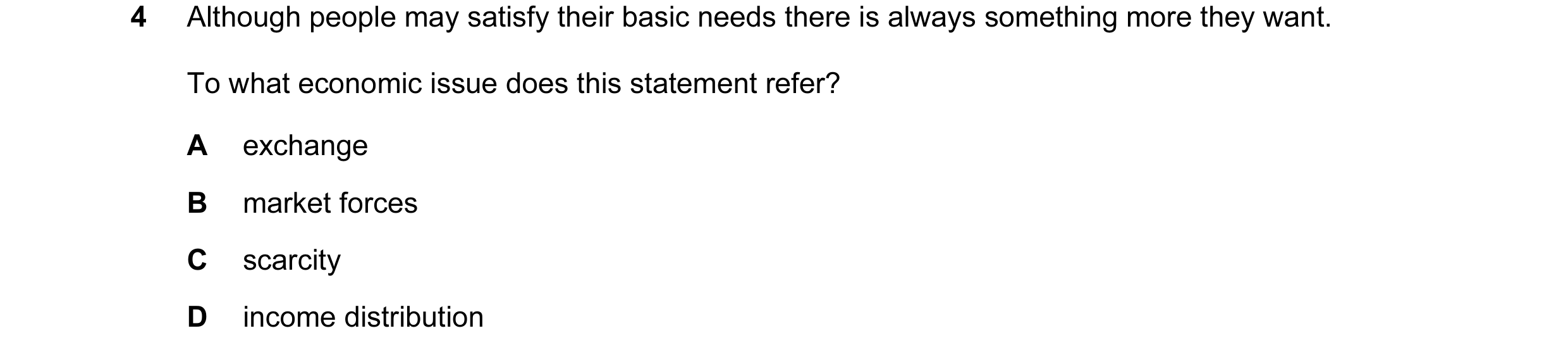
4 Although people may satisfy their basic needs there is always something more they want. To what economic issue does this statement refer? A exchange B market forces C scarcity D income distribution
1 marks
Answer: C
This question in 0455/11 May/June 2006
Q2 · A hospital cannot treat all the people that need treatment 0455/11 Oct/Nov 2006
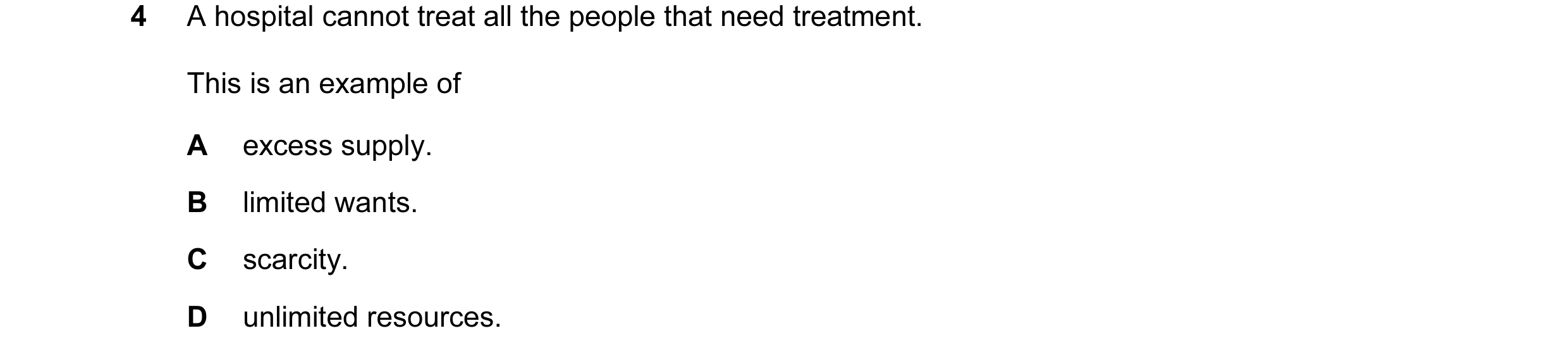
4 A hospital cannot treat all the people that need treatment. This is an example of A excess supply. B limited wants. C scarcity. D unlimited resources.
1 marks
Answer: C
This question in 0455/11 Oct/Nov 2006
Q3 · What is the basic economic problem facing all societies? 0455/11 May/June 2009
1 What is the basic economic problem facing all societies? A how to achieve price stability B how to keep employment levels high C the extent to which incomes should be redistributed D what will be produced, how and for whom
1 marks
Answer: D
This question in 0455/11 May/June 2009
Q4 · Which terms summarise the nature of the economic problem? 0455/11 May/June 2010
1 Which terms summarise the nature of the economic problem? A finite resources and limited wants B finite resources and unlimited wants C infinite resources and limited wants D infinite resources and unlimited wants
1 marks
Answer: B
This question in 0455/11 May/June 2010
Q5 · Which economic change would increase the problem of scarcity? 0455/11 May/June 2010
3 Which economic change would increase the problem of scarcity? A a decrease in fish stocks B a discovery of a new oil field C an increase in labour productivity D a reduction in waste
1 marks
Answer: A
This question in 0455/11 May/June 2010
Q6 · Which terms summarise the nature of the economic problem? 0455/12 May/June 2010
2 Which terms summarise the nature of the economic problem? A finite resources and limited wants B finite resources and unlimited wants C infinite resources and limited wants D infinite resources and unlimited wants
1 marks
Answer: B
This question in 0455/12 May/June 2010
Q7 · Which economic change would increase the problem of scarcity? 0455/12 May/June 2010
4 Which economic change would increase the problem of scarcity? A a decrease in fish stocks B a discovery of a new oil field C an increase in labour productivity D a reduction in waste
1 marks
Answer: A
This question in 0455/12 May/June 2010
Q8 · What makes choice an important element in the basic economic problem? 0455/11 Oct/Nov 2010
1 What makes choice an important element in the basic economic problem? A Increased demand leads to higher market prices. B Limited resources have many alternative uses. C Reaching a market equilibrium may take a long time. D Scarce economic resources are distributed equally.
1 marks
Answer: B
This question in 0455/11 Oct/Nov 2010
Q9 · What makes choice an important element in the basic economic problem? 0455/12 Oct/Nov 2010
2 What makes choice an important element in the basic economic problem? A Increased demand leads to higher market prices. B Limited resources have many alternative uses. C Reaching a market equilibrium may take a long time. D Scarce economic resources are distributed equally.
1 marks
Answer: B
This question in 0455/12 Oct/Nov 2010
Q10 · What makes choice an important element in the basic economic problem? 0455/13 Oct/Nov 2010
3 What makes choice an important element in the basic economic problem? A Increased demand leads to higher market prices. B Limited resources have many alternative uses. C Reaching a market equilibrium may take a long time. D Scarce economic resources are distributed equally.
1 marks
Answer: B
This question in 0455/13 Oct/Nov 2010
Q11 · What is meant by the economic problem? 0455/11 May/June 2011
1 What is meant by the economic problem? A how to achieve efficiency with the existence of fixed resources and limited wants B how to allocate resources between public and private sectors C how to balance unlimited wants against finite resources D how to decide which methods to use to exploit all resources
1 marks
Answer: C
This question in 0455/11 May/June 2011
Q12 · What is meant by the economic problem? 0455/12 May/June 2011
4 What is meant by the economic problem? A how to achieve efficiency with the existence of fixed resources and limited wants B how to allocate resources between public and private sectors C how to balance unlimited wants against finite resources D how to decide which methods to use to exploit all resources
1 marks
Answer: C
This question in 0455/12 May/June 2011
Q13 · What is meant by the economic problem? 0455/13 May/June 2011
4 What is meant by the economic problem? A how to achieve efficiency with the existence of fixed resources and limited wants B how to allocate resources between public and private sectors C how to balance unlimited wants against finite resources D how to decide which methods to use to exploit all resources
1 marks
Answer: C
This question in 0455/13 May/June 2011
Q14 · Every business organisation faces the problem of satisfying wants 0455/11 Oct/Nov 2011
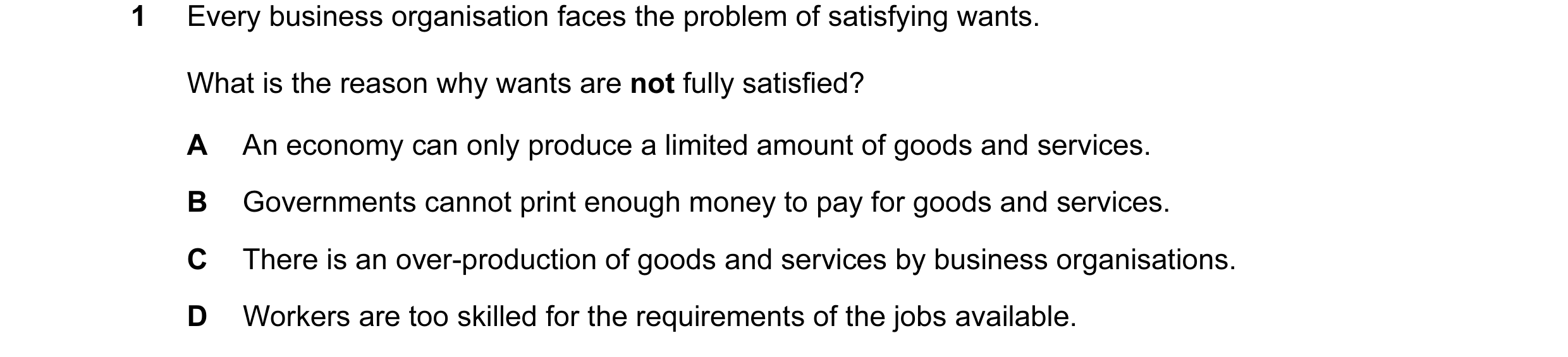
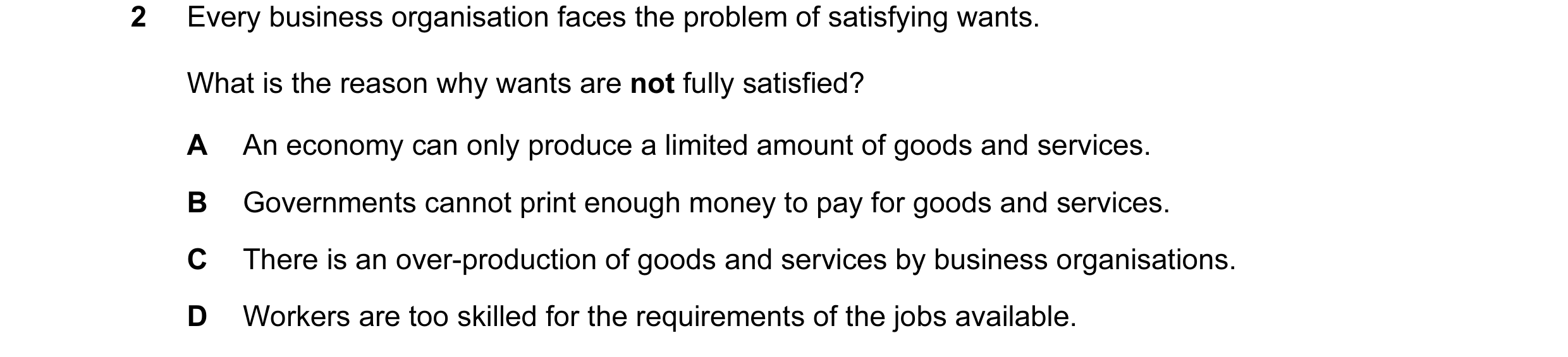
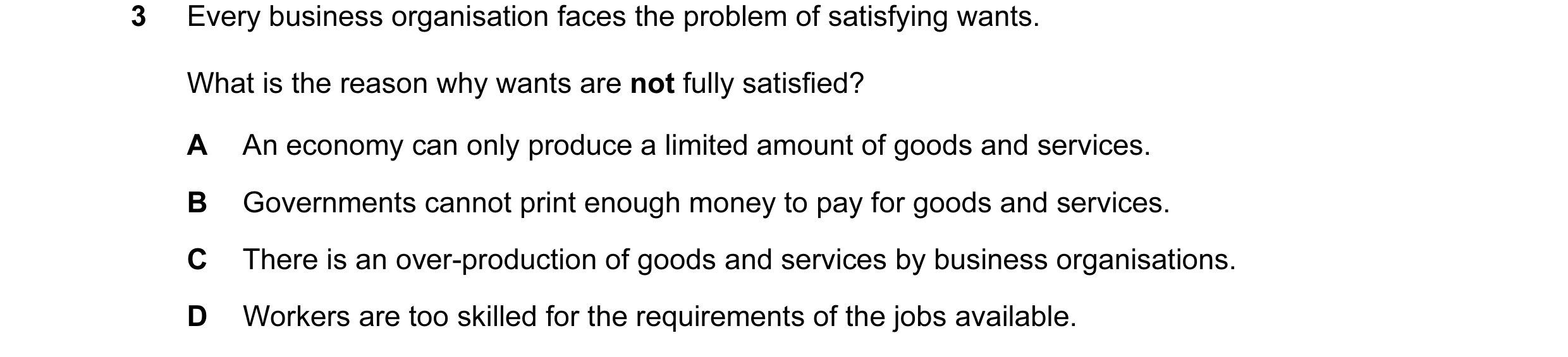
1 Every business organisation faces the problem of satisfying wants. What is the reason why wants are not fully satisfied? A An economy can only produce a limited amount of goods and services. B Governments cannot print enough money to pay for goods and services. C There is an over-production of goods and services by business organisations. D Workers are too skilled for the requirements of the jobs available.
1 marks
Answer: A
This question in 0455/11 Oct/Nov 2011
Q15 · A university rejects 2000 qualified applicants who wish to study there 0455/11 Oct/Nov 2011
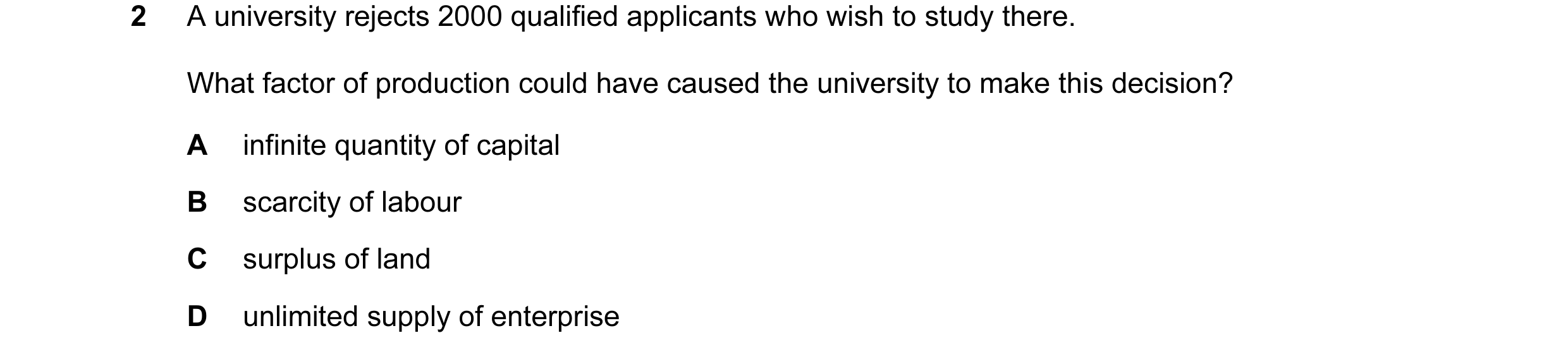
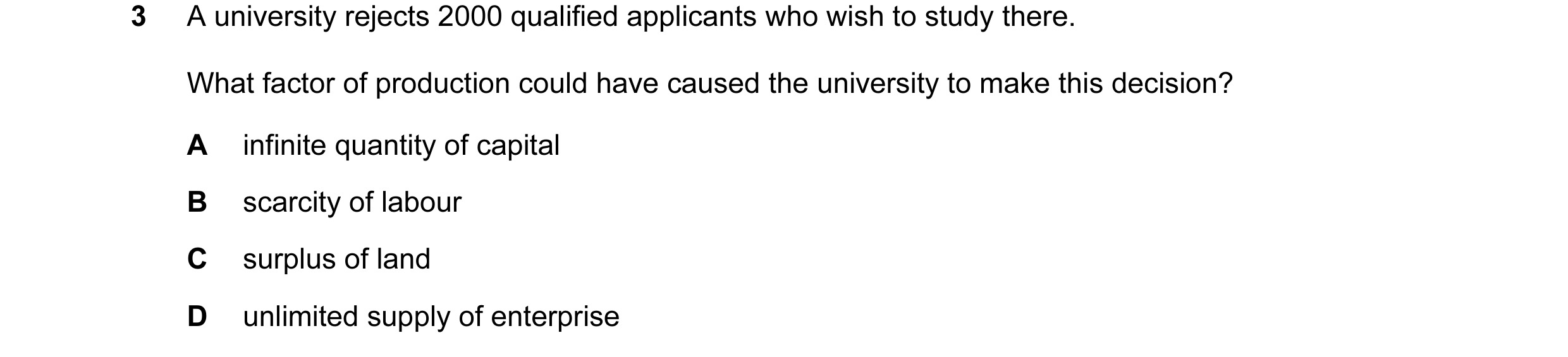
2 A university rejects 2000 qualified applicants who wish to study there. What factor of production could have caused the university to make this decision? A infinite quantity of capital B scarcity of labour C surplus of land D unlimited supply of enterprise
1 marks
Answer: B
This question in 0455/11 Oct/Nov 2011
Q16 · Every business organisation faces the problem of satisfying wants 0455/12 Oct/Nov 2011
2 Every business organisation faces the problem of satisfying wants. What is the reason why wants are not fully satisfied? A An economy can only produce a limited amount of goods and services. B Governments cannot print enough money to pay for goods and services. C There is an over-production of goods and services by business organisations. D Workers are too skilled for the requirements of the jobs available.
1 marks
Answer: A
This question in 0455/12 Oct/Nov 2011
Q17 · A university rejects 2000 qualified applicants who wish to study there 0455/12 Oct/Nov 2011
3 A university rejects 2000 qualified applicants who wish to study there. What factor of production could have caused the university to make this decision? A infinite quantity of capital B scarcity of labour C surplus of land D unlimited supply of enterprise
1 marks
Answer: B
This question in 0455/12 Oct/Nov 2011
Q18 · A university rejects 2000 qualified applicants who wish to study there 0455/13 Oct/Nov 2011
1 A university rejects 2000 qualified applicants who wish to study there. What factor of production could have caused the university to make this decision? A infinite quantity of capital B scarcity of labour C surplus of land D unlimited supply of enterprise
1 marks
Answer: B
This question in 0455/13 Oct/Nov 2011
Q19 · Every business organisation faces the problem of satisfying wants 0455/13 Oct/Nov 2011
3 Every business organisation faces the problem of satisfying wants. What is the reason why wants are not fully satisfied? A An economy can only produce a limited amount of goods and services. B Governments cannot print enough money to pay for goods and services. C There is an over-production of goods and services by business organisations. D Workers are too skilled for the requirements of the jobs available.
1 marks
Answer: A
This question in 0455/13 Oct/Nov 2011
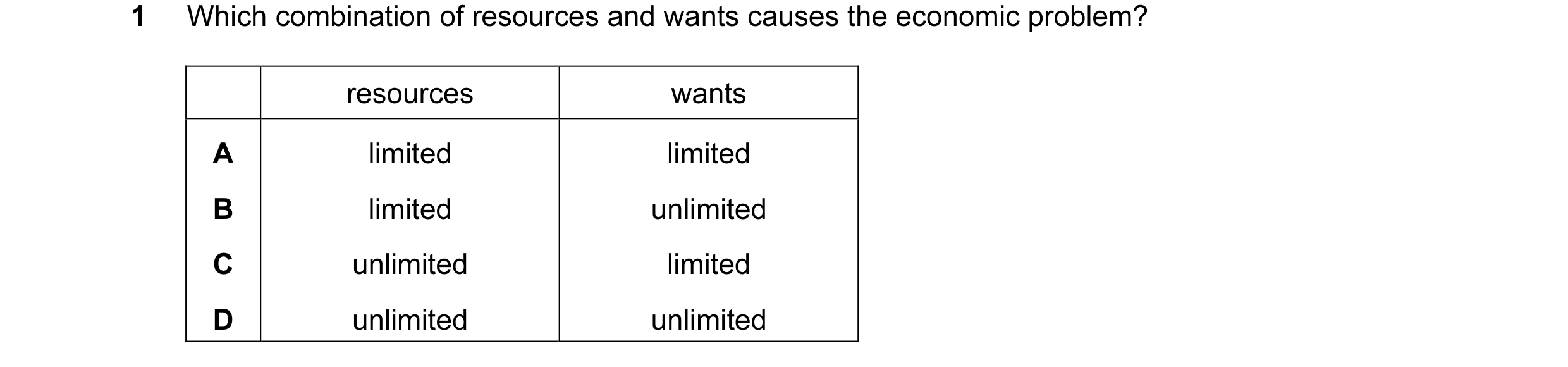
Q20 · Which combination of resources and wants causes the economic problem? 0455/11 May/June 2012
1 Which combination of resources and wants causes the economic problem? resources wants A limited limited B limited unlimited C unlimited limited D unlimited unlimited
1 marks
Answer: B
This question in 0455/11 May/June 2012
Q21 · Economics is primarily concerned with A allocating scarce resources for unlimited wants 0455/12 May/June 2012
1 Economics is primarily concerned with A allocating scarce resources for unlimited wants. B controlling unemployment and inflation. C determining the level of government expenditure. D studying how new wants and economic resources can be produced.
1 marks
Answer: A
This question in 0455/12 May/June 2012
Q22 · Economics is primarily concerned with A allocating scarce resources for unlimited wants 0455/13 May/June 2012
1 Economics is primarily concerned with A allocating scarce resources for unlimited wants. B controlling unemployment and inflation. C determining the level of government expenditure. D studying how new wants and economic resources can be produced.
1 marks
Answer: A
This question in 0455/13 May/June 2012
Q23 · A country with a low income per head discovers large quantities of oil, which eventually… 0455/11 Oct/Nov 2012
12 A country with a low income per head discovers large quantities of oil, which eventually makes everybody better off. Why is the basic economic problem of scarcity not solved by this discovery? A People may not get jobs in the oil industry. B People’s wants are always changing and increasing. C Prices of oil can fluctuate on the world market. D Production of oil can damage the environment.
1 marks
Answer: B
This question in 0455/11 Oct/Nov 2012
Q24 · A country with a low income per head discovers large quantities of oil, which eventually… 0455/12 Oct/Nov 2012
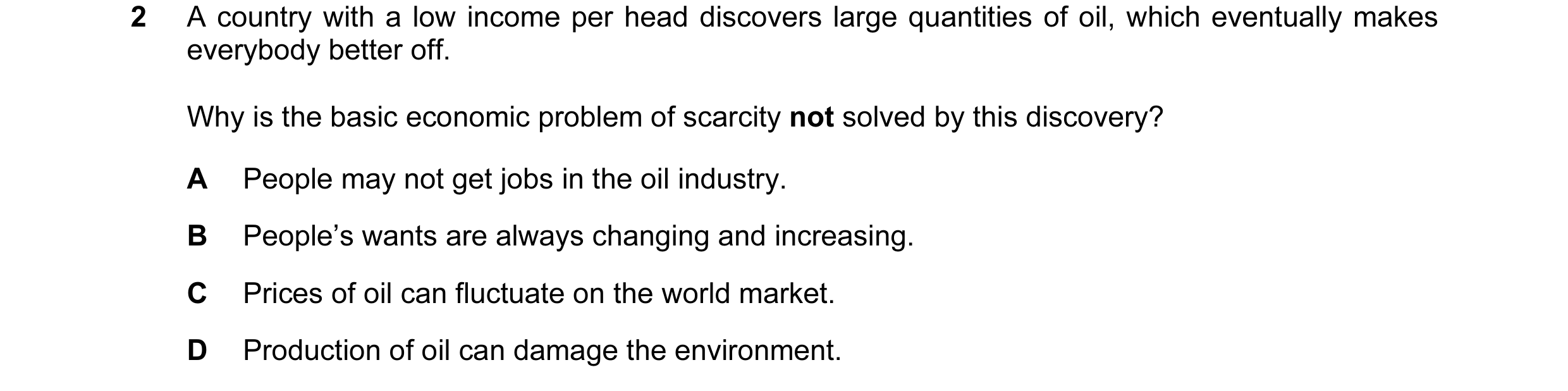
2 A country with a low income per head discovers large quantities of oil, which eventually makes everybody better off. Why is the basic economic problem of scarcity not solved by this discovery? A People may not get jobs in the oil industry. B People’s wants are always changing and increasing. C Prices of oil can fluctuate on the world market. D Production of oil can damage the environment.
1 marks
Answer: B
This question in 0455/12 Oct/Nov 2012
Q25 · A tractor factory runs out of important components and has to stop production 0455/11 May/June 2013
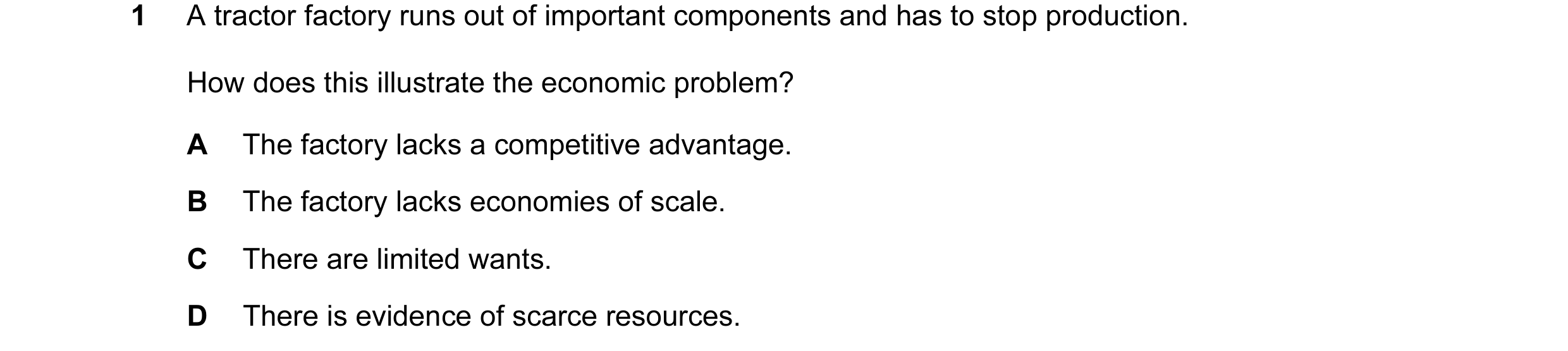
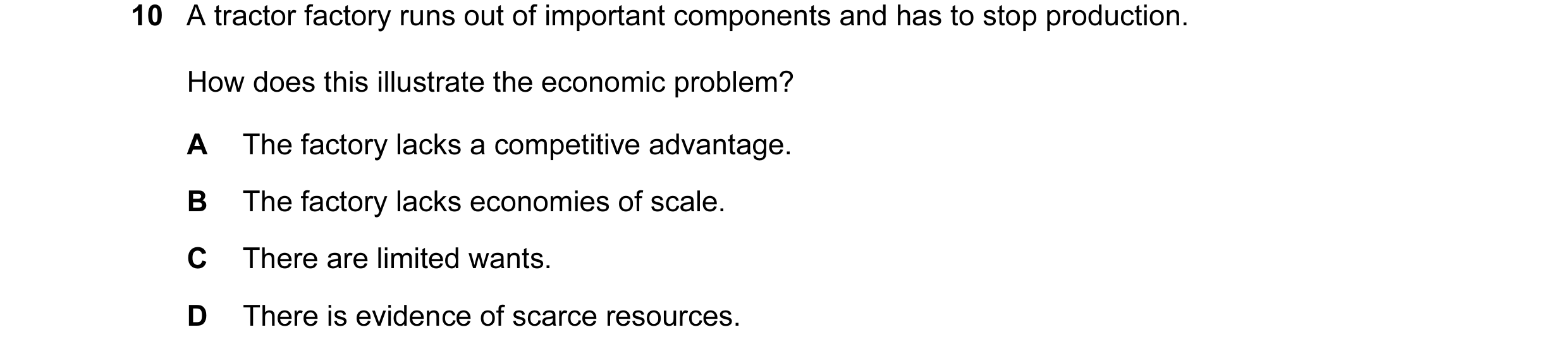
1 A tractor factory runs out of important components and has to stop production. How does this illustrate the economic problem? A The factory lacks a competitive advantage. B The factory lacks economies of scale. C There are limited wants. D There is evidence of scarce resources.
1 marks
Answer: D
This question in 0455/11 May/June 2013
Q26 · Why will the economic problem never be solved? 0455/12 May/June 2013
1 Why will the economic problem never be solved? A People will always want more products than can be produced. B People will never agree on what is the best economic system. C There will always be an uneven distribution of income. D There will always be some people unemployed.
1 marks
Answer: A
This question in 0455/12 May/June 2013
Q27 · A tractor factory runs out of important components and has to stop production 0455/13 May/June 2013
10 A tractor factory runs out of important components and has to stop production. How does this illustrate the economic problem? A The factory lacks a competitive advantage. B The factory lacks economies of scale. C There are limited wants. D There is evidence of scarce resources.
1 marks
Answer: D
This question in 0455/13 May/June 2013
Q28 · How does a production possibility curve show that scarcity exists? 0455/11 Oct/Nov 2013
11 How does a production possibility curve show that scarcity exists? A It shows that a rise in demand for one of the products increases its price. B It shows that as more resources are used to produce a product, its price rises. C It shows that at any point outside the production possibility curve an economy is wasting resources. D It shows that there is a limit to the quantity of products that can be produced with existing resources and technology.
1 marks
Answer: D
This question in 0455/11 Oct/Nov 2013
Q29 · How does a production possibility curve show that scarcity exists? 0455/12 Oct/Nov 2013
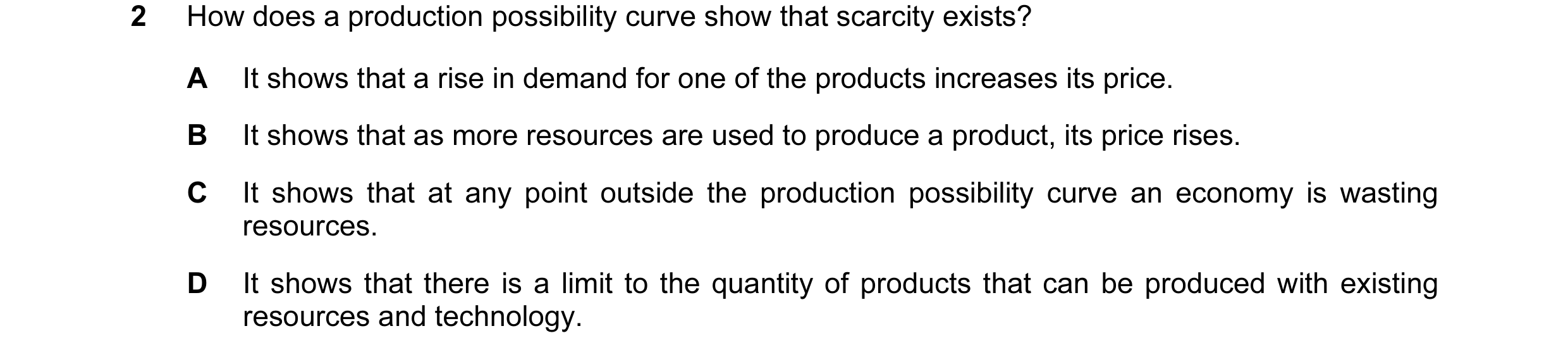
2 How does a production possibility curve show that scarcity exists? A It shows that a rise in demand for one of the products increases its price. B It shows that as more resources are used to produce a product, its price rises. C It shows that at any point outside the production possibility curve an economy is wasting resources. D It shows that there is a limit to the quantity of products that can be produced with existing resources and technology.
1 marks
Answer: D
This question in 0455/12 Oct/Nov 2013
Q30 · What is the cause of economic scarcity? 0455/12 May/June 2014
1 What is the cause of economic scarcity? A limited wants with limited resources B limited wants with unlimited resources C unlimited wants with limited resources D unlimited wants with unlimited resources
1 marks
Answer: C
This question in 0455/12 May/June 2014
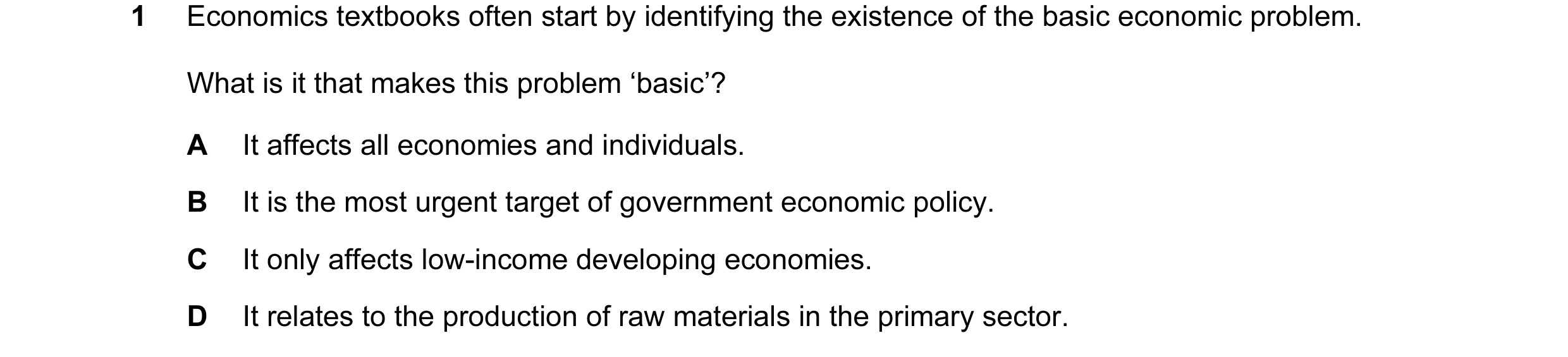
Q31 · Economics textbooks often start by identifying the existence of the basic economic problem 0455/11 Oct/Nov 2014
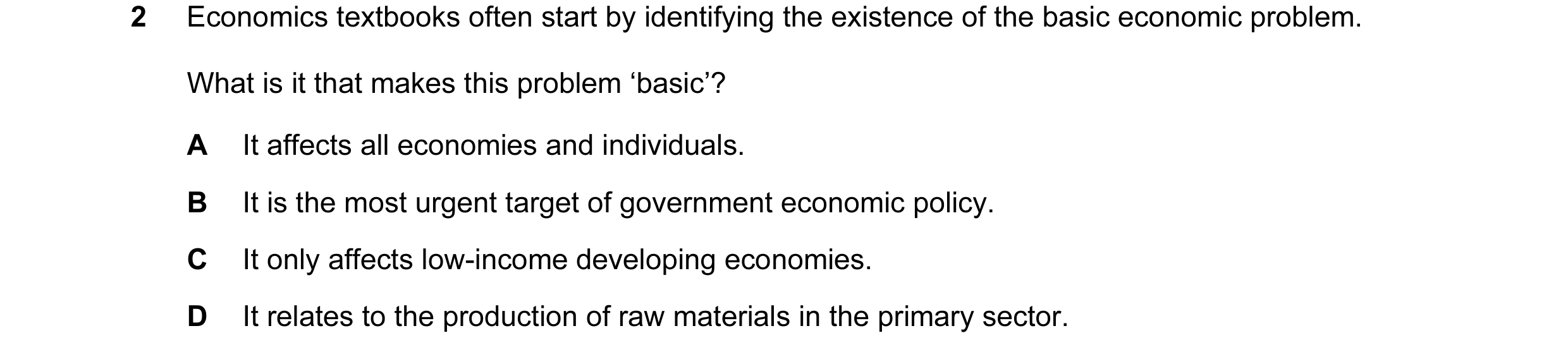
2 Economics textbooks often start by identifying the existence of the basic economic problem. What is it that makes this problem ‘basic’? A It affects all economies and individuals. B It is the most urgent target of government economic policy. C It only affects low-income developing economies. D It relates to the production of raw materials in the primary sector.
1 marks
Answer: A
This question in 0455/11 Oct/Nov 2014
Q32 · Economics textbooks often start by identifying the existence of the basic economic problem 0455/12 Oct/Nov 2014
1 Economics textbooks often start by identifying the existence of the basic economic problem. What is it that makes this problem ‘basic’? A It affects all economies and individuals. B It is the most urgent target of government economic policy. C It only affects low-income developing economies. D It relates to the production of raw materials in the primary sector.
1 marks
Answer: A
This question in 0455/12 Oct/Nov 2014
Q33 · To help reduce the price of oil, new supplies are needed 0455/11 May/June 2015
2 To help reduce the price of oil, new supplies are needed. However, in 2013, objectors opposed attempts to explore new sites because of the environmental damage the exploration might cause. How does this illustrate the basic economic problem? A Oil is a limited resource. B Oil is expensive. C The exploration involves demand and supply. D There are external costs involved in production.
1 marks
Answer: A
This question in 0455/11 May/June 2015
Q34 · What is the basic economic problem? 0455/12 May/June 2015
1 What is the basic economic problem? A finite resources and limited wants B finite resources and unlimited wants C infinite resources and limited wants D infinite resources and unlimited wants
1 marks
Answer: B
This question in 0455/12 May/June 2015
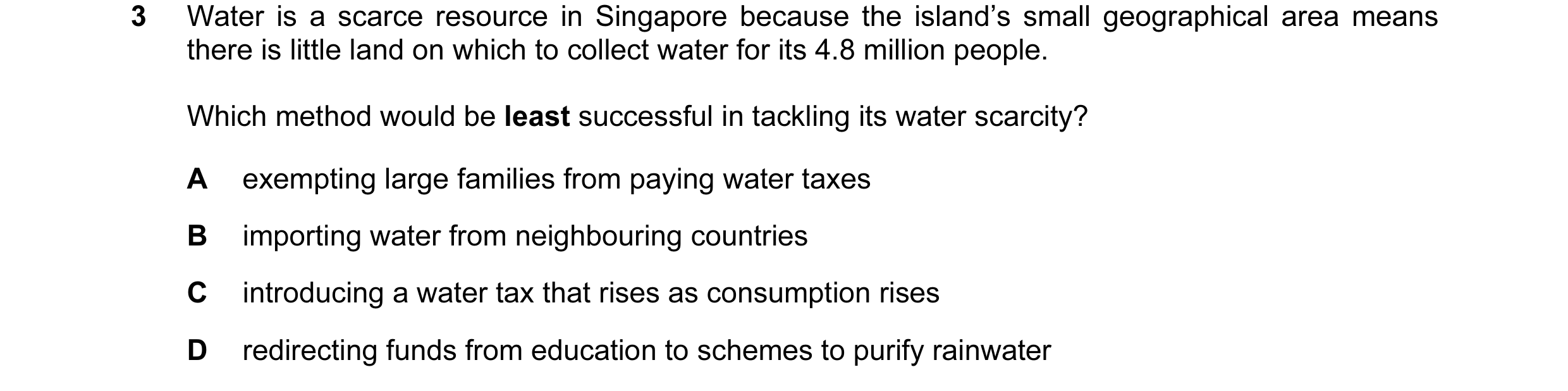
Q35 · Water is a scarce resource in Singapore because the island’s small geographical area… 0455/13 May/June 2015
3 Water is a scarce resource in Singapore because the island’s small geographical area means there is little land on which to collect water for its 4.8 million people. Which method would be least successful in tackling its water scarcity? A exempting large families from paying water taxes B importing water from neighbouring countries C introducing a water tax that rises as consumption rises D redirecting funds from education to schemes to purify rainwater
1 marks
Answer: A
This question in 0455/13 May/June 2015
Q36 · Why is choice an important part of the basic economic problem? 0455/11 Oct/Nov 2015
2 Why is choice an important part of the basic economic problem? A Choice is necessary to achieve an equilibrium price. B Limited resources have many uses. C Manufacturers produce a large variety of foods. D The market leads to an unequal distribution of goods.
1 marks
Answer: B
This question in 0455/11 Oct/Nov 2015
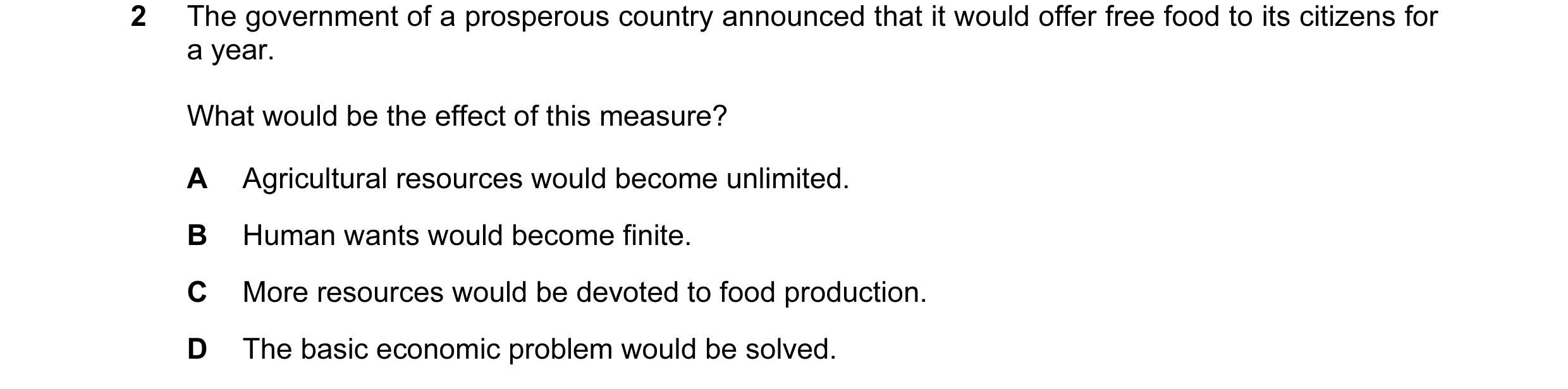
Q37 · The government of a prosperous country announced that it would offer free food to its… 0455/12 Oct/Nov 2015
2 The government of a prosperous country announced that it would offer free food to its citizens for a year. What would be the effect of this measure? A Agricultural resources would become unlimited. B Human wants would become finite. C More resources would be devoted to food production. D The basic economic problem would be solved.
1 marks
Answer: C
This question in 0455/12 Oct/Nov 2015
Q38 · What is the best example of the existence of the economic problem? 0455/12 May/June 2016
3 What is the best example of the existence of the economic problem? A A government provides accommodation for all those who are homeless. B A police force has a lengthening list of unsolved crimes. C Janitha hands her homework in at the last permitted deadline. D Musa completes his journey without putting petrol in his car.
1 marks
Answer: B
This question in 0455/12 May/June 2016
Q39 · Which combination of terms gives the general definition of the economic problem? 0455/11 May/June 2017
1 Which combination of terms gives the general definition of the economic problem? A bigger families, less food, starvation B falling supply, rising demand, shortage C higher population, fewer jobs, unemployment D limited resources, unlimited wants, scarcity
1 marks
Answer: D
This question in 0455/11 May/June 2017
Q40 · What is the cause of the economic problem facing all countries? 0455/11 May/June 2018
3 What is the cause of the economic problem facing all countries? A climate change and global warming B significant quantities of unemployed resources C uneven distribution of income and wealth D unlimited wants in relation to limited resources
1 marks
Answer: D
This question in 0455/11 May/June 2018
Q41 · In economics, natural sunlight is classified as a free good 0455/12 May/June 2018
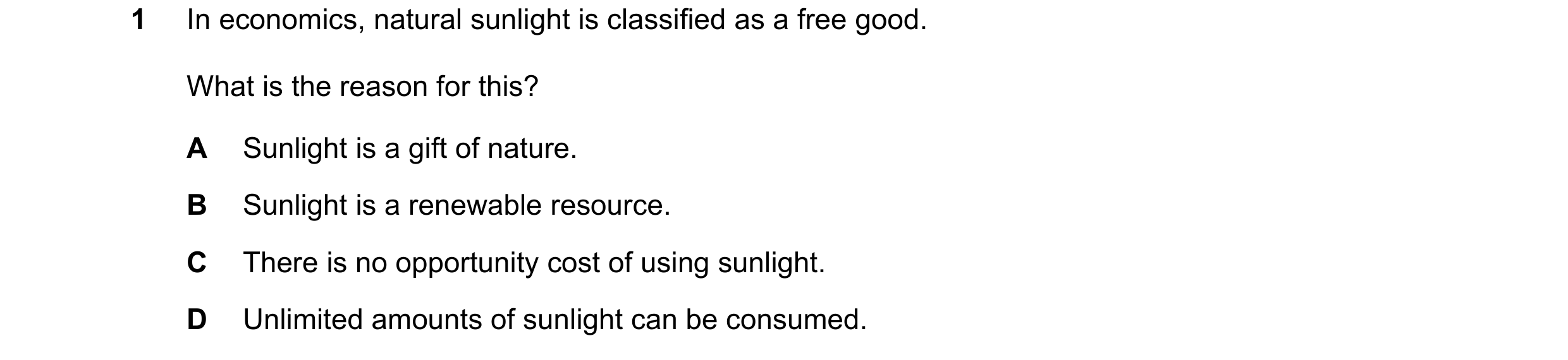
1 In economics, natural sunlight is classified as a free good. What is the reason for this? A Sunlight is a gift of nature. B Sunlight is a renewable resource. C There is no opportunity cost of using sunlight. D Unlimited amounts of sunlight can be consumed.
1 marks
Answer: C
This question in 0455/12 May/June 2018
Q42 · Economics textbooks identify the existence of scarcity as the basic economic problem 0455/13 May/June 2018
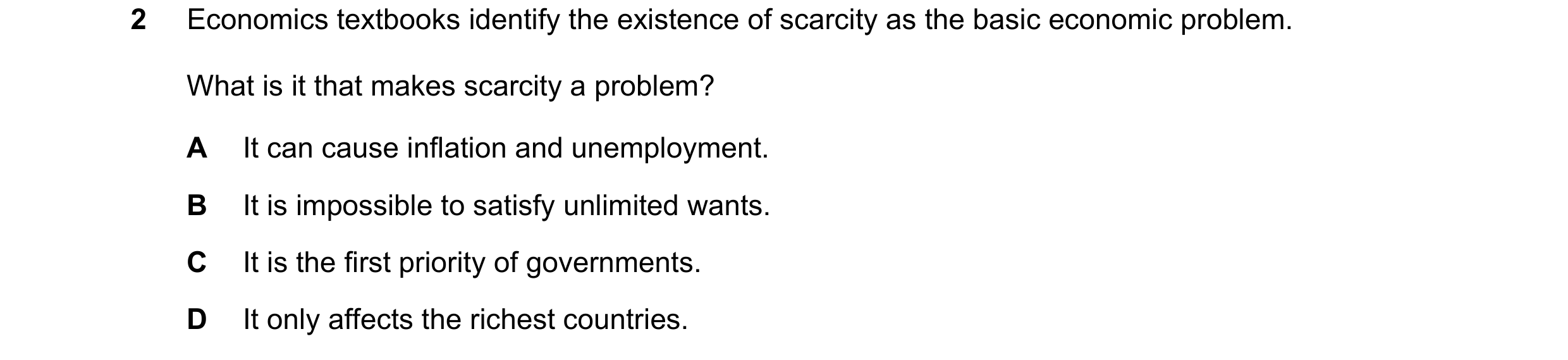
2 Economics textbooks identify the existence of scarcity as the basic economic problem. What is it that makes scarcity a problem? A It can cause inflation and unemployment. B It is impossible to satisfy unlimited wants. C It is the first priority of governments. D It only affects the richest countries.
1 marks
Answer: B
This question in 0455/13 May/June 2018
Q43 · What is the basic problem facing all economies? 0455/11 Oct/Nov 2018
2 What is the basic problem facing all economies? A how to achieve a stable balance of payments B how to maximise tax revenues C how to reach full employment D how to use scarce resources
1 marks
Answer: D
This question in 0455/11 Oct/Nov 2018
Q44 · What do economies aim to achieve in tackling the economic problem of scarcity? 0455/12 Oct/Nov 2018
2 What do economies aim to achieve in tackling the economic problem of scarcity? A equal balance between public and private sectors B equal reward for equal effort C increased competition in the use of resources D optimum allocation of finite resources
1 marks
Answer: D
This question in 0455/12 Oct/Nov 2018
Q45 · Hospital services are provided by the government and paid for through taxation 0455/13 Oct/Nov 2018
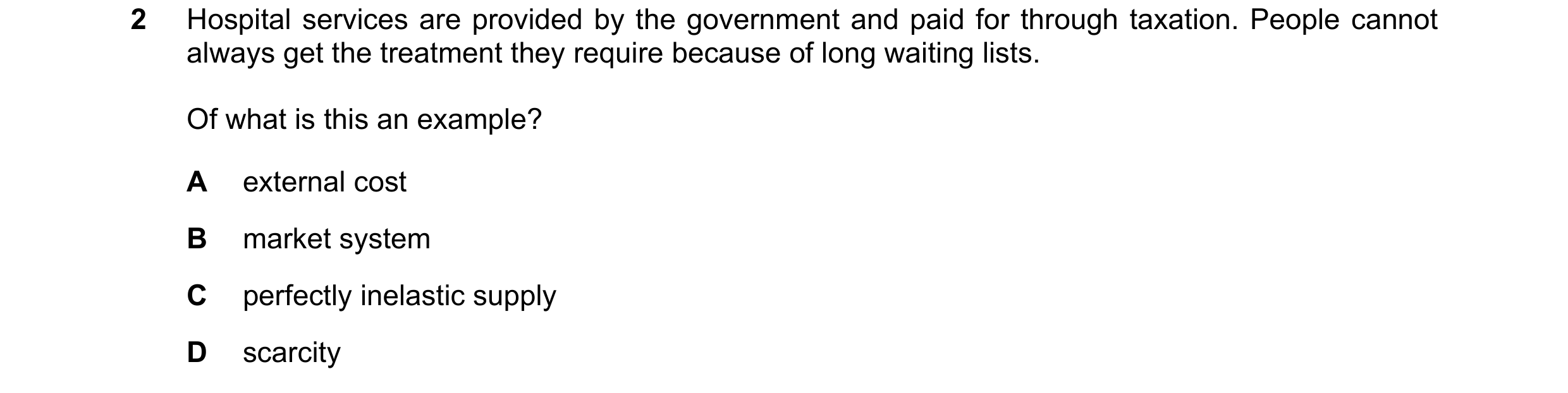
2 Hospital services are provided by the government and paid for through taxation. People cannot always get the treatment they require because of long waiting lists. Of what is this an example? A external cost B market system C perfectly inelastic supply D scarcity
1 marks
Answer: D
This question in 0455/13 Oct/Nov 2018
Q46 · What identifies a finite resource? 0455/13 Oct/Nov 2019
1 What identifies a finite resource? A The resource does not renew itself. B The supply of the resource is greater than demand. C There is no opportunity cost for the resource. D There is unlimited supply of the resource.
1 marks
Answer: A
This question in 0455/13 Oct/Nov 2019
Q47 · A natural resource was discovered in a country 0455/13 May/June 2020
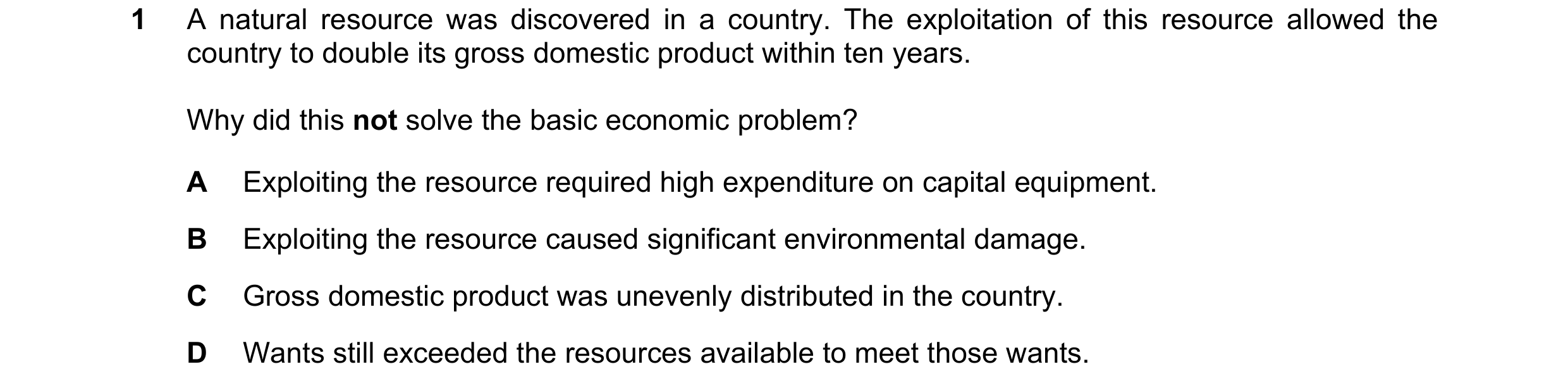
1 A natural resource was discovered in a country. The exploitation of this resource allowed the country to double its gross domestic product within ten years. Why did this not solve the basic economic problem? A Exploiting the resource required high expenditure on capital equipment. B Exploiting the resource caused significant environmental damage. C Gross domestic product was unevenly distributed in the country. D Wants still exceeded the resources available to meet those wants.
1 marks
Answer: D
This question in 0455/13 May/June 2020
Q48 · What is the basic economic problem? 0455/11 Oct/Nov 2020
1 What is the basic economic problem? A excess supply of goods and services B lack of profits C recession D scarcity of resources
1 marks
Answer: D
This question in 0455/11 Oct/Nov 2020
Q49 · What causes economic agents to make choices? 0455/12 Oct/Nov 2020
1 What causes economic agents to make choices? A limited needs and wants B the existence of finite resources C the existence of free goods D the market mechanism
1 marks
Answer: B
This question in 0455/12 Oct/Nov 2020
Q50 · Why do consumers have to make choices when spending their income? 0455/13 Oct/Nov 2020
1 Why do consumers have to make choices when spending their income? A Advertising encourages consumer spending. B Consumers have unlimited incomes. C Consumer wants cannot all be satisfied with their income. D Not all products will be attractive to consumers.
1 marks
Answer: C
This question in 0455/13 Oct/Nov 2020
Q51 · To help reduce the price of oil, new supplies are needed 0455/11 Oct/Nov 2021
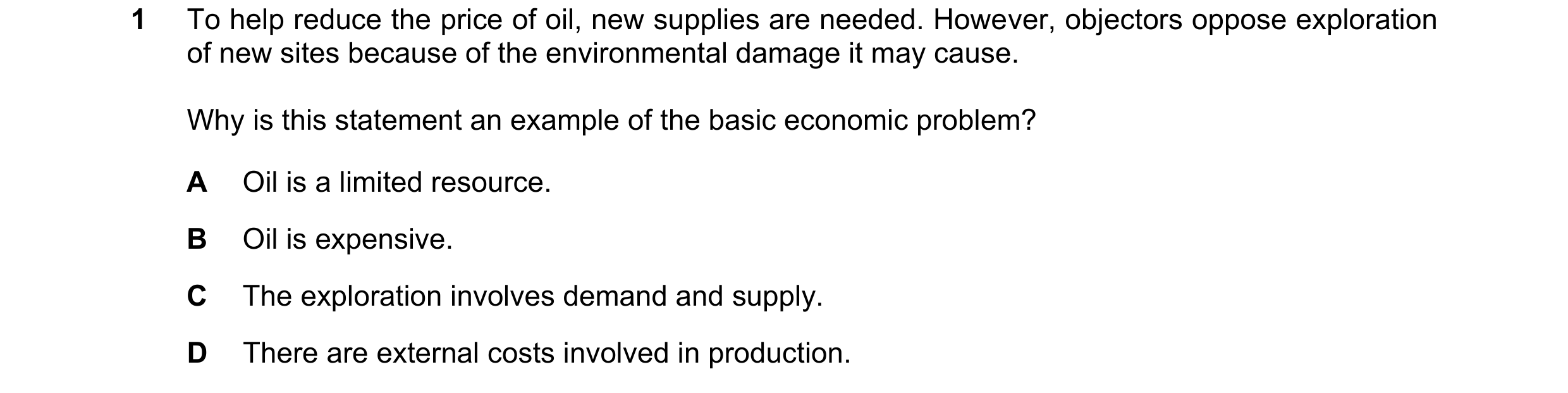
1 To help reduce the price of oil, new supplies are needed. However, objectors oppose exploration of new sites because of the environmental damage it may cause. Why is this statement an example of the basic economic problem? A Oil is a limited resource. B Oil is expensive. C The exploration involves demand and supply. D There are external costs involved in production.
1 marks
Answer: A
This question in 0455/11 Oct/Nov 2021
Q52 · To help reduce the price of oil, new supplies are needed 0455/12 Oct/Nov 2021
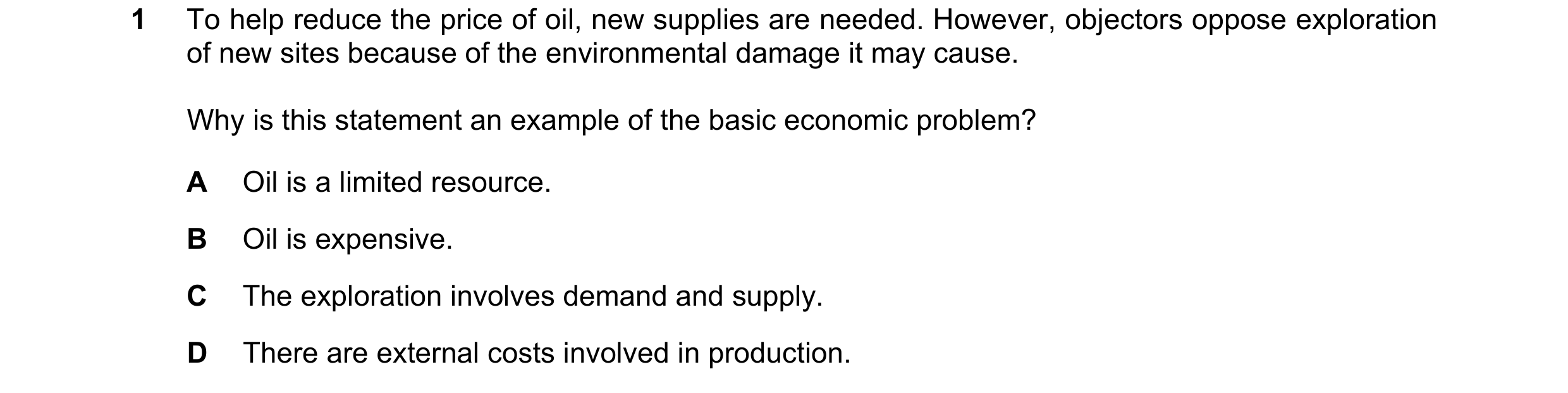
1 To help reduce the price of oil, new supplies are needed. However, objectors oppose exploration of new sites because of the environmental damage it may cause. Why is this statement an example of the basic economic problem? A Oil is a limited resource. B Oil is expensive. C The exploration involves demand and supply. D There are external costs involved in production.
1 marks
Answer: A
This question in 0455/12 Oct/Nov 2021
Q53 · To help reduce the price of oil, new supplies are needed 0455/13 Oct/Nov 2021
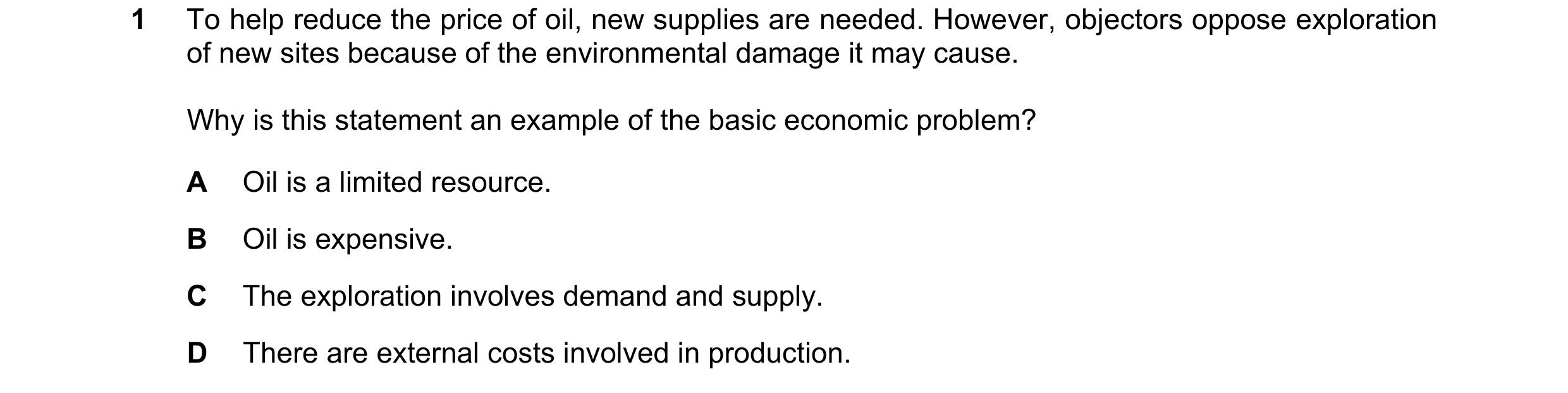
1 To help reduce the price of oil, new supplies are needed. However, objectors oppose exploration of new sites because of the environmental damage it may cause. Why is this statement an example of the basic economic problem? A Oil is a limited resource. B Oil is expensive. C The exploration involves demand and supply. D There are external costs involved in production.
1 marks
Answer: A
This question in 0455/13 Oct/Nov 2021
Q54 · Helium is a gas that is limited in supply because it takes thousands of years to form 0455/13 Oct/Nov 2021
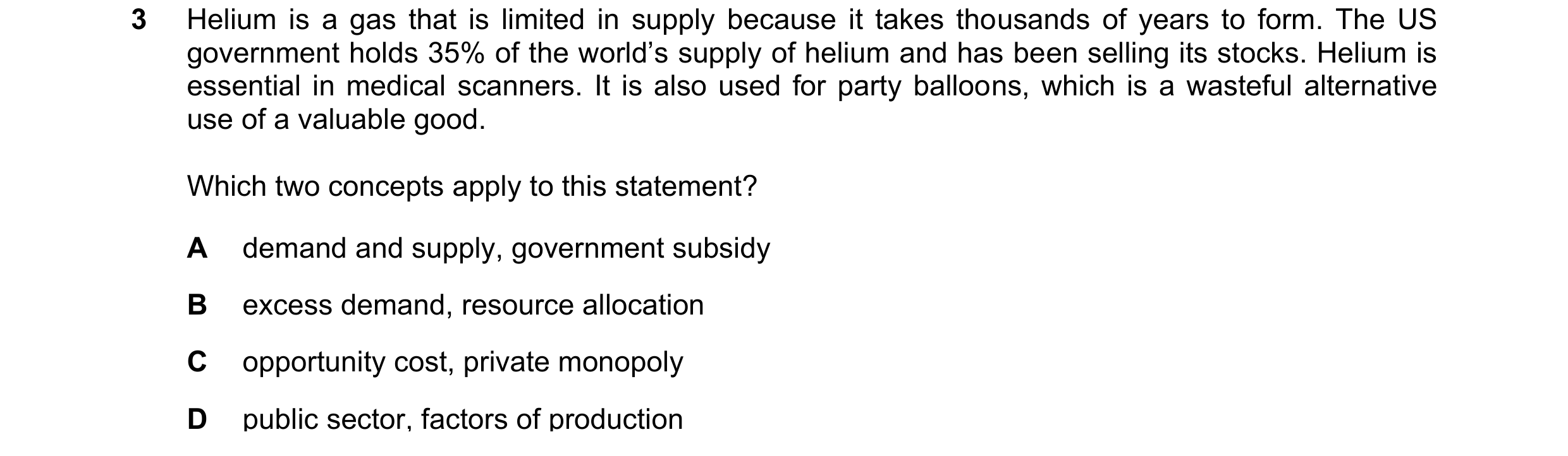
3 Helium is a gas that is limited in supply because it takes thousands of years to form. The US government holds 35% of the world’s supply of helium and has been selling its stocks. Helium is essential in medical scanners. It is also used for party balloons, which is a wasteful alternative use of a valuable good. Which two concepts apply to this statement? A demand and supply, government subsidy B excess demand, resource allocation C opportunity cost, private monopoly D public sector, factors of production
1 marks
Answer: D
This question in 0455/13 Oct/Nov 2021
Q55 · What is an example of a free good? 0455/12 May/June 2022
1 What is an example of a free good? A defence B education C health services D sunshine
1 marks
Answer: D
This question in 0455/12 May/June 2022
Q56 · What is the cause of scarcity in an economy? 0455/11 May/June 2023
1 What is the cause of scarcity in an economy? A high employment levels B high investment levels C unlimited resources D unlimited wants
1 marks
Answer: D
This question in 0455/11 May/June 2023
Q57 · What is part of the economic definition of scarcity? 0455/12 May/June 2023
1 What is part of the economic definition of scarcity? A high levels of taxation B low levels of investment C unequal distribution of income D unlimited consumer wants
1 marks
Answer: D
This question in 0455/12 May/June 2023
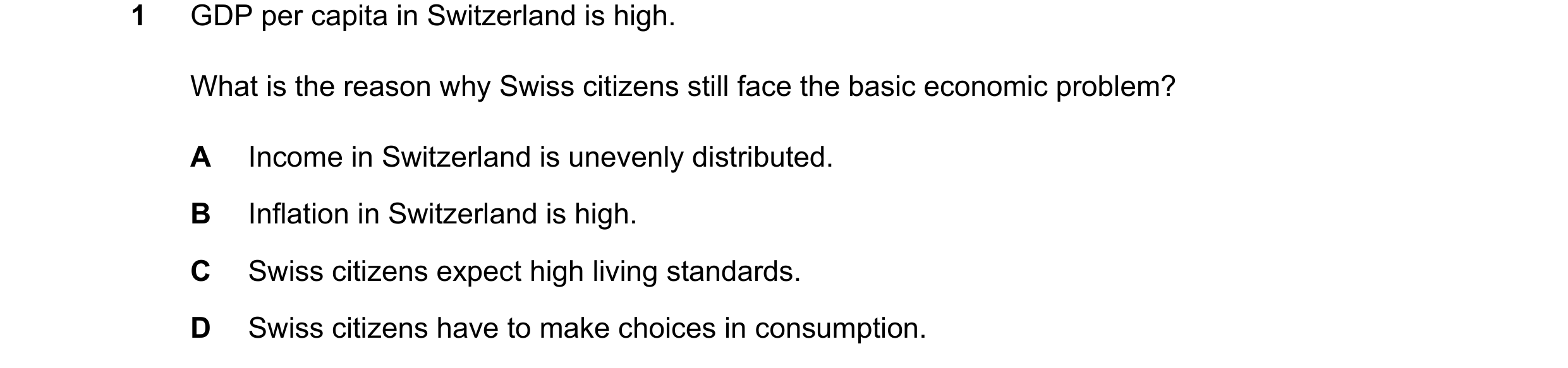
Q58 · GDP per capita in Switzerland is high 0455/13 May/June 2023
1 GDP per capita in Switzerland is high. What is the reason why Swiss citizens still face the basic economic problem? A Income in Switzerland is unevenly distributed. B Inflation in Switzerland is high. C Swiss citizens expect high living standards. D Swiss citizens have to make choices in consumption.
1 marks
Answer: D
This question in 0455/13 May/June 2023
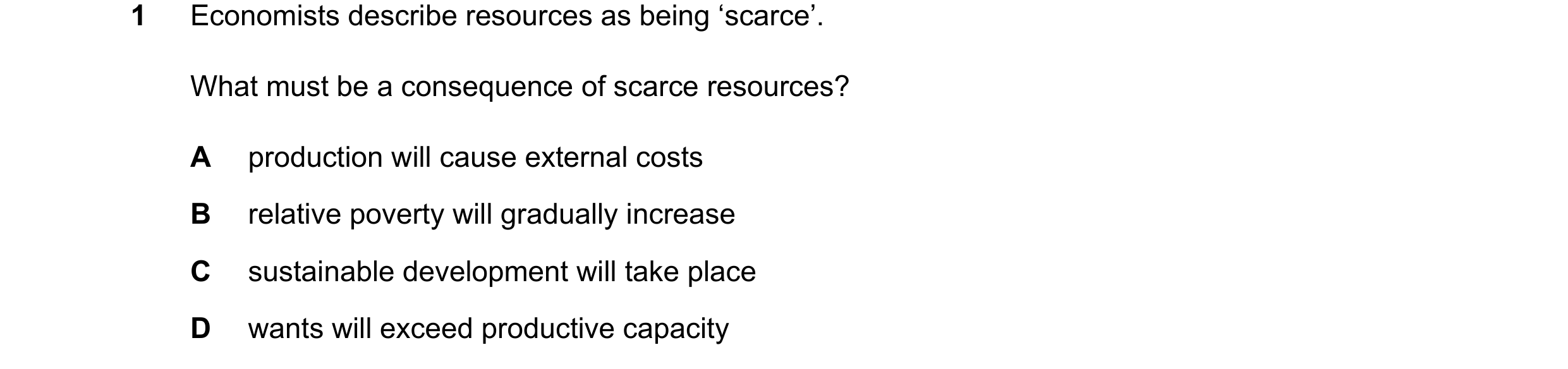
Q59 · Economists describe resources as being ‘scarce’ 0455/11 Oct/Nov 2023
1 Economists describe resources as being ‘scarce’. What must be a consequence of scarce resources? A production will cause external costs B relative poverty will gradually increase C sustainable development will take place D wants will exceed productive capacity
1 marks
Answer: D
This question in 0455/11 Oct/Nov 2023
Q60 · Which statement is correct? 0455/12 Oct/Nov 2023
1 Which statement is correct? A Economic goods are not scarce. B Economic goods have no opportunity cost. C Free goods are scarce. D Free goods have no opportunity cost.
1 marks
Answer: D
This question in 0455/12 Oct/Nov 2023
Q61 · A consumer has $10 to spend 0455/13 Oct/Nov 2023
1 A consumer has $10 to spend. A meal costs $9 and a drink costs $5. What would describe the situation if the consumer did not have enough money to purchase both the meal and the drink? A excess demand B free goods C market failure D the economic problem
1 marks
Answer: D
This question in 0455/13 Oct/Nov 2023
Q62 · What causes economic agents to make choices? 0455/12 Feb/March 2024
1 What causes economic agents to make choices? A limited needs and wants B the existence of finite resources C the existence of free goods D the market mechanism
1 marks
Answer: B
This question in 0455/12 Feb/March 2024
Q63 · Why will scarcity always exist? 0455/12 May/June 2024
1 Why will scarcity always exist? A There are high costs of production. B There are low levels of education. C There are unlimited resources. D There are unlimited wants.
1 marks
Answer: D
This question in 0455/12 May/June 2024
Q64 · How can the economic problem be described? 0455/13 May/June 2024
1 How can the economic problem be described? A as insufficient capital to satisfy our wants B as insufficient income to satisfy all our needs C as insufficient resources to satisfy our unlimited wants D as insufficient wealth to satisfy all our needs
1 marks
Answer: C
This question in 0455/13 May/June 2024
Q65 · What three key questions determine resource allocation? 0455/13 May/June 2024
4 What three key questions determine resource allocation? A what, how, for whom B what, when, for whom C where, what, how D where, how, for whom
1 marks
Answer: A
This question in 0455/13 May/June 2024
Q66 · Which economic question is least likely to arise as a result of scarcity? 0455/12 Oct/Nov 2024
1 Which economic question is least likely to arise as a result of scarcity? A For whom will we produce? B How will we produce? C What will we produce? D When will we produce?
1 marks
Answer: D
This question in 0455/12 Oct/Nov 2024
Q67 · What is the cause of the economic problem facing the global market for gold? 0455/13 Oct/Nov 2024
1 What is the cause of the economic problem facing the global market for gold? A Consumer wants for gold are limited. B Gold is a limited resource. C Only governments can sell gold. D There is an unlimited supply of gold.
1 marks
Answer: B
This question in 0455/13 Oct/Nov 2024
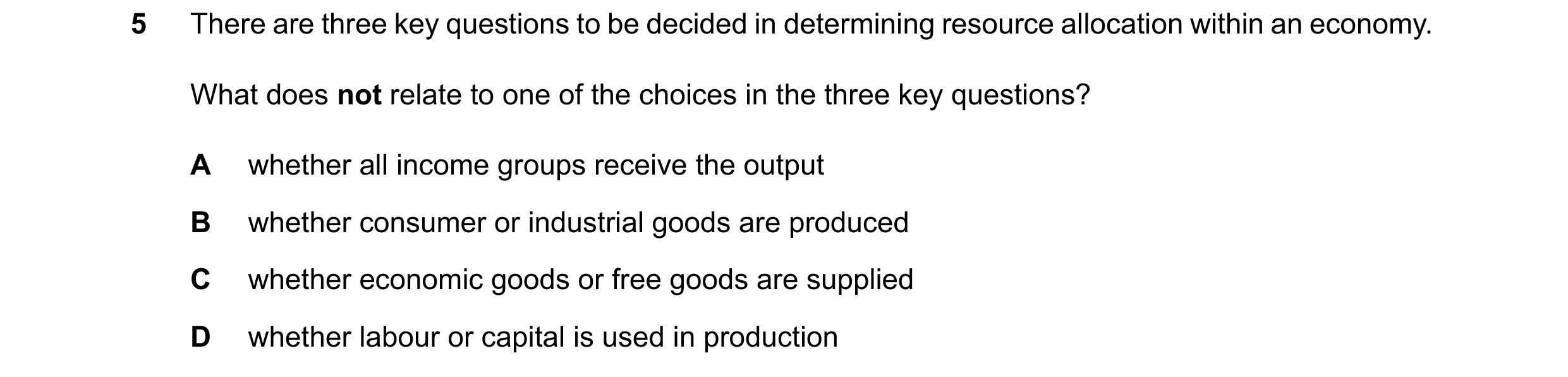
Q68 · There are three key questions to be decided in determining resource allocation within an… 0455/12 Feb/March 2025
5 There are three key questions to be decided in determining resource allocation within an economy. What does not relate to one of the choices in the three key questions? A whether all income groups receive the output B whether consumer or industrial goods are produced C whether economic goods or free goods are supplied D whether labour or capital is used in production
1 marks
Answer: C
This question in 0455/12 Feb/March 2025
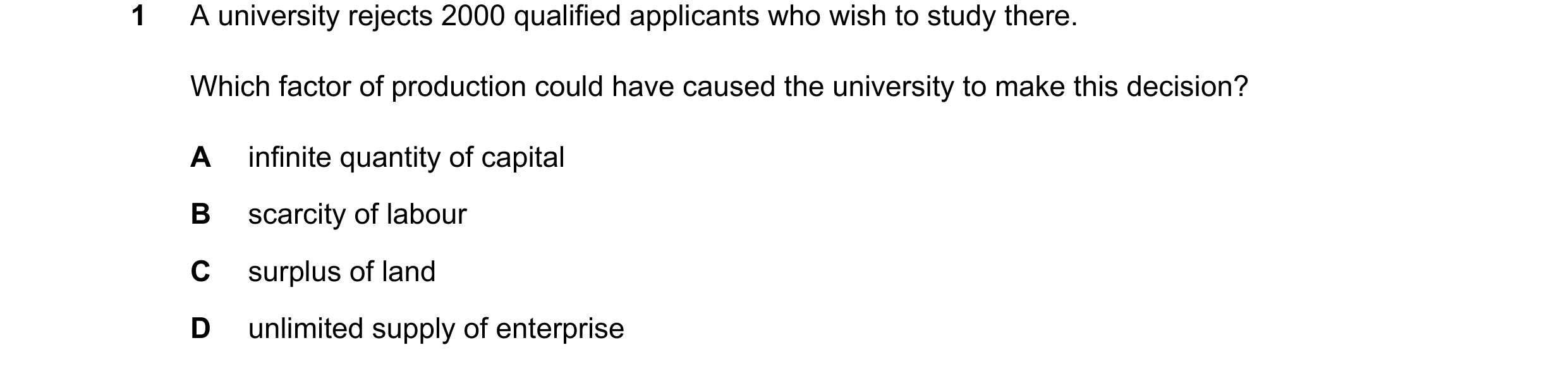
Q69 · A university rejects 2000 qualified applicants who wish to study there 0455/12 May/June 2025
1 A university rejects 2000 qualified applicants who wish to study there. Which factor of production could have caused the university to make this decision? A infinite quantity of capital B scarcity of labour C surplus of land D unlimited supply of enterprise
1 marks
Answer: B
This question in 0455/12 May/June 2025
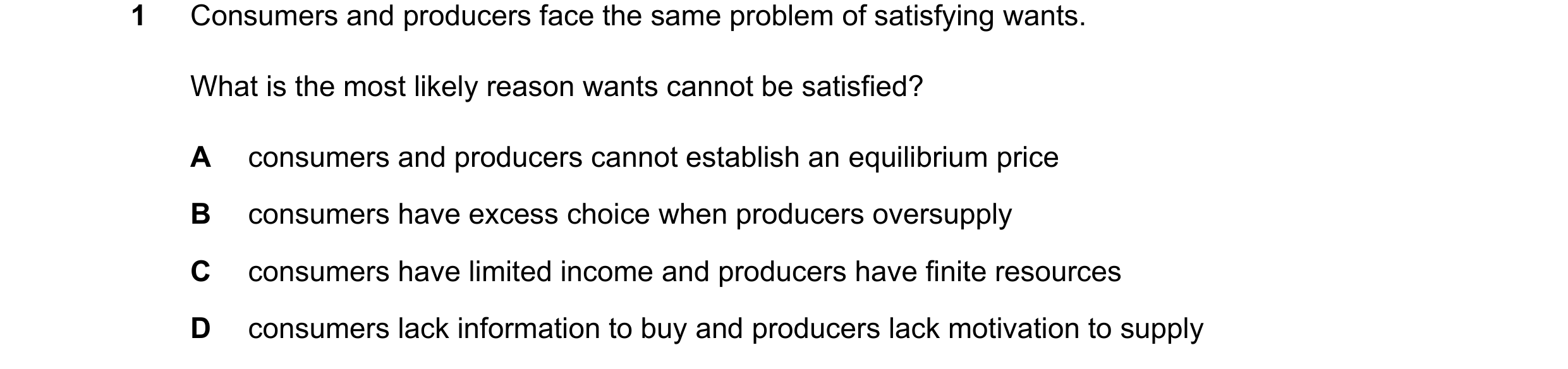
Q70 · Consumers and producers face the same problem of satisfying wants 0455/11 Oct/Nov 2025
1 Consumers and producers face the same problem of satisfying wants. What is the most likely reason wants cannot be satisfied? A consumers and producers cannot establish an equilibrium price B consumers have excess choice when producers oversupply C consumers have limited income and producers have finite resources D consumers lack information to buy and producers lack motivation to supply
1 marks
Answer: C
This question in 0455/11 Oct/Nov 2025



 1 / 13




 2 / 13
 3 / 13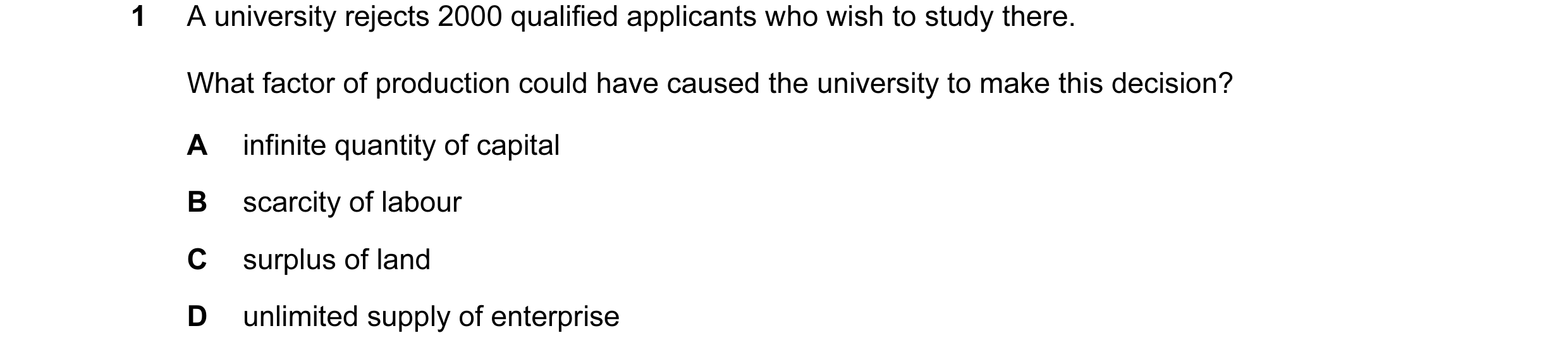

 4 / 13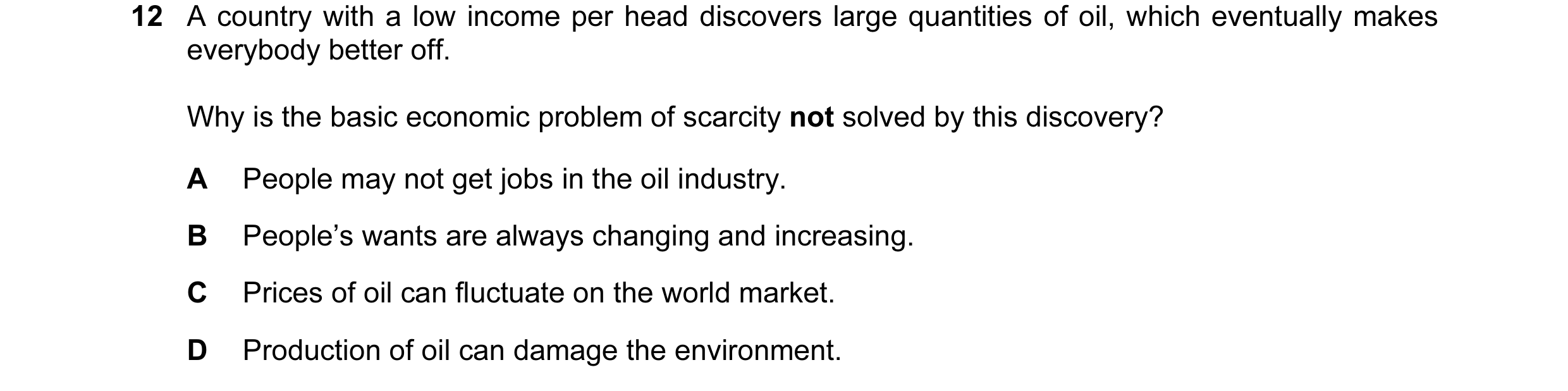

 5 / 13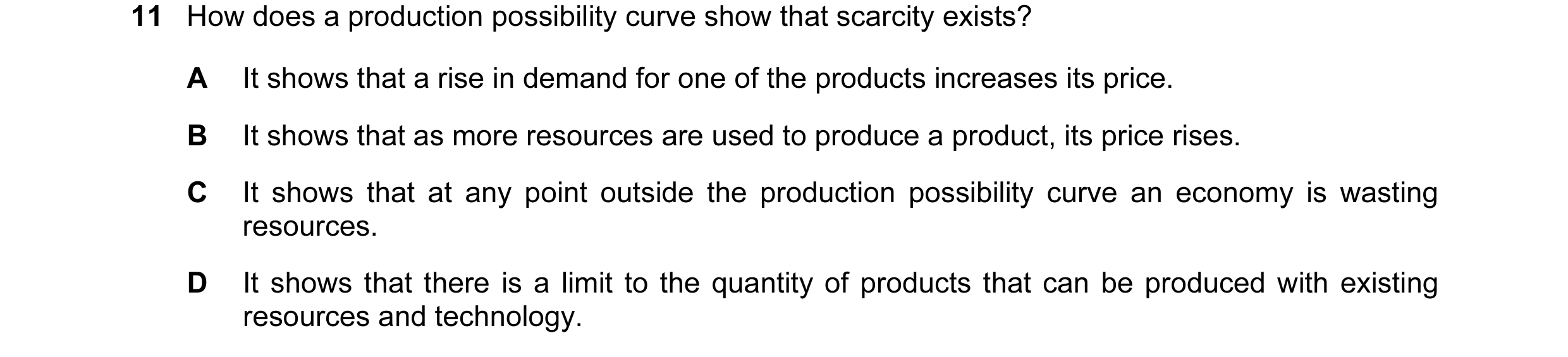

 6 / 13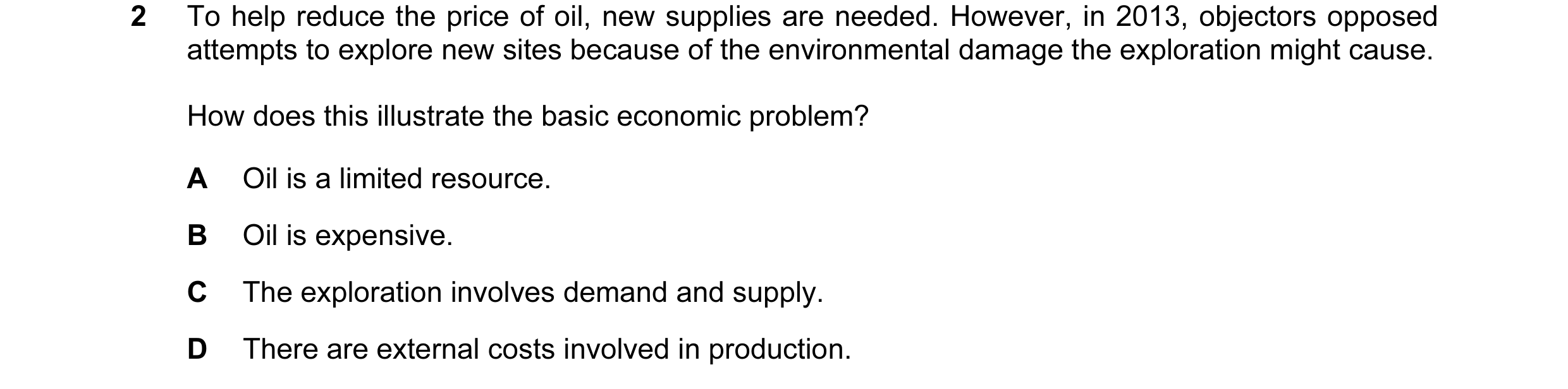


 7 / 13


 8 / 13


 9 / 13
 10 / 13


 11 / 13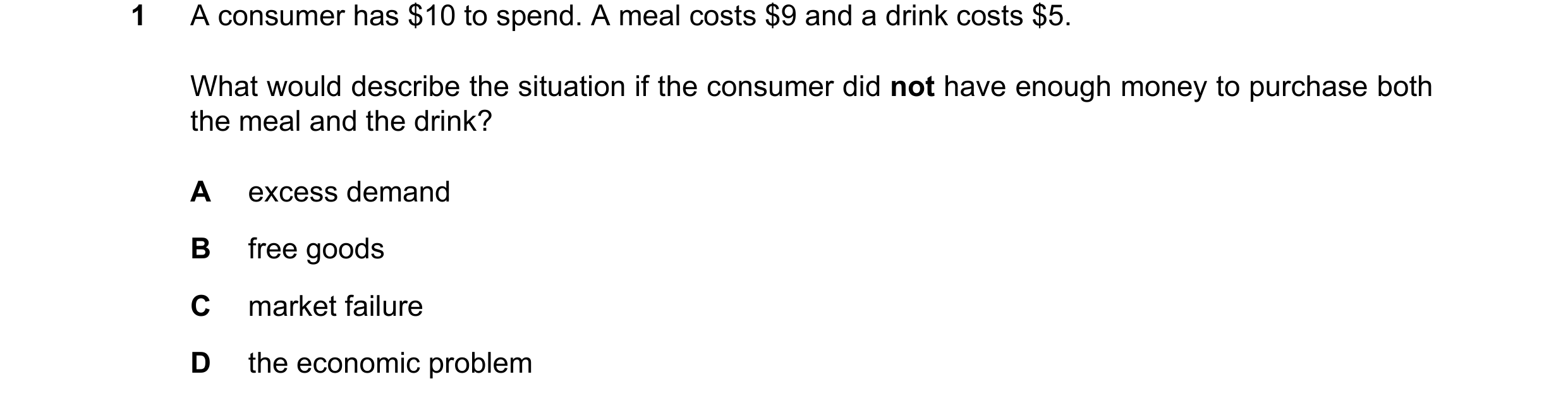




 12 / 13
 13 / 13