Questions as text
Q1 · More people are becoming billionaires at the same time that other people are living in… 0455/22 May/June 2017
4 More people are becoming billionaires at the same time that other people are living in poverty. While some people enjoy luxuries others lack even basic essentials. To enable more people to achieve a minimum living standard some economists support the redistribution of income. (a) What is meant by ‘redistribution of income’? [2] (b) Explain two reasons why the rich spend more in total than the poor. [4] (c) Analyse why the elimination of absolute poverty would not solve the economic problem. [6] (d) Discuss whether Gross Domestic Product (GDP) per head is the best measure of comparative living standards. [8]
20 marks
Mark scheme: 4(a) What is meant by ‘redistribution of income’? Taking income from one group e.g. from the rich (1) and giving it to another e.g. to the poor (1). Creating greater equality/reducing inequality/reducing gap between rich and poor (1). May be achieved by using progressive taxation/state benefits (1). 2 equally’. 4(b) Explain two reasons why the rich spend more in total than the poor. • greater income (1) means the rich have more purchasing power (1) • greater wealth/savings (1) which generates income to spend/ e.g. interest, dividends, capital gains (1) • greater ability to borrow (1) because banks are more willing to lend to the rich/the rich have more collateral (1) • more confidence (1) because the rich may expect that their purchasing power will continue to be high (1) 4 Vice versa is acceptable. 1 mark each for each of two reasons identified (×2) 1 mark each for each of two explanations given (×2) Maximum of 2 marks for a list- like approach. 4(c) Analyse why the elimination of absolute poverty would not solve the economic problem. • Absolute poverty is lack of access to basic necessities (1) example e.g. food/living below a certain income level e.g. $1.25 (1) • The economic problem is unlimited wants (1) exceeding finite resources/scarce resources/scarcity (1) • Even if everyone had access to basic necessities, people would still want more products (1) e.g. better quality food (1) there would not be enough resources to meet people’s increasing wants (1) relative poverty will still exist/rich will still be able to spend more than the poor (1) • Over time what is considered to be absolute poverty is likely to change (1) 6 Question Answer Marks Guidance 4(d) Discuss whether GDP per head is the best measure of comparative living standards. Up to 5 marks for why it may be: • Income / output is an important influence on living standards (1) income influences the quantity and quality of goods and services people can consume (1) the healthcare and education they can enjoy (1) • Higher GDP per head can increase tax revenue (1) which can be spent on items e.g. education which can increase living standards (1) • GDP per head takes into account the size of the population / it is an average (1) it is GDP divided by population (1) a rise in GDP matched by a rise in population would not mean that people are better off (1) • GDP per head is measured by all countries and so comparisons can be made (1) relatively easy to calculate / understand (1) Up to 5 marks for why it may not be: • There are wider/more accurate measures of living standards (1) e.g. HDI (1) which takes into account education/literacy (1) and health/life expectancy (1) • GDP per head is an average (1) it does not take into account distribution of income (1) GDP per head may be high but some people may be poor (1) • GDP per head does not take into account leisure time (1) GDP per head may be high but if people are working long hours the quality of their lives may be low (1) • Increases in output may increase pollution (1) e.g. lower air quality may reduce living standards (1) • GDP per head may not fully reflect the quality of products produced (1) which may increase even if GDP per head does not change (1) • GDP per head may not fully reflect the quantity of goods produced (1) due to the existence of the informal economy (1) • GDP per head does not include safe drinking water (1) which has a significant influence on health (1) 8 A response may develop a mixture of relevant points to achieve up to 5 marks on either side. Maximum of 2 marks on each side of the discussion for a list- like approach. Reward but do not expect reference to the Multi- Dimensional Poverty Index/Genuine Progress Indicator/real income/etc.
This question in 0455/22 May/June 2017
Q2 · Indonesia is rich in resources including such raw materials as copper, gold and coal 0455/21 Oct/Nov 2017
4 Indonesia is rich in resources including such raw materials as copper, gold and coal. Indonesia is the second-largest exporter of coal. In 2015, the Indonesian Government was considering increasing subsidies to producers, including farmers. Subsidies can be used to reduce inflation. Recent years have seen lower direct taxes in Indonesia, but higher direct taxes in some other countries. (a) What is used to measure a country’s inflation rate? [2] (b) Explain two reasons for conserving resources. [4] (c) Analyse how subsidies given to farmers could raise living standards. [6] (d) Discuss whether a rise in direct taxes will reduce economic growth. [8]
20 marks
Mark scheme: 4(a) What is used to measure a country’s inflation rate? 2 CPI / RPI / other relevant named measure (2) A weighted (1) price index (1) 4(b) Explain two reasons for conserving resources. 4 1 mark each for each of two reasons identified: • scarcity / economic problem • protect them for future generations • to achieve sustainable growth • demand may increase in the future • risk of becoming too dependent on one product. 1 mark each for each of two explanations given: • unlimited wants but limited resources • conserving resources may mean output, income and employment can be higher in the future / habitats can be saved for future generations • there is a continuous need for resources • a higher revenue may be earned / prices may rise in the future • exploiting resources may mean that other products are not produced. 4(c) Analyse how subsidies given to farmers could raise living standards. 6 May increase supply (1) as extra payment received (1) higher supply will reduce price (1) lower price will make food more affordable (1) food is a basic necessity (1). Reduced costs for farmers (1) increases their profits/income (1). Subsidies for capital equipment e.g. tractors (1) improve productivity (1) increasing farm outputs / incomes (1). More/better quality food may make the poor healthier (1) increasing their earning capacity (1). The poor may be able to spend less on food (1) allowing them to buy other basic necessities (1). Note: reward increase in supply (1) lower price (1) if shown on a diagram. 4(d) Discuss whether a rise in direct taxes will reduce economic growth. 8 Up to 5 marks for why it might: A rise in income tax will reduce disposable income (1) this may reduce consumer expenditure (1) lower total demand (1) reduce firms’ output (1). A rise in income tax will reduce incentives to work (1) increase tax avoidance (1) leaving less revenue for government spending on e.g. health and education (1) reducing productive potential of workers (1). A rise in corporation tax (1) will increase costs of production (1) will reduce the profits firms can keep (1) reduce the incentive to produce (1) reduce the funds available for investment (1) to expand output (1). Up to 5 marks for why it might not: A rise in income tax may not reduce consumer expenditure if savings fall (1) wages increase by more than tax rise (1). A rise in corporation tax may not reduce investment if firms reduce savings/dividend payments (1). A rise in income tax may reduce spending on imports (1) this would reduce a current account deficit (1) increase net exports (1). The extra tax revenue earned (1) may increase government spending (1) this could offset any fall in consumer expenditure and investment (1).
This question in 0455/21 Oct/Nov 2017
Q3 · The global water crisis In 2015, the World Economic Forum identified the water crisis as… 0455/23 May/June 2018
1 The global water crisis In 2015, the World Economic Forum identified the water crisis as the world’s biggest risk. Across many Asian and African nations the water supply was at critically low levels, insufficient to meet the rising demand. Demand has risen because of the expansion of cities and population growth requiring much more agricultural production. Water scarcity is a problem shared by many developing countries which have a low life expectancy. A third of all their healthcare facilities are estimated to lack access to safe water and basic sanitation. Water shortages harm public health – 80% of all illnesses in developing countries are caused by poor water and sanitation conditions. Water shortages also restrict the amount of food production. Table 1 shows the risk of water shortage (highest risk is 5) and Gross Domestic Product (GDP) per head measured in US$. Table 1 Risk of water shortage and GDP per head for countries / regions in 2015 Country / region Risk of Water Shortage GDP per head (highest risk = 5) (US$) Algeria 3.4 4 318 Canada 1.2 43 332 Germany 1.9 40 997 Pakistan 4.3 1 450 Saudi Arabia 5.0 20 813 Western Sahara 5.0 2 500 The shortage of water has led various countries and regions to experiment with privatising their supply. However, because water is a necessity, private supply has in some cases resulted in consumers suffering from significant price increases. A 10% increase in the price of water is estimated to result in only a 0.7% decrease in quantity demanded. This means that governments have to regulate water markets to protect consumers. Some economists argue that consistent undervaluing of water has led to it being used inefficiently. This is because prices fail to take into account the long-run consequences of not conserving this valuable resource. With much of the world facing a hotter and drier future as a result of climate change, water will become increasingly scarce. More than 663 million people are estimated to live without access to clean water. The World Bank funds a range of projects designed to tackle this and in doing so reduce levels of absolute poverty. Improving access to natural resources is seen as essential in promoting economic development in some of the world’s poorest nations. (a) Identify, using information from the extract, two causes of low life expectancy in developing countries. [2] (b) (i) Explain, using information from the extract, how the water shortage is an example of the economic problem. [4] (ii) Explain, using information from the extract, why the problem of water shortages is likely to become even worse in the future. [4] (c) Analyse, using Table 1, the extent to which a high risk of water shortage in a country/region causes low GDP per head. [5] (d) Calculate, using the information in the extract, the price elasticity of demand for water. [2] (e) Discuss whether or not private firms supplying water should increase their prices. [5] (f) Explain what is meant by absolute poverty. [2] (g) Discuss whether or not a country’s economic growth rate depends mostly on the availability of its natural resources. [6]
30 marks
Mark scheme: 1(a) Identify, using information from the extract, two causes of low life expectancy in developing countries. • Poor healthcare facilities • lack of access to safe water • lack of basic sanitation • not enough food production • absolute poverty 2 1(b)(i) Explain, using information from the extract, how the water shortage is an example of the economic problem. The economic problem consists of the allocation of scarce resources amongst competing ends (1). Water supply is at critically low levels (1) showing resources are scarce / limited (1). Rising demand from growth of cities (1) and rising agricultural production (1) wants are unlimited (1). 4 1(b)(ii) Explain, using information from the extract, why the problem of water shortages is likely to become even worse in the future. Water is being undervalued (1) this has led to it being wasted (1) and the prices do not reflect scarcity that will arise in the future (1) this means that as demand continues to rise (1) the gap between wants and the amount of the resource will increase (1). Climate change (1) will cause water supplies to become increasingly scarce (1). Population will continue to rise / cities will expand (1) increasing demand (1) and exceeding the ability of supply to match demand (1). 4 Question Answer Mark Guidance 1(c) Analyse, using Table 1, the extent to which a high risk of water shortage in a country / region causes low GDP per head. The data indicates a link (1) the greater the degree of water scarcity (i.e. the higher the water risk score) the lower the GDP per capita. (1) Canada / Germany have the lowest water risk scores and the highest GDP per capita (1). Pakistan / Western Sahara have high water risk scores and low GDP per capita (1). Saudi Arabia illustrates that this relationship is not perfect (1) and demonstrates that other factors contribute towards GDP per capita (1) 5 1(d) Calculate, using the information in the extract, the price elasticity of demand for water. PED = (–) 0.07 (2) Correct working –0.7% / 10% or –0.07% or 0.7 (1) 2 Question Answer Mark Guidance 1(e) Discuss whether or not private firms supplying water should increase their prices. Up to 3 marks for why they should: An increase in price will increase total revenue (1) as demand is price inelastic (1) meaning an increase in price causes a less than proportional decrease in quantity demanded (1) some of the extra funds could be used to increase the supply of water (1) reducing its shortage (1) and improve the quality of water (1). Higher prices may reduce demand (1) helping to eliminate the shortage / achieve market equilibrium (1). As population is increasing (1) rising prices are needed to ration extra demand (1). Current prices do not take account of the long run costs of failing to conserve supplies (1) higher prices will encourage more efficient use of water / less waste (1). Up to 3 marks for why they should not: Water is a necessity / has very inelastic demand (1) raising prices will harm consumers (1) and will fall more heavily on the poor / the poor will be unable to afford water (1) increase absolute poverty (1) increase inequality (1). Higher water prices can reduce health (1) reduce life expectancy (1) as less people will have access to safe water / basic sanitation (1). Higher water prices reduce income available to spend on other necessities e.g. education (1). 5 1(f) Explain what is meant by absolute poverty. Individuals cannot afford the necessities essential for survival (1) such as food, water, shelter, warmth and clothing (1) individuals living on less than a certain amount per day, e.g. $1. 2 Question Answer Mark Guidance 1(g) Discuss whether or not a country’s economic growth rate depends mostly on the availability of its natural resources. Up to 4 marks for why they might: Natural resources are an important factor of production (1) Countries endowed with natural resources have a good productive capacity as a result (1), boosting the growth that they can enjoy (1). A lack of natural resources such as water can cause poverty / ill health (1). This can harm productivity (1). Countries with insufficient natural resources are reliant on other countries to provide them (1) worsening the current account and reducing the economic growth rate (1) and if a country does not have enough other resources to trade it must rely upon its own natural resources (1). Natural resources are important in agriculture (1) countries with a lack of natural resources may not produce enough food (1) leading to poorer nutrition (1) poorer health and lower productivity (1). Natural resources are essential for the construction of infrastructure e.g. roads and schools (1) Other economic sectors (secondary and tertiary) depend upon natural resources (primary) (1). Up to 4 marks for why they might not: Other factors of production are equally / more important e.g. capital investment or education for skills (1). Through trade (1) a country can obtain from other countries the natural resources it lacks (1) It depends upon what countries specialise in (1) and whether they face trade restrictions (1) if they can import raw materials from other countries their growth will not be limited (1). Finding natural resources can take a long time (1) slowing down economic growth (1). There are many countries in the world with significant natural resources but poor economic growth rates / standard of living (1) and many countries with limited resources but high growth rates, such as Singapore (1). 6
This question in 0455/23 May/June 2018
Q4 · The economic problem results in people having to make choices 0455/22 Feb/March 2019
3 The economic problem results in people having to make choices. In Bulgaria, in recent years, people have changed how much they spend. The Bulgarian government is encouraging people to spend more. It is trying to ensure that deflation does not return and that the country will continue to experience an increase in output. (a) Identify two ways a government could encourage people to spend more. [2] (b) Explain how the economic problem results in people having to make choices. [4] (c) Analyse why deflation may cause a fall in output. [6] (d) Discuss whether or not a country will suffer if its output falls. [8]
20 marks
Mark scheme: 3(a) Identify two ways a government could encourage people to spend 2 more. • lower taxes • increase government spending / expansionary fiscal policy • increase money supply • reduce interest rates / expansionary monetary policy • raise subsidies 3(b) Explain how the economic problem results in people having to make 4 choices. The economic problem is unlimited wants (1) but limited resources (1). As resources are limited, people cannot have everything they want / not everything can be produced / there is scarcity (1) there is an opportunity cost (1). 3(c) Analyse why deflation may cause a fall in output. 6 A fall in the price level (1) may discourage spending / reduce total (aggregate) demand (1) households waiting for prices to fall further (1) the fall in demand may reduce firms’ output (1). Deflation may reduce firms’ profits (1) this may discourage investment (1) reduce demand for capital goods (1) lower the output of capital goods (1). 3(d) Discuss whether or not a country will suffer if its output falls. 8 Up to 5 marks for why it might: Lower output may mean that people will have fewer goods and services (1) this could reduce living standards / reduce incomes (1). Lower output may mean fewer workers are needed (1) unemployment may rise (1). If consumers cannot buy domestically produced products (1) they may buy imports (1) exports may fall (1) resulting in a current account deficit (1). MNCs may leave the country (1) reducing employment (1). Tax revenue may fall (1) reducing government’s ability to spend on e.g. education (1). Up to 5 marks for why it might not: Living standards may rise (1) if output falls by less than population (1). A lower output may reduce external costs (1) e.g. pollution (1) destruction of sights of natural beauty (1). Lower output may reduce demand for imports (1) improve the current account position (1).
This question in 0455/22 Feb/March 2019
Q5 · Botswana has a number of conservation projects 0455/22 Feb/March 2019
6 Botswana has a number of conservation projects. These are thought to provide a social benefit to local communities. Botswana has a mixed economic system with tax revenue as a percentage of GDP at 27% in 2017. Some Botswanan economists suggest that the country should move towards a market economic system, taking care to avoid market failure. (a) Define social benefit. [2] (b) Explain two advantages of conserving natural resources. [4] (c) Analyse how taxation could reduce market failure. [6] (d) Discuss the advantages and disadvantages of a market economic system. [8]
20 marks
Mark scheme: 6(a) Define social benefit. 2 The total benefit to society of an economic activity or external benefit + private benefit (2). A beneficial effect on society (1). 6(b) Explain two advantages of conserving natural resources. 4 • resources will last longer / decrease rate of depletion (1) future generations will be able to benefit from the resources (1) • economic growth / development may be more sustainable (1) income may be generated over time / value may rise in the future (1) • over use of natural resources (1) may cause external costs (1) • tourism may increase (1) increase export revenue / employment (1). 6(c) Analyse how taxation could reduce market failure. 6 Monopolies may be taxed (1) if they exploit their market power (1) by charging high prices (1). Production and consumption that generates external costs may be taxed (1) example (1) this will turn an external cost into a private cost (1) increase costs of production (1) reduce output (1). Tax revenue can be used to e.g. subsidise products with external benefits (1) example (1). 6(d) Discuss the advantages and disadvantages of a market economic 8 system. Up to 5 marks for why it might: In theory, there is consumer sovereignty (1) consumers determine what is produced (1) firms will respond to changes in demand (1). Prices may be low (1) quality may be high (1) high efficiency (1) due to competition (1) and the profit motive (1) A variety of products may be produced / there may be choice (1). Up to 5 marks for why it might not: Poor consumers will have little influence on what is produced (1) as they have little purchasing power (1). Monopolies may develop (1) which may charge high prices (1) and produce low quality (1). Products that provide external benefits will be under-produced (1) so under- consumed (1) example of such a product (1). Products that cause external costs will be overproduced (1) and so overconsumed (1) example of such a product (1).
This question in 0455/22 Feb/March 2019
Q6 · In 2017, the UK included bicycle helmets for the first time in its calculation of the… 0455/21 Oct/Nov 2019
7 In 2017, the UK included bicycle helmets for the first time in its calculation of the consumer prices index (CPI). Many bicycle retailers now provide their customers with a choice of bicycle helmets. Estimates show that 25 million bicycle helmets are sold globally per year and the number sold is on a steady upward trend. (a) Define choice and give an example. [2] (b) Explain how the CPI is calculated. [4] (c) Analyse the possible reasons for the increase in global demand for bicycle helmets. [6] (d) Discuss whether or not increasing sales of a product will be beneficial to a firm. [8]
20 marks
Mark scheme: 7(a) Define choice and provide an example. Two or more different alternatives that an economic agent may have OR the idea of sacrifice and opportunity cost (1) different coloured bicycle helmets / any example (1). 2 7(b) Explain how the CPI is calculated. CPI uses a basket of goods and services (1) weighted to account for the proportion of income (1) spent by the average household (1) found in a survey (1) uses a base year (1) for comparison (1) prices around the country surveyed (1) various types of firms / sources e.g. physical shops and also online (1) weights multiplied by price changes (1). 4 7(c) Analyse the possible reasons for the increase in global demand for bicycle helmets. Increase in popularity of cycling (1) helmets are complements to bicycles (1) quantity demanded for bicycles increasing would increase the demand for helmets (1). Increase in environmental awareness (1) less driving (1) more bicycles (1) thus, more demand for bicycle helmets (1). Increase in health and safety awareness (1) dangers of cycling (1) increased awareness of benefits of helmets (1). Increase in income (1) bicycle helmet is normal good (1) YED positive (1). Increase subsidies for bicycles (1) decrease price of bicycles (1). Increase demand for bicycles (1) increase demand for bicycle helmets Increase in population (1). Reduction in price of helmets (1). 6 2 marks could be awarded for an accurately drawn Demand and Supply diagram. Question Answer Marks Guidance 7(d) Discuss whether or not increasing sales of a product will be beneficial to a firm. Up to 5 marks why it will be: Increase sales revenue/income (1) increase profits (1) allowing firm to reinvest (1) into R&D (1) employ more labour (1) making new products (1) better quality products (1) profits increase even more (1). Revenue may increase if PED is elastic (1) as demand will rise by a greater proportion than price (1). Economies of scale (1) as output increases and average cost falls (1) efficiency arising from bulk buying / lower interest rates / indivisibility / division of labour (1). Up to 5 marks why it will not be: Price might be lower (1) revenue is lower (1) profit is lower (1) sales of product increase but sales of other products decrease (1) not enough to offset each other (1). Extra sales only achieved through higher costs of production (1) e.g. advertising (1). Diseconomies of scale (1) increase output and average costs increases (1) due to control and coordination problems (1). 8
This question in 0455/21 Oct/Nov 2019
Q7 · Mali is a low income and low productivity country in Africa 0455/22 May/June 2020
5 Mali is a low income and low productivity country in Africa. Its government is using fiscal policy to reduce poverty. The country’s main industries are agriculture and gold mining. In recent years, however, there have been some changes in its resource allocation. The country is developing its iron ore industry. Globally, the iron ore industry is one which has experienced a significant number of mergers in recent years. (a) State two key questions about how resources are allocated. [2] (b) Explain two fiscal policy measures that can be used to reduce poverty. [4] (c) Analyse why a country may have low productivity. [6] (d) Discuss whether or not mergers benefit an economy. [8]
20 marks
Mark scheme: 5(a) State two key questions about how resources are allocated. 2 One mark each for two from: What to produce, how to produce it, for whom / who gets what is produced. 5(b) Explain two fiscal policy measures that can be used to reduce poverty. 4 Logical explanation which might include: Rise in government spending on education (1) make it easier for people to gain jobs / better paid jobs (1). Rise in government spending on healthcare (1) providing a basic necessity / increase productivity of workers (1). Subsidise / free provision of food (1) providing a basic necessity / reduce absolute poverty (1). Subsidise / free provision of housing (1) helping those unable to afford housing (1). Increase in state benefits (1) e.g. paying more in unemployment benefit will raise the income of some of the poor (1). Use of progressive taxes / reduction of regressive taxes (1) reduce relative poverty (1). 5(c) Analyse why a country may have low productivity. 6 Coherent analysis which might include: Education may be low (1) and training may be low (1) workers may lack skills (1). Wages may be low (1) working conditions may be poor (1) reducing the motivation of workers (1). There may a lack of investment (1) workers working with out of date/low quality capital goods (1). Healthcare may be low (1) causing workers to be tired (1). 5(d) Discuss whether or not mergers benefit an economy. 8 In assessing each answer, use the table below. Level Description Marks 3 A reasoned discussion which accurately examines both 6–8 sides of the economic argument, making use of economic information and clear and logical analysis to evaluate economic issues and situations. One side of the argument may have more depth than the other but, overall, both sides of the argument are considered and developed. There is thoughtful evaluation of economic concepts, terminology, information and/or data appropriate to the question. The discussion may also point out the possible uncertainties of alternative decisions and outcomes. 2 A reasoned discussion which makes use of economic 3–5 information and clear analysis to evaluate economic issues and situations. The answer may lack some depth and development may be one-sided. There is relevant use of economic concepts, terminology, information and data appropriate to the question. 1 There is a simple attempt at using economic definitions 1–2 and terminology. Some reference may be made to economic theory, with occasional understanding. 0 A mark of zero should be awarded for no creditable 0 content. Why they might: • may enable the new firm to take greater advantage of economies of scale, lower average cost and lower prices, resulting in lower inflation • may enable the new firm to earn higher profits and spend more on research and development and investment. This could raise the quality of products and increase economic growth • may enable the new firm to compete more effectively internationally which could improve the current account position • a vertical merger can increase the efficiency of production by co- ordinating the production stages. This could increase productive potential. Why they might not: • the new firm may experience diseconomies of scale, higher average cost and higher prices. This may increase the inflation rate • a horizontal merger will reduce competition which can increase prices, reduce choice, lower efficiency and reduce quality. This may reduce international price competitiveness which may harm the country’s current account position. It could also lower the country’s economic growth rate • the new firm may rationalise and this may result in unemployment.
This question in 0455/22 May/June 2020
Q8 · Nearly one million people in Cairo, the capital city of Egypt, live in crowded, unhealthy… 0455/22 May/June 2021
2 Nearly one million people in Cairo, the capital city of Egypt, live in crowded, unhealthy housing. One reason why people lack basic necessities, including adequate housing, is unemployment. In 2019, nearly 10% of Cairo’s workers did not have a job. Other citizens of Cairo live in luxury, in houses costing more than $1 million. Many of Cairo’s rich adults grew up in rich families. (a) Identify two basic necessities, other than housing. [2] (b) Explain how frictional unemployment differs from cyclical unemployment. [4] (c) Analyse why the children of the rich tend to become rich adults. [6] (d) Discuss whether a government should provide subsidies to families to spend on housing. [8]
20 marks
Mark scheme: 2(a) Identify two basic necessities, other than housing. Two from e.g.: Food, water, clothing, healthcare and education. 2 Accept any relevant basic necessity e.g. heating or electricty. If more than two examples given, only consider the first three. 2(b) Explain how frictional unemployment differs from cyclical unemployment. Logical explanation which might include: Frictional unemployment arises from people being in between jobs (1) may be waiting for a better paid job / may be seasonally unemployed / may have worked on a short-term contract / may lack information about vacancies (1) may exist even when there is full employment / may be self-correcting (1). Cyclical unemployment is caused by a lack of total (aggregate) demand (1) more people unemployed than there are job vacancies (1) may arise from a recession / economic downturn (1) may need government action to reduce it (1). Frictional unemployment would be reduced by a rise in labour mobility (1) cyclical unemployment would not be (1). Frictional unemployment may be short term (1) cyclical unemployment may be long term (1). 4 Up to 2 marks for each type of unemployment. Question Answer Marks Guidance 2(c) Analyse why the children of the rich tend to become rich adults. Coherent analysis which might include: The children of the rich tend to receive a good education (1) may not have to take part-time jobs / not have to help in family business when studying / not have to leave school early (1) become well qualified / well educated / gain high level of knowledge (1) become highly skilled / productive / efficient (1) find it is relatively easy to find employment / get a good job (1) well-paid (1). The children of the rich tend to receive good health care (1) good nutrition (1) have good housing (1) unlikely to miss time at school (1) unlikely to miss time at work (1) income will be high (1). The children of the rich tend to have high expectations (1) apply for better jobs (1). The children of the rich may inherit e.g. property (1) may gain income from e.g. inherited property / business / savings (1). Rich parents may have connections with e.g. bosses of major employers (1) more likely to gain high paid work (1). 6 Note the focus here is on the children of the rich so no marks for e.g. the children of the poor may lack education. Reference to highly skilled / productive or efficient may be linked to education, healthcare or nutrition but can only be credited once. Question Answer Marks Guidance 2(d) Discuss whether a government should provide subsidies to families to spend on housing. In assessing each answer, use the table opposite. Why it might: • will increase the spending power of families who receive it • may increase quantity supplied • may give low-income families access to a basic necessity, reducing poverty • may enable families to spend more on e.g. education • may increase employment / reduce unemployment, creating jobs building housing / increase labour mobility • may increase quality of housing and so improve health Why it might not: • rich can already afford housing • some families may not spend it on housing • may be inflationary, demand increasing for housing and e.g. furniture, carpets • opportunity cost • taxes may be raised to finance subsidy • building more houses may result in environmental damage 8 Level Description Marks 3 A reasoned discussion which accurately examines both sides of the economic argument, making use of economic information and clear and logical analysis to evaluate economic issues and situations. One side of the argument may have more depth than the other, but overall both sided of the argument are considered and developed. There is thoughtful evaluation of economic concepts, terminology, information and/or data appropriate to the question. The discussion may also point out the possible uncertainties of alternative decisions and outcomes. 6–8 2 A reasoned discussion which makes use of economic information and clear analysis to evaluate economic issues and situations. The answer may lack some depth and development may be one-sided. There is relevant use of economic concepts, terminology, information and data appropriate to the question. 3–5 1 There is a simple attempt at u sing economic definitions and terminology. Some reference may be made to economic theory, with occasional understanding. 1–2 0 A mark of zero should be awarded for no creditable content. 0
This question in 0455/22 May/June 2021
Q9 · The island of Borneo is famous internationally for its rainforests which can bring many… 0455/21 Oct/Nov 2021
3 The island of Borneo is famous internationally for its rainforests which can bring many benefits, both private and external. However, the economy is heavily dependent on a finite resource, oil. The discovery of oil reserves in other parts of the world led to a significant fall in the world price of oil. This affected producers of oil in Borneo. (a) Define finite resource. [2] (b) Explain the difference between private and external benefits. [4] (c) Analyse, using a demand and supply diagram, the effects on the world price of oil of the discovery of new reserves of oil. [6] (d) Discuss whether or not the fall in the price of a product is a disadvantage to an economy. [8]
20 marks
Mark scheme: 3(a) Define finite resource. A resource is an aid to production (1) which is limited in supply (1) it cannot be replaced over time / fast enough / will run out (1) to keep pace with consumption (1). 2 No mark for an example 3(b) Explain the difference between private and external benefits. Logical explanation which might include: Private benefits are enjoyed by the producer (1) and consumer (1) first and second parties (1) of a product, example e.g. revenue for the producer / satisfaction for the consumer (1). External benefits are enjoyed by a third party (1) not directly involved in the production (1) or consumption process (1) example (1) 4 Maximum 3 marks for only explaining 1 type of benefit. 3(c) Analyse, using a demand and supply diagram, the effects on the world price of oil of the discovery of new reserves of oil. (6) Up to 4 marks for the diagram: Axes correctly labelled – price and quantity or P and Q (1). Original demand and supply curves correctly labelled (1). New supply curve shifted to the right (1). Equilibriums – shown by lines P1, P2 / Q1, Q2: or marking the equilibrium points E1 and E2 (1). Up to 2 marks for written comments: Discovery of new oil will enable an increase in supply (1) price will be lower (1). 6 Question Answer Marks Guidance 3(d) Discuss whether or not the fall in the price of a product is a disadvantage to an economy. In assessing each answer, use the table opposite. Why it might be a disadvantage: • It depends on size of fall in price and elasticity of demand for the product • It depends upon the importance of the product to the economy / how dependent on it • If demand is price inelastic, decrease in total revenue e.g. basic items / necessity, cannot cover the costs, firms may go out of business, less employment opportunities • Less profits, discourages investment, reduces economic growth • Less export revenue, may increase current account deficit • Fall in price may be due to cheaper imports, domestic firms lose out. • The product may be a demerit good which previously was overconsumed. • If the product is part of a deflationary situation, there could be recession / unemployment 8 Level Description Marks 3 A reasoned discussion which accurately examines both sides of the economic argument, making use of economic information and clear and logical analysis to evaluate economic issues and situations. One side of the argument may have more depth than the other, but overall both sided of the argument are considered and developed. There is thoughtful evaluation of economic concepts, terminology, information and/or data appropriate to the question. The discussion may also point out the possible uncertainties of alternative decisions and outcomes. 6–8 Question Answer Marks Guidance 3(d) Why it might not be a disadvantage: • Depends on size of fall and whether it is short or long term • If demand is elastic, increase in total revenue e.g. luxury goods / many substitutes • Increase choices and affordability of product – better living standards • Fall in the price of a raw material may lower cost of production, reducing inflation and increasing economic growth • The product may be a merit good which previously was under- consumed • It may make a basic necessity more affordable – low income groups may be better off • It may be the result of an increase in productivity / a government subsidy • It may make the product more internationally competitive, improving the current account position. Level Description Marks 2 A reasoned discussion which makes use of economic information and clear analysis to evaluate economic issues and situations. The answer may lack some depth and development may be one- sided. There is relevant use of economic concepts, terminology, information and data appropriate to the question. 3–5 1 There is a simple attempt at u sing economic definitions and terminology. Some reference may be made to economic theory, with occasional understanding. 1–2 0 A mark of zero should be awarded for no creditable content. 0
This question in 0455/21 Oct/Nov 2021
Q10 · A number of countries, including Morocco, capture water from fog 0455/22 Oct/Nov 2021
2 A number of countries, including Morocco, capture water from fog. Water is used in the primary, secondary and tertiary sectors. In recent years, Morocco has increased the quantity and quality of its resources and has moved more of them into the tertiary sector. The quantity, quality and composition of a country’s resources are influenced by a number of factors, including its birth rate. Morocco’s birth rate fell from 19.9 in 2016 to 18.7 in 2018. (a) Define a free good. [2] (b) Explain, with examples, the difference between the secondary sector and the tertiary sector. [4] (c) Analyse, using a production possibility curve (PPC), the effect of an increase in the quality of its resources on an economy. [6] (d) Discuss whether or not a fall in a country’s birth rate will benefit an economy. [8]
20 marks
Mark scheme: 2(a) Define a free good. No opportunity cost (1) a good that takes no resources/factors of production to produce / naturally abundant in supply / does not use scarce resources (1). 2(b) Explain, with examples, the difference between the secondary sector and the tertiary sector. Logical explanation which might include: Secondary sector covers manufacturing (and construction) / converts primary products into finished goods (1) e.g. car industry (1). Tertiary sector covers services / final stage of production (1) e.g. insurance (1). 4 For tertiary sector, it is not sufficient to just have the sector which sells products as this is only part of the sector. But for the tertiary sector example accept the sale of a product e.g. the sale of jewellery. Question Answer Marks Guidance 2(c) Analyse, using a production possibility curve (PPC), the effect of an increase in the quality of its resources on an economy. Up to 4 marks for the diagram: Axes correctly labelled with different outputs (1). Initial curve drawn as a curve / line sloping downward to the axes (1). New curve drawn as a curve / line sloping downward to the axes (1). Shift indicated by arrow or letter (1). Up to 2 marks for coherent analysis which might include: Better quality resources will increase productivity (1) enable more of both types of goods to be produced (1) with a given quantity of resources (1) increase productive potential / productive capacity / total supply (1) cause economic growth (1). 6 Nothing for higher output, higher GDP as this is uncertain. Question Answer Marks Guidance 2(d) Discuss whether or not a fall in a country’s birth rate will benefit an economy. In assessing each answer, use the table opposite. Why it might: • reduce the number of dependents • fewer workers away from work to bring up children • enable resources to be used to increase economic growth / raise living standards • reduce pressure on the environment • move towards the optimum population Why it might not: • reduce the size of the labour force in the longer term • reduce labour mobility • create an ageing population • reduce size of markets 8 Level Description Marks 3 A reasoned discussion which accurately examines both sides of the economic argument, making use of economic information and clear and logical analysis to evaluate economic issues and situations. One side of the argument may have more depth than the other, but overall, both sides of the argument are considered and developed. There is thoughtful evaluation of economic concepts, terminology, information and/or data appropriate to the question. The discussion may also point out the possible uncertainties of alternative decisions and outcomes. 6–8 2 A reasoned discussion which makes use of economic information and clear analysis to evaluate economic issues and situations. The answer may lack some depth and development may be one-sided. There is relevant use of economic concepts, terminology, information and data appropriate to the question. 3–5 1 There is a simple attempt at u sing economic definitions and terminology. Some reference may be made to economic theory, with occasional understanding. 1–2 Question Answer Marks Guidance 2(d) Level Description Marks 0 A mark of zero should be awarded for no creditable content. 0
This question in 0455/22 Oct/Nov 2021
Q11 · In Tunisia, resource allocation decisions are made by both the public sector and private… 0455/22 Oct/Nov 2021
4 In Tunisia, resource allocation decisions are made by both the public sector and private sector. Tunisia’s GDP increased from 2014 to 2018 but its households saved less. Income levels can be affected by changes in trade union activity and the foreign exchange rate. From 2014 to 2018, Tunisia experienced a number of strikes organised by its largest trade union, the Tunisian General Labour Union. There was also a significant fall in its foreign exchange rate. (a) Identify two of the three resource allocation decisions. [2] (b) Explain two reasons why households may save less even though their income has increased. [4] (c) Analyse how a trade union may benefit its members. [6] (d) Discuss whether or not a fall in its foreign exchange rate will improve a country’s macroeconomic performance. [8]
20 marks
Mark scheme: 4(a) Identify two of the three resource allocation decisions. Two from: • what to produce • how to produce • who to produce for 2 Question Answer Marks Guidance 4(b) Explain two reasons why households may save less even though their income has increased. Logical explanation which might include: Fall in the rate of interest (1) which would reduce the return from saving / spend/borrow rather than save (1). Inflation (1) spend more now before prices rise further / may reduce the real rate of interest (1). Increase in confidence about the future (1) less motive to save for hard times / less concerned will experience unemployment or fall in income (1). Fall in range, number or reliability of financial institutions (1) which would reduce the safe places to save (1). Greater consumption opportunities / spend more / higher living standards (1) with the introduction of new products / lower prices / may be able to afford private education / healthcare (1). Increase in taxes (1) reducing disposable income (1). Rise in family size (1) increasing household expenses (1). Rise in debt (1) may reduce ability of households to e.g. to put money into a savings account (1). Change in social attitudes (1) due to e.g. change in age of households (1). 4 One mark each for each of two reasons identified and one mark each for each of two explanations. Question Answer Marks Guidance 4(c) Analyse how a trade union may benefit its members. Coherent analysis which might include: A trade union may negotiate with employers (1) to raise wages (1) improve working conditions (1) example (1) increase fringe benefits (1) example (1) through collective bargaining (1) and sometimes industrial action / strikes (1). A trade union may settle disputes between the employer and the workers (1) e.g. over changes in working practices (1) protect workers’ rights (1). A trade union may seek to protect the employment of its members (1) in some cases negotiate favourable redundancy terms (1). A trade union may negotiate / put pressure on the government (1) to e.g. raise a national minimum wage or reduce the retirement age (1). In some countries, trade unions provide benefits and services to members (1) e.g. training services (1). 6 Question Answer Marks Guidance 4(d) Discuss whether or not a fall in its foreign exchange rate will improve a country’s macroeconomic performance. In assessing each answer, use the table opposite. Why it might: • export prices will fall and import prices will rise • demand for exports may rise and demand for imports may fall • domestic output will increase, economic growth may rise • more workers may be employed, reducing unemployment • a deficit on the current account of the balance of payments may be reduced or a surplus increased • may encourage foreign investment if it is thought assets can be bought more cheaply. Why it might not: • rise in price of imported capital goods and raw materials may increase costs of production, causing cost-push inflation • higher total (aggregate) demand may cause demand-pull inflation, especially if the economy is working close to full capacity • demand for exports and imports may be price inelastic, causing export revenue to fall and import expenditure to rise – in such a case may benefit more from a rise in the exchange rate • trade restrictions imposed by other countries may prevent the country from exporting more products • may discourage foreign investment due to a lack of confidence in the country’s future economic prospects. 8 Level Description Marks 3 A reasoned discussion which accurately examines both sides of the economic argument, making use of economic information and clear and logical analysis to evaluate economic issues and situations. One side of the argument may have more depth than the other, but overall, both sides of the argument are considered and developed. There is thoughtful evaluation of economic concepts, terminology, information and/or data appropriate to the question. The discussion may also point out the possible uncertainties of alternative decisions and outcomes. 6–8 2 A reasoned discussion which makes use of economic information and clear analysis to evaluate economic issues and situations. The answer may lack some depth and development may be one-sided. There is relevant use of economic concepts, terminology, information and data appropriate to the question. 3–5 1 There is a simple attempt at u sing economic definitions and terminology. Some reference may be made to economic theory, with occasional understanding. 1–2 Question Answer Marks Guidance 4(d) Level Description Marks 0 A mark of zero should be awarded for no creditable content. 0
This question in 0455/22 Oct/Nov 2021
Q12 · The economic problem means that countries have to decide what to produce 0455/22 Feb/March 2022
5 The economic problem means that countries have to decide what to produce. Ghana uses much of its agricultural land to grow cocoa. Cocoa is sold to chocolate producers. The world’s main chocolate producer in 2019 was a US firm with a 14% share of the global market. That firm was the largest seller of chocolate in the US and, if it merges, may become a monopoly. (a) Define the economic problem. [2] (b) Explain whether land is mobile. [4] (c) Analyse the causes of a shift to the right in the supply curve of chocolate. [6] (d) Discuss whether or not consumers would benefit from a firm becoming a monopoly. [8]
20 marks
Mark scheme: 5(a) Define the economic problem. Finite/limited resources (1) unlimited/infinite wants (1). Wants exceeding resources (2). Scarcity (1). 2 5(b) Explain whether land is mobile. Logical explanation which might include: Most land is geographically immobile (1) fixed in one place / cannot move from one place to another place (1). Some forms of land e.g. wildlife can be moved from one place to another (1). Land is occupationally mobile (1) capable of changing its use / e.g. land can be used for farming or housing (1). 4 Question Answer Marks Guidance 5(c) Analyse the causes of a shift to the right in the supply curve of chocolate. Coherent analysis which might include: A shift to the right of the supply curve means that more will be supplied at each and every price / supply has increased due to a non-price factor/influence (1). Lower costs of production (1) due to any cause (other than tax or subsidy) e.g. lower wages / higher productivity / lower transport costs (1). Subsidy (1) providing an additional income / effectively lowering costs / providing a financial incentive (1). Advances in technology (1) increasing output per unit of resource / increase efficiency / raise productivity of capital (1) Good harvest of cocoa / raw material (1) perhaps due to improvement in weather conditions / improvements in fertilisers (1) reducing price of raw material (1) increasing supply of raw material (1). Lower tax on chocolate / lower indirect tax / lower corporate tax (1) making it more profitable to produce (1). Fall in price/rise in cost of production/ fall in profitability of another product produced by chocolate firms (1) encouraging the switch of some resources to chocolate production (1). 6 Note: no marks for a diagram. Question Answer Marks Guidance 5(d) Discuss whether or not consumers would benefit from a firm becoming a monopoly. In assessing each answer, use the table opposite. Why they might: • a monopoly may have lower average costs of production due to economies of scale • lower costs of production may result in lower prices • a monopoly may have larger profits which can be spent on R&D • higher R&D can improve the quality of the product • may be a state-owned monopoly which seeks to increase social welfare. Why they might not: • monopoly may use market power to increase price • lack of competition may reduce pressure to improve quality • consumers will have less choice • there may be a lack of availability if the monopoly restricts supply to drive up price • a monopoly may have higher average costs due to diseconomies of scale. 8 Level Description Marks 3 A reasoned discussion which accurately examines both sides of the economic argument, making use of economic information and clear and logical analysis to evaluate economic issues and situations. One side of the argument may have more depth than the other, but overall both sides of the argument are considered and developed. There is thoughtful evaluation of economic concepts, terminology, information and/or data appropriate to the question. The discussion may also point out the possible uncertainties of alternative decisions and outcomes. 6–8 Question Answer Marks Guidance 5(d) Level Description Marks 2 A reasoned discussion which makes use of economic information and clear analysis to evaluate economic issues and situations. The answer may lack some depth and development may be one-sided. There is relevant use of economic concepts, terminology, information and data appropriate to the question. 3–5 1 There is a simple attempt at using economic definitions and terminology. Some reference may be made to economic theory, with occasional understanding. 1–2 0 A mark of zero should be awarded for no creditable content. 0
This question in 0455/22 Feb/March 2022
Q13 · The economic problem results in choices and opportunity cost 0455/22 Oct/Nov 2022
2 The economic problem results in choices and opportunity cost. People have to decide what job to do and where to live. In recent years Australia has recruited teachers from a number of countries including Canada, the UK and the US. Most of these teachers specialise in a single subject. (a) Define opportunity cost. [2] (b) Explain the economic problem and why it is always likely to exist. [4] (c) Analyse why the wages of all teachers may increase. [6] (d) Discuss whether or not a teacher would benefit from specialisation. [8]
20 marks
Mark scheme: 2(a) Define opportunity cost. 2 The (next) best alternative / choice (1) forgone / sacrificed (1). 2(b) Explain the economic problem and why it is always 4 likely to exist. Logical explanation which might include: The economic problem is finite / limited resources (1) and infinite / unlimited wants / wants exceed resources (1) scarcity (1). It is always likely to exist as wants grow faster than resources / wants are increasing (1) there will never be enough resources to produce all the products people would like to have (1). People are living longer / population is increasing (1) more resources are needed / some resources are being depleted (1). 2(c) Analyse why the wages of all teachers may increase. 6 Coherent analysis which might include: The wages of teachers may increase if demand for teachers rises (1) derived (1) this may be because there are more children to educate / rise in population size (1) smaller class sizes / children staying in education longer (1) teachers being more productive / skilful (1). A decrease in supply will increase wages (1) this may be due to a rise in qualifications needed (1) long period of training (1) rise in wages in other occupations / need to compete with other occupations (1) need to compete with wages paid to teachers in other countries / recruit from higher paying countries (1). Bargaining power of teachers may increase (1) more teachers may belong to trade unions (1) may be more prepared to take strike action (1) wages may be raised to keep up with inflation / maintain real wages (1). Government policy may favour teachers (1) e.g. there may be an increase in school leaving age / increase provision of education (1). Increase in minimum wage (1). 2(d) Discuss whether or not a teacher would benefit from 8 Level Description Marks specialisation. 3 A reasoned discussion which 6–8 In assessing each answer, use the table opposite. accurately examines both sides of the economic argument, making use of Why it might: economic information and clear and • may be trained more quickly logical analysis to evaluate economic • become more skilled / productive issues and situations. One side of the argument may have more depth than • may be in higher demand the other, but overall both sided of the • may be better paid argument are considered and • may increase chance of promotion developed. There is thoughtful evaluation of economic concepts, Why it might not: terminology, information and/or data • subject may become less popular appropriate to the question. The • may become bored teaching the same subject discussion may also point out the • if lose job, may find it difficult to get another job possible uncertainties of alternative • may spend a long time developing the specialisation decisions and outcomes. • may not get the opportunity to move into another 2 A reasoned discussion which makes 3–5 subject. use of economic information and clear analysis to evaluate economic issues and situations. The answer may lack some depth and development may be one-sided. There is relevant use of economic concepts, terminology, information and data appropriate to the question. 1 There is a simple attempt at using 1–2 economic definitions and terminology. Some reference may be made to economic theory, with occasional understanding. 0 A mark of zero should be awarded for 0 no creditable content.
This question in 0455/22 Oct/Nov 2022
Q14 · Calculate the price elasticity of supply of Ecuador’s oil 0455/23 Oct/Nov 2022
1 (a) Calculate the price elasticity of supply of Ecuador’s oil. [1] (b) Identify two key resource allocation questions. [2] (c) State why sunshine has no opportunity cost. [2] (d) Explain two reasons why Ecuador experienced a recession between 2014 and 2016. [4] (e) Analyse how building more roads can increase a country’s economic growth rate. [4] (f) Analyse the relationship between GDP per head and car ownership. [5] (g) Discuss whether or not the profits of Ecuador’s textile firms are likely to have increased between 2016 and 2019. [6] (h) Discuss whether or not Ecuador benefits from the emigration of some of its workers. [6]
30 marks
Mark scheme: Question Answer Marks Guidance 1(a) Calculate the price elasticity of supply of Ecuador’s oil. 1 Do not accept 16% 0.16 (1). 1(b) Identify two key resource allocation questions. 2 Do not accept: How much to produce or for whom to produce What to produce / produce less of one product and more of another product / less oil and more textiles (1). How to produce it / how products are made / using fewer capital goods (1). 1(c) State why sunshine has no opportunity cost. 2 It is a free good (1). In unlimited supply / not scarce / a renewable source of energy (1). Does not take resources to produce it / nothing needs to be sacrificed to use it / no alternative / substitute so no opportunity cost (1). It is there naturally (1). 1(d) Explain two reasons why Ecuador experienced a 4 One mark for each of two reasons identified and one mark recession between 2014 and 2016. for each explanation. Logical explanation which might include: Fall in demand for exports [of oil] (1) lower export revenue / increase current account deficit / lower output of oil / lower total demand / lower GDP (1). Decrease in government spending (1) lower employment / lower output / lower income from benefits / lower total demand / lower GDP (1). 1(e) Analyse how building more roads can increase a 4 country’s economic growth rate. Building more roads would increase employment )1) lower unemployment (1) increase demand for road building materials (1) increase in government spending on roads (1) increase incomes (1) leading to higher demand / expenditure on goods and services e.g. education / cars (1). Less congestion (1) easier to transport goods / better infrastructure (1) quicker to work / increases labour mobility / longer working hours / more productive / efficient workforce (1) output rises (1). Lower transport costs (1) encourage firms to increase output / attract MNCs / foreign investment (1). Lower costs may increase international competitiveness (1) increase demand for country’s exports (1). 1(f) Analyse the relationship between GDP per head and car 5 There must be a comparison between countries and/or GDP ownership. per head and car ownership. Merely describing the data gets no marks as it is not analysis. Coherent analysis which might include: A direct comparison between two countries e.g. GDP per Overview head is higher in Switzerland than Senegal and car Generally, a direct relationship / the higher the income, the ownership is higher in Switzerland than Senegal is worth the higher the car ownership / the lower the income, the lower 2 marks. the car ownership (1). Supporting evidence – two comparison examples Senegal has the lowest GDP per head and the lowest car ownership (1). Ecuador has the second lowest GDP per head and the second lowest car ownership / Spain has higher GDP per head and car ownership than Uruguay (1) Exception New Zealand / Switzerland (1) Switzerland has a higher GDP per head but lower car ownership than New Zealand (1). OR Switzerland has highest GDP per head but only second highest car ownership (1) OR New Zealand has second highest GDP per head but highest car ownership (1). Comments Higher income would increase ability to purchase cars / high income countries often have more than one car per household (1) For exception other influences on demand e.g. cost of public transport / road space / congestions (1). 1(g) Discuss whether or not the profits of Ecuador’s textile 6 Apply this example to all questions with the command firms are likely to have increased between 2016 and word DISCUSS 2019. (1g, 1h, 2d, 3d, 4d and 5d) Award up to 4 marks for logical reasons why they Each point may be credited only once, on either side of an might, which may include: argument, but separate development as to how/why the Incomes / household spending increased in Ecuador (1) outcome may differ is rewarded. increasing demand for textiles (1) revenue increases (1). Generic example Mark Costs of production may have fallen (1) due to lower transport costs (1)’. Tax revenue may decrease… 1 Increase in scale of production (1) increased ability to take ...because of reason e.g. incomes may be lower. 1 advantage of economies of scale (1) average cost falls (1) profits may rise if prices unchanged but costs fall / profit is Tax revenue may increase because incomes 0 revenue – costs (1). may be higher i.e. reverse of a previous argument. Low increase in wage costs (1) revenue may have increased by more than costs (1). Tax revenue may increase because of a 1 different reason i.e. not the reverse of a previous Incomes abroad may have increased (1) increasing demand argument e.g. government spending on for Ecuadorean textiles (1) especially of luxury textiles (1). subsidies may stimulate the economy more than spending on education. Award up to 4 marks for logical reasons why they might not, which may include: The firms may have lost skilled workers abroad (1) which could have reduced productivity (1) increased costs / production falls (1). Strong competition from abroad (1) they may have lost sales to competitors (1) reducing revenue and or prices (1). Low wage increase (1) workers may leave industry / lower productivity (1) trade unions / workers may take action (1) may strike / disrupting the firms’ supply/ lead to higher costs (1). 1(h) Discuss whether or not Ecuador benefits from the 6 emigration of some of its workers. Award up to 4 marks for logical reasons why it might, which may include: Some may be unskilled (1), may have been unemployed (1) others leaving jobs create vacancies to be filled by unemployed (1) and so the government would spend less on unemployment benefit / more for other public spending (1) less poverty as a result (1). Some may be trained abroad (1) and may bring back skills and ideas into the country (1) increasing output (1). Some may send money home (1) improve the current account balance (1) will increase spending / total demand (1) leading to economic growth (1). Net emigration results in lower population / reduces overpopulation (1) less depletion of resources / pollution / shortage of resources e.g. housing (1). Award up to 4 marks for logical reasons why it might not, which may include: May lose skilled workers (1) lower productivity (1) low quality products / reduce output / economic growth (1) a relatively high proportion of people lost (1) makes it more difficult to attract MNCs (1). If some will not support families at home (1) dependency ratio will rise (1) place more burden on the government (1). Large proportion / 3 million already working abroad (1) shortage of workers / large reduction in size of labour force / increase (unit) wage costs (1) less income (1) less government tax revenue (1) less government spending e.g. education, health (1). Younger workers emigrating (1) leads to an ageing population (1).
This question in 0455/23 Oct/Nov 2022
Q15 · Serbia is the world’s second largest producer of raspberries, a product with elastic… 0455/22 Feb/March 2023
5 Serbia is the world’s second largest producer of raspberries, a product with elastic demand. Consumers experience the economic problem when buying raspberries. Few raspberry farm workers are members of trade unions. Membership of trade unions in Serbia had fallen to 20% of all workers by 2020. In that year, Serbia had more state pensioners than workers. (a) Identify two determinants of price elasticity of demand. [2] (b) Explain how the economic problem results in consumers having to make choices. [4] (c) Analyse why some workers decide not to join a trade union. [6] (d) Discuss whether or not a government should reduce the amount of money it gives to each state pensioner. [8]
20 marks
Mark scheme: 5(a) Identify two determinants of price elasticity of 2 If more than two determinants given, consider the first three. demand. Two from: • substitutes • whether a luxury or necessity • proportion of income taken • whether habit forming / addictive • whether the purchase can be postponed • time period • breadth of definition • brand loyalty • number of uses • complements 5(b) Explain how the economic problem results in 4 consumers having to make choices. Logical explanation which might include: The economic problem is unlimited / infinite wants (1) exceeding limited / finite / scare resources (1) resulting in scarcity (1). Consumers have limited incomes (1) and so cannot buy everything they want (1). Buying one product involves an opportunity cost (1) in the form of another product sacrificed / example (1). 5(c) Analyse why some workers decide not to join a 6 trade union. Coherent analysis which might include: Trade unions charge a subscription fee (1) workers cannot afford to join (1) may be unemployed / have low income (1). Government legislation may prevent trade union membership / government may discourage membership (1) may reduce the power of trade unions (1) less benefit from joining (1). Employers may discourage membership (1) may think it will reduce chance of employment / increase chance of unemployment (1) chance of promotion (1). May be satisfied with wages (1) working conditions (1) may have job security (1) no need for collective bargaining (1). May be employed in industries that do not have a history of trade union membership (1). May be reluctant to take industrial action (1) may lose pay during a strike (1). May not agree with the objectives of the trade union (1). May follow example of fellow workers (1). 5(d) Discuss whether or not a government should 8 Level Description Marks reduce the amount of money it gives to each state pensioner. 3 A reasoned discussion which accurately 6–8 examines both sides of the economic In assessing each answer, use the table opposite. argument, making use of economic information and clear and logical analysis Why it should: to evaluate economic issues and • ageing population can mean the amount of situations. One side of the argument may government spending on pensions rises have more depth than the other, but significantly overall, both sided of the argument are • a reduction in the state pension could reduce a considered and developed. There is budget deficit thoughtful evaluation of economic • may persuade people to work longer, raising concepts, terminology, information and / output and tax revenue or data appropriate to the question. The • paying pensions involves an opportunity cost, discussion may also point out the could spend more on e.g. education possible uncertainties of alternative decisions and outcomes. Why it should not: 2 A reasoned discussion which makes use 3–5 • will reduce living standards of pensioners of economic information and clear • may increase the numbers living in absolute analysis to evaluate economic issues poverty and situations. The answer may lack • will reduce total demand some depth and development may be • lower spending by pensioners could reduce one-sided. There is relevant use of output and increase unemployment. economic concepts, terminology, information and data appropriate to the question. 1 There is a simple attempt at using 1–2 economic definitions and terminology. Some reference may be made to economic theory, with occasional understanding. 0 A mark of zero should be awarded for no 0 creditable content.
This question in 0455/22 Feb/March 2023
Q16 · Free goods and economic goods are consumed in Poland 0455/22 May/June 2024
5 Free goods and economic goods are consumed in Poland. In 2020, demand for both economic goods and factors of production increased in Poland. For example, Polish consumers demanded more football shirts and the Polish government increased its spending on housing for the country’s population. (a) Identify two free goods. [2] (b) Explain two influences on demand for factors of production. [4] (c) Analyse the effect of an increase in demand for football shirts on demand for football shorts and demand for basketball shirts. [6] (d) Discuss whether or not an increase in government spending on housing would benefit an economy. [8]
20 marks
Mark scheme: 5(a) Identify two free goods. Two from e.g.: air / oxygen sunlight water wind 2 BOD on ‘sun’, trees (not wood), wild flowers, wild fruit. Not accepting fish or stone. 5(b) Explain two influences on demand for factors of production. Logical explanation which might include: Demand for the product produced / total demand / economic activity (1) rise in demand for the product/products will be likely to increase demand for the factor/factors of production / derived demand (1). Price of the factor itself (1) lower price will be likely to result in higher demand (1). Price of substitute factors of production (1) e.g. may demand more labour if price of capital rises (1). Price of complementary factors of production (1) e.g. if labour is used with capital, a fall in the price of capital may increase demand for labour (1). Productivity (1) higher productivity will be likely to increase demand (1). Quality / advances in technology / changes in standards of education and training (1) higher quality will increase demand (1). Occupational mobility (1) the more occupationally mobile, the higher demand will tend to be (1). Method of production (1) switch from labour-intensive production will increase demand for capital goods (1). 4 One mark each for each of two influences identified and one mark for each of two explanations. If more than 2 influences are given, consider the first 3. Accept price and / or demand on its own but looking for price of a complement or price of a substitute not just complement or substitute. Question Answer Marks Guidance 5(c) Analyse the effect of an increase in demand for football shirts on demand for football shorts and demand for basketball shirts. Coherent analysis which might include: Demand for football shorts is likely to increase (1) football shirts and shorts are complements (1) bought to be used together / bought to complete the set (1). Demand for basketball shirts is likely to fall (1) basketball shirts and football shirts may be substitutes (1) consumers may switch between them (1). 6 Changes in demand may be shown in the written answer or on diagrams. Question Answer Marks Guidance 5(d) Discuss whether or not an increase in government spending on housing would benefit an economy. In assessing each answer, use the table opposite. Why it might: may increase total demand may increase output / GDP may increase employment / reduce unemployment may lower the price of housing may increase living standards may reduce homelessness may reduce poverty. Why it might not: will have an opportunity cost may increase taxes quality of housing may be low private sector may provide better housing may be external costs during the construction. 8 Level Description Marks 3 A reasoned discussion which accurately examines both sides of the economic argument, making use of economic information and clear and logical analysis to evaluate economic issues and situations. One side of the argument may have more depth than the other, but overall both sided of the argument are considered and developed. There is thoughtful evaluation of economic concepts, terminology, information and/or data appropriate to the question. The discussion may also point out the possible uncertainties of alternative decisions and outcomes. 6–8 2 A reasoned discussion which makes use of economic information and clear analysis to evaluate economic issues and situations. The answer may lack some depth and development may be one-sided. There is relevant use of economic concepts, terminology, information and data appropriate to the question. 3–5 1 There is a simple attempt at using economic definitions and terminology. Some reference may be made to economic theory, with occasional understanding. 1–2 Question Answer Marks Guidance 5(d) Level Description Marks 0 A mark of zero should be awarded for no creditable content. 0
This question in 0455/22 May/June 2024
Q17 · Shenzhen, once a fishing village, is now one of China’s richest cities with a large… 0455/23 May/June 2024
2 Shenzhen, once a fishing village, is now one of China’s richest cities with a large secondary sector. This transformation was possible as local villages shared resources to develop their area. For example, they constructed new housing to rent to migrants working in the factories in the city. However, the supply of housing has not been able to keep up with demand and the government is now setting a maximum price on housing. (a) Define secondary sector using an example apart from construction. [2] (b) Explain two key resource allocation decisions. [4] (c) Analyse why workers may want to migrate to another area. [6] (d) Discuss whether or not a government should introduce a maximum price on housing. [8]
20 marks
Mark scheme: 2(a) Define secondary sector using an example apart from construction. The sector covering construction and manufacturing / the sector that processes raw materials (1) e.g. car manufacturing (1). 2 Accept covers manufacturing / production of goods. 2(b) Explain two key resource allocation decisions. Logical explanation which might include: what to produce (1) a decision on what types of products that an economy needs to produce e.g. capital goods vs consumer goods / necessities vs luxuries (1) how to produce (1) seeking the most efficient methods / where the methods to produce the goods and services needs to be decided / capital-intensive vs labour- intensive (1) for whom to produce (1) for those who can pay for the goods and services / for the target market / sector of the economy for whom the goods should be produced / those who need it vs those who want it (1). 4 One mark each for each of two decisions identified and one mark for each of two explanations. Accept answers based on resource allocation decisions made by firms e.g. demand for a firm's products. Question Answer Mark Guidance 2(c) Analyse why workers may want to migrate to another area. Coherent analysis which might include: to gain higher incomes (1) as there are more / better jobs opportunities available in another area / more opportunities to use skills (1) since there are more employers / economic activity (1) to have better living standards (1) better public amenities (1) such as better health and education facilities (1) to move from areas with housing shortages (1) for cheaper / better housing (1) to move from areas where prices / cost of living is high (1) move to area with lower taxes (1) increase purchasing power / living standards (1) to have better working conditions (1) more job security (1) to be closer to friends / family (1) who have migrated previously (1) to escape wars / high crime (1) more security (1) to avoid losing lives / lives of family members (1) to gain more freedom (1) fewer laws / restrictive regulations (1) climate change (1) original area no longer habitable / cannot plant crops (1) relocate to areas where there are better soil / fewer floods / fewer natural disasters / less pollution (1). 6 Accept internal and external migration. Maximum of 3 marks for identifying reasons. Question Answer Mark Guidance 2(d) Discuss whether or not a government should introduce a maximum price on housing. In assessing each answer, use the table opposite. Why it might: reduces price of housing / makes housing more affordable to control (cost-push) inflation to improve labour mobility / increase labour force available ensures everyone has shelter, a basic necessity leaves enough money to buy other needs and wants, increasing living standards less inequality / reduces relative poverty. Why it might not: discourages firms from supplying housing / reduces profits may reduce housing quality if firms wish to maintain profit levels shortage of housing if maximum price is below the equilibrium no effect if maximum price is set above the equilibrium price creation of informal markets at higher prices – lower standards maximum prices might still be too high and unaffordable the maximum price introduced may not take location into account. 8 Level Description Marks 3 A reasoned discussion which accurately examines both sides of the economic argument, making use of economic information and clear and logical analysis to evaluate economic issues and situations. One side of the argument may have more depth than the other, but overall both sides of the argument are considered and developed. There is thoughtful evaluation of economic concepts, terminology, information and/or data appropriate to the question. The discussion may also point out the possible uncertainties of alternative decisions and outcomes. 6–8 2 A reasoned discussion which makes use of economic information and clear analysis to evaluate economic issues and situations. The answer may lack some depth and development may be one-sided. There is relevant use of economic concepts, terminology, information and data appropriate to the question. 3–5 1 There is a simple attempt at using economic definitions and terminology. Some reference may be made to economic theory, with occasional understanding. 1–2 Question Answer Mark Guidance Level Description Marks 0 A mark of zero should be awarded for no creditable content. 0
This question in 0455/23 May/June 2024
Q18 · South Korea makes use of both economic goods and free goods 0455/22 Feb/March 2025
2 South Korea makes use of both economic goods and free goods. Its output includes products with both elastic and inelastic supply. The country is building the world’s first floating city, estimated to cost $180m. This is to cope with rising sea levels caused by climate change. Governments take a number of measures to reduce greenhouse gases which contribute to climate change, including banning the burning of wood to heat homes. (a) Identify a difference between economic goods and free goods. [2] (b) Explain how opportunity cost will influence a government’s decision on whether to spend tax revenue on a large infrastructure project. [4] (c) Analyse the influences on whether supply of a product is elastic or inelastic. [6] (d) Discuss whether or not a government should ban the burning of wood to heat homes. [8]
20 marks
Mark scheme: 2(a) Identify a difference between economic goods and free goods. 2 No marks for examples. Economic goods use up resources / need factors of production to One mark for economic goods and one mark produce them (1) free goods do not (1) for free goods. Economic goods are scarce / in limited supply (1) free goods are in unlimited supply (1). Economic goods have an opportunity cost (1) free goods do not (1). 2(b) Explain how opportunity cost will influence a government’s 4 decision on whether to spend tax revenue on a large infrastructure project. Logical explanation which might include: Opportunity cost is the (next) best alternative (1) forgone / given up (1). Tax revenue is limited (1) if a government spends some of it on an infrastructure project, it will not be able to spend on something else / could use the money to spend on something else (1) an example (1). Governments have to decide on their priorities / consider which form of spending will provide the greatest benefit (1) reason why spending on infrastructure may be the best option / may not be the best option (1). 2(c) Analyse the influences on whether supply of a product is elastic or 6 inelastic. Coherent analysis which might include: Elasticity of supply is a measure of the responsiveness of supply to a change in price / formula / elastic supply is when pes is > 1/ inelastic supply is when pes <1 (1). Elastic supply occurs when supply changes by a greater percentage than the change in price / inelastic supply is when supply changes by a smaller percentage than the change in price (1). Whether the product can be stored / non-perishable (1) if it can be, it will be elastic (1) able to adjust supply quickly to changes in price (1) as if price rises, goods can be taken out of storage (1). Whether the production time is short (1) if so, output can be increased quickly to take advantage of higher prices (1). Cost of altering supply (1) if it is costly to alter the supply, supply is likely to be inelastic (1). Whether there are unemployed resources / level of capacity (1) if there are, supply can be adjusted by taking on more resources (1). Whether resources / factors of production are mobile (1) if they can change use / location (1). Time (1) supply usually becomes more elastic, the longer the time period (1). Level of competition (1) supply is likely to be more elastic in a competitive than in a monopoly market (1). 2(d) Discuss whether or not a government should ban the burning of 8 Level Description Marks wood to heat homes. 3 A reasoned discussion 6–8 In assessing each answer, use the table opposite. which accurately examines both sides of the Why it should: economic argument, • reduce external costs / pollution making use of economic • correct market failure / information failure information and clear and • improve people’s health logical analysis to evaluate • protect forests economic issues and • replace wood with a more environmentally-friendly fuel situations. One side of the • wood could be used for other purposes argument may have more depth than the other, but Why it should not: overall both sides of the • wood may be bought mainly by the poor, increase poverty argument are considered • other sources of fuel may be more expensive and developed. There is • may be difficult to enforce thoughtful evaluation of • may cause unemployment economic concepts, • may be better to tax wood as a fuel, could use revenue to subsidise terminology, information more environmentally-friendly sources of fuel and/or data appropriate to • some alternative fuels may be more polluting. the question. The discussion may also point out the possible uncertainties of alternative decisions and outcomes. 2(b) Level Description Marks 2 A reasoned discussion 3–5 which makes use of economic information and clear analysis to evaluate economic issues and situations. The answer may lack some depth and development may be one- sided. There is relevant use of economic concepts, terminology, information and data appropriate to the question. 1 There is a simple attempt 1–2 at using economic definitions and terminology. Some reference may be made to economic theory, with occasional understanding. 0 A mark of zero should be 0 awarded for no creditable content.
This question in 0455/22 Feb/March 2025
Q19 · Missions to outer space face the same basic economic problem as that experienced on Earth 0455/23 May/June 2025
5 Missions to outer space face the same basic economic problem as that experienced on Earth. The African Space Agency was created to improve science and technology on the African continent. This agency also aims to coordinate trade between African countries to help technological development. This may improve how markets work. In 2021, total government spending on this agency was more than $500 million. (a) Define the basic economic problem. [2] (b) Explain how a market allocates resources. [4] (c) Analyse the benefits a country may gain from exporting to and importing from other countries. [6] (d) Discuss whether or not an increase in government spending will benefit an economy. [8]
20 marks
Mark scheme: 5(a) Define the basic economic problem. 2 The basic economic problem is the scarcity (1) of resources / factors of production (1) compared to unlimited wants of humans (1) . 5(b) Explain how a market allocates resources. 4 One mark for more resources devoted to products in high demand / fewer resources devoted to products in low Logical explanation which might include: demand. A market is made up of buyers (1) and sellers (1) who trade products (1) through the interaction of demand (1) and supply (1) creating market equilibrium (1) Price signals / price mechanism indicate to sellers how to allocate their resources (1) profit provides the incentive for sellers to respond to changes in demand (1). If demand for the product increases, price will rise (1) more resources will be devoted to its production (1). If demand for the product decreases, price will fall (1) fewer resources will be devoted to its production (1). 5(c) Analyse the benefits a country may gain from exporting 6 Reward but do not expect reference to comparative or to and importing from other countries. absolute advantage. Allows countries to specialise (1) in what they are best at producing (1) develop skills (1) increase efficiency (1) Exports create demand for the output of domestic producers (1) causing economic growth in that country (1) creating employment (1) Exports create larger markets (1) able to take advantage of economies of scale (1) produce at a lower average cost (1). Incomes in other countries maybe higher (1) allowing more income to be earned by exporting (1) Exports are a component of total (aggregate) demand (1) so increased exports will lead to higher output / cause economic growth (1). Imports allow consumers to enjoy more goods and services (1) greater choice / variety (1) at low prices (1) increase living standards (1). Imports provide greater competition (1) which can increase quality (1). Imports allow countries to obtain goods / raw materials they cannot produce (1) at a lower price (1) reducing costs of production (1) obtain tariff revenue (1). Spread of ideas / technology (1) increasing productivity (1). 5(d) Discuss whether or not an increase in government 8 Level Description Marks spending will benefit an economy. 3 A reasoned discussion which accurately 6–8 In assessing each answer, use the table opposite. examines both sides of the economic argument, making use of economic Why it might: information and clear and logical • increase total demand analysis to evaluate economic issues • some forms of government spending e.g. education / and situations. One side of the argument healthcare may increase productivity may have more depth than the other, but • reduce unemployment overall both sided of the argument are • increase economic growth considered and developed. There is • reduce inequality thoughtful evaluation of economic • increase access to merit goods concepts, terminology, information • provide public goods and/or data appropriate to the question. The discussion may also point out the Why it might not: possible uncertainties of alternative • increased inflation decisions and outcomes. • increase a current account deficit if spent on e.g. imported capital goods 2 A reasoned discussion which makes use 3–5 • increased taxation to pay for increased spending of economic information and clear • increase government debt analysis to evaluate economic issues • government spending may be inefficient – the private and situations. The answer may lack some depth and development may be sector may be more efficient one-sided. There is relevant use of economic concepts, terminology, information and data appropriate to the question. 5(d) 8 Level Description Marks 1 There is a simple attempt at using 1–2 economic definitions and terminology. Some reference may be made to economic theory, with occasional understanding. 0 A mark of zero should be awarded for no 0 creditable content.
This question in 0455/23 May/June 2025
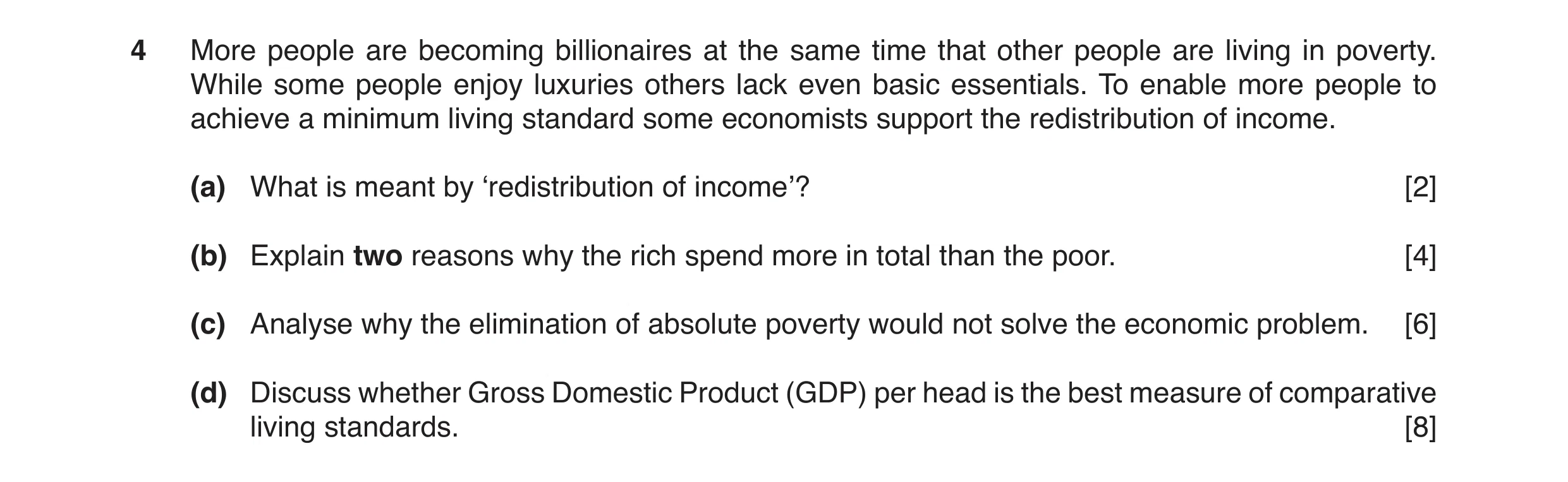
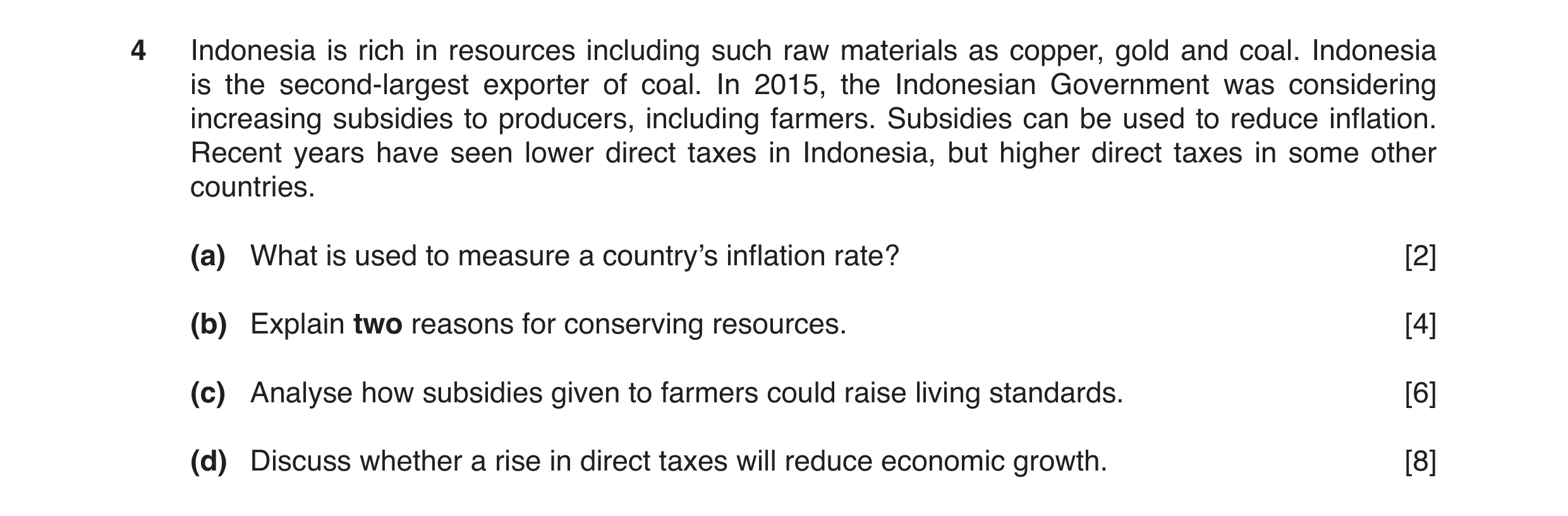 1 / 7
1 / 7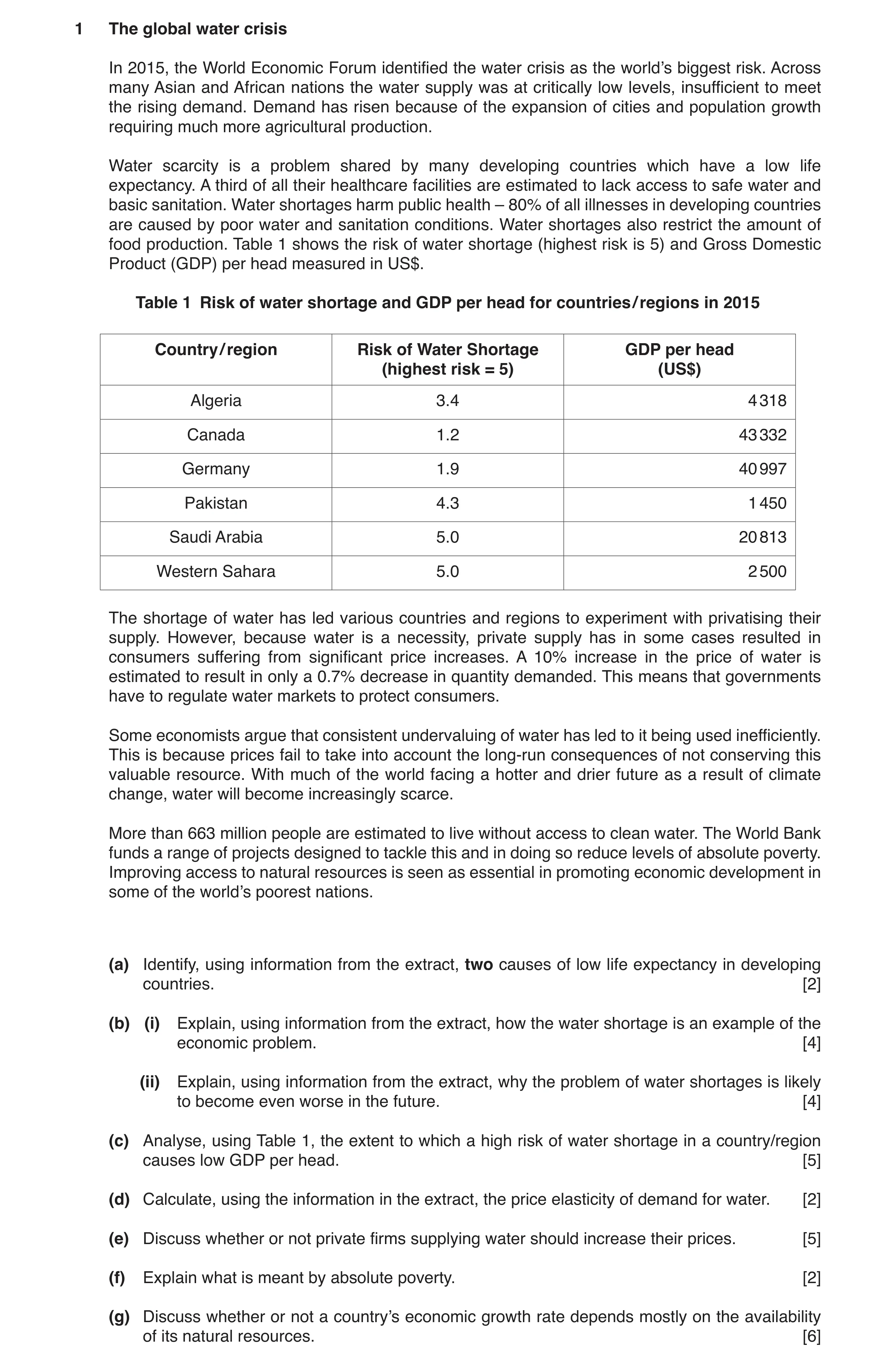
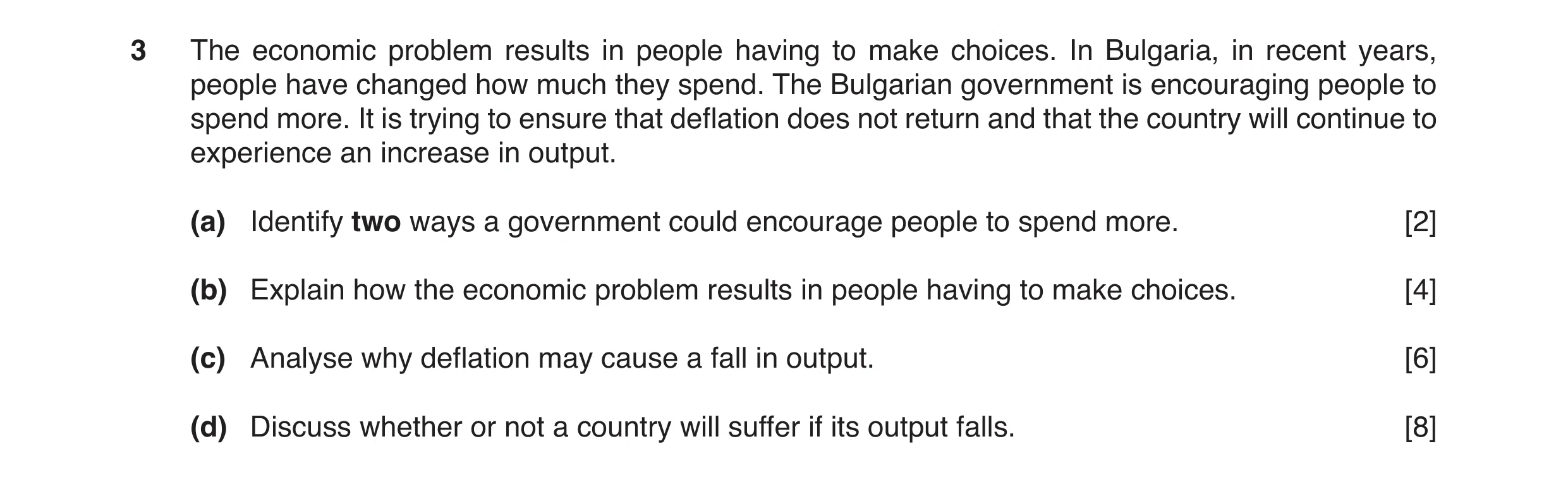 2 / 7
2 / 7
 3 / 7
3 / 7
 4 / 7
4 / 7
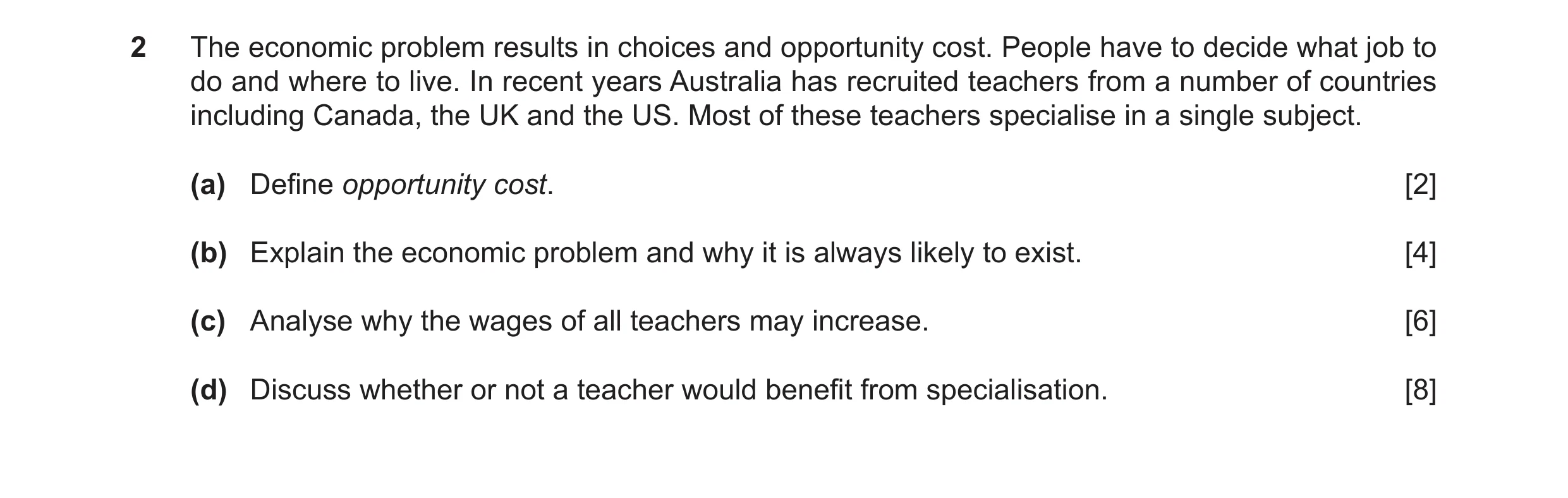
![Question 14: (a) Calculate the price elasticity of supply of Ecuador’s oil. [1] (b) Identify two key resource allocation questions. [2] (c) State why su…](https://img.pastlit.com/crops/23ae5604-fbfe-4bc2-8158-2b705635eae3/q1.webp) 5 / 7
5 / 7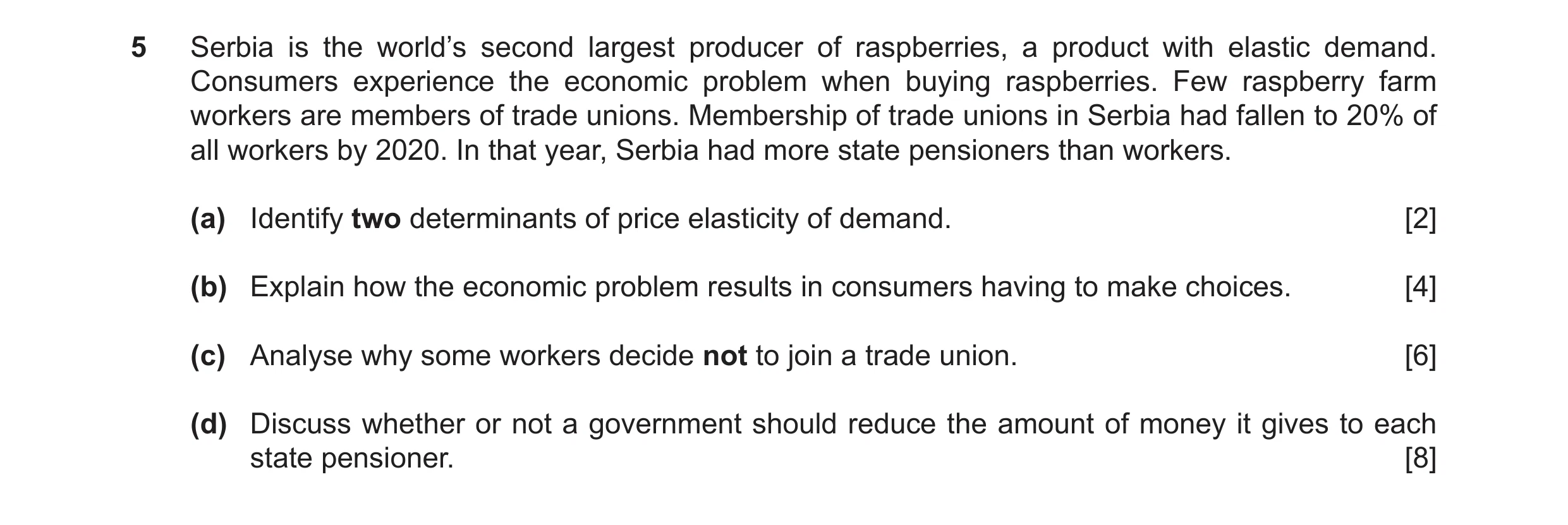
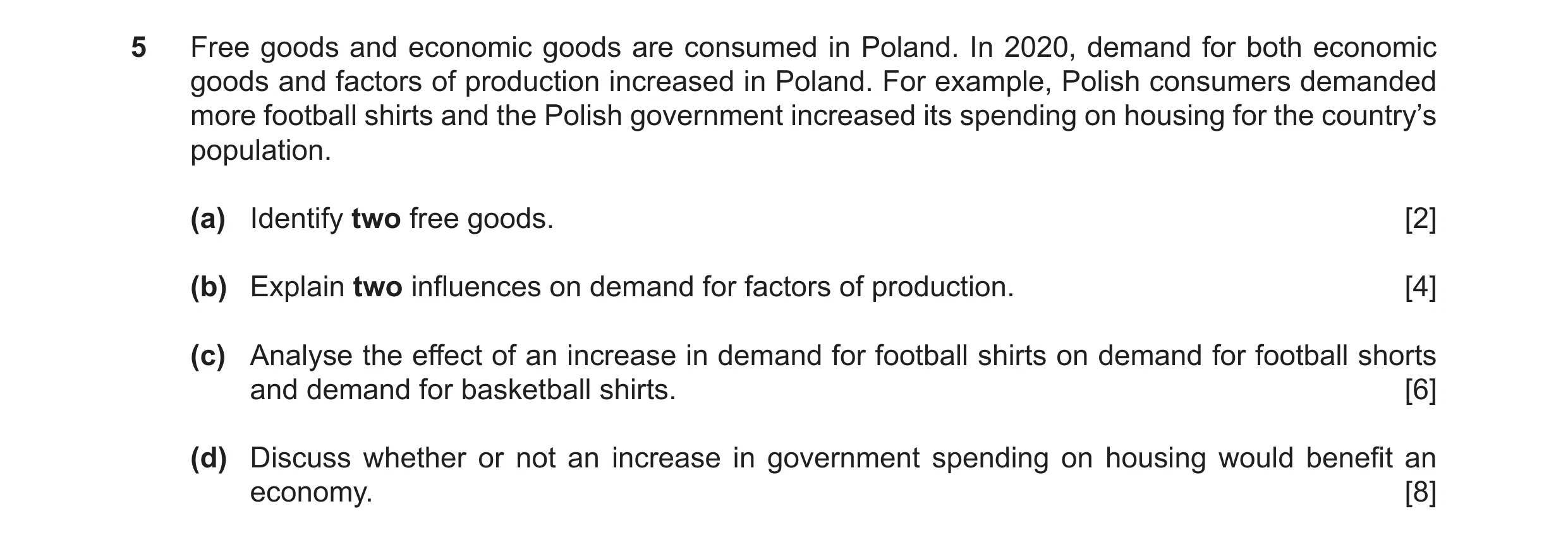
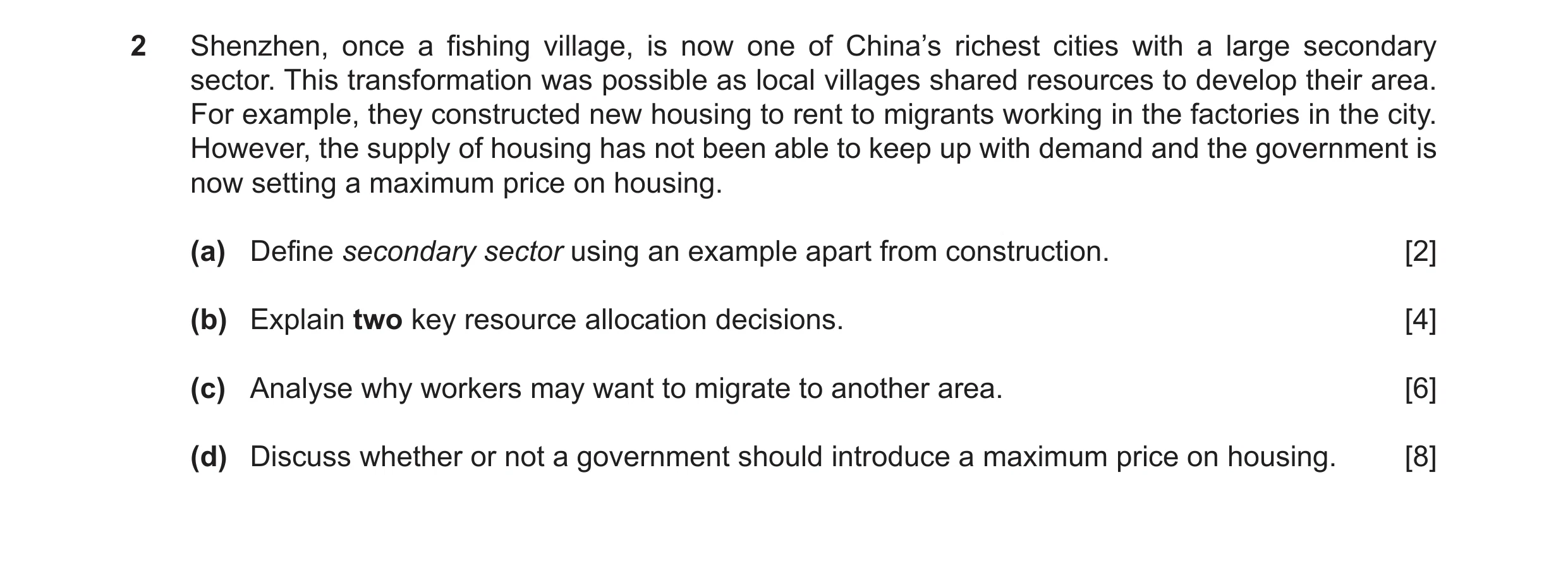 6 / 7
6 / 7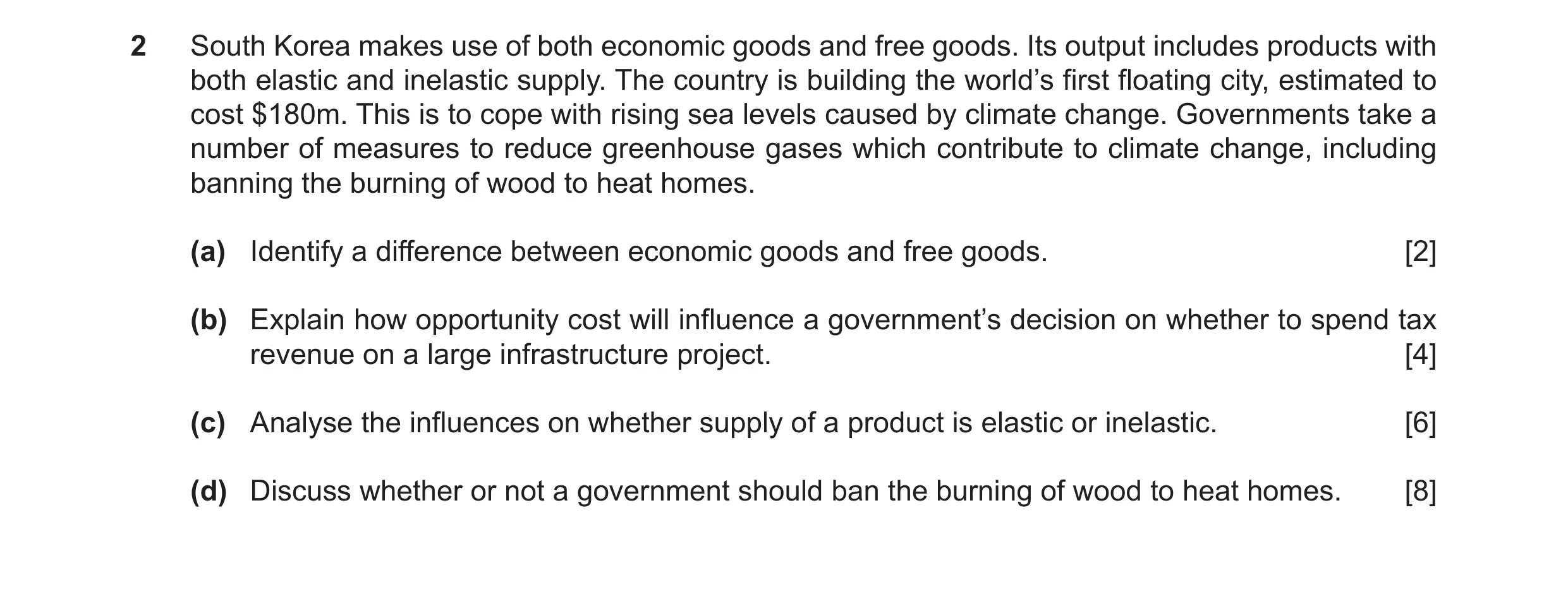
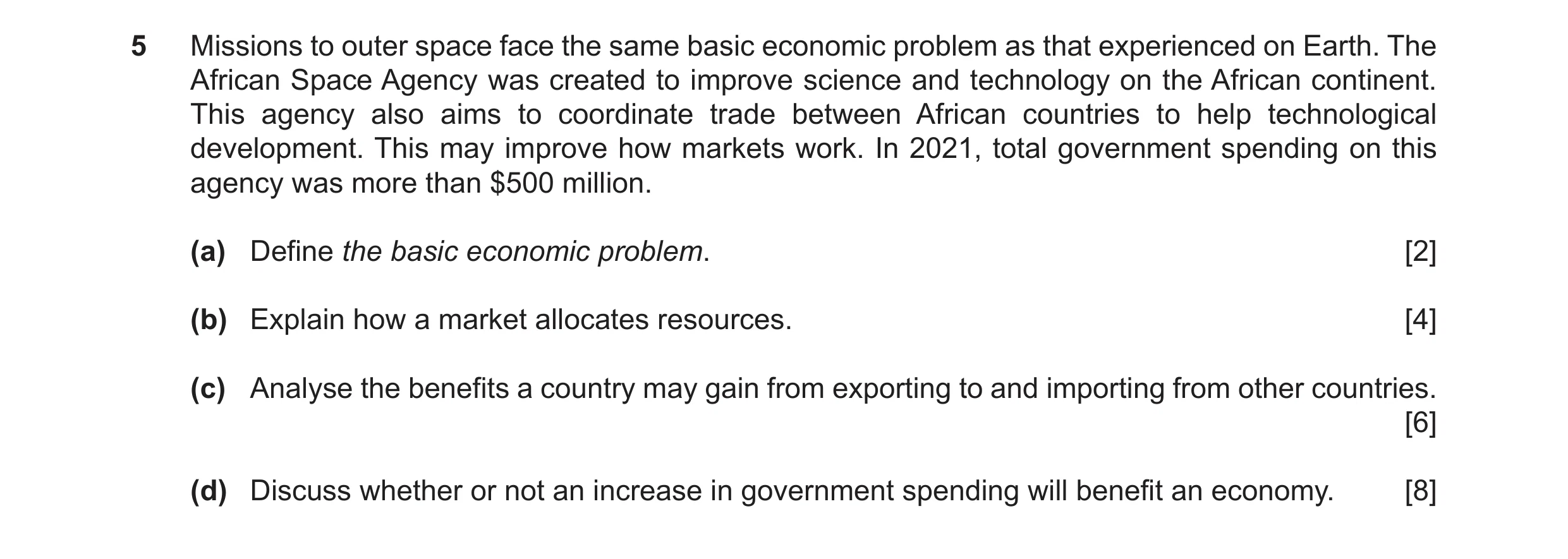 7 / 7
7 / 7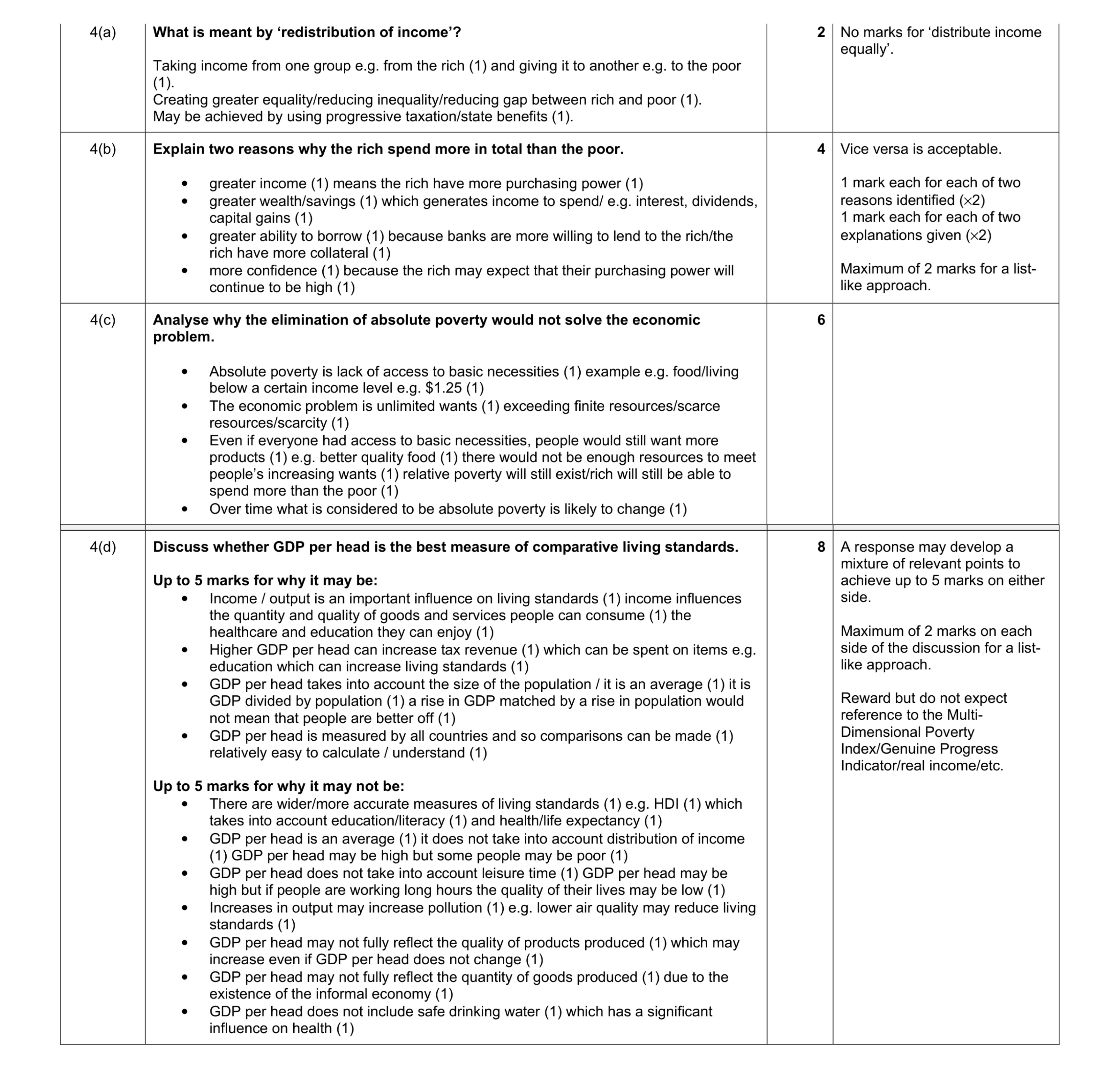 20
20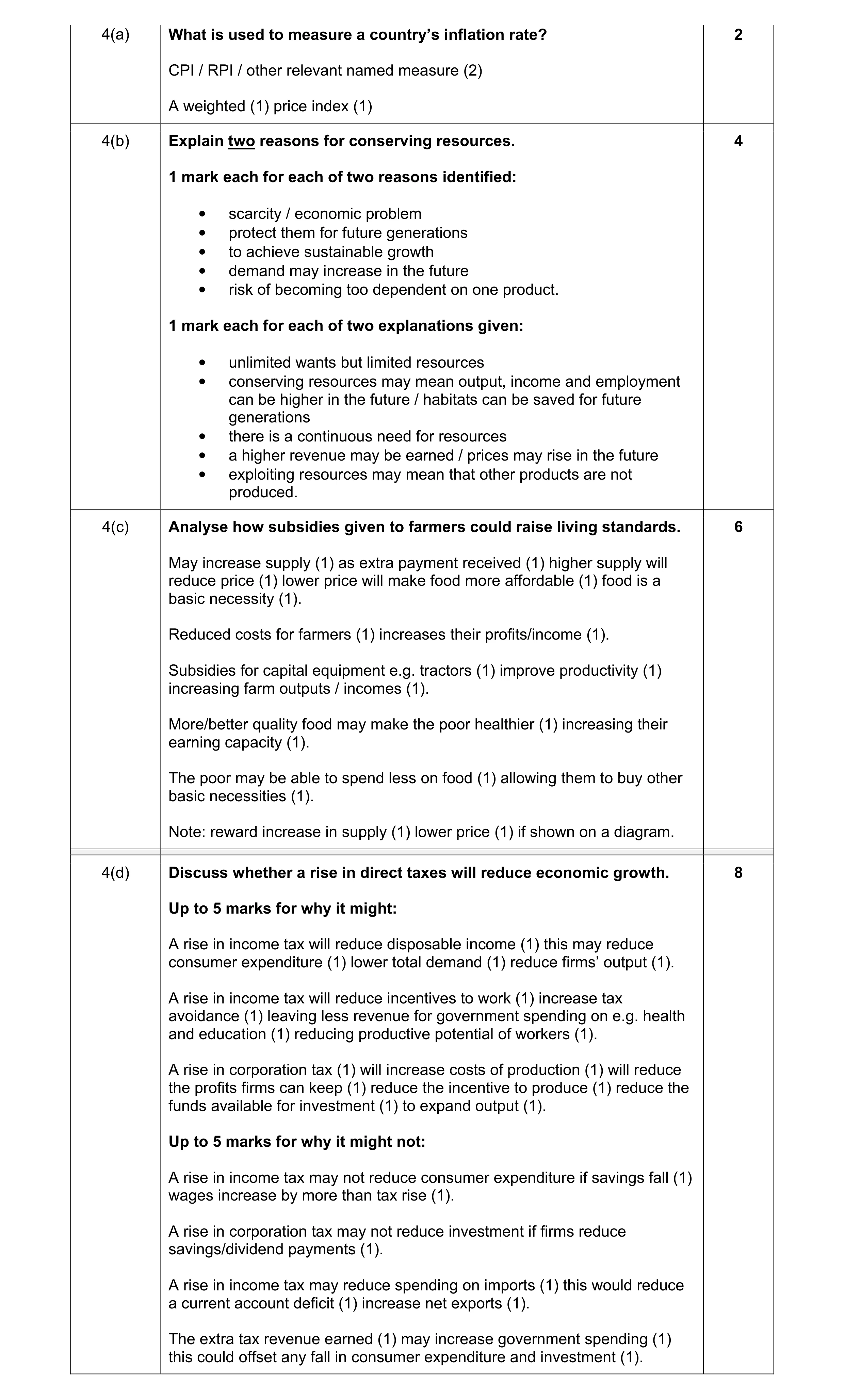 20
20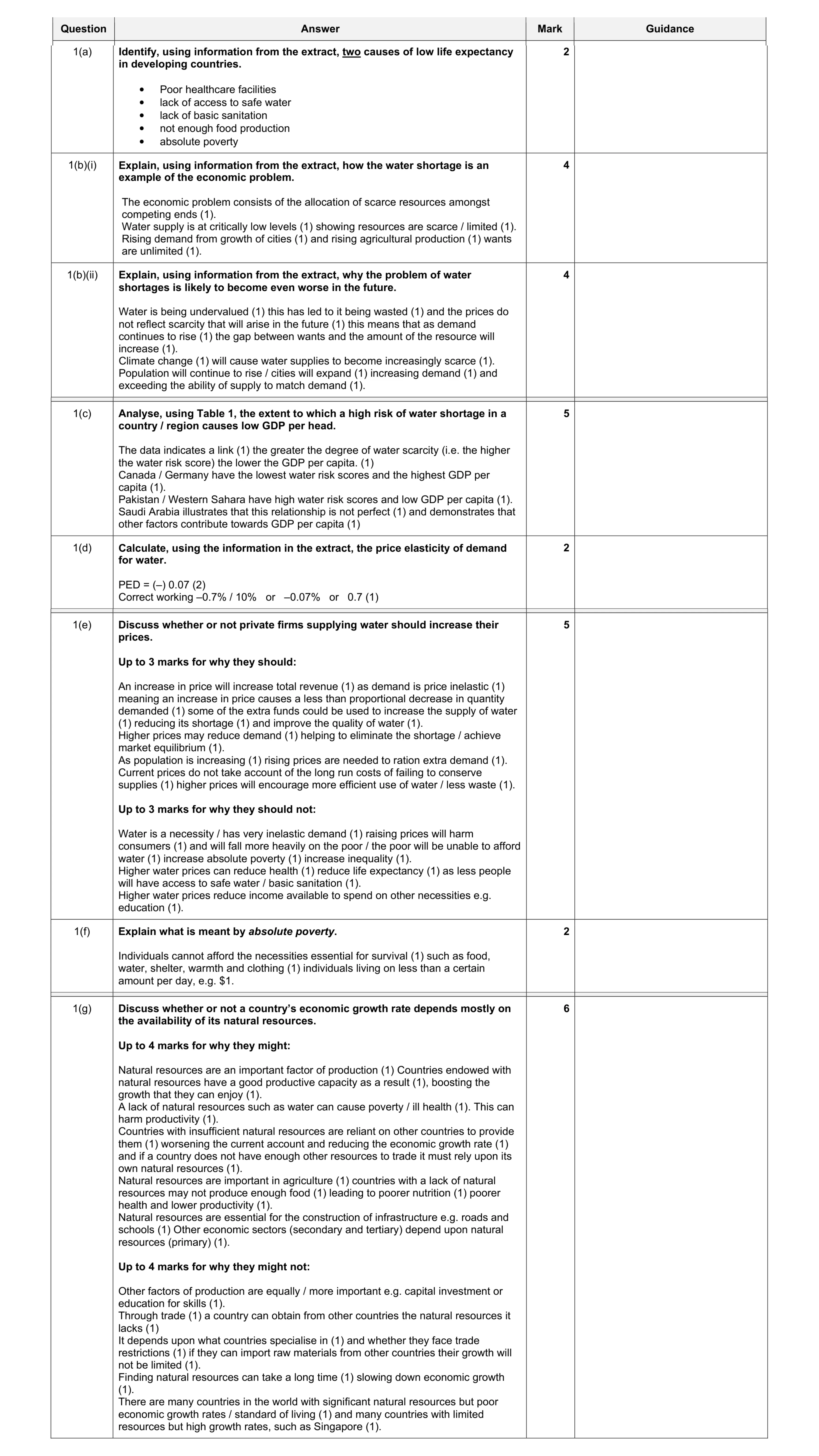 30
30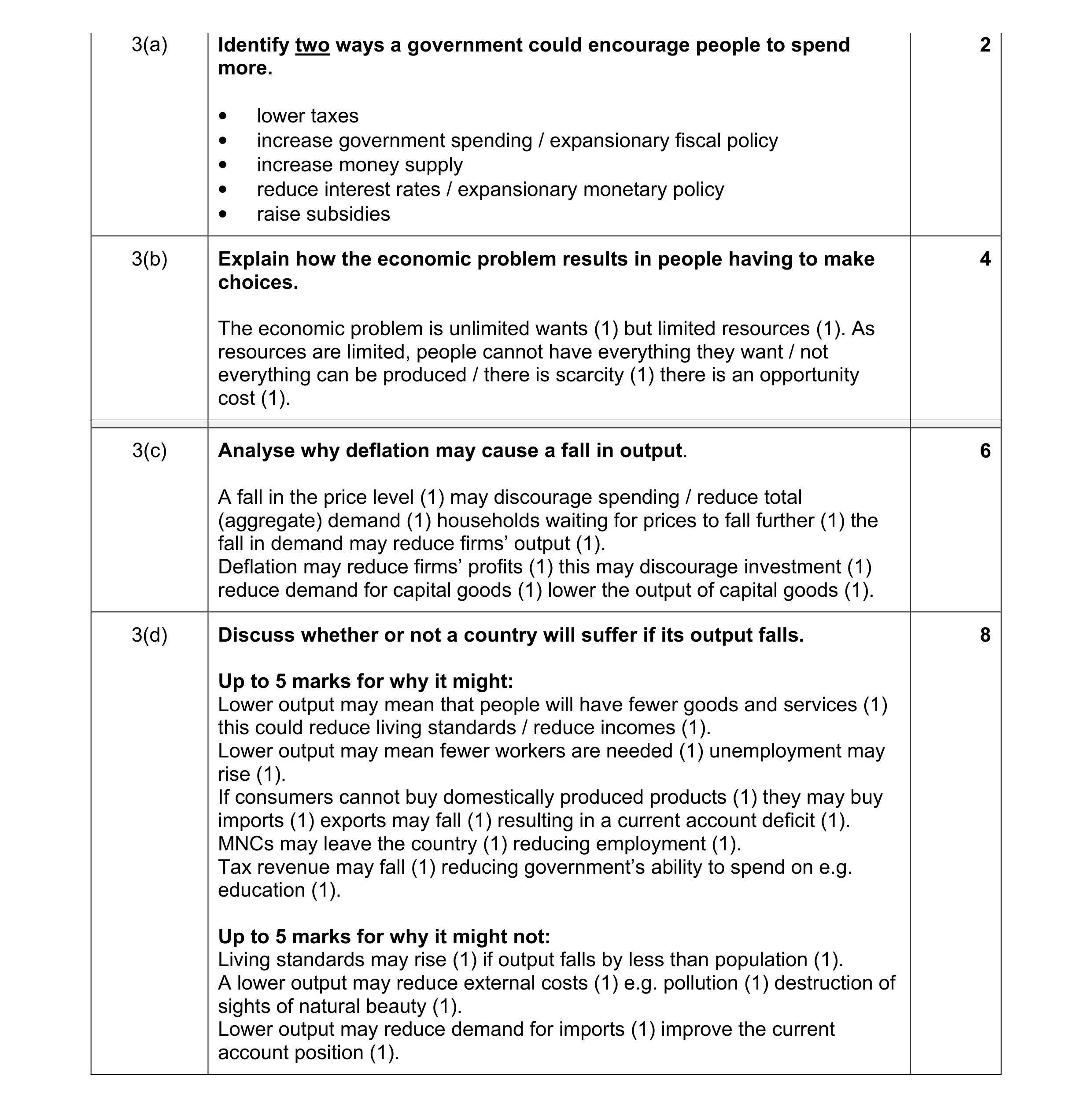 20
20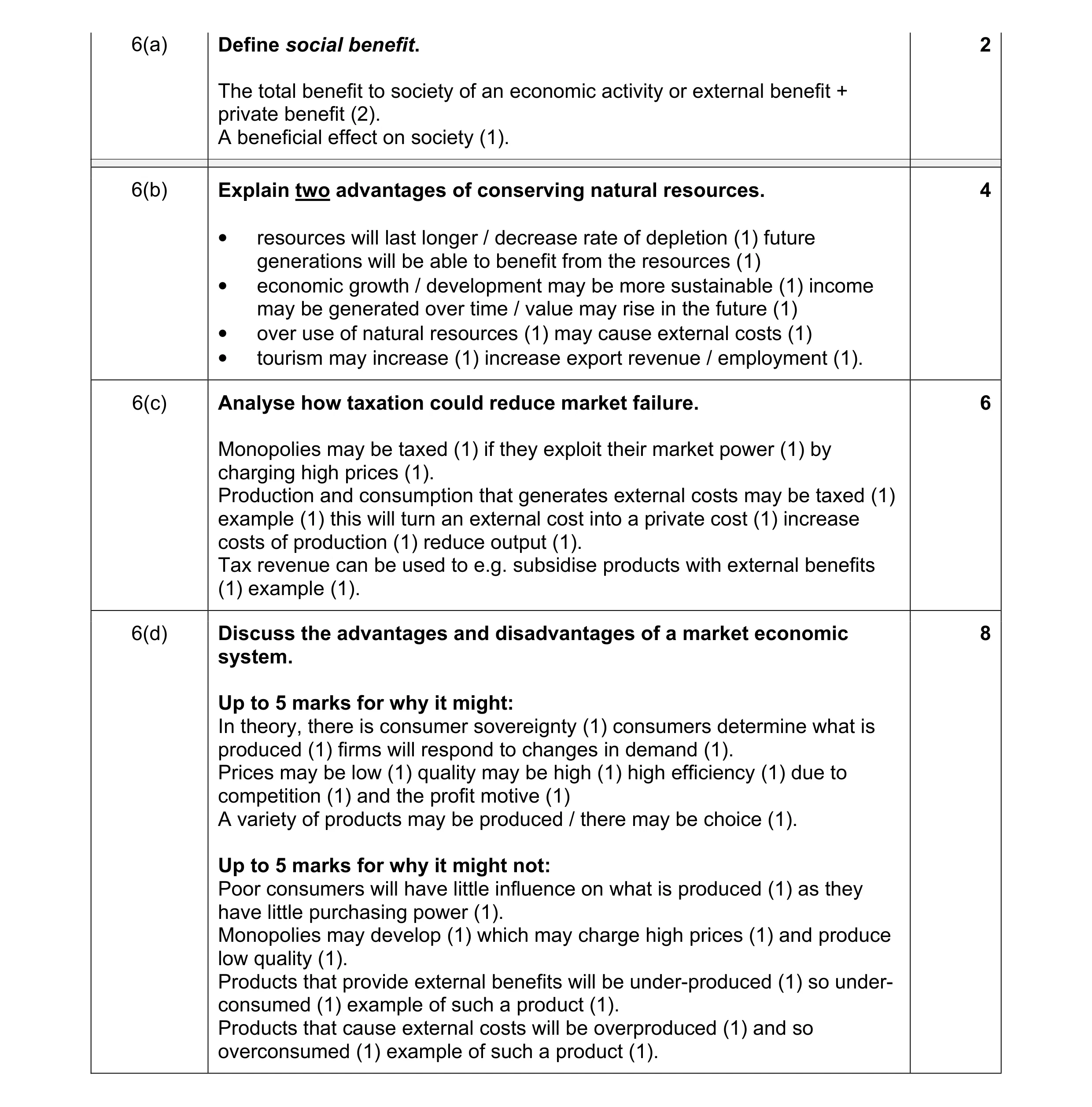 20
20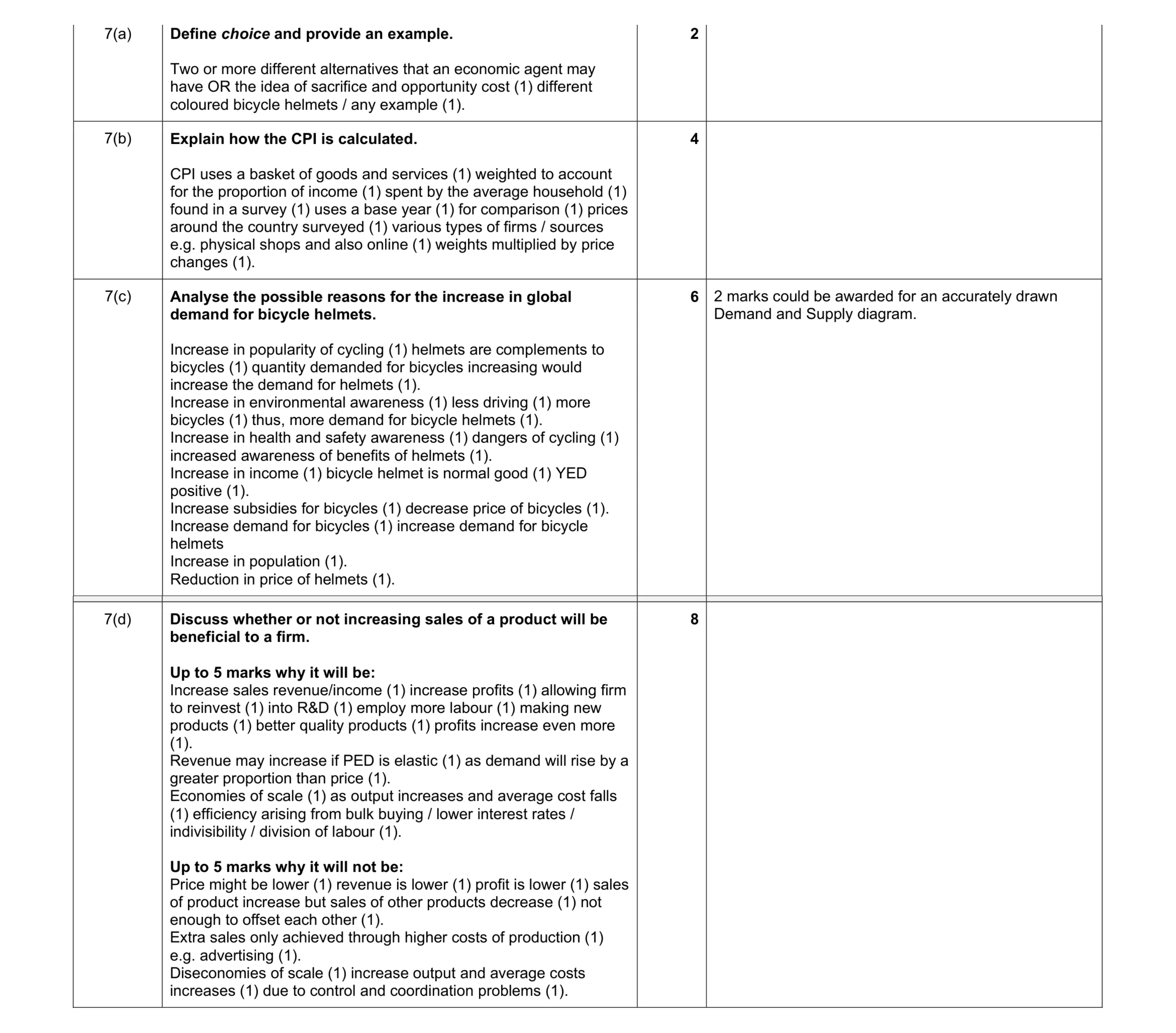 20
20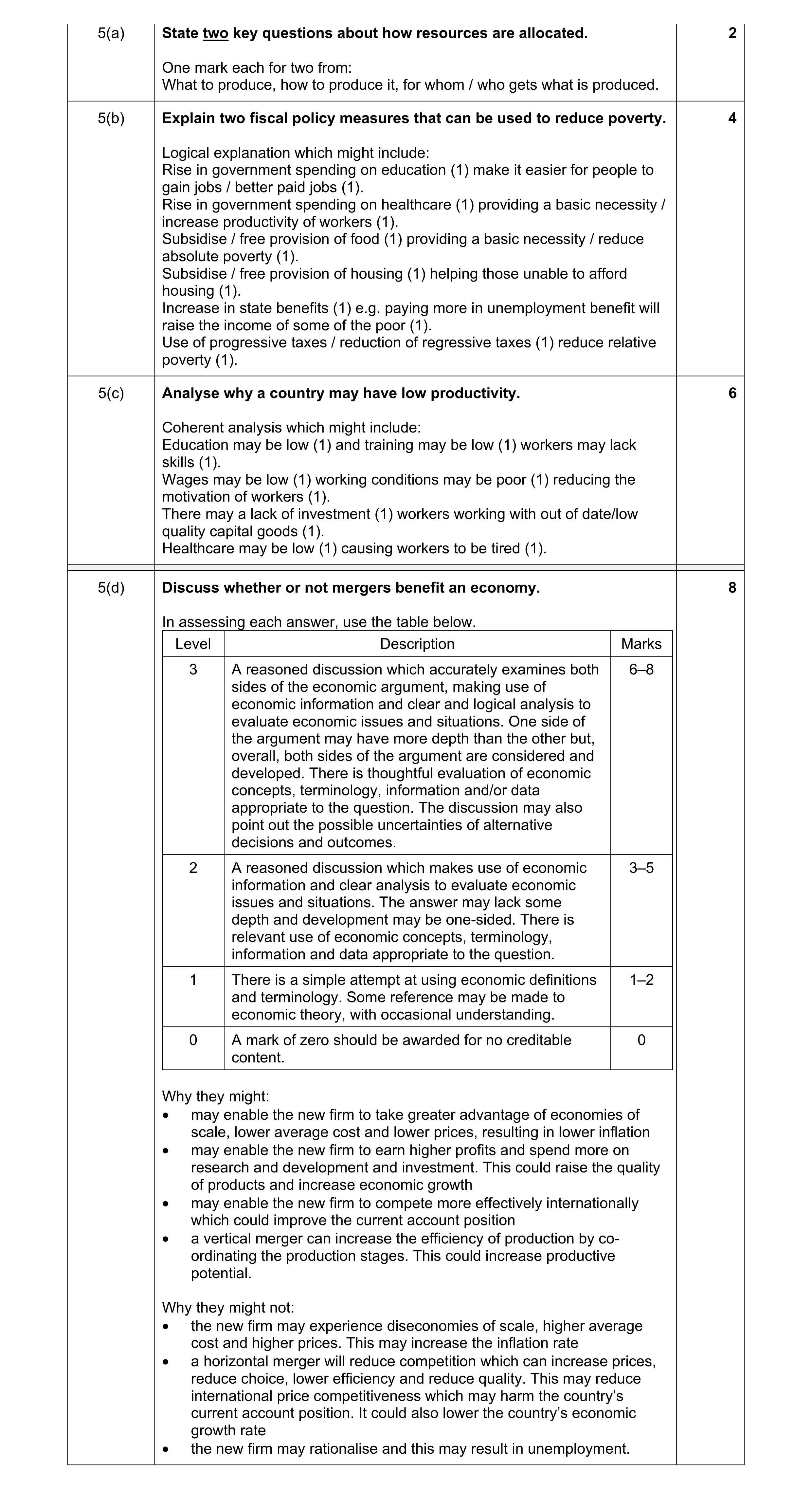 20
20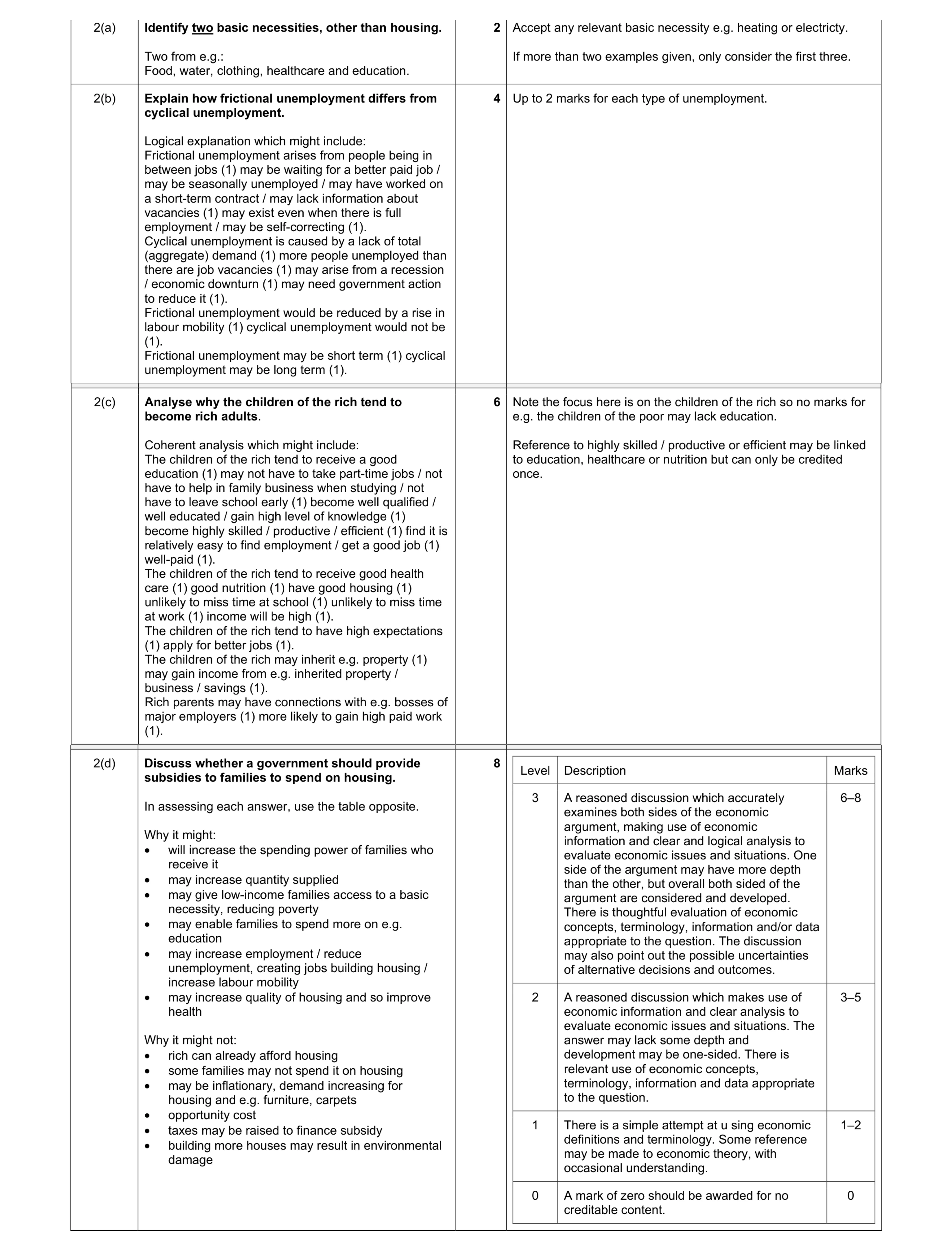 20
20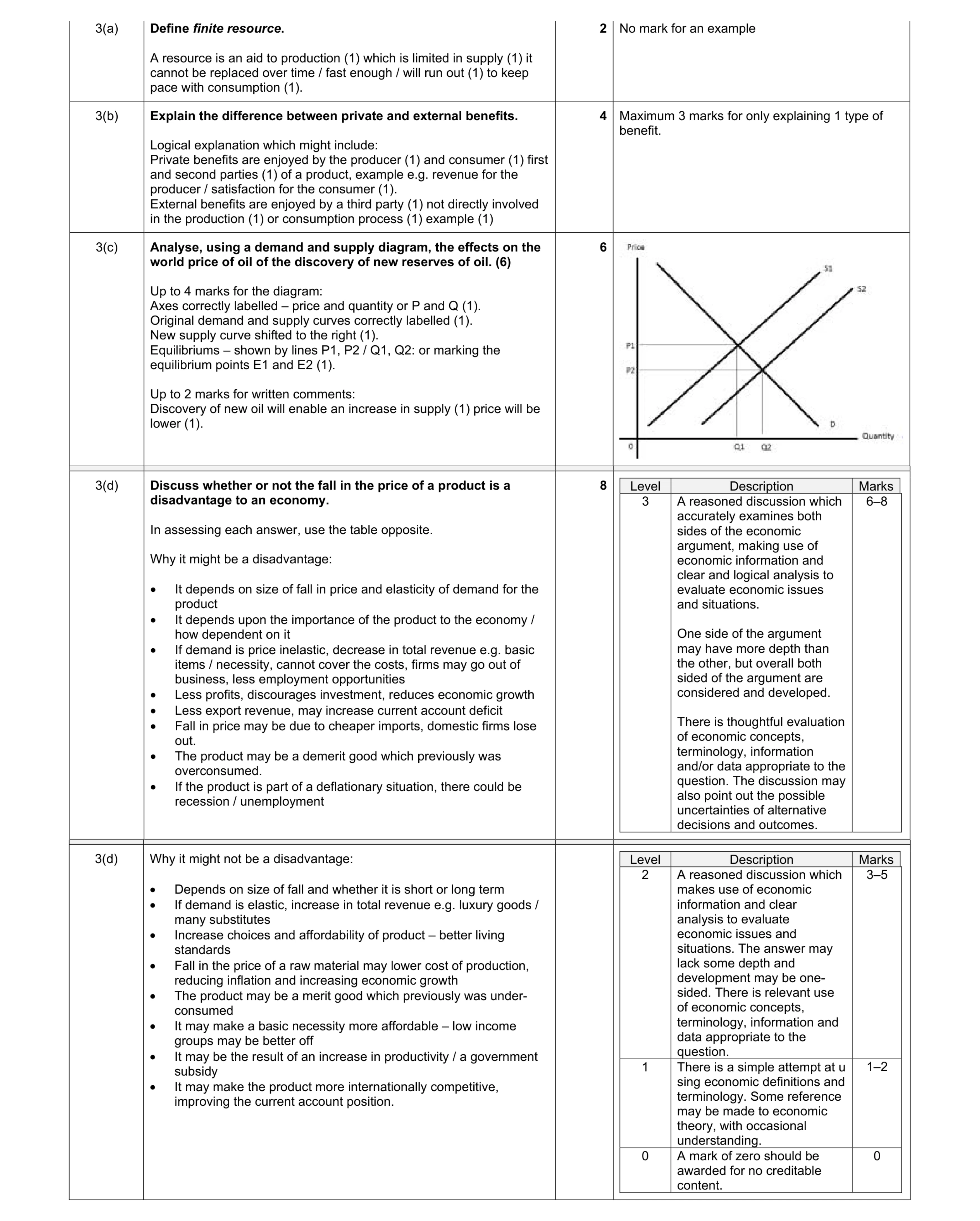 20
20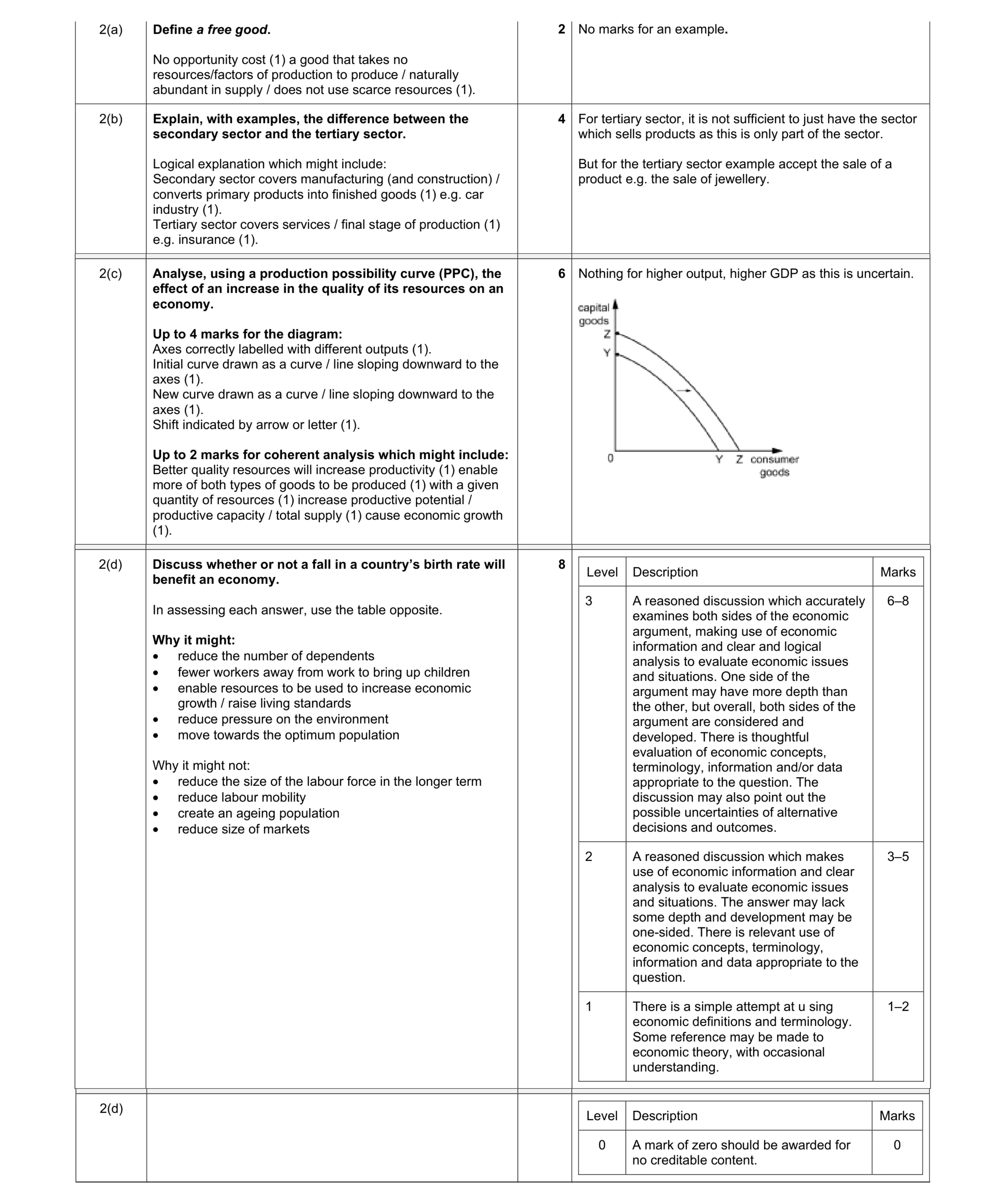 20
20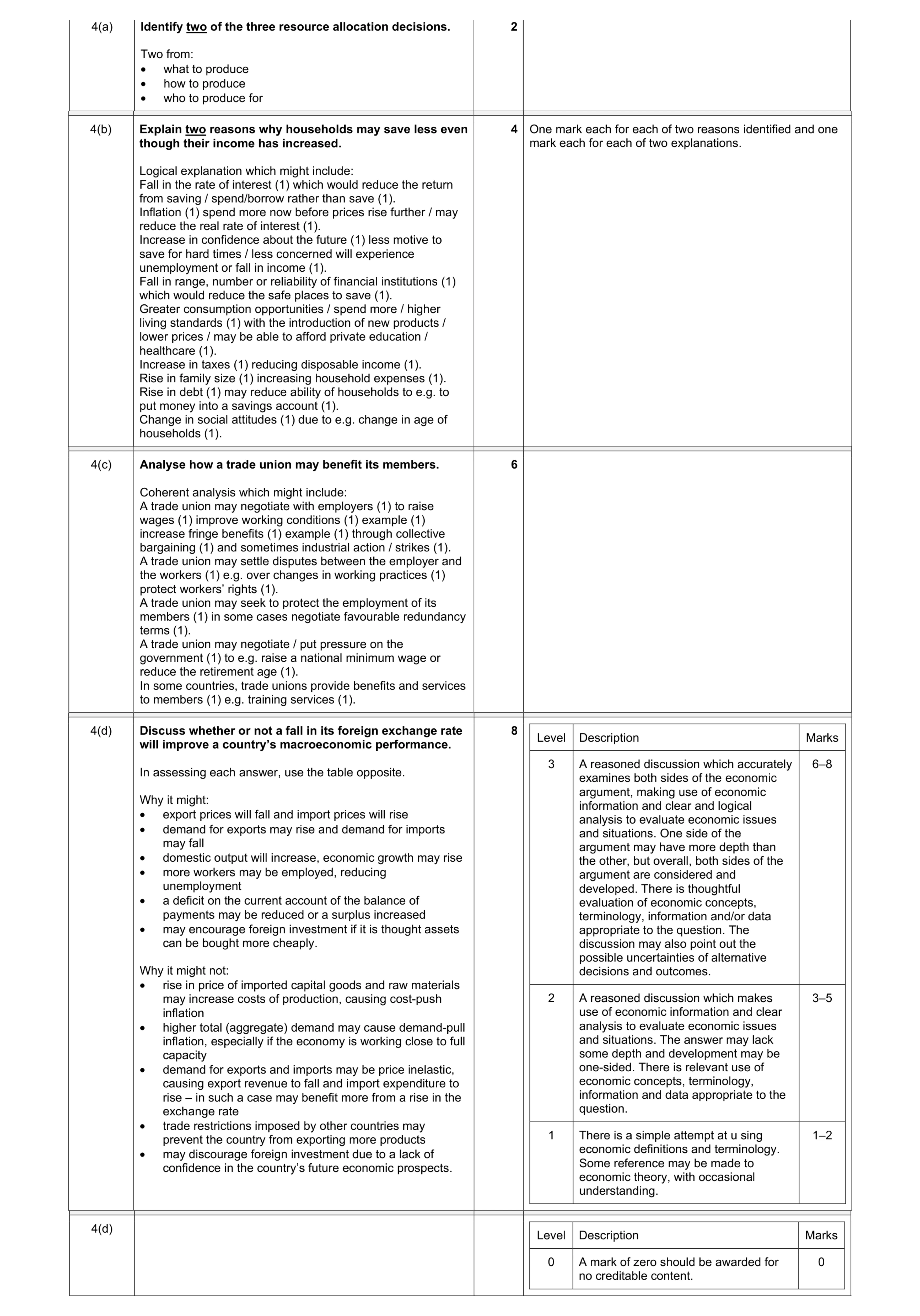 20
20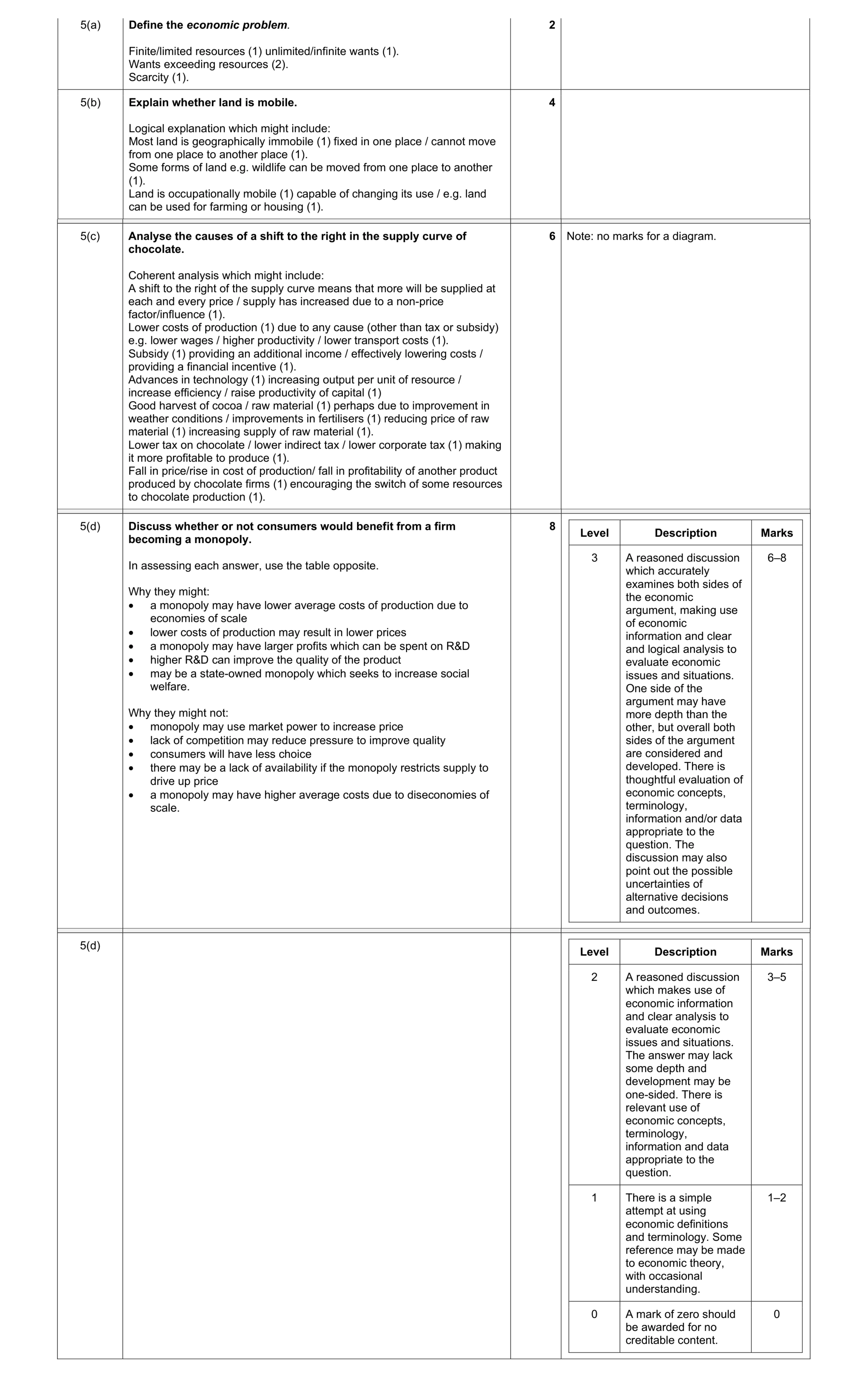 20
20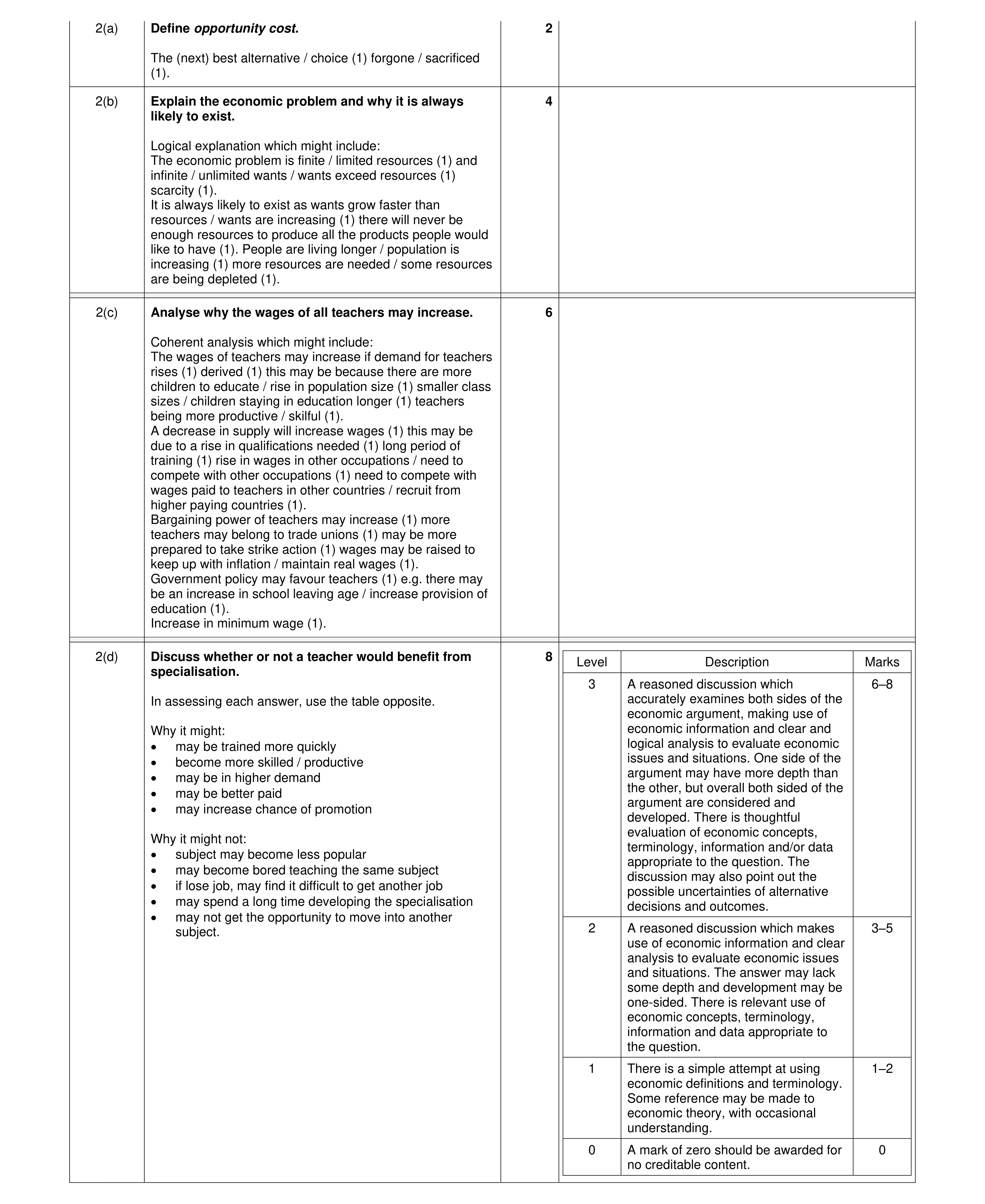 20
20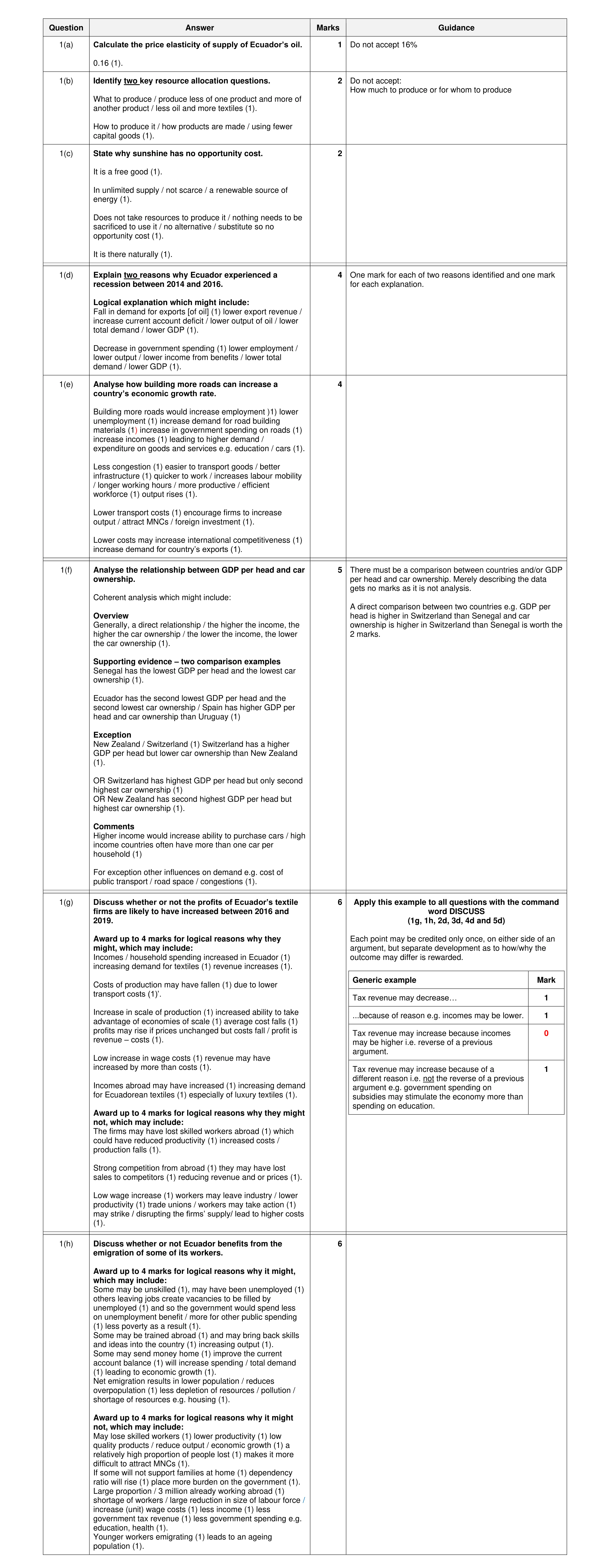 30
30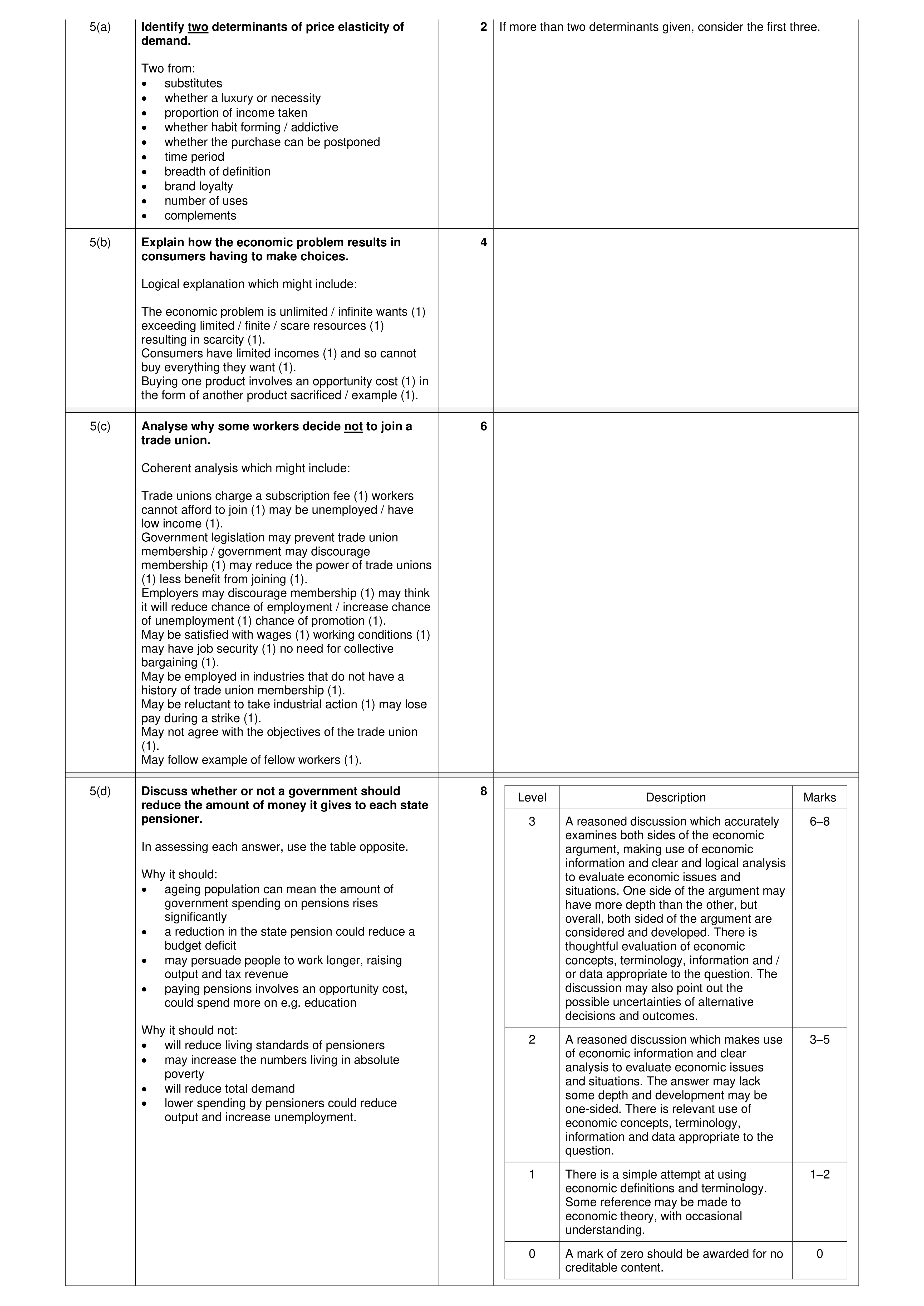 20
20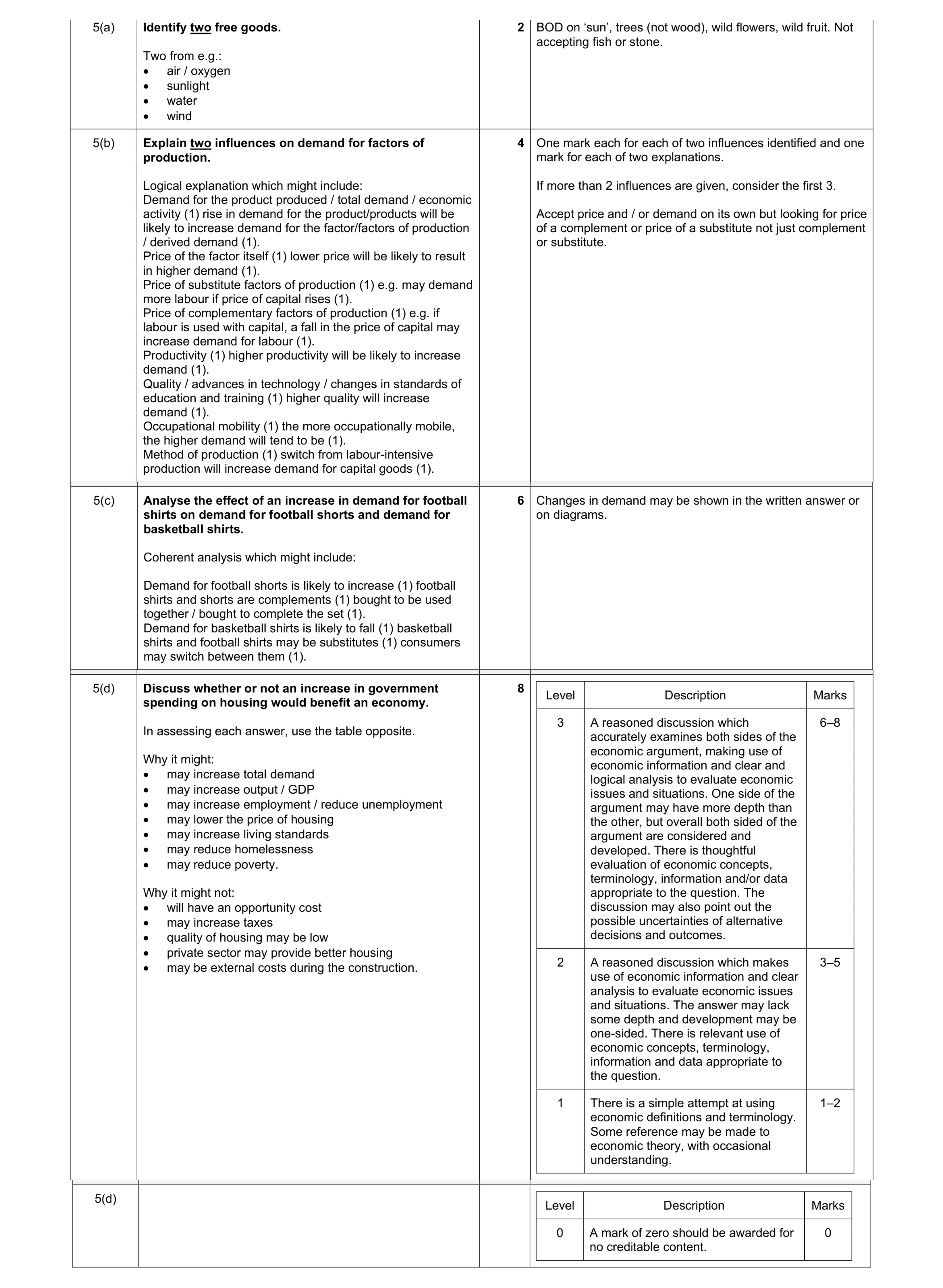 20
20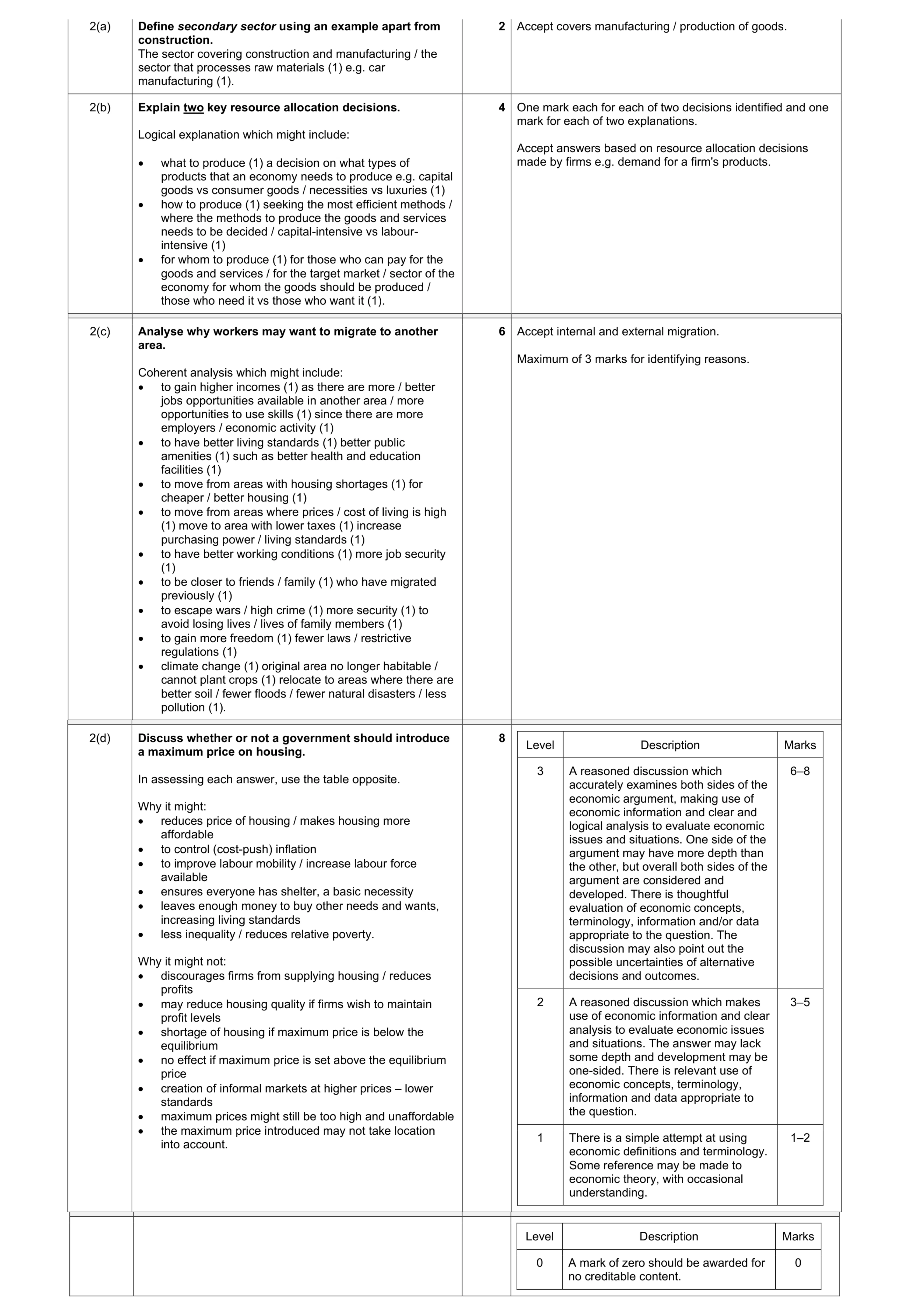 20
20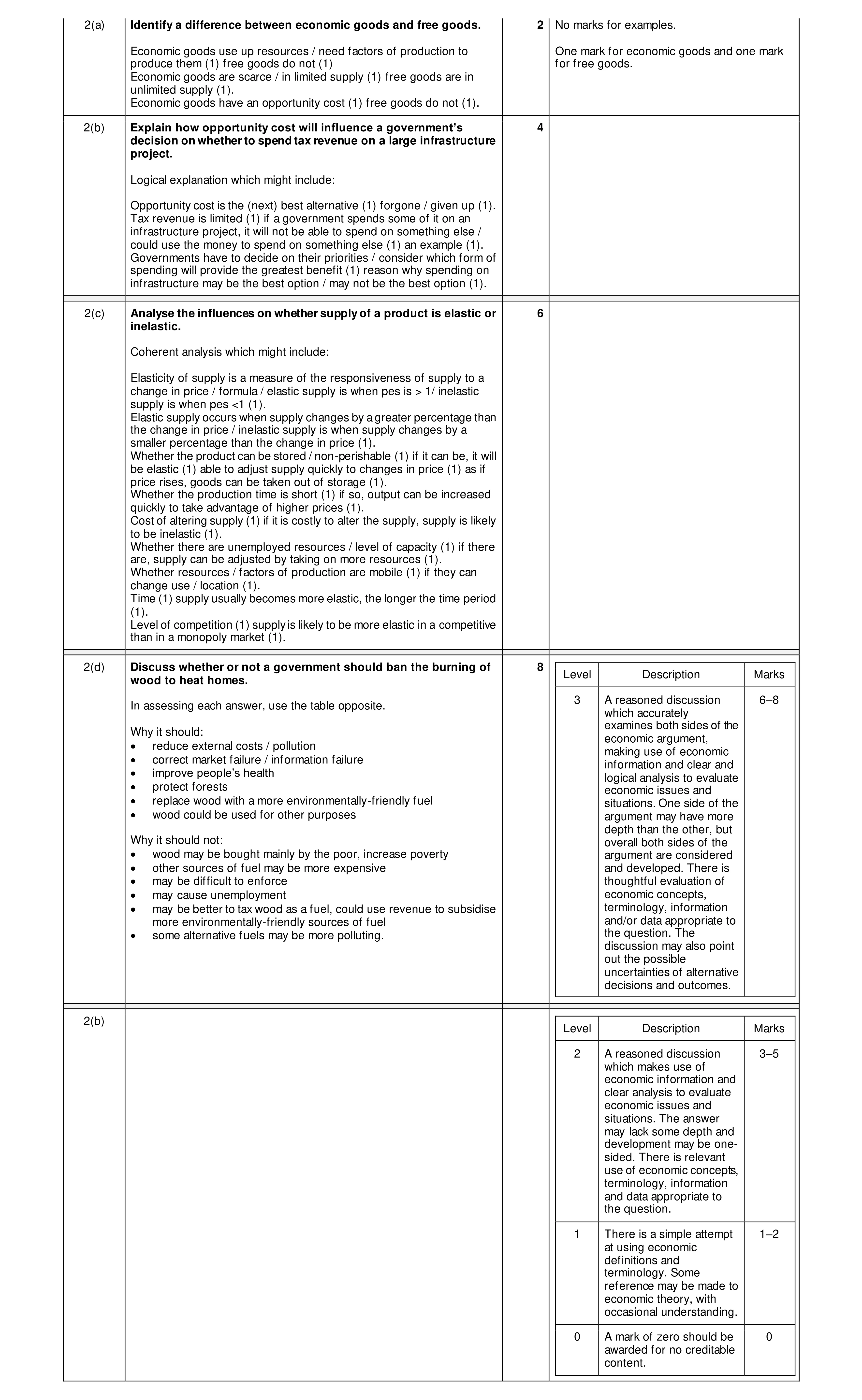 20
20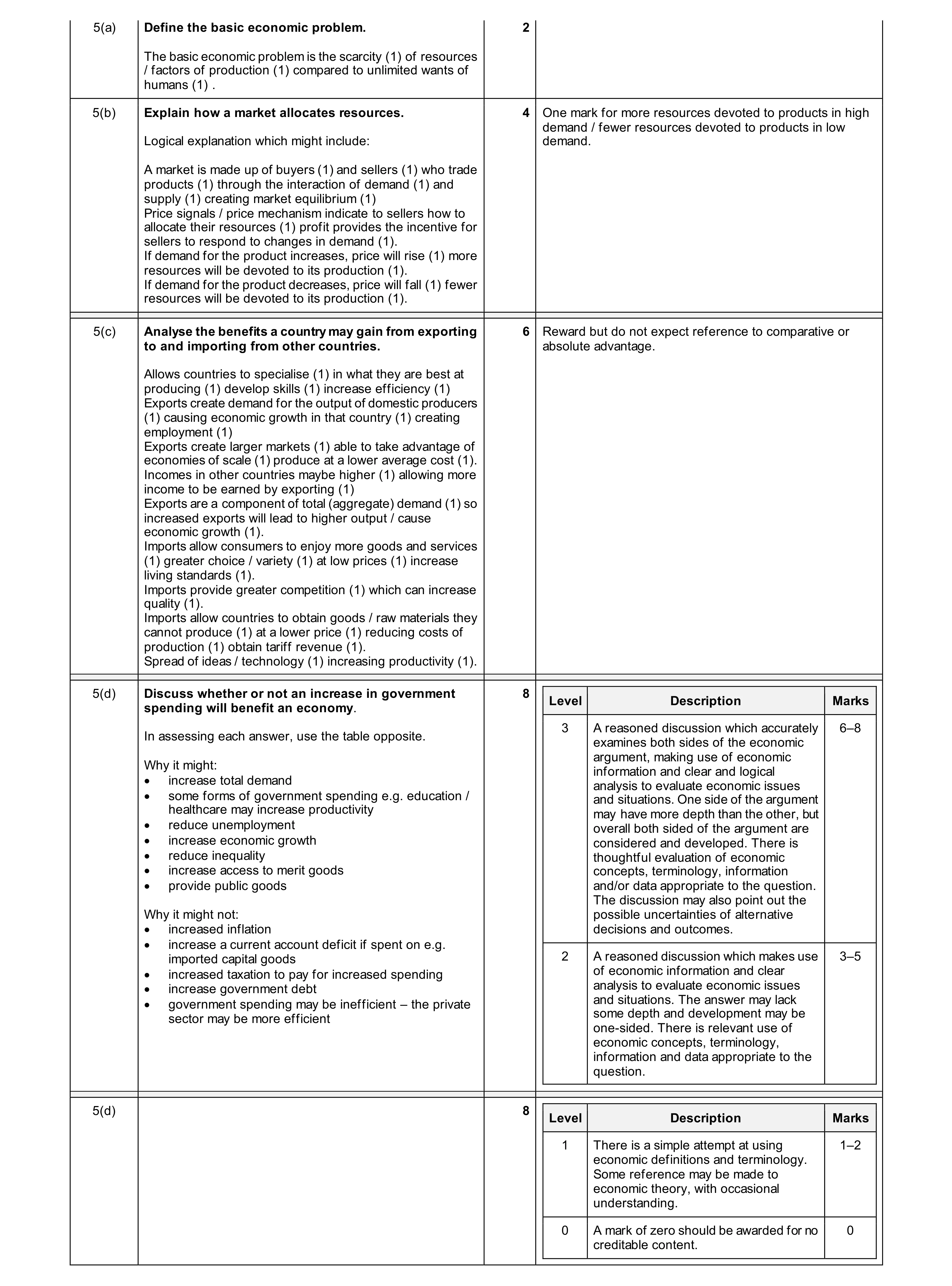 20
20