Questions as text
Q1 · Which of the following is a longitudinal wave? 9702/11 Oct/Nov 2004
24 Which of the following is a longitudinal wave? A a light wave travelling through air B a radio wave from a broadcasting station C a ripple on the surface of water D a sound wave travelling through air
1 marks
Answer: D
This question in 9702/11 Oct/Nov 2004
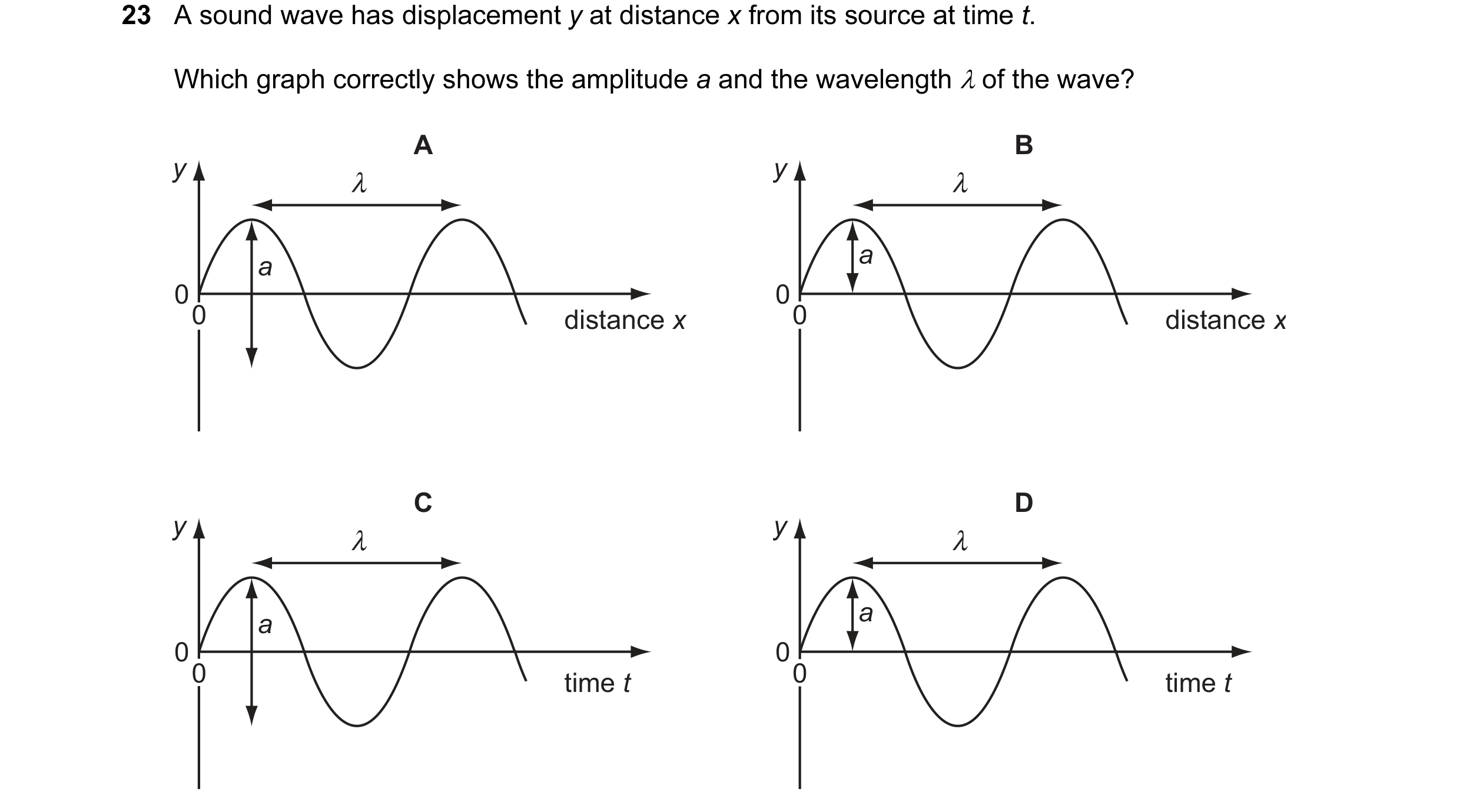
Q2 · A sound wave has displacement y at distance x from its source at time t 9702/11 Oct/Nov 2005
23 A sound wave has displacement y at distance x from its source at time t. Which graph correctly shows the amplitude a and the wavelength λ of the wave? A B y y λ λ a a 0 0 0 distance x 0 distance x C D y y λ λ a a 0 0 0 time t 0 time t
1 marks
Answer: B
This question in 9702/11 Oct/Nov 2005
Q3 · Which phenomenon is associated with transverse waves but not longitudinal waves? 9702/11 May/June 2006
23 Which phenomenon is associated with transverse waves but not longitudinal waves? A polarisation B reflection C refraction D superposition
1 marks
Answer: A
This question in 9702/11 May/June 2006
Q4 · A wave that can be polarised must be A longitudinal 9702/12 Oct/Nov 2011
24 A wave that can be polarised must be A longitudinal. B progressive. C stationary. D transverse.
1 marks
Answer: D
This question in 9702/12 Oct/Nov 2011
Q5 · A sound wave is set up in a long tube, closed at one end 9702/12 Oct/Nov 2011
27 A sound wave is set up in a long tube, closed at one end. The length of the tube is adjusted until the sound from the tube is loudest. What is the nature of the sound wave in the tube? A longitudinal and progressive B longitudinal and stationary C transverse and progressive D transverse and stationary
1 marks
Answer: B
This question in 9702/12 Oct/Nov 2011
Q6 · What is correct for all transverse waves? 9702/12 May/June 2013
26 What is correct for all transverse waves? A They are all electromagnetic. B They can all be polarised. C They can all travel through a vacuum. D They all involve the oscillation of atoms. Space for working
1 marks
Answer: B
This question in 9702/12 May/June 2013
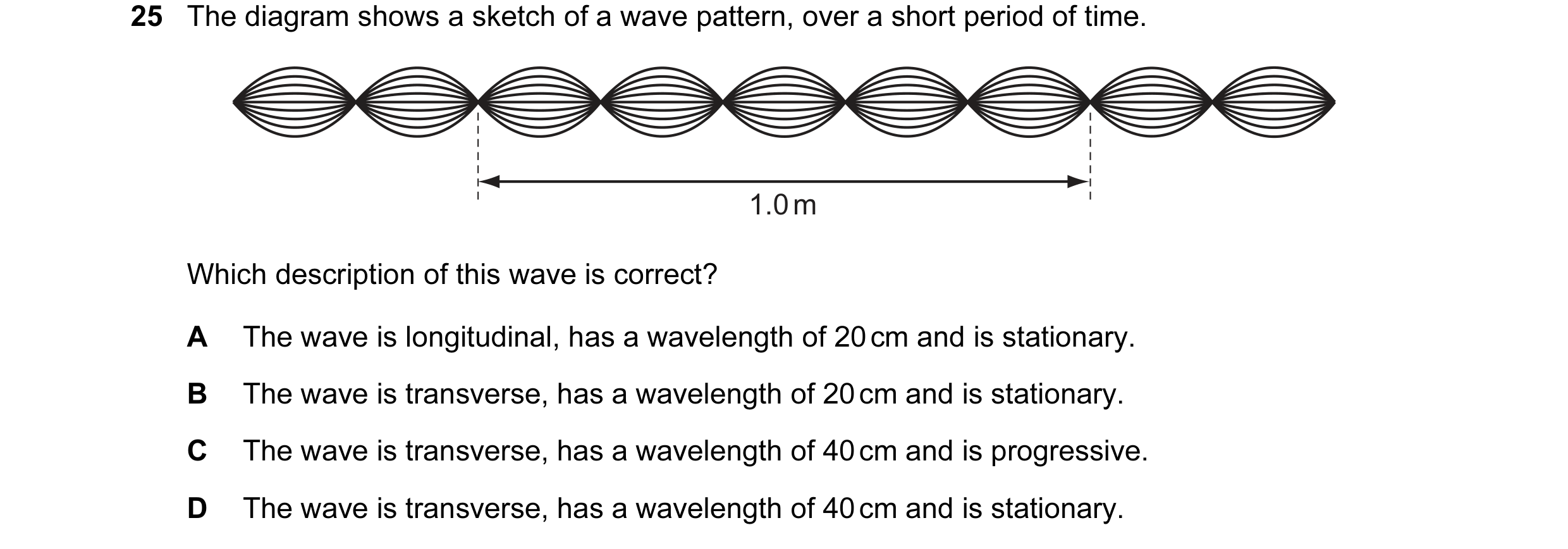
Q7 · The diagram shows a sketch of a wave pattern, over a short period of time 9702/11 Oct/Nov 2013
25 The diagram shows a sketch of a wave pattern, over a short period of time. 1.0 m Which description of this wave is correct? A The wave is longitudinal, has a wavelength of 20 cm and is stationary. B The wave is transverse, has a wavelength of 20 cm and is stationary. C The wave is transverse, has a wavelength of 40 cm and is progressive. D The wave is transverse, has a wavelength of 40 cm and is stationary.
1 marks
Answer: D
This question in 9702/11 Oct/Nov 2013
Q8 · Which statement about a light wave and a sound wave is correct? 9702/12 Oct/Nov 2013
26 Which statement about a light wave and a sound wave is correct? A Both can be polarised. B Both can travel through free space. C Both have a frequency inversely proportional to their wavelength. D Both have an intensity proportional to their amplitude. Space for working
1 marks
Answer: C
This question in 9702/12 Oct/Nov 2013
Q9 · Which statement about longitudinal waves is correct? 9702/11 May/June 2014
22 Which statement about longitudinal waves is correct? A Longitudinal waves include radio waves travelling through air. B Particles in a longitudinal wave vibrate at right-angles to the direction of transfer of wave energy. C Some types of longitudinal wave can be polarised. D Stationary waves can be produced by the superposition of longitudinal waves.
1 marks
Answer: D
This question in 9702/11 May/June 2014
Q10 · The diagram shows a vertical cross-section through a water wave moving from left to right 9702/12 May/June 2014
24 The diagram shows a vertical cross-section through a water wave moving from left to right. At which point is the water moving upwards with maximum speed? B A C D
1 marks
Answer: C
This question in 9702/12 May/June 2014
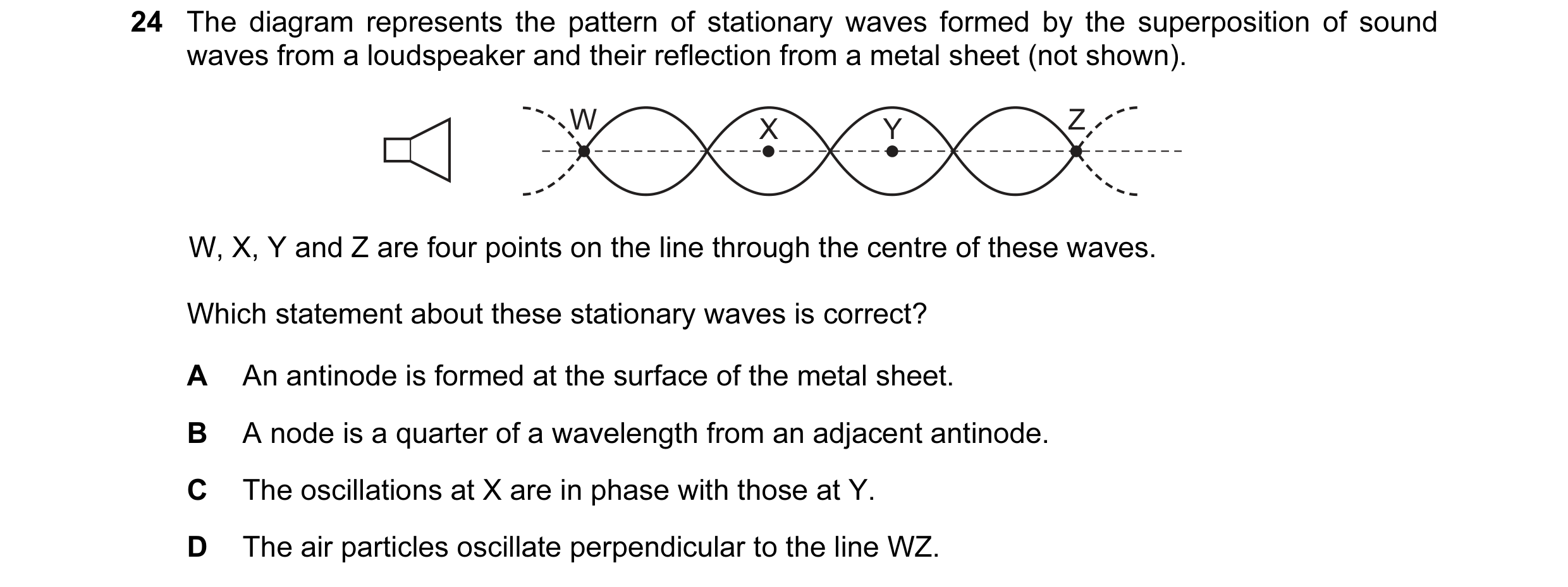
Q11 · The diagram represents the pattern of stationary waves formed by the superposition of… 9702/12 Feb/March 2016
24 The diagram represents the pattern of stationary waves formed by the superposition of sound waves from a loudspeaker and their reflection from a metal sheet (not shown). W X Y Z W, X, Y and Z are four points on the line through the centre of these waves. Which statement about these stationary waves is correct? A An antinode is formed at the surface of the metal sheet. B A node is a quarter of a wavelength from an adjacent antinode. C The oscillations at X are in phase with those at Y. D The air particles oscillate perpendicular to the line WZ.
1 marks
Answer: B
This question in 9702/12 Feb/March 2016
Q12 · Which statement about light waves and sound waves is correct? 9702/12 Feb/March 2017
23 Which statement about light waves and sound waves is correct? A Both light waves and sound waves show the Doppler effect. B Light waves can be diffracted but sound waves cannot be diffracted. C Sound waves are transverse waves and light waves are longitudinal waves. D Sound waves can travel in a vacuum but light waves cannot travel in a vacuum.
1 marks
Answer: A
This question in 9702/12 Feb/March 2017
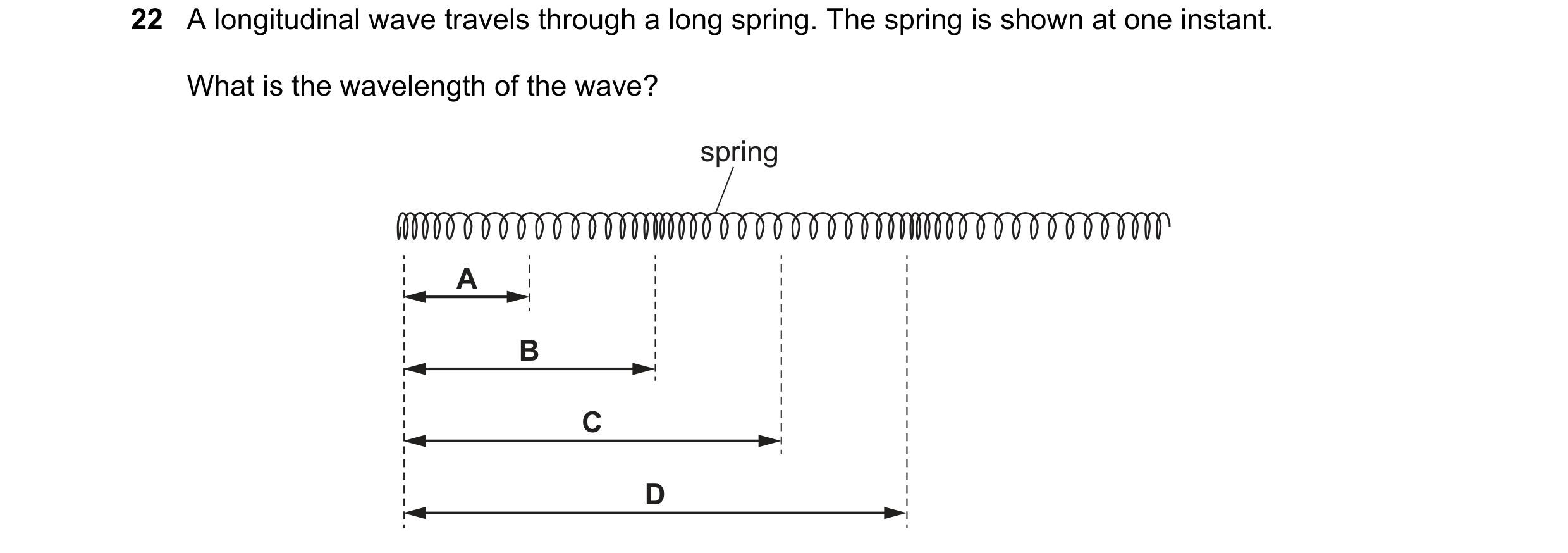
Q13 · A longitudinal wave travels through a long spring 9702/11 May/June 2017
22 A longitudinal wave travels through a long spring. The spring is shown at one instant. What is the wavelength of the wave? spring A B C D
1 marks
Answer: B
This question in 9702/11 May/June 2017
Q14 · Which statement about progressive longitudinal waves is not correct? 9702/12 May/June 2017
23 Which statement about progressive longitudinal waves is not correct? A The oscillations of the particles are parallel to the direction of travel of the wave energy. B They have a series of nodes and antinodes. C They need a medium through which to travel. D They transfer energy.
1 marks
Answer: B
This question in 9702/12 May/June 2017
Q15 · Which wave is a longitudinal wave? 9702/12 Oct/Nov 2017
23 Which wave is a longitudinal wave? A a light wave travelling through air B a radio wave from a broadcasting station C a ripple on the surface of water D a sound wave travelling through air
1 marks
Answer: D
This question in 9702/12 Oct/Nov 2017
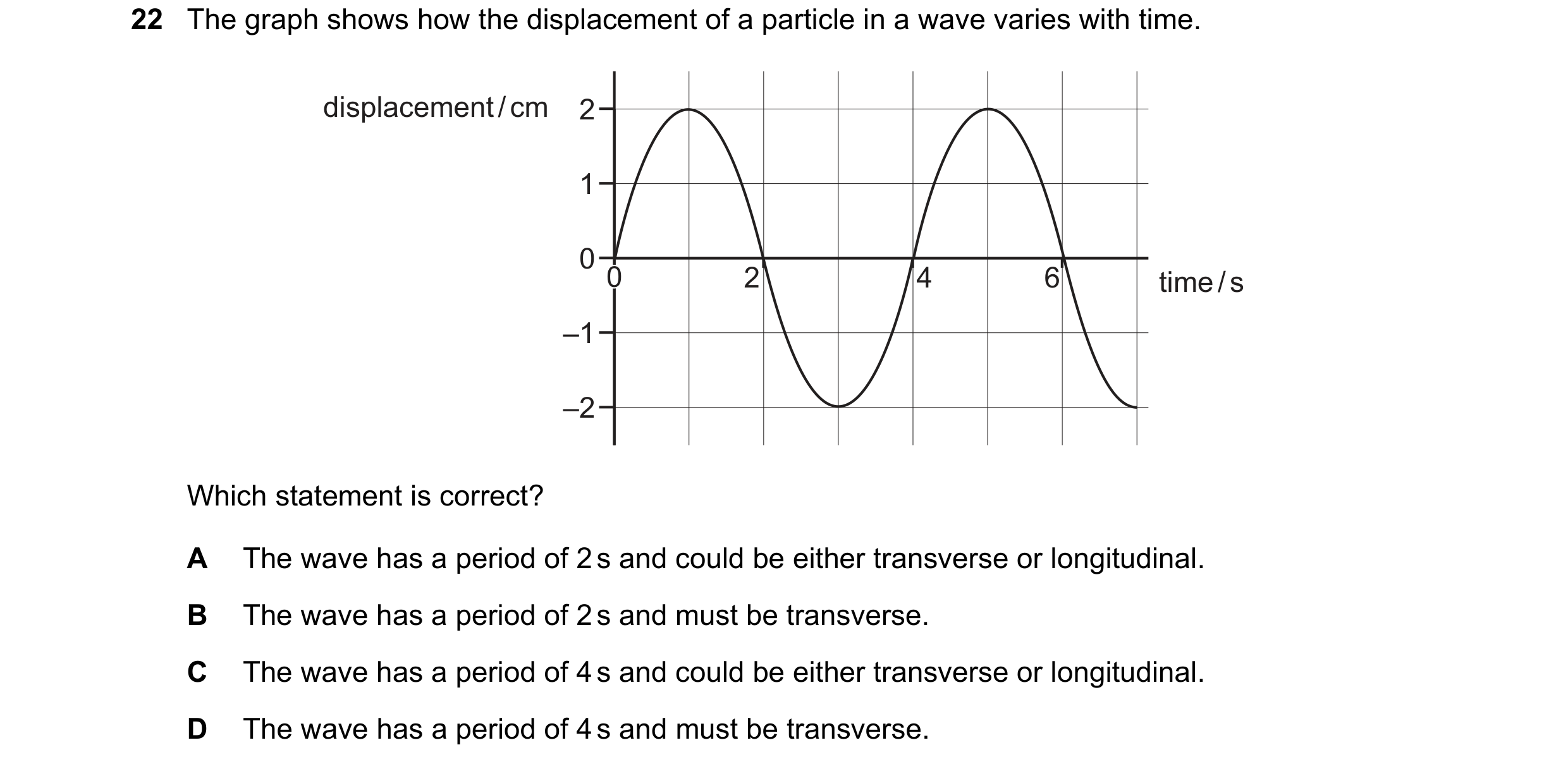
Q16 · The graph shows how the displacement of a particle in a wave varies with time 9702/13 Oct/Nov 2017
22 The graph shows how the displacement of a particle in a wave varies with time. displacement / cm 2 1 0 0 2 4 6 time / s –1 –2 Which statement is correct? A The wave has a period of 2 s and could be either transverse or longitudinal. B The wave has a period of 2 s and must be transverse. C The wave has a period of 4 s and could be either transverse or longitudinal. D The wave has a period of 4 s and must be transverse.
1 marks
Answer: C
This question in 9702/13 Oct/Nov 2017
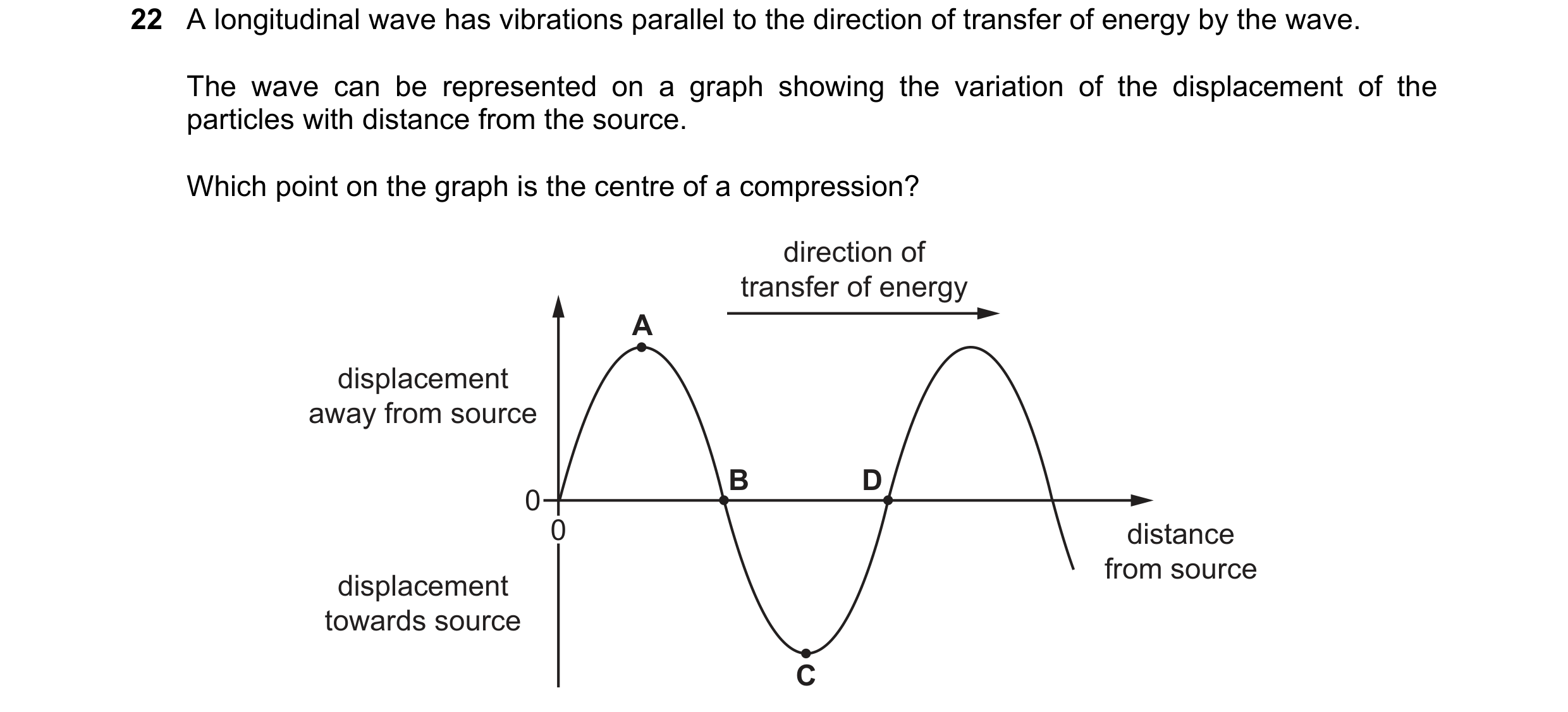
Q17 · A longitudinal wave has vibrations parallel to the direction of transfer of energy by the… 9702/11 May/June 2018
22 A longitudinal wave has vibrations parallel to the direction of transfer of energy by the wave. The wave can be represented on a graph showing the variation of the displacement of the particles with distance from the source. Which point on the graph is the centre of a compression? direction of transfer of energy A displacement away from source B D 0 0 distance from source displacement towards source C
1 marks
Answer: B
This question in 9702/11 May/June 2018
Q18 · When a guitar string is plucked, it causes a longitudinal sound wave in the air, as shown 9702/12 Oct/Nov 2018
23 When a guitar string is plucked, it causes a longitudinal sound wave in the air, as shown. 0.0 0.2 0.4 0.6 0.8 distance / m The speed of sound in the air is 340 m s–1. What is the approximate frequency of the sound wave shown? A 430 Hz B 680 Hz C 1100 Hz D 1400 Hz
1 marks
Answer: B
This question in 9702/12 Oct/Nov 2018
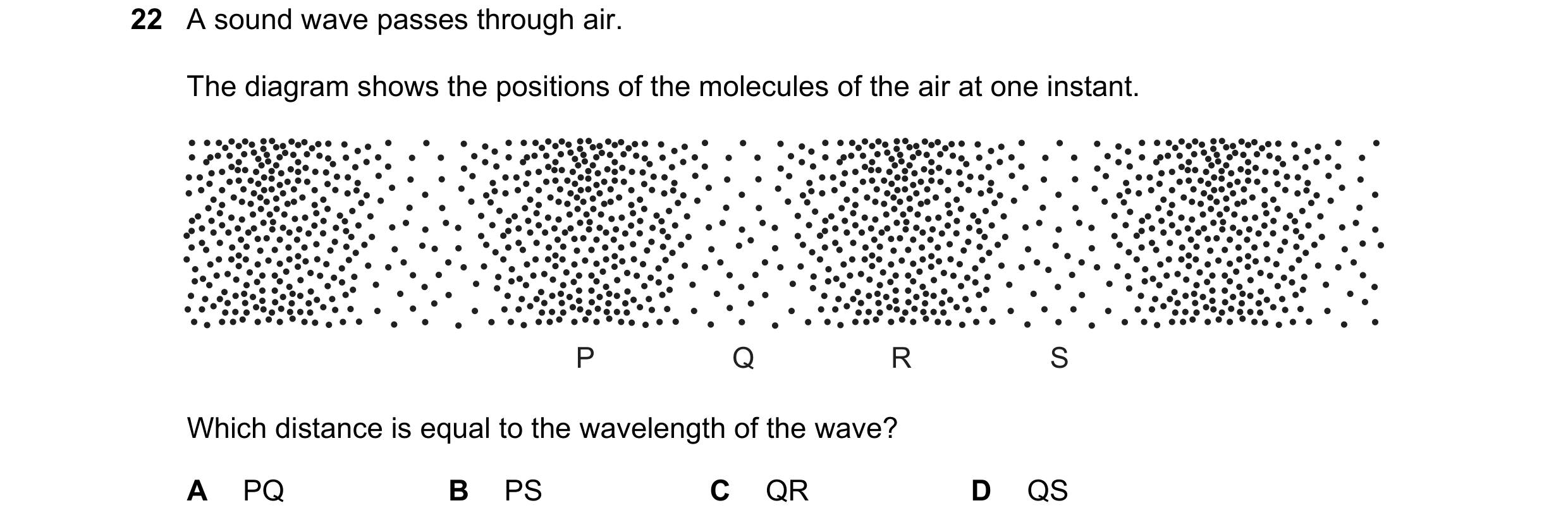
Q19 · A sound wave passes through air 9702/12 Feb/March 2019
22 A sound wave passes through air. The diagram shows the positions of the molecules of the air at one instant. P Q R S Which distance is equal to the wavelength of the wave? A PQ B PS C QR D QS
1 marks
Answer: D
This question in 9702/12 Feb/March 2019
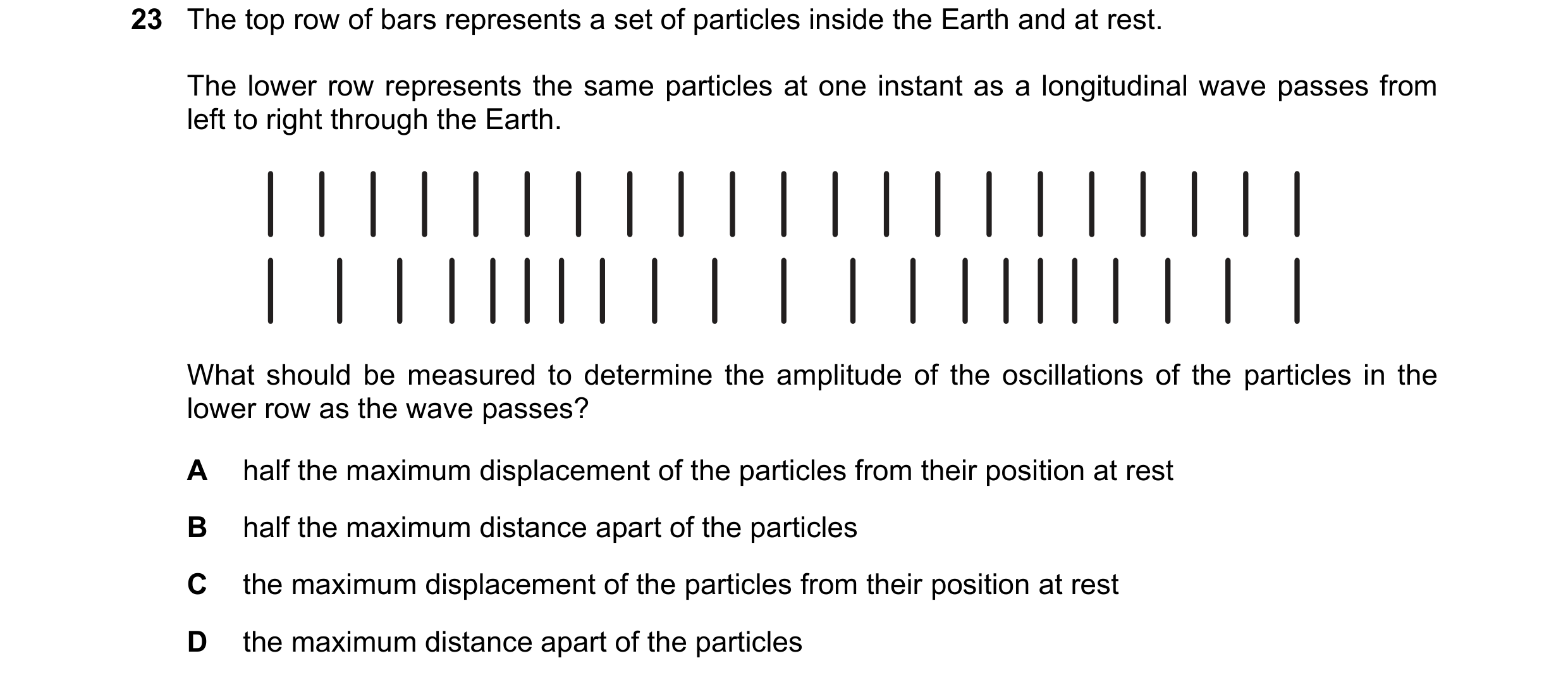
Q20 · The top row of bars represents a set of particles inside the Earth and at rest 9702/12 Feb/March 2019
23 The top row of bars represents a set of particles inside the Earth and at rest. The lower row represents the same particles at one instant as a longitudinal wave passes from left to right through the Earth. What should be measured to determine the amplitude of the oscillations of the particles in the lower row as the wave passes? A half the maximum displacement of the particles from their position at rest B half the maximum distance apart of the particles C the maximum displacement of the particles from their position at rest D the maximum distance apart of the particles
1 marks
Answer: C
This question in 9702/12 Feb/March 2019
Q21 · Which statement about all types of transverse waves is correct? 9702/11 Oct/Nov 2019
22 Which statement about all types of transverse waves is correct? A They all have the same speed. B They all have vibrations that are parallel to the direction of propagation of energy. C They can all form stationary waves. D They can all travel through a vacuum.
1 marks
Answer: C
This question in 9702/11 Oct/Nov 2019
Q22 · Which statement about a light wave and a sound wave is correct? 9702/12 Oct/Nov 2019
26 Which statement about a light wave and a sound wave is correct? A Both can travel through free space. B Both have a frequency inversely proportional to their wavelength. C Both have an intensity proportional to their amplitude. D Both have oscillations perpendicular to the direction of energy transfer.
1 marks
Answer: B
This question in 9702/12 Oct/Nov 2019
Q23 · Which statement about light waves and sound waves is not correct? 9702/13 Oct/Nov 2019
21 Which statement about light waves and sound waves is not correct? A Light waves and sound waves can both demonstrate the Doppler effect. B Light waves are transverse waves and sound waves are longitudinal waves. C Light waves can be diffracted but sound waves cannot. D Light waves can travel in a vacuum but sound waves cannot.
1 marks
Answer: C
This question in 9702/13 Oct/Nov 2019
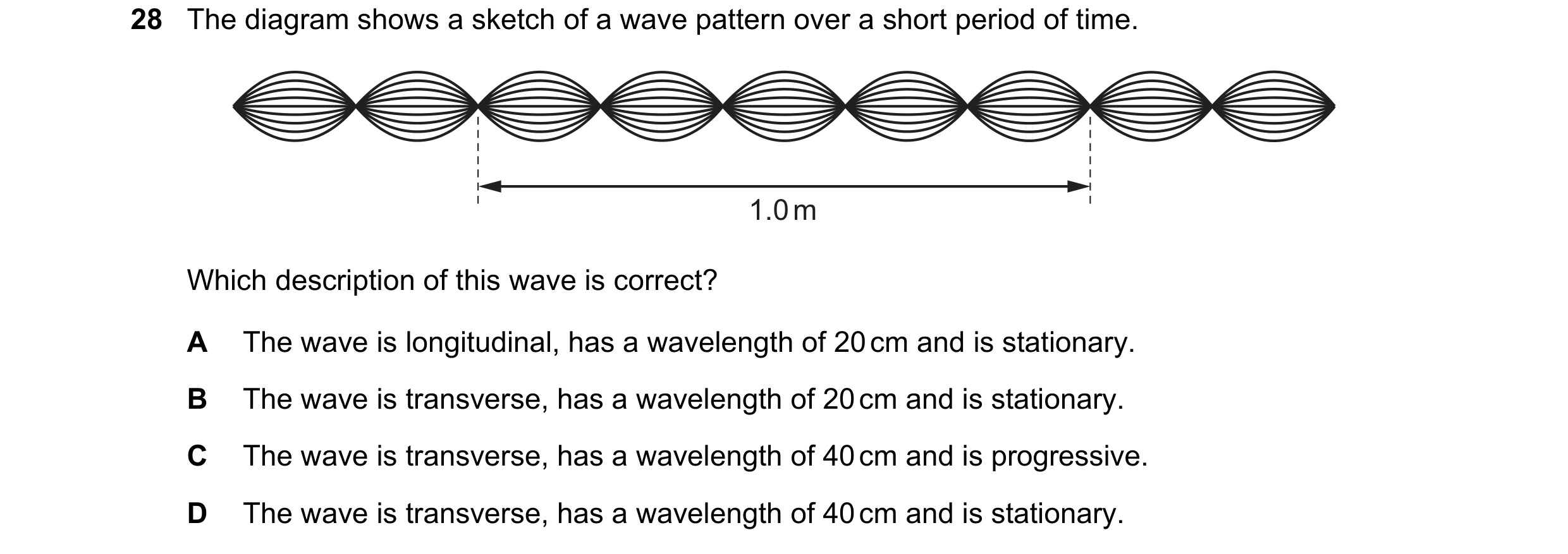
Q24 · The diagram shows a sketch of a wave pattern over a short period of time 9702/13 Oct/Nov 2019
28 The diagram shows a sketch of a wave pattern over a short period of time. 1.0 m Which description of this wave is correct? A The wave is longitudinal, has a wavelength of 20 cm and is stationary. B The wave is transverse, has a wavelength of 20 cm and is stationary. C The wave is transverse, has a wavelength of 40 cm and is progressive. D The wave is transverse, has a wavelength of 40 cm and is stationary.
1 marks
Answer: D
This question in 9702/13 Oct/Nov 2019
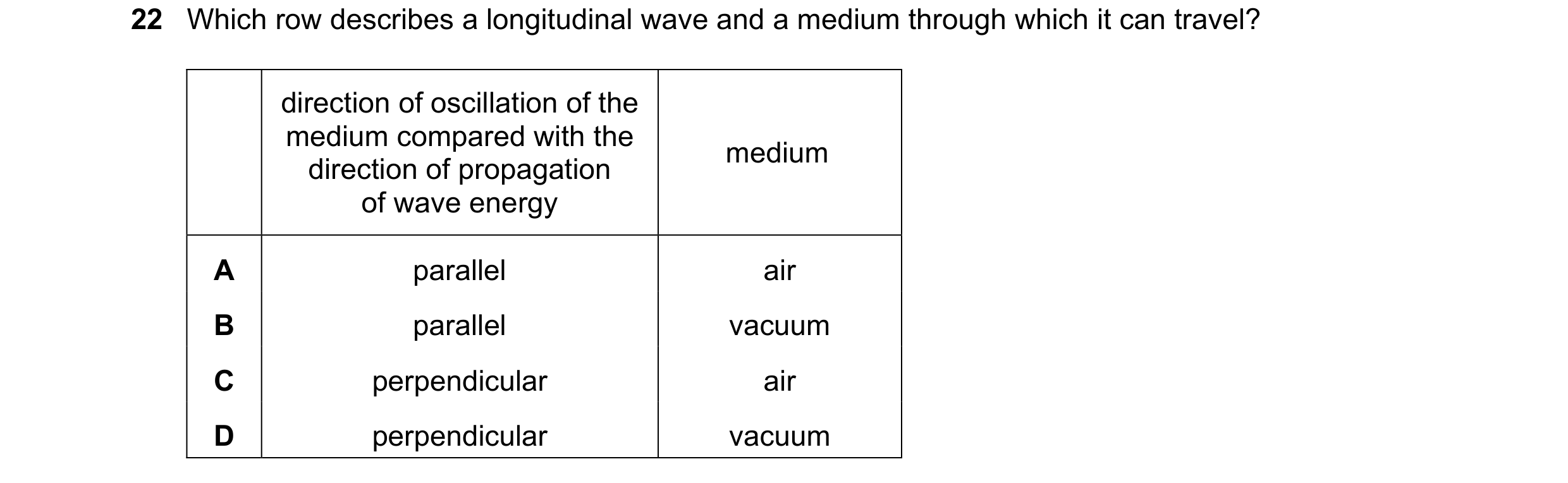
Q25 · Which row describes a longitudinal wave and a medium through which it can travel? 9702/12 Feb/March 2020
22 Which row describes a longitudinal wave and a medium through which it can travel? direction of oscillation of the medium compared with the medium direction of propagation of wave energy A parallel air B parallel vacuum C perpendicular air D perpendicular vacuum
1 marks
Answer: A
This question in 9702/12 Feb/March 2020
Q26 · Which statement is correct for longitudinal waves but not correct for transverse waves? 9702/12 Feb/March 2021
22 Which statement is correct for longitudinal waves but not correct for transverse waves? A They can form stationary waves. B They can only travel through a medium. C They can transfer energy in the direction of travel. D They consist of peaks and troughs.
1 marks
Answer: B
This question in 9702/12 Feb/March 2021
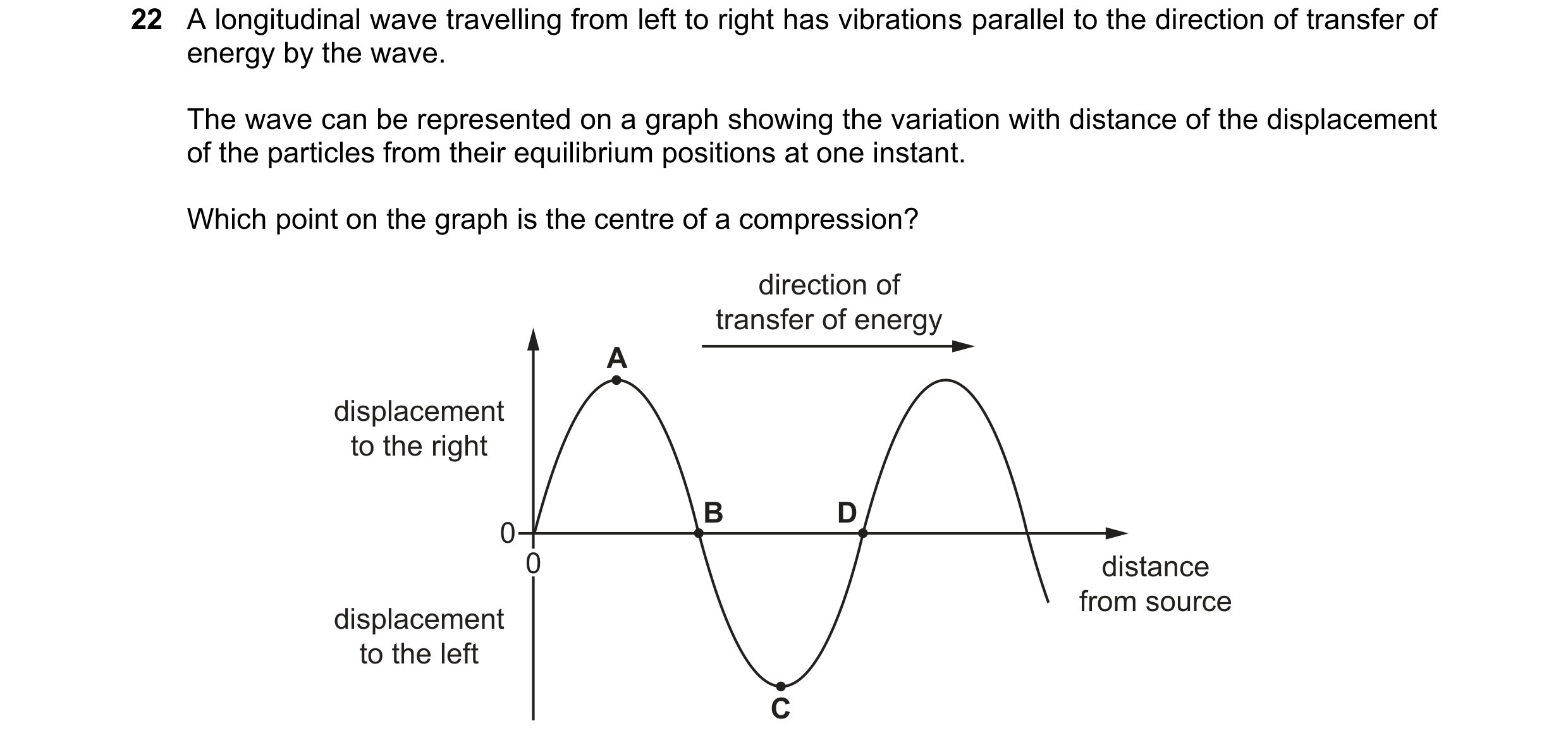
Q27 · A longitudinal wave travelling from left to right has vibrations parallel to the… 9702/11 May/June 2021
22 A longitudinal wave travelling from left to right has vibrations parallel to the direction of transfer of energy by the wave. The wave can be represented on a graph showing the variation with distance of the displacement of the particles from their equilibrium positions at one instant. Which point on the graph is the centre of a compression? direction of transfer of energy A displacement to the right B D 0 0 distance from source displacement to the left C
1 marks
Answer: B
This question in 9702/11 May/June 2021
Q28 · Which statement about transverse or longitudinal waves is not correct? 9702/11 Oct/Nov 2021
22 Which statement about transverse or longitudinal waves is not correct? A Longitudinal waves can be used to demonstrate diffraction. B Longitudinal waves can travel in a vacuum. C Transverse waves can form stationary waves. D Transverse waves can transfer energy.
1 marks
Answer: B
This question in 9702/11 Oct/Nov 2021
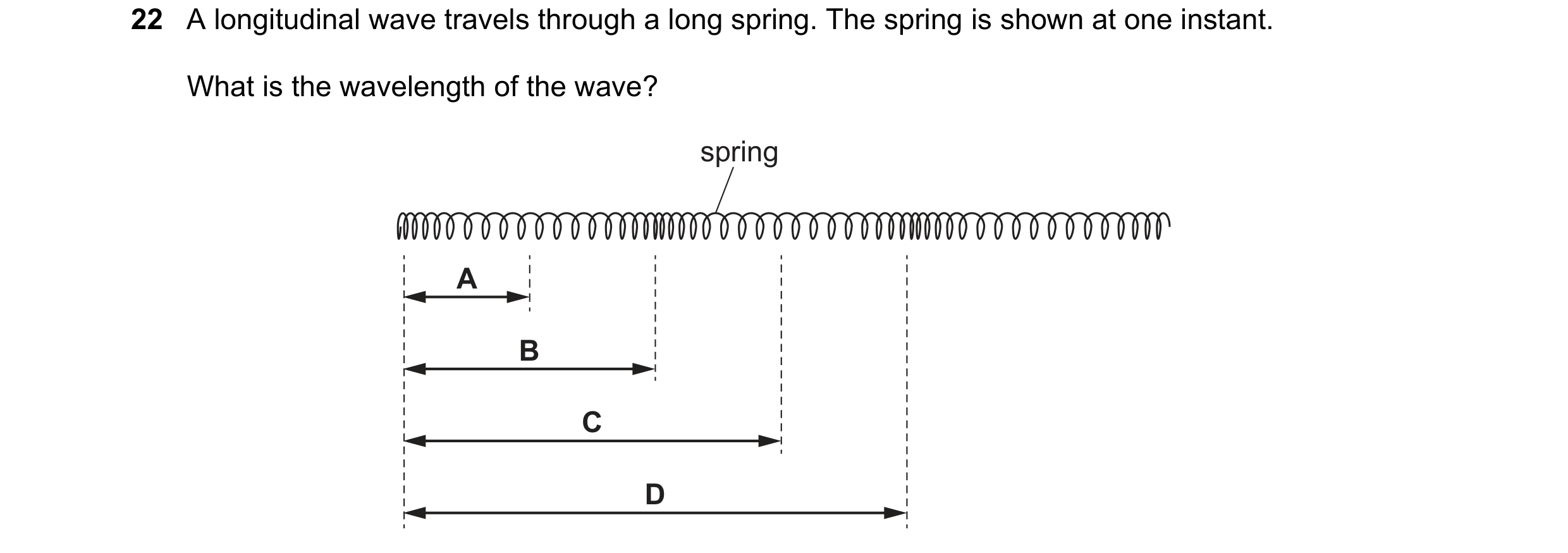
Q29 · A longitudinal wave travels through a long spring 9702/13 Oct/Nov 2021
22 A longitudinal wave travels through a long spring. The spring is shown at one instant. What is the wavelength of the wave? spring A B C D
1 marks
Answer: B
This question in 9702/13 Oct/Nov 2021
Q30 · Which statement about waves is correct? 9702/13 Oct/Nov 2021
23 Which statement about waves is correct? A Both longitudinal and transverse waves can travel through a vacuum. B Both longitudinal and transverse waves transfer matter. C Longitudinal progressive waves consist of alternate nodes and antinodes. D The particles of a transverse wave vibrate perpendicular to the direction of energy propagation.
1 marks
Answer: D
This question in 9702/13 Oct/Nov 2021
Q31 · Which statement is correct? 9702/11 May/June 2022
23 Which statement is correct? A Gases cannot transmit longitudinal waves. B Longitudinal sound waves cannot form stationary waves. C Solids can transmit both transverse and longitudinal waves. D Transverse waves cannot pass through a vacuum.
1 marks
Answer: C
This question in 9702/11 May/June 2022
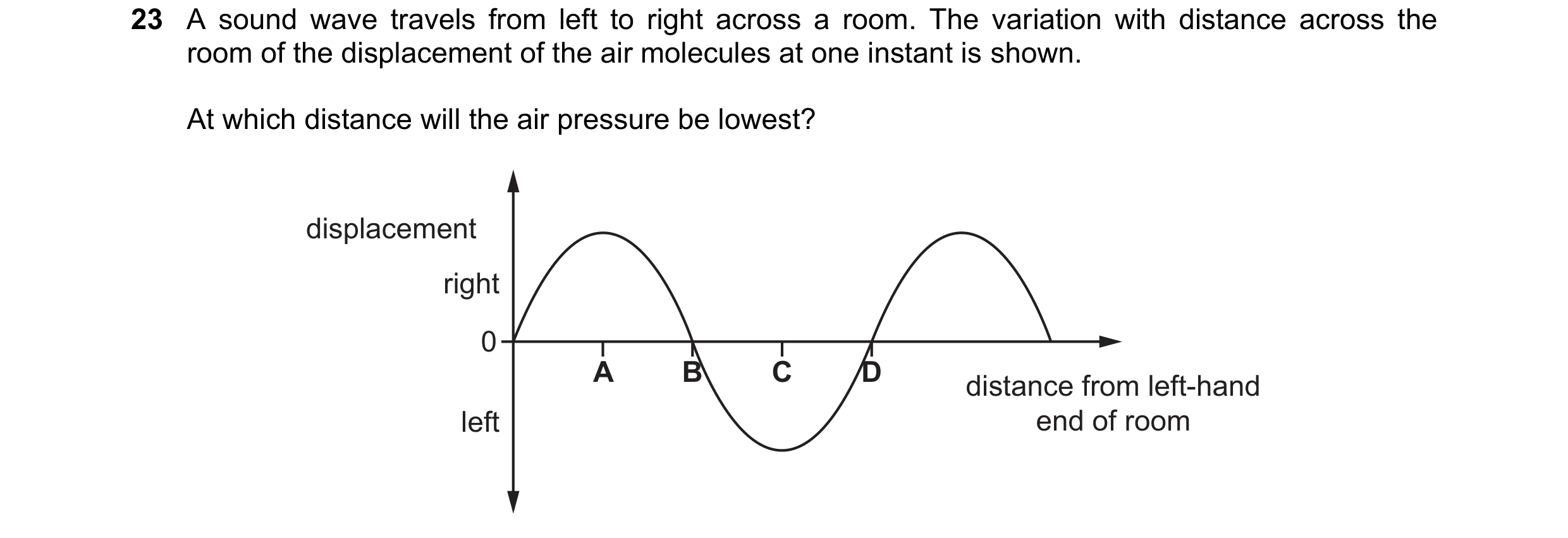
Q32 · A sound wave travels from left to right across a room 9702/12 May/June 2022
23 A sound wave travels from left to right across a room. The variation with distance across the room of the displacement of the air molecules at one instant is shown. At which distance will the air pressure be lowest? displacement right 0 A B C D distance from left-hand left end of room
1 marks
Answer: D
This question in 9702/12 May/June 2022
Q33 · A signal generator, amplifier and loudspeaker are used to produce different sound waves… 9702/11 Oct/Nov 2022
21 A signal generator, amplifier and loudspeaker are used to produce different sound waves in the air of a room. The relationships between the properties of these waves are investigated. Which relationship is not correct? A Amplitude is proportional to wavelength. B Frequency is inversely proportional to wavelength. C Intensity is proportional to amplitude squared at a given frequency. D Period is equal to the reciprocal of frequency.
1 marks
Answer: A
This question in 9702/11 Oct/Nov 2022
Q34 · When a guitar string is plucked, it causes a longitudinal sound wave in the air, as shown 9702/11 Oct/Nov 2022
22 When a guitar string is plucked, it causes a longitudinal sound wave in the air, as shown. 0.0 0.2 0.4 0.6 0.8 distance / m The speed of sound in the air is 340 m s–1. What is the approximate frequency of the sound wave shown? A 430 Hz B 680 Hz C 1100 Hz D 1400 Hz
1 marks
Answer: B
This question in 9702/11 Oct/Nov 2022
Q35 · Which statement about progressive transverse and longitudinal waves is correct? 9702/12 Oct/Nov 2022
23 Which statement about progressive transverse and longitudinal waves is correct? A Particles in a transverse wave have fixed equilibrium positions but those in longitudinal waves do not. B Transverse waves can be polarised but longitudinal waves cannot. C Transverse waves transfer energy but longitudinal waves do not. D Two-source interference can be demonstrated with transverse waves but not with longitudinal waves.
1 marks
Answer: B
This question in 9702/12 Oct/Nov 2022
Q36 · Which statement about longitudinal waves and transverse waves is not correct? 9702/12 Feb/March 2023
21 Which statement about longitudinal waves and transverse waves is not correct? A Both waves can be polarised. B Both waves can form stationary waves. C Both waves can transfer energy as progressive waves. D Both waves obey the equation v = fλ.
1 marks
Answer: A
This question in 9702/12 Feb/March 2023
Q37 · A longitudinal wave is travelling from left to right 9702/12 May/June 2023
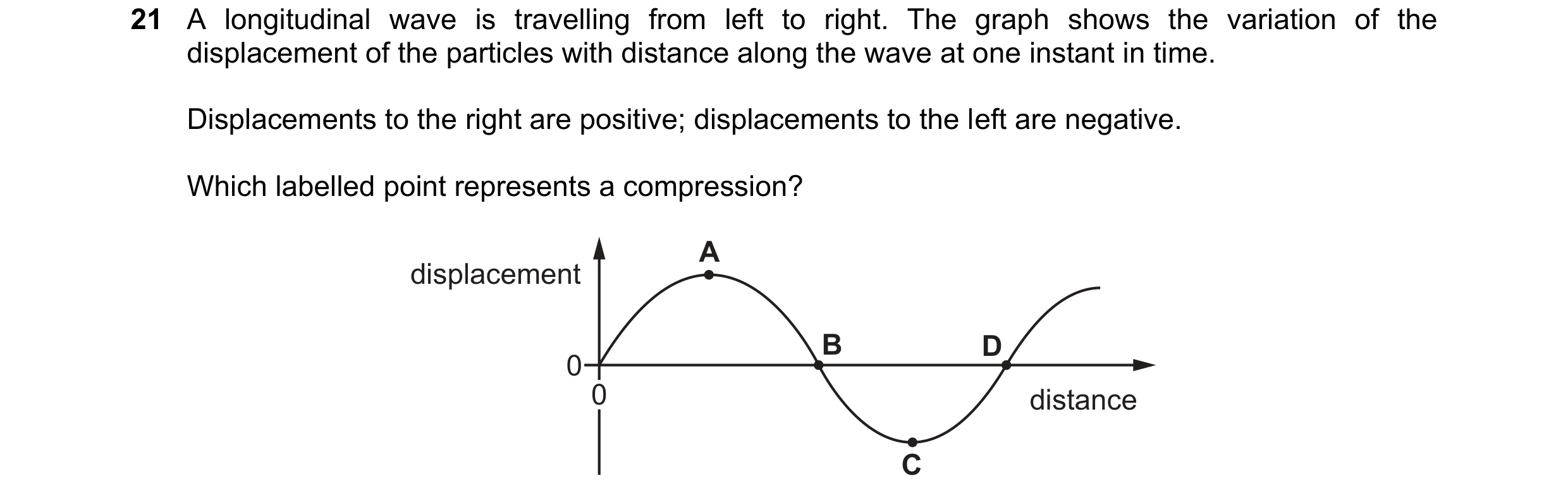
21 A longitudinal wave is travelling from left to right. The graph shows the variation of the displacement of the particles with distance along the wave at one instant in time. Displacements to the right are positive; displacements to the left are negative. Which labelled point represents a compression? A displacement B D 0 0 distance C
1 marks
Answer: B
This question in 9702/12 May/June 2023
Q38 · A guitar string is plucked 9702/12 May/June 2024
25 A guitar string is plucked. Which statement describes the resulting waves? A Longitudinal waves on the string cause longitudinal waves in the air. B Longitudinal waves on the string cause transverse waves in the air. C Transverse waves on the string cause longitudinal waves in the air. D Transverse waves on the string cause transverse waves in the air.
1 marks
Answer: C
This question in 9702/12 May/June 2024
Q39 · Radio waves can be polarised, but sound waves cannot be polarised 9702/11 Oct/Nov 2024
29 Radio waves can be polarised, but sound waves cannot be polarised. Which statement gives the reason for this? A Radio waves are generally of a higher frequency than sound waves. B Radio waves are transverse waves, but sound waves are longitudinal waves. C Radio waves can travel through a vacuum, but sound waves cannot travel through a vacuum. D Radio waves travel at a much higher speed than sound waves.
1 marks
Answer: B
This question in 9702/11 Oct/Nov 2024
Q40 · A progressive longitudinal sound wave moves through air 9702/12 Oct/Nov 2024
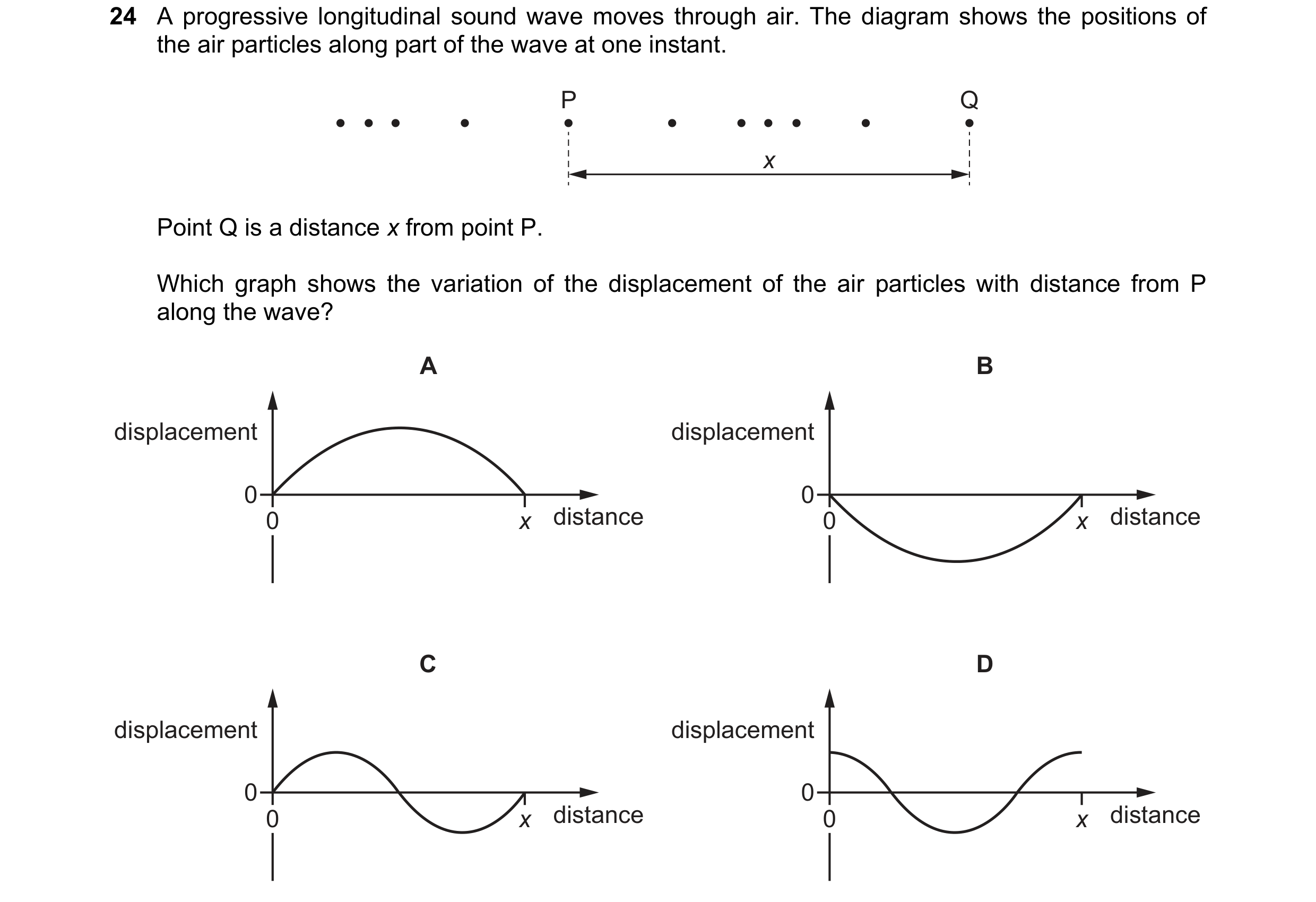
24 A progressive longitudinal sound wave moves through air. The diagram shows the positions of the air particles along part of the wave at one instant. P Q x Point Q is a distance x from point P. Which graph shows the variation of the displacement of the air particles with distance from P along the wave? A B displacement displacement 0 0 0 x distance 0 x distance C D displacement displacement 0 0 0 x distance 0 x distance
1 marks
Answer: C
This question in 9702/12 Oct/Nov 2024
Q41 · Which row correctly identifies the properties of all electromagnetic waves? 9702/12 Feb/March 2025
22 Which row correctly identifies the properties of all electromagnetic waves?
transverse | longitudinal can travel
wave wave in free space
A v x v
B v x x
Cc x v v
D x v x
key
/ = property of an electromagnetic wave
X = not a property of an electromagnetic wave
1 marks
Answer: A
This question in 9702/12 Feb/March 2025
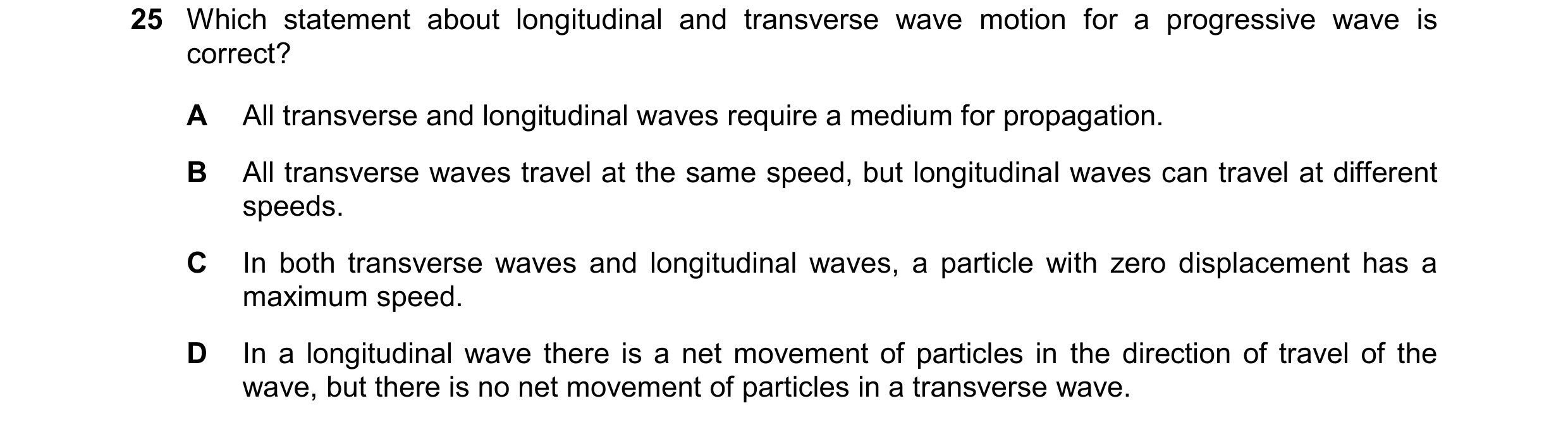
Q42 · Which statement about longitudinal and transverse wave motion for a progressive wave is… 9702/11 May/June 2025
25 Which statement about longitudinal and transverse wave motion for a progressive wave is correct? A All transverse and longitudinal waves require a medium for propagation. B All transverse waves travel at the same speed, but longitudinal waves can travel at different speeds. C In both transverse waves and longitudinal waves, a particle with zero displacement has a maximum speed. D In a longitudinal wave there is a net movement of particles in the direction of travel of the wave, but there is no net movement of particles in a transverse wave.
1 marks
Answer: C
This question in 9702/11 May/June 2025
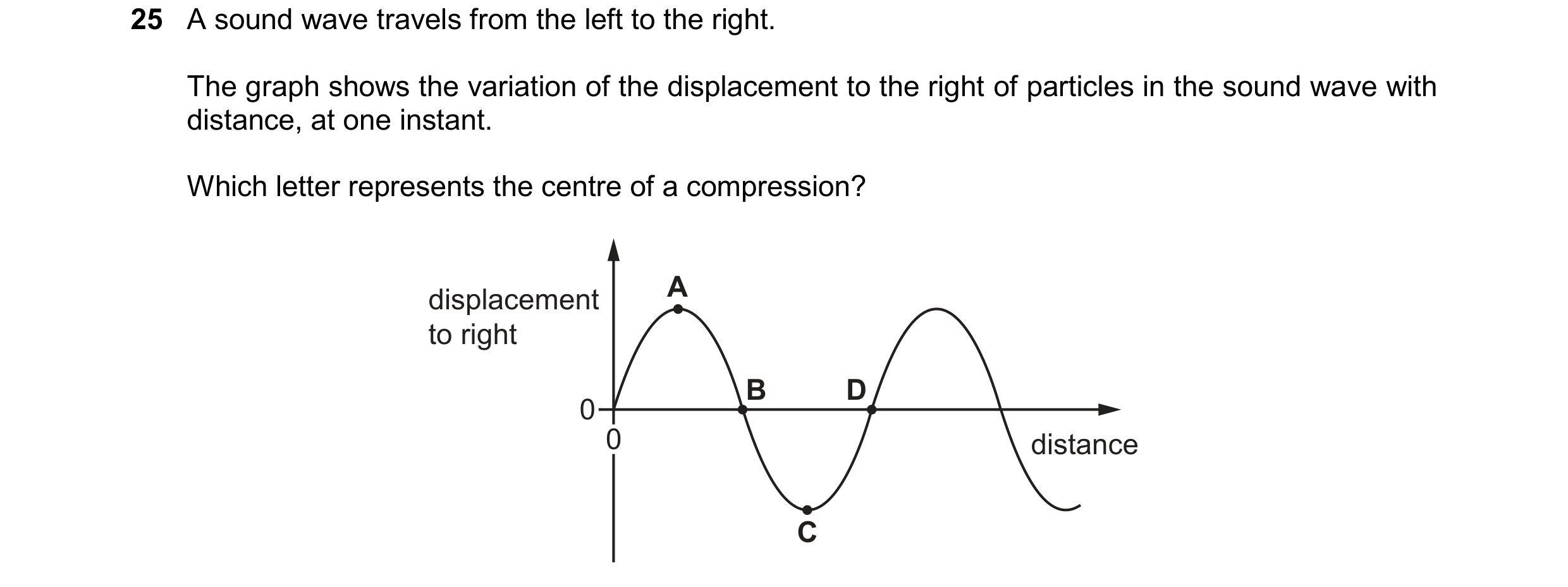
Q43 · A sound wave travels from the left to the right 9702/12 May/June 2025
25 A sound wave travels from the left to the right. The graph shows the variation of the displacement to the right of particles in the sound wave with distance, at one instant. Which letter represents the centre of a compression? displacement A to right B D 0 0 distance C
1 marks
Answer: B
This question in 9702/12 May/June 2025
Q44 · Which statement compares the behaviour of transverse and longitudinal waves? 9702/12 May/June 2025
28 Which statement compares the behaviour of transverse and longitudinal waves? A Only longitudinal waves can be diffracted. B Only longitudinal waves can travel in free space. C Only transverse waves can be coherent. D Only transverse waves can be polarised.
1 marks
Answer: D
This question in 9702/12 May/June 2025
Q45 · A progressive longitudinal wave is travelling horizontally from left to right 9702/14 May/June 2025
21 A progressive longitudinal wave is travelling horizontally from left to right. A graphical representation of the wave at one instant in time is shown. 0 0 Which row could give the correct labels for the x-axis and y-axis of this graph? x-axis y-axis A distance displacement of particles to the right B distance displacement of particles upwards C time displacement of particles to the right D time displacement of particles upwards
1 marks
Answer: A
This question in 9702/14 May/June 2025
Q46 · Which row is correct for sound waves? 9702/11 Oct/Nov 2025
24 Which row is correct for sound waves? can travel can be can diffract in a vacuum polarised through a gap A no no yes B yes no no C no yes no D no yes yes
1 marks
Answer: A
This question in 9702/11 Oct/Nov 2025
Q47 · A source emits a progressive sound wave in the horizontal direction 9702/11 Oct/Nov 2025
25 A source emits a progressive sound wave in the horizontal direction. The wave travels away from the source in a direction towards the right. The graph shows the variation of the displacement of the particles from their equilibrium positions with distance from the source at a particular instant in time. Displacements to the right of the equilibrium positions are shown as positive. displacement 0 0 distance Y Position Y represents the displacement of a particle in the sound wave at a particular distance from the source at this instant. Which statement about the motion of this particle is correct? A The particle is moving away from the source. B The particle is moving towards the source. C The particle is moving upwards. D The particle is moving downwards.
1 marks
Answer: B
This question in 9702/11 Oct/Nov 2025
Q48 · Which row describes a progressive longitudinal wave? 9702/12 Oct/Nov 2025
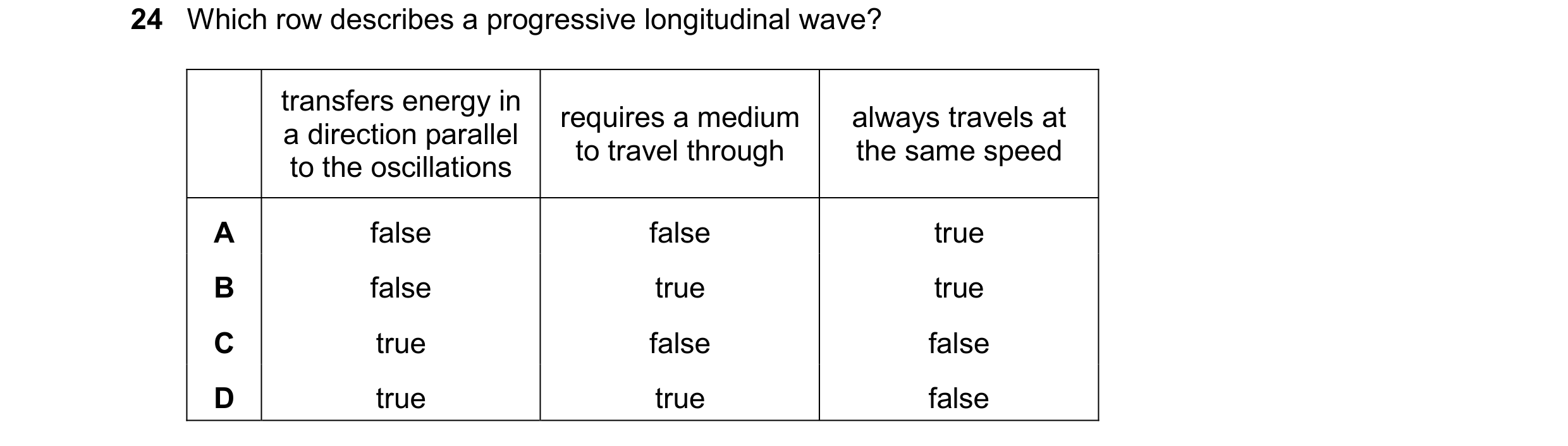
24 Which row describes a progressive longitudinal wave? transfers energy in requires a medium always travels at a direction parallel to travel through the same speed to the oscillations A false false true B false true true C true false false D true true false
1 marks
Answer: D
This question in 9702/12 Oct/Nov 2025
Q49 · Which row is correct for sound waves? 9702/13 Oct/Nov 2025
24 Which row is correct for sound waves? can travel can be can diffract in a vacuum polarised through a gap A no no yes B yes no no C no yes no D no yes yes
1 marks
Answer: A
This question in 9702/13 Oct/Nov 2025
Q50 · A source emits a progressive sound wave in the horizontal direction 9702/13 Oct/Nov 2025
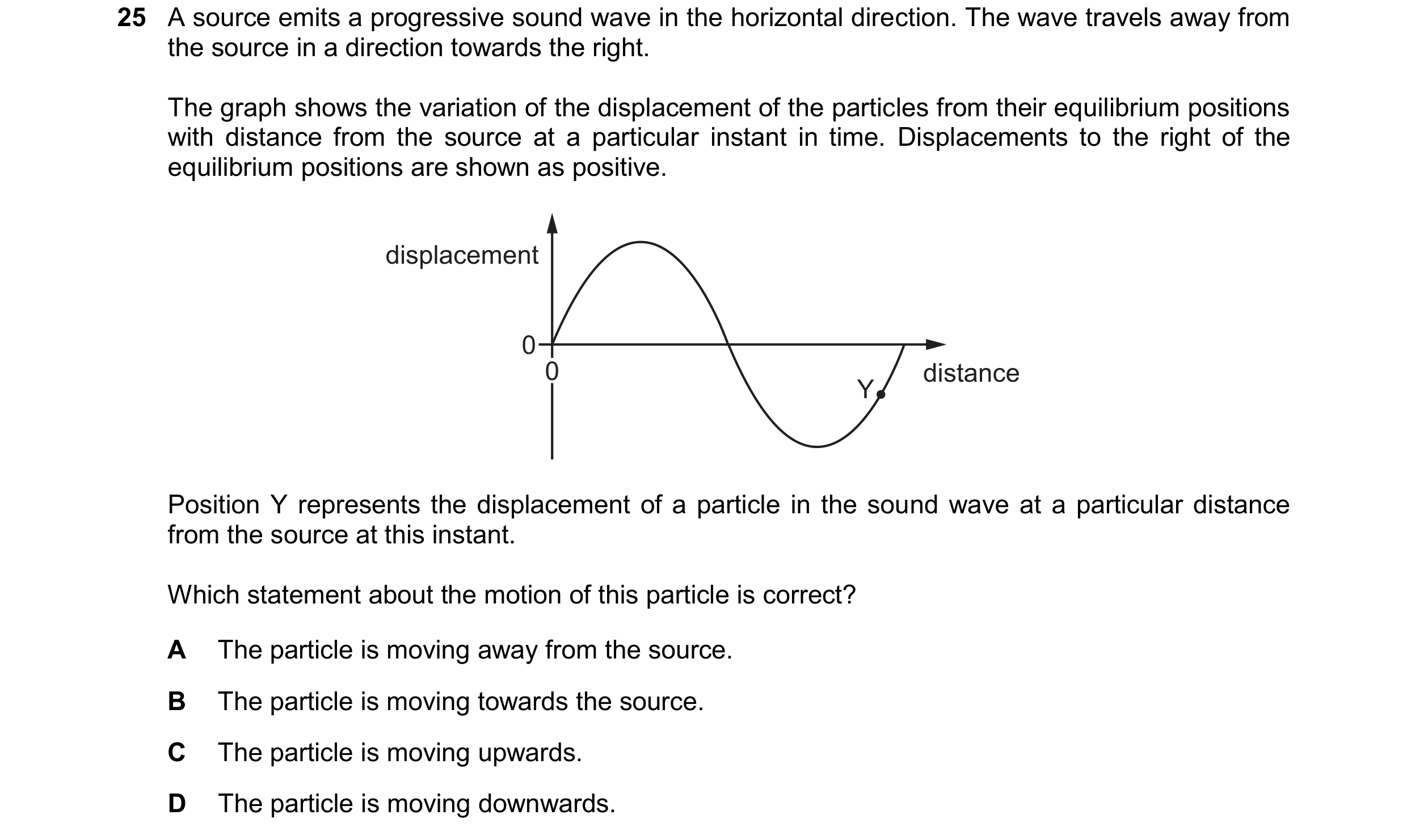
25 A source emits a progressive sound wave in the horizontal direction. The wave travels away from the source in a direction towards the right. The graph shows the variation of the displacement of the particles from their equilibrium positions with distance from the source at a particular instant in time. Displacements to the right of the equilibrium positions are shown as positive. displacement 0 0 distance Y Position Y represents the displacement of a particle in the sound wave at a particular distance from the source at this instant. Which statement about the motion of this particle is correct? A The particle is moving away from the source. B The particle is moving towards the source. C The particle is moving upwards. D The particle is moving downwards.
1 marks
Answer: B
This question in 9702/13 Oct/Nov 2025


 1 / 14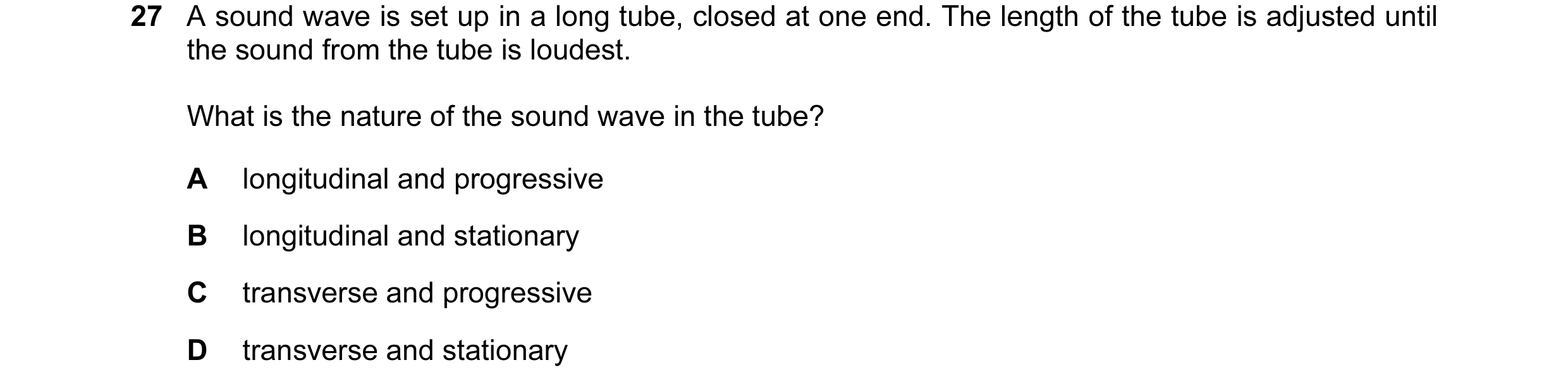


 2 / 14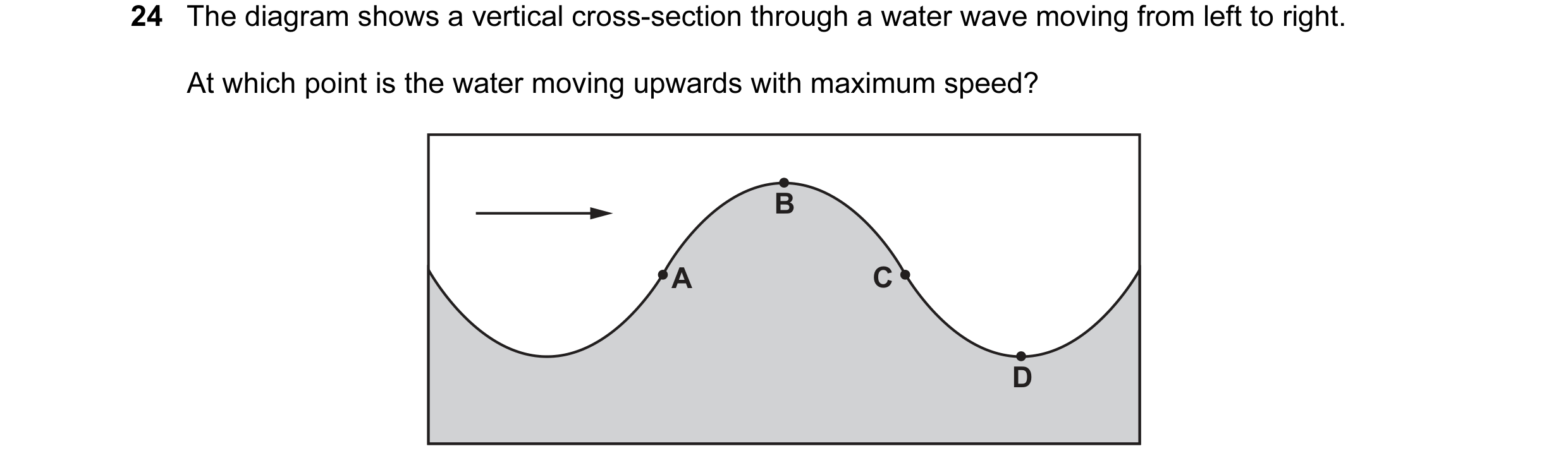

 3 / 14

 4 / 14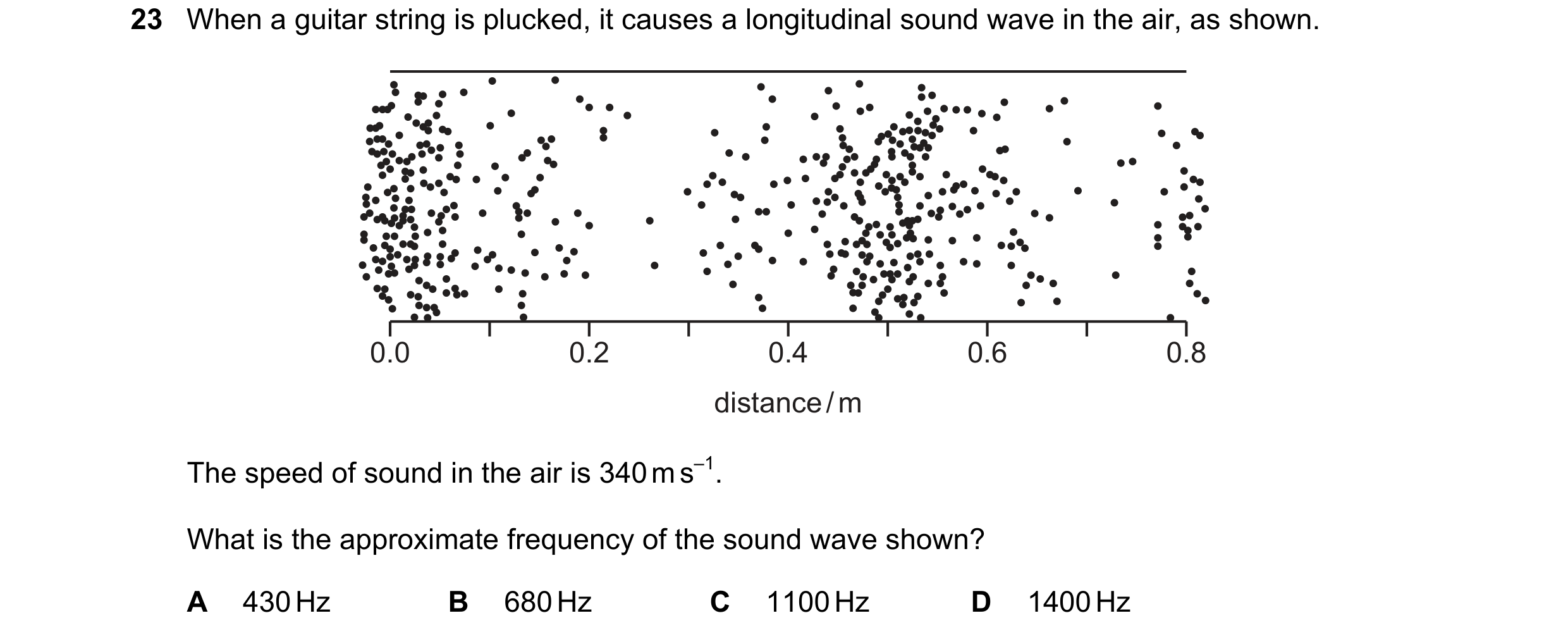
 5 / 14


 6 / 14

 7 / 14

 8 / 14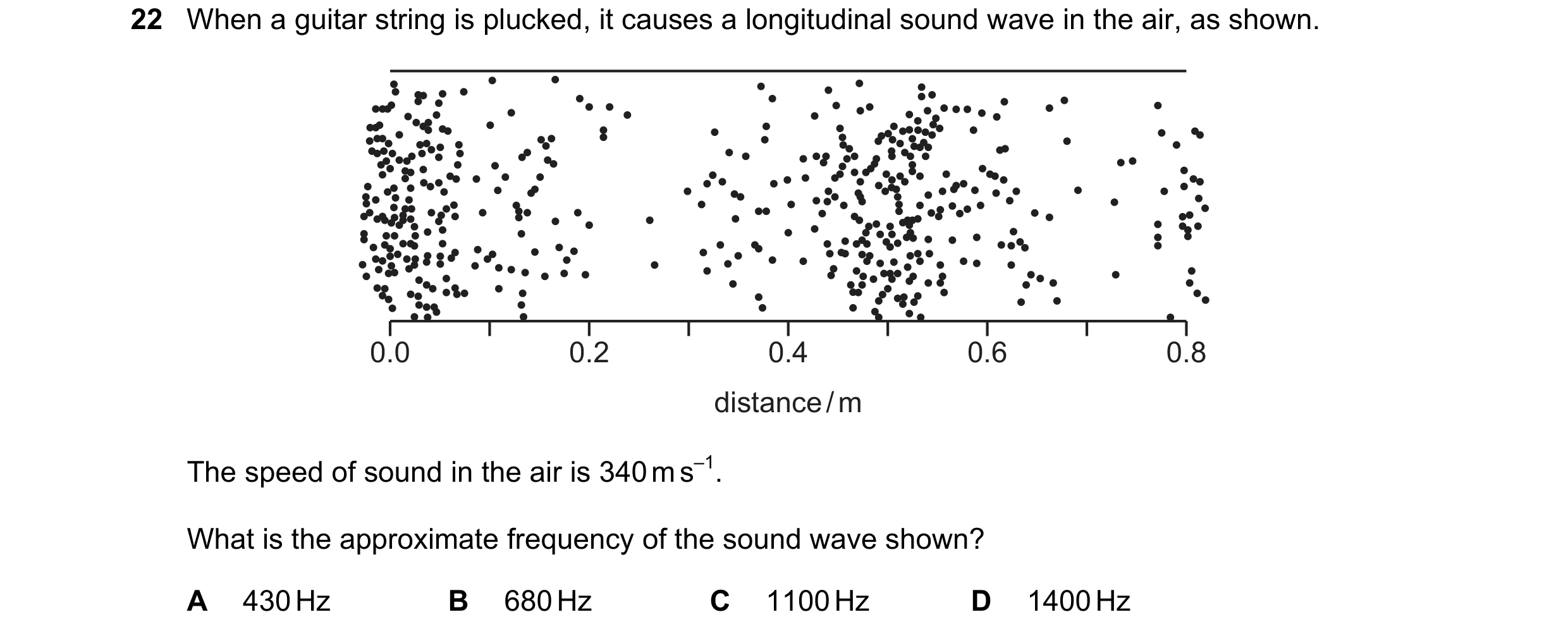

 9 / 14
 10 / 14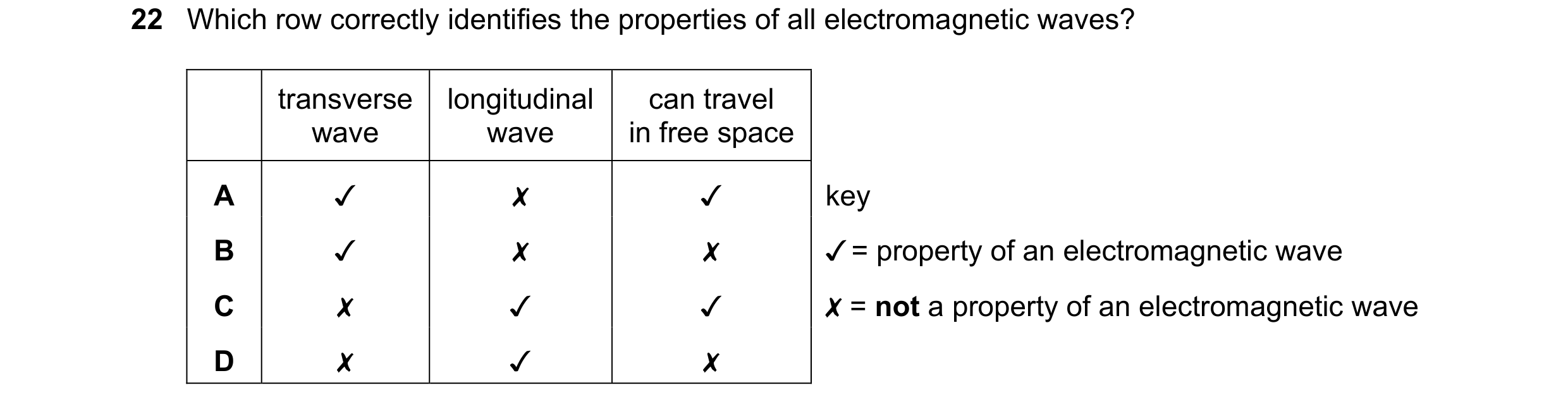
 11 / 14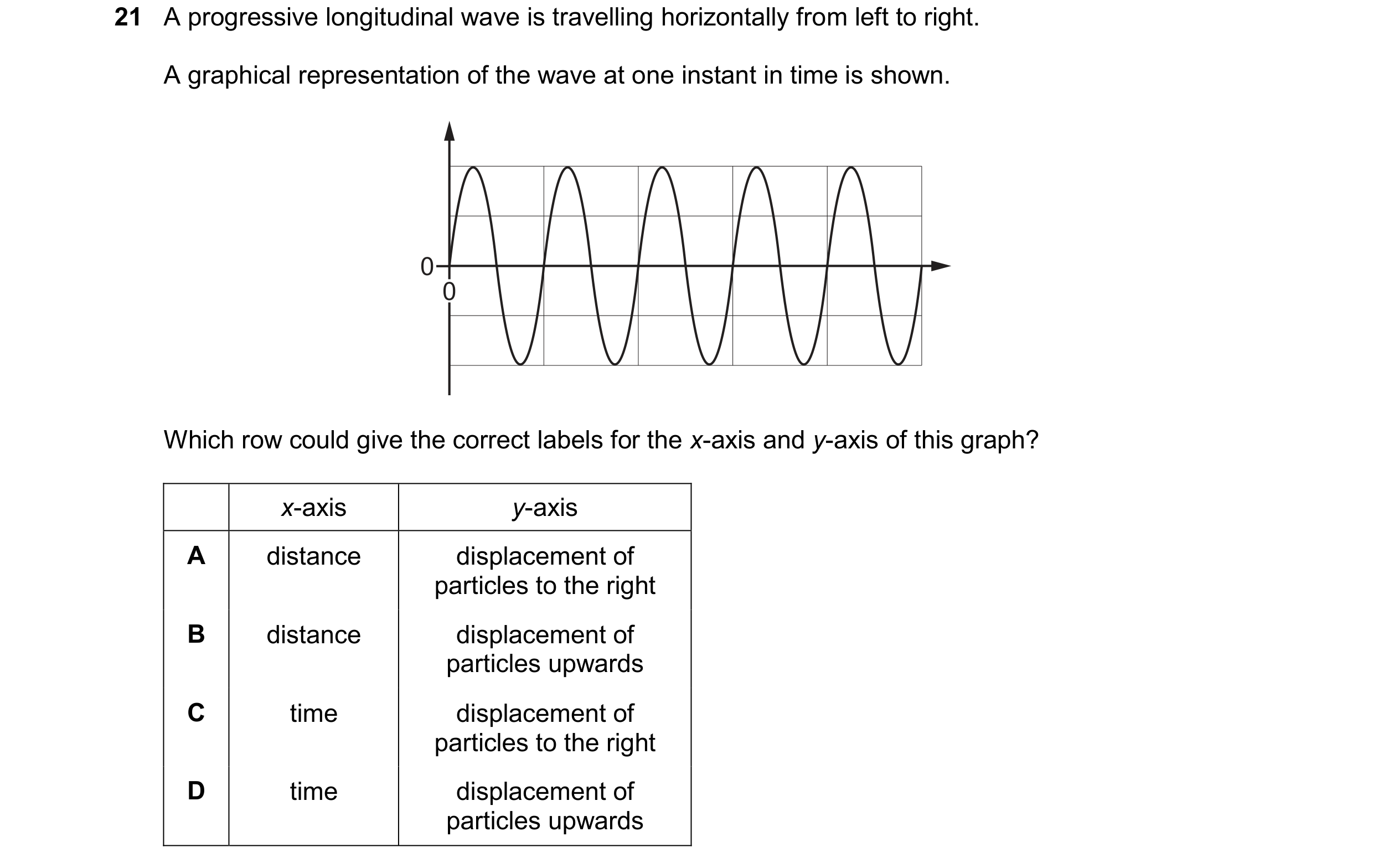
 12 / 14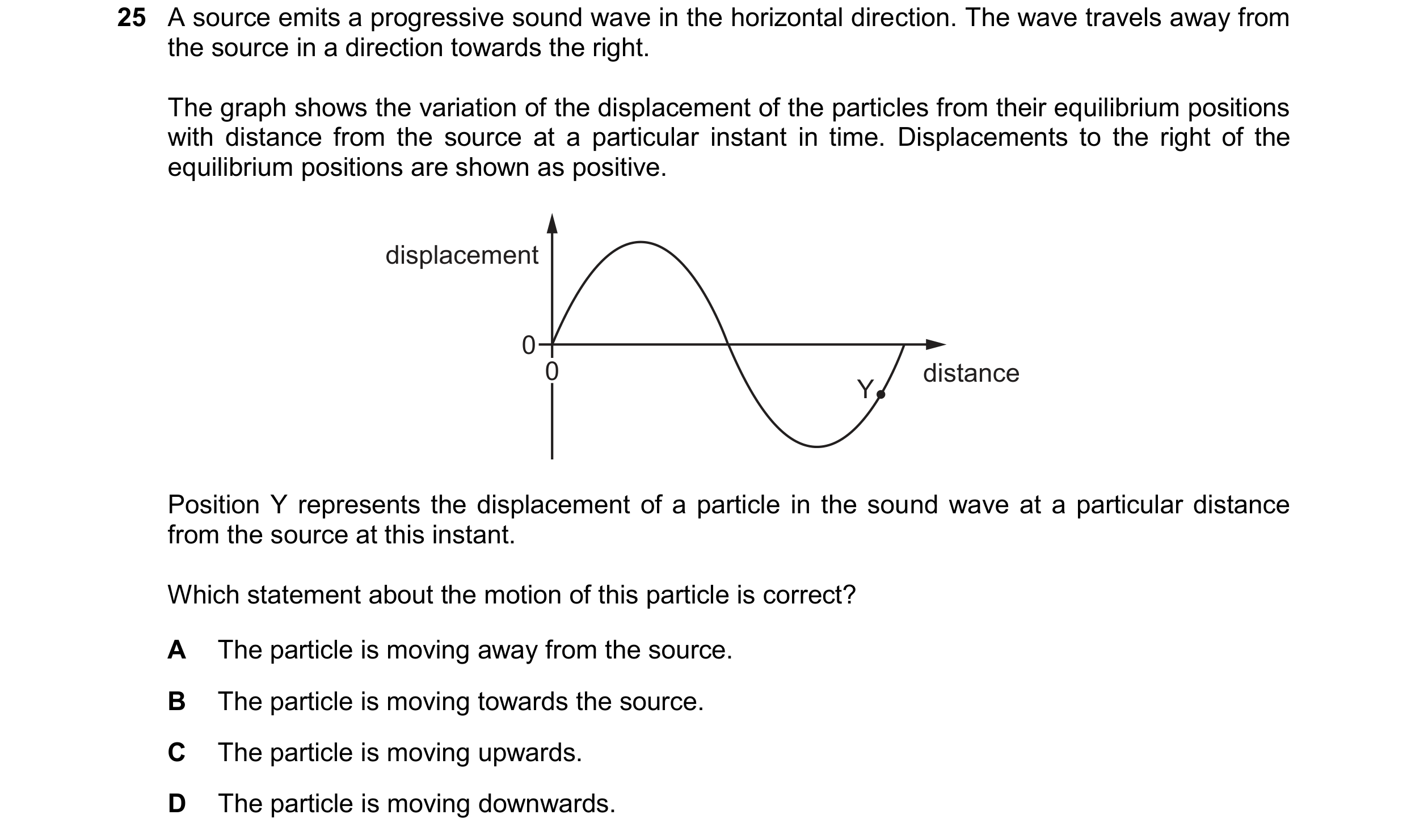
 13 / 14
 14 / 14