Questions as text
Q1 · Light reflected from the surface of smooth water may be described as a polarised… 9702/21 May/June 2007
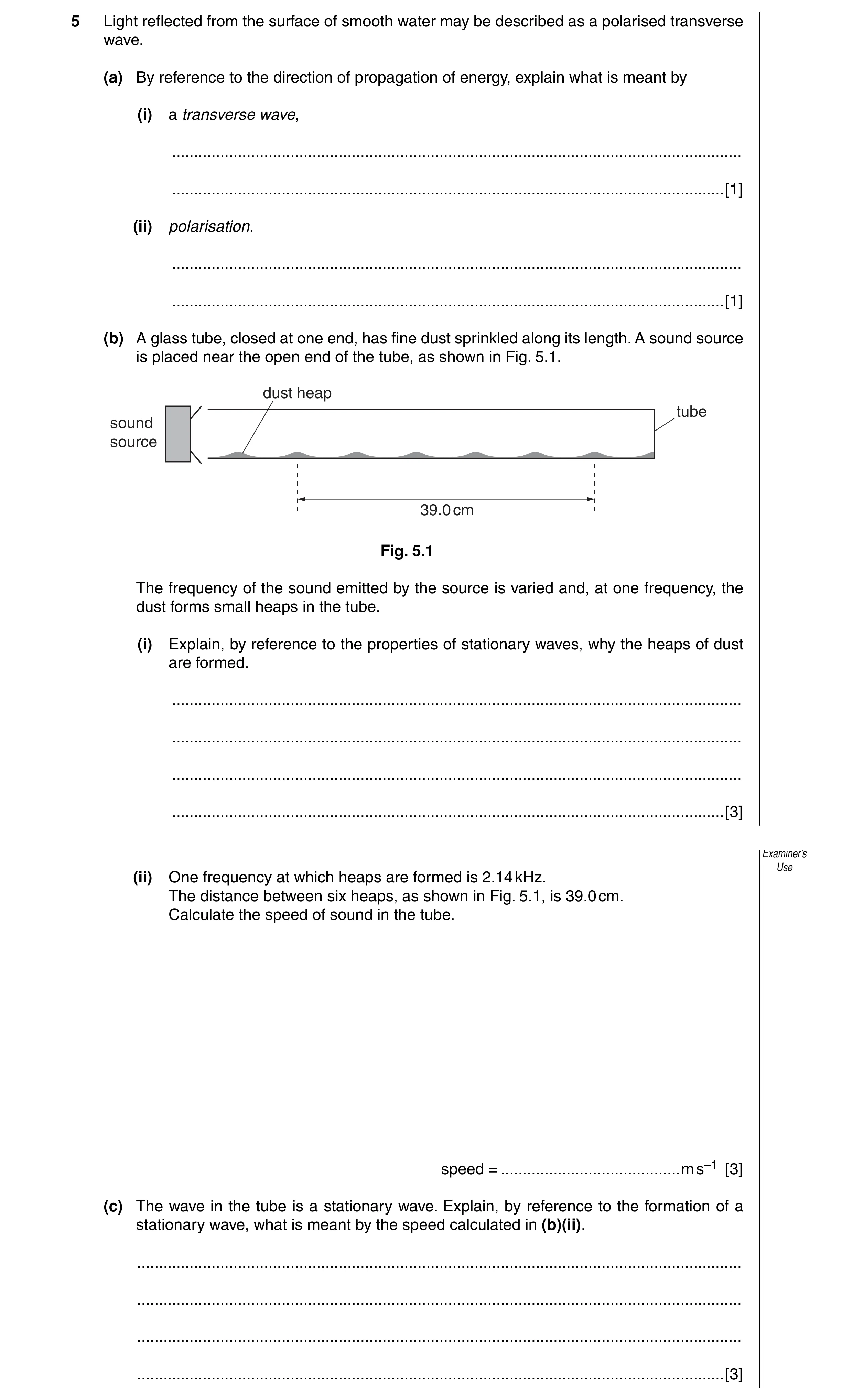
5 Light reflected from the surface of smooth water may be described as a polarised transverse wave. (a) By reference to the direction of propagation of energy, explain what is meant by (i) a transverse wave, … … [1] (ii) polarisation. … … [1] (b) A glass tube, closed at one end, has fine dust sprinkled along its length. A sound source is placed near the open end of the tube, as shown in Fig. 5.1. dust heap tube sound source 39.0 cm Fig. 5.1 The frequency of the sound emitted by the source is varied and, at one frequency, the dust forms small heaps in the tube. (i) Explain, by reference to the properties of stationary waves, why the heaps of dust are formed. … … … … [3] Examiner’s Use (ii) One frequency at which heaps are formed is 2.14 kHz. The distance between six heaps, as shown in Fig. 5.1, is 39.0 cm. Calculate the speed of sound in the tube. speed = … m s–1 [3] (c) The wave in the tube is a stationary wave. Explain, by reference to the formation of a stationary wave, what is meant by the speed calculated in (b)(ii). … … … … [3]
11 marks
Mark scheme: 5 (a) (i) vibrations (in plane) normal to direction of energy propagation B1 [1] (ii) vibrations in one direction (normal to direction of propagation) B1 [1] (b) (i) at (displacement) antinodes / where there are no heaps, wave has maximum amplitude (of vibration) B1 at (displacement) nodes/where there are heaps, amplitude of vibration is zero/minimum B1 dust is pushed to / settles at (displacement) nodes B1 [3] (ii) 2.5λ = 39 cm C1 v = fλ C1 v = 2.14 × 103 × 15.6 × 10-2 = 334 m s-1 (allow 330, not 340) A1 [3] (c) Stationary wave formed by interference / superposition / overlap of B1 either wave travelling down tube and its reflection or two waves of same (type and) frequency travelling in opposite directions B1 speed is the speed of the incident / reflected waves B1 [3] GCE A/AS LEVEL – May/June 2007 9702 2
This question in 9702/21 May/June 2007
Q2 · State what is meant by a progressive wave 9702/21 Oct/Nov 2009
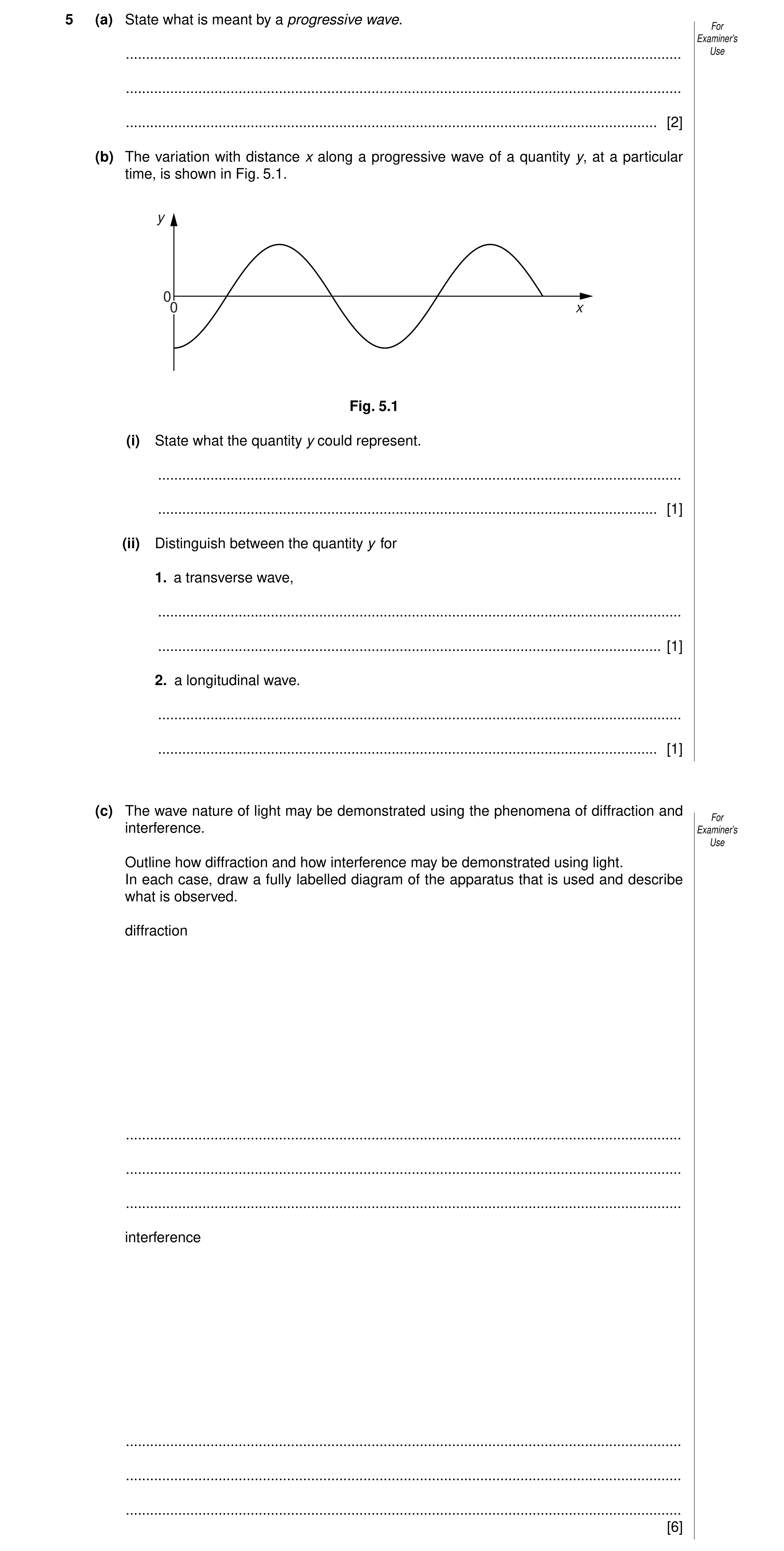
5 (a) State what is meant by a progressive wave. For Examiner’s … Use … … [2] (b) The variation with distance x along a progressive wave of a quantity y, at a particular time, is shown in Fig. 5.1. y 0 0 x Fig. 5.1 (i) State what the quantity y could represent. … … [1] (ii) Distinguish between the quantity y for 1. a transverse wave, … … [1] 2. a longitudinal wave. … … [1] (c) The wave nature of light may be demonstrated using the phenomena of diffraction and For interference. Examiner’s Use Outline how diffraction and how interference may be demonstrated using light. In each case, draw a fully labelled diagram of the apparatus that is used and describe what is observed. diffraction … … … interference … … … [6]
11 marks
Mark scheme: 5 (a) transfer / propagation of energy … M1 as a result of oscillations / vibrations … A1 [2] (b) (i) displacement / velocity / acceleration (of particles in the wave) … B1 [1] (ii) displacement etc. is normal to direction of energy transfer / travel of wave / propagation of wave ……(not ‘wave motion’) … B1 [1] (iii) displacement etc. along / same direction of energy transfer / travel of wave / propagation of wave ……(not ‘wave motion’) … B1 [1] (c) diffraction: suitable object, means of observation … M1 either laser or lamp and aperture or distant source … M1 light region where darkness expected … A1 interference: suitable object, means of observation and illumination … B1 light and dark fringes observed … B1 appropriate reference to a dimension for diffraction or for interference … B1 [6] [Total: 11]
This question in 9702/21 Oct/Nov 2009
Q3 · By reference to vibrations of the points on a wave and to its direction of energy… 9702/23 Oct/Nov 2011
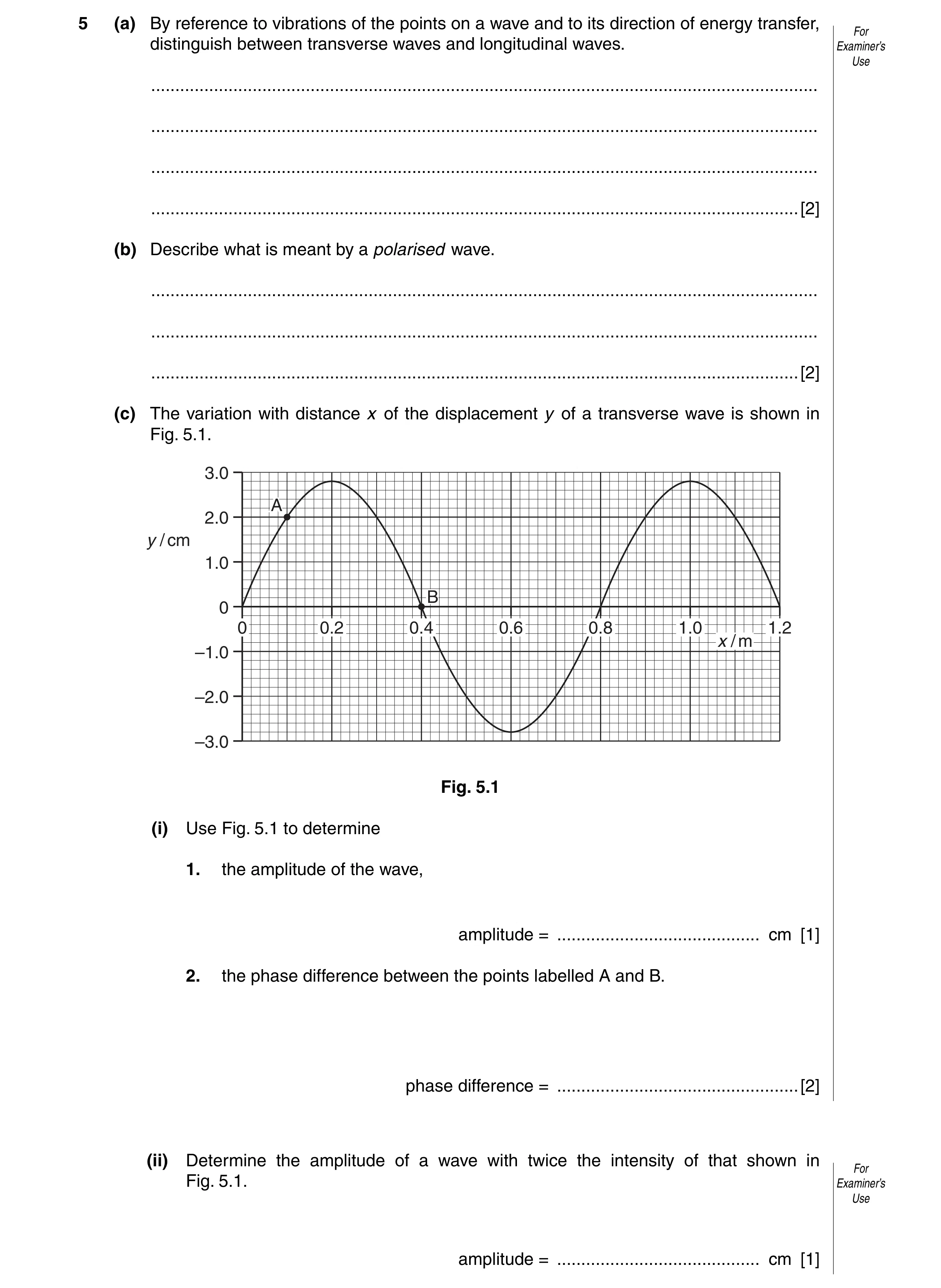
5 (a) By reference to vibrations of the points on a wave and to its direction of energy transfer, For distinguish between transverse waves and longitudinal waves. Examiner’s Use … … … … [2] (b) Describe what is meant by a polarised wave. … … … [2] (c) The variation with distance x of the displacement y of a transverse wave is shown in Fig. 5.1. 3.0 AA 2.0 y / cm 1.0 BB 0 0 0.2 0.4 0.6 0.8 1.0 1.2 x / m –1.0 –2.0 –3.0 Fig. 5.1 (i) Use Fig. 5.1 to determine 1. the amplitude of the wave, amplitude = … cm [1] 2. the phase difference between the points labelled A and B. phase difference = … [2] (ii) Determine the amplitude of a wave with twice the intensity of that shown in For Fig. 5.1. Examiner’s Use amplitude = … cm [1]
8 marks
Mark scheme: 5 (a) transverse waves have vibrations that are perpendicular / normal to the direction of energy travel B1 longitudinal waves have vibrations that are parallel to the direction of energy travel B1 [2] (b) vibrations are in a single direction M1 either applies to transverse waves or normal to direction of wave energy travel or normal to direction of wave propagation A1 [2] (c) (i) 1. amplitude = 2.8 cm B1 [1] 2. phase difference = 135° or 0.75π rad or ¾π rad or 2.36 radians (three sf needed) numerical value M1 unit A1 [2] (ii) amplitude = 3.96 cm (4.0 cm) A1 [1]
This question in 9702/23 Oct/Nov 2011
Q4 · State one property of electromagnetic waves that is not common to other transverse For… 9702/23 Oct/Nov 2012
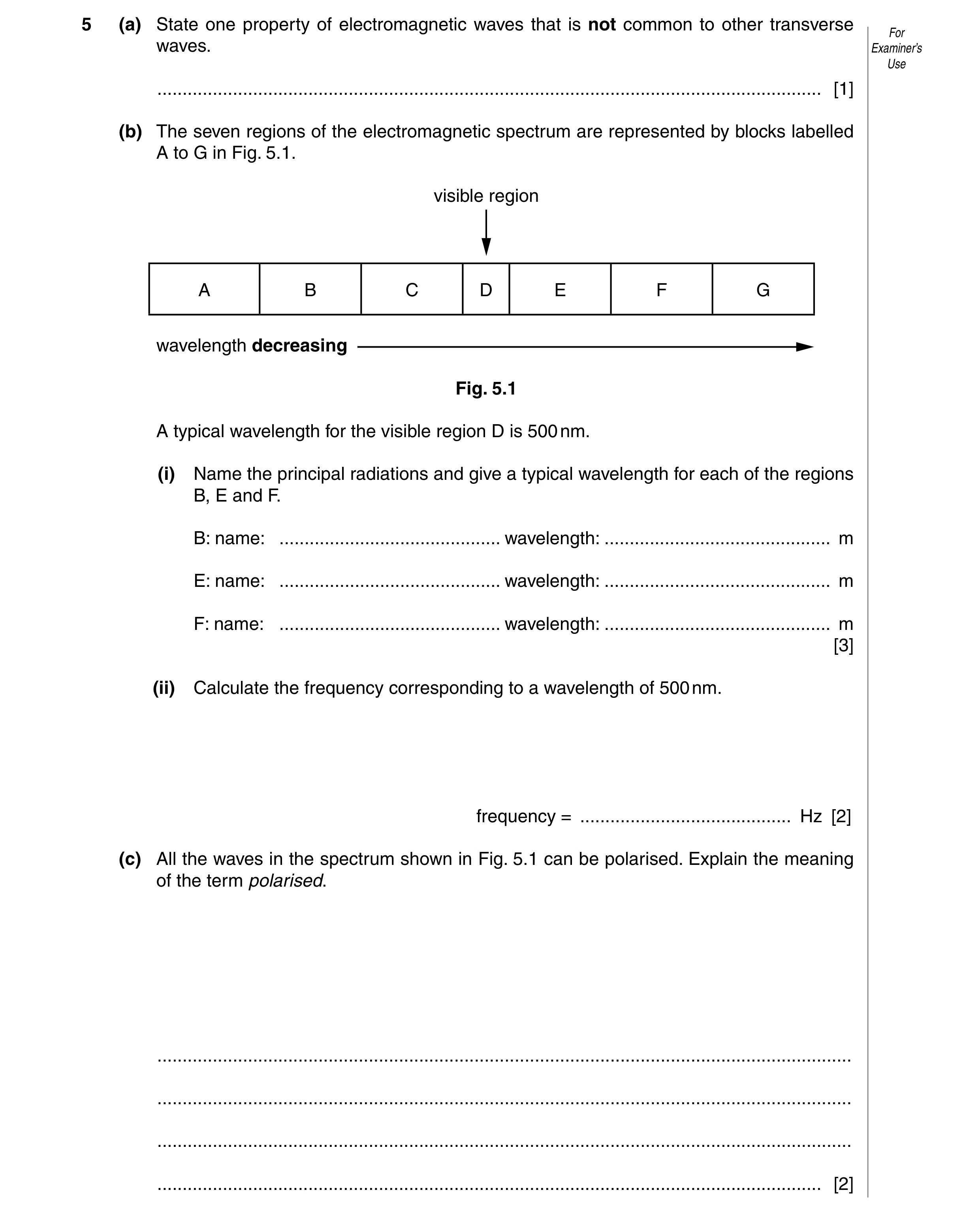
5 (a) State one property of electromagnetic waves that is not common to other transverse For waves. Examiner’s Use … [1] (b) The seven regions of the electromagnetic spectrum are represented by blocks labelled A to G in Fig. 5.1. visible region A B C D E F G wavelength decreasing Fig. 5.1 A typical wavelength for the visible region D is 500 nm. (i) Name the principal radiations and give a typical wavelength for each of the regions B, E and F. B: name: … wavelength: … m E: name: … wavelength: … m F: name: … wavelength: … m [3] (ii) Calculate the frequency corresponding to a wavelength of 500 nm. frequency = … Hz [2] (c) All the waves in the spectrum shown in Fig. 5.1 can be polarised. Explain the meaning of the term polarised. … … … … [2]
8 marks
Mark scheme: 5 (a) travel through a vacuum / free space B1 [1] (b) (i) B : name: microwaves wavelength: 10– 4 to 10–1 m B1 C : name: ultra-violet / UV wavelength: 10–7 to 10–9 m B1 F : name: X –rays wavelength: 10–9 to 10–12 m B1 [3] 3 × 10 8 (ii) f = C1 500 × 10 − 9 f = 6(.0) × 1014 Hz A1 [2] GCE AS/A LEVEL – October/November 2012 9702 23 (c) vibrations are in one direction M1 perpendicular to direction of propagation / energy transfer or good sketch showing this A1 [2]
This question in 9702/23 Oct/Nov 2012
Q5 · A long rope is held under tension between two points A and B 9702/22 Oct/Nov 2013
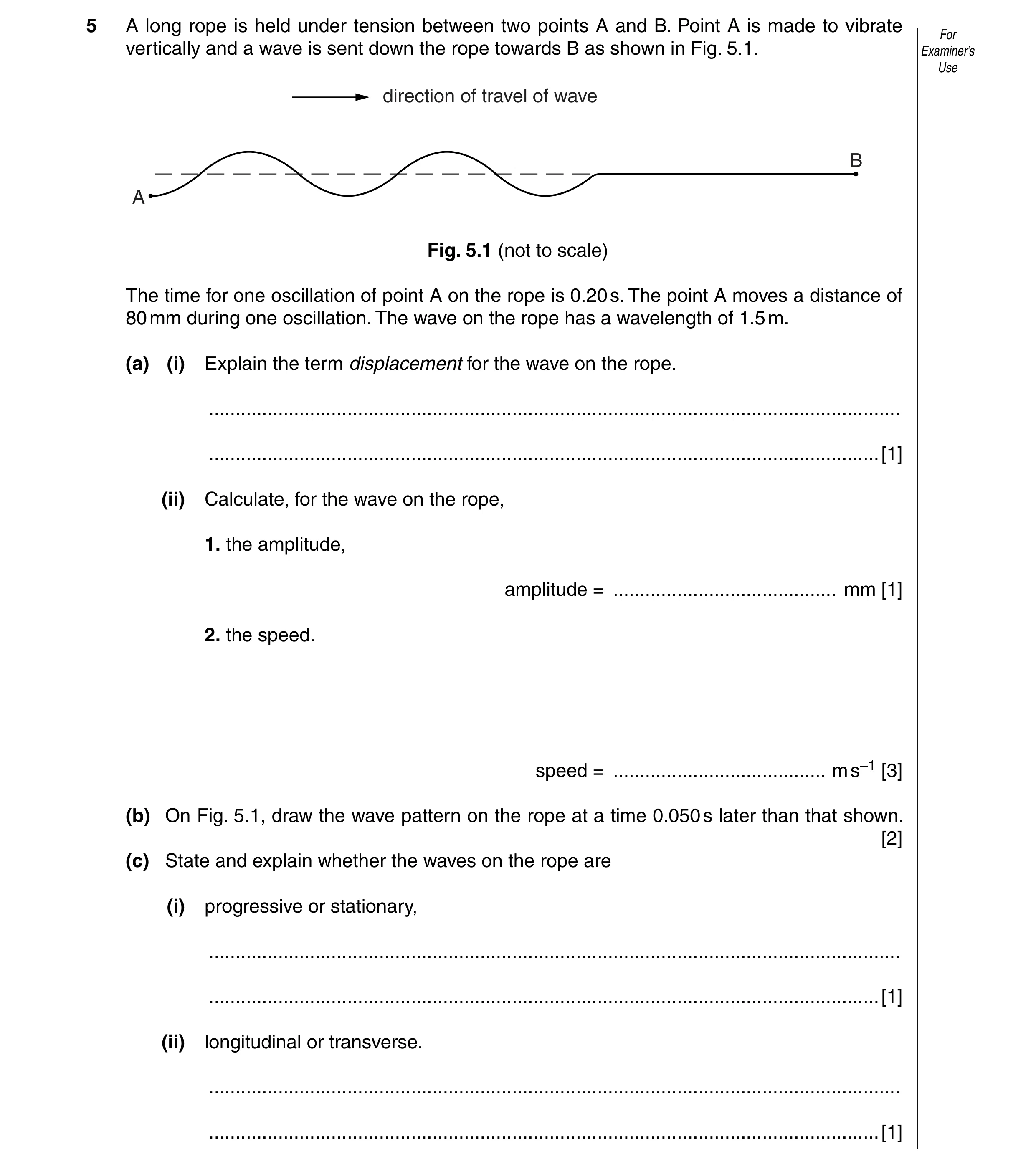
5 A long rope is held under tension between two points A and B. Point A is made to vibrate For vertically and a wave is sent down the rope towards B as shown in Fig. 5.1. Examiner’s Use direction of travel of wave B A Fig. 5.1 (not to scale) The time for one oscillation of point A on the rope is 0.20 s. The point A moves a distance of 80 mm during one oscillation. The wave on the rope has a wavelength of 1.5 m. (a) (i) Explain the term displacement for the wave on the rope. … … [1] (ii) Calculate, for the wave on the rope, 1. the amplitude, amplitude = … mm [1] 2. the speed. speed = … m s–1 [3] (b) On Fig. 5.1, draw the wave pattern on the rope at a time 0.050 s later than that shown. [2] (c) State and explain whether the waves on the rope are (i) progressive or stationary, … … [1] (ii) longitudinal or transverse. … … [1]
9 marks
Mark scheme: 5 (a) (i) displacement is the distance the rope / particles are (above or below) from the equilibrium / mean / rest / undisturbed position (not ‘distance moved’) B1 [1] (ii) 1. amplitude (= 80 / 4) = 20 mm B1 [1] 2. v = fλ or v = λ / T C1 f = 1 / T = 1 / 0.2 (5 Hz) C1 v = 5 × 1.5 = 7.5 m s–1 A1 [3] (b) point A of rope shown at equilibrium position B1 same wavelength, shape, peaks / wave moved ¼λ to right B1 [2] (c) (i) progressive as energy OR peaks OR troughs is/are transferred/moved /propagated (by the waves) B1 [1] (ii) transverse as particles/rope movement is perpendicular to direction of travel /propagation of the energy/wave velocity B1 [1]
This question in 9702/22 Oct/Nov 2013
Q6 · State one difference and one similarity between longitudinal and transverse waves 9702/22 Oct/Nov 2014
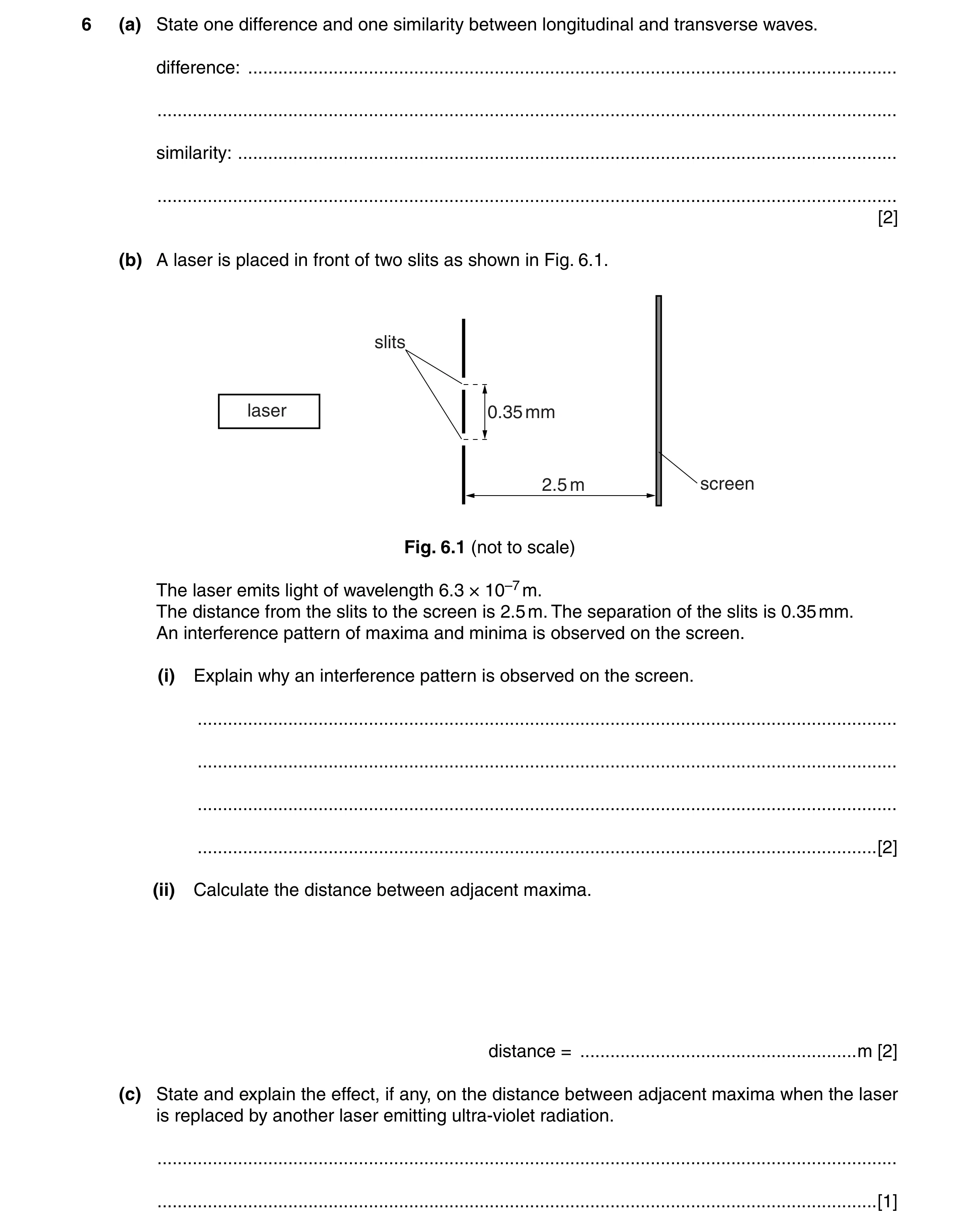
6 (a) State one difference and one similarity between longitudinal and transverse waves. difference: … … similarity: … … [2] (b) A laser is placed in front of two slits as shown in Fig. 6.1. slits laser 0.35 mm 2.5 m screen Fig. 6.1 (not to scale) The laser emits light of wavelength 6.3 × 10⁻⁷ m. The distance from the slits to the screen is 2.5 m. The separation of the slits is 0.35 mm. An interference pattern of maxima and minima is observed on the screen. (i) Explain why an interference pattern is observed on the screen. … … … … [2] (ii) Calculate the distance between adjacent maxima. distance = … m [2] (c) State and explain the effect, if any, on the distance between adjacent maxima when the laser is replaced by another laser emitting ultra-violet radiation. … … [1]
7 marks
Mark scheme: 6 (a) difference: vibration / oscillation (of particles) / displacement of particles is parallel to energy transfer / wavefronts in longitudinal and perpendicular for transverse B1 or transverse can be polarised, longitudinal cannot be polarised similarity: both transfer / propagate energy B1 [2] (b) (i) waves from slits are coherent / constant phase relationship (B1) waves overlap (at screen) with a phase difference or have a path difference (B1) maxima where phase difference is integer ×360° (or ×2π rad) or path difference is integer ×λ or equivalent explanation of minima e.g. (n+½)×360° (B1) max. 2 [2] (ii) maxima spacing = λD / a C1 = (6.3 × 10–7 × 2.5) / 0.35 × 10–3 = 4.5 × 10⁻³ m A1 [2] (c) (ultra-violet has) shorter wavelength, hence smaller separation / distance A1 [1]
This question in 9702/22 Oct/Nov 2014
Q7 · Define the frequency of a sound wave 9702/22 May/June 2017
5 (a) Define the frequency of a sound wave. … … [1] (b) A sound wave travels through air. Describe the motion of the air particles relative to the direction of travel of the sound wave. … … [1] (c) The sound wave emitted from the horn of a stationary car is detected with a microphone and displayed on a cathode-ray oscilloscope (c.r.o.), as shown in Fig. 5.1. 1.0 cm 1.0 cm Fig. 5.1 The y-axis setting is 5.0 mV cm–1. The time-base setting is 0.50 ms cm–1. (i) Use Fig. 5.1 to determine the frequency of the sound wave. frequency = … Hz [2] (ii) The horn of the car sounds continuously. Describe the changes to the trace seen on the c.r.o. as the car travels at constant speed 1. directly towards the stationary microphone, … … 2. directly away from the stationary microphone. … … [3] [Total: 7]
7 marks
Mark scheme: 5(a) frequency is the number of vibrations/oscillations per unit time or the number of wavefronts passing a point per unit time B1 5(b) vibrations/oscillation of the air particles are parallel to the direction of it (the direction of travel of the sound wave) B1 5(c)(i) T = 2(.0) (ms) C1 f = 500 Hz A1 5(c)(ii) 1. amplitude increases (time) period decreases 2. amplitude decreases (time) period increases any 3 points B3
This question in 9702/22 May/June 2017
Q8 · By reference to the direction of propagation of energy, explain what is meant by a… 9702/23 Oct/Nov 2017
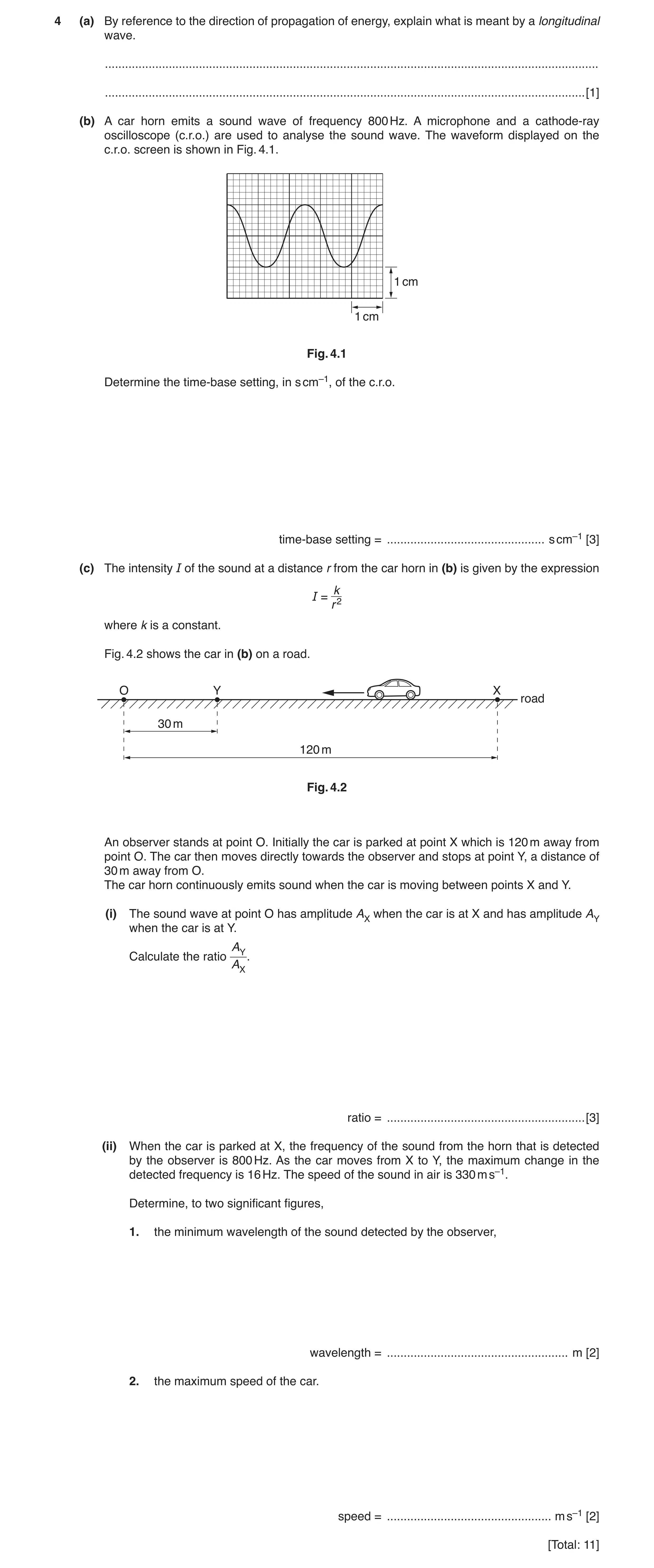
4 (a) By reference to the direction of propagation of energy, explain what is meant by a longitudinal wave. … … [1] (b) A car horn emits a sound wave of frequency 800 Hz. A microphone and a cathode-ray oscilloscope (c.r.o.) are used to analyse the sound wave. The waveform displayed on the c.r.o. screen is shown in Fig. 4.1. 1 cm 1 cm Fig. 4.1 Determine the time-base setting, in s cm–1, of the c.r.o. time-base setting = … s cm–1 [3] (c) The intensity I of the sound at a distance r from the car horn in (b) is given by the expression k I = 2 r where k is a constant. Fig. 4.2 shows the car in (b) on a road. O Y X road 30 m 120 m Fig. 4.2 An observer stands at point O. Initially the car is parked at point X which is 120 m away from point O. The car then moves directly towards the observer and stops at point Y, a distance of 30 m away from O. The car horn continuously emits sound when the car is moving between points X and Y. (i) The sound wave at point O has amplitude AX when the car is at X and has amplitude AY when the car is at Y. AY Calculate the ratio . AX ratio = … [3] (ii) When the car is parked at X, the frequency of the sound from the horn that is detected by the observer is 800 Hz. As the car moves from X to Y, the maximum change in the detected frequency is 16 Hz. The speed of the sound in air is 330 m s–1. Determine, to two significant figures, 1. the minimum wavelength of the sound detected by the observer, wavelength = … m [2] 2. the maximum speed of the car. speed = … m s–1 [2] [Total: 11]
11 marks
Mark scheme: 4(a) displacement of particles/vibration(s)/oscillation(s) is parallel to/along the direction of energy/propagation B1 4(b) period = 1 / 800 (= 1.25 × 10⁻³ s) C1 time-base setting = 1.25 × 10⁻³ / 2.5 C1 = 5.0 × 10⁻⁴ s cm–1 A1 4(c)(i) I ∝ A2 C1 (IX / IY =) [rY / rX] 2 = [AX / AY]2 C1 ratio AY / AX = 120 / 30 = 4.0 A1 Question Answer Marks 4(c)(ii) 1. v = f λ C1 minimum λ = 330 / (800 + 16) = 0.40 m A1 2. fo / fs = v / (v – vs) 816 / 800 = 330 / (330 – vs) C1 vs = 6.5 m s–1 A1
This question in 9702/23 Oct/Nov 2017
Q9 · Sound waves are longitudinal waves 9702/22 Oct/Nov 2018
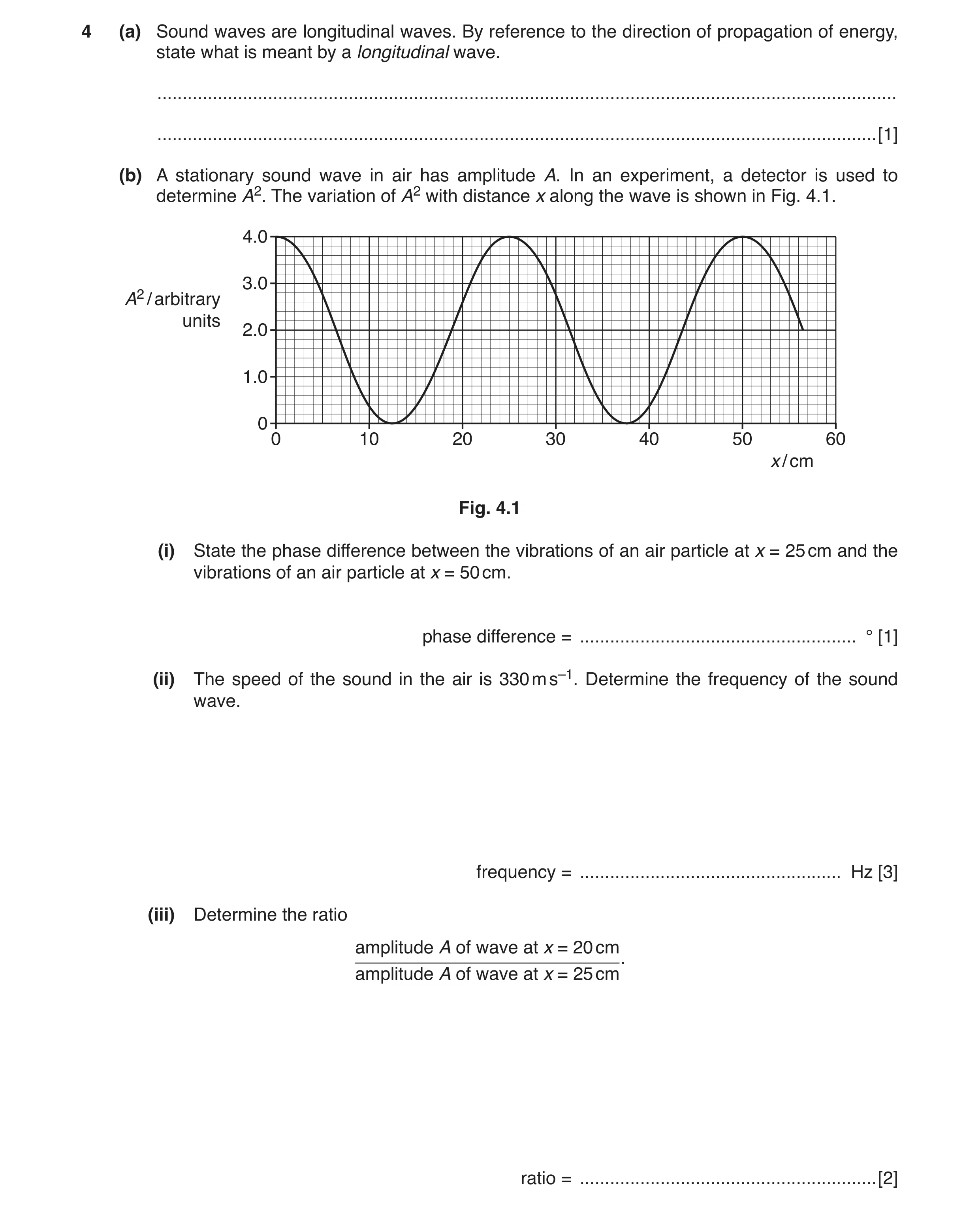
4 (a) Sound waves are longitudinal waves. By reference to the direction of propagation of energy, state what is meant by a longitudinal wave. … … [1] (b) A stationary sound wave in air has amplitude A. In an experiment, a detector is used to determine A2. The variation of A2 with distance x along the wave is shown in Fig. 4.1. 4.0 3.0 A2 / arbitrary units 2.0 1.0 0 0 10 20 30 40 50 60 x / cm Fig. 4.1 (i) State the phase difference between the vibrations of an air particle at x = 25 cm and the vibrations of an air particle at x = 50 cm. phase difference = … ° [1] (ii) The speed of the sound in the air is 330 m s–1. Determine the frequency of the sound wave. frequency = … Hz [3] (iii) Determine the ratio amplitude A of wave at x = 20 cm . amplitude A of wave at x = 25 cm ratio = … [2]
7 marks
Mark scheme: 4(a) vibration(s)/oscillation(s) (of particles) parallel to direction of propagation of energy B1 4(b)(i) phase difference = 180° A1 4(b)(ii) v = fλ C1 λ / 2 = 25 (cm) or 0.25 (m) C1 f = 330 / 0.50 = 660 Hz A1 4(b)(iii) (readings from graph =) 2.6 and 4.0 C1 ratio = (2.6 / 4.0)1/2 = 0.81 A1
This question in 9702/22 Oct/Nov 2018
Q10 · By reference to the direction of propagation of energy, state what is meant by a… 9702/21 May/June 2020
4 (a) (i) By reference to the direction of propagation of energy, state what is meant by a longitudinal wave. … … [1] (ii) State the principle of superposition. … … … [2] (b) The wavelength of light from a laser is determined using the apparatus shown in Fig. 4.1. double slit screen light 3.7 × 10⁻⁴ m 2.3 m Fig. 4.1 (not to scale) The light from the laser is incident normally on the plane of the double slit. The separation of the two slits is 3.7 × 10⁻⁴ m. The screen is parallel to the plane of the double slit. The distance between the screen and the double slit is 2.3 m. A pattern of bright fringes and dark fringes is seen on the screen. The separation of adjacent bright fringes on the screen is 4.3 × 10⁻³ m. (i) Calculate the wavelength, in nm, of the light. wavelength = … nm [3] (ii) The intensity of the light passing through each slit was initially the same. The intensity of the light through one of the slits is now reduced. Compare the appearance of the fringes before and after the change of intensity. … … … … [2] [Total: 8]
8 marks
Mark scheme: 4(a)(i) vibrations (of particles) are parallel to direction of energy propagation B1 4(a)(ii) waves meet/overlap (at a point) B1 (resultant) displacement is sum of individual displacements B1 4(b)(i) λ = ax / D C1 = (3.7 × 10–4 × 4.3 × 10–3) / 2.3 C1 = 6.9 × 10⁻⁷ (m) = 690 nm A1 4(b)(ii) • no change to fringe separation/fringe width/number of fringes • bright fringes are darker • dark fringes are brighter Any two marking points, 1 mark each B2
This question in 9702/21 May/June 2020
Q11 · By reference to the direction of transfer of energy, state what is meant by a… 9702/21 Oct/Nov 2021
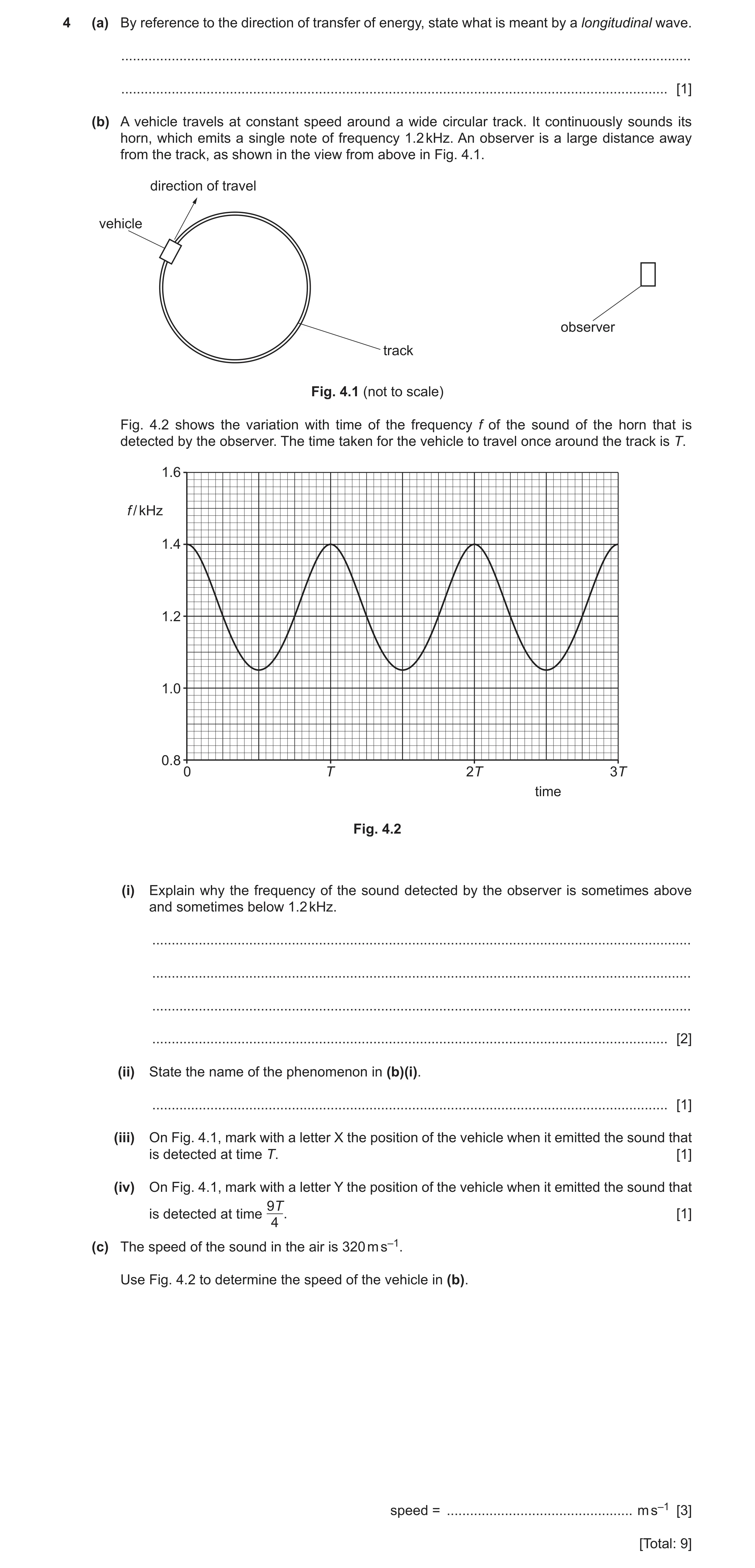
4 (a) By reference to the direction of transfer of energy, state what is meant by a longitudinal wave. … … [1] (b) A vehicle travels at constant speed around a wide circular track. It continuously sounds its horn, which emits a single note of frequency 1.2 kHz. An observer is a large distance away from the track, as shown in the view from above in Fig. 4.1. direction of travel vehicle observer track Fig. 4.1 (not to scale) Fig. 4.2 shows the variation with time of the frequency f of the sound of the horn that is detected by the observer. The time taken for the vehicle to travel once around the track is T. 1.6 f / kHz 1.4 1.2 1.0 0.8 0 T 2T 3T time Fig. 4.2 (i) Explain why the frequency of the sound detected by the observer is sometimes above and sometimes below 1.2 kHz. … … … … [2] (ii) State the name of the phenomenon in (b)(i). … [1] (iii) On Fig. 4.1, mark with a letter X the position of the vehicle when it emitted the sound that is detected at time T. [1] (iv) On Fig. 4.1, mark with a letter Y the position of the vehicle when it emitted the sound that 9T is detected at time . [1] 4 (c) The speed of the sound in the air is 320 m s–1. Use Fig. 4.2 to determine the speed of the vehicle in (b). speed = … m s–1 [3] [Total: 9]
9 marks
Mark scheme: 4(a) oscillations (of particles) are parallel to (the direction of) energy transfer B1 4(b)(i) (frequency varies as) vehicle moves relative to (stationary) observer C1 (vehicle) moving towards (observer) gives higher (observed) frequency (than 1.2 kHz) and (vehicle) moving away (from observer) gives lower (observed) frequency (than 1.2 kHz) A1 4(b)(ii) Doppler effect B1 4(b)(iii) position of vehicle labelled ‘X’ at top (12 o’clock) position on track B1 4(b)(iv) position of vehicle labelled ‘Y’ at right-hand edge (3 o’clock) position on track B1 4(c) maximum frequency = 1.40 (kHz) or 1.40 × 10³ (Hz) C1 1.40 = (1.2 × 320) / (320 – v) C1 v = 46 m s–1 A1 or minimum frequency = 1.05 (kHz) or 1.05 × 10³ (Hz) (C1) 1.05 = (1.2 × 320) / (320 + v) (C1) v = 46 m s–1 (A1)
This question in 9702/21 Oct/Nov 2021
Q12 · A progressive wave travels through a medium 9702/22 May/June 2023
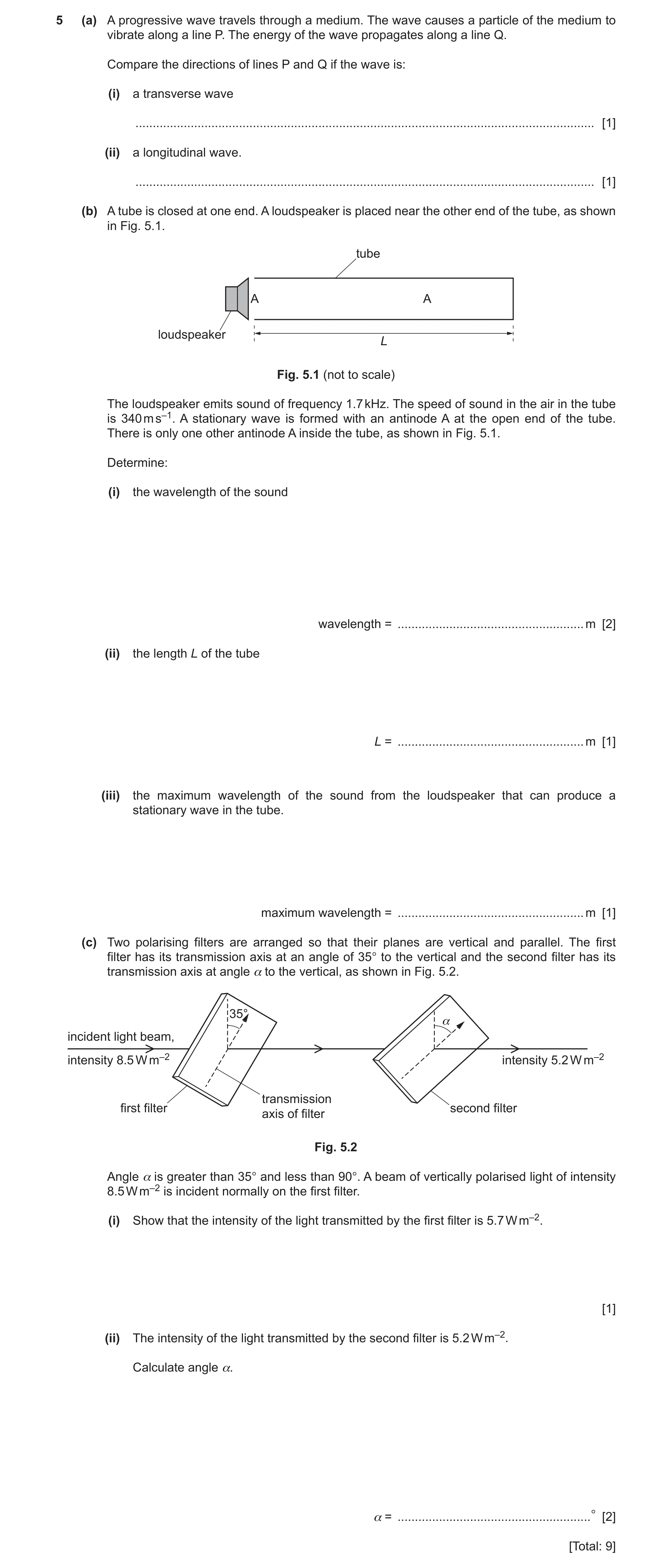
5 (a) A progressive wave travels through a medium. The wave causes a particle of the medium to vibrate along a line P. The energy of the wave propagates along a line Q. Compare the directions of lines P and Q if the wave is: (i) a transverse wave … [1] (ii) a longitudinal wave. … [1] (b) A tube is closed at one end. A loudspeaker is placed near the other end of the tube, as shown in Fig. 5.1. tube A A loudspeaker L Fig. 5.1 (not to scale) The loudspeaker emits sound of frequency 1.7 kHz. The speed of sound in the air in the tube is 340 m s–1. A stationary wave is formed with an antinode A at the open end of the tube. There is only one other antinode A inside the tube, as shown in Fig. 5.1. Determine: (i) the wavelength of the sound wavelength = … m [2] (ii) the length L of the tube L = … m [1] (iii) the maximum wavelength of the sound from the loudspeaker that can produce a stationary wave in the tube. maximum wavelength = … m [1] (c) Two polarising filters are arranged so that their planes are vertical and parallel. The first filter has its transmission axis at an angle of 35° to the vertical and the second filter has its transmission axis at angle α to the vertical, as shown in Fig. 5.2. 35° α incident light beam, intensity 8.5 W m–2 intensity 5.2 W m–2 transmission first filter second filter axis of filter Fig. 5.2 Angle α is greater than 35° and less than 90°. A beam of vertically polarised light of intensity 8.5 W m–2 is incident normally on the first filter. (i) Show that the intensity of the light transmitted by the first filter is 5.7 W m–2. [1] (ii) The intensity of the light transmitted by the second filter is 5.2 W m–2. Calculate angle α. α = … ° [2] [Total: 9]
9 marks
Mark scheme: 5(a)(i) (they are) perpendicular B1 5(a)(ii) (they are) parallel B1 5(b)(i) = v / f C1 = 340 / 1700 = 0.20 m A1 5(b)(ii) L = 3 4 = 3 4 0.20 = 0.15 m A1 5(b)(iii) = 4 0.15 or 0.20 3 = 0.60 m A1 5(c)(i) (I =) 8.5 cos2 35° = 5.7 (W m–2) A1 5(c)(ii) 5.2 = 5.7 cos2 ( = 17°) C1 = 35° + 17° = 52° A1
This question in 9702/22 May/June 2023
Q13 · By reference to the direction of propagation of energy, state what is meant by a… 9702/22 Feb/March 2024
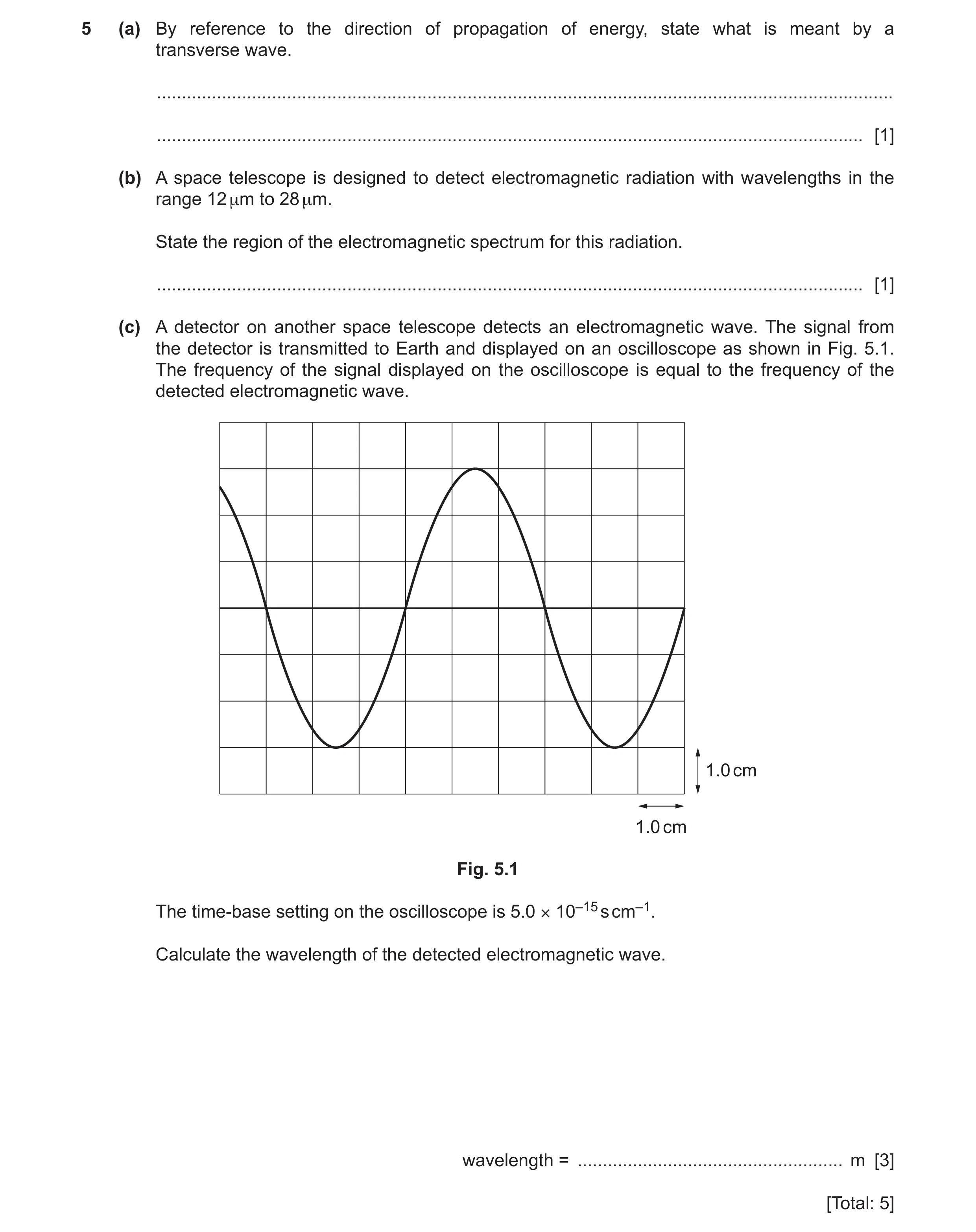
5 (a) By reference to the direction of propagation of energy, state what is meant by a transverse wave. … … [1] (b) A space telescope is designed to detect electromagnetic radiation with wavelengths in the range 12 μm to 28 μm. State the region of the electromagnetic spectrum for this radiation. … [1] (c) A detector on another space telescope detects an electromagnetic wave. The signal from the detector is transmitted to Earth and displayed on an oscilloscope as shown in Fig. 5.1. The frequency of the signal displayed on the oscilloscope is equal to the frequency of the detected electromagnetic wave. 1.0 cm 1.0 cm Fig. 5.1 The time-base setting on the oscilloscope is 5.0 × 10⁻¹⁵ s cm–1. Calculate the wavelength of the detected electromagnetic wave. wavelength = … m [3] [Total: 5]
5 marks
Mark scheme: 5(a) vibrations / oscillations (of the particles / wave) are perpendicular to the direction (of the propagation of energy) B1 5(b) infrared B1 5(c) T = 6 5.0 10–15 C1 T = 3.0 10–14 = c T or = c / f and f = 1 / T C1 = 3.0 108 3.0 10-14 or = 3.0 108 / 3.33 1013 A1 = 9.0 10–6 m
This question in 9702/22 Feb/March 2024
 5 / 18
 6 / 18
 7 / 18
 8 / 18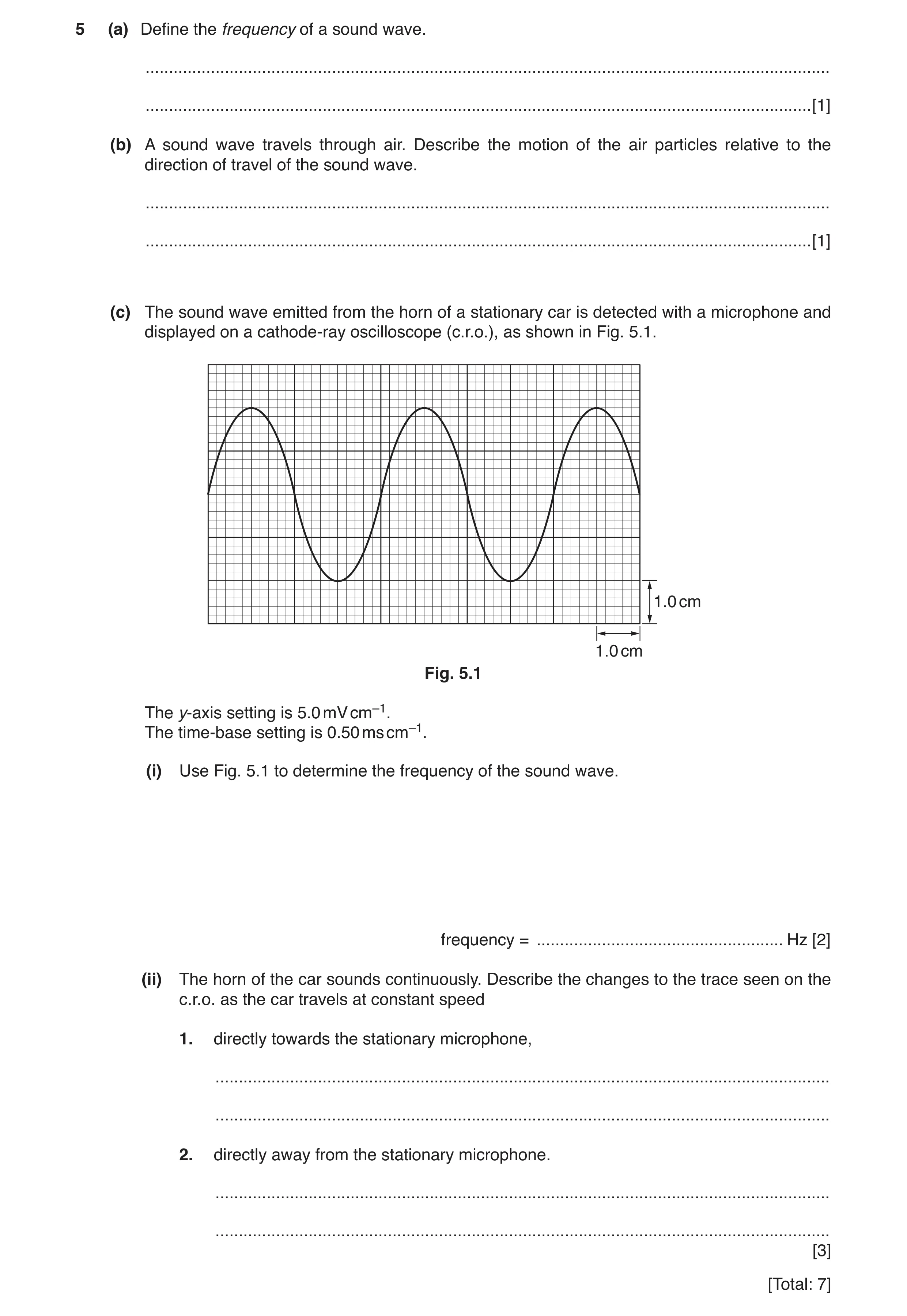
 12 / 18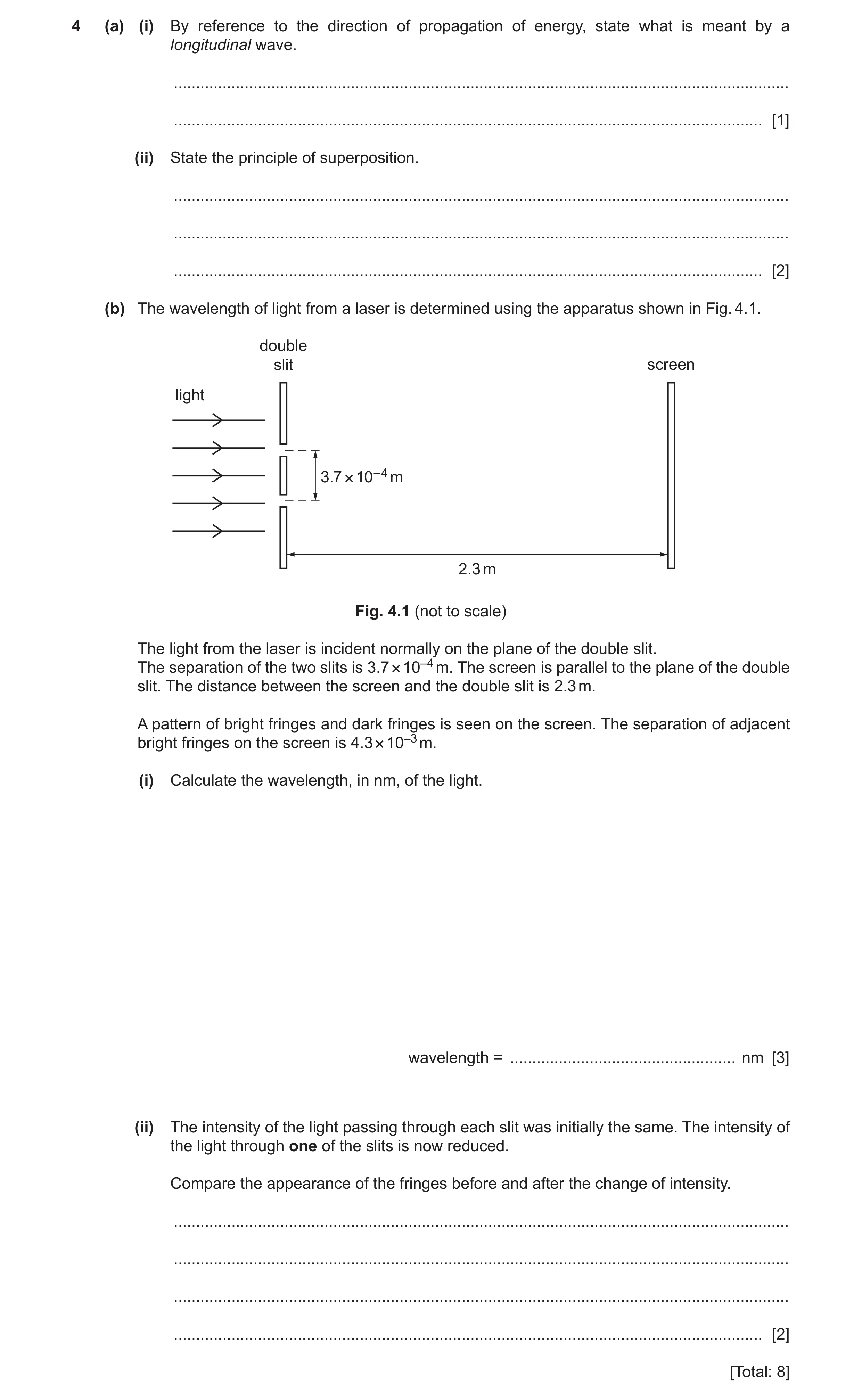
 18 / 18
 11
11 11
11 8
8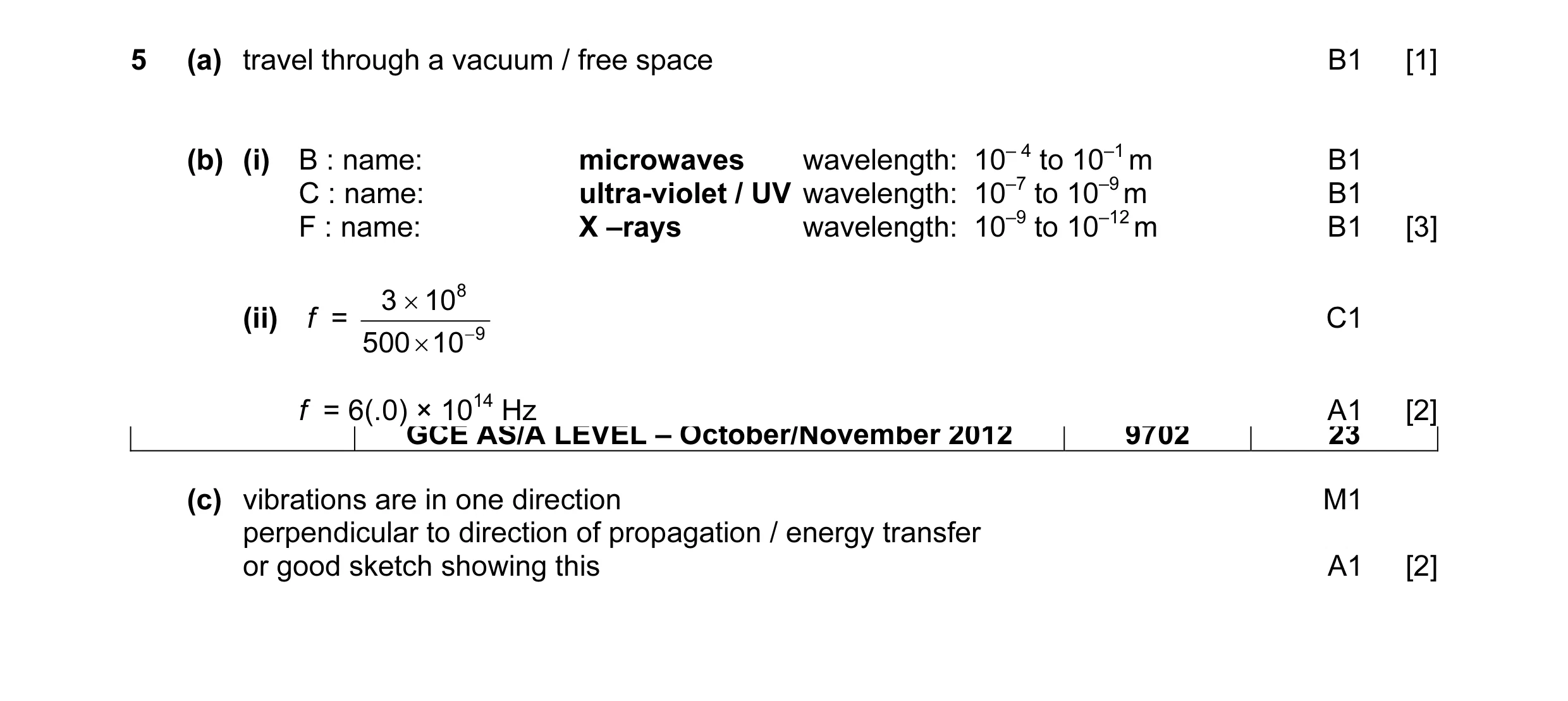 8
8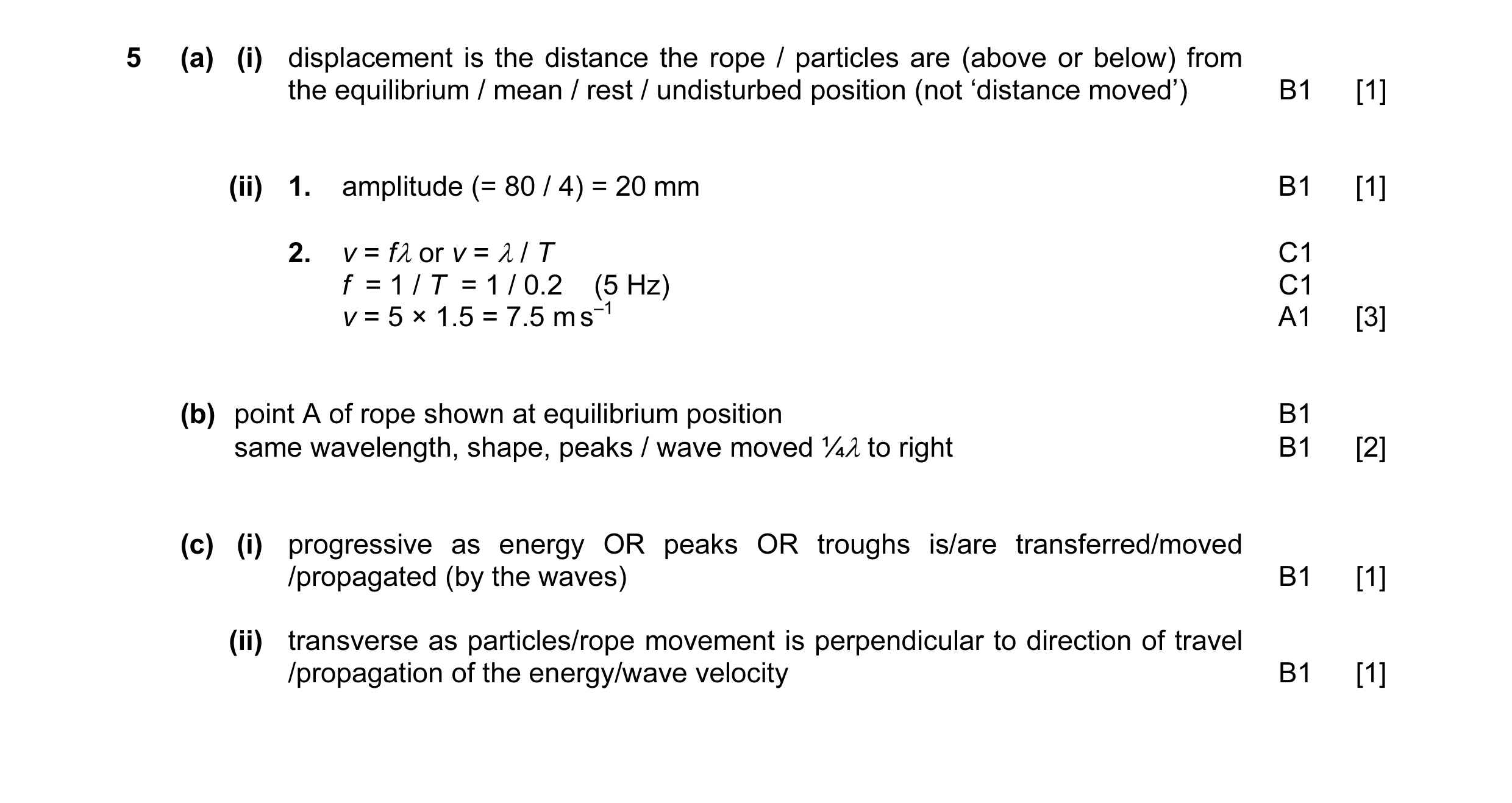 9
9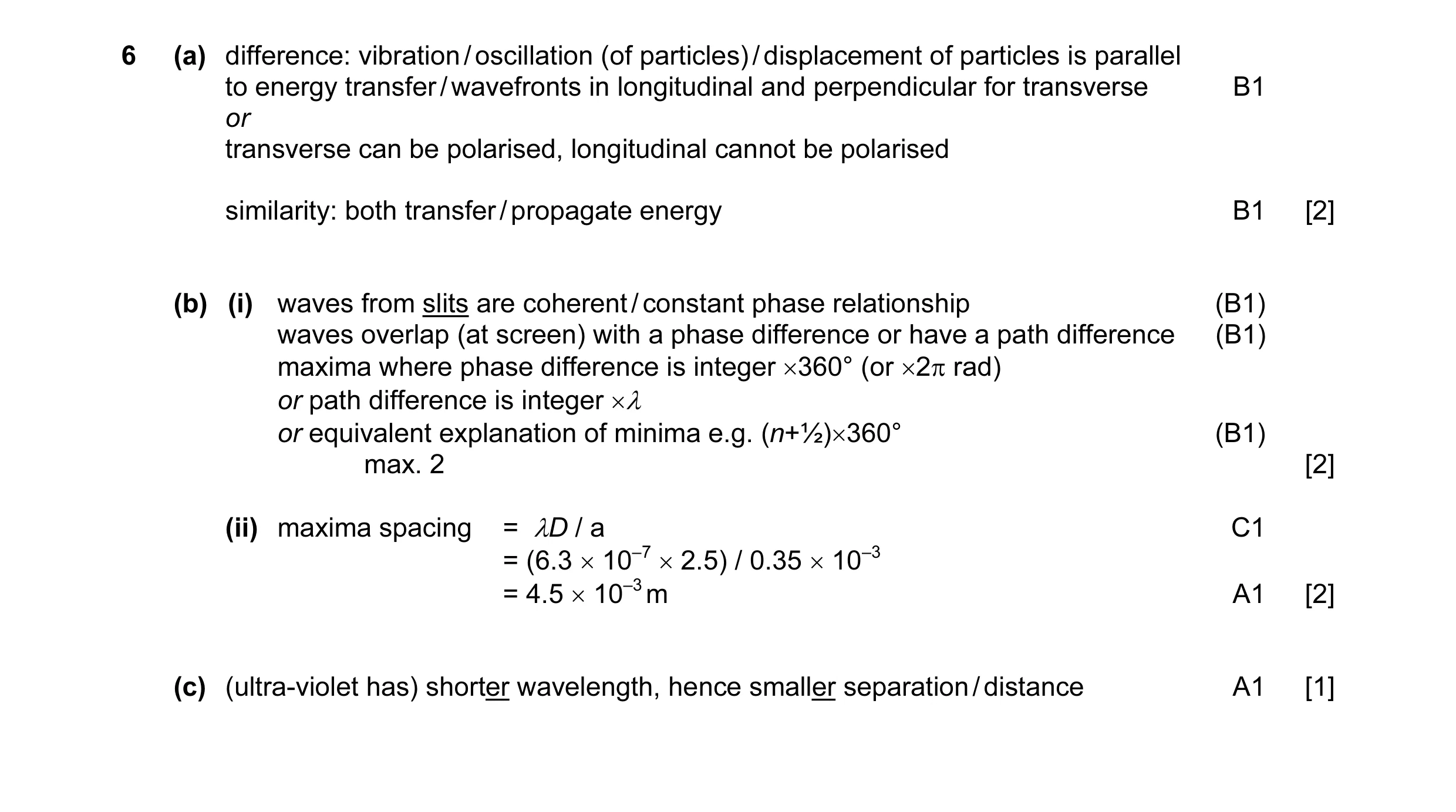 7
7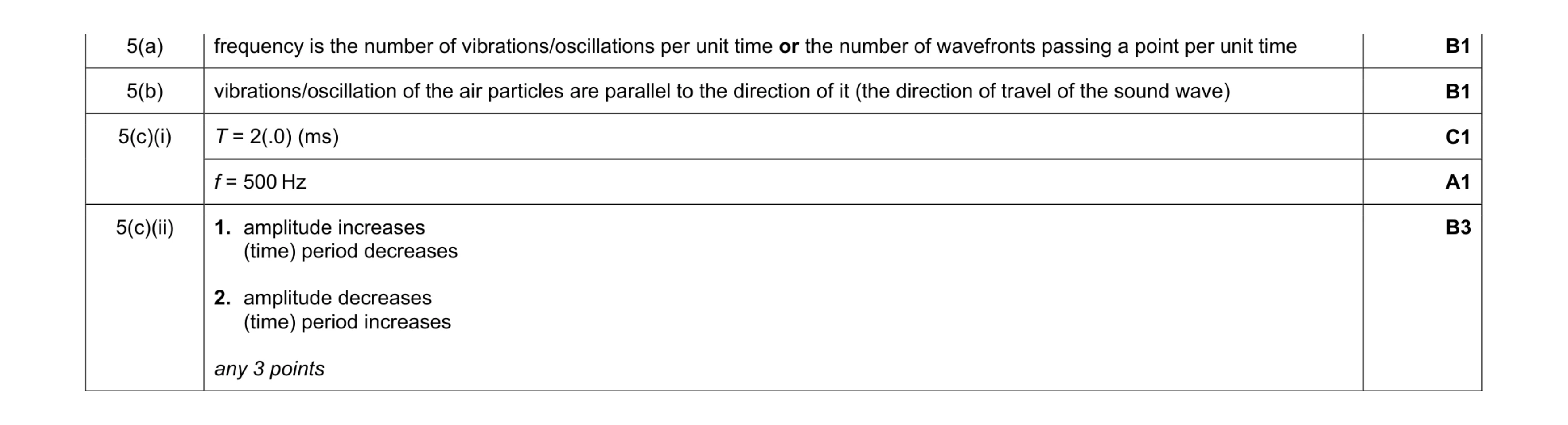 7
7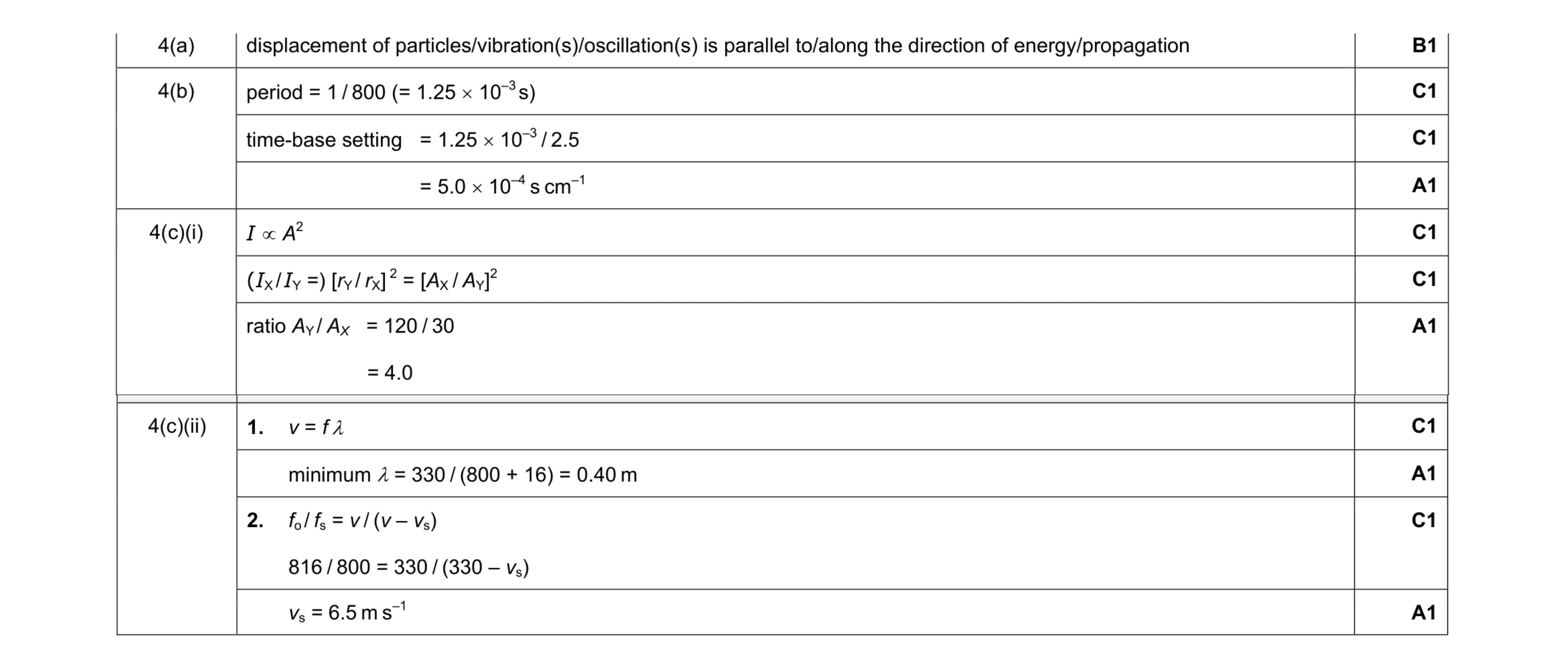 11
11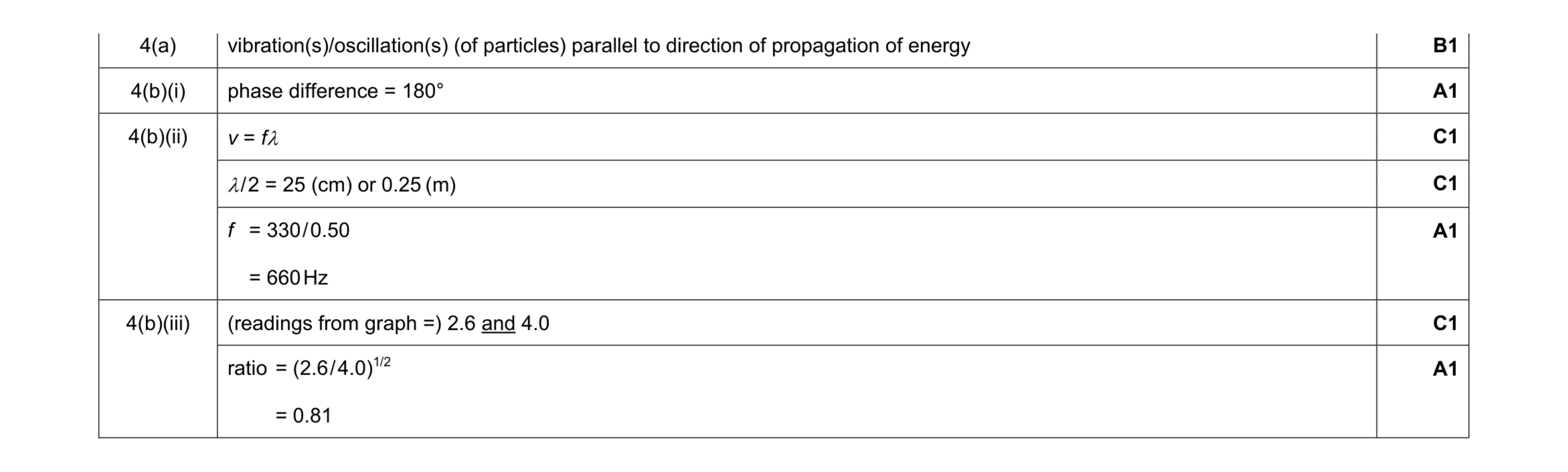 7
7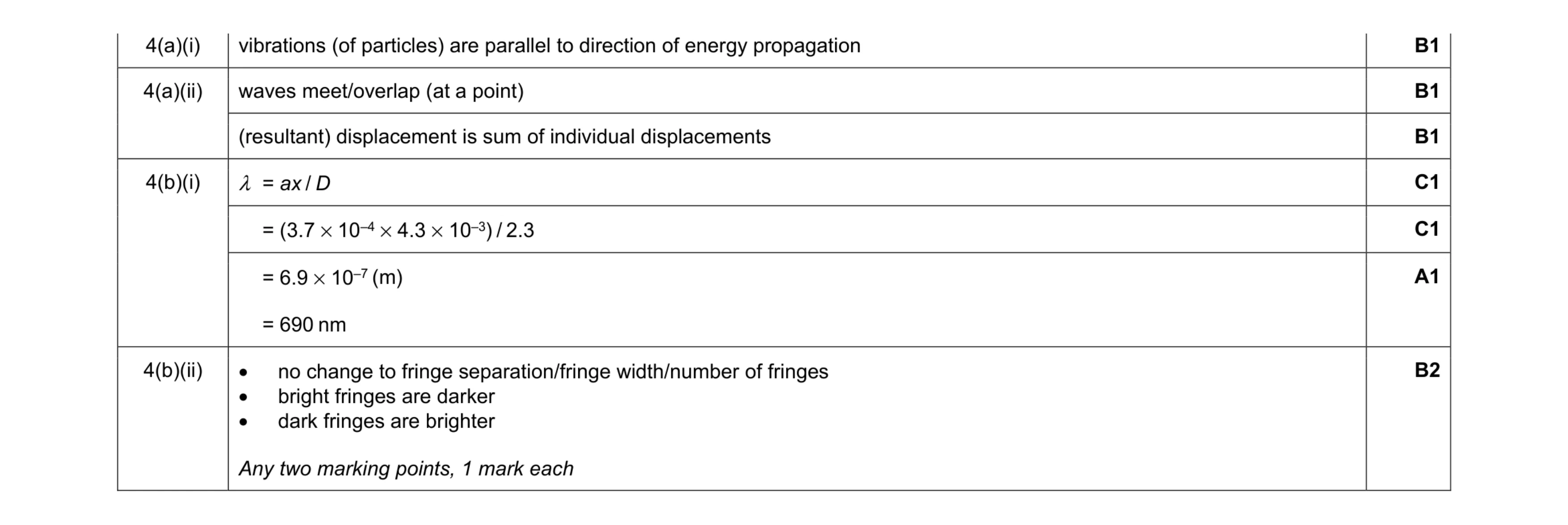 8
8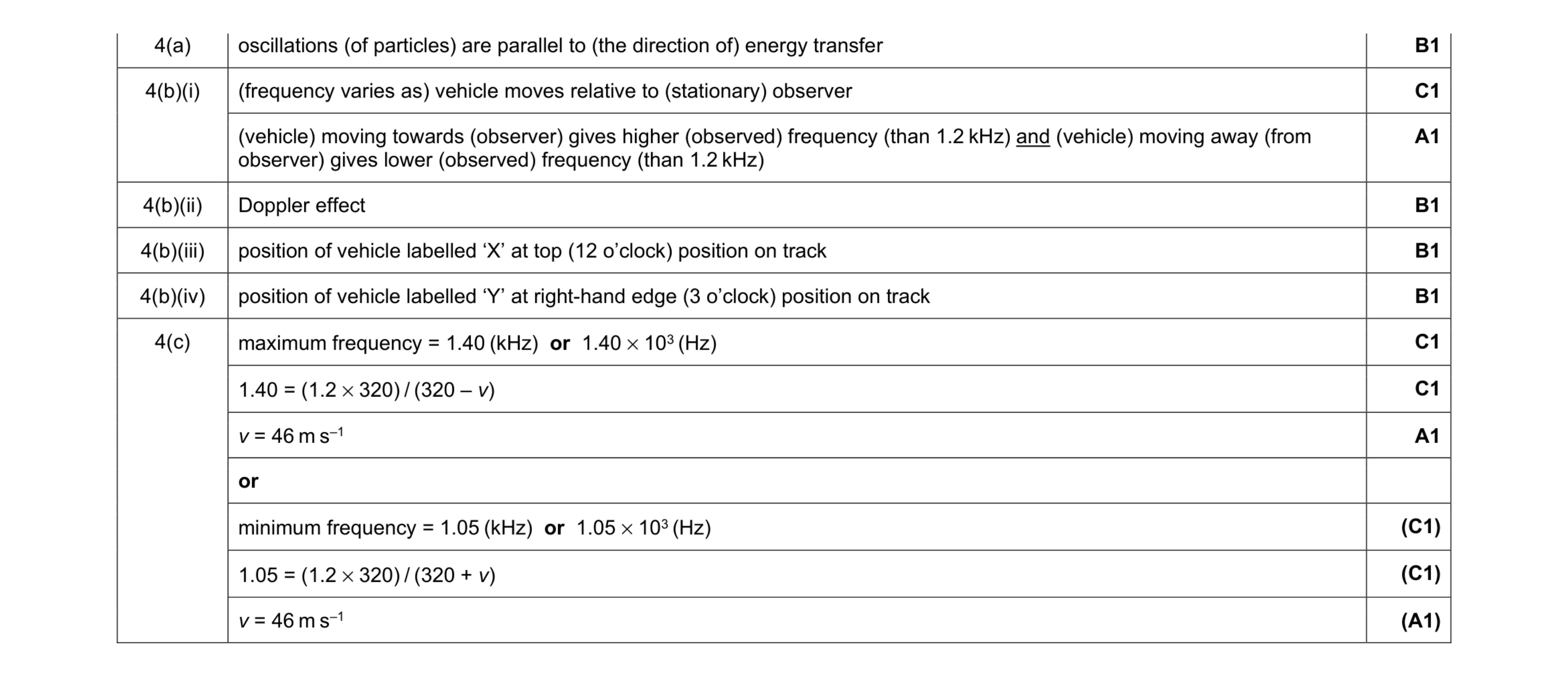 9
9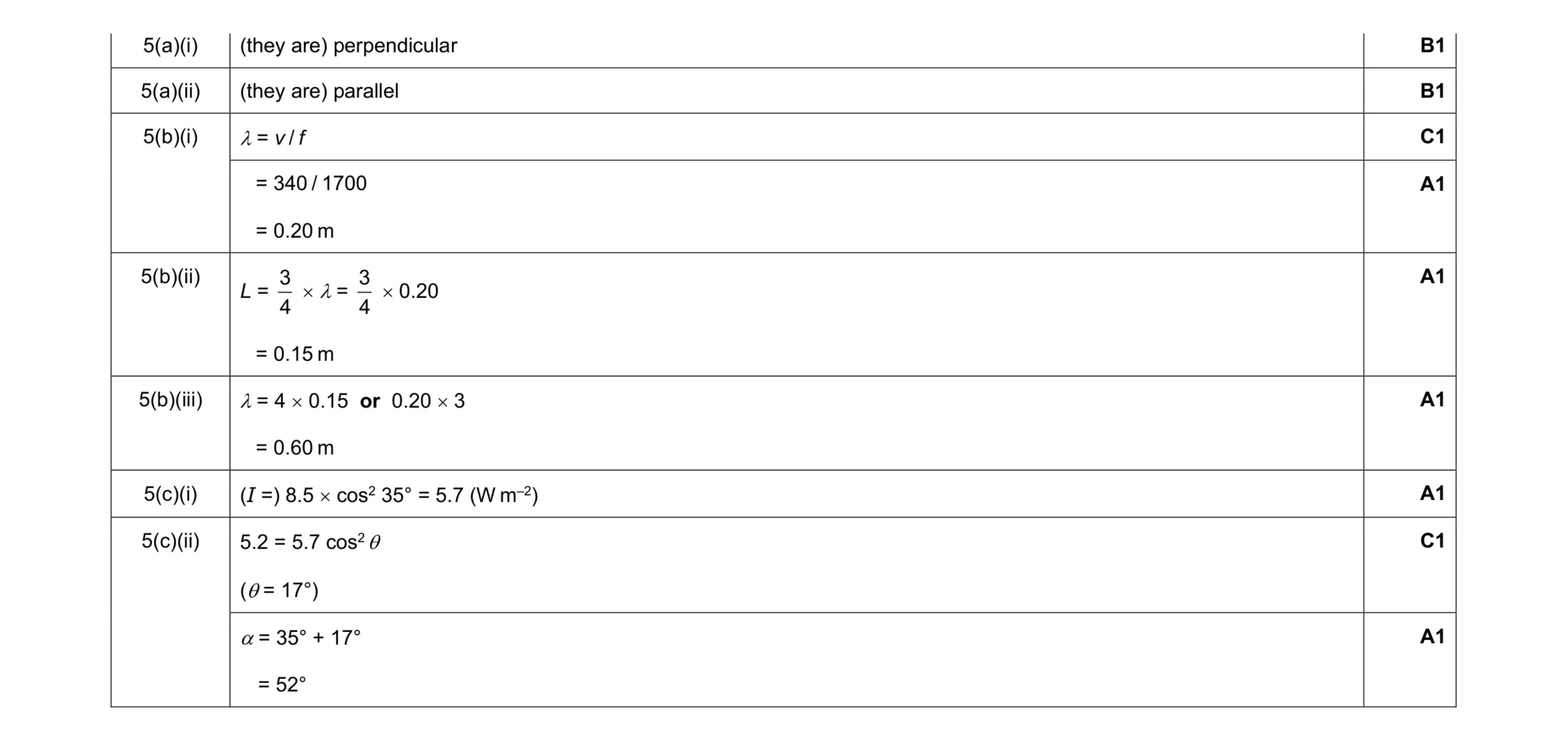 9
9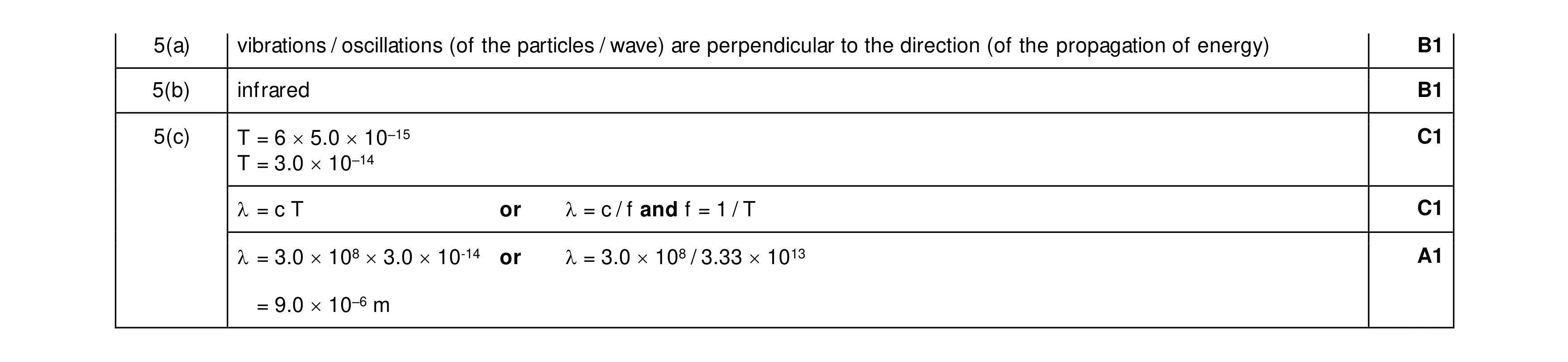 5
5