Questions as text
Q1 · During the electrolysis of brine using a diaphragm cell, which reaction occurs at the… 9701/11 Oct/Nov 2005
8 During the electrolysis of brine using a diaphragm cell, which reaction occurs at the cathode? A 2Cl –(aq) → Cl2(g) + 2e– B 4OH –(aq) → O2(g) + 2H2O(l) + 4e– C 2H2O(l) + 2e– → H2(g) + 2OH–(aq) D Na+(aq) + e– → Na(s)
1 marks
Answer: C
This question in 9701/11 Oct/Nov 2005
Q2 · Use of the Data Booklet is relevant to this question 9701/11 Oct/Nov 2007
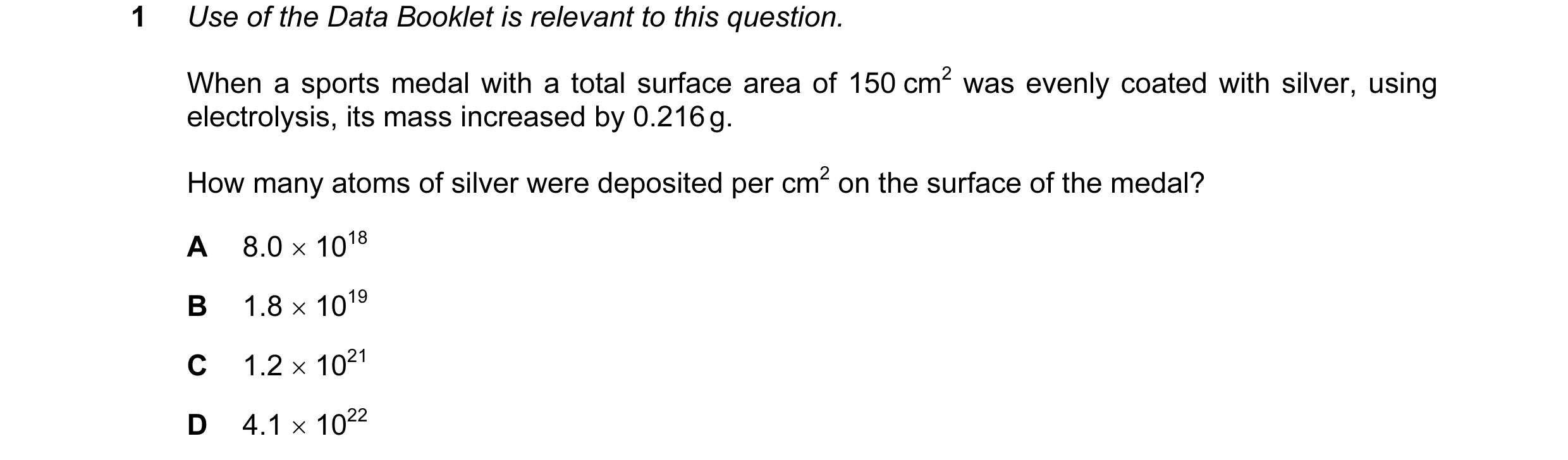
1 Use of the Data Booklet is relevant to this question. When a sports medal with a total surface area of 150 cm2 was evenly coated with silver, using electrolysis, its mass increased by 0.216 g. How many atoms of silver were deposited per cm2 on the surface of the medal? A 8.0 × 10¹⁸ B 1.8 × 10¹⁹ C 1.2 × 10²¹ D 4.1 × 10²²
1 marks
Answer: A
This question in 9701/11 Oct/Nov 2007
Q3 · When copper is extracted from its ores, the metal is not pure enough for electrical uses 9701/11 May/June 2009
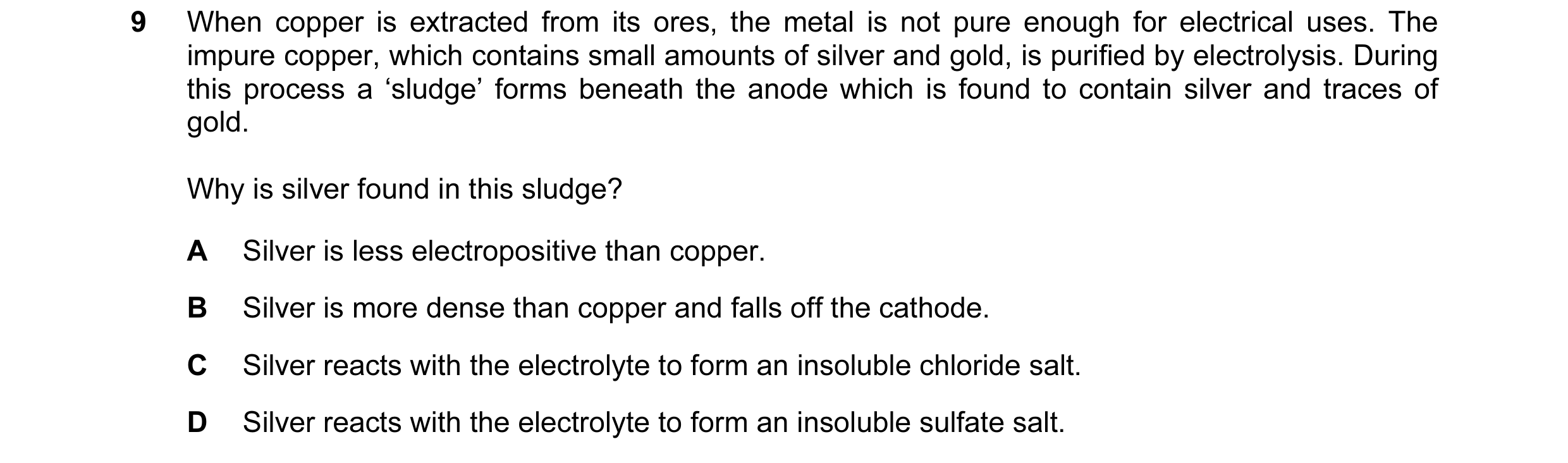
9 When copper is extracted from its ores, the metal is not pure enough for electrical uses. The impure copper, which contains small amounts of silver and gold, is purified by electrolysis. During this process a ‘sludge’ forms beneath the anode which is found to contain silver and traces of gold. Why is silver found in this sludge? A Silver is less electropositive than copper. B Silver is more dense than copper and falls off the cathode. C Silver reacts with the electrolyte to form an insoluble chloride salt. D Silver reacts with the electrolyte to form an insoluble sulfate salt.
1 marks
Answer: A
This question in 9701/11 May/June 2009
Q4 · During electrolysis of brine in a diaphragm cell, chlorine, hydrogen and sodium hydroxide… 9701/11 Oct/Nov 2009
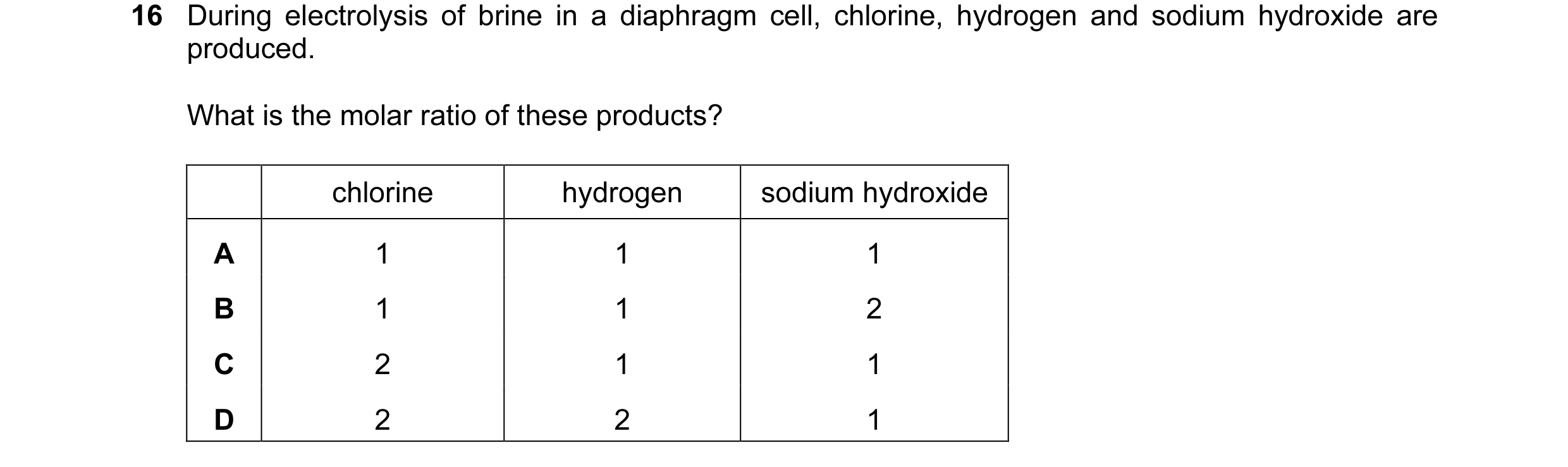
16 During electrolysis of brine in a diaphragm cell, chlorine, hydrogen and sodium hydroxide are produced. What is the molar ratio of these products? chlorine hydrogen sodium hydroxide A 1 1 1 B 1 1 2 C 2 1 1 D 2 2 1
1 marks
Answer: B
This question in 9701/11 Oct/Nov 2009
Q5 · Every year millions of tonnes each of chlorine and sodium hydroxide are manufactured by… 9701/11 Oct/Nov 2010
1 Every year millions of tonnes each of chlorine and sodium hydroxide are manufactured by the electrolysis of brine using a ‘diaphragm cell’. What is the purpose of the diaphragm in such a cell? A to prevent chlorine gas escaping into the factory B to prevent the build up of pressure in the electrolysis cell C to provide a large surface area of electrode D to stop the products of electrolysis from reacting together
1 marks
Answer: D
This question in 9701/11 Oct/Nov 2010
Q6 · Strontium metal can be obtained by the electrolysis of molten strontium bromide, SrBr2… 9701/12 Oct/Nov 2010
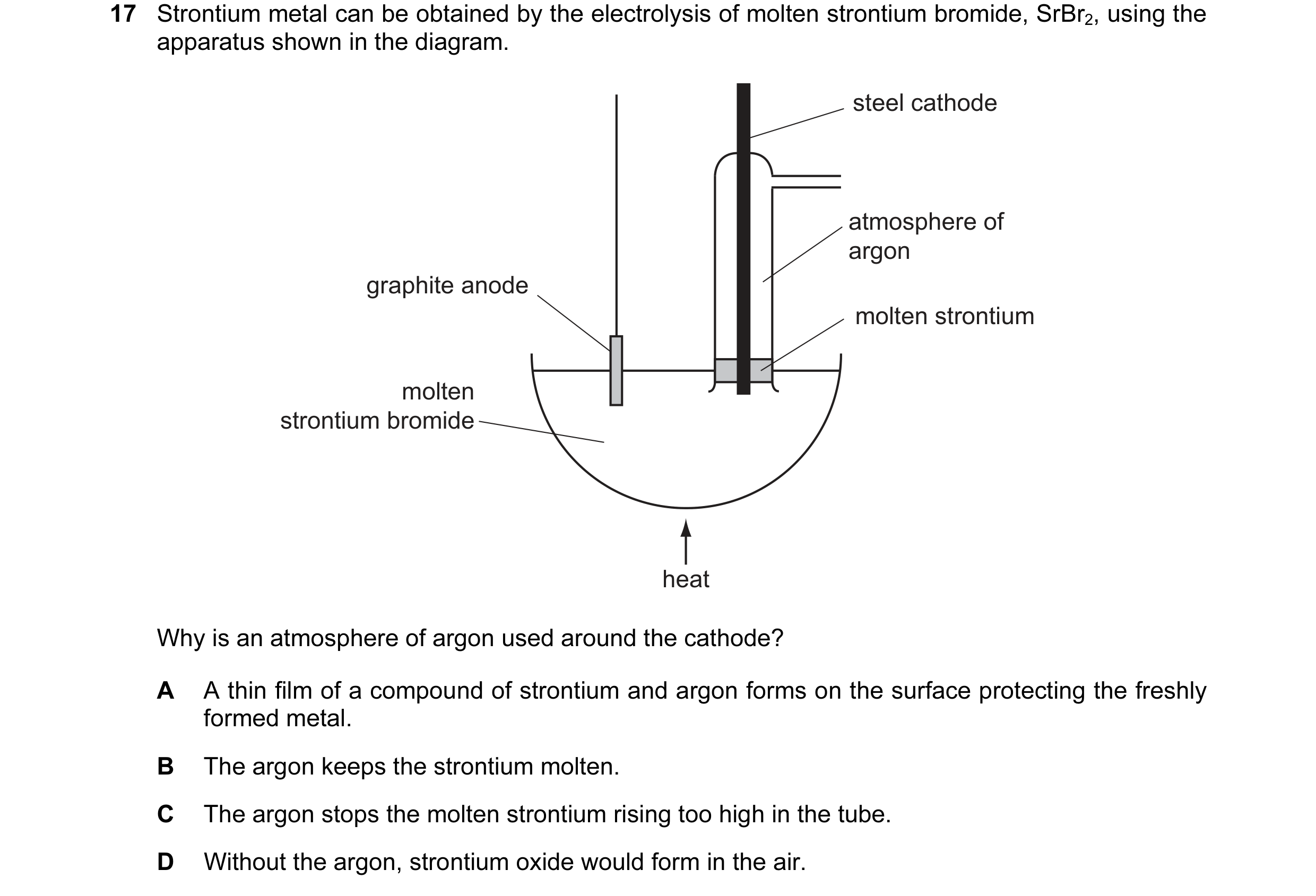
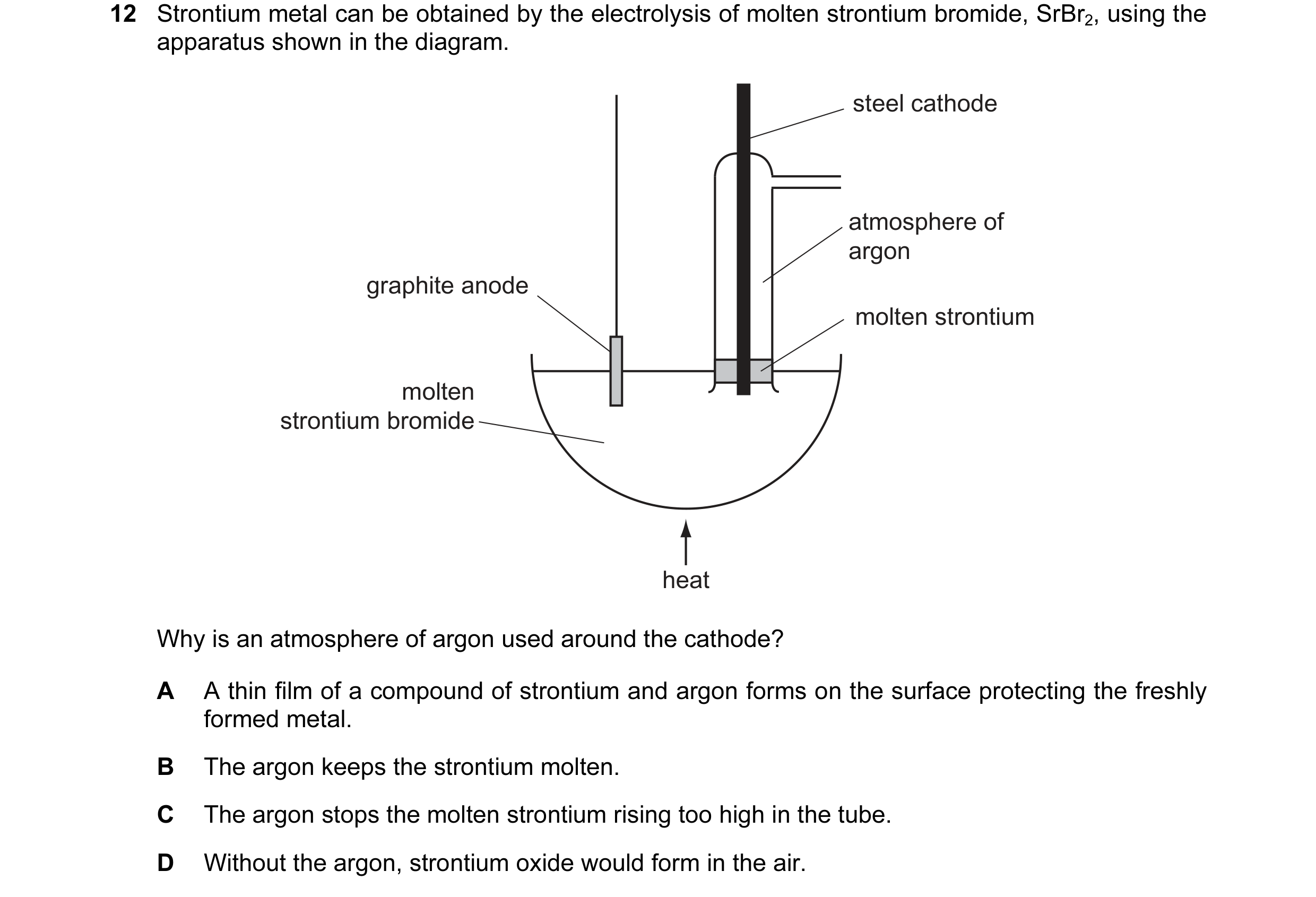
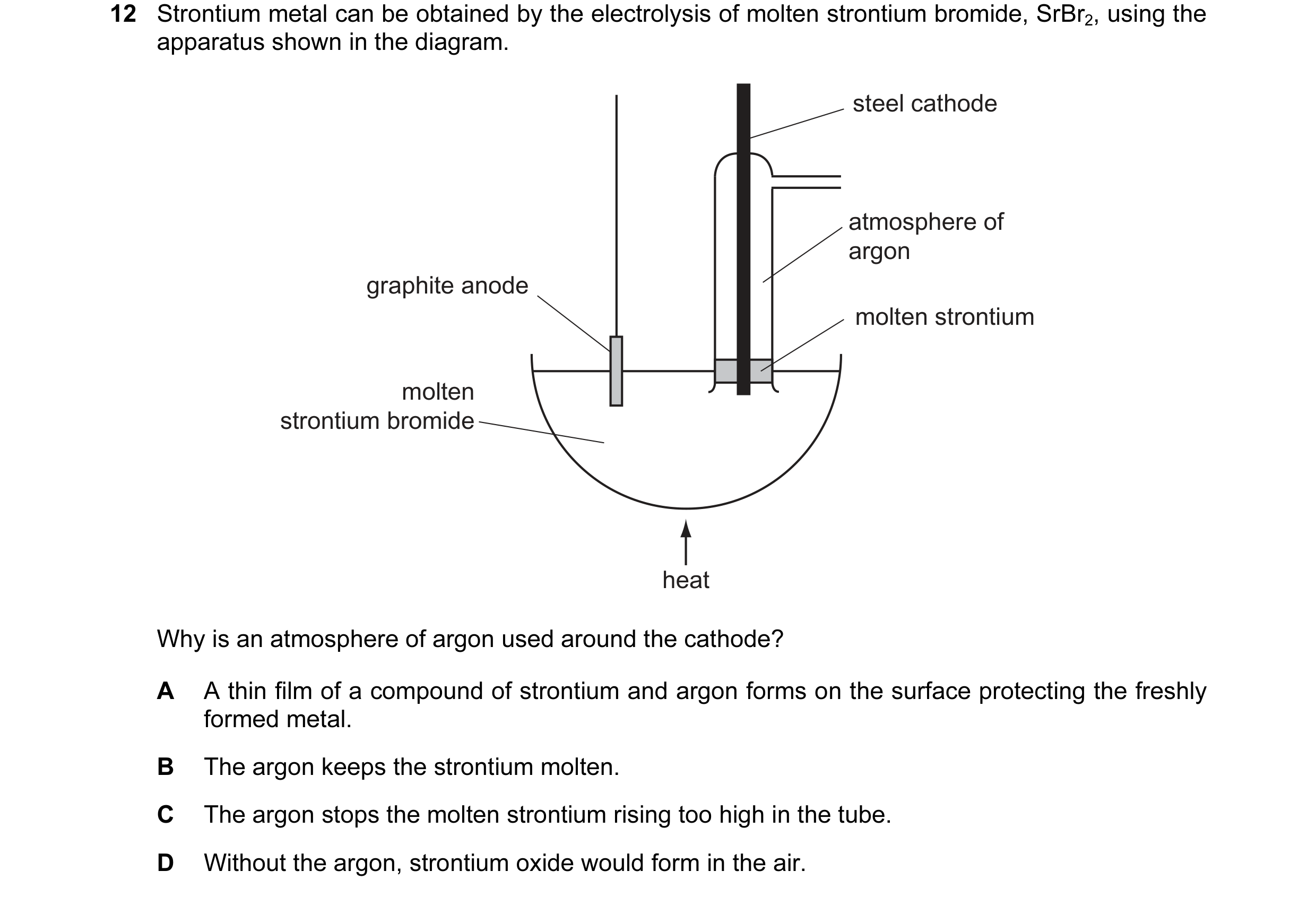
17 Strontium metal can be obtained by the electrolysis of molten strontium bromide, SrBr2, using the apparatus shown in the diagram. steel cathode atmosphere of argon graphite anode molten strontium molten strontium bromide heat Why is an atmosphere of argon used around the cathode? A A thin film of a compound of strontium and argon forms on the surface protecting the freshly formed metal. B The argon keeps the strontium molten. C The argon stops the molten strontium rising too high in the tube. D Without the argon, strontium oxide would form in the air.
1 marks
Answer: D
This question in 9701/12 Oct/Nov 2010
Q7 · Every year millions of tonnes each of chlorine and sodium hydroxide are manufactured by… 9701/13 Oct/Nov 2010
7 Every year millions of tonnes each of chlorine and sodium hydroxide are manufactured by the electrolysis of brine using a ‘diaphragm cell’. What is the purpose of the diaphragm in such a cell? A to prevent chlorine gas escaping into the factory B to prevent the build up of pressure in the electrolysis cell C to provide a large surface area of electrode D to stop the products of electrolysis from reacting together
1 marks
Answer: D
This question in 9701/13 Oct/Nov 2010
Q8 · In the extraction of aluminium by the electrolysis of molten aluminium oxide, why is… 9701/11 May/June 2011
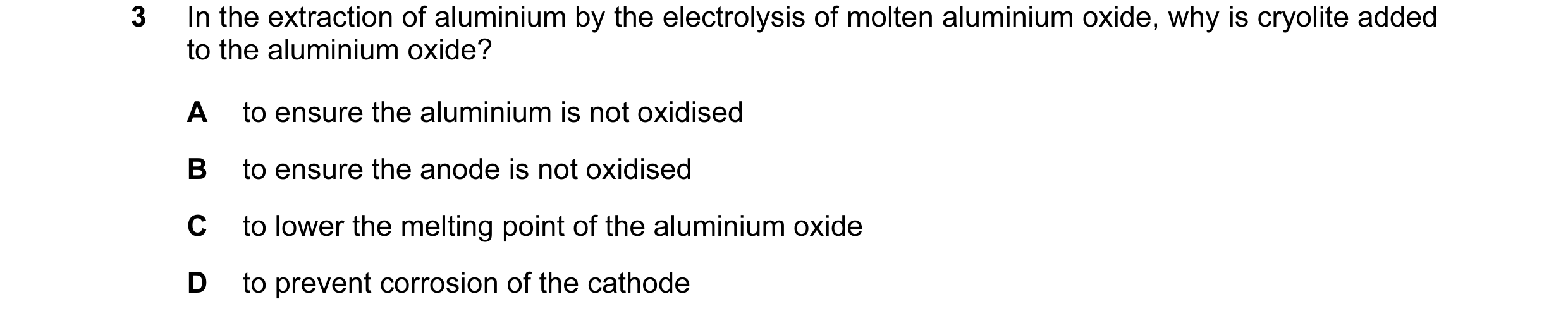
3 In the extraction of aluminium by the electrolysis of molten aluminium oxide, why is cryolite added to the aluminium oxide? A to ensure the aluminium is not oxidised B to ensure the anode is not oxidised C to lower the melting point of the aluminium oxide D to prevent corrosion of the cathode
1 marks
Answer: C
This question in 9701/11 May/June 2011
Q9 · Aluminium is the most abundant metal in the Earth’s crust 9701/12 May/June 2011
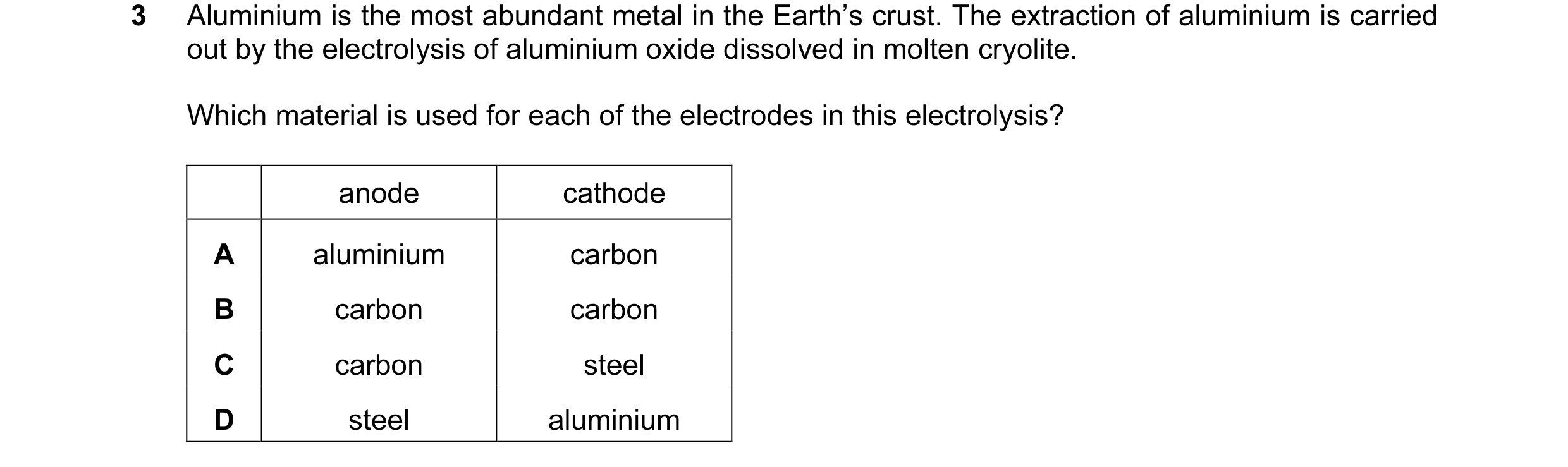
3 Aluminium is the most abundant metal in the Earth’s crust. The extraction of aluminium is carried out by the electrolysis of aluminium oxide dissolved in molten cryolite. Which material is used for each of the electrodes in this electrolysis? anode cathode A aluminium carbon B carbon carbon C carbon steel D steel aluminium
1 marks
Answer: B
This question in 9701/12 May/June 2011
Q10 · In the extraction of aluminium by the electrolysis of molten aluminium oxide, why is… 9701/13 May/June 2011
3 In the extraction of aluminium by the electrolysis of molten aluminium oxide, why is cryolite added to the aluminium oxide? A to ensure the aluminium is not oxidised B to ensure the anode is not oxidised C to lower the melting point of the aluminium oxide D to prevent corrosion of the cathode
1 marks
Answer: C
This question in 9701/13 May/June 2011
Q11 · Aqueous sodium chloride (brine) is electrolysed by using inert electrodes in a cell which… 9701/11 Oct/Nov 2011
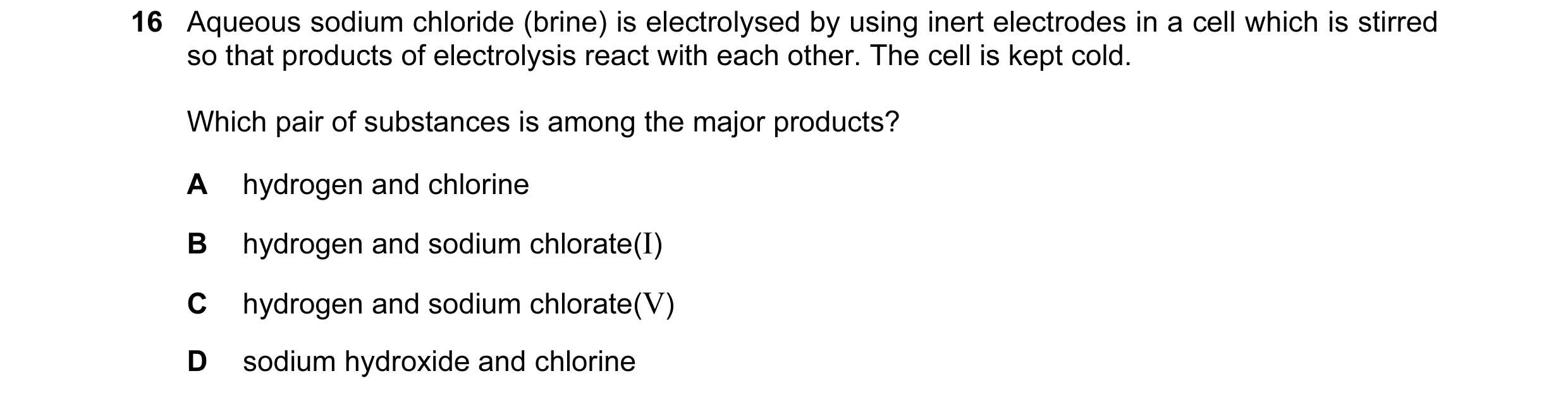
16 Aqueous sodium chloride (brine) is electrolysed by using inert electrodes in a cell which is stirred so that products of electrolysis react with each other. The cell is kept cold. Which pair of substances is among the major products? A hydrogen and chlorine B hydrogen and sodium chlorate(I) C hydrogen and sodium chlorate(V) D sodium hydroxide and chlorine
1 marks
Answer: B
This question in 9701/11 Oct/Nov 2011
Q12 · Chlorine can be manufactured from brine in a diaphragm cell 9701/12 Oct/Nov 2011
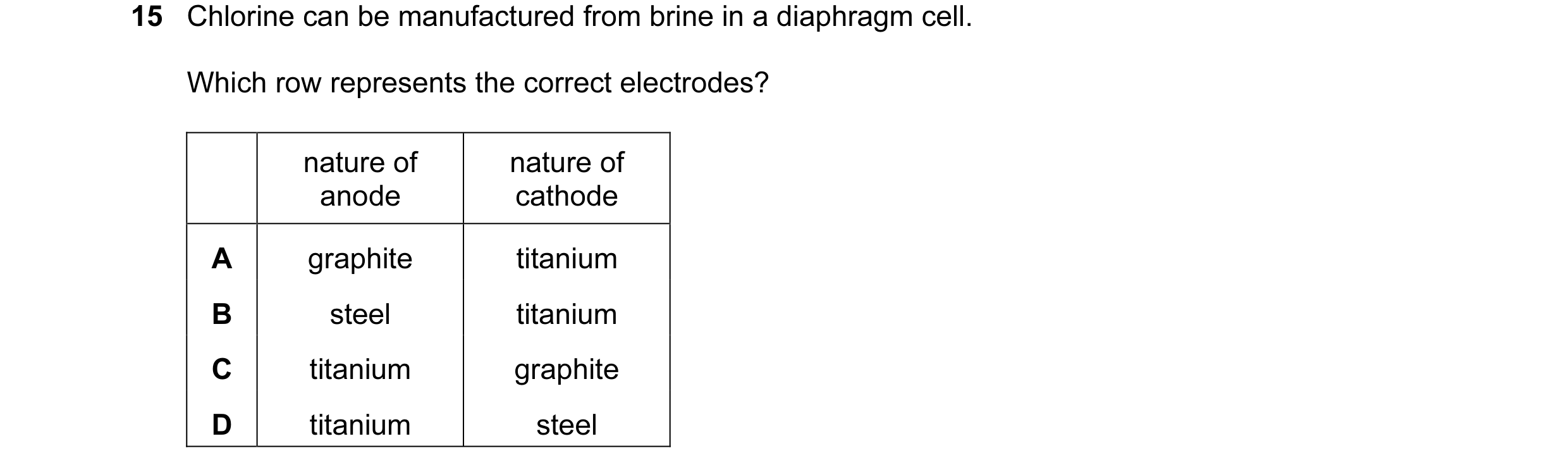
15 Chlorine can be manufactured from brine in a diaphragm cell. Which row represents the correct electrodes? nature of nature of anode cathode A graphite titanium B steel titanium C titanium graphite D titanium steel
1 marks
This question in 9701/12 Oct/Nov 2011
Q13 · Aqueous sodium chloride (brine) is electrolysed by using inert electrodes in a cell which… 9701/13 Oct/Nov 2011
17 Aqueous sodium chloride (brine) is electrolysed by using inert electrodes in a cell which is stirred so that products of electrolysis react with each other. The cell is kept cold. Which pair of substances is among the major products? A hydrogen and chlorine B hydrogen and sodium chlorate(I) C hydrogen and sodium chlorate(V) D sodium hydroxide and chlorine
1 marks
Answer: B
This question in 9701/13 Oct/Nov 2011
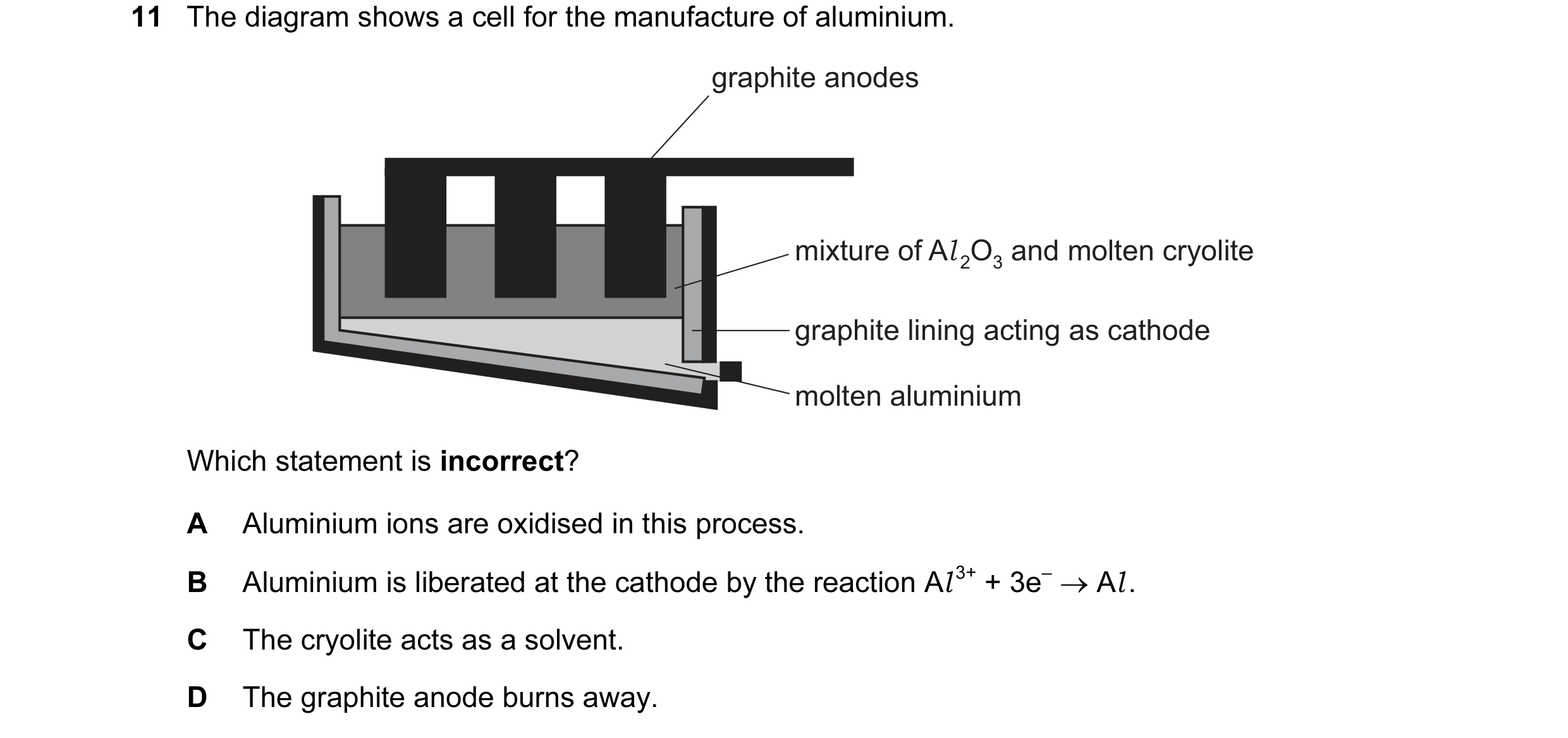
Q14 · The diagram shows a cell for the manufacture of aluminium 9701/11 May/June 2012
11 The diagram shows a cell for the manufacture of aluminium. graphite anodes mixture of Al 2O3 and molten cryolite graphite lining acting as cathode molten aluminium Which statement is incorrect? A Aluminium ions are oxidised in this process. B Aluminium is liberated at the cathode by the reaction Al 3+ + 3e– → Al . C The cryolite acts as a solvent. D The graphite anode burns away.
1 marks
Answer: A
This question in 9701/11 May/June 2012
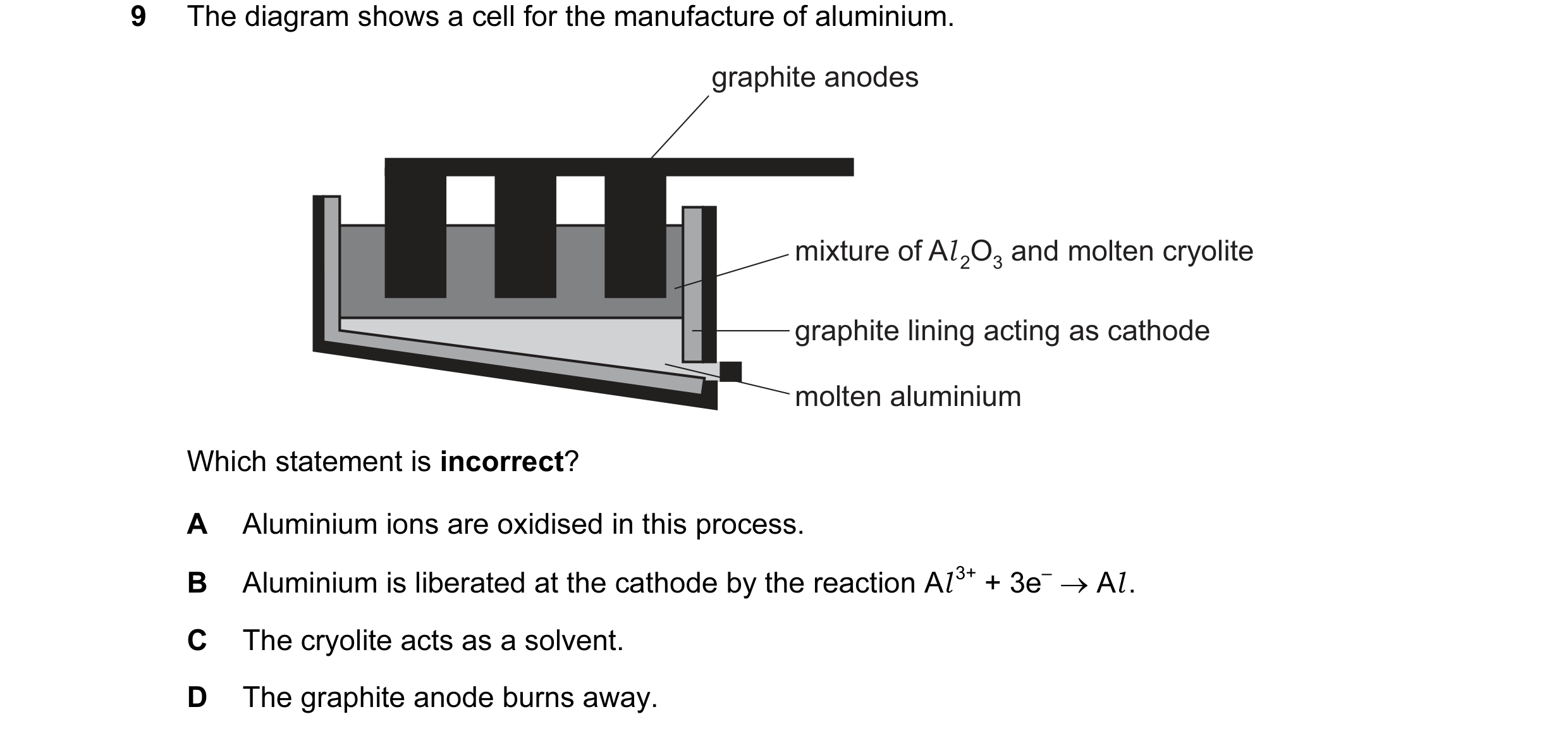
Q15 · The diagram shows a cell for the manufacture of aluminium 9701/13 May/June 2012
9 The diagram shows a cell for the manufacture of aluminium. graphite anodes mixture of Al 2O3 and molten cryolite graphite lining acting as cathode molten aluminium Which statement is incorrect? A Aluminium ions are oxidised in this process. B Aluminium is liberated at the cathode by the reaction Al 3+ + 3e– → Al . C The cryolite acts as a solvent. D The graphite anode burns away.
1 marks
Answer: A
This question in 9701/13 May/June 2012
Q16 · Aluminium is extracted by the electrolysis of a molten mixture containing aluminium oxide 9701/11 Oct/Nov 2012
7 Aluminium is extracted by the electrolysis of a molten mixture containing aluminium oxide. By a similar method, magnesium is extracted by the electrolysis of a molten mixture containing magnesium chloride. Which statement about the extraction of magnesium is correct? A Magnesium ions travel to the anode and are oxidised to magnesium metal. B Magnesium ions travel to the anode and are reduced to magnesium metal. C Magnesium ions travel to the cathode and are oxidised to magnesium metal. D Magnesium ions travel to the cathode and are reduced to magnesium metal.
1 marks
Answer: D
This question in 9701/11 Oct/Nov 2012
Q17 · Aluminium is extracted by the electrolysis of a molten mixture containing aluminium oxide 9701/12 Oct/Nov 2012
7 Aluminium is extracted by the electrolysis of a molten mixture containing aluminium oxide. By a similar method, magnesium is extracted by the electrolysis of a molten mixture containing magnesium chloride. Which statement about the extraction of magnesium is correct? A Magnesium ions travel to the anode and are oxidised to magnesium metal. B Magnesium ions travel to the anode and are reduced to magnesium metal. C Magnesium ions travel to the cathode and are oxidised to magnesium metal. D Magnesium ions travel to the cathode and are reduced to magnesium metal.
1 marks
Answer: D
This question in 9701/12 Oct/Nov 2012
Q18 · Aluminium is extracted by the electrolysis of a molten mixture containing aluminium oxide 9701/13 Oct/Nov 2012
4 Aluminium is extracted by the electrolysis of a molten mixture containing aluminium oxide. By a similar method, magnesium is extracted by the electrolysis of a molten mixture containing magnesium chloride. Which statement about this electrolysis is correct? A Chloride ions travel to the anode and are oxidised to chlorine gas. B Chloride ions travel to the anode and are reduced to chlorine gas. C Chloride ions travel to the cathode and are oxidised to chlorine gas. D Chloride ions travel to the cathode and are reduced to chlorine gas.
1 marks
Answer: A
This question in 9701/13 Oct/Nov 2012
Q19 · The diagram shows an electrolytic cell for the extraction of aluminium 9701/11 May/June 2013
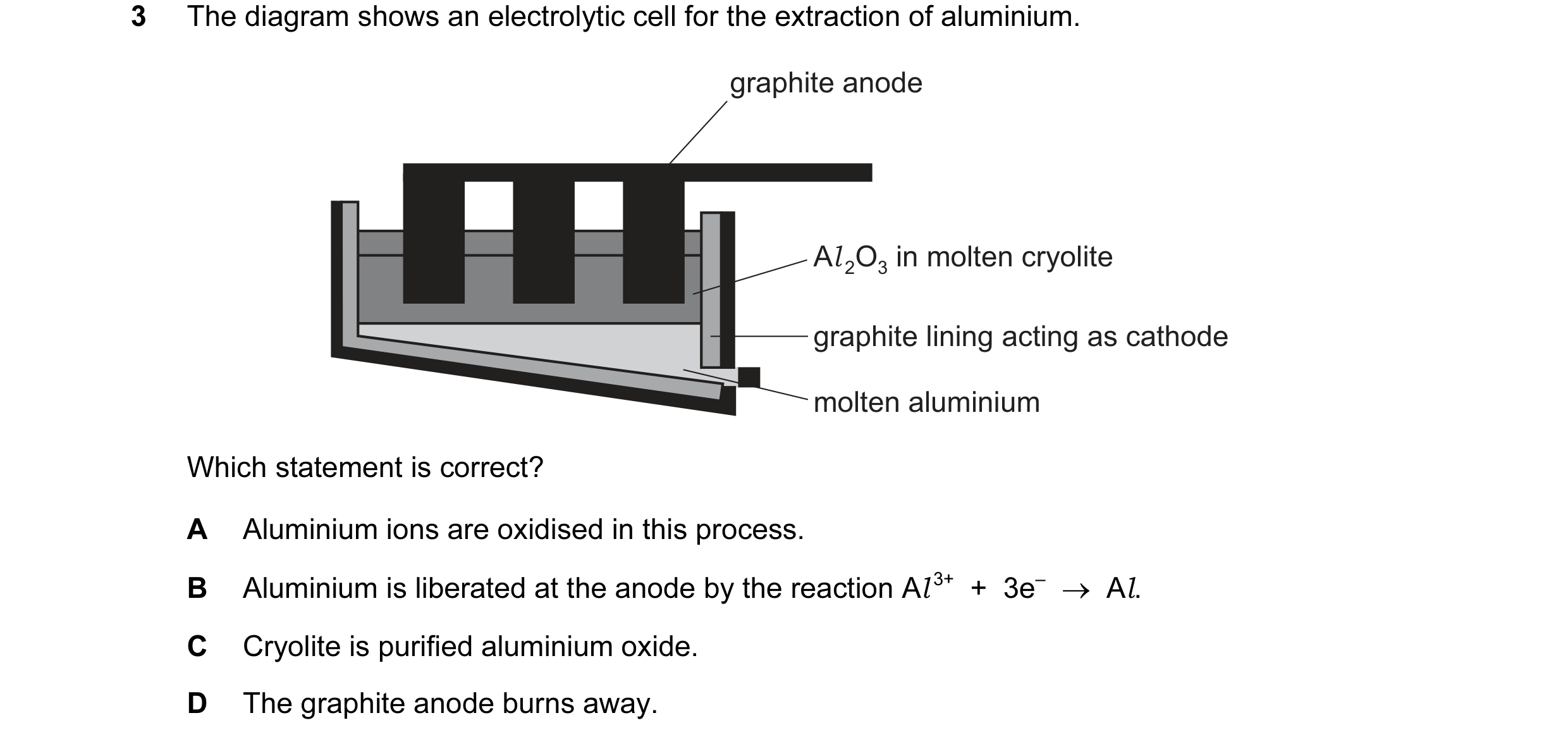
3 The diagram shows an electrolytic cell for the extraction of aluminium. graphite anode Al 2O3 in molten cryolite graphite lining acting as cathode molten aluminium Which statement is correct? A Aluminium ions are oxidised in this process. B Aluminium is liberated at the anode by the reaction Al 3+ + 3e– → Al. C Cryolite is purified aluminium oxide. D The graphite anode burns away.
1 marks
Answer: D
This question in 9701/11 May/June 2013
Q20 · During the electrolysis of molten aluminium oxide to produce aluminium, using carbon… 9701/12 May/June 2013
1 During the electrolysis of molten aluminium oxide to produce aluminium, using carbon electrodes, two consecutive reactions occur at the anode, each producing a different gas. How does the oxidation number of oxygen change in these reactions? A decreases by 2, then increases by 2 B increases by 2, then decreases by 2 C increases by 2, then decreases by 4 D no change, then decreases by 2
1 marks
Answer: B
This question in 9701/12 May/June 2013
Q21 · At the age of 17, in a woodshed in Ohio, Charles Martin Hall discovered the commercial… 9701/11 Oct/Nov 2013
1 At the age of 17, in a woodshed in Ohio, Charles Martin Hall discovered the commercial process for the production of aluminium metal by the electrolysis of a mixture of bauxite, Al 2O3, and cryolite, Na3Al F6. What is the main purpose of the cryolite? A Al 2O3 is covalent, and Al F6 3– ions interact with it to produce Al 3+ ions which can be discharged at the cathode. B Cryolite is a base, forming NaAl O2 with bauxite, enabling aluminium to be discharged at the anode. C Cryolite minimises the release of O2– ions at the graphite anodes, which are otherwise burnt away to CO. D Cryolite reduces the melting point of the bauxite.
1 marks
Answer: D
This question in 9701/11 Oct/Nov 2013
Q22 · Strontium metal can be obtained by the electrolysis of molten strontium bromide, SrBr2… 9701/11 Oct/Nov 2013
12 Strontium metal can be obtained by the electrolysis of molten strontium bromide, SrBr2, using the apparatus shown in the diagram. steel cathode atmosphere of argon graphite anode molten strontium molten strontium bromide heat Why is an atmosphere of argon used around the cathode? A A thin film of a compound of strontium and argon forms on the surface protecting the freshly formed metal. B The argon keeps the strontium molten. C The argon stops the molten strontium rising too high in the tube. D Without the argon, strontium oxide would form in the air.
1 marks
Answer: D
This question in 9701/11 Oct/Nov 2013
Q23 · At the age of 17, in a woodshed in Ohio, Charles Martin Hall discovered the commercial… 9701/12 Oct/Nov 2013
1 At the age of 17, in a woodshed in Ohio, Charles Martin Hall discovered the commercial process for the production of aluminium metal by the electrolysis of a mixture of bauxite, Al 2O3, and cryolite, Na3Al F6. What is the main purpose of the cryolite? A Al 2O3 is covalent, and Al F6 3– ions interact with it to produce Al 3+ ions which can be discharged at the cathode. B Cryolite is a base, forming NaAl O2 with bauxite, enabling aluminium to be discharged at the anode. C Cryolite minimises the release of O2– ions at the graphite anodes, which are otherwise burnt away to CO. D Cryolite reduces the melting point of the bauxite.
1 marks
Answer: D
This question in 9701/12 Oct/Nov 2013
Q24 · Strontium metal can be obtained by the electrolysis of molten strontium bromide, SrBr2… 9701/12 Oct/Nov 2013
12 Strontium metal can be obtained by the electrolysis of molten strontium bromide, SrBr2, using the apparatus shown in the diagram. steel cathode atmosphere of argon graphite anode molten strontium molten strontium bromide heat Why is an atmosphere of argon used around the cathode? A A thin film of a compound of strontium and argon forms on the surface protecting the freshly formed metal. B The argon keeps the strontium molten. C The argon stops the molten strontium rising too high in the tube. D Without the argon, strontium oxide would form in the air.
1 marks
Answer: D
This question in 9701/12 Oct/Nov 2013
Q25 · In the extraction of aluminium by electrolysis, why is it necessary to dissolve aluminium… 9701/13 Oct/Nov 2013
2 In the extraction of aluminium by electrolysis, why is it necessary to dissolve aluminium oxide in molten cryolite? A to reduce the very high melting point of the electrolyte B cryolite is a base; aluminium oxide is amphoteric C cryolite reacts with the aluminium oxide to form ions D molten aluminium oxide alone would not conduct electricity
1 marks
Answer: A
This question in 9701/13 Oct/Nov 2013
Q26 · The electrolysis of brine using the diaphragm cell is an important industrial process 9701/13 May/June 2014
5 The electrolysis of brine using the diaphragm cell is an important industrial process. What happens at the anode? A Chloride ions are oxidised. B Hydrogen gas is produced. C Hydroxide ions are formed. D The electrode reaction is 2Cl –(aq) + 2e– → Cl 2(g).
1 marks
Answer: A
This question in 9701/13 May/June 2014
Q27 · Which row correctly describes the electrodes used in the electrolysis cell for the… 9701/11 Oct/Nov 2014
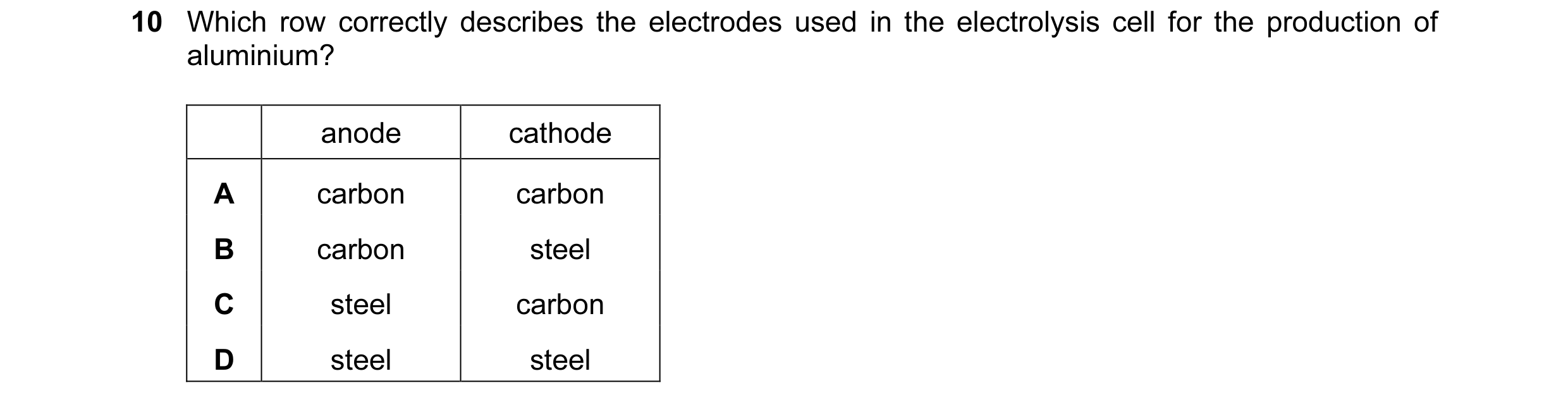
10 Which row correctly describes the electrodes used in the electrolysis cell for the production of aluminium? anode cathode A carbon carbon B carbon steel C steel carbon D steel steel
1 marks
Answer: A
This question in 9701/11 Oct/Nov 2014
Q28 · Which row correctly describes the electrodes used in the electrolysis cell for the… 9701/12 Oct/Nov 2014
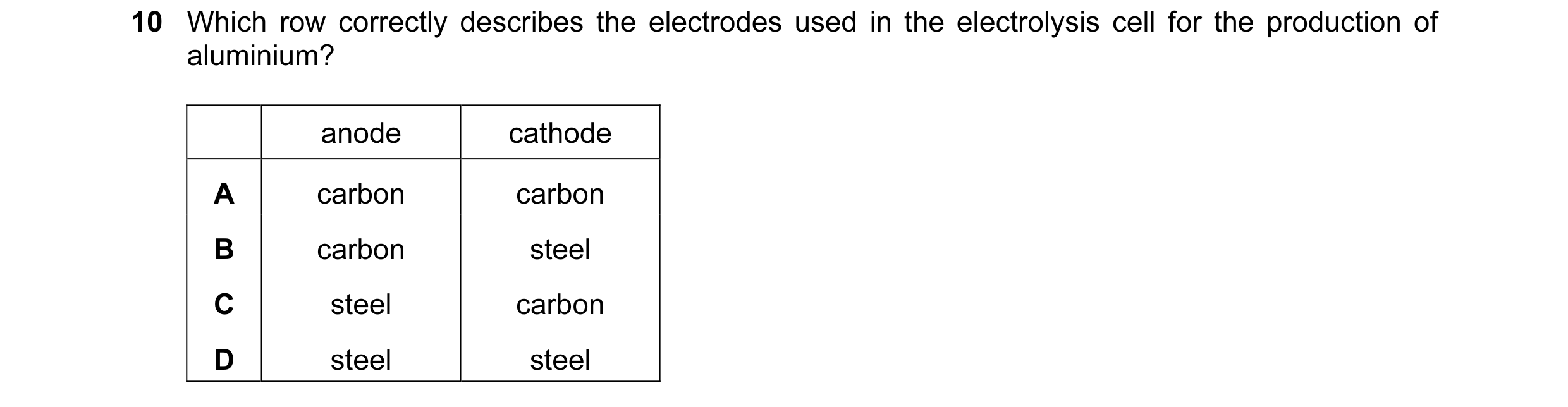
10 Which row correctly describes the electrodes used in the electrolysis cell for the production of aluminium? anode cathode A carbon carbon B carbon steel C steel carbon D steel steel
1 marks
Answer: A
This question in 9701/12 Oct/Nov 2014
Q29 · Impure copper is purified by electrolysis 9701/13 Oct/Nov 2014
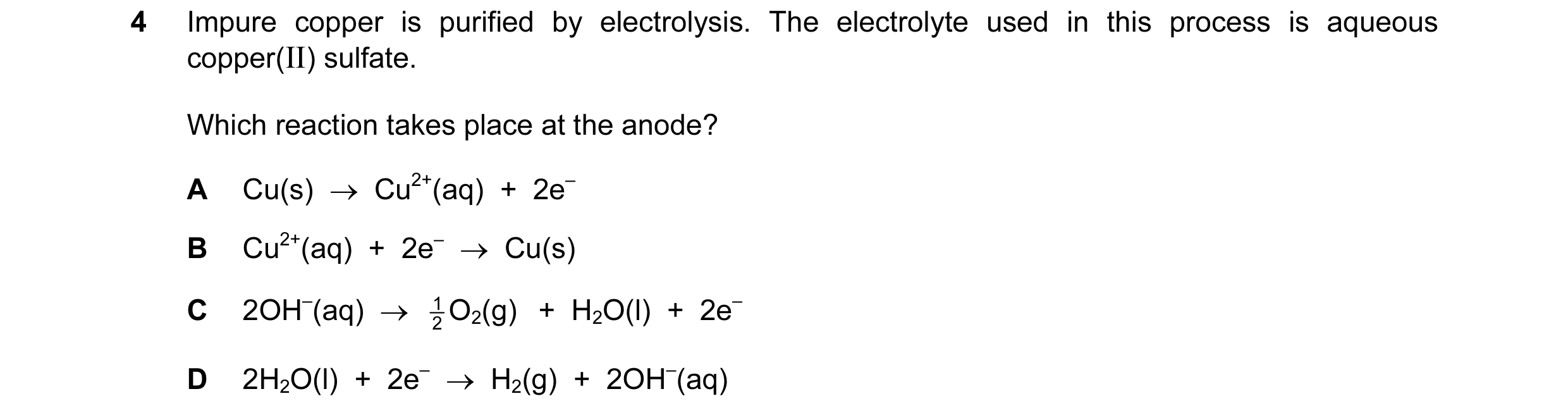
4 Impure copper is purified by electrolysis. The electrolyte used in this process is aqueous copper(II) sulfate. Which reaction takes place at the anode? A Cu(s) → Cu2+(aq) + 2e– B Cu2+(aq) + 2e– → Cu(s) C 2OH–(aq) → 1 O2 (g) + H2O(l) + 2e– 2 D 2H2O(l) + 2e– → H2(g) + 2OH–(aq)
1 marks
Answer: A
This question in 9701/13 Oct/Nov 2014
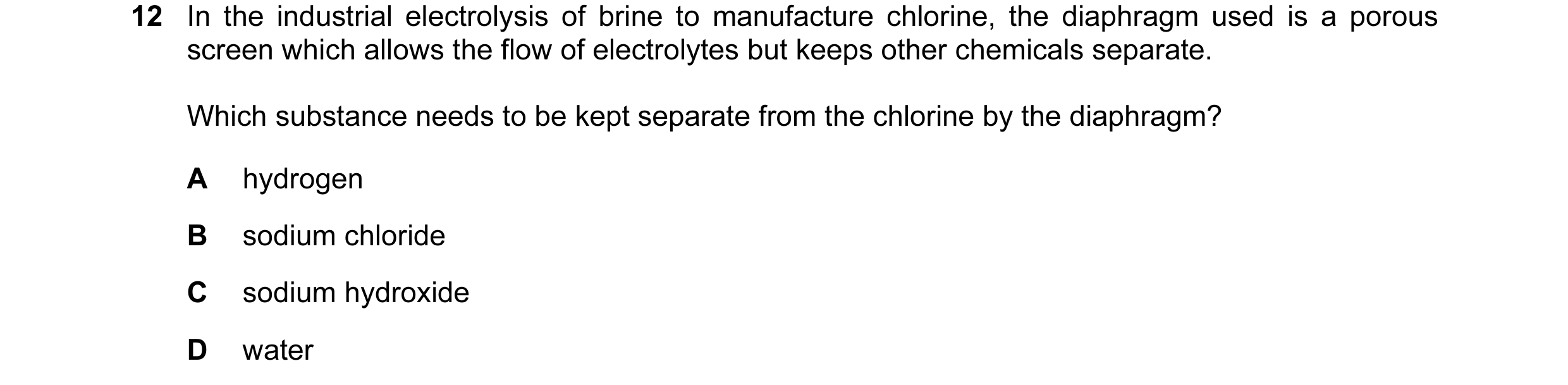
Q30 · In the industrial electrolysis of brine to manufacture chlorine, the diaphragm used is a… 9701/11 May/June 2015
12 In the industrial electrolysis of brine to manufacture chlorine, the diaphragm used is a porous screen which allows the flow of electrolytes but keeps other chemicals separate. Which substance needs to be kept separate from the chlorine by the diaphragm? A hydrogen B sodium chloride C sodium hydroxide D water
1 marks
Answer: C
This question in 9701/11 May/June 2015
Q31 · Aluminium is extracted from aluminium oxide by electrolysis 9701/11 May/June 2015
33 Aluminium is extracted from aluminium oxide by electrolysis. Which statements are correct? 1 Aluminium oxide has an extremely high melting point. 2 Bauxite is added to the aluminium oxide to lower its melting point. 3 Oxygen produced at the graphite cathode reacts with the graphite to produce CO2.
1 marks
Answer: D
This question in 9701/11 May/June 2015
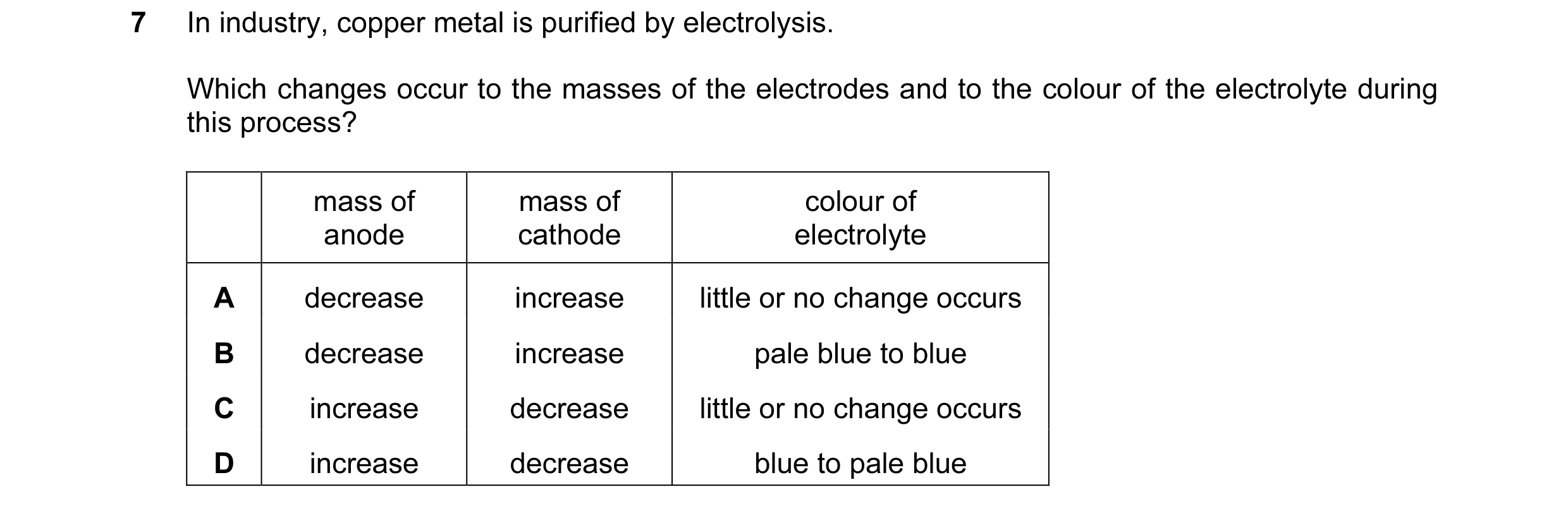
Q32 · In industry, copper metal is purified by electrolysis 9701/12 May/June 2015
7 In industry, copper metal is purified by electrolysis. Which changes occur to the masses of the electrodes and to the colour of the electrolyte during this process? mass of mass of colour of anode cathode electrolyte A decrease increase little or no change occurs B decrease increase pale blue to blue C increase decrease little or no change occurs D increase decrease blue to pale blue
1 marks
Answer: A
This question in 9701/12 May/June 2015
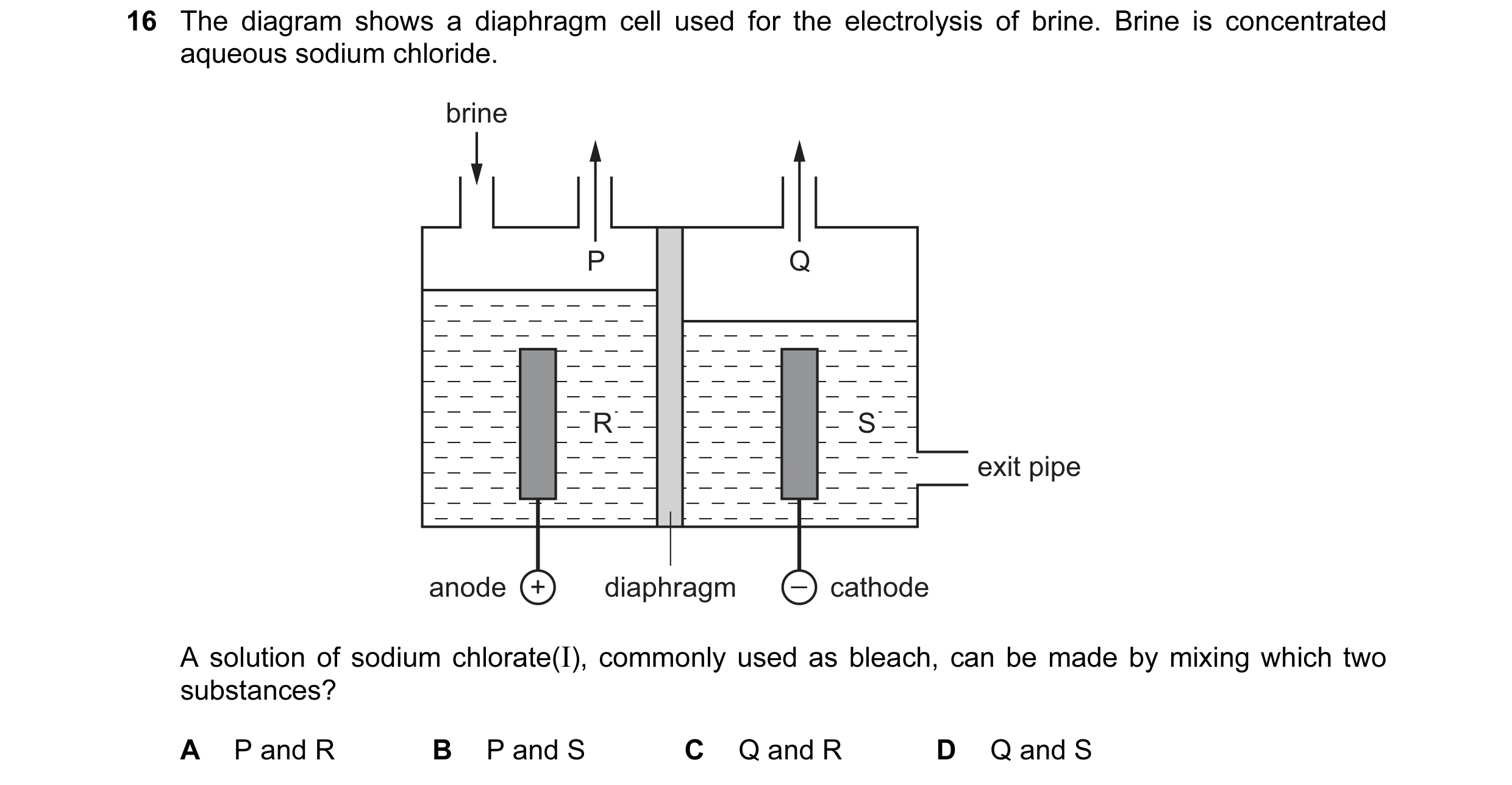
Q33 · The diagram shows a diaphragm cell used for the electrolysis of brine 9701/12 May/June 2015
16 The diagram shows a diaphragm cell used for the electrolysis of brine. Brine is concentrated aqueous sodium chloride. brine P Q R S exit pipe _ cathode anode + diaphragm A solution of sodium chlorate(I), commonly used as bleach, can be made by mixing which two substances? A P and R B P and S C Q and R D Q and S
1 marks
Answer: B
This question in 9701/12 May/June 2015
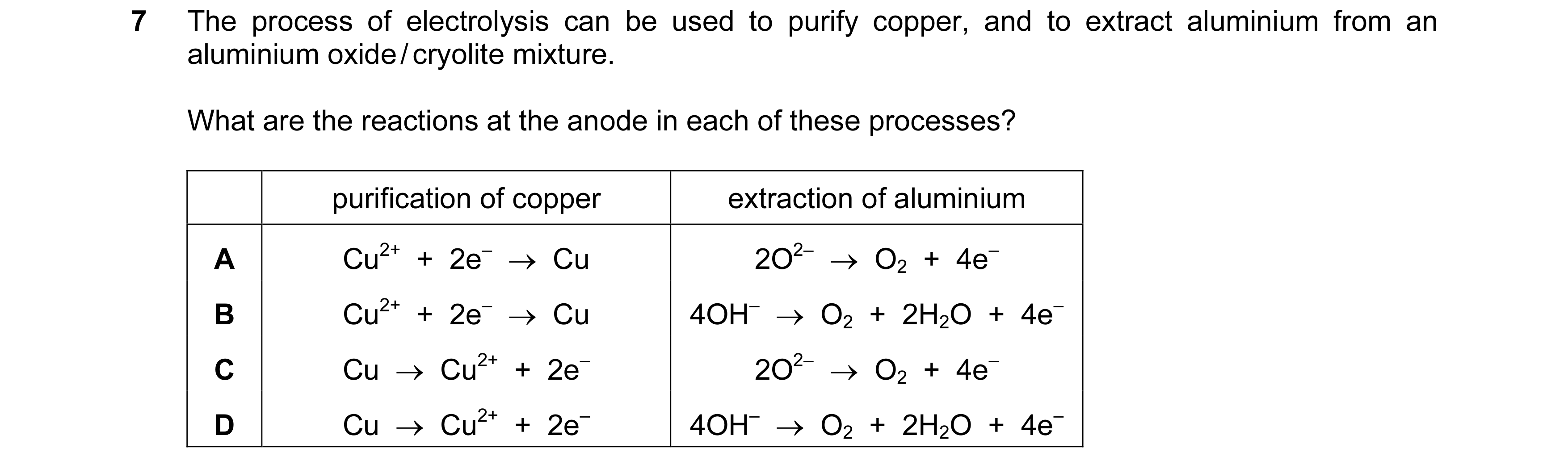
Q34 · The process of electrolysis can be used to purify copper, and to extract aluminium from… 9701/12 Oct/Nov 2015
7 The process of electrolysis can be used to purify copper, and to extract aluminium from an aluminium oxide / cryolite mixture. What are the reactions at the anode in each of these processes? purification of copper extraction of aluminium A Cu2+ + 2e– → Cu 2O2– → O2 + 4e– B Cu2+ + 2e– → Cu 4OH– → O2 + 2H2O + 4e– C Cu → Cu2+ + 2e– 2O2– → O2 + 4e– D Cu → Cu2+ + 2e– 4OH– → O2 + 2H2O + 4e–
1 marks
This question in 9701/12 Oct/Nov 2015
Q35 · Use of the Data Booklet is relevant to this question 9701/12 Oct/Nov 2015
16 Use of the Data Booklet is relevant to this question. Brine is concentrated aqueous sodium chloride. In the commercial electrolysis of brine, the products are chlorine, hydrogen and sodium hydroxide. What is the maximum yield of each of these products when 58.5 kg of sodium chloride are electrolysed as brine? yield of yield of yield of sodium chlorine / kg hydrogen / kg hydroxide / kg A 35.5 1 40 B 35.5 2 40 C 71 1 40 D 71 2 80
1 marks
This question in 9701/12 Oct/Nov 2015
Q36 · Gas M is produced when NH4Cl (aq) is heated with CaO(s) 9701/12 Feb/March 2025
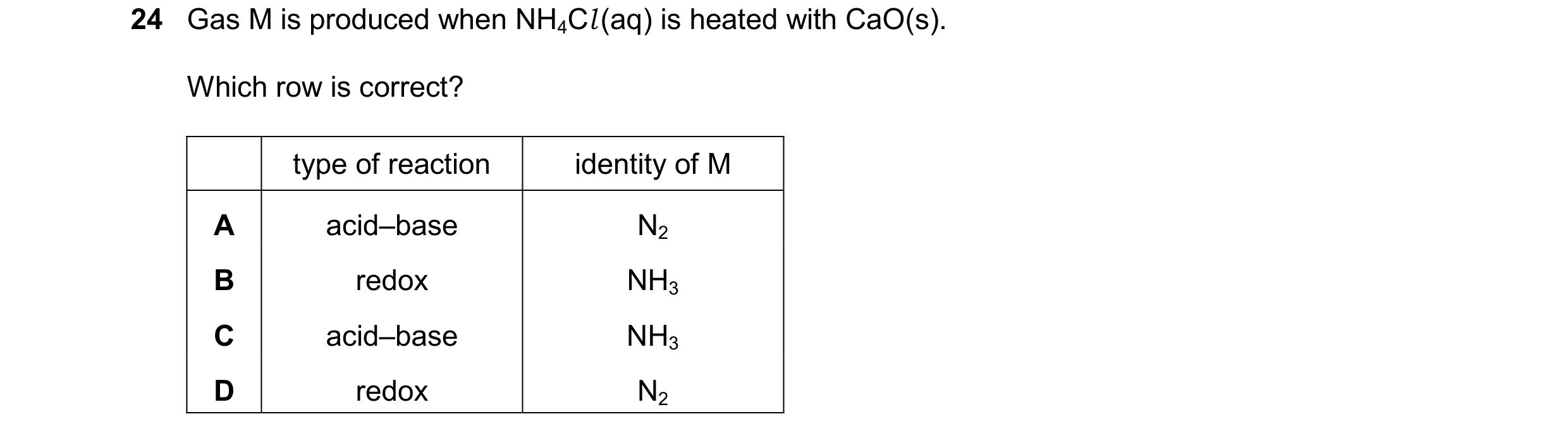
24 Gas M is produced when NH4Cl (aq) is heated with CaO(s). Which row is correct? type of reaction identity of M A acid–base N2 B redox NH3 C acid–base NH3 D redox N2
1 marks
Answer: C
This question in 9701/12 Feb/March 2025

 1 / 10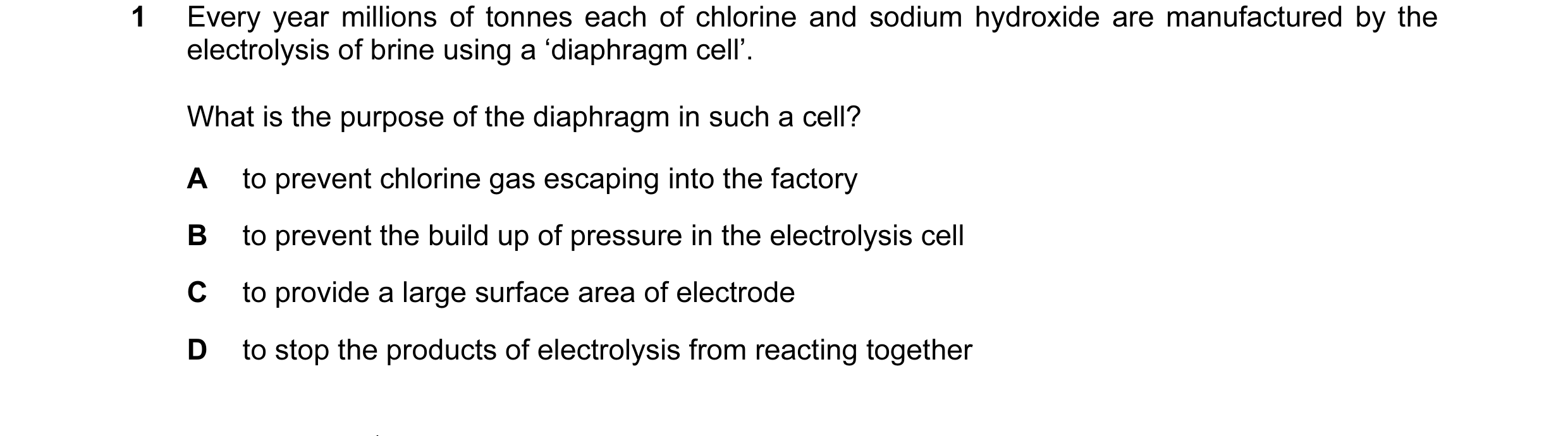
 2 / 10
 3 / 10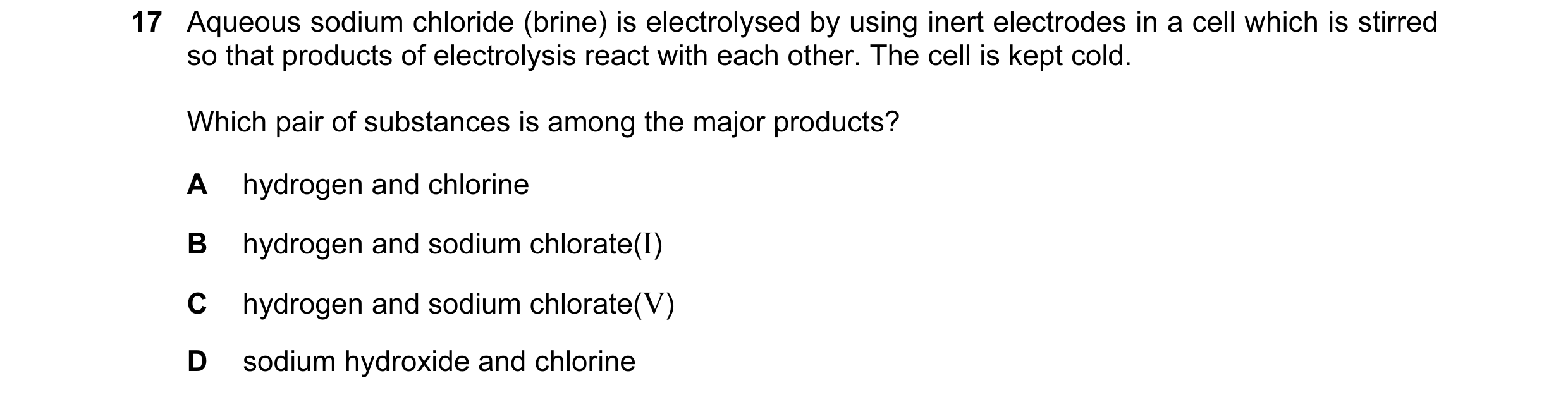
 4 / 10
 5 / 10
 6 / 10
 7 / 10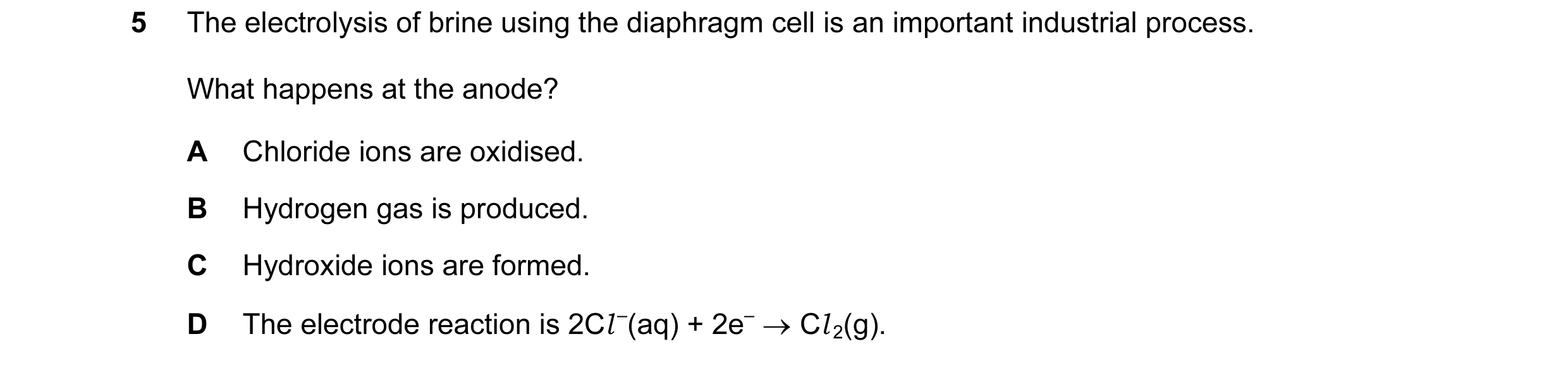
 8 / 10
 9 / 10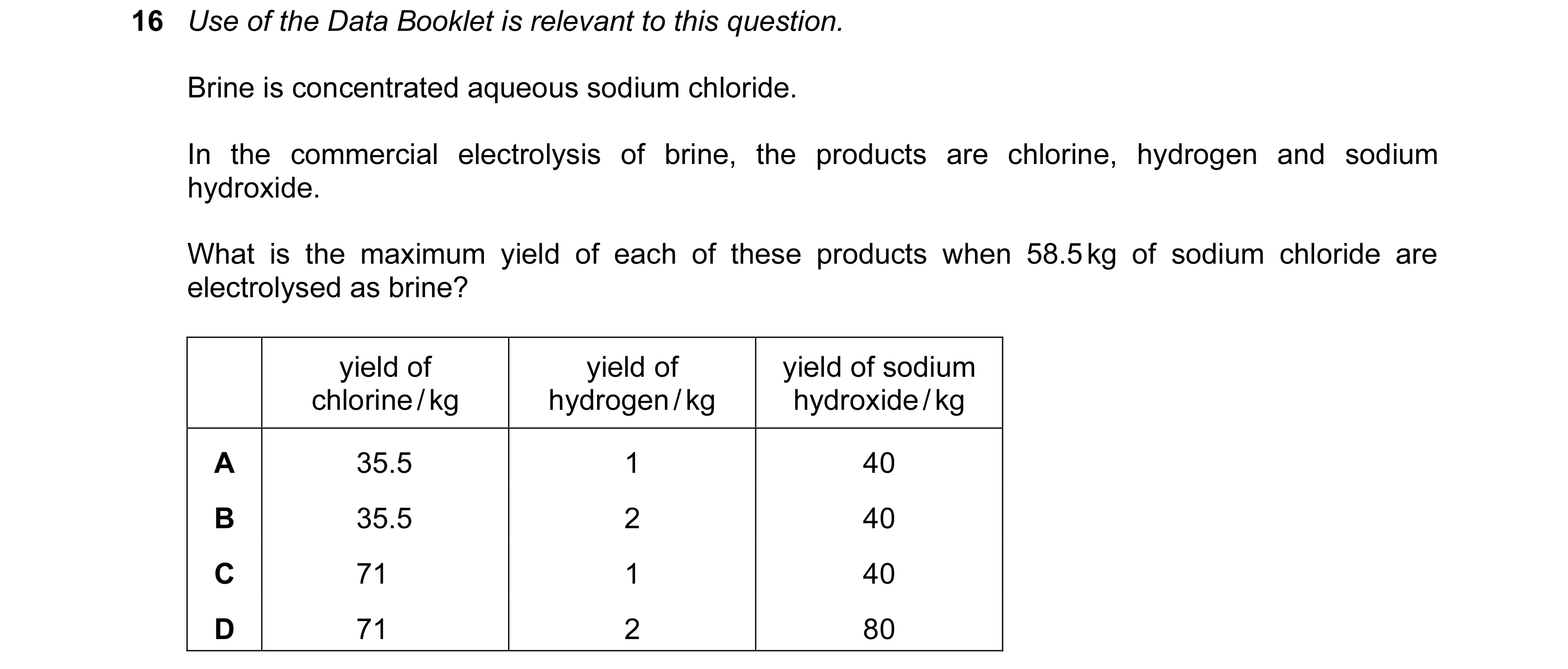
 10 / 10