Questions as text
Q1 · Which process is used to separate petroleum? 0653/21 Oct/Nov 2017
15 Which process is used to separate petroleum? A crystallisation B distillation C filtration D fractional distillation
1 marks
Answer: D
This question in 0653/21 Oct/Nov 2017
Q2 · What is the correct sequence that takes place during fractional distillation? 0653/22 Oct/Nov 2017
15 What is the correct sequence that takes place during fractional distillation? A evaporate → condense → collect → heat B evaporate → condense → heat → collect C heat → condense → collect → evaporate D heat → evaporate → condense → collect
1 marks
Answer: D
This question in 0653/22 Oct/Nov 2017
Q3 · Excess aqueous barium nitrate is added to dilute sulfuric acid to produce barium sulfate 0653/22 Oct/Nov 2017
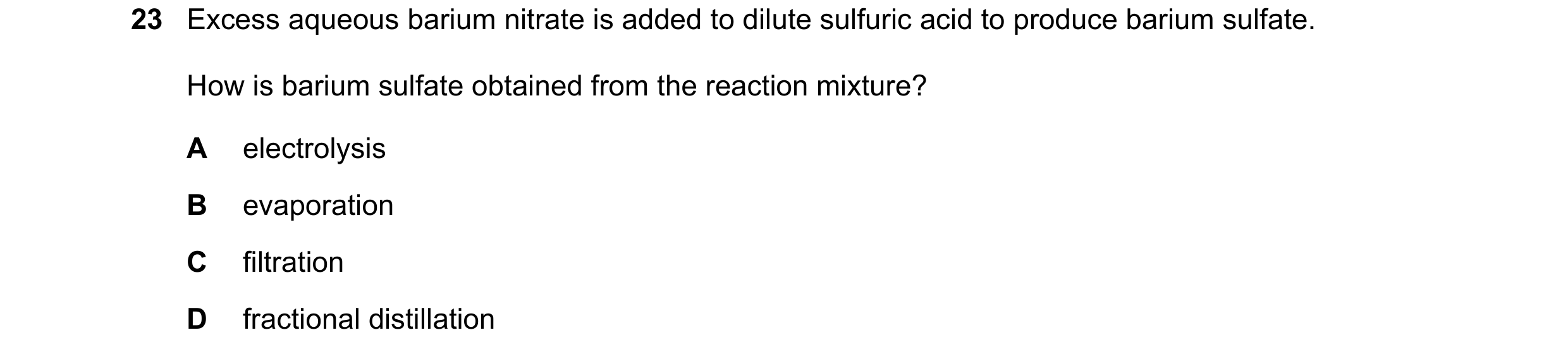
23 Excess aqueous barium nitrate is added to dilute sulfuric acid to produce barium sulfate. How is barium sulfate obtained from the reaction mixture? A electrolysis B evaporation C filtration D fractional distillation
1 marks
Answer: C
This question in 0653/22 Oct/Nov 2017
Q4 · Excess aqueous barium nitrate is added to dilute sulfuric acid to produce barium sulfate 0653/23 Oct/Nov 2017
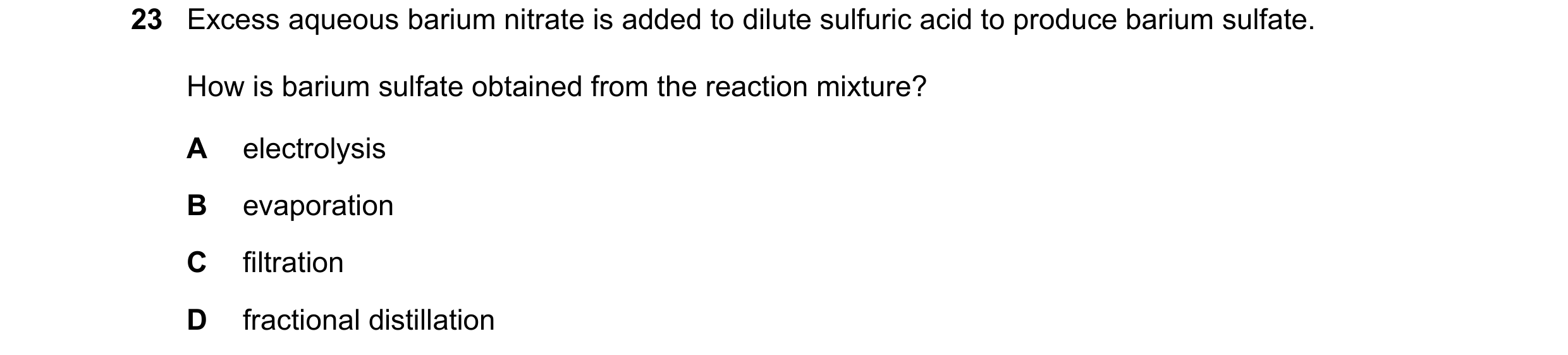
23 Excess aqueous barium nitrate is added to dilute sulfuric acid to produce barium sulfate. How is barium sulfate obtained from the reaction mixture? A electrolysis B evaporation C filtration D fractional distillation
1 marks
Answer: C
This question in 0653/23 Oct/Nov 2017
Q5 · Which row describes the method used to obtain salt from salt water and petrol from… 0653/21 May/June 2018
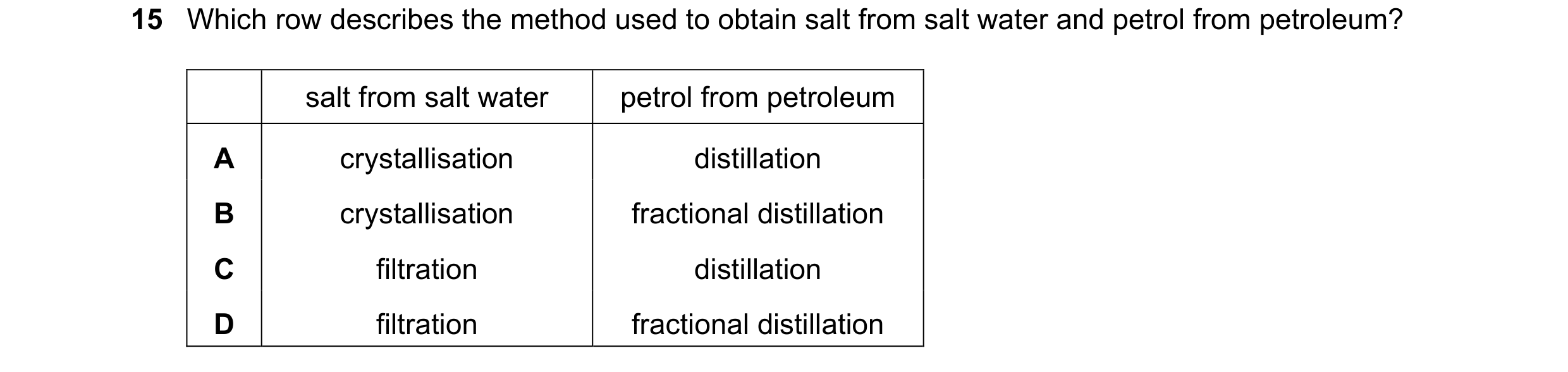
15 Which row describes the method used to obtain salt from salt water and petrol from petroleum? salt from salt water petrol from petroleum A crystallisation distillation B crystallisation fractional distillation C filtration distillation D filtration fractional distillation
1 marks
Answer: B
This question in 0653/21 May/June 2018
Q6 · Which method is used to separate a mixture of two liquids? 0653/22 May/June 2018
15 Which method is used to separate a mixture of two liquids? A chromatography B crystallisation C filtration D fractional distillation
1 marks
Answer: D
This question in 0653/22 May/June 2018
Q7 · Zinc sulfate is a soluble salt 0653/22 May/June 2018
23 Zinc sulfate is a soluble salt. It is made by reacting excess zinc with dilute sulfuric acid. Which row describes how zinc sulfate is obtained from the mixture after the reaction has finished? step 1 step 2 step 3 A evaporate all wash the solid dry the solid of the water that is left B filter the mixture collect the residue wash and from the filter paper dry the residue C filter the mixture saturate the solution filter, wash and and crystallise dry the crystals D saturate the solution allow the solution filter, wash and to crystallise dry the crystals
1 marks
Answer: C
This question in 0653/22 May/June 2018
Q8 · A mixture of salt water and sand is filtered 0653/23 May/June 2018
15 A mixture of salt water and sand is filtered. Which statement is correct? A The salt and the sand are trapped by the filter paper. B The salt is dissolved in the water and passes through the filter paper. C The sand is insoluble in water and passes through the filter paper. D The sand is trapped by the filter paper and pure water is obtained.
1 marks
Answer: B
This question in 0653/23 May/June 2018
Q9 · Which process is not a chemical change? 0653/23 May/June 2018
16 Which process is not a chemical change? A the electrolysis of molten lead bromide B the fractional distillation of petroleum C the oxidation of copper D the rusting of iron
1 marks
Answer: B
This question in 0653/23 May/June 2018
Q10 · P, Q and R are three fractions obtained from petroleum by fractional distillation 0653/21 Oct/Nov 2018
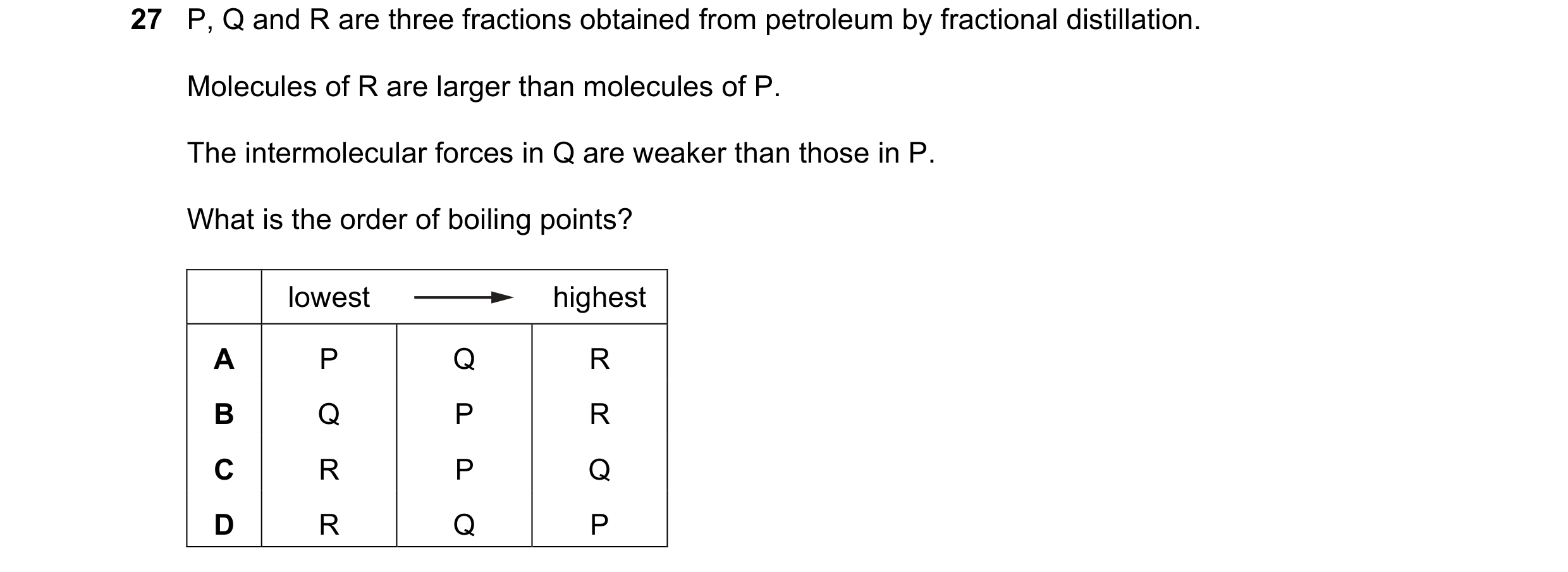
27 P, Q and R are three fractions obtained from petroleum by fractional distillation. Molecules of R are larger than molecules of P. The intermolecular forces in Q are weaker than those in P. What is the order of boiling points? lowest highest A P Q R B Q P R C R P Q D R Q P
1 marks
Answer: B
This question in 0653/21 Oct/Nov 2018
Q11 · Petroleum is separated into fractions by fractional distillation 0653/22 Oct/Nov 2018
27 Petroleum is separated into fractions by fractional distillation. Which labelled fraction contains molecules with the largest intermolecular attractive forces? A B C D petroleum
1 marks
Answer: D
This question in 0653/22 Oct/Nov 2018
Q12 · The diagram shows apparatus used for filtration 0653/21 May/June 2019
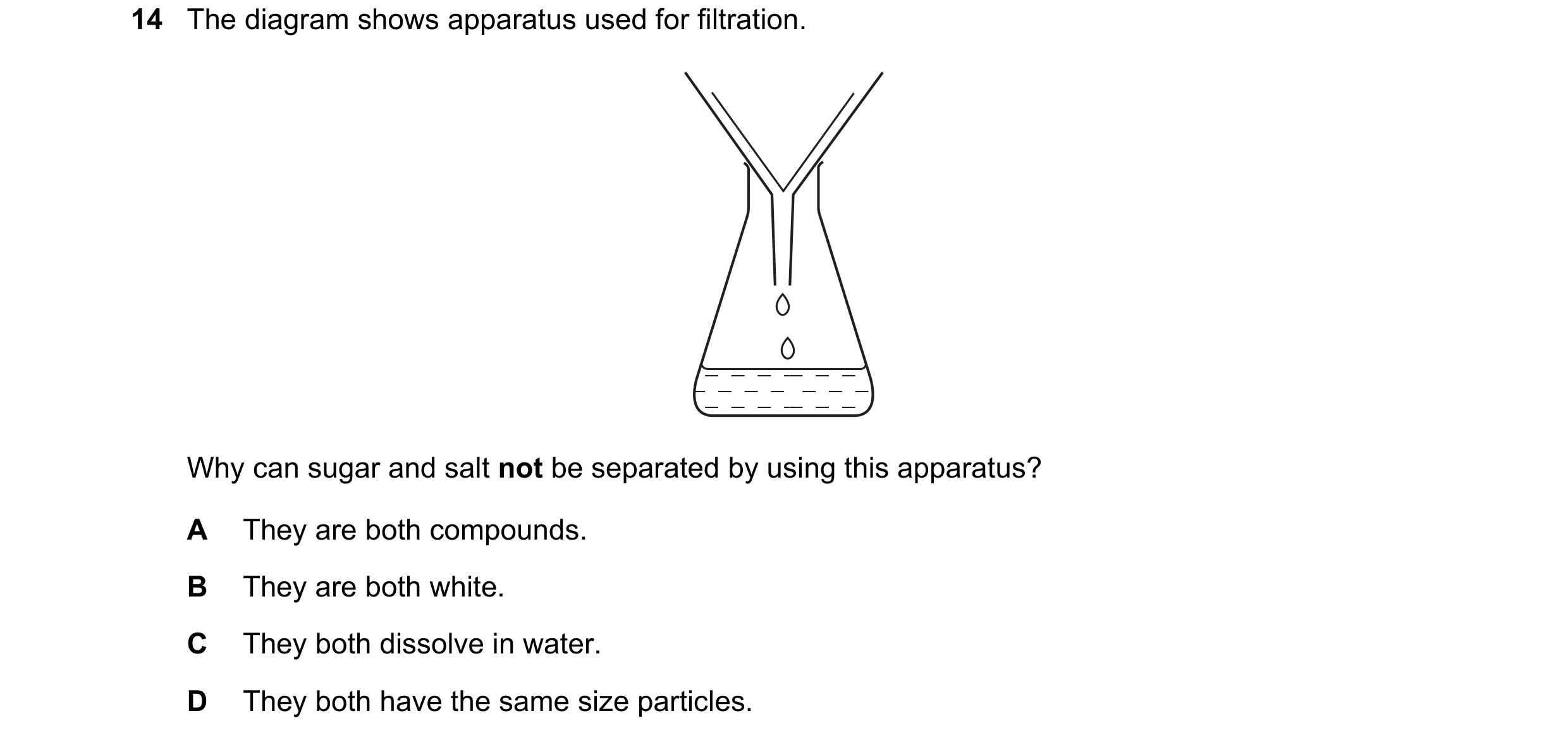
14 The diagram shows apparatus used for filtration. Why can sugar and salt not be separated by using this apparatus? A They are both compounds. B They are both white. C They both dissolve in water. D They both have the same size particles.
1 marks
Answer: C
This question in 0653/21 May/June 2019
Q13 · Copper sulfate crystals dissolve in water 0653/21 May/June 2019
15 Copper sulfate crystals dissolve in water. Which word describes the role of the water? A filtrate B solute C solution D solvent
1 marks
Answer: D
This question in 0653/21 May/June 2019
Q14 · Calcium chloride is a soluble salt 0653/21 May/June 2019
19 Calcium chloride is a soluble salt. It is made by adding calcium carbonate to substance X. Solid calcium chloride is obtained from the reaction mixture by process Y. What are substance X and process Y? substance X process Y A hydrochloric acid crystallisation B hydrochloric acid filtration C sodium chloride crystallisation D sodium chloride filtration
1 marks
Answer: A
This question in 0653/21 May/June 2019
Q15 · Which statement shows that petroleum is a mixture? 0653/21 May/June 2019
25 Which statement shows that petroleum is a mixture? A Petroleum can be burned as a fuel. B Petroleum can be separated into fractions by distillation. C Petroleum is a fossil fuel formed over millions of years. D Petroleum is a thick, black liquid.
1 marks
Answer: B
This question in 0653/21 May/June 2019
Q16 · The diagram shows apparatus used for filtration 0653/22 May/June 2019
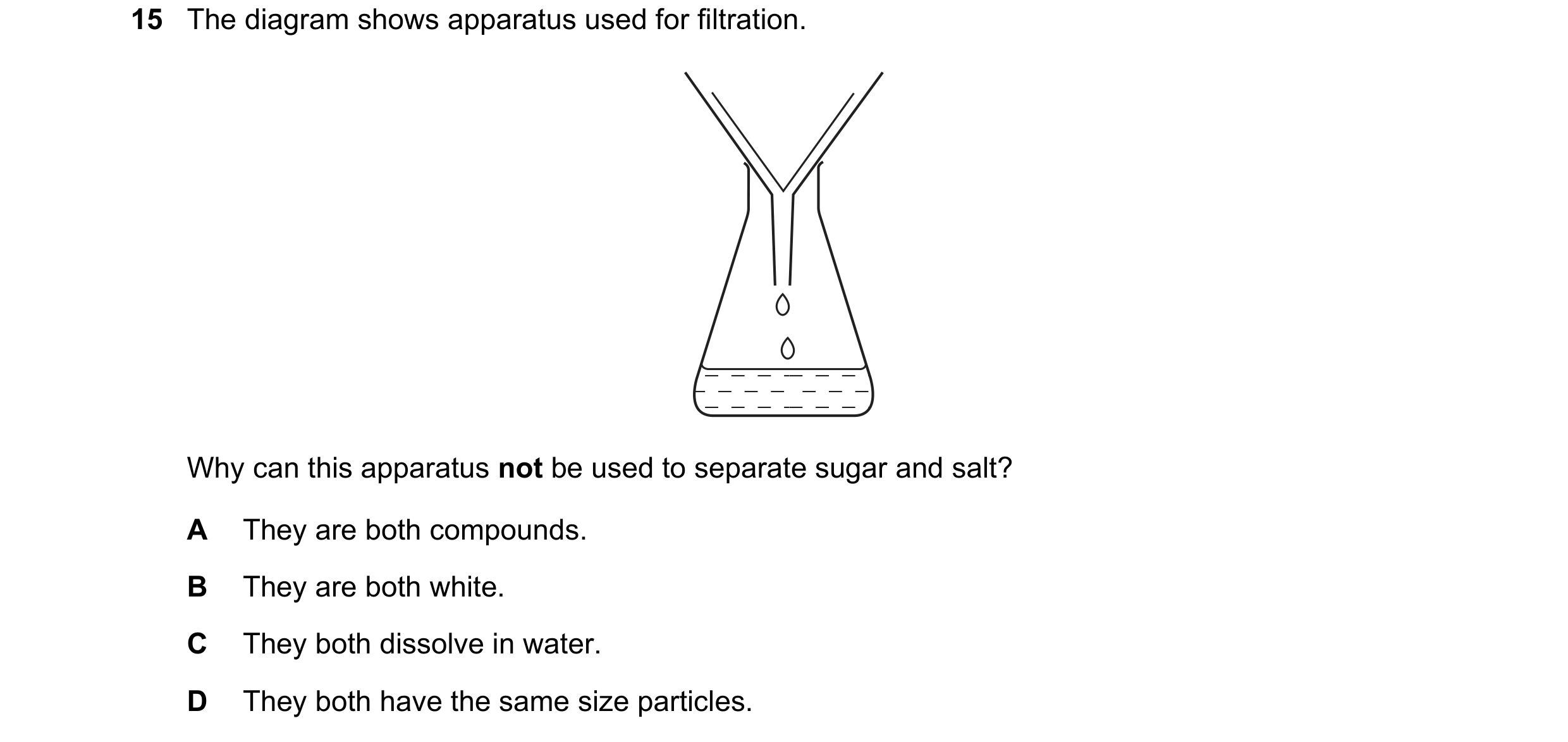
15 The diagram shows apparatus used for filtration. Why can this apparatus not be used to separate sugar and salt? A They are both compounds. B They are both white. C They both dissolve in water. D They both have the same size particles.
1 marks
Answer: C
This question in 0653/22 May/June 2019
Q17 · Which statement shows that petroleum is a mixture? 0653/22 May/June 2019
25 Which statement shows that petroleum is a mixture? A Petroleum can be burned as a fuel. B Petroleum can be separated into fractions by distillation. C Petroleum is a fossil fuel formed over millions of years. D Petroleum is a thick, black liquid.
1 marks
Answer: B
This question in 0653/22 May/June 2019
Q18 · The diagram shows apparatus used for filtration 0653/23 May/June 2019
14 The diagram shows apparatus used for filtration. Why can sugar and salt not be separated by using this apparatus? A They are both compounds. B They are both white. C They both dissolve in water. D They both have the same size particles.
1 marks
Answer: C
This question in 0653/23 May/June 2019
Q19 · Salt, sand and water are stirred together in a beaker 0653/21 May/June 2020
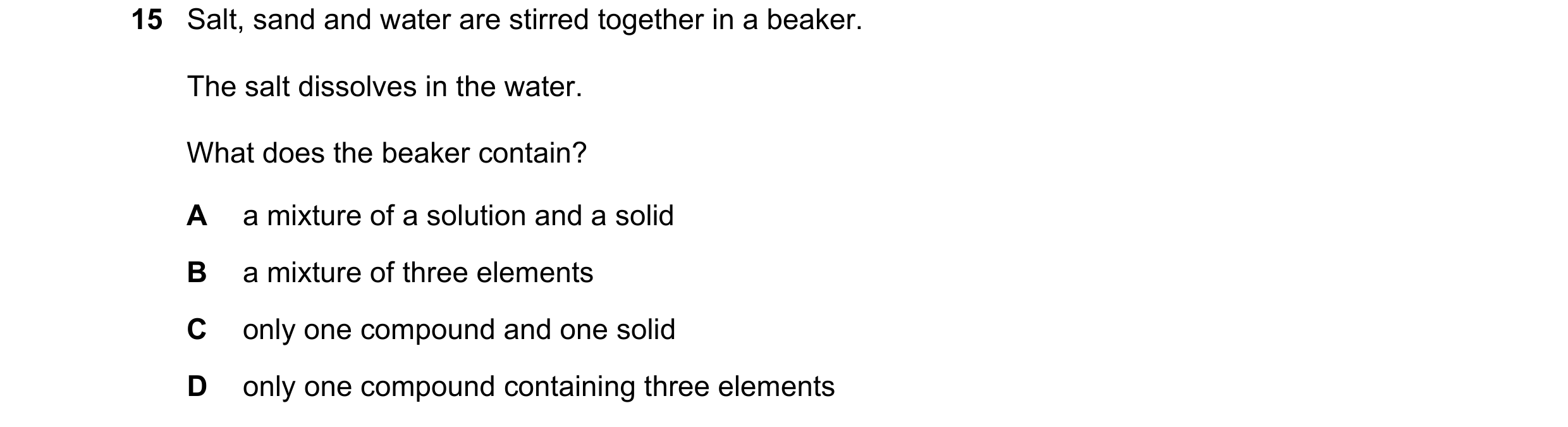
15 Salt, sand and water are stirred together in a beaker. The salt dissolves in the water. What does the beaker contain? A a mixture of a solution and a solid B a mixture of three elements C only one compound and one solid D only one compound containing three elements
1 marks
Answer: A
This question in 0653/21 May/June 2020
Q20 · Petroleum is separated into useful fractions by fractional distillation 0653/21 May/June 2020
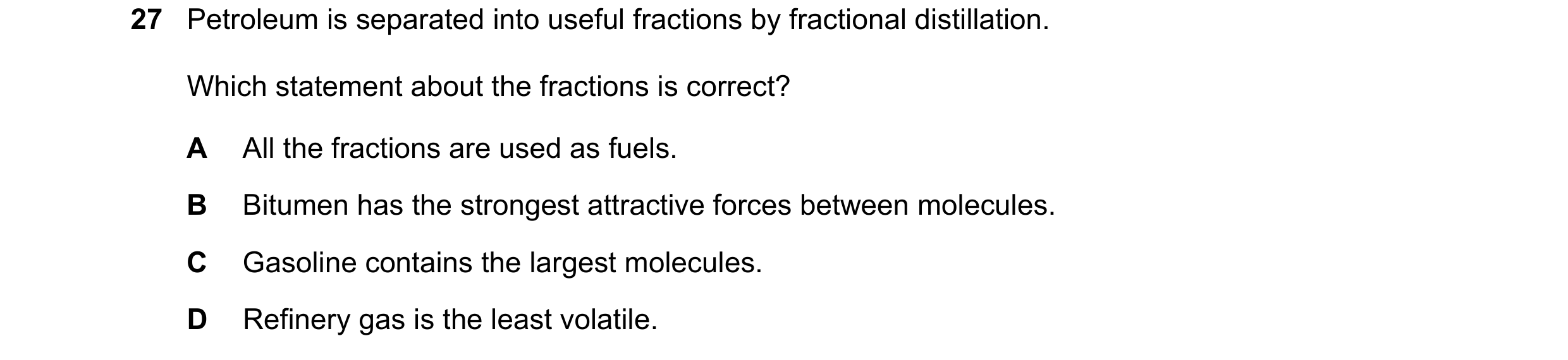
27 Petroleum is separated into useful fractions by fractional distillation. Which statement about the fractions is correct? A All the fractions are used as fuels. B Bitumen has the strongest attractive forces between molecules. C Gasoline contains the largest molecules. D Refinery gas is the least volatile.
1 marks
Answer: B
This question in 0653/21 May/June 2020
Q21 · Which methods of separation depend on the substances in a mixture having different… 0653/22 Feb/March 2021
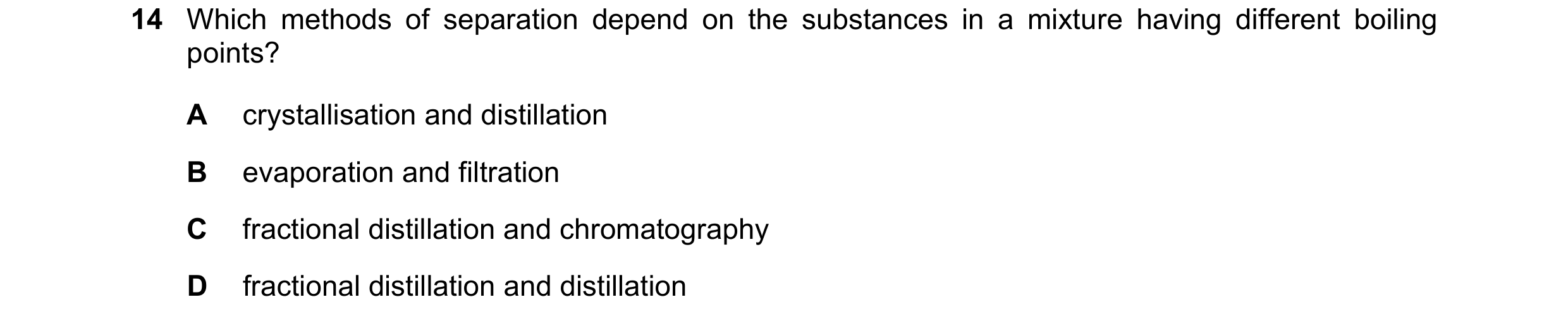
14 Which methods of separation depend on the substances in a mixture having different boiling points? A crystallisation and distillation B evaporation and filtration C fractional distillation and chromatography D fractional distillation and distillation
1 marks
Answer: D
This question in 0653/22 Feb/March 2021
Q22 · Excess insoluble solid copper carbonate is mixed with dilute nitric acid 0653/22 May/June 2021
21 Excess insoluble solid copper carbonate is mixed with dilute nitric acid. Aqueous copper nitrate is formed. Which row shows the processes used to obtain pure solid copper nitrate from the reaction mixture? process 1 process 2 process 3 A filter the mixture dry the solid on warm in an oven the filter paper B filter the mixture heat the solution filter the mixture and crystallise and dry C heat the solution cool to crystallise filter the mixture and dry D heat the solution filter the mixture dry the solid
1 marks
Answer: B
This question in 0653/22 May/June 2021
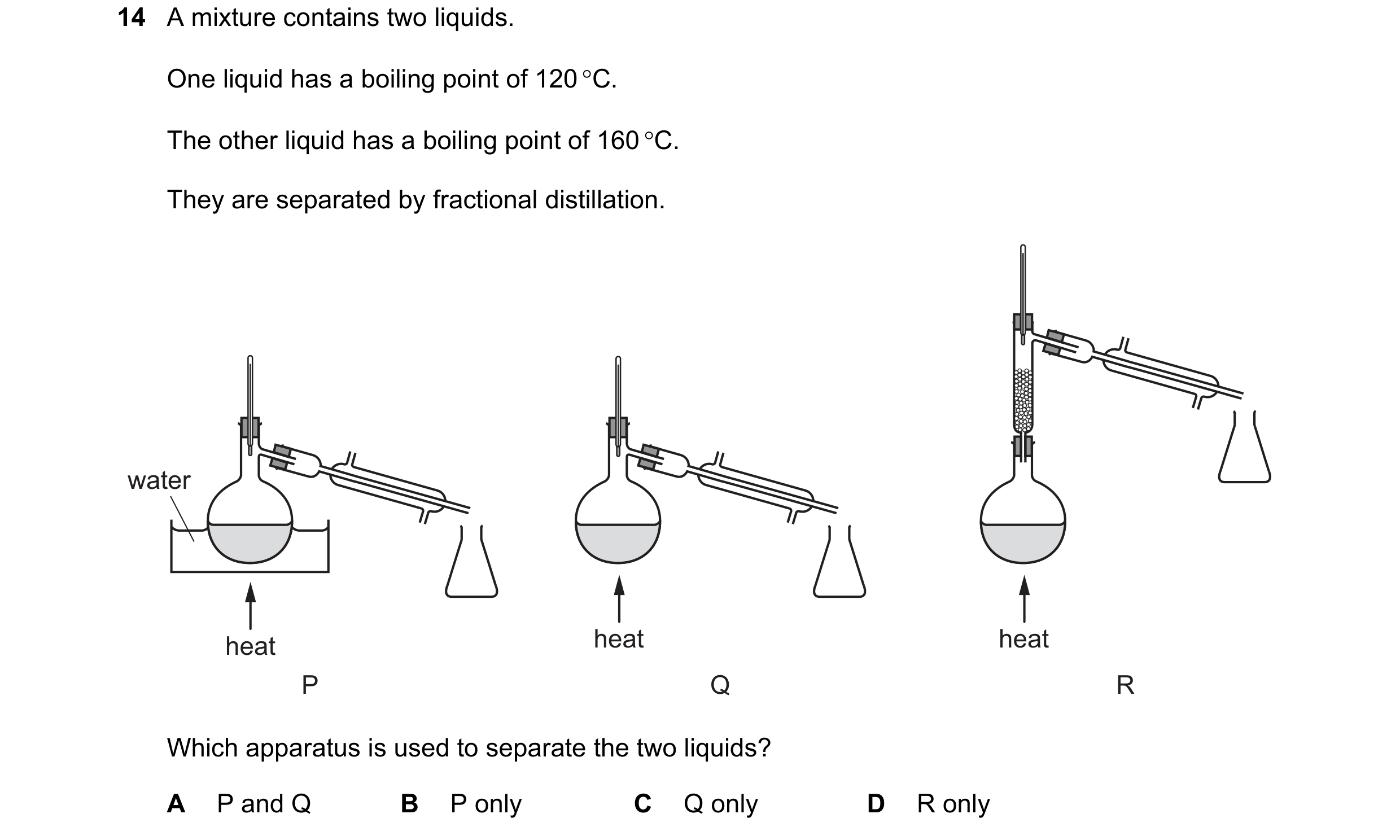
Q23 · A mixture contains two liquids 0653/22 Feb/March 2022
14 A mixture contains two liquids. One liquid has a boiling point of 120 C. The other liquid has a boiling point of 160 C. They are separated by fractional distillation. water heat heat heat P Q R Which apparatus is used to separate the two liquids? A P and Q B P only C Q only D R only
1 marks
Answer: D
This question in 0653/22 Feb/March 2022
Q24 · Some water is added to a coloured, powdered mixture 0653/22 Feb/March 2023
22 Some water is added to a coloured, powdered mixture. After shaking, a blue solution and a white solid are seen. water blue solution coloured, powdered white solid mixture What does the powder contain? A sodium chloride and copper(II) oxide B sodium chloride and copper(II) sulfate C barium sulfate and copper(II) oxide D barium sulfate and copper(II) sulfate
1 marks
Answer: D
This question in 0653/22 Feb/March 2023
Q25 · Which processes are used in the treatment of the water supply? 0653/22 Feb/March 2024
25 Which processes are used in the treatment of the water supply? 1 chlorination 2 crystallisation 3 filtration 4 precipitation A 1 and 3 B 1 and 4 C 2 and 3 D 2 and 4
1 marks
Answer: A
This question in 0653/22 Feb/March 2024
Q26 · A water supply contains small insoluble impurities 0653/21 May/June 2024
26 A water supply contains small insoluble impurities. It also contains bacteria. Which statement describes how the insoluble impurities are removed and how the bacteria are killed? A The water supply is filtered. B The water supply is filtered and treated with chloride ions. C The water supply is filtered and treated with chlorine. D The water supply is treated with chlorine and chloride ions.
1 marks
Answer: C
This question in 0653/21 May/June 2024
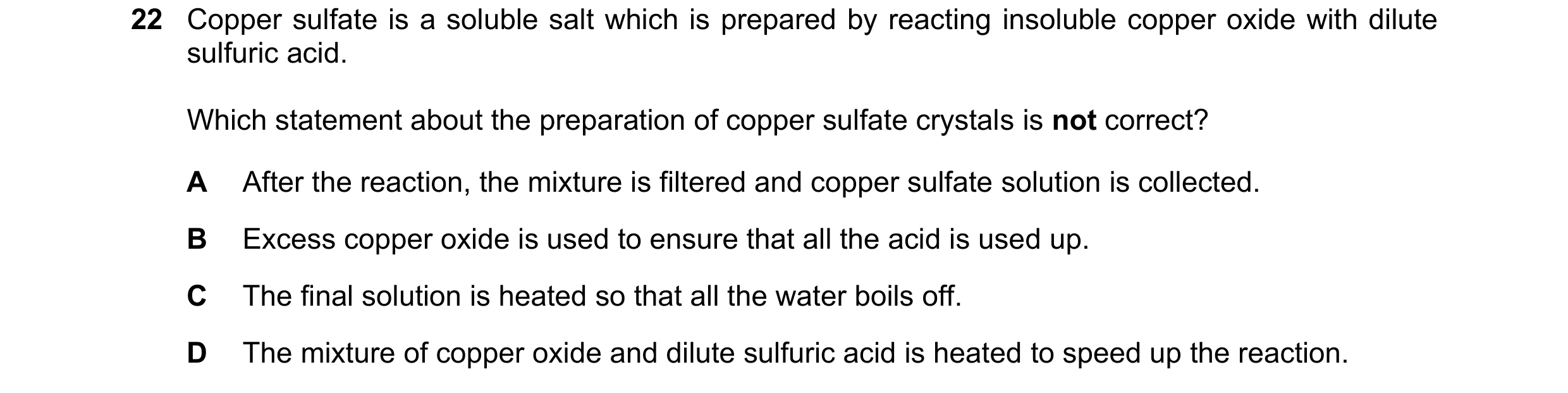
Q27 · Copper sulfate is a soluble salt which is prepared by reacting insoluble copper oxide… 0653/22 May/June 2024
22 Copper sulfate is a soluble salt which is prepared by reacting insoluble copper oxide with dilute sulfuric acid. Which statement about the preparation of copper sulfate crystals is not correct? A After the reaction, the mixture is filtered and copper sulfate solution is collected. B Excess copper oxide is used to ensure that all the acid is used up. C The final solution is heated so that all the water boils off. D The mixture of copper oxide and dilute sulfuric acid is heated to speed up the reaction.
1 marks
Answer: C
This question in 0653/22 May/June 2024
Q28 · A mixture of salt water and sand is filtered 0653/23 May/June 2024
15 A mixture of salt water and sand is filtered. Which statement is correct? A The salt and the sand are trapped by the filter paper. B The salt is dissolved in the water and passes through the filter paper. C The sand is insoluble in water and passes through the filter paper. D The sand is trapped by the filter paper and pure water is obtained.
1 marks
Answer: B
This question in 0653/23 May/June 2024
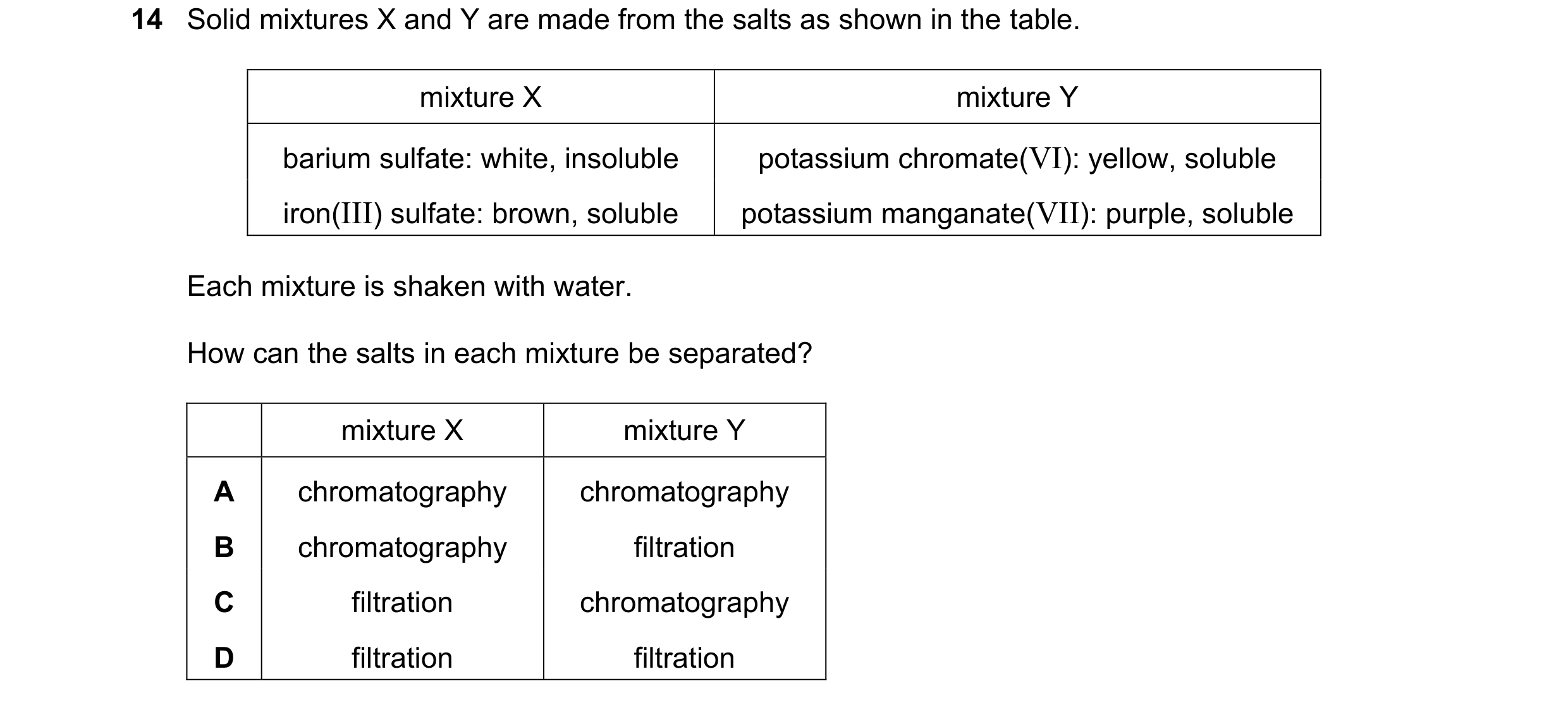
Q29 · Solid mixtures X and Y are made from the salts as shown in the table 0653/23 Oct/Nov 2024
14 Solid mixtures X and Y are made from the salts as shown in the table. mixture X mixture Y barium sulfate: white, insoluble potassium chromate(VI): yellow, soluble iron(III) sulfate: brown, soluble potassium manganate(VII): purple, soluble Each mixture is shaken with water. How can the salts in each mixture be separated? mixture X mixture Y A chromatography chromatography B chromatography filtration C filtration chromatography D filtration filtration
1 marks
Answer: C
This question in 0653/23 Oct/Nov 2024
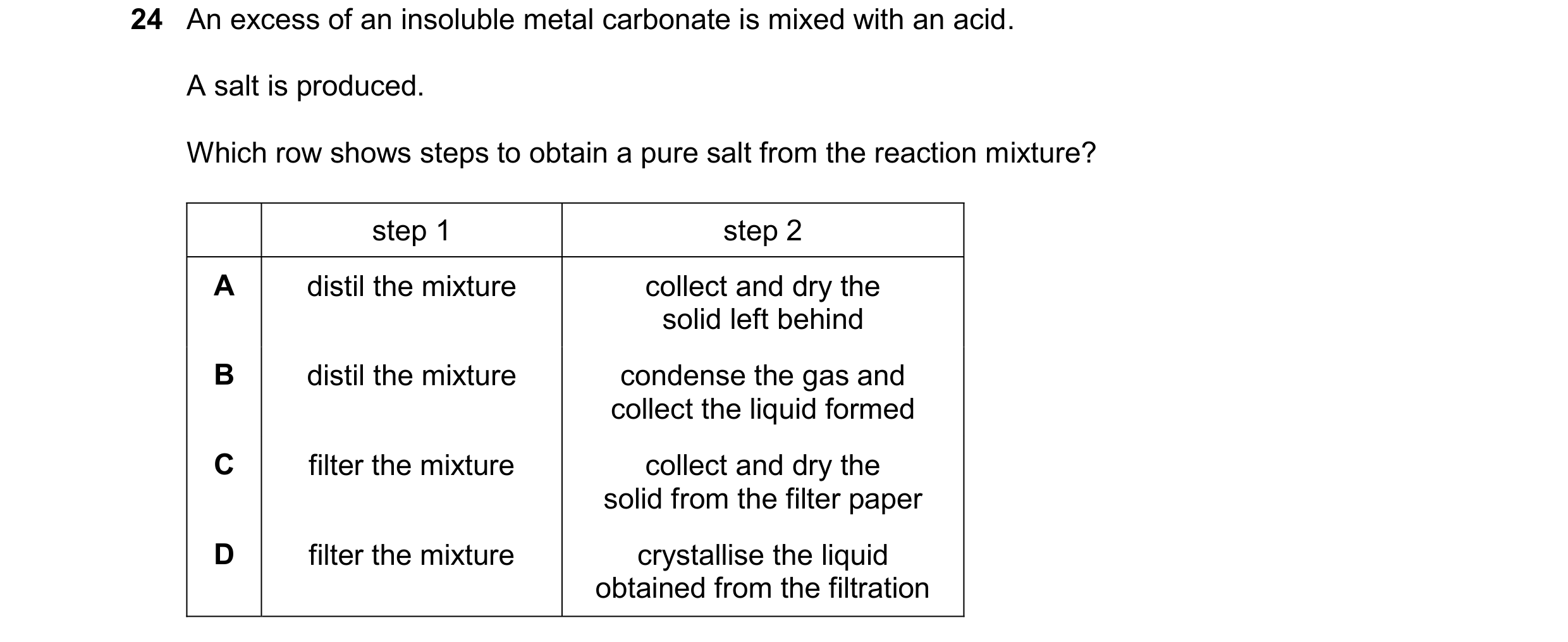
Q30 · An excess of an insoluble metal carbonate is mixed with an acid 0653/21 May/June 2025
24 An excess of an insoluble metal carbonate is mixed with an acid. A salt is produced. Which row shows steps to obtain a pure salt from the reaction mixture? step 1 step 2 A distil the mixture collect and dry the solid left behind B distil the mixture condense the gas and collect the liquid formed C filter the mixture collect and dry the solid from the filter paper D filter the mixture crystallise the liquid obtained from the filtration
1 marks
Answer: D
This question in 0653/21 May/June 2025
Q31 · Potassium iodide reacts with lead(II) nitrate to produce yellow lead(II) iodide and… 0653/22 May/June 2025
26 Potassium iodide reacts with lead(II) nitrate to produce yellow lead(II) iodide and potassium nitrate. 2KI(aq) + Pb(NO3)2(aq) PbI2(s) + 2KNO3(aq) Which row describes this reaction and how to separate lead(II) iodide from the reaction mixture? reaction separation A neutralisation chromatography B neutralisation filtration C precipitation chromatography D precipitation filtration
1 marks
Answer: D
This question in 0653/22 May/June 2025
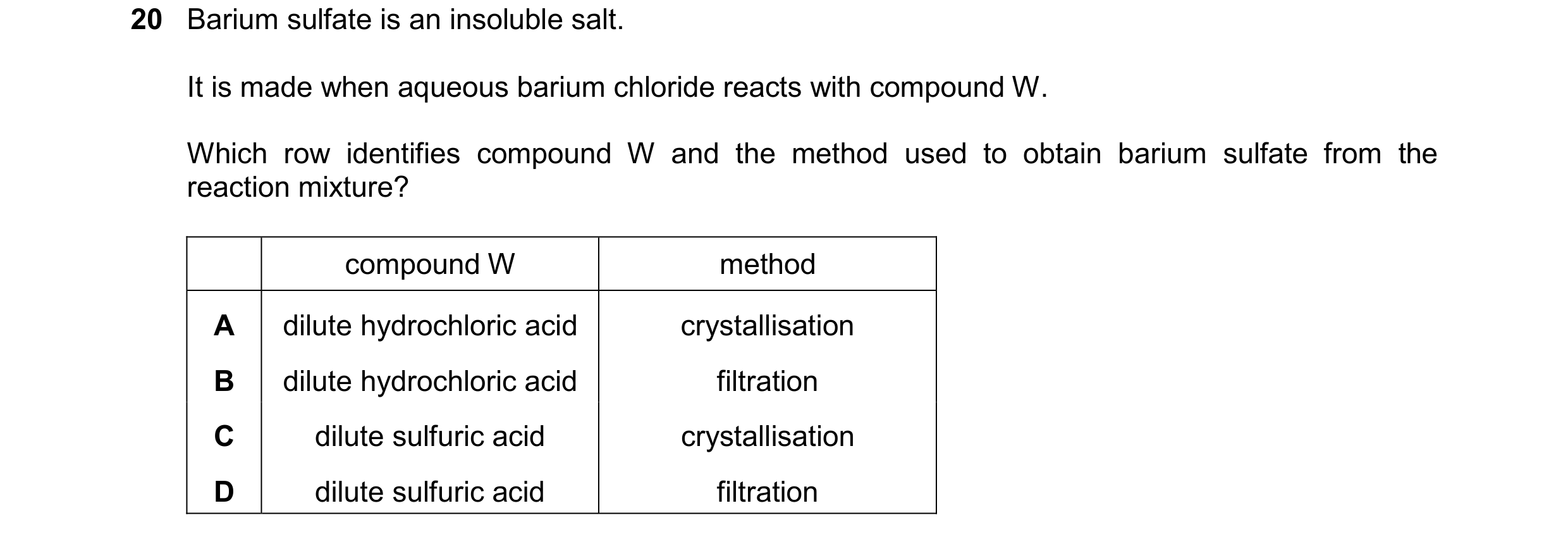
Q32 · Barium sulfate is an insoluble salt 0653/23 May/June 2025
20 Barium sulfate is an insoluble salt. It is made when aqueous barium chloride reacts with compound W. Which row identifies compound W and the method used to obtain barium sulfate from the reaction mixture? compound W method A dilute hydrochloric acid crystallisation B dilute hydrochloric acid filtration C dilute sulfuric acid crystallisation D dilute sulfuric acid filtration
1 marks
Answer: D
This question in 0653/23 May/June 2025
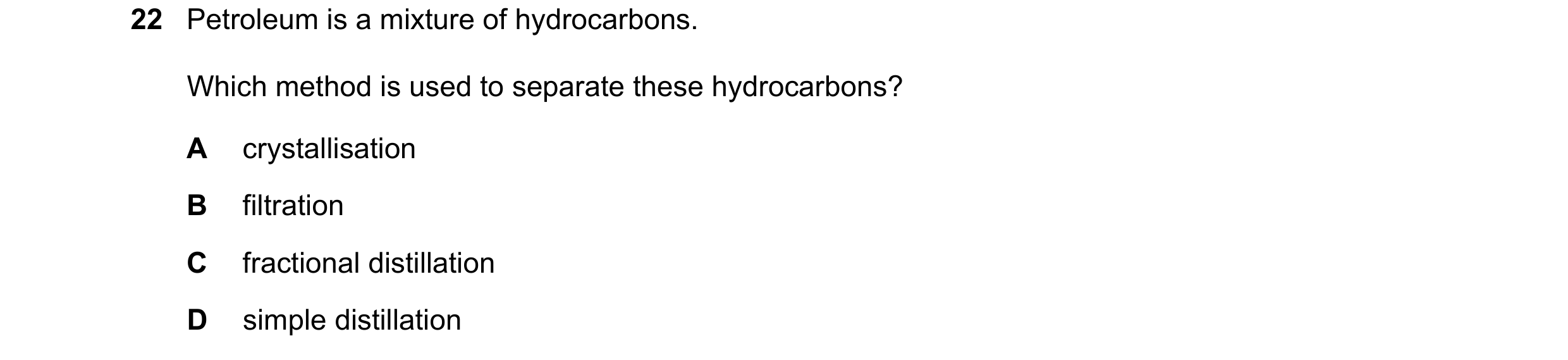
Q33 · Petroleum is a mixture of hydrocarbons 0653/21 Oct/Nov 2025
22 Petroleum is a mixture of hydrocarbons. Which method is used to separate these hydrocarbons? A crystallisation B filtration C fractional distillation D simple distillation
1 marks
Answer: C
This question in 0653/21 Oct/Nov 2025
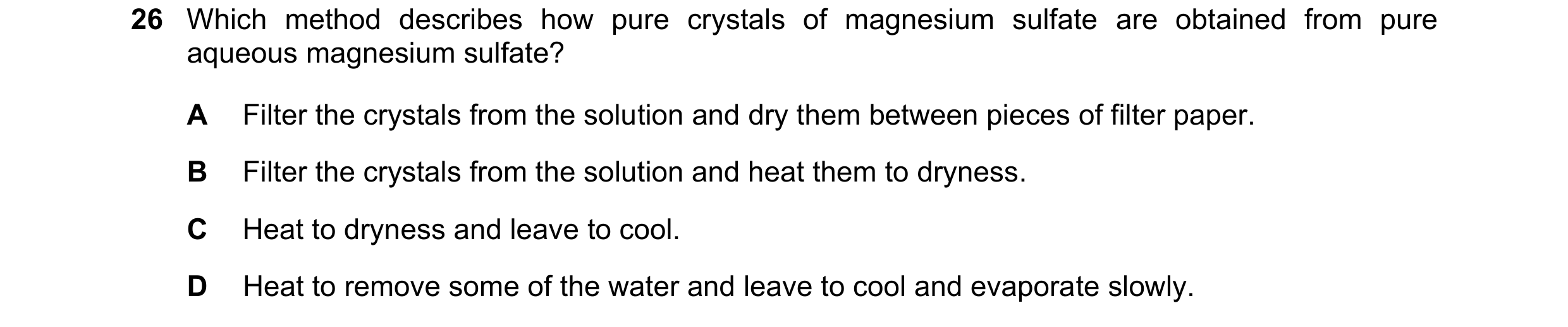
Q34 · Which method describes how pure crystals of magnesium sulfate are obtained from pure… 0653/22 Oct/Nov 2025
26 Which method describes how pure crystals of magnesium sulfate are obtained from pure aqueous magnesium sulfate? A Filter the crystals from the solution and dry them between pieces of filter paper. B Filter the crystals from the solution and heat them to dryness. C Heat to dryness and leave to cool. D Heat to remove some of the water and leave to cool and evaporate slowly.
1 marks
Answer: D
This question in 0653/22 Oct/Nov 2025
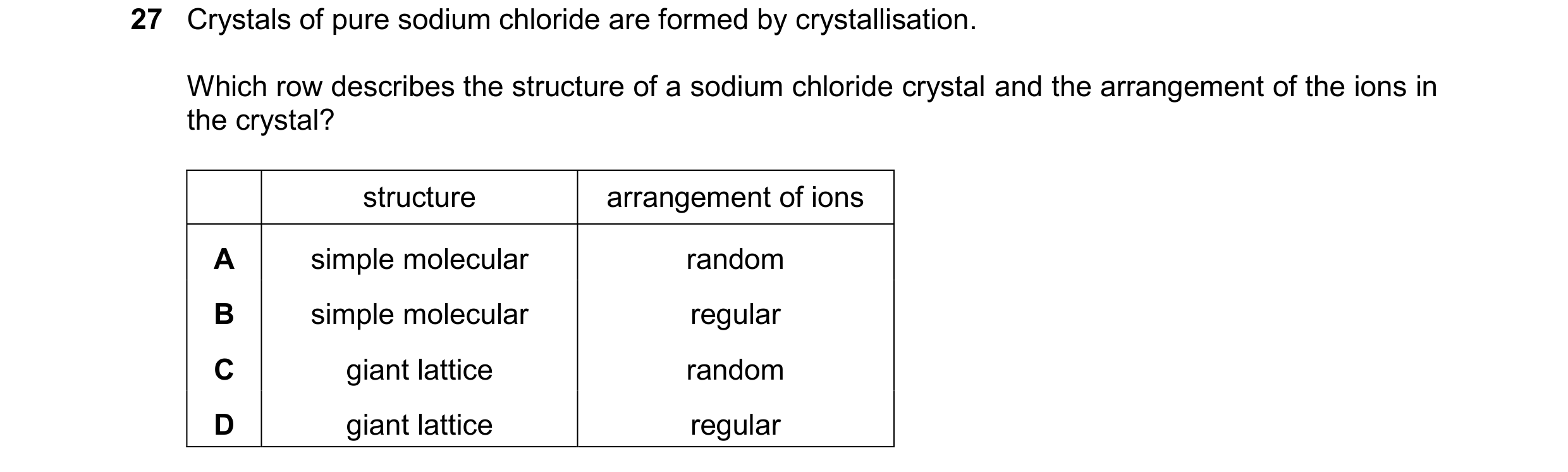
Q35 · Crystals of pure sodium chloride are formed by crystallisation 0653/23 Oct/Nov 2025
27 Crystals of pure sodium chloride are formed by crystallisation. Which row describes the structure of a sodium chloride crystal and the arrangement of the ions in the crystal? structure arrangement of ions A simple molecular random B simple molecular regular C giant lattice random D giant lattice regular
1 marks
Answer: D
This question in 0653/23 Oct/Nov 2025


 1 / 10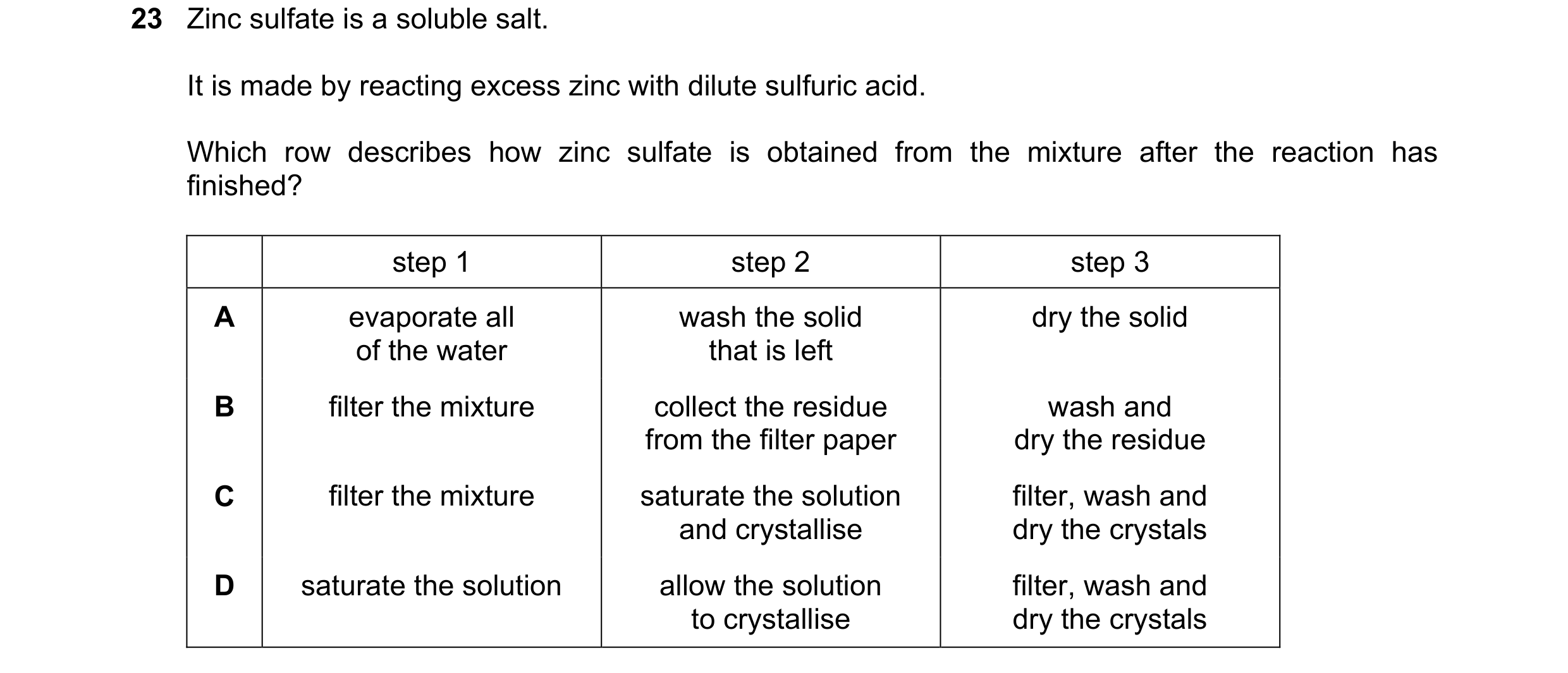

 2 / 10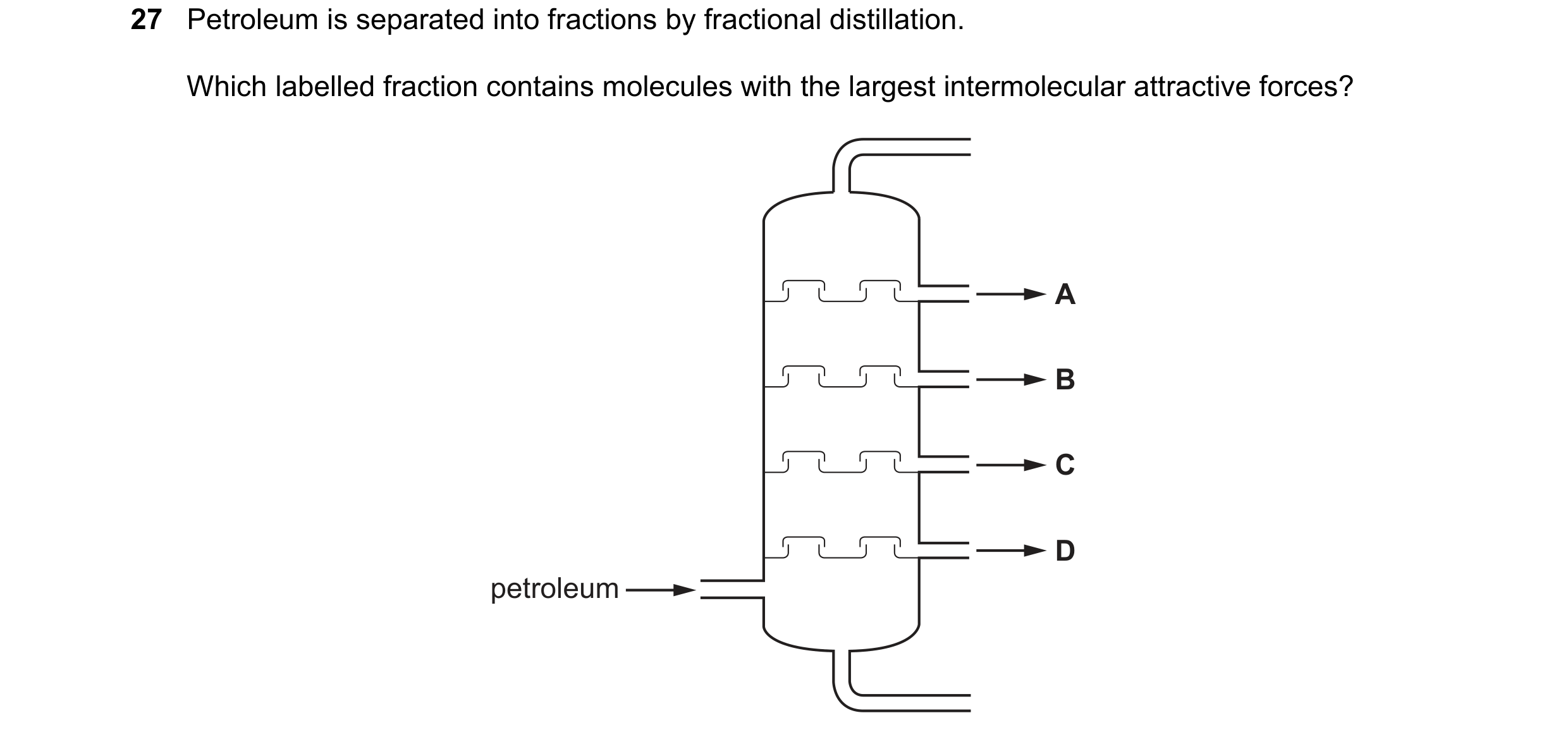
 3 / 10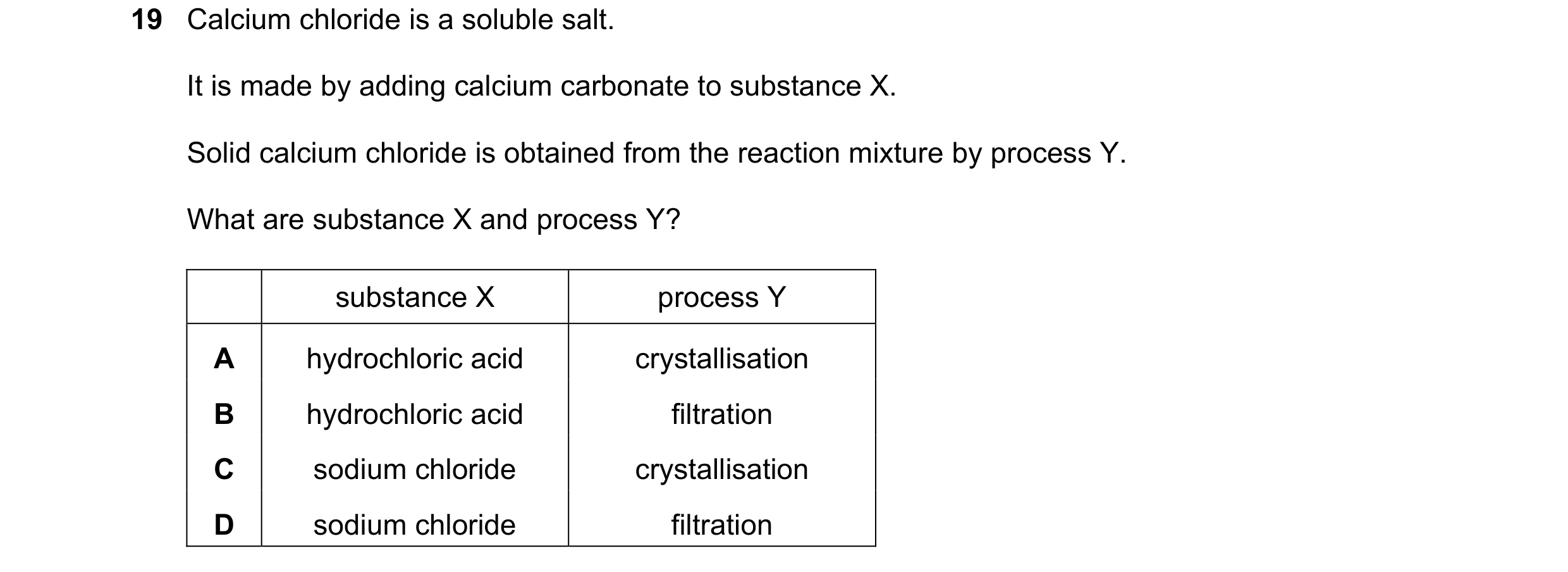

 4 / 10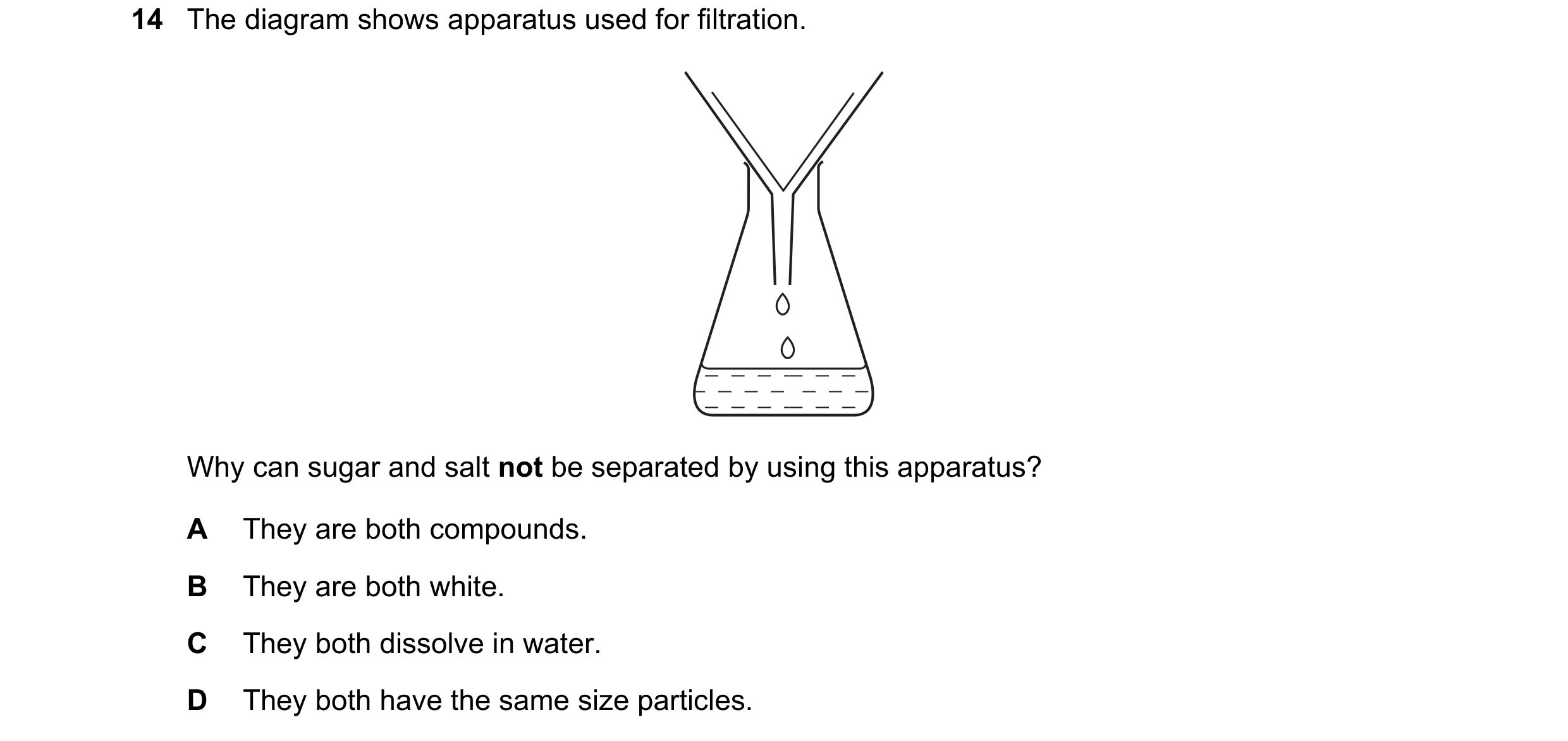
 5 / 10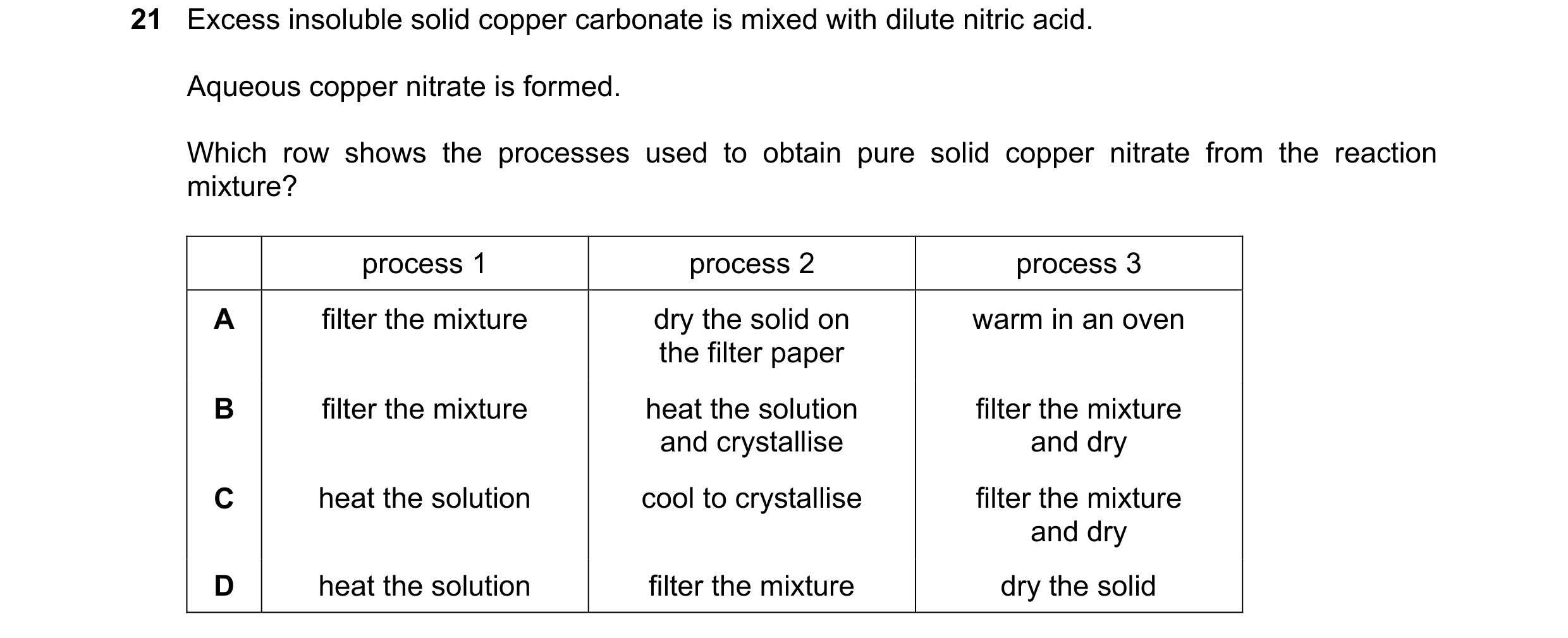
 6 / 10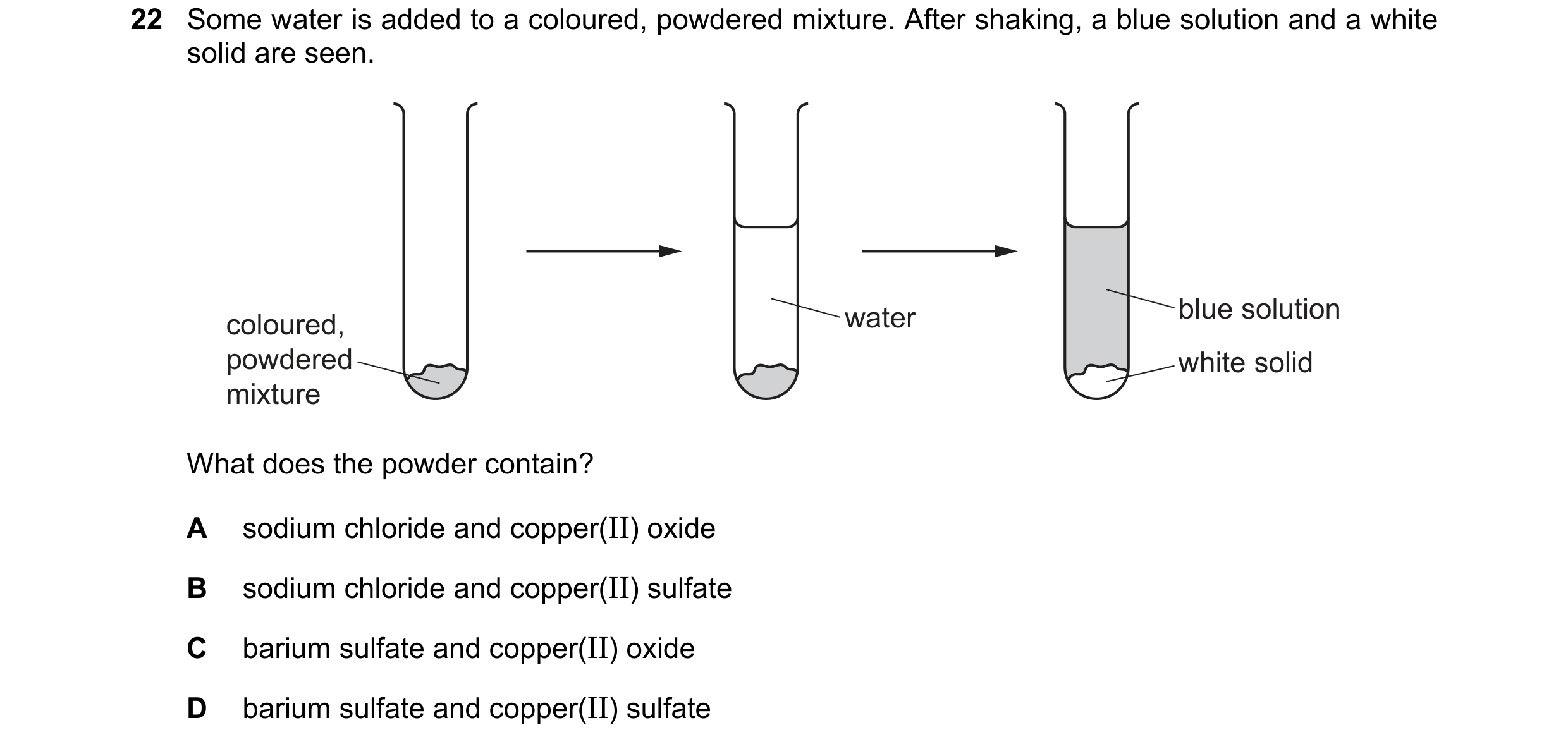
 7 / 10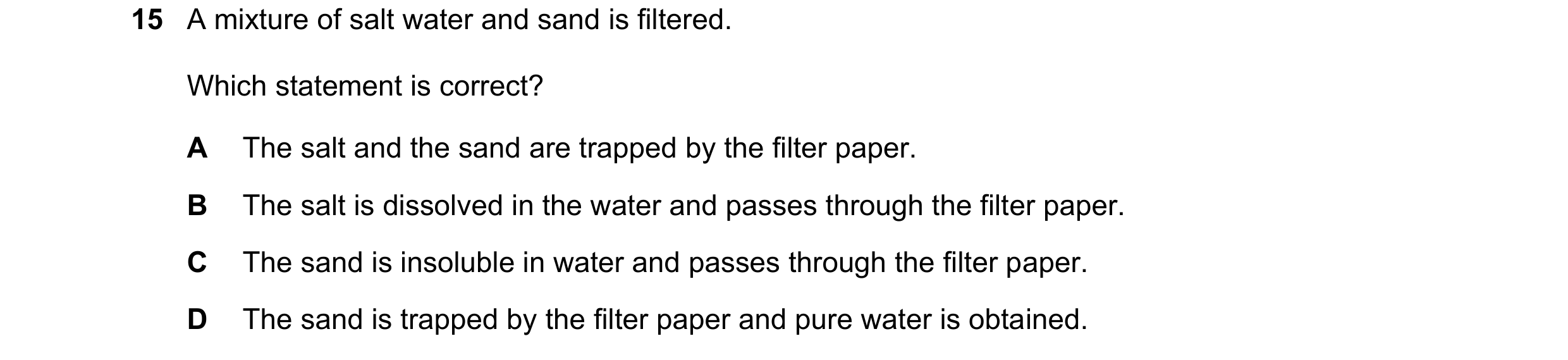
 8 / 10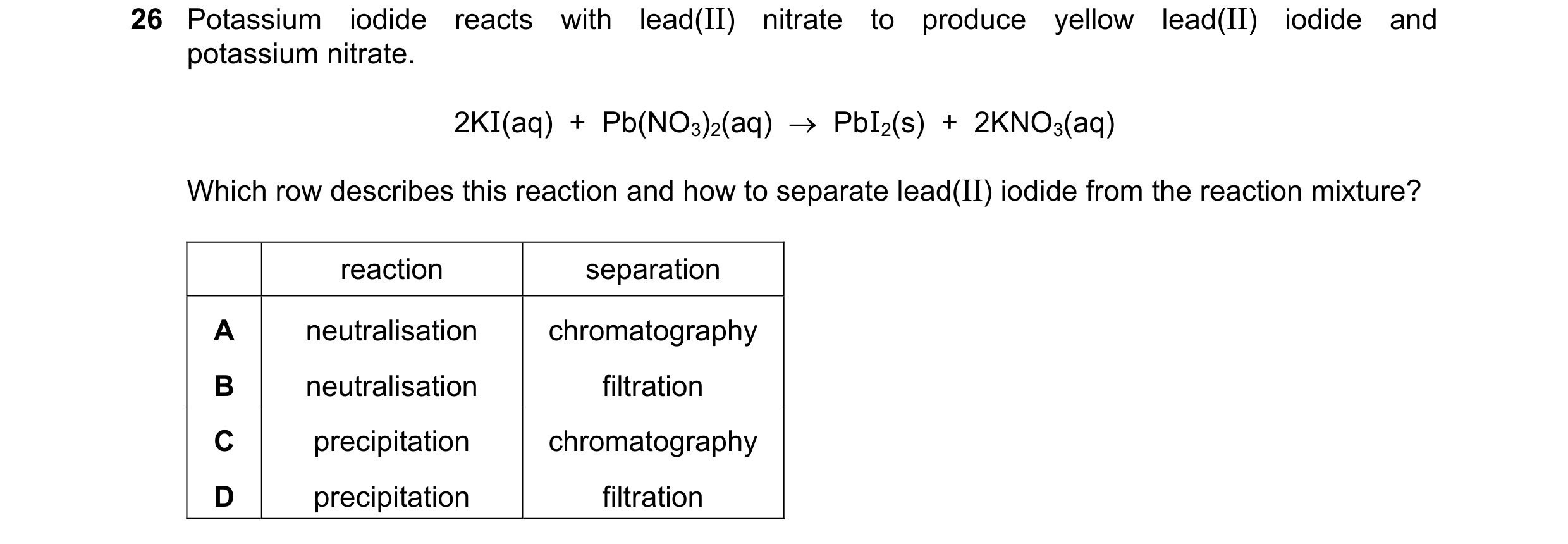
 9 / 10
 10 / 10