Questions as text
Q1 · Ethane and octane are obtained from petroleum by fractional distillation 0653/43 May/June 2017
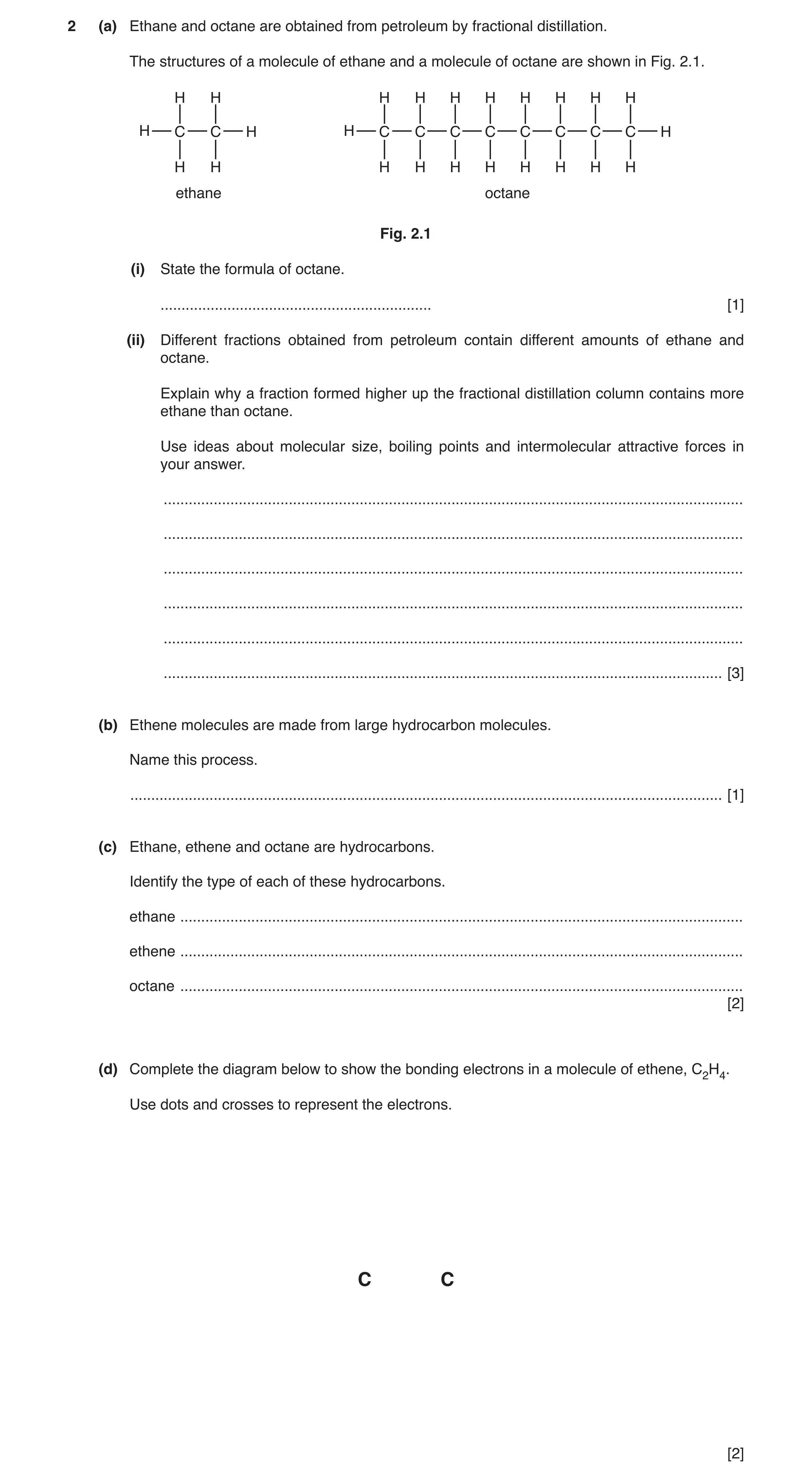
2 (a) Ethane and octane are obtained from petroleum by fractional distillation. The structures of a molecule of ethane and a molecule of octane are shown in Fig. 2.1. H H H H H H H H H H H C C H H C C C C C C C C H H H H H H H H H H H ethane octane Fig. 2.1 (i) State the formula of octane. … [1] (ii) Different fractions obtained from petroleum contain different amounts of ethane and octane. Explain why a fraction formed higher up the fractional distillation column contains more ethane than octane. Use ideas about molecular size, boiling points and intermolecular attractive forces in your answer. … … … … … … [3] (b) Ethene molecules are made from large hydrocarbon molecules. Name this process. … [1] (c) Ethane, ethene and octane are hydrocarbons. Identify the type of each of these hydrocarbons. ethane … ethene … octane … [2] (d) Complete the diagram below to show the bonding electrons in a molecule of ethene, C2H4. Use dots and crosses to represent the electrons. C C [2]
9 marks
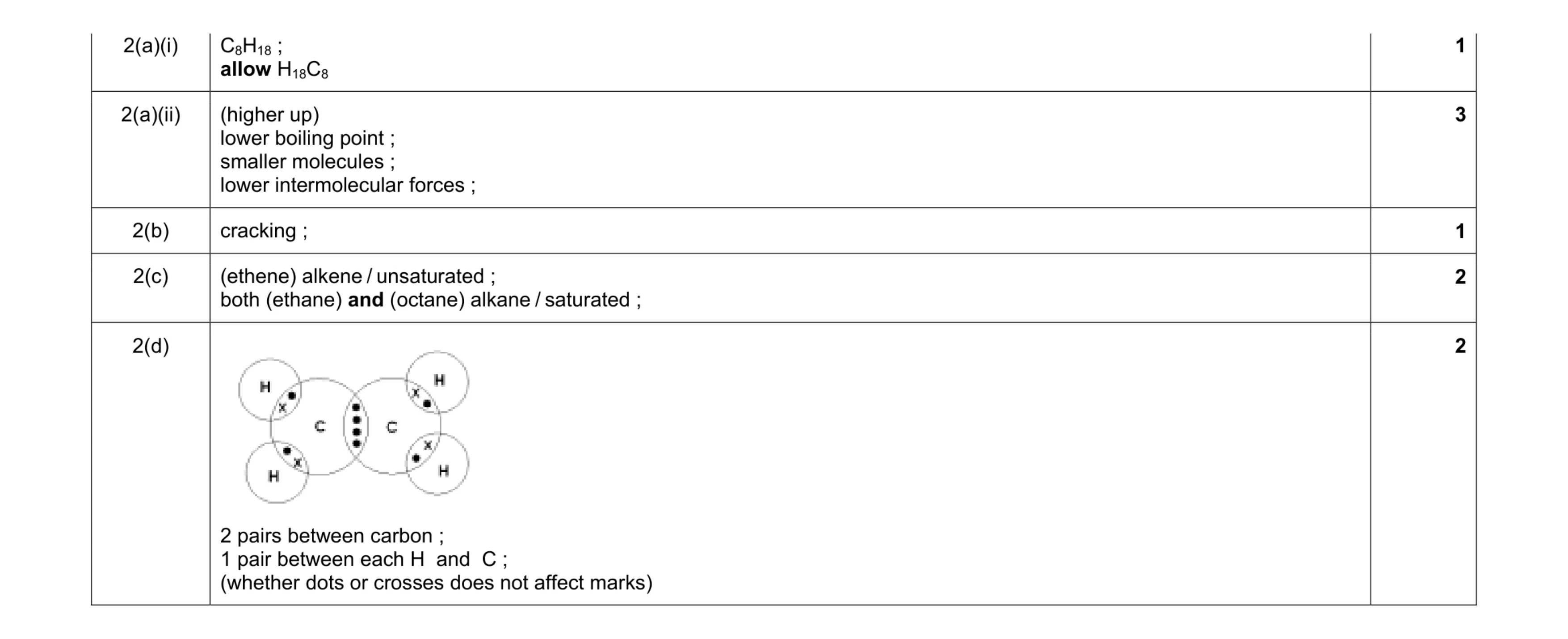
Mark scheme: 2(a)(i) C8H18 ; allow H18C8 1 2(a)(ii) (higher up) lower boiling point ; smaller molecules ; lower intermolecular forces ; 3 2(b) cracking ; 1 2(c) (ethene) alkene / unsaturated ; both (ethane) and (octane) alkane / saturated ; 2 2(d) 2 pairs between carbon ; 1 pair between each H and C ; (whether dots or crosses does not affect marks) 2
This question in 0653/43 May/June 2017
Q2 · Petroleum is separated into useful products by process W shown in Fig 0653/41 Oct/Nov 2017
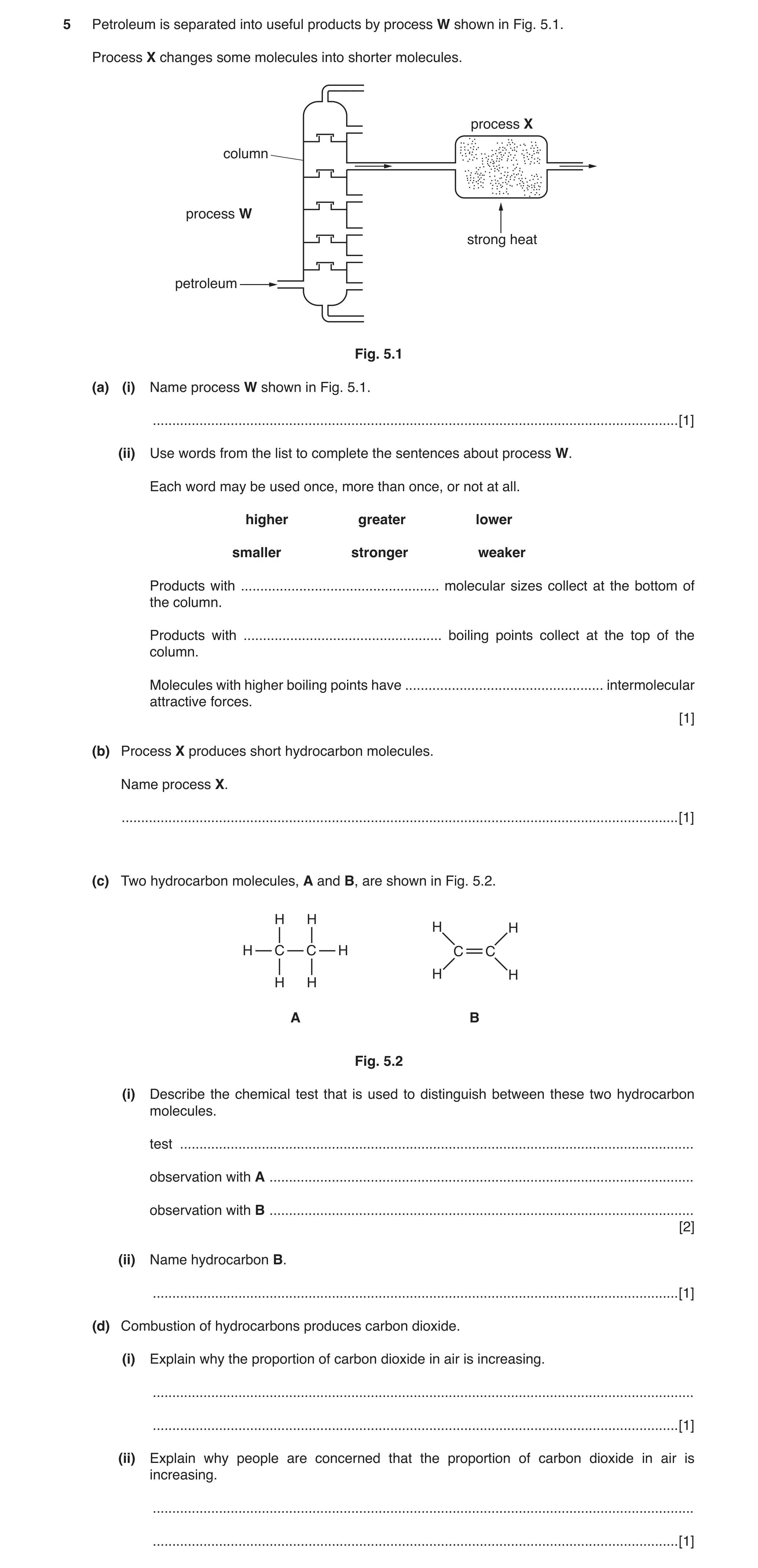
5 Petroleum is separated into useful products by process W shown in Fig. 5.1. Process X changes some molecules into shorter molecules. process X column process W strong heat petroleum Fig. 5.1 (a) (i) Name process W shown in Fig. 5.1. … [1] (ii) Use words from the list to complete the sentences about process W. Each word may be used once, more than once, or not at all. higher greater lower smaller stronger weaker Products with … molecular sizes collect at the bottom of the column. Products with … boiling points collect at the top of the column. Molecules with higher boiling points have … intermolecular attractive forces. [1] (b) Process X produces short hydrocarbon molecules. Name process X. … [1] (c) Two hydrocarbon molecules, A and B, are shown in Fig. 5.2. H H H H H C C H C C H H H H A B Fig. 5.2 (i) Describe the chemical test that is used to distinguish between these two hydrocarbon molecules. test … observation with A … observation with B … [2] (ii) Name hydrocarbon B. … [1] (d) Combustion of hydrocarbons produces carbon dioxide. (i) Explain why the proportion of carbon dioxide in air is increasing. … … [1] (ii) Explain why people are concerned that the proportion of carbon dioxide in air is increasing. … … [1]
8 marks
Mark scheme: 5(a)(i) fractional distillation ; 1 5(a)(ii) greater lower greater ; 1 5(b) cracking ; 1 Question Answer Marks 5(c)(i) (test) bromine (water) ; (observation A) no change and (observation B) decolourises / turns (brown to) colourless ; 2 5(c)(ii) ethene ; 1 5(d)(i) reference to use of (fossil) fuel / named fuel / industrialisation / deforestation ; 1 5(d)(ii) global warming / consequences of global warming ; 1
This question in 0653/41 Oct/Nov 2017
Q3 · Explain why the proportion of carbon dioxide in the air is increasing 0653/42 Oct/Nov 2017
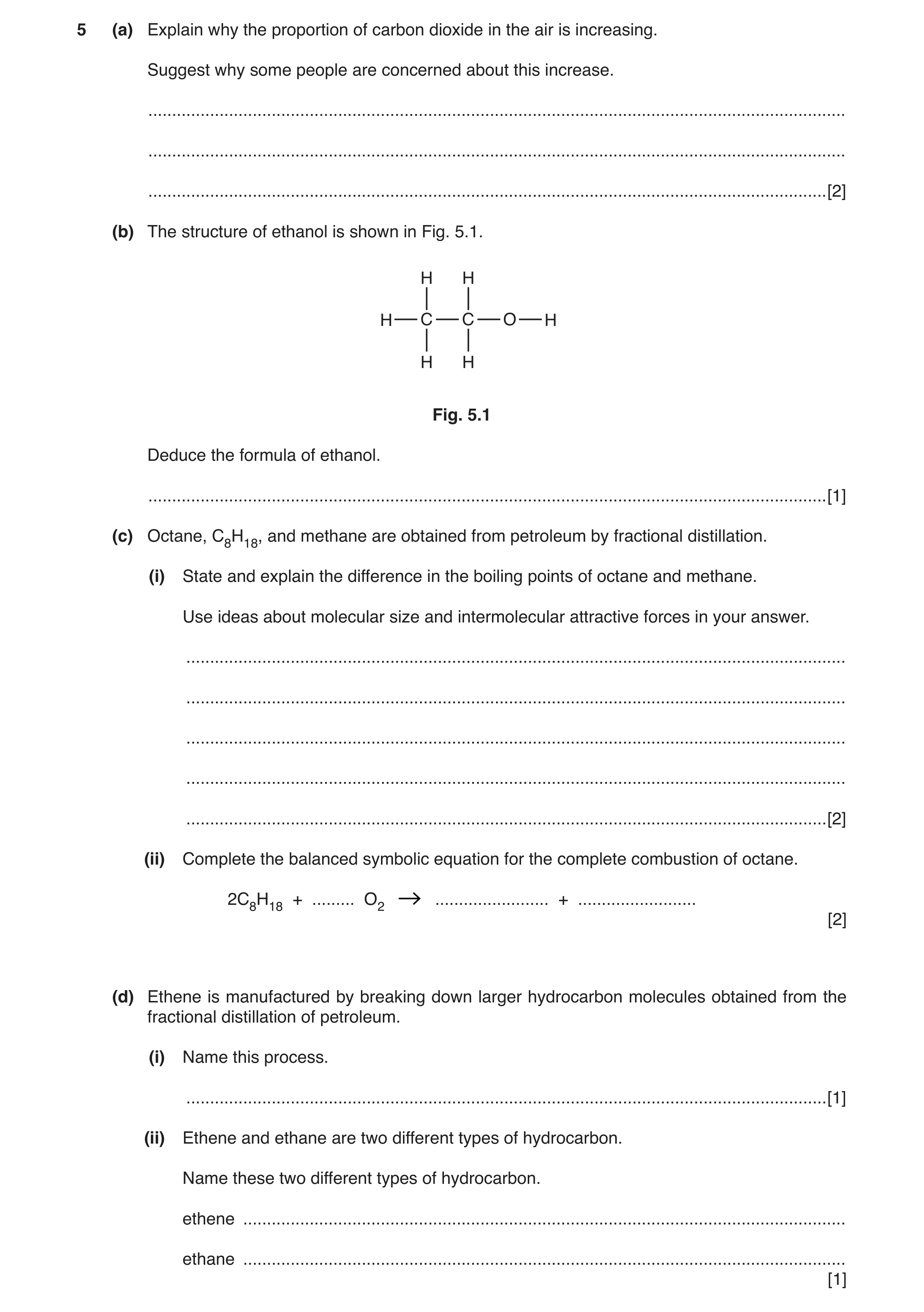
5 (a) Explain why the proportion of carbon dioxide in the air is increasing. Suggest why some people are concerned about this increase. … … … [2] (b) The structure of ethanol is shown in Fig. 5.1. H H H C C O H H H Fig. 5.1 Deduce the formula of ethanol. … [1] (c) Octane, C8H18, and methane are obtained from petroleum by fractional distillation. (i) State and explain the difference in the boiling points of octane and methane. Use ideas about molecular size and intermolecular attractive forces in your answer. … … … … … [2] (ii) Complete the balanced symbolic equation for the complete combustion of octane. 2C8H18 + … O2 … + … [2] (d) Ethene is manufactured by breaking down larger hydrocarbon molecules obtained from the fractional distillation of petroleum. (i) Name this process. … [1] (ii) Ethene and ethane are two different types of hydrocarbon. Name these two different types of hydrocarbon. ethene … ethane … [1]
9 marks
Mark scheme: 5(a) reference to use of (fossil) fuel / named fuel / industrialisation / deforestation ; global warming / any named effect of global warming ; 2 5(b) C2H5OH / C2H6O ; 1 5(c)(i) (octane has higher boiling point / ora) (octane has) larger molecules / ora ; (octane has ) greater intermolecular forces (of attraction) / ora ; 2 5(c)(ii) (2C8H18) + 25«(O2) → «16 CO2 + «18 H2O correct species ; balanced (dependent on correct species) ; 2 5(d)(i) cracking ; 1 5(d)(ii) (ethene) alkene / unsaturated and (ethane) alkane / saturated ; 1
This question in 0653/42 Oct/Nov 2017
Q4 · Petroleum is separated into useful fractions by fractional distillation 0653/42 Feb/March 2018
8 Petroleum is separated into useful fractions by fractional distillation. Process Y produces short alkene molecules from longer alkane molecules. These processes are shown in Fig. 8.1. fractional process Y powdered distillation fraction P solid catalyst column strong heat petroleum fraction Q Fig. 8.1 (a) Fraction P and fraction Q contain different compounds. Describe two of the differences between the compounds in fraction P and those in fraction Q. 1. … … 2. … … [2] (b) Name process Y. … [1] (c) The rate of reaction in process Y is increased by using a powdered solid catalyst and a high temperature. (i) State why the catalyst is used in the form of a powder. … … [1] (ii) Explain how a high temperature increases the rate of reaction in process Y. Use ideas about particles in your answer. … … [2] (d) Bromine is added to two different samples of hydrocarbons A and B. Hydrocarbon A decolourises the bromine. Hydrocarbon B has no effect on the bromine. State these two types of hydrocarbon. A … B … [1] (e) The combustion of hydrocarbons produces a gas that turns limewater milky. (i) State the formula of this gas. … [1] (ii) Suggest one concern that people have as the proportion of this gas is increasing in the air. … … [1]
9 marks
Mark scheme: 8(a) (fraction P) lower boiling point ; smaller molecules ; weaker intermolecular (attractive) forces ; greater flammability ; lower viscosity ; max2 8(b) (catalytic or thermal) cracking ; 1 8(c)(i) increases surface area ; 1 8(c)(ii) particles move faster / have greater kinetic energy ; particles collide (with the catalyst) more often ; 2 8(d) (A) alkene / unsaturated and (B) alkane / saturated ; 1 8(e)(i) CO2 ; 1 8(e)(ii) reference to global warming / excessive (runaway / enhanced) greenhouse effect / negative effects such as climate change / polar melting / rising sea levels / ocean acidification ; 1
This question in 0653/42 Feb/March 2018
Q5 · Petroleum is a fossil fuel 0653/43 May/June 2018
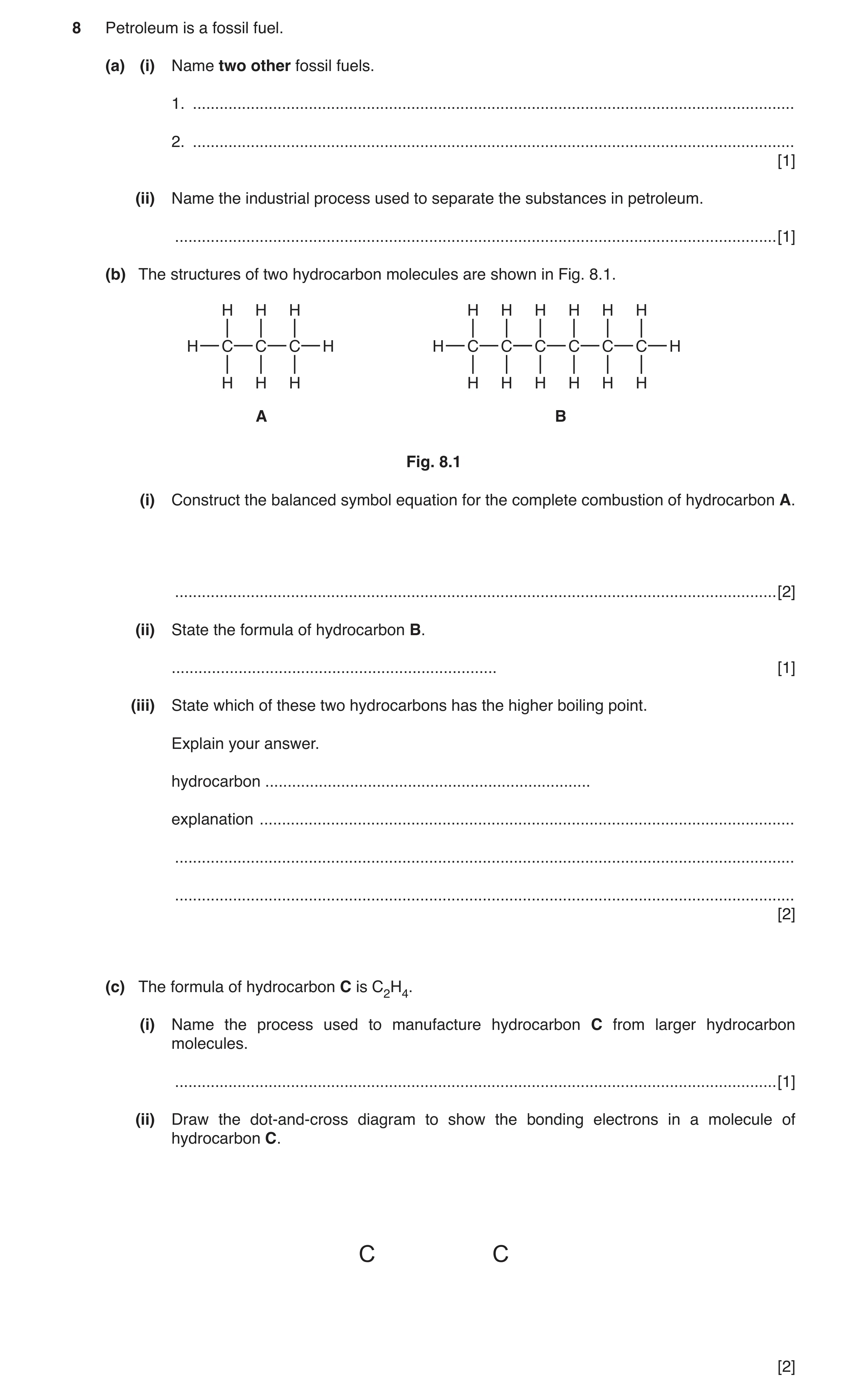
8 Petroleum is a fossil fuel. (a) (i) Name two other fossil fuels. 1. … 2. … [1] (ii) Name the industrial process used to separate the substances in petroleum. … [1] (b) The structures of two hydrocarbon molecules are shown in Fig. 8.1. H H H H H H H H H H C C C H H C C C C C C H H H H H H H H H H A B Fig. 8.1 (i) Construct the balanced symbol equation for the complete combustion of hydrocarbon A. … [2] (ii) State the formula of hydrocarbon B. … [1] (iii) State which of these two hydrocarbons has the higher boiling point. Explain your answer. hydrocarbon … explanation … … … [2] (c) The formula of hydrocarbon C is C2H4. (i) Name the process used to manufacture hydrocarbon C from larger hydrocarbon molecules. … [1] (ii) Draw the dot-and-cross diagram to show the bonding electrons in a molecule of hydrocarbon C. C C [2]
10 marks
Mark scheme: 8(a)(i) coal and natural gas ; 1 8(a)(ii) fractional distillation ; 1 8(b)(i) C3H8 + 5O2 → 3CO2 + 4H2O all formulae correct ; correct balancing (dependant on correct formulae) ; 2 8(b)(ii) C6H14 ; 1 8(b)(iii) (B / C6H14 / hexane) (B) larger molecule / surface area ; (B) greater intermolecular (attractive) forces / more energy needed to separate molecules ; 2 8(c)(i) cracking ; 1 Question Answer Marks 8(c)(ii) (circles not essential) double bond between carbon atoms ; four H atoms drawn with single pair between each and a C atom ; 2 Question Answer Marks 9(a) fuse in main circuit ; heating elements in parallel with each other and supply ; motor in parallel with heating elements (and supply) ; switches in series with both heaters and motor ; 4 9(b) total power supply required = 1200 × 2 + 100 = 2500 W ; use of P = I × V e.g. current through one heater = 5 A / total current = 2500 ÷ 240 ; = 10.4 A (which is above fuse rating) ; 3 Question Answer Marks 9(c) value within range 10–15 kHz ; top end of normal range is 20 kHz / older residents can hear up to 15 kHz ; 2
This question in 0653/43 May/June 2018
Q6 · Ethane, C2H6, is an alkane 0653/42 Oct/Nov 2018
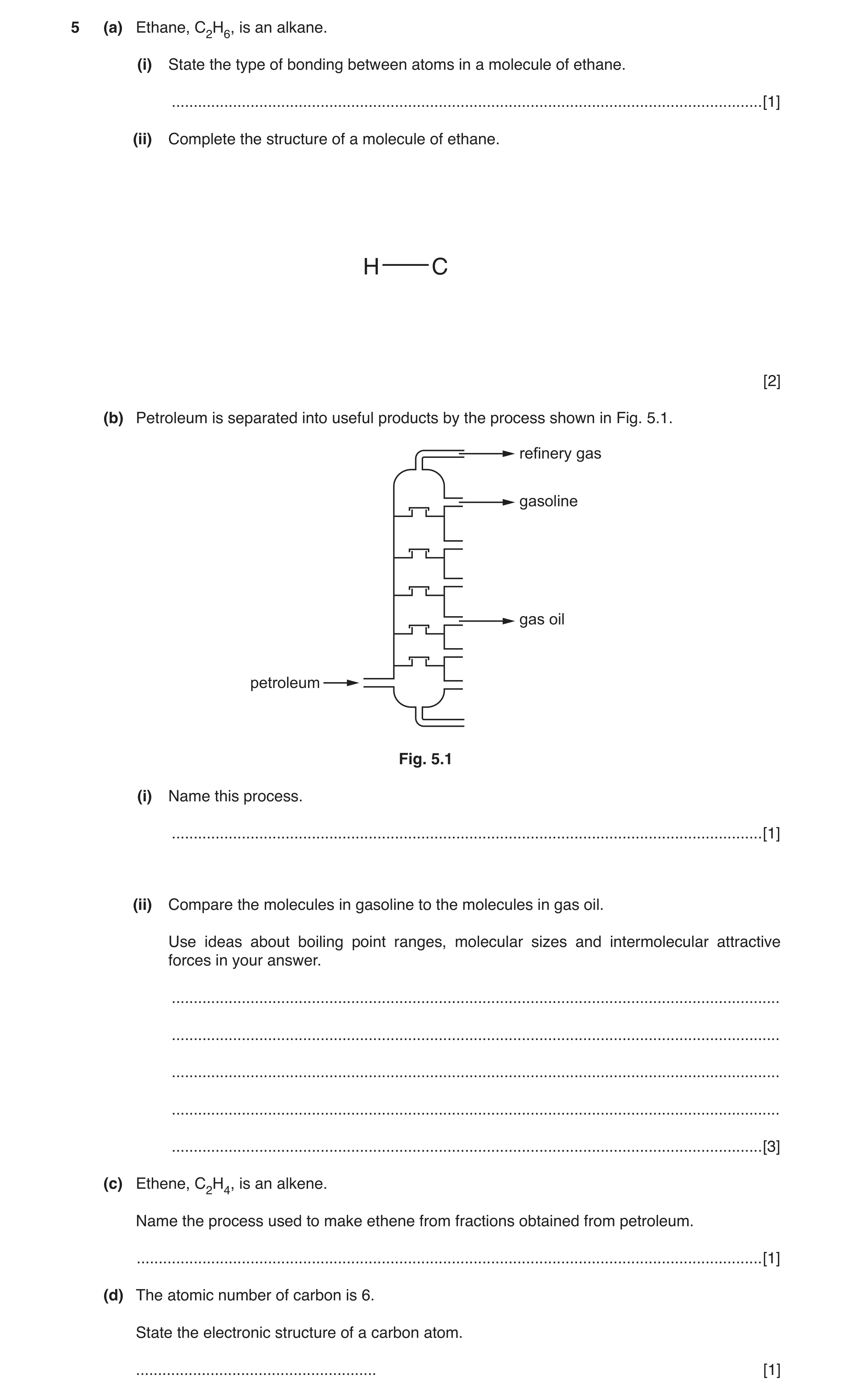
5 (a) Ethane, C2H6, is an alkane. (i) State the type of bonding between atoms in a molecule of ethane. … [1] (ii) Complete the structure of a molecule of ethane. H C [2] (b) Petroleum is separated into useful products by the process shown in Fig. 5.1. refinery gas gasoline gas oil petroleum Fig. 5.1 (i) Name this process. … [1] (ii) Compare the molecules in gasoline to the molecules in gas oil. Use ideas about boiling point ranges, molecular sizes and intermolecular attractive forces in your answer. … … … … … [3] (c) Ethene, C2H4, is an alkene. Name the process used to make ethene from fractions obtained from petroleum. … [1] (d) The atomic number of carbon is 6. State the electronic structure of a carbon atom. … [1]
9 marks
Mark scheme: 5(a)(i) covalent ; 1 5(a)(ii) C – C single bond ; six correctly located C-H single bonds ; 2 5(b)(i) fractional distillation ; 1 5(b)(ii) gasoline molecules • are smaller ; • have lower boiling points ; • have weaker intermolecular attractive forces ; 3 5(c) cracking ; 1 5(d) 2,4 ; 1
This question in 0653/42 Oct/Nov 2018
Q7 · The processes of fractional distillation and cracking 0653/42 Feb/March 2019
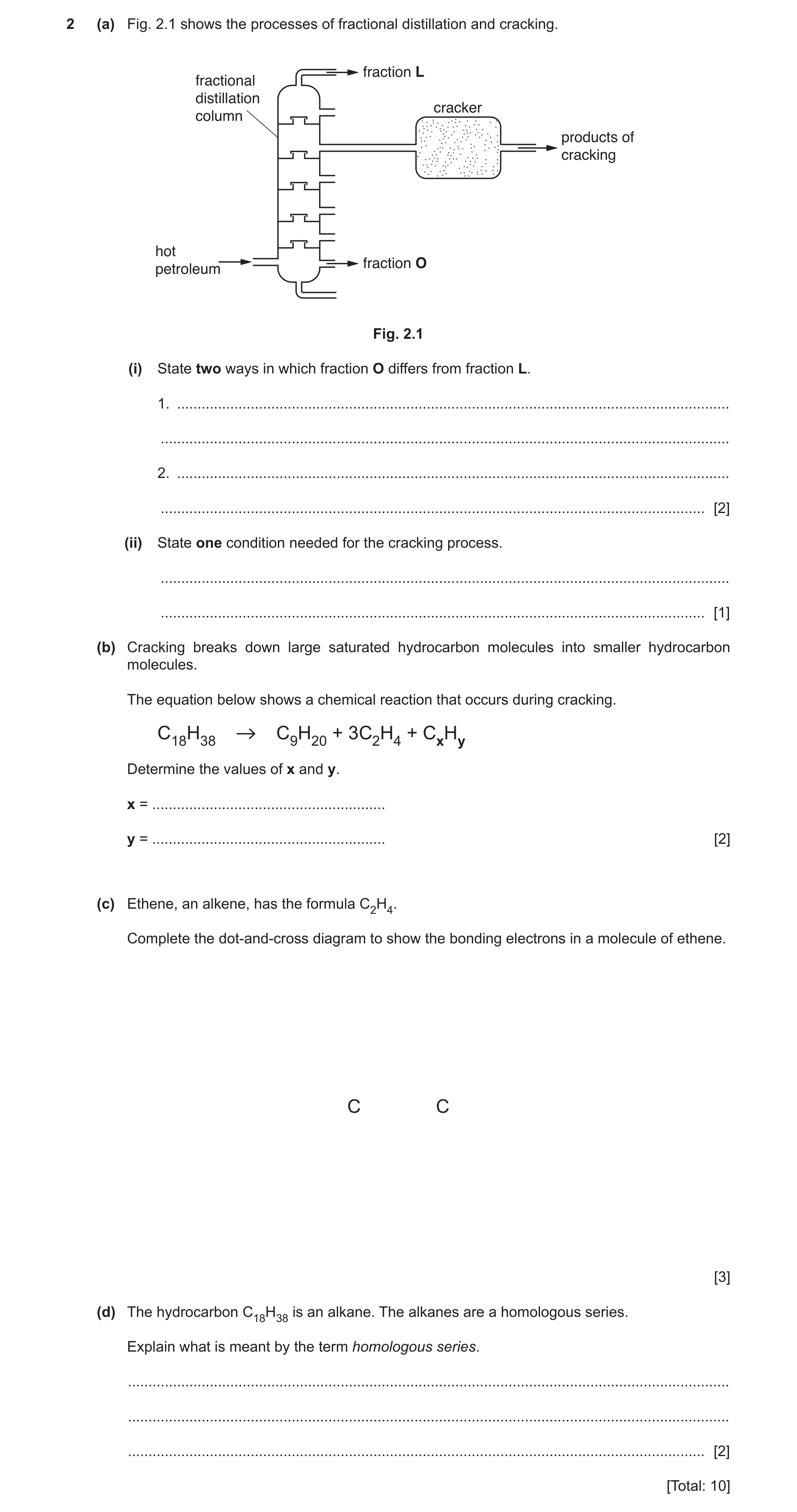
2 (a) Fig. 2.1 shows the processes of fractional distillation and cracking. fraction L fractional distillation cracker column products of cracking hot fraction O petroleum Fig. 2.1 (i) State two ways in which fraction O differs from fraction L. 1. … … 2. … … [2] (ii) State one condition needed for the cracking process. … … [1] (b) Cracking breaks down large saturated hydrocarbon molecules into smaller hydrocarbon molecules. The equation below shows a chemical reaction that occurs during cracking. C18H38 C9H20 + 3C2H4 + CxHy Determine the values of x and y. x = … y = … [2] (c) Ethene, an alkene, has the formula C2H4. Complete the dot-and-cross diagram to show the bonding electrons in a molecule of ethene. C C [3] (d) The hydrocarbon C18H38 is an alkane. The alkanes are a homologous series. Explain what is meant by the term homologous series. … … … [2] [Total: 10]
10 marks
Mark scheme: 2(a)(i) fraction O molecules are larger / have more carbon atoms; fraction O has higher bp / is liquid not gas; fraction O is more viscous; fraction O molecules have stronger intermolecular attractive forces; fraction O is less flammable ; fraction O has higher density ; max 2 2(a)(ii) heat / high temperature / temp of 450 °C etc. or high pressure / 200 atm or catalyst; 1 2(b) x = 3; y = 6; 2 2(c) four hydrogen atoms used two attached to each carbon; two bonding pairs between carbon atoms; single bonding pair between each carbon and hydrogen; 3 2(d) (family of compounds with) the same general formula ; similar (chemical) properties ; 2
This question in 0653/42 Feb/March 2019
Q8 · The fractional distillation of petroleum is shown in Fig 0653/42 May/June 2020
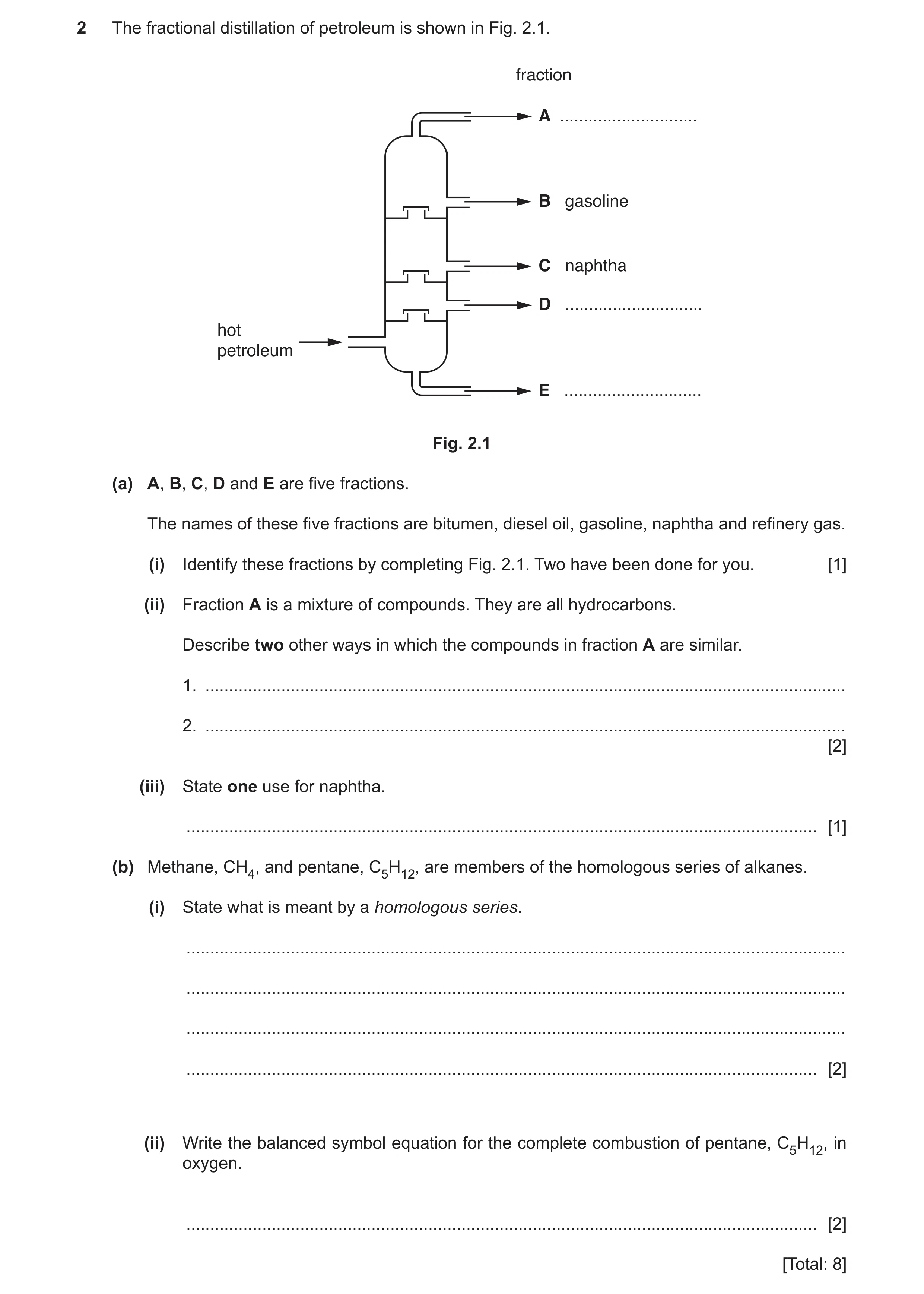
2 The fractional distillation of petroleum is shown in Fig. 2.1. fraction A … B gasoline C naphtha D … hot petroleum E … Fig. 2.1 (a) A, B, C, D and E are five fractions. The names of these five fractions are bitumen, diesel oil, gasoline, naphtha and refinery gas. (i) Identify these fractions by completing Fig. 2.1. Two have been done for you. [1] (ii) Fraction A is a mixture of compounds. They are all hydrocarbons. Describe two other ways in which the compounds in fraction A are similar. 1. … 2. … [2] (iii) State one use for naphtha. … [1] (b) Methane, CH4, and pentane, C5H12, are members of the homologous series of alkanes. (i) State what is meant by a homologous series. … … … … [2] (ii) Write the balanced symbol equation for the complete combustion of pentane, C5H12, in oxygen. … [2] [Total: 8]
8 marks
Mark scheme: 2(a)(i) A refinery gas B (gasoline) C (naphtha) D diesel oil E bitumen ; all three correct for one mark 2(a)(ii) any two from: all gases ; similar boiling points ; small molecules ; 2 2(a)(iii) feedstock for making chemicals ; 1 Question Answer Marks 2(b)(i) family of compounds with, the same general formula ; similar chemical properties ; 2 2(b)(ii) C5H12 + 8O2 → 5CO2 + 6H2O formula ; balancing ; 2
This question in 0653/42 May/June 2020
Q9 · A scientist uses three processes to treat a sample of sea water to make it safe to drink… 0653/41 Oct/Nov 2021
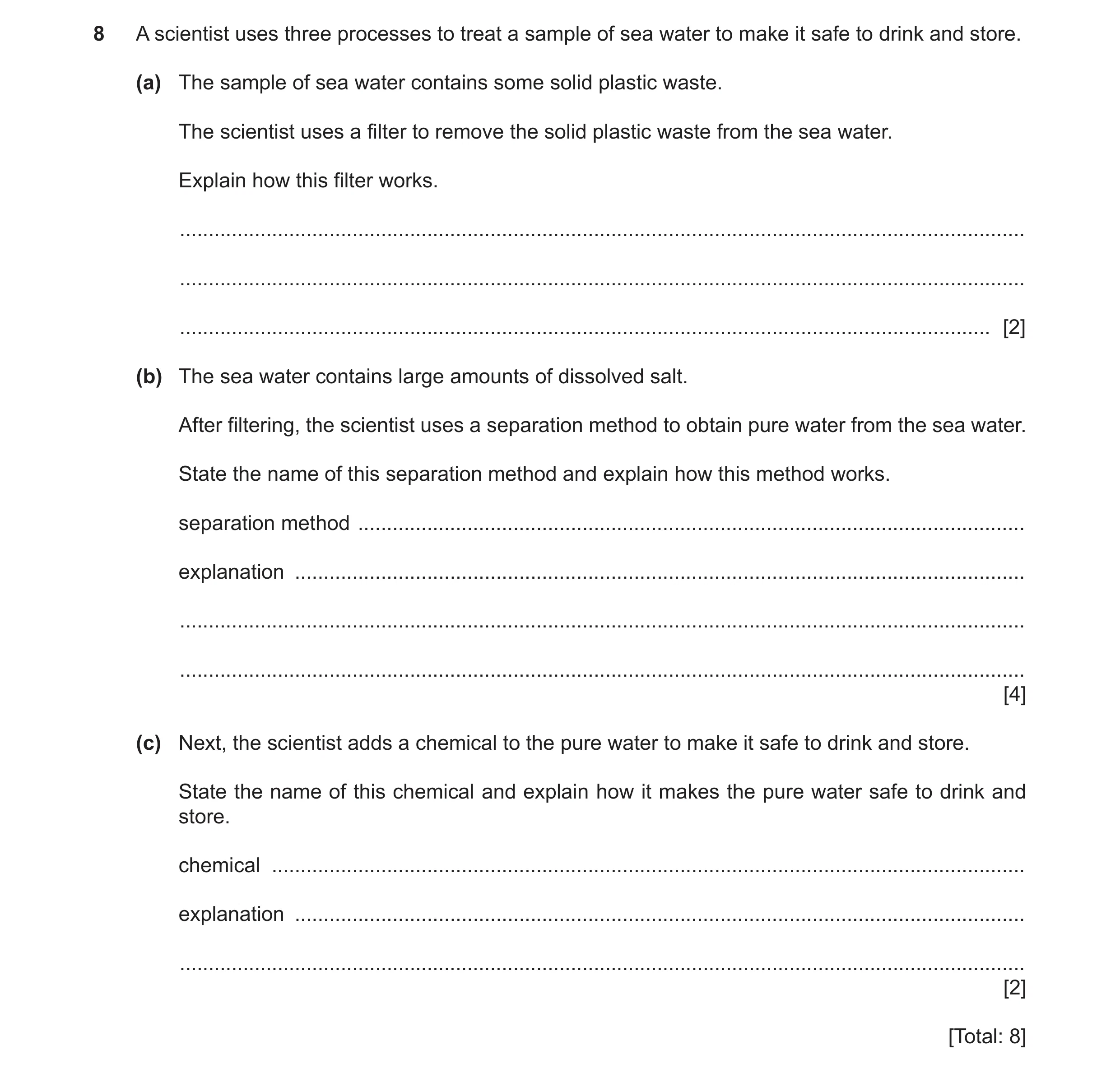
8 A scientist uses three processes to treat a sample of sea water to make it safe to drink and store. (a) The sample of sea water contains some solid plastic waste. The scientist uses a filter to remove the solid plastic waste from the sea water. Explain how this filter works. … … … [2] (b) The sea water contains large amounts of dissolved salt. After filtering, the scientist uses a separation method to obtain pure water from the sea water. State the name of this separation method and explain how this method works. separation method … explanation … … … [4] (c) Next, the scientist adds a chemical to the pure water to make it safe to drink and store. State the name of this chemical and explain how it makes the pure water safe to drink and store. chemical … explanation … … [2] [Total: 8]
8 marks
Mark scheme: 8(a) any two from: (sea) water / solutions, pass through filter ; insoluble materials / plastic / solids, do not pass through filter ; description of, filter / filter paper, as being, porous / having (small) holes ; 2 8(b) distillation ; heat / boil / evaporate, (sea) water ; salt is left behind ; condense / cool, steam / water vapour (to obtain pure water); 4 8(c) chlorine ; kills any bacteria in the water ; 2
This question in 0653/41 Oct/Nov 2021
Q10 · Some information about alkanes and alkenes 0653/41 May/June 2023
5 Table 5.1 shows some information about alkanes and alkenes. Table 5.1 alkanes alkenes number of carbon atoms per molecule name formula name formula 1 methane CH4 does not exist 2 ethane ethene C2H4 3 propane C3H8 propene C3H6 4 butane C4H10 butene C4H8 8 octane C8H18 octene (a) The general formula of alkanes is CnH(2n+2). Deduce the general formula of alkenes. … [1] (b) Complete the table by filling in the formulae for ethane and for octene. [2] (c) Fig. 5.1 shows the structures of ethene and propene. ethene propene H H H H C C C C H H H CH3 Fig. 5.1 (i) Ethene and propene are unsaturated hydrocarbons. State what is meant by unsaturated and hydrocarbons. unsaturated … … hydrocarbons … … [2] (ii) Explain why methene does not exist. … … … [2] (d) Refinery gas, obtained from petroleum, contains both propane and butane. (i) State one use of refinery gas. … [1] (ii) Explain why propane and butane are in the same fraction. … [1] [Total: 9]
9 marks
Mark scheme: 5(a) CnH2n ; 1 5(b) C2H6 ; C8H16 ; 2 5(c)(i) (unsaturated because) they contain a (carbon-carbon) double bond ; (hydrocarbons) contain hydrogen and carbon only ; 2 5(c)(ii) (the idea that methene would contain) only one carbon atom / an alkene needs (at least) two carbon atoms ; the idea that a (C = C) double bond cannot form ; 2 5(d)(i) bottled gas / heating / cooking ; 1 5(d)(ii) similar boiling point ; 1
This question in 0653/41 May/June 2023
Q11 · Cracking decane, C10H22, forms three compounds, as shown in Fig 0653/42 May/June 2023
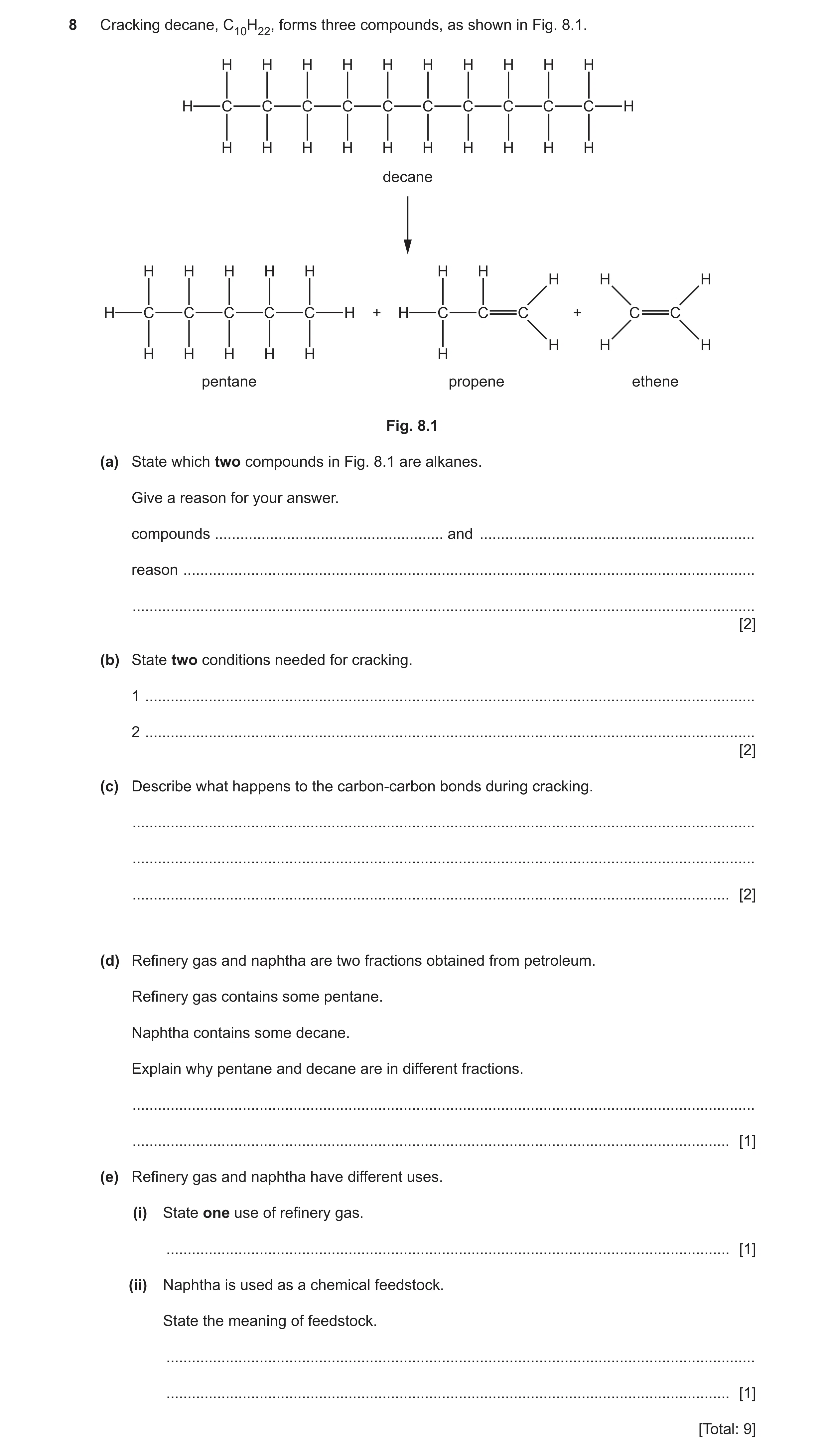
8 Cracking decane, C10H22, forms three compounds, as shown in Fig. 8.1. H H H H H H H H H H H C C C C C C C C C C H H H H H H H H H H H decane H H H H H H H H H H H C C C C C H + H C C C + C C H H H H H H H H H pentane propene ethene Fig. 8.1 (a) State which two compounds in Fig. 8.1 are alkanes. Give a reason for your answer. compounds … and … reason … … [2] (b) State two conditions needed for cracking. 1 … 2 … [2] (c) Describe what happens to the carbon-carbon bonds during cracking. … … … [2] (d) Refinery gas and naphtha are two fractions obtained from petroleum. Refinery gas contains some pentane. Naphtha contains some decane. Explain why pentane and decane are in different fractions. … … [1] (e) Refinery gas and naphtha have different uses. (i) State one use of refinery gas. … [1] (ii) Naphtha is used as a chemical feedstock. State the meaning of feedstock. … … [1] [Total: 9]
9 marks
Mark scheme: 8(a) decane and pentane ; reason: they are saturated (hydrocarbons) / do not contain double (C=C) bonds / contain only single bonds ; 2 8(b) any two from: high temperature ; high pressure ; catalyst ; 2 8(c) (some carbon – carbon single) bonds break ; (some) carbon atoms form double bonds (with each other) ; 2 8(d) they have different boiling points ; 1 8(e)(i) bottled gas / heating and cooking ; 1 8(e)(ii) (source / reactant for) making (other) chemicals ; 1
This question in 0653/42 May/June 2023
Q12 · Petroleum contains a mixture of hydrocarbons 0653/42 Feb/March 2024
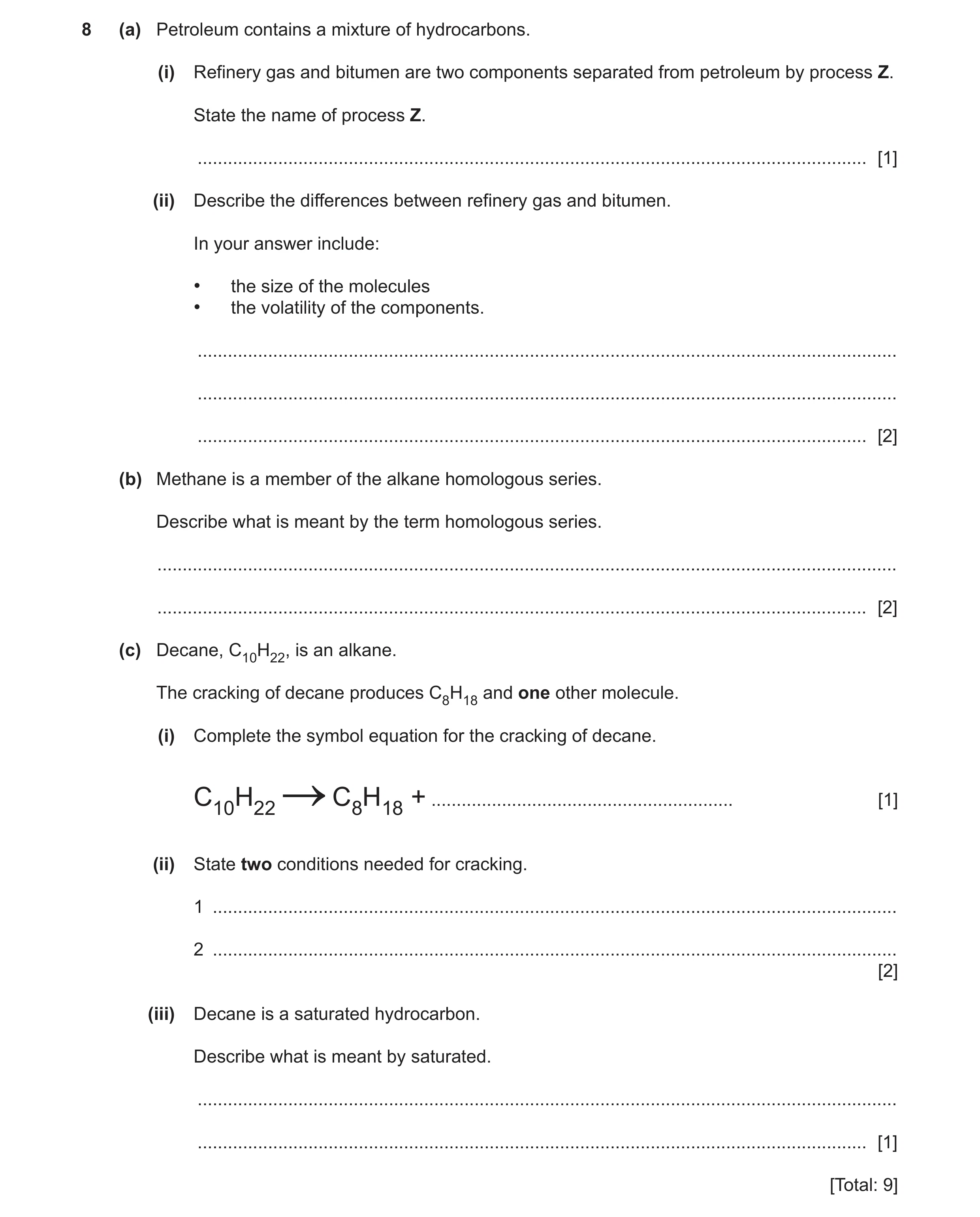
8 (a) Petroleum contains a mixture of hydrocarbons. (i) Refinery gas and bitumen are two components separated from petroleum by process Z. State the name of process Z. … [1] (ii) Describe the differences between refinery gas and bitumen. In your answer include: • the size of the molecules • the volatility of the components. … … … [2] (b) Methane is a member of the alkane homologous series. Describe what is meant by the term homologous series. … … [2] (c) Decane, C10H22, is an alkane. The cracking of decane produces C8H18 and one other molecule. (i) Complete the symbol equation for the cracking of decane. … [1] C10H22 C8H18 + (ii) State two conditions needed for cracking. 1 … 2 … [2] (iii) Decane is a saturated hydrocarbon. Describe what is meant by saturated. … … [1] [Total: 9]
9 marks
Mark scheme: 8(a)(i) fractional and distillation ; 1 8(a)(ii) refinery gas: 2 smaller molecules ; more volatile ; ORA 8(b) (family of compounds with): 2 same general formula ; similar chemical properties ; 8(c)(i) C2H4 ; 1 8(c)(ii) any two from: 2 high temperature / 400−700 C ; high pressure / 60–70 atmosphere ; catalyst ; 8(c)(iii) contains only single (C-C) (covalent) bonds / does not contain double (C=C) (covalent) bonds ; 1
This question in 0653/42 Feb/March 2024
Q13 · Different methods of separation are used for different types of mixtures 0653/41 May/June 2024
2 Different methods of separation are used for different types of mixtures. (a) Pure water is separated from a solution of salt and water by distillation. Fig. 2.1 shows the apparatus used for distillation. thermometer A B pure water E D C Fig. 2.1 Identify the labels used in Fig. 2.1. A … B … C … D … E … [3] (b) A different method is used to separate the pure, dry salt from a solution of salt dissolved in water. Describe the method used to produce pure, dry crystals of salt from this solution. … … … [2] (c) Sodium chloride, NaCl, is a salt. It contains sodium ions, Na+, and chloride ions, Cl –. Fig. 2.2 shows the arrangement of ions in solid sodium chloride. One sodium ion is labelled. Label the other ions. Na+ Fig. 2.2 [2] (d) Explain why sodium ions and chloride ions have different charges. Use ideas about electrons in your answer. … … … [2] [Total: 9]
9 marks
Mark scheme: 2(a) A (cold) water (out) (at top) B condenser C (cold) water (in) (at bottom of condenser) D heat/(Bunsen) burner E salt and water / mixture / solution ;;; 5 correct = (3) 3–4 correct = (2) 1–2 correct = (1) 2(b) heat (the solution) ; to remove the water ; 2 Question Answer Marks 2(c) 6 Na and 6 Cl ; alternating Na+ and Cl – both horizontally and vertically ; 2 2(d) sodium (atom) loses an / one electron (to give +1 charge) OR sodium (ion) has one electron fewer than the proton number ; chlorine (atom) gains an / one electron (to give –1 charge) OR chloride (ion) has one electron more than the proton number ; 2
This question in 0653/41 May/June 2024
Q14 · Different types of mixtures need different separation processes to isolate the pure… 0653/42 May/June 2024
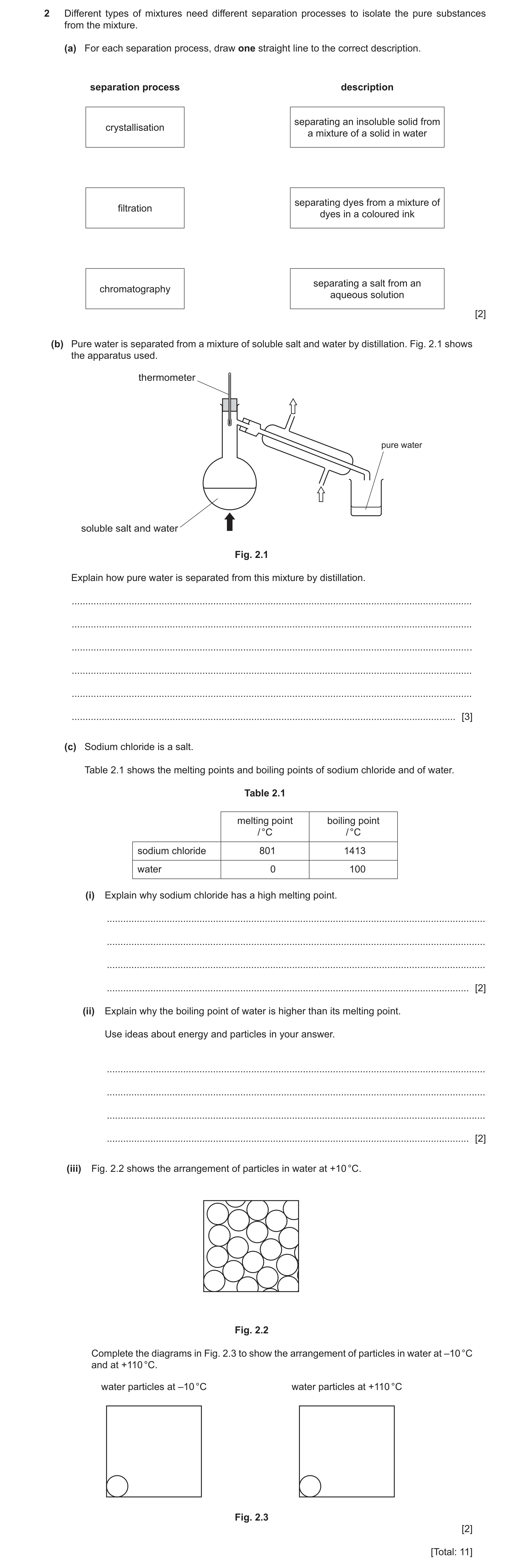
2 Different types of mixtures need different separation processes to isolate the pure substances from the mixture. (a) For each separation process, draw one straight line to the correct description. separation process description separating an insoluble solid from crystallisation a mixture of a solid in water separating dyes from a mixture of filtration dyes in a coloured ink separating a salt from an chromatography aqueous solution [2] (b) Pure water is separated from a mixture of soluble salt and water by distillation. Fig. 2.1 shows the apparatus used. thermometer pure water soluble salt and water Fig. 2.1 Explain how pure water is separated from this mixture by distillation. … … … … … … [3] (c) Sodium chloride is a salt. Table 2.1 shows the melting points and boiling points of sodium chloride and of water. Table 2.1 melting point boiling point / °C / °C sodium chloride 801 1413 water 0 100 (i) Explain why sodium chloride has a high melting point. … … … … [2] (ii) Explain why the boiling point of water is higher than its melting point. Use ideas about energy and particles in your answer. … … … … [2] (iii) Fig. 2.2 shows the arrangement of particles in water at +10 °C. Fig. 2.2 Complete the diagrams in Fig. 2.3 to show the arrangement of particles in water at –10 °C and at +110 °C. water particles at –10 °C water particles at +110 °C Fig. 2.3 [2] [Total: 11]
11 marks
Mark scheme: 2(a) separation process description crystallisation separating an insoluble solid from a mixture of a solid in water filtration separating dyes from a mixture of dyes in a coloured ink chromatography separating a salt from an aqueous solution ;; all three correct = (2) one or two correct = (1) 2 2(b) water, boils / is heated and evaporates / becomes steam / becomes water vapour / leaves the flask ; steam / vapour / it is, cooled in the condenser OR steam / vapour / it, condenses ; salt is left behind / salt does not evaporate (with the water) / only water evaporates ; 3 2(c)(i) any two from: is ionic / has ionic bonds ; strong attraction / force, between ions (in ionic lattice) ; due to opposite charges / ions have opposite charges ; need lots of energy to, break bonds / separate the ions / separate the particles (therefore high mp) ; 2 Question Answer Marks 2(c)(ii) energy is needed to, change state / make particles move (more) ; more energy needed to, overcome forces between / separate particles when, changing from liquid to gas than from solid to liquid ; 2 2(c)(iii) particles in solid (–10 °C) in regular arrangement, consistent size and touching ; fewer particles in gas (+110 °C), consistent size and not touching ; 2
This question in 0653/42 May/June 2024
 4 / 20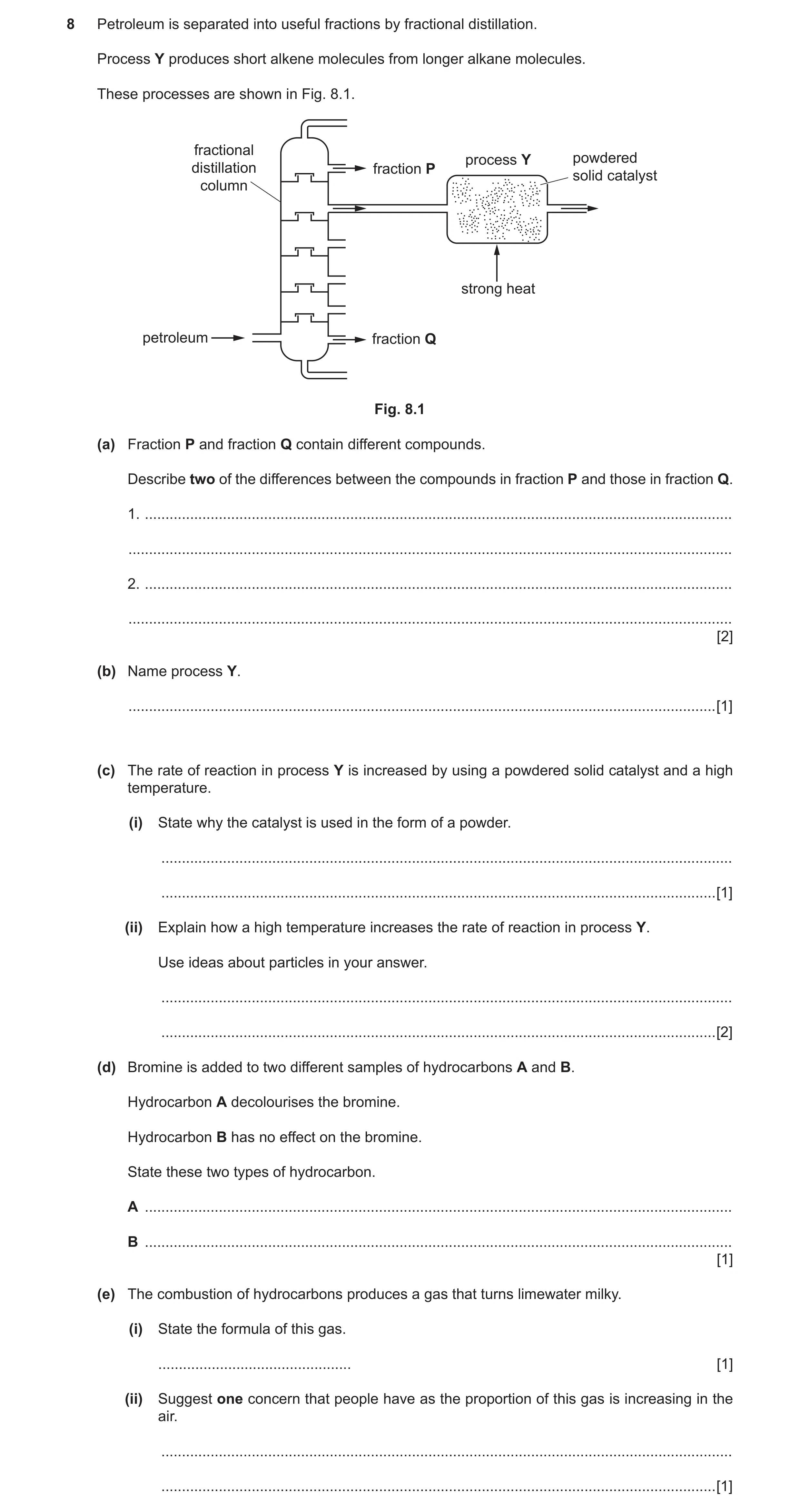
 11 / 20
 12 / 20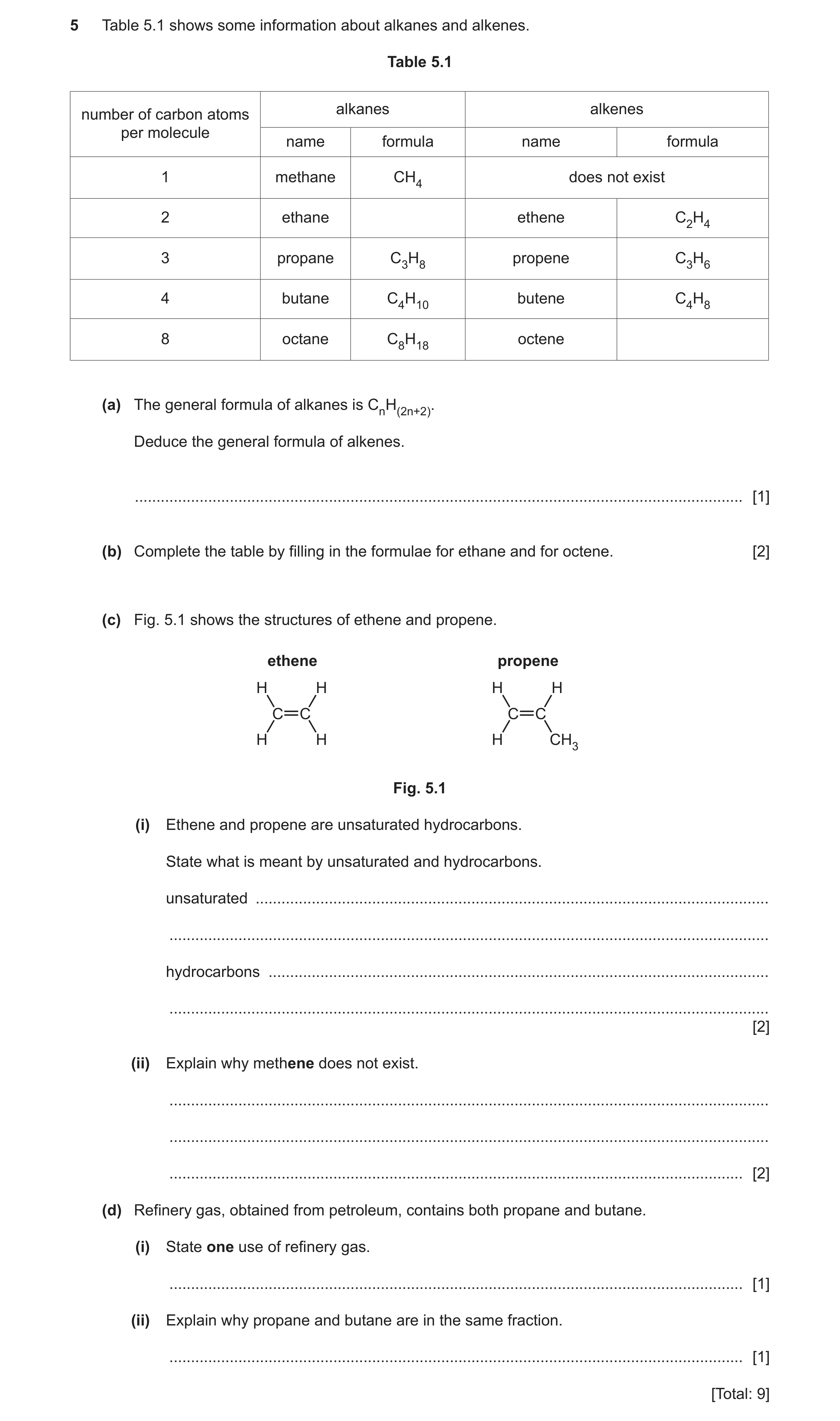
 16 / 20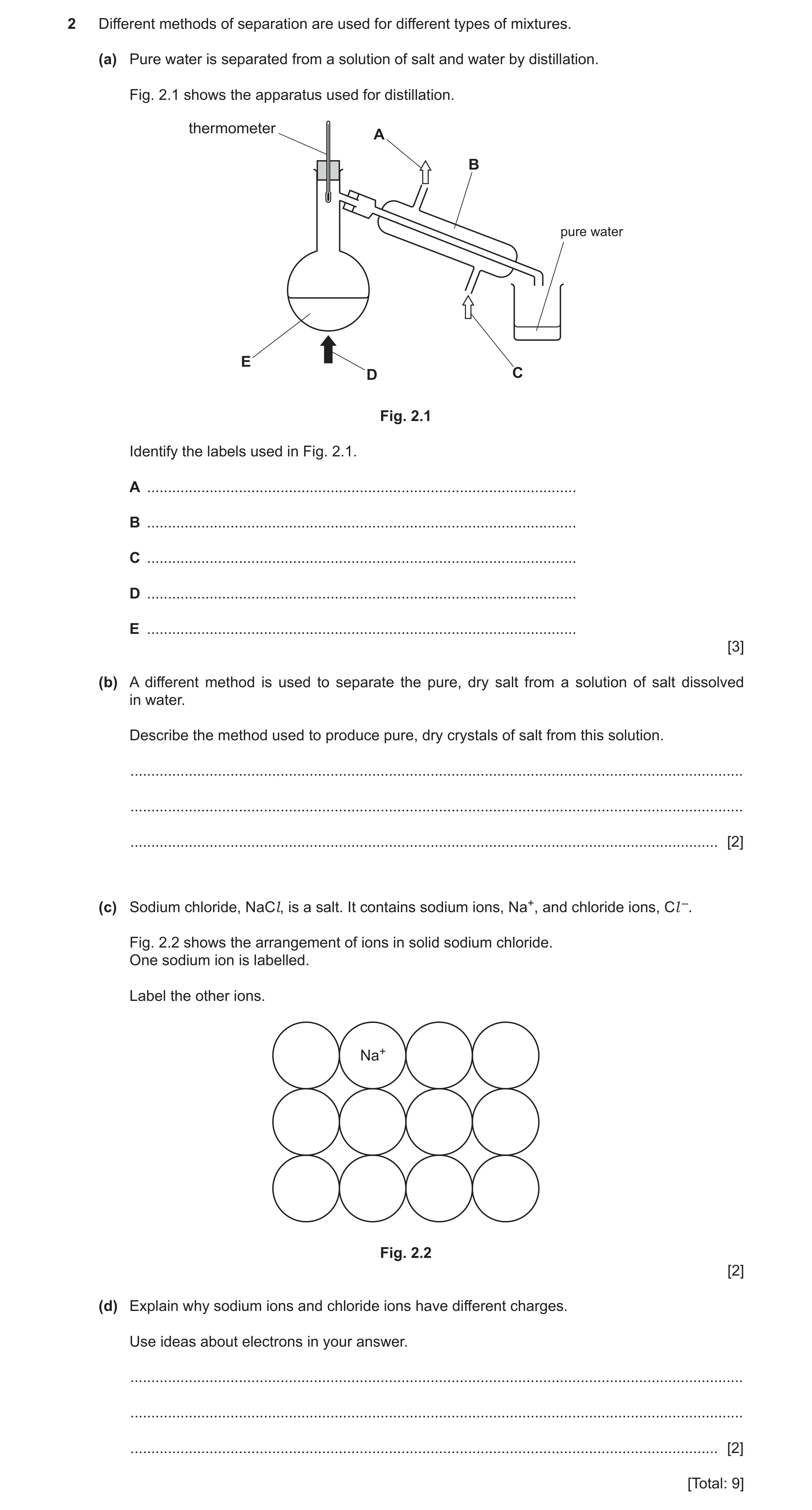
 9
9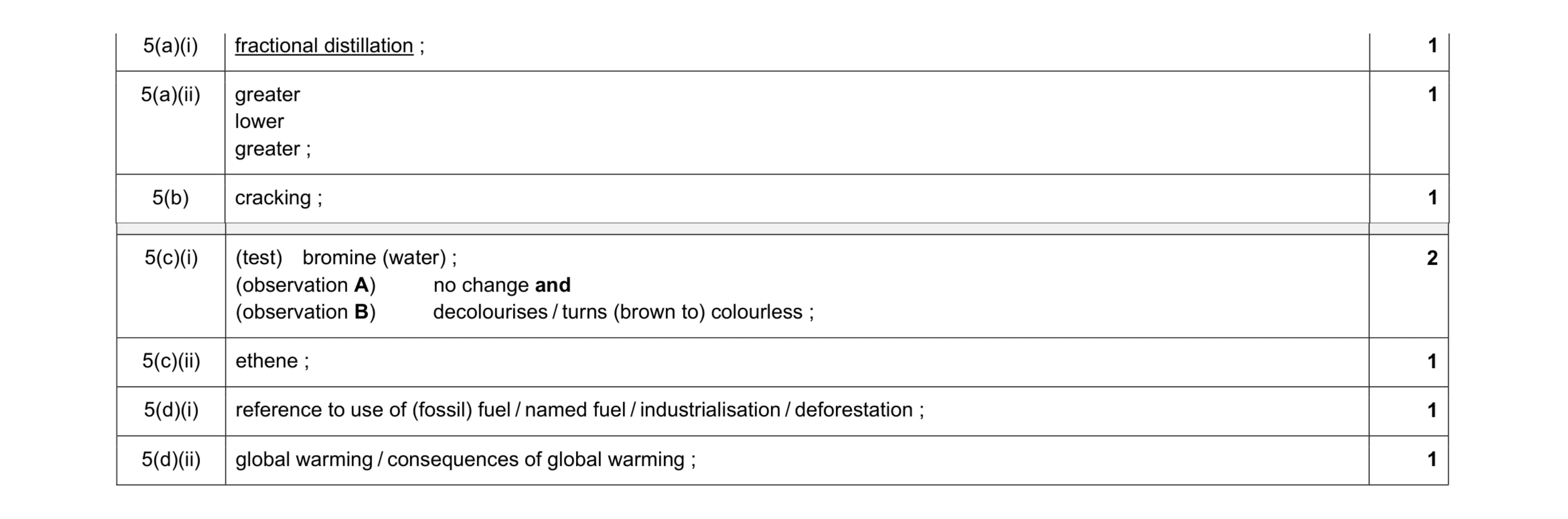 8
8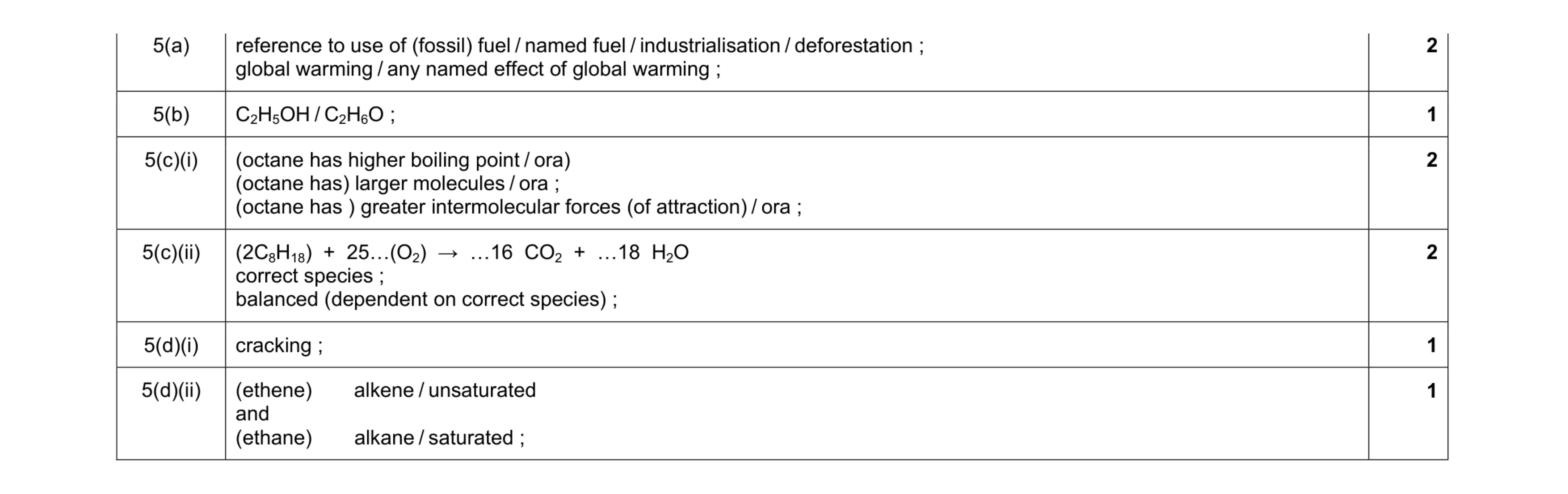 9
9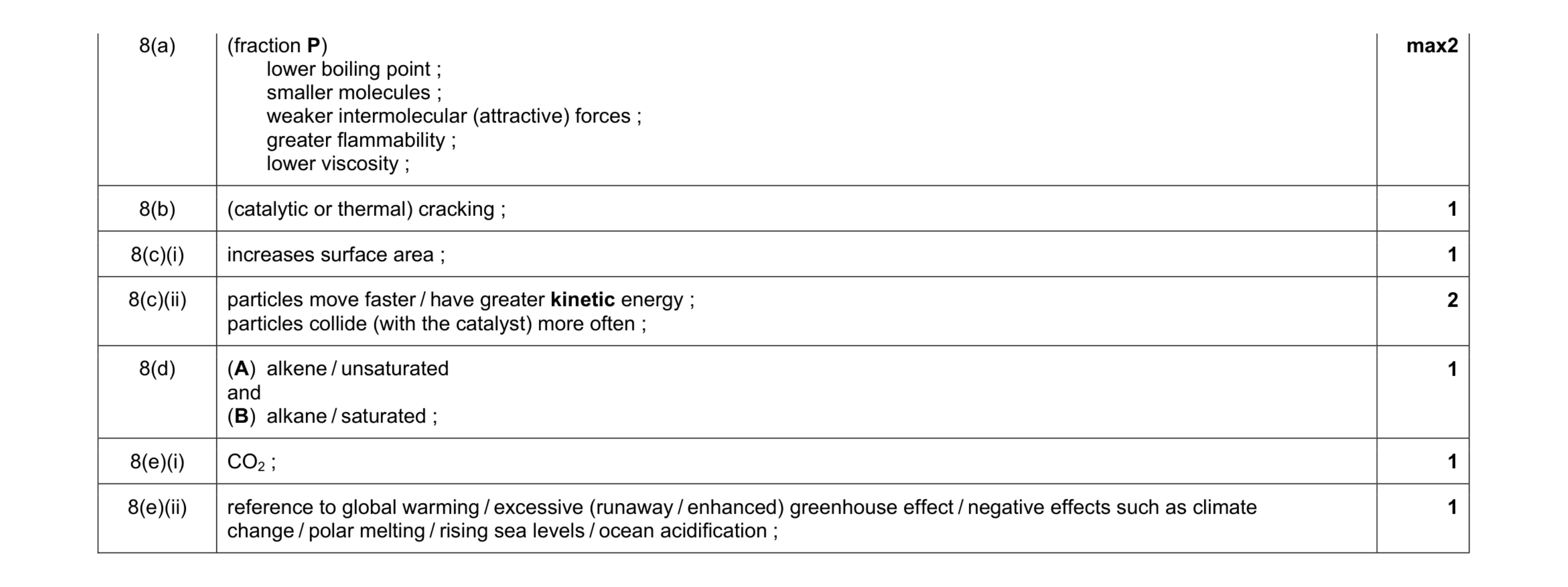 9
9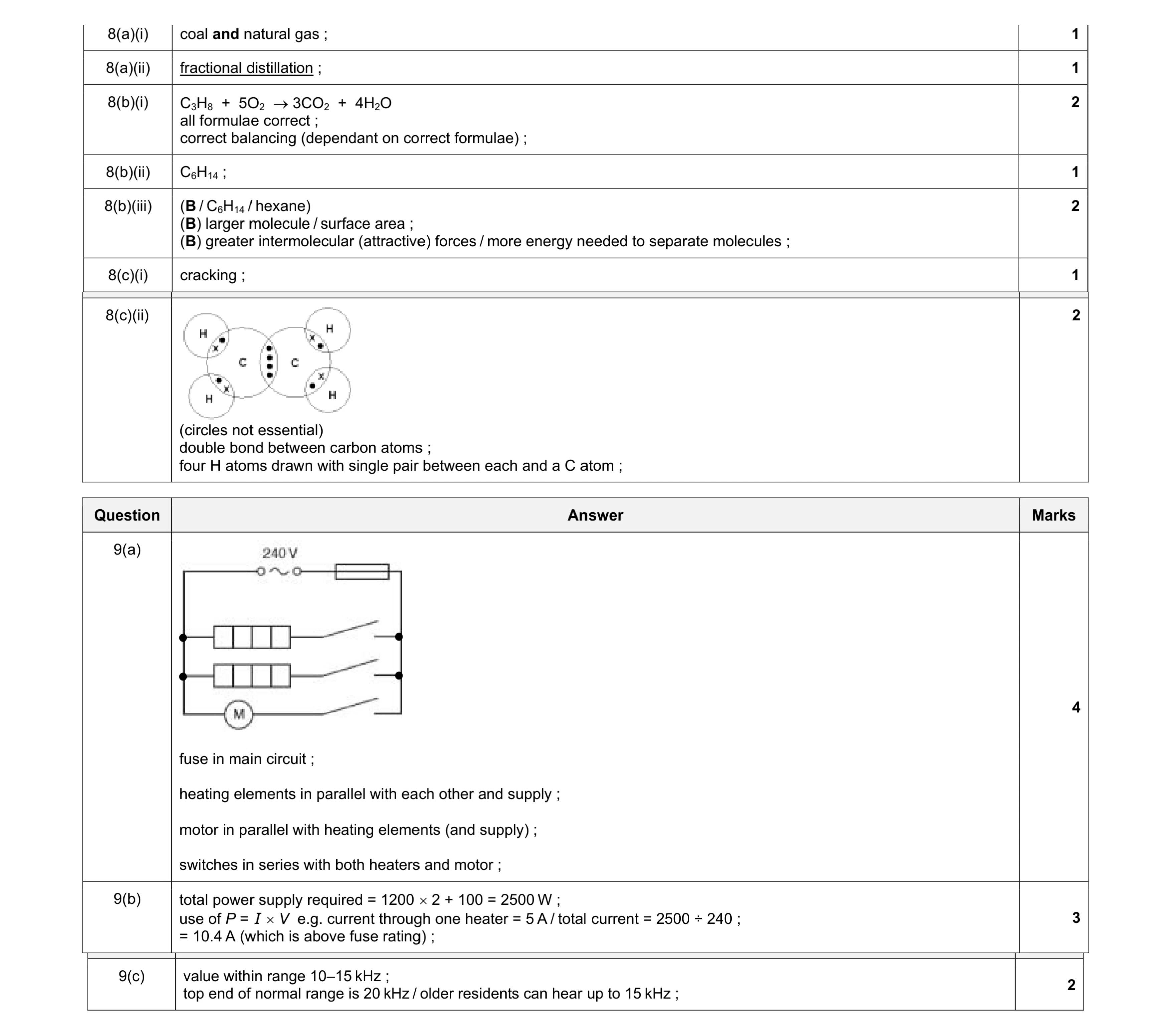 10
10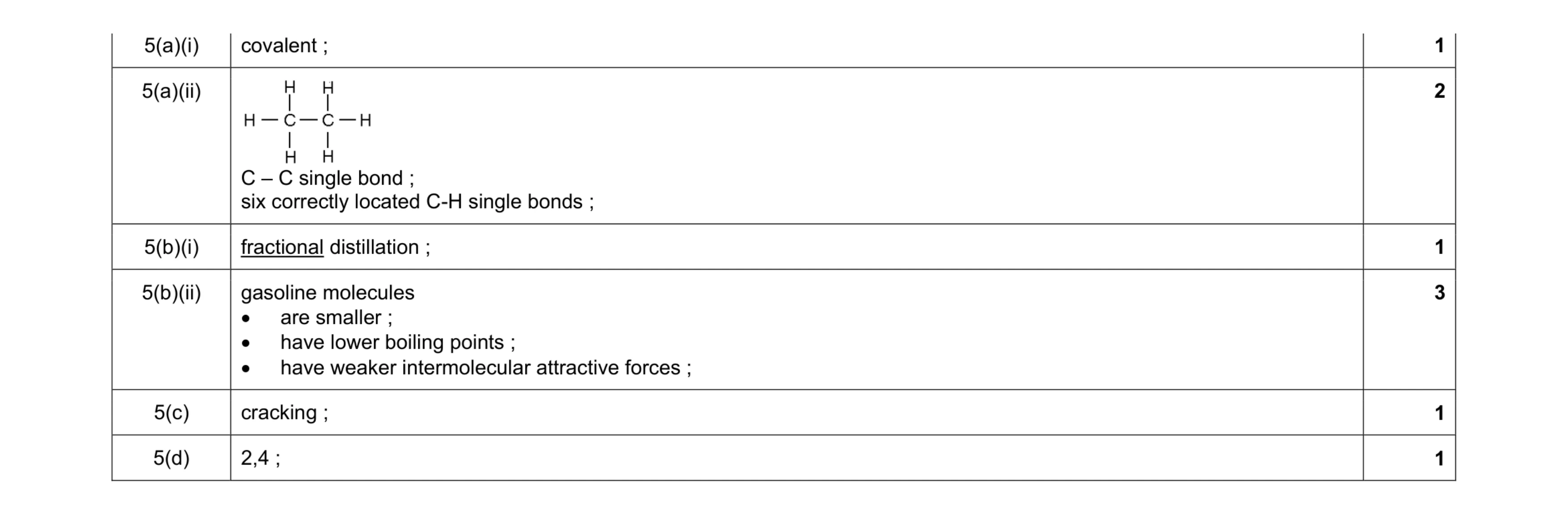 9
9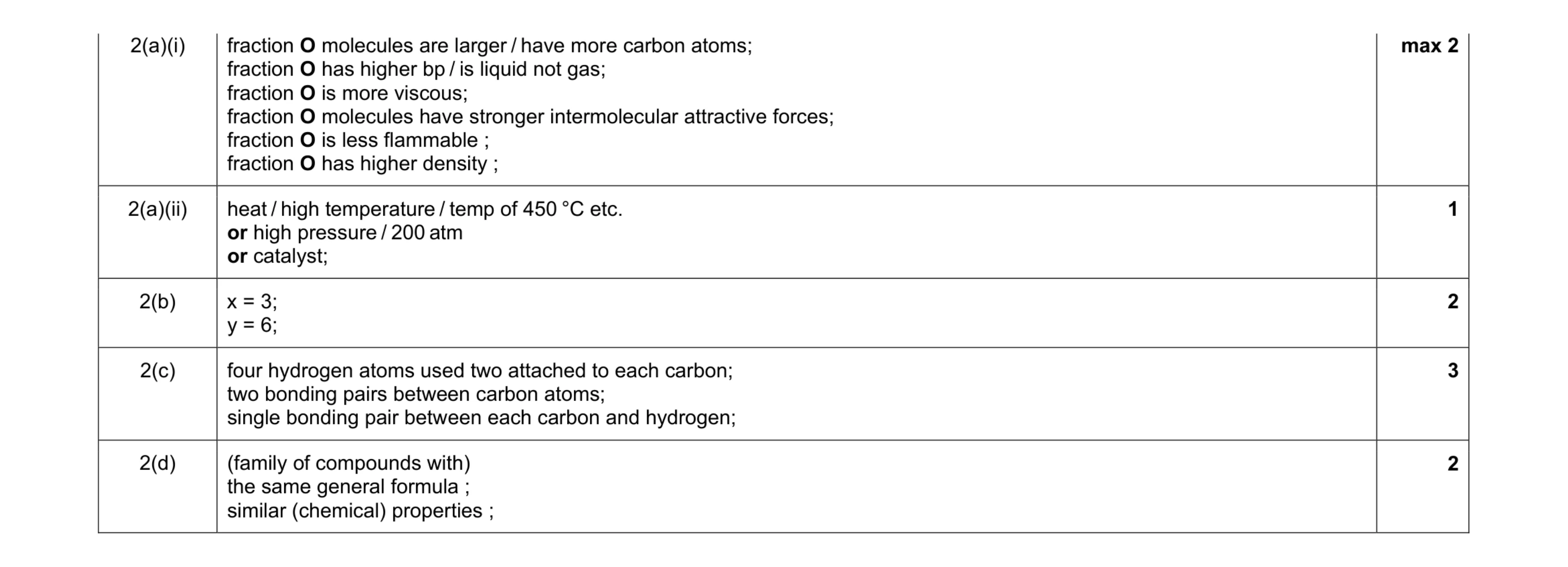 10
10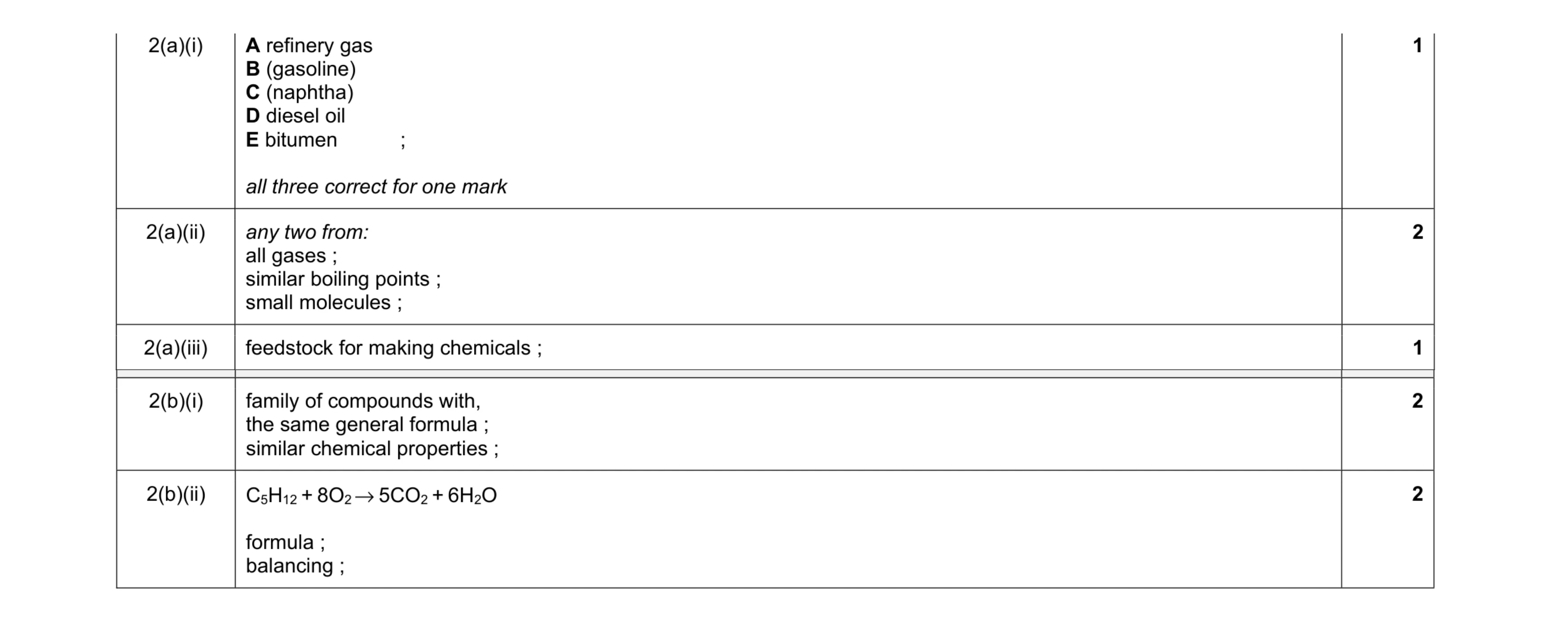 8
8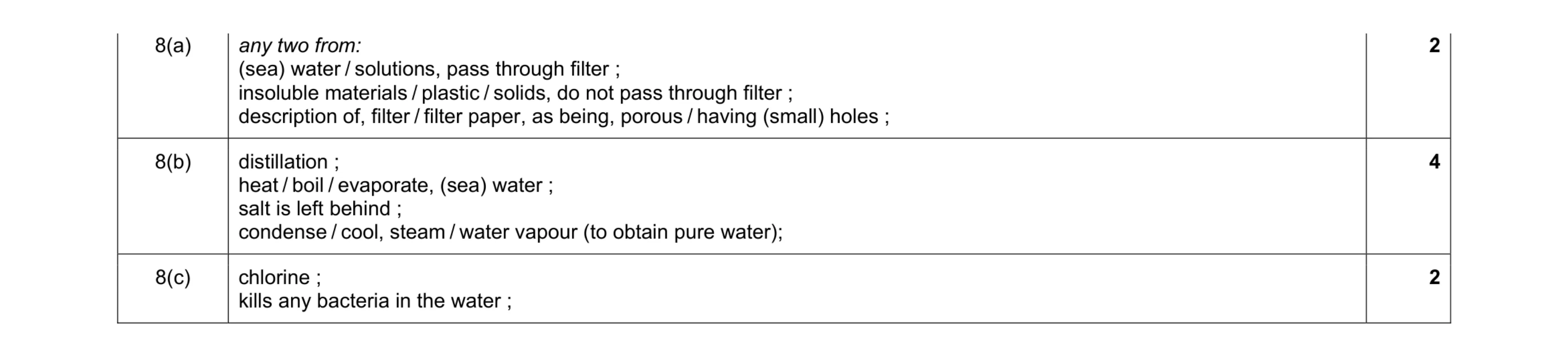 8
8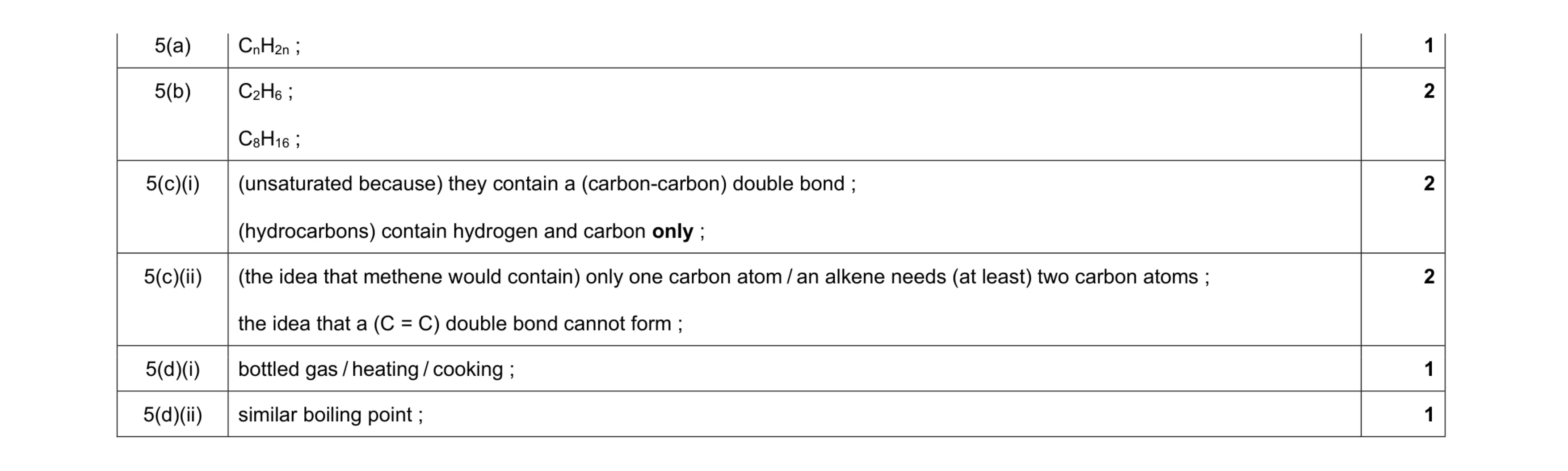 9
9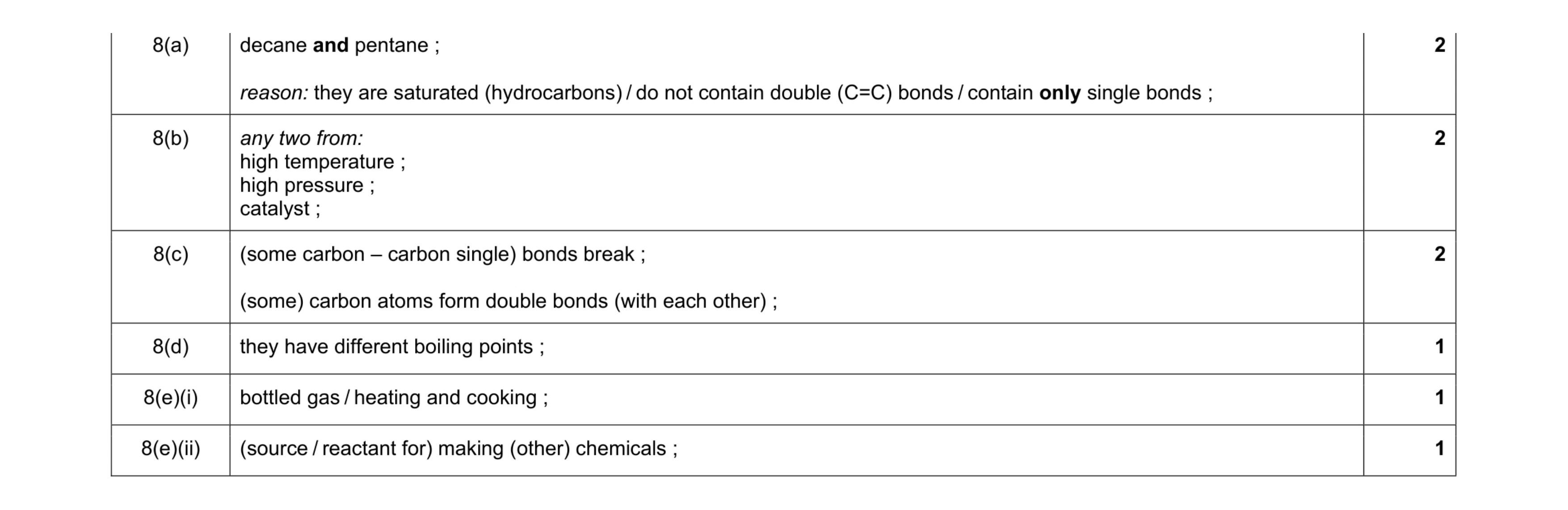 9
9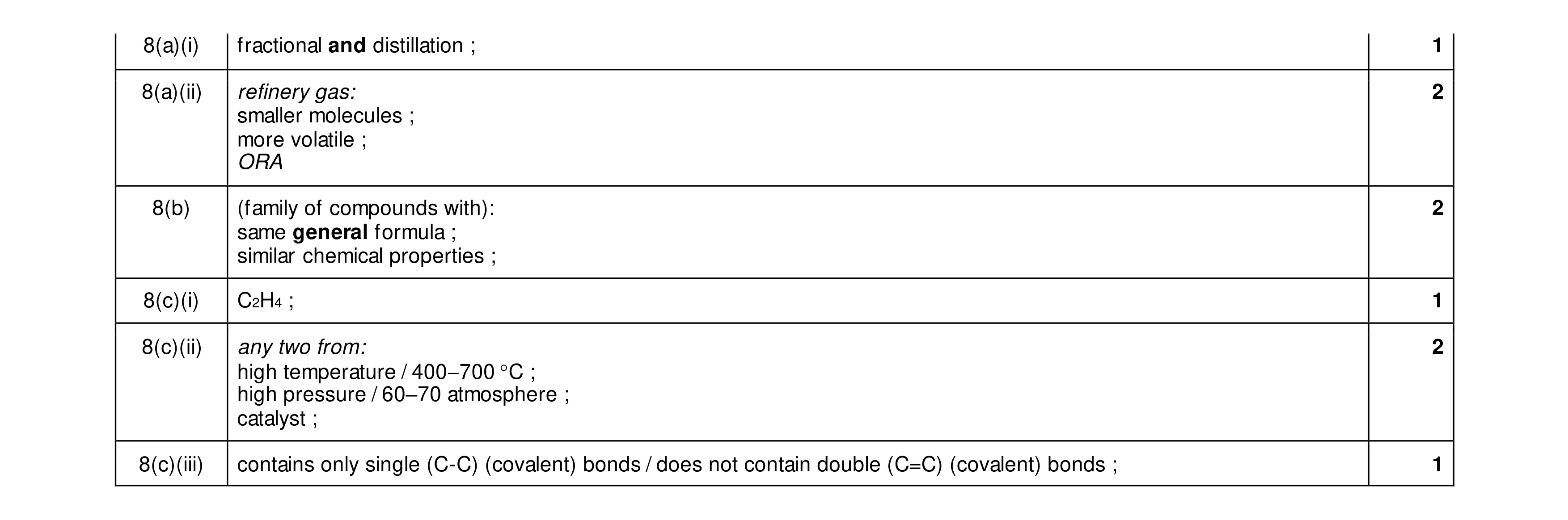 9
9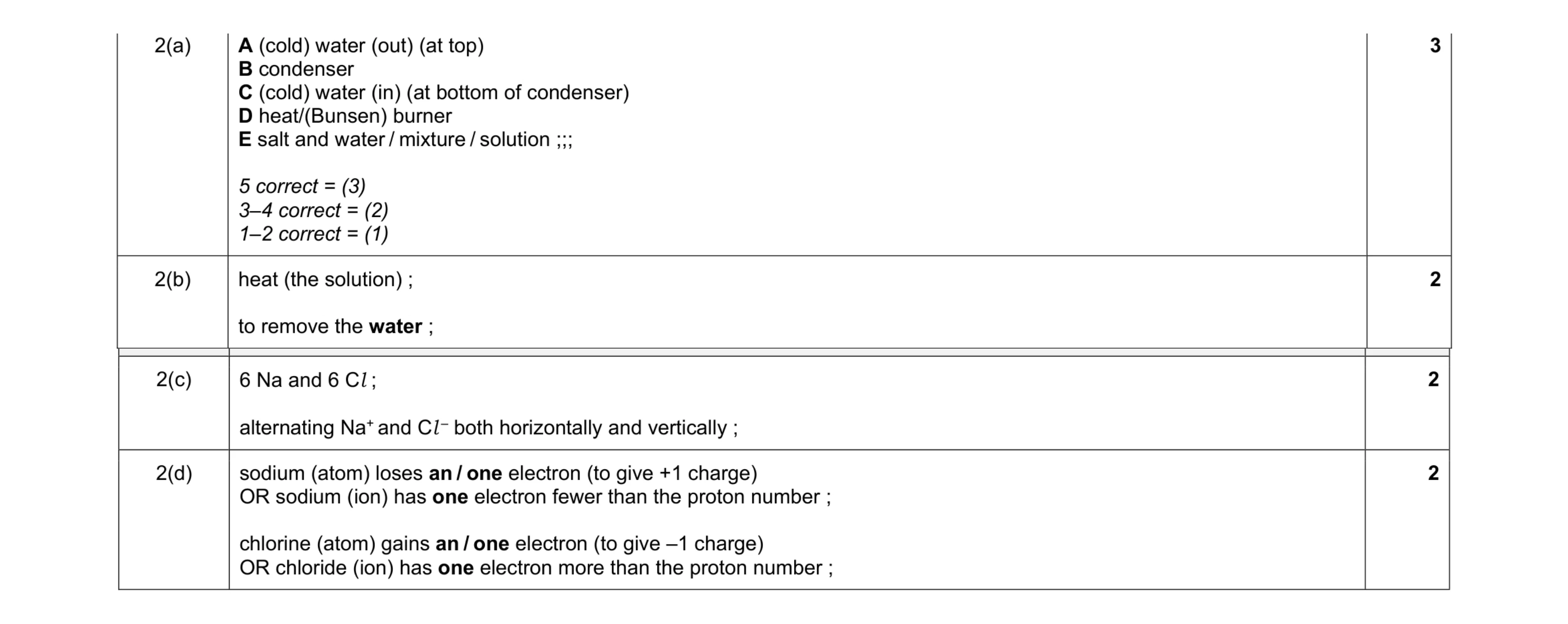 9
9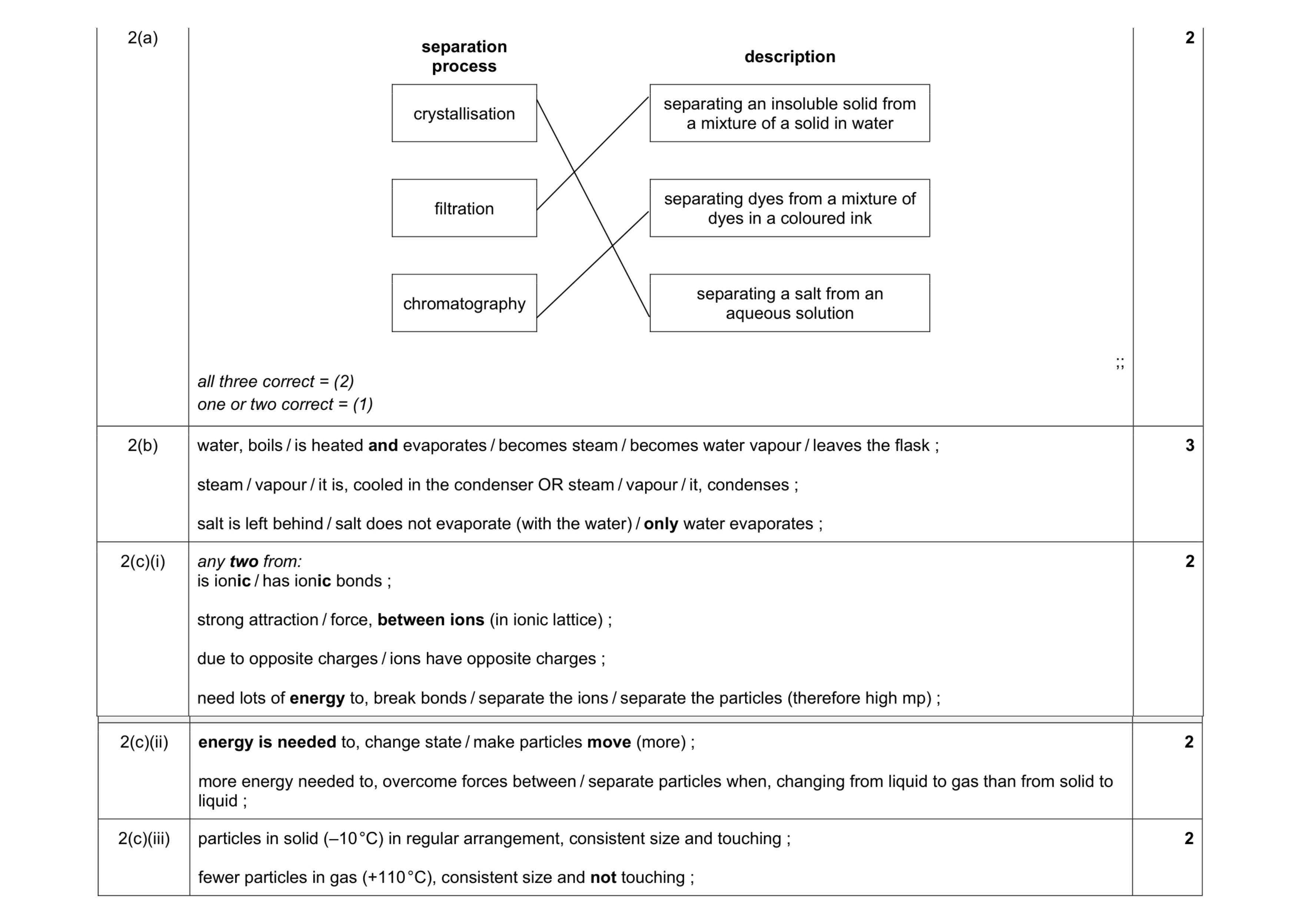 11
11