Questions as text
Q1 · Which pair of hydrocarbons can be distinguished from each other by the addition of… 0653/22 Feb/March 2017
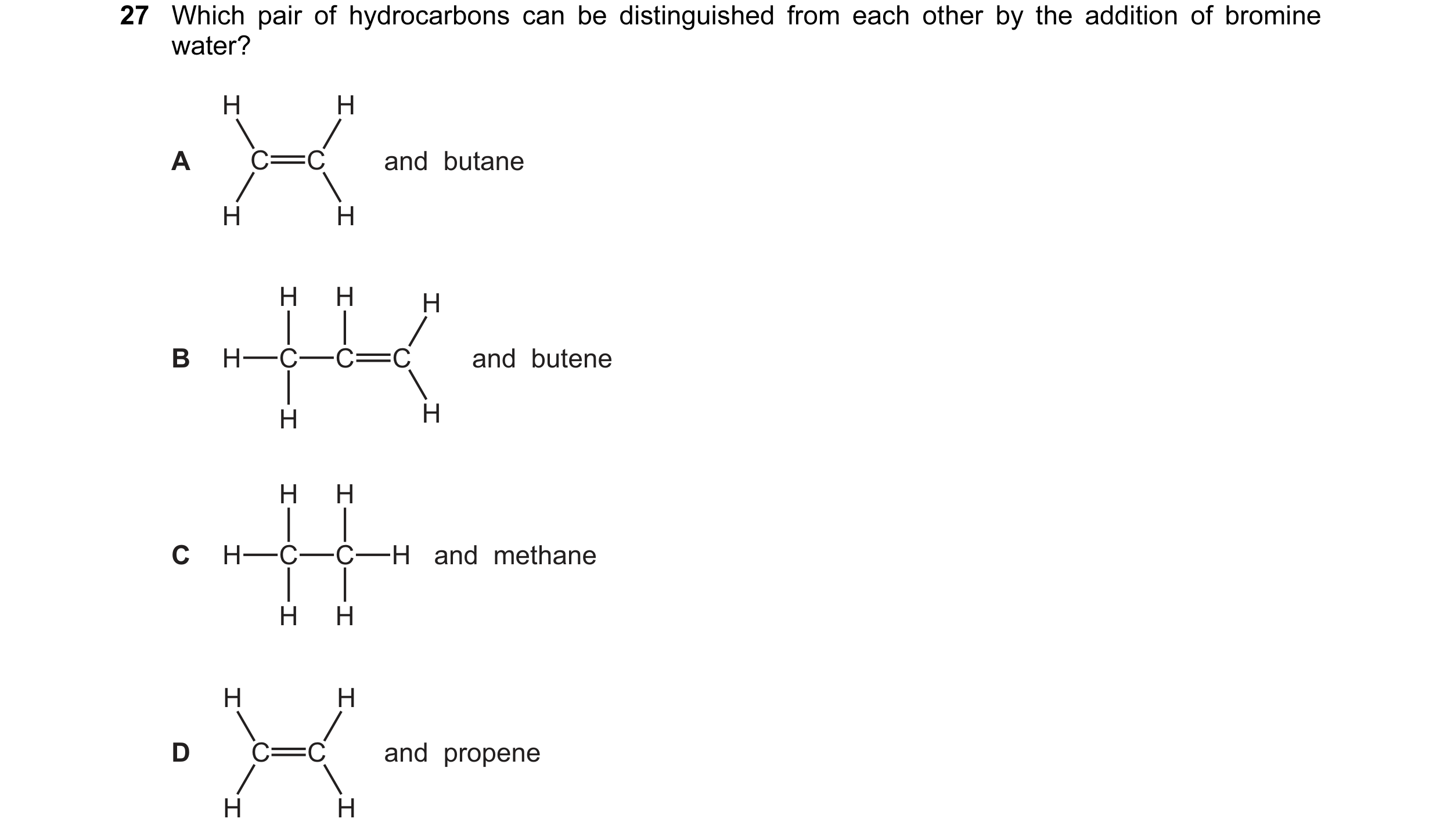
27 Which pair of hydrocarbons can be distinguished from each other by the addition of bromine water? H H A C C and butane H H H H H B H C C C and butene H H H H C H C C H and methane H H H H D C C and propene H H
1 marks
Answer: A
This question in 0653/22 Feb/March 2017
Q2 · Which statement about hydrocarbons is not correct? 0653/23 May/June 2018
27 Which statement about hydrocarbons is not correct? A Alkenes are made by cracking alkanes. B Butene decolourises bromine. C C2H4 is an alkene. D Ethanol is an alkane.
1 marks
Answer: D
This question in 0653/23 May/June 2018
Q3 · Which statement describes compounds in the same homologous series? 0653/22 Feb/March 2019
27 Which statement describes compounds in the same homologous series? A They have different general formulae and different chemical properties. B They have different general formulae and similar chemical properties. C They have the same general formula and different chemical properties. D They have the same general formula and similar chemical properties.
1 marks
Answer: D
This question in 0653/22 Feb/March 2019
Q4 · Which statement about alkanes is correct? 0653/22 May/June 2019
26 Which statement about alkanes is correct? A Alkanes are compounds containing carbon, hydrogen and oxygen. B Alkanes are saturated hydrocarbons. C Ethane is used to make poly(ethene). D Methane is the only alkane that does not contain a double bond.
1 marks
Answer: B
This question in 0653/22 May/June 2019
Q5 · Which hydrocarbons belong to the same homologous series? 0653/22 Oct/Nov 2019
27 Which hydrocarbons belong to the same homologous series? A C2H2, C2H4, C2H6 B CH4, C2H4, C3H4 C C2H4, C3H6, C4H8 D C2H4, C3H8, C4H10
1 marks
Answer: C
This question in 0653/22 Oct/Nov 2019
Q6 · Which diagram represents a molecule of methanol? 0653/22 Feb/March 2020
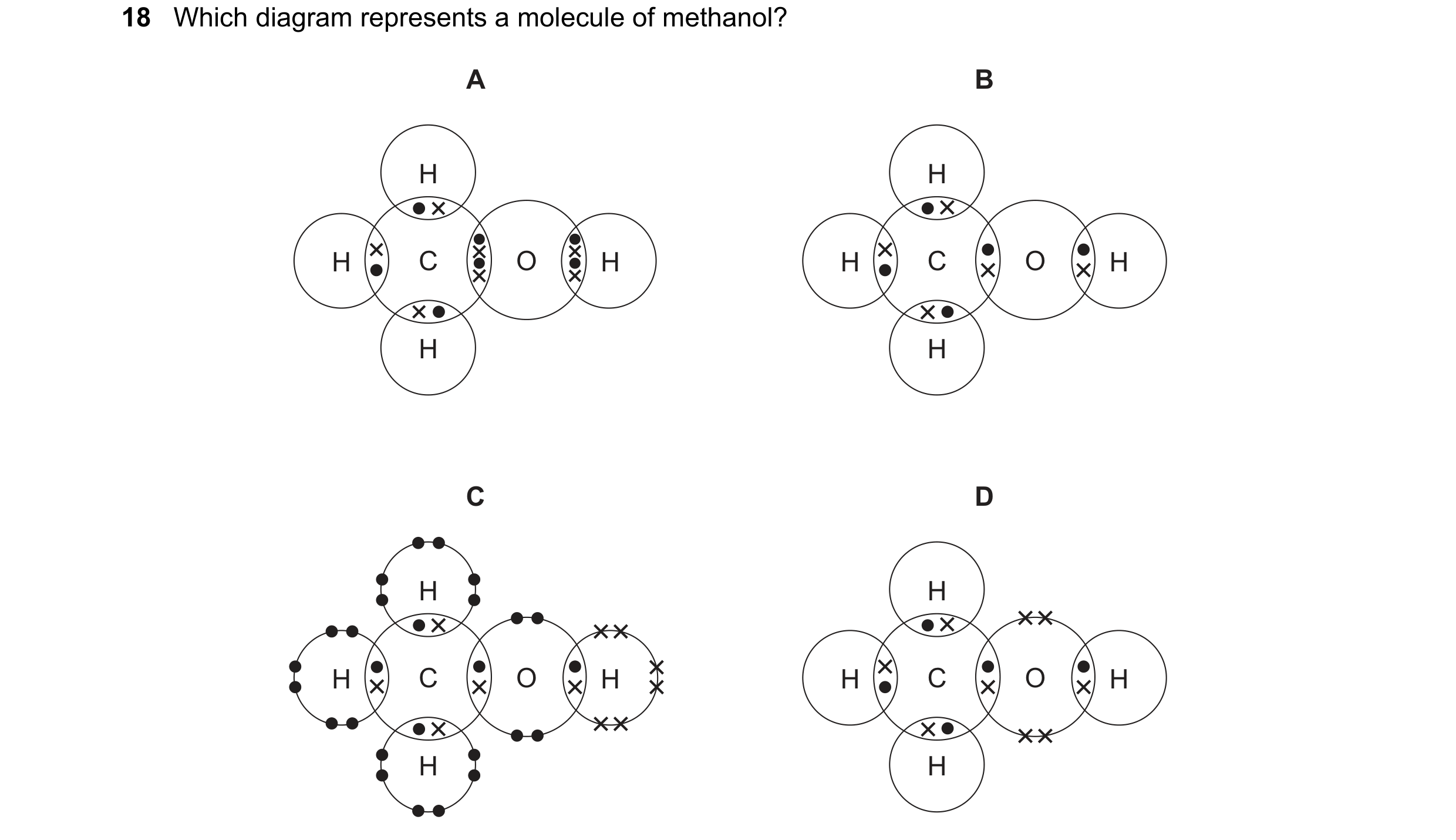
18 Which diagram represents a molecule of methanol? A B H H H C O H H C O H H H C D H H H C O H H C O H H H
1 marks
Answer: D
This question in 0653/22 Feb/March 2020
Q7 · In which list are all of the hydrocarbons in the same homologous series? 0653/22 May/June 2020
27 In which list are all of the hydrocarbons in the same homologous series? A CH4, C2H6, C3H8, C5H10 B C2H4, C2H6, C3H6, C4H8 C C2H4, C3H6, C4H8, C5H10 D C2H6, C3H6, C4H8, C5H10
1 marks
Answer: C
This question in 0653/22 May/June 2020
Q8 · Which statement describes a hydrocarbon? 0653/21 Oct/Nov 2020
26 Which statement describes a hydrocarbon? A a compound that burns to form carbon dioxide and hydrogen B a compound that contains carbon and hydrogen only C a compound that only contains ionic bonds D a compound that reacts easily with metals
1 marks
Answer: B
This question in 0653/21 Oct/Nov 2020
Q9 · Which statement describes a hydrocarbon? 0653/22 Oct/Nov 2020
27 Which statement describes a hydrocarbon? A a compound that burns to form carbon dioxide and hydrogen B a compound that contains carbon and hydrogen only C a compound that only contains ionic bonds D a compound that reacts easily with metals
1 marks
Answer: B
This question in 0653/22 Oct/Nov 2020
Q10 · Which statement describes a hydrocarbon? 0653/23 Oct/Nov 2020
27 Which statement describes a hydrocarbon? A a compound that burns to form carbon dioxide and hydrogen B a compound that contains carbon and hydrogen only C a compound that only contains ionic bonds D a compound that reacts easily with metals
1 marks
Answer: B
This question in 0653/23 Oct/Nov 2020
Q11 · Which type of compound contains only carbon and hydrogen? 0653/21 May/June 2021
27 Which type of compound contains only carbon and hydrogen? A carbohydrate B carbonate C hydrocarbon D hydroxide
1 marks
Answer: C
This question in 0653/21 May/June 2021
Q12 · Which type of compound contains only carbon and hydrogen? 0653/22 May/June 2021
27 Which type of compound contains only carbon and hydrogen? A carbohydrate B carbonate C hydrocarbon D hydroxide
1 marks
Answer: C
This question in 0653/22 May/June 2021
Q13 · Which type of compound contains only carbon and hydrogen? 0653/23 May/June 2021
27 Which type of compound contains only carbon and hydrogen? A carbohydrate B carbonate C hydrocarbon D hydroxide
1 marks
Answer: C
This question in 0653/23 May/June 2021
Q14 · Alkenes are hydrocarbons that belong to the same homologous series 0653/21 May/June 2022
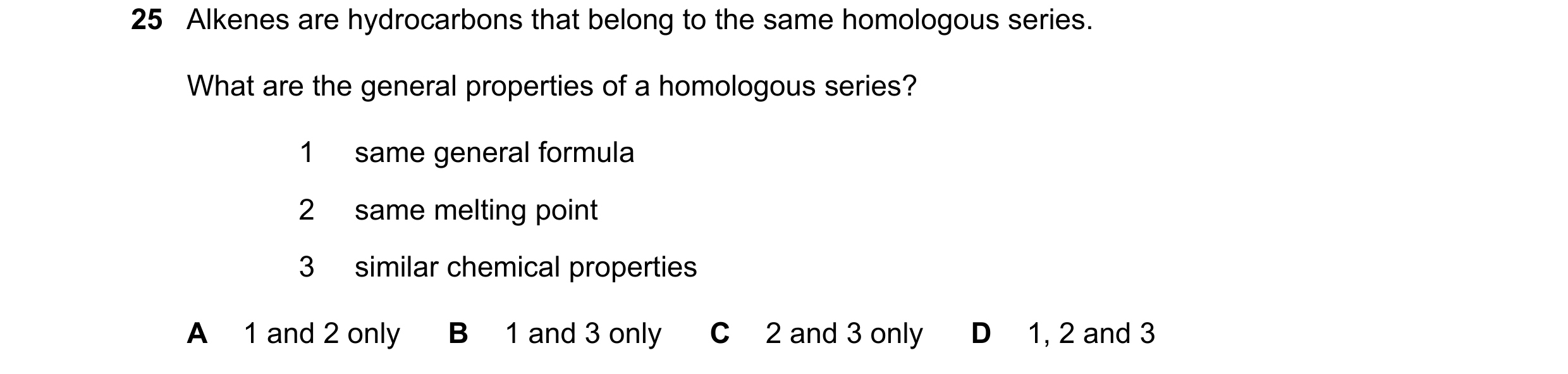
25 Alkenes are hydrocarbons that belong to the same homologous series. What are the general properties of a homologous series? 1 same general formula 2 same melting point 3 similar chemical properties A 1 and 2 only B 1 and 3 only C 2 and 3 only D 1, 2 and 3
1 marks
Answer: B
This question in 0653/21 May/June 2022
Q15 · Which statement about homologous series is correct? 0653/22 May/June 2022
25 Which statement about homologous series is correct? A Alkanes and alkenes have the same general formula. B Alkenes contain only double bonds. C Alkanes and alkenes have similar chemical properties. D Ethene, C2H4, and propene, C3H6, are members of the same homologous series.
1 marks
Answer: D
This question in 0653/22 May/June 2022
Q16 · Which statement best describes the members of a homologous series? 0653/23 May/June 2022
25 Which statement best describes the members of a homologous series? A They have different general formulae and different chemical properties. B They have different general formulae and similar chemical properties. C They have the same general formula and different chemical properties. D They have the same general formula and similar chemical properties.
1 marks
Answer: D
This question in 0653/23 May/June 2022
Q17 · Which statement about the homologous series of alkenes is correct? 0653/22 Feb/March 2023
27 Which statement about the homologous series of alkenes is correct? A They are all saturated hydrocarbons. B They all have the same physical properties. C Their molecules have the same ratio of carbon atoms to hydrogen atoms. D They all have the same molecular formula.
1 marks
Answer: C
This question in 0653/22 Feb/March 2023
Q18 · Why are alkanes members of the same homologous series? 0653/21 May/June 2023
26 Why are alkanes members of the same homologous series? A They are all hydrocarbons. B They have similar physical properties. C They have the same general formula. D They all undergo combustion to give carbon dioxide and water.
1 marks
Answer: C
This question in 0653/21 May/June 2023
Q19 · Which statements about the members of an homologous series are correct? 0653/22 May/June 2023
26 Which statements about the members of an homologous series are correct? 1 They have similar chemical properties. 2 They have the same boiling points. 3 They have the same general formula. A 1, 2 and 3 B 1 and 2 only C 1 and 3 only D 2 and 3 only
1 marks
Answer: C
This question in 0653/22 May/June 2023
Q20 · Which statement about all alkanes is correct? 0653/23 May/June 2023
26 Which statement about all alkanes is correct? A They contain the same number of carbon atoms. B They have different chemical properties. C They have the same general formula. D They have the same melting point.
1 marks
Answer: C
This question in 0653/23 May/June 2023
Q21 · Which statement about alkanes is correct? 0653/21 Oct/Nov 2023
27 Which statement about alkanes is correct? A Their molecules are unsaturated. B They are generally reactive compounds. C They are mixtures of carbon and hydrogen atoms only. D They produce water when they burn.
1 marks
Answer: D
This question in 0653/21 Oct/Nov 2023
Q22 · Decane is an alkane 0653/22 Oct/Nov 2023
27 Decane is an alkane. Which statement about decane is correct? A It burns in air to form carbon dioxide and hydrogen. B It is an unsaturated hydrocarbon. C It only contains single C–C and C–H bonds. D It rapidly decolourises bromine water.
1 marks
Answer: C
This question in 0653/22 Oct/Nov 2023
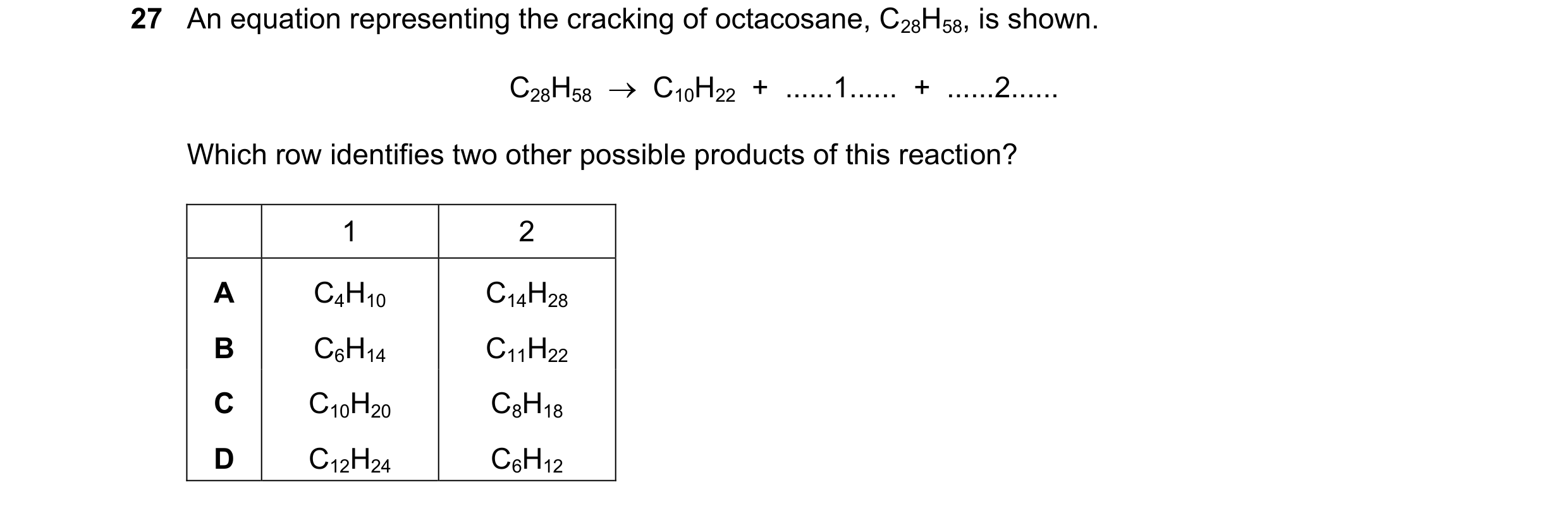
Q23 · An equation representing the cracking of octacosane, C28H58, is shown 0653/22 Feb/March 2024
27 An equation representing the cracking of octacosane, C28H58, is shown. C28H58 C10H22 + … 1 … + … 2 … Which row identifies two other possible products of this reaction? 1 2 A C4H10 C14H28 B C6H14 C11H22 C C10H20 C8H18 D C12H24 C6H12
1 marks
Answer: D
This question in 0653/22 Feb/March 2024
Q24 · Which statement about alkenes is correct? 0653/22 May/June 2024
26 Which statement about alkenes is correct? A They are saturated hydrocarbons. B They have the general formula CnH2n+2. C They have similar chemical properties. D They are all gases at room temperature.
1 marks
Answer: C
This question in 0653/22 May/June 2024
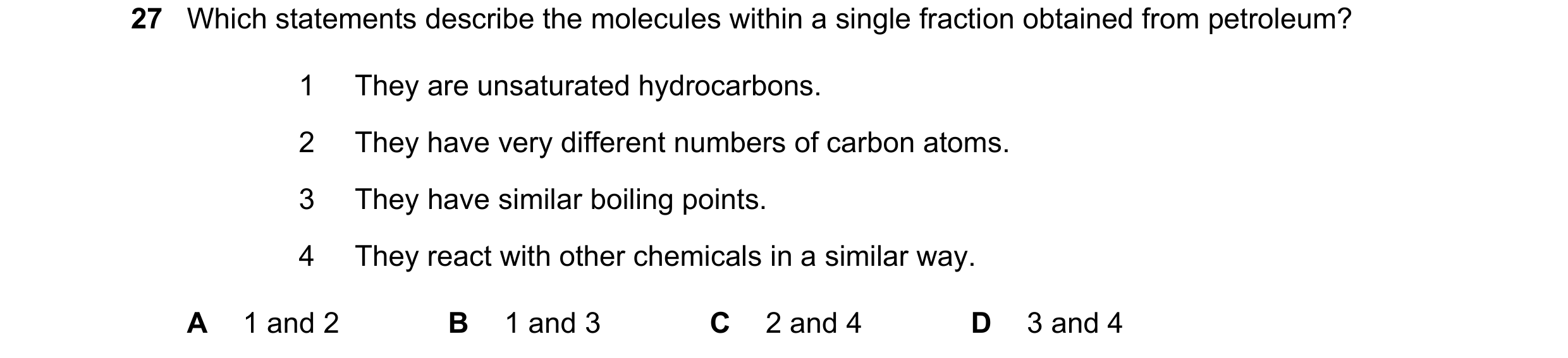
Q25 · Which statements describe the molecules within a single fraction obtained from petroleum? 0653/23 May/June 2024
27 Which statements describe the molecules within a single fraction obtained from petroleum? 1 They are unsaturated hydrocarbons. 2 They have very different numbers of carbon atoms. 3 They have similar boiling points. 4 They react with other chemicals in a similar way. A 1 and 2 B 1 and 3 C 2 and 4 D 3 and 4
1 marks
Answer: D
This question in 0653/23 May/June 2024
Q26 · Which statements about the alkanes are correct? 0653/21 Oct/Nov 2024
26 Which statements about the alkanes are correct? 1 They are saturated hydrocarbons. 2 They produce carbon monoxide and water during complete combustion. 3 They are generally unreactive, except in terms of burning. A 1, 2 and 3 B 1 and 2 only C 1 and 3 only D 2 and 3 only
1 marks
Answer: C
This question in 0653/21 Oct/Nov 2024
Q27 · Methane, ethane and propane are all members of the same homologous series 0653/23 May/June 2025
24 Methane, ethane and propane are all members of the same homologous series. Which statement about these compounds is correct? A They contain double carbon–carbon covalent bonds. B They have different general formulas. C They have the same molecular structure. D They react in similar ways.
1 marks
Answer: D
This question in 0653/23 May/June 2025
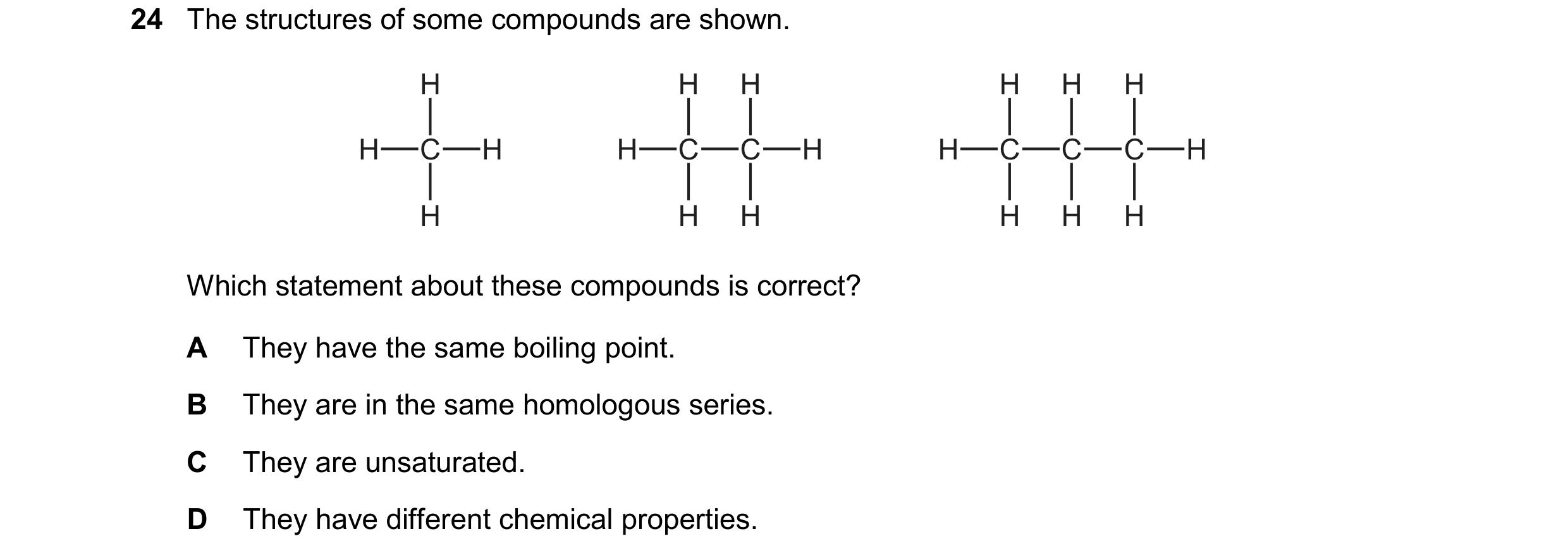
Q28 · The structures of some compounds are shown 0653/23 Oct/Nov 2025
24 The structures of some compounds are shown. H H H H H H H C H H C C H H C C C H H H H H H H Which statement about these compounds is correct? A They have the same boiling point. B They are in the same homologous series. C They are unsaturated. D They have different chemical properties.
1 marks
Answer: B
This question in 0653/23 Oct/Nov 2025


 1 / 6
1 / 6


 2 / 6
2 / 6



 3 / 6
3 / 6




 4 / 6
4 / 6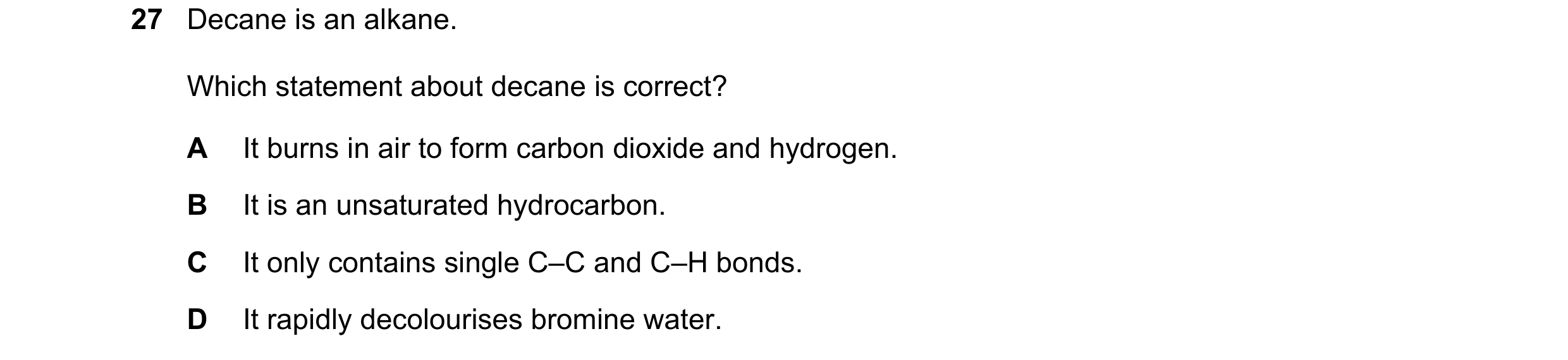

 5 / 6
5 / 6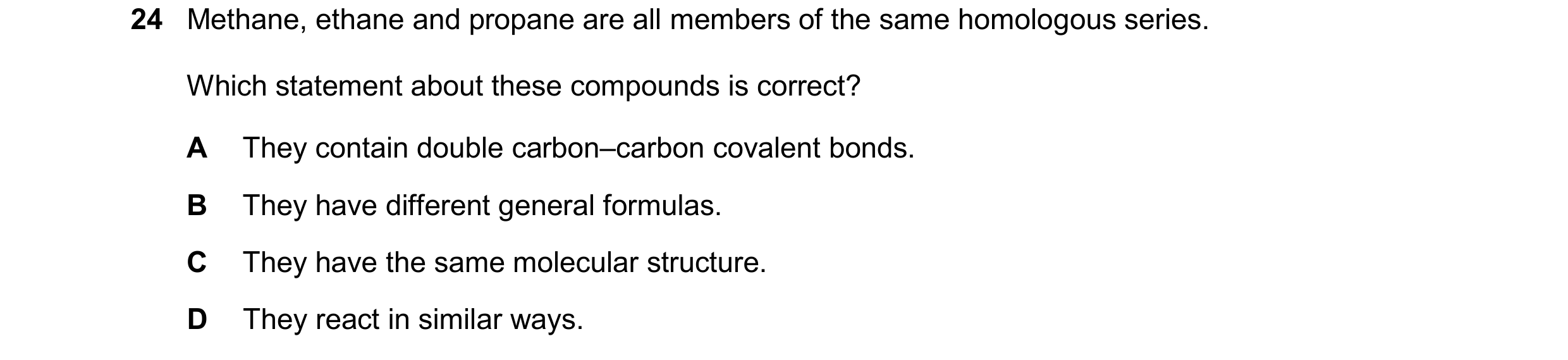
 6 / 6
6 / 6