Questions as text
Q1 · Two particles A and B, of masses 0.3 kg and 0.2 kg respectively, are attached to the ends… 9709/41 Oct/Nov 2005
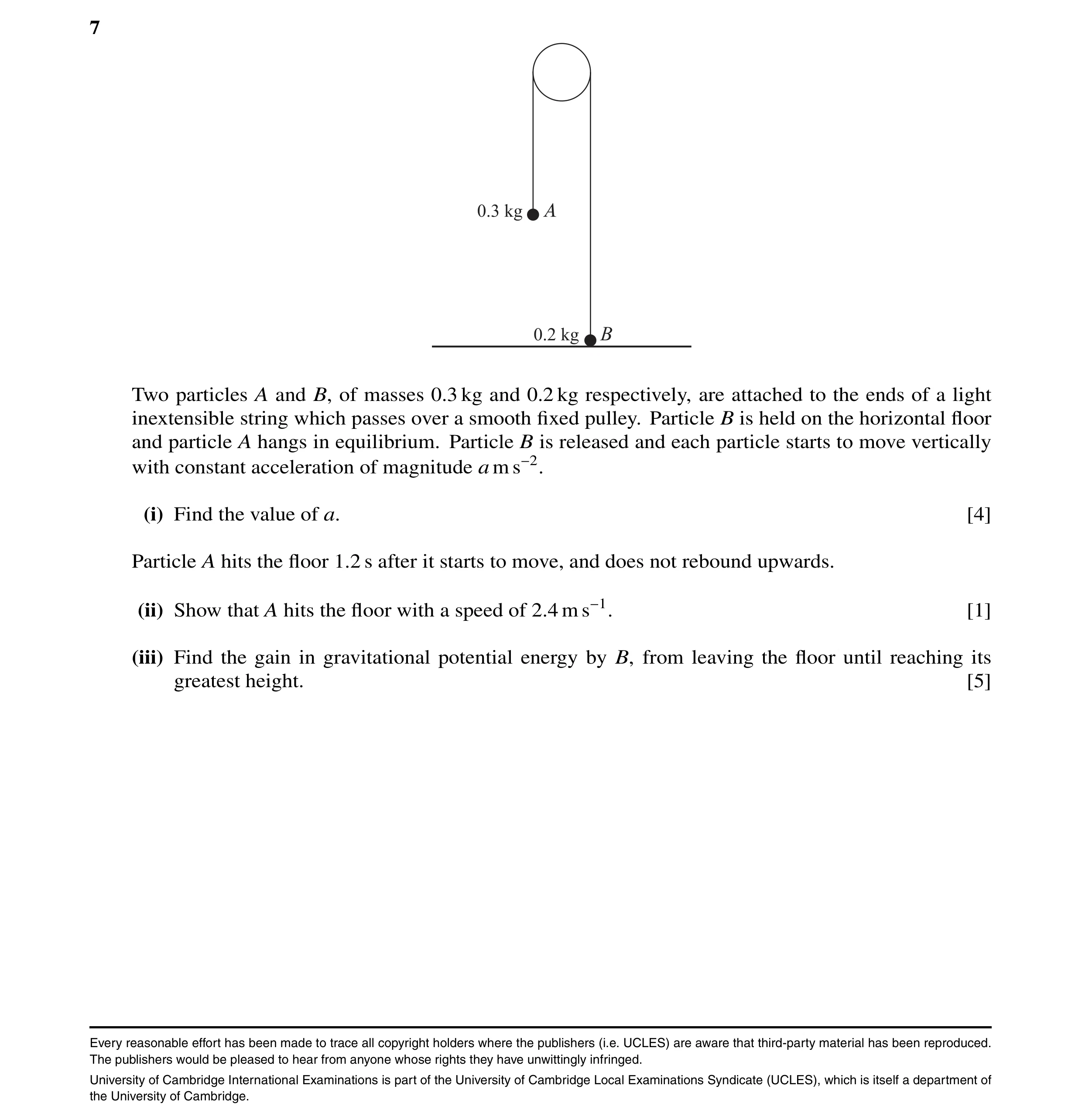
7 Two particles A and B, of masses 0.3 kg and 0.2 kg respectively, are attached to the ends of a light inextensible string which passes over a smooth fixed pulley. Particle B is held on the horizontal floor and particle A hangs in equilibrium. Particle B is released and each particle starts to move vertically with constant acceleration of magnitude a m s−2. (i) Find the value of a. [4] Particle A hits the floor 1.2 s after it starts to move, and does not rebound upwards. (ii) Show that A hits the floor with a speed of 2.4 m s−1. [1] (iii) Find the gain in gravitational potential energy by B, from leaving the floor until reaching its greatest height. [5] Every reasonable effort has been made to trace all copyright holders where the publishers (i.e. UCLES) are aware that third-party material has been reproduced. The publishers would be pleased to hear from anyone whose rights they have unwittingly infringed. University of Cambridge International Examinations is part of the University of Cambridge Local Examinations Syndicate (UCLES), which is itself a department of the University of Cambridge.
10 marks
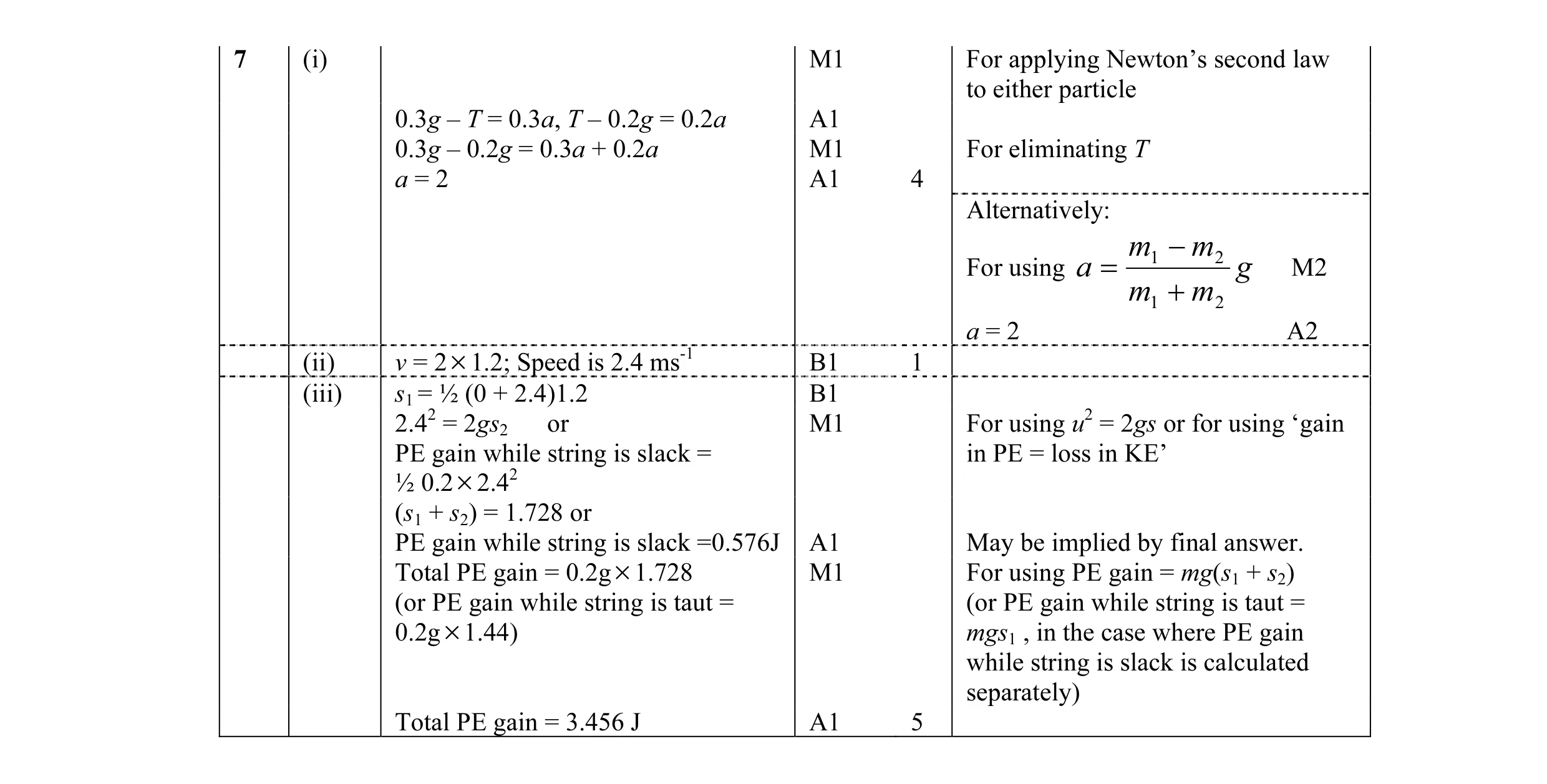
Mark scheme: 7 (i) M1 For applying Newton’s second law to either particle 0.3g – T = 0.3a, T – 0.2g = 0.2a A1 0.3g – 0.2g = 0.3a + 0.2a M1 For eliminating T a = 2 A1 4 Alternatively: m1 − m 2 For using a = g M2 m1 + m 2 a = 2 A2 (ii) v = 2×1.2; Speed is 2.4 ms-1 B1 1 (iii) s1 = ½ (0 + 2.4)1.2 B1 2.42 = 2gs2 or M1 For using u2 = 2gs or for using ‘gain PE gain while string is slack = in PE = loss in KE’ ½ 0.2×2.42 (s1 + s2) = 1.728 or PE gain while string is slack =0.576J A1 May be implied by final answer. Total PE gain = 0.2g×1.728 M1 For using PE gain = mg(s1 + s2) (or PE gain while string is taut = (or PE gain while string is taut = 0.2g×1.44) mgs1 , in the case where PE gain while string is slack is calculated separately) Total PE gain = 3.456 J A1 5
This question in 9709/41 Oct/Nov 2005
Q2 · A car travels along a horizontal straight road with increasing speed until it reaches its… 9709/41 May/June 2007
3 A car travels along a horizontal straight road with increasing speed until it reaches its maximum speed of 30 m s−1. The resistance to motion is constant and equal to R N, and the power provided by the car’s engine is 18 kW. (i) Find the value of R. [3] (ii) Given that the car has mass 1200 kg, find its acceleration at the instant when its speed is 20 m s−1. [3]
6 marks
Mark scheme: 3 (i) [DF = 18000/30] M1 For using DF = P/v-may be scored in (ii) [R = DF] M1 For using a = 0 (may be implied) R = 600 N A1 3 (ii) M1 For using Newton’s second law (3 terms) 18000/20 – 600 = 1200a A1ft ft wrong R Acceleration is 0.25ms-2 A1 3
This question in 9709/41 May/June 2007
Q3 · B 3 m C A A block B of mass 0.6 kg and a particle A of mass 0.4 kg are attached to… 9709/41 May/June 2008
5 B 3 m C A A block B of mass 0.6 kg and a particle A of mass 0.4 kg are attached to opposite ends of a light inextensible string. The block is held at rest on a rough horizontal table, and the coefficient of friction between the block and the table is 0.5. The string passes over a small smooth pulley C at the edge of the table and A hangs in equilibrium vertically below C. The part of the string between B and C is horizontal and the distance BC is 3 m (see diagram). B is released and the system starts to move. (i) Find the acceleration of B and the tension in the string. [6] (ii) Find the time taken for B to reach the pulley. [2]
8 marks
Mark scheme: 5 (i) F = 0.5(0.6g) B1 M1 For applying Newton’s second law to A or to B 0.4g – T = 0.4a A1 Alternative to either of the above equations:- T – F = 0.6a A1 0.4g – F = (0.4 + 0.6)a B1 SR in lieu of the previous 3 marks (max. mark 1/3) 0.4g – T = 0.4ga and T – F = 0.6ga B1 M1 For substituting for F and solving for a or for T Acceleration is 1ms-2 and tension is 3.6N A1 [6] (ii) M1 For using s = (0) + ½ at2 Time taken is 2.45s A1ft [2] ft t = (6/a)½ 2
This question in 9709/41 May/June 2008
Q4 · P Q 5 m Particles P and Q, of masses 0.55 kg and 0.45 kg respectively, are attached to… 9709/41 Oct/Nov 2009
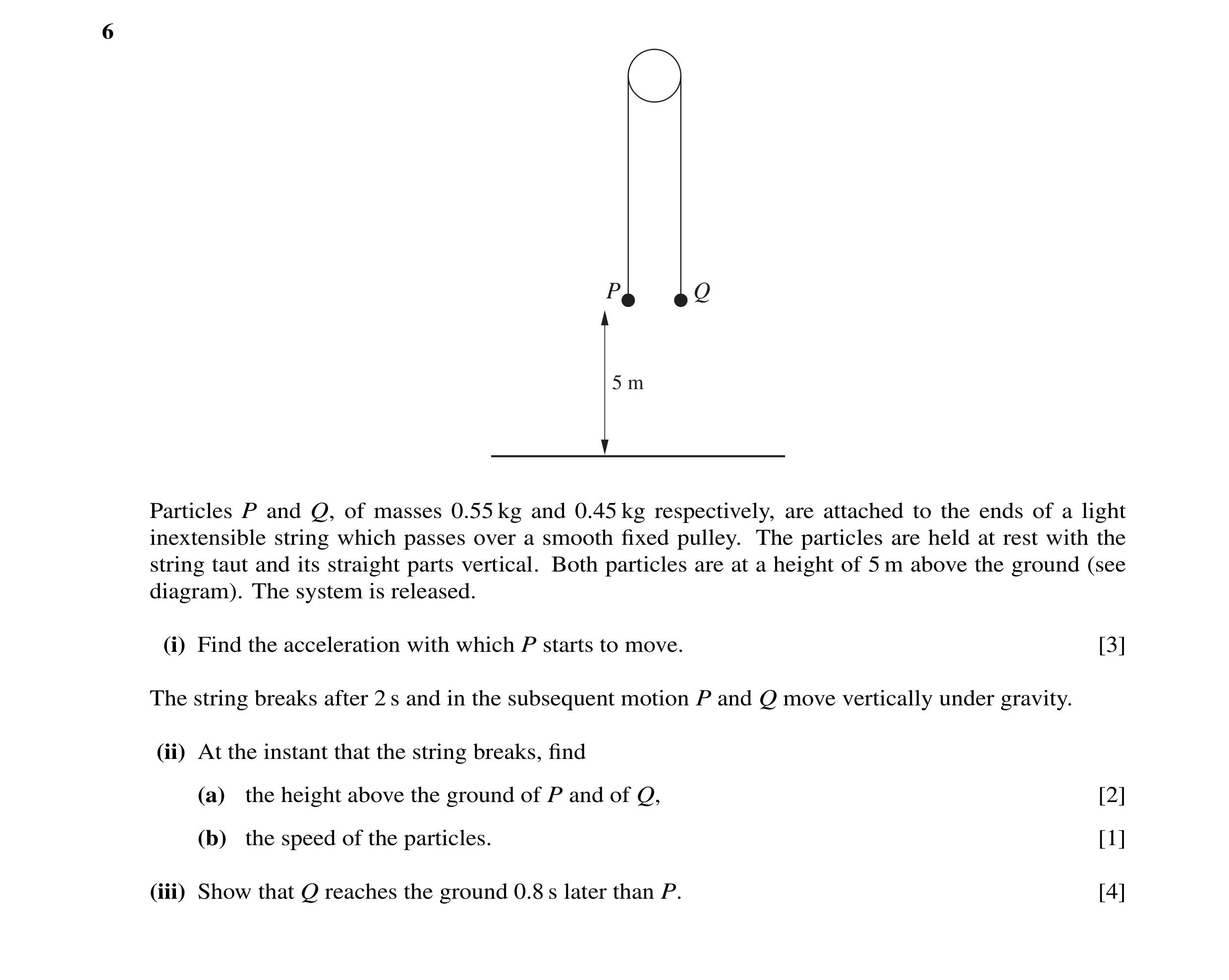
6 P Q 5 m Particles P and Q, of masses 0.55 kg and 0.45 kg respectively, are attached to the ends of a light inextensible string which passes over a smooth fixed pulley. The particles are held at rest with the string taut and its straight parts vertical. Both particles are at a height of 5 m above the ground (see diagram). The system is released. (i) Find the acceleration with which P starts to move. [3] The string breaks after 2 s and in the subsequent motion P and Q move vertically under gravity. (ii) At the instant that the string breaks, find (a) the height above the ground of P and of Q, [2] (b) the speed of the particles. [1] (iii) Show that Q reaches the ground 0.8 s later than P. [4]
10 marks
Mark scheme: 6 (i) For using Newton’s second law to P or M − m M1 Q, or for using a = g M + m 0.55g – T = 0.55a and T – 0.45g = 0.45a or a = [(0.55 – 0.45)/(0.55+ 0.45)]g A1 Acceleration is 1ms–2 A1 3 (ii) (a) For using s = 5 – ½ a22 for P or M1 s = 5 + ½ a22 for Q Height of P is 3m and height of Q is 7m A1ft 2 ft 5 – 2a and 5 + 2a (b) Speed is 2ms–1 B1ft 1 ft 2a (iii) For using s = ut + ½ gt2 for P or for Q [3 = 2tP + 5tP2, 7 = –2tQ + 5tQ2] M1 (NB a = g) tP = 0.6 A1 Accept tQ = 0.2 + 1.2 following consideration of upward and downward tQ = 1.4 A1 motion under gravity of Q separately Q is 0.8s later than P A1 4 AG
This question in 9709/41 Oct/Nov 2009
Q5 · B 0.7 kg 0.3 kg A Particles A and B, of masses 0.3 kg and 0.7 kg respectively, are… 9709/42 Oct/Nov 2009
6 B 0.7 kg 0.3 kg A Particles A and B, of masses 0.3 kg and 0.7 kg respectively, are attached to the ends of a light inextensible string which passes over a smooth fixed pulley. Particle A is held on the horizontal floor and particle B hangs in equilibrium. Particle A is released and both particles start to move vertically. (i) Find the acceleration of the particles. [3] The speed of the particles immediately before B hits the floor is 1.6 m s−1. Given that B does not rebound upwards, find (ii) the maximum height above the floor reached by A, [3] (iii) the time taken by A, from leaving the floor, to reach this maximum height. [3]
9 marks
Mark scheme: 6 (i) For applying Newton’s second law to A or to B or for using M1 (M + m)a = (M – m)g T – 0.3g = 0.3a and 0.7g – T = 0.7a or A1 (0.7 + 0.3)a = (0.7 – 0.3)g Acceleration is 4 ms–2 A1 3 (ii) s1 = 1.62/(2 × 4) B1ft ft acceleration M1 For using 02 = 1.62 – 2gs2 Height is 0.448 m A1 3 From s1 + s2 = 0.32 + 0.128 (iii) t1 = 1.6/4 B1ft ft acceleration (can be scored in (ii)) M1 For using 0 = 1.6 – gt2 Time taken is 0.56 s A1 3 From t1 + t2 = 0.4 + 0.16 . . . . . . . . . . . . . . . . . . . . . . . . . . . . . . . . . (Alternative for part (iii)) For observing that the average speed is the same for each of the two phases and equal to M1 (0 + 1.6)/2 ms–1 t1 + t2 = (s1 + s2)/0.8 A1 Time taken is 0.56 s A1 3 [Similarly for finding s1 + s2 if ans(iii) is found before ans(ii)] . . . . . . . . . . . . . . . . . . . . . . . . . . . . . . . . . (Alternatively for parts ii and iii using v–t graph) M1 Use of gradient to find t1 or t2 t1 = 1.6/4 and t2 = 1.6/10 A1 Time taken is 0.56s A1 For use of area to find M1 s1 or s2 or s1 + s2 s1 = 0.4 × 1.6/2 or s2 = 0.16 × 1.6/2 or s1 + s2 = (0.4 + 0.16) × 1.6/2 A1 Height is 0.448m A1 6 GCE A/AS LEVEL – October/November 2009 9709 42
This question in 9709/42 Oct/Nov 2009
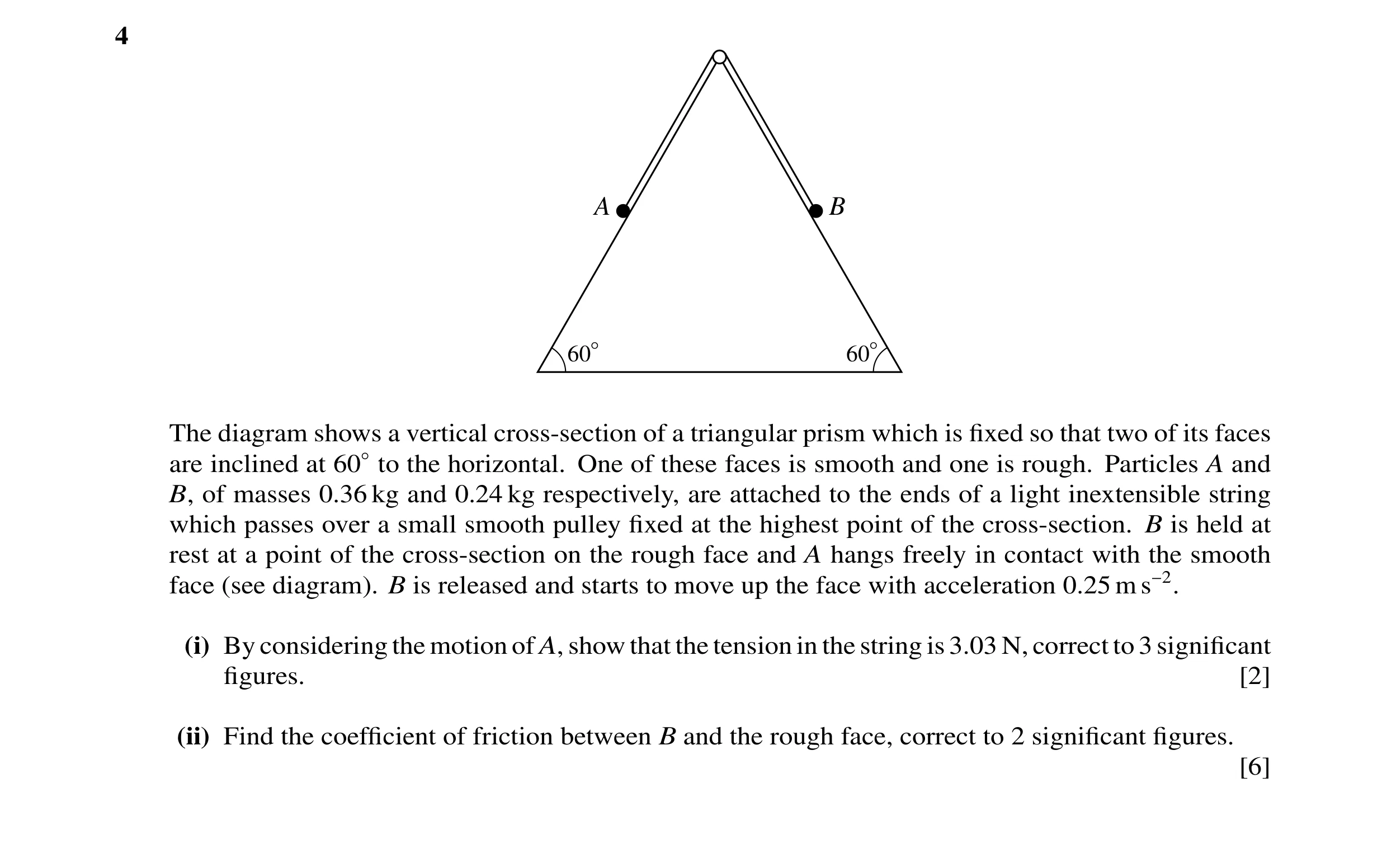
Q6 · A B 60° 60° The diagram shows a vertical cross-section of a triangular prism which is… 9709/43 May/June 2010
4 A B 60° 60° The diagram shows a vertical cross-section of a triangular prism which is fixed so that two of its faces are inclined at 60◦to the horizontal. One of these faces is smooth and one is rough. Particles A and B, of masses 0.36 kg and 0.24 kg respectively, are attached to the ends of a light inextensible string which passes over a small smooth pulley fixed at the highest point of the cross-section. B is held at rest at a point of the cross-section on the rough face and A hangs freely in contact with the smooth face (see diagram). B is released and starts to move up the face with acceleration 0.25 m s−2. (i) By considering the motion of A, show that the tension in the string is 3.03 N, correct to 3 significant figures. [2] (ii) Find the coefficient of friction between B and the rough face, correct to 2 significant figures. [6]
8 marks
Mark scheme: 4 (i) 0.36g sin60° – T = 0.36 × 0.25 B1 Tension is 3.03 N B1 AG [2] (ii) M1 For applying Newton’s second law to B. T ± F – 0.24g sin60° = 0.24 × 0.25 A1 F = 3.03 – 0.24g sin60° – 0.24 × 0.25 (F = 0.889) A1 R = 0.24g cos60° (R = 1.2) B1 M1 For using µ = F/R Coefficient is 0.74 A1 [6]
This question in 9709/43 May/June 2010
Q7 · A car of mass 1250 kg travels along a horizontal straight road 9709/43 Oct/Nov 2010
7 A car of mass 1250 kg travels along a horizontal straight road. The power of the car’s engine is constant and equal to 24 kW and the resistance to the car’s motion is constant and equal to R N. The car passes through the point A on the road with speed 20 m s−1 and acceleration 0.32 m s−2. (i) Find the value of R. [3] The car continues with increasing speed, passing through the point B on the road with speed 29.9 m s−1. The car subsequently passes through the point C. (ii) Find the acceleration of the car at B, giving the answer in m s−2 correct to 3 decimal places. [2] (iii) Show that, while the car’s speed is increasing, it cannot reach 30 m s−1. [2] (iv) Explain why the speed of the car is approximately constant between B and C. [1] (v) State a value of the approximately constant speed, and the maximum possible error in this value at any point between B and C. [1] The work done by the car’s engine during the motion from B to C is 1200 kJ. (vi) By assuming the speed of the car is constant from B to C, find, in either order, (a) the approximate time taken for the car to travel from B to C, (b) an approximation for the distance BC. [4]
13 marks
Mark scheme: 7 (i) DF = 24000/20 B1 [DF – R = 1250x0.32] M1 For using Newton’s second law (3 terms) R = 800 A1 [3] (ii) 24000/29.9 – 800 = 1250a B1 Acceleration is 0.002 ms–2 B1 [2] (iii) [a = (24000/30 – 800)/1250 M1 For finding a when v = 30 or for using 24000/v – 800 > 0 v < 30] a > 0 to obtain an inequality for v Car not accelerating when v = 30 or Speed cannot reach 30 ms–1 A1 [2] AG (iv) 29.9 ≤ v < 30 speed approximately constant B1 [1] (v) 30 ms–1 (max error 0.1) or 29.95 ms–1 (max error 0.05) or 29.9 ms–1 (max error 0.1) B1 [1] (vi) (a) [24 = 1200/T] M1 For using P = ∆WD/∆t Time taken is 50 s A1 (b) [s = 30x50 or 29.95x50 or 29.9x50] M1 For using s = vt Distance BC is 1500 m or 1500 m or 1495 m A1 [4] GCE AS/A LEVEL – October/November 2010 9709 43 ALTERNATIVE FOR PART (vi) (b) [1200 000 = 800d] M1 For using ‘no change in KE’ WD by car’s engine = WD against resistance’ (may be implied) Distance BC is 1500 m A1 (a) [t = 1500/30 or 1500/29.95 or 1500/29.9] M1 For using t = s/v Time taken is 50 s or 50.1 s or 50.2 s A1
This question in 9709/43 Oct/Nov 2010
Q8 · A car of mass 700 kg is travelling along a straight horizontal road 9709/41 May/June 2011
1 A car of mass 700 kg is travelling along a straight horizontal road. The resistance to motion is constant and equal to 600 N. (i) Find the driving force of the car’s engine at an instant when the acceleration is 2 m s−2. [2] (ii) Given that the car’s speed at this instant is 15 m s−1, find the rate at which the car’s engine is working. [2]
4 marks
Mark scheme: 1 (i) [DF – 600 = 700 × 2] M1 For using Newton’s second law (3 terms needed) Driving force is 2000 N A1 [2] (ii) [P = 2000 × 15] M1 For using P = Fv Rate of working is 30000 W (or 30 kW) A1ft [2]
This question in 9709/41 May/June 2011
Q9 · Loads A and B, of masses 1.2 kg and 2.0 kg respectively, are attached to the ends of a… 9709/41 May/June 2011
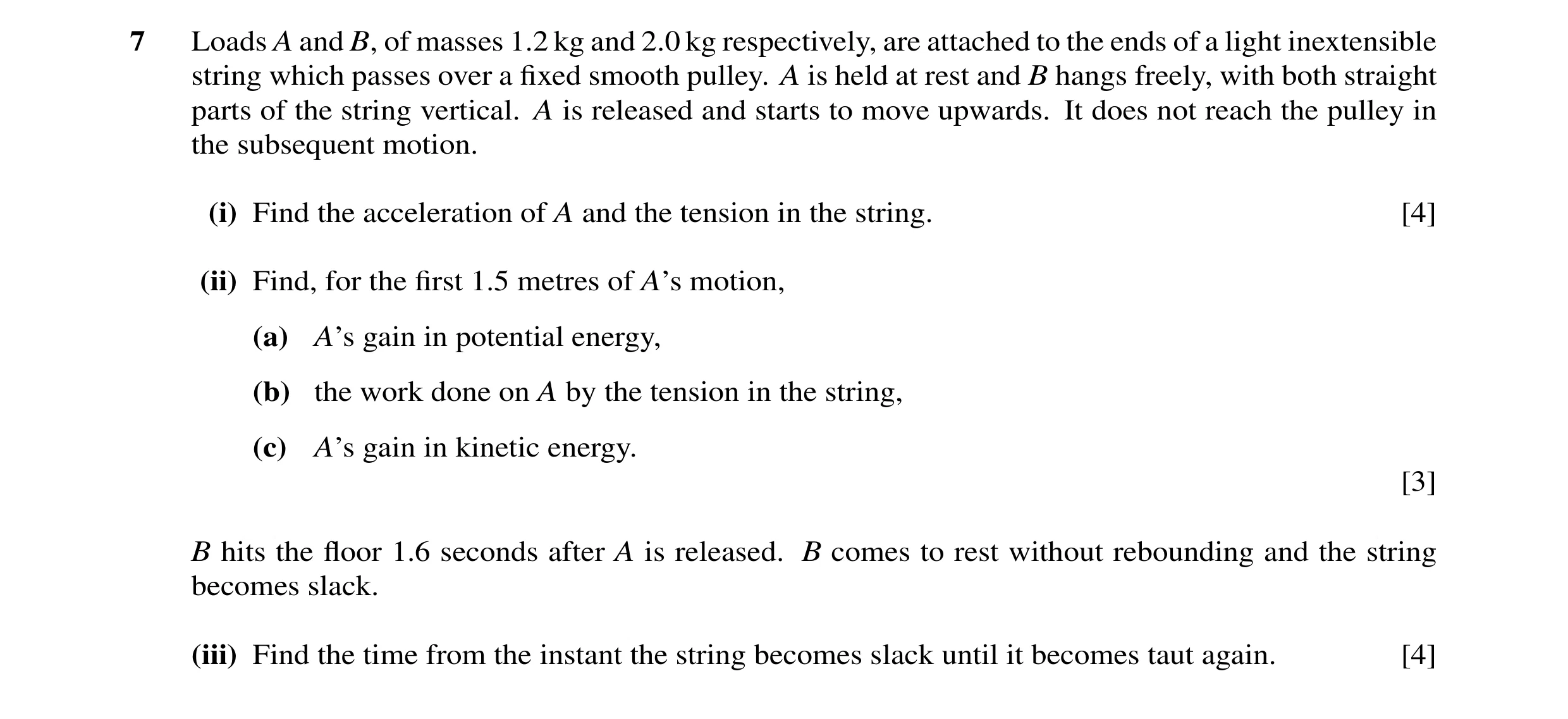
7 Loads A and B, of masses 1.2 kg and 2.0 kg respectively, are attached to the ends of a light inextensible string which passes over a fixed smooth pulley. A is held at rest and B hangs freely, with both straight parts of the string vertical. A is released and starts to move upwards. It does not reach the pulley in the subsequent motion. (i) Find the acceleration of A and the tension in the string. [4] (ii) Find, for the first 1.5 metres of A’s motion, (a) A’s gain in potential energy, (b) the work done on A by the tension in the string, (c) A’s gain in kinetic energy. [3] B hits the floor 1.6 seconds after A is released. B comes to rest without rebounding and the string becomes slack. (iii) Find the time from the instant the string becomes slack until it becomes taut again. [4]
11 marks
Mark scheme: 7 (i) M1 For applying Newton’s second law to A or to B T – 12 = 1.2a and 20 –T = 2a A1 Accept (2 – 1.2)g = (2.0 + 1.2)a as an alternative for one of these equations Acceleration is 2.5 ms-2 B1 Tension is 15 N A1 [4] (ii) (a) PE gain = 12 × 1.5 = 18 J B1 (b) WD on A = 15 × 1.5 = 22.5J B1 (c) Gain in KE = ans(b) – ans(a) = 4.5 J B1ft [3] alt: KE = ½ 1.2(2 × 2.5 × 1.5) = 4.5J (iii) v = 1.6 × 2.5 B1ft M1 For using v = u – gt t = 0.4 s A1 May be implied Total time taken is 0.8 s A1 [4]
This question in 9709/41 May/June 2011
Q10 · V (m s–1 ) 50 8 0 t (s) 0 5 12 102 The velocity-time graph shown models the motion of a… 9709/42 May/June 2011
3 v (m s–1 ) 50 8 0 t (s) 0 5 12 102 The velocity-time graph shown models the motion of a parachutist falling vertically. There are four stages in the motion: • falling freely with the parachute closed, • decelerating at a constant rate with the parachute open, • falling with constant speed with the parachute open, • coming to rest instantaneously on hitting the ground. (i) Show that the total distance fallen is 1048 m. [2] The weight of the parachutist is 850 N. (ii) Find the upward force on the parachutist due to the parachute, during the second stage. [5]
7 marks
Mark scheme: 3 (i) [ ½ 5 × 50 + ½ 7(8 + 50) + 90 × 8] M1 For using the area property for distance or s = ½ (u + v)t Distance is 1048 m A1 [2] AG (ii) M1 For use of the gradient property for acceleration (deceleration) a = (8 – 50)/(12 – 5) or d = (50 – 8)/(12 – 5) A1 M1 For using Newton’s second law (3 terms) 850 – F = 85a (or –85d) A1 Upward force is 1360 N A1 [5] GCE AS/A LEVEL – May/June 2011 9709 42
This question in 9709/42 May/June 2011
Q11 · Particles A and B, of masses 0.9 kg and 0.6 kg respectively, are attached to the ends of… 9709/42 Oct/Nov 2011
5 Particles A and B, of masses 0.9 kg and 0.6 kg respectively, are attached to the ends of a light inextensible string. The string passes over a fixed smooth pulley. The system is released from rest with the string taut, with its straight parts vertical and with the particles at the same height above the horizontal floor. In the subsequent motion, B does not reach the pulley. (i) Find the acceleration of A and the tension in the string during the motion before A hits the floor. [4] After A hits the floor, B continues to move vertically upwards for a further 0.3 s. (ii) Find the height of the particles above the floor at the instant that they started to move. [4]
8 marks
Mark scheme: 5 (i) M1 For applying Newton’s second law to A or to B 0.9g – T = 0.9a or T – 0.6g = 0.6a A1 T – 0.6g = 0.6a or 0.9g – T = 0.9a or B1 (0.9 – 0.6)g = (0.9 + 0.6)a Acceleration is 2 ms–2 and tension is 7.2 N A1 4 (ii) M1 For using 0 = u – gt u = 3 A1 [32 = 2 × 2 h] M1 For using v2 = 02 + 2ah with [½ (0.9 + 0.6)32 = (0.9 – 0.6)gh] vtaut = uslack or for using KE gain = PE loss while the string is in tension Height is 2.25 m A1 4 2 2
This question in 9709/42 Oct/Nov 2011
Q12 · A B 0.65 m Two particles A and B have masses 0.12 kg and 0.38 kg respectively 9709/43 May/June 2012
7 A B 0.65 m Two particles A and B have masses 0.12 kg and 0.38 kg respectively. The particles are attached to the ends of a light inextensible string which passes over a fixed smooth pulley. A is held at rest with the string taut and both straight parts of the string vertical. A and B are each at a height of 0.65 m above horizontal ground (see diagram). A is released and B moves downwards. Find (i) the acceleration of B while it is moving downwards, [2] (ii) the speed with which B reaches the ground and the time taken for it to reach the ground. [3] B remains on the ground while A continues to move with the string slack, without reaching the pulley. The string remains slack until A is at a height of 1.3 m above the ground for a second time. At this instant A has been in motion for a total time of T s. (iii) Find the value of T and sketch the velocity-time graph for A for the first T s of its motion. [3] (iv) Find the total distance travelled by A in the first T s of its motion. [2]
10 marks
Mark scheme: 7 (i) For using Newton’s second law [T – 0.12g = 0.12a & 0.38g – T = 0.38a; M − m for A and B or for using a = g .038 − .012 M + m a = g ] M1 .038 + .012 Acceleration is 5.2 ms–2 A1 [2] (ii) [v2 = 2 × 5.2 × 0.65; 0.65 = ½ 5.2TB2] M1 For using v2 = 2ah or s = ½ at2 Speed of B is 2.6ms–1 or TB = 0.5 A1ft ft incorrect a TB = 0.5 or Speed of B is 2.6ms–1 B1 [3] (iii) [– 2.6 = 2.6 – 10(T – 0.5)] M1 For using –V = V – g(T – TB) or equivalent T = 1.02 A1ft ft incorrect V and/or TB Correct graph for 0 < t < 1.02 B1ft [3] ft incorrect values of V, T and TB 0.5 1.02 (iv) [0.65 + 0.5(1.02 – 0.5)2.6] M1 For using ‘total distance T A − T B = ½ (VTB) + 2 x ½ V 2 Total distance is 1.326 m (accept 1.33) A1 [2]
This question in 9709/43 May/June 2012
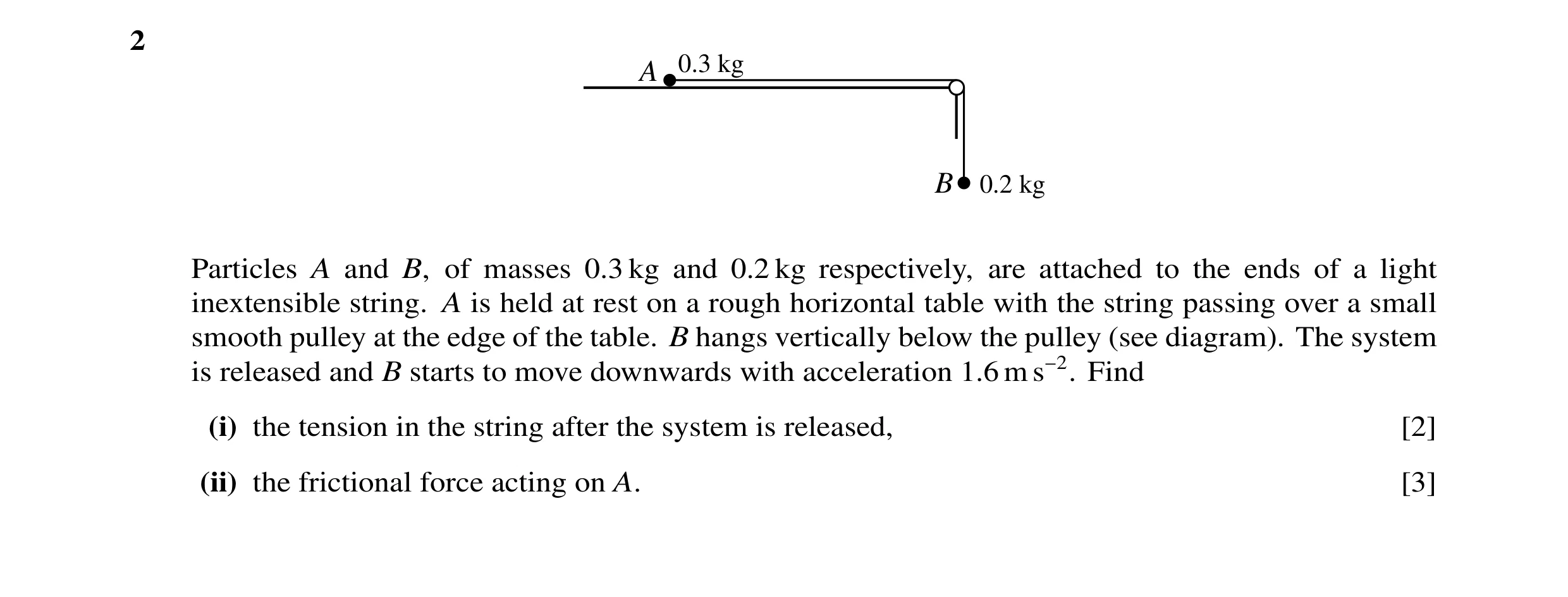
Q13 · A 0.3 kg B 0.2 kg Particles A and B, of masses 0.3 kg and 0.2 kg respectively, are… 9709/41 Oct/Nov 2012
2 A 0.3 kg B 0.2 kg Particles A and B, of masses 0.3 kg and 0.2 kg respectively, are attached to the ends of a light inextensible string. A is held at rest on a rough horizontal table with the string passing over a small smooth pulley at the edge of the table. B hangs vertically below the pulley (see diagram). The system is released and B starts to move downwards with acceleration 1.6 m s−2. Find (i) the tension in the string after the system is released, [2] (ii) the frictional force acting on A. [3]
5 marks
Mark scheme: 2 (i) [0.2g – T = 0.2 × 1.6] M1 For applying Newton’s 2nd law to B Tension is 1.68 N A1 2 (ii) M1 For applying Newton’s 2nd law to A T – F = 0.3 × 1.6 A1 Frictional force is 1.2 N A1ft 3 ft T – 0.48
This question in 9709/41 Oct/Nov 2012
Q14 · A car of mass 1200 kg moves in a straight line along horizontal ground 9709/41 Oct/Nov 2012
7 A car of mass 1200 kg moves in a straight line along horizontal ground. The resistance to motion of the car is constant and has magnitude 960 N. The car’s engine works at a rate of 17 280 W. (i) Calculate the acceleration of the car at an instant when its speed is 12 m s−1. [3] The car passes through the points A and B. While the car is moving between A and B it has constant speed V m s−1. (ii) Show that V = 18. [2] At the instant that the car reaches B the engine is switched off and subsequently provides no energy. The car continues along the straight line until it comes to rest at the point C. The time taken for the car to travel from A to C is 52.5 s. (iii) Find the distance AC. [5]
10 marks
Mark scheme: 7 (i) DF = 17280/12 (= 1440 N) B1 [DF – R = ma 1440 – 960 = 1200a] M1 For using Newton’s 2nd law Acceleration is 0.4 ms–2 A1 3 (ii) [17280/V – 960 = 0] M1 For using P/v – R = 0 V = 18 A1 2 AG (iii) For BC, –960 = 1200a (a = –0.8) B1 M1 For using 0 = 18 +at and 0 = 182 + 2as for BC tBC = (0 – 18)/(–0.8) and sBC = (0 – 182)/(–1.6) (= 22.5 s and 202.5 m) A1 Distance AB = 18(52.5 – 22.5) B1 Distance is AC is 742.5 m A1 5 Accept 742 or 743
This question in 9709/41 Oct/Nov 2012
Q15 · Particles A and B of masses m kg and (1 −m) kg respectively are attached to the ends of a… 9709/42 Oct/Nov 2012
2 Particles A and B of masses m kg and (1 −m) kg respectively are attached to the ends of a light inextensible string which passes over a fixed smooth pulley. The system is released from rest with the straight parts of the string vertical. A moves vertically downwards and 0.3 seconds later it has speed 0.6 m s−1. Find (i) the acceleration of A, [2] (ii) the value of m and the tension in the string. [4]
6 marks
Mark scheme: 2 (i) [0.6 = 0 + 0.3a] M1 For using v = 0 + at Acceleration is 2 ms–2 A1 2 (ii) [mg – T = 2m, T – (1 – m)g For applying Newton’s 2nd law to A = 2(1 – m)] M1 or to B [m = T/8 T – (10 – 1.25T) = 2 – 0.25T or T = 8m 8m – (10 – 10m) = 2 – 2m] M1 For eliminating or evaluating m T + 1.25T + 0.25T = 10 + 2 or m = 0.6 and T = 8m A1 m = 0.6 and tension is 4.8 N A1 4 Alternative for part (ii) [{m + (1 – m)} × 2 = {m – (1 – m)} × g] M1 For using (mA + mB)a = (mA – mB)g m = 0.6 A1 [mg – T = 2m or T – (1 – m)g = 2(1 – m)] M1 For applying Newton’s 2nd law to A or to B, substituting for m and solving for T Tension is 4.8 N A1 GCE AS/A LEVEL – October/November 2012 9709 42 2
This question in 9709/42 Oct/Nov 2012
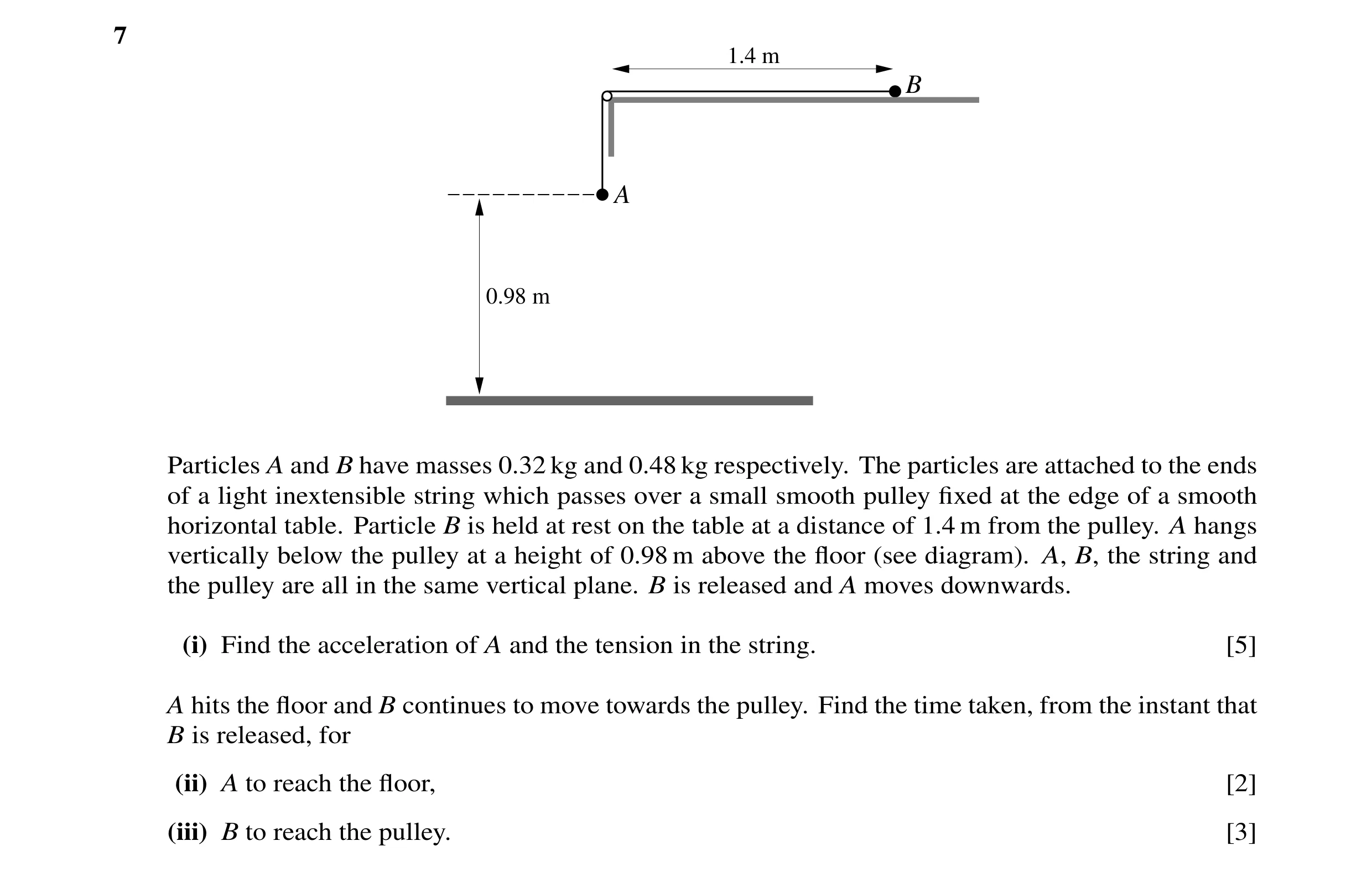
Q16 · 1.4 m B A 0.98 m Particles A and B have masses 0.32 kg and 0.48 kg respectively 9709/43 Oct/Nov 2012
7 1.4 m B A 0.98 m Particles A and B have masses 0.32 kg and 0.48 kg respectively. The particles are attached to the ends of a light inextensible string which passes over a small smooth pulley fixed at the edge of a smooth horizontal table. Particle B is held at rest on the table at a distance of 1.4 m from the pulley. A hangs vertically below the pulley at a height of 0.98 m above the floor (see diagram). A, B, the string and the pulley are all in the same vertical plane. B is released and A moves downwards. (i) Find the acceleration of A and the tension in the string. [5] A hits the floor and B continues to move towards the pulley. Find the time taken, from the instant that B is released, for (ii) A to reach the floor, [2] (iii) B to reach the pulley. [3]
10 marks
Mark scheme: 7 (i) For applying Newton’s 2nd law to A M1 or to B. 0.32g – T = 0.32a (or T = 0.48a) A1 T = 0.48a (or 0.32g – T = 0.32a) OR 0.32g = (0.32 + 0.48)a B1 M1 For solving for a and T Acceleration is 4 ms–2 and tension is 1.92 A1 5 N (ii) [0.98 = ½ 4t2] M1 For using s = ½ at2 Time taken is 0.7 s A1 2 (iii) For using v = at for taut stage and t M1 = d/v for slack stage v = 4 × 0.7 and t = (1.4 – 0.98)/v (= 0.15) A1ft ft a from (i) and /or t from (ii) (a>0, a≠g) Time taken is 0.85 s A1 3
This question in 9709/43 Oct/Nov 2012
Q17 · A B a A light inextensible string has a particle A of mass 0.26 kg attached to one end… 9709/41 May/June 2013
5 A B a A light inextensible string has a particle A of mass 0.26 kg attached to one end and a particle B of mass 0.54 kg attached to the other end. The particle A is held at rest on a rough plane inclined at angle ! to the horizontal, where sin ! = 13.5 The string is taut and parallel to a line of greatest slope of the plane. The string passes over a small smooth pulley at the top of the plane. Particle B hangs at rest vertically below the pulley (see diagram). The coefficient of friction between A and the plane is 0.2. Particle A is released and the particles start to move. (i) Find the magnitude of the acceleration of the particles and the tension in the string. [6] Particle A reaches the pulley 0.4 s after starting to move. (ii) Find the distance moved by each of the particles. [2]
8 marks
Mark scheme: 5 (i) R = 2.6 × (12 ÷ 13) (= 2.4) B1 [F = 0.2 × 2.4] M1 For using F = µR [T – 2.6(5 ÷ 13) – F = 0.26a, 5.4 – T = For applying Newton’s 2nd law to A or to B. 0.54a] M1 For any two of T – 1 – 0.48 = 0.26a, 5.4 – T = 0.54a or (5.4 – 1 – 0.48) = (0.54 + 0.26)a A1 Acceleration is 4.9 ms–2 B1 Tension is 2.75 N (2.754 exact) A1 [6] (ii) [s = ½ 4.9 × 0.42] M1 For using s = ½ at2 Distance is 0.392 m A1 [2]
This question in 9709/41 May/June 2013
Q18 · P 2.5m B A 0.6 m Particles A of mass 0.26 kg and B of mass 0.52 kg are attached to the… 9709/42 May/June 2013
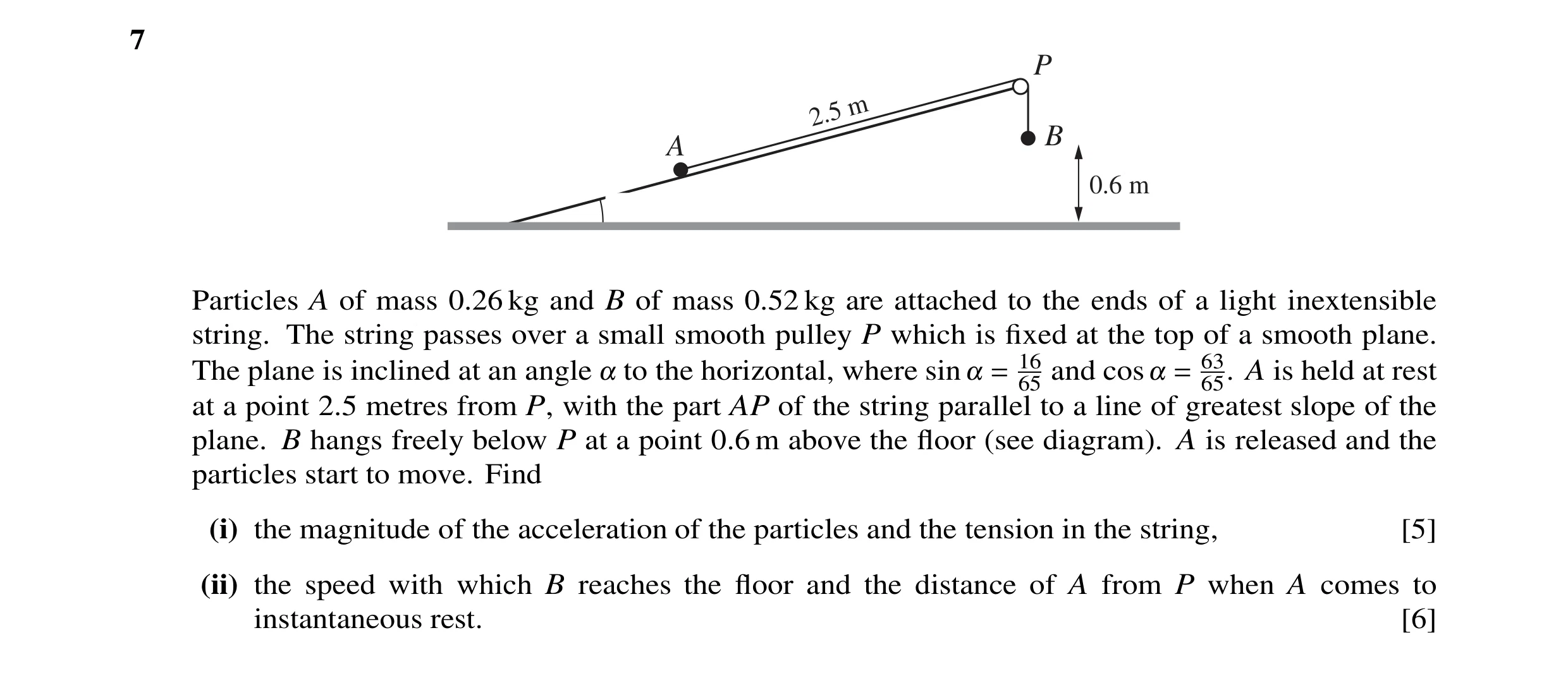
7 P 2.5m B A 0.6 m Particles A of mass 0.26 kg and B of mass 0.52 kg are attached to the ends of a light inextensible string. The string passes over a small smooth pulley P which is fixed at the top of a smooth plane. The plane is inclined at an angle to the horizontal, where sin = 16 and cos = 63 A is held at rest 65 65. at a point 2.5 metres from P, with the part AP of the string parallel to a line of greatest slope of the plane. B hangs freely below P at a point 0.6 m above the floor (see diagram). A is released and the particles start to move. Find (i) the magnitude of the acceleration of the particles and the tension in the string, [5] (ii) the speed with which B reaches the floor and the distance of A from P when A comes to instantaneous rest. [6]
11 marks
Mark scheme: 7 (i) M1 For applying Newton’s 2nd law to A or B T – 0.26g(16÷65) = 0.26a or A1 0.52g – T = 0.52a For {0.52g – T = 0.52a or T – 0.26g(16 ÷ 65) = 0.26a} or 0.52g – 0.26g(16 ÷ 65) = (0.52 + 0.26)a B1 Acceleration is 5.85 ms–2 B1 Tension is 2.16 N A1 [5] (ii) [v2 = 2 × (76/13) × 0.6] M1 For using v2 = 2as Speed is 2.65 ms–1 A1 2 0 = 91.2/13 – 2(160/65)s M1 For using 0 = vB – 2(g sinα)s S = 57/40 (= 1.425) A1 For using [AP = 2.5 – 0.6 – 1.425] M1 AP = 2.5 – 0.6 – s Distance AP is 0.475 m A1 [6]
This question in 9709/42 May/June 2013
Q19 · A 0.48 m P B 0.45 m Particle A of mass 1.26 kg and particle B of mass 0.9 kg are attached… 9709/43 May/June 2013
7 A 0.48 m P B 0.45 m Particle A of mass 1.26 kg and particle B of mass 0.9 kg are attached to the ends of a light inextensible string. The string passes over a small smooth pulley P which is fixed at the edge of a rough horizontal table. A is held at rest at a point 0.48 m from P, and B hangs vertically below P, at a height of 0.45 m above the floor (see diagram). The coefficient of friction between A and the table is 7.2 A is released and the particles start to move. (i) Show that the magnitude of the acceleration of the particles is 2.5 m s−2 and find the tension in the string. [5] (ii) Find the speed with which B reaches the floor. [2] (iii) Find the speed with which A reaches the pulley. [4]
11 marks
Mark scheme: 7 (i) M1 For applying Newton’s 2nd law to A or to B T – (2 / 7) 1.26 g = 1.26 a or A1 0.9 g - T = 0.9 a 0.9g – T = 0.9 a or T – (2 / 7) 1.26 g = 1.26 a or 0.9 g – (2 / 7) 1.26 g = (0.9 + 1.26) a B1 Acceleration is 2.5 m s-2 B1 AG Tension is 6.75 N A1 [5] (ii) [v2 = 2 × (2.5) × 0.45] M1 For using v2 = 2 a h Speed is 1.5 m s-1 A1 [2] (iii) [– (2 / 7) 1.26 g = 1.26 a] M1 For applying Newton’s 2nd law to A a = – 20 / 7 A1 [v2 = 2.25 + 2 (–20 / 7) (0.03)] M1 For using v2 = vB2 + 2 a s Speed is 1.44 m s-1 A1 [4]
This question in 9709/43 May/June 2013
Q20 · A B 0.52 m Particles A and B, of masses 0.3 kg and 0.7 kg respectively, are attached to… 9709/41 Oct/Nov 2013
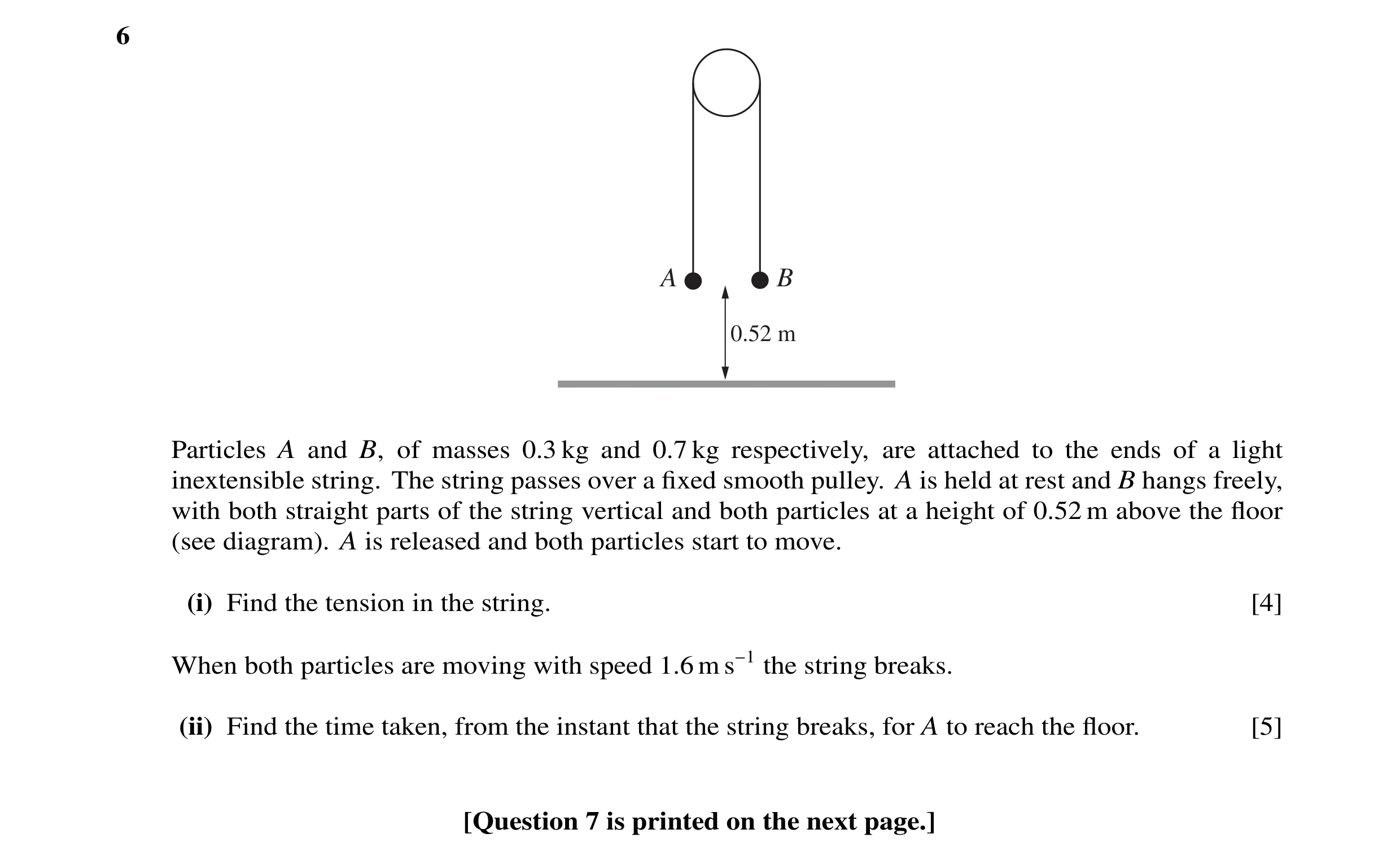
6 A B 0.52 m Particles A and B, of masses 0.3 kg and 0.7 kg respectively, are attached to the ends of a light inextensible string. The string passes over a fixed smooth pulley. A is held at rest and B hangs freely, with both straight parts of the string vertical and both particles at a height of 0.52 m above the floor (see diagram). A is released and both particles start to move. (i) Find the tension in the string. [4] When both particles are moving with speed 1.6 m s−1 the string breaks. (ii) Find the time taken, from the instant that the string breaks, for A to reach the floor. [5] [Question 7 is printed on the next page.]
9 marks
Mark scheme: 6 (i) For applying Newton’s 2nd law to A or to B M1 T – 0.3g = 0.3a or 0.7g – T = 0.7a A1 0.7g – T = 0.7a or T – 0.3g = 0.3a or 0.7g – 0.3g = (0.7 + 0.3)a B1 Tension is 4.2 N A1 4 (ii) a = 4 B1 May be scored in (i) staut = 1.62/(2 × 4) (= 0.32) B1 [(0.52 + 0.32) = –1.6t + 5t2] M1 For using s = ut + ½ gt2 For solving the resultant quadratic [(t – 0.6)(5t + 1.4) = 0] M1 equation. Time taken is 0.6 s A1 5 Alternative Marking Scheme for the last three marks 02 = 1.62 – 2gsup, For using kinematic formulae to find tup tup = 2sup/(1.6 + 0) (= 0.16) M1 2 0.52 + staut + sup = 0 + ½ gtdown For using kinematic formulae to find tdown (tdown = 0.44) M1 Time taken = tup + tdown = 0.6 s B1 GCE AS/A LEVEL – October/November 2013 9709 41
This question in 9709/41 Oct/Nov 2013
Q21 · V (m s –1) 0.4 t (s) O 5 24 28 An elevator is pulled vertically upwards by a cable 9709/42 Oct/Nov 2013
7 v (m s –1) 0.4 t (s) O 5 24 28 An elevator is pulled vertically upwards by a cable. The velocity-time graph for the motion is shown above. Find (i) the distance travelled by the elevator, [2] (ii) the acceleration during the first stage and the deceleration during the third stage. [2] The mass of the elevator is 800 kg and there is a box of mass 100 kg on the floor of the elevator. (iii) Find the tension in the cable in each of the three stages of the motion. [3] (iv) Find the greatest and least values of the magnitude of the force exerted on the box by the floor of the elevator. [3]
10 marks
Mark scheme: 7 (i) [s = ½ 5 × 0.4 + 19 × 0.4 + ½ 4 × 0.4] For using the area property for M1 distance Distance = 9.4 A1 2 (ii) Acceleration is 0.08 ms–2 B1 Deceleration is 0.1ms–2 B1 2 (iii) [T – (800 + 100) g = (800 +100)a] For applying Newton’s 2nd law to M1 the elevator and box T – 900g = 900a A1 T = 9072 N in 1st stage T = 9000 N in 2nd stage T = 8910 N in 3rd stage A1 3 (iv) [R – 100g = 100a] For applying Newton’s 2nd law to M1 the box For obtaining the greatest value of R = 1008 N A1 the force on the box For obtaining the least value of the R = 990 N A1 3 force on the box
This question in 9709/42 Oct/Nov 2013
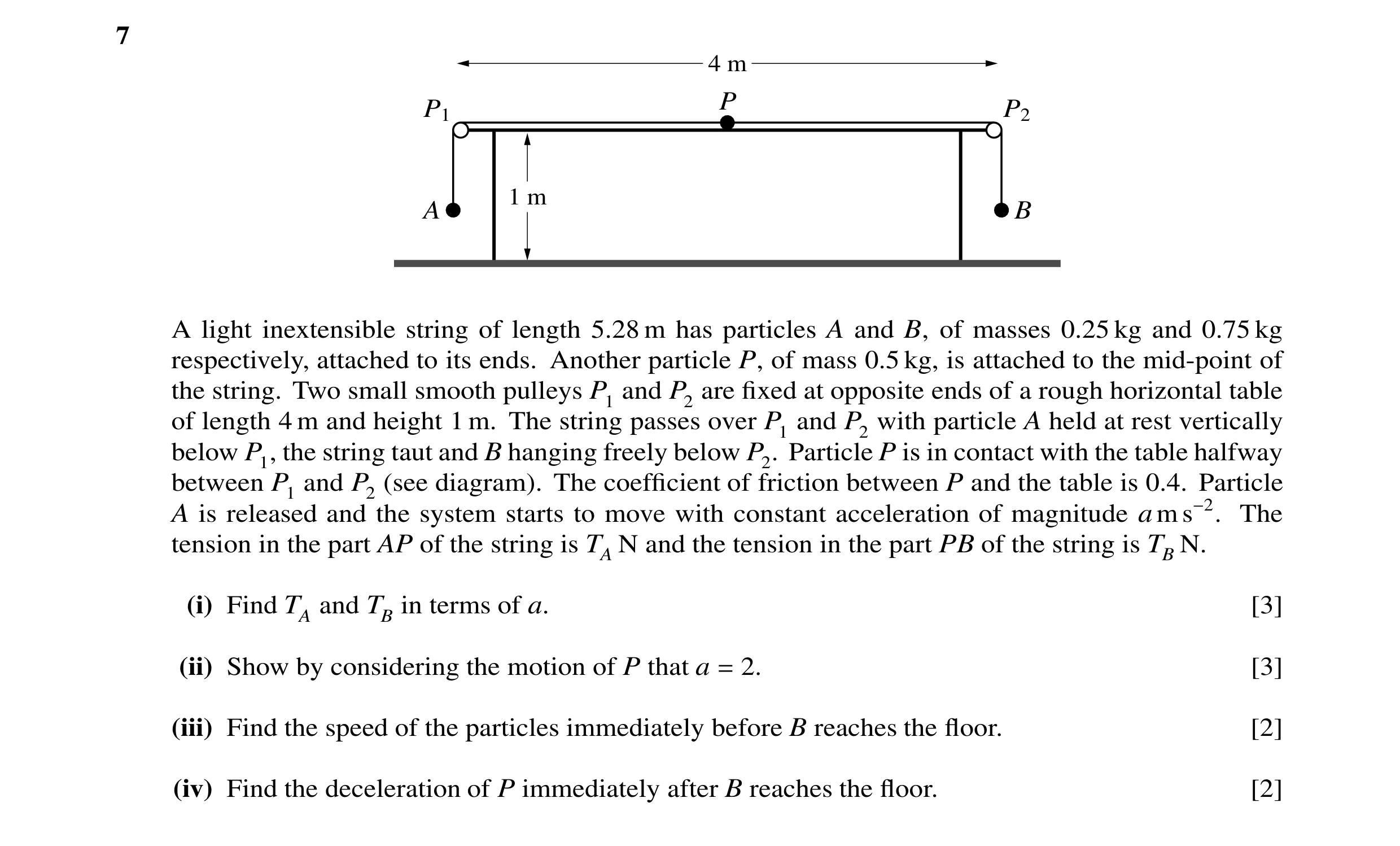
Q22 · 4 m P P1 P2 1 m A B A light inextensible string of length 5.28 m has particles A and B… 9709/42 May/June 2014
7 4 m P P1 P2 1 m A B A light inextensible string of length 5.28 m has particles A and B, of masses 0.25 kg and 0.75 kg respectively, attached to its ends. Another particle P, of mass 0.5 kg, is attached to the mid-point of the string. Two small smooth pulleys P1 and P2 are fixed at opposite ends of a rough horizontal table of length 4 m and height 1 m. The string passes over P1 and P2 with particle A held at rest vertically below P1, the string taut and B hanging freely below P2. Particle P is in contact with the table halfway between P1 and P2 (see diagram). The coefficient of friction between P and the table is 0.4. Particle A is released and the system starts to move with constant acceleration of magnitude a m s−2. The tension in the part AP of the string is TA N and the tension in the part PB of the string is TB N. (i) Find TA and TB in terms of a. [3] (ii) Show by considering the motion of P that a = 2. [3] (iii) Find the speed of the particles immediately before B reaches the floor. [2] (iv) Find the deceleration of P immediately after B reaches the floor. [2]
10 marks
Mark scheme: 7 (i) [ TA – 2.5 = 0.25 × a ] [ 7.5 – TB = 0.75 × a ] M1 For applying Newton’s 2nd law to either particle A or particle B TA = 2.5 + 0.25a A1 TB = 7.5 – 0.75a A1 3 (ii) F = 0.4 × 5 B1 [TB – TA – F = 0.5a] M1 For using Newton’s 2nd law for P with friction and both tensions represented (4 terms) 7.5 – 0.75a – (2.5 + 0.25a) – 2 = 0.5a a = 2 A1 3 AG GCE AS/A LEVEL – May/June 2014 9709 42 Alternative method for (ii) (ii) F = 0.4 × 5 B1 a = 2 used to find TA = 3, TB = 6 and used in TB – TA – F = 0.5 × a M1 Assume given value of a, find TA and TB and use the values in 4 term Newton’s 2nd law a = 2 A1 Justify the value a = 2 (iii) [v2 = 2 × 2 × 0.36] M1 For using v2 = 2as with s = 1 – ½ (5.28 – 4) Speed is 1.2 ms–1 A1 2 (iv) – TA – 2 = 0.5a and TA – 2.5 = 0.25a M1 For applying Newton’s 2nd law to particle P and substituting for TA Deceleration is 6 ms–2 A1 2 a = – 6 or d = 6
This question in 9709/42 May/June 2014
Q23 · A particle of mass 3 kg falls from rest at a point 5 m above the surface of a liquid… 9709/41 Oct/Nov 2014
6 A particle of mass 3 kg falls from rest at a point 5 m above the surface of a liquid which is in a container. There is no instantaneous change in speed of the particle as it enters the liquid. The depth of the liquid in the container is 4 m. The downward acceleration of the particle while it is moving in the liquid is 5.5 m s−2. (i) Find the resistance to motion of the particle while it is moving in the liquid. [2] (ii) Sketch the velocity-time graph for the motion of the particle, from the time it starts to move until the time it reaches the bottom of the container. Show on your sketch the velocity and the time when the particle enters the liquid, and when the particle reaches the bottom of the container. [7]
9 marks
Mark scheme: 6 (i) [3g – R = 3 × 5.5] M1 For using Newton’s 2nd law Resistance is 13.5 N A1 2 (ii) Graph consists of two line segments; the first starts at the origin and has a positive gradient. B1 The second starts where first one ends and has positive but less steep gradient. B1 2 (iii) [vS2 = 2 × 10 × 5 = 100 or M1 For using v2 = u2 + 2as (for either stage) 2 2 vB = vT + 2 × 5.5 × 4] vS = 10 ms-1 at surface and vB = 12 ms-1 at bottom – both shown on sketch A1 [10 = 0 + 10t1 or For using v = u + at (for either stage) 12 = 10 + 5.5(t2 – t1)] M1 t1 = 1 s at surface and shown on sketch A1 t2 = 1.36 s at bottom and shown on sketch. A1 5
This question in 9709/41 Oct/Nov 2014
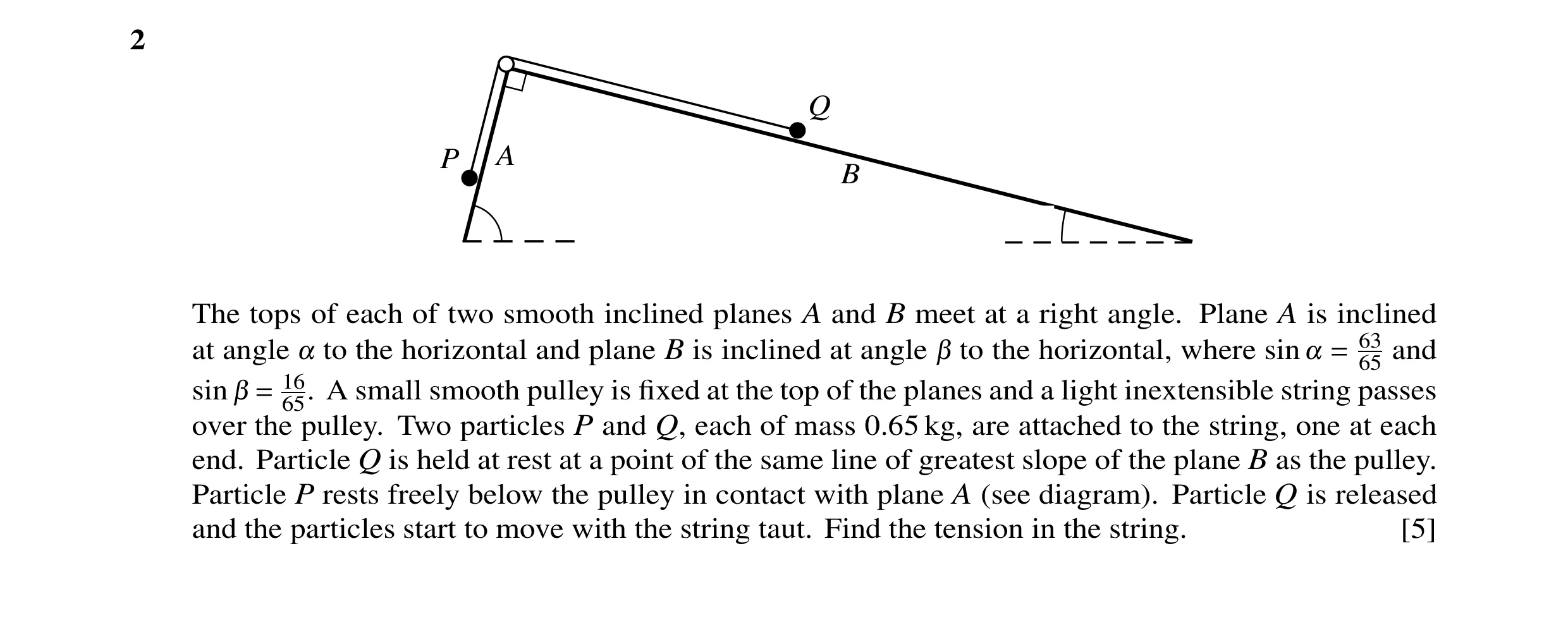
Q24 · Q P A B The tops of each of two smooth inclined planes A and B meet at a right angle 9709/43 Oct/Nov 2014
2 Q P A B The tops of each of two smooth inclined planes A and B meet at a right angle. Plane A is inclined at angle to the horizontal and plane B is inclined at angle to the horizontal, where sin = 63 and 65 sin = 1665. A small smooth pulley is fixed at the top of the planes and a light inextensible string passes over the pulley. Two particles P and Q, each of mass 0.65 kg, are attached to the string, one at each end. Particle Q is held at rest at a point of the same line of greatest slope of the plane B as the pulley. Particle P rests freely below the pulley in contact with plane A (see diagram). Particle Q is released and the particles start to move with the string taut. Find the tension in the string. [5]
5 marks
Mark scheme: 2 M1 For applying Newton’s 2nd law to P or to Q 0.65 × 10 × (63/65) – T = 0.65a or A1 T – 0.65 × 10 × (16/65) = 0.65a T – 0.65 × 10 × (16/65) = 0.65a or B1 0.65 × 10 × (63/65) – T = 0.65a or 0.65 × 10 × (63 – 16)/65 = 2 × 0.65a [T – 1.6 = 6.3 – T] or [T = 6.3 – 0.65 × (47/13)] or [T = 1.6 + 0.65 × (47/13)] M1 For eliminating a Tension is 3.95 N A1 5
This question in 9709/43 Oct/Nov 2014
Q25 · V (m s−1) 2 O t (s) 0.5 P Q h m −2 Fig 9709/42 May/June 2015
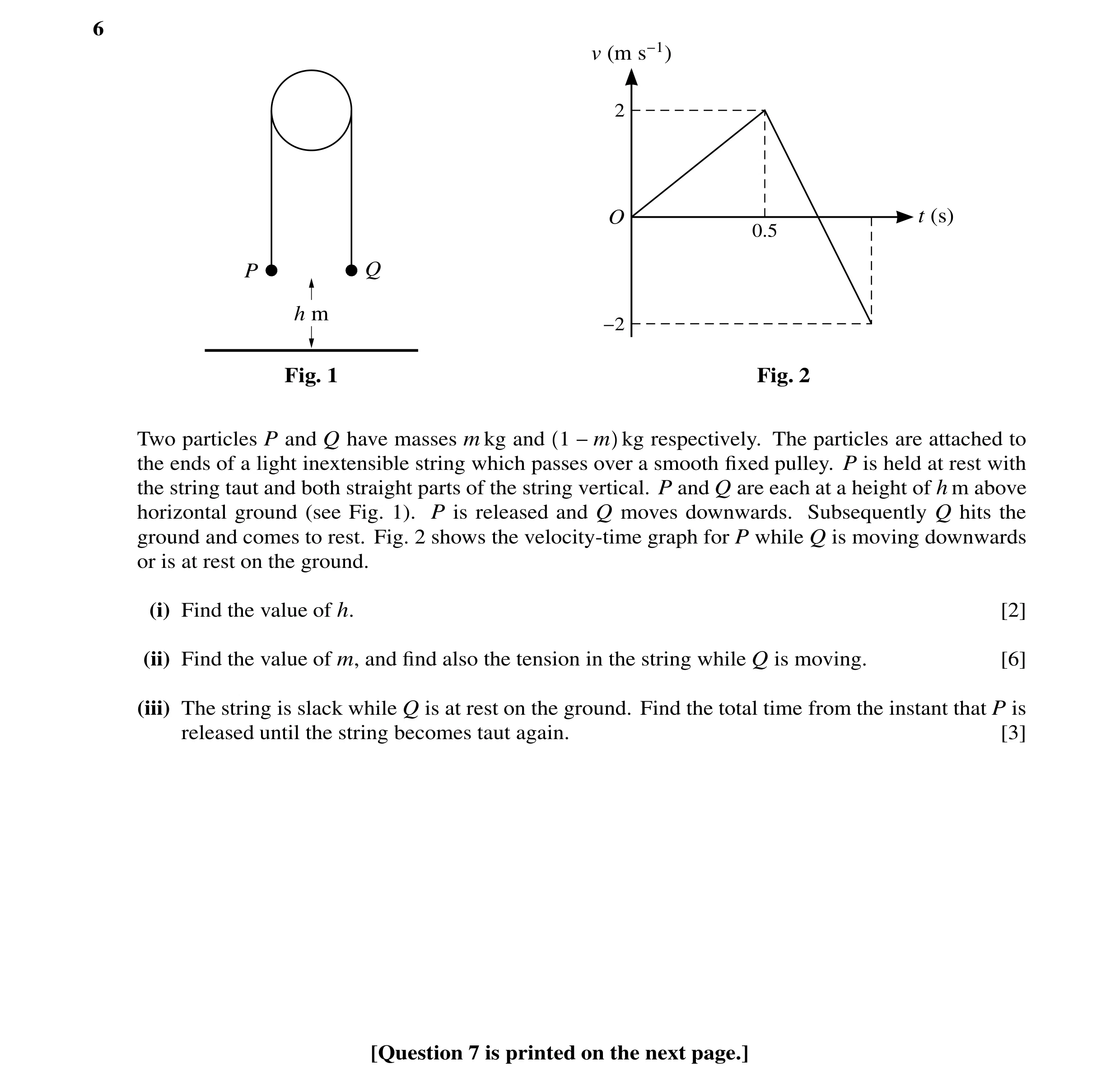
6 v (m s−1) 2 O t (s) 0.5 P Q h m −2 Fig. 1 Fig. 2 Two particles P and Q have masses m kg and 1 −m kg respectively. The particles are attached to the ends of a light inextensible string which passes over a smooth fixed pulley. P is held at rest with the string taut and both straight parts of the string vertical. P and Q are each at a height of h m above horizontal ground (see Fig. 1). P is released and Q moves downwards. Subsequently Q hits the ground and comes to rest. Fig. 2 shows the velocity-time graph for P while Q is moving downwards or is at rest on the ground. (i) Find the value of h. [2] (ii) Find the value of m, and find also the tension in the string while Q is moving. [6] (iii) The string is slack while Q is at rest on the ground. Find the total time from the instant that P is released until the string becomes taut again. [3] [Question 7 is printed on the next page.]
11 marks
Mark scheme: 6 (i) 1 M1 For using area property of the graph or h = × 5.0 × 2 2 constant acceleration formulae h = 0.5 A1 2 (ii) [a = 2 ÷ 0.5] B1 State the value of a using the gradient property of the graph [T – mg = ma M1 For applying both and • Newton’s 2nd law to P (while Q (1 – m)g – T = (1 – m)a is moving) • Newton’s 2nd law to Q (while Q or is moving) a = {(1 – 2m) ÷ (1 – m + m)}g] or using a = [(M – m) ÷ (M + m)]g M1 For eliminating T or rearranging to find m m = 0.3 A1 [T – 0.3 × 10 = 4 × 0.3 or M1 For substituting a and m into 0.7 × 10 – T = 4 × 0.7] • Newton’s 2nd law to P (while Q is moving) • Newton’s 2nd law to Q (while Q is moving) to find T (tension) Tension is 4.2 N A1 6 (iii) M1 For using the gradient property of the graph with acceleration –g (–2 – 2) ÷ (t – 0.5) = –10 A1 T = 0.9 A1 3 First Alternative method for (iii) (iii) [–2 = 2 –10t] M1 For using v = u + at to find the total time that string is slack t = 0.4 A1 Required time = 0.5 + 0.4 = 0.9 A1 3 Second Alternative method for (iii) (iii) t = 0.2 s B1 Obtaining the time taken from v = 0 to v = 2 OR v = 0 to v = –2 t = 0.2 × 2 = 0.4 s B1 Obtaining the total time that the string is slack. Total time = 0.9 s B1 3 For completing the solution using 0.4 + 0.5 = 0.9 s
This question in 9709/42 May/June 2015
Q26 · A particle of mass 0.8 kg is projected with a speed of 12 m s−1 up a line of greatest… 9709/41 May/June 2017
2 A particle of mass 0.8 kg is projected with a speed of 12 m s−1 up a line of greatest slope of a rough plane inclined at an angle of 10Å to the horizontal. The coefficient of friction between the particle and the plane is 0.4. (i) Find the acceleration of the particle. [4] … … … … … … … … … … … … … … (ii) Find the distance the particle moves up the plane before coming to rest. [2] … … … … … … … …
6 marks
Mark scheme: 2(i) R = 0.8g cos 10 [= 7.88] B1 F = 0.4 × 8 cos 10 [= 3.15] M1 Use F = µR –8 sin 10 – 3.2 cos 10 = 0.8a M1 Newton 2 along the plane a = –5.68 ms–2 A1 Total: 4 2(ii) 0 = 12 2 – 2 × 5.68 × s M1 Using v2 = u2 + 2as s = 144/(2 × 5.68) = 12.7 m A1 Total: 2 Question Answer Mark Guidance 3 EITHER: (M1 Resolve horizontally and/or vertically at the 25 N weight A cos 30 + B cos 40 = 25 A1 A sin 30 = B sin 40 A1 M1 Solve for A and/or B A = 17.1 A1 B = 13.3 A1) OR: (M1 Attempt Lami’s theorem 25 sin 70 sin140 sin150 = = A B A1 One correct equation A1 A second correct equation M1 Solve for A and/or B A = 17.1 A1 B = 13.3 A1) Total: 6
This question in 9709/41 May/June 2017
Q27 · Two particles A and B, of masses 0.8 kg and 0.2 kg respectively, are connected by a light… 9709/42 Feb/March 2018
1 Two particles A and B, of masses 0.8 kg and 0.2 kg respectively, are connected by a light inextensible string that passes over a fixed smooth pulley. The particles hang vertically. The system is released from rest. Show that the acceleration of A has magnitude 6 m s−2 and find the tension in the string. [4] … … … … … … … … … … … … … … … … … … … … … … … …
4 marks
Mark scheme: Question Answer Marks Guidance 1 [T – 2 = 0.2a 8 – T = 0.8a] M1 Attempt Newton’s 2nd law for System is 0.8g – 0.2g = (0.2 + 0.8)a either particle or use a formula for and T = 2(0.2)(0.8)g/(0.8 + 0.2) the system for a and/or T A1 Two correct equations Attempt to solve for a or T M1 a = 6 T = 3.2 A1 Both correct NB a = 6 AG 4
This question in 9709/42 Feb/March 2018
Q28 · A car of mass 1200 kg has a greatest possible constant speed of 60 m s−1 along a straight… 9709/42 Feb/March 2018
6 A car of mass 1200 kg has a greatest possible constant speed of 60 m s−1 along a straight level road. When the car is travelling at a speed of v m s−1 there is a resistive force of magnitude 35v N. (i) Find the greatest possible power of the car. [2] … … … … … (ii) The car travels along a straight level road. Show that, at an instant when its speed is 30 m s−1, the greatest possible acceleration of the car is 2.625 m s−2. [3] … … … … … … … … … … … … … … … … … (iii) The car travels at a constant speed up a hill inclined at an angle of sin−1 7 to the horizontal. 48 Find the greatest possible speed of the car. [5] … … … … … … … … … … … … … … … … … … … … … … … … …
10 marks
Mark scheme: 6(i) Driving force = 35 × 60 M1 Power = 35 × 602 = 126000 W A1 2 6(ii) 126000 B1FT Driving force is DF = 30 DF − 35 × 30 = 1200 a M1 For 3-term Newton’s 2nd law equation, dimensionally correct 3150 21 A1 AG a = = = 2.625 m s–2 1200 8 3 6(iii) 126000 M1 P DF = For F = v v 126000 7 M1 For 3-term force equation, or = 35v + 1200 g × equivalent v 48 A1 For correct (unsimplified) equation 35v 2 + 1750v − 126000 = 0 M1 For simplifying and solving of a 3- 2 term quadratic attempted or v + 50v − 3600 = 0 v = 40 ms-1 A1 v = −90 rejected or ignored 5
This question in 9709/42 Feb/March 2018
Q29 · Two particles A and B, of masses m kg and 0.3 kg respectively, are attached to the ends… 9709/41 Oct/Nov 2018
4 Two particles A and B, of masses m kg and 0.3 kg respectively, are attached to the ends of a light inextensible string. The string passes over a fixed smooth pulley and the particles hang freely below it. The system is released from rest, with both particles 0.8 m above horizontal ground. Particle A reaches the ground with a speed of 0.6 m s−1. (i) Find the tension in the string during the motion before A reaches the ground. [4] … … … … … … … … … … … … … … … (ii) Find the value of m. [2] … … … … … …
6 marks
Mark scheme: 4(i) a = 0.225 A1 T – 0.3 g = 0.3a M1 For using Newton’s second law for the 0.3 kg particle T = 3.07 N (3.0675 N) A1 4 Question Answer Marks Guidance 4(ii) mg – T = ma, m(10 – 0.225) = 3.0675 M1 For using Newton’s second law applied to the m kg particle m = 0.314 kg (0.31381…) A1 2
This question in 9709/41 Oct/Nov 2018
Q30 · A van of mass 3200 kg travels along a horizontal road 9709/43 Oct/Nov 2018
6 A van of mass 3200 kg travels along a horizontal road. The power of the van’s engine is constant and equal to 36 kW, and there is a constant resistance to motion acting on the van. (i) When the speed of the van is 20 m s−1, its acceleration is 0.2 m s−2. Find the resistance force. [3] … … … … … … … … … When the van is travelling at 30 m s−1, it begins to ascend a hill inclined at 1.5Å to the horizontal. The power is increased and the resistance force is still equal to the value found in part (i). (ii) Find the power required to maintain this speed of 30 m s−1. [3] … … … … … … … … … … … (iii) The engine is now stopped, with the van still travelling at 30 m s−1, and the van decelerates to rest. Find the distance the van moves up the hill from the point at which the engine is stopped until it comes to rest. [4] … … … … … … … … … … … … … … … … … … … … … … … …
10 marks
Mark scheme: 6(i) B1 [36000 / 20 – R = 3200 × 0.2] M1 Use of Newton’s Second Law R = 1160 N A1 [3] 6(ii) Driving force F = 3200gsin1.5 + 1160 M1 Resolving along plane [Power = (3200gsin1.5 + 1160) × 30] M1 Use of P = Fv Power = 59900 W (59929.87…) A1 3 Question Answer Marks Guidance 6(iii) [– (3200gsin1.5 + 1160) = 3200a] M1 Use of Newton’s Second Law (a = –0.62426…) A1 [02 = 302 + 2as] M1 Use of v2 = u2 + 2as to find s Distance s = 721 m (720.84…) A1 4 OR: 6(iii) [3200gsin1.5s] or [½ × 3200 × 900] M1 For PE gain or KE loss 3200gsin1.5s and ½ × 3200 × 900 A1 For PE gain and KE loss [½ × 3200 × 900 = 1160s + 3200gsin1.5s] M1 For work / energy equation Distance s = 721 m (720.84…) A1 4
This question in 9709/43 Oct/Nov 2018
Q31 · A B 0.4 kg 0.2 kg 0.5 m Two particles A and B, of masses 0.4 kg and 0.2 kg respectively… 9709/42 May/June 2019
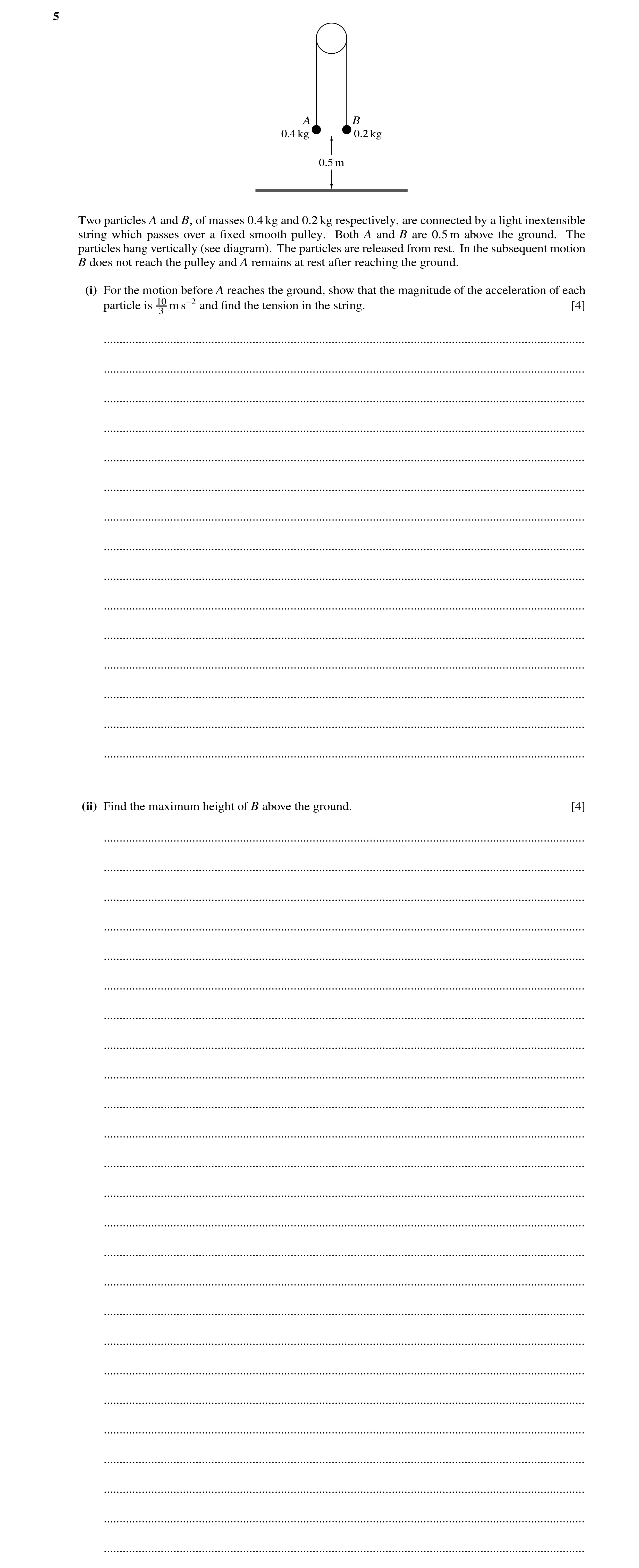
5 A B 0.4 kg 0.2 kg 0.5 m Two particles A and B, of masses 0.4 kg and 0.2 kg respectively, are connected by a light inextensible string which passes over a fixed smooth pulley. Both A and B are 0.5 m above the ground. The particles hang vertically (see diagram). The particles are released from rest. In the subsequent motion B does not reach the pulley and A remains at rest after reaching the ground. (i) For the motion before A reaches the ground, show that the magnitude of the acceleration of each particle is 10 m s−2 and find the tension in the string. [4] 3 … … … … … … … … … … … … … … … (ii) Find the maximum height of B above the ground. [4] … … … … … … … … … … … … … … … … … … … … … … … … …
8 marks
Mark scheme: 5(i) A: 4 – T = 0.4a B: T – 2 = 0.2a System: 4 – 2 = (0.4 + 0.2)a M1 Apply Newton’ second law to particle A (3 terms) or to particle B (3 terms) or to the system (4 terms implied) A1 Two correct equations M1 Either solve the system equation for a or solve two simultaneous equations for a or T or verify the given value of a by finding the same T value in both equations a = 10 3 , T = 8 3 A1 Both correct AG 4 5(ii) M1 Apply v 2 = u 2 +2as to particle A or particle B with a = 10/3 v2 = 0 + 2 × 10/3 × 0.5 A1 [v = 1.83 but not needed specifically] 0 = 10/3 – 2 × 10 × s [s = 1 6 ] M1 Apply v 2 = u 2 + 2as to particle B to find s, the distance travelled by B after A has hit the ground Maximum height = 7 6 = 1.17 m A1 Maximum height = 1/2 + 1/2 + 1/6 = 7/6 = 1.17 4
This question in 9709/42 May/June 2019
Q32 · Q 0.2 kg P 0.3 kg 0.8 m 1 Two particles P and Q, of masses 0.3 kg and 0.2 kg… 9709/42 Oct/Nov 2019
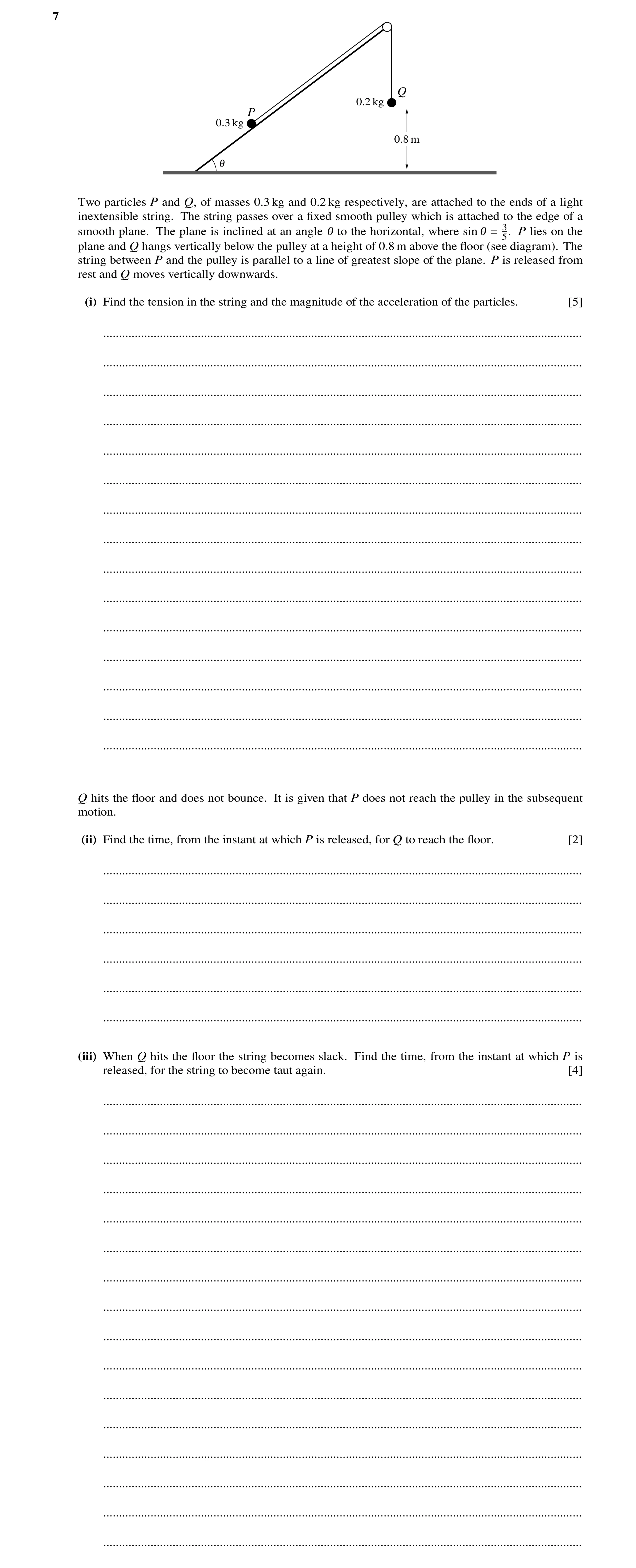
7 Q 0.2 kg P 0.3 kg 0.8 m 1 Two particles P and Q, of masses 0.3 kg and 0.2 kg respectively, are attached to the ends of a light inextensible string. The string passes over a fixed smooth pulley which is attached to the edge of a smooth plane. The plane is inclined at an angle 1 to the horizontal, where sin 1 = 35. P lies on the plane and Q hangs vertically below the pulley at a height of 0.8 m above the floor (see diagram). The string between P and the pulley is parallel to a line of greatest slope of the plane. P is released from rest and Q moves vertically downwards. (i) Find the tension in the string and the magnitude of the acceleration of the particles. [5] … … … … … … … … … … … … … … … Q hits the floor and does not bounce. It is given that P does not reach the pulley in the subsequent motion. (ii) Find the time, from the instant at which P is released, for Q to reach the floor. [2] … … … … … … (iii) When Q hits the floor the string becomes slack. Find the time, from the instant at which P is released, for the string to become taut again. [4] … … … … … … … … … … … … … … … …
11 marks
Mark scheme: 7(i) M1 Use of Newton’s second law for P or Q or the system For P: 3 0.3 0.3 sin36.9 0.3 5 T g T g a − × = − = For Q: 0.2g – T = 0.2a System: ( ) 3 0.2 0.3 0.2 0.3 5 g g a − × = + or 0.2g – 0.3g sin 36.9 = (0.2 + 0.3)a A1 Two correct equations Allow use of θ = 36.9 [0.2g – 0.18g = 0.5a] M1 For solving either the system for a or for solving a pair of simultaneous equations for a or T a = 0.4 ms–2 A1 T = 1.92 N A1 5 Question Answer Mark Guidance 7(ii) 2 1 0.8 0 0.4 2 t = + × × a M1 For use of the constant acceleration equations with their a from 7(i) and a ≠ ± g for a complete method to find t t = 2 s A1 2 7(iii) Speed when Q hits the floor = 2 × 0.4 (= 0.8) or ( )[ ] 2 0.4 0.8 0.8 v = × × = B1FT Using v = u + at with u = 0 Allow FT for their unsimplified v = at or v2 = 2as with a from (i), t from (ii) and s = 0.8 3 0.3 0.3 sin36.9 0.3 5 g g a − × = − = [a = –6] M1 Using Newton’s second law for P to find a ≠ ± g ( ) ( ) 2 1 0 0.8 6 0.2666... 2 t t t = + × − = or 0 = 0.8 – 6T (T = 0.13333 = 2 15 and t = 2T = 0.26666 = 4 15 ) M1 Use of the constant acceleration equation(s) to find the time taken for P to return to the position where the string first became slack. Total time = 2 + 0.266... = 2 + 4 15 = 2.27 = 34 15 s A1 4
This question in 9709/42 Oct/Nov 2019
Q33 · A lorry of mass 16 000 kg is travelling along a straight horizontal road 9709/42 Feb/March 2020
1 A lorry of mass 16 000 kg is travelling along a straight horizontal road. The engine of the lorry is working at constant power. The work done by the driving force in 10 s is 750 000 J. (a) Find the power of the lorry’s engine. [1] … … … … … (b) There is a constant resistance force acting on the lorry of magnitude 2400 N. Find the acceleration of the lorry at an instant when its speed is 25 m s−1. [3] … … … … … … … … … … … … … … … …
4 marks
Mark scheme: 1(a) Power = 750000/10 = 75000 W or 75 kW B1 Power = WD/Time 1 1(b) Driving force DF = 75000/25 B1FT Using P = DF × v [DF – 2400 = 16000a] M1 Using Newton’s 2nd law a = 0.0375 ms–2 A1 Allow a = 3 80 3
This question in 9709/42 Feb/March 2020
Q34 · A particle P of mass 0.4 kg is on a rough horizontal floor 9709/42 Feb/March 2020
2 A particle P of mass 0.4 kg is on a rough horizontal floor. The coefficient of friction between P and the floor is -. A force of magnitude 3 N is applied to P upwards at an angle ! above the horizontal, where tan ! = 34. The particle is initially at rest and accelerates at 2 m s−2. (a) Find the time it takes for P to travel a distance of 1.44 m from its starting point. [2] … … … … … … … … (b) Find -. [4] … … … … … … … … … … … … … …
6 marks
Mark scheme: 2(a) M1 For using a complete method which would lead to an equation for finding a value of t such as s = ut + ½ at2 with u = 0, s = 1.44 and a = 2 t = 1.2 s A1 2 2(b) R = 0.4g – 3 × 3 5 = 0.4g – 3 sin 36.9 [= 2.2] B1 [3 × 4 5 – F = 3 cos 36.9 – F = 0.4 × 2] [F = 1.6] M1 Use Newton’s 2nd law, 3 terms, to find F. 4 5 3 5 3 0.4 2 1.6 0.4 3 2.2 g μ × − × = = −× M1 Use of F R μ = μ = 0.727 A1 Allow μ = 8 11 4
This question in 9709/42 Feb/March 2020
Q35 · On a straight horizontal test track, driverless vehicles (with no passengers) are being… 9709/42 Feb/March 2020
6 On a straight horizontal test track, driverless vehicles (with no passengers) are being tested. A car of mass 1600 kg is towing a trailer of mass 700 kg along the track. The brakes are applied, resulting in a deceleration of 12 m s−2. The braking force acts on the car only. In addition to the braking force there are constant resistance forces of 600 N on the car and of 200 N on the trailer. (a) Find the magnitude of the force in the tow-bar. [2] … … … … … … … … … … … (b) Find the braking force. [2] … … … … … … … … … … (c) At the instant when the brakes are applied, the car has speed 22 m s−1. At this instant the car is 17.5 m away from a stationary van, which is directly in front of the car. Show that the car hits the van at a speed of 8 m s−1. [2] … … … … … … … … … … … (d) After the collision, the van starts to move with speed 5 m s−1 and the car and trailer continue moving in the same direction with speed 2 m s−1. Find the mass of the van. [3] … … … … … … … … … …
9 marks
Mark scheme: 6(a) [T – 200 = 700 × –12] Car: –T – 600 – F = 1600 × –12 System: –600 – 200 – F = 2300 × –12 the car and to the system and eliminate the braking force, F. Magnitude of T = 8200 N A1 2 6(b) Car [T – F – 600 = 1600 × –12] or System [–600 – 200 – F = 2300 × –12] M1 Apply Newton’s second law either to the car or to the system with braking force = F and use of their T from 6(a) Braking force F = 26800 N A1 2 6(c) [v2 = 222 + 2 × –12 × 17.5] M1 A complete method using constant acceleration equations which would lead to an equation for finding v, using u = 22, s = 17.5 and a = –12 v = 8 ms–1 A1 AG 2 6(d) [2300 × 8 + m × 0 = 2300 × 2 + m × 5] M1 For applying the conservation of momentum equation to the system of car, trailer and van, where m = mass of the van A1 Correct equation m = 2760 kg A1 3
This question in 9709/42 Feb/March 2020
Q36 · A minibus of mass 4000 kg is travelling along a straight horizontal road 9709/43 May/June 2020
2 A minibus of mass 4000 kg is travelling along a straight horizontal road. The resistance to motion is 900 N. (a) Find the driving force when the acceleration of the minibus is 0.5 m s−2. [2] … … … … … … … … … … … (b) Find the power required for the minibus to maintain a constant speed of 25 m s−1. [2] … … … … … … … … … … …
4 marks
Mark scheme: 2(a) F – 900 = 4000 × 0.5 (M1 for use of Newton’s second law, 3 terms) M1 F = 2900 N A1 2(b) 900 × 25 (M1 for use of P = Fv with F = resistance only) M1 22 500 W or 22.5 kW A1
This question in 9709/43 May/June 2020
Q37 · 0.8 kg 0.2 kg 0.5 m Two particles of masses 0.8 kg and 0.2 kg are connected by a light… 9709/41 Oct/Nov 2020
5 0.8 kg 0.2 kg 0.5 m Two particles of masses 0.8 kg and 0.2 kg are connected by a light inextensible string that passes over a fixed smooth pulley. The system is released from rest with both particles 0.5 m above a horizontal floor (see diagram). In the subsequent motion the 0.2 kg particle does not reach the pulley. (a) Show that the magnitude of the acceleration of the particles is 6 m s−2 and find the tension in the string. [4] … … … … … … … … … … … … … … … … (b) When the 0.8 kg particle reaches the floor it comes to rest. Find the greatest height of the 0.2 kg particle above the floor. [3] … … … … … … … … … … … … … … … … … … … … … … … …
7 marks
Mark scheme: 5(a) 0.8g – T = 0.8a, T – 0.2g = 0.2a, For system: 0.8g – 0.2g = (0.8 + 0.2)a A1 Any 2 correct equations Attempt to solve for either a or T M1 a = 6 ms–2 and T = 3.2 N A1 AG. Both correct 4 5(b) v2 = 2 × 6 × 0.5 M1 Attempt to find v or v2 as 0.8 kg particle reaches the ground using a from 5(a) 0 = 6 – 20s M1 Attempt to find the extra height reached by 0.2 kg particle using v2 from previous M1 mark Greatest height = 0.5 + 0.5 + 0.3 = 1.3 m A1 3
This question in 9709/41 Oct/Nov 2020
Q38 · A 0.3 kg B 0.5 kg 3.5 N 30Å Two particles A and B, of masses 0.3 kg and 0.5 kg… 9709/42 Oct/Nov 2020
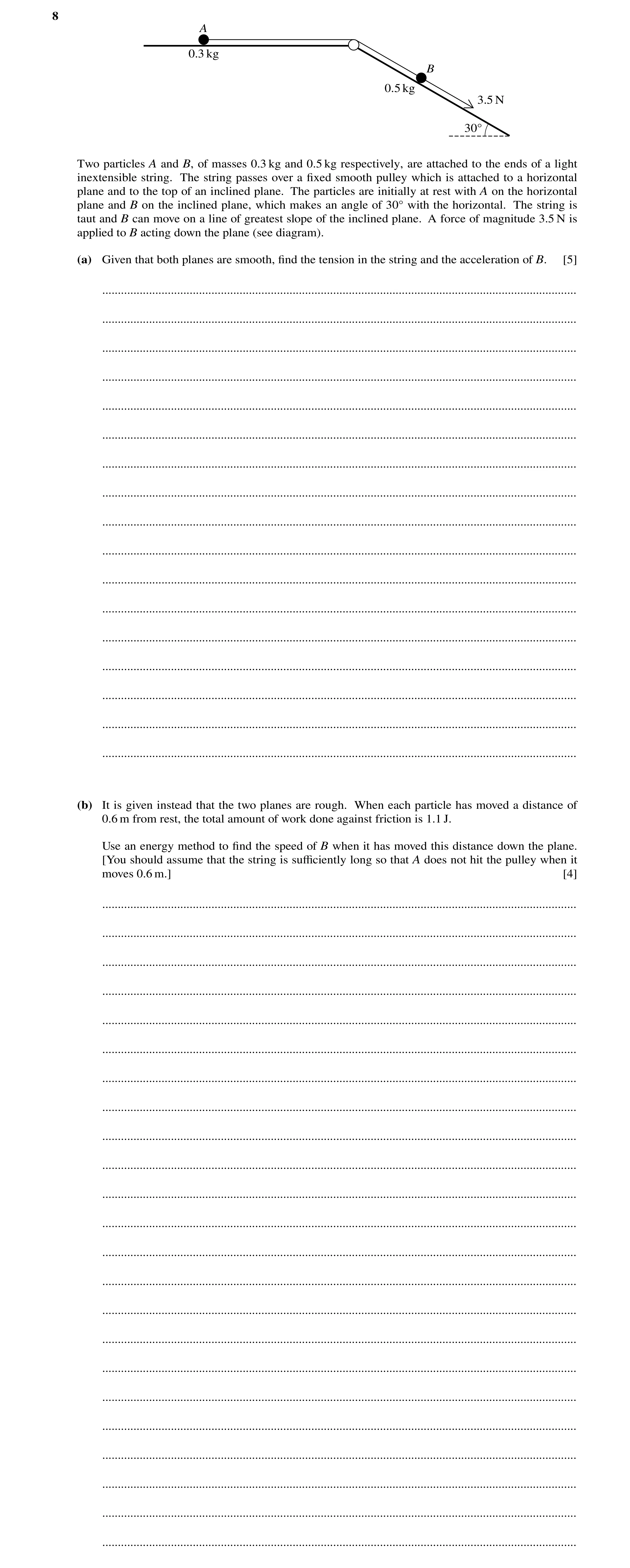
8 A 0.3 kg B 0.5 kg 3.5 N 30Å Two particles A and B, of masses 0.3 kg and 0.5 kg respectively, are attached to the ends of a light inextensible string. The string passes over a fixed smooth pulley which is attached to a horizontal plane and to the top of an inclined plane. The particles are initially at rest with A on the horizontal plane and B on the inclined plane, which makes an angle of 30Å with the horizontal. The string is taut and B can move on a line of greatest slope of the inclined plane. A force of magnitude 3.5 N is applied to B acting down the plane (see diagram). (a) Given that both planes are smooth, find the tension in the string and the acceleration of B. [5] … … … … … … … … … … … … … … … … … (b) It is given instead that the two planes are rough. When each particle has moved a distance of 0.6 m from rest, the total amount of work done against friction is 1.1 J. Use an energy method to find the speed of B when it has moved this distance down the plane. [You should assume that the string is sufficiently long so that A does not hit the pulley when it moves 0.6 m.] [4] … … … … … … … … … … … … … … … … … … … … … … …
9 marks
Mark scheme: 8(a) For A: T = 0.3a For B: 3.5 + 0.5g sin 30 – T = 0.5a System: 3.5 + 0.5g sin 30 = (0.3 + 0.5)a or to the system. Correct number of terms. A1 Two correct equations For solving either for T or for a M1 a = 7.5 ms–2 A1 T = 2.25 N A1 5 8(b) 0.5g sin 30 × 0.6 [= 1.5] B1 PE loss by B Apply the work-energy equation to the system M1 5 relevant terms, their PE for 0.5 kg, WD by 3.5 N, WD against friction and two relevant KE terms. 0.5g sin 30 × 0.6 + 3.5 × 0.6 = ½ × 0.8 × v2 + 1.1 A1 v = 2.5 ms–1 A1 4
This question in 9709/42 Oct/Nov 2020
Q39 · A car of mass 1600 kg is pulling a caravan of mass 800 kg 9709/43 Oct/Nov 2020
6 A car of mass 1600 kg is pulling a caravan of mass 800 kg. The car and the caravan are connected by a light rigid tow-bar. The resistances to the motion of the car and caravan are 400 N and 250 N respectively. (a) The car and caravan are travelling along a straight horizontal road. (i) Given that the car and caravan have a constant speed of 25 m s−1, find the power of the car’s engine. [2] … … … … … … (ii) The engine’s power is now suddenly increased to 39 kW. Find the instantaneous acceleration of the car and caravan and find the tension in the tow-bar. [5] … … … … … … … … … … … … … … … … … … … … … (b) The car and caravan now travel up a straight hill, inclined at an angle of sin−1 0.05 to the horizontal, at a constant speed of v m s−1. The car’s engine is working at 32.5 kW. Find v. [3] … … … … … … … … … … … … … … …
10 marks
Mark scheme: 6(a)(i) P = 650 × 25 M1 Use P = Fv with F = total resistance P = 16 250 W = 16.25 kW A1 Accept 16 300 W or 16.3 kW (3sf) 2 Question Answer Marks Guidance 6(a)(ii) DF = 39000 25 (= 1560) B1 For using DF = P/v For applying Newton’s 2nd law to the system to form an equation in a, or to the caravan or the car to form an equation in T and a M1 [1560 – 650 = 2400 × a] 1560 – 650 = 2400a T – 250 = 800a 1560 – 400 – T = 1600a A1 Two correct equations ( ) 1560 650 2400 a − = M1 For solving for a or for T a = 0.379 ms–2 (0.37916…) T = 553 N (553.33…) A1 5 6(b) [DF = 650 + 2400 × 10 × 0.05] M1 Newton’s 2nd law 32 500 = (650 + 24 000 × 0.05)v M1 For using P = Fv v = 17.6 A1 Allow v = 650 37 3
This question in 9709/43 Oct/Nov 2020
Q40 · V (m s−1) 2 0 t (s) 0 1.5 6 7 13 15 20 21.5 −V An elevator moves vertically, supported by… 9709/42 Feb/March 2021
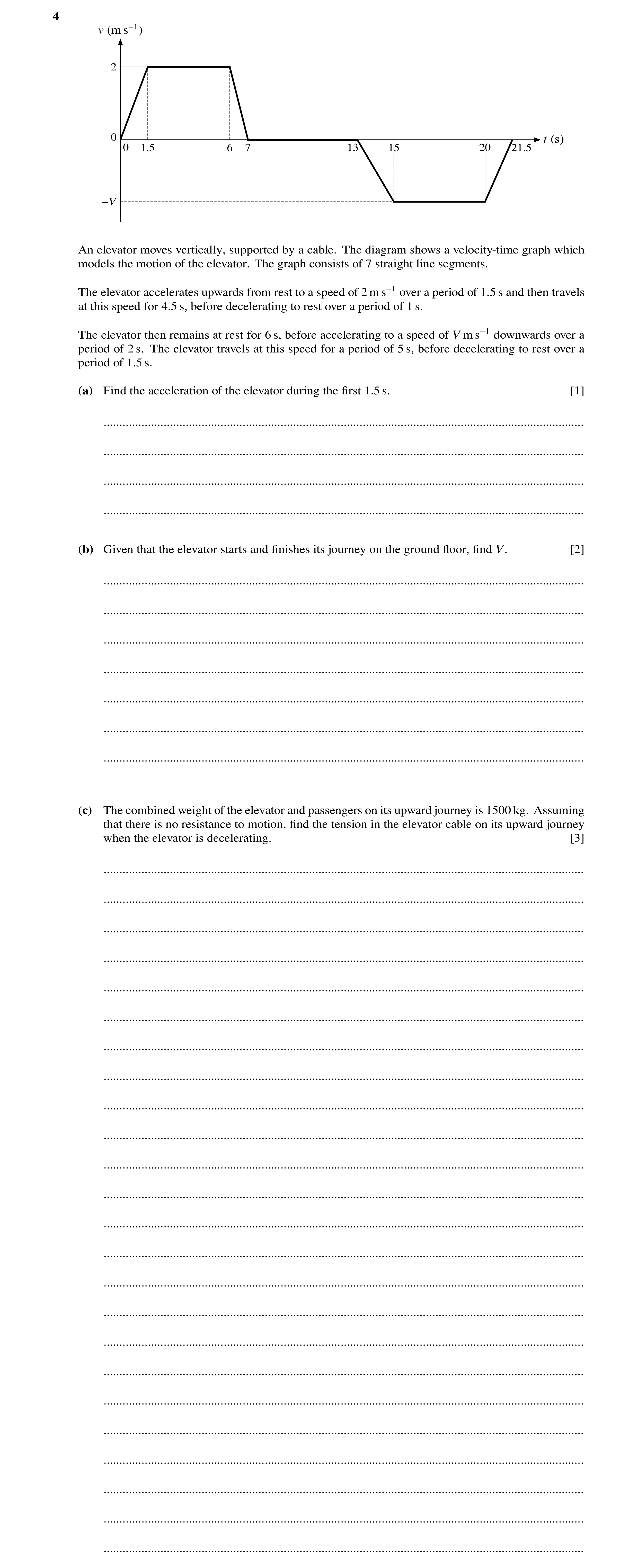
4 v (m s−1) 2 0 t (s) 0 1.5 6 7 13 15 20 21.5 −V An elevator moves vertically, supported by a cable. The diagram shows a velocity-time graph which models the motion of the elevator. The graph consists of 7 straight line segments. The elevator accelerates upwards from rest to a speed of 2 m s−1 over a period of 1.5 s and then travels at this speed for 4.5 s, before decelerating to rest over a period of 1 s. The elevator then remains at rest for 6 s, before accelerating to a speed of V m s−1 downwards over a period of 2 s. The elevator travels at this speed for a period of 5 s, before decelerating to rest over a period of 1.5 s. (a) Find the acceleration of the elevator during the first 1.5 s. [1] … … … … (b) Given that the elevator starts and finishes its journey on the ground floor, find V. [2] … … … … … … … (c) The combined weight of the elevator and passengers on its upward journey is 1500 kg. Assuming that there is no resistance to motion, find the tension in the elevator cable on its upward journey when the elevator is decelerating. [3] … … … … … … … … … … … … … … … … … … … … … … … …
6 marks
Mark scheme: 4(a) Acceleration = 4 3 m s–2 1 4(b) ( ) ( ) 1 1 7 4.5 2 8.5 5 2 2 + × = + ×V M1 Equate expressions for the two areas (distances) leading to an equation in V. V = 1.7[0] (3sf) A1 Allow V = 46 27 . 2 4(c) Acceleration = −2 m s–2 B1 Or Deceleration = 2. T – 1500g = 1500× (−2) M1 Apply Newton’s second law to the lift, using an acceleration 4 ( 3 ≠ or their 4(a)). Correct dimensions and number of relevant terms. T = 12 000 N A1 3
This question in 9709/42 Feb/March 2021
Q41 · A B m kg 0.1 kg 0.9 m Two particles A and B have masses m kg and 0.1 kg respectively… 9709/41 May/June 2021
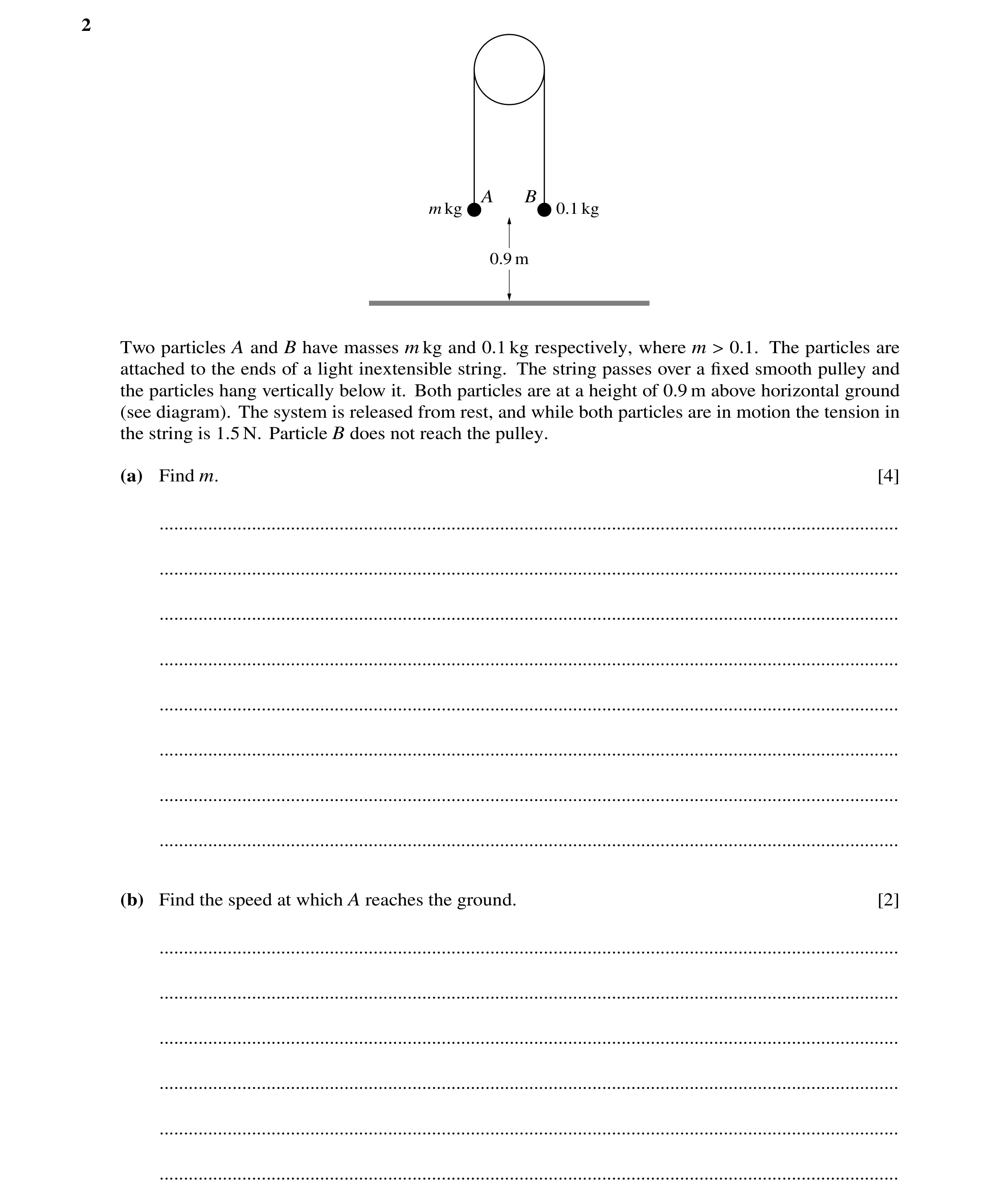
2 A B m kg 0.1 kg 0.9 m Two particles A and B have masses m kg and 0.1 kg respectively, where m > 0.1. The particles are attached to the ends of a light inextensible string. The string passes over a fixed smooth pulley and the particles hang vertically below it. Both particles are at a height of 0.9 m above horizontal ground (see diagram). The system is released from rest, and while both particles are in motion the tension in the string is 1.5 N. Particle B does not reach the pulley. (a) Find m. [4] … … … … … … … … (b) Find the speed at which A reaches the ground. [2] … … … … … …
6 marks
Mark scheme: 2(a) 0.1 kg particle 0.1 0.1 − = T g a m kg particle − = mg T ma System ( ) 0.1 0.1 − = + mg g m a particle or to the system, correct number of terms A1 Two correct equations Solve for m [ ] 5 = a M1 From 2 equations with the correct number of relevant terms 0.3 = m A1 4 Question Answer Marks Guidance 2(b) 2 0 2 5 0.9 = + × × v M1 Use of 2 2 2 = + v u as with 0 = u , 0.9 = s and their ≠± a g 3 = v m s–1 A1 FT FT on 1.8a 2
This question in 9709/41 May/June 2021
Q42 · A toy railway locomotive of mass 0.8kg is towing a truck of mass 0.4kg on a straight… 9709/42 Feb/March 2023
4 A toy railway locomotive of mass 0.8kg is towing a truck of mass 0.4kg on a straight horizontal track at a constant speed of 2ms−1. There is a constant resistance force of magnitude 0.2N on the locomotive, but no resistance force on the truck. There is a light rigid horizontal coupling connecting the locomotive and the truck. (a) State the tension in the coupling. [1] … … (b) Find the power produced by the locomotive’s engine. [1] … … … The power produced by the locomotive’s engine is now changed to 1.2W. (c) Find the magnitude of the tension in the coupling at the instant that the locomotive begins to accelerate. [5] … … … … … … … … … … … … …
7 marks
Mark scheme: 4(a) Tension = 0 N B1 May be implied. 1 4(b) Power = 0.2 2 = 0.4 W B1 Use of power = Fv . Allow without units. 1 4(c) Driving force = 1.2/2 [= 0.6 N] B1 Use of Newton’s second law for locomotive or truck or system M1 Correct number of relevant terms. For locomotive: DF – 0.2 –T = 0.8a A1 For any two correct. For truck: T = 0.4a For system: DF – 0.2 =1.2a For attempt to solve for T M1 From equations with correct number of relevant terms. Using their dimensionally correct DF. 1 May see a = . 3 2 A1 Allow awrt 0.133 . T = N 15 5
This question in 9709/42 Feb/March 2023
Q43 · T N 20Å B 30Å F N A block B, of mass 2kg, lies on a rough inclined plane sloping at 30Å… 9709/42 Feb/March 2023
6 T N 20Å B 30Å F N A block B, of mass 2kg, lies on a rough inclined plane sloping at 30Å to the horizontal. A light rope, inclined at an angle of 20Å above a line of greatest slope, is attached to B. The tension in the rope is T N. There is a friction force of F N acting on B (see diagram). The coefficient of friction between B and the plane is -. (a) It is given that F = 5 and that the acceleration of B up the plane is 1.2ms−2. (i) Find the value of T. [3] … … … … … … … (ii) Find the value of -. [3] … … … … … … … … (b) It is given instead that - = 0.8 and T = 15. Determine whether B will move up the plane. [3] … … … … … … … … … … … … … … … … … … … … … … … …
9 marks
Mark scheme: 6(a)(i) Attempt to resolve parallel to the plane M1 4 terms; allow sin/cos mix; allow sign errors; allow g missing. Tcos20 −−5 2 gsin30 = 2 1.2 A1 Correct equation. T = 18.5 A1 awrt 18.5 . 3 6(a)(ii) Attempt resolve perpendicular to the plane M1 3 terms; allow sin/cos mix: allow sign errors; allow with T or R = 2 g cos30 − Tsin20 their T ; allow g missing. Use of 5 = R to get an equation in only M1 Where R is a two term expression with a component of 2g and = 5 ( 2 g cos30 − Tsin20 ) a component of their T ; allow g missing. = 0.455 A1 5 awrt 0.455; allow 0.46 or 0.45; do not allow . 11 3 6(b) Max F = 0.8 ( 2 g cos30 − 15sin20 ) *B1 = 0.8 12.1902 = 9.7521 Net force up the plane = 15cos20 − 2 gsin30 = 4.0953 *B1 15cos20 − 2 gsin30 − 0.8 ( 2 g cos30 − 15sin20 ) OR = 2 a −5.6567 = 2 a a = −2.8283.. If max F incorrect and use F = ma then allow B1 for 15cos20 − 2 gsin30 − their max F . [State 4.0953 9.7521 ,] hence the block does not move DB1 Must have correct values (to at least 1 sf) to compare for this [up the plane] mark. No incorrect statement seen. Alternative Method 1 for Question 6(b) Max force down plane = 0.8 ( 2 g cos30 − 15sin20 ) + 2 gsin30 *B1 = 0.8 12.1902 + 10 = 19.7521 Force up plane = 15cos20 = 14.0953 *B1 i.e. using it to compare with their max force down the plane. [State 1 4.0953 19.7521 ,] hence the block does not move DB1 Must have correct values (to at least 1 sf) to compare for this [up the plane] mark. No incorrect statement seen. 6(b) Alternative Method 2 for Question 6(b) F = 15cos20 − 2 gsin30 = 4.9053 *B1 Or R = 2 g cos30 − 15sin20 = 12.1902 15cos20 − 2 gsin30 *B1 Get = = 0.3359 2 g cos30 − 15sin20 [State 0.3359 0.8 ,] hence the block does not move [up the DB1 Must have correct value of (to at least 1 sf) to compare for plane] this mark. No incorrect statement seen. 3
This question in 9709/42 Feb/March 2023
Q44 · An elevator is pulled vertically upwards by a cable 9709/43 May/June 2023
6 An elevator is pulled vertically upwards by a cable. The elevator accelerates at 0.4ms−2 for 5s, then travels at constant speed for 25s. The elevator then decelerates at 0.2ms−2 until it comes to rest. (a) Find the greatest speed of the elevator and hence draw a velocity-time graph for the motion of the elevator. [3] … … … (b) Find the total distance travelled by the elevator. [2] … … … … … … … The mass of the elevator is 1200kg and there is a crate of mass mkg resting on the floor of the elevator. (c) Given that the tension in the cable when the elevator is decelerating is 12250N, find the value of m. [3] … … … … … … … … … … … (d) Find the greatest magnitude of the force exerted on the crate by the floor of the elevator, and state its direction. [3] … … … … … … … … … … …
11 marks
Mark scheme: 6(a) 0.4 5 B1 This can be seen on the graph and not stated explicitly. Trapezium shape B1 Sitting on t-axis, starting at origin. B1 All correct including height of 2 and t-values of 5, 30, 40 on the horizontal axis. Labels not needed. Does not need to be to scale. 3 6(b) Distance = 1 25 5 25 1 0 2 2 their their or 1 1 5 2 25 2 10 2 2 2 their their their their M1 Allow M1 for finding total area under their trapezium or appropriate ‘suvat’ in each phase. If presented as 3 areas, they do not need to be added for M1. Allow one wrong value but must represent all 3 phases of motion. Distance = 65[m] A1 2 6(c) Attempt at Newton’s second law M1 Must have correct number of terms (5). Allow sign errors. Allow g missing. Use of a = g is M0A0A0 but condone use of a = 0.4 (from wrong phase). 12250 1200 1200 0.2 g mg m Or 1200 12250 1200 0.2 g mg m A1 Correct equation. Note that taking a = 0.2 and omitting mg gets M0A0A0. m = 50 A1 3 −5 5 10 15 20 25 30 35 40 2 t v Question Answer Marks Guidance 6(d) Realise that this is when accelerating and attempt Newton’s second law for the crate only M1 Must have correct number of terms (3). Allow sign errors. Allow g missing. Must use a = ±0.4, M0A0A0 otherwise. 50 50 0.4 R g or 50 50 0.4 g R A1FT Correct equation using their 50. Force R = 520[N], upwards A1 Must include ‘upwards’ OE. 3
This question in 9709/43 May/June 2023
Q45 · A block of mass 8kg slides down a rough plane inclined at 30Å to the horizontal, starting… 9709/43 Oct/Nov 2023
3 A block of mass 8kg slides down a rough plane inclined at 30Å to the horizontal, starting from rest. The coefficient of friction between the block and the plane is -. The block accelerates uniformly down the plane at 2.4ms−2. (a) Draw a diagram showing the forces acting on the block. [1] (b) Find the value of -. [4] … … … … … … … … … … (c) Find the speed of the block after it has moved 3m down the plane. [1] … … … …
6 marks
Mark scheme: 3(a) Correct force diagram with 3 forces in the correct directions. B1 No labels required on the 3 forces and ignore wrong labels. Arrows needed. Allow either or both components of weight if fully labelled. Allow sin/cos mix. If forces are not connected to the block, then the line of action of each force must go through the block. 1 3(b) R = 8 g cos30 = 40 3 = 69.282 B1 Resolving perpendicular to the plane. Resolving parallel to the plane and attempt to apply Newton’s second law. M1* 3 terms. Allow sign errors, sin/cos mix. Allow g 8 g sin30 − F = 8 2.4 F = 20.8 missing, otherwise dimensionally correct. Use of F = R to get an equation in only. DM1 Allow g missing in either or both of F and R. Allow sign errors, consistent sin/cos mix. 8 g sin30 − 8 gcos30 = 8 2.4 40 − 40 3= 19.2 R must be a single component of a force. Allow the 3 masses to be cancelled. 20.8 20.8 A1 13 3 104 3 = 0.3 0 May first see or Allow exact value or oe. 40 3 69.282 75 600 4 3(c) B1 3.79473… (3.8 without a more accurate value seen gets 2 6 10 [ v = 2 2.4 3 greatest speed =] 3.79 ms–1 = B0 and should be annotated SF). 5 1
This question in 9709/43 Oct/Nov 2023
Q46 · A cyclist is riding along a straight horizontal road 9709/42 Oct/Nov 2024
3 A cyclist is riding along a straight horizontal road. The total mass of the cyclist and his bicycle is 90 kg. The power exerted by the cyclist is 250 W. At an instant when the cyclist’s speed is 5 m s -1 , his acceleration is 0.1 m s -2 . (a) Find the value of the constant resistance to motion acting on the cyclist. [3] … … … … … … … … … … The cyclist comes to the bottom of a hill inclined at 2° to the horizontal. (b) Given that the power and resistance to motion are unchanged, find the steady speed which the cyclist could maintain when riding up the hill. [2] … … … … … … … … … … … … …
5 marks
Mark scheme: 3(a) 250 B1 For use of power =Fv e.g. 5 PF = 250 . [Peddling force = PF =] 5 their PF − R = 90 0.1 M1 Using their PF 250 . 3 terms; allow sign errors. Dimensionally correct. Resistance = 41 N A1 3 3(b) 250 M1 For attempt at resolving up the hill; 3 terms; allow sign − their 41 − 90 g sin2 = 0 errors; Must be a component of weight (NOT mass) but v allow sin/cos mix; allow use of their 41. Dimensionally correct. 250 Oe eg v = . their 41 + 90 g sin 2 Steady speed = 3.45 m s–1 A1 3.45258… AWRT 3.45. 2
This question in 9709/42 Oct/Nov 2024
Q47 · A 0.2 kg i B 0.3 kg 0.25 m Two particles, A and B, of masses 0.2 kg and 0.3 kg… 9709/42 Oct/Nov 2024
7 A 0.2 kg i B 0.3 kg 0.25 m Two particles, A and B, of masses 0.2 kg and 0.3 kg respectively, are attached to the ends of a light inextensible string. The string passes over a small fixed smooth pulley which is attached to the bottom of a rough plane inclined at an angle i to the horizontal where sin i = 0. 6 . Particle A lies on the plane, and particle B hangs vertically below the pulley, 0.25 m above horizontal ground. The string between A and the pulley is parallel to a line of greatest slope of the plane (see diagram). The coefficient of friction between A and the plane is 1.125 . Particle A is released from rest. (a) Find the tension in the string and the magnitude of the acceleration of the particles. [7] … … … … … … … … … … … … … … … … … … … … … … … … (b) When B reaches the ground, it comes to rest. Find the total distance that A travels down the plane from when it is released until it comes to rest. You may assume that A does not reach the pulley. [4] … … … … … … … … … … … … … … … …
11 marks
Mark scheme: cos37 or better for 0.8.7(a) R = 0.2 g 0.8 = 1.6 B1 Allow R is a component of weight. F = 1.125 R = 1.8 *M1 Where Must have 1.125 0.2 g 0.8 or 1.125 0.2 g 0.6 or with using cos37 or sin37 or better for 0.8 and 0.6 respectively. These 2 marks may be embedded in the N2L equation(s). Use of Newton’s second law for A or B or system *M1 Correct number of terms; allow sign errors; allow sin/cos mix. Dimensionally correct. 0.3 g − T = 0.3a A1 For any 2 correct equations. T + 0.2 g 0.6 − F = 0.2a Allow sin37 or better for 0.6. Allow their possibly incorrect F . 0.3 g + 0.2 g 0.6 − F = 0.5a a = 4.8 m s–2 A1 Must be positive. For attempt to solve for T DM1 From equations with the correct number of relevant terms. If a found first then substituting into an equation with the correct number of relevant terms and solving. If resolved equations incorrect and no working seen, then this mark is implied by the correct T value for their equations. Dependent on previous 2 M marks T = 1.56 N A1 7 7(b) [For B or A] v 2 = 0 2 + 2 4.8 0.25 *M1 Use of v 2 = u 2 + 2 as with u = 0 and using 2 2 15 s = 0.25 , their 4.8 , a g . Must be a complete method v = 2.4 or v = = 1.549 5 to get an expression for v or 2v . Attempt at Newton’s 2nd Law on A when string becomes slack *M1 3 terms; allow sign errors; allow sin/cos mix; allow their F from part (a); Dimensionally correct; must be 0.2 g 0.6 − 1.125 0.2 g 0.8 = 0.2 a non-zero using 0.2 for the mass. Allow = 37 or better. For reference a = −3 (or −2.99 if using = 36.9 ). 20 = 2.4 + 2 −( 3) s =s 0.4 DM1 Using constant acceleration formula(e) using a negative acceleration to get an expression in s only. Dependent on previous 2 M marks. Total distance = 0.25 + 0.4 = 0.65 m A1 AWRT 0.650. Allow 0.651 from use of = 36.9 . ALTERNATIVE for 7(b) using energy: [For B or A] v 2 = 0 2 + 2 4.8 0.25 *M1 Use of v 2 = u 2 + 2 as with u = 0 . 2 2 15 Using s = 0.25 , their 4.8 , a g . v = 2.4 or v = = 1.549 5 Must be a complete method to get an expression for v or 2v . For attempt at work energy equation DM1 3 terms; dimensionally correct; allow sin/cos mix in PE term and work done against Friction term; allow sign errors; allow their non-zero F from part (a). 7(b) 1 A1 For correct equation in d only; must be using 0.2 for the 0.2 2.4 + 0.2 g 0.6 d − 1.125 0.2 g 0.8 d = 0 mass. 2 d = 0.4m Allow = 37 or better. Total distance = 0.25 + 0.4 = 0.65 m A1 AWRT 0.650. Allow 0.651 from use of = 36.9 . 4
This question in 9709/42 Oct/Nov 2024
Q48 · A car of mass 900 kg is moving along a straight horizontal road against a constant… 9709/41 Oct/Nov 2025
1 A car of mass 900 kg is moving along a straight horizontal road against a constant resistance to motion of 350 N. At an instant when the car is moving at 15 ms -1 its acceleration is 0.25 m s -2. (a) Find the driving force of the car’s engine at this instant. [2] … … … … … … … … … (b) Find the power of the car’s engine at this instant. [2] … … … … … … … … … … … … … … … …
4 marks
Mark scheme: Question Answer Marks Guidance 1(a) D − 350 = 900 0.25 M1 Attempt at N2L – correct number of terms. Allow sign errors but must be dimensionally correct. D = 575 N A1 2 1(b) P = 575 15 M1 Use of P = D v with their D from 1(a) and v = 15. P = 8625 W or 8.625 kW A1 Allow 8625 without units, but 8.625 must have kW. 2
This question in 9709/41 Oct/Nov 2025
 1 / 46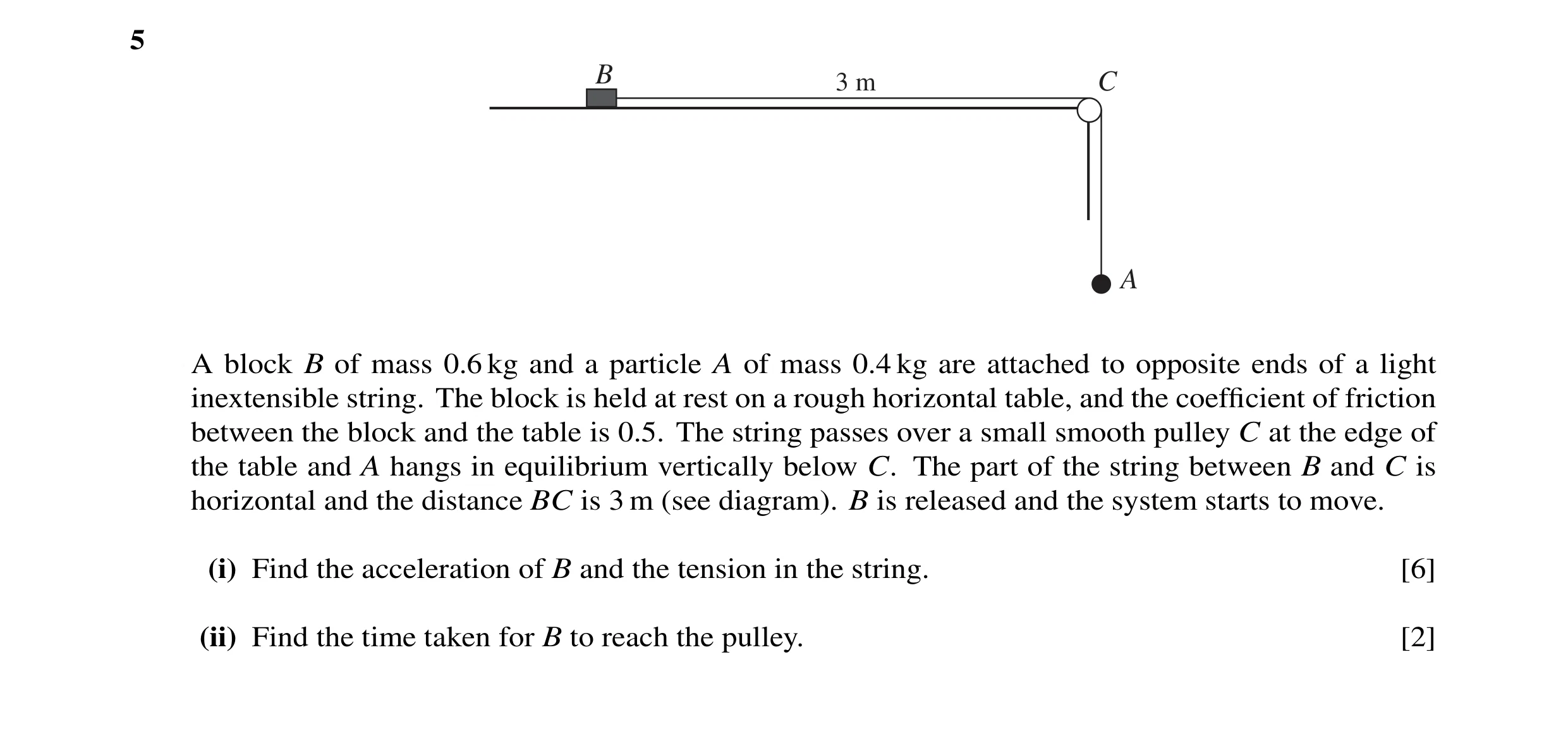
 2 / 46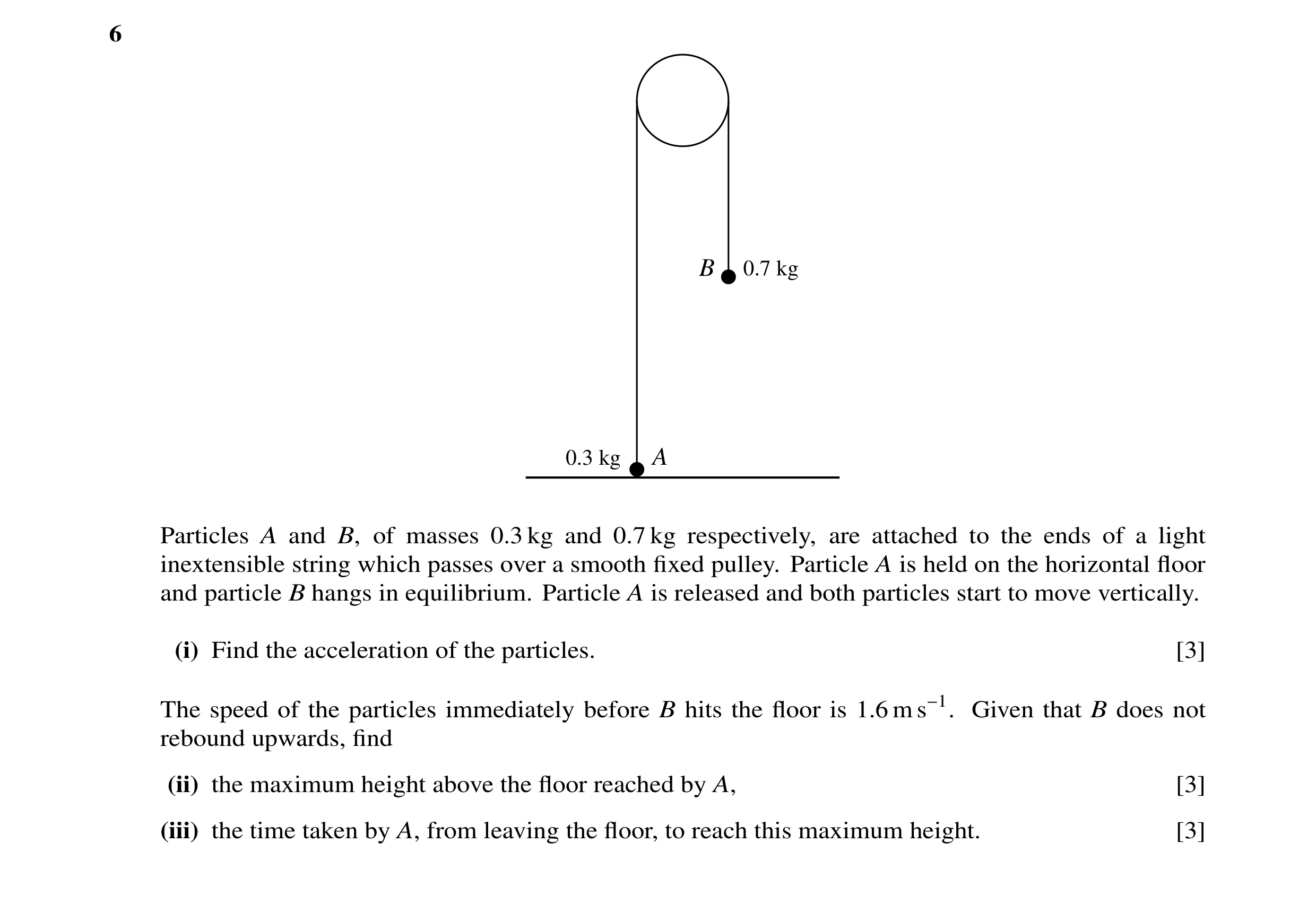
 3 / 46
 4 / 46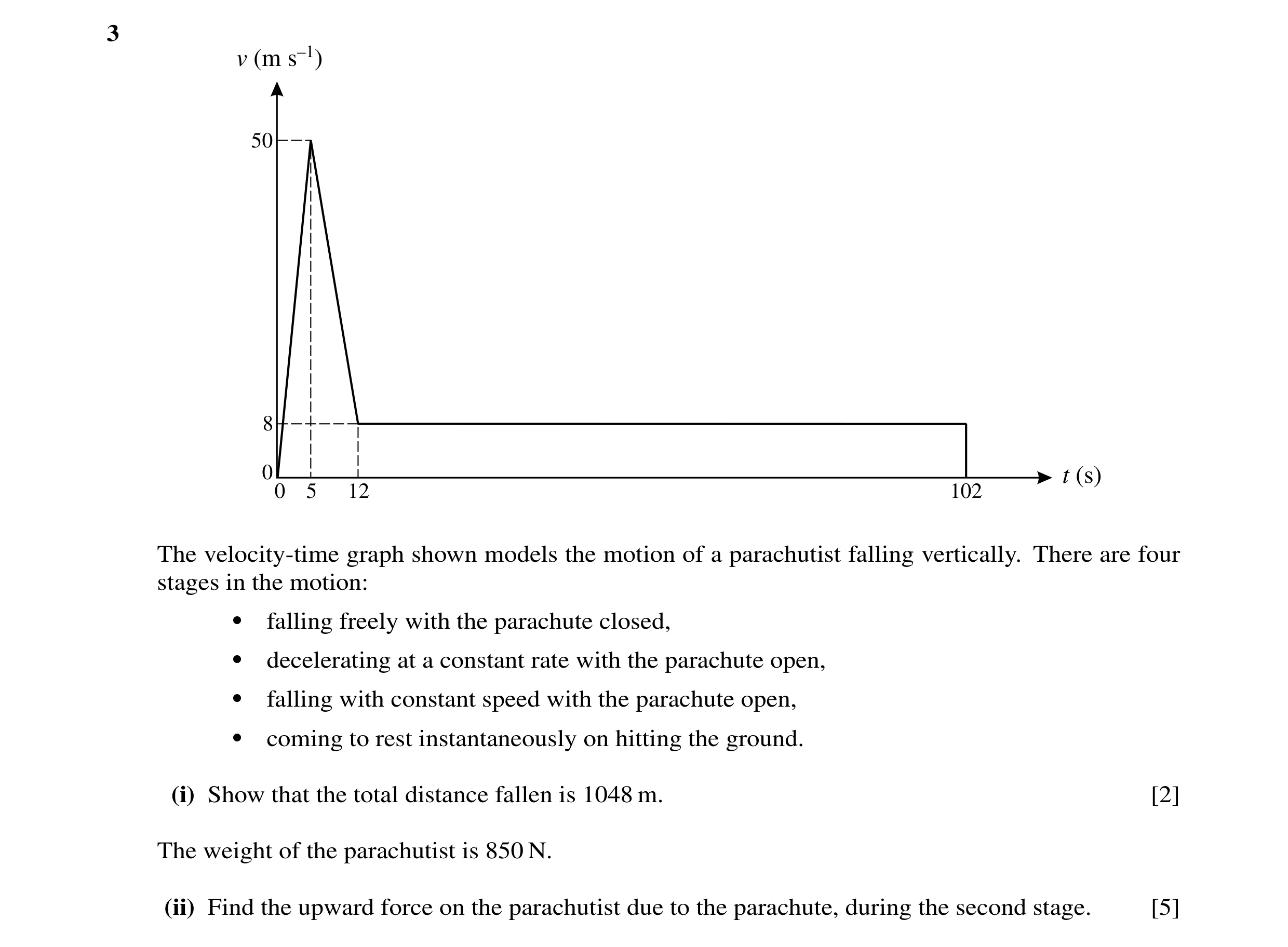
 5 / 46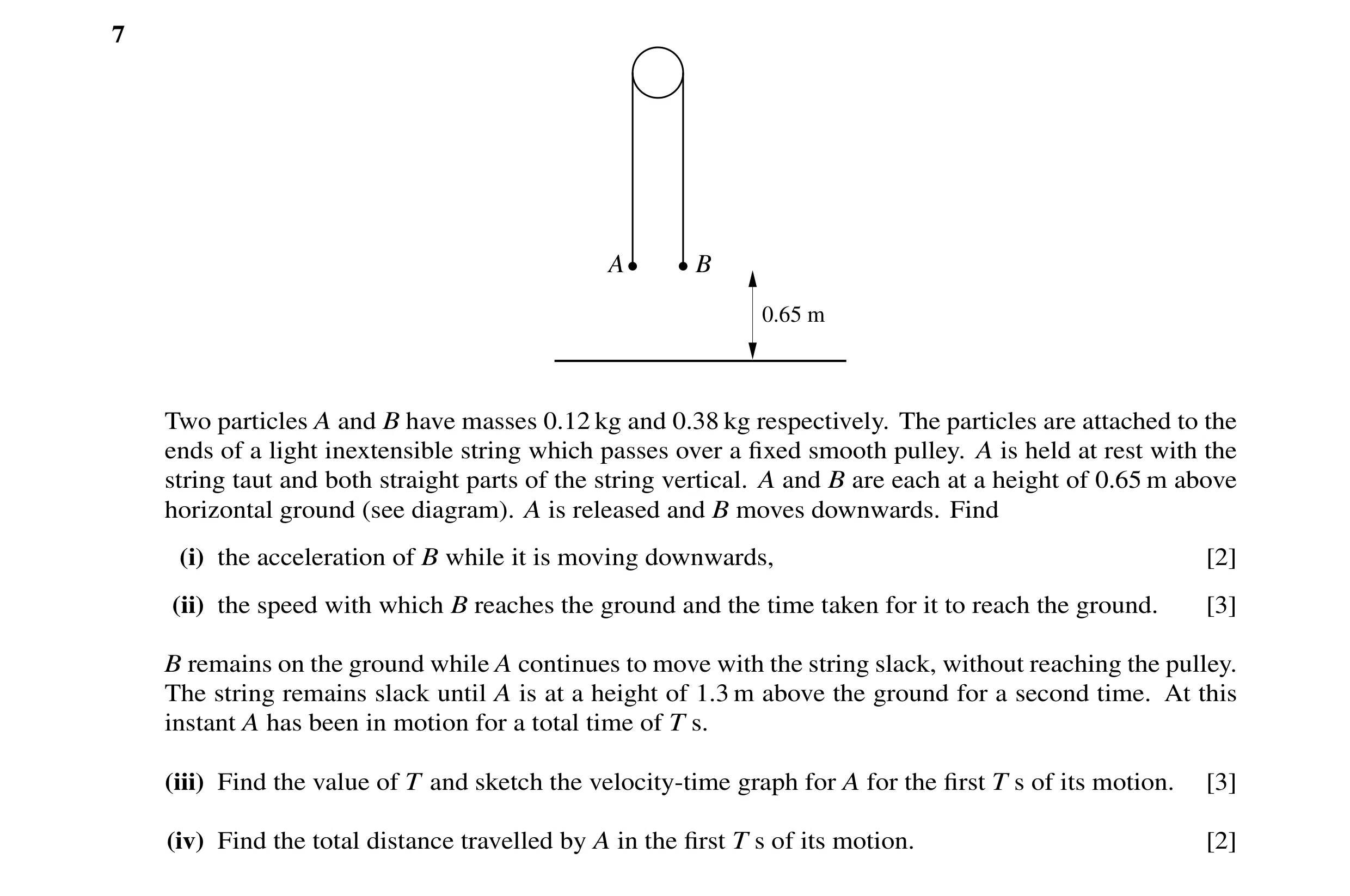
 6 / 46
 7 / 46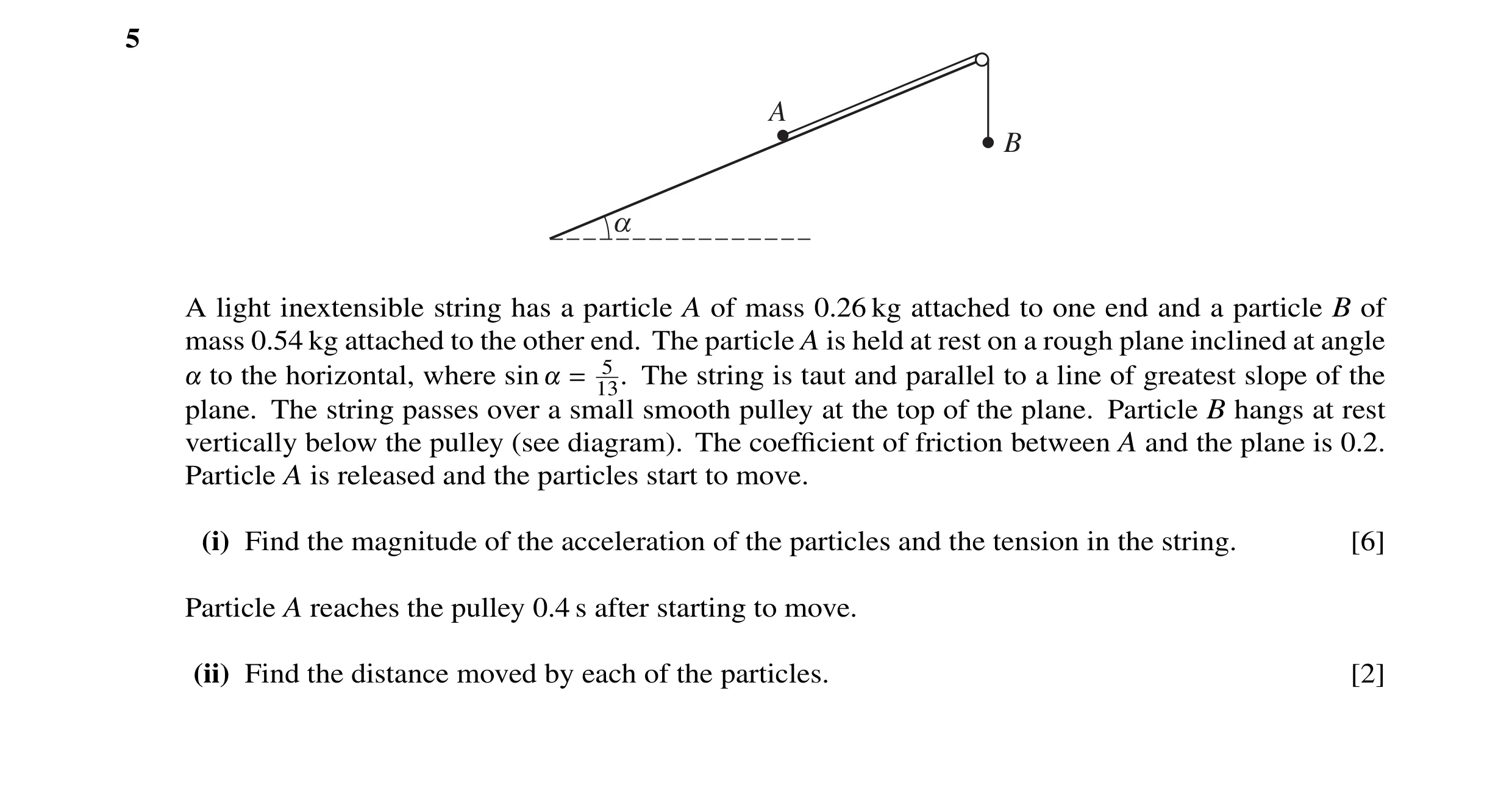
 8 / 46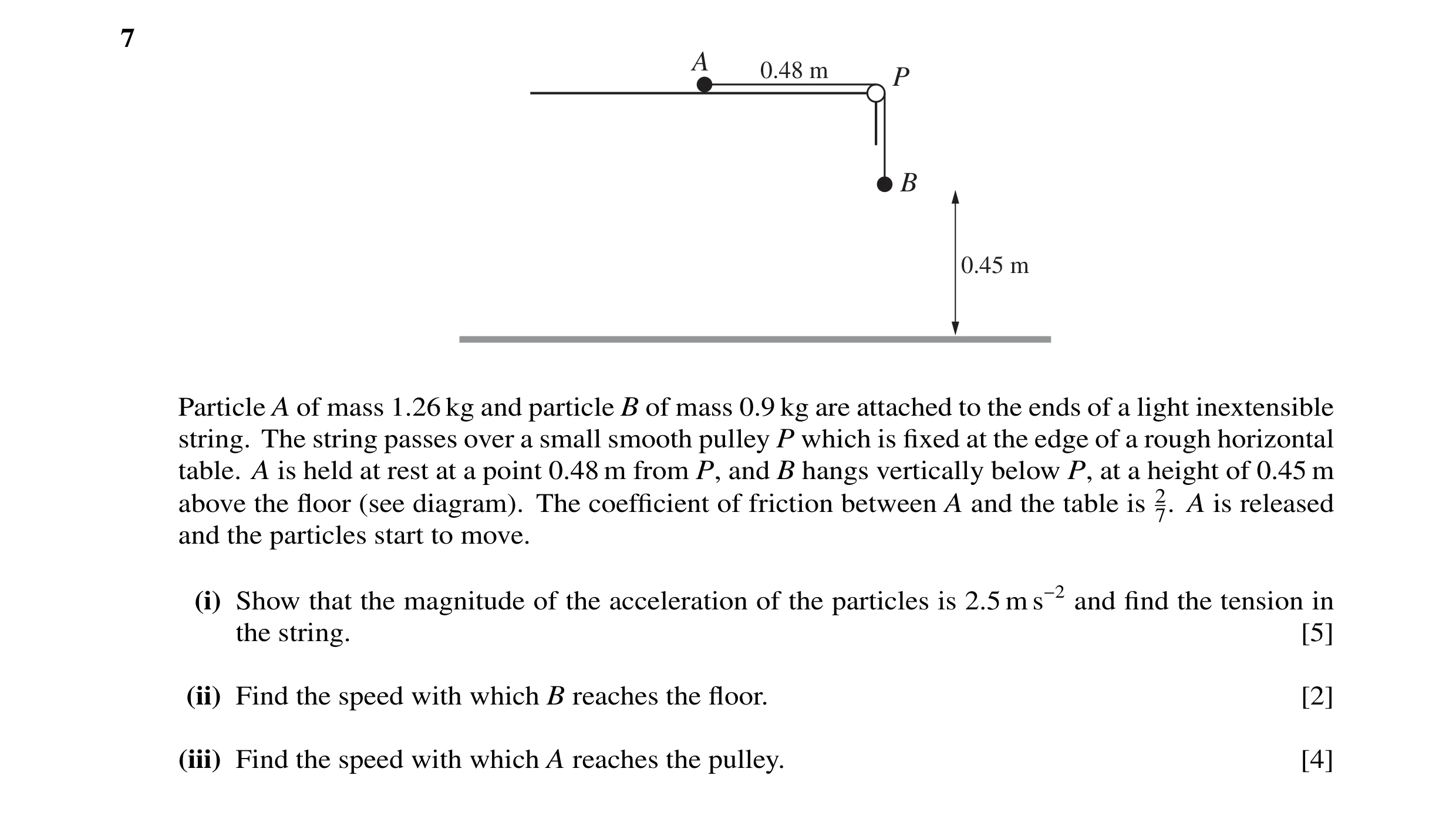
 9 / 46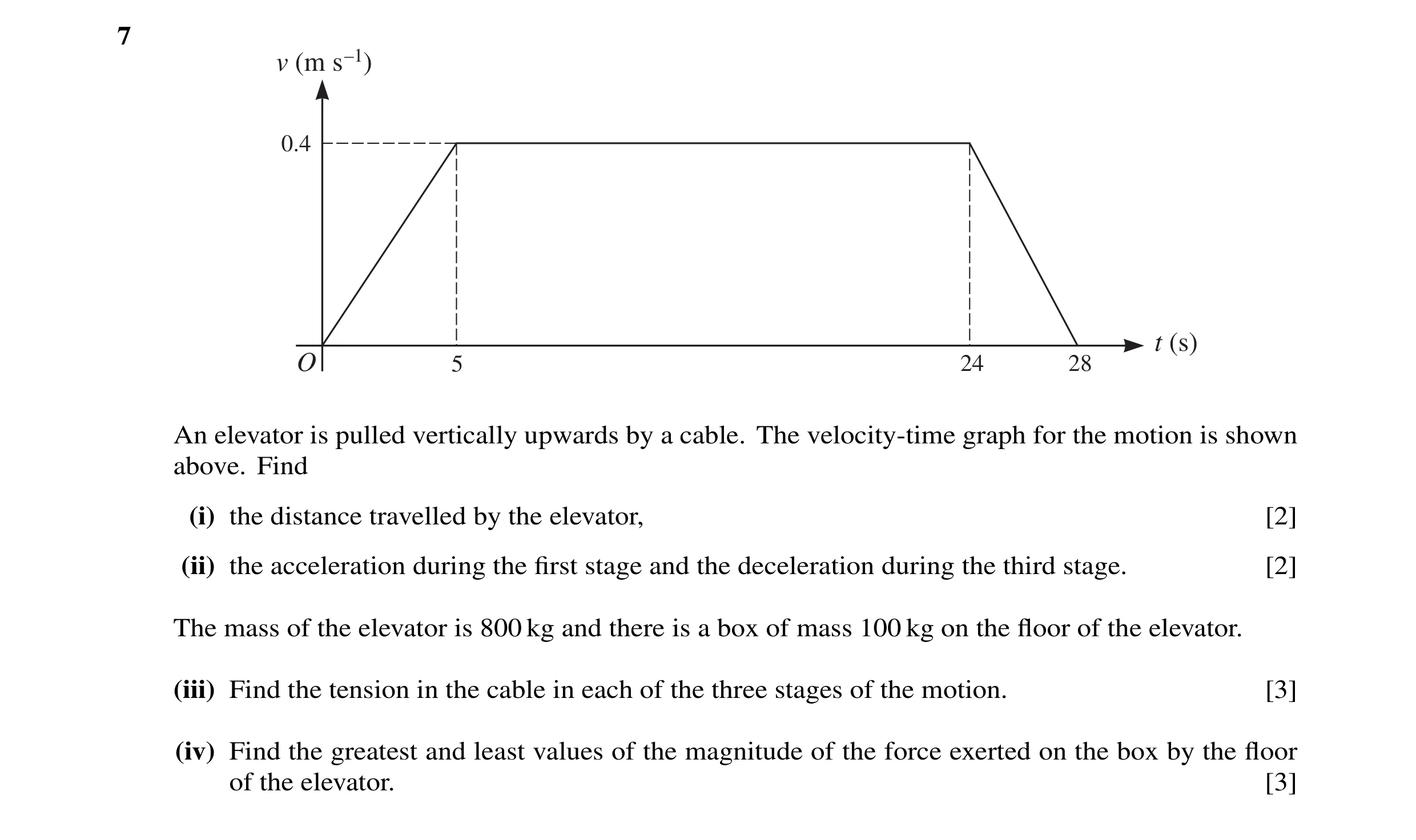
 10 / 46
 11 / 46
 12 / 46
 13 / 46
 14 / 46
 17 / 46
 24 / 46
 25 / 46
 28 / 46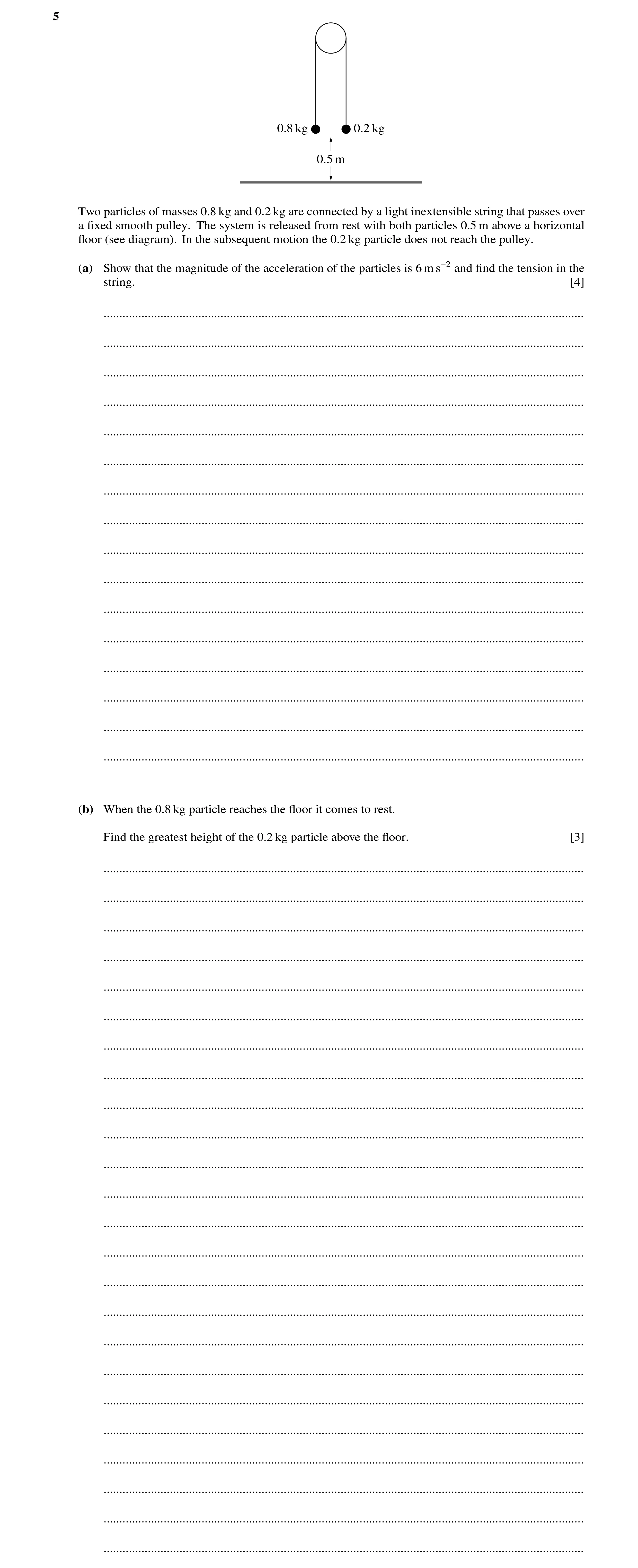
 36 / 46
 37 / 46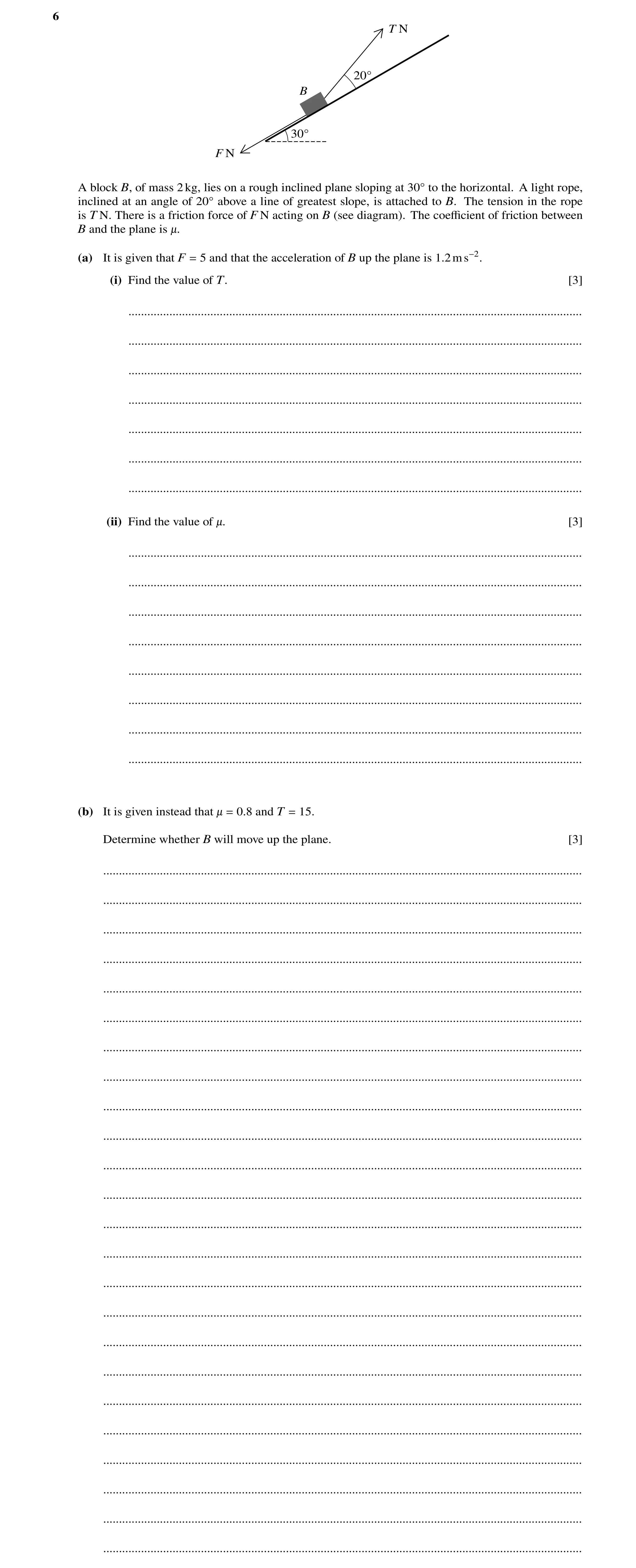
 42 / 46
 43 / 46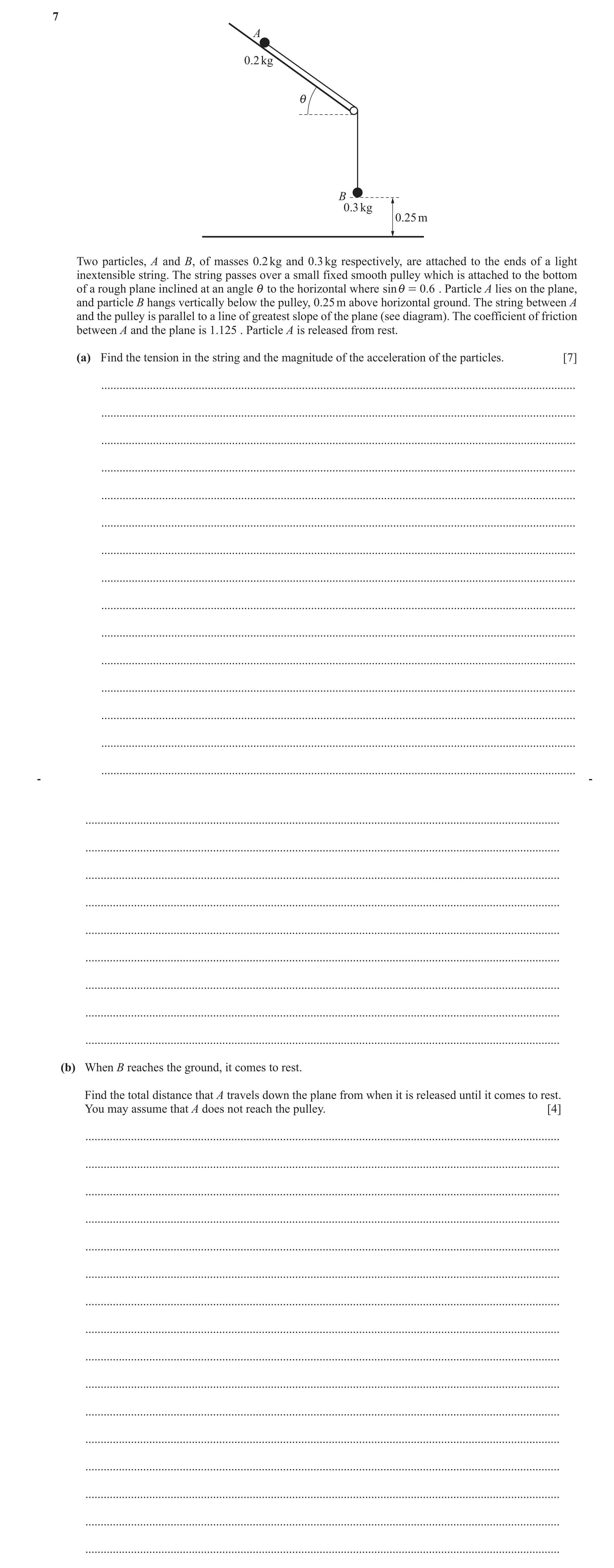
 46 / 46
 10
10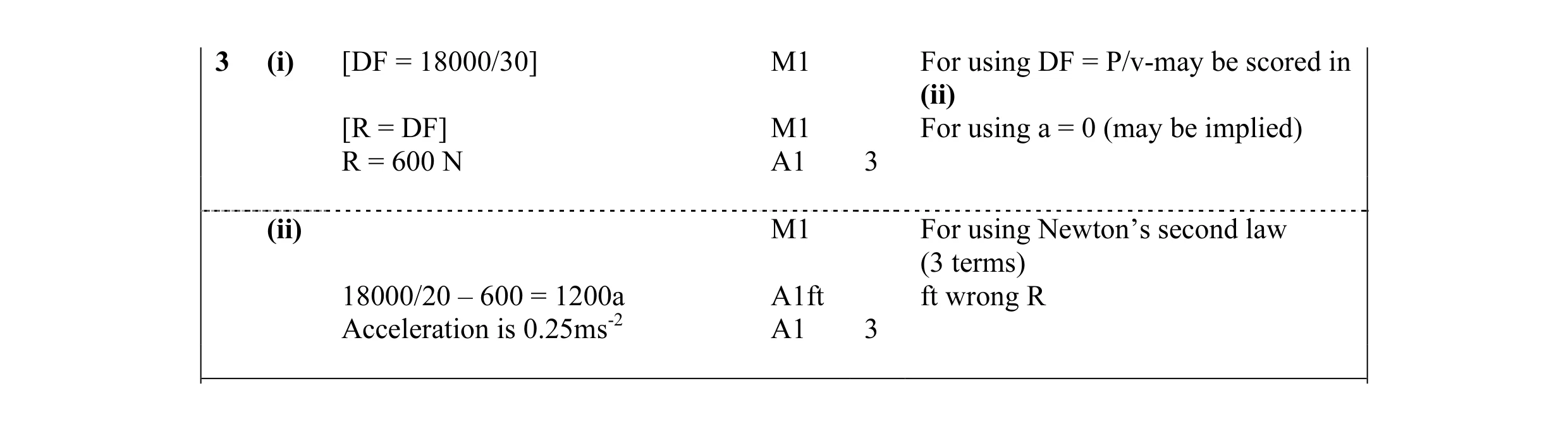 6
6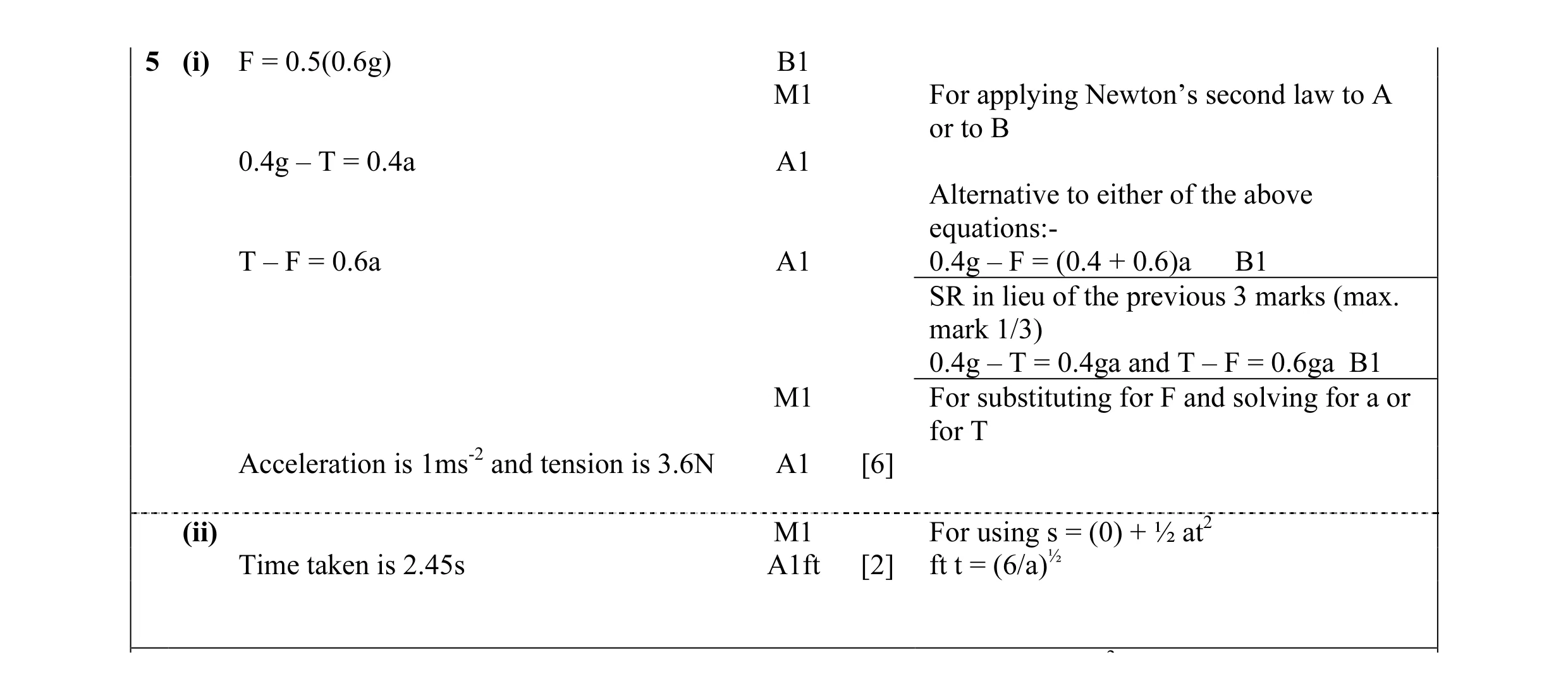 8
8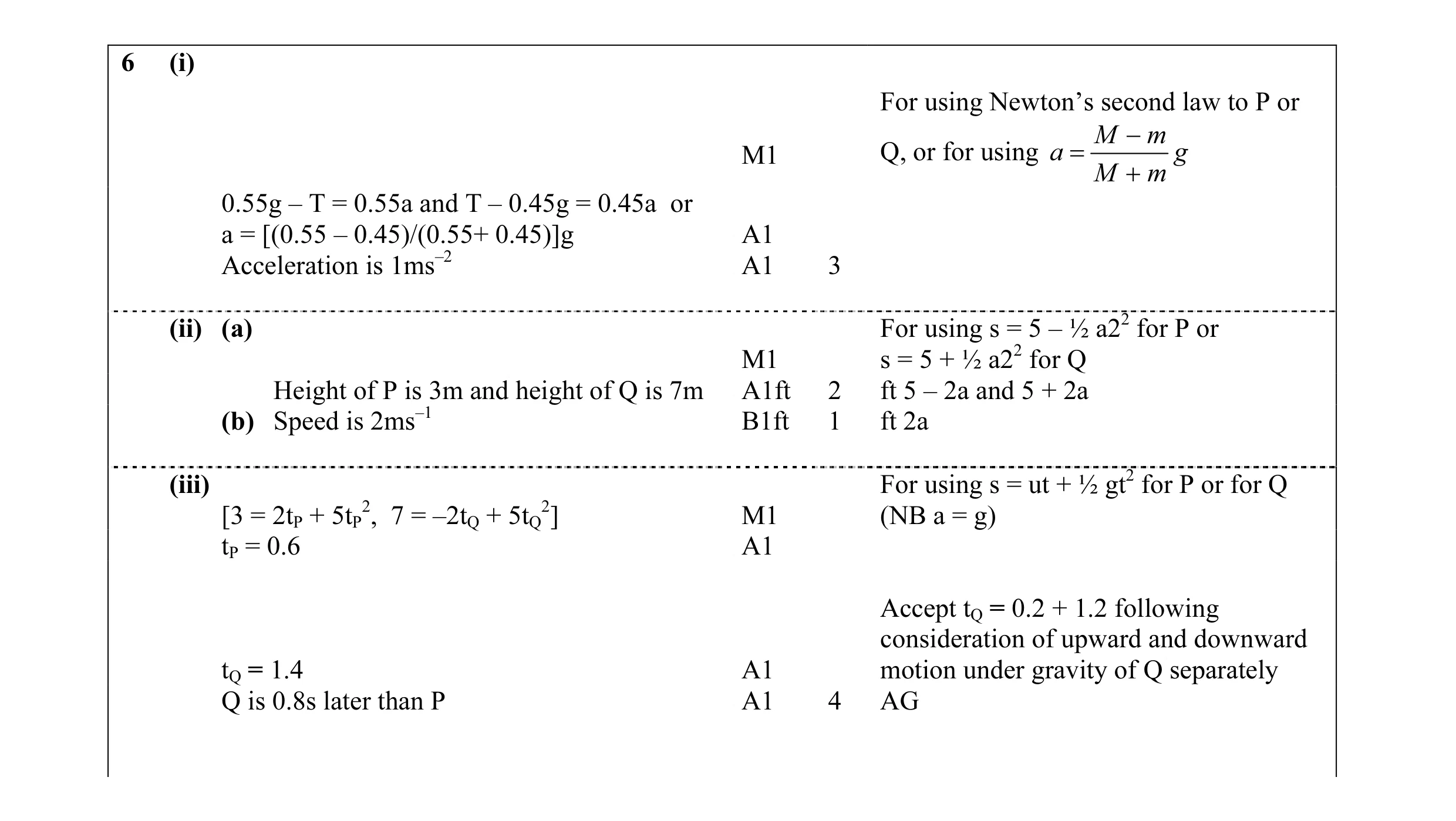 10
10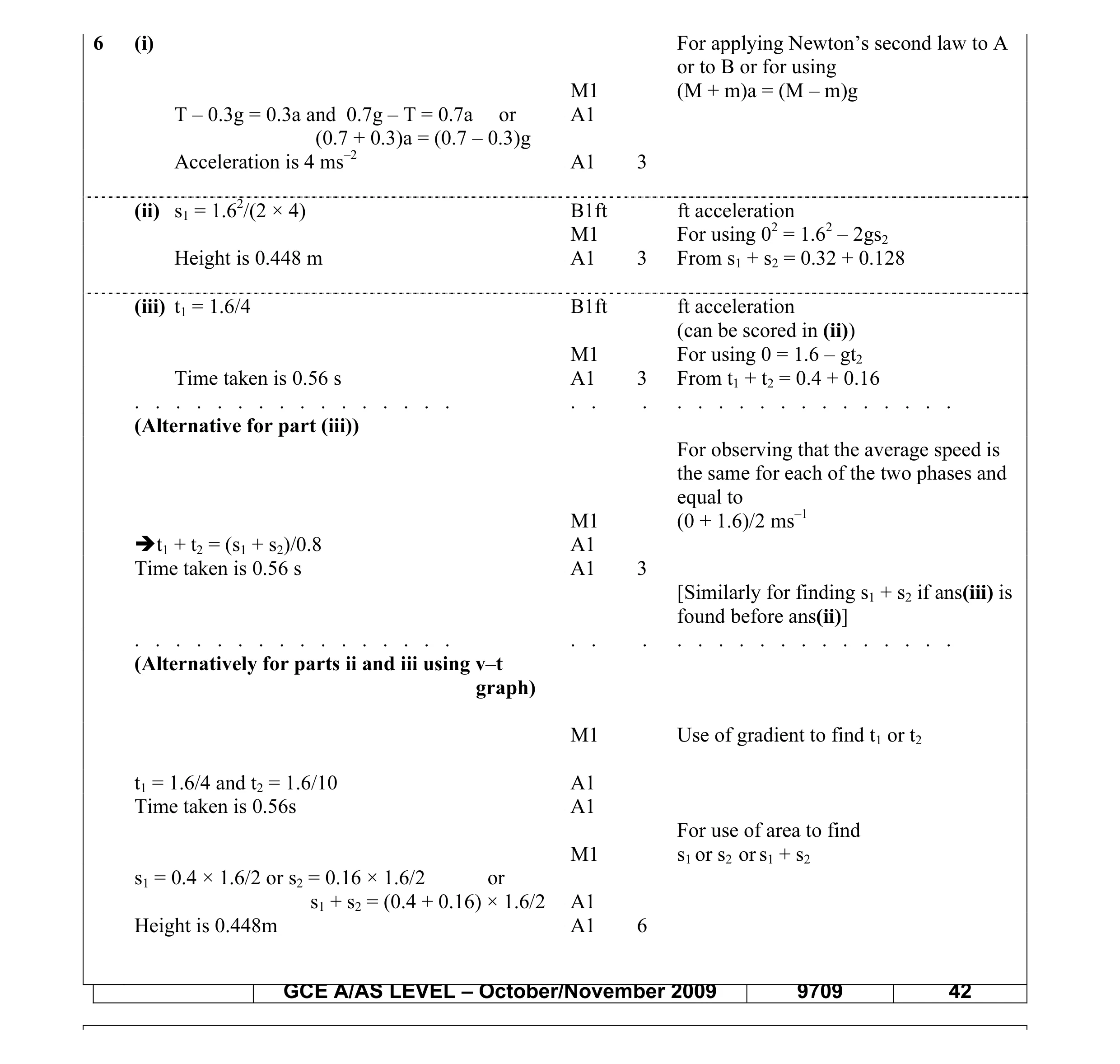 9
9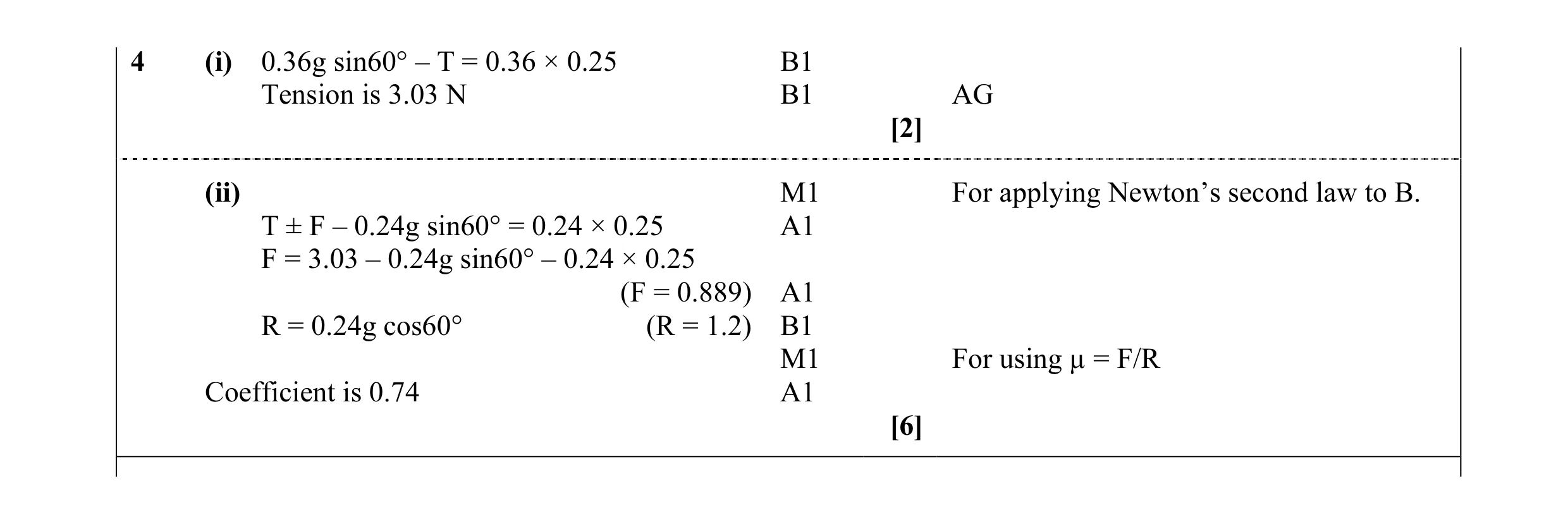 8
8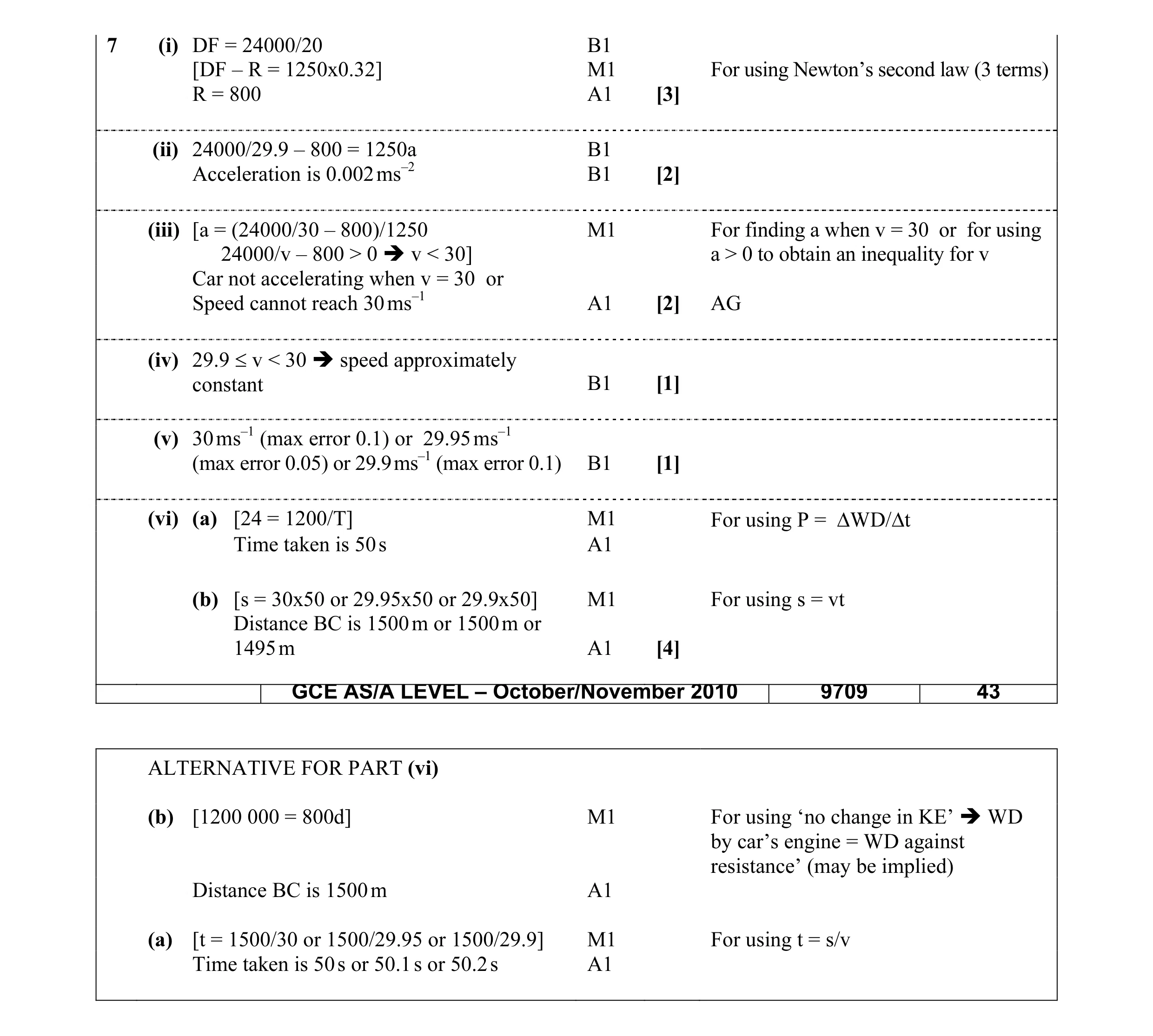 13
13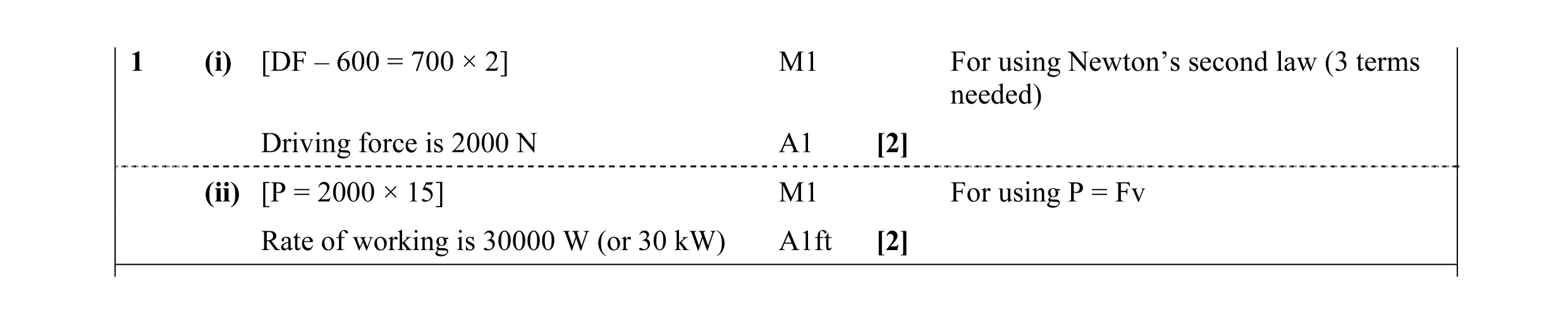 4
4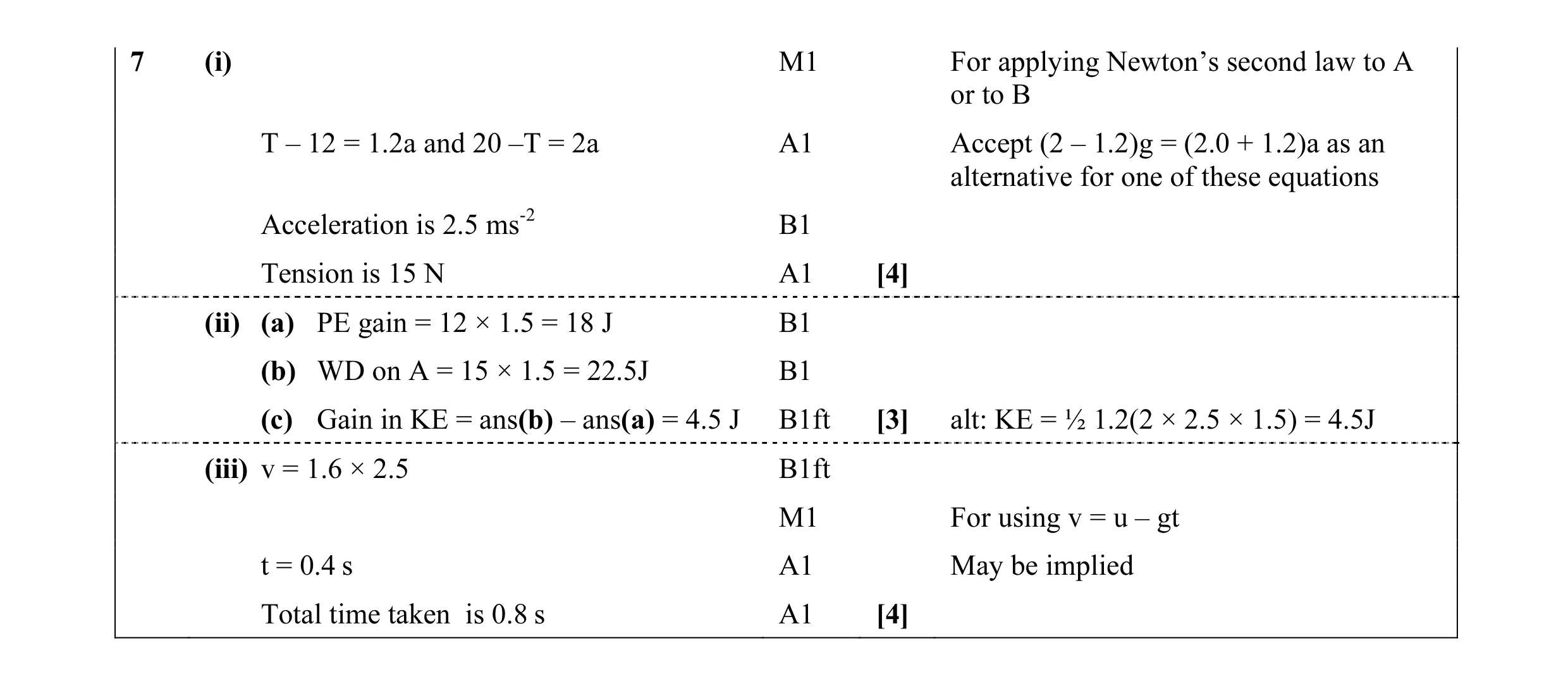 11
11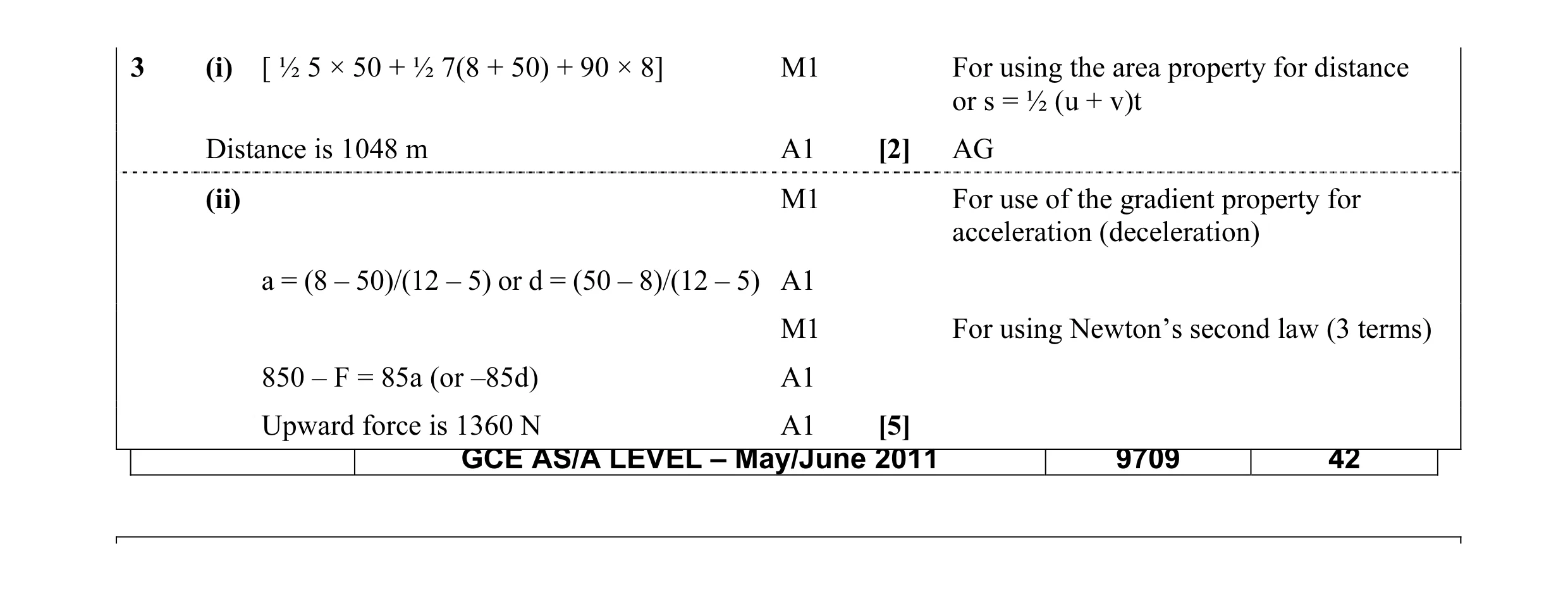 7
7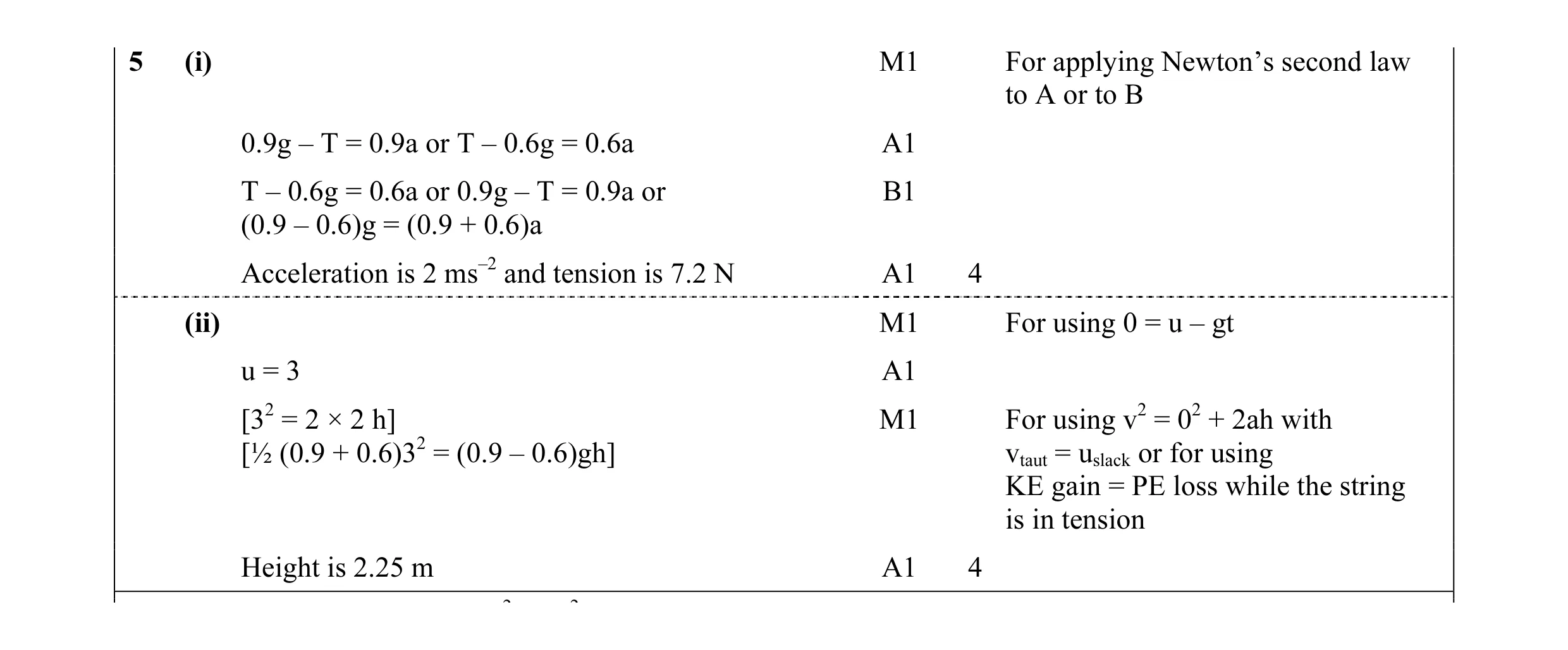 8
8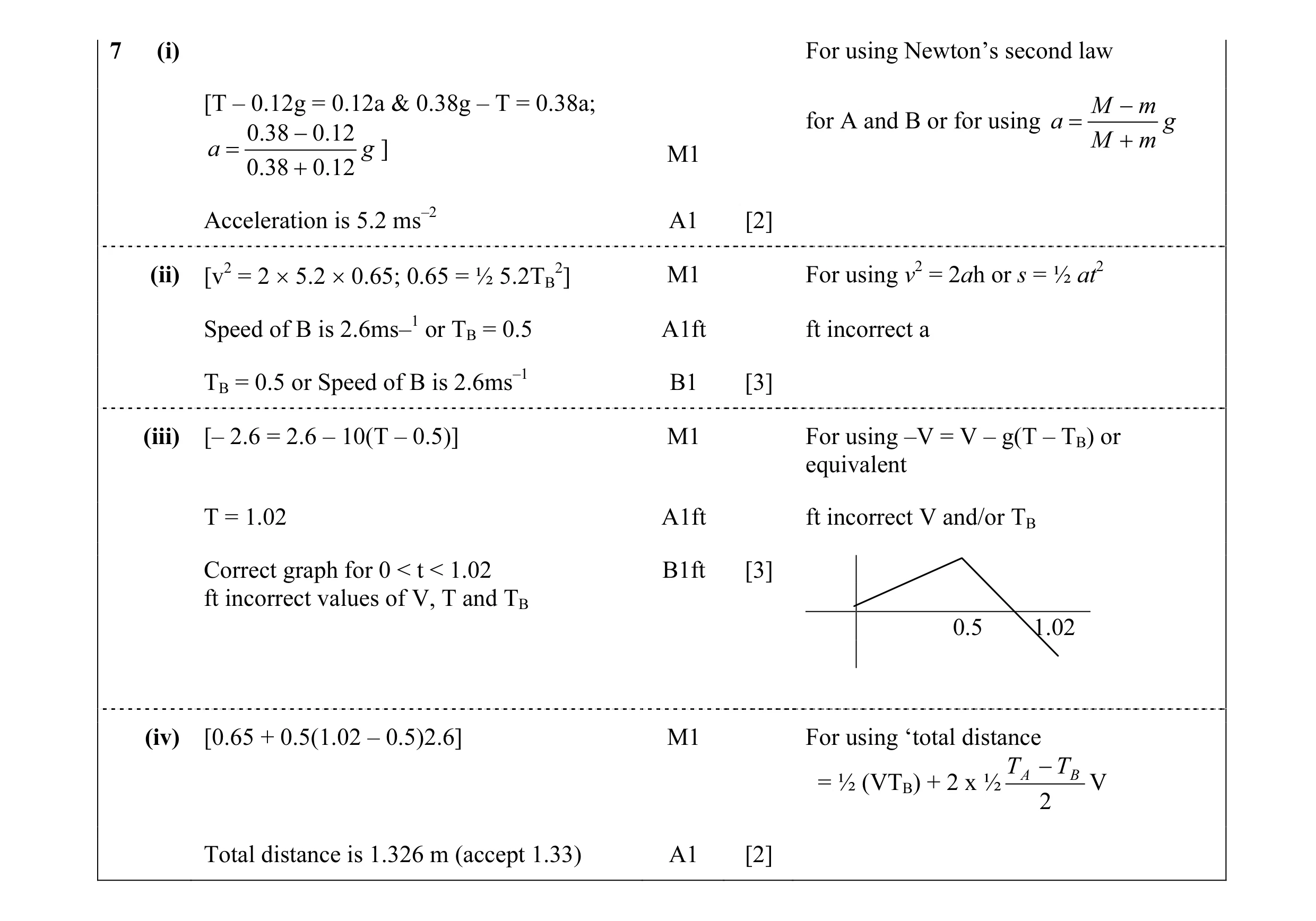 10
10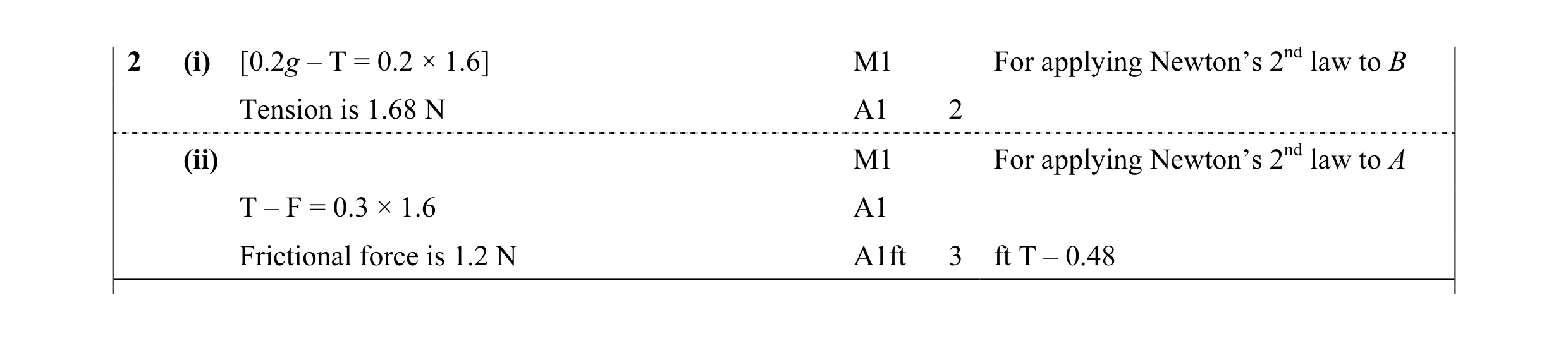 5
5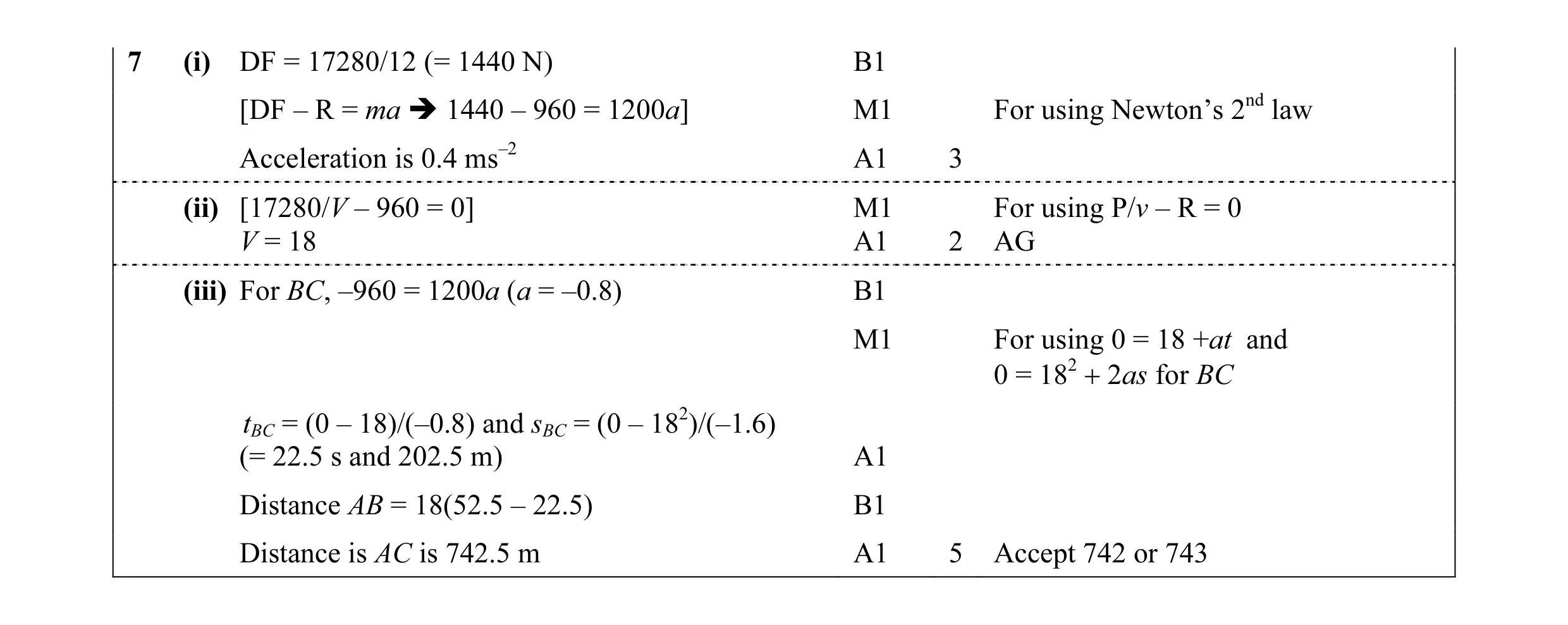 10
10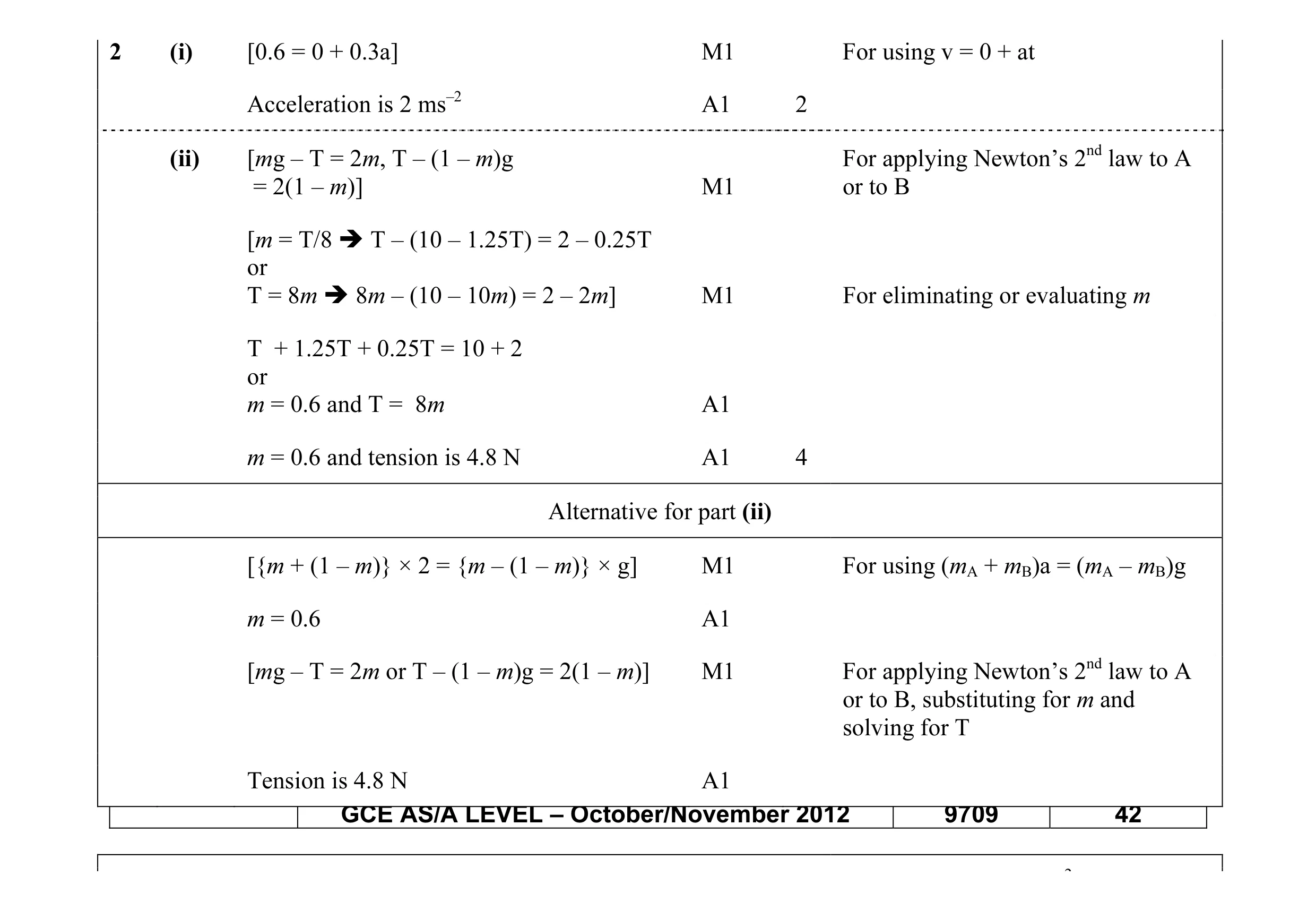 6
6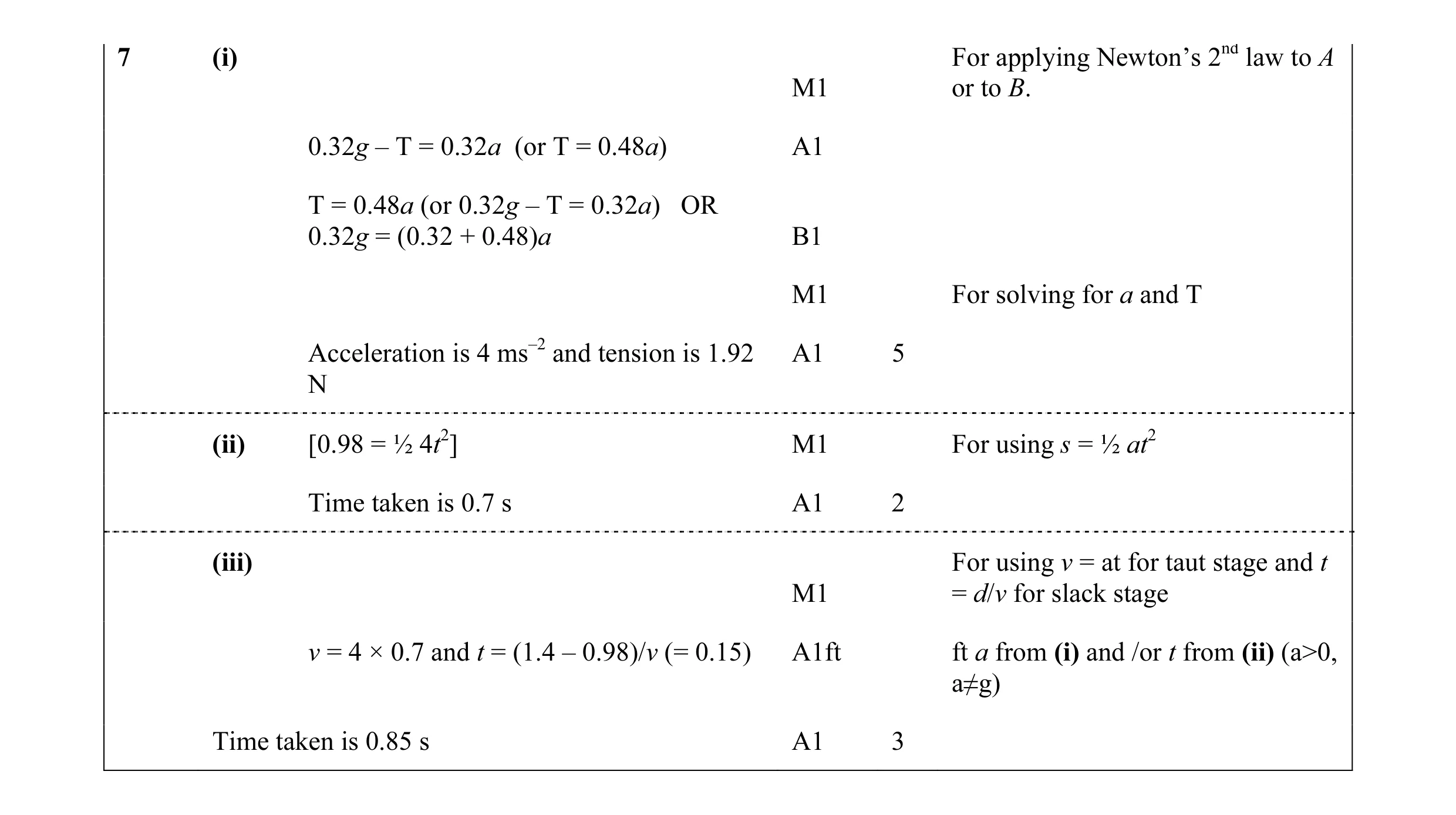 10
10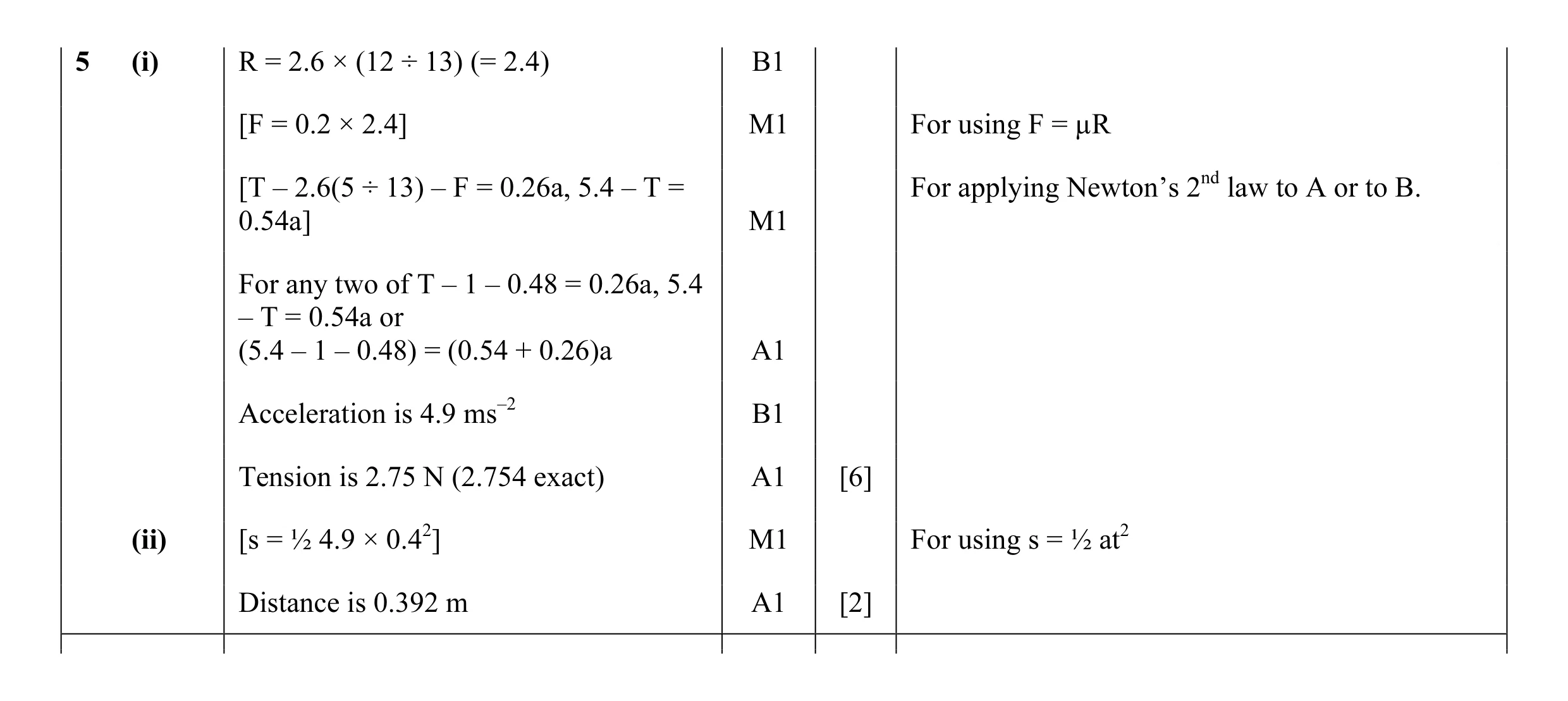 8
8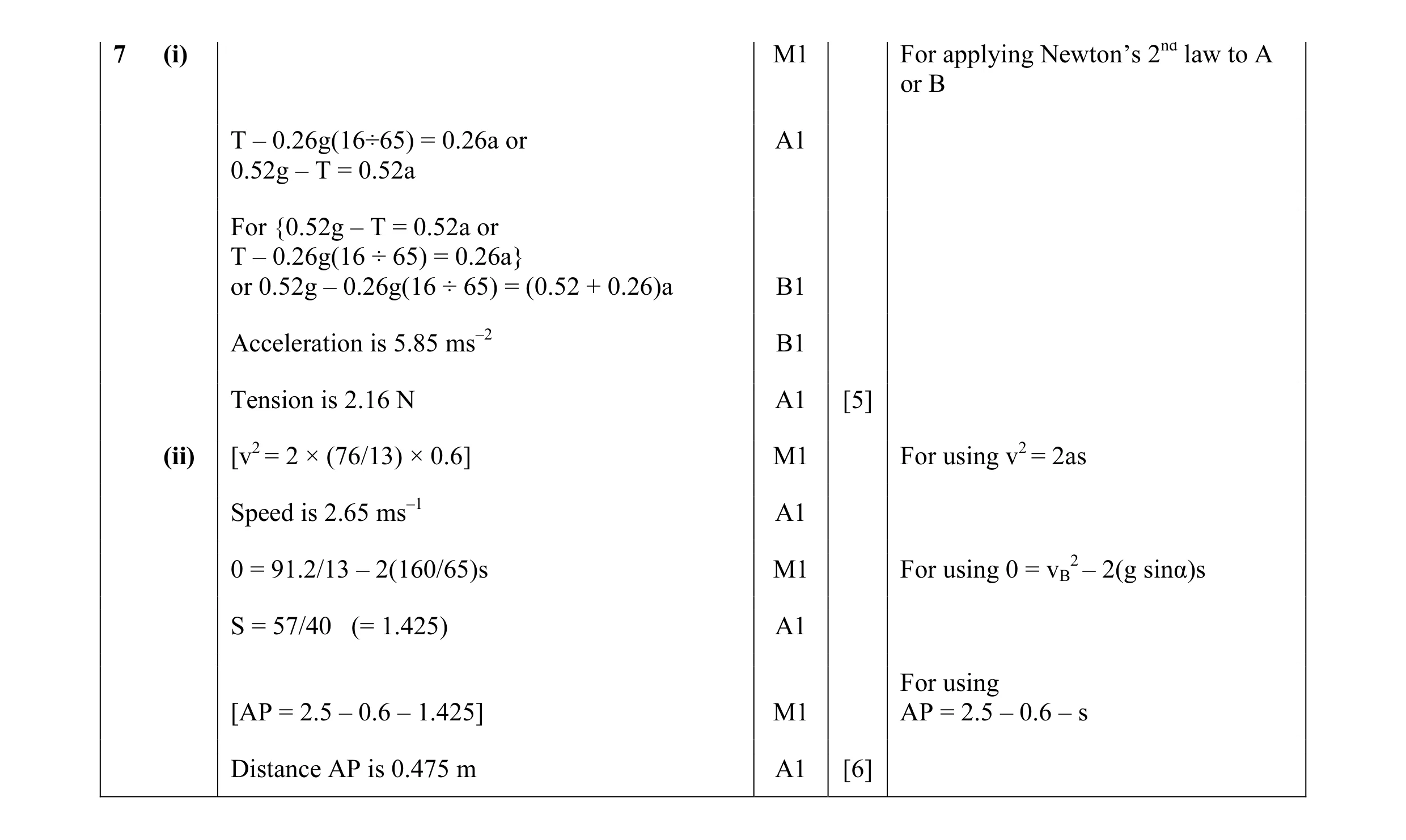 11
11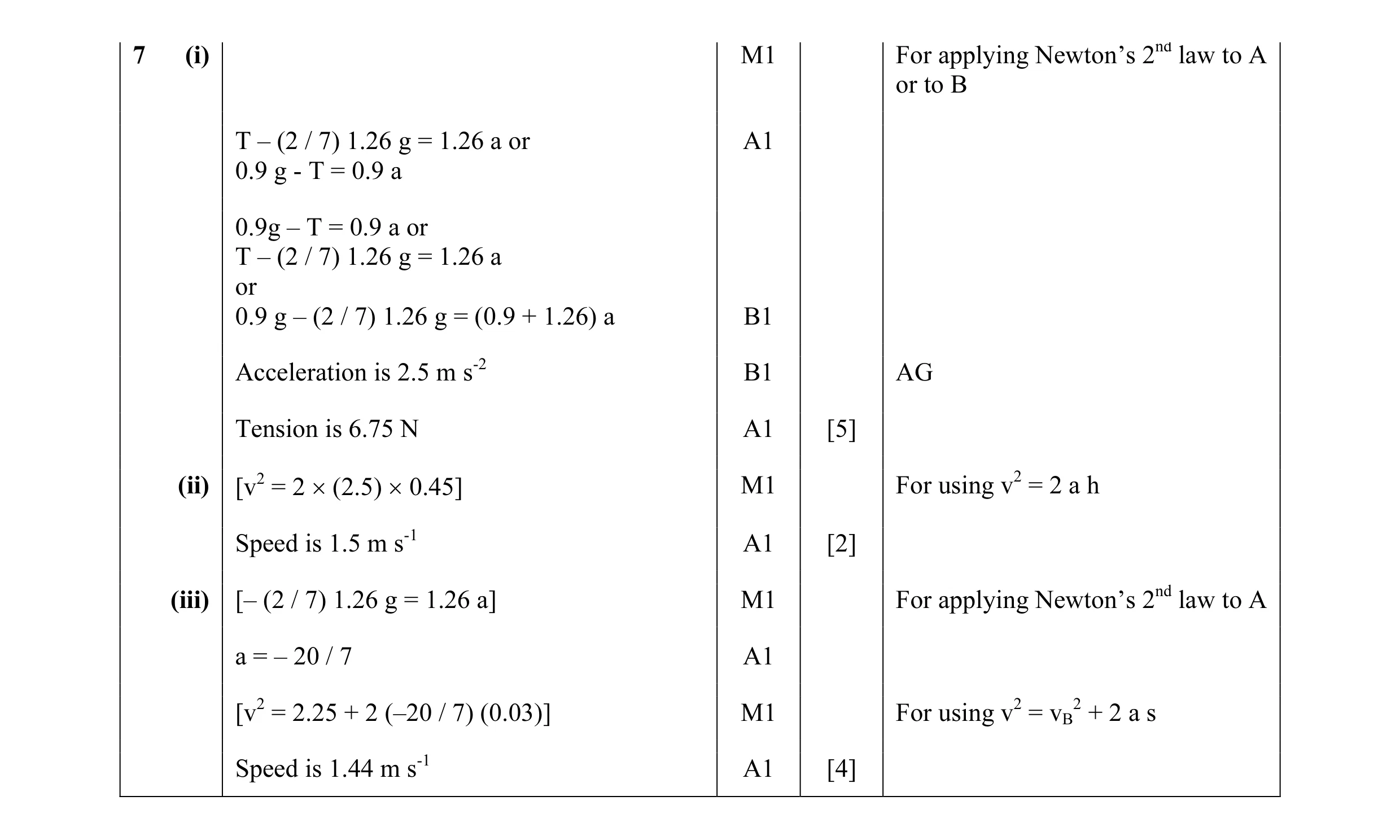 11
11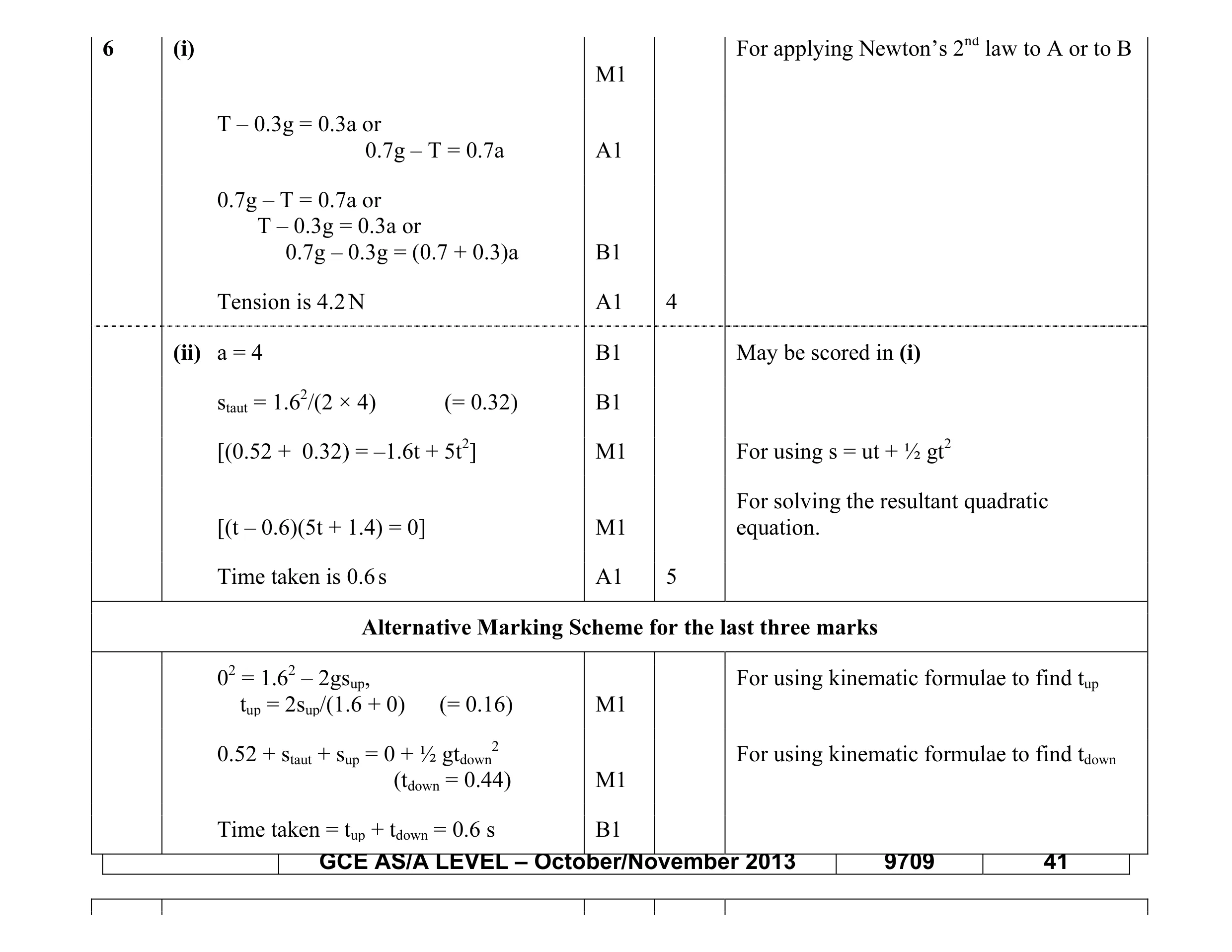 9
9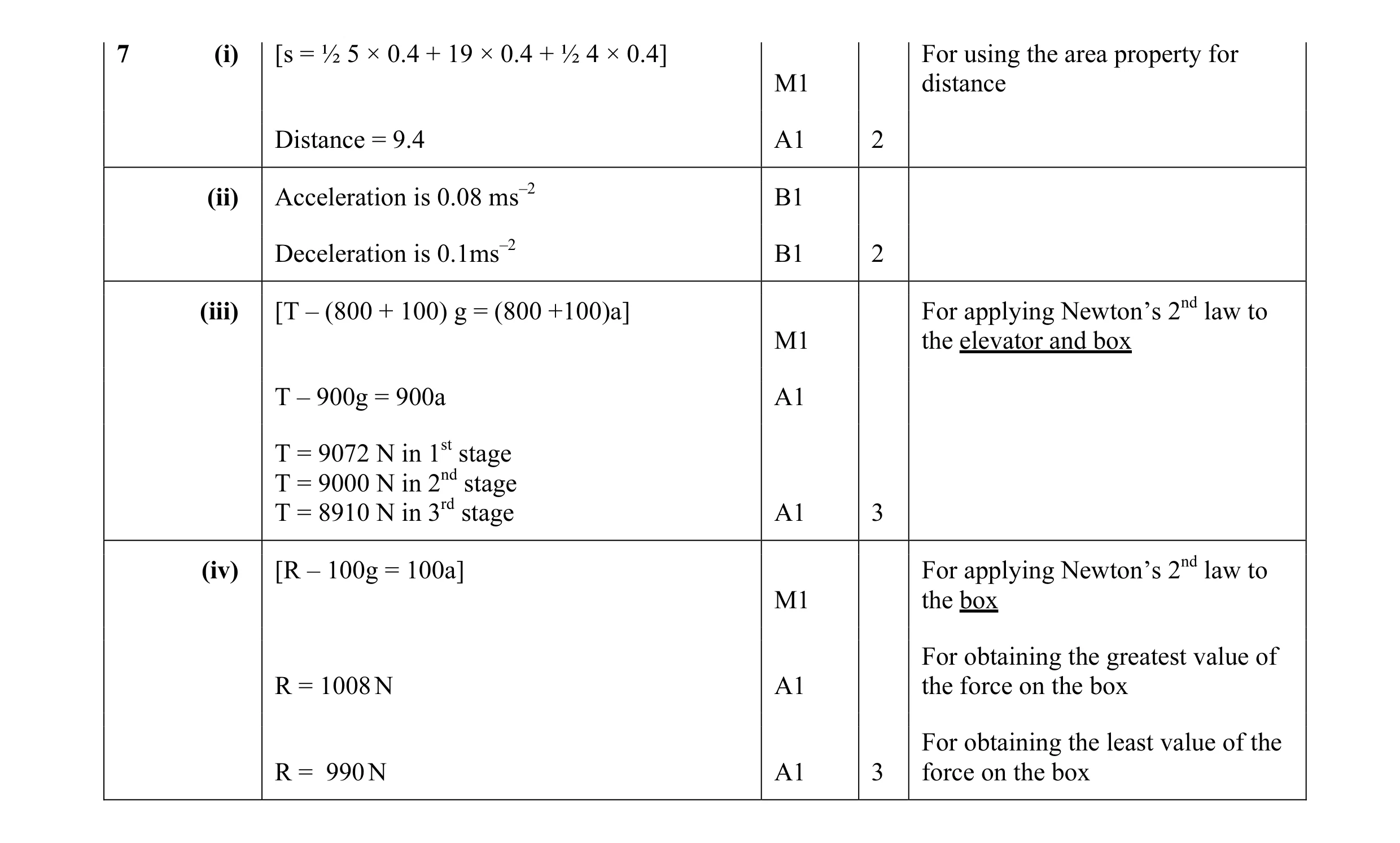 10
10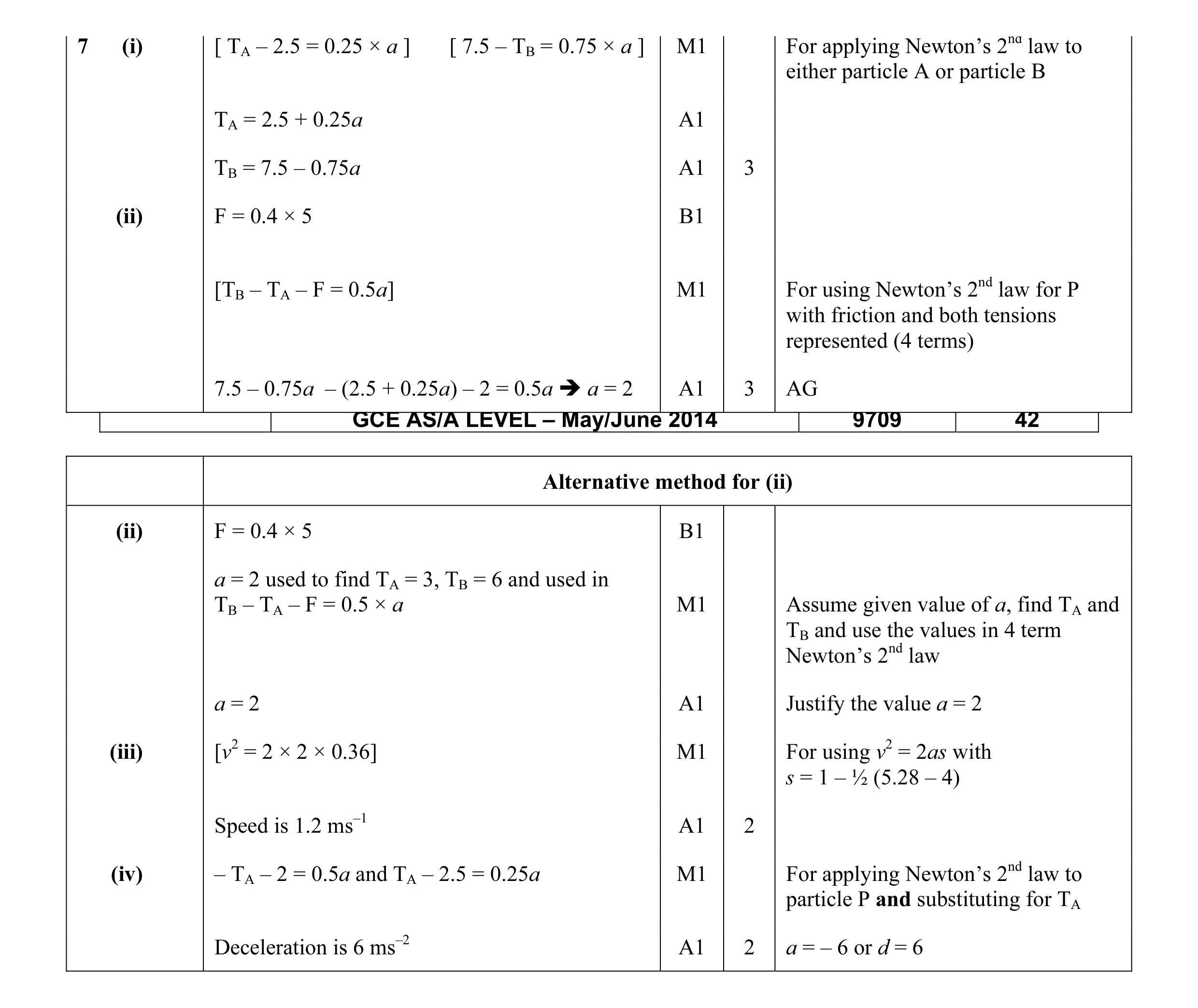 10
10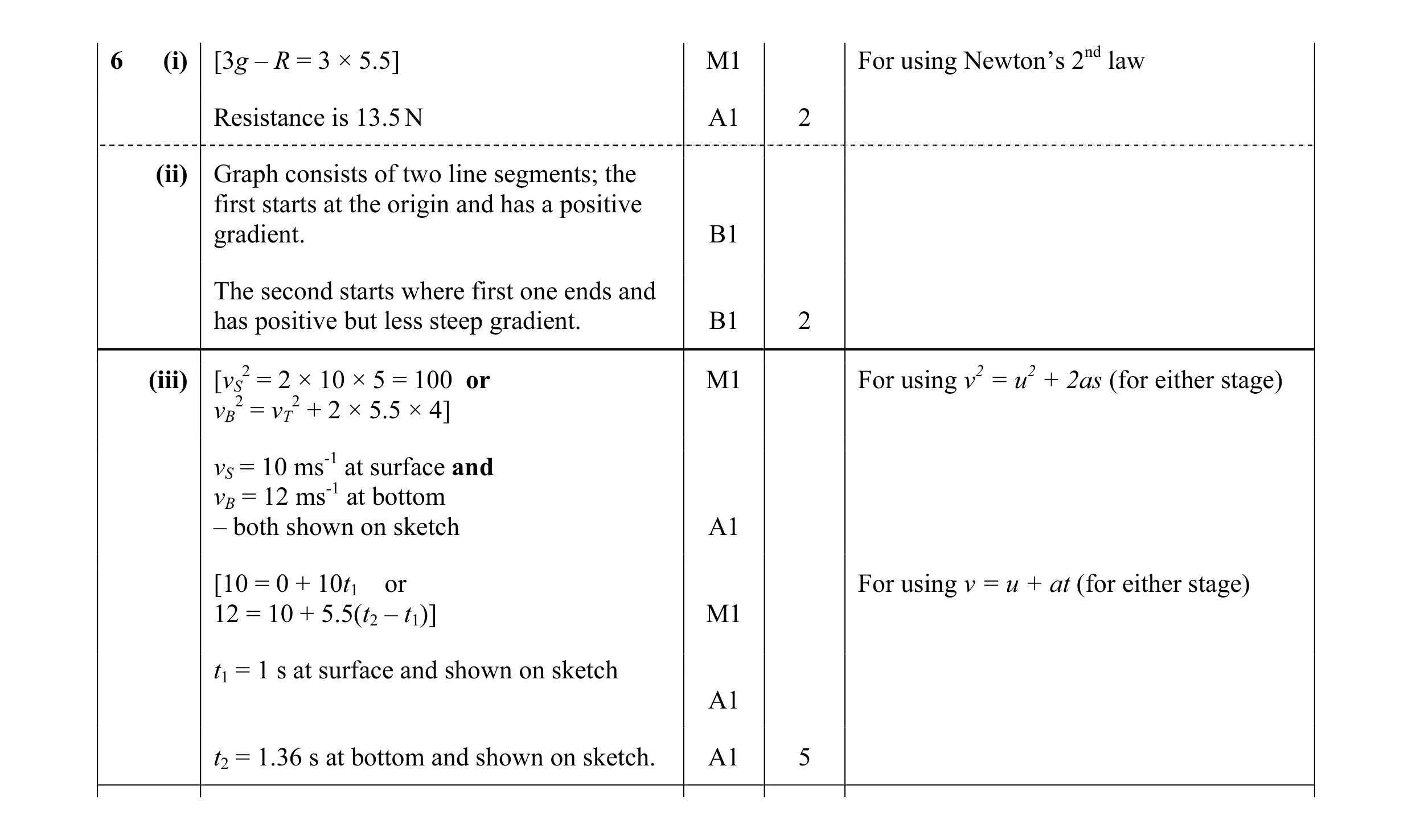 9
9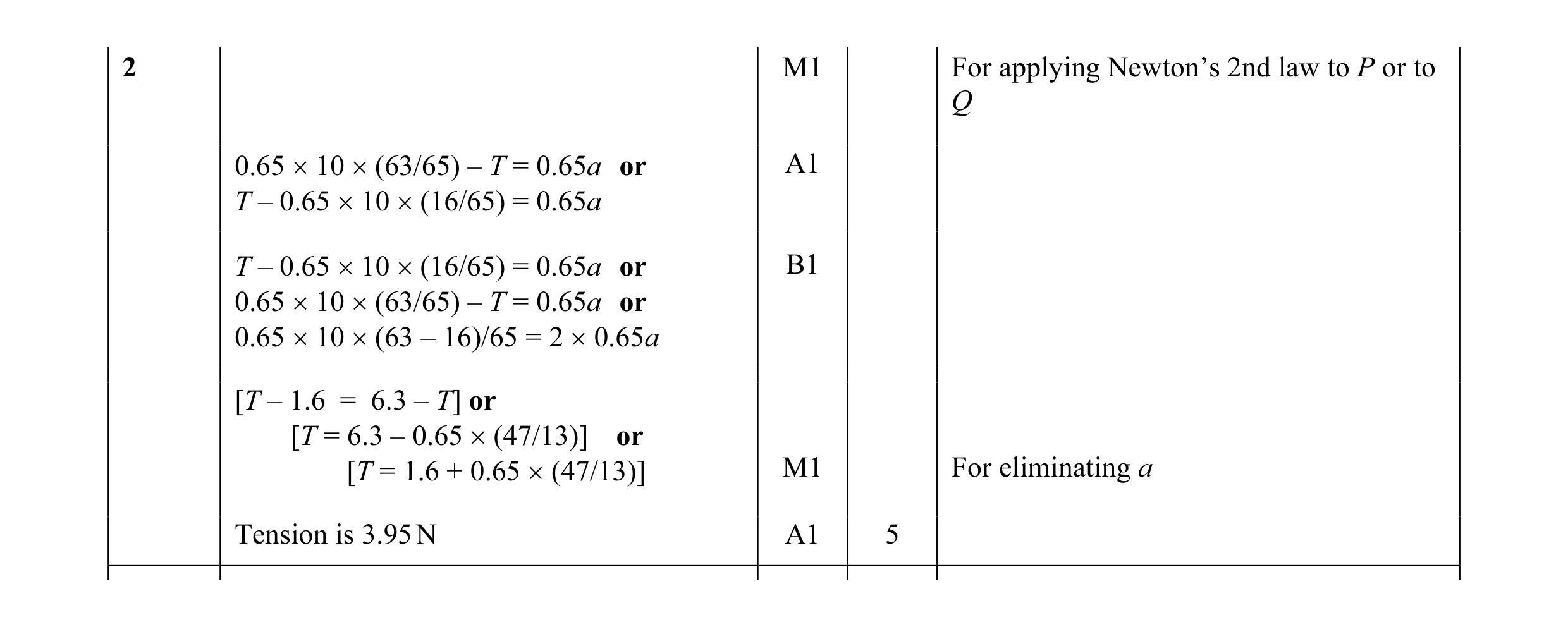 5
5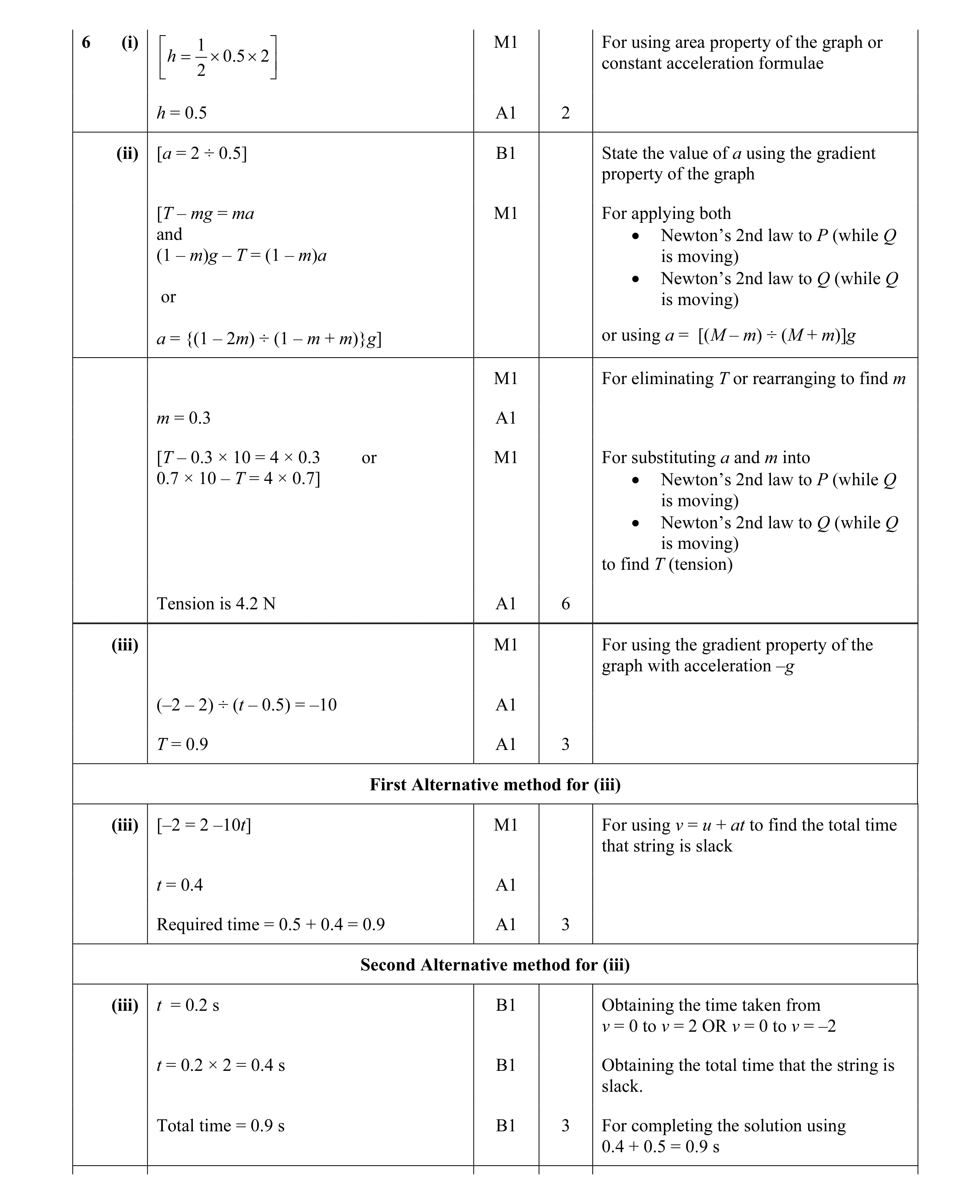 11
11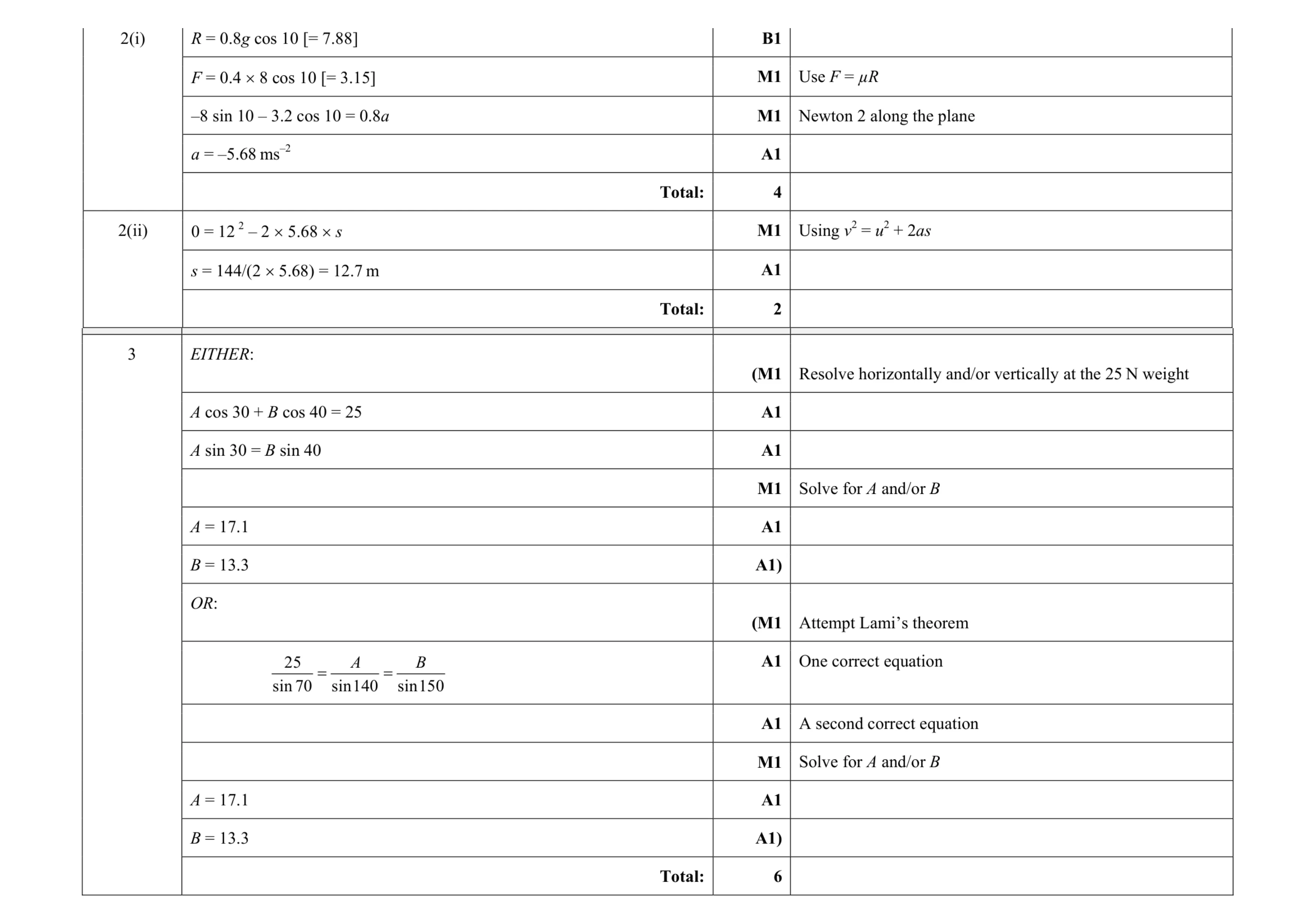 6
6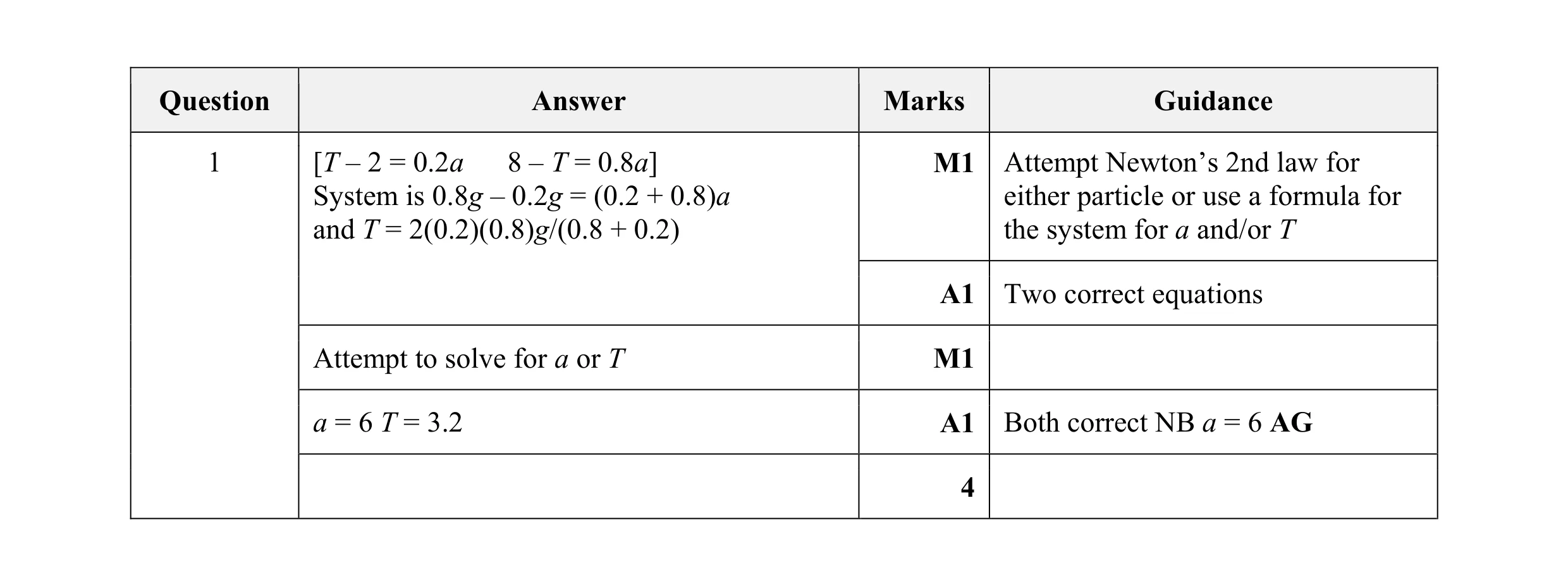 4
4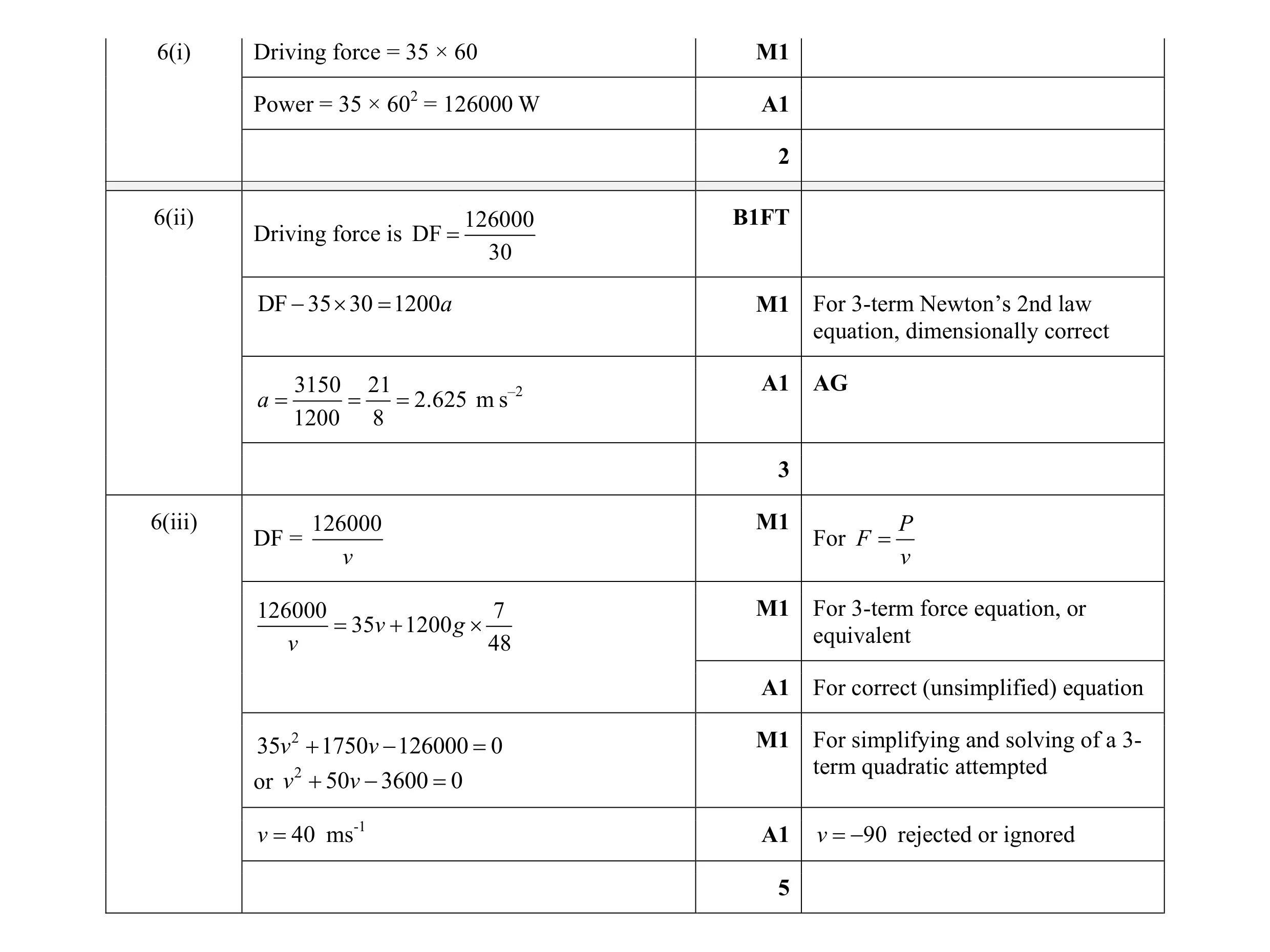 10
10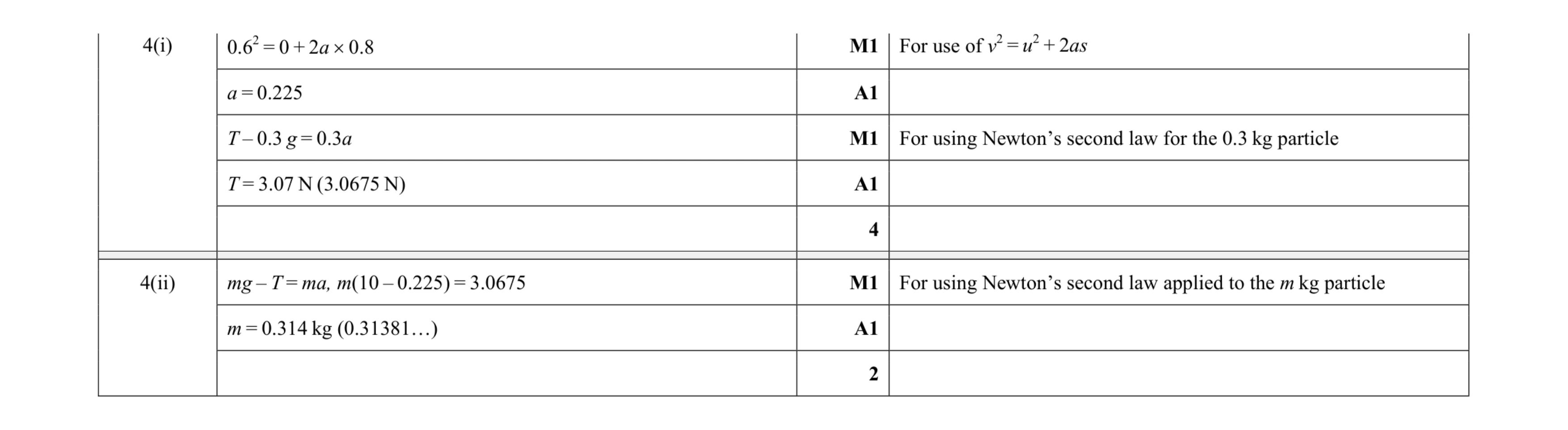 6
6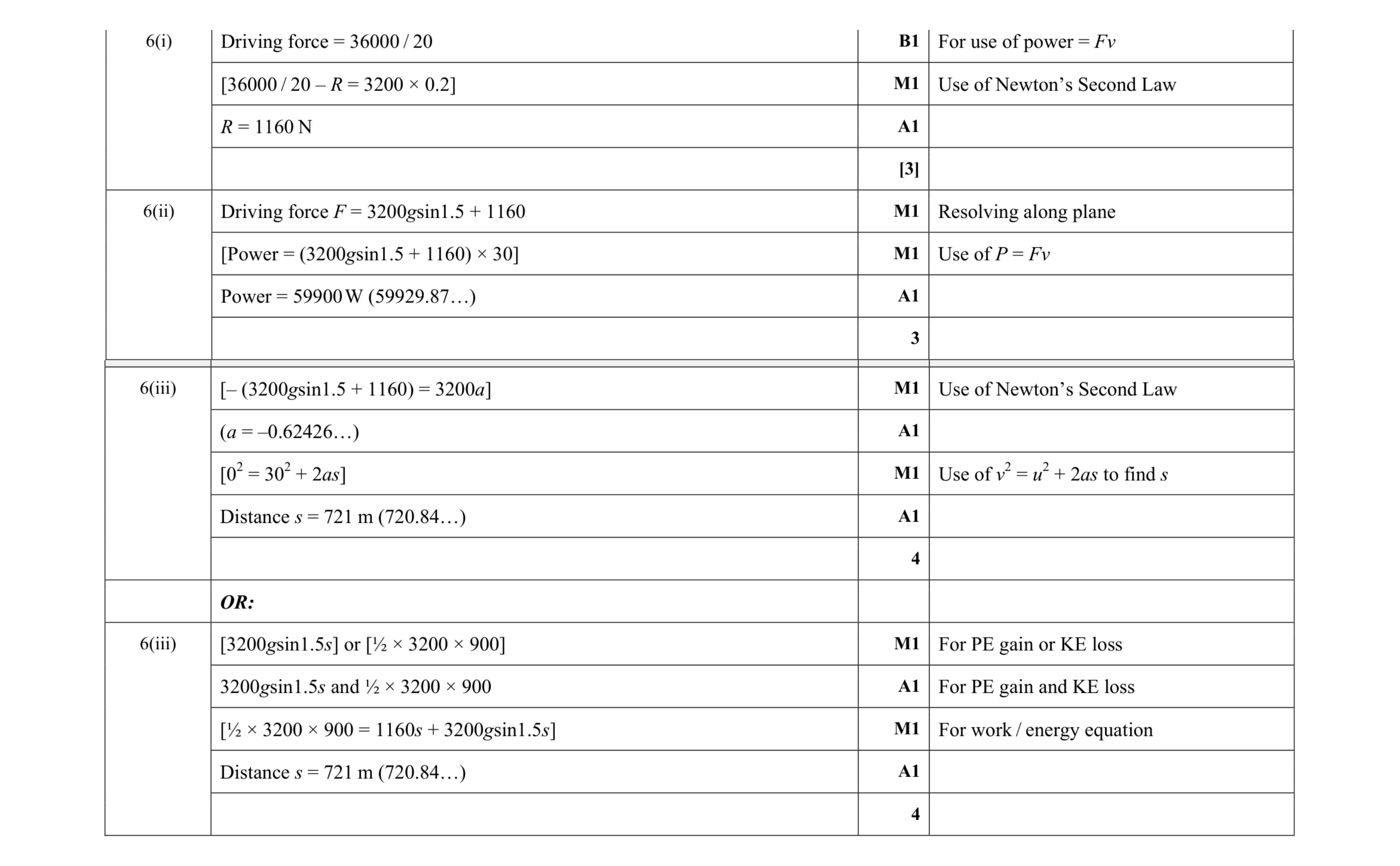 10
10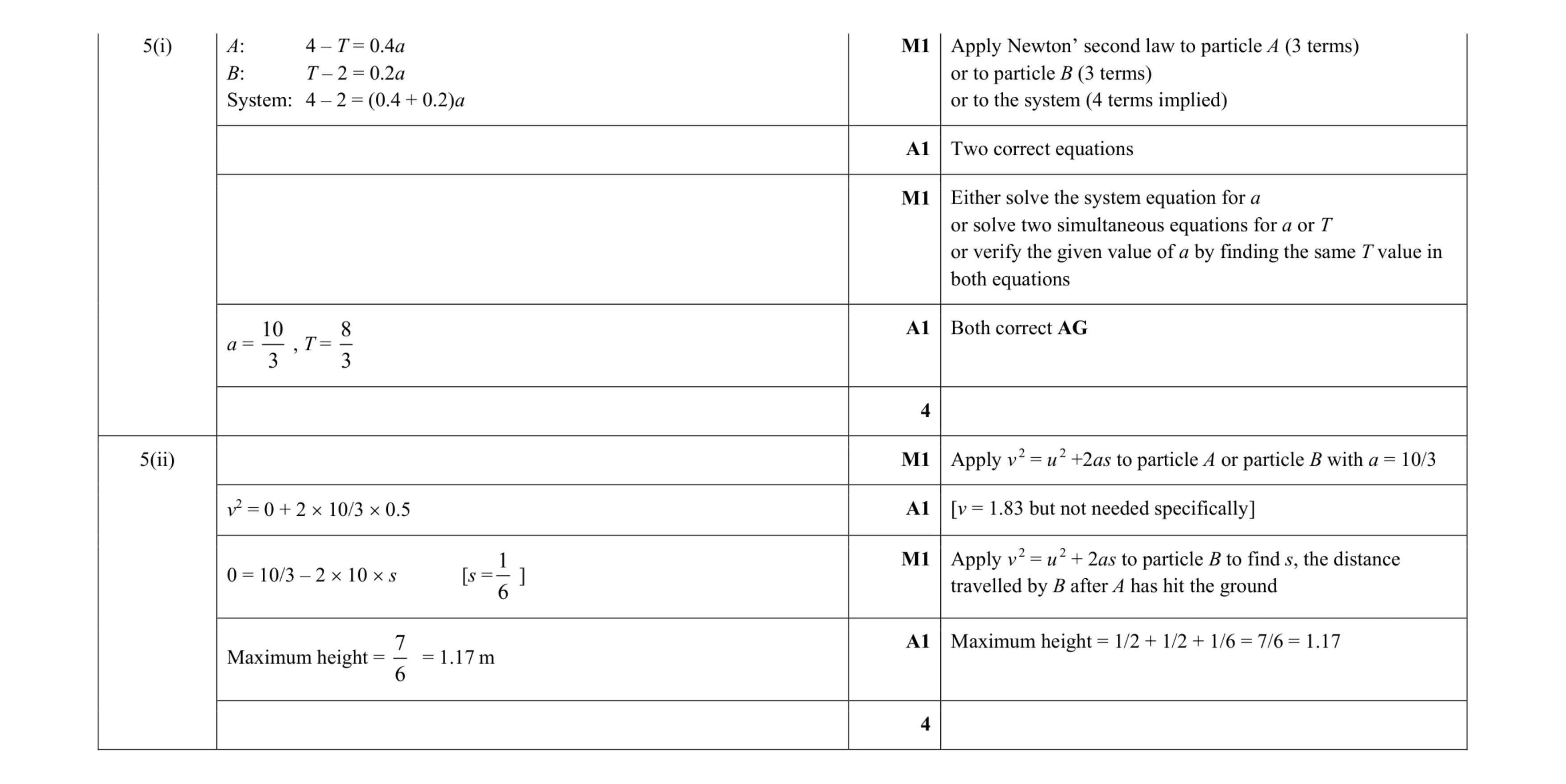 8
8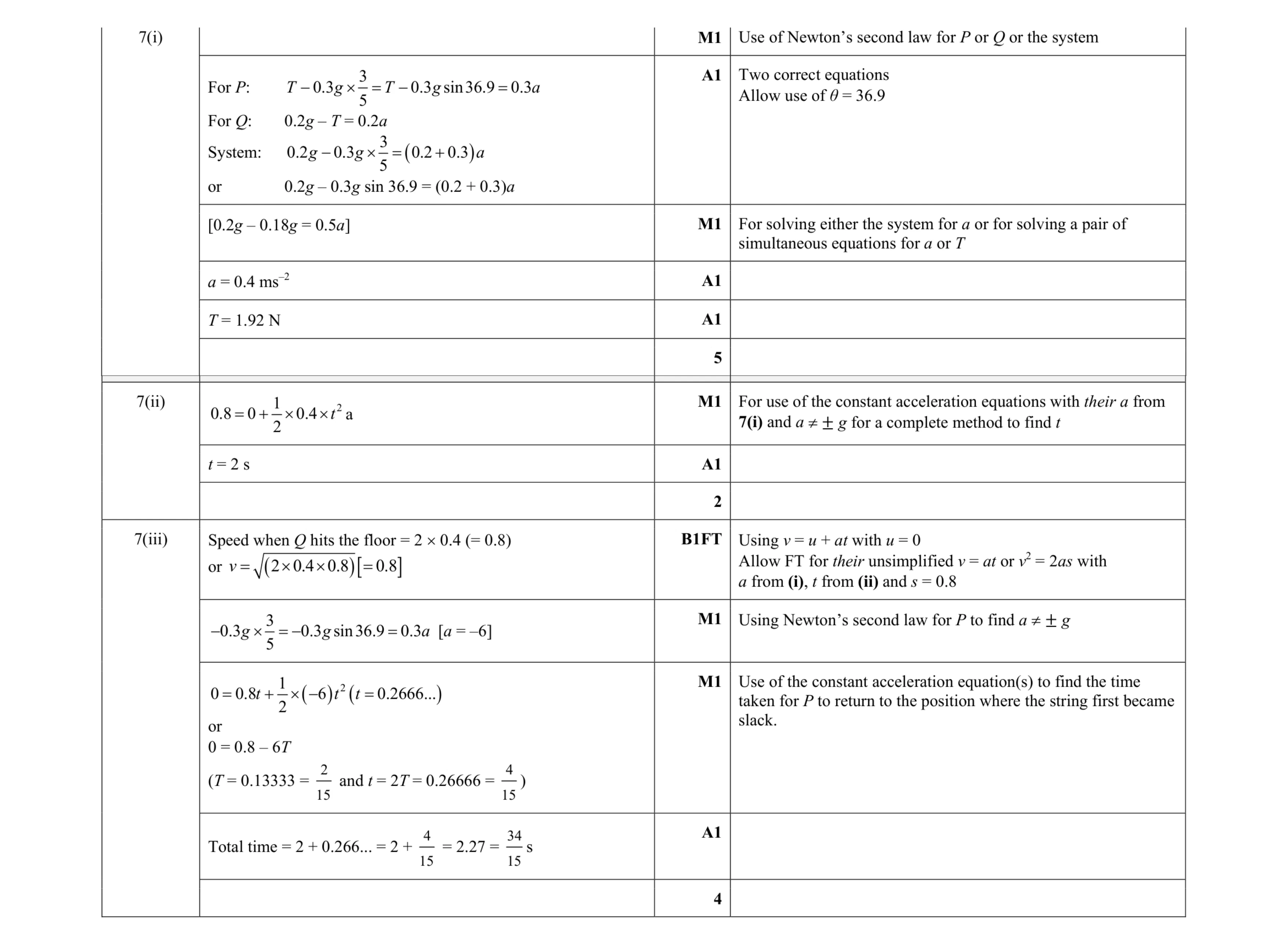 11
11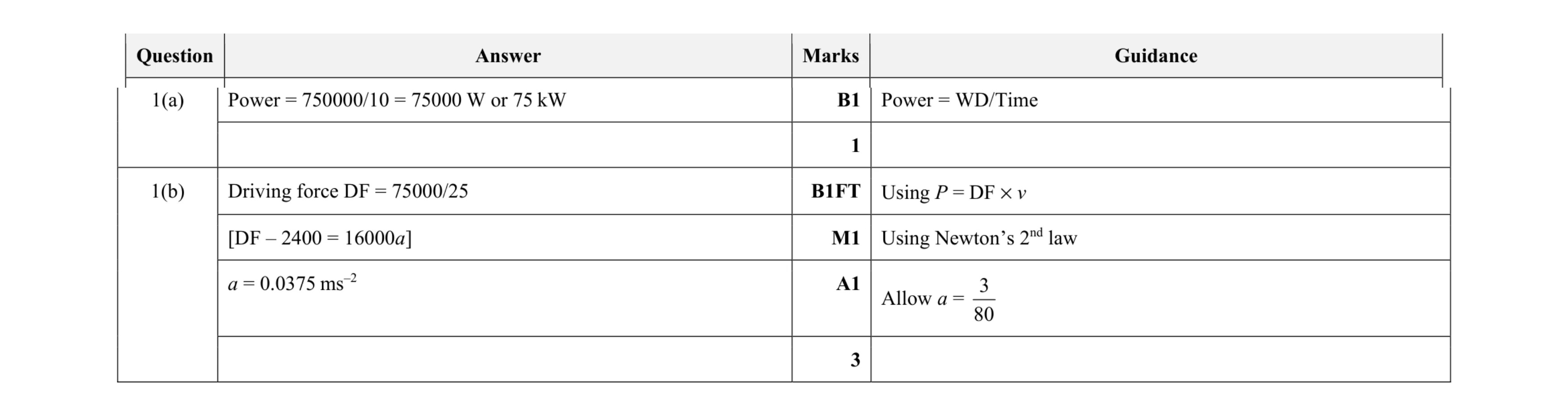 4
4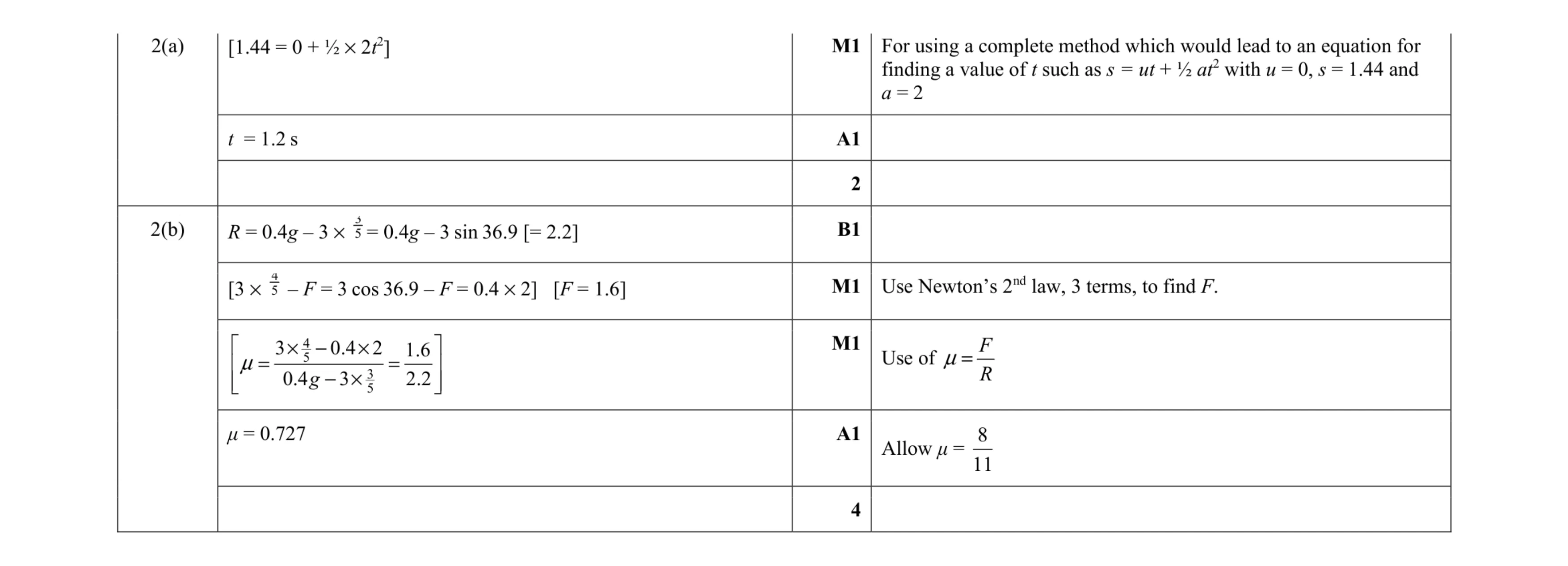 6
6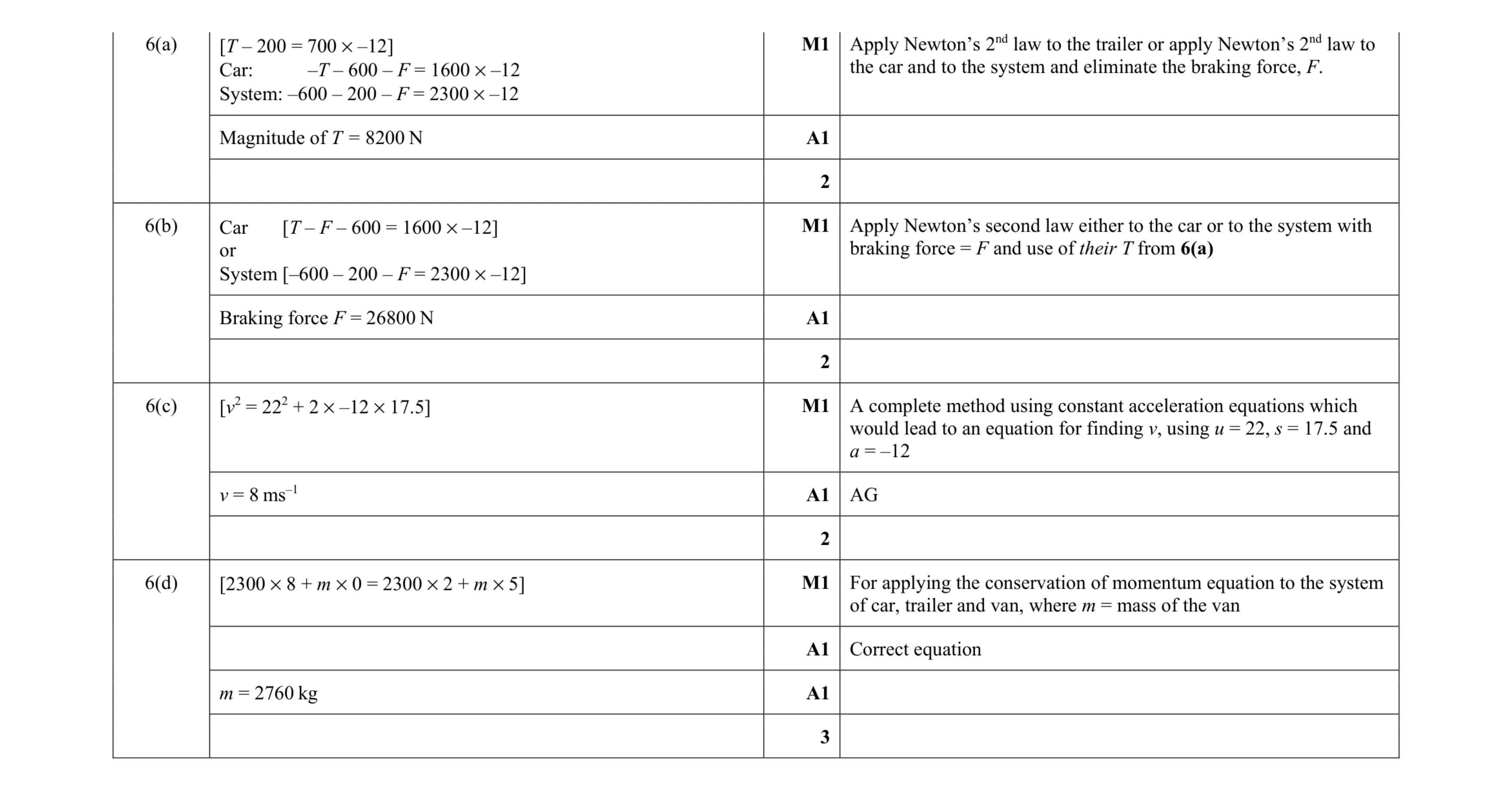 9
9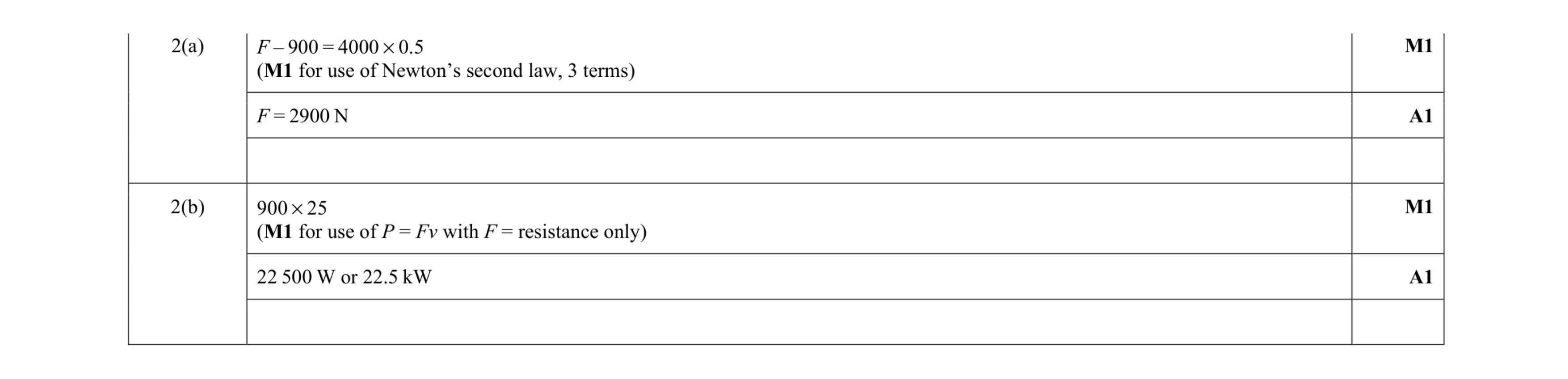 4
4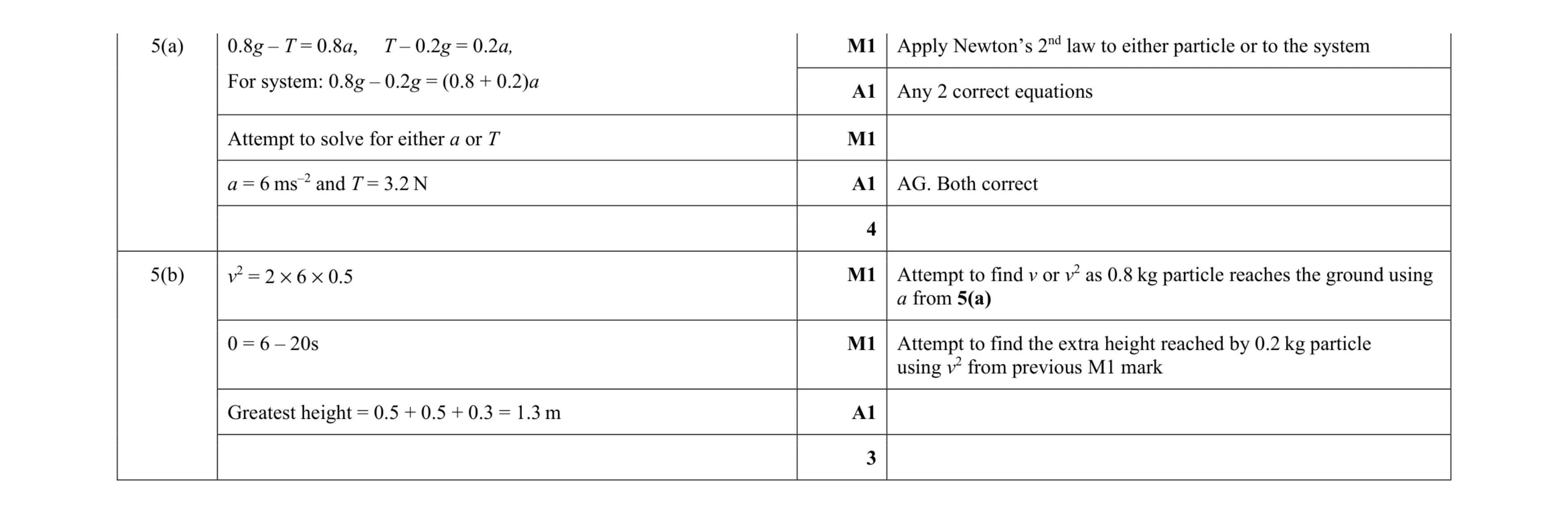 7
7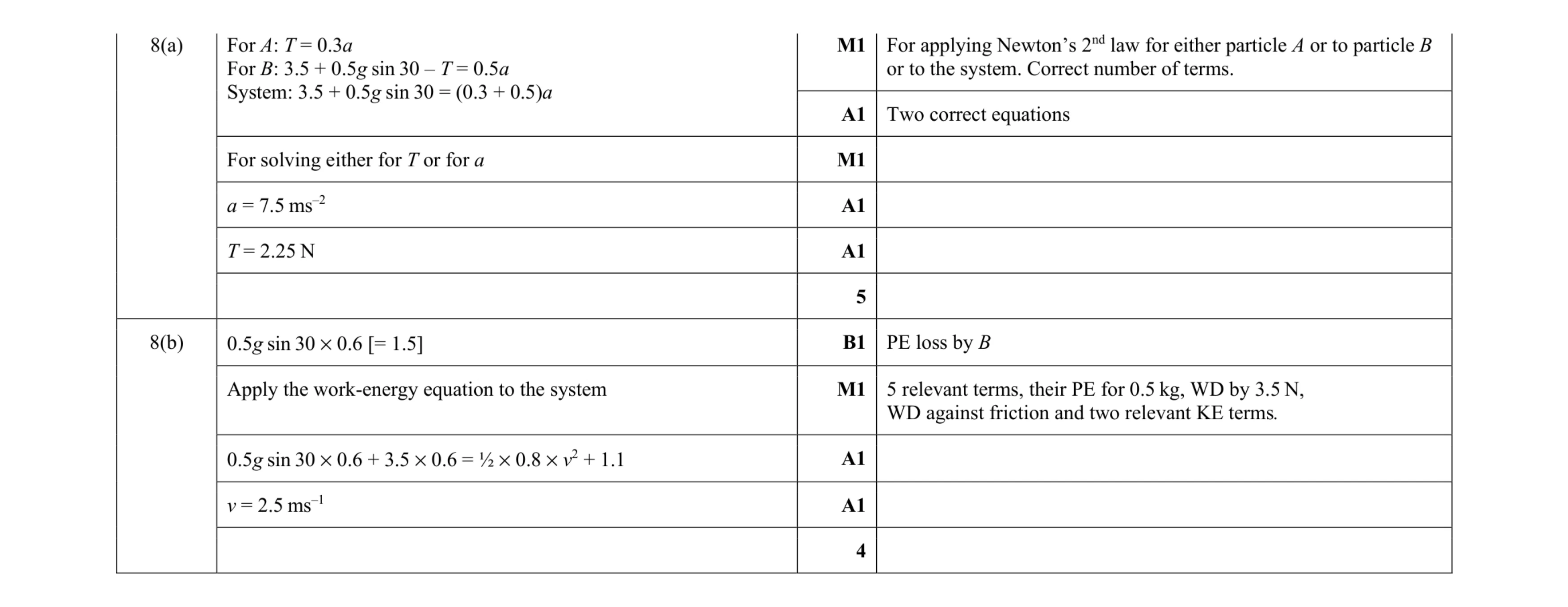 9
9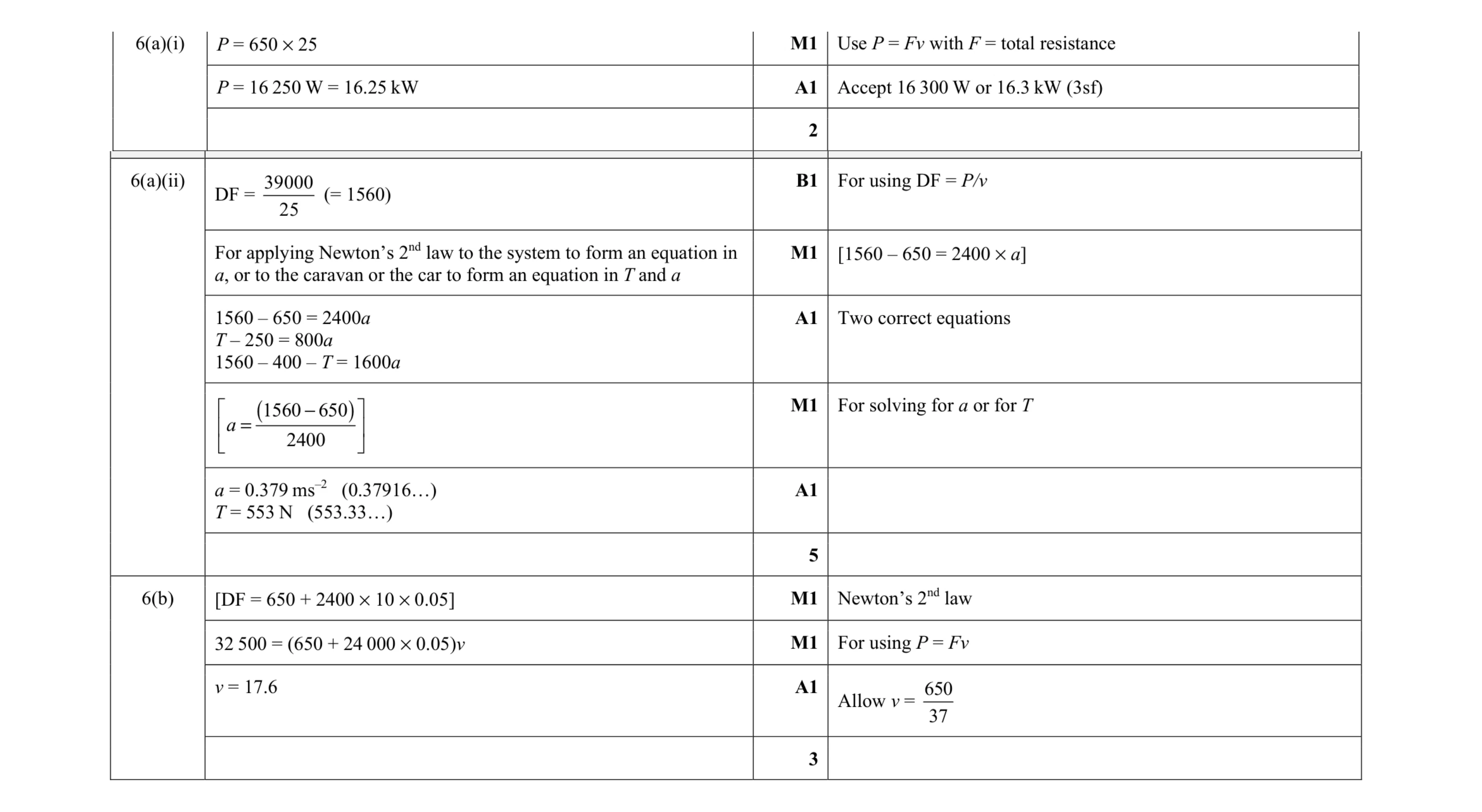 10
10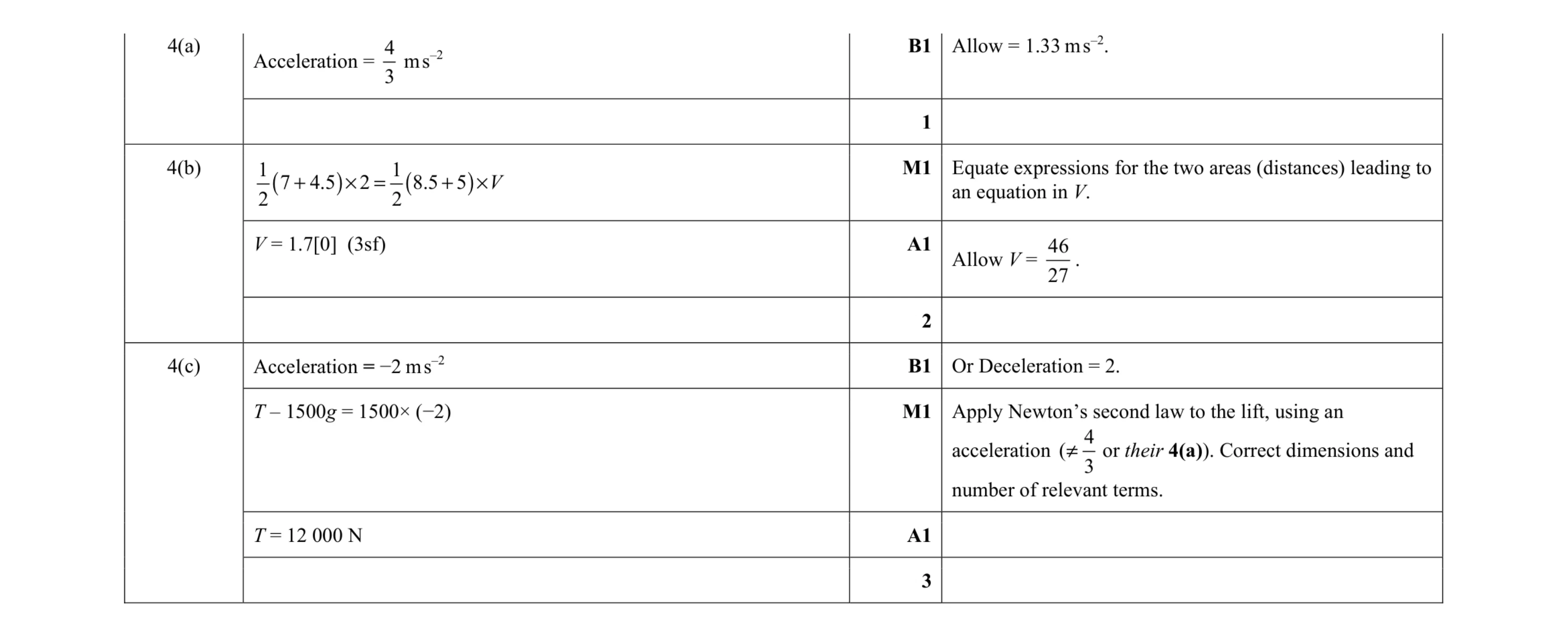 6
6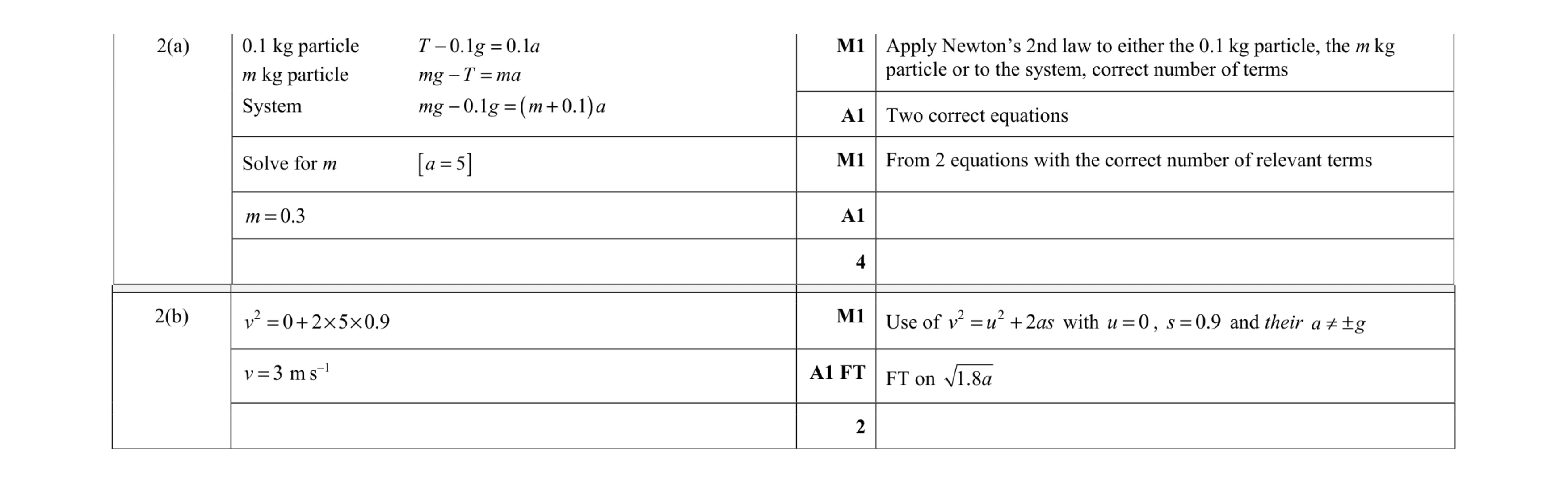 6
6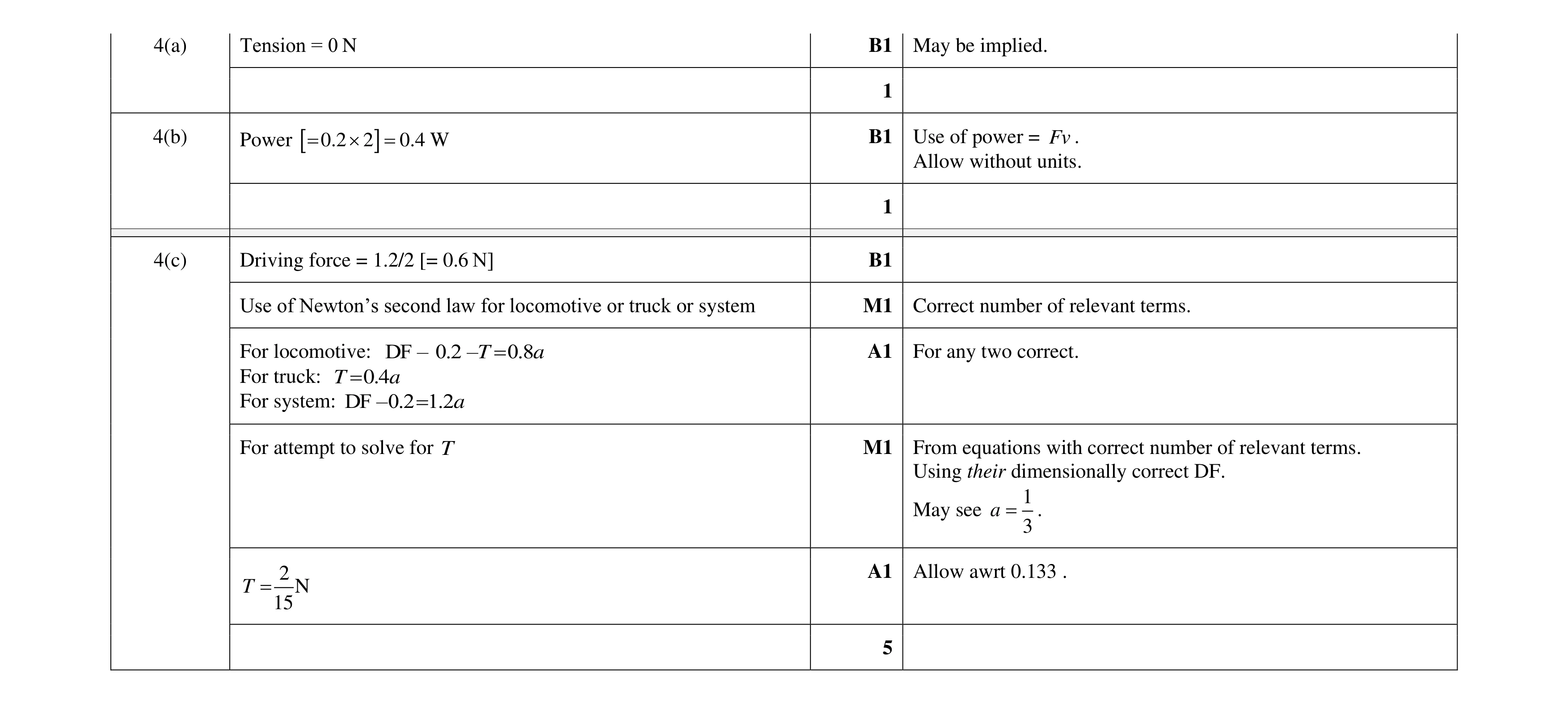 7
7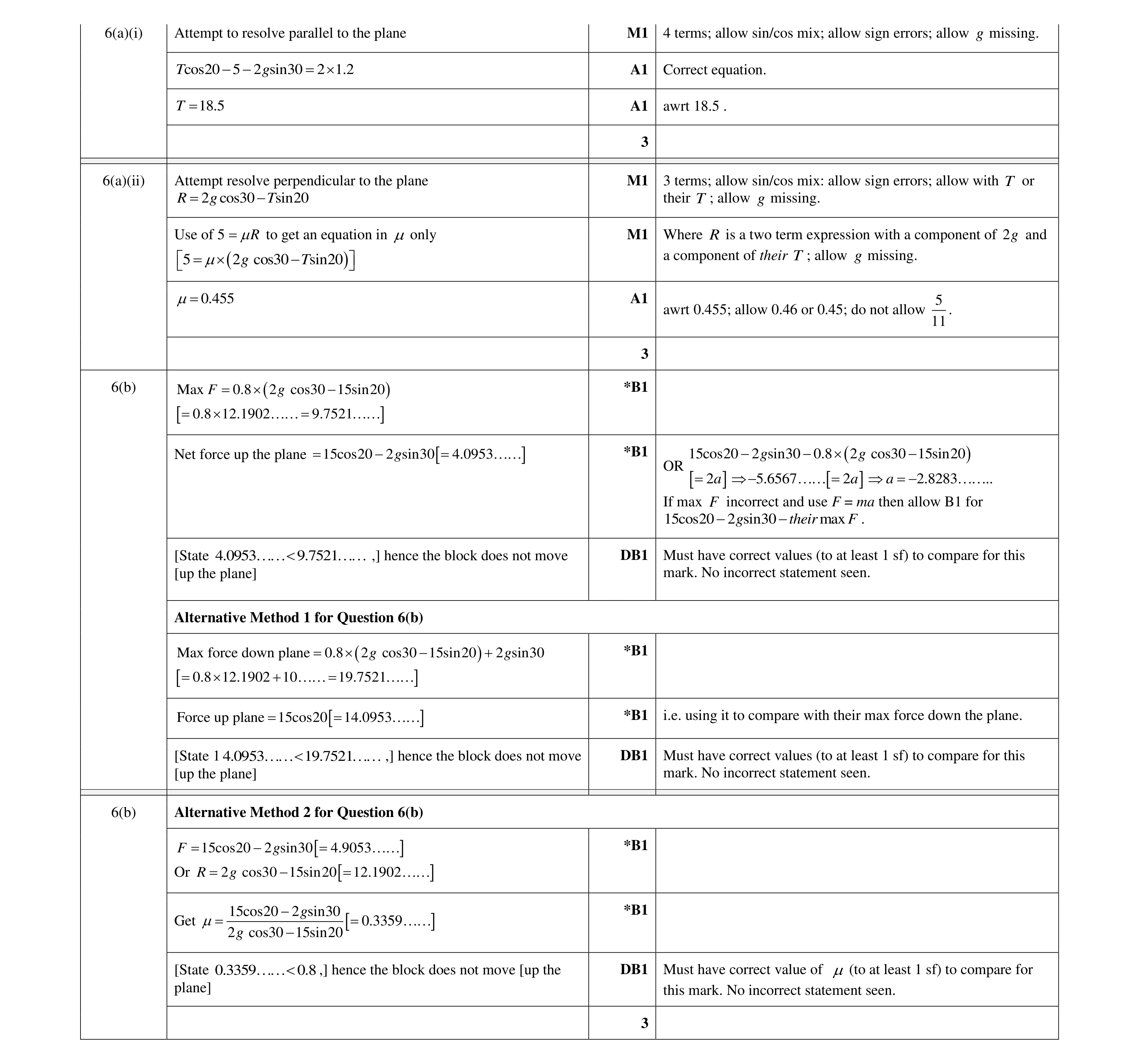 9
9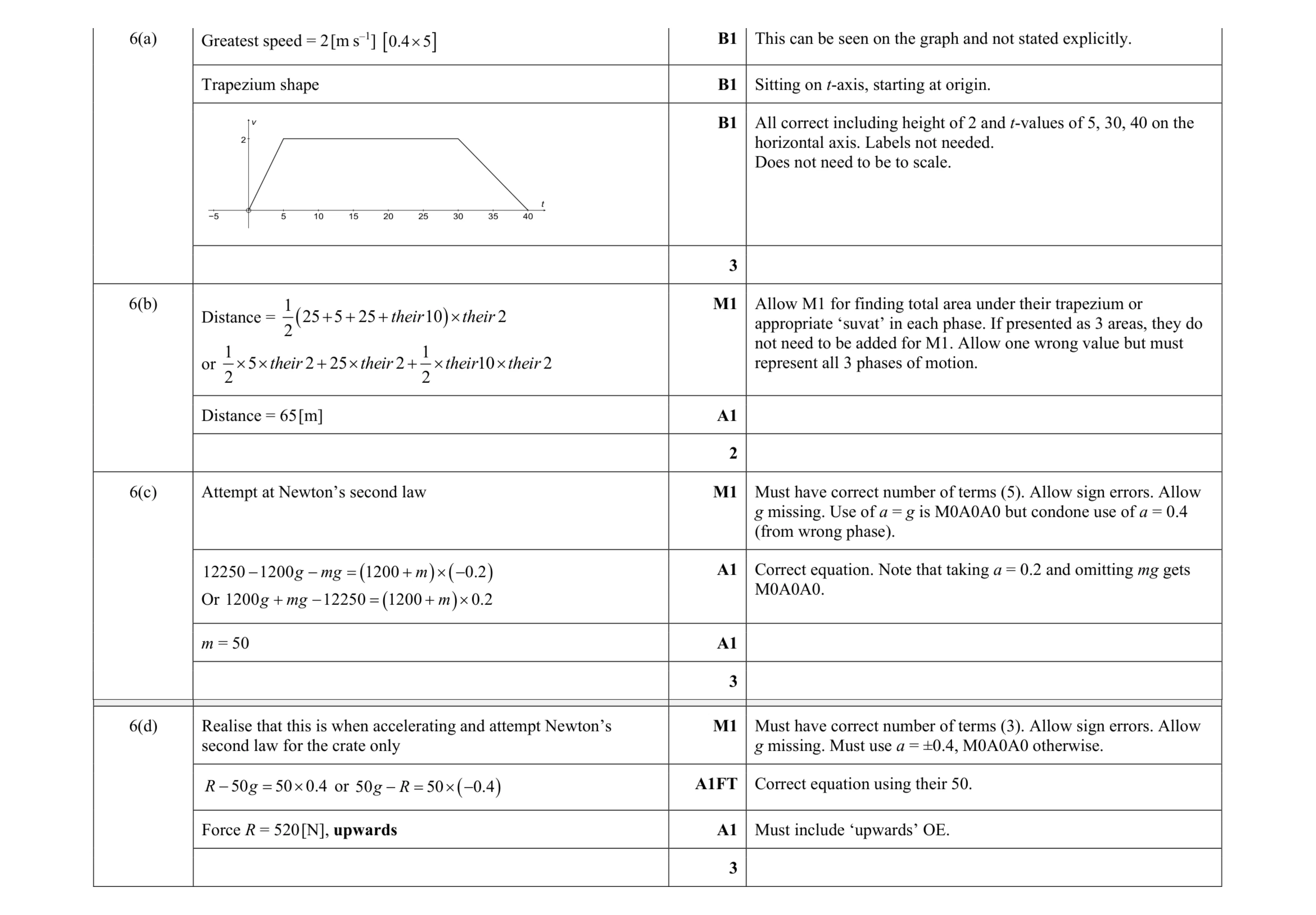 11
11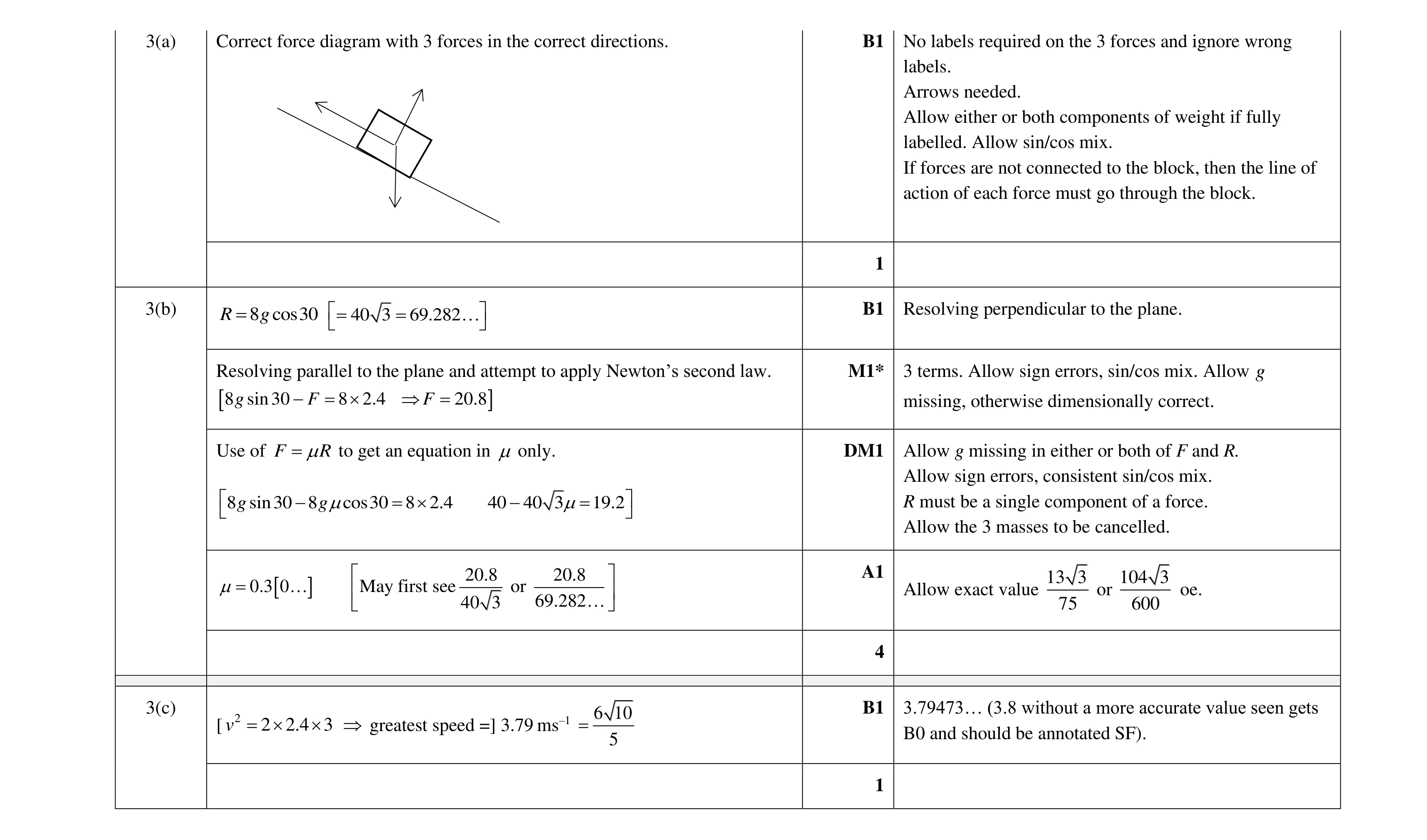 6
6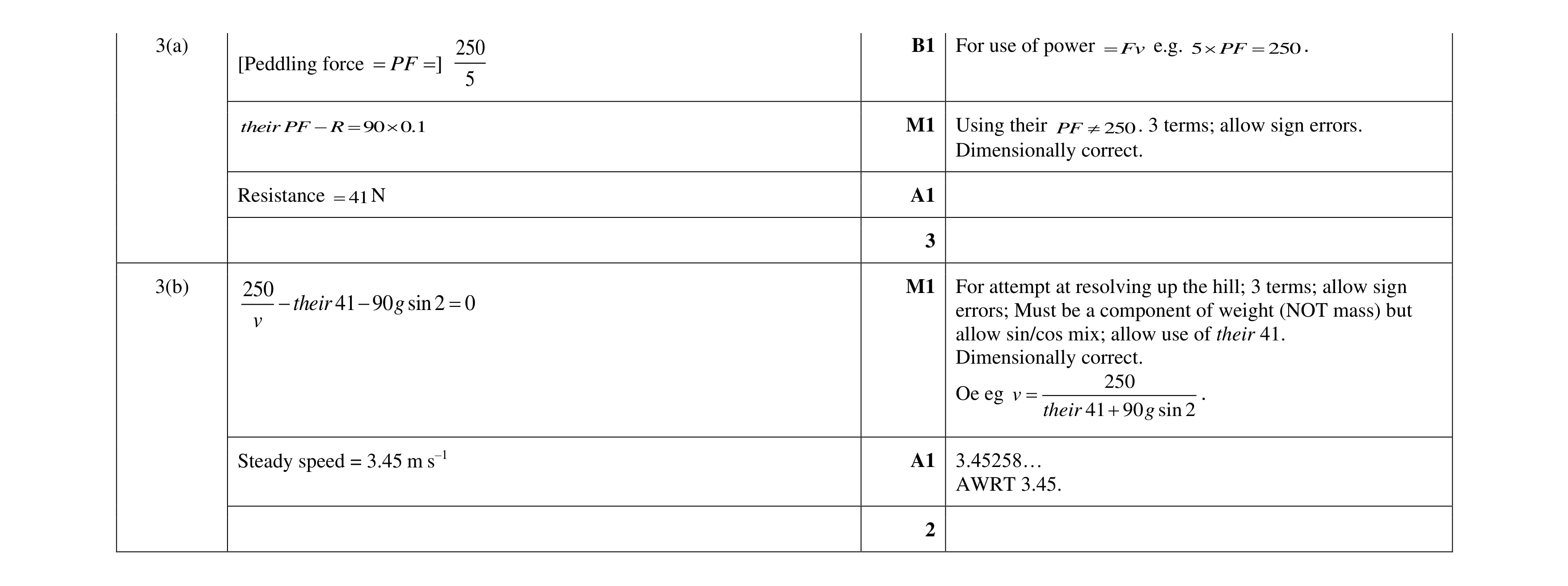 5
5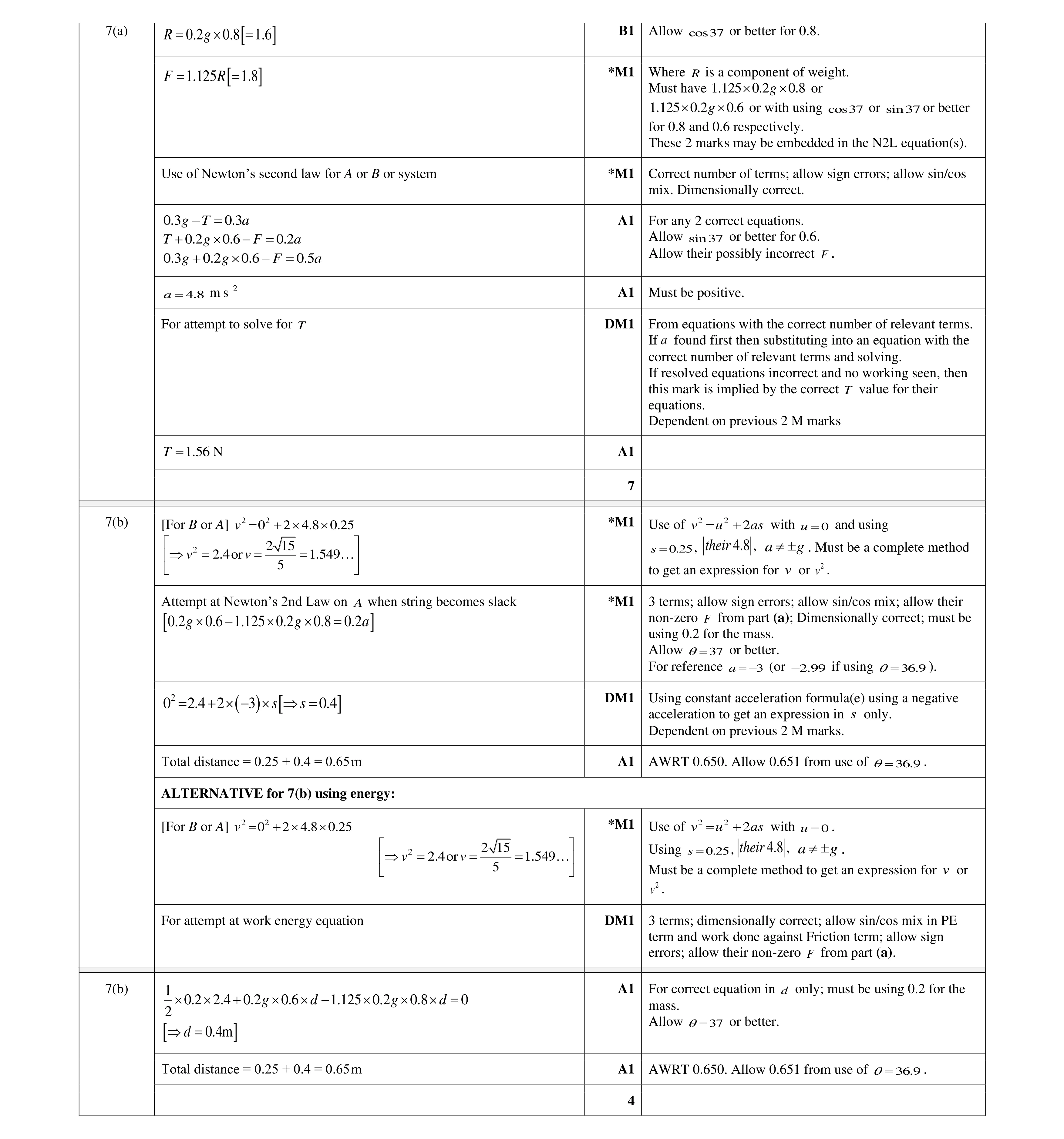 11
11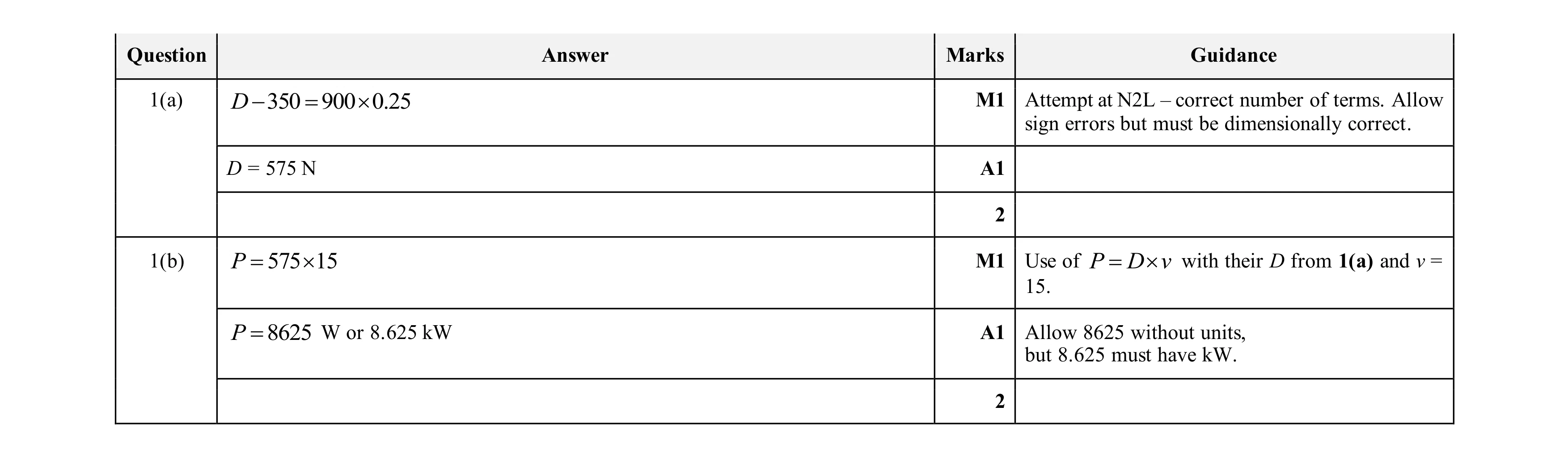 4
4