Cambridge A Level Mathematics 9709 — 2014 May/June Paper 4 · Variant 2
9709/42/M/J/14 · 1 question · 50 marks · ≈56 min
The question paper and its mark scheme, free to read here and free to download. This is Cambridge’s own paper, exactly as it was sat.
Question paper4 pages
Mark scheme7 pages
Answers below. Sit the paper first if you are practising.
Questions as text
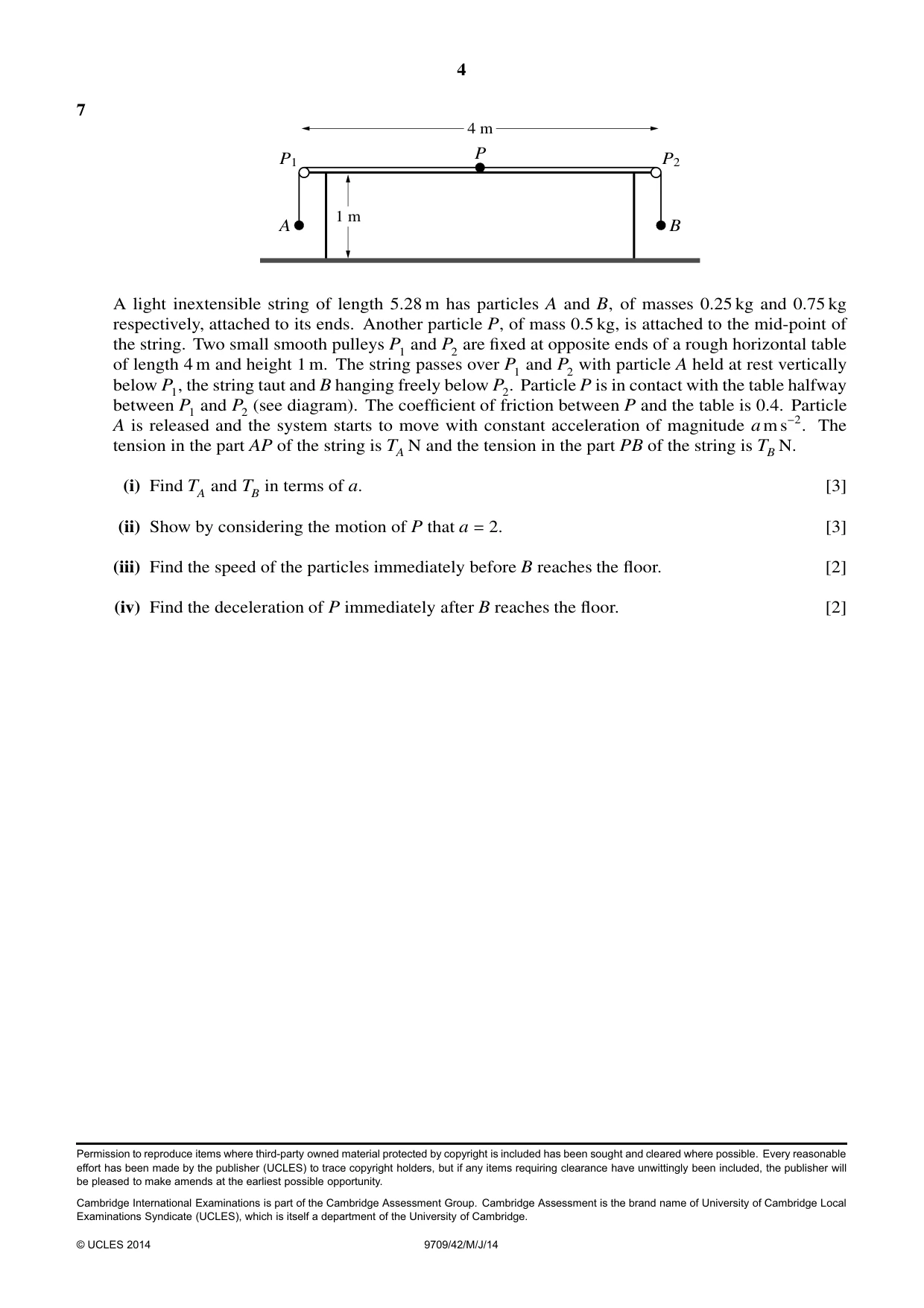
Q7 · 4 m P P1 P2 1 m A B A light inextensible string of length 5.28 m has particles A and B…
7 4 m P P1 P2 1 m A B A light inextensible string of length 5.28 m has particles A and B, of masses 0.25 kg and 0.75 kg respectively, attached to its ends. Another particle P, of mass 0.5 kg, is attached to the mid-point of the string. Two small smooth pulleys P1 and P2 are fixed at opposite ends of a rough horizontal table of length 4 m and height 1 m. The string passes over P1 and P2 with particle A held at rest vertically below P1, the string taut and B hanging freely below P2. Particle P is in contact with the table halfway between P1 and P2 (see diagram). The coefficient of friction between P and the table is 0.4. Particle A is released and the system starts to move with constant acceleration of magnitude a m s−2. The tension in the part AP of the string is TA N and the tension in the part PB of the string is TB N. (i) Find TA and TB in terms of a. [3] (ii) Show by considering the motion of P that a = 2. [3] (iii) Find the speed of the particles immediately before B reaches the floor. [2] (iv) Find the deceleration of P immediately after B reaches the floor. [2]
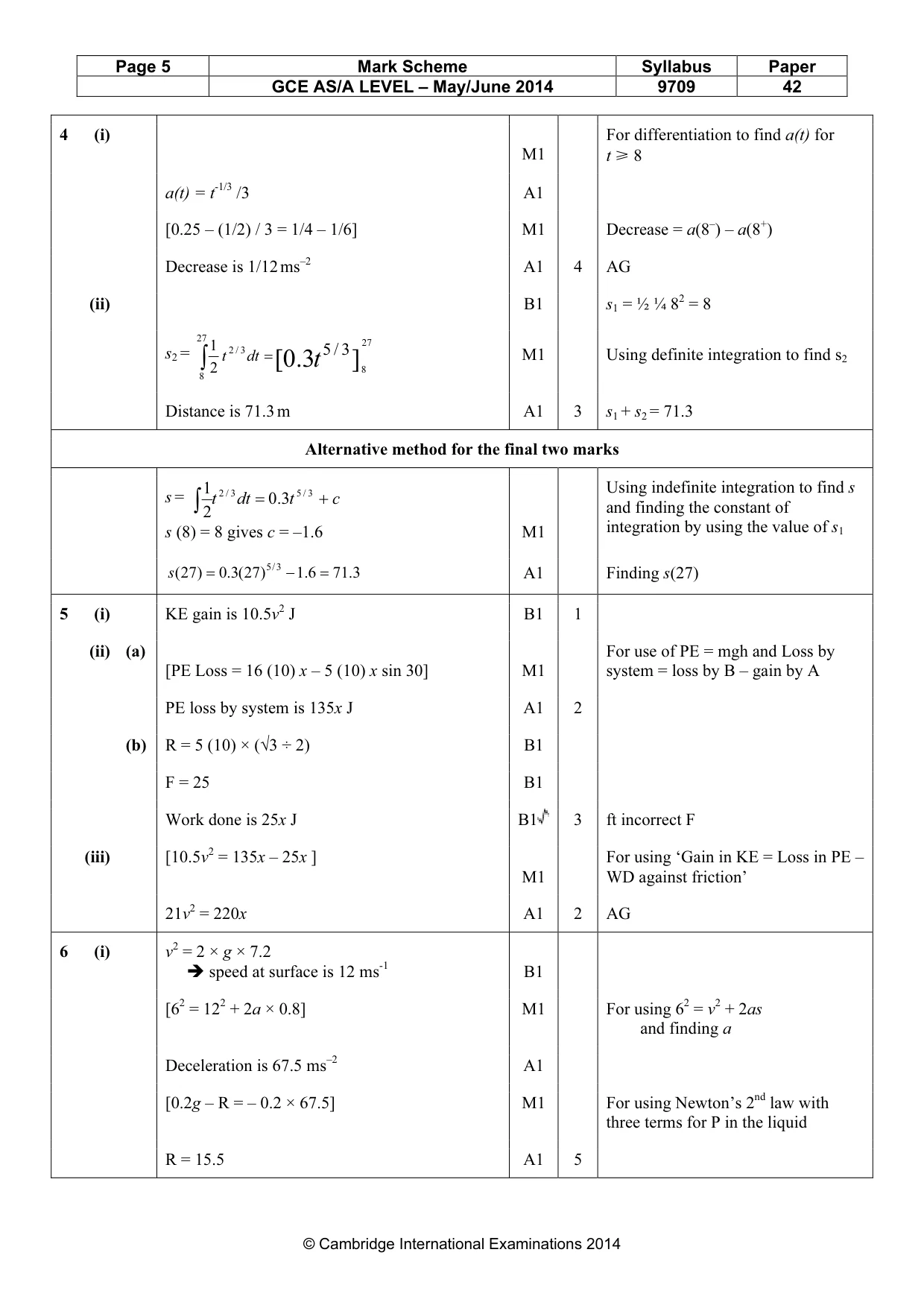
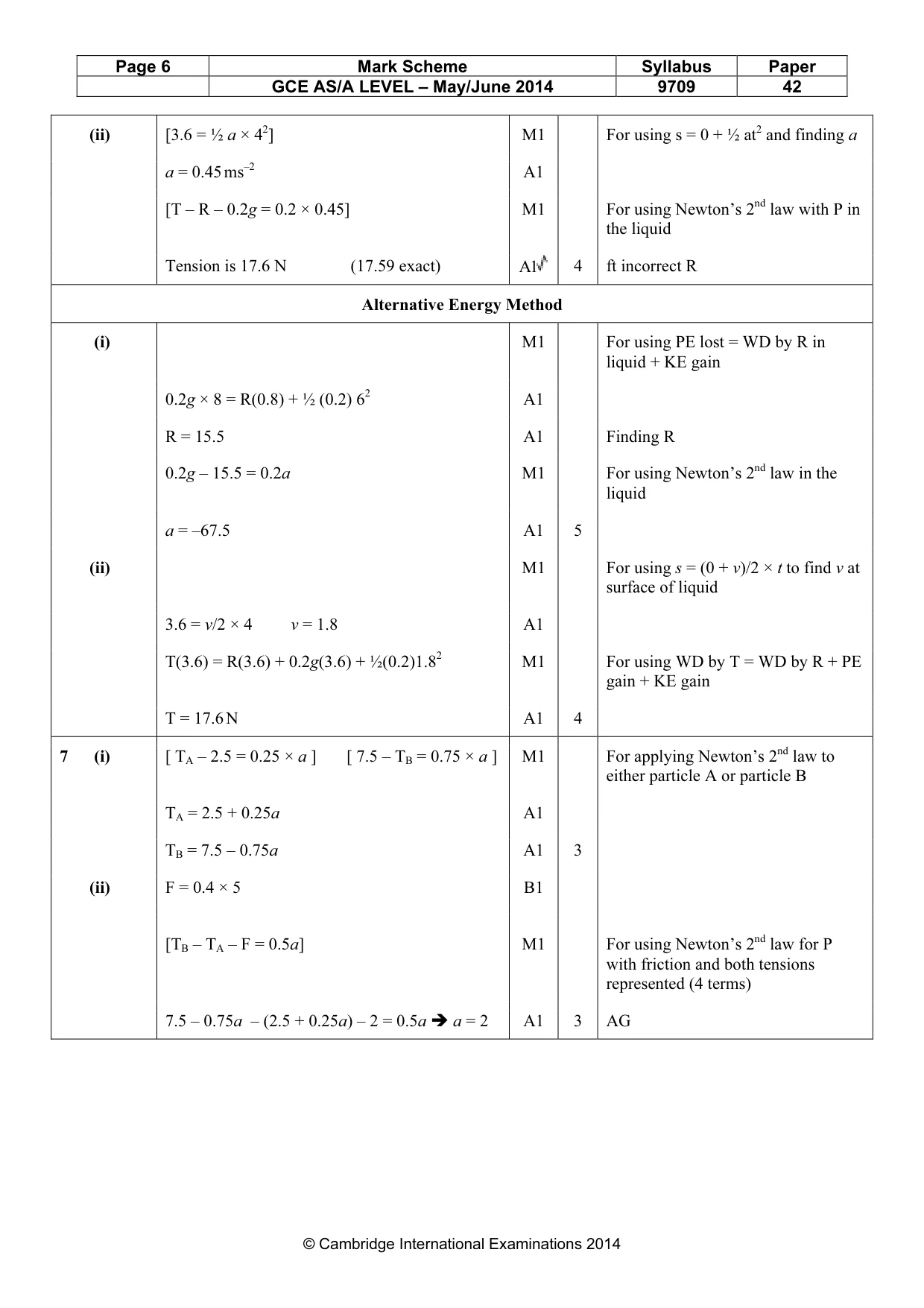
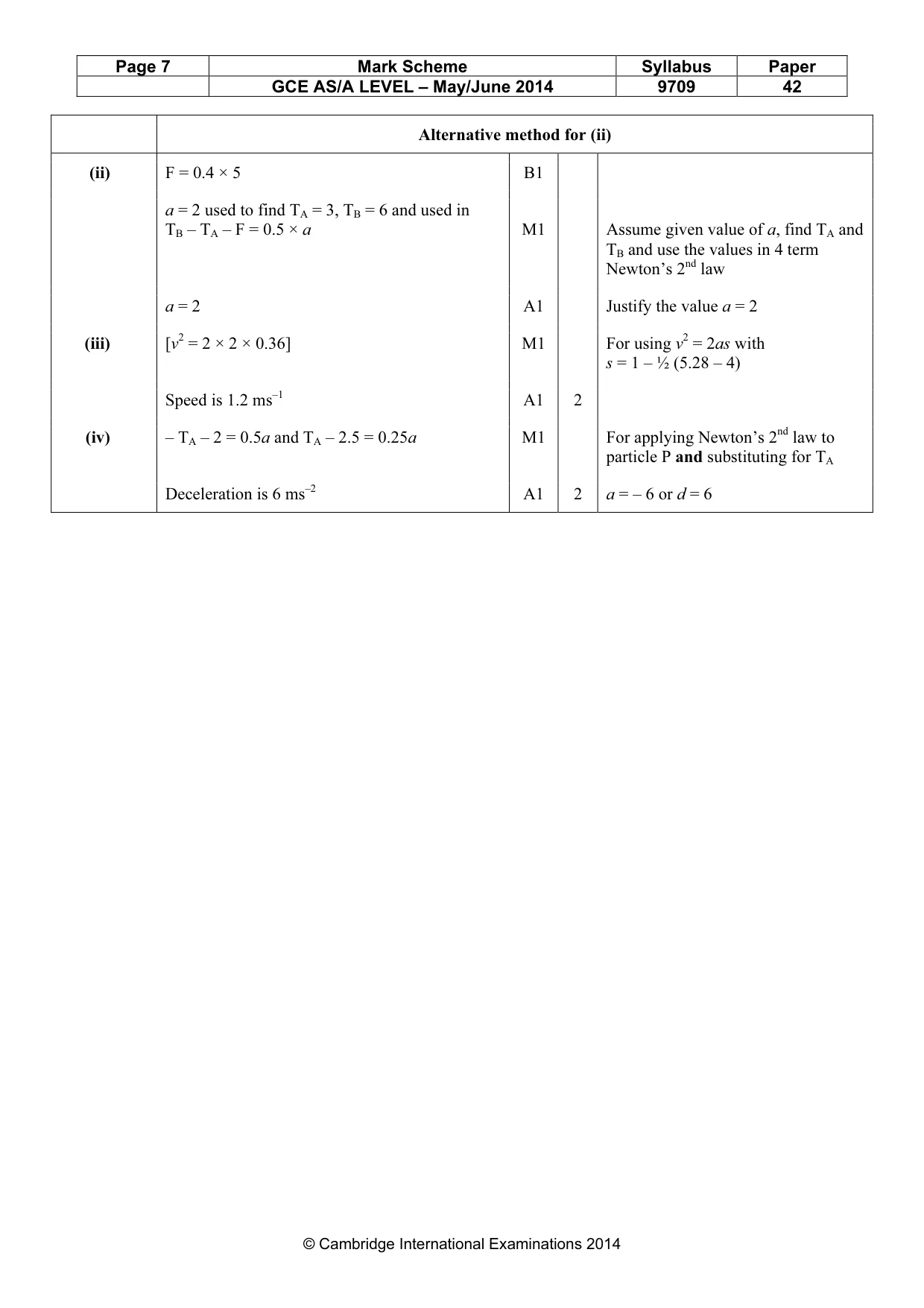
Mark scheme: 7 (i) [ TA – 2.5 = 0.25 × a ] [ 7.5 – TB = 0.75 × a ] M1 For applying Newton’s 2nd law to either particle A or particle B TA = 2.5 + 0.25a A1 TB = 7.5 – 0.75a A1 3 (ii) F = 0.4 × 5 B1 [TB – TA – F = 0.5a] M1 For using Newton’s 2nd law for P with friction and both tensions represented (4 terms) 7.5 – 0.75a – (2.5 + 0.25a) – 2 = 0.5a a = 2 A1 3 AG GCE AS/A LEVEL – May/June 2014 9709 42 Alternative method for (ii) (ii) F = 0.4 × 5 B1 a = 2 used to find TA = 3, TB = 6 and used in TB – TA – F = 0.5 × a M1 Assume given value of a, find TA and TB and use the values in 4 term Newton’s 2nd law a = 2 A1 Justify the value a = 2 (iii) [v2 = 2 × 2 × 0.36] M1 For using v2 = 2as with s = 1 – ½ (5.28 – 4) Speed is 1.2 ms–1 A1 2 (iv) – TA – 2 = 0.5a and TA – 2.5 = 0.25a M1 For applying Newton’s 2nd law to particle P and substituting for TA Deceleration is 6 ms–2 A1 2 a = – 6 or d = 6
What was in this paper
The subtopics covered by these 1 questions, and how many questions each got. Open one in a new tab to see every Cambridge question on it.
What you needed in this session
Cambridge’s own grade thresholds for 2014 May/June, Paper 4 · Variant 2. A higher threshold means an easier paper — the bar moves with how the cohort did.