Questions as text
Q1 · One end of a light inextensible string of length 0.16 m is attached to a fixed point A… 9709/51 Oct/Nov 2007
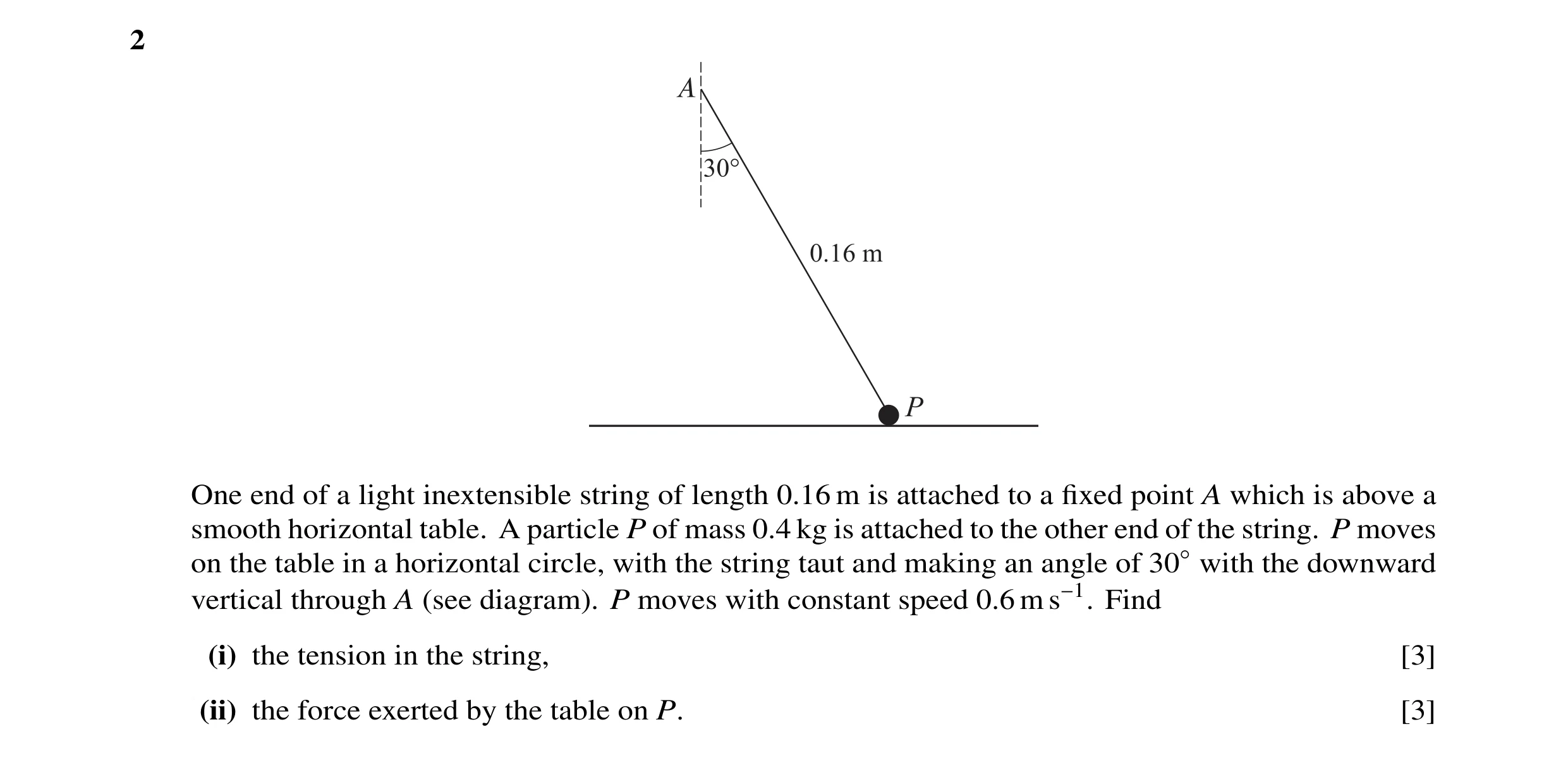
2 One end of a light inextensible string of length 0.16 m is attached to a fixed point A which is above a smooth horizontal table. A particle P of mass 0.4 kg is attached to the other end of the string. P moves on the table in a horizontal circle, with the string taut and making an angle of 30◦with the downward vertical through A (see diagram). P moves with constant speed 0.6 m s−1. Find (i) the tension in the string, [3] (ii) the force exerted by the table on P. [3]
6 marks
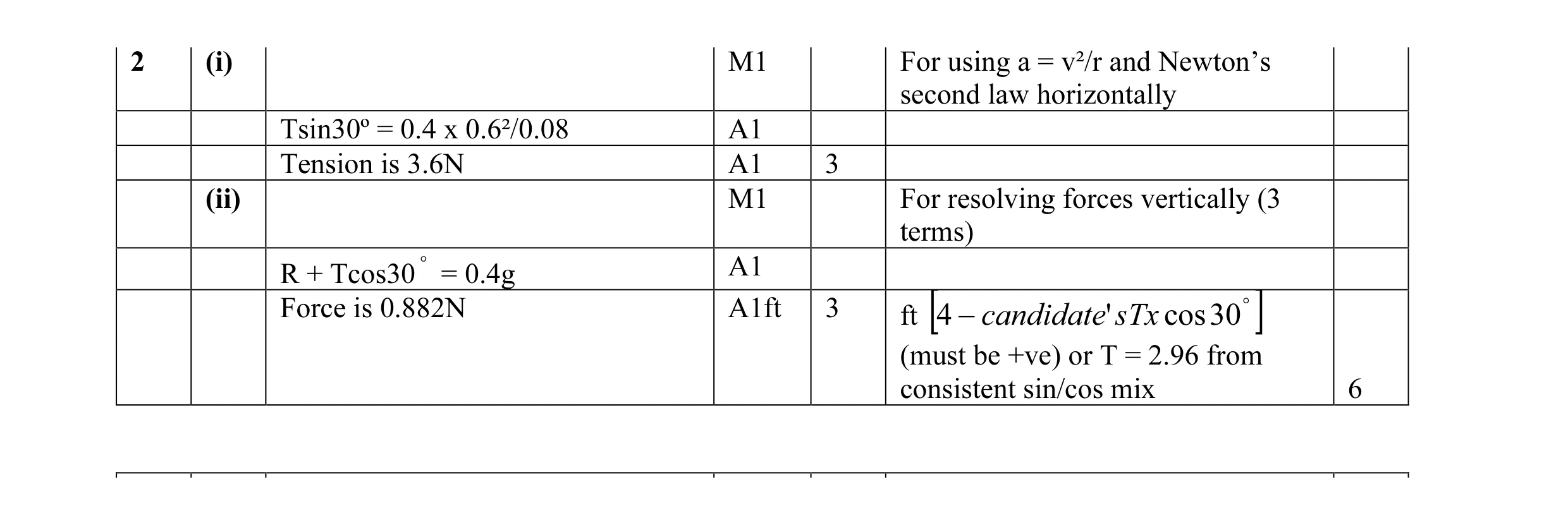
Mark scheme: 2 (i) M1 For using a = v²/r and Newton’s second law horizontally Tsin30º = 0.4 x 0.6²/0.08 A1 Tension is 3.6N A1 3 (ii) M1 For resolving forces vertically (3 terms) R + Tcos30 ° = 0.4g A1 Force is 0.882N A1ft 3 ft [4 − candidate ' sTx cos 30 ° ] (must be +ve) or T = 2.96 from consistent sin/cos mix 6
This question in 9709/51 Oct/Nov 2007
Q2 · One end of a light elastic string of natural length 1.25 m and modulus of elasticity 20 N… 9709/51 May/June 2008
6 One end of a light elastic string of natural length 1.25 m and modulus of elasticity 20 N is attached to a fixed point O. A particle P of mass 0.5 kg is attached to the other end of the string. P is held at rest at O and then released. When the extension of the string is x m the speed of P is v m s−1. (i) Show that v2 = −32x2 + 20x + 25. [4] (ii) Find the maximum speed of P. [3] (iii) Find the acceleration of P when it is at its lowest point. [4]
11 marks
Mark scheme: 6 (i) EE gain = 20x2/(2x1.25) B1 PE loss = 0.5g(1.25 + x) B1 [ 1 0.5v2 = 6.25 + 5x – 8x2] M1 For using KE gain = PE loss – EE gain 2 v2 = -32x2 + 20x + 25 A1 4 AG ALTERNATIVE For using Newton’s second law with [5.0 v ( dv / dx ) = − 20 x / .1 25 + 5.0 g ] M1 A=v(dv/dx) and T = λx / L 1 For integrating and using [ 0.5v2 = -10x2/1.25 + 5x + c] M1 1 2 0.5v(0)2 = 0.5gx1.25 2 c = 6.25 A1 v2 = -32x2 + 20x + 25 A1 (4) AG 2 For obtaining v2 in the form (ii) [v2=-32(x-5/16) + 28.125] M1 a(x – b)2 + c [ vmax = 28.125 ] M1 For substituting v max = c Maximum speed is 5.30ms-1 A1 3 ALTERNATIVE 1 [-64x + 20 = 0 ⇒ x = 5/16] M1 For solving d(v2)/dx for x [vmax 2= -32(5/16)2 + 20(5/16) + 25] M1 For substituting x found into v2 (x) Maximum speed is 5.30ms-1 A1 (3) ALTERNATIVE 2 [T = mg = 5, T = λ x/L = 20x/1.25 ⇒ M1 Using a = 0 at maximum speed x = 5/16 ] M1 For substituting x = 5/16 in v2 Maximum speed is 5.30ms-1 A1 (3) (iii) [-32x2 + 20x + 25 = 0 ⇒ x = 1.25] M1 For attempting to solve v = 0 [a = v(dv)/dx = 1 d(v2)/dx = -32x + 10] 2 M1 For using a = 12 d(v2)/dx a = -32x1.25 + 10 A1ft Acceleration is 30ms-2 (upwards) A1 4 ALTERNATIVE 1 [-32x2 + 20x + 25 = 0 ⇒ x = 1.25] M1 For attempting to solve v = 0 [0.5g – 20x/1.25 = 0.5a] M1 For using Newton’s second law a = g – 2(20x1.25/1.25) A1ft Acceleration is 30ms-2 (upwards) A1 (4) ALTERNATIVE 2 [-32x2 + 20x + 25 = 0 ⇒ x = 1.25] M1 For attempting to solve v = 0 M1 Using Newton’s 2nd Law 20 – 5 = 0.5a or 5 – 20 = 0.5a A1ft If a = -30 then the direction should be Acceleration is 30ms-2 A1 (4) 11 explained GCE A/AS LEVEL – May/June 2008 9709 05 For using Newton’s second law and
This question in 9709/51 May/June 2008
Q3 · A particle P of mass 0.5 kg moves on a horizontal surface along the straight line OA, in… 9709/51 May/June 2008
7 A particle P of mass 0.5 kg moves on a horizontal surface along the straight line OA, in the direction from O to A. The coefficient of friction between P and the surface is 0.08. Air resistance of magnitude 0.2v N opposes the motion, where v m s−1 is the speed of P at time t s. The particle passes through O with speed 4 m s−1 when t = 0. (i) Show that 2.5dv = −(v + 2) and hence find the value of t when v = 0. [7] dt dx (ii) Show that = 6e−0.4t −2, where x m is the displacement of P from O at time t s, and hence find dt the distance OP when v = 0. [5]
12 marks
Mark scheme: For using Newton s second law and 7 (i) 0.5a = -(0.2v + 0.08x0.5g) M1 F = µ R 2.5dv/dt = -(v + 2) A1 AG M1 For separating variables and integrating 2.5ln(v + 2) = -t (+c) A1 M1 For using v(0) = 4 t = 2.5ln[6/(v + 2)] A1 t = 2.75 A1 7 (ii) e0.4t = 6/(v + 2) ⇒ dx/dt = 6e–0.4t - 2 B1 M1 For integrating x = -15e–0.4t - 2t (+k) A1 x = 15(1 − e −0.4 t ) − 2t M1 For using x(0) = 0 i.e. x = 0, t = 0 Distance is 4.51m A1 5 12
This question in 9709/51 May/June 2008
Q4 · A 40° 0.7 m P One end of a light inextensible string of length 0.7 m is attached to a… 9709/51 Oct/Nov 2009
6 A 40° 0.7 m P One end of a light inextensible string of length 0.7 m is attached to a fixed point A. The other end of the string is attached to a particle P of mass 0.25 kg. The particle P moves in a circle on a smooth horizontal table with constant speed 1.5 m s−1. The string is taut and makes an angle of 40◦with the vertical (see diagram). Find (i) the tension in the string, [3] (ii) the force exerted on P by the table. [3] P now moves in the same horizontal circle with constant angular speed ω rad s−1. (iii) Find the maximum value of ω for which P remains on the table. [5]
11 marks
Mark scheme: 6 (i) a = 1.52/(0.7sin40º) B1 [Tsin40º = 0.25a] M1 For using Newton’s second law horizontally Tension is 1.94 N A1 3 (ii) M1 For resolving forces vertically Tcos40º + R = 0.25 g A1 Force exerted is 1.01 N A1√ 3 ft 2.5 – Tcos40º (iii) M1 For using Newton’s second law horizontally and a = rω2 Tsin40º = 0.25(0.7sin40º) ω2 A1 Tcos40º = 0.25 g (T = 3.2635…) B1 [tan40º = 0.7sin40º ω2/g or 3.2635…sin40º = 0.25(0.7sin40º) ω2] M1 For eliminating T or substituting for T Maximum value of ω is 4.32 A1 5 [11] GCE A/AS LEVEL – October/November 2009 9709 51
This question in 9709/51 Oct/Nov 2009
Q5 · A particle P of mass 0.1 kg is projected vertically upwards from a point O with speed 20… 9709/51 Oct/Nov 2009
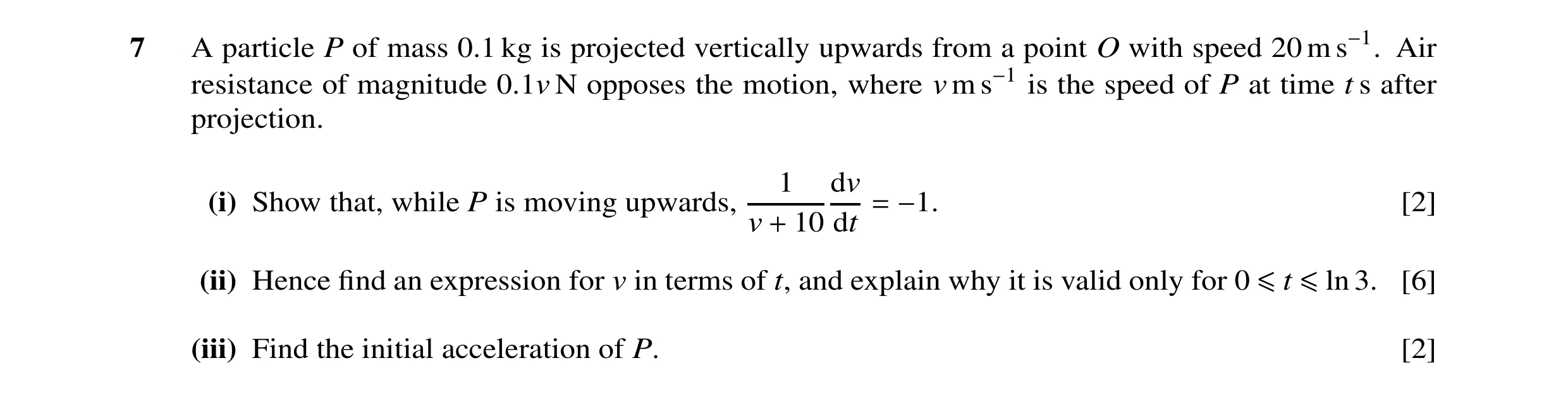
7 A particle P of mass 0.1 kg is projected vertically upwards from a point O with speed 20 m s−1. Air resistance of magnitude 0.1v N opposes the motion, where v m s−1 is the speed of P at time t s after projection. 1 dv (i) Show that, while P is moving upwards, = −1. [2] v + 10 dt (ii) Hence find an expression for v in terms of t, and explain why it is valid only for 0 ≤t ≤ln 3. [6] (iii) Find the initial acceleration of P. [2]
10 marks
Mark scheme: 7 (i) M1 For using Newton’s second law with a = dv/dt 1 dv 0.1dv/dt = –0.1 g – 0.1v ⇒ = –1 A1 2 AG v + 10 dt 1 (ii) [∫ v + 10 dv = − ∫ dt ] M1 For separating variables and attempting to integrate ln(v + 10) = –t (+A) A1 A = ln30 B1√ [ln{v + 10)/30} = –t ⇒ (v + 10)/30 = e–t M1 For transposing to eliminate ln v = 30e–t – 10 A1 Until 0 = 30e–t ⇒ valid for 0 ≤ t ≤ ln3 B1 6 (iii) M1 For substituting v = 20 into a = –(v + 10) or t = 0 into a = –30e–t Acceleration is –30 m s–2 A1 2 [10]
This question in 9709/51 Oct/Nov 2009
Q6 · A particle P of mass 0.25 kg moves in a straight line on a smooth horizontal surface 9709/51 May/June 2010
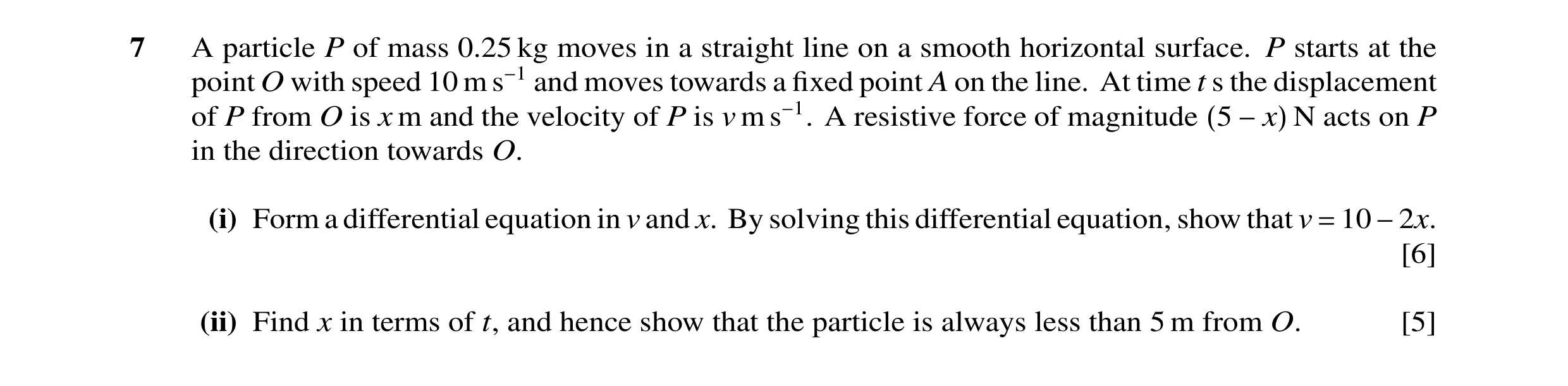
7 A particle P of mass 0.25 kg moves in a straight line on a smooth horizontal surface. P starts at the point O with speed 10 m s−1 and moves towards a fixed point A on the line. At time t s the displacement of P from O is x m and the velocity of P is v m s−1. A resistive force of magnitude (5 −x) N acts on P in the direction towards O. (i) Form a differential equation in v and x. By solving this differential equation, show that v = 10 −2x. [6] (ii) Find x in terms of t, and hence show that the particle is always less than 5 m from O. [5]
11 marks
Mark scheme: 7 (i) [0.25v(dv/dx) = –(5 – x)] B1 For using Newton’s second law and a = v(dv/dx) M1 For separating variables and attempting [∫ vdv = 4 ∫ (x − 5)dx ] to integrate v2/2 = 4(x – 5)2/2 (+ A) A1 M1 For using v(0) = 10 v2 = 4(x – 5) 2 A1 Any correct expression in x Selects correct square root to obtain v = 10 – 2x A1 AG [6] dx For using v = dx/dt and separating (ii) [∫ 10 −x2 = ∫dt ] M1 variables – 12 ln(10 – 2x) = t(– 12 lnB) A1 B = 10 (or equivalent) A1 x = 5(1 – e–2t) B1ft ft x = (B/2)(1 – e–2t) 0 < e–2t < 1 for all t → x < 5 for all t B1 AG [5]
This question in 9709/51 May/June 2010
Q7 · A particle P of mass 0.25 kg moves in a straight line on a smooth horizontal surface 9709/52 May/June 2010
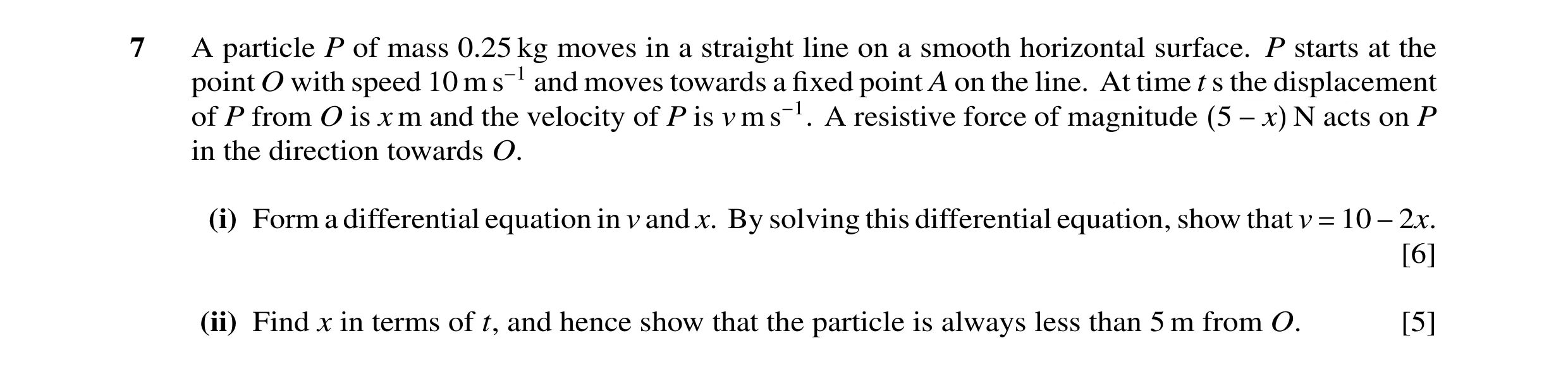
7 A particle P of mass 0.25 kg moves in a straight line on a smooth horizontal surface. P starts at the point O with speed 10 m s−1 and moves towards a fixed point A on the line. At time t s the displacement of P from O is x m and the velocity of P is v m s−1. A resistive force of magnitude (5 −x) N acts on P in the direction towards O. (i) Form a differential equation in v and x. By solving this differential equation, show that v = 10 −2x. [6] (ii) Find x in terms of t, and hence show that the particle is always less than 5 m from O. [5]
11 marks
Mark scheme: 7 (i) [0.25v(dv/dx) = –(5 – x)] B1 For using Newton’s second law and a = v(dv/dx) M1 For separating variables and attempting [∫ vdv = 4 ∫ (x − 5)dx ] to integrate v2/2 = 4(x – 5)2/2 (+ A) A1 M1 For using v(0) = 10 v2 = 4(x – 5) 2 A1 Any correct expression in x Selects correct square root to obtain v = 10 – 2x A1 AG [6] dx For using v = dx/dt and separating (ii) [∫ 10 −x2 = ∫dt ] M1 variables – 12 ln(10 – 2x) = t(– 12 lnB) A1 B = 10 (or equivalent) A1 x = 5(1 – e–2t) B1ft ft x = (B/2)(1 – e–2t) 0 < e–2t < 1 for all t → x < 5 for all t B1 AG [5]
This question in 9709/52 May/June 2010
Q8 · A 0.2 m 30° P One end of a light inextensible string of length 0.2 m is attached to a… 9709/52 Oct/Nov 2010
3 A 0.2 m 30° P One end of a light inextensible string of length 0.2 m is attached to a fixed point A which is above a smooth horizontal surface. A particle P of mass 0.6 kg is attached to the other end of the string. P moves in a circle on the surface with constant speed v m s−1, with the string taut and making an angle of 30◦to the horizontal (see diagram). (i) Given that v = 1.5, calculate the magnitude of the force that the surface exerts on P. [4] (ii) Given instead that P moves with its greatest possible speed while remaining in contact with the surface, find v. [3]
7 marks
Mark scheme: 3 (i) 0.6x1.52/(0.2cos30°) = Tcos30° M1 Uses N2L horizontally with component of tension T = 9 N A1 R = 0.6g – 9sin30° M1 Resolves vertically, 3 terms R = 1.5 N A1 [4] (ii) Tsin30° = 0.6g M1 Resolves vertically, 2 terms 0.6v2/(0.2cos30°) = 12cos30° M1 v2 = 3, v =1.73 A1 [3] GCE A LEVEL – October/November 2010 9709 52
This question in 9709/52 Oct/Nov 2010
Q9 · One end of a light elastic string of natural length 0.3 m and modulus of elasticity 6 N… 9709/53 May/June 2011
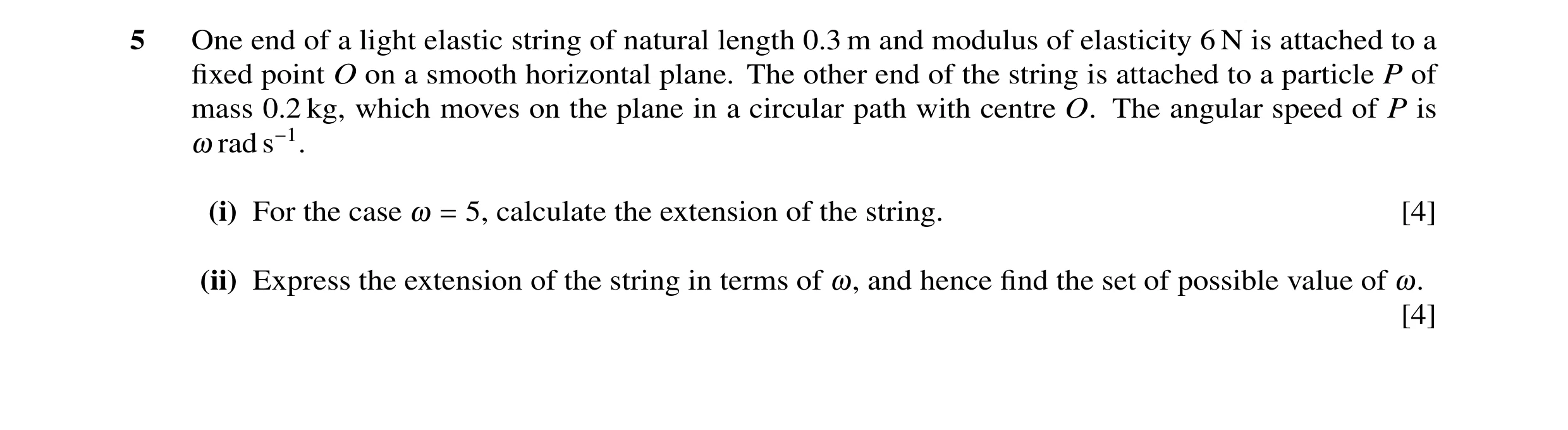
5 One end of a light elastic string of natural length 0.3 m and modulus of elasticity 6 N is attached to a fixed point O on a smooth horizontal plane. The other end of the string is attached to a particle P of mass 0.2 kg, which moves on the plane in a circular path with centre O. The angular speed of P is ω rad s−1. (i) For the case ω = 5, calculate the extension of the string. [4] (ii) Express the extension of the string in terms of ω, and hence find the set of possible value of ω. [4]
8 marks
Mark scheme: 5 (i) T = 6e / 0.3 B1 0.2 × 5 2 (0.3 + e) = 6e / 0.3 M1, A1 Newton’s Second Law radially e = 0.1 A1 [4] (ii) 0.2ω 2 (0.3 + e) = 6e / 0.3 M1 Newton’s Second Law radially e = 0.06ω 2/(20 – 0.2ω 2) A1 Other forms acceptable 20 – 0.2ω 2 > 0 M1 Uses denominator > 0 (0 <) ω < 10 A1 Disregard lower limit [4] GCE AS/A LEVEL – May/June 2011 9709 53 2
This question in 9709/53 May/June 2011
Q10 · A ball of mass 0.05 kg is released from rest at a height h m above the ground 9709/52 Oct/Nov 2011
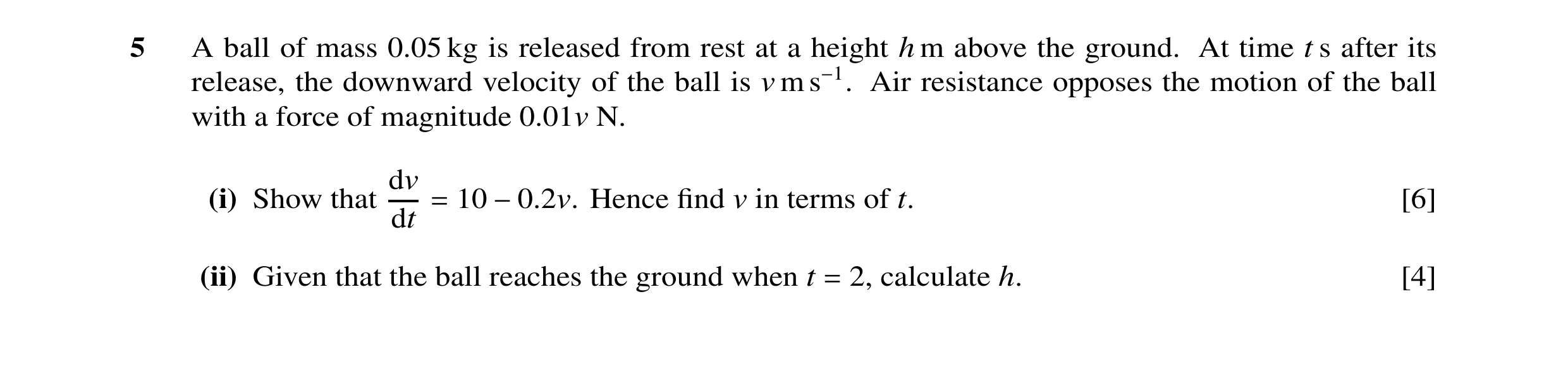
5 A ball of mass 0.05 kg is released from rest at a height h m above the ground. At time t s after its release, the downward velocity of the ball is v m s−1. Air resistance opposes the motion of the ball with a force of magnitude 0.01v N. dv (i) Show that = 10 −0.2v. Hence find v in terms of t. [6] dt (ii) Given that the ball reaches the ground when t = 2, calculate h. [4]
10 marks
Mark scheme: 5 (i) 0.05dv/dt = 0.05g – 0.01v M1 Uses Newton’s Second Law dv/dt = 10 – 0.2v AG A1 ∫ dv/(10 – 0.2v) = ∫ dt M1 –ln(10 – 0.2v)/0.2 = t (+ c) A1 t = 0, v = 0, hence c = –5ln10 M1 –4.60517… ln(10 – 0.2v)/10 = 0.2t, 1 – 0.02v = e–0.2t v = 50 – 50e–0.2t A1 [6] (ii) dx/dt = 50 – 50e–0.2t M1 x = ∫ (50 – 50e–0.2t)dt x = 50t + 50e–0.2t/0.2 (+c) A1 h = [50t + 50e–0.2t/0.2] 02 M1 Or uses h = 0, t = 0 to evaluate c = (–250) and then finds h(2) h = 17.6 A1 [4] 1 B1 73 4º ith th h i t l
This question in 9709/52 Oct/Nov 2011
Q11 · A particle P of mass 0.4 kg is projected horizontally with velocity 8 m s−1 from a point… 9709/53 Oct/Nov 2011
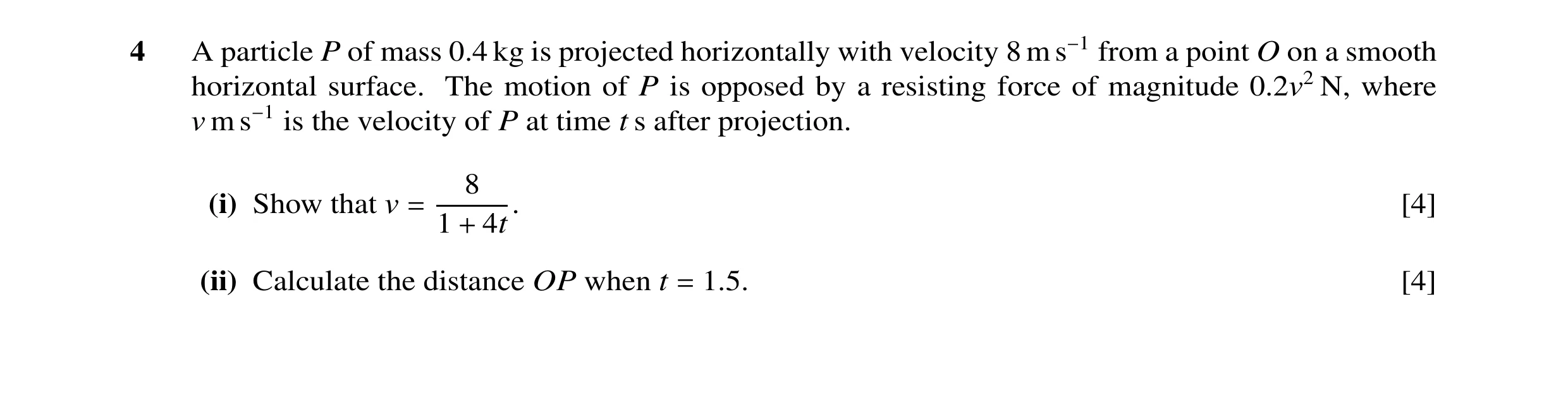
4 A particle P of mass 0.4 kg is projected horizontally with velocity 8 m s−1 from a point O on a smooth horizontal surface. The motion of P is opposed by a resisting force of magnitude 0.2v2 N, where v m s−1 is the velocity of P at time t s after projection. 8 (i) Show that v = . [4] 1 + 4t (ii) Calculate the distance OP when t = 1.5. [4]
8 marks
Mark scheme: 4 (i) 0.4δv/δt = 0.2v2 M1 Newton’s Second Law with a = δv/δt ∫ −2 A1 v δv = −5.0 ∫ δt –v–1 = –0.5t (+ c) t = 0, v = 8, hence c = –0.125 M1 v = 1/(0.125 + 0.5t) = 8/(1 + 4t) AG A1 [4] (ii) δx/δt = 8/(1 + 4t) M1* x = 8 ∫ δt / 1( + 4t ) x = 84 ln(1 + 4t) (+ c) A1 Accept c = 0 assumed t = 1.5, x = 84 *ln(1 + 4 × 1.5) D* Or limits used 84 [ln(1 + 4t] 5.10 M1 OP = 3.89 m A1 4 GCE AS/A LEVEL – October/November 2011 9709 53 2
This question in 9709/53 Oct/Nov 2011
Q12 · Particles P and Q, of masses 0.8 kg and 0.5 kg respectively, are attached to the ends of… 9709/52 May/June 2012
7 Particles P and Q, of masses 0.8 kg and 0.5 kg respectively, are attached to the ends of a light inextensible string which passes through a small hole in a smooth horizontal table of negligible thickness. P moves with constant angular speed 6.25 rad s−1 in a circular path on the surface of the table. (i) It is given that Q is stationary and that the part of string attached to Q is vertical. Calculate the radius of the path of P, and find the speed of P. [4] (ii) It is given instead that the part of string attached to Q is inclined at 60◦to the vertical, and that Q moves in a horizontal circular path below the table, also with constant angular speed 6.25 rad s−1. Calculate the total length of the string. [6]
10 marks
Mark scheme: 7 (i) T = 0.5 g B1 T = 5 T = 0.8 × 6.252 × r M1 r = 0.16 m A1 v = 1 ms–1 B1 [4] (ii) Tcos60 = 0.5 g B1 T = 10 r = 0.32 m B1 (2 × candidate’s value of r) Tsin60 = 0.5 × 6.252 × R M1 Newton’s Second Law with component of T R = 0.443(40) m A1 L = 0.32 + 0.443(4)/sin60 M1 L = 0.832 m A1 [6] [10]
This question in 9709/52 May/June 2012
Q13 · A particle P of mass 0.2 kg is released from rest and falls vertically 9709/52 Oct/Nov 2012
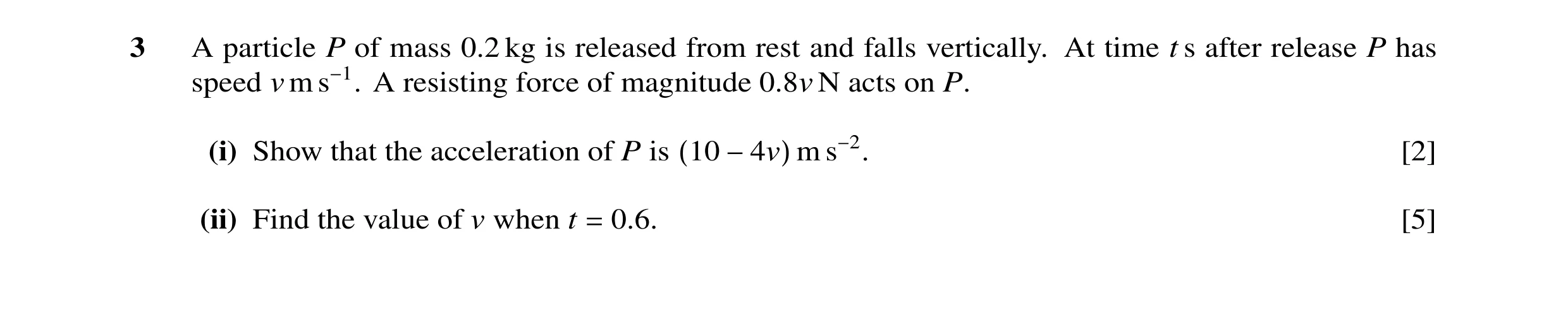
3 A particle P of mass 0.2 kg is released from rest and falls vertically. At time t s after release P has speed v m s−1. A resisting force of magnitude 0.8v N acts on P. (i) Show that the acceleration of P is (10 −4v) m s−2. [2] (ii) Find the value of v when t = 0.6. [5]
7 marks
Mark scheme: 3 (i) 0.2 dv / dt = 0.2g – 0.8v M1 Use Newton’s Second Law, – sign essential a = (dv / dt =)10 – 4v AG A1 [2] (ii) ∫ 1 / (10 – 4v) dv = ∫dt M1 Separates variables and attempts to integrate −ln1 (10 – 4v) = t (+ c) 4 A1 [c = −ln1 10] M1 Attempts to find the constant or uses the 4 correct limits −ln 1 (10 – 4v) = 0.6 – 1 ln4 A1 4 4 v = 2.27 A1 [5]
This question in 9709/52 Oct/Nov 2012
Q14 · A light elastic string has natural length 3 m and modulus of elasticity 45 N 9709/52 Oct/Nov 2012
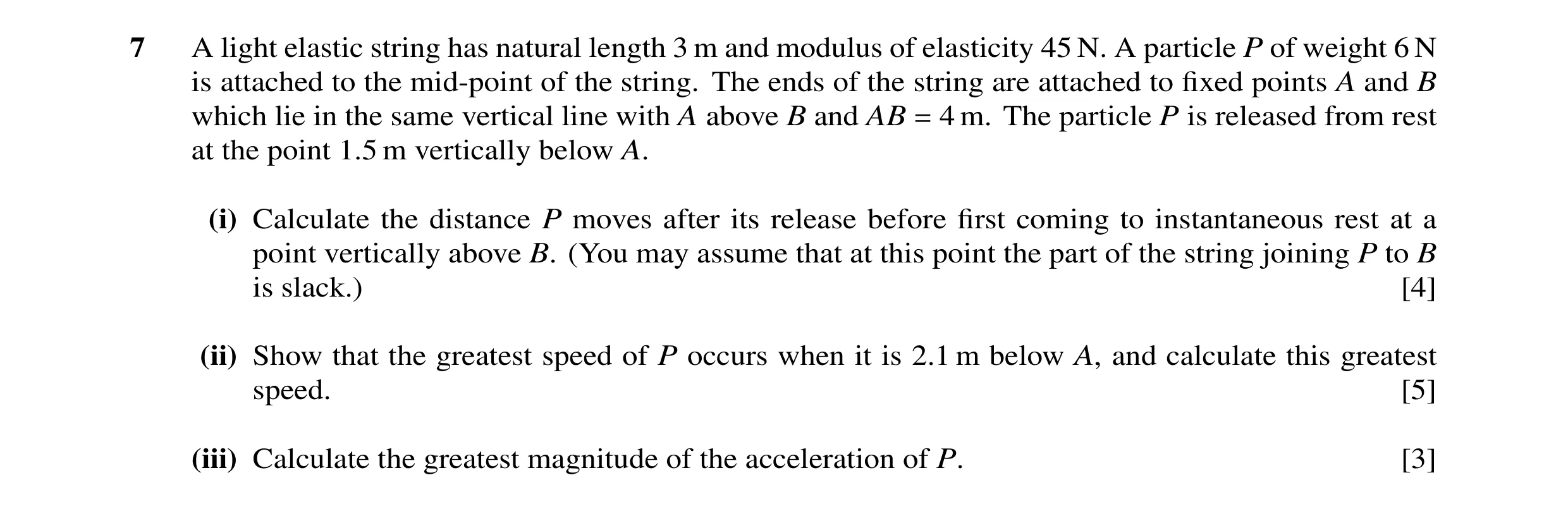
7 A light elastic string has natural length 3 m and modulus of elasticity 45 N. A particle P of weight 6 N is attached to the mid-point of the string. The ends of the string are attached to fixed points A and B which lie in the same vertical line with A above B and AB = 4 m. The particle P is released from rest at the point 1.5 m vertically below A. (i) Calculate the distance P moves after its release before first coming to instantaneous rest at a point vertically above B. (You may assume that at this point the part of the string joining P to B is slack.) [4] (ii) Show that the greatest speed of P occurs when it is 2.1 m below A, and calculate this greatest speed. [5] (iii) Calculate the greatest magnitude of the acceleration of P. [3]
12 marks
Mark scheme: 7 (i) M1 Energy conservation, no KE, 2 EE terms 45 × 12 / (2 × 1.5) + 0.6 gh = 45 h2 / (2 × 1.5) A1 5h2 – 2h – 5 = 0 M1 Simplifies, tries to solve a 3 term quadratic equation h = 1.22 m A1 [4] (ii) 45e / 1.5 = 45(1 – e) / 1.5 + 6 M1 Finds equilibrium position (e = 0.6) AP = (1.5 + 0.6) = 2.1 AG A1 0.6 v2 / 2 = 0.6 g × 0.6 + 45 (1)2 / (2 × 1.5) M1 Energy conservation with KE/PE/EE – 4.5(0.6)2 / (2 × 1.5) – 45(0.4)2 / (2 × 1.5) A1 terms v = 6 ms–1 A1 [5] (iii) 0.6 a = ± (0.6g + 45 × 1 / 1.5) M1* Top a = ± 60 ms–2 0.6 a = ± (0.6g – 45 × 1.22 / 1.5) M1* Bottom a = ± 51 ms–2 | a | = 60 ms–2 A**1 [3] Needs acceleration at both extreme positions considered.
This question in 9709/52 Oct/Nov 2012
Q15 · A particle P of mass 0.4 kg is attached to one end of a light elastic string of natural… 9709/51 May/June 2013
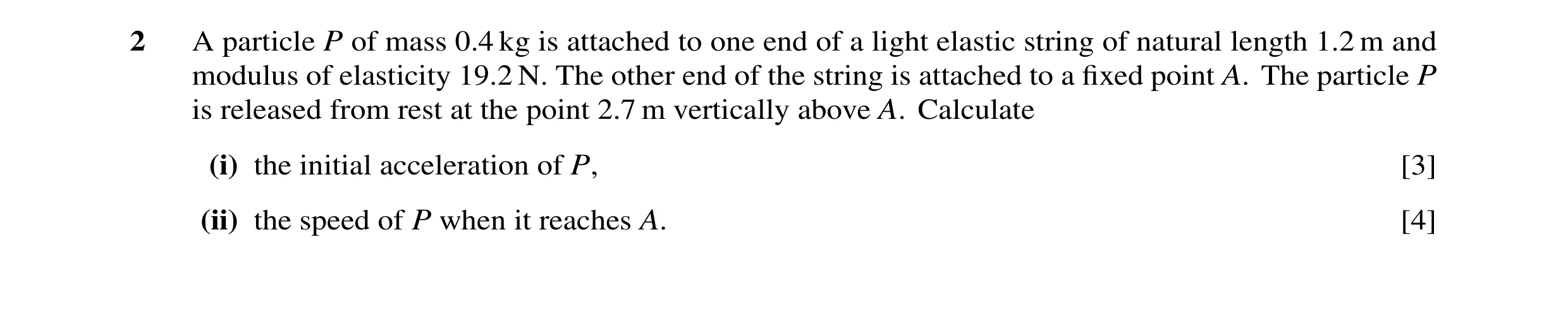
2 A particle P of mass 0.4 kg is attached to one end of a light elastic string of natural length 1.2 m and modulus of elasticity 19.2 N. The other end of the string is attached to a fixed point A. The particle P is released from rest at the point 2.7 m vertically above A. Calculate (i) the initial acceleration of P, [3] (ii) the speed of P when it reaches A. [4]
7 marks
Mark scheme: 2 (i) T = 19.2 ×(2.7 – 1.2)/1.2 B1 T = 24 N 0.4a = 0.4g + T M1 Newton’s Second Law with 3 terms a = 70 ms − 2 A1 [3] (ii) 19.2(2.7 – 1.2) 2 /(2 × 1.2) B1 Initial EE = 18 M1 For a 3 term energy equation 0.4v 2 /2 = 0.4g × 2.7 A1 + 19.2 × (2.7 – 1.2) 2 /(2 × 1.2 ) v = 12 ms − 1 A1 [4] [7]
This question in 9709/51 May/June 2013
Q16 · A particle P of mass 0.5 kg moves in a straight line on a smooth horizontal surface 9709/52 May/June 2013
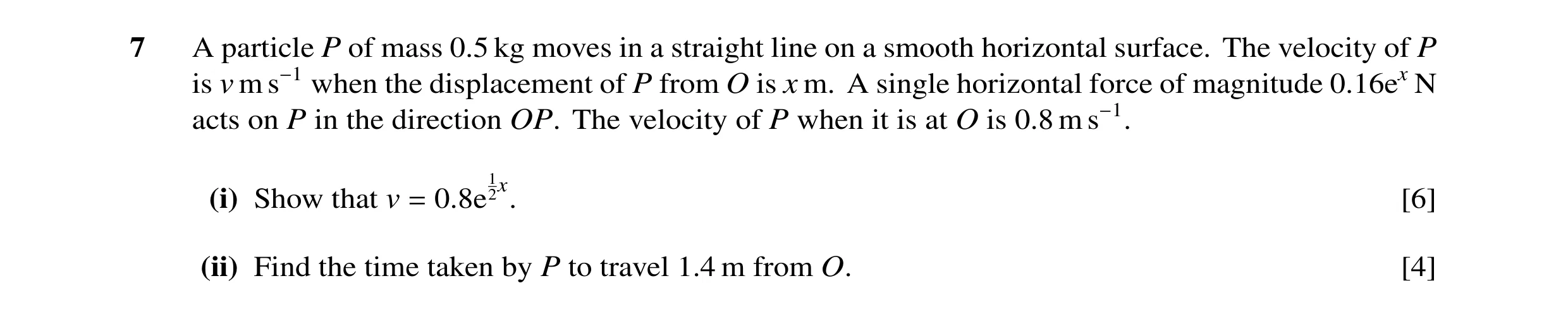
7 A particle P of mass 0.5 kg moves in a straight line on a smooth horizontal surface. The velocity of P is v m s−1 when the displacement of P from O is x m. A single horizontal force of magnitude 0.16ex N acts on P in the direction OP. The velocity of P when it is at O is 0.8 m s−1. (i) Show that v = 0.8e 12x. [6] (ii) Find the time taken by P to travel 1.4 m from O. [4]
10 marks
Mark scheme: 7 (i) 0.5a = 0.16e x M1 N2L, single force a = 0.32e x A1 ∫vdv x M1 Forms integral from vdv/dx = a = ∫0.32e dx v 2 /2 = 0.32e x (+c) A1 Award if c omitted x = 0, v = 0.8 hence c = 0, M1 Trying to find the value of c so v 2 = 0.64e x GCE AS/A LEVEL – May/June 2013 9709 52 v = 0.8e x / 2 AG A1 [6] OR dv/dt = 0.8e x / 2 xdx/dt M1 Uses chain rule on given answer dv/dt = 0.4e x / 2 .v A1 Maybe implied by later work x = 0, v = 0.8e 0 M1 Finding speed where x = 0 x = 0, v = 0.8 A1 0.5dv/dt = (0.2e x / 2 )(0.8e x / 2 ) M1 Expresses “ma” in terms of x 0.5acc n = 0.16e x A1 (ii) ∫e − x / 2 dx = ∫0.8dt M1 Forms integral from dx/dt = 0.8e x / 2 e − x / 2 /(–1/2) = 0.8t (+c) A1 Award if c omitted x = 0, t = 0, hence c = –2 and M1 Finding c and using x = 1.4 or –2e −4.1 / 2 = 0.8t – 2 [e − x / 2 /(–1/2)] 4.10 = 0.8t t = 1.26 s A1 [4] 1.2585.. [10]
This question in 9709/52 May/June 2013
Q17 · A 0.5 m P 0.3 m A smooth hollow cylinder of internal radius 0.3 m is fixed with its axis… 9709/53 May/June 2013
4 A 0.5 m P 0.3 m A smooth hollow cylinder of internal radius 0.3 m is fixed with its axis vertical. One end of a light inextensible string of length 0.5 m is fixed to a point A on the axis. The other end of the string is attached to a particle P of mass 0.2 kg which moves in a horizontal circle on the surface of the cylinder (see diagram). (i) Find the tension in the string. [3] (ii) Find the least angular speed of P for which the motion is possible. [2] (iii) Calculate the magnitude of the force exerted on P by the cylinder given that the speed of P is 1.8 m s−1. [3]
8 marks
Mark scheme: 4 (i) cosθ = 0.8, sinθ = 0.6 or B1 Either θ = string angle with vert cosφ = 0.6, sinφ = 0.8 or φ = string angle with horiz Tcosθ = 0.2 g or Tsinφ = 0.2 g M1 Resolves T vertically T = 2.5 N A1 [3] (ii) 2.5sinθ or 2.5cosφ = 0.2ω 2 × 0.3 M1 N2L with acc n = 2ω 2 × 0.3 ω = 5 rads −1 A1 [2] (iii) M1 N2L with 2 +ve radial forces R + 2.5sinθ = 0.2 × 1.82/0.3 A1 or R + 2.5cosφ = 0.2 × 1.8 2 /0.3 R = 0.66 N A1 [3] 8
This question in 9709/53 May/June 2013
Q18 · A small ball B of mass 0.2 kg moves in a narrow fixed smooth cylindrical tube OA of length… 9709/53 May/June 2013
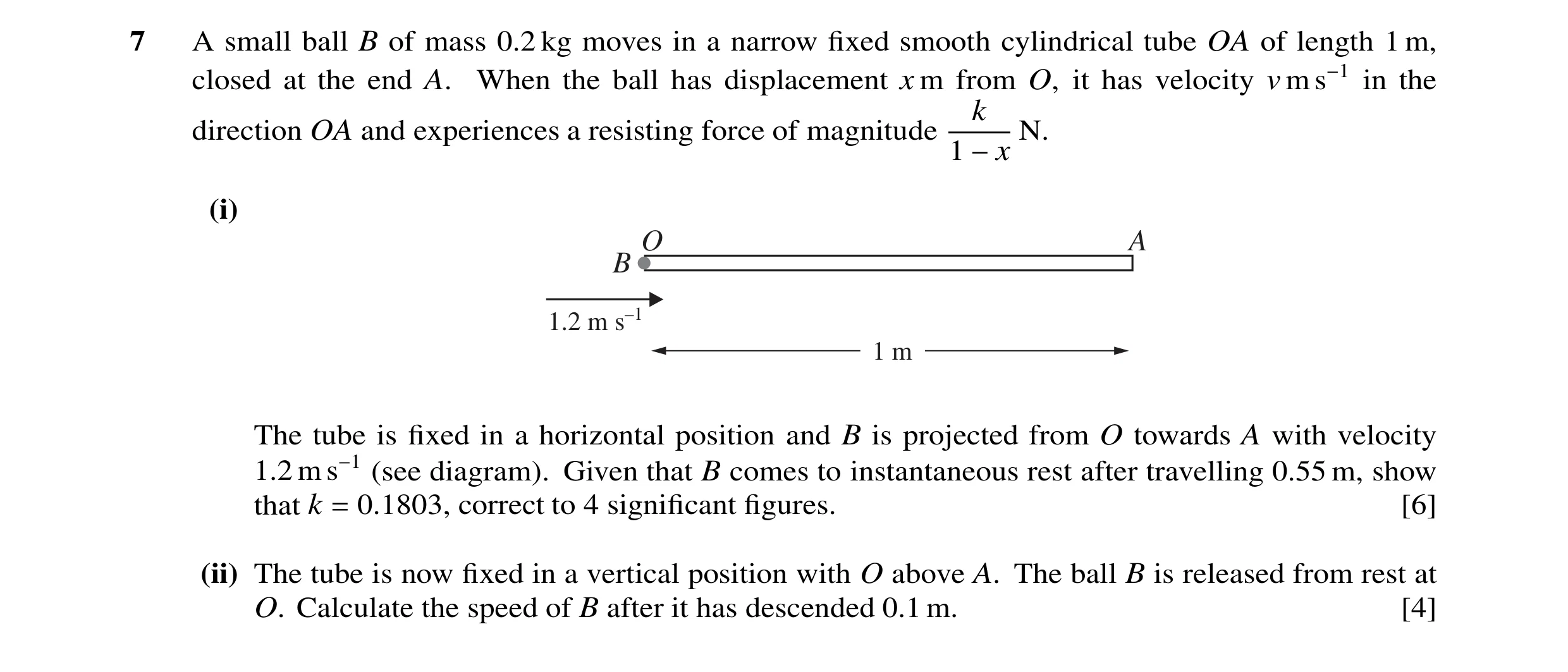
7 A small ball B of mass 0.2 kg moves in a narrow fixed smooth cylindrical tube OA of length 1 m, closed at the end A. When the ball has displacement x m from O, it has velocity v m s−1 in the k direction OA and experiences a resisting force of magnitude N. 1 −x (i) O A B 1.2 m s–1 1 m The tube is fixed in a horizontal position and B is projected from O towards A with velocity 1.2 m s−1 (see diagram). Given that B comes to instantaneous rest after travelling 0.55 m, show that k = 0.1803, correct to 4 significant figures. [6] (ii) The tube is now fixed in a vertical position with O above A. The ball B is released from rest at O. Calculate the speed of B after it has descended 0.1 m. [4]
10 marks
Mark scheme: 7 (i) 0.2a = – k/(1 – x) M1 N2L, single force a = – 5k/(1 – x) M1 Attempts ∫, accept use of dv/dt ∫vdv = – 5k∫1/(1 – x)dx v 2 /2 = 5kln(1 – x) (+c) A1 x = 0, v = 1.2, hence c = 0.72 M1 2 0 0 .55 [v /2] 1. 2 = [5kln(1 – x)] 0 5kln(1 – 0.55) + 0.72 = 0 DM1 k = 0.1803 AG A1 6 (ii) 0.2vdv/dx = 0.2 g – 0.1803/(1 – x) M1 N2L, difference of 2 forces 0.2v 2 /2 = 0.2 gx + 0. (1 – x) (+c) A1 Accept omission of c 0.2v 2 /2 = 0.2 gx 0.1 + 0.1803 ln(1 – 0.1) M1 nb c = 0, so can be omitted/lost v = 1.35 ms −1 A1 4 1.345 10
This question in 9709/53 May/June 2013
Q19 · A particle P of mass 0.8 kg moves along the x-axis on a horizontal surface 9709/51 Oct/Nov 2013
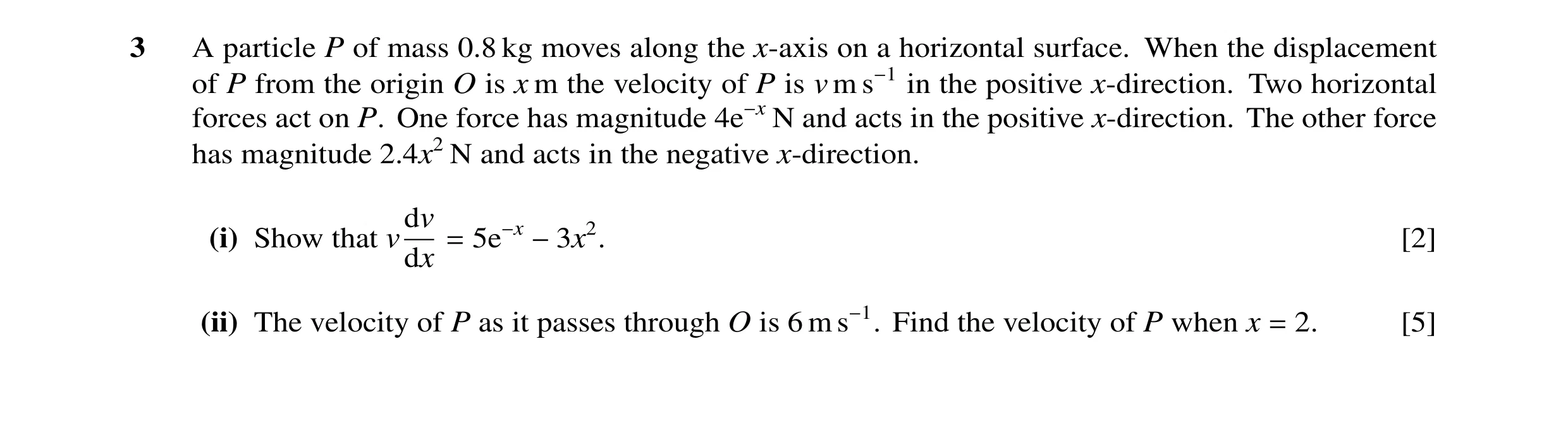
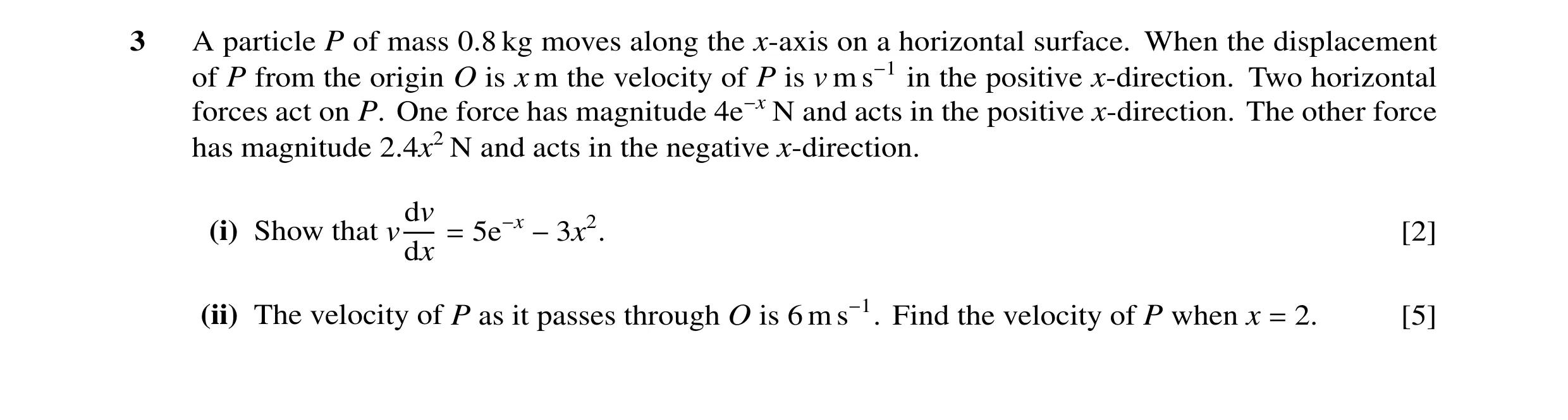
3 A particle P of mass 0.8 kg moves along the x-axis on a horizontal surface. When the displacement of P from the origin O is x m the velocity of P is v m s−1 in the positive x-direction. Two horizontal forces act on P. One force has magnitude 4e−x N and acts in the positive x-direction. The other force has magnitude 2.4x2 N and acts in the negative x-direction. (i) Show that vdv = 5e−x −3x2. [2] dx (ii) The velocity of P as it passes through O is 6 m s−1. Find the velocity of P when x = 2. [5]
7 marks
Mark scheme: 3 (i) 0.8vdv/dx = 4e − x – 2.4x 2 M1 N2L, terms different signs vdv/dx = 5e − x – 3x 2 AG A1 [2] − x 2 M1 Attempts integration (ii) ∫ vdv = ∫ (5e – 3x )dx v 2 / 2 = –5e − x – 3x 3 / 3 (+c) A1 Accept c omitted x = 0, v = 6, hence c = 23 B1 Or uses limits 0 and 2 v 2 / 2 = –5e − 2 – 3x2 3 / 3 + 23 M1 Puts x = 2 in v(x) expression v = 5.35 ms − 1 A1 [5] v = 5.352.. [7]
This question in 9709/51 Oct/Nov 2013
Q20 · A 0.4 m P 0.3 m B A particle P of mass 0.2 kg is attached to a fixed point A by a light… 9709/51 Oct/Nov 2013
5 A 0.4 m P 0.3 m B A particle P of mass 0.2 kg is attached to a fixed point A by a light inextensible string of length 0.4 m. A second light inextensible string of length 0.3 m connects P to a fixed point B which is vertically below A. The particle P moves in a horizontal circle, which has its centre on the line AB, with the angle APB = 90Å (see diagram). (i) Given that the tensions in the two strings are equal, calculate the speed of P. [5] (ii) It is given instead that P moves with its least possible angular speed for motion in this circle. Find this angular speed. [3]
8 marks
Mark scheme: 5 (i) M1 Resolves vertically, 3 forces Tx(4/5) – Tx(3/5) = 0.2g A1 T = 10 A1 Maybe implied Tx(4/5) + Tx(3/5) = 0.2v 2 / (0.4 × 3 / 5) M1 Resolves horizontally. N2L v = 4.1(0) ms − 1 A1 [5] (ii) Tx(4 / 5) = 0.2g B1 T = 2.5 Tx(3 / 5) = 0.2ω 2 x(0.4 × 3 / 5) M1 N2L horizontally, single force ω =5.59 rads − 1 A1 [3] [8]
This question in 9709/51 Oct/Nov 2013
Q21 · A particle P of mass 0.8 kg moves along the x-axis on a horizontal surface 9709/52 Oct/Nov 2013
3 A particle P of mass 0.8 kg moves along the x-axis on a horizontal surface. When the displacement of P from the origin O is x m the velocity of P is v m s−1 in the positive x-direction. Two horizontal forces act on P. One force has magnitude 4e−x N and acts in the positive x-direction. The other force has magnitude 2.4x2 N and acts in the negative x-direction. (i) Show that vdv = 5e−x −3x2. [2] dx (ii) The velocity of P as it passes through O is 6 m s−1. Find the velocity of P when x = 2. [5]
7 marks
Mark scheme: 3 (i) 0.8vdv/dx = 4e − x – 2.4x 2 M1 N2L, terms different signs vdv/dx = 5e − x – 3x 2 AG A1 [2] − x 2 M1 Attempts integration (ii) ∫ vdv = ∫ (5e – 3x )dx v 2 / 2 = –5e − x – 3x 3/ 3 (+c) A1 Accept c omitted x = 0, v = 6, hence c = 23 B1 Or uses limits 0 and 2 v 2 / 2 = –5e − 2 – 3x2 3/ 3 + 23 M1 Puts x = 2 in v(x) expression v = 5.35 ms − 1 A1 [5] v = 5.352.. [7]
This question in 9709/52 Oct/Nov 2013
Q22 · O, A and B are three points in a straight line on a smooth horizontal surface 9709/51 Oct/Nov 2014
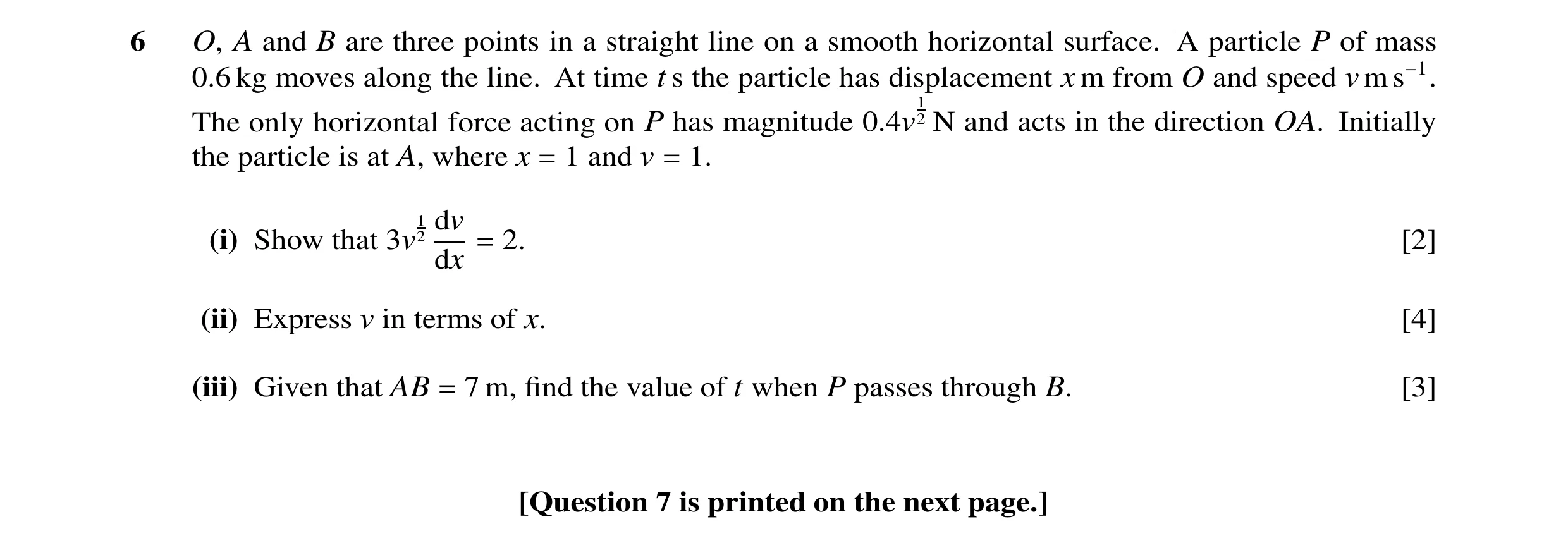
6 O, A and B are three points in a straight line on a smooth horizontal surface. A particle P of mass 0.6 kg moves along the line. At time t s the particle has displacement x m from O and speed v m s−1. 1 The only horizontal force acting on P has magnitude 0.4v 2 N and acts in the direction OA. Initially the particle is at A, where x = 1 and v = 1. 1 dv (i) Show that 3v 2 = 2. [2] dx (ii) Express v in terms of x. [4] (iii) Given that AB = 7 m, find the value of t when P passes through B. [3] [Question 7 is printed on the next page.]
9 marks
Mark scheme: dv dv 6 (i) 0.6v = 0.4v1/2 M1 Newton’s 2nd law, a = v dx dx dv 3v1/2 = 2 AG A1 dx [2] 1 (ii) 3 ∫ v 2 dv = 2 ∫ dx M1 Integrates 3 3v 2 = 2 x (+c) A1 Accept omission of +c 3 Evaluates c (=0) 2 3 2 3 × 21 × = 2 +c M1 3 2 v = x 3 A1 [4] − 2 d x (iii) ∫ x 3 dx = ∫ dt M1 Integrates using v = d t 8 1 x 3 = t A1 1 3 1 t = 3 A1 [3] 0.4 15 cosθ λ ext
This question in 9709/51 Oct/Nov 2014
Q23 · A particle P of mass 0.3 kg is attached to one end of a light elastic string of natural… 9709/51 May/June 2015
5 A particle P of mass 0.3 kg is attached to one end of a light elastic string of natural length 0.9 m and modulus of elasticity 18 N. The other end of the string is attached to a fixed point O which is 3 m above the ground. (i) Find the extension of the string when P is in the equilibrium position. [2] P is projected vertically downwards from the equilibrium position with initial speed 6 m s−1. At the instant when the tension in the string is 12 N the string breaks. P continues to descend vertically. (ii) (a) Calculate the height of P above the ground at the instant when the string breaks. [2] (b) Find the speed of P immediately before it strikes the ground. [4]
8 marks
Mark scheme: 5 (i) 18e λ x 0.3g = M1 Uses T = 0.9 l e = 0.15 m A1 [2] (ii) (a) 18ext 12 = and ht = 3 – 0.9 – ext M1 Both ideas needed, ext = 0.6 0.9 ht = 1.5 m A1 [2] (ii) (b) 0.3 × 6 2 0.3u 2 – + 0.3g(0.6 – 0.15) M1 KE/PE/EE balance up to string 2 2 A1 breaking 18 × 0.6 2 18 × 0.15 2 = – 2 × 0.9 2 × 0.9 3.0u 2 = .3 375 u2 = 22.5 2 0.3v2 = 0.3u2 + 0.3g(3 – 0.6 – 0.9) M1 KE/PE balance after string breaks or OR v2 = u2 + 2g(3 – 0.6 – 0.9) v2 = u2 + 2g(ht) using ht from (ii)(a) v = 7.25 ms–1 A1 4 7.2456
This question in 9709/51 May/June 2015
Q24 · A particle P of mass 0.3 kg moves in a straight line on a smooth horizontal surface 9709/51 Oct/Nov 2015
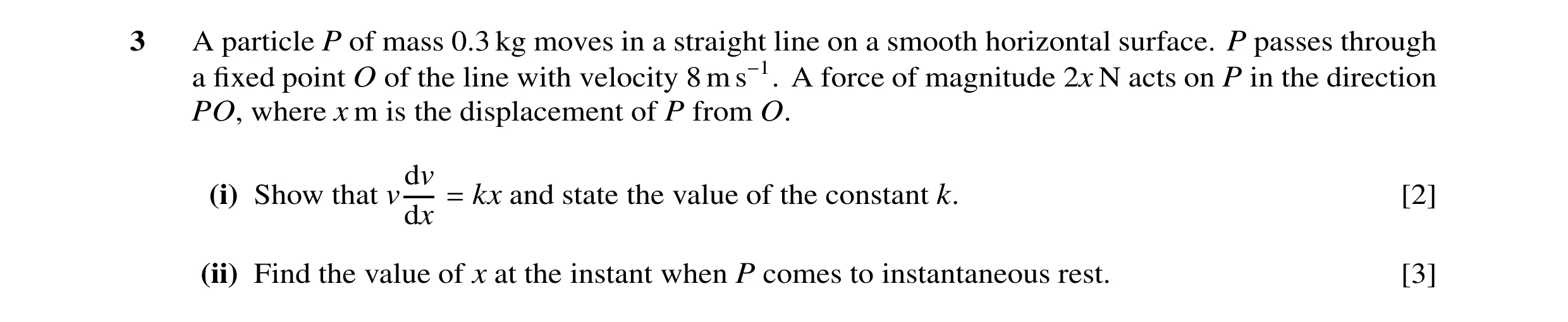
3 A particle P of mass 0.3 kg moves in a straight line on a smooth horizontal surface. P passes through a fixed point O of the line with velocity 8 m s−1. A force of magnitude 2x N acts on P in the direction PO, where x m is the displacement of P from O. (i) Show that vdv = kx and state the value of the constant k. [2] dx (ii) Find the value of x at the instant when P comes to instantaneous rest. [3]
5 marks
Mark scheme: dv 3 (i) 0.3v = –2 x M1 dx 20 2 k = – = –6 3 A1 2 3 (ii) M1 Integrates acceleration 0 20 x ∫8 vdv = − 3 ∫0 xdx M1 Uses limits or finds constant of integration x = 3.1(0) A1 3
This question in 9709/51 Oct/Nov 2015
Q25 · A particle P of mass 0.3 kg moves in a straight line on a smooth horizontal surface 9709/52 Oct/Nov 2015
3 A particle P of mass 0.3 kg moves in a straight line on a smooth horizontal surface. P passes through a fixed point O of the line with velocity 8 m s−1. A force of magnitude 2x N acts on P in the direction PO, where x m is the displacement of P from O. (i) Show that vdv = kx and state the value of the constant k. [2] dx (ii) Find the value of x at the instant when P comes to instantaneous rest. [3]
5 marks
Mark scheme: dv 3 (i) 0.3v = –2 x M1 dx 20 2 k = – = –6 3 A1 2 3 (ii) M1 Integrates acceleration 0 20 x ∫8 vdv = − 3 ∫0 xdx M1 Uses limits or finds constant of integration x = 3.1(0) A1 3
This question in 9709/52 Oct/Nov 2015
Q26 · A particle P of mass 0.5 kg is projected vertically upwards from a point on a horizontal… 9709/53 Oct/Nov 2015
5 A particle P of mass 0.5 kg is projected vertically upwards from a point on a horizontal surface. A resisting force of magnitude 0.02v2 N acts on P, where v m s−1 is the upward velocity of P when it is a height of x m above the surface. The initial speed of P is 8 m s−1. (i) Show that, while P is moving upwards, vdv = −10 −0.04v2. [2] dx (ii) Find the greatest height of P above the surface. [3] (iii) Find the speed of P immediately before it strikes the surface after descending. [4]
9 marks
Mark scheme: 5 (i) dv 2 0.5v = –0.5g – 0.02v M1 dx dv 2 v = –10 – 0.04v AG A1 2 dx 0 v x 2 ∫0 (ii) ∫a − 10 − .0 04v dv = dx M1 Separates the variables and attempts to integrate 2 0 x = [− ln(10 + .0 04 v /) .0 08 ] 8 M1 Uses limits or finds constant x = 2.85 A1 3 dv 2 (iii) v = 10 – 0.04v B1 dx v v .2 85 2 dv = ∫0dx M1 Integrates new acceleration ∫0 10 − .0 04v ln [(10 − .004v 2 /) 10 ] / − ( .008) = .285 M1 Uses earlier answer as distance v = 7.14 ms–1 A1 4
This question in 9709/53 Oct/Nov 2015
Q27 · A particle P of mass 0.4 kg is released from rest at a point O on a smooth plane inclined… 9709/53 May/June 2016
3 A particle P of mass 0.4 kg is released from rest at a point O on a smooth plane inclined at 30Å to the horizontal. When the displacement of P from O is x m down the plane, the velocity of P is v m s−1. A force of magnitude 0.8e−x N acts on P up the plane along the line of greatest slope through O. (i) Show that vdv = 5 −2e−x. [2] dx (ii) Find v when x = 0.6. [4]
6 marks
Mark scheme: 3 (i) 0.4vdv/dx = 0.4 g sin30 – 0.8 e− x M1 vdv/dx = 5 – 2 e− x AG A1 2 (ii) ∫ vdv = ∫ (5 − 2 e− x ) dx M1 Separates the variables and attempts to integrate v 2 /2 = 5x + 2 e− x ( + c ) A1 M1 Uses limits or finds c (c = –2) v = 2.05 A1 4
This question in 9709/53 May/June 2016
Q28 · A small block B of mass 0.25 kg is released from rest at a point O on a smooth horizontal… 9709/53 Oct/Nov 2016
3 A small block B of mass 0.25 kg is released from rest at a point O on a smooth horizontal surface. After its release the velocity of B is v m s−1 when its displacement is x m from O. The force acting on B has magnitude 2 + 0.3x2 N and is directed horizontally away from O. (i) Show that vdv = 1.2x2 + 8. [2] dx (ii) Find the velocity of B when x = 1.5. [3] An extra force acts on B after x = 1.5. It is given that, when x > 1.5, vdv = 1.2x2 + 6 −3x. dx (iii) Find the magnitude of this extra force and state the direction in which it acts. [2]
7 marks
Mark scheme: 3 (i) 0.25vdv/dx = 2 + 0.3x2 M1 vdv/dx = 1.2 x2 + 8 AG A1 2 (ii) ∫v d v = ∫ (1.2 x 2 + 8) dx M1 v2/2 = 0.4x3 + 8x ( + c) A1 Allow c = 0 without working v = 5.17 A1 3 (iii) 0.25vdv/dx = 0.3x2 + 1.5 – 0.75x M1 Force is 0.5 + 0.75x N towards O A1 2
This question in 9709/53 Oct/Nov 2016
Q29 · A small ball B of mass 0.4 kg moves in a horizontal circle with centre O and radius 0.6 m… 9709/53 Oct/Nov 2016
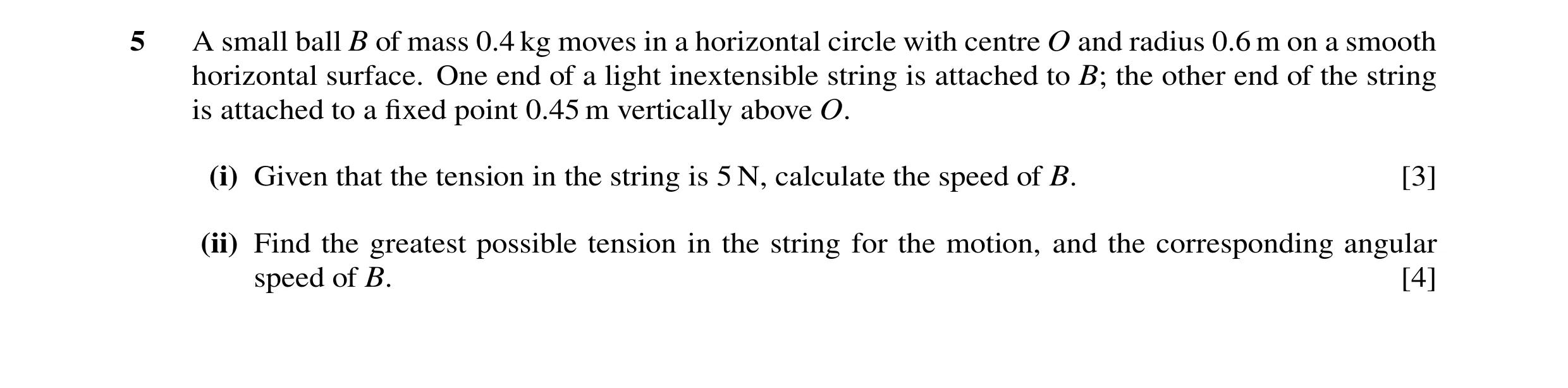
5 A small ball B of mass 0.4 kg moves in a horizontal circle with centre O and radius 0.6 m on a smooth horizontal surface. One end of a light inextensible string is attached to B; the other end of the string is attached to a fixed point 0.45 m vertically above O. (i) Given that the tension in the string is 5 N, calculate the speed of B. [3] (ii) Find the greatest possible tension in the string for the motion, and the corresponding angular speed of B. [4]
7 marks
Mark scheme: 5 (i) θ(= tan–10.45/0.6 = 36.87..) = 36.9° B1 Or tanθ = 3/4 0.4v2/0.6 = 5cosθ M1 v = 2.45 ms–1 A1 3 Or 6 (ii) Tsinθ = 0.4g M1 2 T = 6.67 N A1 Accept 0.66, 6 , 20/3 3 0.4ω2 x 0.6 = 6.67cosθ M1 ω = 4.71 rad s–1 A1 4 Accept 4.72 rad s–1 2
This question in 9709/53 Oct/Nov 2016
Q30 · O and A are fixed points on a rough horizontal surface, with OA = 1 m 9709/52 Feb/March 2017
6 O and A are fixed points on a rough horizontal surface, with OA = 1 m. A particle P of mass 0.4 kg is projected horizontally with speed U m s−1 from A in the direction OA and moves in a straight line. After projection, when the displacement of P from O is x m, the velocity of P is v m s−1. The 0.8 coefficient of friction between the surface and P is 0.4. A force of magnitude N acts on P in the x direction PO. (i) Show that, while the particle is in motion, vdv = −4 −2 [3] dx x. … … … … … … It is given that P comes to instantaneous rest between x = 2.0 and x = 2.1. (ii) Find the set of possible values of U. [5] … … … … … … … … … … … … … … … … … … … … … … … … … … … … … … … … … … … … … …
8 marks
Mark scheme: 6(i) Friction = 0.4 x 0.4g B1 Uses F = µR 0.4vdv/dx = –0.4 x 0.4g – 0.8/x M1 Uses Newton's Second Law and a = vdv/dx vdv/dx = –4 – 2/x A1 Total: 3 6(ii) 2 M1 Separates the variables and attempts to ∫vdv = ∫−− 4 d x integrate x v2/2 = –4x – 2lnx ( + c) A1 v = U when x = 1 hence c = U2 /2 + 4 M1 Attempts to find c 0= –4 x 2 – 2ln2 + U2/2 + 4 [U2 = 10.7(725)] M1 Put v = 0 and x = 2 0= –4 x 2.1 – 2ln2.1 + U2/2 + 4 Put v = 0 and x = 2.1 [U2 =11.7(677)] 3.28 ˂ U ˂ 3.43 A1 Total: 5
This question in 9709/52 Feb/March 2017
Q31 · A particle P of mass 0.5 kg is at rest at a point O on a rough horizontal surface 9709/51 May/June 2017
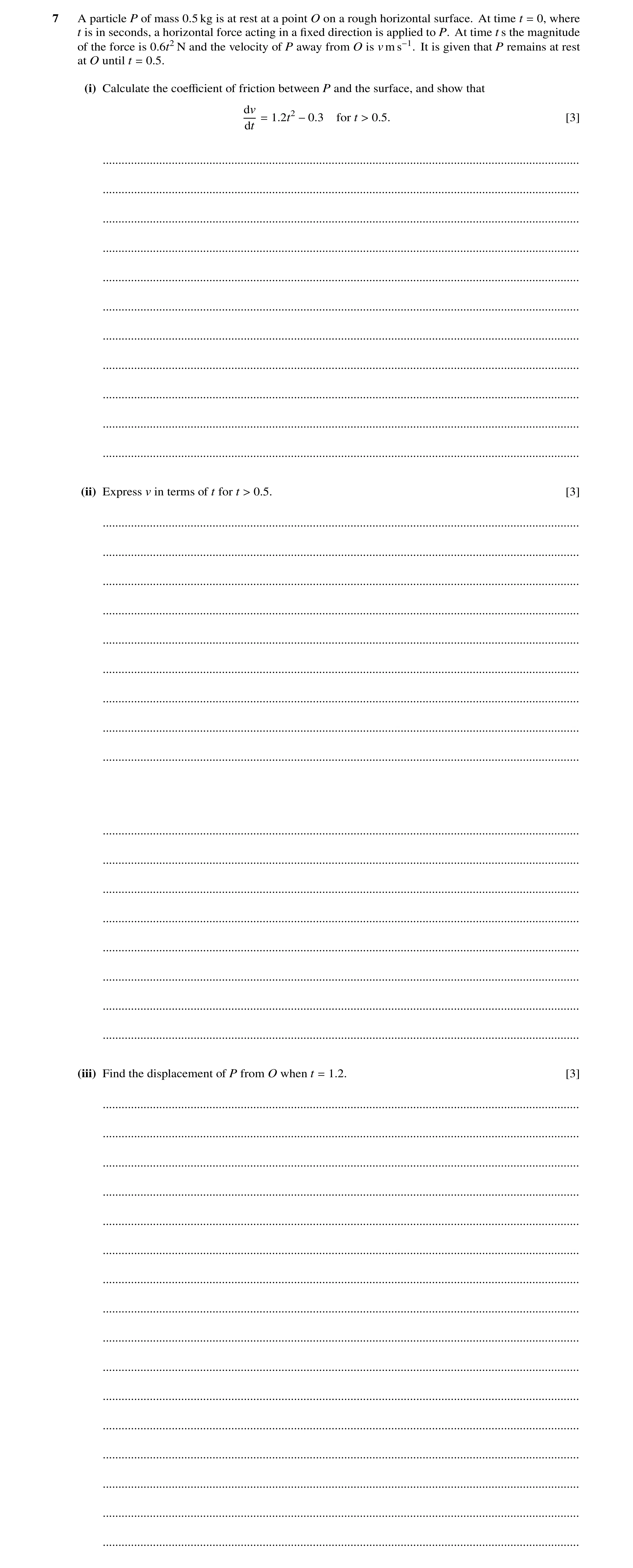
7 A particle P of mass 0.5 kg is at rest at a point O on a rough horizontal surface. At time t = 0, where t is in seconds, a horizontal force acting in a fixed direction is applied to P. At time t s the magnitude of the force is 0.6t2 N and the velocity of P away from O is v m s−1. It is given that P remains at rest at O until t = 0.5. (i) Calculate the coefficient of friction between P and the surface, and show that dv = 1.2t2 −0.3 for t > 0.5. [3] dt … … … … … … … … … … … (ii) Express v in terms of t for t > 0.5. [3] … … … … … … … … … … … … … … … … … (iii) Find the displacement of P from O when t = 1.2. [3] … … … … … … … … … … … … … … … …
9 marks
Mark scheme: 7(i) µ = 0.6 × 0. 2 5 / (0.5 g) ( = 0.03) 0.5dv / dt = 0.6 2t – 0.03 × 0.5g M1 Uses Newton's Second Law horizontally dv / dt = 1.2 2t – 0.3 A1 Total: 3 Question Answer Marks Guidance 7(ii) dv ∫ = (∫1.2 2t – 0.3) dt v = 0.4 3t – 0.3t ( + c) M1 Separates the variables and attempts to integrate t = 0.5, v = 0 hence c = 0.1 M1 Attempts to find c v = 0.4 3t – 0.3t + 0.1 A1 Total: 3 7(iii) dx ∫ = (∫0.4 3t – 0.3t + 0.1) dt x = 0.1 4t – 0.15 2t + 0.1t ( + c) M1 Attempts to integrate t = 0.5, x = 0 hence c = –0.01875 M1 Finds c or substitutes the limits x(1.2) = 0.0926(1) A1 Total: 3
This question in 9709/51 May/June 2017
Q32 · A particle P of mass 0.2 kg moves with speed 4 m s−1 and angular speed 5 rad s−1 in a… 9709/52 May/June 2017
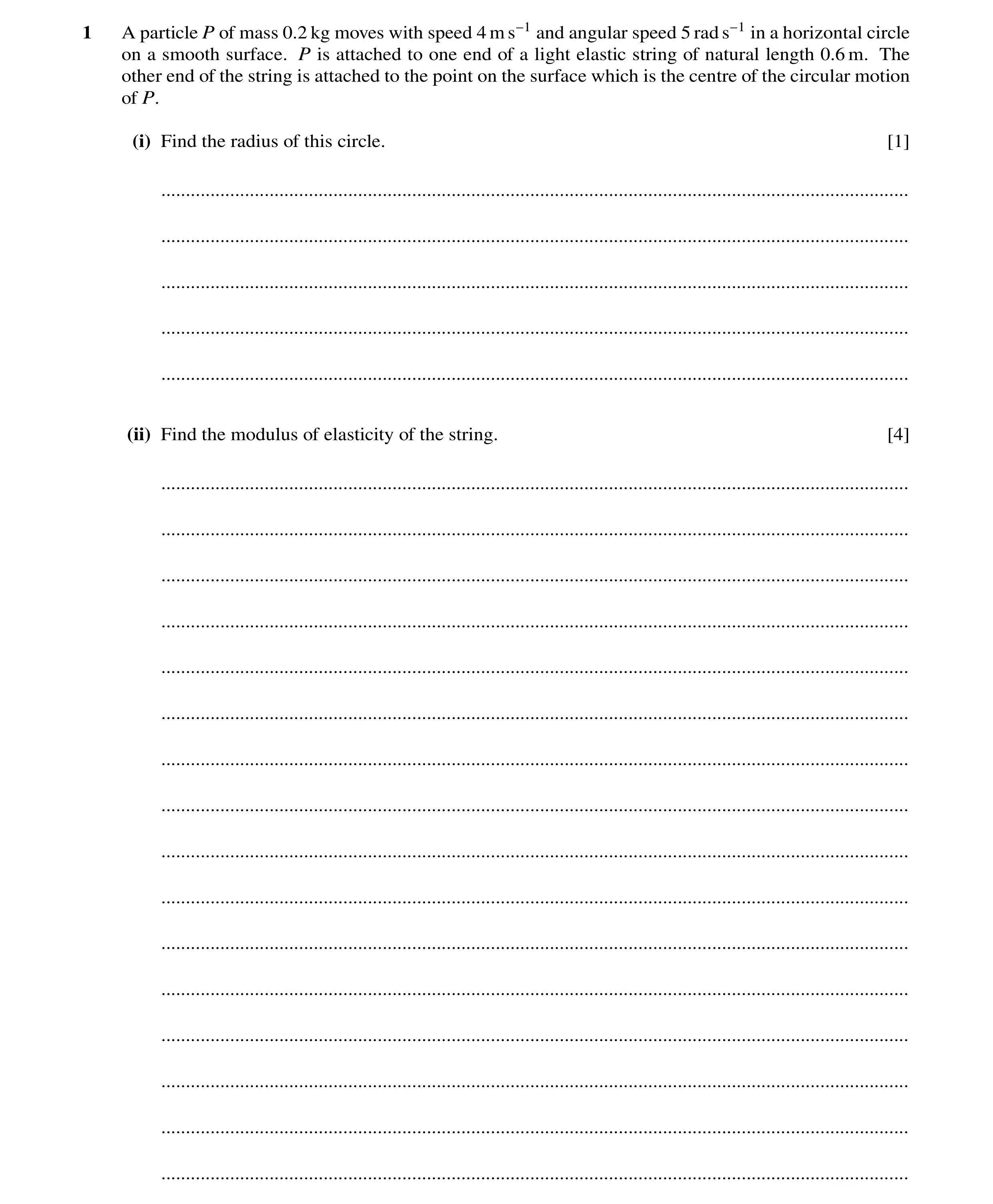
1 A particle P of mass 0.2 kg moves with speed 4 m s−1 and angular speed 5 rad s−1 in a horizontal circle on a smooth surface. P is attached to one end of a light elastic string of natural length 0.6 m. The other end of the string is attached to the point on the surface which is the centre of the circular motion of P. (i) Find the radius of this circle. [1] … … … … … (ii) Find the modulus of elasticity of the string. [4] … … … … … … … … … … … … … … … …
5 marks
Mark scheme: 1(i) Total: 1 1(ii) T = 0.2 × 2 5 × 0.8 M1 Uses Newton’s Second Law horizontally T = 4 N A1 FT FT with their radius from part (i) 4 = λ(0.8 – 0.6) / 0.6 M1 Uses T = λx / L λ = 12 A1 Total: 4
This question in 9709/52 May/June 2017
Q33 · One end of a light elastic string of natural length 0.8 m and modulus of elasticity 24 N… 9709/51 Oct/Nov 2017
5 One end of a light elastic string of natural length 0.8 m and modulus of elasticity 24 N is attached to a fixed point O. The other end of the string is attached to a particle P of mass 0.3 kg. P is projected vertically upwards with speed 4 m s−1 from a position 1.2 m vertically below O. (i) Calculate the speed of the particle at the position where it is moving with zero acceleration. [5] … … … … … … … … … … … … … … … … … … … … … … … (ii) Show that the particle moves 1.2 m while moving upwards with constant deceleration. [3] … … … … … … … … … … … … … … … … … … … … … … … … …
8 marks
Mark scheme: 5(i) 0.3g = 24e M1 Use T = λx/L e = 0.1 A1 EE =24 × (1.2–0.8)2/(2 × 0.8) or 24 × 0.12 /(2 × 0.8) B1 Use EE = λ x 2 /(2L). 0.3 2v /2 = 0.3 × 4 2 /2 + 24 × (1.2 – 0.8)2/(2 × 0.8) M1 Sets up a 5 term energy equation 2 involving EE, KE and PE. –24 × 0.1 /(2 × 0.8) – 0.3g(1.2 – 0.8) v = 5 m −s1 A1 5 5(ii) 0.5 × 5 2 /2 + 24 × 0.12 /(2 × 0.8) = 0.3(x + 0.9) ×10 M1 Sets up a 3 term energy equation where x is the distance above 0 when v = 0. x = 0.4 A1 Distance moved = 0.8 + 0.4 = 1.2 m A1 AG 3
This question in 9709/51 Oct/Nov 2017
Q34 · A particle P of mass 0.2 kg is released from rest at a point O on a rough plane inclined… 9709/51 Oct/Nov 2017
7 A particle P of mass 0.2 kg is released from rest at a point O on a rough plane inclined at 60Å to the horizontal, and travels down a line of greatest slope. The coefficient of friction between P and the plane is 0.3. A force of magnitude 0.6x N acts on P in the direction PO, where x m is the displacement of P from O. (i) Show that vdv = 5ï3 −1.5 −3x, where v m s−1 is the velocity of P at a displacement x m from dx O. [3] … … … … … … … … … (ii) Find the value of x for which P reaches its maximum velocity, and calculate this maximum velocity. [4] … … … … … … … … … … … … … … … … … … … (iii) Calculate the magnitude of the acceleration of P immediately after it has first come to instantaneous rest. [4] … … … … … … … … … … … … … … … …
11 marks
Mark scheme: 7(i) 0.2vdv/dx=0.2gsin60 – 0.3 × 0.2gcos60 – 0.6x M1A1 Uses Newton's Second Law parallel to the plane. Correct equation. vdv/dx = 5 3 – 1.5 – 3x A1 AG 3 7(ii) x = (5 3 – 1.5)/3 (= 2.39) B1 Uses a = 0. ∫v dv = ∫ (5 3 – 1.5 – 3x) dx M1 Separates the variables and attempts to integrate. v 2 /2 = 5 3 x –1.5x – 3 x 2 /2 ( + c) A1 Allow c = 0 without calculation seen. v = 4.13 A1 Substitutes x = 2.39. 4 7(iii) 0 = 5 3 x – 1.5x – 3 x 2 /2 M1 Puts v = 0 and attempts to solve a quadratic equation. x = 4.77(35...) A1 a = 5 3 – 1.5 – 3 × 4.77(35…) M1 Magnitude of a = 7.16 m s–2 A1 4
This question in 9709/51 Oct/Nov 2017
Q35 · One end of a light elastic string of natural length 0.4 m and modulus of elasticity 8 N… 9709/52 Oct/Nov 2017
6 One end of a light elastic string of natural length 0.4 m and modulus of elasticity 8 N is attached to a fixed point O on a smooth horizontal plane. The other end of the string is attached to a particle P of mass 0.2 kg which moves on the plane in a circular path with centre O. The speed of P is v m s−1 and the extension of the string is x m. (i) Given that v = 2.5, find x. [4] … … … … … … … … … … … … … … … … … … … … … … … It is given instead that the kinetic energy of P is twice the elastic potential energy stored in the string. (ii) Form two simultaneous equations and hence find x and v. [5] … … … … … … … … … … … … … … … … … … … … … … … …
9 marks
Mark scheme: 6(i) T = 0.2 × 2. 5 2 /(0.4 + e) B1 Uses Newton's Second Law towards the centre of the circle. T = 8e/0.4 B1 Uses T = λx/L. 1.25/(0.4 + e) = 20e→20 2e + 8e – 1.25 = 0 M1 Eliminates T to find e. e = 0.12(0) m A1 4 6(ii) 0.2 v 2 /2 = 2[8 x 2 /(2 × 0.4)] B1 Uses KE = 2EE. 0.2 v 2 /(0.4 + x) = 8x/0.4 B1 Uses T = λx/L and T = m v 2 /r. M1 Attempts to solve the 2 equations to find v or x. x = 0.4 and v = 5.66 or 4 2 A1A1 5
This question in 9709/52 Oct/Nov 2017
Q36 · One end of a light elastic string of natural length 0.8 m and modulus of elasticity 24 N… 9709/53 Oct/Nov 2017
5 One end of a light elastic string of natural length 0.8 m and modulus of elasticity 24 N is attached to a fixed point O. The other end of the string is attached to a particle P of mass 0.3 kg. P is projected vertically upwards with speed 4 m s−1 from a position 1.2 m vertically below O. (i) Calculate the speed of the particle at the position where it is moving with zero acceleration. [5] … … … … … … … … … … … … … … … … … … … … … … … (ii) Show that the particle moves 1.2 m while moving upwards with constant deceleration. [3] … … … … … … … … … … … … … … … … … … … … … … … … …
8 marks
Mark scheme: 5(i) 0.3g = 24e M1 Use T = λx/L e = 0.1 A1 EE =24 × (1.2–0.8)2/(2 × 0.8) or 24 × 0.12 /(2 × 0.8) B1 Use EE = λ x 2 /(2L). 0.3 2v /2 = 0.3 × 4 2 /2 + 24 × (1.2 – 0.8)2/(2 × 0.8) M1 Sets up a 5 term energy equation 2 involving EE, KE and PE. –24 × 0.1 /(2 × 0.8) – 0.3g(1.2 – 0.8) v = 5 m −s1 A1 5 5(ii) 0.5 × 5 2 /2 + 24 × 0.12 /(2 × 0.8) = 0.3(x + 0.9) ×10 M1 Sets up a 3 term energy equation where x is the distance above 0 when v = 0. x = 0.4 A1 Distance moved = 0.8 + 0.4 = 1.2 m A1 AG 3
This question in 9709/53 Oct/Nov 2017
Q37 · A particle P of mass 0.2 kg is released from rest at a point O on a rough plane inclined… 9709/53 Oct/Nov 2017
7 A particle P of mass 0.2 kg is released from rest at a point O on a rough plane inclined at 60Å to the horizontal, and travels down a line of greatest slope. The coefficient of friction between P and the plane is 0.3. A force of magnitude 0.6x N acts on P in the direction PO, where x m is the displacement of P from O. (i) Show that vdv = 5ï3 −1.5 −3x, where v m s−1 is the velocity of P at a displacement x m from dx O. [3] … … … … … … … … … (ii) Find the value of x for which P reaches its maximum velocity, and calculate this maximum velocity. [4] … … … … … … … … … … … … … … … … … … … (iii) Calculate the magnitude of the acceleration of P immediately after it has first come to instantaneous rest. [4] … … … … … … … … … … … … … … … …
11 marks
Mark scheme: 7(i) 0.2vdv/dx=0.2gsin60 – 0.3 × 0.2gcos60 – 0.6x M1A1 Uses Newton's Second Law parallel to the plane. Correct equation. vdv/dx = 5 3 – 1.5 – 3x A1 AG 3 7(ii) x = (5 3 – 1.5)/3 (= 2.39) B1 Uses a = 0. ∫v dv = ∫ (5 3 – 1.5 – 3x) dx M1 Separates the variables and attempts to integrate. v 2 /2 = 5 3 x –1.5x – 3 x 2 /2 ( + c) A1 Allow c = 0 without calculation seen. v = 4.13 A1 Substitutes x = 2.39. 4 7(iii) 0 = 5 3 x – 1.5x – 3 x 2 /2 M1 Puts v = 0 and attempts to solve a quadratic equation. x = 4.77(35...) A1 a = 5 3 – 1.5 – 3 × 4.77(35…) M1 Magnitude of a = 7.16 m s–2 A1 4
This question in 9709/53 Oct/Nov 2017
Q38 · A particle P of mass 0.4 kg is projected horizontally along a smooth horizontal plane… 9709/51 May/June 2018
3 A particle P of mass 0.4 kg is projected horizontally along a smooth horizontal plane from a point O. At time t s after projection the velocity of P is v m s−1. A force of magnitude 0.8t N directed away from O acts on P and a force of magnitude 2e−t N opposes the motion of P. dv (i) Show that = 2t −5e−t. [2] dt … … … … … … … (ii) Given that v = 8 when t = 1, express v in terms of t. [3] … … … … … … … … … … … … … … … … … … … … … … … … (iii) Find the speed of projection of P. [2] … … … … … … … … … … … … … …
7 marks
Mark scheme: 3(i) dv t M1 Use Newton’s Second Law 0.4 = 0.8t – 2 e− horizontally dt dv t A1 AG = 2t – 5e− dt 2 3(ii) ∫ dv = ∫ (2t − 5e− t )dt M1 Attempt to integrate the 2 t equation from part (i) v = t + 5e− ( + c) t = 1 and v = 8 so c = 5.16 M1 Attempt to find the constant of integration, c v = t 2 + 5e − t + 5.16 or v = t 2 + 5e − t + 7 − 5e − 1 A1 3 3(iii) Evaluates v for t = 0 M1 V = 10.2 ms − 1 A1 2
This question in 9709/51 May/June 2018
Q39 · H P 0.4 m Q A A particle P of mass 0.2 kg is attached to one end of a light inextensible… 9709/51 May/June 2018
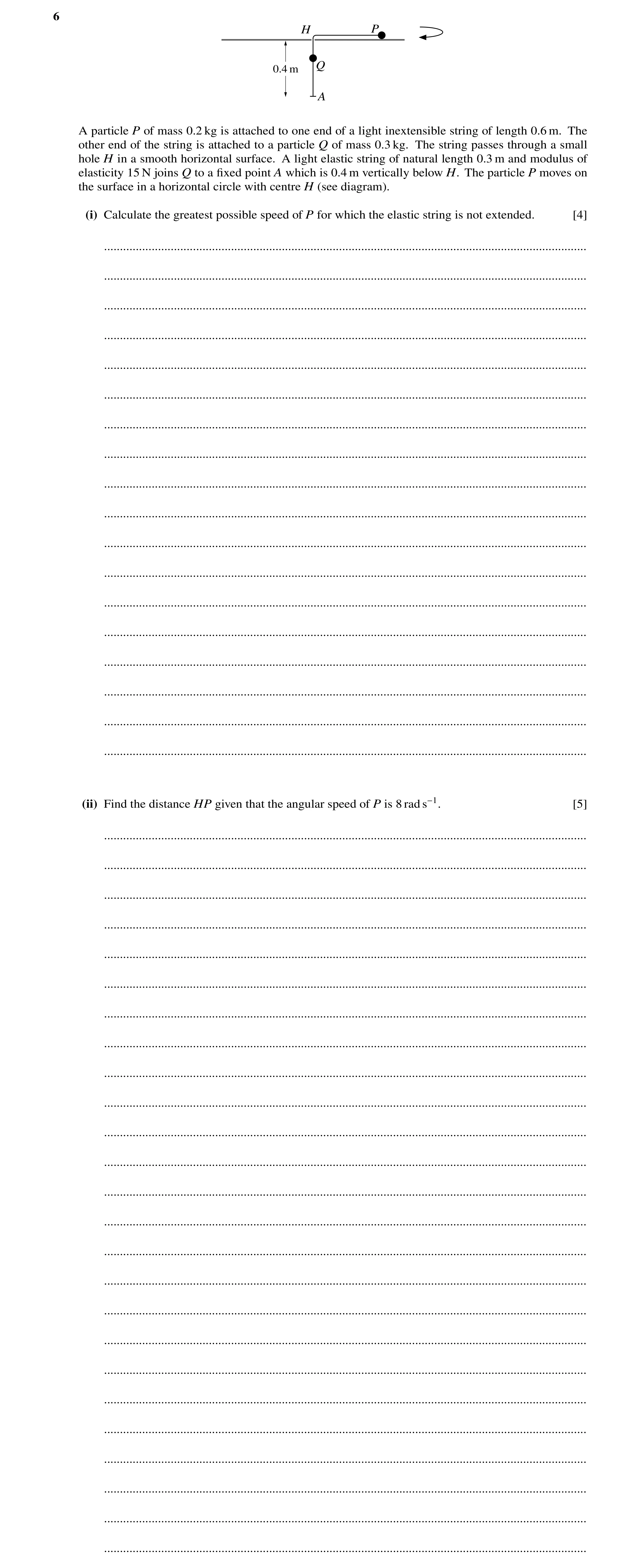
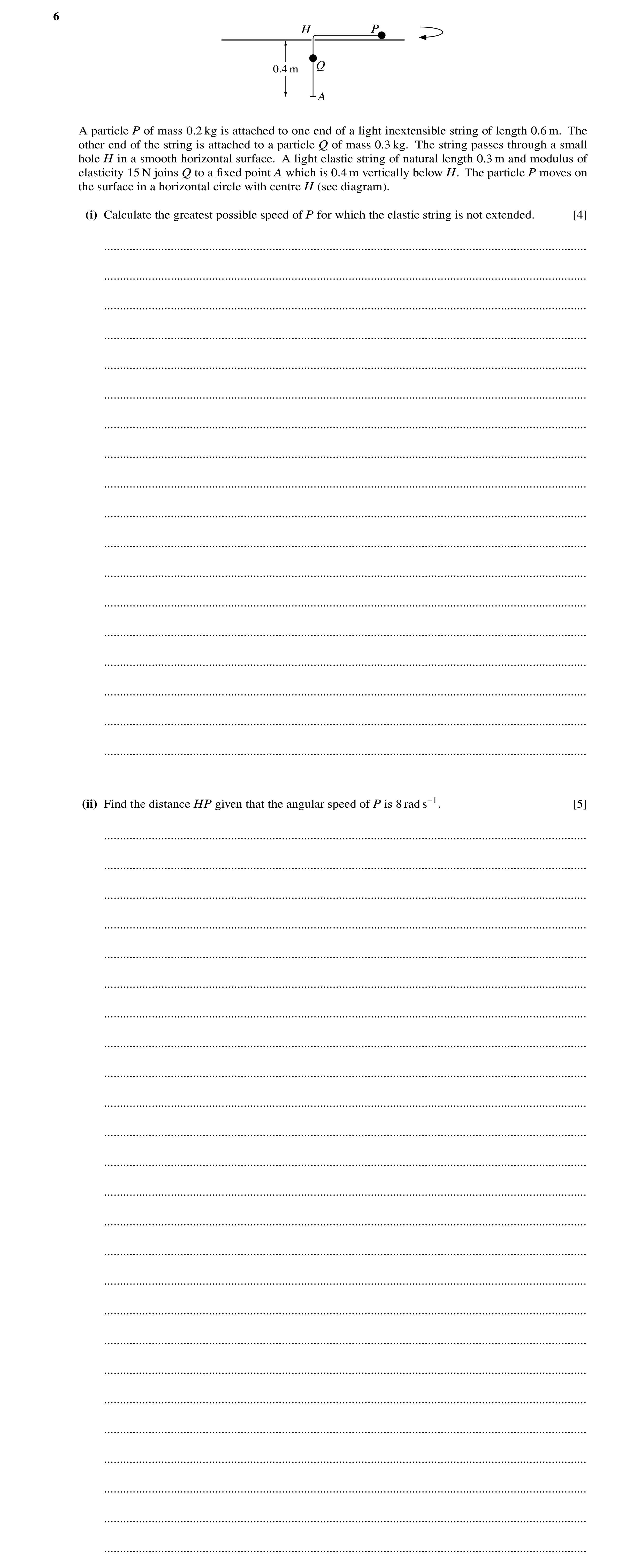
6 H P 0.4 m Q A A particle P of mass 0.2 kg is attached to one end of a light inextensible string of length 0.6 m. The other end of the string is attached to a particle Q of mass 0.3 kg. The string passes through a small hole H in a smooth horizontal surface. A light elastic string of natural length 0.3 m and modulus of elasticity 15 N joins Q to a fixed point A which is 0.4 m vertically below H. The particle P moves on the surface in a horizontal circle with centre H (see diagram). (i) Calculate the greatest possible speed of P for which the elastic string is not extended. [4] … … … … … … … … … … … … … … … … … … (ii) Find the distance HP given that the angular speed of P is 8 rad s−1. [5] … … … … … … … … … … … … … … … … … … … … … … … … …
9 marks
Mark scheme: 6(i) r [= 0.6 – (0.4-0.3)]= 0.5 B1 T = 0.3g B1 Resolve vertically for Q 0.2v 2 / 0.5 = 0.3 g M1 Use Newton’s Second Law horizontally for P v = 2.74 ms− 1 A1 4 6(ii) r = 0.5 + e B1 e = extension of the string 15e B1 Use T = λx/l T = = 50e 0.3 0.2 × 8 2 (5 + e ) = 50e + 0.3g M1 Use Newton’s Second Law horizontally with a = rω2 ( 6.4 − 3 ) A1 e = ( = 0.0914) ( 50 − 12.8 ) HP = 0.591 m A1 5
This question in 9709/51 May/June 2018
Q40 · A particle P of mass 0.2 kg is released from rest at a point O above horizontal ground 9709/52 May/June 2018
7 A particle P of mass 0.2 kg is released from rest at a point O above horizontal ground. At time t s after its release the velocity of P is v m s−1 downwards. A vertically downwards force of magnitude 0.6t N acts on P. A vertically upwards force of magnitude ke−t N, where k is a constant, also acts on P. dv (i) Show that = 10 −5ke−t + 3t. [2] dt … … … … … … … (ii) Find the greatest value of k for which P does not initially move upwards. [3] … … … … … … … … … … … … … … (iii) Given that k = 1, and that P strikes the ground when t = 2, find the height of O above the ground. [5] … … … … … … … … … … … … … … … … … … … … … … … … … Additional Page If you use the following lined page to complete the answer(s) to any question(s), the question number(s) must be clearly shown. … … … … … … … … … … … … … … … … … … … … … … … …
10 marks
Mark scheme: 7(i) 0.2dv/dt = 0.2 g + 0.6t – k −t e dv/dt = 10 + 3t – 5 −t ke AG A1 Total: 2 7(ii) dv/dt = 10 – 5k 0e = 0 M1 Recognise that dv/dt = 0 when t = 0 M1 Attempts to solve the equation 7(ii) k = 2 A1 Total: 3 Question Answer Marks Guidance 7(iii) ∫dv = (∫10 + 3t – 5k −t e )dt M1 Attempts to integrate the equation from part i with k not replaced [v = 10t + 3 2t /2 + 5 −t e + c, v = 0, t = 0 so c = – 5] v = 10t + 3 2t /2 + 5 −t e – 5 A1 ∫dx = (∫10t + 3 2t /2 + 5 −t e – 5)dt x = 5 2t + 3t /2 – 5 −t e – 5t + c M1 Attempts to integrate again. Allow their k or just k not replaced x = 0, t = 0, so c = 5 and substitutes t = 2 x = 5 × 2 2 + 3 2 /2 – 5 2 − e – 5 × 2 + 5 M1 Height = 18.3 m A1 Total: 5
This question in 9709/52 May/June 2018
Q41 · A particle P of mass 0.4 kg is projected horizontally along a smooth horizontal plane… 9709/53 May/June 2018
3 A particle P of mass 0.4 kg is projected horizontally along a smooth horizontal plane from a point O. At time t s after projection the velocity of P is v m s−1. A force of magnitude 0.8t N directed away from O acts on P and a force of magnitude 2e−t N opposes the motion of P. dv (i) Show that = 2t −5e−t. [2] dt … … … … … … … (ii) Given that v = 8 when t = 1, express v in terms of t. [3] … … … … … … … … … … … … … … … … … … … … … … … … (iii) Find the speed of projection of P. [2] … … … … … … … … … … … … … …
7 marks
Mark scheme: 3(i) dv t M1 Use Newton’s Second Law 0.4 = 0.8t – 2 e− horizontally dt dv t A1 AG = 2t – 5e− dt 2 3(ii) ∫ dv = ∫ (2t − 5e− t )dt M1 Attempt to integrate the 2 t equation from part (i) v = t + 5e− ( + c) t = 1 and v = 8 so c = 5.16 M1 Attempt to find the constant of integration, c v = t 2 + 5e − t + 5.16 or v = t 2 + 5e − t + 7 − 5e − 1 A1 3 3(iii) Evaluates v for t = 0 M1 V = 10.2 ms − 1 A1 2
This question in 9709/53 May/June 2018
Q42 · H P 0.4 m Q A A particle P of mass 0.2 kg is attached to one end of a light inextensible… 9709/53 May/June 2018
6 H P 0.4 m Q A A particle P of mass 0.2 kg is attached to one end of a light inextensible string of length 0.6 m. The other end of the string is attached to a particle Q of mass 0.3 kg. The string passes through a small hole H in a smooth horizontal surface. A light elastic string of natural length 0.3 m and modulus of elasticity 15 N joins Q to a fixed point A which is 0.4 m vertically below H. The particle P moves on the surface in a horizontal circle with centre H (see diagram). (i) Calculate the greatest possible speed of P for which the elastic string is not extended. [4] … … … … … … … … … … … … … … … … … … (ii) Find the distance HP given that the angular speed of P is 8 rad s−1. [5] … … … … … … … … … … … … … … … … … … … … … … … … …
9 marks
Mark scheme: 6(i) r [= 0.6 – (0.4-0.3)]= 0.5 B1 T = 0.3g B1 Resolve vertically for Q 0.2v 2 / 0.5 = 0.3 g M1 Use Newton’s Second Law horizontally for P v = 2.74 ms− 1 A1 4 6(ii) r = 0.5 + e B1 e = extension of the string 15e B1 Use T = λx/l T = = 50e 0.3 0.2 × 8 2 (5 + e ) = 50e + 0.3g M1 Use Newton’s Second Law horizontally with a = rω2 ( 6.4 − 3 ) A1 e = ( = 0.0914) ( 50 − 12.8 ) HP = 0.591 m A1 5
This question in 9709/53 May/June 2018
Q43 · A particle P is projected horizontally from a point O on a rough horizontal surface 9709/52 Feb/March 2019
7 A particle P is projected horizontally from a point O on a rough horizontal surface. The coefficient of friction between the particle and the surface is 0.2. A horizontal force of magnitude 0.06t N directed away from O acts on P, where t s is the time after projection. P comes to rest when t = 4. (i) The particle begins to move again when t = 8. Show that the mass of P is 0.24 kg. [2] … … … … … … dv (ii) Show that, for 0 ≤t ≤4, = 0.25t −2, and find the speed of projection of P. [5] dt … … … … … … … … … … … … … … … … … … … … … (iii) Find the distance from O at which P comes to rest. [4] … … … … … … … … … … … … … … … … … … Additional Page If you use the following lined page to complete the answer(s) to any question(s), the question number(s) must be clearly shown. … … … … … … … … … … … … … … … … … … … … … … … …
11 marks
Mark scheme: 7(i) 0.2mg = 0.06 × 8 M1 Resolve along the plane m = 0.24 kg AG A1 2 7(ii) m ୢ௩ ୢ௧ = 0.06t – 0.2mg or 0.24 ୢ௩ ୢ௧ = 0.06t – 0.2 × 0.24g M1 Use N2L along the plane ୢ௩ ୢ௧ = 0.25t – 2 AG A1 dv ∫ = ( ) 0.25 2 d t t ∫ − M1 Attempt to integrate v = 0.25 2 / 2 t – 2t + c , Put v = 0 and t = 4 ( leads to c = 6 ) M1 Attempt to find c Initial velocity = 6 m s–1 A1 5 7(iii) x = (∫0.25 2t /2 – 2t + 6)dt M1 Attempt to integrate x = 0.25 3t /6 – 2t + 6t ( + k ) A1ft ft candidates c from part (ii) Finds or assumes k = 0 and substitutes t = 4 OR uses limits of 0 and 4 M1 OP = 32/3 = 10 2 3 = 10.7 m A1 4
This question in 9709/52 Feb/March 2019
Q44 · A particle P of mass 0.5 kg is attached to one end of a light elastic string of natural… 9709/52 May/June 2019
4 A particle P of mass 0.5 kg is attached to one end of a light elastic string of natural length 0.8 m and modulus of elasticity 16 N. The other end of the string is attached to a fixed point O. The particle P is released from rest at the point 0.8 m vertically below O. When the extension of the string is x m, the downwards velocity of P is v m s−1 and a force of magnitude 25x2 N opposes the motion of P. (i) Show that, when P is moving downwards, vdv = 10 −40x −50x2. [2] dx … … … … … … … … … … … (ii) For the instant when P has its greatest downwards speed, find the kinetic energy of P and the elastic potential energy stored in the string. [6] … … … … … … … … … … … … … … … … … … … … … … … … … … … … … … … … … …
8 marks
Mark scheme: 4(i) 2 d 16 0.5 0.5 25 d 0.8 v x v g x x = − − M1 Use Newton’s Second Law vertically 2 d 10 40 50 d v v x x x = − − AG A1 2 Question Answer Marks Guidance 4(ii) ( ) 2 d 10 40 50 d = − − ∫ ∫ v v x x x M1 Attempt to integrate 2 3 2 50 10 20 ( ) 2 3 v x x x c = − − + A1 0 = 10 – 40x – 50x2 M1 Put the acceleration equal to zero x = 0.2 (Ignore x = –1 if seen) A1 2 0.5 8 0.533J 2 15 = = v B1 Use 2 2 = mv KE ( ) 2 0.2 16 0.4J 2 0.8 × = × B1 Use ( ) 2 2 λ = x EE l 6
This question in 9709/52 May/June 2019
Q45 · A 0.8 m 0.15 m O P v m s−1 A particle P of mass 0.3 kg is attached to a fixed point A by a… 9709/53 May/June 2019
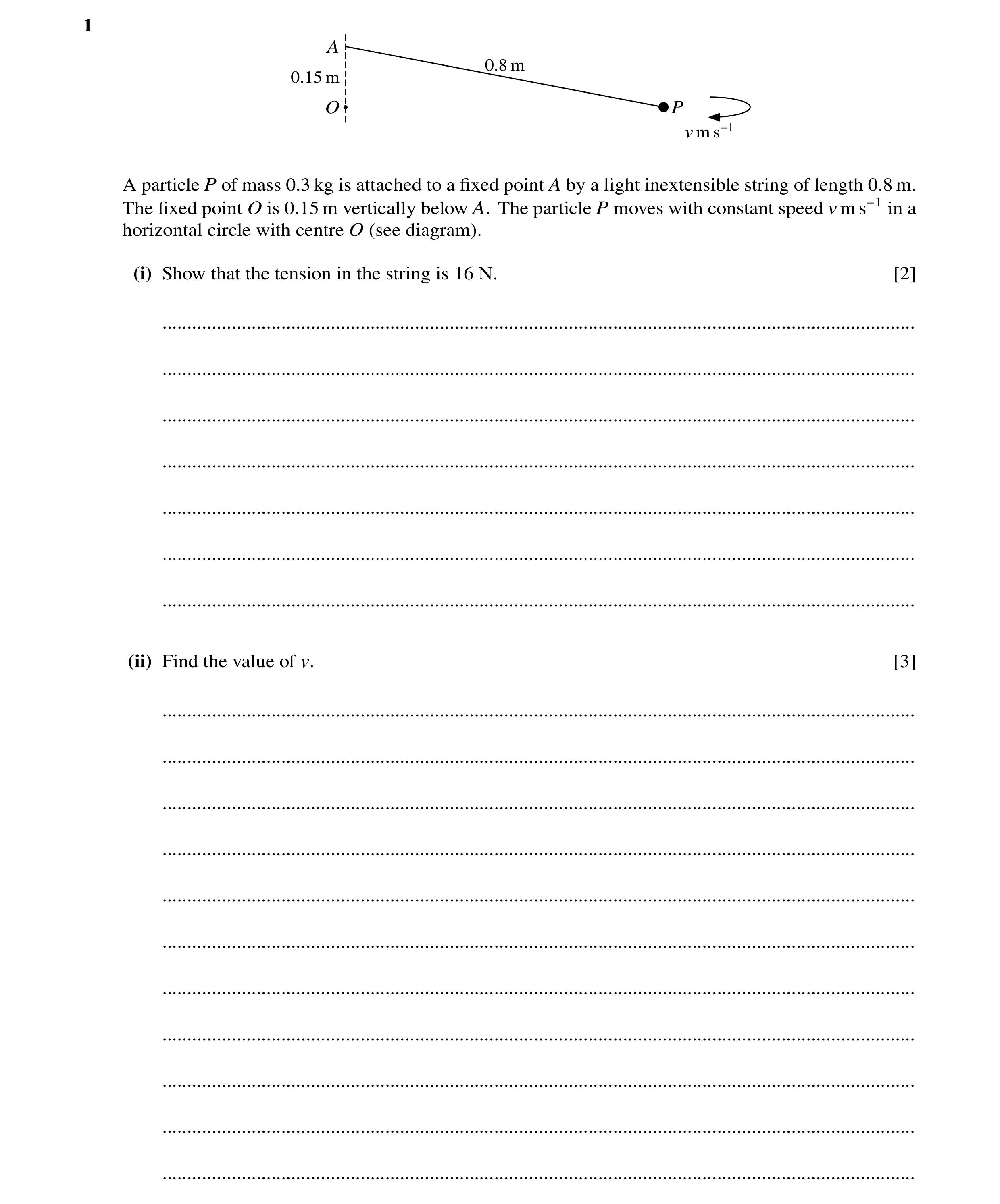
1 A 0.8 m 0.15 m O P v m s−1 A particle P of mass 0.3 kg is attached to a fixed point A by a light inextensible string of length 0.8 m. The fixed point O is 0.15 m vertically below A. The particle P moves with constant speed v m s−1 in a horizontal circle with centre O (see diagram). (i) Show that the tension in the string is 16 N. [2] … … … … … … … (ii) Find the value of v. [3] … … … … … … … … … … …
5 marks
Mark scheme: 1(i) 0.15 cos 0.3 0.8 T T g θ = × = M1 the vertical T = 16 N AG A1 2 1(ii) 2 2 2 0.8 0.15 r = − B1 r = 0.78581... 2 0.78581... 0.3 16sin 16 0.8 0.78581... v θ = × = M1 Use Newton’s Second Law horizontally v = 6.416 A1 3
This question in 9709/53 May/June 2019
Q46 · A particle P of mass 0.3 kg is attached to one end of a light elastic string of natural… 9709/51 Oct/Nov 2019
5 A particle P of mass 0.3 kg is attached to one end of a light elastic string of natural length 0.6 m and modulus of elasticity 9 N. The other end of the string is attached to a fixed point O on a smooth plane inclined at 30Å to the horizontal. OA is a line of greatest slope of the plane with A below the level of O and OA = 0.8 m. The particle P is released from rest at A. (i) Find the initial acceleration of P. [4] … … … … … … … … … … … … … … … … … … … … … … … (ii) Find the greatest speed of P. [5] … … … … … … … … … … … … … … … … … … … … … … … … …
9 marks
Mark scheme: 5(i) 9 (0.8 0.6) T 0.6 = M1 Use T = x l . Note 0.4 sin30 = OP T = 3 N A1 0.3a = 3 – 0.3gsin30 M1 Use Newton’s Second Law along the slope a = 5 m 1 −s A1 4 5(ii) 9e 0.3 sin30 0.6 = g M1 Note the maximum speed is at the equilibrium position e = 0.1 A1 2 2 9 (0.8 0.6) 9 EPE or 2 0.6 2 0.6 × − ×0.1 = × × B1 2 2 2 0.3 9 (0.8 0.6) 9 0.1 0.3 0.1sin30 2 2 0.6 2 0.6 × − × = − − × × × v g M1 Set up a 4 term energy equation v = 0.707 m 1 s− A1 5
This question in 9709/51 Oct/Nov 2019
Q47 · A particle P of mass 0.2 kg is projected horizontally from a fixed point O on a smooth… 9709/52 Oct/Nov 2019
6 A particle P of mass 0.2 kg is projected horizontally from a fixed point O on a smooth horizontal surface. When the displacement of P from O is x m the velocity of P is v m s−1. A horizontal force of variable magnitude 0.09 x N directed away from O acts on P. An additional force of constant magnitude 0.3 N directed towards O acts on P. (i) Show that vdv = 0.45 x −1.5. [2] dx … … … … … … … … (ii) Find the value of x for which the acceleration of P is zero. [2] … … … … … … … … … … … … … (iii) Given that the minimum value of v is positive, find the set of possible values for the speed of projection. [5] … … … … … … … … … … … … … … … … … … … … … … … … …
9 marks
Mark scheme: 6(i) d 0.2 0.09 0.3 d = − v v x x M1 Use Newton’s Second Law horizontally d 0.45 1.5 d = − v v x x A1 AG 2 6(ii) 0 = 0.45 1 2 x – 1.5 M1 Equate acceleration to zero 100 9 = x A1 2 Question Answer Marks Guidance 6(iii) 1 2 d (0.45 1.5)d = − ∫ ∫ v v x x M1 Attempt to integrate 3 3 2 2 2 0.45 1.5 ( ) 0.3 1.5 ( ) 3 2 2 = − + = − + v x c x x c A1 3 2 100 100 0.3 1.5 0 9 9 − + = c M1 50 9 = c A1 x = 0, 2 50 10 so 2 9 3 > > v v A1 5
This question in 9709/52 Oct/Nov 2019
Q48 · A particle P of mass 0.3 kg is attached to one end of a light elastic string of natural… 9709/53 Oct/Nov 2019
5 A particle P of mass 0.3 kg is attached to one end of a light elastic string of natural length 0.6 m and modulus of elasticity 9 N. The other end of the string is attached to a fixed point O on a smooth plane inclined at 30Å to the horizontal. OA is a line of greatest slope of the plane with A below the level of O and OA = 0.8 m. The particle P is released from rest at A. (i) Find the initial acceleration of P. [4] … … … … … … … … … … … … … … … … … … … … … … … (ii) Find the greatest speed of P. [5] … … … … … … … … … … … … … … … … … … … … … … … … …
9 marks
Mark scheme: 5(i) 9 (0.8 0.6) T 0.6 = M1 Use T = x l . Note 0.4 sin30 = OP T = 3 N A1 0.3a = 3 – 0.3gsin30 M1 Use Newton’s Second Law along the slope a = 5 m 1 −s A1 4 5(ii) 9e 0.3 sin30 0.6 = g M1 Note the maximum speed is at the equilibrium position e = 0.1 A1 2 2 9 (0.8 0.6) 9 EPE or 2 0.6 2 0.6 × − ×0.1 = × × B1 2 2 2 0.3 9 (0.8 0.6) 9 0.1 0.3 0.1sin30 2 2 0.6 2 0.6 × − × = − − × × × v g M1 Set up a 4 term energy equation v = 0.707 m 1 s− A1 5
This question in 9709/53 Oct/Nov 2019
 1 / 40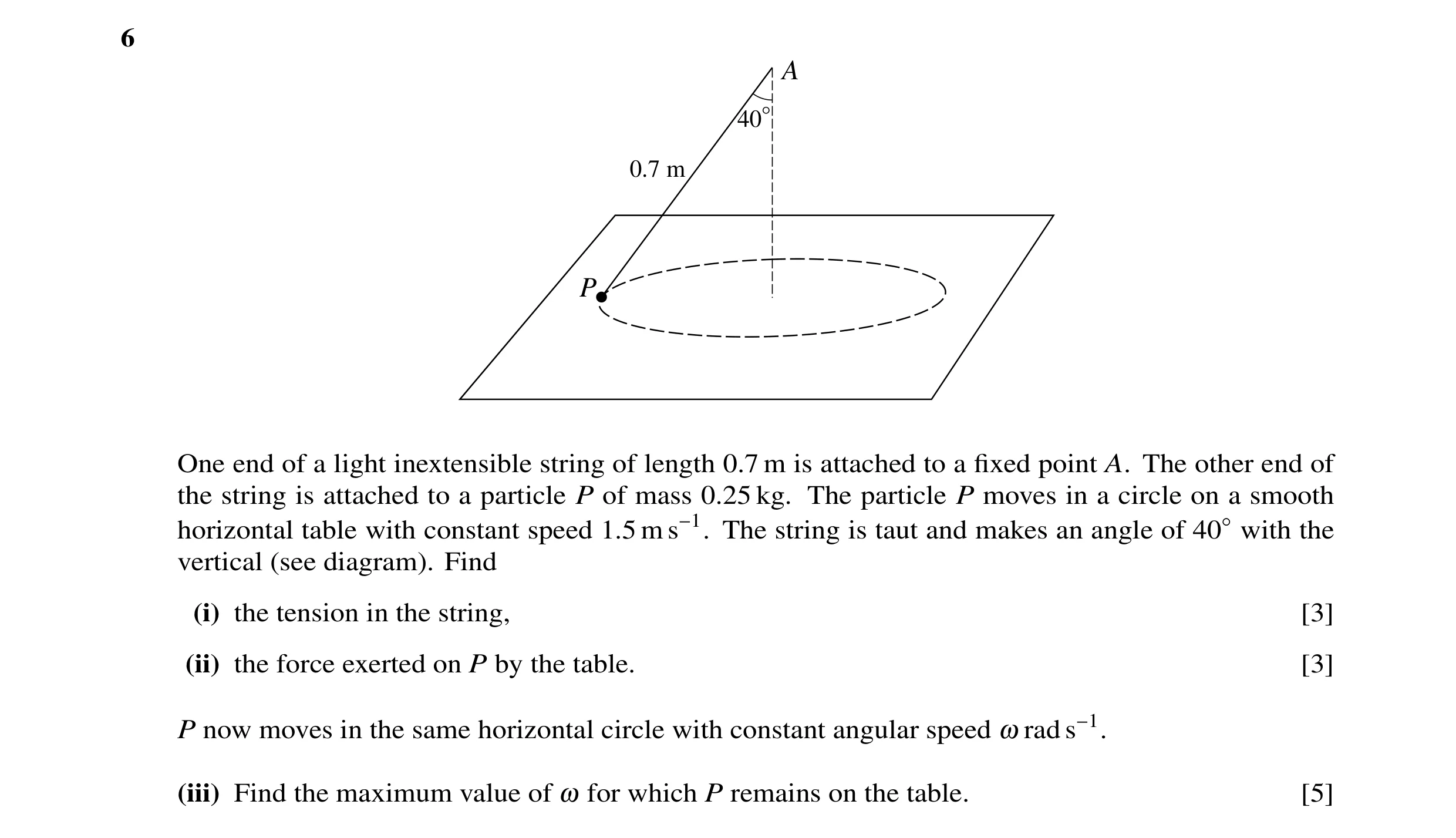
 2 / 40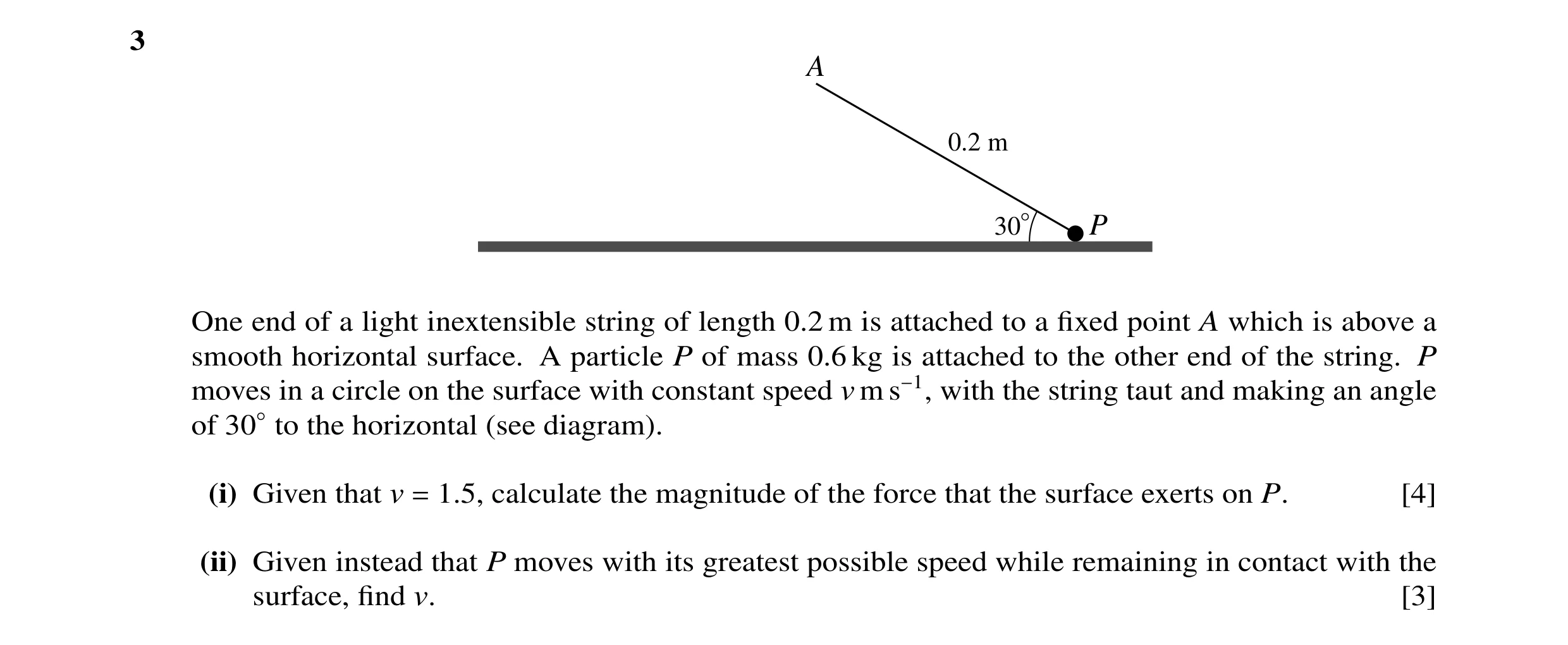
 3 / 40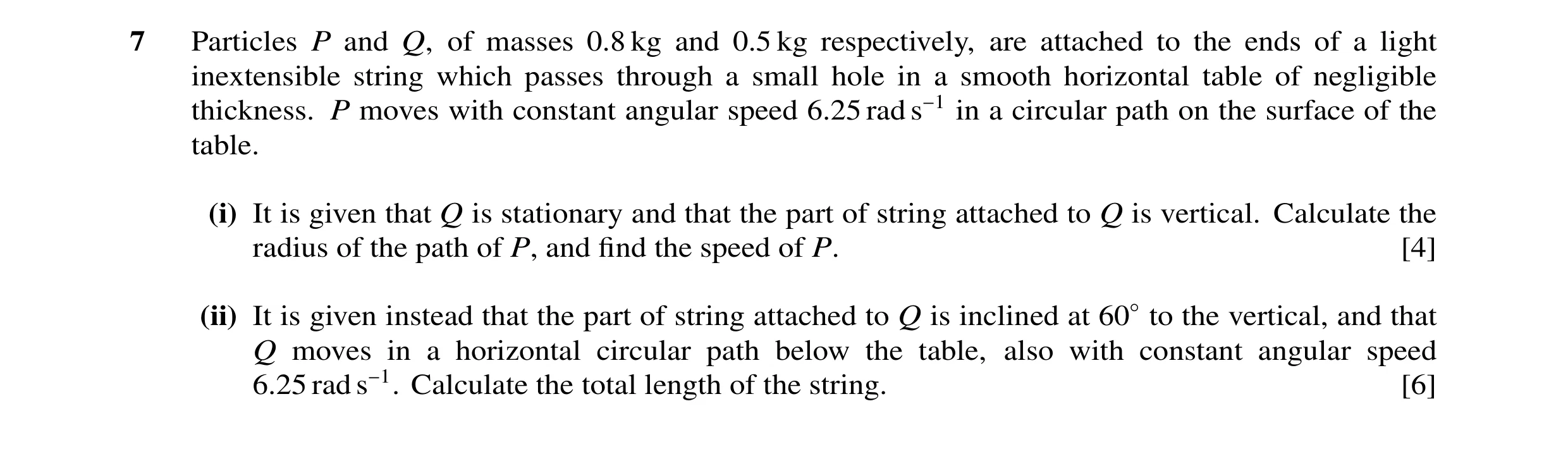
 4 / 40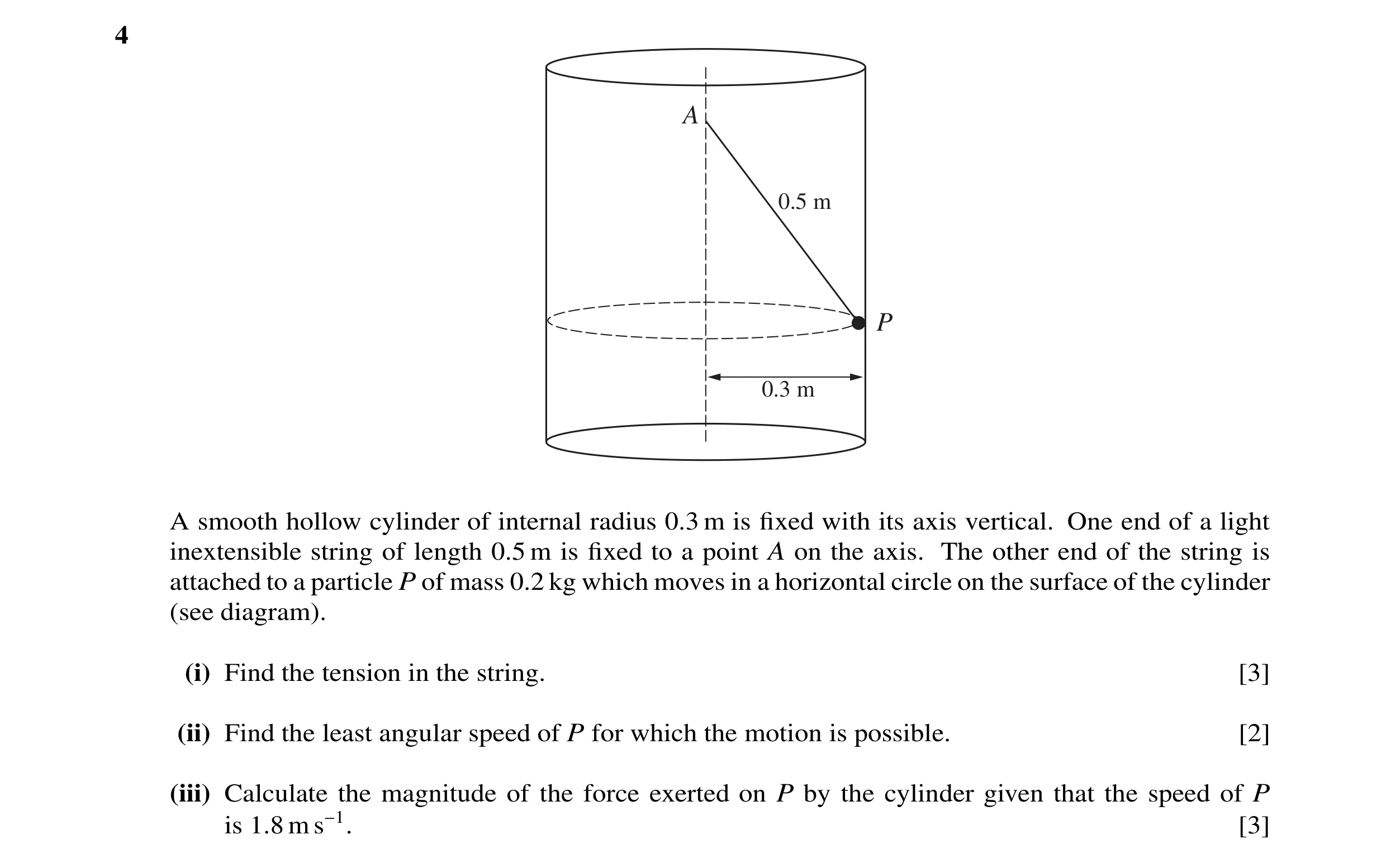
 5 / 40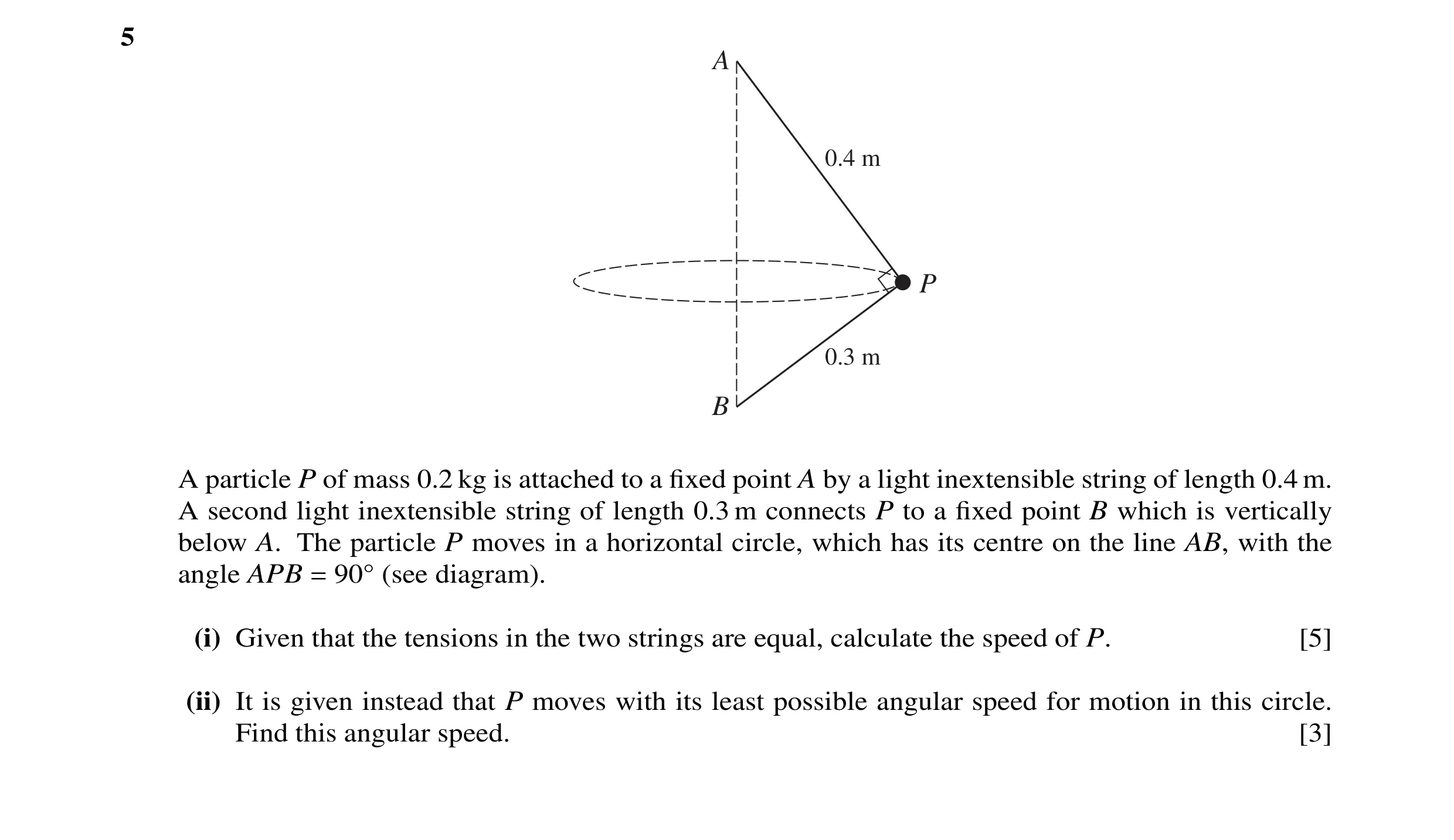
 6 / 40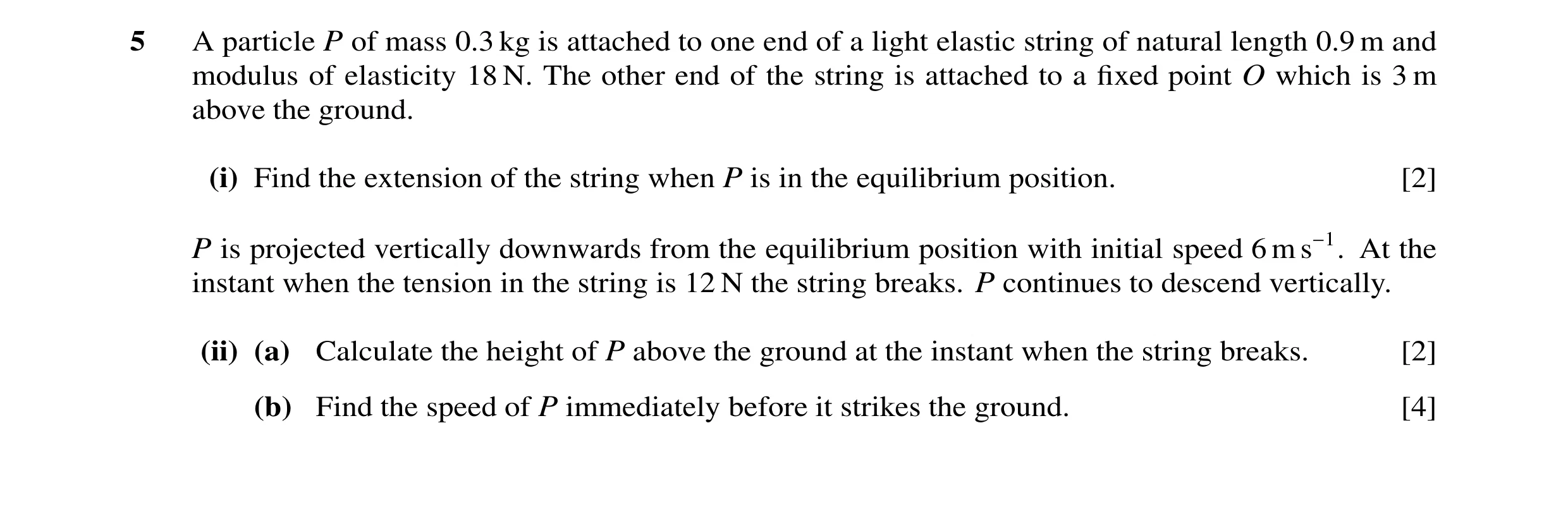
 7 / 40
 8 / 40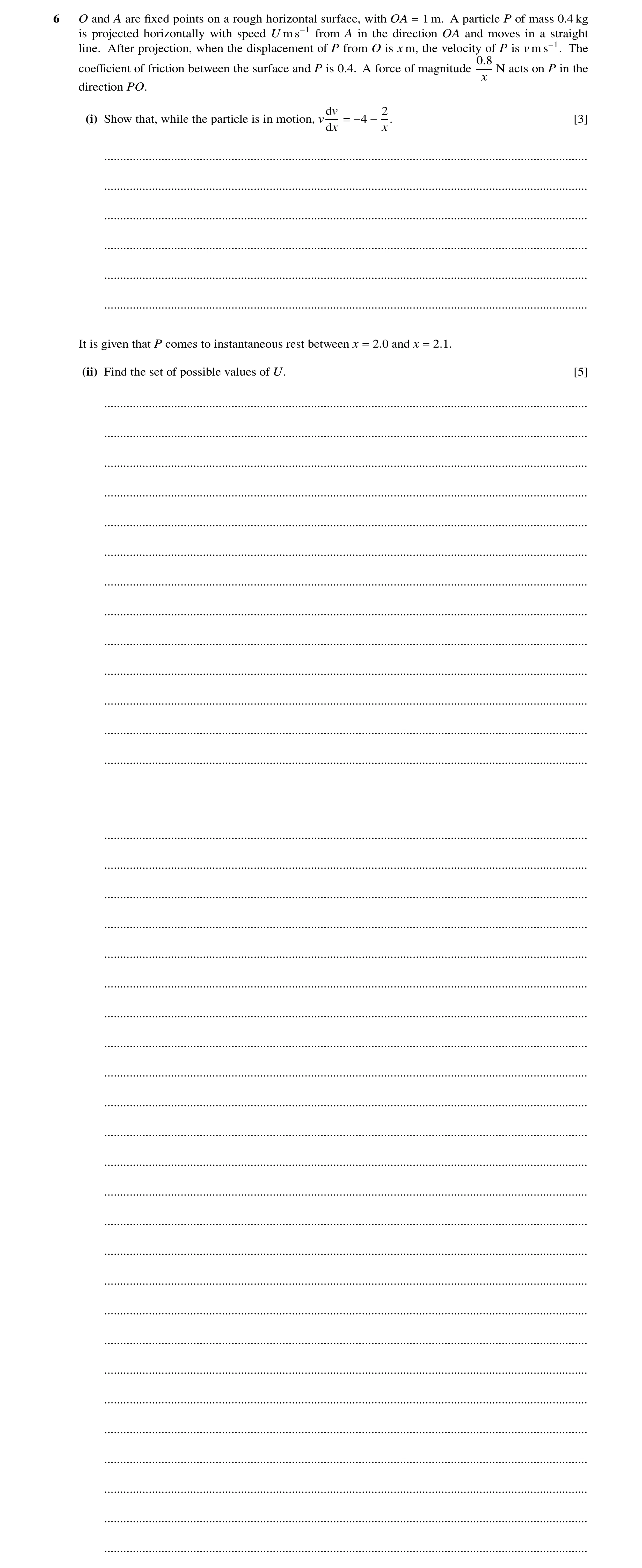
 12 / 40


 34 / 40

 6
6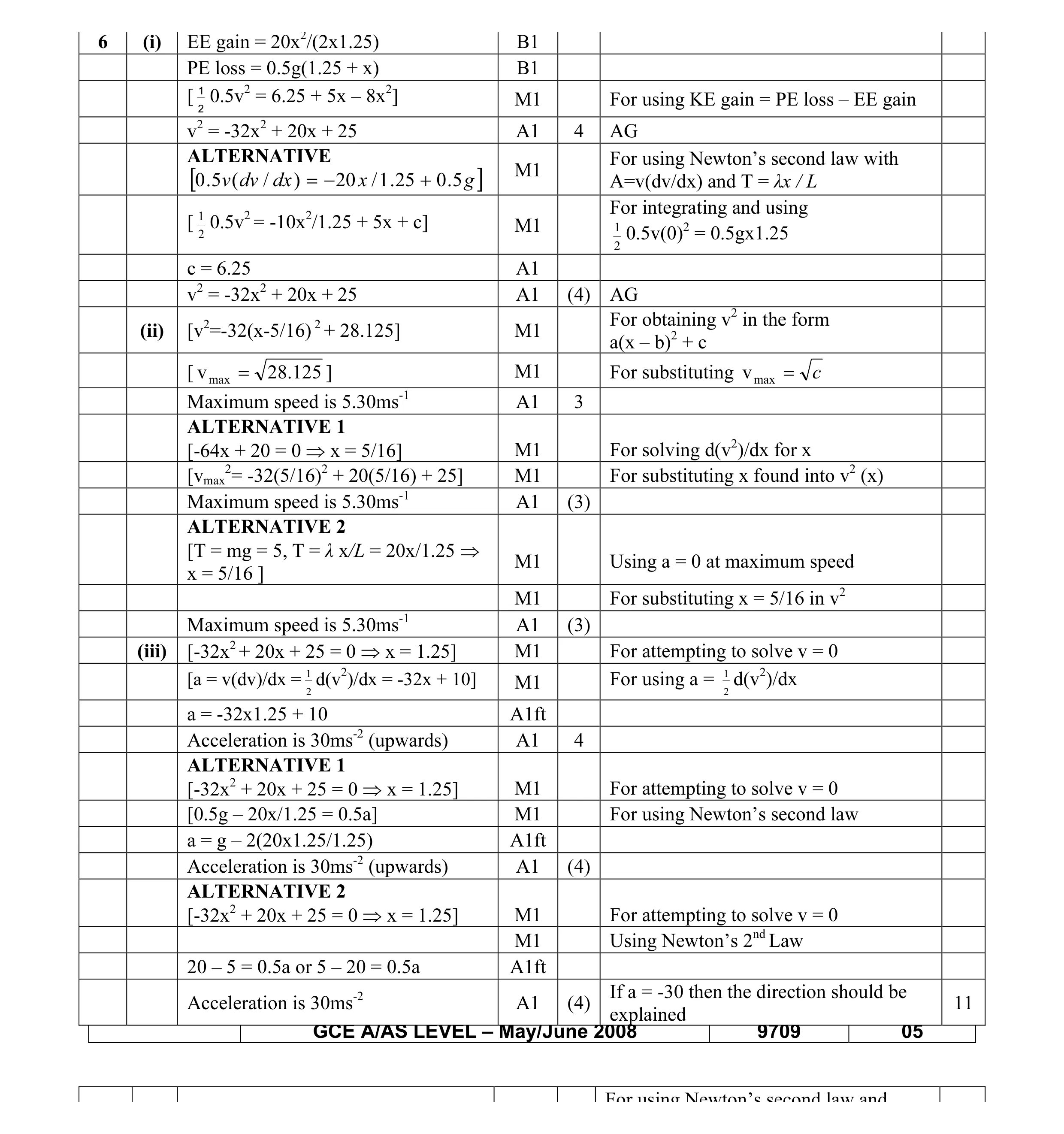 11
11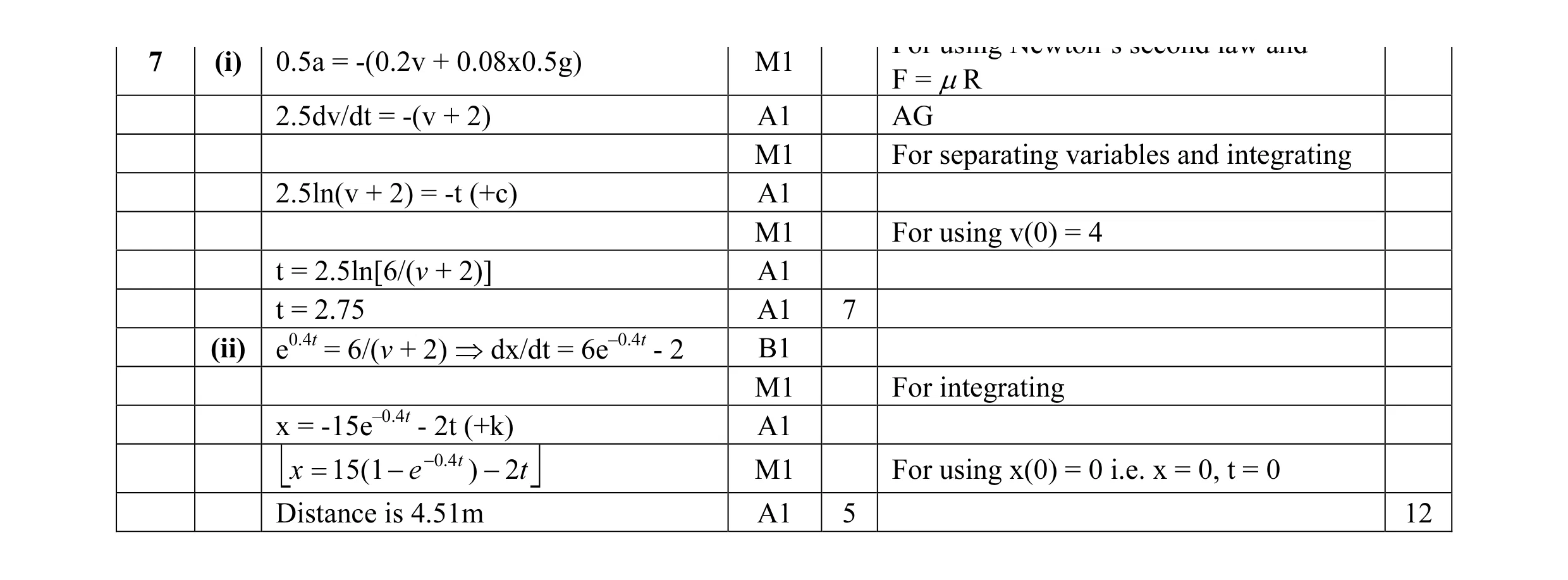 12
12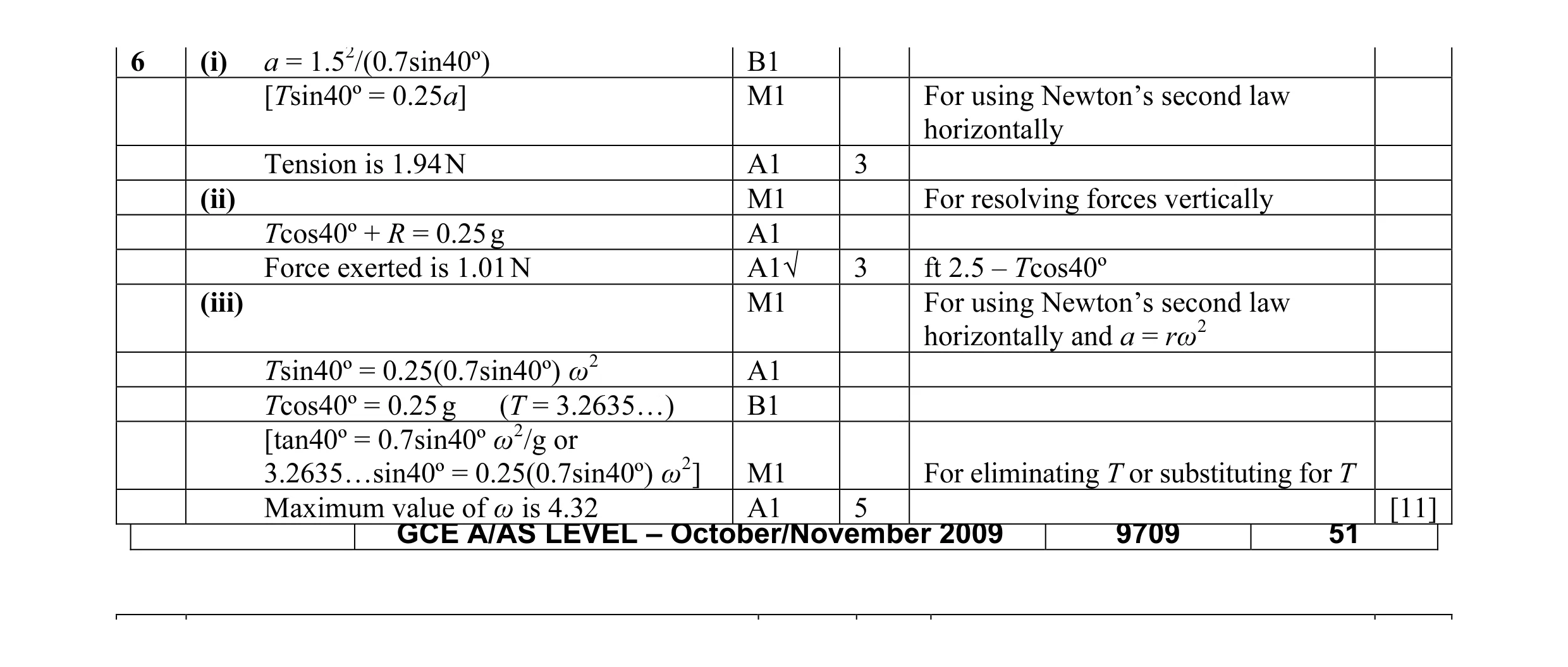 11
11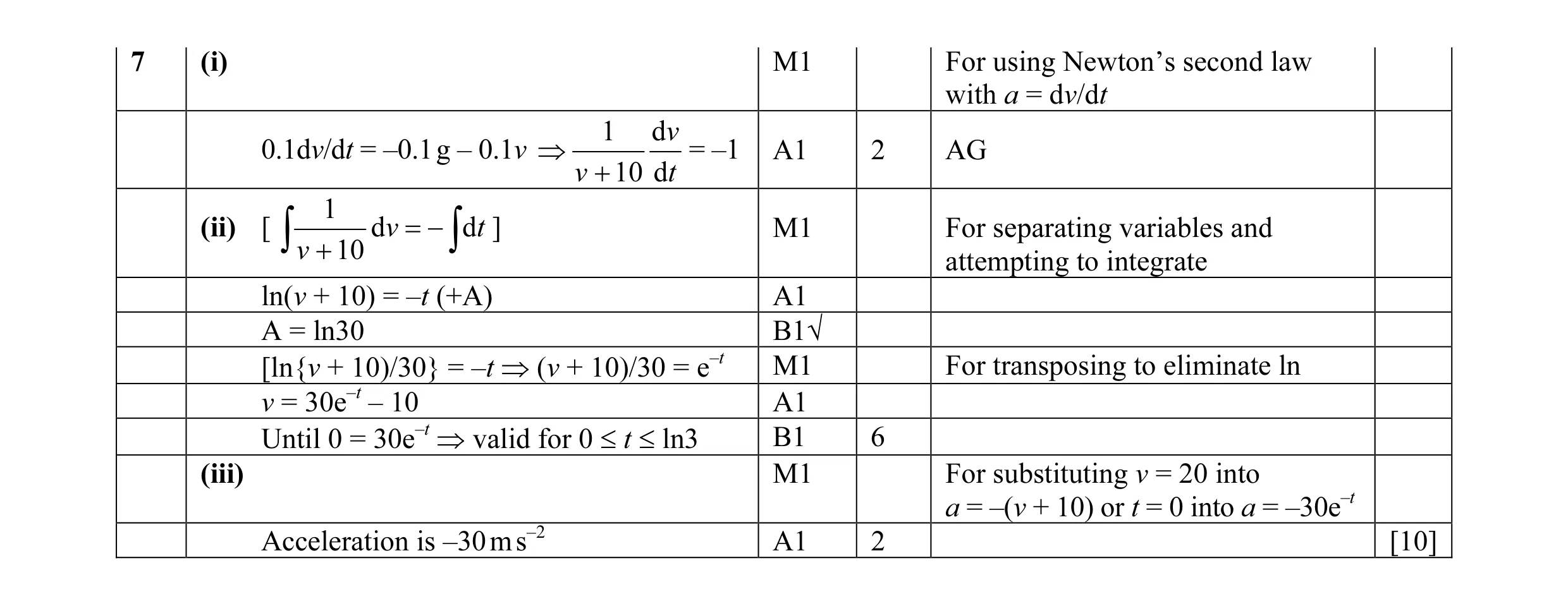 10
10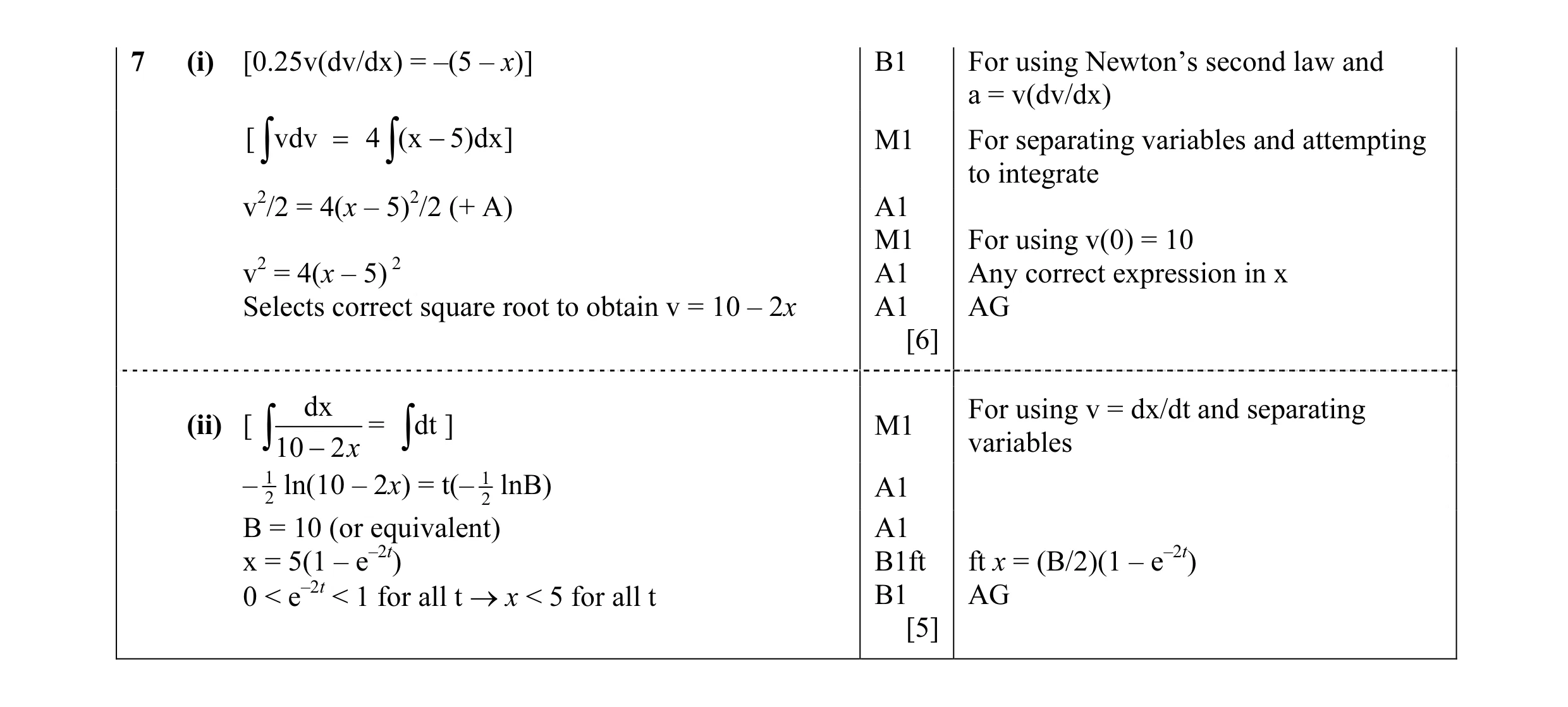 11
11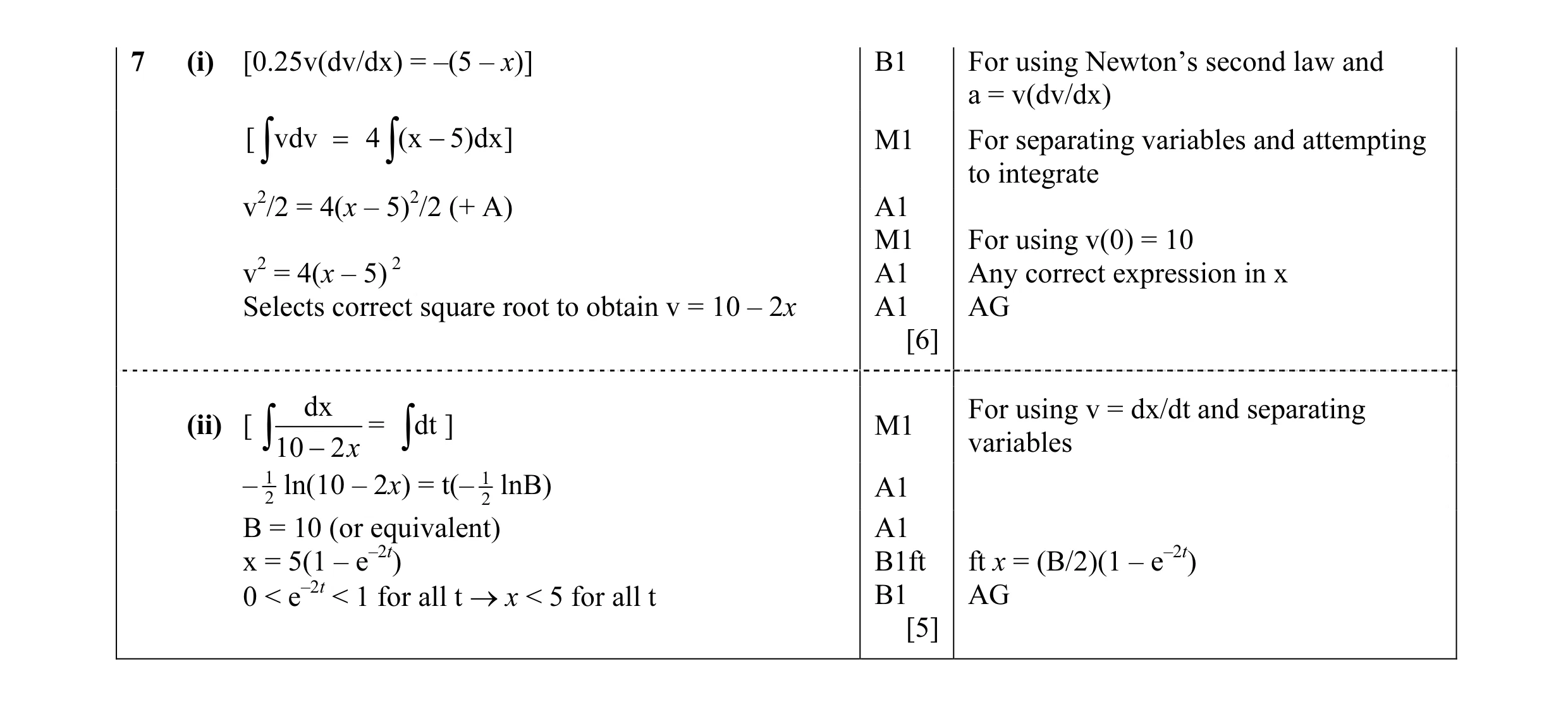 11
11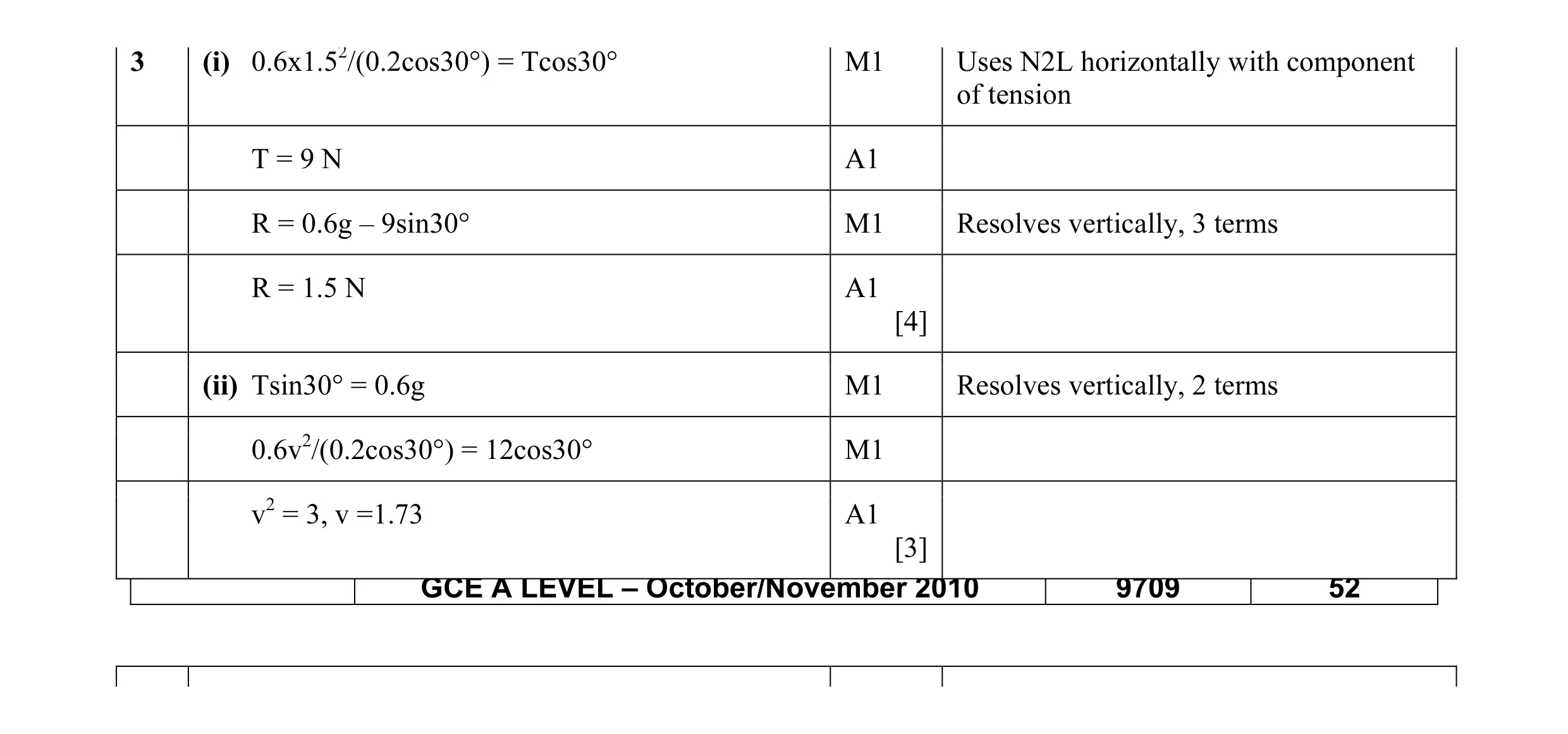 7
7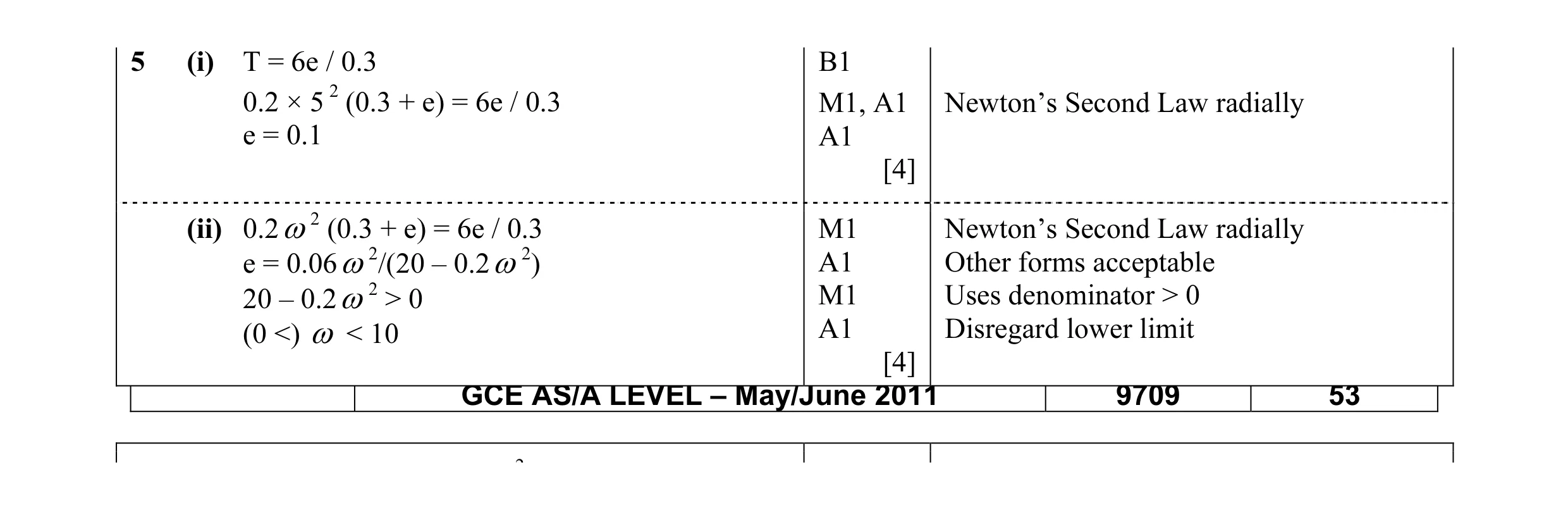 8
8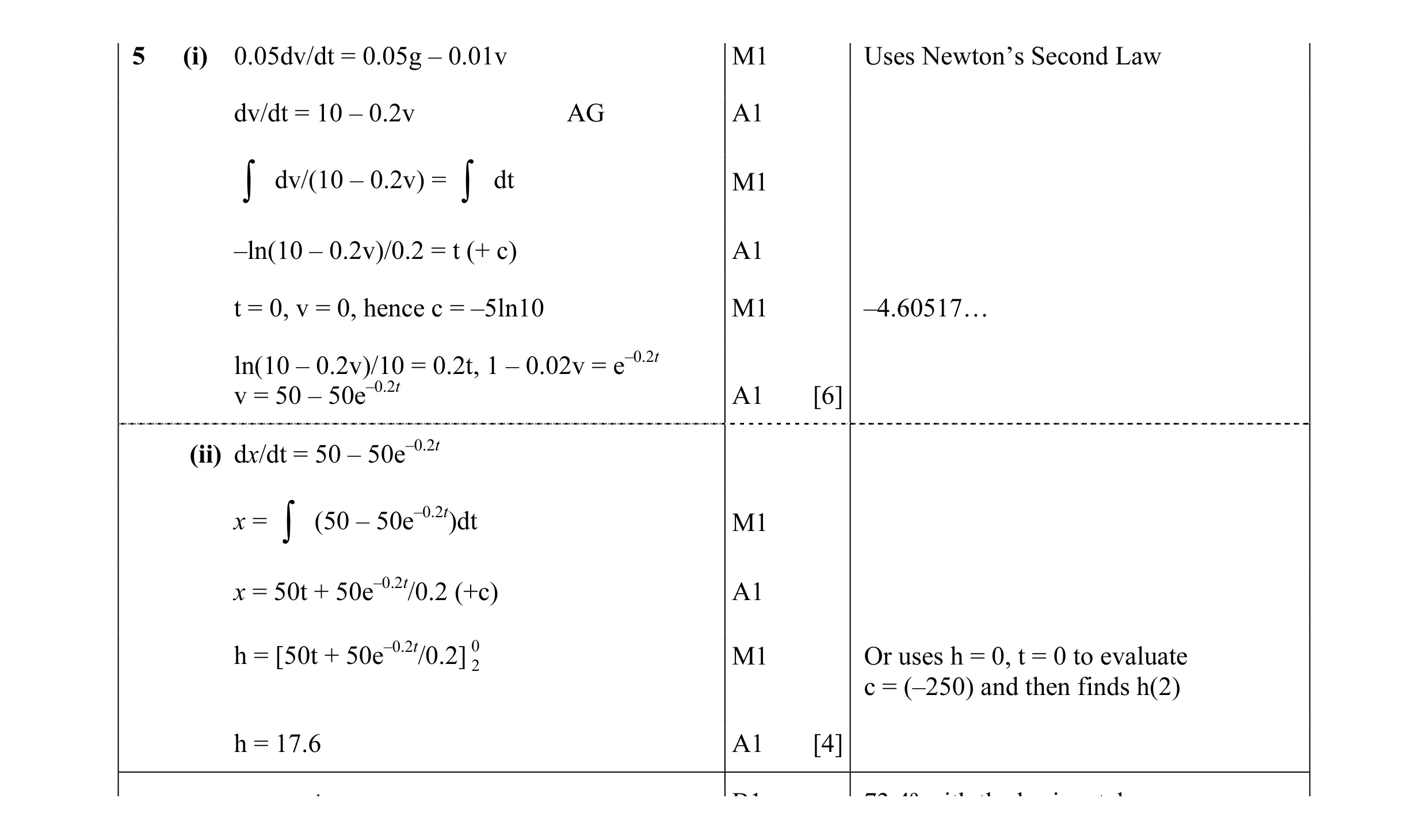 10
10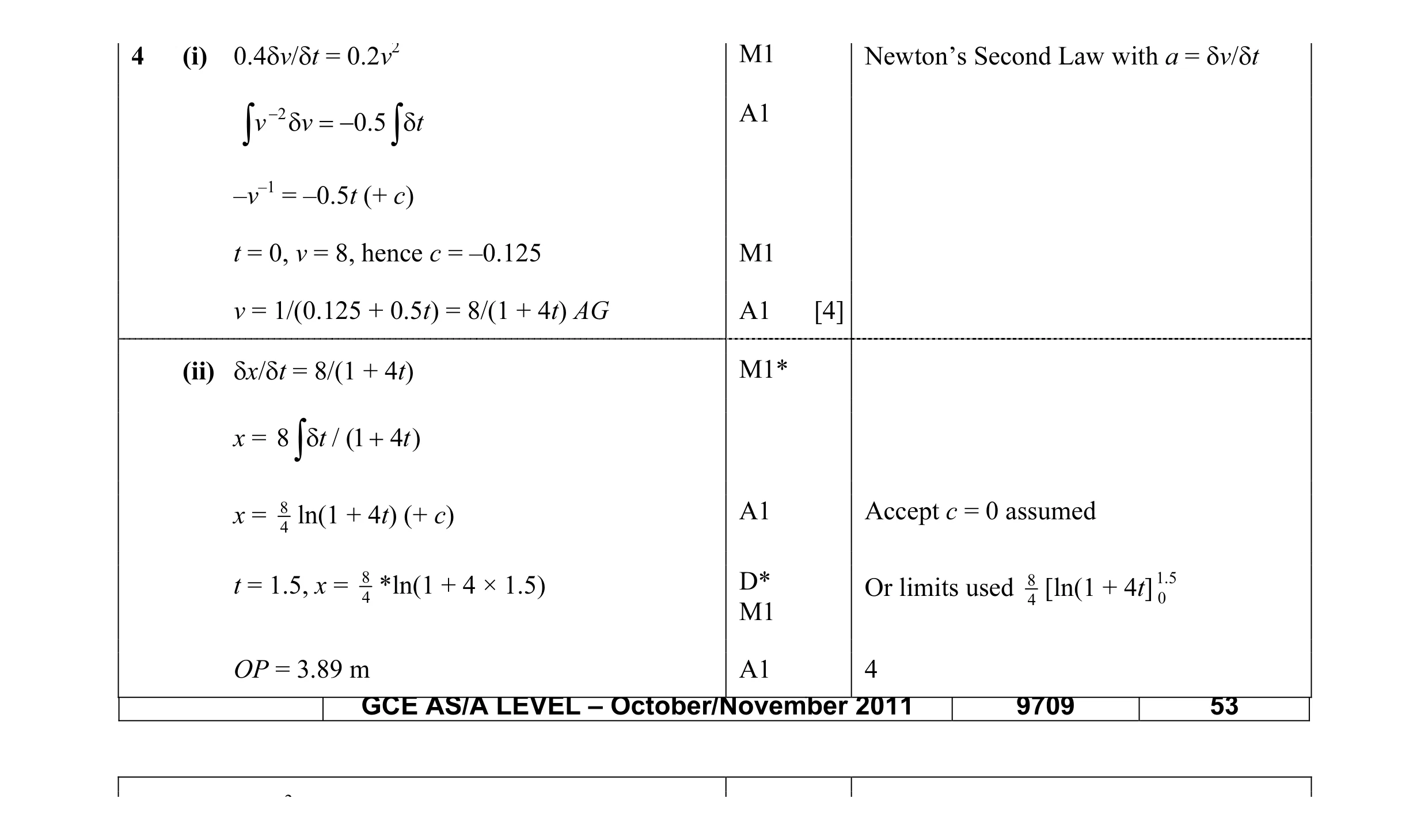 8
8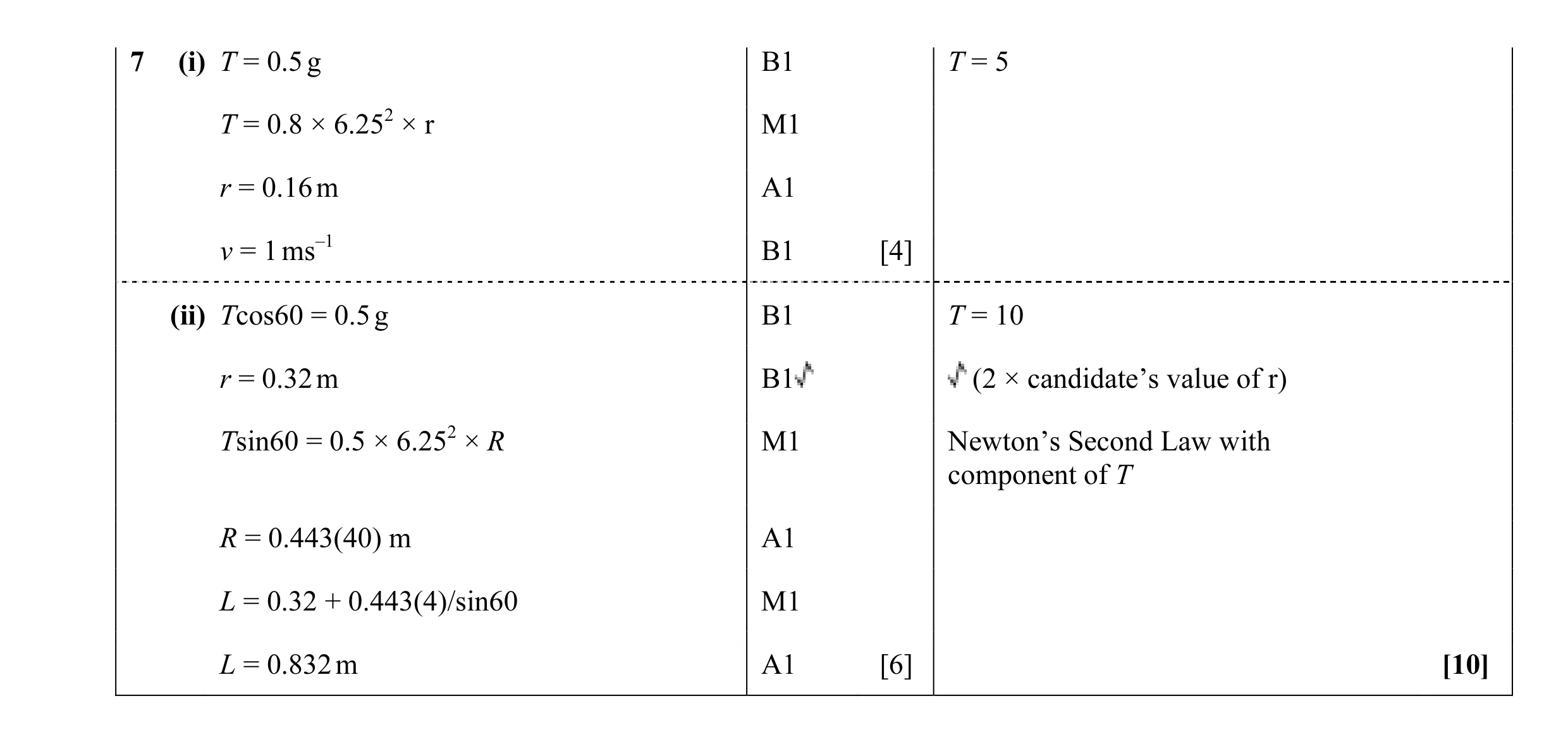 10
10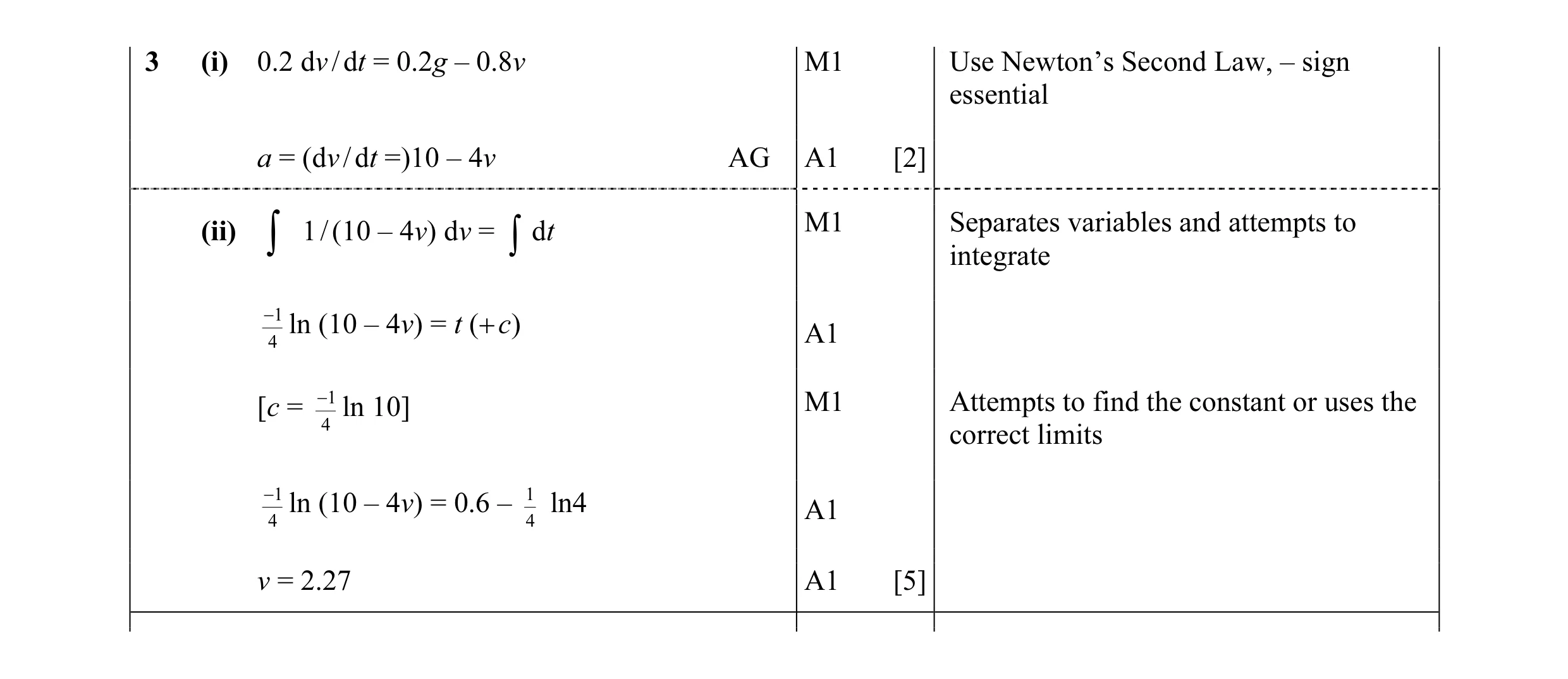 7
7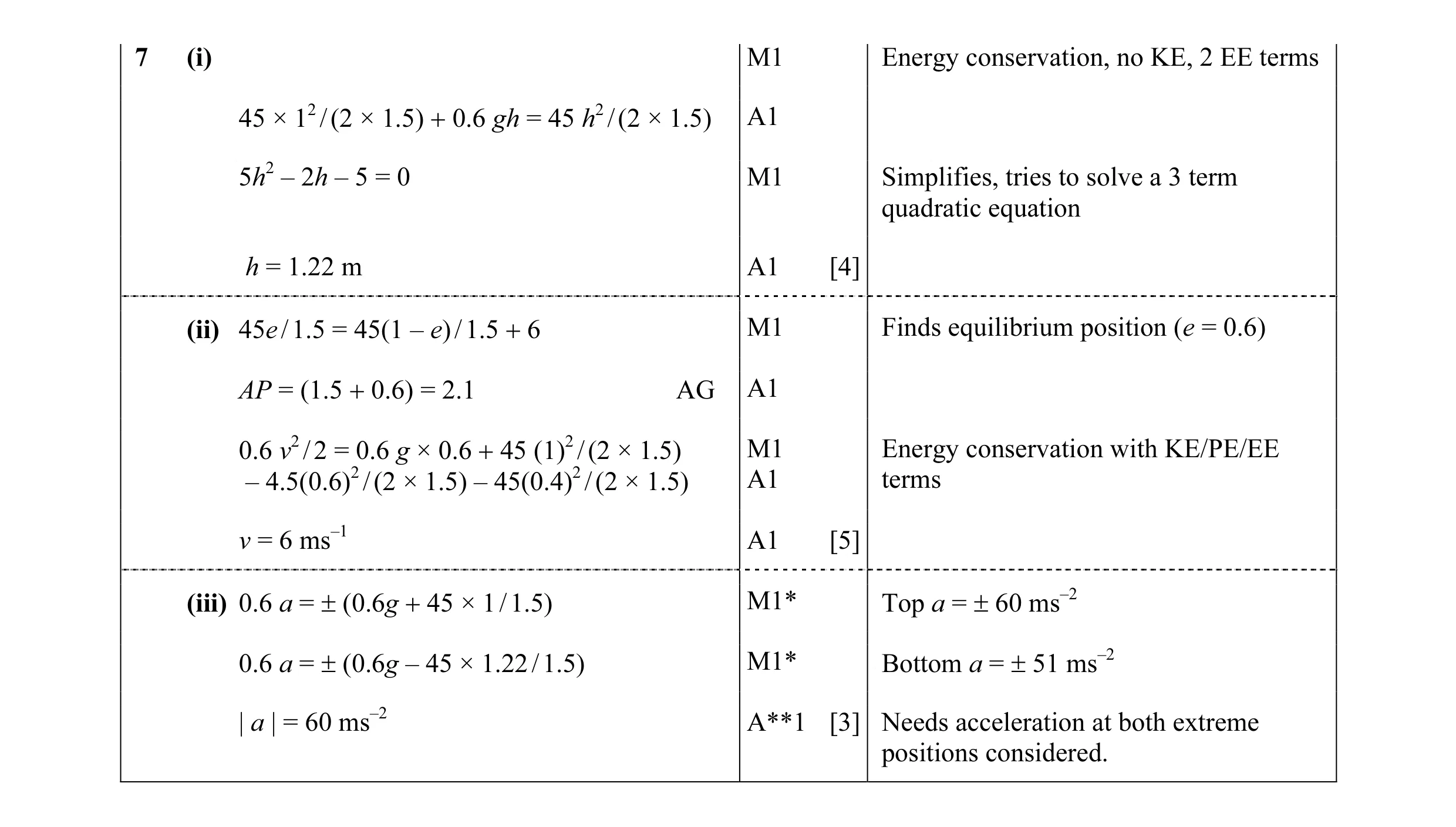 12
12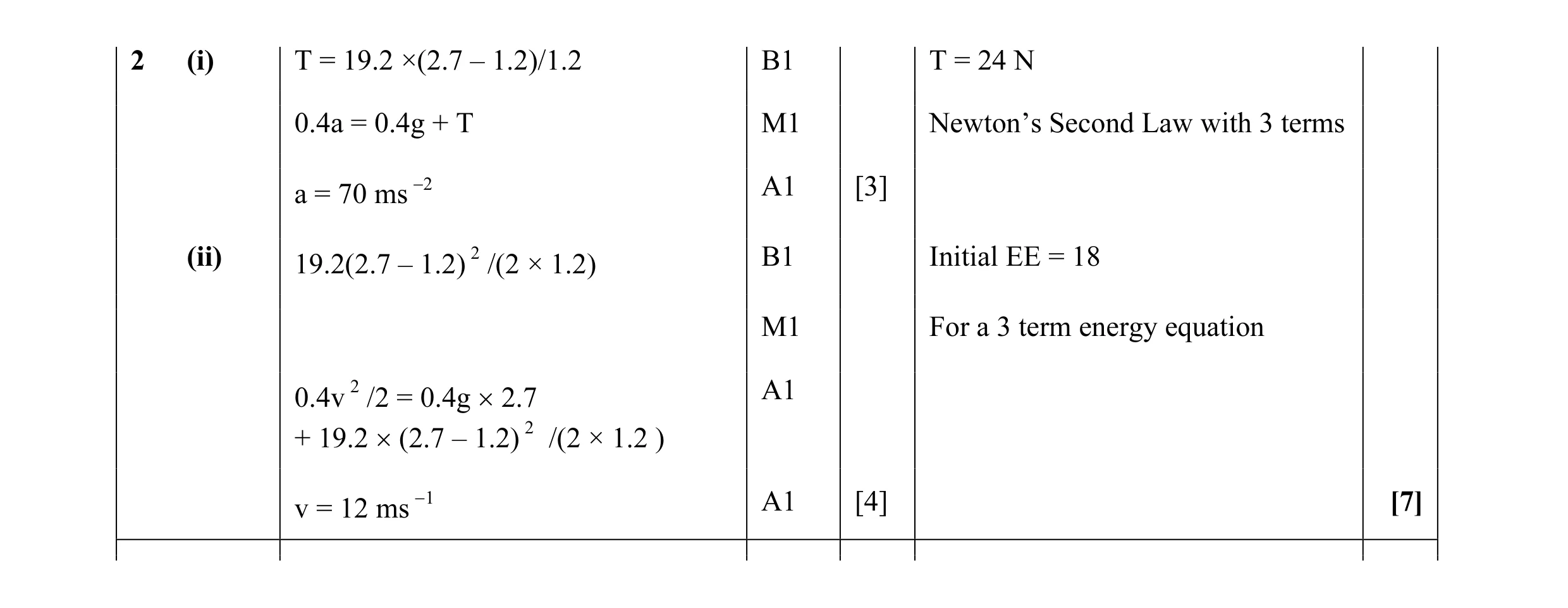 7
7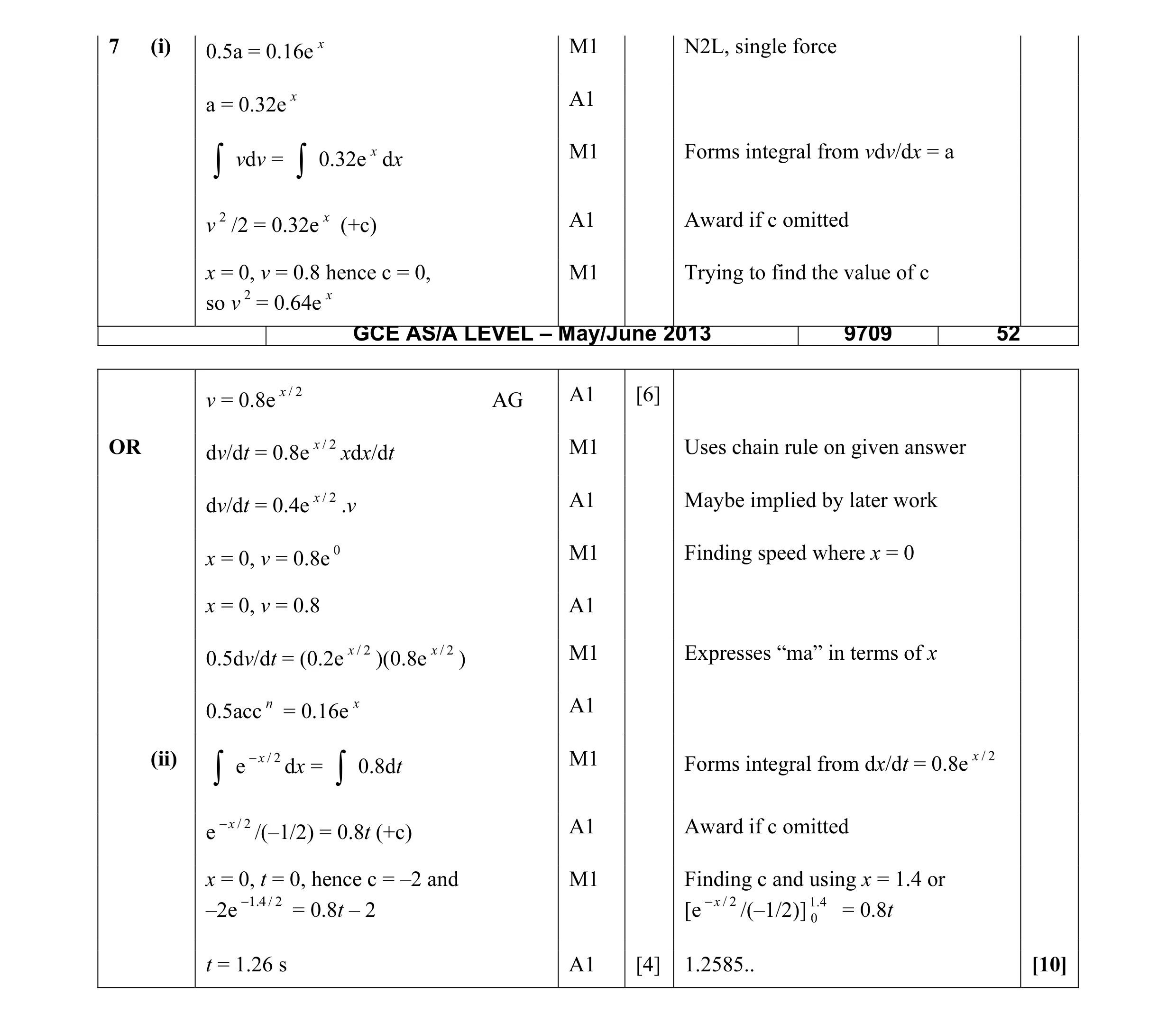 10
10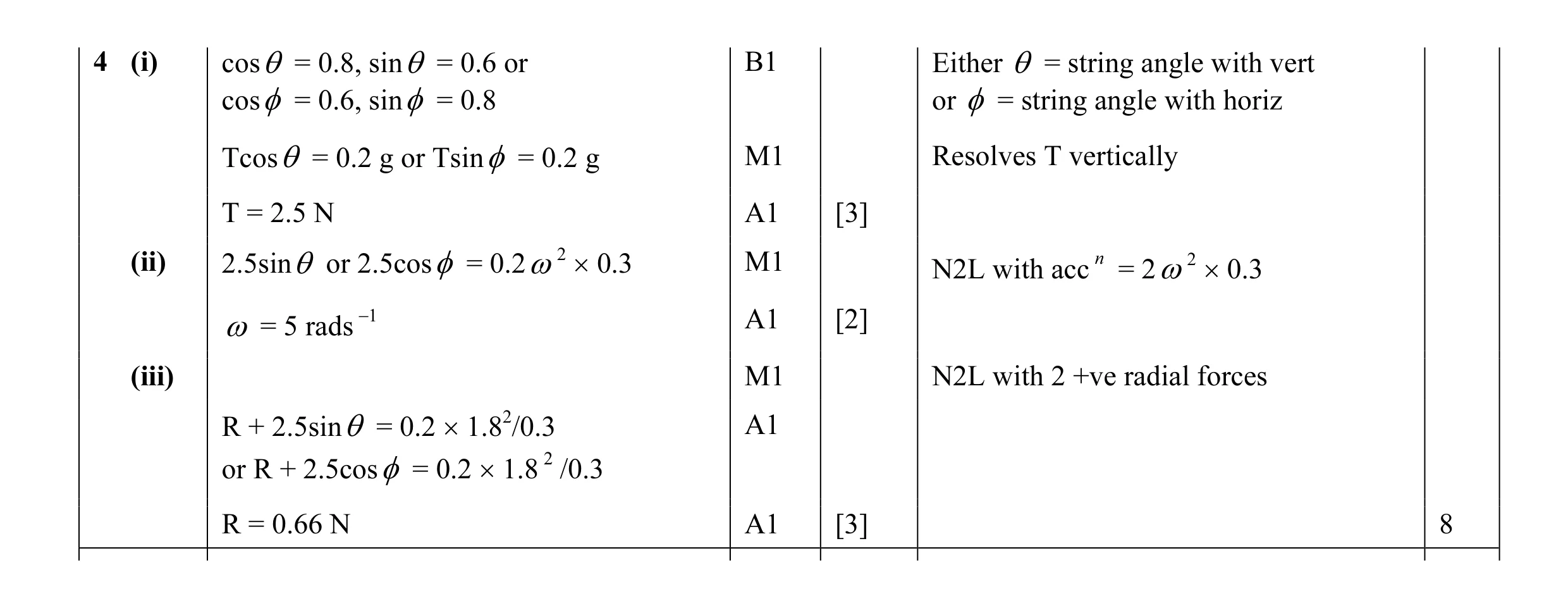 8
8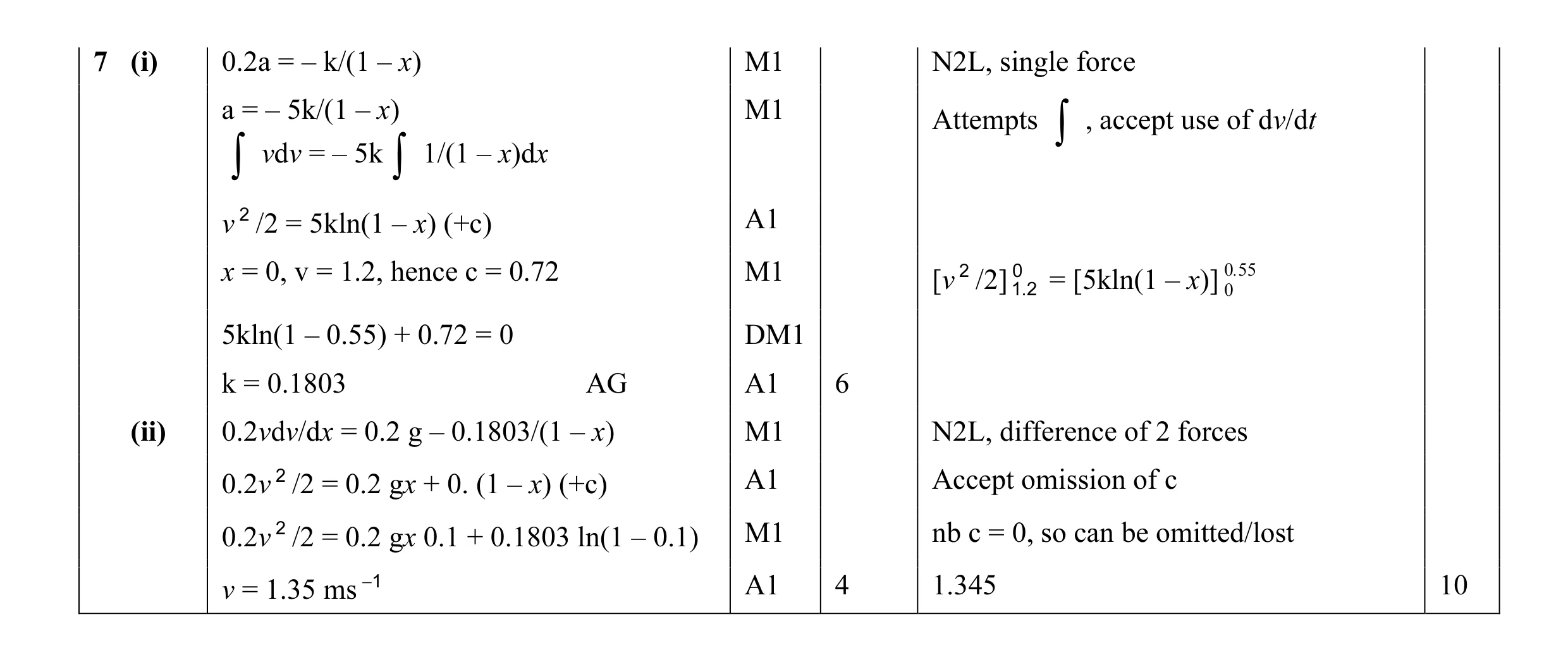 10
10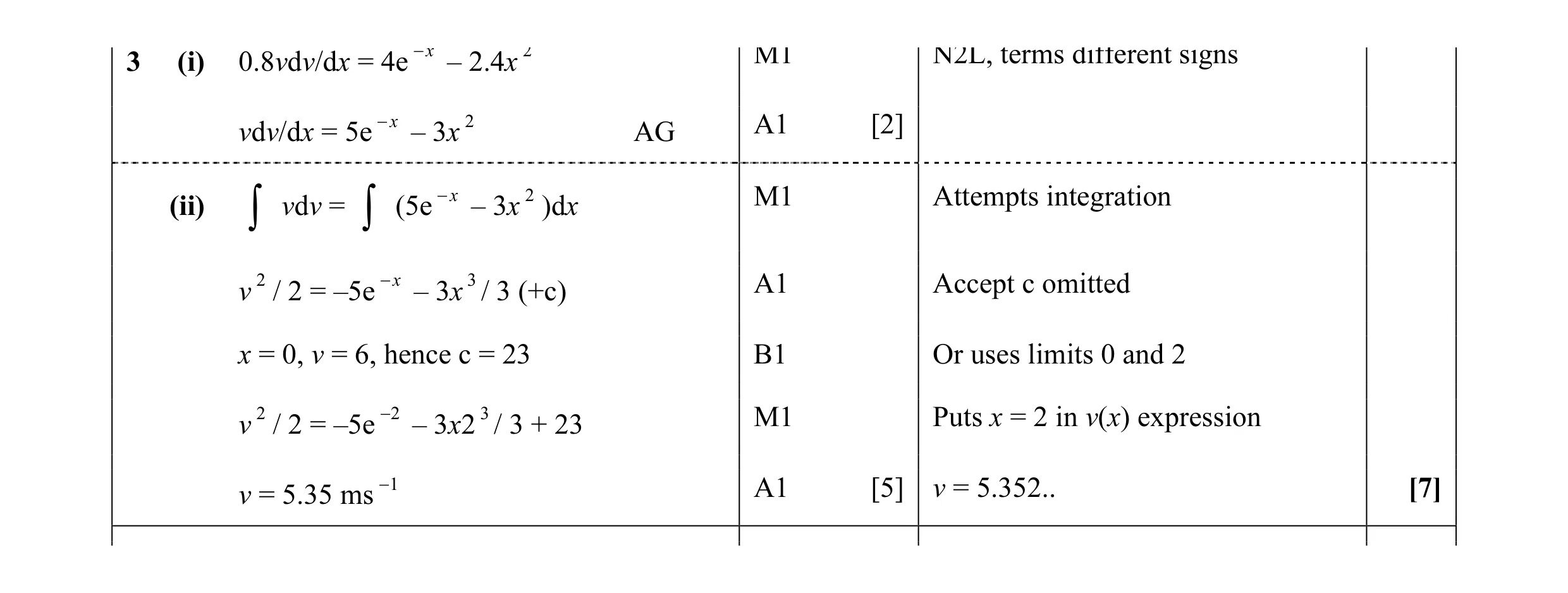 7
7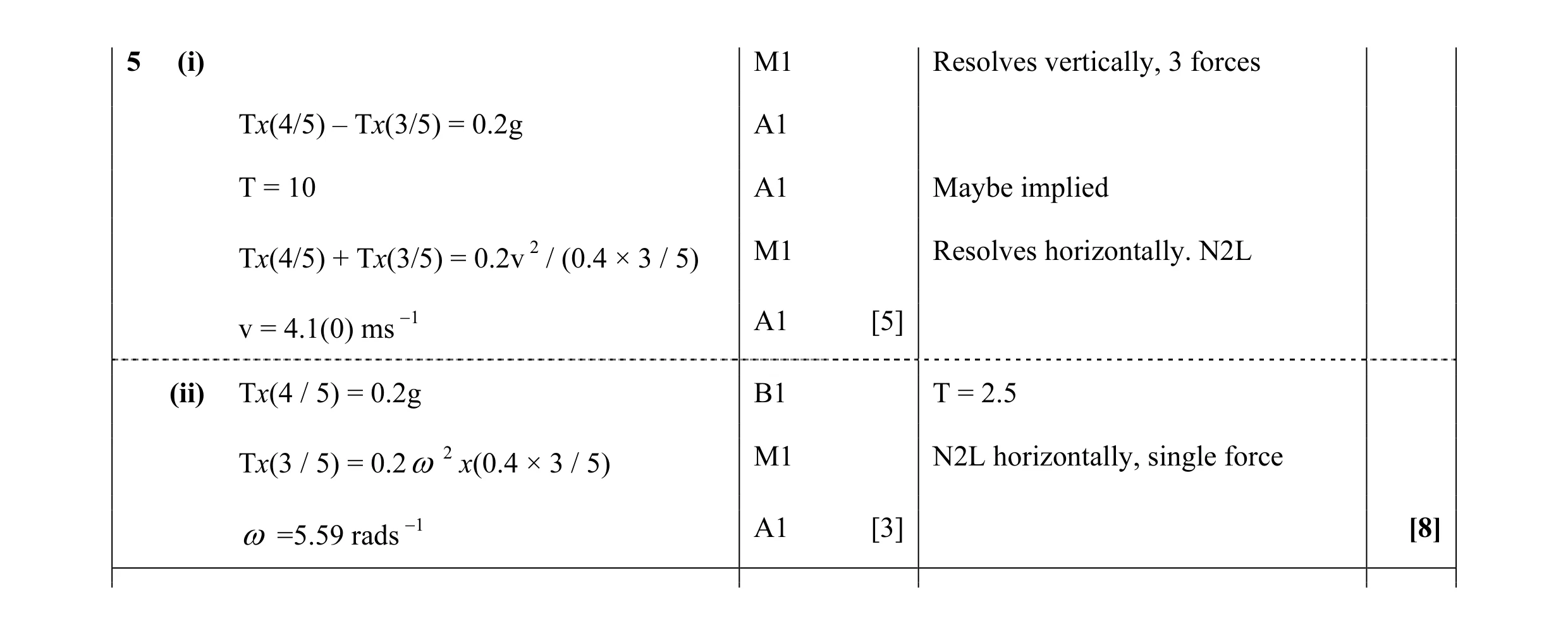 8
8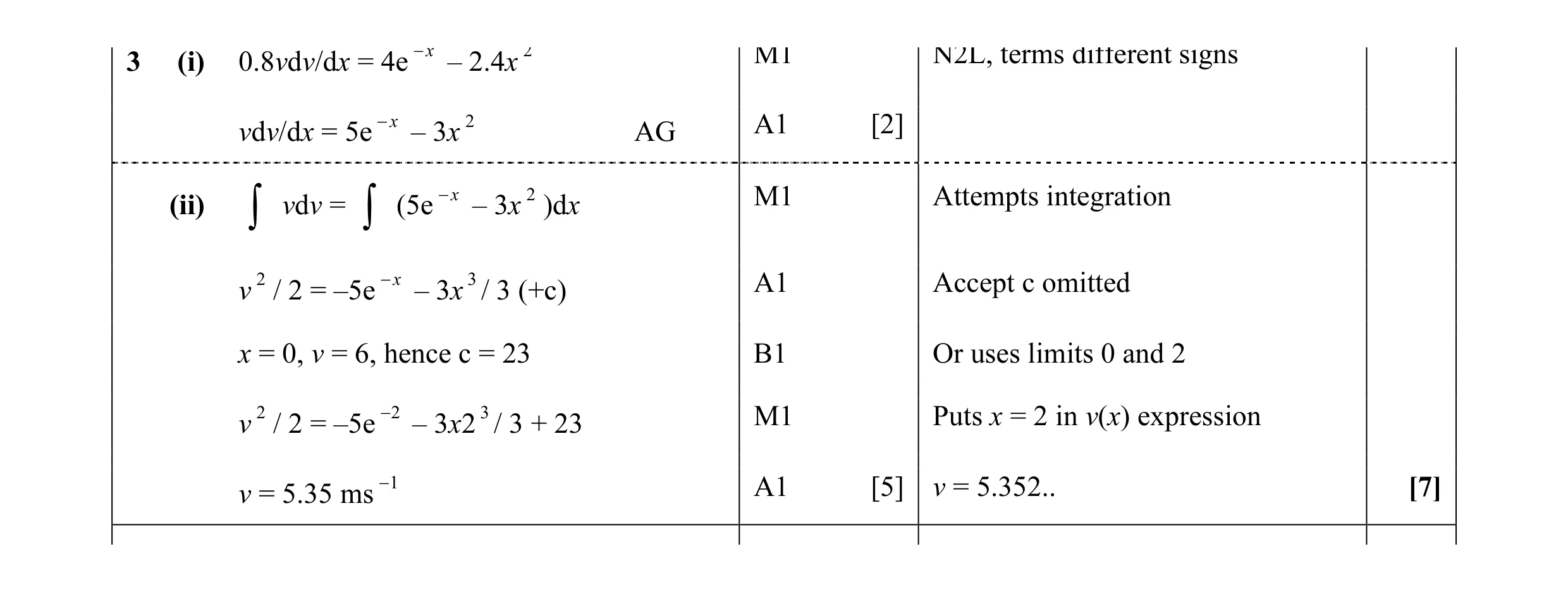 7
7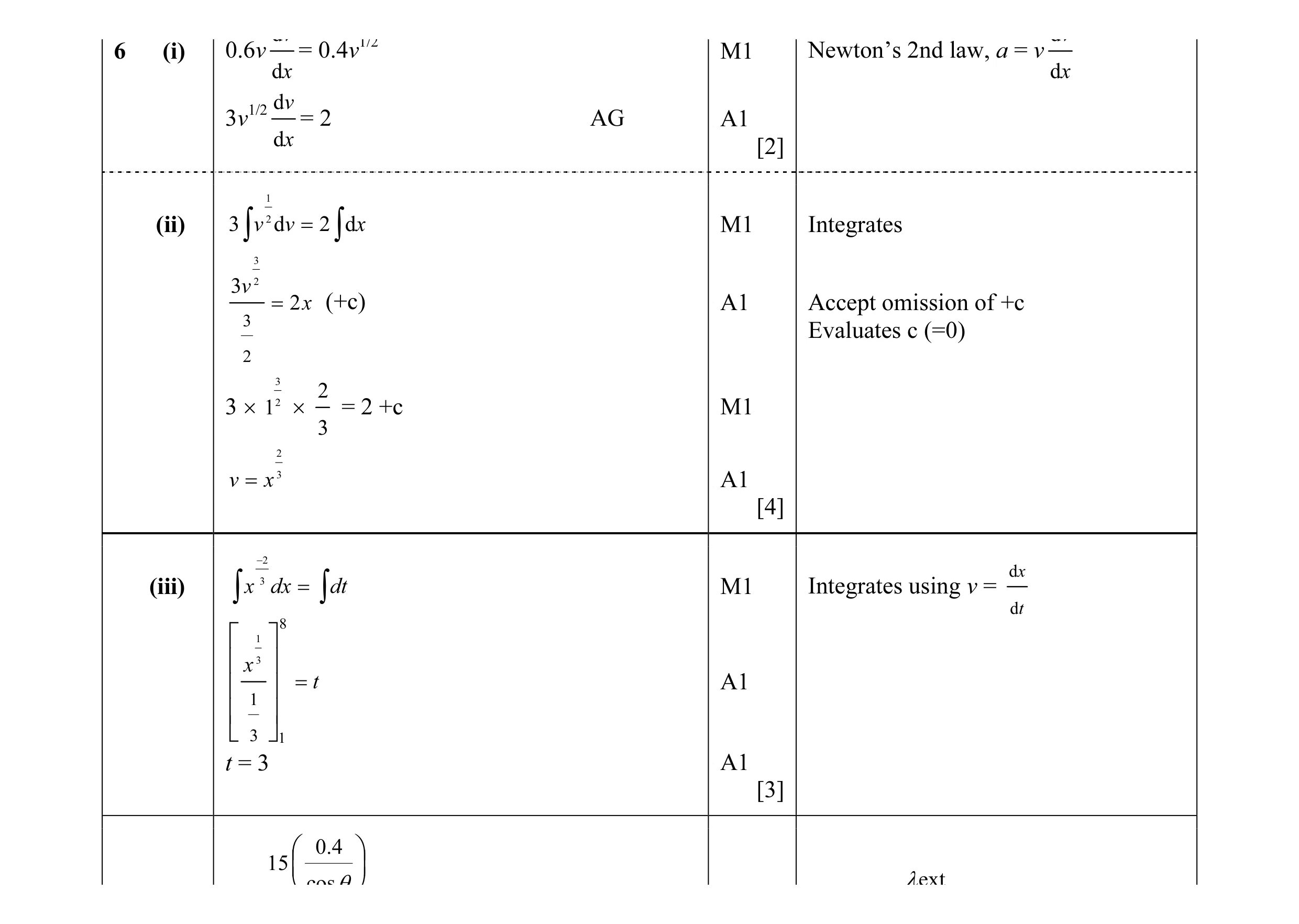 9
9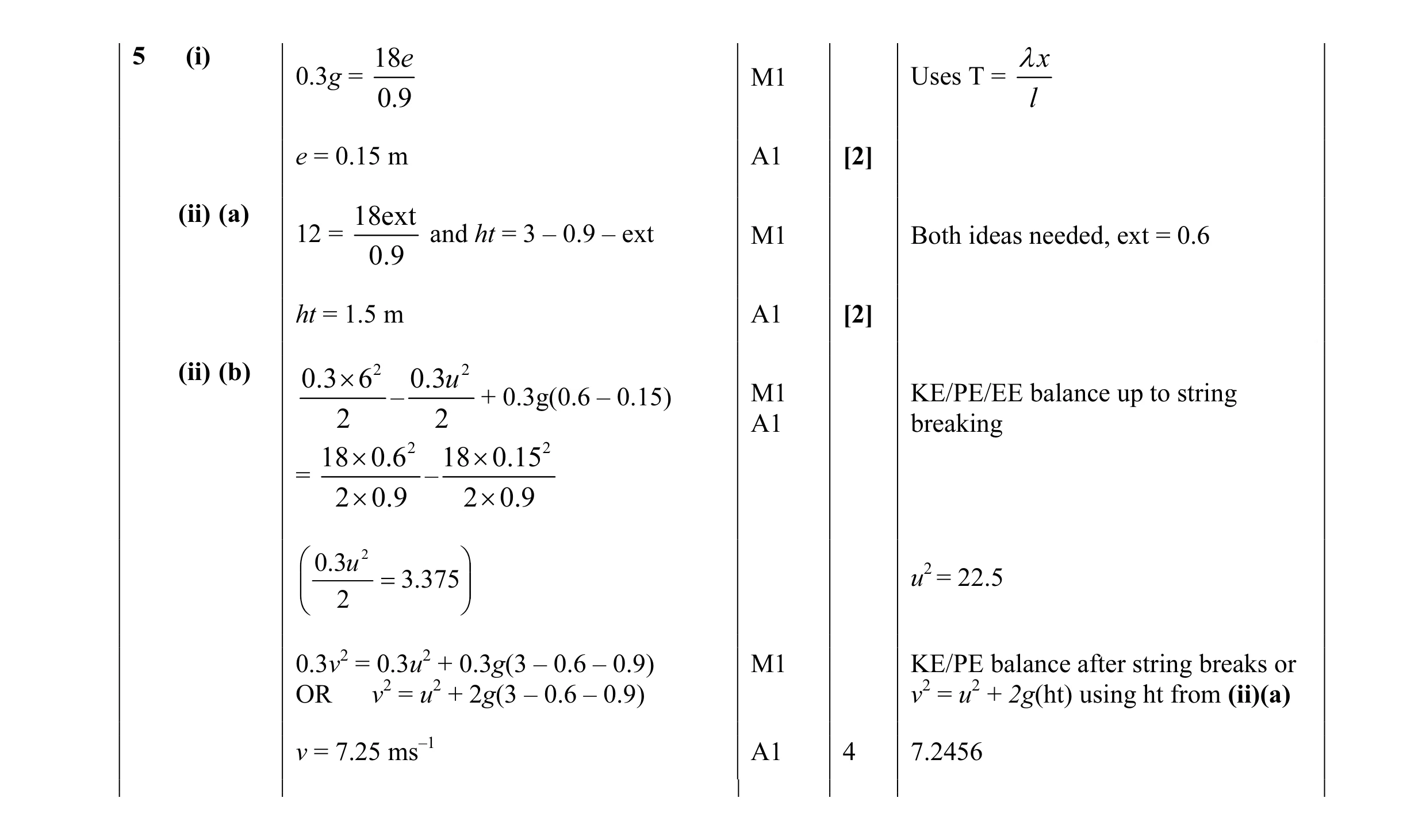 8
8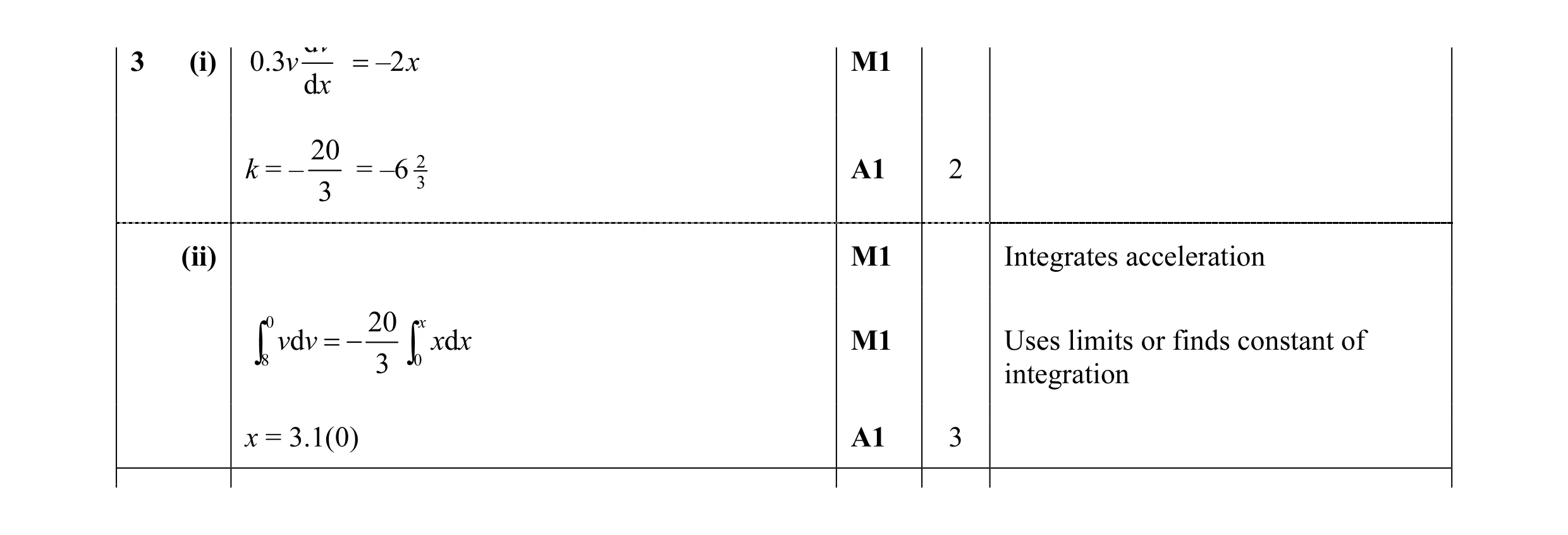 5
5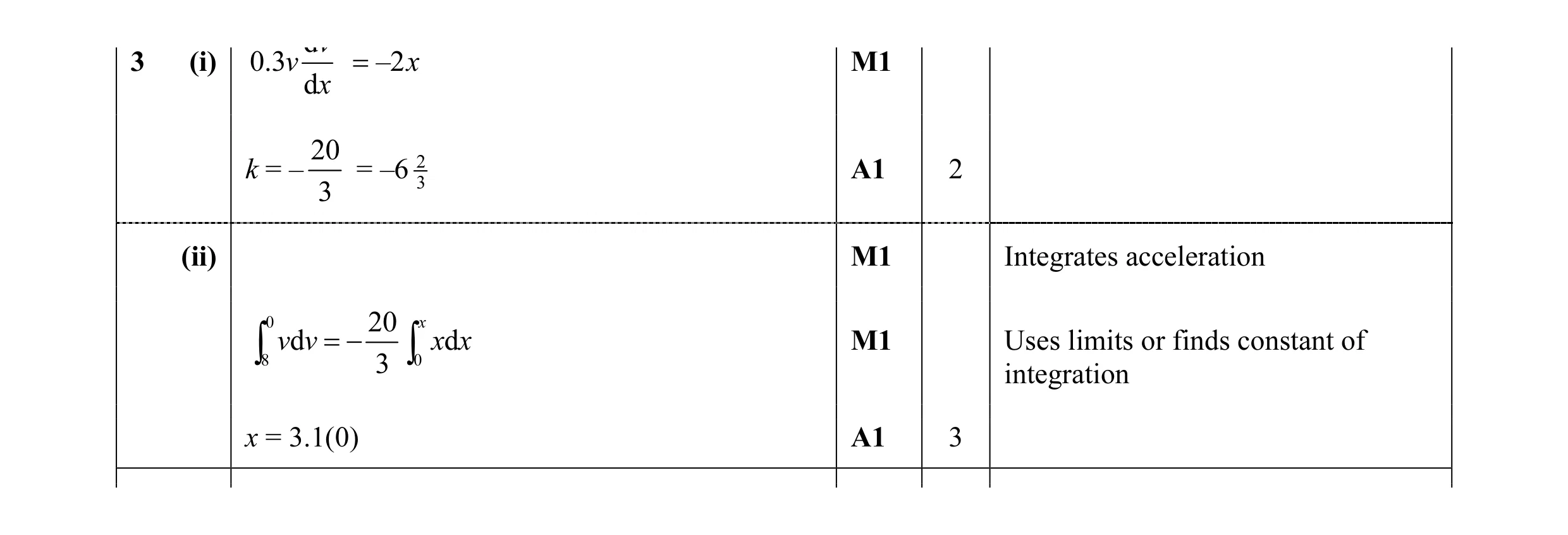 5
5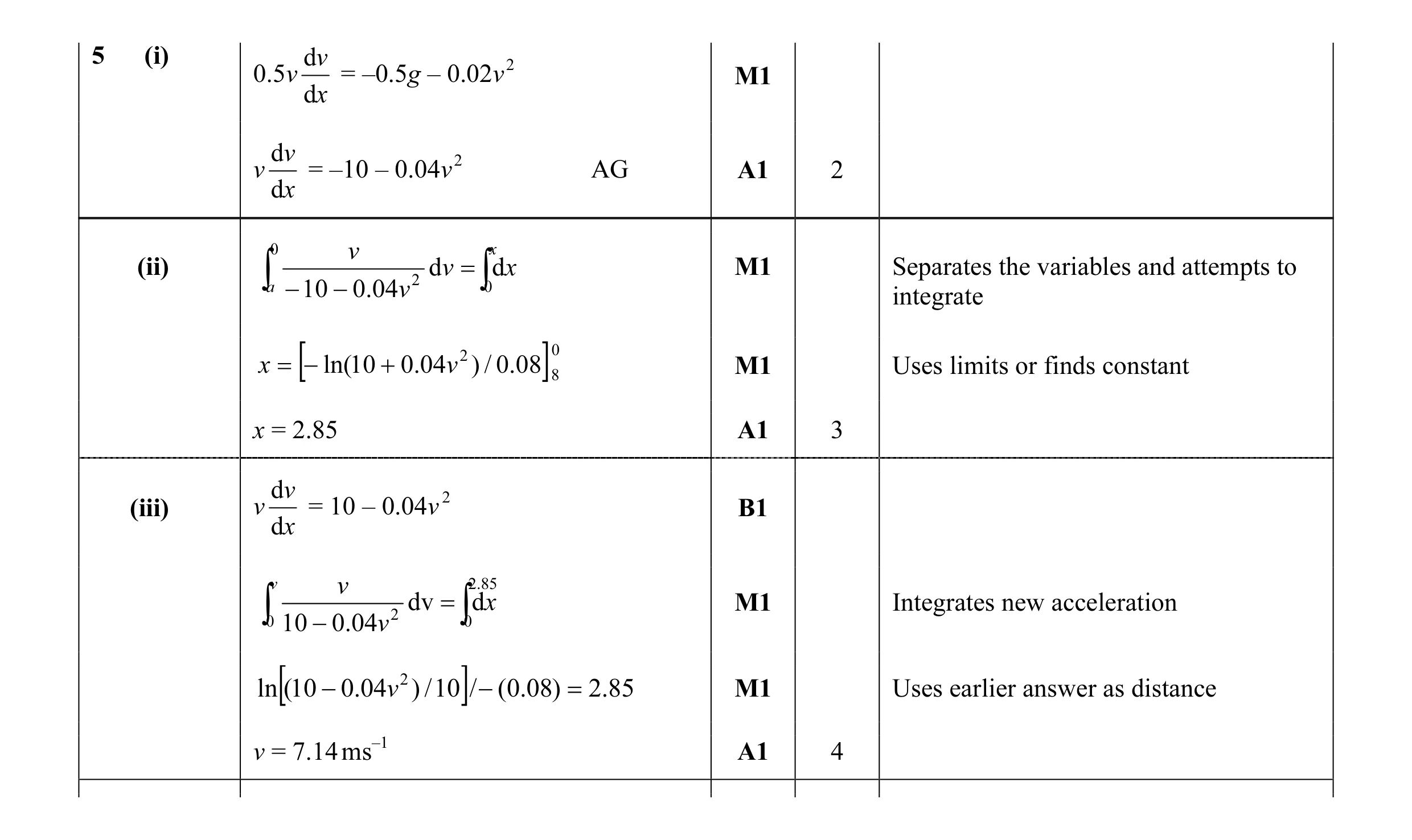 9
9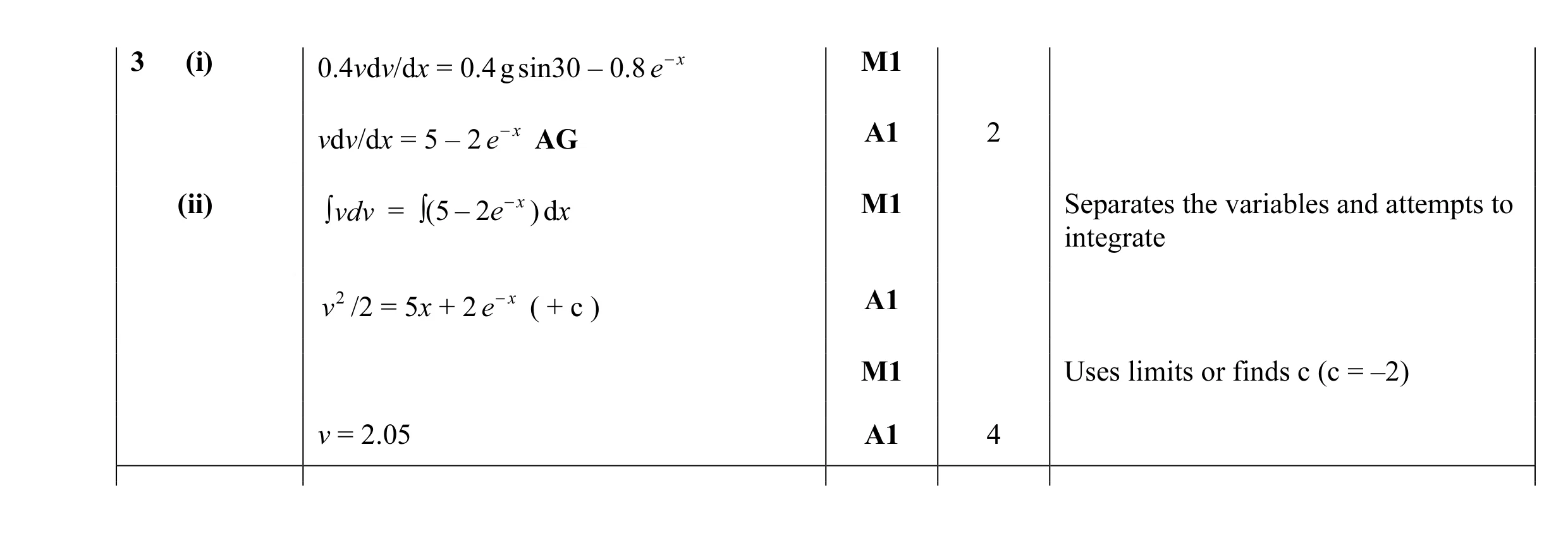 6
6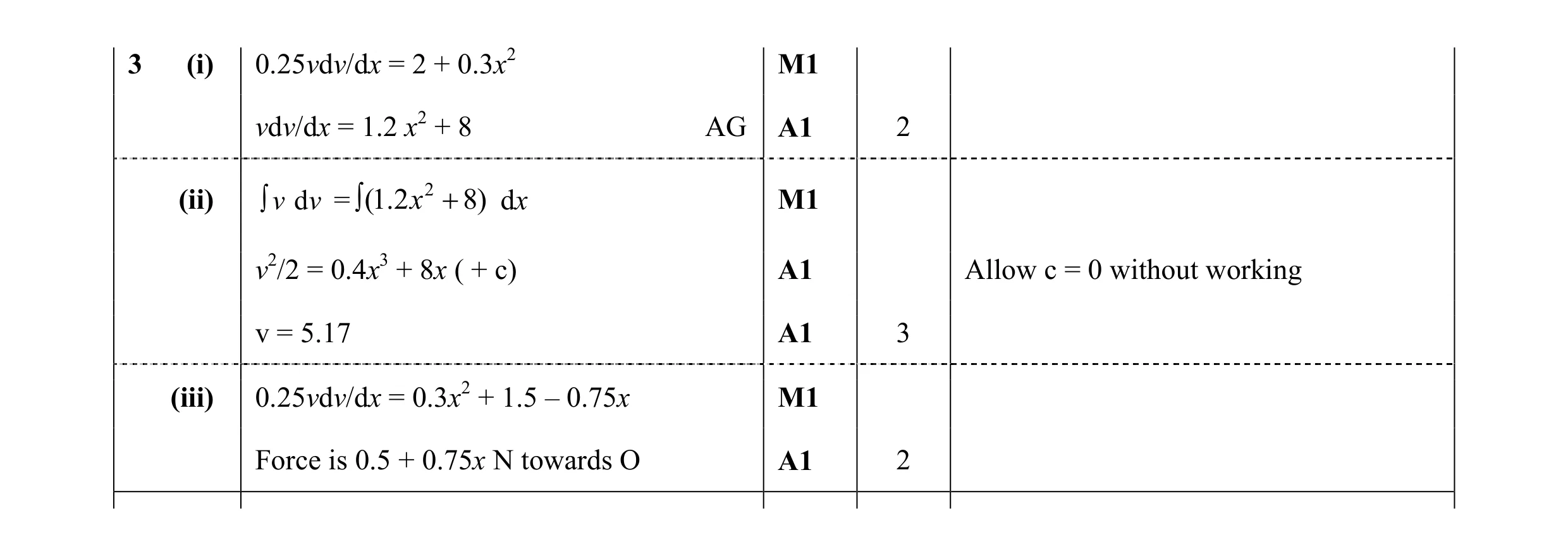 7
7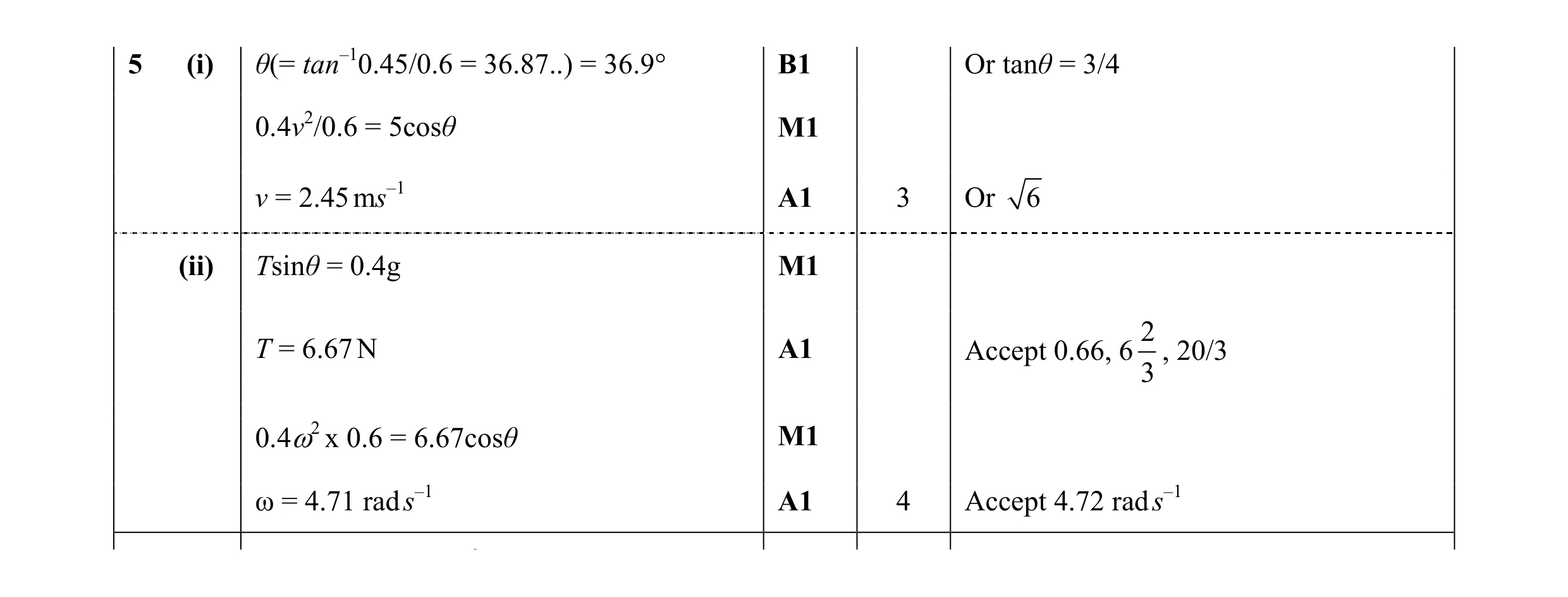 7
7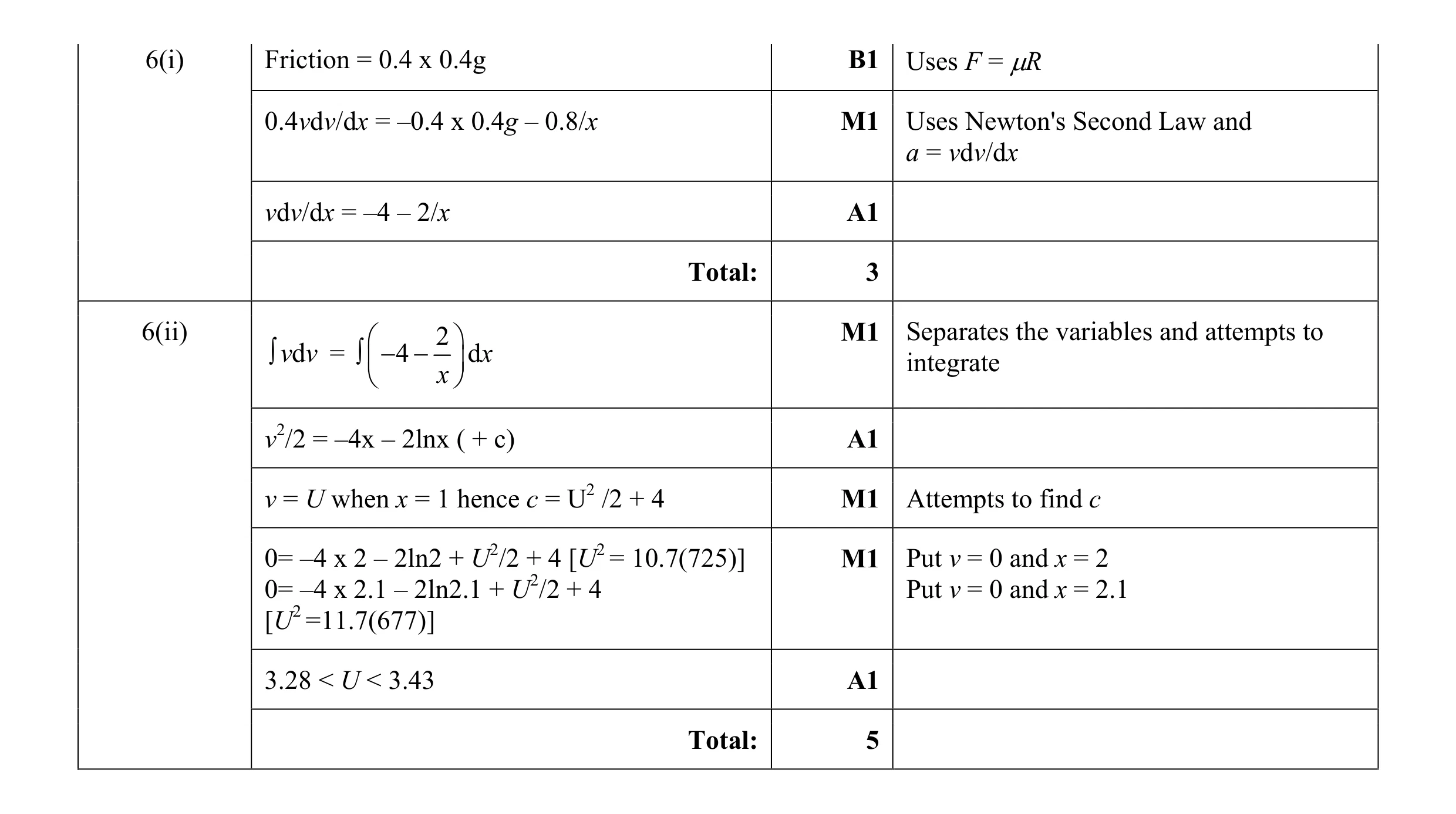 8
8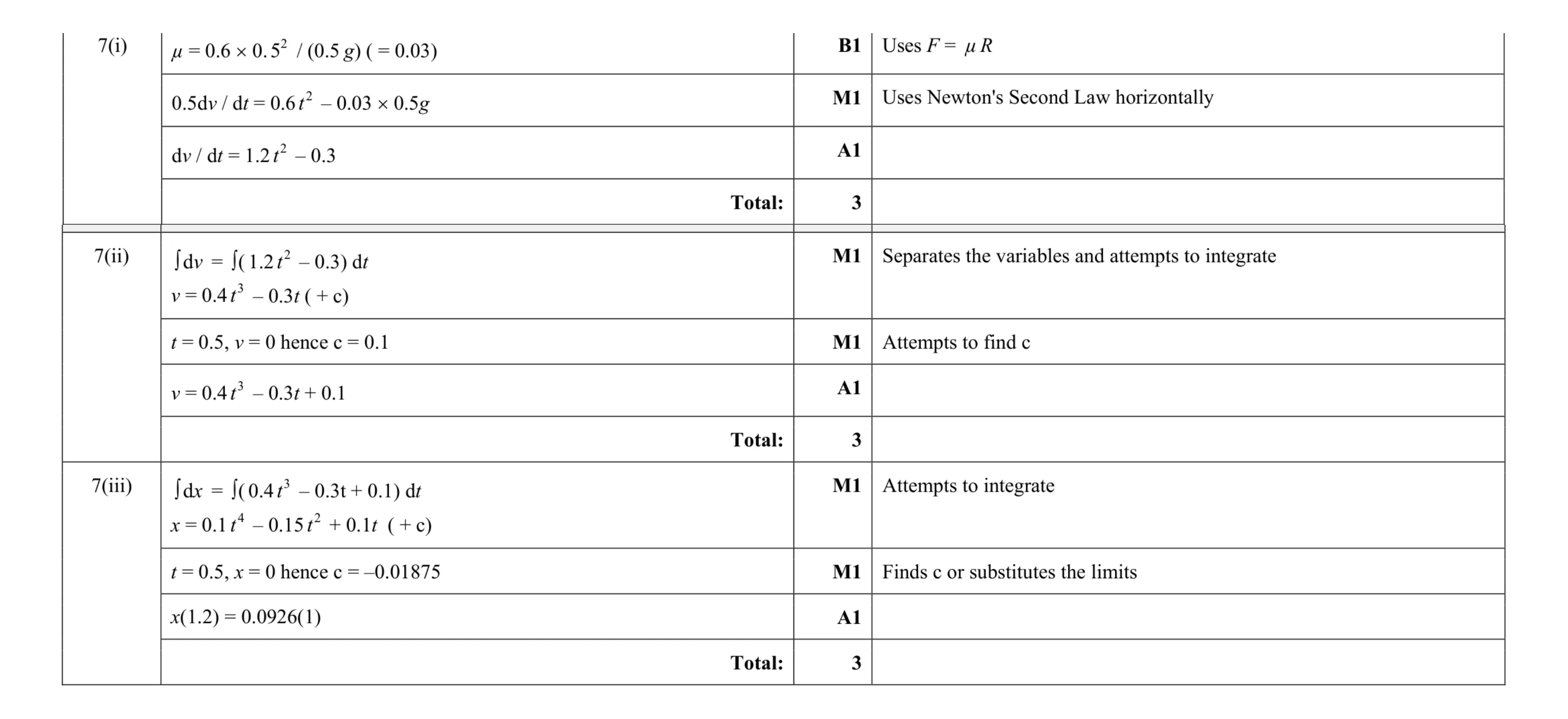 9
9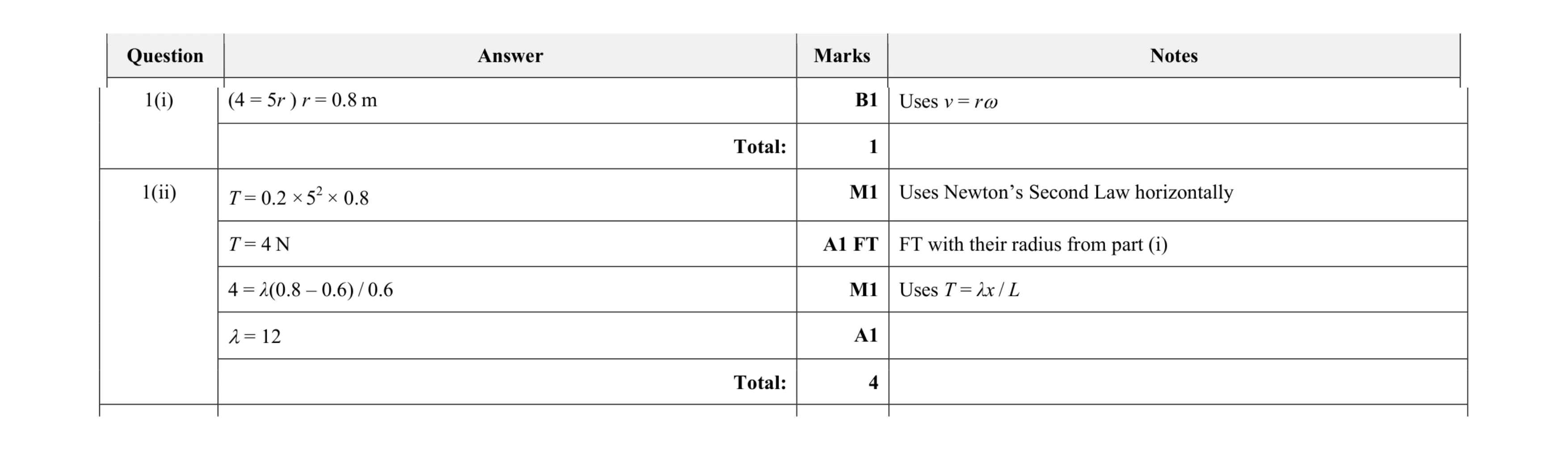 5
5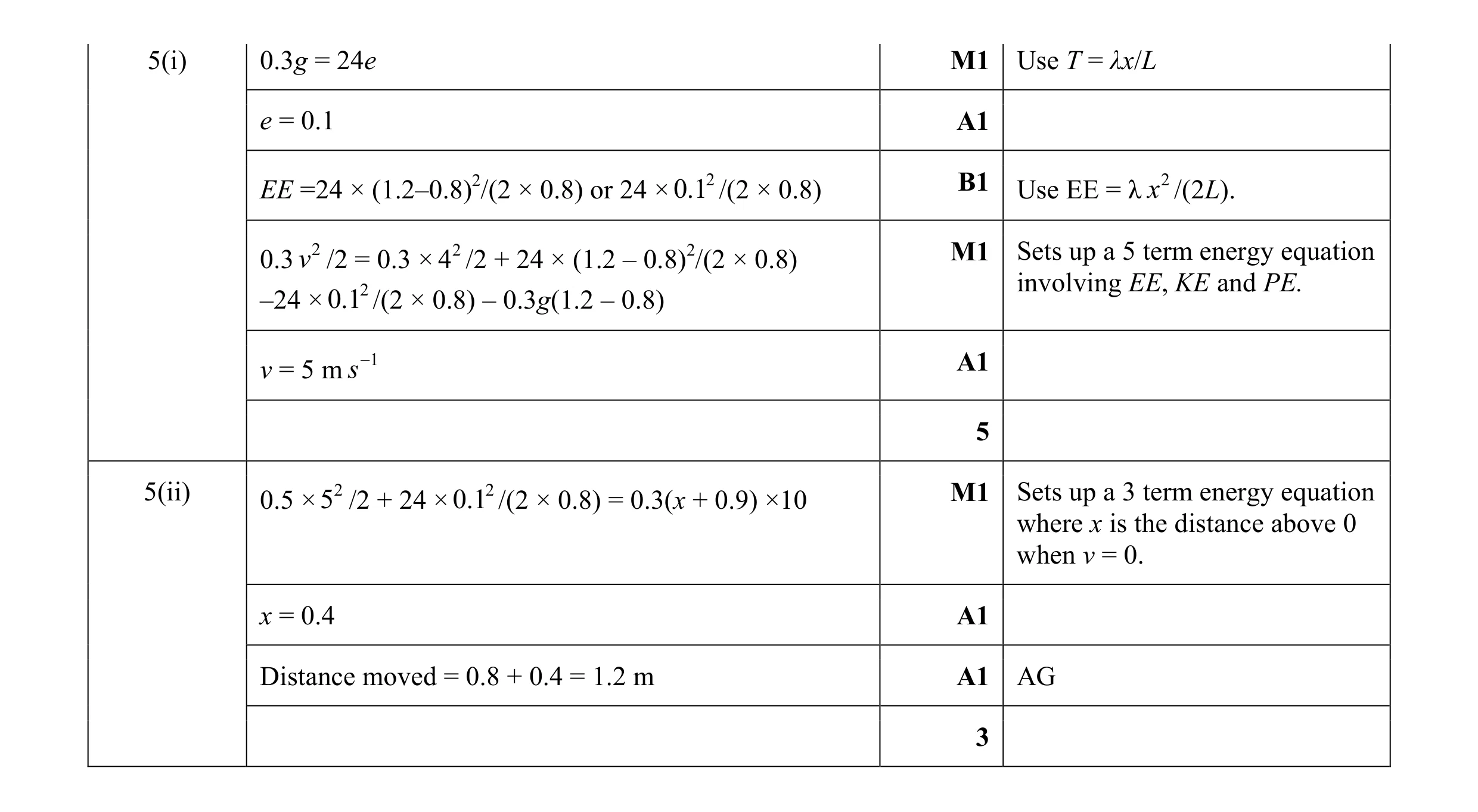 8
8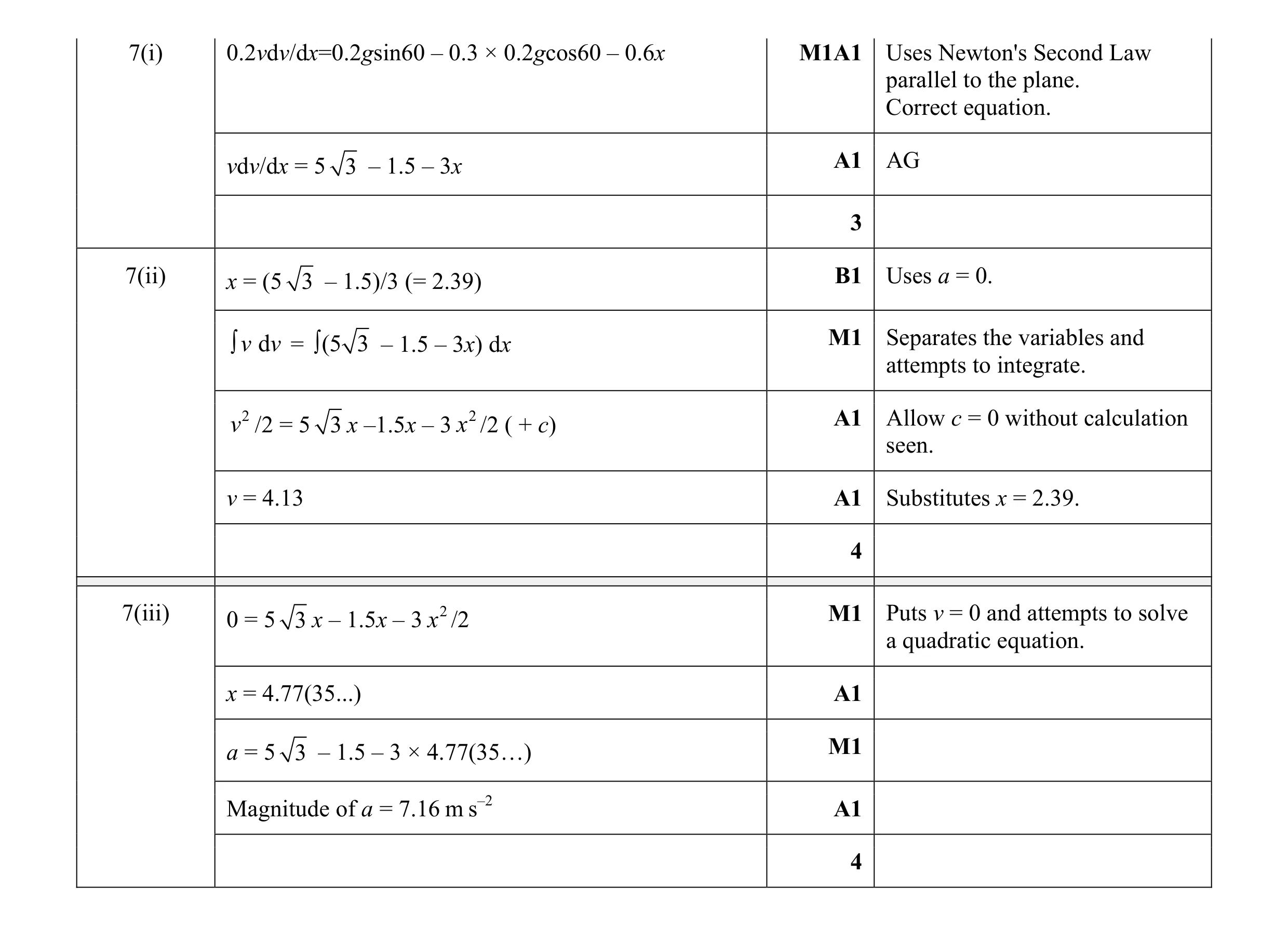 11
11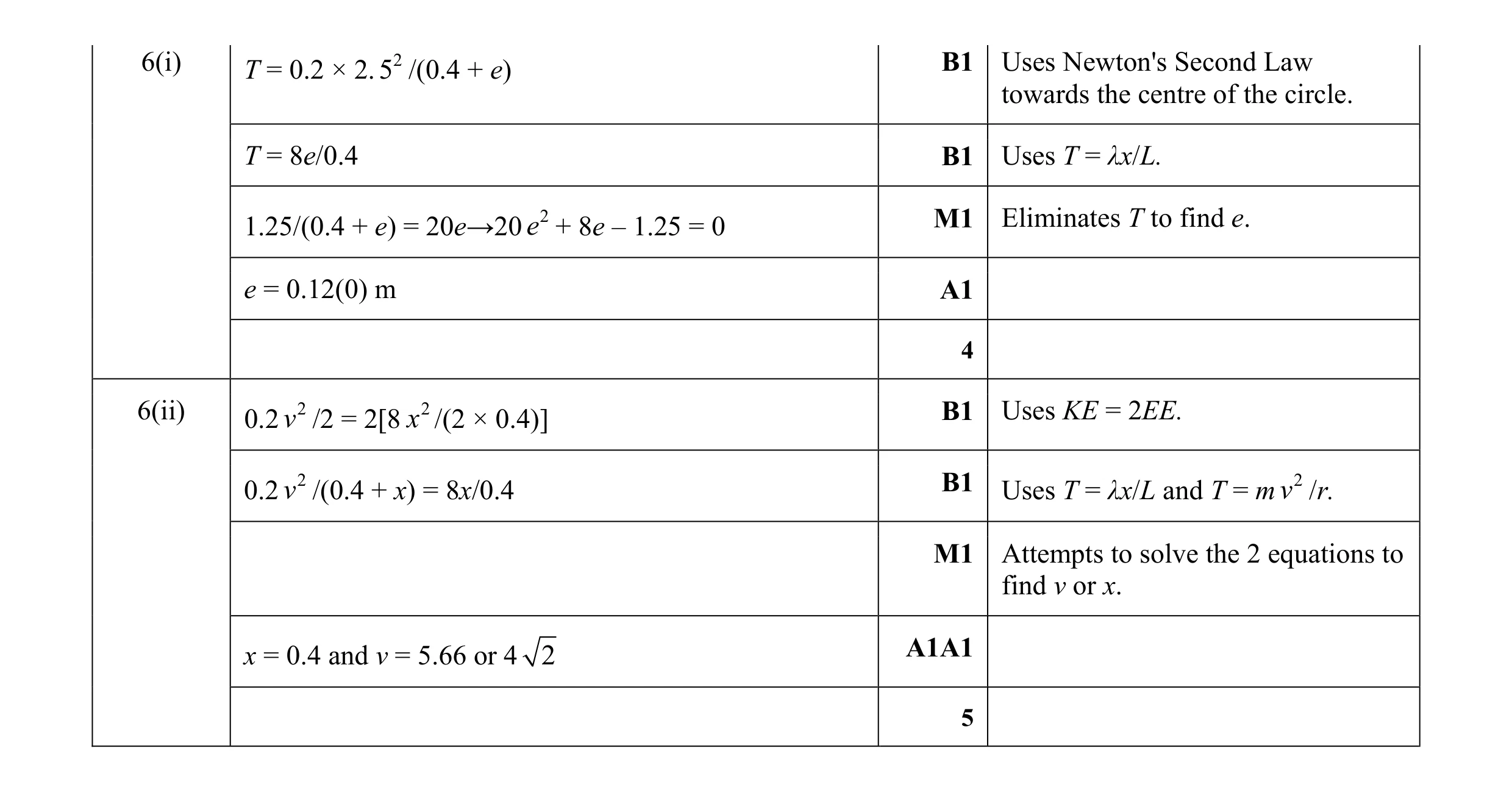 9
9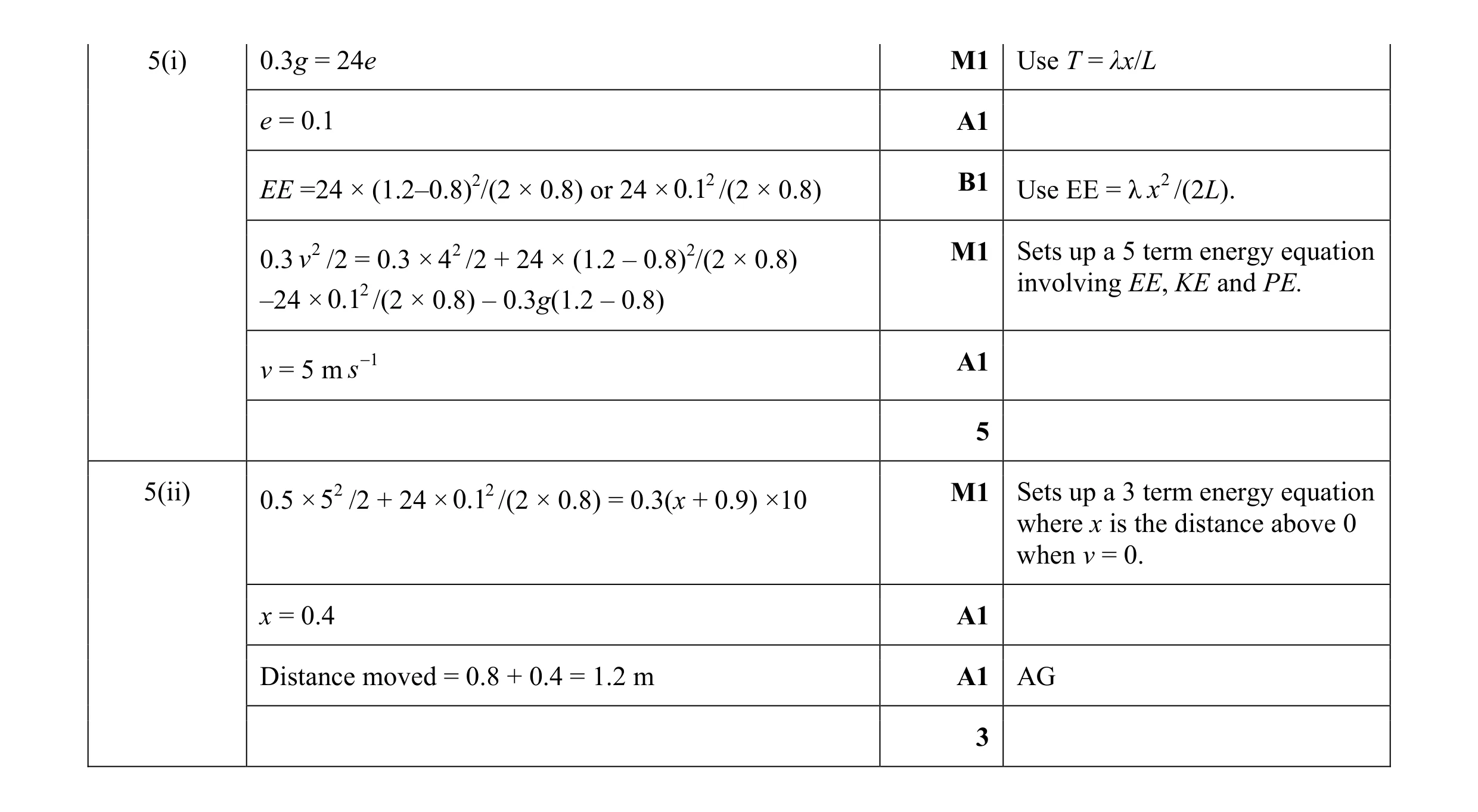 8
8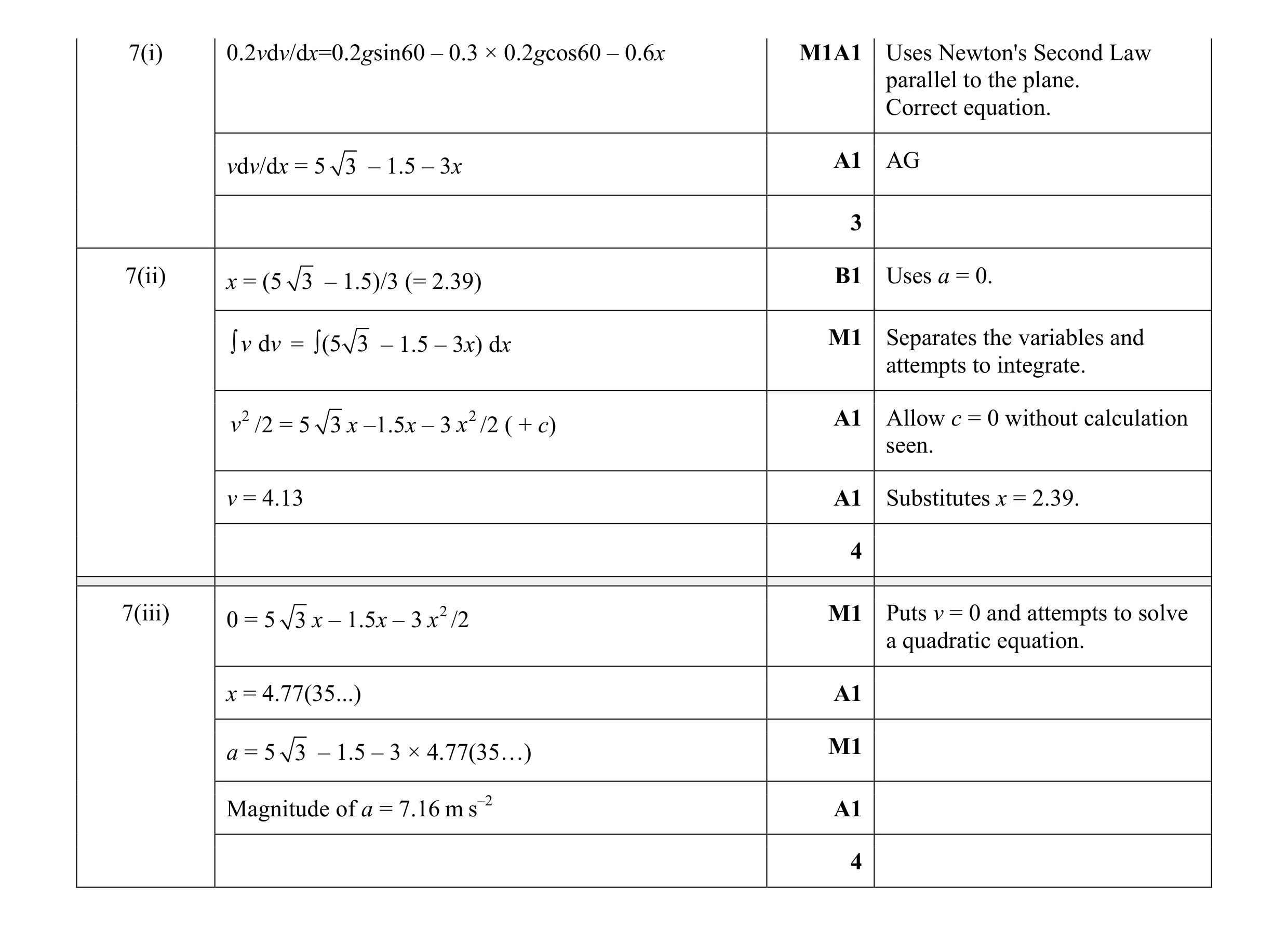 11
11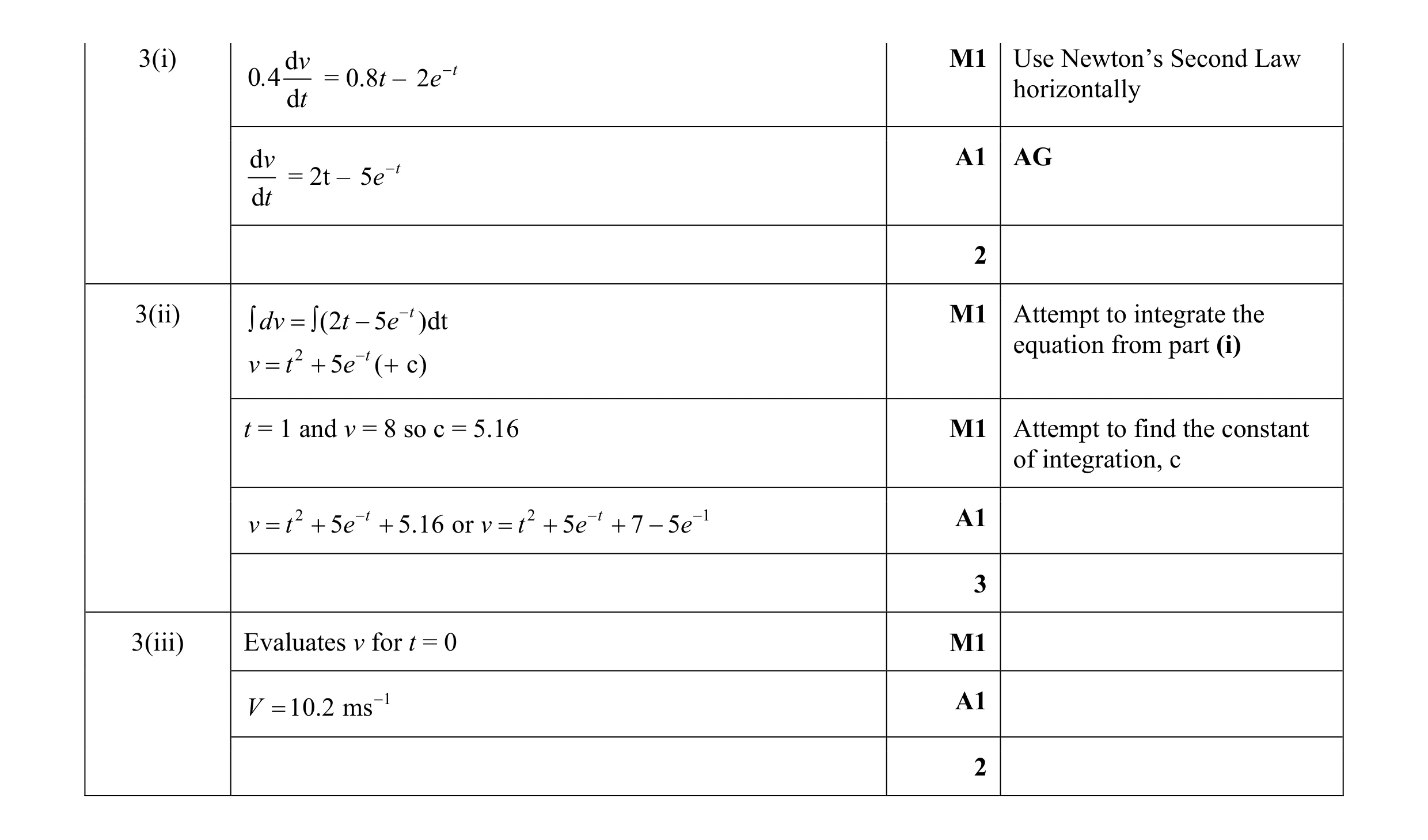 7
7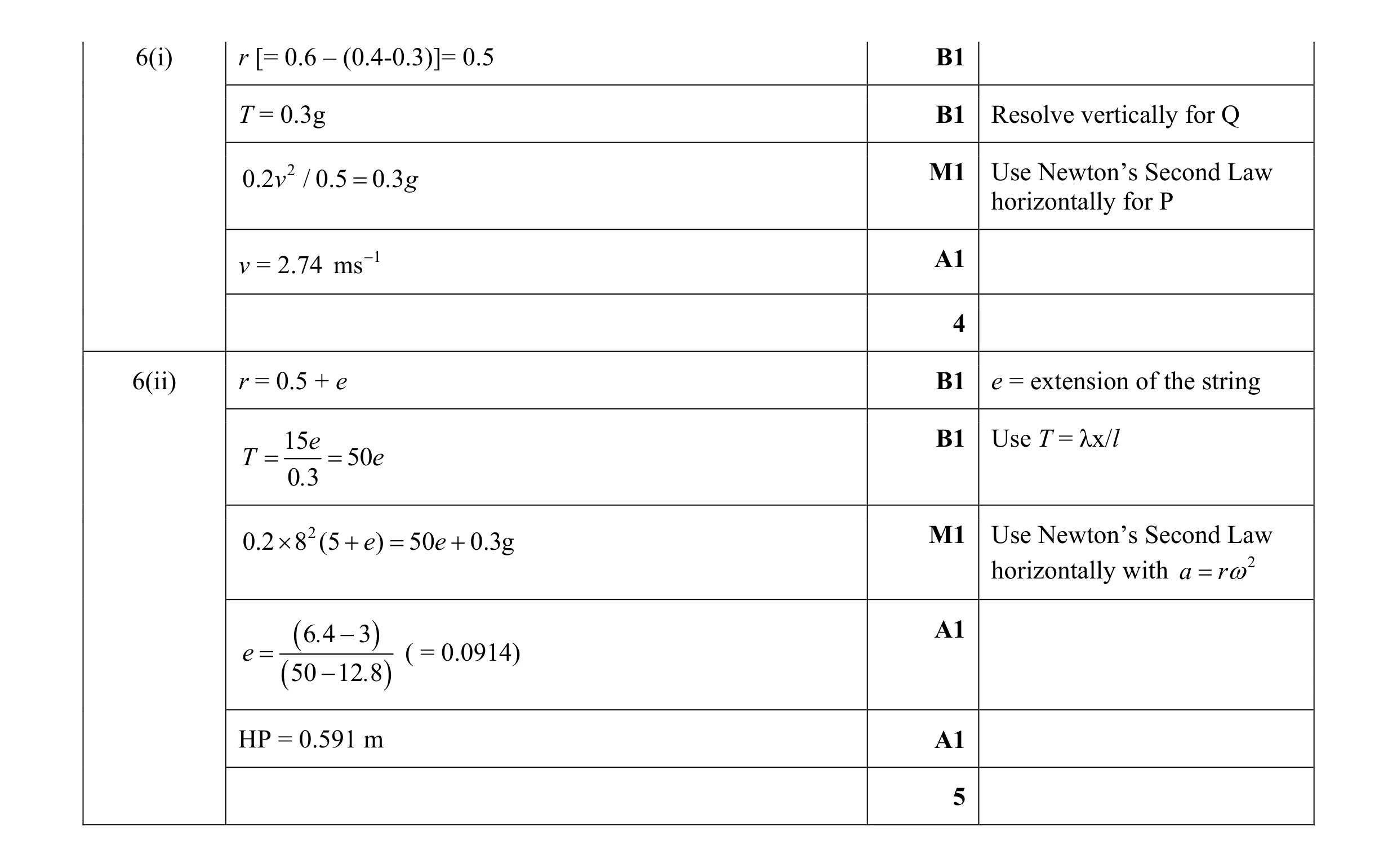 9
9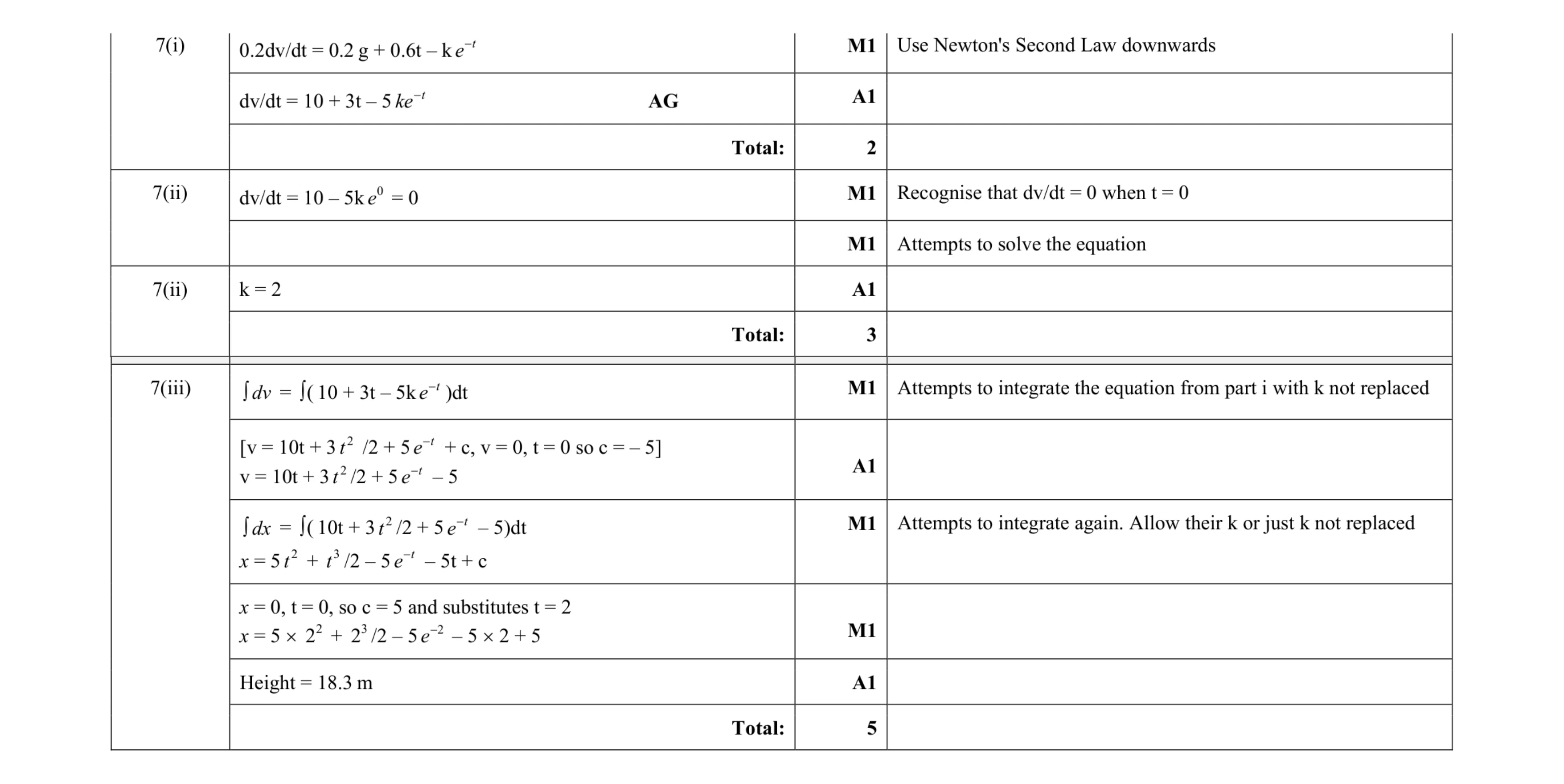 10
10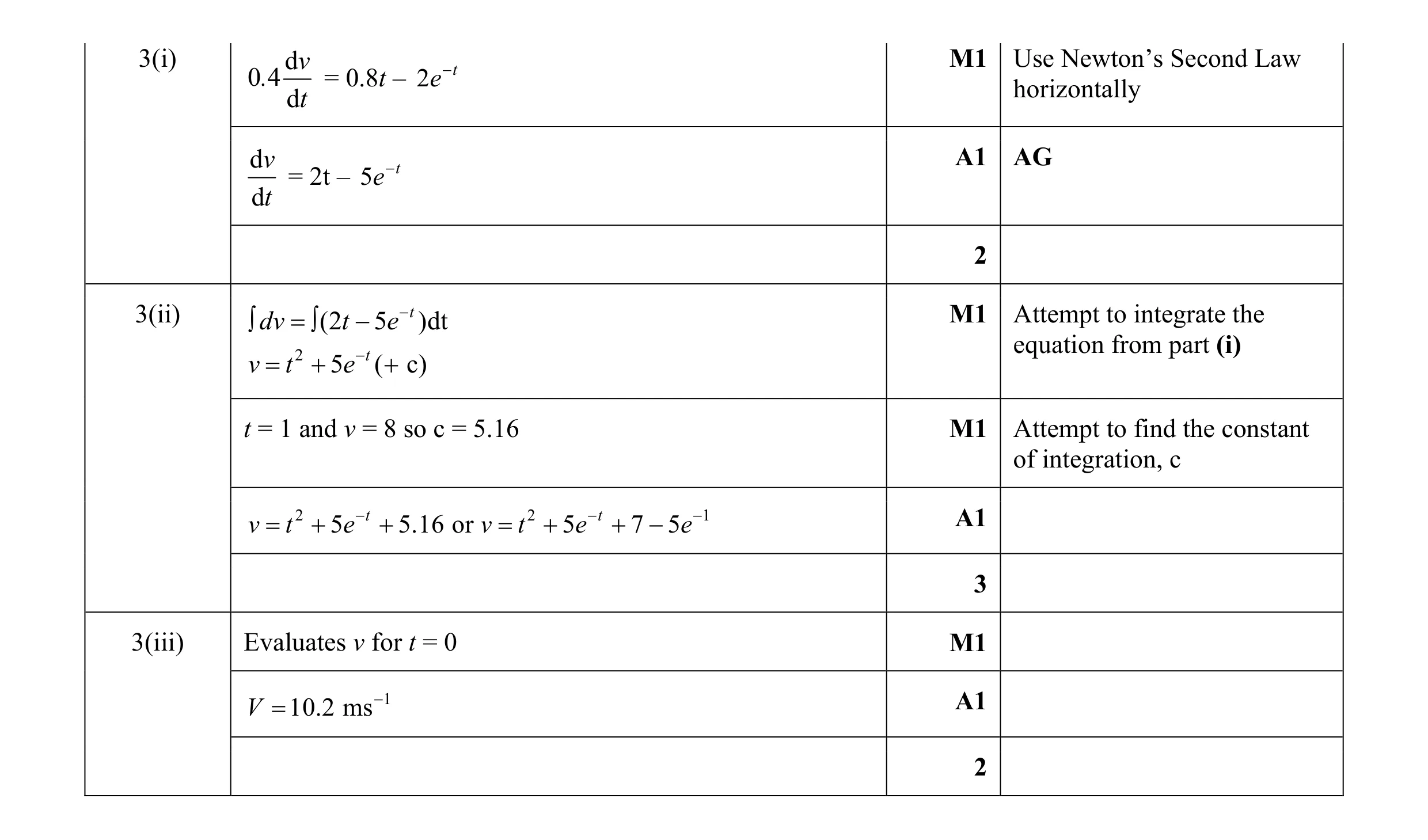 7
7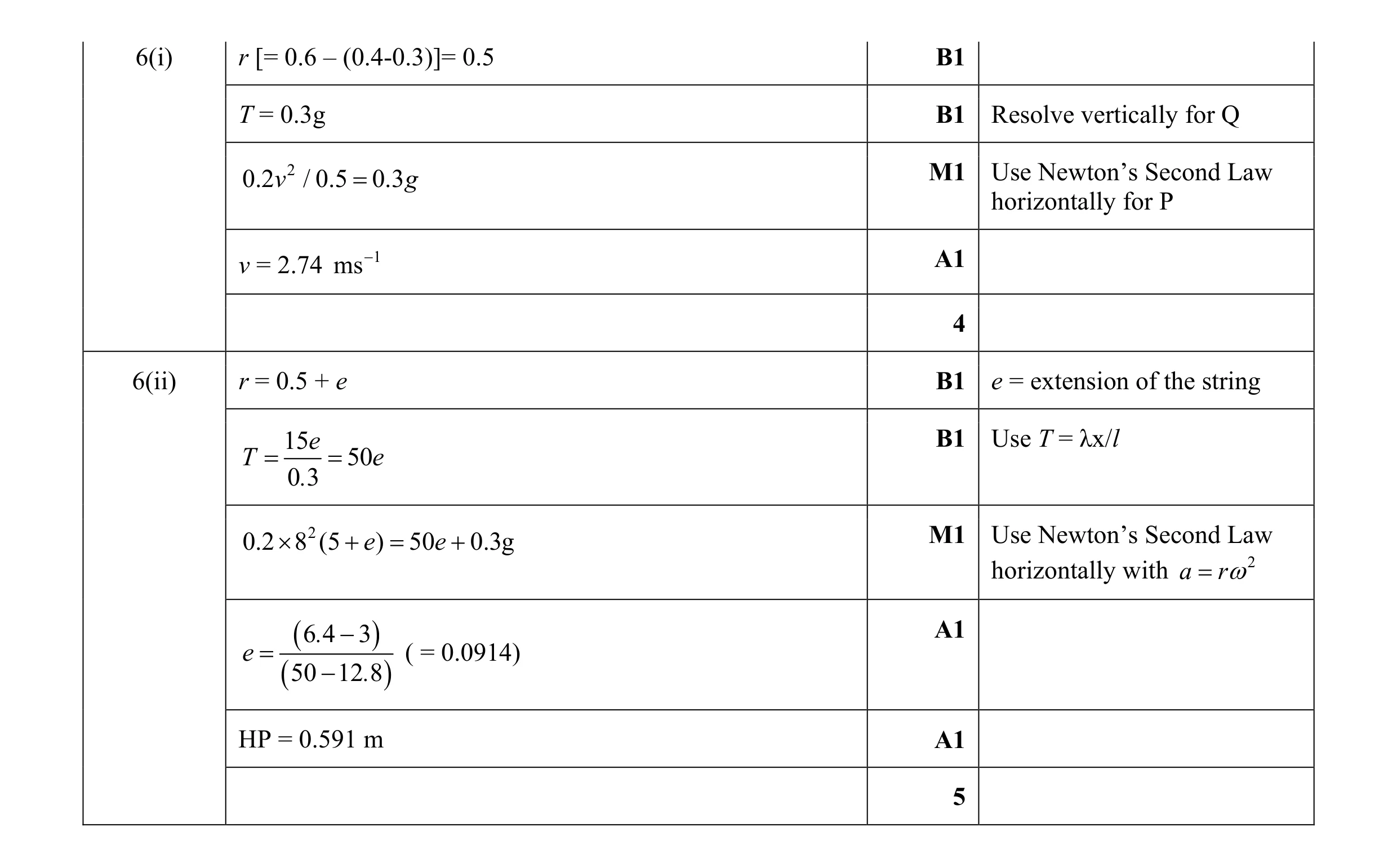 9
9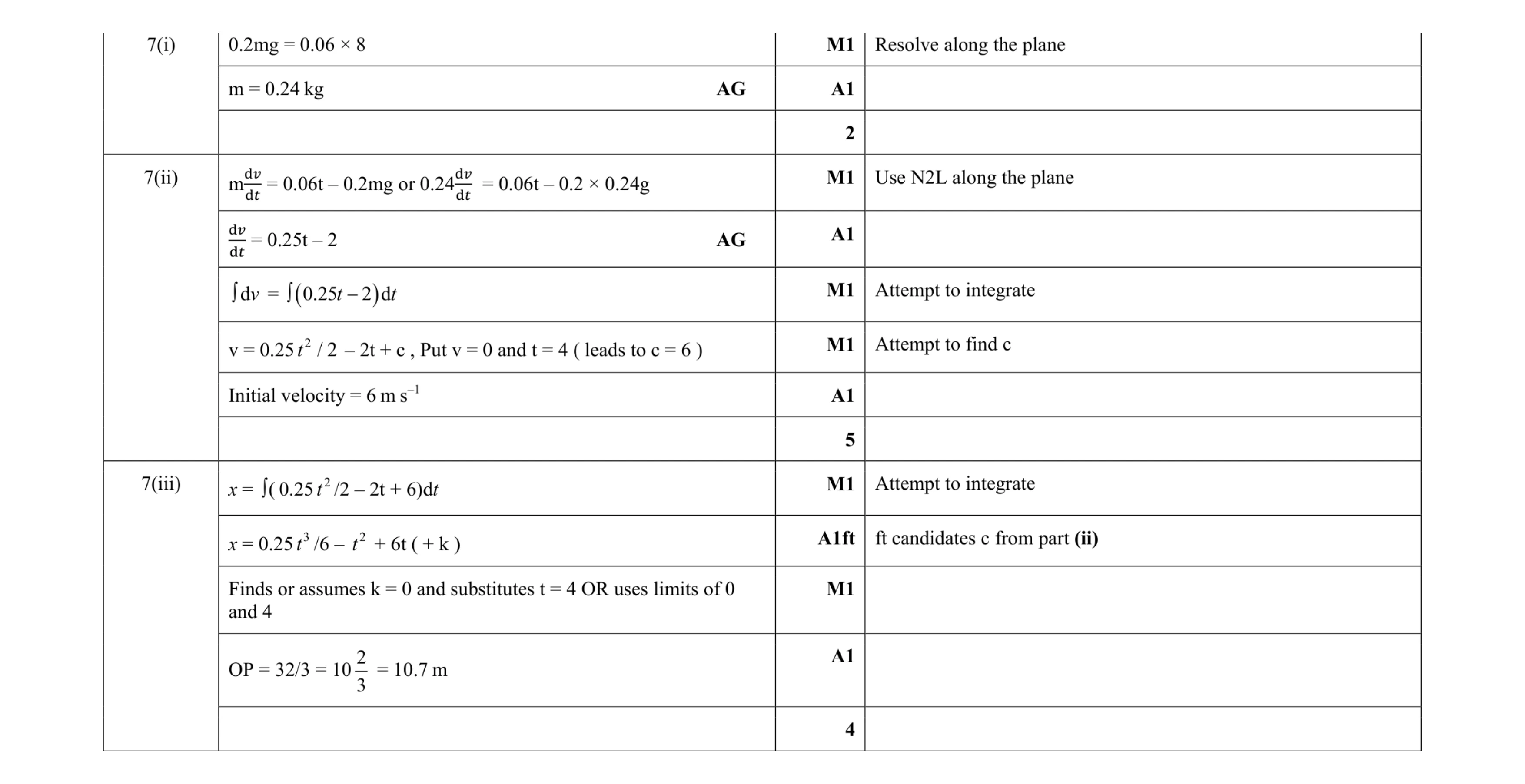 11
11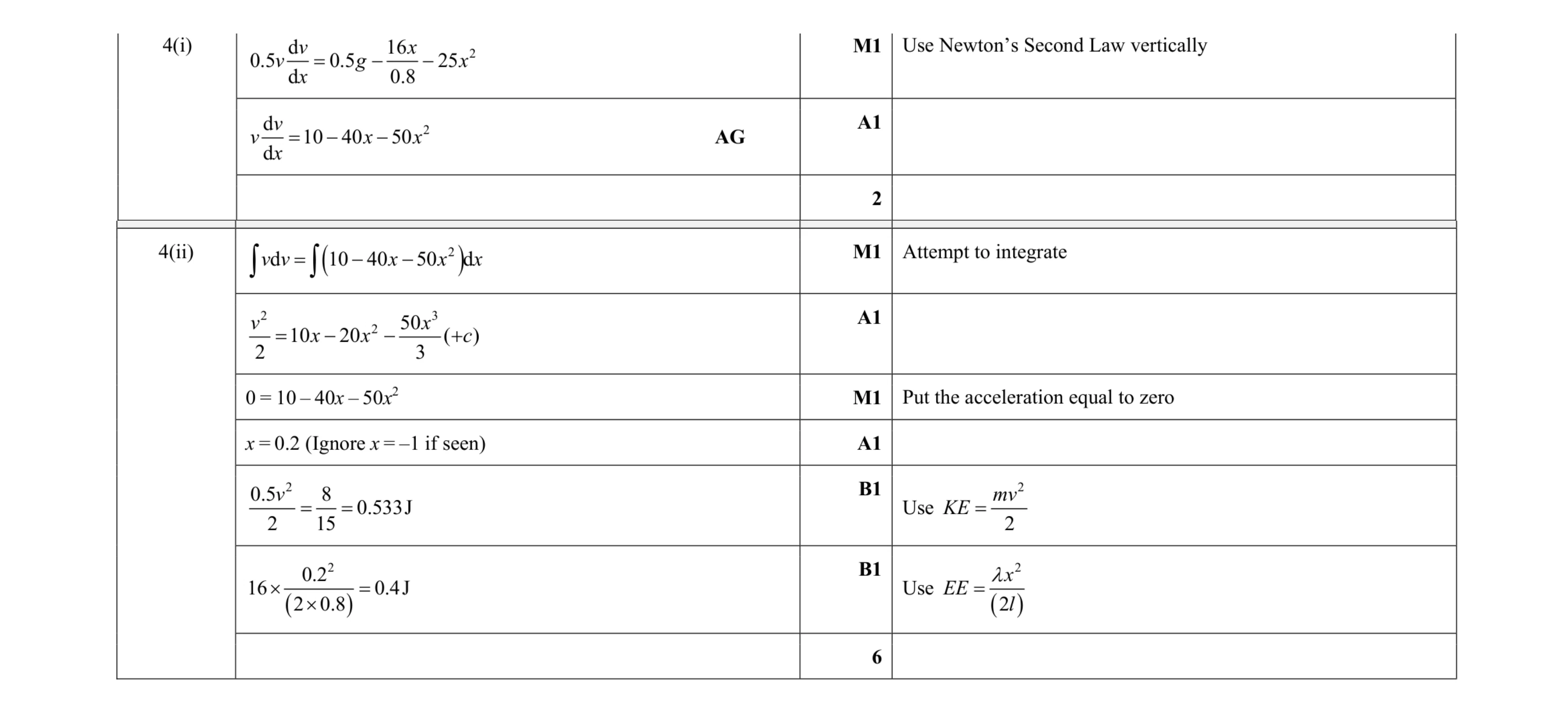 8
8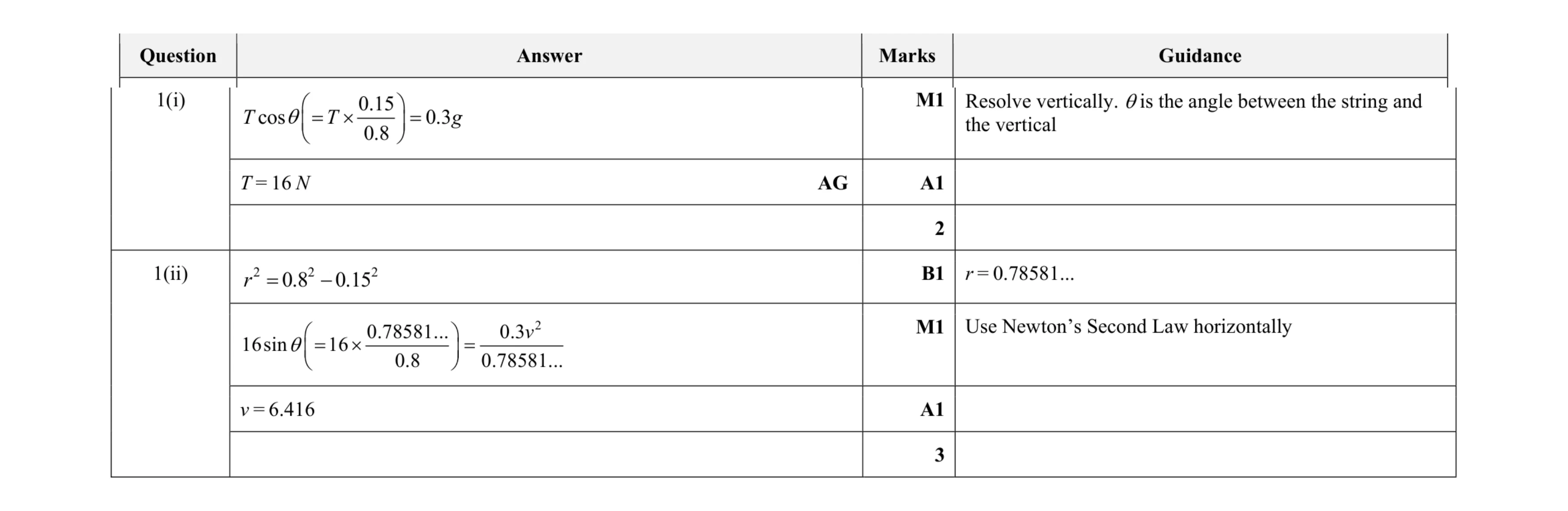 5
5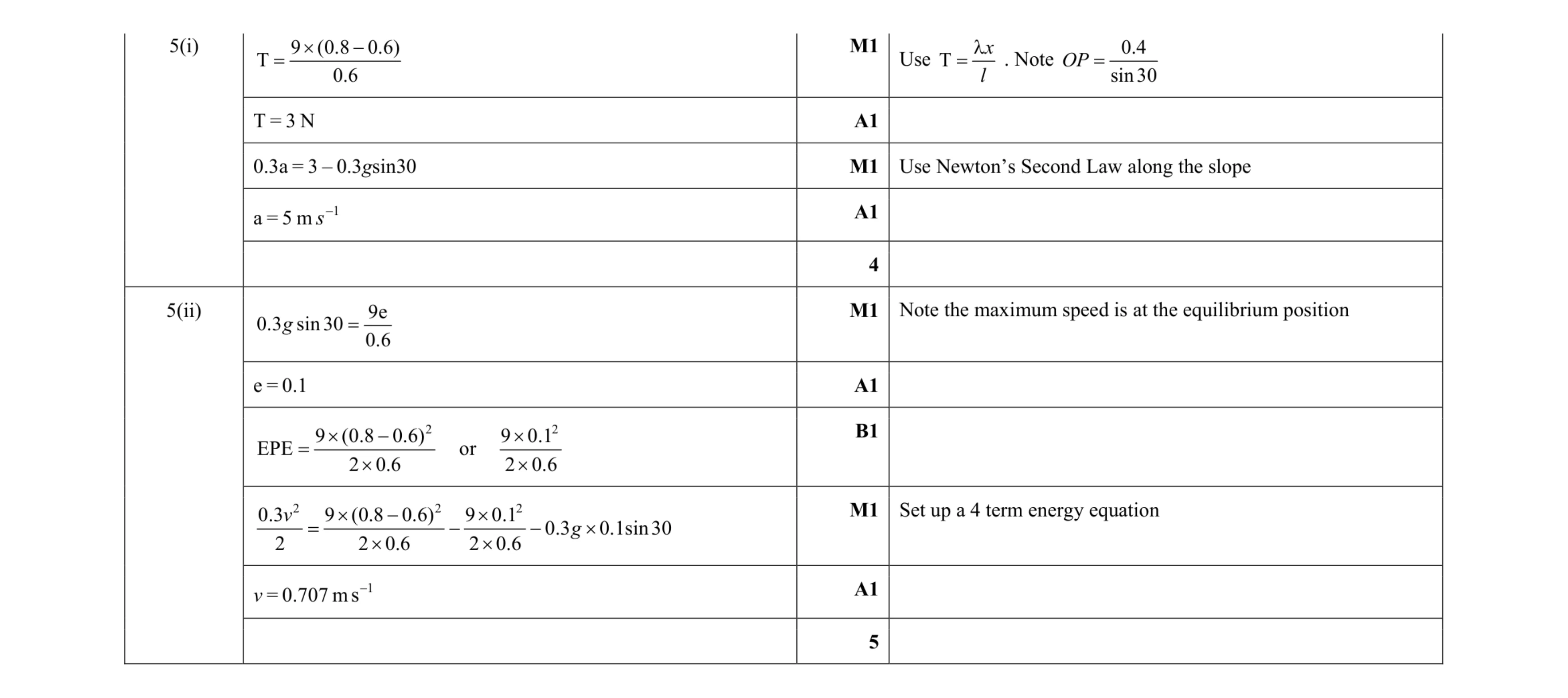 9
9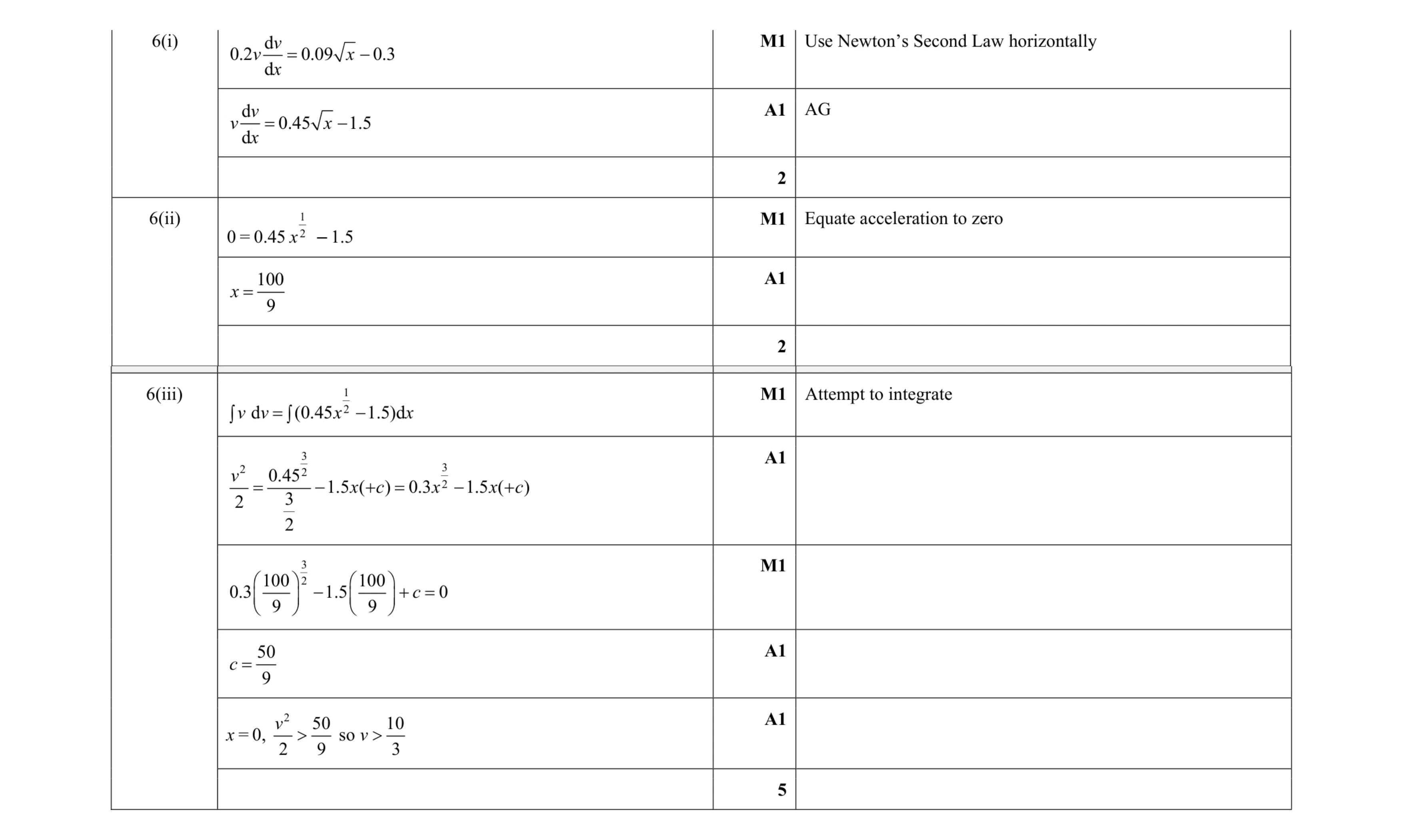 9
9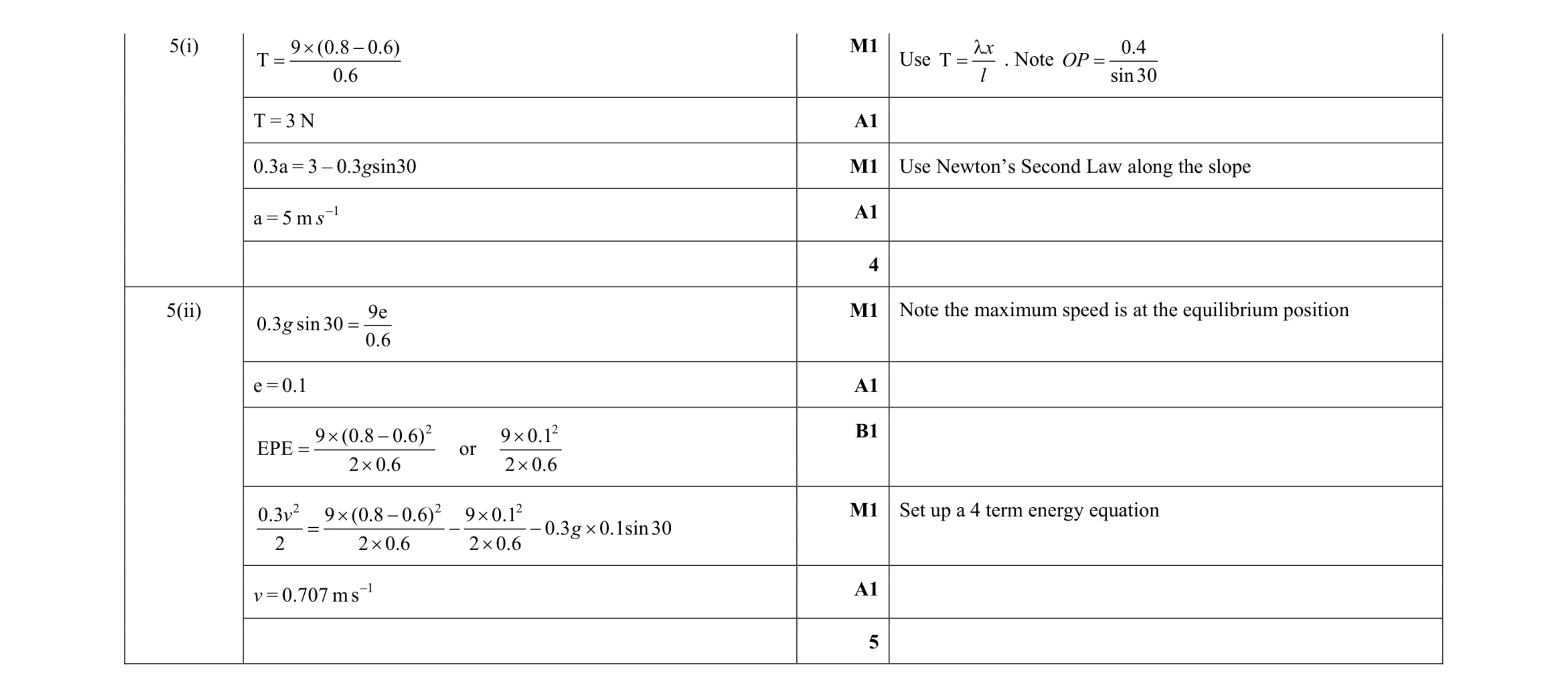 9
9