Cambridge A Level Mathematics 9709 — 2013 Oct/Nov Paper 4 · Variant 2
9709/42/O/N/13 · 2 questions · 50 marks · ≈56 min
The question paper and its mark scheme, free to read here and free to download. This is Cambridge’s own paper, exactly as it was sat.
Question paper4 pages
Mark scheme9 pages
Answers below. Sit the paper first if you are practising.
Questions as text
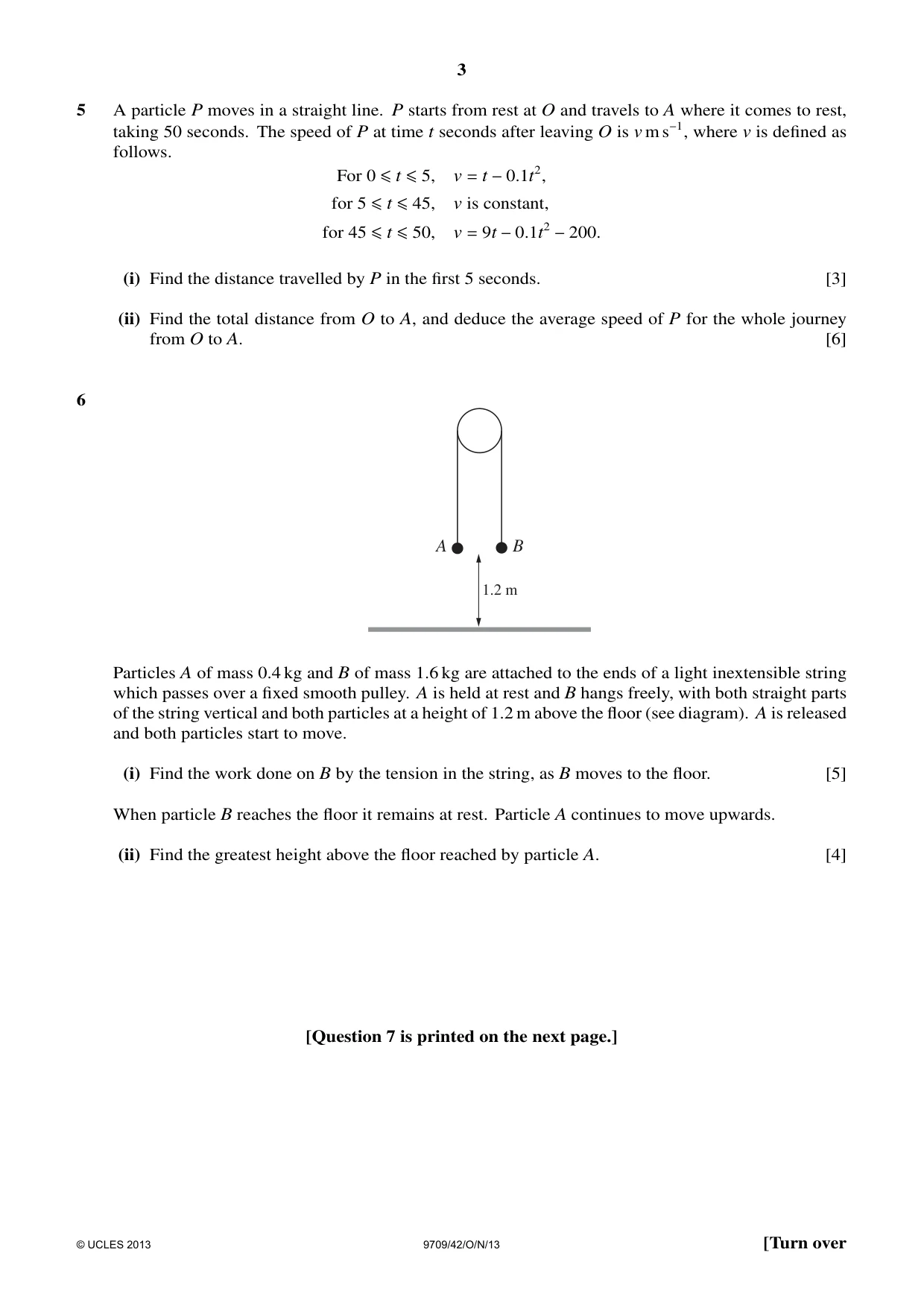
Q6 · A B 1.2 m Particles A of mass 0.4 kg and B of mass 1.6 kg are attached to the ends of a…
6 A B 1.2 m Particles A of mass 0.4 kg and B of mass 1.6 kg are attached to the ends of a light inextensible string which passes over a fixed smooth pulley. A is held at rest and B hangs freely, with both straight parts of the string vertical and both particles at a height of 1.2 m above the floor (see diagram). A is released and both particles start to move. (i) Find the work done on B by the tension in the string, as B moves to the floor. [5] When particle B reaches the floor it remains at rest. Particle A continues to move upwards. (ii) Find the greatest height above the floor reached by particle A. [4] [Question 7 is printed on the next page.]
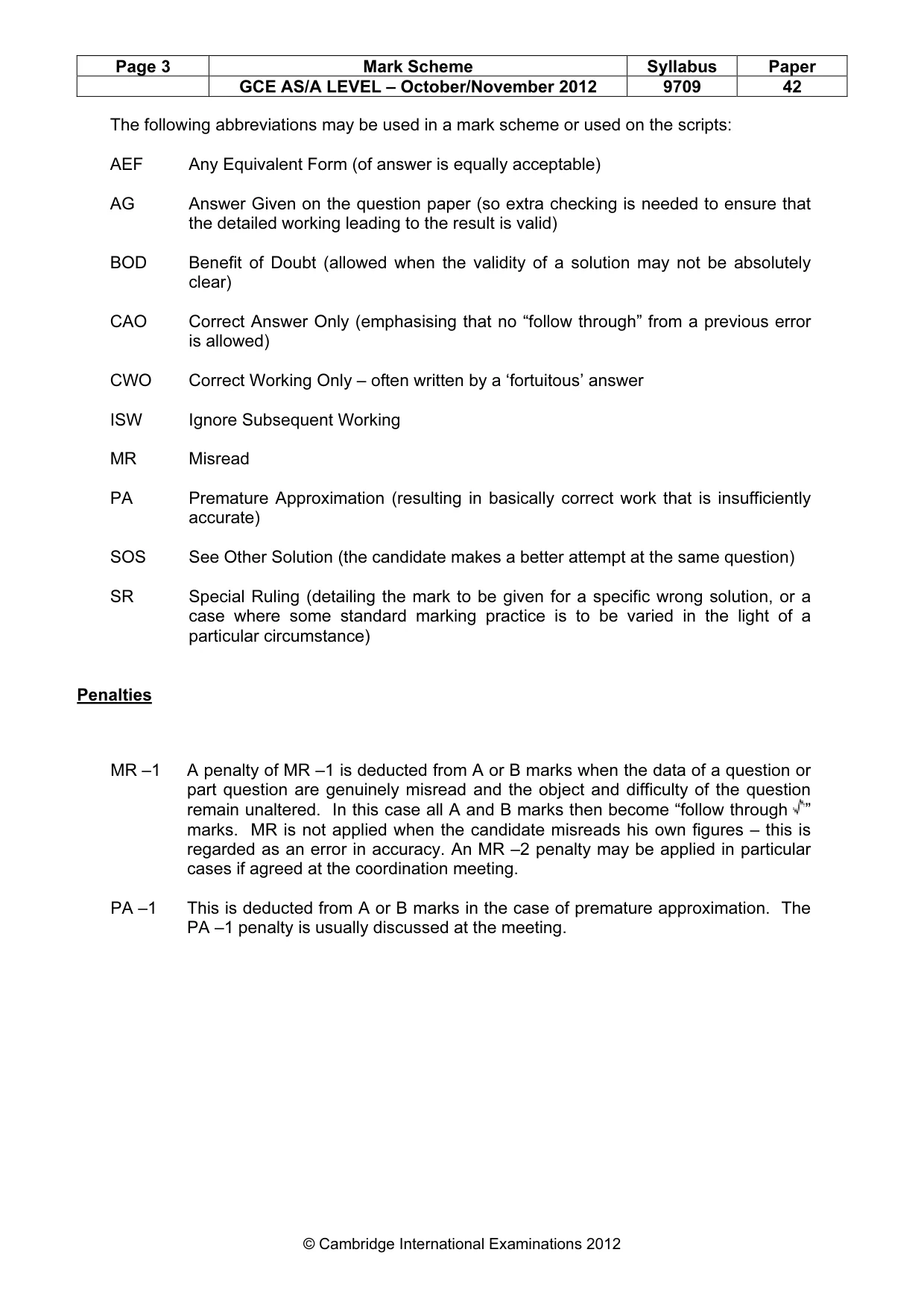
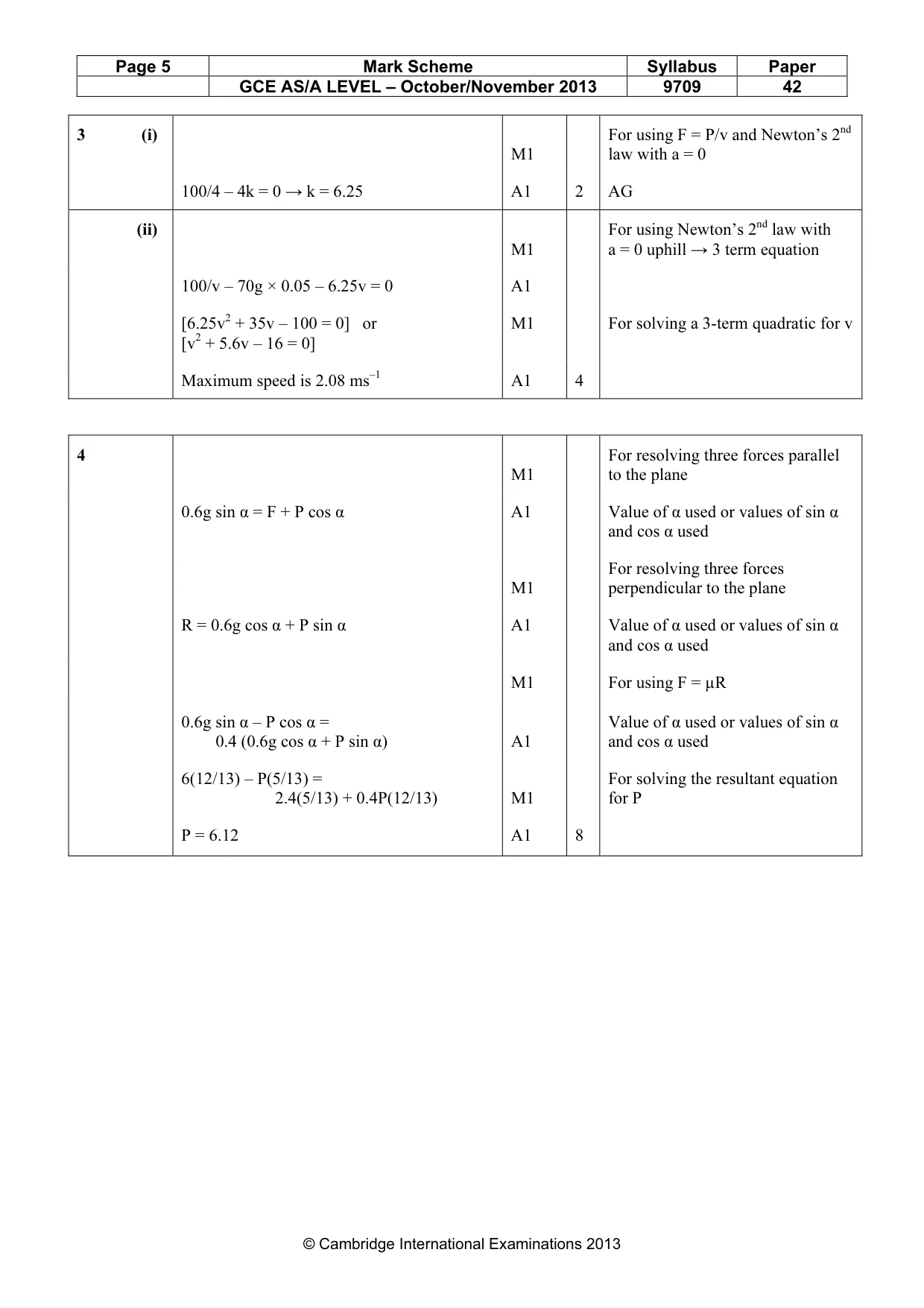
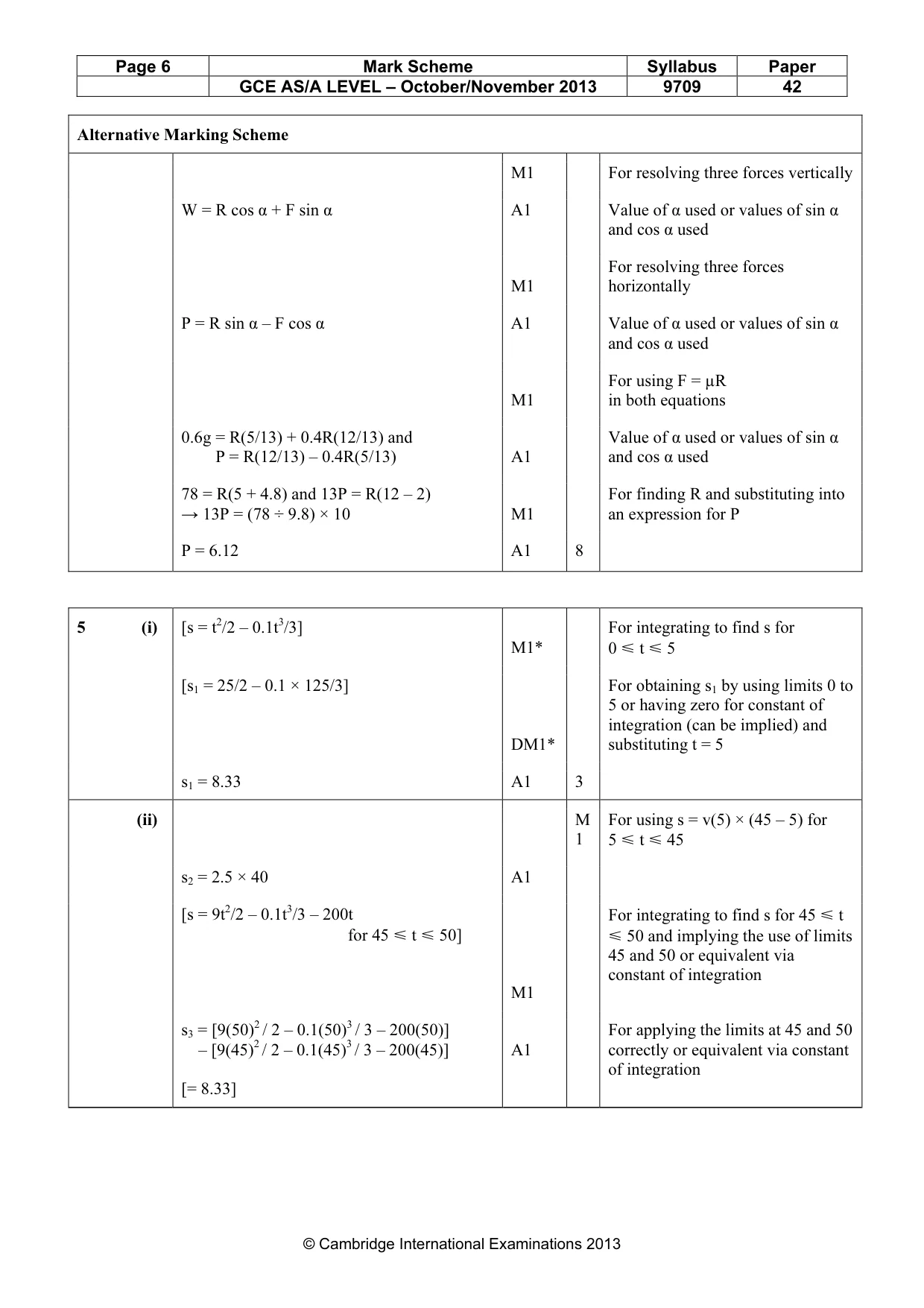
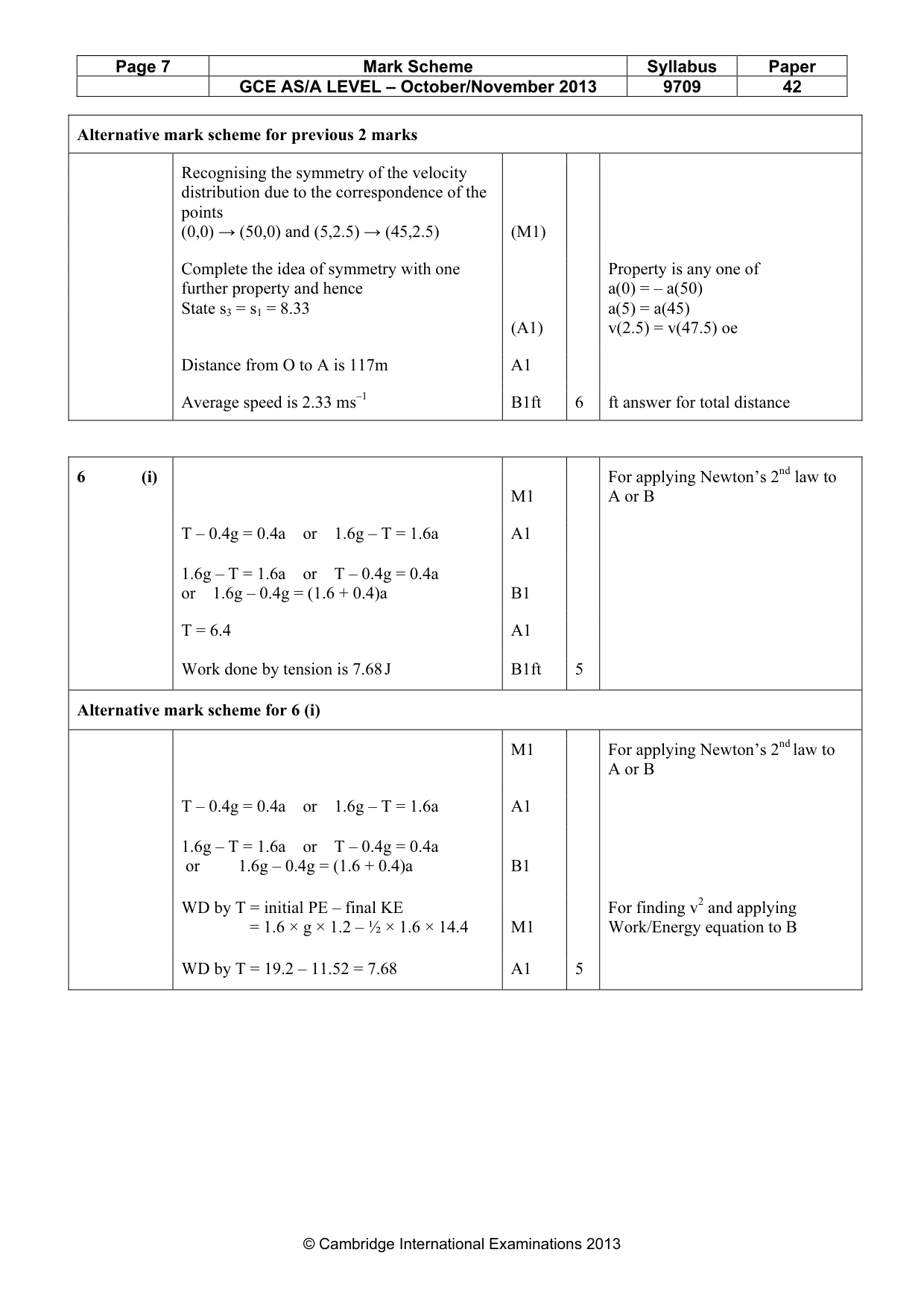
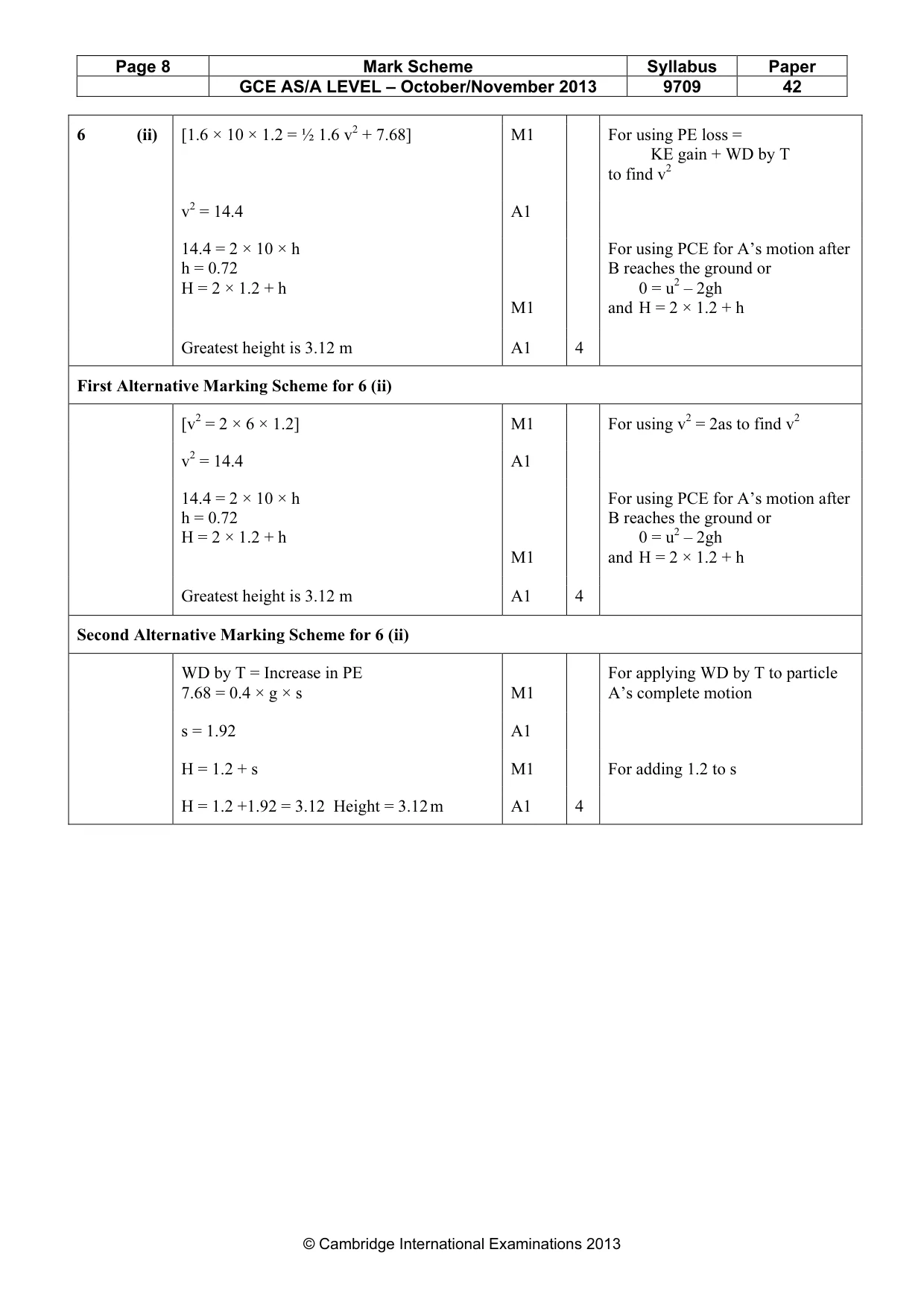
Mark scheme: 6 (ii) [1.6 × 10 × 1.2 = ½ 1.6 v2 + 7.68] M1 For using PE loss = KE gain + WD by T to find v2 v2 = 14.4 A1 14.4 = 2 × 10 × h For using PCE for A’s motion after h = 0.72 B reaches the ground or H = 2 × 1.2 + h 0 = u2 – 2gh M1 and H = 2 × 1.2 + h Greatest height is 3.12 m A1 4 First Alternative Marking Scheme for 6 (ii) [v2 = 2 × 6 × 1.2] M1 For using v2 = 2as to find v2 v2 = 14.4 A1 14.4 = 2 × 10 × h For using PCE for A’s motion after h = 0.72 B reaches the ground or H = 2 × 1.2 + h 0 = u2 – 2gh M1 and H = 2 × 1.2 + h Greatest height is 3.12 m A1 4 Second Alternative Marking Scheme for 6 (ii) WD by T = Increase in PE For applying WD by T to particle 7.68 = 0.4 × g × s M1 A’s complete motion s = 1.92 A1 H = 1.2 + s M1 For adding 1.2 to s H = 1.2 +1.92 = 3.12 Height = 3.12 m A1 4 GCE AS/A LEVEL – October/November 2013 9709 42
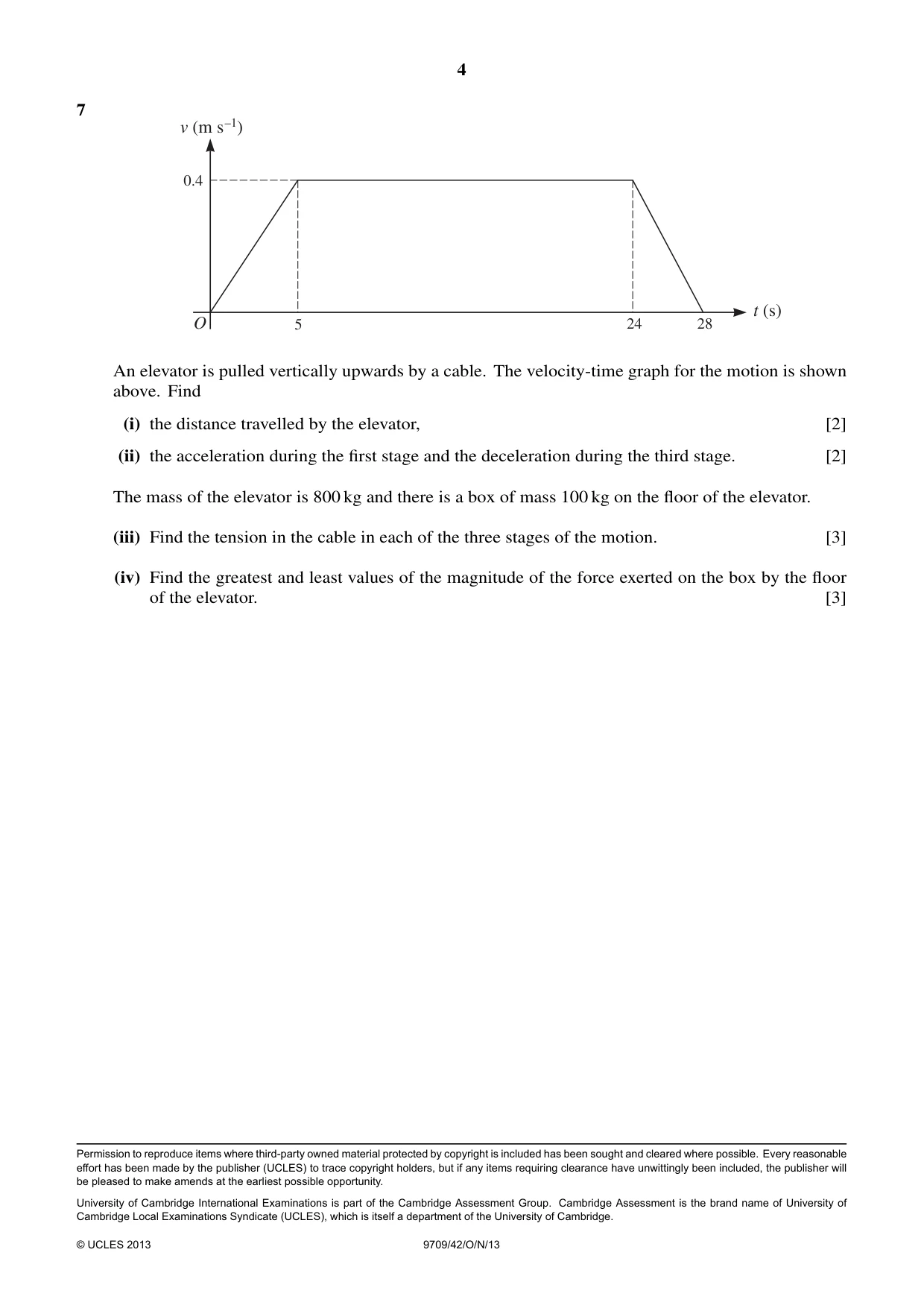
Q7 · V (m s –1) 0.4 t (s) O 5 24 28 An elevator is pulled vertically upwards by a cable
7 v (m s –1) 0.4 t (s) O 5 24 28 An elevator is pulled vertically upwards by a cable. The velocity-time graph for the motion is shown above. Find (i) the distance travelled by the elevator, [2] (ii) the acceleration during the first stage and the deceleration during the third stage. [2] The mass of the elevator is 800 kg and there is a box of mass 100 kg on the floor of the elevator. (iii) Find the tension in the cable in each of the three stages of the motion. [3] (iv) Find the greatest and least values of the magnitude of the force exerted on the box by the floor of the elevator. [3]
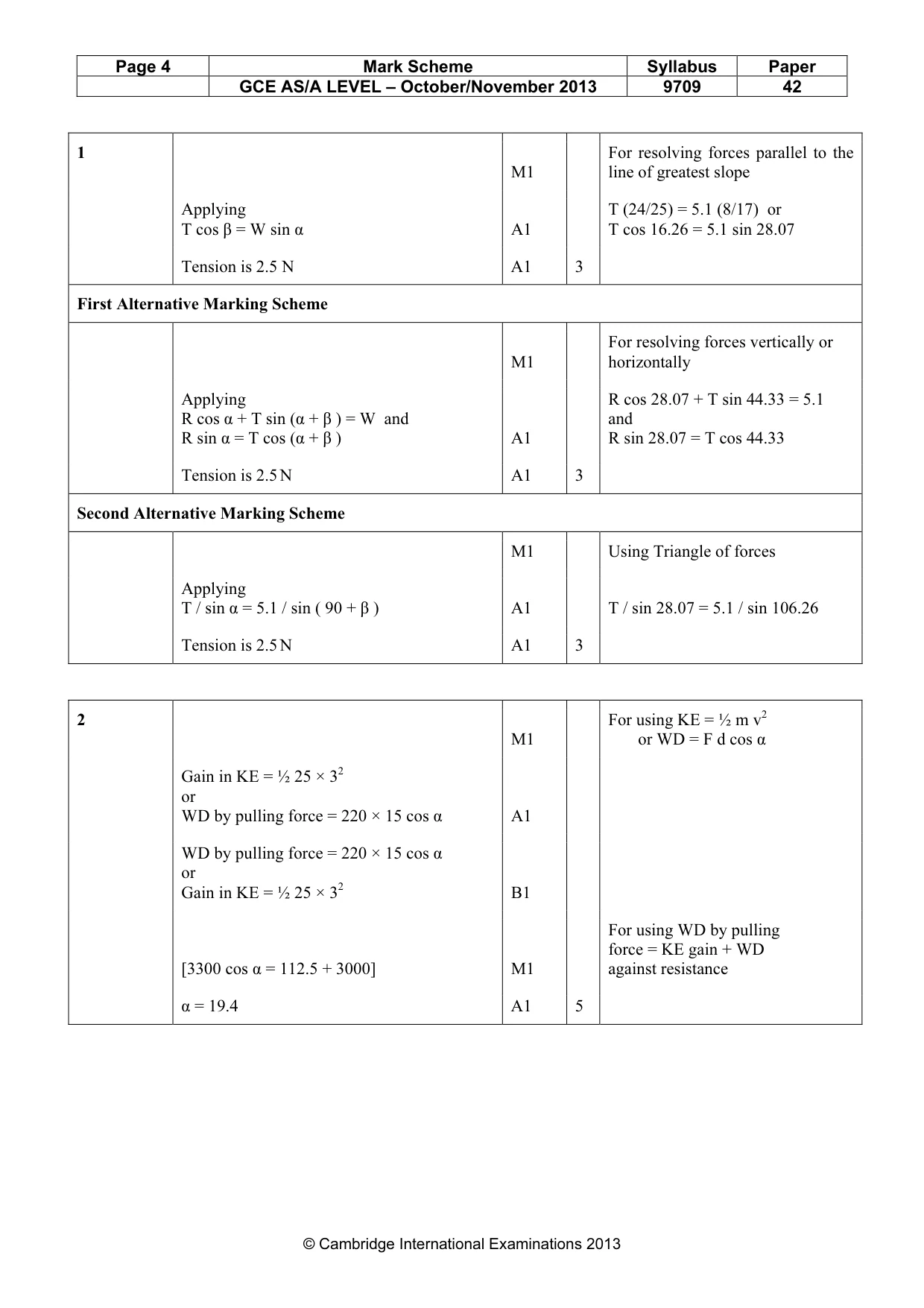
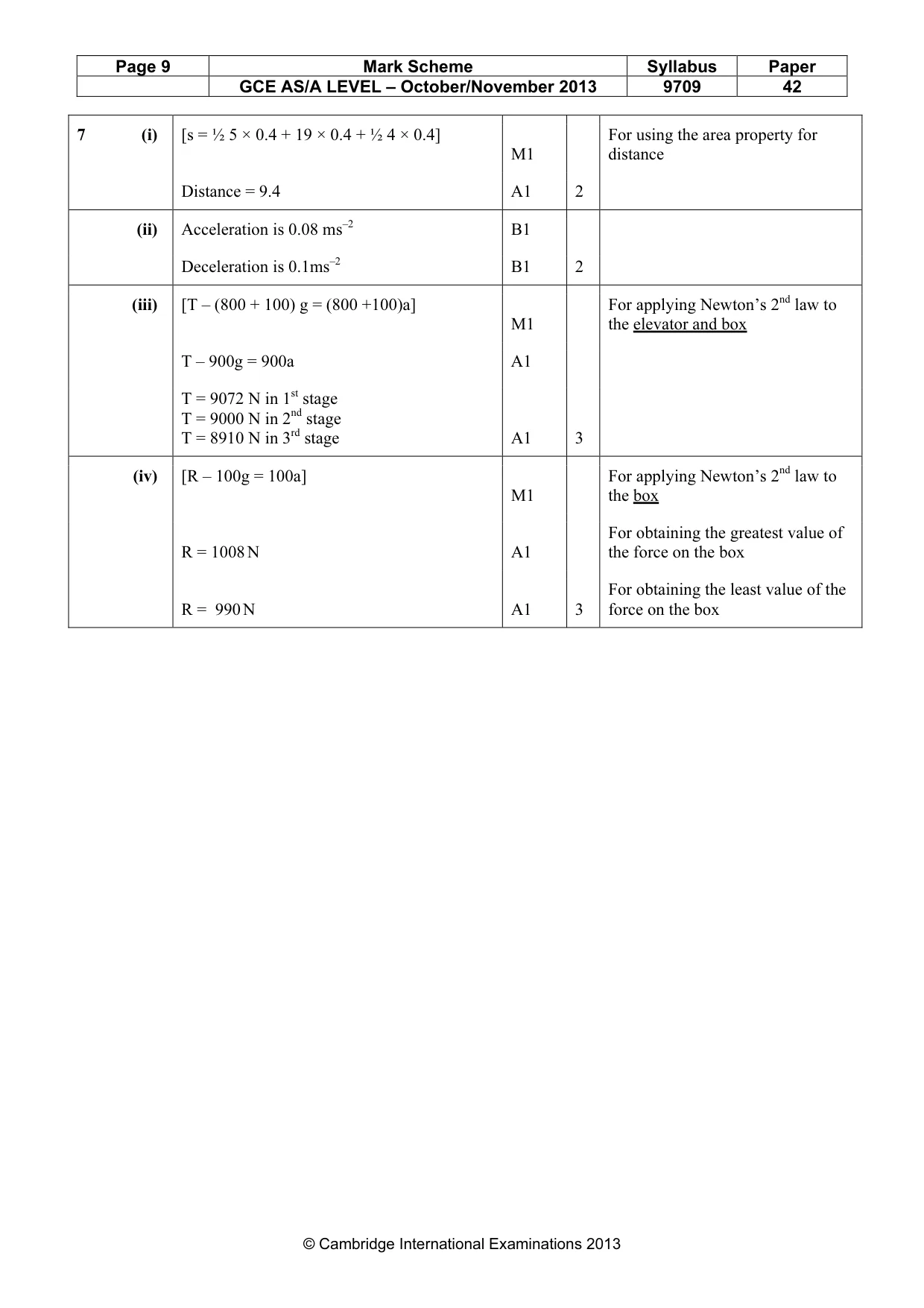
Mark scheme: 7 (i) [s = ½ 5 × 0.4 + 19 × 0.4 + ½ 4 × 0.4] For using the area property for M1 distance Distance = 9.4 A1 2 (ii) Acceleration is 0.08 ms–2 B1 Deceleration is 0.1ms–2 B1 2 (iii) [T – (800 + 100) g = (800 +100)a] For applying Newton’s 2nd law to M1 the elevator and box T – 900g = 900a A1 T = 9072 N in 1st stage T = 9000 N in 2nd stage T = 8910 N in 3rd stage A1 3 (iv) [R – 100g = 100a] For applying Newton’s 2nd law to M1 the box For obtaining the greatest value of R = 1008 N A1 the force on the box For obtaining the least value of the R = 990 N A1 3 force on the box
What was in this paper
The subtopics covered by these 2 questions, and how many questions each got. Open one in a new tab to see every Cambridge question on it.
What you needed in this session
Cambridge’s own grade thresholds for 2013 Oct/Nov, Paper 4 · Variant 2. A higher threshold means an easier paper — the bar moves with how the cohort did.