Questions as text
Q1 · Civil War and Reconstruction, 1861–77 (a) Explain why Lincoln issued the Emancipation… 9489/22 Feb/March 2021
4 Civil War and Reconstruction, 1861–77 (a) Explain why Lincoln issued the Emancipation Proclamation in 1863. [10] (b) ‘Johnson’s Reconstruction policies continued what Lincoln had planned.’ How far do you agree with this view? [20]
30 marks
Mark scheme: 4(a) Explain why Lincoln issued the Emancipation Proclamation in 1863. 10 Lincoln issued the Emancipation Proclamation in 1863 because: • On 22 September 1862 Lincoln had announced his plans to emancipate slaves in states still in a state of rebellion on 1 January 1863. As no slave states returned to the union in this time, he signed a Proclamation which announced the emancipation of slaves in ten rebel states; Tennessee was already back under Union control. Slavery continued in the four Border States which had joined the Union in 1861. • Lincoln wanted to encourage black slaves to rebel against their Southern masters and/or move to the North to help with the war effort. This was a decision made to attempt to shorten the war by undermining the Confederate war effort. Confederate soldiers would have to be diverted from the main battles to deal with freed black slaves which would weaken their overall military effort. • The issuing of the proclamation sent a clear message that this war was about the issue of slavery – Lincoln calculated that this would prevent foreign powers such as Britain and France intervening on the side of the Confederacy because of the growing issue of cotton shortages in Europe. Lincoln also hoped that a clear focus on slavery would help with military recruitment in the North. Accept other valid responses. 4(b) ‘Johnson’s Reconstruction policies continued what Lincoln had 20 planned.’ How far do you agree with this view? Lincoln and Reconstruction: Lincoln made some post-war plans in the year before his death: • the 10% Plan [December 1863], whereby rebel states could return to the USA if (a) 10% of voters took an oath of future loyalty and (b) the state amended its constitution to include the abolition of slavery; • the Thirteenth Amendment [January 1865], which abolished slavery; • the Freedmen’s Bureau [March 1865], to help freed black slaves and white refugees – though the Bureau was more Congress’s doing and it was set up for one year only. • In addition, just before his death, Lincoln stated publicly that some black males could be given the vote. The 10% Plan was opposed in Congress, which approved the Wade-Davis bill for a minimum of 50% taking the oath. Lincoln vetoed the bill. The 10% Plan was applied to Louisiana. Johnson and Reconstruction: Johnson, a Southern Democrat from Tennessee, a border state, believed in states’ rights, as a result of which many states introduced Black Codes to uphold the rights of whites. In May 1865 he issued his terms for an amnesty, which gave no percentage for those taking the oath and accepting emancipation. However, the most propertied had to apply individually for a pardon, implying they were to be excluded; most, however, were pardoned. In December 1865 he declared Reconstruction was complete, which alienated Congress. In January 1866 Johnson vetoed both a bill to extend the life of the Freedmen’s Bureau and the Civil Rights Act introducing black suffrage. These actions further alienated Congress which consequently introduced the 14th Amendment ensuring equality for all Americans. In general, Johnson thought he was continuing Lincoln’s policies while radicals in Congress, who had fallen out with Lincoln became even more hostile to what they saw as the betrayal of Johnson. Accept other valid responses.
This question in 9489/22 Feb/March 2021
Q2 · Civil War and Reconstruction, 1861–77 (a) Explain why the involvement of foreign powers… 9489/21 May/June 2021
4 Civil War and Reconstruction, 1861–77 (a) Explain why the involvement of foreign powers prolonged the Civil War. [10] (b) To what extent was Johnson to blame for the disagreements with Congress over Reconstruction? [20]
30 marks
Mark scheme: 4(a) Explain why the involvement of foreign powers prolonged the Civil War. 10 With the outbreak of the Civil War, the US issued a global decree which warned against foreign involvement, but this did not prevent involvement from both Britain and France, albeit in an informal manner. • Although Great Britain remained officially neutral, many private companies still traded with the Confederacy. A vast majority of the Confederate Navy was built in Liverpool during the war using private money, and the port also became the unofficial location for the Confederate embassy within Great Britain. • Not only were warships commissioned in Great Britain, so too were ships specifically designed to outrun Union blockade forces and smuggle illegal goods to and from Confederate controlled land. This had an impact on the effectiveness of the North’s blockade. • France's trade prospects were also hurt because of Northern blockades of Southern ports. France wanted to intervene to ensure the trade of cotton, wine, brandy, and silk. Despite its intention of staying out of war with the United States, France invaded Mexico and installed its own emperor, Maximillian, in 1864. France's goal was to improve its power abroad and set up a puppet government that could perhaps aid the Confederacy during the Civil War. France also could regain some of its former colonies in the Americas by working with the Confederates. • Candidates may argue that financial involvement by Britain extended the war by allowing the Confederacy to extend their weapons and support. This could also be argued about the political involvement of the French. Accept any other valid responses. 4(b) To what extent was Johnson to blame for the disagreements with 20 Congress over Reconstruction? The Congress elected in 1864 was solidly Republican and the 1866 Congress was even more so. There was a great deal of difference between President and Congress, Democrat and Republican, both in how best to treat the defeated Confederacy as well as which of the two should lead Reconstruction policies. Actions of Johnson • Andrew Johnson, who became President on the death of Lincoln in 1865, was a Tennessee Democrat, a Southerner chosen as Vice President to attract Democratic voters. • In 1865, Johnson took a softer line towards Southern war leaders than Congress wanted: only one was executed and Jefferson Davis was imprisoned for two years. This went against views of Congress and many in the country who felt that the suffering endured in the war needed to be acknowledged through a firmer line against CSA leaders. • Johnson assumed that with the passage of the Thirteenth Amendment, Reconstruction was over. Actions of Congress • In 1866, Congress passed a Civil Rights Act protecting the rights of freedmen; it passed the Reconstruction Acts which imposed military rule on the South. Johnson vetoed both only for Congress to override his vetoes. • Congress also passed the Fourteenth Amendment giving equal rights to all, only to find Johnson encouraging states to refuse to approve it. • In 1867, Congress passed the Tenure of Office Act, which stated that the President could not dismiss a federal official until Congress had approved a successor Johnson still went ahead and dismissed the Secretary of War, Edwin Stanton. • Relations between President and Congress were so bad that, in March 1868, Congress impeached Johnson. He escaped punishment by one vote. Thus, when discussing who was to blame for the disagreements after the Civil War, it is vital to consider the political realities of the period – something which it could be said Johnson failed to do. Republican supermajorities in both houses meant that any policies which did not meet with Congressional approval were going to be difficult to pass. In ignoring this reality, Johnson must take some of the blame, but it is clear that members of Congress were unwilling to compromise as well. Accept any other valid responses.
This question in 9489/21 May/June 2021
Q3 · Civil War and Reconstruction, 1861–77 (a) Explain why Presidential Reconstruction plans… 9489/22 May/June 2021
4 Civil War and Reconstruction, 1861–77 (a) Explain why Presidential Reconstruction plans struggled to win support in Congress. [10] (b) ‘Weak leadership on both sides was the main reason the Civil War lasted as long as it did.’ How far do you agree with this view? [20]
30 marks
Mark scheme: 4(a) Explain why Presidential Reconstruction plans struggled to win 10 support in Congress. The views of Johnson and Congress were fundamentally different. Congress was dominated by the Republican party, especially after the elections of 1866, which saw both houses returned with supermajorities. Meanwhile, Johnson believed in the reconstruction of the South along very particular lines. He advocated for the restoration of states’ rights to Southern states governed by white men. He demanded that those who had committed treason, primarily the wealthy who had led the Confederate war effort, mainly from the plantocracy, be punished. He was also against giving any rights to black people, whom he saw as inferior. Consequently, numerous of Johnson’s policies struggled to gain support: • His granting of amnesties to Southern leaders, which was more generous than first proposed. This was for personal electoral reasons, as he needed Southern support in the 1868 elections. • Johnson vetoed the Civil Rights Act and the renewal of the Freedman’s Bureau, both of which were considered key Reconstruction policies. As a result, this set him firmly against Congress. • Johnson supported Southern states passing Black Codes laws which restricted African Americans’ political and economic freedoms. Accept any other valid responses. 4(b) ‘Weak leadership on both sides was the main reason the Civil War 20 lasted as long as it did.’ How far do you agree with this view? Discussion points on the weaknesses of each side: • Many of the country’s best military schools were based in the South, which meant that many of the most qualified generals fought for the South, i.e., General Lee led the Confederate army because his home state sided with the South. • President Lincoln had to replace some of his generals because they weren’t effective e.g., General McClellan hesitated to move his army at times. At Antietam in September 1862, he failed to pursue the retreating General Lee, possibly costing the Union a chance to end the Civil War at the time. • Lincoln had very little experience of military affairs, as evidenced by the fact that he appointed several Generals-in-Chief in those first two years – McClellan and Halleck – before sticking with Halleck until Grant took over in March 1864. • Davis, as an ex-military man, was prone to interfering excessively in strategy formulation. Though Robert E Lee remained the key military leader of the Confederacy, he was not appointed as General-in-Chief until January 1865, by which time the war had been lost. • General James Longstreet tried in vain to convince Lee not to attack on the third day at Gettysburg, arguing that it would be a suicide mission. But, as historian Shelby Foote characterized it, ‘Lee's blood was up’, and you could not talk to him in that state. Other possible factors for discussion: • Because of the nature of the war, the North had to completely ‘conquer’ the South to be considered successful, whereas the South only had to continue to fight a defensive war. As a result, the nature of victory was often unclear. • There was some opposition to the Civil War in the North. The Peace Democrats wanted President Lincoln to negotiate a settlement with the Confederacy. Thus, not everybody in the North fully supported the Union’s war efforts. • Candidates may also discuss the more decisive episodes of leadership, e.g., as shown by Grant. Accept any other valid responses.
This question in 9489/22 May/June 2021
Q4 · Civil War and Reconstruction, 1861–77 (a) Explain why Grant was appointed commander of… 9489/23 May/June 2021
4 Civil War and Reconstruction, 1861–77 (a) Explain why Grant was appointed commander of the Union forces in March 1864. [10] (b) ‘The Compromise of 1877 was agreed because Reconstruction had failed.’ How far do you agree with this view? [20]
30 marks
Mark scheme: 4(a) Explain why Grant was appointed commander of the Union forces in 10 March 1864. • By early 1864, almost three years after the outbreak of the Civil War, the North had still failed to gain a clear military advantage over the South. In the previous summer, in the eastern theatre, Unionist forces had imposed a major defeat on the Confederates at Gettysburg. That merely repulsed a Southern advance into the North; the South itself remained intact. • In the western theatre, however, the North had gained a significant advance when it gained control of Vicksburg, the last remaining Confederate town on the Mississippi. Control of Vicksburg gave the Unionists control of the whole river and thus divided Confederate forces in the area. • The leader of the army which took Vicksburg was Ulysses Grant. The Unionist press publicised his successes. Congressional politicians wanted him appointed as lieutenant-general, a post last occupied by George Washington. • In the spring of 1864, at the start of the new campaigning season, Lincoln invited Grant to Washington and appointed him head of all Unionist forces. ‘Grant is the first general I have had’, Lincoln said. By that he meant he had found someone prepared to take military decisions without seeking his approval. The needs of war and the talents of Grant had caused Lincoln to make this appointment. Accept other valid responses. 4(b) ‘The Compromise of 1877 was agreed because Reconstruction had 20 failed.’ How far do you agree with this view? • The Compromise was an informal deal in February 1877 between the Republican Party and Southern Democrats. In return for the Republicans (a) aiding various infrastructure projects and (b) withdrawing federal troops from the South, those Democrats would accept the Republican, Rutherford Hayes, as President. • The Democratic candidate, Samuel Tilden, had not only clearly won the popular vote but more narrowly led the Electoral College vote. Twenty Electoral College votes were disputed, however, in Florida, Louisiana and South Carolina. An electoral commission was appointed to rule on these results. Divided on party lines, it awarded all twenty votes to Hayes who, as a result, won the Electoral College by a single vote. • Government was more focused on economic recovery following the crisis of 1873–5 Possible discussion points on the successes/failures of Reconstruction: • Although the reintegration of Southern states was done relatively quickly after the end of the Civil War and through their acceptance of the 13th and 14th amendments it was more difficult to make this actually count in the lives of African Americans – especially ex- slaves. Republican governments in Southern states needed military support to stay in power and many Southern leaders stayed in post. The vote in 1876 showed that politically not much had changed in the South. • Although the Freedmen’s Bureau did some good work for ex-slaves in the mid-1860s it lacked enough federal support to continue its work in the 1870s. Some ex-slaves participated in state politics and government in the late 1860s and early 1870s but this was in the face of massive opposition. It could be argued that the Compromise of 1877 was recognition that these policies had failed and that withdrawal was a better option. Even when the North was at its most interventionist, it never tried to change the system of land ownership. The plantations were never broken up; the whites still owned the land and the blacks did not. Accept other valid responses.
This question in 9489/23 May/June 2021
Q5 · Civil War and Reconstruction, 1861–77 (a) Explain why civil liberties were limited during… 9489/21 Oct/Nov 2021
4 Civil War and Reconstruction, 1861–77 (a) Explain why civil liberties were limited during the Civil War. [10] (b) ‘Opposition from white southerners was the main reason for the limited success of Reconstruction.’ How far do you agree with this view? [20]
30 marks
Mark scheme: 4(a) Explain why civil liberties were limited during the Civil War. 10 The writ of habeas corpus is the only civil liberty mentioned in the original constitution, and it was also allowed to be suspended in cases of rebellion where public safety required it. Suspending the writ allowed indefinite detention without charge. This became the focus of civil liberties in the North during the Civil War. • Present danger – Lincoln moved quickly to suspend habeas corpus. Washington D.C was largely undefended in April 1861 and rioters in Baltimore threatened to disrupt reinforcements by rail. The situation made it difficult to call Congress into session. Lincoln ordered his military commanders to suspend the writ of habeas corpus between the capital and Philadelphia. • Stifle opposition – By early 1862, several hundred political prisoners were detained without trial. Lincoln allowed their release if they took an oath of loyalty, which most did. • Draft resistance – In September 1862, in response to draft resistance, Lincoln suspended habeas corpus in the North and introduced military courts to try civilians who had been arrested without charge. Hundreds of draft resisters were imprisoned. • Copperheads – an anti-war faction amongst Democrats in the Union and in May 1863, one of their leaders, Clement Vallandigham, was arrested and exiled to avoid embarrassment. A few months earlier, in March 1863, Congress finally authorised the suspension of habeas corpus by the president. Under the Act, the federal government was meant to give lists of all those detained. It never did so, claiming the pressures of war made it difficult to keep such records. • The South – it was quick to suspend habeas corpus and to introduce martial law which was used widely, especially in the Border States. It is believed that thousands of dissidents were held without trial. Accept any other valid responses. 4(b) ‘Opposition from white southerners was the main reason for the limited 20 success of Reconstruction.’ How far do you agree with this view? Possible discussion points on opposition from white southerners: • The main forms of opposition to Reconstruction included the passage of the Black Codes in 1865–66 and the formation of groups such as the Ku Klux Klan, violent grassroots bodies that attacked ex-slaves and Southern Republicans to prevent Reconstruction. Thus, intimidation helped to undermine Reconstruction. • The South resisted as much as it could because it objected the 14th and 15th Amendments, which granted freedmen political equality and allowed them to vote and be elected into office. Slavery was abolished by the 13th Amendment, but this did not mean that freedmen need be granted political equality. Thus, Black Codes were passed in nine Southern states. • The South also resisted Reconstruction because it was imposed and enforced by Northern politicians. After the relative co-operation of Johnson, Grant enforced the ideas more stridently. • Thus, the Ku Klux Klan became even more active in 1869–71. The South was prepared to use violence to uphold the supremacy of the whites. Southern opposition to Reconstruction was based on a fear of racial equality. Other reasons for the limited success of Reconstruction: • Reconstruction did not always mean the same thing to the victors in the North – thus policies changed with Presidents and Congressional elections. This could be exemplified by the disagreements between Johnson and Congress from 1865–68 but was part of a much wider discussion in the North. How was the conquered South to be readmitted to the Union on equal terms? • Even when the North was at its most interventionist, it never tried to change the system of land ownership. The plantations were never broken up; the whites still owned the land and the blacks did not. Some may suggest that Reconstruction was never radical enough in its conception of what a post war country should look like. • The deaths of leading supporters, such as Thaddeus Stevens (1868), William H. Seward (1872) and Salmon P. Chase (1873), robbed it of intellectual and political gravitas. • The economic downturn of 1873 meant that the federal government was more concerned with economic issues than Reconstruction. In the 1874 mid-term elections, the Democrats took control of the House and ended Republican control of government. This marked the beginning of the end of effective federal support for Reconstruction. The Compromise of 1877 confirmed it. Accept any other valid responses.
This question in 9489/21 Oct/Nov 2021
Q6 · Civil War and Reconstruction, 1861–77 (a) Explain why the Compromise of 1877 was agreed 9489/22 Oct/Nov 2021
4 Civil War and Reconstruction, 1861–77 (a) Explain why the Compromise of 1877 was agreed. [10] (b) To what extent were civil liberties limited during the Civil War? [20]
30 marks
Mark scheme: 4(a) Explain why the Compromise of 1877 was agreed. 10 After the controversial results of the 1876 Presidential election, the Compromise was passed once again which saw the United States at an impasse over who should take power. It signalled the end of the project of Reconstruction. • In February 1877, the Compromise was an informal deal between the Republican Party and Southern Democrats. In return for the Republicans (a) aiding various infrastructure projects and (b) withdrawing federal troops from the South, those Democrats would accept the Republican, Rutherford Hayes, as President. • The Democratic candidate, Samuel Tilden, had not only clearly won the popular vote, but more narrowly led the Electoral College vote. However, twenty Electoral College votes were disputed in Florida, Louisiana and South Carolina. An electoral commission was appointed to rule on these results. Divided on party lines, it awarded all twenty votes to Hayes who, as a result, won the Electoral College by a single vote. • South wanted to end Re-construction. • Republicans wanted to focus attention on economic recovery after the ‘panic’ of 1873. Thus, the Compromise showed that the project of Reconstruction had largely been a failure in that the two halves of the union had not been successfully reunited – at least not in party political terms. Accept any other valid responses. 4(b) To what extent were civil liberties limited during the Civil War? 20 Candidates may discuss the debate about civil liberties in the Civil War including ideas around both whether the respective Presidents, Lincoln and Davis, could limit them and also the effects of the limits they imposed. • The major issues concerning civil liberties were (a) the suspension of the writ of habeas corpus, thus allowing indefinite detention without charge, and (b) the establishment of military tribunals to uphold the laws of war. • Lincoln allowed military leaders to suspend habeas corpus in parts of Maryland as soon as the war had started because it was a strategically important border state which had yet to decide between North and South. Many state representatives were sympathetic to the South whose citizens were detained without charge to prevent a state vote on secession. In this case, military rule worked and Maryland did not secede. • The most famous case of suppression of civil liberties in the North concerned Clement Vallandigham, a leading opponent, who was tried and sentenced by a military tribunal. This punishment aroused a lot of criticism of Lincoln’s administration. • The South followed a similar pattern, limiting habeas corpus and setting up military tribunals, despite historical interpretations to the contrary. • However, in both North and South, elections were held, which suggests that limits on civil liberties were restricted to those who undermined the war effort and encouraged people to support the other side. It was still possible to argue about the politics of the war, about its goals and how long it should be fought. Accept any other valid responses.
This question in 9489/22 Oct/Nov 2021
Q7 · Civil War and Reconstruction, 1861–77 (a) Explain why Congress pursued a policy of… 9489/23 Oct/Nov 2021
4 Civil War and Reconstruction, 1861–77 (a) Explain why Congress pursued a policy of ‘Radical Reconstruction’ from 1867. [10] (b) To what extent was superior military strategy the reason for the North’s victory in the Civil War? [20]
30 marks
Mark scheme: 4(a) Explain why Congress pursued a policy of ‘Radical Reconstruction’ 10 from 1867. Radical Reconstruction was the set of policies associated with the Republican party in the US Congress and especially with Senator Charles Sumner. Thus, it is sometimes called Congressional Reconstruction as opposed to the policies pursued by Johnson which were known as Presidential Reconstruction: • They wanted equal civil and voting rights for ex-slaves [male only] when moderate Republicans did not. Thus the 15th Amendment to the constitution. • They wanted harsher treatment of the former Confederate states. Thus the 1867 Reconstruction Act and the imposition of military rule on most Southern states. These policies were introduced because: • Congress was in dispute with President Johnson, who was encouraging Southern states to resist reforms by refusing to approve the 14th Amendment. • The 1866 Congressional elections were a defeat for Johnson’s attempt to win in the North via his ‘swing around the circle’, which was counterproductive. • The election increased Republican support in both houses of Congress (they had supermajorities in the House and Senate), giving them the ability to override the presidential veto. Accept any other valid responses. 4(b) To what extent was superior military strategy the reason for the North’s 20 victory in the Civil War? Discussion points surrounding military strategy: • At the start, the Southern leadership was stronger in that Jefferson Davis had considerable military experience, having fought in the war against Mexico in 1846–48 and being Secretary of War in 1853–57, while Lincoln had almost none. In addition, the South had Robert E Lee as the leader of its army in Northern Virginia, where many of the early battles were fought. • Some candidates may discuss interpretations which have seen Lee’s military leadership as poor – his offensive-defensive strategy often resulted in too many casualties. • Lincoln’s early military commanders tended to be cautious and ineffectual, which caused him frustration and Northern leadership additional problems. By 1864, however, he found his man, Ulysses Grant, who provided the dynamic, aggressive campaigning Lincoln believed necessary. • Throughout the war the North was growing in terms of manpower and military equipment. Other factors for the Northern victory in the Civil War: • Davis’s poor political leadership (especially when compared with Lincoln’s); the confederate nature of the Confederacy, meaning a lack of unity and will to win; the failure to gain the support of Britain and France. • Lincoln grew into his role as President, as evidenced by the Emancipation Proclamation and the Gettysburg Address, while Davis proved less effective as the leader of the South. As a leader of his cabinet, he was much less effective than Lincoln and his leadership of a ‘team of rivals’. And Davis, as an ex-military man, was prone to interfere too much in the making of strategy. Thus, it could be argued that in the last year of the war the assertion contained in the question is correct but before that it was not as clear cut. Accept any other valid responses.
This question in 9489/23 Oct/Nov 2021
Q8 · Civil War and Reconstruction, 1861–77 (a) Explain why life was difficult for civilians in… 9489/22 Feb/March 2023
5 Civil War and Reconstruction, 1861–77 (a) Explain why life was difficult for civilians in the South during the Civil War. [10] (b) How far was Johnson to blame for the failure of Presidential Reconstruction? [20]
30 marks
Mark scheme: 5(a) Explain why life was difficult for civilians in the South during the Civil 10 War. Indicative content • Civil Liberties were restricted in the South (as they were in the North). This included organising a draft to force men to serve in the army (March 1862), the suspension of habeas corpus and the use of martial law to control the population. • As armies (from both sides) moved through the South local populations were subjected to destruction and appropriation of property, food being taken and the transformation of houses into hospitals and barracks. • The huge economic strains that the war brought meant that even in Confederate controlled cities local people were subjected to shortages, inflation, overcrowding and hunger. • Women and children were often left alone as men went to war and were vulnerable to passing armies. They also had to cope with the death of many fighting men. • Accept any relevant comments on the effect of the war on the slave population. Accept any other valid responses. 5(b) How far was Johnson to blame for the failure of Presidential 20 Reconstruction? Indicative content Andrew Johnson largely oversaw what is known as Presidential Reconstruction. Johnson, who became President on the death of Lincoln in 1865, was a Tennessee Democrat, a Southerner chosen as Vice President in order to attract Democratic voters. The Congress elected in 1864 was solidly Republican, the 1866 Congress even more so. There was a great deal of difference between President and Congress, Democrat and Republican, both in how best to treat the defeated Confederacy as well as which of the two should lead Reconstruction policies. Possible discussions around the issues created by Presidential Reconstruction: • In 1865 Johnson took a softer line towards Southern war leaders than Congress wanted: only one was executed and Jefferson Davis was imprisoned for two years. • Johnson also focused Reconstruction on the white population, ignoring the position of ex-slaves. Thus, Southern states passed Black Codes in 1865. Johnson assumed that with the passage of the Thirteenth Amendment, Reconstruction was over. • Congress disagreed and in 1866 it passed a Civil Rights Act protecting the rights of freedmen; it passed the Reconstruction Acts which imposed military rule on the South. Johnson vetoed both only for Congress to override his vetoes. • Congress also passed the Fourteenth Amendment giving equal rights to all, only to find Johnson encouraging states to refuse to approve it. The Amendment was eventually passed while Congress introduced the Fifteenth Amendment giving ex-slaves the vote. • Relations between President and Congress were so bad that, in March 1868, Congress impeached Johnson. He escaped punishment by one vote. • Even though Presidential Reconstruction was short-lived it did succeed in keeping the union together through the first tense days following the end of the Civil War. But the power of abolitionists in Congress could not be held back for long. Accept any other valid responses.
This question in 9489/22 Feb/March 2023
Q9 · Civil War and Reconstruction, 1861–77 (a) Explain why leaders were accused of being… 9489/21 May/June 2023
5 Civil War and Reconstruction, 1861–77 (a) Explain why leaders were accused of being anti-democratic during the Civil War. [10] (b) ‘Grant made Reconstruction a success.’ How far do you agree? [20]
30 marks
Mark scheme: 5(a) Explain why leaders were accused of being anti-democratic during the 10 Civil War. Indicative content In response to leading countries through a war, leaders in the North and South took steps to suspend certain civil liberties. Although many supported these actions, there were also those who saw these moves as undemocratic. Lincoln moved quickly to suspend habeas corpus in certain parts of Maryland, which raised the issue of whether he had the constitutional authority to do so. In the Merryman case, the chief justice said no. Lincoln ignored him. By early 1862 several hundred political prisoners were detained without trial. Lincoln allowed their release if they took an oath of loyalty. Most did. In September 1862, in response to draft resistance, Lincoln suspended habeas corpus throughout the North and introduced military courts to try civilians under arrest without charge. Several hundred draft resisters were imprisoned. In May 1863, the best-known opponent of the war, Clement Vallandigham, was arrested and exiled to avoid embarrassment. A few months earlier, in March 1863, Congress had at long last authorised the suspension of habeas corpus by the president. Under the Act, the federal government was meant to give lists of all those detained. It never did so, claiming the pressures of war made it difficult to keep such records. The South was quick to suspend habeas corpus and to introduce martial law which it used it widely, especially in the Border States. According to one source, thousands of dissidents were held without trial. Both Lincoln and Davis used conscription – the rich could pay someone to take their place – this was resented as unfair – New York Draft Riots. Accept any other valid responses. 5(b) ‘Grant made Reconstruction a success.’ How far do you agree? 20 Indicative content Possible discussions about the actions of Grant as a Reconstruction president might consider the major fall out (and impeachment) which had occurred between Andrew Johnson and Congress meant that Grant ran his 1868 election campaign based on protecting the rights of former enslaved people in the South. This issue was brought to a head through the campaign as the KKK continued their terrorist activities across the Southern states. Additionally, in 1870 Grant signed the Fifteenth Amendment, which guaranteed universal male suffrage regardless of race. In addition, the Republican-controlled Congress passed the first of four Force Acts that targeted illegal voter suppression in the South. The Force Acts strangled the public operation of groups such as the Klan, gave the federal government control over the administration of national elections, and authorised the president to use the military to protect voting rights. Although Grant’s actions made Klan activity difficult the Republican mandate in the South continued to wilt. In spite of this he secured a landslide majority in his election of 1872. This was most likely due to the large numbers of black Americans who had been enfranchised because of his actions. Possible discussion of the weaknesses of Reconstruction might consider how Grant’s attention soon turned to the economic problems in the South as the Panic of 1873 devastated sections of the economy. After this the South once again felt ignored. By the time of the Compromise of 1877 the lives of many ex-slaves had changed very little from before the Civil War. Even when the North was at its most interventionist, it never tried to change the system of land ownership. The plantations were never broken up; the whites still owned the land, and the blacks did not. Although the law had changed the socio- economic status of many ex-slaves had not. Accept any other valid responses.
This question in 9489/21 May/June 2023
Q10 · Civil War and Reconstruction, 1861–77 (a) Explain why there were tensions in the… 9489/22 May/June 2023
5 Civil War and Reconstruction, 1861–77 (a) Explain why there were tensions in the relationship between the Union and Britain during the Civil War. [10] (b) To what extent had the lives of ex-slaves improved by 1877? [20]
30 marks
Mark scheme: 5(a) Explain why there were tensions in the relationship between the Union 10 and Britain during the Civil War. Indicative content With the outbreak of the Civil War the United States issued a global decree warning against foreign involvement but this did not prevent the involvement of foreign powers such as Great Britain. Although Great Britain remained officially neutral many private companies still traded with the Confederacy. A vast majority of the Confederate Navy was built in Liverpool during the war using private money, and the port also became the unofficial location for the Confederate embassy within Great Britain. Not only were warships commissioned in Great Britain, so too were ships specifically designed to outrun Union blockade forces and smuggle illegal goods to and from Confederate controlled land. The Confederate strategy for independence somewhat relied on British military involvement in the war but this never happened. The North threatened the British with war if they got involved and this would have cut off much of Britain’s food supply. However, there were moments where war was close e.g. The Trent Affair 1861. Accept any other valid responses. 5(b) To what extent had the lives of ex-slaves improved by 1877? 20 Possible discussion on the positives of Reconstruction for ex-slaves might consider how the 1865 Thirteenth Amendment meant all slaves were freed. It took the Fourteenth Amendment of 1867 to make them citizens, equal in status with whites, and the Fifteenth Amendment of 1869 to give them the right to vote. These overturned many of the limits imposed in some states by Black Codes in 1865–66. The three amendments did much to improve the legal and political position of ex-slaves. Additionally, the legal provisions made by the three amendments went further than many could have imagined prior to the Civil War. Some 2000 ex-slaves were elected to official posts within Southern states. The Freedmen’s Bureau also did much useful work in the late 1860s, especially in establishing schools and colleges. Furthermore, Republicans in Congress passed three Reconstruction Acts in 1867, the main consequence of which was to impose military rule. The army was used to try and ensure that the rights of ex-slaves were respected and to limit the power of returning Confederates. This rule allowed an alliance of scalawags (Southern Unionists), carpetbaggers (Northern activists) and freedmen to try to reform Southern society along Northern lines. They made some limited progress. Possible discussion on the continuing difficulties for ex-slaves by 1877 might include how, though the Freedmen’s Bureau did much useful work in the late 1860s, especially in establishing schools and colleges, it was scrapped in the early 1870s when, to make a lasting difference, its contributions were needed for many more years. It also caused huge resentment amongst many white Southerners who disliked its aims and the involvement of federal government. Southern states also by-passed the federal legislation by passing ‘Black Codes’ (began in Mississippi 1865) to weaken the Reconstruction Amendments. Judgements of the Supreme Court in 1873 (the Slaughter-House cases) and 1875 (US vs Cruickshank) also limited the advances made by the post-Civil War amendments. In social and economic matters, the situation was much less positive. To make a living, ex-slaves turned to sharecropping, a system of farming which maintained the predominance of the white landowners. Before long, more conservative Southern whites gained office in the South while at the same time the federal government of Grant lost the strong will needed to impose social change on the South. The Compromise of 1877, by which the Republicans handed control of the South back to Democrats in return for keeping the presidency, was more a consequence of the changing reality of Southern politics than a cause. By 1877 the position of ex-slaves had certainly changed and broadly for the better. They had some opportunities, which benefited some. For many, however, the change was more in the letter of the law than the reality of their lives. Accept any other valid responses.
This question in 9489/22 May/June 2023
Q11 · Civil War and Reconstruction, 1861–77 (a) Explain why Grant changed the government’s… 9489/23 May/June 2023
5 Civil War and Reconstruction, 1861–77 (a) Explain why Grant changed the government’s approach to Reconstruction after his election in 1868. [10] (b) ‘During the Civil War, civil liberties were restricted more in the South than in the North.’ How far do you agree? [20]
30 marks
Mark scheme: 5(a) Explain why Grant changed the government’s approach to 10 Reconstruction after his election in 1868. Indicative content Andrew Johnson’s version of Presidential Reconstruction was heavily criticised as being too lenient to supporters of the Confederacy. Grant’s election campaign was based specifically on protecting the rights of former enslaved people in the South. This issue was brought to a head through the campaign as the KKK continued their terrorist activities across the Southern states. Johnson had been blocking more radical measures proposed by Congress. The 15th amendment had already been passed by the Republican congress in January 1869 to protect black voting rights and Grant was responsible for signing t into law.1870 Grant signed the Fifteenth Amendment, which guaranteed universal male suffrage regardless of race. with a republican president, Congress was also able to pass the first of four Force Acts that targeted illegal voter suppression in the South. The Force Acts strangled the public operation of groups such as the Klan, gave the federal government control over the administration of national elections, and authorised the president to use the military to protect voting rights. Accept any other valid responses. 5(b) ‘During the Civil War, civil liberties were restricted more in the South 20 than in the North.’ How far do you agree? Indicative content Issues around civil liberties in the North and South might include Conscription [aka ‘the draft’]. The South was first to compel men to serve in the army, in March 1862. The North’s Enrolment Act came a year later. The difference was a result of the limited manpower available in the South: slaves were excluded. Though both sides allowed exemptions, the South was more vigorous in drafting men into its armies. The suspension of habeas corpus may also be considered. Lincoln was quick to suspend habeas corpus in certain areas given local unrest. Congress and the courts said that Lincoln did not have this power. In 1863, Congress authorised the suspension of habeas corpus. In 1862, when John Merryman was granted a writ by a judge, Lincoln just ignored it. It is hard to gauge the extent of its use. The South was quick to suspend habeas corpus and to introduce martial law which it used it widely, especially in the Border States. According to one source, thousands of dissidents were held without trial. The introduction of Martial law and the use of military courts and laws to replace civilian courts and laws may also be identified. Clement Vallandigham is the best-known case of a political figure being prosecuted under military law. His case caused much opposition. Lincoln eventually had him moved to the South. He returned and took part in the 1864 Democratic convention. Lincoln did nothing to prevent him. For the South, see details under suspension of habeas corpus. In addition to the use of Martial Law and the suspension of Habeas Corpus, the South, which was in more desperate circumstances, took more powers to order manpower, e.g., some key occupations were exempt from the draft. The taking of power in the name of war by both federal-level governments caused criticism but more so in the South, which was committed to the idea of states’ rights. Accept any other valid responses.
This question in 9489/23 May/June 2023
Q12 · Civil War and Reconstruction, 1861–77 (a) Explain why the 14th Amendment was passed 9489/22 Oct/Nov 2023
5 Civil War and Reconstruction, 1861–77 (a) Explain why the 14th Amendment was passed. [10] (b) To what extent was poor military leadership the reason the Civil War lasted for four years? [20]
30 marks
Mark scheme: 5(a) Explain why the 14th Amendment was passed. 10 Indicative content • The fourteenth amendment was passed on 9 July 1868 to give citizenship to former slaves and states that every person born or naturalised in America is a citizen of the country as well as their state of residence. • The amendment was passed in response to the ‘Black Codes’ which many Southern States had created in order to undermine the rights of former enslaved people. The fourteenth amendment placed a limit of states’ rights as well as protecting the civil rights of black Americans. • The fourteenth amendment also focused on the issue of rebellion and the readmission of states into the Union. States could not be officially readmitted to the Union without ratifying the 14th amendment. It also stated that no one could be elected to public office after engaging in rebellion or treason. Accept any other valid responses. 5(b) To what extent was poor military leadership the reason the Civil War 20 lasted for four years? Indicative content Candidates may frame their discussion in terms of North/South or through the lens of individual leaders. Possible discussions of military leaders may include the leadership of Scott/McClellan/Halleck and Grant as Generals-in-Chief vs Lee and Jackson – though candidates are likely to concentrate on the better- known names. At the start, the Southern leadership was stronger in that Jefferson Davis had considerable military experience, having fought in the war against Mexico in 1846–48 and being Secretary of War in 1853–57. In addition, the South had Robert E Lee as the leader of its army in Northern Virginia, where many of the early battles were fought. Lincoln’s military commanders tended to be cautious and ineffectual, which caused him frustration and the Northern leadership additional problems. By 1864, however, he found his man, Ulysses Grant, who provided the dynamic, aggressive campaigning Lincoln believed necessary. Though Robert E Lee remained the key military leader of the Confederacy, he was not appointed as General-in-Chief until January 1865, by which time the war had been lost. Possible discussions of other factors prolonging the war might include the nature of the war which meant that the North had to fully ‘conquer’ the South in order to be seen as successful, whereas the South had only to continue to fight a defensive war. This meant that the nature of victory was often unclear. There also was some opposition to the Civil War in the North. The Peace Democrats wanted President Lincoln to negotiate a settlement with the Confederacy. Thus, not everybody in the North fully supported the Union’s war efforts. More decisive episodes of leadership shown by people like Ulysses Grant may also be identified. The Anaconda plan of Scott needed the USA to gain naval control over the CSA’s coastline, and this took time. The production of arms and the training of raw recruits could not be achieved overnight. Thus, the North’s advantages in wealth and numbers took time to be harnessed effectively. The fall of Vicksburg in 1863 meant the Confederacy was now split as the North controlled the Mississippi. Accept any other valid responses.
This question in 9489/22 Oct/Nov 2023
Q13 · Civil War and Reconstruction, 1861–77 (a) Explain why ex-slaves found it difficult to… 9489/23 Oct/Nov 2023
5 Civil War and Reconstruction, 1861–77 (a) Explain why ex-slaves found it difficult to improve their lives during the Reconstruction period. [10] (b) How important was foreign influence in determining the outcome of the Civil War? [20]
30 marks
Mark scheme: 5(a) Explain why ex-slaves found it difficult to improve their lives during the 10 Reconstruction period. Indicative content Ex-slaves faced economic and political challenges in this period: • Most ex-slaves remained farming the land still retained by their former owners as sharecroppers. This was not what many had expected, e.g. Sherman’s forty acres and a mule. • Their social situation improved very little. Because most ex-slaves remained where they had lived before the war, their place in Southern society changed hardly at all. By 1877 the Freedmen’s Bureau was a thing of the past, as were the benefits it undoubtedly brought. • Their political situation was slow to change. While ex-slaves gained some political rights via the 15th amendment, the practical implementation of those rights was too dependent upon Northern carpetbaggers, US troops and Southern whites. When Grant’s administration lost interest in the South after 1873 any gains quickly disappeared. • Once Southern white regained control, either Black Codes [1865–66] or Jim Crow Laws [admittedly after 1877] were implemented. Thus, ex- slaves’ right to vote and ability to win elections was short-lived. Accept any other valid responses. 5(b) How important was foreign influence in determining the outcome of the 20 Civil War? Indicative content With the outbreak of the Civil War the United States issued a global decree warning against foreign involvement but this did not prevent involvement from both Britain and France albeit in an informal manner. Great Britain remained officially neutral but many private companies still traded with the Confederacy. A vast majority of the Confederate Navy was built in Liverpool during the war using private money, and the port also became the unofficial location for the Confederate embassy within Great Britain. Not only were warships commissioned in Great Britain, so too were ships specifically designed to outrun Union blockade forces and smuggle illegal goods to and from Confederate controlled land. However, British public opinion was consistently in favour of the abolitionist mind set which they believed the North held and this probably meant that British support for the Confederacy was more muted than it might have been despite the attempts by Confederate leaders to woo British politicians. France's trade prospects were also hurt because of Northern blockades of Southern ports. France wanted to intervene in order to ensure the trade of cotton, wine, brandy and silk. Despite its intention of staying out of war with the United States, France invaded Mexico and installed its own emperor, Maximillian, in 1864. France's goal was to improve its power abroad and set up a puppet government that could perhaps aid the Confederacy during the Civil War. France also could regain some of its former colonies in the Americas by working with the Confederates. Candidates may argue that financial involvement by Britain extended the war by allowing the Confederacy to extend their weapons and support. This could also be argued about the political involvement of the French. Other factors that may be discussed include the distribution of resources. The north had the main industrial centres and once they were geared up to war production in the South, which had a largely agricultural economy could not compete. Similarly, the north had most of the developed rail system which allowed for he mor rapid deployment of troops and equipment. The north also had a much larger population which enabled them to field larger armies and sustain greater losses. Also escaping slaves were willing to fight for the North increasing the pool of soldiers even more. Accept any other valid responses.
This question in 9489/23 Oct/Nov 2023
Q14 · Civil War and Reconstruction, 1861–77 (a) Explain why foreign powers had an impact on the… 9489/22 Feb/March 2024
5 Civil War and Reconstruction, 1861–77 (a) Explain why foreign powers had an impact on the Civil War. [10] (b) ‘Grant’s reconstruction policies failed.’ How far do you agree? [20]
30 marks
Mark scheme: 5(a) Explain why foreign powers had an impact on the Civil War. 10 Indicative content • Great Britain remained officially neutral; many private companies still traded with the Confederacy. A vast majority of the Confederate Navy was built in Liverpool during the war using private money, and the port also became the unofficial location for the Confederate embassy within Great Britain. • Not only were warships commissioned in Great Britain, so too were ships specifically designed to outrun Union blockade forces and smuggle illegal goods to and from Confederate controlled land. • France's trade prospects were also hurt because of Northern blockades of Southern ports. France wanted to intervene to ensure the trade of cotton, wine, brandy and silk. Despite its intention of staying out of war with the United States, France invaded Mexico and installed its own emperor, Maximillian, in 1864. • France's goal was to improve its power abroad and set up a puppet government that could perhaps aid the Confederacy during the Civil War. France also could regain some of its former colonies in the Americas by working with the Confederates. • Candidates may argue that financial involvement by Britain extended the war by allowing the Confederacy to extend their weapons and support. This could also be argued about the political involvement of the French. Accept any other valid responses. 5(b) ‘Grant’s reconstruction policies failed.’ How far do you agree? 20 Indicative content Possible discussion of the problems Grant faced might include the idea that White Southern leaders had rejected the ideas of since the end of the Civil War and had worked systematically to undermine the various policies of Reconstruction they had been faced with. Increasing Klan activity during the 1868 election campaign also showed the challenges he would face in making real changes to the lives of previously enslaved people. In addition, Grant’s attention had to turn to the economic problems facing the whole country as the Panic of 1873 devastated sections of the economy. After this the South once again felt ignored. Furthermore, even when the North was at its most interventionist, it never tried to change the system of land ownership. The plantations were never broken up; the whites still owned the land and the blacks did not. Although the law had changed the socio-economic status of many ex-slaves had not. Possible discussion of the successes of Grant’s Reconstruction: In 1870 Grant signed the Fifteenth Amendment, which guaranteed universal male suffrage regardless of race. In addition, the Republican-controlled Congress passed the first of four Force Acts that targeted illegal voter suppression in the South. The Force Acts strangled the public operation of groups such as the Klan, gave the federal government control over the administration of national elections, and authorised the president to use the military to protect voting rights. Although Grant’s actions made Klan activity difficult the Republican mandate in the South continued to wilt. In spite of this he secured a landslide majority in his election of 1872. This was most likely due to the large numbers of black Americans who had been enfranchised because of his actions. Accept any other valid responses.
This question in 9489/22 Feb/March 2024
Q15 · Civil War and Reconstruction, 1861–77 (a) Explain why there was Northern support for… 9489/21 May/June 2024
5 Civil War and Reconstruction, 1861–77 (a) Explain why there was Northern support for Congressional Reconstruction after 1866. [10] (b) To what extent were civil liberties limited in the North during the Civil War? [20]
30 marks
Mark scheme: 5(a) Explain why there was Northern support for Congressional 10 Reconstruction after 1866. Congressional (Radical) Reconstruction was the set of policies associated with the Republican party in the US Congress and especially with Senator Charles Sumner. Indicative content They wanted equal civil and voting rights for ex–slaves [male only] when moderate Republicans did not. Thus the 15th Amendment to the constitution. They wanted harsher treatment of the former Confederate states. This led to the 1867 Reconstruction Act and the imposition of military rule on most Southern states. Congress was in dispute with President Johnson, who was encouraging Southern states to resist reforms, e.g., by refusing to approve the 14th Amendment. The 1866 Congressional elections were a defeat for Johnson’s attempt to win in the North via his ‘swing around the circle’, which was counterproductive. The election increased Republican support in both houses of Congress, giving them the ability to override the presidential veto. There was broad support for these policies in the North as many felt that the South should be controlled after their defeat in the Civil War. However, as Reconstruction continued and other problems (economic and political) reared their heads this support cooled. Accept any other valid responses. 5(b) To what extent were civil liberties limited in the North during the Civil 20 War? Indicative content Actions taken by the North which limited civil liberties might include how the North passed enrolment acts in 1862 and 63 to increase the size of its army and how Lincoln was quick to suspend habeas corpus in certain areas given local unrest. Congress and the courts said that Lincoln did not have this power. In 1863, Congress authorised the suspension of habeas corpus and in 1862, when John Merryman was granted a writ by a judge, Lincoln just ignored it, however it is hard to gauge the extent of its use. Discussion challenging the extent of the limits of civil liberties might include how Lincoln certainly gave the needs of war priority but not at the cost of abandoning all political freedoms. Elections still took place on time; just before the 1864 presidential election, Lincoln was pessimistic about his chances of defeating his rival, General McClellan. There was also no great censorship of Northern newspapers, which reported events such as the New York draft riots of 1863. Some might argue that even though the main limit on democratic rights introduced by Lincoln was the suspension of habeas corpus and the introduction of military courts to try those accused of supporting the enemy, this was used sparingly and with some restraint. His best–known example was the action taken against Clement Vallandigham, an Ohio Democrat who had been very critical of the conduct of the war. He had also described the president as ‘King Lincoln’. A military court sentenced him to life imprisonment, but Lincoln commuted this to banishment to the confederacy. The evidence is that these courts were used sparingly and mainly in border states or those close to the front line of fighting. Accept any other valid responses.
This question in 9489/21 May/June 2024
Q16 · Civil War and Reconstruction, 1861–77 (a) Explain why military strategies changed during… 9489/22 May/June 2024
5 Civil War and Reconstruction, 1861–77 (a) Explain why military strategies changed during the Civil War. [10] (b) To what extent had the White South accepted the policies of Reconstruction by 1877? [20]
30 marks
Mark scheme: 5(a) Explain why military strategies changed during the Civil War. 10 Indicative content The initial strategy of the North was the Anaconda Plan devised by Winfield Scott. It aimed to strangle the South by means of a naval blockade and the North’s gaining control of the Mississippi. It was a gradualist, relatively bloodless strategy and not immediately enforceable because the North lacked the necessary ships needed to take the Mississippi river. The North did make some advances in the West, where the taking of Vicksburg in 1863 gave it control of the Mississippi. This could be seen as a successful implementation of the Anaconda Plan. However, it was clear that a different strategy would be needed to defeat the South completely. This was developed by Ulysses Grant, who was made the commander of all Northern forces in March 1864. He led armies on the eastern front to take Richmond while Sherman advanced on the western front to take Atlanta. The North was now occupying the South, with Sherman’s March to the Sea in December 1864 destroying much of its infrastructure and directly inflicting great hardship on civilians. The Southern strategy throughout the war was to ‘win by not losing’ and so, in a sense, did not change very much. Many wanted Davis to follow the ideas of Washington by fighting a war of attrition. However, this proved difficult because Southern governors demanded that no section of the South should be allowed to fall to the North. Thus, a ‘cordon strategy’ was adopted which spread Confederate forces too thinly. Accept any other valid responses. 5(b) To what extent had the White South accepted the policies of 20 Reconstruction by 1877? Indicative content Arguments which suggest that the White South did not accept Reconstruction may include the following. The main forms of opposition to Reconstruction included the passage of the Black Codes in 1865–66 and the formation of groups such as the Ku Klux Klan. These violent grassroots bodies attacked ex-slaves and Southern Republicans to prevent Reconstruction. In addition, the South resisted as much as it could because it objected to giving freedmen political equality via the 14th and 15th Amendments because this meant that freedmen could vote and be voted into office. The South’s view was that the abolition of slavery via the 13th Amendment did not mean that freedmen should be granted political equality. This led to Black Codes being passed in nine Southern states. Furthermore, the South also resisted Reconstruction because it was imposed and enforced by Northern politicians. President Johnson, a Southerner himself, opposed Radical Reconstruction and thus the South did not experience its full enforcement. However, Johnson’s successor, Ulysses Grant, was determined to ensure equality for the freedmen. As a result, the Ku Klux Klan became even more active in 1869–71. The South was prepared to use violence to uphold the supremacy of the whites. Southern opposition to Reconstruction was based on a fear of racial equality. Arguments which suggest that the South did accept Reconstruction by 1877 may include points about the 1877 Compromise. For example, by 1877 the South had accepted that they were once more part of the union and would be governed by the elected President. However, there were still limitations to this acceptance and opposition remained despite the Compromise. In 1877, the Republicans, essentially a Northern party, conceded rule of the South to the Democrats. Although there had been some moves forward for freedmen this ensured that political equality became an ever-more distant reality as the entrenched discrimination that was accepted in the Compromise of 1877 would last for the best part of a century. Note: Jim Crow Laws are identified as any racial legislation introduced in the period from 1877 to the mid twentieth century and thus fall outside the remit of this essay. Accept any other valid responses.
This question in 9489/22 May/June 2024
Q17 · Civil War and Reconstruction, 1861–77 (a) Explain why the governments of both the North… 9489/23 May/June 2024
5 Civil War and Reconstruction, 1861–77 (a) Explain why the governments of both the North and the South attempted to limit civil liberties between 1861 and 1865. [10] (b) How significant was the impact of the constitutional amendments of 1865–70? [20]
30 marks
Mark scheme: 5(a) Explain why the governments of both the North and the South attempted 10 to limit civil liberties between 1861 and 1865. Indicative content Both the governments of the North and South took steps to limit civil liberties during the Civil War – they were concerned about citizens having unlimited freedom during a time of war. Conscription – both sides conscripted soldiers into the army often against the will of individuals as they needed to ensure they had enough soldiers to fight. Suspension of habeas corpus – both sides suspended rights around fair trials and juries. In the North this was particularly controversial. Lincoln was quick to suspend habeas corpus in certain areas given local unrest. Congress and the courts said that Lincoln did not have this power. In 1863, Congress authorised the suspension of habeas corpus. In 1862, when John Merryman was granted a writ by a judge, Lincoln just ignored it. It is hard to gauge the extent of its use. The sale of alcohol was also prohibited in the South and travel was restricted to control people. These ideas were often more criticised in the South because of the commitment of many leaders of the Confederacy to States (and individual white) Rights. Many felt that their actions in suspending freedoms saw them acting as a federal government. However, they saw it as necessary to protect the war effort of the South. Accept any other valid responses. 5(b) How significant was the impact of the constitutional amendments of 20 1865–70? Indicative content Discussions around the changes brought by the three amendments: The 13th Amendment abolished slavery, which had been a key feature underpinning the US government since its foundations; its abolition was bound to have profound effects on that system. The 14th Amendment gave all Blacks born in the USA the right to citizenship, which was bound to transform American government, which traditionally gave few, if any rights to African Americans. Finally, the 15th Amendment gave all Black men the right to vote, which would reduce the voting power of whites, especially in Southern states such as Mississippi. All three amendments seemed revolutionary. Slavery was abolished . Americans would have equal civil rights and African American men would have the right to vote. These were major steps forward. In the South it would change the electoral composition of some of the states and reduce the voting power of whites. There were some improvements with the election of the first black representatives to political office. Possible discussions around lack of change: Changing the theory of the constitution does not necessarily change the practice of US government. The most obvious example is the 15th Amendment, which was soon circumvented, especially in the South, where states passed Black Code laws imposing literacy tests on prospective voters. Also, though the 13th Amendment abolished slavery it did not prevent the development of a similarly unequal form of farming in the sharecropping system. More specifically, the Whites in the South maintained their political dominance, via both the ballot box and by force, e.g. lynchings, Ku Klux Klan. The presence of federal forces in the South, needed to achieve Reconstruction, was ended in the 1870s. By then, there was little obvious difference between the old and new systems of government, in the South especially. Accept any other valid responses.
This question in 9489/23 May/June 2024
Q18 · Civil War and Reconstruction, 1861–77 (a) Explain why there were different responses in… 9489/21 Oct/Nov 2024
5 Civil War and Reconstruction, 1861–77 (a) Explain why there were different responses in the North to the Emancipation Proclamation. [10] (b) ‘Reconstruction policies were applied consistently throughout the period 1865–77.’ How far do you agree? [20]
30 marks
Mark scheme: 5(a) Explain why there were different responses in the North to the 10 Emancipation Proclamation. Indicative content People tended to react to Lincoln passing the Emancipation Proclamation according to their views on slavery and abolition, but this was not always predictable. • Abolitionists and Radical Republicans were predictably happy with the decision – William Lloyd Garrison called the occasion ‘a great historic event, sublime in its magnitude and beneficent in its far-reaching consequences’. The radical Republican Benjamin Wade proclaimed, ‘Now, hurrah for Old Abe and the proclamation!’ • Black Americans were also in favour of the move – The minister Henry Highland Garnet called Lincoln ‘the man of our choice and hope’ and said that the proclamation was ‘one of the greatest acts in all history’. Frederick Douglass said the proclamation was ‘the greatest event in our nation’s history’. • The proclamation was not universally accepted in the North though. Those that disagreed with abolition were clearly against the decision – The Cincinnati Enquirer said that the proclamation represented the ‘complete overthrow of the Constitution he swore to protect and defend.’ All over the North anti abolitionists called the proclamation ‘wicked’, ‘atrocious’ and ‘impudent’. Accept any other valid responses. 5(b) ‘Reconstruction policies were applied consistently throughout the 20 period 1865–77.’ How far do you agree? Indicative content Discussion of evidence that the policies of Reconstruction remained the same in the years 1865–77 might consider how the twin aims of Reconstruction – to free the slaves and to impose a new settlement on the South – remained the same. The Southern states were also made to change their constitutions and to accept the 13th Amendment. The freed ex-slaves were provided with assistance (although this was variable) to help them adjust to their new position in society. President Grant passed the Enforcement Act in 1871 to outlaw the activities of groups like the Ku Klux Klan (KKK). Discussion of evidence that the policies of Reconstruction were inconsistent in 1865–77 might consider the imposition of military rule from 1867 and the withdrawal of support for ex-slaves with the end of the Freedmen’s Bureau in the early 1870s. Also, the gradual granting of constitutional rights to ex- slaves: 1865 the 13th Amendment to 1870 the 15th Amendment might be considered, as might the abandonment of Reconstruction in the Compromise of 1877 as a result of the 1876 election outcome. Accept any other valid responses.
This question in 9489/21 Oct/Nov 2024
Q19 · Civil War and Reconstruction, 1861–77 (a) Explain why Reconstruction ended in 1877 9489/22 Oct/Nov 2024
5 Civil War and Reconstruction, 1861–77 (a) Explain why Reconstruction ended in 1877. [10] (b) ‘The shortage of resources was the main reason the Civil War lasted for four years.’ How far do you agree? [20]
30 marks
Mark scheme: 5(a) Explain why Reconstruction ended in 1877. 10 Indicative content Reconstruction ended in 1877 after the Compromise was passed as a result of the controversial results of the 1876 Presidential election. The inconclusive election once again signalled that the United States was in danger of falling into conflict. • The Compromise was an informal deal in February 1877 between the Republican Party and Southern Democrats. In return for the Republicans (a) aiding various infrastructure projects and (b) withdrawing federal troops from the South, those Democrats would accept the Republican, Rutherford Hayes, as President. • The Democratic candidate, Samuel Tilden, had not only clearly won the popular vote but more narrowly led the Electoral College vote. Twenty Electoral College votes were disputed, however, in Florida, Louisiana and South Carolina. An electoral commission was appointed to rule on these results. Divided on party lines, it awarded all twenty votes to Hayes who, as a result, won the Electoral College by a single vote. Thus, the Compromise showed that the project of Reconstruction had largely been a failure in that the two halves of the union had not been successfully reunited – at least not in party political terms. Accept any other valid responses. 5(b) ‘The shortage of resources was the main reason the Civil War lasted for 20 four years.’ How far do you agree? Indicative content Possible discussions about the availability of resources might include that in 1860 the South was still a predominantly agricultural economy which was reliant on the sale of goods to the world economy. The Southern states produced two thirds of the world’s cotton supply but had little manufacturing capability – 29% of the train tracks in the US and 13% of banks. In contrast, 90% of the country’s manufacturing output came from the North. The North produced more than the South: 30 times more leather goods, 20 times more pig iron, and 32 times more firearms. This would have an impact on their ability to turn to a war time economy. Even in agricultural terms the North outproduced the South – by 1860 the North had c. twice the amount of farm machinery as the South which led to greater output. These advantages continued to grow for the North as the Civil War began and they were able to mobilise their population and machinery to put down the rebellion in the South. In addition, better transport links in the North allowed for an easier and more efficient movement of troops. Possible discussions of other factors prolonging the war might include the nature of the war. The North had to fully ‘conquer’ the South in order to be seen as successful whereas the South had only to continue to fight a defensive war. This meant that the nature of victory was often unclear. There also was some opposition to the Civil War in the North. The Peace Democrats wanted President Lincoln to negotiate a settlement with the Confederacy. Thus, not everybody in the North fully supported the Union’s war efforts. The different approaches by leaders in the North and South and how the change of leader to Grant in 1864 had an impact on the outcome of the war might also be considered. Accept any other valid responses.
This question in 9489/22 Oct/Nov 2024
Q20 · Civil War and Reconstruction, 1861–77 (a) Explain why Radical Republicans opposed… 9489/23 Oct/Nov 2024
5 Civil War and Reconstruction, 1861–77 (a) Explain why Radical Republicans opposed Johnson’s Presidential Reconstruction policies. [10] (b) ‘Living conditions in the South were hard throughout the Civil War.’ How far do you agree? [20]
30 marks
Mark scheme: 5(a) Explain why Radical Republicans opposed Johnson’s Presidential 10 Reconstruction policies. Indicative content • The views of Johnson and Congress were fundamentally different. Congress was dominated by the Republican Party especially after the elections of 1866 which saw both houses returned with supermajorities. • Meanwhile, Johnson believed in the reconstruction of the South along very particular lines. He wanted a restoration of states’ rights to Southern states based on rule by white males. He wanted punishment for those who had committed treason, mainly the wealthy who had led the Confederate war effort, mainly from the plantocracy. He was also against giving any rights to blacks, whom he saw as inferior. Consequently, a number of Johnson’s policies struggled to gain support: • His granting of amnesties to Southern leaders, which was more generous than first proposed. This was for personal electoral reasons, as he needed Southern support in the 1868 elections. • Johnson vetoed the Civil Rights Act and the renewal of the Freedman’s Bureau which were seen as two fundamental Reconstruction policies. This set him firmly against Congress. • Johnson supported Southern states passing Black Codes laws which restricted African Americans’ political and economic freedoms. Accept any other valid responses. 5(b) ‘Living conditions in the South were hard throughout the Civil War.’ How 20 far do you agree? Indicative content Discussions around harsh conditions throughout the war might consider living conditions became difficult from the outset. When men left to go to war, women took up their duties on top of their own. Supplies were short and inflation was much more rampant than in the North. When the Union blockade kept cotton from being sold, it also prevented goods and supplies from coming in. Prices of everything rose sharply. The Confederacy printed its own money, but merchants began to refuse it. They wanted to be paid in gold or silver coins. As the war continued, many cities and towns in the South saw fighting firsthand. Atlanta, Savannah, Vicksburg, Petersburg, Richmond, and others all came under the guns of the Union. In April 1863, many Southern cities experienced bread riots and especially in Richmond, the capital. Their occurrence in the spring of 1863 must mean that life had been harsher for some months. Organised by women, many calling themselves soldiers’ wives, the rioters complained about the price of foodstuffs, the high price of which they blamed on speculators. The position and attitude of slaves was another source of insecurity on the plantations, especially as CSA conscription, introduced in 1862, unusually included married men as well as bachelors. Discussions around conditions only being harsh in the last year of the war might consider the scorched earth policies of Sherman and his armies, as they marched through Georgia and South Carolina. Avoiding set piece battles might also be considered as Sherman destroyed the infrastructure that helped support the CSA’s war effort, e.g. railroad tracks and much property, as his troops lived off the land instead of relying on supply trains. At the same time, Grant subjected Richmond and Petersburg in Virginia to the harsh tactics of siege warfare. By 1864–65, the North’s campaigns were as much against the people of the South as against their armies. This made living conditions much harsher. The effects of the naval blockade (the Anaconda Plan) were slow to become fully effective until Union control of the Mississippi closed off the major opportunity for blockade runners to bring in supplies. After Grant’s victories in the west, this route was closed. Accept any other valid responses.
This question in 9489/23 Oct/Nov 2024
Q21 · Civil War and Reconstruction, 1861–77 (a) Explain why the Union used scorched earth… 9489/22 Feb/March 2025
4 Civil War and Reconstruction, 1861–77 (a) Explain why the Union used scorched earth tactics during the Civil War. [10] (b) ‘The passage of the 15th Amendment was more difficult than those of the 13th and 14th Amendments.’ How far do you agree? [20]
30 marks
Mark scheme: 4(a) Explain why the Union used scorched earth tactics during the Civil War. 10 Indicative content A scorched earth policy was introduced by Grant. • Battles such as Shiloh had convinced the Union that the CSA would not surrender until it was totally defeated. • Pitched battles could result in enormous loss of life and materials with very little military advantage to either side. An example of this is the Battle of Shiloh. Both sides had been unable to move for weeks after the battle because of the number of casualties. The losses sustained in battles, even when they were seen as victories, were difficult to justify to the public in the North. • The tactic adopted to achieve victory with less loss of life and resources was ‘scorched earth.’ It was used because it achieved faster and more decisive results. The Union had made slow progress with some setbacks before August 1864. For example, it took eight months to capture Vicksburg. It would take far longer to win using methods such as trench warfare. • ‘Scorched earth’ policies such as Sherman’s March to the Sea also reduced the financial cost of war. The troops took the supplies that they needed from the Confederate area before destroying what they could not use or carry. This meant there was less pressure on supply chains and lower costs. • The tactic also had the advantage of reducing enemy supplies because the Union armies burned what they could not use and destroyed railroads. Accept any other valid responses. 4(b) ‘The passage of the 15th Amendment was more difficult than those of 20 the 13th and 14th Amendments.’ How far do you agree? Indicative content: By the time the Fifteenth Amendment was introduced there were fewer radical Republicans in Congress, so it was more difficult to gain the necessary support. For the Fifteenth Amendment to be passed in Congress, three versions were produced. The most moderate version was accepted, suggesting that was accepted only because it was a ‘watered down’ version of what radicals wanted. Even this version only just achieved the requisite 75% vote in Congress. This was because, while Congress had agreed to free slaves and grant civil liberties to ex-slaves there was limited support for extending the franchise to include African Americans. The Fifteenth Amendment gave voting rights in all states, so it did not change the voting rights in the southern states – it simply made the rights the same throughout the country. In order to ensure the Ratification of the Fifteenth Amendment, Congress had to make readmission to the union for the Confederate States dependent on accepting it. This was the only way to achieve ratification by the number of states required to amend the constitution. A further difficulty was that in its final form the amendment was opposed by radical Republicans as being too moderate. However, all three of the amendments had their difficulties. For example, there were rumours that opponents had to be offered the best jobs in government in order to secure their support; Lincoln had to intervene personally in order to secure the final few votes; the Thirteenth Amendment was passed only when accepting it became a condition of readmission of southern states. There was a two-year battle over ratification of the Fourteenth Amendment because Congress approved it but the president opposed it. Johnson supported the right of individual states to decide the status of freedmen. Johnson had already opposed the Civil Rights Act and the Freedmen’s Bureau Bill. In general, he was far more supportive of States’ Rights than was the Post-Bellum Congress. Accept any other valid responses.
This question in 9489/22 Feb/March 2025
Q22 · Civil War and Reconstruction, 1861–77 (a) Explain why by 1864 the Union had changed its… 9489/21 May/June 2025
4 Civil War and Reconstruction, 1861–77 (a) Explain why by 1864 the Union had changed its strategy to a war of attrition. [10] (b) How far do you agree that the main aim of Radical Reconstruction was to rebuild the Southern economy? [20]
30 marks
Mark scheme: 4(b) How far do you agree that the main aim of Radical Reconstruction was 20 to rebuild the Southern economy? Indicative content The economy of the South had been devastated by the Civil War and needed major intervention to rebuild it. Given the physical destruction, damage to personal wealth, loss of life, disruption to the labour market and the export trade on which the South relied, the South could not recover unaided. This would have compounded the divisions in the country. Hence an important aim of Reconstruction was to finance the building of infrastructure including public schools and transport links. The aim was to rebuild the southern economy so that it was less divided between rich and poor. There were, however, other important aims. These included improving the position of African Americans by ensuring that the rights granted in the 13th and 14th amendments were not undermined by Black Codes or by white intimidation such as the KKK. The intention was that freed slaves would take an active part in government by being elected to office as well as by voting. The Freedmen’s Bureau aimed to support freed slaves economically by seeking to strengthen the bargaining power of plantation labourers and outlawing racial discrimination, for example in public transport and housing. Underlying this was the aim of forcing a set of values on southern whites, establishing the equality of races and the elimination of a caste-based society. Reconstruction aimed to do this by enforcing democracy in the form of one man, one vote regardless of race and by preventing white southerners from re-establishing their power. Accept any other valid responses. 5(a) Explain why successive US governments took little action to limit 10 private corporations. Indicative content • Administrations were reluctant to introduce legislation – even though they said they were committed to improving the lot of workers; they thought workers would be worse off with no big business to employ them. • Big businesses had substantial influence on government at all levels. They used this influence to limit the scope of legislation. The influence also made enforcement difficult at state level. • In constitutional terms, regulation of business lay within the scope of state rather than federal government. Ongoing tensions over states’ rights meant federal government was reluctant to intervene as this could be interpreted as an encroachment on states’ rights. However, state governments could not easily take action against big business either, because big businesses and corporations operated across state boundaries and companies would simply move their HQ to another state if interfered with. • The US regarded itself as ‘the land of the free’ where government did not interfere with the rights of individuals to run businesses. Ideally, government was ‘small government.’ Intervention was seen as ‘un- American.’ Accept any other valid responses.
This question in 9489/21 May/June 2025
Q23 · Civil War and Reconstruction, 1861–77 (a) Explain why the US Congress imposed military… 9489/22 May/June 2025
4 Civil War and Reconstruction, 1861–77 (a) Explain why the US Congress imposed military rule on the South in 1867. [10] (b) ‘The Confederacy lost the Civil War because it lacked the necessary resources.’ How far do you agree? [20]
30 marks
Mark scheme: 4(a) Explain why the US Congress imposed military rule on the South in 10 1867? Indicative content The Reconstruction Act of March 1867 re-imposed military rule on the South – with the exception of Tennessee. The South was divided into five military districts. This was necessary because: • Most Southern states had introduced Black Codes in 1865–66, laws which restricted the freedmen’s legal rights of contract. • White Southerners were starting to organise themselves into conspiratorial groups which used violence against blacks, e.g. the Ku Klux Klan. • A more explicit Northern rule would help uphold the 14th Amendment introducing equality before the law, to which many Southerners objected. • A presidential election was imminent and Northern Republicans had to offset the likely inclusion of White Democrats by maintaining law and order, including elections. Accept any other valid responses. 4(b) ‘The Confederacy lost the Civil War because it lacked the necessary 20 resources.’ How far do you agree? Indicative content The resources of the CSA were generally lacking compared with those of the Union. In terms of manpower, the population of the CSA was smaller. The total population of the Union states was 18 million, compared with 12 million in the CSA of whom 4 million were slaves. The superiority in numbers meant that the Union could better sustain the war even though loss of life was a source of discontent. The Union was also arguably wealthier. Certainly, as the war progressed, the disruption of cotton exports and the lack of infrastructure for tax collection meant that, whatever its wealth, the CSA was in a weaker position in terms of funding the war. The CSA was slower to adopt the necessary methods of tax collection and was less successful in selling government bonds to fund the war and the use of paper money. This meant that supplying its armies was more challenging. In addition, the industrial resources of the Union were vastly superior. Its railway infrastructure, essential for moving troops and supplies, was flawed but far more extensive than that of the South. The capture of key CSA railways/junctions by the Union was an important way of reducing its power. Most manufacturing, including all arms production, was concentrated in the north, meaning that the CSA had to import military hardware. With a tightening blockade, this became increasingly difficult. Discussion about other reasons for the CSA’s defeat might consider how it had enjoyed early military successes and might have been more successful had it gained the support of foreign powers. However, the CSA failed to gain the support of the UK, despite the importance of its raw cotton for British industry. The UK did not recognise the CSA as a country, but rather as belligerent and other countries followed Britain’s lead in taking a neutral stance. The lack of centralised government machinery also limited the ability of the CSA to collect tax and organise supplies and this was exacerbated by the failure of the CSA leaders to recognise the importance of these aspects of warfare. Corruption also worsened the situation. Consequently, morale was weakened in the armies and among civilians. Additionally, Southern support for secession and the war was strongest in the Deep South. Men in the border states were less likely to volunteer. Escaping slaves and later freed slaves decreased the labour force while boosting the manpower of the Union. Accept any other valid responses.
This question in 9489/22 May/June 2025
Q24 · Civil War and Reconstruction, 1861–77 (a) Explain why the Confederacy was able to resist… 9489/23 May/June 2025
4 Civil War and Reconstruction, 1861–77 (a) Explain why the Confederacy was able to resist the Union for four years. [10] (b) ‘Sharecropping was the main reason there was little change in the position of ex-slaves in the South.’ How valid is this view of the Reconstruction period? [20]
30 marks
Mark scheme: 4(a) Explain why the Confederacy was able to resist the Union for four years. 10 Indicative content • The Confederacy had some advantages over the Union. More of their men were experienced and skilled in the use of firearms and many of them owned guns. They were, therefore, better prepared for war. In addition, several hundred officers of the US army joined the CSA forces, giving them strong military leadership. • Although both sides had a similar strategy: defend when necessary and attack where possible, the Union’s McClellan rarely attacked and was over-cautious. For example, he failed to follow up his victory at Antietam, allowing Lee to retreat to Virginia. Lee, on the other hand, was better able to adapt the strategies he had learned at West Point. • In the eastern theatre of war initially most fighting took place on Union soil, meaning that CSA troops could live off the land, using up Union resources rather than their own. • Overall, the campaigns in the east were deadlocked, with neither side able to achieve a decisive advantage. Even in the later stages of the war 9000 CSA troops were able to threaten Washington. • The naval blockade was not fully or successfully implemented. Although Britain and other countries remained neutral, means were found to build ships in Europe and then adapt them to naval use after they had been delivered to the CSA. • Initially Lincoln’s main aim was reintegration of the South, so he delayed the Emancipation Proclamation. This blurred the differences between the two sides; after 1863 the North had a clearer objective. Accept any other valid responses. 4(b) ‘Sharecropping was the main reason there was little change in the 20 position of ex-slaves in the South.’ How valid is this view of the Reconstruction period? Indicative content From an economic point of view sharecropping meant ex-slaves were condemned to a life of poverty and debt as they did not own land or tools and had to pay the landowner (ex-owner) a share of crops. The low price of cotton meant they could not pay off their loans so they were kept in a cycle of poverty. They were, therefore, tied to the land, so sharecropping meant that they were condemned to a type of servitude to their former owners. They remained at the bottom of the socio-economic hierarchy. However, since sharecropping only applied to about one third of the plantation lands of the south other reasons are valid. The determination of southern whites to keep ex-slaves from exercising their constitutional rights led initially to Black Codes. Although the Reconstruction Amendments aimed to prevent legal challenges to equal status new ways were found to avoid equality. Intimidation by white supremacists was partially effective. The KKK was established in 1865 and although its first manifestation was destroyed by 1872 it was indicative of the attitude of Southern white supremacists. Many southern whites were imbued with the idea of their racial superiority. For example, African American politicians and the legislatures they served were mocked. Their success did not have a positive impact on the position of the majority. Their rule was associated with corruption and resented as indicative of the imposition of a form of government that denied southerners their traditional way of life. The Freedmen’s bureau had some short-term benefits for ex-slaves, but very few received much land and certainly not the ’40 acres and a mule’ they were promised. A further issue was that, farmed by freedmen, the land became less productive than it had been under the plantation system. Accept any other valid responses.
This question in 9489/23 May/June 2025
Q25 · Civil War and Reconstruction, 1861–77 (a) Explain why Grant’s enforcement of… 9489/21 Oct/Nov 2025
4 Civil War and Reconstruction, 1861–77 (a) Explain why Grant’s enforcement of Reconstruction policies was inconsistent. [10] (b) ‘The main aim of the Fourteenth and Fifteenth Amendments was to suppress states’ rights.’ How far do you agree? [20]
30 marks
Mark scheme: 4(a) Explain why Grant’s enforcement of Reconstruction policies was 10 inconsistent. Indicative content • Grant’s enforcement was inconsistent in that some actions showed a commitment to achieving and enforcing Civil Rights for African Americans and others did not. The reasons for this include the changing situation in the South, changing priorities for the nation, and splits within the Republican Party regarding Reconstruction. • Despite his commitment to Civil Rights (demonstrated by his support for the 1875 Act and the Fifteenth Amendment etc.), Grant did not always enforce the law. One reason was that political support for enforcement was limited. Before the 15th Amendment few northern states had granted the vote to African Americans; the move did not have widespread support. • The idea of using the US army to enforce the law was not popular. The military were used to oppose high-profile, violent, anti-black groups such as the KKK (to 1872), but not to counter the Red-Shirts in Mississippi in 1875 by which time waning support was apparent in the failure of a Force Bill. • The Civil Rights Act of 1875, aiming to outlaw segregation, was unpopular and Grant did not attempt to enforce it because he regarded continuing violence against African Americans as a more important issue. He was more likely to intervene (as in Mississippi) to protect African Americans’ right to vote as Republican politicians depended on their support. Accept any other valid responses. 4(b) ‘The main aim of the Fourteenth and Fifteenth Amendments was to 20 suppress states’ rights.’ How far do you agree? Indicative content Southern states had been using every possible method (Black Codes etc.) to undermine the rights of ex-slaves granted them by the federal government. Southern states were allowed to re-join the Union on condition they agreed to the 14th and 15th amendments. This represented imposition of laws about citizens’ rights on the Southern states; these states had argued that issues of voting, bearing arms etc. were matters for individual states to decide. The argument presented by those in favour of imposing the amendments was that the US Constitution granted certain rights as inalienable, so it was not within the rights of the states to restrict these rights and freedoms. The amendments were also seen as measures completing the Union aims in the Civil War which had originated in the issue of states’ rights. However, the rights introduced by the amendments could be seen as an end in themselves. They built on the rights of African Americans (and others) by specifying the rights that they should be afforded as citizens of the US. They aimed to prevent measures that could be applied to restrict these rights. They were a response to the measures taken in the southern states, both by the legislatures and private citizens, to undermine the rights of ex-slaves. The Fifteenth Amendment extended voting rights to African Americans and others throughout the US. Accept any other valid responses.
This question in 9489/21 Oct/Nov 2025
Q26 · Civil War and Reconstruction, 1861–77 (a) Explain why there was opposition to Johnson’s… 9489/22 Oct/Nov 2025
4 Civil War and Reconstruction, 1861–77 (a) Explain why there was opposition to Johnson’s plans for Reconstruction. [10] (b) ‘Lincoln issued the Emancipation Proclamation for military reasons.’ How far do you agree? [20]
30 marks
Mark scheme: 4(a) Explain why there was opposition to Johnson’s plans for 10 Reconstruction. Indicative content: • Congress was strongly influenced by causes and results of secession, that is, the impact of war etc. so wanted to punish the South. Johnson’s plans were, in their view, too soft on southern combatants, with pardons for most and confiscated land taken from its new ex-slave owners and returned to the former owners. • In the eyes of Congress this was harsh on ex-slaves who had been granted the confiscated land. • Johnson’s policy was, in the opinion of Congress, too focused on preservation and rebuilding of the union and on preserving states’ rights rather than on punishment of South or bringing south into line on the rights of ex-slaves (which had increasingly been the goal of the war). States’ rights had been the issue that started the war, so Johnson’s support for it was unpopular. • In April 1865 Johnson issues the Amnesty Proclamation granting pardons to many southern leaders- this was strongly opposed by the radical republicans Accept any other valid responses. 4(b) ‘Lincoln issued the Emancipation Proclamation for military reasons.’ 20 How far do you agree? Indicative content In support of the statement consideration might be given to how the preliminary Emancipation Proclamation of 1862 was a response to losses at the Battle of Antietam. Lincoln wanted to end the war as soon as possible. The preliminary Emancipation Proclamation contained the threat of emancipation in rebellious states to encourage them to rejoin the Union. The priority can be seen as ending the fighting rather than freeing slaves, since had rebellious states rejoined the Union, they would have been allowed to maintain slavery. Fleeing slaves were also already enlisting in the Union Army before the Emancipation Proclamation was issued. The extra manpower in the army was of benefit to the Union, and the Emancipation Proclamation of 1863 could be seen as invitation to freed slaves to join the Union army – of which 180 000 eventually did so. The Emancipation Proclamation also meant that European nations would not ally with the Confederacy as this would have been seen as supporting slavery, an institution they opposed and had abolished. This had some naval if not military implications. On the other hand, Lincoln was increasingly of the opinion that slavery had to be abolished. The Emancipation Proclamation was a first step in that it freed slaves in the rebellious states. This paved the way for the Thirteenth Amendment. The proclamation gave renewed impetus to the Union war effort by confirming that it was a war for freedom and that this freedom depended on Union victory. Accept any other valid responses.
This question in 9489/22 Oct/Nov 2025
Q27 · Civil War and Reconstruction, 1861–77 (a) Explain why white Southerners were hostile to… 9489/23 Oct/Nov 2025
4 Civil War and Reconstruction, 1861–77 (a) Explain why white Southerners were hostile to Reconstruction governments. [10] (b) To what extent did President Lincoln abuse his power as Commander-in-Chief? [20]
30 marks
Mark scheme: 4(a) Explain why white Southerners were hostile to Reconstruction 10 governments. Indicative content • Reconstruction governments were regarded as military occupation. They were imposed by the victors and were hence a reminder of Confederate defeat by the Union. • These governments tried to force a change in values, replacing white supremacy with equality. • The Reconstruction administrations were criticised because of their association with carpetbaggers who were associated with exploitation and corruption. • They included ex-slaves who were ridiculed by the white supremacists. • They excluded former politicians from office. • Reconstruction governments introduced high taxes to pay for school building and economic development etc. in states which had paid a high price for the war and where depressed cotton prices were leading to further impoverishment. Accept any other valid responses. 4(b) To what extent did President Lincoln abuse his power as Commander- 20 in-Chief? Indicative content Discussion of whether Lincoln abused his power as Commander-in-Chief might consider how he Suspended habeas corpus and then ignored judicial decisions overruling the suspension. It might also include how he ruled for the first three months of the war without Congress, during which time he ordered troops to be enlisted and Southern ports to be blockaded. Lincoln also Announced the Emancipation Proclamation in 1862–63. This initiative properly rested with Congress. In challenging the idea that Lincoln abused his power, discussion might include how he eventually gained [retrospective] Congressional approval for his controversial initiatives, e.g. suspending habeas corpus, recruiting US troops. Arguments might also discuss how the exact powers of the US Commander-in-Chief, as stated in the constitution, were very unclear. Lincoln also tried as far as possible to observe constitutional limits – and outside Commander-in-Chief duties – continued to accept them, e.g. holding elections in 1862 and especially 1864, when he was expecting to be defeated. It could also be said that the Emancipation Proclamation was a wartime measure and that it did not apply to areas outside the control of the US army. Accept any other valid responses.
This question in 9489/23 Oct/Nov 2025
![Question 1: Civil War and Reconstruction, 1861–77 (a) Explain why Lincoln issued the Emancipation Proclamation in 1863. [10] (b) ‘Johnson’s Reconstruct…](https://img.pastlit.com/crops/1ed363be-b9e0-442c-ac52-96baff607b3a/q4.webp)
![Question 2: Civil War and Reconstruction, 1861–77 (a) Explain why the involvement of foreign powers prolonged the Civil War. [10] (b) To what extent wa…](https://img.pastlit.com/crops/13d46c47-39fa-4683-9180-45eba3203b62/q4.webp)
![Question 3: Civil War and Reconstruction, 1861–77 (a) Explain why Presidential Reconstruction plans struggled to win support in Congress. [10] (b) ‘Wea…](https://img.pastlit.com/crops/6c7ef1dc-7c08-460e-b4bd-4c71c646eae8/q4.webp)
![Question 4: Civil War and Reconstruction, 1861–77 (a) Explain why Grant was appointed commander of the Union forces in March 1864. [10] (b) ‘The Compro…](https://img.pastlit.com/crops/a2dd7a46-f840-4e99-a1a1-4c55cac6aff6/q4.webp)
![Question 5: Civil War and Reconstruction, 1861–77 (a) Explain why civil liberties were limited during the Civil War. [10] (b) ‘Opposition from white so…](https://img.pastlit.com/crops/63a88974-9d8b-4fde-90de-0e3bfda623dc/q4.webp)
![Question 6: Civil War and Reconstruction, 1861–77 (a) Explain why the Compromise of 1877 was agreed. [10] (b) To what extent were civil liberties limit…](https://img.pastlit.com/crops/7b934edf-2381-45da-a7bc-e9de705ac1d2/q4.webp) 1 / 5
1 / 5![Question 7: Civil War and Reconstruction, 1861–77 (a) Explain why Congress pursued a policy of ‘Radical Reconstruction’ from 1867. [10] (b) To what ext…](https://img.pastlit.com/crops/3be512a5-fff3-4f44-ae8e-2b50e93415e8/q4.webp)
![Question 8: Civil War and Reconstruction, 1861–77 (a) Explain why life was difficult for civilians in the South during the Civil War. [10] (b) How far …](https://img.pastlit.com/crops/1e81c614-eec2-4b3f-926b-ab8f6c37216e/q5.webp)
![Question 9: Civil War and Reconstruction, 1861–77 (a) Explain why leaders were accused of being anti-democratic during the Civil War. [10] (b) ‘Grant m…](https://img.pastlit.com/crops/918b9df9-a753-48e6-b28a-da3c8235de60/q5.webp)
![Question 12: Civil War and Reconstruction, 1861–77 (a) Explain why the 14th Amendment was passed. [10] (b) To what extent was poor military leadership t…](https://img.pastlit.com/crops/1c0289c9-3e5f-4d38-a85a-0247ebc67c41/q5.webp) 2 / 5
2 / 5
![Question 14: Civil War and Reconstruction, 1861–77 (a) Explain why foreign powers had an impact on the Civil War. [10] (b) ‘Grant’s reconstruction polic…](https://img.pastlit.com/crops/fe40b30a-a626-4555-9a8e-9c296cf5d55d/q5.webp)
![Question 15: Civil War and Reconstruction, 1861–77 (a) Explain why there was Northern support for Congressional Reconstruction after 1866. [10] (b) To w…](https://img.pastlit.com/crops/1e9768d7-c225-4abe-a9c2-55fadd798beb/q5.webp)
![Question 16: Civil War and Reconstruction, 1861–77 (a) Explain why military strategies changed during the Civil War. [10] (b) To what extent had the Whi…](https://img.pastlit.com/crops/d307473b-eb3d-42cb-b640-1158fb25930c/q5.webp)
![Question 18: Civil War and Reconstruction, 1861–77 (a) Explain why there were different responses in the North to the Emancipation Proclamation. [10] (b…](https://img.pastlit.com/crops/5a216cca-6ede-4d0a-8b84-12a4d3c58783/q5.webp) 3 / 5
3 / 5![Question 19: Civil War and Reconstruction, 1861–77 (a) Explain why Reconstruction ended in 1877. [10] (b) ‘The shortage of resources was the main reason…](https://img.pastlit.com/crops/3cd171d1-0ecf-44fa-ae60-c8f47acabfd0/q5.webp)
![Question 20: Civil War and Reconstruction, 1861–77 (a) Explain why Radical Republicans opposed Johnson’s Presidential Reconstruction policies. [10] (b) …](https://img.pastlit.com/crops/6f253293-5518-447c-bfd7-2df728a3c945/q5.webp)
![Question 21: Civil War and Reconstruction, 1861–77 (a) Explain why the Union used scorched earth tactics during the Civil War. [10] (b) ‘The passage of …](https://img.pastlit.com/crops/e770a01d-6907-4b7f-a733-2f53128fb283/q4.webp)
![Question 22: Civil War and Reconstruction, 1861–77 (a) Explain why by 1864 the Union had changed its strategy to a war of attrition. [10] (b) How far do…](https://img.pastlit.com/crops/437c8215-73eb-4aff-b91b-9fe5da52cbf3/q4.webp)
![Question 23: Civil War and Reconstruction, 1861–77 (a) Explain why the US Congress imposed military rule on the South in 1867. [10] (b) ‘The Confederacy…](https://img.pastlit.com/crops/f0ed21d0-0f48-4734-a6b3-a4cb32722fc7/q4.webp)
![Question 24: Civil War and Reconstruction, 1861–77 (a) Explain why the Confederacy was able to resist the Union for four years. [10] (b) ‘Sharecropping …](https://img.pastlit.com/crops/90cfefd7-83ab-449c-94e6-73ab8c94737d/q4.webp) 4 / 5
4 / 5![Question 25: Civil War and Reconstruction, 1861–77 (a) Explain why Grant’s enforcement of Reconstruction policies was inconsistent. [10] (b) ‘The main a…](https://img.pastlit.com/crops/d36e5e01-5f31-44db-8a06-5ba1e1926efd/q4.webp)
![Question 26: Civil War and Reconstruction, 1861–77 (a) Explain why there was opposition to Johnson’s plans for Reconstruction. [10] (b) ‘Lincoln issued …](https://img.pastlit.com/crops/f34ff3ad-4811-4297-b0bb-1f9e0c2c9aee/q4.webp)
![Question 27: Civil War and Reconstruction, 1861–77 (a) Explain why white Southerners were hostile to Reconstruction governments. [10] (b) To what extent…](https://img.pastlit.com/crops/2b5bfc49-c8bb-4041-b0c0-cf9d22e3808b/q4.webp) 5 / 5
5 / 5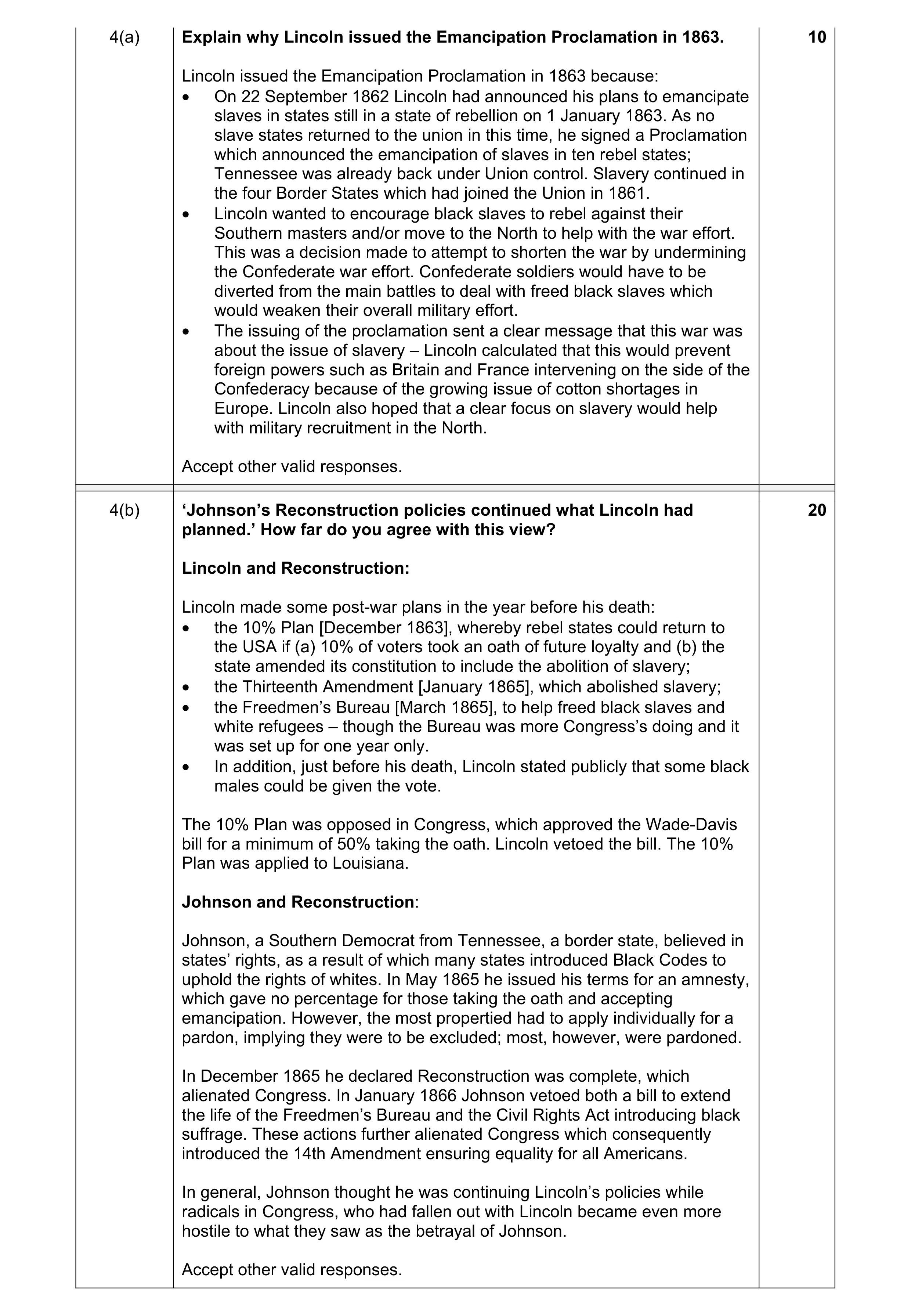 30
30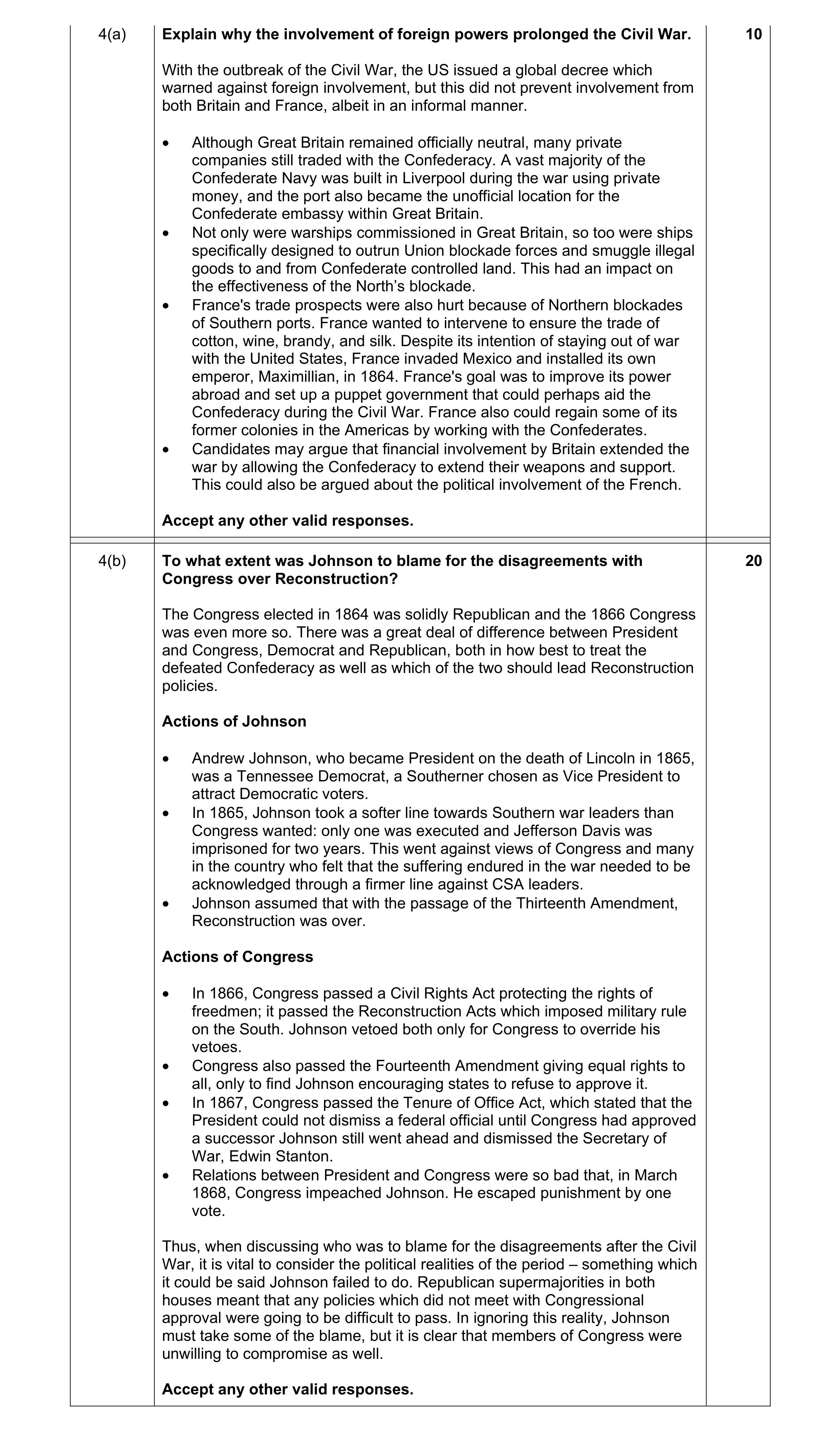 30
30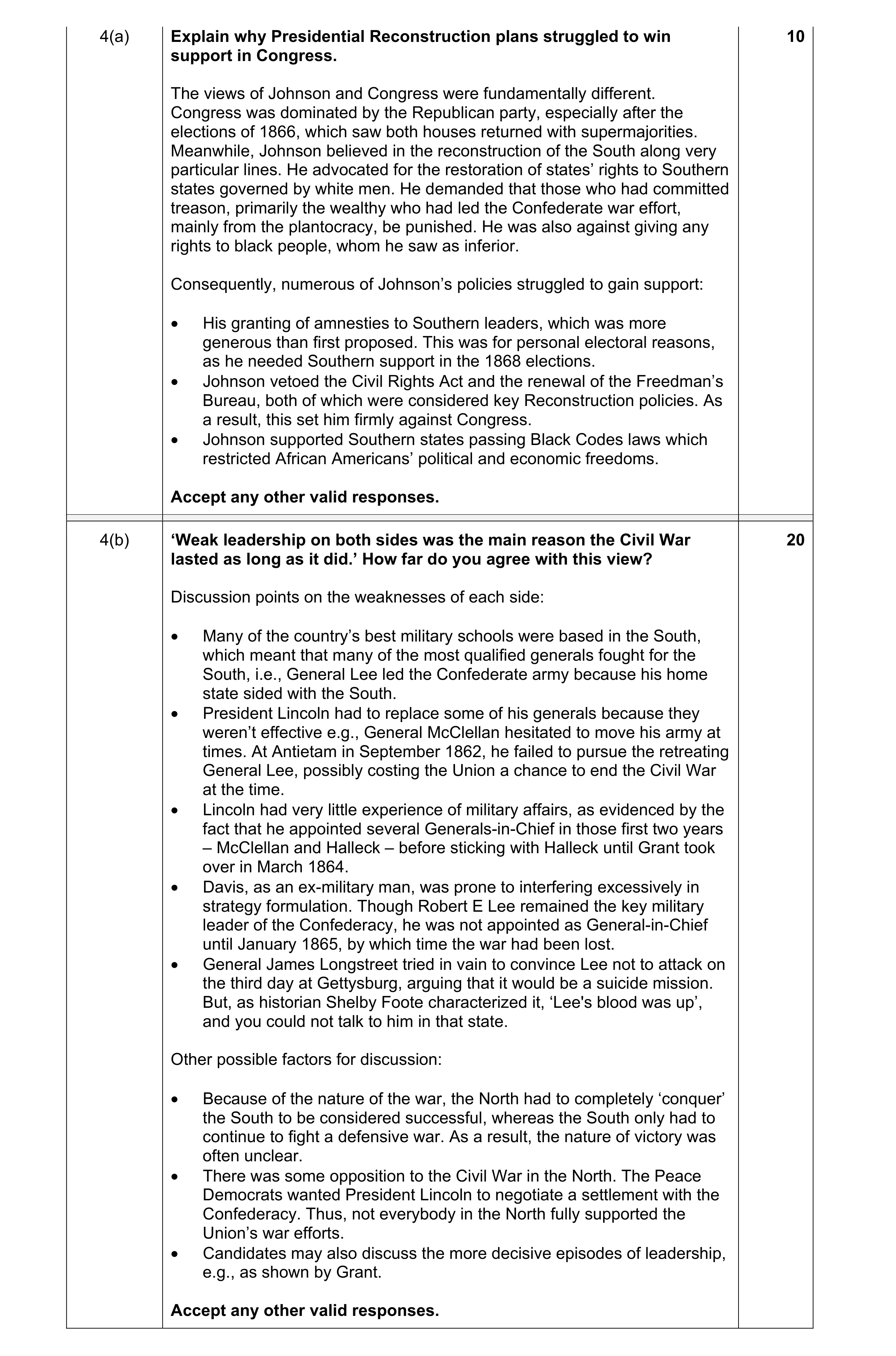 30
30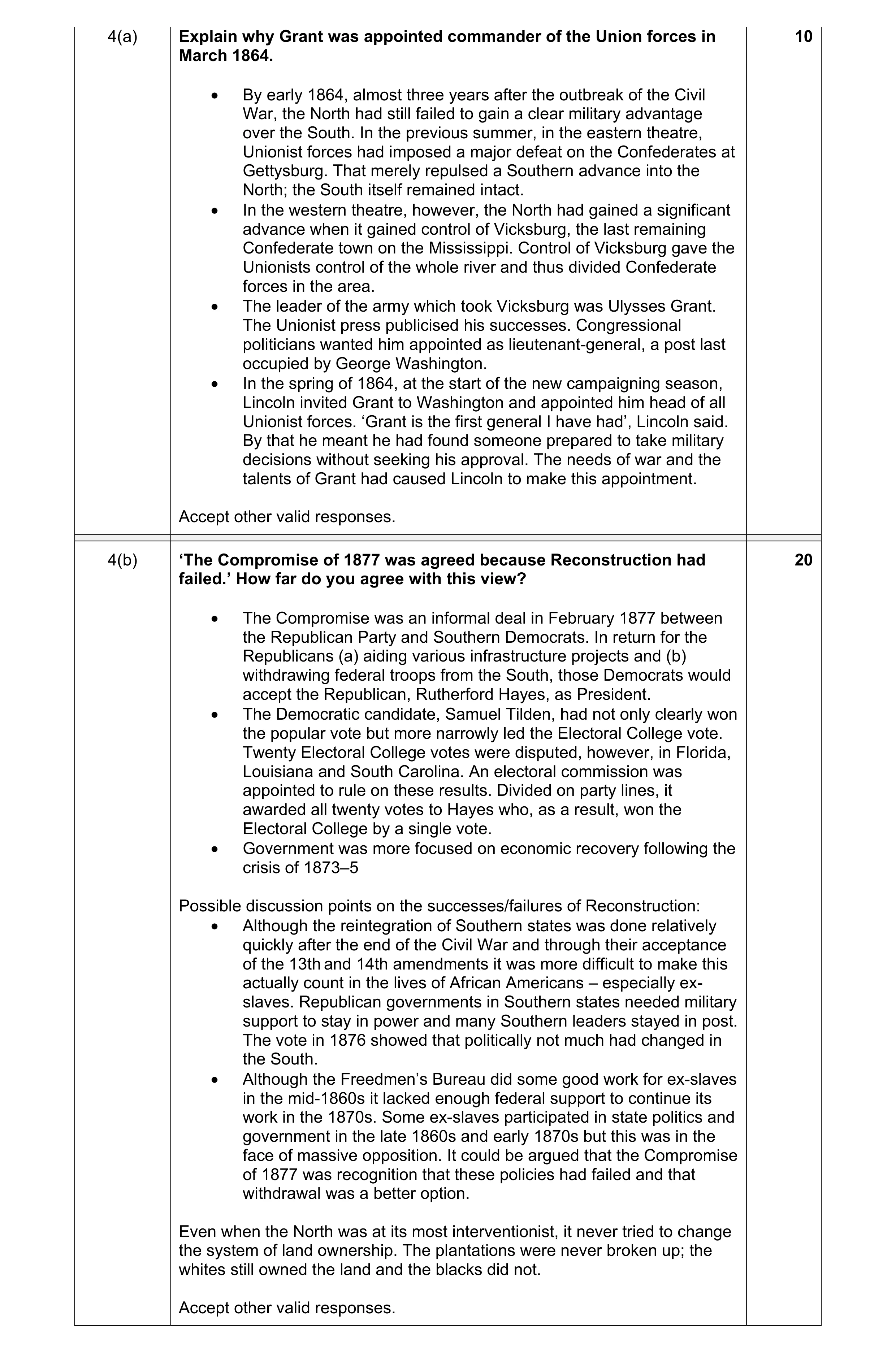 30
30 30
30 30
30 30
30 30
30 30
30 30
30 30
30 30
30 30
30 30
30 30
30 30
30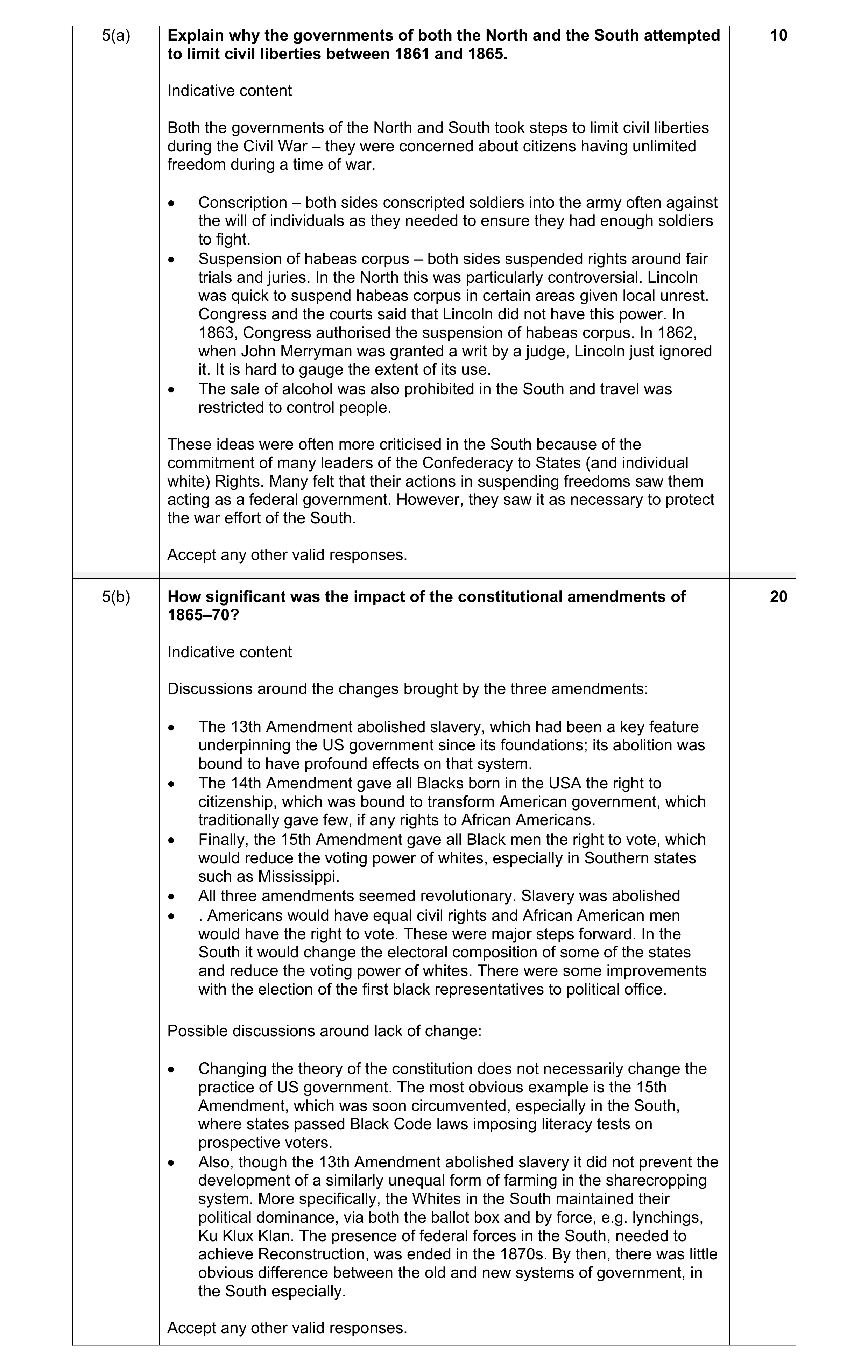 30
30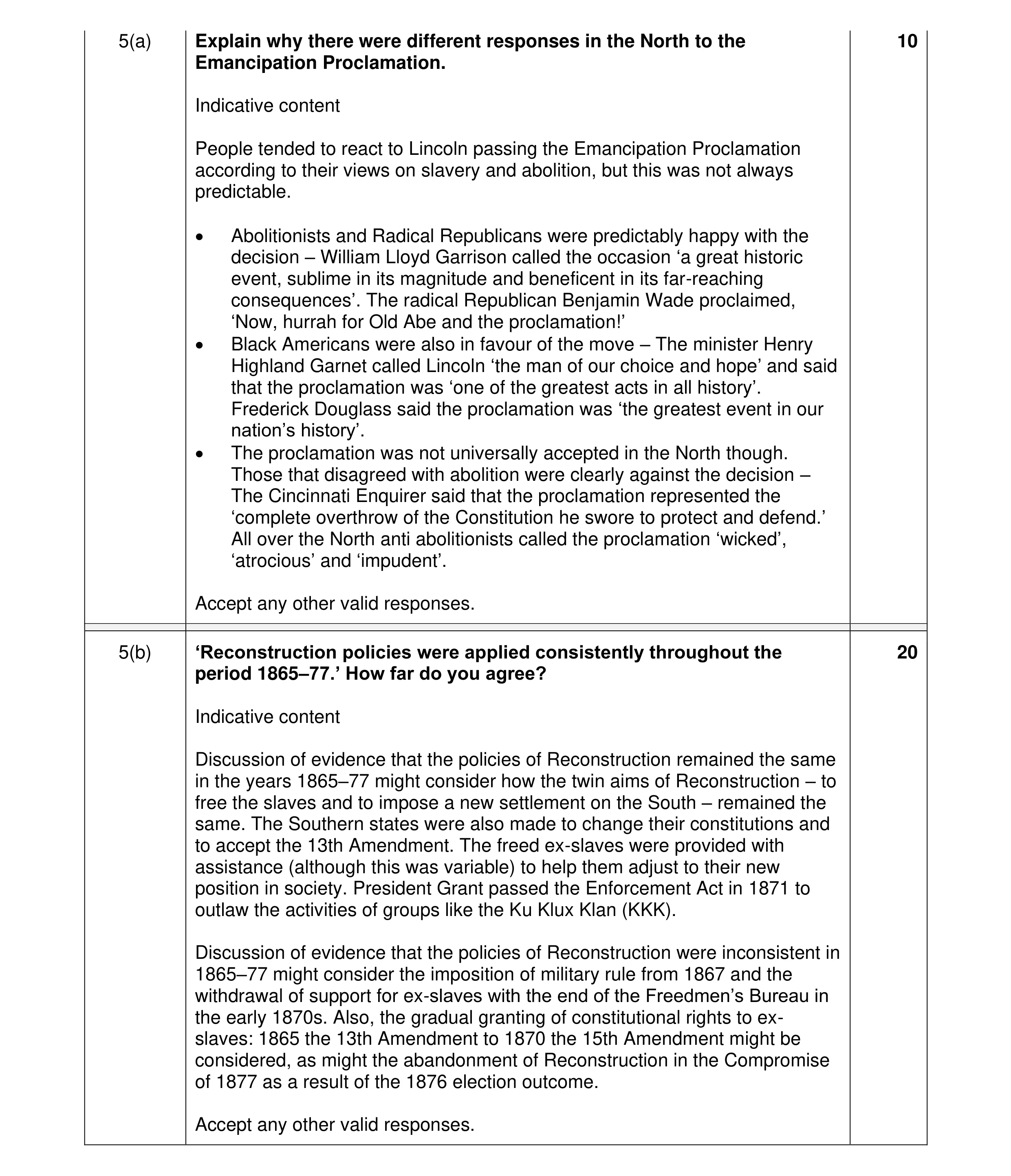 30
30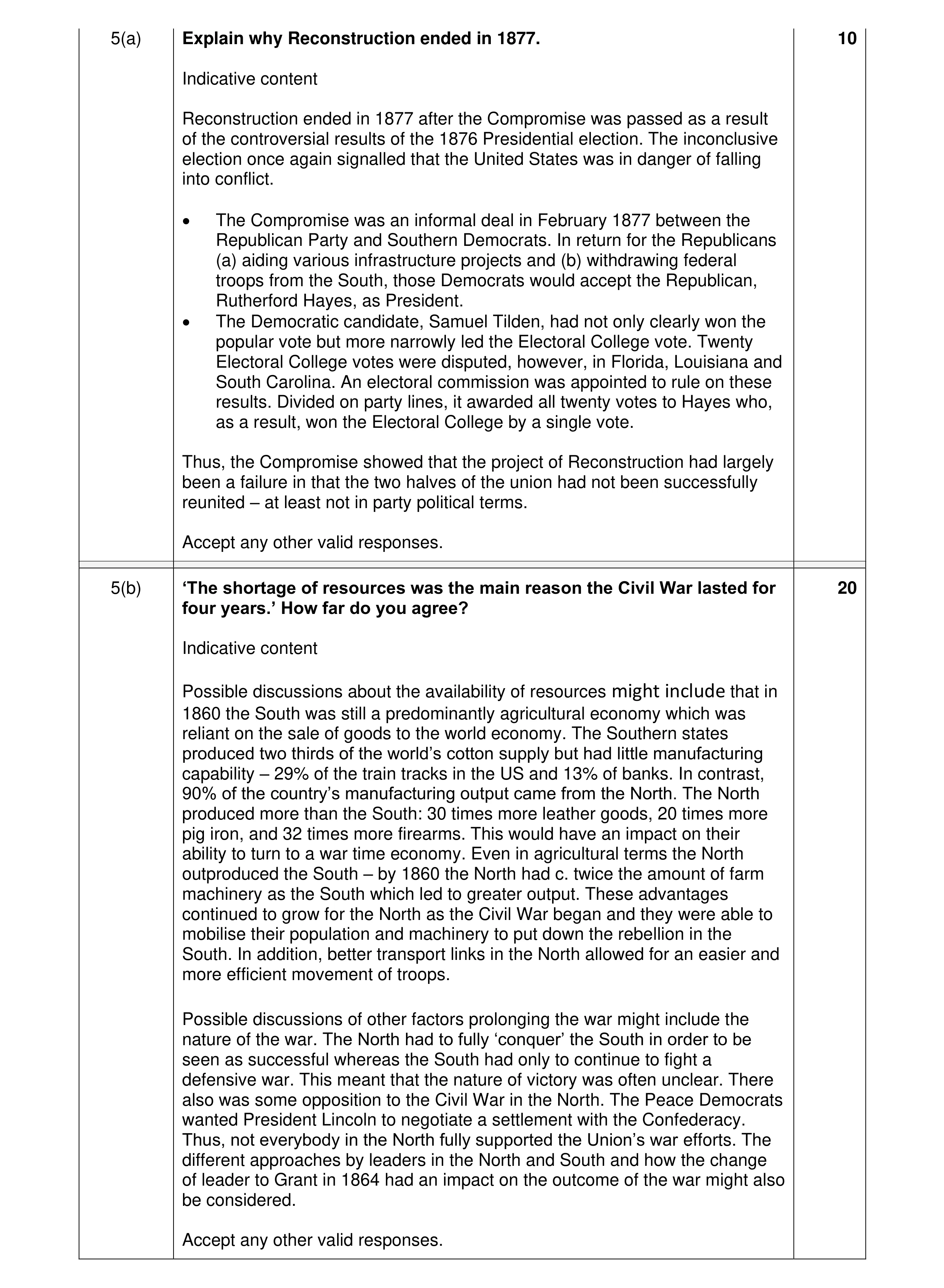 30
30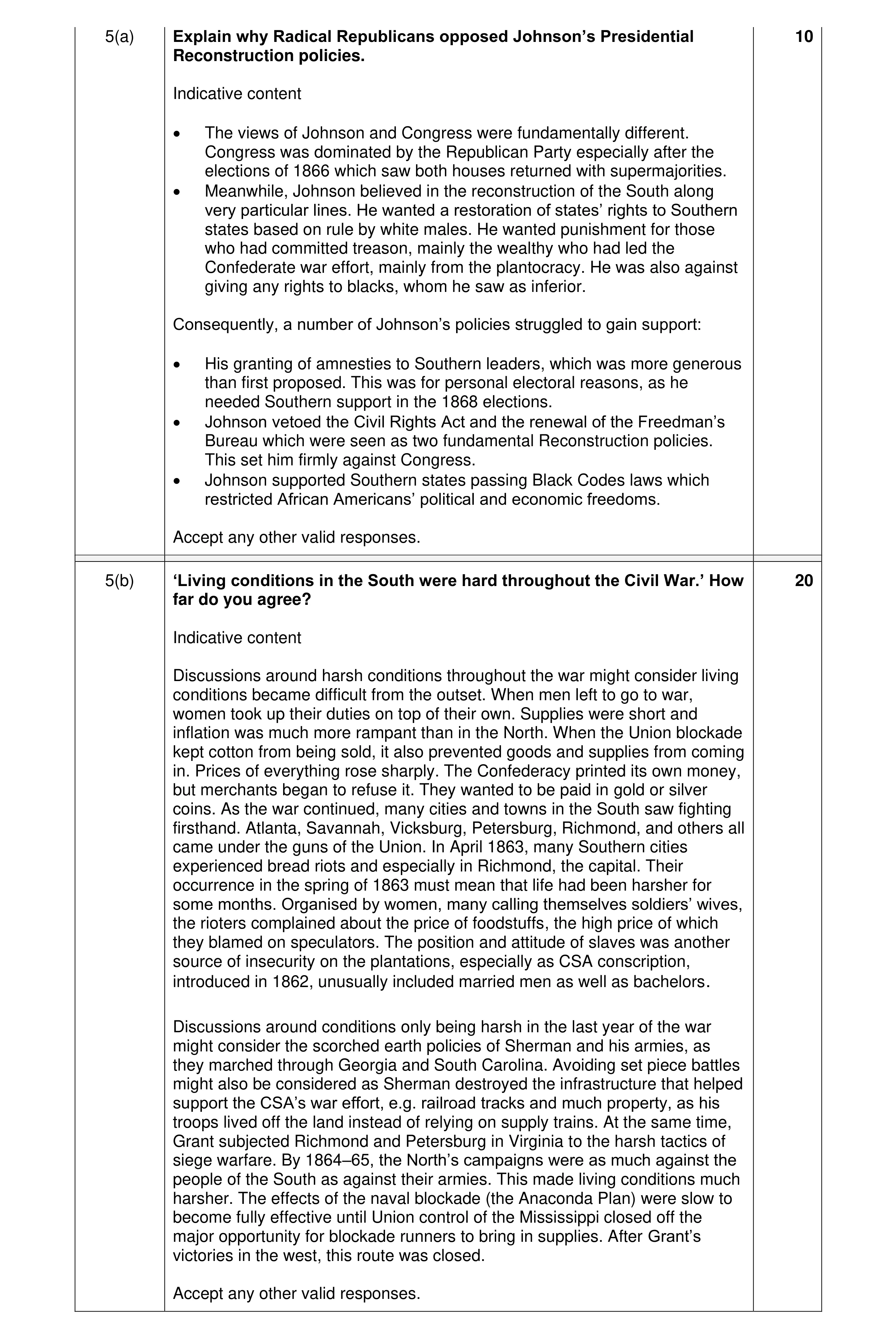 30
30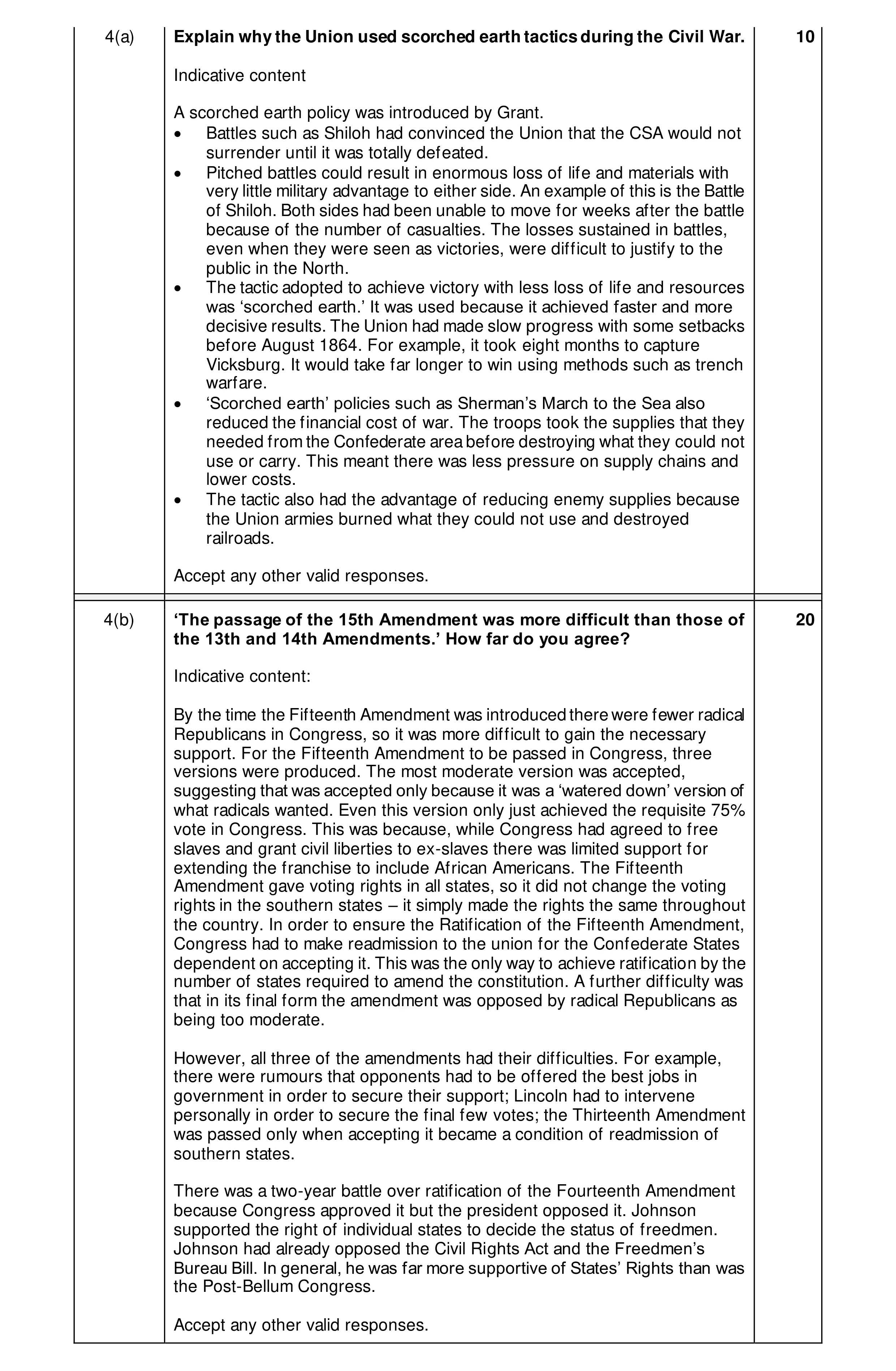 30
30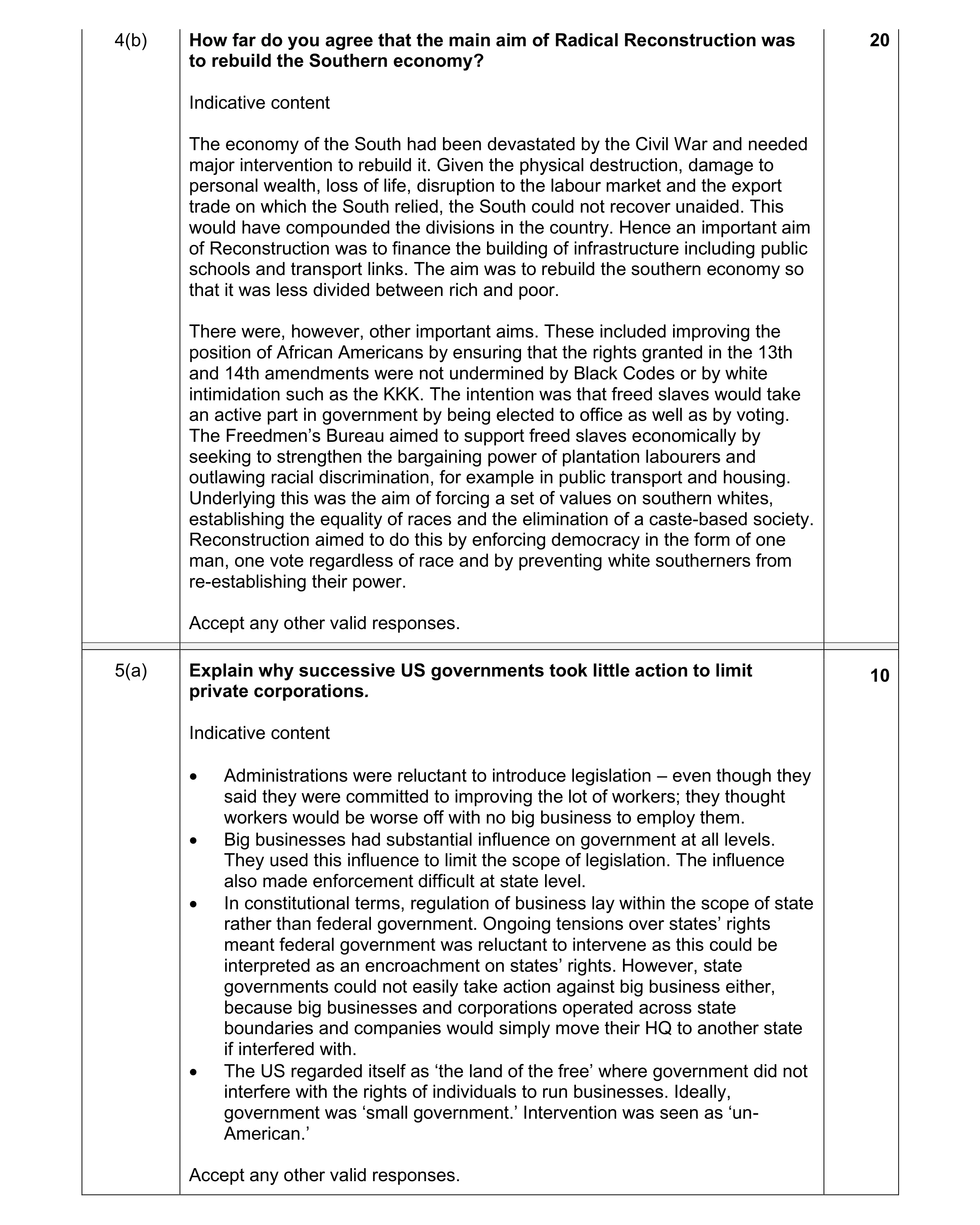 30
30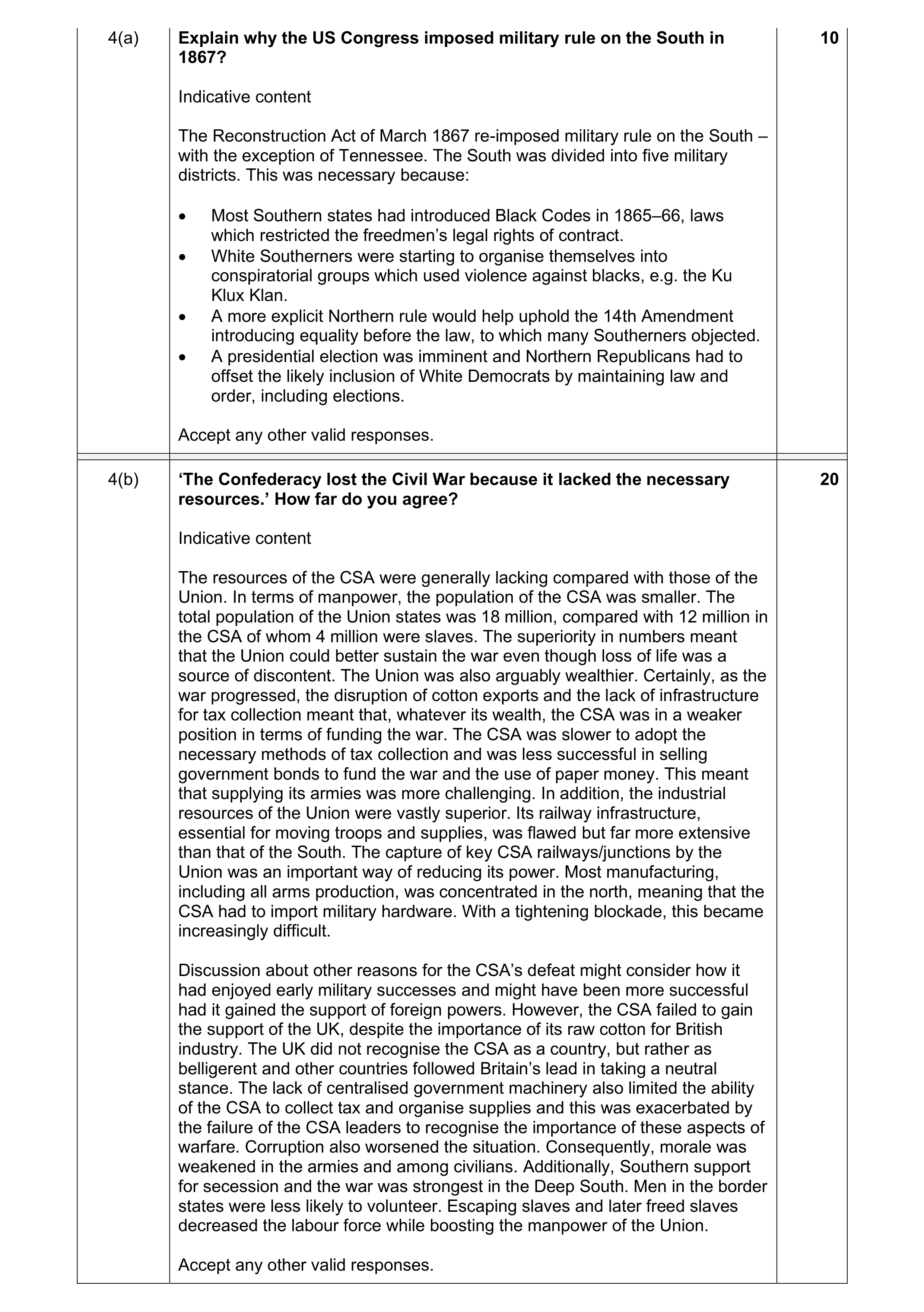 30
30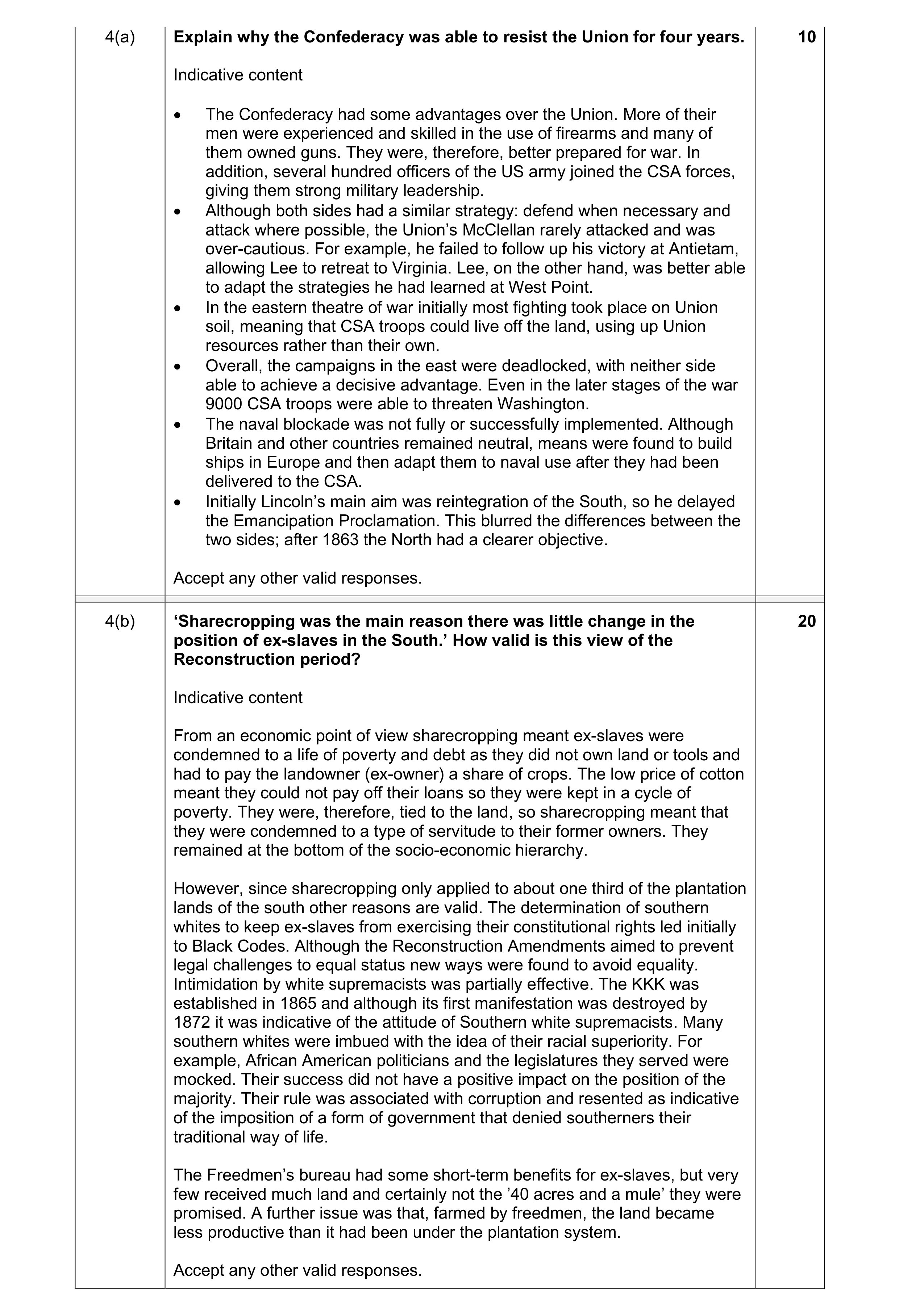 30
30 30
30 30
30 30
30