Cambridge A Level History 9489 — 2021 Feb/March Paper 2 · Variant 2
9489/22/F/M/21 · 9 questions · 60 marks · ≈68 min
The question paper and its mark scheme, free to read here and free to download. This is Cambridge’s own paper, exactly as it was sat.
Question paper4 pages
Mark scheme17 pages
Answers below. Sit the paper first if you are practising.

Questions as text
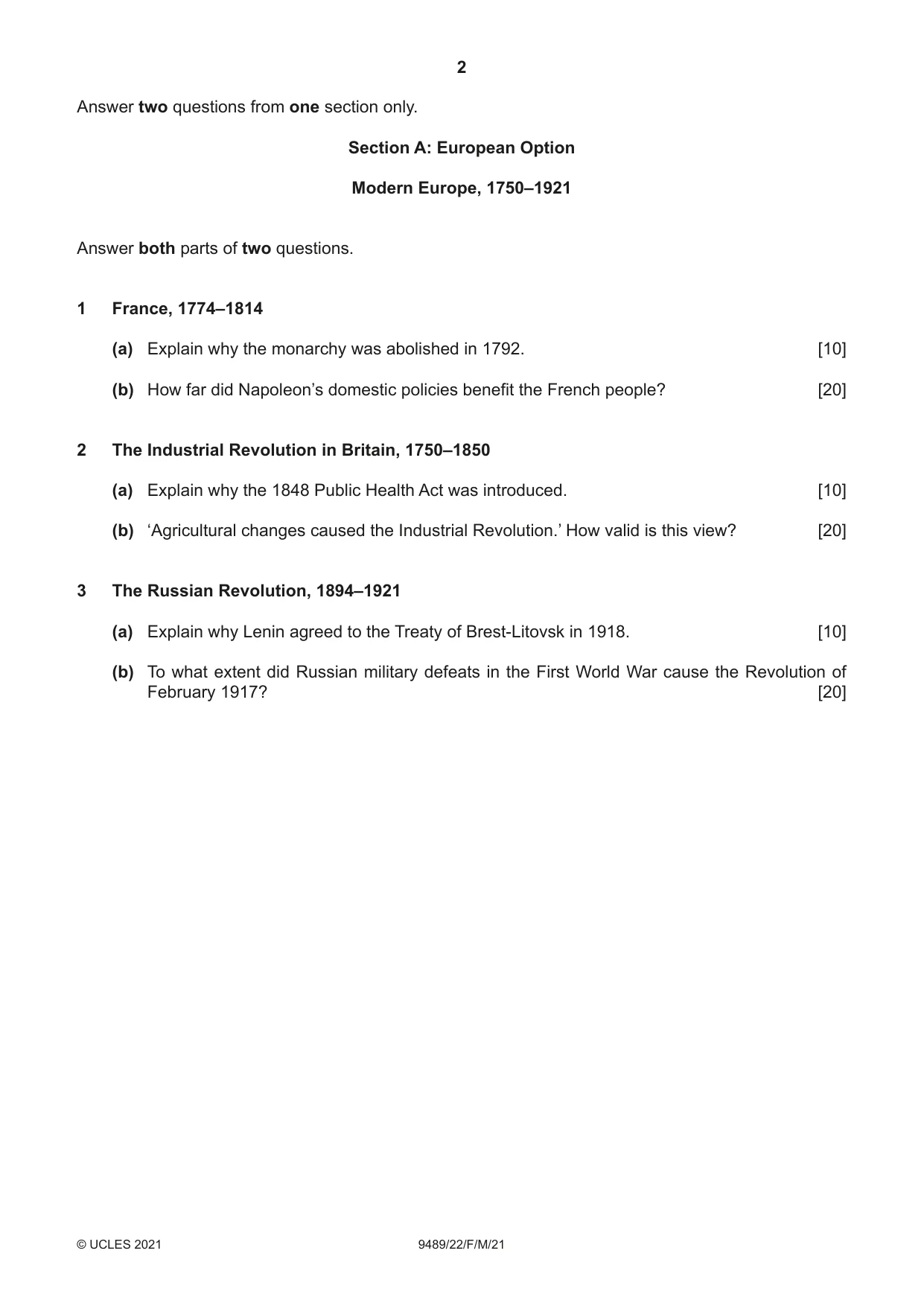
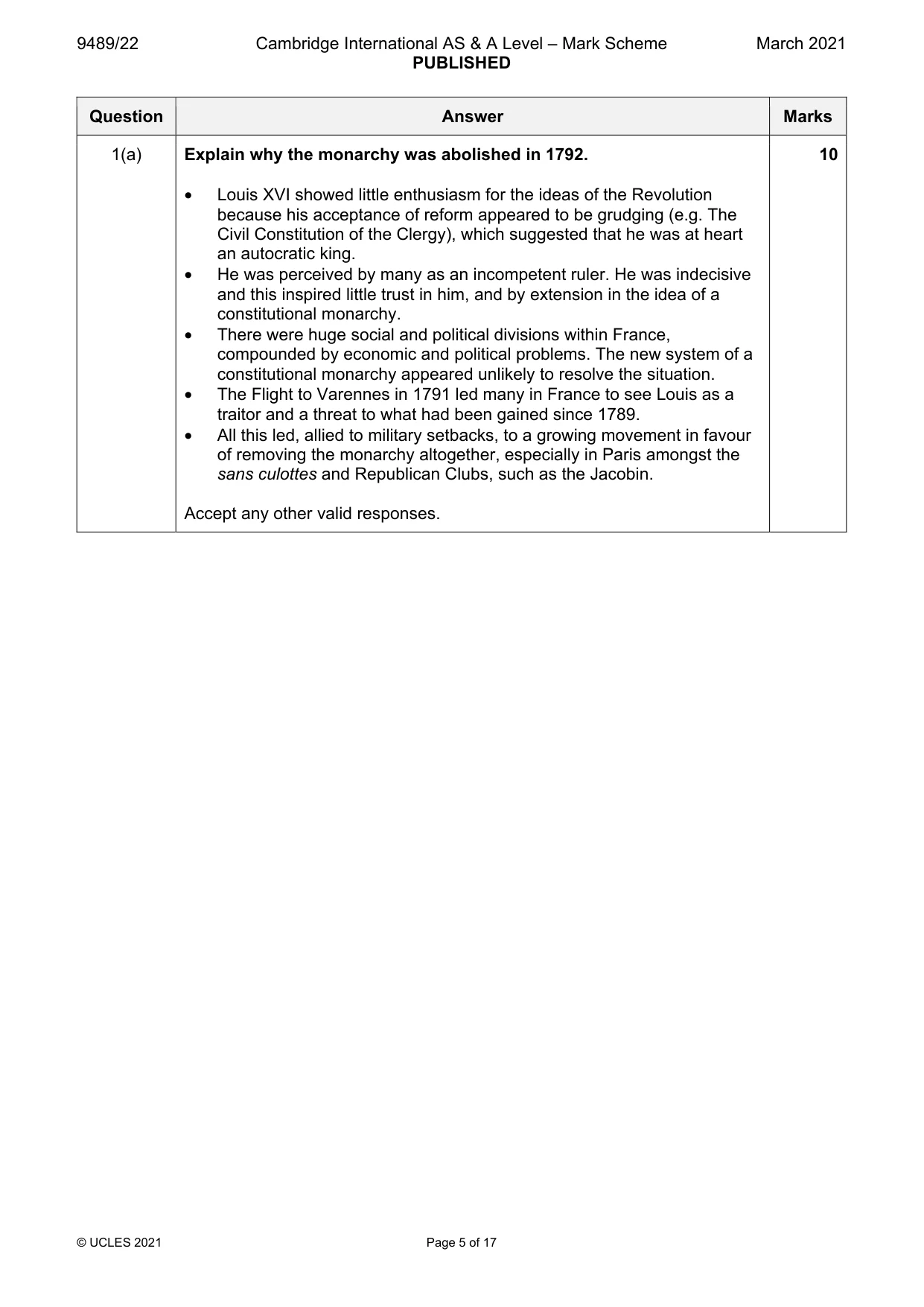
Q1 · France, 1774–1814 (a) Explain why the monarchy was abolished in 1792
1 France, 1774–1814 (a) Explain why the monarchy was abolished in 1792. [10] (b) How far did Napoleon’s domestic policies benefit the French people? [20]
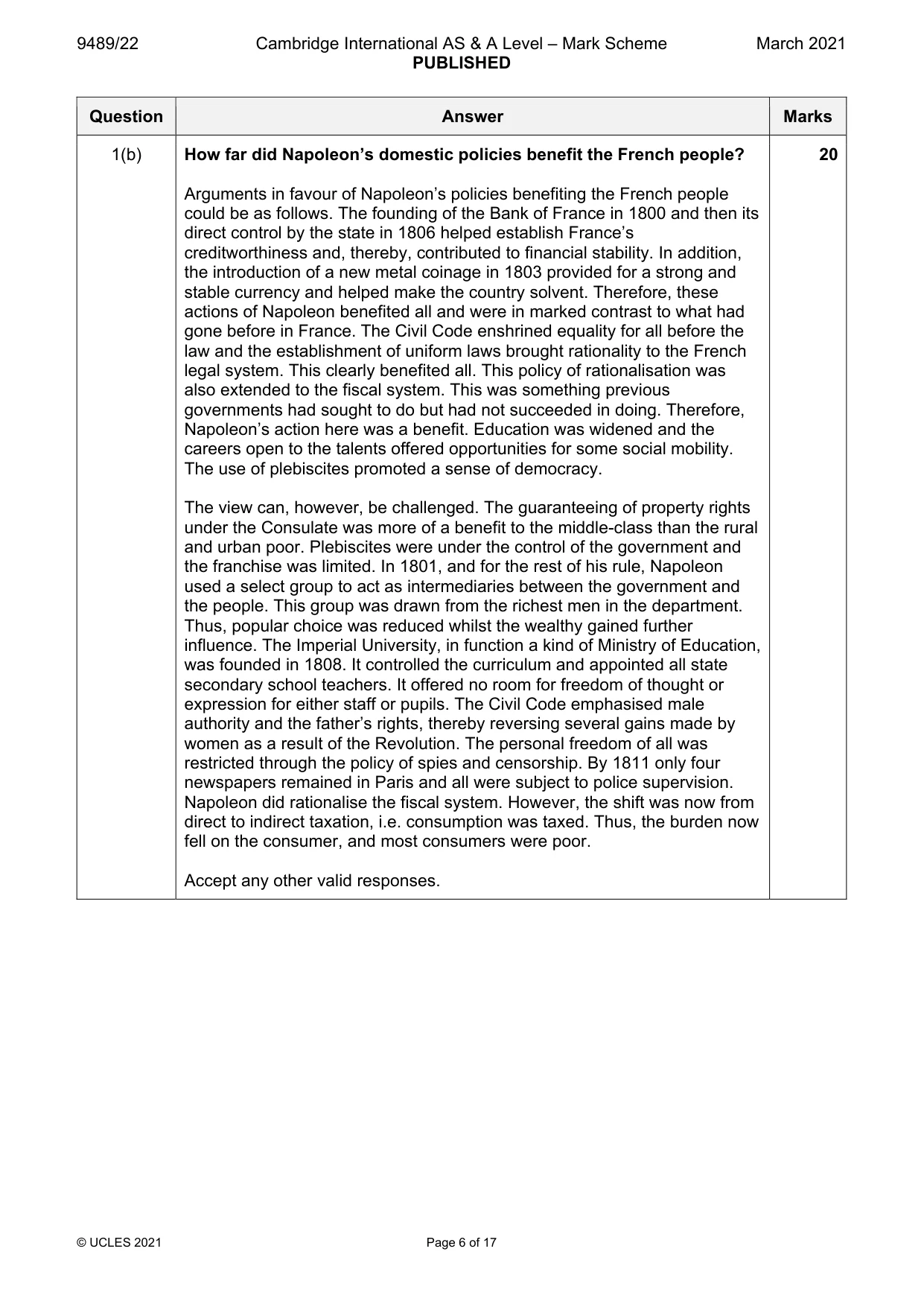
Mark scheme: Question Answer Marks 1(a) Explain why the monarchy was abolished in 1792. 10 • Louis XVI showed little enthusiasm for the ideas of the Revolution because his acceptance of reform appeared to be grudging (e.g. The Civil Constitution of the Clergy), which suggested that he was at heart an autocratic king. • He was perceived by many as an incompetent ruler. He was indecisive and this inspired little trust in him, and by extension in the idea of a constitutional monarchy. • There were huge social and political divisions within France, compounded by economic and political problems. The new system of a constitutional monarchy appeared unlikely to resolve the situation. • The Flight to Varennes in 1791 led many in France to see Louis as a traitor and a threat to what had been gained since 1789. • All this led, allied to military setbacks, to a growing movement in favour of removing the monarchy altogether, especially in Paris amongst the sans culottes and Republican Clubs, such as the Jacobin. Accept any other valid responses. 1(b) How far did Napoleon’s domestic policies benefit the French people? 20 Arguments in favour of Napoleon’s policies benefiting the French people could be as follows. The founding of the Bank of France in 1800 and then its direct control by the state in 1806 helped establish France’s creditworthiness and, thereby, contributed to financial stability. In addition, the introduction of a new metal coinage in 1803 provided for a strong and stable currency and helped make the country solvent. Therefore, these actions of Napoleon benefited all and were in marked contrast to what had gone before in France. The Civil Code enshrined equality for all before the law and the establishment of uniform laws brought rationality to the French legal system. This clearly benefited all. This policy of rationalisation was also extended to the fiscal system. This was something previous governments had sought to do but had not succeeded in doing. Therefore, Napoleon’s action here was a benefit. Education was widened and the careers open to the talents offered opportunities for some social mobility. The use of plebiscites promoted a sense of democracy. The view can, however, be challenged. The guaranteeing of property rights under the Consulate was more of a benefit to the middle-class than the rural and urban poor. Plebiscites were under the control of the government and the franchise was limited. In 1801, and for the rest of his rule, Napoleon used a select group to act as intermediaries between the government and the people. This group was drawn from the richest men in the department. Thus, popular choice was reduced whilst the wealthy gained further influence. The Imperial University, in function a kind of Ministry of Education, was founded in 1808. It controlled the curriculum and appointed all state secondary school teachers. It offered no room for freedom of thought or expression for either staff or pupils. The Civil Code emphasised male authority and the father’s rights, thereby reversing several gains made by women as a result of the Revolution. The personal freedom of all was restricted through the policy of spies and censorship. By 1811 only four newspapers remained in Paris and all were subject to police supervision. Napoleon did rationalise the fiscal system. However, the shift was now from direct to indirect taxation, i.e. consumption was taxed. Thus, the burden now fell on the consumer, and most consumers were poor. Accept any other valid responses.
More questions on What caused the rise and fall of Napoleon Bonaparte?
Q2 · The Industrial Revolution in Britain, 1750–1850 (a) Explain why the 1848 Public Health…
2 The Industrial Revolution in Britain, 1750–1850 (a) Explain why the 1848 Public Health Act was introduced. [10] (b) ‘Agricultural changes caused the Industrial Revolution.’ How valid is this view? [20]
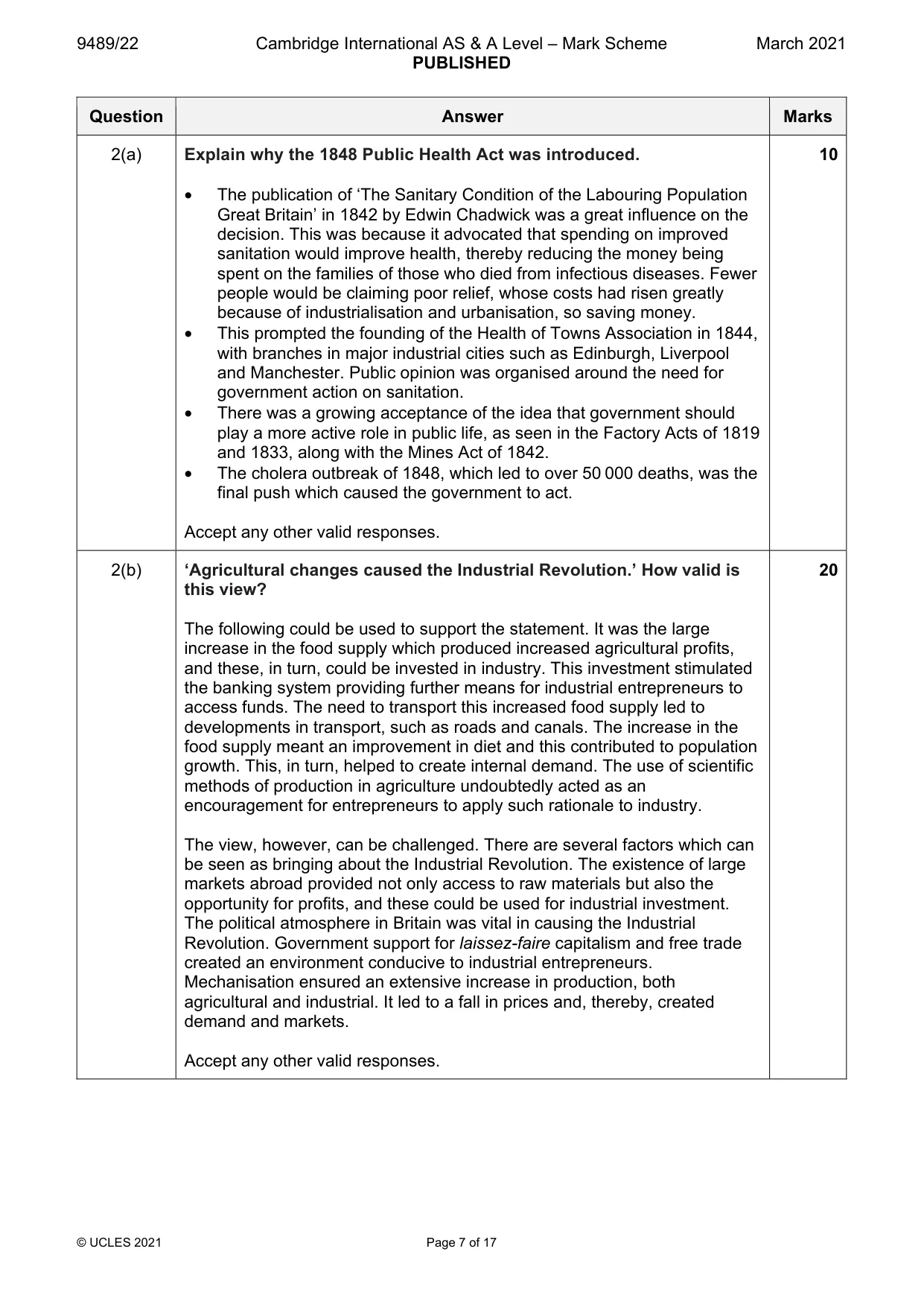
Mark scheme: 2(a) Explain why the 1848 Public Health Act was introduced. 10 • The publication of ‘The Sanitary Condition of the Labouring Population Great Britain’ in 1842 by Edwin Chadwick was a great influence on the decision. This was because it advocated that spending on improved sanitation would improve health, thereby reducing the money being spent on the families of those who died from infectious diseases. Fewer people would be claiming poor relief, whose costs had risen greatly because of industrialisation and urbanisation, so saving money. • This prompted the founding of the Health of Towns Association in 1844, with branches in major industrial cities such as Edinburgh, Liverpool and Manchester. Public opinion was organised around the need for government action on sanitation. • There was a growing acceptance of the idea that government should play a more active role in public life, as seen in the Factory Acts of 1819 and 1833, along with the Mines Act of 1842. • The cholera outbreak of 1848, which led to over 50 000 deaths, was the final push which caused the government to act. Accept any other valid responses. 2(b) ‘Agricultural changes caused the Industrial Revolution.’ How valid is 20 this view? The following could be used to support the statement. It was the large increase in the food supply which produced increased agricultural profits, and these, in turn, could be invested in industry. This investment stimulated the banking system providing further means for industrial entrepreneurs to access funds. The need to transport this increased food supply led to developments in transport, such as roads and canals. The increase in the food supply meant an improvement in diet and this contributed to population growth. This, in turn, helped to create internal demand. The use of scientific methods of production in agriculture undoubtedly acted as an encouragement for entrepreneurs to apply such rationale to industry. The view, however, can be challenged. There are several factors which can be seen as bringing about the Industrial Revolution. The existence of large markets abroad provided not only access to raw materials but also the opportunity for profits, and these could be used for industrial investment. The political atmosphere in Britain was vital in causing the Industrial Revolution. Government support for laissez-faire capitalism and free trade created an environment conducive to industrial entrepreneurs. Mechanisation ensured an extensive increase in production, both agricultural and industrial. It led to a fall in prices and, thereby, created demand and markets. Accept any other valid responses.
More questions on Why was there rapid industrialisation after 1870?
Q3 · The Russian Revolution, 1894–1921 (a) Explain why Lenin agreed to the Treaty of…
3 The Russian Revolution, 1894–1921 (a) Explain why Lenin agreed to the Treaty of Brest-Litovsk in 1918. [10] (b) To what extent did Russian military defeats in the First World War cause the Revolution of February 1917? [20]
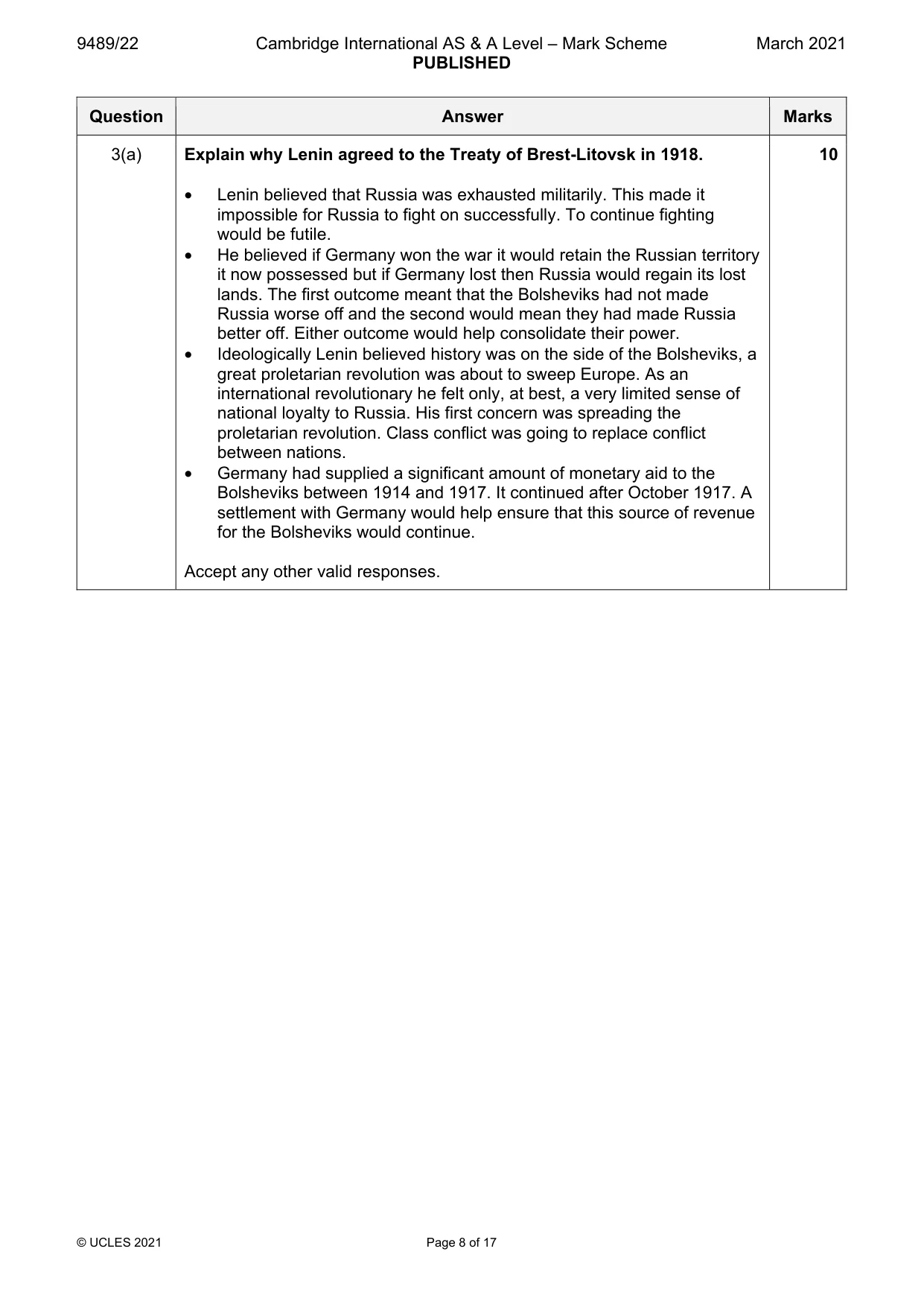
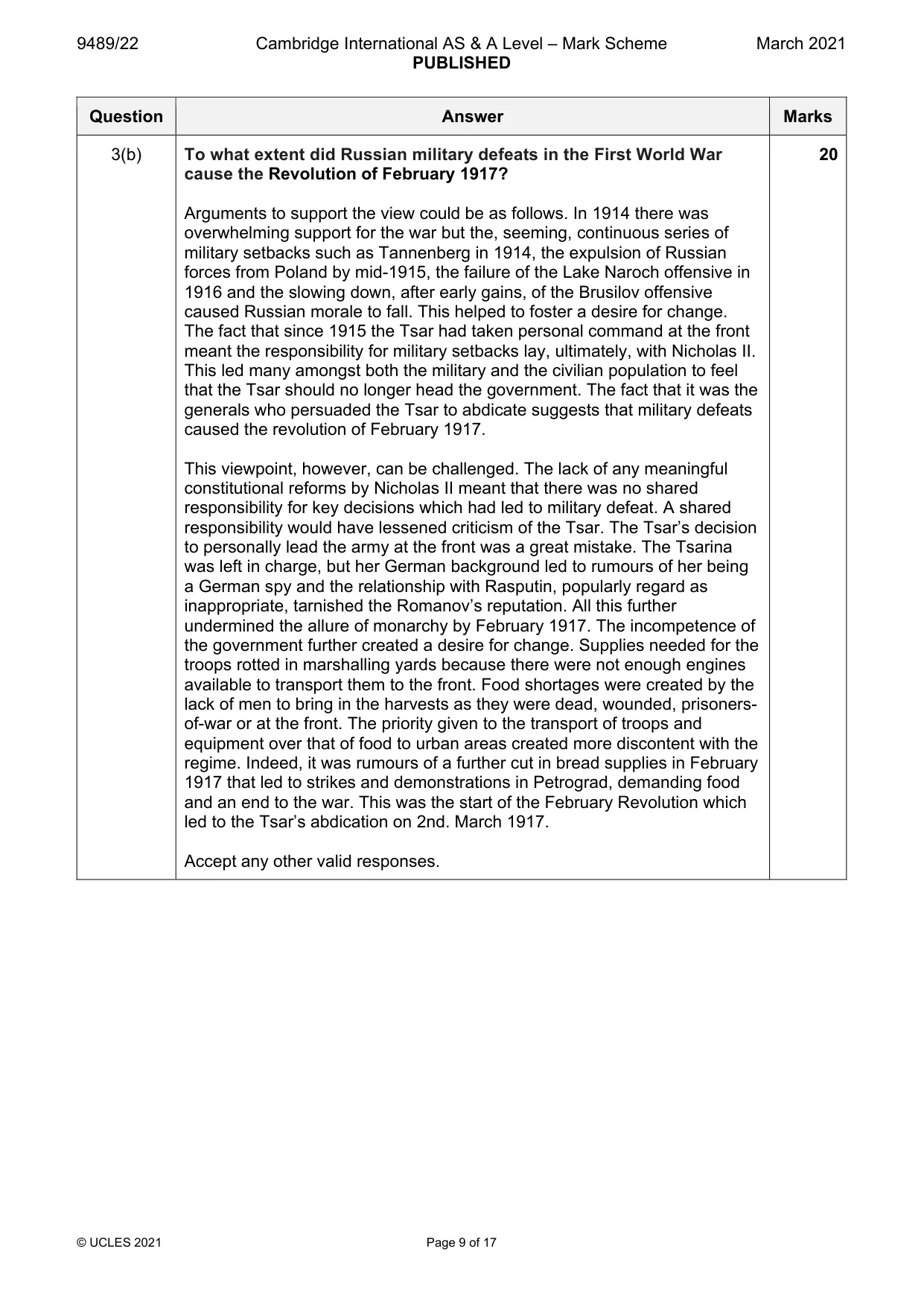
Mark scheme: 3(a) Explain why Lenin agreed to the Treaty of Brest-Litovsk in 1918. 10 • Lenin believed that Russia was exhausted militarily. This made it impossible for Russia to fight on successfully. To continue fighting would be futile. • He believed if Germany won the war it would retain the Russian territory it now possessed but if Germany lost then Russia would regain its lost lands. The first outcome meant that the Bolsheviks had not made Russia worse off and the second would mean they had made Russia better off. Either outcome would help consolidate their power. • Ideologically Lenin believed history was on the side of the Bolsheviks, a great proletarian revolution was about to sweep Europe. As an international revolutionary he felt only, at best, a very limited sense of national loyalty to Russia. His first concern was spreading the proletarian revolution. Class conflict was going to replace conflict between nations. • Germany had supplied a significant amount of monetary aid to the Bolsheviks between 1914 and 1917. It continued after October 1917. A settlement with Germany would help ensure that this source of revenue for the Bolsheviks would continue. Accept any other valid responses. 3(b) To what extent did Russian military defeats in the First World War 20 cause the Revolution of February 1917? Arguments to support the view could be as follows. In 1914 there was overwhelming support for the war but the, seeming, continuous series of military setbacks such as Tannenberg in 1914, the expulsion of Russian forces from Poland by mid-1915, the failure of the Lake Naroch offensive in 1916 and the slowing down, after early gains, of the Brusilov offensive caused Russian morale to fall. This helped to foster a desire for change. The fact that since 1915 the Tsar had taken personal command at the front meant the responsibility for military setbacks lay, ultimately, with Nicholas II. This led many amongst both the military and the civilian population to feel that the Tsar should no longer head the government. The fact that it was the generals who persuaded the Tsar to abdicate suggests that military defeats caused the revolution of February 1917. This viewpoint, however, can be challenged. The lack of any meaningful constitutional reforms by Nicholas II meant that there was no shared responsibility for key decisions which had led to military defeat. A shared responsibility would have lessened criticism of the Tsar. The Tsar’s decision to personally lead the army at the front was a great mistake. The Tsarina was left in charge, but her German background led to rumours of her being a German spy and the relationship with Rasputin, popularly regard as inappropriate, tarnished the Romanov’s reputation. All this further undermined the allure of monarchy by February 1917. The incompetence of the government further created a desire for change. Supplies needed for the troops rotted in marshalling yards because there were not enough engines available to transport them to the front. Food shortages were created by the lack of men to bring in the harvests as they were dead, wounded, prisoners- of-war or at the front. The priority given to the transport of troops and equipment over that of food to urban areas created more discontent with the regime. Indeed, it was rumours of a further cut in bread supplies in February 1917 that led to strikes and demonstrations in Petrograd, demanding food and an end to the war. This was the start of the February Revolution which led to the Tsar’s abdication on 2nd. March 1917. Accept any other valid responses.
More questions on How and why did the Bolsheviks seize power in October 1917?
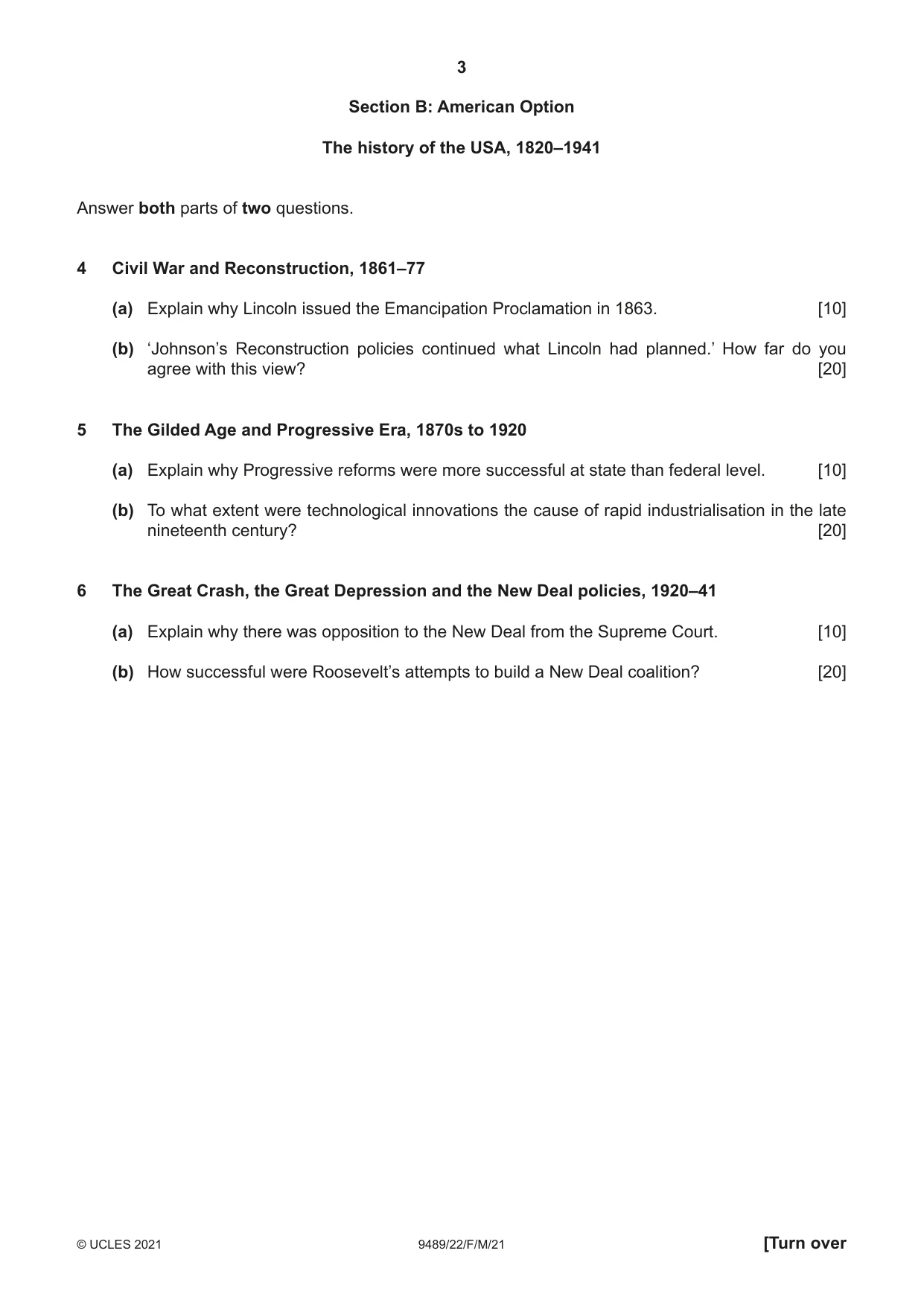
Q4 · Civil War and Reconstruction, 1861–77 (a) Explain why Lincoln issued the Emancipation…
4 Civil War and Reconstruction, 1861–77 (a) Explain why Lincoln issued the Emancipation Proclamation in 1863. [10] (b) ‘Johnson’s Reconstruction policies continued what Lincoln had planned.’ How far do you agree with this view? [20]
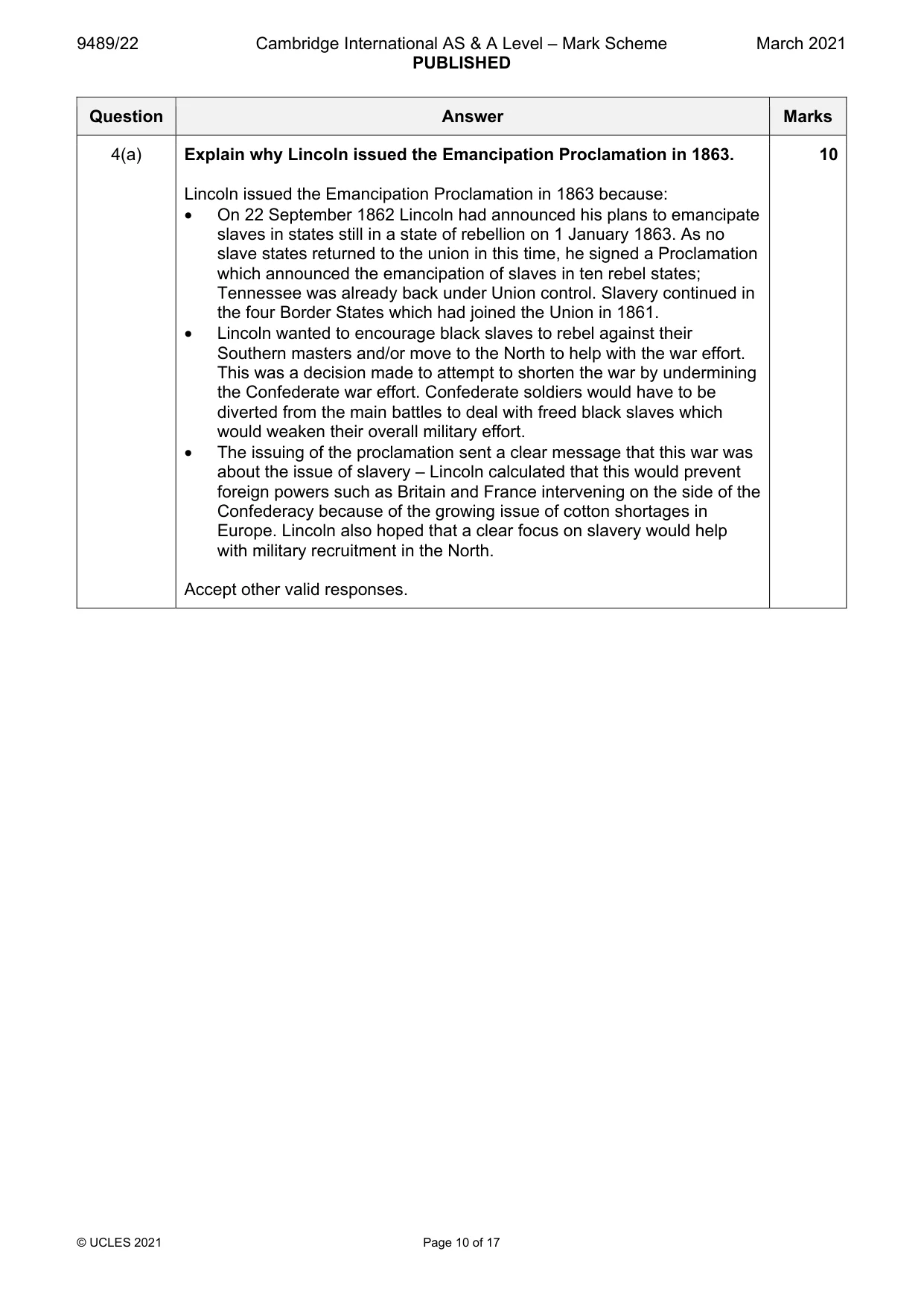
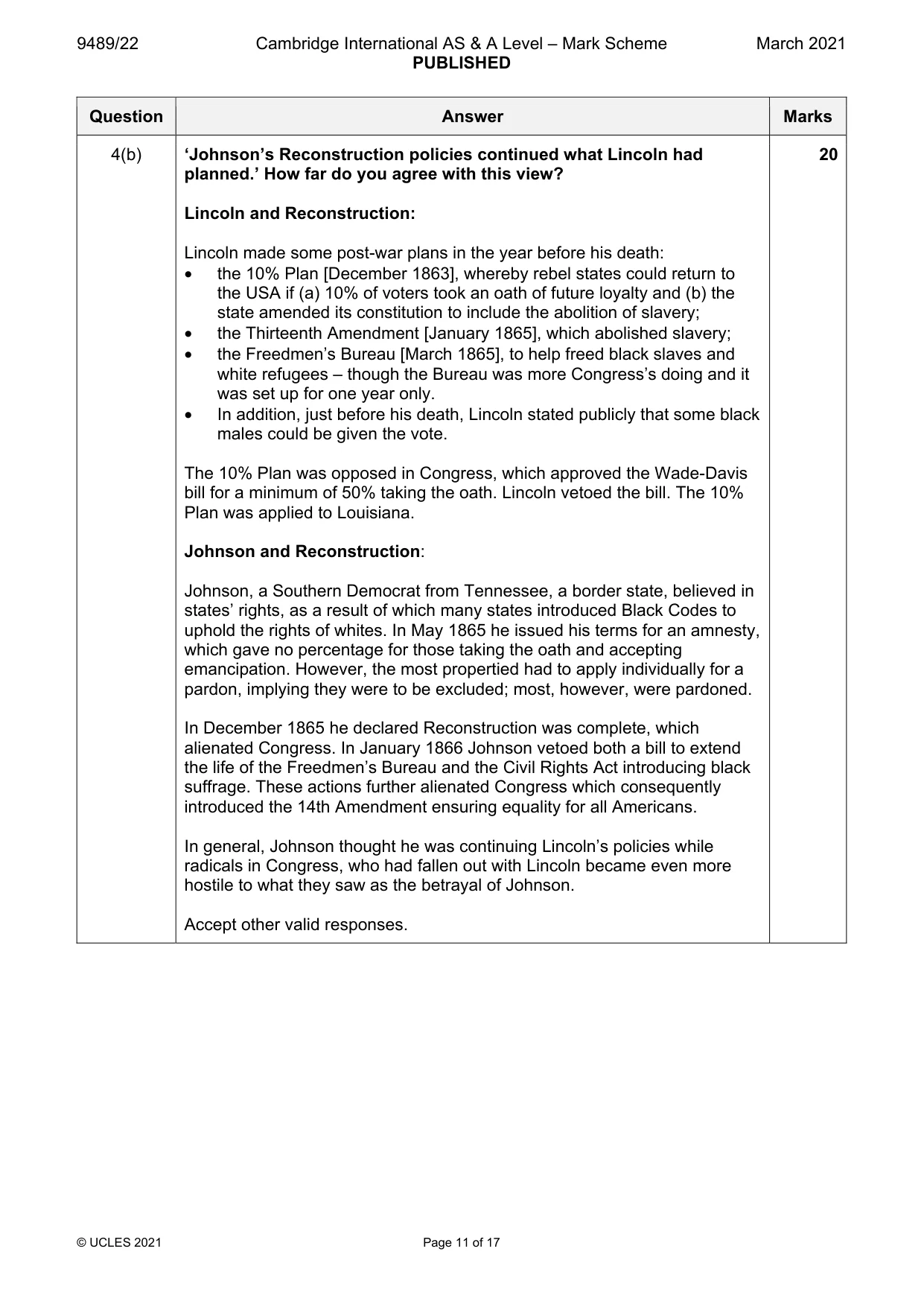
Mark scheme: 4(a) Explain why Lincoln issued the Emancipation Proclamation in 1863. 10 Lincoln issued the Emancipation Proclamation in 1863 because: • On 22 September 1862 Lincoln had announced his plans to emancipate slaves in states still in a state of rebellion on 1 January 1863. As no slave states returned to the union in this time, he signed a Proclamation which announced the emancipation of slaves in ten rebel states; Tennessee was already back under Union control. Slavery continued in the four Border States which had joined the Union in 1861. • Lincoln wanted to encourage black slaves to rebel against their Southern masters and/or move to the North to help with the war effort. This was a decision made to attempt to shorten the war by undermining the Confederate war effort. Confederate soldiers would have to be diverted from the main battles to deal with freed black slaves which would weaken their overall military effort. • The issuing of the proclamation sent a clear message that this war was about the issue of slavery – Lincoln calculated that this would prevent foreign powers such as Britain and France intervening on the side of the Confederacy because of the growing issue of cotton shortages in Europe. Lincoln also hoped that a clear focus on slavery would help with military recruitment in the North. Accept other valid responses. 4(b) ‘Johnson’s Reconstruction policies continued what Lincoln had 20 planned.’ How far do you agree with this view? Lincoln and Reconstruction: Lincoln made some post-war plans in the year before his death: • the 10% Plan [December 1863], whereby rebel states could return to the USA if (a) 10% of voters took an oath of future loyalty and (b) the state amended its constitution to include the abolition of slavery; • the Thirteenth Amendment [January 1865], which abolished slavery; • the Freedmen’s Bureau [March 1865], to help freed black slaves and white refugees – though the Bureau was more Congress’s doing and it was set up for one year only. • In addition, just before his death, Lincoln stated publicly that some black males could be given the vote. The 10% Plan was opposed in Congress, which approved the Wade-Davis bill for a minimum of 50% taking the oath. Lincoln vetoed the bill. The 10% Plan was applied to Louisiana. Johnson and Reconstruction: Johnson, a Southern Democrat from Tennessee, a border state, believed in states’ rights, as a result of which many states introduced Black Codes to uphold the rights of whites. In May 1865 he issued his terms for an amnesty, which gave no percentage for those taking the oath and accepting emancipation. However, the most propertied had to apply individually for a pardon, implying they were to be excluded; most, however, were pardoned. In December 1865 he declared Reconstruction was complete, which alienated Congress. In January 1866 Johnson vetoed both a bill to extend the life of the Freedmen’s Bureau and the Civil Rights Act introducing black suffrage. These actions further alienated Congress which consequently introduced the 14th Amendment ensuring equality for all Americans. In general, Johnson thought he was continuing Lincoln’s policies while radicals in Congress, who had fallen out with Lincoln became even more hostile to what they saw as the betrayal of Johnson. Accept other valid responses.
More questions on What were the aims of Reconstruction and how successful was it?
Q5 · The Gilded Age and Progressive Era, 1870s to 1920 (a) Explain why Progressive reforms…
5 The Gilded Age and Progressive Era, 1870s to 1920 (a) Explain why Progressive reforms were more successful at state than federal level. [10] (b) To what extent were technological innovations the cause of rapid industrialisation in the late nineteenth century? [20]
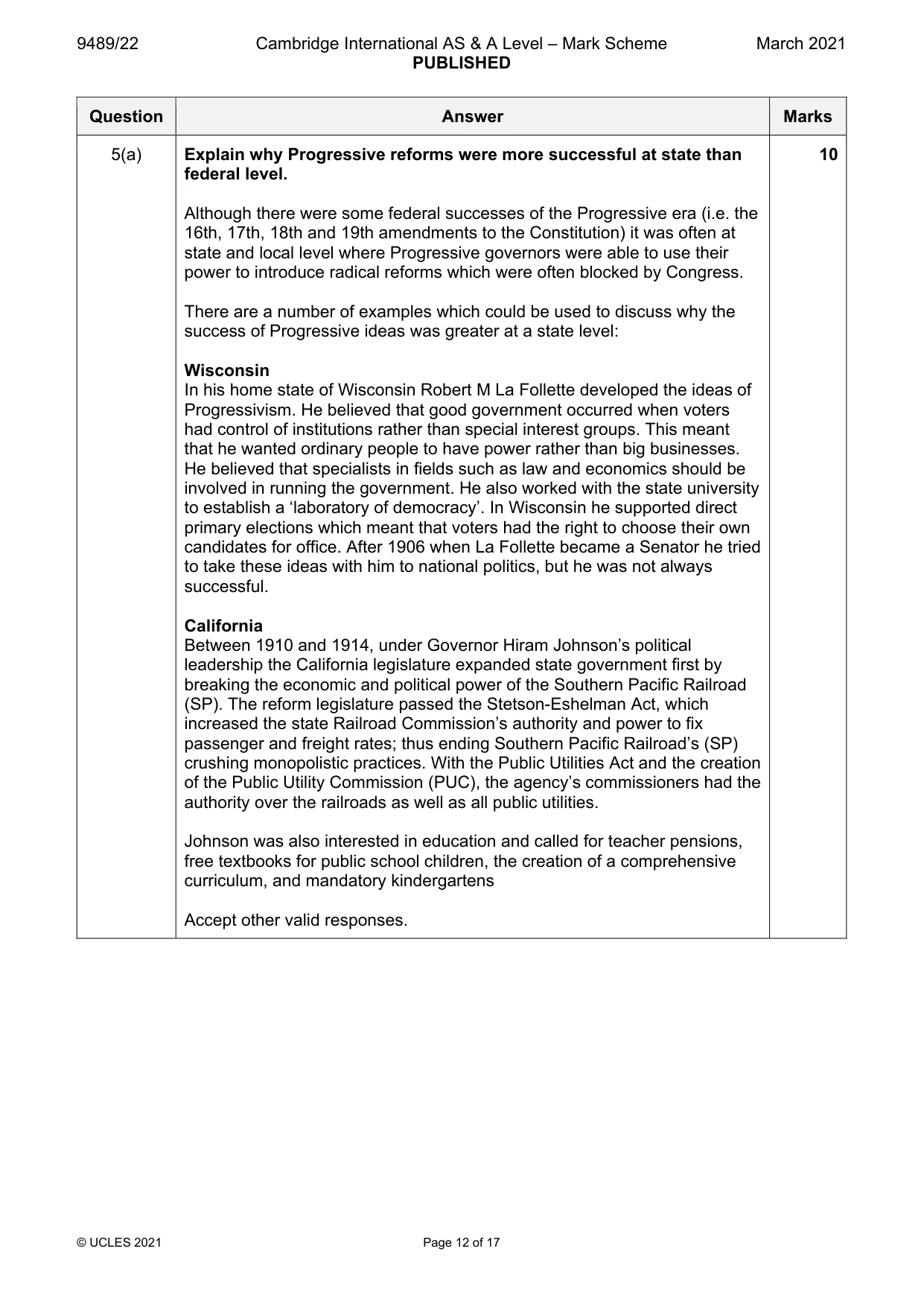
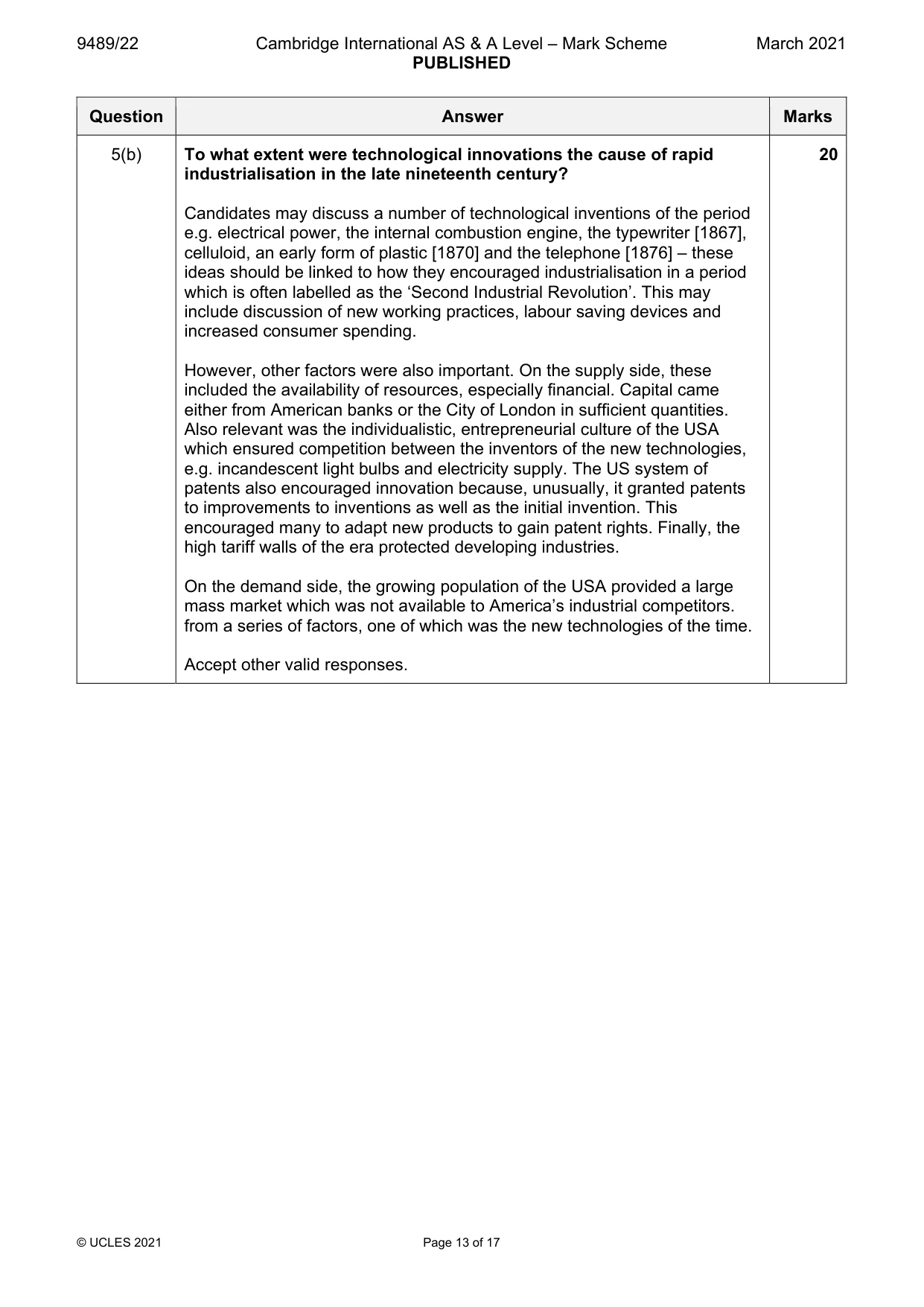
Mark scheme: 5(a) Explain why Progressive reforms were more successful at state than 10 federal level. Although there were some federal successes of the Progressive era (i.e. the 16th, 17th, 18th and 19th amendments to the Constitution) it was often at state and local level where Progressive governors were able to use their power to introduce radical reforms which were often blocked by Congress. There are a number of examples which could be used to discuss why the success of Progressive ideas was greater at a state level: Wisconsin In his home state of Wisconsin Robert M La Follette developed the ideas of Progressivism. He believed that good government occurred when voters had control of institutions rather than special interest groups. This meant that he wanted ordinary people to have power rather than big businesses. He believed that specialists in fields such as law and economics should be involved in running the government. He also worked with the state university to establish a ‘laboratory of democracy’. In Wisconsin he supported direct primary elections which meant that voters had the right to choose their own candidates for office. After 1906 when La Follette became a Senator he tried to take these ideas with him to national politics, but he was not always successful. California Between 1910 and 1914, under Governor Hiram Johnson’s political leadership the California legislature expanded state government first by breaking the economic and political power of the Southern Pacific Railroad (SP). The reform legislature passed the Stetson-Eshelman Act, which increased the state Railroad Commission’s authority and power to fix passenger and freight rates; thus ending Southern Pacific Railroad’s (SP) crushing monopolistic practices. With the Public Utilities Act and the creation of the Public Utility Commission (PUC), the agency’s commissioners had the authority over the railroads as well as all public utilities. Johnson was also interested in education and called for teacher pensions, free textbooks for public school children, the creation of a comprehensive curriculum, and mandatory kindergartens Accept other valid responses. 5(b) To what extent were technological innovations the cause of rapid 20 industrialisation in the late nineteenth century? Candidates may discuss a number of technological inventions of the period e.g. electrical power, the internal combustion engine, the typewriter [1867], celluloid, an early form of plastic [1870] and the telephone [1876] – these ideas should be linked to how they encouraged industrialisation in a period which is often labelled as the ‘Second Industrial Revolution’. This may include discussion of new working practices, labour saving devices and increased consumer spending. However, other factors were also important. On the supply side, these included the availability of resources, especially financial. Capital came either from American banks or the City of London in sufficient quantities. Also relevant was the individualistic, entrepreneurial culture of the USA which ensured competition between the inventors of the new technologies, e.g. incandescent light bulbs and electricity supply. The US system of patents also encouraged innovation because, unusually, it granted patents to improvements to inventions as well as the initial invention. This encouraged many to adapt new products to gain patent rights. Finally, the high tariff walls of the era protected developing industries. On the demand side, the growing population of the USA provided a large mass market which was not available to America’s industrial competitors. from a series of factors, one of which was the new technologies of the time. Accept other valid responses.
More questions on Why was there rapid industrialisation after 1870?
Q6 · The Great Crash, the Great Depression and the New Deal policies, 1920–41 (a) Explain why…
6 The Great Crash, the Great Depression and the New Deal policies, 1920–41 (a) Explain why there was opposition to the New Deal from the Supreme Court. [10] (b) How successful were Roosevelt’s attempts to build a New Deal coalition? [20] Section C: International Option International history, 1870–1945 Answer both parts of two questions.
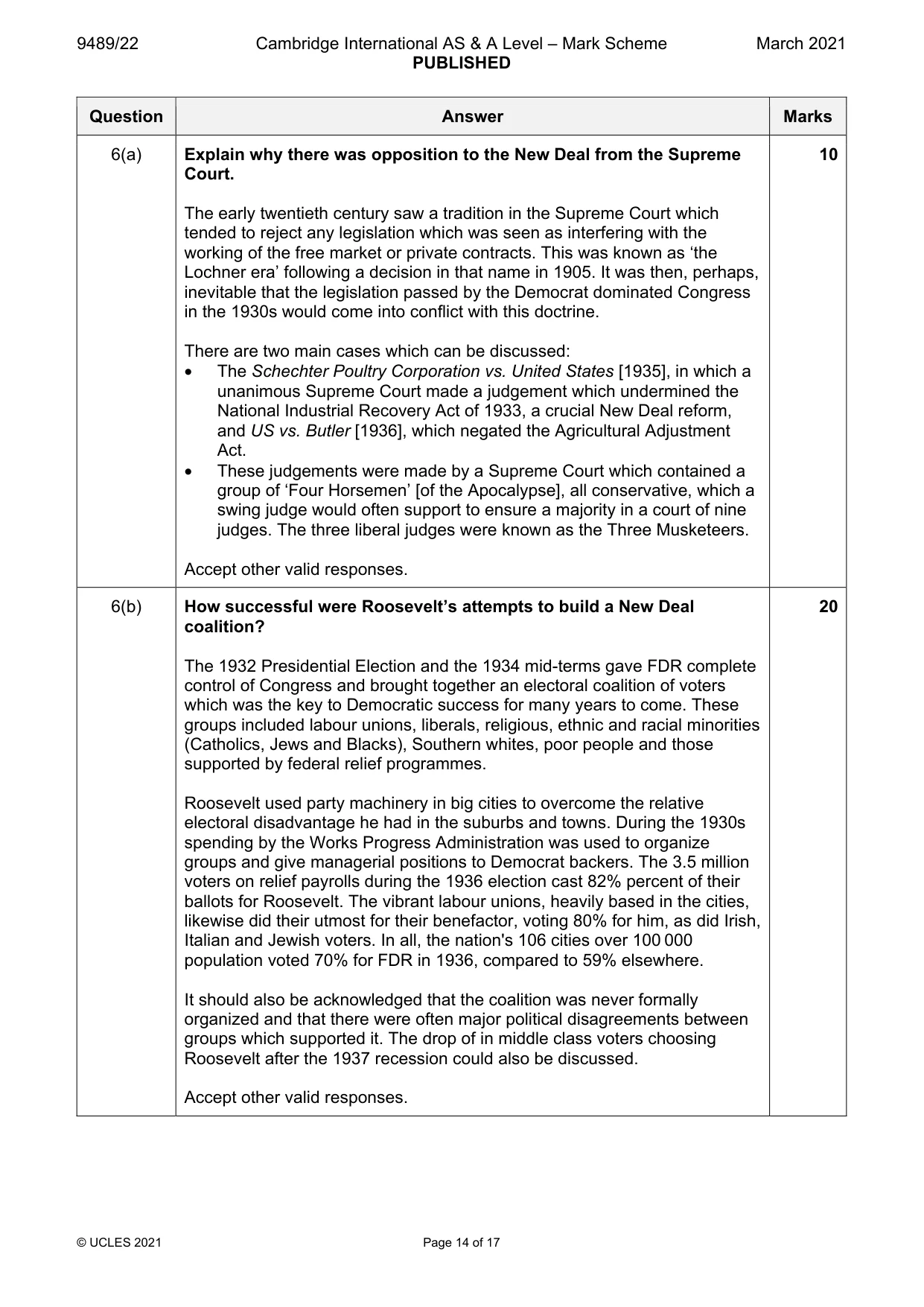
Mark scheme: 6(a) Explain why there was opposition to the New Deal from the Supreme 10 Court. The early twentieth century saw a tradition in the Supreme Court which tended to reject any legislation which was seen as interfering with the working of the free market or private contracts. This was known as ‘the Lochner era’ following a decision in that name in 1905. It was then, perhaps, inevitable that the legislation passed by the Democrat dominated Congress in the 1930s would come into conflict with this doctrine. There are two main cases which can be discussed: • The Schechter Poultry Corporation vs. United States [1935], in which a unanimous Supreme Court made a judgement which undermined the National Industrial Recovery Act of 1933, a crucial New Deal reform, and US vs. Butler [1936], which negated the Agricultural Adjustment Act. • These judgements were made by a Supreme Court which contained a group of ‘Four Horsemen’ [of the Apocalypse], all conservative, which a swing judge would often support to ensure a majority in a court of nine judges. The three liberal judges were known as the Three Musketeers. Accept other valid responses. 6(b) How successful were Roosevelt’s attempts to build a New Deal 20 coalition? The 1932 Presidential Election and the 1934 mid-terms gave FDR complete control of Congress and brought together an electoral coalition of voters which was the key to Democratic success for many years to come. These groups included labour unions, liberals, religious, ethnic and racial minorities (Catholics, Jews and Blacks), Southern whites, poor people and those supported by federal relief programmes. Roosevelt used party machinery in big cities to overcome the relative electoral disadvantage he had in the suburbs and towns. During the 1930s spending by the Works Progress Administration was used to organize groups and give managerial positions to Democrat backers. The 3.5 million voters on relief payrolls during the 1936 election cast 82% percent of their ballots for Roosevelt. The vibrant labour unions, heavily based in the cities, likewise did their utmost for their benefactor, voting 80% for him, as did Irish, Italian and Jewish voters. In all, the nation's 106 cities over 100 000 population voted 70% for FDR in 1936, compared to 59% elsewhere. It should also be acknowledged that the coalition was never formally organized and that there were often major political disagreements between groups which supported it. The drop of in middle class voters choosing Roosevelt after the 1937 recession could also be discussed. Accept other valid responses.
More questions on Why was there a second New Deal and how successful was it?
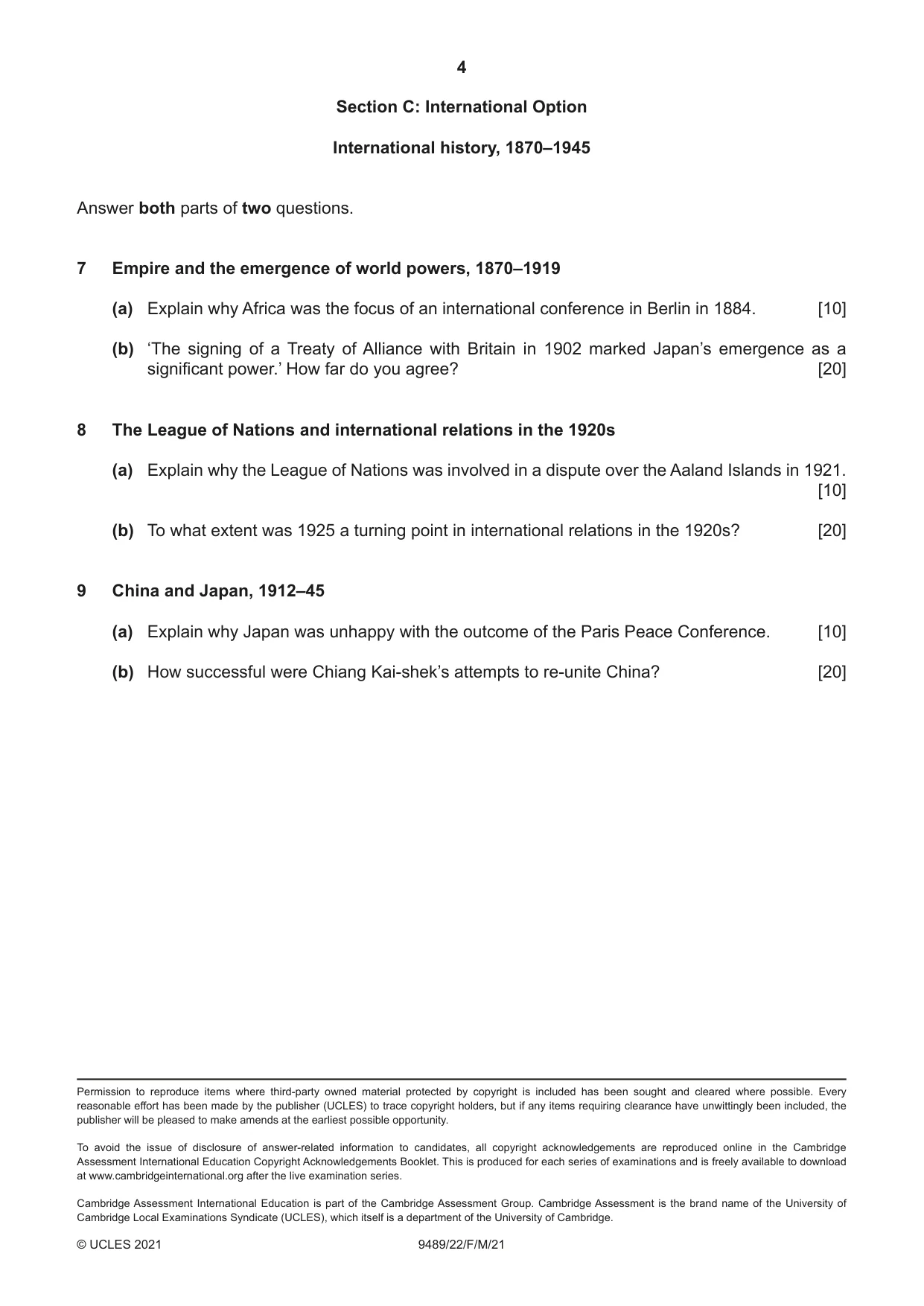
Q7 · Empire and the emergence of world powers, 1870–1919 (a) Explain why Africa was the focus…
7 Empire and the emergence of world powers, 1870–1919 (a) Explain why Africa was the focus of an international conference in Berlin in 1884. [10] (b) ‘The signing of a Treaty of Alliance with Britain in 1902 marked Japan’s emergence as a significant power.’ How far do you agree? [20]
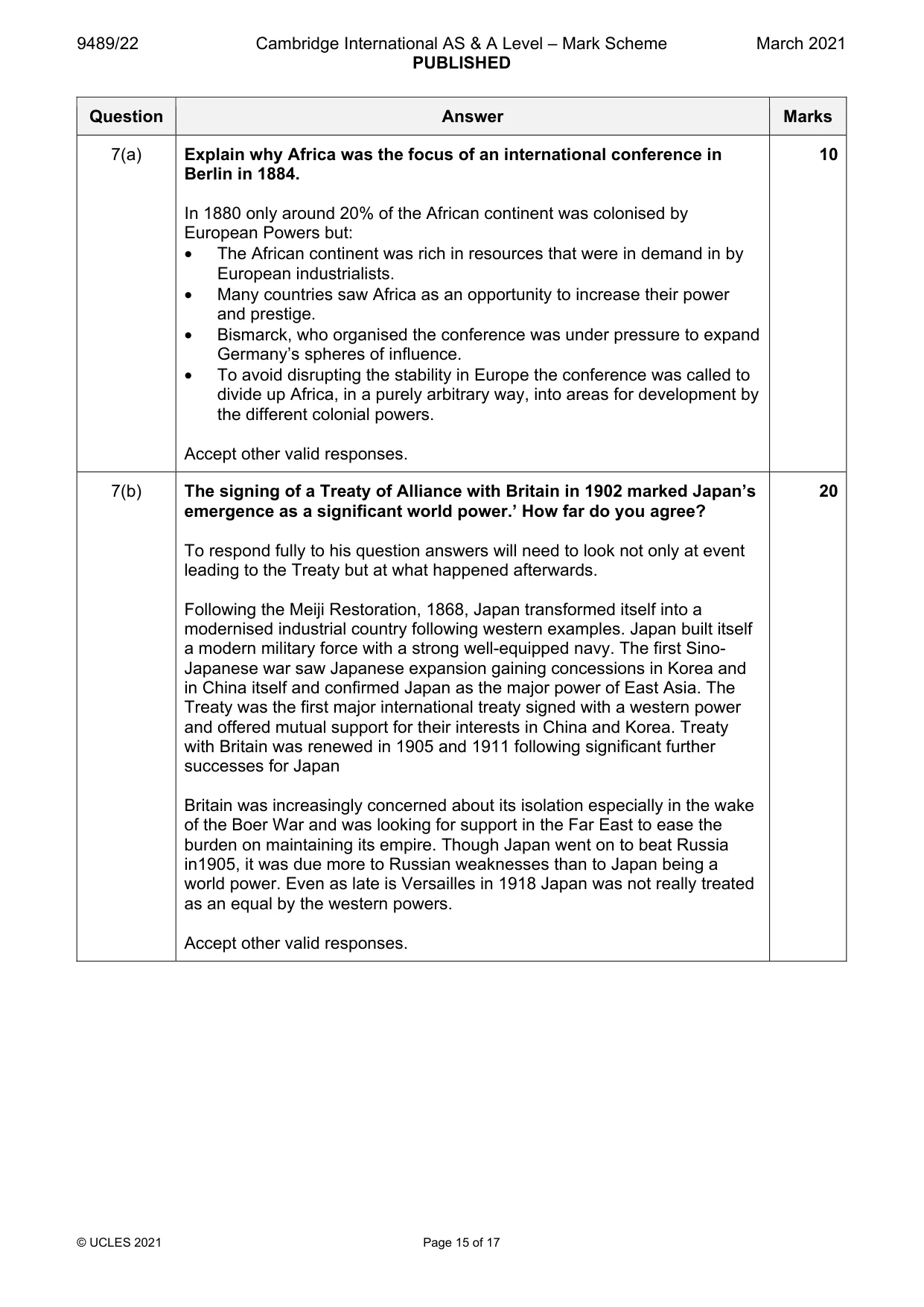
Mark scheme: 7(a) Explain why Africa was the focus of an international conference in 10 Berlin in 1884. In 1880 only around 20% of the African continent was colonised by European Powers but: • The African continent was rich in resources that were in demand in by European industrialists. • Many countries saw Africa as an opportunity to increase their power and prestige. • Bismarck, who organised the conference was under pressure to expand Germany’s spheres of influence. • To avoid disrupting the stability in Europe the conference was called to divide up Africa, in a purely arbitrary way, into areas for development by the different colonial powers. Accept other valid responses. 7(b) The signing of a Treaty of Alliance with Britain in 1902 marked Japan’s 20 emergence as a significant world power.’ How far do you agree? To respond fully to his question answers will need to look not only at event leading to the Treaty but at what happened afterwards. Following the Meiji Restoration, 1868, Japan transformed itself into a modernised industrial country following western examples. Japan built itself a modern military force with a strong well-equipped navy. The first Sino- Japanese war saw Japanese expansion gaining concessions in Korea and in China itself and confirmed Japan as the major power of East Asia. The Treaty was the first major international treaty signed with a western power and offered mutual support for their interests in China and Korea. Treaty with Britain was renewed in 1905 and 1911 following significant further successes for Japan Britain was increasingly concerned about its isolation especially in the wake of the Boer War and was looking for support in the Far East to ease the burden on maintaining its empire. Though Japan went on to beat Russia in1905, it was due more to Russian weaknesses than to Japan being a world power. Even as late is Versailles in 1918 Japan was not really treated as an equal by the western powers. Accept other valid responses.
More questions on Why did Japan emerge as a world power and what was the impact on international
Q8 · The League of Nations and international relations in the 1920s (a) Explain why the League…
8 The League of Nations and international relations in the 1920s (a) Explain why the League of Nations was involved in a dispute over the Aaland Islands in 1921. [10] (b) To what extent was 1925 a turning point in international relations in the 1920s? [20]
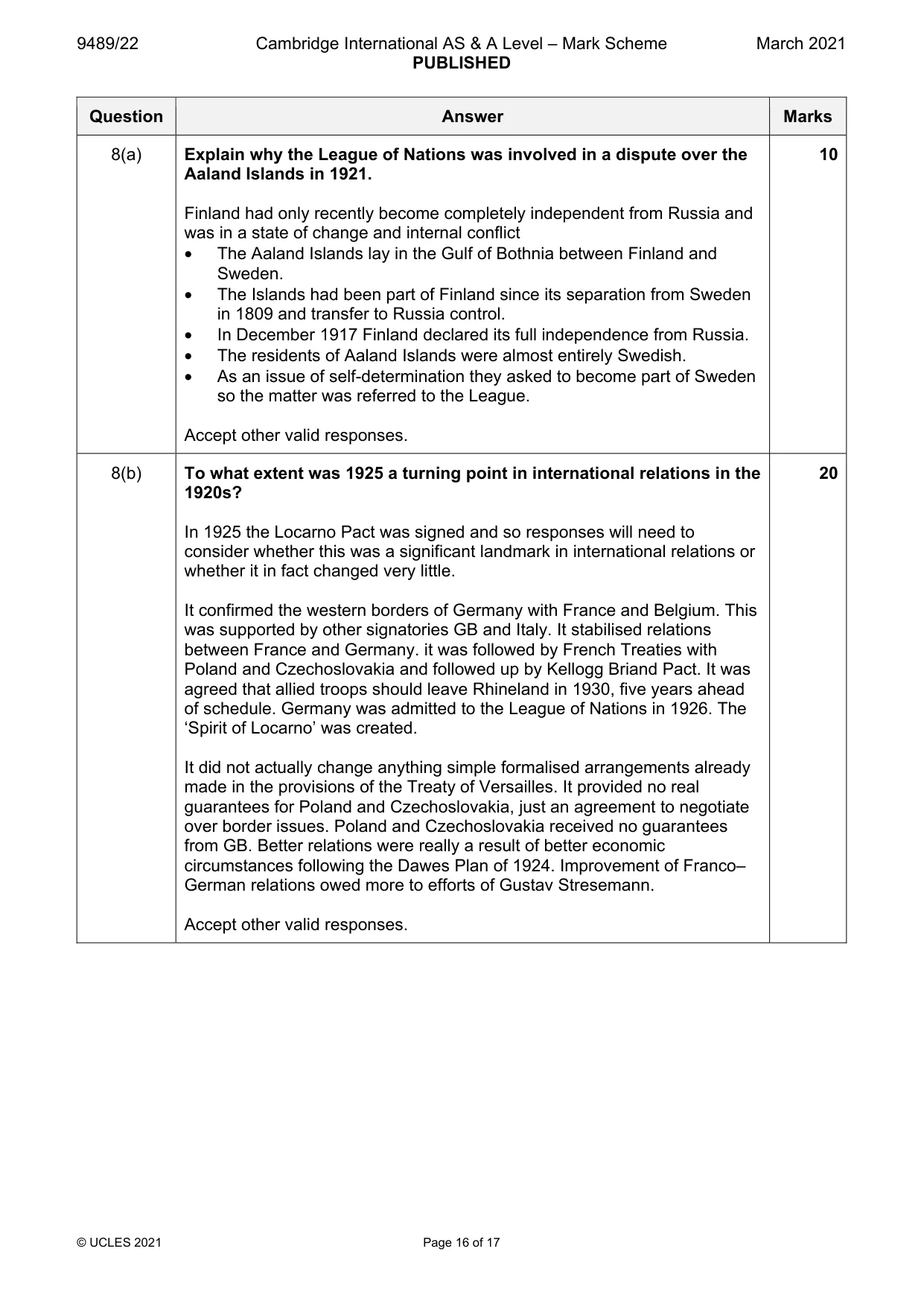
Mark scheme: 8(a) Explain why the League of Nations was involved in a dispute over the 10 Aaland Islands in 1921. Finland had only recently become completely independent from Russia and was in a state of change and internal conflict • The Aaland Islands lay in the Gulf of Bothnia between Finland and Sweden. • The Islands had been part of Finland since its separation from Sweden in 1809 and transfer to Russia control. • In December 1917 Finland declared its full independence from Russia. • The residents of Aaland Islands were almost entirely Swedish. • As an issue of self-determination they asked to become part of Sweden so the matter was referred to the League. Accept other valid responses. 8(b) To what extent was 1925 a turning point in international relations in the 20 1920s? In 1925 the Locarno Pact was signed and so responses will need to consider whether this was a significant landmark in international relations or whether it in fact changed very little. It confirmed the western borders of Germany with France and Belgium. This was supported by other signatories GB and Italy. It stabilised relations between France and Germany. it was followed by French Treaties with Poland and Czechoslovakia and followed up by Kellogg Briand Pact. It was agreed that allied troops should leave Rhineland in 1930, five years ahead of schedule. Germany was admitted to the League of Nations in 1926. The ‘Spirit of Locarno’ was created. It did not actually change anything simple formalised arrangements already made in the provisions of the Treaty of Versailles. It provided no real guarantees for Poland and Czechoslovakia, just an agreement to negotiate over border issues. Poland and Czechoslovakia received no guarantees from GB. Better relations were really a result of better economic circumstances following the Dawes Plan of 1924. Improvement of Franco– German relations owed more to efforts of Gustav Stresemann. Accept other valid responses.
More questions on How and why did international relations improve, 1924–29?
Q9 · China and Japan, 1912–45 (a) Explain why Japan was unhappy with the outcome of the Paris…
9 China and Japan, 1912–45 (a) Explain why Japan was unhappy with the outcome of the Paris Peace Conference. [10] (b) How successful were Chiang Kai-shek’s attempts to re-unite China? [20]
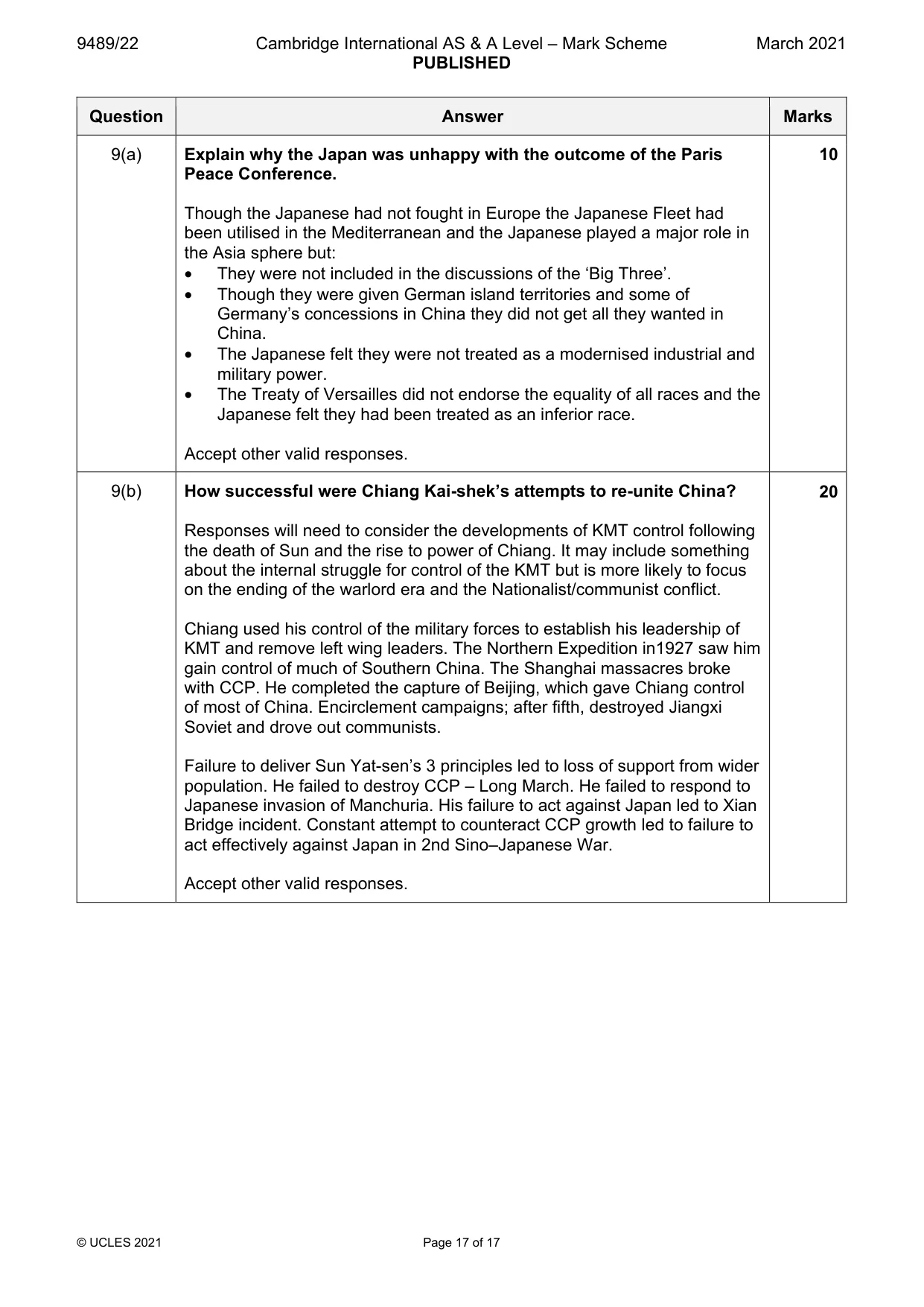
Mark scheme: 9(a) Explain why the Japan was unhappy with the outcome of the Paris 10 Peace Conference. Though the Japanese had not fought in Europe the Japanese Fleet had been utilised in the Mediterranean and the Japanese played a major role in the Asia sphere but: • They were not included in the discussions of the ‘Big Three’. • Though they were given German island territories and some of Germany’s concessions in China they did not get all they wanted in China. • The Japanese felt they were not treated as a modernised industrial and military power. • The Treaty of Versailles did not endorse the equality of all races and the Japanese felt they had been treated as an inferior race. Accept other valid responses. 9(b) How successful were Chiang Kai-shek’s attempts to re-unite China? 20 Responses will need to consider the developments of KMT control following the death of Sun and the rise to power of Chiang. It may include something about the internal struggle for control of the KMT but is more likely to focus on the ending of the warlord era and the Nationalist/communist conflict. Chiang used his control of the military forces to establish his leadership of KMT and remove left wing leaders. The Northern Expedition in1927 saw him gain control of much of Southern China. The Shanghai massacres broke with CCP. He completed the capture of Beijing, which gave Chiang control of most of China. Encirclement campaigns; after fifth, destroyed Jiangxi Soviet and drove out communists. Failure to deliver Sun Yat-sen’s 3 principles led to loss of support from wider population. He failed to destroy CCP – Long March. He failed to respond to Japanese invasion of Manchuria. His failure to act against Japan led to Xian Bridge incident. Constant attempt to counteract CCP growth led to failure to act effectively against Japan in 2nd Sino–Japanese War. Accept other valid responses.
More questions on How well was France governed in the period 1793–99?
What was in this paper
The subtopics covered by these 9 questions, and how many questions each got. Open one in a new tab to see every Cambridge question on it.
2How and why did international relations improve, 1924–29?1How and why did the Bolsheviks seize power in October 1917?1How well was France governed in the period 1793–99?1What caused the rise and fall of Napoleon Bonaparte?1What were the aims of Reconstruction and how successful was it?1Why did Japan emerge as a world power and what was the impact on international1Why was there a second New Deal and how successful was it?1What you needed in this session
Cambridge’s own grade thresholds for 2021 Feb/March, Paper 2 · Variant 2. A higher threshold means an easier paper — the bar moves with how the cohort did.