Cambridge A Level History 9489 — 2021 May/June Paper 2 · Variant 1
9489/21/M/J/21 · 9 questions · 60 marks · ≈68 min
The question paper and its mark scheme, free to read here and free to download. This is Cambridge’s own paper, exactly as it was sat.
Question paper4 pages
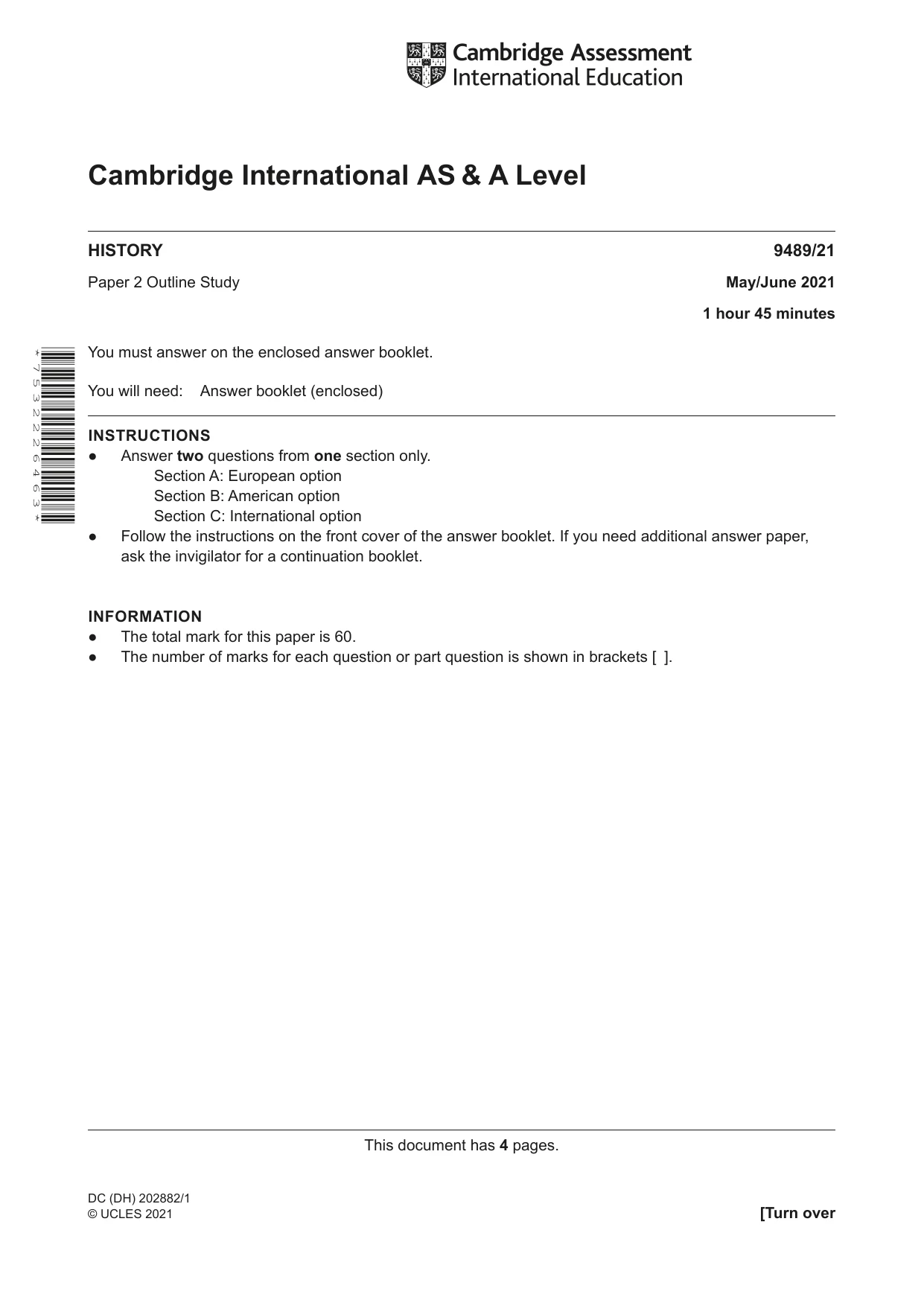
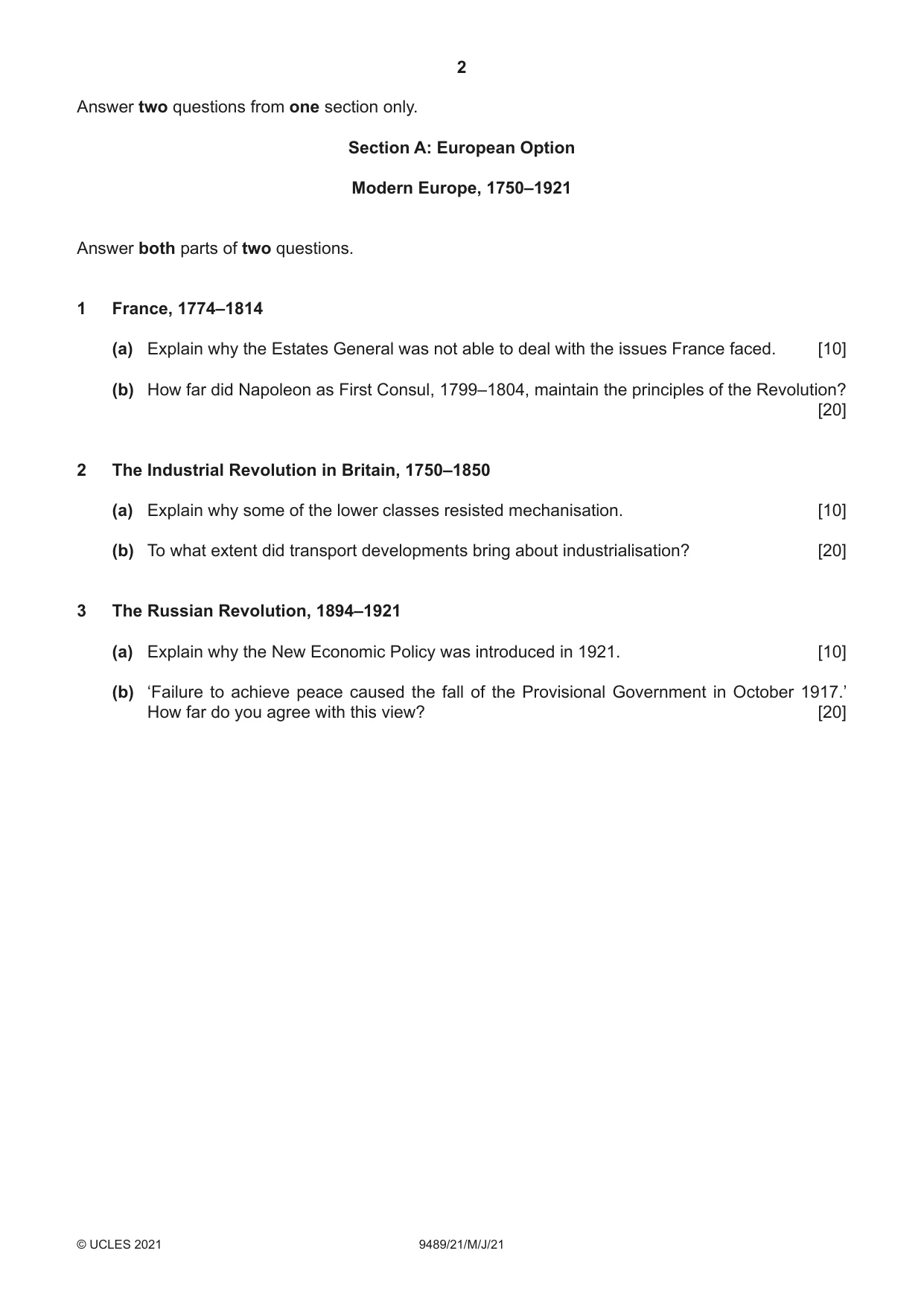
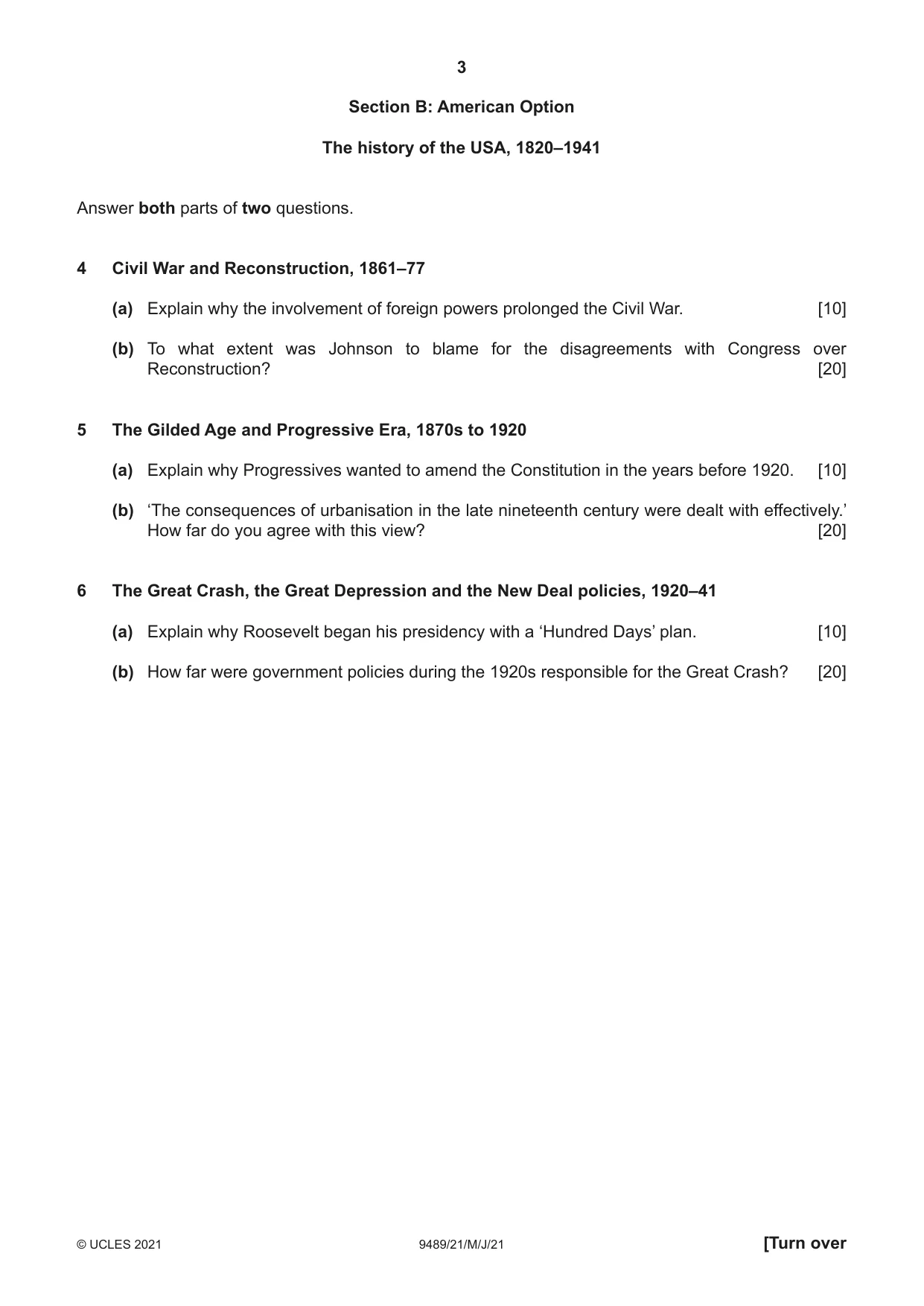
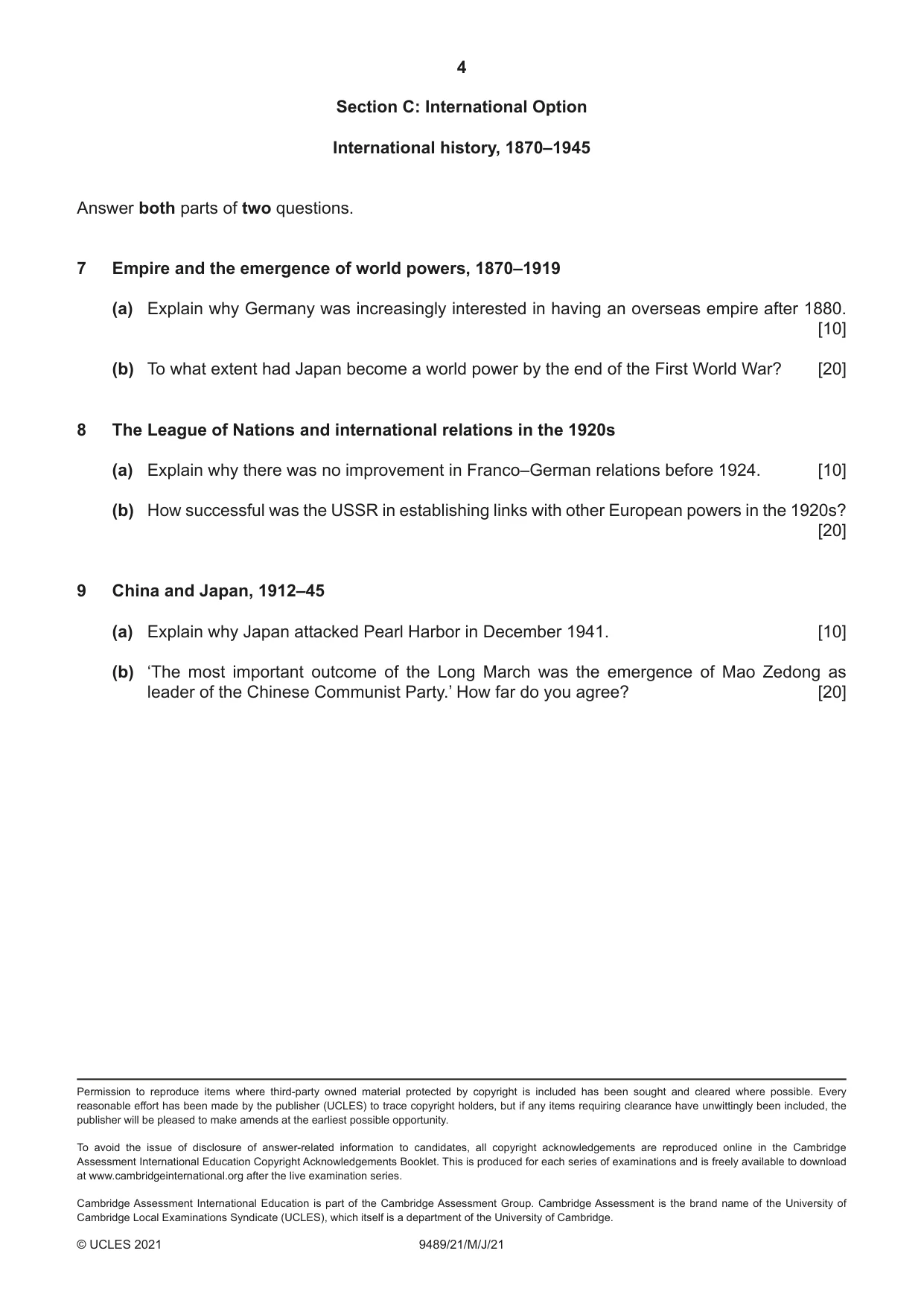
Mark scheme20 pages
Answers below. Sit the paper first if you are practising.
Questions as text
Q1 · France, 1774–1814 (a) Explain why the Estates General was not able to deal with the…
1 France, 1774–1814 (a) Explain why the Estates General was not able to deal with the issues France faced. [10] (b) How far did Napoleon as First Consul, 1799–1804, maintain the principles of the Revolution? [20]
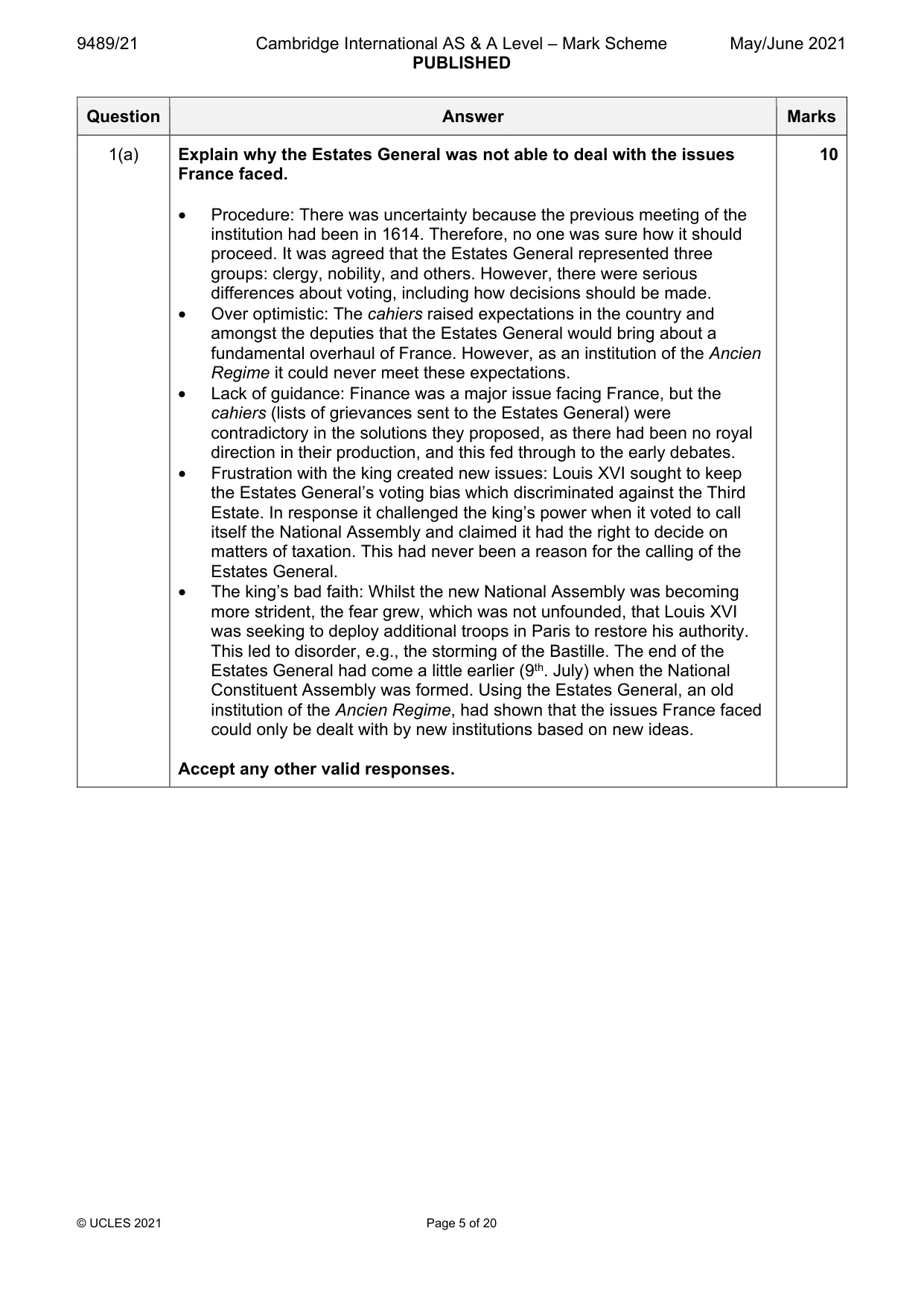
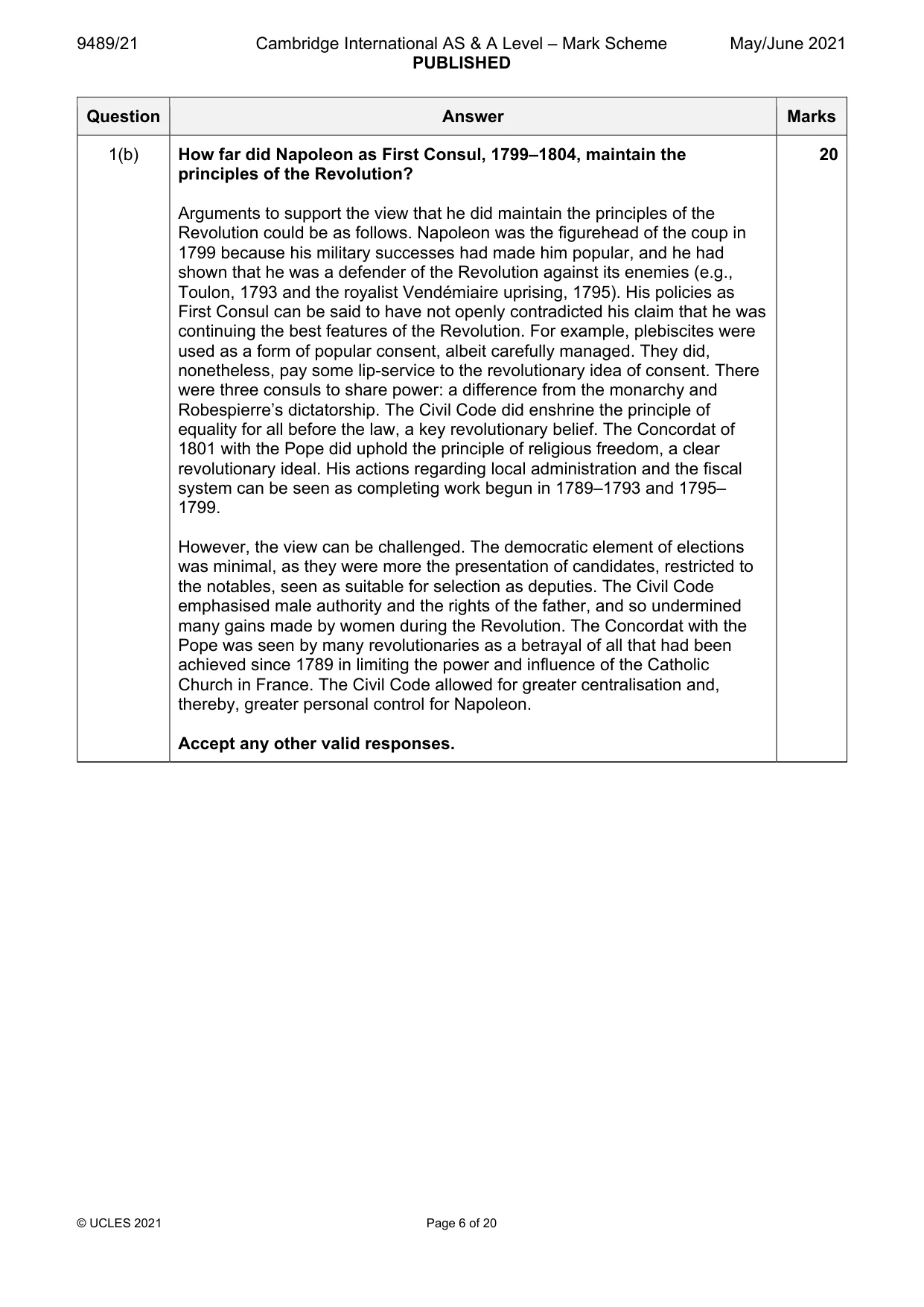
Mark scheme: Question Answer Marks 1(a) Explain why the Estates General was not able to deal with the issues 10 France faced. • Procedure: There was uncertainty because the previous meeting of the institution had been in 1614. Therefore, no one was sure how it should proceed. It was agreed that the Estates General represented three groups: clergy, nobility, and others. However, there were serious differences about voting, including how decisions should be made. • Over optimistic: The cahiers raised expectations in the country and amongst the deputies that the Estates General would bring about a fundamental overhaul of France. However, as an institution of the Ancien Regime it could never meet these expectations. • Lack of guidance: Finance was a major issue facing France, but the cahiers (lists of grievances sent to the Estates General) were contradictory in the solutions they proposed, as there had been no royal direction in their production, and this fed through to the early debates. • Frustration with the king created new issues: Louis XVI sought to keep the Estates General’s voting bias which discriminated against the Third Estate. In response it challenged the king’s power when it voted to call itself the National Assembly and claimed it had the right to decide on matters of taxation. This had never been a reason for the calling of the Estates General. • The king’s bad faith: Whilst the new National Assembly was becoming more strident, the fear grew, which was not unfounded, that Louis XVI was seeking to deploy additional troops in Paris to restore his authority. This led to disorder, e.g., the storming of the Bastille. The end of the Estates General had come a little earlier (9th. July) when the National Constituent Assembly was formed. Using the Estates General, an old institution of the Ancien Regime, had shown that the issues France faced could only be dealt with by new institutions based on new ideas. Accept any other valid responses. 1(b) How far did Napoleon as First Consul, 1799‒1804, maintain the 20 principles of the Revolution? Arguments to support the view that he did maintain the principles of the Revolution could be as follows. Napoleon was the figurehead of the coup in 1799 because his military successes had made him popular, and he had shown that he was a defender of the Revolution against its enemies (e.g., Toulon, 1793 and the royalist Vendémiaire uprising, 1795). His policies as First Consul can be said to have not openly contradicted his claim that he was continuing the best features of the Revolution. For example, plebiscites were used as a form of popular consent, albeit carefully managed. They did, nonetheless, pay some lip-service to the revolutionary idea of consent. There were three consuls to share power: a difference from the monarchy and Robespierre’s dictatorship. The Civil Code did enshrine the principle of equality for all before the law, a key revolutionary belief. The Concordat of 1801 with the Pope did uphold the principle of religious freedom, a clear revolutionary ideal. His actions regarding local administration and the fiscal system can be seen as completing work begun in 1789–1793 and 1795– 1799. However, the view can be challenged. The democratic element of elections was minimal, as they were more the presentation of candidates, restricted to the notables, seen as suitable for selection as deputies. The Civil Code emphasised male authority and the rights of the father, and so undermined many gains made by women during the Revolution. The Concordat with the Pope was seen by many revolutionaries as a betrayal of all that had been achieved since 1789 in limiting the power and influence of the Catholic Church in France. The Civil Code allowed for greater centralisation and, thereby, greater personal control for Napoleon. Accept any other valid responses.
More questions on What caused the rise and fall of Napoleon Bonaparte?
Q2 · The Industrial Revolution in Britain, 1750–1850 (a) Explain why some of the lower classes…
2 The Industrial Revolution in Britain, 1750–1850 (a) Explain why some of the lower classes resisted mechanisation. [10] (b) To what extent did transport developments bring about industrialisation? [20]
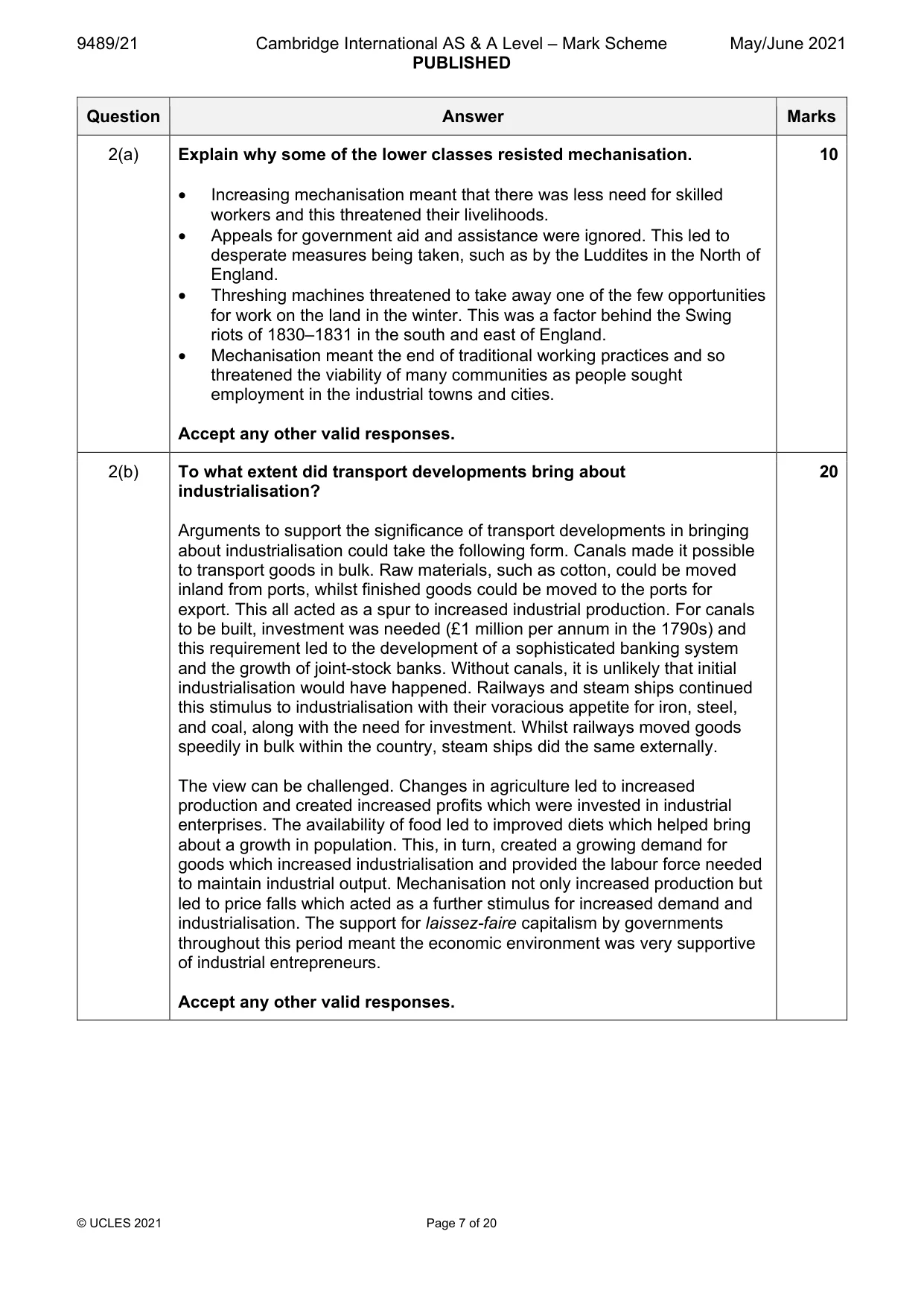
Mark scheme: 2(a) Explain why some of the lower classes resisted mechanisation. 10 • Increasing mechanisation meant that there was less need for skilled workers and this threatened their livelihoods. • Appeals for government aid and assistance were ignored. This led to desperate measures being taken, such as by the Luddites in the North of England. • Threshing machines threatened to take away one of the few opportunities for work on the land in the winter. This was a factor behind the Swing riots of 1830–1831 in the south and east of England. • Mechanisation meant the end of traditional working practices and so threatened the viability of many communities as people sought employment in the industrial towns and cities. Accept any other valid responses. 2(b) To what extent did transport developments bring about 20 industrialisation? Arguments to support the significance of transport developments in bringing about industrialisation could take the following form. Canals made it possible to transport goods in bulk. Raw materials, such as cotton, could be moved inland from ports, whilst finished goods could be moved to the ports for export. This all acted as a spur to increased industrial production. For canals to be built, investment was needed (£1 million per annum in the 1790s) and this requirement led to the development of a sophisticated banking system and the growth of joint-stock banks. Without canals, it is unlikely that initial industrialisation would have happened. Railways and steam ships continued this stimulus to industrialisation with their voracious appetite for iron, steel, and coal, along with the need for investment. Whilst railways moved goods speedily in bulk within the country, steam ships did the same externally. The view can be challenged. Changes in agriculture led to increased production and created increased profits which were invested in industrial enterprises. The availability of food led to improved diets which helped bring about a growth in population. This, in turn, created a growing demand for goods which increased industrialisation and provided the labour force needed to maintain industrial output. Mechanisation not only increased production but led to price falls which acted as a further stimulus for increased demand and industrialisation. The support for laissez-faire capitalism by governments throughout this period meant the economic environment was very supportive of industrial entrepreneurs. Accept any other valid responses.
More questions on Why was there rapid industrialisation after 1870?
Q3 · The Russian Revolution, 1894–1921 (a) Explain why the New Economic Policy was introduced…
3 The Russian Revolution, 1894–1921 (a) Explain why the New Economic Policy was introduced in 1921. [10] (b) ‘Failure to achieve peace caused the fall of the Provisional Government in October 1917.’ How far do you agree with this view? [20]
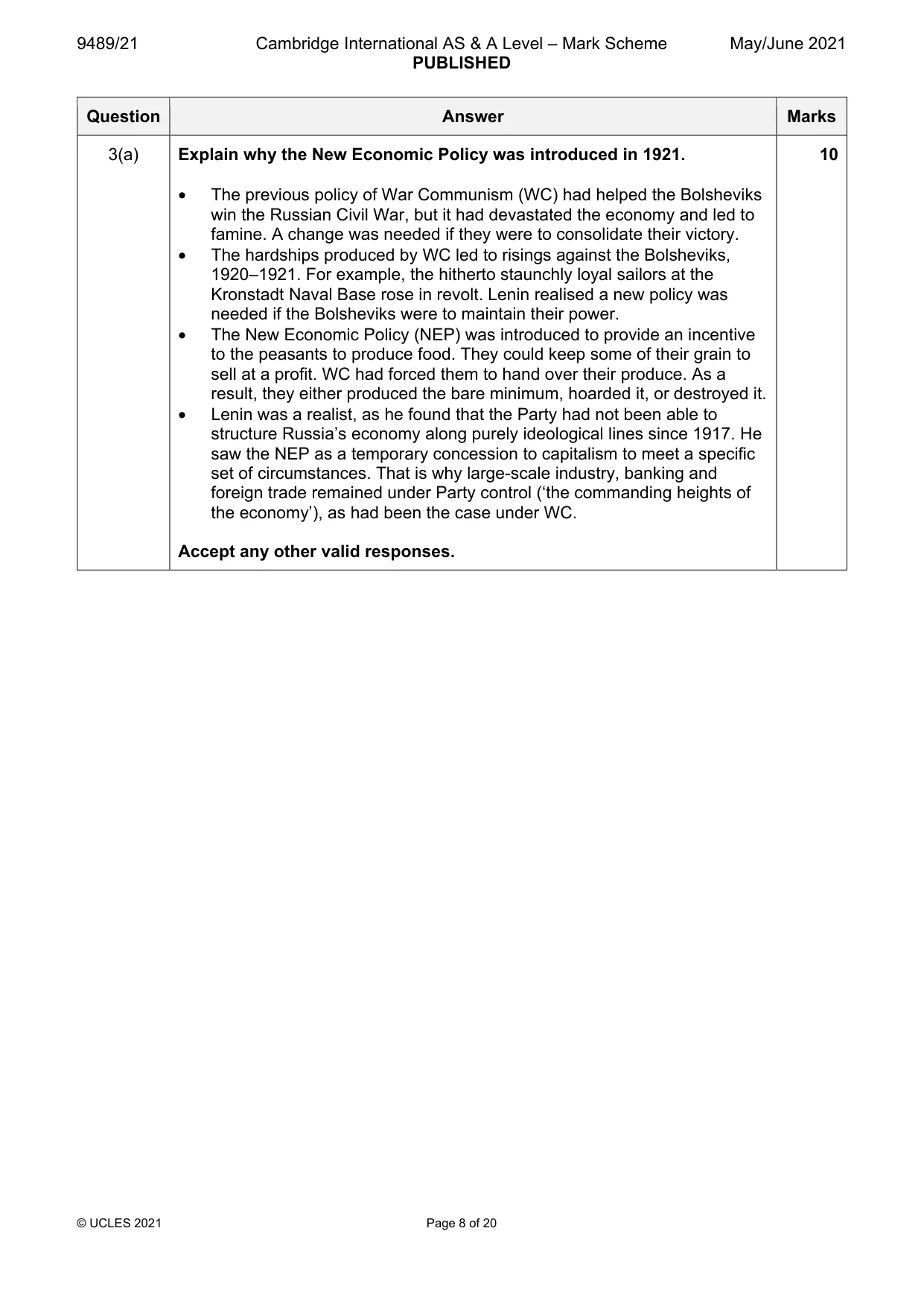
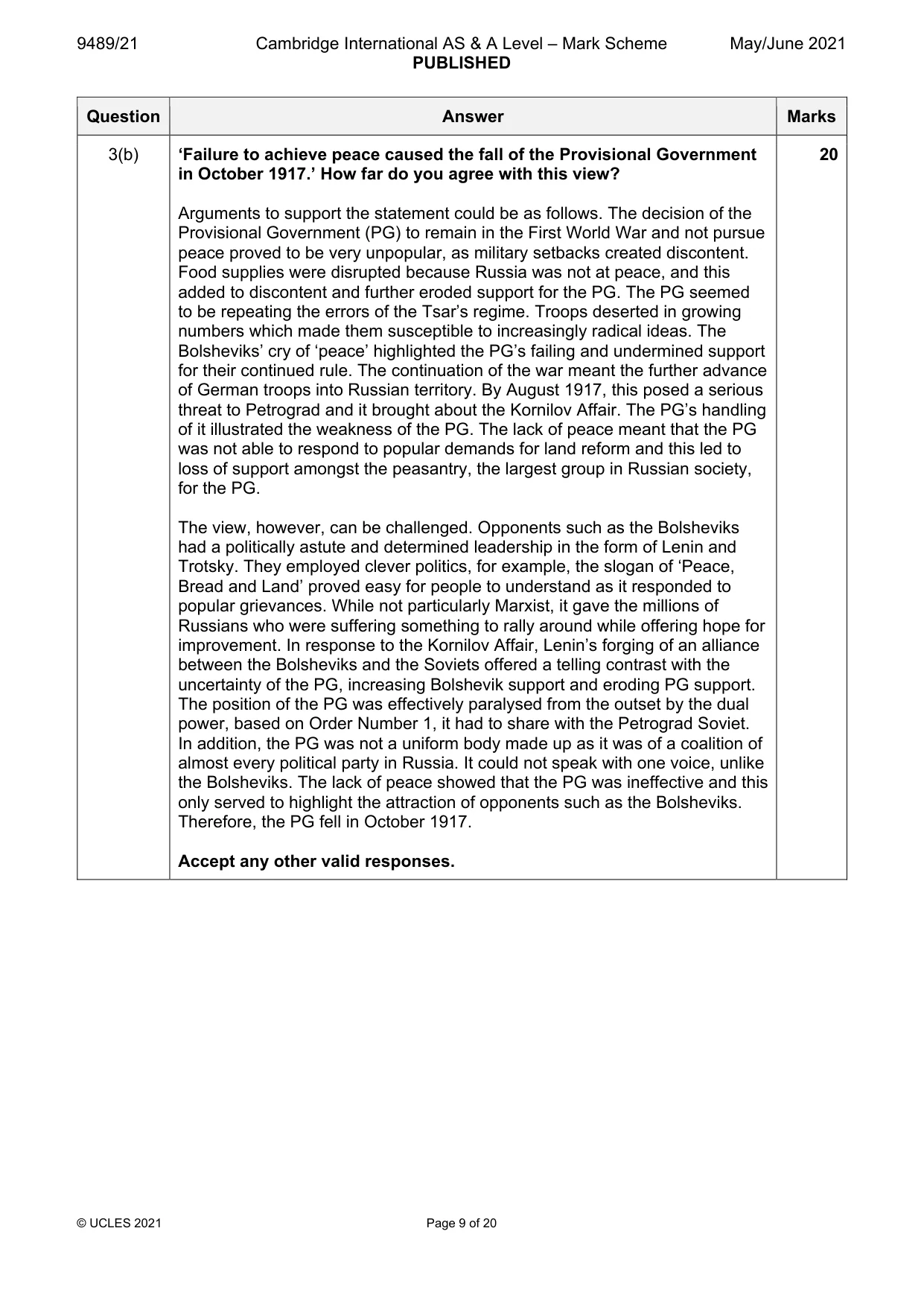
Mark scheme: 3(a) Explain why the New Economic Policy was introduced in 1921. 10 • The previous policy of War Communism (WC) had helped the Bolsheviks win the Russian Civil War, but it had devastated the economy and led to famine. A change was needed if they were to consolidate their victory. • The hardships produced by WC led to risings against the Bolsheviks, 1920–1921. For example, the hitherto staunchly loyal sailors at the Kronstadt Naval Base rose in revolt. Lenin realised a new policy was needed if the Bolsheviks were to maintain their power. • The New Economic Policy (NEP) was introduced to provide an incentive to the peasants to produce food. They could keep some of their grain to sell at a profit. WC had forced them to hand over their produce. As a result, they either produced the bare minimum, hoarded it, or destroyed it. • Lenin was a realist, as he found that the Party had not been able to structure Russia’s economy along purely ideological lines since 1917. He saw the NEP as a temporary concession to capitalism to meet a specific set of circumstances. That is why large-scale industry, banking and foreign trade remained under Party control (‘the commanding heights of the economy’), as had been the case under WC. Accept any other valid responses. 3(b) ‘Failure to achieve peace caused the fall of the Provisional Government 20 in October 1917.’ How far do you agree with this view? Arguments to support the statement could be as follows. The decision of the Provisional Government (PG) to remain in the First World War and not pursue peace proved to be very unpopular, as military setbacks created discontent. Food supplies were disrupted because Russia was not at peace, and this added to discontent and further eroded support for the PG. The PG seemed to be repeating the errors of the Tsar’s regime. Troops deserted in growing numbers which made them susceptible to increasingly radical ideas. The Bolsheviks’ cry of ‘peace’ highlighted the PG’s failing and undermined support for their continued rule. The continuation of the war meant the further advance of German troops into Russian territory. By August 1917, this posed a serious threat to Petrograd and it brought about the Kornilov Affair. The PG’s handling of it illustrated the weakness of the PG. The lack of peace meant that the PG was not able to respond to popular demands for land reform and this led to loss of support amongst the peasantry, the largest group in Russian society, for the PG. The view, however, can be challenged. Opponents such as the Bolsheviks had a politically astute and determined leadership in the form of Lenin and Trotsky. They employed clever politics, for example, the slogan of ‘Peace, Bread and Land’ proved easy for people to understand as it responded to popular grievances. While not particularly Marxist, it gave the millions of Russians who were suffering something to rally around while offering hope for improvement. In response to the Kornilov Affair, Lenin’s forging of an alliance between the Bolsheviks and the Soviets offered a telling contrast with the uncertainty of the PG, increasing Bolshevik support and eroding PG support. The position of the PG was effectively paralysed from the outset by the dual power, based on Order Number 1, it had to share with the Petrograd Soviet. In addition, the PG was not a uniform body made up as it was of a coalition of almost every political party in Russia. It could not speak with one voice, unlike the Bolsheviks. The lack of peace showed that the PG was ineffective and this only served to highlight the attraction of opponents such as the Bolsheviks. Therefore, the PG fell in October 1917. Accept any other valid responses.
More questions on How and why did the Bolsheviks seize power in October 1917?
Q4 · Civil War and Reconstruction, 1861–77 (a) Explain why the involvement of foreign powers…
4 Civil War and Reconstruction, 1861–77 (a) Explain why the involvement of foreign powers prolonged the Civil War. [10] (b) To what extent was Johnson to blame for the disagreements with Congress over Reconstruction? [20]
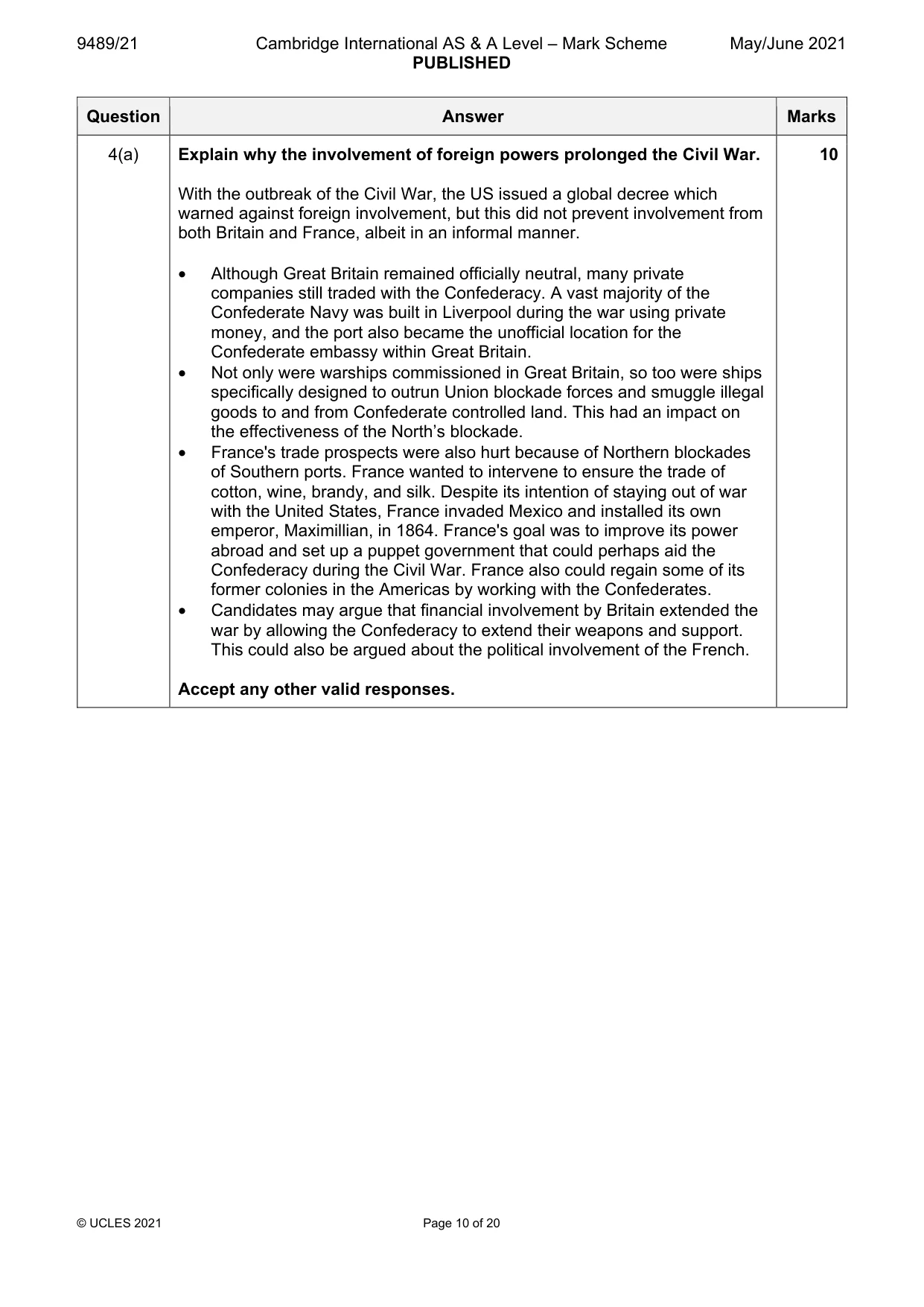
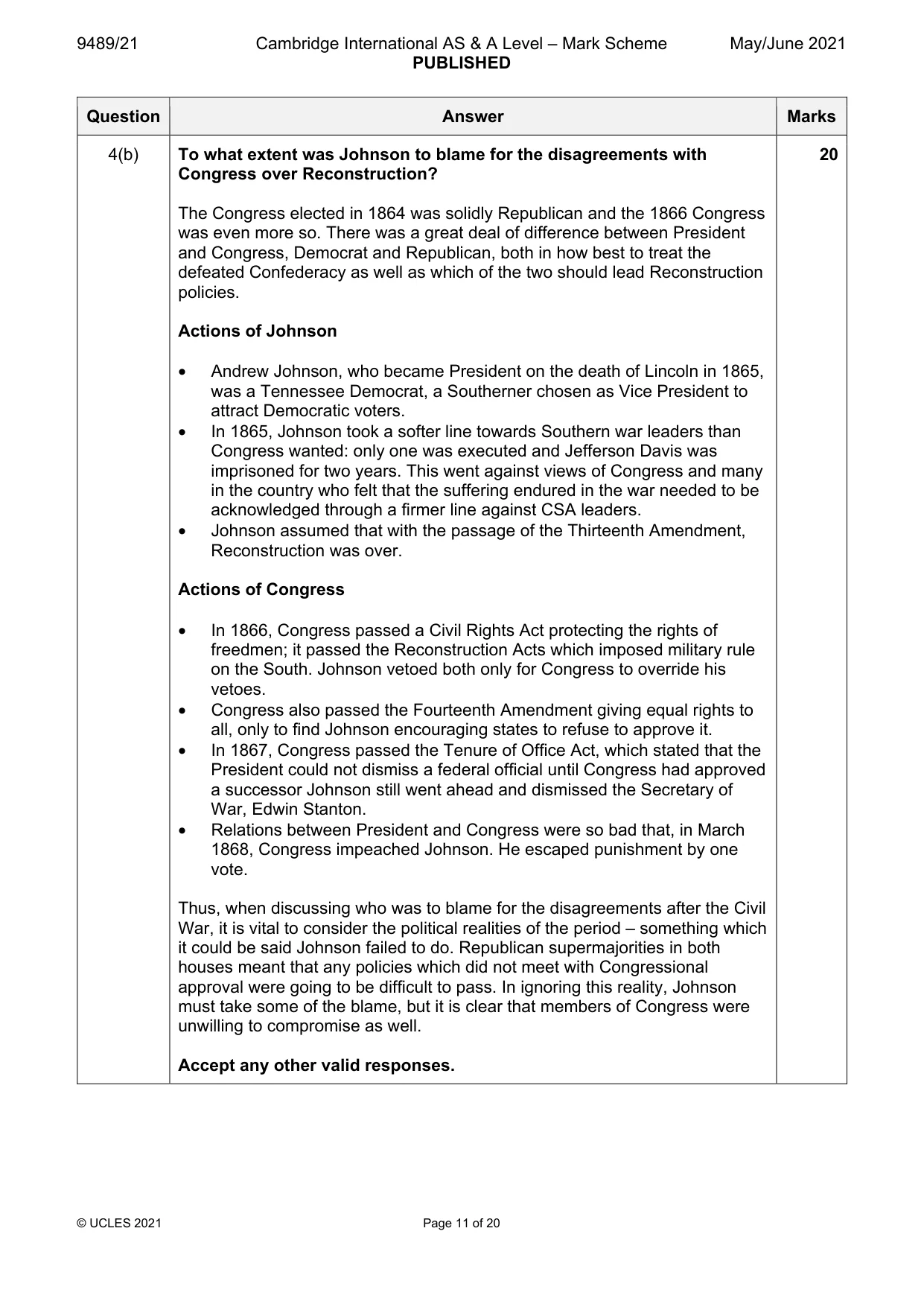
Mark scheme: 4(a) Explain why the involvement of foreign powers prolonged the Civil War. 10 With the outbreak of the Civil War, the US issued a global decree which warned against foreign involvement, but this did not prevent involvement from both Britain and France, albeit in an informal manner. • Although Great Britain remained officially neutral, many private companies still traded with the Confederacy. A vast majority of the Confederate Navy was built in Liverpool during the war using private money, and the port also became the unofficial location for the Confederate embassy within Great Britain. • Not only were warships commissioned in Great Britain, so too were ships specifically designed to outrun Union blockade forces and smuggle illegal goods to and from Confederate controlled land. This had an impact on the effectiveness of the North’s blockade. • France's trade prospects were also hurt because of Northern blockades of Southern ports. France wanted to intervene to ensure the trade of cotton, wine, brandy, and silk. Despite its intention of staying out of war with the United States, France invaded Mexico and installed its own emperor, Maximillian, in 1864. France's goal was to improve its power abroad and set up a puppet government that could perhaps aid the Confederacy during the Civil War. France also could regain some of its former colonies in the Americas by working with the Confederates. • Candidates may argue that financial involvement by Britain extended the war by allowing the Confederacy to extend their weapons and support. This could also be argued about the political involvement of the French. Accept any other valid responses. 4(b) To what extent was Johnson to blame for the disagreements with 20 Congress over Reconstruction? The Congress elected in 1864 was solidly Republican and the 1866 Congress was even more so. There was a great deal of difference between President and Congress, Democrat and Republican, both in how best to treat the defeated Confederacy as well as which of the two should lead Reconstruction policies. Actions of Johnson • Andrew Johnson, who became President on the death of Lincoln in 1865, was a Tennessee Democrat, a Southerner chosen as Vice President to attract Democratic voters. • In 1865, Johnson took a softer line towards Southern war leaders than Congress wanted: only one was executed and Jefferson Davis was imprisoned for two years. This went against views of Congress and many in the country who felt that the suffering endured in the war needed to be acknowledged through a firmer line against CSA leaders. • Johnson assumed that with the passage of the Thirteenth Amendment, Reconstruction was over. Actions of Congress • In 1866, Congress passed a Civil Rights Act protecting the rights of freedmen; it passed the Reconstruction Acts which imposed military rule on the South. Johnson vetoed both only for Congress to override his vetoes. • Congress also passed the Fourteenth Amendment giving equal rights to all, only to find Johnson encouraging states to refuse to approve it. • In 1867, Congress passed the Tenure of Office Act, which stated that the President could not dismiss a federal official until Congress had approved a successor Johnson still went ahead and dismissed the Secretary of War, Edwin Stanton. • Relations between President and Congress were so bad that, in March 1868, Congress impeached Johnson. He escaped punishment by one vote. Thus, when discussing who was to blame for the disagreements after the Civil War, it is vital to consider the political realities of the period – something which it could be said Johnson failed to do. Republican supermajorities in both houses meant that any policies which did not meet with Congressional approval were going to be difficult to pass. In ignoring this reality, Johnson must take some of the blame, but it is clear that members of Congress were unwilling to compromise as well. Accept any other valid responses.
More questions on What were the aims of Reconstruction and how successful was it?
Q5 · The Gilded Age and Progressive Era, 1870s to 1920 (a) Explain why Progressives wanted to…
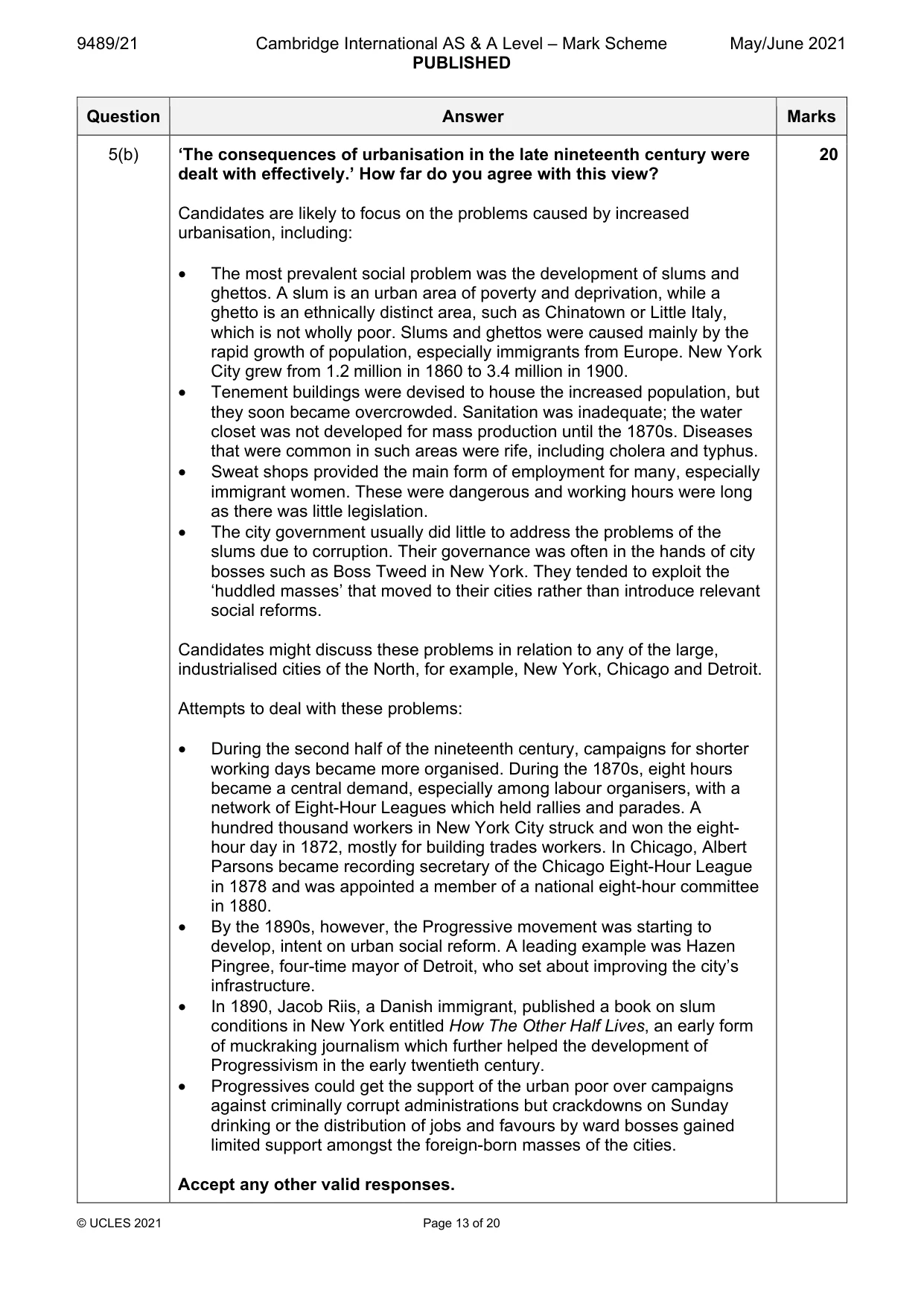
5 The Gilded Age and Progressive Era, 1870s to 1920 (a) Explain why Progressives wanted to amend the Constitution in the years before 1920. [10] (b) ‘The consequences of urbanisation in the late nineteenth century were dealt with effectively.’ How far do you agree with this view? [20]
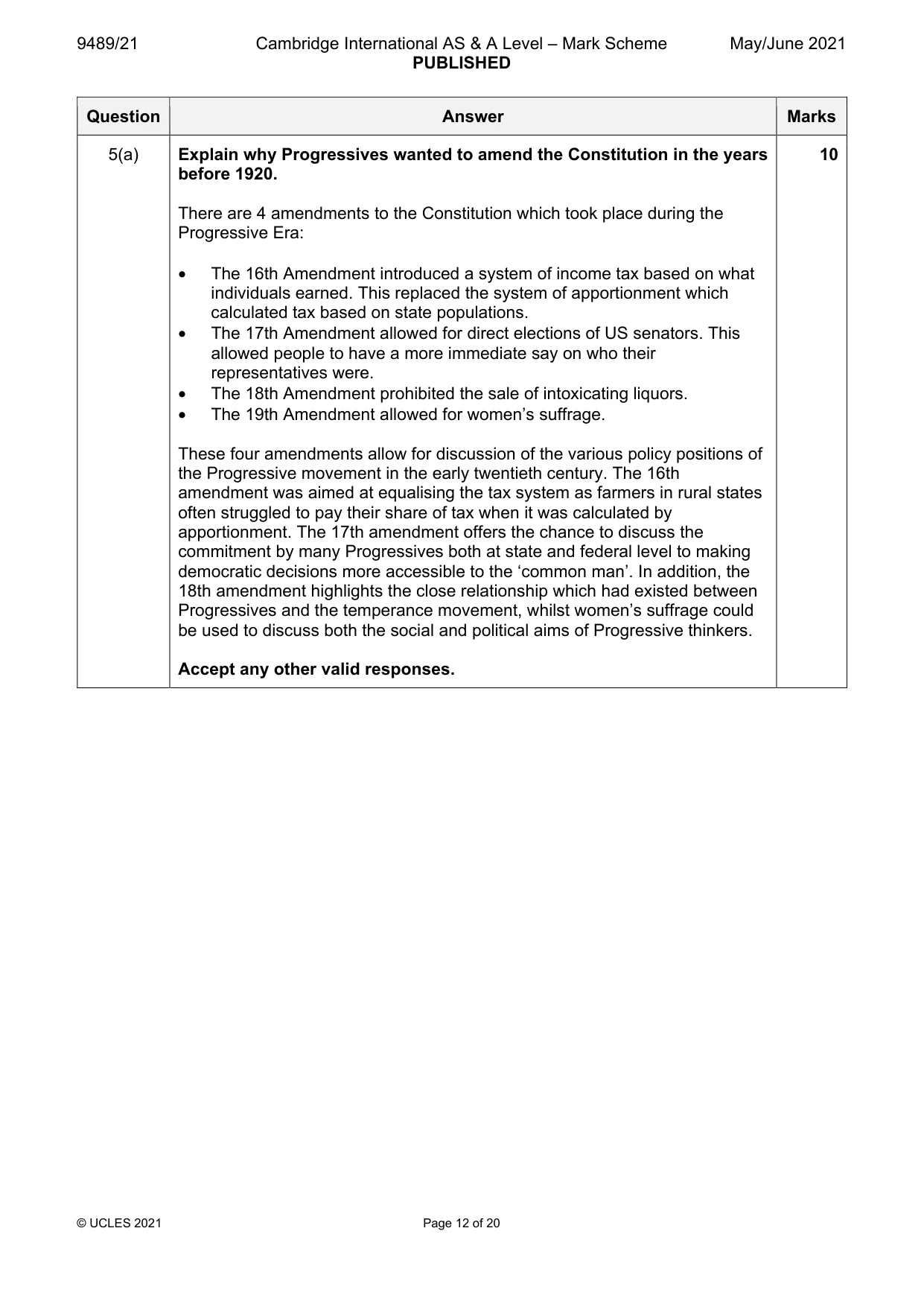
Mark scheme: 5(a) Explain why Progressives wanted to amend the Constitution in the years 10 before 1920. There are 4 amendments to the Constitution which took place during the Progressive Era: • The 16th Amendment introduced a system of income tax based on what individuals earned. This replaced the system of apportionment which calculated tax based on state populations. • The 17th Amendment allowed for direct elections of US senators. This allowed people to have a more immediate say on who their representatives were. • The 18th Amendment prohibited the sale of intoxicating liquors. • The 19th Amendment allowed for women’s suffrage. These four amendments allow for discussion of the various policy positions of the Progressive movement in the early twentieth century. The 16th amendment was aimed at equalising the tax system as farmers in rural states often struggled to pay their share of tax when it was calculated by apportionment. The 17th amendment offers the chance to discuss the commitment by many Progressives both at state and federal level to making democratic decisions more accessible to the ‘common man’. In addition, the 18th amendment highlights the close relationship which had existed between Progressives and the temperance movement, whilst women’s suffrage could be used to discuss both the social and political aims of Progressive thinkers. Accept any other valid responses. 5(b) ‘The consequences of urbanisation in the late nineteenth century were 20 dealt with effectively.’ How far do you agree with this view? Candidates are likely to focus on the problems caused by increased urbanisation, including: • The most prevalent social problem was the development of slums and ghettos. A slum is an urban area of poverty and deprivation, while a ghetto is an ethnically distinct area, such as Chinatown or Little Italy, which is not wholly poor. Slums and ghettos were caused mainly by the rapid growth of population, especially immigrants from Europe. New York City grew from 1.2 million in 1860 to 3.4 million in 1900. • Tenement buildings were devised to house the increased population, but they soon became overcrowded. Sanitation was inadequate; the water closet was not developed for mass production until the 1870s. Diseases that were common in such areas were rife, including cholera and typhus. • Sweat shops provided the main form of employment for many, especially immigrant women. These were dangerous and working hours were long as there was little legislation. • The city government usually did little to address the problems of the slums due to corruption. Their governance was often in the hands of city bosses such as Boss Tweed in New York. They tended to exploit the ‘huddled masses’ that moved to their cities rather than introduce relevant social reforms. Candidates might discuss these problems in relation to any of the large, industrialised cities of the North, for example, New York, Chicago and Detroit. Attempts to deal with these problems: • During the second half of the nineteenth century, campaigns for shorter working days became more organised. During the 1870s, eight hours became a central demand, especially among labour organisers, with a network of Eight-Hour Leagues which held rallies and parades. A hundred thousand workers in New York City struck and won the eight- hour day in 1872, mostly for building trades workers. In Chicago, Albert Parsons became recording secretary of the Chicago Eight-Hour League in 1878 and was appointed a member of a national eight-hour committee in 1880. • By the 1890s, however, the Progressive movement was starting to develop, intent on urban social reform. A leading example was Hazen Pingree, four-time mayor of Detroit, who set about improving the city’s infrastructure. • In 1890, Jacob Riis, a Danish immigrant, published a book on slum conditions in New York entitled How The Other Half Lives, an early form of muckraking journalism which further helped the development of Progressivism in the early twentieth century. • Progressives could get the support of the urban poor over campaigns against criminally corrupt administrations but crackdowns on Sunday drinking or the distribution of jobs and favours by ward bosses gained limited support amongst the foreign-born masses of the cities. Accept any other valid responses.
More questions on What were the consequences of the rapid economic growth after 1870?
Q6 · The Great Crash, the Great Depression and the New Deal policies, 1920–41 (a) Explain why…
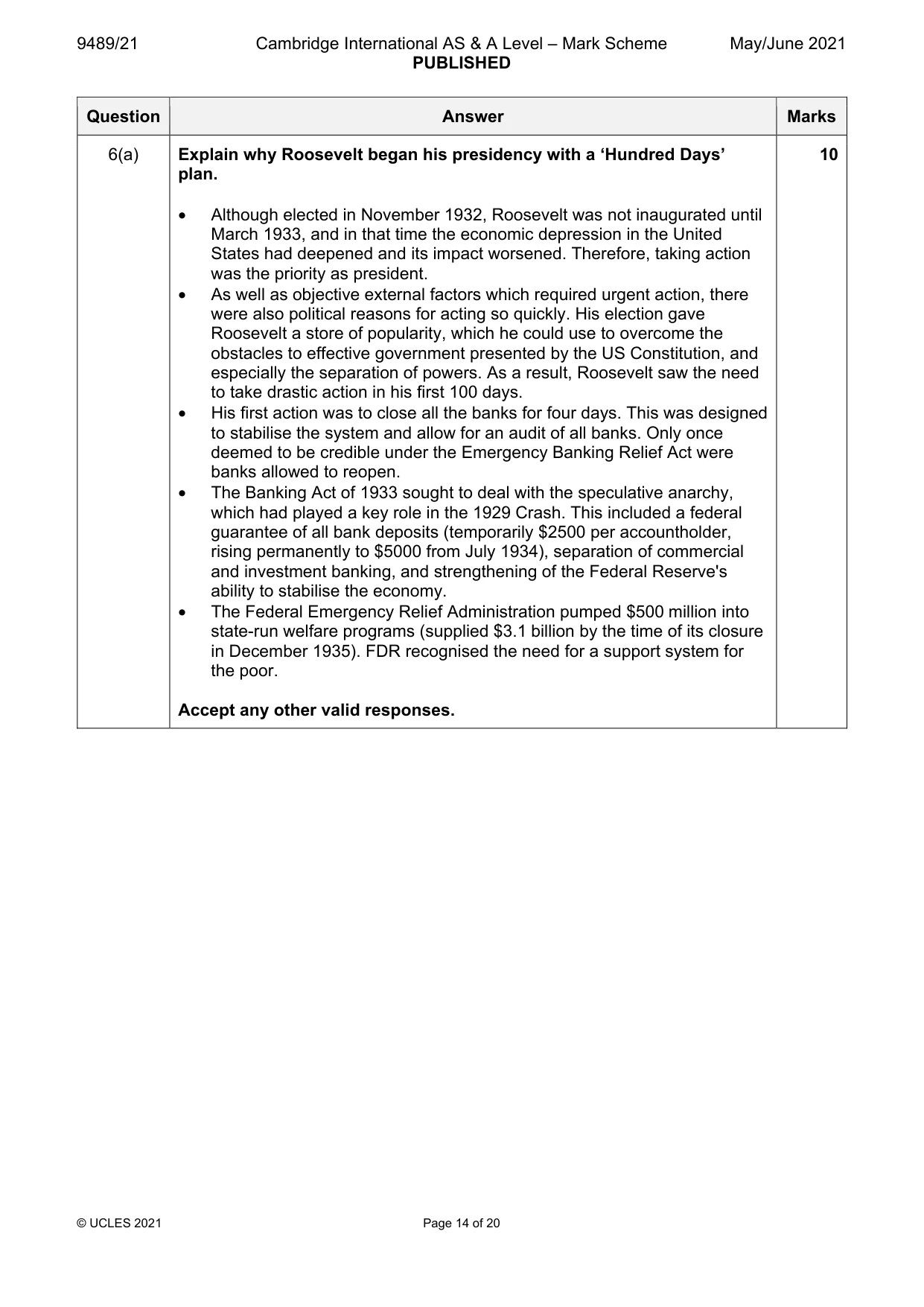
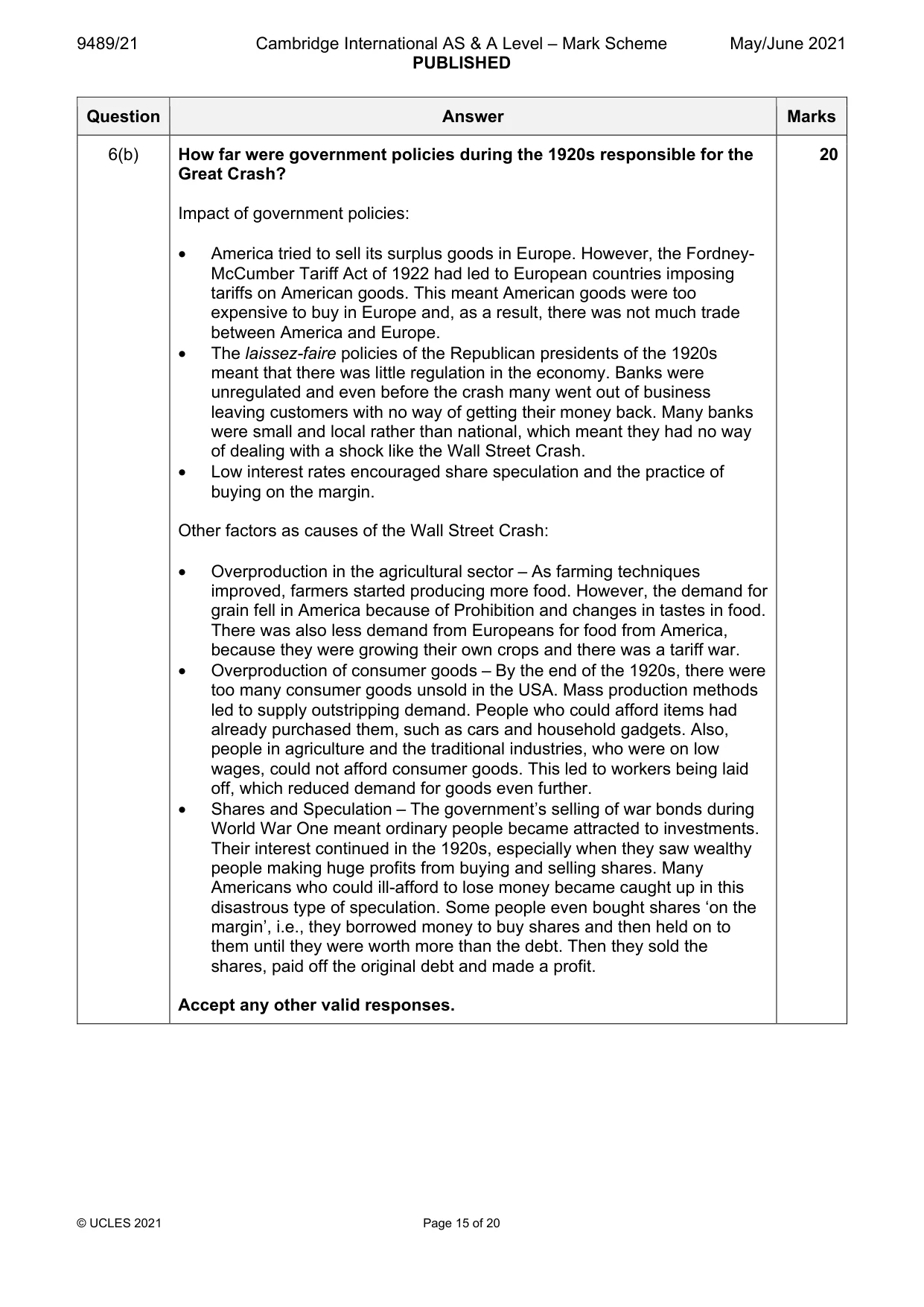
6 The Great Crash, the Great Depression and the New Deal policies, 1920–41 (a) Explain why Roosevelt began his presidency with a ‘Hundred Days’ plan. [10] (b) How far were government policies during the 1920s responsible for the Great Crash? [20] Section C: International Option International history, 1870–1945 Answer both parts of two questions.
Mark scheme: 6(a) Explain why Roosevelt began his presidency with a ‘Hundred Days’ 10 plan. • Although elected in November 1932, Roosevelt was not inaugurated until March 1933, and in that time the economic depression in the United States had deepened and its impact worsened. Therefore, taking action was the priority as president. • As well as objective external factors which required urgent action, there were also political reasons for acting so quickly. His election gave Roosevelt a store of popularity, which he could use to overcome the obstacles to effective government presented by the US Constitution, and especially the separation of powers. As a result, Roosevelt saw the need to take drastic action in his first 100 days. • His first action was to close all the banks for four days. This was designed to stabilise the system and allow for an audit of all banks. Only once deemed to be credible under the Emergency Banking Relief Act were banks allowed to reopen. • The Banking Act of 1933 sought to deal with the speculative anarchy, which had played a key role in the 1929 Crash. This included a federal guarantee of all bank deposits (temporarily $2500 per accountholder, rising permanently to $5000 from July 1934), separation of commercial and investment banking, and strengthening of the Federal Reserve's ability to stabilise the economy. • The Federal Emergency Relief Administration pumped $500 million into state-run welfare programs (supplied $3.1 billion by the time of its closure in December 1935). FDR recognised the need for a support system for the poor. Accept any other valid responses. 6(b) How far were government policies during the 1920s responsible for the 20 Great Crash? Impact of government policies: • America tried to sell its surplus goods in Europe. However, the Fordney- McCumber Tariff Act of 1922 had led to European countries imposing tariffs on American goods. This meant American goods were too expensive to buy in Europe and, as a result, there was not much trade between America and Europe. • The laissez-faire policies of the Republican presidents of the 1920s meant that there was little regulation in the economy. Banks were unregulated and even before the crash many went out of business leaving customers with no way of getting their money back. Many banks were small and local rather than national, which meant they had no way of dealing with a shock like the Wall Street Crash. • Low interest rates encouraged share speculation and the practice of buying on the margin. Other factors as causes of the Wall Street Crash: • Overproduction in the agricultural sector – As farming techniques improved, farmers started producing more food. However, the demand for grain fell in America because of Prohibition and changes in tastes in food. There was also less demand from Europeans for food from America, because they were growing their own crops and there was a tariff war. • Overproduction of consumer goods – By the end of the 1920s, there were too many consumer goods unsold in the USA. Mass production methods led to supply outstripping demand. People who could afford items had already purchased them, such as cars and household gadgets. Also, people in agriculture and the traditional industries, who were on low wages, could not afford consumer goods. This led to workers being laid off, which reduced demand for goods even further. • Shares and Speculation – The government’s selling of war bonds during World War One meant ordinary people became attracted to investments. Their interest continued in the 1920s, especially when they saw wealthy people making huge profits from buying and selling shares. Many Americans who could ill-afford to lose money became caught up in this disastrous type of speculation. Some people even bought shares ‘on the margin’, i.e., they borrowed money to buy shares and then held on to them until they were worth more than the debt. Then they sold the shares, paid off the original debt and made a profit. Accept any other valid responses.
More questions on What were the causes of the Great Crash and the Great Depression?
Q7 · Empire and the emergence of world powers, 1870–1919 (a) Explain why Germany was…
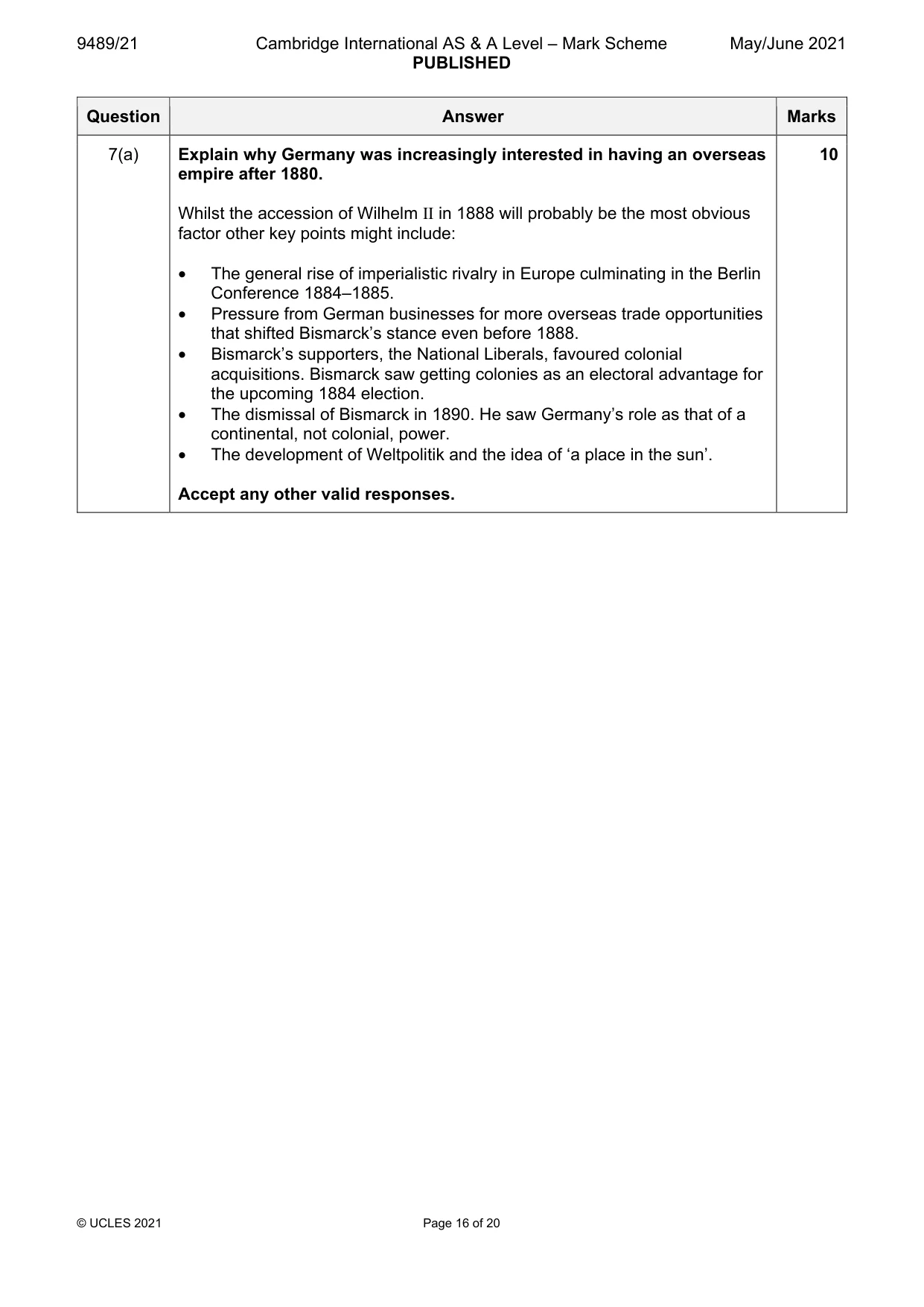
7 Empire and the emergence of world powers, 1870–1919 (a) Explain why Germany was increasingly interested in having an overseas empire after 1880. [10] (b) To what extent had Japan become a world power by the end of the First World War? [20]
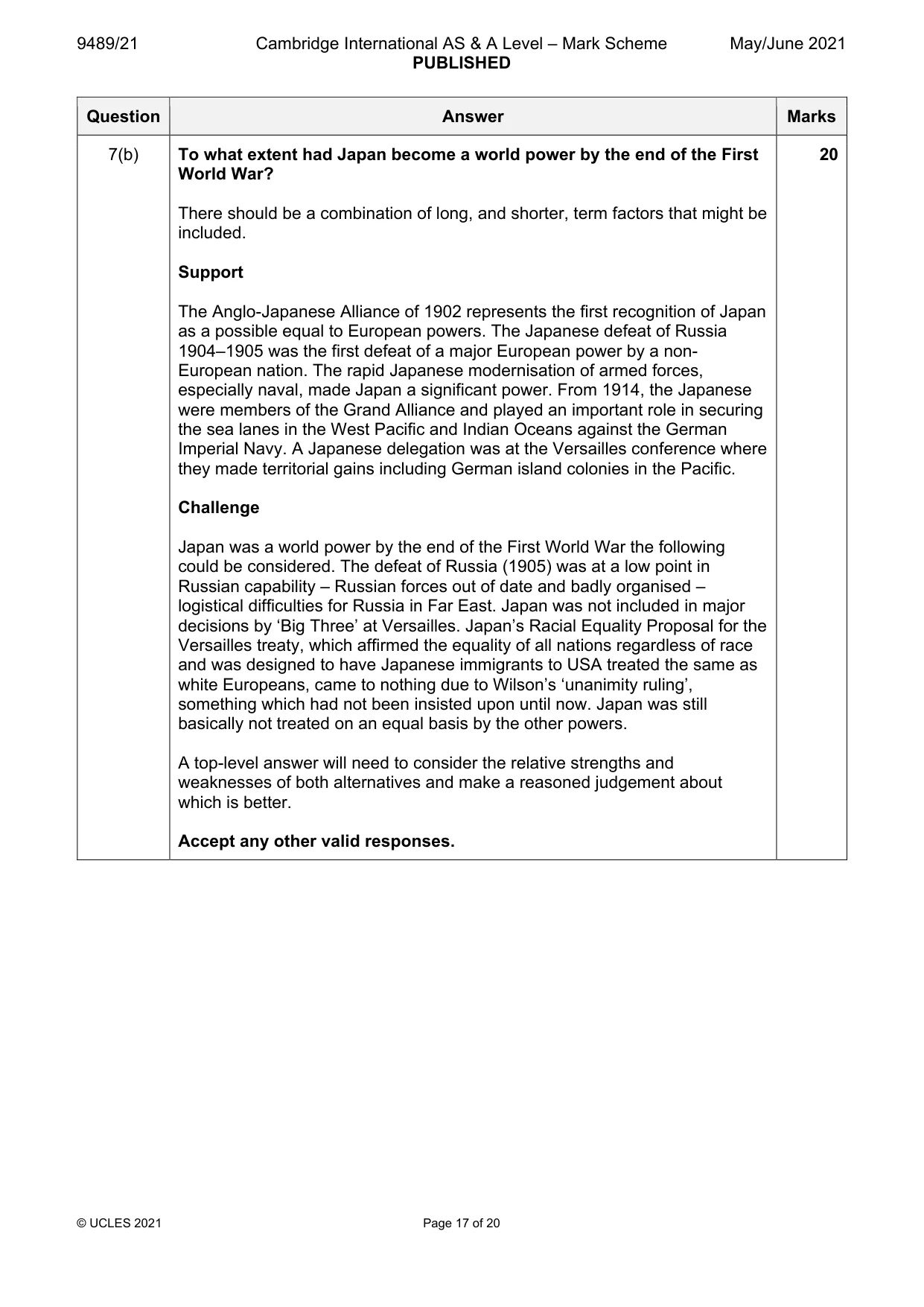
Mark scheme: 7(a) Explain why Germany was increasingly interested in having an overseas 10 empire after 1880. Whilst the accession of Wilhelm Ⅱ in 1888 will probably be the most obvious factor other key points might include: • The general rise of imperialistic rivalry in Europe culminating in the Berlin Conference 1884–1885. • Pressure from German businesses for more overseas trade opportunities that shifted Bismarck’s stance even before 1888. • Bismarck’s supporters, the National Liberals, favoured colonial acquisitions. Bismarck saw getting colonies as an electoral advantage for the upcoming 1884 election. • The dismissal of Bismarck in 1890. He saw Germany’s role as that of a continental, not colonial, power. • The development of Weltpolitik and the idea of ‘a place in the sun’. Accept any other valid responses. 7(b) To what extent had Japan become a world power by the end of the First 20 World War? There should be a combination of long, and shorter, term factors that might be included. Support The Anglo-Japanese Alliance of 1902 represents the first recognition of Japan as a possible equal to European powers. The Japanese defeat of Russia 1904–1905 was the first defeat of a major European power by a non- European nation. The rapid Japanese modernisation of armed forces, especially naval, made Japan a significant power. From 1914, the Japanese were members of the Grand Alliance and played an important role in securing the sea lanes in the West Pacific and Indian Oceans against the German Imperial Navy. A Japanese delegation was at the Versailles conference where they made territorial gains including German island colonies in the Pacific. Challenge Japan was a world power by the end of the First World War the following could be considered. The defeat of Russia (1905) was at a low point in Russian capability – Russian forces out of date and badly organised – logistical difficulties for Russia in Far East. Japan was not included in major decisions by ‘Big Three’ at Versailles. Japan’s Racial Equality Proposal for the Versailles treaty, which affirmed the equality of all nations regardless of race and was designed to have Japanese immigrants to USA treated the same as white Europeans, came to nothing due to Wilson’s ‘unanimity ruling’, something which had not been insisted upon until now. Japan was still basically not treated on an equal basis by the other powers. A top-level answer will need to consider the relative strengths and weaknesses of both alternatives and make a reasoned judgement about which is better. Accept any other valid responses.
More questions on Why did Japan emerge as a world power and what was the impact on international
Q8 · The League of Nations and international relations in the 1920s (a) Explain why there was…
8 The League of Nations and international relations in the 1920s (a) Explain why there was no improvement in Franco‒German relations before 1924. [10] (b) How successful was the USSR in establishing links with other European powers in the 1920s? [20]
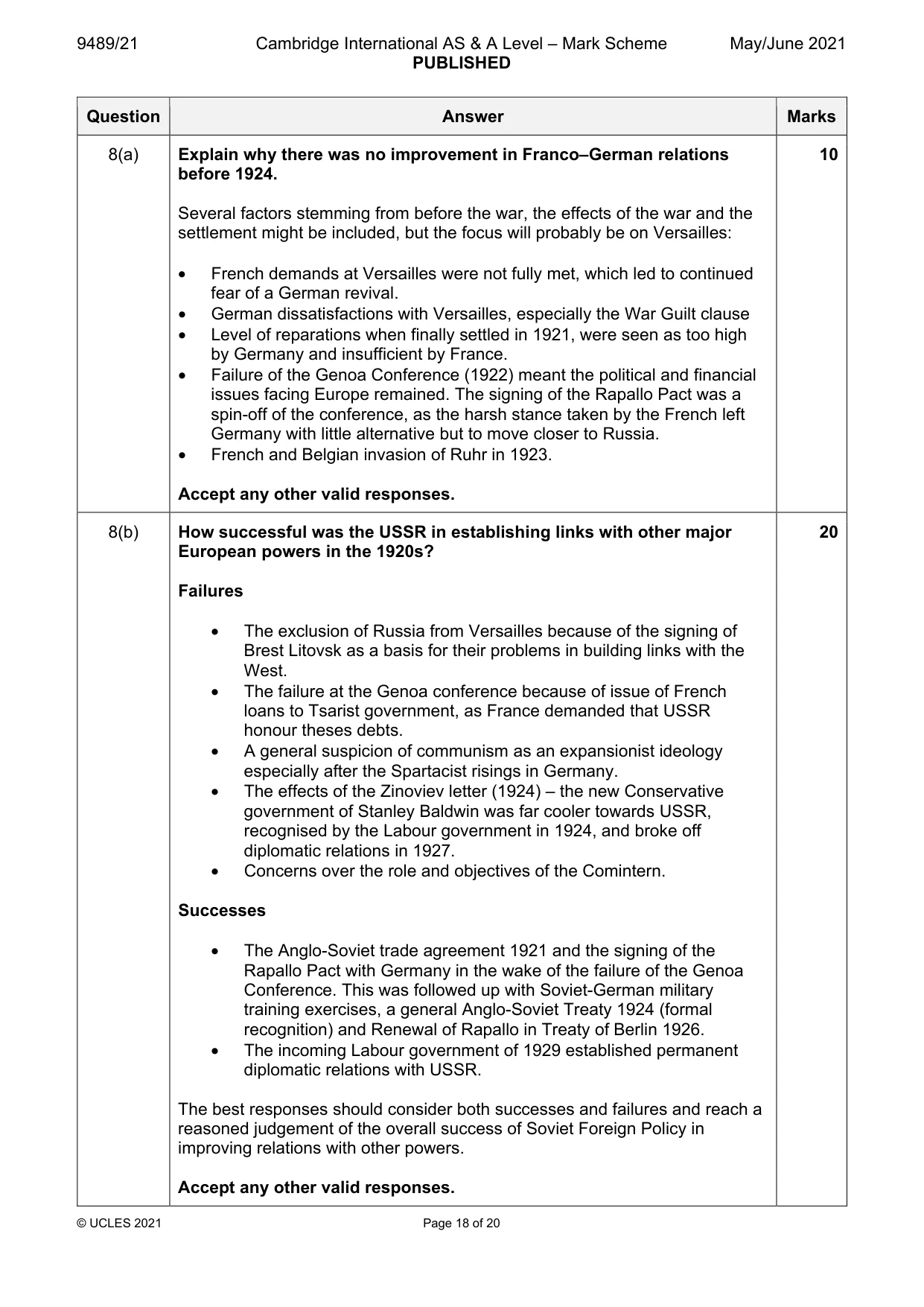
Mark scheme: 8(a) Explain why there was no improvement in Franco‒German relations 10 before 1924. Several factors stemming from before the war, the effects of the war and the settlement might be included, but the focus will probably be on Versailles: • French demands at Versailles were not fully met, which led to continued fear of a German revival. • German dissatisfactions with Versailles, especially the War Guilt clause • Level of reparations when finally settled in 1921, were seen as too high by Germany and insufficient by France. • Failure of the Genoa Conference (1922) meant the political and financial issues facing Europe remained. The signing of the Rapallo Pact was a spin-off of the conference, as the harsh stance taken by the French left Germany with little alternative but to move closer to Russia. • French and Belgian invasion of Ruhr in 1923. Accept any other valid responses. 8(b) How successful was the USSR in establishing links with other major 20 European powers in the 1920s? Failures • The exclusion of Russia from Versailles because of the signing of Brest Litovsk as a basis for their problems in building links with the West. • The failure at the Genoa conference because of issue of French loans to Tsarist government, as France demanded that USSR honour theses debts. • A general suspicion of communism as an expansionist ideology especially after the Spartacist risings in Germany. • The effects of the Zinoviev letter (1924) – the new Conservative government of Stanley Baldwin was far cooler towards USSR, recognised by the Labour government in 1924, and broke off diplomatic relations in 1927. • Concerns over the role and objectives of the Comintern. Successes • The Anglo-Soviet trade agreement 1921 and the signing of the Rapallo Pact with Germany in the wake of the failure of the Genoa Conference. This was followed up with Soviet-German military training exercises, a general Anglo-Soviet Treaty 1924 (formal recognition) and Renewal of Rapallo in Treaty of Berlin 1926. • The incoming Labour government of 1929 established permanent diplomatic relations with USSR. The best responses should consider both successes and failures and reach a reasoned judgement of the overall success of Soviet Foreign Policy in improving relations with other powers. Accept any other valid responses.
More questions on How and why did international relations improve, 1924–29?
Q9 · China and Japan, 1912–45 (a) Explain why Japan attacked Pearl Harbor in December 1941
9 China and Japan, 1912–45 (a) Explain why Japan attacked Pearl Harbor in December 1941. [10] (b) ‘The most important outcome of the Long March was the emergence of Mao Zedong as leader of the Chinese Communist Party.’ How far do you agree? [20]
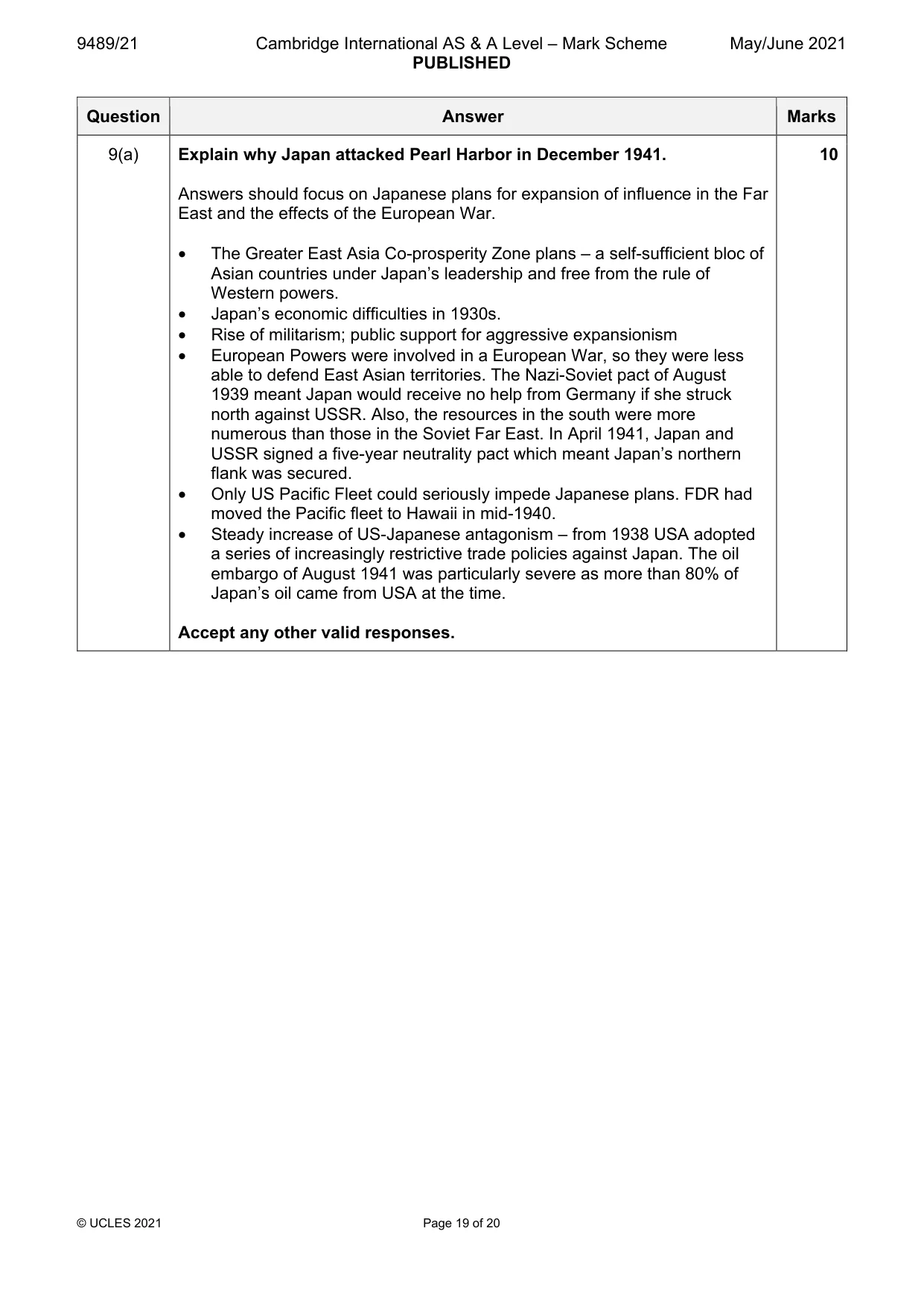
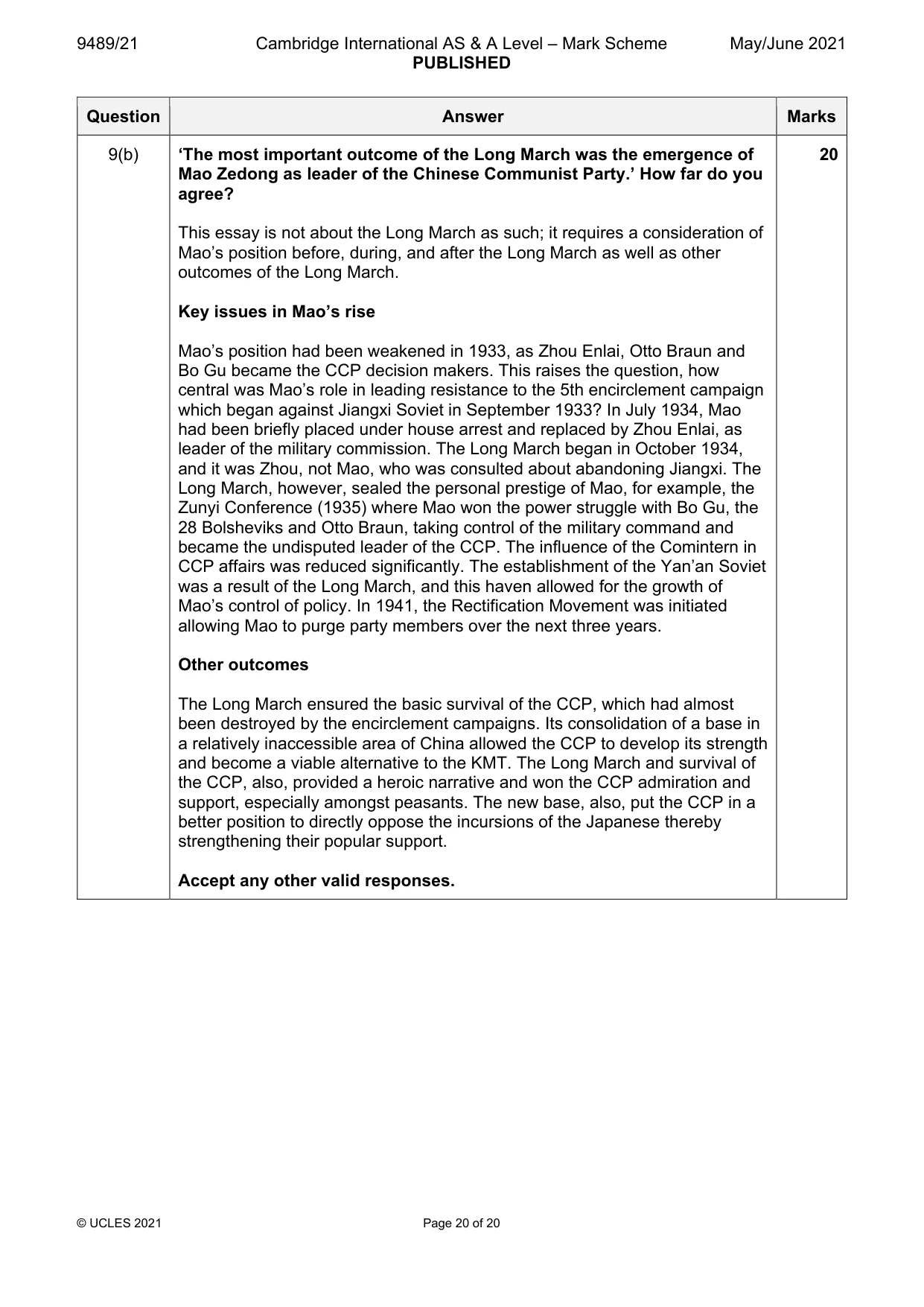
Mark scheme: 9(a) Explain why Japan attacked Pearl Harbor in December 1941. 10 Answers should focus on Japanese plans for expansion of influence in the Far East and the effects of the European War. • The Greater East Asia Co-prosperity Zone plans – a self-sufficient bloc of Asian countries under Japan’s leadership and free from the rule of Western powers. • Japan’s economic difficulties in 1930s. • Rise of militarism; public support for aggressive expansionism • European Powers were involved in a European War, so they were less able to defend East Asian territories. The Nazi-Soviet pact of August 1939 meant Japan would receive no help from Germany if she struck north against USSR. Also, the resources in the south were more numerous than those in the Soviet Far East. In April 1941, Japan and USSR signed a five-year neutrality pact which meant Japan’s northern flank was secured. • Only US Pacific Fleet could seriously impede Japanese plans. FDR had moved the Pacific fleet to Hawaii in mid-1940. • Steady increase of US-Japanese antagonism – from 1938 USA adopted a series of increasingly restrictive trade policies against Japan. The oil embargo of August 1941 was particularly severe as more than 80% of Japan’s oil came from USA at the time. Accept any other valid responses. 9(b) ‘The most important outcome of the Long March was the emergence of 20 Mao Zedong as leader of the Chinese Communist Party.’ How far do you agree? This essay is not about the Long March as such; it requires a consideration of Mao’s position before, during, and after the Long March as well as other outcomes of the Long March. Key issues in Mao’s rise Mao’s position had been weakened in 1933, as Zhou Enlai, Otto Braun and Bo Gu became the CCP decision makers. This raises the question, how central was Mao’s role in leading resistance to the 5th encirclement campaign which began against Jiangxi Soviet in September 1933? In July 1934, Mao had been briefly placed under house arrest and replaced by Zhou Enlai, as leader of the military commission. The Long March began in October 1934, and it was Zhou, not Mao, who was consulted about abandoning Jiangxi. The Long March, however, sealed the personal prestige of Mao, for example, the Zunyi Conference (1935) where Mao won the power struggle with Bo Gu, the 28 Bolsheviks and Otto Braun, taking control of the military command and became the undisputed leader of the CCP. The influence of the Comintern in CCP affairs was reduced significantly. The establishment of the Yan’an Soviet was a result of the Long March, and this haven allowed for the growth of Mao’s control of policy. In 1941, the Rectification Movement was initiated allowing Mao to purge party members over the next three years. Other outcomes The Long March ensured the basic survival of the CCP, which had almost been destroyed by the encirclement campaigns. Its consolidation of a base in a relatively inaccessible area of China allowed the CCP to develop its strength and become a viable alternative to the KMT. The Long March and survival of the CCP, also, provided a heroic narrative and won the CCP admiration and support, especially amongst peasants. The new base, also, put the CCP in a better position to directly oppose the incursions of the Japanese thereby strengthening their popular support. Accept any other valid responses.
More questions on How were the Bolsheviks able to consolidate their power up to 1924?
What was in this paper
The subtopics covered by these 9 questions, and how many questions each got. Open one in a new tab to see every Cambridge question on it.
1How and why did the Bolsheviks seize power in October 1917?1How were the Bolsheviks able to consolidate their power up to 1924?1What caused the rise and fall of Napoleon Bonaparte?1What were the aims of Reconstruction and how successful was it?1What were the causes of the Great Crash and the Great Depression?1What were the consequences of the rapid economic growth after 1870?1Why did Japan emerge as a world power and what was the impact on international1Why was there rapid industrialisation after 1870?1What you needed in this session
Cambridge’s own grade thresholds for 2021 May/June, Paper 2 · Variant 1. A higher threshold means an easier paper — the bar moves with how the cohort did.