Cambridge A Level History 9489 — 2023 Feb/March Paper 2 · Variant 2
9489/22/F/M/23 · 9 questions · 60 marks · ≈68 min
The question paper and its mark scheme, free to read here and free to download. This is Cambridge’s own paper, exactly as it was sat.
Question paper4 pages
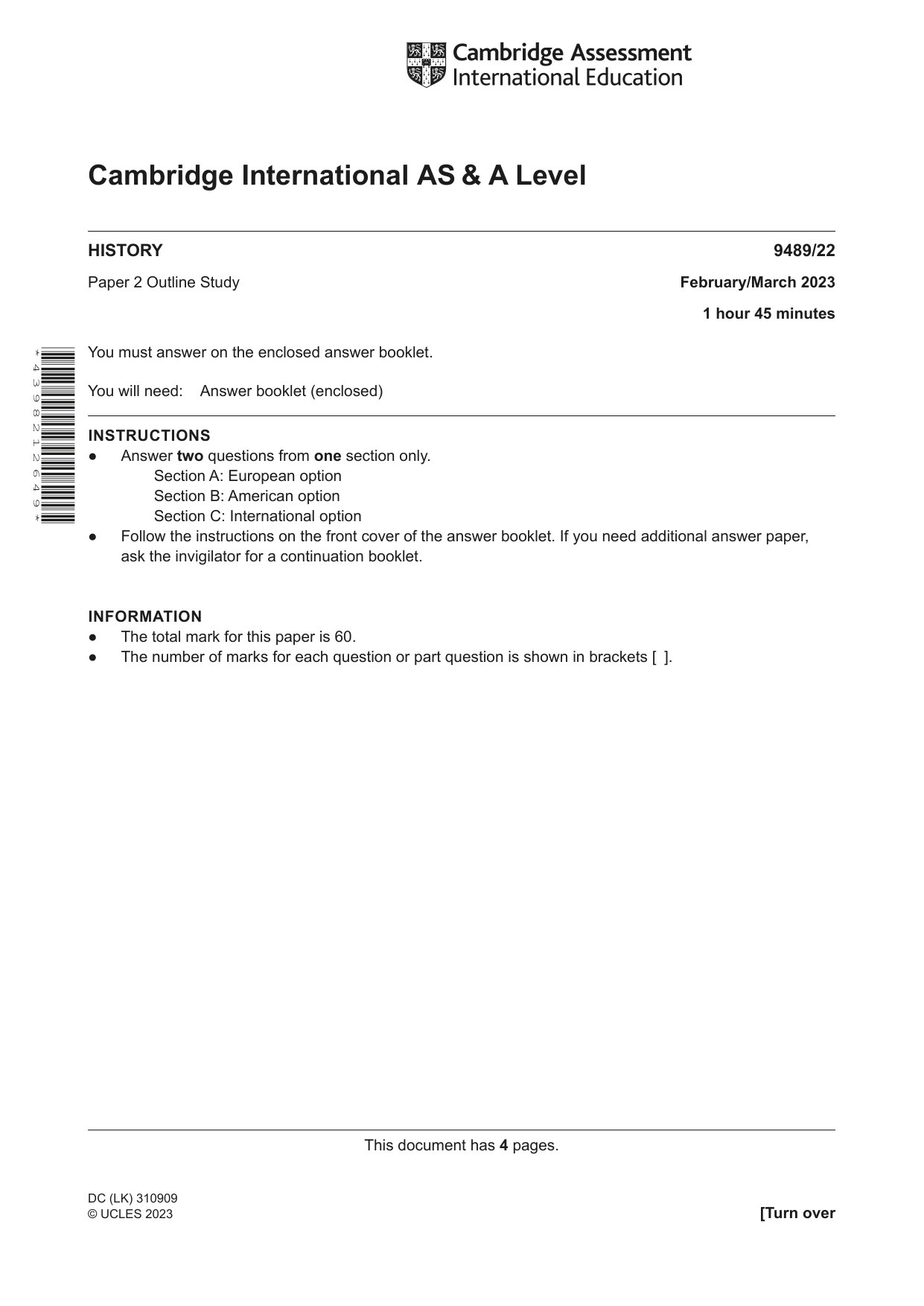
Mark scheme21 pages
Answers below. Sit the paper first if you are practising.

Questions as text
Q1 · The Industrial Revolution in Britain, 1750–1850 (a) Explain why railways developed after…
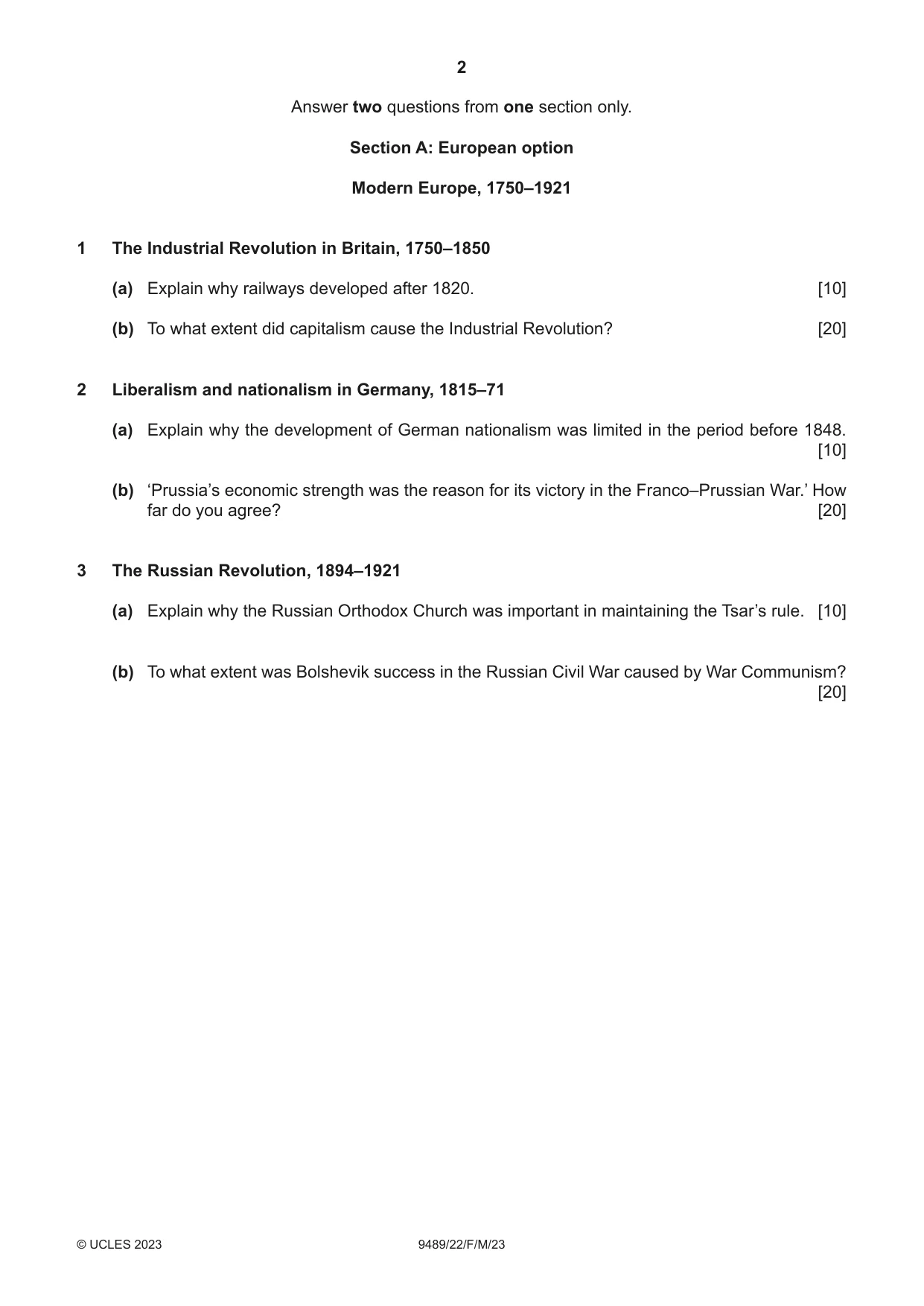
1 The Industrial Revolution in Britain, 1750–1850 (a) Explain why railways developed after 1820. [10] (b) To what extent did capitalism cause the Industrial Revolution? [20]
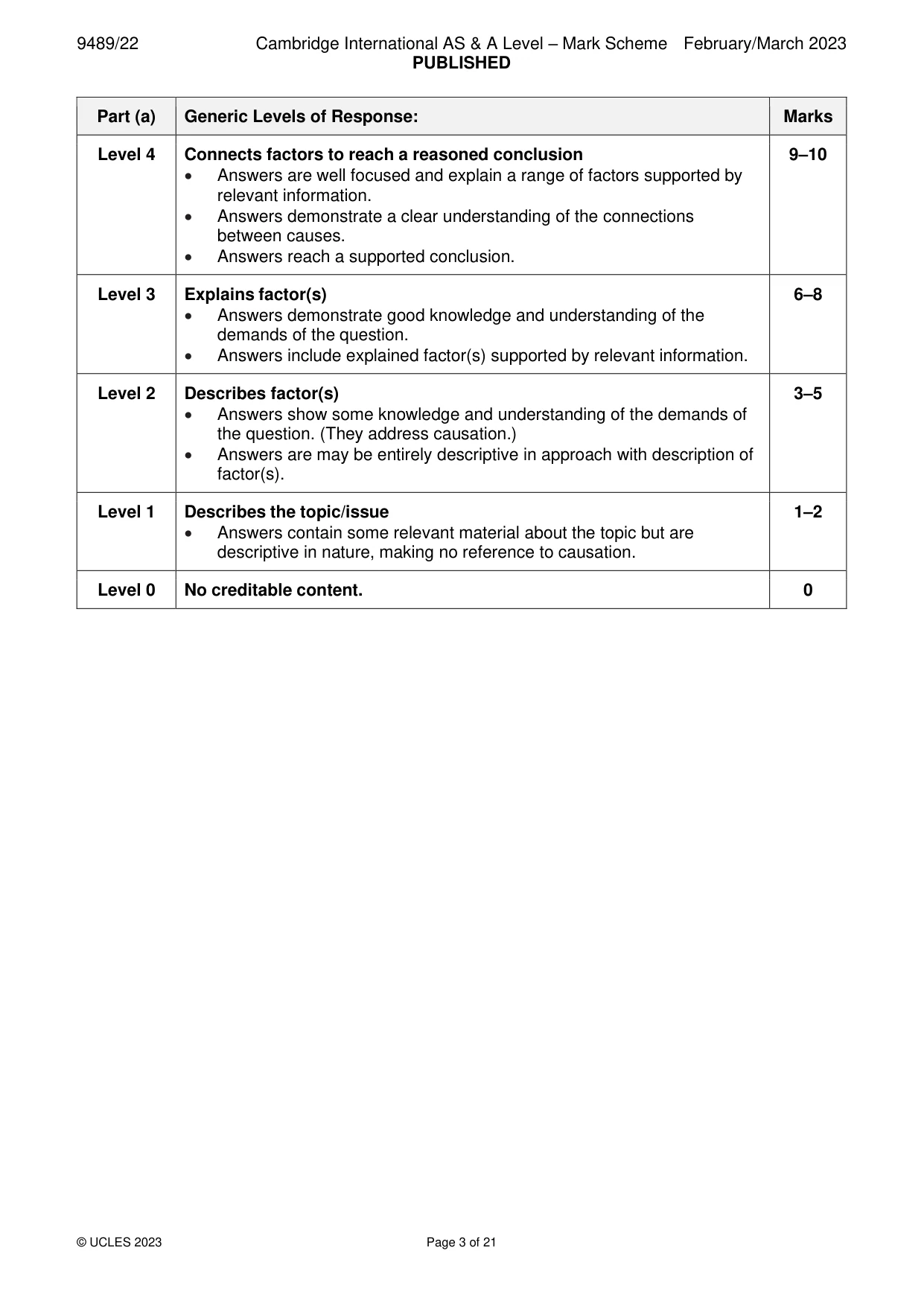
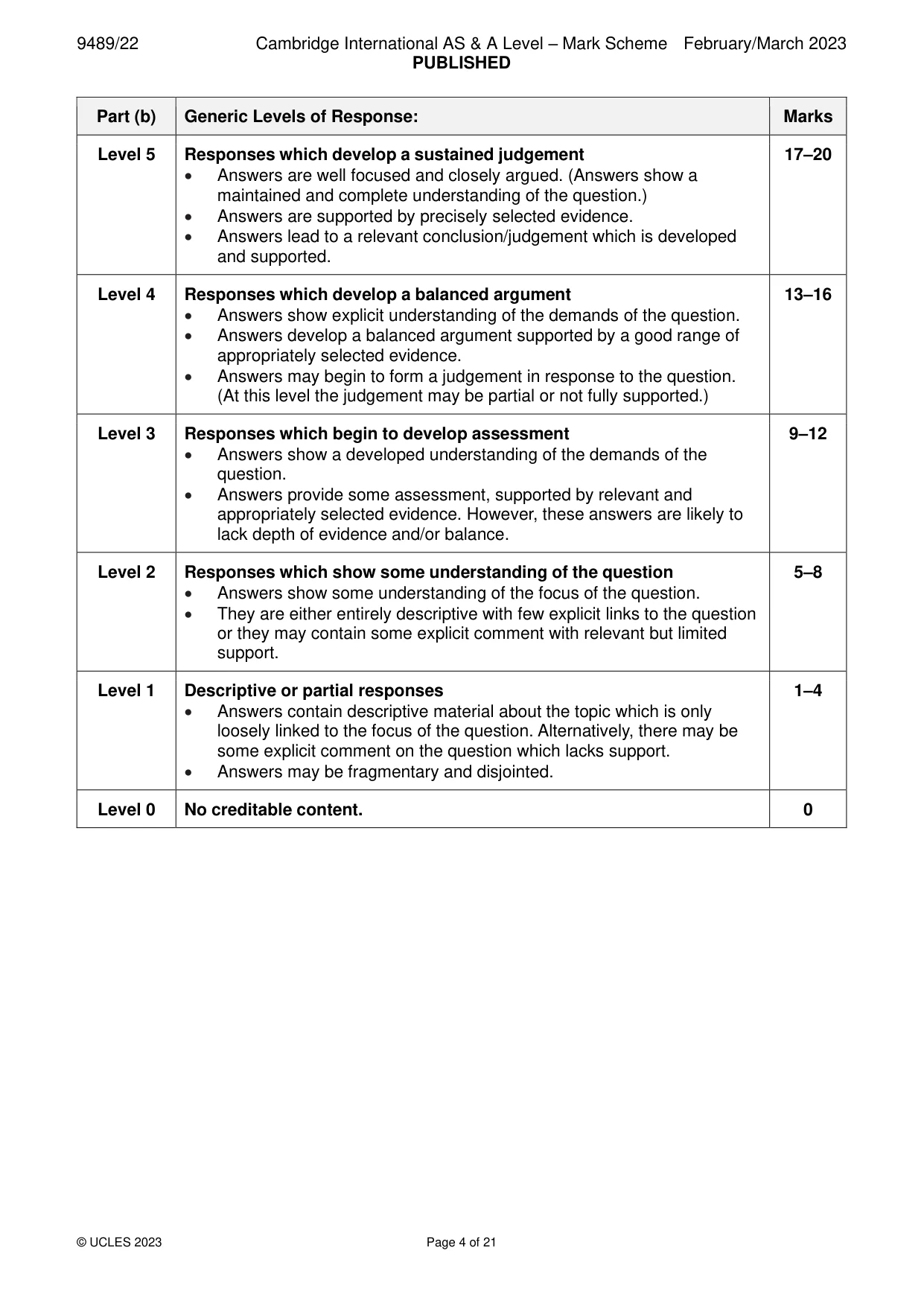
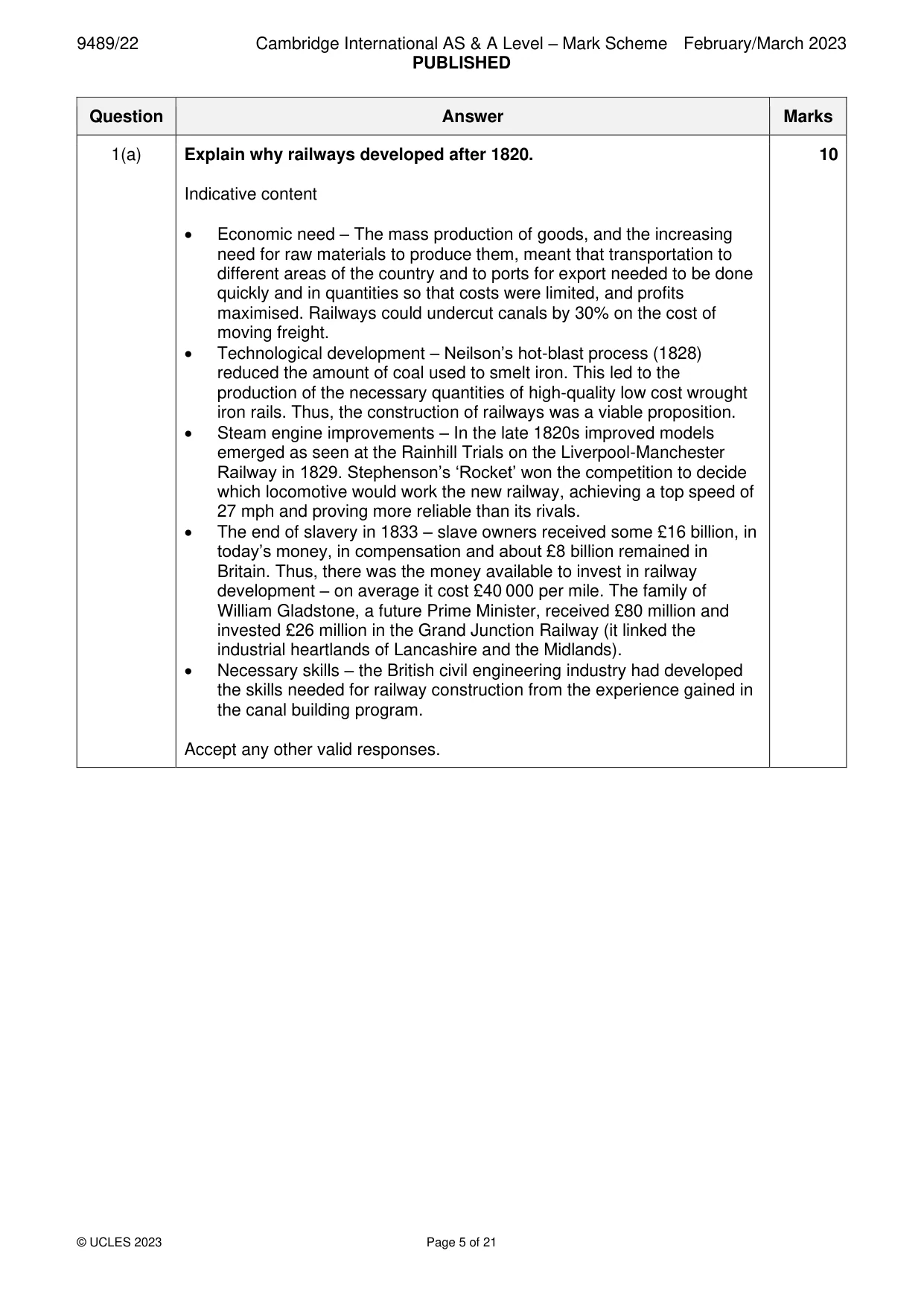
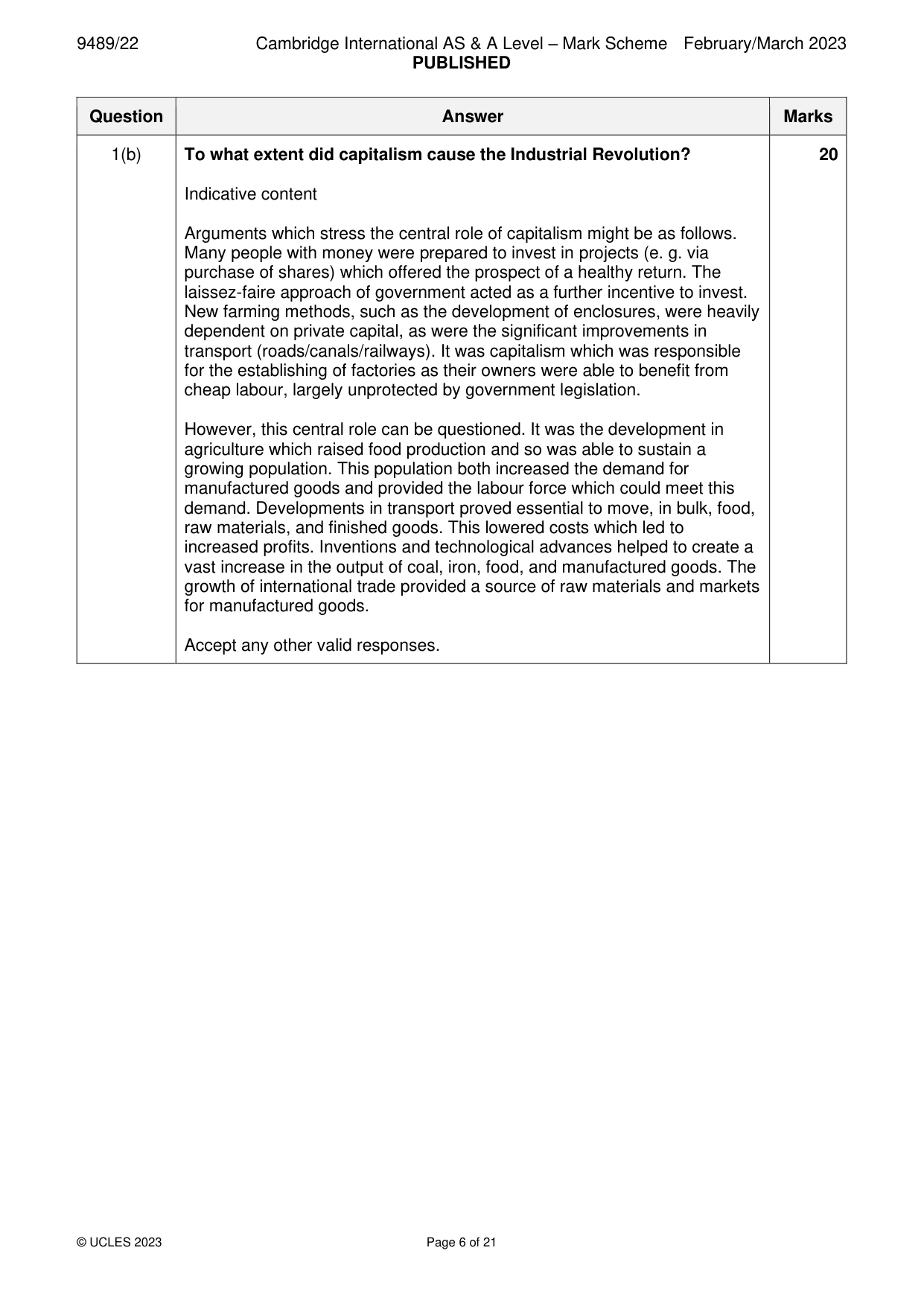
Mark scheme: Question Answer Marks 1(a) Explain why railways developed after 1820. 10 Indicative content • Economic need – The mass production of goods, and the increasing need for raw materials to produce them, meant that transportation to different areas of the country and to ports for export needed to be done quickly and in quantities so that costs were limited, and profits maximised. Railways could undercut canals by 30% on the cost of moving freight. • Technological development – Neilson’s hot-blast process (1828) reduced the amount of coal used to smelt iron. This led to the production of the necessary quantities of high-quality low cost wrought iron rails. Thus, the construction of railways was a viable proposition. • Steam engine improvements – In the late 1820s improved models emerged as seen at the Rainhill Trials on the Liverpool-Manchester Railway in 1829. Stephenson’s ‘Rocket’ won the competition to decide which locomotive would work the new railway, achieving a top speed of 27 mph and proving more reliable than its rivals. • The end of slavery in 1833 – slave owners received some £16 billion, in today’s money, in compensation and about £8 billion remained in Britain. Thus, there was the money available to invest in railway development – on average it cost £40 000 per mile. The family of William Gladstone, a future Prime Minister, received £80 million and invested £26 million in the Grand Junction Railway (it linked the industrial heartlands of Lancashire and the Midlands). • Necessary skills – the British civil engineering industry had developed the skills needed for railway construction from the experience gained in the canal building program. Accept any other valid responses. 1(b) To what extent did capitalism cause the Industrial Revolution? 20 Indicative content Arguments which stress the central role of capitalism might be as follows. Many people with money were prepared to invest in projects (e. g. via purchase of shares) which offered the prospect of a healthy return. The laissez-faire approach of government acted as a further incentive to invest. New farming methods, such as the development of enclosures, were heavily dependent on private capital, as were the significant improvements in transport (roads/canals/railways). It was capitalism which was responsible for the establishing of factories as their owners were able to benefit from cheap labour, largely unprotected by government legislation. However, this central role can be questioned. It was the development in agriculture which raised food production and so was able to sustain a growing population. This population both increased the demand for manufactured goods and provided the labour force which could meet this demand. Developments in transport proved essential to move, in bulk, food, raw materials, and finished goods. This lowered costs which led to increased profits. Inventions and technological advances helped to create a vast increase in the output of coal, iron, food, and manufactured goods. The growth of international trade provided a source of raw materials and markets for manufactured goods. Accept any other valid responses.
More questions on Why was there rapid industrialisation after 1870?
Q2 · Liberalism and nationalism in Germany, 1815–71 (a) Explain why the development of German…
2 Liberalism and nationalism in Germany, 1815–71 (a) Explain why the development of German nationalism was limited in the period before 1848. [10] (b) ‘Prussia’s economic strength was the reason for its victory in the Franco–Prussian War.’ How far do you agree? [20]
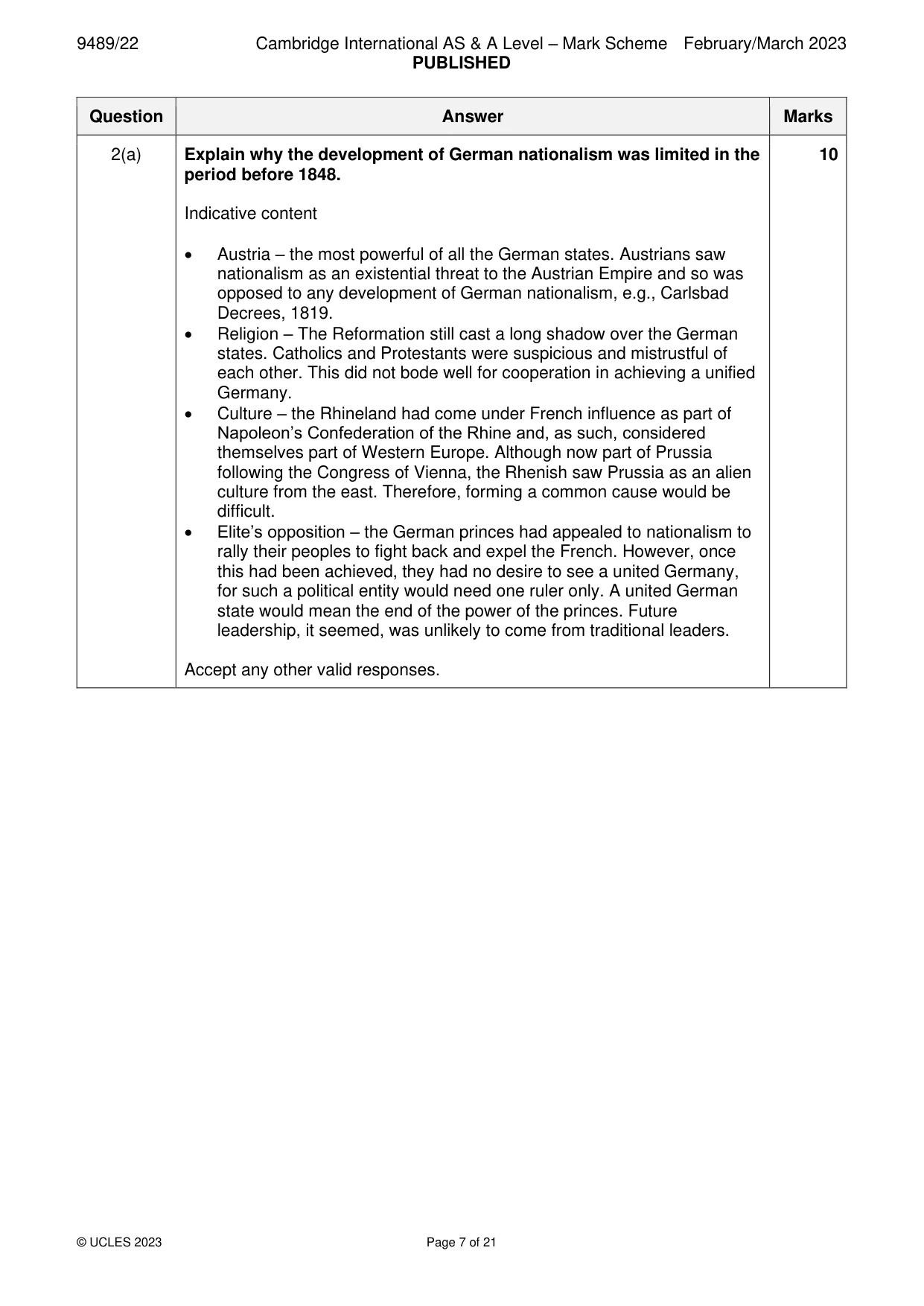
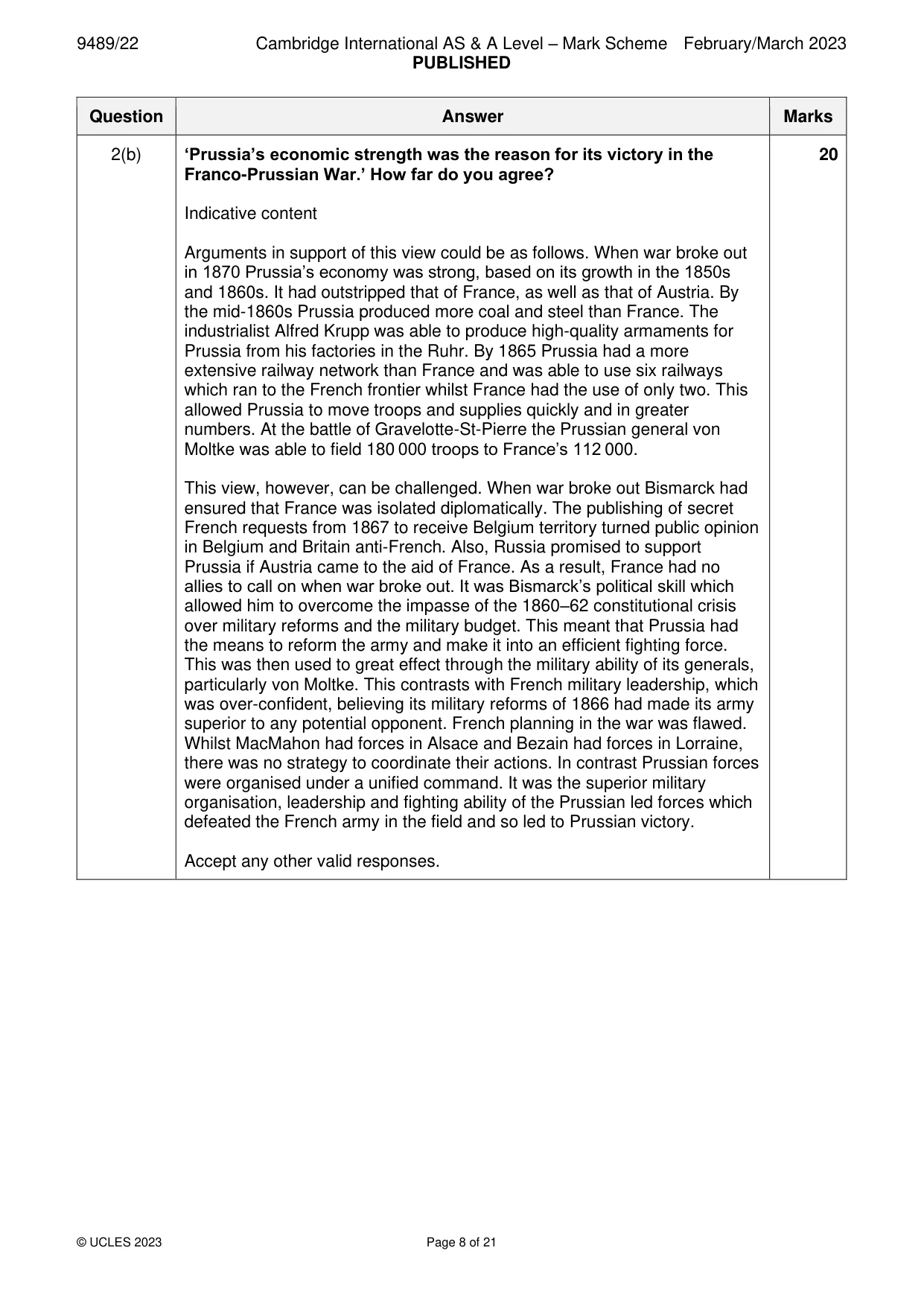
Mark scheme: 2(a) Explain why the development of German nationalism was limited in the 10 period before 1848. Indicative content • Austria – the most powerful of all the German states. Austrians saw nationalism as an existential threat to the Austrian Empire and so was opposed to any development of German nationalism, e.g., Carlsbad Decrees, 1819. • Religion – The Reformation still cast a long shadow over the German states. Catholics and Protestants were suspicious and mistrustful of each other. This did not bode well for cooperation in achieving a unified Germany. • Culture – the Rhineland had come under French influence as part of Napoleon’s Confederation of the Rhine and, as such, considered themselves part of Western Europe. Although now part of Prussia following the Congress of Vienna, the Rhenish saw Prussia as an alien culture from the east. Therefore, forming a common cause would be difficult. • Elite’s opposition – the German princes had appealed to nationalism to rally their peoples to fight back and expel the French. However, once this had been achieved, they had no desire to see a united Germany, for such a political entity would need one ruler only. A united German state would mean the end of the power of the princes. Future leadership, it seemed, was unlikely to come from traditional leaders. Accept any other valid responses. 2(b) ‘Prussia’s economic strength was the reason for its victory in the 20 Franco-Prussian War.’ How far do you agree? Indicative content Arguments in support of this view could be as follows. When war broke out in 1870 Prussia’s economy was strong, based on its growth in the 1850s and 1860s. It had outstripped that of France, as well as that of Austria. By the mid-1860s Prussia produced more coal and steel than France. The industrialist Alfred Krupp was able to produce high-quality armaments for Prussia from his factories in the Ruhr. By 1865 Prussia had a more extensive railway network than France and was able to use six railways which ran to the French frontier whilst France had the use of only two. This allowed Prussia to move troops and supplies quickly and in greater numbers. At the battle of Gravelotte-St-Pierre the Prussian general von Moltke was able to field 180 000 troops to France’s 112 000. This view, however, can be challenged. When war broke out Bismarck had ensured that France was isolated diplomatically. The publishing of secret French requests from 1867 to receive Belgium territory turned public opinion in Belgium and Britain anti-French. Also, Russia promised to support Prussia if Austria came to the aid of France. As a result, France had no allies to call on when war broke out. It was Bismarck’s political skill which allowed him to overcome the impasse of the 1860–62 constitutional crisis over military reforms and the military budget. This meant that Prussia had the means to reform the army and make it into an efficient fighting force. This was then used to great effect through the military ability of its generals, particularly von Moltke. This contrasts with French military leadership, which was over-confident, believing its military reforms of 1866 had made its army superior to any potential opponent. French planning in the war was flawed. Whilst MacMahon had forces in Alsace and Bezain had forces in Lorraine, there was no strategy to coordinate their actions. In contrast Prussian forces were organised under a unified command. It was the superior military organisation, leadership and fighting ability of the Prussian led forces which defeated the French army in the field and so led to Prussian victory. Accept any other valid responses.
More questions on How and why was German unification achieved by 1871?
Q3 · The Russian Revolution, 1894–1921 (a) Explain why the Russian Orthodox Church was…
3 The Russian Revolution, 1894–1921 (a) Explain why the Russian Orthodox Church was important in maintaining the Tsar’s rule. [10] (b) To what extent was Bolshevik success in the Russian Civil War caused by War Communism? [20]
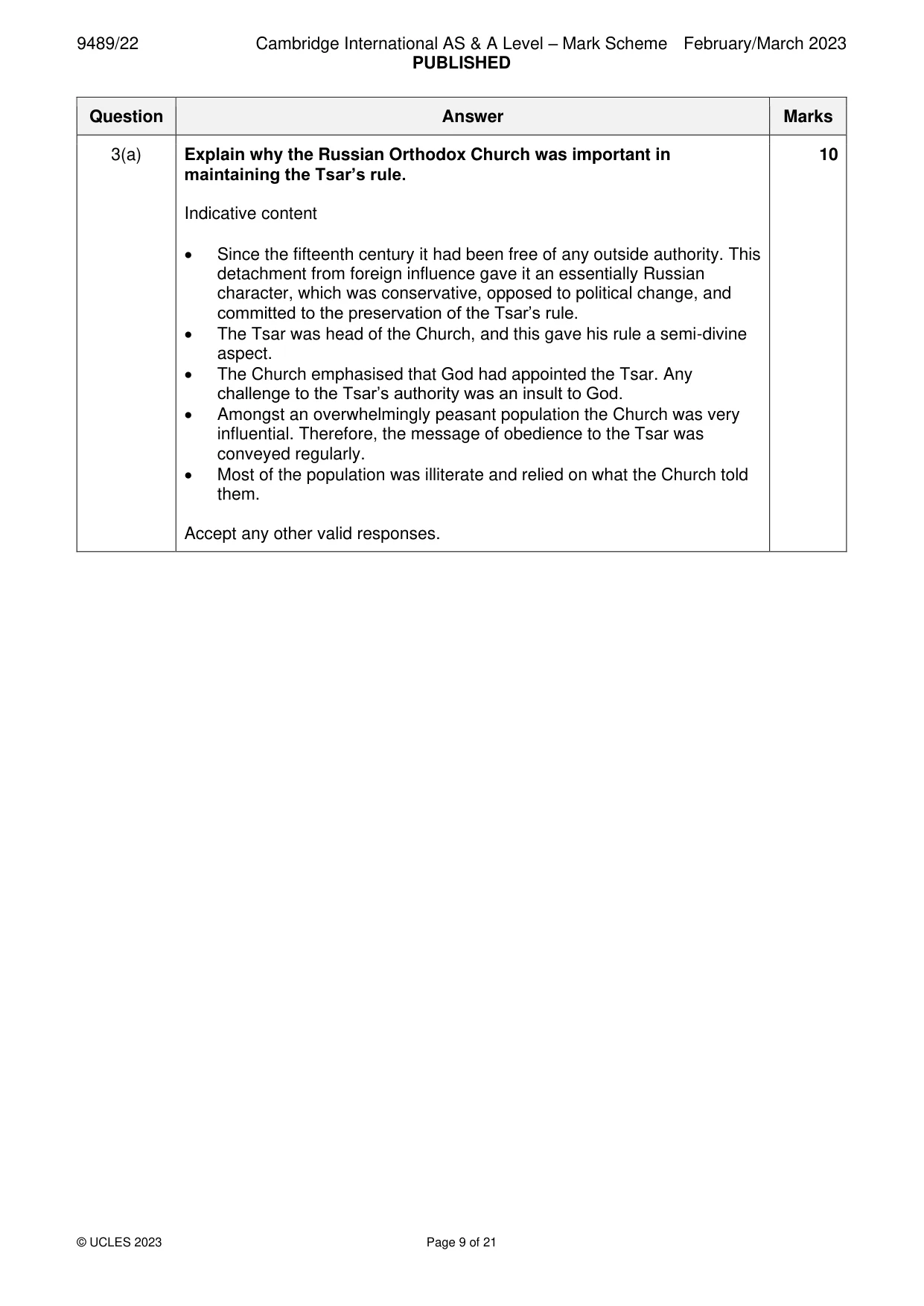
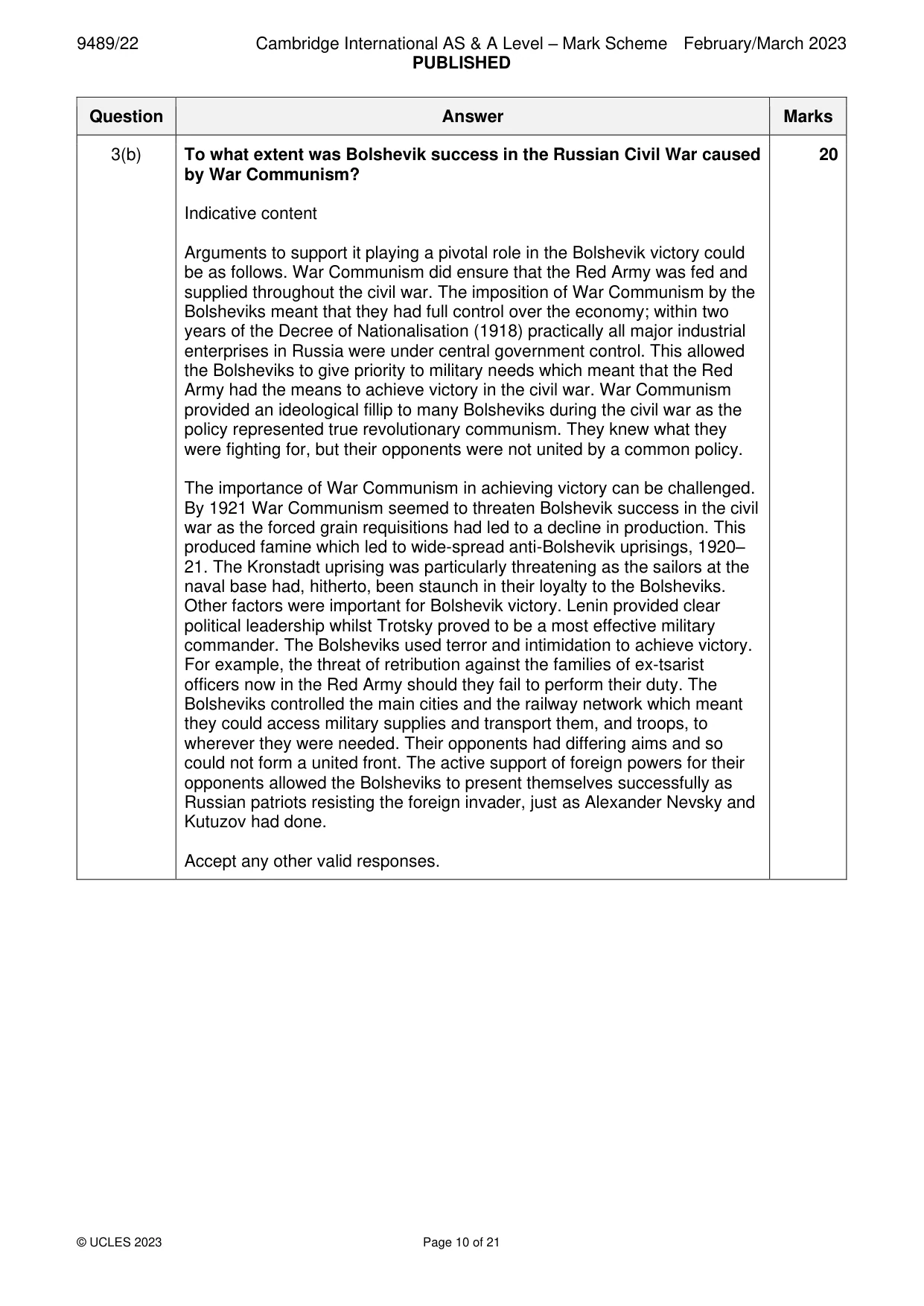
Mark scheme: 3(a) Explain why the Russian Orthodox Church was important in 10 maintaining the Tsar’s rule. Indicative content • Since the fifteenth century it had been free of any outside authority. This detachment from foreign influence gave it an essentially Russian character, which was conservative, opposed to political change, and committed to the preservation of the Tsar’s rule. • The Tsar was head of the Church, and this gave his rule a semi-divine aspect. • The Church emphasised that God had appointed the Tsar. Any challenge to the Tsar’s authority was an insult to God. • Amongst an overwhelmingly peasant population the Church was very influential. Therefore, the message of obedience to the Tsar was conveyed regularly. • Most of the population was illiterate and relied on what the Church told them. Accept any other valid responses. 3(b) To what extent was Bolshevik success in the Russian Civil War caused 20 by War Communism? Indicative content Arguments to support it playing a pivotal role in the Bolshevik victory could be as follows. War Communism did ensure that the Red Army was fed and supplied throughout the civil war. The imposition of War Communism by the Bolsheviks meant that they had full control over the economy; within two years of the Decree of Nationalisation (1918) practically all major industrial enterprises in Russia were under central government control. This allowed the Bolsheviks to give priority to military needs which meant that the Red Army had the means to achieve victory in the civil war. War Communism provided an ideological fillip to many Bolsheviks during the civil war as the policy represented true revolutionary communism. They knew what they were fighting for, but their opponents were not united by a common policy. The importance of War Communism in achieving victory can be challenged. By 1921 War Communism seemed to threaten Bolshevik success in the civil war as the forced grain requisitions had led to a decline in production. This produced famine which led to wide-spread anti-Bolshevik uprisings, 1920– 21. The Kronstadt uprising was particularly threatening as the sailors at the naval base had, hitherto, been staunch in their loyalty to the Bolsheviks. Other factors were important for Bolshevik victory. Lenin provided clear political leadership whilst Trotsky proved to be a most effective military commander. The Bolsheviks used terror and intimidation to achieve victory. For example, the threat of retribution against the families of ex-tsarist officers now in the Red Army should they fail to perform their duty. The Bolsheviks controlled the main cities and the railway network which meant they could access military supplies and transport them, and troops, to wherever they were needed. Their opponents had differing aims and so could not form a united front. The active support of foreign powers for their opponents allowed the Bolsheviks to present themselves successfully as Russian patriots resisting the foreign invader, just as Alexander Nevsky and Kutuzov had done. Accept any other valid responses.
More questions on How were the Bolsheviks able to consolidate their power up to 1924?
Q4 · The origins of the Civil War, 1820–61 (a) Explain why many people were worried by…
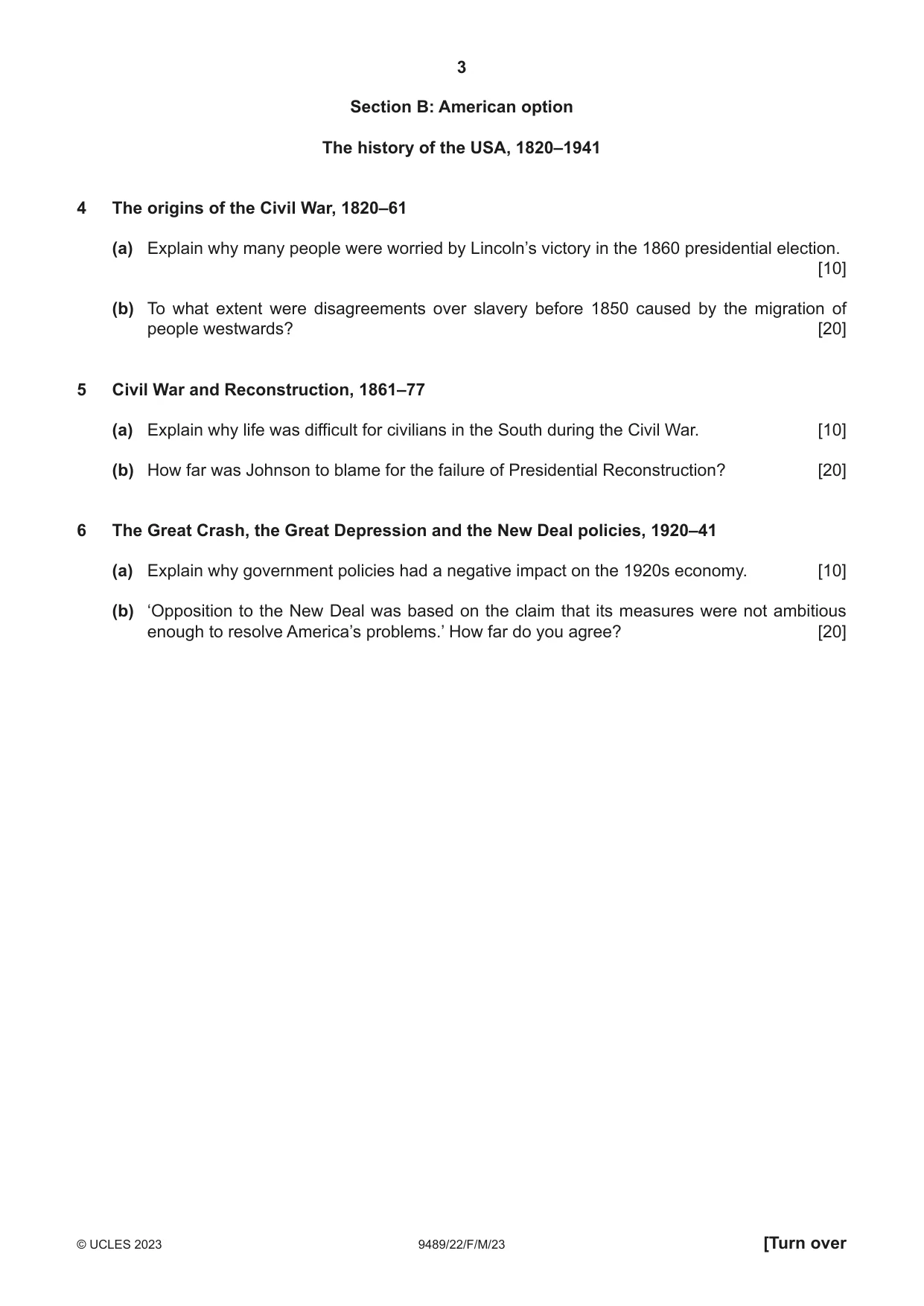
4 The origins of the Civil War, 1820–61 (a) Explain why many people were worried by Lincoln’s victory in the 1860 presidential election. [10] (b) To what extent were disagreements over slavery before 1850 caused by the migration of people westwards? [20]
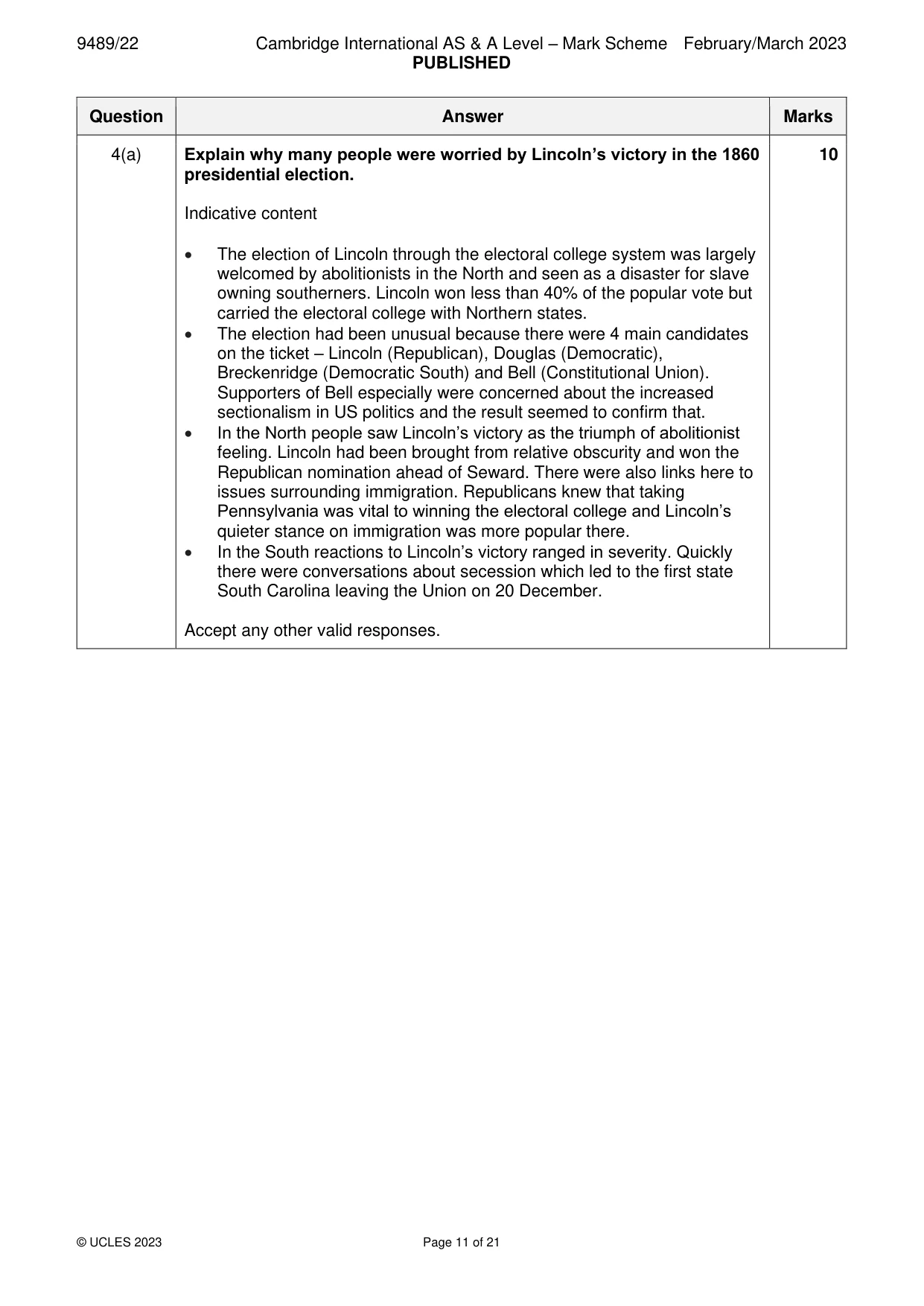
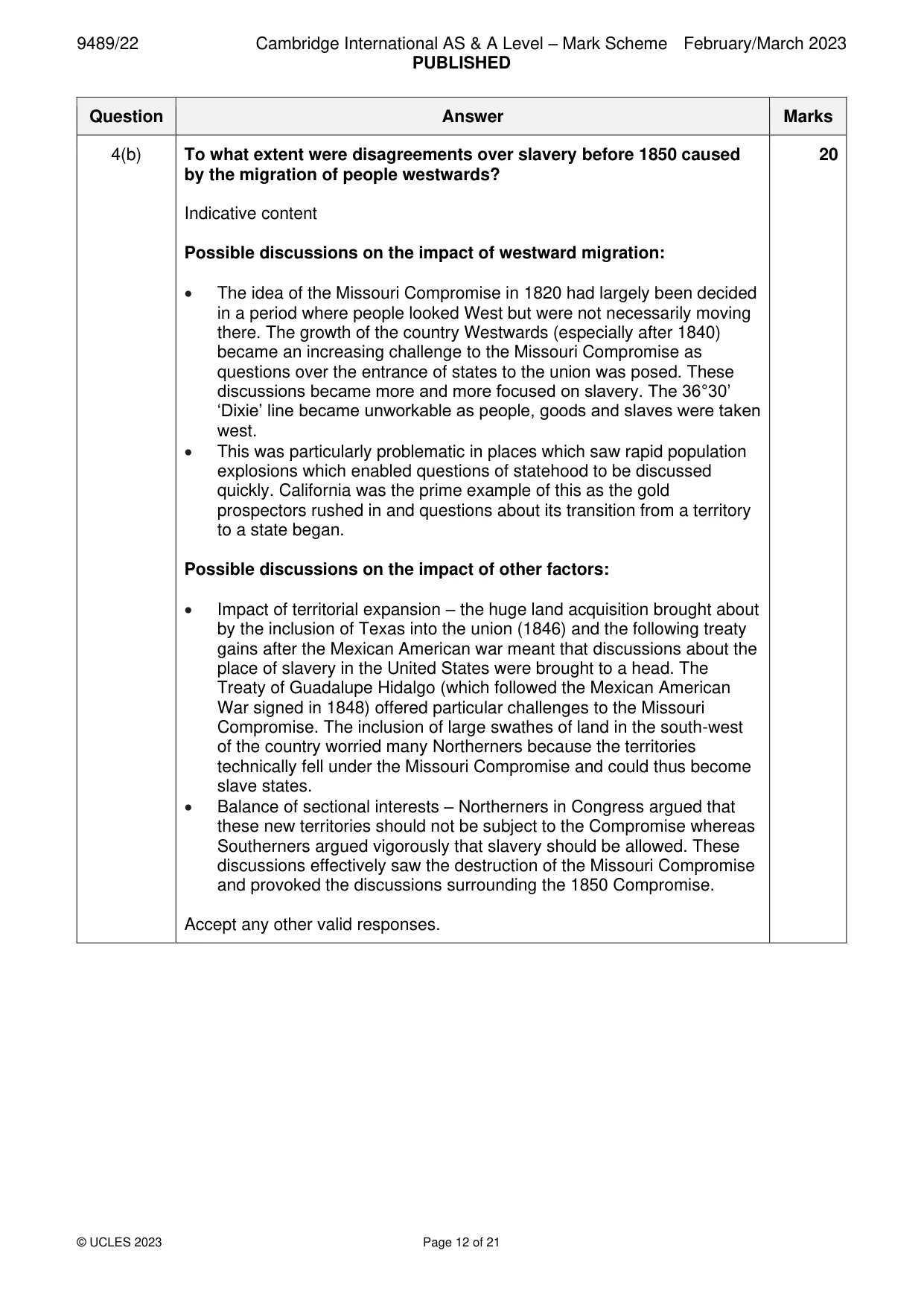
Mark scheme: 4(a) Explain why many people were worried by Lincoln’s victory in the 1860 10 presidential election. Indicative content • The election of Lincoln through the electoral college system was largely welcomed by abolitionists in the North and seen as a disaster for slave owning southerners. Lincoln won less than 40% of the popular vote but carried the electoral college with Northern states. • The election had been unusual because there were 4 main candidates on the ticket – Lincoln (Republican), Douglas (Democratic), Breckenridge (Democratic South) and Bell (Constitutional Union). Supporters of Bell especially were concerned about the increased sectionalism in US politics and the result seemed to confirm that. • In the North people saw Lincoln’s victory as the triumph of abolitionist feeling. Lincoln had been brought from relative obscurity and won the Republican nomination ahead of Seward. There were also links here to issues surrounding immigration. Republicans knew that taking Pennsylvania was vital to winning the electoral college and Lincoln’s quieter stance on immigration was more popular there. • In the South reactions to Lincoln’s victory ranged in severity. Quickly there were conversations about secession which led to the first state South Carolina leaving the Union on 20 December. Accept any other valid responses. 4(b) To what extent were disagreements over slavery before 1850 caused 20 by the migration of people westwards? Indicative content Possible discussions on the impact of westward migration: • The idea of the Missouri Compromise in 1820 had largely been decided in a period where people looked West but were not necessarily moving there. The growth of the country Westwards (especially after 1840) became an increasing challenge to the Missouri Compromise as questions over the entrance of states to the union was posed. These discussions became more and more focused on slavery. The 36°30’ ‘Dixie’ line became unworkable as people, goods and slaves were taken west. • This was particularly problematic in places which saw rapid population explosions which enabled questions of statehood to be discussed quickly. California was the prime example of this as the gold prospectors rushed in and questions about its transition from a territory to a state began. Possible discussions on the impact of other factors: • Impact of territorial expansion – the huge land acquisition brought about by the inclusion of Texas into the union (1846) and the following treaty gains after the Mexican American war meant that discussions about the place of slavery in the United States were brought to a head. The Treaty of Guadalupe Hidalgo (which followed the Mexican American War signed in 1848) offered particular challenges to the Missouri Compromise. The inclusion of large swathes of land in the south-west of the country worried many Northerners because the territories technically fell under the Missouri Compromise and could thus become slave states. • Balance of sectional interests – Northerners in Congress argued that these new territories should not be subject to the Compromise whereas Southerners argued vigorously that slavery should be allowed. These discussions effectively saw the destruction of the Missouri Compromise and provoked the discussions surrounding the 1850 Compromise. Accept any other valid responses.
More questions on Why was there increasing tension between the North and the South before 1860?
Q5 · Civil War and Reconstruction, 1861–77 (a) Explain why life was difficult for civilians in…
5 Civil War and Reconstruction, 1861–77 (a) Explain why life was difficult for civilians in the South during the Civil War. [10] (b) How far was Johnson to blame for the failure of Presidential Reconstruction? [20]
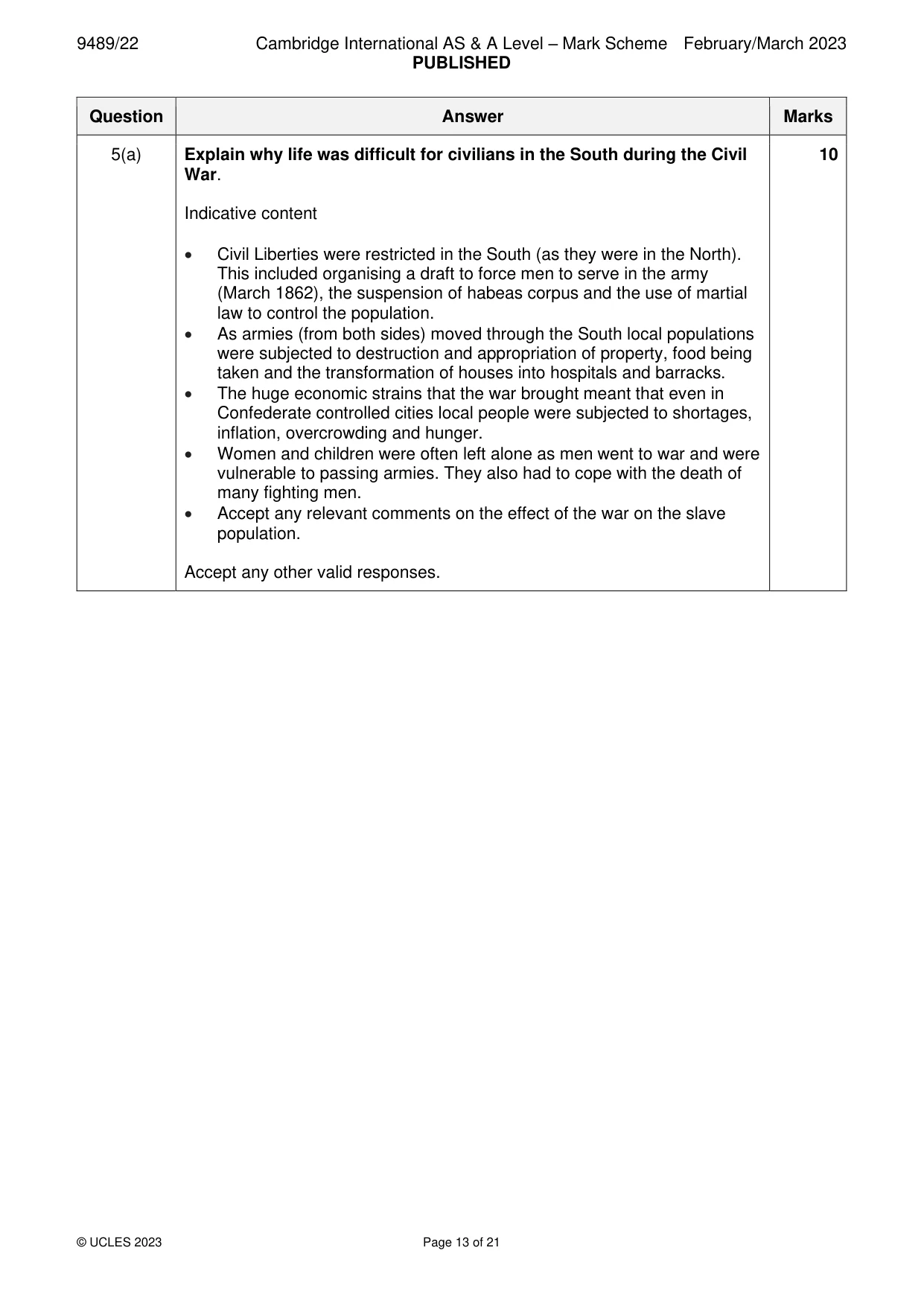
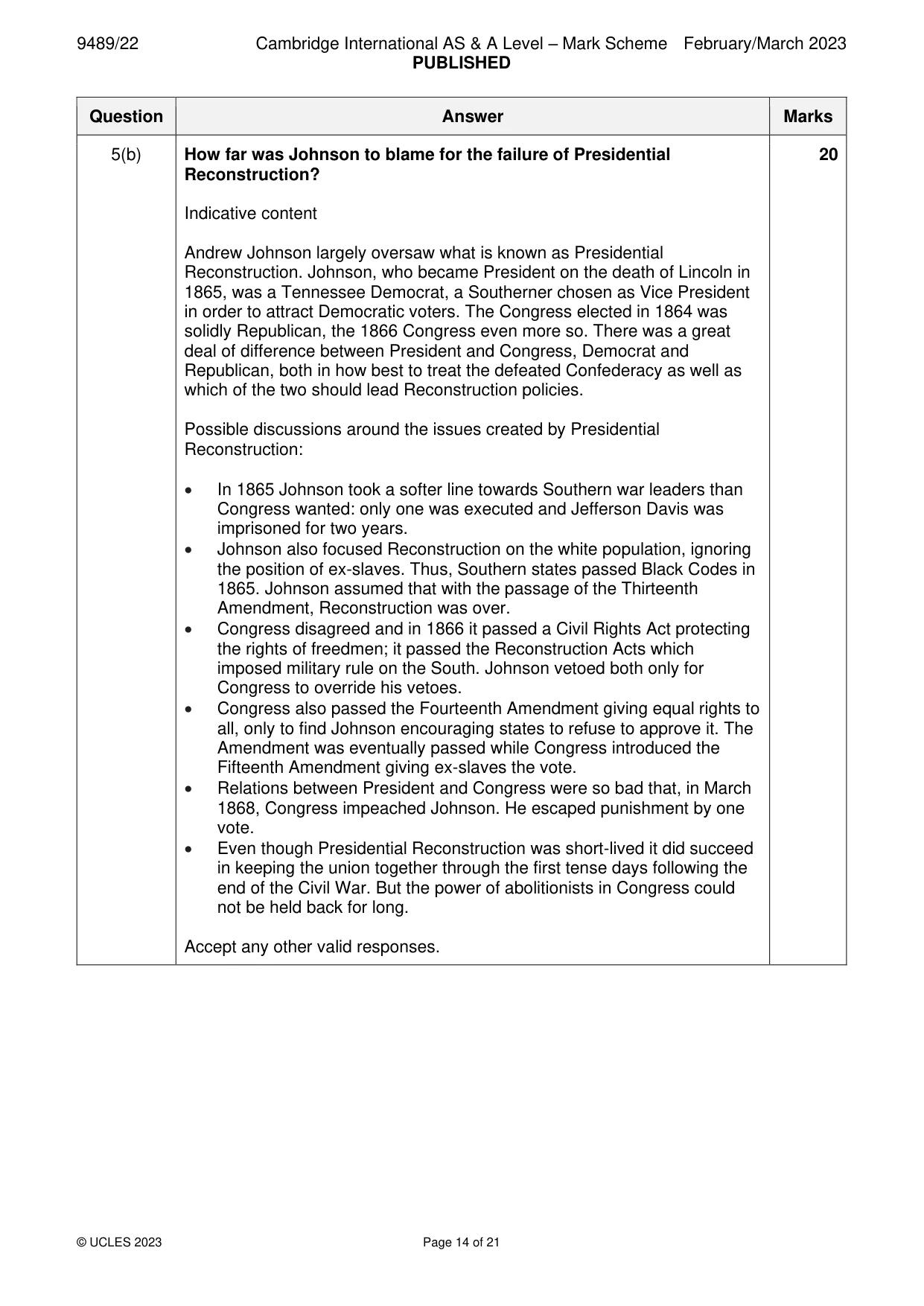
Mark scheme: 5(a) Explain why life was difficult for civilians in the South during the Civil 10 War. Indicative content • Civil Liberties were restricted in the South (as they were in the North). This included organising a draft to force men to serve in the army (March 1862), the suspension of habeas corpus and the use of martial law to control the population. • As armies (from both sides) moved through the South local populations were subjected to destruction and appropriation of property, food being taken and the transformation of houses into hospitals and barracks. • The huge economic strains that the war brought meant that even in Confederate controlled cities local people were subjected to shortages, inflation, overcrowding and hunger. • Women and children were often left alone as men went to war and were vulnerable to passing armies. They also had to cope with the death of many fighting men. • Accept any relevant comments on the effect of the war on the slave population. Accept any other valid responses. 5(b) How far was Johnson to blame for the failure of Presidential 20 Reconstruction? Indicative content Andrew Johnson largely oversaw what is known as Presidential Reconstruction. Johnson, who became President on the death of Lincoln in 1865, was a Tennessee Democrat, a Southerner chosen as Vice President in order to attract Democratic voters. The Congress elected in 1864 was solidly Republican, the 1866 Congress even more so. There was a great deal of difference between President and Congress, Democrat and Republican, both in how best to treat the defeated Confederacy as well as which of the two should lead Reconstruction policies. Possible discussions around the issues created by Presidential Reconstruction: • In 1865 Johnson took a softer line towards Southern war leaders than Congress wanted: only one was executed and Jefferson Davis was imprisoned for two years. • Johnson also focused Reconstruction on the white population, ignoring the position of ex-slaves. Thus, Southern states passed Black Codes in 1865. Johnson assumed that with the passage of the Thirteenth Amendment, Reconstruction was over. • Congress disagreed and in 1866 it passed a Civil Rights Act protecting the rights of freedmen; it passed the Reconstruction Acts which imposed military rule on the South. Johnson vetoed both only for Congress to override his vetoes. • Congress also passed the Fourteenth Amendment giving equal rights to all, only to find Johnson encouraging states to refuse to approve it. The Amendment was eventually passed while Congress introduced the Fifteenth Amendment giving ex-slaves the vote. • Relations between President and Congress were so bad that, in March 1868, Congress impeached Johnson. He escaped punishment by one vote. • Even though Presidential Reconstruction was short-lived it did succeed in keeping the union together through the first tense days following the end of the Civil War. But the power of abolitionists in Congress could not be held back for long. Accept any other valid responses.
More questions on What were the aims of Reconstruction and how successful was it?
Q6 · The Great Crash, the Great Depression and the New Deal policies, 1920–41 (a) Explain why…
6 The Great Crash, the Great Depression and the New Deal policies, 1920–41 (a) Explain why government policies had a negative impact on the 1920s economy. [10] (b) ‘Opposition to the New Deal was based on the claim that its measures were not ambitious enough to resolve America’s problems.’ How far do you agree? [20] Section C: International option International history, 1870–1945
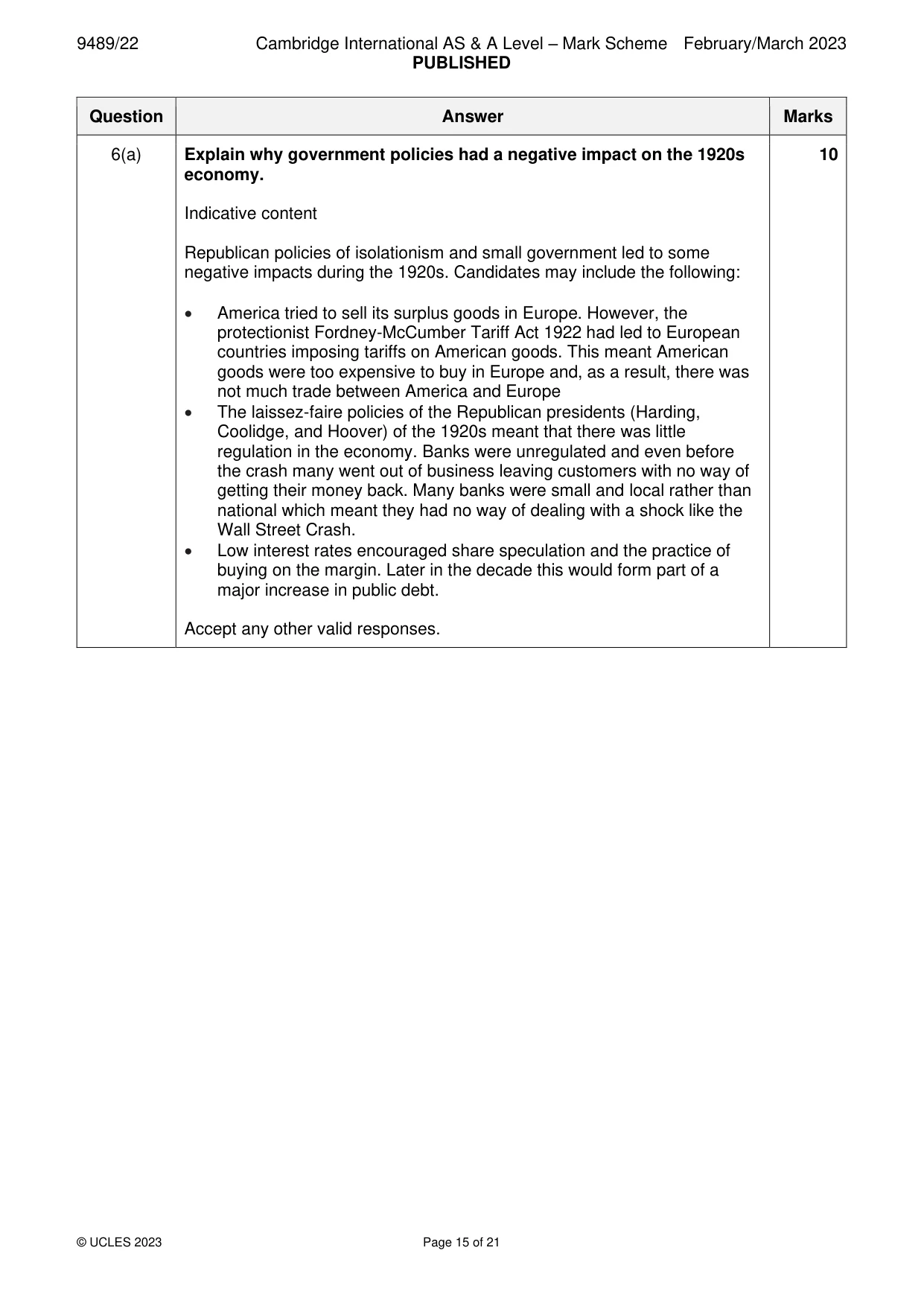
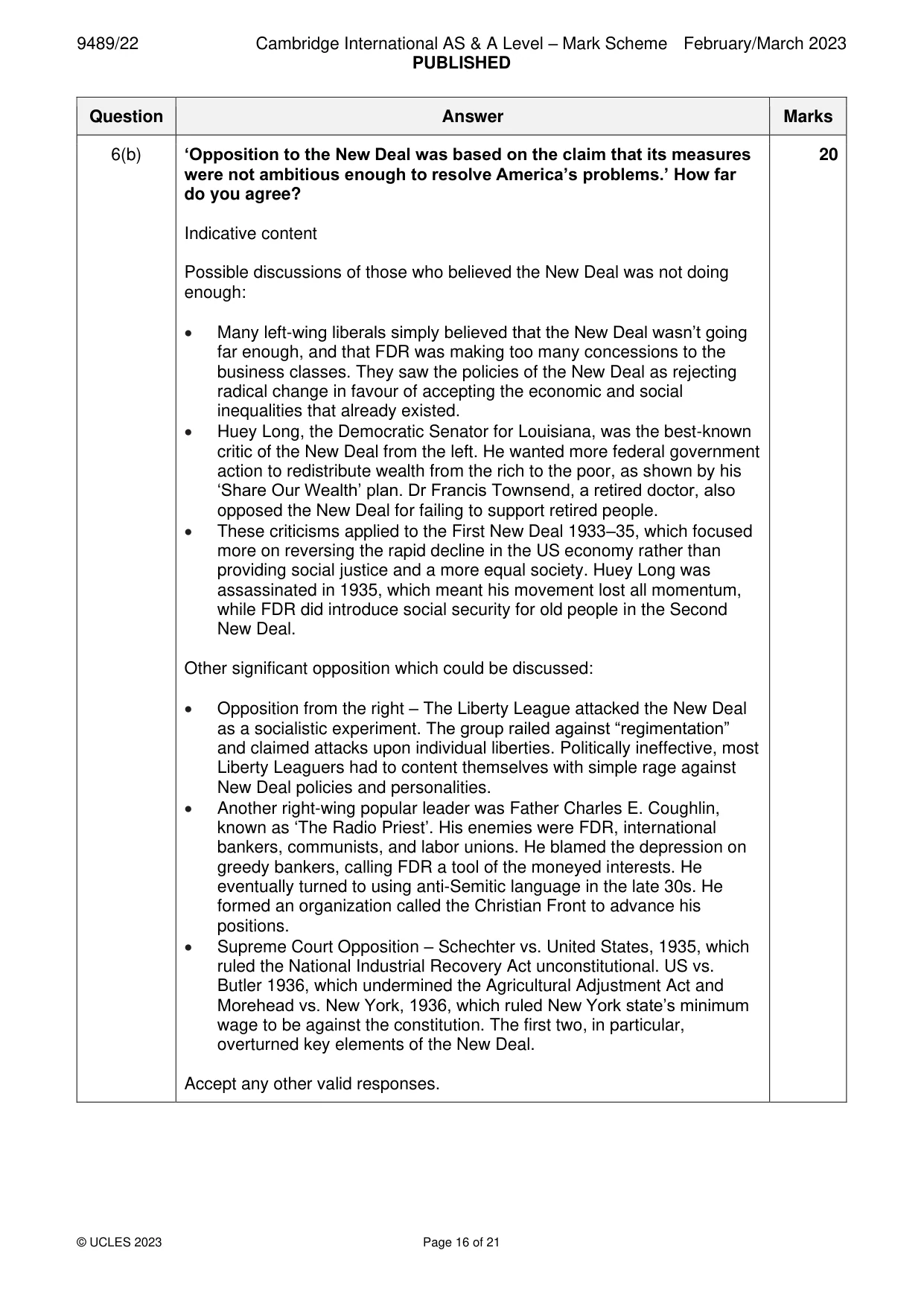
Mark scheme: 6(a) Explain why government policies had a negative impact on the 1920s 10 economy. Indicative content Republican policies of isolationism and small government led to some negative impacts during the 1920s. Candidates may include the following: • America tried to sell its surplus goods in Europe. However, the protectionist Fordney-McCumber Tariff Act 1922 had led to European countries imposing tariffs on American goods. This meant American goods were too expensive to buy in Europe and, as a result, there was not much trade between America and Europe • The laissez-faire policies of the Republican presidents (Harding, Coolidge, and Hoover) of the 1920s meant that there was little regulation in the economy. Banks were unregulated and even before the crash many went out of business leaving customers with no way of getting their money back. Many banks were small and local rather than national which meant they had no way of dealing with a shock like the Wall Street Crash. • Low interest rates encouraged share speculation and the practice of buying on the margin. Later in the decade this would form part of a major increase in public debt. Accept any other valid responses. 6(b) ‘Opposition to the New Deal was based on the claim that its measures 20 were not ambitious enough to resolve America’s problems.’ How far do you agree? Indicative content Possible discussions of those who believed the New Deal was not doing enough: • Many left-wing liberals simply believed that the New Deal wasn’t going far enough, and that FDR was making too many concessions to the business classes. They saw the policies of the New Deal as rejecting radical change in favour of accepting the economic and social inequalities that already existed. • Huey Long, the Democratic Senator for Louisiana, was the best-known critic of the New Deal from the left. He wanted more federal government action to redistribute wealth from the rich to the poor, as shown by his ‘Share Our Wealth’ plan. Dr Francis Townsend, a retired doctor, also opposed the New Deal for failing to support retired people. • These criticisms applied to the First New Deal 1933–35, which focused more on reversing the rapid decline in the US economy rather than providing social justice and a more equal society. Huey Long was assassinated in 1935, which meant his movement lost all momentum, while FDR did introduce social security for old people in the Second New Deal. Other significant opposition which could be discussed: • Opposition from the right – The Liberty League attacked the New Deal as a socialistic experiment. The group railed against “regimentation” and claimed attacks upon individual liberties. Politically ineffective, most Liberty Leaguers had to content themselves with simple rage against New Deal policies and personalities. • Another right-wing popular leader was Father Charles E. Coughlin, known as ‘The Radio Priest’. His enemies were FDR, international bankers, communists, and labor unions. He blamed the depression on greedy bankers, calling FDR a tool of the moneyed interests. He eventually turned to using anti-Semitic language in the late 30s. He formed an organization called the Christian Front to advance his positions. • Supreme Court Opposition – Schechter vs. United States, 1935, which ruled the National Industrial Recovery Act unconstitutional. US vs. Butler 1936, which undermined the Agricultural Adjustment Act and Morehead vs. New York, 1936, which ruled New York state’s minimum wage to be against the constitution. The first two, in particular, overturned key elements of the New Deal. Accept any other valid responses.
More questions on Why was there a second New Deal and how successful was it?
Q7 · The League of Nations and international relations in the 1920s (a) Explain why the Corfu…
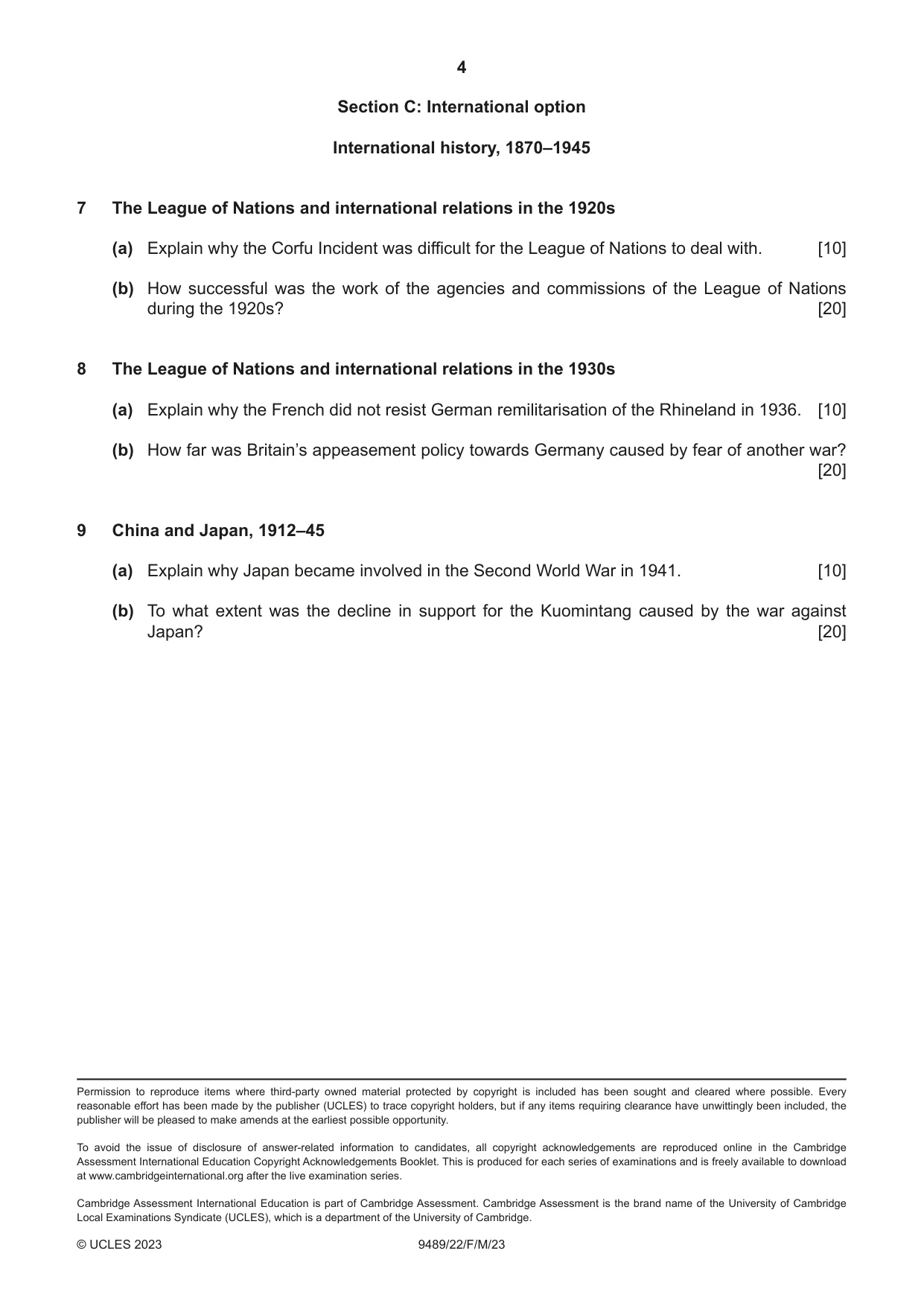
7 The League of Nations and international relations in the 1920s (a) Explain why the Corfu Incident was difficult for the League of Nations to deal with. [10] (b) How successful was the work of the agencies and commissions of the League of Nations during the 1920s? [20]
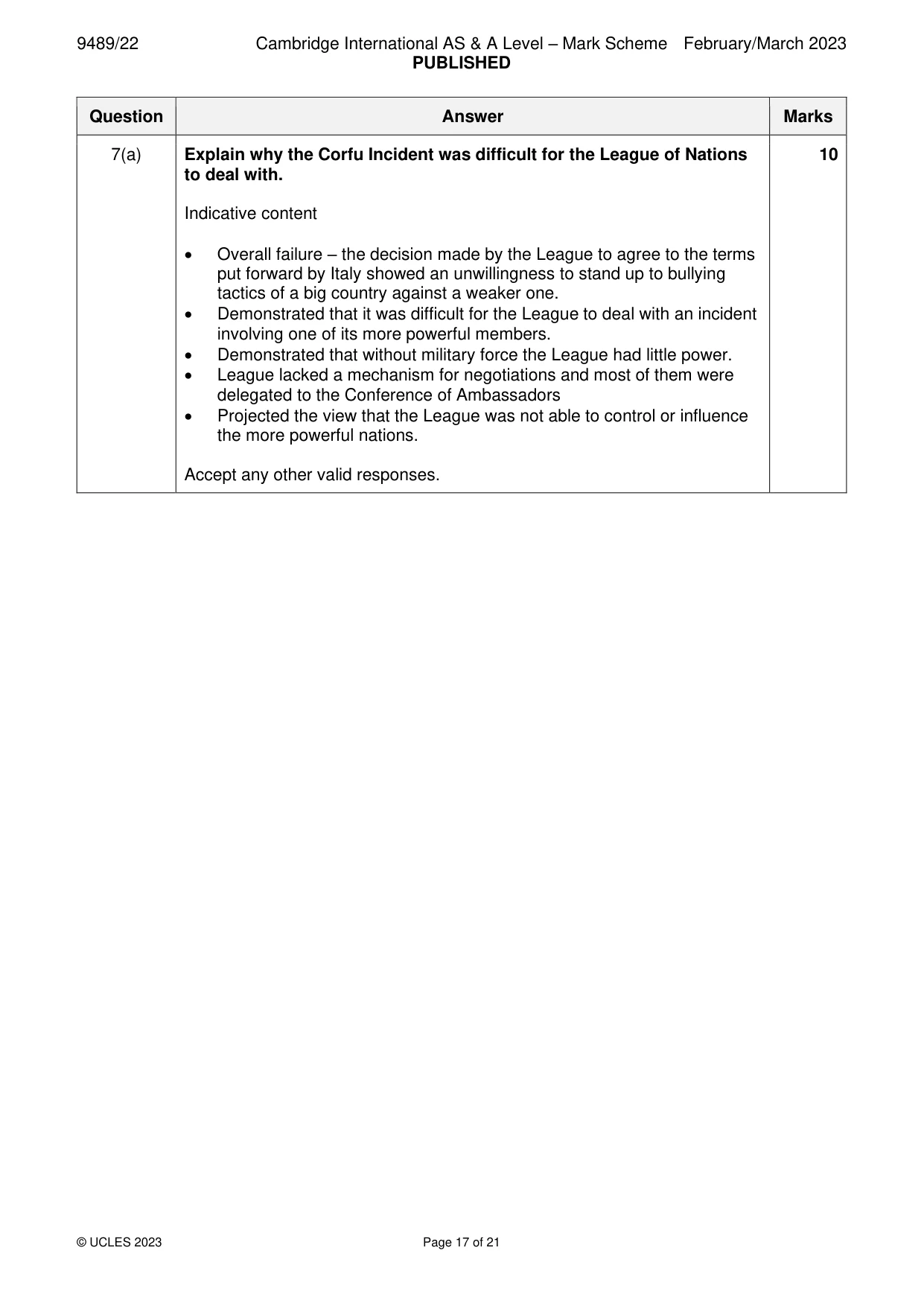
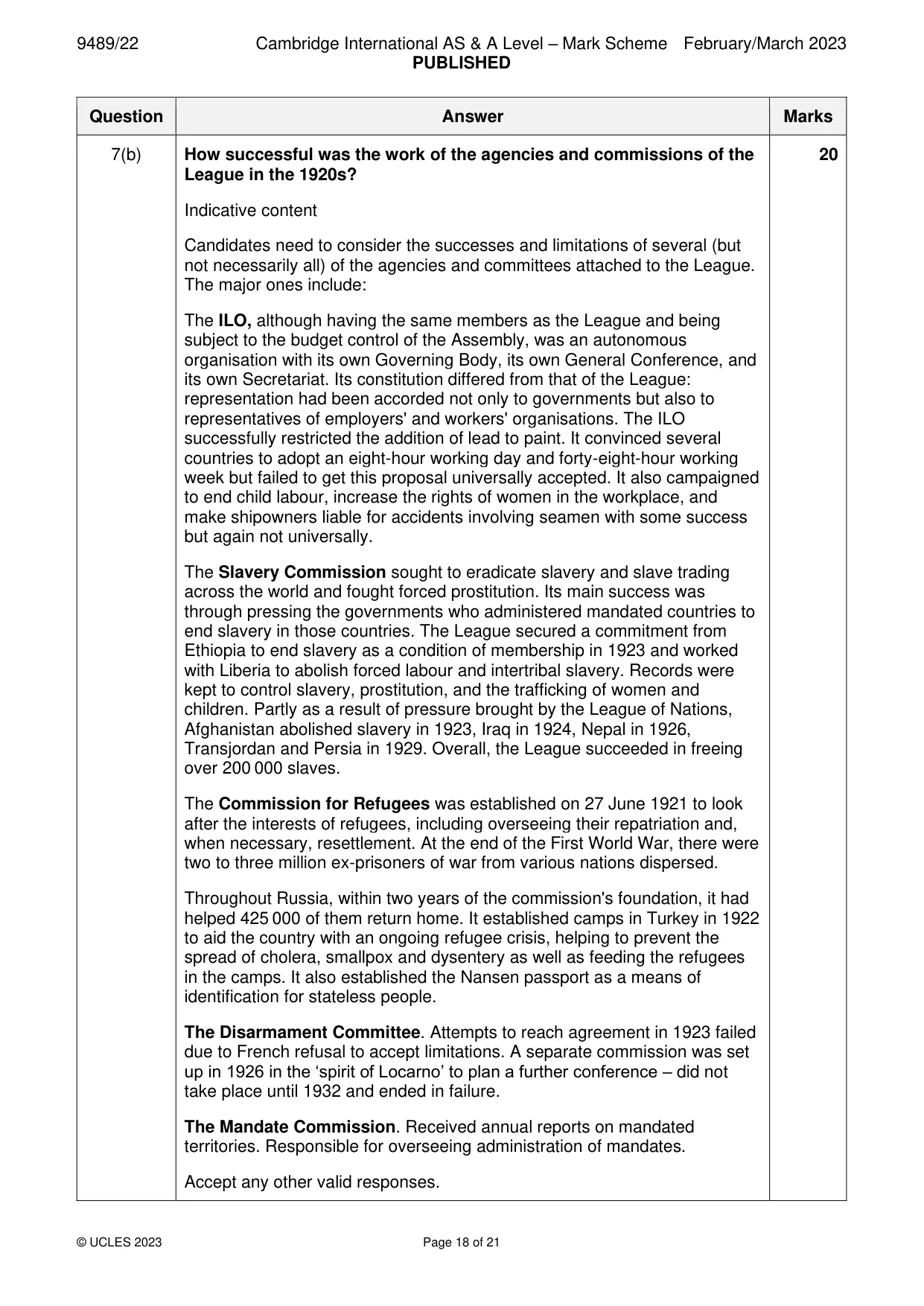
Mark scheme: 7(a) Explain why the Corfu Incident was difficult for the League of Nations 10 to deal with. Indicative content • Overall failure – the decision made by the League to agree to the terms put forward by Italy showed an unwillingness to stand up to bullying tactics of a big country against a weaker one. • Demonstrated that it was difficult for the League to deal with an incident involving one of its more powerful members. • Demonstrated that without military force the League had little power. • League lacked a mechanism for negotiations and most of them were delegated to the Conference of Ambassadors • Projected the view that the League was not able to control or influence the more powerful nations. Accept any other valid responses. 7(b) How successful was the work of the agencies and commissions of the 20 League in the 1920s? Indicative content Candidates need to consider the successes and limitations of several (but not necessarily all) of the agencies and committees attached to the League. The major ones include: The ILO, although having the same members as the League and being subject to the budget control of the Assembly, was an autonomous organisation with its own Governing Body, its own General Conference, and its own Secretariat. Its constitution differed from that of the League: representation had been accorded not only to governments but also to representatives of employers' and workers' organisations. The ILO successfully restricted the addition of lead to paint. It convinced several countries to adopt an eight-hour working day and forty-eight-hour working week but failed to get this proposal universally accepted. It also campaigned to end child labour, increase the rights of women in the workplace, and make shipowners liable for accidents involving seamen with some success but again not universally. The Slavery Commission sought to eradicate slavery and slave trading across the world and fought forced prostitution. Its main success was through pressing the governments who administered mandated countries to end slavery in those countries. The League secured a commitment from Ethiopia to end slavery as a condition of membership in 1923 and worked with Liberia to abolish forced labour and intertribal slavery. Records were kept to control slavery, prostitution, and the trafficking of women and children. Partly as a result of pressure brought by the League of Nations, Afghanistan abolished slavery in 1923, Iraq in 1924, Nepal in 1926, Transjordan and Persia in 1929. Overall, the League succeeded in freeing over 200 000 slaves. The Commission for Refugees was established on 27 June 1921 to look after the interests of refugees, including overseeing their repatriation and, when necessary, resettlement. At the end of the First World War, there were two to three million ex-prisoners of war from various nations dispersed. Throughout Russia, within two years of the commission's foundation, it had helped 425 000 of them return home. It established camps in Turkey in 1922 to aid the country with an ongoing refugee crisis, helping to prevent the spread of cholera, smallpox and dysentery as well as feeding the refugees in the camps. It also established the Nansen passport as a means of identification for stateless people. The Disarmament Committee. Attempts to reach agreement in 1923 failed due to French refusal to accept limitations. A separate commission was set up in 1926 in the ‘spirit of Locarno’ to plan a further conference – did not take place until 1932 and ended in failure. The Mandate Commission. Received annual reports on mandated territories. Responsible for overseeing administration of mandates. Accept any other valid responses.
Q8 · The League of Nations and international relations in the 1930s (a) Explain why the French…
8 The League of Nations and international relations in the 1930s (a) Explain why the French did not resist German remilitarisation of the Rhineland in 1936. [10] (b) How far was Britain’s appeasement policy towards Germany caused by fear of another war? [20]
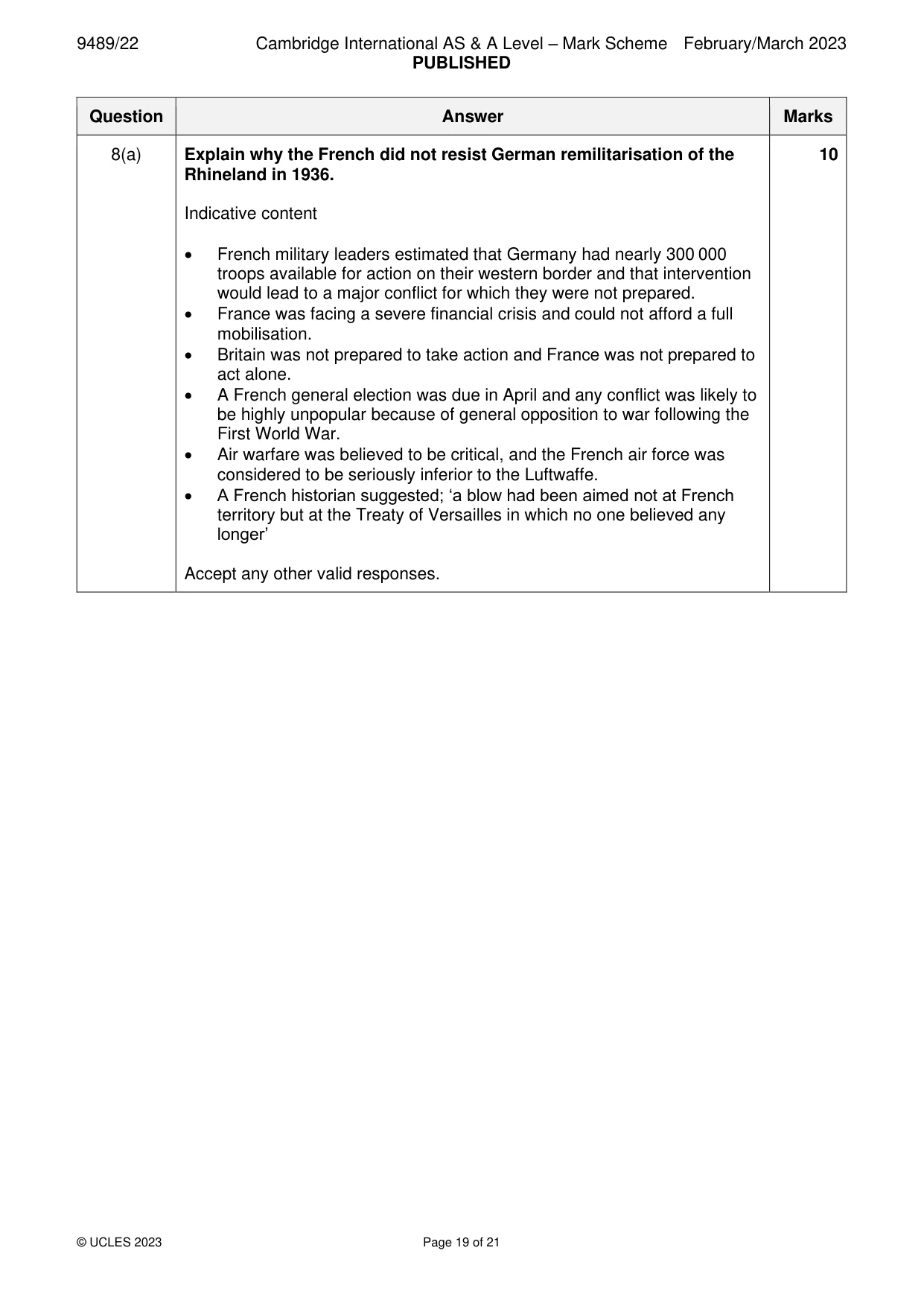
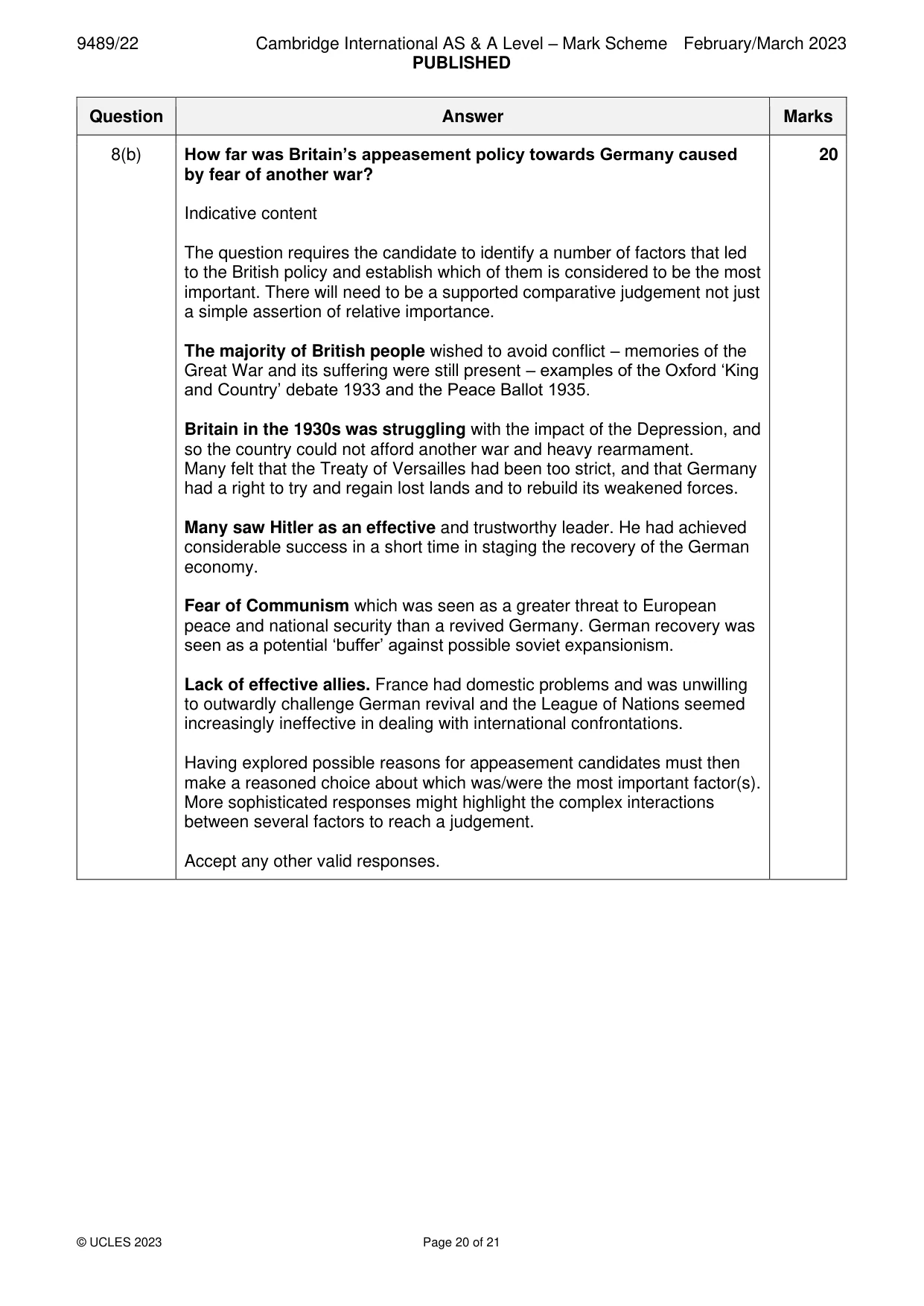
Mark scheme: 8(a) Explain why the French did not resist German remilitarisation of the 10 Rhineland in 1936. Indicative content • French military leaders estimated that Germany had nearly 300 000 troops available for action on their western border and that intervention would lead to a major conflict for which they were not prepared. • France was facing a severe financial crisis and could not afford a full mobilisation. • Britain was not prepared to take action and France was not prepared to act alone. • A French general election was due in April and any conflict was likely to be highly unpopular because of general opposition to war following the First World War. • Air warfare was believed to be critical, and the French air force was considered to be seriously inferior to the Luftwaffe. • A French historian suggested; ‘a blow had been aimed not at French territory but at the Treaty of Versailles in which no one believed any longer’ Accept any other valid responses. 8(b) How far was Britain’s appeasement policy towards Germany caused 20 by fear of another war? Indicative content The question requires the candidate to identify a number of factors that led to the British policy and establish which of them is considered to be the most important. There will need to be a supported comparative judgement not just a simple assertion of relative importance. The majority of British people wished to avoid conflict – memories of the Great War and its suffering were still present – examples of the Oxford ‘King and Country’ debate 1933 and the Peace Ballot 1935. Britain in the 1930s was struggling with the impact of the Depression, and so the country could not afford another war and heavy rearmament. Many felt that the Treaty of Versailles had been too strict, and that Germany had a right to try and regain lost lands and to rebuild its weakened forces. Many saw Hitler as an effective and trustworthy leader. He had achieved considerable success in a short time in staging the recovery of the German economy. Fear of Communism which was seen as a greater threat to European peace and national security than a revived Germany. German recovery was seen as a potential ‘buffer’ against possible soviet expansionism. Lack of effective allies. France had domestic problems and was unwilling to outwardly challenge German revival and the League of Nations seemed increasingly ineffective in dealing with international confrontations. Having explored possible reasons for appeasement candidates must then make a reasoned choice about which was/were the most important factor(s). More sophisticated responses might highlight the complex interactions between several factors to reach a judgement. Accept any other valid responses.
More questions on Why, and with what effects, did Britain and France pursue a policy of appeasement?
Q9 · China and Japan, 1912–45 (a) Explain why Japan became involved in the Second World War in…
9 China and Japan, 1912–45 (a) Explain why Japan became involved in the Second World War in 1941. [10] (b) To what extent was the decline in support for the Kuomintang caused by the war against Japan? [20]
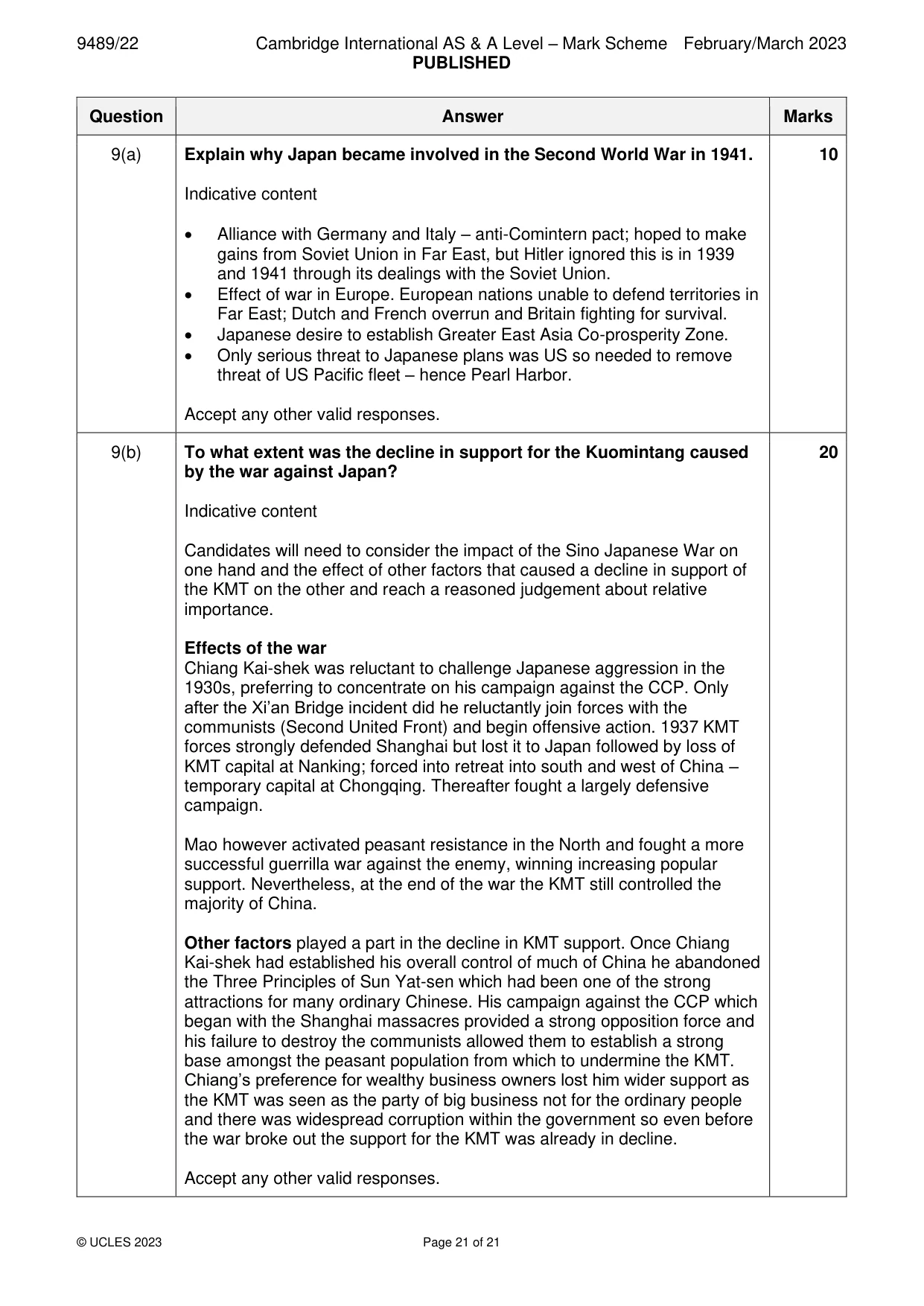
Mark scheme: 9(a) Explain why Japan became involved in the Second World War in 1941. 10 Indicative content • Alliance with Germany and Italy – anti-Comintern pact; hoped to make gains from Soviet Union in Far East, but Hitler ignored this is in 1939 and 1941 through its dealings with the Soviet Union. • Effect of war in Europe. European nations unable to defend territories in Far East; Dutch and French overrun and Britain fighting for survival. • Japanese desire to establish Greater East Asia Co-prosperity Zone. • Only serious threat to Japanese plans was US so needed to remove threat of US Pacific fleet – hence Pearl Harbor. Accept any other valid responses. 9(b) To what extent was the decline in support for the Kuomintang caused 20 by the war against Japan? Indicative content Candidates will need to consider the impact of the Sino Japanese War on one hand and the effect of other factors that caused a decline in support of the KMT on the other and reach a reasoned judgement about relative importance. Effects of the war Chiang Kai-shek was reluctant to challenge Japanese aggression in the 1930s, preferring to concentrate on his campaign against the CCP. Only after the Xi’an Bridge incident did he reluctantly join forces with the communists (Second United Front) and begin offensive action. 1937 KMT forces strongly defended Shanghai but lost it to Japan followed by loss of KMT capital at Nanking; forced into retreat into south and west of China – temporary capital at Chongqing. Thereafter fought a largely defensive campaign. Mao however activated peasant resistance in the North and fought a more successful guerrilla war against the enemy, winning increasing popular support. Nevertheless, at the end of the war the KMT still controlled the majority of China. Other factors played a part in the decline in KMT support. Once Chiang Kai-shek had established his overall control of much of China he abandoned the Three Principles of Sun Yat-sen which had been one of the strong attractions for many ordinary Chinese. His campaign against the CCP which began with the Shanghai massacres provided a strong opposition force and his failure to destroy the communists allowed them to establish a strong base amongst the peasant population from which to undermine the KMT. Chiang’s preference for wealthy business owners lost him wider support as the KMT was seen as the party of big business not for the ordinary people and there was widespread corruption within the government so even before the war broke out the support for the KMT was already in decline. Accept any other valid responses.
More questions on Why did Japan emerge as a world power and what was the impact on international
What was in this paper
The subtopics covered by these 9 questions, and how many questions each got. Open one in a new tab to see every Cambridge question on it.
1How were the Bolsheviks able to consolidate their power up to 1924?1What were the aims of Reconstruction and how successful was it?1Why did Japan emerge as a world power and what was the impact on international1Why was the League of Nations created and what challenges did it face in the 1920s?1Why was there a second New Deal and how successful was it?1Why was there increasing tension between the North and the South before 1860?1Why was there rapid industrialisation after 1870?1Why, and with what effects, did Britain and France pursue a policy of appeasement?1What you needed in this session
Cambridge’s own grade thresholds for 2023 Feb/March, Paper 2 · Variant 2. A higher threshold means an easier paper — the bar moves with how the cohort did.