Cambridge A Level History 9489 — 2025 May/June Paper 2 · Variant 3
9489/23/M/J/25 · 9 questions · 60 marks · ≈68 min
The question paper and its mark scheme, free to read here and free to download. This is Cambridge’s own paper, exactly as it was sat.
Question paper4 pages
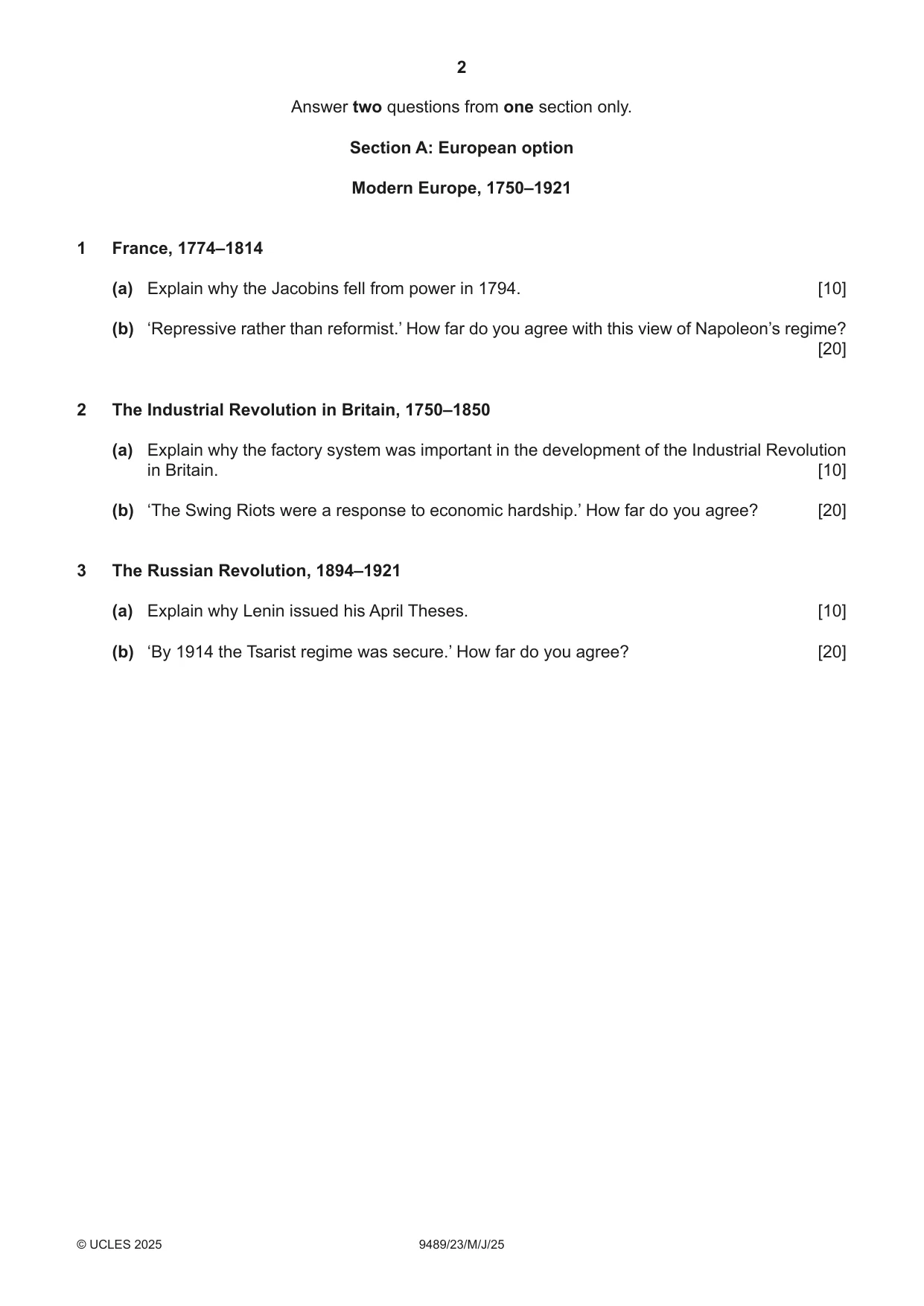
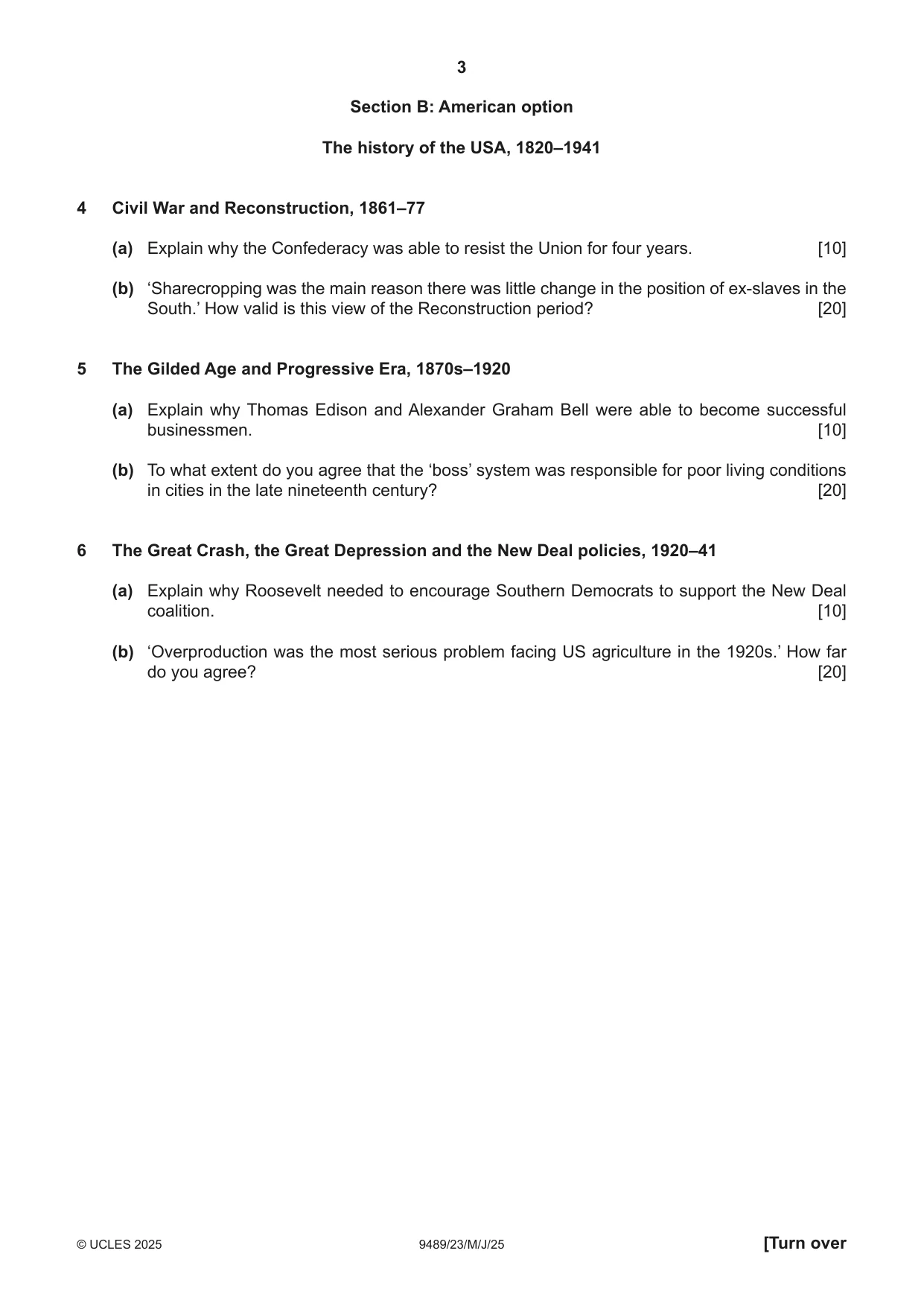
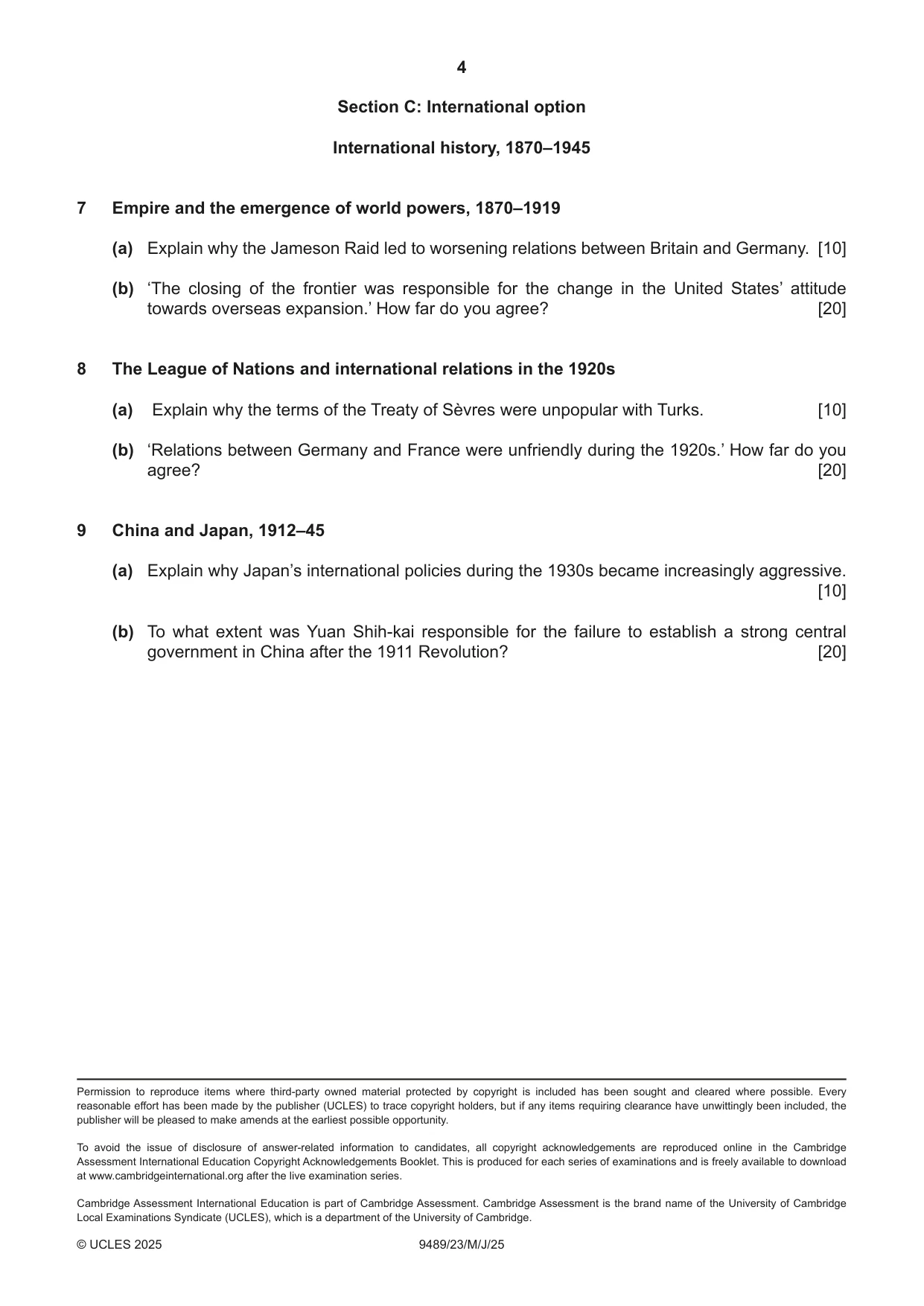
Mark scheme24 pages
Answers below. Sit the paper first if you are practising.
Questions as text
Q1 · France, 1774–1814 (a) Explain why the Jacobins fell from power in 1794
1 France, 1774–1814 (a) Explain why the Jacobins fell from power in 1794. [10] (b) ‘Repressive rather than reformist.’ How far do you agree with this view of Napoleon’s regime? [20]
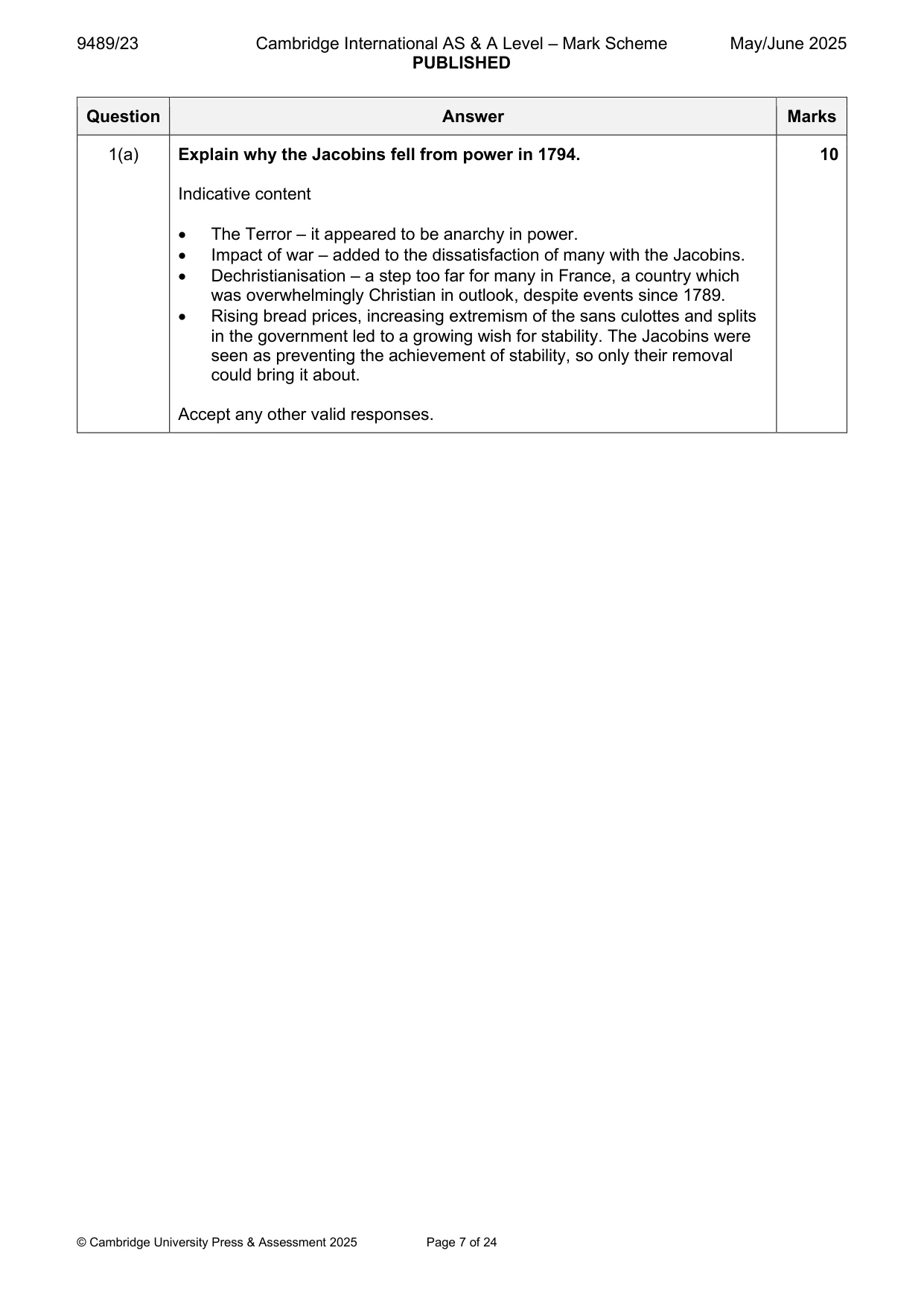
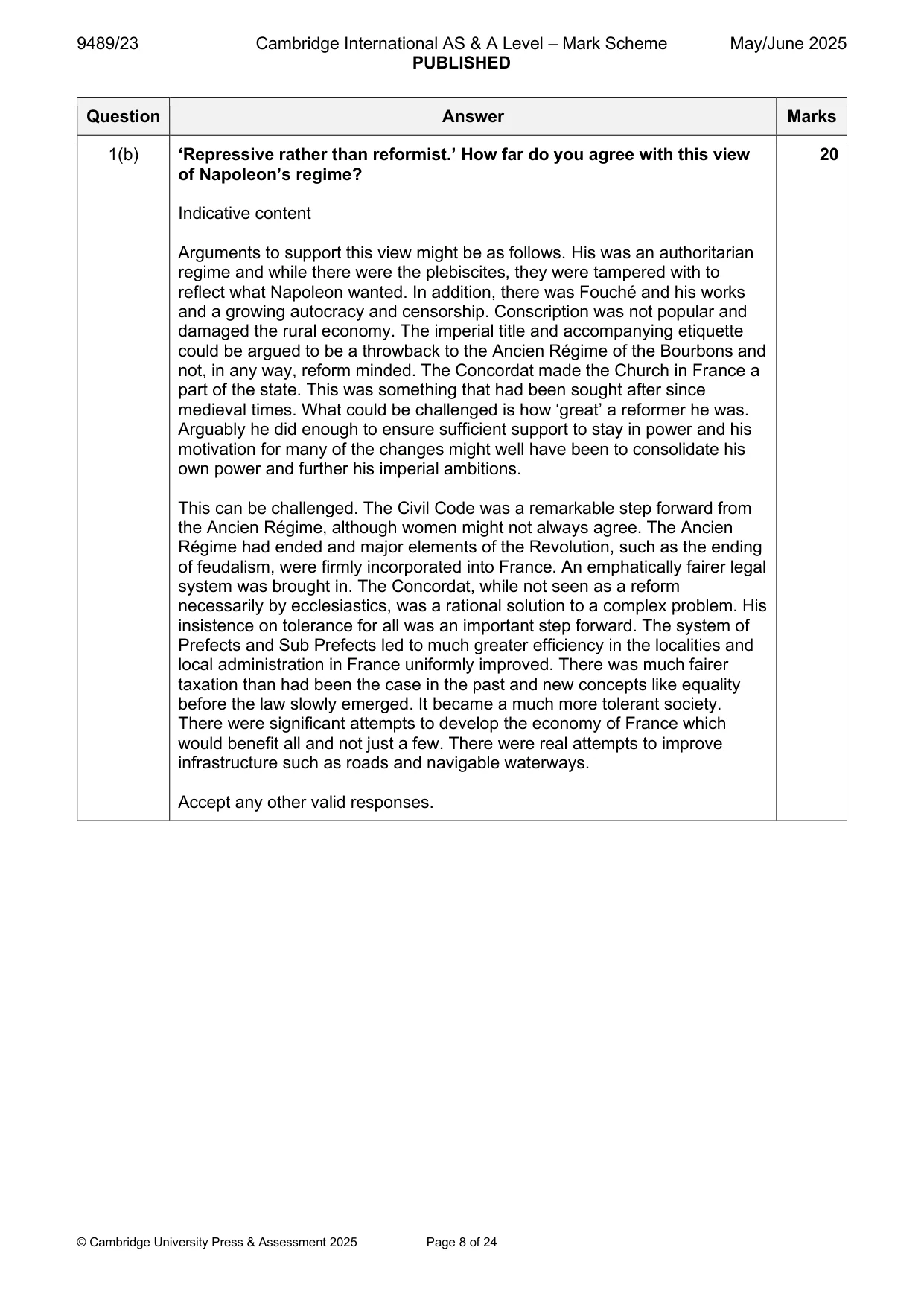
Mark scheme: Question Answer Marks 1(a) Explain why the Jacobins fell from power in 1794. 10 Indicative content • The Terror – it appeared to be anarchy in power. • Impact of war – added to the dissatisfaction of many with the Jacobins. • Dechristianisation – a step too far for many in France, a country which was overwhelmingly Christian in outlook, despite events since 1789. • Rising bread prices, increasing extremism of the sans culottes and splits in the government led to a growing wish for stability. The Jacobins were seen as preventing the achievement of stability, so only their removal could bring it about. Accept any other valid responses. 1(b) ‘Repressive rather than reformist.’ How far do you agree with this view 20 of Napoleon’s regime? Indicative content Arguments to support this view might be as follows. His was an authoritarian regime and while there were the plebiscites, they were tampered with to reflect what Napoleon wanted. In addition, there was Fouché and his works and a growing autocracy and censorship. Conscription was not popular and damaged the rural economy. The imperial title and accompanying etiquette could be argued to be a throwback to the Ancien Régime of the Bourbons and not, in any way, reform minded. The Concordat made the Church in France a part of the state. This was something that had been sought after since medieval times. What could be challenged is how ‘great’ a reformer he was. Arguably he did enough to ensure sufficient support to stay in power and his motivation for many of the changes might well have been to consolidate his own power and further his imperial ambitions. This can be challenged. The Civil Code was a remarkable step forward from the Ancien Régime, although women might not always agree. The Ancien Régime had ended and major elements of the Revolution, such as the ending of feudalism, were firmly incorporated into France. An emphatically fairer legal system was brought in. The Concordat, while not seen as a reform necessarily by ecclesiastics, was a rational solution to a complex problem. His insistence on tolerance for all was an important step forward. The system of Prefects and Sub Prefects led to much greater efficiency in the localities and local administration in France uniformly improved. There was much fairer taxation than had been the case in the past and new concepts like equality before the law slowly emerged. It became a much more tolerant society. There were significant attempts to develop the economy of France which would benefit all and not just a few. There were real attempts to improve infrastructure such as roads and navigable waterways. Accept any other valid responses.
More questions on What caused the rise and fall of Napoleon Bonaparte?
Q2 · The Industrial Revolution in Britain, 1750–1850 (a) Explain why the factory system was…
2 The Industrial Revolution in Britain, 1750–1850 (a) Explain why the factory system was important in the development of the Industrial Revolution in Britain. [10] (b) ‘The Swing Riots were a response to economic hardship.’ How far do you agree? [20]
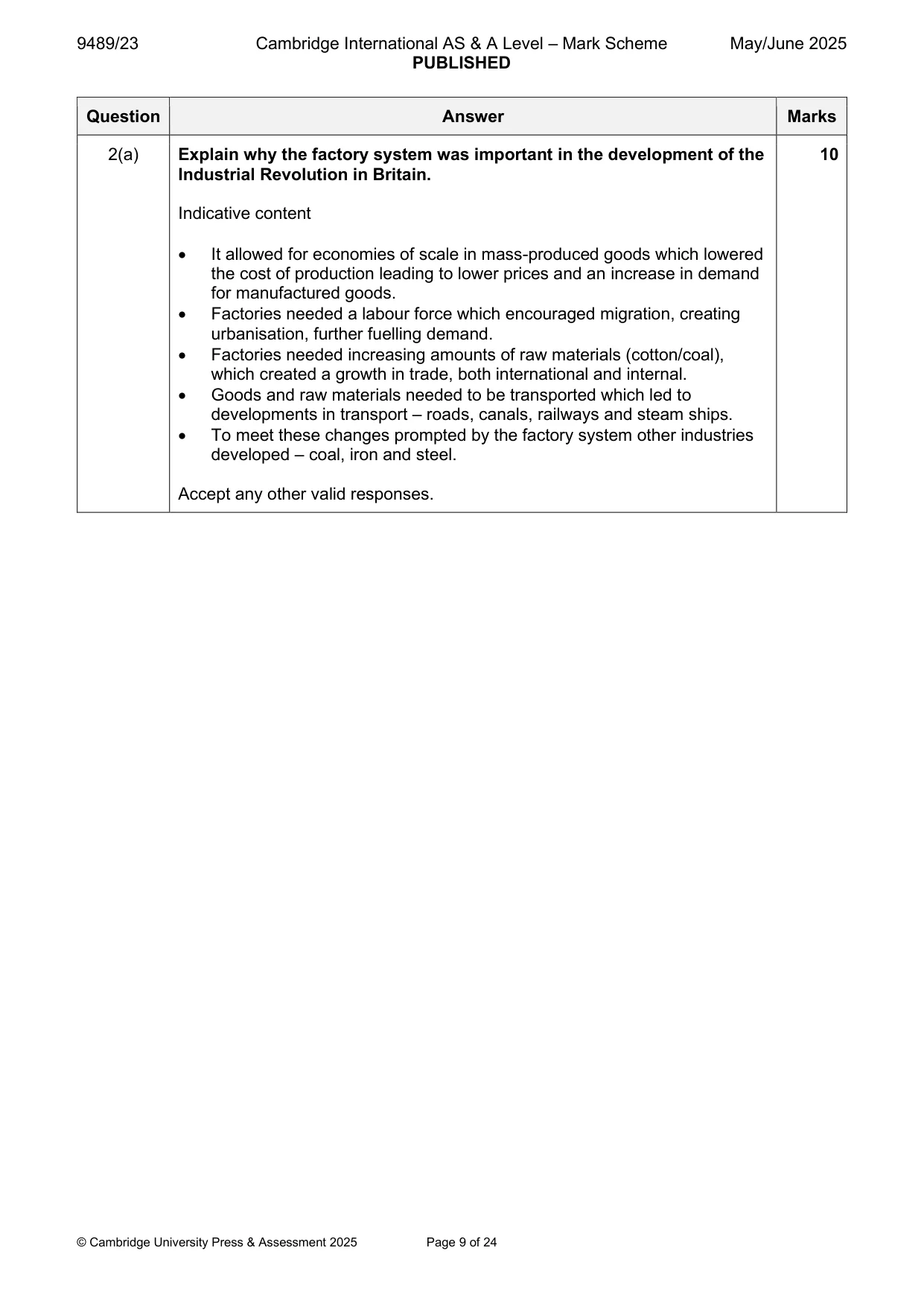
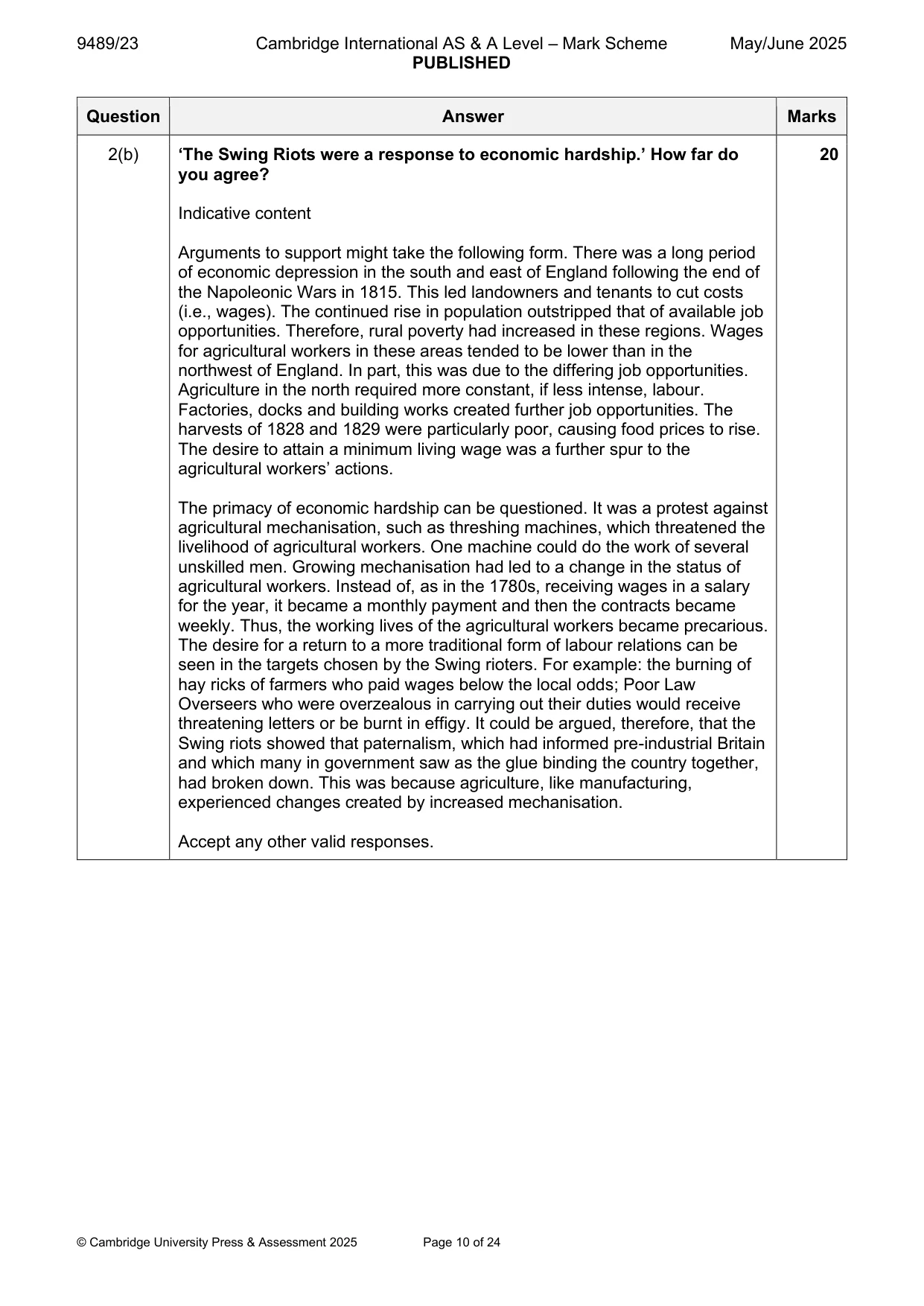
Mark scheme: 2(a) Explain why the factory system was important in the development of the 10 Industrial Revolution in Britain. Indicative content • It allowed for economies of scale in mass-produced goods which lowered the cost of production leading to lower prices and an increase in demand for manufactured goods. • Factories needed a labour force which encouraged migration, creating urbanisation, further fuelling demand. • Factories needed increasing amounts of raw materials (cotton/coal), which created a growth in trade, both international and internal. • Goods and raw materials needed to be transported which led to developments in transport – roads, canals, railways and steam ships. • To meet these changes prompted by the factory system other industries developed – coal, iron and steel. Accept any other valid responses. 2(b) ‘The Swing Riots were a response to economic hardship.’ How far do 20 you agree? Indicative content Arguments to support might take the following form. There was a long period of economic depression in the south and east of England following the end of the Napoleonic Wars in 1815. This led landowners and tenants to cut costs (i.e., wages). The continued rise in population outstripped that of available job opportunities. Therefore, rural poverty had increased in these regions. Wages for agricultural workers in these areas tended to be lower than in the northwest of England. In part, this was due to the differing job opportunities. Agriculture in the north required more constant, if less intense, labour. Factories, docks and building works created further job opportunities. The harvests of 1828 and 1829 were particularly poor, causing food prices to rise. The desire to attain a minimum living wage was a further spur to the agricultural workers’ actions. The primacy of economic hardship can be questioned. It was a protest against agricultural mechanisation, such as threshing machines, which threatened the livelihood of agricultural workers. One machine could do the work of several unskilled men. Growing mechanisation had led to a change in the status of agricultural workers. Instead of, as in the 1780s, receiving wages in a salary for the year, it became a monthly payment and then the contracts became weekly. Thus, the working lives of the agricultural workers became precarious. The desire for a return to a more traditional form of labour relations can be seen in the targets chosen by the Swing rioters. For example: the burning of hay ricks of farmers who paid wages below the local odds; Poor Law Overseers who were overzealous in carrying out their duties would receive threatening letters or be burnt in effigy. It could be argued, therefore, that the Swing riots showed that paternalism, which had informed pre-industrial Britain and which many in government saw as the glue binding the country together, had broken down. This was because agriculture, like manufacturing, experienced changes created by increased mechanisation. Accept any other valid responses.
More questions on What were the consequences of the rapid economic growth after 1870?
Q3 · The Russian Revolution, 1894–1921 (a) Explain why Lenin issued his April Theses
3 The Russian Revolution, 1894–1921 (a) Explain why Lenin issued his April Theses. [10] (b) ‘By 1914 the Tsarist regime was secure.’ How far do you agree? [20]
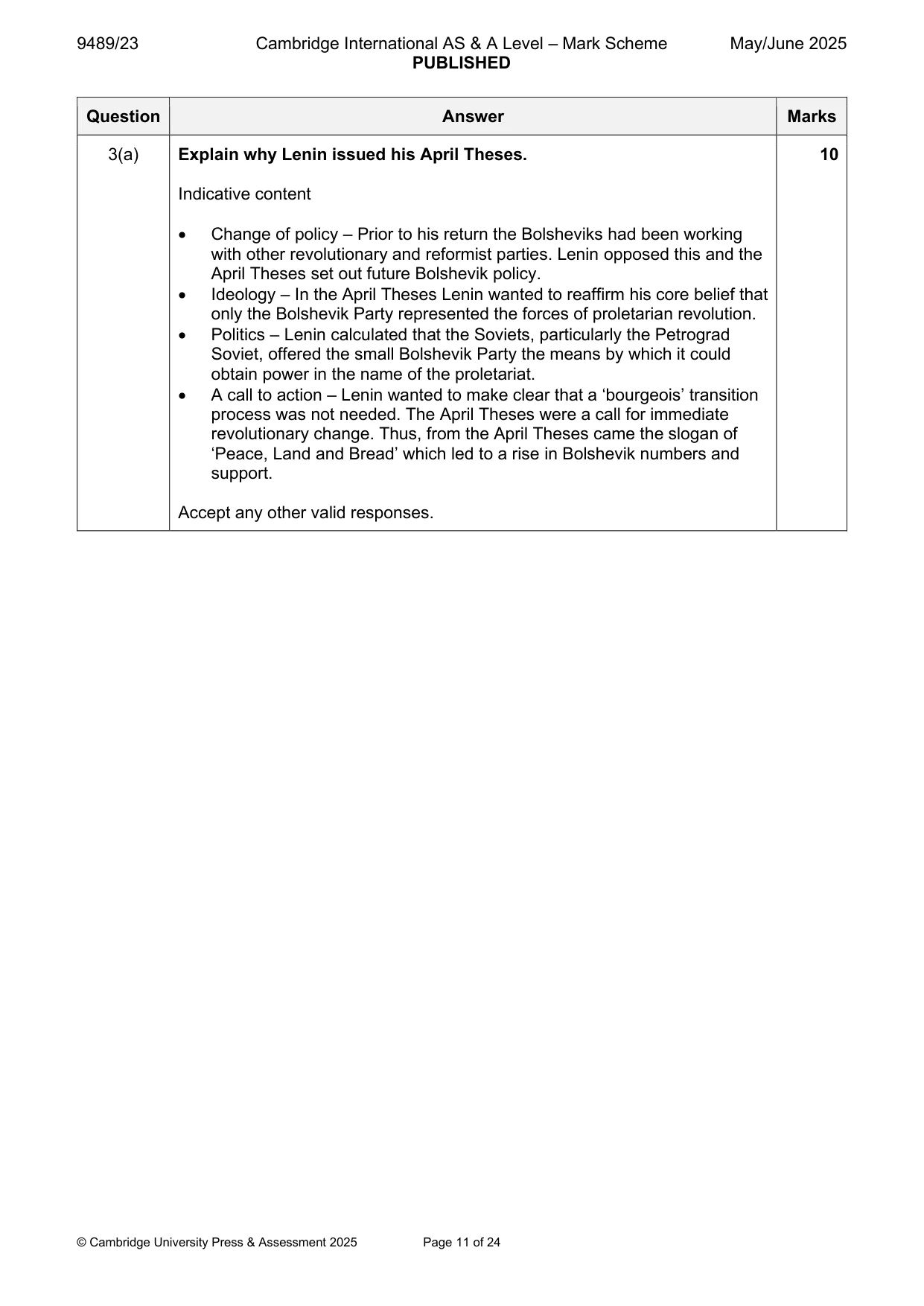
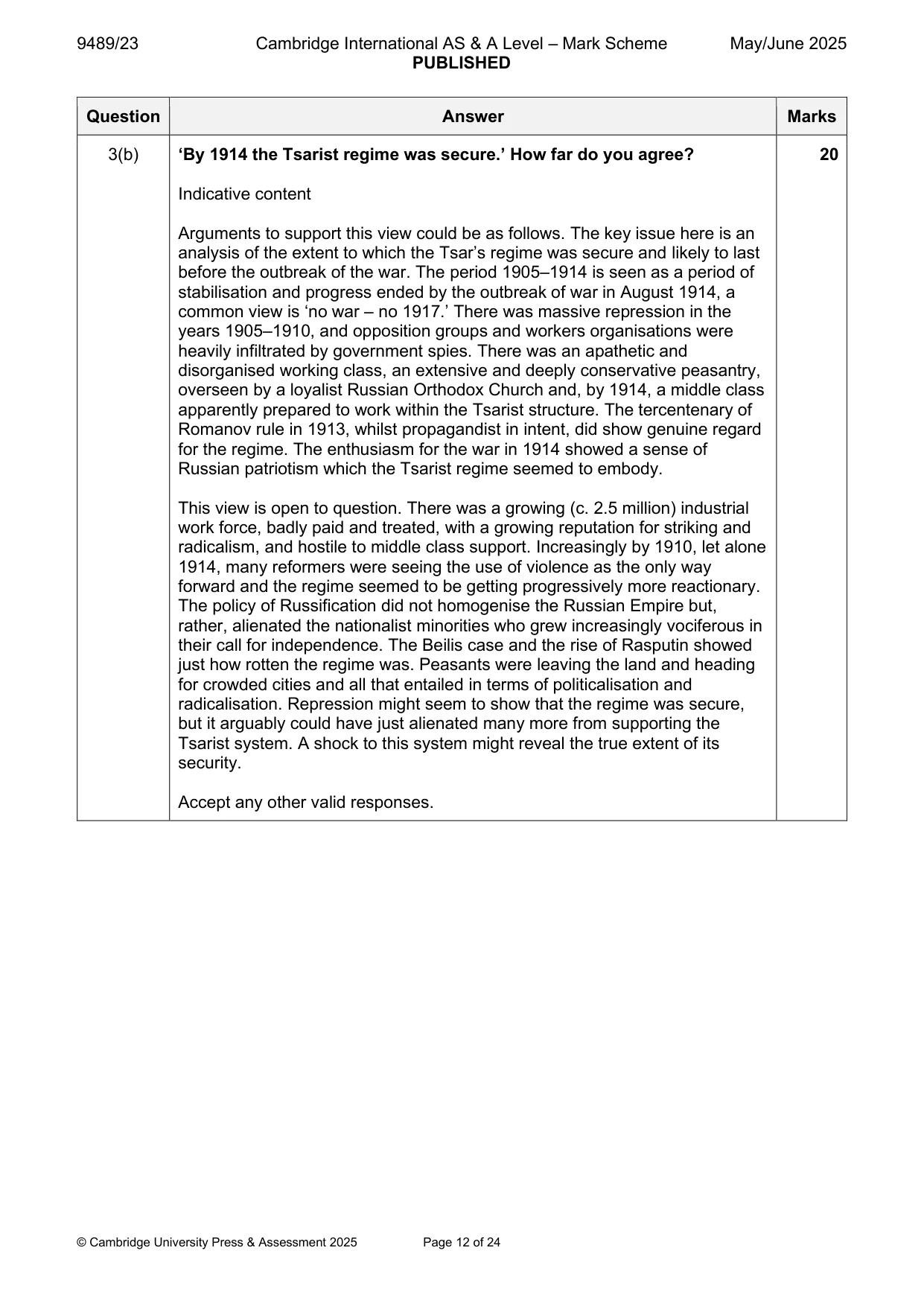
Mark scheme: 3(a) Explain why Lenin issued his April Theses. 10 Indicative content • Change of policy – Prior to his return the Bolsheviks had been working with other revolutionary and reformist parties. Lenin opposed this and the April Theses set out future Bolshevik policy. • Ideology – In the April Theses Lenin wanted to reaffirm his core belief that only the Bolshevik Party represented the forces of proletarian revolution. • Politics – Lenin calculated that the Soviets, particularly the Petrograd Soviet, offered the small Bolshevik Party the means by which it could obtain power in the name of the proletariat. • A call to action – Lenin wanted to make clear that a ‘bourgeois’ transition process was not needed. The April Theses were a call for immediate revolutionary change. Thus, from the April Theses came the slogan of ‘Peace, Land and Bread’ which led to a rise in Bolshevik numbers and support. Accept any other valid responses. 3(b) ‘By 1914 the Tsarist regime was secure.’ How far do you agree? 20 Indicative content Arguments to support this view could be as follows. The key issue here is an analysis of the extent to which the Tsar’s regime was secure and likely to last before the outbreak of the war. The period 1905–1914 is seen as a period of stabilisation and progress ended by the outbreak of war in August 1914, a common view is ‘no war – no 1917.’ There was massive repression in the years 1905–1910, and opposition groups and workers organisations were heavily infiltrated by government spies. There was an apathetic and disorganised working class, an extensive and deeply conservative peasantry, overseen by a loyalist Russian Orthodox Church and, by 1914, a middle class apparently prepared to work within the Tsarist structure. The tercentenary of Romanov rule in 1913, whilst propagandist in intent, did show genuine regard for the regime. The enthusiasm for the war in 1914 showed a sense of Russian patriotism which the Tsarist regime seemed to embody. This view is open to question. There was a growing (c. 2.5 million) industrial work force, badly paid and treated, with a growing reputation for striking and radicalism, and hostile to middle class support. Increasingly by 1910, let alone 1914, many reformers were seeing the use of violence as the only way forward and the regime seemed to be getting progressively more reactionary. The policy of Russification did not homogenise the Russian Empire but, rather, alienated the nationalist minorities who grew increasingly vociferous in their call for independence. The Beilis case and the rise of Rasputin showed just how rotten the regime was. Peasants were leaving the land and heading for crowded cities and all that entailed in terms of politicalisation and radicalisation. Repression might seem to show that the regime was secure, but it arguably could have just alienated many more from supporting the Tsarist system. A shock to this system might reveal the true extent of its security. Accept any other valid responses.
More questions on What were the causes and outcomes of the 1905 Revolution up to 1914?
Q4 · Civil War and Reconstruction, 1861–77 (a) Explain why the Confederacy was able to resist…
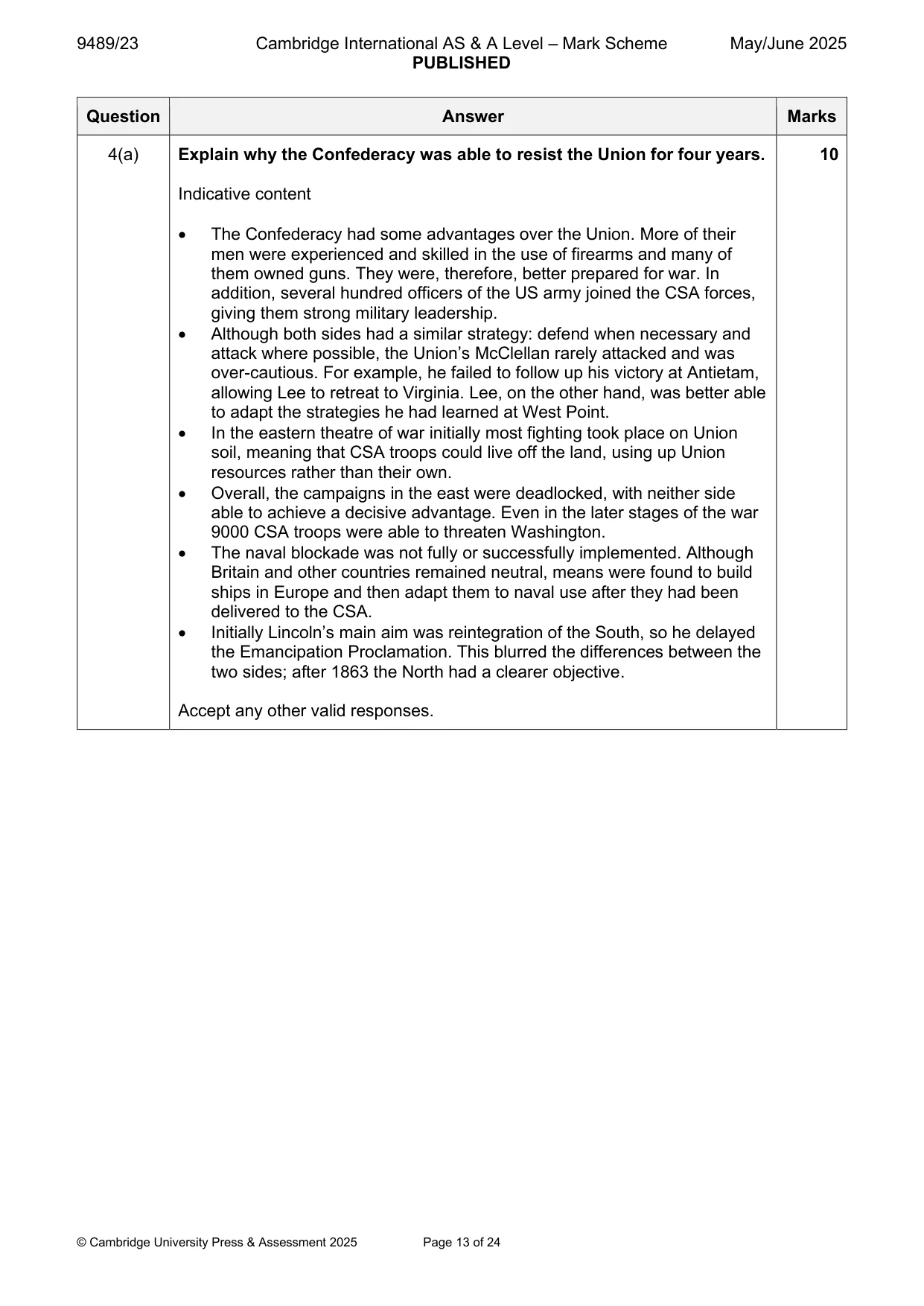
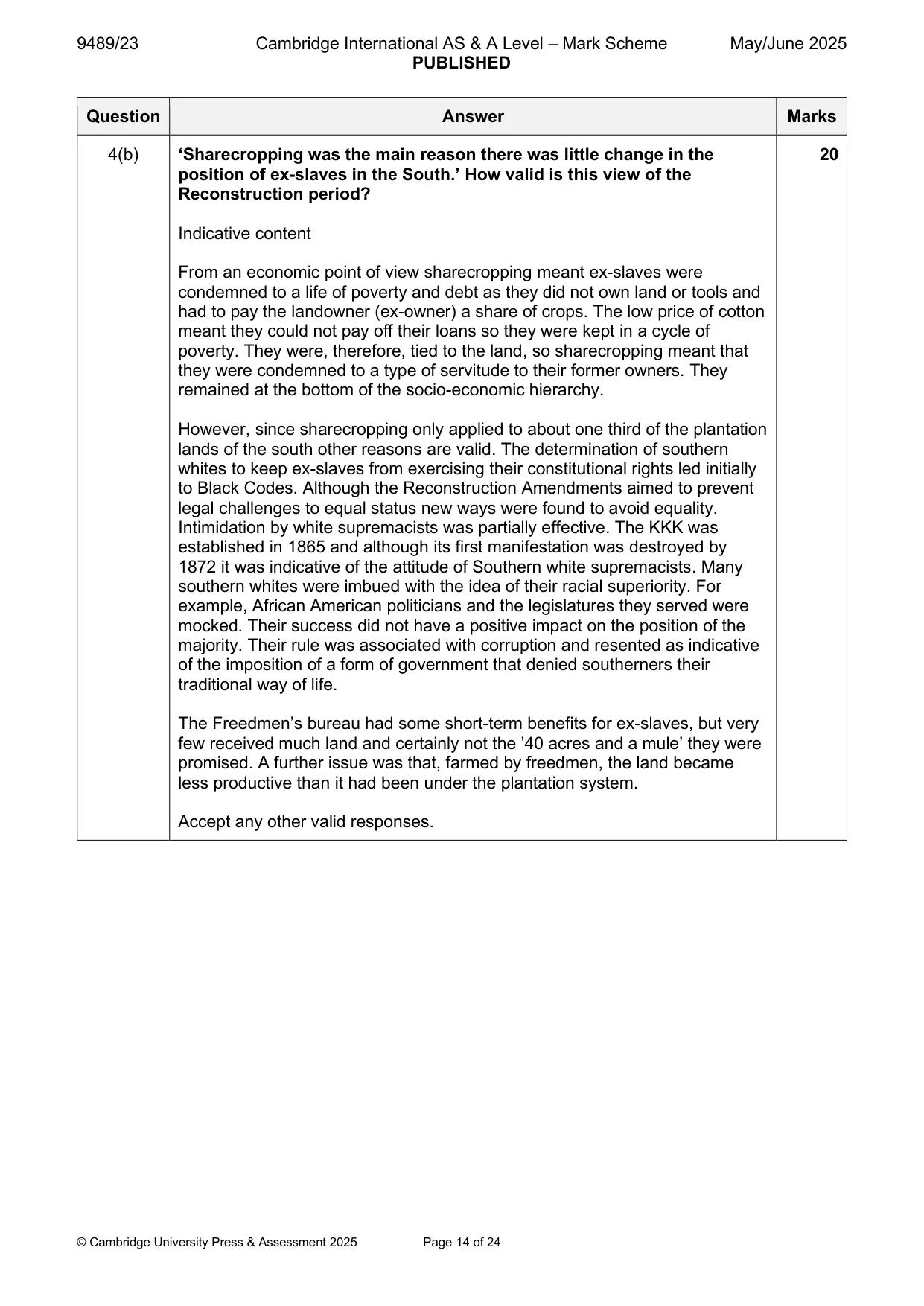
4 Civil War and Reconstruction, 1861–77 (a) Explain why the Confederacy was able to resist the Union for four years. [10] (b) ‘Sharecropping was the main reason there was little change in the position of ex-slaves in the South.’ How valid is this view of the Reconstruction period? [20]
Mark scheme: 4(a) Explain why the Confederacy was able to resist the Union for four years. 10 Indicative content • The Confederacy had some advantages over the Union. More of their men were experienced and skilled in the use of firearms and many of them owned guns. They were, therefore, better prepared for war. In addition, several hundred officers of the US army joined the CSA forces, giving them strong military leadership. • Although both sides had a similar strategy: defend when necessary and attack where possible, the Union’s McClellan rarely attacked and was over-cautious. For example, he failed to follow up his victory at Antietam, allowing Lee to retreat to Virginia. Lee, on the other hand, was better able to adapt the strategies he had learned at West Point. • In the eastern theatre of war initially most fighting took place on Union soil, meaning that CSA troops could live off the land, using up Union resources rather than their own. • Overall, the campaigns in the east were deadlocked, with neither side able to achieve a decisive advantage. Even in the later stages of the war 9000 CSA troops were able to threaten Washington. • The naval blockade was not fully or successfully implemented. Although Britain and other countries remained neutral, means were found to build ships in Europe and then adapt them to naval use after they had been delivered to the CSA. • Initially Lincoln’s main aim was reintegration of the South, so he delayed the Emancipation Proclamation. This blurred the differences between the two sides; after 1863 the North had a clearer objective. Accept any other valid responses. 4(b) ‘Sharecropping was the main reason there was little change in the 20 position of ex-slaves in the South.’ How valid is this view of the Reconstruction period? Indicative content From an economic point of view sharecropping meant ex-slaves were condemned to a life of poverty and debt as they did not own land or tools and had to pay the landowner (ex-owner) a share of crops. The low price of cotton meant they could not pay off their loans so they were kept in a cycle of poverty. They were, therefore, tied to the land, so sharecropping meant that they were condemned to a type of servitude to their former owners. They remained at the bottom of the socio-economic hierarchy. However, since sharecropping only applied to about one third of the plantation lands of the south other reasons are valid. The determination of southern whites to keep ex-slaves from exercising their constitutional rights led initially to Black Codes. Although the Reconstruction Amendments aimed to prevent legal challenges to equal status new ways were found to avoid equality. Intimidation by white supremacists was partially effective. The KKK was established in 1865 and although its first manifestation was destroyed by 1872 it was indicative of the attitude of Southern white supremacists. Many southern whites were imbued with the idea of their racial superiority. For example, African American politicians and the legislatures they served were mocked. Their success did not have a positive impact on the position of the majority. Their rule was associated with corruption and resented as indicative of the imposition of a form of government that denied southerners their traditional way of life. The Freedmen’s bureau had some short-term benefits for ex-slaves, but very few received much land and certainly not the ’40 acres and a mule’ they were promised. A further issue was that, farmed by freedmen, the land became less productive than it had been under the plantation system. Accept any other valid responses.
More questions on What were the aims of Reconstruction and how successful was it?
Q5 · The Gilded Age and Progressive Era, 1870s–1920 (a) Explain why Thomas Edison and…
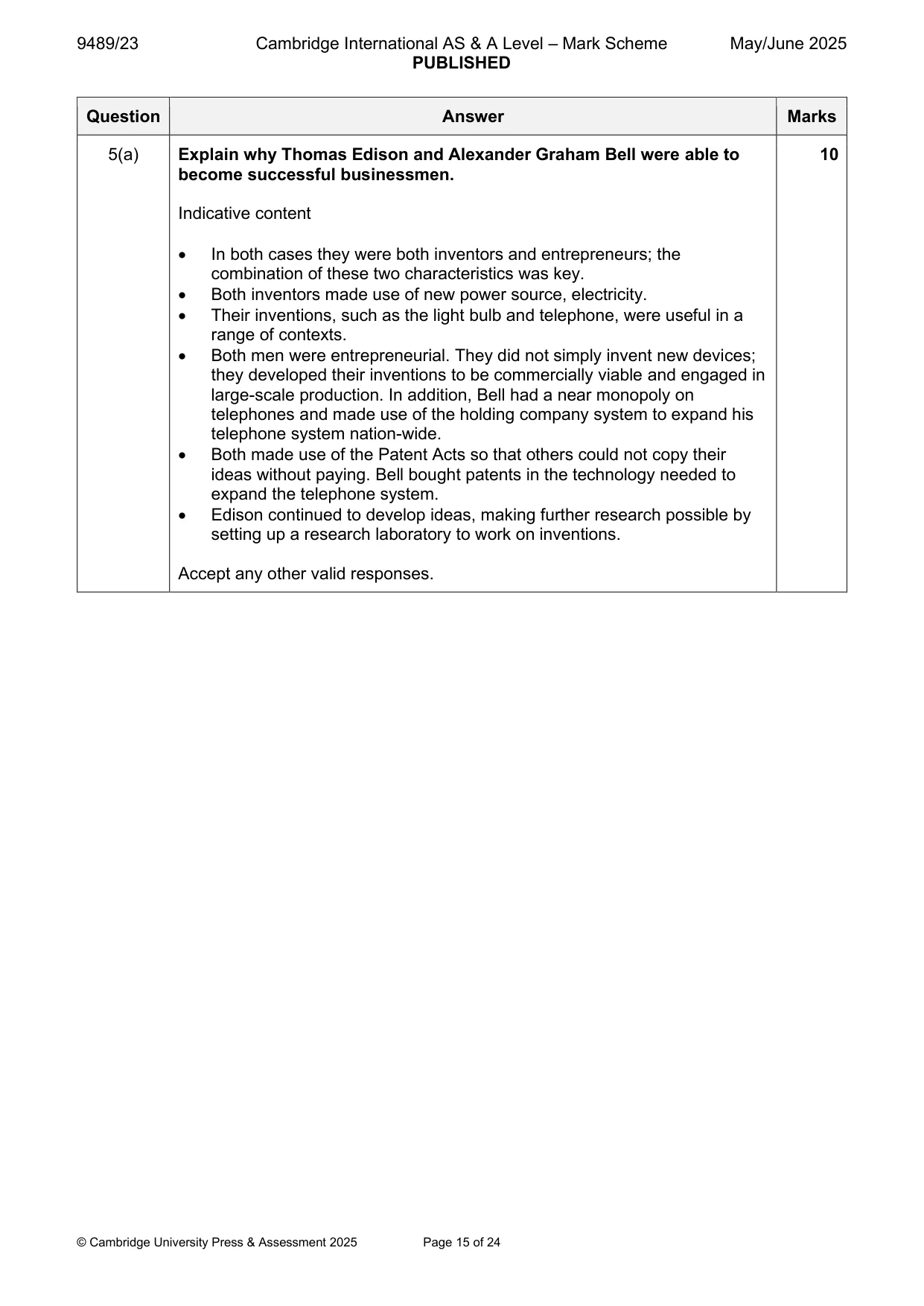
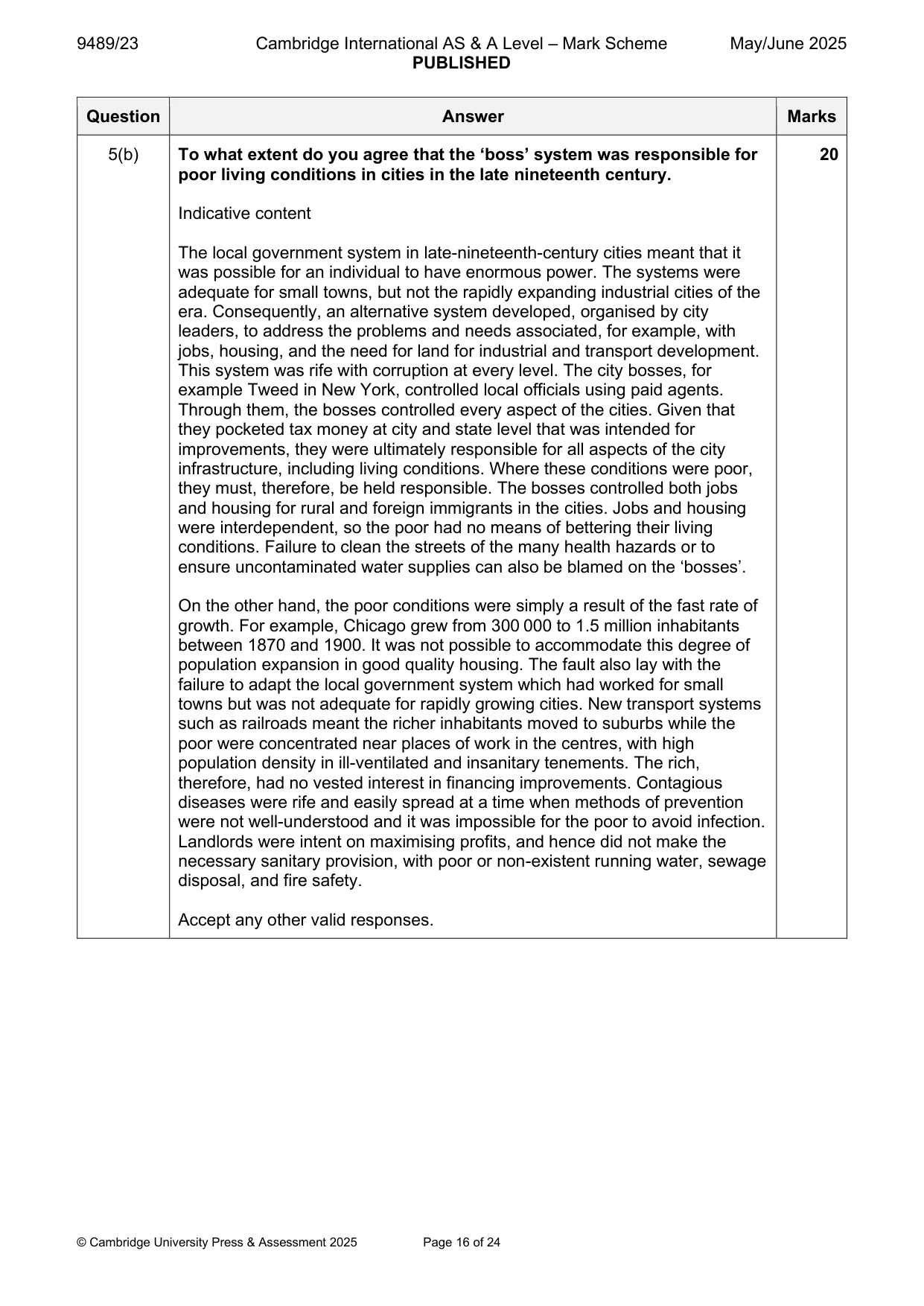
5 The Gilded Age and Progressive Era, 1870s–1920 (a) Explain why Thomas Edison and Alexander Graham Bell were able to become successful businessmen. [10] (b) To what extent do you agree that the ‘boss’ system was responsible for poor living conditions in cities in the late nineteenth century? [20]
Mark scheme: 5(a) Explain why Thomas Edison and Alexander Graham Bell were able to 10 become successful businessmen. Indicative content • In both cases they were both inventors and entrepreneurs; the combination of these two characteristics was key. • Both inventors made use of new power source, electricity. • Their inventions, such as the light bulb and telephone, were useful in a range of contexts. • Both men were entrepreneurial. They did not simply invent new devices; they developed their inventions to be commercially viable and engaged in large-scale production. In addition, Bell had a near monopoly on telephones and made use of the holding company system to expand his telephone system nation-wide. • Both made use of the Patent Acts so that others could not copy their ideas without paying. Bell bought patents in the technology needed to expand the telephone system. • Edison continued to develop ideas, making further research possible by setting up a research laboratory to work on inventions. Accept any other valid responses. 5(b) To what extent do you agree that the ‘boss’ system was responsible for 20 poor living conditions in cities in the late nineteenth century. Indicative content The local government system in late-nineteenth-century cities meant that it was possible for an individual to have enormous power. The systems were adequate for small towns, but not the rapidly expanding industrial cities of the era. Consequently, an alternative system developed, organised by city leaders, to address the problems and needs associated, for example, with jobs, housing, and the need for land for industrial and transport development. This system was rife with corruption at every level. The city bosses, for example Tweed in New York, controlled local officials using paid agents. Through them, the bosses controlled every aspect of the cities. Given that they pocketed tax money at city and state level that was intended for improvements, they were ultimately responsible for all aspects of the city infrastructure, including living conditions. Where these conditions were poor, they must, therefore, be held responsible. The bosses controlled both jobs and housing for rural and foreign immigrants in the cities. Jobs and housing were interdependent, so the poor had no means of bettering their living conditions. Failure to clean the streets of the many health hazards or to ensure uncontaminated water supplies can also be blamed on the ‘bosses’. On the other hand, the poor conditions were simply a result of the fast rate of growth. For example, Chicago grew from 300 000 to 1.5 million inhabitants between 1870 and 1900. It was not possible to accommodate this degree of population expansion in good quality housing. The fault also lay with the failure to adapt the local government system which had worked for small towns but was not adequate for rapidly growing cities. New transport systems such as railroads meant the richer inhabitants moved to suburbs while the poor were concentrated near places of work in the centres, with high population density in ill-ventilated and insanitary tenements. The rich, therefore, had no vested interest in financing improvements. Contagious diseases were rife and easily spread at a time when methods of prevention were not well-understood and it was impossible for the poor to avoid infection. Landlords were intent on maximising profits, and hence did not make the necessary sanitary provision, with poor or non-existent running water, sewage disposal, and fire safety. Accept any other valid responses.
More questions on What were the consequences of the rapid economic growth after 1870?
Q6 · The Great Crash, the Great Depression and the New Deal policies, 1920–41 (a) Explain why…
6 The Great Crash, the Great Depression and the New Deal policies, 1920–41 (a) Explain why Roosevelt needed to encourage Southern Democrats to support the New Deal coalition. [10] (b) ‘Overproduction was the most serious problem facing US agriculture in the 1920s.’ How far do you agree? [20] Section C: International option International history, 1870–1945
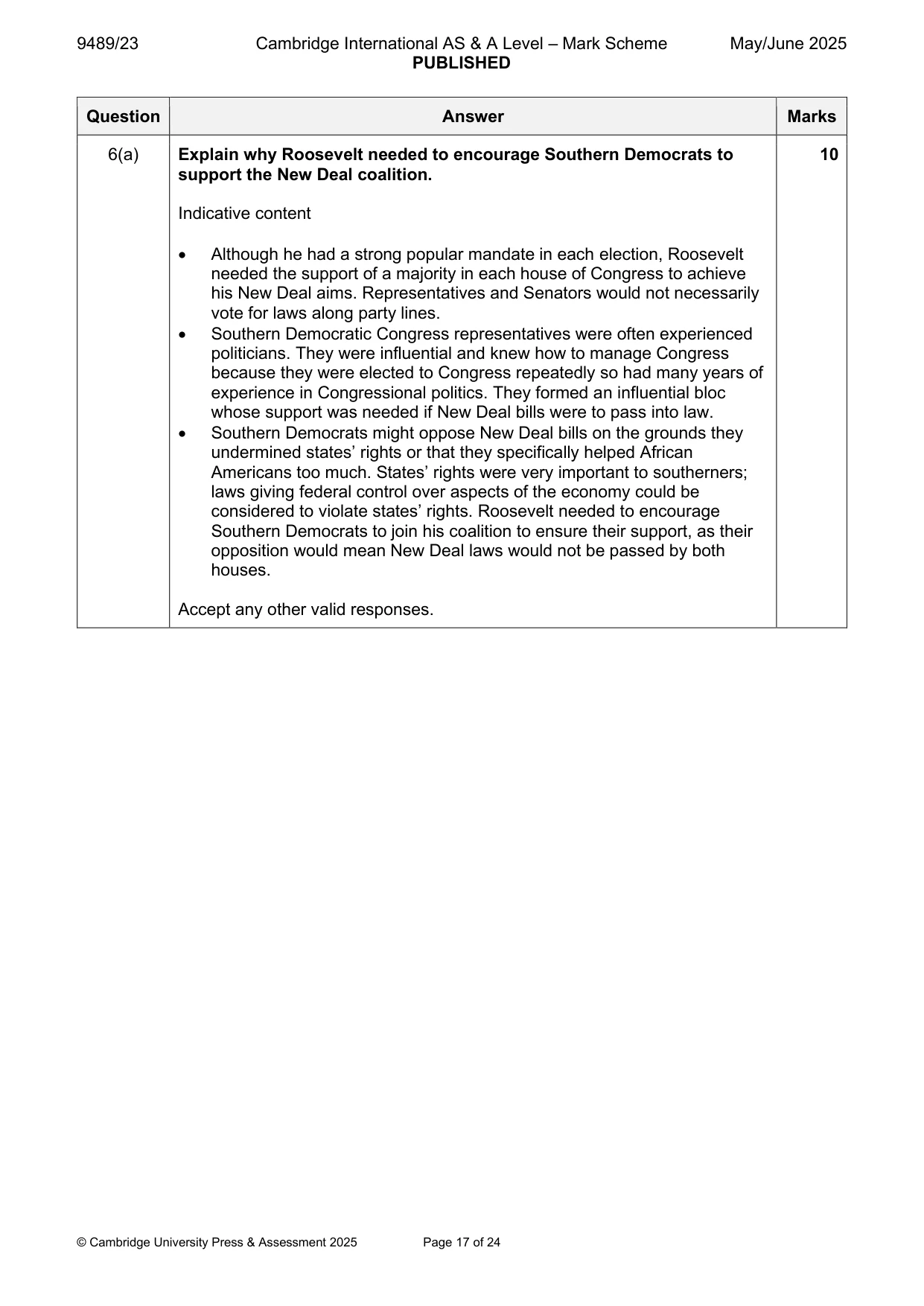
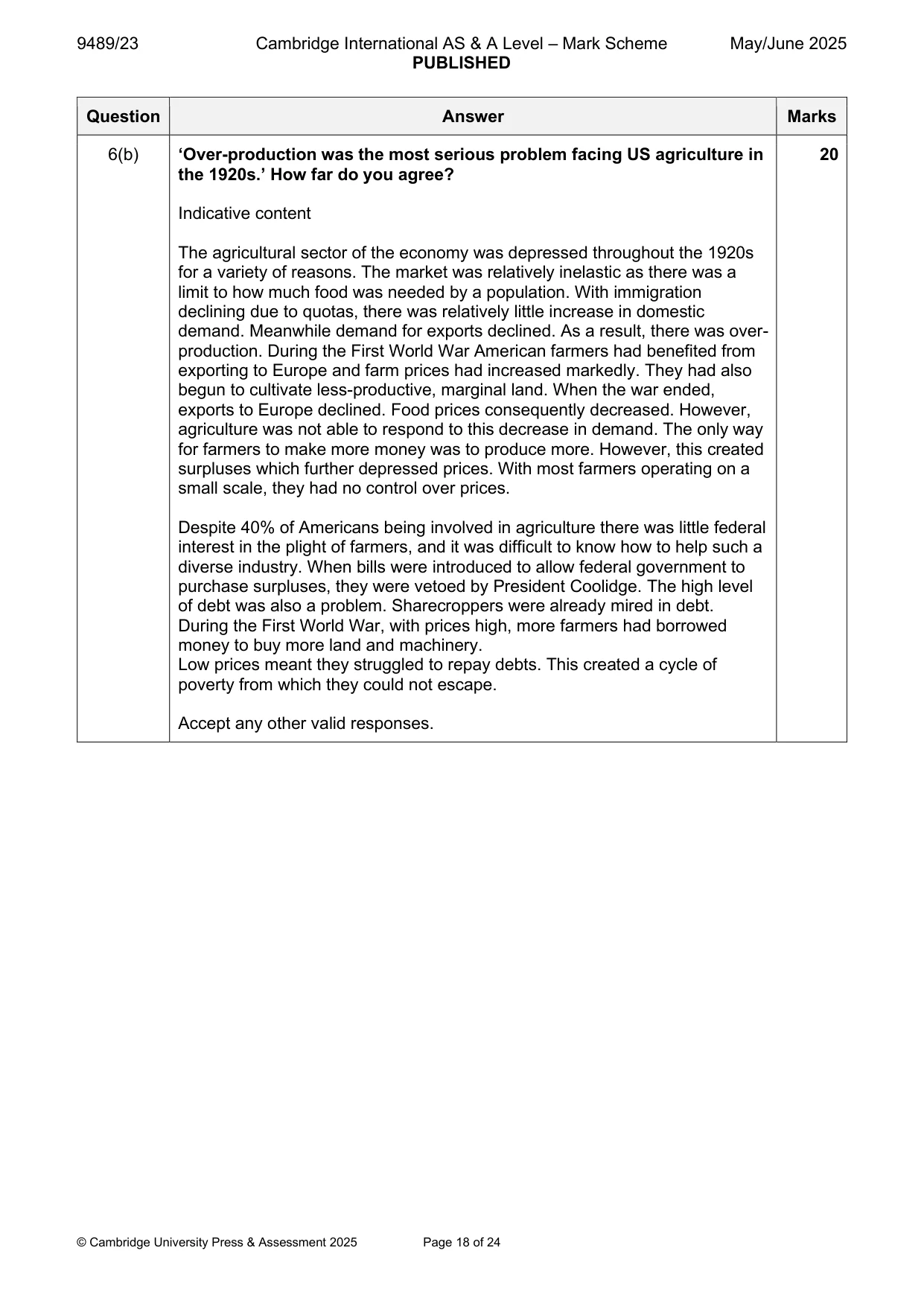
Mark scheme: 6(a) Explain why Roosevelt needed to encourage Southern Democrats to 10 support the New Deal coalition. Indicative content • Although he had a strong popular mandate in each election, Roosevelt needed the support of a majority in each house of Congress to achieve his New Deal aims. Representatives and Senators would not necessarily vote for laws along party lines. • Southern Democratic Congress representatives were often experienced politicians. They were influential and knew how to manage Congress because they were elected to Congress repeatedly so had many years of experience in Congressional politics. They formed an influential bloc whose support was needed if New Deal bills were to pass into law. • Southern Democrats might oppose New Deal bills on the grounds they undermined states’ rights or that they specifically helped African Americans too much. States’ rights were very important to southerners; laws giving federal control over aspects of the economy could be considered to violate states’ rights. Roosevelt needed to encourage Southern Democrats to join his coalition to ensure their support, as their opposition would mean New Deal laws would not be passed by both houses. Accept any other valid responses. 6(b) ‘Over-production was the most serious problem facing US agriculture in 20 the 1920s.’ How far do you agree? Indicative content The agricultural sector of the economy was depressed throughout the 1920s for a variety of reasons. The market was relatively inelastic as there was a limit to how much food was needed by a population. With immigration declining due to quotas, there was relatively little increase in domestic demand. Meanwhile demand for exports declined. As a result, there was over- production. During the First World War American farmers had benefited from exporting to Europe and farm prices had increased markedly. They had also begun to cultivate less-productive, marginal land. When the war ended, exports to Europe declined. Food prices consequently decreased. However, agriculture was not able to respond to this decrease in demand. The only way for farmers to make more money was to produce more. However, this created surpluses which further depressed prices. With most farmers operating on a small scale, they had no control over prices. Despite 40% of Americans being involved in agriculture there was little federal interest in the plight of farmers, and it was difficult to know how to help such a diverse industry. When bills were introduced to allow federal government to purchase surpluses, they were vetoed by President Coolidge. The high level of debt was also a problem. Sharecroppers were already mired in debt. During the First World War, with prices high, more farmers had borrowed money to buy more land and machinery. Low prices meant they struggled to repay debts. This created a cycle of poverty from which they could not escape. Accept any other valid responses.
More questions on What were the causes of the Great Crash and the Great Depression?
Q7 · Empire and the emergence of world powers, 1870–1919 (a) Explain why the Jameson Raid led…
7 Empire and the emergence of world powers, 1870–1919 (a) Explain why the Jameson Raid led to worsening relations between Britain and Germany. [10] (b) ‘The closing of the frontier was responsible for the change in the United States’ attitude towards overseas expansion.’ How far do you agree? [20]
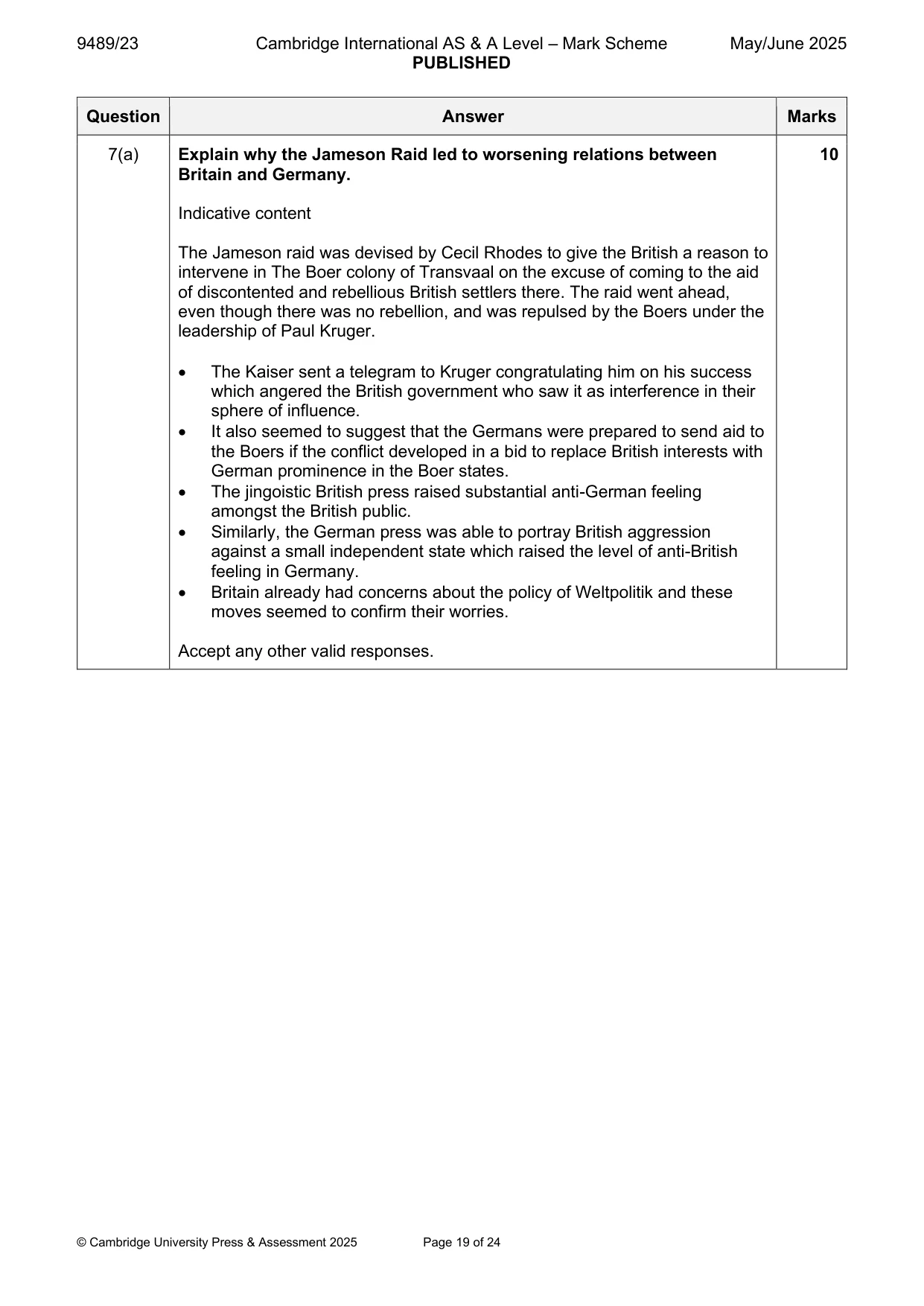
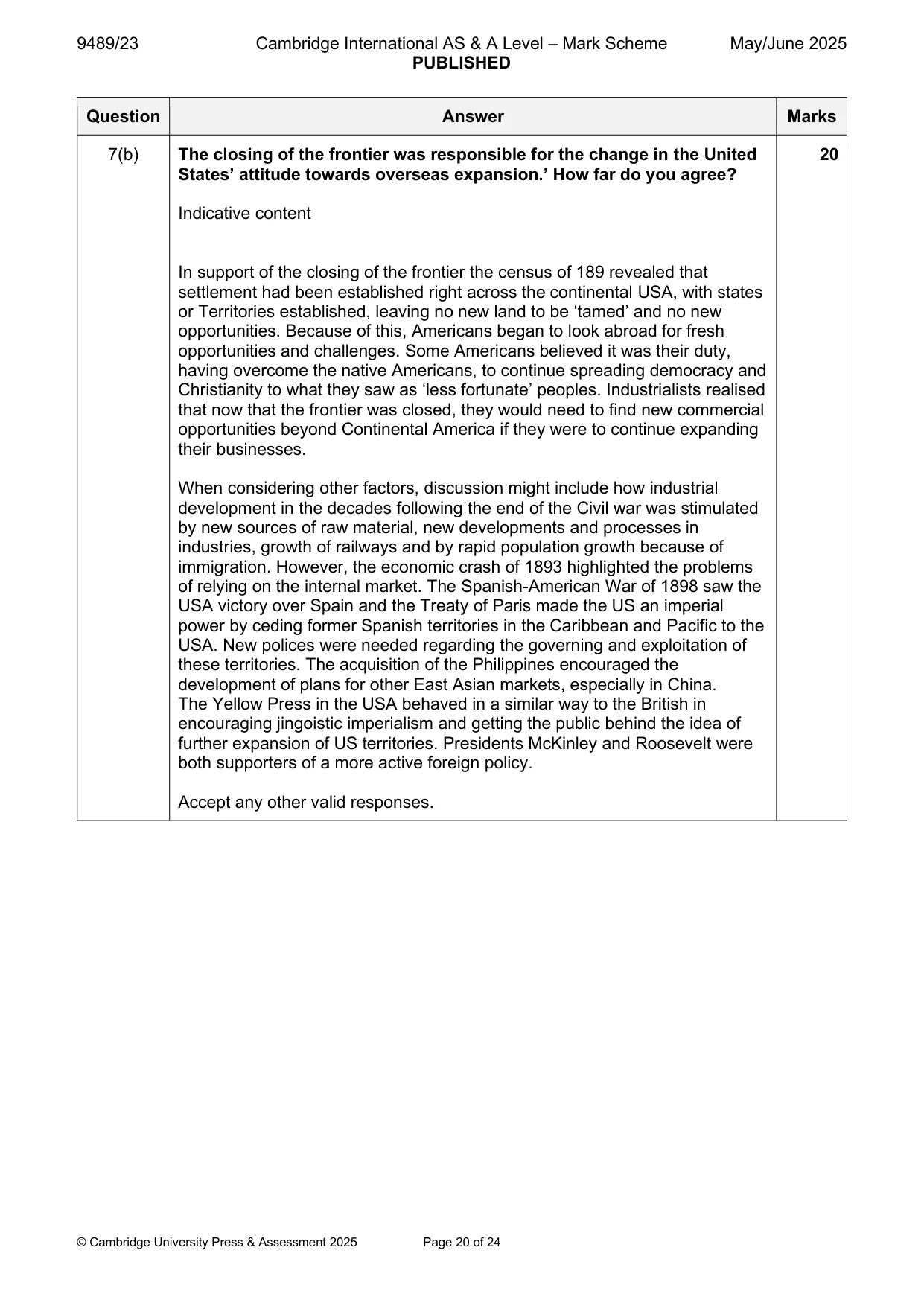
Mark scheme: 7(a) Explain why the Jameson Raid led to worsening relations between 10 Britain and Germany. Indicative content The Jameson raid was devised by Cecil Rhodes to give the British a reason to intervene in The Boer colony of Transvaal on the excuse of coming to the aid of discontented and rebellious British settlers there. The raid went ahead, even though there was no rebellion, and was repulsed by the Boers under the leadership of Paul Kruger. • The Kaiser sent a telegram to Kruger congratulating him on his success which angered the British government who saw it as interference in their sphere of influence. • It also seemed to suggest that the Germans were prepared to send aid to the Boers if the conflict developed in a bid to replace British interests with German prominence in the Boer states. • The jingoistic British press raised substantial anti-German feeling amongst the British public. • Similarly, the German press was able to portray British aggression against a small independent state which raised the level of anti-British feeling in Germany. • Britain already had concerns about the policy of Weltpolitik and these moves seemed to confirm their worries. Accept any other valid responses. 7(b) The closing of the frontier was responsible for the change in the United 20 States’ attitude towards overseas expansion.’ How far do you agree? Indicative content In support of the closing of the frontier the census of 189 revealed that settlement had been established right across the continental USA, with states or Territories established, leaving no new land to be ‘tamed’ and no new opportunities. Because of this, Americans began to look abroad for fresh opportunities and challenges. Some Americans believed it was their duty, having overcome the native Americans, to continue spreading democracy and Christianity to what they saw as ‘less fortunate’ peoples. Industrialists realised that now that the frontier was closed, they would need to find new commercial opportunities beyond Continental America if they were to continue expanding their businesses. When considering other factors, discussion might include how industrial development in the decades following the end of the Civil war was stimulated by new sources of raw material, new developments and processes in industries, growth of railways and by rapid population growth because of immigration. However, the economic crash of 1893 highlighted the problems of relying on the internal market. The Spanish-American War of 1898 saw the USA victory over Spain and the Treaty of Paris made the US an imperial power by ceding former Spanish territories in the Caribbean and Pacific to the USA. New polices were needed regarding the governing and exploitation of these territories. The acquisition of the Philippines encouraged the development of plans for other East Asian markets, especially in China. The Yellow Press in the USA behaved in a similar way to the British in encouraging jingoistic imperialism and getting the public behind the idea of further expansion of US territories. Presidents McKinley and Roosevelt were both supporters of a more active foreign policy. Accept any other valid responses.
More questions on Why did the USA emerge as a world power and what was the impact on international
Q8 · The League of Nations and international relations in the 1920s (a) Explain why the terms…
8 The League of Nations and international relations in the 1920s (a) Explain why the terms of the Treaty of Sèvres were unpopular with Turks. [10] (b) ‘Relations between Germany and France were unfriendly during the 1920s.’ How far do you agree? [20]
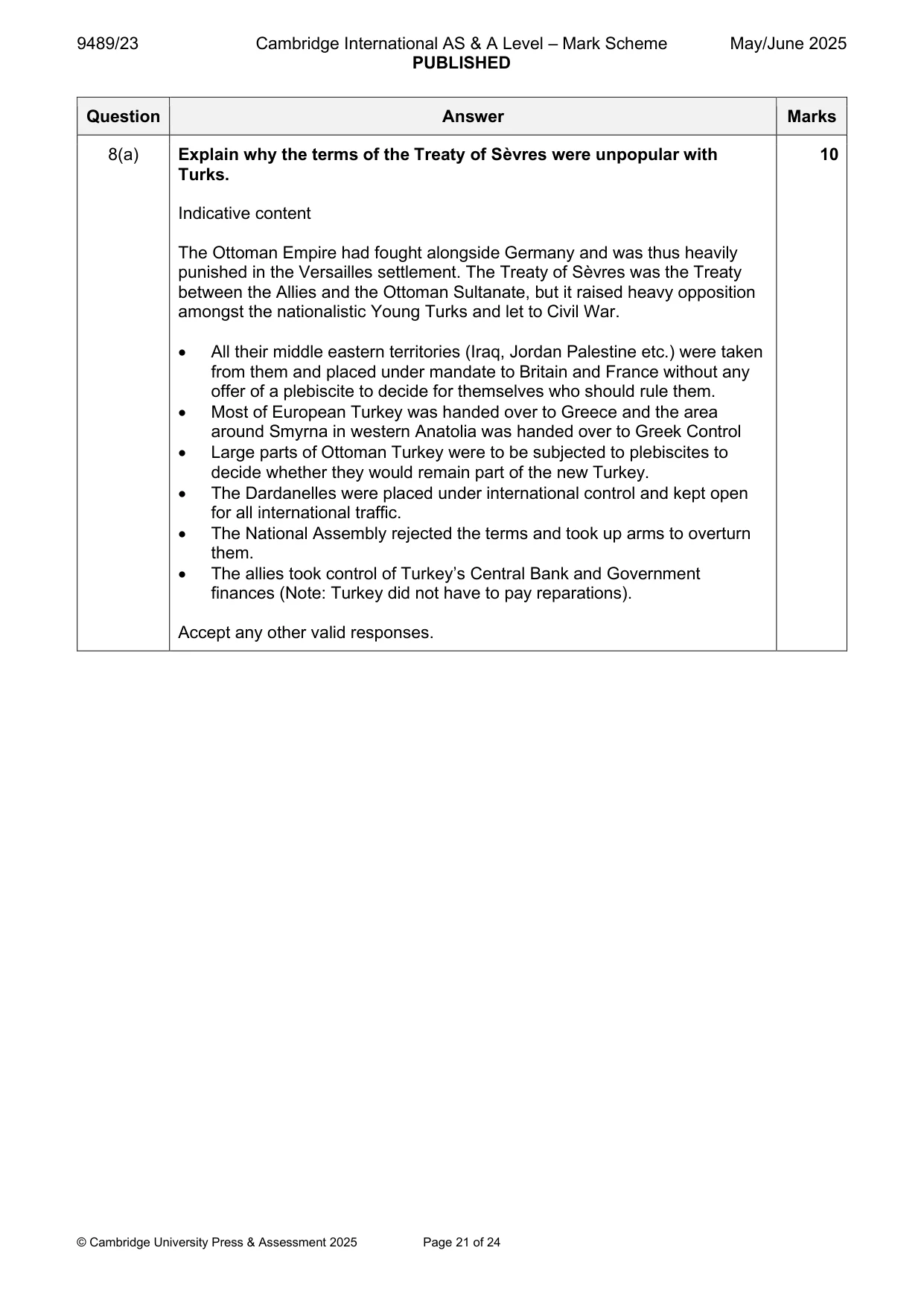
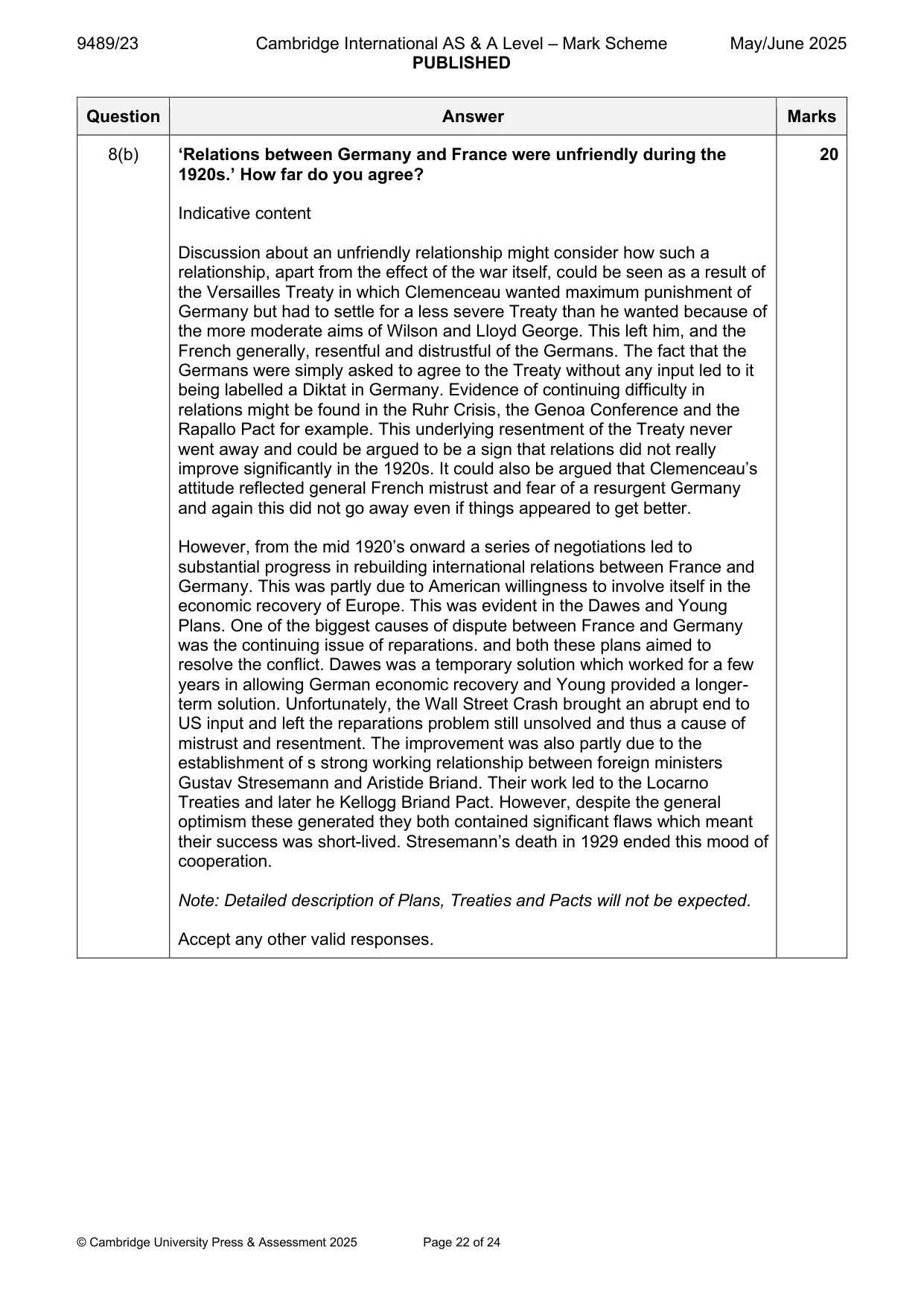
Mark scheme: 8(a) Explain why the terms of the Treaty of Sèvres were unpopular with 10 Turks. Indicative content The Ottoman Empire had fought alongside Germany and was thus heavily punished in the Versailles settlement. The Treaty of Sèvres was the Treaty between the Allies and the Ottoman Sultanate, but it raised heavy opposition amongst the nationalistic Young Turks and let to Civil War. • All their middle eastern territories (Iraq, Jordan Palestine etc.) were taken from them and placed under mandate to Britain and France without any offer of a plebiscite to decide for themselves who should rule them. • Most of European Turkey was handed over to Greece and the area around Smyrna in western Anatolia was handed over to Greek Control • Large parts of Ottoman Turkey were to be subjected to plebiscites to decide whether they would remain part of the new Turkey. • The Dardanelles were placed under international control and kept open for all international traffic. • The National Assembly rejected the terms and took up arms to overturn them. • The allies took control of Turkey’s Central Bank and Government finances (Note: Turkey did not have to pay reparations). Accept any other valid responses. 8(b) ‘Relations between Germany and France were unfriendly during the 20 1920s.’ How far do you agree? Indicative content Discussion about an unfriendly relationship might consider how such a relationship, apart from the effect of the war itself, could be seen as a result of the Versailles Treaty in which Clemenceau wanted maximum punishment of Germany but had to settle for a less severe Treaty than he wanted because of the more moderate aims of Wilson and Lloyd George. This left him, and the French generally, resentful and distrustful of the Germans. The fact that the Germans were simply asked to agree to the Treaty without any input led to it being labelled a Diktat in Germany. Evidence of continuing difficulty in relations might be found in the Ruhr Crisis, the Genoa Conference and the Rapallo Pact for example. This underlying resentment of the Treaty never went away and could be argued to be a sign that relations did not really improve significantly in the 1920s. It could also be argued that Clemenceau’s attitude reflected general French mistrust and fear of a resurgent Germany and again this did not go away even if things appeared to get better. However, from the mid 1920’s onward a series of negotiations led to substantial progress in rebuilding international relations between France and Germany. This was partly due to American willingness to involve itself in the economic recovery of Europe. This was evident in the Dawes and Young Plans. One of the biggest causes of dispute between France and Germany was the continuing issue of reparations. and both these plans aimed to resolve the conflict. Dawes was a temporary solution which worked for a few years in allowing German economic recovery and Young provided a longer- term solution. Unfortunately, the Wall Street Crash brought an abrupt end to US input and left the reparations problem still unsolved and thus a cause of mistrust and resentment. The improvement was also partly due to the establishment of s strong working relationship between foreign ministers Gustav Stresemann and Aristide Briand. Their work led to the Locarno Treaties and later he Kellogg Briand Pact. However, despite the general optimism these generated they both contained significant flaws which meant their success was short-lived. Stresemann’s death in 1929 ended this mood of cooperation. Note: Detailed description of Plans, Treaties and Pacts will not be expected. Accept any other valid responses.
More questions on How and why did international relations improve, 1924–29?
Q9 · China and Japan, 1912–45 (a) Explain why Japan’s international policies during the 1930s…
9 China and Japan, 1912–45 (a) Explain why Japan’s international policies during the 1930s became increasingly aggressive. [10] (b) To what extent was Yuan Shih-kai responsible for the failure to establish a strong central government in China after the 1911 Revolution? [20]
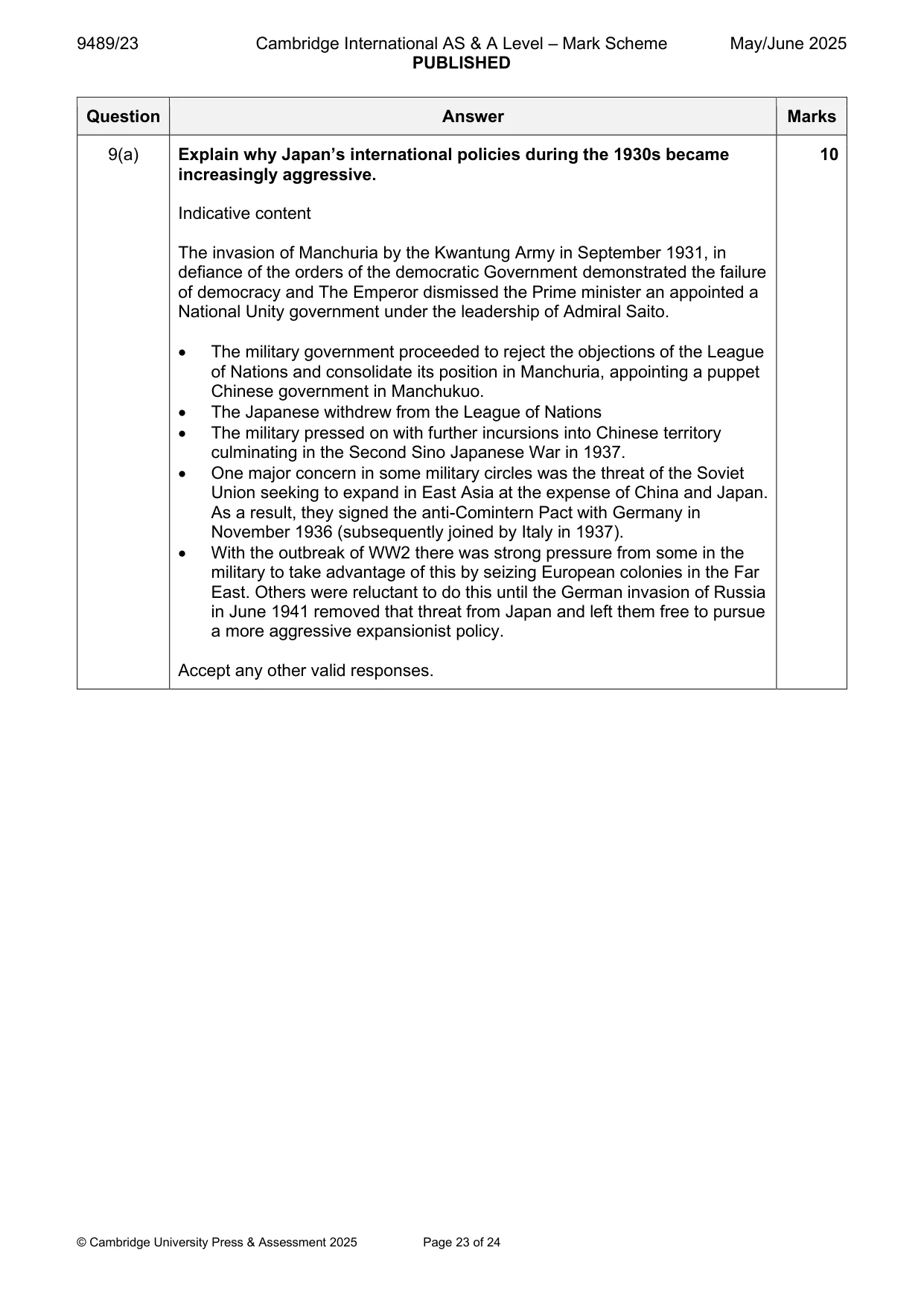
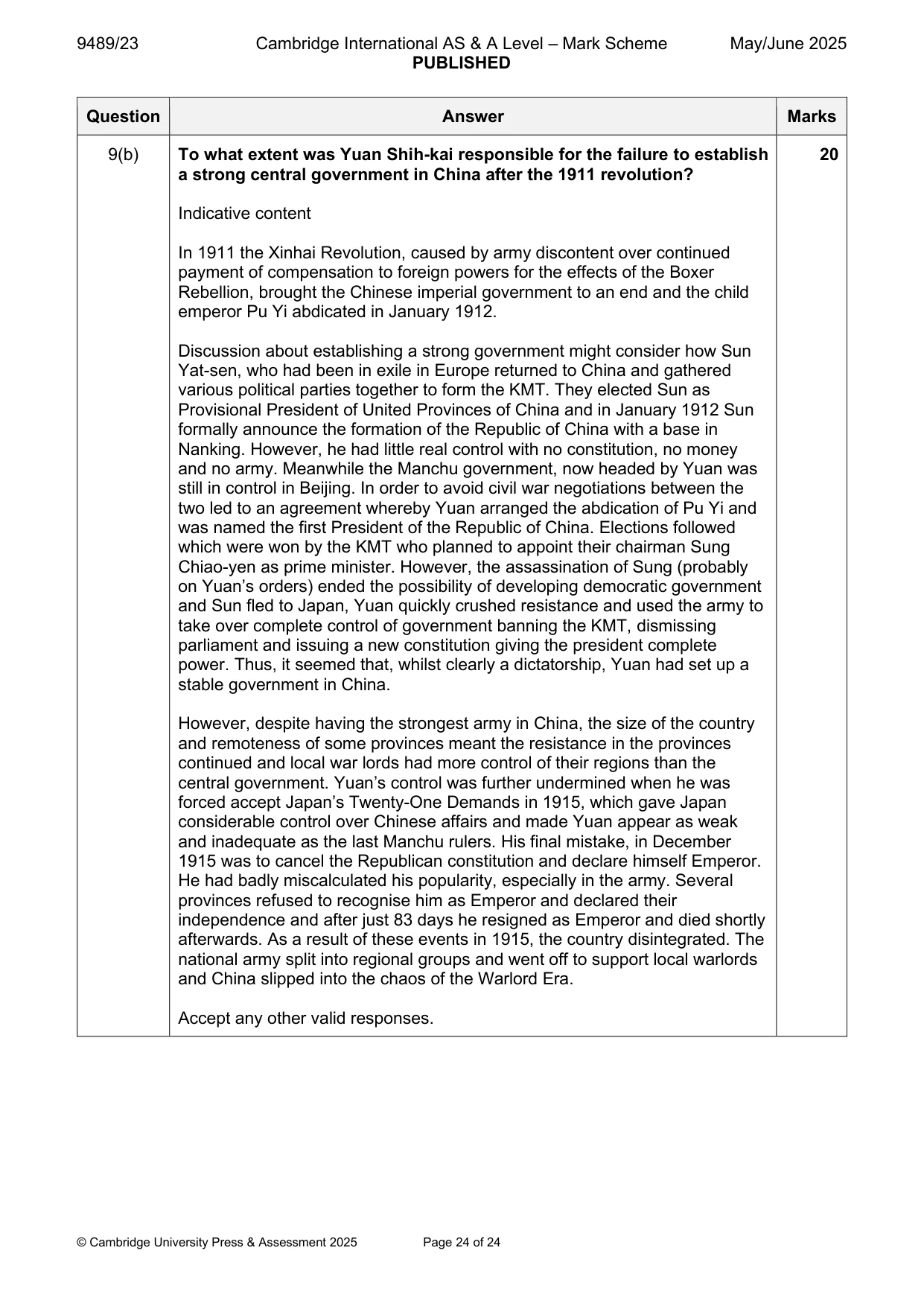
Mark scheme: 9(a) Explain why Japan’s international policies during the 1930s became 10 increasingly aggressive. Indicative content The invasion of Manchuria by the Kwantung Army in September 1931, in defiance of the orders of the democratic Government demonstrated the failure of democracy and The Emperor dismissed the Prime minister an appointed a National Unity government under the leadership of Admiral Saito. • The military government proceeded to reject the objections of the League of Nations and consolidate its position in Manchuria, appointing a puppet Chinese government in Manchukuo. • The Japanese withdrew from the League of Nations • The military pressed on with further incursions into Chinese territory culminating in the Second Sino Japanese War in 1937. • One major concern in some military circles was the threat of the Soviet Union seeking to expand in East Asia at the expense of China and Japan. As a result, they signed the anti-Comintern Pact with Germany in November 1936 (subsequently joined by Italy in 1937). • With the outbreak of WW2 there was strong pressure from some in the military to take advantage of this by seizing European colonies in the Far East. Others were reluctant to do this until the German invasion of Russia in June 1941 removed that threat from Japan and left them free to pursue a more aggressive expansionist policy. Accept any other valid responses. 9(b) To what extent was Yuan Shih-kai responsible for the failure to establish 20 a strong central government in China after the 1911 revolution? Indicative content In 1911 the Xinhai Revolution, caused by army discontent over continued payment of compensation to foreign powers for the effects of the Boxer Rebellion, brought the Chinese imperial government to an end and the child emperor Pu Yi abdicated in January 1912. Discussion about establishing a strong government might consider how Sun Yat-sen, who had been in exile in Europe returned to China and gathered various political parties together to form the KMT. They elected Sun as Provisional President of United Provinces of China and in January 1912 Sun formally announce the formation of the Republic of China with a base in Nanking. However, he had little real control with no constitution, no money and no army. Meanwhile the Manchu government, now headed by Yuan was still in control in Beijing. In order to avoid civil war negotiations between the two led to an agreement whereby Yuan arranged the abdication of Pu Yi and was named the first President of the Republic of China. Elections followed which were won by the KMT who planned to appoint their chairman Sung Chiao-yen as prime minister. However, the assassination of Sung (probably on Yuan’s orders) ended the possibility of developing democratic government and Sun fled to Japan, Yuan quickly crushed resistance and used the army to take over complete control of government banning the KMT, dismissing parliament and issuing a new constitution giving the president complete power. Thus, it seemed that, whilst clearly a dictatorship, Yuan had set up a stable government in China. However, despite having the strongest army in China, the size of the country and remoteness of some provinces meant the resistance in the provinces continued and local war lords had more control of their regions than the central government. Yuan’s control was further undermined when he was forced accept Japan’s Twenty-One Demands in 1915, which gave Japan considerable control over Chinese affairs and made Yuan appear as weak and inadequate as the last Manchu rulers. His final mistake, in December 1915 was to cancel the Republican constitution and declare himself Emperor. He had badly miscalculated his popularity, especially in the army. Several provinces refused to recognise him as Emperor and declared their independence and after just 83 days he resigned as Emperor and died shortly afterwards. As a result of these events in 1915, the country disintegrated. The national army split into regional groups and went off to support local warlords and China slipped into the chaos of the Warlord Era. Accept any other valid responses.
More questions on How well was France governed in the period 1793–99?
What was in this paper
The subtopics covered by these 9 questions, and how many questions each got. Open one in a new tab to see every Cambridge question on it.
2How and why did international relations improve, 1924–29?1How well was France governed in the period 1793–99?1What caused the rise and fall of Napoleon Bonaparte?1What were the aims of Reconstruction and how successful was it?1What were the causes and outcomes of the 1905 Revolution up to 1914?1What were the causes of the Great Crash and the Great Depression?1Why did the USA emerge as a world power and what was the impact on international1What you needed in this session
Cambridge’s own grade thresholds for 2025 May/June, Paper 2 · Variant 3. A higher threshold means an easier paper — the bar moves with how the cohort did.