Cambridge A Level History 9489 — 2023 May/June Paper 2 · Variant 3
9489/23/M/J/23 · 9 questions · 60 marks · ≈68 min
The question paper and its mark scheme, free to read here and free to download. This is Cambridge’s own paper, exactly as it was sat.
Question paper4 pages
Mark scheme22 pages
Answers below. Sit the paper first if you are practising.

Questions as text
Q1 · The Industrial Revolution in Britain, 1750–1850 (a) Explain why changes in agriculture…
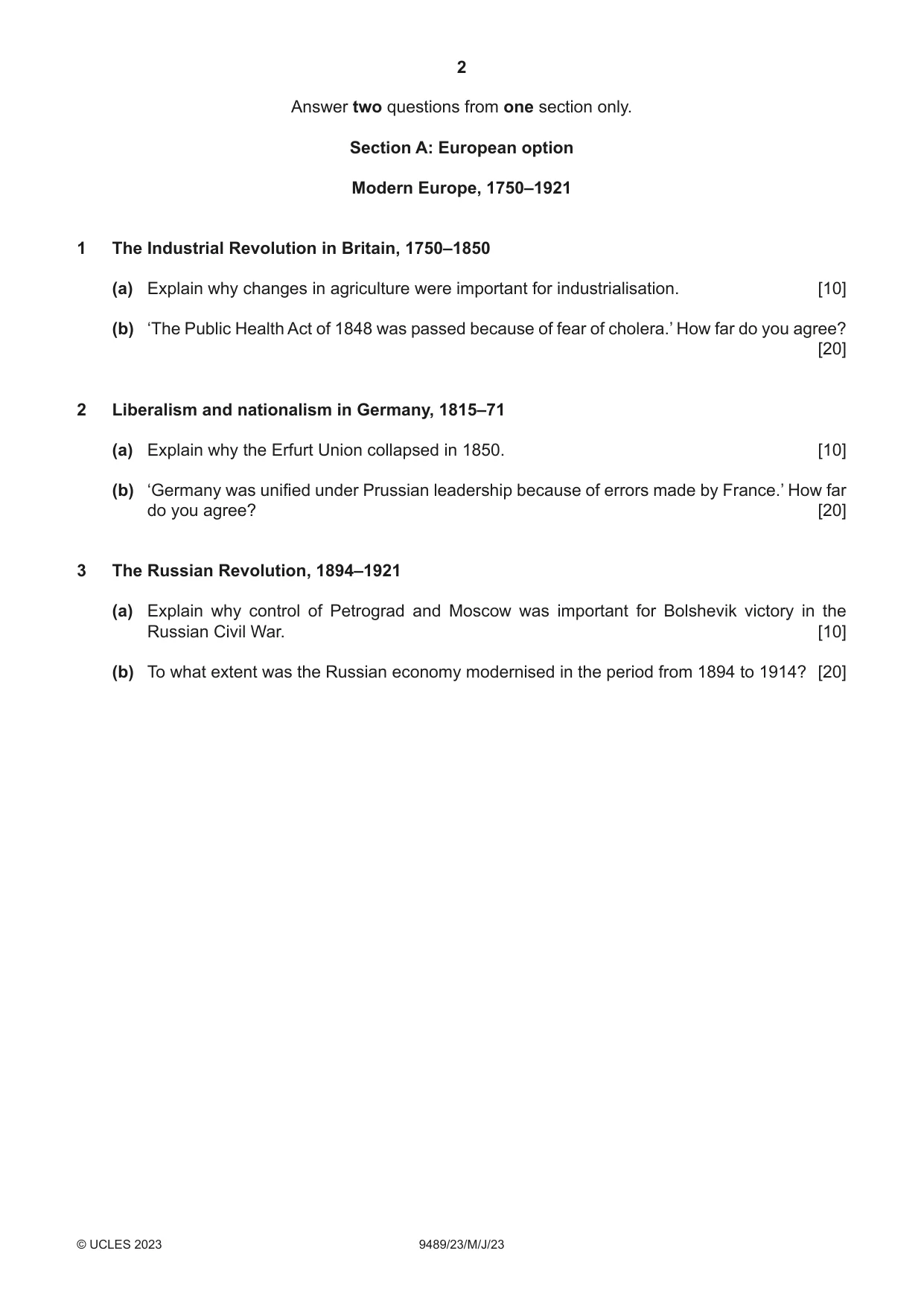
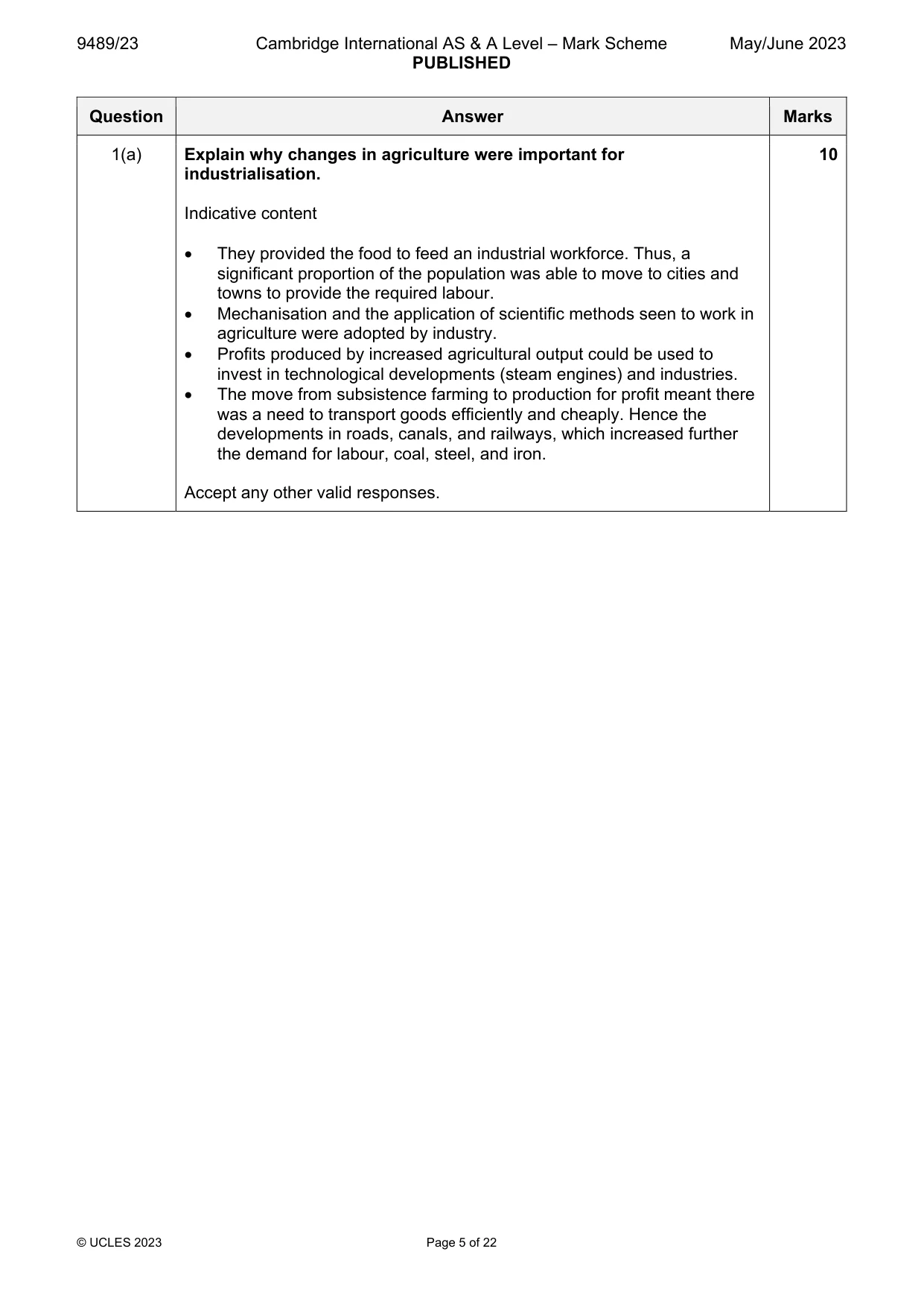
1 The Industrial Revolution in Britain, 1750–1850 (a) Explain why changes in agriculture were important for industrialisation. [10] (b) ‘The Public Health Act of 1848 was passed because of fear of cholera.’ How far do you agree? [20]
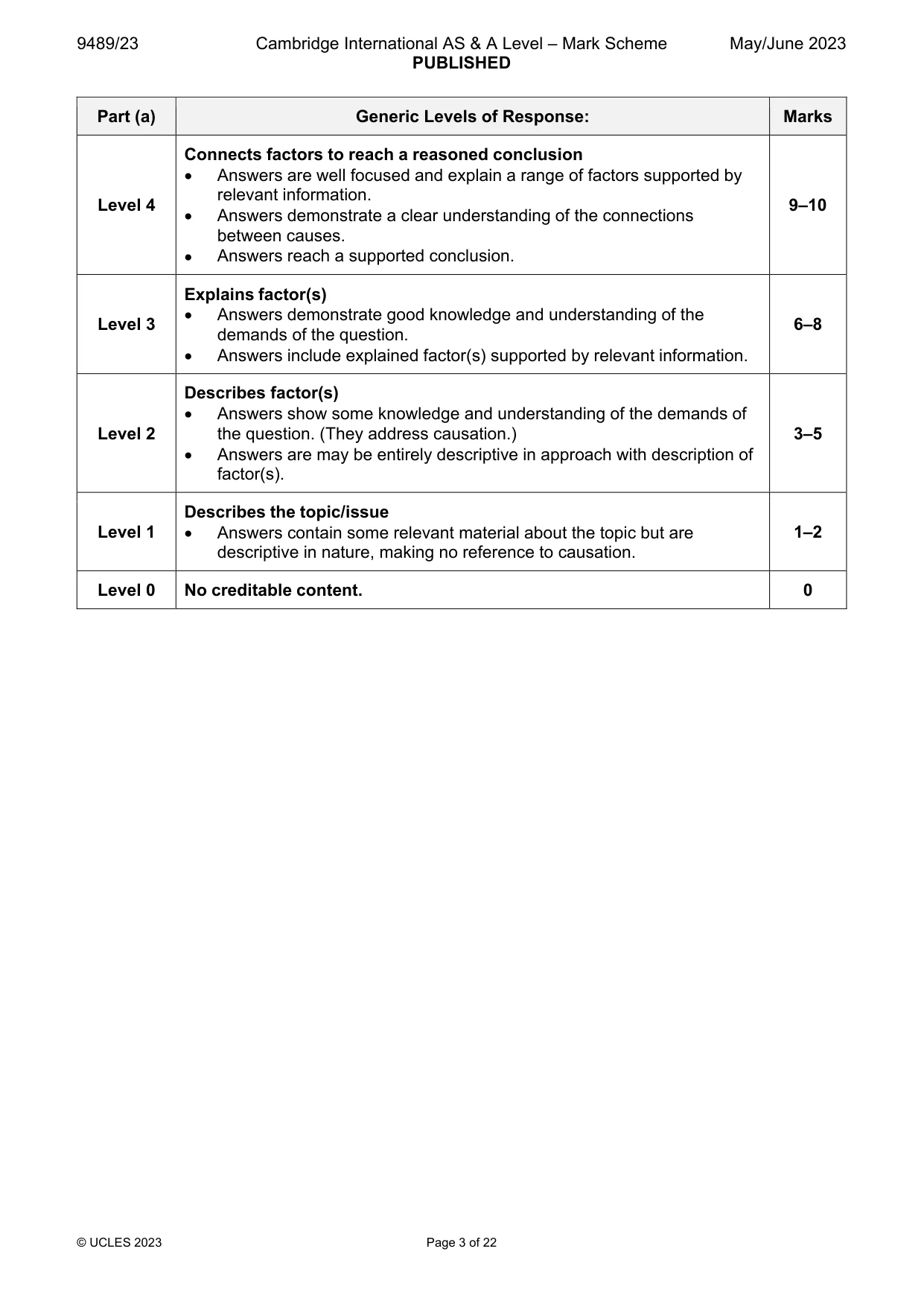
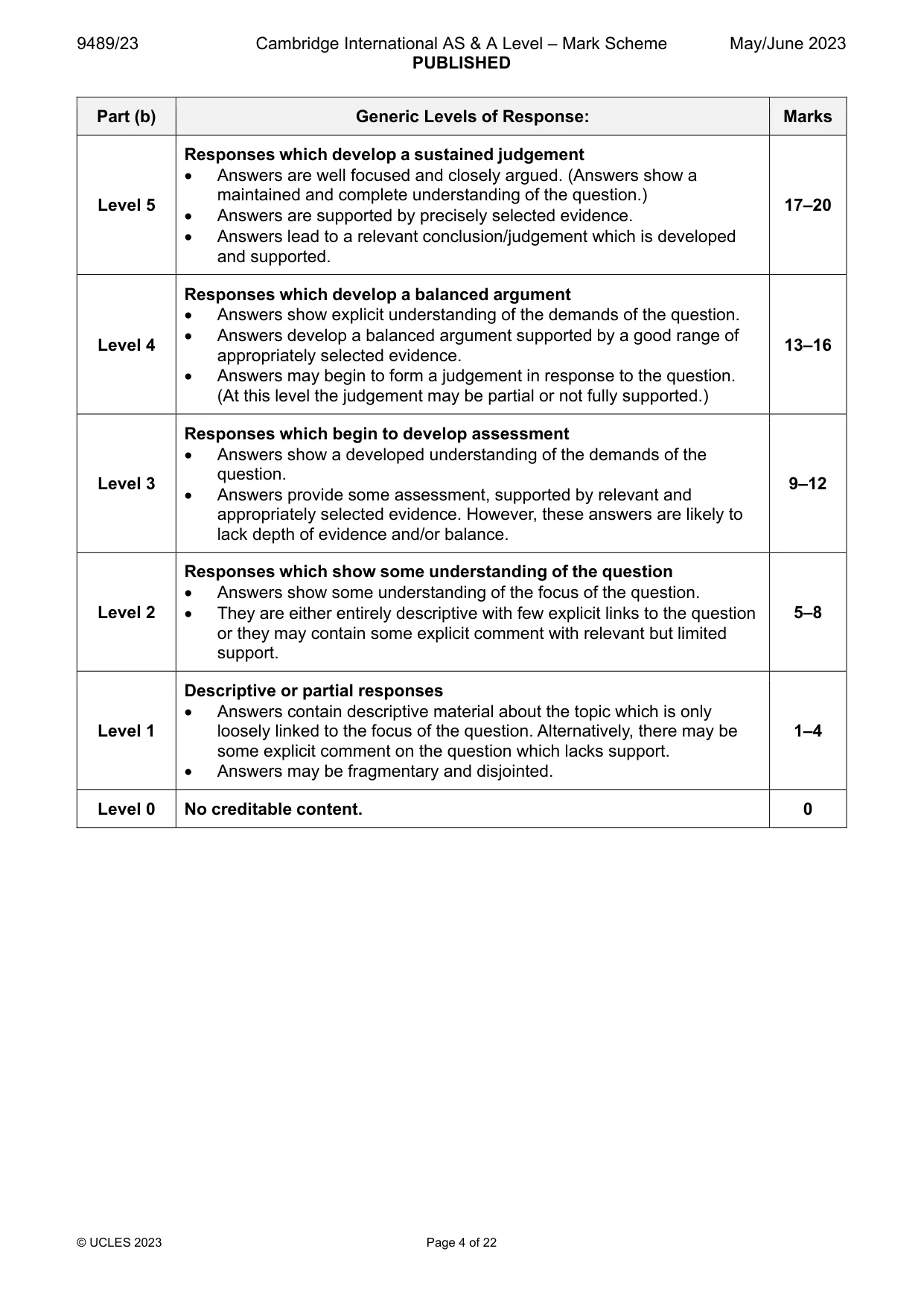
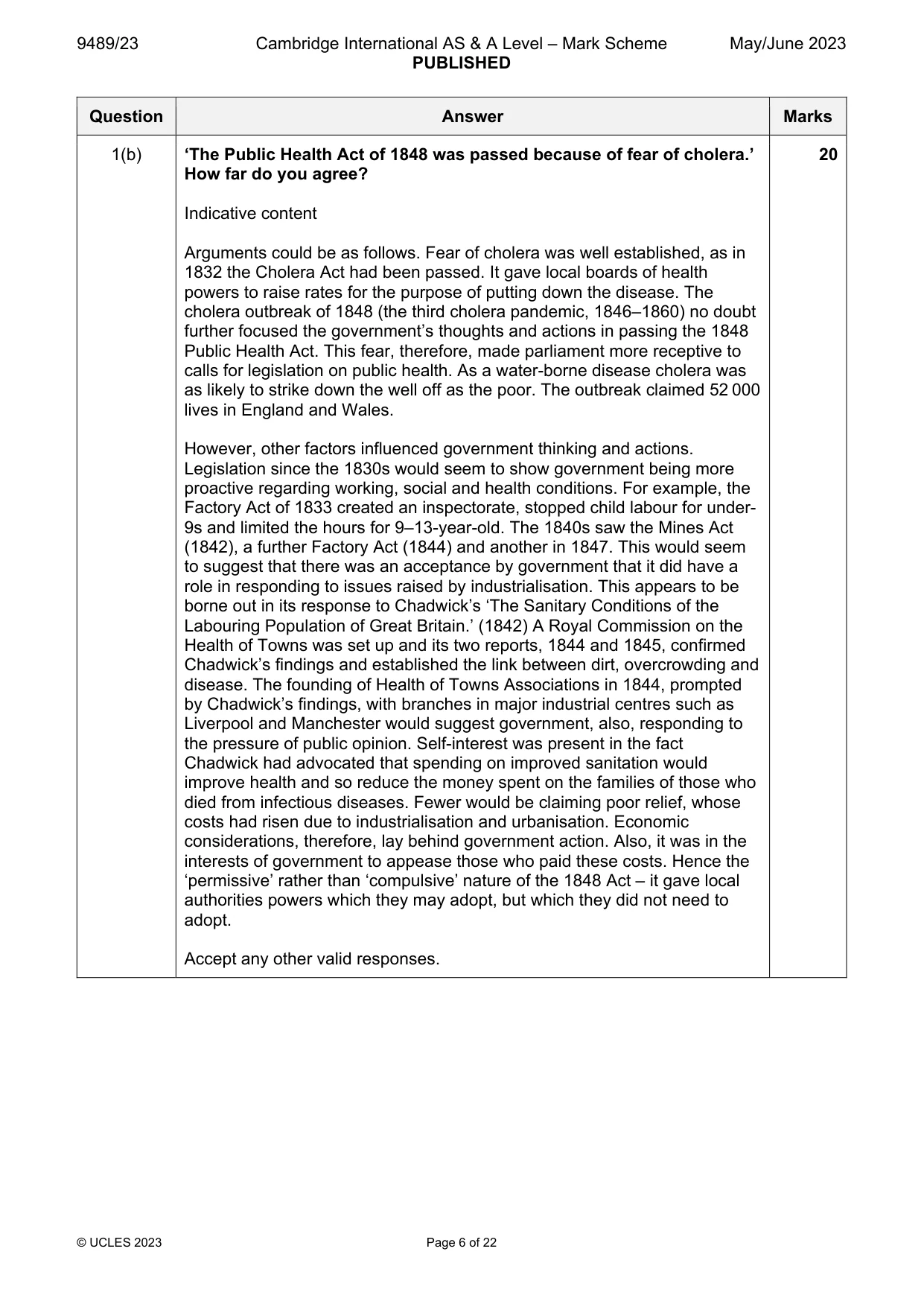
Mark scheme: Question Answer Marks 1(a) Explain why changes in agriculture were important for 10 industrialisation. Indicative content They provided the food to feed an industrial workforce. Thus, a significant proportion of the population was able to move to cities and towns to provide the required labour. Mechanisation and the application of scientific methods seen to work in agriculture were adopted by industry. Profits produced by increased agricultural output could be used to invest in technological developments (steam engines) and industries. The move from subsistence farming to production for profit meant there was a need to transport goods efficiently and cheaply. Hence the developments in roads, canals, and railways, which increased further the demand for labour, coal, steel, and iron. Accept any other valid responses. 1(b) ‘The Public Health Act of 1848 was passed because of fear of cholera.’ 20 How far do you agree? Indicative content Arguments could be as follows. Fear of cholera was well established, as in 1832 the Cholera Act had been passed. It gave local boards of health powers to raise rates for the purpose of putting down the disease. The cholera outbreak of 1848 (the third cholera pandemic, 1846–1860) no doubt further focused the government’s thoughts and actions in passing the 1848 Public Health Act. This fear, therefore, made parliament more receptive to calls for legislation on public health. As a water-borne disease cholera was as likely to strike down the well off as the poor. The outbreak claimed 52 000 lives in England and Wales. However, other factors influenced government thinking and actions. Legislation since the 1830s would seem to show government being more proactive regarding working, social and health conditions. For example, the Factory Act of 1833 created an inspectorate, stopped child labour for under- 9s and limited the hours for 9–13-year-old. The 1840s saw the Mines Act (1842), a further Factory Act (1844) and another in 1847. This would seem to suggest that there was an acceptance by government that it did have a role in responding to issues raised by industrialisation. This appears to be borne out in its response to Chadwick’s ‘The Sanitary Conditions of the Labouring Population of Great Britain.’ (1842) A Royal Commission on the Health of Towns was set up and its two reports, 1844 and 1845, confirmed Chadwick’s findings and established the link between dirt, overcrowding and disease. The founding of Health of Towns Associations in 1844, prompted by Chadwick’s findings, with branches in major industrial centres such as Liverpool and Manchester would suggest government, also, responding to the pressure of public opinion. Self-interest was present in the fact Chadwick had advocated that spending on improved sanitation would improve health and so reduce the money spent on the families of those who died from infectious diseases. Fewer would be claiming poor relief, whose costs had risen due to industrialisation and urbanisation. Economic considerations, therefore, lay behind government action. Also, it was in the interests of government to appease those who paid these costs. Hence the ‘permissive’ rather than ‘compulsive’ nature of the 1848 Act – it gave local authorities powers which they may adopt, but which they did not need to adopt. Accept any other valid responses.
More questions on What were the consequences of the rapid economic growth after 1870?
Q2 · Liberalism and nationalism in Germany, 1815–71 (a) Explain why the Erfurt Union collapsed…
2 Liberalism and nationalism in Germany, 1815–71 (a) Explain why the Erfurt Union collapsed in 1850. [10] (b) ‘Germany was unified under Prussian leadership because of errors made by France.’ How far do you agree? [20]
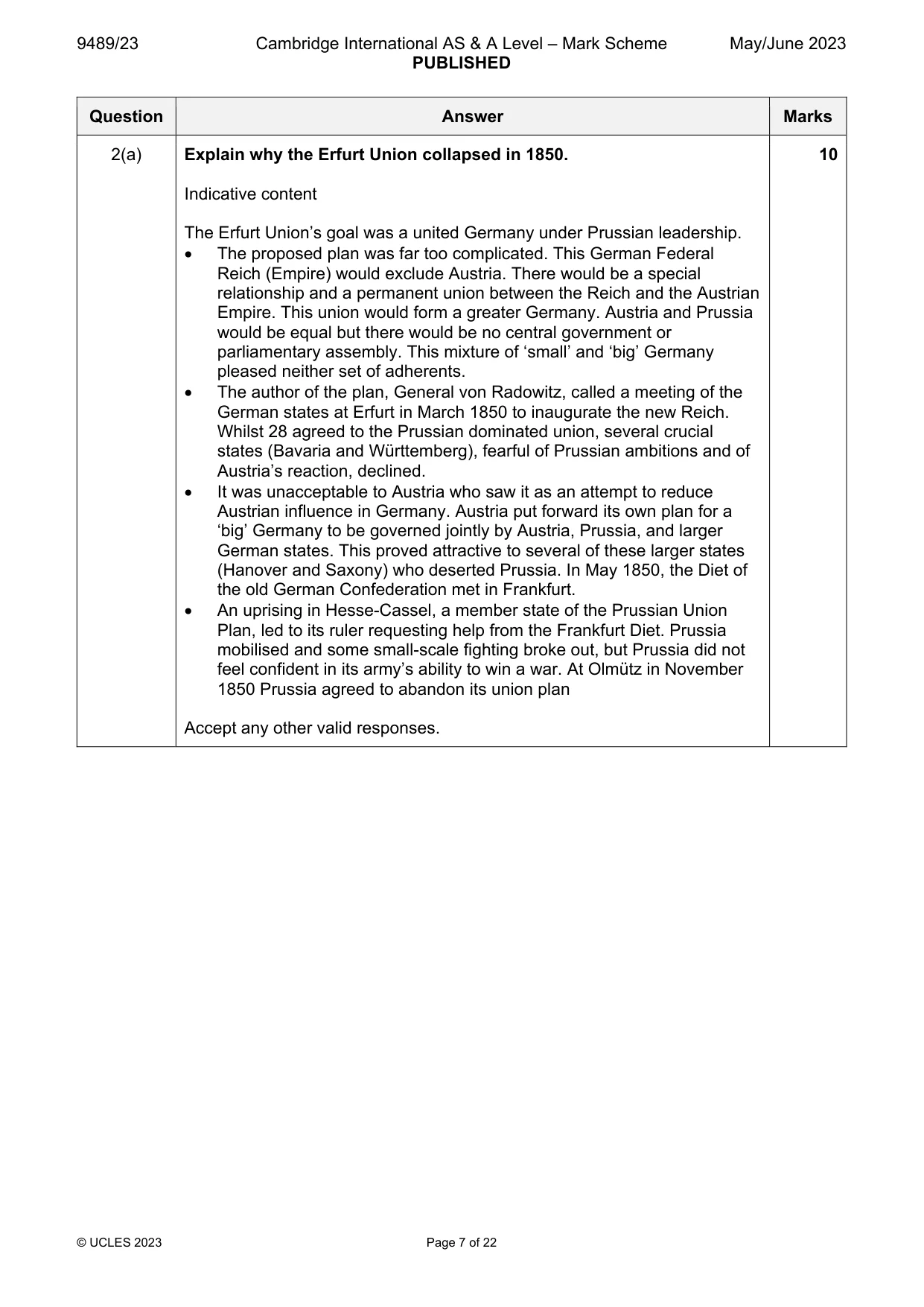
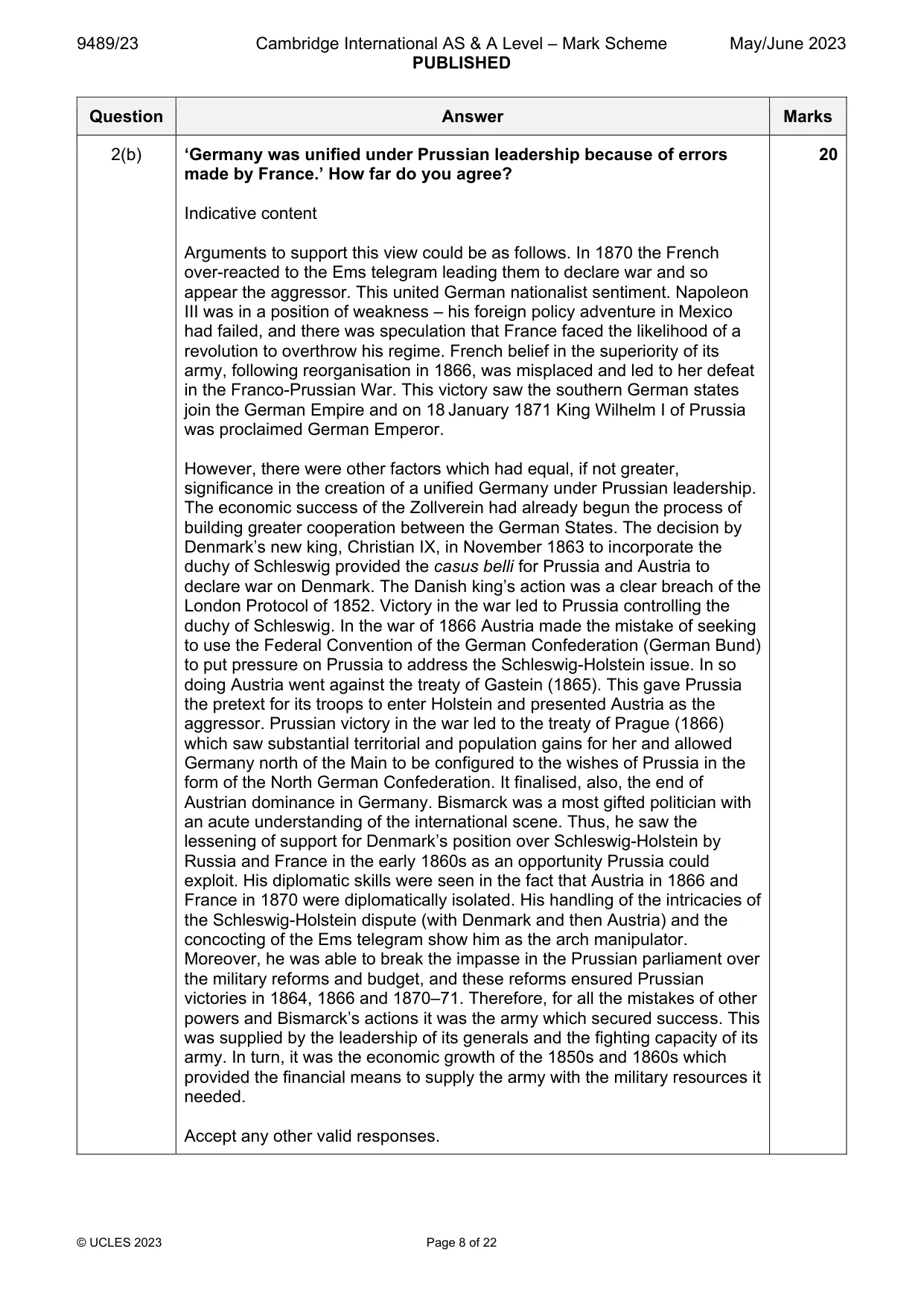
Mark scheme: 2(a) Explain why the Erfurt Union collapsed in 1850. 10 Indicative content The Erfurt Union’s goal was a united Germany under Prussian leadership. The proposed plan was far too complicated. This German Federal Reich (Empire) would exclude Austria. There would be a special relationship and a permanent union between the Reich and the Austrian Empire. This union would form a greater Germany. Austria and Prussia would be equal but there would be no central government or parliamentary assembly. This mixture of ‘small’ and ‘big’ Germany pleased neither set of adherents. The author of the plan, General von Radowitz, called a meeting of the German states at Erfurt in March 1850 to inaugurate the new Reich. Whilst 28 agreed to the Prussian dominated union, several crucial states (Bavaria and Württemberg), fearful of Prussian ambitions and of Austria’s reaction, declined. It was unacceptable to Austria who saw it as an attempt to reduce Austrian influence in Germany. Austria put forward its own plan for a ‘big’ Germany to be governed jointly by Austria, Prussia, and larger German states. This proved attractive to several of these larger states (Hanover and Saxony) who deserted Prussia. In May 1850, the Diet of the old German Confederation met in Frankfurt. An uprising in Hesse-Cassel, a member state of the Prussian Union Plan, led to its ruler requesting help from the Frankfurt Diet. Prussia mobilised and some small-scale fighting broke out, but Prussia did not feel confident in its army’s ability to win a war. At Olmütz in November 1850 Prussia agreed to abandon its union plan Accept any other valid responses. 2(b) ‘Germany was unified under Prussian leadership because of errors 20 made by France.’ How far do you agree? Indicative content Arguments to support this view could be as follows. In 1870 the French over-reacted to the Ems telegram leading them to declare war and so appear the aggressor. This united German nationalist sentiment. Napoleon III was in a position of weakness – his foreign policy adventure in Mexico had failed, and there was speculation that France faced the likelihood of a revolution to overthrow his regime. French belief in the superiority of its army, following reorganisation in 1866, was misplaced and led to her defeat in the Franco-Prussian War. This victory saw the southern German states join the German Empire and on 18 January 1871 King Wilhelm I of Prussia was proclaimed German Emperor. However, there were other factors which had equal, if not greater, significance in the creation of a unified Germany under Prussian leadership. The economic success of the Zollverein had already begun the process of building greater cooperation between the German States. The decision by Denmark’s new king, Christian IX, in November 1863 to incorporate the duchy of Schleswig provided the casus belli for Prussia and Austria to declare war on Denmark. The Danish king’s action was a clear breach of the London Protocol of 1852. Victory in the war led to Prussia controlling the duchy of Schleswig. In the war of 1866 Austria made the mistake of seeking to use the Federal Convention of the German Confederation (German Bund) to put pressure on Prussia to address the Schleswig-Holstein issue. In so doing Austria went against the treaty of Gastein (1865). This gave Prussia the pretext for its troops to enter Holstein and presented Austria as the aggressor. Prussian victory in the war led to the treaty of Prague (1866) which saw substantial territorial and population gains for her and allowed Germany north of the Main to be configured to the wishes of Prussia in the form of the North German Confederation. It finalised, also, the end of Austrian dominance in Germany. Bismarck was a most gifted politician with an acute understanding of the international scene. Thus, he saw the lessening of support for Denmark’s position over Schleswig-Holstein by Russia and France in the early 1860s as an opportunity Prussia could exploit. His diplomatic skills were seen in the fact that Austria in 1866 and France in 1870 were diplomatically isolated. His handling of the intricacies of the Schleswig-Holstein dispute (with Denmark and then Austria) and the concocting of the Ems telegram show him as the arch manipulator. Moreover, he was able to break the impasse in the Prussian parliament over the military reforms and budget, and these reforms ensured Prussian victories in 1864, 1866 and 1870–71. Therefore, for all the mistakes of other powers and Bismarck’s actions it was the army which secured success. This was supplied by the leadership of its generals and the fighting capacity of its army. In turn, it was the economic growth of the 1850s and 1860s which provided the financial means to supply the army with the military resources it needed. Accept any other valid responses.
More questions on How and why was German unification achieved by 1871?
Q3 · The Russian Revolution, 1894–1921 (a) Explain why control of Petrograd and Moscow was…
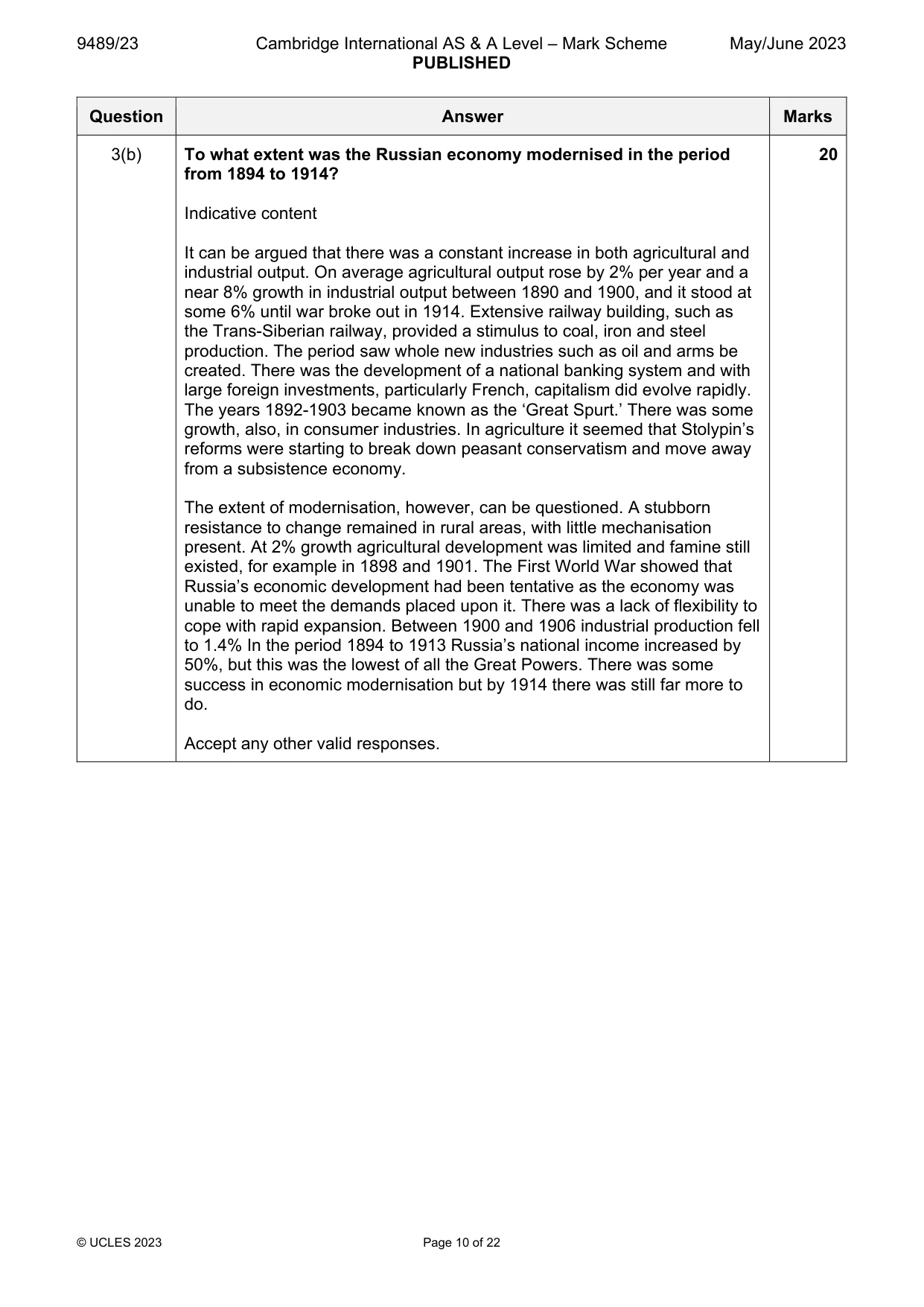
3 The Russian Revolution, 1894–1921 (a) Explain why control of Petrograd and Moscow was important for Bolshevik victory in the Russian Civil War. [10] (b) To what extent was the Russian economy modernised in the period from 1894 to 1914? [20]
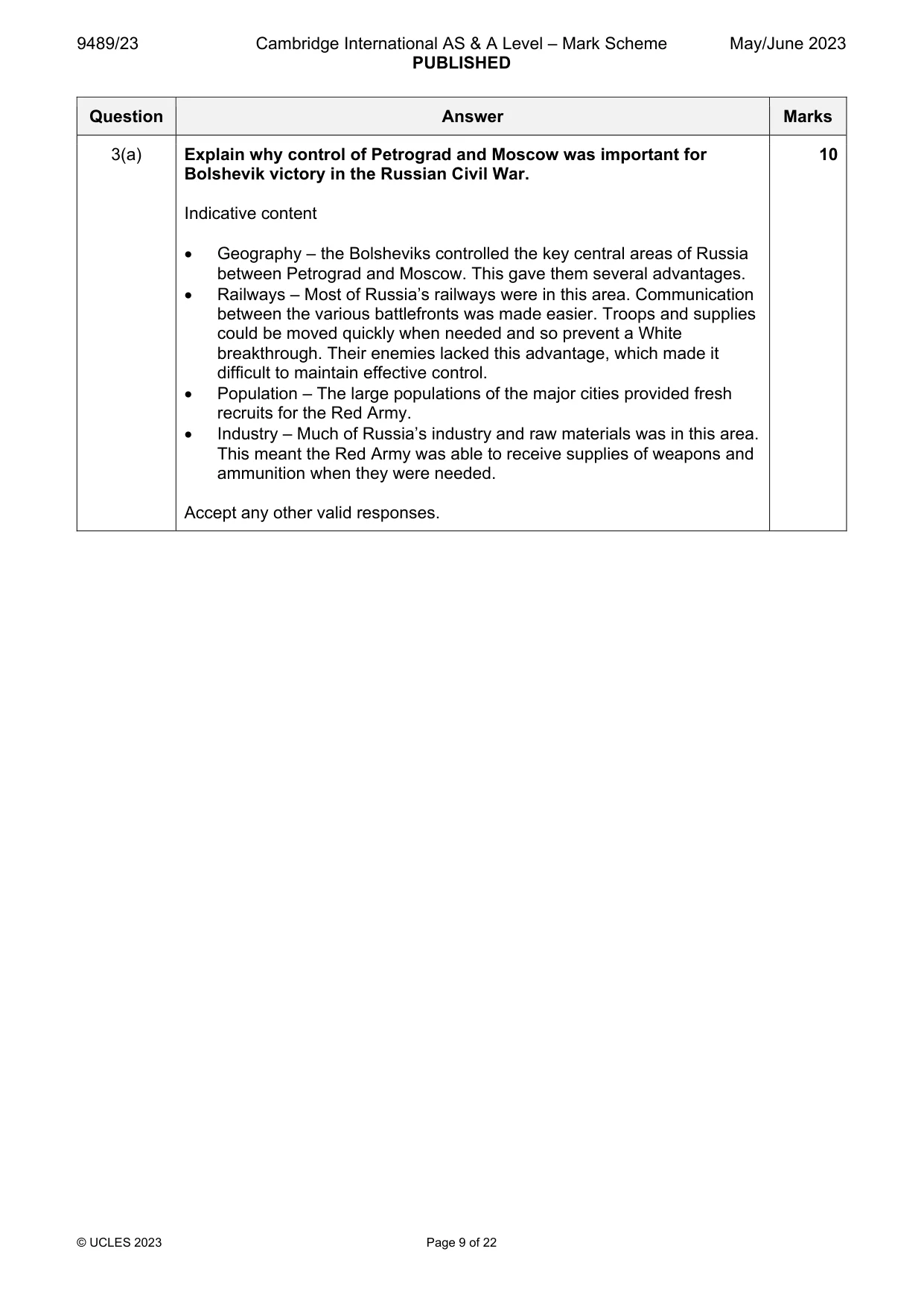
Mark scheme: 3(a) Explain why control of Petrograd and Moscow was important for 10 Bolshevik victory in the Russian Civil War. Indicative content Geography – the Bolsheviks controlled the key central areas of Russia between Petrograd and Moscow. This gave them several advantages. Railways – Most of Russia’s railways were in this area. Communication between the various battlefronts was made easier. Troops and supplies could be moved quickly when needed and so prevent a White breakthrough. Their enemies lacked this advantage, which made it difficult to maintain effective control. Population – The large populations of the major cities provided fresh recruits for the Red Army. Industry – Much of Russia’s industry and raw materials was in this area. This meant the Red Army was able to receive supplies of weapons and ammunition when they were needed. Accept any other valid responses. 3(b) To what extent was the Russian economy modernised in the period 20 from 1894 to 1914? Indicative content It can be argued that there was a constant increase in both agricultural and industrial output. On average agricultural output rose by 2% per year and a near 8% growth in industrial output between 1890 and 1900, and it stood at some 6% until war broke out in 1914. Extensive railway building, such as the Trans-Siberian railway, provided a stimulus to coal, iron and steel production. The period saw whole new industries such as oil and arms be created. There was the development of a national banking system and with large foreign investments, particularly French, capitalism did evolve rapidly. The years 1892-1903 became known as the ‘Great Spurt.’ There was some growth, also, in consumer industries. In agriculture it seemed that Stolypin’s reforms were starting to break down peasant conservatism and move away from a subsistence economy. The extent of modernisation, however, can be questioned. A stubborn resistance to change remained in rural areas, with little mechanisation present. At 2% growth agricultural development was limited and famine still existed, for example in 1898 and 1901. The First World War showed that Russia’s economic development had been tentative as the economy was unable to meet the demands placed upon it. There was a lack of flexibility to cope with rapid expansion. Between 1900 and 1906 industrial production fell to 1.4% In the period 1894 to 1913 Russia’s national income increased by 50%, but this was the lowest of all the Great Powers. There was some success in economic modernisation but by 1914 there was still far more to do. Accept any other valid responses.
More questions on What were the causes and outcomes of the 1905 Revolution up to 1914?
Q4 · The origins of the Civil War, 1820–61 (a) Explain why the Democratic Party was divided…
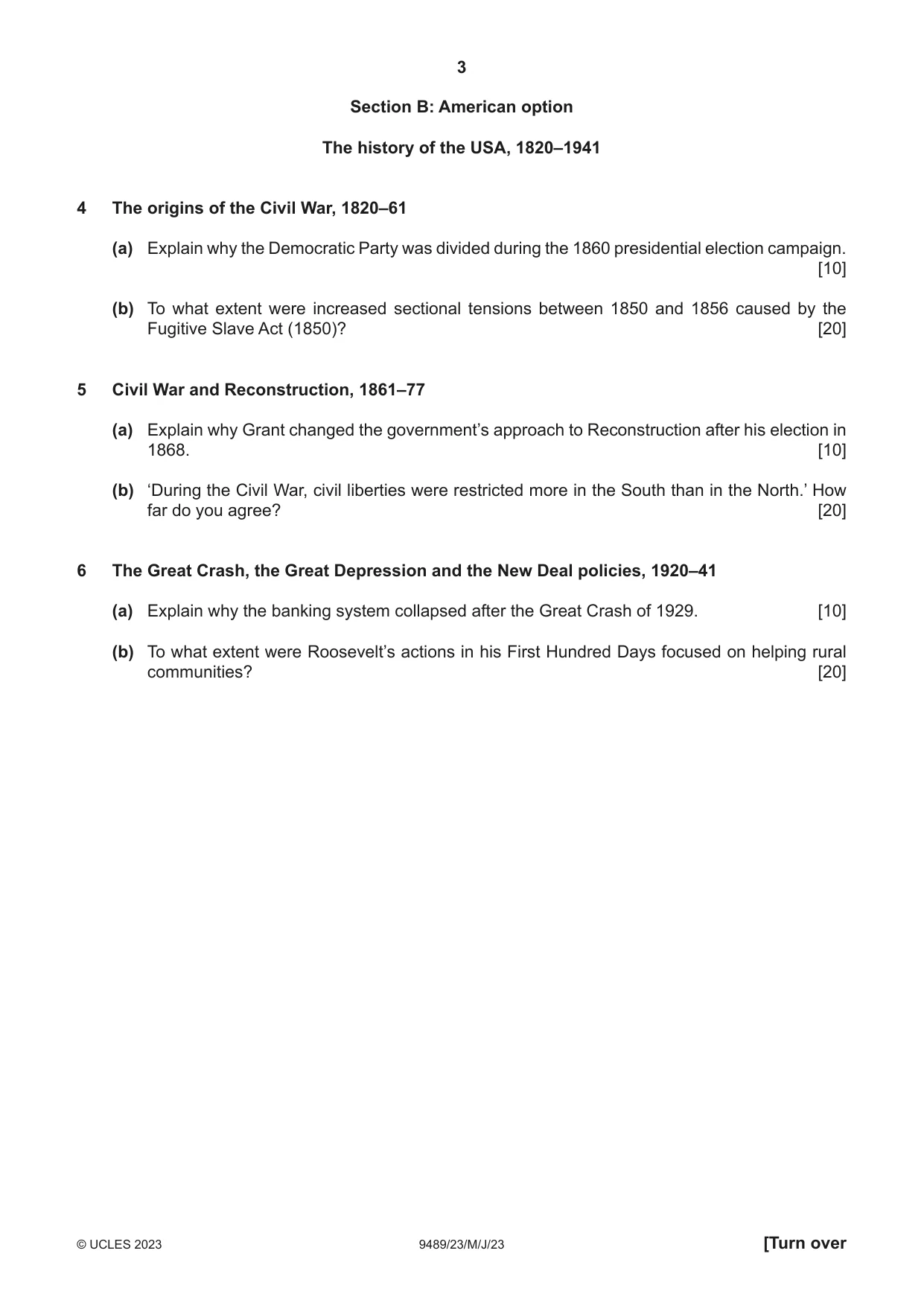
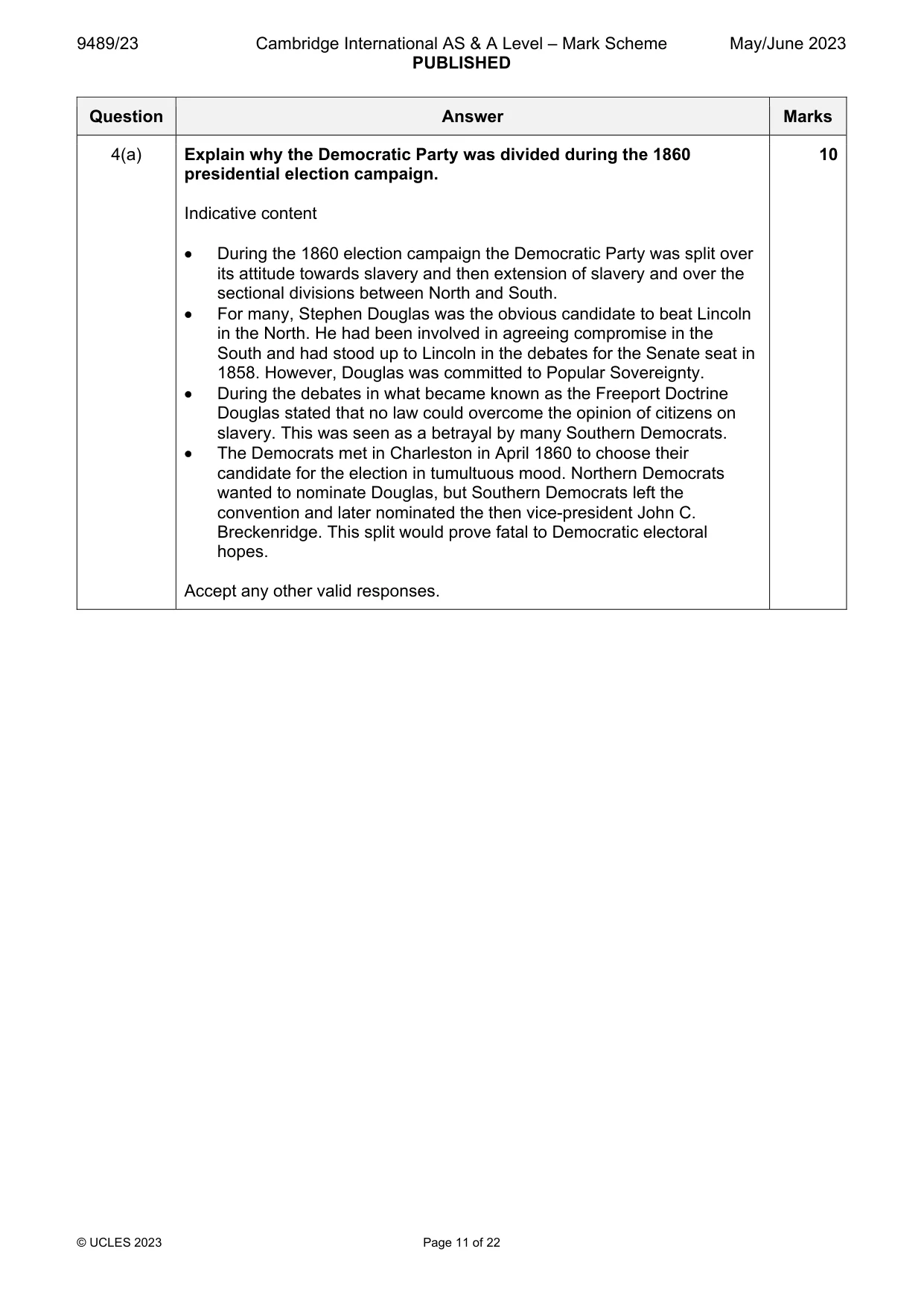
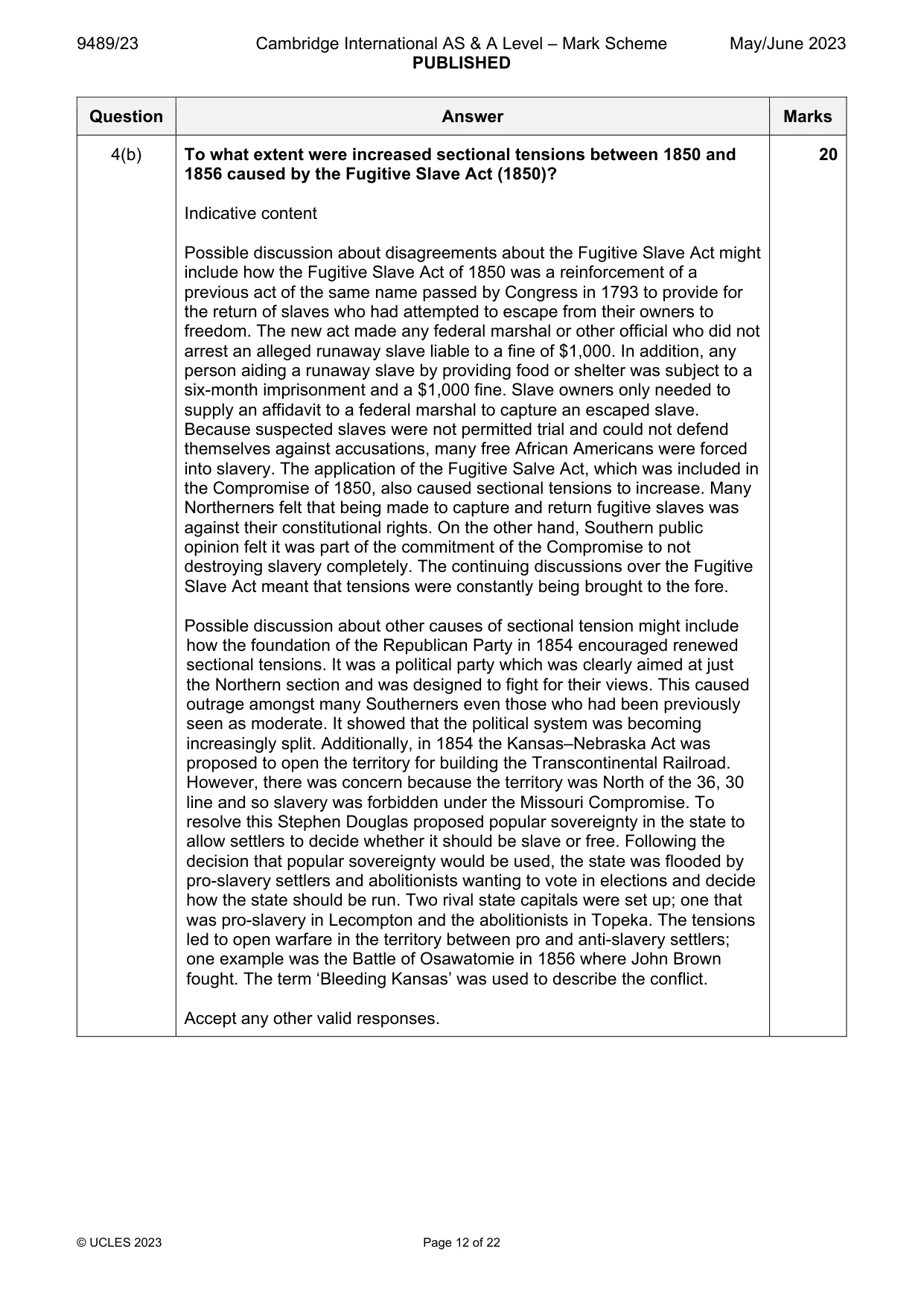
4 The origins of the Civil War, 1820–61 (a) Explain why the Democratic Party was divided during the 1860 presidential election campaign. [10] (b) To what extent were increased sectional tensions between 1850 and 1856 caused by the Fugitive Slave Act (1850)? [20]
Mark scheme: 4(a) Explain why the Democratic Party was divided during the 1860 10 presidential election campaign. Indicative content During the 1860 election campaign the Democratic Party was split over its attitude towards slavery and then extension of slavery and over the sectional divisions between North and South. For many, Stephen Douglas was the obvious candidate to beat Lincoln in the North. He had been involved in agreeing compromise in the South and had stood up to Lincoln in the debates for the Senate seat in 1858. However, Douglas was committed to Popular Sovereignty. During the debates in what became known as the Freeport Doctrine Douglas stated that no law could overcome the opinion of citizens on slavery. This was seen as a betrayal by many Southern Democrats. The Democrats met in Charleston in April 1860 to choose their candidate for the election in tumultuous mood. Northern Democrats wanted to nominate Douglas, but Southern Democrats left the convention and later nominated the then vice-president John C. Breckenridge. This split would prove fatal to Democratic electoral hopes. Accept any other valid responses. 4(b) To what extent were increased sectional tensions between 1850 and 20 1856 caused by the Fugitive Slave Act (1850)? Indicative content Possible discussion about disagreements about the Fugitive Slave Act might include how the Fugitive Slave Act of 1850 was a reinforcement of a previous act of the same name passed by Congress in 1793 to provide for the return of slaves who had attempted to escape from their owners to freedom. The new act made any federal marshal or other official who did not arrest an alleged runaway slave liable to a fine of $1,000. In addition, any person aiding a runaway slave by providing food or shelter was subject to a six-month imprisonment and a $1,000 fine. Slave owners only needed to supply an affidavit to a federal marshal to capture an escaped slave. Because suspected slaves were not permitted trial and could not defend themselves against accusations, many free African Americans were forced into slavery. The application of the Fugitive Salve Act, which was included in the Compromise of 1850, also caused sectional tensions to increase. Many Northerners felt that being made to capture and return fugitive slaves was against their constitutional rights. On the other hand, Southern public opinion felt it was part of the commitment of the Compromise to not destroying slavery completely. The continuing discussions over the Fugitive Slave Act meant that tensions were constantly being brought to the fore. Possible discussion about other causes of sectional tension might include how the foundation of the Republican Party in 1854 encouraged renewed sectional tensions. It was a political party which was clearly aimed at just the Northern section and was designed to fight for their views. This caused outrage amongst many Southerners even those who had been previously seen as moderate. It showed that the political system was becoming increasingly split. Additionally, in 1854 the Kansas–Nebraska Act was proposed to open the territory for building the Transcontinental Railroad. However, there was concern because the territory was North of the 36, 30 line and so slavery was forbidden under the Missouri Compromise. To resolve this Stephen Douglas proposed popular sovereignty in the state to allow settlers to decide whether it should be slave or free. Following the decision that popular sovereignty would be used, the state was flooded by pro-slavery settlers and abolitionists wanting to vote in elections and decide how the state should be run. Two rival state capitals were set up; one that was pro-slavery in Lecompton and the abolitionists in Topeka. The tensions led to open warfare in the territory between pro and anti-slavery settlers; one example was the Battle of Osawatomie in 1856 where John Brown fought. The term ‘Bleeding Kansas’ was used to describe the conflict. Accept any other valid responses.
More questions on Why was there increasing tension between the North and the South before 1860?
Q5 · Civil War and Reconstruction, 1861–77 (a) Explain why Grant changed the government’s…
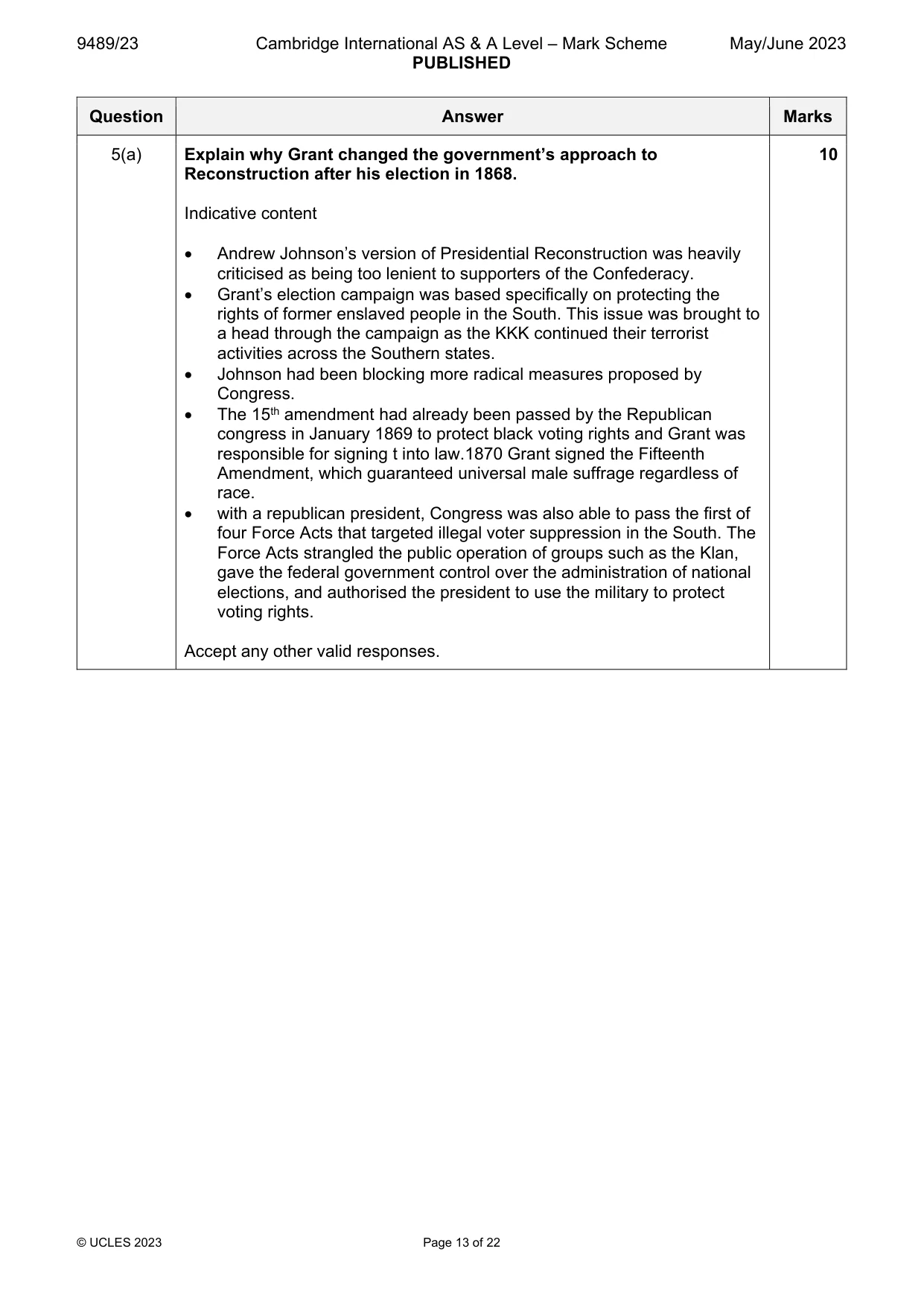
5 Civil War and Reconstruction, 1861–77 (a) Explain why Grant changed the government’s approach to Reconstruction after his election in 1868. [10] (b) ‘During the Civil War, civil liberties were restricted more in the South than in the North.’ How far do you agree? [20]
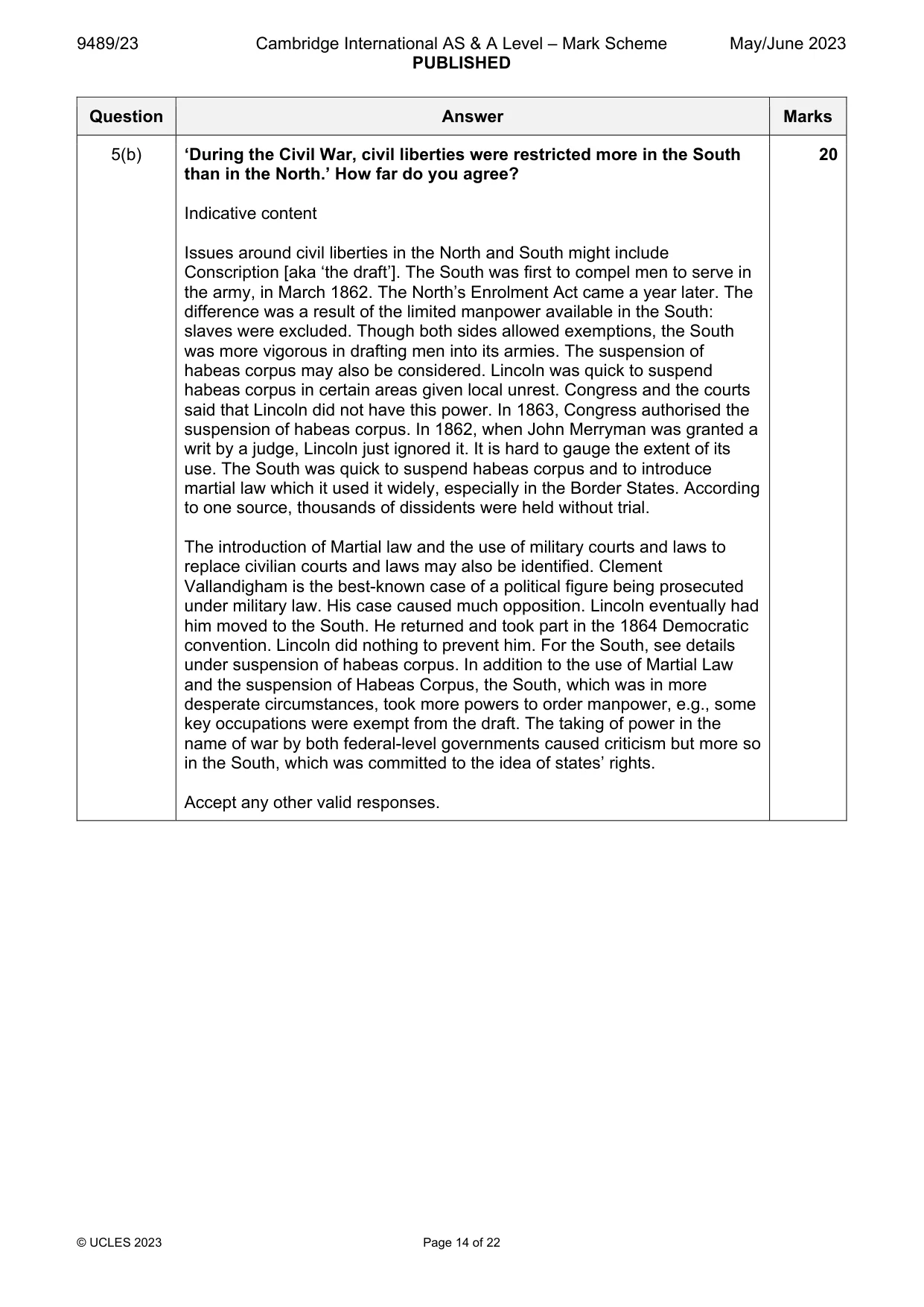
Mark scheme: 5(a) Explain why Grant changed the government’s approach to 10 Reconstruction after his election in 1868. Indicative content Andrew Johnson’s version of Presidential Reconstruction was heavily criticised as being too lenient to supporters of the Confederacy. Grant’s election campaign was based specifically on protecting the rights of former enslaved people in the South. This issue was brought to a head through the campaign as the KKK continued their terrorist activities across the Southern states. Johnson had been blocking more radical measures proposed by Congress. The 15th amendment had already been passed by the Republican congress in January 1869 to protect black voting rights and Grant was responsible for signing t into law.1870 Grant signed the Fifteenth Amendment, which guaranteed universal male suffrage regardless of race. with a republican president, Congress was also able to pass the first of four Force Acts that targeted illegal voter suppression in the South. The Force Acts strangled the public operation of groups such as the Klan, gave the federal government control over the administration of national elections, and authorised the president to use the military to protect voting rights. Accept any other valid responses. 5(b) ‘During the Civil War, civil liberties were restricted more in the South 20 than in the North.’ How far do you agree? Indicative content Issues around civil liberties in the North and South might include Conscription [aka ‘the draft’]. The South was first to compel men to serve in the army, in March 1862. The North’s Enrolment Act came a year later. The difference was a result of the limited manpower available in the South: slaves were excluded. Though both sides allowed exemptions, the South was more vigorous in drafting men into its armies. The suspension of habeas corpus may also be considered. Lincoln was quick to suspend habeas corpus in certain areas given local unrest. Congress and the courts said that Lincoln did not have this power. In 1863, Congress authorised the suspension of habeas corpus. In 1862, when John Merryman was granted a writ by a judge, Lincoln just ignored it. It is hard to gauge the extent of its use. The South was quick to suspend habeas corpus and to introduce martial law which it used it widely, especially in the Border States. According to one source, thousands of dissidents were held without trial. The introduction of Martial law and the use of military courts and laws to replace civilian courts and laws may also be identified. Clement Vallandigham is the best-known case of a political figure being prosecuted under military law. His case caused much opposition. Lincoln eventually had him moved to the South. He returned and took part in the 1864 Democratic convention. Lincoln did nothing to prevent him. For the South, see details under suspension of habeas corpus. In addition to the use of Martial Law and the suspension of Habeas Corpus, the South, which was in more desperate circumstances, took more powers to order manpower, e.g., some key occupations were exempt from the draft. The taking of power in the name of war by both federal-level governments caused criticism but more so in the South, which was committed to the idea of states’ rights. Accept any other valid responses.
Q6 · The Great Crash, the Great Depression and the New Deal policies, 1920–41 (a) Explain why…
6 The Great Crash, the Great Depression and the New Deal policies, 1920–41 (a) Explain why the banking system collapsed after the Great Crash of 1929. [10] (b) To what extent were Roosevelt’s actions in his First Hundred Days focused on helping rural communities? [20] Section C: International option International history, 1870–1945
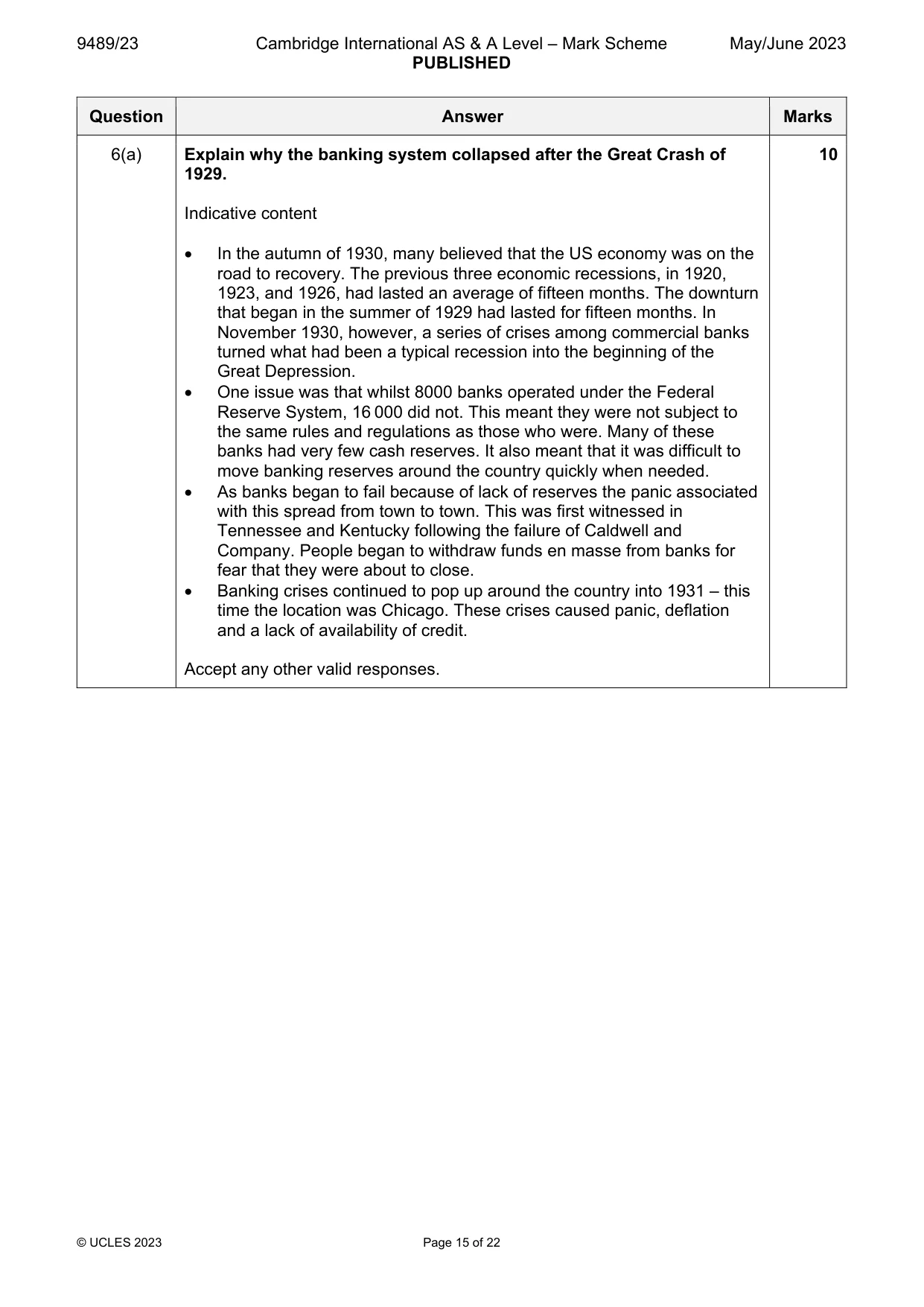
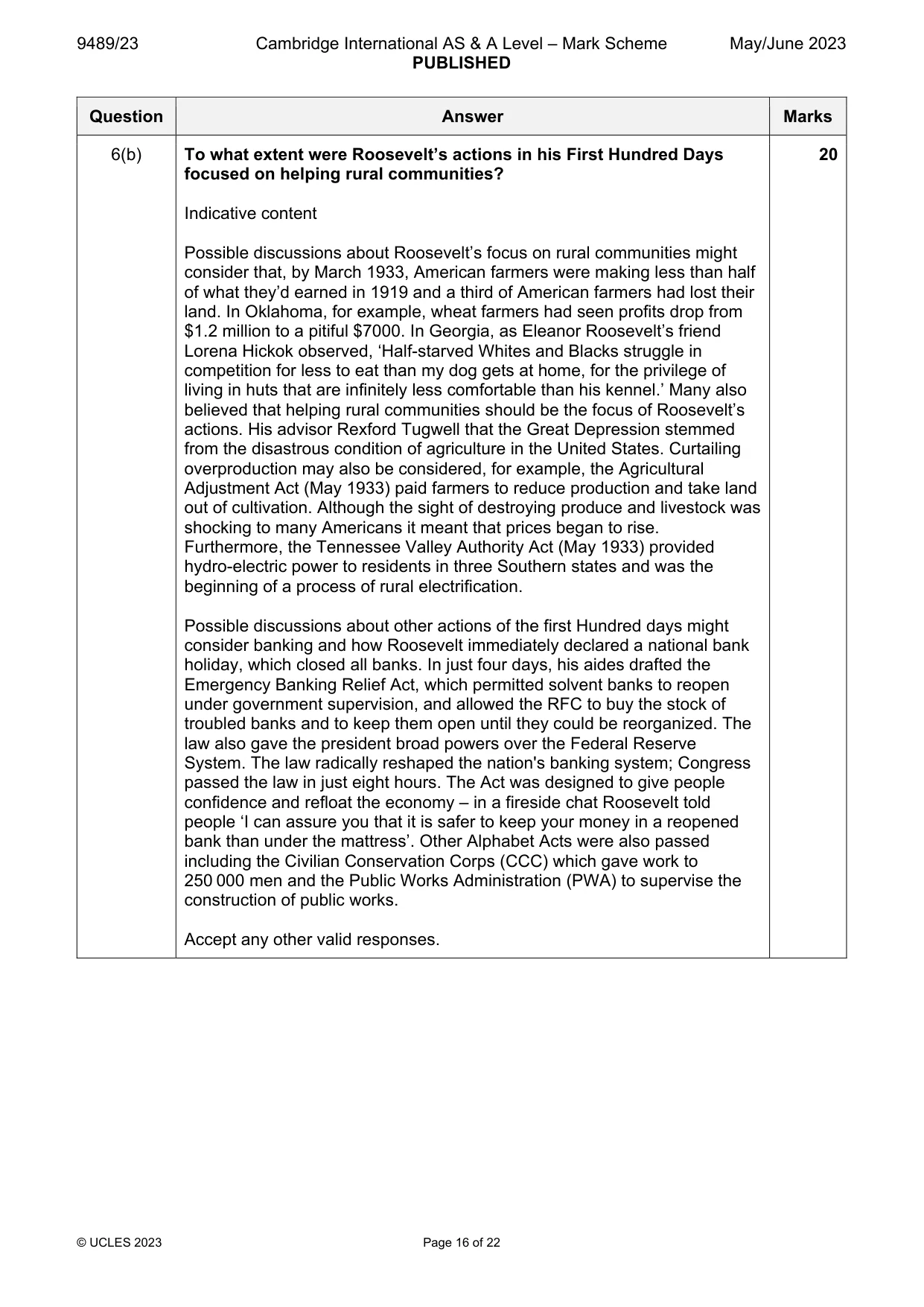
Mark scheme: 6(a) Explain why the banking system collapsed after the Great Crash of 10 1929. Indicative content In the autumn of 1930, many believed that the US economy was on the road to recovery. The previous three economic recessions, in 1920, 1923, and 1926, had lasted an average of fifteen months. The downturn that began in the summer of 1929 had lasted for fifteen months. In November 1930, however, a series of crises among commercial banks turned what had been a typical recession into the beginning of the Great Depression. One issue was that whilst 8000 banks operated under the Federal Reserve System, 16 000 did not. This meant they were not subject to the same rules and regulations as those who were. Many of these banks had very few cash reserves. It also meant that it was difficult to move banking reserves around the country quickly when needed. As banks began to fail because of lack of reserves the panic associated with this spread from town to town. This was first witnessed in Tennessee and Kentucky following the failure of Caldwell and Company. People began to withdraw funds en masse from banks for fear that they were about to close. Banking crises continued to pop up around the country into 1931 – this time the location was Chicago. These crises caused panic, deflation and a lack of availability of credit. Accept any other valid responses. 6(b) To what extent were Roosevelt’s actions in his First Hundred Days 20 focused on helping rural communities? Indicative content Possible discussions about Roosevelt’s focus on rural communities might consider that, by March 1933, American farmers were making less than half of what they’d earned in 1919 and a third of American farmers had lost their land. In Oklahoma, for example, wheat farmers had seen profits drop from $1.2 million to a pitiful $7000. In Georgia, as Eleanor Roosevelt’s friend Lorena Hickok observed, ‘Half-starved Whites and Blacks struggle in competition for less to eat than my dog gets at home, for the privilege of living in huts that are infinitely less comfortable than his kennel.’ Many also believed that helping rural communities should be the focus of Roosevelt’s actions. His advisor Rexford Tugwell that the Great Depression stemmed from the disastrous condition of agriculture in the United States. Curtailing overproduction may also be considered, for example, the Agricultural Adjustment Act (May 1933) paid farmers to reduce production and take land out of cultivation. Although the sight of destroying produce and livestock was shocking to many Americans it meant that prices began to rise. Furthermore, the Tennessee Valley Authority Act (May 1933) provided hydro-electric power to residents in three Southern states and was the beginning of a process of rural electrification. Possible discussions about other actions of the first Hundred days might consider banking and how Roosevelt immediately declared a national bank holiday, which closed all banks. In just four days, his aides drafted the Emergency Banking Relief Act, which permitted solvent banks to reopen under government supervision, and allowed the RFC to buy the stock of troubled banks and to keep them open until they could be reorganized. The law also gave the president broad powers over the Federal Reserve System. The law radically reshaped the nation's banking system; Congress passed the law in just eight hours. The Act was designed to give people confidence and refloat the economy – in a fireside chat Roosevelt told people ‘I can assure you that it is safer to keep your money in a reopened bank than under the mattress’. Other Alphabet Acts were also passed including the Civilian Conservation Corps (CCC) which gave work to 250 000 men and the Public Works Administration (PWA) to supervise the construction of public works. Accept any other valid responses.
More questions on How successful was Roosevelt’s first New Deal?
Q7 · The League of Nations and international relations in the 1920s (a) Explain why the…
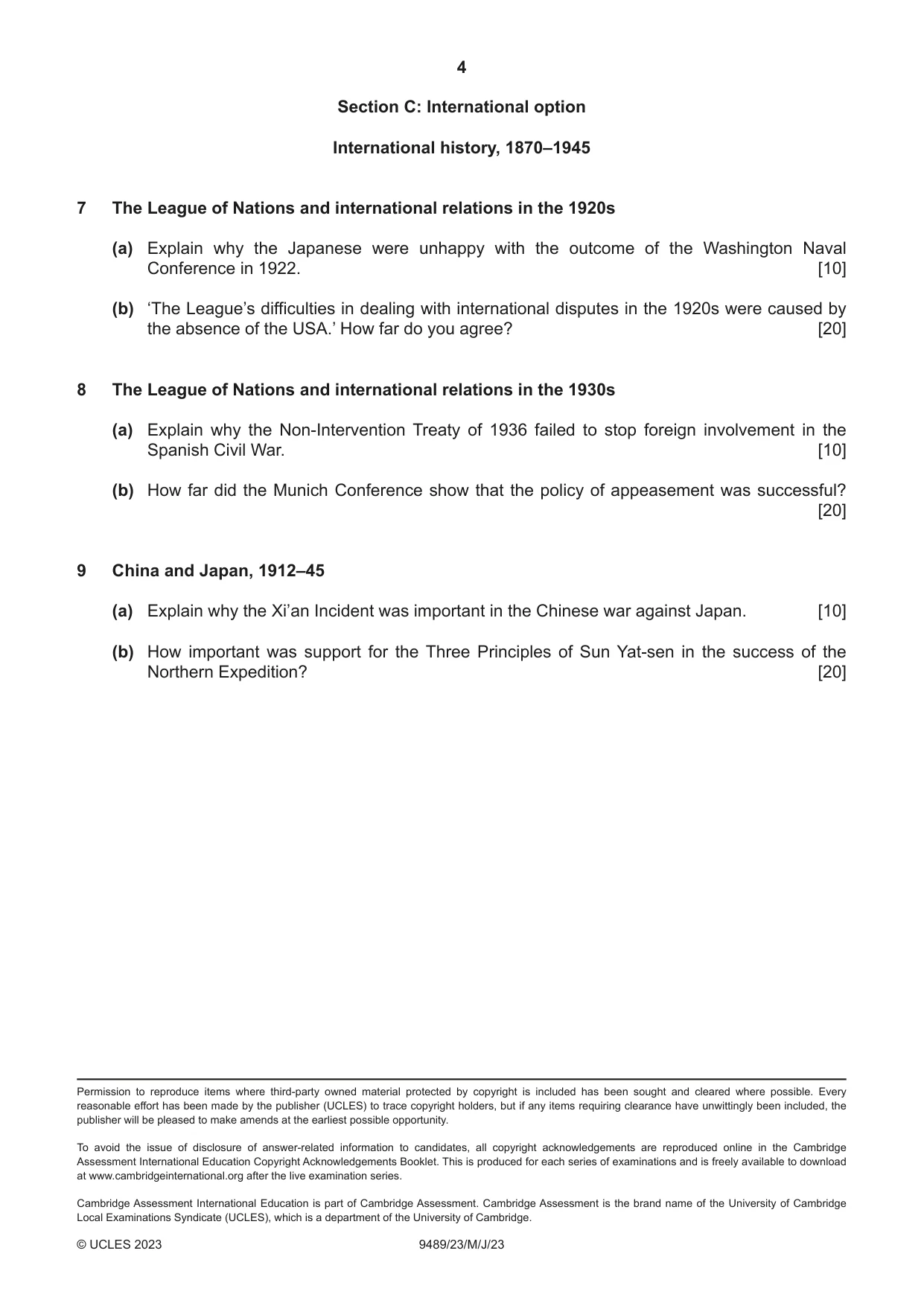
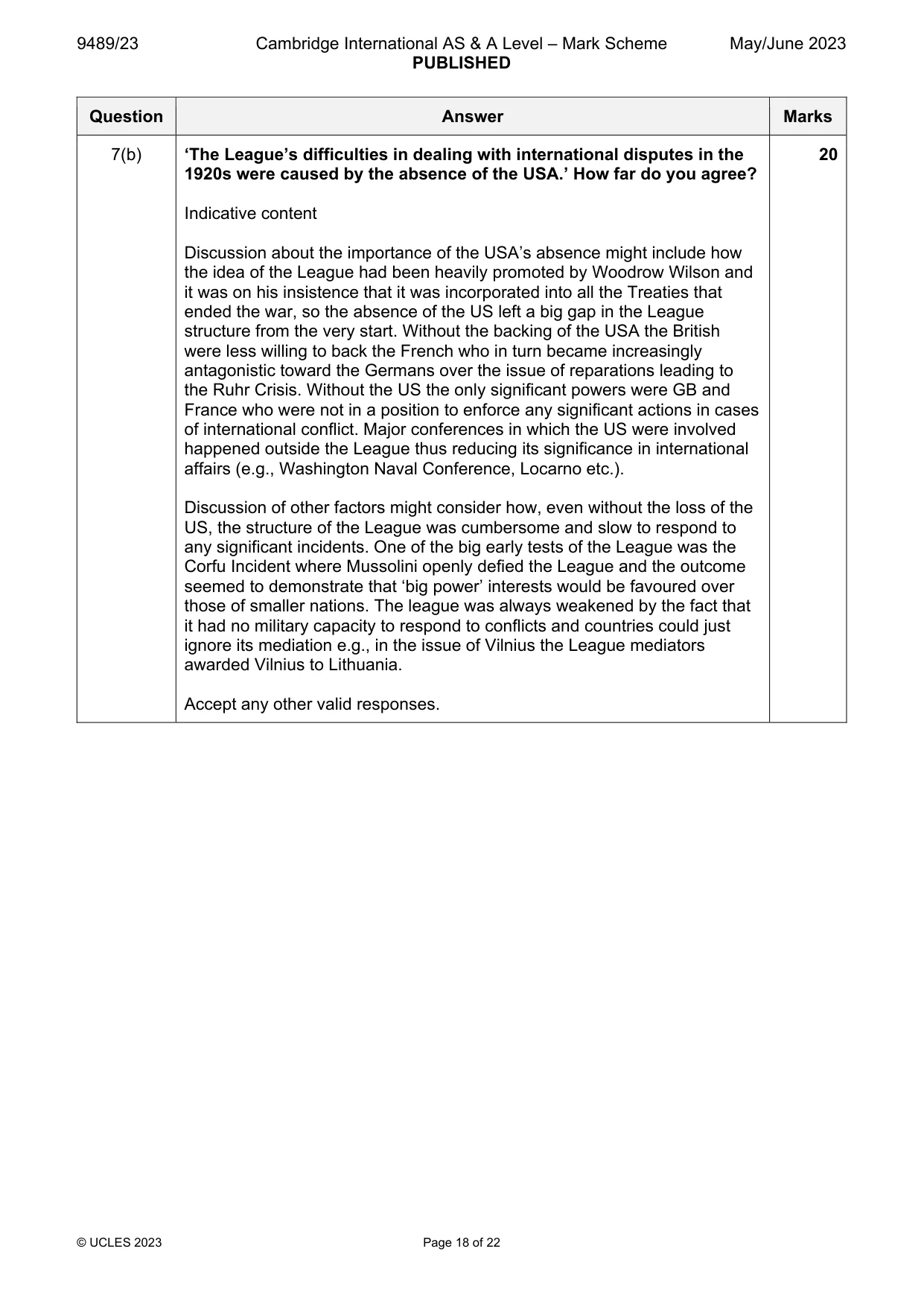
7 The League of Nations and international relations in the 1920s (a) Explain why the Japanese were unhappy with the outcome of the Washington Naval Conference in 1922. [10] (b) ‘The League’s difficulties in dealing with international disputes in the 1920s were caused by the absence of the USA.’ How far do you agree? [20]
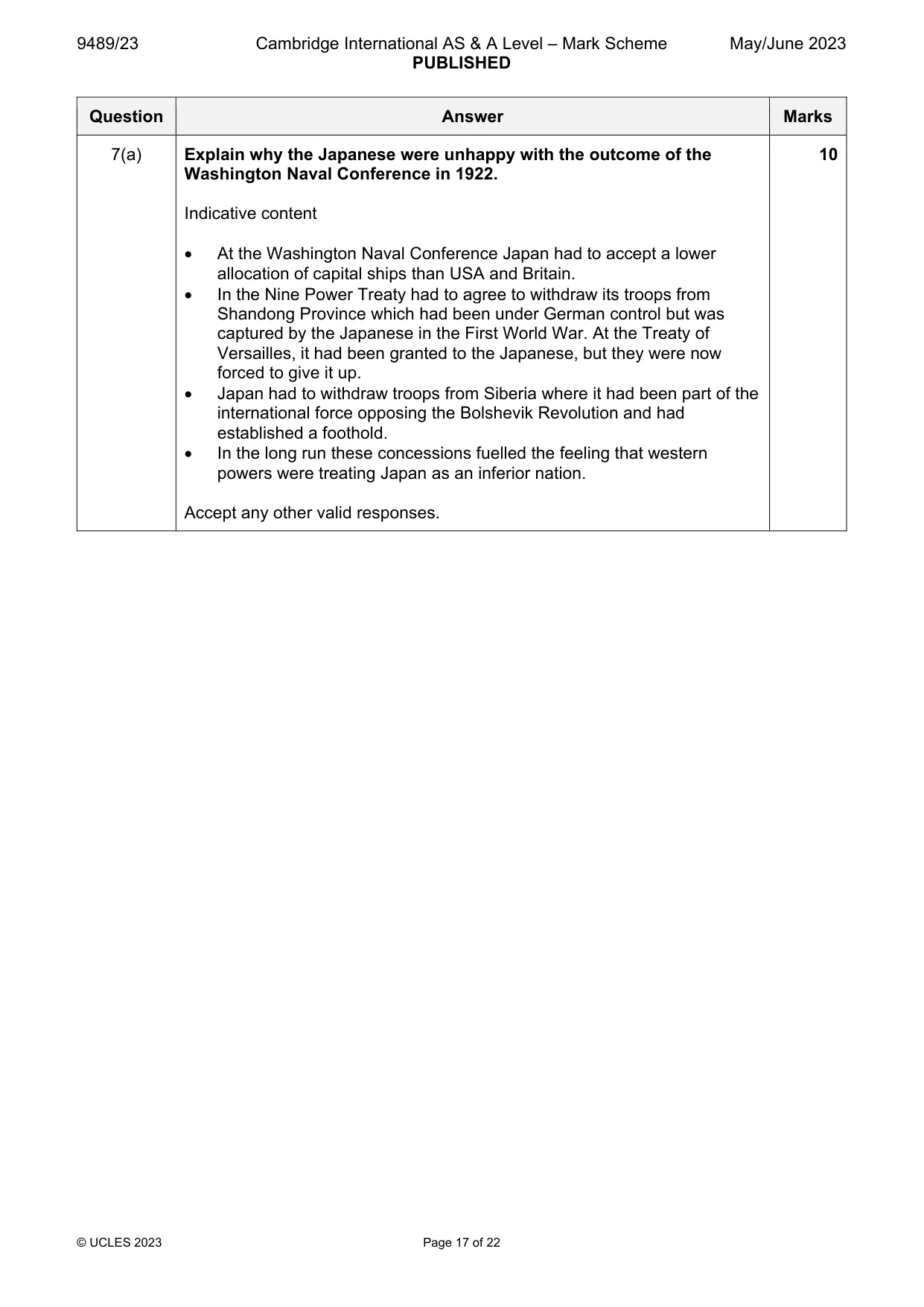
Mark scheme: 7(a) Explain why the Japanese were unhappy with the outcome of the 10 Washington Naval Conference in 1922. Indicative content At the Washington Naval Conference Japan had to accept a lower allocation of capital ships than USA and Britain. In the Nine Power Treaty had to agree to withdraw its troops from Shandong Province which had been under German control but was captured by the Japanese in the First World War. At the Treaty of Versailles, it had been granted to the Japanese, but they were now forced to give it up. Japan had to withdraw troops from Siberia where it had been part of the international force opposing the Bolshevik Revolution and had established a foothold. In the long run these concessions fuelled the feeling that western powers were treating Japan as an inferior nation. Accept any other valid responses. 7(b) ‘The League’s difficulties in dealing with international disputes in the 20 1920s were caused by the absence of the USA.’ How far do you agree? Indicative content Discussion about the importance of the USA’s absence might include how the idea of the League had been heavily promoted by Woodrow Wilson and it was on his insistence that it was incorporated into all the Treaties that ended the war, so the absence of the US left a big gap in the League structure from the very start. Without the backing of the USA the British were less willing to back the French who in turn became increasingly antagonistic toward the Germans over the issue of reparations leading to the Ruhr Crisis. Without the US the only significant powers were GB and France who were not in a position to enforce any significant actions in cases of international conflict. Major conferences in which the US were involved happened outside the League thus reducing its significance in international affairs (e.g., Washington Naval Conference, Locarno etc.). Discussion of other factors might consider how, even without the loss of the US, the structure of the League was cumbersome and slow to respond to any significant incidents. One of the big early tests of the League was the Corfu Incident where Mussolini openly defied the League and the outcome seemed to demonstrate that ‘big power’ interests would be favoured over those of smaller nations. The league was always weakened by the fact that it had no military capacity to respond to conflicts and countries could just ignore its mediation e.g., in the issue of Vilnius the League mediators awarded Vilnius to Lithuania. Accept any other valid responses.
Q8 · The League of Nations and international relations in the 1930s (a) Explain why the…
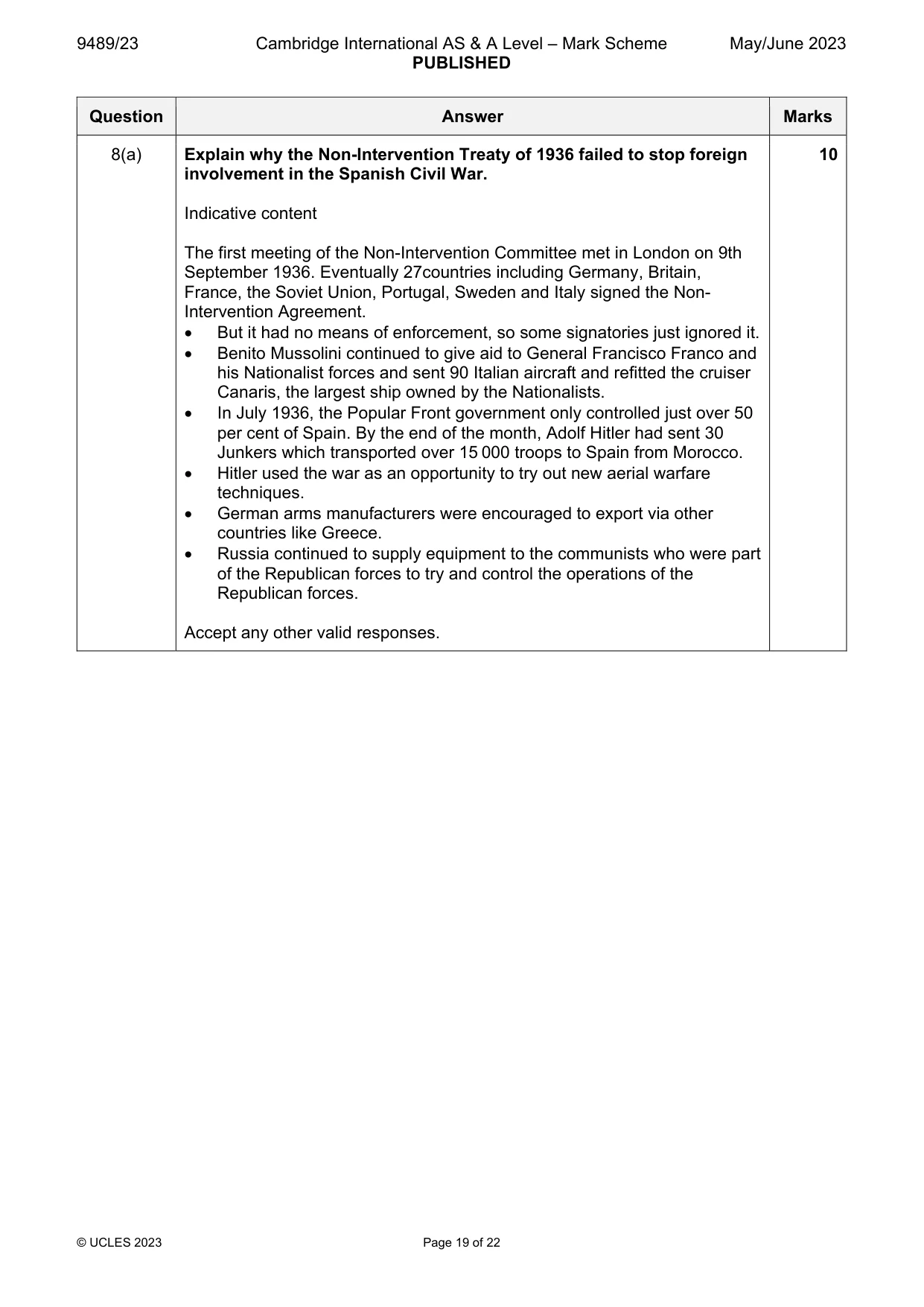
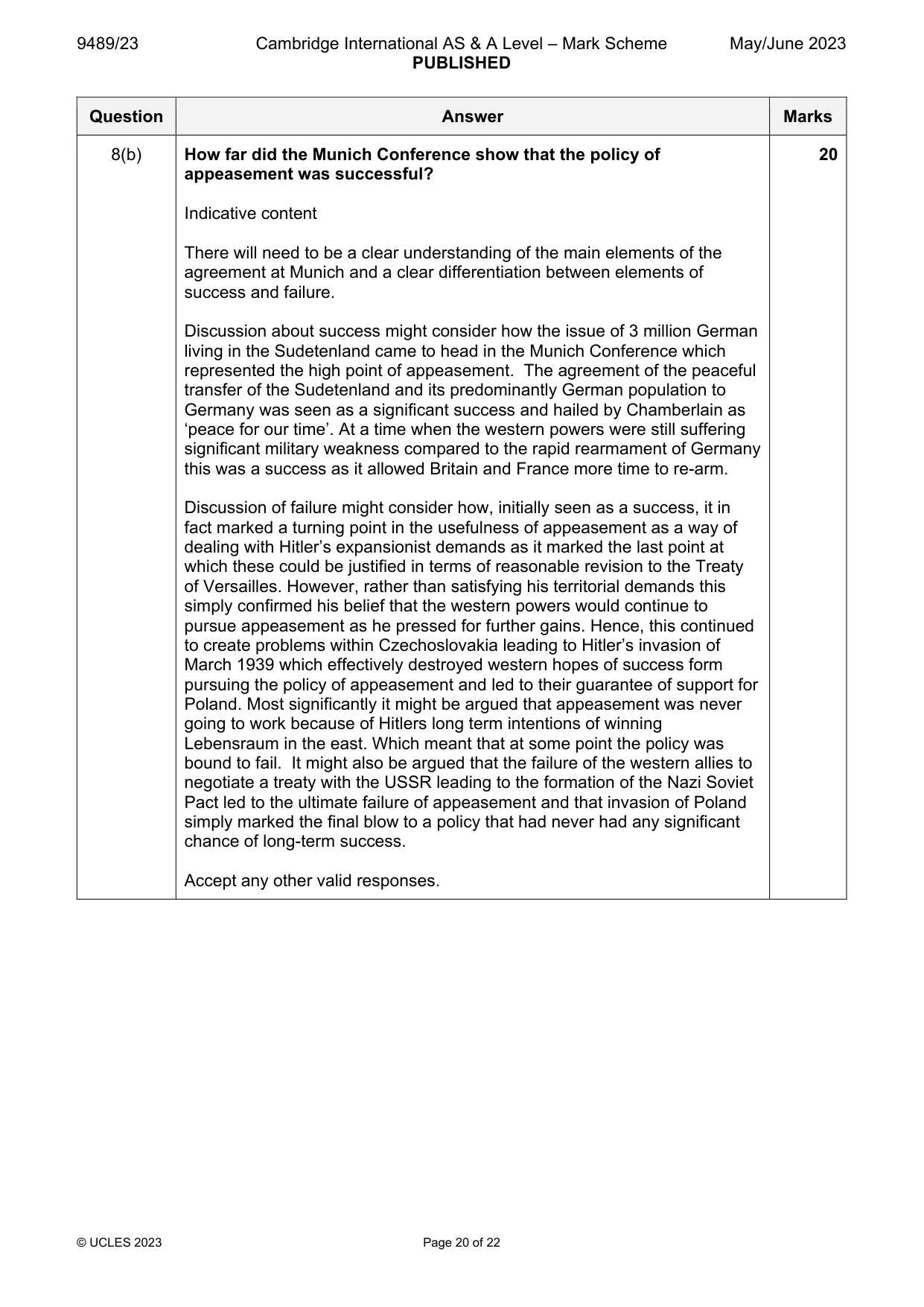
8 The League of Nations and international relations in the 1930s (a) Explain why the Non-Intervention Treaty of 1936 failed to stop foreign involvement in the Spanish Civil War. [10] (b) How far did the Munich Conference show that the policy of appeasement was successful? [20]
Mark scheme: 8(a) Explain why the Non-Intervention Treaty of 1936 failed to stop foreign 10 involvement in the Spanish Civil War. Indicative content The first meeting of the Non-Intervention Committee met in London on 9th September 1936. Eventually 27countries including Germany, Britain, France, the Soviet Union, Portugal, Sweden and Italy signed the Non- Intervention Agreement. But it had no means of enforcement, so some signatories just ignored it. Benito Mussolini continued to give aid to General Francisco Franco and his Nationalist forces and sent 90 Italian aircraft and refitted the cruiser Canaris, the largest ship owned by the Nationalists. In July 1936, the Popular Front government only controlled just over 50 per cent of Spain. By the end of the month, Adolf Hitler had sent 30 Junkers which transported over 15 000 troops to Spain from Morocco. Hitler used the war as an opportunity to try out new aerial warfare techniques. German arms manufacturers were encouraged to export via other countries like Greece. Russia continued to supply equipment to the communists who were part of the Republican forces to try and control the operations of the Republican forces. Accept any other valid responses. 8(b) How far did the Munich Conference show that the policy of 20 appeasement was successful? Indicative content There will need to be a clear understanding of the main elements of the agreement at Munich and a clear differentiation between elements of success and failure. Discussion about success might consider how the issue of 3 million German living in the Sudetenland came to head in the Munich Conference which represented the high point of appeasement. The agreement of the peaceful transfer of the Sudetenland and its predominantly German population to Germany was seen as a significant success and hailed by Chamberlain as ‘peace for our time’. At a time when the western powers were still suffering significant military weakness compared to the rapid rearmament of Germany this was a success as it allowed Britain and France more time to re-arm. Discussion of failure might consider how, initially seen as a success, it in fact marked a turning point in the usefulness of appeasement as a way of dealing with Hitler’s expansionist demands as it marked the last point at which these could be justified in terms of reasonable revision to the Treaty of Versailles. However, rather than satisfying his territorial demands this simply confirmed his belief that the western powers would continue to pursue appeasement as he pressed for further gains. Hence, this continued to create problems within Czechoslovakia leading to Hitler’s invasion of March 1939 which effectively destroyed western hopes of success form pursuing the policy of appeasement and led to their guarantee of support for Poland. Most significantly it might be argued that appeasement was never going to work because of Hitlers long term intentions of winning Lebensraum in the east. Which meant that at some point the policy was bound to fail. It might also be argued that the failure of the western allies to negotiate a treaty with the USSR leading to the formation of the Nazi Soviet Pact led to the ultimate failure of appeasement and that invasion of Poland simply marked the final blow to a policy that had never had any significant chance of long-term success. Accept any other valid responses.
More questions on Why, and with what effects, did Britain and France pursue a policy of appeasement?
Q9 · China and Japan, 1912–45 (a) Explain why the Xi’an Incident was important in the Chinese…
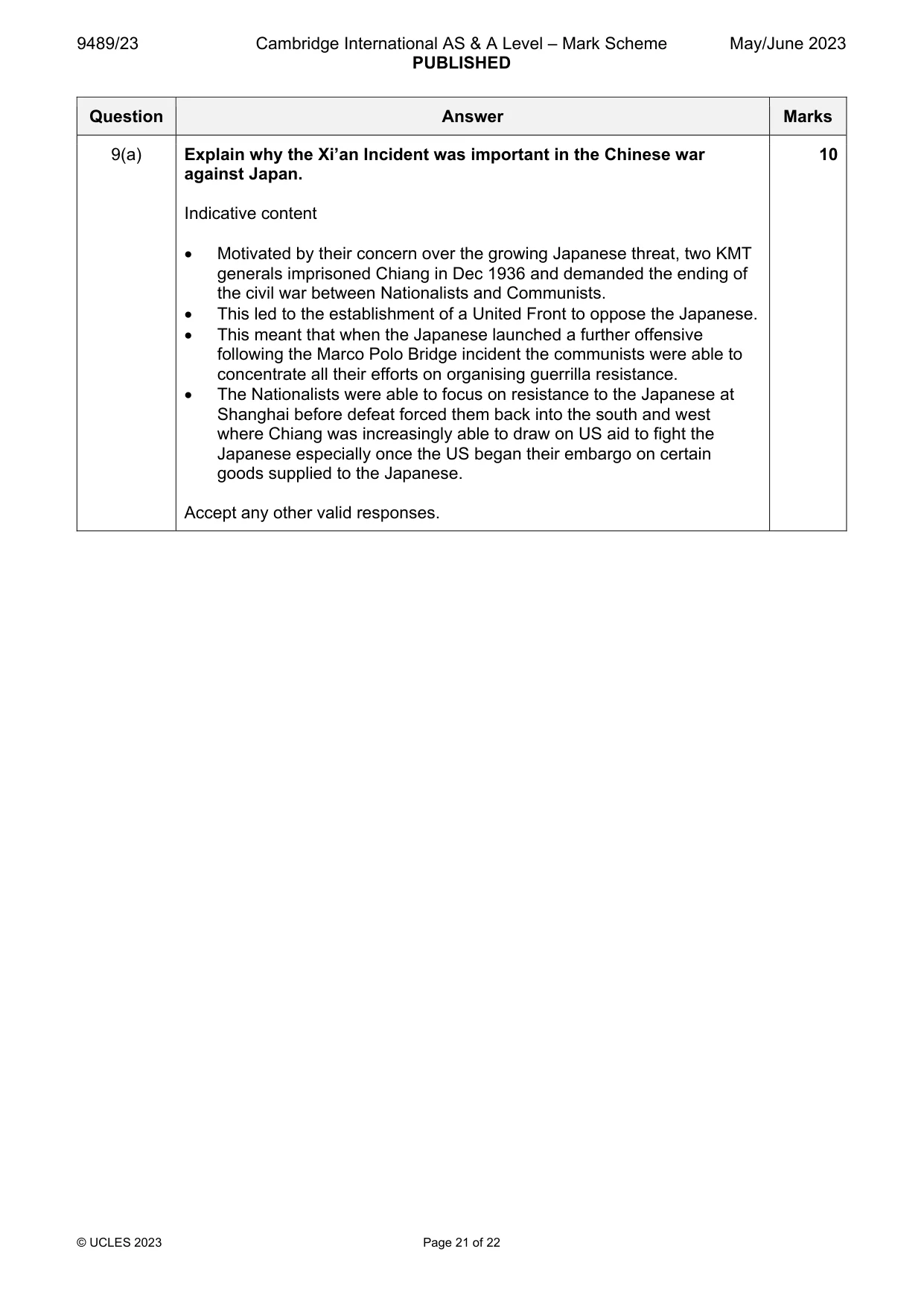
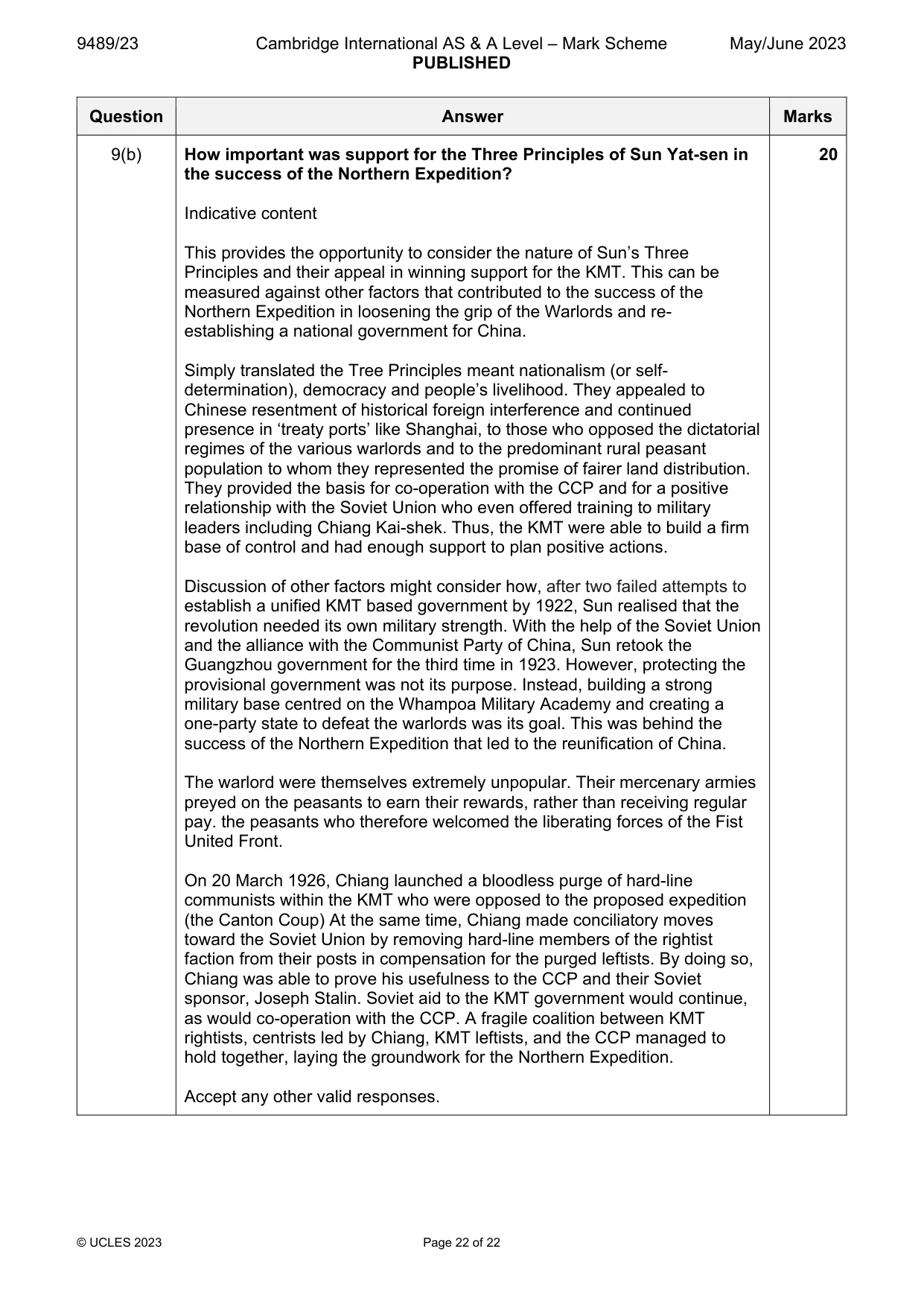
9 China and Japan, 1912–45 (a) Explain why the Xi’an Incident was important in the Chinese war against Japan. [10] (b) How important was support for the Three Principles of Sun Yat-sen in the success of the Northern Expedition? [20]
Mark scheme: 9(a) Explain why the Xi’an Incident was important in the Chinese war 10 against Japan. Indicative content Motivated by their concern over the growing Japanese threat, two KMT generals imprisoned Chiang in Dec 1936 and demanded the ending of the civil war between Nationalists and Communists. This led to the establishment of a United Front to oppose the Japanese. This meant that when the Japanese launched a further offensive following the Marco Polo Bridge incident the communists were able to concentrate all their efforts on organising guerrilla resistance. The Nationalists were able to focus on resistance to the Japanese at Shanghai before defeat forced them back into the south and west where Chiang was increasingly able to draw on US aid to fight the Japanese especially once the US began their embargo on certain goods supplied to the Japanese. Accept any other valid responses. 9(b) How important was support for the Three Principles of Sun Yat-sen in 20 the success of the Northern Expedition? Indicative content This provides the opportunity to consider the nature of Sun’s Three Principles and their appeal in winning support for the KMT. This can be measured against other factors that contributed to the success of the Northern Expedition in loosening the grip of the Warlords and re- establishing a national government for China. Simply translated the Tree Principles meant nationalism (or self- determination), democracy and people’s livelihood. They appealed to Chinese resentment of historical foreign interference and continued presence in ‘treaty ports’ like Shanghai, to those who opposed the dictatorial regimes of the various warlords and to the predominant rural peasant population to whom they represented the promise of fairer land distribution. They provided the basis for co-operation with the CCP and for a positive relationship with the Soviet Union who even offered training to military leaders including Chiang Kai-shek. Thus, the KMT were able to build a firm base of control and had enough support to plan positive actions. Discussion of other factors might consider how, after two failed attempts to establish a unified KMT based government by 1922, Sun realised that the revolution needed its own military strength. With the help of the Soviet Union and the alliance with the Communist Party of China, Sun retook the Guangzhou government for the third time in 1923. However, protecting the provisional government was not its purpose. Instead, building a strong military base centred on the Whampoa Military Academy and creating a one-party state to defeat the warlords was its goal. This was behind the success of the Northern Expedition that led to the reunification of China. The warlord were themselves extremely unpopular. Their mercenary armies preyed on the peasants to earn their rewards, rather than receiving regular pay. the peasants who therefore welcomed the liberating forces of the Fist United Front. On 20 March 1926, Chiang launched a bloodless purge of hard-line communists within the KMT who were opposed to the proposed expedition (the Canton Coup) At the same time, Chiang made conciliatory moves toward the Soviet Union by removing hard-line members of the rightist faction from their posts in compensation for the purged leftists. By doing so, Chiang was able to prove his usefulness to the CCP and their Soviet sponsor, Joseph Stalin. Soviet aid to the KMT government would continue, as would co-operation with the CCP. A fragile coalition between KMT rightists, centrists led by Chiang, KMT leftists, and the CCP managed to hold together, laying the groundwork for the Northern Expedition. Accept any other valid responses.
More questions on Why did Japan emerge as a world power and what was the impact on international
What was in this paper
The subtopics covered by these 9 questions, and how many questions each got. Open one in a new tab to see every Cambridge question on it.
1How successful was Roosevelt’s first New Deal?1What were the causes and outcomes of the 1905 Revolution up to 1914?1What were the consequences of the rapid economic growth after 1870?1Why did Japan emerge as a world power and what was the impact on international1Why did the Civil War last four years?1Why was the League of Nations created and what challenges did it face in the 1920s?1Why was there increasing tension between the North and the South before 1860?1Why, and with what effects, did Britain and France pursue a policy of appeasement?1What you needed in this session
Cambridge’s own grade thresholds for 2023 May/June, Paper 2 · Variant 3. A higher threshold means an easier paper — the bar moves with how the cohort did.