Cambridge A Level History 9489 — 2025 Oct/Nov Paper 2 · Variant 3
9489/23/O/N/25 · 9 questions · 60 marks · ≈68 min
The question paper and its mark scheme, free to read here and free to download. This is Cambridge’s own paper, exactly as it was sat.
Question paper4 pages
Mark scheme23 pages
Answers below. Sit the paper first if you are practising.

Questions as text
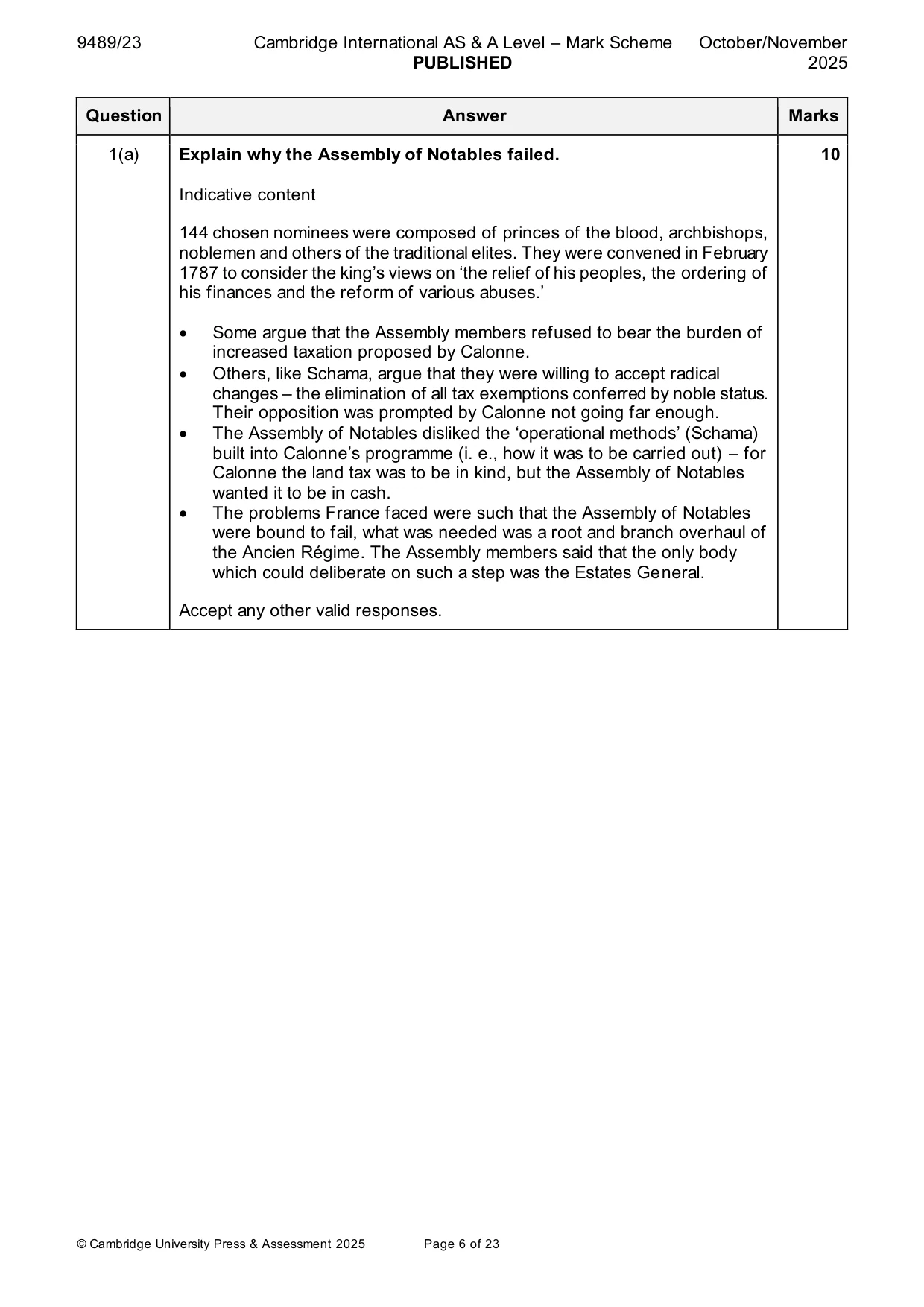
Q1 · France, 1774–1814 (a) Explain why the Assembly of Notables failed
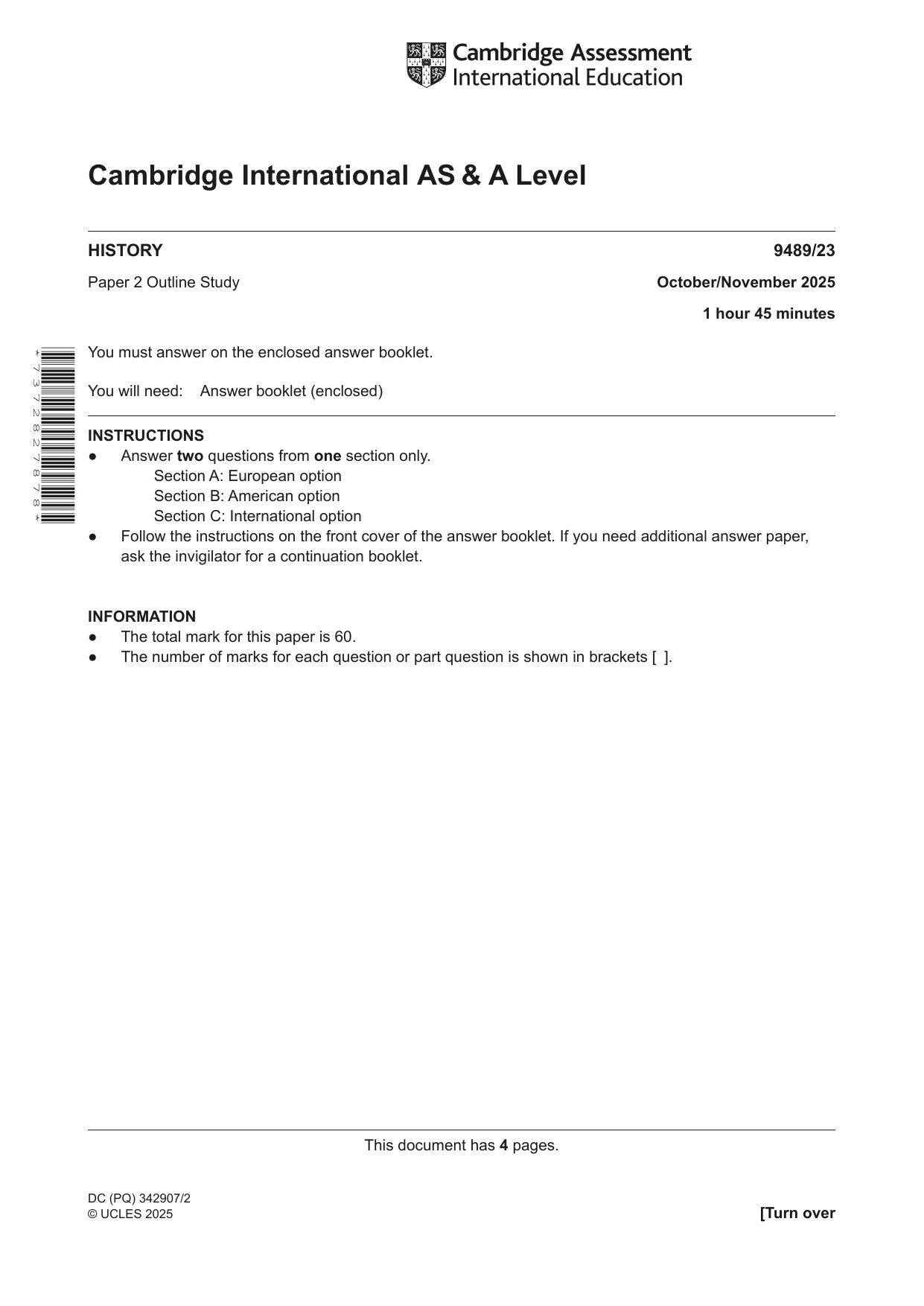
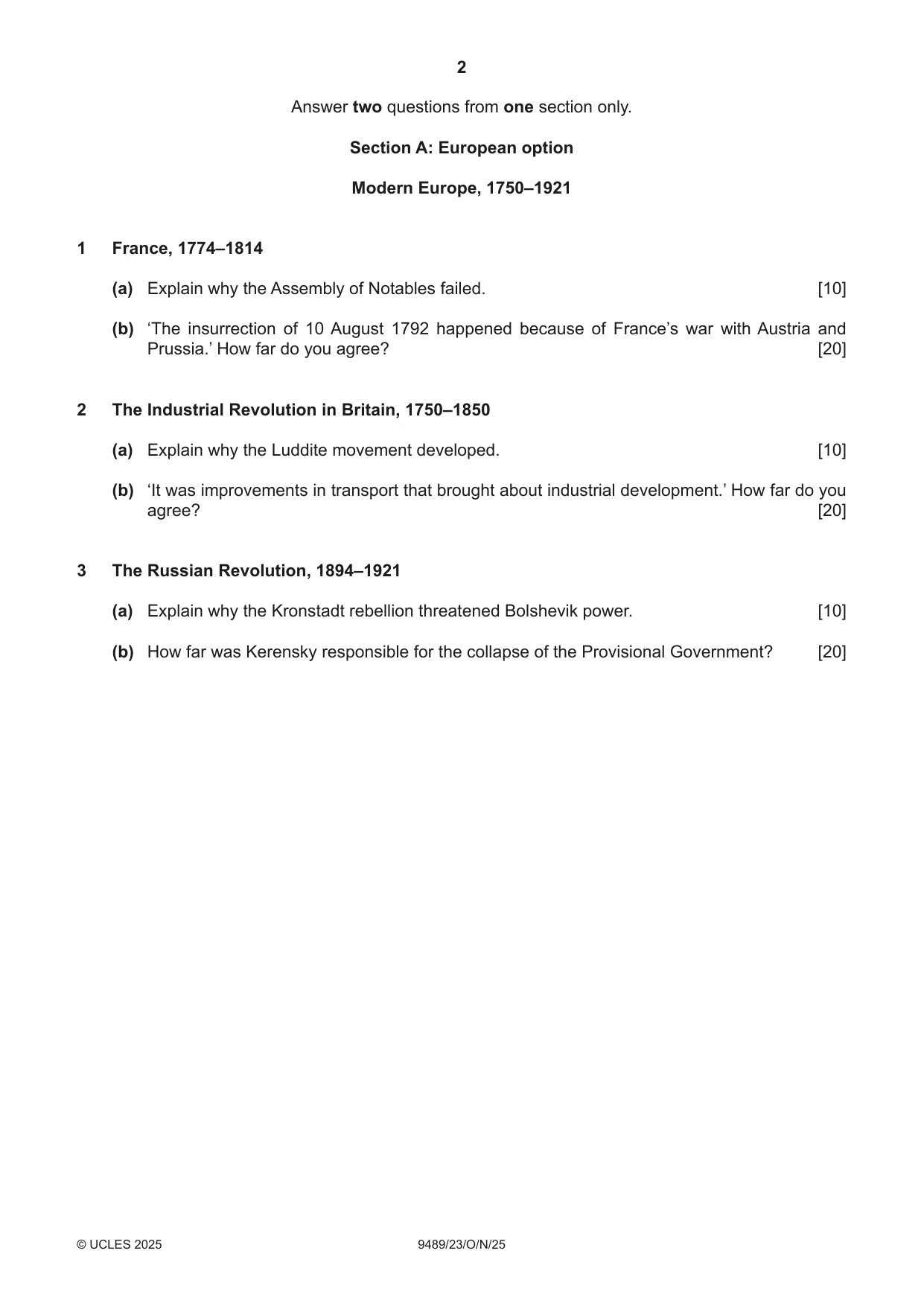
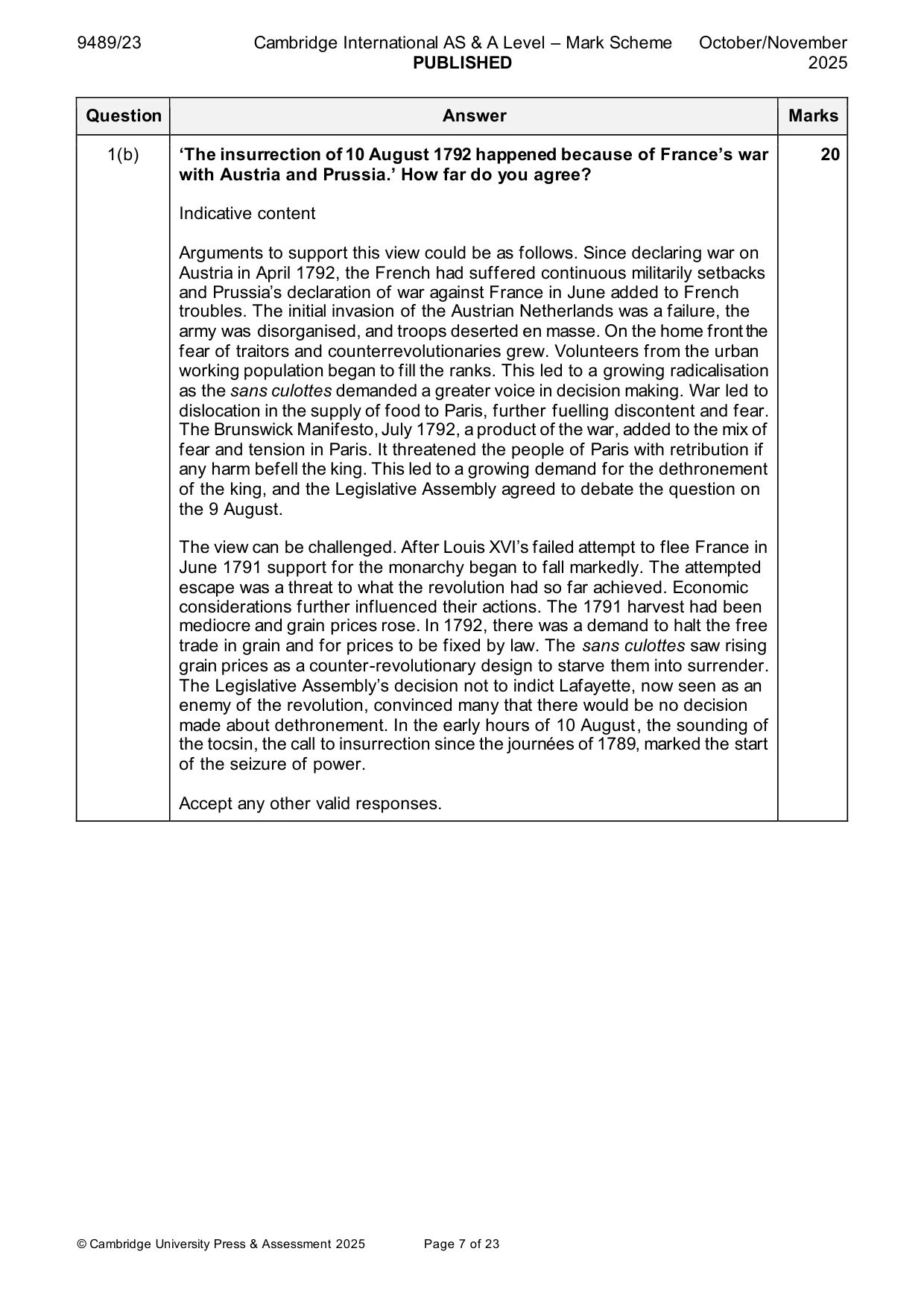
1 France, 1774–1814 (a) Explain why the Assembly of Notables failed. [10] (b) ‘The insurrection of 10 August 1792 happened because of France’s war with Austria and Prussia.’ How far do you agree? [20]
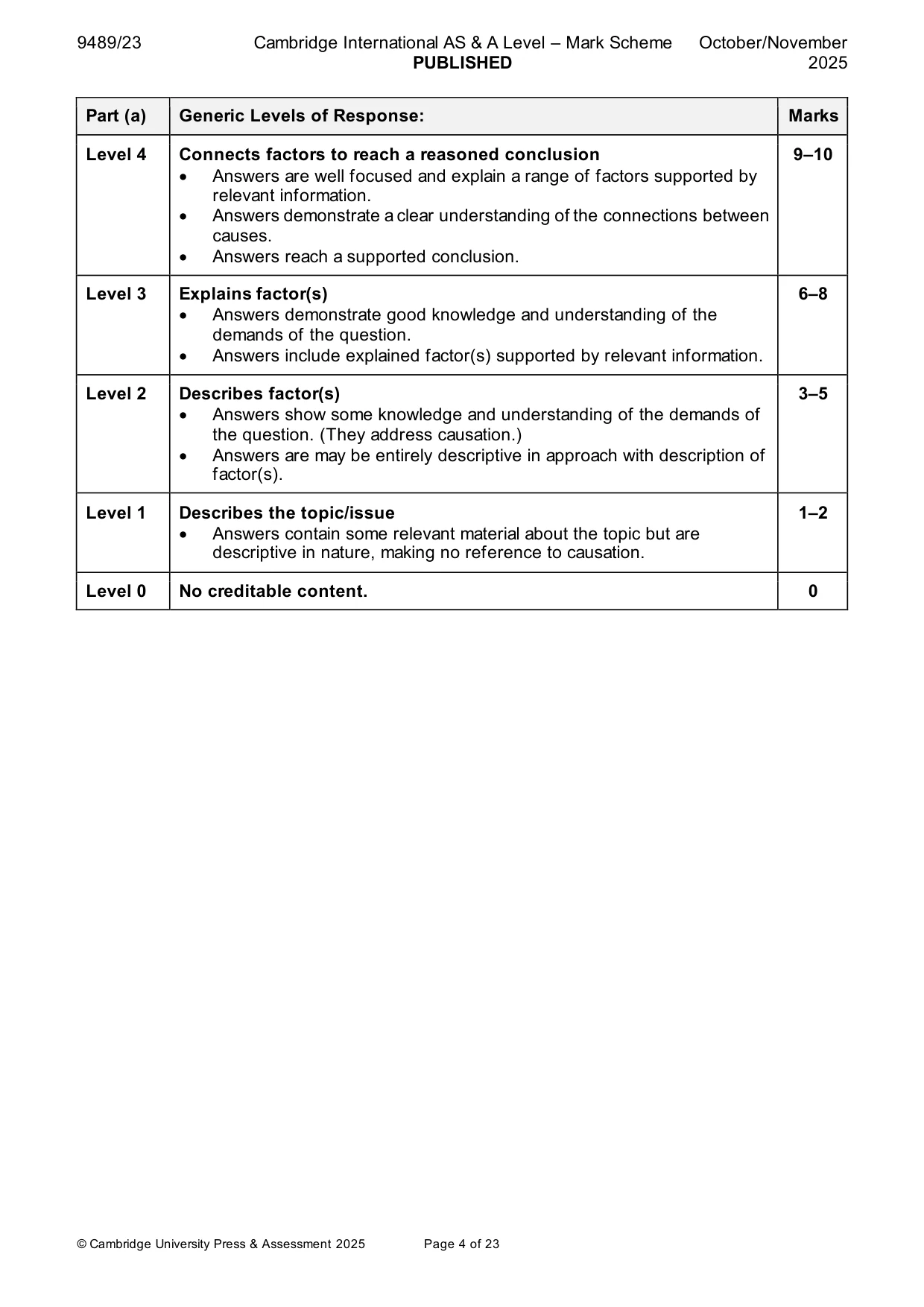
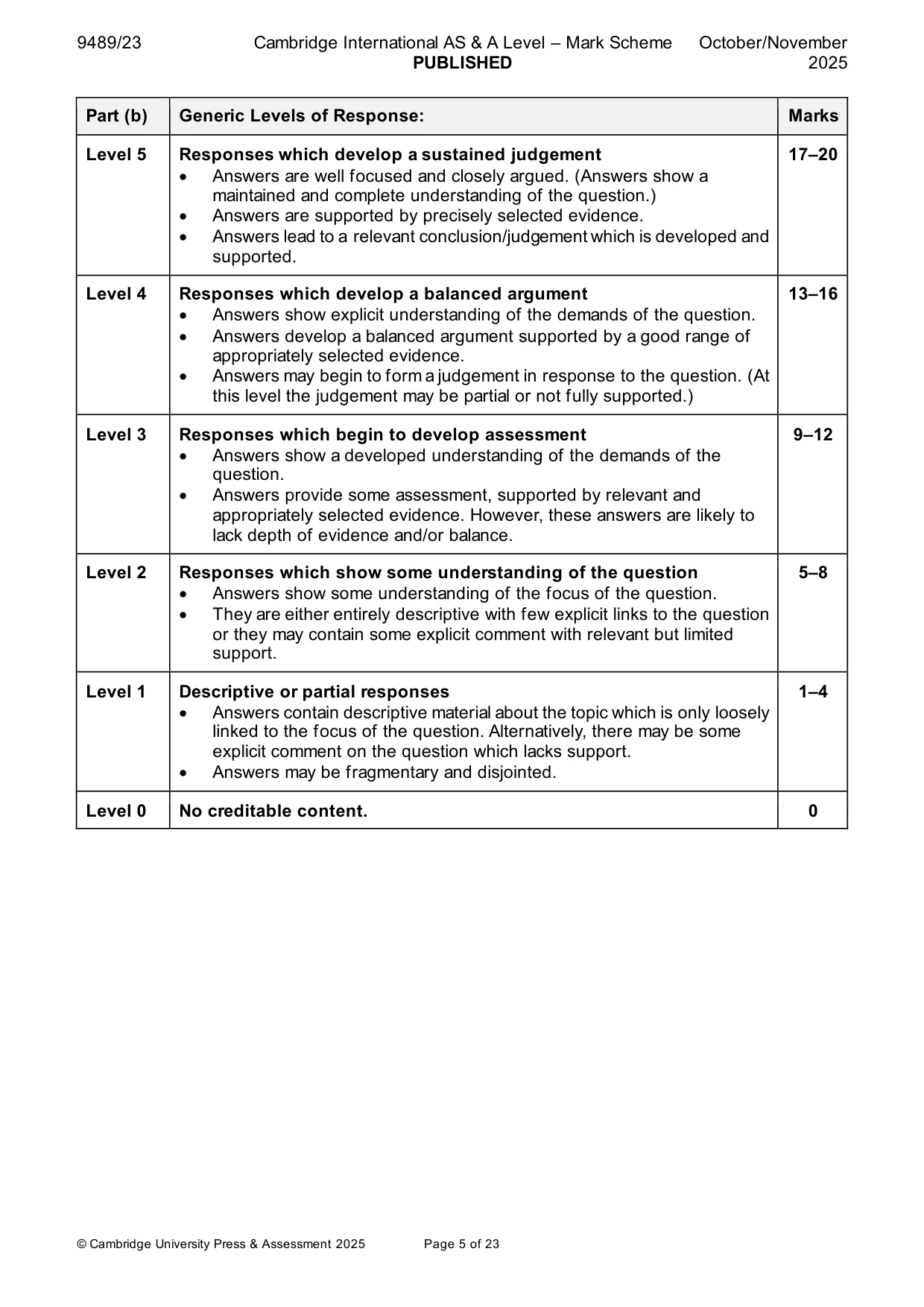
Mark scheme: Question Answer Marks 1(a) Explain why the Assembly of Notables failed. 10 Indicative content 144 chosen nominees were composed of princes of the blood, archbishops, noblemen and others of the traditional elites. They were convened in February 1787 to consider the king’s views on ‘the relief of his peoples, the ordering of his finances and the reform of various abuses.’ • Some argue that the Assembly members refused to bear the burden of increased taxation proposed by Calonne. • Others, like Schama, argue that they were willing to accept radical changes – the elimination of all tax exemptions conferred by noble status. Their opposition was prompted by Calonne not going far enough. • The Assembly of Notables disliked the ‘operational methods’ (Schama) built into Calonne’s programme (i. e., how it was to be carried out) – for Calonne the land tax was to be in kind, but the Assembly of Notables wanted it to be in cash. • The problems France faced were such that the Assembly of Notables were bound to fail, what was needed was a root and branch overhaul of the Ancien Régime. The Assembly members said that the only body which could deliberate on such a step was the Estates General. Accept any other valid responses. 1(b) ‘The insurrection of 10 August 1792 happened because of France’s war 20 with Austria and Prussia.’ How far do you agree? Indicative content Arguments to support this view could be as follows. Since declaring war on Austria in April 1792, the French had suffered continuous militarily setbacks and Prussia’s declaration of war against France in June added to French troubles. The initial invasion of the Austrian Netherlands was a failure, the army was disorganised, and troops deserted en masse. On the home front the fear of traitors and counterrevolutionaries grew. Volunteers from the urban working population began to fill the ranks. This led to a growing radicalisation as the sans culottes demanded a greater voice in decision making. War led to dislocation in the supply of food to Paris, further fuelling discontent and fear. The Brunswick Manifesto, July 1792, a product of the war, added to the mix of fear and tension in Paris. It threatened the people of Paris with retribution if any harm befell the king. This led to a growing demand for the dethronement of the king, and the Legislative Assembly agreed to debate the question on the 9 August. The view can be challenged. After Louis XVI’s failed attempt to flee France in June 1791 support for the monarchy began to fall markedly. The attempted escape was a threat to what the revolution had so far achieved. Economic considerations further influenced their actions. The 1791 harvest had been mediocre and grain prices rose. In 1792, there was a demand to halt the free trade in grain and for prices to be fixed by law. The sans culottes saw rising grain prices as a counter-revolutionary design to starve them into surrender. The Legislative Assembly’s decision not to indict Lafayette, now seen as an enemy of the revolution, convinced many that there would be no decision made about dethronement. In the early hours of 10 August, the sounding of the tocsin, the call to insurrection since the journées of 1789, marked the start of the seizure of power. Accept any other valid responses.
More questions on How and why did France become a republic by 1792?
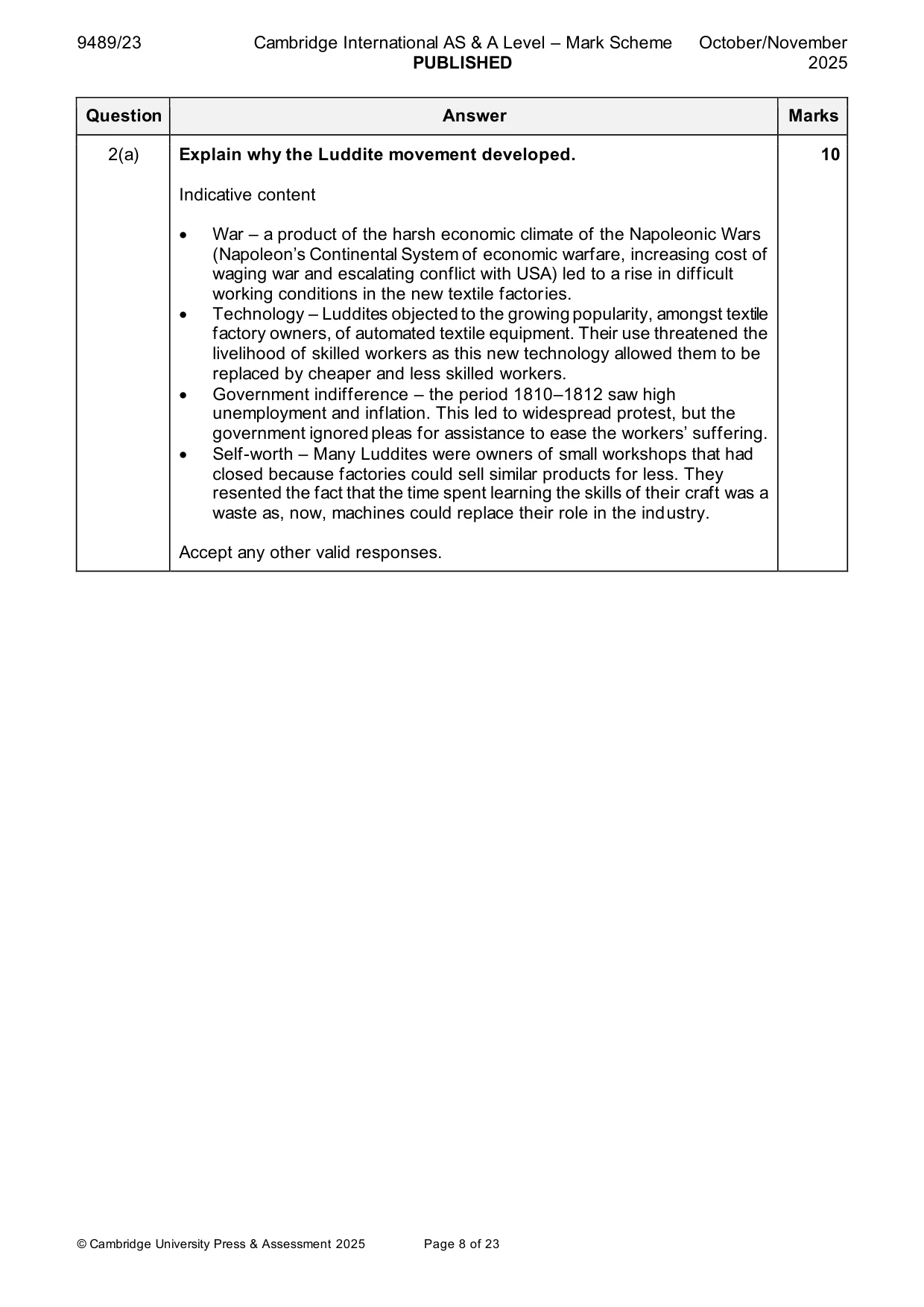
Q2 · The Industrial Revolution in Britain, 1750–1850 (a) Explain why the Luddite movement…
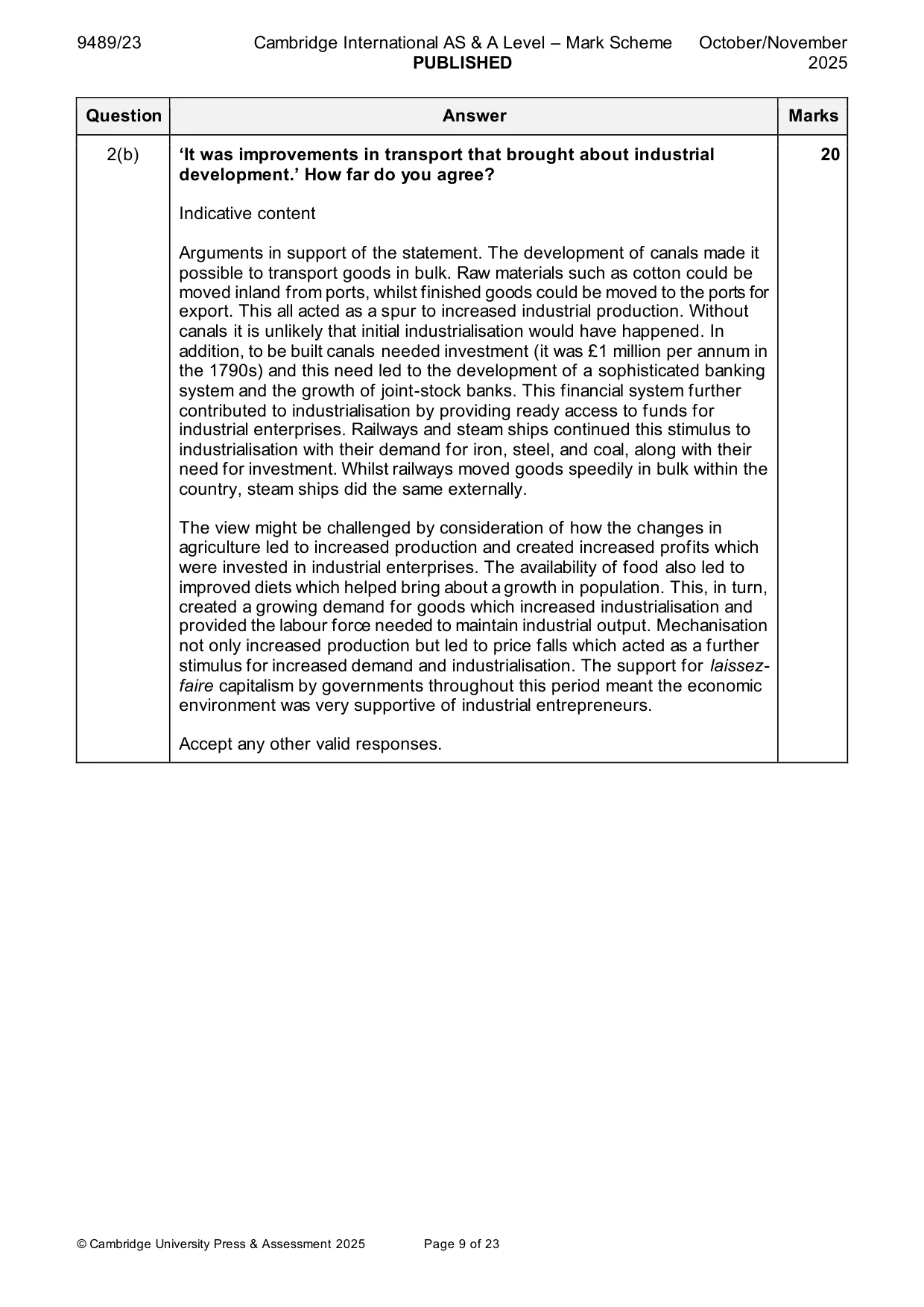
2 The Industrial Revolution in Britain, 1750–1850 (a) Explain why the Luddite movement developed. [10] (b) ‘It was improvements in transport that brought about industrial development.’ How far do you agree? [20]
Mark scheme: 2(a) Explain why the Luddite movement developed. 10 Indicative content • War – a product of the harsh economic climate of the Napoleonic Wars (Napoleon’s Continental System of economic warfare, increasing cost of waging war and escalating conflict with USA) led to a rise in difficult working conditions in the new textile factories. • Technology – Luddites objected to the growing popularity, amongst textile factory owners, of automated textile equipment. Their use threatened the livelihood of skilled workers as this new technology allowed them to be replaced by cheaper and less skilled workers. • Government indifference – the period 1810–1812 saw high unemployment and inflation. This led to widespread protest, but the government ignored pleas for assistance to ease the workers’ suffering. • Self-worth – Many Luddites were owners of small workshops that had closed because factories could sell similar products for less. They resented the fact that the time spent learning the skills of their craft was a waste as, now, machines could replace their role in the industry. Accept any other valid responses. 2(b) ‘It was improvements in transport that brought about industrial 20 development.’ How far do you agree? Indicative content Arguments in support of the statement. The development of canals made it possible to transport goods in bulk. Raw materials such as cotton could be moved inland from ports, whilst finished goods could be moved to the ports for export. This all acted as a spur to increased industrial production. Without canals it is unlikely that initial industrialisation would have happened. In addition, to be built canals needed investment (it was £1 million per annum in the 1790s) and this need led to the development of a sophisticated banking system and the growth of joint-stock banks. This financial system further contributed to industrialisation by providing ready access to funds for industrial enterprises. Railways and steam ships continued this stimulus to industrialisation with their demand for iron, steel, and coal, along with their need for investment. Whilst railways moved goods speedily in bulk within the country, steam ships did the same externally. The view might be challenged by consideration of how the changes in agriculture led to increased production and created increased profits which were invested in industrial enterprises. The availability of food also led to improved diets which helped bring about a growth in population. This, in turn, created a growing demand for goods which increased industrialisation and provided the labour force needed to maintain industrial output. Mechanisation not only increased production but led to price falls which acted as a further stimulus for increased demand and industrialisation. The support for laissez- faire capitalism by governments throughout this period meant the economic environment was very supportive of industrial entrepreneurs. Accept any other valid responses.
More questions on Why was there rapid industrialisation after 1870?
Q3 · The Russian Revolution, 1894–1921 (a) Explain why the Kronstadt rebellion threatened…
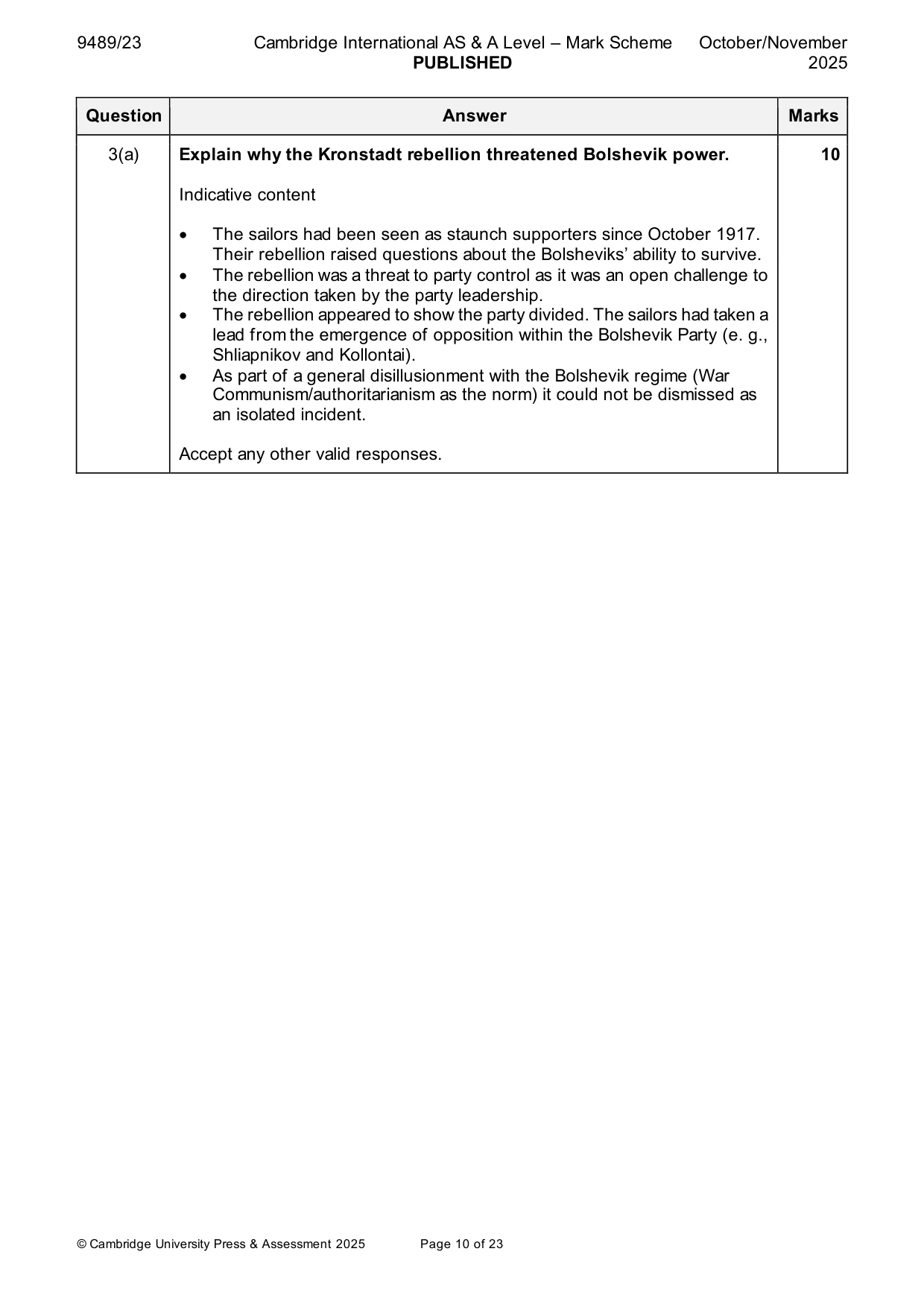
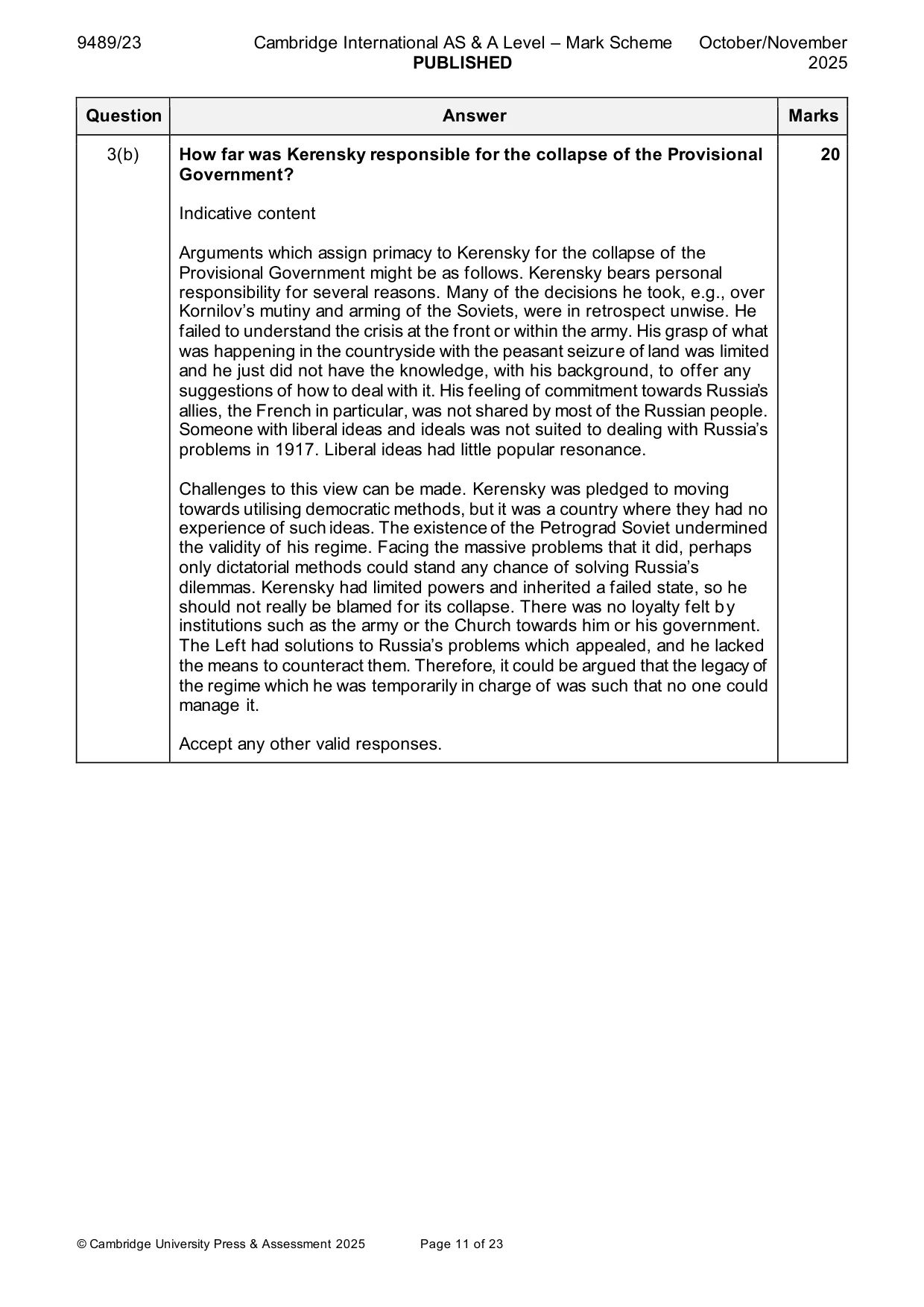
3 The Russian Revolution, 1894–1921 (a) Explain why the Kronstadt rebellion threatened Bolshevik power. [10] (b) How far was Kerensky responsible for the collapse of the Provisional Government? [20]
Mark scheme: 3(a) Explain why the Kronstadt rebellion threatened Bolshevik power. 10 Indicative content • The sailors had been seen as staunch supporters since October 1917. Their rebellion raised questions about the Bolsheviks’ ability to survive. • The rebellion was a threat to party control as it was an open challenge to the direction taken by the party leadership. • The rebellion appeared to show the party divided. The sailors had taken a lead from the emergence of opposition within the Bolshevik Party (e. g., Shliapnikov and Kollontai). • As part of a general disillusionment with the Bolshevik regime (War Communism/authoritarianism as the norm) it could not be dismissed as an isolated incident. Accept any other valid responses. 3(b) How far was Kerensky responsible for the collapse of the Provisional 20 Government? Indicative content Arguments which assign primacy to Kerensky for the collapse of the Provisional Government might be as follows. Kerensky bears personal responsibility for several reasons. Many of the decisions he took, e.g., over Kornilov’s mutiny and arming of the Soviets, were in retrospect unwise. He failed to understand the crisis at the front or within the army. His grasp of what was happening in the countryside with the peasant seizure of land was limited and he just did not have the knowledge, with his background, to offer any suggestions of how to deal with it. His feeling of commitment towards Russia’s allies, the French in particular, was not shared by most of the Russian people. Someone with liberal ideas and ideals was not suited to dealing with Russia’s problems in 1917. Liberal ideas had little popular resonance. Challenges to this view can be made. Kerensky was pledged to moving towards utilising democratic methods, but it was a country where they had no experience of such ideas. The existence of the Petrograd Soviet undermined the validity of his regime. Facing the massive problems that it did, perhaps only dictatorial methods could stand any chance of solving Russia’s dilemmas. Kerensky had limited powers and inherited a failed state, so he should not really be blamed for its collapse. There was no loyalty felt by institutions such as the army or the Church towards him or his government. The Left had solutions to Russia’s problems which appealed, and he lacked the means to counteract them. Therefore, it could be argued that the legacy of the regime which he was temporarily in charge of was such that no one could manage it. Accept any other valid responses.
More questions on How and why did the Bolsheviks seize power in October 1917?
Q4 · Civil War and Reconstruction, 1861–77 (a) Explain why white Southerners were hostile to…
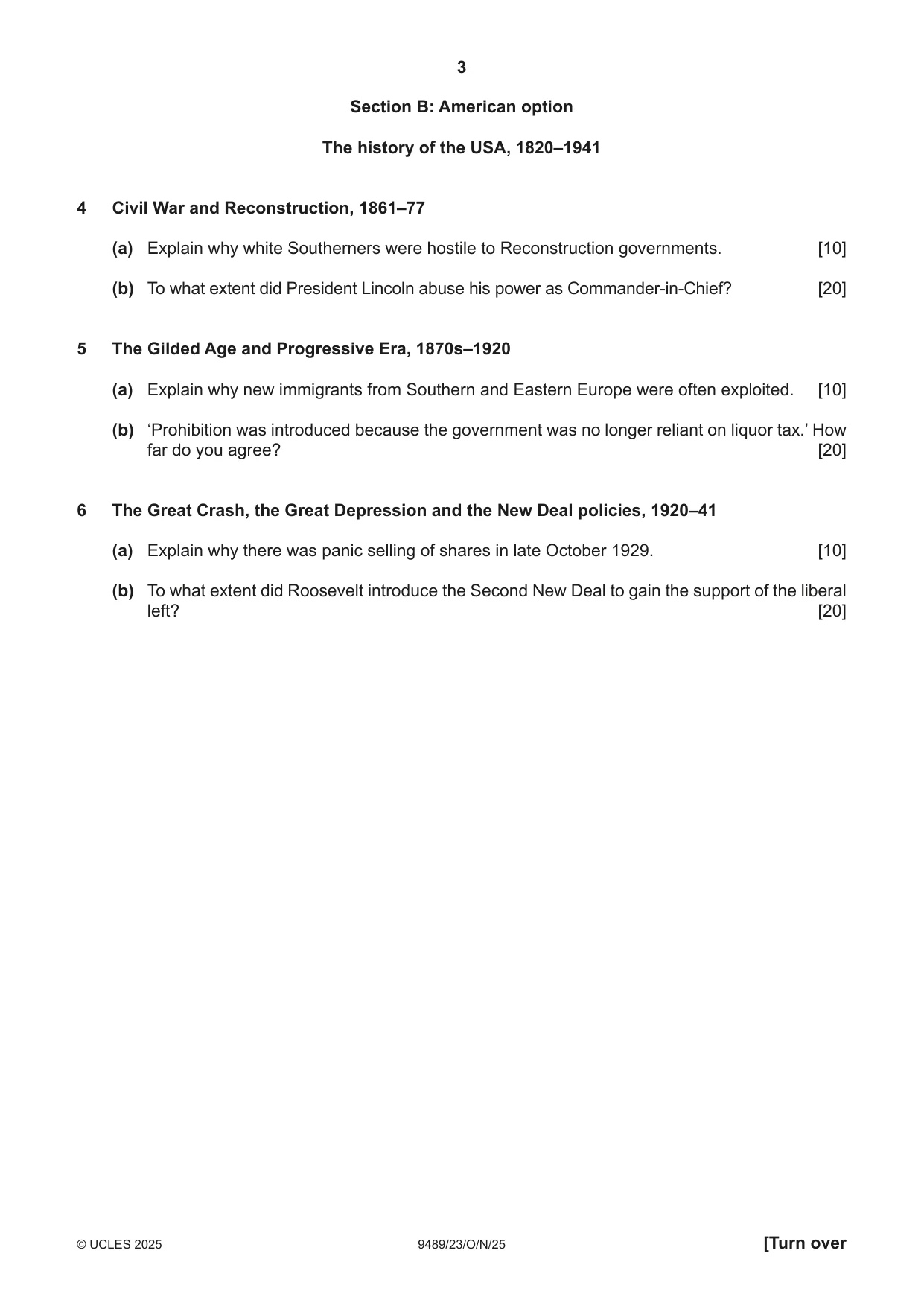
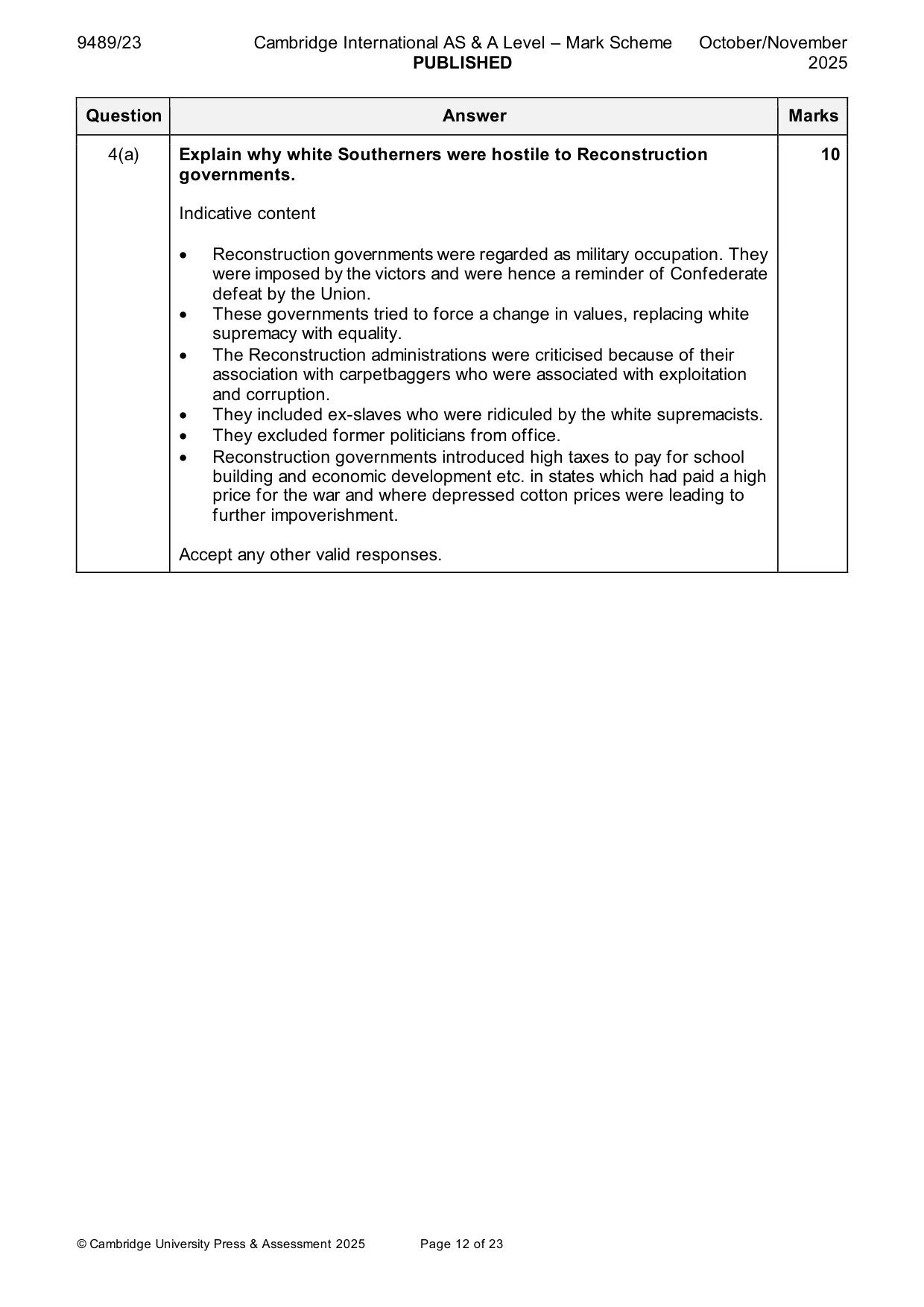
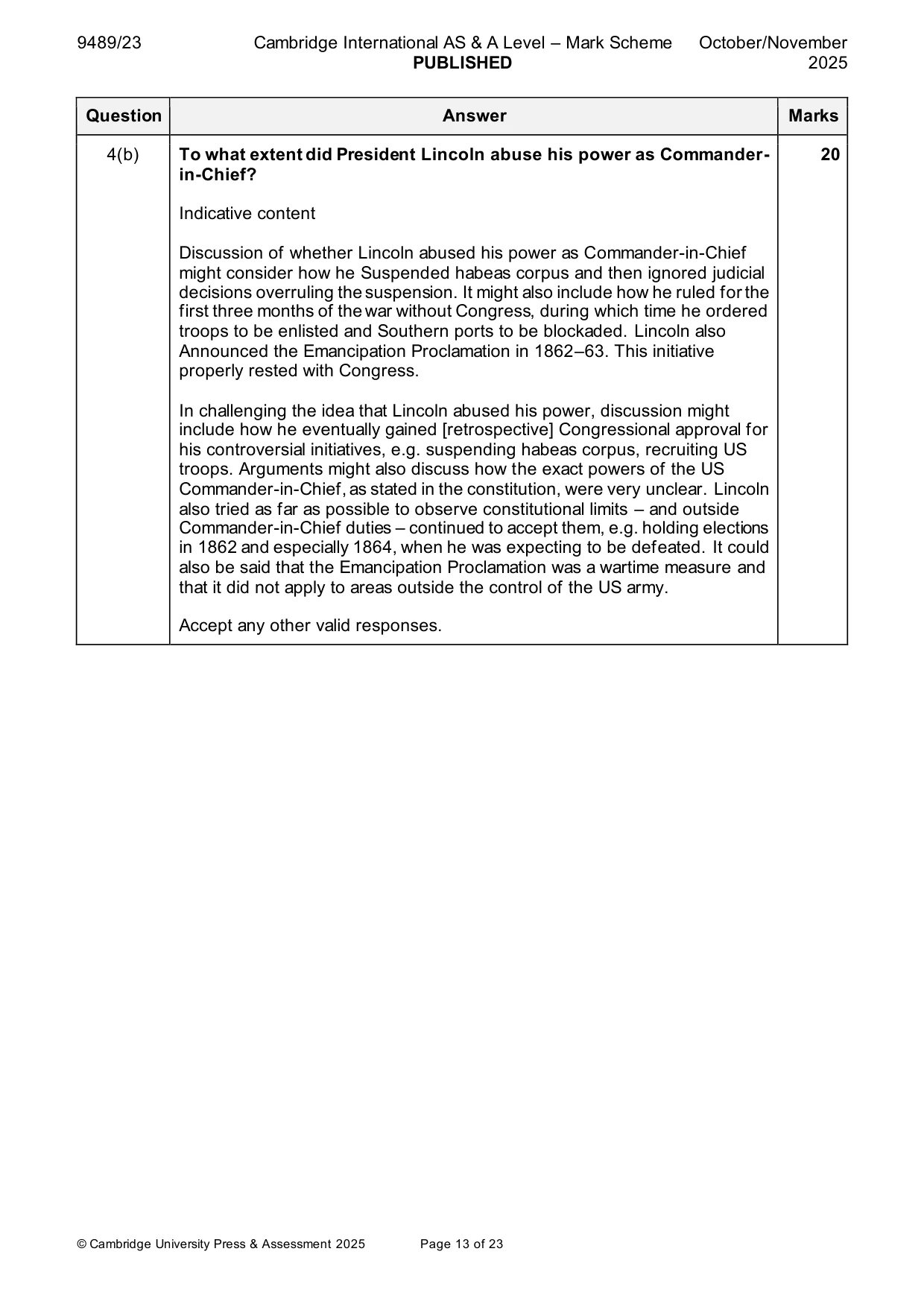
4 Civil War and Reconstruction, 1861–77 (a) Explain why white Southerners were hostile to Reconstruction governments. [10] (b) To what extent did President Lincoln abuse his power as Commander-in-Chief? [20]
Mark scheme: 4(a) Explain why white Southerners were hostile to Reconstruction 10 governments. Indicative content • Reconstruction governments were regarded as military occupation. They were imposed by the victors and were hence a reminder of Confederate defeat by the Union. • These governments tried to force a change in values, replacing white supremacy with equality. • The Reconstruction administrations were criticised because of their association with carpetbaggers who were associated with exploitation and corruption. • They included ex-slaves who were ridiculed by the white supremacists. • They excluded former politicians from office. • Reconstruction governments introduced high taxes to pay for school building and economic development etc. in states which had paid a high price for the war and where depressed cotton prices were leading to further impoverishment. Accept any other valid responses. 4(b) To what extent did President Lincoln abuse his power as Commander- 20 in-Chief? Indicative content Discussion of whether Lincoln abused his power as Commander-in-Chief might consider how he Suspended habeas corpus and then ignored judicial decisions overruling the suspension. It might also include how he ruled for the first three months of the war without Congress, during which time he ordered troops to be enlisted and Southern ports to be blockaded. Lincoln also Announced the Emancipation Proclamation in 1862–63. This initiative properly rested with Congress. In challenging the idea that Lincoln abused his power, discussion might include how he eventually gained [retrospective] Congressional approval for his controversial initiatives, e.g. suspending habeas corpus, recruiting US troops. Arguments might also discuss how the exact powers of the US Commander-in-Chief, as stated in the constitution, were very unclear. Lincoln also tried as far as possible to observe constitutional limits – and outside Commander-in-Chief duties – continued to accept them, e.g. holding elections in 1862 and especially 1864, when he was expecting to be defeated. It could also be said that the Emancipation Proclamation was a wartime measure and that it did not apply to areas outside the control of the US army. Accept any other valid responses.
Q5 · The Gilded Age and Progressive Era, 1870s–1920 (a) Explain why new immigrants from…
5 The Gilded Age and Progressive Era, 1870s–1920 (a) Explain why new immigrants from Southern and Eastern Europe were often exploited. [10] (b) ‘Prohibition was introduced because the government was no longer reliant on liquor tax.’ How far do you agree? [20]
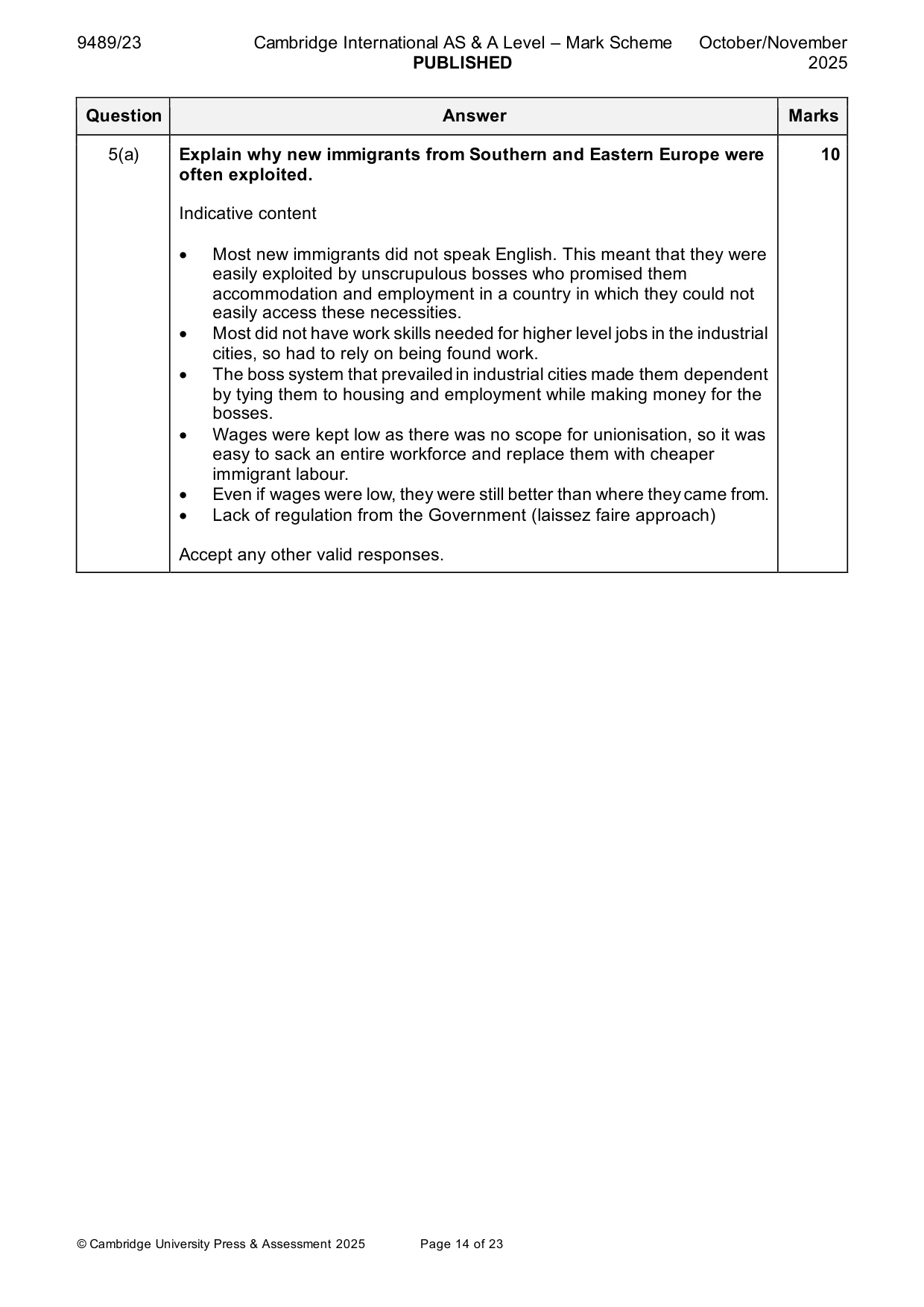
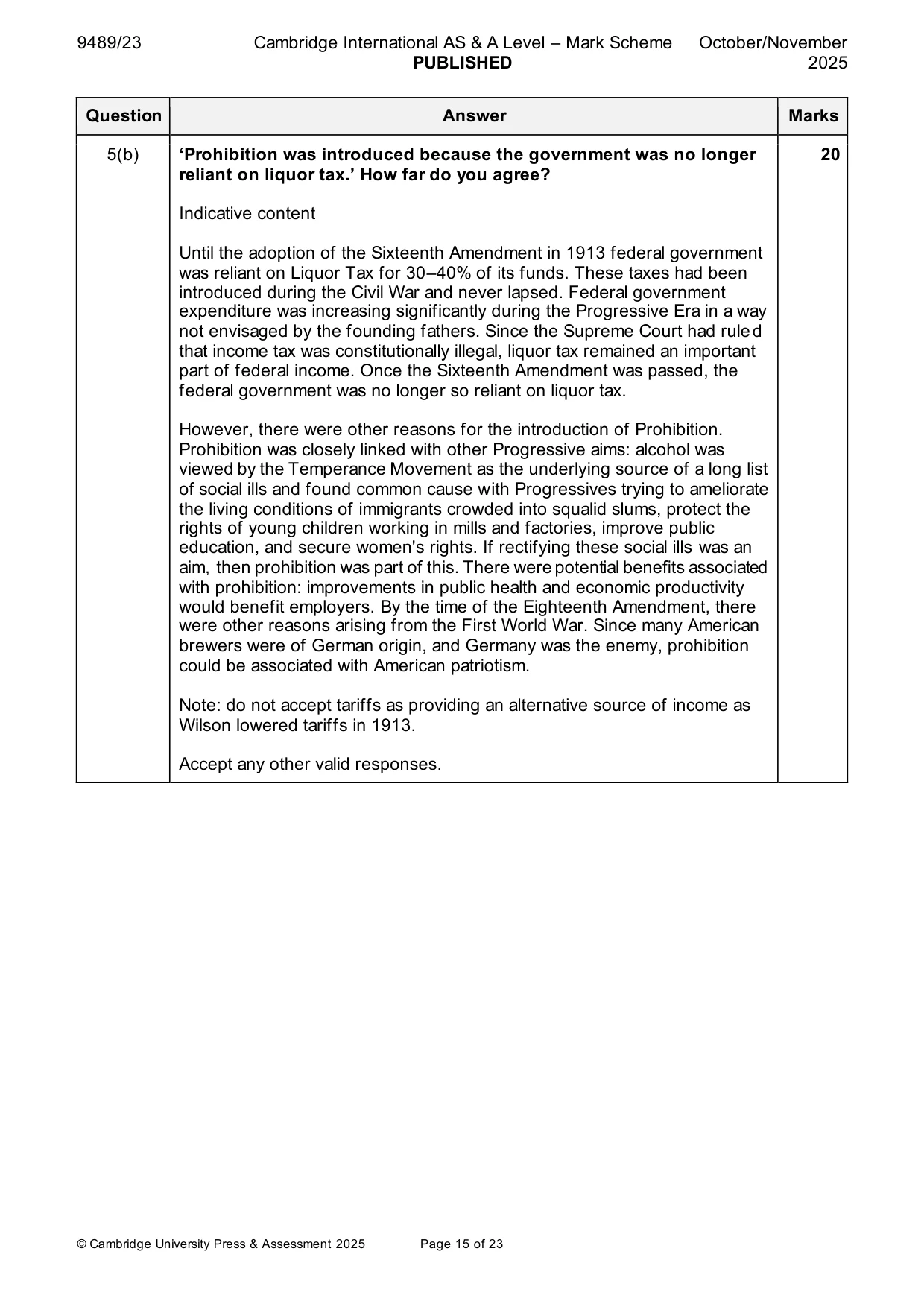
Mark scheme: 5(a) Explain why new immigrants from Southern and Eastern Europe were 10 often exploited. Indicative content • Most new immigrants did not speak English. This meant that they were easily exploited by unscrupulous bosses who promised them accommodation and employment in a country in which they could not easily access these necessities. • Most did not have work skills needed for higher level jobs in the industrial cities, so had to rely on being found work. • The boss system that prevailed in industrial cities made them dependent by tying them to housing and employment while making money for the bosses. • Wages were kept low as there was no scope for unionisation, so it was easy to sack an entire workforce and replace them with cheaper immigrant labour. • Even if wages were low, they were still better than where they came from. • Lack of regulation from the Government (laissez faire approach) Accept any other valid responses. 5(b) ‘Prohibition was introduced because the government was no longer 20 reliant on liquor tax.’ How far do you agree? Indicative content Until the adoption of the Sixteenth Amendment in 1913 federal government was reliant on Liquor Tax for 30–40% of its funds. These taxes had been introduced during the Civil War and never lapsed. Federal government expenditure was increasing significantly during the Progressive Era in a way not envisaged by the founding fathers. Since the Supreme Court had ruled that income tax was constitutionally illegal, liquor tax remained an important part of federal income. Once the Sixteenth Amendment was passed, the federal government was no longer so reliant on liquor tax. However, there were other reasons for the introduction of Prohibition. Prohibition was closely linked with other Progressive aims: alcohol was viewed by the Temperance Movement as the underlying source of a long list of social ills and found common cause with Progressives trying to ameliorate the living conditions of immigrants crowded into squalid slums, protect the rights of young children working in mills and factories, improve public education, and secure women's rights. If rectifying these social ills was an aim, then prohibition was part of this. There were potential benefits associated with prohibition: improvements in public health and economic productivity would benefit employers. By the time of the Eighteenth Amendment, there were other reasons arising from the First World War. Since many American brewers were of German origin, and Germany was the enemy, prohibition could be associated with American patriotism. Note: do not accept tariffs as providing an alternative source of income as Wilson lowered tariffs in 1913. Accept any other valid responses.
More questions on How successful was the Progressive Movement from 1890 to 1920?
Q6 · The Great Crash, the Great Depression and the New Deal policies, 1920–41 (a) Explain why…
6 The Great Crash, the Great Depression and the New Deal policies, 1920–41 (a) Explain why there was panic selling of shares in late October 1929. [10] (b) To what extent did Roosevelt introduce the Second New Deal to gain the support of the liberal left? [20] Section C: International option International history, 1870–1945
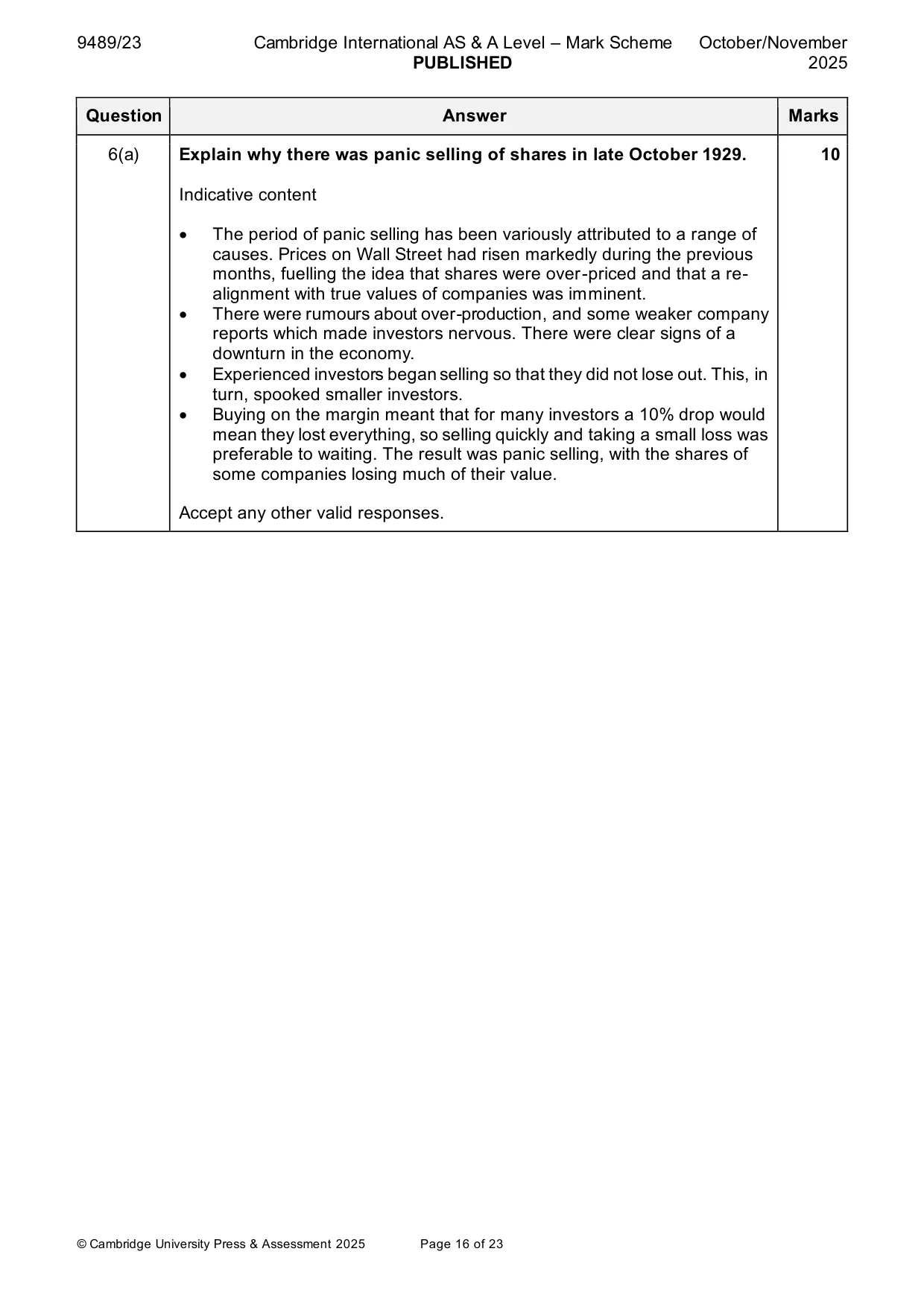
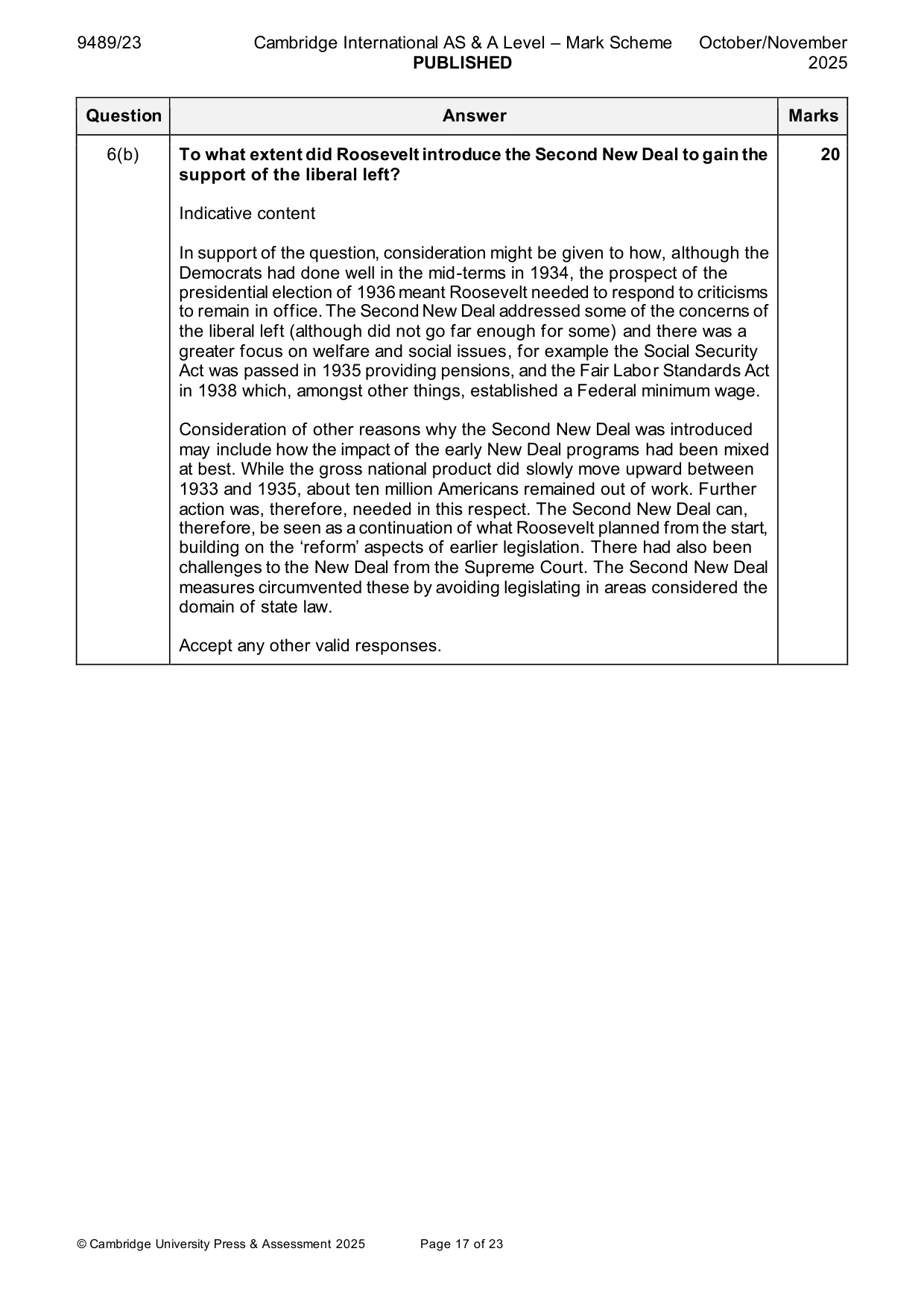
Mark scheme: 6(a) Explain why there was panic selling of shares in late October 1929. 10 Indicative content • The period of panic selling has been variously attributed to a range of causes. Prices on Wall Street had risen markedly during the previous months, fuelling the idea that shares were over-priced and that a re- alignment with true values of companies was imminent. • There were rumours about over-production, and some weaker company reports which made investors nervous. There were clear signs of a downturn in the economy. • Experienced investors began selling so that they did not lose out. This, in turn, spooked smaller investors. • Buying on the margin meant that for many investors a 10% drop would mean they lost everything, so selling quickly and taking a small loss was preferable to waiting. The result was panic selling, with the shares of some companies losing much of their value. Accept any other valid responses. 6(b) To what extent did Roosevelt introduce the Second New Deal to gain the 20 support of the liberal left? Indicative content In support of the question, consideration might be given to how, although the Democrats had done well in the mid-terms in 1934, the prospect of the presidential election of 1936 meant Roosevelt needed to respond to criticisms to remain in office. The Second New Deal addressed some of the concerns of the liberal left (although did not go far enough for some) and there was a greater focus on welfare and social issues, for example the Social Security Act was passed in 1935 providing pensions, and the Fair Labor Standards Act in 1938 which, amongst other things, established a Federal minimum wage. Consideration of other reasons why the Second New Deal was introduced may include how the impact of the early New Deal programs had been mixed at best. While the gross national product did slowly move upward between 1933 and 1935, about ten million Americans remained out of work. Further action was, therefore, needed in this respect. The Second New Deal can, therefore, be seen as a continuation of what Roosevelt planned from the start, building on the ‘reform’ aspects of earlier legislation. There had also been challenges to the New Deal from the Supreme Court. The Second New Deal measures circumvented these by avoiding legislating in areas considered the domain of state law. Accept any other valid responses.
More questions on Why was there a second New Deal and how successful was it?
Q7 · Empire and the emergence of world powers, 1870–1919 (a) Explain why the USA became…
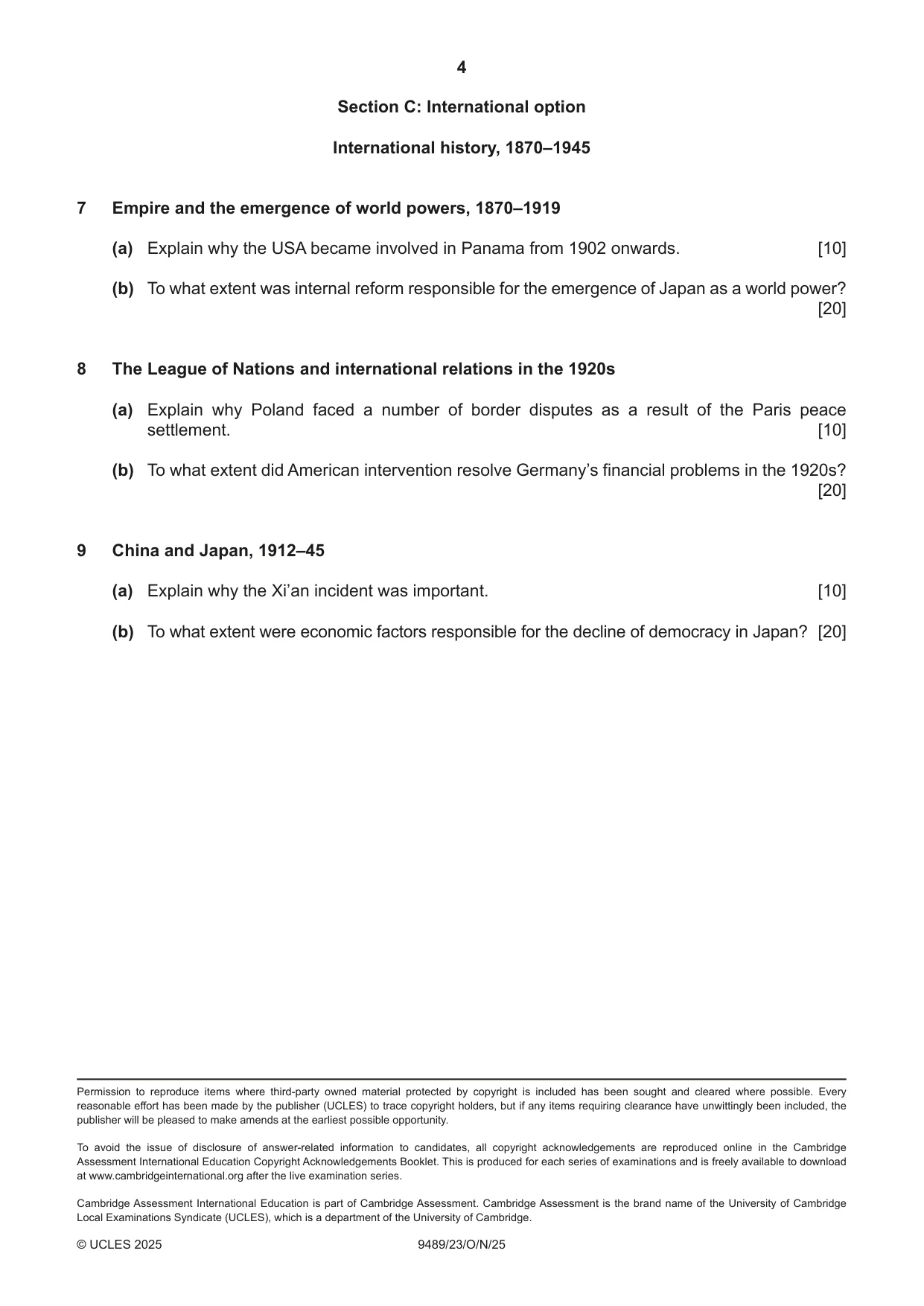
7 Empire and the emergence of world powers, 1870–1919 (a) Explain why the USA became involved in Panama from 1902 onwards. [10] (b) To what extent was internal reform responsible for the emergence of Japan as a world power? [20]
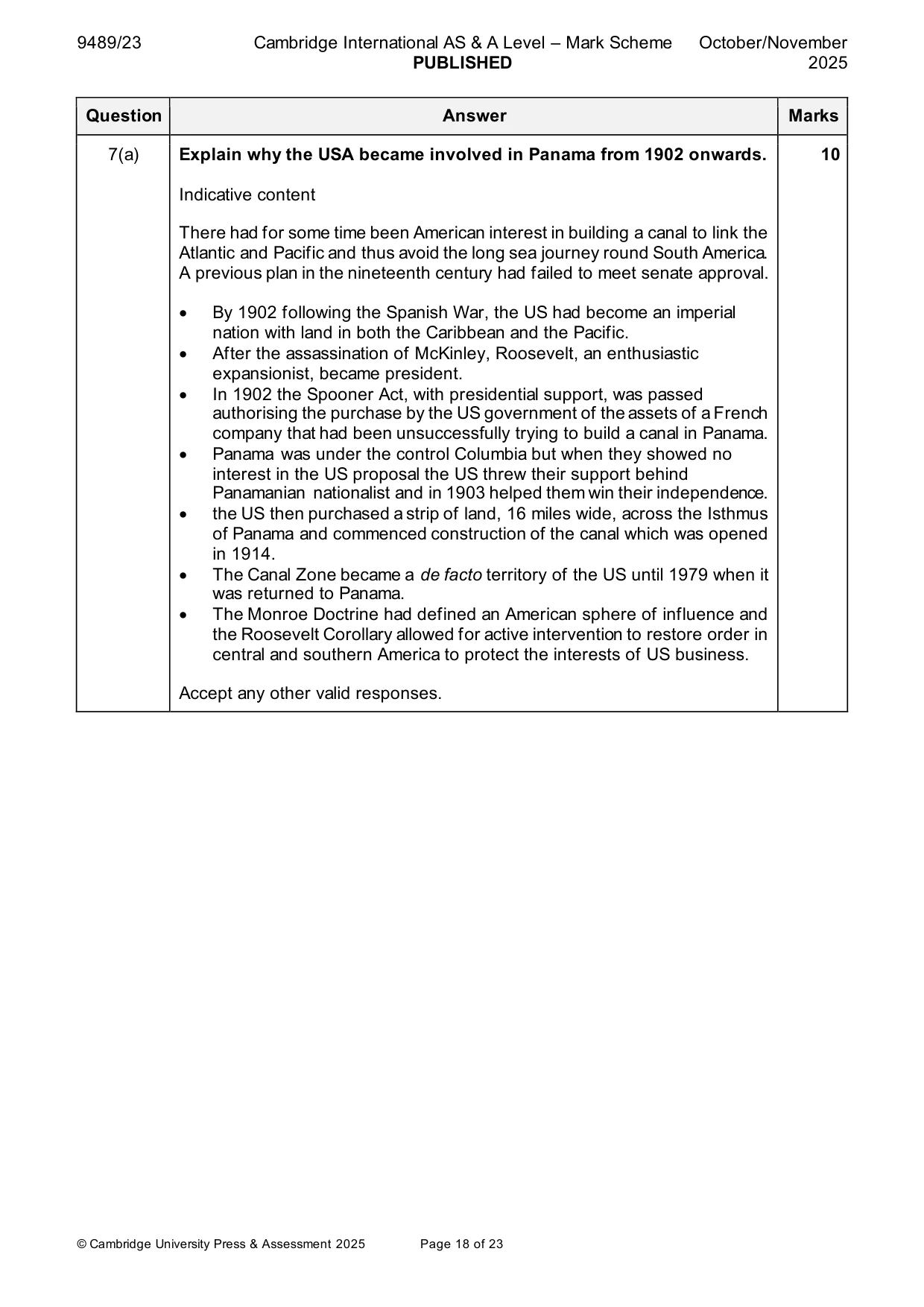
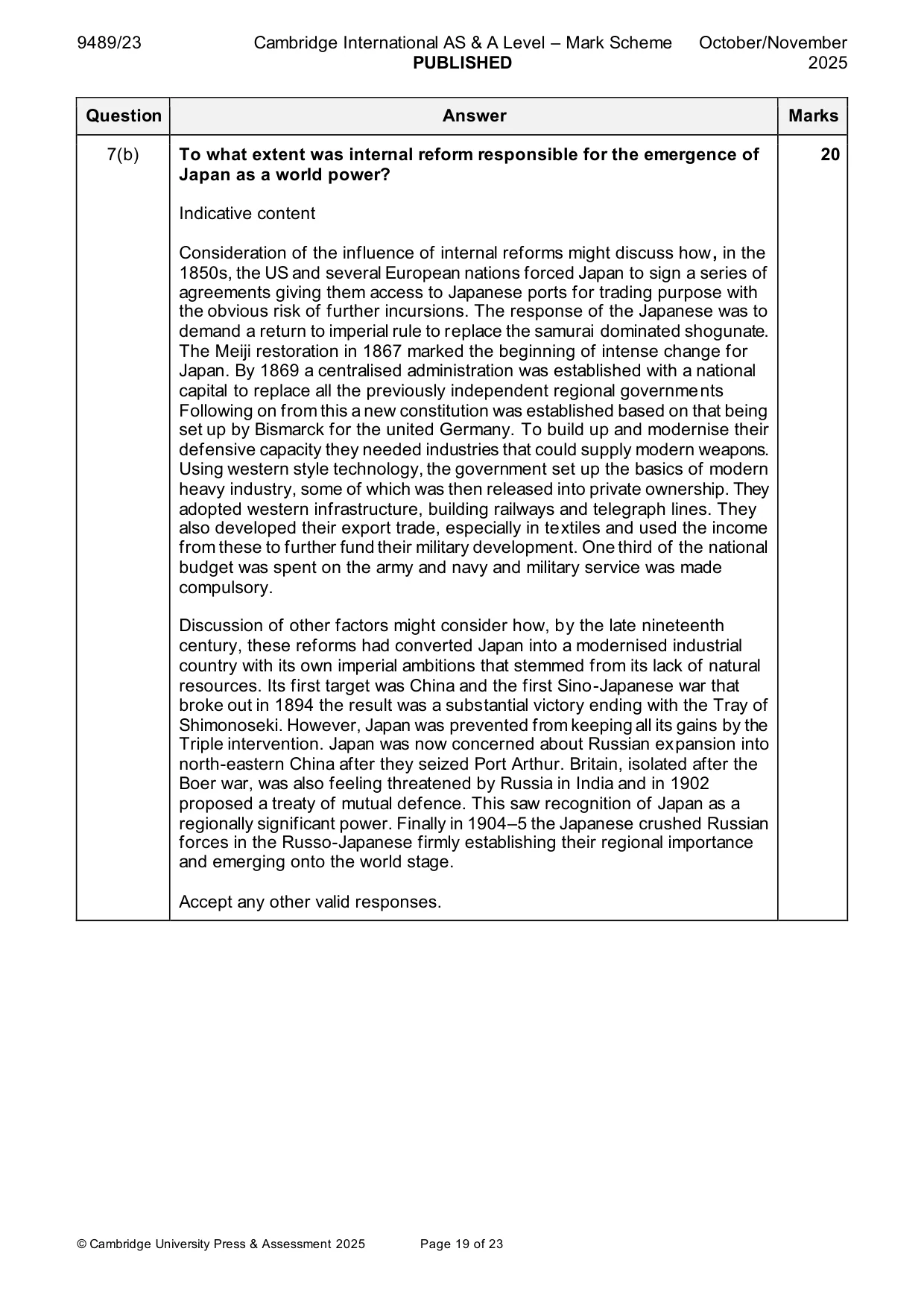
Mark scheme: 7(a) Explain why the USA became involved in Panama from 1902 onwards. 10 Indicative content There had for some time been American interest in building a canal to link the Atlantic and Pacific and thus avoid the long sea journey round South America. A previous plan in the nineteenth century had failed to meet senate approval. • By 1902 following the Spanish War, the US had become an imperial nation with land in both the Caribbean and the Pacific. • After the assassination of McKinley, Roosevelt, an enthusiastic expansionist, became president. • In 1902 the Spooner Act, with presidential support, was passed authorising the purchase by the US government of the assets of a French company that had been unsuccessfully trying to build a canal in Panama. • Panama was under the control Columbia but when they showed no interest in the US proposal the US threw their support behind Panamanian nationalist and in 1903 helped them win their independence. • the US then purchased a strip of land, 16 miles wide, across the Isthmus of Panama and commenced construction of the canal which was opened in 1914. • The Canal Zone became a de facto territory of the US until 1979 when it was returned to Panama. • The Monroe Doctrine had defined an American sphere of influence and the Roosevelt Corollary allowed for active intervention to restore order in central and southern America to protect the interests of US business. Accept any other valid responses. 7(b) To what extent was internal reform responsible for the emergence of 20 Japan as a world power? Indicative content Consideration of the influence of internal reforms might discuss how, in the 1850s, the US and several European nations forced Japan to sign a series of agreements giving them access to Japanese ports for trading purpose with the obvious risk of further incursions. The response of the Japanese was to demand a return to imperial rule to replace the samurai dominated shogunate. The Meiji restoration in 1867 marked the beginning of intense change for Japan. By 1869 a centralised administration was established with a national capital to replace all the previously independent regional governments Following on from this a new constitution was established based on that being set up by Bismarck for the united Germany. To build up and modernise their defensive capacity they needed industries that could supply modern weapons. Using western style technology, the government set up the basics of modern heavy industry, some of which was then released into private ownership. They adopted western infrastructure, building railways and telegraph lines. They also developed their export trade, especially in textiles and used the income from these to further fund their military development. One third of the national budget was spent on the army and navy and military service was made compulsory. Discussion of other factors might consider how, by the late nineteenth century, these reforms had converted Japan into a modernised industrial country with its own imperial ambitions that stemmed from its lack of natural resources. Its first target was China and the first Sino-Japanese war that broke out in 1894 the result was a substantial victory ending with the Tray of Shimonoseki. However, Japan was prevented from keeping all its gains by the Triple intervention. Japan was now concerned about Russian expansion into north-eastern China after they seized Port Arthur. Britain, isolated after the Boer war, was also feeling threatened by Russia in India and in 1902 proposed a treaty of mutual defence. This saw recognition of Japan as a regionally significant power. Finally in 1904–5 the Japanese crushed Russian forces in the Russo-Japanese firmly establishing their regional importance and emerging onto the world stage. Accept any other valid responses.
More questions on Why did Japan emerge as a world power and what was the impact on international
Q8 · The League of Nations and international relations in the 1920s (a) Explain why Poland…
8 The League of Nations and international relations in the 1920s (a) Explain why Poland faced a number of border disputes as a result of the Paris peace settlement. [10] (b) To what extent did American intervention resolve Germany’s financial problems in the 1920s? [20]
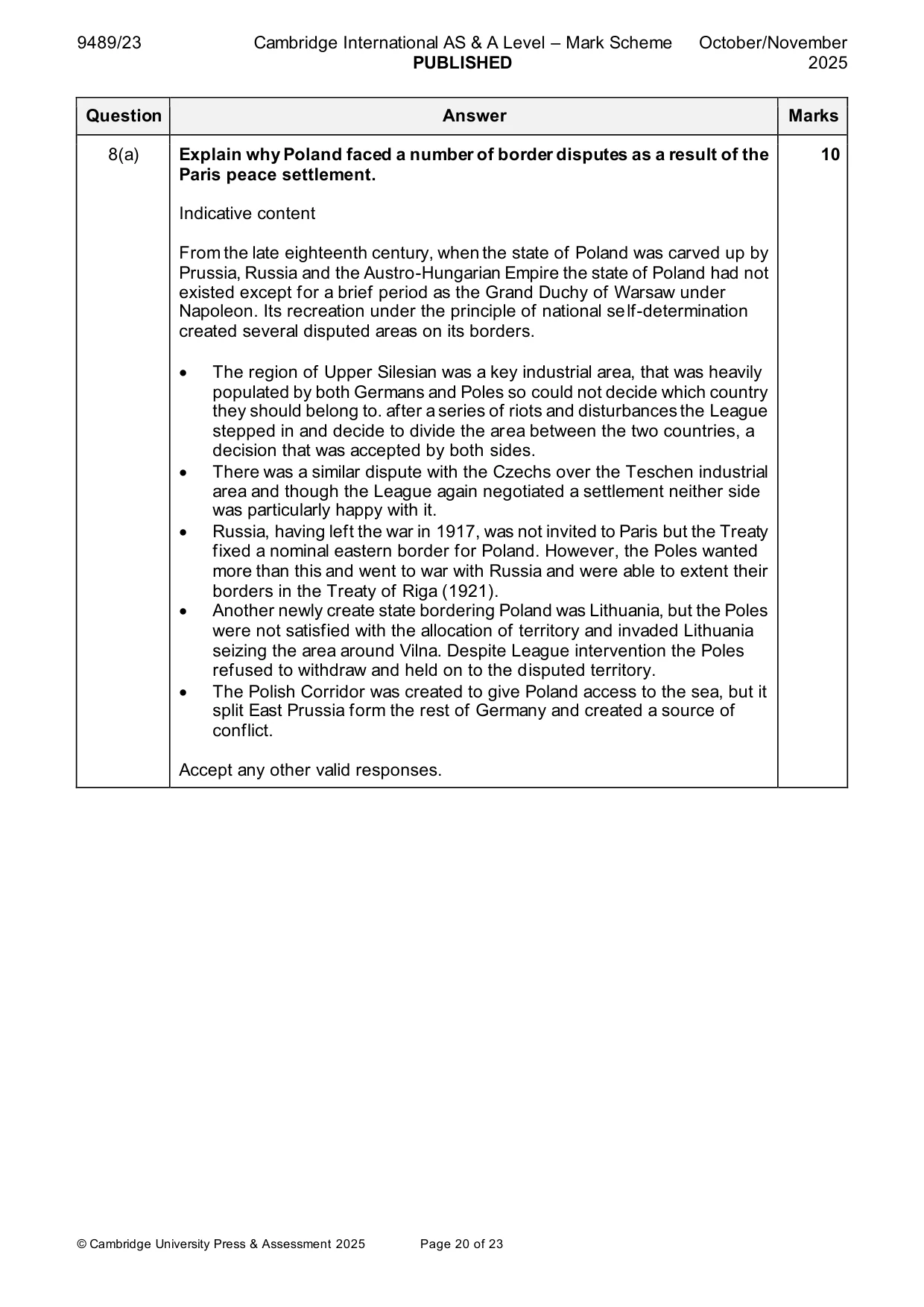
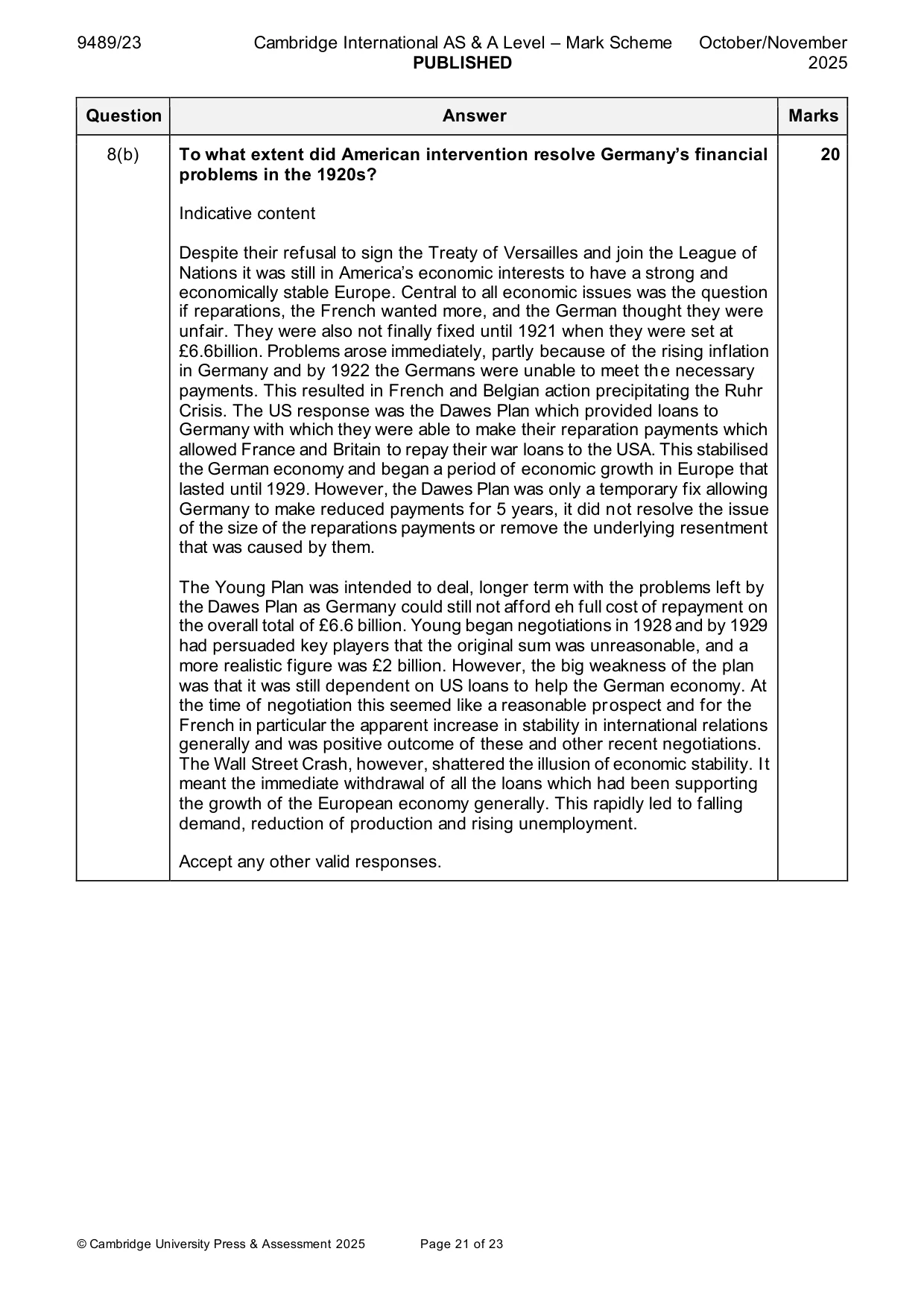
Mark scheme: 8(a) Explain why Poland faced a number of border disputes as a result of the 10 Paris peace settlement. Indicative content From the late eighteenth century, when the state of Poland was carved up by Prussia, Russia and the Austro-Hungarian Empire the state of Poland had not existed except for a brief period as the Grand Duchy of Warsaw under Napoleon. Its recreation under the principle of national self-determination created several disputed areas on its borders. • The region of Upper Silesian was a key industrial area, that was heavily populated by both Germans and Poles so could not decide which country they should belong to. after a series of riots and disturbances the League stepped in and decide to divide the area between the two countries, a decision that was accepted by both sides. • There was a similar dispute with the Czechs over the Teschen industrial area and though the League again negotiated a settlement neither side was particularly happy with it. • Russia, having left the war in 1917, was not invited to Paris but the Treaty fixed a nominal eastern border for Poland. However, the Poles wanted more than this and went to war with Russia and were able to extent their borders in the Treaty of Riga (1921). • Another newly create state bordering Poland was Lithuania, but the Poles were not satisfied with the allocation of territory and invaded Lithuania seizing the area around Vilna. Despite League intervention the Poles refused to withdraw and held on to the disputed territory. • The Polish Corridor was created to give Poland access to the sea, but it split East Prussia form the rest of Germany and created a source of conflict. Accept any other valid responses. 8(b) To what extent did American intervention resolve Germany’s financial 20 problems in the 1920s? Indicative content Despite their refusal to sign the Treaty of Versailles and join the League of Nations it was still in America’s economic interests to have a strong and economically stable Europe. Central to all economic issues was the question if reparations, the French wanted more, and the German thought they were unfair. They were also not finally fixed until 1921 when they were set at £6.6billion. Problems arose immediately, partly because of the rising inflation in Germany and by 1922 the Germans were unable to meet the necessary payments. This resulted in French and Belgian action precipitating the Ruhr Crisis. The US response was the Dawes Plan which provided loans to Germany with which they were able to make their reparation payments which allowed France and Britain to repay their war loans to the USA. This stabilised the German economy and began a period of economic growth in Europe that lasted until 1929. However, the Dawes Plan was only a temporary fix allowing Germany to make reduced payments for 5 years, it did not resolve the issue of the size of the reparations payments or remove the underlying resentment that was caused by them. The Young Plan was intended to deal, longer term with the problems left by the Dawes Plan as Germany could still not afford eh full cost of repayment on the overall total of £6.6 billion. Young began negotiations in 1928 and by 1929 had persuaded key players that the original sum was unreasonable, and a more realistic figure was £2 billion. However, the big weakness of the plan was that it was still dependent on US loans to help the German economy. At the time of negotiation this seemed like a reasonable prospect and for the French in particular the apparent increase in stability in international relations generally and was positive outcome of these and other recent negotiations. The Wall Street Crash, however, shattered the illusion of economic stability. It meant the immediate withdrawal of all the loans which had been supporting the growth of the European economy generally. This rapidly led to falling demand, reduction of production and rising unemployment. Accept any other valid responses.
More questions on How and why did international relations improve, 1924–29?
Q9 · China and Japan, 1912–45 (a) Explain why the Xi’an incident was important
9 China and Japan, 1912–45 (a) Explain why the Xi’an incident was important. [10] (b) To what extent were economic factors responsible for the decline of democracy in Japan? [20]
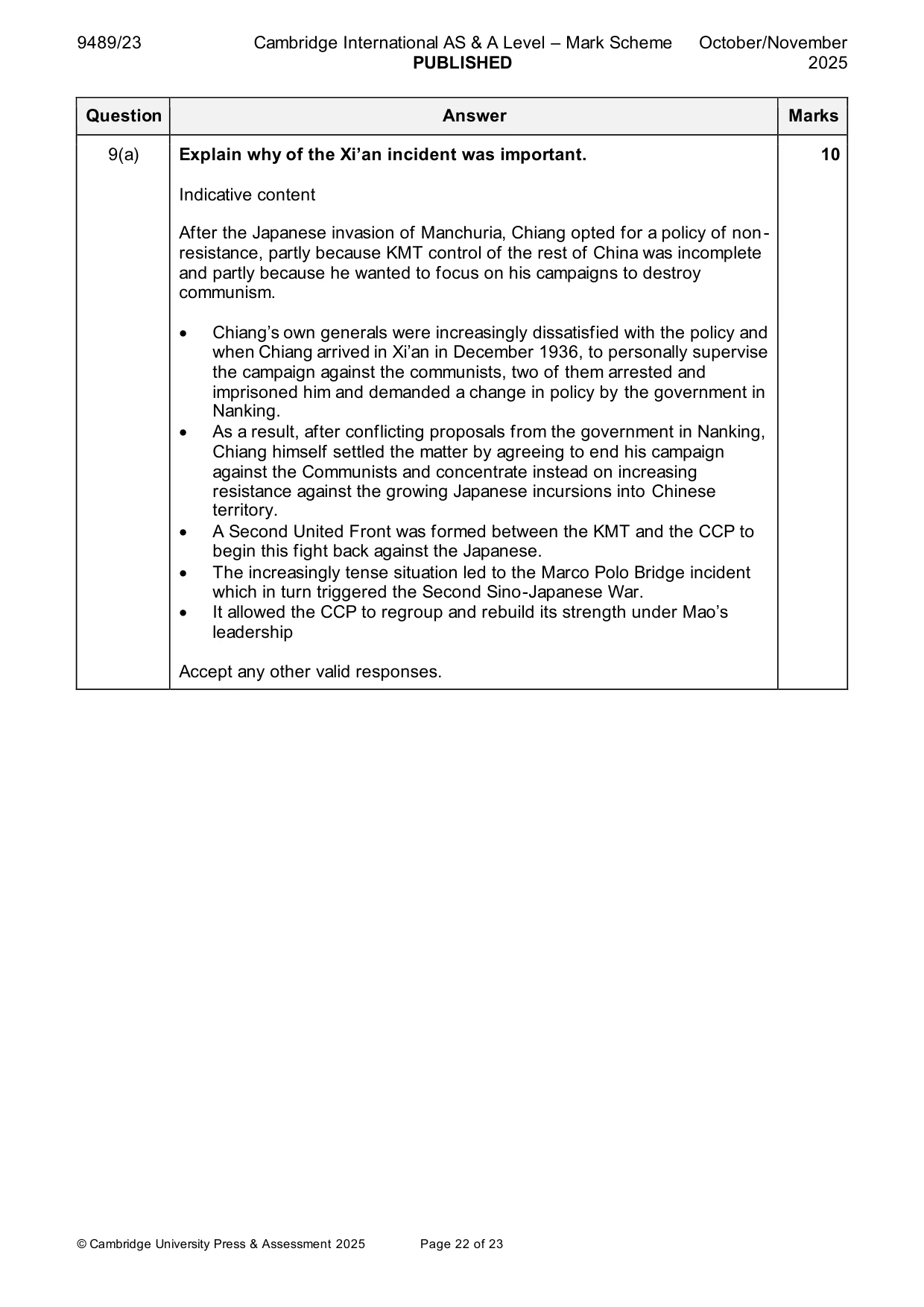
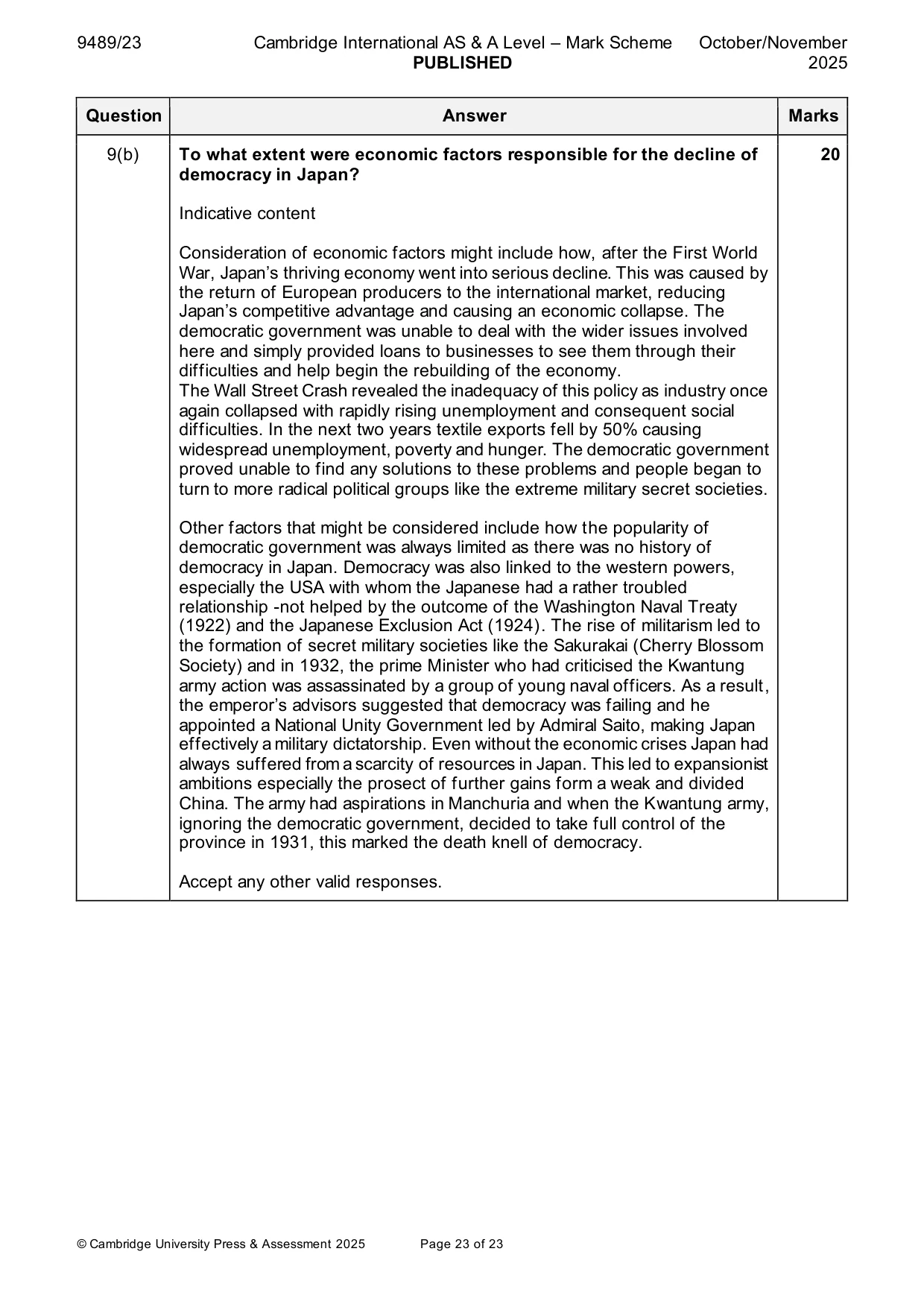
Mark scheme: 9(a) Explain why of the Xi’an incident was important. 10 Indicative content After the Japanese invasion of Manchuria, Chiang opted for a policy of non- resistance, partly because KMT control of the rest of China was incomplete and partly because he wanted to focus on his campaigns to destroy communism. • Chiang’s own generals were increasingly dissatisfied with the policy and when Chiang arrived in Xi’an in December 1936, to personally supervise the campaign against the communists, two of them arrested and imprisoned him and demanded a change in policy by the government in Nanking. • As a result, after conflicting proposals from the government in Nanking, Chiang himself settled the matter by agreeing to end his campaign against the Communists and concentrate instead on increasing resistance against the growing Japanese incursions into Chinese territory. • A Second United Front was formed between the KMT and the CCP to begin this fight back against the Japanese. • The increasingly tense situation led to the Marco Polo Bridge incident which in turn triggered the Second Sino-Japanese War. • It allowed the CCP to regroup and rebuild its strength under Mao’s leadership Accept any other valid responses. 9(b) To what extent were economic factors responsible for the decline of 20 democracy in Japan? Indicative content Consideration of economic factors might include how, after the First World War, Japan’s thriving economy went into serious decline. This was caused by the return of European producers to the international market, reducing Japan’s competitive advantage and causing an economic collapse. The democratic government was unable to deal with the wider issues involved here and simply provided loans to businesses to see them through their difficulties and help begin the rebuilding of the economy. The Wall Street Crash revealed the inadequacy of this policy as industry once again collapsed with rapidly rising unemployment and consequent social difficulties. In the next two years textile exports fell by 50% causing widespread unemployment, poverty and hunger. The democratic government proved unable to find any solutions to these problems and people began to turn to more radical political groups like the extreme military secret societies. Other factors that might be considered include how the popularity of democratic government was always limited as there was no history of democracy in Japan. Democracy was also linked to the western powers, especially the USA with whom the Japanese had a rather troubled relationship -not helped by the outcome of the Washington Naval Treaty (1922) and the Japanese Exclusion Act (1924). The rise of militarism led to the formation of secret military societies like the Sakurakai (Cherry Blossom Society) and in 1932, the prime Minister who had criticised the Kwantung army action was assassinated by a group of young naval officers. As a result, the emperor’s advisors suggested that democracy was failing and he appointed a National Unity Government led by Admiral Saito, making Japan effectively a military dictatorship. Even without the economic crises Japan had always suffered from a scarcity of resources in Japan. This led to expansionist ambitions especially the prosect of further gains form a weak and divided China. The army had aspirations in Manchuria and when the Kwantung army, ignoring the democratic government, decided to take full control of the province in 1931, this marked the death knell of democracy. Accept any other valid responses.
More questions on Why did Japan emerge as a world power and what was the impact on international
What was in this paper
The subtopics covered by these 9 questions, and how many questions each got. Open one in a new tab to see every Cambridge question on it.
2How and why did France become a republic by 1792?1How and why did international relations improve, 1924–29?1How and why did the Bolsheviks seize power in October 1917?1How successful was the Progressive Movement from 1890 to 1920?1Why did the Civil War last four years?1Why was there a second New Deal and how successful was it?1Why was there rapid industrialisation after 1870?1What you needed in this session
Cambridge’s own grade thresholds for 2025 Oct/Nov, Paper 2 · Variant 3. A higher threshold means an easier paper — the bar moves with how the cohort did.