Cambridge A Level History 9489 — 2024 Oct/Nov Paper 2 · Variant 3
9489/23/O/N/24 · 9 questions · 60 marks · ≈68 min
The question paper and its mark scheme, free to read here and free to download. This is Cambridge’s own paper, exactly as it was sat.
Question paper4 pages
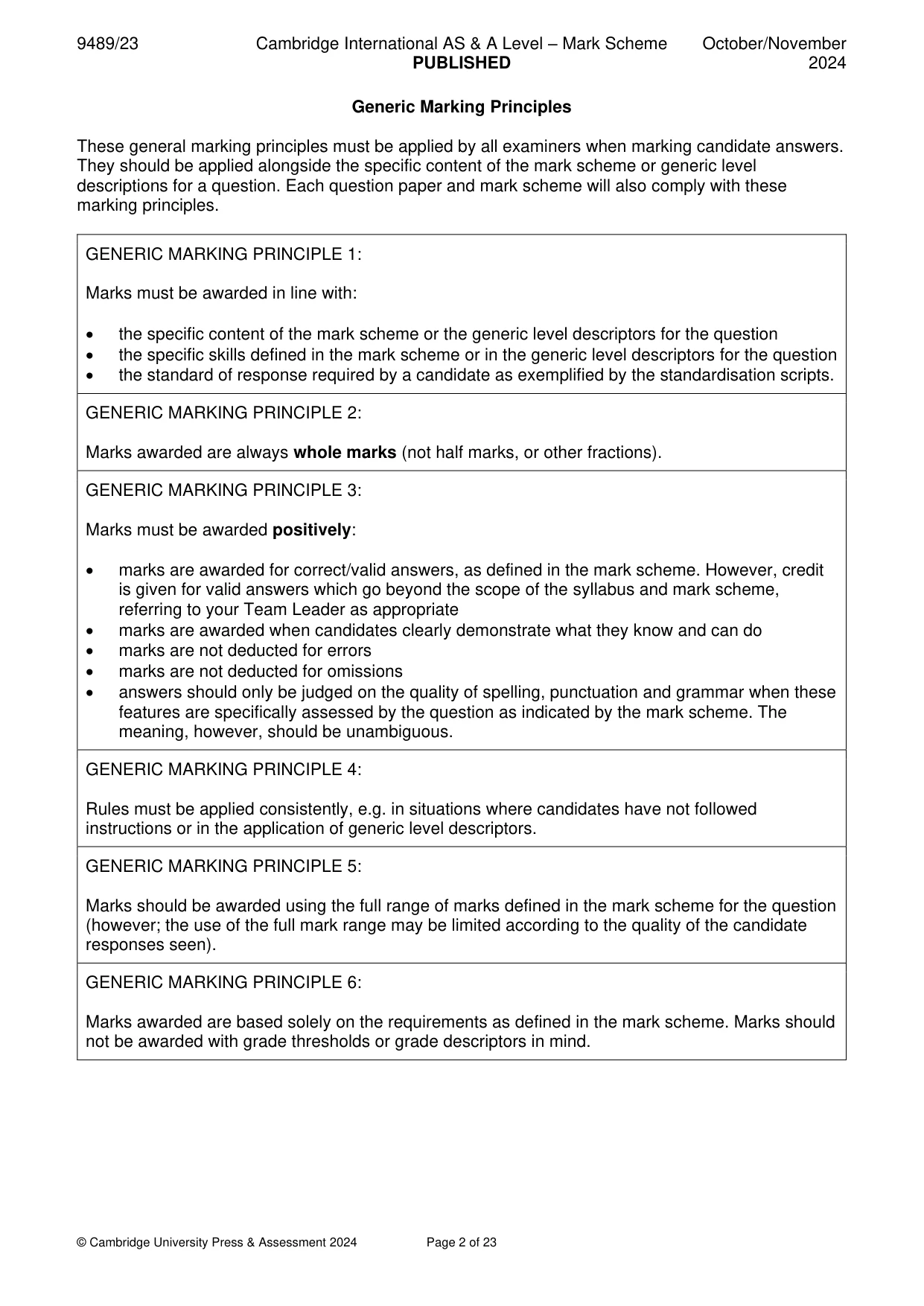
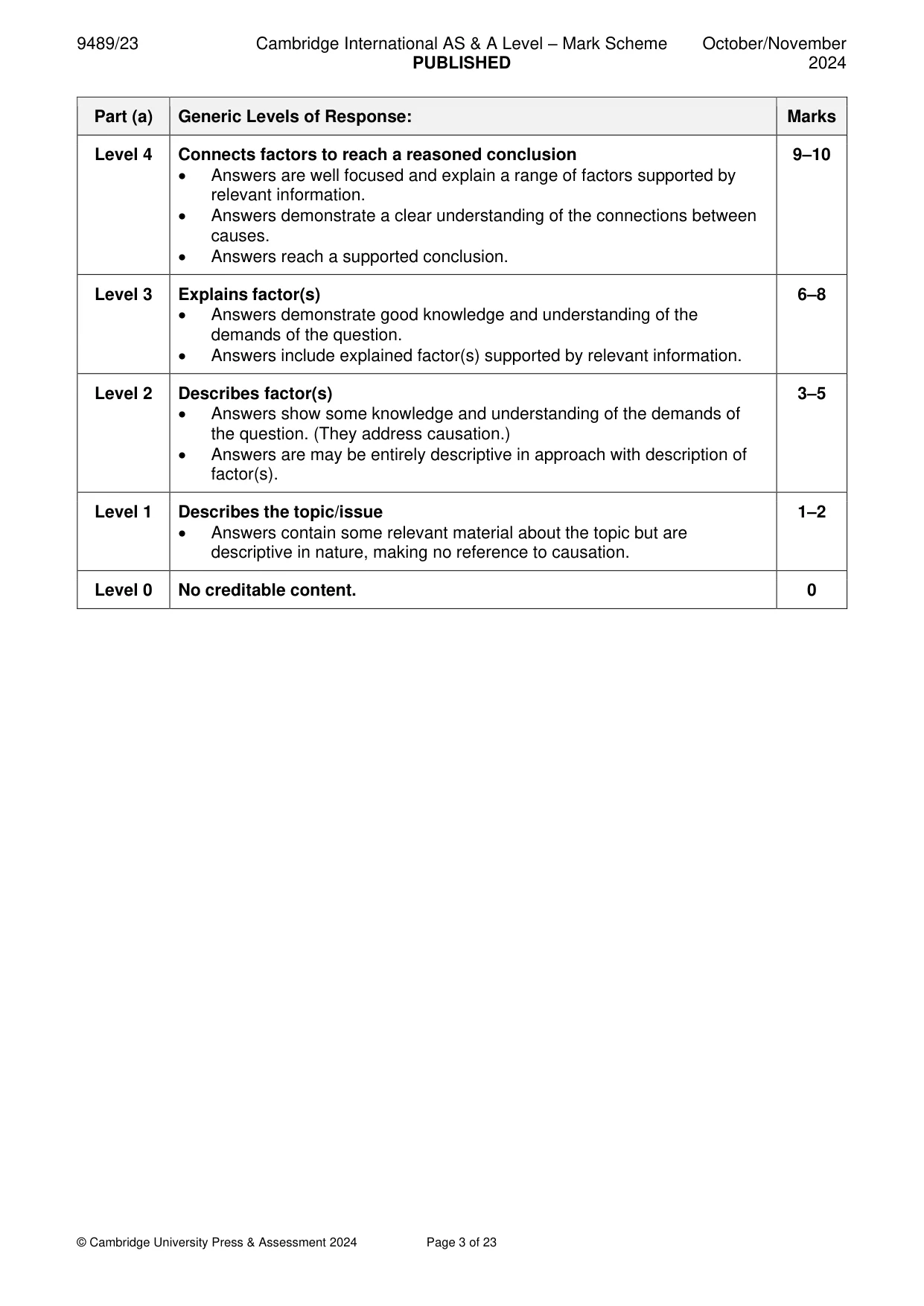
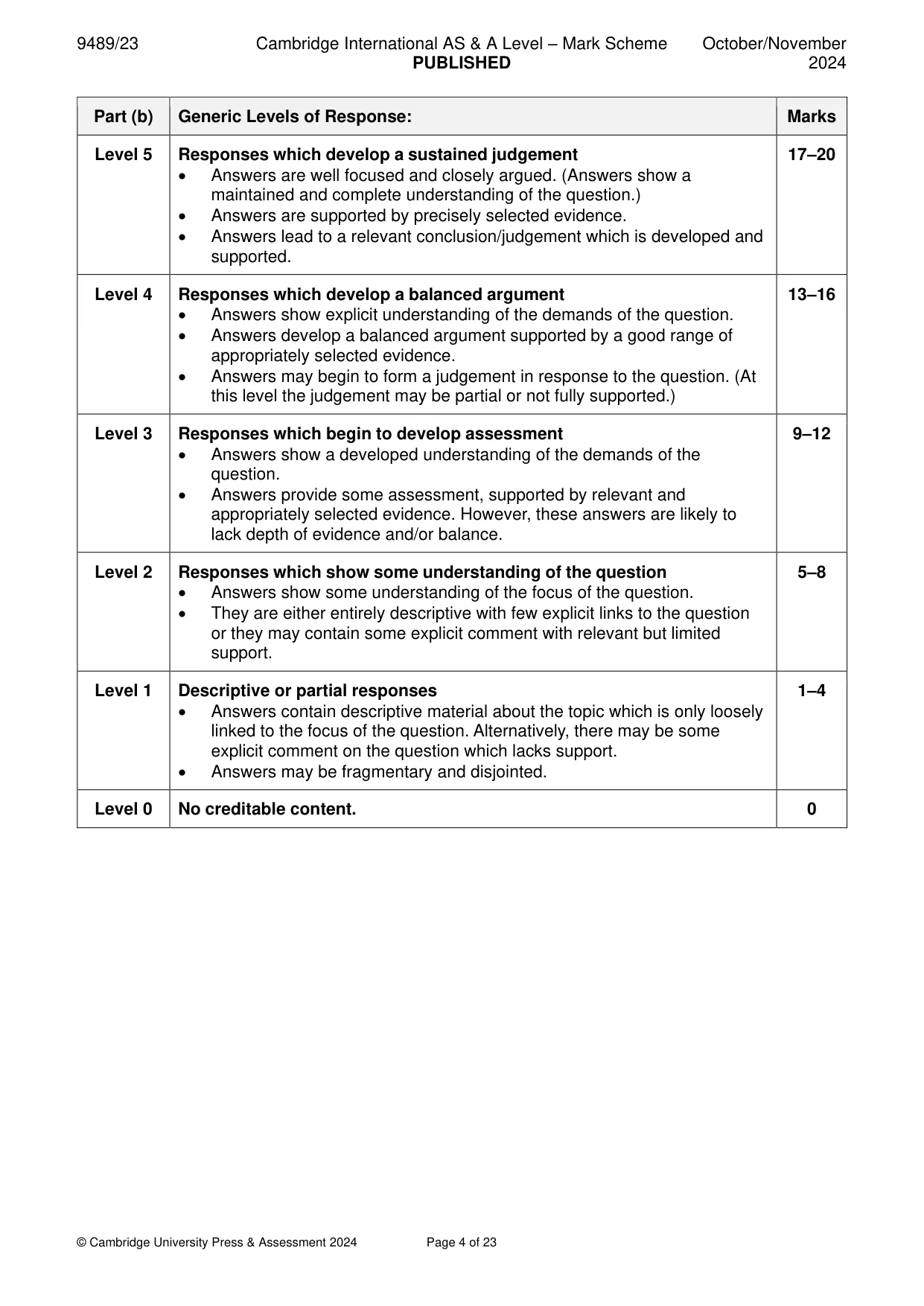
Mark scheme23 pages
Answers below. Sit the paper first if you are practising.
Questions as text
Q1 · France, 1774–1814 (a) Explain why Necker’s ‘Le Compte Rendu au Roi’ was criticised when…
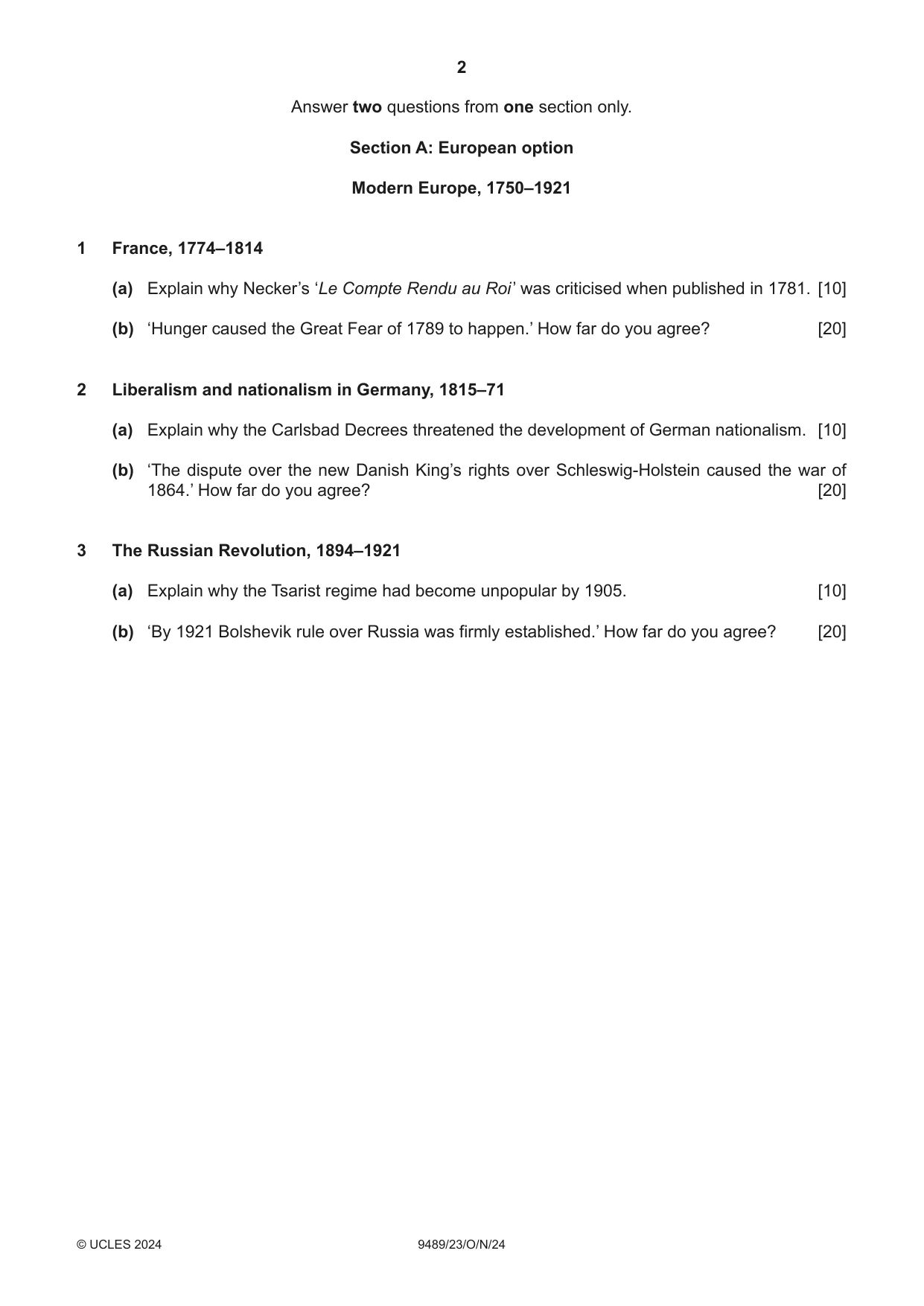
1 France, 1774–1814 (a) Explain why Necker’s ‘Le Compte Rendu au Roi’ was criticised when published in 1781. [10] (b) ‘Hunger caused the Great Fear of 1789 to happen.’ How far do you agree? [20]
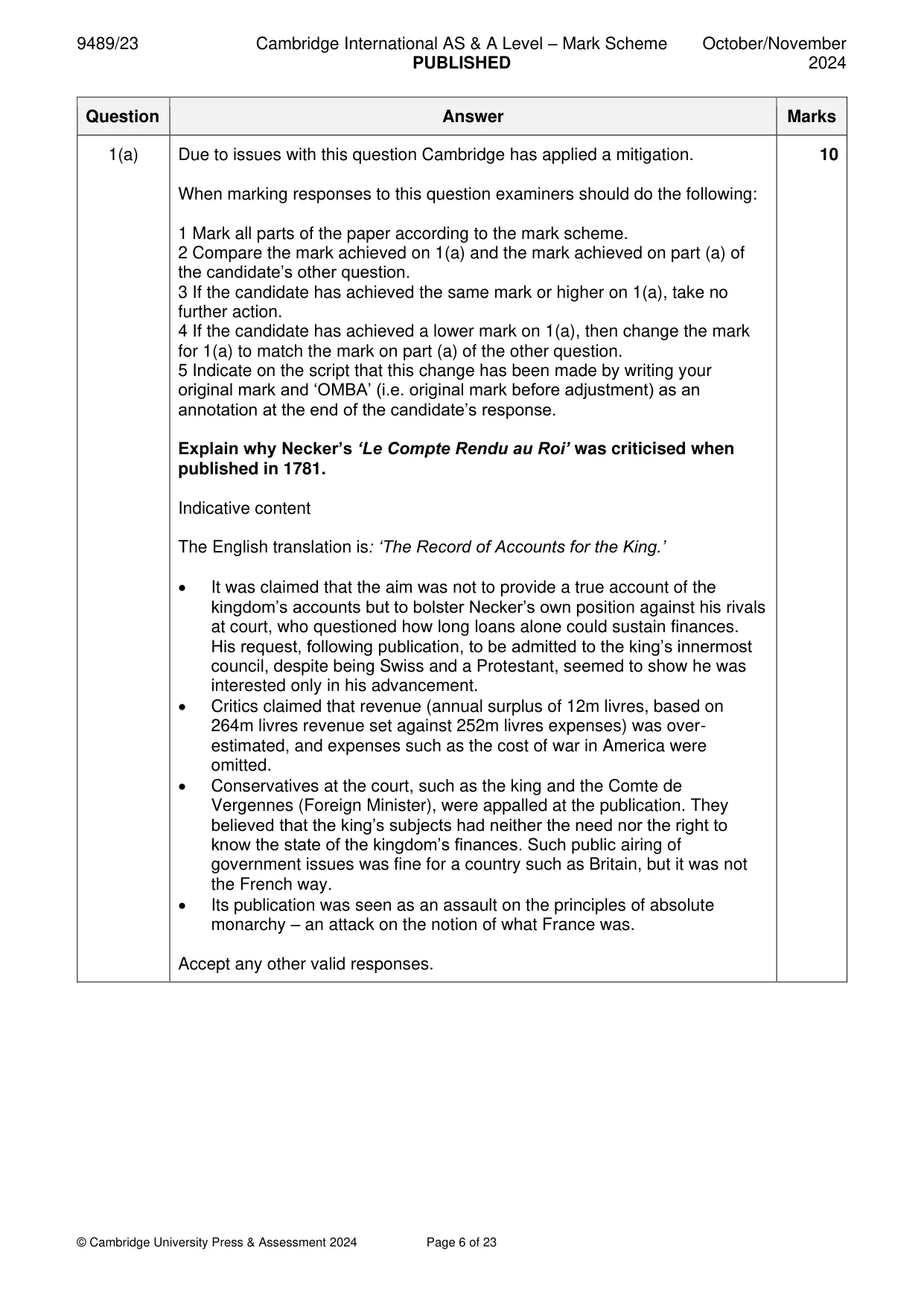
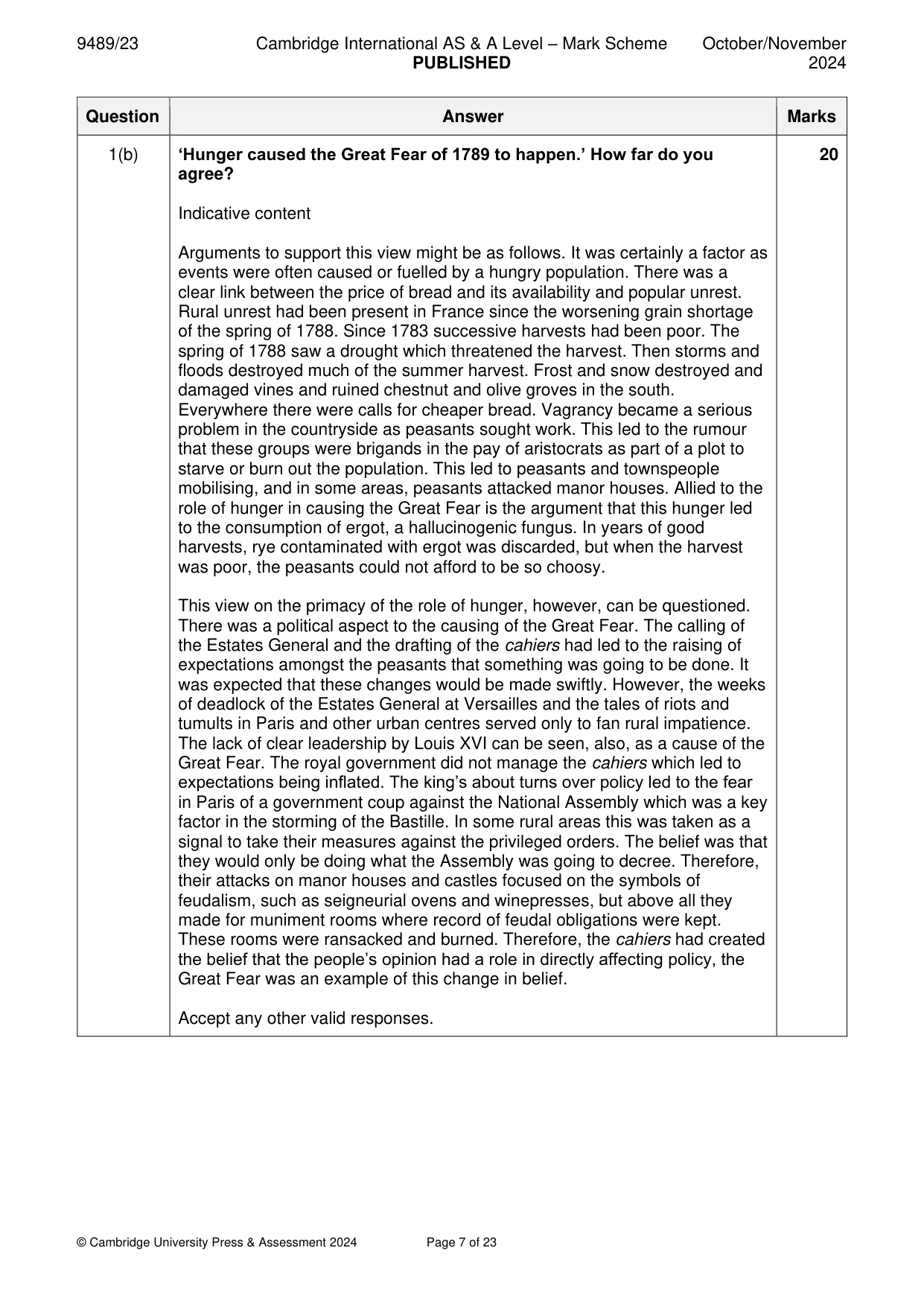
Mark scheme: Question Answer Marks 1(a) Due to issues with this question Cambridge has applied a mitigation. 10 When marking responses to this question examiners should do the following: 1 Mark all parts of the paper according to the mark scheme. 2 Compare the mark achieved on 1(a) and the mark achieved on part (a) of the candidate’s other question. 3 If the candidate has achieved the same mark or higher on 1(a), take no further action. 4 If the candidate has achieved a lower mark on 1(a), then change the mark for 1(a) to match the mark on part (a) of the other question. 5 Indicate on the script that this change has been made by writing your original mark and ‘OMBA’ (i.e. original mark before adjustment) as an annotation at the end of the candidate’s response. Explain why Necker’s ‘Le Compte Rendu au Roi’ was criticised when published in 1781. Indicative content The English translation is: ‘The Record of Accounts for the King.’ • It was claimed that the aim was not to provide a true account of the kingdom’s accounts but to bolster Necker’s own position against his rivals at court, who questioned how long loans alone could sustain finances. His request, following publication, to be admitted to the king’s innermost council, despite being Swiss and a Protestant, seemed to show he was interested only in his advancement. • Critics claimed that revenue (annual surplus of 12m livres, based on 264m livres revenue set against 252m livres expenses) was over- estimated, and expenses such as the cost of war in America were omitted. • Conservatives at the court, such as the king and the Comte de Vergennes (Foreign Minister), were appalled at the publication. They believed that the king’s subjects had neither the need nor the right to know the state of the kingdom’s finances. Such public airing of government issues was fine for a country such as Britain, but it was not the French way. • Its publication was seen as an assault on the principles of absolute monarchy – an attack on the notion of what France was. Accept any other valid responses. 1(b) ‘Hunger caused the Great Fear of 1789 to happen.’ How far do you 20 agree? Indicative content Arguments to support this view might be as follows. It was certainly a factor as events were often caused or fuelled by a hungry population. There was a clear link between the price of bread and its availability and popular unrest. Rural unrest had been present in France since the worsening grain shortage of the spring of 1788. Since 1783 successive harvests had been poor. The spring of 1788 saw a drought which threatened the harvest. Then storms and floods destroyed much of the summer harvest. Frost and snow destroyed and damaged vines and ruined chestnut and olive groves in the south. Everywhere there were calls for cheaper bread. Vagrancy became a serious problem in the countryside as peasants sought work. This led to the rumour that these groups were brigands in the pay of aristocrats as part of a plot to starve or burn out the population. This led to peasants and townspeople mobilising, and in some areas, peasants attacked manor houses. Allied to the role of hunger in causing the Great Fear is the argument that this hunger led to the consumption of ergot, a hallucinogenic fungus. In years of good harvests, rye contaminated with ergot was discarded, but when the harvest was poor, the peasants could not afford to be so choosy. This view on the primacy of the role of hunger, however, can be questioned. There was a political aspect to the causing of the Great Fear. The calling of the Estates General and the drafting of the cahiers had led to the raising of expectations amongst the peasants that something was going to be done. It was expected that these changes would be made swiftly. However, the weeks of deadlock of the Estates General at Versailles and the tales of riots and tumults in Paris and other urban centres served only to fan rural impatience. The lack of clear leadership by Louis XVI can be seen, also, as a cause of the Great Fear. The royal government did not manage the cahiers which led to expectations being inflated. The king’s about turns over policy led to the fear in Paris of a government coup against the National Assembly which was a key factor in the storming of the Bastille. In some rural areas this was taken as a signal to take their measures against the privileged orders. The belief was that they would only be doing what the Assembly was going to decree. Therefore, their attacks on manor houses and castles focused on the symbols of feudalism, such as seigneurial ovens and winepresses, but above all they made for muniment rooms where record of feudal obligations were kept. These rooms were ransacked and burned. Therefore, the cahiers had created the belief that the people’s opinion had a role in directly affecting policy, the Great Fear was an example of this change in belief. Accept any other valid responses.
More questions on What were the causes and immediate consequences of the 1789 Revolution?
Q2 · Liberalism and nationalism in Germany, 1815–71 (a) Explain why the Carlsbad Decrees…
2 Liberalism and nationalism in Germany, 1815–71 (a) Explain why the Carlsbad Decrees threatened the development of German nationalism. [10] (b) ‘The dispute over the new Danish King’s rights over Schleswig-Holstein caused the war of 1864.’ How far do you agree? [20]
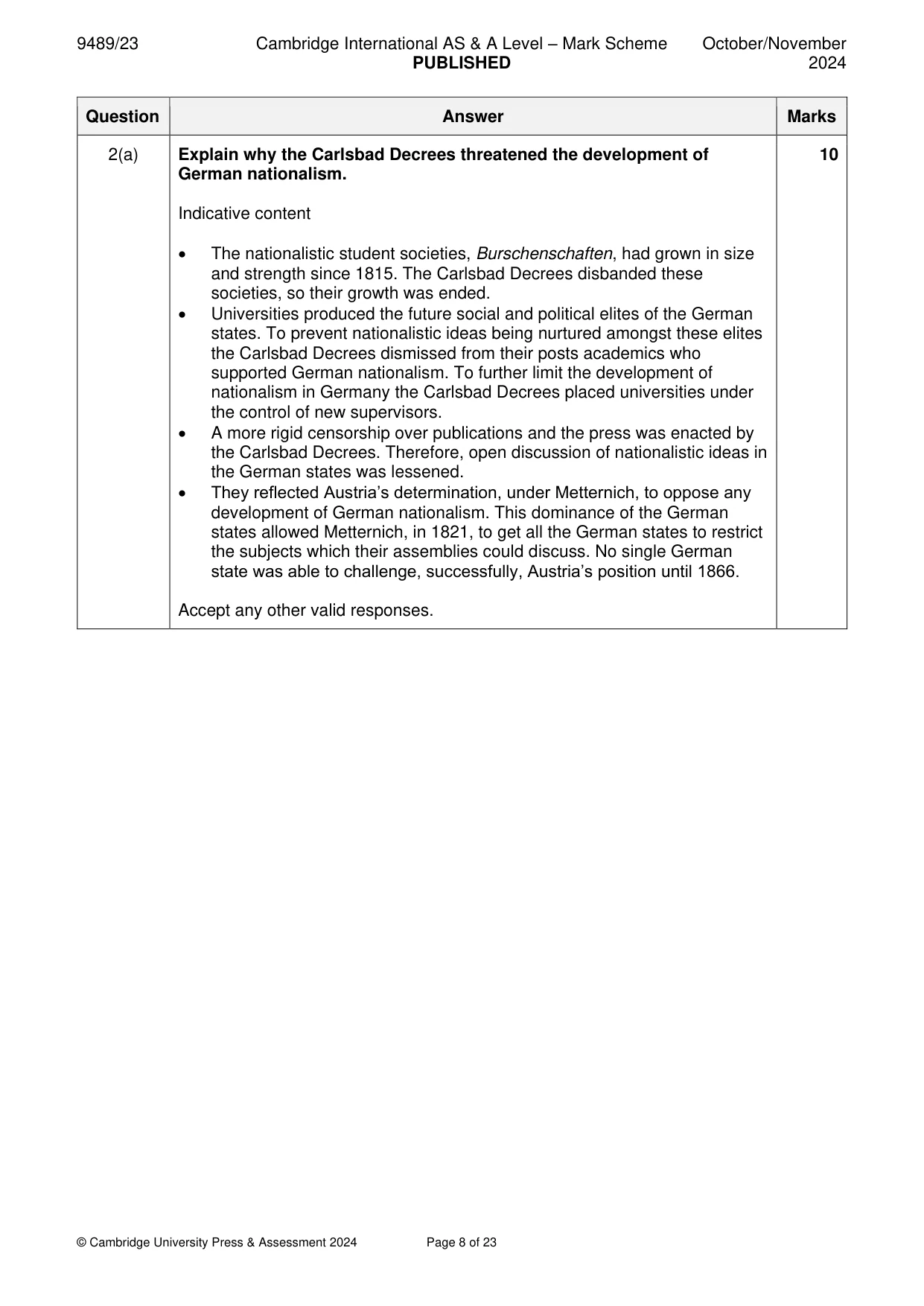
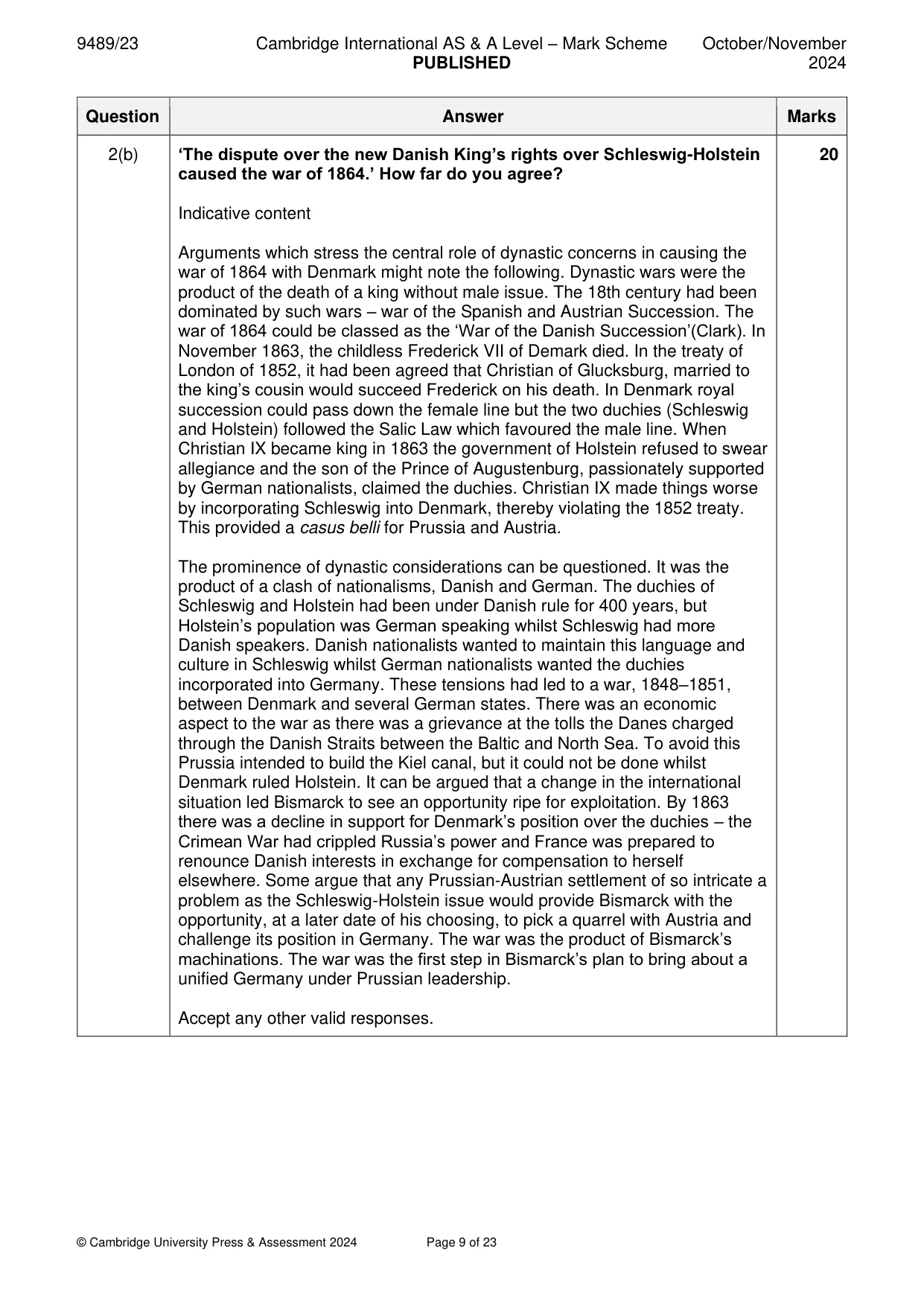
Mark scheme: 2(a) Explain why the Carlsbad Decrees threatened the development of 10 German nationalism. Indicative content • The nationalistic student societies, Burschenschaften, had grown in size and strength since 1815. The Carlsbad Decrees disbanded these societies, so their growth was ended. • Universities produced the future social and political elites of the German states. To prevent nationalistic ideas being nurtured amongst these elites the Carlsbad Decrees dismissed from their posts academics who supported German nationalism. To further limit the development of nationalism in Germany the Carlsbad Decrees placed universities under the control of new supervisors. • A more rigid censorship over publications and the press was enacted by the Carlsbad Decrees. Therefore, open discussion of nationalistic ideas in the German states was lessened. • They reflected Austria’s determination, under Metternich, to oppose any development of German nationalism. This dominance of the German states allowed Metternich, in 1821, to get all the German states to restrict the subjects which their assemblies could discuss. No single German state was able to challenge, successfully, Austria’s position until 1866. Accept any other valid responses. 2(b) ‘The dispute over the new Danish King’s rights over Schleswig-Holstein 20 caused the war of 1864.’ How far do you agree? Indicative content Arguments which stress the central role of dynastic concerns in causing the war of 1864 with Denmark might note the following. Dynastic wars were the product of the death of a king without male issue. The 18th century had been dominated by such wars – war of the Spanish and Austrian Succession. The war of 1864 could be classed as the ‘War of the Danish Succession’(Clark). In November 1863, the childless Frederick VII of Demark died. In the treaty of London of 1852, it had been agreed that Christian of Glucksburg, married to the king’s cousin would succeed Frederick on his death. In Denmark royal succession could pass down the female line but the two duchies (Schleswig and Holstein) followed the Salic Law which favoured the male line. When Christian IX became king in 1863 the government of Holstein refused to swear allegiance and the son of the Prince of Augustenburg, passionately supported by German nationalists, claimed the duchies. Christian IX made things worse by incorporating Schleswig into Denmark, thereby violating the 1852 treaty. This provided a casus belli for Prussia and Austria. The prominence of dynastic considerations can be questioned. It was the product of a clash of nationalisms, Danish and German. The duchies of Schleswig and Holstein had been under Danish rule for 400 years, but Holstein’s population was German speaking whilst Schleswig had more Danish speakers. Danish nationalists wanted to maintain this language and culture in Schleswig whilst German nationalists wanted the duchies incorporated into Germany. These tensions had led to a war, 1848–1851, between Denmark and several German states. There was an economic aspect to the war as there was a grievance at the tolls the Danes charged through the Danish Straits between the Baltic and North Sea. To avoid this Prussia intended to build the Kiel canal, but it could not be done whilst Denmark ruled Holstein. It can be argued that a change in the international situation led Bismarck to see an opportunity ripe for exploitation. By 1863 there was a decline in support for Denmark’s position over the duchies – the Crimean War had crippled Russia’s power and France was prepared to renounce Danish interests in exchange for compensation to herself elsewhere. Some argue that any Prussian-Austrian settlement of so intricate a problem as the Schleswig-Holstein issue would provide Bismarck with the opportunity, at a later date of his choosing, to pick a quarrel with Austria and challenge its position in Germany. The war was the product of Bismarck’s machinations. The war was the first step in Bismarck’s plan to bring about a unified Germany under Prussian leadership. Accept any other valid responses.
More questions on How and why was German unification achieved by 1871?
Q3 · The Russian Revolution, 1894–1921 (a) Explain why the Tsarist regime had become unpopular…
3 The Russian Revolution, 1894–1921 (a) Explain why the Tsarist regime had become unpopular by 1905. [10] (b) ‘By 1921 Bolshevik rule over Russia was firmly established.’ How far do you agree? [20]
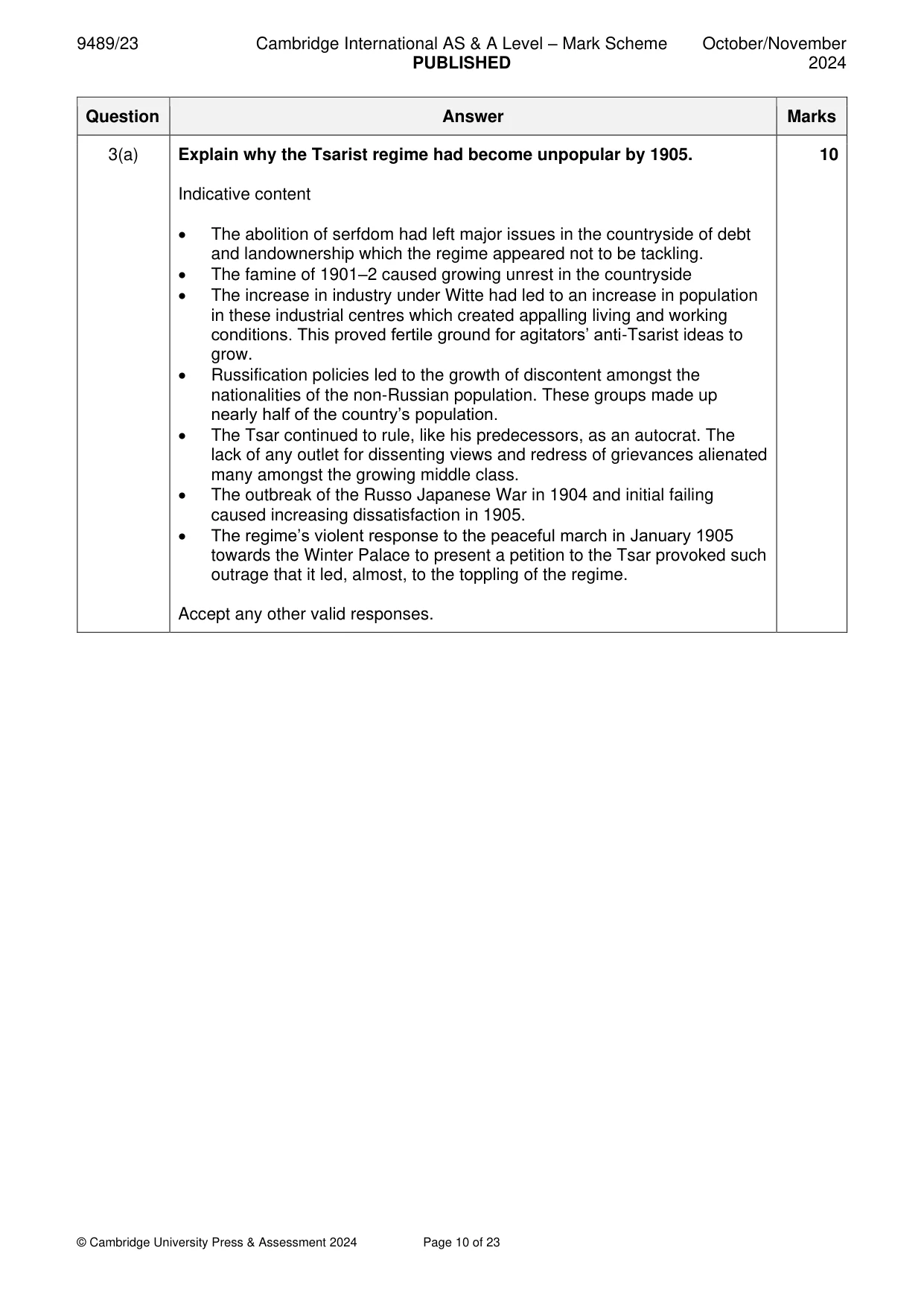
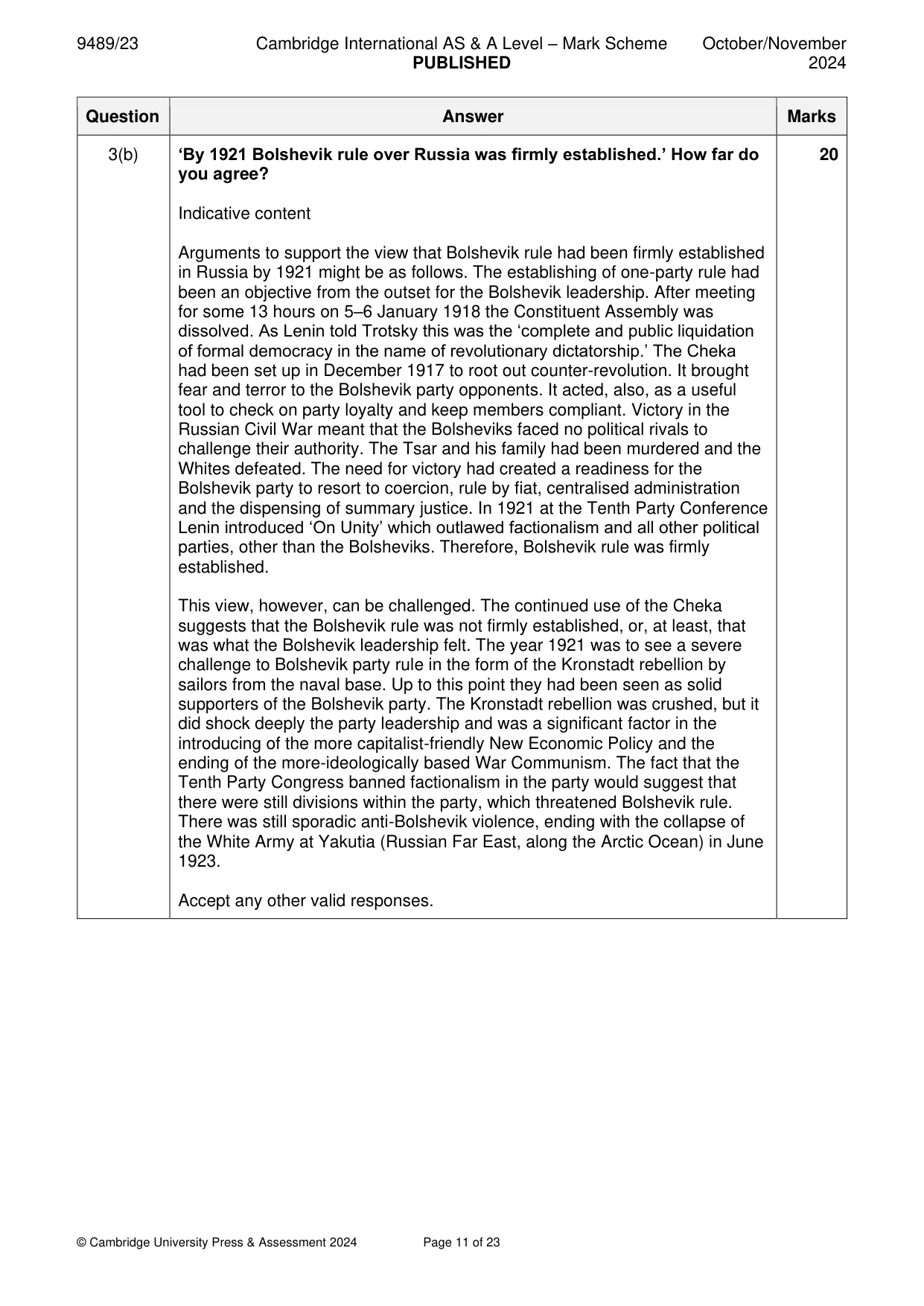
Mark scheme: 3(a) Explain why the Tsarist regime had become unpopular by 1905. 10 Indicative content • The abolition of serfdom had left major issues in the countryside of debt and landownership which the regime appeared not to be tackling. • The famine of 1901–2 caused growing unrest in the countryside • The increase in industry under Witte had led to an increase in population in these industrial centres which created appalling living and working conditions. This proved fertile ground for agitators’ anti-Tsarist ideas to grow. • Russification policies led to the growth of discontent amongst the nationalities of the non-Russian population. These groups made up nearly half of the country’s population. • The Tsar continued to rule, like his predecessors, as an autocrat. The lack of any outlet for dissenting views and redress of grievances alienated many amongst the growing middle class. • The outbreak of the Russo Japanese War in 1904 and initial failing caused increasing dissatisfaction in 1905. • The regime’s violent response to the peaceful march in January 1905 towards the Winter Palace to present a petition to the Tsar provoked such outrage that it led, almost, to the toppling of the regime. Accept any other valid responses. 3(b) ‘By 1921 Bolshevik rule over Russia was firmly established.’ How far do 20 you agree? Indicative content Arguments to support the view that Bolshevik rule had been firmly established in Russia by 1921 might be as follows. The establishing of one-party rule had been an objective from the outset for the Bolshevik leadership. After meeting for some 13 hours on 5–6 January 1918 the Constituent Assembly was dissolved. As Lenin told Trotsky this was the ‘complete and public liquidation of formal democracy in the name of revolutionary dictatorship.’ The Cheka had been set up in December 1917 to root out counter-revolution. It brought fear and terror to the Bolshevik party opponents. It acted, also, as a useful tool to check on party loyalty and keep members compliant. Victory in the Russian Civil War meant that the Bolsheviks faced no political rivals to challenge their authority. The Tsar and his family had been murdered and the Whites defeated. The need for victory had created a readiness for the Bolshevik party to resort to coercion, rule by fiat, centralised administration and the dispensing of summary justice. In 1921 at the Tenth Party Conference Lenin introduced ‘On Unity’ which outlawed factionalism and all other political parties, other than the Bolsheviks. Therefore, Bolshevik rule was firmly established. This view, however, can be challenged. The continued use of the Cheka suggests that the Bolshevik rule was not firmly established, or, at least, that was what the Bolshevik leadership felt. The year 1921 was to see a severe challenge to Bolshevik party rule in the form of the Kronstadt rebellion by sailors from the naval base. Up to this point they had been seen as solid supporters of the Bolshevik party. The Kronstadt rebellion was crushed, but it did shock deeply the party leadership and was a significant factor in the introducing of the more capitalist-friendly New Economic Policy and the ending of the more-ideologically based War Communism. The fact that the Tenth Party Congress banned factionalism in the party would suggest that there were still divisions within the party, which threatened Bolshevik rule. There was still sporadic anti-Bolshevik violence, ending with the collapse of the White Army at Yakutia (Russian Far East, along the Arctic Ocean) in June 1923. Accept any other valid responses.
More questions on How were the Bolsheviks able to consolidate their power up to 1924?
Q4 · The origins of the Civil War, 1820–61 (a) Explain why Confederate forces attacked Fort…
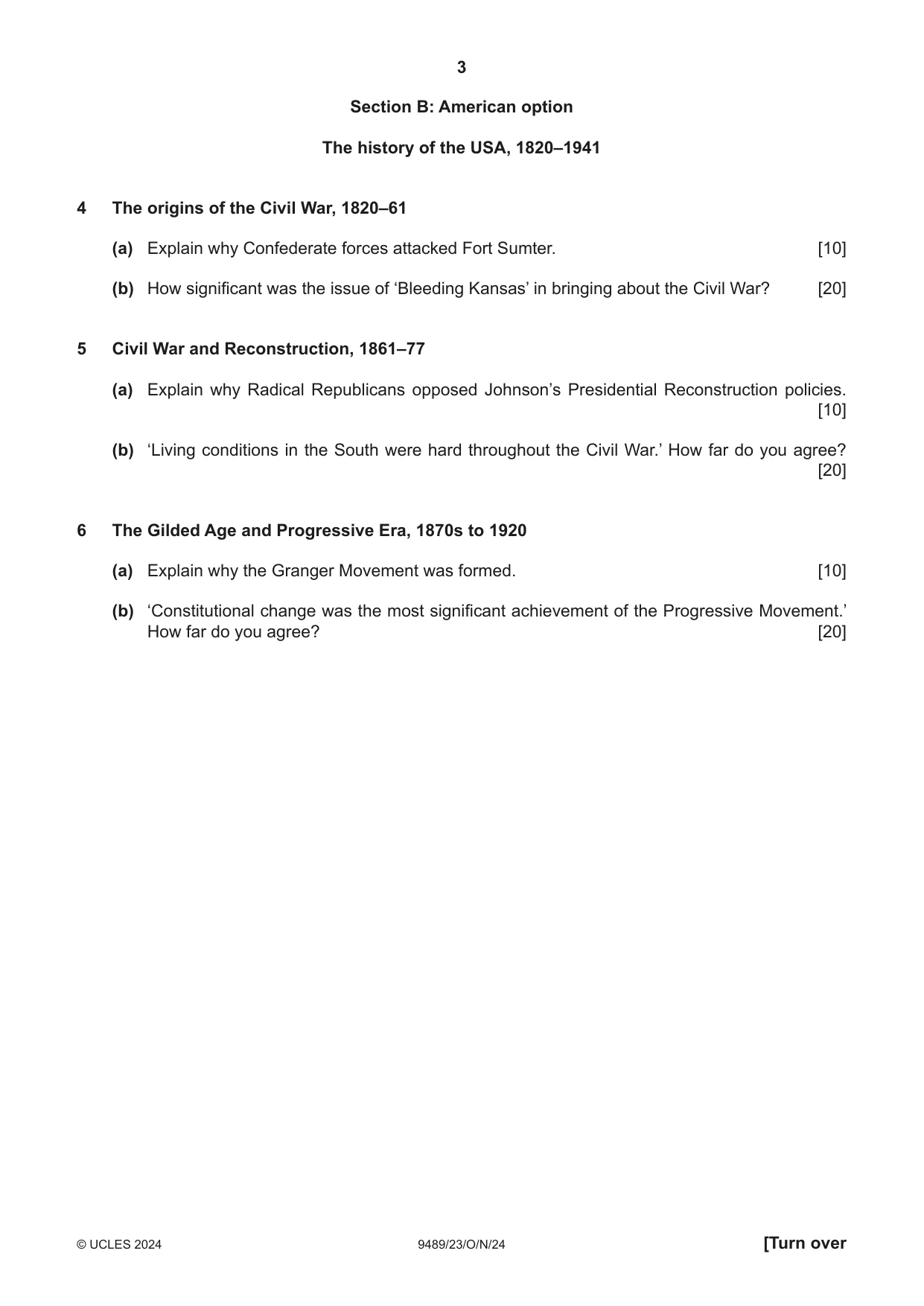
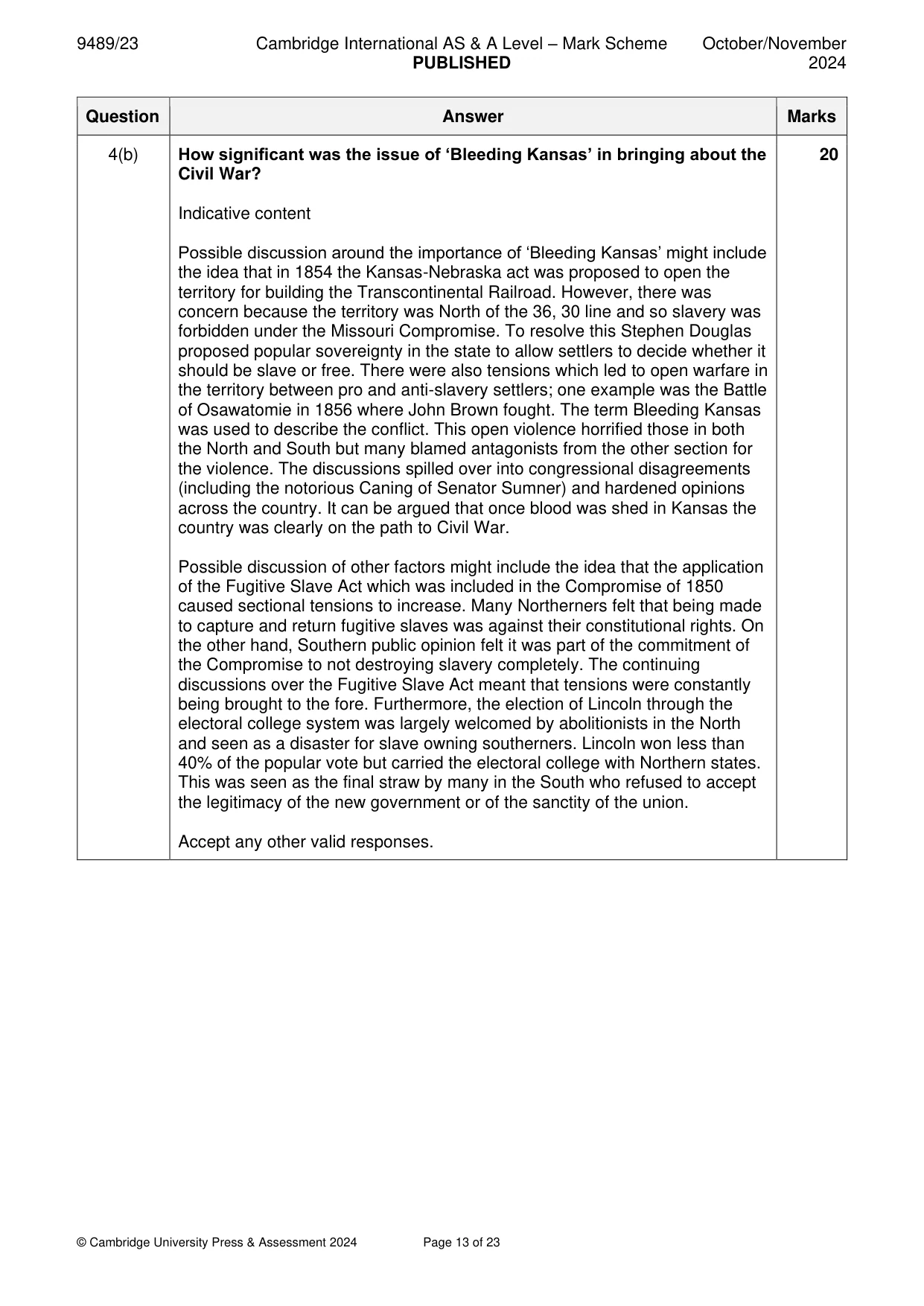
4 The origins of the Civil War, 1820–61 (a) Explain why Confederate forces attacked Fort Sumter. [10] (b) How significant was the issue of ‘Bleeding Kansas’ in bringing about the Civil War? [20]
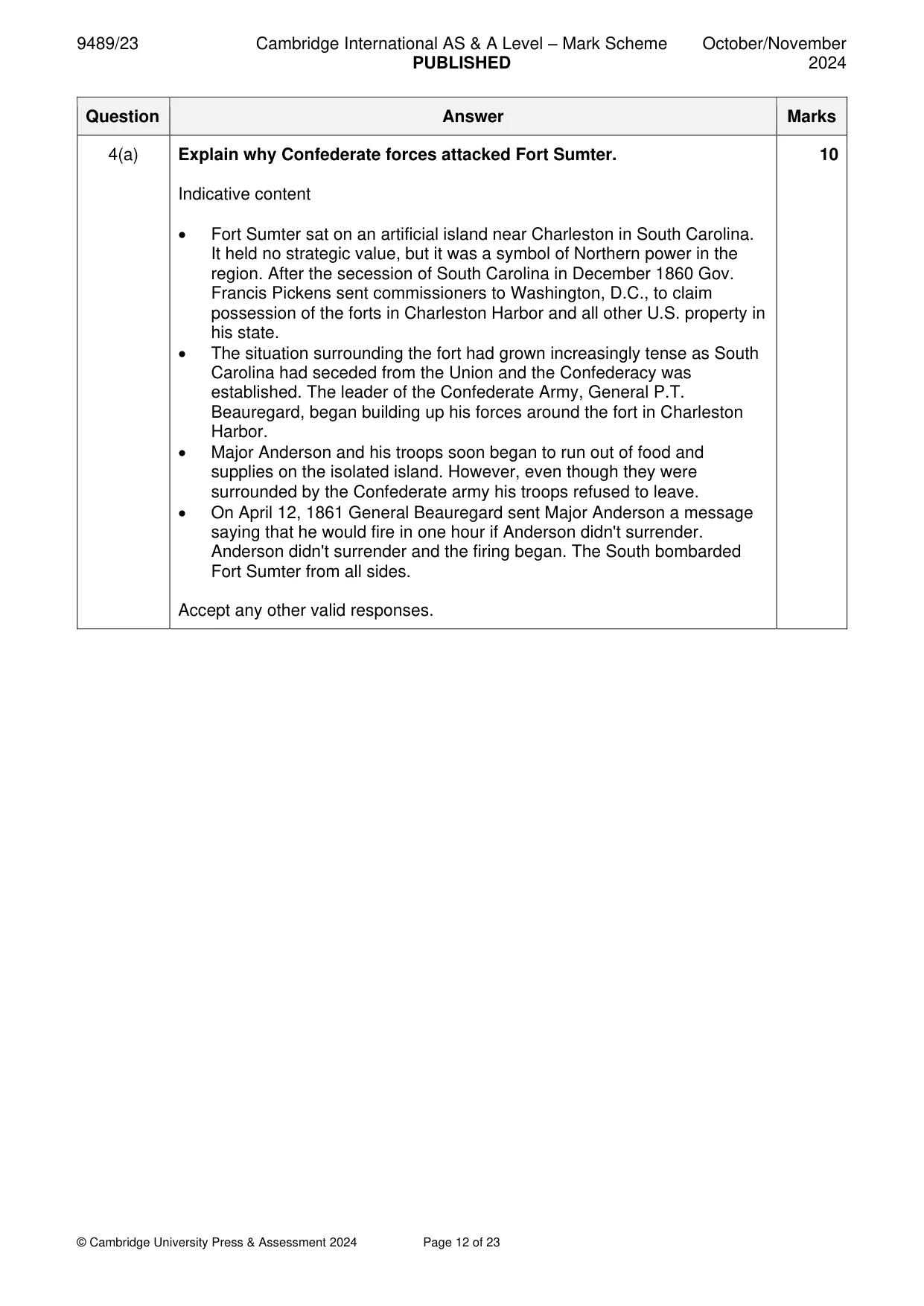
Mark scheme: 4(a) Explain why Confederate forces attacked Fort Sumter. 10 Indicative content • Fort Sumter sat on an artificial island near Charleston in South Carolina. It held no strategic value, but it was a symbol of Northern power in the region. After the secession of South Carolina in December 1860 Gov. Francis Pickens sent commissioners to Washington, D.C., to claim possession of the forts in Charleston Harbor and all other U.S. property in his state. • The situation surrounding the fort had grown increasingly tense as South Carolina had seceded from the Union and the Confederacy was established. The leader of the Confederate Army, General P.T. Beauregard, began building up his forces around the fort in Charleston Harbor. • Major Anderson and his troops soon began to run out of food and supplies on the isolated island. However, even though they were surrounded by the Confederate army his troops refused to leave. • On April 12, 1861 General Beauregard sent Major Anderson a message saying that he would fire in one hour if Anderson didn't surrender. Anderson didn't surrender and the firing began. The South bombarded Fort Sumter from all sides. Accept any other valid responses. 4(b) How significant was the issue of ‘Bleeding Kansas’ in bringing about the 20 Civil War? Indicative content Possible discussion around the importance of ‘Bleeding Kansas’ might include the idea that in 1854 the Kansas-Nebraska act was proposed to open the territory for building the Transcontinental Railroad. However, there was concern because the territory was North of the 36, 30 line and so slavery was forbidden under the Missouri Compromise. To resolve this Stephen Douglas proposed popular sovereignty in the state to allow settlers to decide whether it should be slave or free. There were also tensions which led to open warfare in the territory between pro and anti-slavery settlers; one example was the Battle of Osawatomie in 1856 where John Brown fought. The term Bleeding Kansas was used to describe the conflict. This open violence horrified those in both the North and South but many blamed antagonists from the other section for the violence. The discussions spilled over into congressional disagreements (including the notorious Caning of Senator Sumner) and hardened opinions across the country. It can be argued that once blood was shed in Kansas the country was clearly on the path to Civil War. Possible discussion of other factors might include the idea that the application of the Fugitive Slave Act which was included in the Compromise of 1850 caused sectional tensions to increase. Many Northerners felt that being made to capture and return fugitive slaves was against their constitutional rights. On the other hand, Southern public opinion felt it was part of the commitment of the Compromise to not destroying slavery completely. The continuing discussions over the Fugitive Slave Act meant that tensions were constantly being brought to the fore. Furthermore, the election of Lincoln through the electoral college system was largely welcomed by abolitionists in the North and seen as a disaster for slave owning southerners. Lincoln won less than 40% of the popular vote but carried the electoral college with Northern states. This was seen as the final straw by many in the South who refused to accept the legitimacy of the new government or of the sanctity of the union. Accept any other valid responses.
More questions on Why was there increasing tension between the North and the South before 1860?
Q5 · Civil War and Reconstruction, 1861–77 (a) Explain why Radical Republicans opposed…
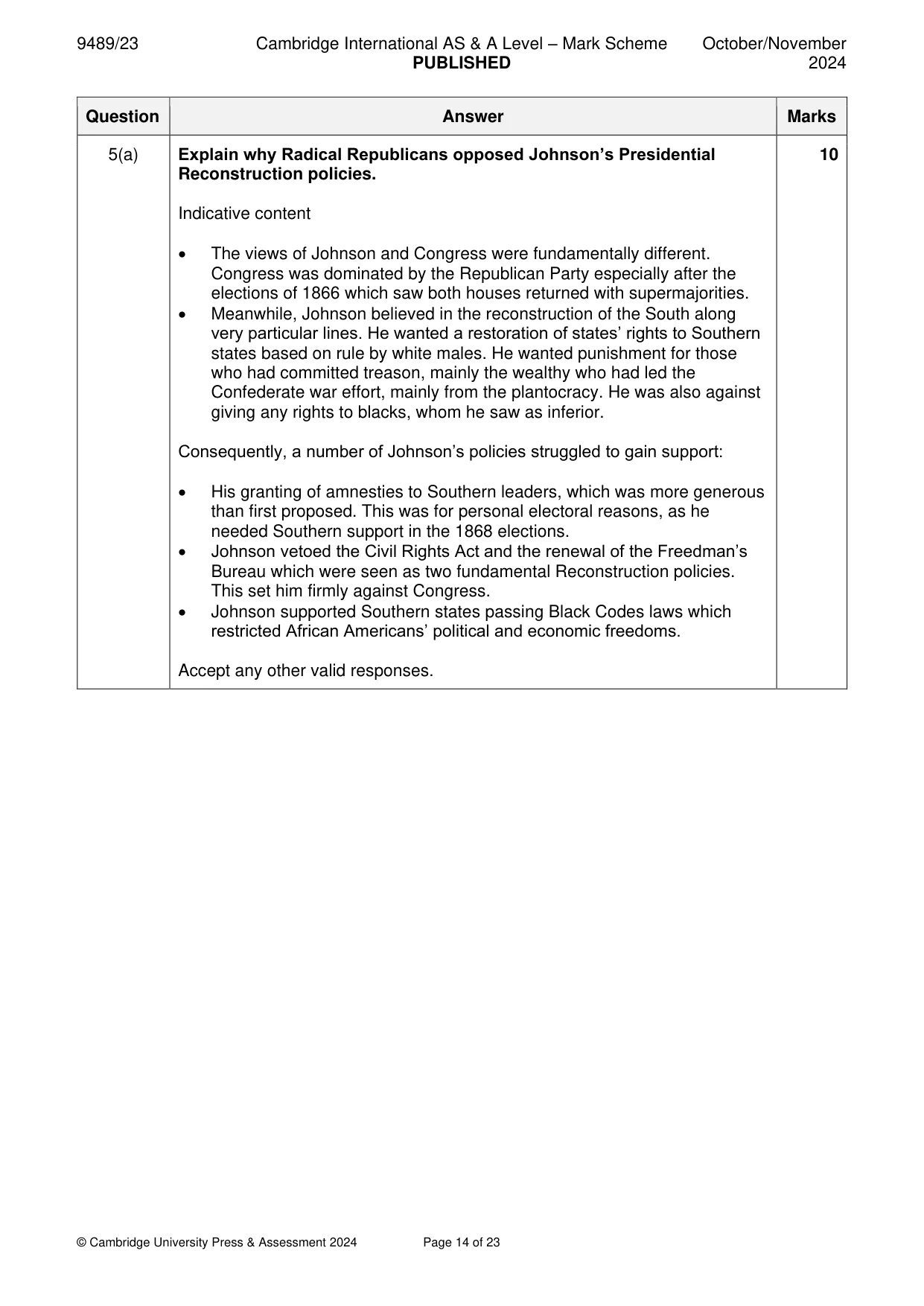
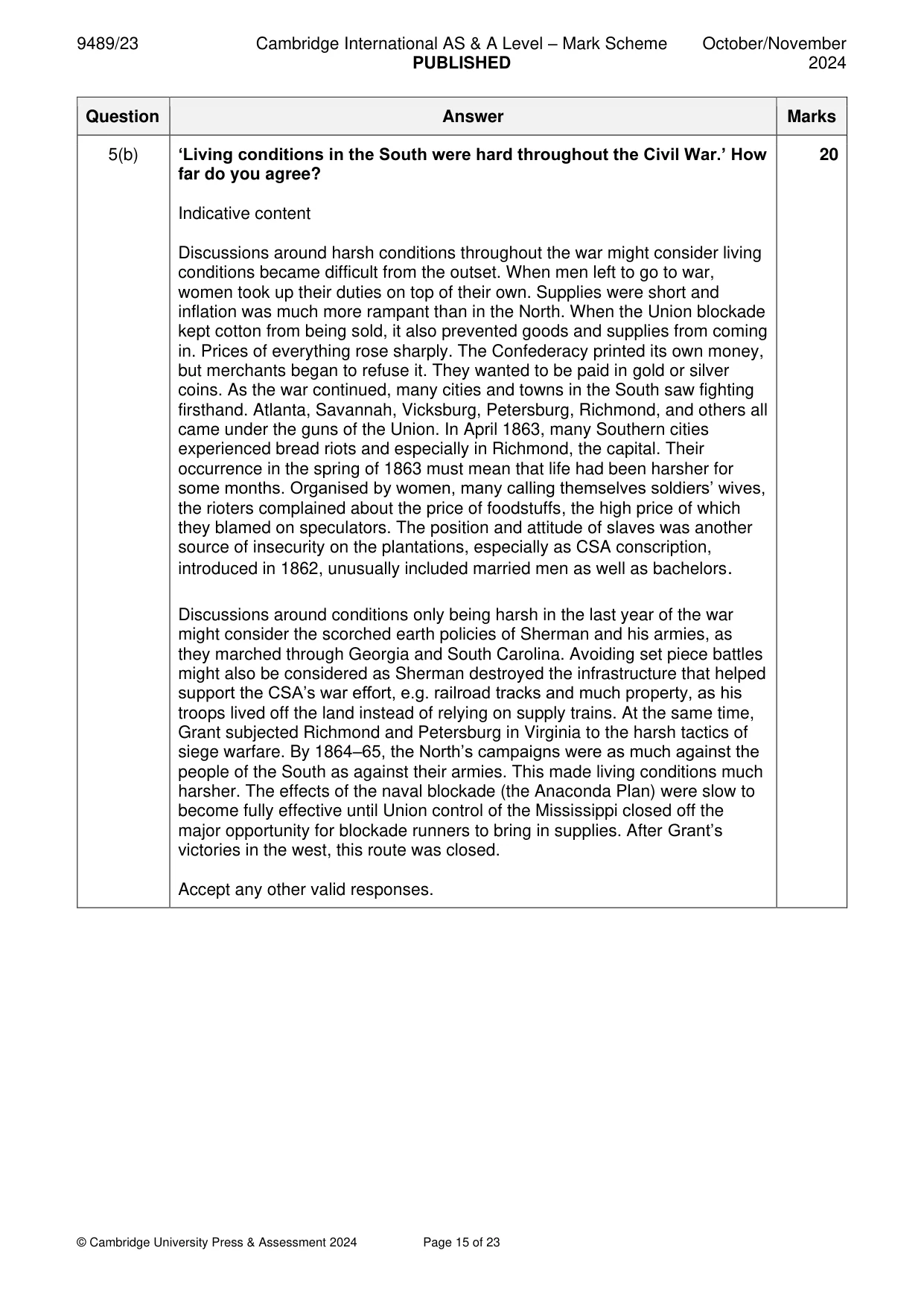
5 Civil War and Reconstruction, 1861–77 (a) Explain why Radical Republicans opposed Johnson’s Presidential Reconstruction policies. [10] (b) ‘Living conditions in the South were hard throughout the Civil War.’ How far do you agree? [20]
Mark scheme: 5(a) Explain why Radical Republicans opposed Johnson’s Presidential 10 Reconstruction policies. Indicative content • The views of Johnson and Congress were fundamentally different. Congress was dominated by the Republican Party especially after the elections of 1866 which saw both houses returned with supermajorities. • Meanwhile, Johnson believed in the reconstruction of the South along very particular lines. He wanted a restoration of states’ rights to Southern states based on rule by white males. He wanted punishment for those who had committed treason, mainly the wealthy who had led the Confederate war effort, mainly from the plantocracy. He was also against giving any rights to blacks, whom he saw as inferior. Consequently, a number of Johnson’s policies struggled to gain support: • His granting of amnesties to Southern leaders, which was more generous than first proposed. This was for personal electoral reasons, as he needed Southern support in the 1868 elections. • Johnson vetoed the Civil Rights Act and the renewal of the Freedman’s Bureau which were seen as two fundamental Reconstruction policies. This set him firmly against Congress. • Johnson supported Southern states passing Black Codes laws which restricted African Americans’ political and economic freedoms. Accept any other valid responses. 5(b) ‘Living conditions in the South were hard throughout the Civil War.’ How 20 far do you agree? Indicative content Discussions around harsh conditions throughout the war might consider living conditions became difficult from the outset. When men left to go to war, women took up their duties on top of their own. Supplies were short and inflation was much more rampant than in the North. When the Union blockade kept cotton from being sold, it also prevented goods and supplies from coming in. Prices of everything rose sharply. The Confederacy printed its own money, but merchants began to refuse it. They wanted to be paid in gold or silver coins. As the war continued, many cities and towns in the South saw fighting firsthand. Atlanta, Savannah, Vicksburg, Petersburg, Richmond, and others all came under the guns of the Union. In April 1863, many Southern cities experienced bread riots and especially in Richmond, the capital. Their occurrence in the spring of 1863 must mean that life had been harsher for some months. Organised by women, many calling themselves soldiers’ wives, the rioters complained about the price of foodstuffs, the high price of which they blamed on speculators. The position and attitude of slaves was another source of insecurity on the plantations, especially as CSA conscription, introduced in 1862, unusually included married men as well as bachelors. Discussions around conditions only being harsh in the last year of the war might consider the scorched earth policies of Sherman and his armies, as they marched through Georgia and South Carolina. Avoiding set piece battles might also be considered as Sherman destroyed the infrastructure that helped support the CSA’s war effort, e.g. railroad tracks and much property, as his troops lived off the land instead of relying on supply trains. At the same time, Grant subjected Richmond and Petersburg in Virginia to the harsh tactics of siege warfare. By 1864–65, the North’s campaigns were as much against the people of the South as against their armies. This made living conditions much harsher. The effects of the naval blockade (the Anaconda Plan) were slow to become fully effective until Union control of the Mississippi closed off the major opportunity for blockade runners to bring in supplies. After Grant’s victories in the west, this route was closed. Accept any other valid responses.
Q6 · The Gilded Age and Progressive Era, 1870s to 1920 (a) Explain why the Granger Movement…
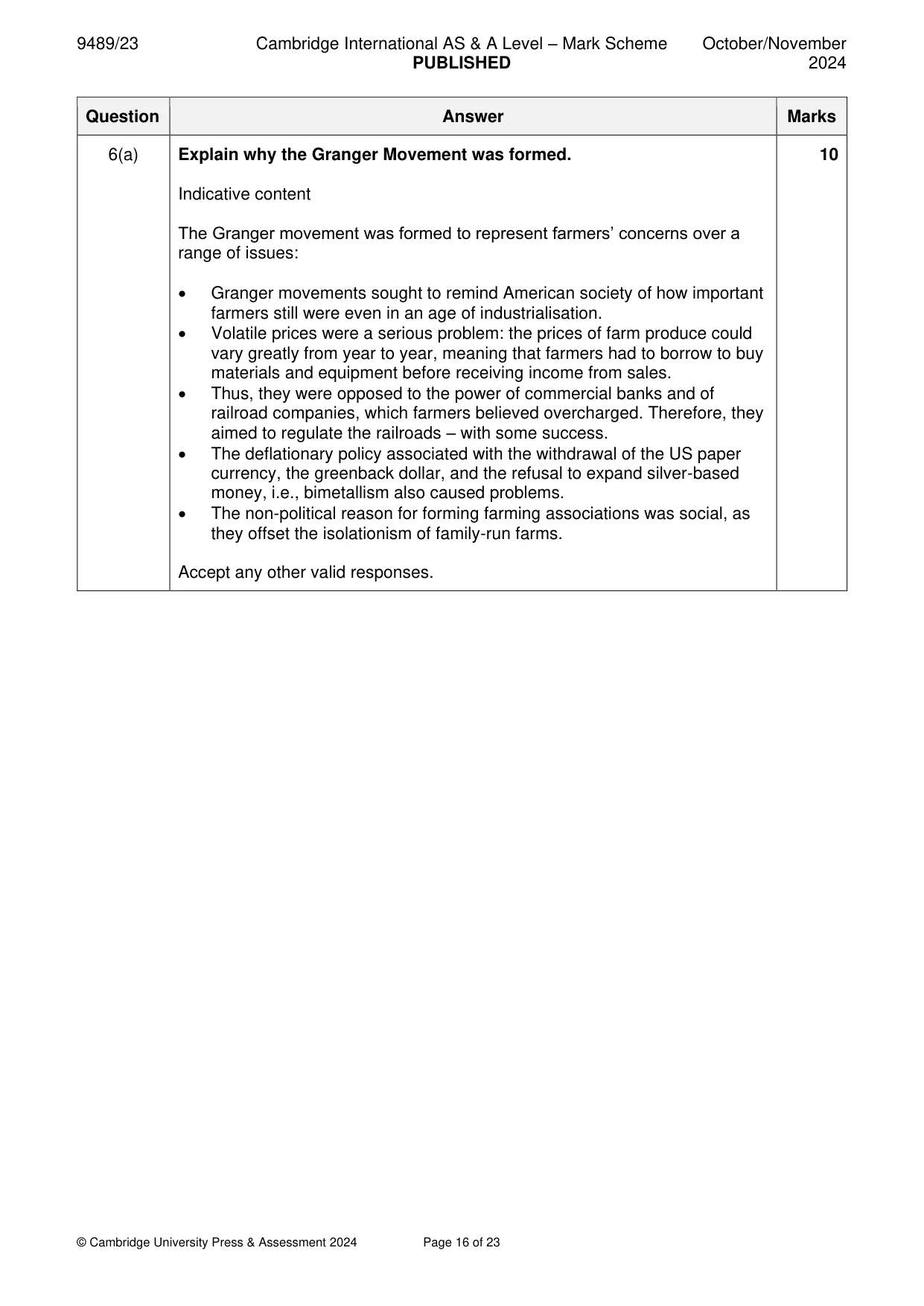
6 The Gilded Age and Progressive Era, 1870s to 1920 (a) Explain why the Granger Movement was formed. [10] (b) ‘Constitutional change was the most significant achievement of the Progressive Movement.’ How far do you agree? [20] Section C: International option International history, 1870–1945
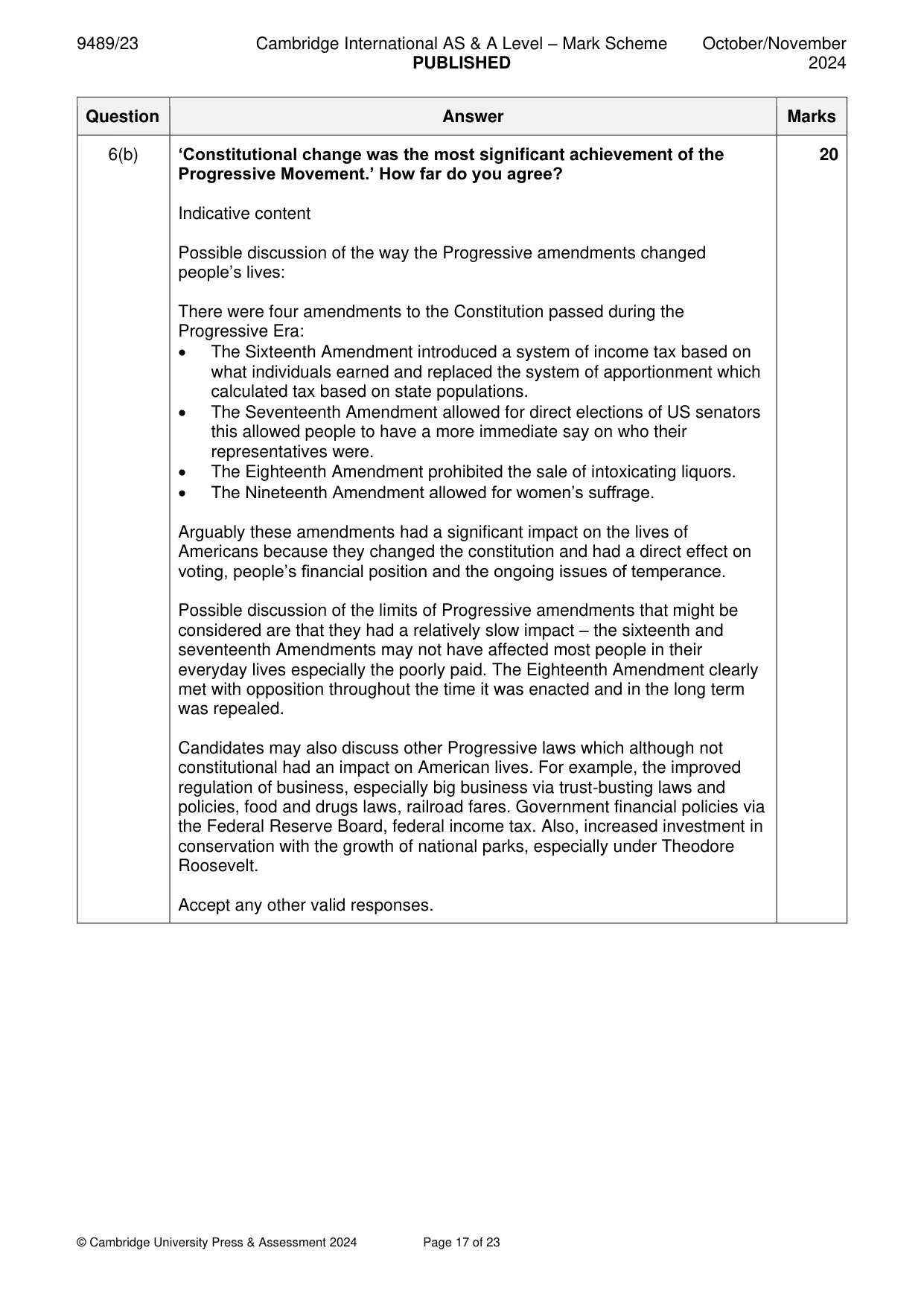
Mark scheme: 6(a) Explain why the Granger Movement was formed. 10 Indicative content The Granger movement was formed to represent farmers’ concerns over a range of issues: • Granger movements sought to remind American society of how important farmers still were even in an age of industrialisation. • Volatile prices were a serious problem: the prices of farm produce could vary greatly from year to year, meaning that farmers had to borrow to buy materials and equipment before receiving income from sales. • Thus, they were opposed to the power of commercial banks and of railroad companies, which farmers believed overcharged. Therefore, they aimed to regulate the railroads – with some success. • The deflationary policy associated with the withdrawal of the US paper currency, the greenback dollar, and the refusal to expand silver-based money, i.e., bimetallism also caused problems. • The non-political reason for forming farming associations was social, as they offset the isolationism of family-run farms. Accept any other valid responses. 6(b) ‘Constitutional change was the most significant achievement of the 20 Progressive Movement.’ How far do you agree? Indicative content Possible discussion of the way the Progressive amendments changed people’s lives: There were four amendments to the Constitution passed during the Progressive Era: • The Sixteenth Amendment introduced a system of income tax based on what individuals earned and replaced the system of apportionment which calculated tax based on state populations. • The Seventeenth Amendment allowed for direct elections of US senators this allowed people to have a more immediate say on who their representatives were. • The Eighteenth Amendment prohibited the sale of intoxicating liquors. • The Nineteenth Amendment allowed for women’s suffrage. Arguably these amendments had a significant impact on the lives of Americans because they changed the constitution and had a direct effect on voting, people’s financial position and the ongoing issues of temperance. Possible discussion of the limits of Progressive amendments that might be considered are that they had a relatively slow impact – the sixteenth and seventeenth Amendments may not have affected most people in their everyday lives especially the poorly paid. The Eighteenth Amendment clearly met with opposition throughout the time it was enacted and in the long term was repealed. Candidates may also discuss other Progressive laws which although not constitutional had an impact on American lives. For example, the improved regulation of business, especially big business via trust-busting laws and policies, food and drugs laws, railroad fares. Government financial policies via the Federal Reserve Board, federal income tax. Also, increased investment in conservation with the growth of national parks, especially under Theodore Roosevelt. Accept any other valid responses.
More questions on How successful was the Progressive Movement from 1890 to 1920?
Q7 · Empire and the emergence of world powers, 1870–1919 (a) Explain why political…
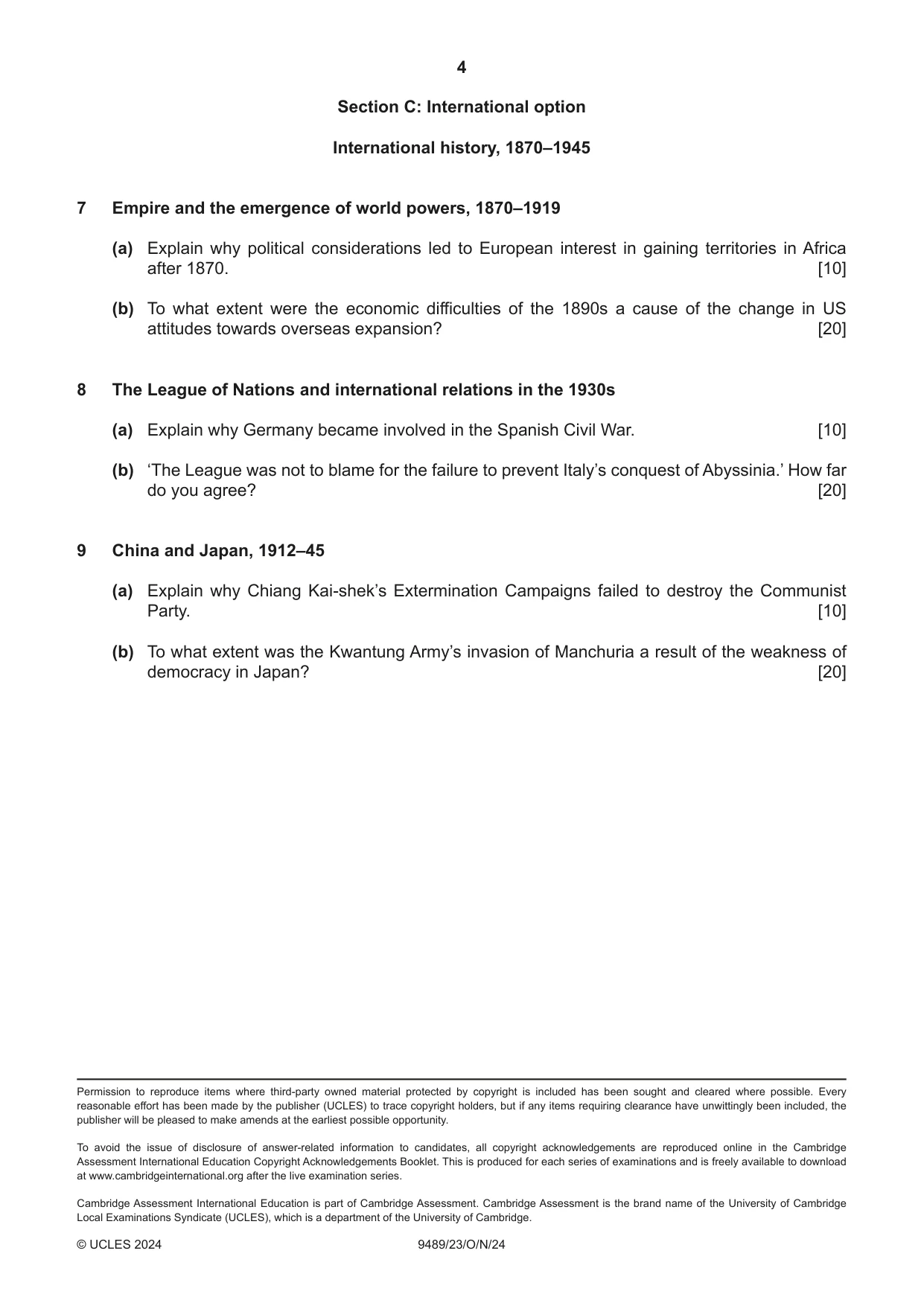
7 Empire and the emergence of world powers, 1870–1919 (a) Explain why political considerations led to European interest in gaining territories in Africa after 1870. [10] (b) To what extent were the economic difficulties of the 1890s a cause of the change in US attitudes towards overseas expansion? [20]
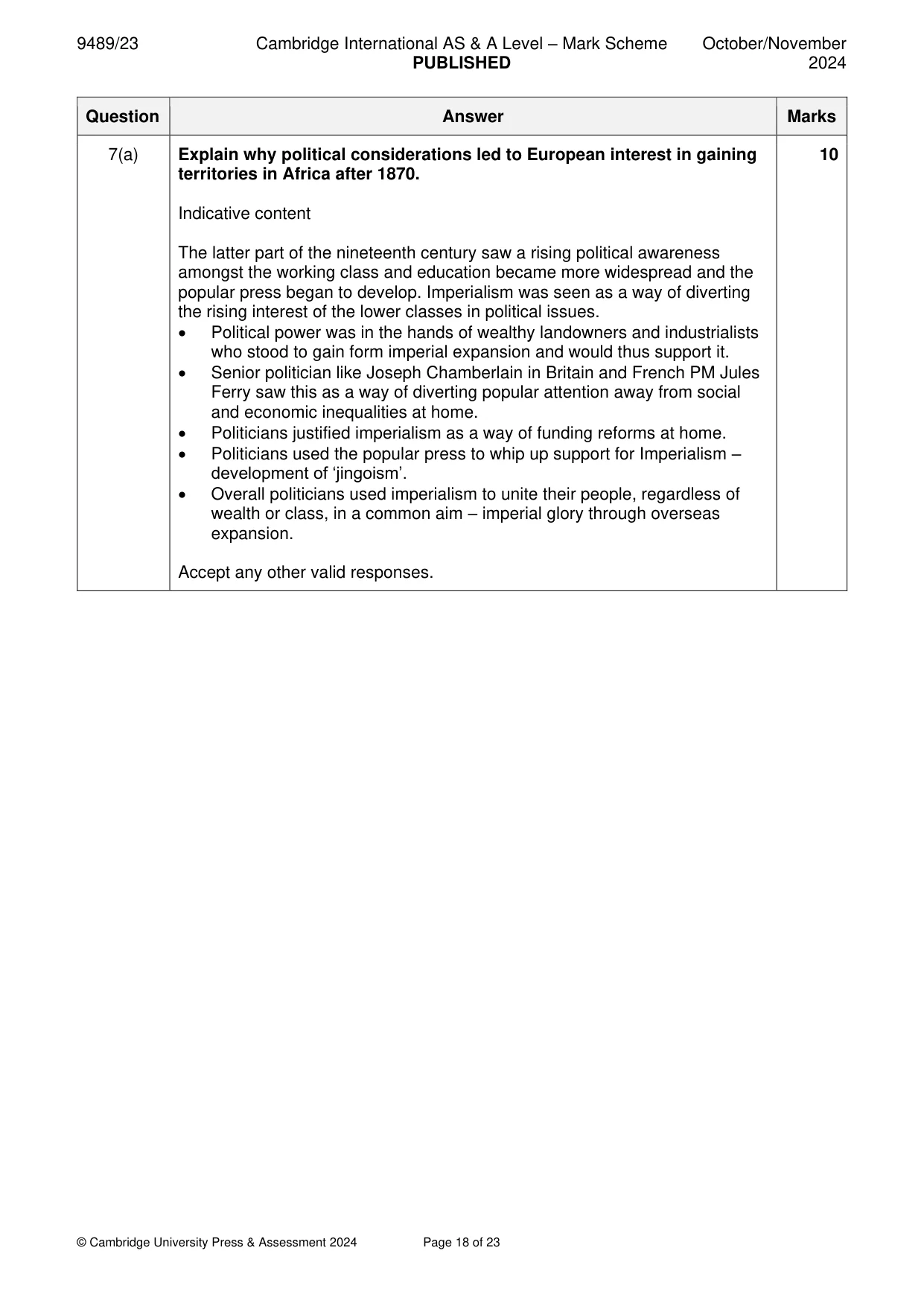
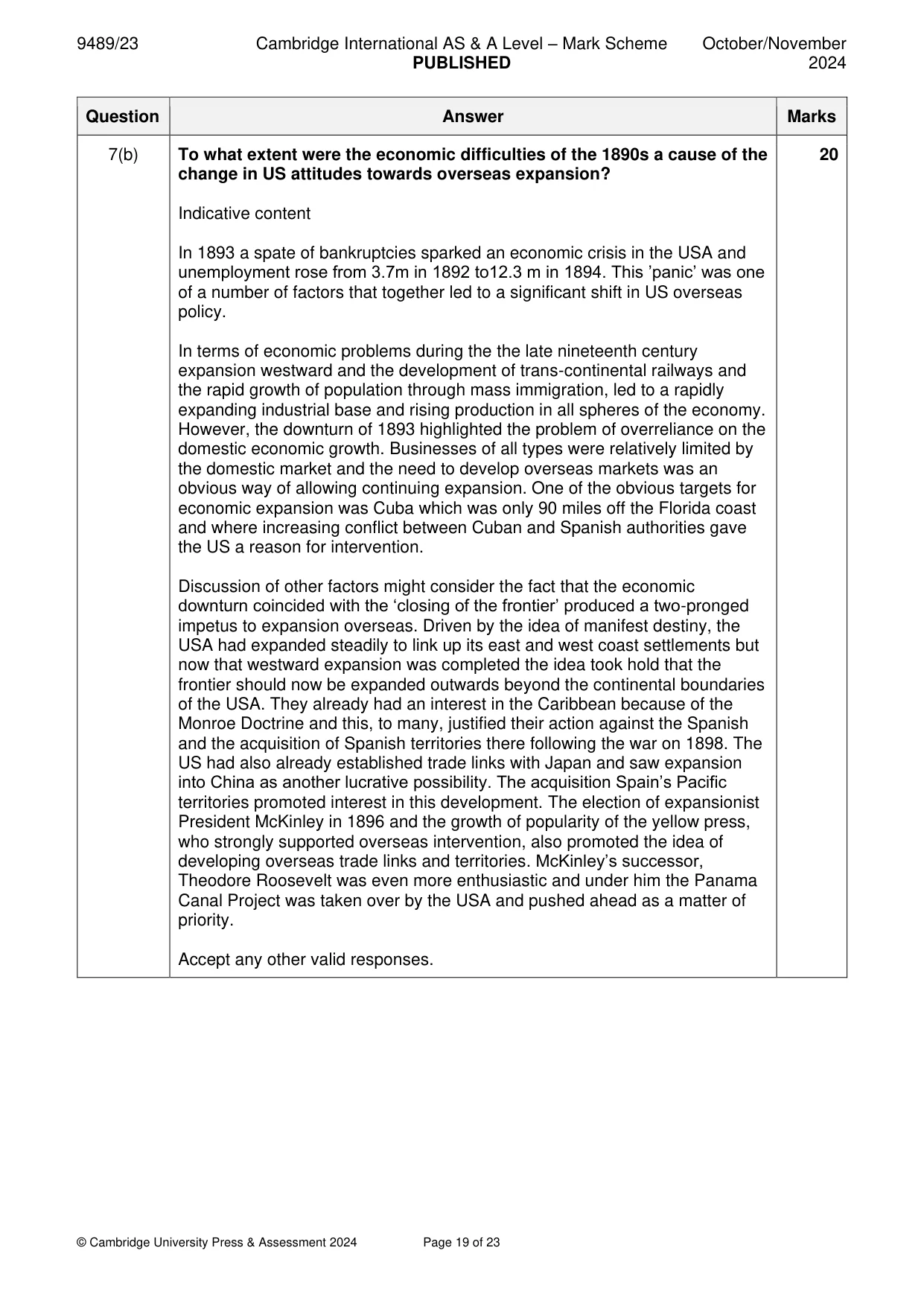
Mark scheme: 7(a) Explain why political considerations led to European interest in gaining 10 territories in Africa after 1870. Indicative content The latter part of the nineteenth century saw a rising political awareness amongst the working class and education became more widespread and the popular press began to develop. Imperialism was seen as a way of diverting the rising interest of the lower classes in political issues. • Political power was in the hands of wealthy landowners and industrialists who stood to gain form imperial expansion and would thus support it. • Senior politician like Joseph Chamberlain in Britain and French PM Jules Ferry saw this as a way of diverting popular attention away from social and economic inequalities at home. • Politicians justified imperialism as a way of funding reforms at home. • Politicians used the popular press to whip up support for Imperialism – development of ‘jingoism’. • Overall politicians used imperialism to unite their people, regardless of wealth or class, in a common aim – imperial glory through overseas expansion. Accept any other valid responses. 7(b) To what extent were the economic difficulties of the 1890s a cause of the 20 change in US attitudes towards overseas expansion? Indicative content In 1893 a spate of bankruptcies sparked an economic crisis in the USA and unemployment rose from 3.7m in 1892 to12.3 m in 1894. This ’panic’ was one of a number of factors that together led to a significant shift in US overseas policy. In terms of economic problems during the the late nineteenth century expansion westward and the development of trans-continental railways and the rapid growth of population through mass immigration, led to a rapidly expanding industrial base and rising production in all spheres of the economy. However, the downturn of 1893 highlighted the problem of overreliance on the domestic economic growth. Businesses of all types were relatively limited by the domestic market and the need to develop overseas markets was an obvious way of allowing continuing expansion. One of the obvious targets for economic expansion was Cuba which was only 90 miles off the Florida coast and where increasing conflict between Cuban and Spanish authorities gave the US a reason for intervention. Discussion of other factors might consider the fact that the economic downturn coincided with the ‘closing of the frontier’ produced a two-pronged impetus to expansion overseas. Driven by the idea of manifest destiny, the USA had expanded steadily to link up its east and west coast settlements but now that westward expansion was completed the idea took hold that the frontier should now be expanded outwards beyond the continental boundaries of the USA. They already had an interest in the Caribbean because of the Monroe Doctrine and this, to many, justified their action against the Spanish and the acquisition of Spanish territories there following the war on 1898. The US had also already established trade links with Japan and saw expansion into China as another lucrative possibility. The acquisition Spain’s Pacific territories promoted interest in this development. The election of expansionist President McKinley in 1896 and the growth of popularity of the yellow press, who strongly supported overseas intervention, also promoted the idea of developing overseas trade links and territories. McKinley’s successor, Theodore Roosevelt was even more enthusiastic and under him the Panama Canal Project was taken over by the USA and pushed ahead as a matter of priority. Accept any other valid responses.
More questions on Why did the USA emerge as a world power and what was the impact on international
Q8 · The League of Nations and international relations in the 1930s (a) Explain why Germany…
8 The League of Nations and international relations in the 1930s (a) Explain why Germany became involved in the Spanish Civil War. [10] (b) ‘The League was not to blame for the failure to prevent Italy’s conquest of Abyssinia.’ How far do you agree? [20]
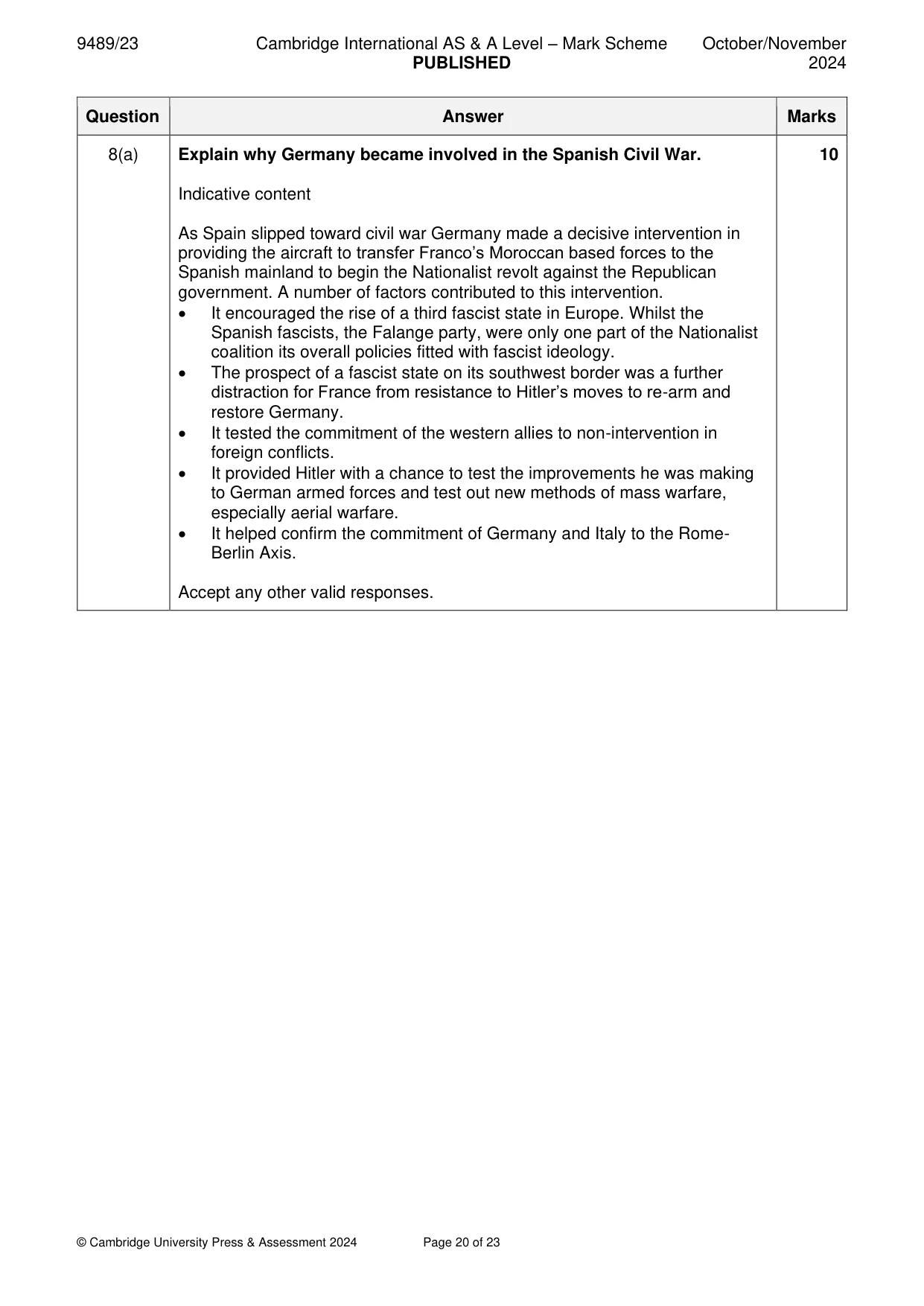
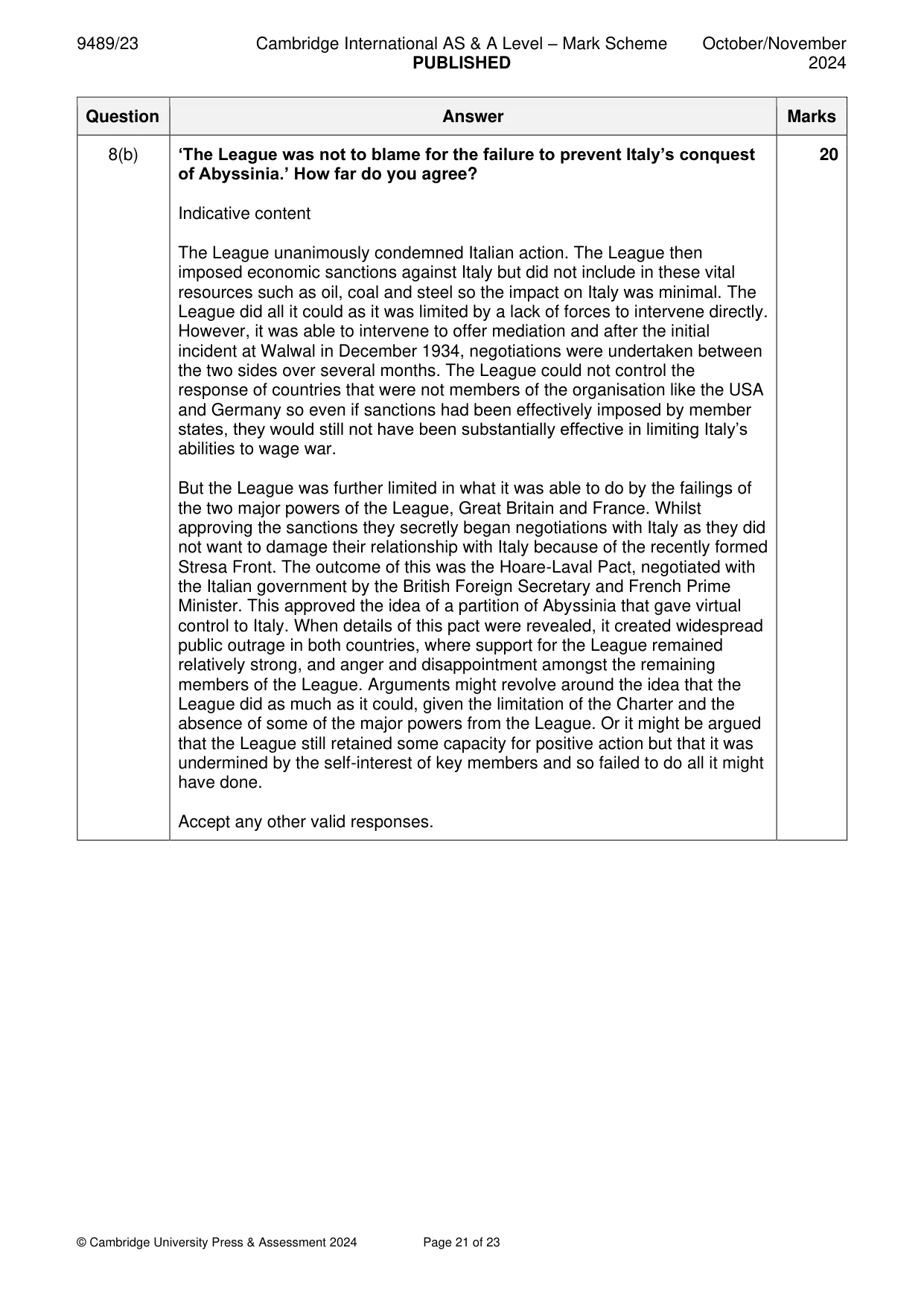
Mark scheme: 8(a) Explain why Germany became involved in the Spanish Civil War. 10 Indicative content As Spain slipped toward civil war Germany made a decisive intervention in providing the aircraft to transfer Franco’s Moroccan based forces to the Spanish mainland to begin the Nationalist revolt against the Republican government. A number of factors contributed to this intervention. • It encouraged the rise of a third fascist state in Europe. Whilst the Spanish fascists, the Falange party, were only one part of the Nationalist coalition its overall policies fitted with fascist ideology. • The prospect of a fascist state on its southwest border was a further distraction for France from resistance to Hitler’s moves to re-arm and restore Germany. • It tested the commitment of the western allies to non-intervention in foreign conflicts. • It provided Hitler with a chance to test the improvements he was making to German armed forces and test out new methods of mass warfare, especially aerial warfare. • It helped confirm the commitment of Germany and Italy to the Rome- Berlin Axis. Accept any other valid responses. 8(b) ‘The League was not to blame for the failure to prevent Italy’s conquest 20 of Abyssinia.’ How far do you agree? Indicative content The League unanimously condemned Italian action. The League then imposed economic sanctions against Italy but did not include in these vital resources such as oil, coal and steel so the impact on Italy was minimal. The League did all it could as it was limited by a lack of forces to intervene directly. However, it was able to intervene to offer mediation and after the initial incident at Walwal in December 1934, negotiations were undertaken between the two sides over several months. The League could not control the response of countries that were not members of the organisation like the USA and Germany so even if sanctions had been effectively imposed by member states, they would still not have been substantially effective in limiting Italy’s abilities to wage war. But the League was further limited in what it was able to do by the failings of the two major powers of the League, Great Britain and France. Whilst approving the sanctions they secretly began negotiations with Italy as they did not want to damage their relationship with Italy because of the recently formed Stresa Front. The outcome of this was the Hoare-Laval Pact, negotiated with the Italian government by the British Foreign Secretary and French Prime Minister. This approved the idea of a partition of Abyssinia that gave virtual control to Italy. When details of this pact were revealed, it created widespread public outrage in both countries, where support for the League remained relatively strong, and anger and disappointment amongst the remaining members of the League. Arguments might revolve around the idea that the League did as much as it could, given the limitation of the Charter and the absence of some of the major powers from the League. Or it might be argued that the League still retained some capacity for positive action but that it was undermined by the self-interest of key members and so failed to do all it might have done. Accept any other valid responses.
More questions on Why did the League of Nations fail to keep the peace in the 1930s?
Q9 · China and Japan, 1912–45 (a) Explain why Chiang Kai-shek’s Extermination Campaigns failed…
9 China and Japan, 1912–45 (a) Explain why Chiang Kai-shek’s Extermination Campaigns failed to destroy the Communist Party. [10] (b) To what extent was the Kwantung Army’s invasion of Manchuria a result of the weakness of democracy in Japan? [20]
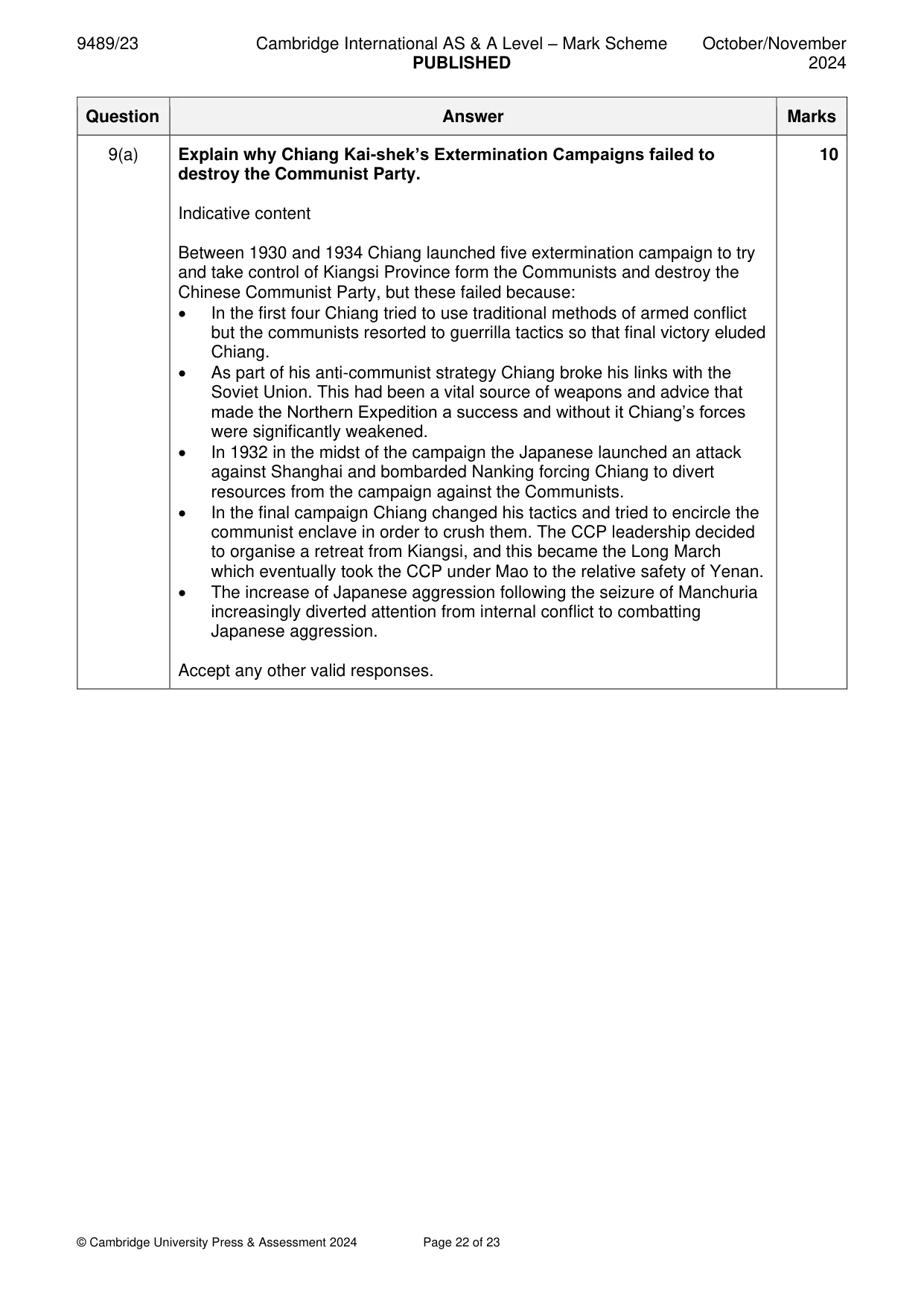
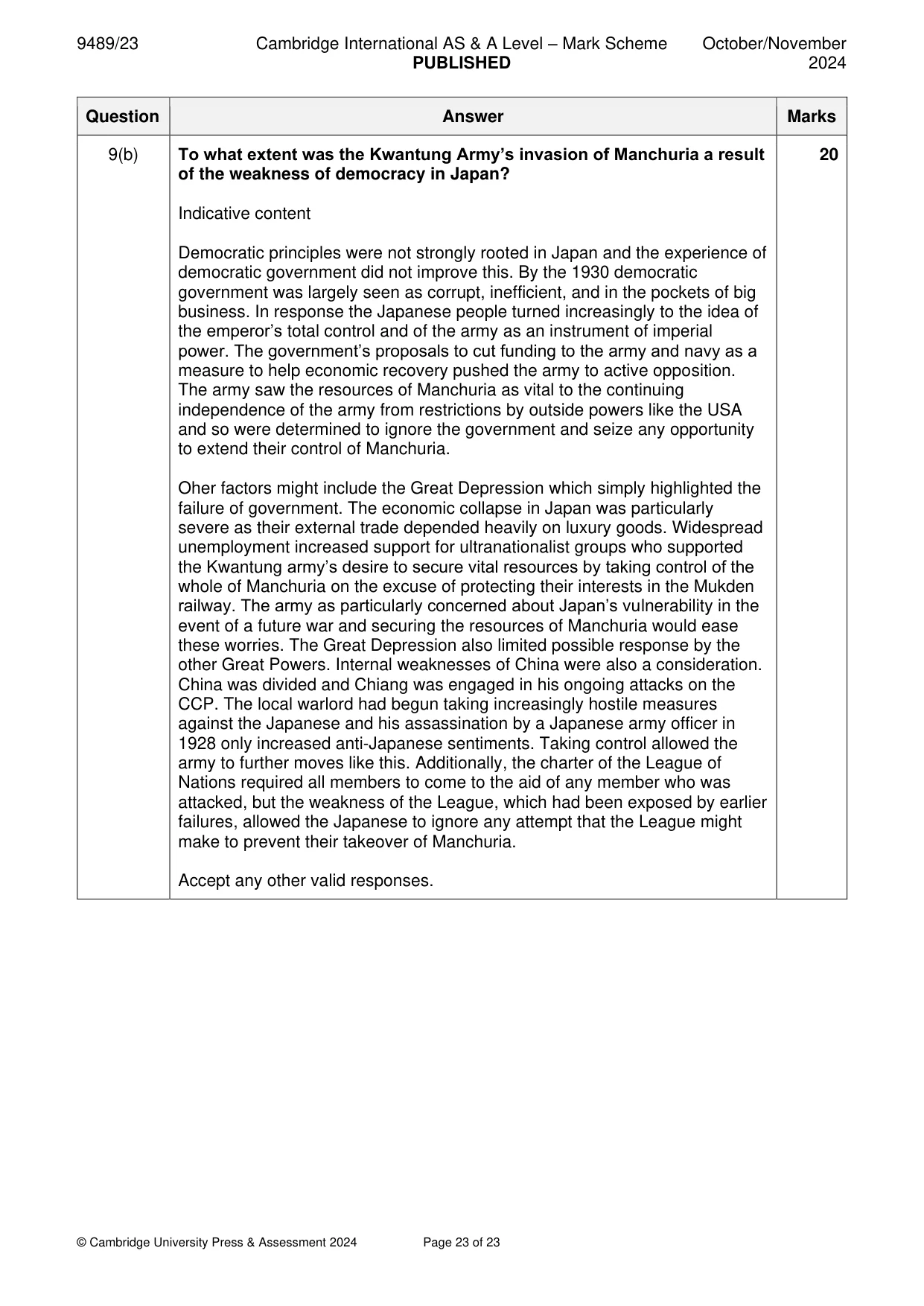
Mark scheme: 9(a) Explain why Chiang Kai-shek’s Extermination Campaigns failed to 10 destroy the Communist Party. Indicative content Between 1930 and 1934 Chiang launched five extermination campaign to try and take control of Kiangsi Province form the Communists and destroy the Chinese Communist Party, but these failed because: • In the first four Chiang tried to use traditional methods of armed conflict but the communists resorted to guerrilla tactics so that final victory eluded Chiang. • As part of his anti-communist strategy Chiang broke his links with the Soviet Union. This had been a vital source of weapons and advice that made the Northern Expedition a success and without it Chiang’s forces were significantly weakened. • In 1932 in the midst of the campaign the Japanese launched an attack against Shanghai and bombarded Nanking forcing Chiang to divert resources from the campaign against the Communists. • In the final campaign Chiang changed his tactics and tried to encircle the communist enclave in order to crush them. The CCP leadership decided to organise a retreat from Kiangsi, and this became the Long March which eventually took the CCP under Mao to the relative safety of Yenan. • The increase of Japanese aggression following the seizure of Manchuria increasingly diverted attention from internal conflict to combatting Japanese aggression. Accept any other valid responses. 9(b) To what extent was the Kwantung Army’s invasion of Manchuria a result 20 of the weakness of democracy in Japan? Indicative content Democratic principles were not strongly rooted in Japan and the experience of democratic government did not improve this. By the 1930 democratic government was largely seen as corrupt, inefficient, and in the pockets of big business. In response the Japanese people turned increasingly to the idea of the emperor’s total control and of the army as an instrument of imperial power. The government’s proposals to cut funding to the army and navy as a measure to help economic recovery pushed the army to active opposition. The army saw the resources of Manchuria as vital to the continuing independence of the army from restrictions by outside powers like the USA and so were determined to ignore the government and seize any opportunity to extend their control of Manchuria. Oher factors might include the Great Depression which simply highlighted the failure of government. The economic collapse in Japan was particularly severe as their external trade depended heavily on luxury goods. Widespread unemployment increased support for ultranationalist groups who supported the Kwantung army’s desire to secure vital resources by taking control of the whole of Manchuria on the excuse of protecting their interests in the Mukden railway. The army as particularly concerned about Japan’s vulnerability in the event of a future war and securing the resources of Manchuria would ease these worries. The Great Depression also limited possible response by the other Great Powers. Internal weaknesses of China were also a consideration. China was divided and Chiang was engaged in his ongoing attacks on the CCP. The local warlord had begun taking increasingly hostile measures against the Japanese and his assassination by a Japanese army officer in 1928 only increased anti-Japanese sentiments. Taking control allowed the army to further moves like this. Additionally, the charter of the League of Nations required all members to come to the aid of any member who was attacked, but the weakness of the League, which had been exposed by earlier failures, allowed the Japanese to ignore any attempt that the League might make to prevent their takeover of Manchuria. Accept any other valid responses.
More questions on Why did Japan emerge as a world power and what was the impact on international
What was in this paper
The subtopics covered by these 9 questions, and how many questions each got. Open one in a new tab to see every Cambridge question on it.
1How successful was the Progressive Movement from 1890 to 1920?1How were the Bolsheviks able to consolidate their power up to 1924?1What were the causes and immediate consequences of the 1789 Revolution?1Why did Japan emerge as a world power and what was the impact on international1Why did the Civil War last four years?1Why did the League of Nations fail to keep the peace in the 1930s?1Why did the USA emerge as a world power and what was the impact on international1Why was there increasing tension between the North and the South before 1860?1What you needed in this session
Cambridge’s own grade thresholds for 2024 Oct/Nov, Paper 2 · Variant 3. A higher threshold means an easier paper — the bar moves with how the cohort did.