Cambridge A Level History 9489 — 2024 May/June Paper 2 · Variant 2
9489/22/M/J/24 · 9 questions · 60 marks · ≈68 min
The question paper and its mark scheme, free to read here and free to download. This is Cambridge’s own paper, exactly as it was sat.
Question paper4 pages
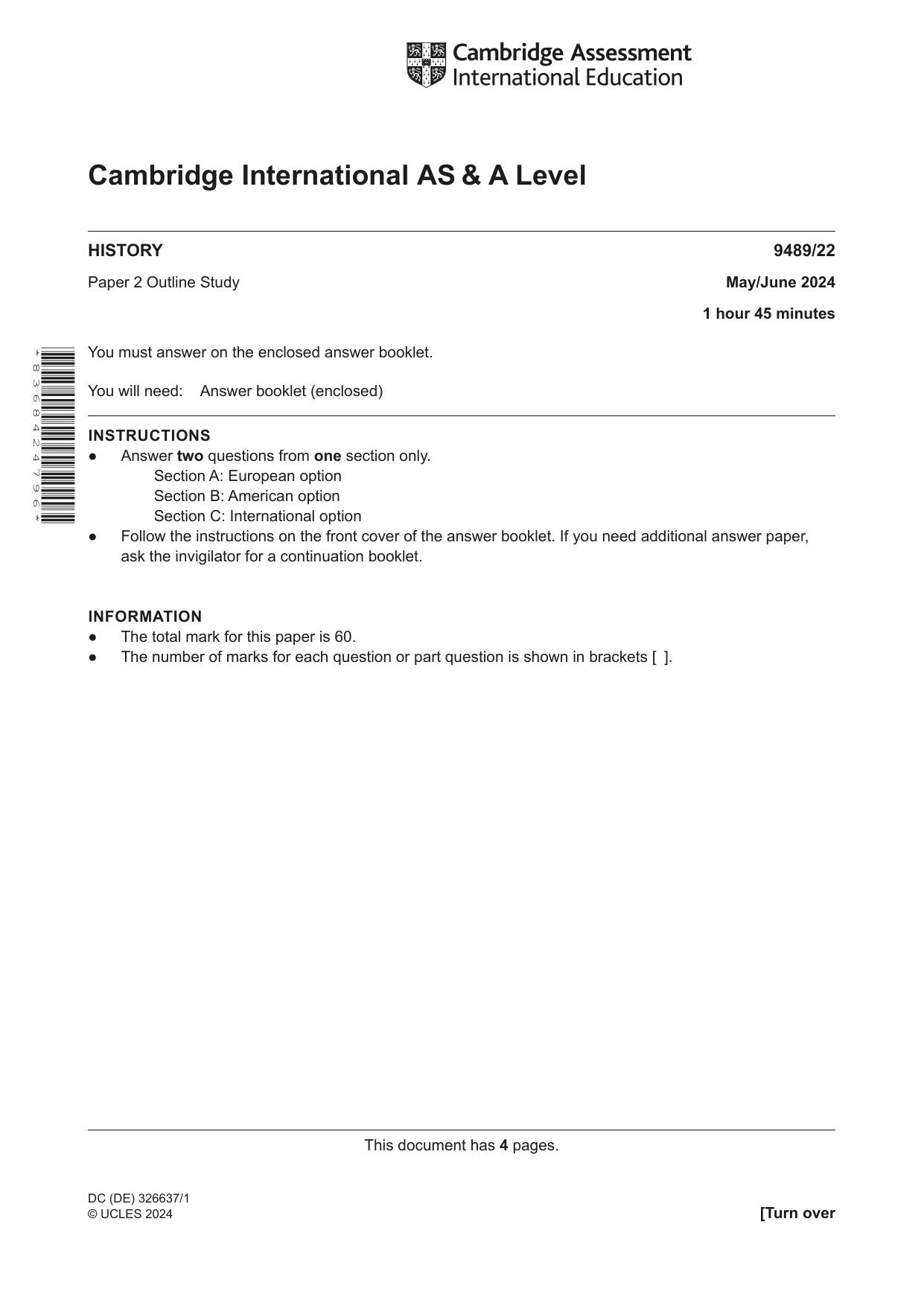
Mark scheme23 pages
Answers below. Sit the paper first if you are practising.

Questions as text
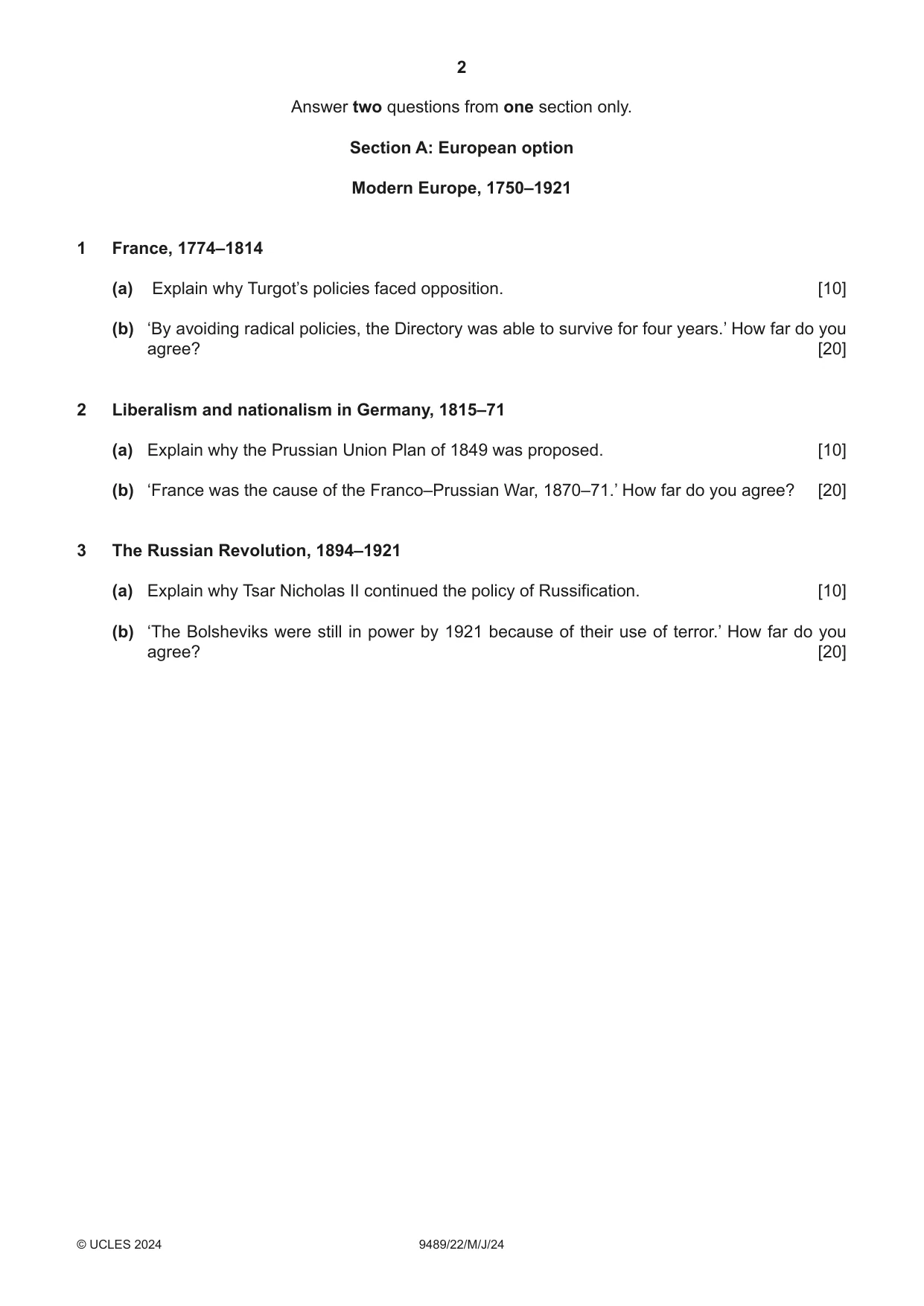
Q1 · France, 1774–1814 (a) Explain why Turgot’s policies faced opposition
1 France, 1774–1814 (a) Explain why Turgot’s policies faced opposition. [10] (b) ‘By avoiding radical policies, the Directory was able to survive for four years.’ How far do you agree? [20]
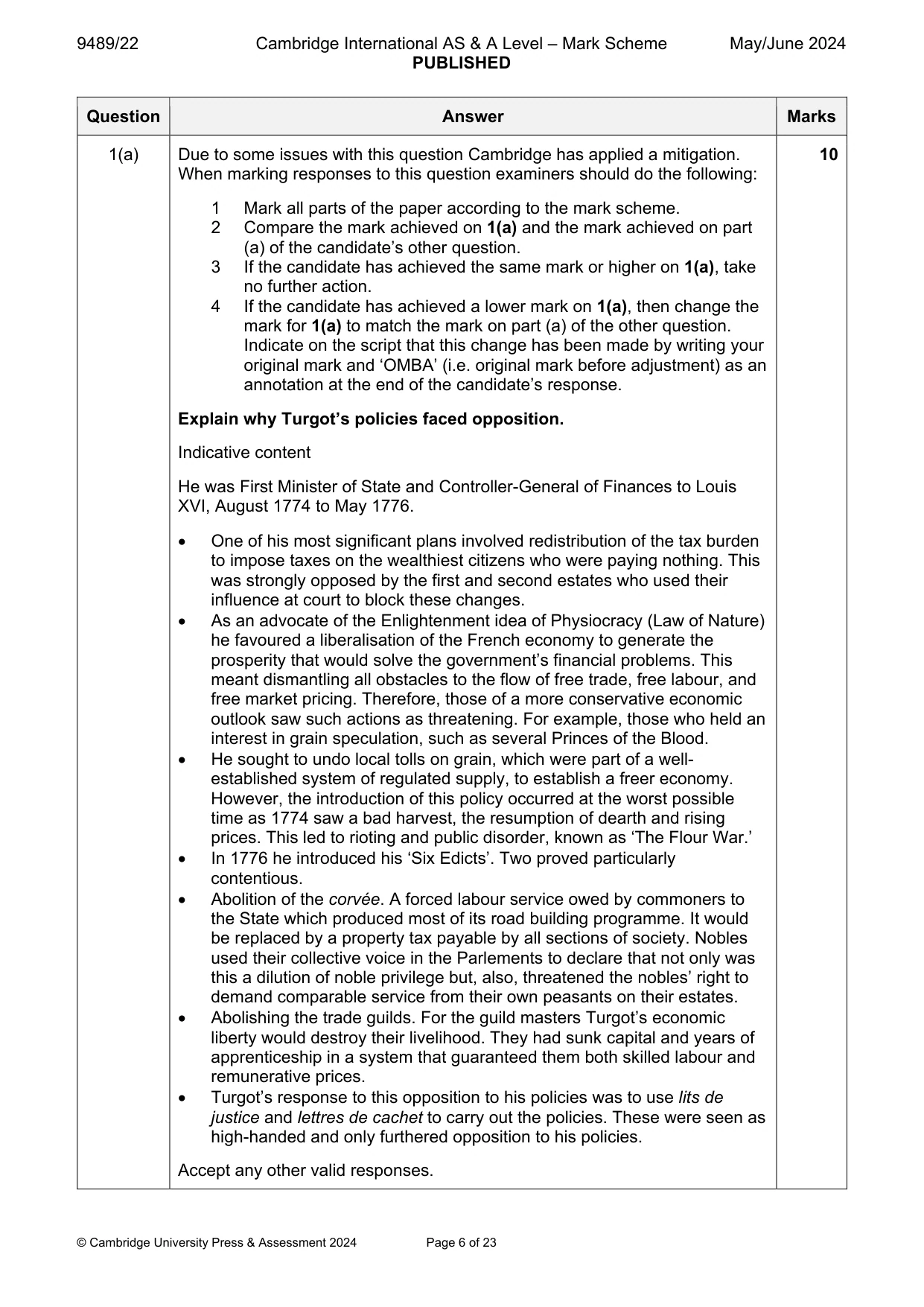
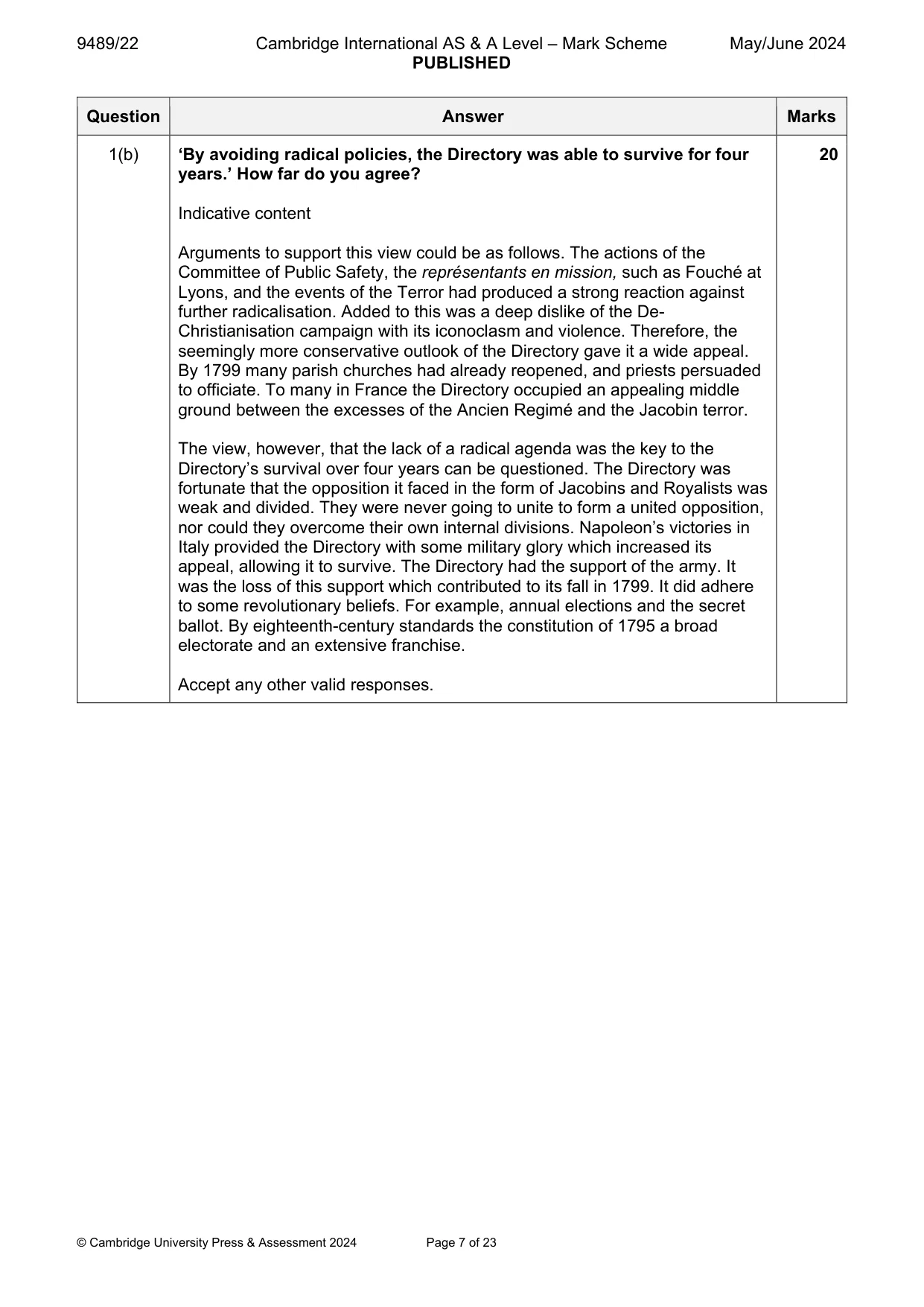
Mark scheme: Question Answer Marks 1(a) Due to some issues with this question Cambridge has applied a mitigation. 10 When marking responses to this question examiners should do the following: 1 Mark all parts of the paper according to the mark scheme. 2 Compare the mark achieved on 1(a) and the mark achieved on part (a) of the candidate’s other question. 3 If the candidate has achieved the same mark or higher on 1(a), take no further action. 4 If the candidate has achieved a lower mark on 1(a), then change the mark for 1(a) to match the mark on part (a) of the other question. Indicate on the script that this change has been made by writing your original mark and ‘OMBA’ (i.e. original mark before adjustment) as an annotation at the end of the candidate’s response. Explain why Turgot’s policies faced opposition. Indicative content He was First Minister of State and Controller-General of Finances to Louis XVI, August 1774 to May 1776. One of his most significant plans involved redistribution of the tax burden to impose taxes on the wealthiest citizens who were paying nothing. This was strongly opposed by the first and second estates who used their influence at court to block these changes. As an advocate of the Enlightenment idea of Physiocracy (Law of Nature) he favoured a liberalisation of the French economy to generate the prosperity that would solve the government’s financial problems. This meant dismantling all obstacles to the flow of free trade, free labour, and free market pricing. Therefore, those of a more conservative economic outlook saw such actions as threatening. For example, those who held an interest in grain speculation, such as several Princes of the Blood. He sought to undo local tolls on grain, which were part of a well- established system of regulated supply, to establish a freer economy. However, the introduction of this policy occurred at the worst possible time as 1774 saw a bad harvest, the resumption of dearth and rising prices. This led to rioting and public disorder, known as ‘The Flour War.’ In 1776 he introduced his ‘Six Edicts’. Two proved particularly contentious. Abolition of the corvée. A forced labour service owed by commoners to the State which produced most of its road building programme. It would be replaced by a property tax payable by all sections of society. Nobles used their collective voice in the Parlements to declare that not only was this a dilution of noble privilege but, also, threatened the nobles’ right to demand comparable service from their own peasants on their estates. Abolishing the trade guilds. For the guild masters Turgot’s economic liberty would destroy their livelihood. They had sunk capital and years of apprenticeship in a system that guaranteed them both skilled labour and remunerative prices. Turgot’s response to this opposition to his policies was to use lits de justice and lettres de cachet to carry out the policies. These were seen as high-handed and only furthered opposition to his policies. Accept any other valid responses. 1(b) ‘By avoiding radical policies, the Directory was able to survive for four 20 years.’ How far do you agree? Indicative content Arguments to support this view could be as follows. The actions of the Committee of Public Safety, the représentants en mission, such as Fouché at Lyons, and the events of the Terror had produced a strong reaction against further radicalisation. Added to this was a deep dislike of the De- Christianisation campaign with its iconoclasm and violence. Therefore, the seemingly more conservative outlook of the Directory gave it a wide appeal. By 1799 many parish churches had already reopened, and priests persuaded to officiate. To many in France the Directory occupied an appealing middle ground between the excesses of the Ancien Regimé and the Jacobin terror. The view, however, that the lack of a radical agenda was the key to the Directory’s survival over four years can be questioned. The Directory was fortunate that the opposition it faced in the form of Jacobins and Royalists was weak and divided. They were never going to unite to form a united opposition, nor could they overcome their own internal divisions. Napoleon’s victories in Italy provided the Directory with some military glory which increased its appeal, allowing it to survive. The Directory had the support of the army. It was the loss of this support which contributed to its fall in 1799. It did adhere to some revolutionary beliefs. For example, annual elections and the secret ballot. By eighteenth-century standards the constitution of 1795 a broad electorate and an extensive franchise. Accept any other valid responses.
More questions on How well was France governed in the period 1793–99?
Q2 · Liberalism and nationalism in Germany, 1815–71 (a) Explain why the Prussian Union Plan of…
2 Liberalism and nationalism in Germany, 1815–71 (a) Explain why the Prussian Union Plan of 1849 was proposed. [10] (b) ‘France was the cause of the Franco–Prussian War, 1870–71.’ How far do you agree? [20]
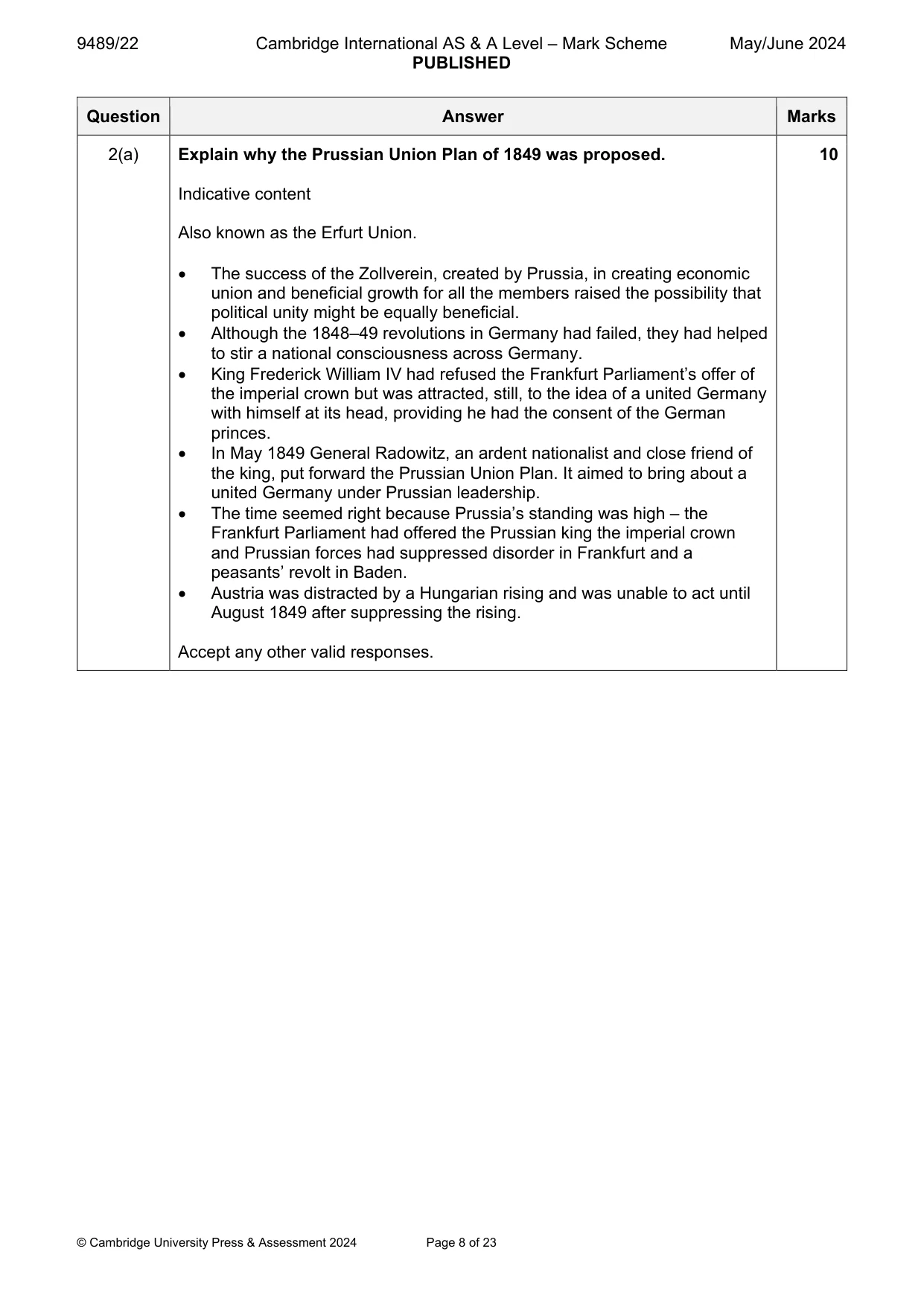
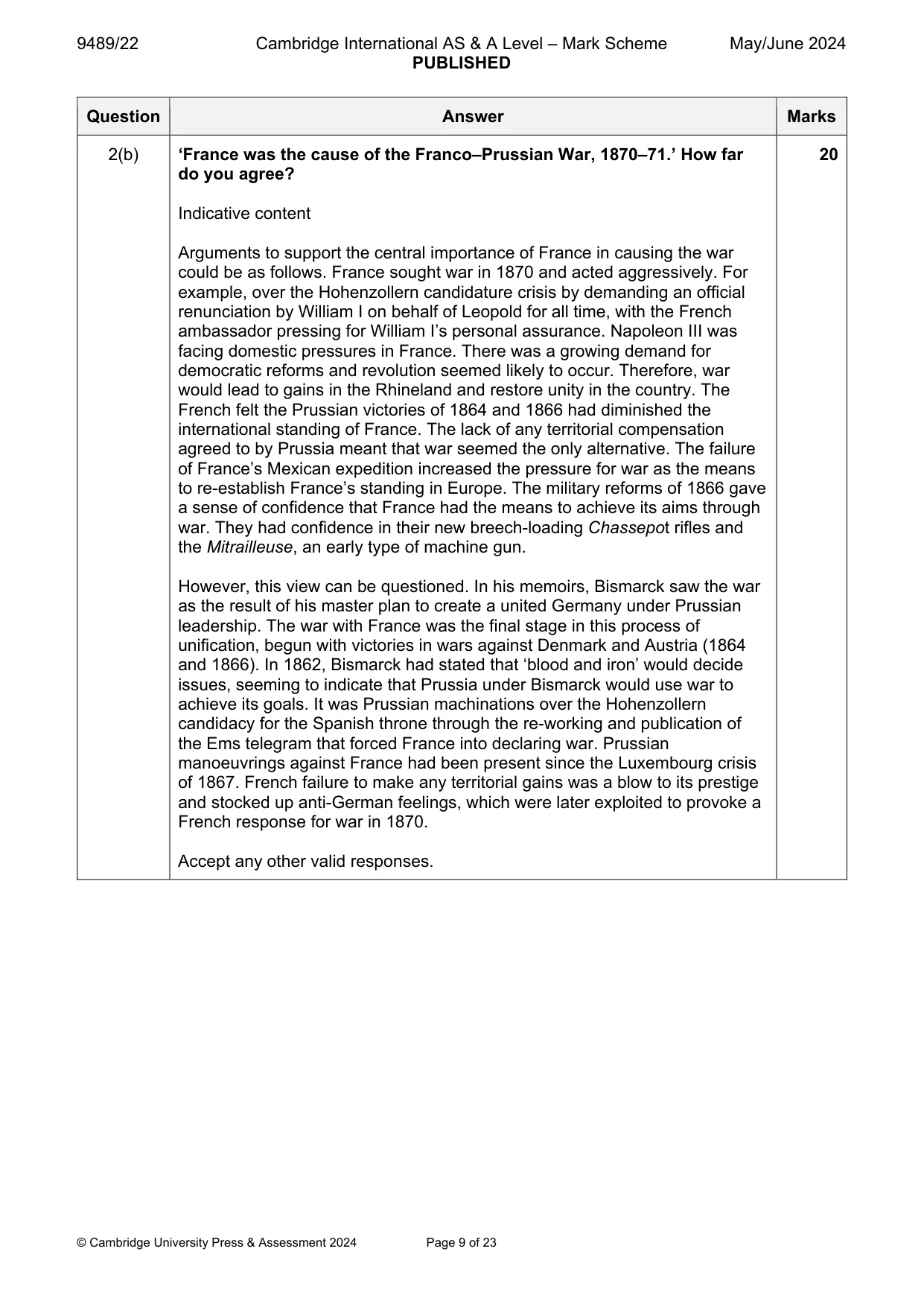
Mark scheme: 2(a) Explain why the Prussian Union Plan of 1849 was proposed. 10 Indicative content Also known as the Erfurt Union. The success of the Zollverein, created by Prussia, in creating economic union and beneficial growth for all the members raised the possibility that political unity might be equally beneficial. Although the 1848–49 revolutions in Germany had failed, they had helped to stir a national consciousness across Germany. King Frederick William IV had refused the Frankfurt Parliament’s offer of the imperial crown but was attracted, still, to the idea of a united Germany with himself at its head, providing he had the consent of the German princes. In May 1849 General Radowitz, an ardent nationalist and close friend of the king, put forward the Prussian Union Plan. It aimed to bring about a united Germany under Prussian leadership. The time seemed right because Prussia’s standing was high – the Frankfurt Parliament had offered the Prussian king the imperial crown and Prussian forces had suppressed disorder in Frankfurt and a peasants’ revolt in Baden. Austria was distracted by a Hungarian rising and was unable to act until August 1849 after suppressing the rising. Accept any other valid responses. 2(b) ‘France was the cause of the Franco–Prussian War, 1870–71.’ How far 20 do you agree? Indicative content Arguments to support the central importance of France in causing the war could be as follows. France sought war in 1870 and acted aggressively. For example, over the Hohenzollern candidature crisis by demanding an official renunciation by William I on behalf of Leopold for all time, with the French ambassador pressing for William I’s personal assurance. Napoleon III was facing domestic pressures in France. There was a growing demand for democratic reforms and revolution seemed likely to occur. Therefore, war would lead to gains in the Rhineland and restore unity in the country. The French felt the Prussian victories of 1864 and 1866 had diminished the international standing of France. The lack of any territorial compensation agreed to by Prussia meant that war seemed the only alternative. The failure of France’s Mexican expedition increased the pressure for war as the means to re-establish France’s standing in Europe. The military reforms of 1866 gave a sense of confidence that France had the means to achieve its aims through war. They had confidence in their new breech-loading Chassepot rifles and the Mitrailleuse, an early type of machine gun. However, this view can be questioned. In his memoirs, Bismarck saw the war as the result of his master plan to create a united Germany under Prussian leadership. The war with France was the final stage in this process of unification, begun with victories in wars against Denmark and Austria (1864 and 1866). In 1862, Bismarck had stated that ‘blood and iron’ would decide issues, seeming to indicate that Prussia under Bismarck would use war to achieve its goals. It was Prussian machinations over the Hohenzollern candidacy for the Spanish throne through the re-working and publication of the Ems telegram that forced France into declaring war. Prussian manoeuvrings against France had been present since the Luxembourg crisis of 1867. French failure to make any territorial gains was a blow to its prestige and stocked up anti-German feelings, which were later exploited to provoke a French response for war in 1870. Accept any other valid responses.
More questions on How and why was German unification achieved by 1871?
Q3 · The Russian Revolution, 1894–1921 (a) Explain why Tsar Nicholas II continued the policy…
3 The Russian Revolution, 1894–1921 (a) Explain why Tsar Nicholas II continued the policy of Russification. [10] (b) ‘The Bolsheviks were still in power by 1921 because of their use of terror.’ How far do you agree? [20]
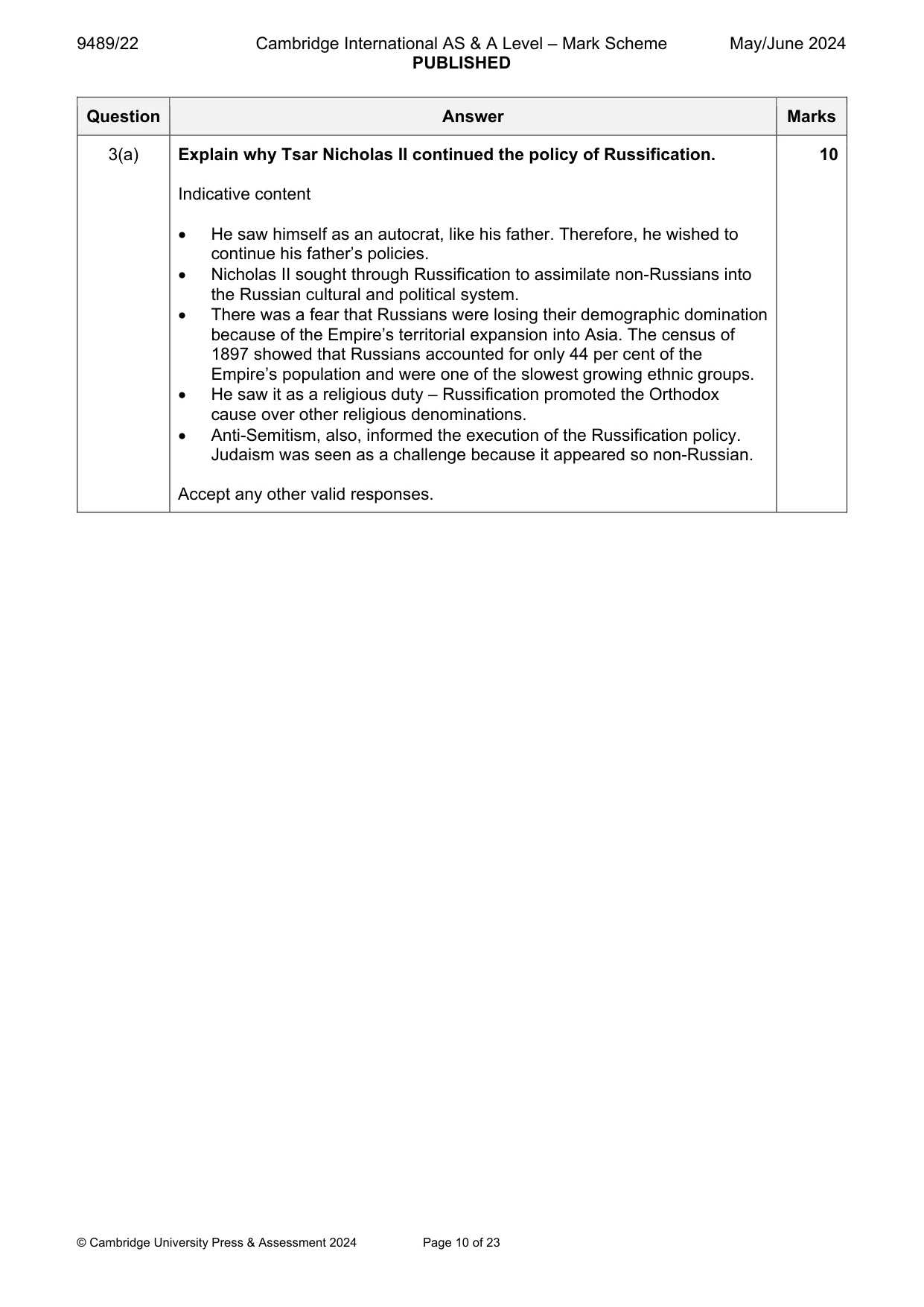
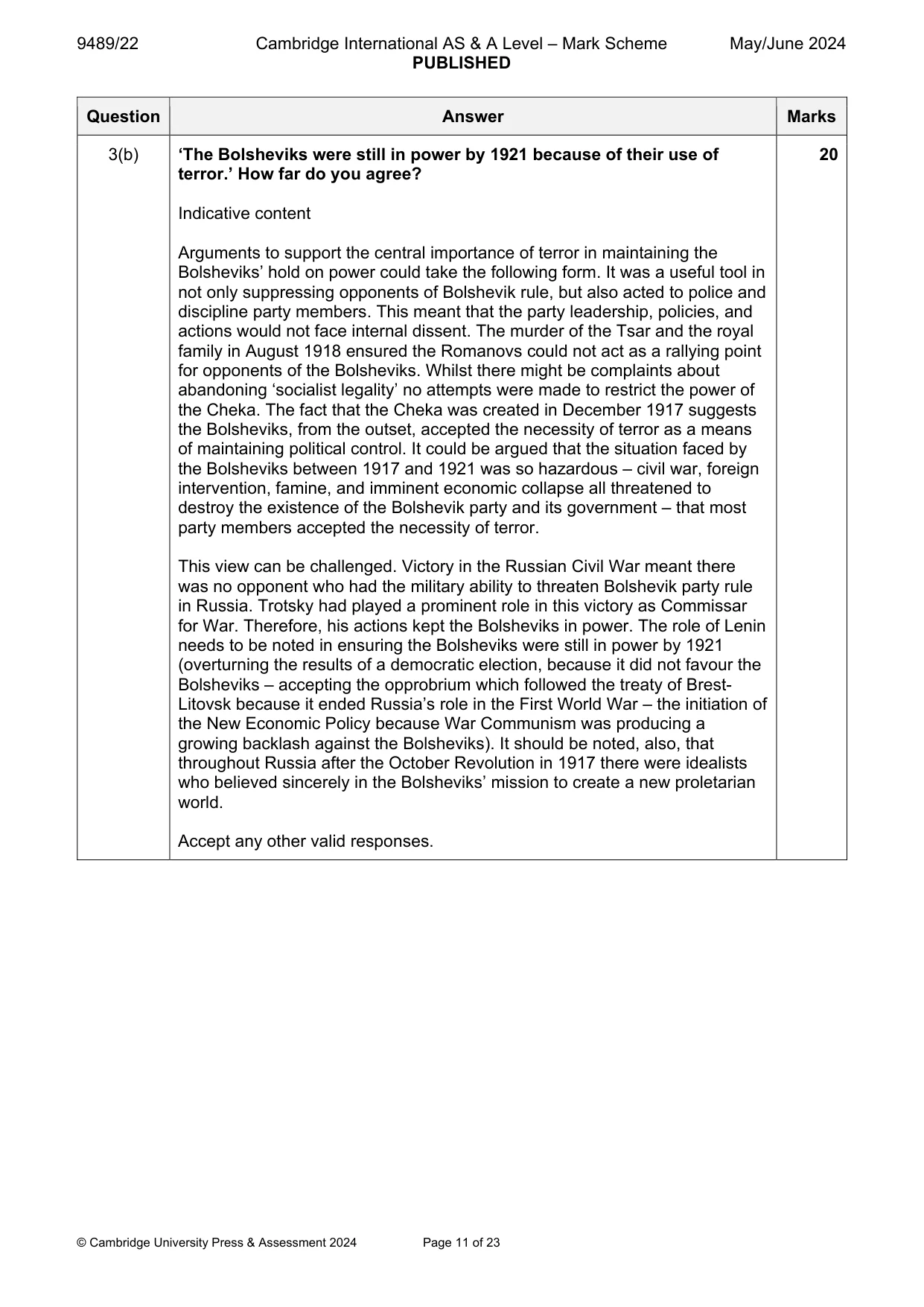
Mark scheme: 3(a) Explain why Tsar Nicholas II continued the policy of Russification. 10 Indicative content He saw himself as an autocrat, like his father. Therefore, he wished to continue his father’s policies. Nicholas II sought through Russification to assimilate non-Russians into the Russian cultural and political system. There was a fear that Russians were losing their demographic domination because of the Empire’s territorial expansion into Asia. The census of 1897 showed that Russians accounted for only 44 per cent of the Empire’s population and were one of the slowest growing ethnic groups. He saw it as a religious duty – Russification promoted the Orthodox cause over other religious denominations. Anti-Semitism, also, informed the execution of the Russification policy. Judaism was seen as a challenge because it appeared so non-Russian. Accept any other valid responses. 3(b) ‘The Bolsheviks were still in power by 1921 because of their use of 20 terror.’ How far do you agree? Indicative content Arguments to support the central importance of terror in maintaining the Bolsheviks’ hold on power could take the following form. It was a useful tool in not only suppressing opponents of Bolshevik rule, but also acted to police and discipline party members. This meant that the party leadership, policies, and actions would not face internal dissent. The murder of the Tsar and the royal family in August 1918 ensured the Romanovs could not act as a rallying point for opponents of the Bolsheviks. Whilst there might be complaints about abandoning ‘socialist legality’ no attempts were made to restrict the power of the Cheka. The fact that the Cheka was created in December 1917 suggests the Bolsheviks, from the outset, accepted the necessity of terror as a means of maintaining political control. It could be argued that the situation faced by the Bolsheviks between 1917 and 1921 was so hazardous – civil war, foreign intervention, famine, and imminent economic collapse all threatened to destroy the existence of the Bolshevik party and its government – that most party members accepted the necessity of terror. This view can be challenged. Victory in the Russian Civil War meant there was no opponent who had the military ability to threaten Bolshevik party rule in Russia. Trotsky had played a prominent role in this victory as Commissar for War. Therefore, his actions kept the Bolsheviks in power. The role of Lenin needs to be noted in ensuring the Bolsheviks were still in power by 1921 (overturning the results of a democratic election, because it did not favour the Bolsheviks – accepting the opprobrium which followed the treaty of Brest- Litovsk because it ended Russia’s role in the First World War – the initiation of the New Economic Policy because War Communism was producing a growing backlash against the Bolsheviks). It should be noted, also, that throughout Russia after the October Revolution in 1917 there were idealists who believed sincerely in the Bolsheviks’ mission to create a new proletarian world. Accept any other valid responses.
More questions on How were the Bolsheviks able to consolidate their power up to 1924?
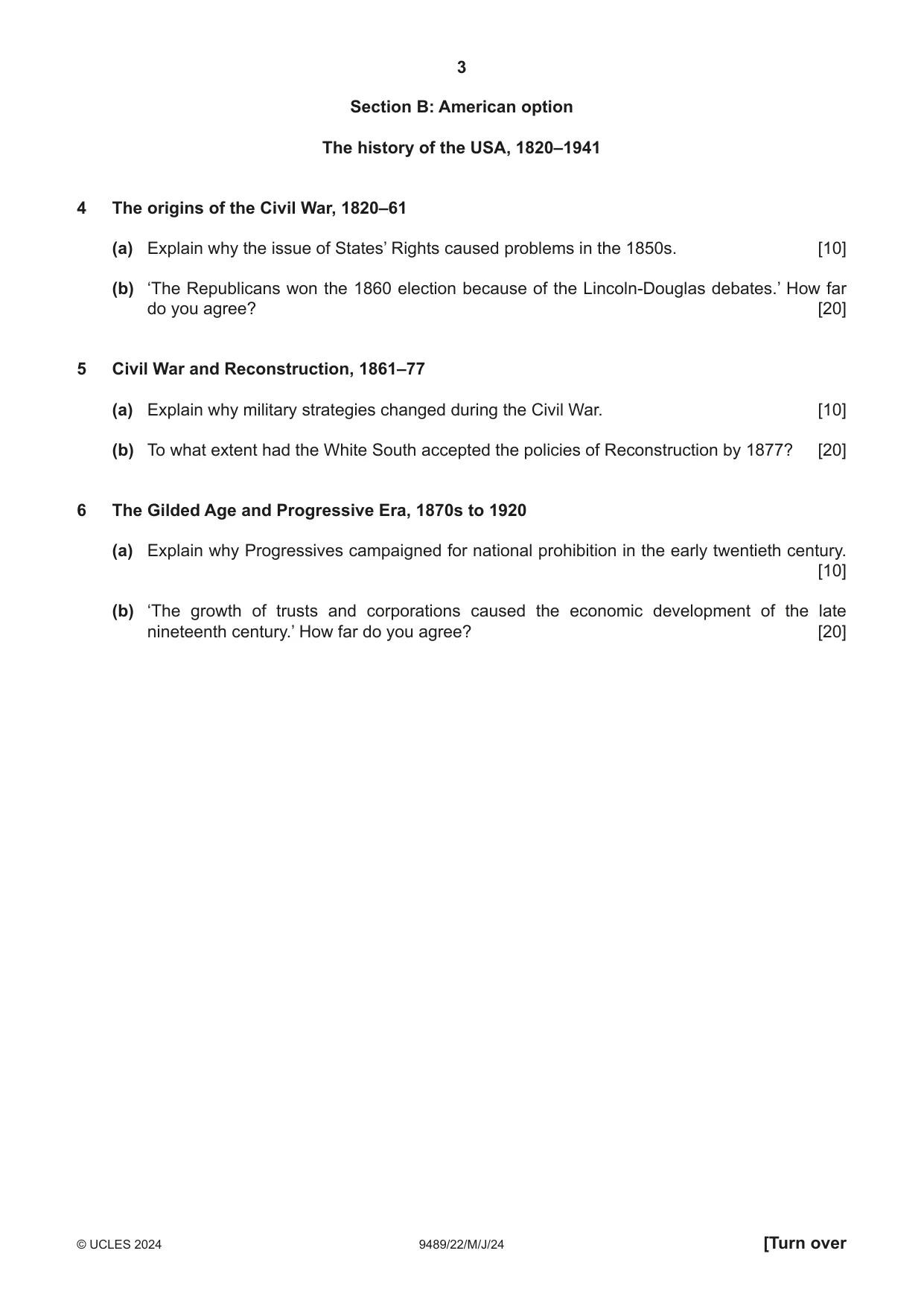
Q4 · The origins of the Civil War, 1820–61 (a) Explain why the issue of States’ Rights caused…
4 The origins of the Civil War, 1820–61 (a) Explain why the issue of States’ Rights caused problems in the 1850s. [10] (b) ‘The Republicans won the 1860 election because of the Lincoln-Douglas debates.’ How far do you agree? [20]
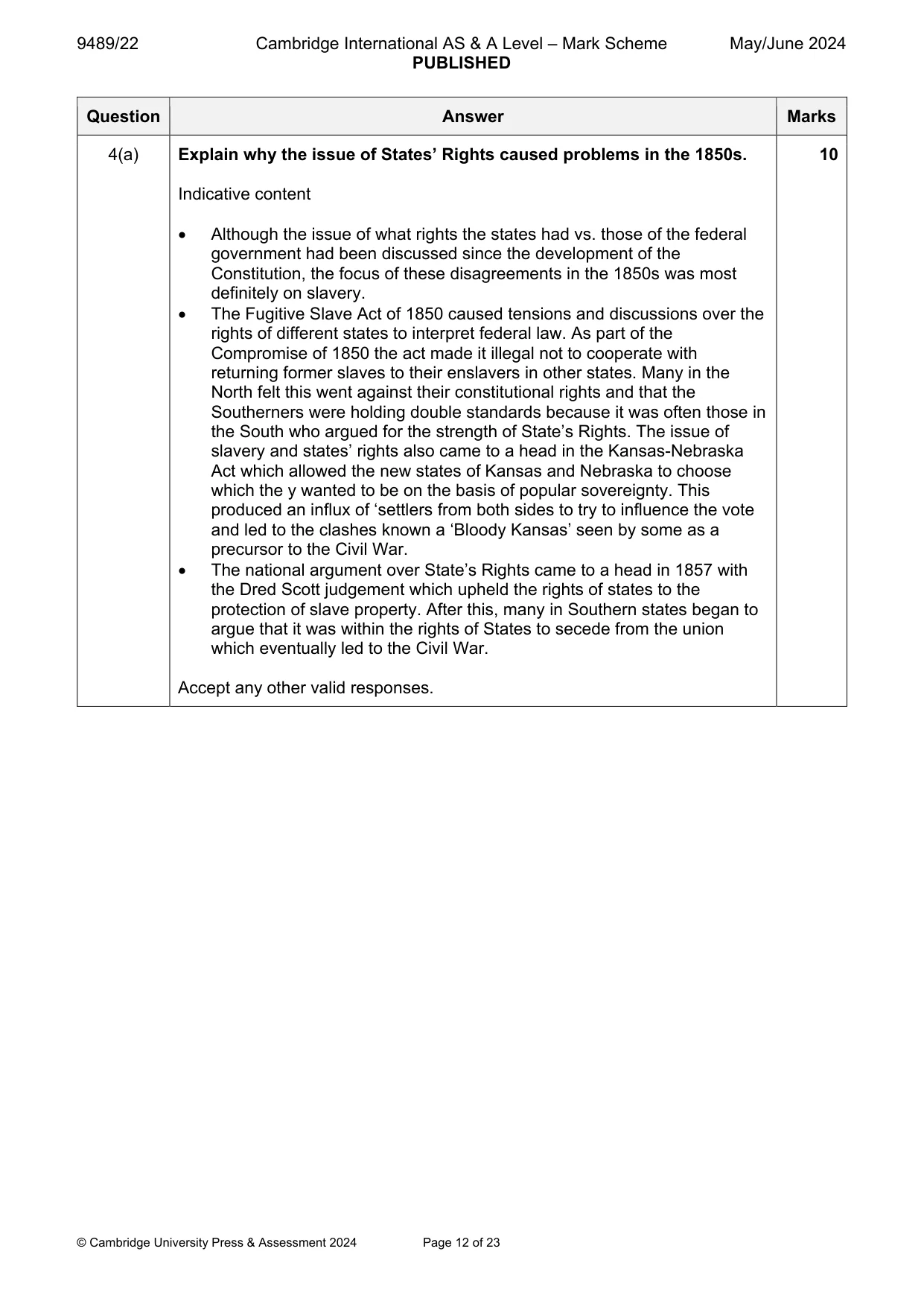
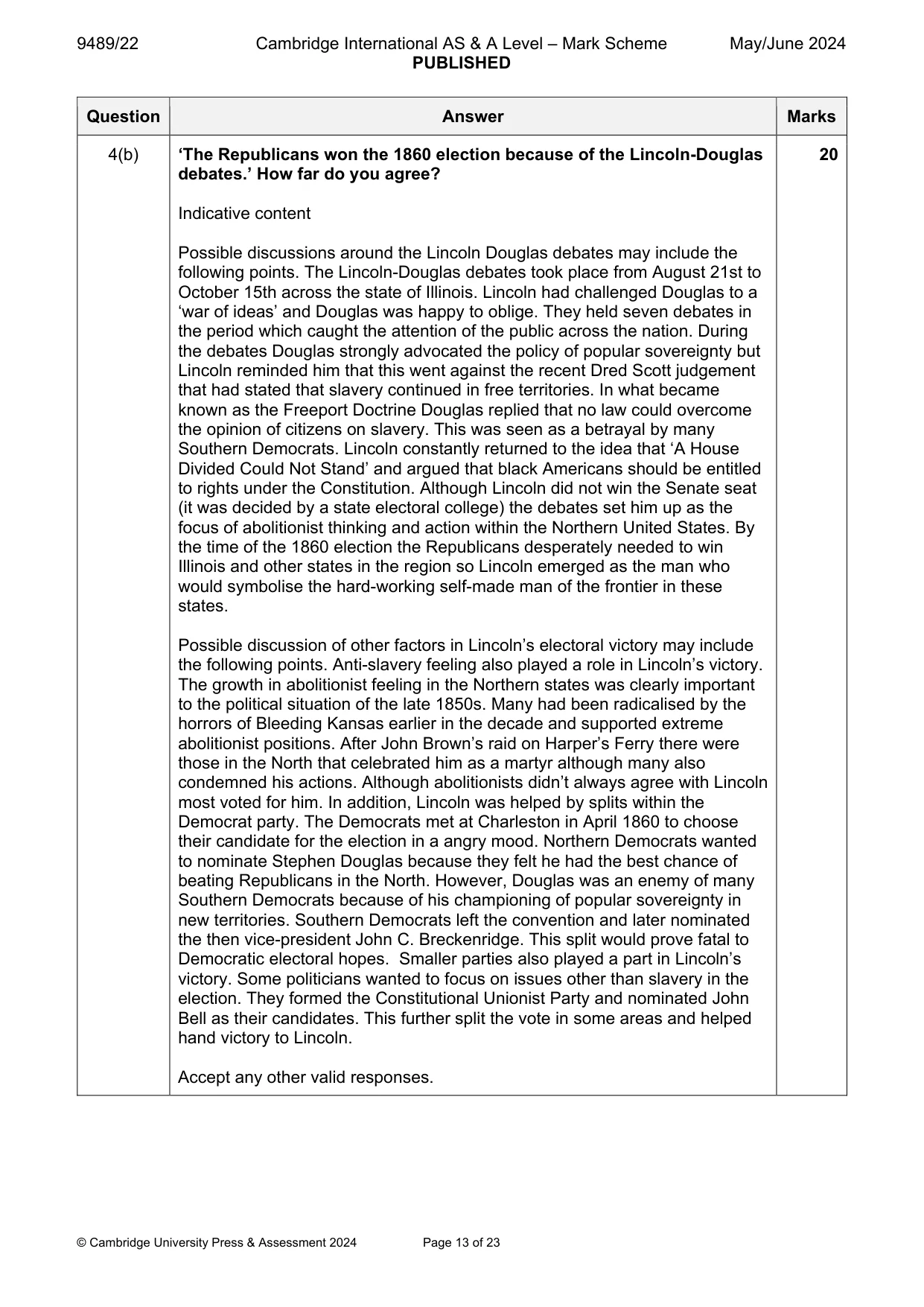
Mark scheme: 4(a) Explain why the issue of States’ Rights caused problems in the 1850s. 10 Indicative content Although the issue of what rights the states had vs. those of the federal government had been discussed since the development of the Constitution, the focus of these disagreements in the 1850s was most definitely on slavery. The Fugitive Slave Act of 1850 caused tensions and discussions over the rights of different states to interpret federal law. As part of the Compromise of 1850 the act made it illegal not to cooperate with returning former slaves to their enslavers in other states. Many in the North felt this went against their constitutional rights and that the Southerners were holding double standards because it was often those in the South who argued for the strength of State’s Rights. The issue of slavery and states’ rights also came to a head in the Kansas-Nebraska Act which allowed the new states of Kansas and Nebraska to choose which the y wanted to be on the basis of popular sovereignty. This produced an influx of ‘settlers from both sides to try to influence the vote and led to the clashes known a ‘Bloody Kansas’ seen by some as a precursor to the Civil War. The national argument over State’s Rights came to a head in 1857 with the Dred Scott judgement which upheld the rights of states to the protection of slave property. After this, many in Southern states began to argue that it was within the rights of States to secede from the union which eventually led to the Civil War. Accept any other valid responses. 4(b) ‘The Republicans won the 1860 election because of the Lincoln-Douglas 20 debates.’ How far do you agree? Indicative content Possible discussions around the Lincoln Douglas debates may include the following points. The Lincoln-Douglas debates took place from August 21st to October 15th across the state of Illinois. Lincoln had challenged Douglas to a ‘war of ideas’ and Douglas was happy to oblige. They held seven debates in the period which caught the attention of the public across the nation. During the debates Douglas strongly advocated the policy of popular sovereignty but Lincoln reminded him that this went against the recent Dred Scott judgement that had stated that slavery continued in free territories. In what became known as the Freeport Doctrine Douglas replied that no law could overcome the opinion of citizens on slavery. This was seen as a betrayal by many Southern Democrats. Lincoln constantly returned to the idea that ‘A House Divided Could Not Stand’ and argued that black Americans should be entitled to rights under the Constitution. Although Lincoln did not win the Senate seat (it was decided by a state electoral college) the debates set him up as the focus of abolitionist thinking and action within the Northern United States. By the time of the 1860 election the Republicans desperately needed to win Illinois and other states in the region so Lincoln emerged as the man who would symbolise the hard-working self-made man of the frontier in these states. Possible discussion of other factors in Lincoln’s electoral victory may include the following points. Anti-slavery feeling also played a role in Lincoln’s victory. The growth in abolitionist feeling in the Northern states was clearly important to the political situation of the late 1850s. Many had been radicalised by the horrors of Bleeding Kansas earlier in the decade and supported extreme abolitionist positions. After John Brown’s raid on Harper’s Ferry there were those in the North that celebrated him as a martyr although many also condemned his actions. Although abolitionists didn’t always agree with Lincoln most voted for him. In addition, Lincoln was helped by splits within the Democrat party. The Democrats met at Charleston in April 1860 to choose their candidate for the election in a angry mood. Northern Democrats wanted to nominate Stephen Douglas because they felt he had the best chance of beating Republicans in the North. However, Douglas was an enemy of many Southern Democrats because of his championing of popular sovereignty in new territories. Southern Democrats left the convention and later nominated the then vice-president John C. Breckenridge. This split would prove fatal to Democratic electoral hopes. Smaller parties also played a part in Lincoln’s victory. Some politicians wanted to focus on issues other than slavery in the election. They formed the Constitutional Unionist Party and nominated John Bell as their candidates. This further split the vote in some areas and helped hand victory to Lincoln. Accept any other valid responses.
More questions on Why was there increasing tension between the North and the South before 1860?
Q5 · Civil War and Reconstruction, 1861–77 (a) Explain why military strategies changed during…
5 Civil War and Reconstruction, 1861–77 (a) Explain why military strategies changed during the Civil War. [10] (b) To what extent had the White South accepted the policies of Reconstruction by 1877? [20]
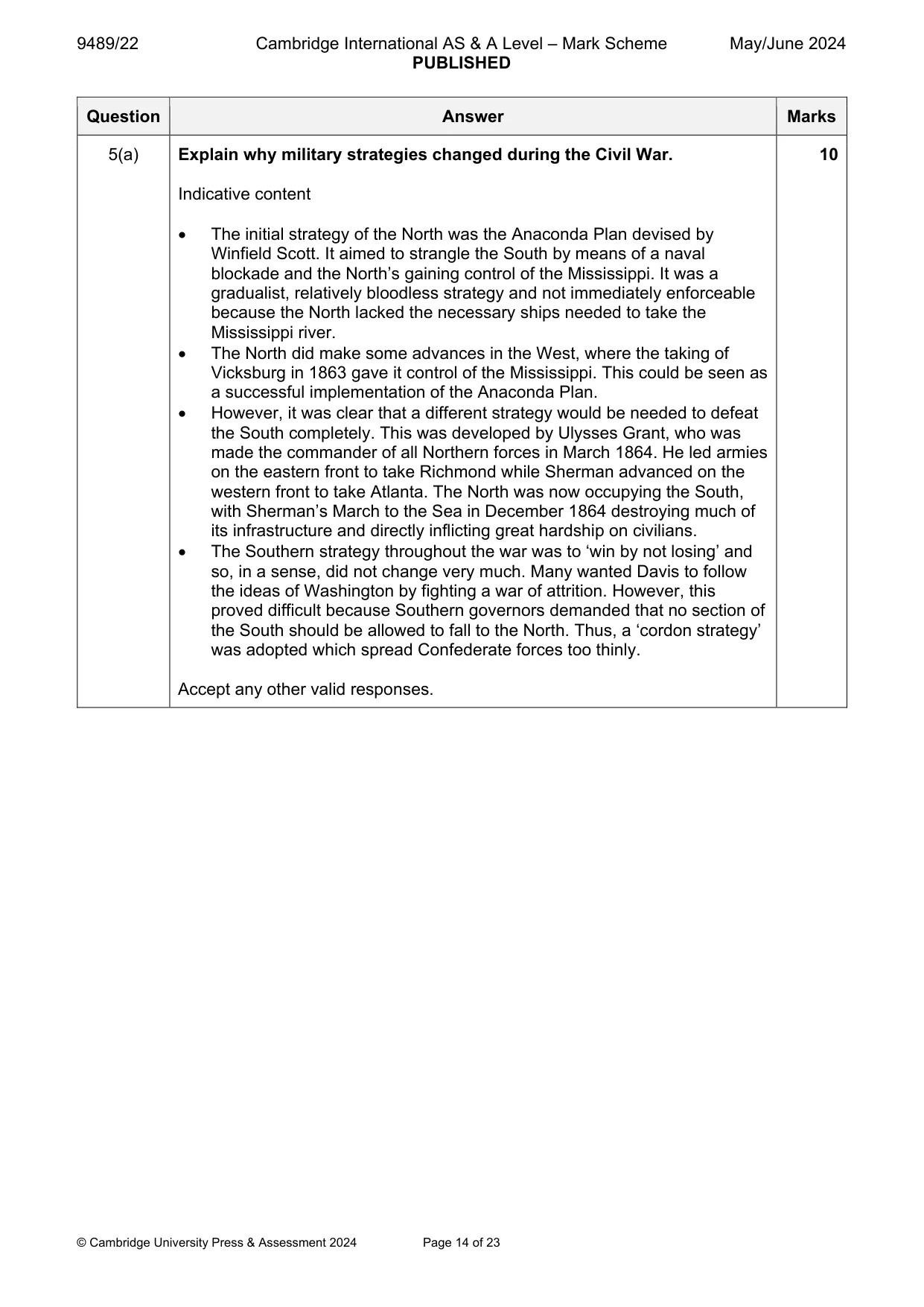
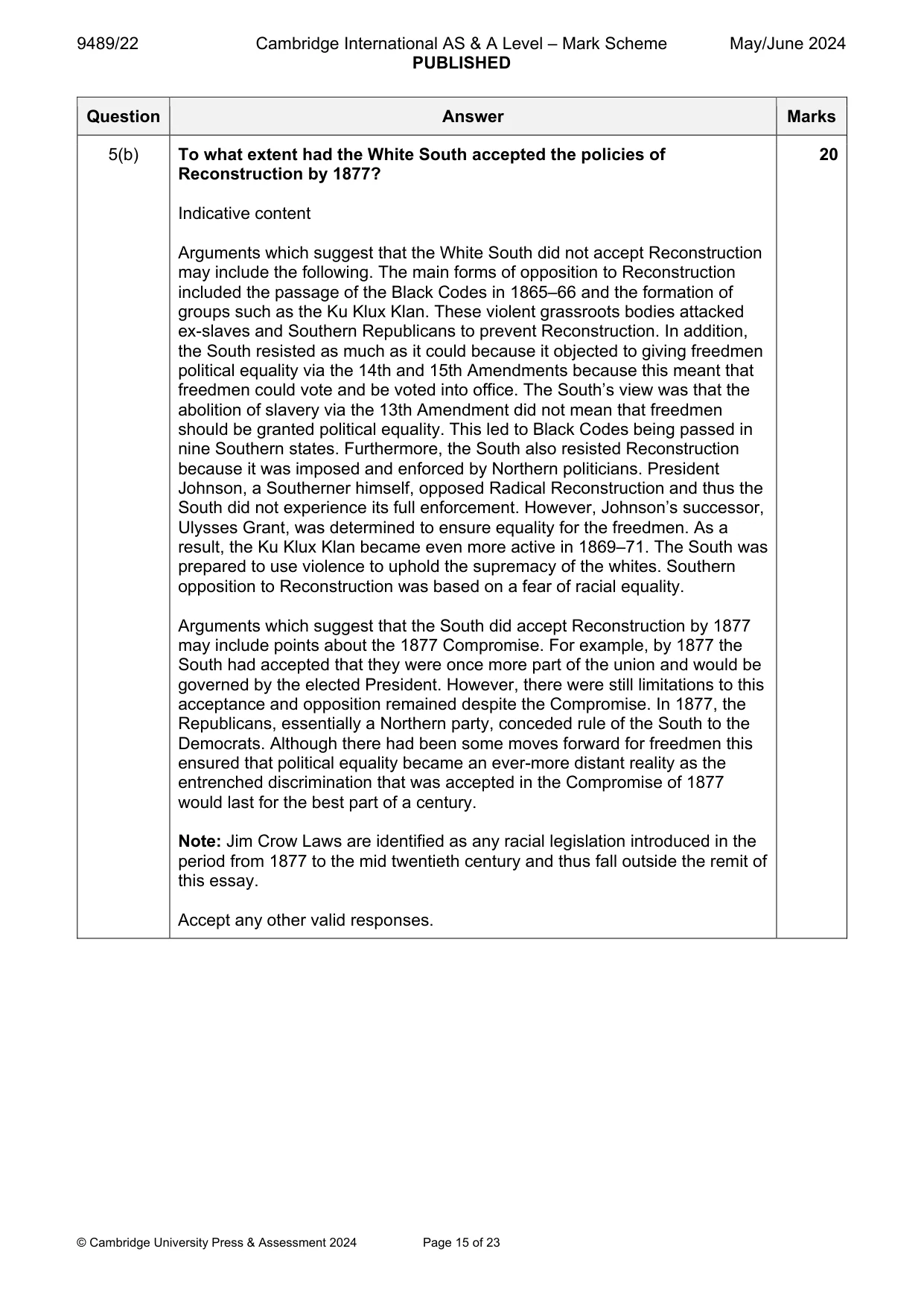
Mark scheme: 5(a) Explain why military strategies changed during the Civil War. 10 Indicative content The initial strategy of the North was the Anaconda Plan devised by Winfield Scott. It aimed to strangle the South by means of a naval blockade and the North’s gaining control of the Mississippi. It was a gradualist, relatively bloodless strategy and not immediately enforceable because the North lacked the necessary ships needed to take the Mississippi river. The North did make some advances in the West, where the taking of Vicksburg in 1863 gave it control of the Mississippi. This could be seen as a successful implementation of the Anaconda Plan. However, it was clear that a different strategy would be needed to defeat the South completely. This was developed by Ulysses Grant, who was made the commander of all Northern forces in March 1864. He led armies on the eastern front to take Richmond while Sherman advanced on the western front to take Atlanta. The North was now occupying the South, with Sherman’s March to the Sea in December 1864 destroying much of its infrastructure and directly inflicting great hardship on civilians. The Southern strategy throughout the war was to ‘win by not losing’ and so, in a sense, did not change very much. Many wanted Davis to follow the ideas of Washington by fighting a war of attrition. However, this proved difficult because Southern governors demanded that no section of the South should be allowed to fall to the North. Thus, a ‘cordon strategy’ was adopted which spread Confederate forces too thinly. Accept any other valid responses. 5(b) To what extent had the White South accepted the policies of 20 Reconstruction by 1877? Indicative content Arguments which suggest that the White South did not accept Reconstruction may include the following. The main forms of opposition to Reconstruction included the passage of the Black Codes in 1865–66 and the formation of groups such as the Ku Klux Klan. These violent grassroots bodies attacked ex-slaves and Southern Republicans to prevent Reconstruction. In addition, the South resisted as much as it could because it objected to giving freedmen political equality via the 14th and 15th Amendments because this meant that freedmen could vote and be voted into office. The South’s view was that the abolition of slavery via the 13th Amendment did not mean that freedmen should be granted political equality. This led to Black Codes being passed in nine Southern states. Furthermore, the South also resisted Reconstruction because it was imposed and enforced by Northern politicians. President Johnson, a Southerner himself, opposed Radical Reconstruction and thus the South did not experience its full enforcement. However, Johnson’s successor, Ulysses Grant, was determined to ensure equality for the freedmen. As a result, the Ku Klux Klan became even more active in 1869–71. The South was prepared to use violence to uphold the supremacy of the whites. Southern opposition to Reconstruction was based on a fear of racial equality. Arguments which suggest that the South did accept Reconstruction by 1877 may include points about the 1877 Compromise. For example, by 1877 the South had accepted that they were once more part of the union and would be governed by the elected President. However, there were still limitations to this acceptance and opposition remained despite the Compromise. In 1877, the Republicans, essentially a Northern party, conceded rule of the South to the Democrats. Although there had been some moves forward for freedmen this ensured that political equality became an ever-more distant reality as the entrenched discrimination that was accepted in the Compromise of 1877 would last for the best part of a century. Note: Jim Crow Laws are identified as any racial legislation introduced in the period from 1877 to the mid twentieth century and thus fall outside the remit of this essay. Accept any other valid responses.
More questions on What were the aims of Reconstruction and how successful was it?
Q6 · The Gilded Age and Progressive Era, 1870s to 1920 (a) Explain why Progressives campaigned…
6 The Gilded Age and Progressive Era, 1870s to 1920 (a) Explain why Progressives campaigned for national prohibition in the early twentieth century. [10] (b) ‘The growth of trusts and corporations caused the economic development of the late nineteenth century.’ How far do you agree? [20] Section C: International option International history, 1870–1945
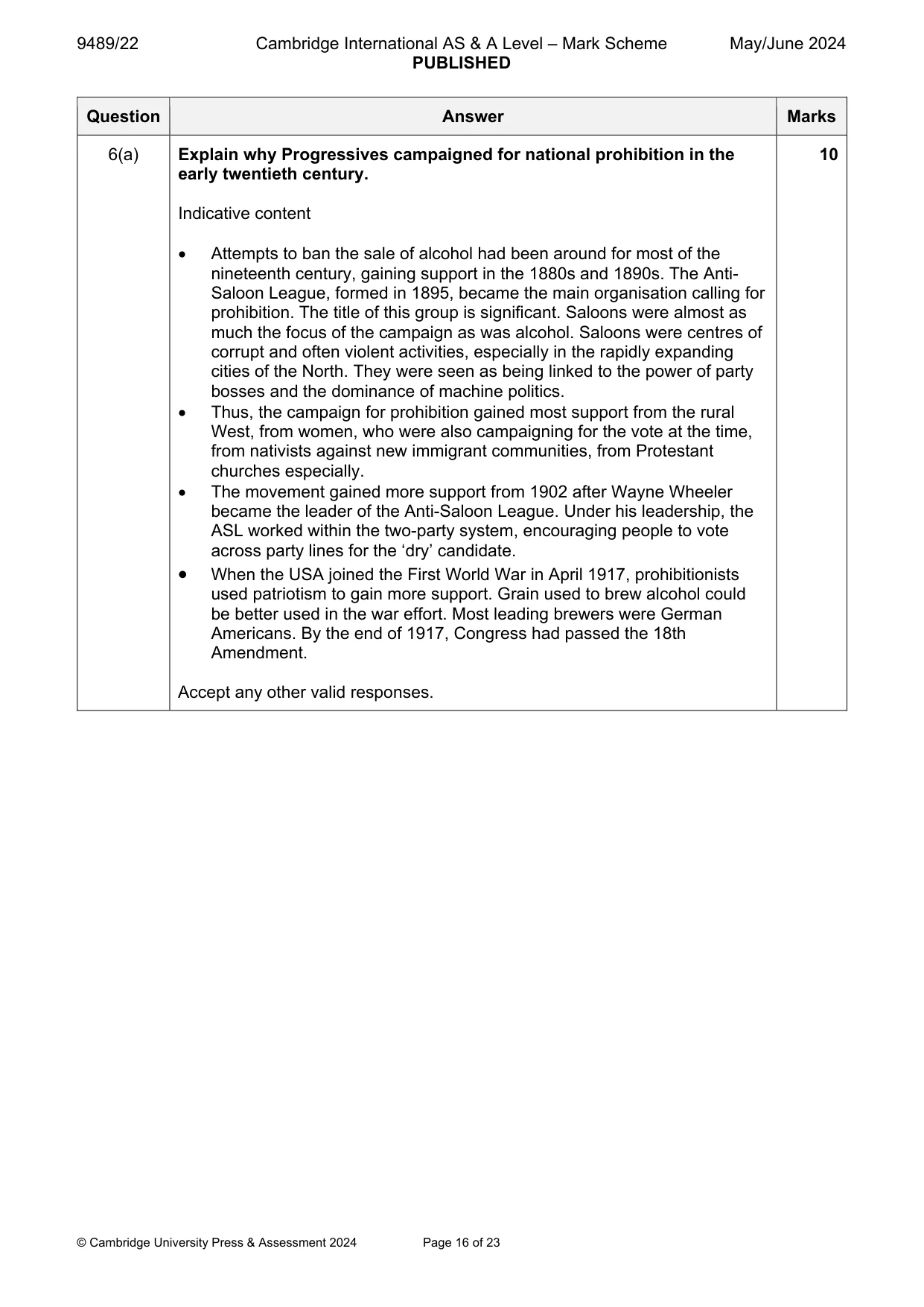
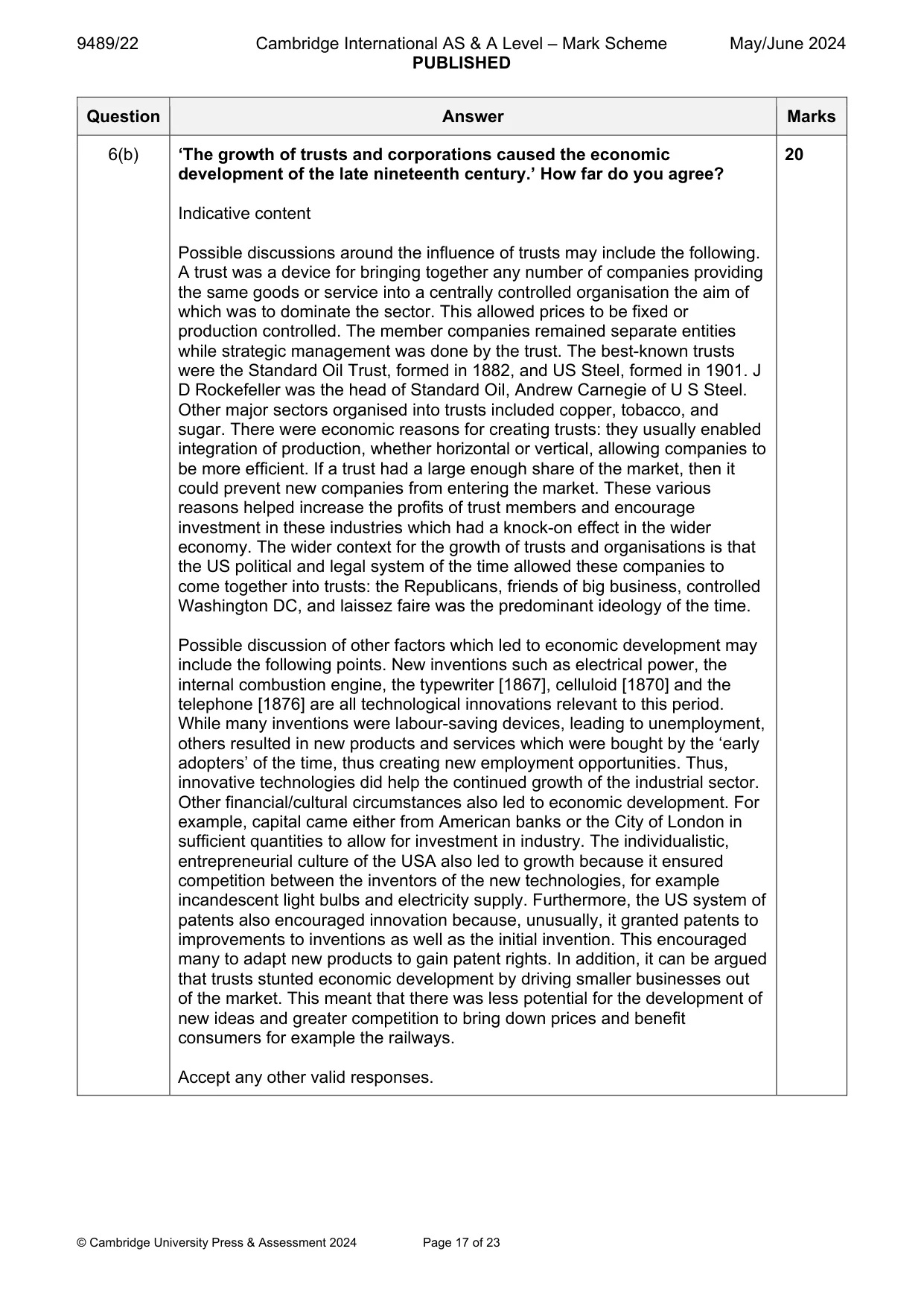
Mark scheme: 6(a) Explain why Progressives campaigned for national prohibition in the 10 early twentieth century. Indicative content Attempts to ban the sale of alcohol had been around for most of the nineteenth century, gaining support in the 1880s and 1890s. The Anti- Saloon League, formed in 1895, became the main organisation calling for prohibition. The title of this group is significant. Saloons were almost as much the focus of the campaign as was alcohol. Saloons were centres of corrupt and often violent activities, especially in the rapidly expanding cities of the North. They were seen as being linked to the power of party bosses and the dominance of machine politics. Thus, the campaign for prohibition gained most support from the rural West, from women, who were also campaigning for the vote at the time, from nativists against new immigrant communities, from Protestant churches especially. The movement gained more support from 1902 after Wayne Wheeler became the leader of the Anti-Saloon League. Under his leadership, the ASL worked within the two-party system, encouraging people to vote across party lines for the ‘dry’ candidate. When the USA joined the First World War in April 1917, prohibitionists used patriotism to gain more support. Grain used to brew alcohol could be better used in the war effort. Most leading brewers were German Americans. By the end of 1917, Congress had passed the 18th Amendment. Accept any other valid responses. 6(b) ‘The growth of trusts and corporations caused the economic 20 development of the late nineteenth century.’ How far do you agree? Indicative content Possible discussions around the influence of trusts may include the following. A trust was a device for bringing together any number of companies providing the same goods or service into a centrally controlled organisation the aim of which was to dominate the sector. This allowed prices to be fixed or production controlled. The member companies remained separate entities while strategic management was done by the trust. The best-known trusts were the Standard Oil Trust, formed in 1882, and US Steel, formed in 1901. J D Rockefeller was the head of Standard Oil, Andrew Carnegie of U S Steel. Other major sectors organised into trusts included copper, tobacco, and sugar. There were economic reasons for creating trusts: they usually enabled integration of production, whether horizontal or vertical, allowing companies to be more efficient. If a trust had a large enough share of the market, then it could prevent new companies from entering the market. These various reasons helped increase the profits of trust members and encourage investment in these industries which had a knock-on effect in the wider economy. The wider context for the growth of trusts and organisations is that the US political and legal system of the time allowed these companies to come together into trusts: the Republicans, friends of big business, controlled Washington DC, and laissez faire was the predominant ideology of the time. Possible discussion of other factors which led to economic development may include the following points. New inventions such as electrical power, the internal combustion engine, the typewriter [1867], celluloid [1870] and the telephone [1876] are all technological innovations relevant to this period. While many inventions were labour-saving devices, leading to unemployment, others resulted in new products and services which were bought by the ‘early adopters’ of the time, thus creating new employment opportunities. Thus, innovative technologies did help the continued growth of the industrial sector. Other financial/cultural circumstances also led to economic development. For example, capital came either from American banks or the City of London in sufficient quantities to allow for investment in industry. The individualistic, entrepreneurial culture of the USA also led to growth because it ensured competition between the inventors of the new technologies, for example incandescent light bulbs and electricity supply. Furthermore, the US system of patents also encouraged innovation because, unusually, it granted patents to improvements to inventions as well as the initial invention. This encouraged many to adapt new products to gain patent rights. In addition, it can be argued that trusts stunted economic development by driving smaller businesses out of the market. This meant that there was less potential for the development of new ideas and greater competition to bring down prices and benefit consumers for example the railways. Accept any other valid responses.
More questions on Why was there rapid industrialisation after 1870?
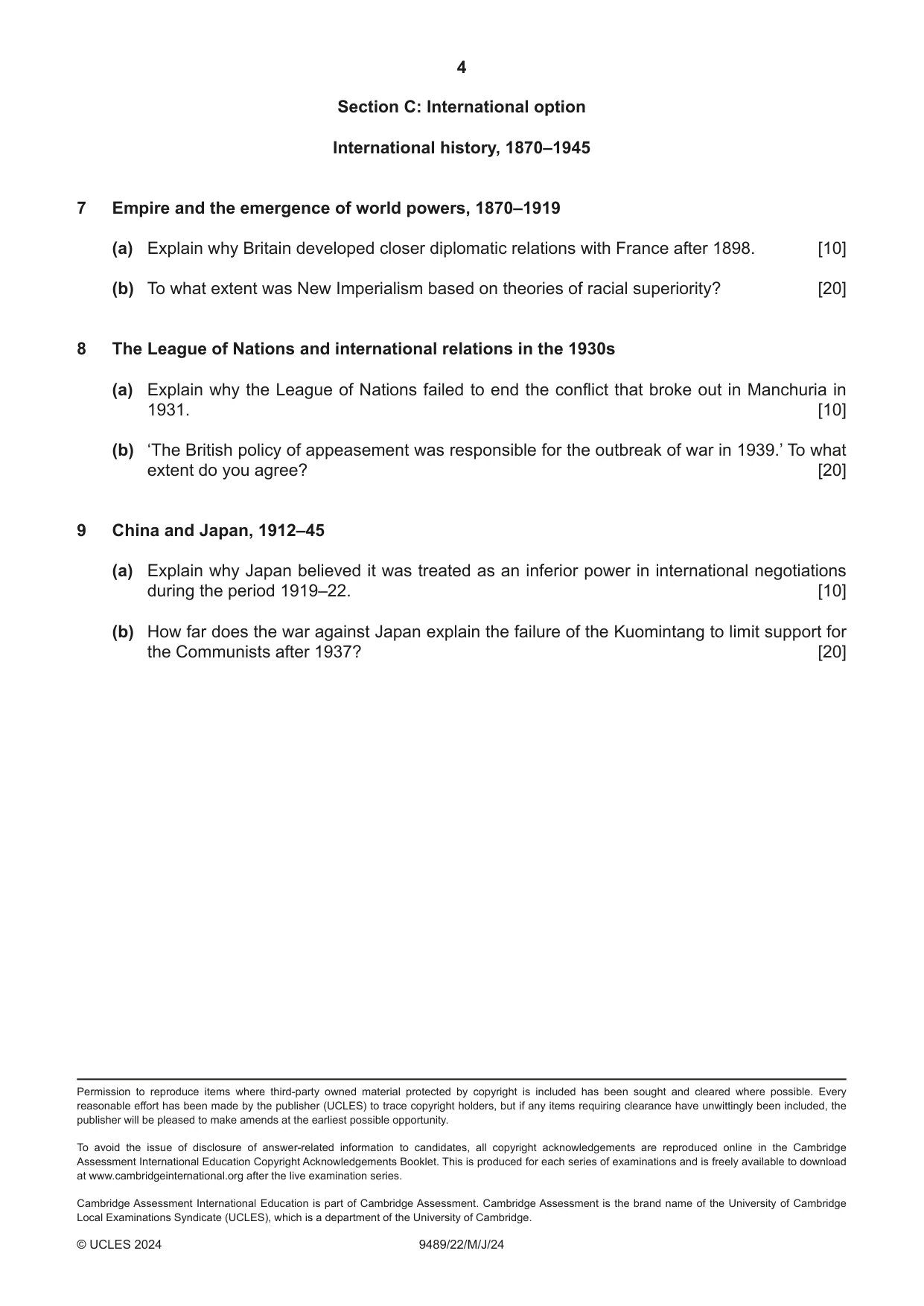
Q7 · Empire and the emergence of world powers, 1870–1919 (a) Explain why Britain developed…
7 Empire and the emergence of world powers, 1870–1919 (a) Explain why Britain developed closer diplomatic relations with France after 1898. [10] (b) To what extent was New Imperialism based on theories of racial superiority? [20]
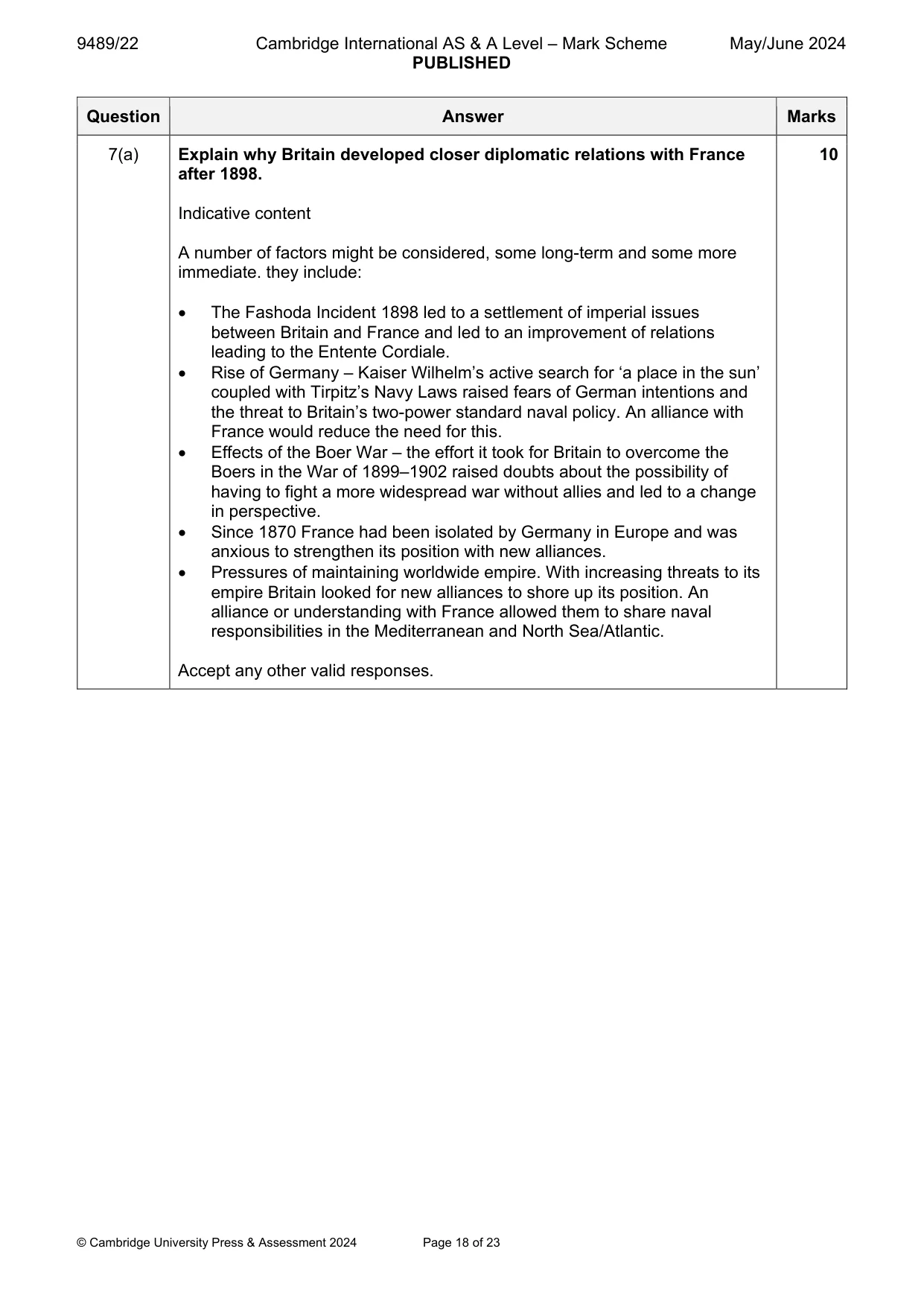
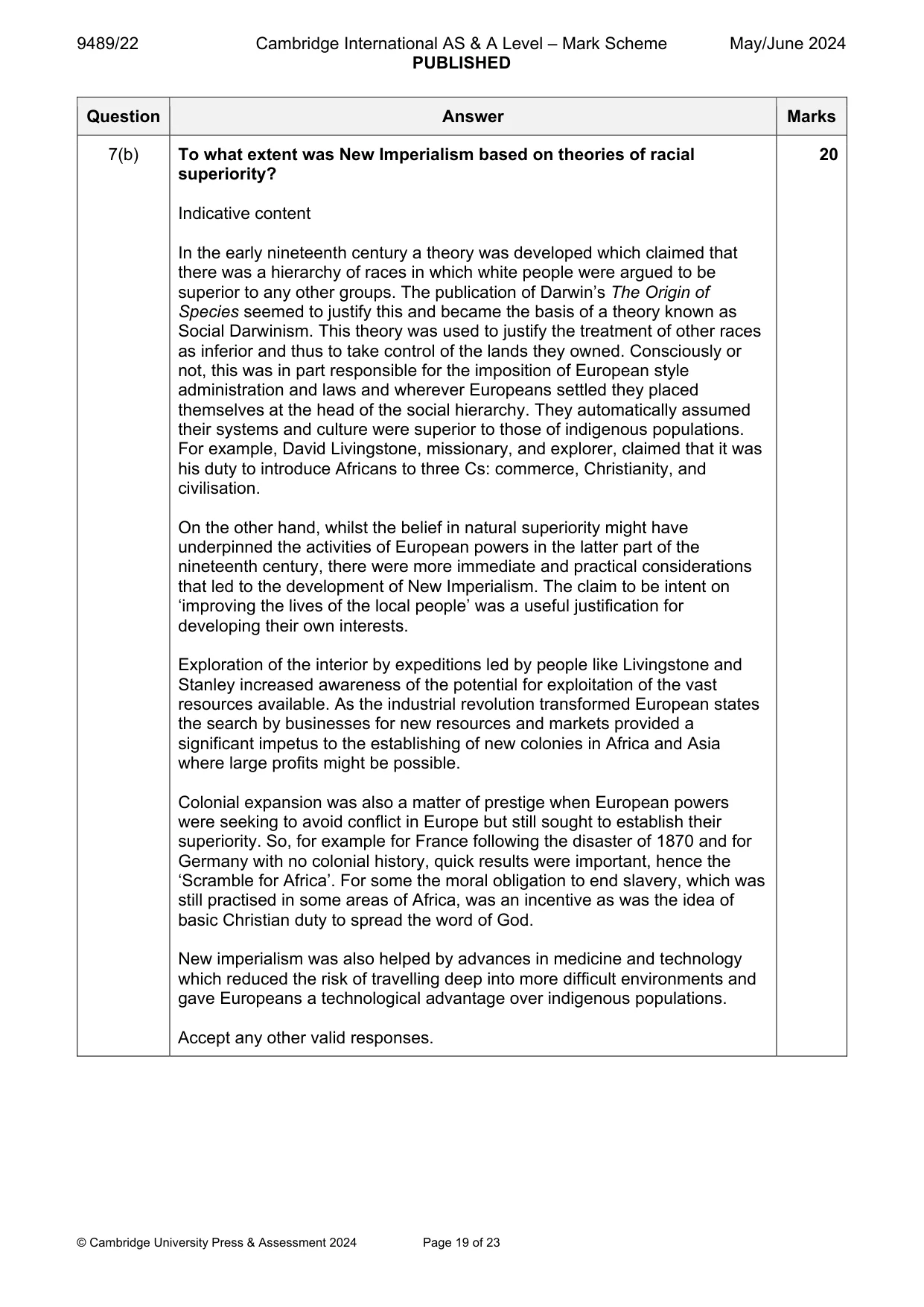
Mark scheme: 7(a) Explain why Britain developed closer diplomatic relations with France 10 after 1898. Indicative content A number of factors might be considered, some long-term and some more immediate. they include: The Fashoda Incident 1898 led to a settlement of imperial issues between Britain and France and led to an improvement of relations leading to the Entente Cordiale. Rise of Germany – Kaiser Wilhelm’s active search for ‘a place in the sun’ coupled with Tirpitz’s Navy Laws raised fears of German intentions and the threat to Britain’s two-power standard naval policy. An alliance with France would reduce the need for this. Effects of the Boer War – the effort it took for Britain to overcome the Boers in the War of 1899–1902 raised doubts about the possibility of having to fight a more widespread war without allies and led to a change in perspective. Since 1870 France had been isolated by Germany in Europe and was anxious to strengthen its position with new alliances. Pressures of maintaining worldwide empire. With increasing threats to its empire Britain looked for new alliances to shore up its position. An alliance or understanding with France allowed them to share naval responsibilities in the Mediterranean and North Sea/Atlantic. Accept any other valid responses. 7(b) To what extent was New Imperialism based on theories of racial 20 superiority? Indicative content In the early nineteenth century a theory was developed which claimed that there was a hierarchy of races in which white people were argued to be superior to any other groups. The publication of Darwin’s The Origin of Species seemed to justify this and became the basis of a theory known as Social Darwinism. This theory was used to justify the treatment of other races as inferior and thus to take control of the lands they owned. Consciously or not, this was in part responsible for the imposition of European style administration and laws and wherever Europeans settled they placed themselves at the head of the social hierarchy. They automatically assumed their systems and culture were superior to those of indigenous populations. For example, David Livingstone, missionary, and explorer, claimed that it was his duty to introduce Africans to three Cs: commerce, Christianity, and civilisation. On the other hand, whilst the belief in natural superiority might have underpinned the activities of European powers in the latter part of the nineteenth century, there were more immediate and practical considerations that led to the development of New Imperialism. The claim to be intent on ‘improving the lives of the local people’ was a useful justification for developing their own interests. Exploration of the interior by expeditions led by people like Livingstone and Stanley increased awareness of the potential for exploitation of the vast resources available. As the industrial revolution transformed European states the search by businesses for new resources and markets provided a significant impetus to the establishing of new colonies in Africa and Asia where large profits might be possible. Colonial expansion was also a matter of prestige when European powers were seeking to avoid conflict in Europe but still sought to establish their superiority. So, for example for France following the disaster of 1870 and for Germany with no colonial history, quick results were important, hence the ‘Scramble for Africa’. For some the moral obligation to end slavery, which was still practised in some areas of Africa, was an incentive as was the idea of basic Christian duty to spread the word of God. New imperialism was also helped by advances in medicine and technology which reduced the risk of travelling deep into more difficult environments and gave Europeans a technological advantage over indigenous populations. Accept any other valid responses.
More questions on Why was imperialism a significant force in Africa from 1870?
Q8 · The League of Nations and international relations in the 1930s (a) Explain why the League…
8 The League of Nations and international relations in the 1930s (a) Explain why the League of Nations failed to end the conflict that broke out in Manchuria in 1931. [10] (b) ‘The British policy of appeasement was responsible for the outbreak of war in 1939.’ To what extent do you agree? [20]
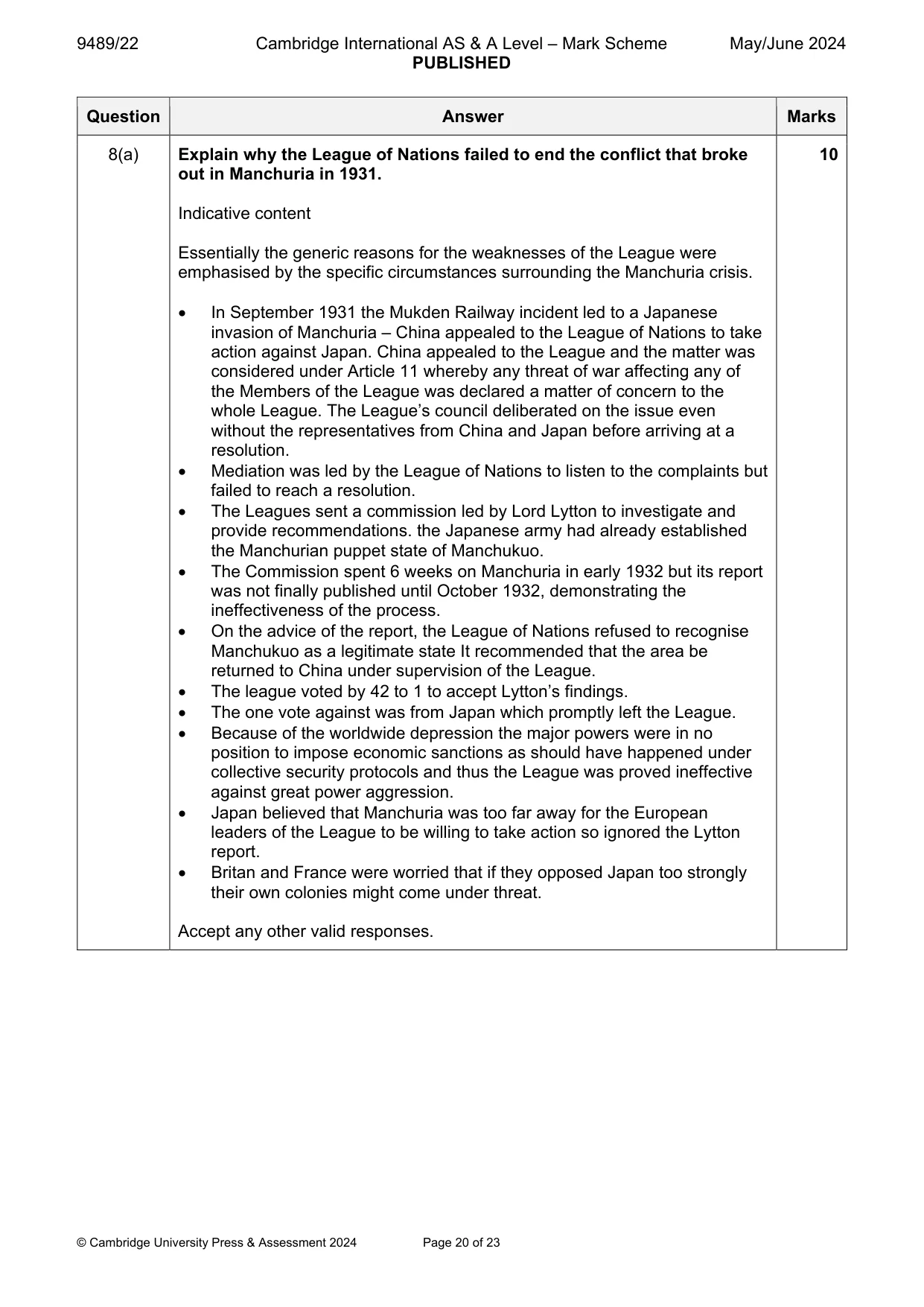
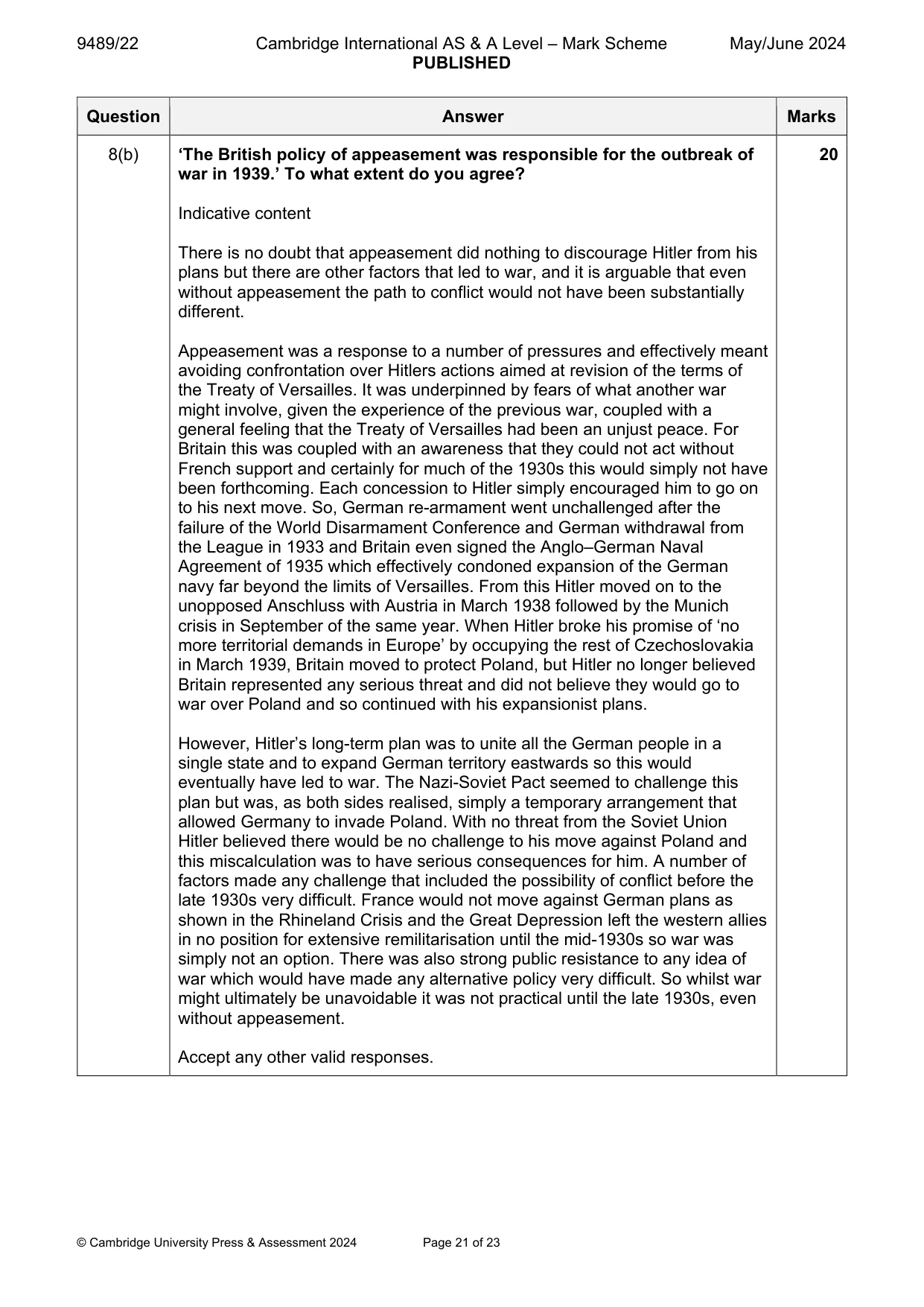
Mark scheme: 8(a) Explain why the League of Nations failed to end the conflict that broke 10 out in Manchuria in 1931. Indicative content Essentially the generic reasons for the weaknesses of the League were emphasised by the specific circumstances surrounding the Manchuria crisis. In September 1931 the Mukden Railway incident led to a Japanese invasion of Manchuria – China appealed to the League of Nations to take action against Japan. China appealed to the League and the matter was considered under Article 11 whereby any threat of war affecting any of the Members of the League was declared a matter of concern to the whole League. The League’s council deliberated on the issue even without the representatives from China and Japan before arriving at a resolution. Mediation was led by the League of Nations to listen to the complaints but failed to reach a resolution. The Leagues sent a commission led by Lord Lytton to investigate and provide recommendations. the Japanese army had already established the Manchurian puppet state of Manchukuo. The Commission spent 6 weeks on Manchuria in early 1932 but its report was not finally published until October 1932, demonstrating the ineffectiveness of the process. On the advice of the report, the League of Nations refused to recognise Manchukuo as a legitimate state It recommended that the area be returned to China under supervision of the League. The league voted by 42 to 1 to accept Lytton’s findings. The one vote against was from Japan which promptly left the League. Because of the worldwide depression the major powers were in no position to impose economic sanctions as should have happened under collective security protocols and thus the League was proved ineffective against great power aggression. Japan believed that Manchuria was too far away for the European leaders of the League to be willing to take action so ignored the Lytton report. Britan and France were worried that if they opposed Japan too strongly their own colonies might come under threat. Accept any other valid responses. 8(b) ‘The British policy of appeasement was responsible for the outbreak of 20 war in 1939.’ To what extent do you agree? Indicative content There is no doubt that appeasement did nothing to discourage Hitler from his plans but there are other factors that led to war, and it is arguable that even without appeasement the path to conflict would not have been substantially different. Appeasement was a response to a number of pressures and effectively meant avoiding confrontation over Hitlers actions aimed at revision of the terms of the Treaty of Versailles. It was underpinned by fears of what another war might involve, given the experience of the previous war, coupled with a general feeling that the Treaty of Versailles had been an unjust peace. For Britain this was coupled with an awareness that they could not act without French support and certainly for much of the 1930s this would simply not have been forthcoming. Each concession to Hitler simply encouraged him to go on to his next move. So, German re-armament went unchallenged after the failure of the World Disarmament Conference and German withdrawal from the League in 1933 and Britain even signed the Anglo–German Naval Agreement of 1935 which effectively condoned expansion of the German navy far beyond the limits of Versailles. From this Hitler moved on to the unopposed Anschluss with Austria in March 1938 followed by the Munich crisis in September of the same year. When Hitler broke his promise of ‘no more territorial demands in Europe’ by occupying the rest of Czechoslovakia in March 1939, Britain moved to protect Poland, but Hitler no longer believed Britain represented any serious threat and did not believe they would go to war over Poland and so continued with his expansionist plans. However, Hitler’s long-term plan was to unite all the German people in a single state and to expand German territory eastwards so this would eventually have led to war. The Nazi-Soviet Pact seemed to challenge this plan but was, as both sides realised, simply a temporary arrangement that allowed Germany to invade Poland. With no threat from the Soviet Union Hitler believed there would be no challenge to his move against Poland and this miscalculation was to have serious consequences for him. A number of factors made any challenge that included the possibility of conflict before the late 1930s very difficult. France would not move against German plans as shown in the Rhineland Crisis and the Great Depression left the western allies in no position for extensive remilitarisation until the mid-1930s so war was simply not an option. There was also strong public resistance to any idea of war which would have made any alternative policy very difficult. So whilst war might ultimately be unavoidable it was not practical until the late 1930s, even without appeasement. Accept any other valid responses.
More questions on Why, and with what effects, did Britain and France pursue a policy of appeasement?
Q9 · China and Japan, 1912–45 (a) Explain why Japan believed it was treated as an inferior…
9 China and Japan, 1912–45 (a) Explain why Japan believed it was treated as an inferior power in international negotiations during the period 1919–22. [10] (b) How far does the war against Japan explain the failure of the Kuomintang to limit support for the Communists after 1937? [20]
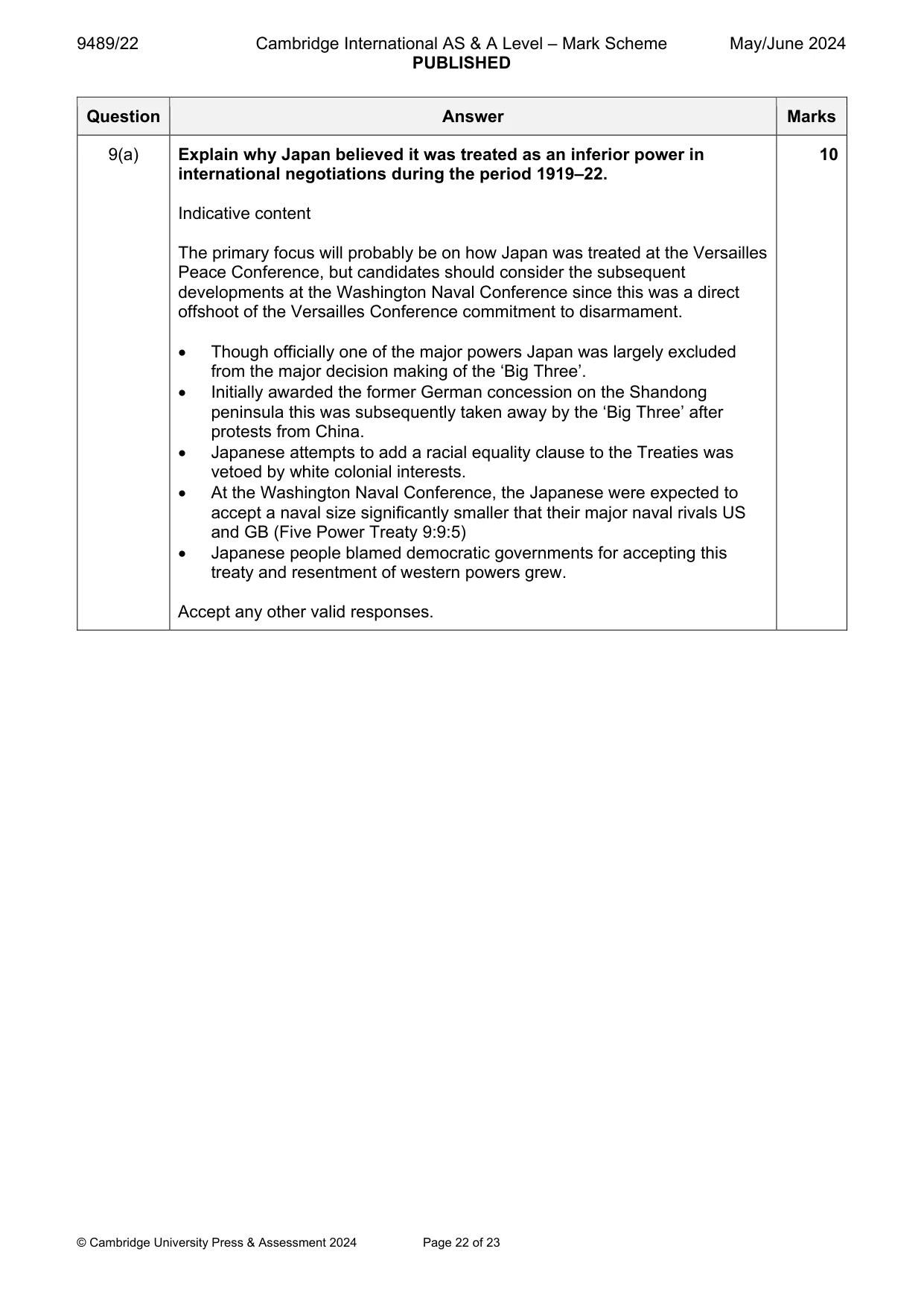
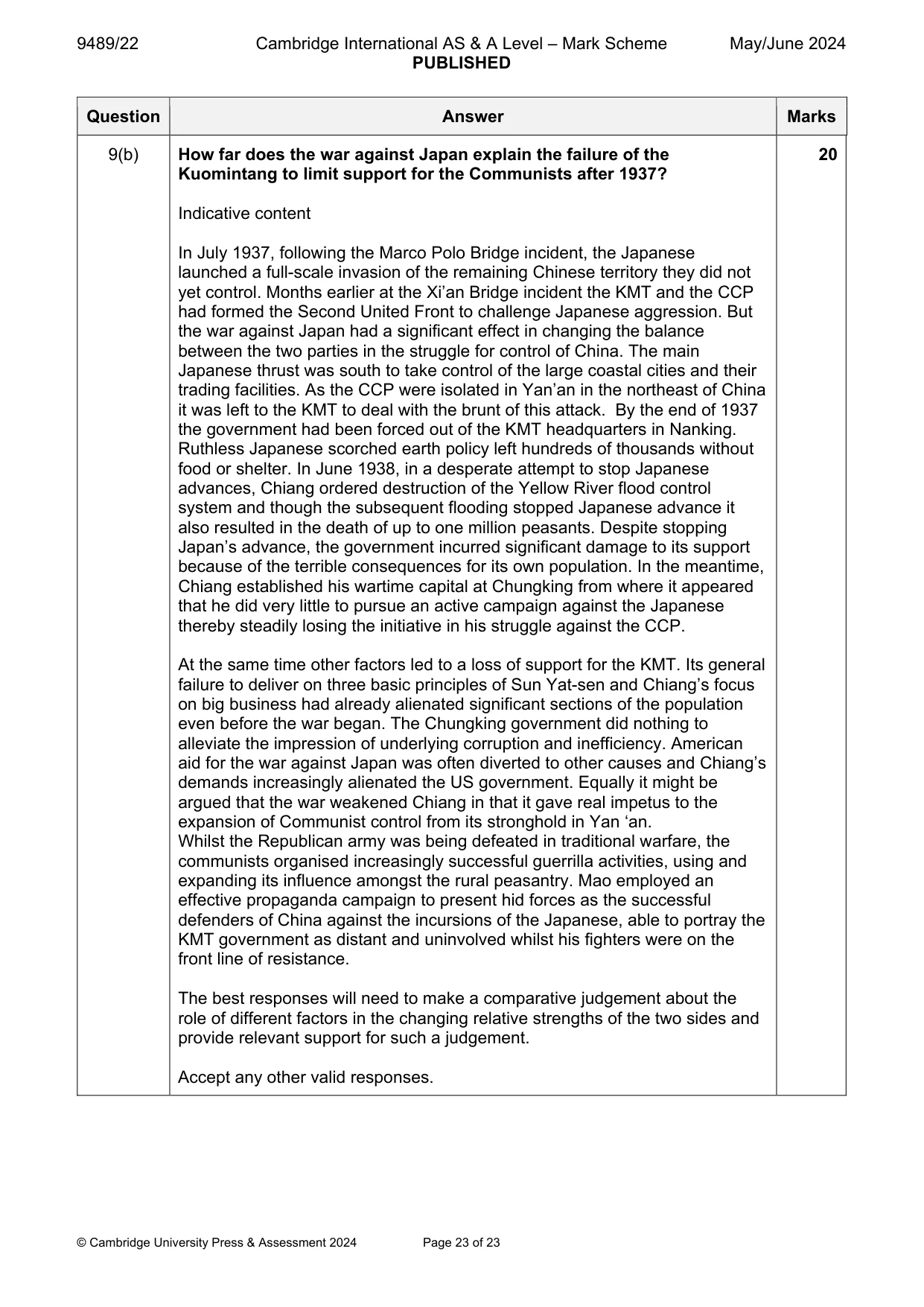
Mark scheme: 9(a) Explain why Japan believed it was treated as an inferior power in 10 international negotiations during the period 1919–22. Indicative content The primary focus will probably be on how Japan was treated at the Versailles Peace Conference, but candidates should consider the subsequent developments at the Washington Naval Conference since this was a direct offshoot of the Versailles Conference commitment to disarmament. Though officially one of the major powers Japan was largely excluded from the major decision making of the ‘Big Three’. Initially awarded the former German concession on the Shandong peninsula this was subsequently taken away by the ‘Big Three’ after protests from China. Japanese attempts to add a racial equality clause to the Treaties was vetoed by white colonial interests. At the Washington Naval Conference, the Japanese were expected to accept a naval size significantly smaller that their major naval rivals US and GB (Five Power Treaty 9:9:5) Japanese people blamed democratic governments for accepting this treaty and resentment of western powers grew. Accept any other valid responses. 9(b) How far does the war against Japan explain the failure of the 20 Kuomintang to limit support for the Communists after 1937? Indicative content In July 1937, following the Marco Polo Bridge incident, the Japanese launched a full-scale invasion of the remaining Chinese territory they did not yet control. Months earlier at the Xi’an Bridge incident the KMT and the CCP had formed the Second United Front to challenge Japanese aggression. But the war against Japan had a significant effect in changing the balance between the two parties in the struggle for control of China. The main Japanese thrust was south to take control of the large coastal cities and their trading facilities. As the CCP were isolated in Yan’an in the northeast of China it was left to the KMT to deal with the brunt of this attack. By the end of 1937 the government had been forced out of the KMT headquarters in Nanking. Ruthless Japanese scorched earth policy left hundreds of thousands without food or shelter. In June 1938, in a desperate attempt to stop Japanese advances, Chiang ordered destruction of the Yellow River flood control system and though the subsequent flooding stopped Japanese advance it also resulted in the death of up to one million peasants. Despite stopping Japan’s advance, the government incurred significant damage to its support because of the terrible consequences for its own population. In the meantime, Chiang established his wartime capital at Chungking from where it appeared that he did very little to pursue an active campaign against the Japanese thereby steadily losing the initiative in his struggle against the CCP. At the same time other factors led to a loss of support for the KMT. Its general failure to deliver on three basic principles of Sun Yat-sen and Chiang’s focus on big business had already alienated significant sections of the population even before the war began. The Chungking government did nothing to alleviate the impression of underlying corruption and inefficiency. American aid for the war against Japan was often diverted to other causes and Chiang’s demands increasingly alienated the US government. Equally it might be argued that the war weakened Chiang in that it gave real impetus to the expansion of Communist control from its stronghold in Yan ‘an. Whilst the Republican army was being defeated in traditional warfare, the communists organised increasingly successful guerrilla activities, using and expanding its influence amongst the rural peasantry. Mao employed an effective propaganda campaign to present hid forces as the successful defenders of China against the incursions of the Japanese, able to portray the KMT government as distant and uninvolved whilst his fighters were on the front line of resistance. The best responses will need to make a comparative judgement about the role of different factors in the changing relative strengths of the two sides and provide relevant support for such a judgement. Accept any other valid responses.
More questions on Why did Japan emerge as a world power and what was the impact on international
What was in this paper
The subtopics covered by these 9 questions, and how many questions each got. Open one in a new tab to see every Cambridge question on it.
1How well was France governed in the period 1793–99?1How were the Bolsheviks able to consolidate their power up to 1924?1What were the aims of Reconstruction and how successful was it?1Why did Japan emerge as a world power and what was the impact on international1Why was imperialism a significant force in Africa from 1870?1Why was there increasing tension between the North and the South before 1860?1Why was there rapid industrialisation after 1870?1Why, and with what effects, did Britain and France pursue a policy of appeasement?1What you needed in this session
Cambridge’s own grade thresholds for 2024 May/June, Paper 2 · Variant 2. A higher threshold means an easier paper — the bar moves with how the cohort did.