Cambridge A Level History 9489 — 2025 May/June Paper 2 · Variant 2
9489/22/M/J/25 · 9 questions · 60 marks · ≈68 min
The question paper and its mark scheme, free to read here and free to download. This is Cambridge’s own paper, exactly as it was sat.
Question paper4 pages
Mark scheme24 pages
Answers below. Sit the paper first if you are practising.

Questions as text
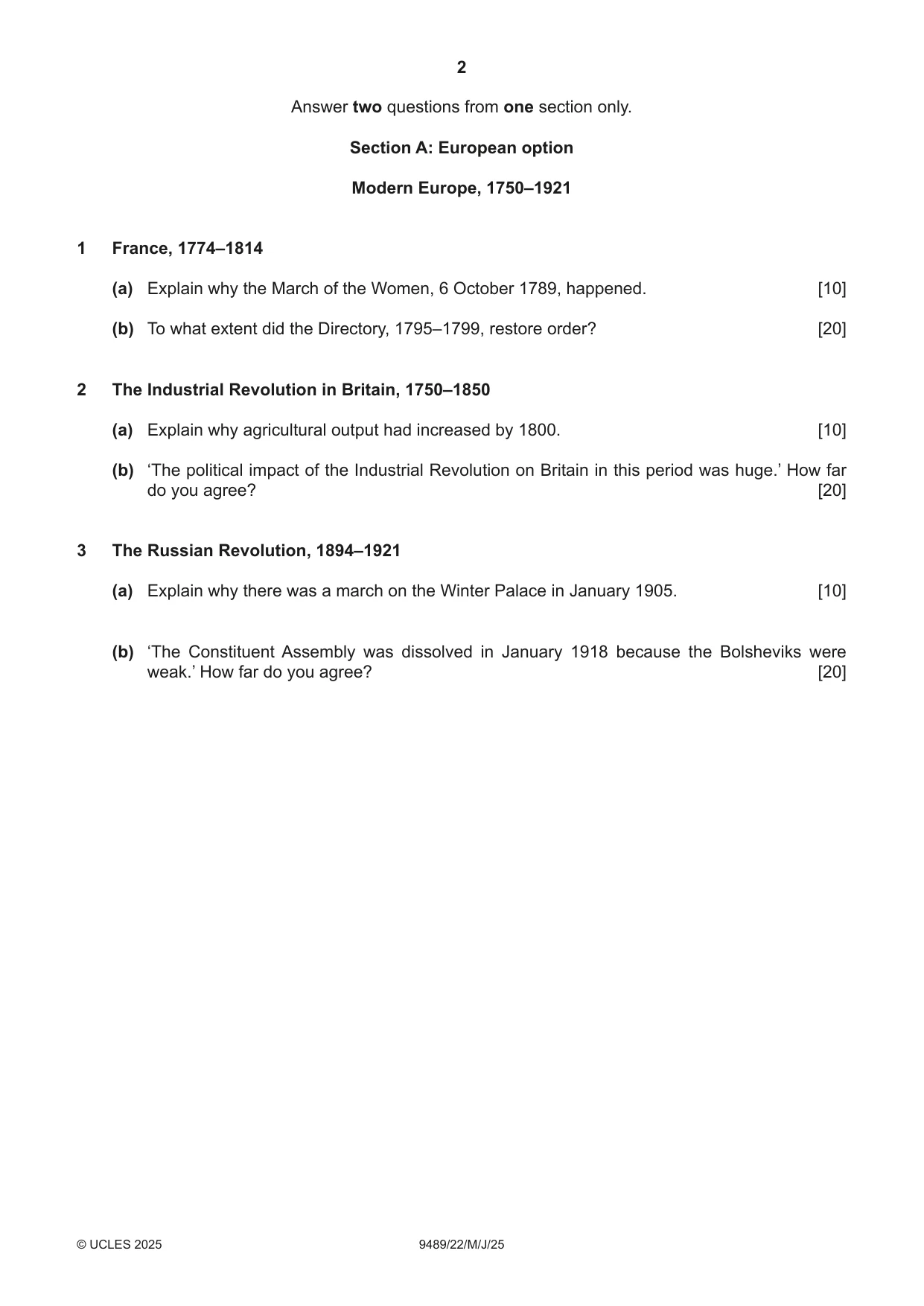
Q1 · France, 1774–1814 (a) Explain why the March of the Women, 6 October 1789, happened
1 France, 1774–1814 (a) Explain why the March of the Women, 6 October 1789, happened. [10] (b) To what extent did the Directory, 1795–1799, restore order? [20]
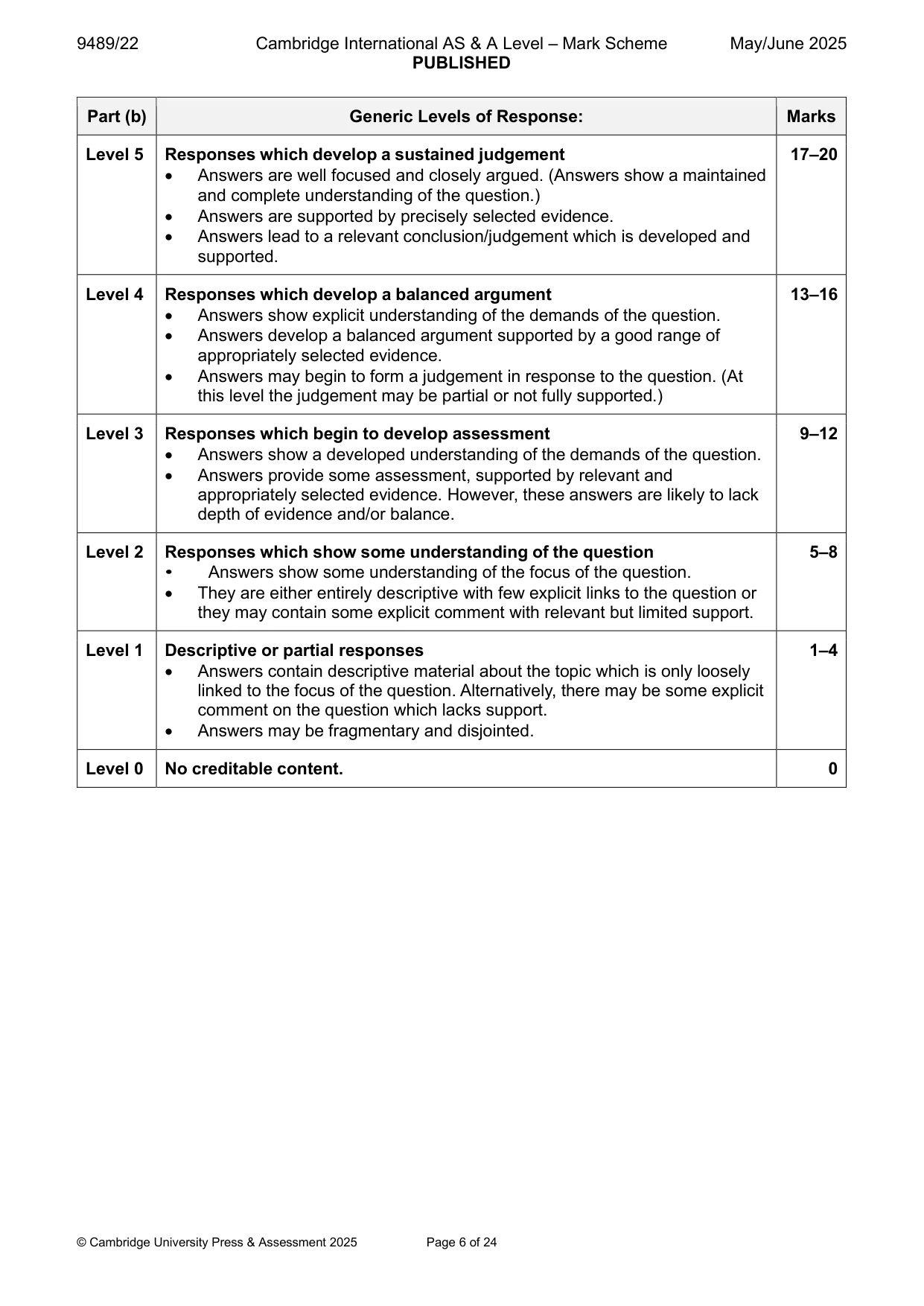
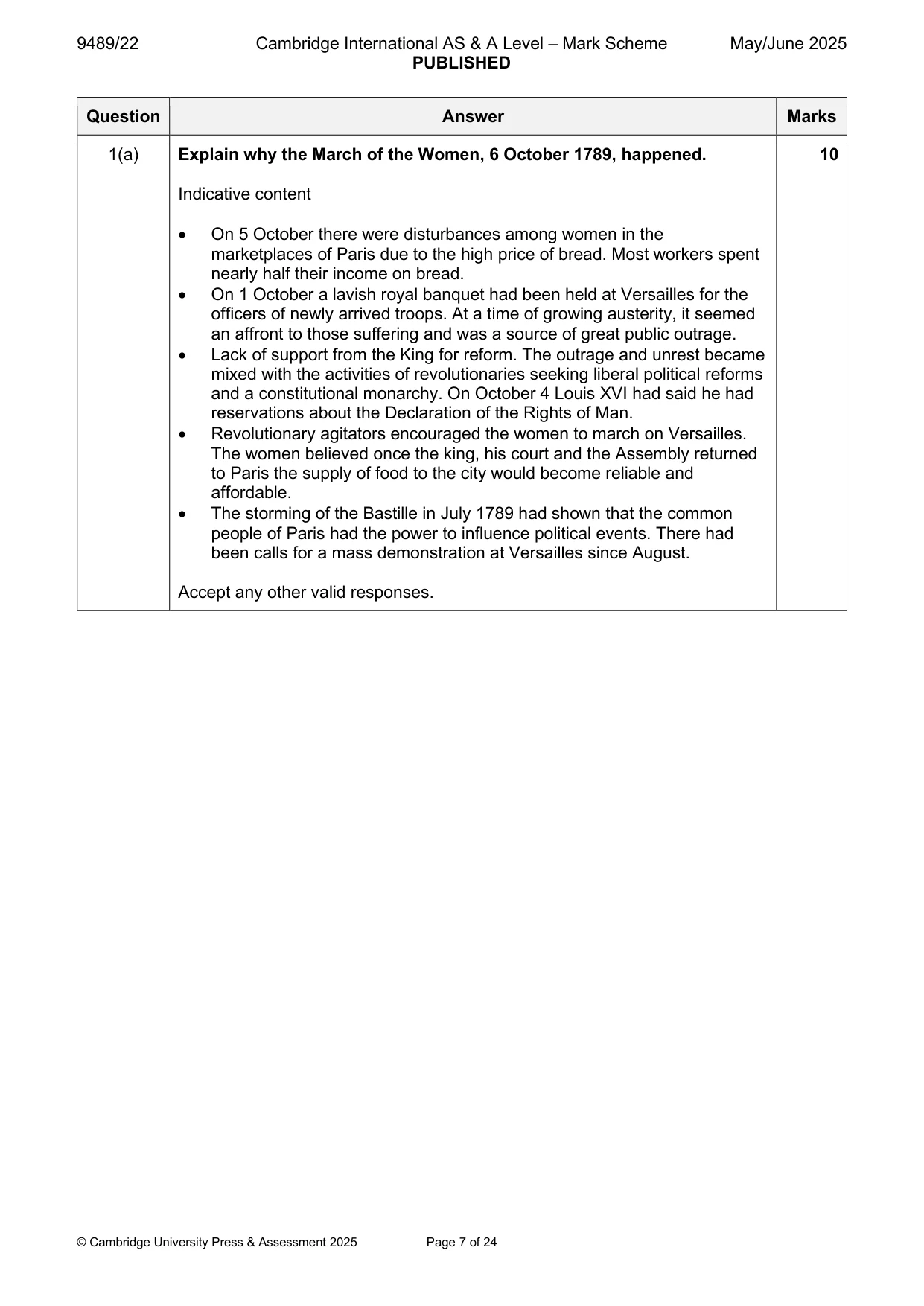
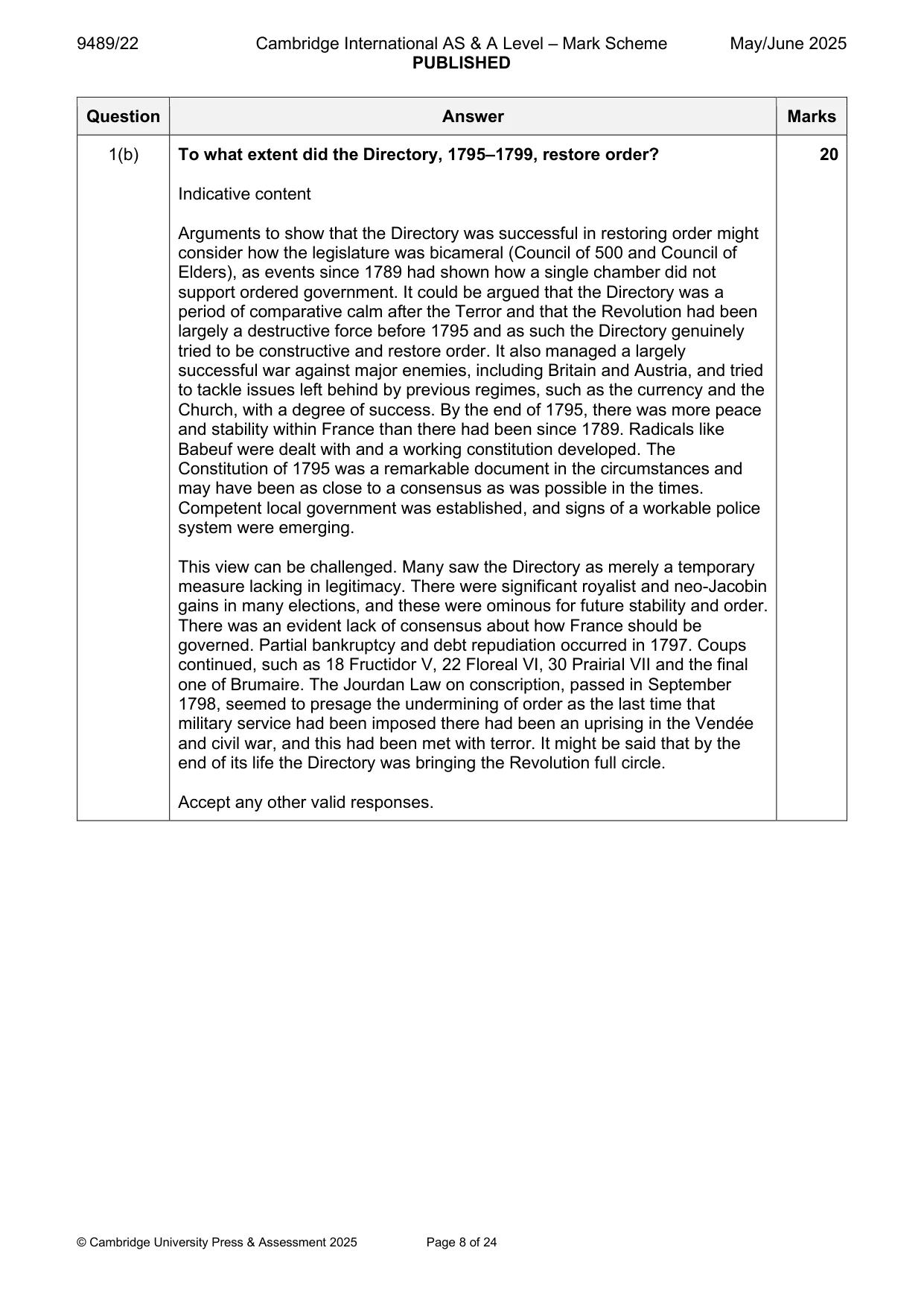
Mark scheme: Question Answer Marks 1(a) Explain why the March of the Women, 6 October 1789, happened. 10 Indicative content • On 5 October there were disturbances among women in the marketplaces of Paris due to the high price of bread. Most workers spent nearly half their income on bread. • On 1 October a lavish royal banquet had been held at Versailles for the officers of newly arrived troops. At a time of growing austerity, it seemed an affront to those suffering and was a source of great public outrage. • Lack of support from the King for reform. The outrage and unrest became mixed with the activities of revolutionaries seeking liberal political reforms and a constitutional monarchy. On October 4 Louis XVI had said he had reservations about the Declaration of the Rights of Man. • Revolutionary agitators encouraged the women to march on Versailles. The women believed once the king, his court and the Assembly returned to Paris the supply of food to the city would become reliable and affordable. • The storming of the Bastille in July 1789 had shown that the common people of Paris had the power to influence political events. There had been calls for a mass demonstration at Versailles since August. Accept any other valid responses. 1(b) To what extent did the Directory, 1795–1799, restore order? 20 Indicative content Arguments to show that the Directory was successful in restoring order might consider how the legislature was bicameral (Council of 500 and Council of Elders), as events since 1789 had shown how a single chamber did not support ordered government. It could be argued that the Directory was a period of comparative calm after the Terror and that the Revolution had been largely a destructive force before 1795 and as such the Directory genuinely tried to be constructive and restore order. It also managed a largely successful war against major enemies, including Britain and Austria, and tried to tackle issues left behind by previous regimes, such as the currency and the Church, with a degree of success. By the end of 1795, there was more peace and stability within France than there had been since 1789. Radicals like Babeuf were dealt with and a working constitution developed. The Constitution of 1795 was a remarkable document in the circumstances and may have been as close to a consensus as was possible in the times. Competent local government was established, and signs of a workable police system were emerging. This view can be challenged. Many saw the Directory as merely a temporary measure lacking in legitimacy. There were significant royalist and neo-Jacobin gains in many elections, and these were ominous for future stability and order. There was an evident lack of consensus about how France should be governed. Partial bankruptcy and debt repudiation occurred in 1797. Coups continued, such as 18 Fructidor V, 22 Floreal VI, 30 Prairial VII and the final one of Brumaire. The Jourdan Law on conscription, passed in September 1798, seemed to presage the undermining of order as the last time that military service had been imposed there had been an uprising in the Vendée and civil war, and this had been met with terror. It might be said that by the end of its life the Directory was bringing the Revolution full circle. Accept any other valid responses.
More questions on How well was France governed in the period 1793–99?
Q2 · The Industrial Revolution in Britain, 1750–1850 (a) Explain why agricultural output had…
2 The Industrial Revolution in Britain, 1750–1850 (a) Explain why agricultural output had increased by 1800. [10] (b) ‘The political impact of the Industrial Revolution on Britain in this period was huge.’ How far do you agree? [20]
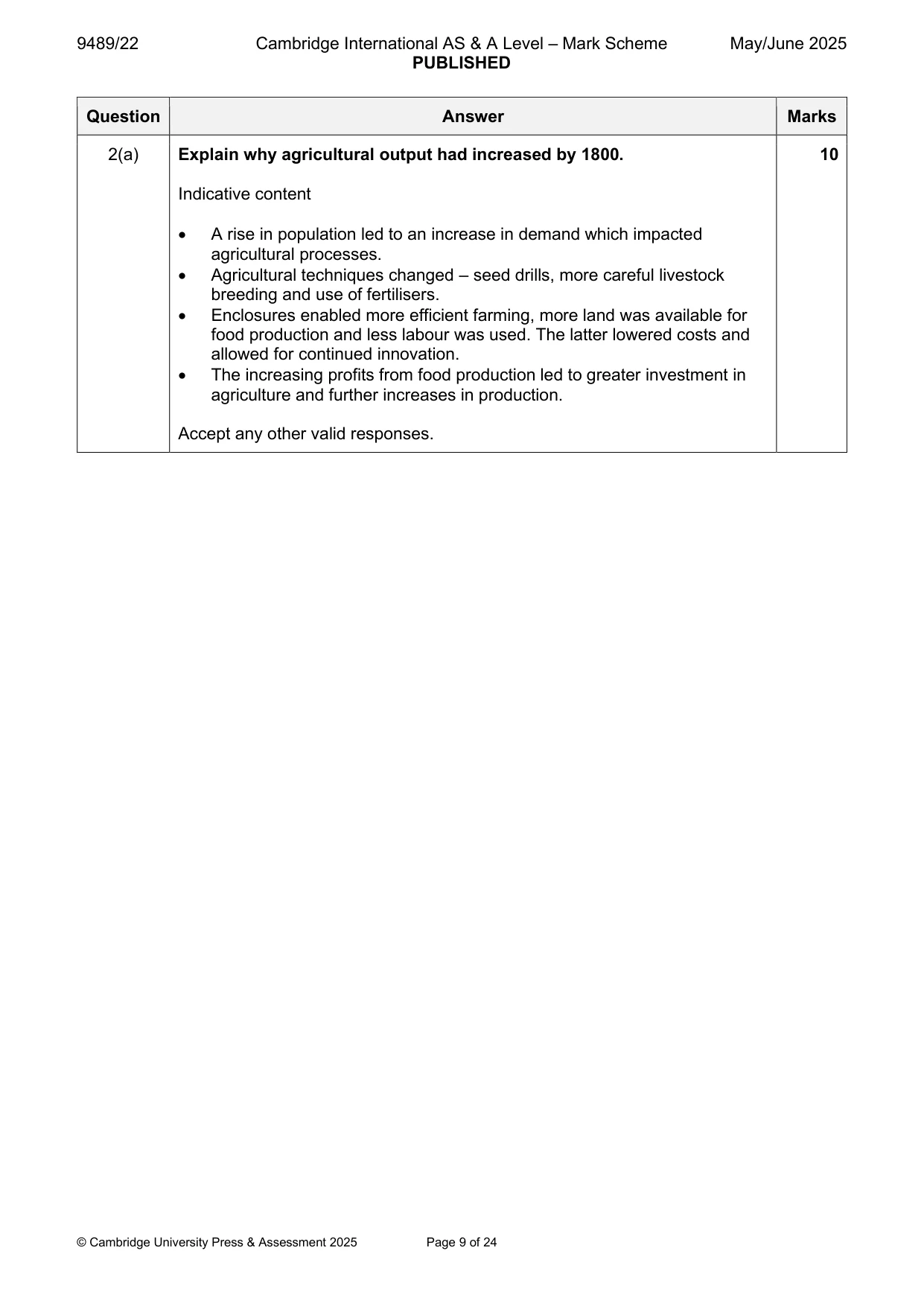
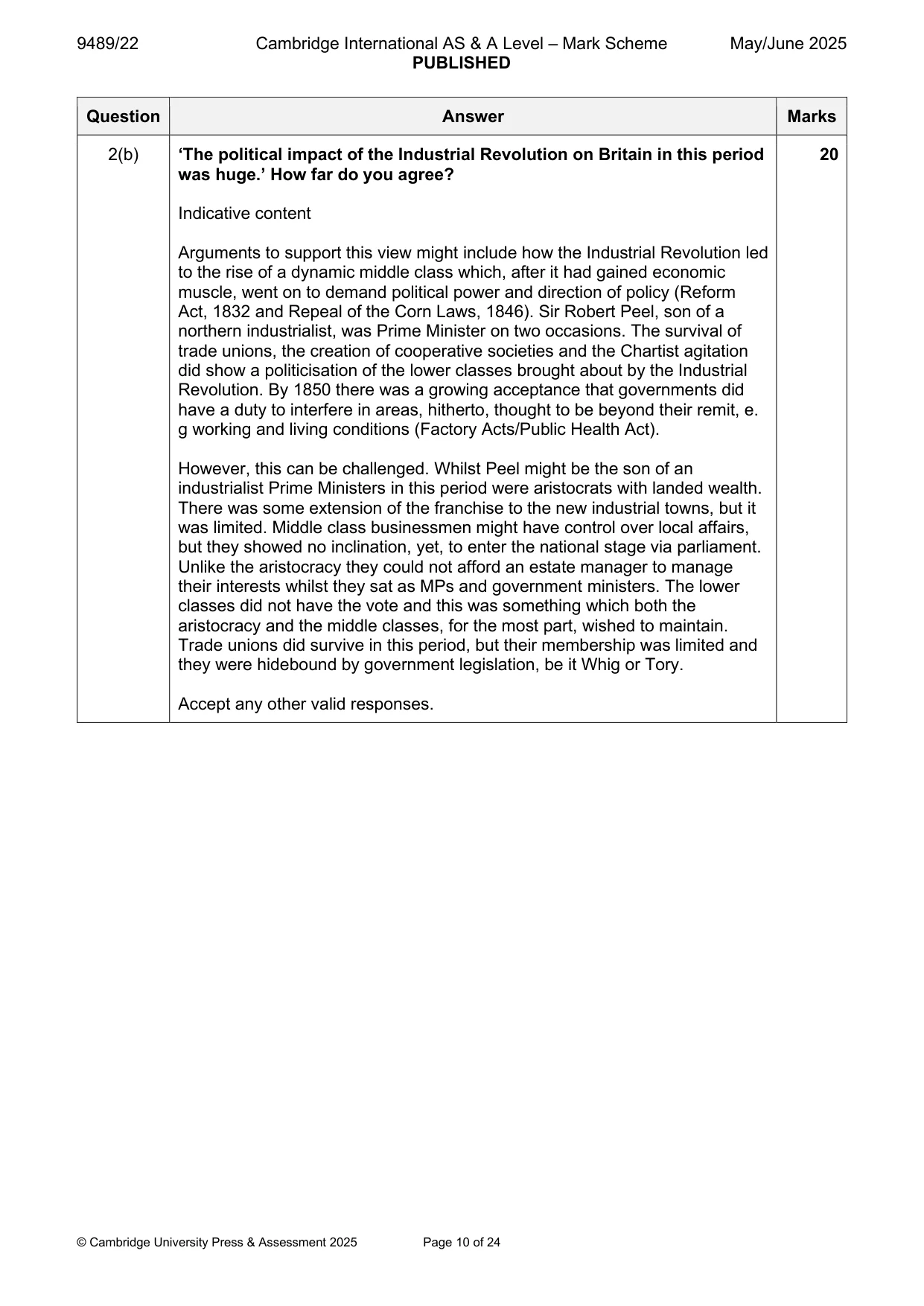
Mark scheme: 2(a) Explain why agricultural output had increased by 1800. 10 Indicative content • A rise in population led to an increase in demand which impacted agricultural processes. • Agricultural techniques changed – seed drills, more careful livestock breeding and use of fertilisers. • Enclosures enabled more efficient farming, more land was available for food production and less labour was used. The latter lowered costs and allowed for continued innovation. • The increasing profits from food production led to greater investment in agriculture and further increases in production. Accept any other valid responses. 2(b) ‘The political impact of the Industrial Revolution on Britain in this period 20 was huge.’ How far do you agree? Indicative content Arguments to support this view might include how the Industrial Revolution led to the rise of a dynamic middle class which, after it had gained economic muscle, went on to demand political power and direction of policy (Reform Act, 1832 and Repeal of the Corn Laws, 1846). Sir Robert Peel, son of a northern industrialist, was Prime Minister on two occasions. The survival of trade unions, the creation of cooperative societies and the Chartist agitation did show a politicisation of the lower classes brought about by the Industrial Revolution. By 1850 there was a growing acceptance that governments did have a duty to interfere in areas, hitherto, thought to be beyond their remit, e. g working and living conditions (Factory Acts/Public Health Act). However, this can be challenged. Whilst Peel might be the son of an industrialist Prime Ministers in this period were aristocrats with landed wealth. There was some extension of the franchise to the new industrial towns, but it was limited. Middle class businessmen might have control over local affairs, but they showed no inclination, yet, to enter the national stage via parliament. Unlike the aristocracy they could not afford an estate manager to manage their interests whilst they sat as MPs and government ministers. The lower classes did not have the vote and this was something which both the aristocracy and the middle classes, for the most part, wished to maintain. Trade unions did survive in this period, but their membership was limited and they were hidebound by government legislation, be it Whig or Tory. Accept any other valid responses.
More questions on What were the consequences of the rapid economic growth after 1870?
Q3 · The Russian Revolution, 1894–1921 (a) Explain why there was a march on the Winter Palace…
3 The Russian Revolution, 1894–1921 (a) Explain why there was a march on the Winter Palace in January 1905. [10] (b) ‘The Constituent Assembly was dissolved in January 1918 because the Bolsheviks were weak.’ How far do you agree? [20]
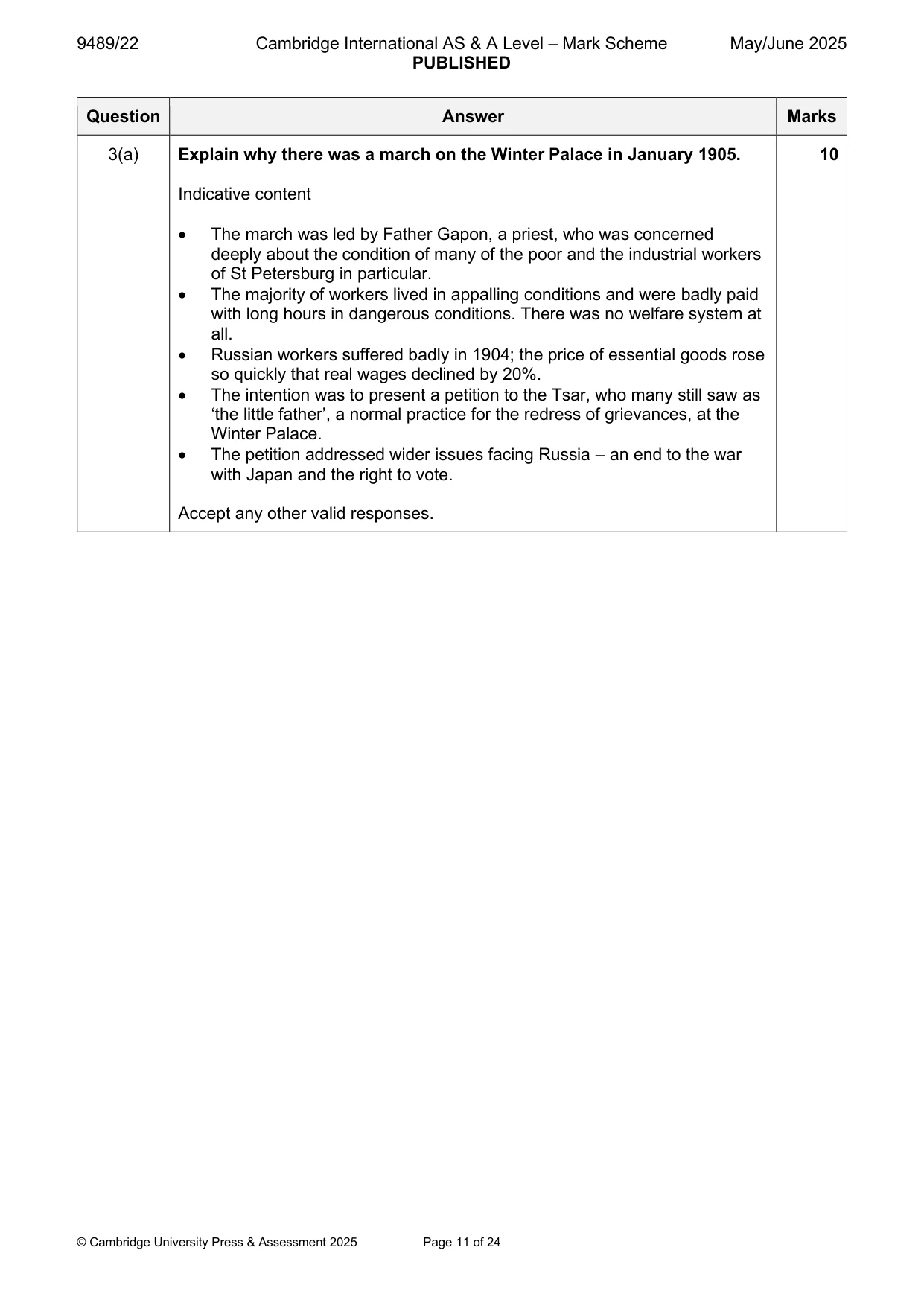
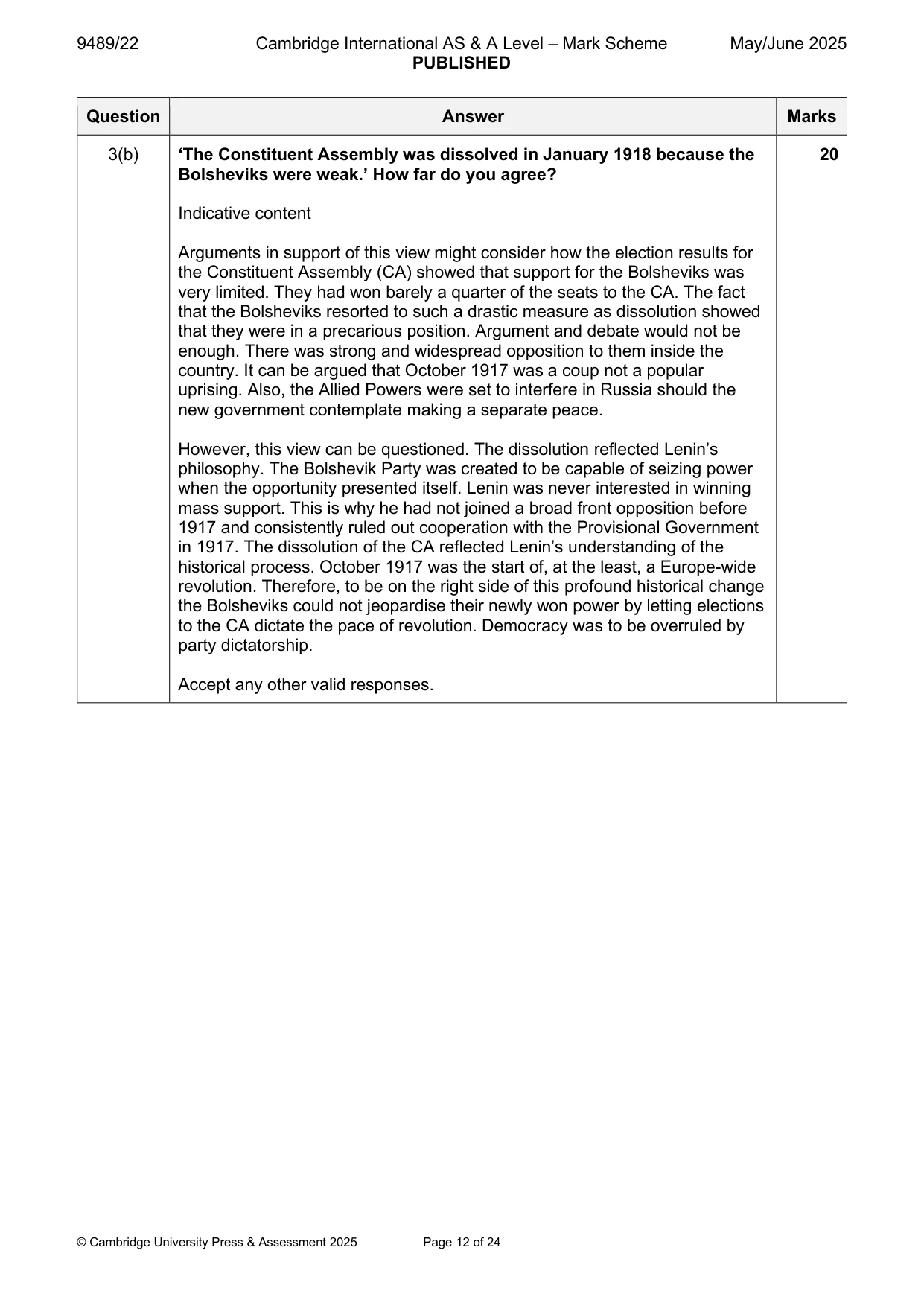
Mark scheme: 3(a) Explain why there was a march on the Winter Palace in January 1905. 10 Indicative content • The march was led by Father Gapon, a priest, who was concerned deeply about the condition of many of the poor and the industrial workers of St Petersburg in particular. • The majority of workers lived in appalling conditions and were badly paid with long hours in dangerous conditions. There was no welfare system at all. • Russian workers suffered badly in 1904; the price of essential goods rose so quickly that real wages declined by 20%. • The intention was to present a petition to the Tsar, who many still saw as ‘the little father’, a normal practice for the redress of grievances, at the Winter Palace. • The petition addressed wider issues facing Russia – an end to the war with Japan and the right to vote. Accept any other valid responses. 3(b) ‘The Constituent Assembly was dissolved in January 1918 because the 20 Bolsheviks were weak.’ How far do you agree? Indicative content Arguments in support of this view might consider how the election results for the Constituent Assembly (CA) showed that support for the Bolsheviks was very limited. They had won barely a quarter of the seats to the CA. The fact that the Bolsheviks resorted to such a drastic measure as dissolution showed that they were in a precarious position. Argument and debate would not be enough. There was strong and widespread opposition to them inside the country. It can be argued that October 1917 was a coup not a popular uprising. Also, the Allied Powers were set to interfere in Russia should the new government contemplate making a separate peace. However, this view can be questioned. The dissolution reflected Lenin’s philosophy. The Bolshevik Party was created to be capable of seizing power when the opportunity presented itself. Lenin was never interested in winning mass support. This is why he had not joined a broad front opposition before 1917 and consistently ruled out cooperation with the Provisional Government in 1917. The dissolution of the CA reflected Lenin’s understanding of the historical process. October 1917 was the start of, at the least, a Europe-wide revolution. Therefore, to be on the right side of this profound historical change the Bolsheviks could not jeopardise their newly won power by letting elections to the CA dictate the pace of revolution. Democracy was to be overruled by party dictatorship. Accept any other valid responses.
More questions on How and why did the Bolsheviks seize power in October 1917?
Q4 · Civil War and Reconstruction, 1861–77 (a) Explain why the US Congress imposed military…
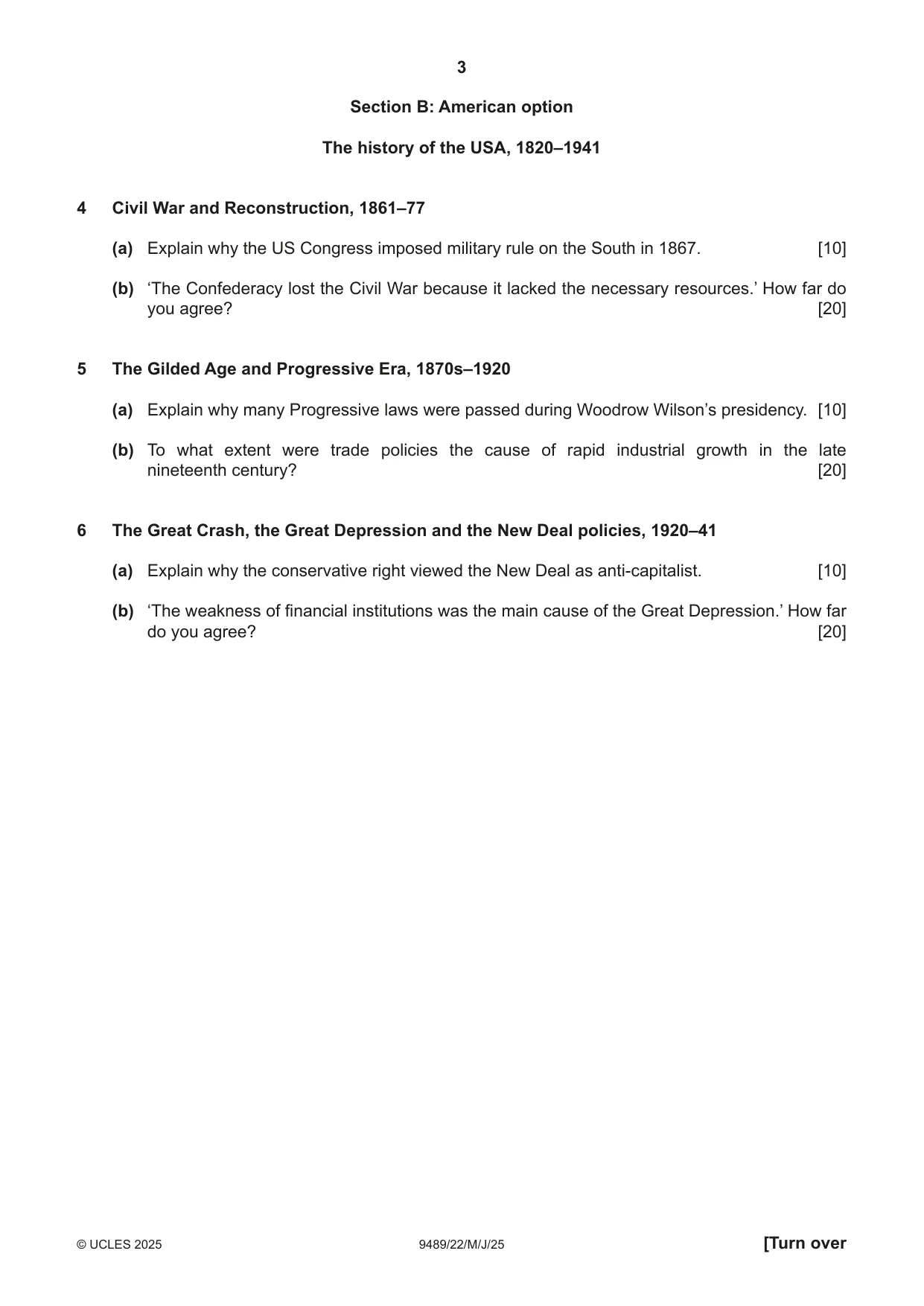
4 Civil War and Reconstruction, 1861–77 (a) Explain why the US Congress imposed military rule on the South in 1867. [10] (b) ‘The Confederacy lost the Civil War because it lacked the necessary resources.’ How far do you agree? [20]
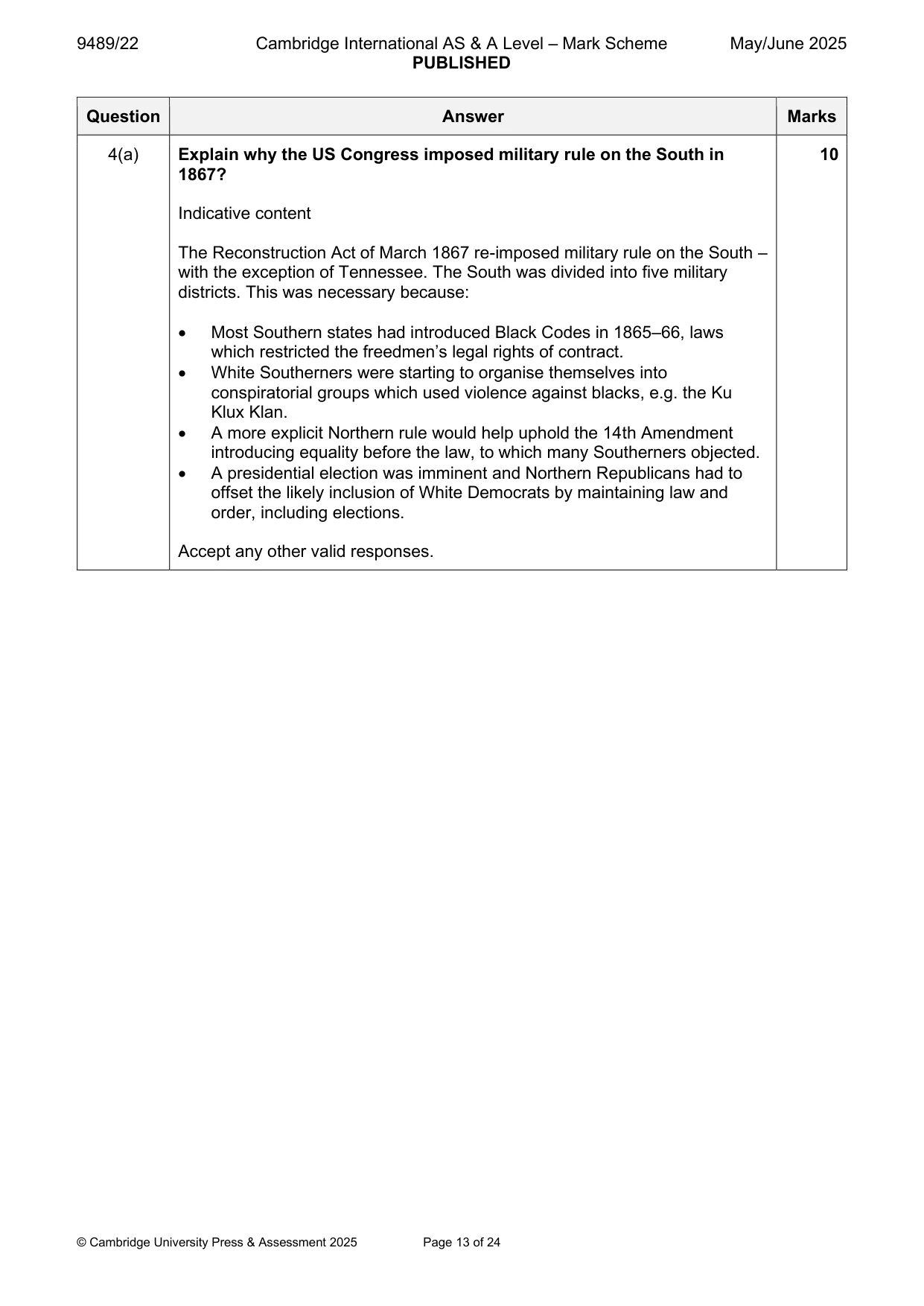
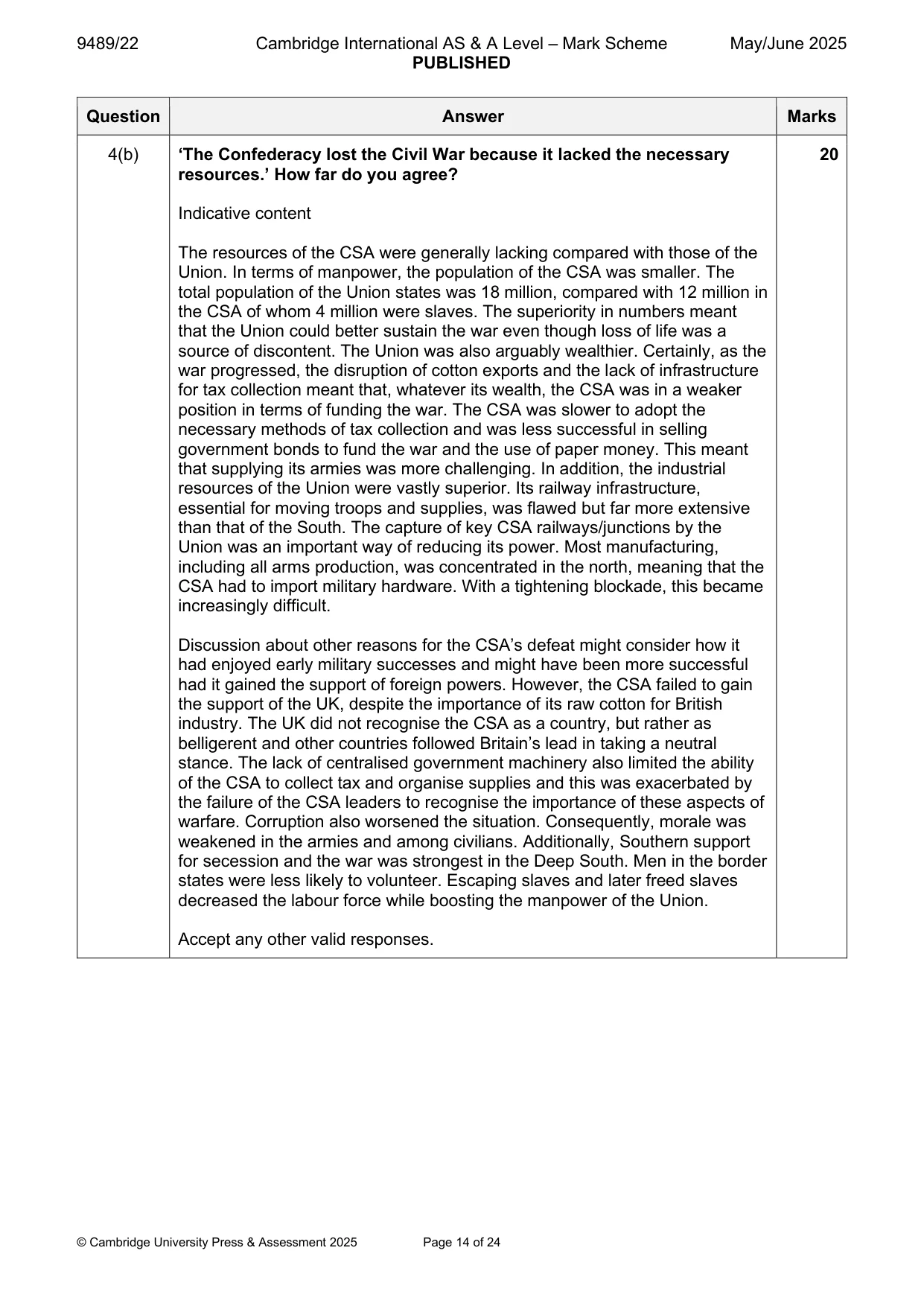
Mark scheme: 4(a) Explain why the US Congress imposed military rule on the South in 10 1867? Indicative content The Reconstruction Act of March 1867 re-imposed military rule on the South – with the exception of Tennessee. The South was divided into five military districts. This was necessary because: • Most Southern states had introduced Black Codes in 1865–66, laws which restricted the freedmen’s legal rights of contract. • White Southerners were starting to organise themselves into conspiratorial groups which used violence against blacks, e.g. the Ku Klux Klan. • A more explicit Northern rule would help uphold the 14th Amendment introducing equality before the law, to which many Southerners objected. • A presidential election was imminent and Northern Republicans had to offset the likely inclusion of White Democrats by maintaining law and order, including elections. Accept any other valid responses. 4(b) ‘The Confederacy lost the Civil War because it lacked the necessary 20 resources.’ How far do you agree? Indicative content The resources of the CSA were generally lacking compared with those of the Union. In terms of manpower, the population of the CSA was smaller. The total population of the Union states was 18 million, compared with 12 million in the CSA of whom 4 million were slaves. The superiority in numbers meant that the Union could better sustain the war even though loss of life was a source of discontent. The Union was also arguably wealthier. Certainly, as the war progressed, the disruption of cotton exports and the lack of infrastructure for tax collection meant that, whatever its wealth, the CSA was in a weaker position in terms of funding the war. The CSA was slower to adopt the necessary methods of tax collection and was less successful in selling government bonds to fund the war and the use of paper money. This meant that supplying its armies was more challenging. In addition, the industrial resources of the Union were vastly superior. Its railway infrastructure, essential for moving troops and supplies, was flawed but far more extensive than that of the South. The capture of key CSA railways/junctions by the Union was an important way of reducing its power. Most manufacturing, including all arms production, was concentrated in the north, meaning that the CSA had to import military hardware. With a tightening blockade, this became increasingly difficult. Discussion about other reasons for the CSA’s defeat might consider how it had enjoyed early military successes and might have been more successful had it gained the support of foreign powers. However, the CSA failed to gain the support of the UK, despite the importance of its raw cotton for British industry. The UK did not recognise the CSA as a country, but rather as belligerent and other countries followed Britain’s lead in taking a neutral stance. The lack of centralised government machinery also limited the ability of the CSA to collect tax and organise supplies and this was exacerbated by the failure of the CSA leaders to recognise the importance of these aspects of warfare. Corruption also worsened the situation. Consequently, morale was weakened in the armies and among civilians. Additionally, Southern support for secession and the war was strongest in the Deep South. Men in the border states were less likely to volunteer. Escaping slaves and later freed slaves decreased the labour force while boosting the manpower of the Union. Accept any other valid responses.
Q5 · The Gilded Age and Progressive Era, 1870s–1920 (a) Explain why many Progressive laws were…
5 The Gilded Age and Progressive Era, 1870s–1920 (a) Explain why many Progressive laws were passed during Woodrow Wilson’s presidency. [10] (b) To what extent were trade policies the cause of rapid industrial growth in the late nineteenth century? [20]
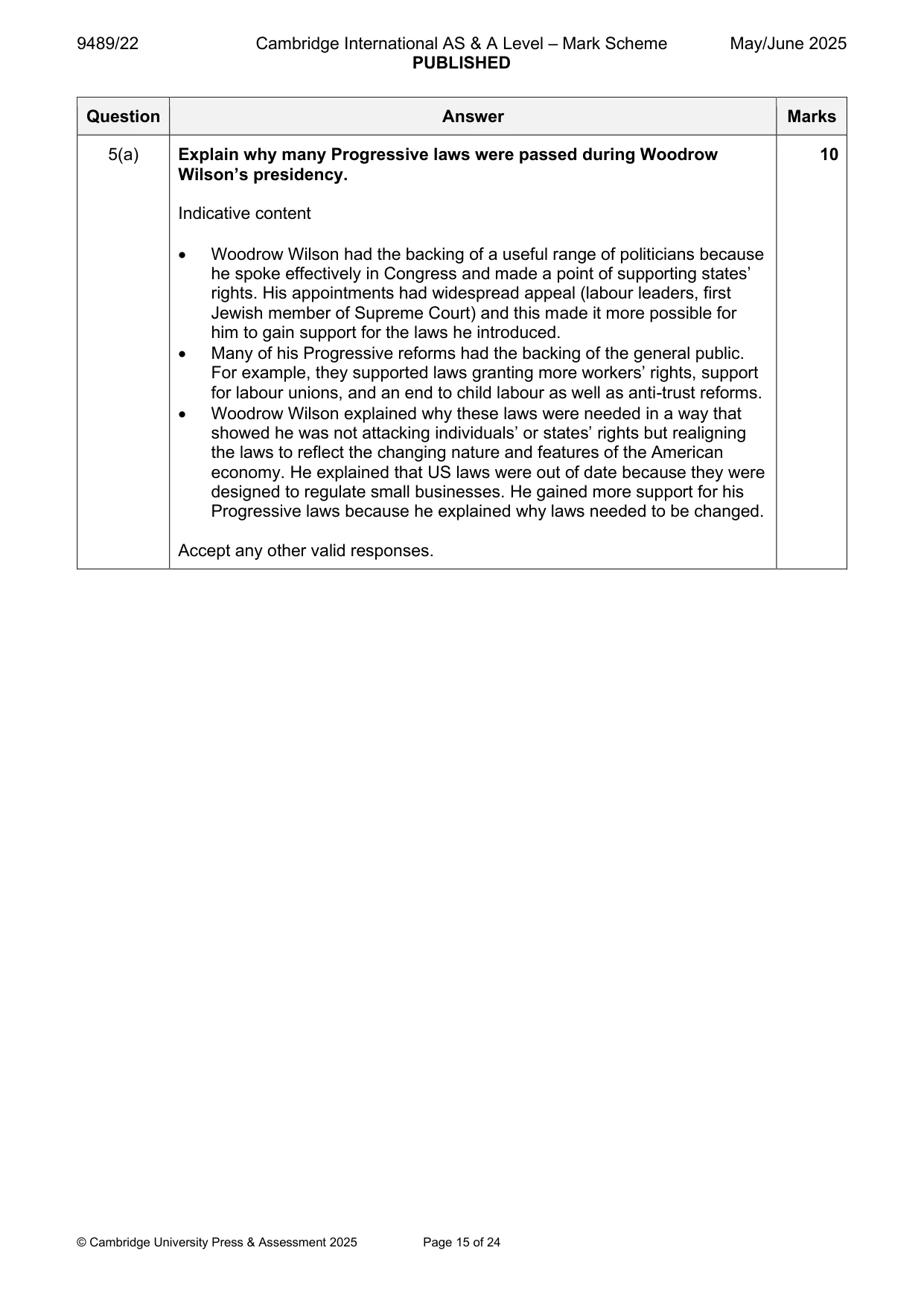
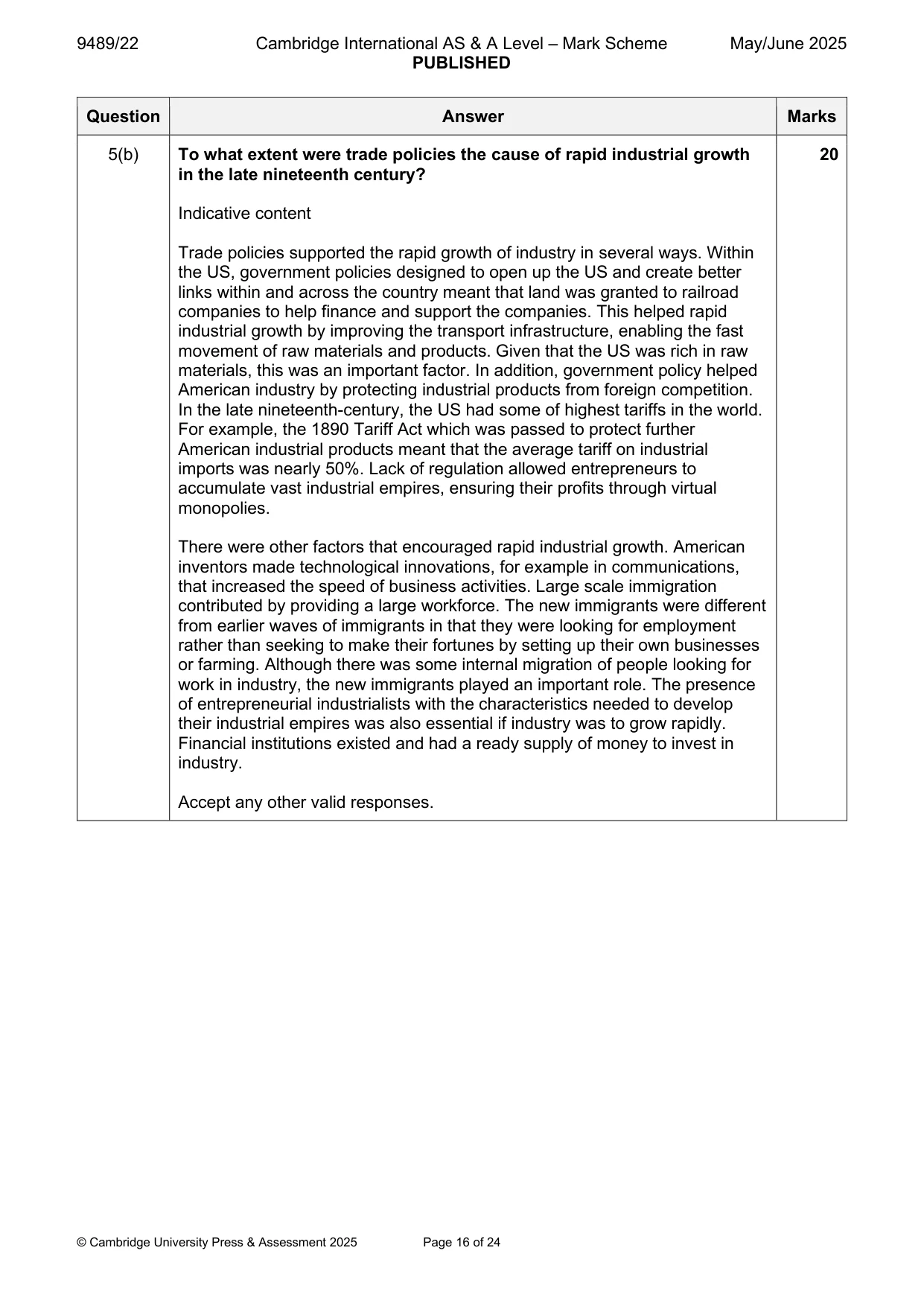
Mark scheme: 5(a) Explain why many Progressive laws were passed during Woodrow 10 Wilson’s presidency. Indicative content • Woodrow Wilson had the backing of a useful range of politicians because he spoke effectively in Congress and made a point of supporting states’ rights. His appointments had widespread appeal (labour leaders, first Jewish member of Supreme Court) and this made it more possible for him to gain support for the laws he introduced. • Many of his Progressive reforms had the backing of the general public. For example, they supported laws granting more workers’ rights, support for labour unions, and an end to child labour as well as anti-trust reforms. • Woodrow Wilson explained why these laws were needed in a way that showed he was not attacking individuals’ or states’ rights but realigning the laws to reflect the changing nature and features of the American economy. He explained that US laws were out of date because they were designed to regulate small businesses. He gained more support for his Progressive laws because he explained why laws needed to be changed. Accept any other valid responses. 5(b) To what extent were trade policies the cause of rapid industrial growth 20 in the late nineteenth century? Indicative content Trade policies supported the rapid growth of industry in several ways. Within the US, government policies designed to open up the US and create better links within and across the country meant that land was granted to railroad companies to help finance and support the companies. This helped rapid industrial growth by improving the transport infrastructure, enabling the fast movement of raw materials and products. Given that the US was rich in raw materials, this was an important factor. In addition, government policy helped American industry by protecting industrial products from foreign competition. In the late nineteenth-century, the US had some of highest tariffs in the world. For example, the 1890 Tariff Act which was passed to protect further American industrial products meant that the average tariff on industrial imports was nearly 50%. Lack of regulation allowed entrepreneurs to accumulate vast industrial empires, ensuring their profits through virtual monopolies. There were other factors that encouraged rapid industrial growth. American inventors made technological innovations, for example in communications, that increased the speed of business activities. Large scale immigration contributed by providing a large workforce. The new immigrants were different from earlier waves of immigrants in that they were looking for employment rather than seeking to make their fortunes by setting up their own businesses or farming. Although there was some internal migration of people looking for work in industry, the new immigrants played an important role. The presence of entrepreneurial industrialists with the characteristics needed to develop their industrial empires was also essential if industry was to grow rapidly. Financial institutions existed and had a ready supply of money to invest in industry. Accept any other valid responses.
More questions on Why was there rapid industrialisation after 1870?
Q6 · The Great Crash, the Great Depression and the New Deal policies, 1920–41 (a) Explain why…
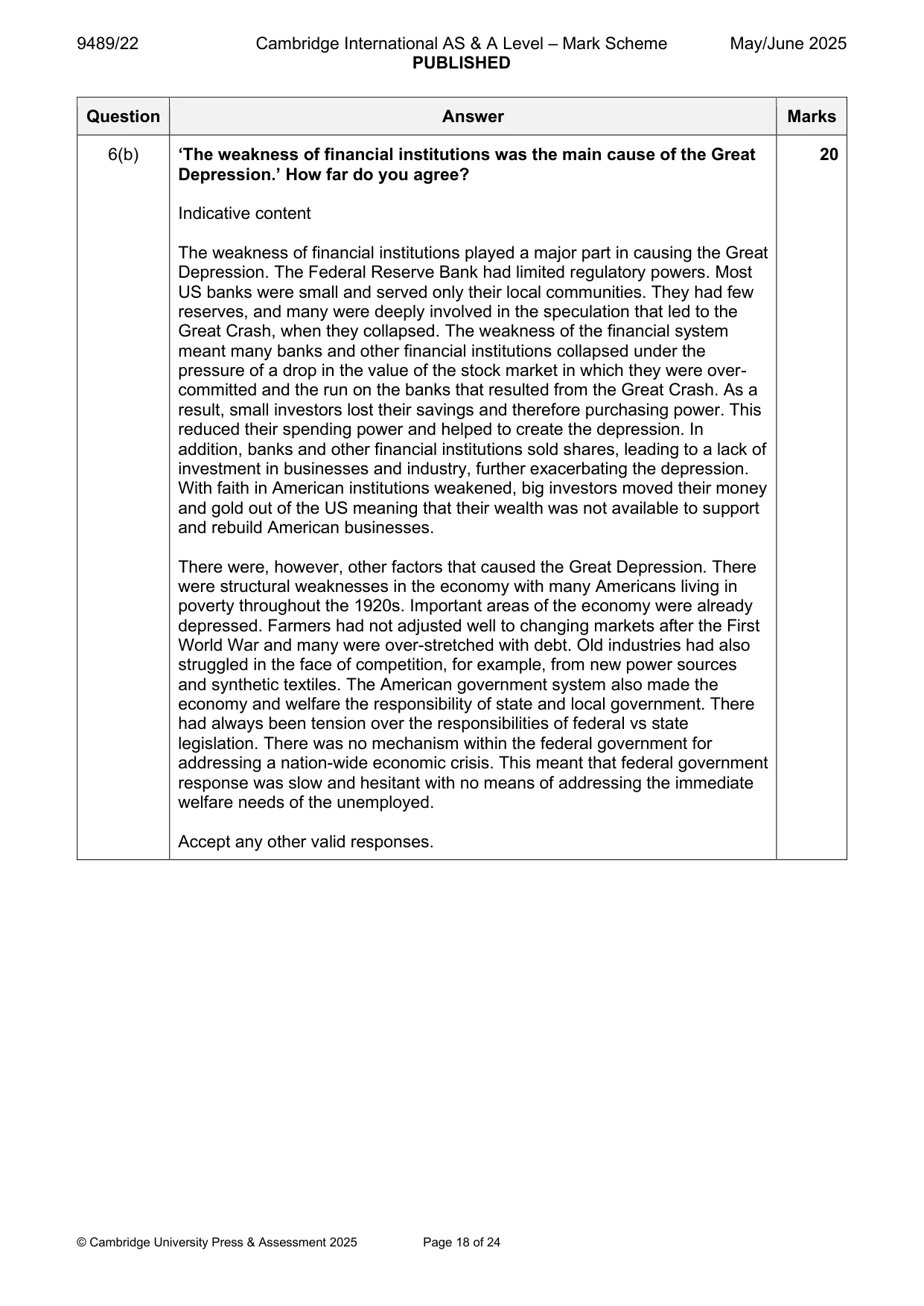
6 The Great Crash, the Great Depression and the New Deal policies, 1920–41 (a) Explain why the conservative right viewed the New Deal as anti-capitalist. [10] (b) ‘The weakness of financial institutions was the main cause of the Great Depression.’ How far do you agree? [20] Section C: International option International history, 1870–1945
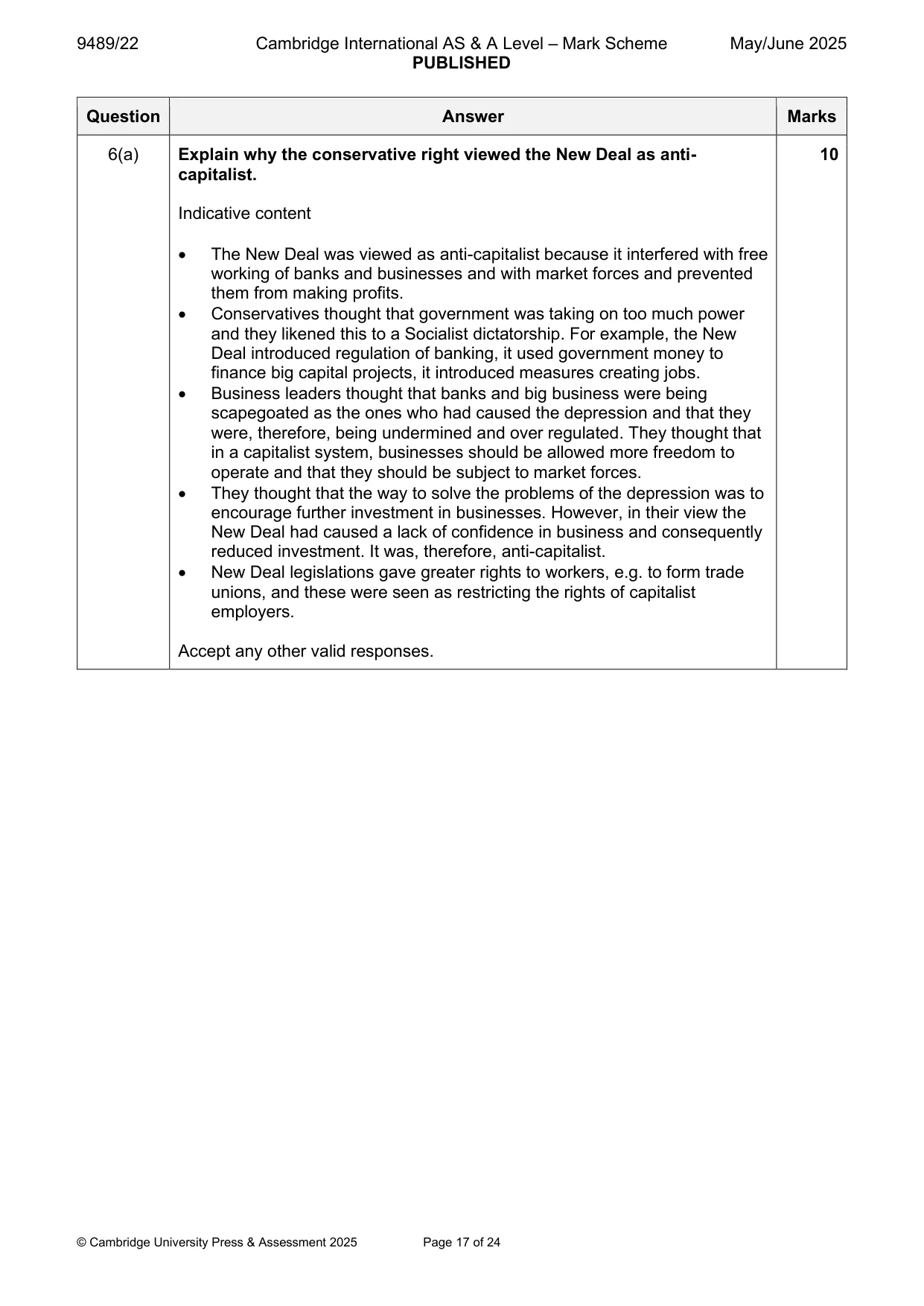
Mark scheme: 6(a) Explain why the conservative right viewed the New Deal as anti- 10 capitalist. Indicative content • The New Deal was viewed as anti-capitalist because it interfered with free working of banks and businesses and with market forces and prevented them from making profits. • Conservatives thought that government was taking on too much power and they likened this to a Socialist dictatorship. For example, the New Deal introduced regulation of banking, it used government money to finance big capital projects, it introduced measures creating jobs. • Business leaders thought that banks and big business were being scapegoated as the ones who had caused the depression and that they were, therefore, being undermined and over regulated. They thought that in a capitalist system, businesses should be allowed more freedom to operate and that they should be subject to market forces. • They thought that the way to solve the problems of the depression was to encourage further investment in businesses. However, in their view the New Deal had caused a lack of confidence in business and consequently reduced investment. It was, therefore, anti-capitalist. • New Deal legislations gave greater rights to workers, e.g. to form trade unions, and these were seen as restricting the rights of capitalist employers. Accept any other valid responses. 6(b) ‘The weakness of financial institutions was the main cause of the Great 20 Depression.’ How far do you agree? Indicative content The weakness of financial institutions played a major part in causing the Great Depression. The Federal Reserve Bank had limited regulatory powers. Most US banks were small and served only their local communities. They had few reserves, and many were deeply involved in the speculation that led to the Great Crash, when they collapsed. The weakness of the financial system meant many banks and other financial institutions collapsed under the pressure of a drop in the value of the stock market in which they were over- committed and the run on the banks that resulted from the Great Crash. As a result, small investors lost their savings and therefore purchasing power. This reduced their spending power and helped to create the depression. In addition, banks and other financial institutions sold shares, leading to a lack of investment in businesses and industry, further exacerbating the depression. With faith in American institutions weakened, big investors moved their money and gold out of the US meaning that their wealth was not available to support and rebuild American businesses. There were, however, other factors that caused the Great Depression. There were structural weaknesses in the economy with many Americans living in poverty throughout the 1920s. Important areas of the economy were already depressed. Farmers had not adjusted well to changing markets after the First World War and many were over-stretched with debt. Old industries had also struggled in the face of competition, for example, from new power sources and synthetic textiles. The American government system also made the economy and welfare the responsibility of state and local government. There had always been tension over the responsibilities of federal vs state legislation. There was no mechanism within the federal government for addressing a nation-wide economic crisis. This meant that federal government response was slow and hesitant with no means of addressing the immediate welfare needs of the unemployed. Accept any other valid responses.
More questions on What were the causes of the Great Crash and the Great Depression?
Q7 · Empire and the emergence of world powers, 1870–1919 (a) Explain why Roosevelt introduced…
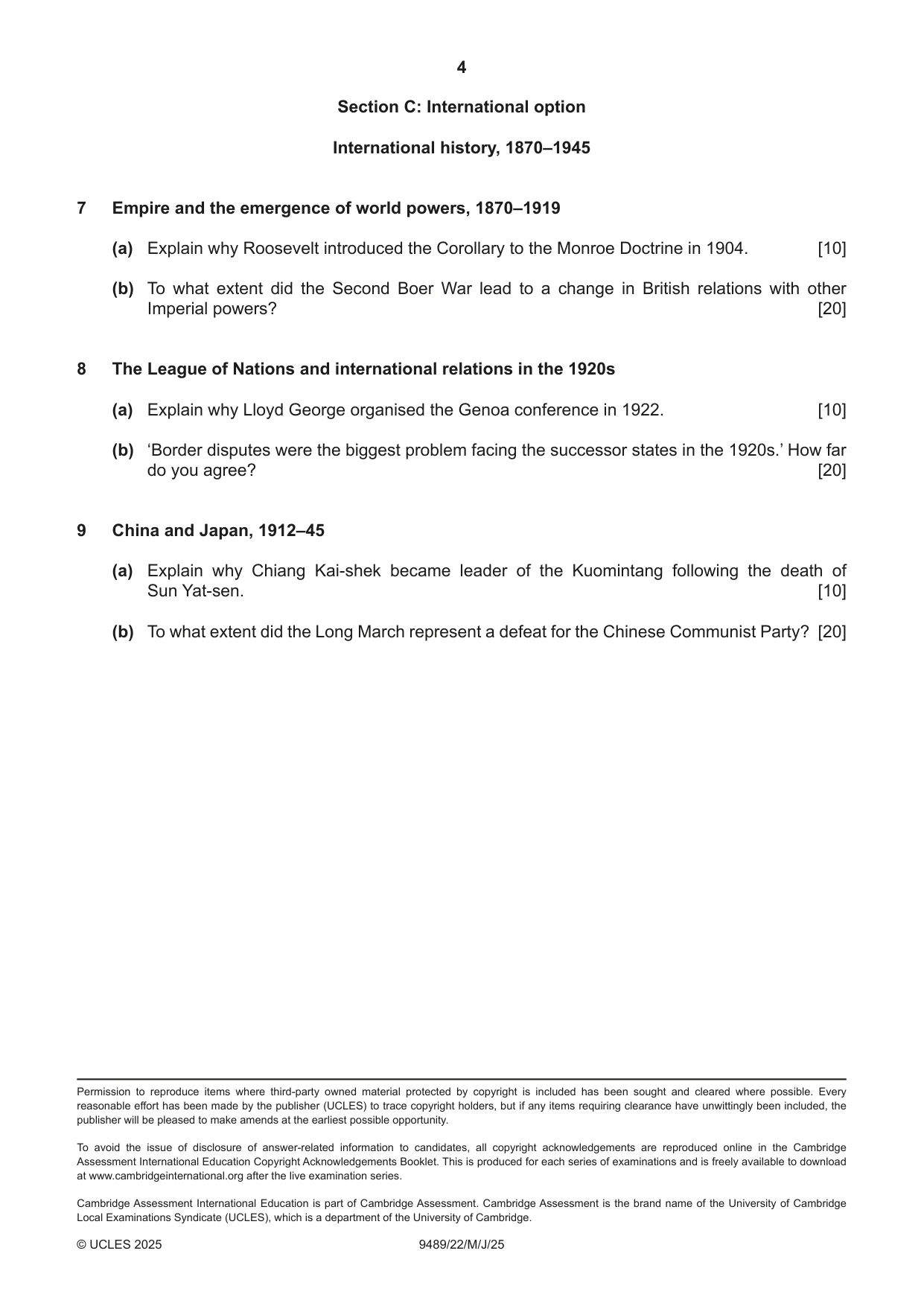
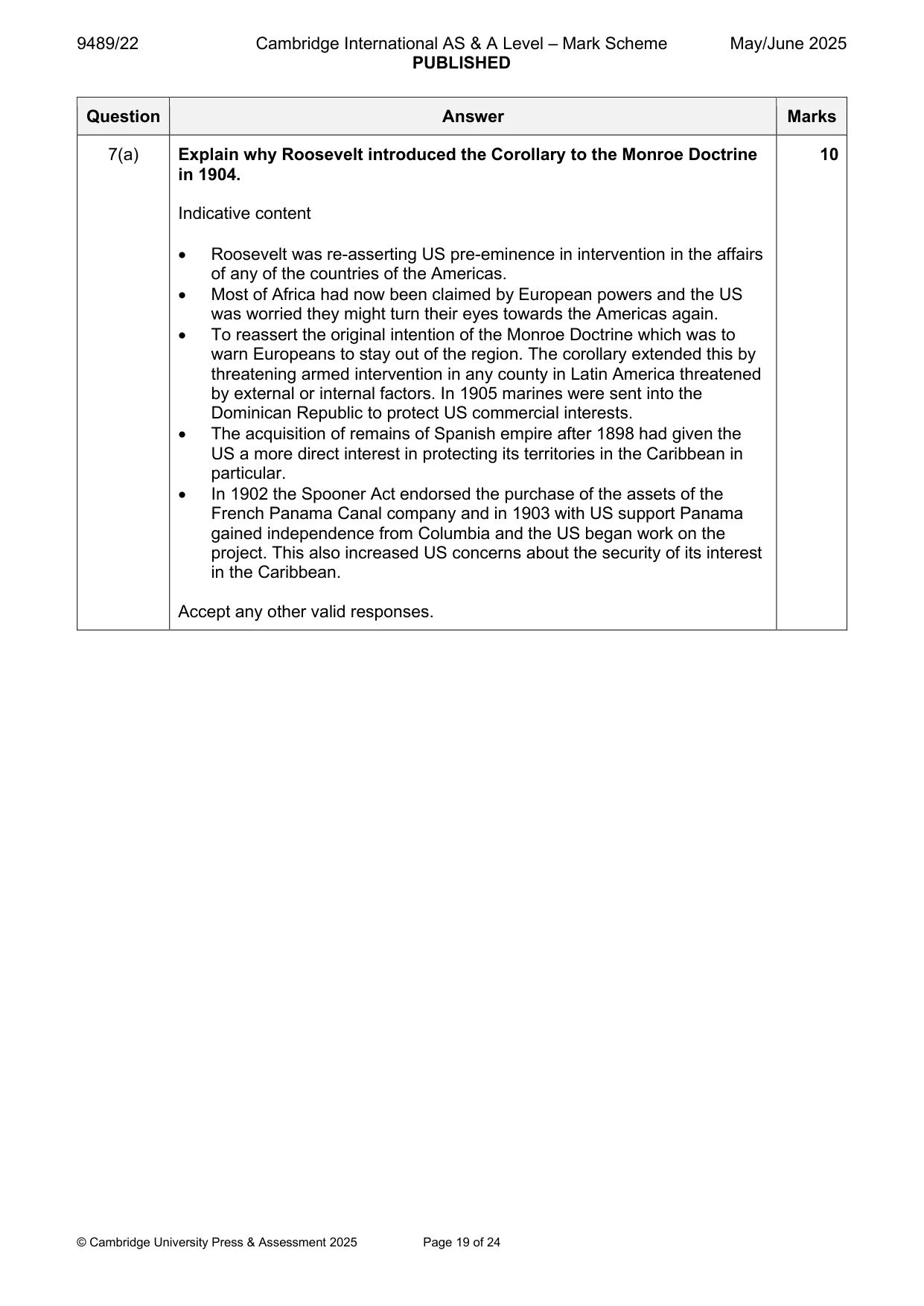
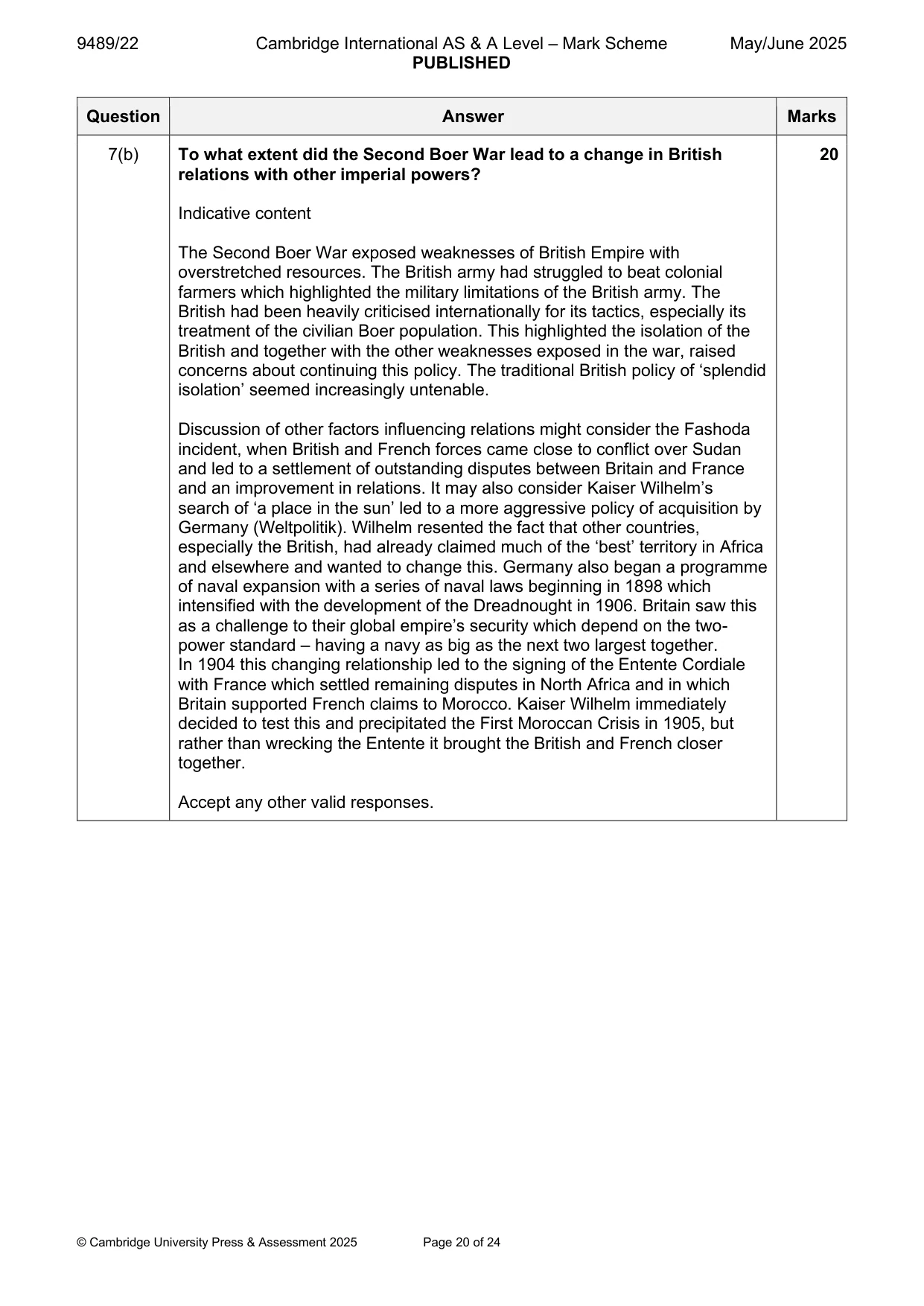
7 Empire and the emergence of world powers, 1870–1919 (a) Explain why Roosevelt introduced the Corollary to the Monroe Doctrine in 1904. [10] (b) To what extent did the Second Boer War lead to a change in British relations with other Imperial powers? [20]
Mark scheme: 7(a) Explain why Roosevelt introduced the Corollary to the Monroe Doctrine 10 in 1904. Indicative content • Roosevelt was re-asserting US pre-eminence in intervention in the affairs of any of the countries of the Americas. • Most of Africa had now been claimed by European powers and the US was worried they might turn their eyes towards the Americas again. • To reassert the original intention of the Monroe Doctrine which was to warn Europeans to stay out of the region. The corollary extended this by threatening armed intervention in any county in Latin America threatened by external or internal factors. In 1905 marines were sent into the Dominican Republic to protect US commercial interests. • The acquisition of remains of Spanish empire after 1898 had given the US a more direct interest in protecting its territories in the Caribbean in particular. • In 1902 the Spooner Act endorsed the purchase of the assets of the French Panama Canal company and in 1903 with US support Panama gained independence from Columbia and the US began work on the project. This also increased US concerns about the security of its interest in the Caribbean. Accept any other valid responses. 7(b) To what extent did the Second Boer War lead to a change in British 20 relations with other imperial powers? Indicative content The Second Boer War exposed weaknesses of British Empire with overstretched resources. The British army had struggled to beat colonial farmers which highlighted the military limitations of the British army. The British had been heavily criticised internationally for its tactics, especially its treatment of the civilian Boer population. This highlighted the isolation of the British and together with the other weaknesses exposed in the war, raised concerns about continuing this policy. The traditional British policy of ‘splendid isolation’ seemed increasingly untenable. Discussion of other factors influencing relations might consider the Fashoda incident, when British and French forces came close to conflict over Sudan and led to a settlement of outstanding disputes between Britain and France and an improvement in relations. It may also consider Kaiser Wilhelm’s search of ‘a place in the sun’ led to a more aggressive policy of acquisition by Germany (Weltpolitik). Wilhelm resented the fact that other countries, especially the British, had already claimed much of the ‘best’ territory in Africa and elsewhere and wanted to change this. Germany also began a programme of naval expansion with a series of naval laws beginning in 1898 which intensified with the development of the Dreadnought in 1906. Britain saw this as a challenge to their global empire’s security which depend on the two- power standard – having a navy as big as the next two largest together. In 1904 this changing relationship led to the signing of the Entente Cordiale with France which settled remaining disputes in North Africa and in which Britain supported French claims to Morocco. Kaiser Wilhelm immediately decided to test this and precipitated the First Moroccan Crisis in 1905, but rather than wrecking the Entente it brought the British and French closer together. Accept any other valid responses.
More questions on What was the impact of imperial expansion on international relations?
Q8 · The League of Nations and international relations in the 1920s (a) Explain why Lloyd…
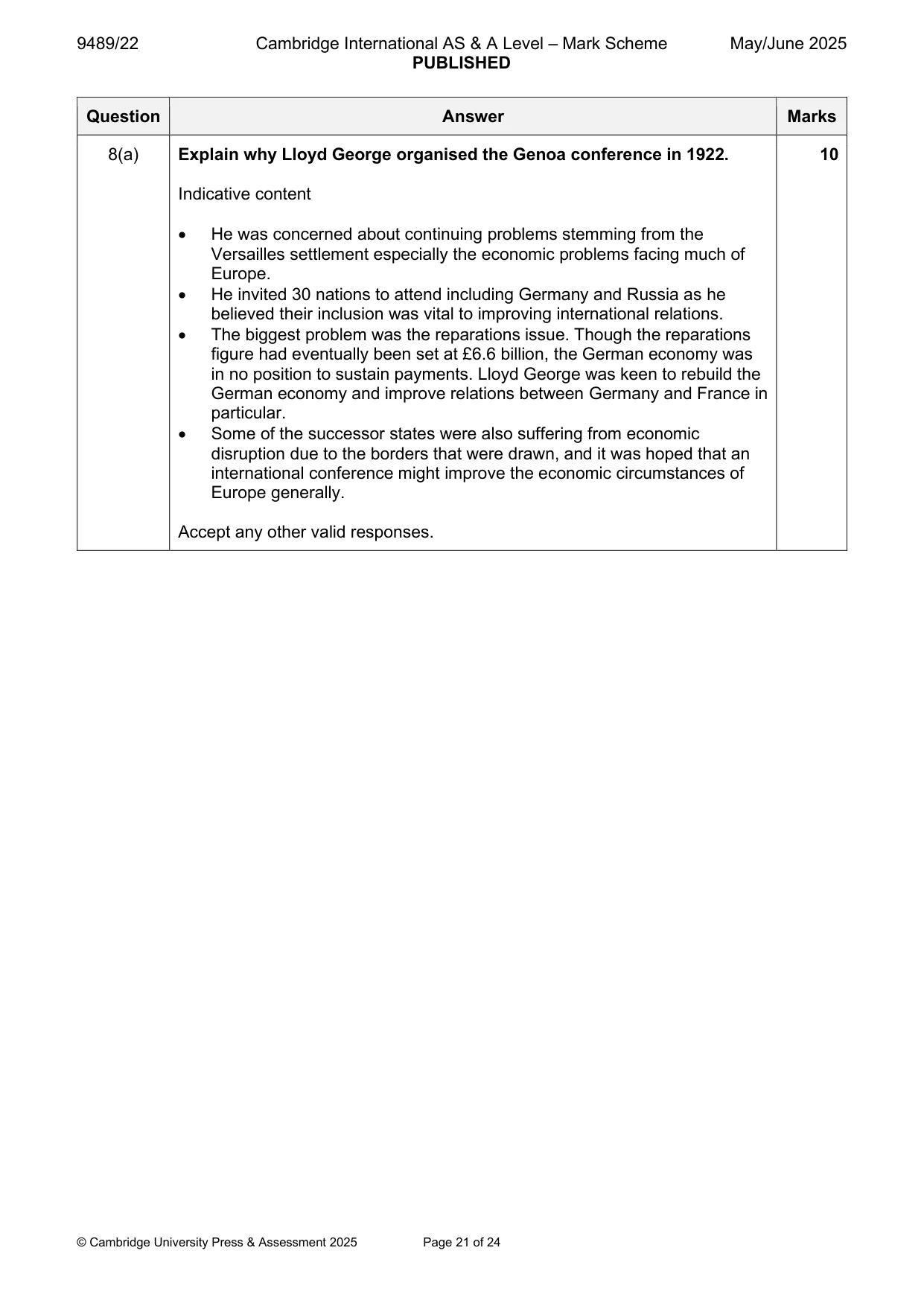
8 The League of Nations and international relations in the 1920s (a) Explain why Lloyd George organised the Genoa conference in 1922. [10] (b) ‘Border disputes were the biggest problem facing the successor states in the 1920s.’ How far do you agree? [20]
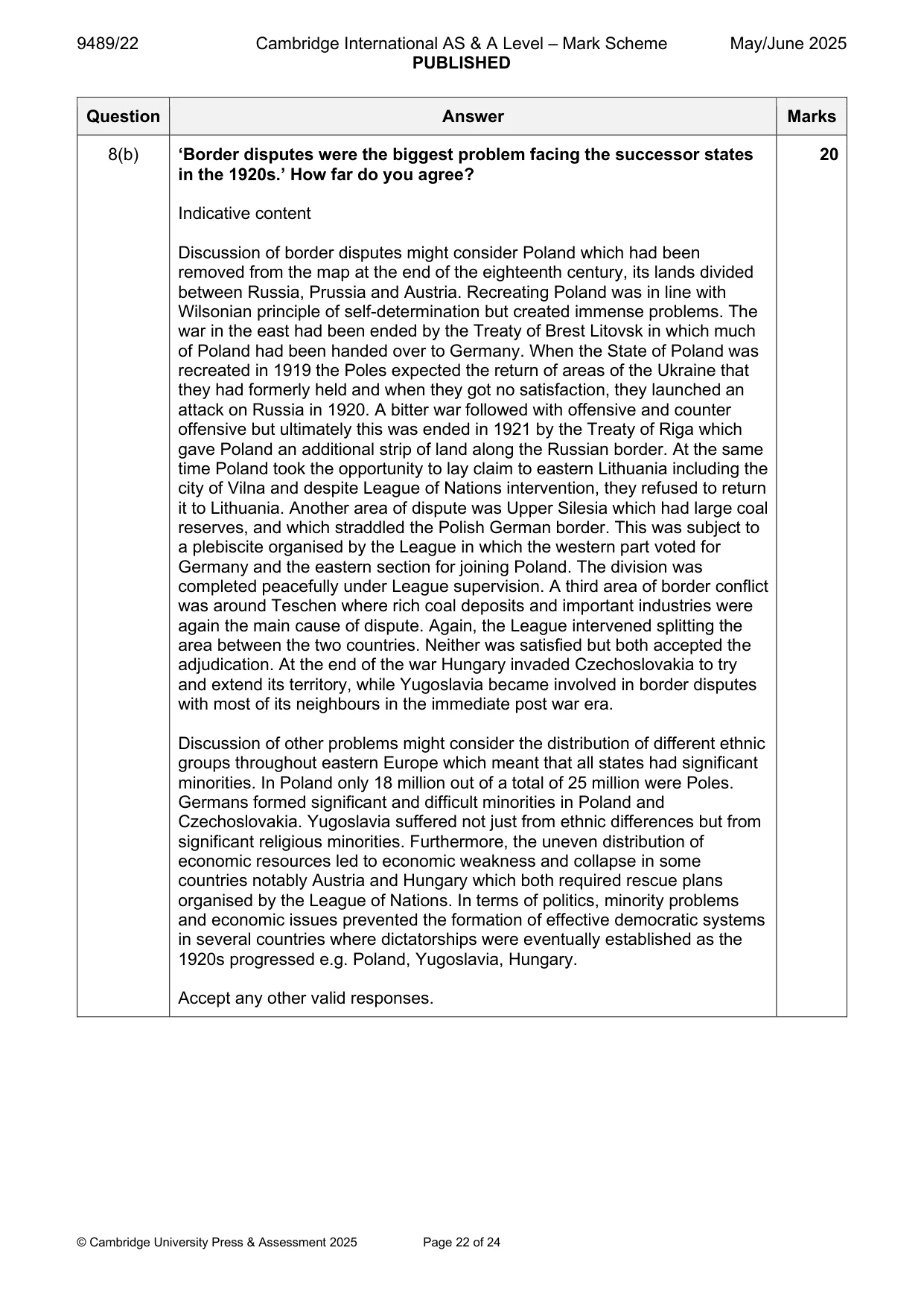
Mark scheme: 8(a) Explain why Lloyd George organised the Genoa conference in 1922. 10 Indicative content • He was concerned about continuing problems stemming from the Versailles settlement especially the economic problems facing much of Europe. • He invited 30 nations to attend including Germany and Russia as he believed their inclusion was vital to improving international relations. • The biggest problem was the reparations issue. Though the reparations figure had eventually been set at £6.6 billion, the German economy was in no position to sustain payments. Lloyd George was keen to rebuild the German economy and improve relations between Germany and France in particular. • Some of the successor states were also suffering from economic disruption due to the borders that were drawn, and it was hoped that an international conference might improve the economic circumstances of Europe generally. Accept any other valid responses. 8(b) ‘Border disputes were the biggest problem facing the successor states 20 in the 1920s.’ How far do you agree? Indicative content Discussion of border disputes might consider Poland which had been removed from the map at the end of the eighteenth century, its lands divided between Russia, Prussia and Austria. Recreating Poland was in line with Wilsonian principle of self-determination but created immense problems. The war in the east had been ended by the Treaty of Brest Litovsk in which much of Poland had been handed over to Germany. When the State of Poland was recreated in 1919 the Poles expected the return of areas of the Ukraine that they had formerly held and when they got no satisfaction, they launched an attack on Russia in 1920. A bitter war followed with offensive and counter offensive but ultimately this was ended in 1921 by the Treaty of Riga which gave Poland an additional strip of land along the Russian border. At the same time Poland took the opportunity to lay claim to eastern Lithuania including the city of Vilna and despite League of Nations intervention, they refused to return it to Lithuania. Another area of dispute was Upper Silesia which had large coal reserves, and which straddled the Polish German border. This was subject to a plebiscite organised by the League in which the western part voted for Germany and the eastern section for joining Poland. The division was completed peacefully under League supervision. A third area of border conflict was around Teschen where rich coal deposits and important industries were again the main cause of dispute. Again, the League intervened splitting the area between the two countries. Neither was satisfied but both accepted the adjudication. At the end of the war Hungary invaded Czechoslovakia to try and extend its territory, while Yugoslavia became involved in border disputes with most of its neighbours in the immediate post war era. Discussion of other problems might consider the distribution of different ethnic groups throughout eastern Europe which meant that all states had significant minorities. In Poland only 18 million out of a total of 25 million were Poles. Germans formed significant and difficult minorities in Poland and Czechoslovakia. Yugoslavia suffered not just from ethnic differences but from significant religious minorities. Furthermore, the uneven distribution of economic resources led to economic weakness and collapse in some countries notably Austria and Hungary which both required rescue plans organised by the League of Nations. In terms of politics, minority problems and economic issues prevented the formation of effective democratic systems in several countries where dictatorships were eventually established as the 1920s progressed e.g. Poland, Yugoslavia, Hungary. Accept any other valid responses.
Q9 · China and Japan, 1912–45 (a) Explain why Chiang Kai-shek became leader of the Kuomintang…
9 China and Japan, 1912–45 (a) Explain why Chiang Kai-shek became leader of the Kuomintang following the death of Sun Yat-sen. [10] (b) To what extent did the Long March represent a defeat for the Chinese Communist Party? [20]
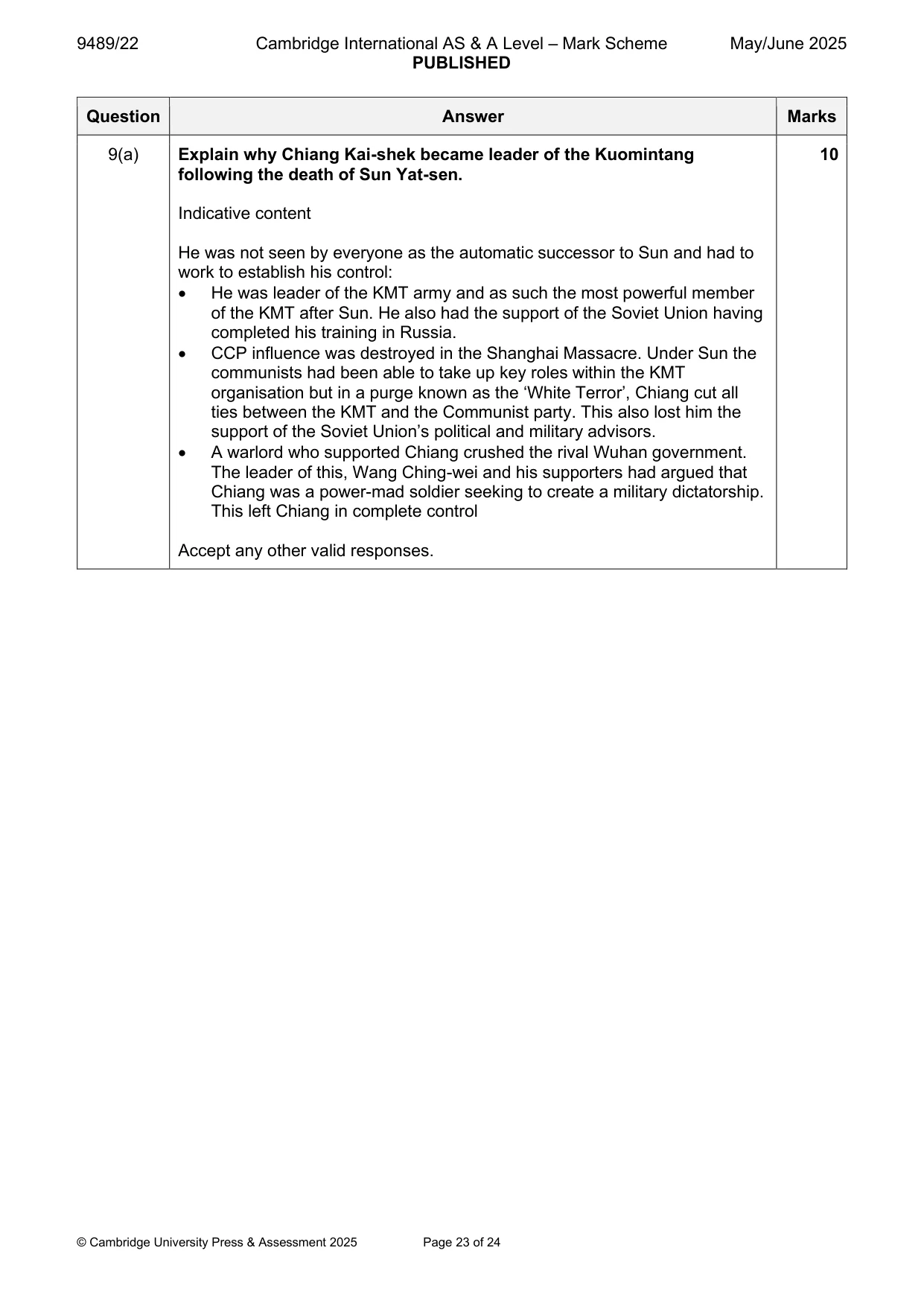
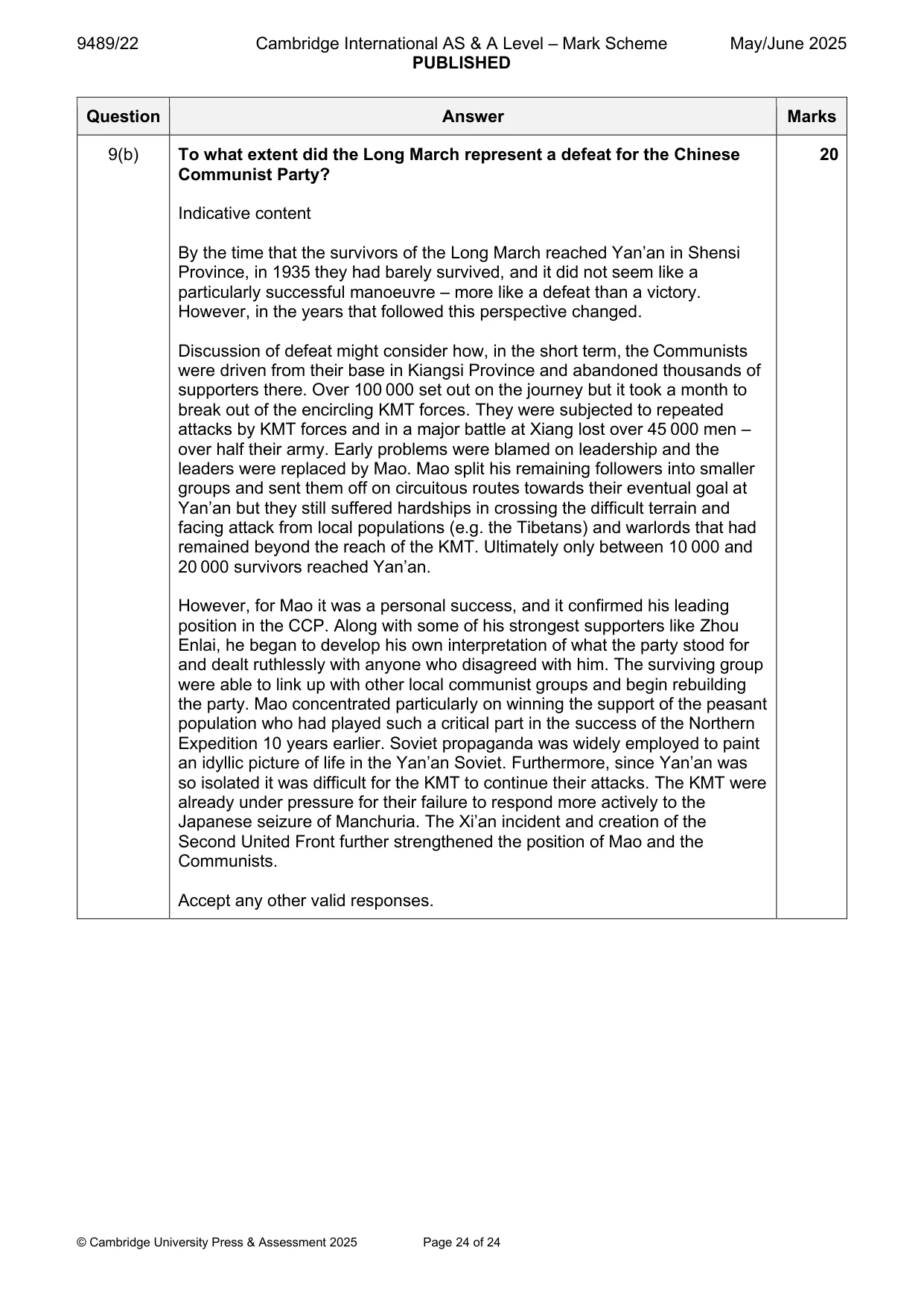
Mark scheme: 9(a) Explain why Chiang Kai-shek became leader of the Kuomintang 10 following the death of Sun Yat-sen. Indicative content He was not seen by everyone as the automatic successor to Sun and had to work to establish his control: • He was leader of the KMT army and as such the most powerful member of the KMT after Sun. He also had the support of the Soviet Union having completed his training in Russia. • CCP influence was destroyed in the Shanghai Massacre. Under Sun the communists had been able to take up key roles within the KMT organisation but in a purge known as the ‘White Terror’, Chiang cut all ties between the KMT and the Communist party. This also lost him the support of the Soviet Union’s political and military advisors. • A warlord who supported Chiang crushed the rival Wuhan government. The leader of this, Wang Ching-wei and his supporters had argued that Chiang was a power-mad soldier seeking to create a military dictatorship. This left Chiang in complete control Accept any other valid responses. 9(b) To what extent did the Long March represent a defeat for the Chinese 20 Communist Party? Indicative content By the time that the survivors of the Long March reached Yan’an in Shensi Province, in 1935 they had barely survived, and it did not seem like a particularly successful manoeuvre – more like a defeat than a victory. However, in the years that followed this perspective changed. Discussion of defeat might consider how, in the short term, the Communists were driven from their base in Kiangsi Province and abandoned thousands of supporters there. Over 100 000 set out on the journey but it took a month to break out of the encircling KMT forces. They were subjected to repeated attacks by KMT forces and in a major battle at Xiang lost over 45 000 men – over half their army. Early problems were blamed on leadership and the leaders were replaced by Mao. Mao split his remaining followers into smaller groups and sent them off on circuitous routes towards their eventual goal at Yan’an but they still suffered hardships in crossing the difficult terrain and facing attack from local populations (e.g. the Tibetans) and warlords that had remained beyond the reach of the KMT. Ultimately only between 10 000 and 20 000 survivors reached Yan’an. However, for Mao it was a personal success, and it confirmed his leading position in the CCP. Along with some of his strongest supporters like Zhou Enlai, he began to develop his own interpretation of what the party stood for and dealt ruthlessly with anyone who disagreed with him. The surviving group were able to link up with other local communist groups and begin rebuilding the party. Mao concentrated particularly on winning the support of the peasant population who had played such a critical part in the success of the Northern Expedition 10 years earlier. Soviet propaganda was widely employed to paint an idyllic picture of life in the Yan’an Soviet. Furthermore, since Yan’an was so isolated it was difficult for the KMT to continue their attacks. The KMT were already under pressure for their failure to respond more actively to the Japanese seizure of Manchuria. The Xi’an incident and creation of the Second United Front further strengthened the position of Mao and the Communists. Accept any other valid responses.
More questions on Why did Japan emerge as a world power and what was the impact on international
What was in this paper
The subtopics covered by these 9 questions, and how many questions each got. Open one in a new tab to see every Cambridge question on it.
1How well was France governed in the period 1793–99?1What was the impact of imperial expansion on international relations?1What were the causes of the Great Crash and the Great Depression?1What were the consequences of the rapid economic growth after 1870?1Why did Japan emerge as a world power and what was the impact on international1Why did the Civil War last four years?1Why was there rapid industrialisation after 1870?1Why was there such extensive dissatisfaction with the peace settlements of 1919–20?1What you needed in this session
Cambridge’s own grade thresholds for 2025 May/June, Paper 2 · Variant 2. A higher threshold means an easier paper — the bar moves with how the cohort did.