Cambridge A Level History 9489 — 2021 Oct/Nov Paper 2 · Variant 3
9489/23/O/N/21 · 9 questions · 60 marks · ≈68 min
The question paper and its mark scheme, free to read here and free to download. This is Cambridge’s own paper, exactly as it was sat.
Question paper4 pages
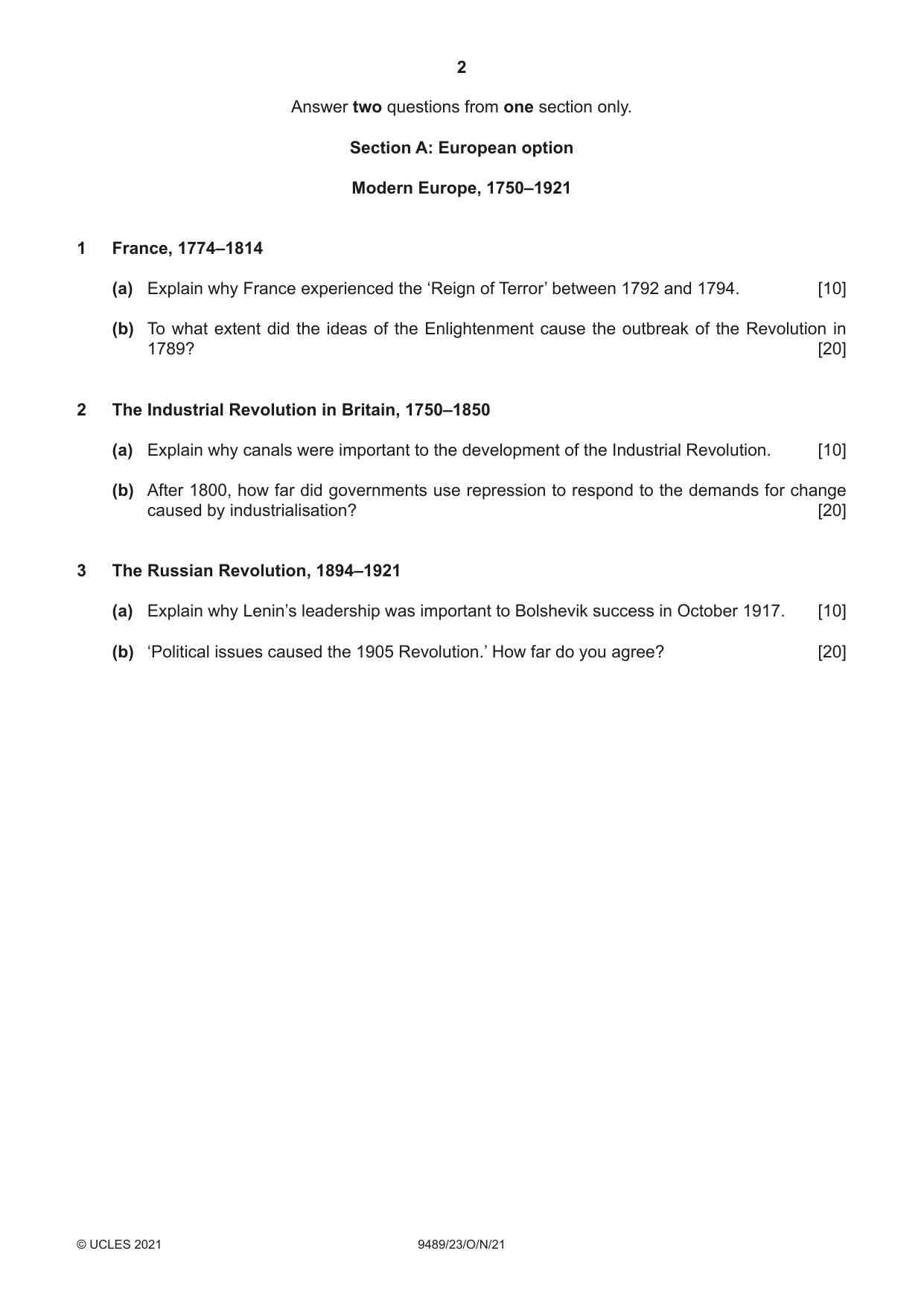
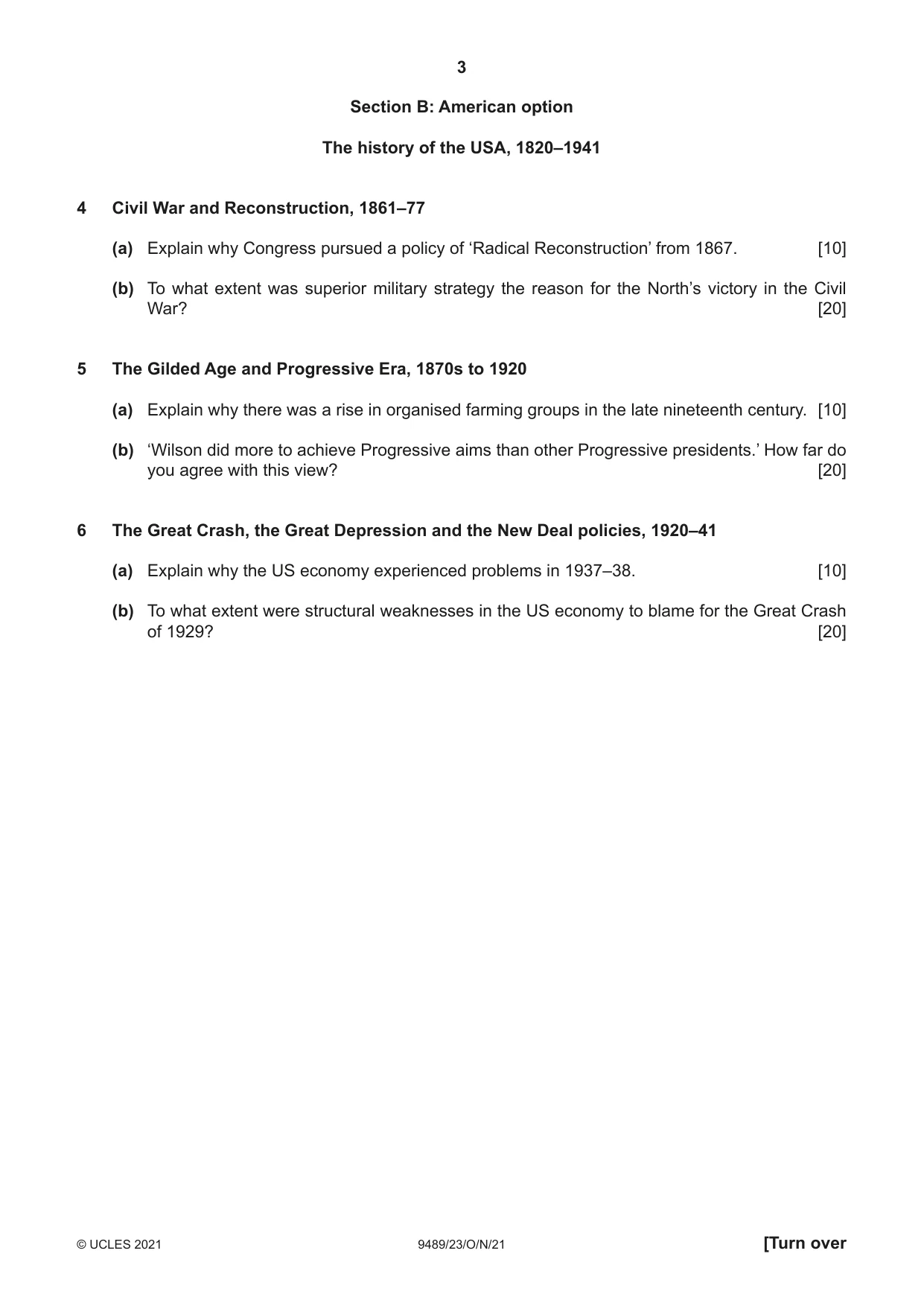
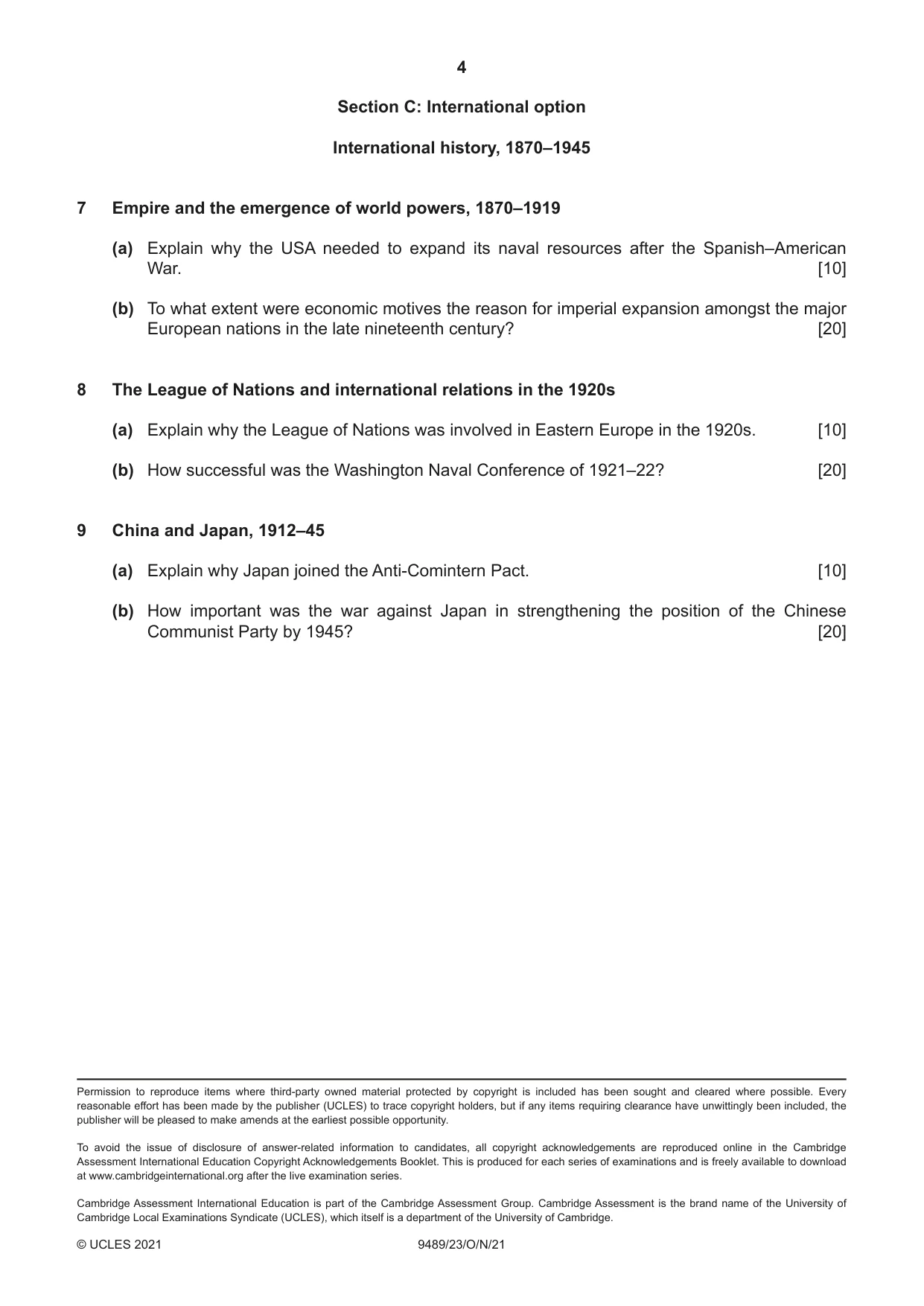
Mark scheme19 pages
Answers below. Sit the paper first if you are practising.

Questions as text
Q1 · France, 1774–1814 (a) Explain why France experienced the ‘Reign of Terror’ between 1792…
1 France, 1774–1814 (a) Explain why France experienced the ‘Reign of Terror’ between 1792 and 1794. [10] (b) To what extent did the ideas of the Enlightenment cause the outbreak of the Revolution in 1789? [20]
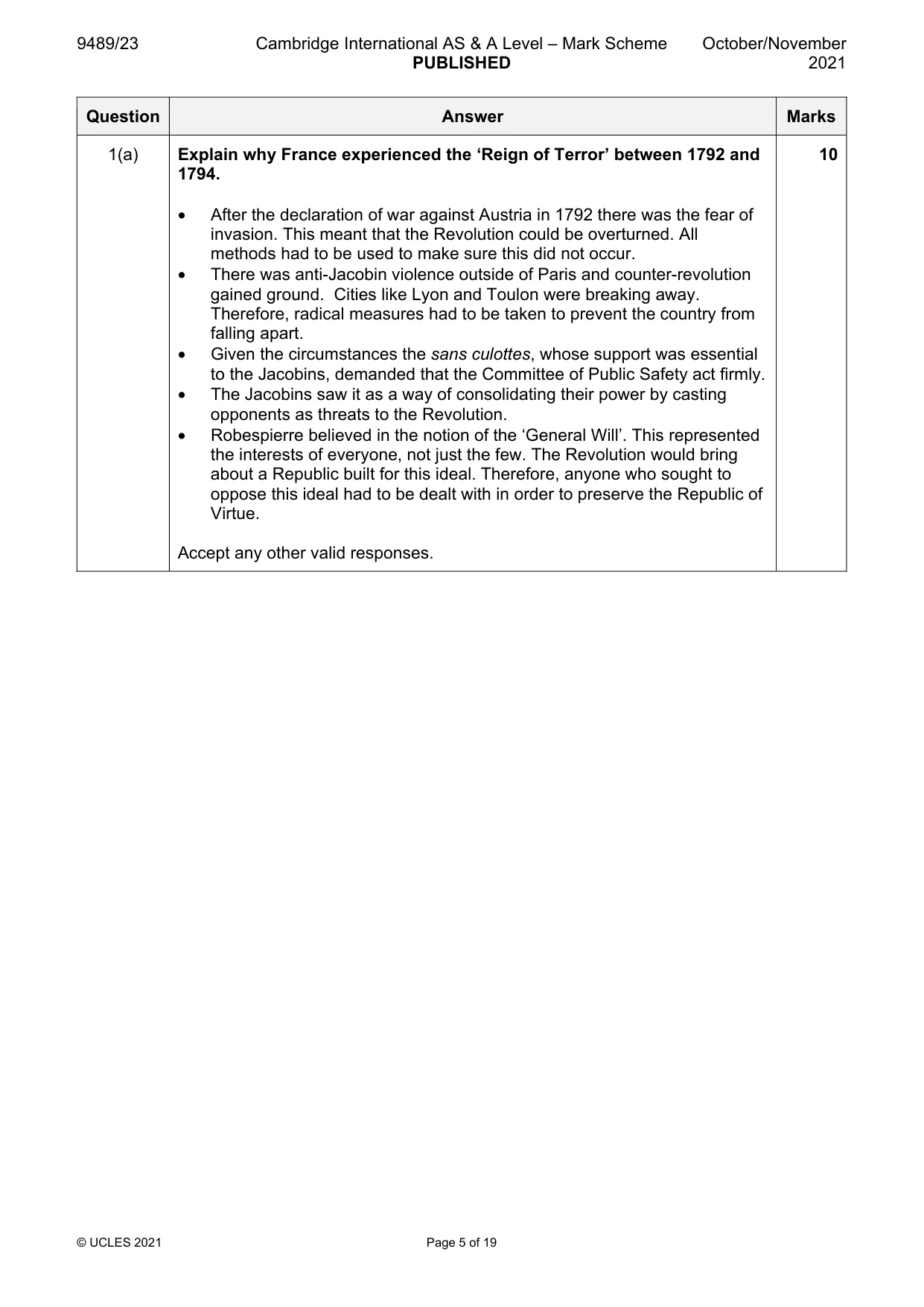
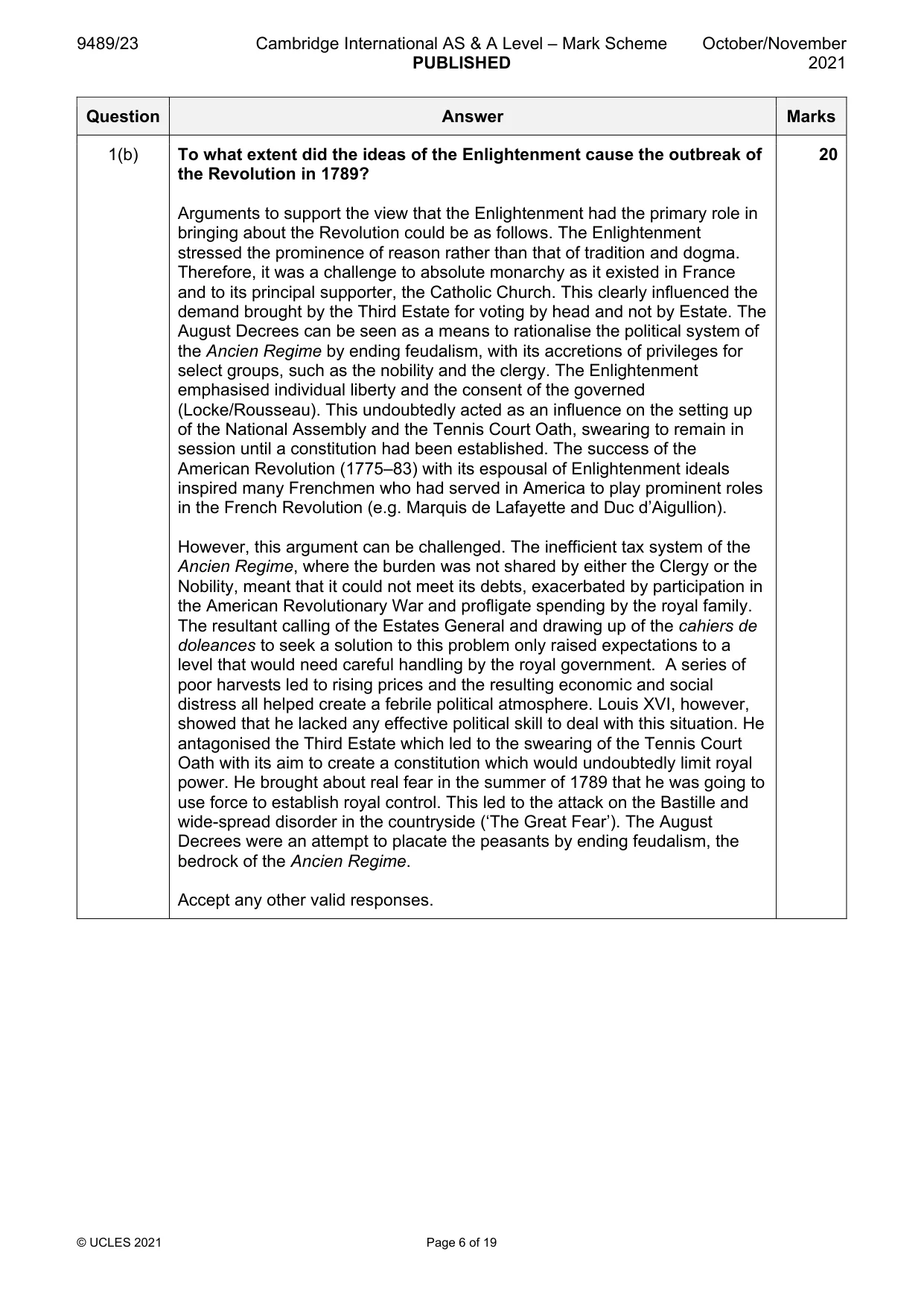
Mark scheme: Question Answer Marks 1(a) Explain why France experienced the ‘Reign of Terror’ between 1792 and 10 1794. • After the declaration of war against Austria in 1792 there was the fear of invasion. This meant that the Revolution could be overturned. All methods had to be used to make sure this did not occur. • There was anti-Jacobin violence outside of Paris and counter-revolution gained ground. Cities like Lyon and Toulon were breaking away. Therefore, radical measures had to be taken to prevent the country from falling apart. • Given the circumstances the sans culottes, whose support was essential to the Jacobins, demanded that the Committee of Public Safety act firmly. • The Jacobins saw it as a way of consolidating their power by casting opponents as threats to the Revolution. • Robespierre believed in the notion of the ‘General Will’. This represented the interests of everyone, not just the few. The Revolution would bring about a Republic built for this ideal. Therefore, anyone who sought to oppose this ideal had to be dealt with in order to preserve the Republic of Virtue. Accept any other valid responses. 1(b) To what extent did the ideas of the Enlightenment cause the outbreak of 20 the Revolution in 1789? Arguments to support the view that the Enlightenment had the primary role in bringing about the Revolution could be as follows. The Enlightenment stressed the prominence of reason rather than that of tradition and dogma. Therefore, it was a challenge to absolute monarchy as it existed in France and to its principal supporter, the Catholic Church. This clearly influenced the demand brought by the Third Estate for voting by head and not by Estate. The August Decrees can be seen as a means to rationalise the political system of the Ancien Regime by ending feudalism, with its accretions of privileges for select groups, such as the nobility and the clergy. The Enlightenment emphasised individual liberty and the consent of the governed (Locke/Rousseau). This undoubtedly acted as an influence on the setting up of the National Assembly and the Tennis Court Oath, swearing to remain in session until a constitution had been established. The success of the American Revolution (1775–83) with its espousal of Enlightenment ideals inspired many Frenchmen who had served in America to play prominent roles in the French Revolution (e.g. Marquis de Lafayette and Duc d’Aigullion). However, this argument can be challenged. The inefficient tax system of the Ancien Regime, where the burden was not shared by either the Clergy or the Nobility, meant that it could not meet its debts, exacerbated by participation in the American Revolutionary War and profligate spending by the royal family. The resultant calling of the Estates General and drawing up of the cahiers de doleances to seek a solution to this problem only raised expectations to a level that would need careful handling by the royal government. A series of poor harvests led to rising prices and the resulting economic and social distress all helped create a febrile political atmosphere. Louis XVI, however, showed that he lacked any effective political skill to deal with this situation. He antagonised the Third Estate which led to the swearing of the Tennis Court Oath with its aim to create a constitution which would undoubtedly limit royal power. He brought about real fear in the summer of 1789 that he was going to use force to establish royal control. This led to the attack on the Bastille and wide-spread disorder in the countryside (‘The Great Fear’). The August Decrees were an attempt to placate the peasants by ending feudalism, the bedrock of the Ancien Regime. Accept any other valid responses.
More questions on What were the causes and immediate consequences of the 1789 Revolution?
Q2 · The Industrial Revolution in Britain, 1750–1850 (a) Explain why canals were important to…
2 The Industrial Revolution in Britain, 1750–1850 (a) Explain why canals were important to the development of the Industrial Revolution. [10] (b) After 1800, how far did governments use repression to respond to the demands for change caused by industrialisation? [20]
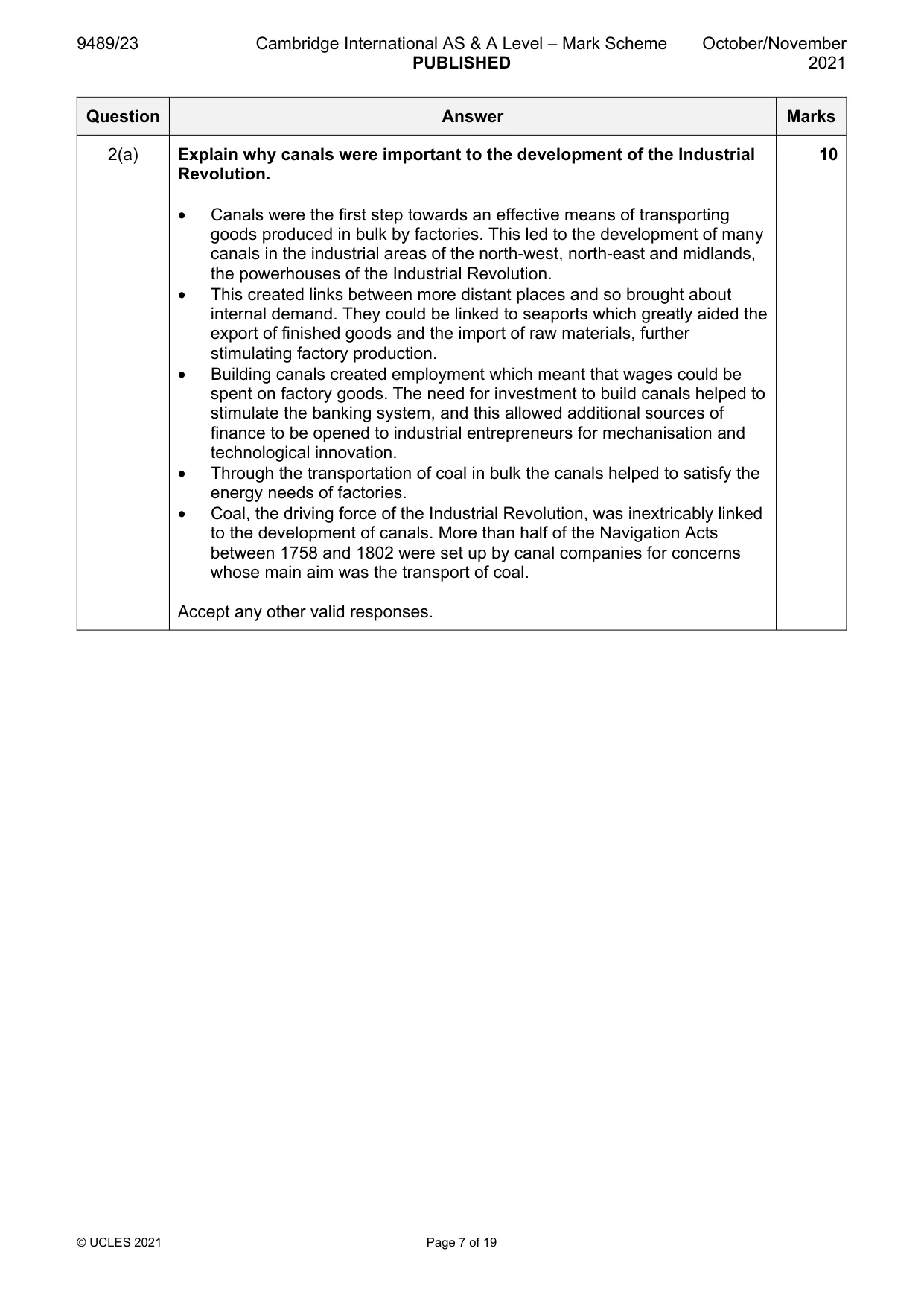
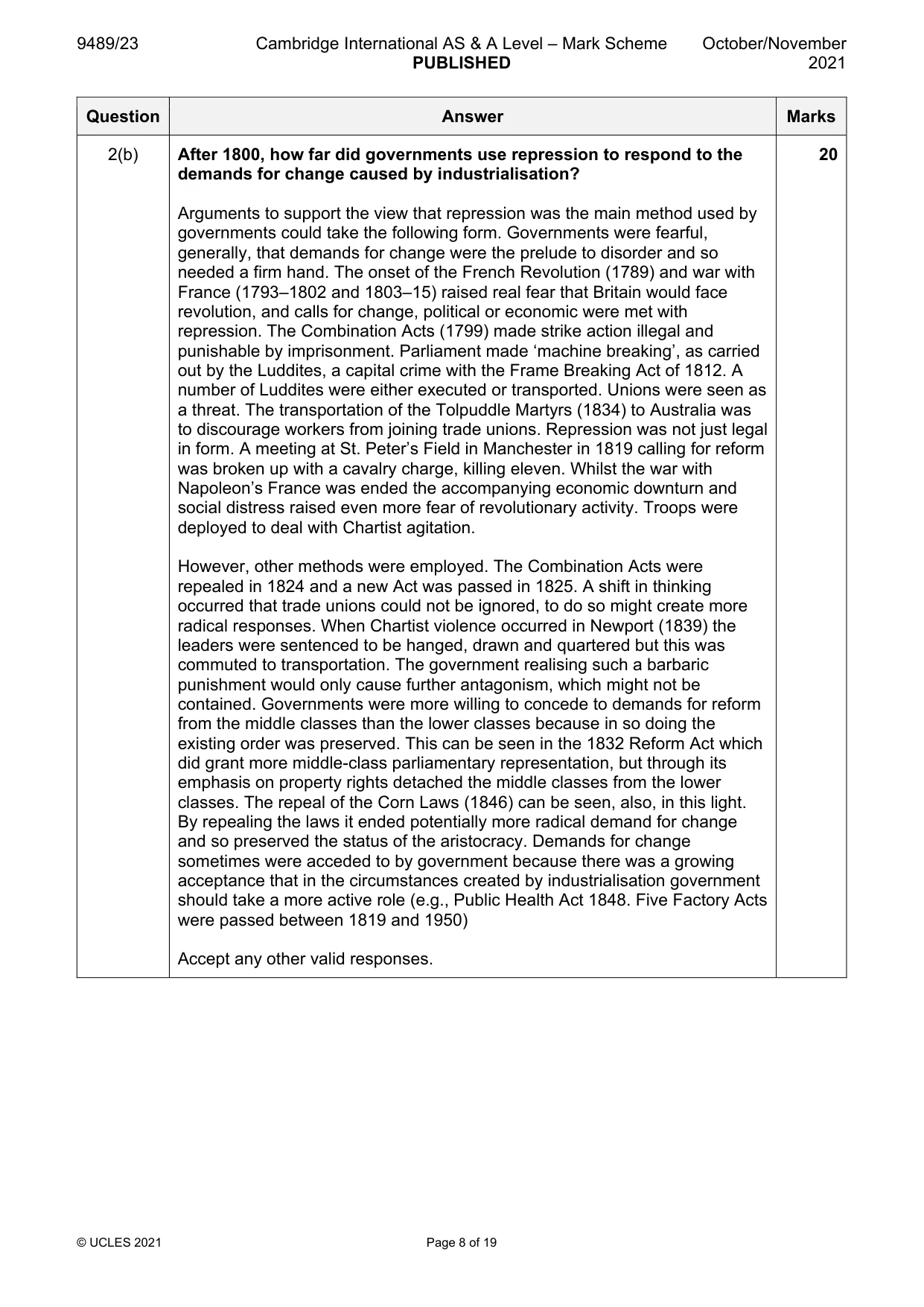
Mark scheme: 2(a) Explain why canals were important to the development of the Industrial 10 Revolution. • Canals were the first step towards an effective means of transporting goods produced in bulk by factories. This led to the development of many canals in the industrial areas of the north-west, north-east and midlands, the powerhouses of the Industrial Revolution. • This created links between more distant places and so brought about internal demand. They could be linked to seaports which greatly aided the export of finished goods and the import of raw materials, further stimulating factory production. • Building canals created employment which meant that wages could be spent on factory goods. The need for investment to build canals helped to stimulate the banking system, and this allowed additional sources of finance to be opened to industrial entrepreneurs for mechanisation and technological innovation. • Through the transportation of coal in bulk the canals helped to satisfy the energy needs of factories. • Coal, the driving force of the Industrial Revolution, was inextricably linked to the development of canals. More than half of the Navigation Acts between 1758 and 1802 were set up by canal companies for concerns whose main aim was the transport of coal. Accept any other valid responses. 2(b) After 1800, how far did governments use repression to respond to the 20 demands for change caused by industrialisation? Arguments to support the view that repression was the main method used by governments could take the following form. Governments were fearful, generally, that demands for change were the prelude to disorder and so needed a firm hand. The onset of the French Revolution (1789) and war with France (1793‒1802 and 1803–15) raised real fear that Britain would face revolution, and calls for change, political or economic were met with repression. The Combination Acts (1799) made strike action illegal and punishable by imprisonment. Parliament made ‘machine breaking’, as carried out by the Luddites, a capital crime with the Frame Breaking Act of 1812. A number of Luddites were either executed or transported. Unions were seen as a threat. The transportation of the Tolpuddle Martyrs (1834) to Australia was to discourage workers from joining trade unions. Repression was not just legal in form. A meeting at St. Peter’s Field in Manchester in 1819 calling for reform was broken up with a cavalry charge, killing eleven. Whilst the war with Napoleon’s France was ended the accompanying economic downturn and social distress raised even more fear of revolutionary activity. Troops were deployed to deal with Chartist agitation. However, other methods were employed. The Combination Acts were repealed in 1824 and a new Act was passed in 1825. A shift in thinking occurred that trade unions could not be ignored, to do so might create more radical responses. When Chartist violence occurred in Newport (1839) the leaders were sentenced to be hanged, drawn and quartered but this was commuted to transportation. The government realising such a barbaric punishment would only cause further antagonism, which might not be contained. Governments were more willing to concede to demands for reform from the middle classes than the lower classes because in so doing the existing order was preserved. This can be seen in the 1832 Reform Act which did grant more middle-class parliamentary representation, but through its emphasis on property rights detached the middle classes from the lower classes. The repeal of the Corn Laws (1846) can be seen, also, in this light. By repealing the laws it ended potentially more radical demand for change and so preserved the status of the aristocracy. Demands for change sometimes were acceded to by government because there was a growing acceptance that in the circumstances created by industrialisation government should take a more active role (e.g., Public Health Act 1848. Five Factory Acts were passed between 1819 and 1950) Accept any other valid responses.
More questions on What were the consequences of the rapid economic growth after 1870?
Q3 · The Russian Revolution, 1894–1921 (a) Explain why Lenin’s leadership was important to…
3 The Russian Revolution, 1894–1921 (a) Explain why Lenin’s leadership was important to Bolshevik success in October 1917. [10] (b) ‘Political issues caused the 1905 Revolution.’ How far do you agree? [20]
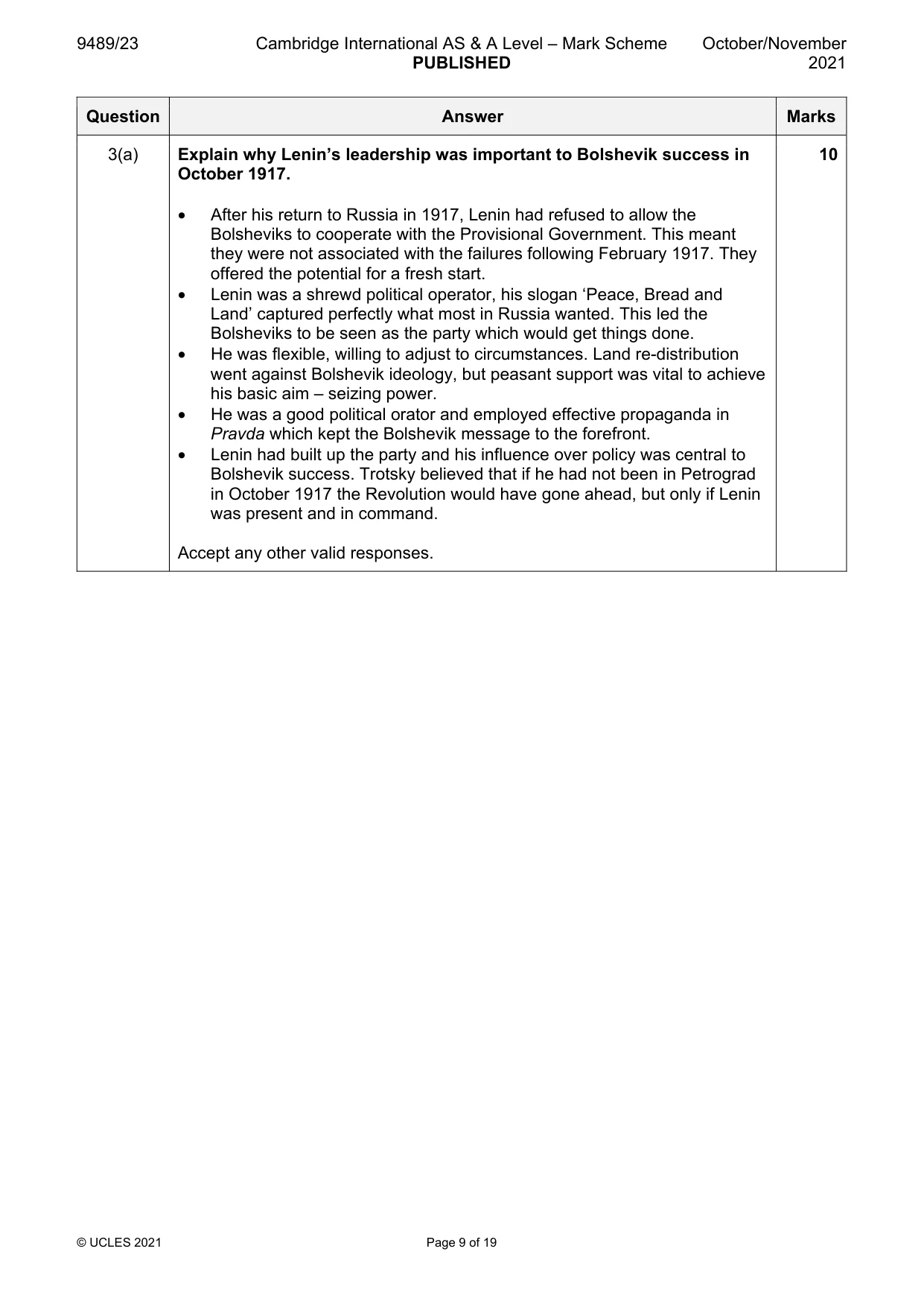
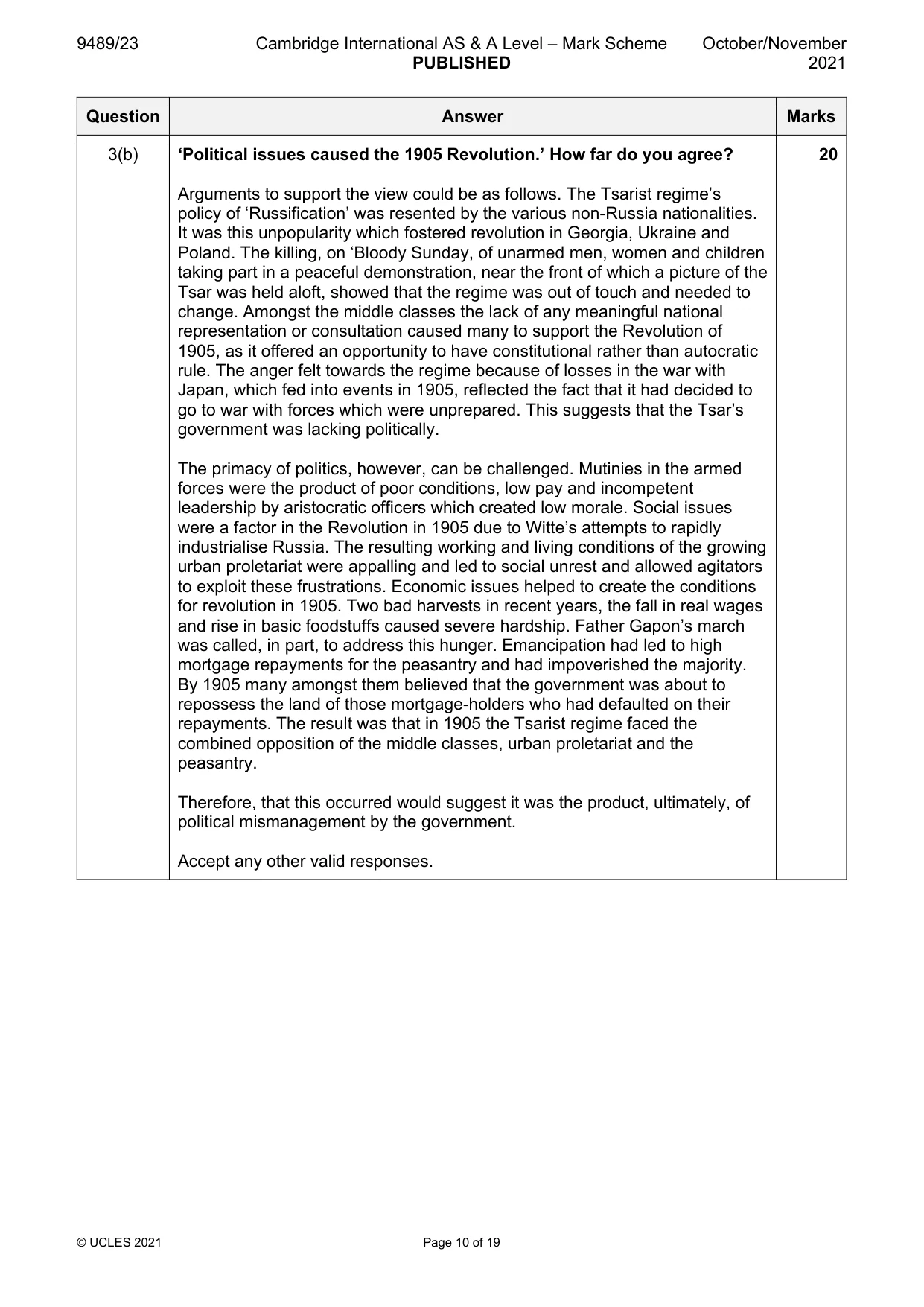
Mark scheme: 3(a) Explain why Lenin’s leadership was important to Bolshevik success in 10 October 1917. • After his return to Russia in 1917, Lenin had refused to allow the Bolsheviks to cooperate with the Provisional Government. This meant they were not associated with the failures following February 1917. They offered the potential for a fresh start. • Lenin was a shrewd political operator, his slogan ‘Peace, Bread and Land’ captured perfectly what most in Russia wanted. This led the Bolsheviks to be seen as the party which would get things done. • He was flexible, willing to adjust to circumstances. Land re-distribution went against Bolshevik ideology, but peasant support was vital to achieve his basic aim – seizing power. • He was a good political orator and employed effective propaganda in Pravda which kept the Bolshevik message to the forefront. • Lenin had built up the party and his influence over policy was central to Bolshevik success. Trotsky believed that if he had not been in Petrograd in October 1917 the Revolution would have gone ahead, but only if Lenin was present and in command. Accept any other valid responses. 3(b) ‘Political issues caused the 1905 Revolution.’ How far do you agree? 20 Arguments to support the view could be as follows. The Tsarist regime’s policy of ‘Russification’ was resented by the various non-Russia nationalities. It was this unpopularity which fostered revolution in Georgia, Ukraine and Poland. The killing, on ‘Bloody Sunday, of unarmed men, women and children taking part in a peaceful demonstration, near the front of which a picture of the Tsar was held aloft, showed that the regime was out of touch and needed to change. Amongst the middle classes the lack of any meaningful national representation or consultation caused many to support the Revolution of 1905, as it offered an opportunity to have constitutional rather than autocratic rule. The anger felt towards the regime because of losses in the war with Japan, which fed into events in 1905, reflected the fact that it had decided to go to war with forces which were unprepared. This suggests that the Tsar’s government was lacking politically. The primacy of politics, however, can be challenged. Mutinies in the armed forces were the product of poor conditions, low pay and incompetent leadership by aristocratic officers which created low morale. Social issues were a factor in the Revolution in 1905 due to Witte’s attempts to rapidly industrialise Russia. The resulting working and living conditions of the growing urban proletariat were appalling and led to social unrest and allowed agitators to exploit these frustrations. Economic issues helped to create the conditions for revolution in 1905. Two bad harvests in recent years, the fall in real wages and rise in basic foodstuffs caused severe hardship. Father Gapon’s march was called, in part, to address this hunger. Emancipation had led to high mortgage repayments for the peasantry and had impoverished the majority. By 1905 many amongst them believed that the government was about to repossess the land of those mortgage-holders who had defaulted on their repayments. The result was that in 1905 the Tsarist regime faced the combined opposition of the middle classes, urban proletariat and the peasantry. Therefore, that this occurred would suggest it was the product, ultimately, of political mismanagement by the government. Accept any other valid responses.
More questions on What were the causes and outcomes of the 1905 Revolution up to 1914?
Q4 · Civil War and Reconstruction, 1861–77 (a) Explain why Congress pursued a policy of…
4 Civil War and Reconstruction, 1861–77 (a) Explain why Congress pursued a policy of ‘Radical Reconstruction’ from 1867. [10] (b) To what extent was superior military strategy the reason for the North’s victory in the Civil War? [20]
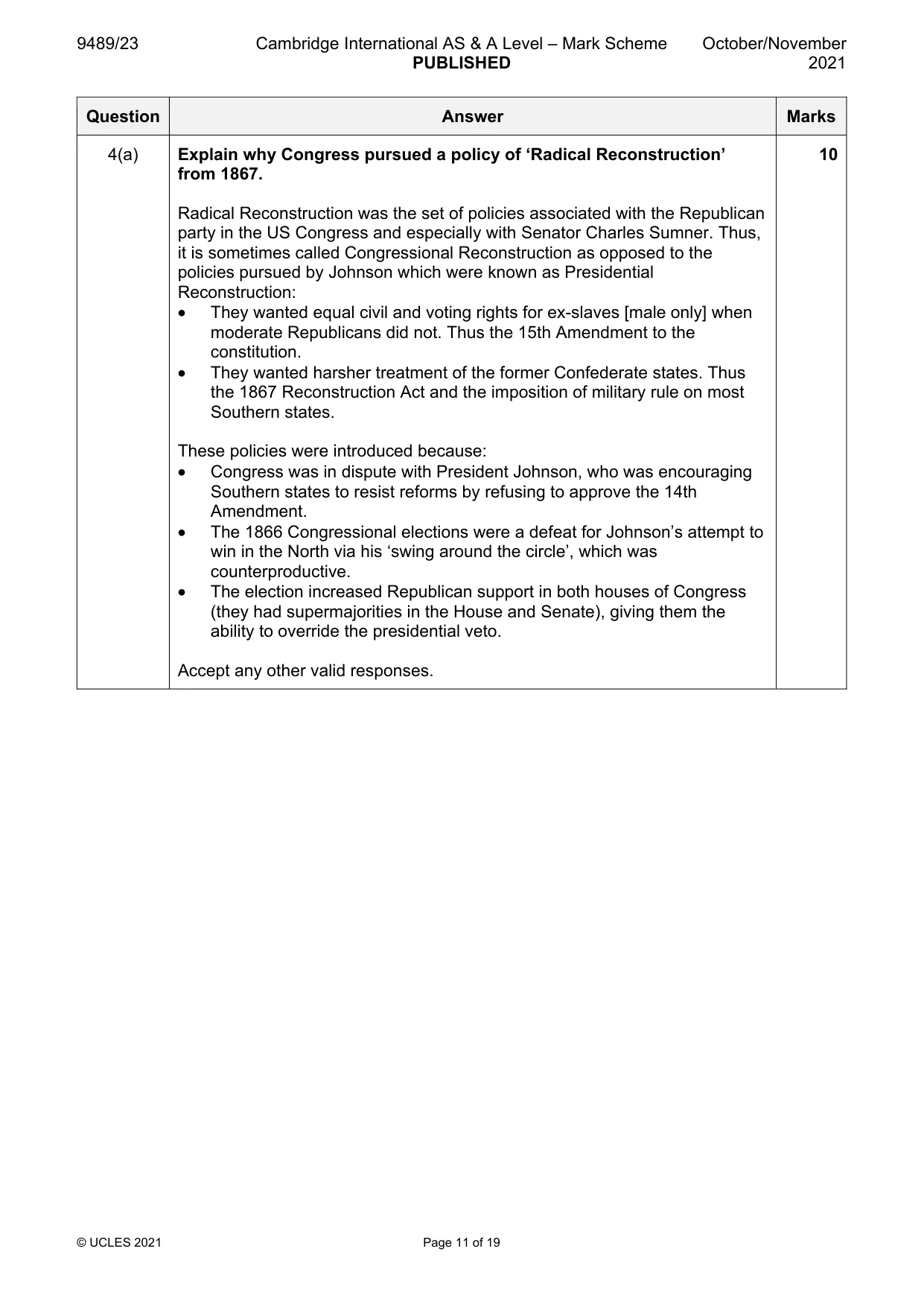
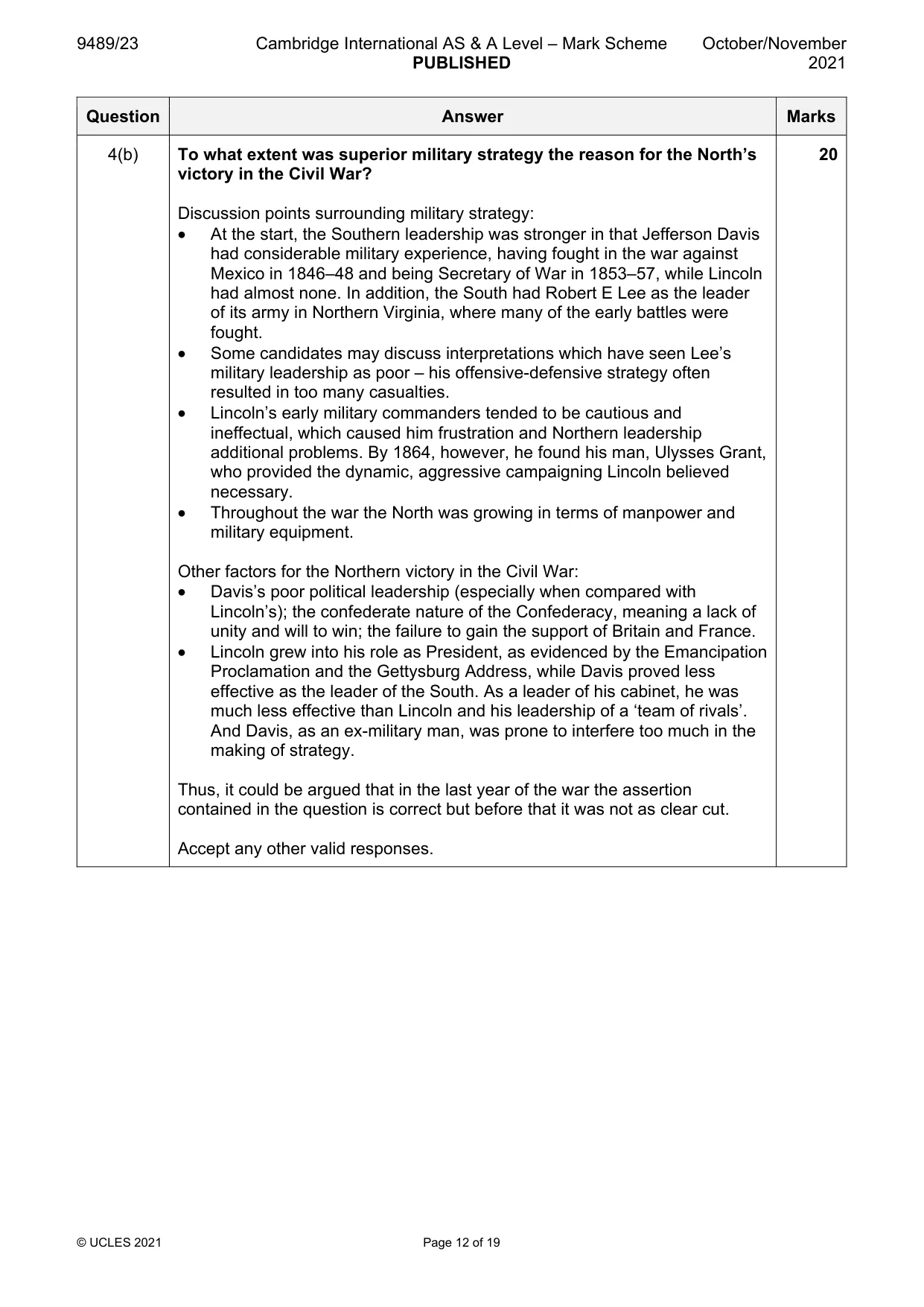
Mark scheme: 4(a) Explain why Congress pursued a policy of ‘Radical Reconstruction’ 10 from 1867. Radical Reconstruction was the set of policies associated with the Republican party in the US Congress and especially with Senator Charles Sumner. Thus, it is sometimes called Congressional Reconstruction as opposed to the policies pursued by Johnson which were known as Presidential Reconstruction: • They wanted equal civil and voting rights for ex-slaves [male only] when moderate Republicans did not. Thus the 15th Amendment to the constitution. • They wanted harsher treatment of the former Confederate states. Thus the 1867 Reconstruction Act and the imposition of military rule on most Southern states. These policies were introduced because: • Congress was in dispute with President Johnson, who was encouraging Southern states to resist reforms by refusing to approve the 14th Amendment. • The 1866 Congressional elections were a defeat for Johnson’s attempt to win in the North via his ‘swing around the circle’, which was counterproductive. • The election increased Republican support in both houses of Congress (they had supermajorities in the House and Senate), giving them the ability to override the presidential veto. Accept any other valid responses. 4(b) To what extent was superior military strategy the reason for the North’s 20 victory in the Civil War? Discussion points surrounding military strategy: • At the start, the Southern leadership was stronger in that Jefferson Davis had considerable military experience, having fought in the war against Mexico in 1846–48 and being Secretary of War in 1853–57, while Lincoln had almost none. In addition, the South had Robert E Lee as the leader of its army in Northern Virginia, where many of the early battles were fought. • Some candidates may discuss interpretations which have seen Lee’s military leadership as poor – his offensive-defensive strategy often resulted in too many casualties. • Lincoln’s early military commanders tended to be cautious and ineffectual, which caused him frustration and Northern leadership additional problems. By 1864, however, he found his man, Ulysses Grant, who provided the dynamic, aggressive campaigning Lincoln believed necessary. • Throughout the war the North was growing in terms of manpower and military equipment. Other factors for the Northern victory in the Civil War: • Davis’s poor political leadership (especially when compared with Lincoln’s); the confederate nature of the Confederacy, meaning a lack of unity and will to win; the failure to gain the support of Britain and France. • Lincoln grew into his role as President, as evidenced by the Emancipation Proclamation and the Gettysburg Address, while Davis proved less effective as the leader of the South. As a leader of his cabinet, he was much less effective than Lincoln and his leadership of a ‘team of rivals’. And Davis, as an ex-military man, was prone to interfere too much in the making of strategy. Thus, it could be argued that in the last year of the war the assertion contained in the question is correct but before that it was not as clear cut. Accept any other valid responses.
Q5 · The Gilded Age and Progressive Era, 1870s to 1920 (a) Explain why there was a rise in…
5 The Gilded Age and Progressive Era, 1870s to 1920 (a) Explain why there was a rise in organised farming groups in the late nineteenth century. [10] (b) ‘Wilson did more to achieve Progressive aims than other Progressive presidents.’ How far do you agree with this view? [20]
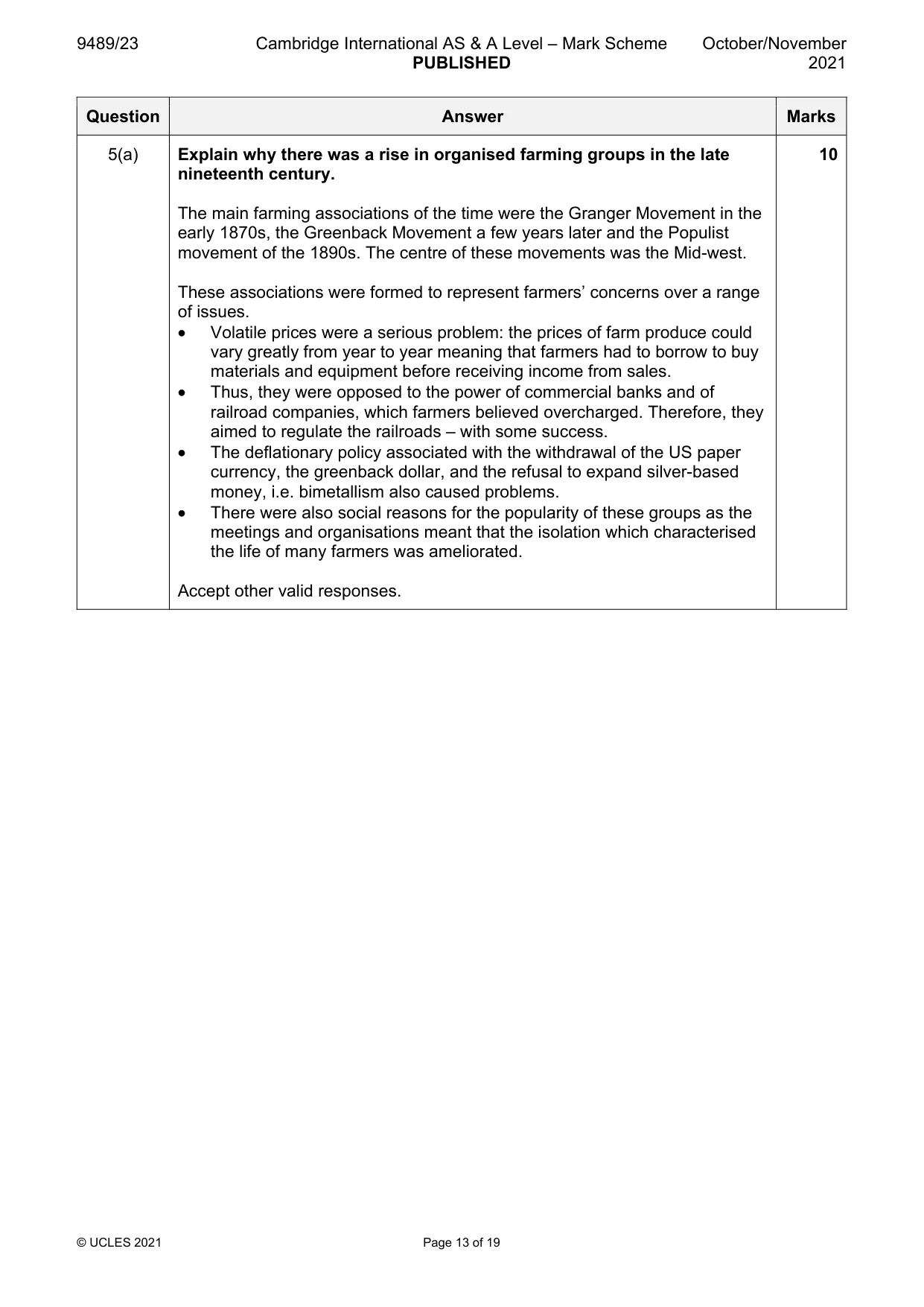
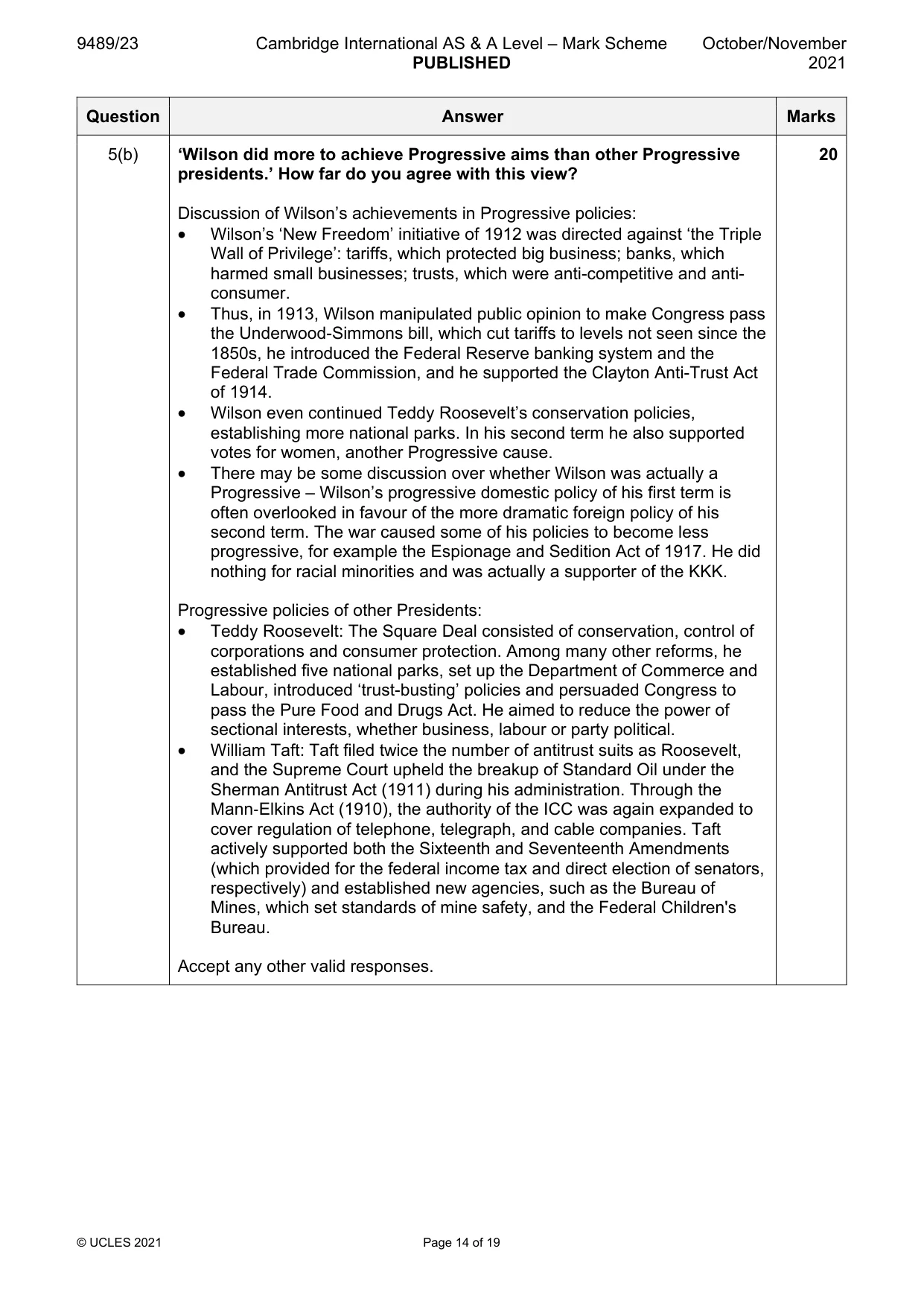
Mark scheme: 5(a) Explain why there was a rise in organised farming groups in the late 10 nineteenth century. The main farming associations of the time were the Granger Movement in the early 1870s, the Greenback Movement a few years later and the Populist movement of the 1890s. The centre of these movements was the Mid-west. These associations were formed to represent farmers’ concerns over a range of issues. • Volatile prices were a serious problem: the prices of farm produce could vary greatly from year to year meaning that farmers had to borrow to buy materials and equipment before receiving income from sales. • Thus, they were opposed to the power of commercial banks and of railroad companies, which farmers believed overcharged. Therefore, they aimed to regulate the railroads – with some success. • The deflationary policy associated with the withdrawal of the US paper currency, the greenback dollar, and the refusal to expand silver-based money, i.e. bimetallism also caused problems. • There were also social reasons for the popularity of these groups as the meetings and organisations meant that the isolation which characterised the life of many farmers was ameliorated. Accept other valid responses. 5(b) ‘Wilson did more to achieve Progressive aims than other Progressive 20 presidents.’ How far do you agree with this view? Discussion of Wilson’s achievements in Progressive policies: • Wilson’s ‘New Freedom’ initiative of 1912 was directed against ‘the Triple Wall of Privilege’: tariffs, which protected big business; banks, which harmed small businesses; trusts, which were anti-competitive and anti- consumer. • Thus, in 1913, Wilson manipulated public opinion to make Congress pass the Underwood-Simmons bill, which cut tariffs to levels not seen since the 1850s, he introduced the Federal Reserve banking system and the Federal Trade Commission, and he supported the Clayton Anti-Trust Act of 1914. • Wilson even continued Teddy Roosevelt’s conservation policies, establishing more national parks. In his second term he also supported votes for women, another Progressive cause. • There may be some discussion over whether Wilson was actually a Progressive – Wilson’s progressive domestic policy of his first term is often overlooked in favour of the more dramatic foreign policy of his second term. The war caused some of his policies to become less progressive, for example the Espionage and Sedition Act of 1917. He did nothing for racial minorities and was actually a supporter of the KKK. Progressive policies of other Presidents: • Teddy Roosevelt: The Square Deal consisted of conservation, control of corporations and consumer protection. Among many other reforms, he established five national parks, set up the Department of Commerce and Labour, introduced ‘trust-busting’ policies and persuaded Congress to pass the Pure Food and Drugs Act. He aimed to reduce the power of sectional interests, whether business, labour or party political. • William Taft: Taft filed twice the number of antitrust suits as Roosevelt, and the Supreme Court upheld the breakup of Standard Oil under the Sherman Antitrust Act (1911) during his administration. Through the Mann‐Elkins Act (1910), the authority of the ICC was again expanded to cover regulation of telephone, telegraph, and cable companies. Taft actively supported both the Sixteenth and Seventeenth Amendments (which provided for the federal income tax and direct election of senators, respectively) and established new agencies, such as the Bureau of Mines, which set standards of mine safety, and the Federal Children's Bureau. Accept any other valid responses.
More questions on How successful was the Progressive Movement from 1890 to 1920?
Q6 · The Great Crash, the Great Depression and the New Deal policies, 1920–41 (a) Explain why…
6 The Great Crash, the Great Depression and the New Deal policies, 1920–41 (a) Explain why the US economy experienced problems in 1937–38. [10] (b) To what extent were structural weaknesses in the US economy to blame for the Great Crash of 1929? [20] Section C: International option International history, 1870–1945
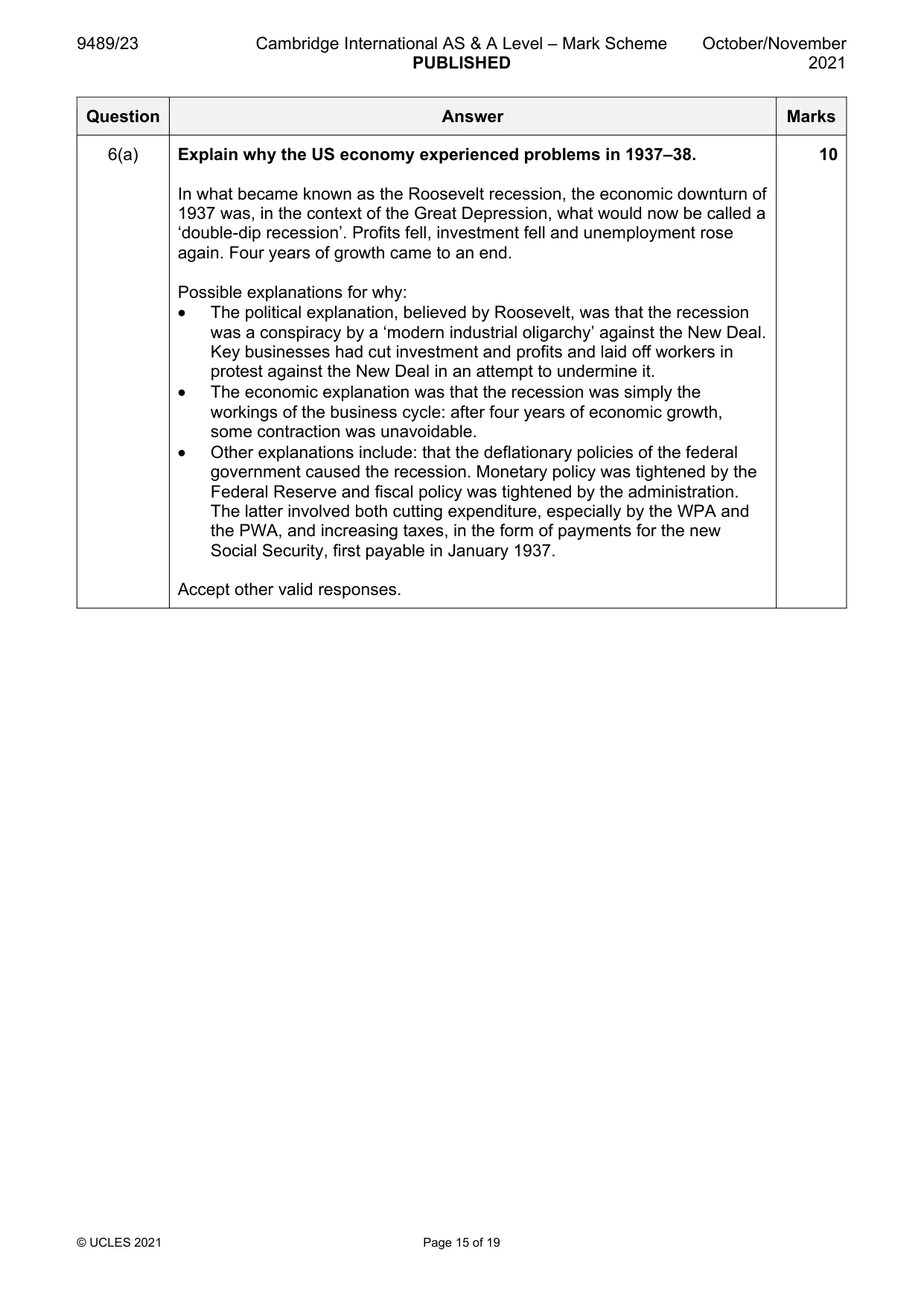
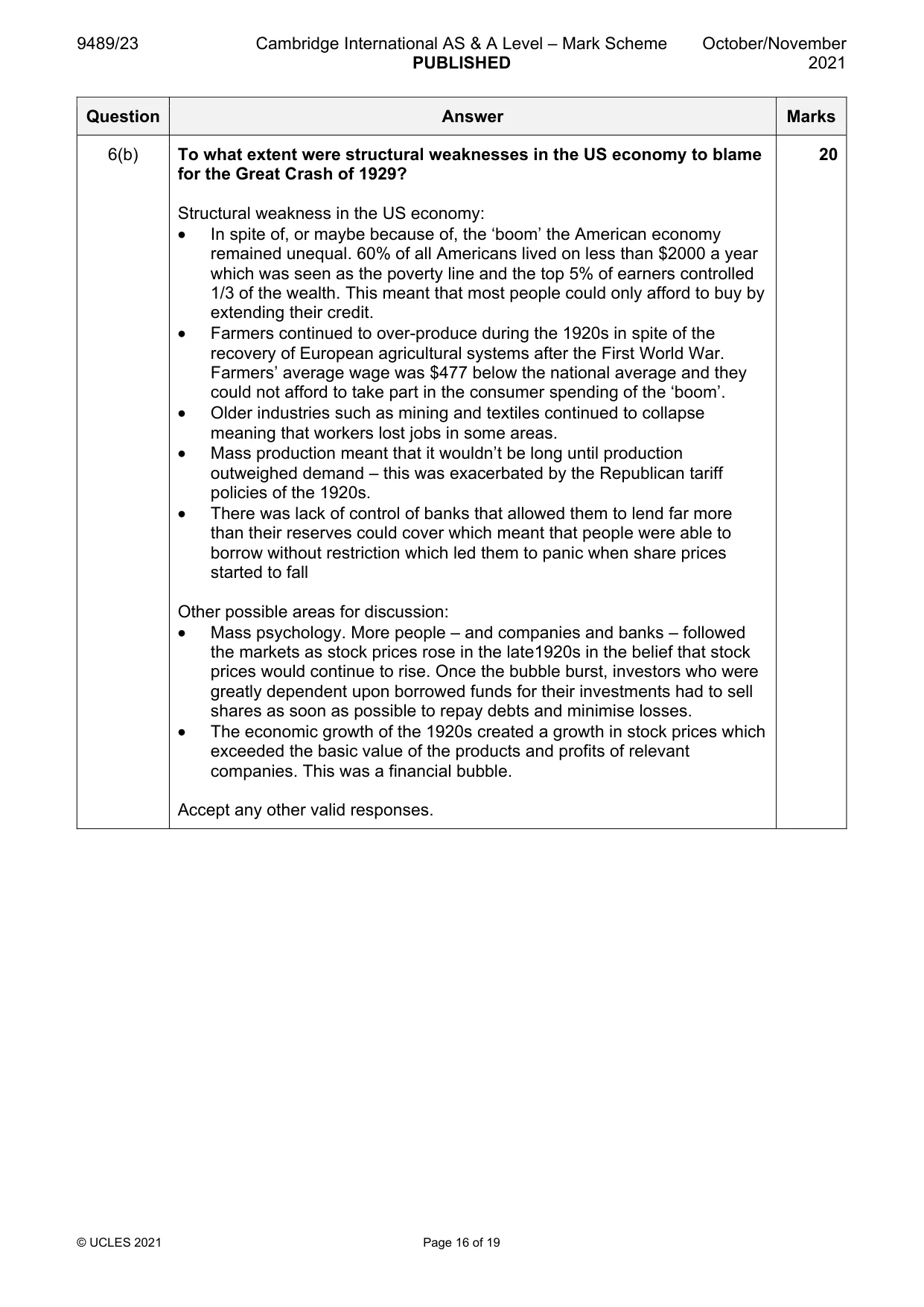
Mark scheme: 6(a) Explain why the US economy experienced problems in 1937–38. 10 In what became known as the Roosevelt recession, the economic downturn of 1937 was, in the context of the Great Depression, what would now be called a ‘double-dip recession’. Profits fell, investment fell and unemployment rose again. Four years of growth came to an end. Possible explanations for why: • The political explanation, believed by Roosevelt, was that the recession was a conspiracy by a ‘modern industrial oligarchy’ against the New Deal. Key businesses had cut investment and profits and laid off workers in protest against the New Deal in an attempt to undermine it. • The economic explanation was that the recession was simply the workings of the business cycle: after four years of economic growth, some contraction was unavoidable. • Other explanations include: that the deflationary policies of the federal government caused the recession. Monetary policy was tightened by the Federal Reserve and fiscal policy was tightened by the administration. The latter involved both cutting expenditure, especially by the WPA and the PWA, and increasing taxes, in the form of payments for the new Social Security, first payable in January 1937. Accept other valid responses. 6(b) To what extent were structural weaknesses in the US economy to blame 20 for the Great Crash of 1929? Structural weakness in the US economy: • In spite of, or maybe because of, the ‘boom’ the American economy remained unequal. 60% of all Americans lived on less than $2000 a year which was seen as the poverty line and the top 5% of earners controlled 1/3 of the wealth. This meant that most people could only afford to buy by extending their credit. • Farmers continued to over-produce during the 1920s in spite of the recovery of European agricultural systems after the First World War. Farmers’ average wage was $477 below the national average and they could not afford to take part in the consumer spending of the ‘boom’. • Older industries such as mining and textiles continued to collapse meaning that workers lost jobs in some areas. • Mass production meant that it wouldn’t be long until production outweighed demand – this was exacerbated by the Republican tariff policies of the 1920s. • There was lack of control of banks that allowed them to lend far more than their reserves could cover which meant that people were able to borrow without restriction which led them to panic when share prices started to fall Other possible areas for discussion: • Mass psychology. More people – and companies and banks – followed the markets as stock prices rose in the late1920s in the belief that stock prices would continue to rise. Once the bubble burst, investors who were greatly dependent upon borrowed funds for their investments had to sell shares as soon as possible to repay debts and minimise losses. • The economic growth of the 1920s created a growth in stock prices which exceeded the basic value of the products and profits of relevant companies. This was a financial bubble. Accept any other valid responses.
More questions on What were the causes of the Great Crash and the Great Depression?
Q7 · Empire and the emergence of world powers, 1870–1919 (a) Explain why the USA needed to…
7 Empire and the emergence of world powers, 1870–1919 (a) Explain why the USA needed to expand its naval resources after the Spanish‒American War. [10] (b) To what extent were economic motives the reason for imperial expansion amongst the major European nations in the late nineteenth century? [20]
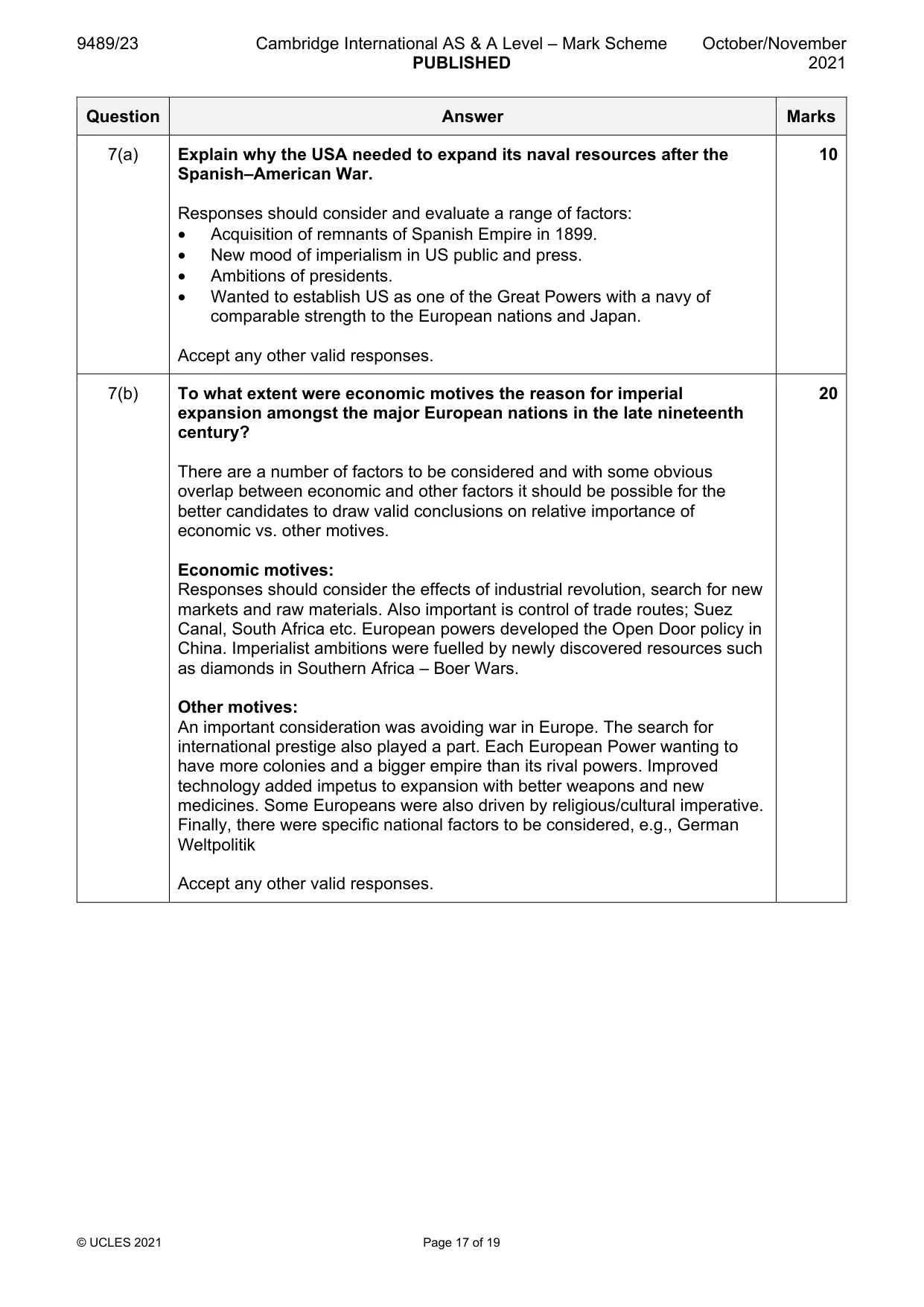
Mark scheme: 7(a) Explain why the USA needed to expand its naval resources after the 10 Spanish‒American War. Responses should consider and evaluate a range of factors: • Acquisition of remnants of Spanish Empire in 1899. • New mood of imperialism in US public and press. • Ambitions of presidents. • Wanted to establish US as one of the Great Powers with a navy of comparable strength to the European nations and Japan. Accept any other valid responses. 7(b) To what extent were economic motives the reason for imperial 20 expansion amongst the major European nations in the late nineteenth century? There are a number of factors to be considered and with some obvious overlap between economic and other factors it should be possible for the better candidates to draw valid conclusions on relative importance of economic vs. other motives. Economic motives: Responses should consider the effects of industrial revolution, search for new markets and raw materials. Also important is control of trade routes; Suez Canal, South Africa etc. European powers developed the Open Door policy in China. Imperialist ambitions were fuelled by newly discovered resources such as diamonds in Southern Africa – Boer Wars. Other motives: An important consideration was avoiding war in Europe. The search for international prestige also played a part. Each European Power wanting to have more colonies and a bigger empire than its rival powers. Improved technology added impetus to expansion with better weapons and new medicines. Some Europeans were also driven by religious/cultural imperative. Finally, there were specific national factors to be considered, e.g., German Weltpolitik Accept any other valid responses.
More questions on Why was imperialism a significant force in Africa from 1870?
Q8 · The League of Nations and international relations in the 1920s (a) Explain why the League…
8 The League of Nations and international relations in the 1920s (a) Explain why the League of Nations was involved in Eastern Europe in the 1920s. [10] (b) How successful was the Washington Naval Conference of 1921–22? [20]
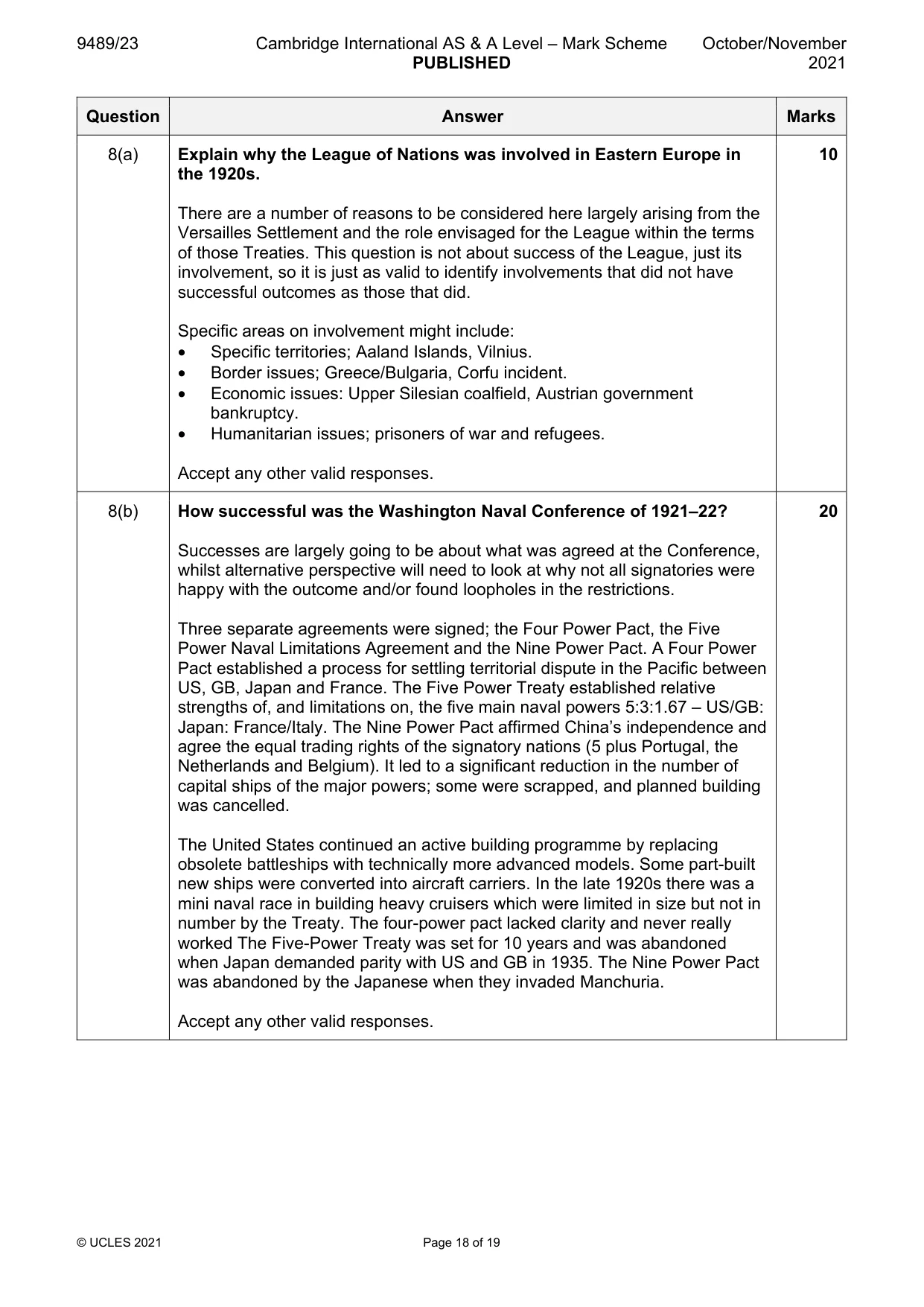
Mark scheme: 8(a) Explain why the League of Nations was involved in Eastern Europe in 10 the 1920s. There are a number of reasons to be considered here largely arising from the Versailles Settlement and the role envisaged for the League within the terms of those Treaties. This question is not about success of the League, just its involvement, so it is just as valid to identify involvements that did not have successful outcomes as those that did. Specific areas on involvement might include: • Specific territories; Aaland Islands, Vilnius. • Border issues; Greece/Bulgaria, Corfu incident. • Economic issues: Upper Silesian coalfield, Austrian government bankruptcy. • Humanitarian issues; prisoners of war and refugees. Accept any other valid responses. 8(b) How successful was the Washington Naval Conference of 1921‒22? 20 Successes are largely going to be about what was agreed at the Conference, whilst alternative perspective will need to look at why not all signatories were happy with the outcome and/or found loopholes in the restrictions. Three separate agreements were signed; the Four Power Pact, the Five Power Naval Limitations Agreement and the Nine Power Pact. A Four Power Pact established a process for settling territorial dispute in the Pacific between US, GB, Japan and France. The Five Power Treaty established relative strengths of, and limitations on, the five main naval powers 5:3:1.67 – US/GB: Japan: France/Italy. The Nine Power Pact affirmed China’s independence and agree the equal trading rights of the signatory nations (5 plus Portugal, the Netherlands and Belgium). It led to a significant reduction in the number of capital ships of the major powers; some were scrapped, and planned building was cancelled. The United States continued an active building programme by replacing obsolete battleships with technically more advanced models. Some part-built new ships were converted into aircraft carriers. In the late 1920s there was a mini naval race in building heavy cruisers which were limited in size but not in number by the Treaty. The four-power pact lacked clarity and never really worked The Five-Power Treaty was set for 10 years and was abandoned when Japan demanded parity with US and GB in 1935. The Nine Power Pact was abandoned by the Japanese when they invaded Manchuria. Accept any other valid responses.
More questions on How and why did international relations improve, 1924–29?
Q9 · China and Japan, 1912–45 (a) Explain why Japan joined the Anti-Comintern Pact
9 China and Japan, 1912–45 (a) Explain why Japan joined the Anti-Comintern Pact. [10] (b) How important was the war against Japan in strengthening the position of the Chinese Communist Party by 1945? [20]
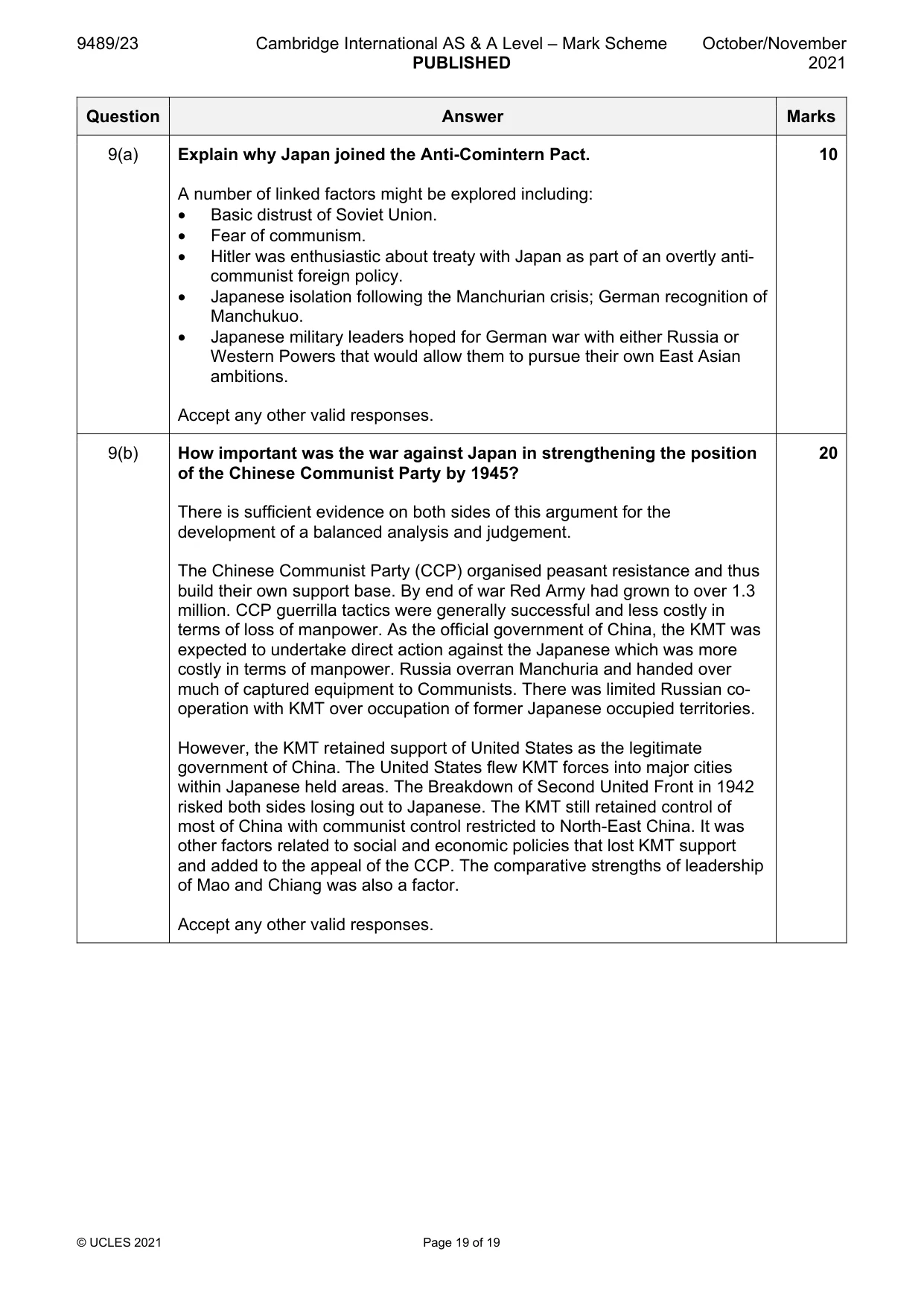
Mark scheme: 9(a) Explain why Japan joined the Anti-Comintern Pact. 10 A number of linked factors might be explored including: • Basic distrust of Soviet Union. • Fear of communism. • Hitler was enthusiastic about treaty with Japan as part of an overtly anti- communist foreign policy. • Japanese isolation following the Manchurian crisis; German recognition of Manchukuo. • Japanese military leaders hoped for German war with either Russia or Western Powers that would allow them to pursue their own East Asian ambitions. Accept any other valid responses. 9(b) How important was the war against Japan in strengthening the position 20 of the Chinese Communist Party by 1945? There is sufficient evidence on both sides of this argument for the development of a balanced analysis and judgement. The Chinese Communist Party (CCP) organised peasant resistance and thus build their own support base. By end of war Red Army had grown to over 1.3 million. CCP guerrilla tactics were generally successful and less costly in terms of loss of manpower. As the official government of China, the KMT was expected to undertake direct action against the Japanese which was more costly in terms of manpower. Russia overran Manchuria and handed over much of captured equipment to Communists. There was limited Russian co- operation with KMT over occupation of former Japanese occupied territories. However, the KMT retained support of United States as the legitimate government of China. The United States flew KMT forces into major cities within Japanese held areas. The Breakdown of Second United Front in 1942 risked both sides losing out to Japanese. The KMT still retained control of most of China with communist control restricted to North-East China. It was other factors related to social and economic policies that lost KMT support and added to the appeal of the CCP. The comparative strengths of leadership of Mao and Chiang was also a factor. Accept any other valid responses.
More questions on Why did Japan emerge as a world power and what was the impact on international
What was in this paper
The subtopics covered by these 9 questions, and how many questions each got. Open one in a new tab to see every Cambridge question on it.
1How successful was the Progressive Movement from 1890 to 1920?1What were the causes and immediate consequences of the 1789 Revolution?1What were the causes and outcomes of the 1905 Revolution up to 1914?1What were the causes of the Great Crash and the Great Depression?1What were the consequences of the rapid economic growth after 1870?1Why did Japan emerge as a world power and what was the impact on international1Why did the Civil War last four years?1Why was imperialism a significant force in Africa from 1870?1What you needed in this session
Cambridge’s own grade thresholds for 2021 Oct/Nov, Paper 2 · Variant 3. A higher threshold means an easier paper — the bar moves with how the cohort did.