Cambridge A Level History 9489 — 2025 Oct/Nov Paper 2 · Variant 1
9489/21/O/N/25 · 9 questions · 60 marks · ≈68 min
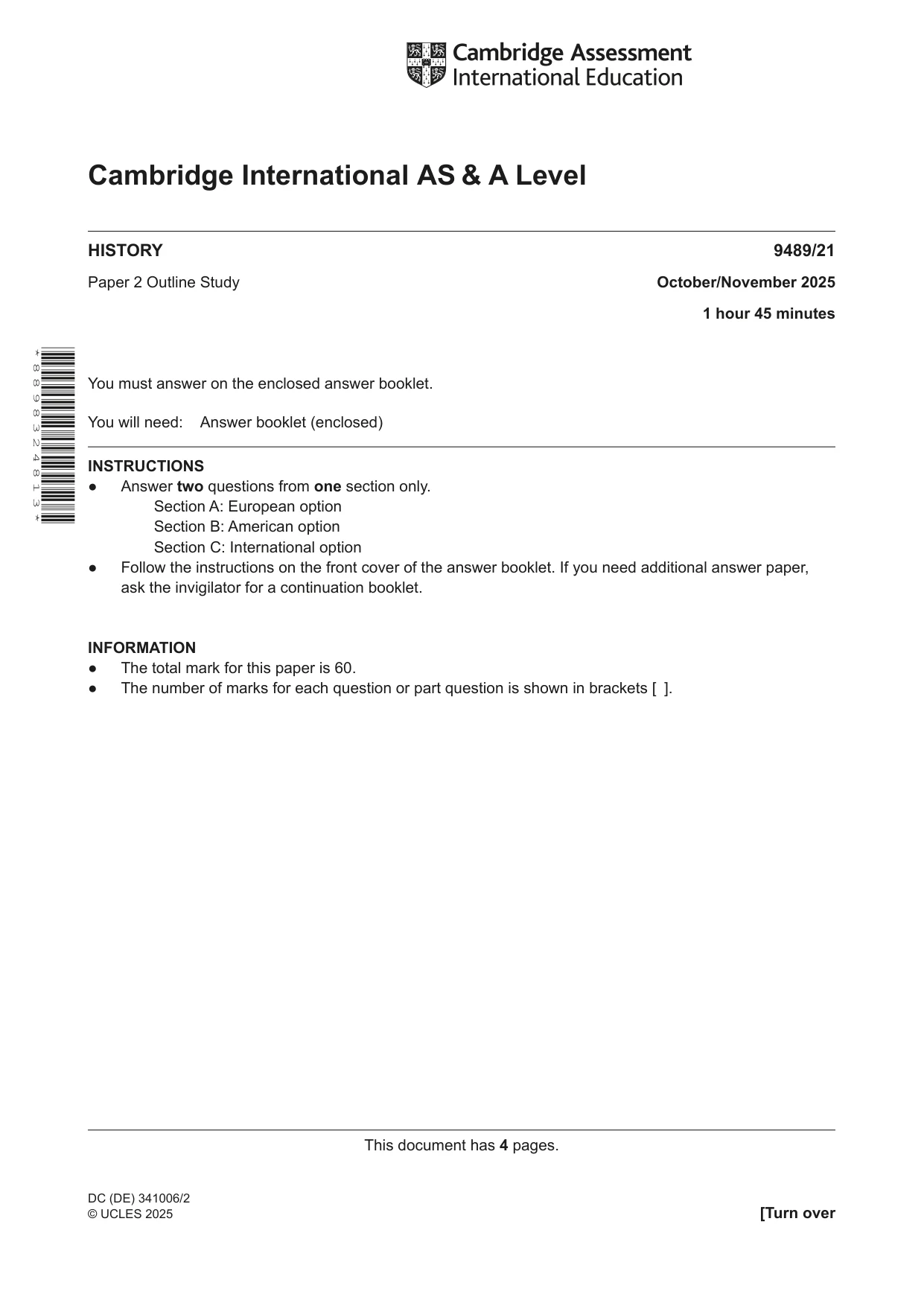
The question paper and its mark scheme, free to read here and free to download. This is Cambridge’s own paper, exactly as it was sat.
Question paper4 pages
Mark scheme23 pages
Answers below. Sit the paper first if you are practising.

Questions as text
Q1 · France, 1774–1814 (a) Explain why the royal family’s attempted escape from Paris in June…
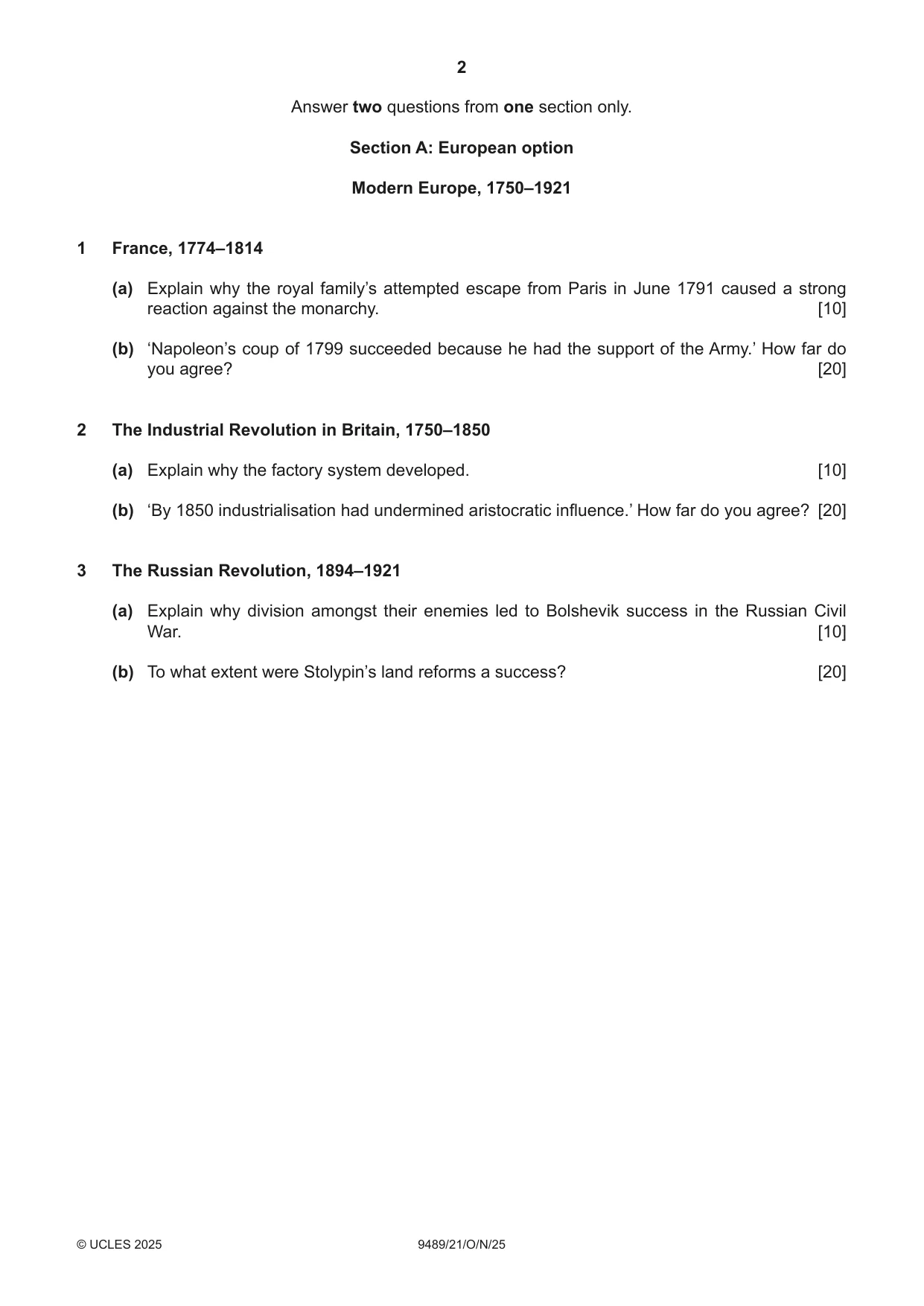
1 France, 1774–1814 (a) Explain why the royal family’s attempted escape from Paris in June 1791 caused a strong reaction against the monarchy. [10] (b) ‘Napoleon’s coup of 1799 succeeded because he had the support of the Army.’ How far do you agree? [20]
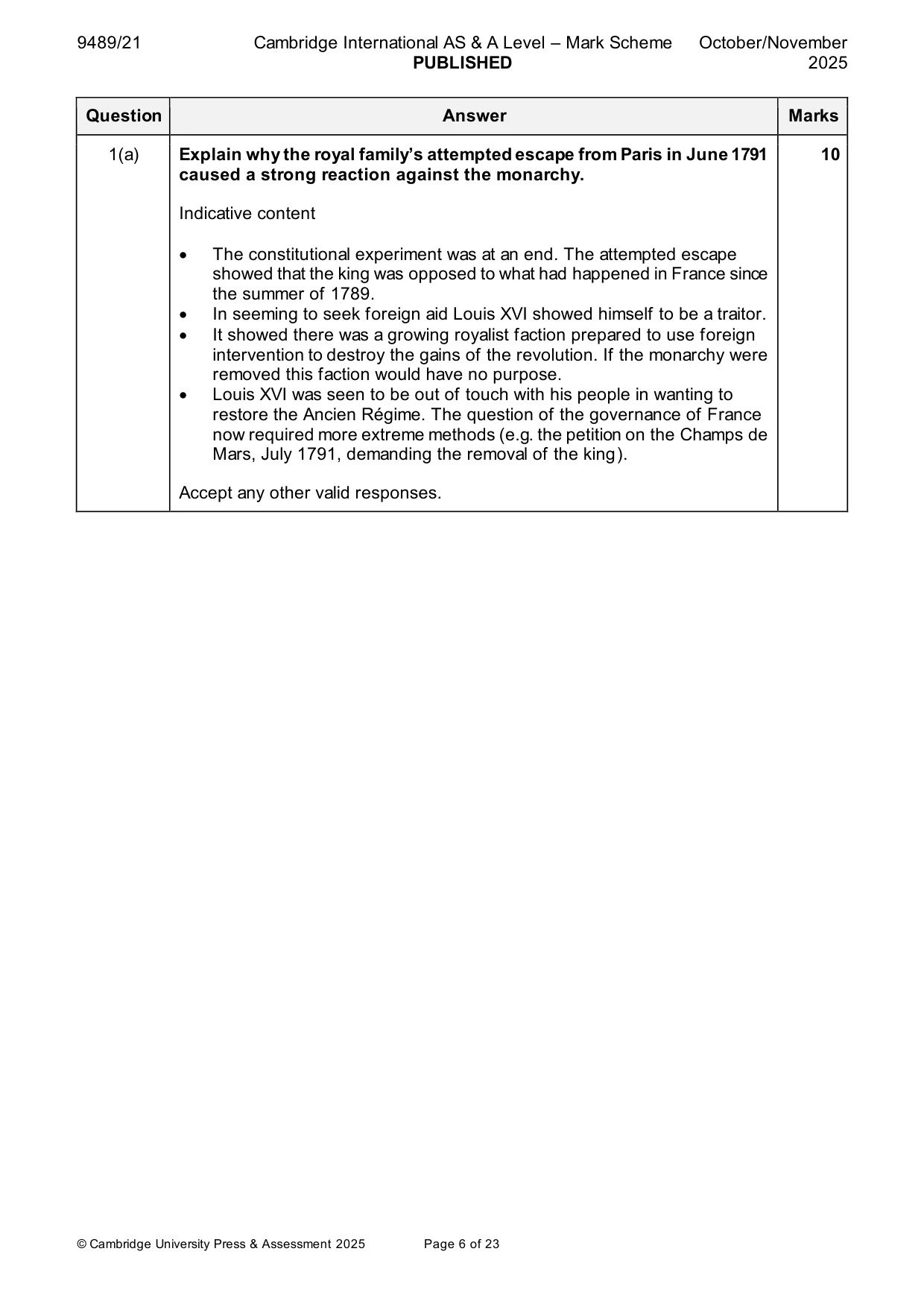
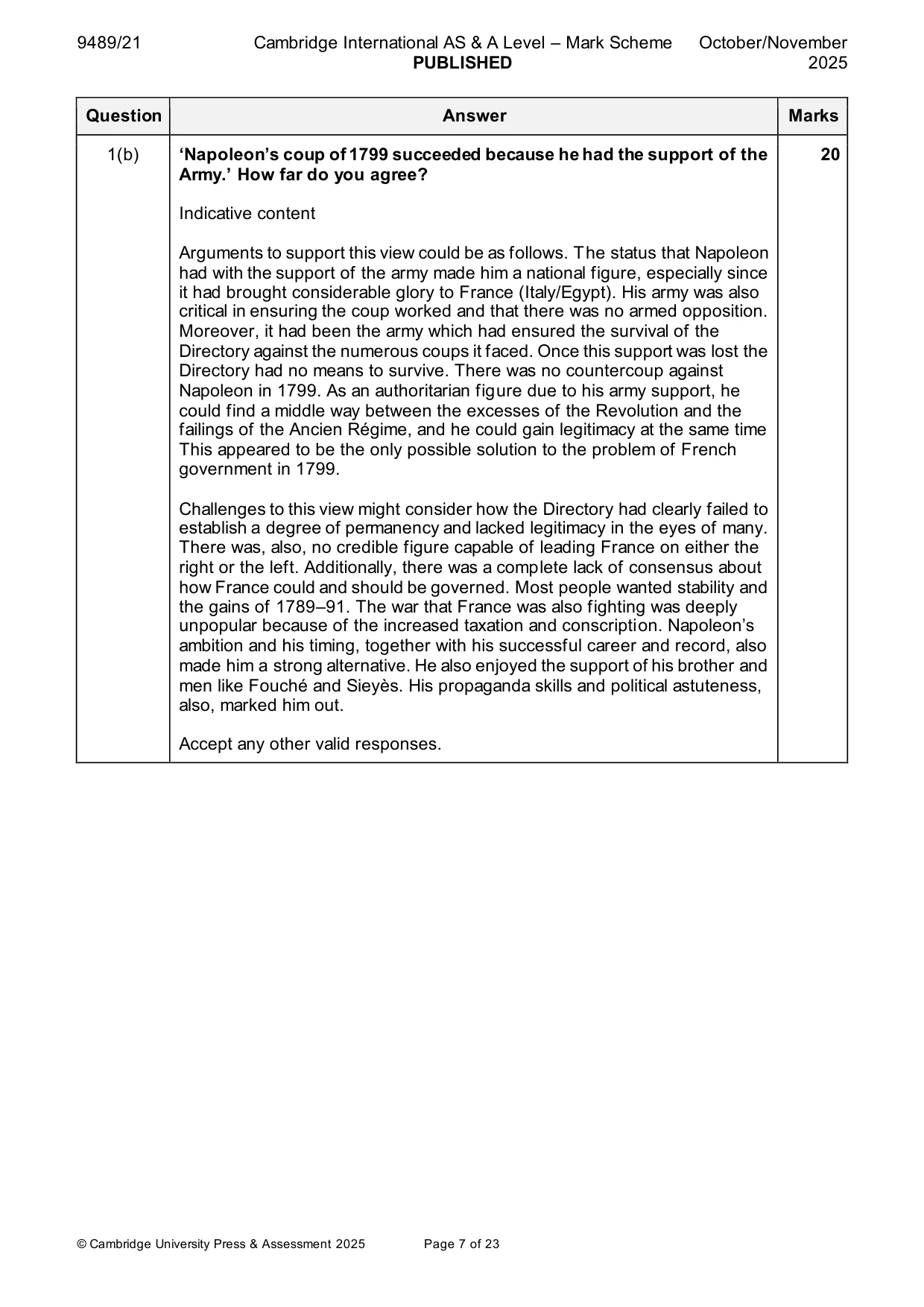
Mark scheme: Question Answer Marks 1(a) Explain why the royal family’s attempted escape from Paris in June 1791 10 caused a strong reaction against the monarchy. Indicative content • The constitutional experiment was at an end. The attempted escape showed that the king was opposed to what had happened in France since the summer of 1789. • In seeming to seek foreign aid Louis XVI showed himself to be a traitor. • It showed there was a growing royalist faction prepared to use foreign intervention to destroy the gains of the revolution. If the monarchy were removed this faction would have no purpose. • Louis XVI was seen to be out of touch with his people in wanting to restore the Ancien Régime. The question of the governance of France now required more extreme methods (e.g. the petition on the Champs de Mars, July 1791, demanding the removal of the king). Accept any other valid responses. 1(b) ‘Napoleon’s coup of 1799 succeeded because he had the support of the 20 Army.’ How far do you agree? Indicative content Arguments to support this view could be as follows. The status that Napoleon had with the support of the army made him a national figure, especially since it had brought considerable glory to France (Italy/Egypt). His army was also critical in ensuring the coup worked and that there was no armed opposition. Moreover, it had been the army which had ensured the survival of the Directory against the numerous coups it faced. Once this support was lost the Directory had no means to survive. There was no countercoup against Napoleon in 1799. As an authoritarian figure due to his army support, he could find a middle way between the excesses of the Revolution and the failings of the Ancien Régime, and he could gain legitimacy at the same time This appeared to be the only possible solution to the problem of French government in 1799. Challenges to this view might consider how the Directory had clearly failed to establish a degree of permanency and lacked legitimacy in the eyes of many. There was, also, no credible figure capable of leading France on either the right or the left. Additionally, there was a complete lack of consensus about how France could and should be governed. Most people wanted stability and the gains of 1789–91. The war that France was also fighting was deeply unpopular because of the increased taxation and conscription. Napoleon’s ambition and his timing, together with his successful career and record, also made him a strong alternative. He also enjoyed the support of his brother and men like Fouché and Sieyès. His propaganda skills and political astuteness, also, marked him out. Accept any other valid responses.
More questions on What caused the rise and fall of Napoleon Bonaparte?
Q2 · The Industrial Revolution in Britain, 1750–1850 (a) Explain why the factory system…
2 The Industrial Revolution in Britain, 1750–1850 (a) Explain why the factory system developed. [10] (b) ‘By 1850 industrialisation had undermined aristocratic influence.’ How far do you agree? [20]
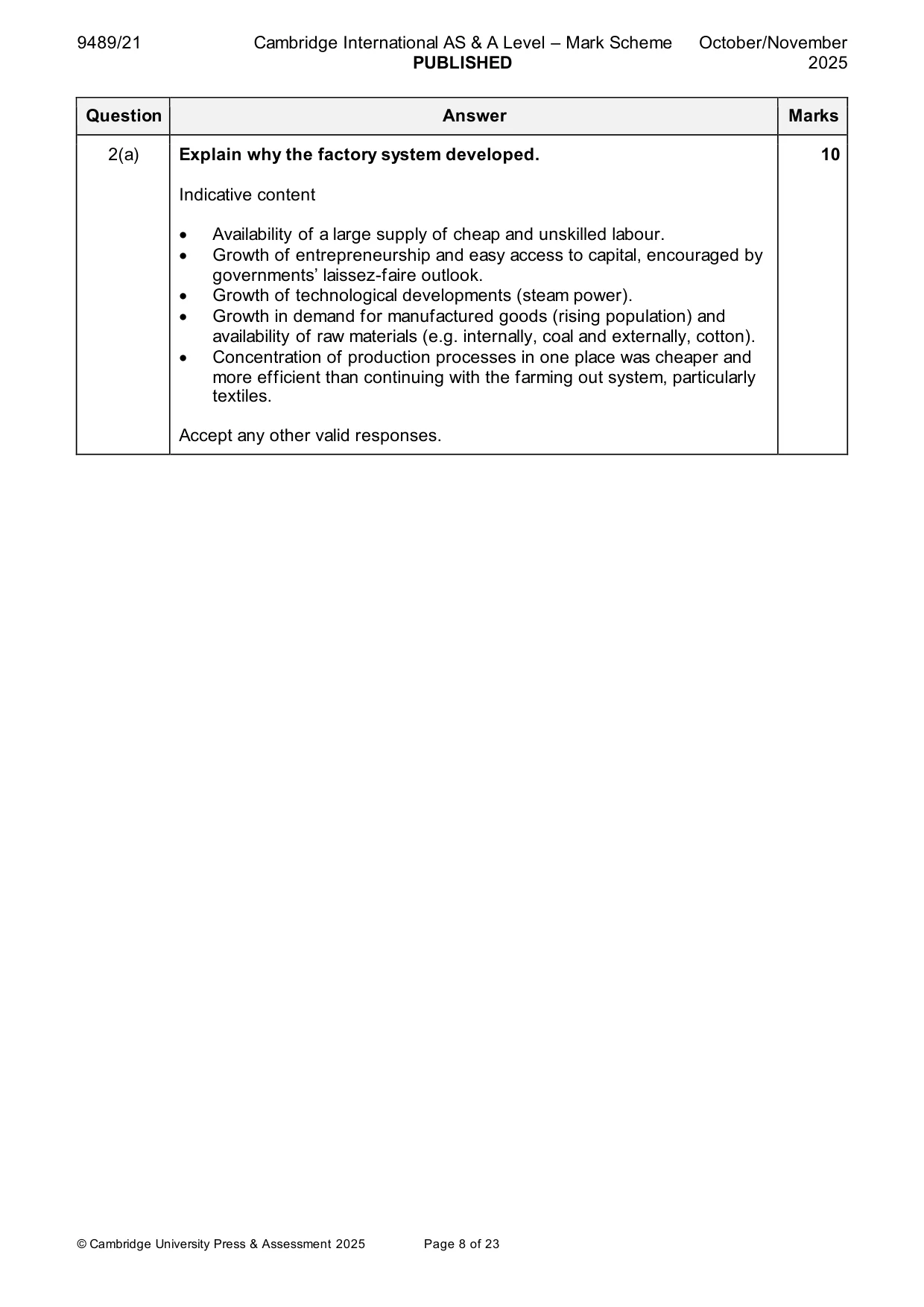
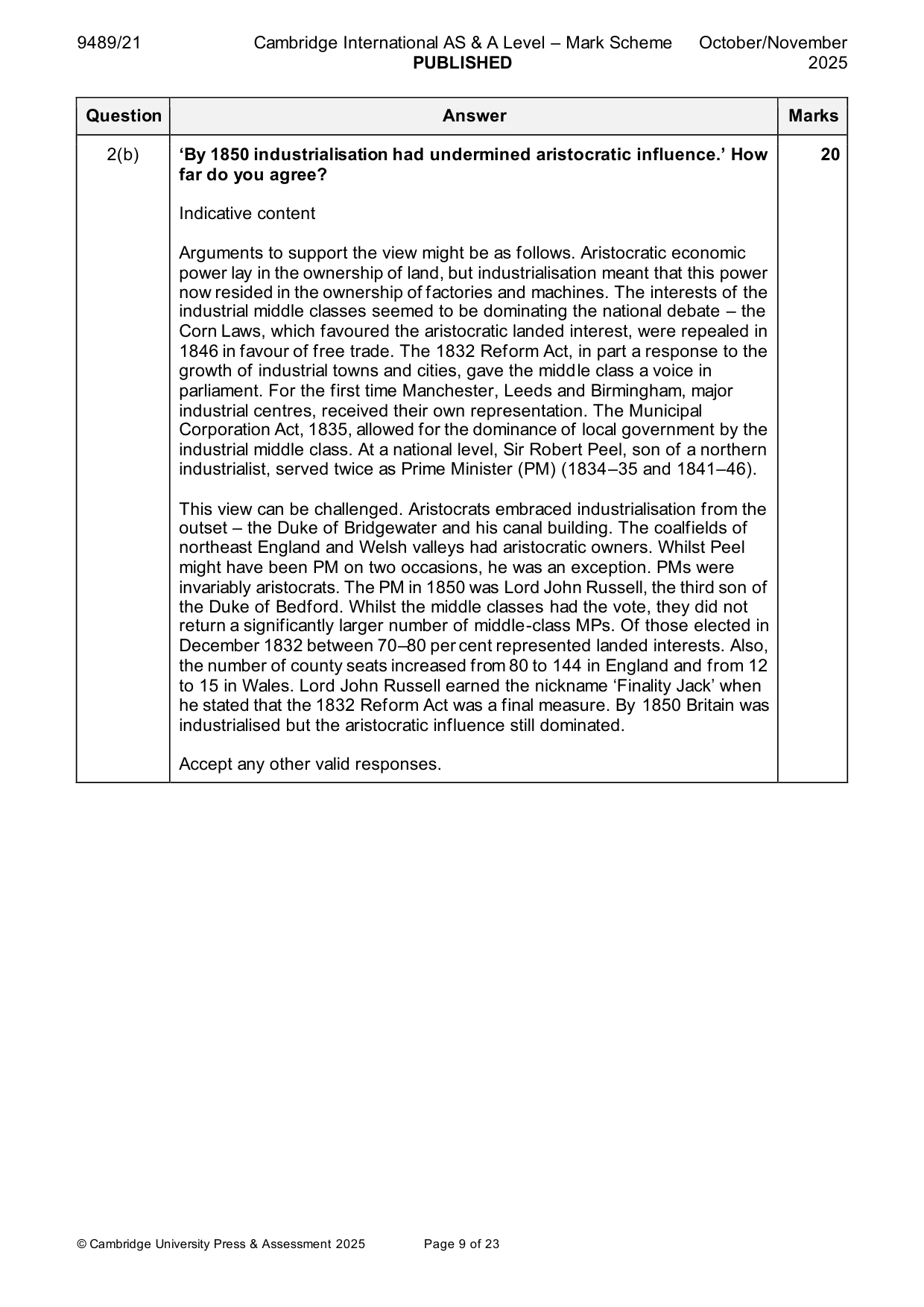
Mark scheme: 2(a) Explain why the factory system developed. 10 Indicative content • Availability of a large supply of cheap and unskilled labour. • Growth of entrepreneurship and easy access to capital, encouraged by governments’ laissez-faire outlook. • Growth of technological developments (steam power). • Growth in demand for manufactured goods (rising population) and availability of raw materials (e.g. internally, coal and externally, cotton). • Concentration of production processes in one place was cheaper and more efficient than continuing with the farming out system, particularly textiles. Accept any other valid responses. 2(b) ‘By 1850 industrialisation had undermined aristocratic influence.’ How 20 far do you agree? Indicative content Arguments to support the view might be as follows. Aristocratic economic power lay in the ownership of land, but industrialisation meant that this power now resided in the ownership of factories and machines. The interests of the industrial middle classes seemed to be dominating the national debate – the Corn Laws, which favoured the aristocratic landed interest, were repealed in 1846 in favour of free trade. The 1832 Reform Act, in part a response to the growth of industrial towns and cities, gave the middle class a voice in parliament. For the first time Manchester, Leeds and Birmingham, major industrial centres, received their own representation. The Municipal Corporation Act, 1835, allowed for the dominance of local government by the industrial middle class. At a national level, Sir Robert Peel, son of a northern industrialist, served twice as Prime Minister (PM) (1834–35 and 1841–46). This view can be challenged. Aristocrats embraced industrialisation from the outset – the Duke of Bridgewater and his canal building. The coalfields of northeast England and Welsh valleys had aristocratic owners. Whilst Peel might have been PM on two occasions, he was an exception. PMs were invariably aristocrats. The PM in 1850 was Lord John Russell, the third son of the Duke of Bedford. Whilst the middle classes had the vote, they did not return a significantly larger number of middle-class MPs. Of those elected in December 1832 between 70–80 per cent represented landed interests. Also, the number of county seats increased from 80 to 144 in England and from 12 to 15 in Wales. Lord John Russell earned the nickname ‘Finality Jack’ when he stated that the 1832 Reform Act was a final measure. By 1850 Britain was industrialised but the aristocratic influence still dominated. Accept any other valid responses.
More questions on What were the consequences of the rapid economic growth after 1870?
Q3 · The Russian Revolution, 1894–1921 (a) Explain why division amongst their enemies led to…
3 The Russian Revolution, 1894–1921 (a) Explain why division amongst their enemies led to Bolshevik success in the Russian Civil War. [10] (b) To what extent were Stolypin’s land reforms a success? [20]
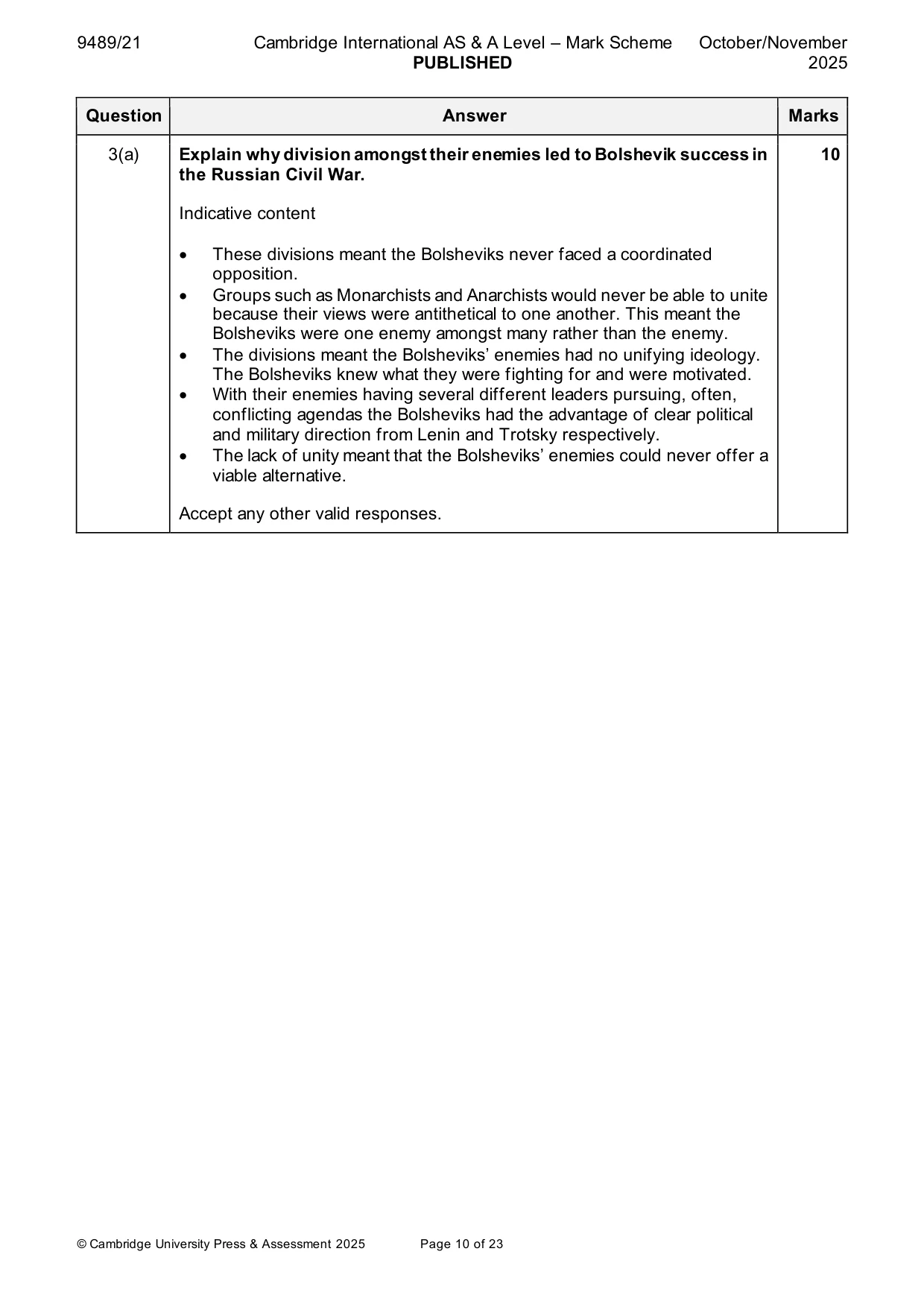
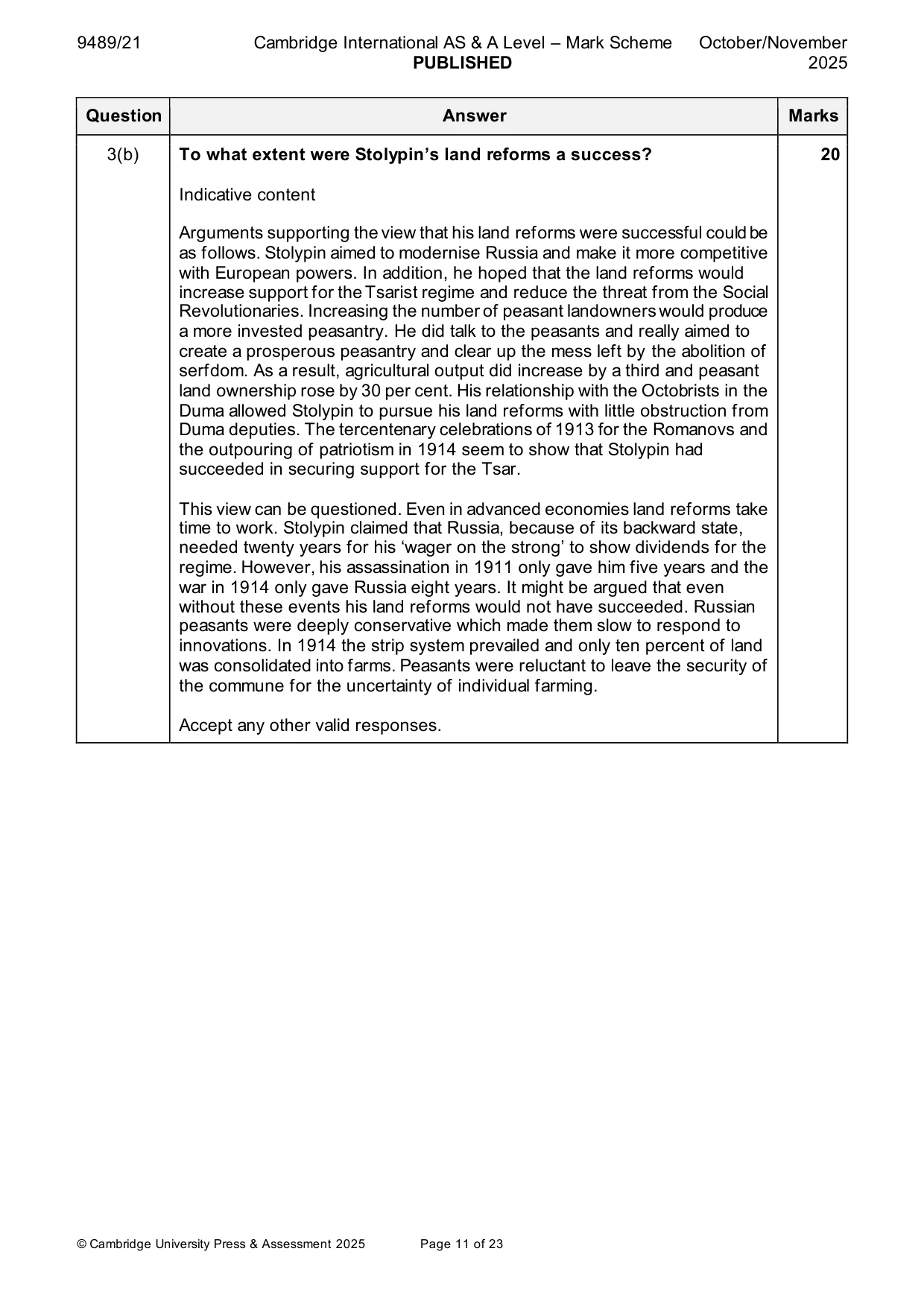
Mark scheme: 3(a) Explain why division amongst their enemies led to Bolshevik success in 10 the Russian Civil War. Indicative content • These divisions meant the Bolsheviks never faced a coordinated opposition. • Groups such as Monarchists and Anarchists would never be able to unite because their views were antithetical to one another. This meant the Bolsheviks were one enemy amongst many rather than the enemy. • The divisions meant the Bolsheviks’ enemies had no unifying ideology. The Bolsheviks knew what they were fighting for and were motivated. • With their enemies having several different leaders pursuing, often, conflicting agendas the Bolsheviks had the advantage of clear political and military direction from Lenin and Trotsky respectively. • The lack of unity meant that the Bolsheviks’ enemies could never offer a viable alternative. Accept any other valid responses. 3(b) To what extent were Stolypin’s land reforms a success? 20 Indicative content Arguments supporting the view that his land reforms were successful could be as follows. Stolypin aimed to modernise Russia and make it more competitive with European powers. In addition, he hoped that the land reforms would increase support for the Tsarist regime and reduce the threat from the Social Revolutionaries. Increasing the number of peasant landowners would produce a more invested peasantry. He did talk to the peasants and really aimed to create a prosperous peasantry and clear up the mess left by the abolition of serfdom. As a result, agricultural output did increase by a third and peasant land ownership rose by 30 per cent. His relationship with the Octobrists in the Duma allowed Stolypin to pursue his land reforms with little obstruction from Duma deputies. The tercentenary celebrations of 1913 for the Romanovs and the outpouring of patriotism in 1914 seem to show that Stolypin had succeeded in securing support for the Tsar. This view can be questioned. Even in advanced economies land reforms take time to work. Stolypin claimed that Russia, because of its backward state, needed twenty years for his ‘wager on the strong’ to show dividends for the regime. However, his assassination in 1911 only gave him five years and the war in 1914 only gave Russia eight years. It might be argued that even without these events his land reforms would not have succeeded. Russian peasants were deeply conservative which made them slow to respond to innovations. In 1914 the strip system prevailed and only ten percent of land was consolidated into farms. Peasants were reluctant to leave the security of the commune for the uncertainty of individual farming. Accept any other valid responses.
More questions on What were the causes and outcomes of the 1905 Revolution up to 1914?
Q4 · Civil War and Reconstruction, 1861–77 (a) Explain why Grant’s enforcement of…
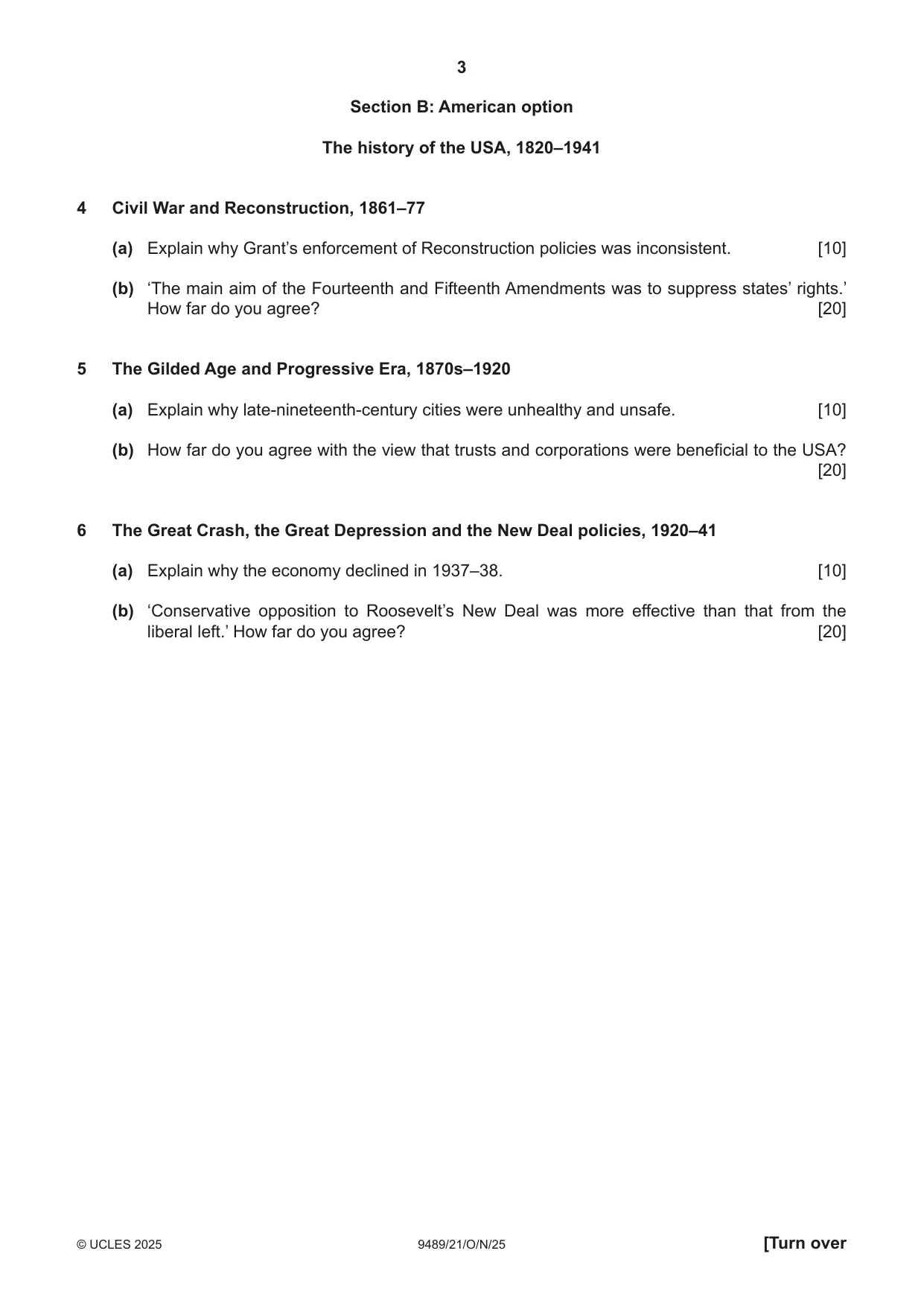
4 Civil War and Reconstruction, 1861–77 (a) Explain why Grant’s enforcement of Reconstruction policies was inconsistent. [10] (b) ‘The main aim of the Fourteenth and Fifteenth Amendments was to suppress states’ rights.’ How far do you agree? [20]
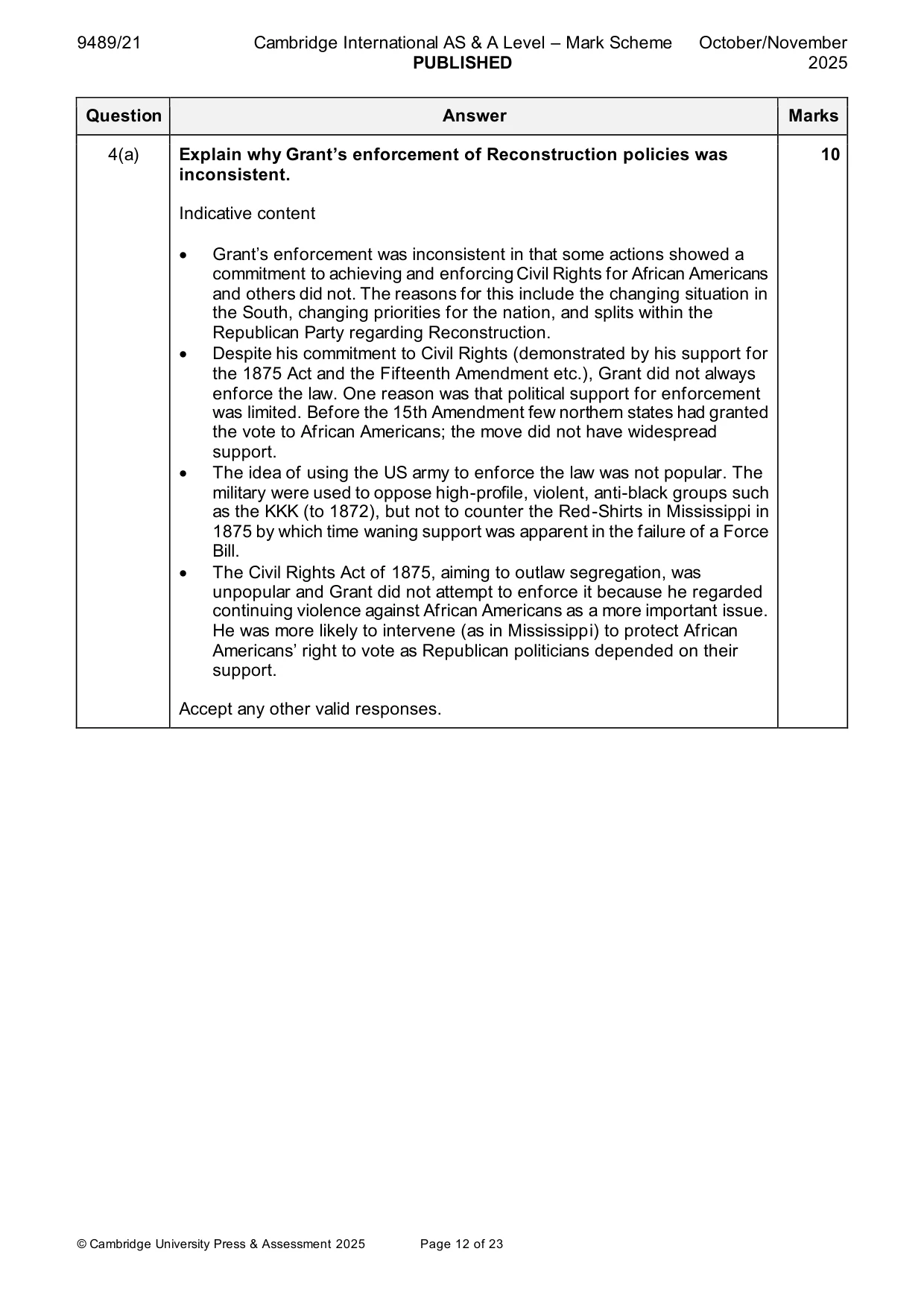
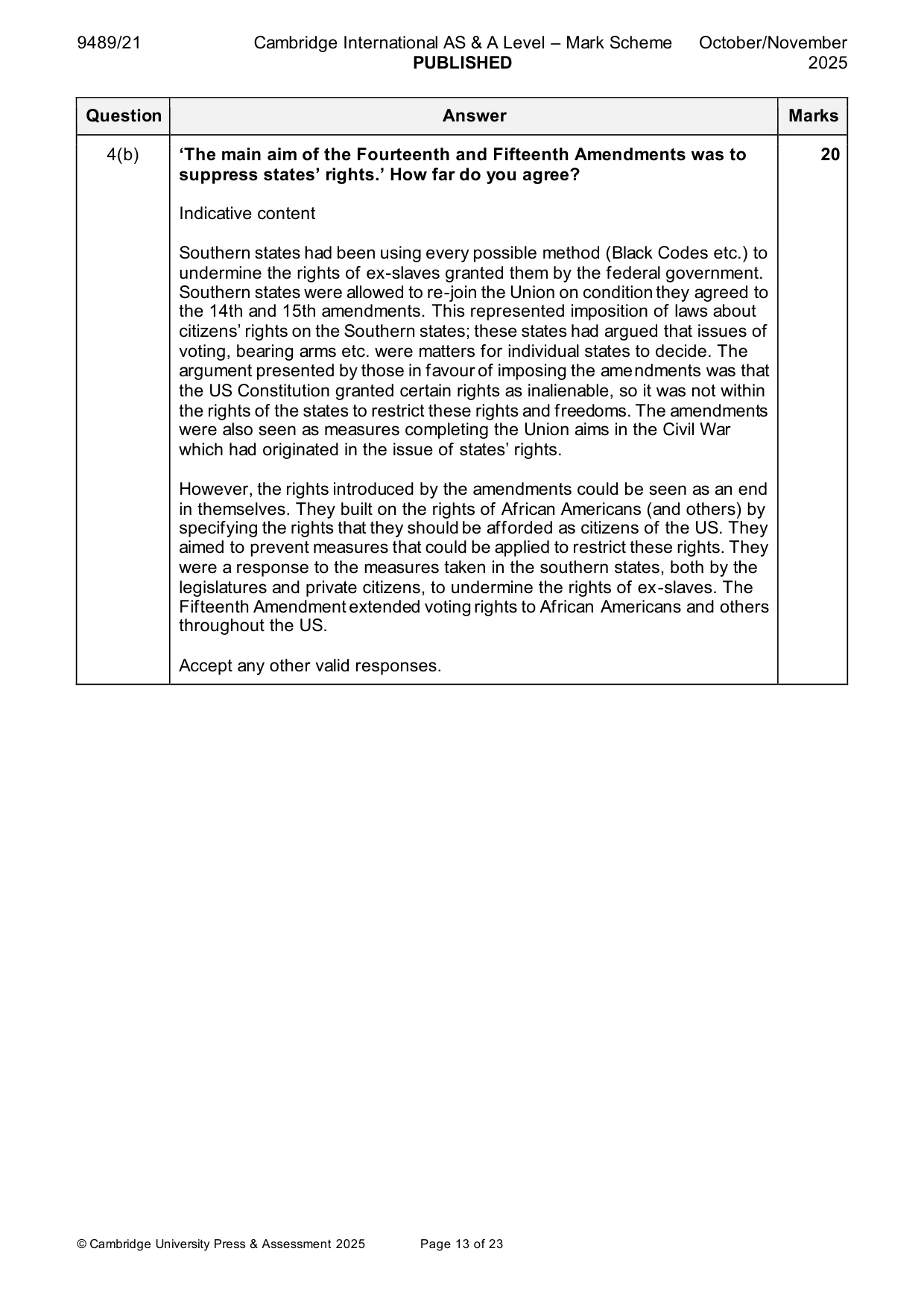
Mark scheme: 4(a) Explain why Grant’s enforcement of Reconstruction policies was 10 inconsistent. Indicative content • Grant’s enforcement was inconsistent in that some actions showed a commitment to achieving and enforcing Civil Rights for African Americans and others did not. The reasons for this include the changing situation in the South, changing priorities for the nation, and splits within the Republican Party regarding Reconstruction. • Despite his commitment to Civil Rights (demonstrated by his support for the 1875 Act and the Fifteenth Amendment etc.), Grant did not always enforce the law. One reason was that political support for enforcement was limited. Before the 15th Amendment few northern states had granted the vote to African Americans; the move did not have widespread support. • The idea of using the US army to enforce the law was not popular. The military were used to oppose high-profile, violent, anti-black groups such as the KKK (to 1872), but not to counter the Red-Shirts in Mississippi in 1875 by which time waning support was apparent in the failure of a Force Bill. • The Civil Rights Act of 1875, aiming to outlaw segregation, was unpopular and Grant did not attempt to enforce it because he regarded continuing violence against African Americans as a more important issue. He was more likely to intervene (as in Mississippi) to protect African Americans’ right to vote as Republican politicians depended on their support. Accept any other valid responses. 4(b) ‘The main aim of the Fourteenth and Fifteenth Amendments was to 20 suppress states’ rights.’ How far do you agree? Indicative content Southern states had been using every possible method (Black Codes etc.) to undermine the rights of ex-slaves granted them by the federal government. Southern states were allowed to re-join the Union on condition they agreed to the 14th and 15th amendments. This represented imposition of laws about citizens’ rights on the Southern states; these states had argued that issues of voting, bearing arms etc. were matters for individual states to decide. The argument presented by those in favour of imposing the amendments was that the US Constitution granted certain rights as inalienable, so it was not within the rights of the states to restrict these rights and freedoms. The amendments were also seen as measures completing the Union aims in the Civil War which had originated in the issue of states’ rights. However, the rights introduced by the amendments could be seen as an end in themselves. They built on the rights of African Americans (and others) by specifying the rights that they should be afforded as citizens of the US. They aimed to prevent measures that could be applied to restrict these rights. They were a response to the measures taken in the southern states, both by the legislatures and private citizens, to undermine the rights of ex-slaves. The Fifteenth Amendment extended voting rights to African Americans and others throughout the US. Accept any other valid responses.
More questions on What were the aims of Reconstruction and how successful was it?
Q5 · The Gilded Age and Progressive Era, 1870s–1920 (a) Explain why late-nineteenth-century…
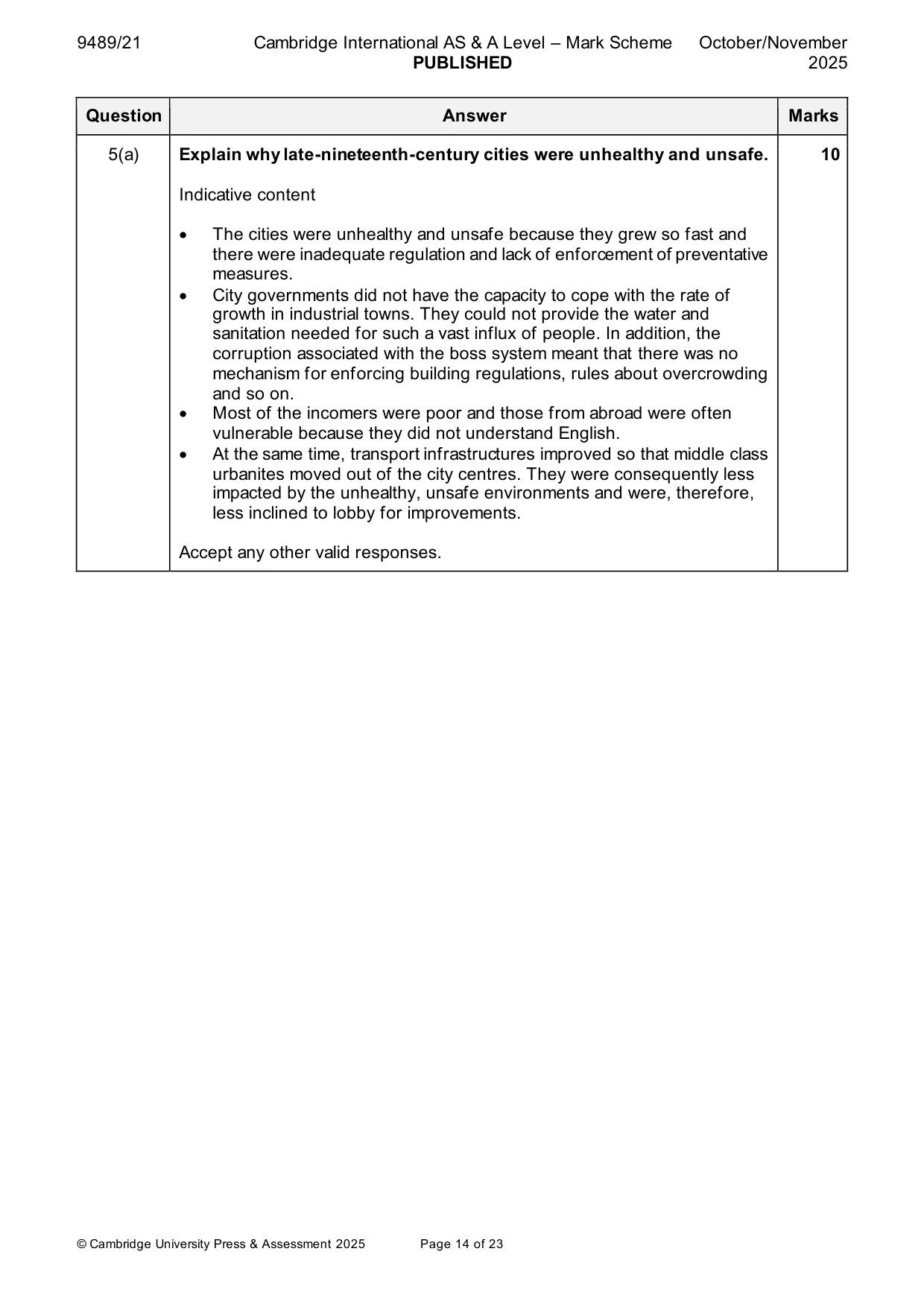
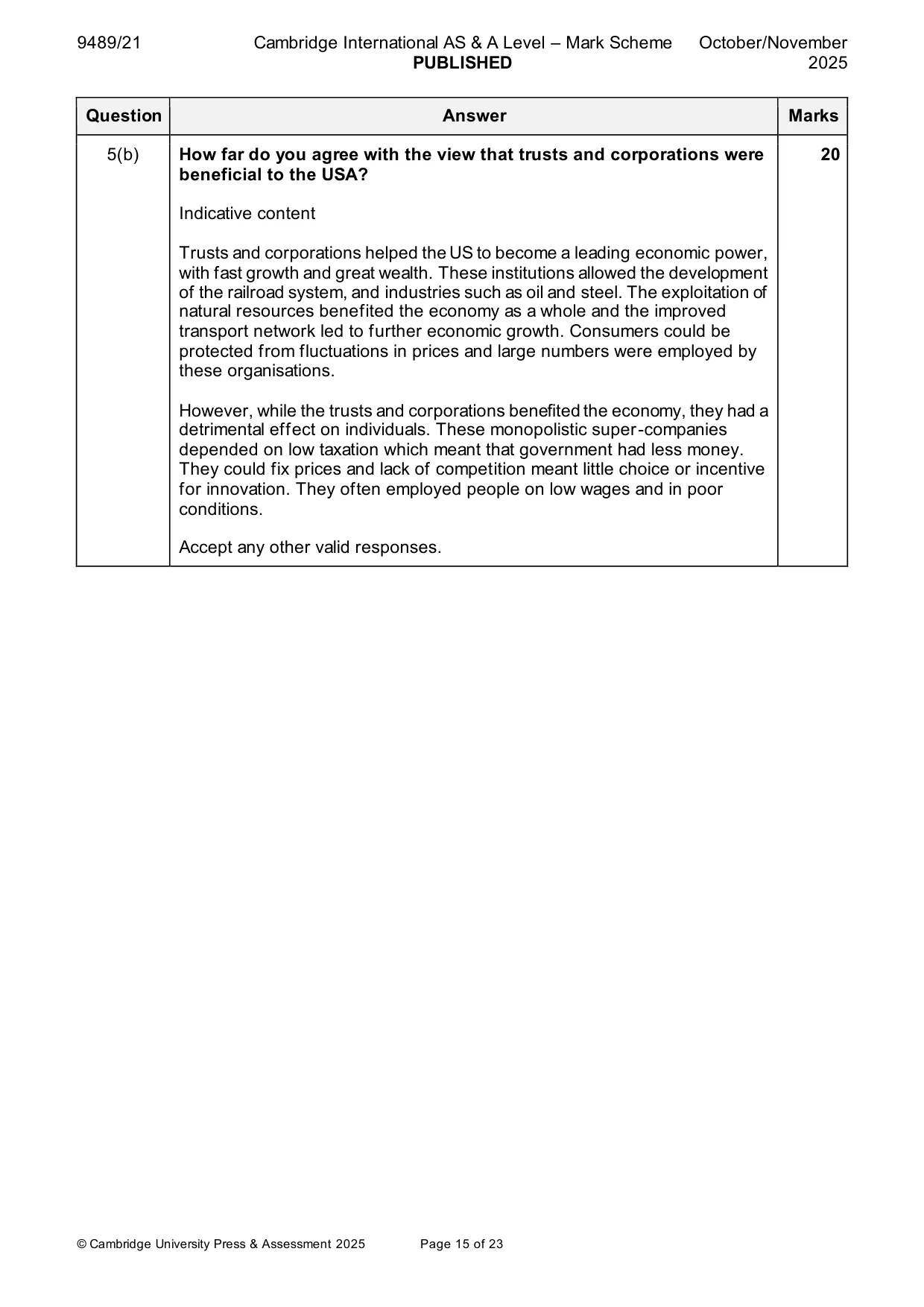
5 The Gilded Age and Progressive Era, 1870s–1920 (a) Explain why late-nineteenth-century cities were unhealthy and unsafe. [10] (b) How far do you agree with the view that trusts and corporations were beneficial to the USA? [20]
Mark scheme: 5(a) Explain why late-nineteenth-century cities were unhealthy and unsafe. 10 Indicative content • The cities were unhealthy and unsafe because they grew so fast and there were inadequate regulation and lack of enforcement of preventative measures. • City governments did not have the capacity to cope with the rate of growth in industrial towns. They could not provide the water and sanitation needed for such a vast influx of people. In addition, the corruption associated with the boss system meant that there was no mechanism for enforcing building regulations, rules about overcrowding and so on. • Most of the incomers were poor and those from abroad were often vulnerable because they did not understand English. • At the same time, transport infrastructures improved so that middle class urbanites moved out of the city centres. They were consequently less impacted by the unhealthy, unsafe environments and were, therefore, less inclined to lobby for improvements. Accept any other valid responses. 5(b) How far do you agree with the view that trusts and corporations were 20 beneficial to the USA? Indicative content Trusts and corporations helped the US to become a leading economic power, with fast growth and great wealth. These institutions allowed the development of the railroad system, and industries such as oil and steel. The exploitation of natural resources benefited the economy as a whole and the improved transport network led to further economic growth. Consumers could be protected from fluctuations in prices and large numbers were employed by these organisations. However, while the trusts and corporations benefited the economy, they had a detrimental effect on individuals. These monopolistic super-companies depended on low taxation which meant that government had less money. They could fix prices and lack of competition meant little choice or incentive for innovation. They often employed people on low wages and in poor conditions. Accept any other valid responses.
More questions on Why was there rapid industrialisation after 1870?
Q6 · The Great Crash, the Great Depression and the New Deal policies, 1920–41 (a) Explain why…
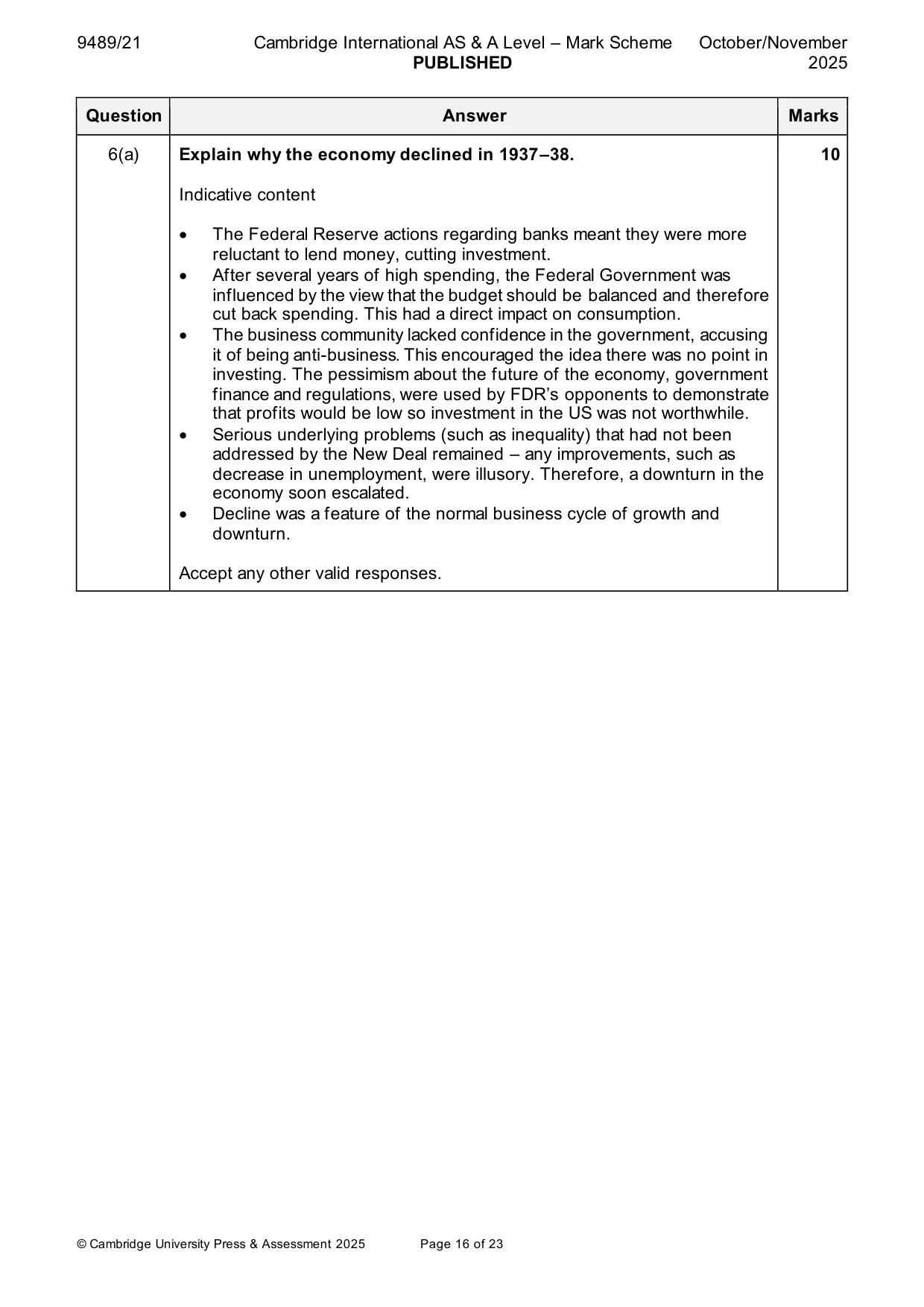
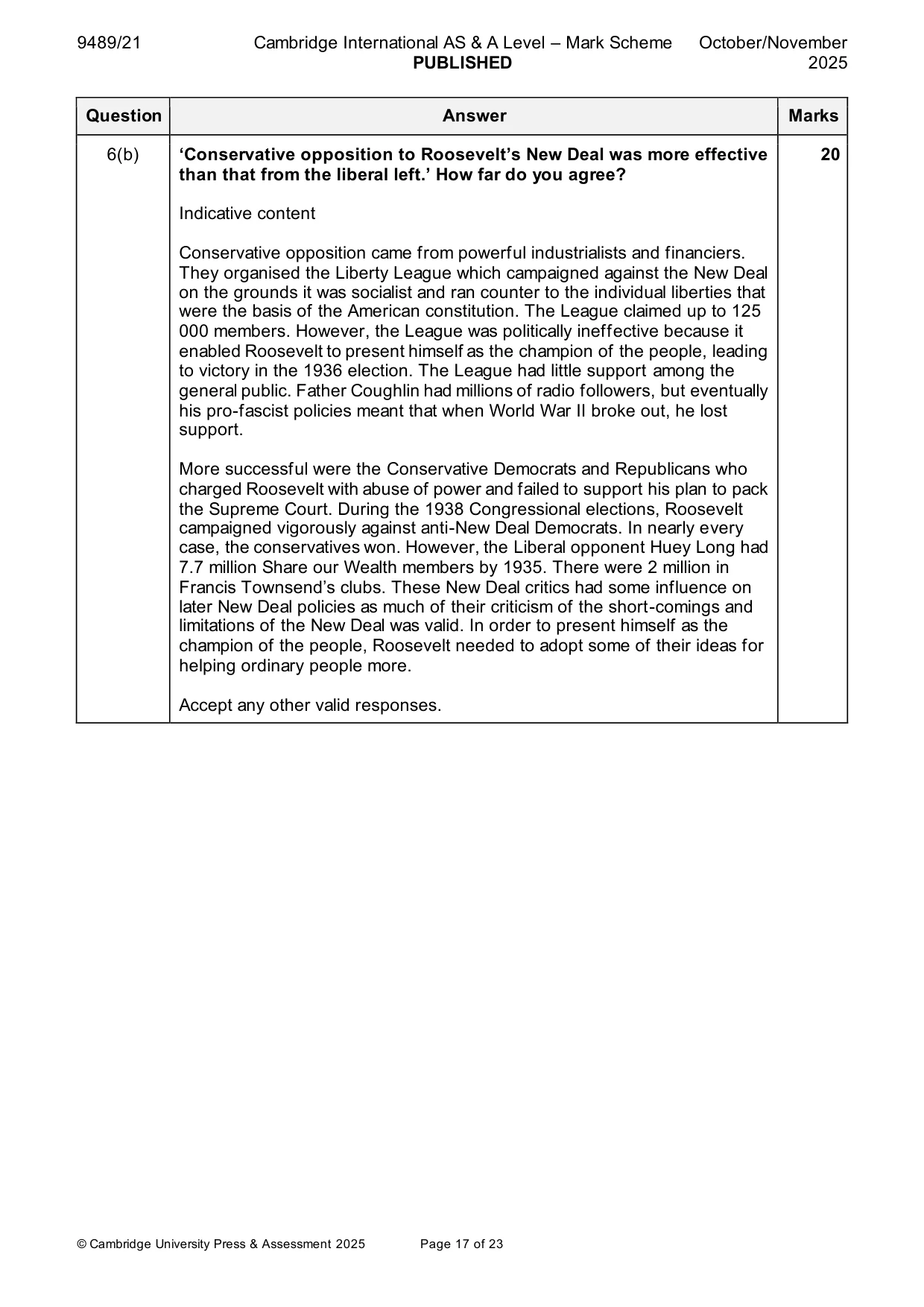
6 The Great Crash, the Great Depression and the New Deal policies, 1920–41 (a) Explain why the economy declined in 1937–38. [10] (b) ‘Conservative opposition to Roosevelt’s New Deal was more effective than that from the liberal left.’ How far do you agree? [20] Section C: International option International history, 1870–1945
Mark scheme: 6(a) Explain why the economy declined in 1937–38. 10 Indicative content • The Federal Reserve actions regarding banks meant they were more reluctant to lend money, cutting investment. • After several years of high spending, the Federal Government was influenced by the view that the budget should be balanced and therefore cut back spending. This had a direct impact on consumption. • The business community lacked confidence in the government, accusing it of being anti-business. This encouraged the idea there was no point in investing. The pessimism about the future of the economy, government finance and regulations, were used by FDR’s opponents to demonstrate that profits would be low so investment in the US was not worthwhile. • Serious underlying problems (such as inequality) that had not been addressed by the New Deal remained – any improvements, such as decrease in unemployment, were illusory. Therefore, a downturn in the economy soon escalated. • Decline was a feature of the normal business cycle of growth and downturn. Accept any other valid responses. 6(b) ‘Conservative opposition to Roosevelt’s New Deal was more effective 20 than that from the liberal left.’ How far do you agree? Indicative content Conservative opposition came from powerful industrialists and financiers. They organised the Liberty League which campaigned against the New Deal on the grounds it was socialist and ran counter to the individual liberties that were the basis of the American constitution. The League claimed up to 125 000 members. However, the League was politically ineffective because it enabled Roosevelt to present himself as the champion of the people, leading to victory in the 1936 election. The League had little support among the general public. Father Coughlin had millions of radio followers, but eventually his pro-fascist policies meant that when World War II broke out, he lost support. More successful were the Conservative Democrats and Republicans who charged Roosevelt with abuse of power and failed to support his plan to pack the Supreme Court. During the 1938 Congressional elections, Roosevelt campaigned vigorously against anti-New Deal Democrats. In nearly every case, the conservatives won. However, the Liberal opponent Huey Long had 7.7 million Share our Wealth members by 1935. There were 2 million in Francis Townsend’s clubs. These New Deal critics had some influence on later New Deal policies as much of their criticism of the short-comings and limitations of the New Deal was valid. In order to present himself as the champion of the people, Roosevelt needed to adopt some of their ideas for helping ordinary people more. Accept any other valid responses.
More questions on Why was there a second New Deal and how successful was it?
Q7 · Empire and the emergence of world powers, 1870–1919 (a) Explain why the Treaty of Paris…
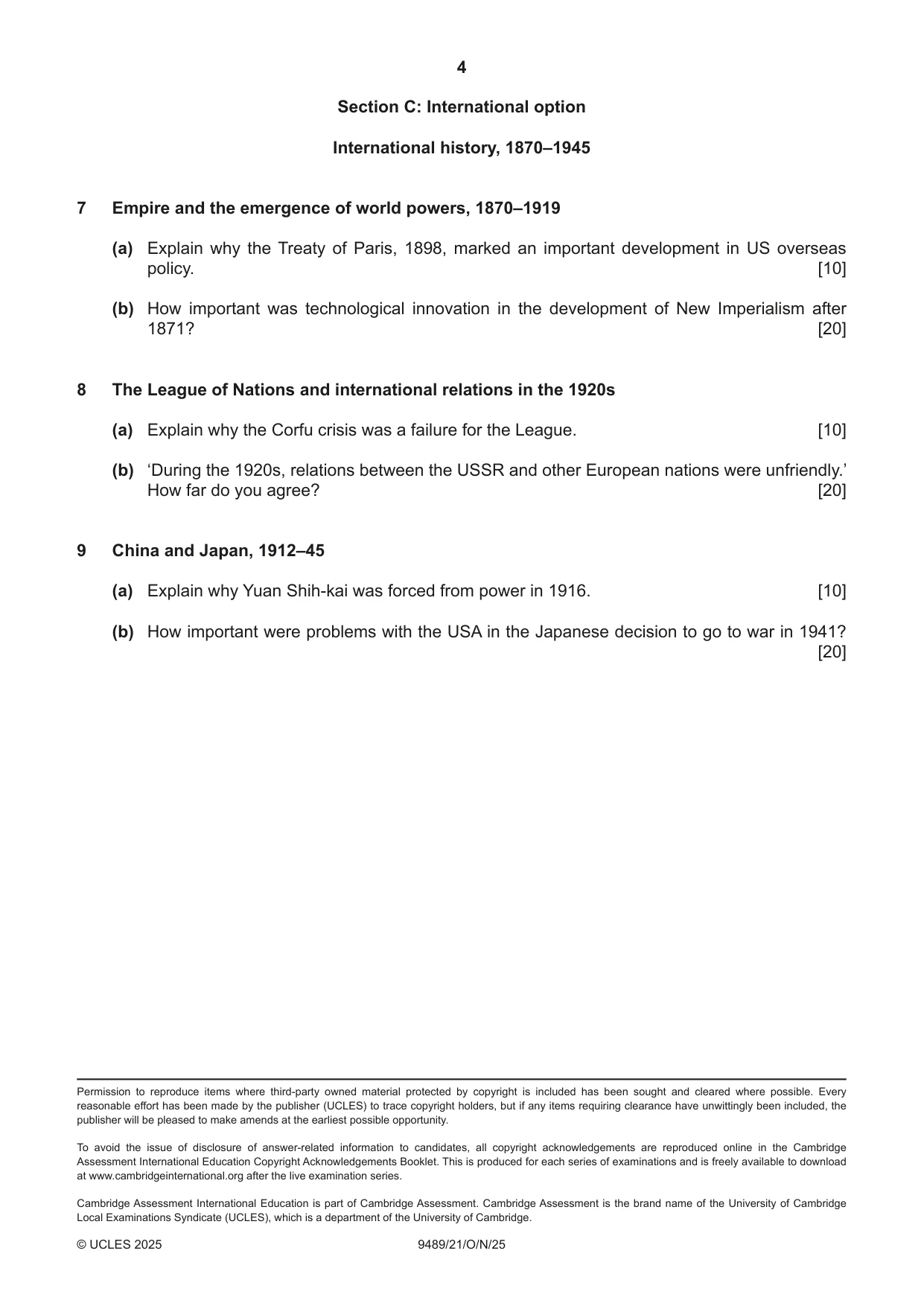
7 Empire and the emergence of world powers, 1870–1919 (a) Explain why the Treaty of Paris, 1898, marked an important development in US overseas policy. [10] (b) How important was technological innovation in the development of New Imperialism after 1871? [20]
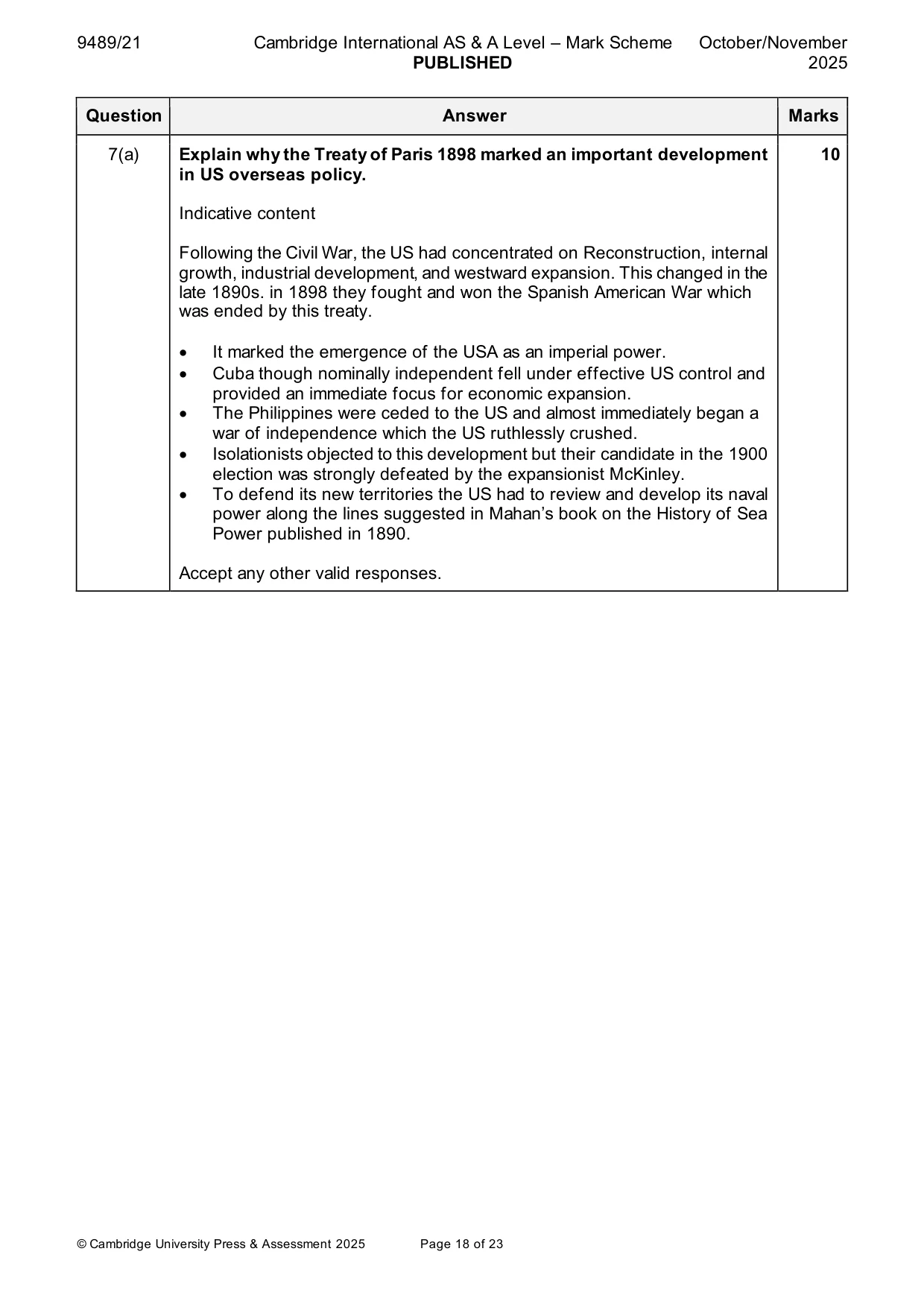
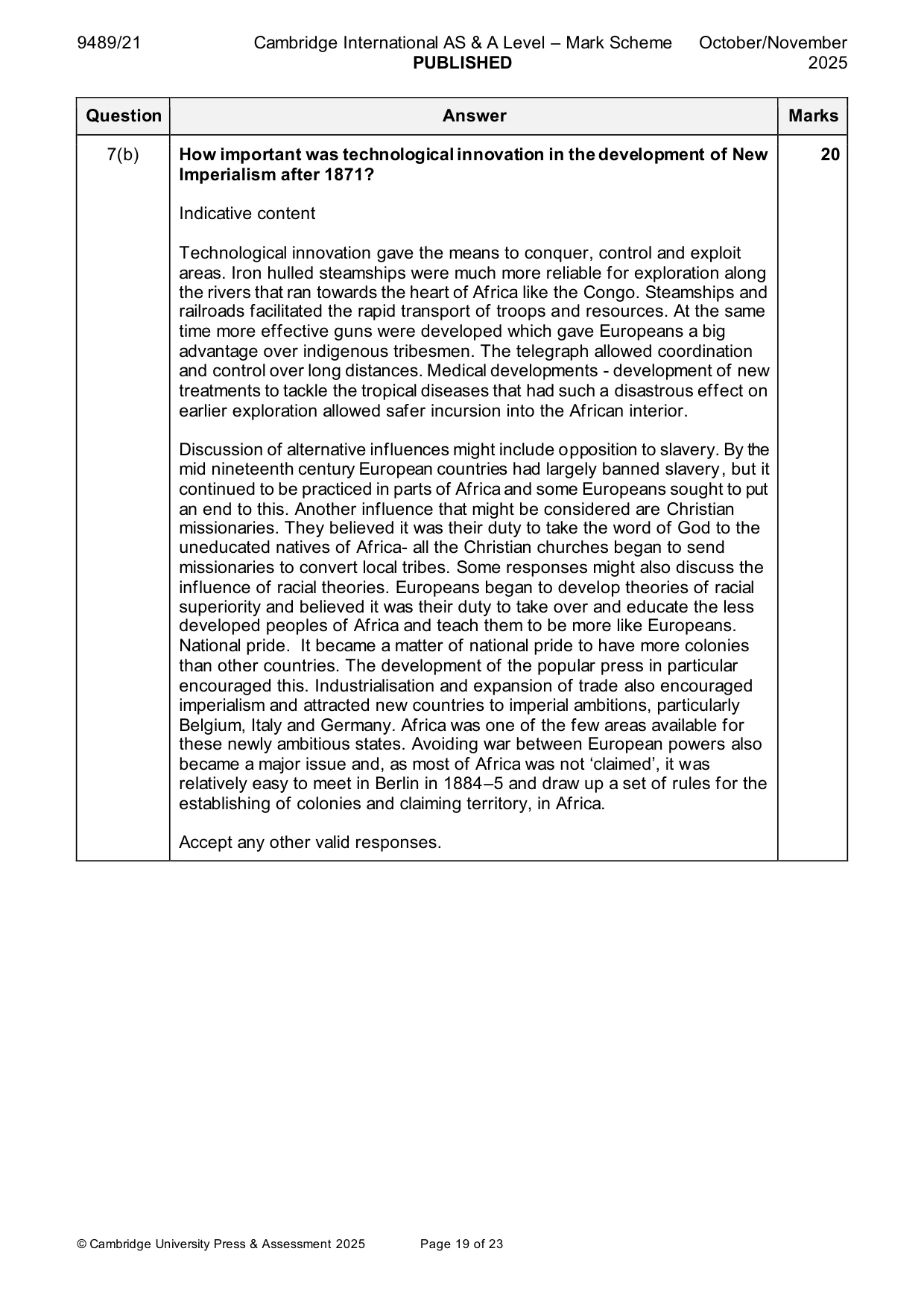
Mark scheme: 7(a) Explain why the Treaty of Paris 1898 marked an important development 10 in US overseas policy. Indicative content Following the Civil War, the US had concentrated on Reconstruction, internal growth, industrial development, and westward expansion. This changed in the late 1890s. in 1898 they fought and won the Spanish American War which was ended by this treaty. • It marked the emergence of the USA as an imperial power. • Cuba though nominally independent fell under effective US control and provided an immediate focus for economic expansion. • The Philippines were ceded to the US and almost immediately began a war of independence which the US ruthlessly crushed. • Isolationists objected to this development but their candidate in the 1900 election was strongly defeated by the expansionist McKinley. • To defend its new territories the US had to review and develop its naval power along the lines suggested in Mahan’s book on the History of Sea Power published in 1890. Accept any other valid responses. 7(b) How important was technological innovation in the development of New 20 Imperialism after 1871? Indicative content Technological innovation gave the means to conquer, control and exploit areas. Iron hulled steamships were much more reliable for exploration along the rivers that ran towards the heart of Africa like the Congo. Steamships and railroads facilitated the rapid transport of troops and resources. At the same time more effective guns were developed which gave Europeans a big advantage over indigenous tribesmen. The telegraph allowed coordination and control over long distances. Medical developments - development of new treatments to tackle the tropical diseases that had such a disastrous effect on earlier exploration allowed safer incursion into the African interior. Discussion of alternative influences might include opposition to slavery. By the mid nineteenth century European countries had largely banned slavery, but it continued to be practiced in parts of Africa and some Europeans sought to put an end to this. Another influence that might be considered are Christian missionaries. They believed it was their duty to take the word of God to the uneducated natives of Africa- all the Christian churches began to send missionaries to convert local tribes. Some responses might also discuss the influence of racial theories. Europeans began to develop theories of racial superiority and believed it was their duty to take over and educate the less developed peoples of Africa and teach them to be more like Europeans. National pride. It became a matter of national pride to have more colonies than other countries. The development of the popular press in particular encouraged this. Industrialisation and expansion of trade also encouraged imperialism and attracted new countries to imperial ambitions, particularly Belgium, Italy and Germany. Africa was one of the few areas available for these newly ambitious states. Avoiding war between European powers also became a major issue and, as most of Africa was not ‘claimed’, it was relatively easy to meet in Berlin in 1884–5 and draw up a set of rules for the establishing of colonies and claiming territory, in Africa. Accept any other valid responses.
More questions on Why was imperialism a significant force in Africa from 1870?
Q8 · The League of Nations and international relations in the 1920s (a) Explain why the Corfu…
8 The League of Nations and international relations in the 1920s (a) Explain why the Corfu crisis was a failure for the League. [10] (b) ‘During the 1920s, relations between the USSR and other European nations were unfriendly.’ How far do you agree? [20]
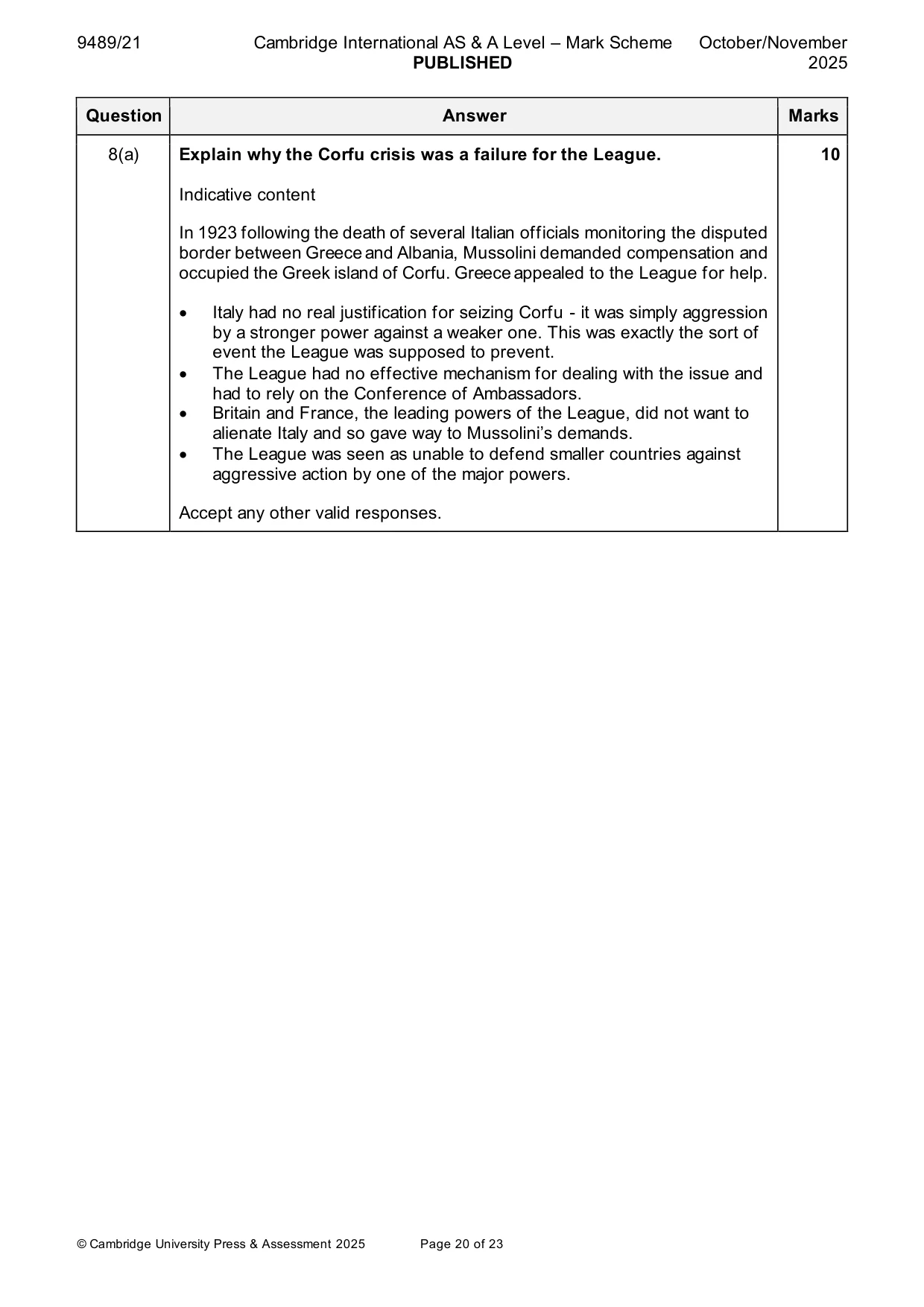
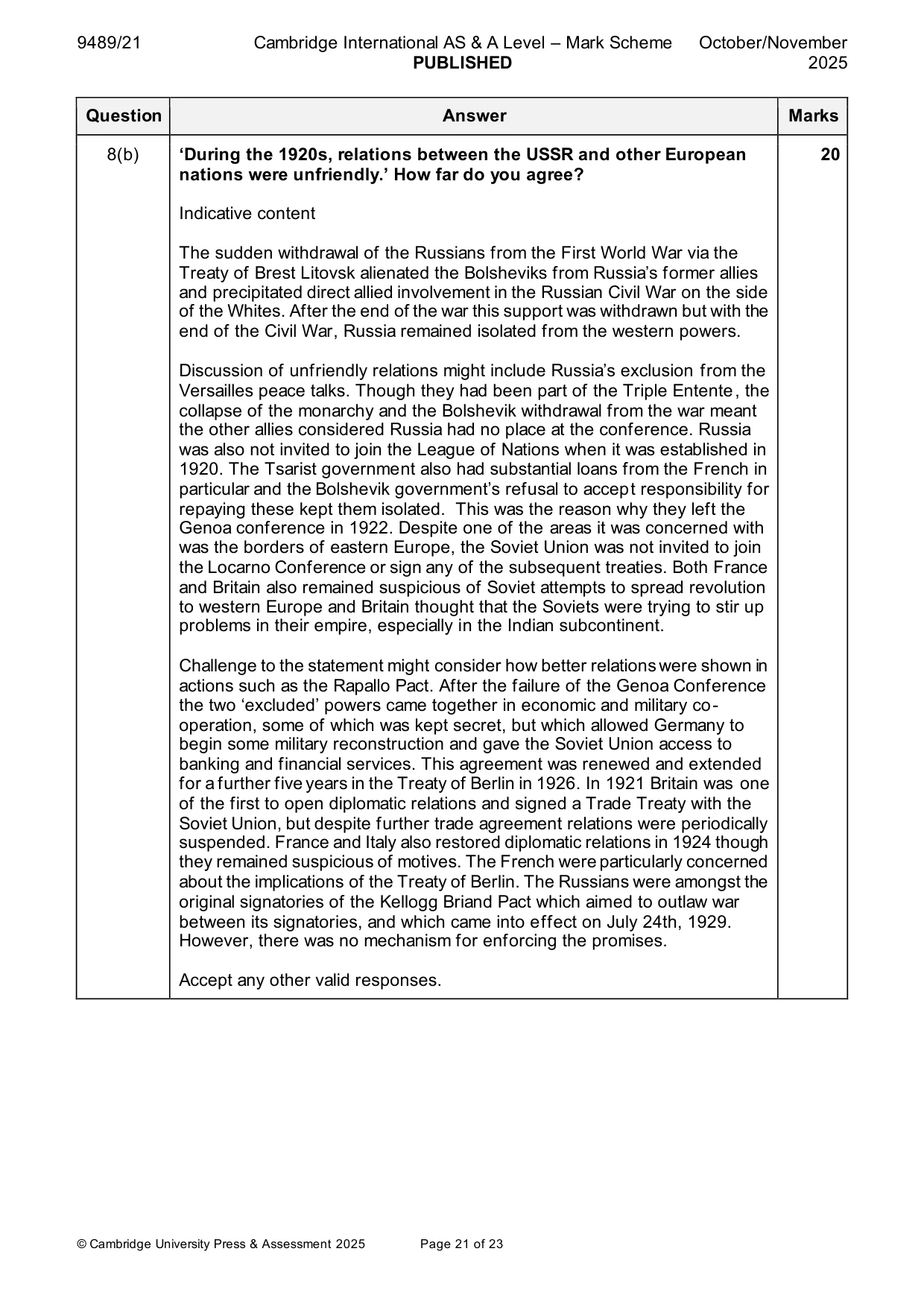
Mark scheme: 8(a) Explain why the Corfu crisis was a failure for the League. 10 Indicative content In 1923 following the death of several Italian officials monitoring the disputed border between Greece and Albania, Mussolini demanded compensation and occupied the Greek island of Corfu. Greece appealed to the League for help. • Italy had no real justification for seizing Corfu - it was simply aggression by a stronger power against a weaker one. This was exactly the sort of event the League was supposed to prevent. • The League had no effective mechanism for dealing with the issue and had to rely on the Conference of Ambassadors. • Britain and France, the leading powers of the League, did not want to alienate Italy and so gave way to Mussolini’s demands. • The League was seen as unable to defend smaller countries against aggressive action by one of the major powers. Accept any other valid responses. 8(b) ‘During the 1920s, relations between the USSR and other European 20 nations were unfriendly.’ How far do you agree? Indicative content The sudden withdrawal of the Russians from the First World War via the Treaty of Brest Litovsk alienated the Bolsheviks from Russia’s former allies and precipitated direct allied involvement in the Russian Civil War on the side of the Whites. After the end of the war this support was withdrawn but with the end of the Civil War, Russia remained isolated from the western powers. Discussion of unfriendly relations might include Russia’s exclusion from the Versailles peace talks. Though they had been part of the Triple Entente, the collapse of the monarchy and the Bolshevik withdrawal from the war meant the other allies considered Russia had no place at the conference. Russia was also not invited to join the League of Nations when it was established in 1920. The Tsarist government also had substantial loans from the French in particular and the Bolshevik government’s refusal to accept responsibility for repaying these kept them isolated. This was the reason why they left the Genoa conference in 1922. Despite one of the areas it was concerned with was the borders of eastern Europe, the Soviet Union was not invited to join the Locarno Conference or sign any of the subsequent treaties. Both France and Britain also remained suspicious of Soviet attempts to spread revolution to western Europe and Britain thought that the Soviets were trying to stir up problems in their empire, especially in the Indian subcontinent. Challenge to the statement might consider how better relations were shown in actions such as the Rapallo Pact. After the failure of the Genoa Conference the two ‘excluded’ powers came together in economic and military co- operation, some of which was kept secret, but which allowed Germany to begin some military reconstruction and gave the Soviet Union access to banking and financial services. This agreement was renewed and extended for a further five years in the Treaty of Berlin in 1926. In 1921 Britain was one of the first to open diplomatic relations and signed a Trade Treaty with the Soviet Union, but despite further trade agreement relations were periodically suspended. France and Italy also restored diplomatic relations in 1924 though they remained suspicious of motives. The French were particularly concerned about the implications of the Treaty of Berlin. The Russians were amongst the original signatories of the Kellogg Briand Pact which aimed to outlaw war between its signatories, and which came into effect on July 24th, 1929. However, there was no mechanism for enforcing the promises. Accept any other valid responses.
More questions on How and why did international relations improve, 1924–29?
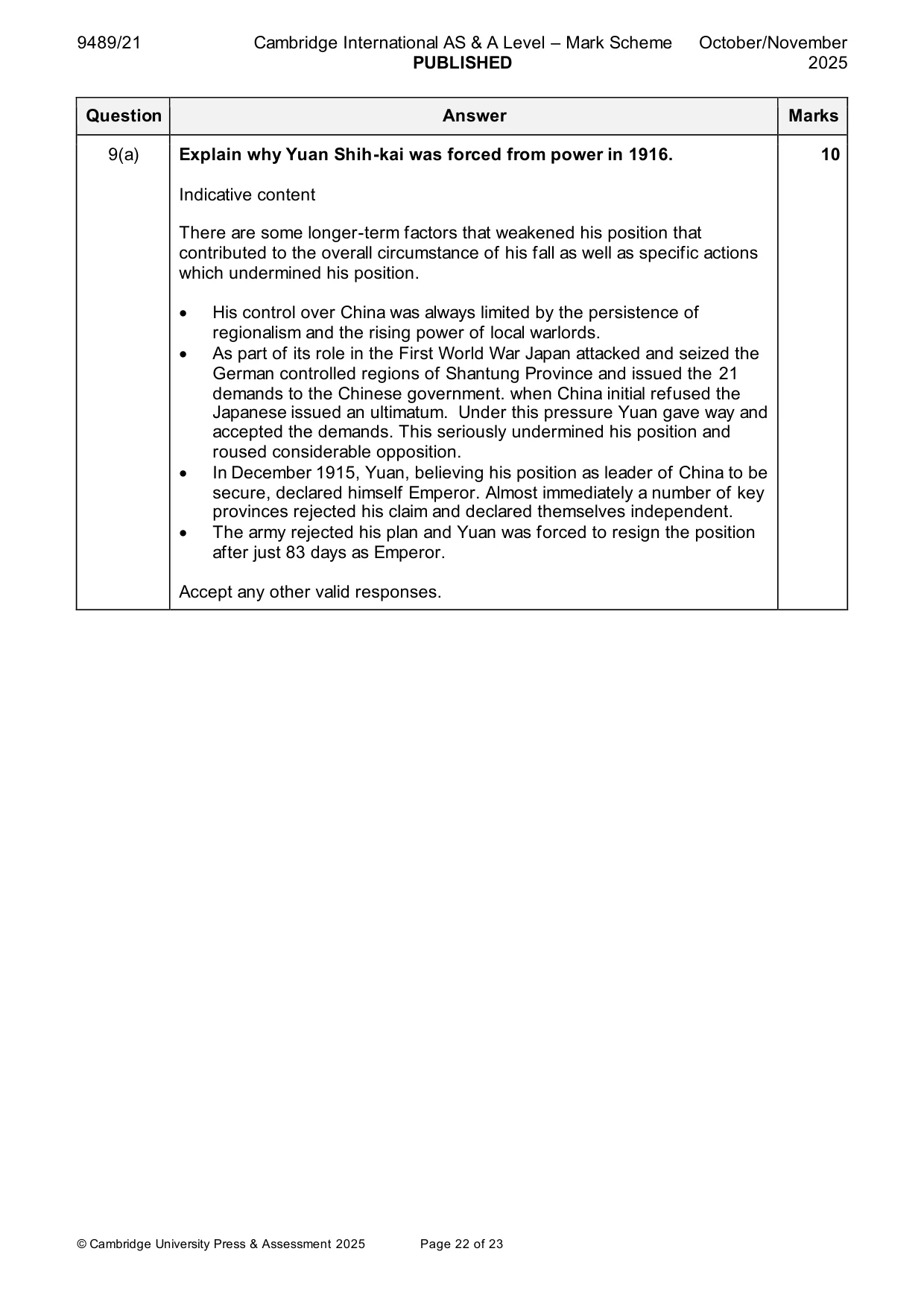
Q9 · China and Japan, 1912–45 (a) Explain why Yuan Shih-kai was forced from power in 1916
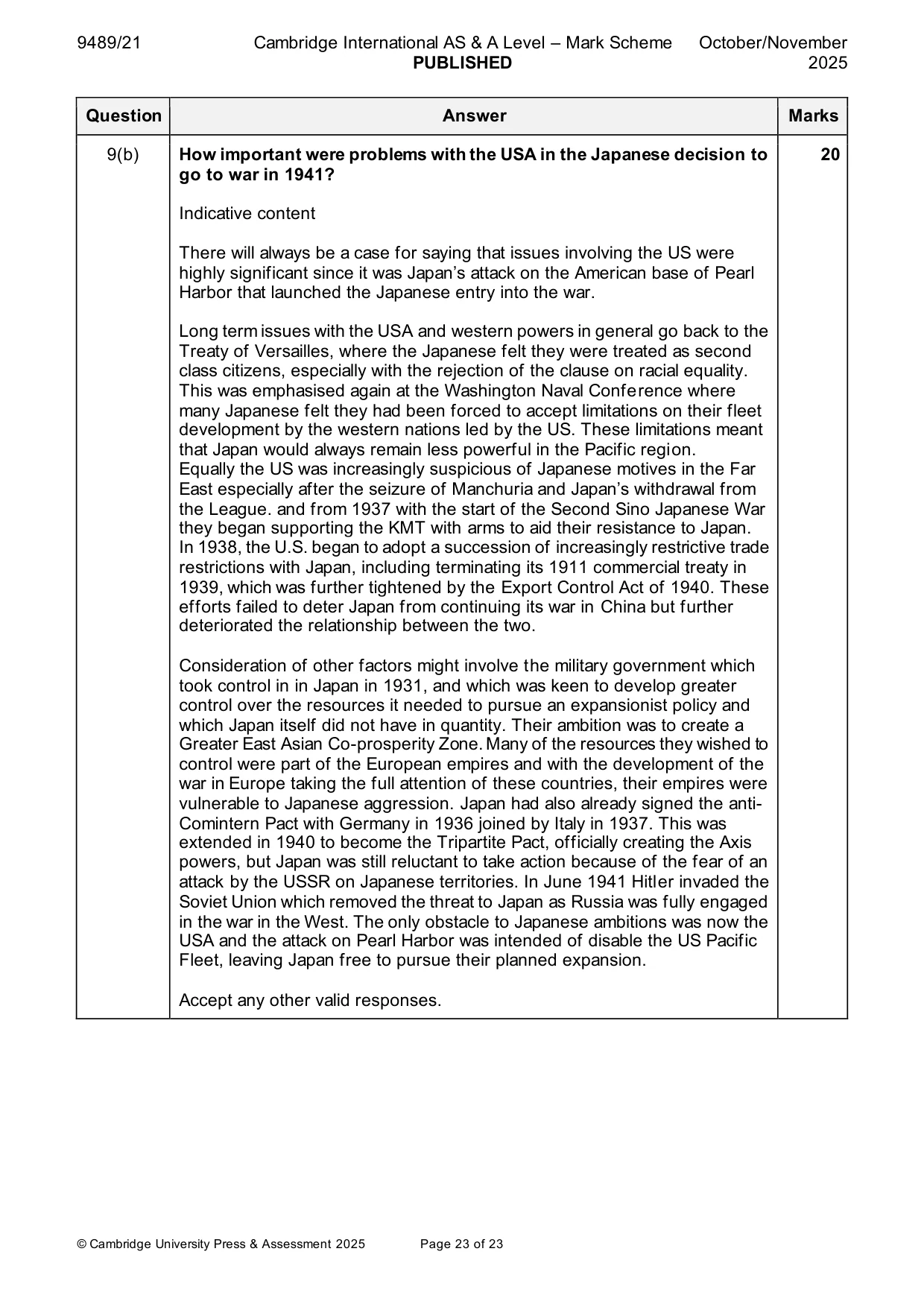
9 China and Japan, 1912–45 (a) Explain why Yuan Shih-kai was forced from power in 1916. [10] (b) How important were problems with the USA in the Japanese decision to go to war in 1941? [20]
Mark scheme: 9(a) Explain why Yuan Shih-kai was forced from power in 1916. 10 Indicative content There are some longer-term factors that weakened his position that contributed to the overall circumstance of his fall as well as specific actions which undermined his position. • His control over China was always limited by the persistence of regionalism and the rising power of local warlords. • As part of its role in the First World War Japan attacked and seized the German controlled regions of Shantung Province and issued the 21 demands to the Chinese government. when China initial refused the Japanese issued an ultimatum. Under this pressure Yuan gave way and accepted the demands. This seriously undermined his position and roused considerable opposition. • In December 1915, Yuan, believing his position as leader of China to be secure, declared himself Emperor. Almost immediately a number of key provinces rejected his claim and declared themselves independent. • The army rejected his plan and Yuan was forced to resign the position after just 83 days as Emperor. Accept any other valid responses. 9(b) How important were problems with the USA in the Japanese decision to 20 go to war in 1941? Indicative content There will always be a case for saying that issues involving the US were highly significant since it was Japan’s attack on the American base of Pearl Harbor that launched the Japanese entry into the war. Long term issues with the USA and western powers in general go back to the Treaty of Versailles, where the Japanese felt they were treated as second class citizens, especially with the rejection of the clause on racial equality. This was emphasised again at the Washington Naval Conference where many Japanese felt they had been forced to accept limitations on their fleet development by the western nations led by the US. These limitations meant that Japan would always remain less powerful in the Pacific region. Equally the US was increasingly suspicious of Japanese motives in the Far East especially after the seizure of Manchuria and Japan’s withdrawal from the League. and from 1937 with the start of the Second Sino Japanese War they began supporting the KMT with arms to aid their resistance to Japan. In 1938, the U.S. began to adopt a succession of increasingly restrictive trade restrictions with Japan, including terminating its 1911 commercial treaty in 1939, which was further tightened by the Export Control Act of 1940. These efforts failed to deter Japan from continuing its war in China but further deteriorated the relationship between the two. Consideration of other factors might involve the military government which took control in in Japan in 1931, and which was keen to develop greater control over the resources it needed to pursue an expansionist policy and which Japan itself did not have in quantity. Their ambition was to create a Greater East Asian Co-prosperity Zone. Many of the resources they wished to control were part of the European empires and with the development of the war in Europe taking the full attention of these countries, their empires were vulnerable to Japanese aggression. Japan had also already signed the anti- Comintern Pact with Germany in 1936 joined by Italy in 1937. This was extended in 1940 to become the Tripartite Pact, officially creating the Axis powers, but Japan was still reluctant to take action because of the fear of an attack by the USSR on Japanese territories. In June 1941 Hitler invaded the Soviet Union which removed the threat to Japan as Russia was fully engaged in the war in the West. The only obstacle to Japanese ambitions was now the USA and the attack on Pearl Harbor was intended of disable the US Pacific Fleet, leaving Japan free to pursue their planned expansion. Accept any other valid responses.
More questions on Why did Japan emerge as a world power and what was the impact on international
What was in this paper
The subtopics covered by these 9 questions, and how many questions each got. Open one in a new tab to see every Cambridge question on it.
1What caused the rise and fall of Napoleon Bonaparte?1What were the aims of Reconstruction and how successful was it?1What were the causes and outcomes of the 1905 Revolution up to 1914?1What were the consequences of the rapid economic growth after 1870?1Why did Japan emerge as a world power and what was the impact on international1Why was imperialism a significant force in Africa from 1870?1Why was there a second New Deal and how successful was it?1Why was there rapid industrialisation after 1870?1What you needed in this session
Cambridge’s own grade thresholds for 2025 Oct/Nov, Paper 2 · Variant 1. A higher threshold means an easier paper — the bar moves with how the cohort did.