Cambridge A Level History 9489 — 2024 Feb/March Paper 2 · Variant 2
9489/22/F/M/24 · 9 questions · 60 marks · ≈68 min
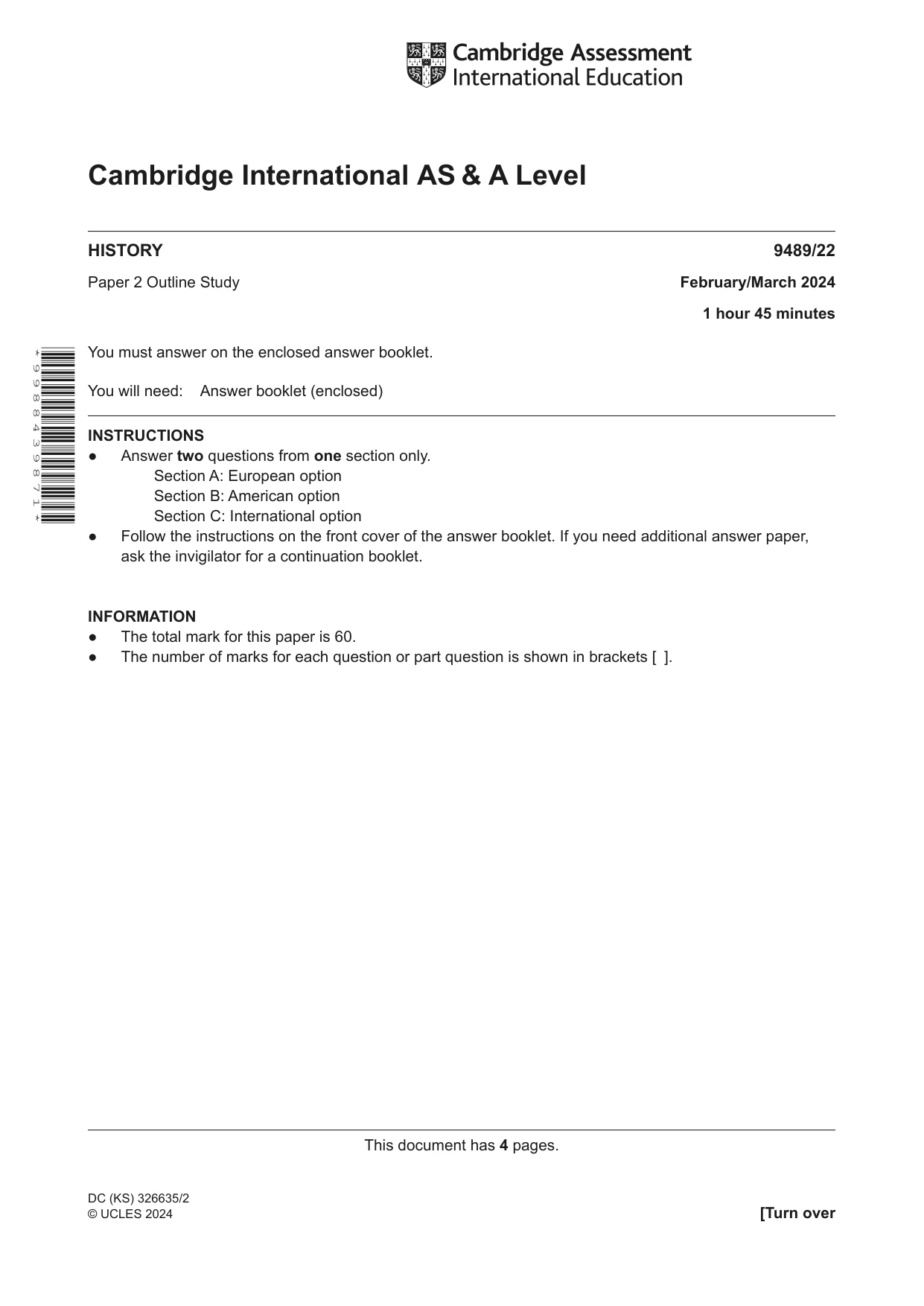
The question paper and its mark scheme, free to read here and free to download. This is Cambridge’s own paper, exactly as it was sat.
Question paper4 pages
Mark scheme21 pages
Answers below. Sit the paper first if you are practising.

Questions as text
Q1 · France, 1774–1814 (a) Explain why Louis XVI recalled the Parlements at the start of his…
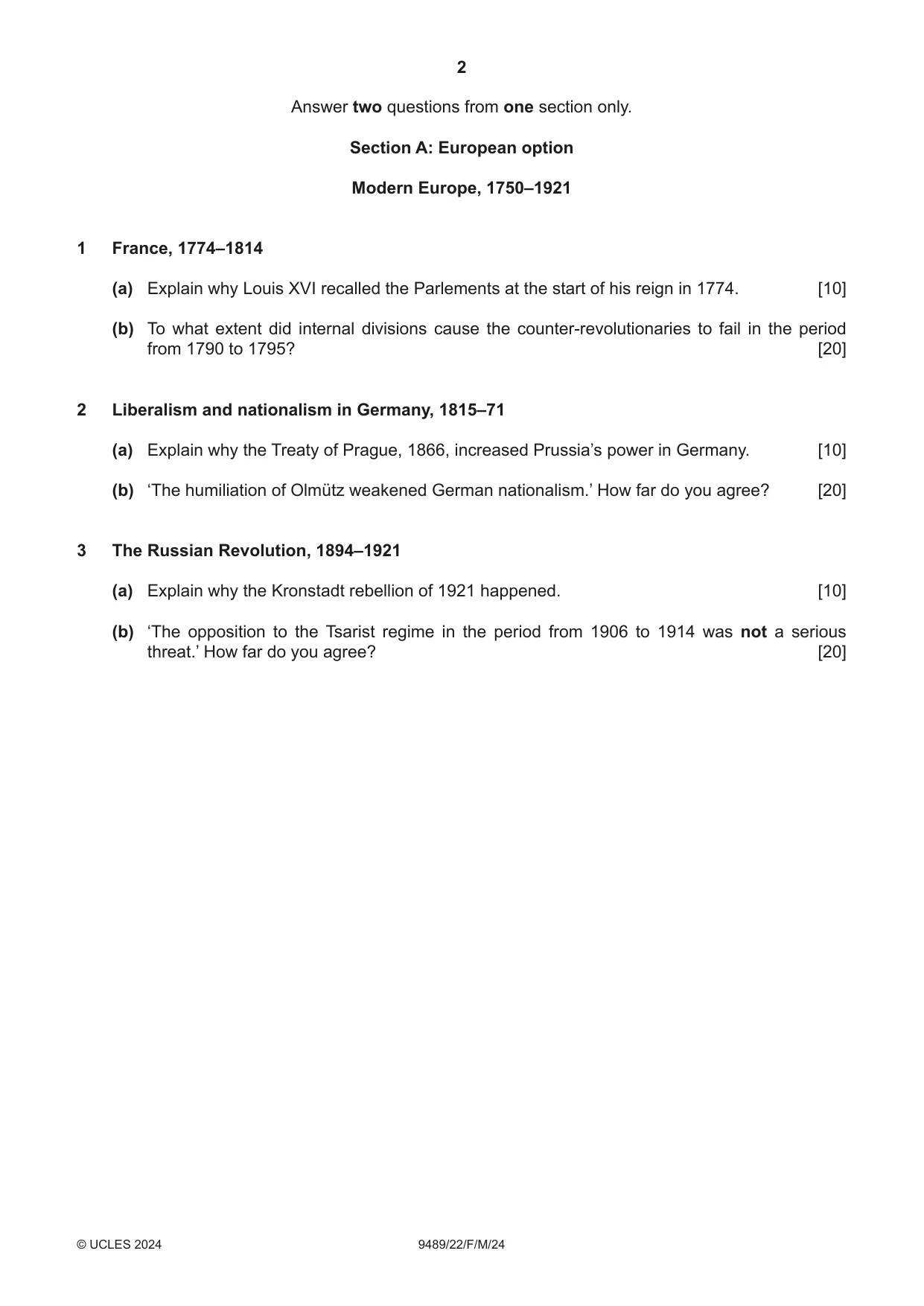
1 France, 1774–1814 (a) Explain why Louis XVI recalled the Parlements at the start of his reign in 1774. [10] (b) To what extent did internal divisions cause the counter-revolutionaries to fail in the period from 1790 to 1795? [20]
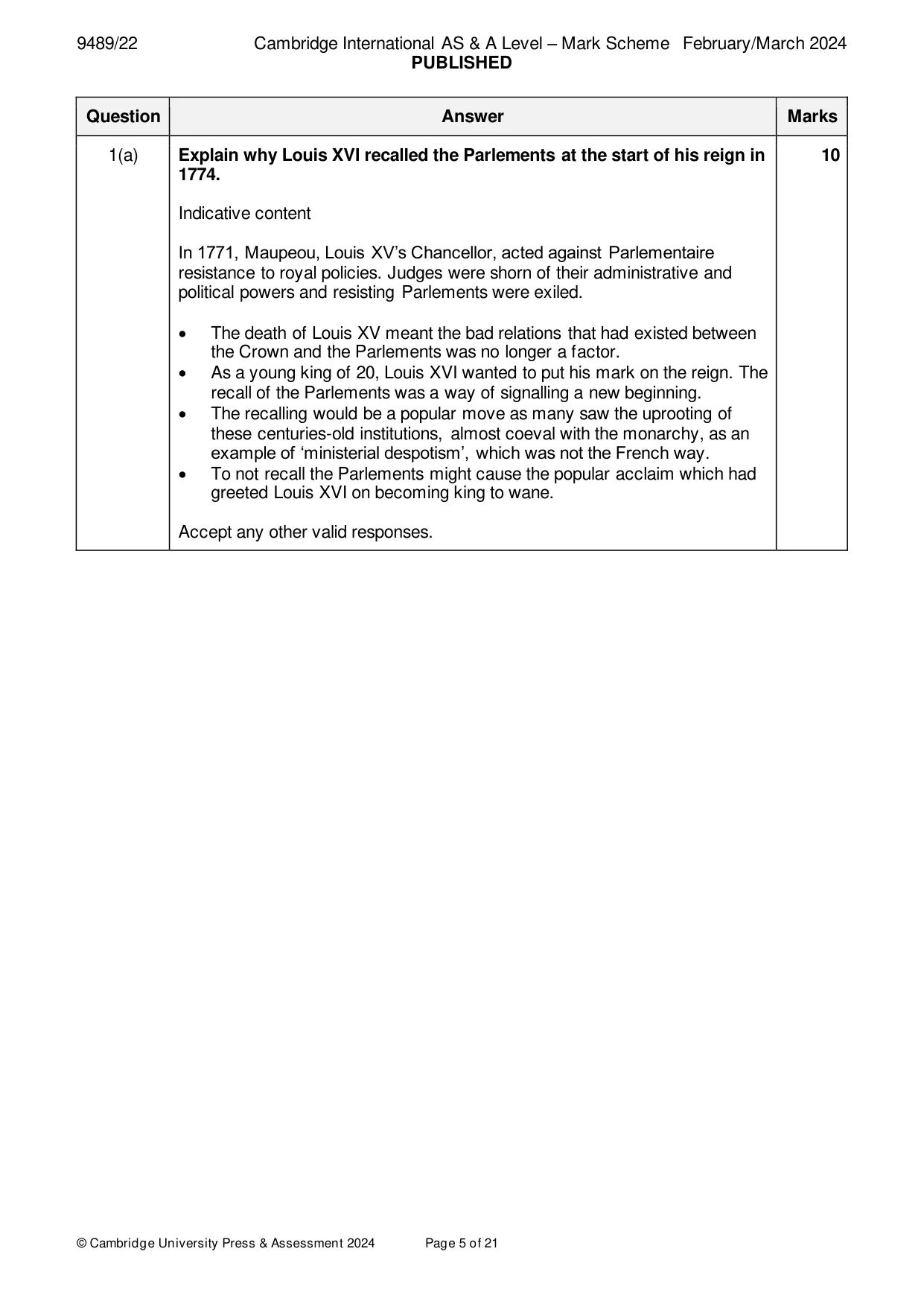
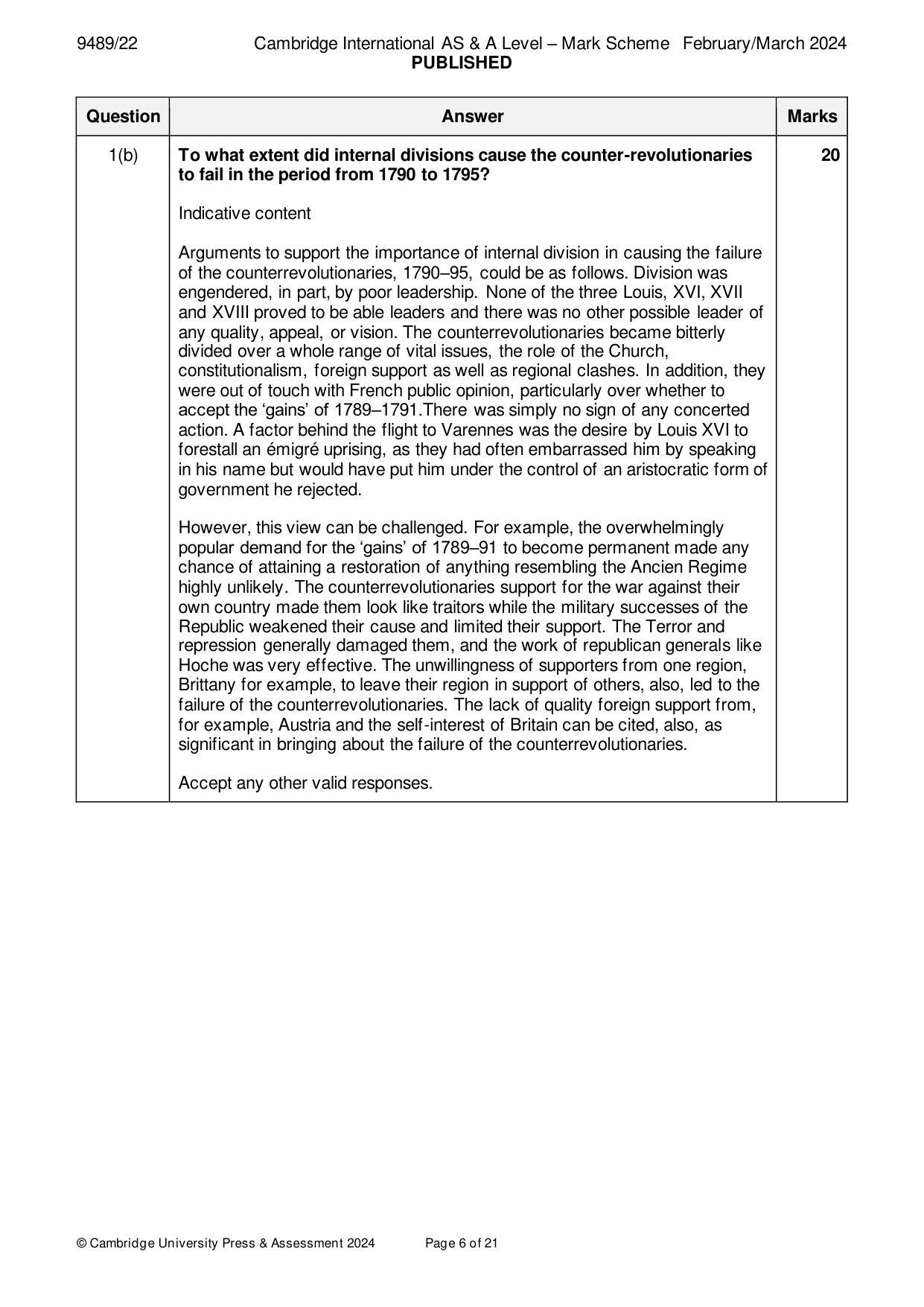
Mark scheme: Question Answer Marks 1(a) Explain why Louis XVI recalled the Parlements at the start of his reign in 10 1774. Indicative content In 1771, Maupeou, Louis XV’s Chancellor, acted against Parlementaire resistance to royal policies. Judges were shorn of their administrative and political powers and resisting Parlements were exiled. • The death of Louis XV meant the bad relations that had existed between the Crown and the Parlements was no longer a factor. • As a young king of 20, Louis XVI wanted to put his mark on the reign. The recall of the Parlements was a way of signalling a new beginning. • The recalling would be a popular move as many saw the uprooting of these centuries-old institutions, almost coeval with the monarchy, as an example of ‘ministerial despotism’, which was not the French way. • To not recall the Parlements might cause the popular acclaim which had greeted Louis XVI on becoming king to wane. Accept any other valid responses. 1(b) To what extent did internal divisions cause the counter-revolutionaries 20 to fail in the period from 1790 to 1795? Indicative content Arguments to support the importance of internal division in causing the failure of the counterrevolutionaries, 1790–95, could be as follows. Division was engendered, in part, by poor leadership. None of the three Louis, XVI, XVII and XVIII proved to be able leaders and there was no other possible leader of any quality, appeal, or vision. The counterrevolutionaries became bitterly divided over a whole range of vital issues, the role of the Church, constitutionalism, foreign support as well as regional clashes. In addition, they were out of touch with French public opinion, particularly over whether to accept the ‘gains’ of 1789–1791.There was simply no sign of any concerted action. A factor behind the flight to Varennes was the desire by Louis XVI to forestall an émigré uprising, as they had often embarrassed him by speaking in his name but would have put him under the control of an aristocratic form of government he rejected. However, this view can be challenged. For example, the overwhelmingly popular demand for the ‘gains’ of 1789–91 to become permanent made any chance of attaining a restoration of anything resembling the Ancien Regime highly unlikely. The counterrevolutionaries support for the war against their own country made them look like traitors while the military successes of the Republic weakened their cause and limited their support. The Terror and repression generally damaged them, and the work of republican generals like Hoche was very effective. The unwillingness of supporters from one region, Brittany for example, to leave their region in support of others, also, led to the failure of the counterrevolutionaries. The lack of quality foreign support from, for example, Austria and the self-interest of Britain can be cited, also, as significant in bringing about the failure of the counterrevolutionaries. Accept any other valid responses.
More questions on How well was France governed in the period 1793–99?
Q2 · Liberalism and nationalism in Germany, 1815–71 (a) Explain why the Treaty of Prague…
2 Liberalism and nationalism in Germany, 1815–71 (a) Explain why the Treaty of Prague, 1866, increased Prussia’s power in Germany. [10] (b) ‘The humiliation of Olmütz weakened German nationalism.’ How far do you agree? [20]
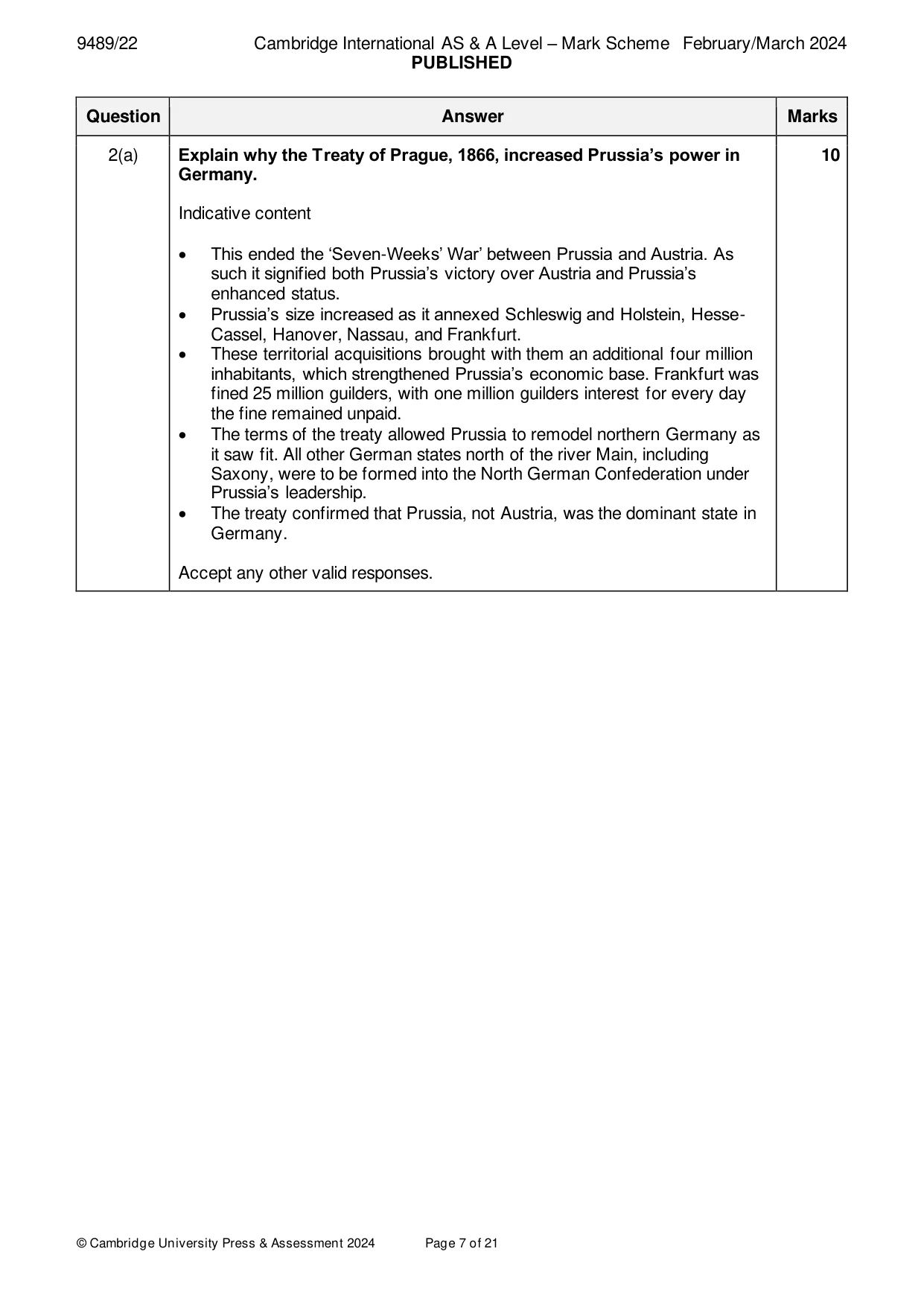
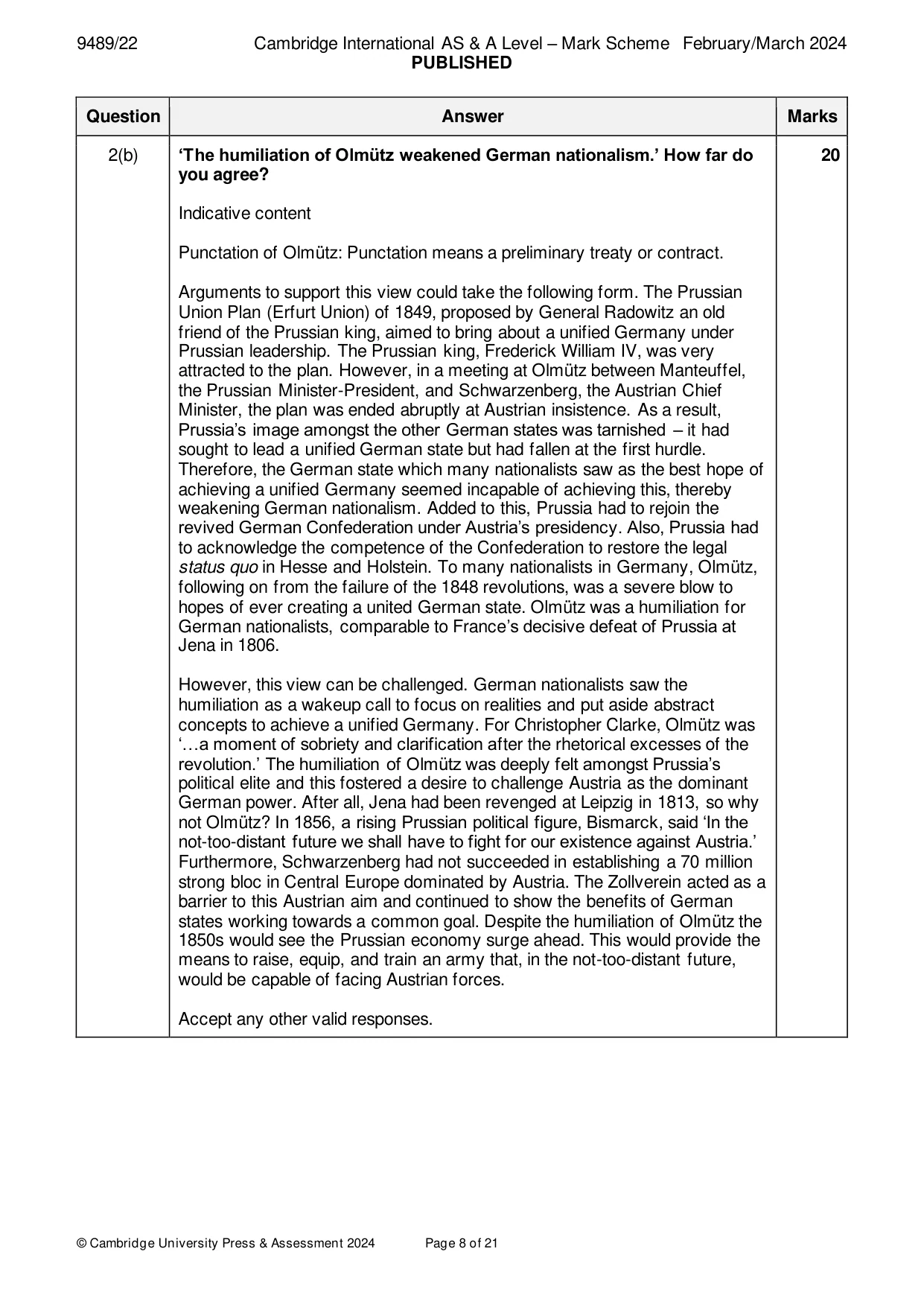
Mark scheme: 2(a) Explain why the Treaty of Prague, 1866, increased Prussia’s power in 10 Germany. Indicative content • This ended the ‘Seven-Weeks’ War’ between Prussia and Austria. As such it signified both Prussia’s victory over Austria and Prussia’s enhanced status. • Prussia’s size increased as it annexed Schleswig and Holstein, Hesse- Cassel, Hanover, Nassau, and Frankfurt. • These territorial acquisitions brought with them an additional four million inhabitants, which strengthened Prussia’s economic base. Frankfurt was fined 25 million guilders, with one million guilders interest for every day the fine remained unpaid. • The terms of the treaty allowed Prussia to remodel northern Germany as it saw fit. All other German states north of the river Main, including Saxony, were to be formed into the North German Confederation under Prussia’s leadership. • The treaty confirmed that Prussia, not Austria, was the dominant state in Germany. Accept any other valid responses. 2(b) ‘The humiliation of Olmütz weakened German nationalism.’ How far do 20 you agree? Indicative content Punctation of Olmütz: Punctation means a preliminary treaty or contract. Arguments to support this view could take the following form. The Prussian Union Plan (Erfurt Union) of 1849, proposed by General Radowitz an old friend of the Prussian king, aimed to bring about a unified Germany under Prussian leadership. The Prussian king, Frederick William IV, was very attracted to the plan. However, in a meeting at Olmütz between Manteuffel, the Prussian Minister-President, and Schwarzenberg, the Austrian Chief Minister, the plan was ended abruptly at Austrian insistence. As a result, Prussia’s image amongst the other German states was tarnished – it had sought to lead a unified German state but had fallen at the first hurdle. Therefore, the German state which many nationalists saw as the best hope of achieving a unified Germany seemed incapable of achieving this, thereby weakening German nationalism. Added to this, Prussia had to rejoin the revived German Confederation under Austria’s presidency. Also, Prussia had to acknowledge the competence of the Confederation to restore the legal status quo in Hesse and Holstein. To many nationalists in Germany, Olmütz, following on from the failure of the 1848 revolutions, was a severe blow to hopes of ever creating a united German state. Olmütz was a humiliation for German nationalists, comparable to France’s decisive defeat of Prussia at Jena in 1806. However, this view can be challenged. German nationalists saw the humiliation as a wakeup call to focus on realities and put aside abstract concepts to achieve a unified Germany. For Christopher Clarke, Olmütz was ‘…a moment of sobriety and clarification after the rhetorical excesses of the revolution.’ The humiliation of Olmütz was deeply felt amongst Prussia’s political elite and this fostered a desire to challenge Austria as the dominant German power. After all, Jena had been revenged at Leipzig in 1813, so why not Olmütz? In 1856, a rising Prussian political figure, Bismarck, said ‘In the not-too-distant future we shall have to fight for our existence against Austria.’ Furthermore, Schwarzenberg had not succeeded in establishing a 70 million strong bloc in Central Europe dominated by Austria. The Zollverein acted as a barrier to this Austrian aim and continued to show the benefits of German states working towards a common goal. Despite the humiliation of Olmütz the 1850s would see the Prussian economy surge ahead. This would provide the means to raise, equip, and train an army that, in the not-too-distant future, would be capable of facing Austrian forces. Accept any other valid responses.
More questions on What happened during the 1848–49 revolutions and what were their consequences?
Q3 · The Russian Revolution, 1894–1921 (a) Explain why the Kronstadt rebellion of 1921 happened
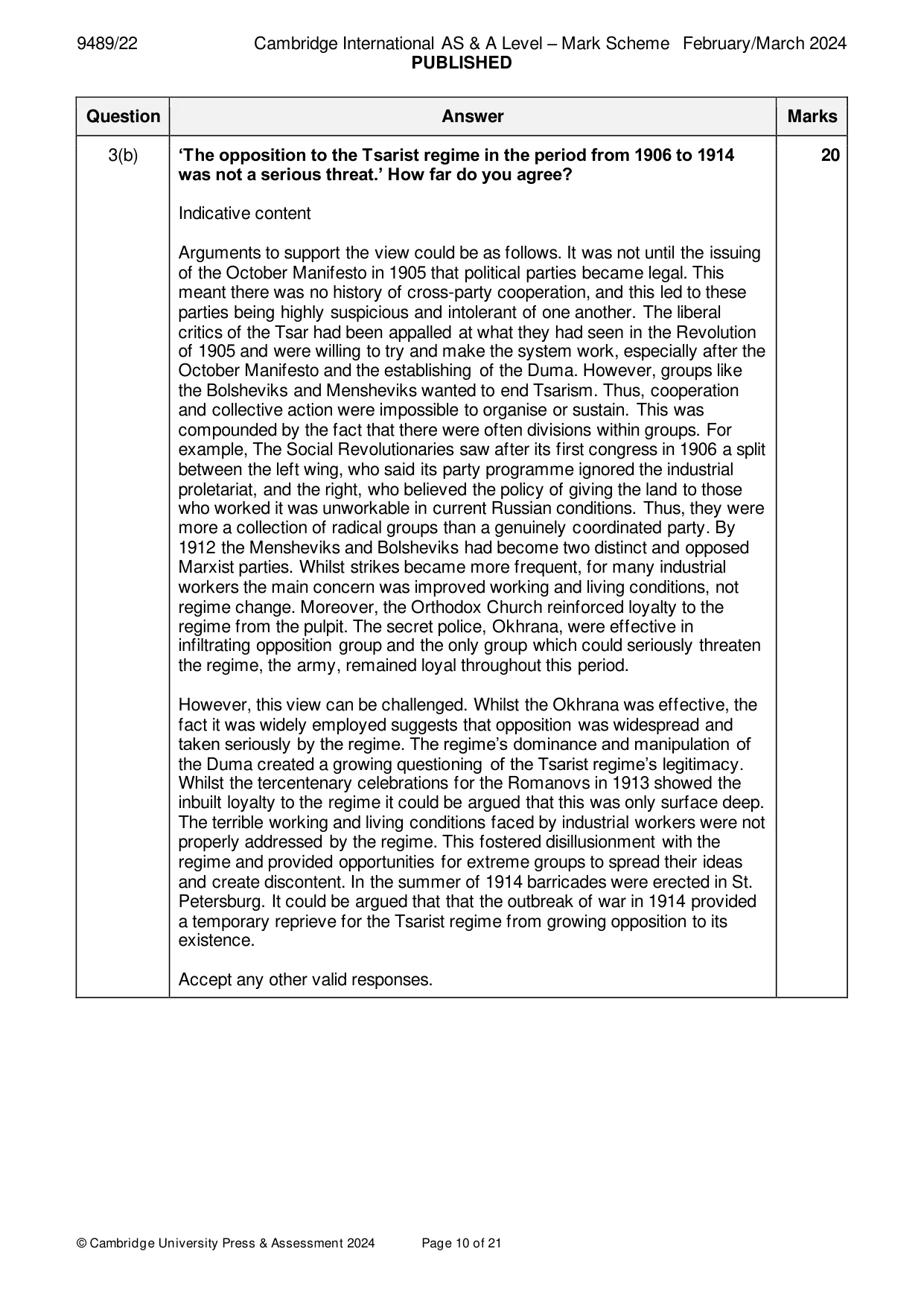
3 The Russian Revolution, 1894–1921 (a) Explain why the Kronstadt rebellion of 1921 happened. [10] (b) ‘The opposition to the Tsarist regime in the period from 1906 to 1914 was not a serious threat.’ How far do you agree? [20]
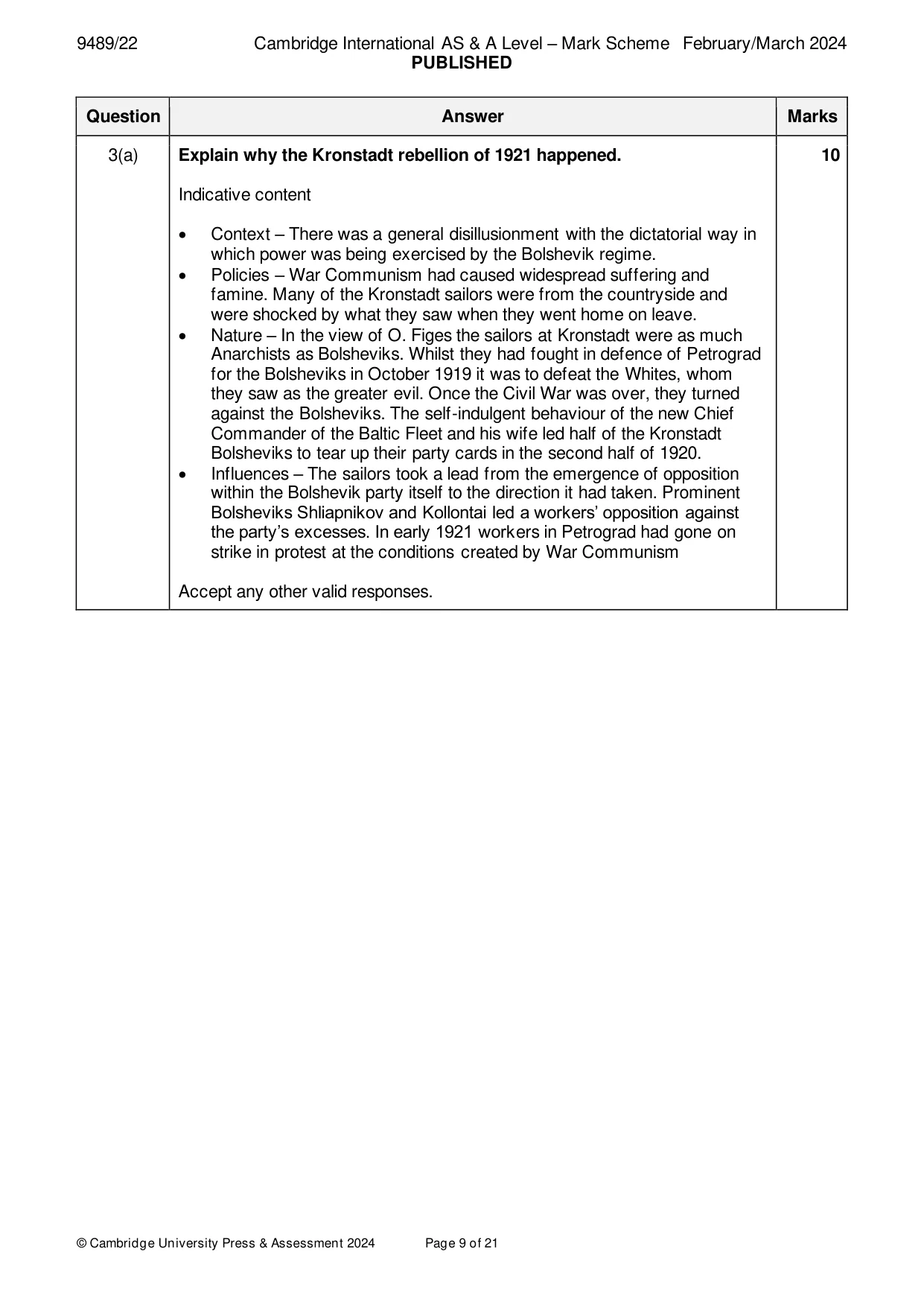
Mark scheme: 3(a) Explain why the Kronstadt rebellion of 1921 happened. 10 Indicative content • Context – There was a general disillusionment with the dictatorial way in which power was being exercised by the Bolshevik regime. • Policies – War Communism had caused widespread suffering and famine. Many of the Kronstadt sailors were from the countryside and were shocked by what they saw when they went home on leave. • Nature – In the view of O. Figes the sailors at Kronstadt were as much Anarchists as Bolsheviks. Whilst they had fought in defence of Petrograd for the Bolsheviks in October 1919 it was to defeat the Whites, whom they saw as the greater evil. Once the Civil War was over, they turned against the Bolsheviks. The self-indulgent behaviour of the new Chief Commander of the Baltic Fleet and his wife led half of the Kronstadt Bolsheviks to tear up their party cards in the second half of 1920. • Influences – The sailors took a lead from the emergence of opposition within the Bolshevik party itself to the direction it had taken. Prominent Bolsheviks Shliapnikov and Kollontai led a workers’ opposition against the party’s excesses. In early 1921 workers in Petrograd had gone on strike in protest at the conditions created by War Communism Accept any other valid responses. 3(b) ‘The opposition to the Tsarist regime in the period from 1906 to 1914 20 was not a serious threat.’ How far do you agree? Indicative content Arguments to support the view could be as follows. It was not until the issuing of the October Manifesto in 1905 that political parties became legal. This meant there was no history of cross-party cooperation, and this led to these parties being highly suspicious and intolerant of one another. The liberal critics of the Tsar had been appalled at what they had seen in the Revolution of 1905 and were willing to try and make the system work, especially after the October Manifesto and the establishing of the Duma. However, groups like the Bolsheviks and Mensheviks wanted to end Tsarism. Thus, cooperation and collective action were impossible to organise or sustain. This was compounded by the fact that there were often divisions within groups. For example, The Social Revolutionaries saw after its first congress in 1906 a split between the left wing, who said its party programme ignored the industrial proletariat, and the right, who believed the policy of giving the land to those who worked it was unworkable in current Russian conditions. Thus, they were more a collection of radical groups than a genuinely coordinated party. By 1912 the Mensheviks and Bolsheviks had become two distinct and opposed Marxist parties. Whilst strikes became more frequent, for many industrial workers the main concern was improved working and living conditions, not regime change. Moreover, the Orthodox Church reinforced loyalty to the regime from the pulpit. The secret police, Okhrana, were effective in infiltrating opposition group and the only group which could seriously threaten the regime, the army, remained loyal throughout this period. However, this view can be challenged. Whilst the Okhrana was effective, the fact it was widely employed suggests that opposition was widespread and taken seriously by the regime. The regime’s dominance and manipulation of the Duma created a growing questioning of the Tsarist regime’s legitimacy. Whilst the tercentenary celebrations for the Romanovs in 1913 showed the inbuilt loyalty to the regime it could be argued that this was only surface deep. The terrible working and living conditions faced by industrial workers were not properly addressed by the regime. This fostered disillusionment with the regime and provided opportunities for extreme groups to spread their ideas and create discontent. In the summer of 1914 barricades were erected in St. Petersburg. It could be argued that that the outbreak of war in 1914 provided a temporary reprieve for the Tsarist regime from growing opposition to its existence. Accept any other valid responses.
More questions on What were the causes and outcomes of the 1905 Revolution up to 1914?
Q4 · The origins of the Civil War, 1820–61 (a) Explain why the Republican Party grew rapidly…
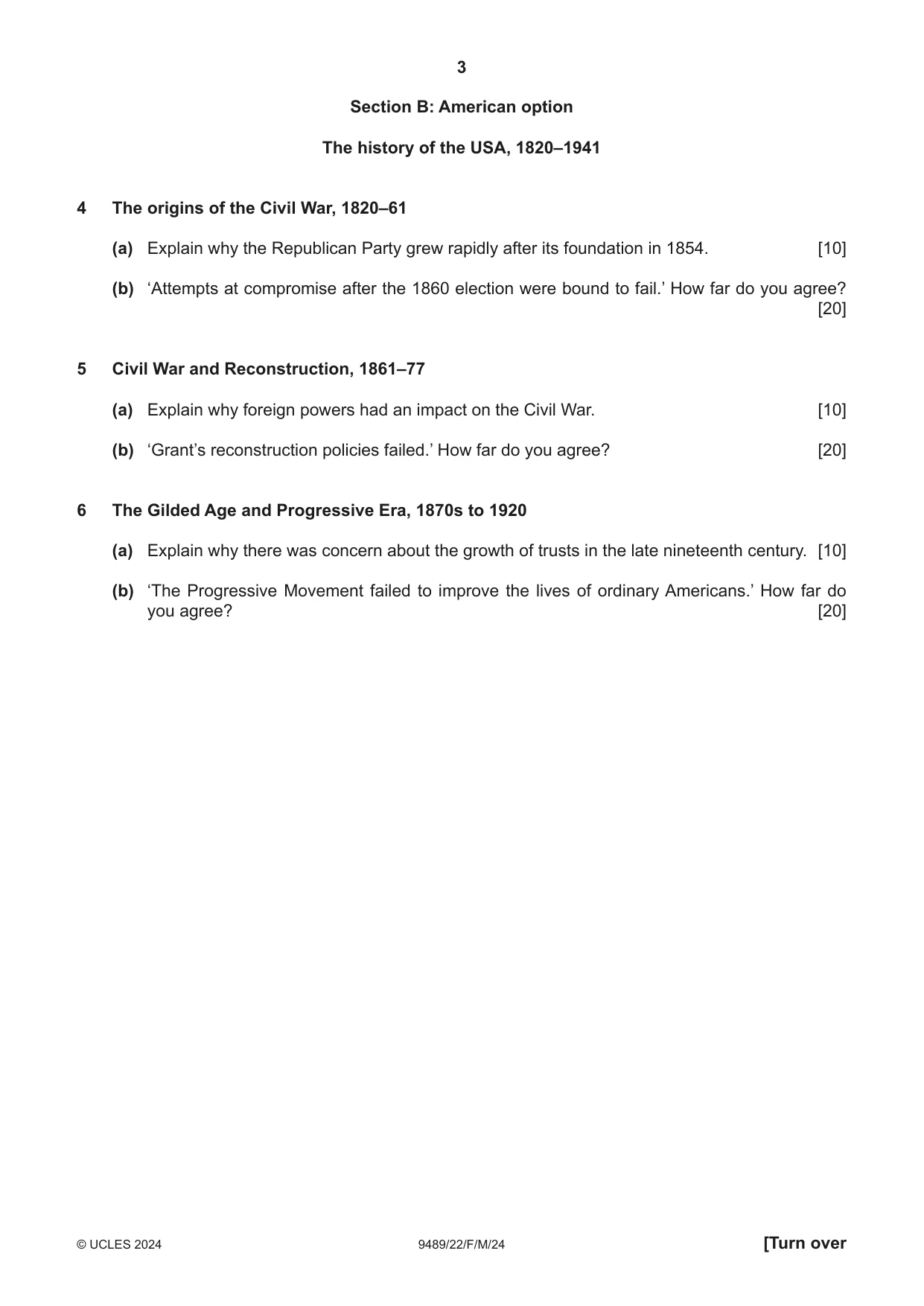
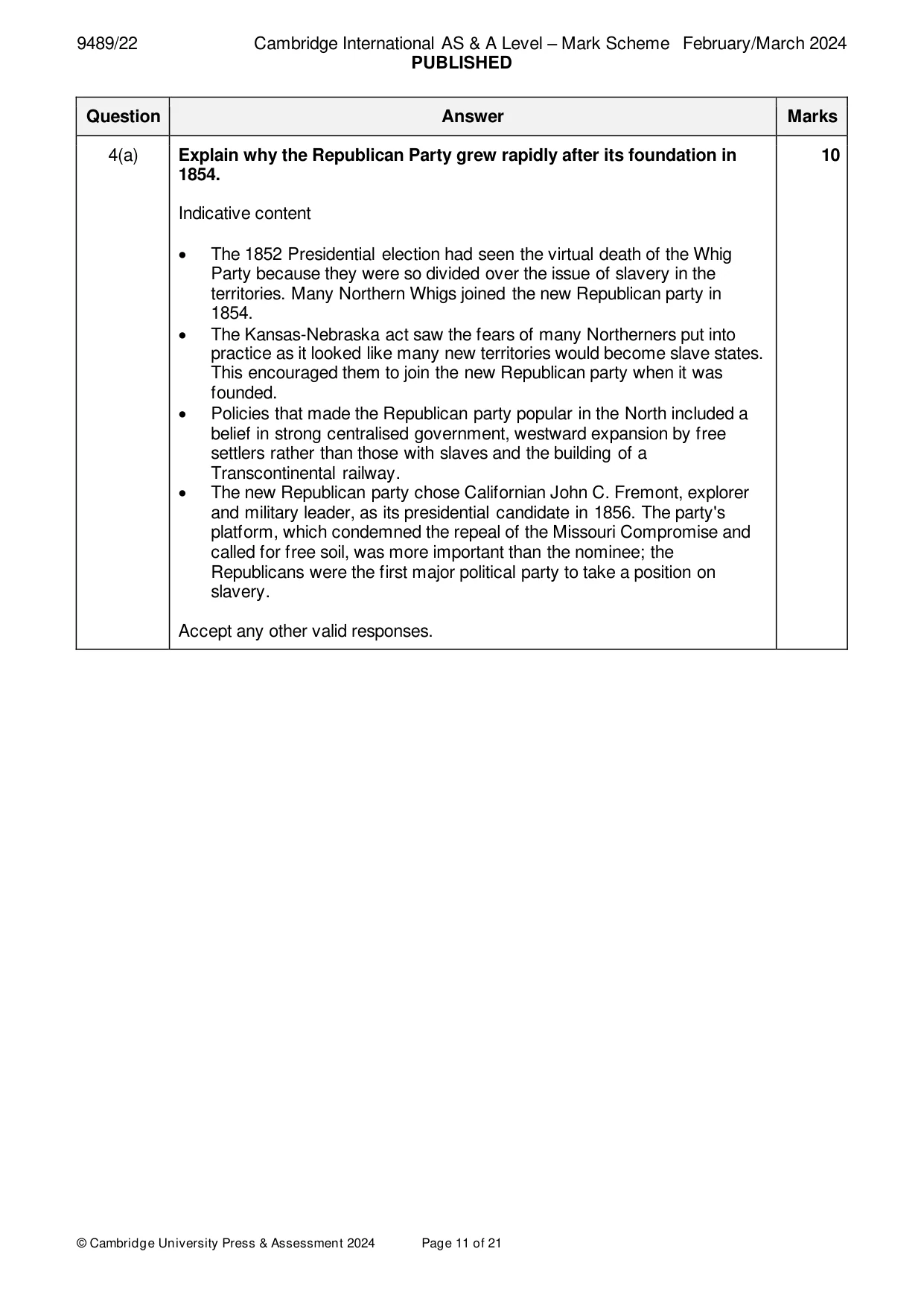
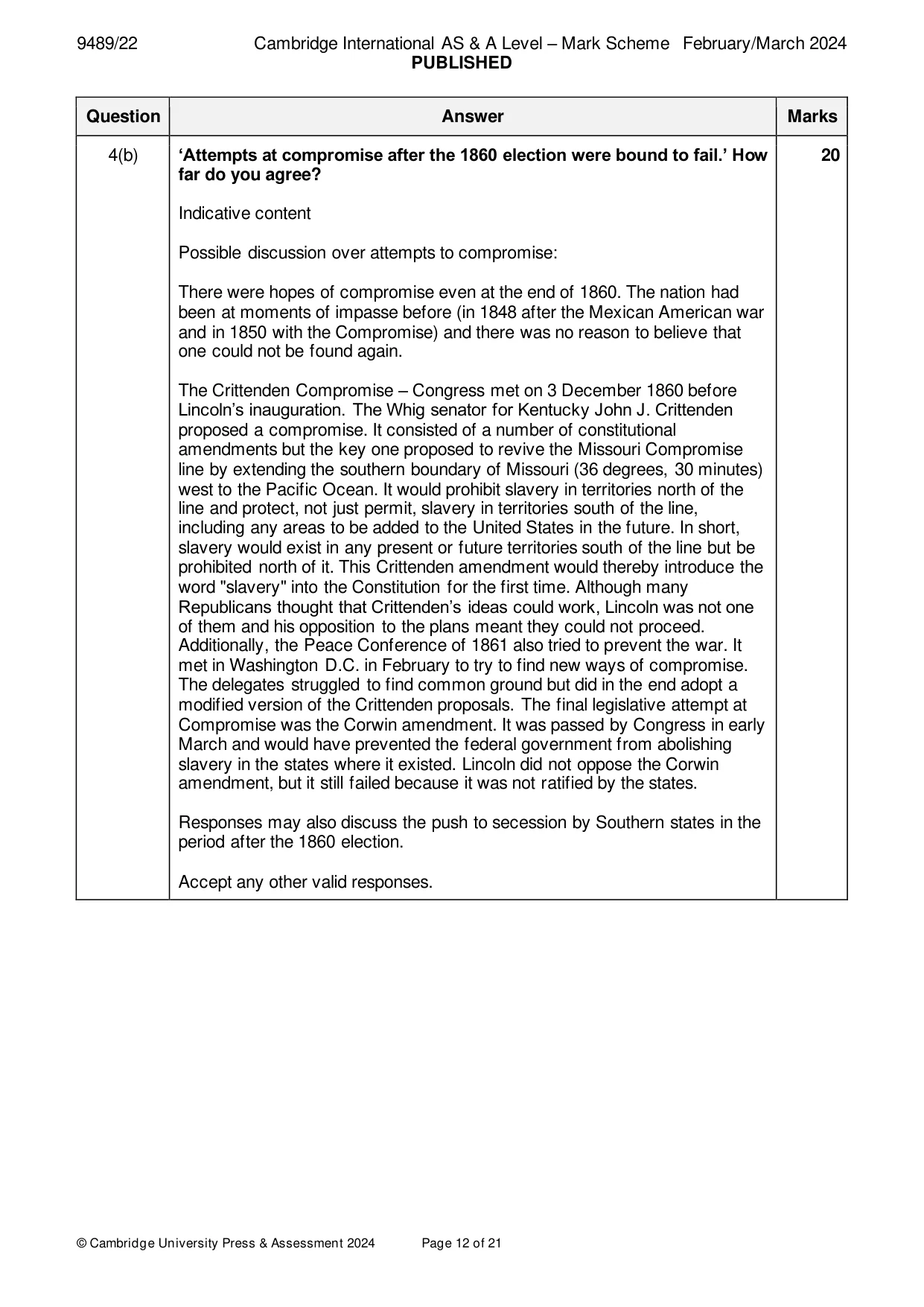
4 The origins of the Civil War, 1820–61 (a) Explain why the Republican Party grew rapidly after its foundation in 1854. [10] (b) ‘Attempts at compromise after the 1860 election were bound to fail.’ How far do you agree? [20]
Mark scheme: 4(a) Explain why the Republican Party grew rapidly after its foundation in 10 1854. Indicative content • The 1852 Presidential election had seen the virtual death of the Whig Party because they were so divided over the issue of slavery in the territories. Many Northern Whigs joined the new Republican party in 1854. • The Kansas-Nebraska act saw the fears of many Northerners put into practice as it looked like many new territories would become slave states. This encouraged them to join the new Republican party when it was founded. • Policies that made the Republican party popular in the North included a belief in strong centralised government, westward expansion by free settlers rather than those with slaves and the building of a Transcontinental railway. • The new Republican party chose Californian John C. Fremont, explorer and military leader, as its presidential candidate in 1856. The party's platform, which condemned the repeal of the Missouri Compromise and called for free soil, was more important than the nominee; the Republicans were the first major political party to take a position on slavery. Accept any other valid responses. 4(b) ‘Attempts at compromise after the 1860 election were bound to fail.’ How 20 far do you agree? Indicative content Possible discussion over attempts to compromise: There were hopes of compromise even at the end of 1860. The nation had been at moments of impasse before (in 1848 after the Mexican American war and in 1850 with the Compromise) and there was no reason to believe that one could not be found again. The Crittenden Compromise – Congress met on 3 December 1860 before Lincoln’s inauguration. The Whig senator for Kentucky John J. Crittenden proposed a compromise. It consisted of a number of constitutional amendments but the key one proposed to revive the Missouri Compromise line by extending the southern boundary of Missouri (36 degrees, 30 minutes) west to the Pacific Ocean. It would prohibit slavery in territories north of the line and protect, not just permit, slavery in territories south of the line, including any areas to be added to the United States in the future. In short, slavery would exist in any present or future territories south of the line but be prohibited north of it. This Crittenden amendment would thereby introduce the word "slavery" into the Constitution for the first time. Although many Republicans thought that Crittenden’s ideas could work, Lincoln was not one of them and his opposition to the plans meant they could not proceed. Additionally, the Peace Conference of 1861 also tried to prevent the war. It met in Washington D.C. in February to try to find new ways of compromise. The delegates struggled to find common ground but did in the end adopt a modified version of the Crittenden proposals. The final legislative attempt at Compromise was the Corwin amendment. It was passed by Congress in early March and would have prevented the federal government from abolishing slavery in the states where it existed. Lincoln did not oppose the Corwin amendment, but it still failed because it was not ratified by the states. Responses may also discuss the push to secession by Southern states in the period after the 1860 election. Accept any other valid responses.
More questions on Why did the Civil War break out in April 1861?
Q5 · Civil War and Reconstruction, 1861–77 (a) Explain why foreign powers had an impact on the…
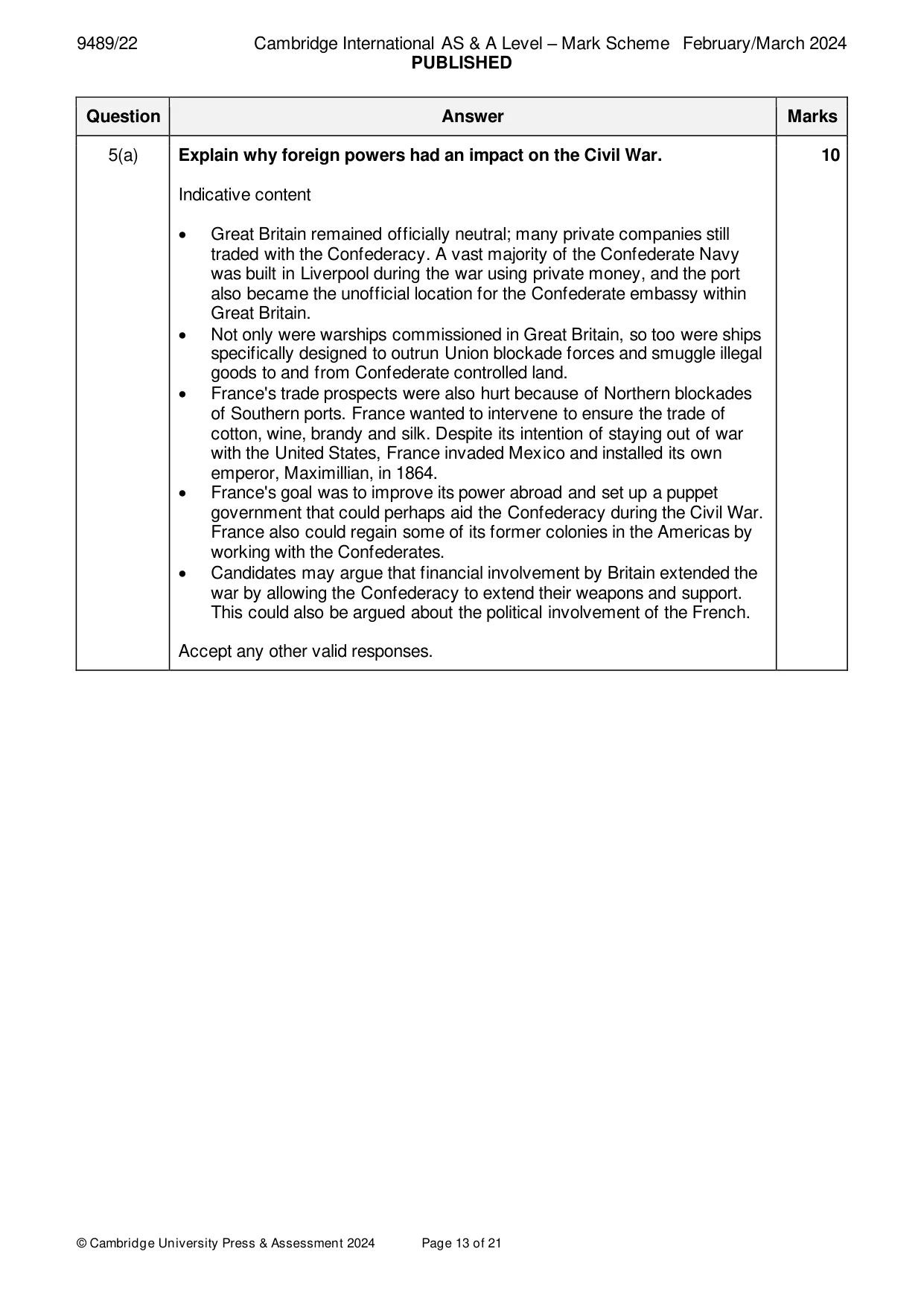
5 Civil War and Reconstruction, 1861–77 (a) Explain why foreign powers had an impact on the Civil War. [10] (b) ‘Grant’s reconstruction policies failed.’ How far do you agree? [20]
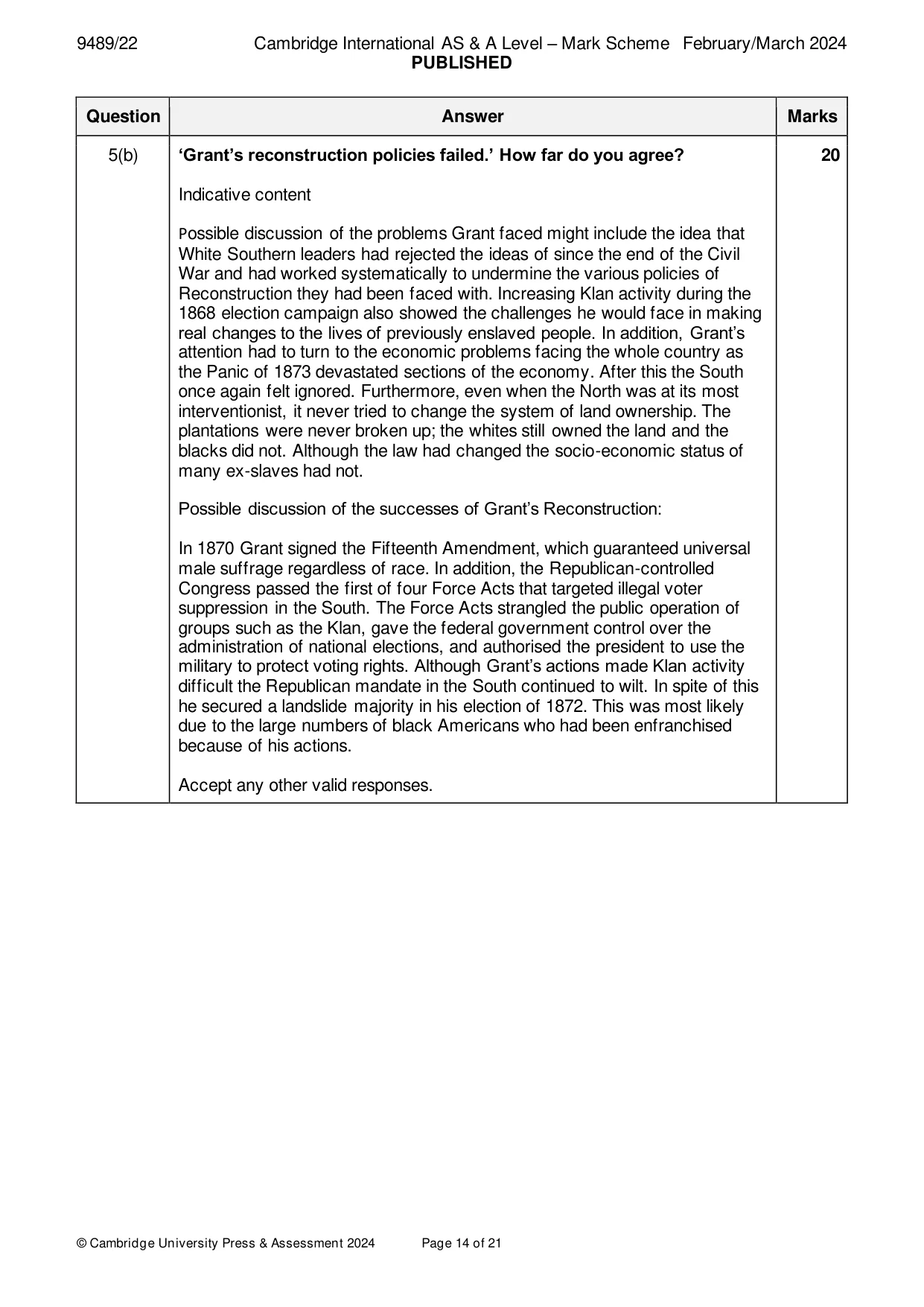
Mark scheme: 5(a) Explain why foreign powers had an impact on the Civil War. 10 Indicative content • Great Britain remained officially neutral; many private companies still traded with the Confederacy. A vast majority of the Confederate Navy was built in Liverpool during the war using private money, and the port also became the unofficial location for the Confederate embassy within Great Britain. • Not only were warships commissioned in Great Britain, so too were ships specifically designed to outrun Union blockade forces and smuggle illegal goods to and from Confederate controlled land. • France's trade prospects were also hurt because of Northern blockades of Southern ports. France wanted to intervene to ensure the trade of cotton, wine, brandy and silk. Despite its intention of staying out of war with the United States, France invaded Mexico and installed its own emperor, Maximillian, in 1864. • France's goal was to improve its power abroad and set up a puppet government that could perhaps aid the Confederacy during the Civil War. France also could regain some of its former colonies in the Americas by working with the Confederates. • Candidates may argue that financial involvement by Britain extended the war by allowing the Confederacy to extend their weapons and support. This could also be argued about the political involvement of the French. Accept any other valid responses. 5(b) ‘Grant’s reconstruction policies failed.’ How far do you agree? 20 Indicative content Possible discussion of the problems Grant faced might include the idea that White Southern leaders had rejected the ideas of since the end of the Civil War and had worked systematically to undermine the various policies of Reconstruction they had been faced with. Increasing Klan activity during the 1868 election campaign also showed the challenges he would face in making real changes to the lives of previously enslaved people. In addition, Grant’s attention had to turn to the economic problems facing the whole country as the Panic of 1873 devastated sections of the economy. After this the South once again felt ignored. Furthermore, even when the North was at its most interventionist, it never tried to change the system of land ownership. The plantations were never broken up; the whites still owned the land and the blacks did not. Although the law had changed the socio-economic status of many ex-slaves had not. Possible discussion of the successes of Grant’s Reconstruction: In 1870 Grant signed the Fifteenth Amendment, which guaranteed universal male suffrage regardless of race. In addition, the Republican-controlled Congress passed the first of four Force Acts that targeted illegal voter suppression in the South. The Force Acts strangled the public operation of groups such as the Klan, gave the federal government control over the administration of national elections, and authorised the president to use the military to protect voting rights. Although Grant’s actions made Klan activity difficult the Republican mandate in the South continued to wilt. In spite of this he secured a landslide majority in his election of 1872. This was most likely due to the large numbers of black Americans who had been enfranchised because of his actions. Accept any other valid responses.
More questions on What were the aims of Reconstruction and how successful was it?
Q6 · The Gilded Age and Progressive Era, 1870s to 1920 (a) Explain why there was concern about…
6 The Gilded Age and Progressive Era, 1870s to 1920 (a) Explain why there was concern about the growth of trusts in the late nineteenth century. [10] (b) ‘The Progressive Movement failed to improve the lives of ordinary Americans.’ How far do you agree? [20] Section C: International option International history, 1870–1945
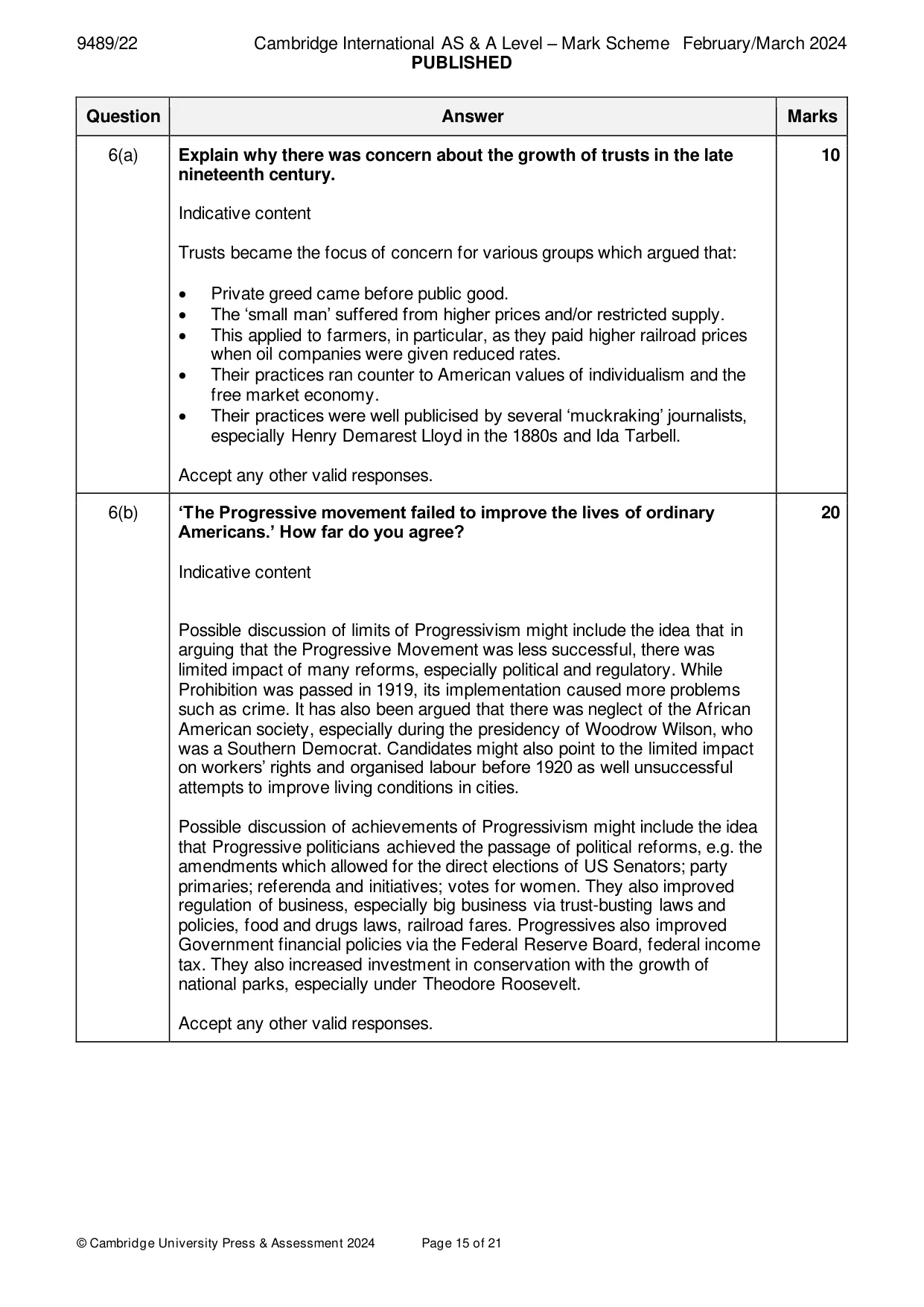
Mark scheme: 6(a) Explain why there was concern about the growth of trusts in the late 10 nineteenth century. Indicative content Trusts became the focus of concern for various groups which argued that: • Private greed came before public good. • The ‘small man’ suffered from higher prices and/or restricted supply. • This applied to farmers, in particular, as they paid higher railroad prices when oil companies were given reduced rates. • Their practices ran counter to American values of individualism and the free market economy. • Their practices were well publicised by several ‘muckraking’ journalists, especially Henry Demarest Lloyd in the 1880s and Ida Tarbell. Accept any other valid responses. 6(b) ‘The Progressive movement failed to improve the lives of ordinary 20 Americans.’ How far do you agree? Indicative content Possible discussion of limits of Progressivism might include the idea that in arguing that the Progressive Movement was less successful, there was limited impact of many reforms, especially political and regulatory. While Prohibition was passed in 1919, its implementation caused more problems such as crime. It has also been argued that there was neglect of the African American society, especially during the presidency of Woodrow Wilson, who was a Southern Democrat. Candidates might also point to the limited impact on workers’ rights and organised labour before 1920 as well unsuccessful attempts to improve living conditions in cities. Possible discussion of achievements of Progressivism might include the idea that Progressive politicians achieved the passage of political reforms, e.g. the amendments which allowed for the direct elections of US Senators; party primaries; referenda and initiatives; votes for women. They also improved regulation of business, especially big business via trust-busting laws and policies, food and drugs laws, railroad fares. Progressives also improved Government financial policies via the Federal Reserve Board, federal income tax. They also increased investment in conservation with the growth of national parks, especially under Theodore Roosevelt. Accept any other valid responses.
More questions on How successful was the Progressive Movement from 1890 to 1920?
Q7 · Empire and the emergence of world powers, 1870–1919 (a) Explain why the United States…
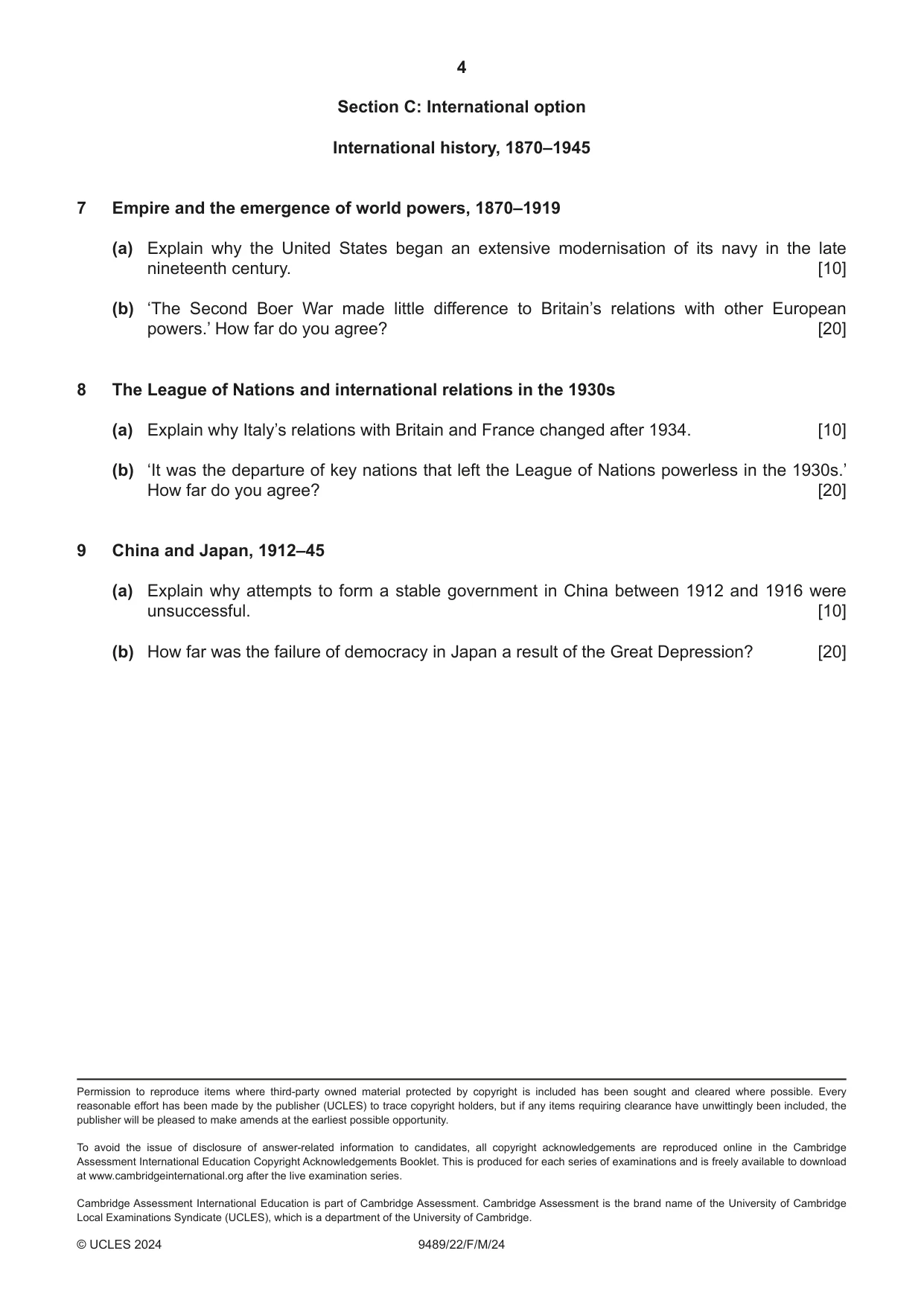
7 Empire and the emergence of world powers, 1870–1919 (a) Explain why the United States began an extensive modernisation of its navy in the late nineteenth century. [10] (b) ‘The Second Boer War made little difference to Britain’s relations with other European powers.’ How far do you agree? [20]
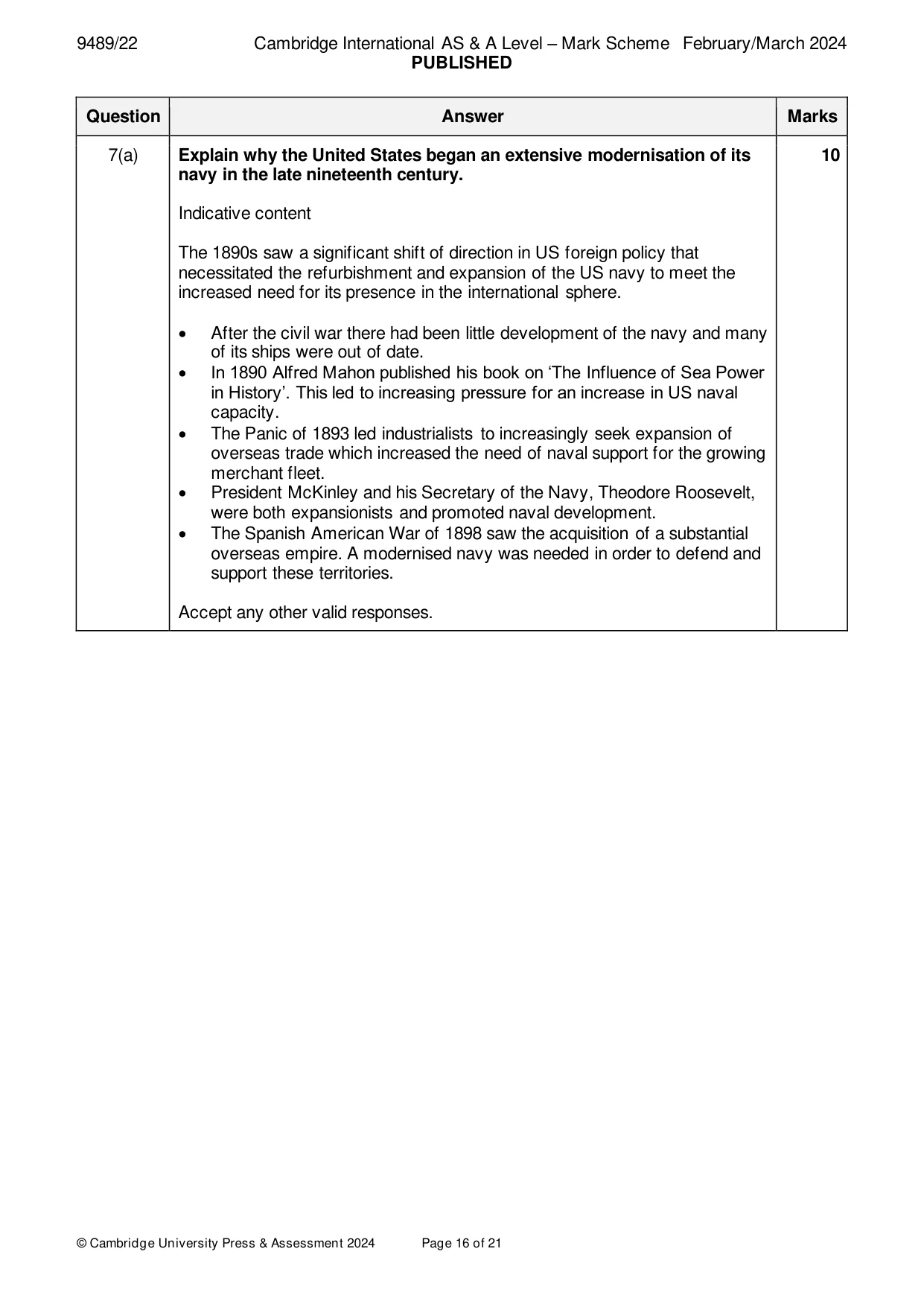
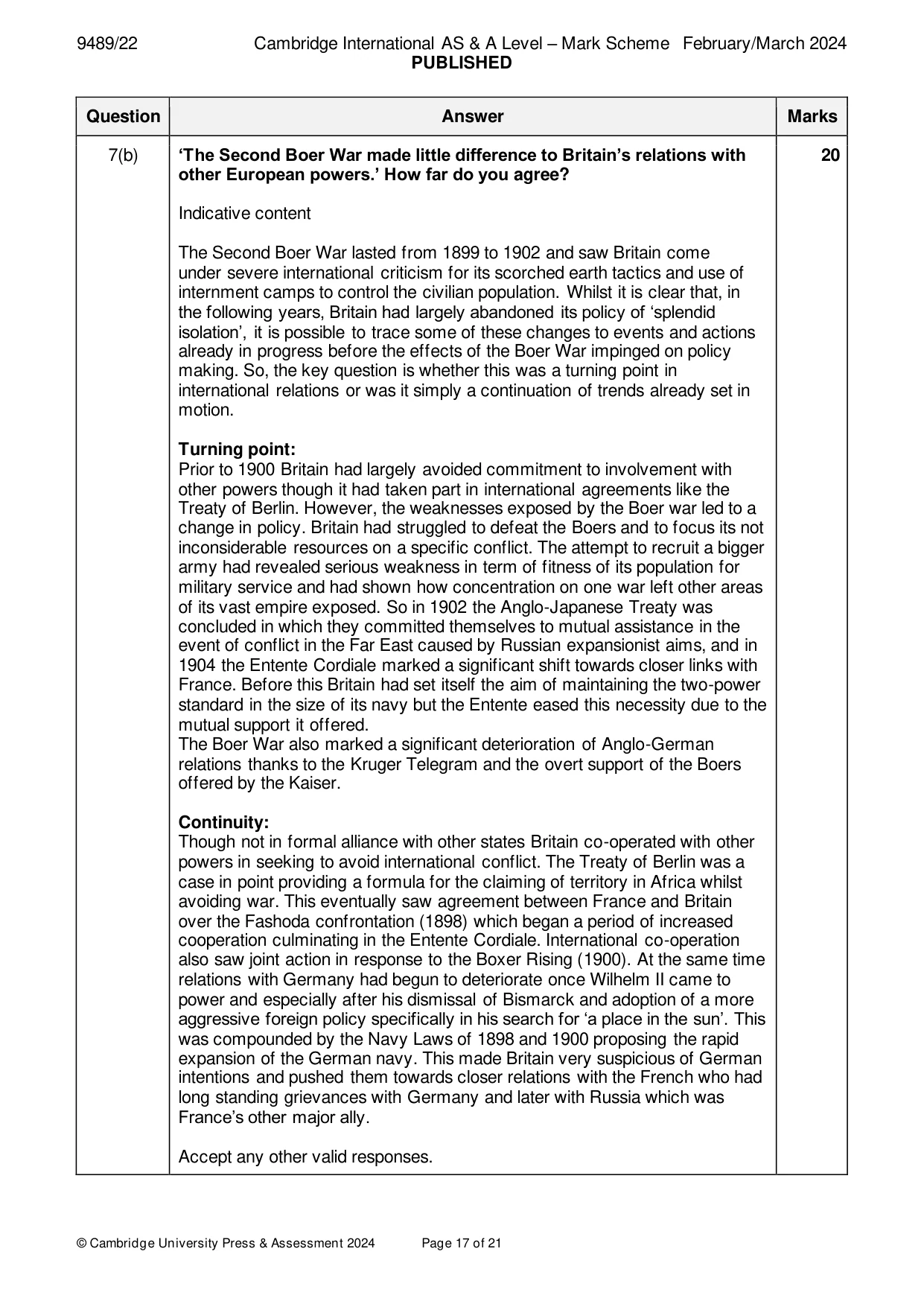
Mark scheme: 7(a) Explain why the United States began an extensive modernisation of its 10 navy in the late nineteenth century. Indicative content The 1890s saw a significant shift of direction in US foreign policy that necessitated the refurbishment and expansion of the US navy to meet the increased need for its presence in the international sphere. • After the civil war there had been little development of the navy and many of its ships were out of date. • In 1890 Alfred Mahon published his book on ‘The Influence of Sea Power in History’. This led to increasing pressure for an increase in US naval capacity. • The Panic of 1893 led industrialists to increasingly seek expansion of overseas trade which increased the need of naval support for the growing merchant fleet. • President McKinley and his Secretary of the Navy, Theodore Roosevelt, were both expansionists and promoted naval development. • The Spanish American War of 1898 saw the acquisition of a substantial overseas empire. A modernised navy was needed in order to defend and support these territories. Accept any other valid responses. 7(b) ‘The Second Boer War made little difference to Britain’s relations with 20 other European powers.’ How far do you agree? Indicative content The Second Boer War lasted from 1899 to 1902 and saw Britain come under severe international criticism for its scorched earth tactics and use of internment camps to control the civilian population. Whilst it is clear that, in the following years, Britain had largely abandoned its policy of ‘splendid isolation’, it is possible to trace some of these changes to events and actions already in progress before the effects of the Boer War impinged on policy making. So, the key question is whether this was a turning point in international relations or was it simply a continuation of trends already set in motion. Turning point: Prior to 1900 Britain had largely avoided commitment to involvement with other powers though it had taken part in international agreements like the Treaty of Berlin. However, the weaknesses exposed by the Boer war led to a change in policy. Britain had struggled to defeat the Boers and to focus its not inconsiderable resources on a specific conflict. The attempt to recruit a bigger army had revealed serious weakness in term of fitness of its population for military service and had shown how concentration on one war left other areas of its vast empire exposed. So in 1902 the Anglo-Japanese Treaty was concluded in which they committed themselves to mutual assistance in the event of conflict in the Far East caused by Russian expansionist aims, and in 1904 the Entente Cordiale marked a significant shift towards closer links with France. Before this Britain had set itself the aim of maintaining the two-power standard in the size of its navy but the Entente eased this necessity due to the mutual support it offered. The Boer War also marked a significant deterioration of Anglo-German relations thanks to the Kruger Telegram and the overt support of the Boers offered by the Kaiser. Continuity: Though not in formal alliance with other states Britain co-operated with other powers in seeking to avoid international conflict. The Treaty of Berlin was a case in point providing a formula for the claiming of territory in Africa whilst avoiding war. This eventually saw agreement between France and Britain over the Fashoda confrontation (1898) which began a period of increased cooperation culminating in the Entente Cordiale. International co-operation also saw joint action in response to the Boxer Rising (1900). At the same time relations with Germany had begun to deteriorate once Wilhelm II came to power and especially after his dismissal of Bismarck and adoption of a more aggressive foreign policy specifically in his search for ‘a place in the sun’. This was compounded by the Navy Laws of 1898 and 1900 proposing the rapid expansion of the German navy. This made Britain very suspicious of German intentions and pushed them towards closer relations with the French who had long standing grievances with Germany and later with Russia which was France’s other major ally. Accept any other valid responses.
More questions on What was the impact of imperial expansion on international relations?
Q8 · The League of Nations and international relations in the 1930s (a) Explain why Italy’s…
8 The League of Nations and international relations in the 1930s (a) Explain why Italy’s relations with Britain and France changed after 1934. [10] (b) ‘It was the departure of key nations that left the League of Nations powerless in the 1930s.’ How far do you agree? [20]
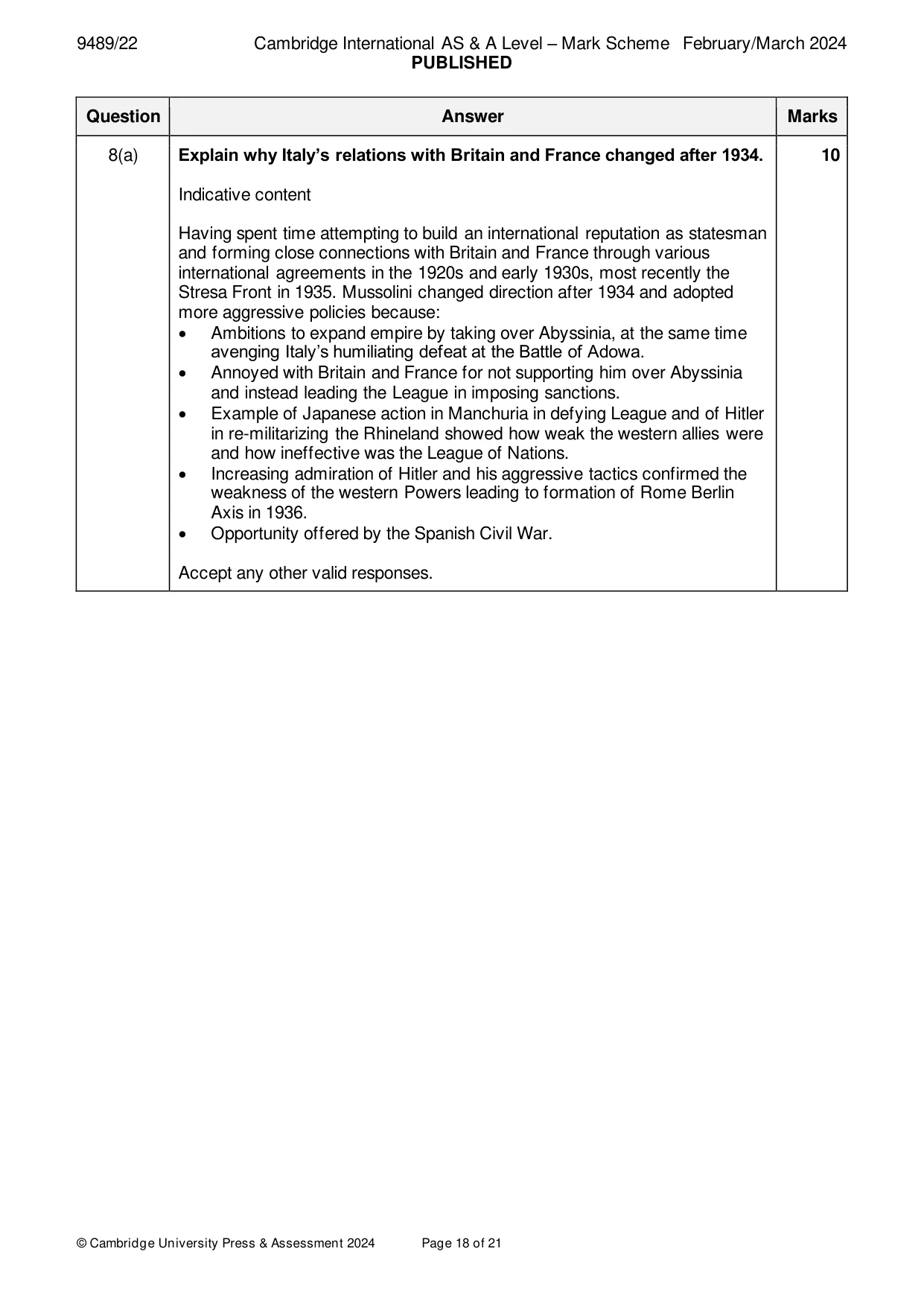
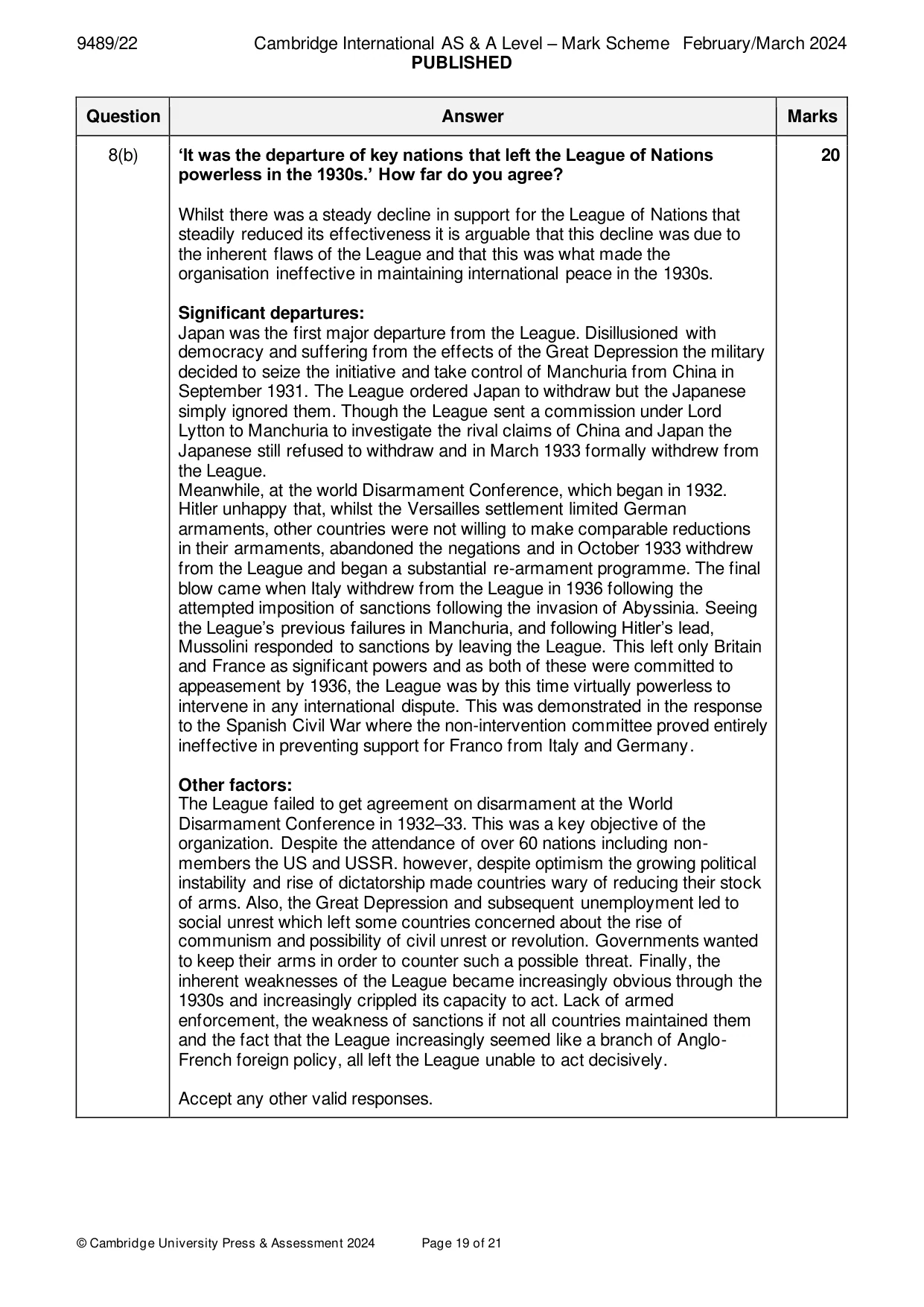
Mark scheme: 8(a) Explain why Italy’s relations with Britain and France changed after 1934. 10 Indicative content Having spent time attempting to build an international reputation as statesman and forming close connections with Britain and France through various international agreements in the 1920s and early 1930s, most recently the Stresa Front in 1935. Mussolini changed direction after 1934 and adopted more aggressive policies because: • Ambitions to expand empire by taking over Abyssinia, at the same time avenging Italy’s humiliating defeat at the Battle of Adowa. • Annoyed with Britain and France for not supporting him over Abyssinia and instead leading the League in imposing sanctions. • Example of Japanese action in Manchuria in defying League and of Hitler in re-militarizing the Rhineland showed how weak the western allies were and how ineffective was the League of Nations. • Increasing admiration of Hitler and his aggressive tactics confirmed the weakness of the western Powers leading to formation of Rome Berlin Axis in 1936. • Opportunity offered by the Spanish Civil War. Accept any other valid responses. 8(b) ‘It was the departure of key nations that left the League of Nations 20 powerless in the 1930s.’ How far do you agree? Whilst there was a steady decline in support for the League of Nations that steadily reduced its effectiveness it is arguable that this decline was due to the inherent flaws of the League and that this was what made the organisation ineffective in maintaining international peace in the 1930s. Significant departures: Japan was the first major departure from the League. Disillusioned with democracy and suffering from the effects of the Great Depression the military decided to seize the initiative and take control of Manchuria from China in September 1931. The League ordered Japan to withdraw but the Japanese simply ignored them. Though the League sent a commission under Lord Lytton to Manchuria to investigate the rival claims of China and Japan the Japanese still refused to withdraw and in March 1933 formally withdrew from the League. Meanwhile, at the world Disarmament Conference, which began in 1932. Hitler unhappy that, whilst the Versailles settlement limited German armaments, other countries were not willing to make comparable reductions in their armaments, abandoned the negations and in October 1933 withdrew from the League and began a substantial re-armament programme. The final blow came when Italy withdrew from the League in 1936 following the attempted imposition of sanctions following the invasion of Abyssinia. Seeing the League’s previous failures in Manchuria, and following Hitler’s lead, Mussolini responded to sanctions by leaving the League. This left only Britain and France as significant powers and as both of these were committed to appeasement by 1936, the League was by this time virtually powerless to intervene in any international dispute. This was demonstrated in the response to the Spanish Civil War where the non-intervention committee proved entirely ineffective in preventing support for Franco from Italy and Germany. Other factors: The League failed to get agreement on disarmament at the World Disarmament Conference in 1932–33. This was a key objective of the organization. Despite the attendance of over 60 nations including non- members the US and USSR. however, despite optimism the growing political instability and rise of dictatorship made countries wary of reducing their stock of arms. Also, the Great Depression and subsequent unemployment led to social unrest which left some countries concerned about the rise of communism and possibility of civil unrest or revolution. Governments wanted to keep their arms in order to counter such a possible threat. Finally, the inherent weaknesses of the League became increasingly obvious through the 1930s and increasingly crippled its capacity to act. Lack of armed enforcement, the weakness of sanctions if not all countries maintained them and the fact that the League increasingly seemed like a branch of Anglo- French foreign policy, all left the League unable to act decisively. Accept any other valid responses.
More questions on Why did the League of Nations fail to keep the peace in the 1930s?
Q9 · China and Japan, 1912–45 (a) Explain why attempts to form a stable government in China…
9 China and Japan, 1912–45 (a) Explain why attempts to form a stable government in China between 1912 and 1916 were unsuccessful. [10] (b) How far was the failure of democracy in Japan a result of the Great Depression? [20]
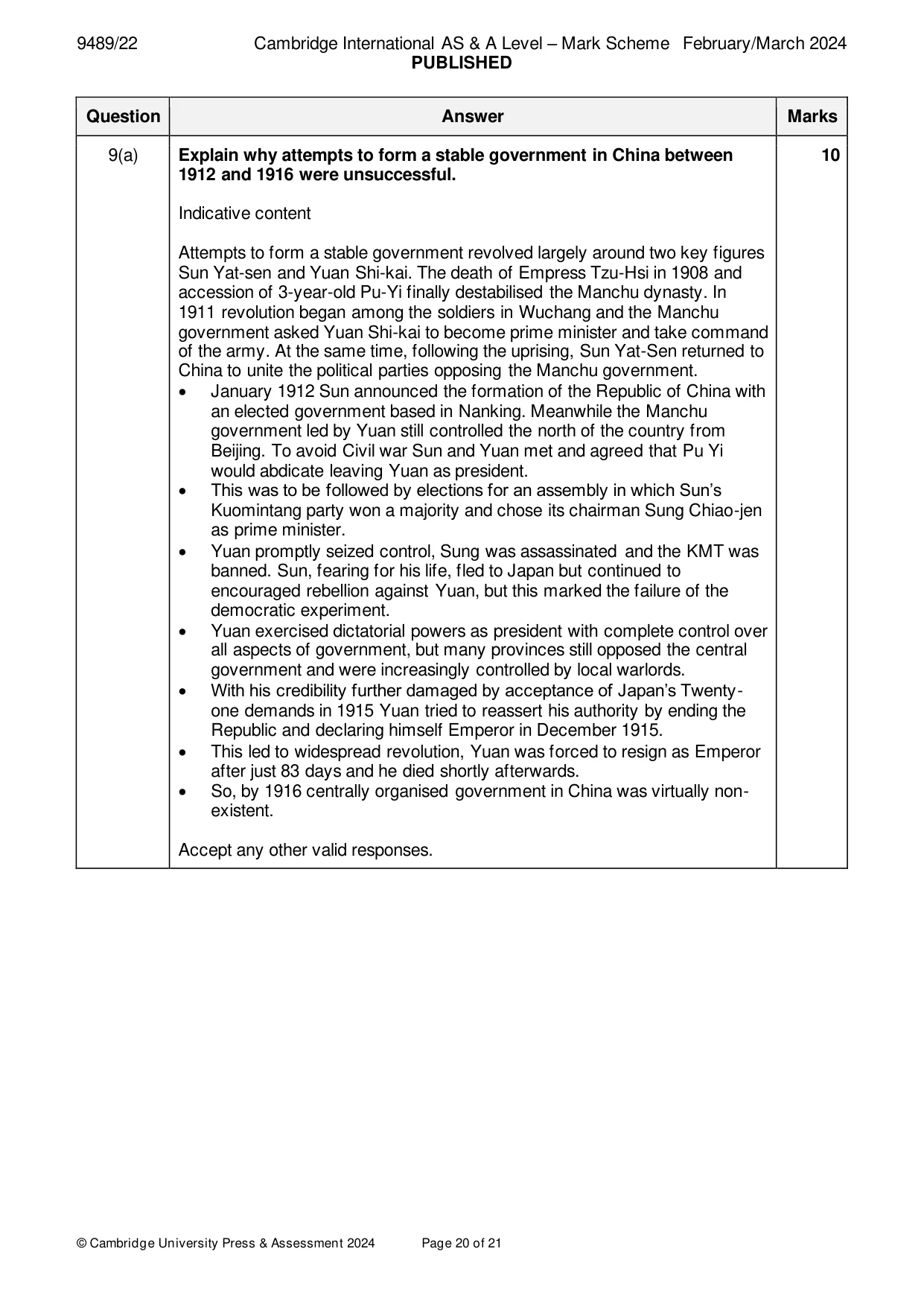
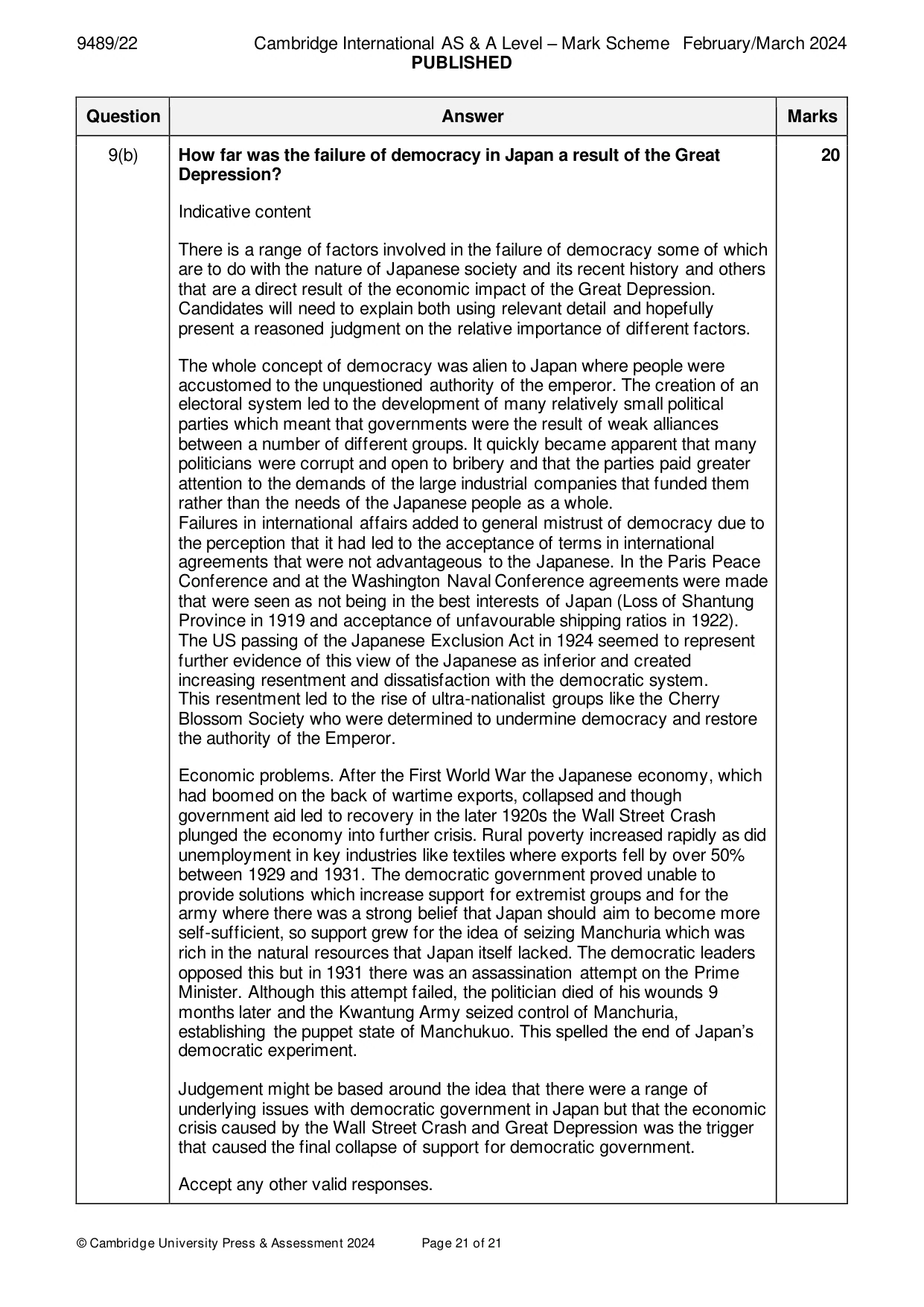
Mark scheme: 9(a) Explain why attempts to form a stable government in China between 10 1912 and 1916 were unsuccessful. Indicative content Attempts to form a stable government revolved largely around two key figures Sun Yat-sen and Yuan Shi-kai. The death of Empress Tzu-Hsi in 1908 and accession of 3-year-old Pu-Yi finally destabilised the Manchu dynasty. In 1911 revolution began among the soldiers in Wuchang and the Manchu government asked Yuan Shi-kai to become prime minister and take command of the army. At the same time, following the uprising, Sun Yat-Sen returned to China to unite the political parties opposing the Manchu government. • January 1912 Sun announced the formation of the Republic of China with an elected government based in Nanking. Meanwhile the Manchu government led by Yuan still controlled the north of the country from Beijing. To avoid Civil war Sun and Yuan met and agreed that Pu Yi would abdicate leaving Yuan as president. • This was to be followed by elections for an assembly in which Sun’s Kuomintang party won a majority and chose its chairman Sung Chiao-jen as prime minister. • Yuan promptly seized control, Sung was assassinated and the KMT was banned. Sun, fearing for his life, fled to Japan but continued to encouraged rebellion against Yuan, but this marked the failure of the democratic experiment. • Yuan exercised dictatorial powers as president with complete control over all aspects of government, but many provinces still opposed the central government and were increasingly controlled by local warlords. • With his credibility further damaged by acceptance of Japan’s Twenty- one demands in 1915 Yuan tried to reassert his authority by ending the Republic and declaring himself Emperor in December 1915. • This led to widespread revolution, Yuan was forced to resign as Emperor after just 83 days and he died shortly afterwards. • So, by 1916 centrally organised government in China was virtually non- existent. Accept any other valid responses. 9(b) How far was the failure of democracy in Japan a result of the Great 20 Depression? Indicative content There is a range of factors involved in the failure of democracy some of which are to do with the nature of Japanese society and its recent history and others that are a direct result of the economic impact of the Great Depression. Candidates will need to explain both using relevant detail and hopefully present a reasoned judgment on the relative importance of different factors. The whole concept of democracy was alien to Japan where people were accustomed to the unquestioned authority of the emperor. The creation of an electoral system led to the development of many relatively small political parties which meant that governments were the result of weak alliances between a number of different groups. It quickly became apparent that many politicians were corrupt and open to bribery and that the parties paid greater attention to the demands of the large industrial companies that funded them rather than the needs of the Japanese people as a whole. Failures in international affairs added to general mistrust of democracy due to the perception that it had led to the acceptance of terms in international agreements that were not advantageous to the Japanese. In the Paris Peace Conference and at the Washington Naval Conference agreements were made that were seen as not being in the best interests of Japan (Loss of Shantung Province in 1919 and acceptance of unfavourable shipping ratios in 1922). The US passing of the Japanese Exclusion Act in 1924 seemed to represent further evidence of this view of the Japanese as inferior and created increasing resentment and dissatisfaction with the democratic system. This resentment led to the rise of ultra-nationalist groups like the Cherry Blossom Society who were determined to undermine democracy and restore the authority of the Emperor. Economic problems. After the First World War the Japanese economy, which had boomed on the back of wartime exports, collapsed and though government aid led to recovery in the later 1920s the Wall Street Crash plunged the economy into further crisis. Rural poverty increased rapidly as did unemployment in key industries like textiles where exports fell by over 50% between 1929 and 1931. The democratic government proved unable to provide solutions which increase support for extremist groups and for the army where there was a strong belief that Japan should aim to become more self-sufficient, so support grew for the idea of seizing Manchuria which was rich in the natural resources that Japan itself lacked. The democratic leaders opposed this but in 1931 there was an assassination attempt on the Prime Minister. Although this attempt failed, the politician died of his wounds 9 months later and the Kwantung Army seized control of Manchuria, establishing the puppet state of Manchukuo. This spelled the end of Japan’s democratic experiment. Judgement might be based around the idea that there were a range of underlying issues with democratic government in Japan but that the economic crisis caused by the Wall Street Crash and Great Depression was the trigger that caused the final collapse of support for democratic government. Accept any other valid responses.
More questions on Why did Japan emerge as a world power and what was the impact on international
What was in this paper
The subtopics covered by these 9 questions, and how many questions each got. Open one in a new tab to see every Cambridge question on it.
1How well was France governed in the period 1793–99?1What happened during the 1848–49 revolutions and what were their consequences?1What was the impact of imperial expansion on international relations?1What were the aims of Reconstruction and how successful was it?1What were the causes and outcomes of the 1905 Revolution up to 1914?1Why did Japan emerge as a world power and what was the impact on international1Why did the Civil War break out in April 1861?1Why did the League of Nations fail to keep the peace in the 1930s?1What you needed in this session
Cambridge’s own grade thresholds for 2024 Feb/March, Paper 2 · Variant 2. A higher threshold means an easier paper — the bar moves with how the cohort did.