Cambridge A Level History 9489 — 2021 Oct/Nov Paper 2 · Variant 1
9489/21/O/N/21 · 9 questions · 60 marks · ≈68 min
The question paper and its mark scheme, free to read here and free to download. This is Cambridge’s own paper, exactly as it was sat.
Question paper4 pages
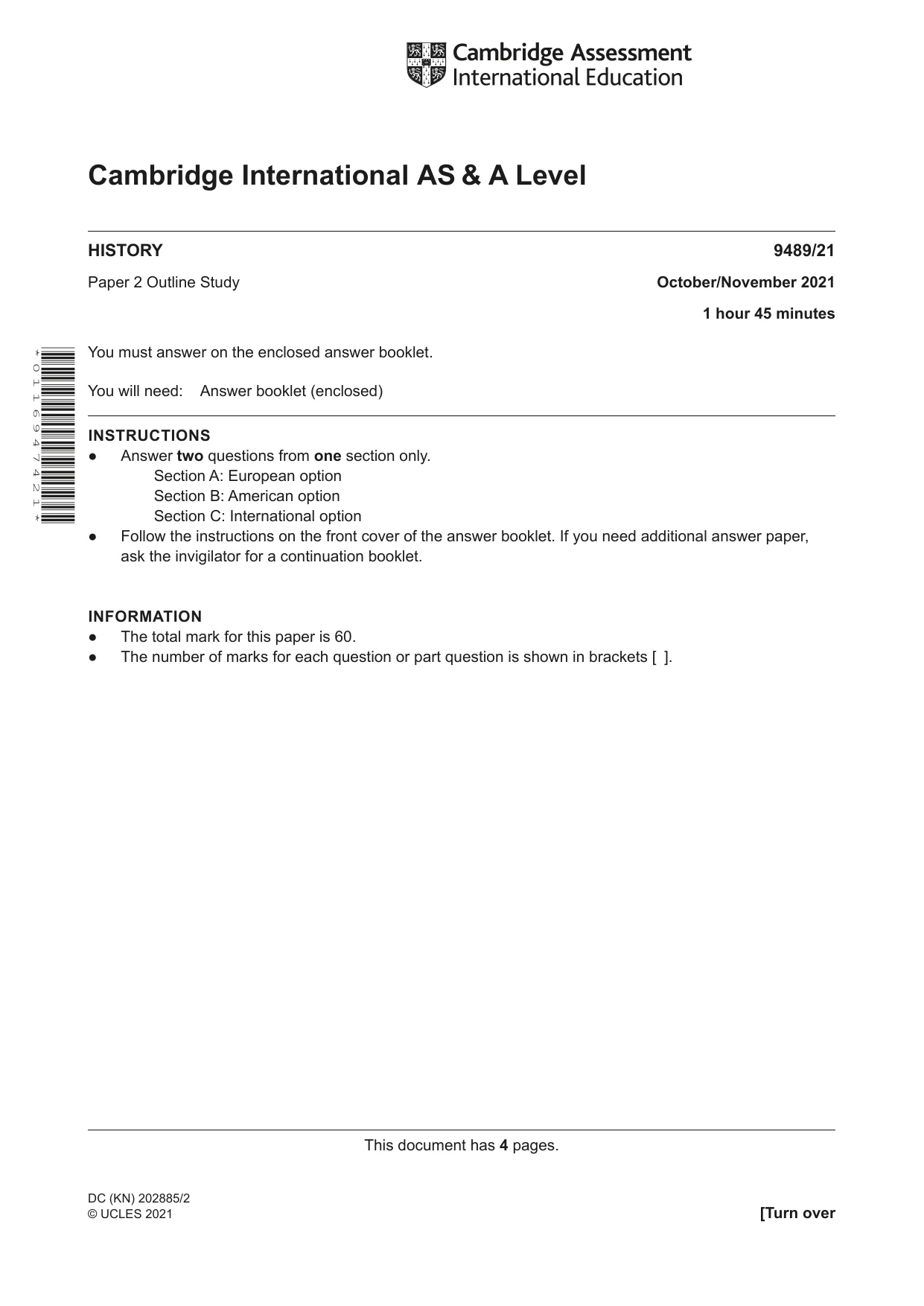
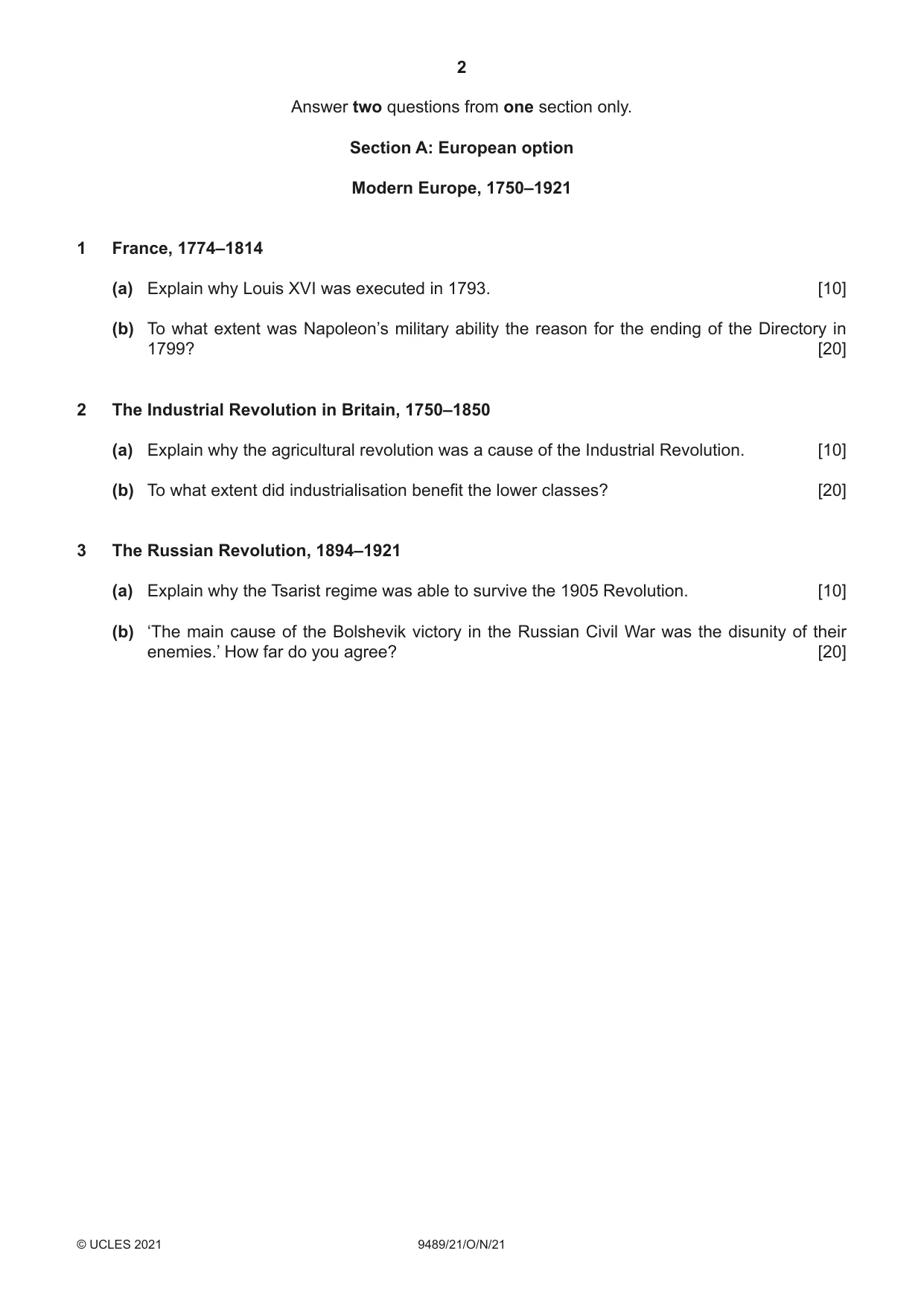
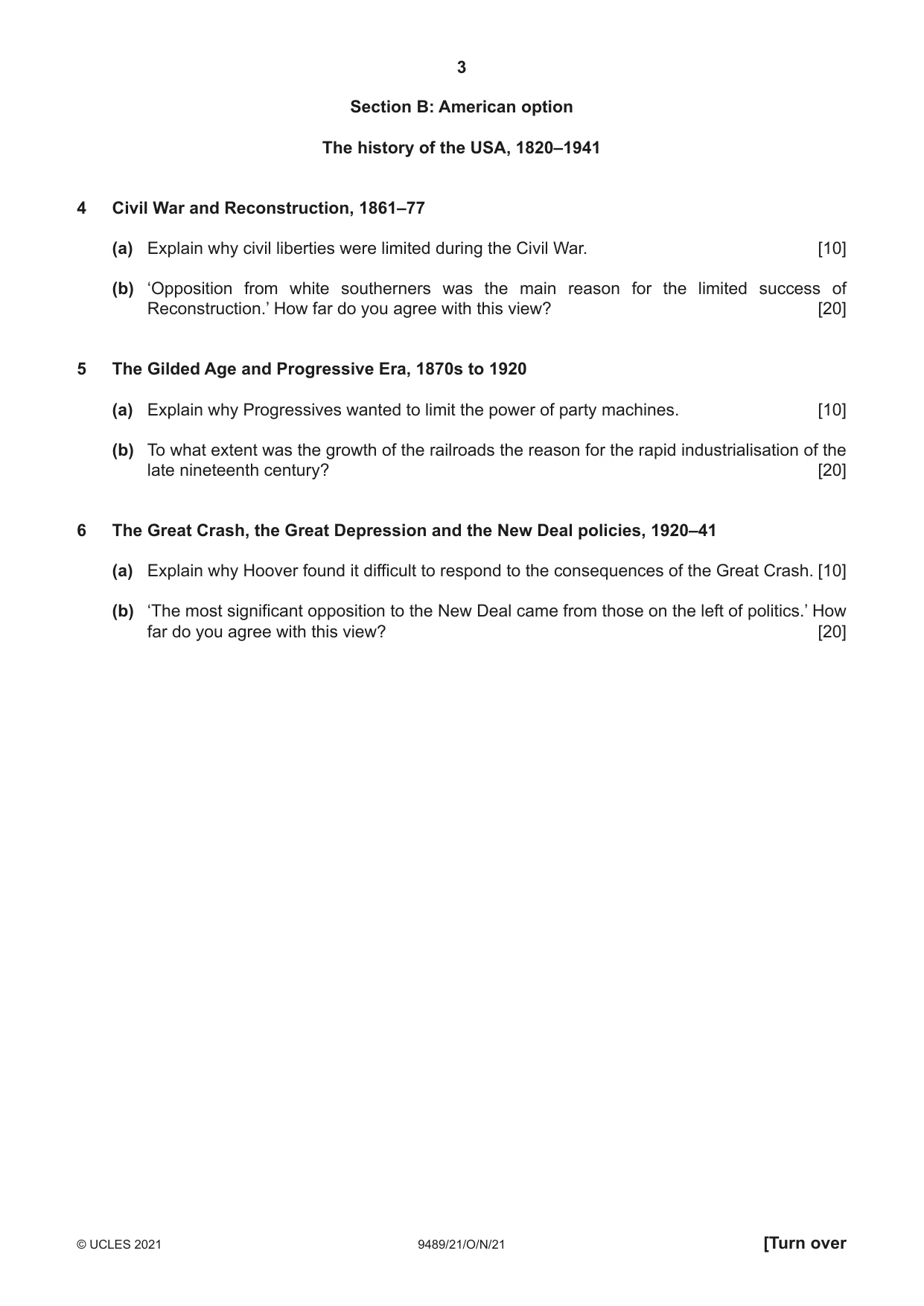
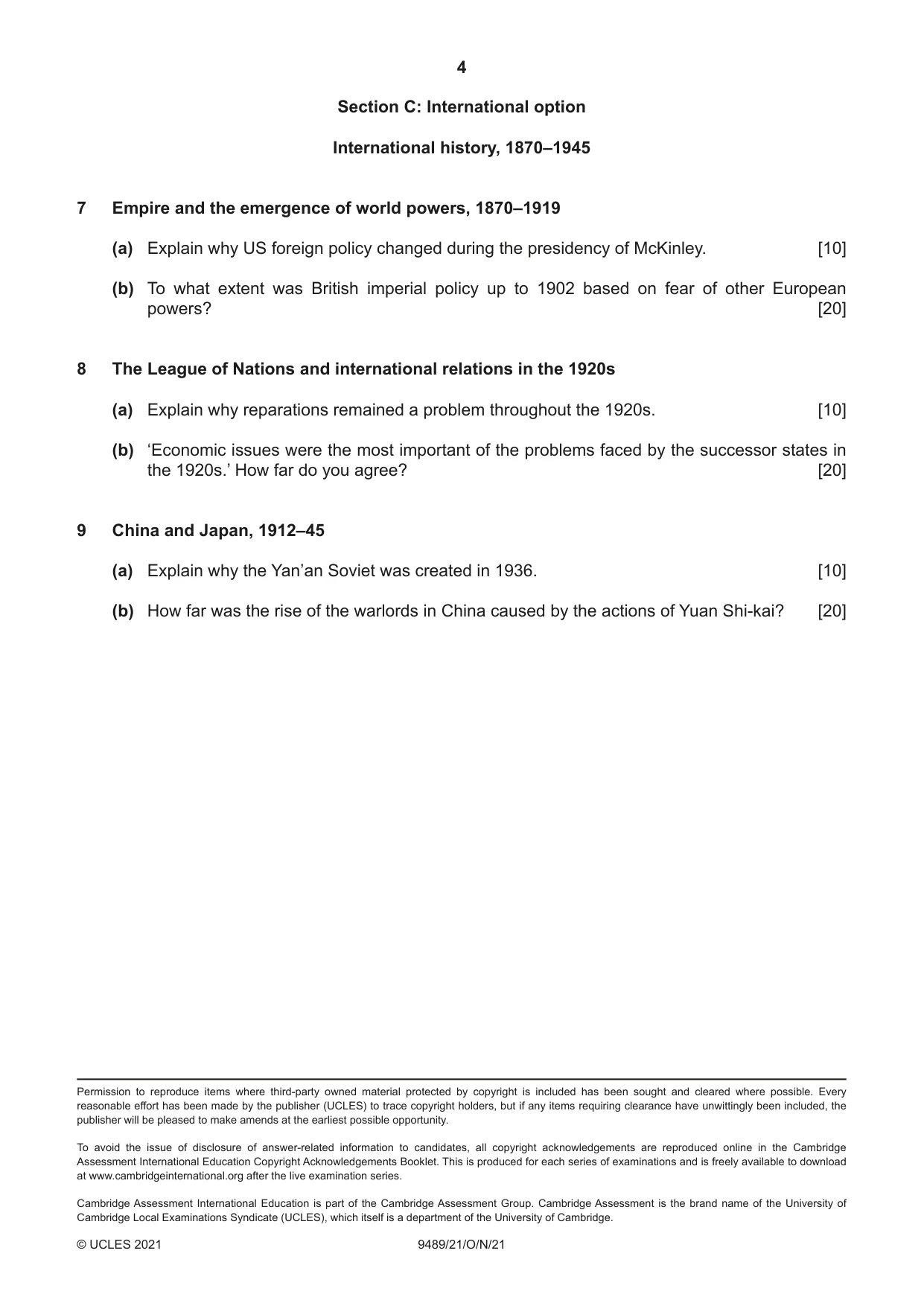
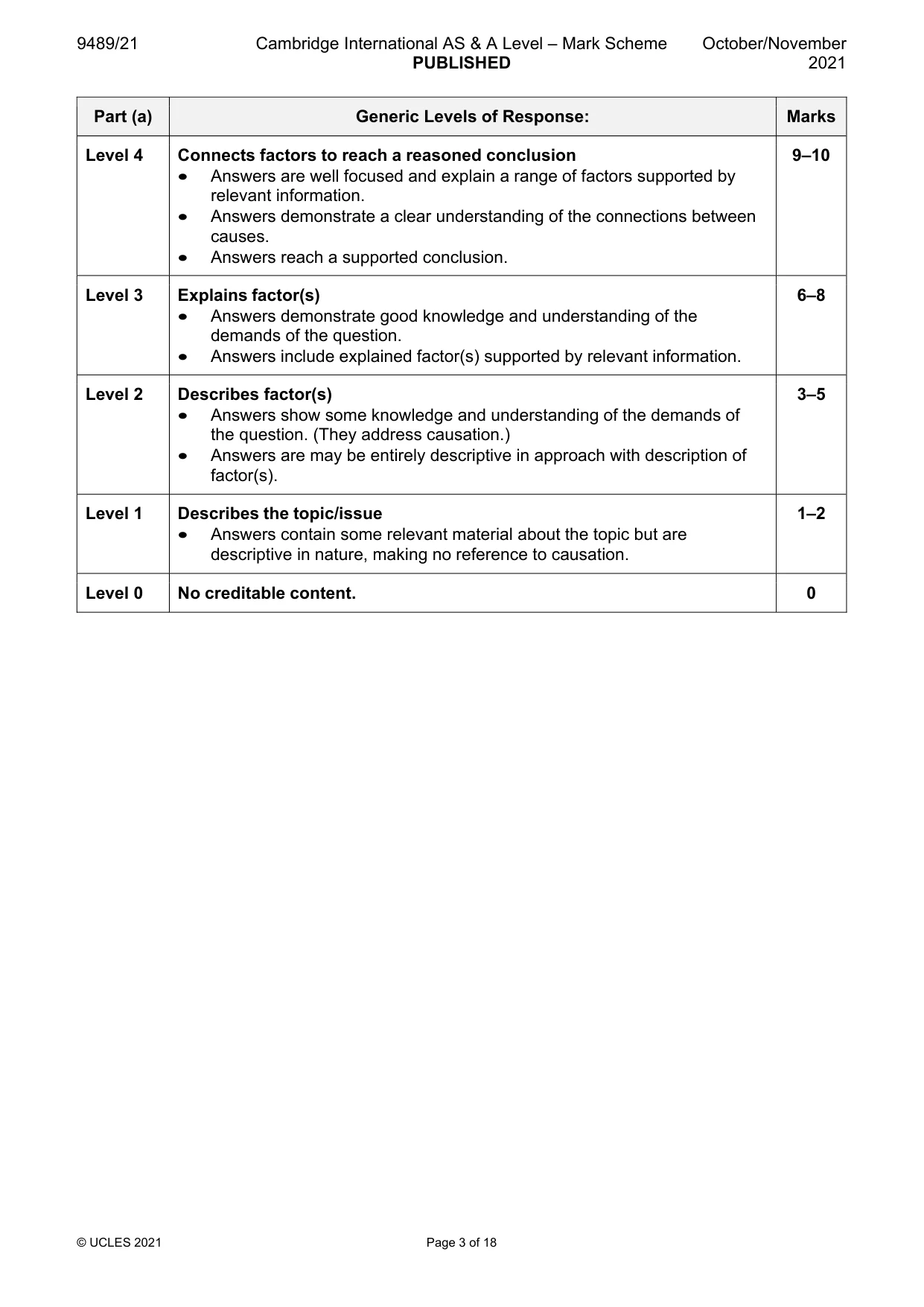
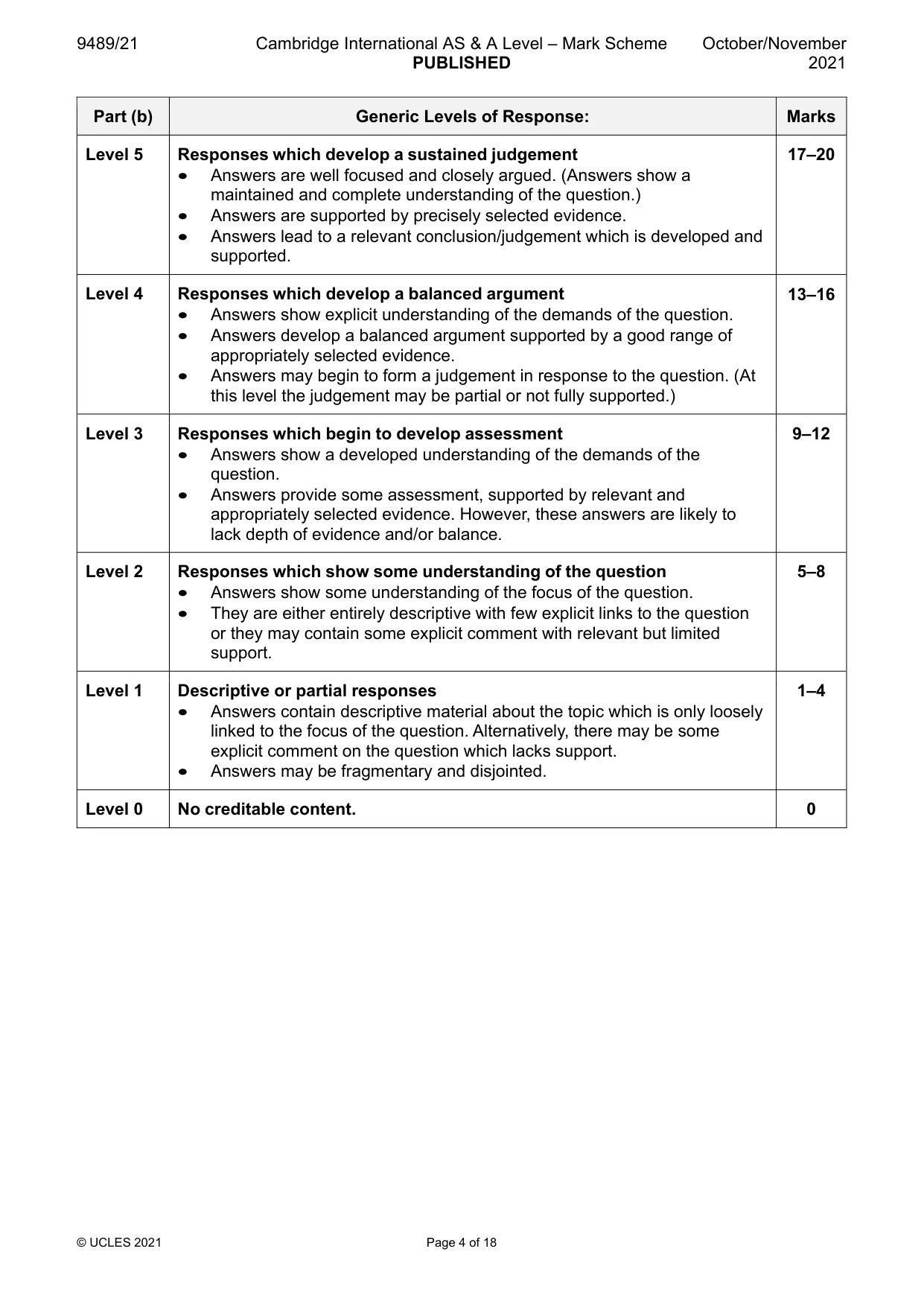
Mark scheme18 pages
Answers below. Sit the paper first if you are practising.

Questions as text
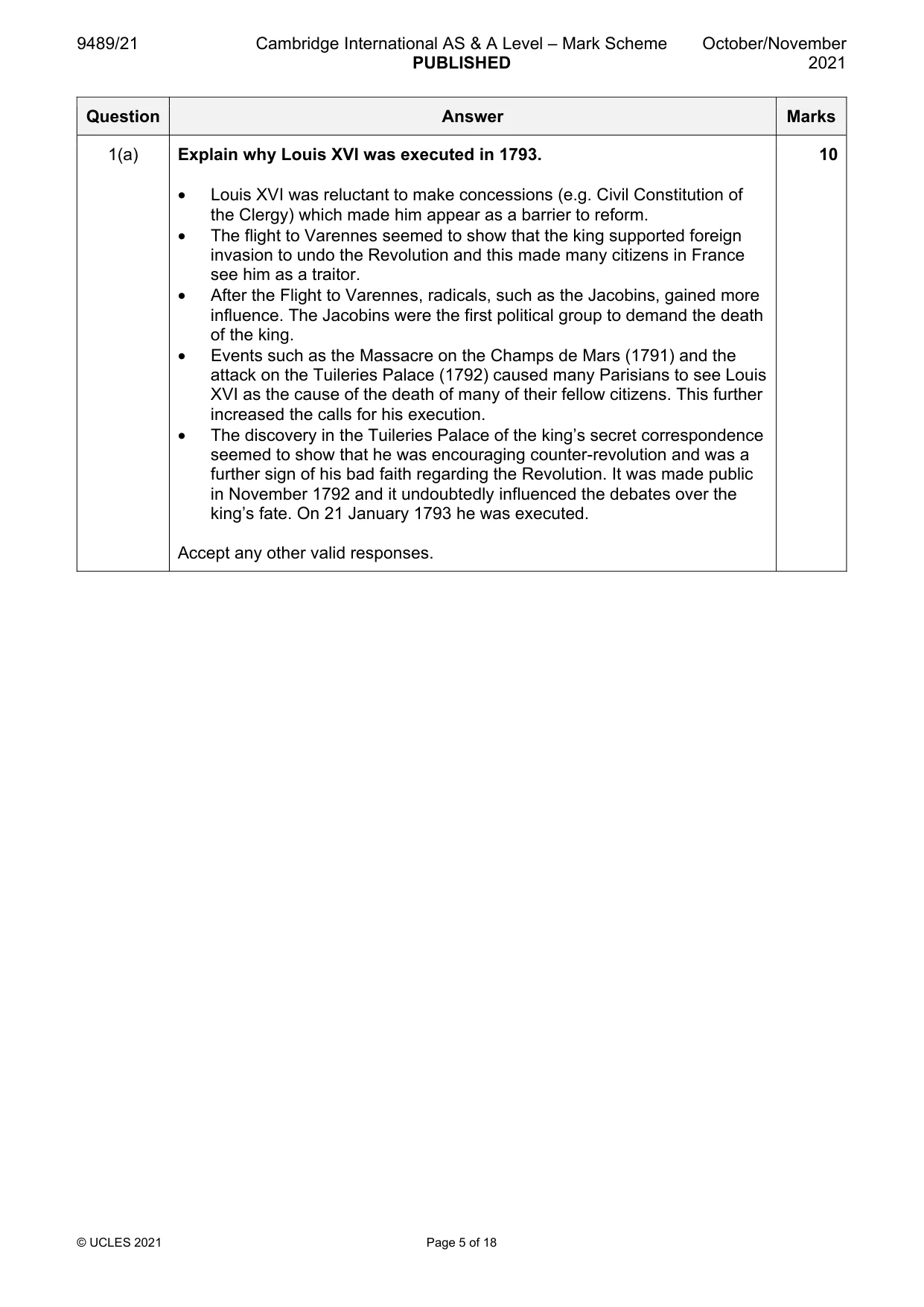
Q1 · France, 1774–1814 (a) Explain why Louis XVI was executed in 1793
1 France, 1774–1814 (a) Explain why Louis XVI was executed in 1793. [10] (b) To what extent was Napoleon’s military ability the reason for the ending of the Directory in 1799? [20]
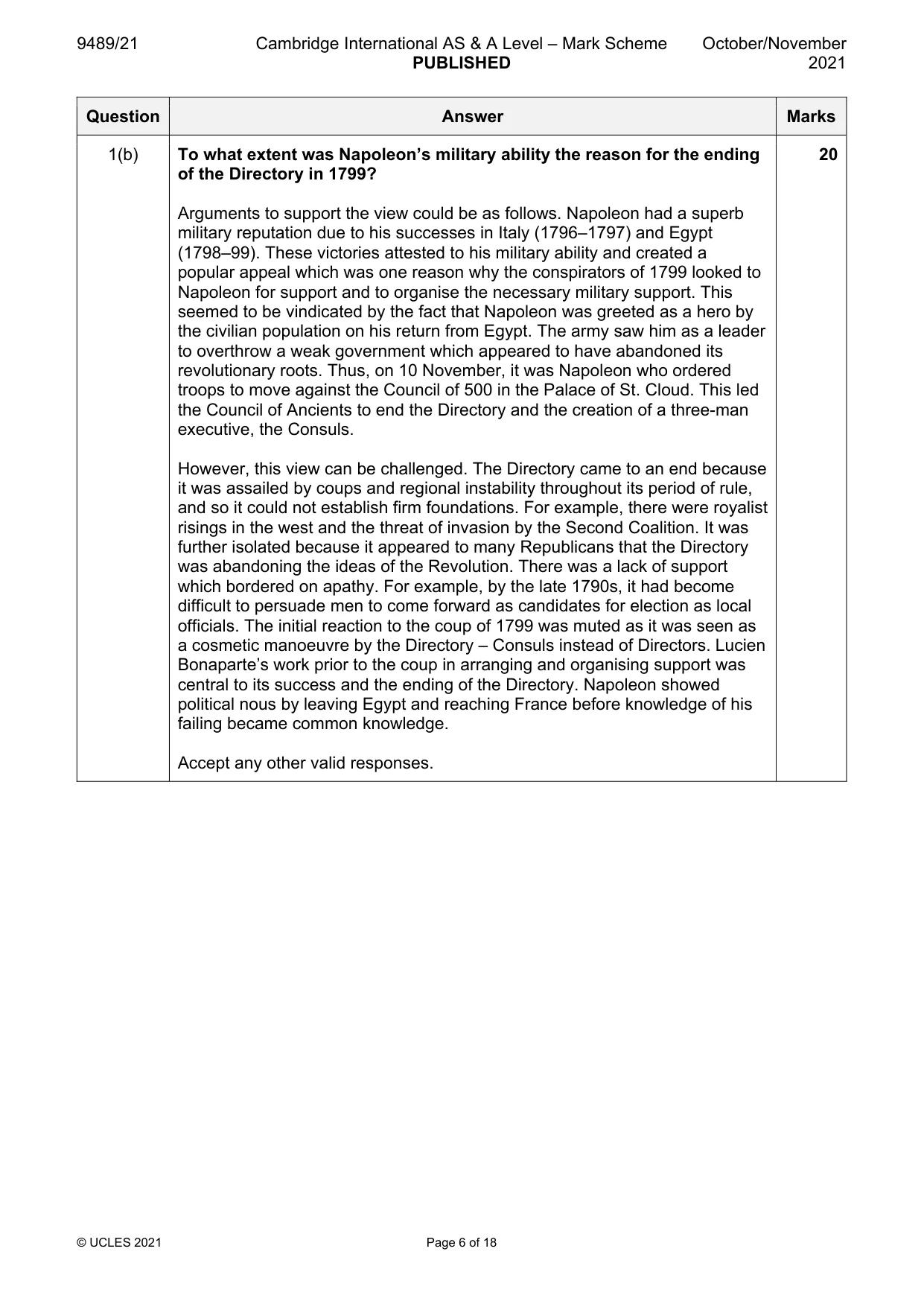
Mark scheme: Question Answer Marks 1(a) Explain why Louis XVI was executed in 1793. 10 • Louis XVI was reluctant to make concessions (e.g. Civil Constitution of the Clergy) which made him appear as a barrier to reform. • The flight to Varennes seemed to show that the king supported foreign invasion to undo the Revolution and this made many citizens in France see him as a traitor. • After the Flight to Varennes, radicals, such as the Jacobins, gained more influence. The Jacobins were the first political group to demand the death of the king. • Events such as the Massacre on the Champs de Mars (1791) and the attack on the Tuileries Palace (1792) caused many Parisians to see Louis XVI as the cause of the death of many of their fellow citizens. This further increased the calls for his execution. • The discovery in the Tuileries Palace of the king’s secret correspondence seemed to show that he was encouraging counter-revolution and was a further sign of his bad faith regarding the Revolution. It was made public in November 1792 and it undoubtedly influenced the debates over the king’s fate. On 21 January 1793 he was executed. Accept any other valid responses. 1(b) To what extent was Napoleon’s military ability the reason for the ending 20 of the Directory in 1799? Arguments to support the view could be as follows. Napoleon had a superb military reputation due to his successes in Italy (1796–1797) and Egypt (1798–99). These victories attested to his military ability and created a popular appeal which was one reason why the conspirators of 1799 looked to Napoleon for support and to organise the necessary military support. This seemed to be vindicated by the fact that Napoleon was greeted as a hero by the civilian population on his return from Egypt. The army saw him as a leader to overthrow a weak government which appeared to have abandoned its revolutionary roots. Thus, on 10 November, it was Napoleon who ordered troops to move against the Council of 500 in the Palace of St. Cloud. This led the Council of Ancients to end the Directory and the creation of a three-man executive, the Consuls. However, this view can be challenged. The Directory came to an end because it was assailed by coups and regional instability throughout its period of rule, and so it could not establish firm foundations. For example, there were royalist risings in the west and the threat of invasion by the Second Coalition. It was further isolated because it appeared to many Republicans that the Directory was abandoning the ideas of the Revolution. There was a lack of support which bordered on apathy. For example, by the late 1790s, it had become difficult to persuade men to come forward as candidates for election as local officials. The initial reaction to the coup of 1799 was muted as it was seen as a cosmetic manoeuvre by the Directory – Consuls instead of Directors. Lucien Bonaparte’s work prior to the coup in arranging and organising support was central to its success and the ending of the Directory. Napoleon showed political nous by leaving Egypt and reaching France before knowledge of his failing became common knowledge. Accept any other valid responses.
More questions on How well was France governed in the period 1793–99?
Q2 · The Industrial Revolution in Britain, 1750–1850 (a) Explain why the agricultural…
2 The Industrial Revolution in Britain, 1750–1850 (a) Explain why the agricultural revolution was a cause of the Industrial Revolution. [10] (b) To what extent did industrialisation benefit the lower classes? [20]
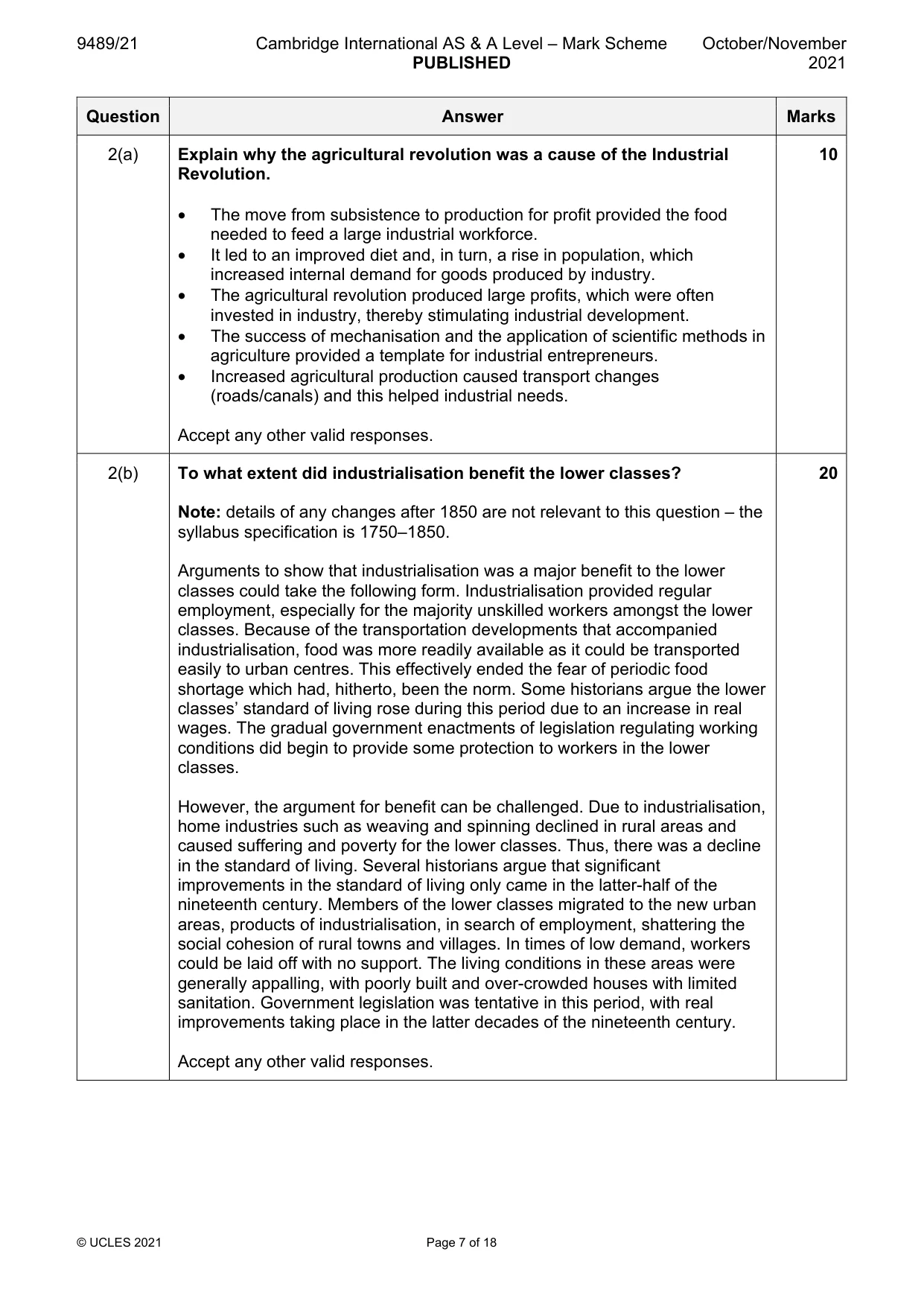
Mark scheme: 2(a) Explain why the agricultural revolution was a cause of the Industrial 10 Revolution. • The move from subsistence to production for profit provided the food needed to feed a large industrial workforce. • It led to an improved diet and, in turn, a rise in population, which increased internal demand for goods produced by industry. • The agricultural revolution produced large profits, which were often invested in industry, thereby stimulating industrial development. • The success of mechanisation and the application of scientific methods in agriculture provided a template for industrial entrepreneurs. • Increased agricultural production caused transport changes (roads/canals) and this helped industrial needs. Accept any other valid responses. 2(b) To what extent did industrialisation benefit the lower classes? 20 Note: details of any changes after 1850 are not relevant to this question – the syllabus specification is 1750–1850. Arguments to show that industrialisation was a major benefit to the lower classes could take the following form. Industrialisation provided regular employment, especially for the majority unskilled workers amongst the lower classes. Because of the transportation developments that accompanied industrialisation, food was more readily available as it could be transported easily to urban centres. This effectively ended the fear of periodic food shortage which had, hitherto, been the norm. Some historians argue the lower classes’ standard of living rose during this period due to an increase in real wages. The gradual government enactments of legislation regulating working conditions did begin to provide some protection to workers in the lower classes. However, the argument for benefit can be challenged. Due to industrialisation, home industries such as weaving and spinning declined in rural areas and caused suffering and poverty for the lower classes. Thus, there was a decline in the standard of living. Several historians argue that significant improvements in the standard of living only came in the latter-half of the nineteenth century. Members of the lower classes migrated to the new urban areas, products of industrialisation, in search of employment, shattering the social cohesion of rural towns and villages. In times of low demand, workers could be laid off with no support. The living conditions in these areas were generally appalling, with poorly built and over-crowded houses with limited sanitation. Government legislation was tentative in this period, with real improvements taking place in the latter decades of the nineteenth century. Accept any other valid responses.
More questions on What were the consequences of the rapid economic growth after 1870?
Q3 · The Russian Revolution, 1894–1921 (a) Explain why the Tsarist regime was able to survive…
3 The Russian Revolution, 1894–1921 (a) Explain why the Tsarist regime was able to survive the 1905 Revolution. [10] (b) ‘The main cause of the Bolshevik victory in the Russian Civil War was the disunity of their enemies.’ How far do you agree? [20]
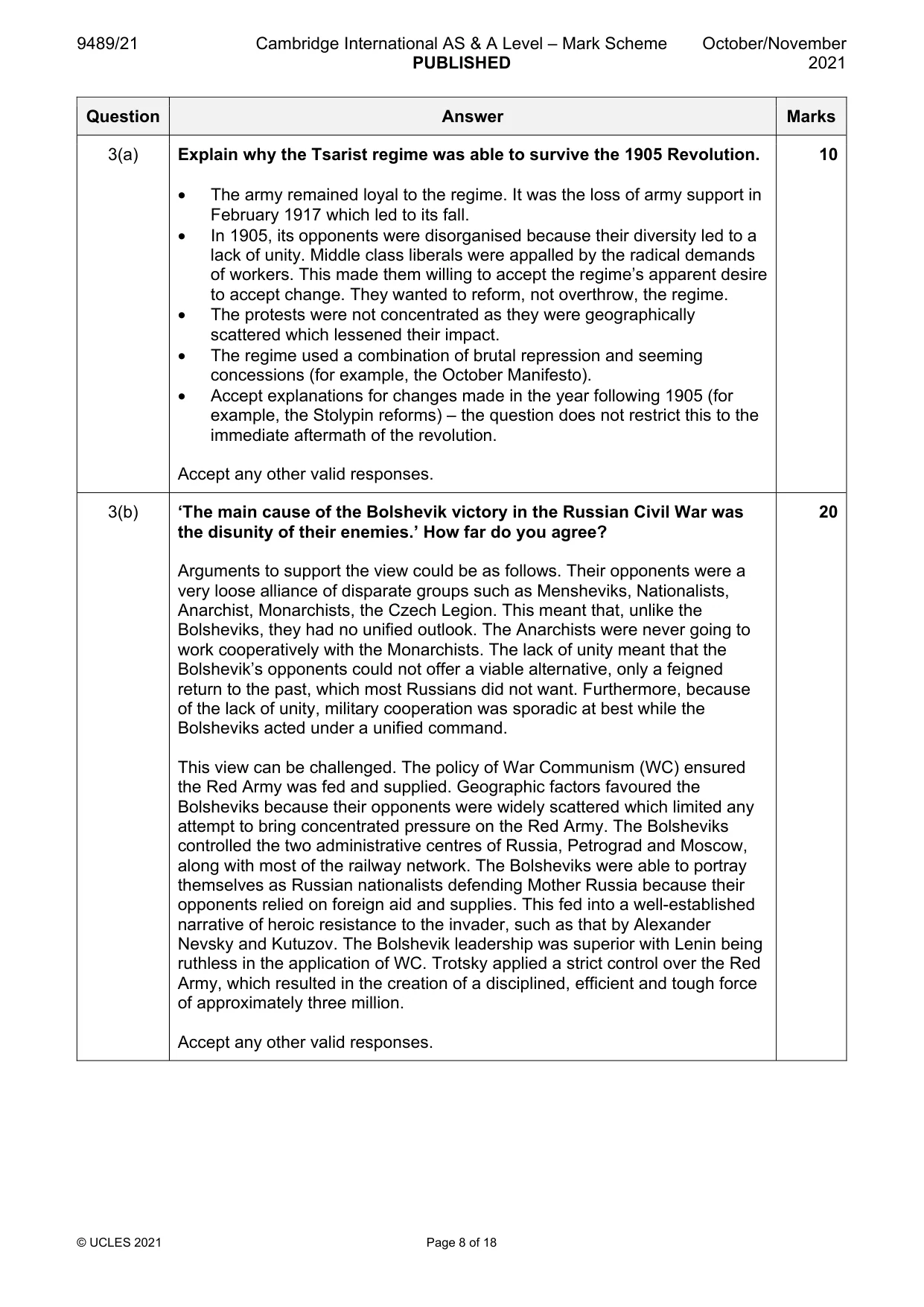
Mark scheme: 3(a) Explain why the Tsarist regime was able to survive the 1905 Revolution. 10 • The army remained loyal to the regime. It was the loss of army support in February 1917 which led to its fall. • In 1905, its opponents were disorganised because their diversity led to a lack of unity. Middle class liberals were appalled by the radical demands of workers. This made them willing to accept the regime’s apparent desire to accept change. They wanted to reform, not overthrow, the regime. • The protests were not concentrated as they were geographically scattered which lessened their impact. • The regime used a combination of brutal repression and seeming concessions (for example, the October Manifesto). • Accept explanations for changes made in the year following 1905 (for example, the Stolypin reforms) – the question does not restrict this to the immediate aftermath of the revolution. Accept any other valid responses. 3(b) ‘The main cause of the Bolshevik victory in the Russian Civil War was 20 the disunity of their enemies.’ How far do you agree? Arguments to support the view could be as follows. Their opponents were a very loose alliance of disparate groups such as Mensheviks, Nationalists, Anarchist, Monarchists, the Czech Legion. This meant that, unlike the Bolsheviks, they had no unified outlook. The Anarchists were never going to work cooperatively with the Monarchists. The lack of unity meant that the Bolshevik’s opponents could not offer a viable alternative, only a feigned return to the past, which most Russians did not want. Furthermore, because of the lack of unity, military cooperation was sporadic at best while the Bolsheviks acted under a unified command. This view can be challenged. The policy of War Communism (WC) ensured the Red Army was fed and supplied. Geographic factors favoured the Bolsheviks because their opponents were widely scattered which limited any attempt to bring concentrated pressure on the Red Army. The Bolsheviks controlled the two administrative centres of Russia, Petrograd and Moscow, along with most of the railway network. The Bolsheviks were able to portray themselves as Russian nationalists defending Mother Russia because their opponents relied on foreign aid and supplies. This fed into a well-established narrative of heroic resistance to the invader, such as that by Alexander Nevsky and Kutuzov. The Bolshevik leadership was superior with Lenin being ruthless in the application of WC. Trotsky applied a strict control over the Red Army, which resulted in the creation of a disciplined, efficient and tough force of approximately three million. Accept any other valid responses.
More questions on How were the Bolsheviks able to consolidate their power up to 1924?
Q4 · Civil War and Reconstruction, 1861–77 (a) Explain why civil liberties were limited during…
4 Civil War and Reconstruction, 1861–77 (a) Explain why civil liberties were limited during the Civil War. [10] (b) ‘Opposition from white southerners was the main reason for the limited success of Reconstruction.’ How far do you agree with this view? [20]
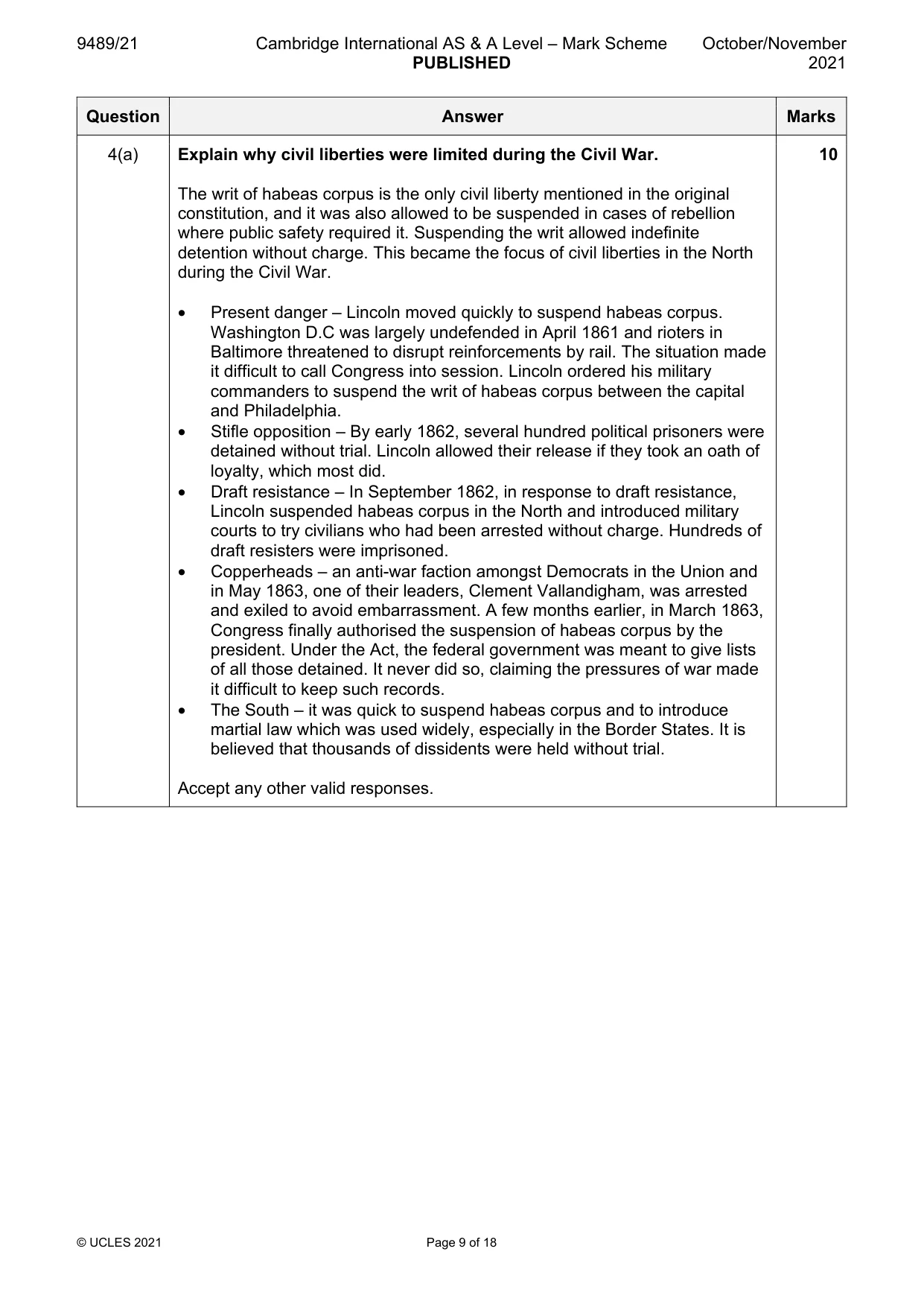
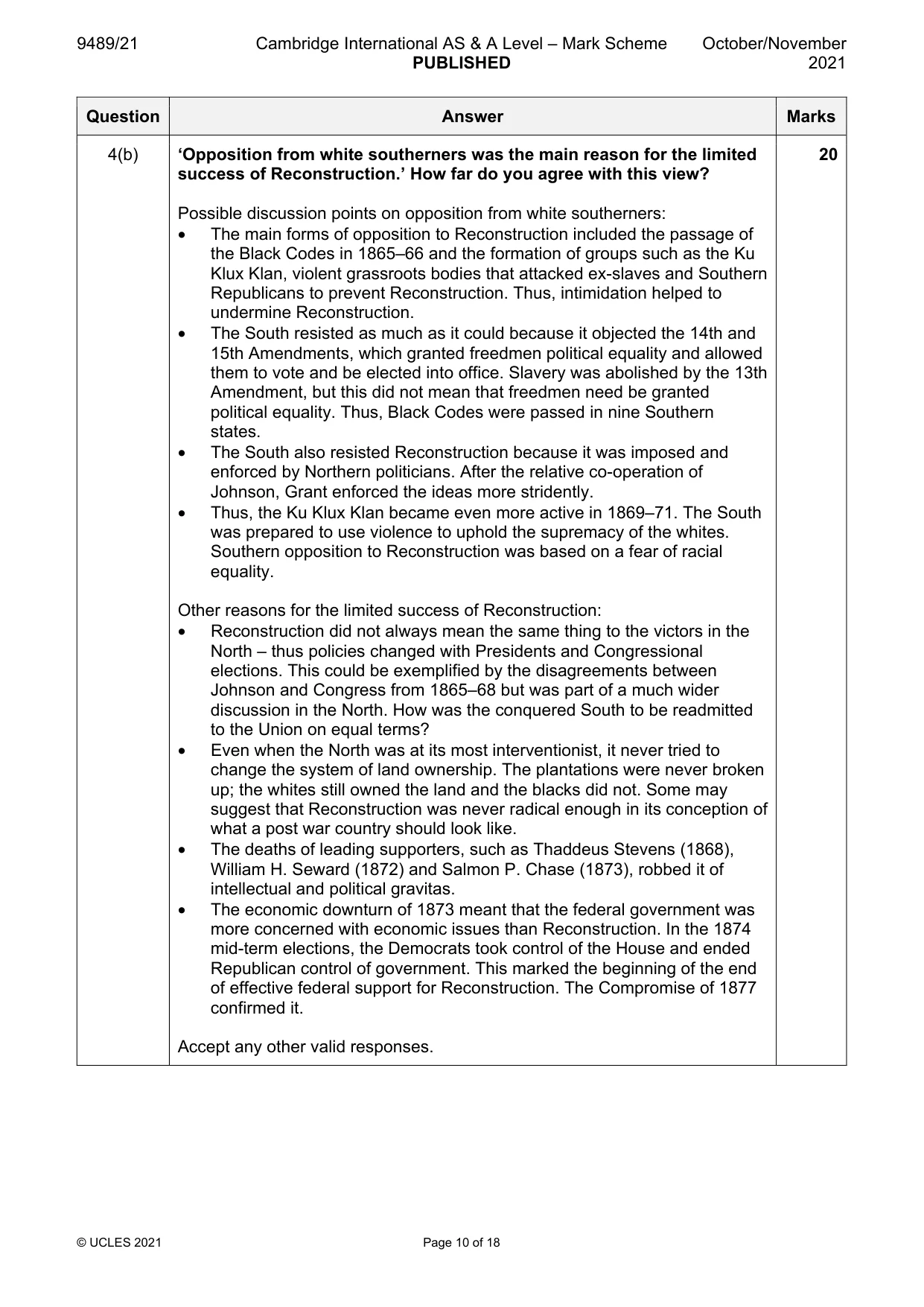
Mark scheme: 4(a) Explain why civil liberties were limited during the Civil War. 10 The writ of habeas corpus is the only civil liberty mentioned in the original constitution, and it was also allowed to be suspended in cases of rebellion where public safety required it. Suspending the writ allowed indefinite detention without charge. This became the focus of civil liberties in the North during the Civil War. • Present danger – Lincoln moved quickly to suspend habeas corpus. Washington D.C was largely undefended in April 1861 and rioters in Baltimore threatened to disrupt reinforcements by rail. The situation made it difficult to call Congress into session. Lincoln ordered his military commanders to suspend the writ of habeas corpus between the capital and Philadelphia. • Stifle opposition – By early 1862, several hundred political prisoners were detained without trial. Lincoln allowed their release if they took an oath of loyalty, which most did. • Draft resistance – In September 1862, in response to draft resistance, Lincoln suspended habeas corpus in the North and introduced military courts to try civilians who had been arrested without charge. Hundreds of draft resisters were imprisoned. • Copperheads – an anti-war faction amongst Democrats in the Union and in May 1863, one of their leaders, Clement Vallandigham, was arrested and exiled to avoid embarrassment. A few months earlier, in March 1863, Congress finally authorised the suspension of habeas corpus by the president. Under the Act, the federal government was meant to give lists of all those detained. It never did so, claiming the pressures of war made it difficult to keep such records. • The South – it was quick to suspend habeas corpus and to introduce martial law which was used widely, especially in the Border States. It is believed that thousands of dissidents were held without trial. Accept any other valid responses. 4(b) ‘Opposition from white southerners was the main reason for the limited 20 success of Reconstruction.’ How far do you agree with this view? Possible discussion points on opposition from white southerners: • The main forms of opposition to Reconstruction included the passage of the Black Codes in 1865–66 and the formation of groups such as the Ku Klux Klan, violent grassroots bodies that attacked ex-slaves and Southern Republicans to prevent Reconstruction. Thus, intimidation helped to undermine Reconstruction. • The South resisted as much as it could because it objected the 14th and 15th Amendments, which granted freedmen political equality and allowed them to vote and be elected into office. Slavery was abolished by the 13th Amendment, but this did not mean that freedmen need be granted political equality. Thus, Black Codes were passed in nine Southern states. • The South also resisted Reconstruction because it was imposed and enforced by Northern politicians. After the relative co-operation of Johnson, Grant enforced the ideas more stridently. • Thus, the Ku Klux Klan became even more active in 1869–71. The South was prepared to use violence to uphold the supremacy of the whites. Southern opposition to Reconstruction was based on a fear of racial equality. Other reasons for the limited success of Reconstruction: • Reconstruction did not always mean the same thing to the victors in the North – thus policies changed with Presidents and Congressional elections. This could be exemplified by the disagreements between Johnson and Congress from 1865–68 but was part of a much wider discussion in the North. How was the conquered South to be readmitted to the Union on equal terms? • Even when the North was at its most interventionist, it never tried to change the system of land ownership. The plantations were never broken up; the whites still owned the land and the blacks did not. Some may suggest that Reconstruction was never radical enough in its conception of what a post war country should look like. • The deaths of leading supporters, such as Thaddeus Stevens (1868), William H. Seward (1872) and Salmon P. Chase (1873), robbed it of intellectual and political gravitas. • The economic downturn of 1873 meant that the federal government was more concerned with economic issues than Reconstruction. In the 1874 mid-term elections, the Democrats took control of the House and ended Republican control of government. This marked the beginning of the end of effective federal support for Reconstruction. The Compromise of 1877 confirmed it. Accept any other valid responses.
More questions on What were the aims of Reconstruction and how successful was it?
Q5 · The Gilded Age and Progressive Era, 1870s to 1920 (a) Explain why Progressives wanted to…
5 The Gilded Age and Progressive Era, 1870s to 1920 (a) Explain why Progressives wanted to limit the power of party machines. [10] (b) To what extent was the growth of the railroads the reason for the rapid industrialisation of the late nineteenth century? [20]
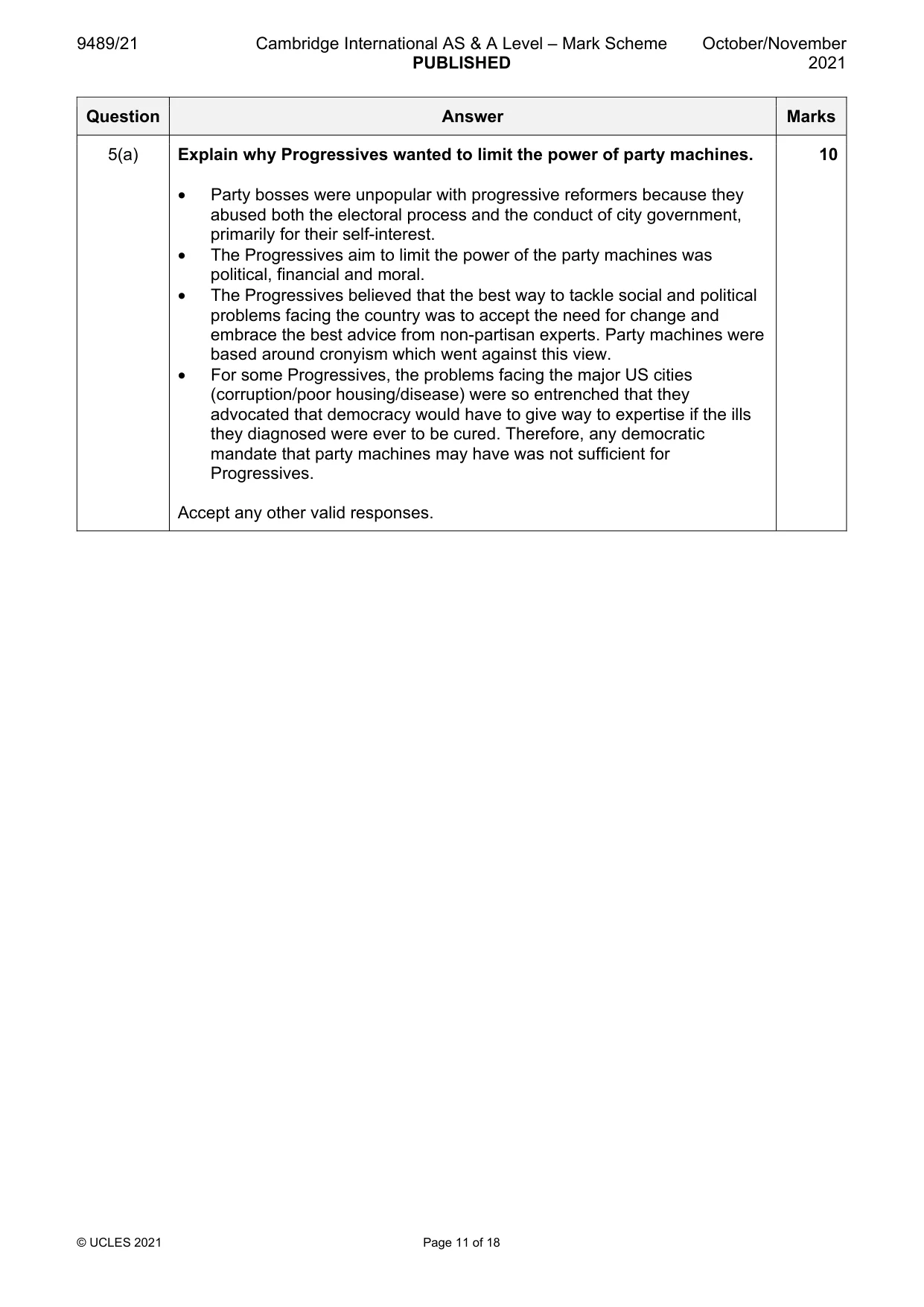
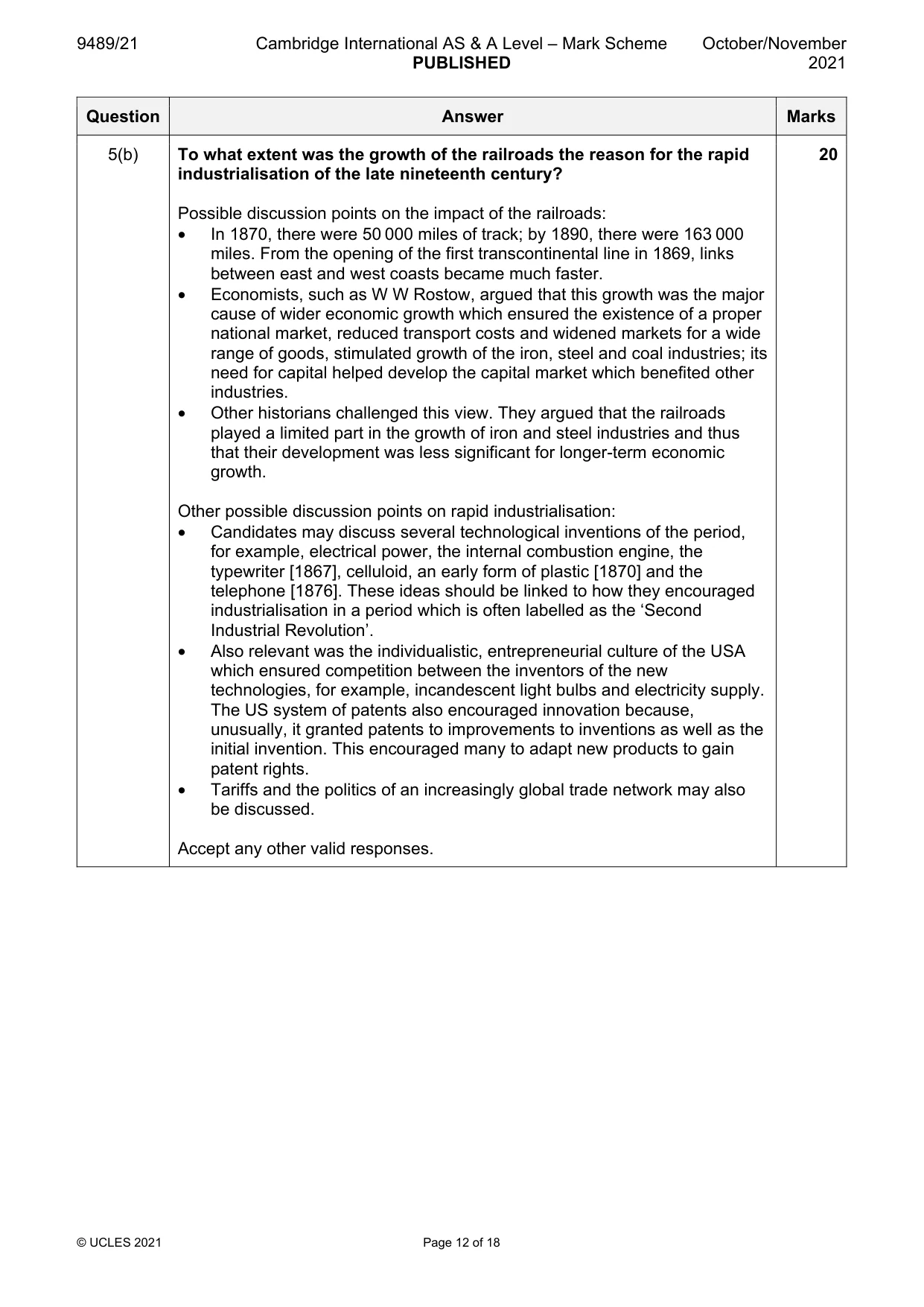
Mark scheme: 5(a) Explain why Progressives wanted to limit the power of party machines. 10 • Party bosses were unpopular with progressive reformers because they abused both the electoral process and the conduct of city government, primarily for their self-interest. • The Progressives aim to limit the power of the party machines was political, financial and moral. • The Progressives believed that the best way to tackle social and political problems facing the country was to accept the need for change and embrace the best advice from non-partisan experts. Party machines were based around cronyism which went against this view. • For some Progressives, the problems facing the major US cities (corruption/poor housing/disease) were so entrenched that they advocated that democracy would have to give way to expertise if the ills they diagnosed were ever to be cured. Therefore, any democratic mandate that party machines may have was not sufficient for Progressives. Accept any other valid responses. 5(b) To what extent was the growth of the railroads the reason for the rapid 20 industrialisation of the late nineteenth century? Possible discussion points on the impact of the railroads: • In 1870, there were 50 000 miles of track; by 1890, there were 163 000 miles. From the opening of the first transcontinental line in 1869, links between east and west coasts became much faster. • Economists, such as W W Rostow, argued that this growth was the major cause of wider economic growth which ensured the existence of a proper national market, reduced transport costs and widened markets for a wide range of goods, stimulated growth of the iron, steel and coal industries; its need for capital helped develop the capital market which benefited other industries. • Other historians challenged this view. They argued that the railroads played a limited part in the growth of iron and steel industries and thus that their development was less significant for longer-term economic growth. Other possible discussion points on rapid industrialisation: • Candidates may discuss several technological inventions of the period, for example, electrical power, the internal combustion engine, the typewriter [1867], celluloid, an early form of plastic [1870] and the telephone [1876]. These ideas should be linked to how they encouraged industrialisation in a period which is often labelled as the ‘Second Industrial Revolution’. • Also relevant was the individualistic, entrepreneurial culture of the USA which ensured competition between the inventors of the new technologies, for example, incandescent light bulbs and electricity supply. The US system of patents also encouraged innovation because, unusually, it granted patents to improvements to inventions as well as the initial invention. This encouraged many to adapt new products to gain patent rights. • Tariffs and the politics of an increasingly global trade network may also be discussed. Accept any other valid responses.
More questions on Why was there rapid industrialisation after 1870?
Q6 · The Great Crash, the Great Depression and the New Deal policies, 1920–41 (a) Explain why…
6 The Great Crash, the Great Depression and the New Deal policies, 1920–41 (a) Explain why Hoover found it difficult to respond to the consequences of the Great Crash. [10] (b) ‘The most significant opposition to the New Deal came from those on the left of politics.’ How far do you agree with this view? [20] Section C: International option International history, 1870–1945
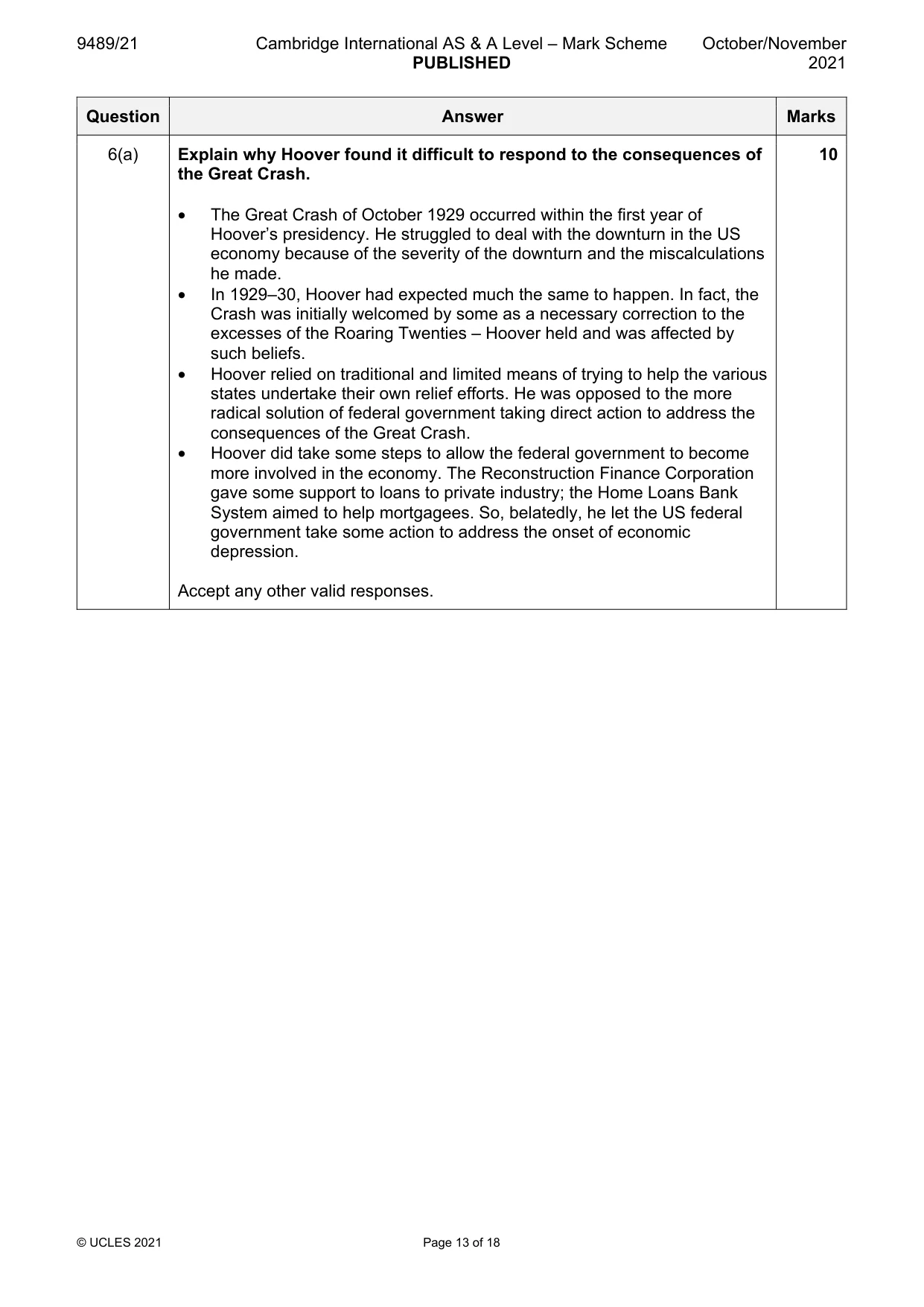
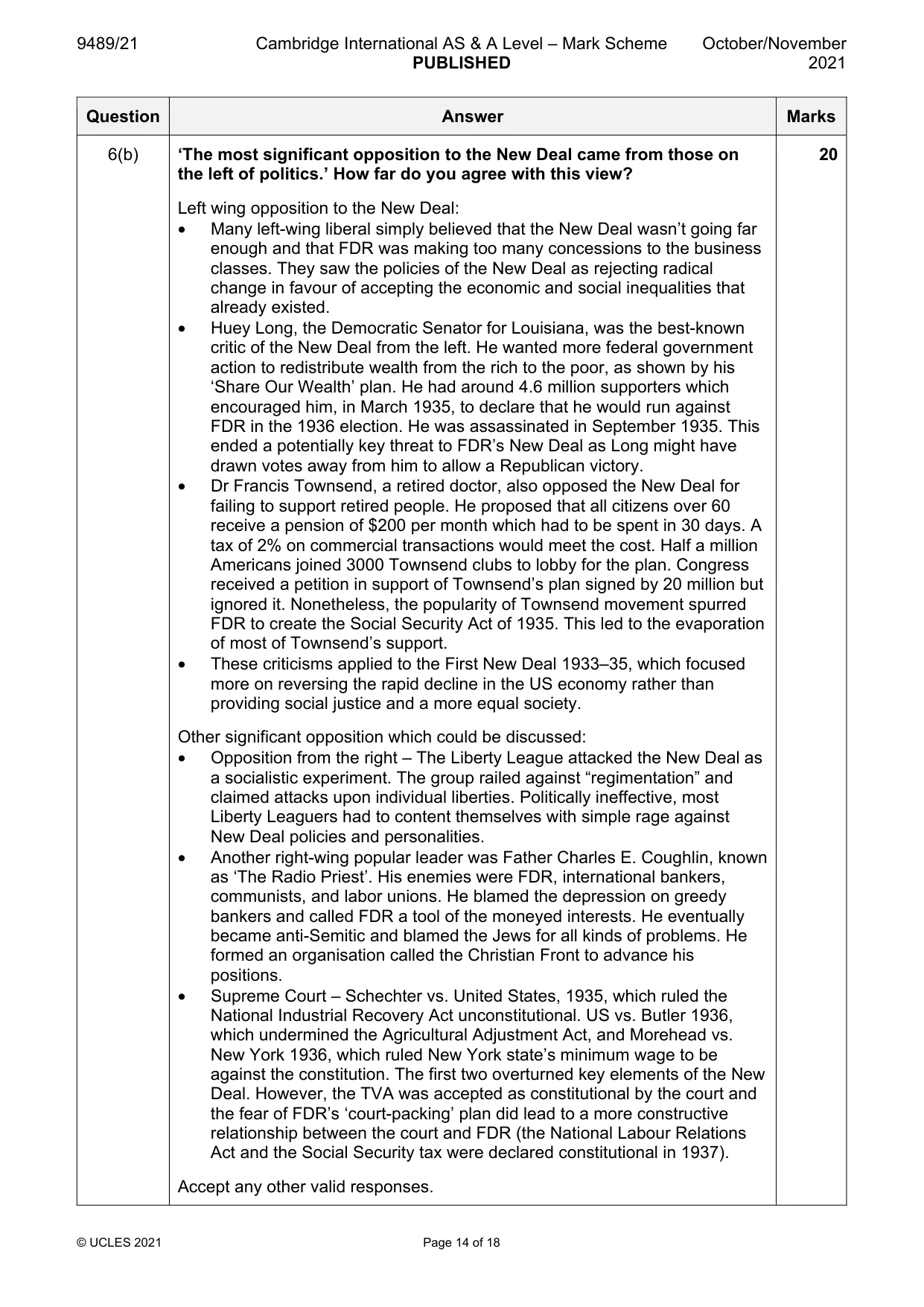
Mark scheme: 6(a) Explain why Hoover found it difficult to respond to the consequences of 10 the Great Crash. • The Great Crash of October 1929 occurred within the first year of Hoover’s presidency. He struggled to deal with the downturn in the US economy because of the severity of the downturn and the miscalculations he made. • In 1929–30, Hoover had expected much the same to happen. In fact, the Crash was initially welcomed by some as a necessary correction to the excesses of the Roaring Twenties – Hoover held and was affected by such beliefs. • Hoover relied on traditional and limited means of trying to help the various states undertake their own relief efforts. He was opposed to the more radical solution of federal government taking direct action to address the consequences of the Great Crash. • Hoover did take some steps to allow the federal government to become more involved in the economy. The Reconstruction Finance Corporation gave some support to loans to private industry; the Home Loans Bank System aimed to help mortgagees. So, belatedly, he let the US federal government take some action to address the onset of economic depression. Accept any other valid responses. 6(b) ‘The most significant opposition to the New Deal came from those on 20 the left of politics.’ How far do you agree with this view? Left wing opposition to the New Deal: • Many left-wing liberal simply believed that the New Deal wasn’t going far enough and that FDR was making too many concessions to the business classes. They saw the policies of the New Deal as rejecting radical change in favour of accepting the economic and social inequalities that already existed. • Huey Long, the Democratic Senator for Louisiana, was the best-known critic of the New Deal from the left. He wanted more federal government action to redistribute wealth from the rich to the poor, as shown by his ‘Share Our Wealth’ plan. He had around 4.6 million supporters which encouraged him, in March 1935, to declare that he would run against FDR in the 1936 election. He was assassinated in September 1935. This ended a potentially key threat to FDR’s New Deal as Long might have drawn votes away from him to allow a Republican victory. • Dr Francis Townsend, a retired doctor, also opposed the New Deal for failing to support retired people. He proposed that all citizens over 60 receive a pension of $200 per month which had to be spent in 30 days. A tax of 2% on commercial transactions would meet the cost. Half a million Americans joined 3000 Townsend clubs to lobby for the plan. Congress received a petition in support of Townsend’s plan signed by 20 million but ignored it. Nonetheless, the popularity of Townsend movement spurred FDR to create the Social Security Act of 1935. This led to the evaporation of most of Townsend’s support. • These criticisms applied to the First New Deal 1933–35, which focused more on reversing the rapid decline in the US economy rather than providing social justice and a more equal society. Other significant opposition which could be discussed: • Opposition from the right – The Liberty League attacked the New Deal as a socialistic experiment. The group railed against “regimentation” and claimed attacks upon individual liberties. Politically ineffective, most Liberty Leaguers had to content themselves with simple rage against New Deal policies and personalities. • Another right-wing popular leader was Father Charles E. Coughlin, known as ‘The Radio Priest’. His enemies were FDR, international bankers, communists, and labor unions. He blamed the depression on greedy bankers and called FDR a tool of the moneyed interests. He eventually became anti-Semitic and blamed the Jews for all kinds of problems. He formed an organisation called the Christian Front to advance his positions. • Supreme Court – Schechter vs. United States, 1935, which ruled the National Industrial Recovery Act unconstitutional. US vs. Butler 1936, which undermined the Agricultural Adjustment Act, and Morehead vs. New York 1936, which ruled New York state’s minimum wage to be against the constitution. The first two overturned key elements of the New Deal. However, the TVA was accepted as constitutional by the court and the fear of FDR’s ‘court-packing’ plan did lead to a more constructive relationship between the court and FDR (the National Labour Relations Act and the Social Security tax were declared constitutional in 1937). Accept any other valid responses.
More questions on Why was there a second New Deal and how successful was it?
Q7 · Empire and the emergence of world powers, 1870–1919 (a) Explain why US foreign policy…
7 Empire and the emergence of world powers, 1870–1919 (a) Explain why US foreign policy changed during the presidency of McKinley. [10] (b) To what extent was British imperial policy up to 1902 based on fear of other European powers? [20]
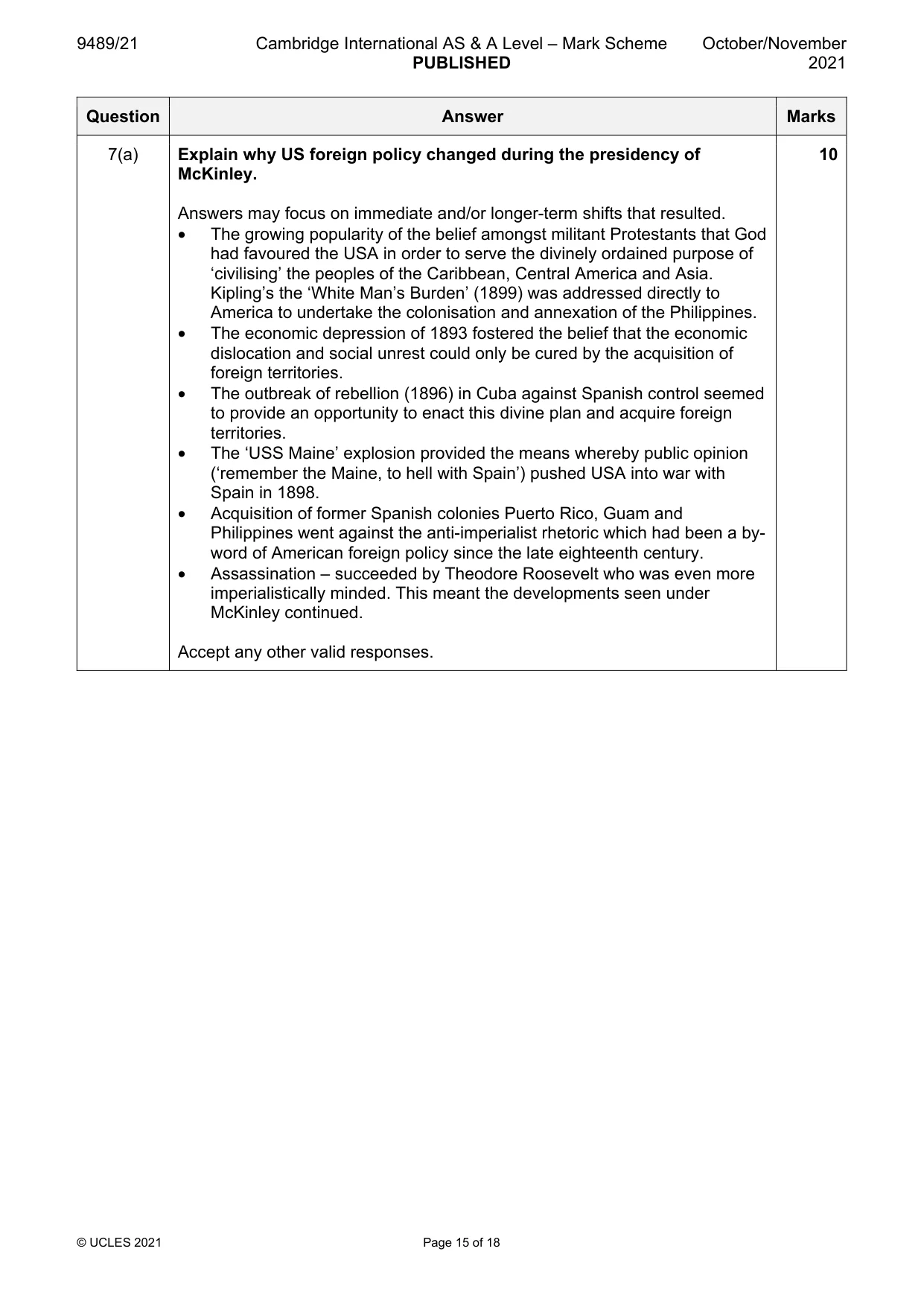
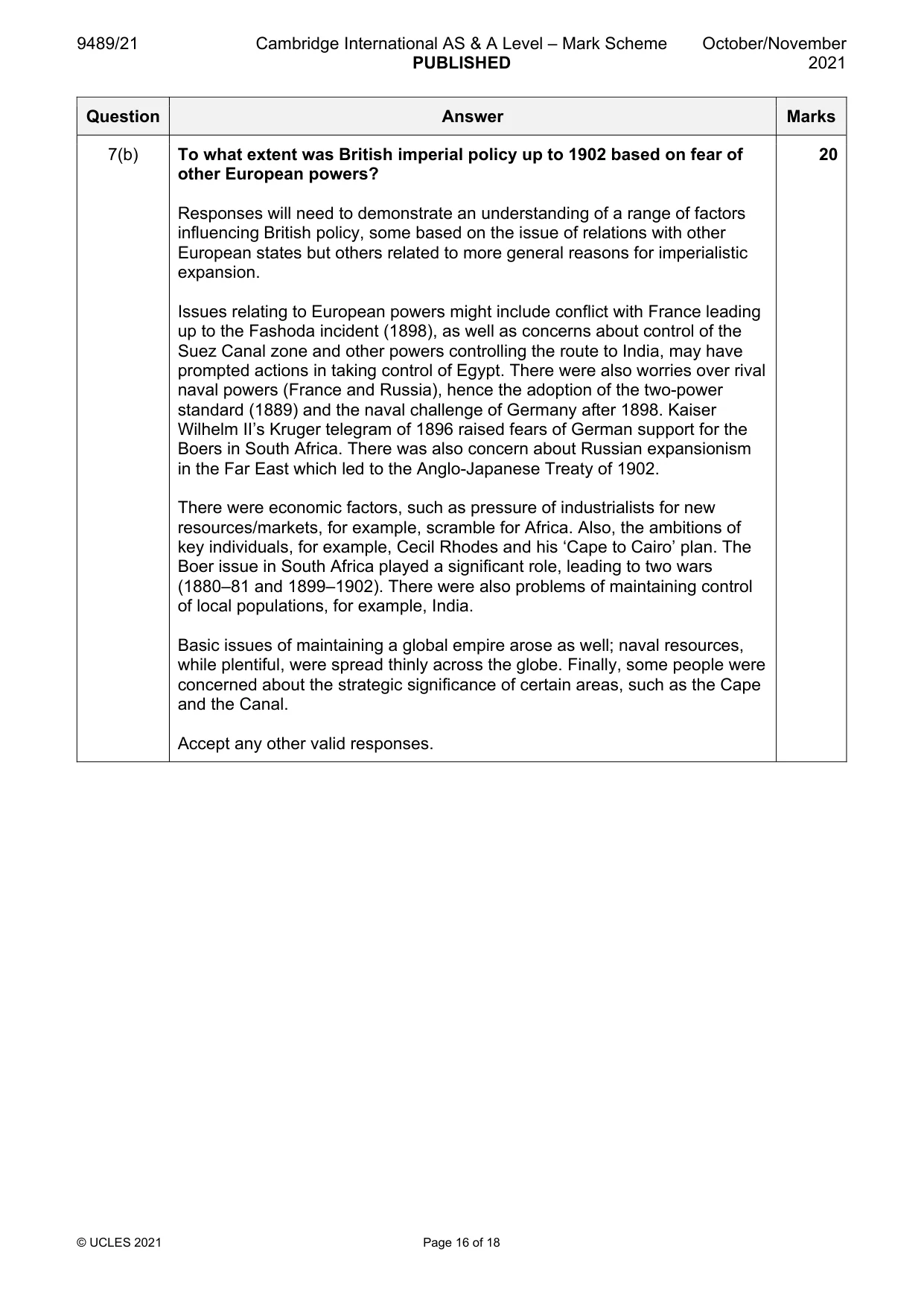
Mark scheme: 7(a) Explain why US foreign policy changed during the presidency of 10 McKinley. Answers may focus on immediate and/or longer-term shifts that resulted. • The growing popularity of the belief amongst militant Protestants that God had favoured the USA in order to serve the divinely ordained purpose of ‘civilising’ the peoples of the Caribbean, Central America and Asia. Kipling’s the ‘White Man’s Burden’ (1899) was addressed directly to America to undertake the colonisation and annexation of the Philippines. • The economic depression of 1893 fostered the belief that the economic dislocation and social unrest could only be cured by the acquisition of foreign territories. • The outbreak of rebellion (1896) in Cuba against Spanish control seemed to provide an opportunity to enact this divine plan and acquire foreign territories. • The ‘USS Maine’ explosion provided the means whereby public opinion (‘remember the Maine, to hell with Spain’) pushed USA into war with Spain in 1898. • Acquisition of former Spanish colonies Puerto Rico, Guam and Philippines went against the anti-imperialist rhetoric which had been a by- word of American foreign policy since the late eighteenth century. • Assassination – succeeded by Theodore Roosevelt who was even more imperialistically minded. This meant the developments seen under McKinley continued. Accept any other valid responses. 7(b) To what extent was British imperial policy up to 1902 based on fear of 20 other European powers? Responses will need to demonstrate an understanding of a range of factors influencing British policy, some based on the issue of relations with other European states but others related to more general reasons for imperialistic expansion. Issues relating to European powers might include conflict with France leading up to the Fashoda incident (1898), as well as concerns about control of the Suez Canal zone and other powers controlling the route to India, may have prompted actions in taking control of Egypt. There were also worries over rival naval powers (France and Russia), hence the adoption of the two-power standard (1889) and the naval challenge of Germany after 1898. Kaiser Wilhelm II’s Kruger telegram of 1896 raised fears of German support for the Boers in South Africa. There was also concern about Russian expansionism in the Far East which led to the Anglo-Japanese Treaty of 1902. There were economic factors, such as pressure of industrialists for new resources/markets, for example, scramble for Africa. Also, the ambitions of key individuals, for example, Cecil Rhodes and his ‘Cape to Cairo’ plan. The Boer issue in South Africa played a significant role, leading to two wars (1880–81 and 1899–1902). There were also problems of maintaining control of local populations, for example, India. Basic issues of maintaining a global empire arose as well; naval resources, while plentiful, were spread thinly across the globe. Finally, some people were concerned about the strategic significance of certain areas, such as the Cape and the Canal. Accept any other valid responses.
More questions on Why was imperialism a significant force in Africa from 1870?
Q8 · The League of Nations and international relations in the 1920s (a) Explain why…
8 The League of Nations and international relations in the 1920s (a) Explain why reparations remained a problem throughout the 1920s. [10] (b) ‘Economic issues were the most important of the problems faced by the successor states in the 1920s.’ How far do you agree? [20]
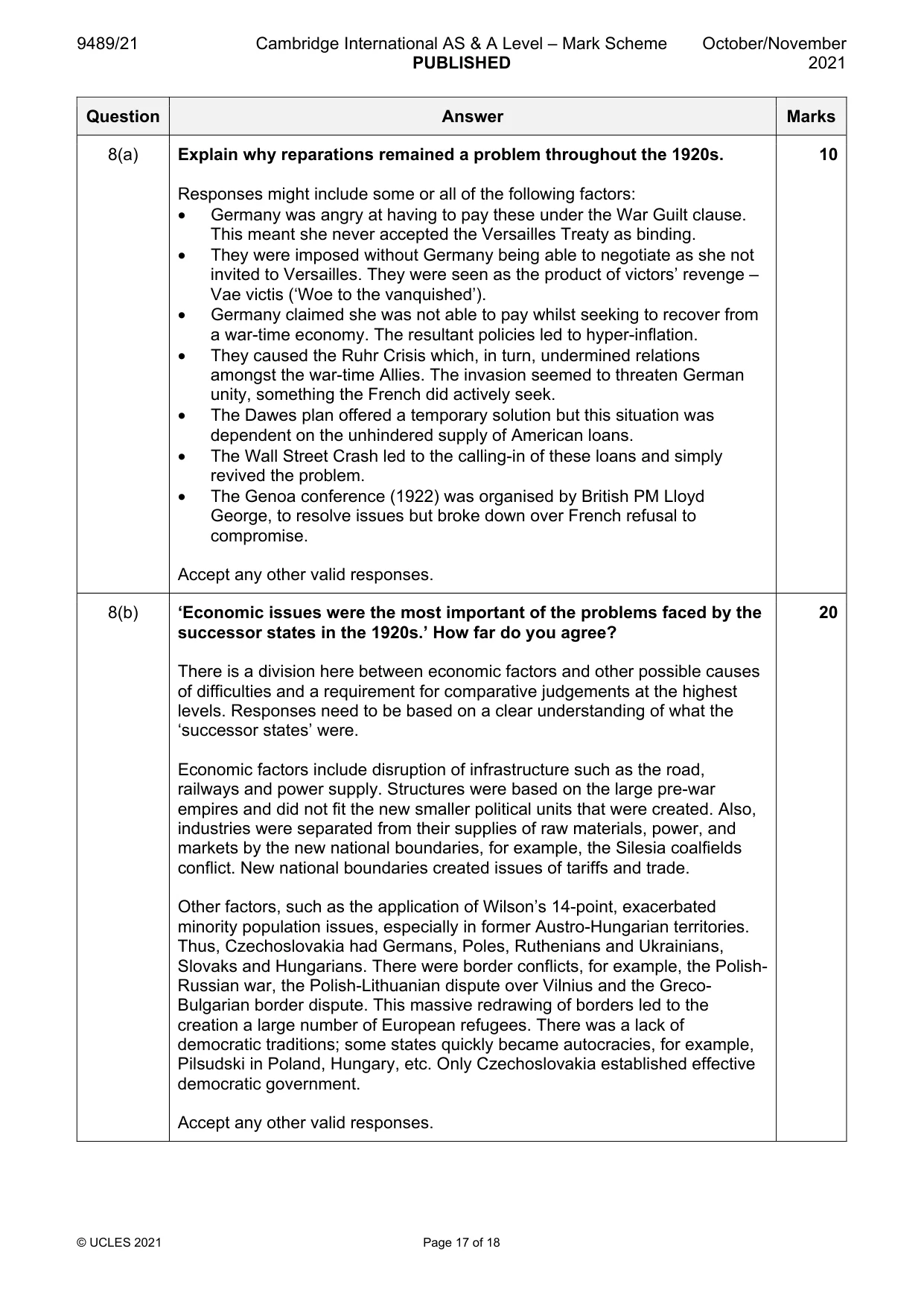
Mark scheme: 8(a) Explain why reparations remained a problem throughout the 1920s. 10 Responses might include some or all of the following factors: • Germany was angry at having to pay these under the War Guilt clause. This meant she never accepted the Versailles Treaty as binding. • They were imposed without Germany being able to negotiate as she not invited to Versailles. They were seen as the product of victors’ revenge – Vae victis (‘Woe to the vanquished’). • Germany claimed she was not able to pay whilst seeking to recover from a war-time economy. The resultant policies led to hyper-inflation. • They caused the Ruhr Crisis which, in turn, undermined relations amongst the war-time Allies. The invasion seemed to threaten German unity, something the French did actively seek. • The Dawes plan offered a temporary solution but this situation was dependent on the unhindered supply of American loans. • The Wall Street Crash led to the calling-in of these loans and simply revived the problem. • The Genoa conference (1922) was organised by British PM Lloyd George, to resolve issues but broke down over French refusal to compromise. Accept any other valid responses. 8(b) ‘Economic issues were the most important of the problems faced by the 20 successor states in the 1920s.’ How far do you agree? There is a division here between economic factors and other possible causes of difficulties and a requirement for comparative judgements at the highest levels. Responses need to be based on a clear understanding of what the ‘successor states’ were. Economic factors include disruption of infrastructure such as the road, railways and power supply. Structures were based on the large pre-war empires and did not fit the new smaller political units that were created. Also, industries were separated from their supplies of raw materials, power, and markets by the new national boundaries, for example, the Silesia coalfields conflict. New national boundaries created issues of tariffs and trade. Other factors, such as the application of Wilson’s 14-point, exacerbated minority population issues, especially in former Austro-Hungarian territories. Thus, Czechoslovakia had Germans, Poles, Ruthenians and Ukrainians, Slovaks and Hungarians. There were border conflicts, for example, the Polish- Russian war, the Polish-Lithuanian dispute over Vilnius and the Greco- Bulgarian border dispute. This massive redrawing of borders led to the creation a large number of European refugees. There was a lack of democratic traditions; some states quickly became autocracies, for example, Pilsudski in Poland, Hungary, etc. Only Czechoslovakia established effective democratic government. Accept any other valid responses.
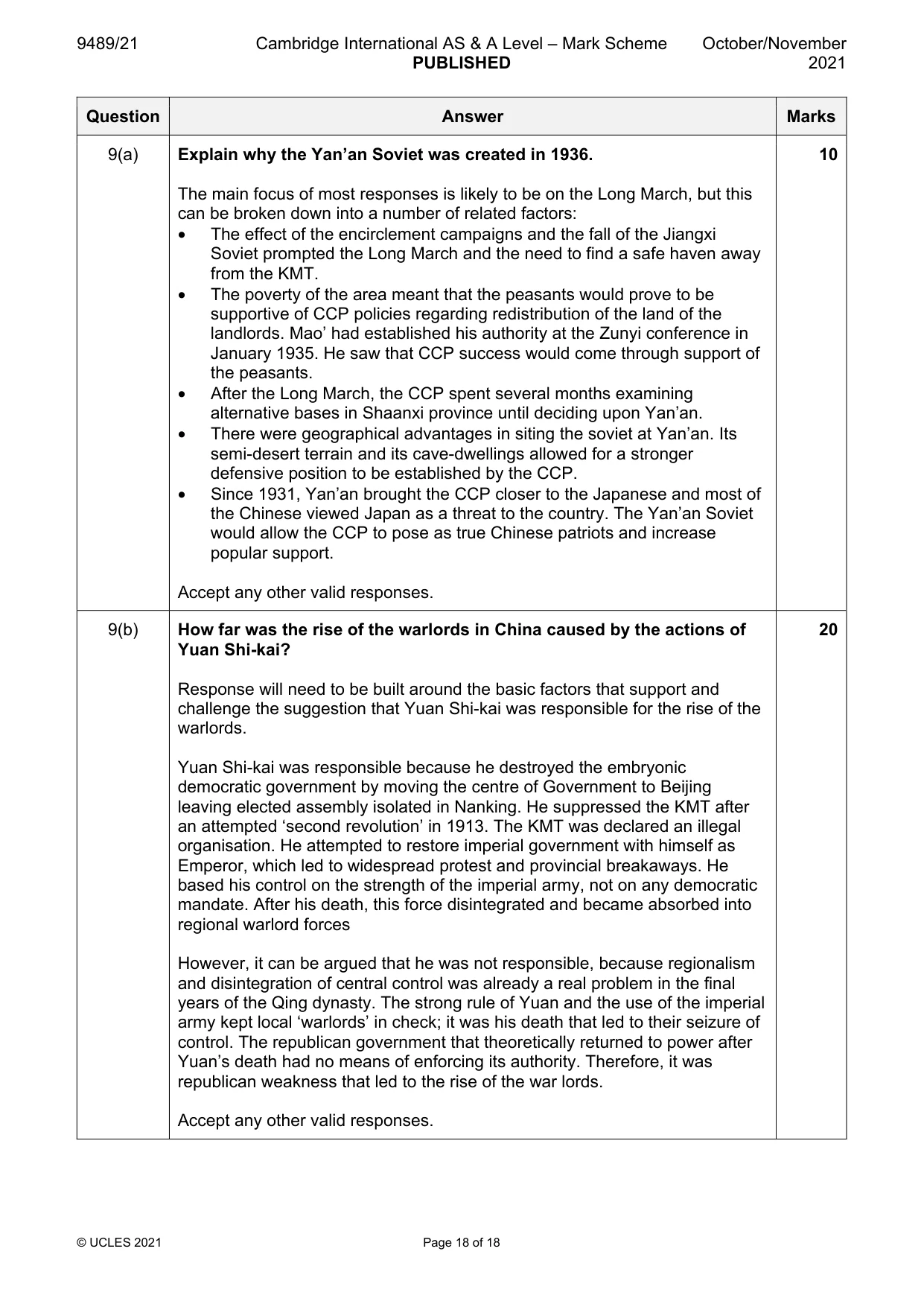
Q9 · China and Japan, 1912–45 (a) Explain why the Yan’an Soviet was created in 1936
9 China and Japan, 1912–45 (a) Explain why the Yan’an Soviet was created in 1936. [10] (b) How far was the rise of the warlords in China caused by the actions of Yuan Shi-kai? [20]
Mark scheme: 9(a) Explain why the Yan’an Soviet was created in 1936. 10 The main focus of most responses is likely to be on the Long March, but this can be broken down into a number of related factors: • The effect of the encirclement campaigns and the fall of the Jiangxi Soviet prompted the Long March and the need to find a safe haven away from the KMT. • The poverty of the area meant that the peasants would prove to be supportive of CCP policies regarding redistribution of the land of the landlords. Mao’ had established his authority at the Zunyi conference in January 1935. He saw that CCP success would come through support of the peasants. • After the Long March, the CCP spent several months examining alternative bases in Shaanxi province until deciding upon Yan’an. • There were geographical advantages in siting the soviet at Yan’an. Its semi-desert terrain and its cave-dwellings allowed for a stronger defensive position to be established by the CCP. • Since 1931, Yan’an brought the CCP closer to the Japanese and most of the Chinese viewed Japan as a threat to the country. The Yan’an Soviet would allow the CCP to pose as true Chinese patriots and increase popular support. Accept any other valid responses. 9(b) How far was the rise of the warlords in China caused by the actions of 20 Yuan Shi-kai? Response will need to be built around the basic factors that support and challenge the suggestion that Yuan Shi-kai was responsible for the rise of the warlords. Yuan Shi-kai was responsible because he destroyed the embryonic democratic government by moving the centre of Government to Beijing leaving elected assembly isolated in Nanking. He suppressed the KMT after an attempted ‘second revolution’ in 1913. The KMT was declared an illegal organisation. He attempted to restore imperial government with himself as Emperor, which led to widespread protest and provincial breakaways. He based his control on the strength of the imperial army, not on any democratic mandate. After his death, this force disintegrated and became absorbed into regional warlord forces However, it can be argued that he was not responsible, because regionalism and disintegration of central control was already a real problem in the final years of the Qing dynasty. The strong rule of Yuan and the use of the imperial army kept local ‘warlords’ in check; it was his death that led to their seizure of control. The republican government that theoretically returned to power after Yuan’s death had no means of enforcing its authority. Therefore, it was republican weakness that led to the rise of the war lords. Accept any other valid responses.
More questions on How and why did the Bolsheviks seize power in October 1917?
What was in this paper
The subtopics covered by these 9 questions, and how many questions each got. Open one in a new tab to see every Cambridge question on it.
1How well was France governed in the period 1793–99?1How were the Bolsheviks able to consolidate their power up to 1924?1What were the aims of Reconstruction and how successful was it?1What were the consequences of the rapid economic growth after 1870?1Why was imperialism a significant force in Africa from 1870?1Why was there a second New Deal and how successful was it?1Why was there rapid industrialisation after 1870?1Why was there such extensive dissatisfaction with the peace settlements of 1919–20?1What you needed in this session
Cambridge’s own grade thresholds for 2021 Oct/Nov, Paper 2 · Variant 1. A higher threshold means an easier paper — the bar moves with how the cohort did.