Cambridge A Level History 9489 — 2024 Oct/Nov Paper 2 · Variant 1
9489/21/O/N/24 · 9 questions · 60 marks · ≈68 min
The question paper and its mark scheme, free to read here and free to download. This is Cambridge’s own paper, exactly as it was sat.
Question paper4 pages
Mark scheme23 pages
Answers below. Sit the paper first if you are practising.
Questions as text
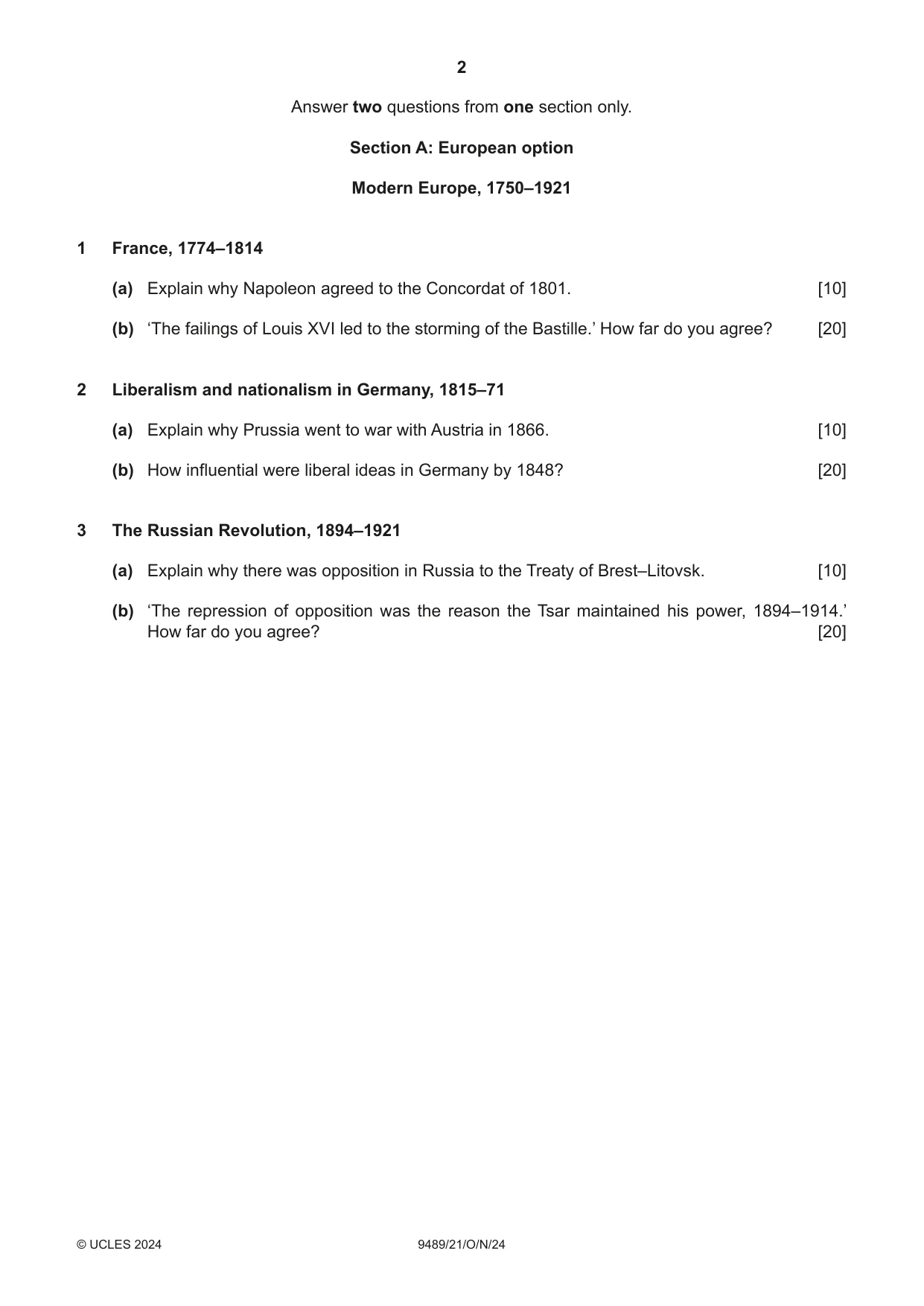
Q1 · France, 1774–1814 (a) Explain why Napoleon agreed to the Concordat of 1801
1 France, 1774–1814 (a) Explain why Napoleon agreed to the Concordat of 1801. [10] (b) ‘The failings of Louis XVI led to the storming of the Bastille.’ How far do you agree? [20]
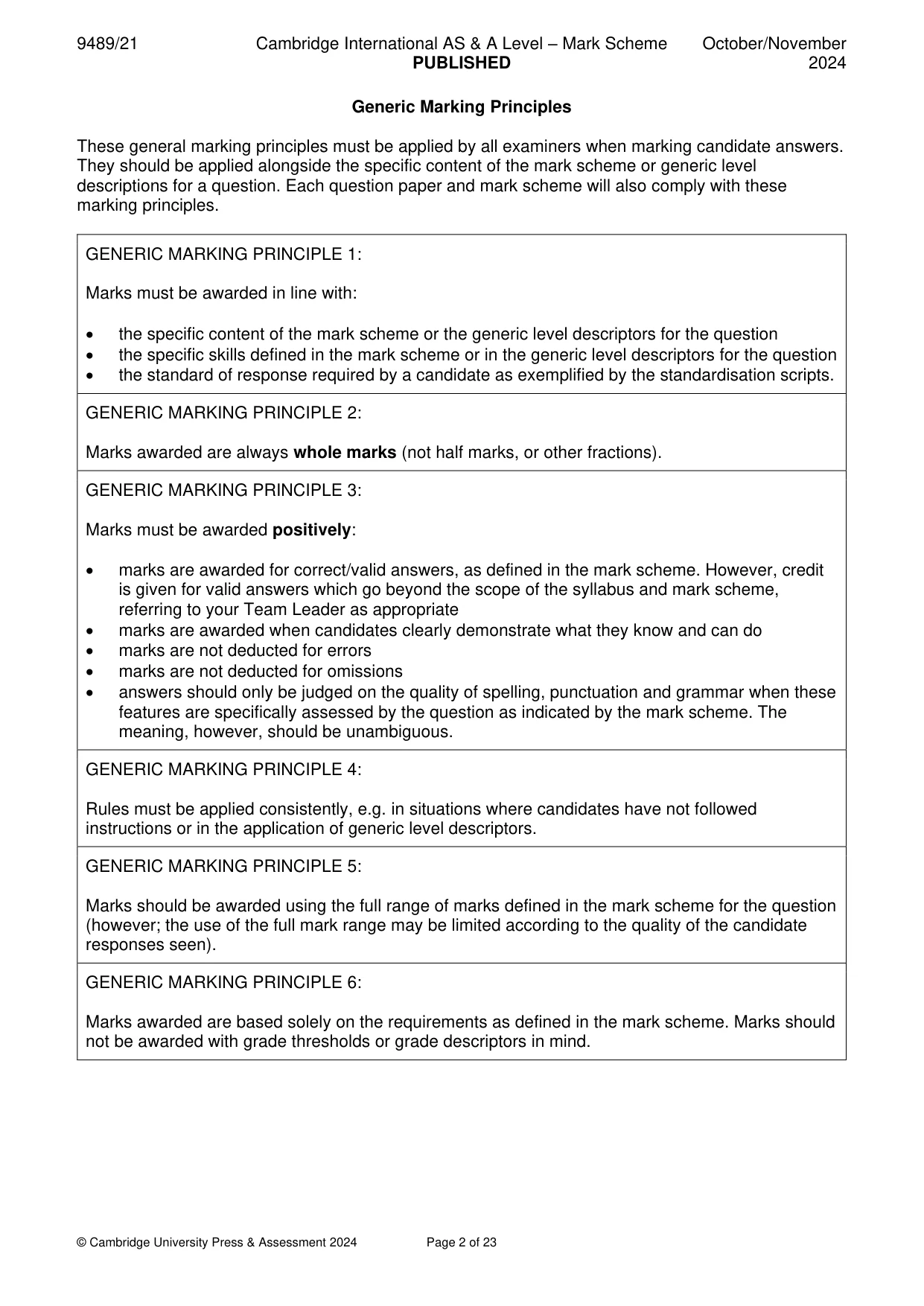
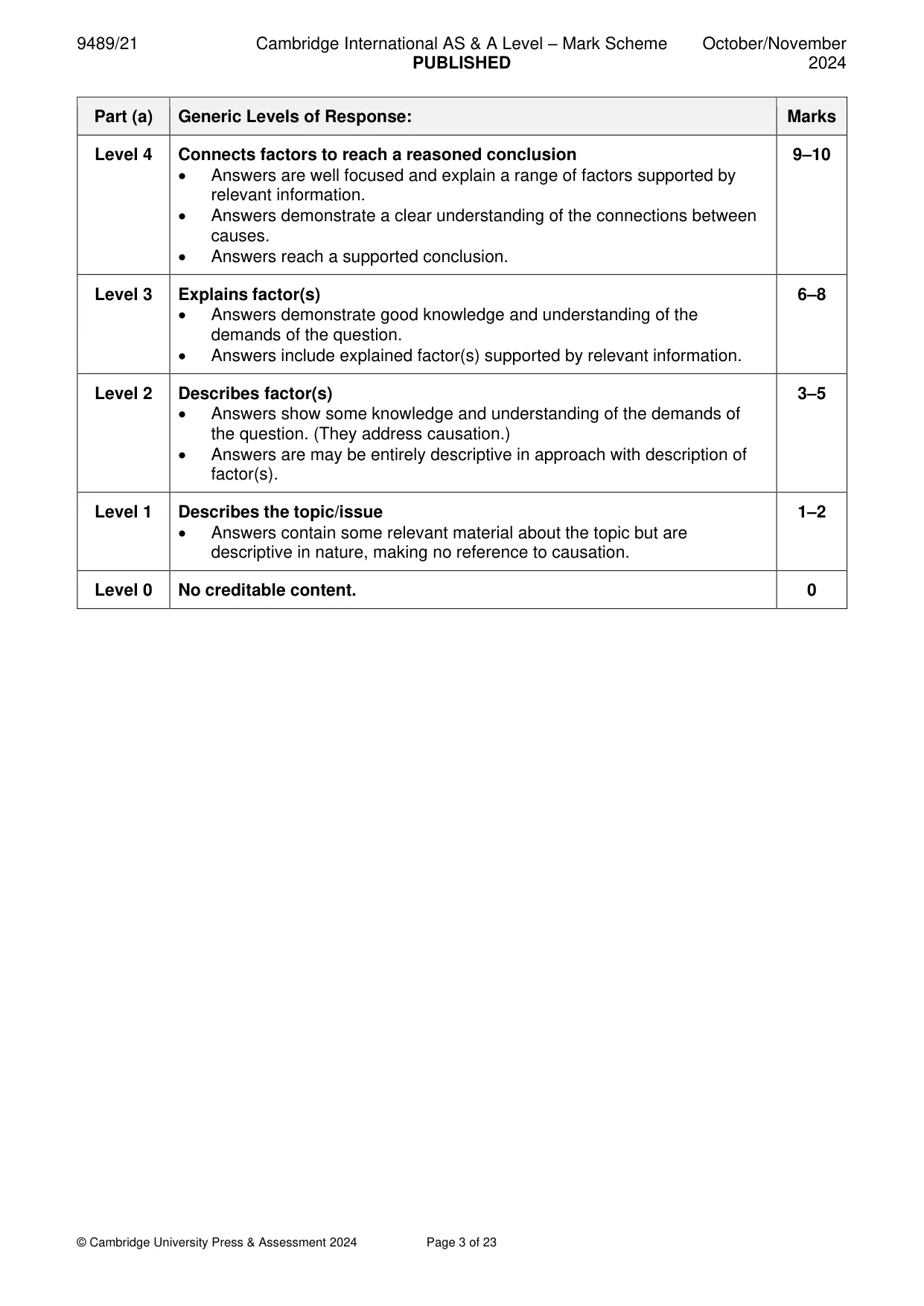
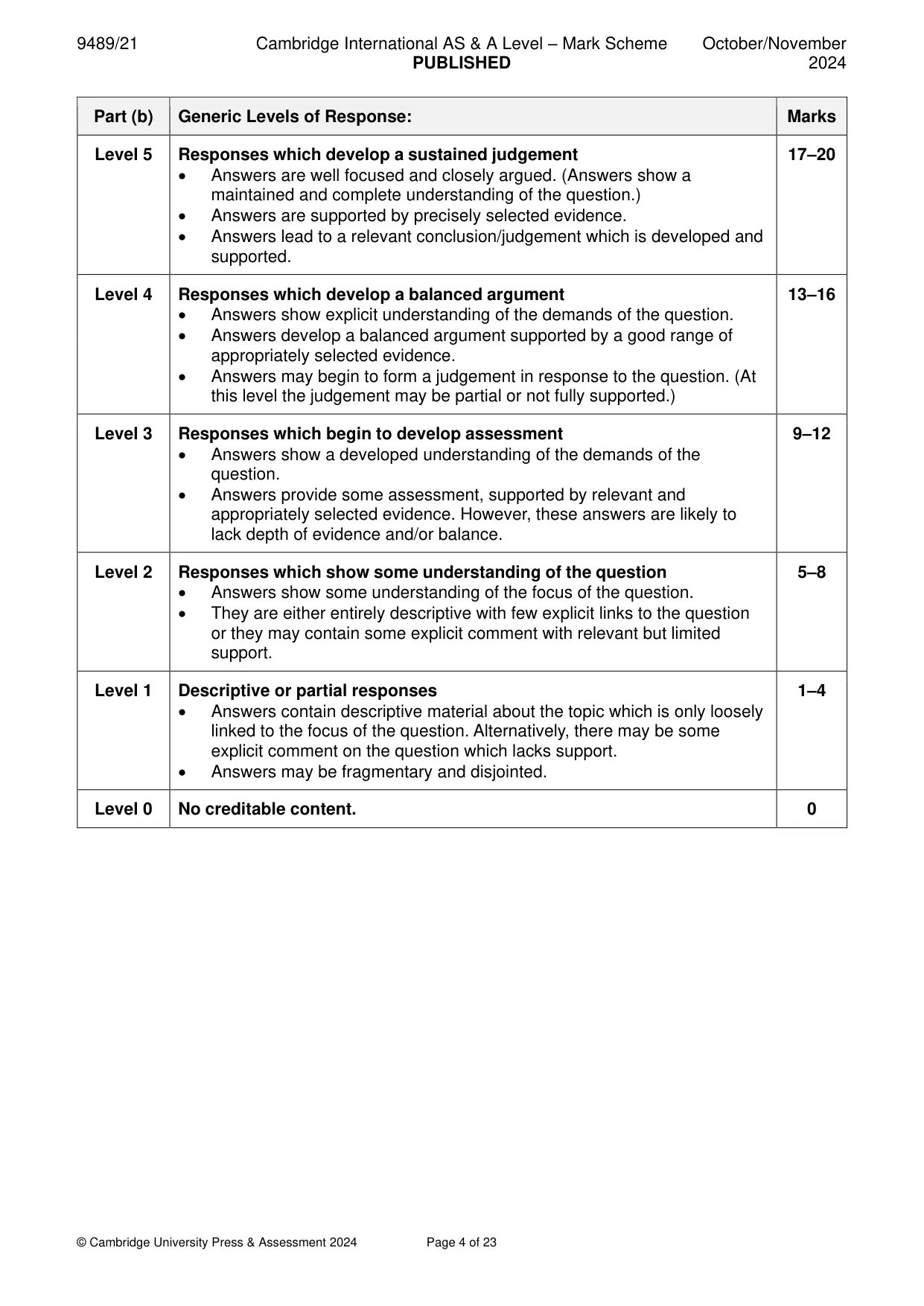
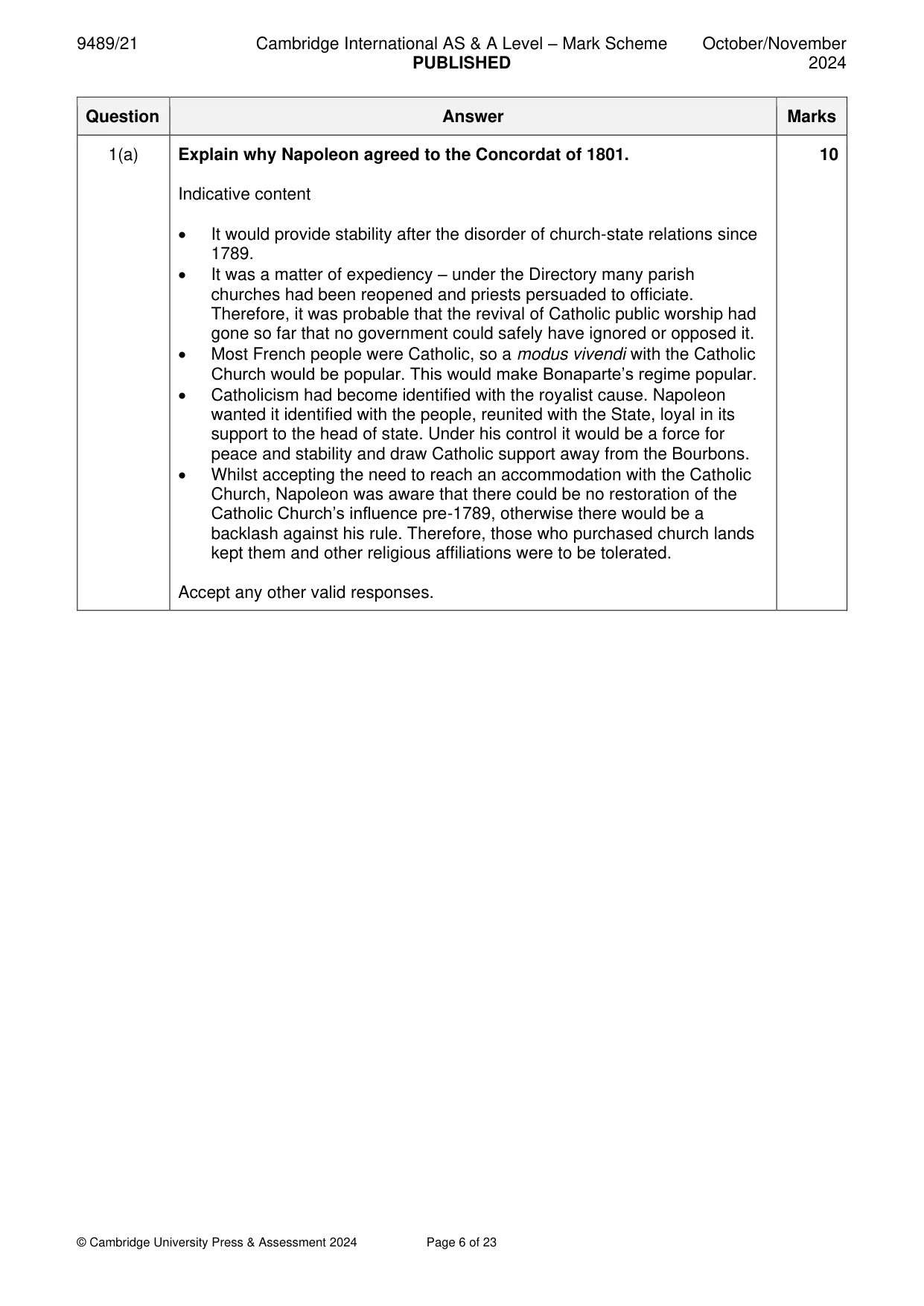
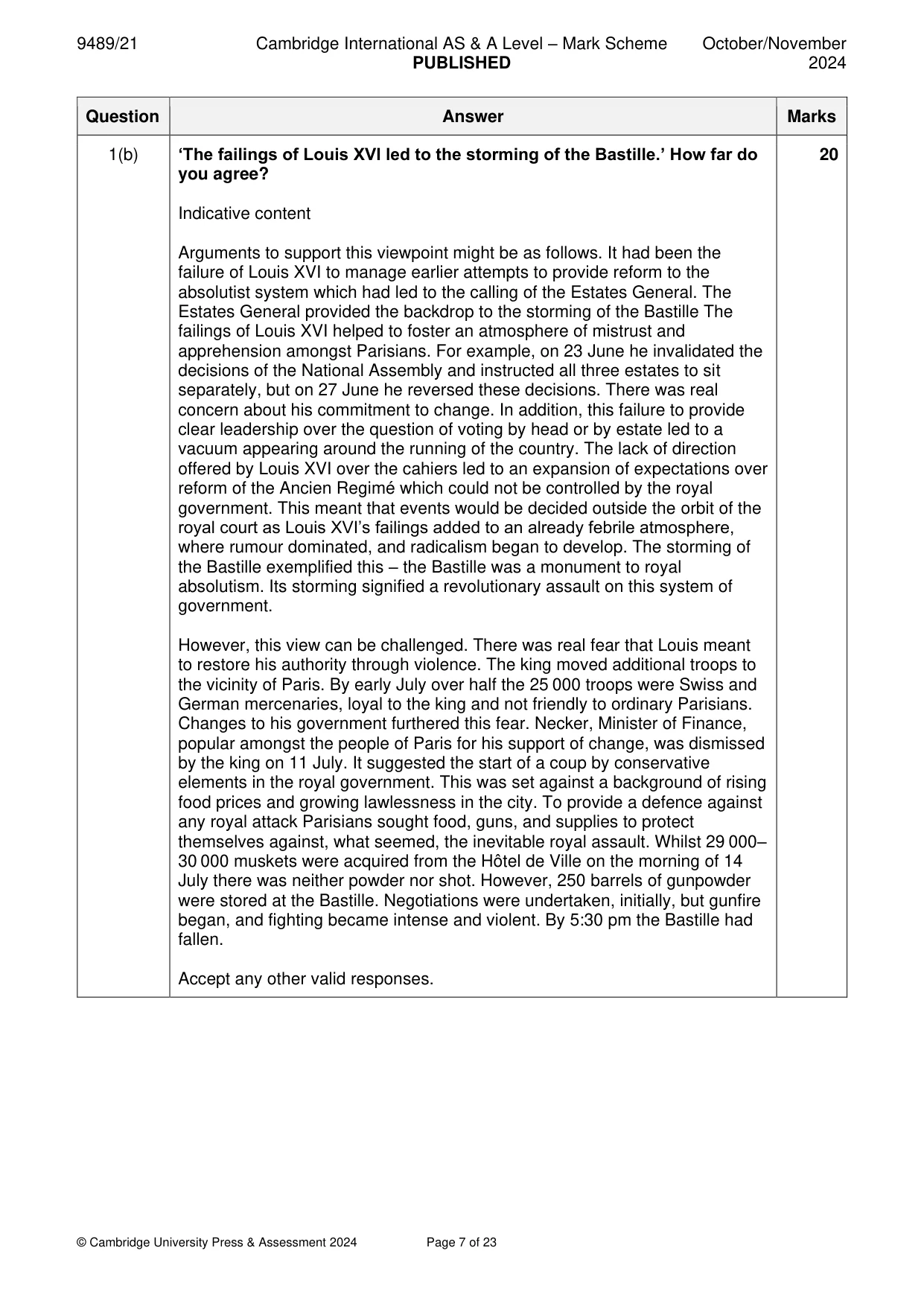
Mark scheme: Question Answer Marks 1(a) Explain why Napoleon agreed to the Concordat of 1801. 10 Indicative content • It would provide stability after the disorder of church-state relations since 1789. • It was a matter of expediency – under the Directory many parish churches had been reopened and priests persuaded to officiate. Therefore, it was probable that the revival of Catholic public worship had gone so far that no government could safely have ignored or opposed it. • Most French people were Catholic, so a modus vivendi with the Catholic Church would be popular. This would make Bonaparte’s regime popular. • Catholicism had become identified with the royalist cause. Napoleon wanted it identified with the people, reunited with the State, loyal in its support to the head of state. Under his control it would be a force for peace and stability and draw Catholic support away from the Bourbons. • Whilst accepting the need to reach an accommodation with the Catholic Church, Napoleon was aware that there could be no restoration of the Catholic Church’s influence pre-1789, otherwise there would be a backlash against his rule. Therefore, those who purchased church lands kept them and other religious affiliations were to be tolerated. Accept any other valid responses. 1(b) ‘The failings of Louis XVI led to the storming of the Bastille.’ How far do 20 you agree? Indicative content Arguments to support this viewpoint might be as follows. It had been the failure of Louis XVI to manage earlier attempts to provide reform to the absolutist system which had led to the calling of the Estates General. The Estates General provided the backdrop to the storming of the Bastille The failings of Louis XVI helped to foster an atmosphere of mistrust and apprehension amongst Parisians. For example, on 23 June he invalidated the decisions of the National Assembly and instructed all three estates to sit separately, but on 27 June he reversed these decisions. There was real concern about his commitment to change. In addition, this failure to provide clear leadership over the question of voting by head or by estate led to a vacuum appearing around the running of the country. The lack of direction offered by Louis XVI over the cahiers led to an expansion of expectations over reform of the Ancien Regimé which could not be controlled by the royal government. This meant that events would be decided outside the orbit of the royal court as Louis XVI’s failings added to an already febrile atmosphere, where rumour dominated, and radicalism began to develop. The storming of the Bastille exemplified this – the Bastille was a monument to royal absolutism. Its storming signified a revolutionary assault on this system of government. However, this view can be challenged. There was real fear that Louis meant to restore his authority through violence. The king moved additional troops to the vicinity of Paris. By early July over half the 25 000 troops were Swiss and German mercenaries, loyal to the king and not friendly to ordinary Parisians. Changes to his government furthered this fear. Necker, Minister of Finance, popular amongst the people of Paris for his support of change, was dismissed by the king on 11 July. It suggested the start of a coup by conservative elements in the royal government. This was set against a background of rising food prices and growing lawlessness in the city. To provide a defence against any royal attack Parisians sought food, guns, and supplies to protect themselves against, what seemed, the inevitable royal assault. Whilst 29 000– 30 000 muskets were acquired from the Hôtel de Ville on the morning of 14 July there was neither powder nor shot. However, 250 barrels of gunpowder were stored at the Bastille. Negotiations were undertaken, initially, but gunfire began, and fighting became intense and violent. By 5:30 pm the Bastille had fallen. Accept any other valid responses.
More questions on What were the causes and immediate consequences of the 1789 Revolution?
Q2 · Liberalism and nationalism in Germany, 1815–71 (a) Explain why Prussia went to war with…
2 Liberalism and nationalism in Germany, 1815–71 (a) Explain why Prussia went to war with Austria in 1866. [10] (b) How influential were liberal ideas in Germany by 1848? [20]
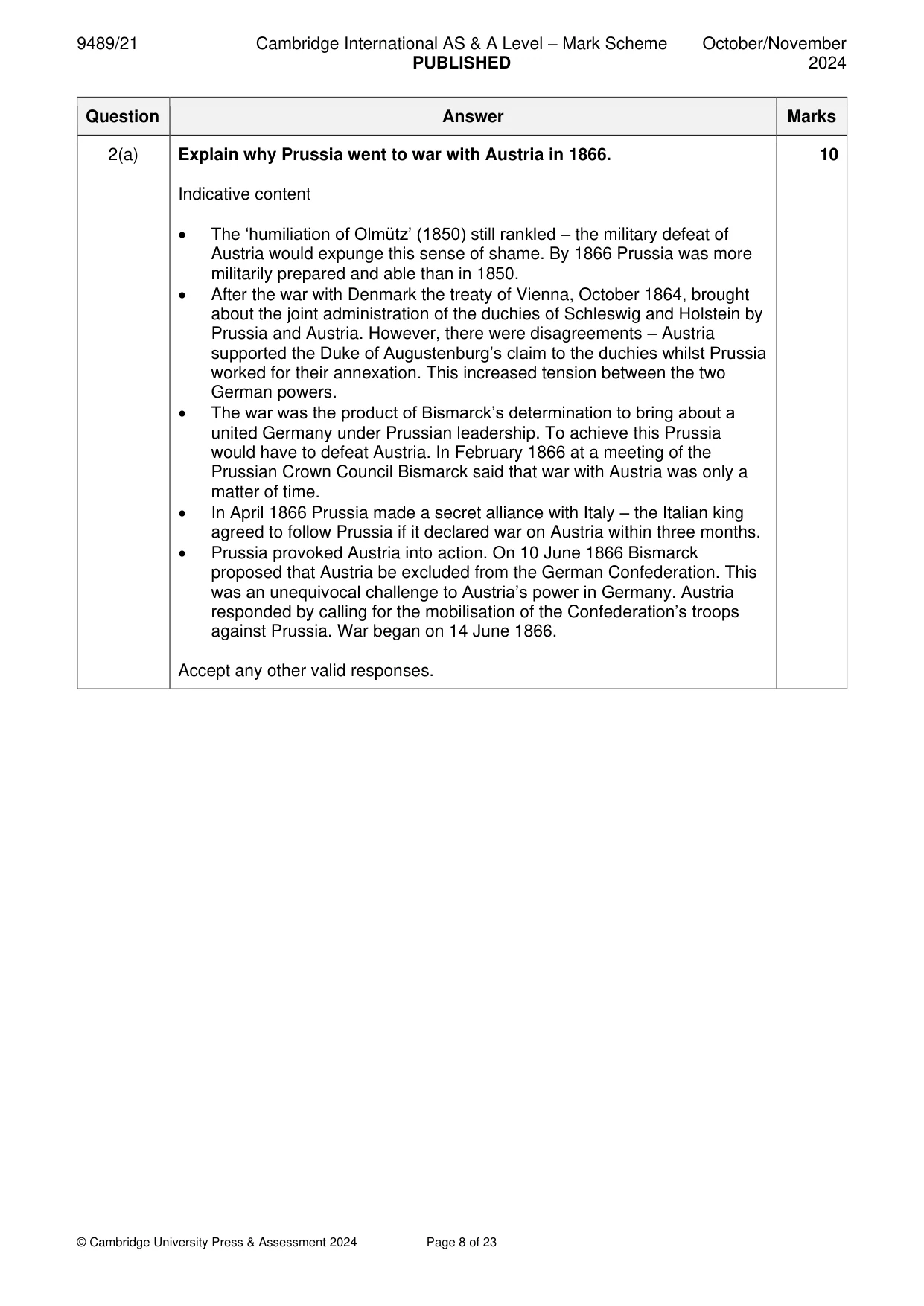
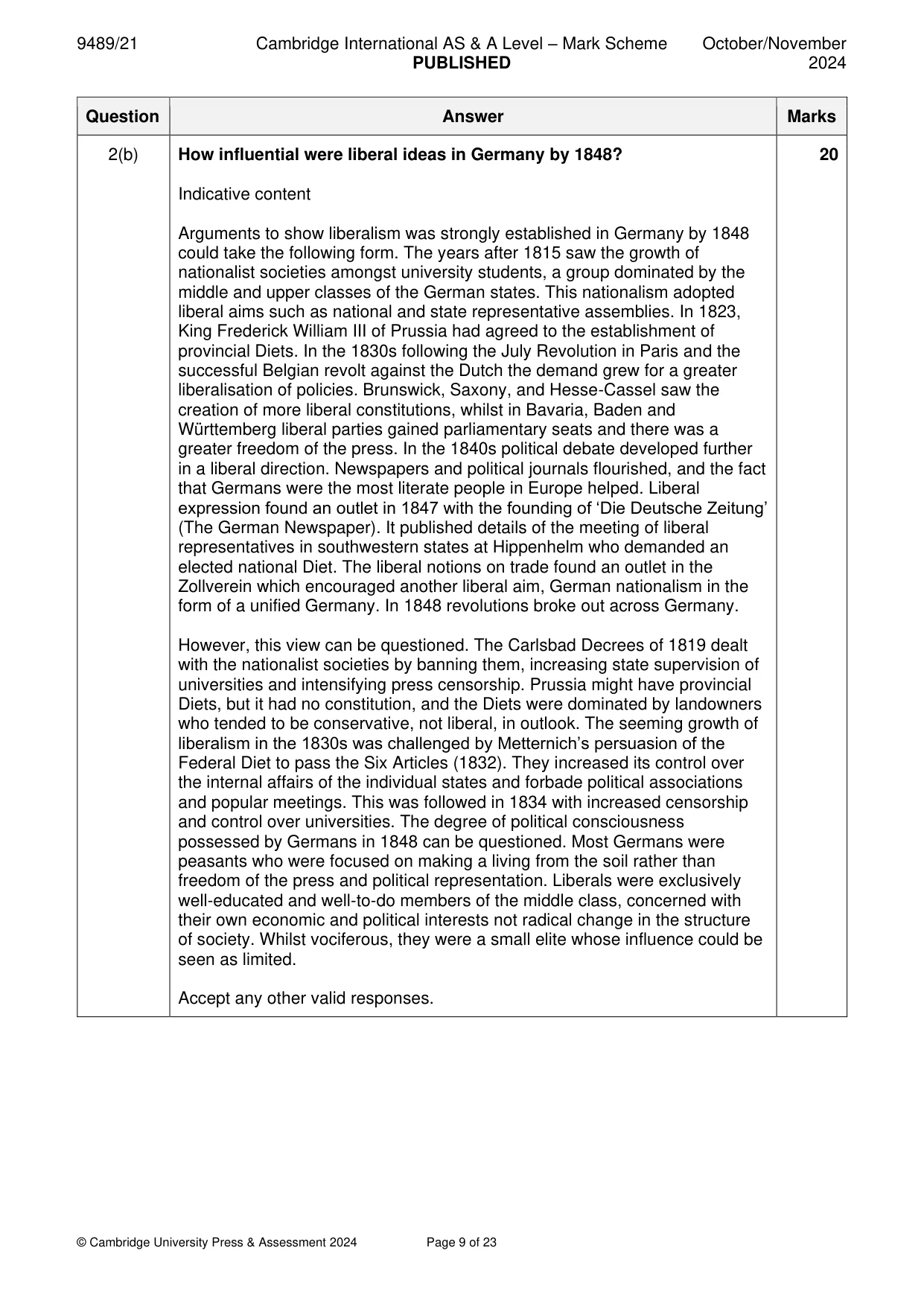
Mark scheme: 2(a) Explain why Prussia went to war with Austria in 1866. 10 Indicative content • The ‘humiliation of Olmütz’ (1850) still rankled – the military defeat of Austria would expunge this sense of shame. By 1866 Prussia was more militarily prepared and able than in 1850. • After the war with Denmark the treaty of Vienna, October 1864, brought about the joint administration of the duchies of Schleswig and Holstein by Prussia and Austria. However, there were disagreements – Austria supported the Duke of Augustenburg’s claim to the duchies whilst Prussia worked for their annexation. This increased tension between the two German powers. • The war was the product of Bismarck’s determination to bring about a united Germany under Prussian leadership. To achieve this Prussia would have to defeat Austria. In February 1866 at a meeting of the Prussian Crown Council Bismarck said that war with Austria was only a matter of time. • In April 1866 Prussia made a secret alliance with Italy – the Italian king agreed to follow Prussia if it declared war on Austria within three months. • Prussia provoked Austria into action. On 10 June 1866 Bismarck proposed that Austria be excluded from the German Confederation. This was an unequivocal challenge to Austria’s power in Germany. Austria responded by calling for the mobilisation of the Confederation’s troops against Prussia. War began on 14 June 1866. Accept any other valid responses. 2(b) How influential were liberal ideas in Germany by 1848? 20 Indicative content Arguments to show liberalism was strongly established in Germany by 1848 could take the following form. The years after 1815 saw the growth of nationalist societies amongst university students, a group dominated by the middle and upper classes of the German states. This nationalism adopted liberal aims such as national and state representative assemblies. In 1823, King Frederick William III of Prussia had agreed to the establishment of provincial Diets. In the 1830s following the July Revolution in Paris and the successful Belgian revolt against the Dutch the demand grew for a greater liberalisation of policies. Brunswick, Saxony, and Hesse-Cassel saw the creation of more liberal constitutions, whilst in Bavaria, Baden and Württemberg liberal parties gained parliamentary seats and there was a greater freedom of the press. In the 1840s political debate developed further in a liberal direction. Newspapers and political journals flourished, and the fact that Germans were the most literate people in Europe helped. Liberal expression found an outlet in 1847 with the founding of ‘Die Deutsche Zeitung’ (The German Newspaper). It published details of the meeting of liberal representatives in southwestern states at Hippenhelm who demanded an elected national Diet. The liberal notions on trade found an outlet in the Zollverein which encouraged another liberal aim, German nationalism in the form of a unified Germany. In 1848 revolutions broke out across Germany. However, this view can be questioned. The Carlsbad Decrees of 1819 dealt with the nationalist societies by banning them, increasing state supervision of universities and intensifying press censorship. Prussia might have provincial Diets, but it had no constitution, and the Diets were dominated by landowners who tended to be conservative, not liberal, in outlook. The seeming growth of liberalism in the 1830s was challenged by Metternich’s persuasion of the Federal Diet to pass the Six Articles (1832). They increased its control over the internal affairs of the individual states and forbade political associations and popular meetings. This was followed in 1834 with increased censorship and control over universities. The degree of political consciousness possessed by Germans in 1848 can be questioned. Most Germans were peasants who were focused on making a living from the soil rather than freedom of the press and political representation. Liberals were exclusively well-educated and well-to-do members of the middle class, concerned with their own economic and political interests not radical change in the structure of society. Whilst vociferous, they were a small elite whose influence could be seen as limited. Accept any other valid responses.
More questions on What were the causes of the Revolutions of 1848?
Q3 · The Russian Revolution, 1894–1921 (a) Explain why there was opposition in Russia to the…
3 The Russian Revolution, 1894–1921 (a) Explain why there was opposition in Russia to the Treaty of Brest–Litovsk. [10] (b) ‘The repression of opposition was the reason the Tsar maintained his power, 1894–1914.’ How far do you agree? [20]
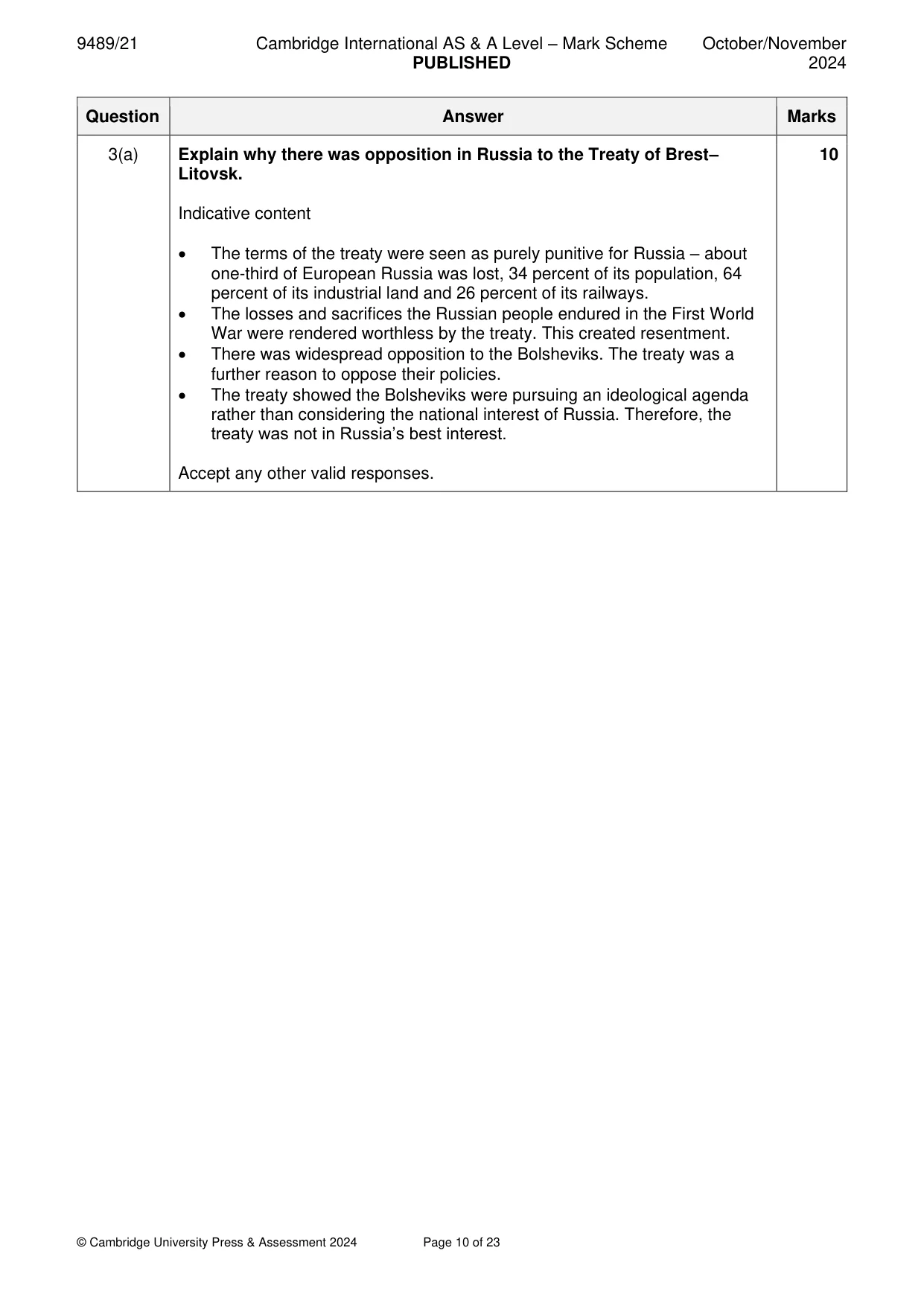
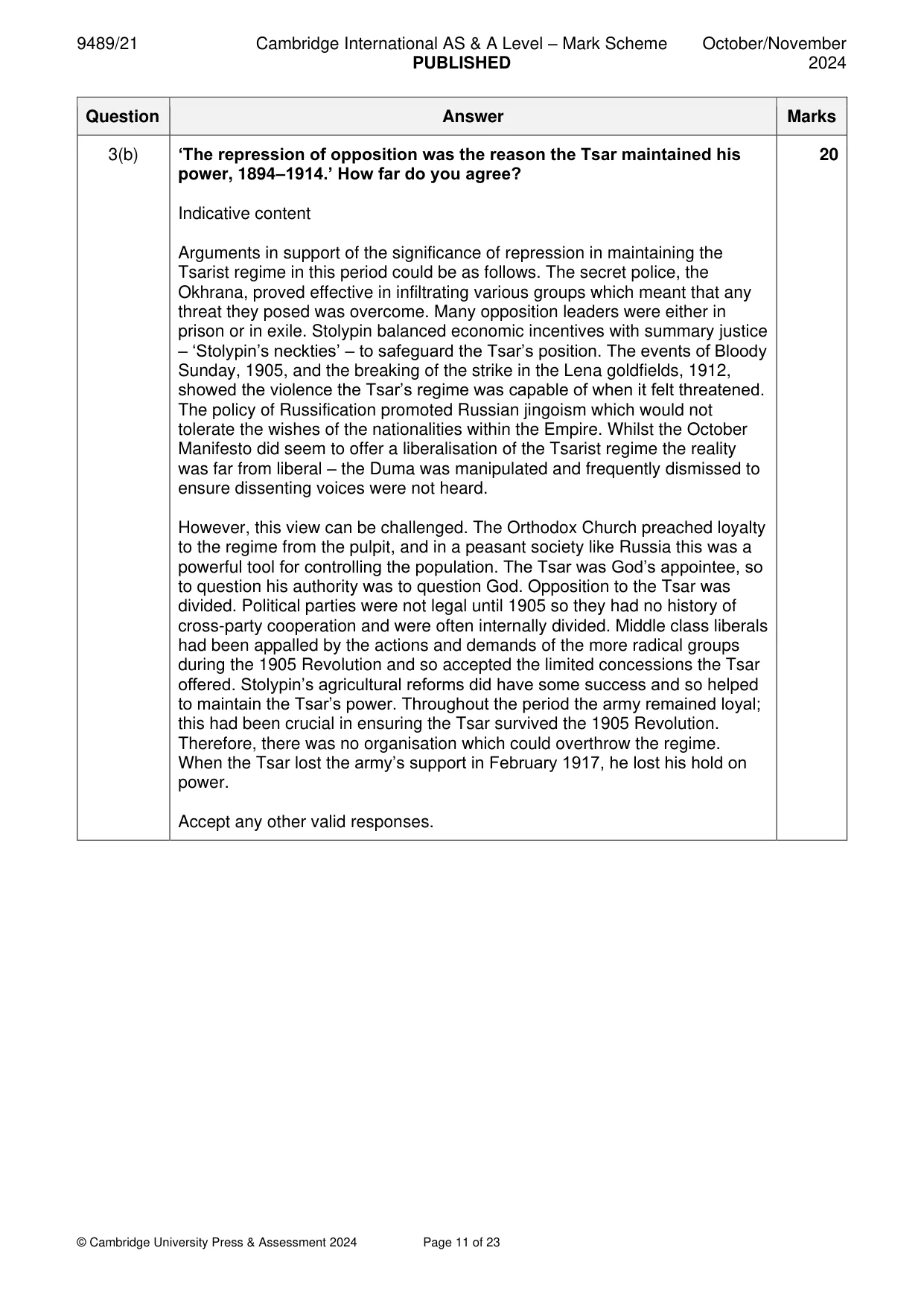
Mark scheme: 3(a) Explain why there was opposition in Russia to the Treaty of Brest– 10 Litovsk. Indicative content • The terms of the treaty were seen as purely punitive for Russia – about one-third of European Russia was lost, 34 percent of its population, 64 percent of its industrial land and 26 percent of its railways. • The losses and sacrifices the Russian people endured in the First World War were rendered worthless by the treaty. This created resentment. • There was widespread opposition to the Bolsheviks. The treaty was a further reason to oppose their policies. • The treaty showed the Bolsheviks were pursuing an ideological agenda rather than considering the national interest of Russia. Therefore, the treaty was not in Russia’s best interest. Accept any other valid responses. 3(b) ‘The repression of opposition was the reason the Tsar maintained his 20 power, 1894–1914.’ How far do you agree? Indicative content Arguments in support of the significance of repression in maintaining the Tsarist regime in this period could be as follows. The secret police, the Okhrana, proved effective in infiltrating various groups which meant that any threat they posed was overcome. Many opposition leaders were either in prison or in exile. Stolypin balanced economic incentives with summary justice – ‘Stolypin’s neckties’ – to safeguard the Tsar’s position. The events of Bloody Sunday, 1905, and the breaking of the strike in the Lena goldfields, 1912, showed the violence the Tsar’s regime was capable of when it felt threatened. The policy of Russification promoted Russian jingoism which would not tolerate the wishes of the nationalities within the Empire. Whilst the October Manifesto did seem to offer a liberalisation of the Tsarist regime the reality was far from liberal – the Duma was manipulated and frequently dismissed to ensure dissenting voices were not heard. However, this view can be challenged. The Orthodox Church preached loyalty to the regime from the pulpit, and in a peasant society like Russia this was a powerful tool for controlling the population. The Tsar was God’s appointee, so to question his authority was to question God. Opposition to the Tsar was divided. Political parties were not legal until 1905 so they had no history of cross-party cooperation and were often internally divided. Middle class liberals had been appalled by the actions and demands of the more radical groups during the 1905 Revolution and so accepted the limited concessions the Tsar offered. Stolypin’s agricultural reforms did have some success and so helped to maintain the Tsar’s power. Throughout the period the army remained loyal; this had been crucial in ensuring the Tsar survived the 1905 Revolution. Therefore, there was no organisation which could overthrow the regime. When the Tsar lost the army’s support in February 1917, he lost his hold on power. Accept any other valid responses.
More questions on What challenges faced the Tsarist regime in the years 1881–94?
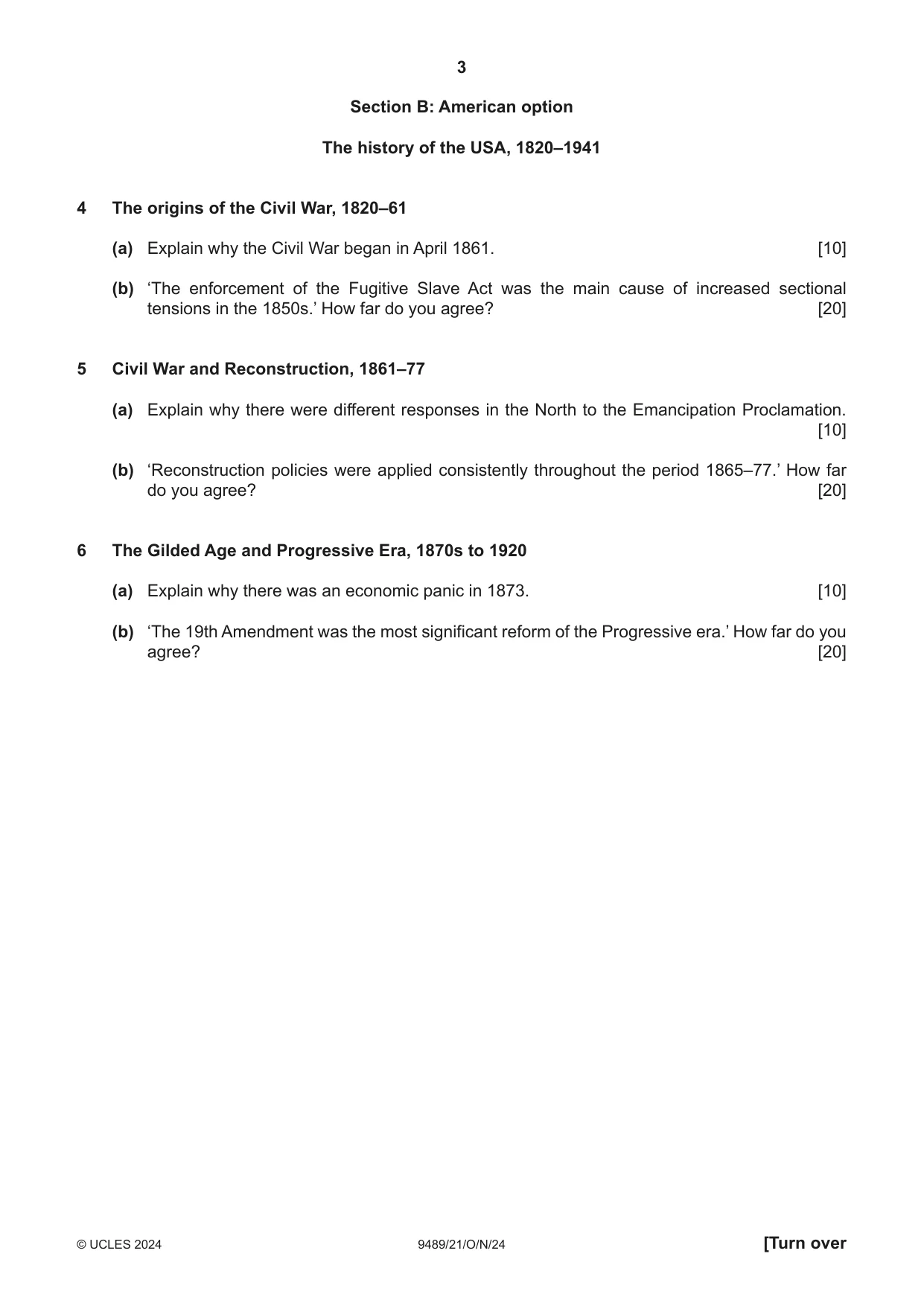
Q4 · The origins of the Civil War, 1820–61 (a) Explain why the Civil War began in April 1861
4 The origins of the Civil War, 1820–61 (a) Explain why the Civil War began in April 1861. [10] (b) ‘The enforcement of the Fugitive Slave Act was the main cause of increased sectional tensions in the 1850s.’ How far do you agree? [20]
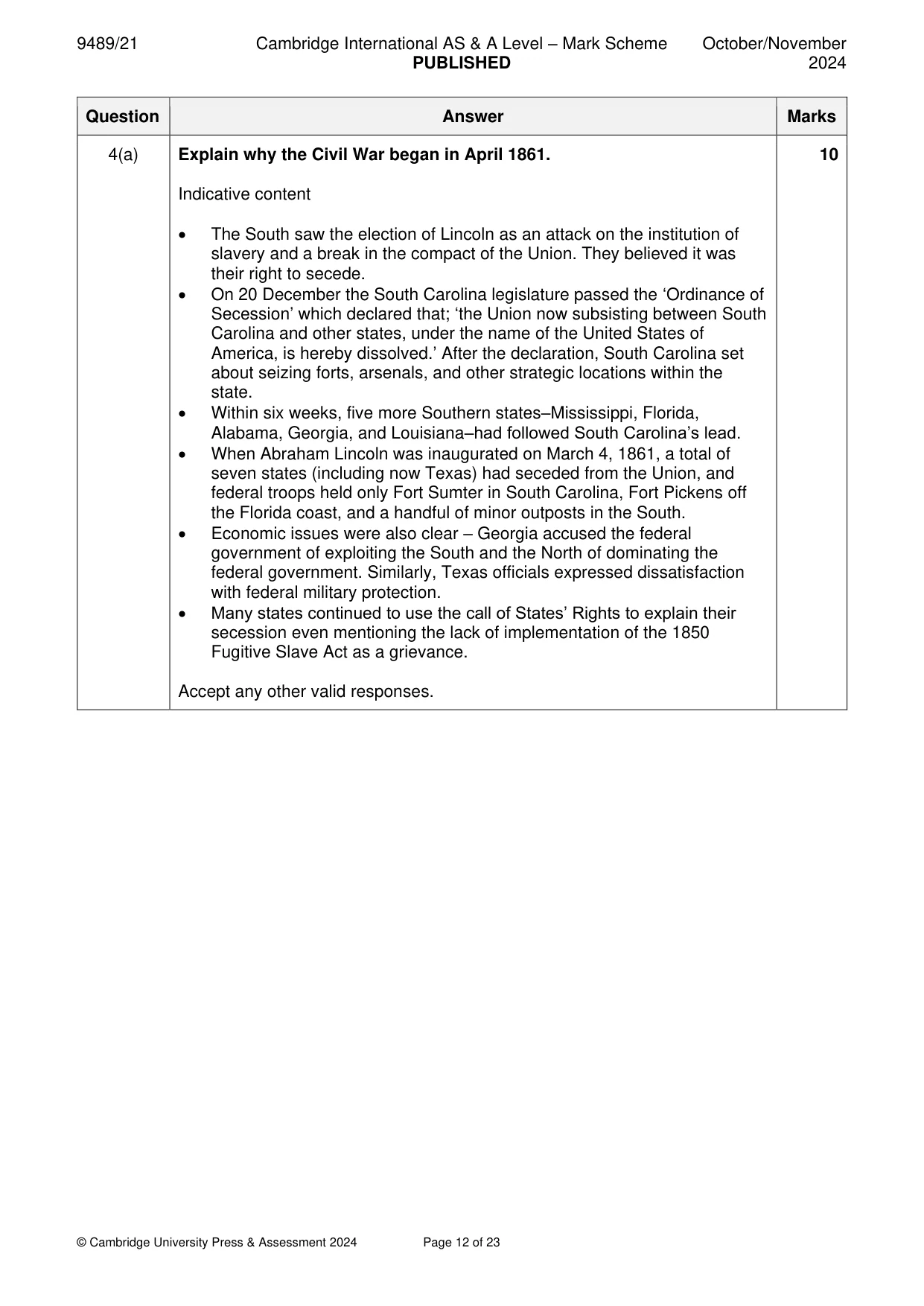
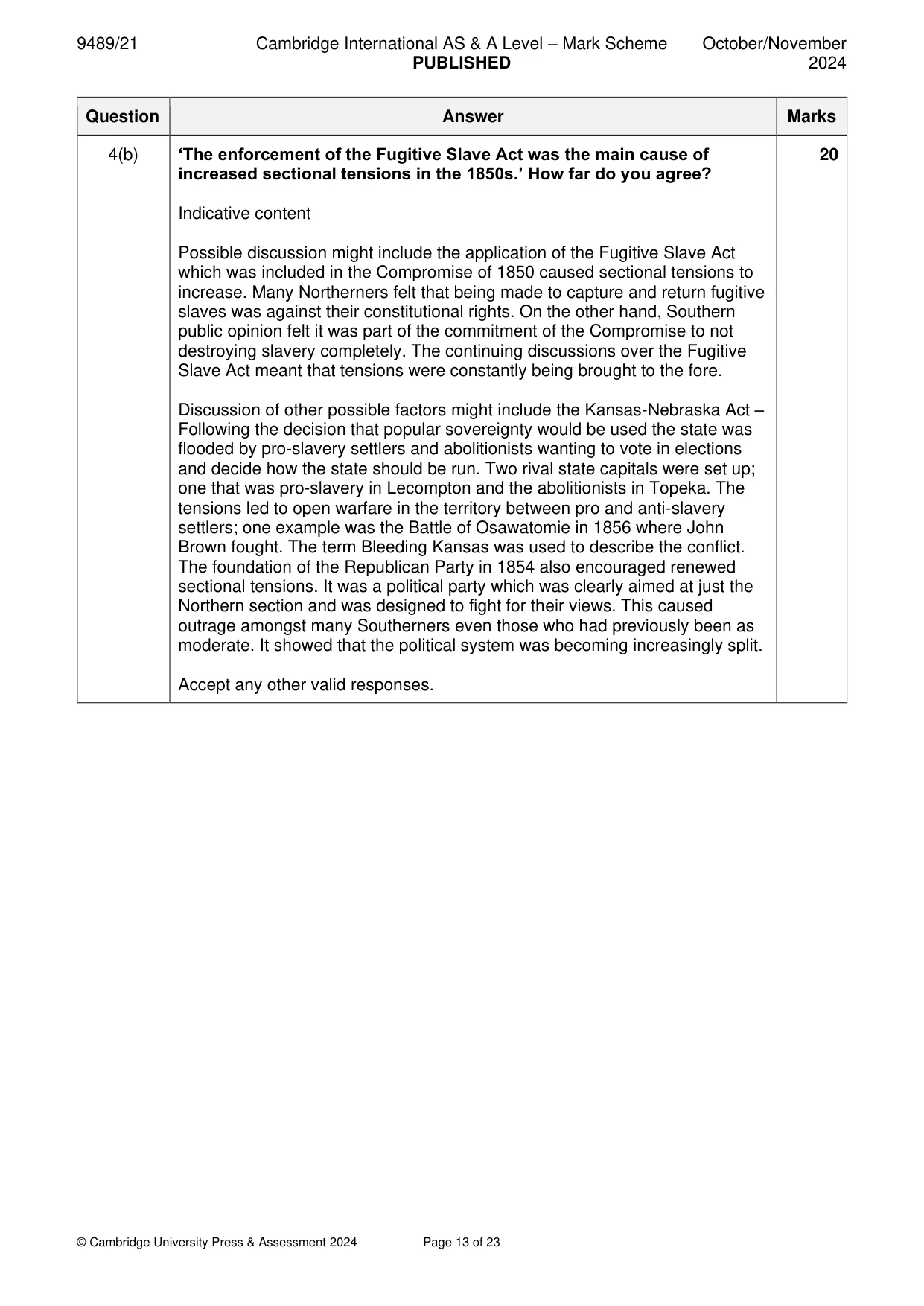
Mark scheme: 4(a) Explain why the Civil War began in April 1861. 10 Indicative content • The South saw the election of Lincoln as an attack on the institution of slavery and a break in the compact of the Union. They believed it was their right to secede. • On 20 December the South Carolina legislature passed the ‘Ordinance of Secession’ which declared that; ‘the Union now subsisting between South Carolina and other states, under the name of the United States of America, is hereby dissolved.’ After the declaration, South Carolina set about seizing forts, arsenals, and other strategic locations within the state. • Within six weeks, five more Southern states–Mississippi, Florida, Alabama, Georgia, and Louisiana–had followed South Carolina’s lead. • When Abraham Lincoln was inaugurated on March 4, 1861, a total of seven states (including now Texas) had seceded from the Union, and federal troops held only Fort Sumter in South Carolina, Fort Pickens off the Florida coast, and a handful of minor outposts in the South. • Economic issues were also clear – Georgia accused the federal government of exploiting the South and the North of dominating the federal government. Similarly, Texas officials expressed dissatisfaction with federal military protection. • Many states continued to use the call of States’ Rights to explain their secession even mentioning the lack of implementation of the 1850 Fugitive Slave Act as a grievance. Accept any other valid responses. 4(b) ‘The enforcement of the Fugitive Slave Act was the main cause of 20 increased sectional tensions in the 1850s.’ How far do you agree? Indicative content Possible discussion might include the application of the Fugitive Slave Act which was included in the Compromise of 1850 caused sectional tensions to increase. Many Northerners felt that being made to capture and return fugitive slaves was against their constitutional rights. On the other hand, Southern public opinion felt it was part of the commitment of the Compromise to not destroying slavery completely. The continuing discussions over the Fugitive Slave Act meant that tensions were constantly being brought to the fore. Discussion of other possible factors might include the Kansas-Nebraska Act – Following the decision that popular sovereignty would be used the state was flooded by pro-slavery settlers and abolitionists wanting to vote in elections and decide how the state should be run. Two rival state capitals were set up; one that was pro-slavery in Lecompton and the abolitionists in Topeka. The tensions led to open warfare in the territory between pro and anti-slavery settlers; one example was the Battle of Osawatomie in 1856 where John Brown fought. The term Bleeding Kansas was used to describe the conflict. The foundation of the Republican Party in 1854 also encouraged renewed sectional tensions. It was a political party which was clearly aimed at just the Northern section and was designed to fight for their views. This caused outrage amongst many Southerners even those who had previously been as moderate. It showed that the political system was becoming increasingly split. Accept any other valid responses.
More questions on Why was there increasing tension between the North and the South before 1860?
Q5 · Civil War and Reconstruction, 1861–77 (a) Explain why there were different responses in…
5 Civil War and Reconstruction, 1861–77 (a) Explain why there were different responses in the North to the Emancipation Proclamation. [10] (b) ‘Reconstruction policies were applied consistently throughout the period 1865–77.’ How far do you agree? [20]
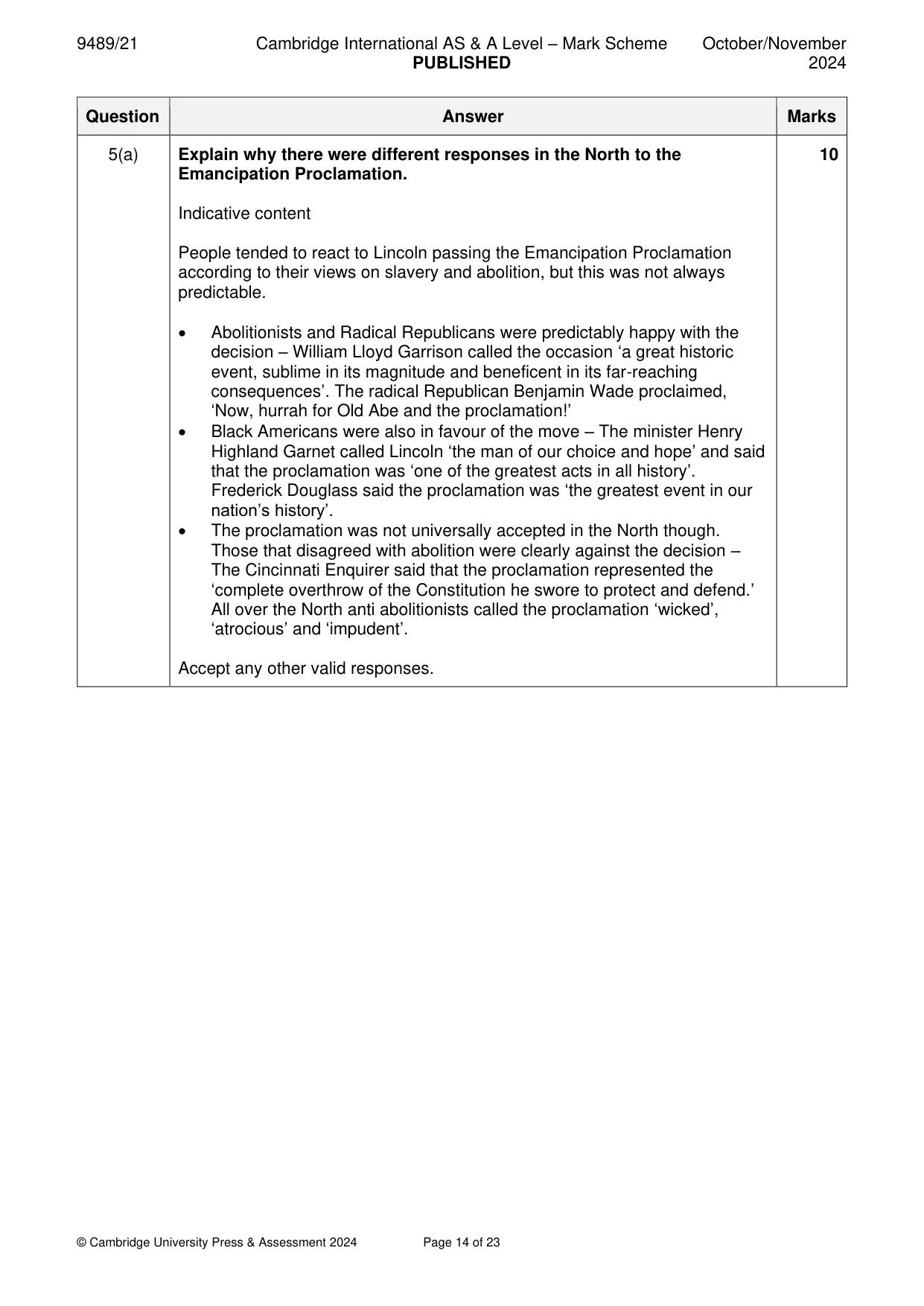
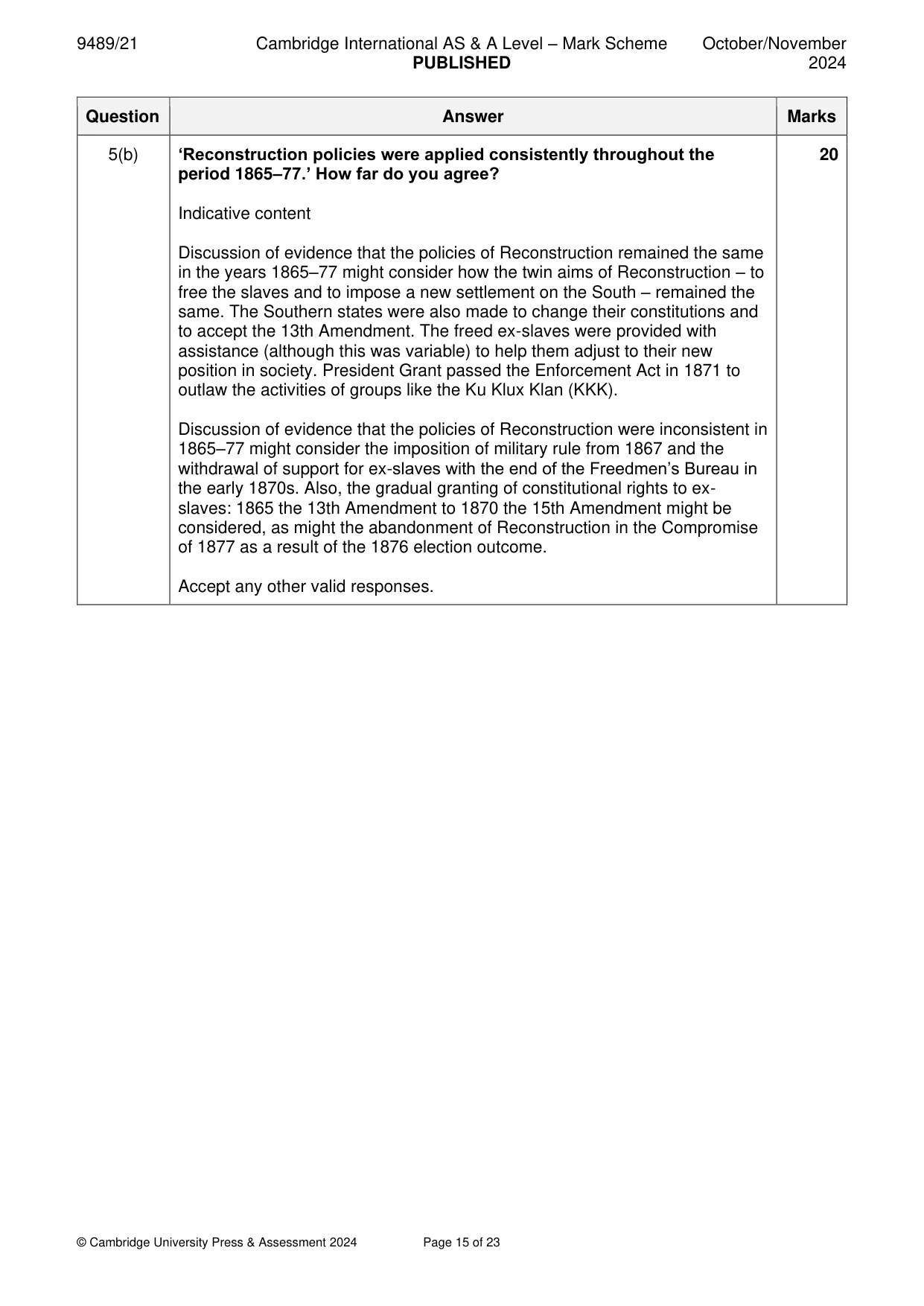
Mark scheme: 5(a) Explain why there were different responses in the North to the 10 Emancipation Proclamation. Indicative content People tended to react to Lincoln passing the Emancipation Proclamation according to their views on slavery and abolition, but this was not always predictable. • Abolitionists and Radical Republicans were predictably happy with the decision – William Lloyd Garrison called the occasion ‘a great historic event, sublime in its magnitude and beneficent in its far-reaching consequences’. The radical Republican Benjamin Wade proclaimed, ‘Now, hurrah for Old Abe and the proclamation!’ • Black Americans were also in favour of the move – The minister Henry Highland Garnet called Lincoln ‘the man of our choice and hope’ and said that the proclamation was ‘one of the greatest acts in all history’. Frederick Douglass said the proclamation was ‘the greatest event in our nation’s history’. • The proclamation was not universally accepted in the North though. Those that disagreed with abolition were clearly against the decision – The Cincinnati Enquirer said that the proclamation represented the ‘complete overthrow of the Constitution he swore to protect and defend.’ All over the North anti abolitionists called the proclamation ‘wicked’, ‘atrocious’ and ‘impudent’. Accept any other valid responses. 5(b) ‘Reconstruction policies were applied consistently throughout the 20 period 1865–77.’ How far do you agree? Indicative content Discussion of evidence that the policies of Reconstruction remained the same in the years 1865–77 might consider how the twin aims of Reconstruction – to free the slaves and to impose a new settlement on the South – remained the same. The Southern states were also made to change their constitutions and to accept the 13th Amendment. The freed ex-slaves were provided with assistance (although this was variable) to help them adjust to their new position in society. President Grant passed the Enforcement Act in 1871 to outlaw the activities of groups like the Ku Klux Klan (KKK). Discussion of evidence that the policies of Reconstruction were inconsistent in 1865–77 might consider the imposition of military rule from 1867 and the withdrawal of support for ex-slaves with the end of the Freedmen’s Bureau in the early 1870s. Also, the gradual granting of constitutional rights to ex- slaves: 1865 the 13th Amendment to 1870 the 15th Amendment might be considered, as might the abandonment of Reconstruction in the Compromise of 1877 as a result of the 1876 election outcome. Accept any other valid responses.
More questions on What were the aims of Reconstruction and how successful was it?
Q6 · The Gilded Age and Progressive Era, 1870s to 1920 (a) Explain why there was an economic…
6 The Gilded Age and Progressive Era, 1870s to 1920 (a) Explain why there was an economic panic in 1873. [10] (b) ‘The 19th Amendment was the most significant reform of the Progressive era.’ How far do you agree? [20] Section C: International option International history, 1870–1945
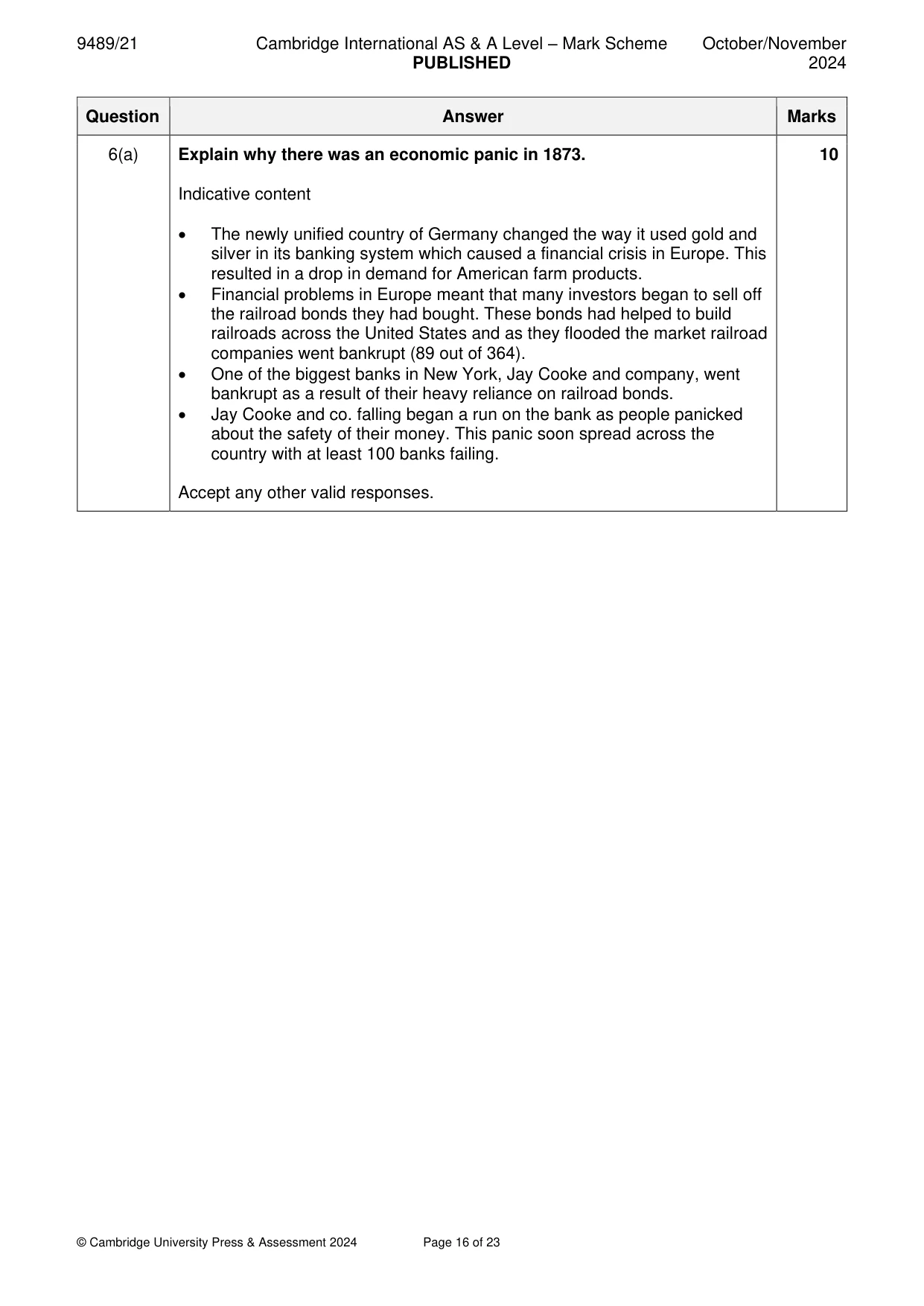
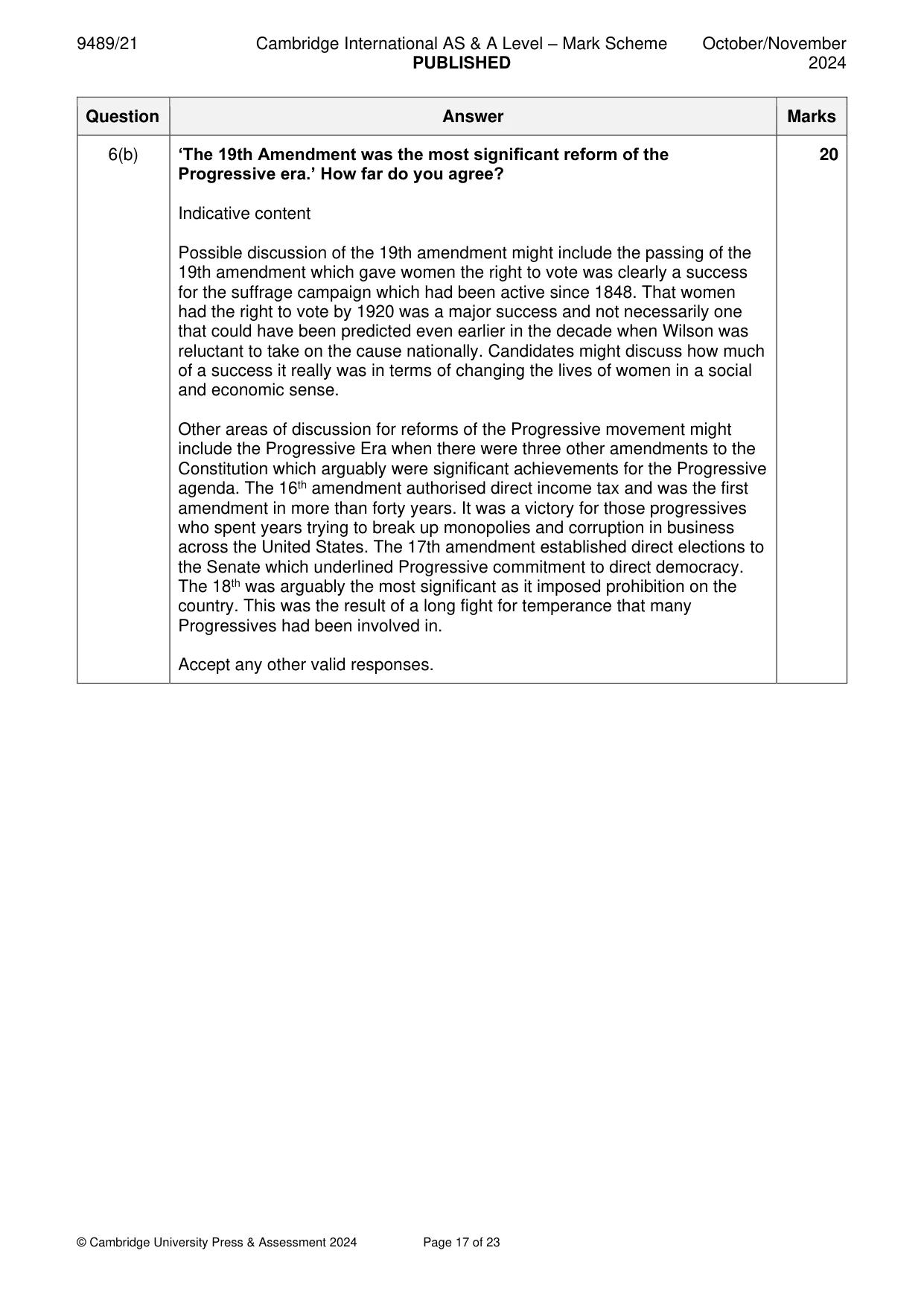
Mark scheme: 6(a) Explain why there was an economic panic in 1873. 10 Indicative content • The newly unified country of Germany changed the way it used gold and silver in its banking system which caused a financial crisis in Europe. This resulted in a drop in demand for American farm products. • Financial problems in Europe meant that many investors began to sell off the railroad bonds they had bought. These bonds had helped to build railroads across the United States and as they flooded the market railroad companies went bankrupt (89 out of 364). • One of the biggest banks in New York, Jay Cooke and company, went bankrupt as a result of their heavy reliance on railroad bonds. • Jay Cooke and co. falling began a run on the bank as people panicked about the safety of their money. This panic soon spread across the country with at least 100 banks failing. Accept any other valid responses. 6(b) ‘The 19th Amendment was the most significant reform of the 20 Progressive era.’ How far do you agree? Indicative content Possible discussion of the 19th amendment might include the passing of the 19th amendment which gave women the right to vote was clearly a success for the suffrage campaign which had been active since 1848. That women had the right to vote by 1920 was a major success and not necessarily one that could have been predicted even earlier in the decade when Wilson was reluctant to take on the cause nationally. Candidates might discuss how much of a success it really was in terms of changing the lives of women in a social and economic sense. Other areas of discussion for reforms of the Progressive movement might include the Progressive Era when there were three other amendments to the Constitution which arguably were significant achievements for the Progressive agenda. The 16th amendment authorised direct income tax and was the first amendment in more than forty years. It was a victory for those progressives who spent years trying to break up monopolies and corruption in business across the United States. The 17th amendment established direct elections to the Senate which underlined Progressive commitment to direct democracy. The 18th was arguably the most significant as it imposed prohibition on the country. This was the result of a long fight for temperance that many Progressives had been involved in. Accept any other valid responses.
More questions on How successful was the Progressive Movement from 1890 to 1920?
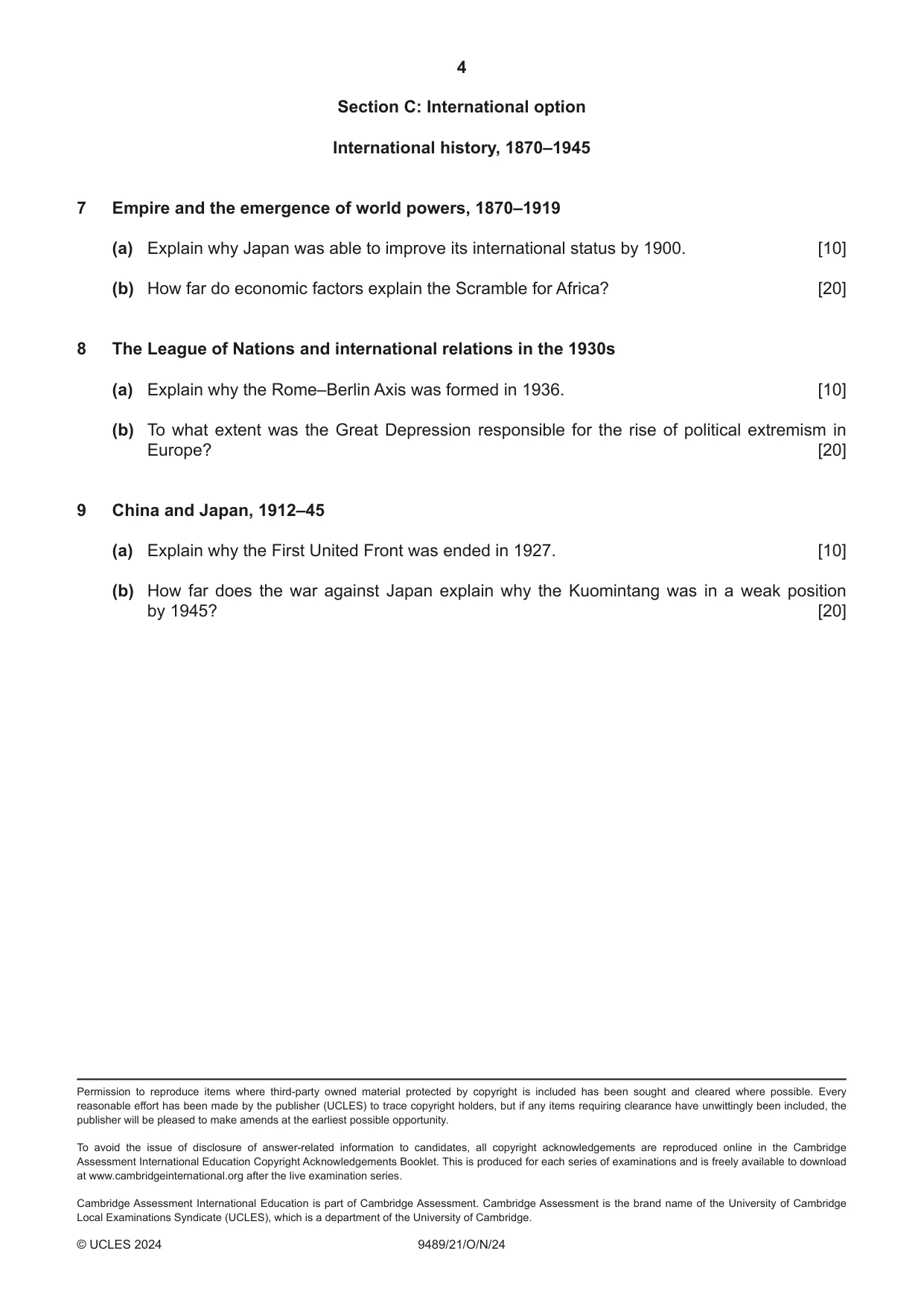
Q7 · Empire and the emergence of world powers, 1870–1919 (a) Explain why Japan was able to…
7 Empire and the emergence of world powers, 1870–1919 (a) Explain why Japan was able to improve its international status by 1900. [10] (b) How far do economic factors explain the Scramble for Africa? [20]
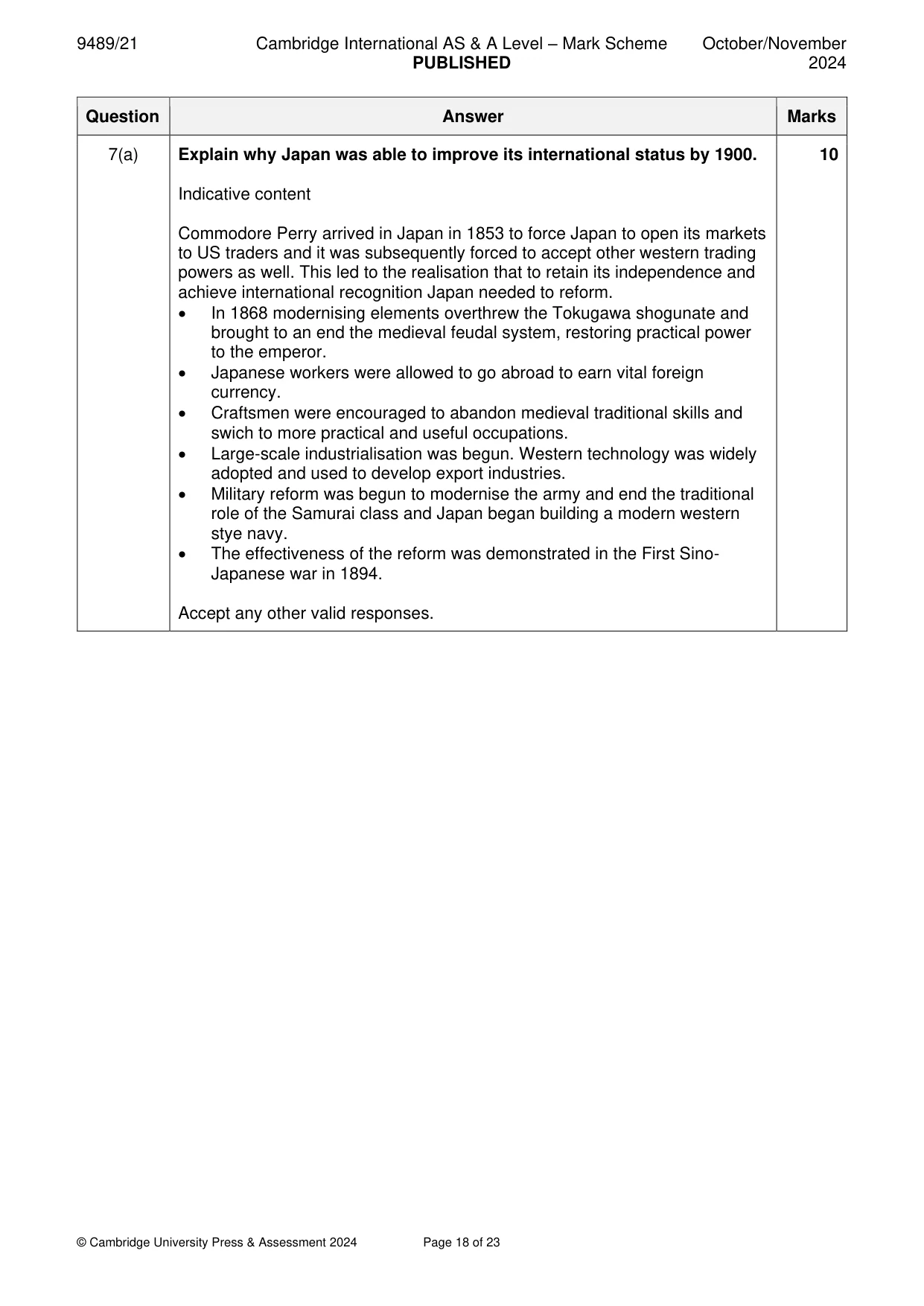
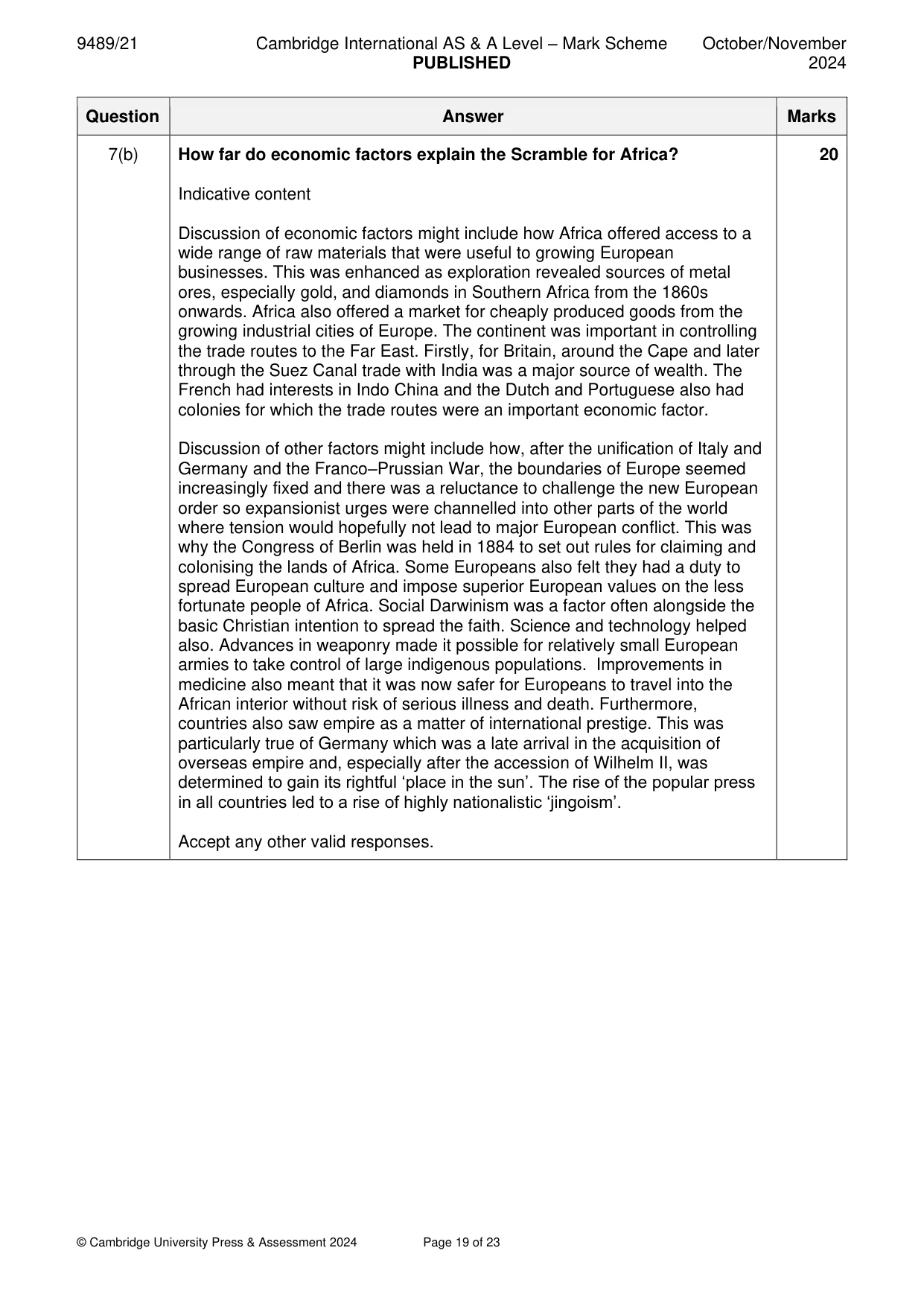
Mark scheme: 7(a) Explain why Japan was able to improve its international status by 1900. 10 Indicative content Commodore Perry arrived in Japan in 1853 to force Japan to open its markets to US traders and it was subsequently forced to accept other western trading powers as well. This led to the realisation that to retain its independence and achieve international recognition Japan needed to reform. • In 1868 modernising elements overthrew the Tokugawa shogunate and brought to an end the medieval feudal system, restoring practical power to the emperor. • Japanese workers were allowed to go abroad to earn vital foreign currency. • Craftsmen were encouraged to abandon medieval traditional skills and swich to more practical and useful occupations. • Large-scale industrialisation was begun. Western technology was widely adopted and used to develop export industries. • Military reform was begun to modernise the army and end the traditional role of the Samurai class and Japan began building a modern western stye navy. • The effectiveness of the reform was demonstrated in the First Sino- Japanese war in 1894. Accept any other valid responses. 7(b) How far do economic factors explain the Scramble for Africa? 20 Indicative content Discussion of economic factors might include how Africa offered access to a wide range of raw materials that were useful to growing European businesses. This was enhanced as exploration revealed sources of metal ores, especially gold, and diamonds in Southern Africa from the 1860s onwards. Africa also offered a market for cheaply produced goods from the growing industrial cities of Europe. The continent was important in controlling the trade routes to the Far East. Firstly, for Britain, around the Cape and later through the Suez Canal trade with India was a major source of wealth. The French had interests in Indo China and the Dutch and Portuguese also had colonies for which the trade routes were an important economic factor. Discussion of other factors might include how, after the unification of Italy and Germany and the Franco–Prussian War, the boundaries of Europe seemed increasingly fixed and there was a reluctance to challenge the new European order so expansionist urges were channelled into other parts of the world where tension would hopefully not lead to major European conflict. This was why the Congress of Berlin was held in 1884 to set out rules for claiming and colonising the lands of Africa. Some Europeans also felt they had a duty to spread European culture and impose superior European values on the less fortunate people of Africa. Social Darwinism was a factor often alongside the basic Christian intention to spread the faith. Science and technology helped also. Advances in weaponry made it possible for relatively small European armies to take control of large indigenous populations. Improvements in medicine also meant that it was now safer for Europeans to travel into the African interior without risk of serious illness and death. Furthermore, countries also saw empire as a matter of international prestige. This was particularly true of Germany which was a late arrival in the acquisition of overseas empire and, especially after the accession of Wilhelm II, was determined to gain its rightful ‘place in the sun’. The rise of the popular press in all countries led to a rise of highly nationalistic ‘jingoism’. Accept any other valid responses.
More questions on Why was imperialism a significant force in Africa from 1870?
Q8 · The League of Nations and international relations in the 1930s (a) Explain why the…
8 The League of Nations and international relations in the 1930s (a) Explain why the Rome–Berlin Axis was formed in 1936. [10] (b) To what extent was the Great Depression responsible for the rise of political extremism in Europe? [20]
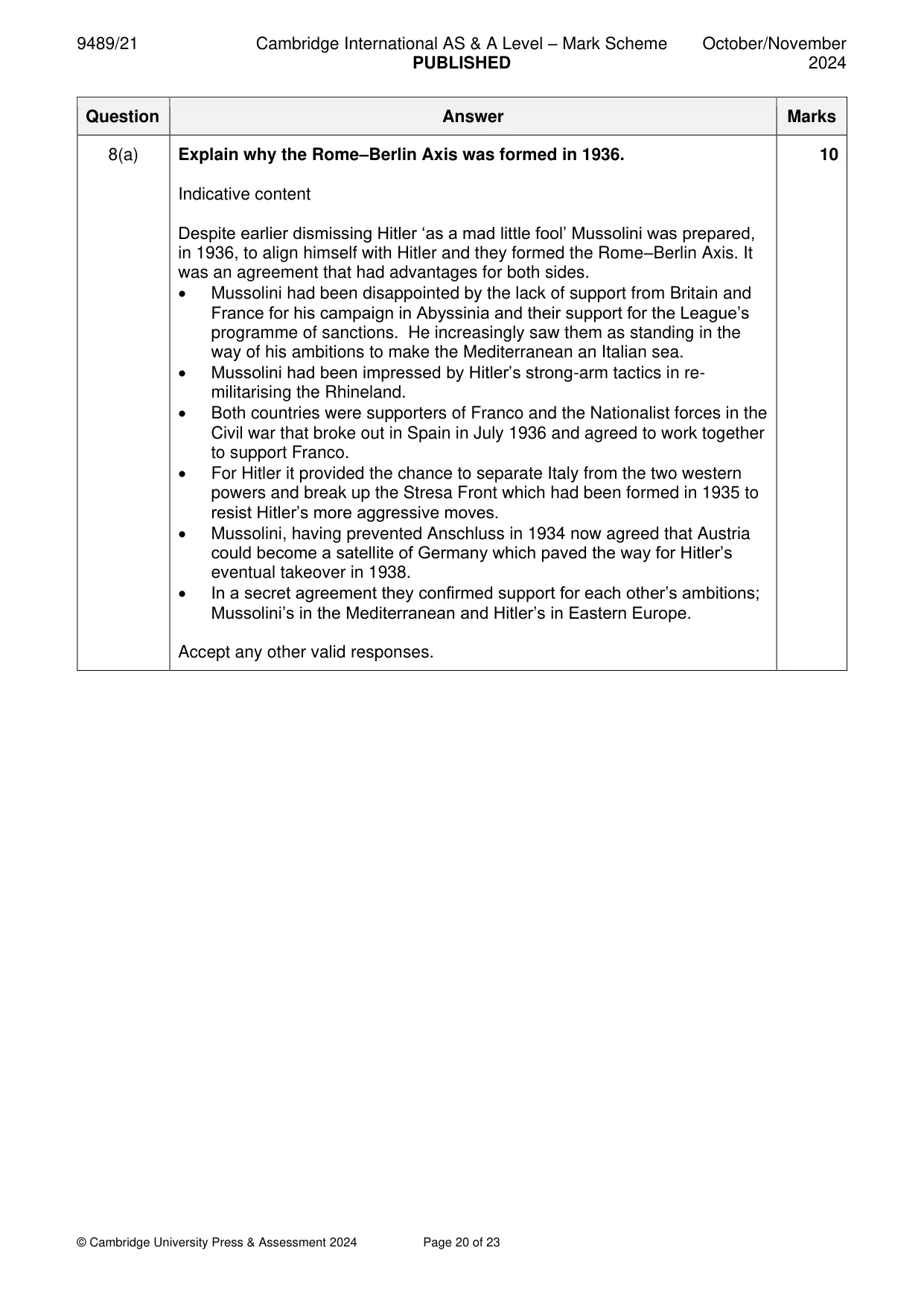
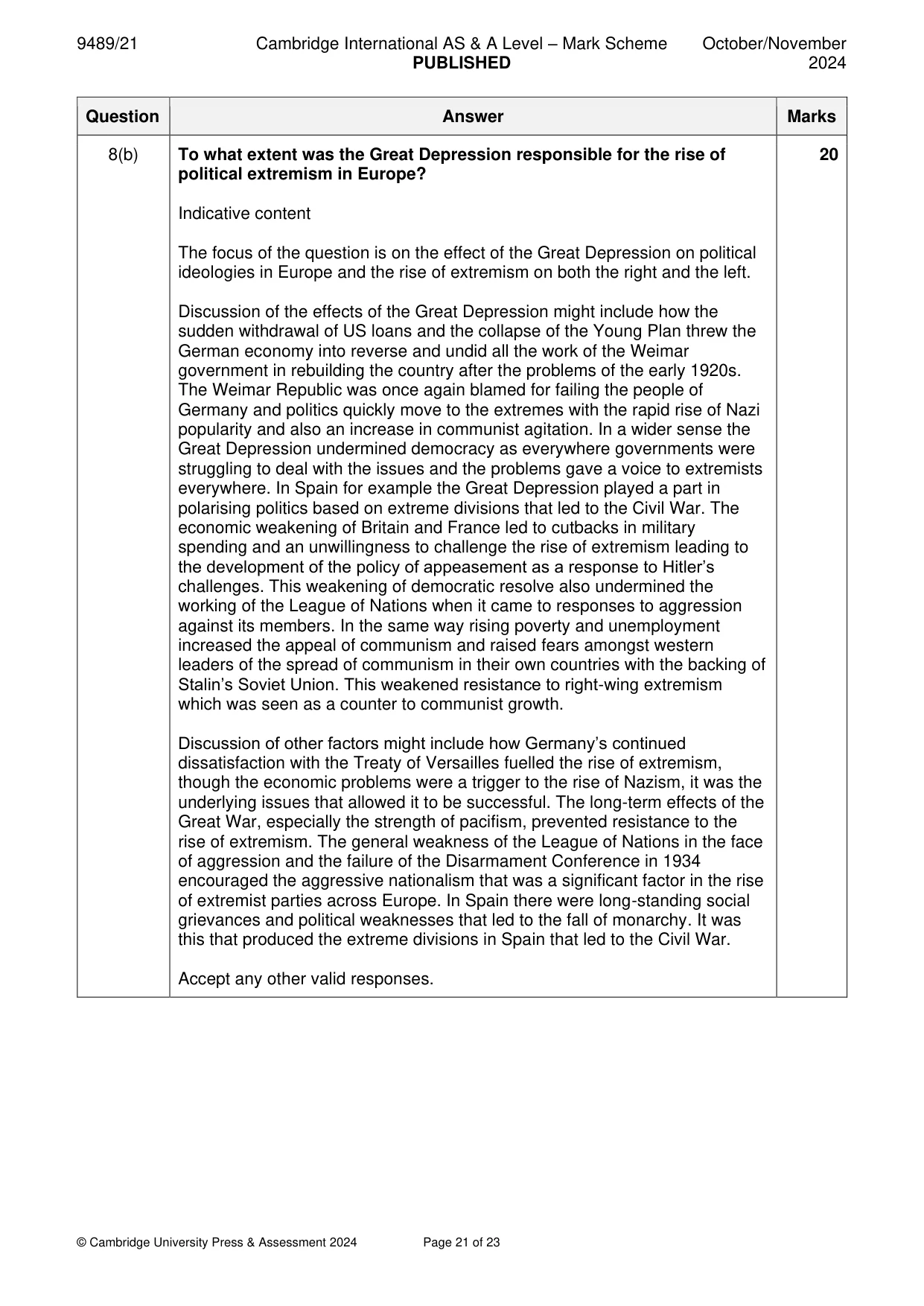
Mark scheme: 8(a) Explain why the Rome–Berlin Axis was formed in 1936. 10 Indicative content Despite earlier dismissing Hitler ‘as a mad little fool’ Mussolini was prepared, in 1936, to align himself with Hitler and they formed the Rome–Berlin Axis. It was an agreement that had advantages for both sides. • Mussolini had been disappointed by the lack of support from Britain and France for his campaign in Abyssinia and their support for the League’s programme of sanctions. He increasingly saw them as standing in the way of his ambitions to make the Mediterranean an Italian sea. • Mussolini had been impressed by Hitler’s strong-arm tactics in re- militarising the Rhineland. • Both countries were supporters of Franco and the Nationalist forces in the Civil war that broke out in Spain in July 1936 and agreed to work together to support Franco. • For Hitler it provided the chance to separate Italy from the two western powers and break up the Stresa Front which had been formed in 1935 to resist Hitler’s more aggressive moves. • Mussolini, having prevented Anschluss in 1934 now agreed that Austria could become a satellite of Germany which paved the way for Hitler’s eventual takeover in 1938. • In a secret agreement they confirmed support for each other’s ambitions; Mussolini’s in the Mediterranean and Hitler’s in Eastern Europe. Accept any other valid responses. 8(b) To what extent was the Great Depression responsible for the rise of 20 political extremism in Europe? Indicative content The focus of the question is on the effect of the Great Depression on political ideologies in Europe and the rise of extremism on both the right and the left. Discussion of the effects of the Great Depression might include how the sudden withdrawal of US loans and the collapse of the Young Plan threw the German economy into reverse and undid all the work of the Weimar government in rebuilding the country after the problems of the early 1920s. The Weimar Republic was once again blamed for failing the people of Germany and politics quickly move to the extremes with the rapid rise of Nazi popularity and also an increase in communist agitation. In a wider sense the Great Depression undermined democracy as everywhere governments were struggling to deal with the issues and the problems gave a voice to extremists everywhere. In Spain for example the Great Depression played a part in polarising politics based on extreme divisions that led to the Civil War. The economic weakening of Britain and France led to cutbacks in military spending and an unwillingness to challenge the rise of extremism leading to the development of the policy of appeasement as a response to Hitler’s challenges. This weakening of democratic resolve also undermined the working of the League of Nations when it came to responses to aggression against its members. In the same way rising poverty and unemployment increased the appeal of communism and raised fears amongst western leaders of the spread of communism in their own countries with the backing of Stalin’s Soviet Union. This weakened resistance to right-wing extremism which was seen as a counter to communist growth. Discussion of other factors might include how Germany’s continued dissatisfaction with the Treaty of Versailles fuelled the rise of extremism, though the economic problems were a trigger to the rise of Nazism, it was the underlying issues that allowed it to be successful. The long-term effects of the Great War, especially the strength of pacifism, prevented resistance to the rise of extremism. The general weakness of the League of Nations in the face of aggression and the failure of the Disarmament Conference in 1934 encouraged the aggressive nationalism that was a significant factor in the rise of extremist parties across Europe. In Spain there were long-standing social grievances and political weaknesses that led to the fall of monarchy. It was this that produced the extreme divisions in Spain that led to the Civil War. Accept any other valid responses.
More questions on How did the rise of extremism affect international relations?
Q9 · China and Japan, 1912–45 (a) Explain why the First United Front was ended in 1927
9 China and Japan, 1912–45 (a) Explain why the First United Front was ended in 1927. [10] (b) How far does the war against Japan explain why the Kuomintang was in a weak position by 1945? [20]
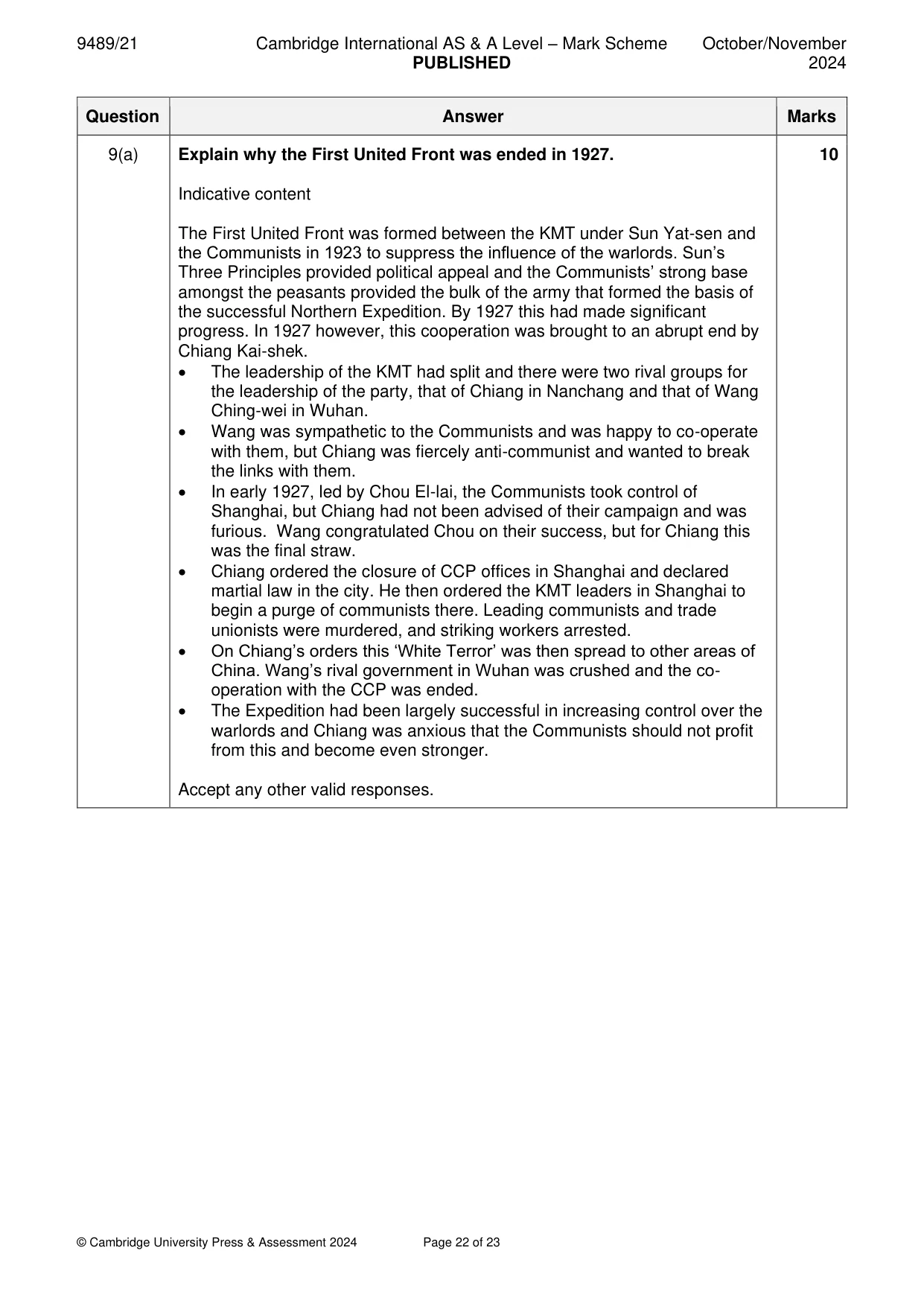
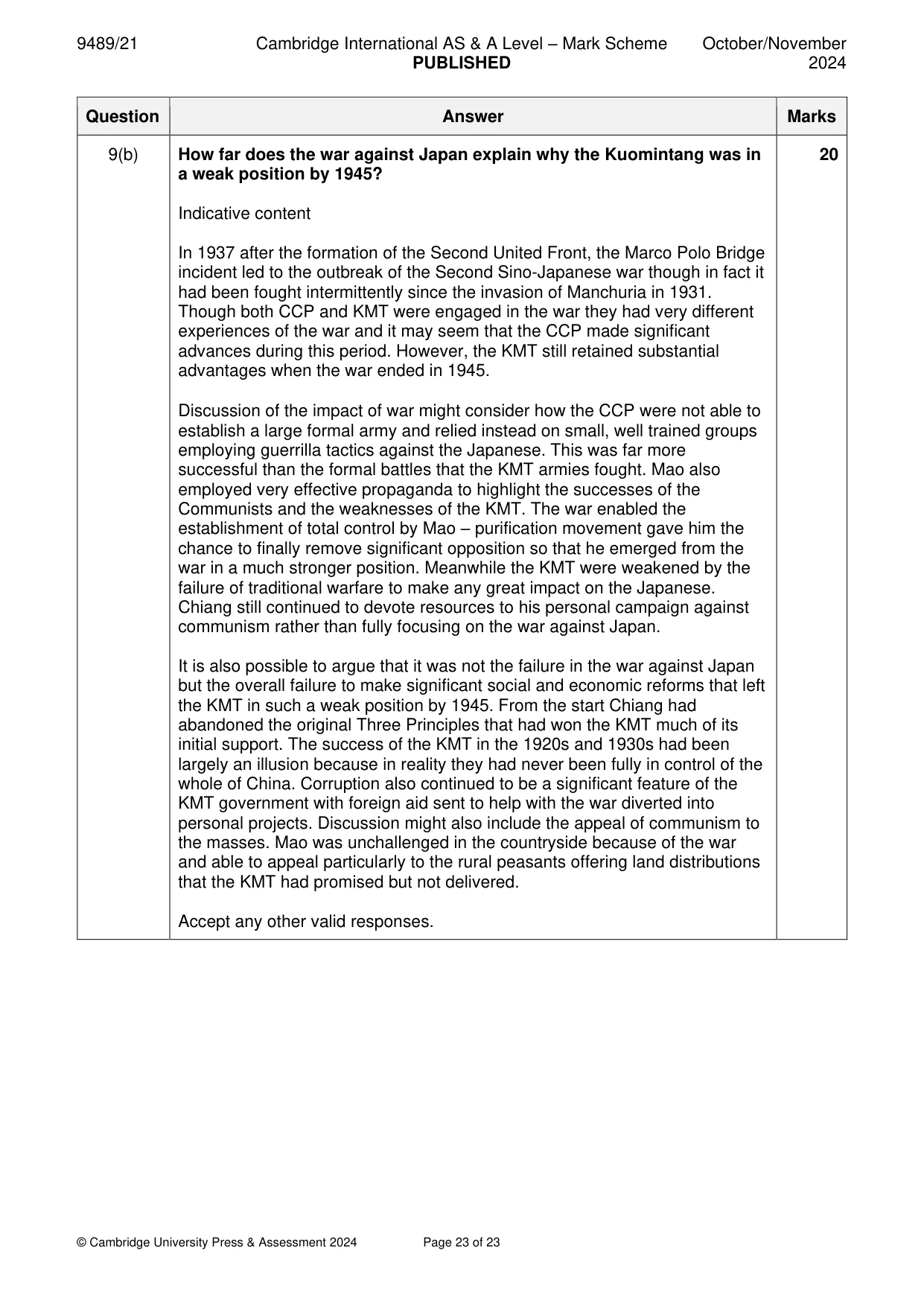
Mark scheme: 9(a) Explain why the First United Front was ended in 1927. 10 Indicative content The First United Front was formed between the KMT under Sun Yat-sen and the Communists in 1923 to suppress the influence of the warlords. Sun’s Three Principles provided political appeal and the Communists’ strong base amongst the peasants provided the bulk of the army that formed the basis of the successful Northern Expedition. By 1927 this had made significant progress. In 1927 however, this cooperation was brought to an abrupt end by Chiang Kai-shek. • The leadership of the KMT had split and there were two rival groups for the leadership of the party, that of Chiang in Nanchang and that of Wang Ching-wei in Wuhan. • Wang was sympathetic to the Communists and was happy to co-operate with them, but Chiang was fiercely anti-communist and wanted to break the links with them. • In early 1927, led by Chou El-lai, the Communists took control of Shanghai, but Chiang had not been advised of their campaign and was furious. Wang congratulated Chou on their success, but for Chiang this was the final straw. • Chiang ordered the closure of CCP offices in Shanghai and declared martial law in the city. He then ordered the KMT leaders in Shanghai to begin a purge of communists there. Leading communists and trade unionists were murdered, and striking workers arrested. • On Chiang’s orders this ‘White Terror’ was then spread to other areas of China. Wang’s rival government in Wuhan was crushed and the co- operation with the CCP was ended. • The Expedition had been largely successful in increasing control over the warlords and Chiang was anxious that the Communists should not profit from this and become even stronger. Accept any other valid responses. 9(b) How far does the war against Japan explain why the Kuomintang was in 20 a weak position by 1945? Indicative content In 1937 after the formation of the Second United Front, the Marco Polo Bridge incident led to the outbreak of the Second Sino-Japanese war though in fact it had been fought intermittently since the invasion of Manchuria in 1931. Though both CCP and KMT were engaged in the war they had very different experiences of the war and it may seem that the CCP made significant advances during this period. However, the KMT still retained substantial advantages when the war ended in 1945. Discussion of the impact of war might consider how the CCP were not able to establish a large formal army and relied instead on small, well trained groups employing guerrilla tactics against the Japanese. This was far more successful than the formal battles that the KMT armies fought. Mao also employed very effective propaganda to highlight the successes of the Communists and the weaknesses of the KMT. The war enabled the establishment of total control by Mao – purification movement gave him the chance to finally remove significant opposition so that he emerged from the war in a much stronger position. Meanwhile the KMT were weakened by the failure of traditional warfare to make any great impact on the Japanese. Chiang still continued to devote resources to his personal campaign against communism rather than fully focusing on the war against Japan. It is also possible to argue that it was not the failure in the war against Japan but the overall failure to make significant social and economic reforms that left the KMT in such a weak position by 1945. From the start Chiang had abandoned the original Three Principles that had won the KMT much of its initial support. The success of the KMT in the 1920s and 1930s had been largely an illusion because in reality they had never been fully in control of the whole of China. Corruption also continued to be a significant feature of the KMT government with foreign aid sent to help with the war diverted into personal projects. Discussion might also include the appeal of communism to the masses. Mao was unchallenged in the countryside because of the war and able to appeal particularly to the rural peasants offering land distributions that the KMT had promised but not delivered. Accept any other valid responses.
More questions on Why did Japan emerge as a world power and what was the impact on international
What was in this paper
The subtopics covered by these 9 questions, and how many questions each got. Open one in a new tab to see every Cambridge question on it.
1How successful was the Progressive Movement from 1890 to 1920?1What challenges faced the Tsarist regime in the years 1881–94?1What were the aims of Reconstruction and how successful was it?1What were the causes and immediate consequences of the 1789 Revolution?1What were the causes of the Revolutions of 1848?1Why did Japan emerge as a world power and what was the impact on international1Why was imperialism a significant force in Africa from 1870?1Why was there increasing tension between the North and the South before 1860?1What you needed in this session
Cambridge’s own grade thresholds for 2024 Oct/Nov, Paper 2 · Variant 1. A higher threshold means an easier paper — the bar moves with how the cohort did.