Cambridge A Level History 9489 — 2021 May/June Paper 2 · Variant 2
9489/22/M/J/21 · 9 questions · 60 marks · ≈68 min
The question paper and its mark scheme, free to read here and free to download. This is Cambridge’s own paper, exactly as it was sat.
Question paper4 pages
Mark scheme17 pages
Answers below. Sit the paper first if you are practising.
Questions as text
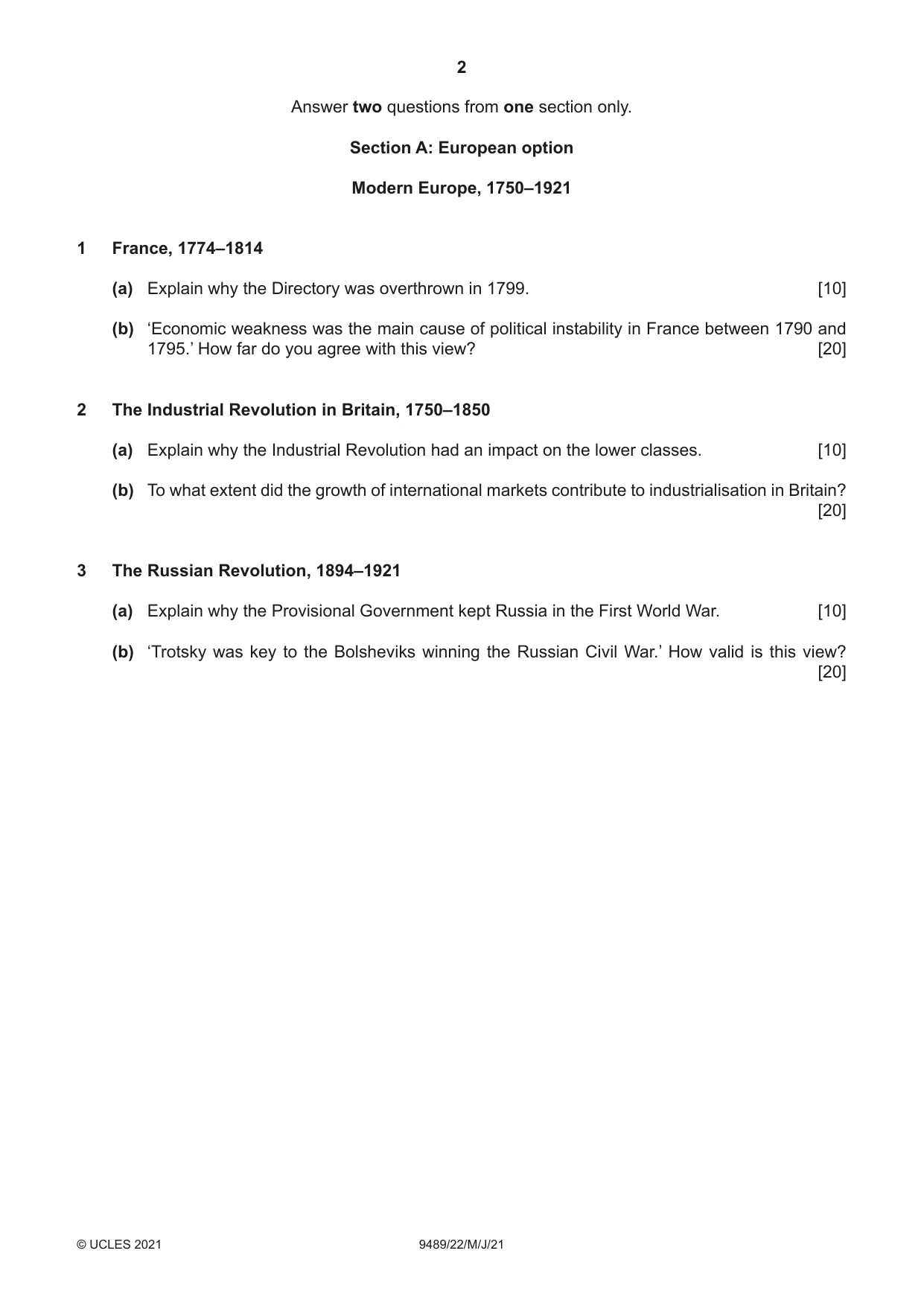
Q1 · France, 1774–1814 (a) Explain why the Directory was overthrown in 1799
1 France, 1774–1814 (a) Explain why the Directory was overthrown in 1799. [10] (b) ‘Economic weakness was the main cause of political instability in France between 1790 and 1795.’ How far do you agree with this view? [20]
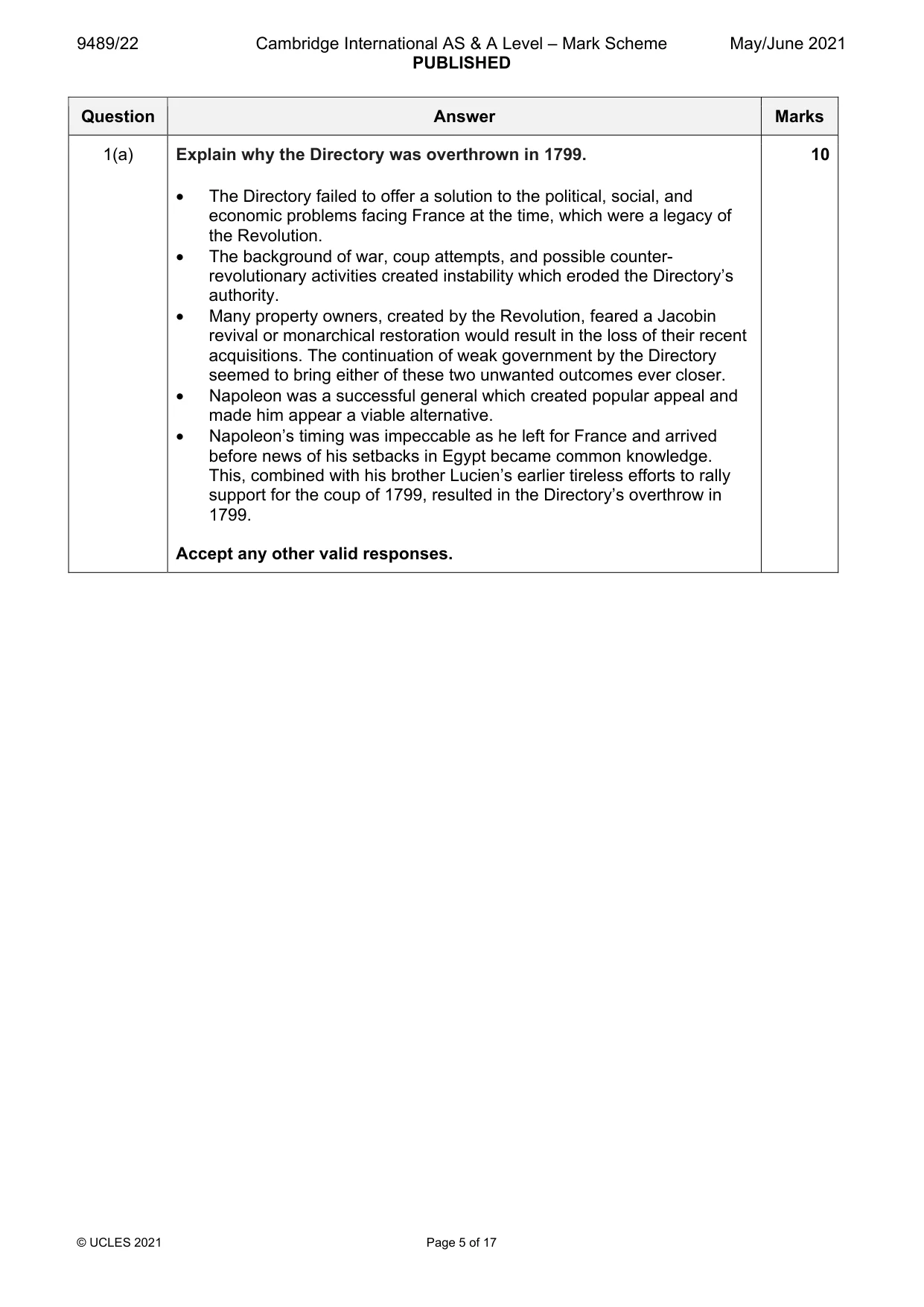
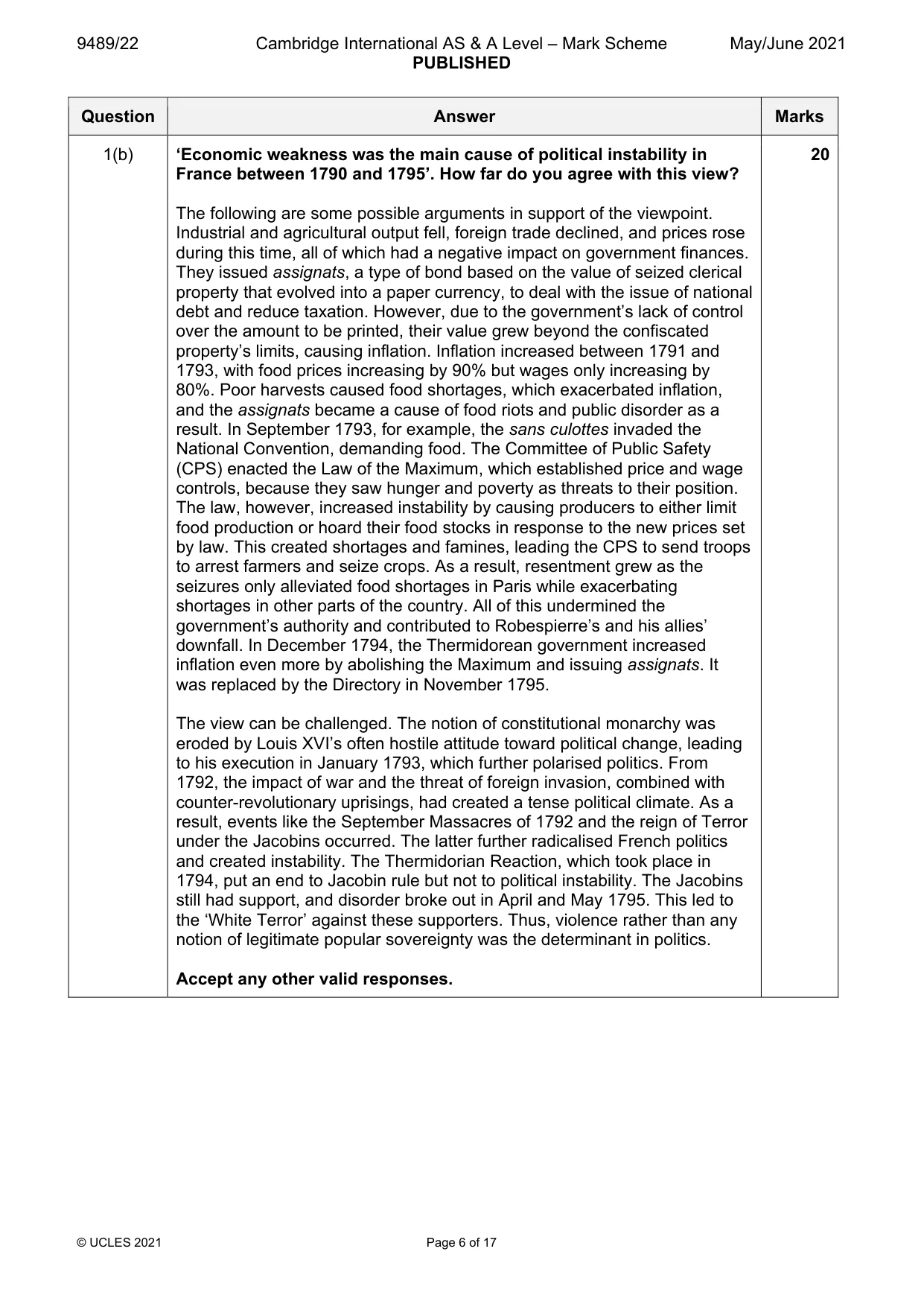
Mark scheme: Question Answer Marks 1(a) Explain why the Directory was overthrown in 1799. 10 • The Directory failed to offer a solution to the political, social, and economic problems facing France at the time, which were a legacy of the Revolution. • The background of war, coup attempts, and possible counter- revolutionary activities created instability which eroded the Directory’s authority. • Many property owners, created by the Revolution, feared a Jacobin revival or monarchical restoration would result in the loss of their recent acquisitions. The continuation of weak government by the Directory seemed to bring either of these two unwanted outcomes ever closer. • Napoleon was a successful general which created popular appeal and made him appear a viable alternative. • Napoleon’s timing was impeccable as he left for France and arrived before news of his setbacks in Egypt became common knowledge. This, combined with his brother Lucien’s earlier tireless efforts to rally support for the coup of 1799, resulted in the Directory’s overthrow in 1799. Accept any other valid responses. 1(b) ‘Economic weakness was the main cause of political instability in 20 France between 1790 and 1795’. How far do you agree with this view? The following are some possible arguments in support of the viewpoint. Industrial and agricultural output fell, foreign trade declined, and prices rose during this time, all of which had a negative impact on government finances. They issued assignats, a type of bond based on the value of seized clerical property that evolved into a paper currency, to deal with the issue of national debt and reduce taxation. However, due to the government’s lack of control over the amount to be printed, their value grew beyond the confiscated property’s limits, causing inflation. Inflation increased between 1791 and 1793, with food prices increasing by 90% but wages only increasing by 80%. Poor harvests caused food shortages, which exacerbated inflation, and the assignats became a cause of food riots and public disorder as a result. In September 1793, for example, the sans culottes invaded the National Convention, demanding food. The Committee of Public Safety (CPS) enacted the Law of the Maximum, which established price and wage controls, because they saw hunger and poverty as threats to their position. The law, however, increased instability by causing producers to either limit food production or hoard their food stocks in response to the new prices set by law. This created shortages and famines, leading the CPS to send troops to arrest farmers and seize crops. As a result, resentment grew as the seizures only alleviated food shortages in Paris while exacerbating shortages in other parts of the country. All of this undermined the government’s authority and contributed to Robespierre’s and his allies’ downfall. In December 1794, the Thermidorean government increased inflation even more by abolishing the Maximum and issuing assignats. It was replaced by the Directory in November 1795. The view can be challenged. The notion of constitutional monarchy was eroded by Louis XVI’s often hostile attitude toward political change, leading to his execution in January 1793, which further polarised politics. From 1792, the impact of war and the threat of foreign invasion, combined with counter-revolutionary uprisings, had created a tense political climate. As a result, events like the September Massacres of 1792 and the reign of Terror under the Jacobins occurred. The latter further radicalised French politics and created instability. The Thermidorian Reaction, which took place in 1794, put an end to Jacobin rule but not to political instability. The Jacobins still had support, and disorder broke out in April and May 1795. This led to the ‘White Terror’ against these supporters. Thus, violence rather than any notion of legitimate popular sovereignty was the determinant in politics. Accept any other valid responses.
More questions on How well was France governed in the period 1793–99?
Q2 · The Industrial Revolution in Britain, 1750–1850 (a) Explain why the Industrial Revolution…
2 The Industrial Revolution in Britain, 1750–1850 (a) Explain why the Industrial Revolution had an impact on the lower classes. [10] (b) To what extent did the growth of international markets contribute to industrialisation in Britain? [20]
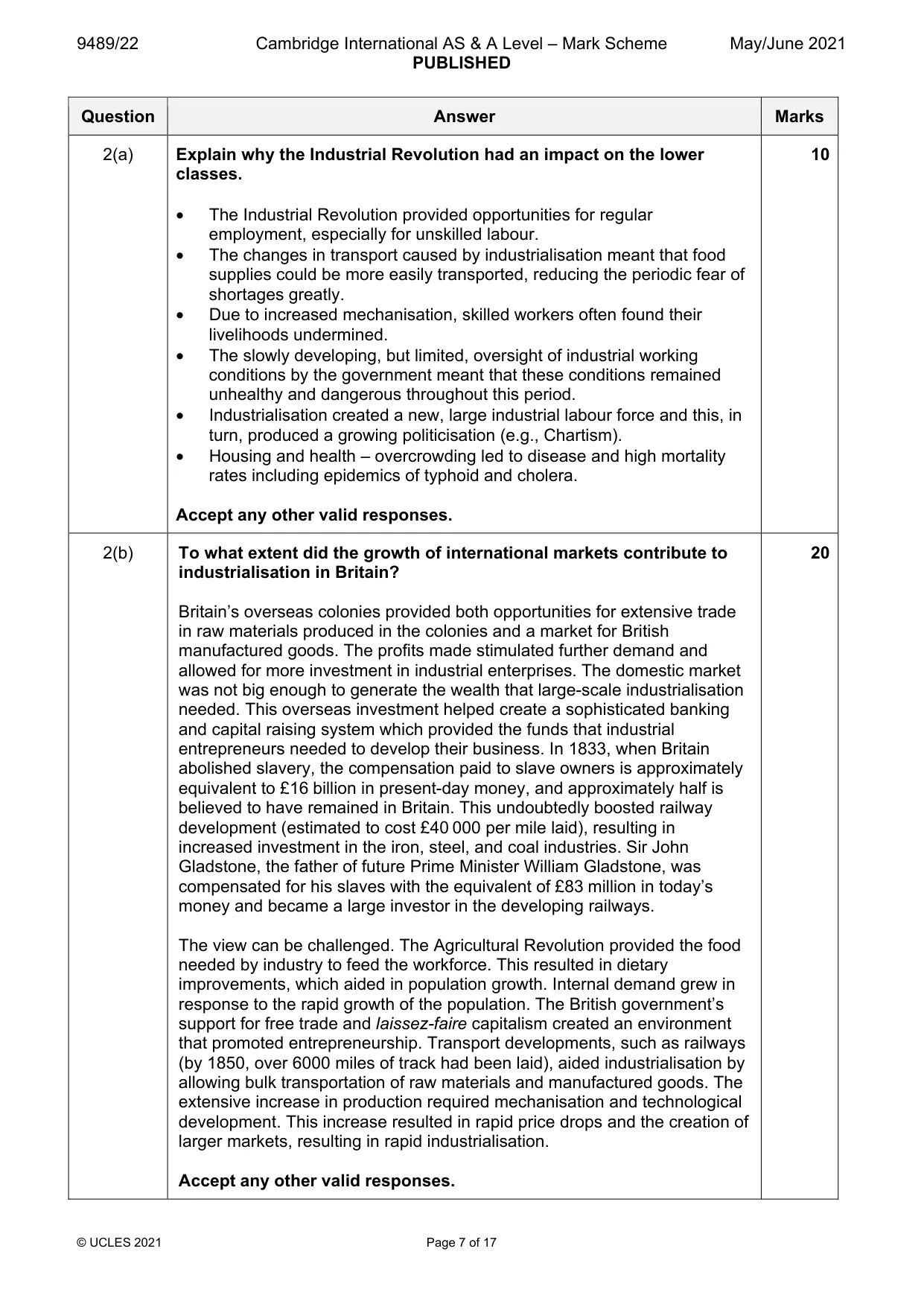
Mark scheme: 2(a) Explain why the Industrial Revolution had an impact on the lower 10 classes. • The Industrial Revolution provided opportunities for regular employment, especially for unskilled labour. • The changes in transport caused by industrialisation meant that food supplies could be more easily transported, reducing the periodic fear of shortages greatly. • Due to increased mechanisation, skilled workers often found their livelihoods undermined. • The slowly developing, but limited, oversight of industrial working conditions by the government meant that these conditions remained unhealthy and dangerous throughout this period. • Industrialisation created a new, large industrial labour force and this, in turn, produced a growing politicisation (e.g., Chartism). • Housing and health – overcrowding led to disease and high mortality rates including epidemics of typhoid and cholera. Accept any other valid responses. 2(b) To what extent did the growth of international markets contribute to 20 industrialisation in Britain? Britain’s overseas colonies provided both opportunities for extensive trade in raw materials produced in the colonies and a market for British manufactured goods. The profits made stimulated further demand and allowed for more investment in industrial enterprises. The domestic market was not big enough to generate the wealth that large-scale industrialisation needed. This overseas investment helped create a sophisticated banking and capital raising system which provided the funds that industrial entrepreneurs needed to develop their business. In 1833, when Britain abolished slavery, the compensation paid to slave owners is approximately equivalent to £16 billion in present-day money, and approximately half is believed to have remained in Britain. This undoubtedly boosted railway development (estimated to cost £40 000 per mile laid), resulting in increased investment in the iron, steel, and coal industries. Sir John Gladstone, the father of future Prime Minister William Gladstone, was compensated for his slaves with the equivalent of £83 million in today’s money and became a large investor in the developing railways. The view can be challenged. The Agricultural Revolution provided the food needed by industry to feed the workforce. This resulted in dietary improvements, which aided in population growth. Internal demand grew in response to the rapid growth of the population. The British government’s support for free trade and laissez-faire capitalism created an environment that promoted entrepreneurship. Transport developments, such as railways (by 1850, over 6000 miles of track had been laid), aided industrialisation by allowing bulk transportation of raw materials and manufactured goods. The extensive increase in production required mechanisation and technological development. This increase resulted in rapid price drops and the creation of larger markets, resulting in rapid industrialisation. Accept any other valid responses.
More questions on Why was there rapid industrialisation after 1870?
Q3 · The Russian Revolution, 1894–1921 (a) Explain why the Provisional Government kept Russia…
3 The Russian Revolution, 1894–1921 (a) Explain why the Provisional Government kept Russia in the First World War. [10] (b) ‘Trotsky was key to the Bolsheviks winning the Russian Civil War.’ How valid is this view? [20]
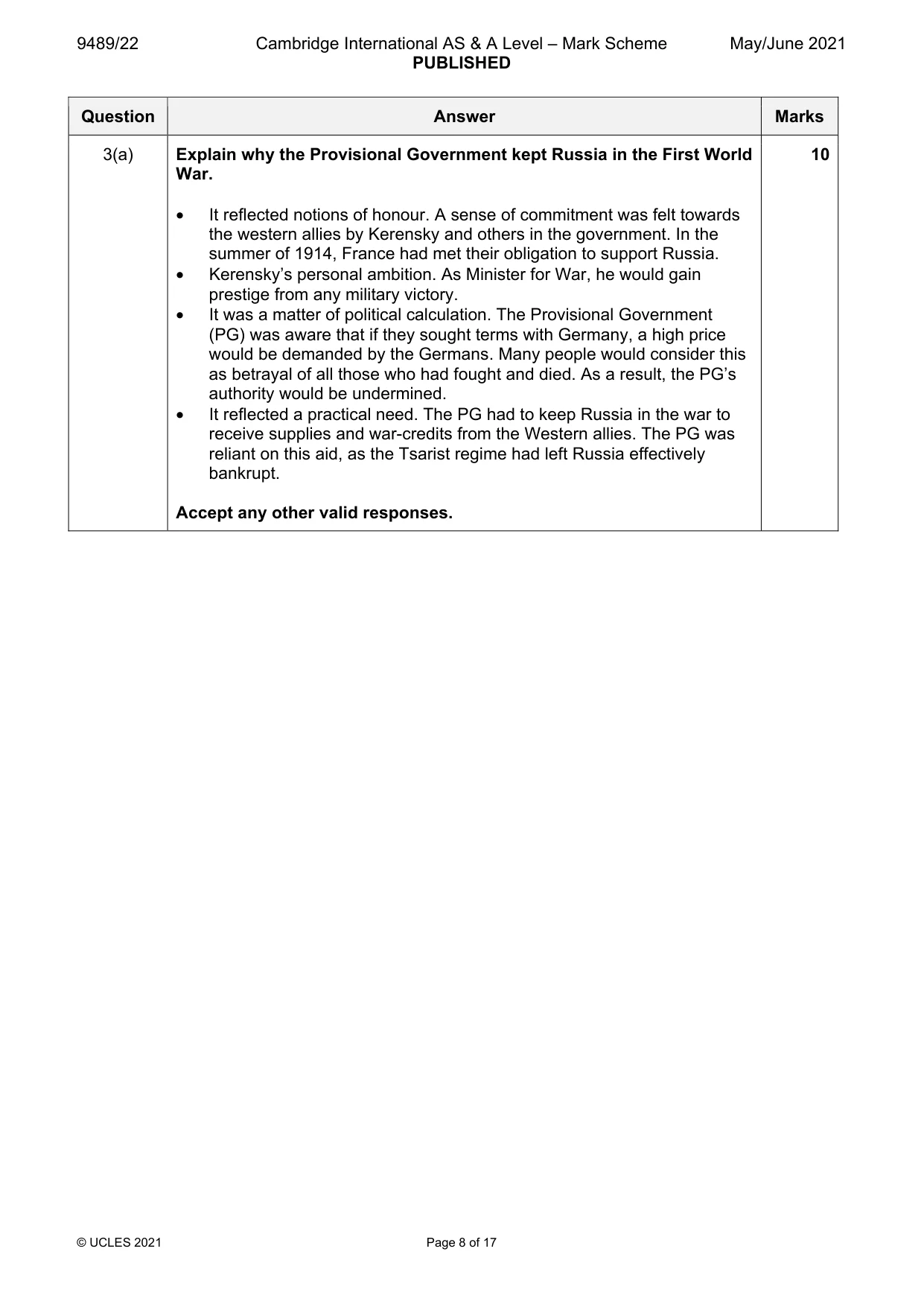
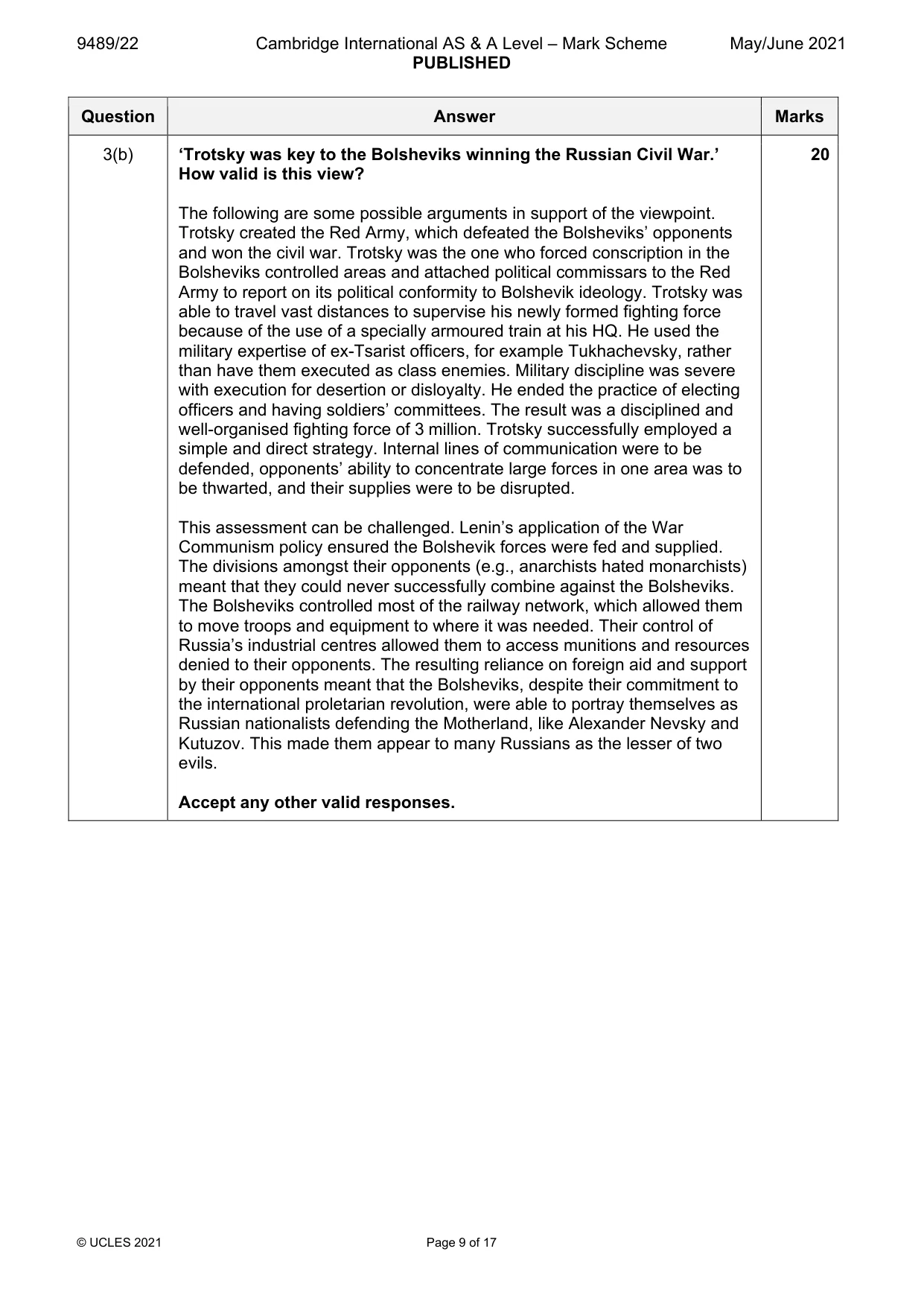
Mark scheme: 3(a) Explain why the Provisional Government kept Russia in the First World 10 War. • It reflected notions of honour. A sense of commitment was felt towards the western allies by Kerensky and others in the government. In the summer of 1914, France had met their obligation to support Russia. • Kerensky’s personal ambition. As Minister for War, he would gain prestige from any military victory. • It was a matter of political calculation. The Provisional Government (PG) was aware that if they sought terms with Germany, a high price would be demanded by the Germans. Many people would consider this as betrayal of all those who had fought and died. As a result, the PG’s authority would be undermined. • It reflected a practical need. The PG had to keep Russia in the war to receive supplies and war-credits from the Western allies. The PG was reliant on this aid, as the Tsarist regime had left Russia effectively bankrupt. Accept any other valid responses. 3(b) ‘Trotsky was key to the Bolsheviks winning the Russian Civil War.’ 20 How valid is this view? The following are some possible arguments in support of the viewpoint. Trotsky created the Red Army, which defeated the Bolsheviks’ opponents and won the civil war. Trotsky was the one who forced conscription in the Bolsheviks controlled areas and attached political commissars to the Red Army to report on its political conformity to Bolshevik ideology. Trotsky was able to travel vast distances to supervise his newly formed fighting force because of the use of a specially armoured train at his HQ. He used the military expertise of ex-Tsarist officers, for example Tukhachevsky, rather than have them executed as class enemies. Military discipline was severe with execution for desertion or disloyalty. He ended the practice of electing officers and having soldiers’ committees. The result was a disciplined and well-organised fighting force of 3 million. Trotsky successfully employed a simple and direct strategy. Internal lines of communication were to be defended, opponents’ ability to concentrate large forces in one area was to be thwarted, and their supplies were to be disrupted. This assessment can be challenged. Lenin’s application of the War Communism policy ensured the Bolshevik forces were fed and supplied. The divisions amongst their opponents (e.g., anarchists hated monarchists) meant that they could never successfully combine against the Bolsheviks. The Bolsheviks controlled most of the railway network, which allowed them to move troops and equipment to where it was needed. Their control of Russia’s industrial centres allowed them to access munitions and resources denied to their opponents. The resulting reliance on foreign aid and support by their opponents meant that the Bolsheviks, despite their commitment to the international proletarian revolution, were able to portray themselves as Russian nationalists defending the Motherland, like Alexander Nevsky and Kutuzov. This made them appear to many Russians as the lesser of two evils. Accept any other valid responses.
More questions on How were the Bolsheviks able to consolidate their power up to 1924?
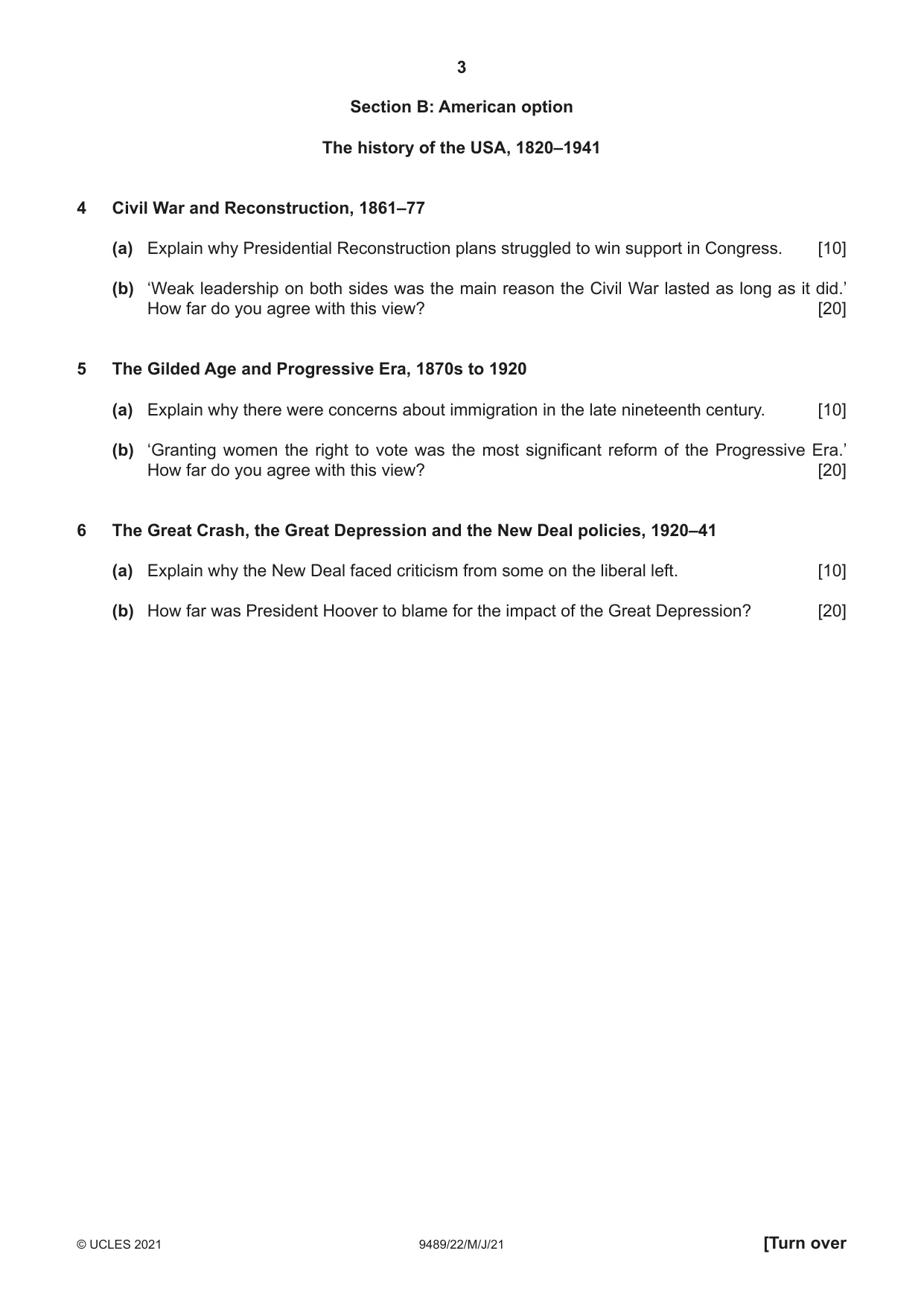
Q4 · Civil War and Reconstruction, 1861–77 (a) Explain why Presidential Reconstruction plans…
4 Civil War and Reconstruction, 1861–77 (a) Explain why Presidential Reconstruction plans struggled to win support in Congress. [10] (b) ‘Weak leadership on both sides was the main reason the Civil War lasted as long as it did.’ How far do you agree with this view? [20]
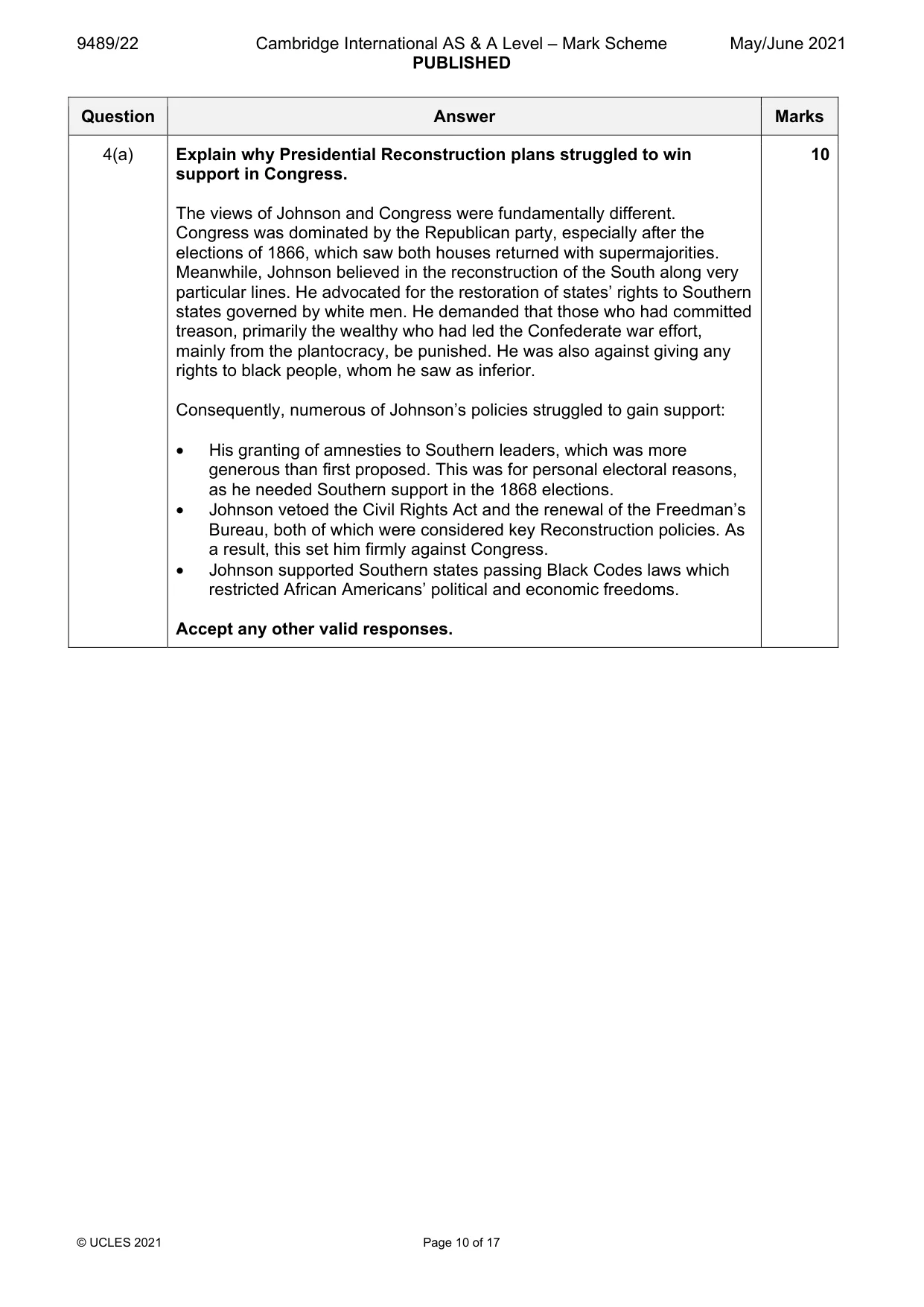
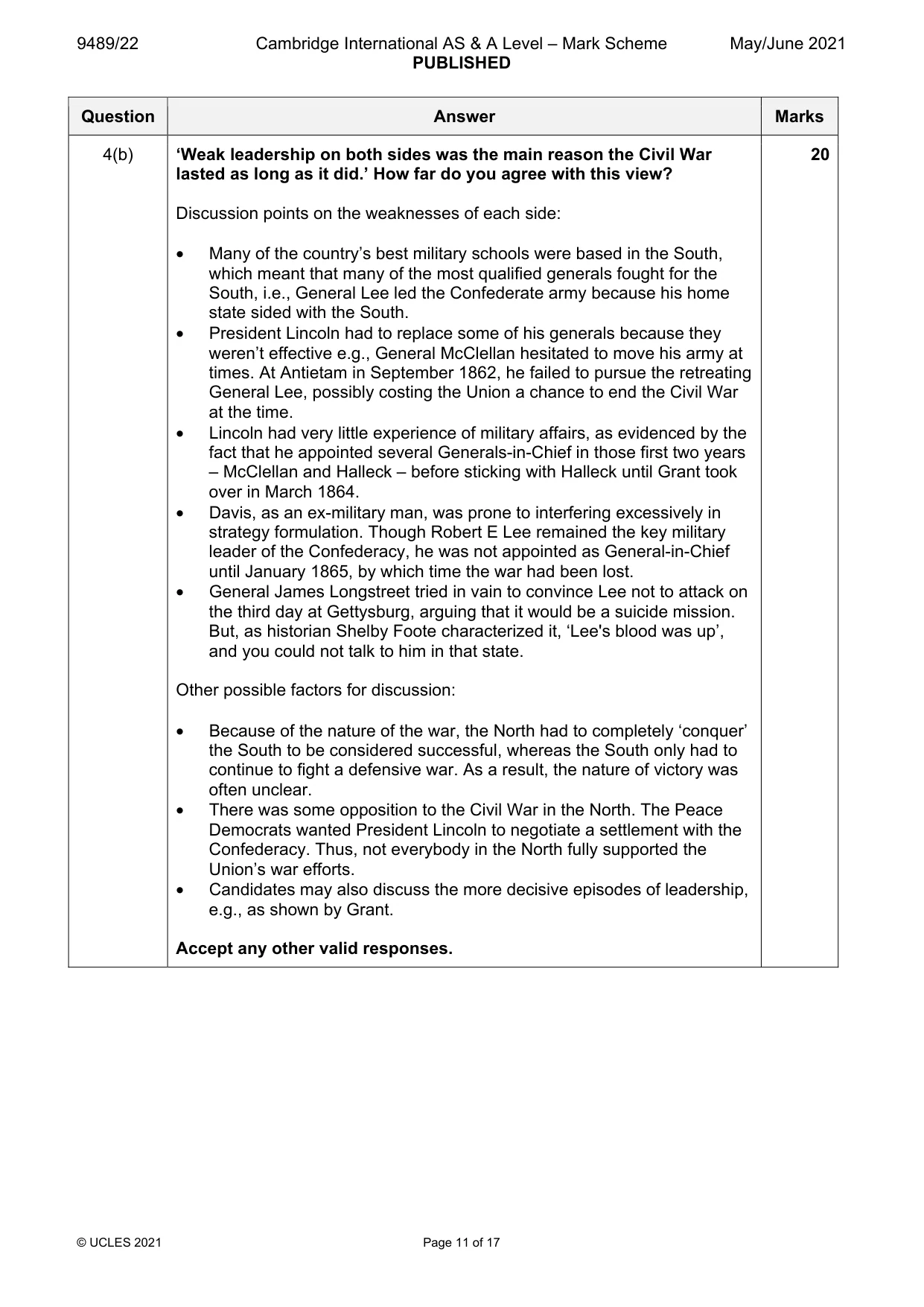
Mark scheme: 4(a) Explain why Presidential Reconstruction plans struggled to win 10 support in Congress. The views of Johnson and Congress were fundamentally different. Congress was dominated by the Republican party, especially after the elections of 1866, which saw both houses returned with supermajorities. Meanwhile, Johnson believed in the reconstruction of the South along very particular lines. He advocated for the restoration of states’ rights to Southern states governed by white men. He demanded that those who had committed treason, primarily the wealthy who had led the Confederate war effort, mainly from the plantocracy, be punished. He was also against giving any rights to black people, whom he saw as inferior. Consequently, numerous of Johnson’s policies struggled to gain support: • His granting of amnesties to Southern leaders, which was more generous than first proposed. This was for personal electoral reasons, as he needed Southern support in the 1868 elections. • Johnson vetoed the Civil Rights Act and the renewal of the Freedman’s Bureau, both of which were considered key Reconstruction policies. As a result, this set him firmly against Congress. • Johnson supported Southern states passing Black Codes laws which restricted African Americans’ political and economic freedoms. Accept any other valid responses. 4(b) ‘Weak leadership on both sides was the main reason the Civil War 20 lasted as long as it did.’ How far do you agree with this view? Discussion points on the weaknesses of each side: • Many of the country’s best military schools were based in the South, which meant that many of the most qualified generals fought for the South, i.e., General Lee led the Confederate army because his home state sided with the South. • President Lincoln had to replace some of his generals because they weren’t effective e.g., General McClellan hesitated to move his army at times. At Antietam in September 1862, he failed to pursue the retreating General Lee, possibly costing the Union a chance to end the Civil War at the time. • Lincoln had very little experience of military affairs, as evidenced by the fact that he appointed several Generals-in-Chief in those first two years – McClellan and Halleck – before sticking with Halleck until Grant took over in March 1864. • Davis, as an ex-military man, was prone to interfering excessively in strategy formulation. Though Robert E Lee remained the key military leader of the Confederacy, he was not appointed as General-in-Chief until January 1865, by which time the war had been lost. • General James Longstreet tried in vain to convince Lee not to attack on the third day at Gettysburg, arguing that it would be a suicide mission. But, as historian Shelby Foote characterized it, ‘Lee's blood was up’, and you could not talk to him in that state. Other possible factors for discussion: • Because of the nature of the war, the North had to completely ‘conquer’ the South to be considered successful, whereas the South only had to continue to fight a defensive war. As a result, the nature of victory was often unclear. • There was some opposition to the Civil War in the North. The Peace Democrats wanted President Lincoln to negotiate a settlement with the Confederacy. Thus, not everybody in the North fully supported the Union’s war efforts. • Candidates may also discuss the more decisive episodes of leadership, e.g., as shown by Grant. Accept any other valid responses.
Q5 · The Gilded Age and Progressive Era, 1870s to 1920 (a) Explain why there were concerns…
5 The Gilded Age and Progressive Era, 1870s to 1920 (a) Explain why there were concerns about immigration in the late nineteenth century. [10] (b) ‘Granting women the right to vote was the most significant reform of the Progressive Era.’ How far do you agree with this view? [20]
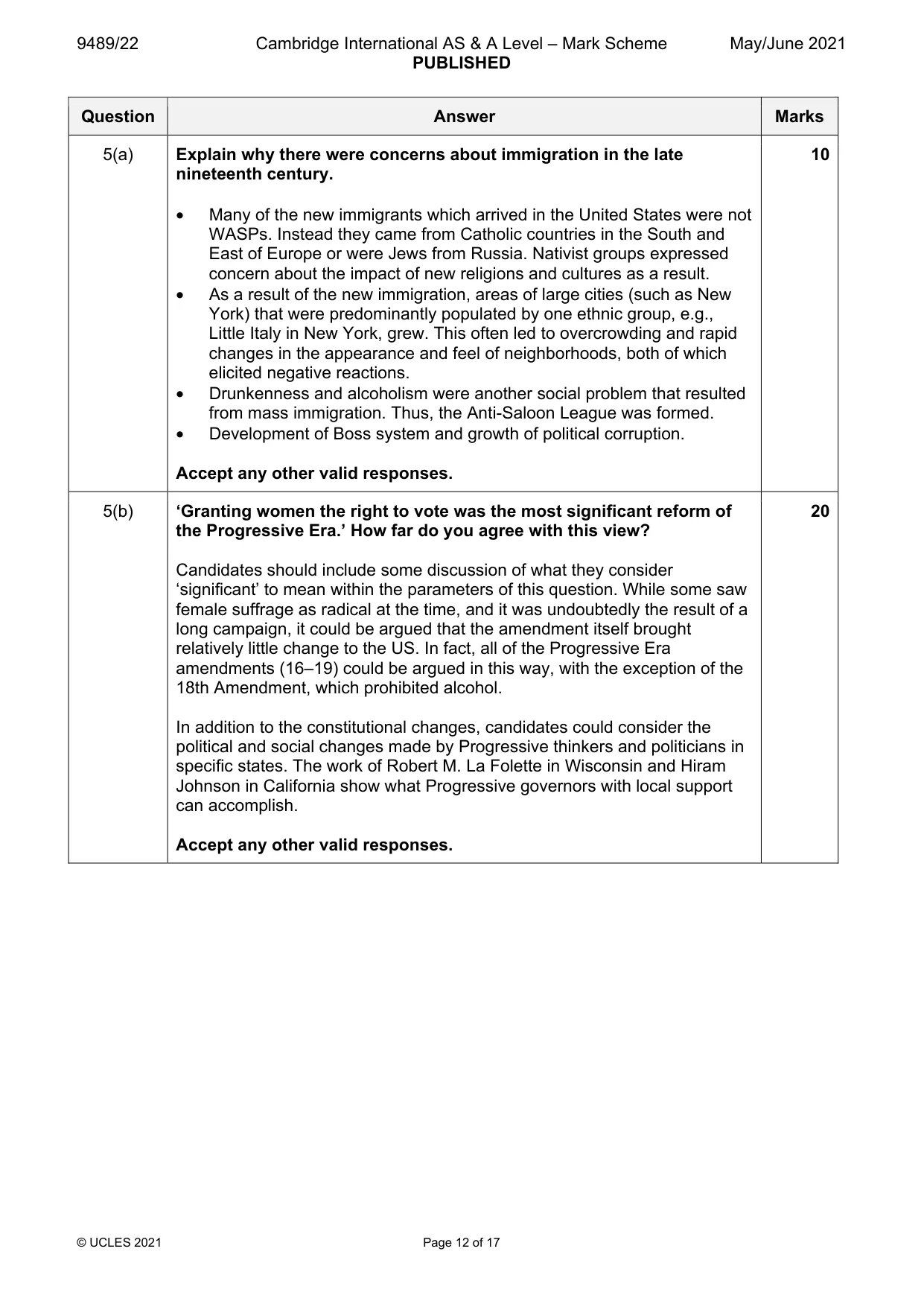
Mark scheme: 5(a) Explain why there were concerns about immigration in the late 10 nineteenth century. • Many of the new immigrants which arrived in the United States were not WASPs. Instead they came from Catholic countries in the South and East of Europe or were Jews from Russia. Nativist groups expressed concern about the impact of new religions and cultures as a result. • As a result of the new immigration, areas of large cities (such as New York) that were predominantly populated by one ethnic group, e.g., Little Italy in New York, grew. This often led to overcrowding and rapid changes in the appearance and feel of neighborhoods, both of which elicited negative reactions. • Drunkenness and alcoholism were another social problem that resulted from mass immigration. Thus, the Anti-Saloon League was formed. • Development of Boss system and growth of political corruption. Accept any other valid responses. 5(b) ‘Granting women the right to vote was the most significant reform of 20 the Progressive Era.’ How far do you agree with this view? Candidates should include some discussion of what they consider ‘significant’ to mean within the parameters of this question. While some saw female suffrage as radical at the time, and it was undoubtedly the result of a long campaign, it could be argued that the amendment itself brought relatively little change to the US. In fact, all of the Progressive Era amendments (16–19) could be argued in this way, with the exception of the 18th Amendment, which prohibited alcohol. In addition to the constitutional changes, candidates could consider the political and social changes made by Progressive thinkers and politicians in specific states. The work of Robert M. La Folette in Wisconsin and Hiram Johnson in California show what Progressive governors with local support can accomplish. Accept any other valid responses.
More questions on How successful was the Progressive Movement from 1890 to 1920?
Q6 · The Great Crash, the Great Depression and the New Deal policies, 1920–41 (a) Explain why…
6 The Great Crash, the Great Depression and the New Deal policies, 1920–41 (a) Explain why the New Deal faced criticism from some on the liberal left. [10] (b) How far was President Hoover to blame for the impact of the Great Depression? [20] Section C: International option International history, 1870–1945
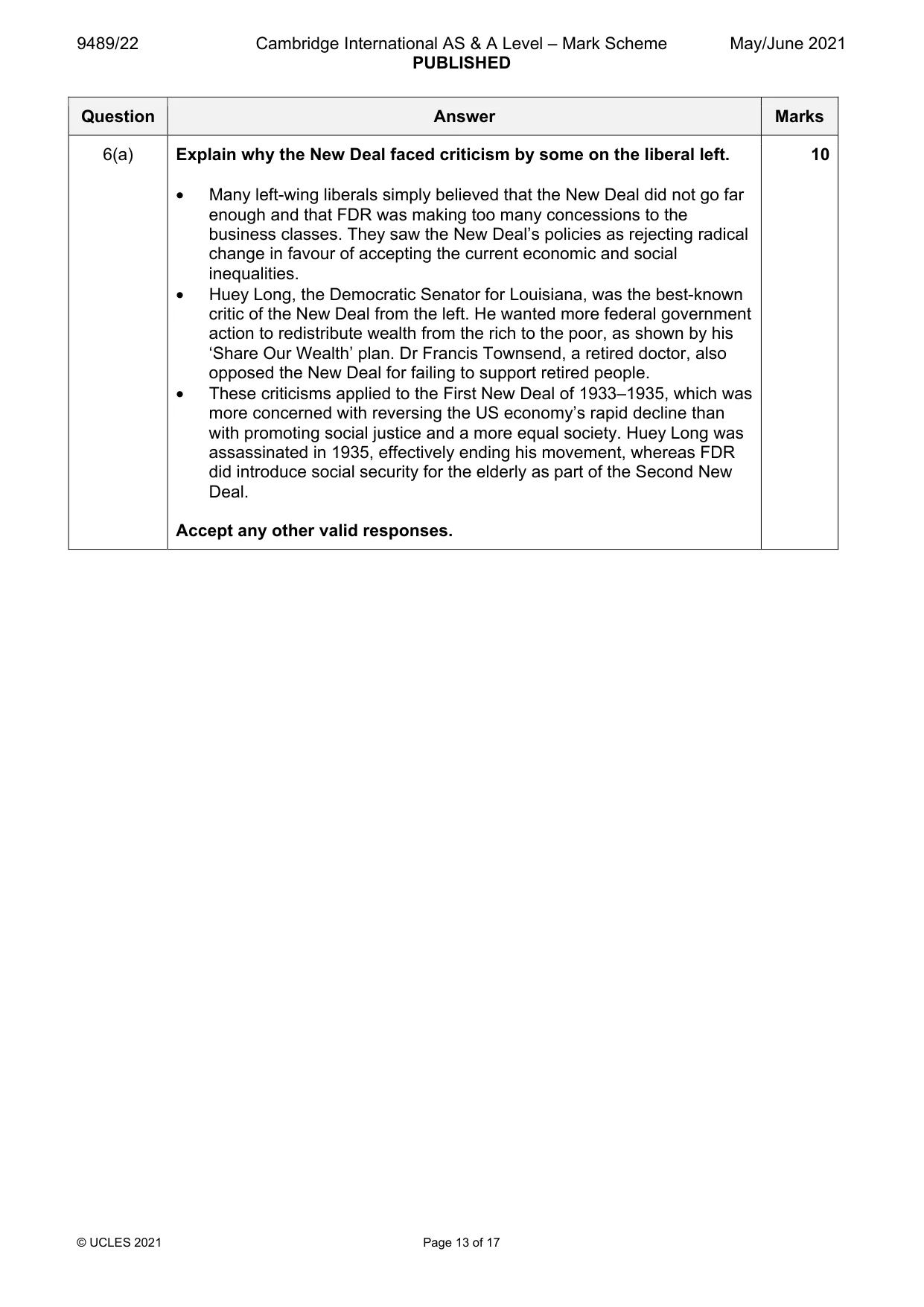
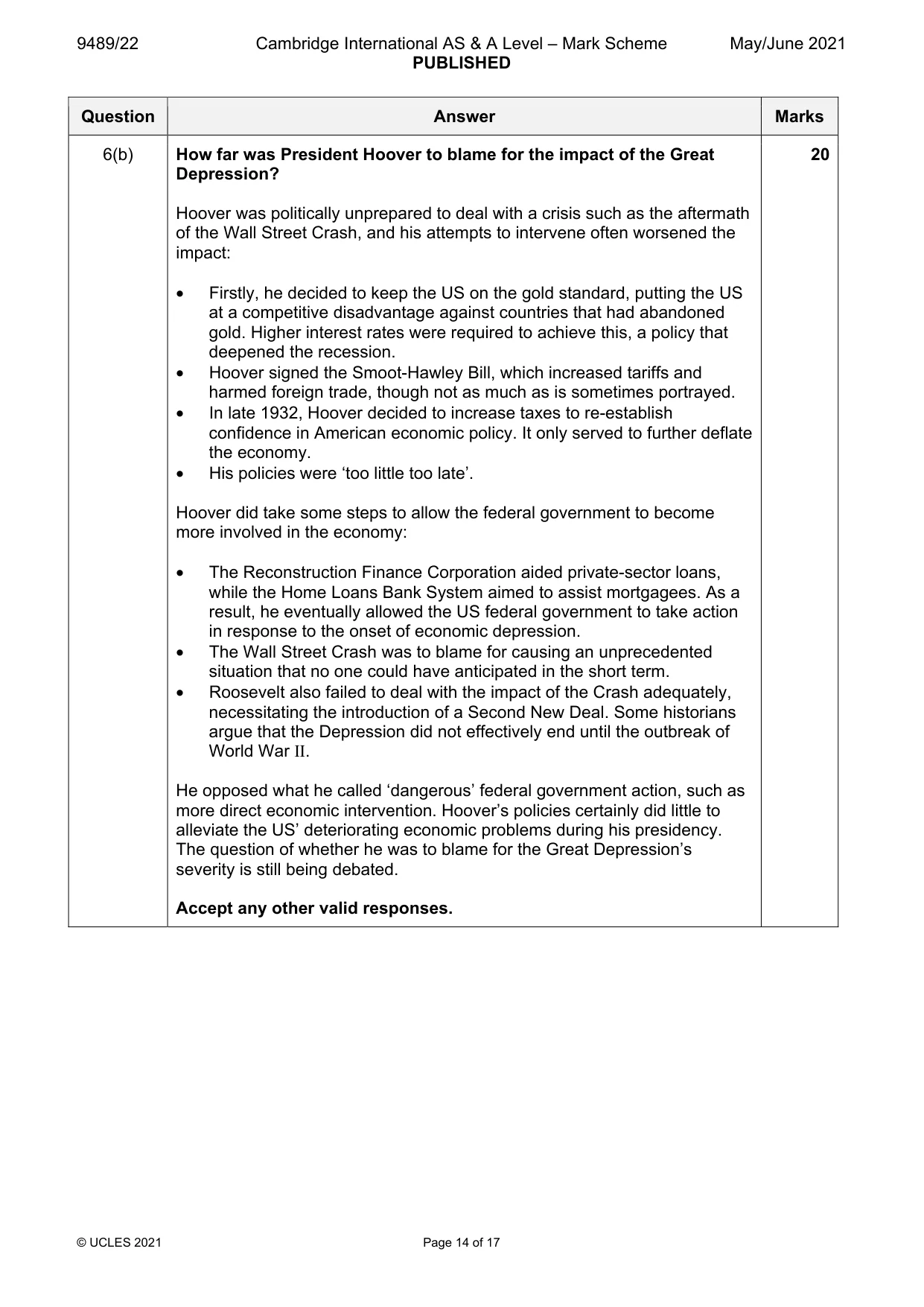
Mark scheme: 6(a) Explain why the New Deal faced criticism by some on the liberal left. 10 • Many left-wing liberals simply believed that the New Deal did not go far enough and that FDR was making too many concessions to the business classes. They saw the New Deal’s policies as rejecting radical change in favour of accepting the current economic and social inequalities. • Huey Long, the Democratic Senator for Louisiana, was the best-known critic of the New Deal from the left. He wanted more federal government action to redistribute wealth from the rich to the poor, as shown by his ‘Share Our Wealth’ plan. Dr Francis Townsend, a retired doctor, also opposed the New Deal for failing to support retired people. • These criticisms applied to the First New Deal of 1933–1935, which was more concerned with reversing the US economy’s rapid decline than with promoting social justice and a more equal society. Huey Long was assassinated in 1935, effectively ending his movement, whereas FDR did introduce social security for the elderly as part of the Second New Deal. Accept any other valid responses. 6(b) How far was President Hoover to blame for the impact of the Great 20 Depression? Hoover was politically unprepared to deal with a crisis such as the aftermath of the Wall Street Crash, and his attempts to intervene often worsened the impact: • Firstly, he decided to keep the US on the gold standard, putting the US at a competitive disadvantage against countries that had abandoned gold. Higher interest rates were required to achieve this, a policy that deepened the recession. • Hoover signed the Smoot-Hawley Bill, which increased tariffs and harmed foreign trade, though not as much as is sometimes portrayed. • In late 1932, Hoover decided to increase taxes to re-establish confidence in American economic policy. It only served to further deflate the economy. • His policies were ‘too little too late’. Hoover did take some steps to allow the federal government to become more involved in the economy: • The Reconstruction Finance Corporation aided private-sector loans, while the Home Loans Bank System aimed to assist mortgagees. As a result, he eventually allowed the US federal government to take action in response to the onset of economic depression. • The Wall Street Crash was to blame for causing an unprecedented situation that no one could have anticipated in the short term. • Roosevelt also failed to deal with the impact of the Crash adequately, necessitating the introduction of a Second New Deal. Some historians argue that the Depression did not effectively end until the outbreak of World War Ⅱ. He opposed what he called ‘dangerous’ federal government action, such as more direct economic intervention. Hoover’s policies certainly did little to alleviate the US’ deteriorating economic problems during his presidency. The question of whether he was to blame for the Great Depression’s severity is still being debated. Accept any other valid responses.
More questions on What were the causes of the Great Crash and the Great Depression?
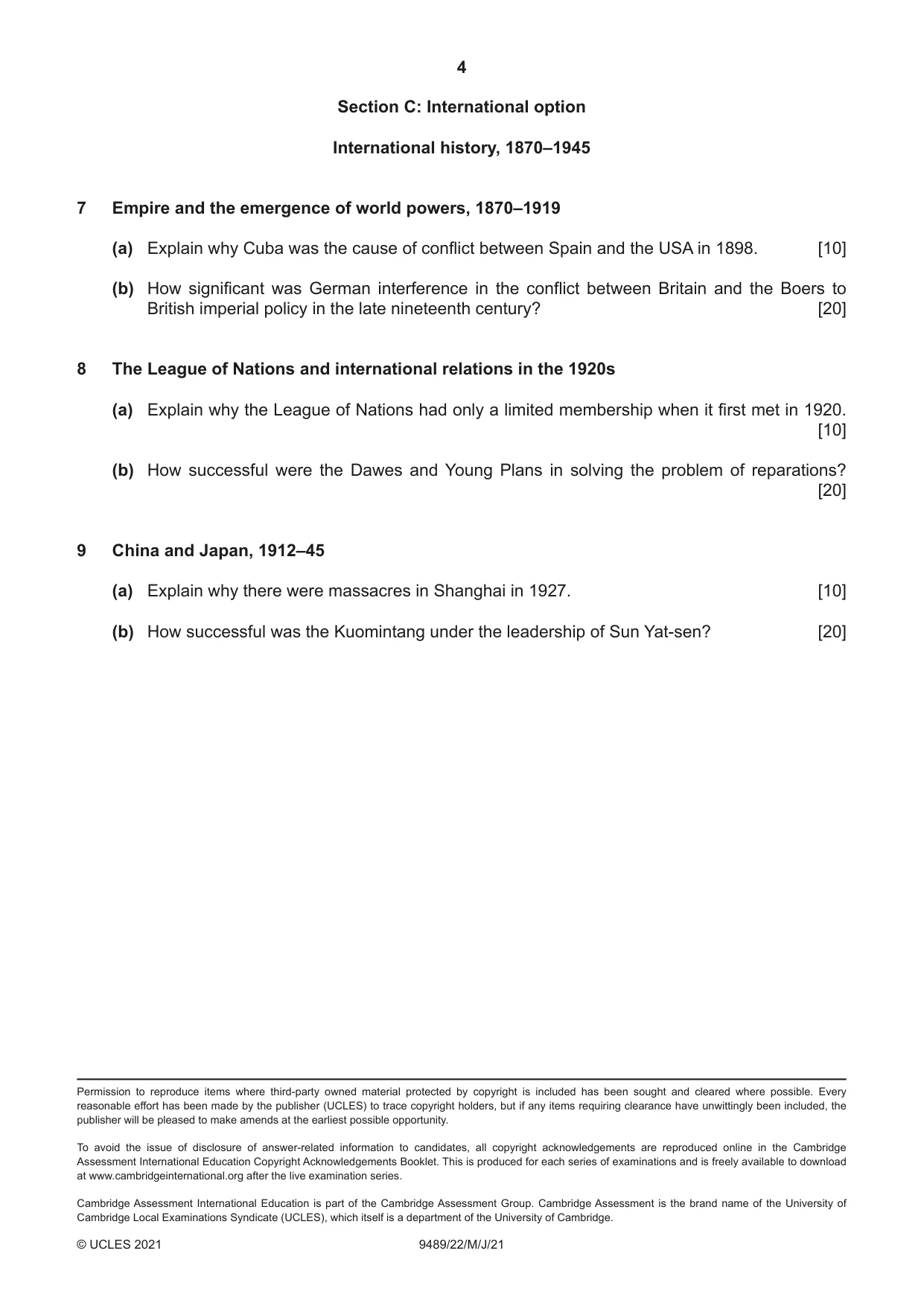
Q7 · Empire and the emergence of world powers, 1870–1919 (a) Explain why Cuba was the cause of…
7 Empire and the emergence of world powers, 1870–1919 (a) Explain why Cuba was the cause of conflict between Spain and the USA in 1898. [10] (b) How significant was German interference in the conflict between Britain and the Boers to British imperial policy in the late nineteenth century? [20]
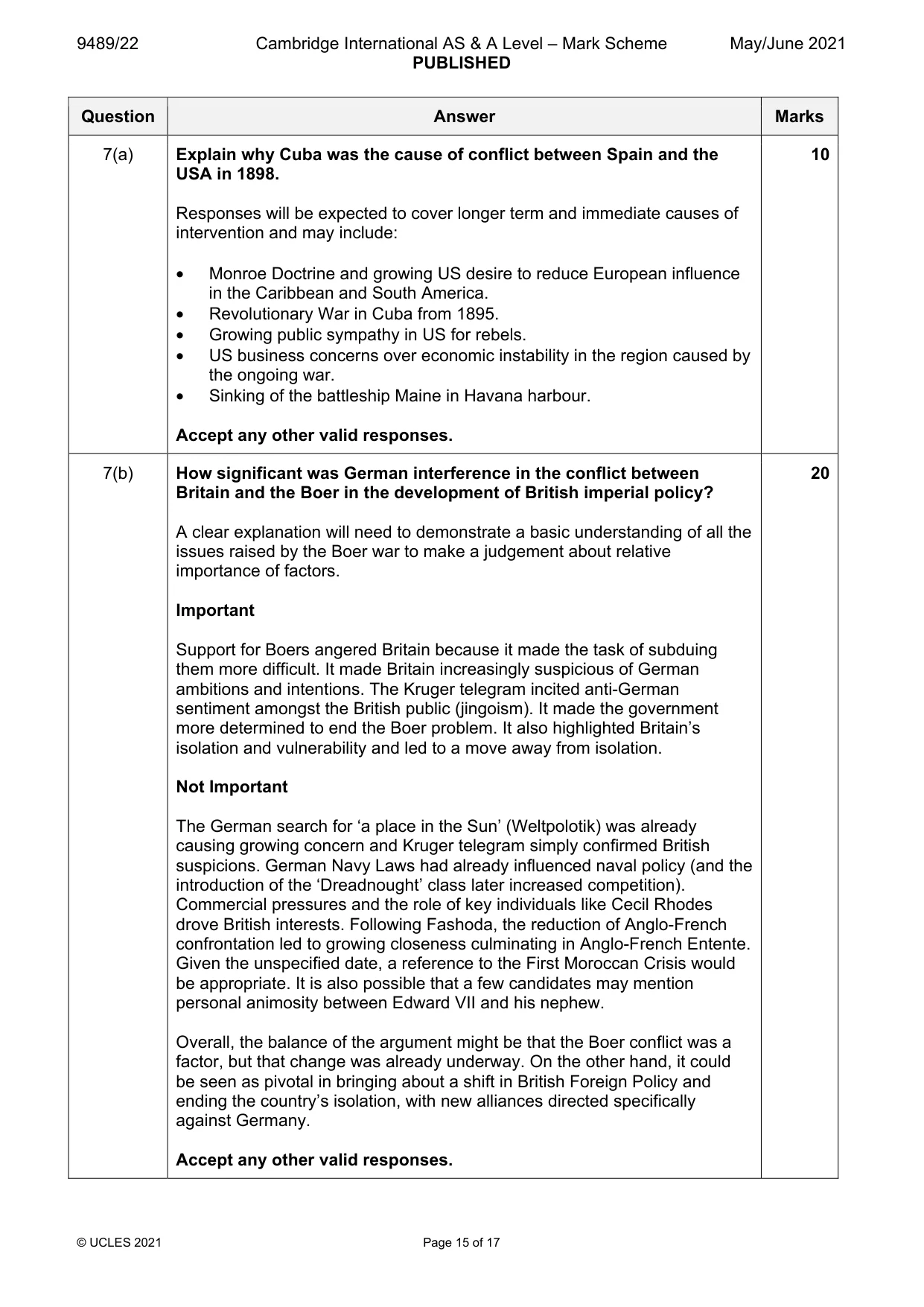
Mark scheme: 7(a) Explain why Cuba was the cause of conflict between Spain and the 10 USA in 1898. Responses will be expected to cover longer term and immediate causes of intervention and may include: • Monroe Doctrine and growing US desire to reduce European influence in the Caribbean and South America. • Revolutionary War in Cuba from 1895. • Growing public sympathy in US for rebels. • US business concerns over economic instability in the region caused by the ongoing war. • Sinking of the battleship Maine in Havana harbour. Accept any other valid responses. 7(b) How significant was German interference in the conflict between 20 Britain and the Boer in the development of British imperial policy? A clear explanation will need to demonstrate a basic understanding of all the issues raised by the Boer war to make a judgement about relative importance of factors. Important Support for Boers angered Britain because it made the task of subduing them more difficult. It made Britain increasingly suspicious of German ambitions and intentions. The Kruger telegram incited anti-German sentiment amongst the British public (jingoism). It made the government more determined to end the Boer problem. It also highlighted Britain’s isolation and vulnerability and led to a move away from isolation. Not Important The German search for ‘a place in the Sun’ (Weltpolotik) was already causing growing concern and Kruger telegram simply confirmed British suspicions. German Navy Laws had already influenced naval policy (and the introduction of the ‘Dreadnought’ class later increased competition). Commercial pressures and the role of key individuals like Cecil Rhodes drove British interests. Following Fashoda, the reduction of Anglo-French confrontation led to growing closeness culminating in Anglo-French Entente. Given the unspecified date, a reference to the First Moroccan Crisis would be appropriate. It is also possible that a few candidates may mention personal animosity between Edward VII and his nephew. Overall, the balance of the argument might be that the Boer conflict was a factor, but that change was already underway. On the other hand, it could be seen as pivotal in bringing about a shift in British Foreign Policy and ending the country’s isolation, with new alliances directed specifically against Germany. Accept any other valid responses.
More questions on What was the impact of imperial expansion on international relations?
Q8 · The League of Nations and international relations in the 1920s (a) Explain why the League…
8 The League of Nations and international relations in the 1920s (a) Explain why the League of Nations had only a limited membership when it first met in 1920. [10] (b) How successful were the Dawes and Young Plans in solving the problem of reparations? [20]
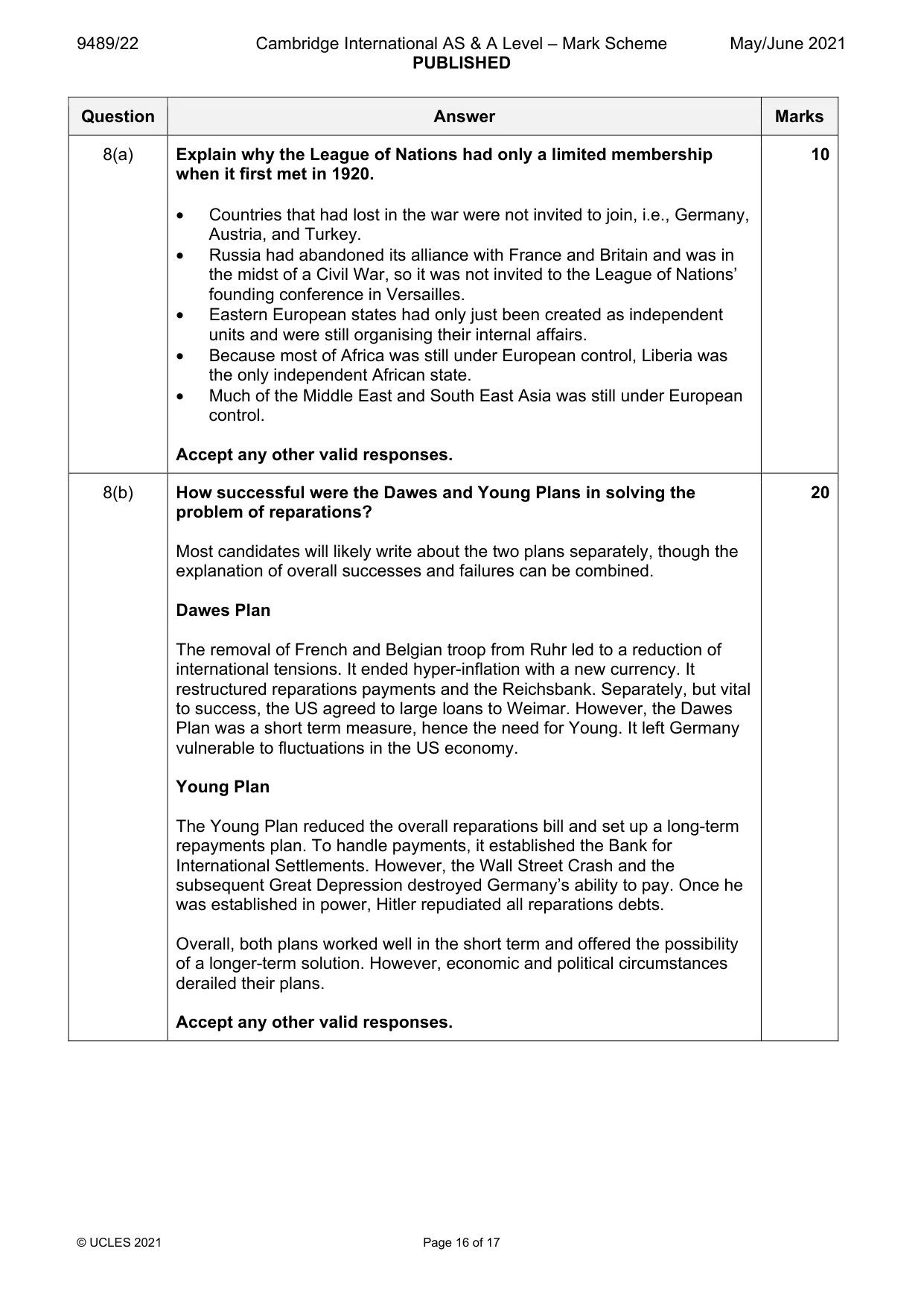
Mark scheme: 8(a) Explain why the League of Nations had only a limited membership 10 when it first met in 1920. • Countries that had lost in the war were not invited to join, i.e., Germany, Austria, and Turkey. • Russia had abandoned its alliance with France and Britain and was in the midst of a Civil War, so it was not invited to the League of Nations’ founding conference in Versailles. • Eastern European states had only just been created as independent units and were still organising their internal affairs. • Because most of Africa was still under European control, Liberia was the only independent African state. • Much of the Middle East and South East Asia was still under European control. Accept any other valid responses. 8(b) How successful were the Dawes and Young Plans in solving the 20 problem of reparations? Most candidates will likely write about the two plans separately, though the explanation of overall successes and failures can be combined. Dawes Plan The removal of French and Belgian troop from Ruhr led to a reduction of international tensions. It ended hyper-inflation with a new currency. It restructured reparations payments and the Reichsbank. Separately, but vital to success, the US agreed to large loans to Weimar. However, the Dawes Plan was a short term measure, hence the need for Young. It left Germany vulnerable to fluctuations in the US economy. Young Plan The Young Plan reduced the overall reparations bill and set up a long-term repayments plan. To handle payments, it established the Bank for International Settlements. However, the Wall Street Crash and the subsequent Great Depression destroyed Germany’s ability to pay. Once he was established in power, Hitler repudiated all reparations debts. Overall, both plans worked well in the short term and offered the possibility of a longer-term solution. However, economic and political circumstances derailed their plans. Accept any other valid responses.
More questions on How and why did international relations improve, 1924–29?
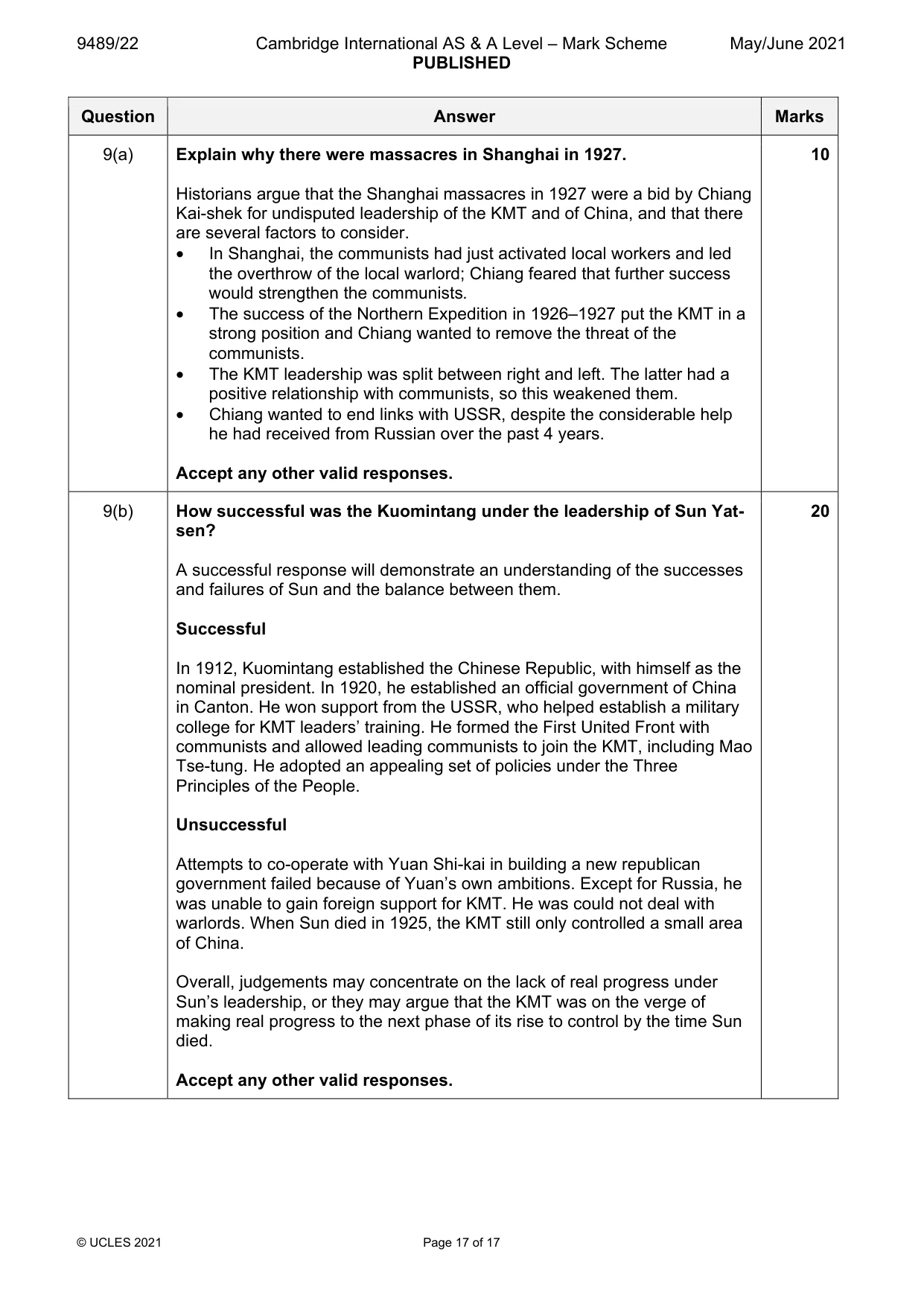
Q9 · China and Japan, 1912–45 (a) Explain why there were massacres in Shanghai in 1927
9 China and Japan, 1912–45 (a) Explain why there were massacres in Shanghai in 1927. [10] (b) How successful was the Kuomintang under the leadership of Sun Yat-sen? [20]
Mark scheme: 9(a) Explain why there were massacres in Shanghai in 1927. 10 Historians argue that the Shanghai massacres in 1927 were a bid by Chiang Kai-shek for undisputed leadership of the KMT and of China, and that there are several factors to consider. • In Shanghai, the communists had just activated local workers and led the overthrow of the local warlord; Chiang feared that further success would strengthen the communists. • The success of the Northern Expedition in 1926–1927 put the KMT in a strong position and Chiang wanted to remove the threat of the communists. • The KMT leadership was split between right and left. The latter had a positive relationship with communists, so this weakened them. • Chiang wanted to end links with USSR, despite the considerable help he had received from Russian over the past 4 years. Accept any other valid responses. 9(b) How successful was the Kuomintang under the leadership of Sun Yat- 20 sen? A successful response will demonstrate an understanding of the successes and failures of Sun and the balance between them. Successful In 1912, Kuomintang established the Chinese Republic, with himself as the nominal president. In 1920, he established an official government of China in Canton. He won support from the USSR, who helped establish a military college for KMT leaders’ training. He formed the First United Front with communists and allowed leading communists to join the KMT, including Mao Tse-tung. He adopted an appealing set of policies under the Three Principles of the People. Unsuccessful Attempts to co-operate with Yuan Shi-kai in building a new republican government failed because of Yuan’s own ambitions. Except for Russia, he was unable to gain foreign support for KMT. He was could not deal with warlords. When Sun died in 1925, the KMT still only controlled a small area of China. Overall, judgements may concentrate on the lack of real progress under Sun’s leadership, or they may argue that the KMT was on the verge of making real progress to the next phase of its rise to control by the time Sun died. Accept any other valid responses.
More questions on Why did Japan emerge as a world power and what was the impact on international
What was in this paper
The subtopics covered by these 9 questions, and how many questions each got. Open one in a new tab to see every Cambridge question on it.
1How successful was the Progressive Movement from 1890 to 1920?1How well was France governed in the period 1793–99?1How were the Bolsheviks able to consolidate their power up to 1924?1What was the impact of imperial expansion on international relations?1What were the causes of the Great Crash and the Great Depression?1Why did Japan emerge as a world power and what was the impact on international1Why did the Civil War last four years?1Why was there rapid industrialisation after 1870?1What you needed in this session
Cambridge’s own grade thresholds for 2021 May/June, Paper 2 · Variant 2. A higher threshold means an easier paper — the bar moves with how the cohort did.