Cambridge A Level History 9489 — 2024 May/June Paper 2 · Variant 3
9489/23/M/J/24 · 9 questions · 60 marks · ≈68 min
The question paper and its mark scheme, free to read here and free to download. This is Cambridge’s own paper, exactly as it was sat.
Question paper4 pages
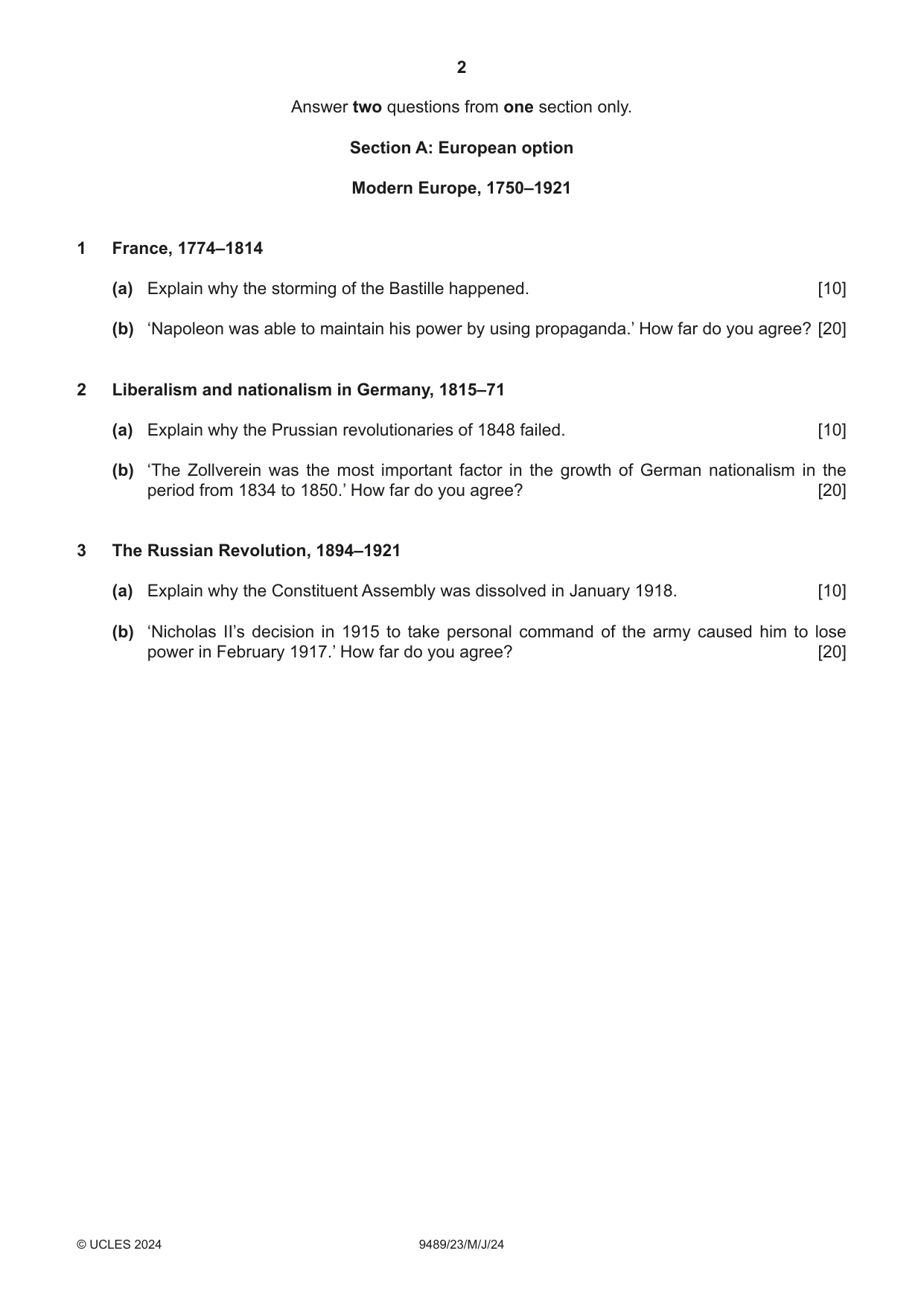
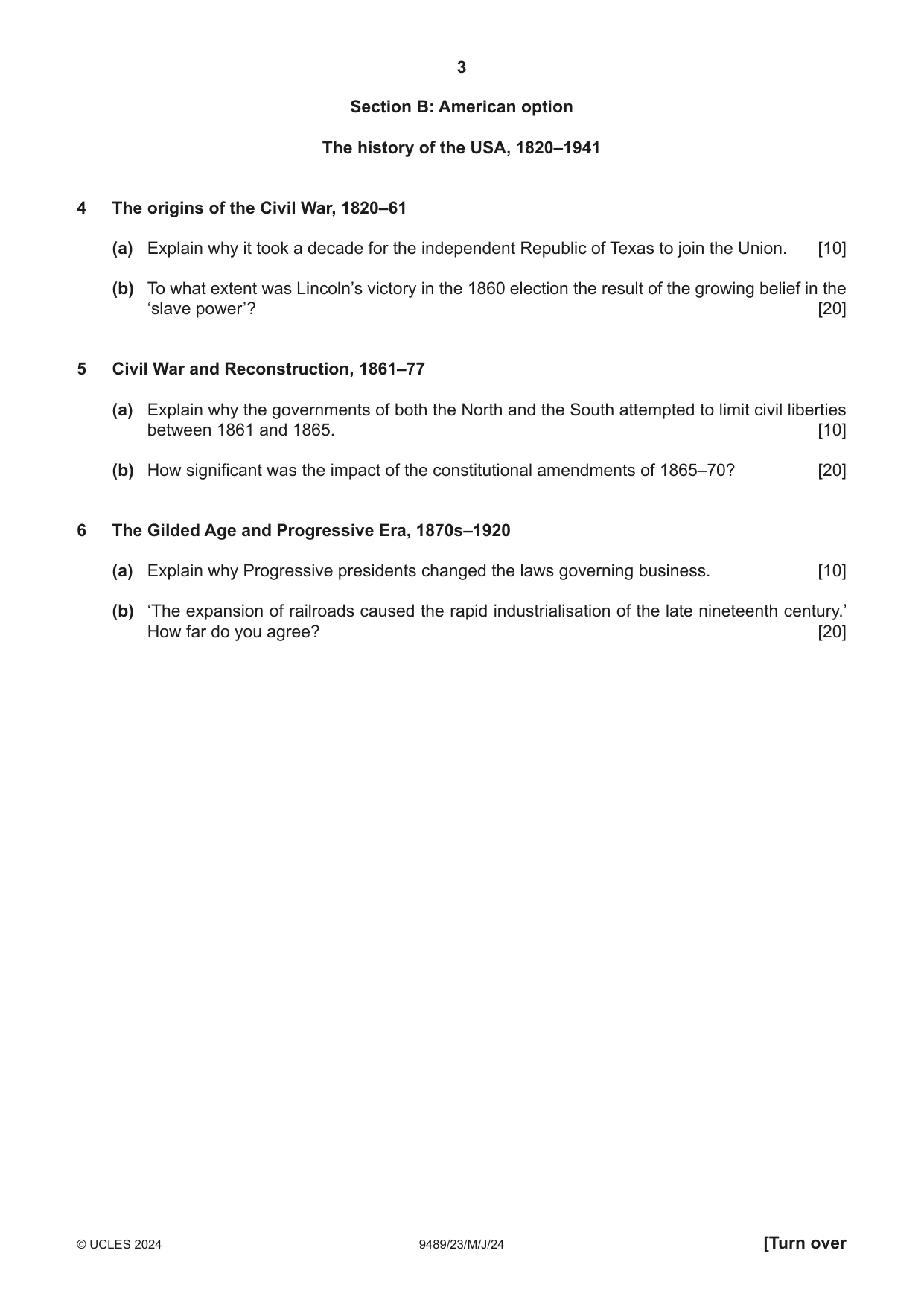
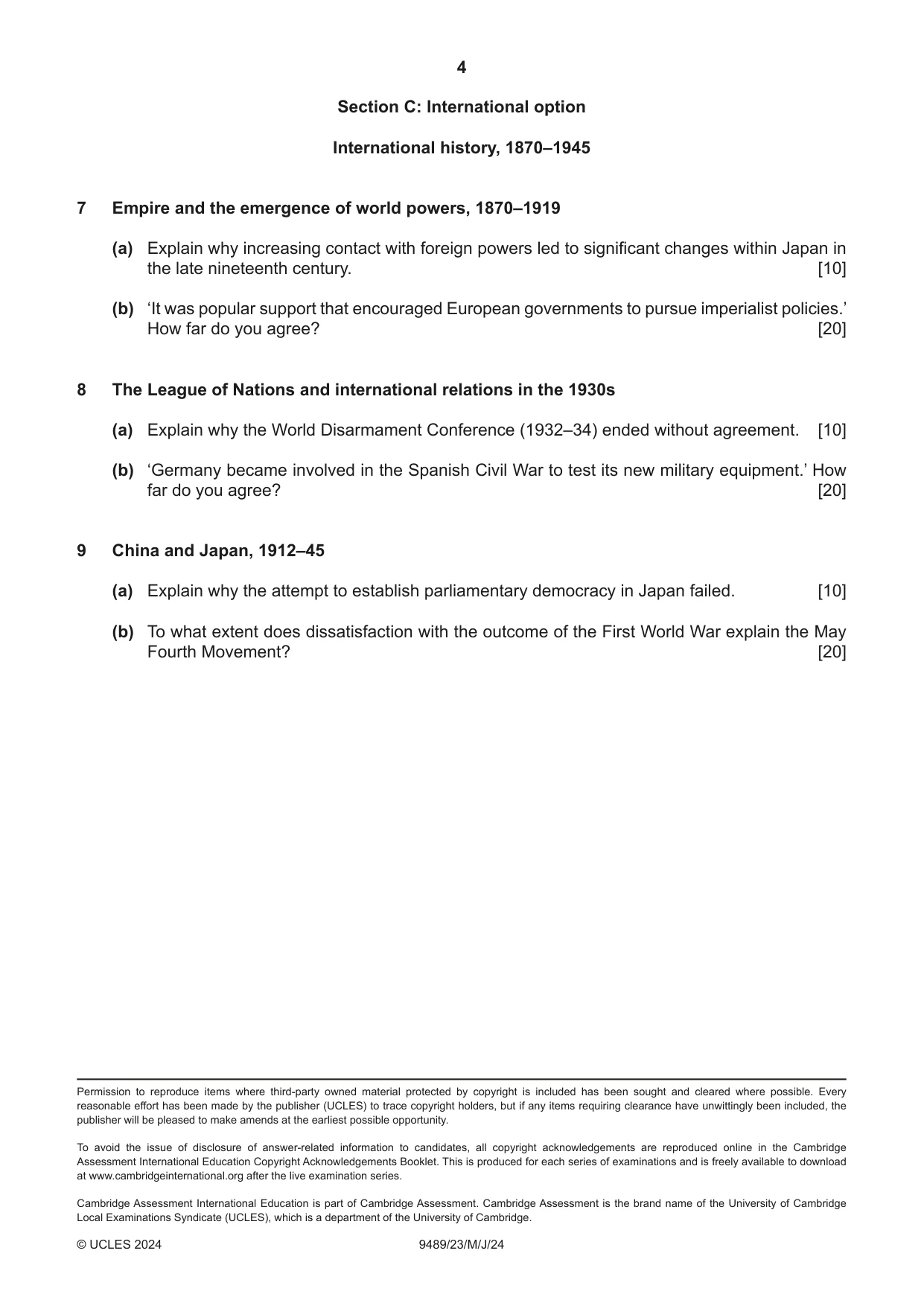
Mark scheme23 pages
Answers below. Sit the paper first if you are practising.
Questions as text
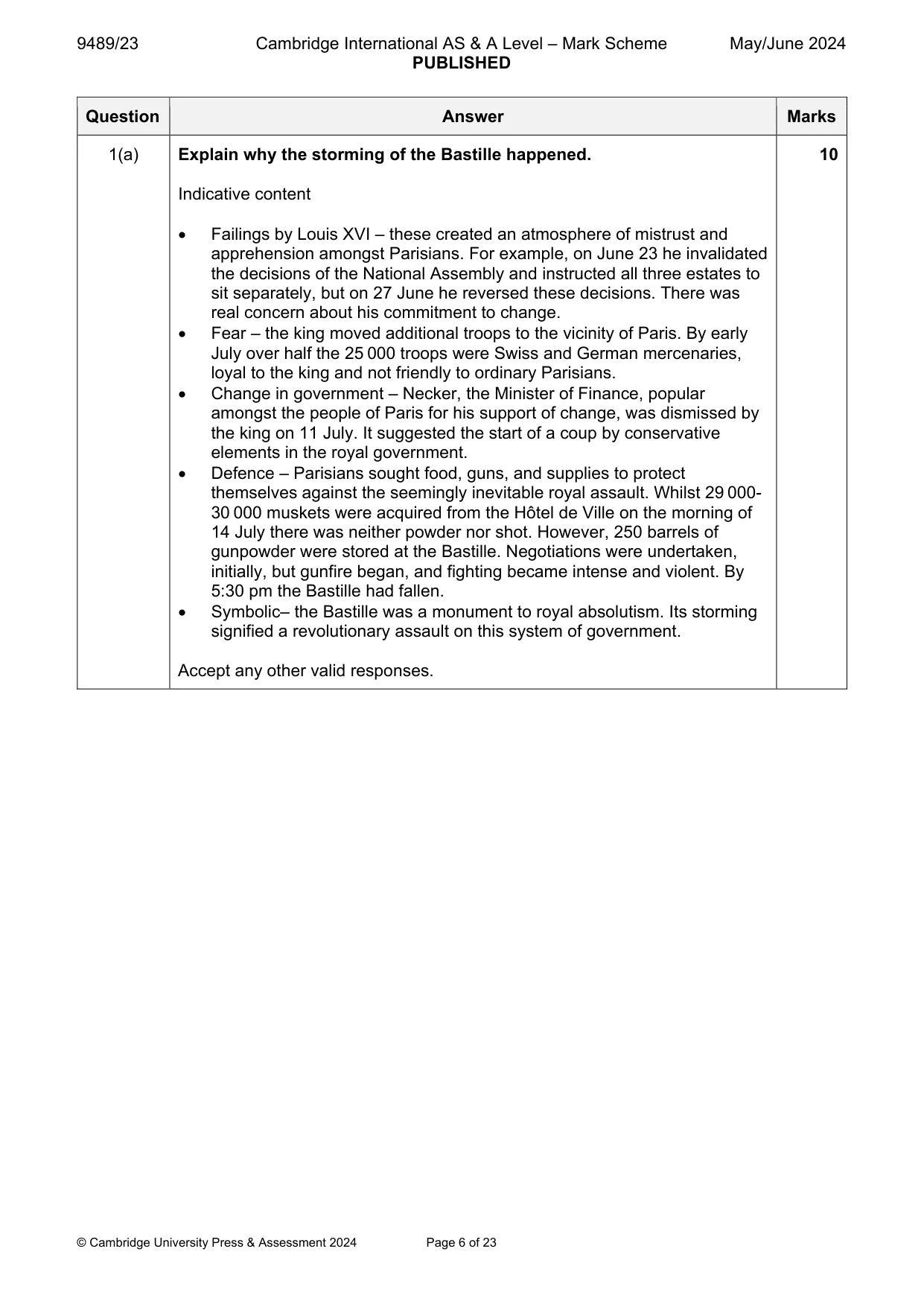
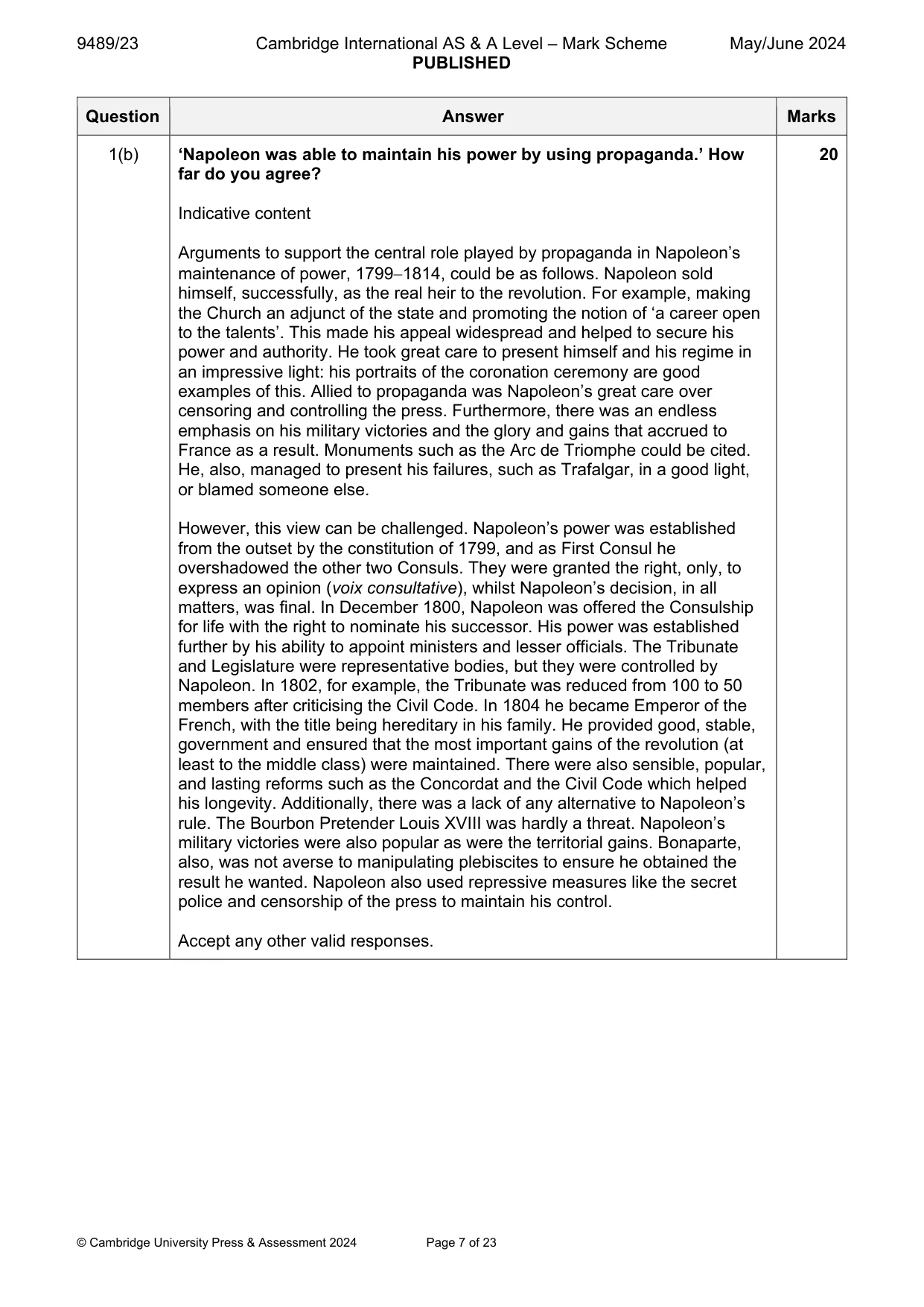
Q1 · France, 1774–1814 (a) Explain why the storming of the Bastille happened
1 France, 1774–1814 (a) Explain why the storming of the Bastille happened. [10] (b) ‘Napoleon was able to maintain his power by using propaganda.’ How far do you agree? [20]
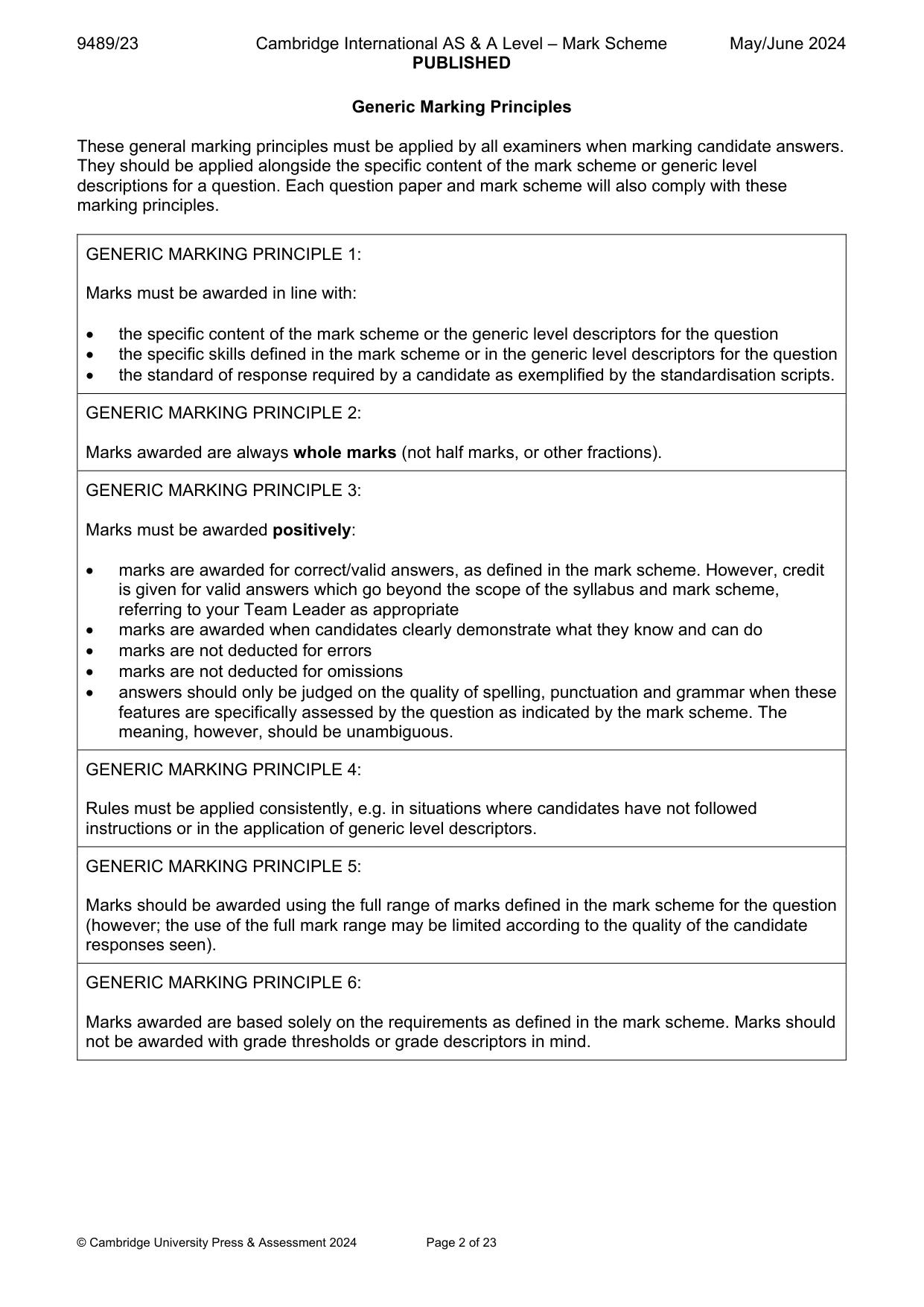
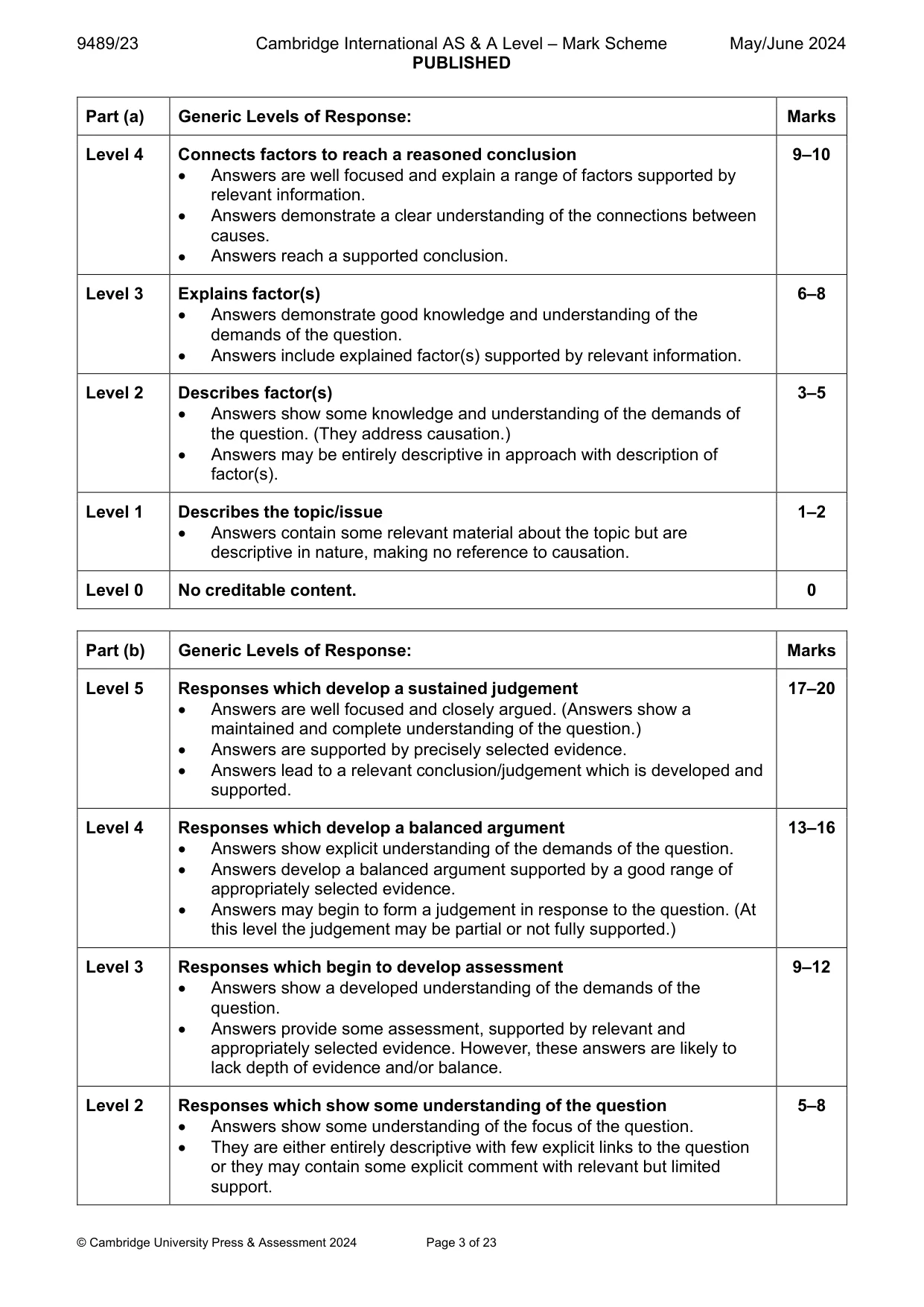
Mark scheme: Question Answer Marks 1(a) Explain why the storming of the Bastille happened. 10 Indicative content Failings by Louis XVI – these created an atmosphere of mistrust and apprehension amongst Parisians. For example, on June 23 he invalidated the decisions of the National Assembly and instructed all three estates to sit separately, but on 27 June he reversed these decisions. There was real concern about his commitment to change. Fear – the king moved additional troops to the vicinity of Paris. By early July over half the 25 000 troops were Swiss and German mercenaries, loyal to the king and not friendly to ordinary Parisians. Change in government – Necker, the Minister of Finance, popular amongst the people of Paris for his support of change, was dismissed by the king on 11 July. It suggested the start of a coup by conservative elements in the royal government. Defence – Parisians sought food, guns, and supplies to protect themselves against the seemingly inevitable royal assault. Whilst 29 000- 30 000 muskets were acquired from the Hôtel de Ville on the morning of 14 July there was neither powder nor shot. However, 250 barrels of gunpowder were stored at the Bastille. Negotiations were undertaken, initially, but gunfire began, and fighting became intense and violent. By 5:30 pm the Bastille had fallen. Symbolic– the Bastille was a monument to royal absolutism. Its storming signified a revolutionary assault on this system of government. Accept any other valid responses. 1(b) ‘Napoleon was able to maintain his power by using propaganda.’ How 20 far do you agree? Indicative content Arguments to support the central role played by propaganda in Napoleon’s maintenance of power, 17991814, could be as follows. Napoleon sold himself, successfully, as the real heir to the revolution. For example, making the Church an adjunct of the state and promoting the notion of ‘a career open to the talents’. This made his appeal widespread and helped to secure his power and authority. He took great care to present himself and his regime in an impressive light: his portraits of the coronation ceremony are good examples of this. Allied to propaganda was Napoleon’s great care over censoring and controlling the press. Furthermore, there was an endless emphasis on his military victories and the glory and gains that accrued to France as a result. Monuments such as the Arc de Triomphe could be cited. He, also, managed to present his failures, such as Trafalgar, in a good light, or blamed someone else. However, this view can be challenged. Napoleon’s power was established from the outset by the constitution of 1799, and as First Consul he overshadowed the other two Consuls. They were granted the right, only, to express an opinion (voix consultative), whilst Napoleon’s decision, in all matters, was final. In December 1800, Napoleon was offered the Consulship for life with the right to nominate his successor. His power was established further by his ability to appoint ministers and lesser officials. The Tribunate and Legislature were representative bodies, but they were controlled by Napoleon. In 1802, for example, the Tribunate was reduced from 100 to 50 members after criticising the Civil Code. In 1804 he became Emperor of the French, with the title being hereditary in his family. He provided good, stable, government and ensured that the most important gains of the revolution (at least to the middle class) were maintained. There were also sensible, popular, and lasting reforms such as the Concordat and the Civil Code which helped his longevity. Additionally, there was a lack of any alternative to Napoleon’s rule. The Bourbon Pretender Louis XVIII was hardly a threat. Napoleon’s military victories were also popular as were the territorial gains. Bonaparte, also, was not averse to manipulating plebiscites to ensure he obtained the result he wanted. Napoleon also used repressive measures like the secret police and censorship of the press to maintain his control. Accept any other valid responses.
More questions on What caused the rise and fall of Napoleon Bonaparte?
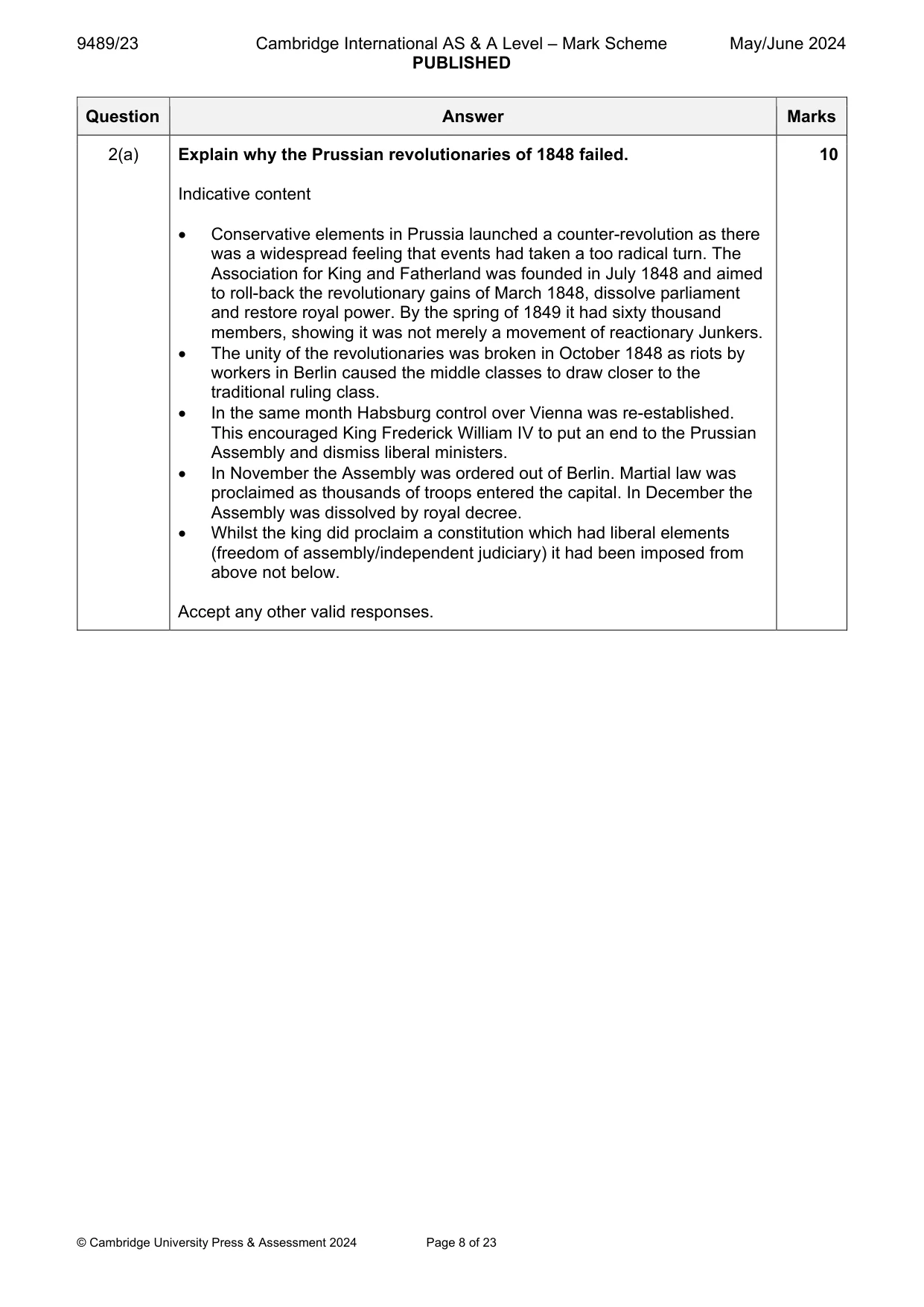
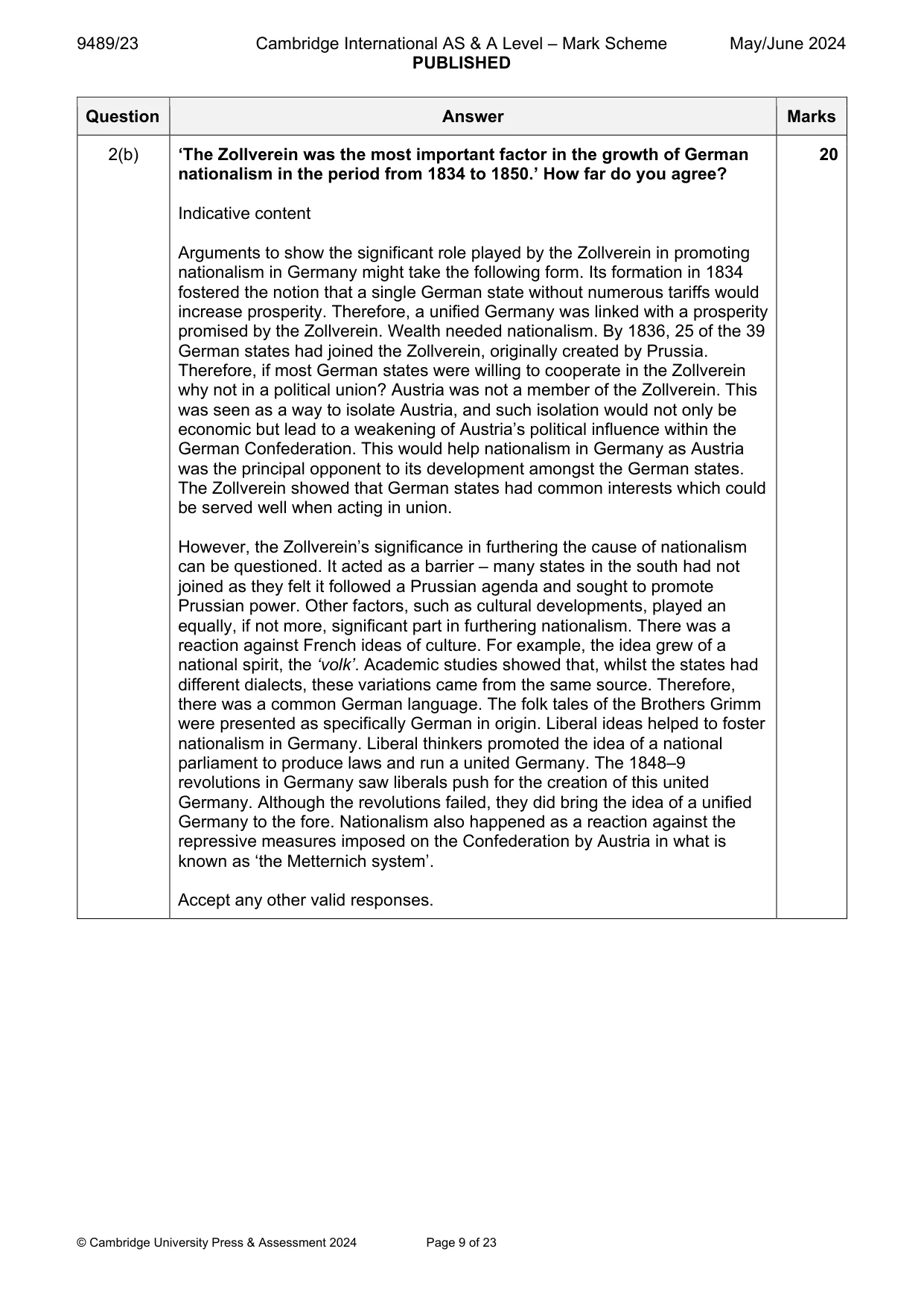
Q2 · Liberalism and nationalism in Germany, 1815–71 (a) Explain why the Prussian…
2 Liberalism and nationalism in Germany, 1815–71 (a) Explain why the Prussian revolutionaries of 1848 failed. [10] (b) ‘The Zollverein was the most important factor in the growth of German nationalism in the period from 1834 to 1850.’ How far do you agree? [20]
Mark scheme: 2(a) Explain why the Prussian revolutionaries of 1848 failed. 10 Indicative content Conservative elements in Prussia launched a counter-revolution as there was a widespread feeling that events had taken a too radical turn. The Association for King and Fatherland was founded in July 1848 and aimed to roll-back the revolutionary gains of March 1848, dissolve parliament and restore royal power. By the spring of 1849 it had sixty thousand members, showing it was not merely a movement of reactionary Junkers. The unity of the revolutionaries was broken in October 1848 as riots by workers in Berlin caused the middle classes to draw closer to the traditional ruling class. In the same month Habsburg control over Vienna was re-established. This encouraged King Frederick William IV to put an end to the Prussian Assembly and dismiss liberal ministers. In November the Assembly was ordered out of Berlin. Martial law was proclaimed as thousands of troops entered the capital. In December the Assembly was dissolved by royal decree. Whilst the king did proclaim a constitution which had liberal elements (freedom of assembly/independent judiciary) it had been imposed from above not below. Accept any other valid responses. 2(b) ‘The Zollverein was the most important factor in the growth of German 20 nationalism in the period from 1834 to 1850.’ How far do you agree? Indicative content Arguments to show the significant role played by the Zollverein in promoting nationalism in Germany might take the following form. Its formation in 1834 fostered the notion that a single German state without numerous tariffs would increase prosperity. Therefore, a unified Germany was linked with a prosperity promised by the Zollverein. Wealth needed nationalism. By 1836, 25 of the 39 German states had joined the Zollverein, originally created by Prussia. Therefore, if most German states were willing to cooperate in the Zollverein why not in a political union? Austria was not a member of the Zollverein. This was seen as a way to isolate Austria, and such isolation would not only be economic but lead to a weakening of Austria’s political influence within the German Confederation. This would help nationalism in Germany as Austria was the principal opponent to its development amongst the German states. The Zollverein showed that German states had common interests which could be served well when acting in union. However, the Zollverein’s significance in furthering the cause of nationalism can be questioned. It acted as a barrier – many states in the south had not joined as they felt it followed a Prussian agenda and sought to promote Prussian power. Other factors, such as cultural developments, played an equally, if not more, significant part in furthering nationalism. There was a reaction against French ideas of culture. For example, the idea grew of a national spirit, the ‘volk’. Academic studies showed that, whilst the states had different dialects, these variations came from the same source. Therefore, there was a common German language. The folk tales of the Brothers Grimm were presented as specifically German in origin. Liberal ideas helped to foster nationalism in Germany. Liberal thinkers promoted the idea of a national parliament to produce laws and run a united Germany. The 1848–9 revolutions in Germany saw liberals push for the creation of this united Germany. Although the revolutions failed, they did bring the idea of a unified Germany to the fore. Nationalism also happened as a reaction against the repressive measures imposed on the Confederation by Austria in what is known as ‘the Metternich system’. Accept any other valid responses.
More questions on What happened during the 1848–49 revolutions and what were their consequences?
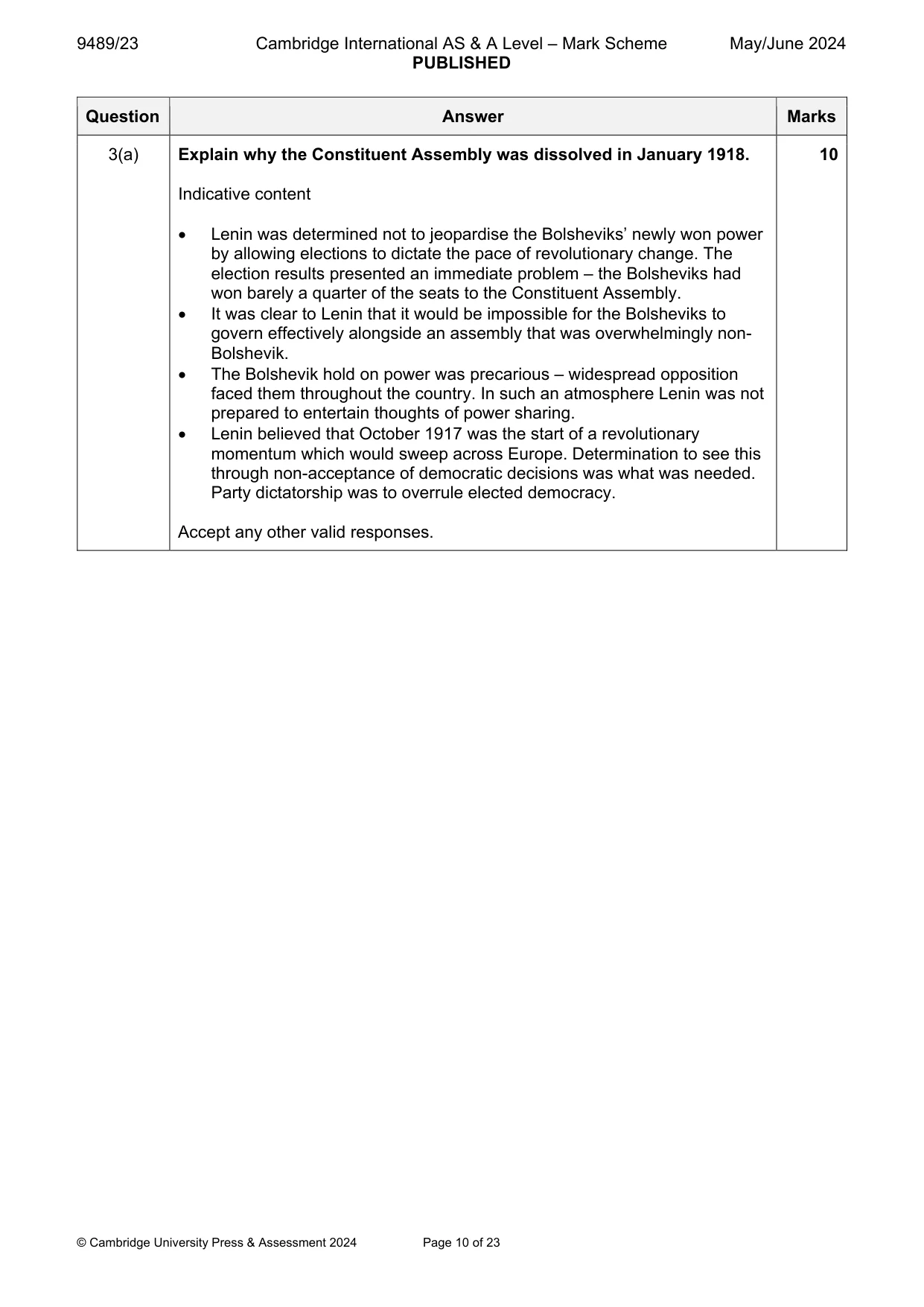
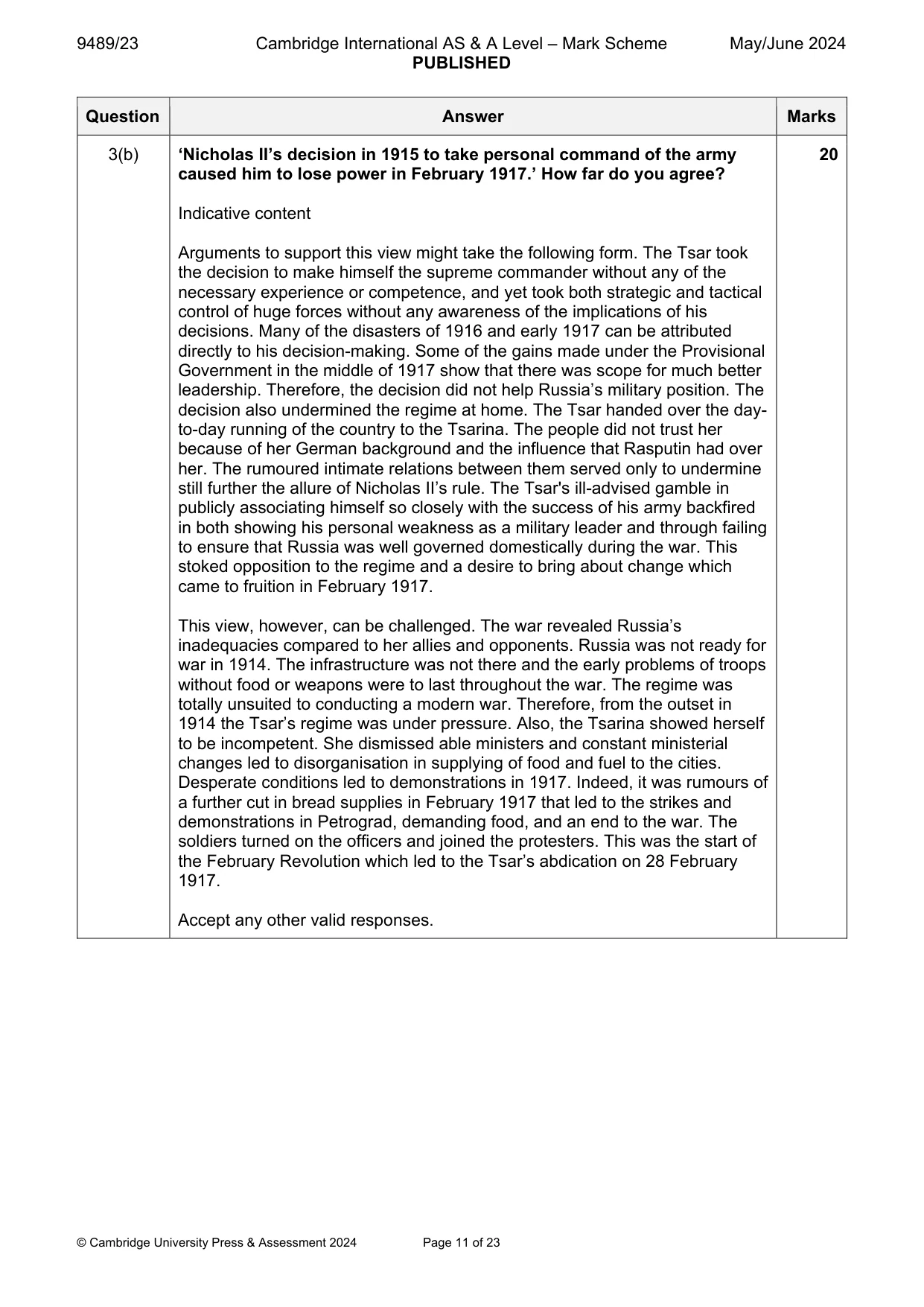
Q3 · The Russian Revolution, 1894–1921 (a) Explain why the Constituent Assembly was dissolved…
3 The Russian Revolution, 1894–1921 (a) Explain why the Constituent Assembly was dissolved in January 1918. [10] (b) ‘Nicholas II’s decision in 1915 to take personal command of the army caused him to lose power in February 1917.’ How far do you agree? [20]
Mark scheme: 3(a) Explain why the Constituent Assembly was dissolved in January 1918. 10 Indicative content Lenin was determined not to jeopardise the Bolsheviks’ newly won power by allowing elections to dictate the pace of revolutionary change. The election results presented an immediate problem – the Bolsheviks had won barely a quarter of the seats to the Constituent Assembly. It was clear to Lenin that it would be impossible for the Bolsheviks to govern effectively alongside an assembly that was overwhelmingly non- Bolshevik. The Bolshevik hold on power was precarious – widespread opposition faced them throughout the country. In such an atmosphere Lenin was not prepared to entertain thoughts of power sharing. Lenin believed that October 1917 was the start of a revolutionary momentum which would sweep across Europe. Determination to see this through non-acceptance of democratic decisions was what was needed. Party dictatorship was to overrule elected democracy. Accept any other valid responses. 3(b) ‘Nicholas II’s decision in 1915 to take personal command of the army 20 caused him to lose power in February 1917.’ How far do you agree? Indicative content Arguments to support this view might take the following form. The Tsar took the decision to make himself the supreme commander without any of the necessary experience or competence, and yet took both strategic and tactical control of huge forces without any awareness of the implications of his decisions. Many of the disasters of 1916 and early 1917 can be attributed directly to his decision-making. Some of the gains made under the Provisional Government in the middle of 1917 show that there was scope for much better leadership. Therefore, the decision did not help Russia’s military position. The decision also undermined the regime at home. The Tsar handed over the day- to-day running of the country to the Tsarina. The people did not trust her because of her German background and the influence that Rasputin had over her. The rumoured intimate relations between them served only to undermine still further the allure of Nicholas II’s rule. The Tsar's ill-advised gamble in publicly associating himself so closely with the success of his army backfired in both showing his personal weakness as a military leader and through failing to ensure that Russia was well governed domestically during the war. This stoked opposition to the regime and a desire to bring about change which came to fruition in February 1917. This view, however, can be challenged. The war revealed Russia’s inadequacies compared to her allies and opponents. Russia was not ready for war in 1914. The infrastructure was not there and the early problems of troops without food or weapons were to last throughout the war. The regime was totally unsuited to conducting a modern war. Therefore, from the outset in 1914 the Tsar’s regime was under pressure. Also, the Tsarina showed herself to be incompetent. She dismissed able ministers and constant ministerial changes led to disorganisation in supplying of food and fuel to the cities. Desperate conditions led to demonstrations in 1917. Indeed, it was rumours of a further cut in bread supplies in February 1917 that led to the strikes and demonstrations in Petrograd, demanding food, and an end to the war. The soldiers turned on the officers and joined the protesters. This was the start of the February Revolution which led to the Tsar’s abdication on 28 February 1917. Accept any other valid responses.
More questions on How and why did the Bolsheviks seize power in October 1917?
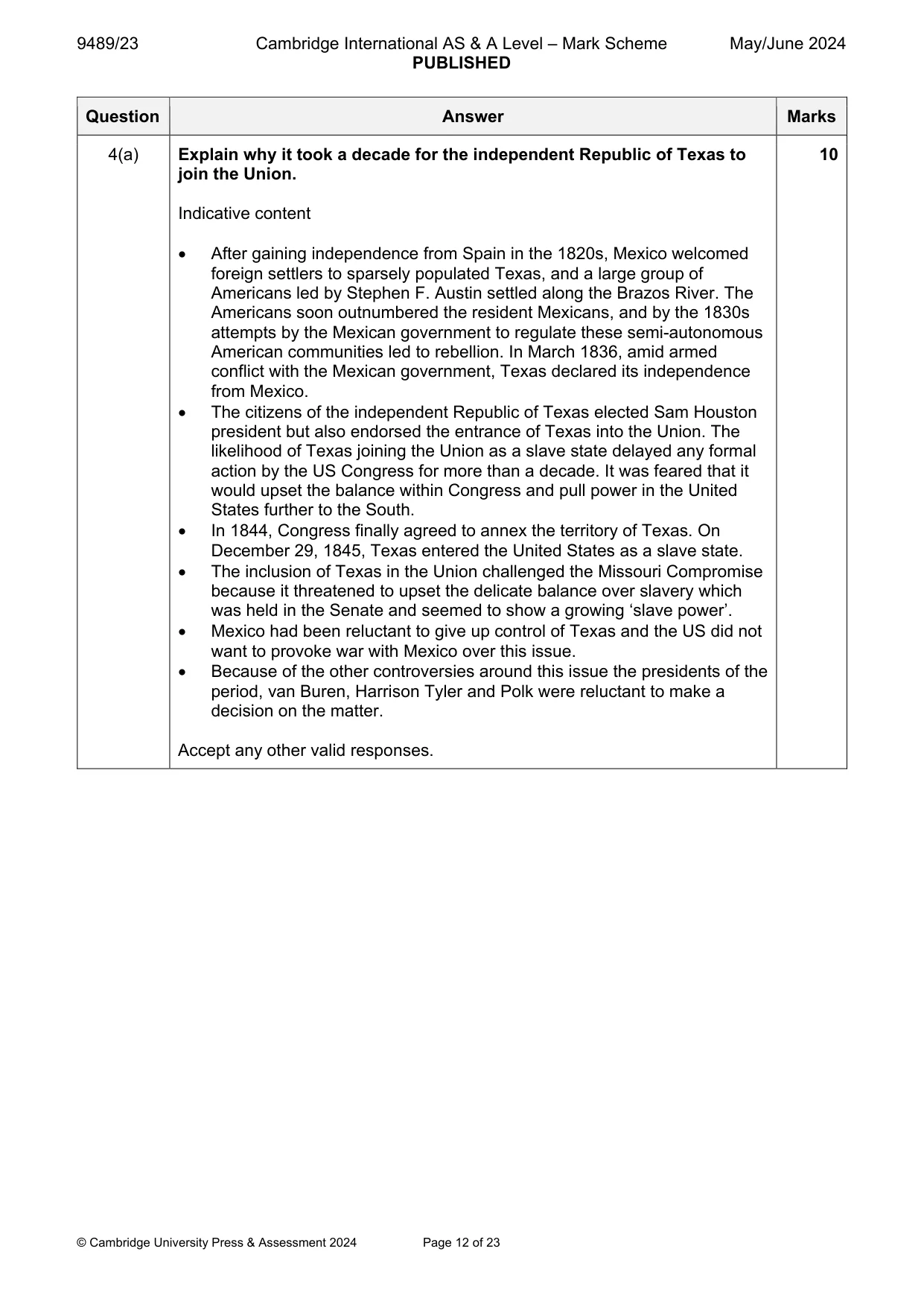
Q4 · The origins of the Civil War, 1820–61 (a) Explain why it took a decade for the…
4 The origins of the Civil War, 1820–61 (a) Explain why it took a decade for the independent Republic of Texas to join the Union. [10] (b) To what extent was Lincoln’s victory in the 1860 election the result of the growing belief in the ‘slave power’? [20]
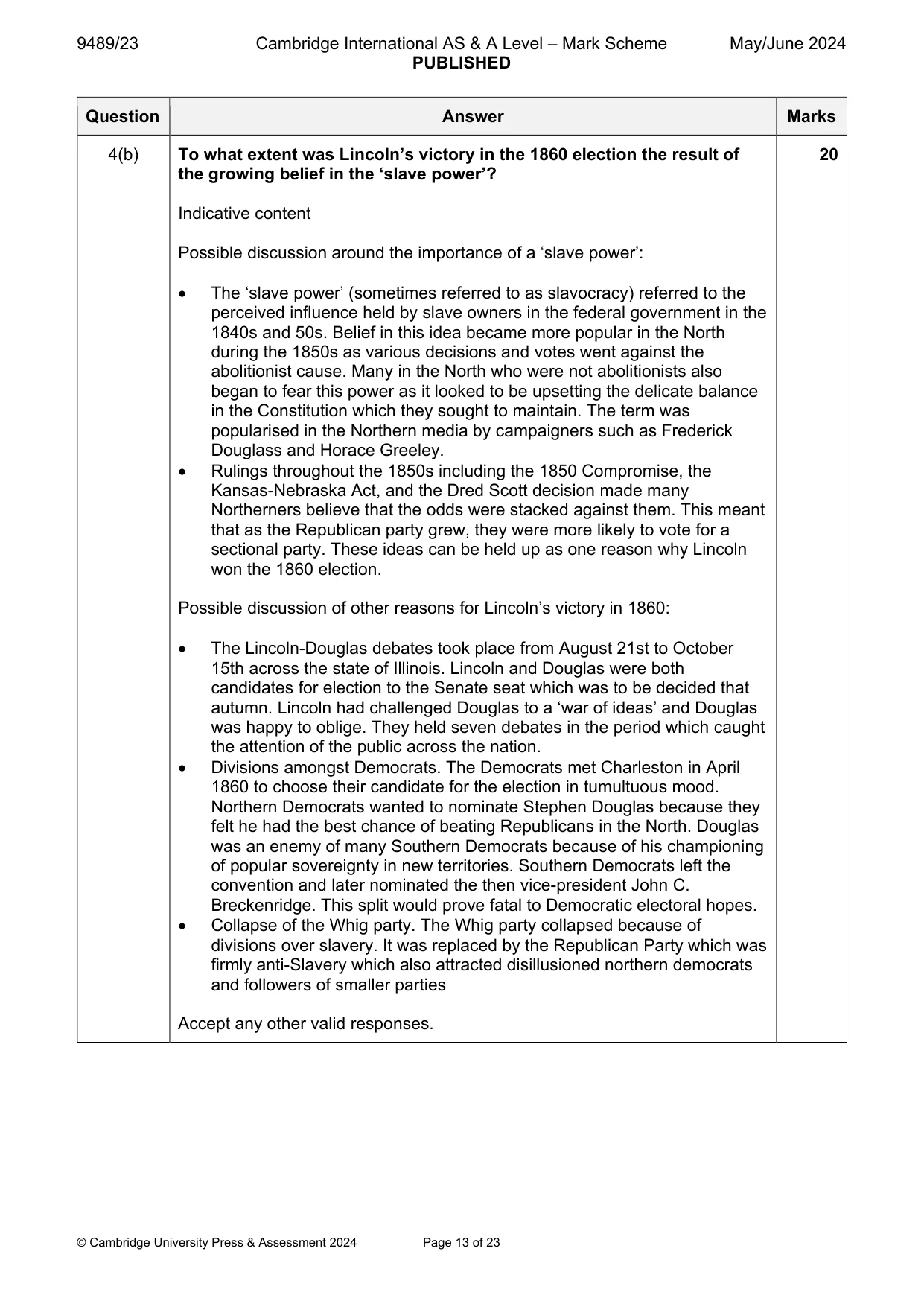
Mark scheme: 4(a) Explain why it took a decade for the independent Republic of Texas to 10 join the Union. Indicative content After gaining independence from Spain in the 1820s, Mexico welcomed foreign settlers to sparsely populated Texas, and a large group of Americans led by Stephen F. Austin settled along the Brazos River. The Americans soon outnumbered the resident Mexicans, and by the 1830s attempts by the Mexican government to regulate these semi-autonomous American communities led to rebellion. In March 1836, amid armed conflict with the Mexican government, Texas declared its independence from Mexico. The citizens of the independent Republic of Texas elected Sam Houston president but also endorsed the entrance of Texas into the Union. The likelihood of Texas joining the Union as a slave state delayed any formal action by the US Congress for more than a decade. It was feared that it would upset the balance within Congress and pull power in the United States further to the South. In 1844, Congress finally agreed to annex the territory of Texas. On December 29, 1845, Texas entered the United States as a slave state. The inclusion of Texas in the Union challenged the Missouri Compromise because it threatened to upset the delicate balance over slavery which was held in the Senate and seemed to show a growing ‘slave power’. Mexico had been reluctant to give up control of Texas and the US did not want to provoke war with Mexico over this issue. Because of the other controversies around this issue the presidents of the period, van Buren, Harrison Tyler and Polk were reluctant to make a decision on the matter. Accept any other valid responses. 4(b) To what extent was Lincoln’s victory in the 1860 election the result of 20 the growing belief in the ‘slave power’? Indicative content Possible discussion around the importance of a ‘slave power’: The ‘slave power’ (sometimes referred to as slavocracy) referred to the perceived influence held by slave owners in the federal government in the 1840s and 50s. Belief in this idea became more popular in the North during the 1850s as various decisions and votes went against the abolitionist cause. Many in the North who were not abolitionists also began to fear this power as it looked to be upsetting the delicate balance in the Constitution which they sought to maintain. The term was popularised in the Northern media by campaigners such as Frederick Douglass and Horace Greeley. Rulings throughout the 1850s including the 1850 Compromise, the Kansas-Nebraska Act, and the Dred Scott decision made many Northerners believe that the odds were stacked against them. This meant that as the Republican party grew, they were more likely to vote for a sectional party. These ideas can be held up as one reason why Lincoln won the 1860 election. Possible discussion of other reasons for Lincoln’s victory in 1860: The Lincoln-Douglas debates took place from August 21st to October 15th across the state of Illinois. Lincoln and Douglas were both candidates for election to the Senate seat which was to be decided that autumn. Lincoln had challenged Douglas to a ‘war of ideas’ and Douglas was happy to oblige. They held seven debates in the period which caught the attention of the public across the nation. Divisions amongst Democrats. The Democrats met Charleston in April 1860 to choose their candidate for the election in tumultuous mood. Northern Democrats wanted to nominate Stephen Douglas because they felt he had the best chance of beating Republicans in the North. Douglas was an enemy of many Southern Democrats because of his championing of popular sovereignty in new territories. Southern Democrats left the convention and later nominated the then vice-president John C. Breckenridge. This split would prove fatal to Democratic electoral hopes. Collapse of the Whig party. The Whig party collapsed because of divisions over slavery. It was replaced by the Republican Party which was firmly anti-Slavery which also attracted disillusioned northern democrats and followers of smaller parties Accept any other valid responses.
More questions on Why did the Civil War break out in April 1861?
Q5 · Civil War and Reconstruction, 1861–77 (a) Explain why the governments of both the North…
5 Civil War and Reconstruction, 1861–77 (a) Explain why the governments of both the North and the South attempted to limit civil liberties between 1861 and 1865. [10] (b) How significant was the impact of the constitutional amendments of 1865–70? [20]
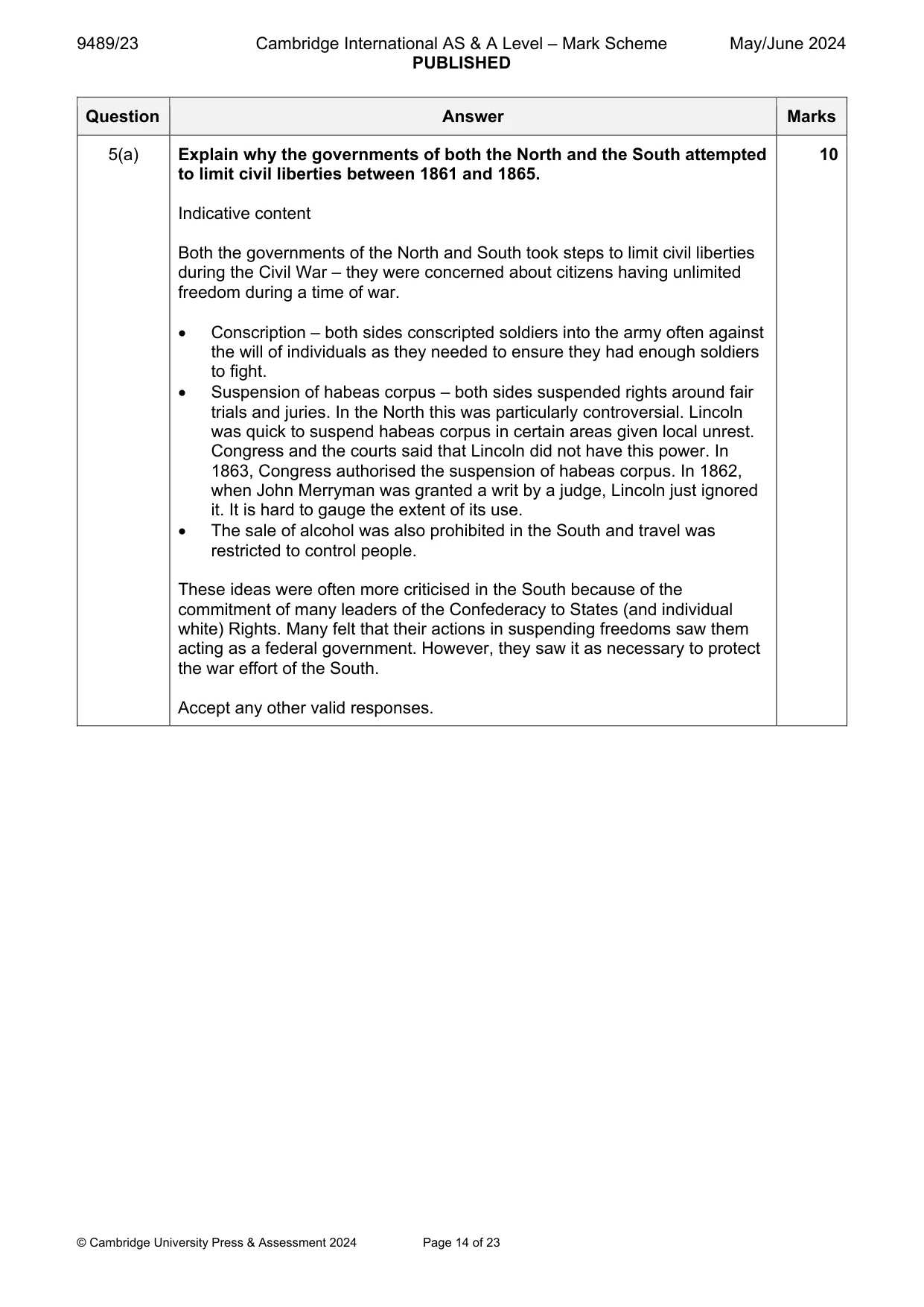
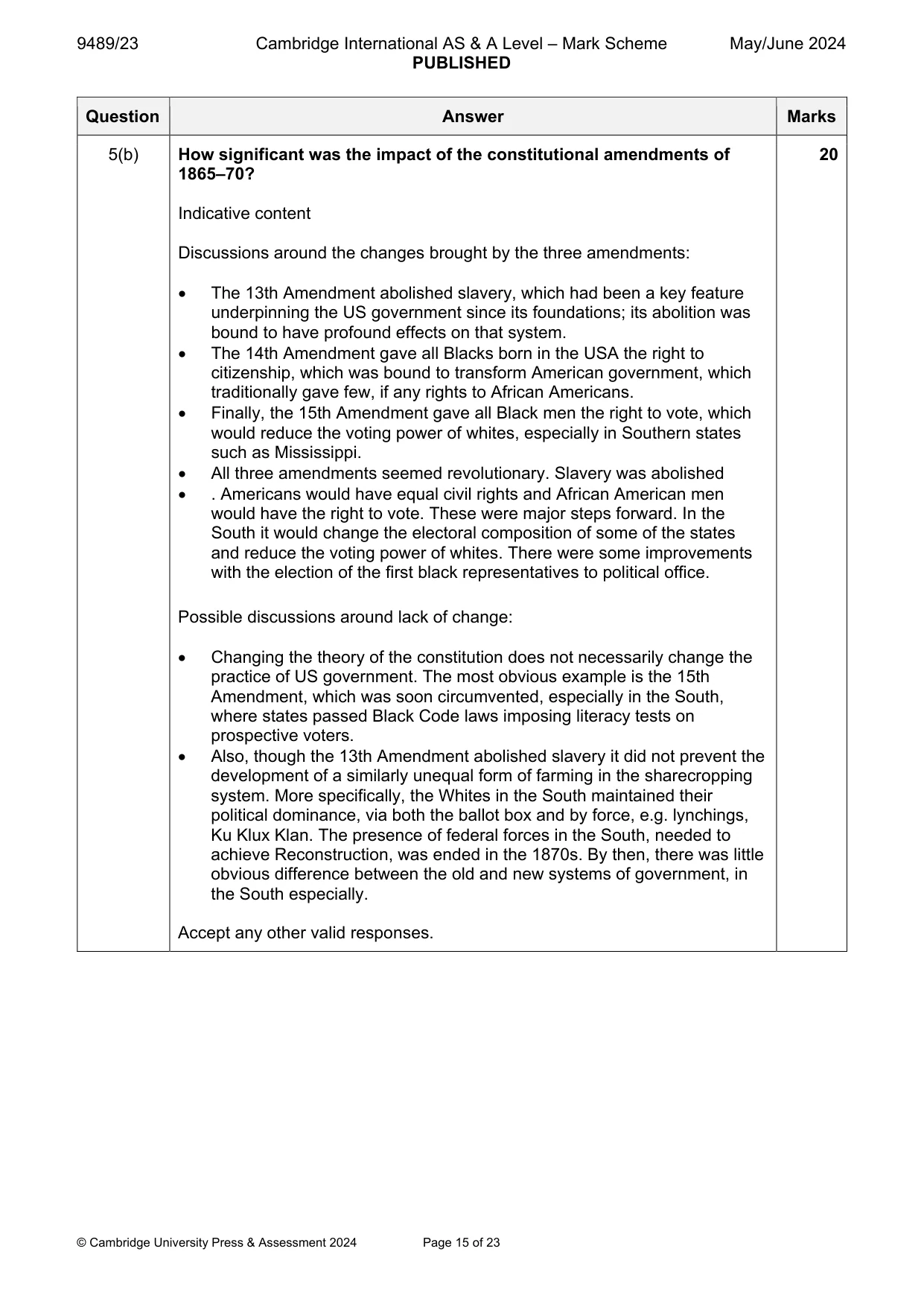
Mark scheme: 5(a) Explain why the governments of both the North and the South attempted 10 to limit civil liberties between 1861 and 1865. Indicative content Both the governments of the North and South took steps to limit civil liberties during the Civil War – they were concerned about citizens having unlimited freedom during a time of war. Conscription – both sides conscripted soldiers into the army often against the will of individuals as they needed to ensure they had enough soldiers to fight. Suspension of habeas corpus – both sides suspended rights around fair trials and juries. In the North this was particularly controversial. Lincoln was quick to suspend habeas corpus in certain areas given local unrest. Congress and the courts said that Lincoln did not have this power. In 1863, Congress authorised the suspension of habeas corpus. In 1862, when John Merryman was granted a writ by a judge, Lincoln just ignored it. It is hard to gauge the extent of its use. The sale of alcohol was also prohibited in the South and travel was restricted to control people. These ideas were often more criticised in the South because of the commitment of many leaders of the Confederacy to States (and individual white) Rights. Many felt that their actions in suspending freedoms saw them acting as a federal government. However, they saw it as necessary to protect the war effort of the South. Accept any other valid responses. 5(b) How significant was the impact of the constitutional amendments of 20 1865–70? Indicative content Discussions around the changes brought by the three amendments: The 13th Amendment abolished slavery, which had been a key feature underpinning the US government since its foundations; its abolition was bound to have profound effects on that system. The 14th Amendment gave all Blacks born in the USA the right to citizenship, which was bound to transform American government, which traditionally gave few, if any rights to African Americans. Finally, the 15th Amendment gave all Black men the right to vote, which would reduce the voting power of whites, especially in Southern states such as Mississippi. All three amendments seemed revolutionary. Slavery was abolished . Americans would have equal civil rights and African American men would have the right to vote. These were major steps forward. In the South it would change the electoral composition of some of the states and reduce the voting power of whites. There were some improvements with the election of the first black representatives to political office. Possible discussions around lack of change: Changing the theory of the constitution does not necessarily change the practice of US government. The most obvious example is the 15th Amendment, which was soon circumvented, especially in the South, where states passed Black Code laws imposing literacy tests on prospective voters. Also, though the 13th Amendment abolished slavery it did not prevent the development of a similarly unequal form of farming in the sharecropping system. More specifically, the Whites in the South maintained their political dominance, via both the ballot box and by force, e.g. lynchings, Ku Klux Klan. The presence of federal forces in the South, needed to achieve Reconstruction, was ended in the 1870s. By then, there was little obvious difference between the old and new systems of government, in the South especially. Accept any other valid responses.
More questions on What were the aims of Reconstruction and how successful was it?
Q6 · The Gilded Age and Progressive Era, 1870s–1920 (a) Explain why Progressive presidents…
6 The Gilded Age and Progressive Era, 1870s–1920 (a) Explain why Progressive presidents changed the laws governing business. [10] (b) ‘The expansion of railroads caused the rapid industrialisation of the late nineteenth century.’ How far do you agree? [20] Section C: International option International history, 1870–1945
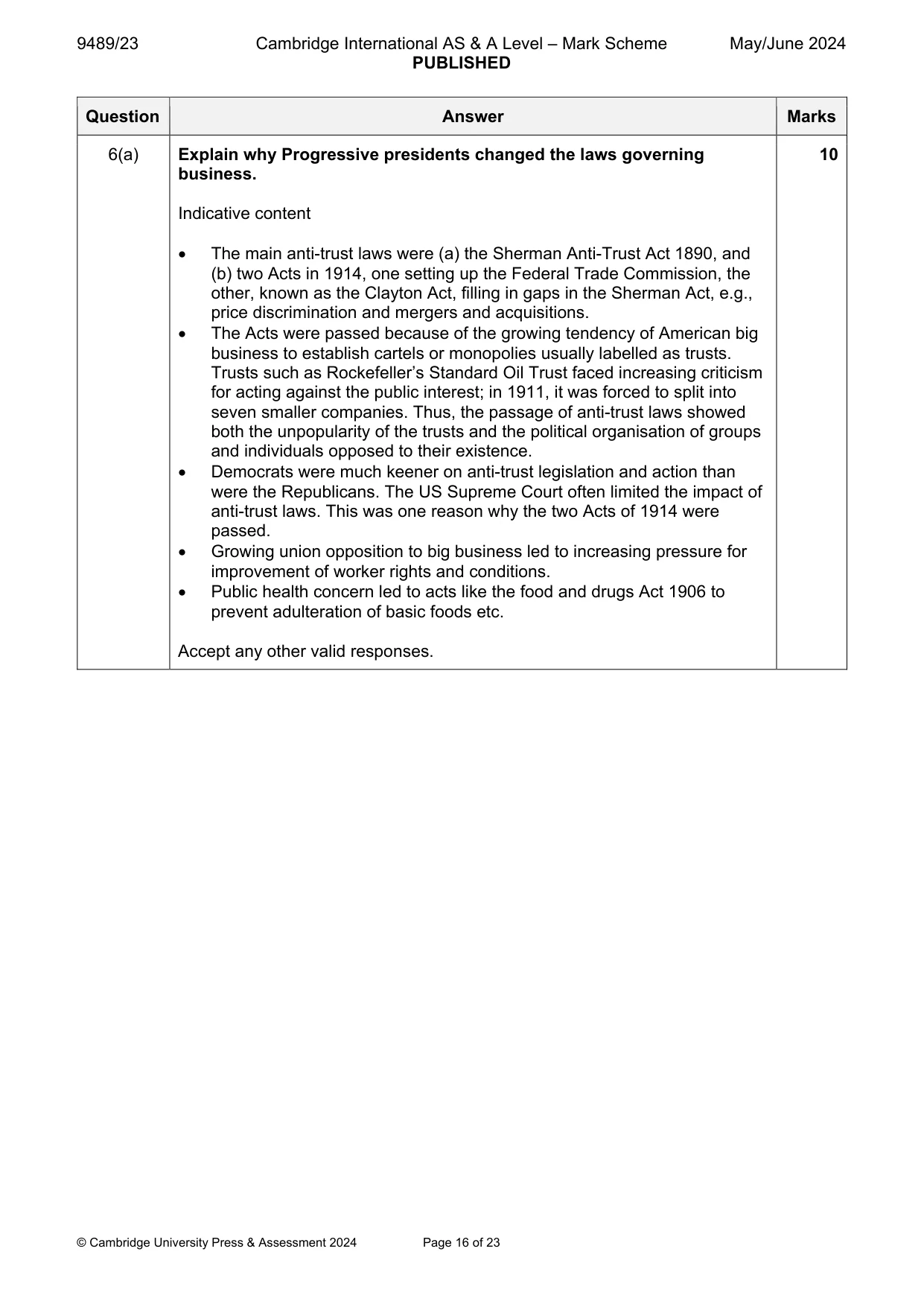
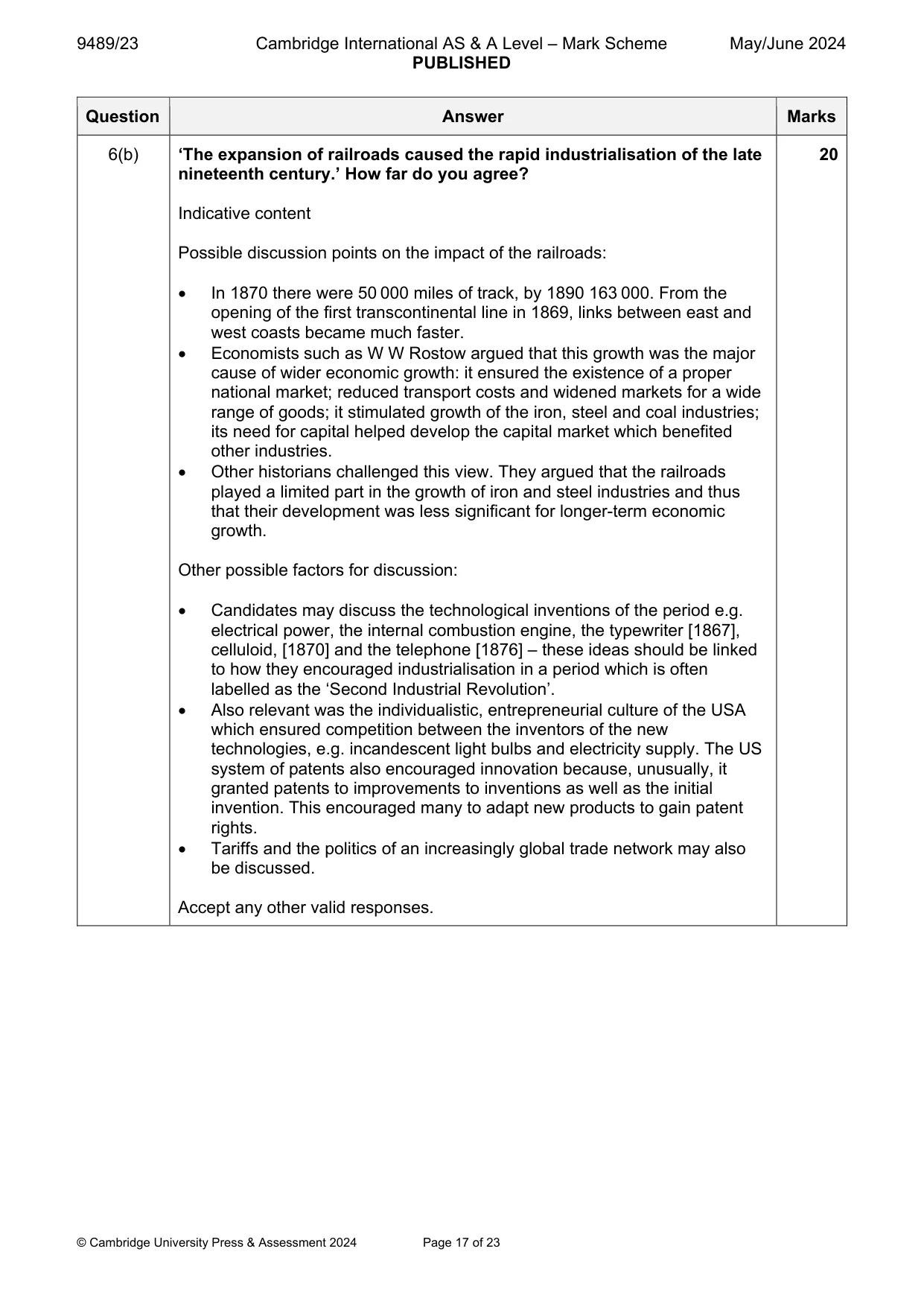
Mark scheme: 6(a) Explain why Progressive presidents changed the laws governing 10 business. Indicative content The main anti-trust laws were (a) the Sherman Anti-Trust Act 1890, and (b) two Acts in 1914, one setting up the Federal Trade Commission, the other, known as the Clayton Act, filling in gaps in the Sherman Act, e.g., price discrimination and mergers and acquisitions. The Acts were passed because of the growing tendency of American big business to establish cartels or monopolies usually labelled as trusts. Trusts such as Rockefeller’s Standard Oil Trust faced increasing criticism for acting against the public interest; in 1911, it was forced to split into seven smaller companies. Thus, the passage of anti-trust laws showed both the unpopularity of the trusts and the political organisation of groups and individuals opposed to their existence. Democrats were much keener on anti-trust legislation and action than were the Republicans. The US Supreme Court often limited the impact of anti-trust laws. This was one reason why the two Acts of 1914 were passed. Growing union opposition to big business led to increasing pressure for improvement of worker rights and conditions. Public health concern led to acts like the food and drugs Act 1906 to prevent adulteration of basic foods etc. Accept any other valid responses. 6(b) ‘The expansion of railroads caused the rapid industrialisation of the late 20 nineteenth century.’ How far do you agree? Indicative content Possible discussion points on the impact of the railroads: In 1870 there were 50 000 miles of track, by 1890 163 000. From the opening of the first transcontinental line in 1869, links between east and west coasts became much faster. Economists such as W W Rostow argued that this growth was the major cause of wider economic growth: it ensured the existence of a proper national market; reduced transport costs and widened markets for a wide range of goods; it stimulated growth of the iron, steel and coal industries; its need for capital helped develop the capital market which benefited other industries. Other historians challenged this view. They argued that the railroads played a limited part in the growth of iron and steel industries and thus that their development was less significant for longer-term economic growth. Other possible factors for discussion: Candidates may discuss the technological inventions of the period e.g. electrical power, the internal combustion engine, the typewriter [1867], celluloid, [1870] and the telephone [1876] – these ideas should be linked to how they encouraged industrialisation in a period which is often labelled as the ‘Second Industrial Revolution’. Also relevant was the individualistic, entrepreneurial culture of the USA which ensured competition between the inventors of the new technologies, e.g. incandescent light bulbs and electricity supply. The US system of patents also encouraged innovation because, unusually, it granted patents to improvements to inventions as well as the initial invention. This encouraged many to adapt new products to gain patent rights. Tariffs and the politics of an increasingly global trade network may also be discussed. Accept any other valid responses.
More questions on Why was there rapid industrialisation after 1870?
Q7 · Empire and the emergence of world powers, 1870–1919 (a) Explain why increasing contact…
7 Empire and the emergence of world powers, 1870–1919 (a) Explain why increasing contact with foreign powers led to significant changes within Japan in the late nineteenth century. [10] (b) ‘It was popular support that encouraged European governments to pursue imperialist policies.’ How far do you agree? [20]
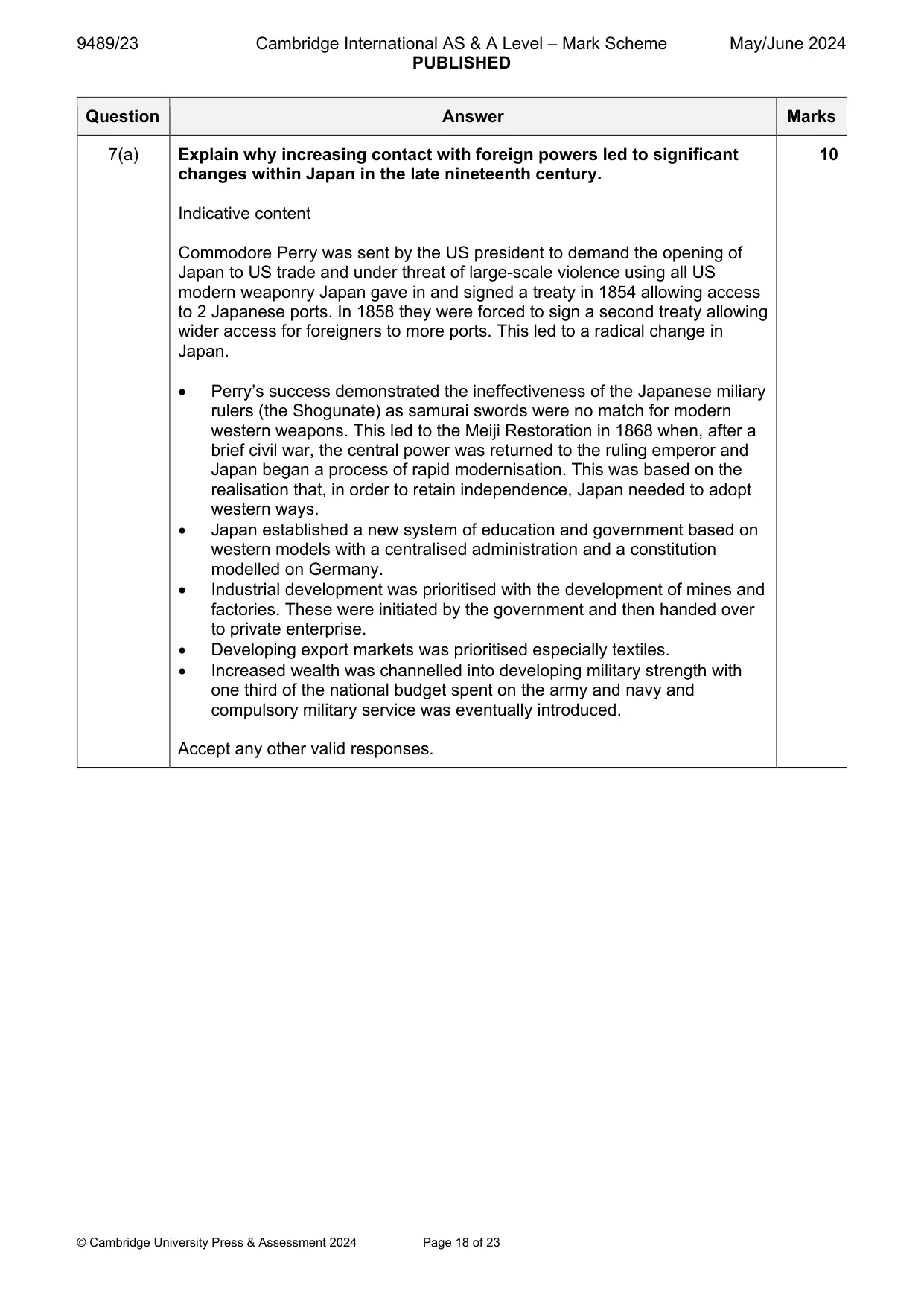
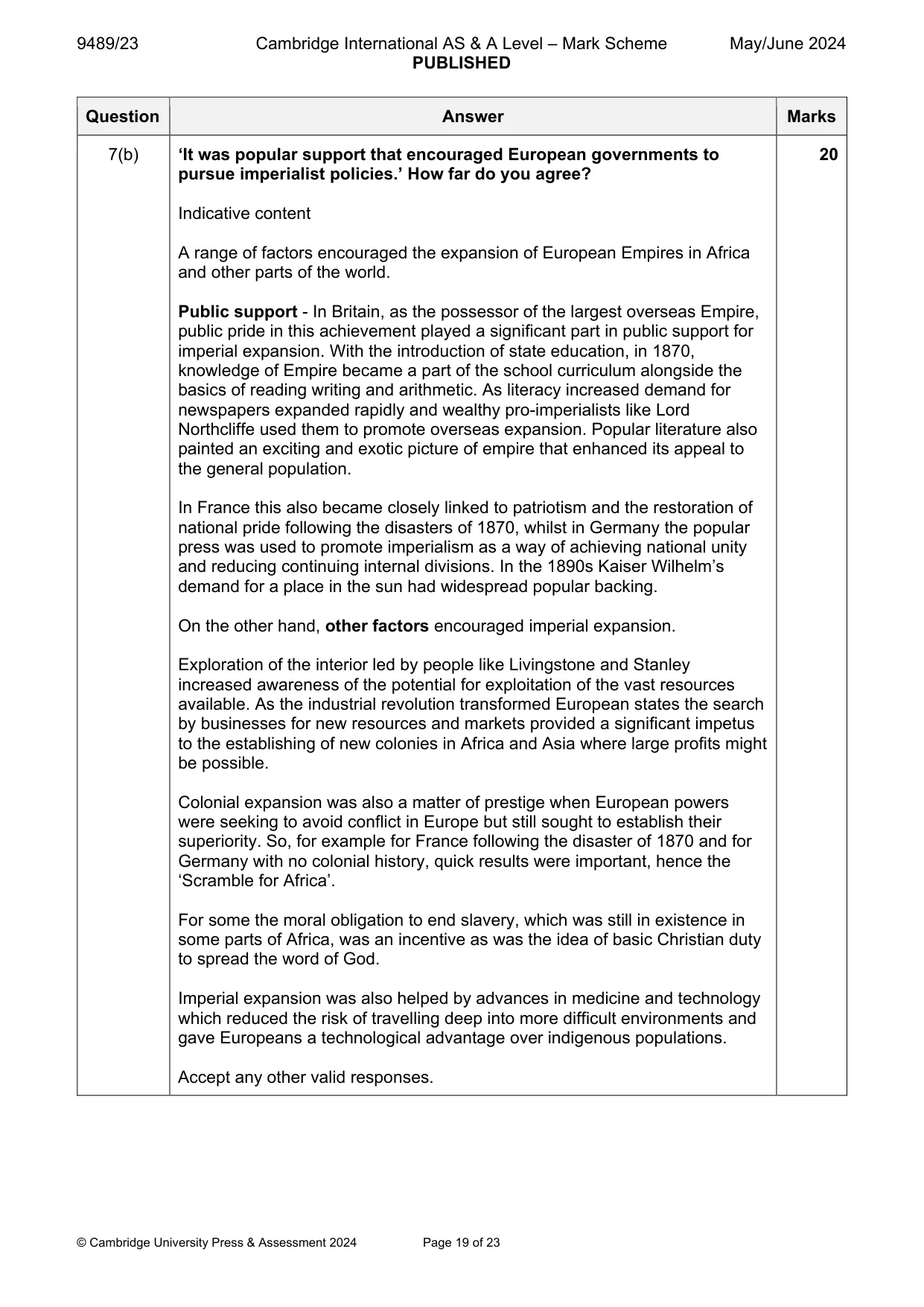
Mark scheme: 7(a) Explain why increasing contact with foreign powers led to significant 10 changes within Japan in the late nineteenth century. Indicative content Commodore Perry was sent by the US president to demand the opening of Japan to US trade and under threat of large-scale violence using all US modern weaponry Japan gave in and signed a treaty in 1854 allowing access to 2 Japanese ports. In 1858 they were forced to sign a second treaty allowing wider access for foreigners to more ports. This led to a radical change in Japan. Perry’s success demonstrated the ineffectiveness of the Japanese miliary rulers (the Shogunate) as samurai swords were no match for modern western weapons. This led to the Meiji Restoration in 1868 when, after a brief civil war, the central power was returned to the ruling emperor and Japan began a process of rapid modernisation. This was based on the realisation that, in order to retain independence, Japan needed to adopt western ways. Japan established a new system of education and government based on western models with a centralised administration and a constitution modelled on Germany. Industrial development was prioritised with the development of mines and factories. These were initiated by the government and then handed over to private enterprise. Developing export markets was prioritised especially textiles. Increased wealth was channelled into developing military strength with one third of the national budget spent on the army and navy and compulsory military service was eventually introduced. Accept any other valid responses. 7(b) ‘It was popular support that encouraged European governments to 20 pursue imperialist policies.’ How far do you agree? Indicative content A range of factors encouraged the expansion of European Empires in Africa and other parts of the world. Public support - In Britain, as the possessor of the largest overseas Empire, public pride in this achievement played a significant part in public support for imperial expansion. With the introduction of state education, in 1870, knowledge of Empire became a part of the school curriculum alongside the basics of reading writing and arithmetic. As literacy increased demand for newspapers expanded rapidly and wealthy pro-imperialists like Lord Northcliffe used them to promote overseas expansion. Popular literature also painted an exciting and exotic picture of empire that enhanced its appeal to the general population. In France this also became closely linked to patriotism and the restoration of national pride following the disasters of 1870, whilst in Germany the popular press was used to promote imperialism as a way of achieving national unity and reducing continuing internal divisions. In the 1890s Kaiser Wilhelm’s demand for a place in the sun had widespread popular backing. On the other hand, other factors encouraged imperial expansion. Exploration of the interior led by people like Livingstone and Stanley increased awareness of the potential for exploitation of the vast resources available. As the industrial revolution transformed European states the search by businesses for new resources and markets provided a significant impetus to the establishing of new colonies in Africa and Asia where large profits might be possible. Colonial expansion was also a matter of prestige when European powers were seeking to avoid conflict in Europe but still sought to establish their superiority. So, for example for France following the disaster of 1870 and for Germany with no colonial history, quick results were important, hence the ‘Scramble for Africa’. For some the moral obligation to end slavery, which was still in existence in some parts of Africa, was an incentive as was the idea of basic Christian duty to spread the word of God. Imperial expansion was also helped by advances in medicine and technology which reduced the risk of travelling deep into more difficult environments and gave Europeans a technological advantage over indigenous populations. Accept any other valid responses.
More questions on Why was imperialism a significant force in Africa from 1870?
Q8 · The League of Nations and international relations in the 1930s (a) Explain why the World…
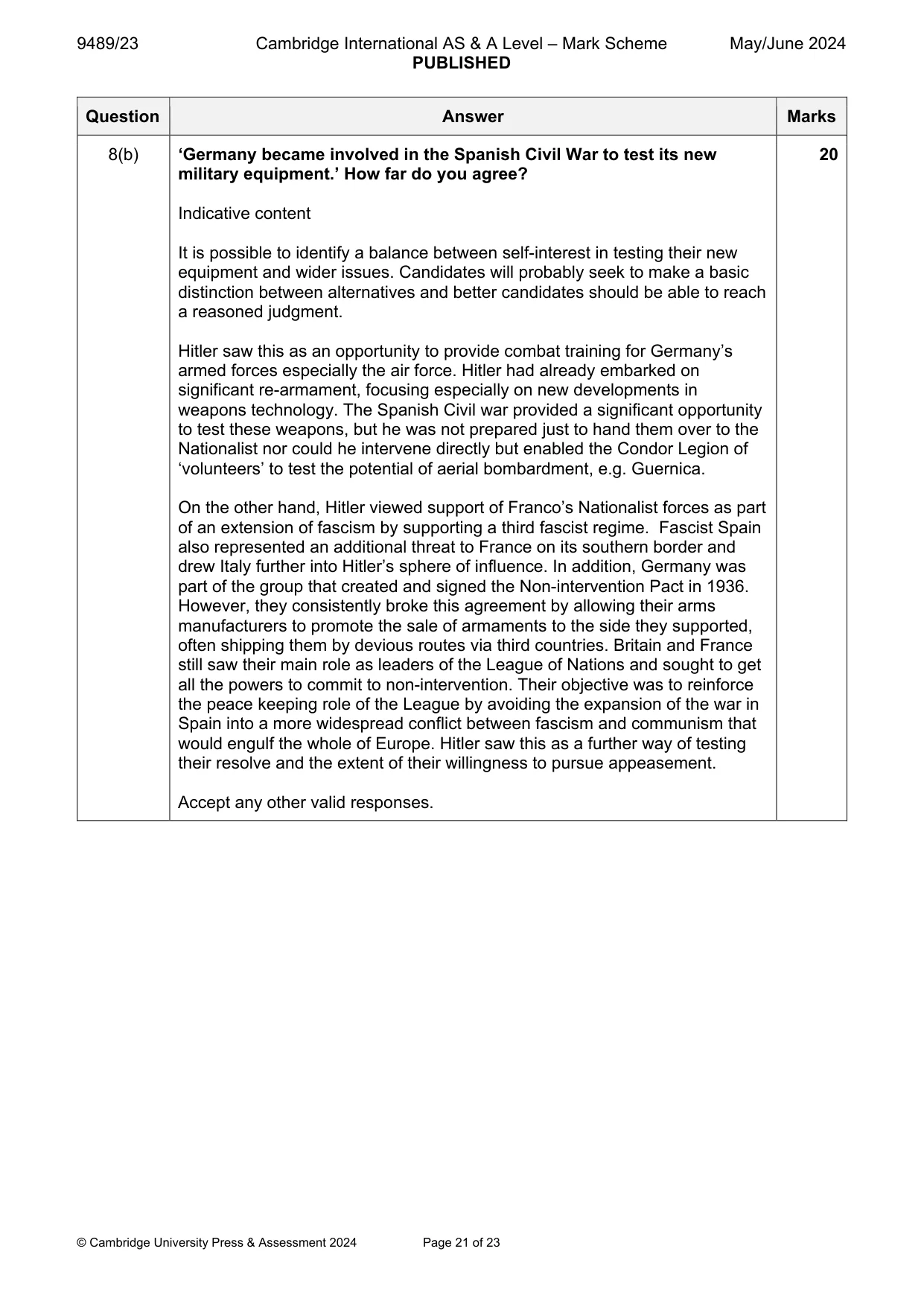
8 The League of Nations and international relations in the 1930s (a) Explain why the World Disarmament Conference (1932–34) ended without agreement. [10] (b) ‘Germany became involved in the Spanish Civil War to test its new military equipment.’ How far do you agree? [20]
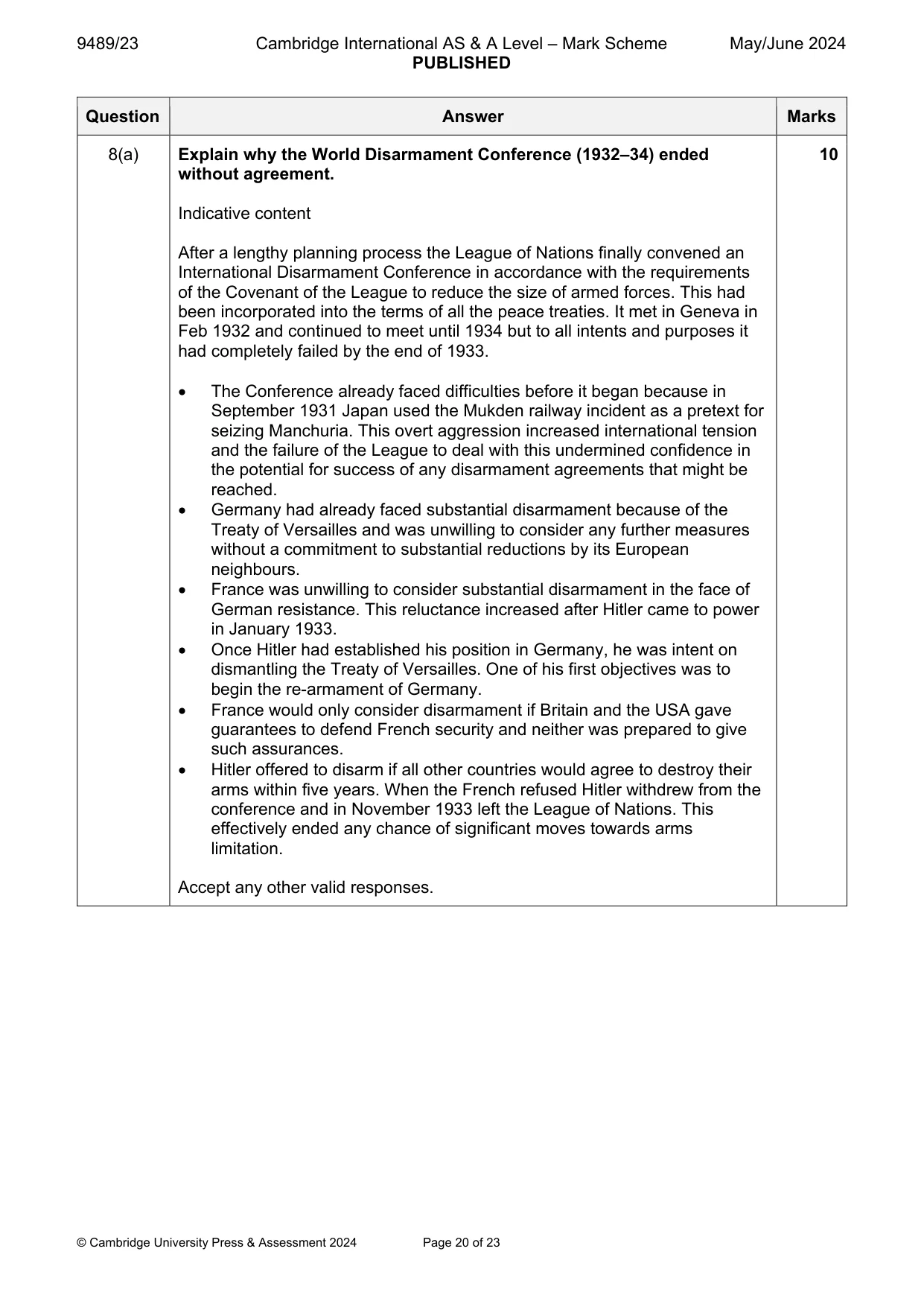
Mark scheme: 8(a) Explain why the World Disarmament Conference (1932–34) ended 10 without agreement. Indicative content After a lengthy planning process the League of Nations finally convened an International Disarmament Conference in accordance with the requirements of the Covenant of the League to reduce the size of armed forces. This had been incorporated into the terms of all the peace treaties. It met in Geneva in Feb 1932 and continued to meet until 1934 but to all intents and purposes it had completely failed by the end of 1933. The Conference already faced difficulties before it began because in September 1931 Japan used the Mukden railway incident as a pretext for seizing Manchuria. This overt aggression increased international tension and the failure of the League to deal with this undermined confidence in the potential for success of any disarmament agreements that might be reached. Germany had already faced substantial disarmament because of the Treaty of Versailles and was unwilling to consider any further measures without a commitment to substantial reductions by its European neighbours. France was unwilling to consider substantial disarmament in the face of German resistance. This reluctance increased after Hitler came to power in January 1933. Once Hitler had established his position in Germany, he was intent on dismantling the Treaty of Versailles. One of his first objectives was to begin the re-armament of Germany. France would only consider disarmament if Britain and the USA gave guarantees to defend French security and neither was prepared to give such assurances. Hitler offered to disarm if all other countries would agree to destroy their arms within five years. When the French refused Hitler withdrew from the conference and in November 1933 left the League of Nations. This effectively ended any chance of significant moves towards arms limitation. Accept any other valid responses. 8(b) ‘Germany became involved in the Spanish Civil War to test its new 20 military equipment.’ How far do you agree? Indicative content It is possible to identify a balance between self-interest in testing their new equipment and wider issues. Candidates will probably seek to make a basic distinction between alternatives and better candidates should be able to reach a reasoned judgment. Hitler saw this as an opportunity to provide combat training for Germany’s armed forces especially the air force. Hitler had already embarked on significant re-armament, focusing especially on new developments in weapons technology. The Spanish Civil war provided a significant opportunity to test these weapons, but he was not prepared just to hand them over to the Nationalist nor could he intervene directly but enabled the Condor Legion of ‘volunteers’ to test the potential of aerial bombardment, e.g. Guernica. On the other hand, Hitler viewed support of Franco’s Nationalist forces as part of an extension of fascism by supporting a third fascist regime. Fascist Spain also represented an additional threat to France on its southern border and drew Italy further into Hitler’s sphere of influence. In addition, Germany was part of the group that created and signed the Non-intervention Pact in 1936. However, they consistently broke this agreement by allowing their arms manufacturers to promote the sale of armaments to the side they supported, often shipping them by devious routes via third countries. Britain and France still saw their main role as leaders of the League of Nations and sought to get all the powers to commit to non-intervention. Their objective was to reinforce the peace keeping role of the League by avoiding the expansion of the war in Spain into a more widespread conflict between fascism and communism that would engulf the whole of Europe. Hitler saw this as a further way of testing their resolve and the extent of their willingness to pursue appeasement. Accept any other valid responses.
More questions on How did the rise of extremism affect international relations?
Q9 · China and Japan, 1912–45 (a) Explain why the attempt to establish parliamentary democracy…
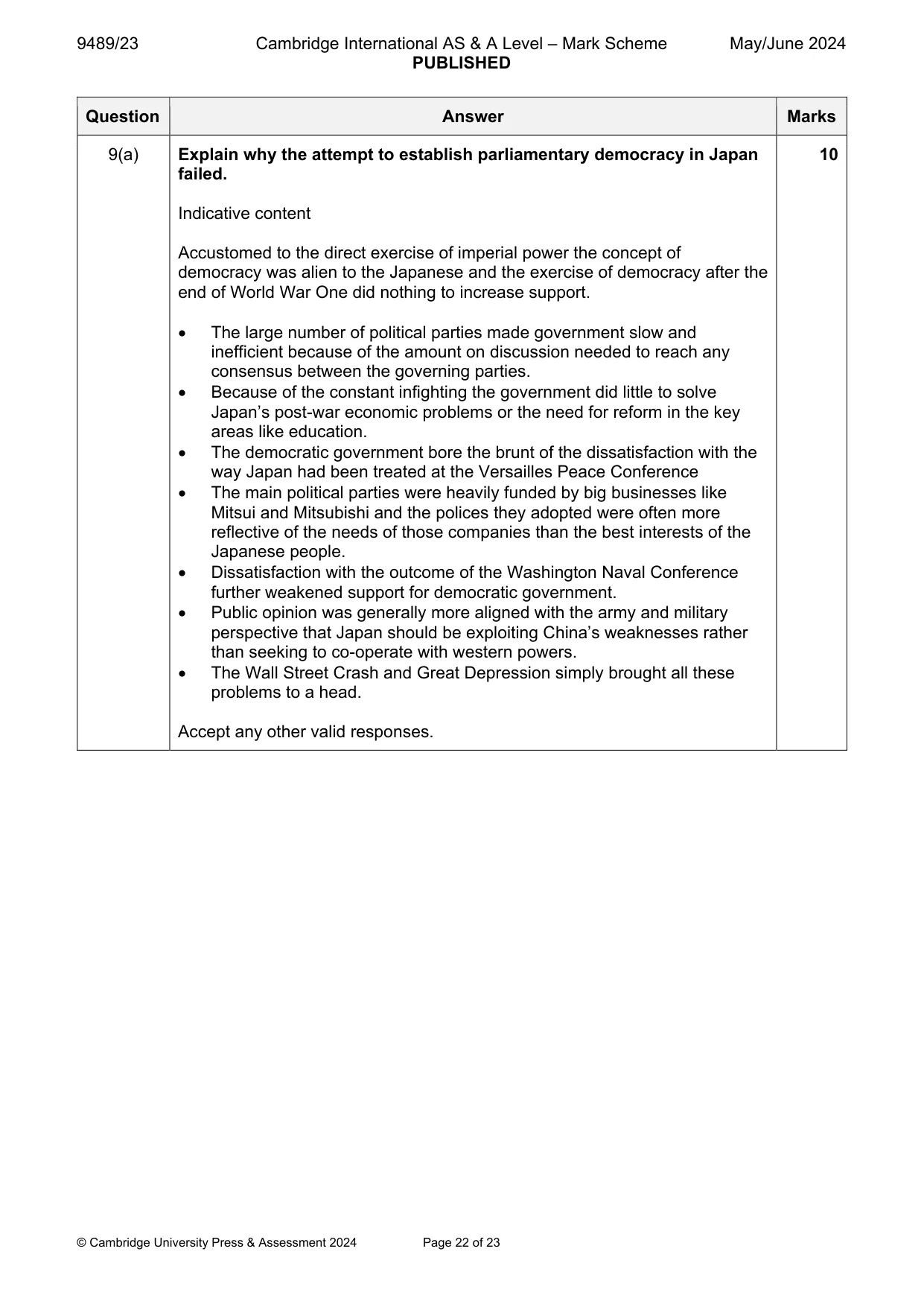
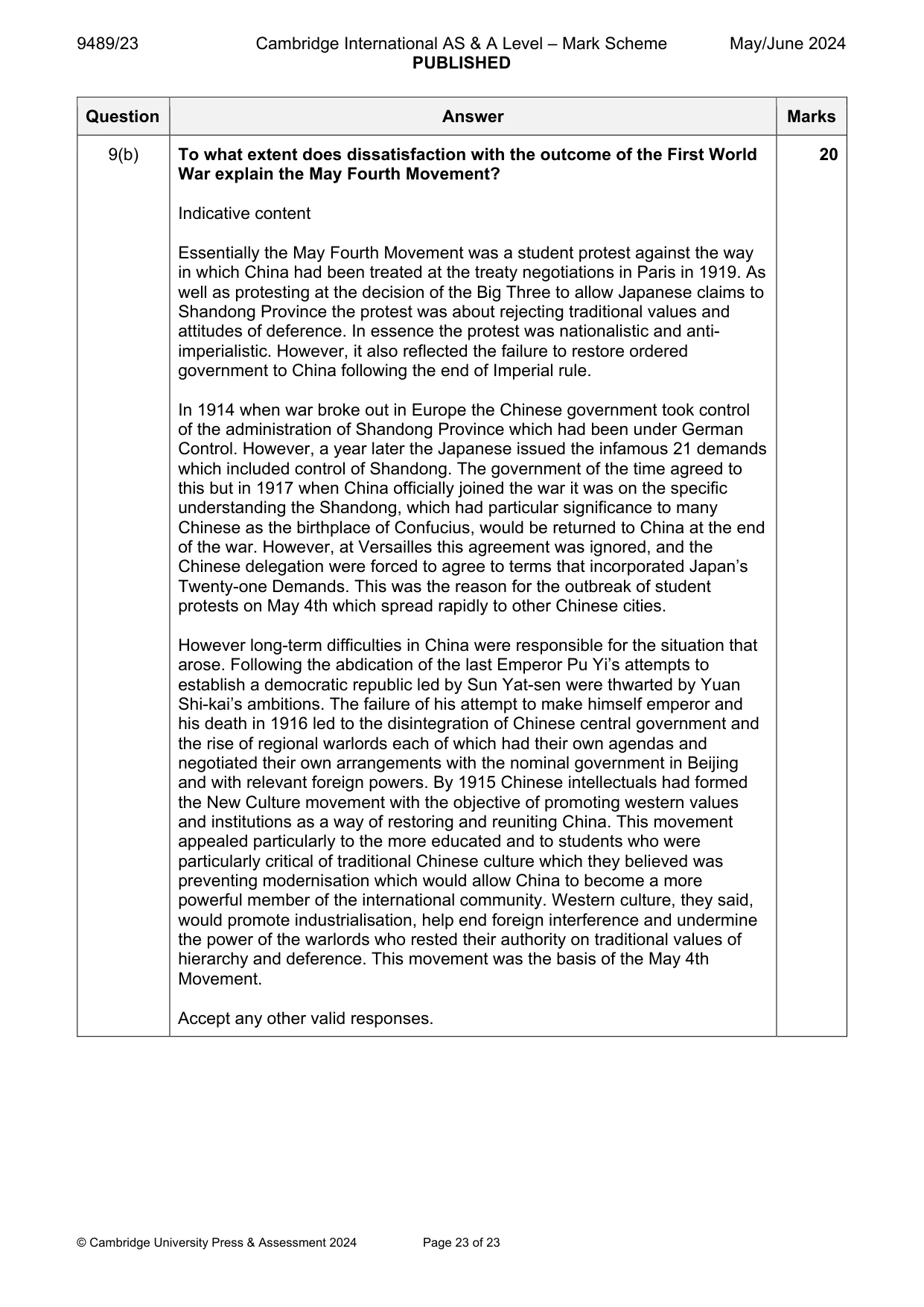
9 China and Japan, 1912–45 (a) Explain why the attempt to establish parliamentary democracy in Japan failed. [10] (b) To what extent does dissatisfaction with the outcome of the First World War explain the May Fourth Movement? [20]
Mark scheme: 9(a) Explain why the attempt to establish parliamentary democracy in Japan 10 failed. Indicative content Accustomed to the direct exercise of imperial power the concept of democracy was alien to the Japanese and the exercise of democracy after the end of World War One did nothing to increase support. The large number of political parties made government slow and inefficient because of the amount on discussion needed to reach any consensus between the governing parties. Because of the constant infighting the government did little to solve Japan’s post-war economic problems or the need for reform in the key areas like education. The democratic government bore the brunt of the dissatisfaction with the way Japan had been treated at the Versailles Peace Conference The main political parties were heavily funded by big businesses like Mitsui and Mitsubishi and the polices they adopted were often more reflective of the needs of those companies than the best interests of the Japanese people. Dissatisfaction with the outcome of the Washington Naval Conference further weakened support for democratic government. Public opinion was generally more aligned with the army and military perspective that Japan should be exploiting China’s weaknesses rather than seeking to co-operate with western powers. The Wall Street Crash and Great Depression simply brought all these problems to a head. Accept any other valid responses. 9(b) To what extent does dissatisfaction with the outcome of the First World 20 War explain the May Fourth Movement? Indicative content Essentially the May Fourth Movement was a student protest against the way in which China had been treated at the treaty negotiations in Paris in 1919. As well as protesting at the decision of the Big Three to allow Japanese claims to Shandong Province the protest was about rejecting traditional values and attitudes of deference. In essence the protest was nationalistic and anti- imperialistic. However, it also reflected the failure to restore ordered government to China following the end of Imperial rule. In 1914 when war broke out in Europe the Chinese government took control of the administration of Shandong Province which had been under German Control. However, a year later the Japanese issued the infamous 21 demands which included control of Shandong. The government of the time agreed to this but in 1917 when China officially joined the war it was on the specific understanding the Shandong, which had particular significance to many Chinese as the birthplace of Confucius, would be returned to China at the end of the war. However, at Versailles this agreement was ignored, and the Chinese delegation were forced to agree to terms that incorporated Japan’s Twenty-one Demands. This was the reason for the outbreak of student protests on May 4th which spread rapidly to other Chinese cities. However long-term difficulties in China were responsible for the situation that arose. Following the abdication of the last Emperor Pu Yi’s attempts to establish a democratic republic led by Sun Yat-sen were thwarted by Yuan Shi-kai’s ambitions. The failure of his attempt to make himself emperor and his death in 1916 led to the disintegration of Chinese central government and the rise of regional warlords each of which had their own agendas and negotiated their own arrangements with the nominal government in Beijing and with relevant foreign powers. By 1915 Chinese intellectuals had formed the New Culture movement with the objective of promoting western values and institutions as a way of restoring and reuniting China. This movement appealed particularly to the more educated and to students who were particularly critical of traditional Chinese culture which they believed was preventing modernisation which would allow China to become a more powerful member of the international community. Western culture, they said, would promote industrialisation, help end foreign interference and undermine the power of the warlords who rested their authority on traditional values of hierarchy and deference. This movement was the basis of the May 4th Movement. Accept any other valid responses.
More questions on Why did Japan emerge as a world power and what was the impact on international
What was in this paper
The subtopics covered by these 9 questions, and how many questions each got. Open one in a new tab to see every Cambridge question on it.
1How did the rise of extremism affect international relations?1What caused the rise and fall of Napoleon Bonaparte?1What happened during the 1848–49 revolutions and what were their consequences?1What were the aims of Reconstruction and how successful was it?1Why did Japan emerge as a world power and what was the impact on international1Why did the Civil War break out in April 1861?1Why was imperialism a significant force in Africa from 1870?1Why was there rapid industrialisation after 1870?1What you needed in this session
Cambridge’s own grade thresholds for 2024 May/June, Paper 2 · Variant 3. A higher threshold means an easier paper — the bar moves with how the cohort did.