Cambridge A Level History 9489 — 2025 Feb/March Paper 2 · Variant 2
9489/22/F/M/25 · 9 questions · 60 marks · ≈68 min
The question paper and its mark scheme, free to read here and free to download. This is Cambridge’s own paper, exactly as it was sat.
Question paper4 pages
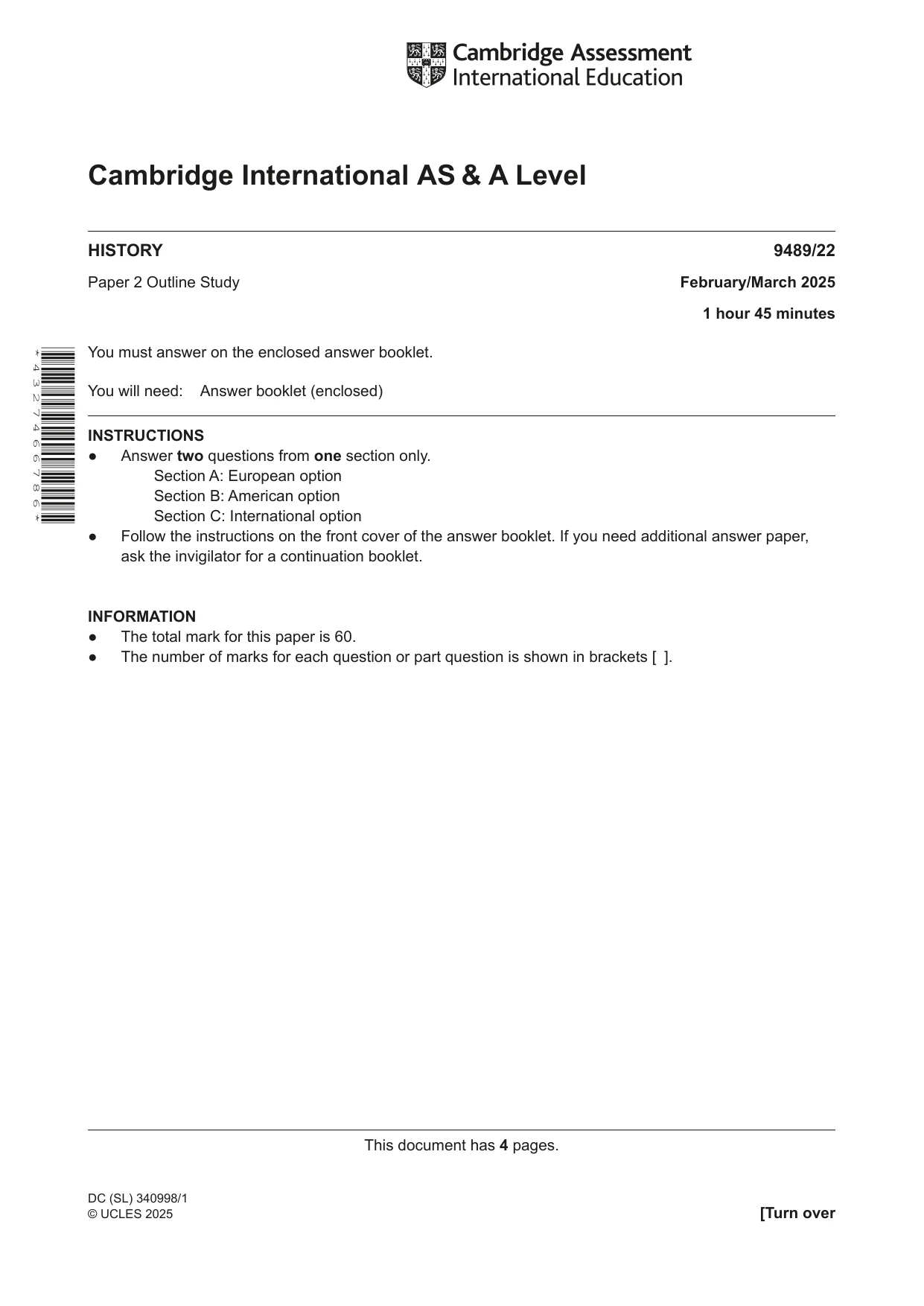
Mark scheme20 pages
Answers below. Sit the paper first if you are practising.
Questions as text
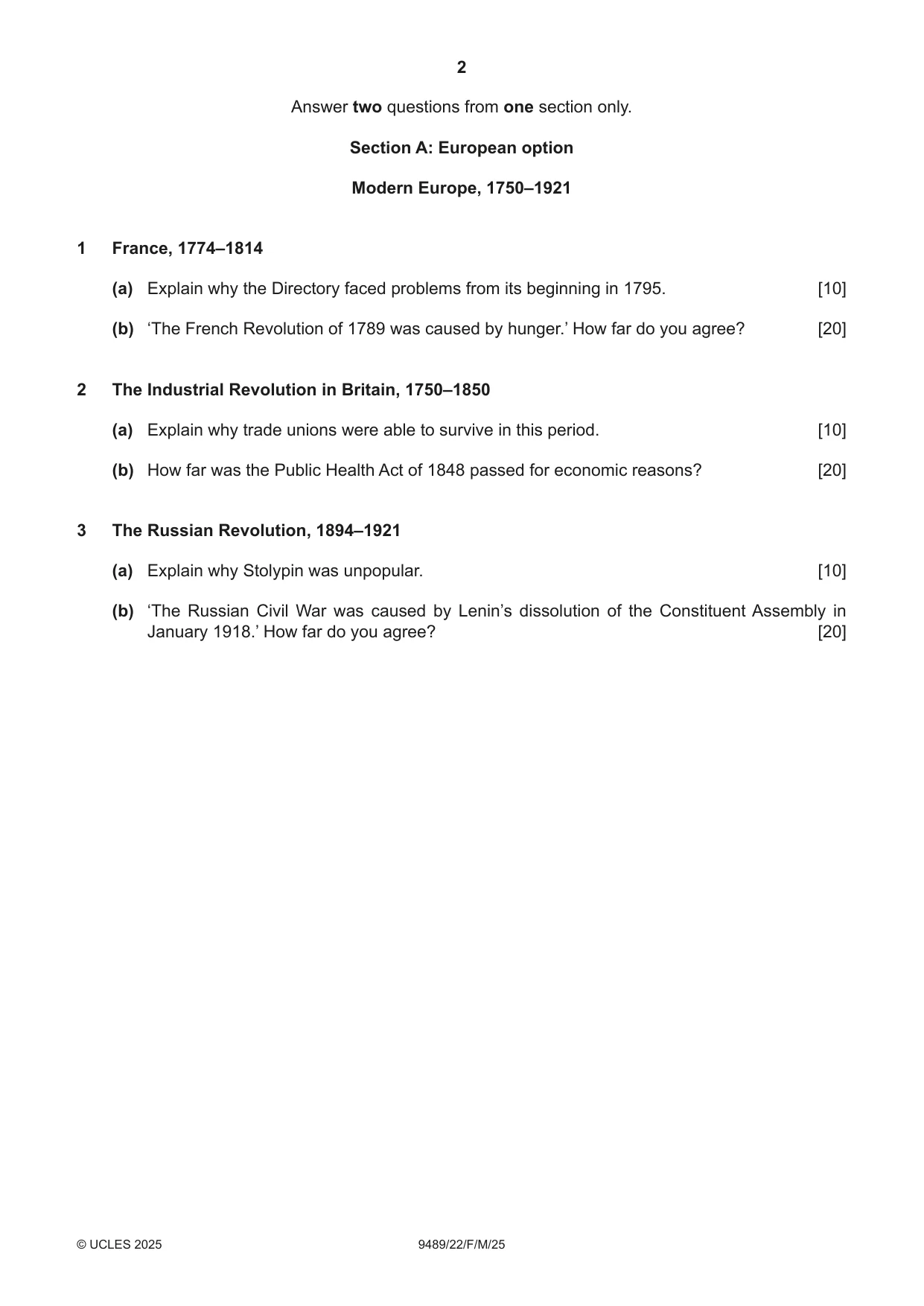
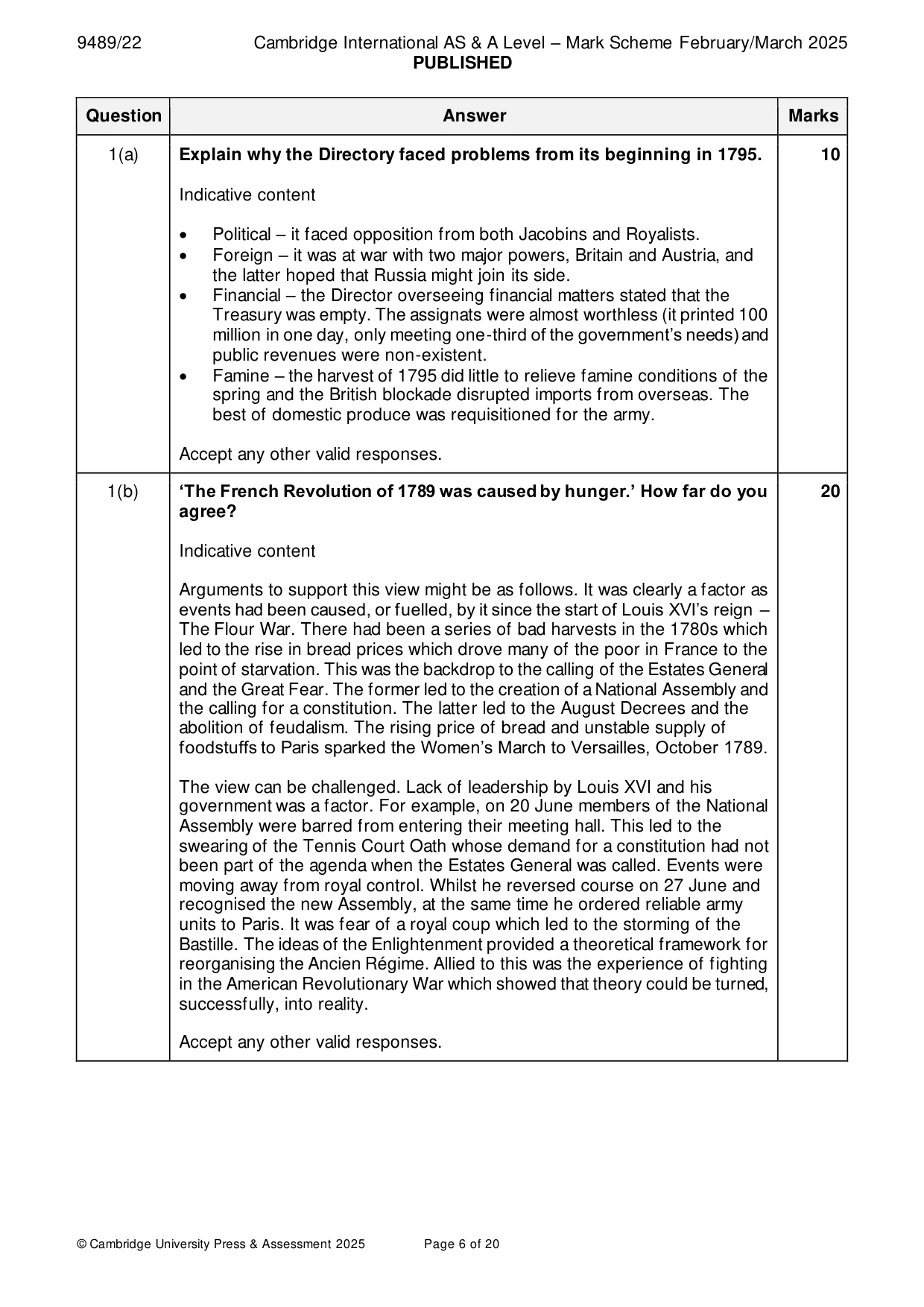
Q1 · France, 1774–1814 (a) Explain why the Directory faced problems from its beginning in 1795
1 France, 1774–1814 (a) Explain why the Directory faced problems from its beginning in 1795. [10] (b) ‘The French Revolution of 1789 was caused by hunger.’ How far do you agree? [20]
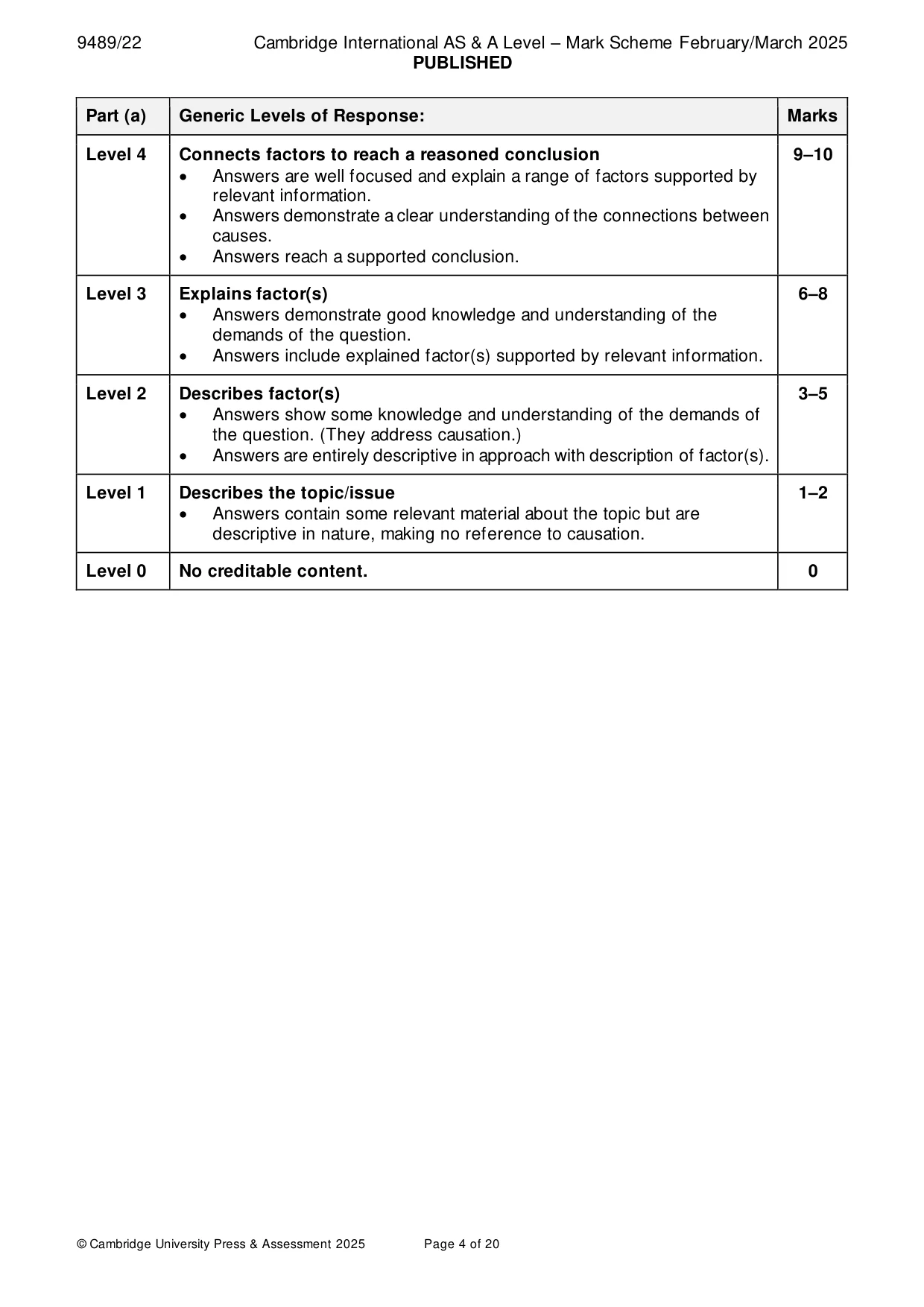
Mark scheme: Question Answer Marks 1(a) Explain why the Directory faced problems from its beginning in 1795. 10 Indicative content • Political – it faced opposition from both Jacobins and Royalists. • Foreign – it was at war with two major powers, Britain and Austria, and the latter hoped that Russia might join its side. • Financial – the Director overseeing financial matters stated that the Treasury was empty. The assignats were almost worthless (it printed 100 million in one day, only meeting one-third of the government’s needs) and public revenues were non-existent. • Famine – the harvest of 1795 did little to relieve famine conditions of the spring and the British blockade disrupted imports from overseas. The best of domestic produce was requisitioned for the army. Accept any other valid responses. 1(b) ‘The French Revolution of 1789 was caused by hunger.’ How far do you 20 agree? Indicative content Arguments to support this view might be as follows. It was clearly a factor as events had been caused, or fuelled, by it since the start of Louis XVI’s reign – The Flour War. There had been a series of bad harvests in the 1780s which led to the rise in bread prices which drove many of the poor in France to the point of starvation. This was the backdrop to the calling of the Estates General and the Great Fear. The former led to the creation of a National Assembly and the calling for a constitution. The latter led to the August Decrees and the abolition of feudalism. The rising price of bread and unstable supply of foodstuffs to Paris sparked the Women’s March to Versailles, October 1789. The view can be challenged. Lack of leadership by Louis XVI and his government was a factor. For example, on 20 June members of the National Assembly were barred from entering their meeting hall. This led to the swearing of the Tennis Court Oath whose demand for a constitution had not been part of the agenda when the Estates General was called. Events were moving away from royal control. Whilst he reversed course on 27 June and recognised the new Assembly, at the same time he ordered reliable army units to Paris. It was fear of a royal coup which led to the storming of the Bastille. The ideas of the Enlightenment provided a theoretical framework for reorganising the Ancien Régime. Allied to this was the experience of fighting in the American Revolutionary War which showed that theory could be turned, successfully, into reality. Accept any other valid responses.
More questions on What were the causes and immediate consequences of the 1789 Revolution?
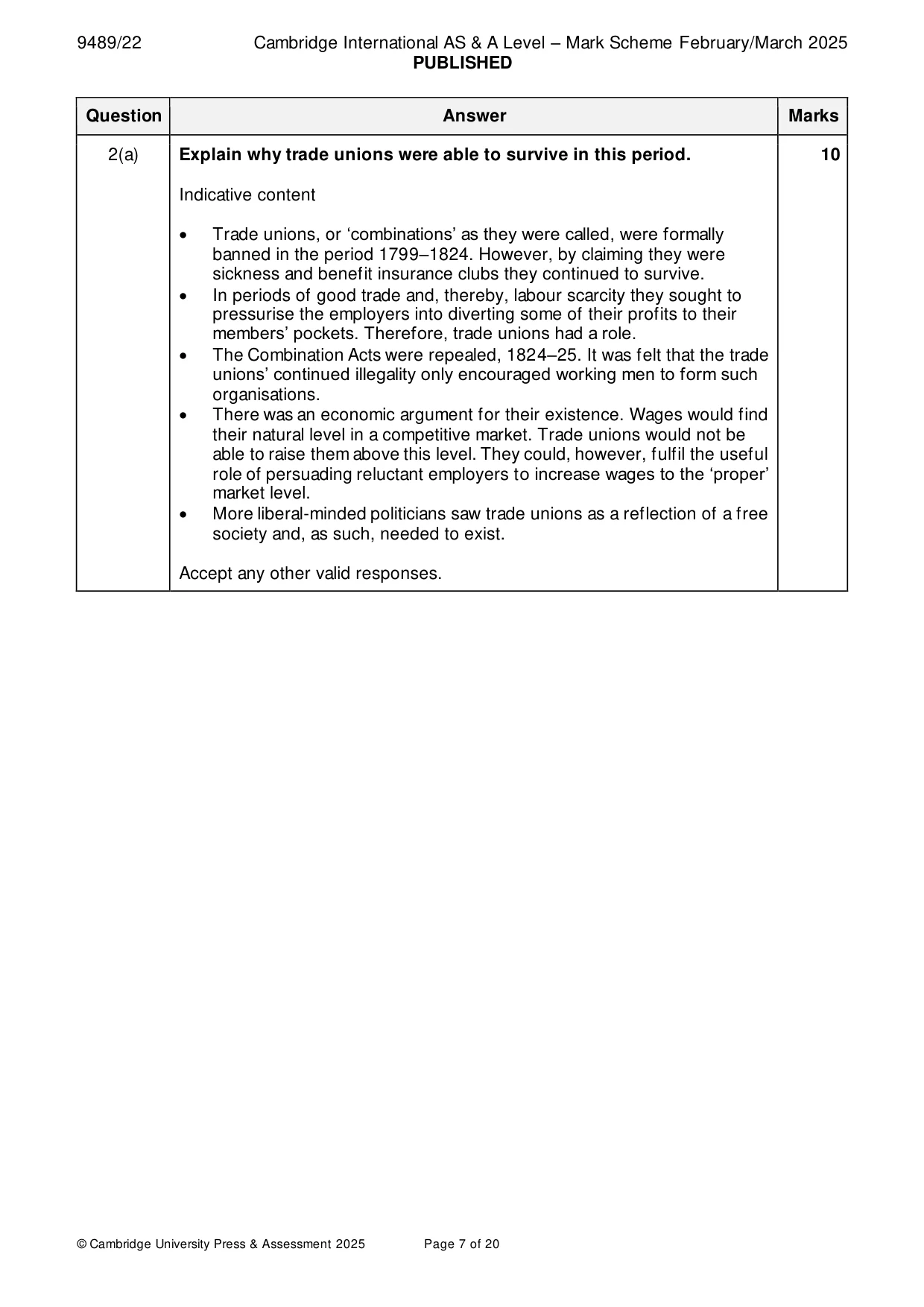
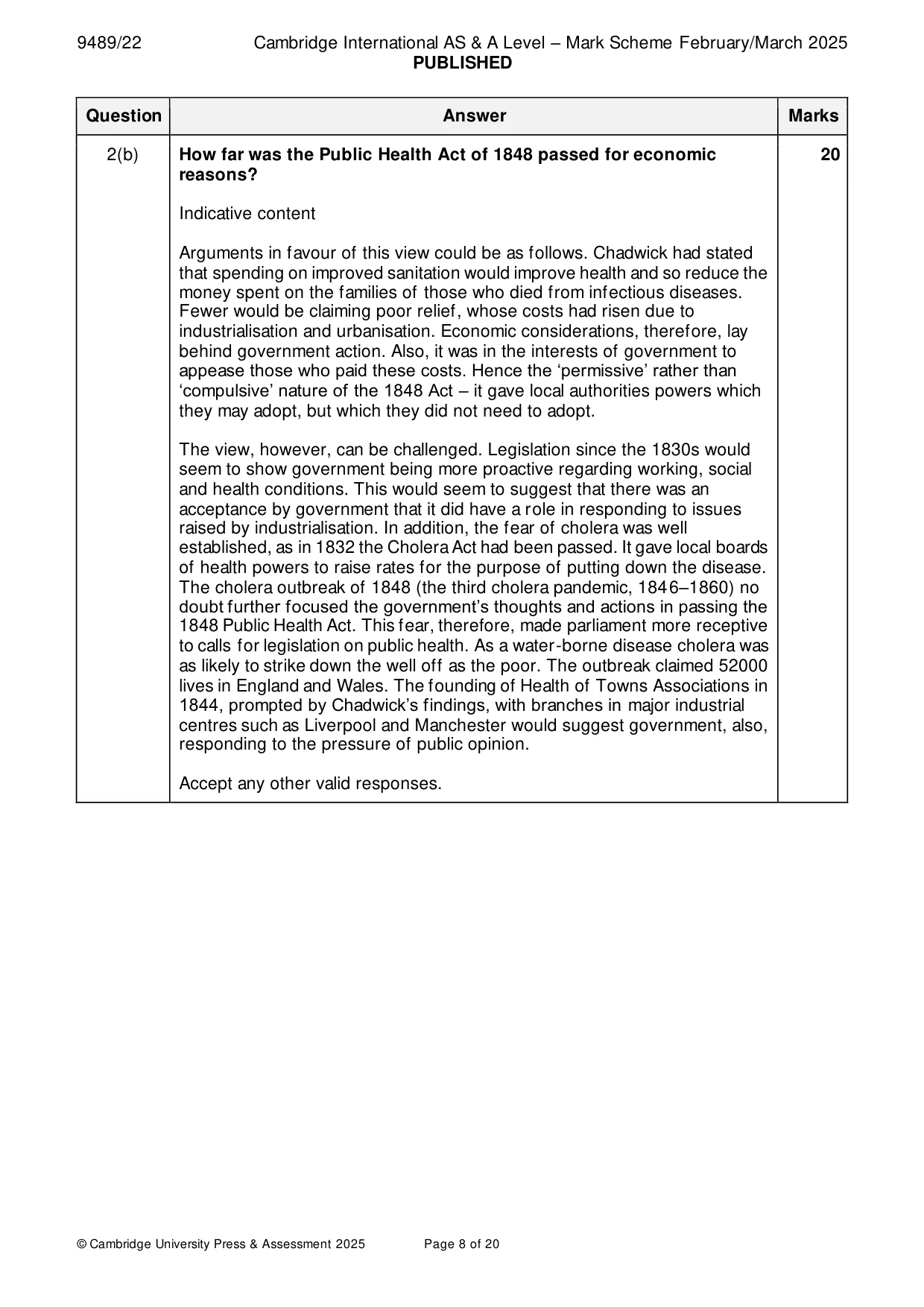
Q2 · The Industrial Revolution in Britain, 1750–1850 (a) Explain why trade unions were able to…
2 The Industrial Revolution in Britain, 1750–1850 (a) Explain why trade unions were able to survive in this period. [10] (b) How far was the Public Health Act of 1848 passed for economic reasons? [20]
Mark scheme: 2(a) Explain why trade unions were able to survive in this period. 10 Indicative content • Trade unions, or ‘combinations’ as they were called, were formally banned in the period 1799–1824. However, by claiming they were sickness and benefit insurance clubs they continued to survive. • In periods of good trade and, thereby, labour scarcity they sought to pressurise the employers into diverting some of their profits to their members’ pockets. Therefore, trade unions had a role. • The Combination Acts were repealed, 1824–25. It was felt that the trade unions’ continued illegality only encouraged working men to form such organisations. • There was an economic argument for their existence. Wages would find their natural level in a competitive market. Trade unions would not be able to raise them above this level. They could, however, fulfil the useful role of persuading reluctant employers to increase wages to the ‘proper’ market level. • More liberal-minded politicians saw trade unions as a reflection of a free society and, as such, needed to exist. Accept any other valid responses. 2(b) How far was the Public Health Act of 1848 passed for economic 20 reasons? Indicative content Arguments in favour of this view could be as follows. Chadwick had stated that spending on improved sanitation would improve health and so reduce the money spent on the families of those who died from infectious diseases. Fewer would be claiming poor relief, whose costs had risen due to industrialisation and urbanisation. Economic considerations, therefore, lay behind government action. Also, it was in the interests of government to appease those who paid these costs. Hence the ‘permissive’ rather than ‘compulsive’ nature of the 1848 Act – it gave local authorities powers which they may adopt, but which they did not need to adopt. The view, however, can be challenged. Legislation since the 1830s would seem to show government being more proactive regarding working, social and health conditions. This would seem to suggest that there was an acceptance by government that it did have a role in responding to issues raised by industrialisation. In addition, the fear of cholera was well established, as in 1832 the Cholera Act had been passed. It gave local boards of health powers to raise rates for the purpose of putting down the disease. The cholera outbreak of 1848 (the third cholera pandemic, 1846–1860) no doubt further focused the government’s thoughts and actions in passing the 1848 Public Health Act. This fear, therefore, made parliament more receptive to calls for legislation on public health. As a water-borne disease cholera was as likely to strike down the well off as the poor. The outbreak claimed 52000 lives in England and Wales. The founding of Health of Towns Associations in 1844, prompted by Chadwick’s findings, with branches in major industrial centres such as Liverpool and Manchester would suggest government, also, responding to the pressure of public opinion. Accept any other valid responses.
More questions on What were the consequences of the rapid economic growth after 1870?
Q3 · The Russian Revolution, 1894–1921 (a) Explain why Stolypin was unpopular
3 The Russian Revolution, 1894–1921 (a) Explain why Stolypin was unpopular. [10] (b) ‘The Russian Civil War was caused by Lenin’s dissolution of the Constituent Assembly in January 1918.’ How far do you agree? [20]
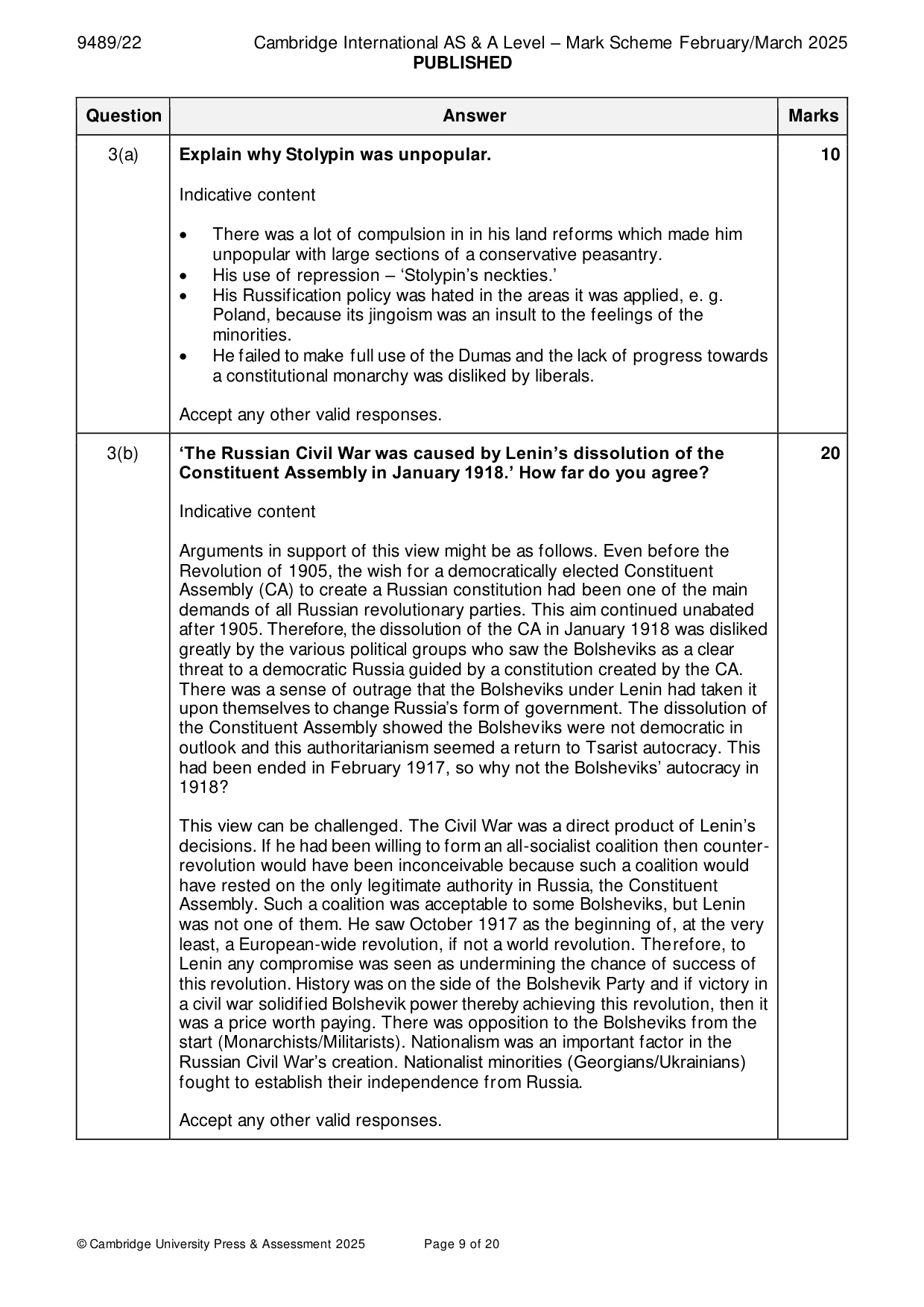
Mark scheme: 3(a) Explain why Stolypin was unpopular. 10 Indicative content • There was a lot of compulsion in in his land reforms which made him unpopular with large sections of a conservative peasantry. • His use of repression – ‘Stolypin’s neckties.’ • His Russification policy was hated in the areas it was applied, e. g. Poland, because its jingoism was an insult to the feelings of the minorities. • He failed to make full use of the Dumas and the lack of progress towards a constitutional monarchy was disliked by liberals. Accept any other valid responses. 3(b) ‘The Russian Civil War was caused by Lenin’s dissolution of the 20 Constituent Assembly in January 1918.’ How far do you agree? Indicative content Arguments in support of this view might be as follows. Even before the Revolution of 1905, the wish for a democratically elected Constituent Assembly (CA) to create a Russian constitution had been one of the main demands of all Russian revolutionary parties. This aim continued unabated after 1905. Therefore, the dissolution of the CA in January 1918 was disliked greatly by the various political groups who saw the Bolsheviks as a clear threat to a democratic Russia guided by a constitution created by the CA. There was a sense of outrage that the Bolsheviks under Lenin had taken it upon themselves to change Russia’s form of government. The dissolution of the Constituent Assembly showed the Bolsheviks were not democratic in outlook and this authoritarianism seemed a return to Tsarist autocracy. This had been ended in February 1917, so why not the Bolsheviks’ autocracy in 1918? This view can be challenged. The Civil War was a direct product of Lenin’s decisions. If he had been willing to form an all-socialist coalition then counter- revolution would have been inconceivable because such a coalition would have rested on the only legitimate authority in Russia, the Constituent Assembly. Such a coalition was acceptable to some Bolsheviks, but Lenin was not one of them. He saw October 1917 as the beginning of, at the very least, a European-wide revolution, if not a world revolution. Therefore, to Lenin any compromise was seen as undermining the chance of success of this revolution. History was on the side of the Bolshevik Party and if victory in a civil war solidified Bolshevik power thereby achieving this revolution, then it was a price worth paying. There was opposition to the Bolsheviks from the start (Monarchists/Militarists). Nationalism was an important factor in the Russian Civil War’s creation. Nationalist minorities (Georgians/Ukrainians) fought to establish their independence from Russia. Accept any other valid responses.
More questions on How were the Bolsheviks able to consolidate their power up to 1924?
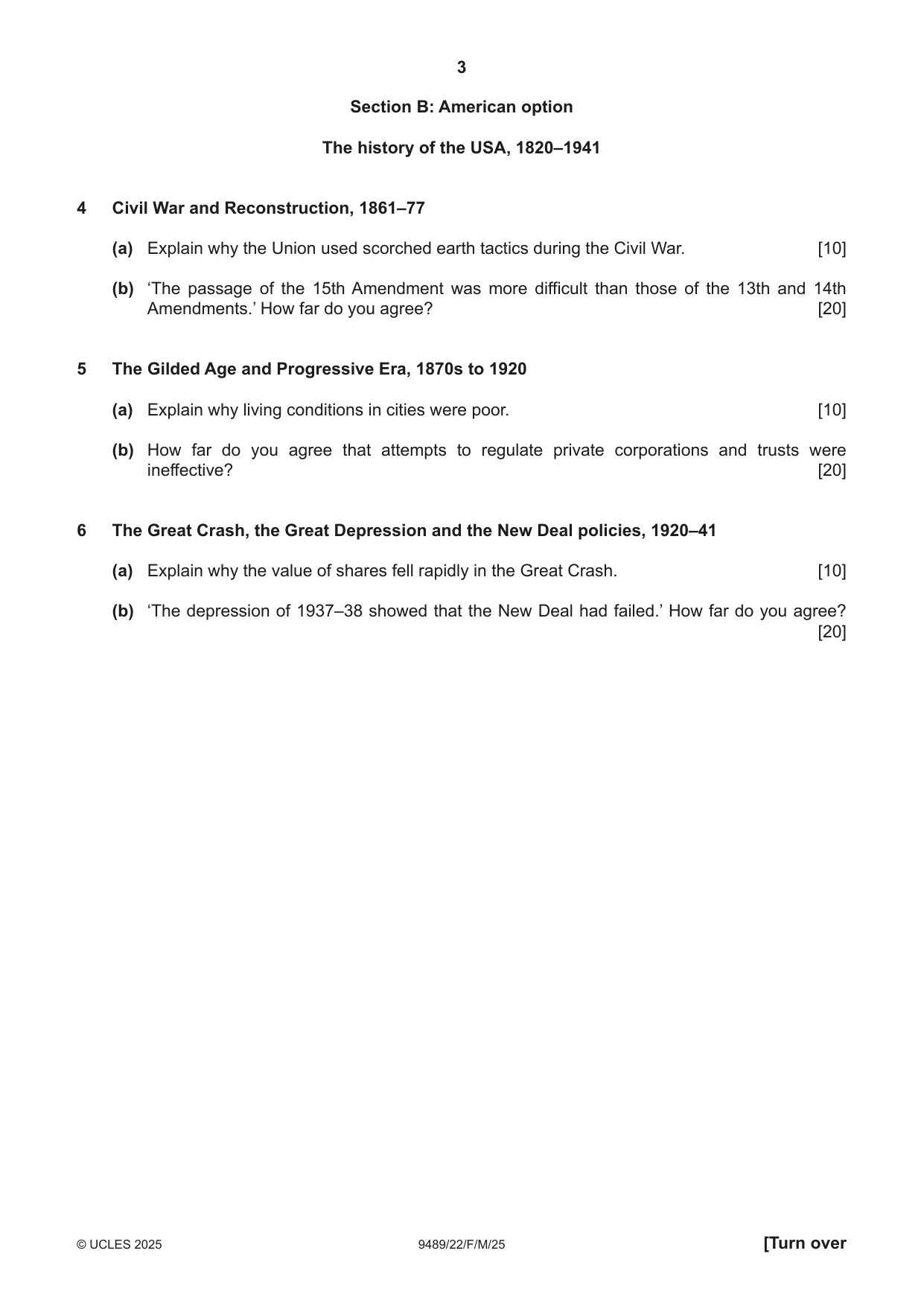
Q4 · Civil War and Reconstruction, 1861–77 (a) Explain why the Union used scorched earth…
4 Civil War and Reconstruction, 1861–77 (a) Explain why the Union used scorched earth tactics during the Civil War. [10] (b) ‘The passage of the 15th Amendment was more difficult than those of the 13th and 14th Amendments.’ How far do you agree? [20]
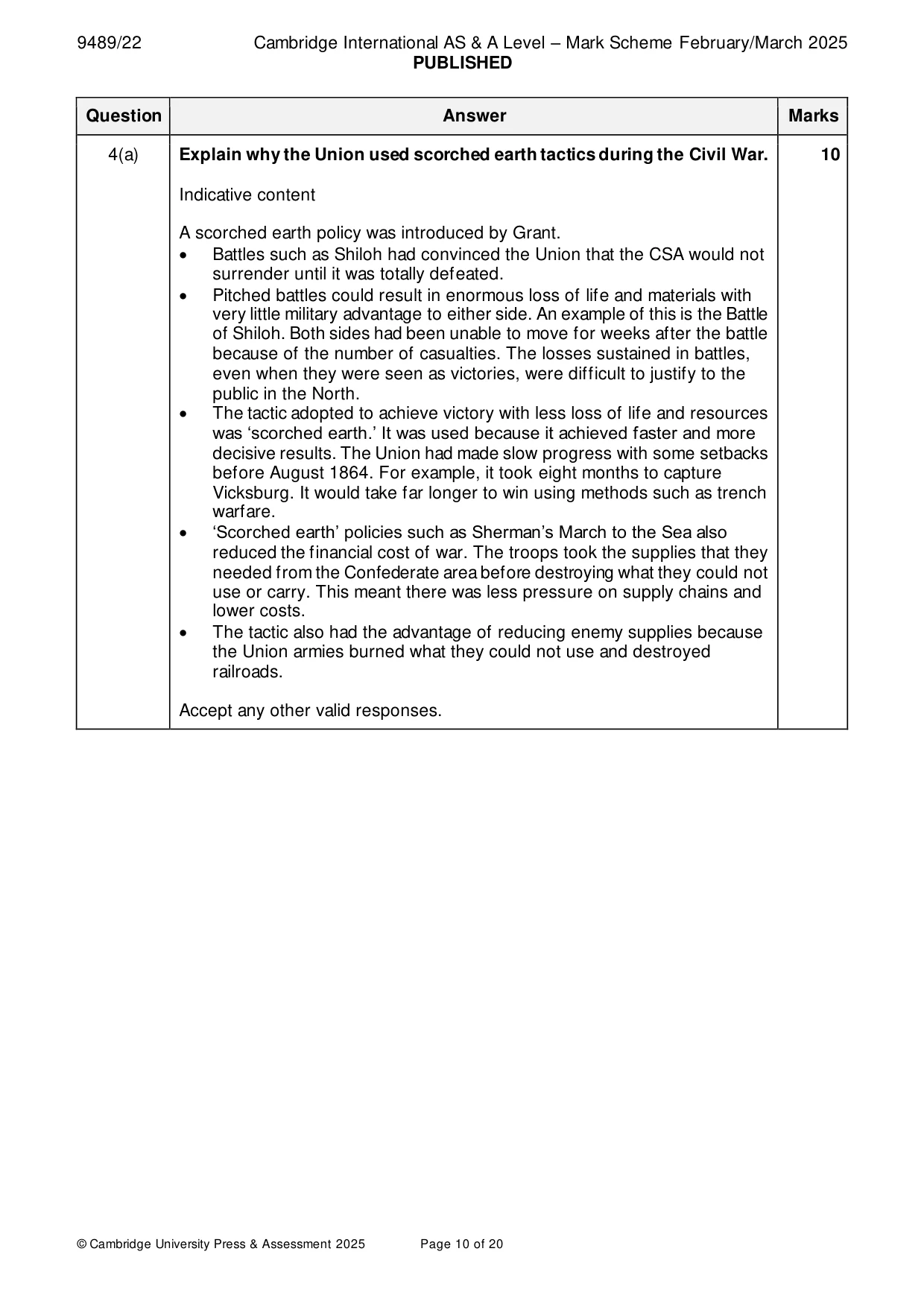
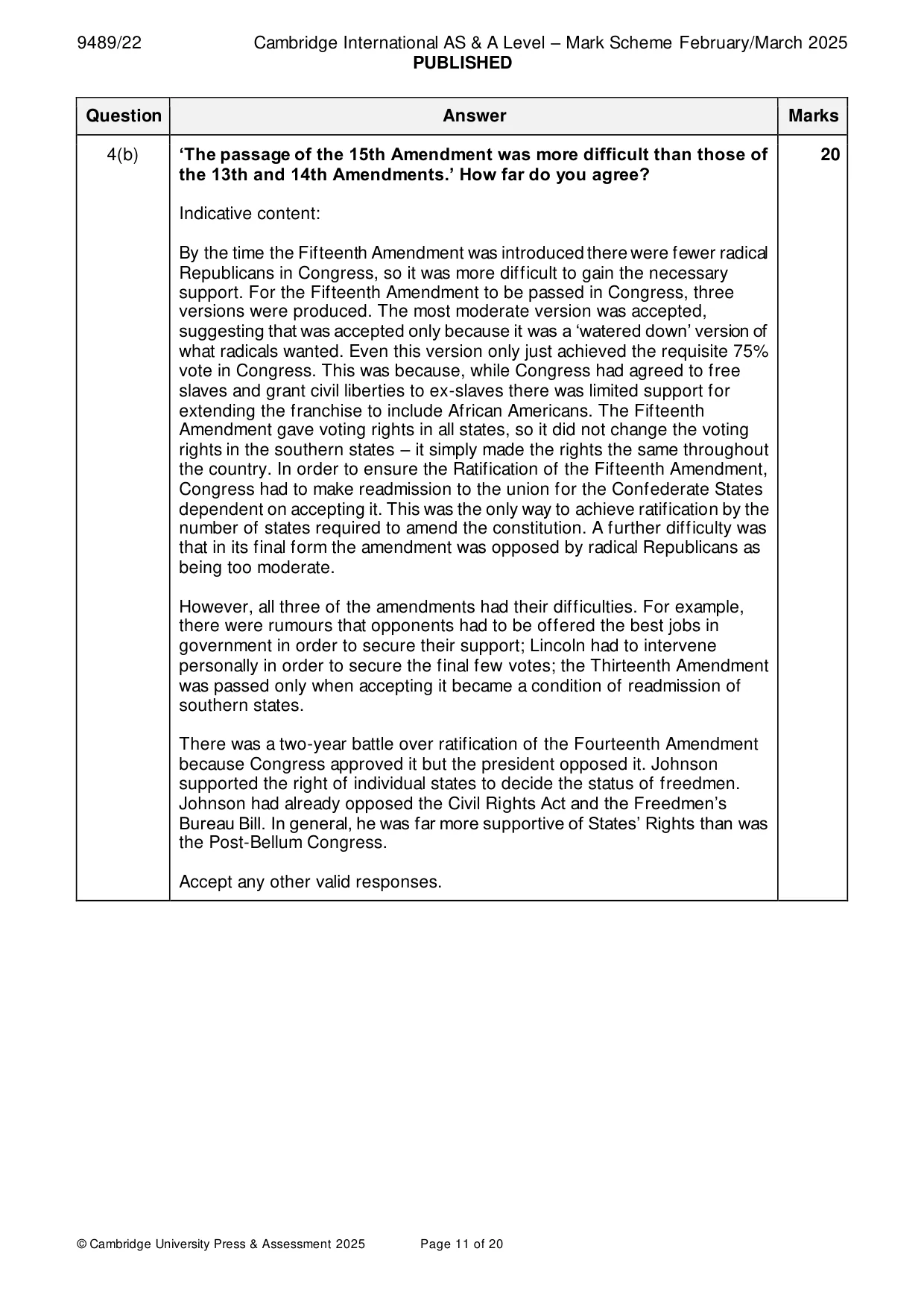
Mark scheme: 4(a) Explain why the Union used scorched earth tactics during the Civil War. 10 Indicative content A scorched earth policy was introduced by Grant. • Battles such as Shiloh had convinced the Union that the CSA would not surrender until it was totally defeated. • Pitched battles could result in enormous loss of life and materials with very little military advantage to either side. An example of this is the Battle of Shiloh. Both sides had been unable to move for weeks after the battle because of the number of casualties. The losses sustained in battles, even when they were seen as victories, were difficult to justify to the public in the North. • The tactic adopted to achieve victory with less loss of life and resources was ‘scorched earth.’ It was used because it achieved faster and more decisive results. The Union had made slow progress with some setbacks before August 1864. For example, it took eight months to capture Vicksburg. It would take far longer to win using methods such as trench warfare. • ‘Scorched earth’ policies such as Sherman’s March to the Sea also reduced the financial cost of war. The troops took the supplies that they needed from the Confederate area before destroying what they could not use or carry. This meant there was less pressure on supply chains and lower costs. • The tactic also had the advantage of reducing enemy supplies because the Union armies burned what they could not use and destroyed railroads. Accept any other valid responses. 4(b) ‘The passage of the 15th Amendment was more difficult than those of 20 the 13th and 14th Amendments.’ How far do you agree? Indicative content: By the time the Fifteenth Amendment was introduced there were fewer radical Republicans in Congress, so it was more difficult to gain the necessary support. For the Fifteenth Amendment to be passed in Congress, three versions were produced. The most moderate version was accepted, suggesting that was accepted only because it was a ‘watered down’ version of what radicals wanted. Even this version only just achieved the requisite 75% vote in Congress. This was because, while Congress had agreed to free slaves and grant civil liberties to ex-slaves there was limited support for extending the franchise to include African Americans. The Fifteenth Amendment gave voting rights in all states, so it did not change the voting rights in the southern states – it simply made the rights the same throughout the country. In order to ensure the Ratification of the Fifteenth Amendment, Congress had to make readmission to the union for the Confederate States dependent on accepting it. This was the only way to achieve ratification by the number of states required to amend the constitution. A further difficulty was that in its final form the amendment was opposed by radical Republicans as being too moderate. However, all three of the amendments had their difficulties. For example, there were rumours that opponents had to be offered the best jobs in government in order to secure their support; Lincoln had to intervene personally in order to secure the final few votes; the Thirteenth Amendment was passed only when accepting it became a condition of readmission of southern states. There was a two-year battle over ratification of the Fourteenth Amendment because Congress approved it but the president opposed it. Johnson supported the right of individual states to decide the status of freedmen. Johnson had already opposed the Civil Rights Act and the Freedmen’s Bureau Bill. In general, he was far more supportive of States’ Rights than was the Post-Bellum Congress. Accept any other valid responses.
More questions on What were the aims of Reconstruction and how successful was it?
Q5 · The Gilded Age and Progressive Era, 1870s to 1920 (a) Explain why living conditions in…
5 The Gilded Age and Progressive Era, 1870s to 1920 (a) Explain why living conditions in cities were poor. [10] (b) How far do you agree that attempts to regulate private corporations and trusts were ineffective? [20]
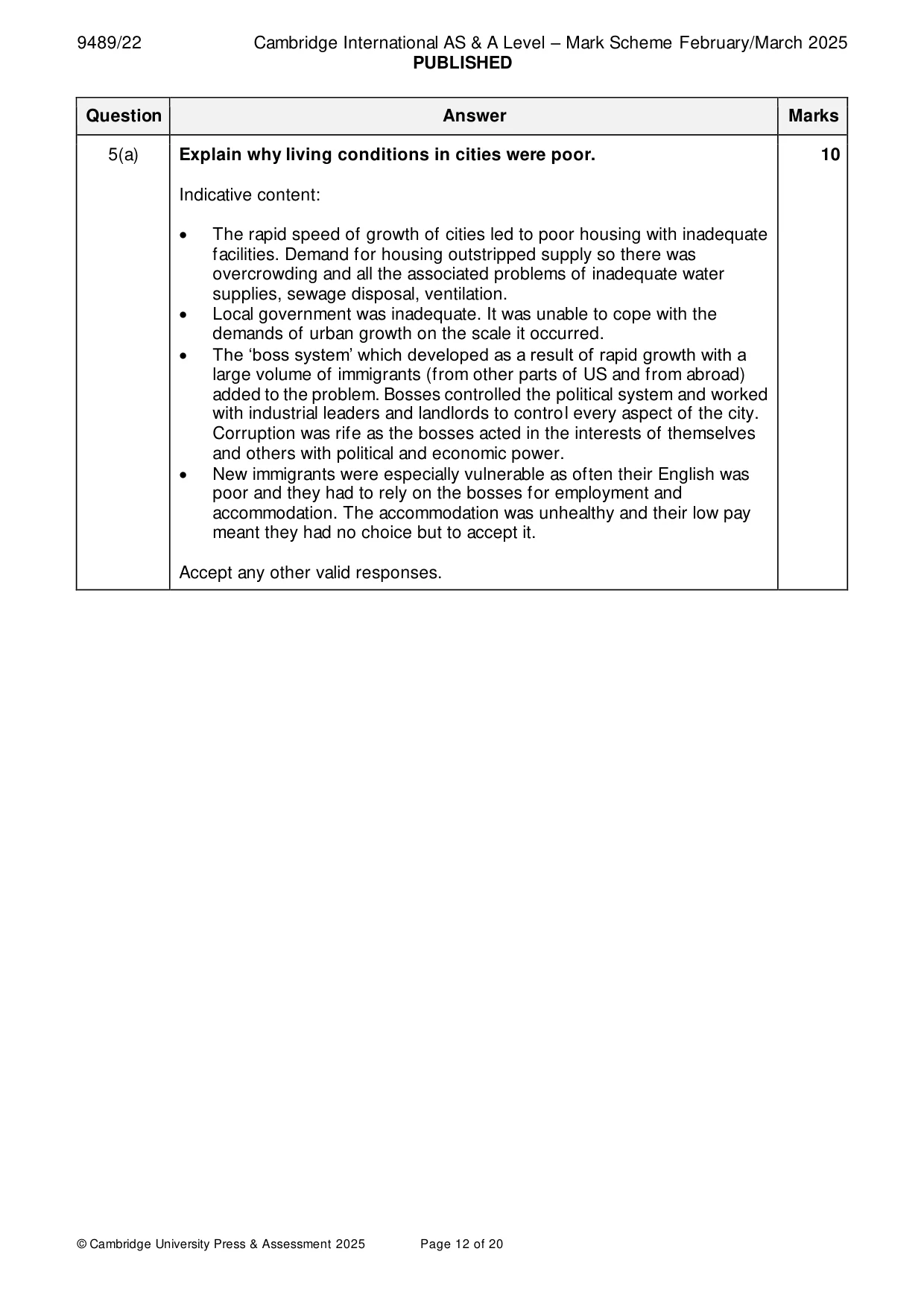
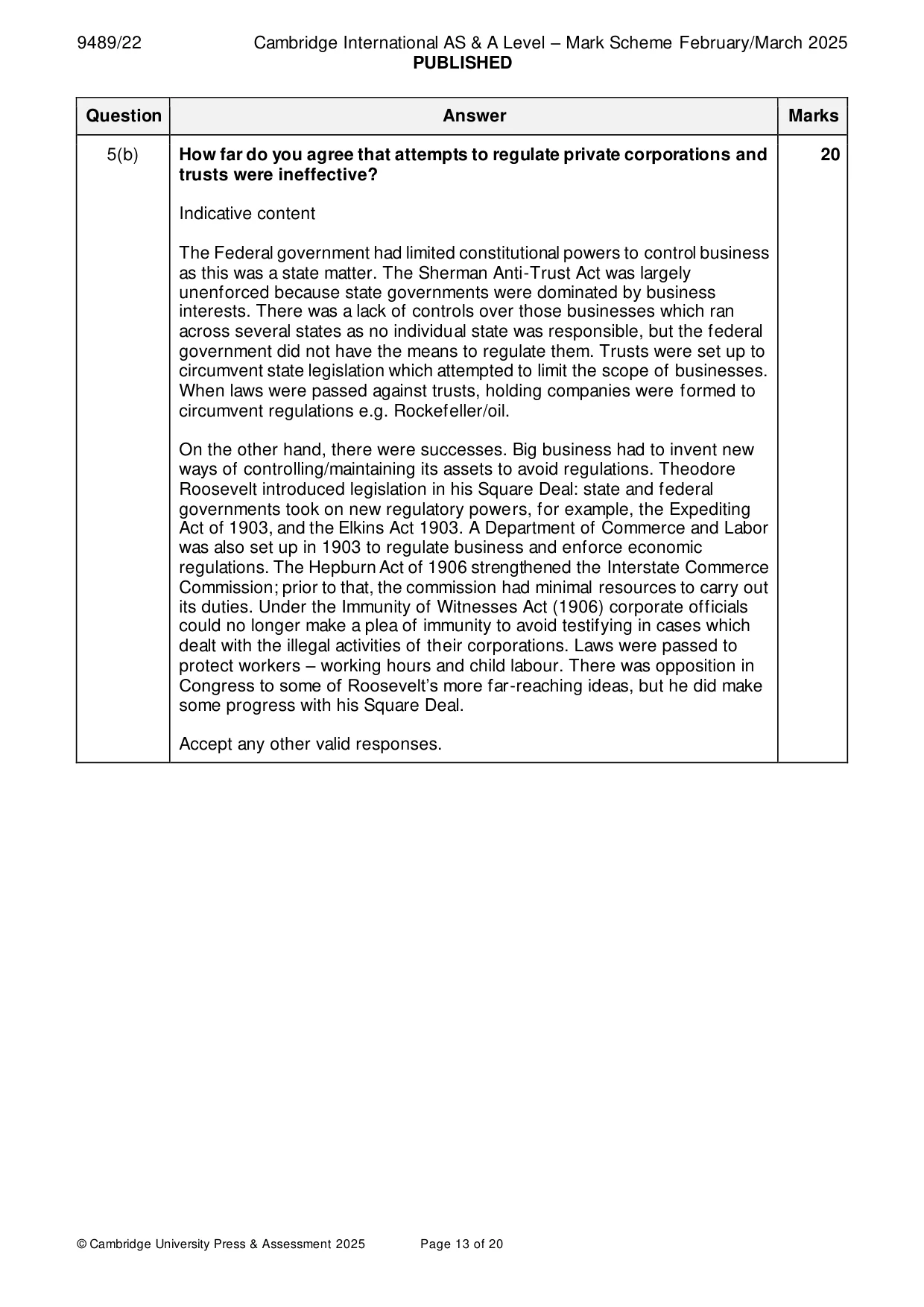
Mark scheme: 5(a) Explain why living conditions in cities were poor. 10 Indicative content: • The rapid speed of growth of cities led to poor housing with inadequate facilities. Demand for housing outstripped supply so there was overcrowding and all the associated problems of inadequate water supplies, sewage disposal, ventilation. • Local government was inadequate. It was unable to cope with the demands of urban growth on the scale it occurred. • The ‘boss system’ which developed as a result of rapid growth with a large volume of immigrants (from other parts of US and from abroad) added to the problem. Bosses controlled the political system and worked with industrial leaders and landlords to control every aspect of the city. Corruption was rife as the bosses acted in the interests of themselves and others with political and economic power. • New immigrants were especially vulnerable as often their English was poor and they had to rely on the bosses for employment and accommodation. The accommodation was unhealthy and their low pay meant they had no choice but to accept it. Accept any other valid responses. 5(b) How far do you agree that attempts to regulate private corporations and 20 trusts were ineffective? Indicative content The Federal government had limited constitutional powers to control business as this was a state matter. The Sherman Anti-Trust Act was largely unenforced because state governments were dominated by business interests. There was a lack of controls over those businesses which ran across several states as no individual state was responsible, but the federal government did not have the means to regulate them. Trusts were set up to circumvent state legislation which attempted to limit the scope of businesses. When laws were passed against trusts, holding companies were formed to circumvent regulations e.g. Rockefeller/oil. On the other hand, there were successes. Big business had to invent new ways of controlling/maintaining its assets to avoid regulations. Theodore Roosevelt introduced legislation in his Square Deal: state and federal governments took on new regulatory powers, for example, the Expediting Act of 1903, and the Elkins Act 1903. A Department of Commerce and Labor was also set up in 1903 to regulate business and enforce economic regulations. The Hepburn Act of 1906 strengthened the Interstate Commerce Commission; prior to that, the commission had minimal resources to carry out its duties. Under the Immunity of Witnesses Act (1906) corporate officials could no longer make a plea of immunity to avoid testifying in cases which dealt with the illegal activities of their corporations. Laws were passed to protect workers – working hours and child labour. There was opposition in Congress to some of Roosevelt’s more far-reaching ideas, but he did make some progress with his Square Deal. Accept any other valid responses.
More questions on How successful was the Progressive Movement from 1890 to 1920?
Q6 · The Great Crash, the Great Depression and the New Deal policies, 1920–41 (a) Explain why…
6 The Great Crash, the Great Depression and the New Deal policies, 1920–41 (a) Explain why the value of shares fell rapidly in the Great Crash. [10] (b) ‘The depression of 1937–38 showed that the New Deal had failed.’ How far do you agree? [20] Section C: International option International history, 1870–1945
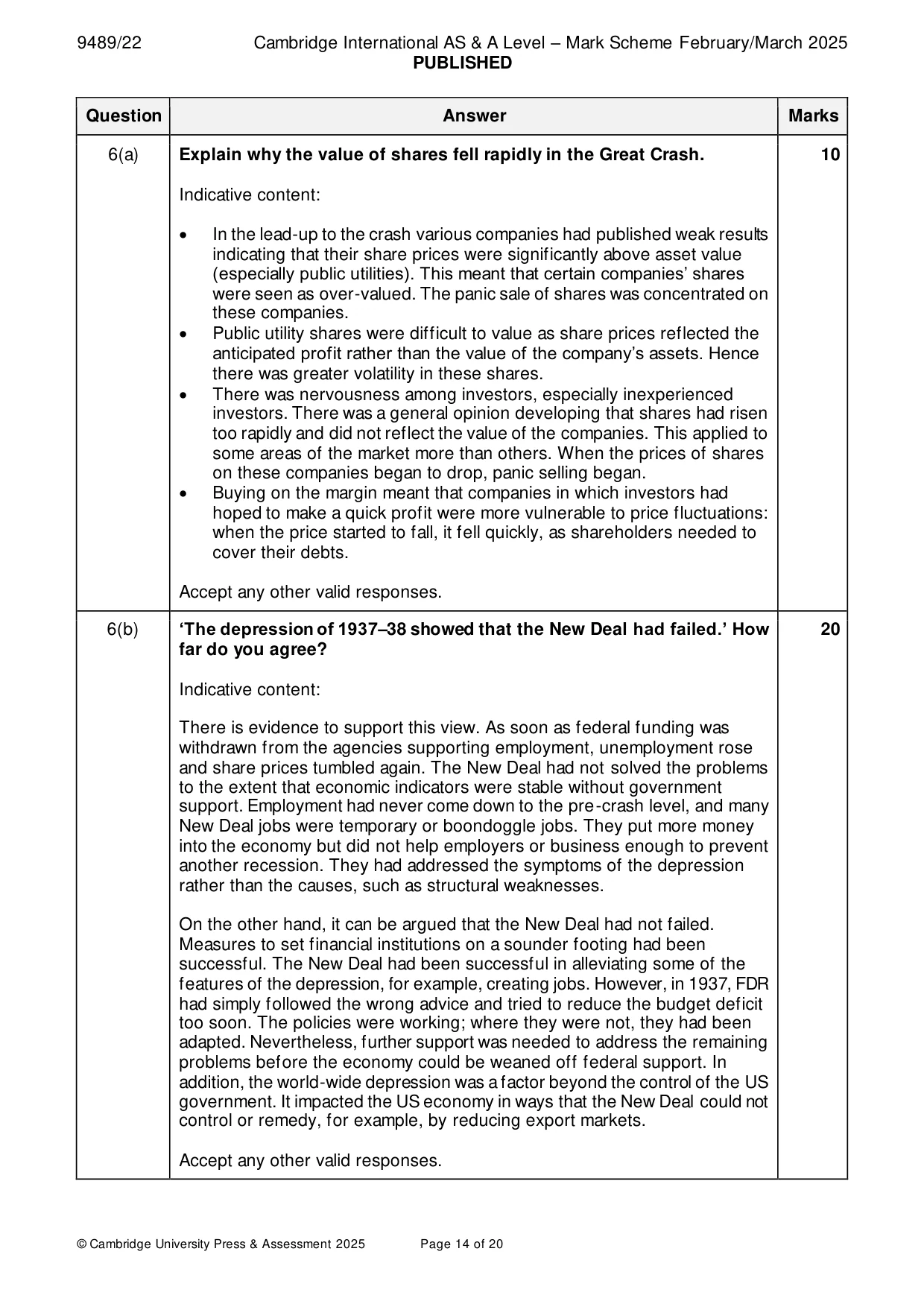
Mark scheme: 6(a) Explain why the value of shares fell rapidly in the Great Crash. 10 Indicative content: • In the lead-up to the crash various companies had published weak results indicating that their share prices were significantly above asset value (especially public utilities). This meant that certain companies’ shares were seen as over-valued. The panic sale of shares was concentrated on these companies. • Public utility shares were difficult to value as share prices reflected the anticipated profit rather than the value of the company’s assets. Hence there was greater volatility in these shares. • There was nervousness among investors, especially inexperienced investors. There was a general opinion developing that shares had risen too rapidly and did not reflect the value of the companies. This applied to some areas of the market more than others. When the prices of shares on these companies began to drop, panic selling began. • Buying on the margin meant that companies in which investors had hoped to make a quick profit were more vulnerable to price fluctuations: when the price started to fall, it fell quickly, as shareholders needed to cover their debts. Accept any other valid responses. 6(b) ‘The depression of 1937–38 showed that the New Deal had failed.’ How 20 far do you agree? Indicative content: There is evidence to support this view. As soon as federal funding was withdrawn from the agencies supporting employment, unemployment rose and share prices tumbled again. The New Deal had not solved the problems to the extent that economic indicators were stable without government support. Employment had never come down to the pre-crash level, and many New Deal jobs were temporary or boondoggle jobs. They put more money into the economy but did not help employers or business enough to prevent another recession. They had addressed the symptoms of the depression rather than the causes, such as structural weaknesses. On the other hand, it can be argued that the New Deal had not failed. Measures to set financial institutions on a sounder footing had been successful. The New Deal had been successful in alleviating some of the features of the depression, for example, creating jobs. However, in 1937, FDR had simply followed the wrong advice and tried to reduce the budget deficit too soon. The policies were working; where they were not, they had been adapted. Nevertheless, further support was needed to address the remaining problems before the economy could be weaned off federal support. In addition, the world-wide depression was a factor beyond the control of the US government. It impacted the US economy in ways that the New Deal could not control or remedy, for example, by reducing export markets. Accept any other valid responses.
More questions on Why was there a second New Deal and how successful was it?
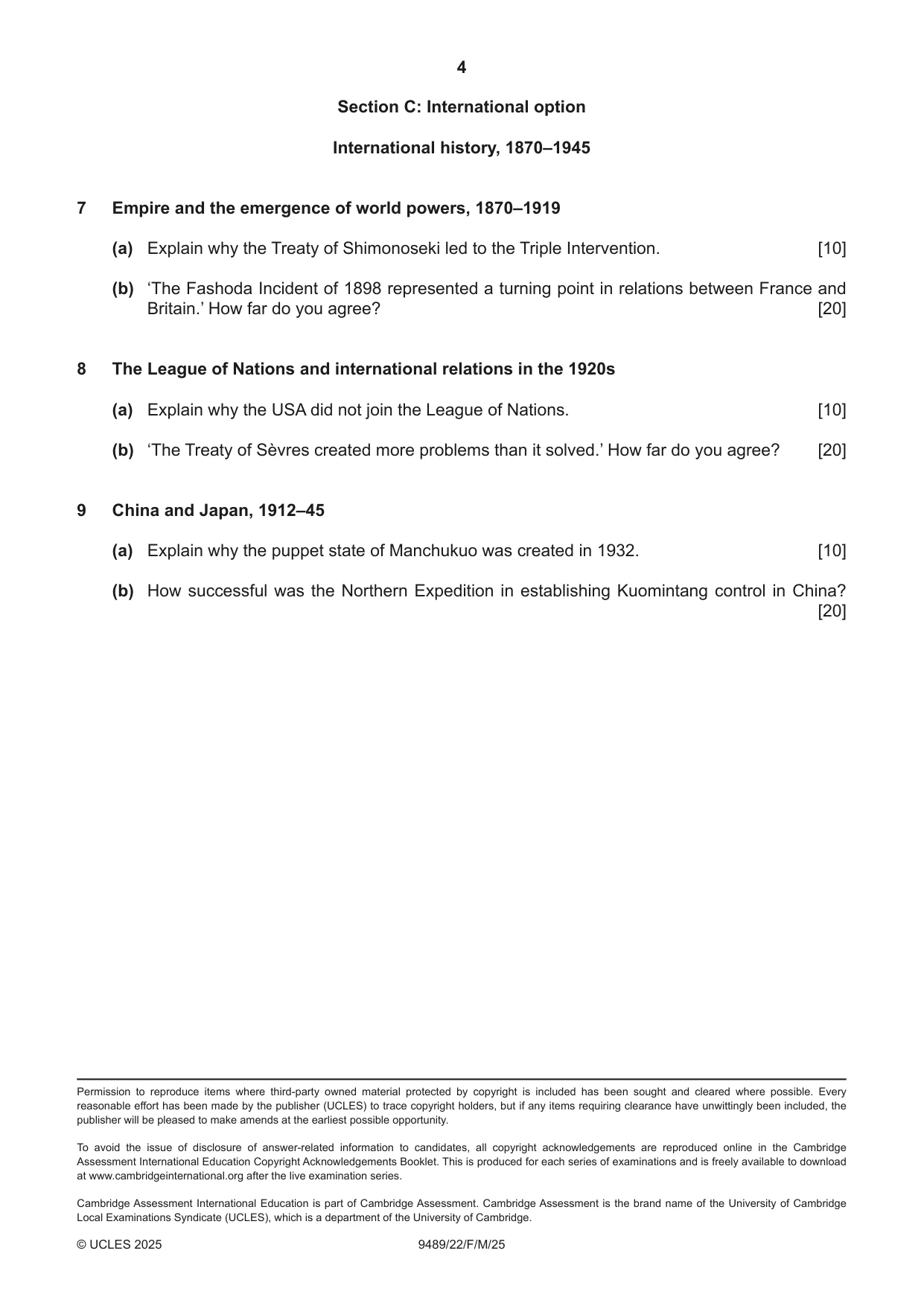
Q7 · Empire and the emergence of world powers, 1870–1919 (a) Explain why the Treaty of…
7 Empire and the emergence of world powers, 1870–1919 (a) Explain why the Treaty of Shimonoseki led to the Triple Intervention. [10] (b) ‘The Fashoda Incident of 1898 represented a turning point in relations between France and Britain.’ How far do you agree? [20]
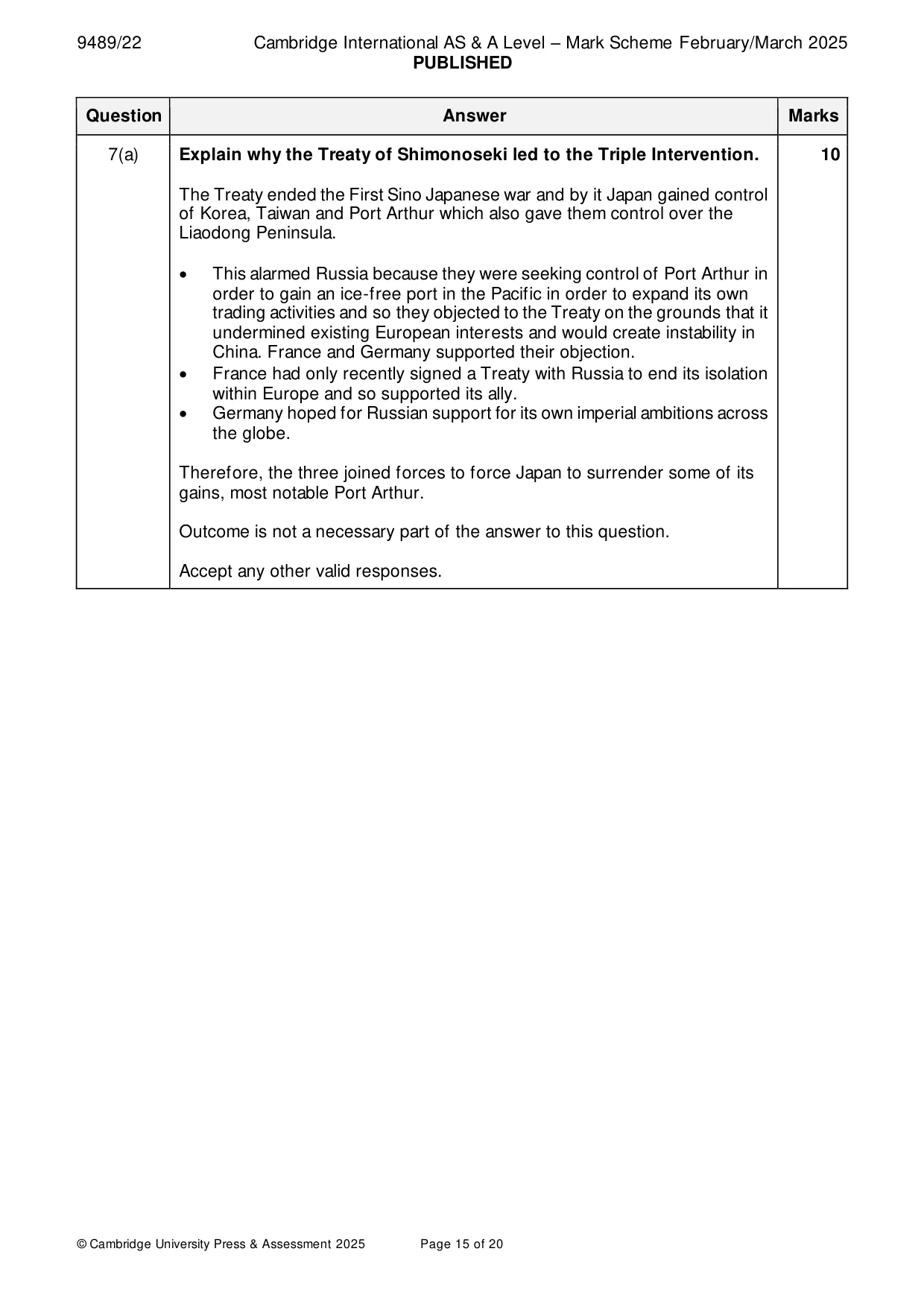
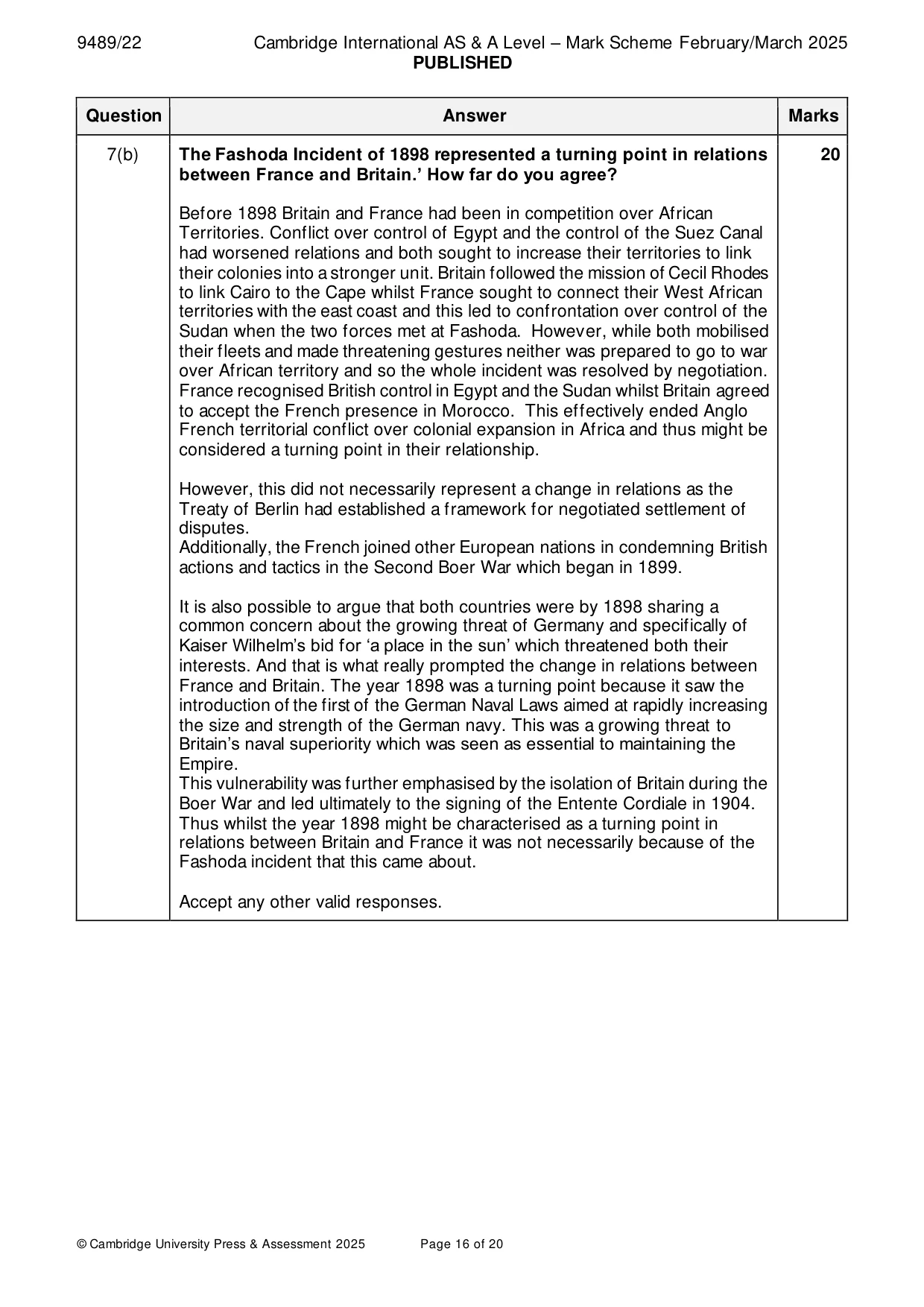
Mark scheme: 7(a) Explain why the Treaty of Shimonoseki led to the Triple Intervention. 10 The Treaty ended the First Sino Japanese war and by it Japan gained control of Korea, Taiwan and Port Arthur which also gave them control over the Liaodong Peninsula. • This alarmed Russia because they were seeking control of Port Arthur in order to gain an ice-free port in the Pacific in order to expand its own trading activities and so they objected to the Treaty on the grounds that it undermined existing European interests and would create instability in China. France and Germany supported their objection. • France had only recently signed a Treaty with Russia to end its isolation within Europe and so supported its ally. • Germany hoped for Russian support for its own imperial ambitions across the globe. Therefore, the three joined forces to force Japan to surrender some of its gains, most notable Port Arthur. Outcome is not a necessary part of the answer to this question. Accept any other valid responses. 7(b) The Fashoda Incident of 1898 represented a turning point in relations 20 between France and Britain.’ How far do you agree? Before 1898 Britain and France had been in competition over African Territories. Conflict over control of Egypt and the control of the Suez Canal had worsened relations and both sought to increase their territories to link their colonies into a stronger unit. Britain followed the mission of Cecil Rhodes to link Cairo to the Cape whilst France sought to connect their West African territories with the east coast and this led to confrontation over control of the Sudan when the two forces met at Fashoda. However, while both mobilised their fleets and made threatening gestures neither was prepared to go to war over African territory and so the whole incident was resolved by negotiation. France recognised British control in Egypt and the Sudan whilst Britain agreed to accept the French presence in Morocco. This effectively ended Anglo French territorial conflict over colonial expansion in Africa and thus might be considered a turning point in their relationship. However, this did not necessarily represent a change in relations as the Treaty of Berlin had established a framework for negotiated settlement of disputes. Additionally, the French joined other European nations in condemning British actions and tactics in the Second Boer War which began in 1899. It is also possible to argue that both countries were by 1898 sharing a common concern about the growing threat of Germany and specifically of Kaiser Wilhelm’s bid for ‘a place in the sun’ which threatened both their interests. And that is what really prompted the change in relations between France and Britain. The year 1898 was a turning point because it saw the introduction of the first of the German Naval Laws aimed at rapidly increasing the size and strength of the German navy. This was a growing threat to Britain’s naval superiority which was seen as essential to maintaining the Empire. This vulnerability was further emphasised by the isolation of Britain during the Boer War and led ultimately to the signing of the Entente Cordiale in 1904. Thus whilst the year 1898 might be characterised as a turning point in relations between Britain and France it was not necessarily because of the Fashoda incident that this came about. Accept any other valid responses.
More questions on What was the impact of imperial expansion on international relations?
Q8 · The League of Nations and international relations in the 1920s (a) Explain why the USA…
8 The League of Nations and international relations in the 1920s (a) Explain why the USA did not join the League of Nations. [10] (b) ‘The Treaty of Sèvres created more problems than it solved.’ How far do you agree? [20]
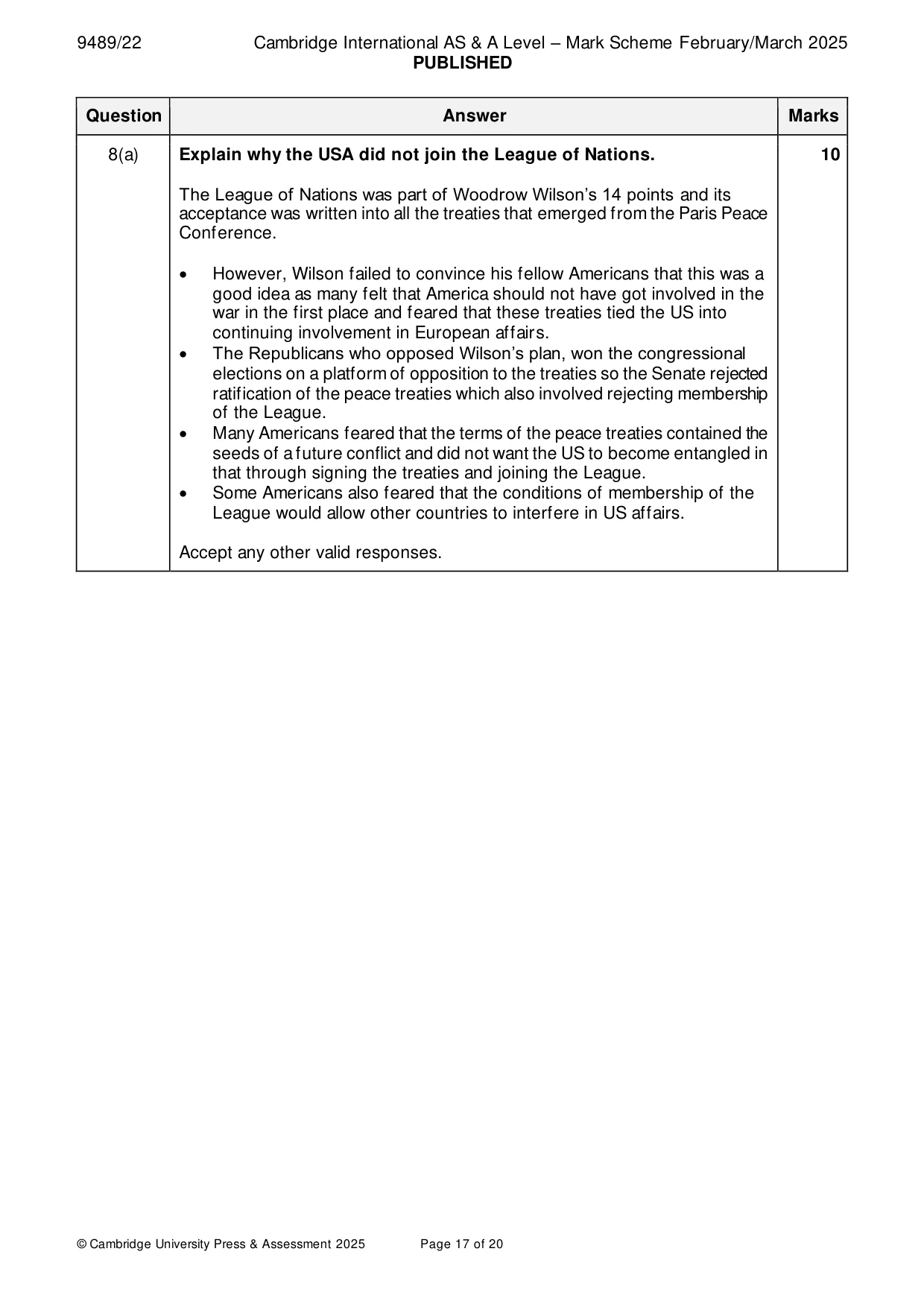
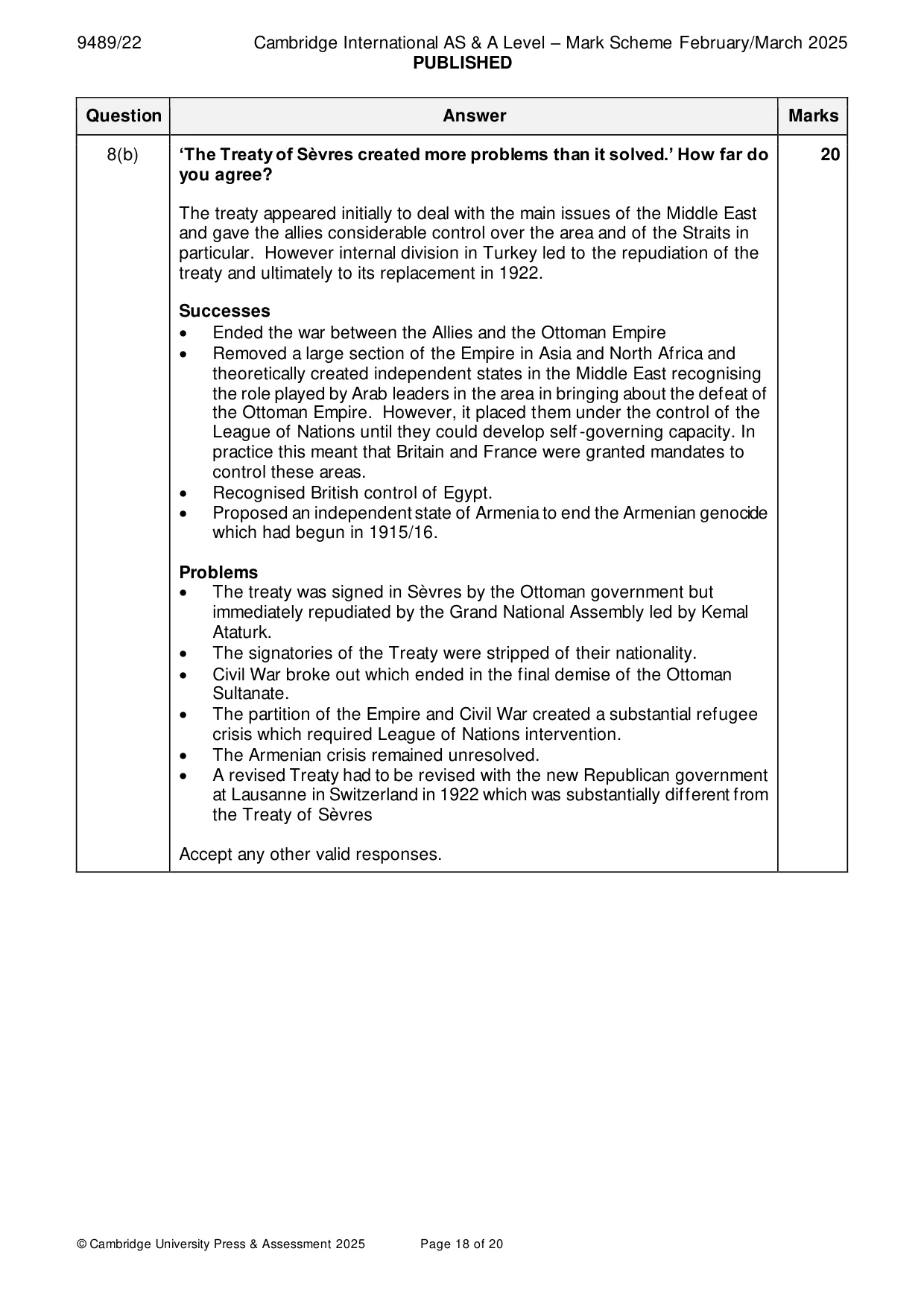
Mark scheme: 8(a) Explain why the USA did not join the League of Nations. 10 The League of Nations was part of Woodrow Wilson’s 14 points and its acceptance was written into all the treaties that emerged from the Paris Peace Conference. • However, Wilson failed to convince his fellow Americans that this was a good idea as many felt that America should not have got involved in the war in the first place and feared that these treaties tied the US into continuing involvement in European affairs. • The Republicans who opposed Wilson’s plan, won the congressional elections on a platform of opposition to the treaties so the Senate rejected ratification of the peace treaties which also involved rejecting membership of the League. • Many Americans feared that the terms of the peace treaties contained the seeds of a future conflict and did not want the US to become entangled in that through signing the treaties and joining the League. • Some Americans also feared that the conditions of membership of the League would allow other countries to interfere in US affairs. Accept any other valid responses. 8(b) ‘The Treaty of Sèvres created more problems than it solved.’ How far do 20 you agree? The treaty appeared initially to deal with the main issues of the Middle East and gave the allies considerable control over the area and of the Straits in particular. However internal division in Turkey led to the repudiation of the treaty and ultimately to its replacement in 1922. Successes • Ended the war between the Allies and the Ottoman Empire • Removed a large section of the Empire in Asia and North Africa and theoretically created independent states in the Middle East recognising the role played by Arab leaders in the area in bringing about the defeat of the Ottoman Empire. However, it placed them under the control of the League of Nations until they could develop self-governing capacity. In practice this meant that Britain and France were granted mandates to control these areas. • Recognised British control of Egypt. • Proposed an independent state of Armenia to end the Armenian genocide which had begun in 1915/16. Problems • The treaty was signed in Sèvres by the Ottoman government but immediately repudiated by the Grand National Assembly led by Kemal Ataturk. • The signatories of the Treaty were stripped of their nationality. • Civil War broke out which ended in the final demise of the Ottoman Sultanate. • The partition of the Empire and Civil War created a substantial refugee crisis which required League of Nations intervention. • The Armenian crisis remained unresolved. • A revised Treaty had to be revised with the new Republican government at Lausanne in Switzerland in 1922 which was substantially different from the Treaty of Sèvres Accept any other valid responses.
Q9 · China and Japan, 1912–45 (a) Explain why the puppet state of Manchukuo was created in 1932
9 China and Japan, 1912–45 (a) Explain why the puppet state of Manchukuo was created in 1932. [10] (b) How successful was the Northern Expedition in establishing Kuomintang control in China? [20]
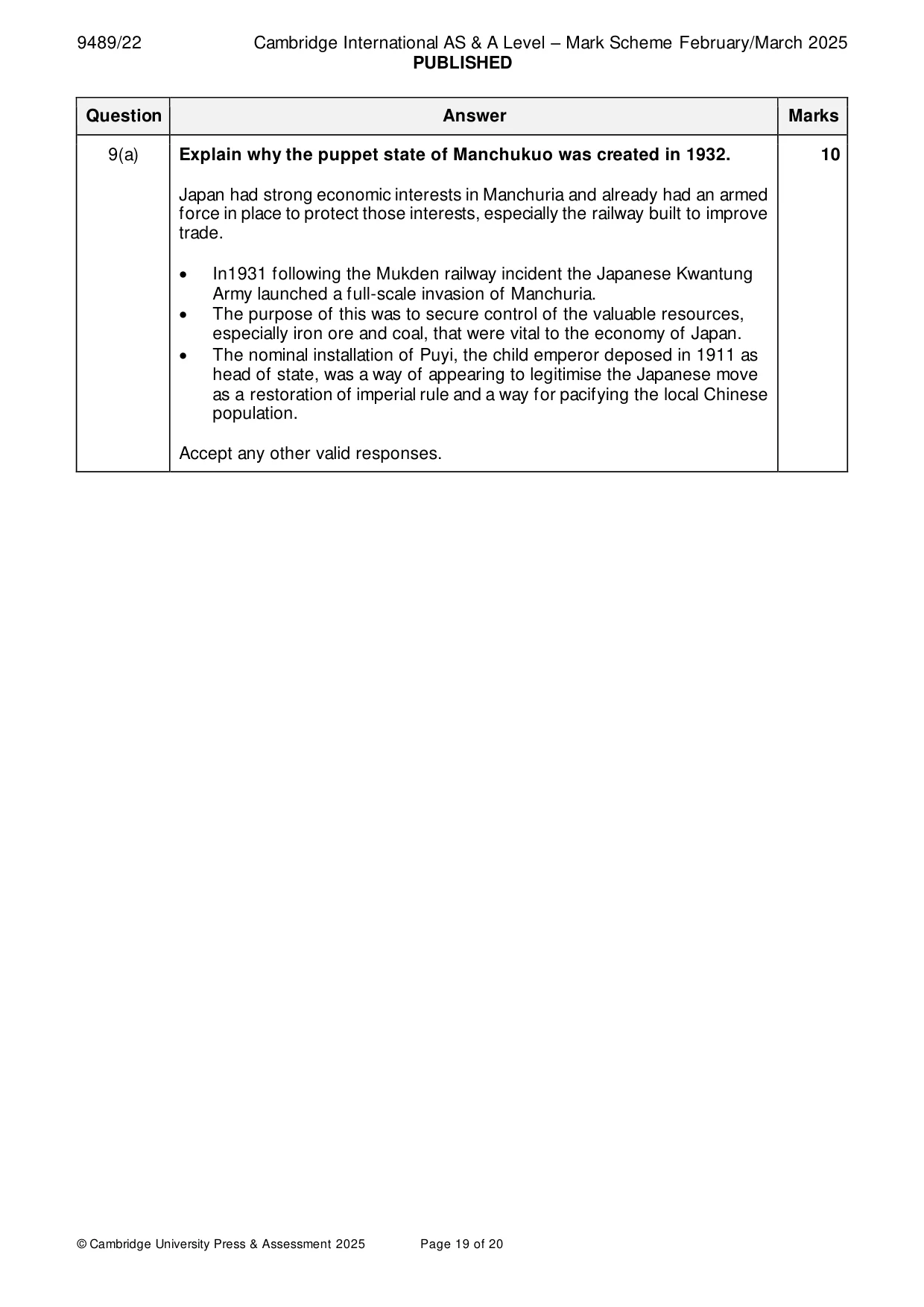
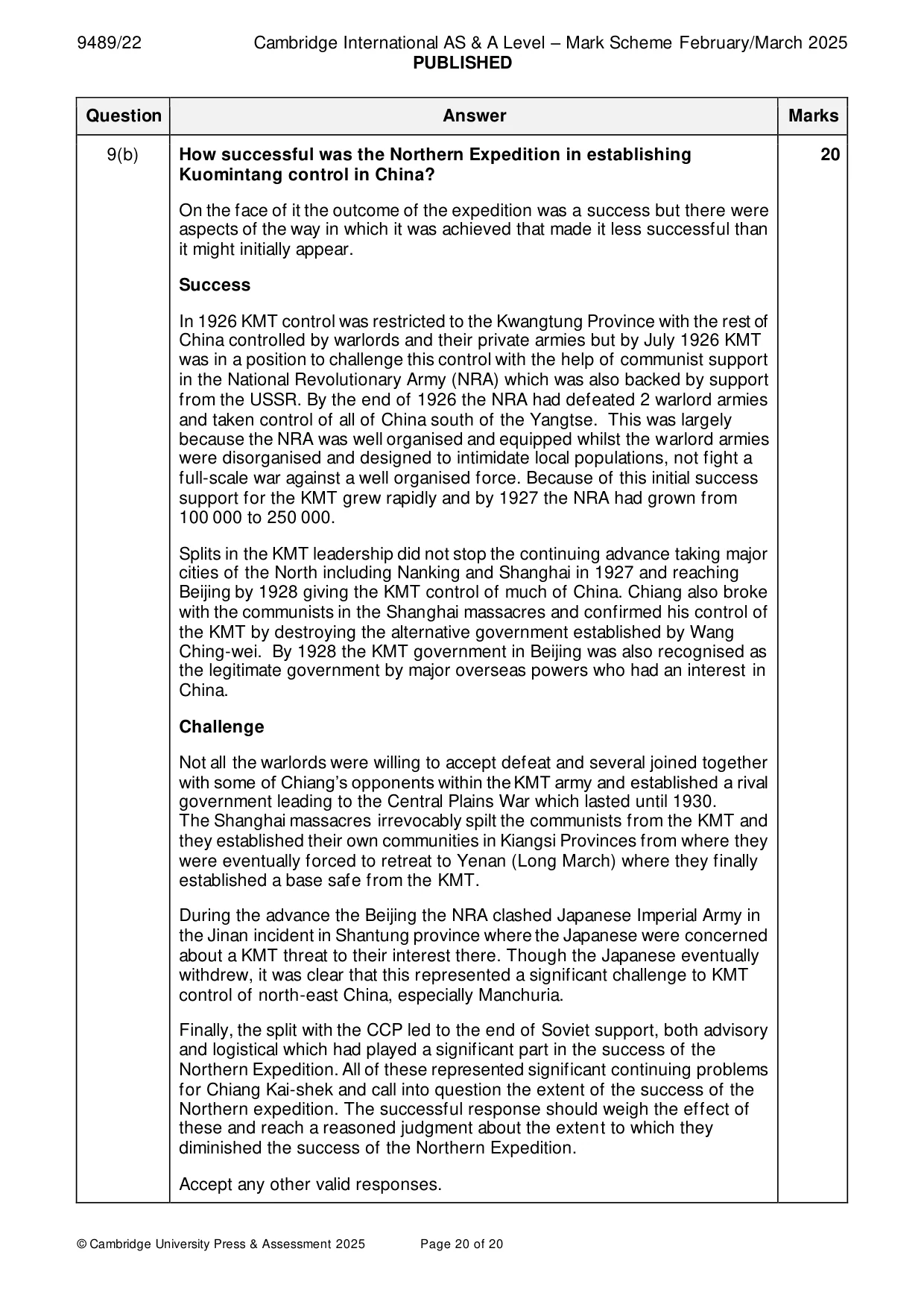
Mark scheme: 9(a) Explain why the puppet state of Manchukuo was created in 1932. 10 Japan had strong economic interests in Manchuria and already had an armed force in place to protect those interests, especially the railway built to improve trade. • In1931 following the Mukden railway incident the Japanese Kwantung Army launched a full-scale invasion of Manchuria. • The purpose of this was to secure control of the valuable resources, especially iron ore and coal, that were vital to the economy of Japan. • The nominal installation of Puyi, the child emperor deposed in 1911 as head of state, was a way of appearing to legitimise the Japanese move as a restoration of imperial rule and a way for pacifying the local Chinese population. Accept any other valid responses. 9(b) How successful was the Northern Expedition in establishing 20 Kuomintang control in China? On the face of it the outcome of the expedition was a success but there were aspects of the way in which it was achieved that made it less successful than it might initially appear. Success In 1926 KMT control was restricted to the Kwangtung Province with the rest of China controlled by warlords and their private armies but by July 1926 KMT was in a position to challenge this control with the help of communist support in the National Revolutionary Army (NRA) which was also backed by support from the USSR. By the end of 1926 the NRA had defeated 2 warlord armies and taken control of all of China south of the Yangtse. This was largely because the NRA was well organised and equipped whilst the warlord armies were disorganised and designed to intimidate local populations, not fight a full-scale war against a well organised force. Because of this initial success support for the KMT grew rapidly and by 1927 the NRA had grown from 100 000 to 250 000. Splits in the KMT leadership did not stop the continuing advance taking major cities of the North including Nanking and Shanghai in 1927 and reaching Beijing by 1928 giving the KMT control of much of China. Chiang also broke with the communists in the Shanghai massacres and confirmed his control of the KMT by destroying the alternative government established by Wang Ching-wei. By 1928 the KMT government in Beijing was also recognised as the legitimate government by major overseas powers who had an interest in China. Challenge Not all the warlords were willing to accept defeat and several joined together with some of Chiang’s opponents within the KMT army and established a rival government leading to the Central Plains War which lasted until 1930. The Shanghai massacres irrevocably spilt the communists from the KMT and they established their own communities in Kiangsi Provinces from where they were eventually forced to retreat to Yenan (Long March) where they finally established a base safe from the KMT. During the advance the Beijing the NRA clashed Japanese Imperial Army in the Jinan incident in Shantung province where the Japanese were concerned about a KMT threat to their interest there. Though the Japanese eventually withdrew, it was clear that this represented a significant challenge to KMT control of north-east China, especially Manchuria. Finally, the split with the CCP led to the end of Soviet support, both advisory and logistical which had played a significant part in the success of the Northern Expedition. All of these represented significant continuing problems for Chiang Kai-shek and call into question the extent of the success of the Northern expedition. The successful response should weigh the effect of these and reach a reasoned judgment about the extent to which they diminished the success of the Northern Expedition. Accept any other valid responses.
More questions on Why did Japan emerge as a world power and what was the impact on international
What was in this paper
The subtopics covered by these 9 questions, and how many questions each got. Open one in a new tab to see every Cambridge question on it.
1How were the Bolsheviks able to consolidate their power up to 1924?1What was the impact of imperial expansion on international relations?1What were the aims of Reconstruction and how successful was it?1What were the causes and immediate consequences of the 1789 Revolution?1What were the consequences of the rapid economic growth after 1870?1Why did Japan emerge as a world power and what was the impact on international1Why was there a second New Deal and how successful was it?1Why was there such extensive dissatisfaction with the peace settlements of 1919–20?1What you needed in this session
Cambridge’s own grade thresholds for 2025 Feb/March, Paper 2 · Variant 2. A higher threshold means an easier paper — the bar moves with how the cohort did.