Cambridge A Level History 9489 — 2025 May/June Paper 2 · Variant 1
9489/21/M/J/25 · 9 questions · 60 marks · ≈68 min
The question paper and its mark scheme, free to read here and free to download. This is Cambridge’s own paper, exactly as it was sat.
Question paper4 pages
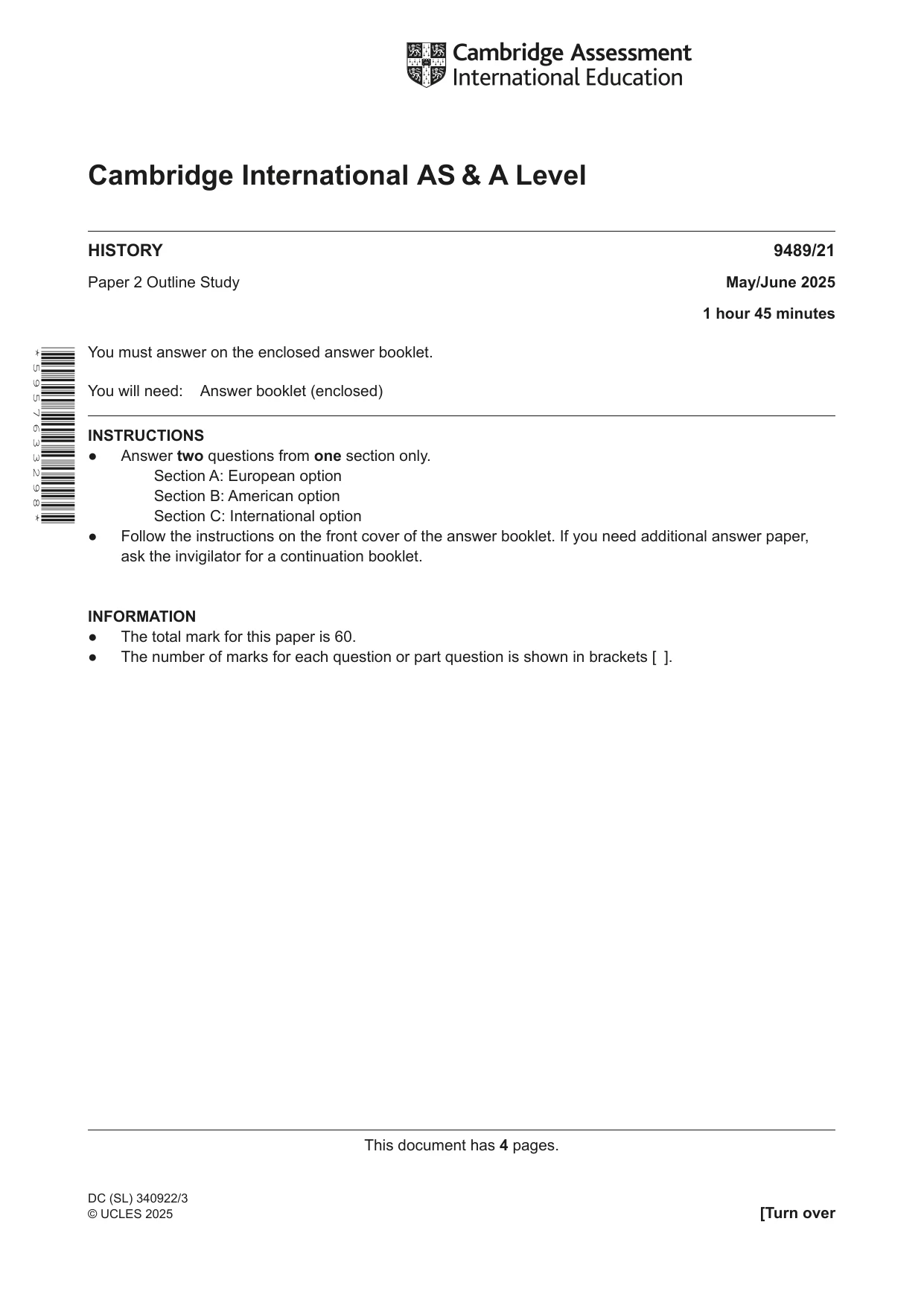
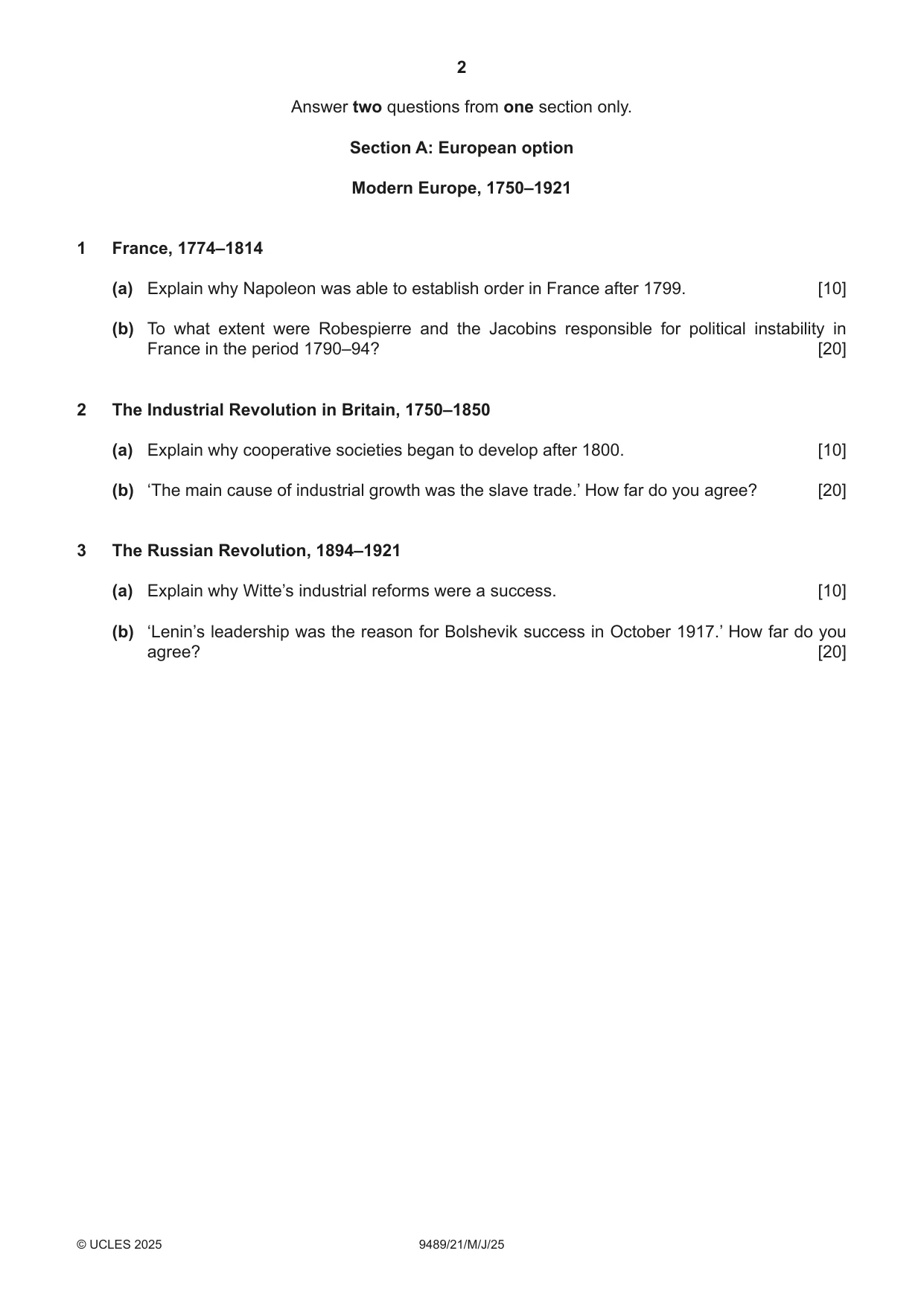
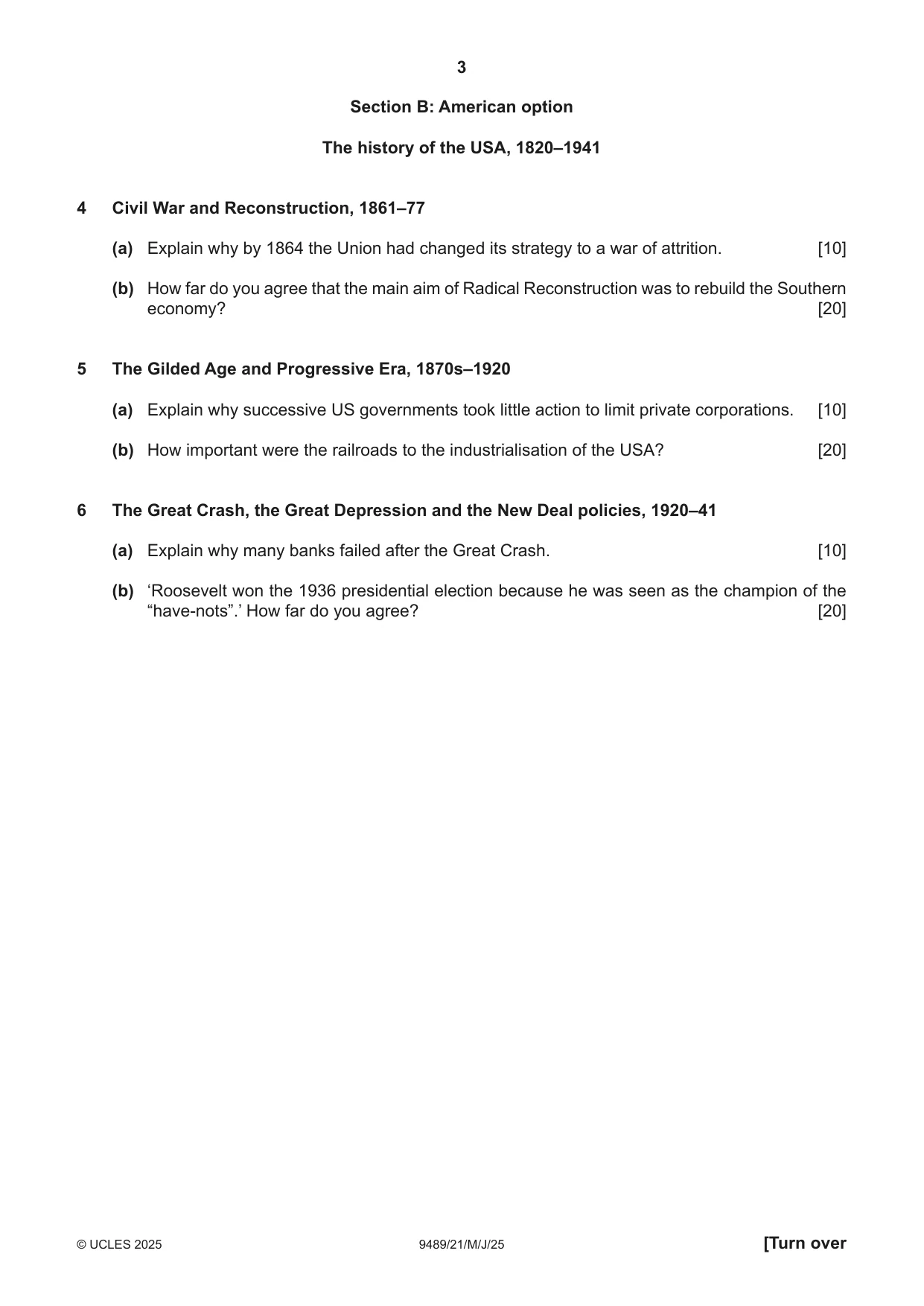
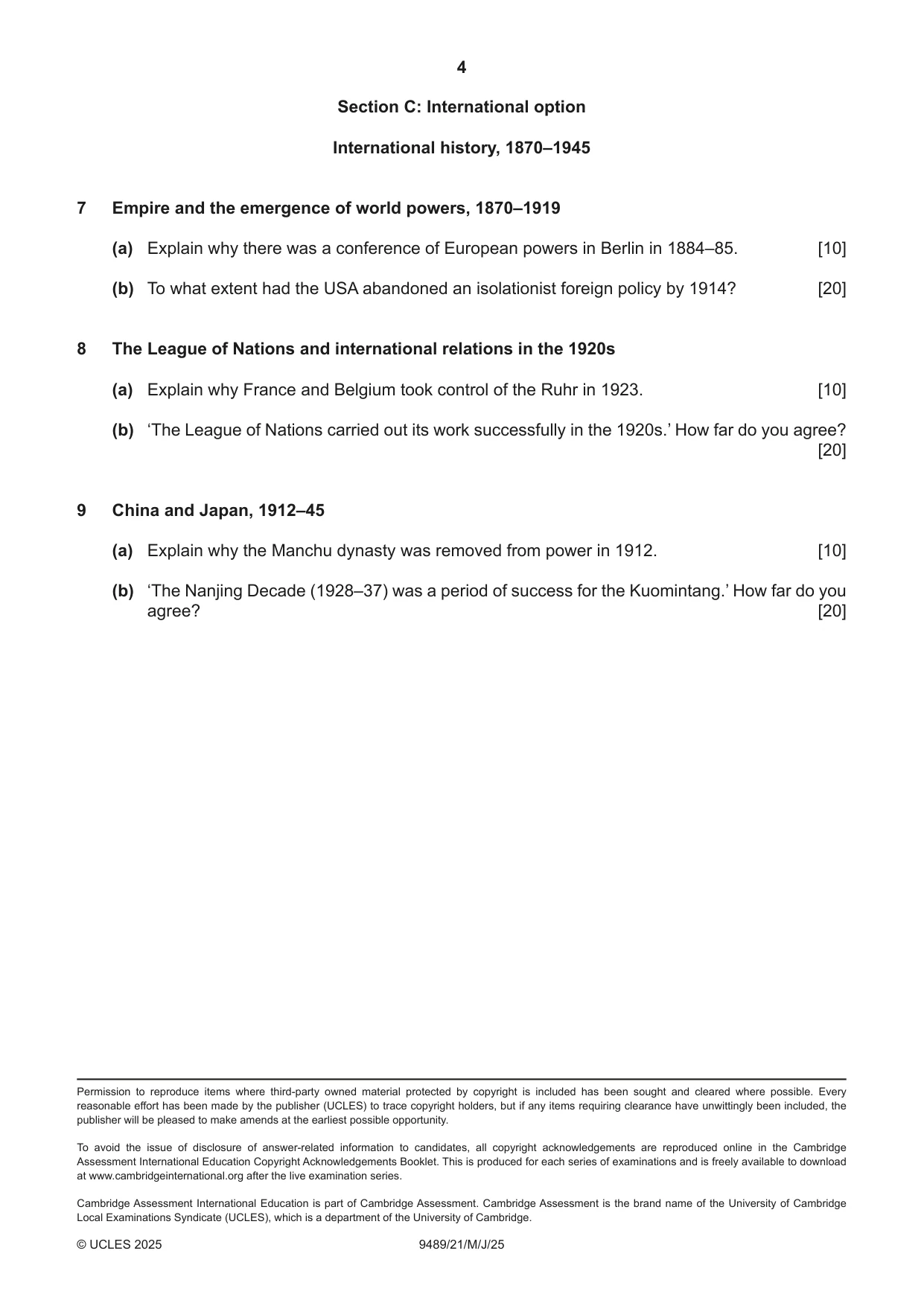
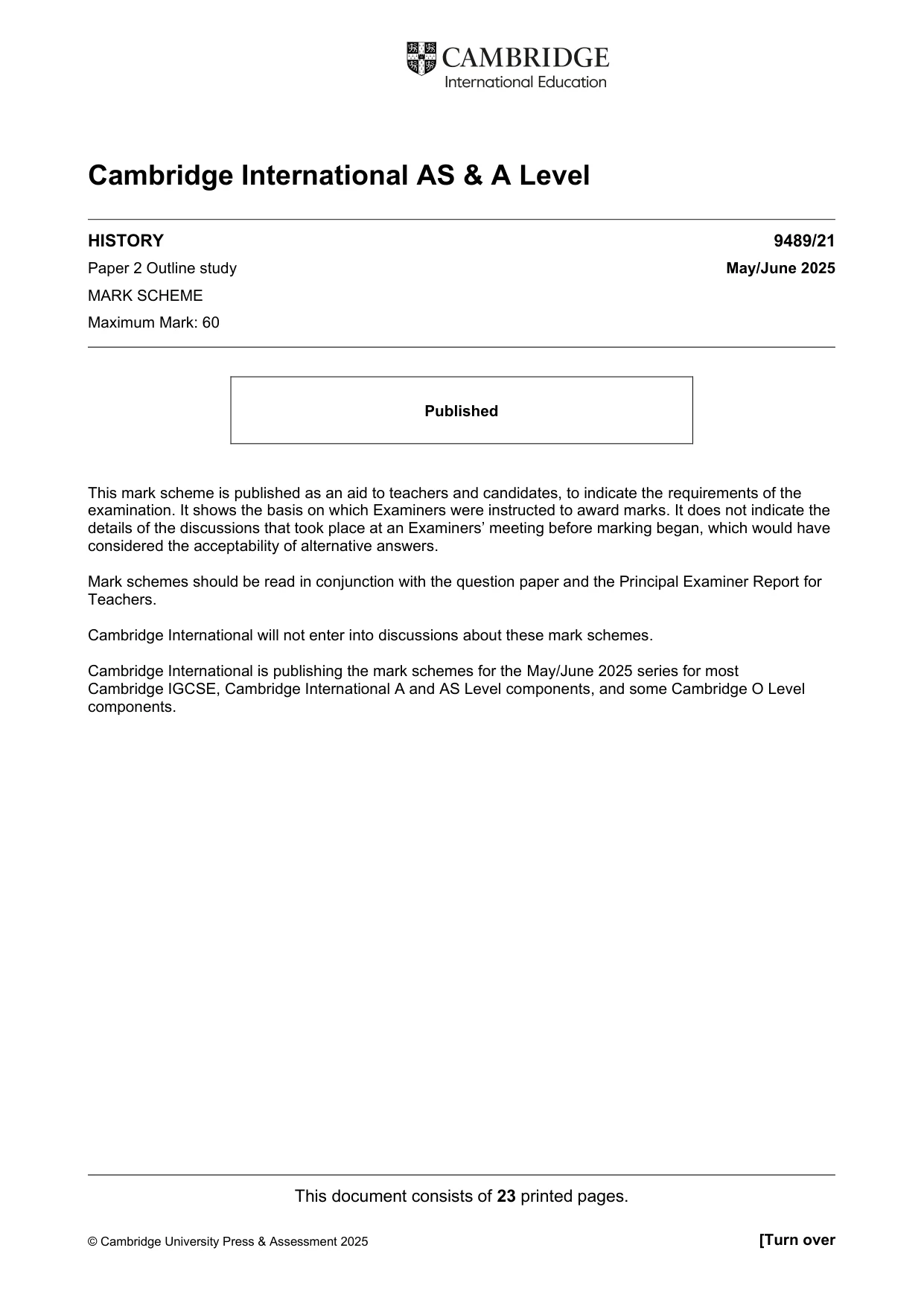
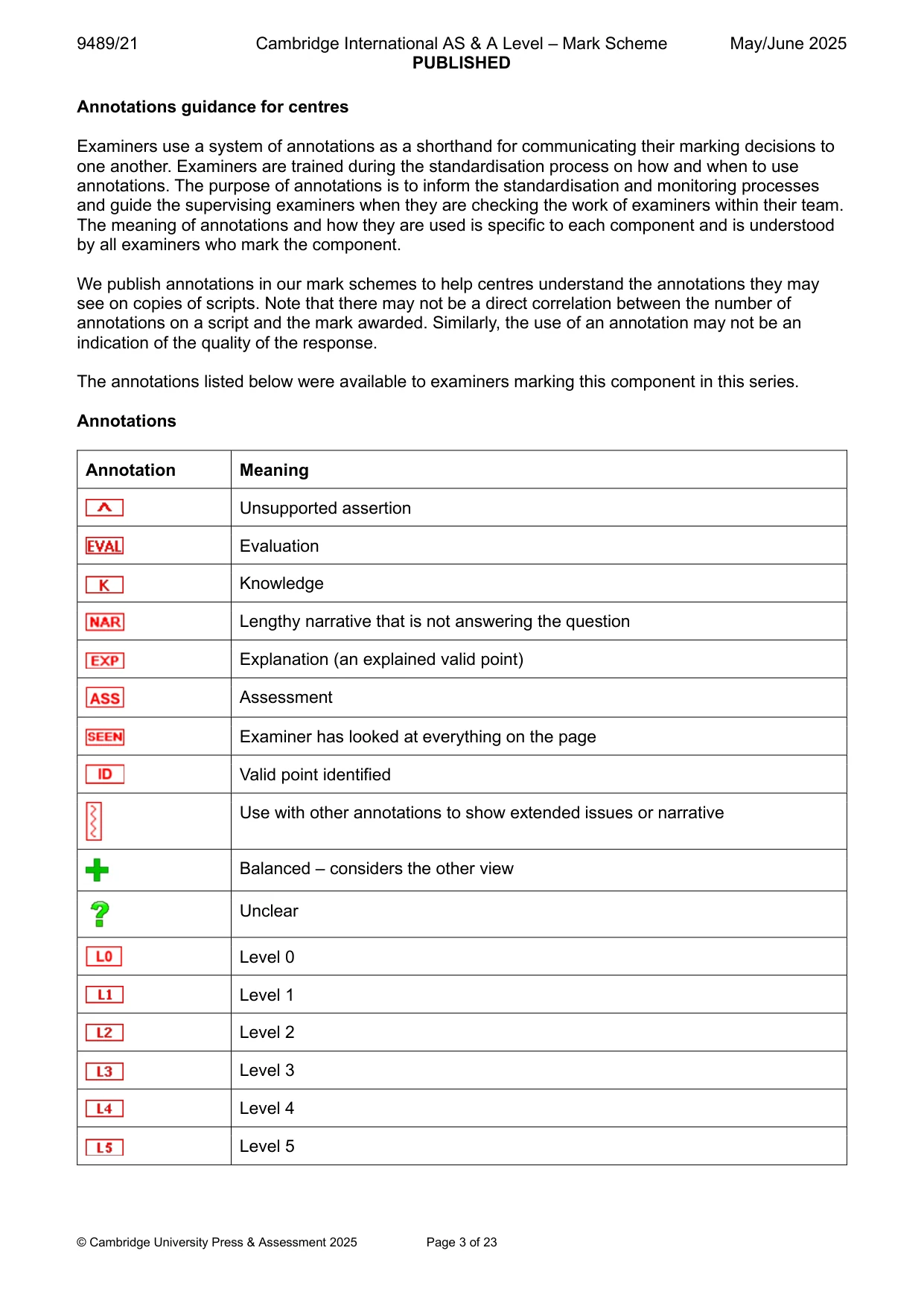
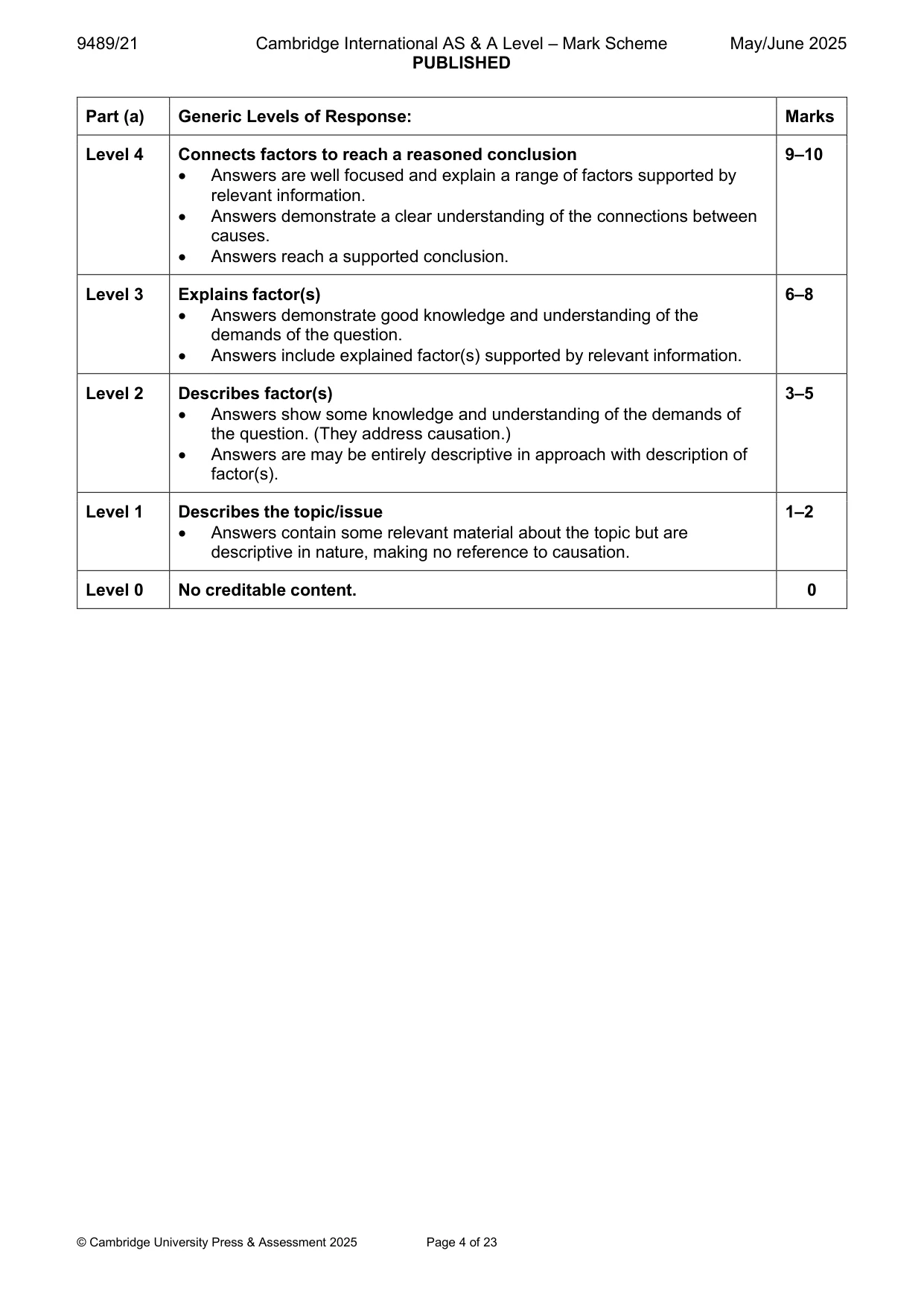
Mark scheme23 pages
Answers below. Sit the paper first if you are practising.
Questions as text
Q1 · France, 1774–1814 (a) Explain why Napoleon was able to establish order in France after…
1 France, 1774–1814 (a) Explain why Napoleon was able to establish order in France after 1799. [10] (b) To what extent were Robespierre and the Jacobins responsible for political instability in France in the period 1790–94? [20]
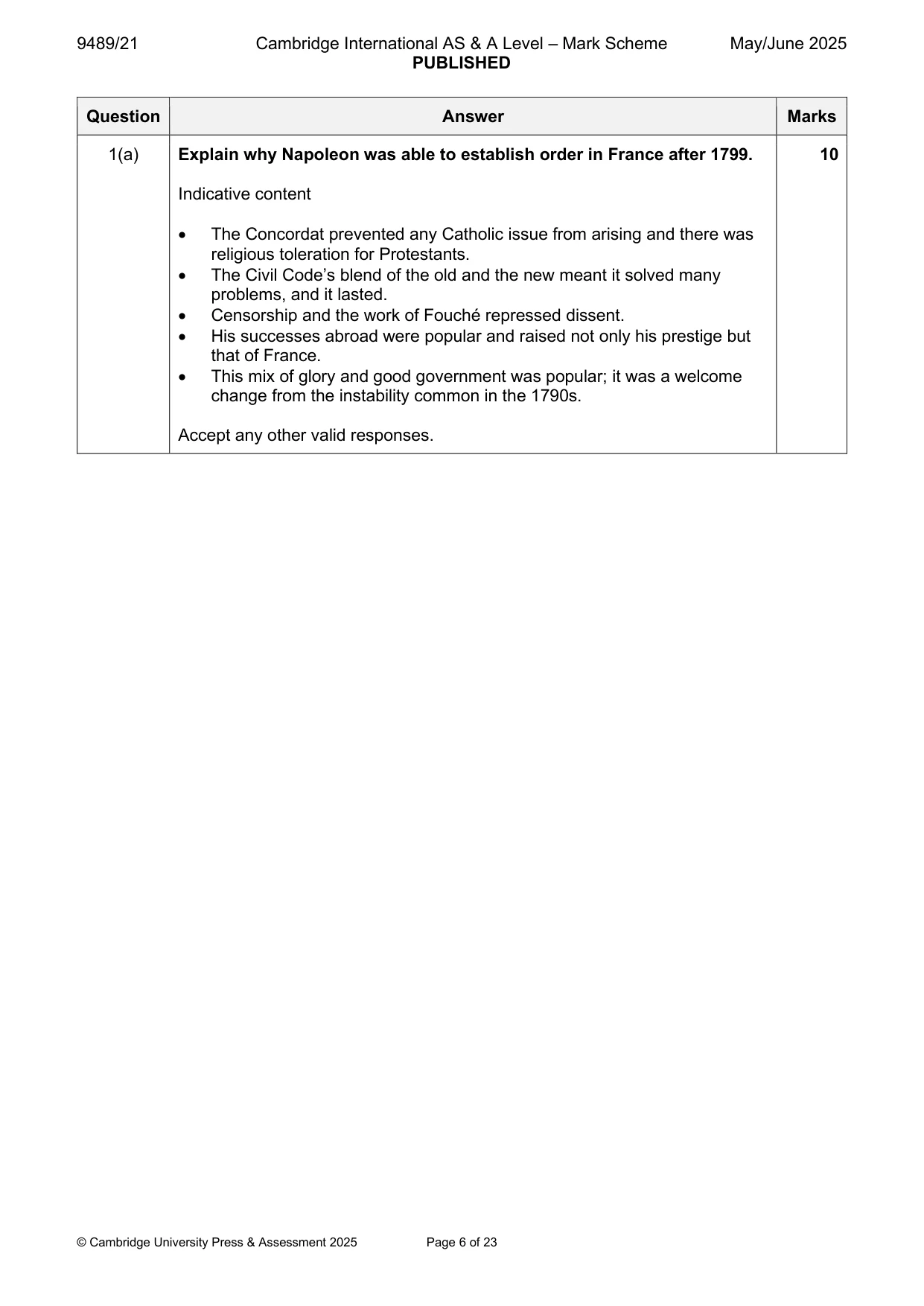
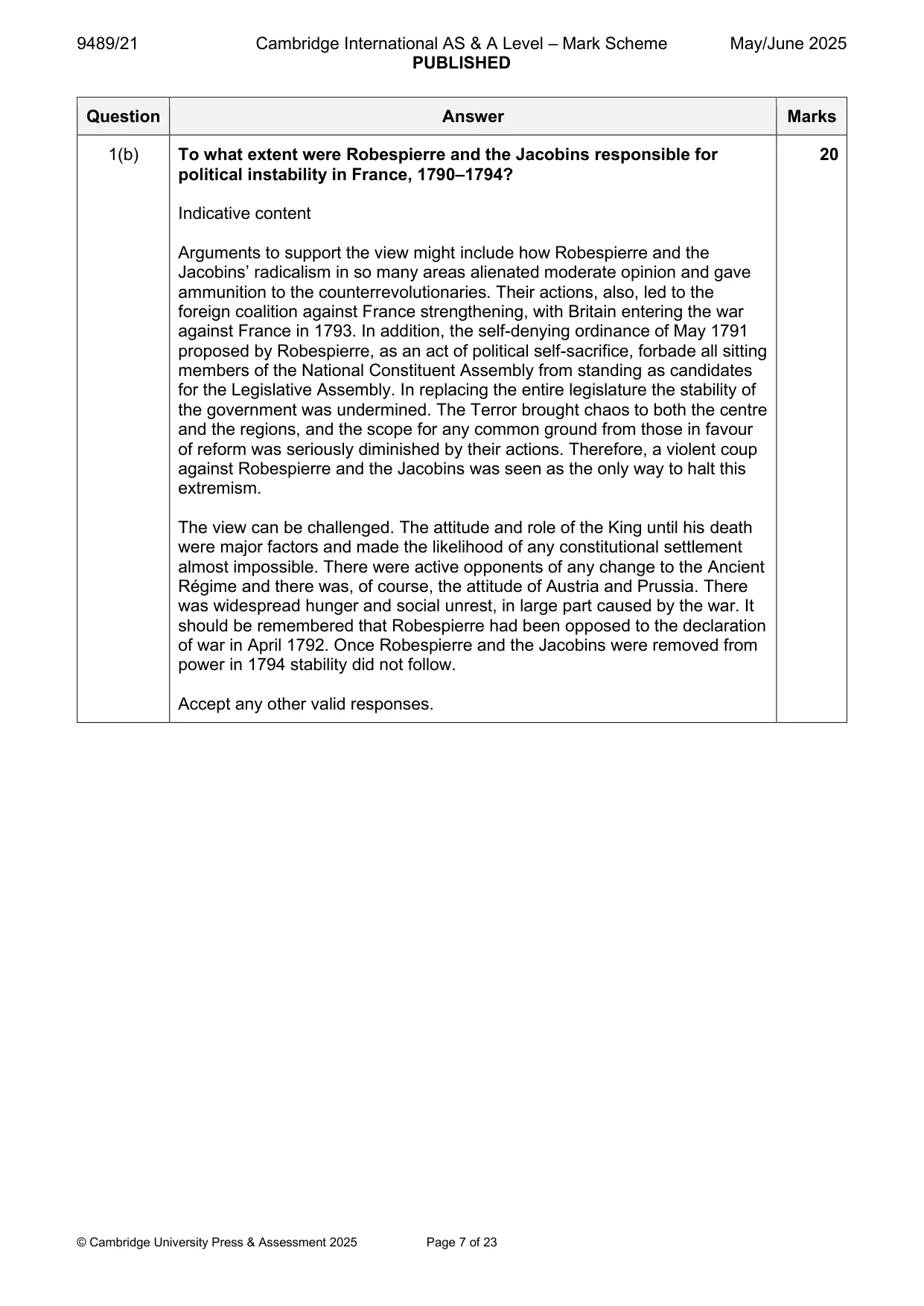
Mark scheme: Question Answer Marks 1(a) Explain why Napoleon was able to establish order in France after 1799. 10 Indicative content • The Concordat prevented any Catholic issue from arising and there was religious toleration for Protestants. • The Civil Code’s blend of the old and the new meant it solved many problems, and it lasted. • Censorship and the work of Fouché repressed dissent. • His successes abroad were popular and raised not only his prestige but that of France. • This mix of glory and good government was popular; it was a welcome change from the instability common in the 1790s. Accept any other valid responses. 1(b) To what extent were Robespierre and the Jacobins responsible for 20 political instability in France, 1790–1794? Indicative content Arguments to support the view might include how Robespierre and the Jacobins’ radicalism in so many areas alienated moderate opinion and gave ammunition to the counterrevolutionaries. Their actions, also, led to the foreign coalition against France strengthening, with Britain entering the war against France in 1793. In addition, the self-denying ordinance of May 1791 proposed by Robespierre, as an act of political self-sacrifice, forbade all sitting members of the National Constituent Assembly from standing as candidates for the Legislative Assembly. In replacing the entire legislature the stability of the government was undermined. The Terror brought chaos to both the centre and the regions, and the scope for any common ground from those in favour of reform was seriously diminished by their actions. Therefore, a violent coup against Robespierre and the Jacobins was seen as the only way to halt this extremism. The view can be challenged. The attitude and role of the King until his death were major factors and made the likelihood of any constitutional settlement almost impossible. There were active opponents of any change to the Ancient Régime and there was, of course, the attitude of Austria and Prussia. There was widespread hunger and social unrest, in large part caused by the war. It should be remembered that Robespierre had been opposed to the declaration of war in April 1792. Once Robespierre and the Jacobins were removed from power in 1794 stability did not follow. Accept any other valid responses.
More questions on How well was France governed in the period 1793–99?
Q2 · The Industrial Revolution in Britain, 1750–1850 (a) Explain why cooperative societies…
2 The Industrial Revolution in Britain, 1750–1850 (a) Explain why cooperative societies began to develop after 1800. [10] (b) ‘The main cause of industrial growth was the slave trade.’ How far do you agree? [20]
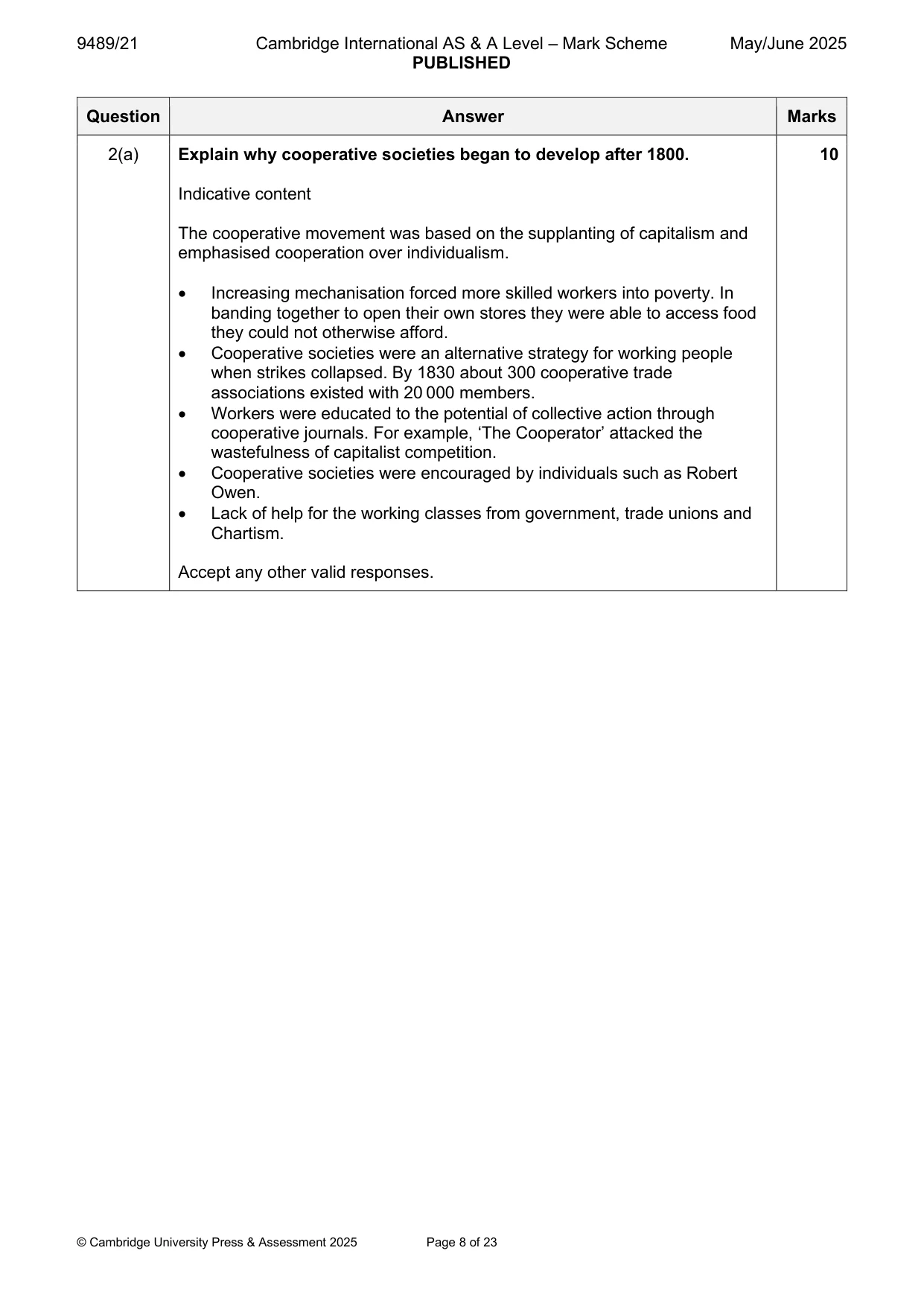
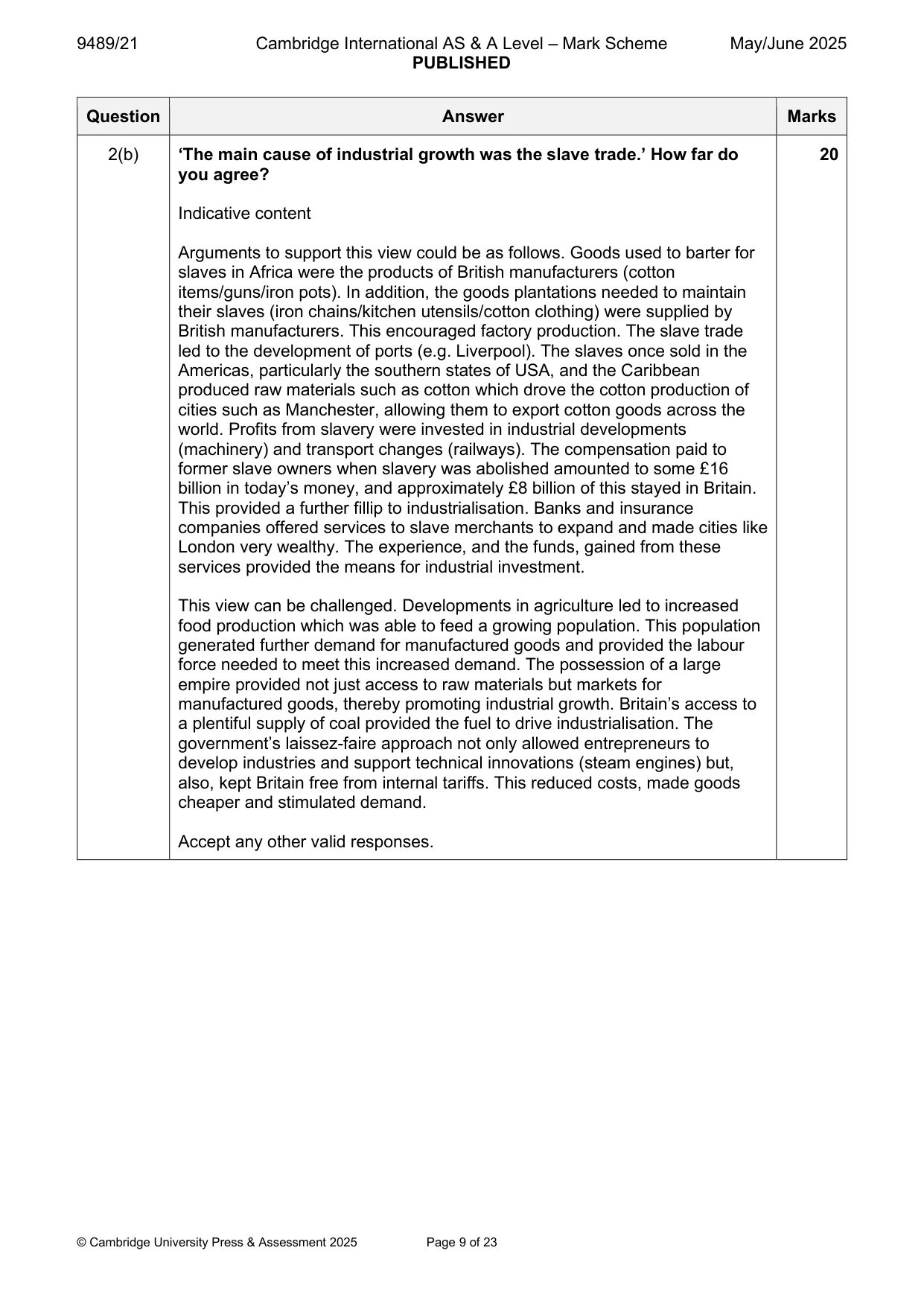
Mark scheme: 2(a) Explain why cooperative societies began to develop after 1800. 10 Indicative content The cooperative movement was based on the supplanting of capitalism and emphasised cooperation over individualism. • Increasing mechanisation forced more skilled workers into poverty. In banding together to open their own stores they were able to access food they could not otherwise afford. • Cooperative societies were an alternative strategy for working people when strikes collapsed. By 1830 about 300 cooperative trade associations existed with 20 000 members. • Workers were educated to the potential of collective action through cooperative journals. For example, ‘The Cooperator’ attacked the wastefulness of capitalist competition. • Cooperative societies were encouraged by individuals such as Robert Owen. • Lack of help for the working classes from government, trade unions and Chartism. Accept any other valid responses. 2(b) ‘The main cause of industrial growth was the slave trade.’ How far do 20 you agree? Indicative content Arguments to support this view could be as follows. Goods used to barter for slaves in Africa were the products of British manufacturers (cotton items/guns/iron pots). In addition, the goods plantations needed to maintain their slaves (iron chains/kitchen utensils/cotton clothing) were supplied by British manufacturers. This encouraged factory production. The slave trade led to the development of ports (e.g. Liverpool). The slaves once sold in the Americas, particularly the southern states of USA, and the Caribbean produced raw materials such as cotton which drove the cotton production of cities such as Manchester, allowing them to export cotton goods across the world. Profits from slavery were invested in industrial developments (machinery) and transport changes (railways). The compensation paid to former slave owners when slavery was abolished amounted to some £16 billion in today’s money, and approximately £8 billion of this stayed in Britain. This provided a further fillip to industrialisation. Banks and insurance companies offered services to slave merchants to expand and made cities like London very wealthy. The experience, and the funds, gained from these services provided the means for industrial investment. This view can be challenged. Developments in agriculture led to increased food production which was able to feed a growing population. This population generated further demand for manufactured goods and provided the labour force needed to meet this increased demand. The possession of a large empire provided not just access to raw materials but markets for manufactured goods, thereby promoting industrial growth. Britain’s access to a plentiful supply of coal provided the fuel to drive industrialisation. The government’s laissez-faire approach not only allowed entrepreneurs to develop industries and support technical innovations (steam engines) but, also, kept Britain free from internal tariffs. This reduced costs, made goods cheaper and stimulated demand. Accept any other valid responses.
More questions on Why was there rapid industrialisation after 1870?
Q3 · The Russian Revolution, 1894–1921 (a) Explain why Witte’s industrial reforms were a…
3 The Russian Revolution, 1894–1921 (a) Explain why Witte’s industrial reforms were a success. [10] (b) ‘Lenin’s leadership was the reason for Bolshevik success in October 1917.’ How far do you agree? [20]
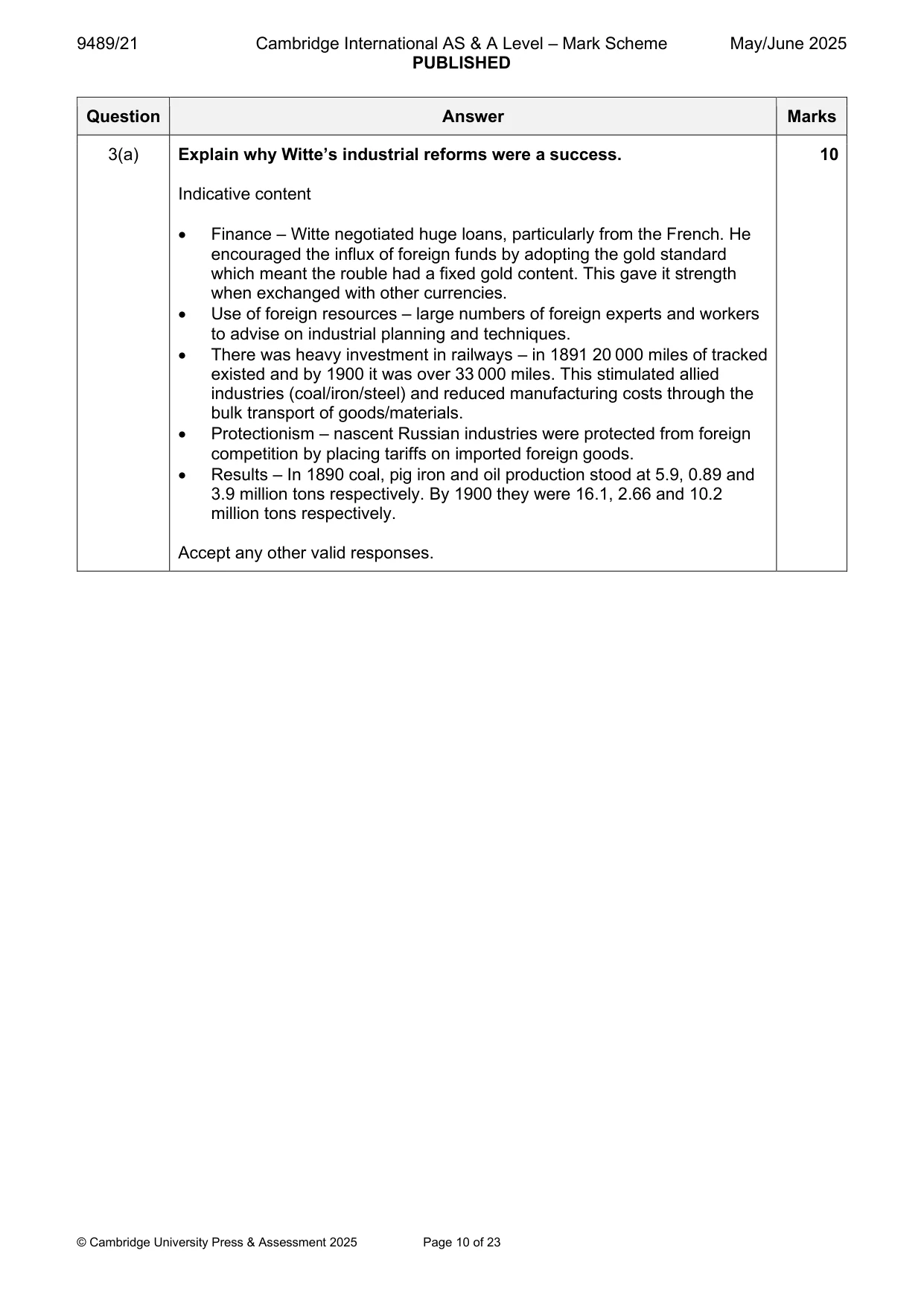
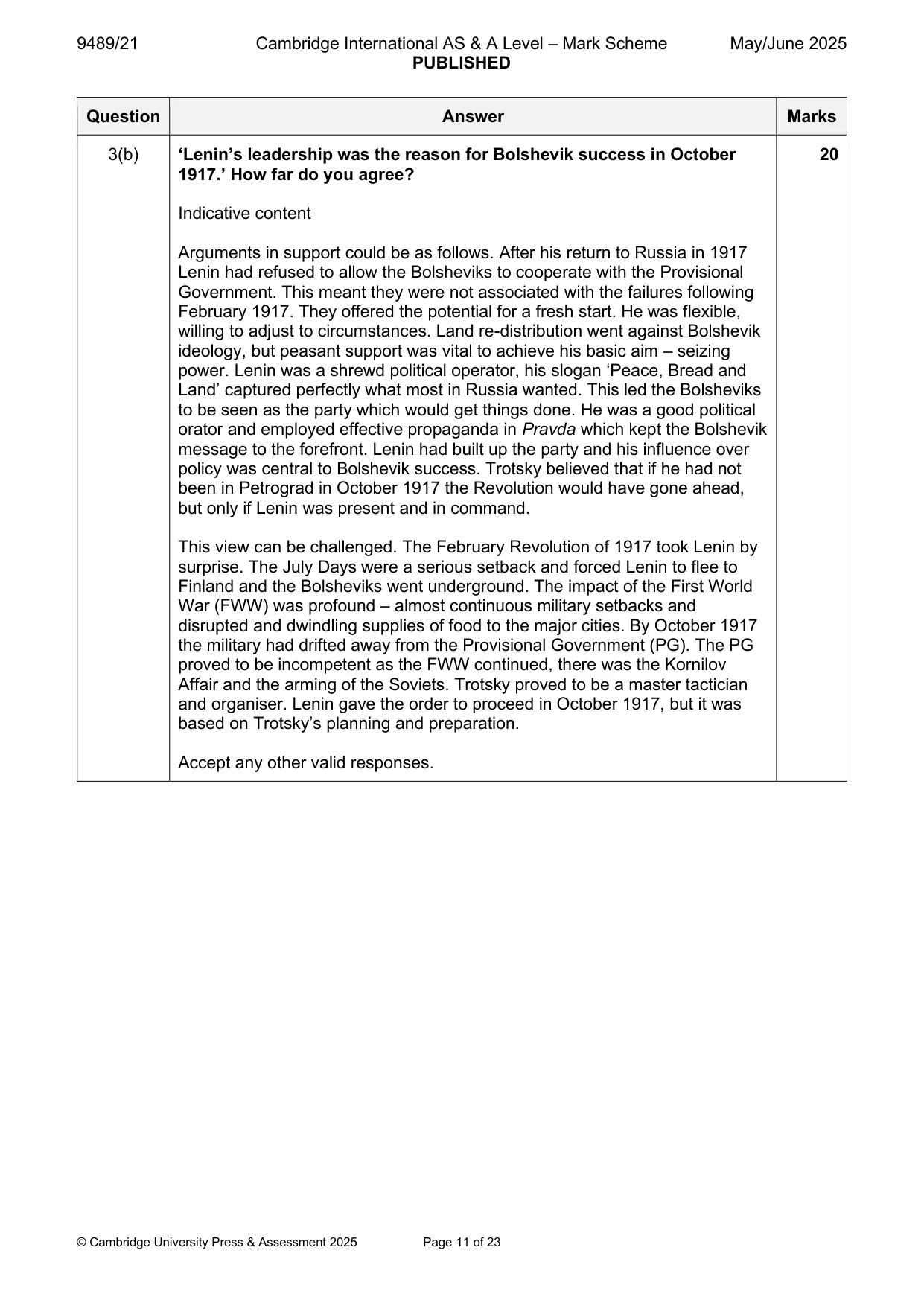
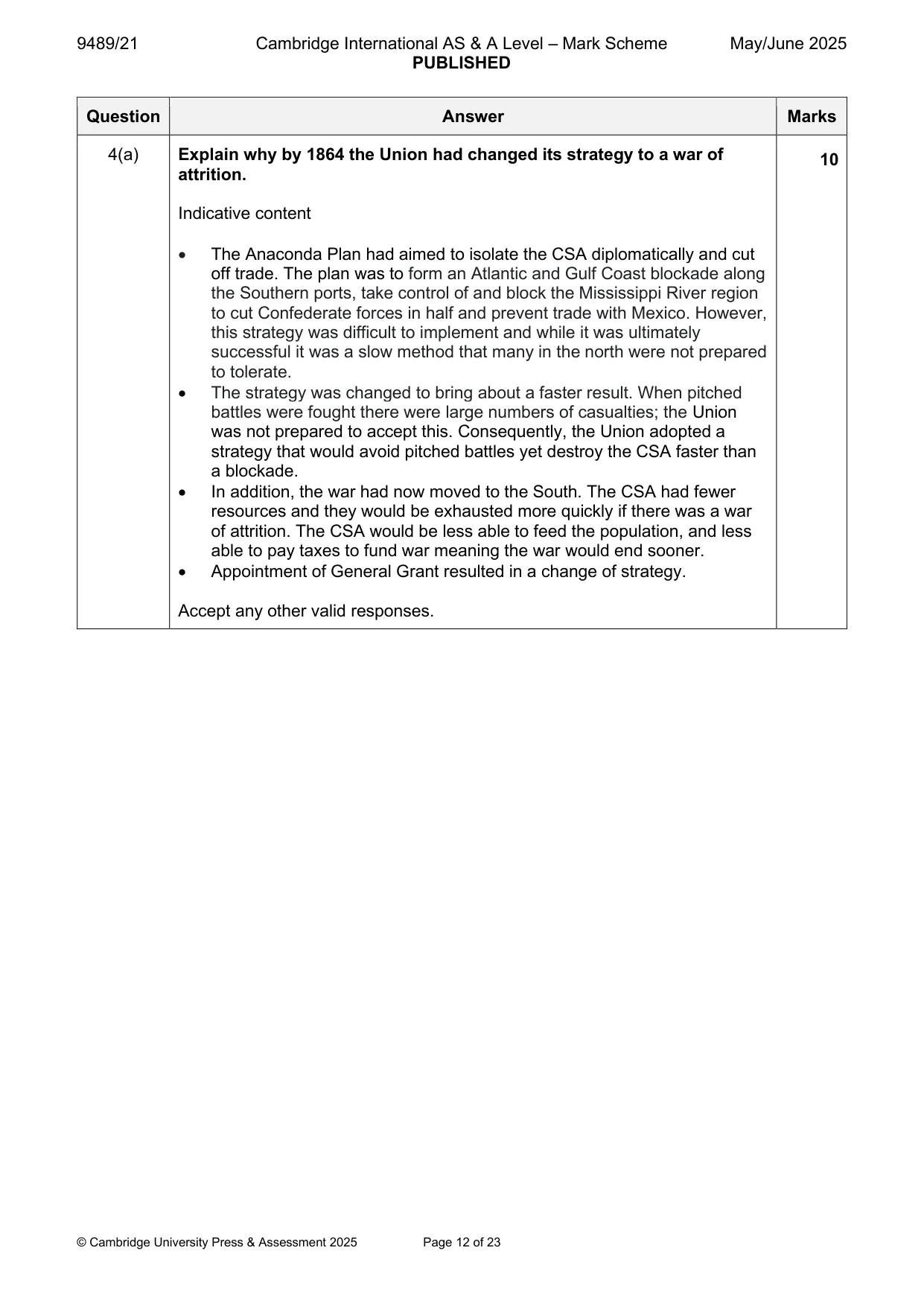
Mark scheme: 3(a) Explain why Witte’s industrial reforms were a success. 10 Indicative content • Finance – Witte negotiated huge loans, particularly from the French. He encouraged the influx of foreign funds by adopting the gold standard which meant the rouble had a fixed gold content. This gave it strength when exchanged with other currencies. • Use of foreign resources – large numbers of foreign experts and workers to advise on industrial planning and techniques. • There was heavy investment in railways – in 1891 20 000 miles of tracked existed and by 1900 it was over 33 000 miles. This stimulated allied industries (coal/iron/steel) and reduced manufacturing costs through the bulk transport of goods/materials. • Protectionism – nascent Russian industries were protected from foreign competition by placing tariffs on imported foreign goods. • Results – In 1890 coal, pig iron and oil production stood at 5.9, 0.89 and 3.9 million tons respectively. By 1900 they were 16.1, 2.66 and 10.2 million tons respectively. Accept any other valid responses. 3(b) ‘Lenin’s leadership was the reason for Bolshevik success in October 20 1917.’ How far do you agree? Indicative content Arguments in support could be as follows. After his return to Russia in 1917 Lenin had refused to allow the Bolsheviks to cooperate with the Provisional Government. This meant they were not associated with the failures following February 1917. They offered the potential for a fresh start. He was flexible, willing to adjust to circumstances. Land re-distribution went against Bolshevik ideology, but peasant support was vital to achieve his basic aim – seizing power. Lenin was a shrewd political operator, his slogan ‘Peace, Bread and Land’ captured perfectly what most in Russia wanted. This led the Bolsheviks to be seen as the party which would get things done. He was a good political orator and employed effective propaganda in Pravda which kept the Bolshevik message to the forefront. Lenin had built up the party and his influence over policy was central to Bolshevik success. Trotsky believed that if he had not been in Petrograd in October 1917 the Revolution would have gone ahead, but only if Lenin was present and in command. This view can be challenged. The February Revolution of 1917 took Lenin by surprise. The July Days were a serious setback and forced Lenin to flee to Finland and the Bolsheviks went underground. The impact of the First World War (FWW) was profound – almost continuous military setbacks and disrupted and dwindling supplies of food to the major cities. By October 1917 the military had drifted away from the Provisional Government (PG). The PG proved to be incompetent as the FWW continued, there was the Kornilov Affair and the arming of the Soviets. Trotsky proved to be a master tactician and organiser. Lenin gave the order to proceed in October 1917, but it was based on Trotsky’s planning and preparation. Accept any other valid responses. 4(a) Explain why by 1864 the Union had changed its strategy to a war of 10 attrition. Indicative content • The Anaconda Plan had aimed to isolate the CSA diplomatically and cut off trade. The plan was to form an Atlantic and Gulf Coast blockade along the Southern ports, take control of and block the Mississippi River region to cut Confederate forces in half and prevent trade with Mexico. However, this strategy was difficult to implement and while it was ultimately successful it was a slow method that many in the north were not prepared to tolerate. • The strategy was changed to bring about a faster result. When pitched battles were fought there were large numbers of casualties; the Union was not prepared to accept this. Consequently, the Union adopted a strategy that would avoid pitched battles yet destroy the CSA faster than a blockade. • In addition, the war had now moved to the South. The CSA had fewer resources and they would be exhausted more quickly if there was a war of attrition. The CSA would be less able to feed the population, and less able to pay taxes to fund war meaning the war would end sooner. • Appointment of General Grant resulted in a change of strategy. Accept any other valid responses.
More questions on How and why did the Bolsheviks seize power in October 1917?
Q4 · Civil War and Reconstruction, 1861–77 (a) Explain why by 1864 the Union had changed its…
4 Civil War and Reconstruction, 1861–77 (a) Explain why by 1864 the Union had changed its strategy to a war of attrition. [10] (b) How far do you agree that the main aim of Radical Reconstruction was to rebuild the Southern economy? [20]
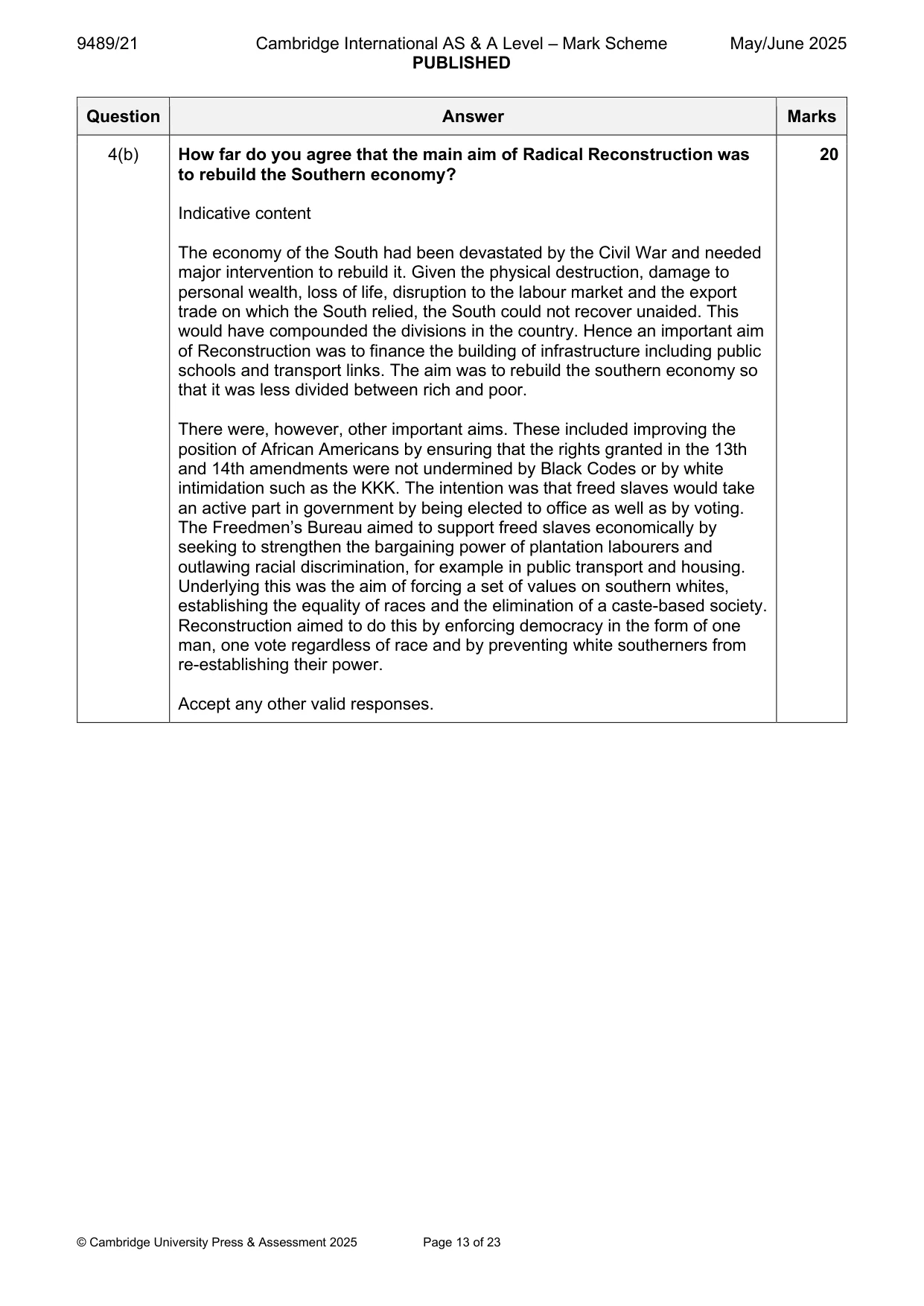
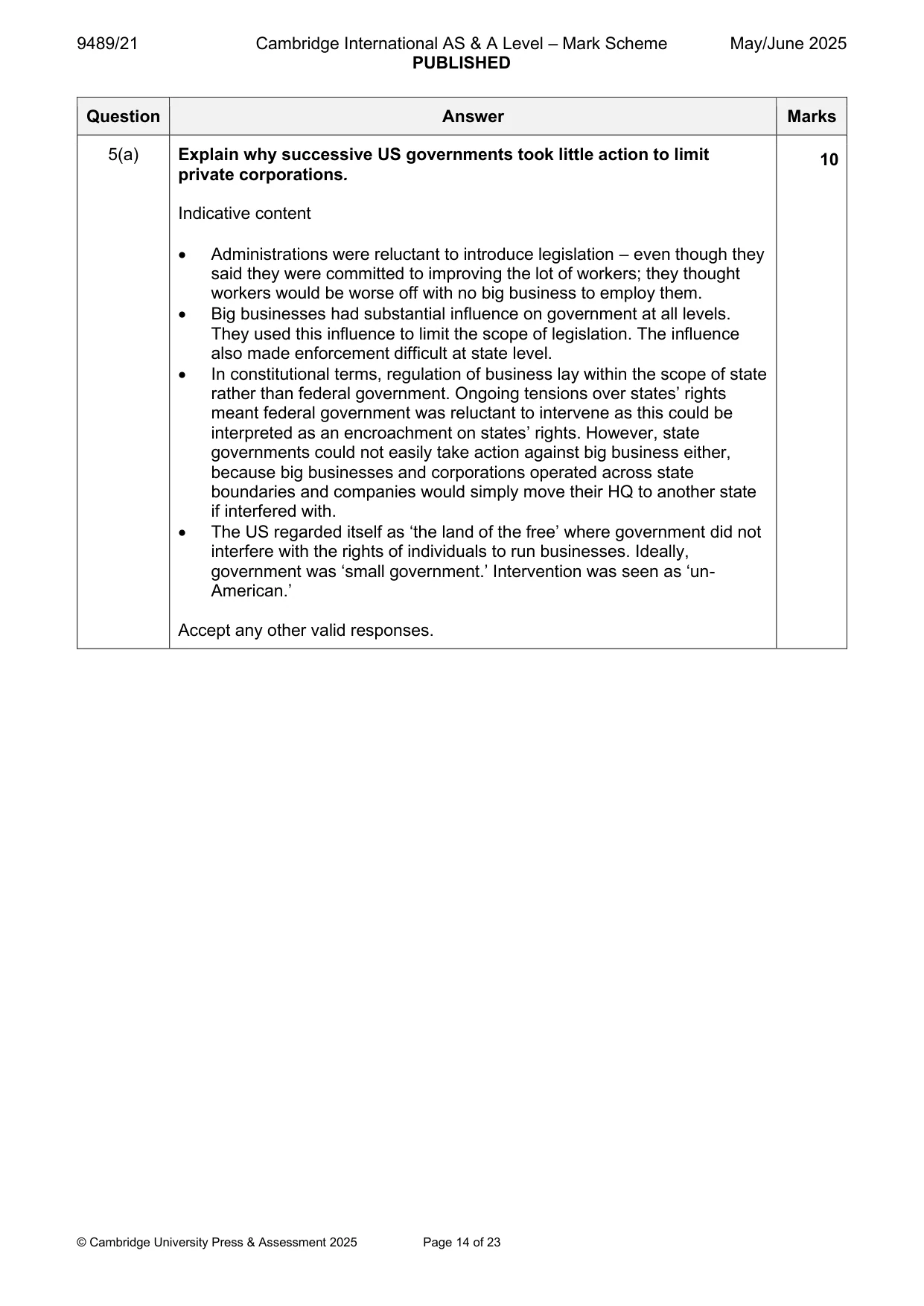
Mark scheme: 4(b) How far do you agree that the main aim of Radical Reconstruction was 20 to rebuild the Southern economy? Indicative content The economy of the South had been devastated by the Civil War and needed major intervention to rebuild it. Given the physical destruction, damage to personal wealth, loss of life, disruption to the labour market and the export trade on which the South relied, the South could not recover unaided. This would have compounded the divisions in the country. Hence an important aim of Reconstruction was to finance the building of infrastructure including public schools and transport links. The aim was to rebuild the southern economy so that it was less divided between rich and poor. There were, however, other important aims. These included improving the position of African Americans by ensuring that the rights granted in the 13th and 14th amendments were not undermined by Black Codes or by white intimidation such as the KKK. The intention was that freed slaves would take an active part in government by being elected to office as well as by voting. The Freedmen’s Bureau aimed to support freed slaves economically by seeking to strengthen the bargaining power of plantation labourers and outlawing racial discrimination, for example in public transport and housing. Underlying this was the aim of forcing a set of values on southern whites, establishing the equality of races and the elimination of a caste-based society. Reconstruction aimed to do this by enforcing democracy in the form of one man, one vote regardless of race and by preventing white southerners from re-establishing their power. Accept any other valid responses. 5(a) Explain why successive US governments took little action to limit 10 private corporations. Indicative content • Administrations were reluctant to introduce legislation – even though they said they were committed to improving the lot of workers; they thought workers would be worse off with no big business to employ them. • Big businesses had substantial influence on government at all levels. They used this influence to limit the scope of legislation. The influence also made enforcement difficult at state level. • In constitutional terms, regulation of business lay within the scope of state rather than federal government. Ongoing tensions over states’ rights meant federal government was reluctant to intervene as this could be interpreted as an encroachment on states’ rights. However, state governments could not easily take action against big business either, because big businesses and corporations operated across state boundaries and companies would simply move their HQ to another state if interfered with. • The US regarded itself as ‘the land of the free’ where government did not interfere with the rights of individuals to run businesses. Ideally, government was ‘small government.’ Intervention was seen as ‘un- American.’ Accept any other valid responses.
More questions on What were the aims of Reconstruction and how successful was it?
Q5 · The Gilded Age and Progressive Era, 1870s–1920 (a) Explain why successive US governments…
5 The Gilded Age and Progressive Era, 1870s–1920 (a) Explain why successive US governments took little action to limit private corporations. [10] (b) How important were the railroads to the industrialisation of the USA? [20]
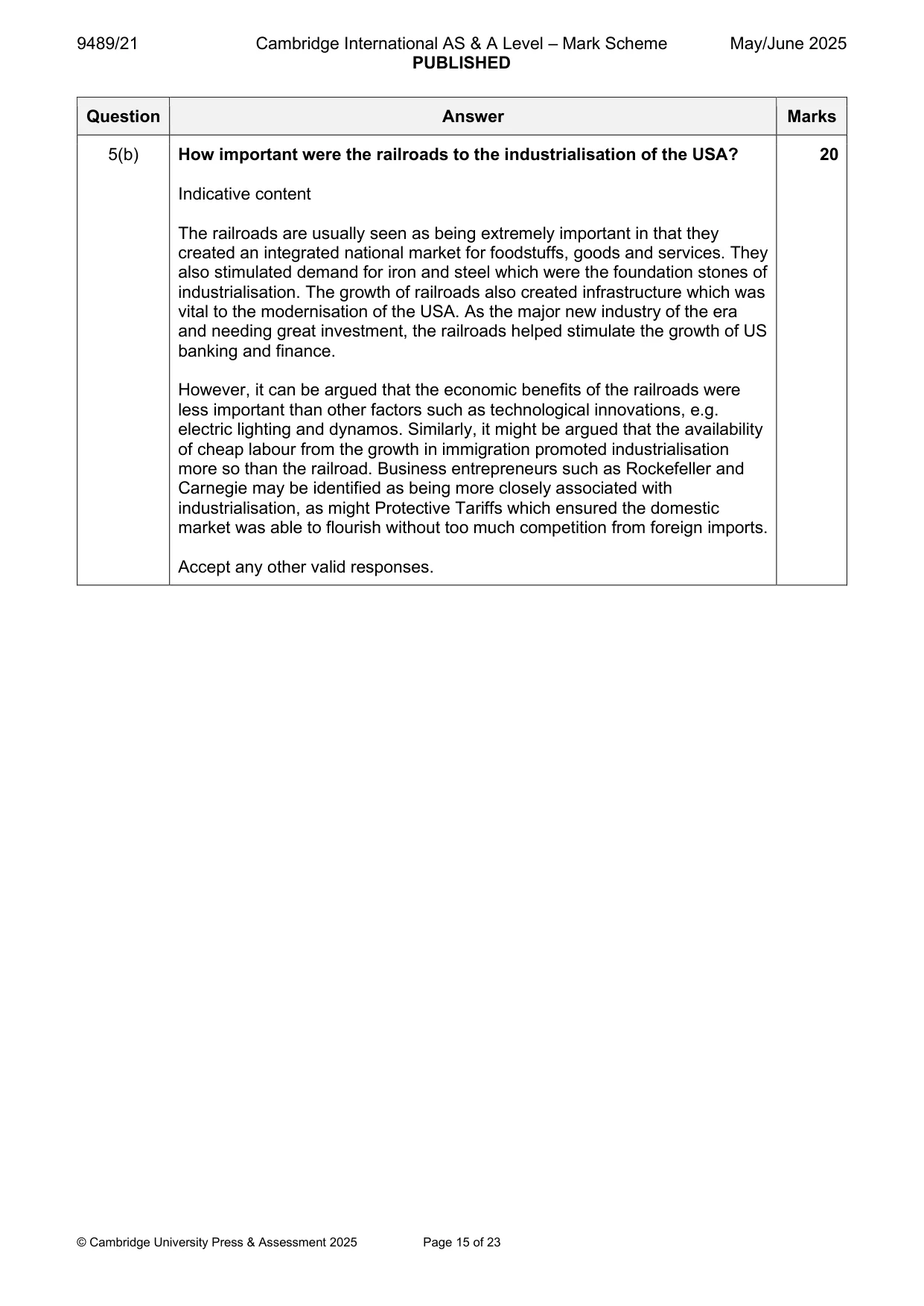
Mark scheme: 5(b) How important were the railroads to the industrialisation of the USA? 20 Indicative content The railroads are usually seen as being extremely important in that they created an integrated national market for foodstuffs, goods and services. They also stimulated demand for iron and steel which were the foundation stones of industrialisation. The growth of railroads also created infrastructure which was vital to the modernisation of the USA. As the major new industry of the era and needing great investment, the railroads helped stimulate the growth of US banking and finance. However, it can be argued that the economic benefits of the railroads were less important than other factors such as technological innovations, e.g. electric lighting and dynamos. Similarly, it might be argued that the availability of cheap labour from the growth in immigration promoted industrialisation more so than the railroad. Business entrepreneurs such as Rockefeller and Carnegie may be identified as being more closely associated with industrialisation, as might Protective Tariffs which ensured the domestic market was able to flourish without too much competition from foreign imports. Accept any other valid responses.
More questions on Why was there rapid industrialisation after 1870?
Q6 · The Great Crash, the Great Depression and the New Deal policies, 1920–41 (a) Explain why…
6 The Great Crash, the Great Depression and the New Deal policies, 1920–41 (a) Explain why many banks failed after the Great Crash. [10] (b) ‘Roosevelt won the 1936 presidential election because he was seen as the champion of the “have‑nots”.’ How far do you agree? [20] Section C: International option International history, 1870–1945
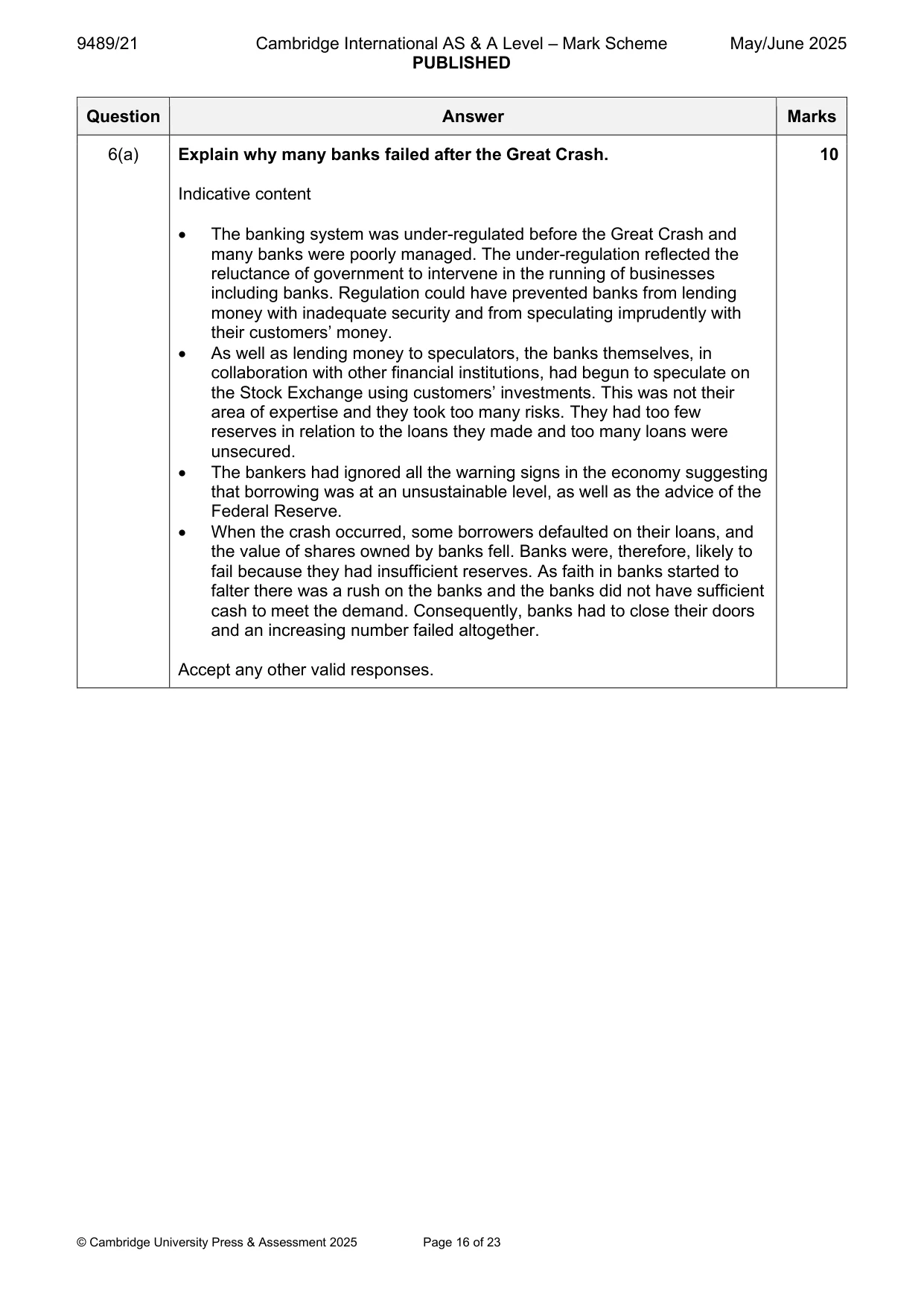
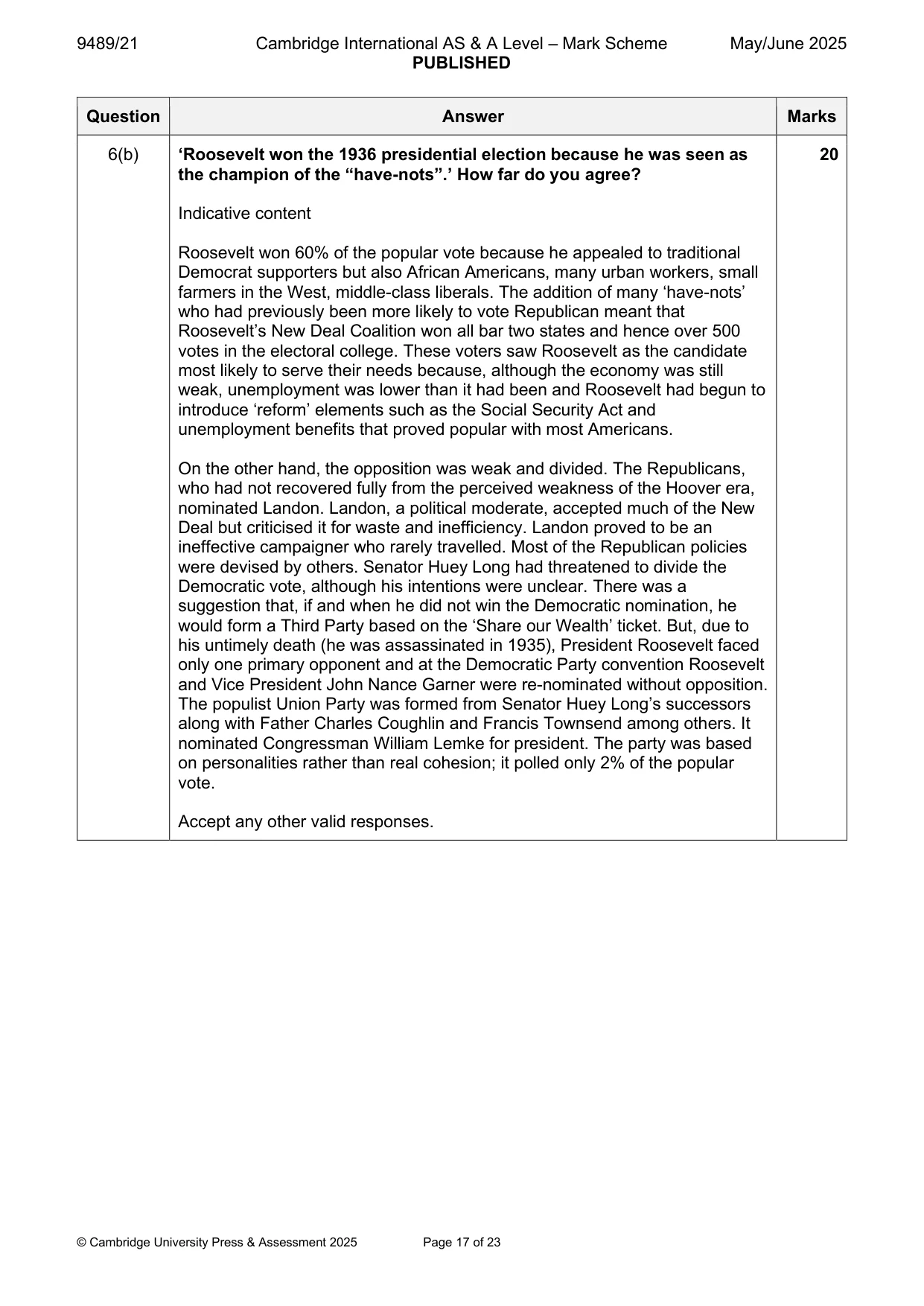
Mark scheme: 6(a) Explain why many banks failed after the Great Crash. 10 Indicative content • The banking system was under-regulated before the Great Crash and many banks were poorly managed. The under-regulation reflected the reluctance of government to intervene in the running of businesses including banks. Regulation could have prevented banks from lending money with inadequate security and from speculating imprudently with their customers’ money. • As well as lending money to speculators, the banks themselves, in collaboration with other financial institutions, had begun to speculate on the Stock Exchange using customers’ investments. This was not their area of expertise and they took too many risks. They had too few reserves in relation to the loans they made and too many loans were unsecured. • The bankers had ignored all the warning signs in the economy suggesting that borrowing was at an unsustainable level, as well as the advice of the Federal Reserve. • When the crash occurred, some borrowers defaulted on their loans, and the value of shares owned by banks fell. Banks were, therefore, likely to fail because they had insufficient reserves. As faith in banks started to falter there was a rush on the banks and the banks did not have sufficient cash to meet the demand. Consequently, banks had to close their doors and an increasing number failed altogether. Accept any other valid responses. 6(b) ‘Roosevelt won the 1936 presidential election because he was seen as 20 the champion of the “have-nots”.’ How far do you agree? Indicative content Roosevelt won 60% of the popular vote because he appealed to traditional Democrat supporters but also African Americans, many urban workers, small farmers in the West, middle-class liberals. The addition of many ‘have-nots’ who had previously been more likely to vote Republican meant that Roosevelt’s New Deal Coalition won all bar two states and hence over 500 votes in the electoral college. These voters saw Roosevelt as the candidate most likely to serve their needs because, although the economy was still weak, unemployment was lower than it had been and Roosevelt had begun to introduce ‘reform’ elements such as the Social Security Act and unemployment benefits that proved popular with most Americans. On the other hand, the opposition was weak and divided. The Republicans, who had not recovered fully from the perceived weakness of the Hoover era, nominated Landon. Landon, a political moderate, accepted much of the New Deal but criticised it for waste and inefficiency. Landon proved to be an ineffective campaigner who rarely travelled. Most of the Republican policies were devised by others. Senator Huey Long had threatened to divide the Democratic vote, although his intentions were unclear. There was a suggestion that, if and when he did not win the Democratic nomination, he would form a Third Party based on the ‘Share our Wealth’ ticket. But, due to his untimely death (he was assassinated in 1935), President Roosevelt faced only one primary opponent and at the Democratic Party convention Roosevelt and Vice President John Nance Garner were re-nominated without opposition. The populist Union Party was formed from Senator Huey Long’s successors along with Father Charles Coughlin and Francis Townsend among others. It nominated Congressman William Lemke for president. The party was based on personalities rather than real cohesion; it polled only 2% of the popular vote. Accept any other valid responses.
More questions on Why was there a second New Deal and how successful was it?
Q7 · Empire and the emergence of world powers, 1870–1919 (a) Explain why there was a…
7 Empire and the emergence of world powers, 1870–1919 (a) Explain why there was a conference of European powers in Berlin in 1884–85. [10] (b) To what extent had the USA abandoned an isolationist foreign policy by 1914? [20]
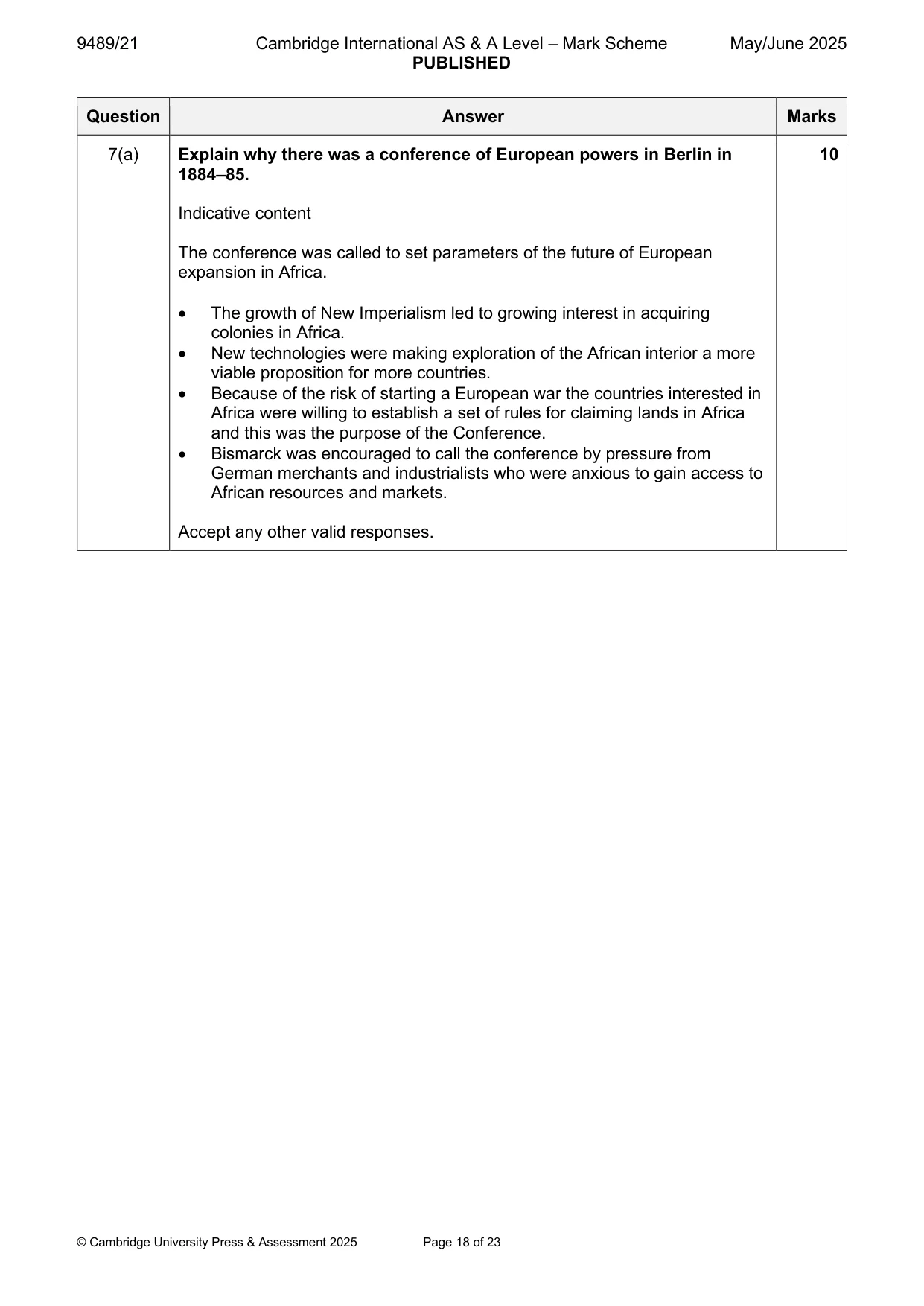
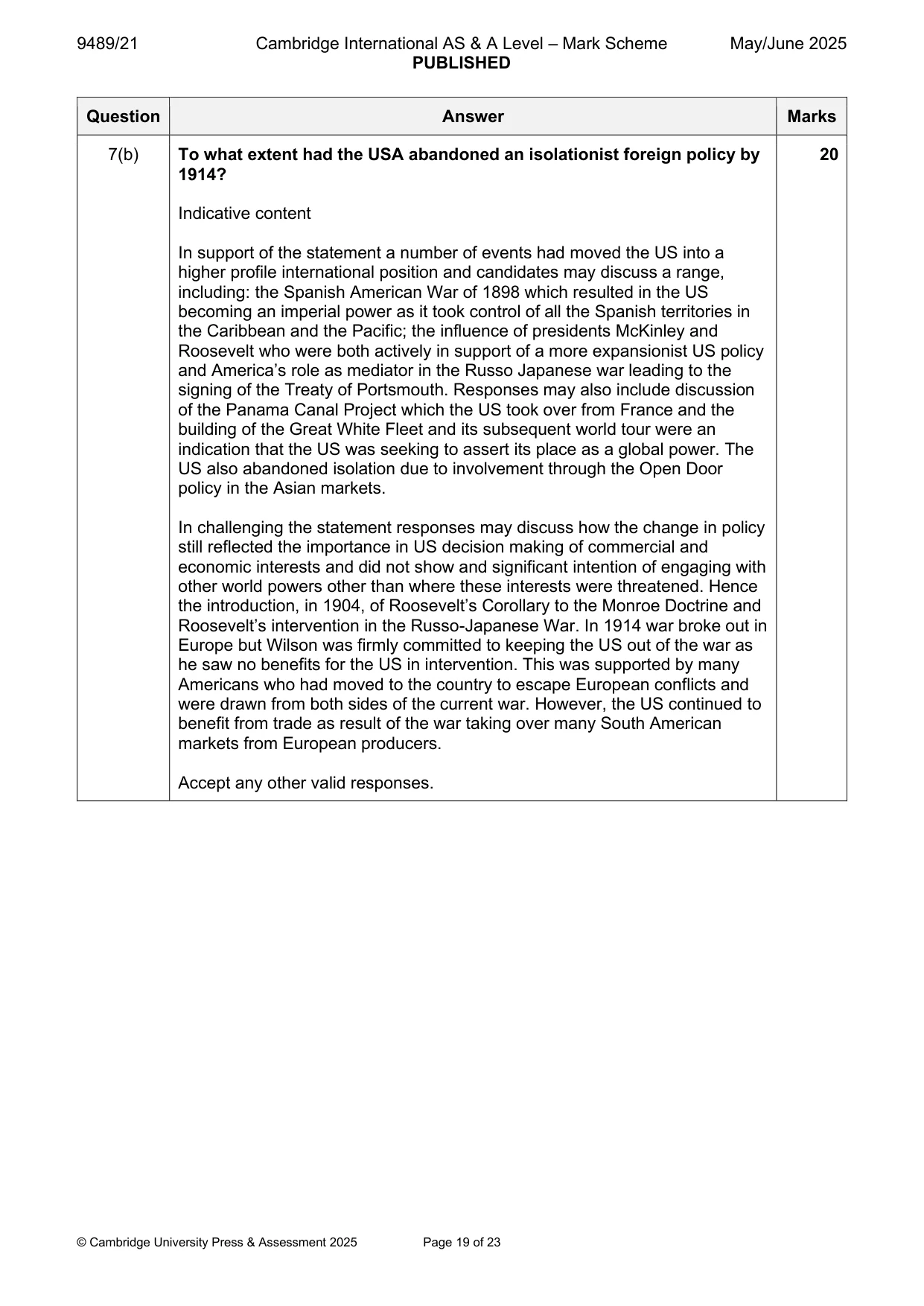
Mark scheme: 7(a) Explain why there was a conference of European powers in Berlin in 10 1884–85. Indicative content The conference was called to set parameters of the future of European expansion in Africa. • The growth of New Imperialism led to growing interest in acquiring colonies in Africa. • New technologies were making exploration of the African interior a more viable proposition for more countries. • Because of the risk of starting a European war the countries interested in Africa were willing to establish a set of rules for claiming lands in Africa and this was the purpose of the Conference. • Bismarck was encouraged to call the conference by pressure from German merchants and industrialists who were anxious to gain access to African resources and markets. Accept any other valid responses. 7(b) To what extent had the USA abandoned an isolationist foreign policy by 20 1914? Indicative content In support of the statement a number of events had moved the US into a higher profile international position and candidates may discuss a range, including: the Spanish American War of 1898 which resulted in the US becoming an imperial power as it took control of all the Spanish territories in the Caribbean and the Pacific; the influence of presidents McKinley and Roosevelt who were both actively in support of a more expansionist US policy and America’s role as mediator in the Russo Japanese war leading to the signing of the Treaty of Portsmouth. Responses may also include discussion of the Panama Canal Project which the US took over from France and the building of the Great White Fleet and its subsequent world tour were an indication that the US was seeking to assert its place as a global power. The US also abandoned isolation due to involvement through the Open Door policy in the Asian markets. In challenging the statement responses may discuss how the change in policy still reflected the importance in US decision making of commercial and economic interests and did not show and significant intention of engaging with other world powers other than where these interests were threatened. Hence the introduction, in 1904, of Roosevelt’s Corollary to the Monroe Doctrine and Roosevelt’s intervention in the Russo-Japanese War. In 1914 war broke out in Europe but Wilson was firmly committed to keeping the US out of the war as he saw no benefits for the US in intervention. This was supported by many Americans who had moved to the country to escape European conflicts and were drawn from both sides of the current war. However, the US continued to benefit from trade as result of the war taking over many South American markets from European producers. Accept any other valid responses.
More questions on Why did the USA emerge as a world power and what was the impact on international
Q8 · The League of Nations and international relations in the 1920s (a) Explain why France and…
8 The League of Nations and international relations in the 1920s (a) Explain why France and Belgium took control of the Ruhr in 1923. [10] (b) ‘The League of Nations carried out its work successfully in the 1920s.’ How far do you agree? [20]
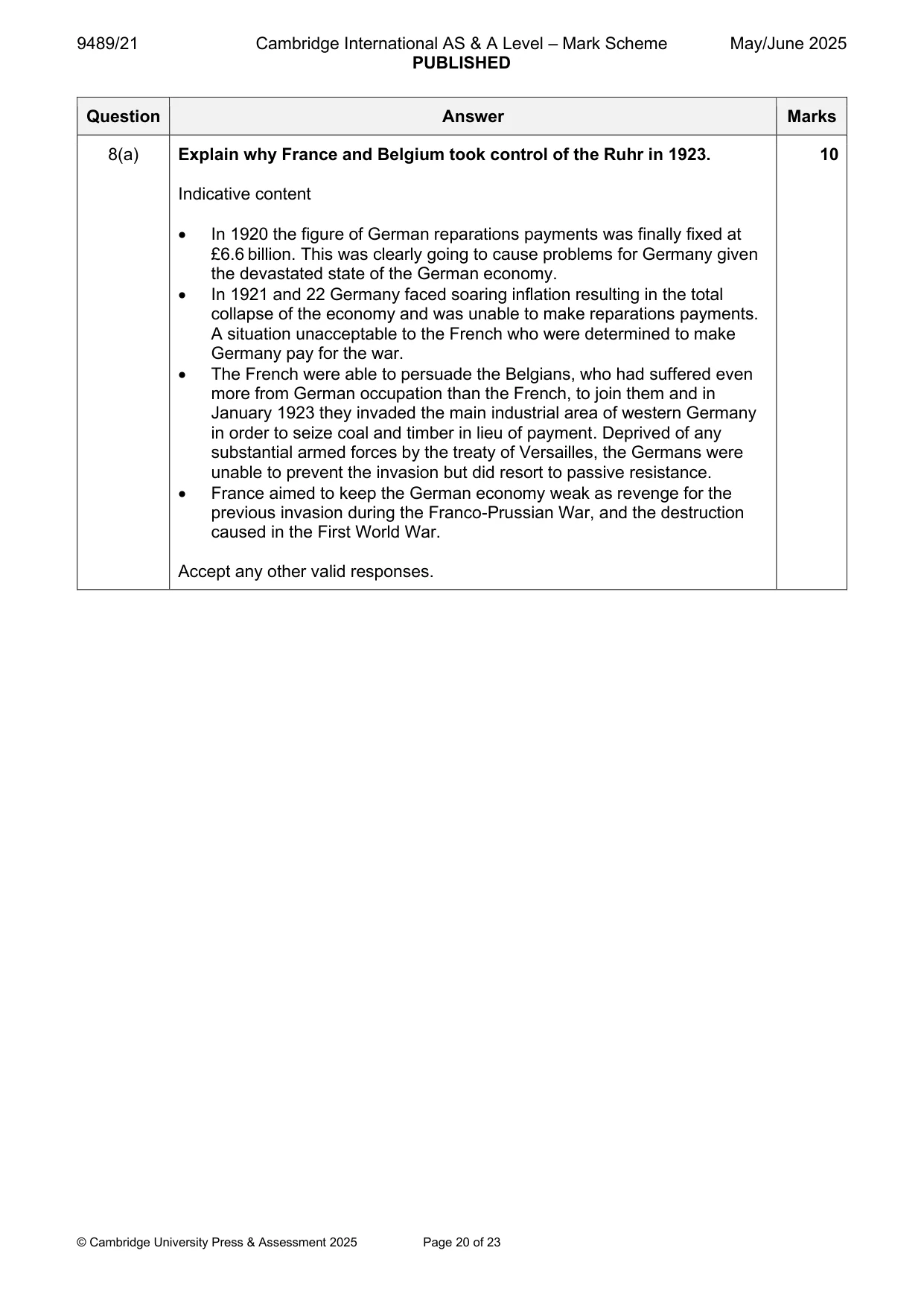
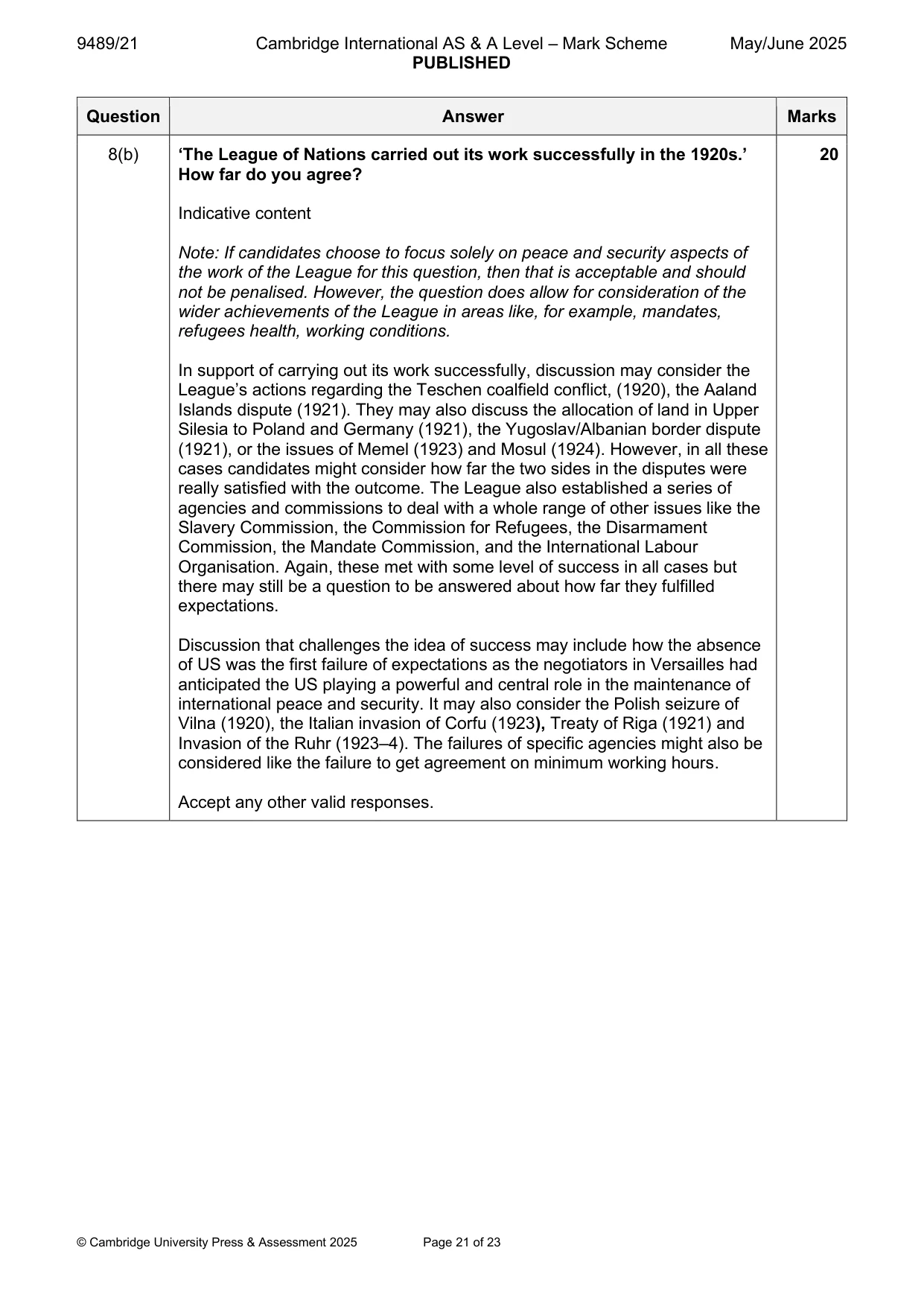
Mark scheme: 8(a) Explain why France and Belgium took control of the Ruhr in 1923. 10 Indicative content • In 1920 the figure of German reparations payments was finally fixed at £6.6 billion. This was clearly going to cause problems for Germany given the devastated state of the German economy. • In 1921 and 22 Germany faced soaring inflation resulting in the total collapse of the economy and was unable to make reparations payments. A situation unacceptable to the French who were determined to make Germany pay for the war. • The French were able to persuade the Belgians, who had suffered even more from German occupation than the French, to join them and in January 1923 they invaded the main industrial area of western Germany in order to seize coal and timber in lieu of payment. Deprived of any substantial armed forces by the treaty of Versailles, the Germans were unable to prevent the invasion but did resort to passive resistance. • France aimed to keep the German economy weak as revenge for the previous invasion during the Franco-Prussian War, and the destruction caused in the First World War. Accept any other valid responses. 8(b) ‘The League of Nations carried out its work successfully in the 1920s.’ 20 How far do you agree? Indicative content Note: If candidates choose to focus solely on peace and security aspects of the work of the League for this question, then that is acceptable and should not be penalised. However, the question does allow for consideration of the wider achievements of the League in areas like, for example, mandates, refugees health, working conditions. In support of carrying out its work successfully, discussion may consider the League’s actions regarding the Teschen coalfield conflict, (1920), the Aaland Islands dispute (1921). They may also discuss the allocation of land in Upper Silesia to Poland and Germany (1921), the Yugoslav/Albanian border dispute (1921), or the issues of Memel (1923) and Mosul (1924). However, in all these cases candidates might consider how far the two sides in the disputes were really satisfied with the outcome. The League also established a series of agencies and commissions to deal with a whole range of other issues like the Slavery Commission, the Commission for Refugees, the Disarmament Commission, the Mandate Commission, and the International Labour Organisation. Again, these met with some level of success in all cases but there may still be a question to be answered about how far they fulfilled expectations. Discussion that challenges the idea of success may include how the absence of US was the first failure of expectations as the negotiators in Versailles had anticipated the US playing a powerful and central role in the maintenance of international peace and security. It may also consider the Polish seizure of Vilna (1920), the Italian invasion of Corfu (1923), Treaty of Riga (1921) and Invasion of the Ruhr (1923–4). The failures of specific agencies might also be considered like the failure to get agreement on minimum working hours. Accept any other valid responses.
Q9 · China and Japan, 1912–45 (a) Explain why the Manchu dynasty was removed from power in 1912
9 China and Japan, 1912–45 (a) Explain why the Manchu dynasty was removed from power in 1912. [10] (b) ‘The Nanjing Decade (1928–37) was a period of success for the Kuomintang.’ How far do you agree? [20]
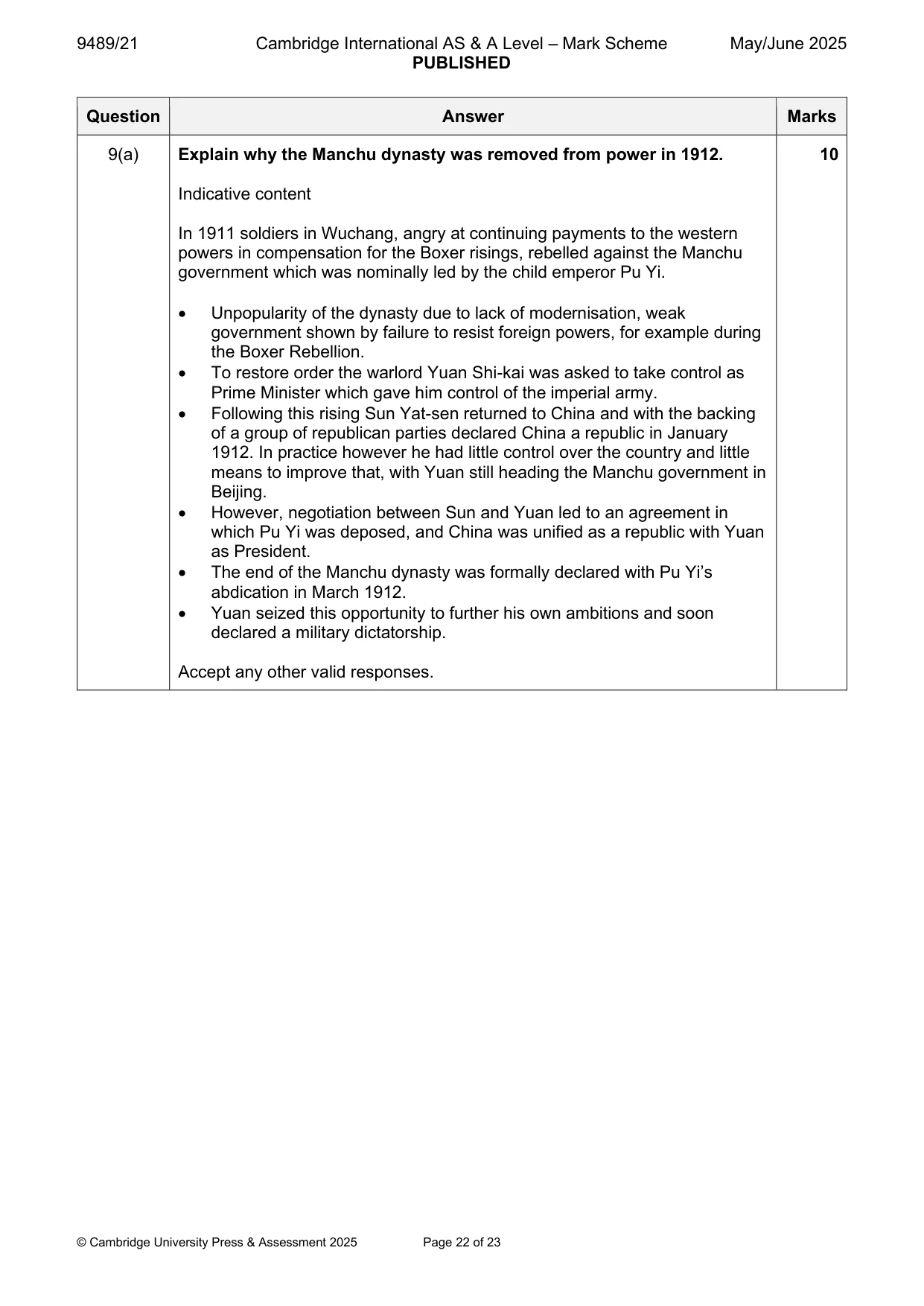
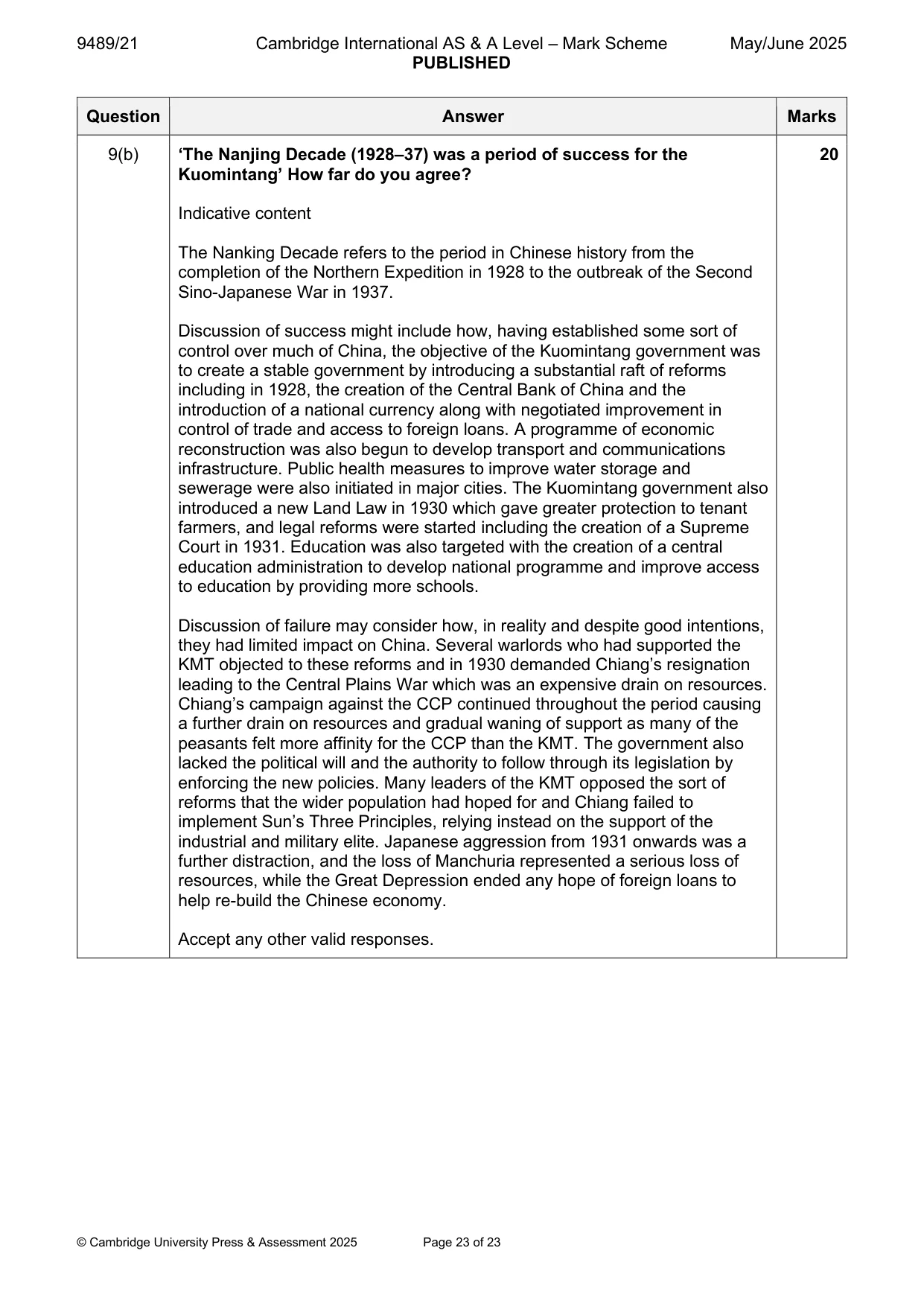
Mark scheme: 9(a) Explain why the Manchu dynasty was removed from power in 1912. 10 Indicative content In 1911 soldiers in Wuchang, angry at continuing payments to the western powers in compensation for the Boxer risings, rebelled against the Manchu government which was nominally led by the child emperor Pu Yi. • Unpopularity of the dynasty due to lack of modernisation, weak government shown by failure to resist foreign powers, for example during the Boxer Rebellion. • To restore order the warlord Yuan Shi-kai was asked to take control as Prime Minister which gave him control of the imperial army. • Following this rising Sun Yat-sen returned to China and with the backing of a group of republican parties declared China a republic in January 1912. In practice however he had little control over the country and little means to improve that, with Yuan still heading the Manchu government in Beijing. • However, negotiation between Sun and Yuan led to an agreement in which Pu Yi was deposed, and China was unified as a republic with Yuan as President. • The end of the Manchu dynasty was formally declared with Pu Yi’s abdication in March 1912. • Yuan seized this opportunity to further his own ambitions and soon declared a military dictatorship. Accept any other valid responses. 9(b) ‘The Nanjing Decade (1928–37) was a period of success for the 20 Kuomintang’ How far do you agree? Indicative content The Nanking Decade refers to the period in Chinese history from the completion of the Northern Expedition in 1928 to the outbreak of the Second Sino-Japanese War in 1937. Discussion of success might include how, having established some sort of control over much of China, the objective of the Kuomintang government was to create a stable government by introducing a substantial raft of reforms including in 1928, the creation of the Central Bank of China and the introduction of a national currency along with negotiated improvement in control of trade and access to foreign loans. A programme of economic reconstruction was also begun to develop transport and communications infrastructure. Public health measures to improve water storage and sewerage were also initiated in major cities. The Kuomintang government also introduced a new Land Law in 1930 which gave greater protection to tenant farmers, and legal reforms were started including the creation of a Supreme Court in 1931. Education was also targeted with the creation of a central education administration to develop national programme and improve access to education by providing more schools. Discussion of failure may consider how, in reality and despite good intentions, they had limited impact on China. Several warlords who had supported the KMT objected to these reforms and in 1930 demanded Chiang’s resignation leading to the Central Plains War which was an expensive drain on resources. Chiang’s campaign against the CCP continued throughout the period causing a further drain on resources and gradual waning of support as many of the peasants felt more affinity for the CCP than the KMT. The government also lacked the political will and the authority to follow through its legislation by enforcing the new policies. Many leaders of the KMT opposed the sort of reforms that the wider population had hoped for and Chiang failed to implement Sun’s Three Principles, relying instead on the support of the industrial and military elite. Japanese aggression from 1931 onwards was a further distraction, and the loss of Manchuria represented a serious loss of resources, while the Great Depression ended any hope of foreign loans to help re-build the Chinese economy. Accept any other valid responses.
More questions on Why did Japan emerge as a world power and what was the impact on international
What was in this paper
The subtopics covered by these 9 questions, and how many questions each got. Open one in a new tab to see every Cambridge question on it.
2How and why did the Bolsheviks seize power in October 1917?1How well was France governed in the period 1793–99?1What were the aims of Reconstruction and how successful was it?1Why did Japan emerge as a world power and what was the impact on international1Why did the USA emerge as a world power and what was the impact on international1Why was the League of Nations created and what challenges did it face in the 1920s?1Why was there a second New Deal and how successful was it?1What you needed in this session
Cambridge’s own grade thresholds for 2025 May/June, Paper 2 · Variant 1. A higher threshold means an easier paper — the bar moves with how the cohort did.