Cambridge A Level History 9489 — 2024 May/June Paper 2 · Variant 1
9489/21/M/J/24 · 9 questions · 60 marks · ≈68 min
The question paper and its mark scheme, free to read here and free to download. This is Cambridge’s own paper, exactly as it was sat.
Question paper4 pages
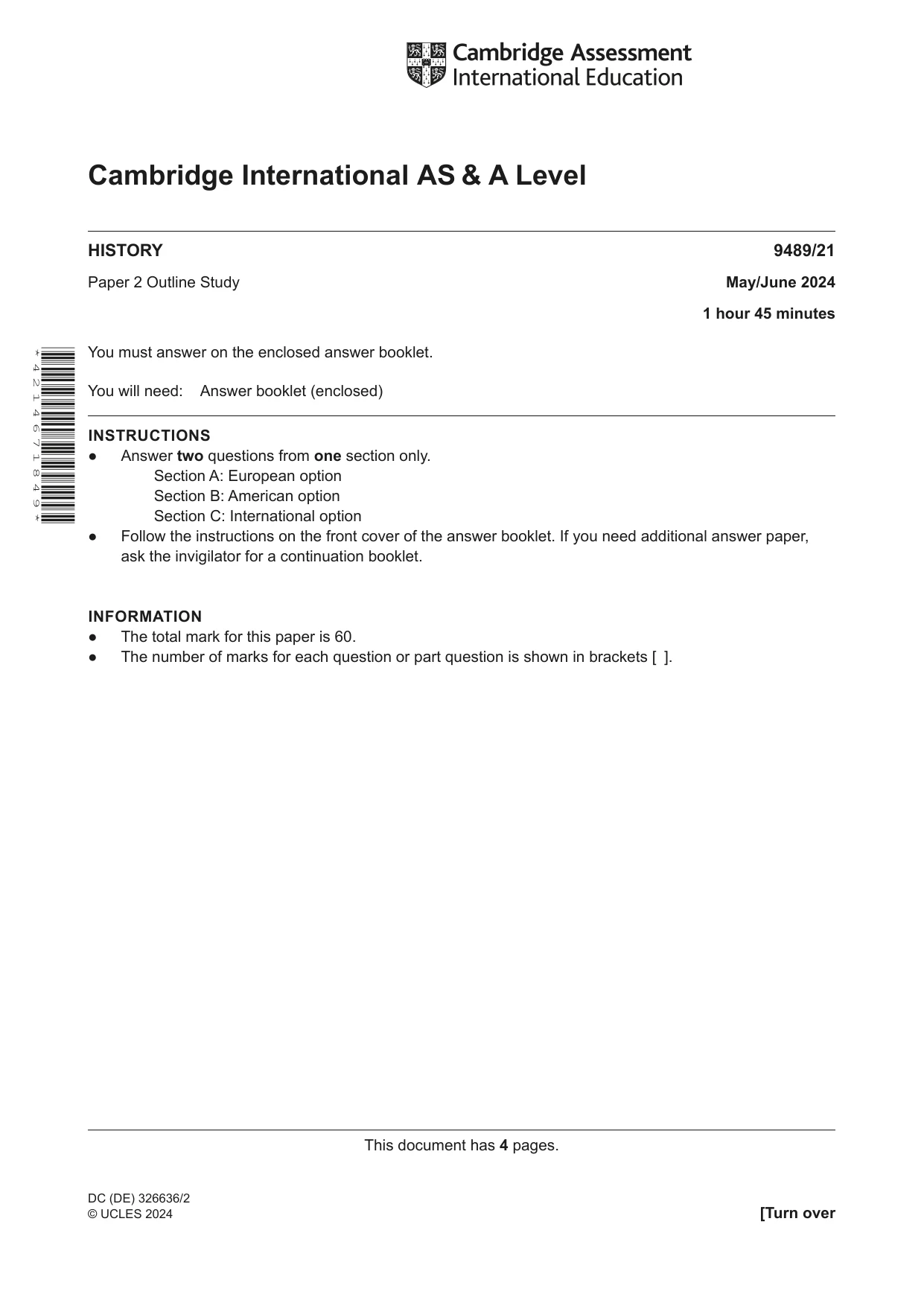
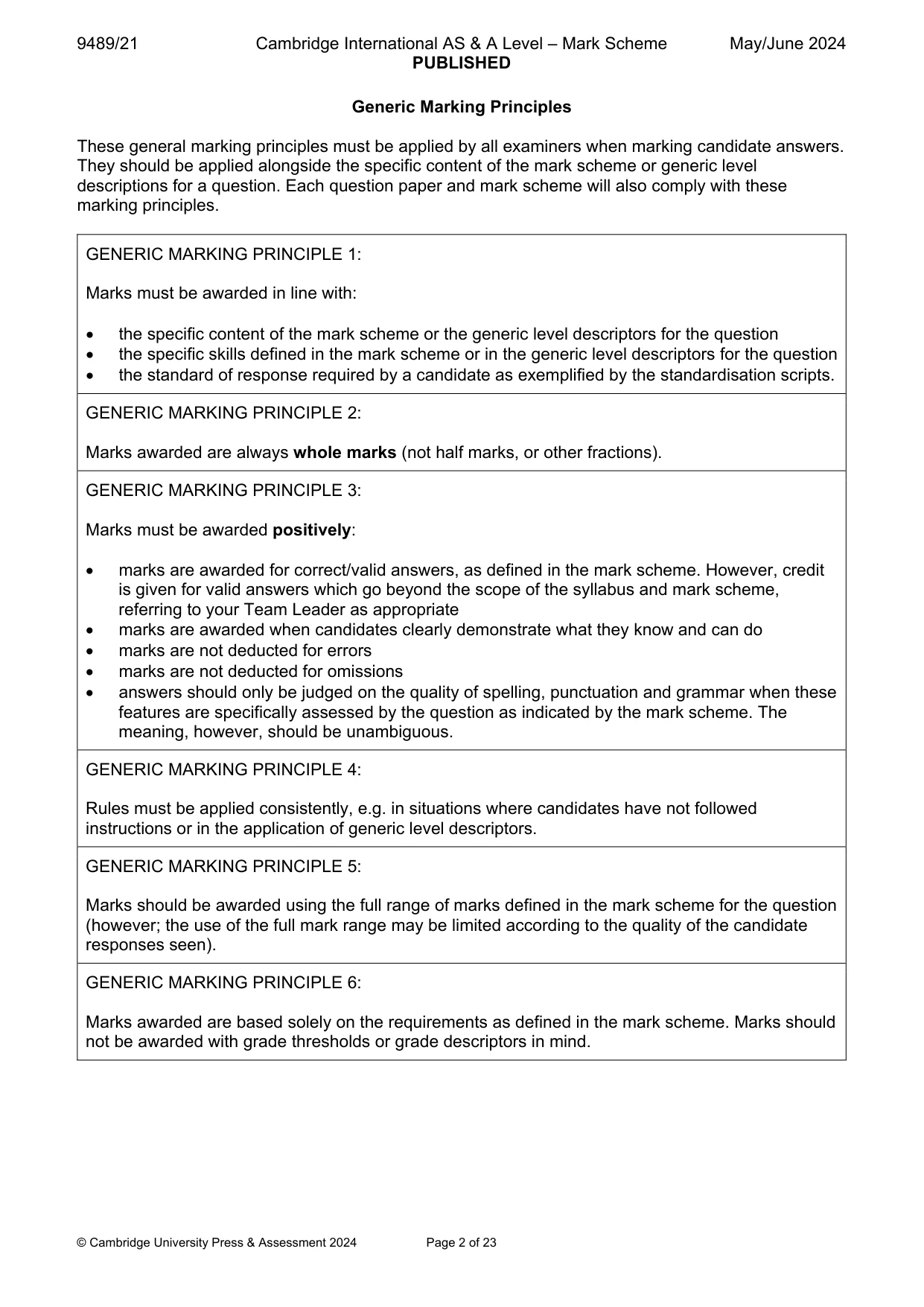
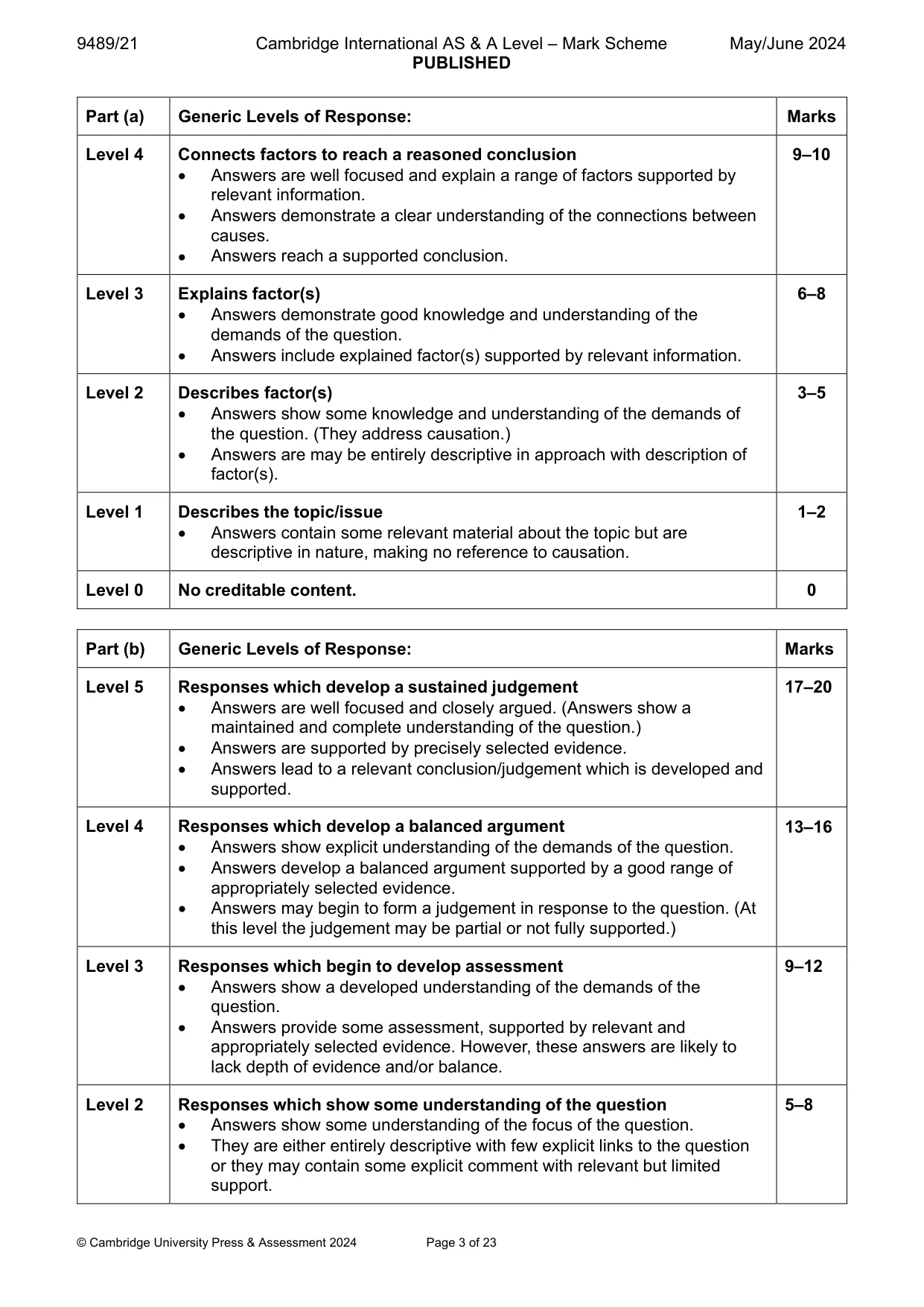
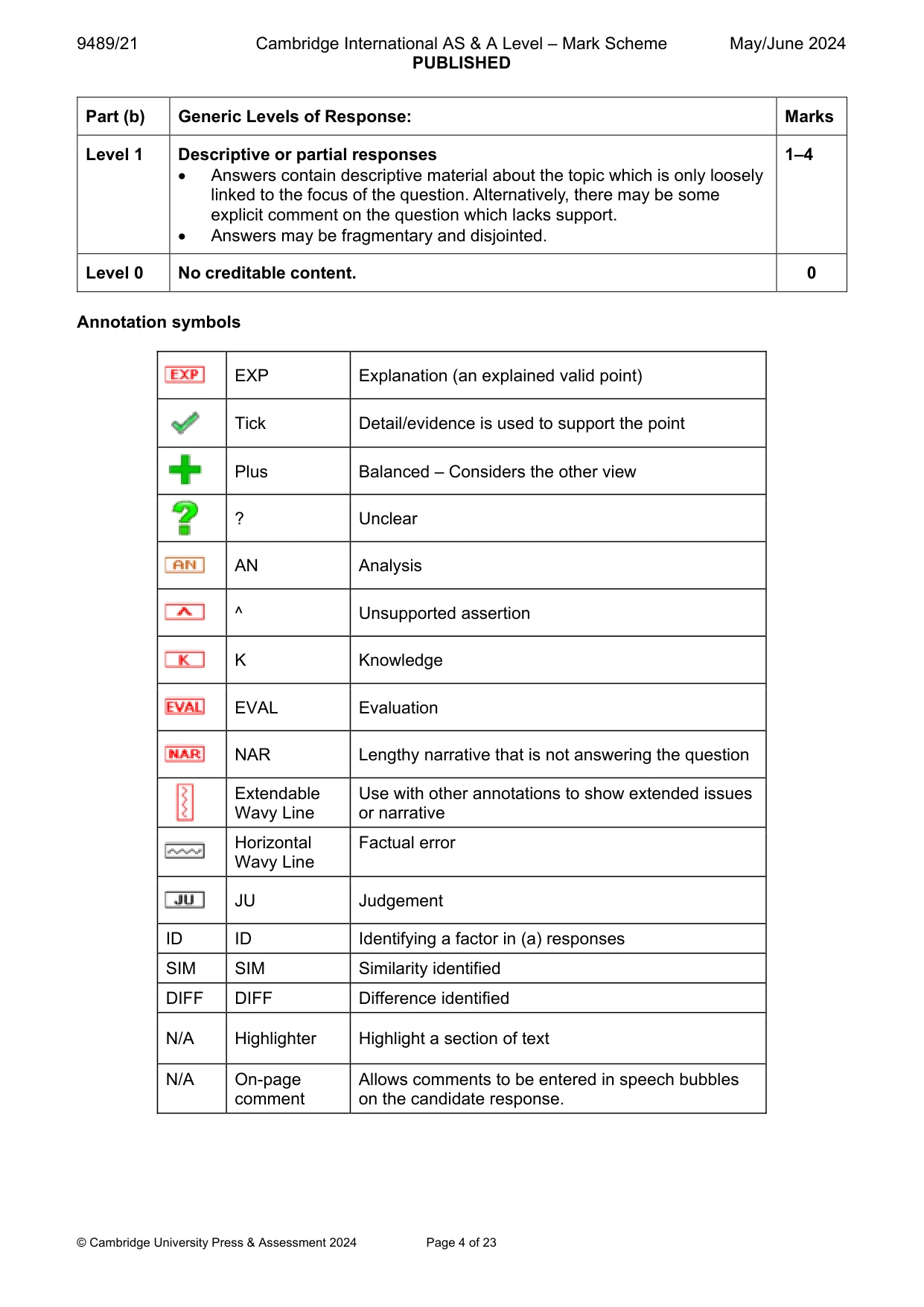
Mark scheme23 pages
Answers below. Sit the paper first if you are practising.
Questions as text
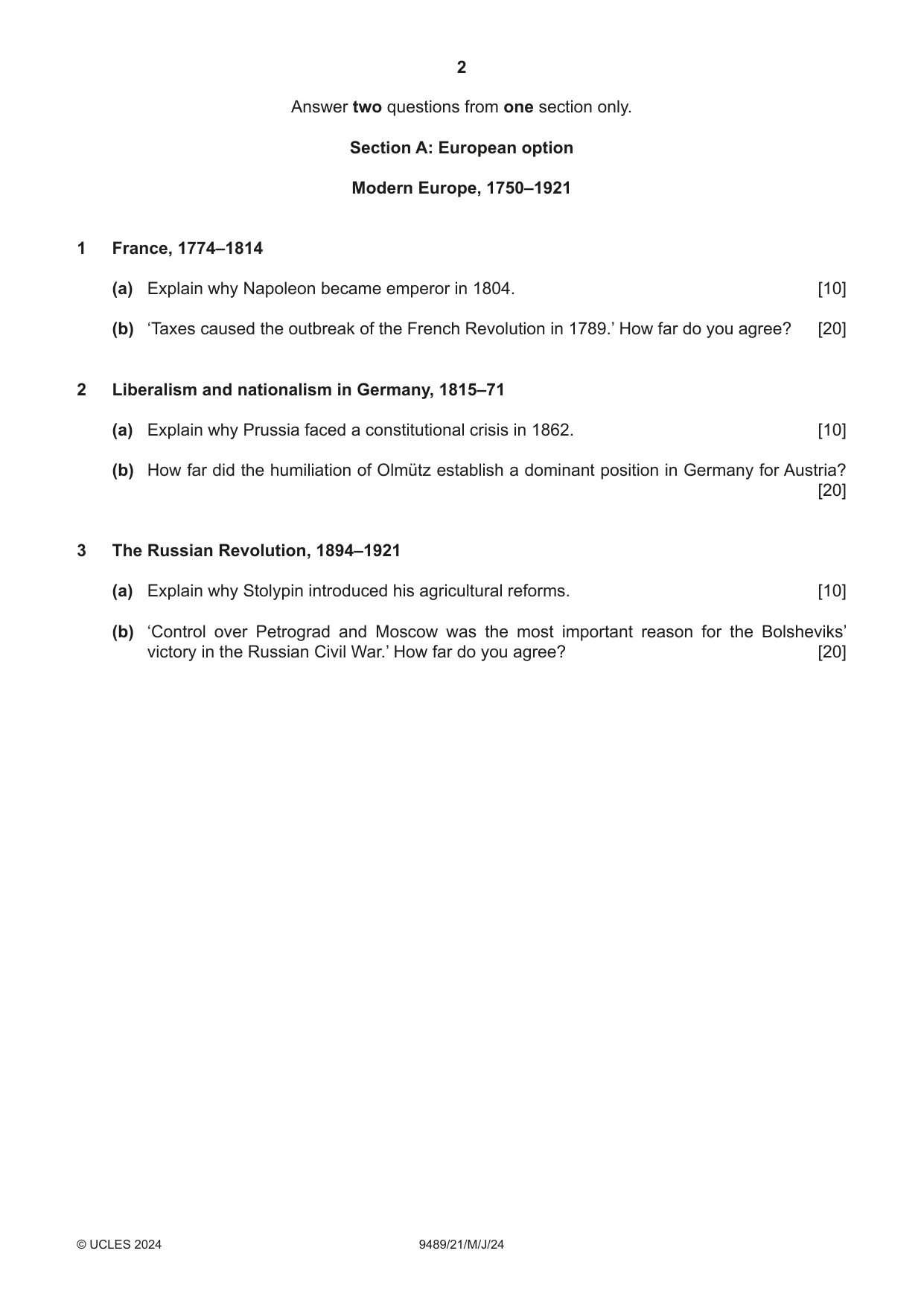
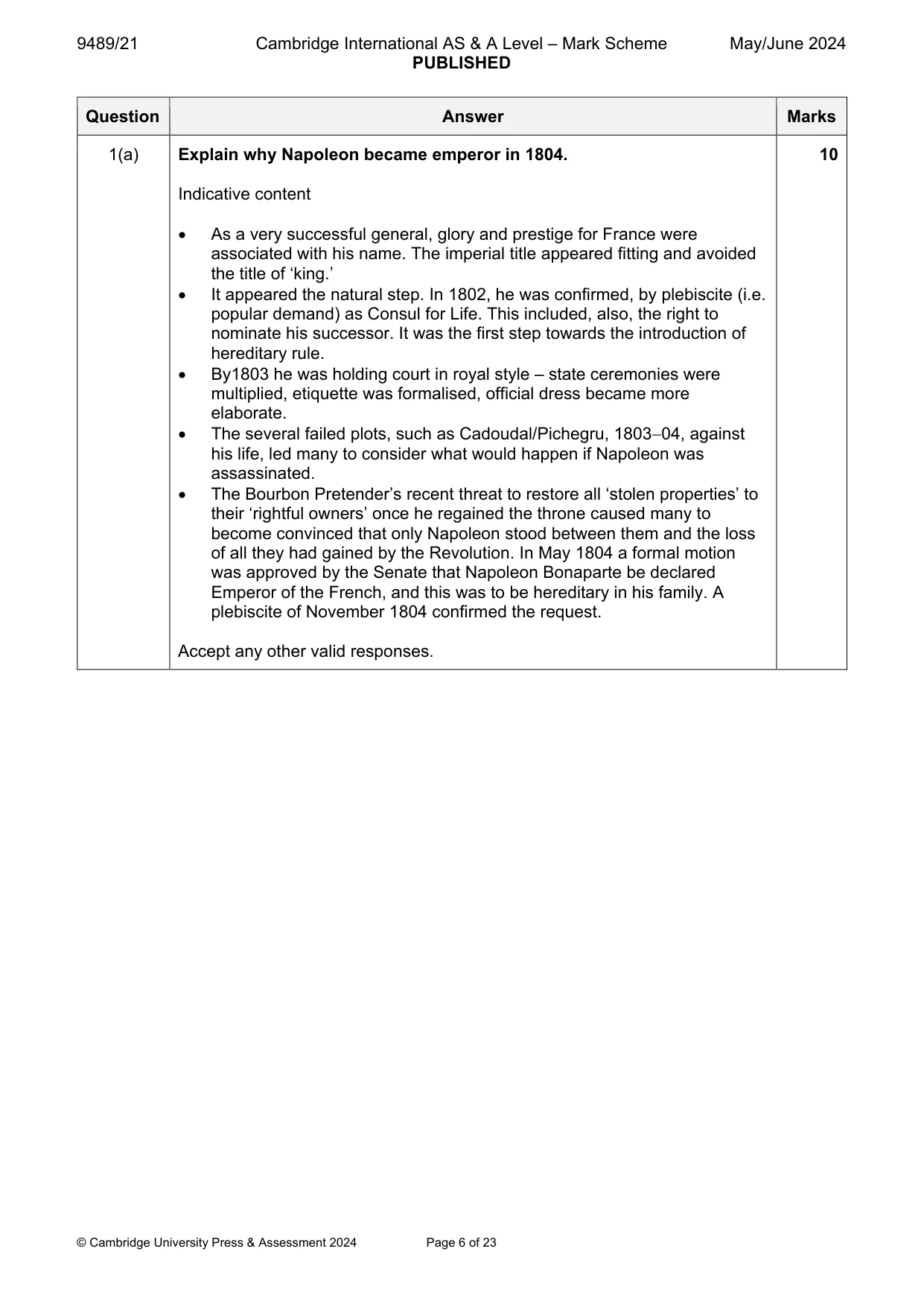
Q1 · France, 1774–1814 (a) Explain why Napoleon became emperor in 1804
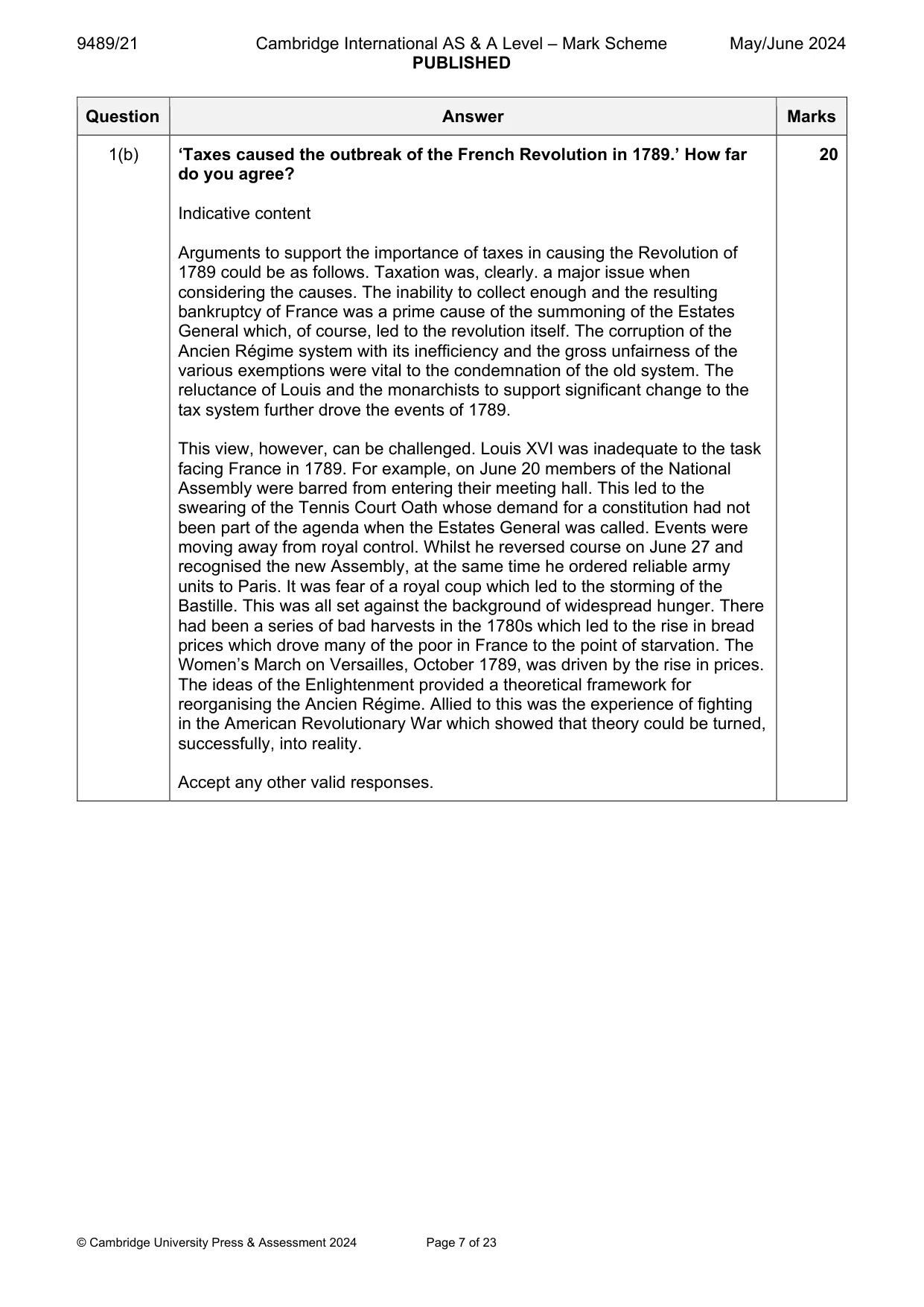
1 France, 1774–1814 (a) Explain why Napoleon became emperor in 1804. [10] (b) ‘Taxes caused the outbreak of the French Revolution in 1789.’ How far do you agree? [20]
Mark scheme: Question Answer Marks 1(a) Explain why Napoleon became emperor in 1804. 10 Indicative content As a very successful general, glory and prestige for France were associated with his name. The imperial title appeared fitting and avoided the title of ‘king.’ It appeared the natural step. In 1802, he was confirmed, by plebiscite (i.e. popular demand) as Consul for Life. This included, also, the right to nominate his successor. It was the first step towards the introduction of hereditary rule. By1803 he was holding court in royal style – state ceremonies were multiplied, etiquette was formalised, official dress became more elaborate. The several failed plots, such as Cadoudal/Pichegru, 180304, against his life, led many to consider what would happen if Napoleon was assassinated. The Bourbon Pretender’s recent threat to restore all ‘stolen properties’ to their ‘rightful owners’ once he regained the throne caused many to become convinced that only Napoleon stood between them and the loss of all they had gained by the Revolution. In May 1804 a formal motion was approved by the Senate that Napoleon Bonaparte be declared Emperor of the French, and this was to be hereditary in his family. A plebiscite of November 1804 confirmed the request. Accept any other valid responses. 1(b) ‘Taxes caused the outbreak of the French Revolution in 1789.’ How far 20 do you agree? Indicative content Arguments to support the importance of taxes in causing the Revolution of 1789 could be as follows. Taxation was, clearly. a major issue when considering the causes. The inability to collect enough and the resulting bankruptcy of France was a prime cause of the summoning of the Estates General which, of course, led to the revolution itself. The corruption of the Ancien Régime system with its inefficiency and the gross unfairness of the various exemptions were vital to the condemnation of the old system. The reluctance of Louis and the monarchists to support significant change to the tax system further drove the events of 1789. This view, however, can be challenged. Louis XVI was inadequate to the task facing France in 1789. For example, on June 20 members of the National Assembly were barred from entering their meeting hall. This led to the swearing of the Tennis Court Oath whose demand for a constitution had not been part of the agenda when the Estates General was called. Events were moving away from royal control. Whilst he reversed course on June 27 and recognised the new Assembly, at the same time he ordered reliable army units to Paris. It was fear of a royal coup which led to the storming of the Bastille. This was all set against the background of widespread hunger. There had been a series of bad harvests in the 1780s which led to the rise in bread prices which drove many of the poor in France to the point of starvation. The Women’s March on Versailles, October 1789, was driven by the rise in prices. The ideas of the Enlightenment provided a theoretical framework for reorganising the Ancien Régime. Allied to this was the experience of fighting in the American Revolutionary War which showed that theory could be turned, successfully, into reality. Accept any other valid responses.
More questions on What were the causes and immediate consequences of the 1789 Revolution?
Q2 · Liberalism and nationalism in Germany, 1815–71 (a) Explain why Prussia faced a…
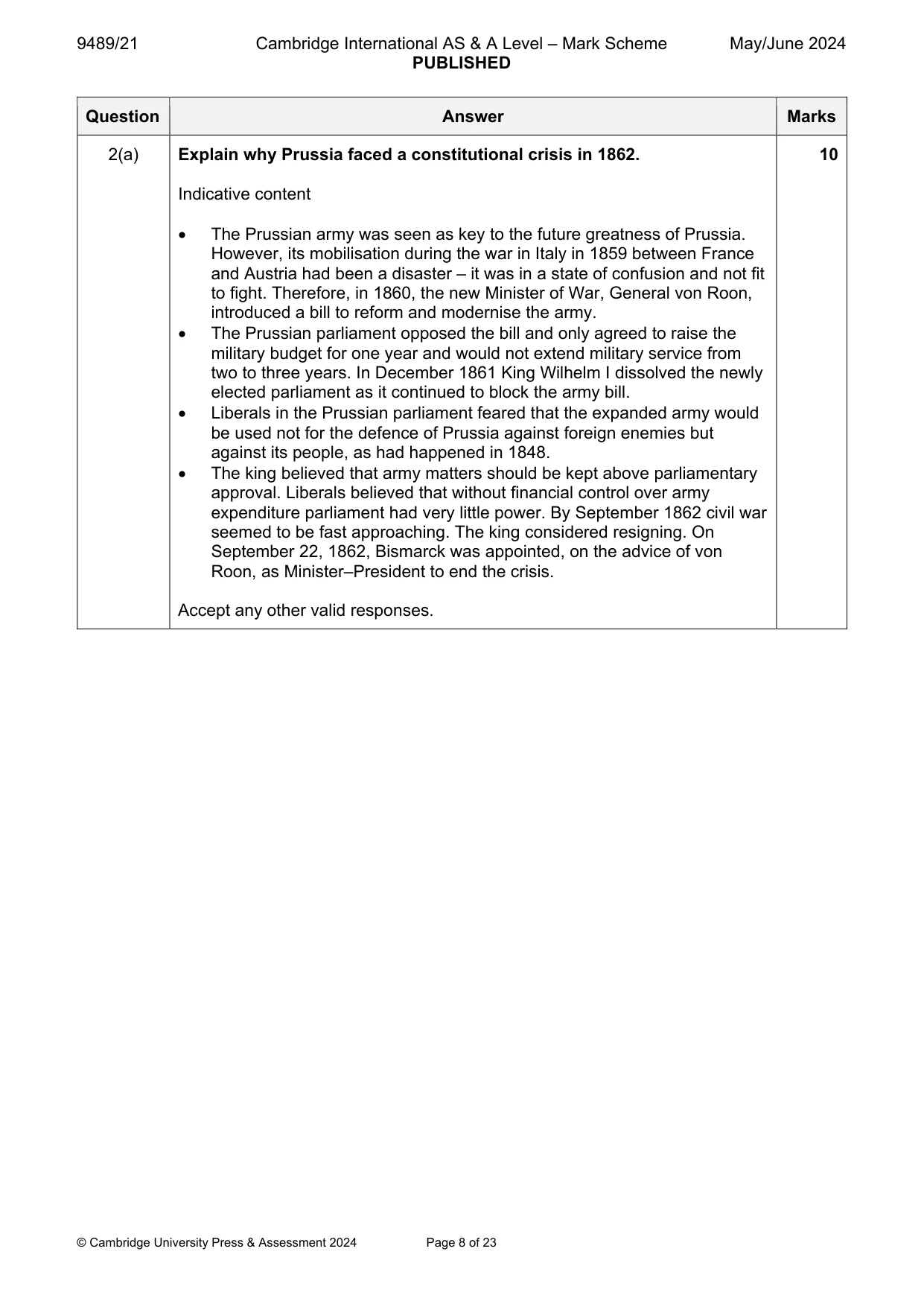
2 Liberalism and nationalism in Germany, 1815–71 (a) Explain why Prussia faced a constitutional crisis in 1862. [10] (b) How far did the humiliation of Olmütz establish a dominant position in Germany for Austria? [20]
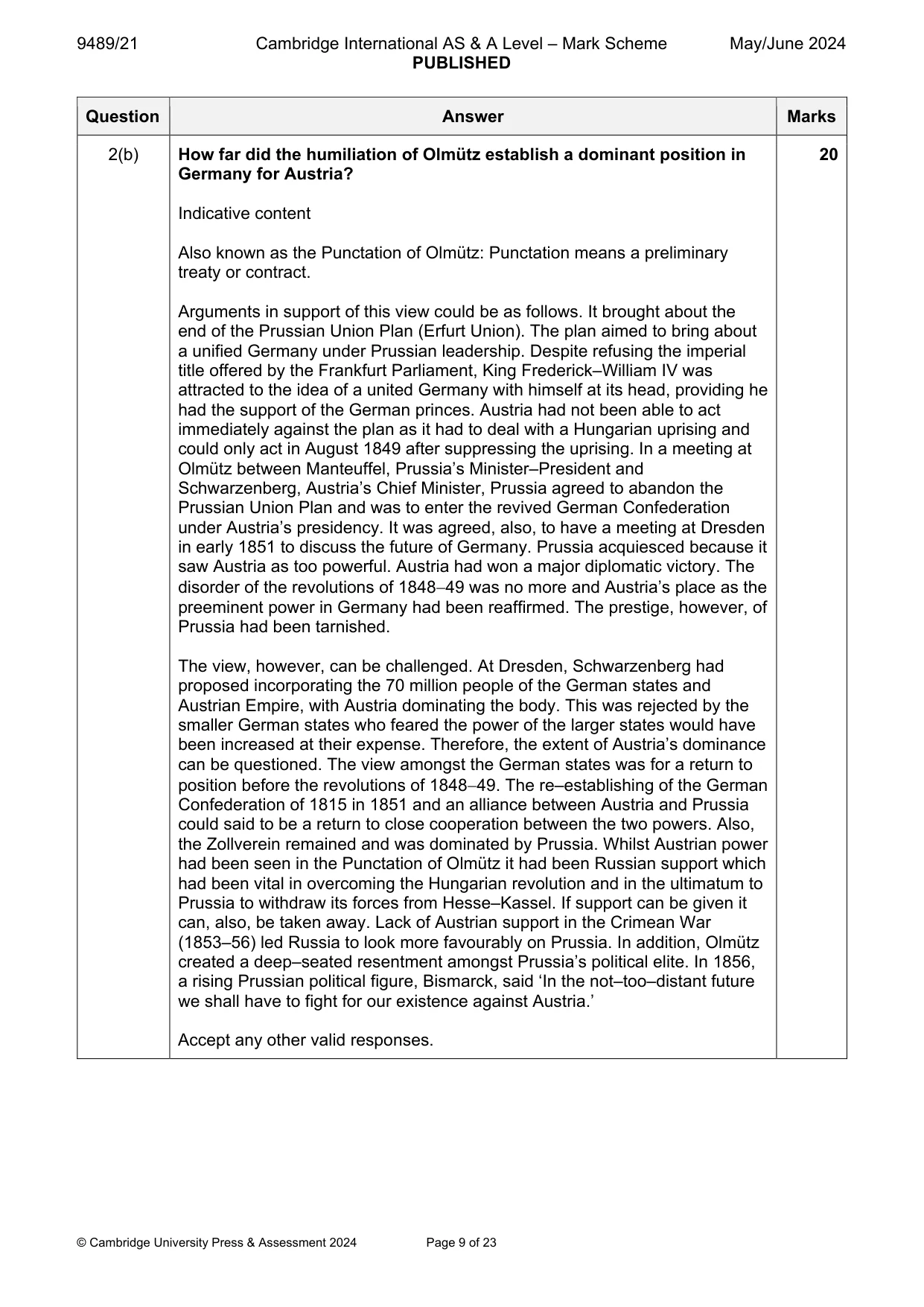
Mark scheme: 2(a) Explain why Prussia faced a constitutional crisis in 1862. 10 Indicative content The Prussian army was seen as key to the future greatness of Prussia. However, its mobilisation during the war in Italy in 1859 between France and Austria had been a disaster – it was in a state of confusion and not fit to fight. Therefore, in 1860, the new Minister of War, General von Roon, introduced a bill to reform and modernise the army. The Prussian parliament opposed the bill and only agreed to raise the military budget for one year and would not extend military service from two to three years. In December 1861 King Wilhelm I dissolved the newly elected parliament as it continued to block the army bill. Liberals in the Prussian parliament feared that the expanded army would be used not for the defence of Prussia against foreign enemies but against its people, as had happened in 1848. The king believed that army matters should be kept above parliamentary approval. Liberals believed that without financial control over army expenditure parliament had very little power. By September 1862 civil war seemed to be fast approaching. The king considered resigning. On September 22, 1862, Bismarck was appointed, on the advice of von Roon, as Minister–President to end the crisis. Accept any other valid responses. 2(b) How far did the humiliation of Olmütz establish a dominant position in 20 Germany for Austria? Indicative content Also known as the Punctation of Olmütz: Punctation means a preliminary treaty or contract. Arguments in support of this view could be as follows. It brought about the end of the Prussian Union Plan (Erfurt Union). The plan aimed to bring about a unified Germany under Prussian leadership. Despite refusing the imperial title offered by the Frankfurt Parliament, King Frederick–William IV was attracted to the idea of a united Germany with himself at its head, providing he had the support of the German princes. Austria had not been able to act immediately against the plan as it had to deal with a Hungarian uprising and could only act in August 1849 after suppressing the uprising. In a meeting at Olmütz between Manteuffel, Prussia’s Minister–President and Schwarzenberg, Austria’s Chief Minister, Prussia agreed to abandon the Prussian Union Plan and was to enter the revived German Confederation under Austria’s presidency. It was agreed, also, to have a meeting at Dresden in early 1851 to discuss the future of Germany. Prussia acquiesced because it saw Austria as too powerful. Austria had won a major diplomatic victory. The disorder of the revolutions of 184849 was no more and Austria’s place as the preeminent power in Germany had been reaffirmed. The prestige, however, of Prussia had been tarnished. The view, however, can be challenged. At Dresden, Schwarzenberg had proposed incorporating the 70 million people of the German states and Austrian Empire, with Austria dominating the body. This was rejected by the smaller German states who feared the power of the larger states would have been increased at their expense. Therefore, the extent of Austria’s dominance can be questioned. The view amongst the German states was for a return to position before the revolutions of 184849. The re–establishing of the German Confederation of 1815 in 1851 and an alliance between Austria and Prussia could said to be a return to close cooperation between the two powers. Also, the Zollverein remained and was dominated by Prussia. Whilst Austrian power had been seen in the Punctation of Olmütz it had been Russian support which had been vital in overcoming the Hungarian revolution and in the ultimatum to Prussia to withdraw its forces from Hesse–Kassel. If support can be given it can, also, be taken away. Lack of Austrian support in the Crimean War (1853–56) led Russia to look more favourably on Prussia. In addition, Olmütz created a deep–seated resentment amongst Prussia’s political elite. In 1856, a rising Prussian political figure, Bismarck, said ‘In the not–too–distant future we shall have to fight for our existence against Austria.’ Accept any other valid responses.
Q3 · The Russian Revolution, 1894–1921 (a) Explain why Stolypin introduced his agricultural…
3 The Russian Revolution, 1894–1921 (a) Explain why Stolypin introduced his agricultural reforms. [10] (b) ‘Control over Petrograd and Moscow was the most important reason for the Bolsheviks’ victory in the Russian Civil War.’ How far do you agree? [20]
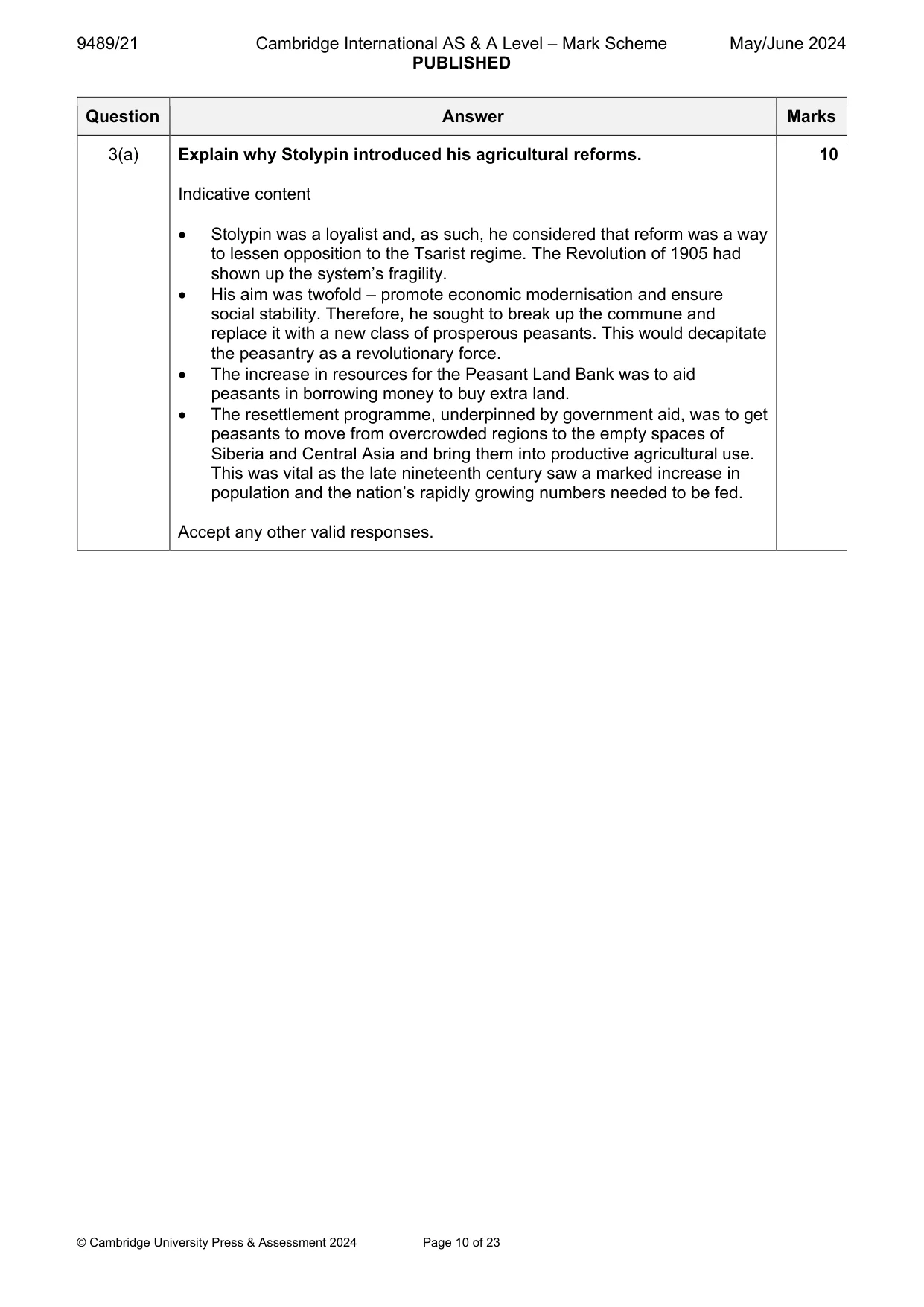
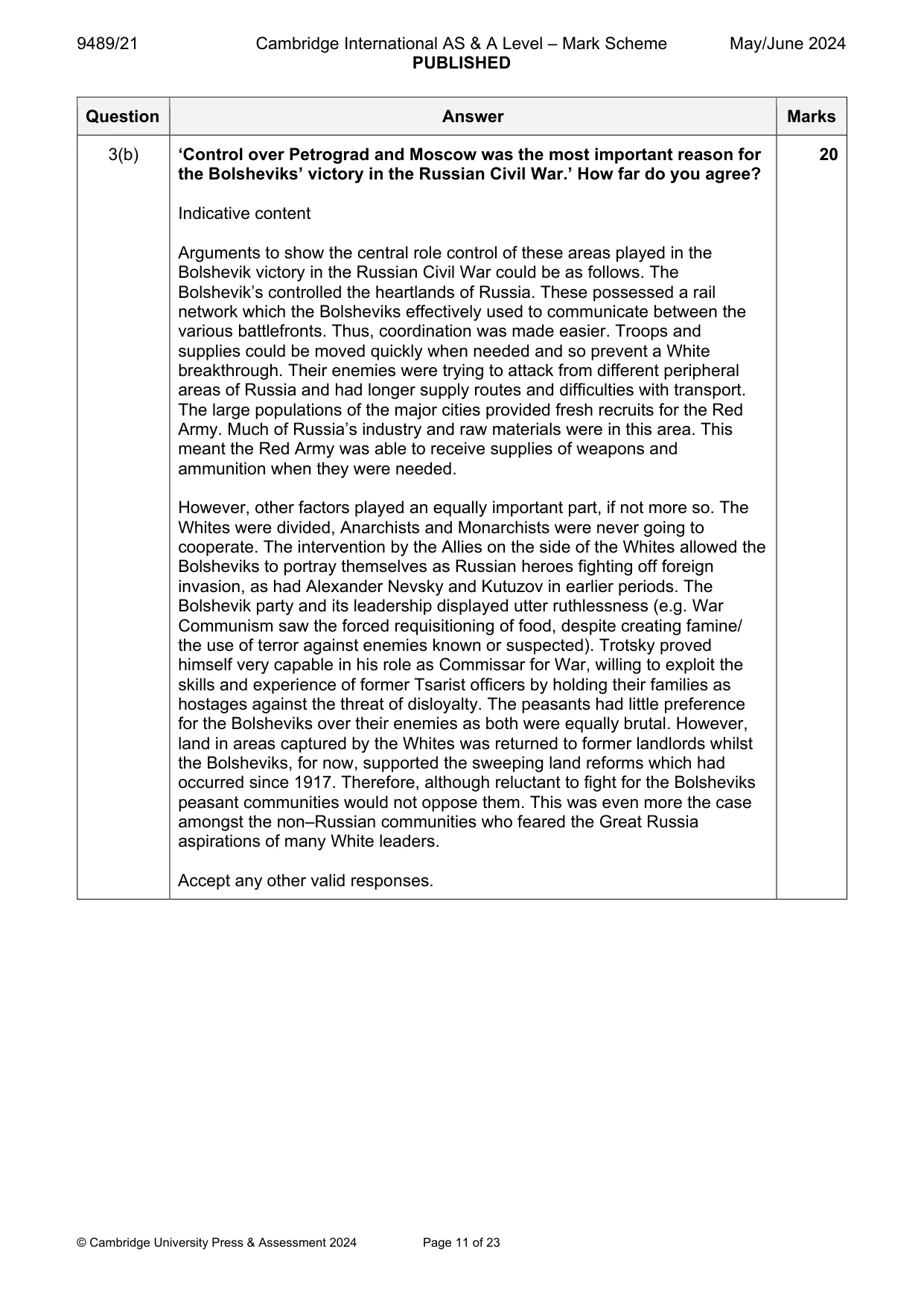
Mark scheme: 3(a) Explain why Stolypin introduced his agricultural reforms. 10 Indicative content Stolypin was a loyalist and, as such, he considered that reform was a way to lessen opposition to the Tsarist regime. The Revolution of 1905 had shown up the system’s fragility. His aim was twofold – promote economic modernisation and ensure social stability. Therefore, he sought to break up the commune and replace it with a new class of prosperous peasants. This would decapitate the peasantry as a revolutionary force. The increase in resources for the Peasant Land Bank was to aid peasants in borrowing money to buy extra land. The resettlement programme, underpinned by government aid, was to get peasants to move from overcrowded regions to the empty spaces of Siberia and Central Asia and bring them into productive agricultural use. This was vital as the late nineteenth century saw a marked increase in population and the nation’s rapidly growing numbers needed to be fed. Accept any other valid responses. 3(b) ‘Control over Petrograd and Moscow was the most important reason for 20 the Bolsheviks’ victory in the Russian Civil War.’ How far do you agree? Indicative content Arguments to show the central role control of these areas played in the Bolshevik victory in the Russian Civil War could be as follows. The Bolshevik’s controlled the heartlands of Russia. These possessed a rail network which the Bolsheviks effectively used to communicate between the various battlefronts. Thus, coordination was made easier. Troops and supplies could be moved quickly when needed and so prevent a White breakthrough. Their enemies were trying to attack from different peripheral areas of Russia and had longer supply routes and difficulties with transport. The large populations of the major cities provided fresh recruits for the Red Army. Much of Russia’s industry and raw materials were in this area. This meant the Red Army was able to receive supplies of weapons and ammunition when they were needed. However, other factors played an equally important part, if not more so. The Whites were divided, Anarchists and Monarchists were never going to cooperate. The intervention by the Allies on the side of the Whites allowed the Bolsheviks to portray themselves as Russian heroes fighting off foreign invasion, as had Alexander Nevsky and Kutuzov in earlier periods. The Bolshevik party and its leadership displayed utter ruthlessness (e.g. War Communism saw the forced requisitioning of food, despite creating famine/ the use of terror against enemies known or suspected). Trotsky proved himself very capable in his role as Commissar for War, willing to exploit the skills and experience of former Tsarist officers by holding their families as hostages against the threat of disloyalty. The peasants had little preference for the Bolsheviks over their enemies as both were equally brutal. However, land in areas captured by the Whites was returned to former landlords whilst the Bolsheviks, for now, supported the sweeping land reforms which had occurred since 1917. Therefore, although reluctant to fight for the Bolsheviks peasant communities would not oppose them. This was even more the case amongst the non–Russian communities who feared the Great Russia aspirations of many White leaders. Accept any other valid responses.
More questions on How were the Bolsheviks able to consolidate their power up to 1924?
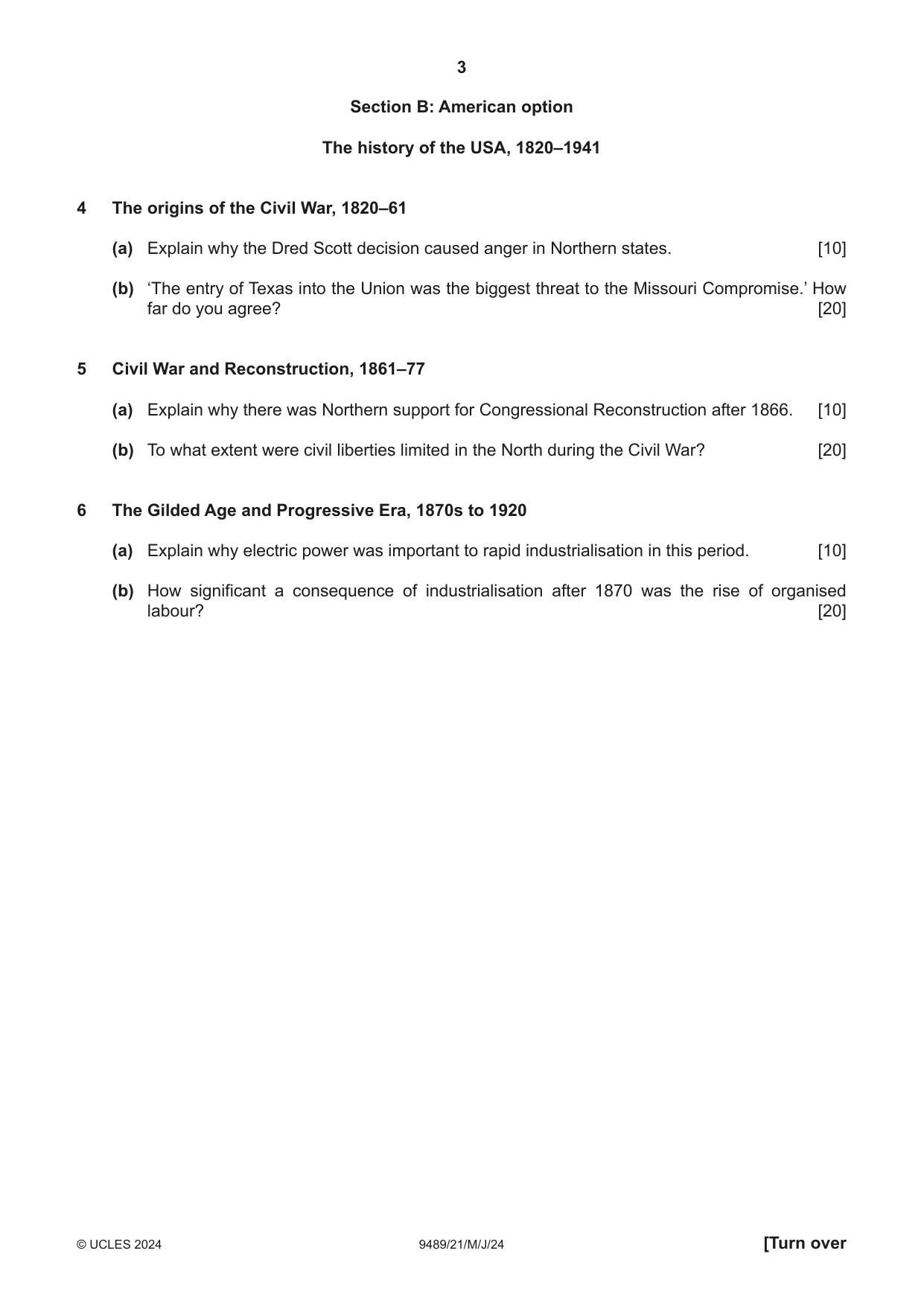
Q4 · The origins of the Civil War, 1820–61 (a) Explain why the Dred Scott decision caused…
4 The origins of the Civil War, 1820–61 (a) Explain why the Dred Scott decision caused anger in Northern states. [10] (b) ‘The entry of Texas into the Union was the biggest threat to the Missouri Compromise.’ How far do you agree? [20]
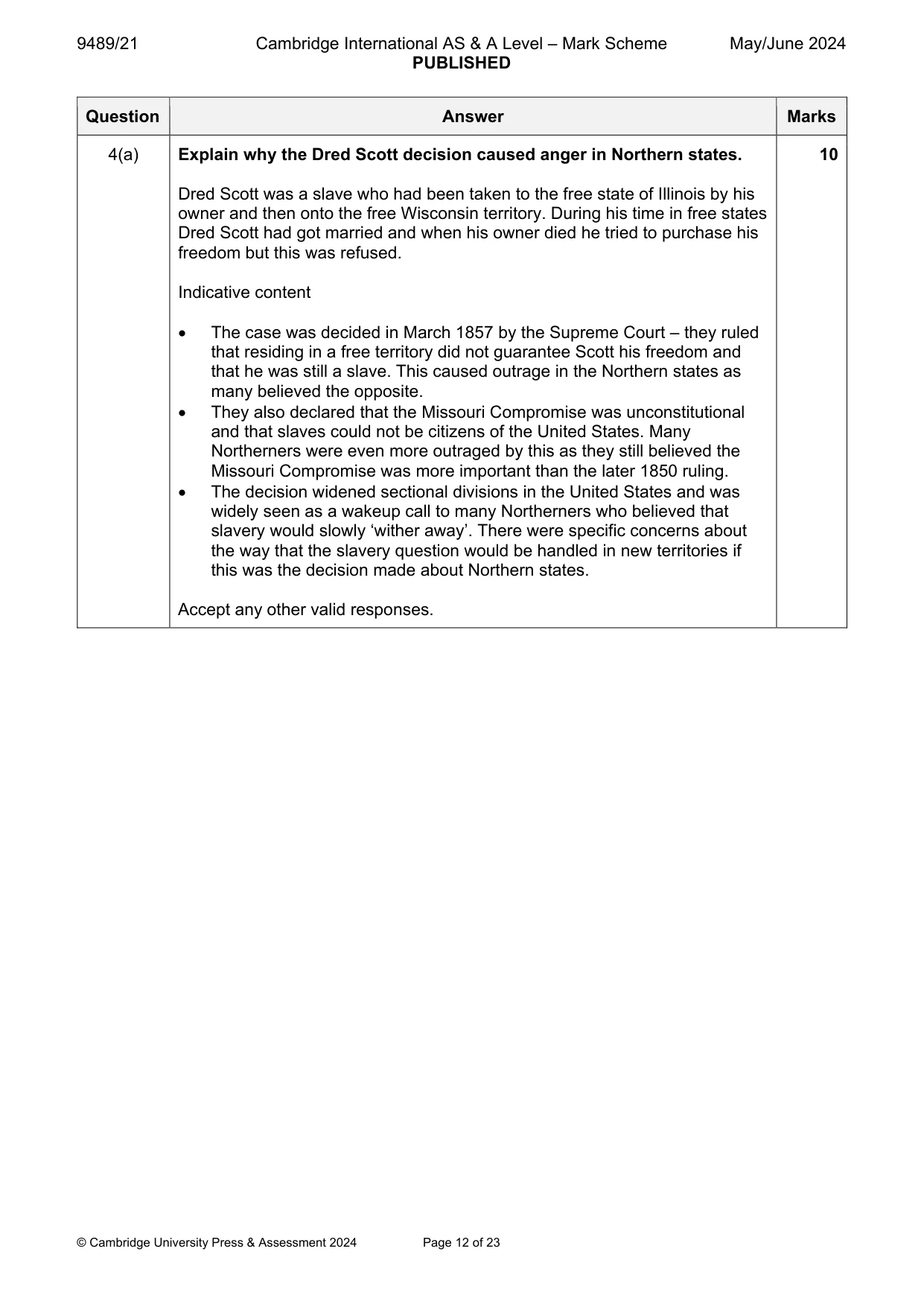
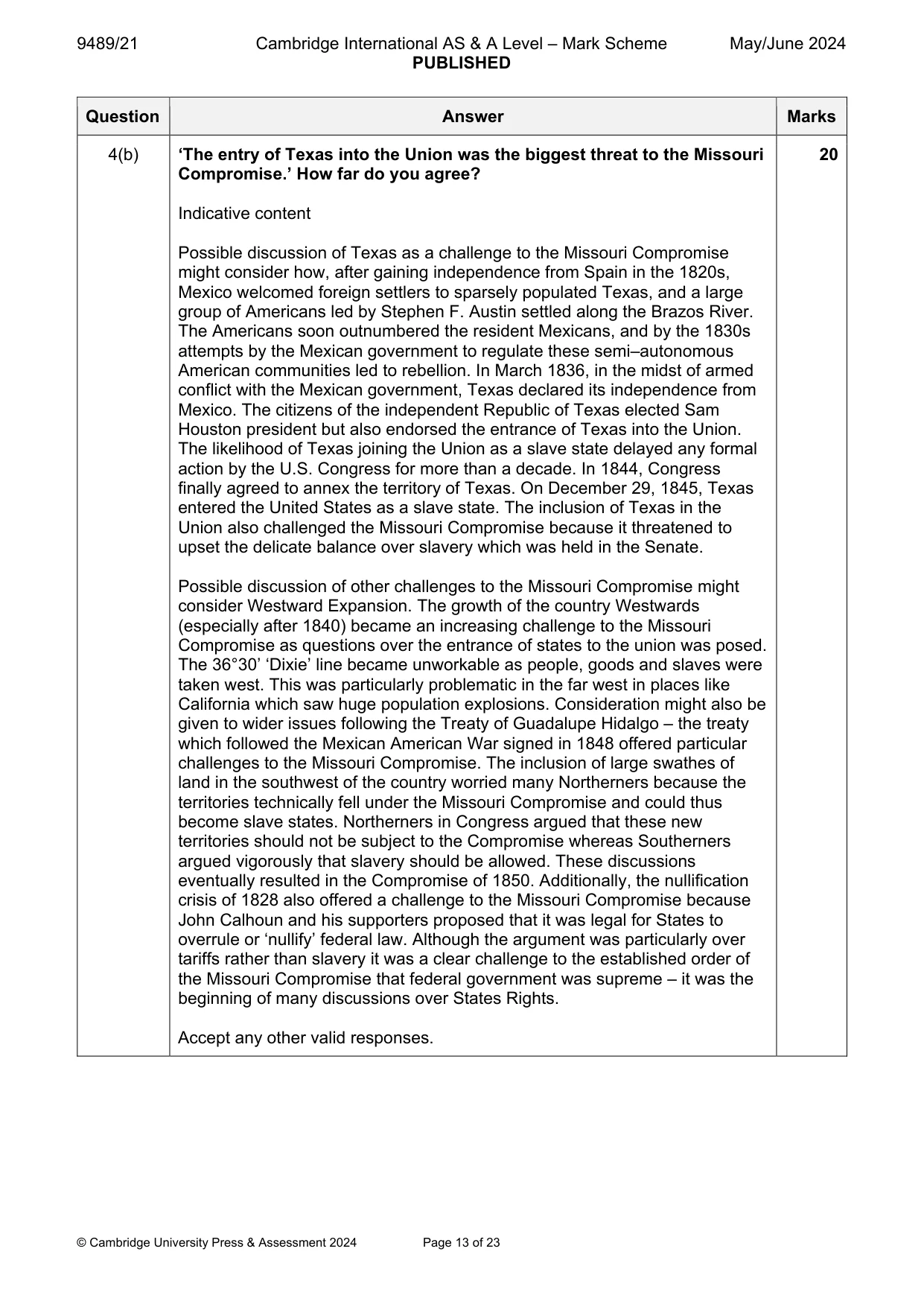
Mark scheme: 4(a) Explain why the Dred Scott decision caused anger in Northern states. 10 Dred Scott was a slave who had been taken to the free state of Illinois by his owner and then onto the free Wisconsin territory. During his time in free states Dred Scott had got married and when his owner died he tried to purchase his freedom but this was refused. Indicative content The case was decided in March 1857 by the Supreme Court – they ruled that residing in a free territory did not guarantee Scott his freedom and that he was still a slave. This caused outrage in the Northern states as many believed the opposite. They also declared that the Missouri Compromise was unconstitutional and that slaves could not be citizens of the United States. Many Northerners were even more outraged by this as they still believed the Missouri Compromise was more important than the later 1850 ruling. The decision widened sectional divisions in the United States and was widely seen as a wakeup call to many Northerners who believed that slavery would slowly ‘wither away’. There were specific concerns about the way that the slavery question would be handled in new territories if this was the decision made about Northern states. Accept any other valid responses. 4(b) ‘The entry of Texas into the Union was the biggest threat to the Missouri 20 Compromise.’ How far do you agree? Indicative content Possible discussion of Texas as a challenge to the Missouri Compromise might consider how, after gaining independence from Spain in the 1820s, Mexico welcomed foreign settlers to sparsely populated Texas, and a large group of Americans led by Stephen F. Austin settled along the Brazos River. The Americans soon outnumbered the resident Mexicans, and by the 1830s attempts by the Mexican government to regulate these semi–autonomous American communities led to rebellion. In March 1836, in the midst of armed conflict with the Mexican government, Texas declared its independence from Mexico. The citizens of the independent Republic of Texas elected Sam Houston president but also endorsed the entrance of Texas into the Union. The likelihood of Texas joining the Union as a slave state delayed any formal action by the U.S. Congress for more than a decade. In 1844, Congress finally agreed to annex the territory of Texas. On December 29, 1845, Texas entered the United States as a slave state. The inclusion of Texas in the Union also challenged the Missouri Compromise because it threatened to upset the delicate balance over slavery which was held in the Senate. Possible discussion of other challenges to the Missouri Compromise might consider Westward Expansion. The growth of the country Westwards (especially after 1840) became an increasing challenge to the Missouri Compromise as questions over the entrance of states to the union was posed. The 36°30’ ‘Dixie’ line became unworkable as people, goods and slaves were taken west. This was particularly problematic in the far west in places like California which saw huge population explosions. Consideration might also be given to wider issues following the Treaty of Guadalupe Hidalgo – the treaty which followed the Mexican American War signed in 1848 offered particular challenges to the Missouri Compromise. The inclusion of large swathes of land in the southwest of the country worried many Northerners because the territories technically fell under the Missouri Compromise and could thus become slave states. Northerners in Congress argued that these new territories should not be subject to the Compromise whereas Southerners argued vigorously that slavery should be allowed. These discussions eventually resulted in the Compromise of 1850. Additionally, the nullification crisis of 1828 also offered a challenge to the Missouri Compromise because John Calhoun and his supporters proposed that it was legal for States to overrule or ‘nullify’ federal law. Although the argument was particularly over tariffs rather than slavery it was a clear challenge to the established order of the Missouri Compromise that federal government was supreme – it was the beginning of many discussions over States Rights. Accept any other valid responses.
More questions on Why was there increasing tension between the North and the South before 1860?
Q5 · Civil War and Reconstruction, 1861–77 (a) Explain why there was Northern support for…
5 Civil War and Reconstruction, 1861–77 (a) Explain why there was Northern support for Congressional Reconstruction after 1866. [10] (b) To what extent were civil liberties limited in the North during the Civil War? [20]
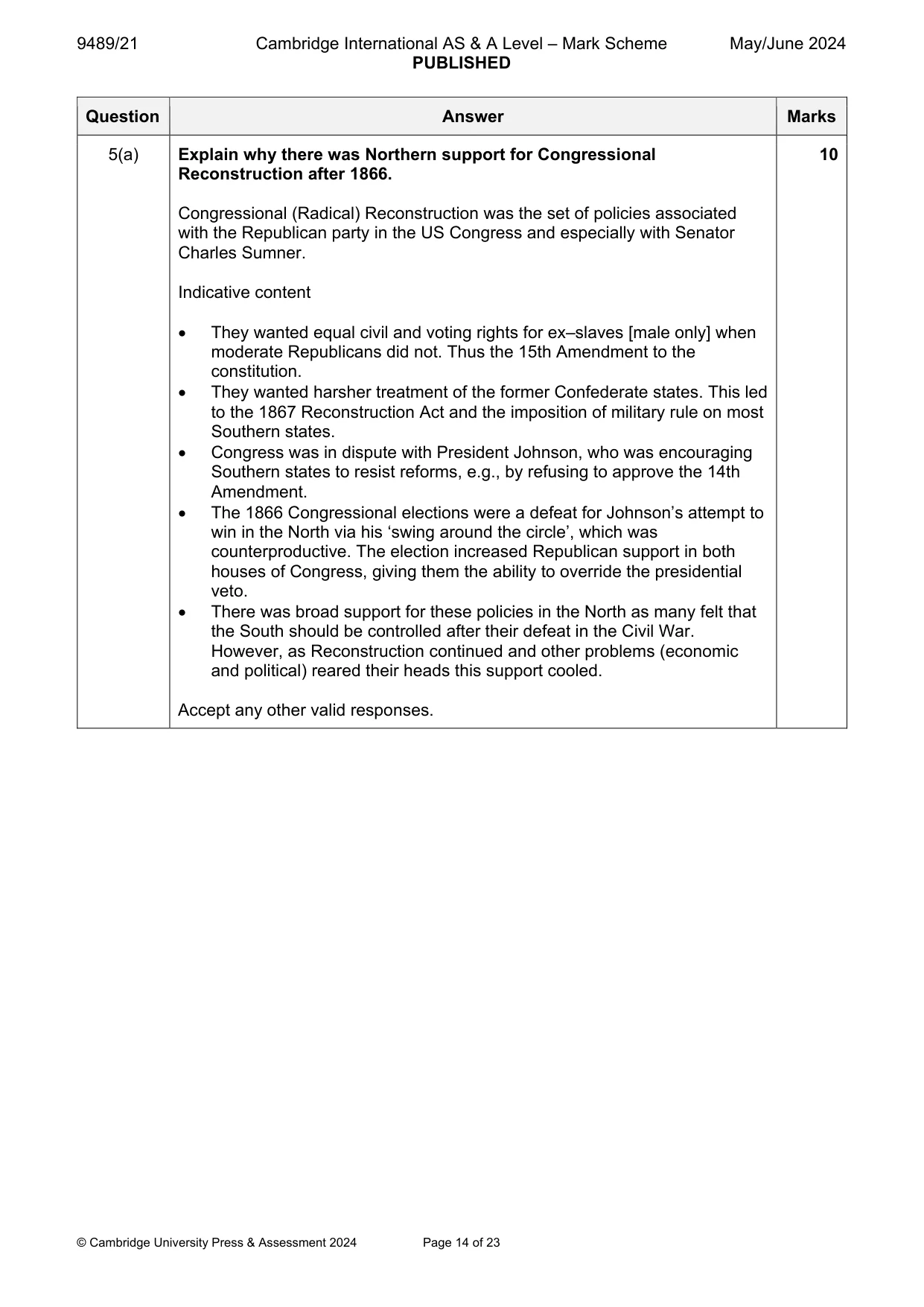
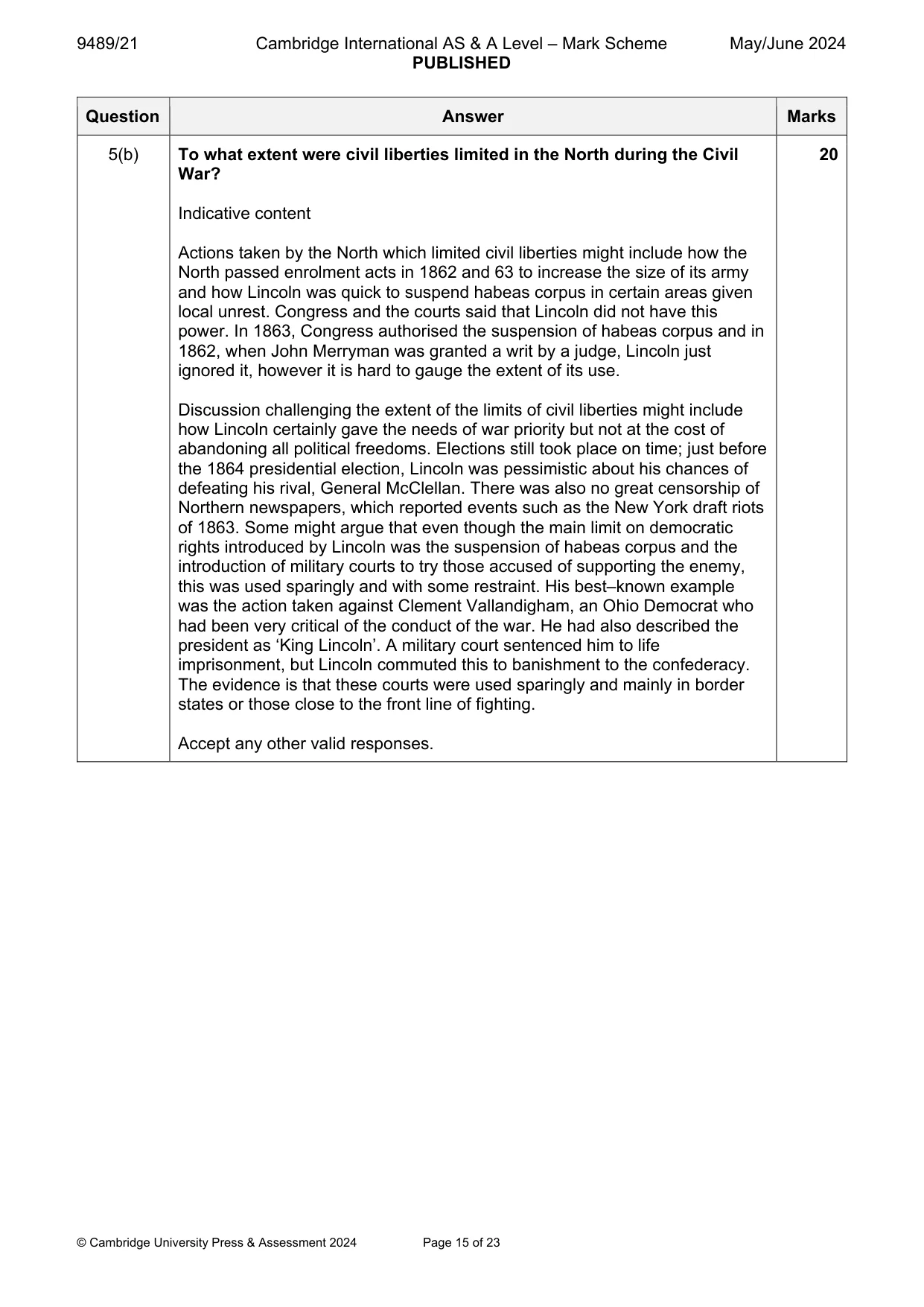
Mark scheme: 5(a) Explain why there was Northern support for Congressional 10 Reconstruction after 1866. Congressional (Radical) Reconstruction was the set of policies associated with the Republican party in the US Congress and especially with Senator Charles Sumner. Indicative content They wanted equal civil and voting rights for ex–slaves [male only] when moderate Republicans did not. Thus the 15th Amendment to the constitution. They wanted harsher treatment of the former Confederate states. This led to the 1867 Reconstruction Act and the imposition of military rule on most Southern states. Congress was in dispute with President Johnson, who was encouraging Southern states to resist reforms, e.g., by refusing to approve the 14th Amendment. The 1866 Congressional elections were a defeat for Johnson’s attempt to win in the North via his ‘swing around the circle’, which was counterproductive. The election increased Republican support in both houses of Congress, giving them the ability to override the presidential veto. There was broad support for these policies in the North as many felt that the South should be controlled after their defeat in the Civil War. However, as Reconstruction continued and other problems (economic and political) reared their heads this support cooled. Accept any other valid responses. 5(b) To what extent were civil liberties limited in the North during the Civil 20 War? Indicative content Actions taken by the North which limited civil liberties might include how the North passed enrolment acts in 1862 and 63 to increase the size of its army and how Lincoln was quick to suspend habeas corpus in certain areas given local unrest. Congress and the courts said that Lincoln did not have this power. In 1863, Congress authorised the suspension of habeas corpus and in 1862, when John Merryman was granted a writ by a judge, Lincoln just ignored it, however it is hard to gauge the extent of its use. Discussion challenging the extent of the limits of civil liberties might include how Lincoln certainly gave the needs of war priority but not at the cost of abandoning all political freedoms. Elections still took place on time; just before the 1864 presidential election, Lincoln was pessimistic about his chances of defeating his rival, General McClellan. There was also no great censorship of Northern newspapers, which reported events such as the New York draft riots of 1863. Some might argue that even though the main limit on democratic rights introduced by Lincoln was the suspension of habeas corpus and the introduction of military courts to try those accused of supporting the enemy, this was used sparingly and with some restraint. His best–known example was the action taken against Clement Vallandigham, an Ohio Democrat who had been very critical of the conduct of the war. He had also described the president as ‘King Lincoln’. A military court sentenced him to life imprisonment, but Lincoln commuted this to banishment to the confederacy. The evidence is that these courts were used sparingly and mainly in border states or those close to the front line of fighting. Accept any other valid responses.
Q6 · The Gilded Age and Progressive Era, 1870s to 1920 (a) Explain why electric power was…
6 The Gilded Age and Progressive Era, 1870s to 1920 (a) Explain why electric power was important to rapid industrialisation in this period. [10] (b) How significant a consequence of industrialisation after 1870 was the rise of organised labour? [20] Section C: International option International history, 1870–1945
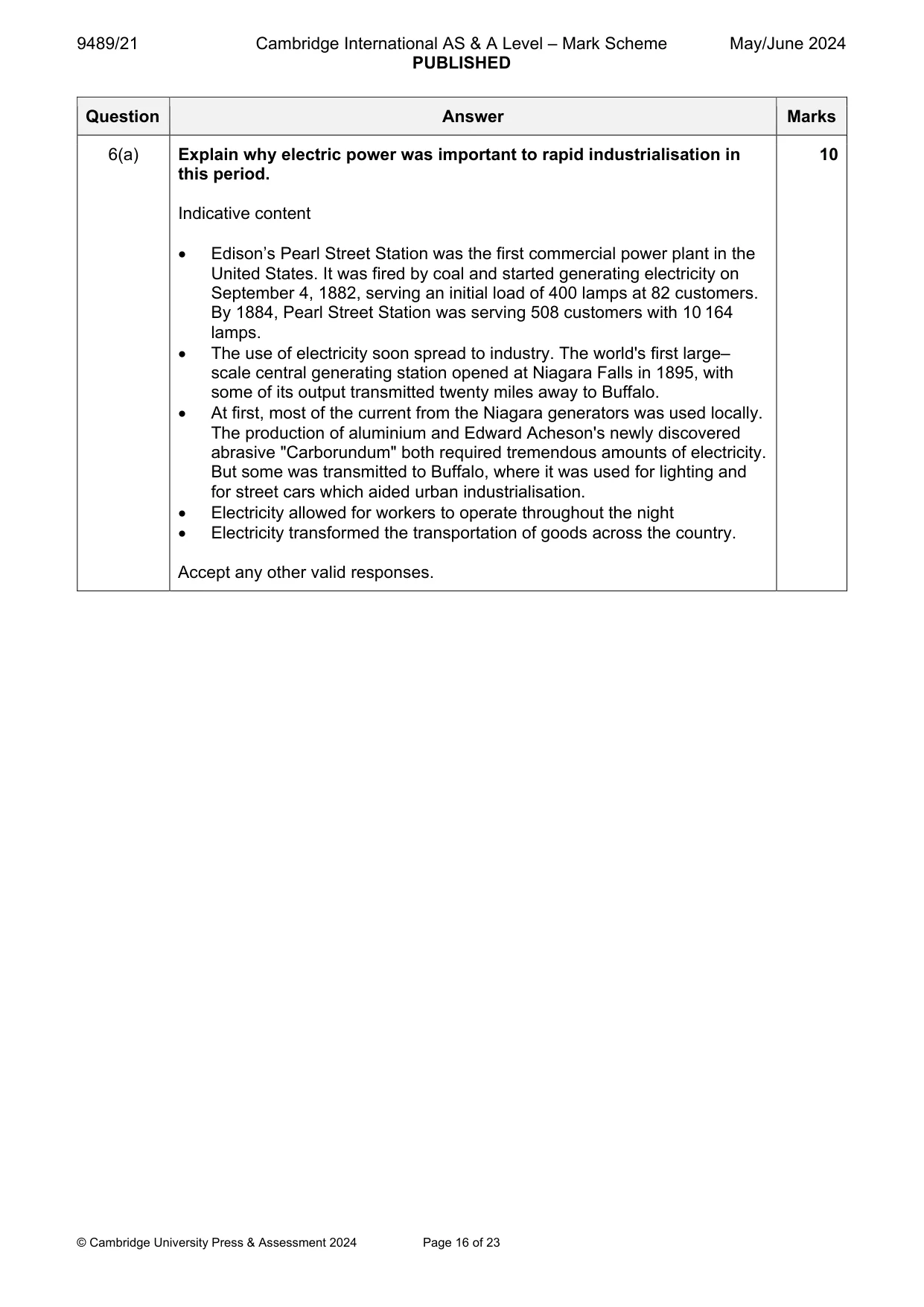
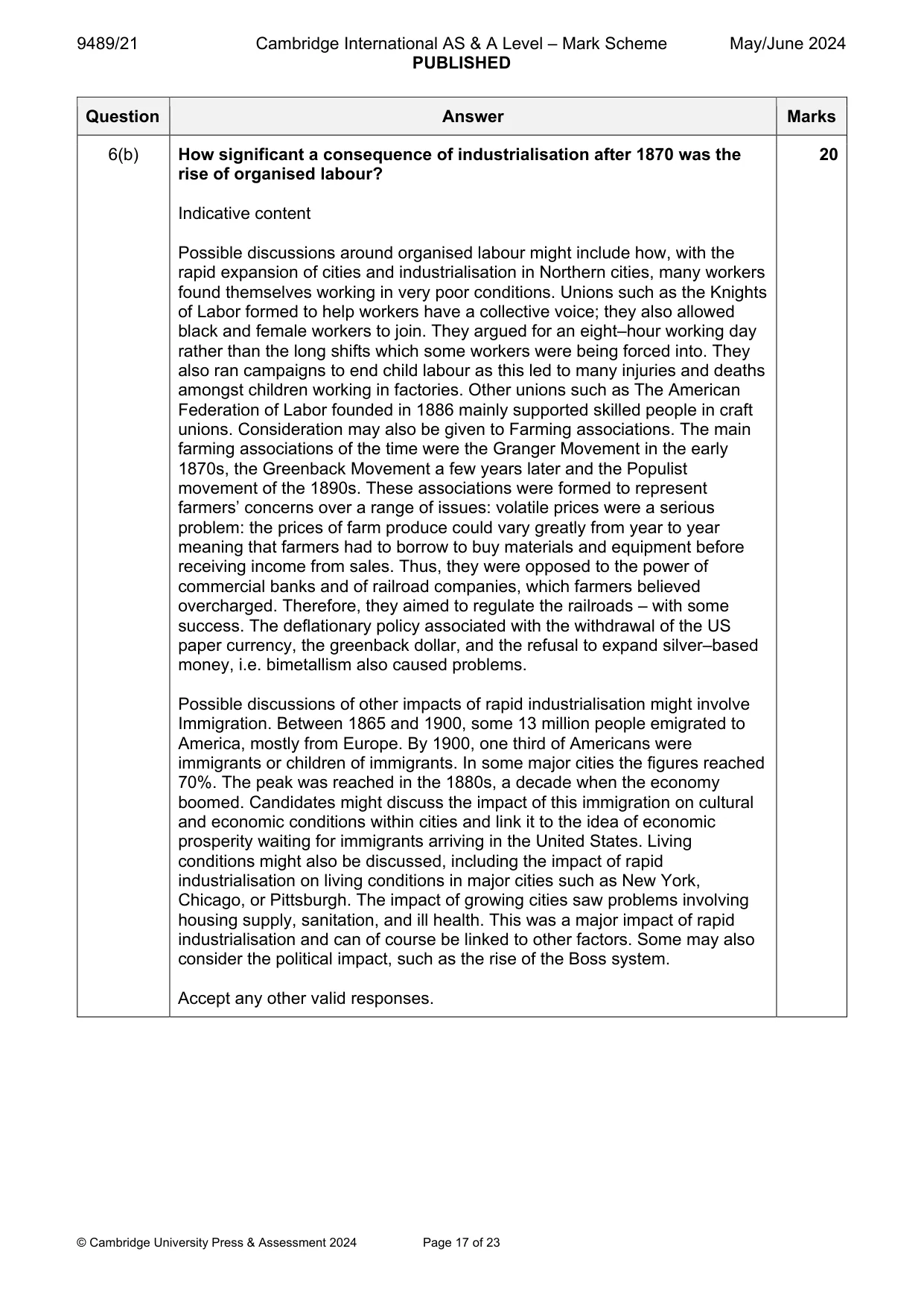
Mark scheme: 6(a) Explain why electric power was important to rapid industrialisation in 10 this period. Indicative content Edison’s Pearl Street Station was the first commercial power plant in the United States. It was fired by coal and started generating electricity on September 4, 1882, serving an initial load of 400 lamps at 82 customers. By 1884, Pearl Street Station was serving 508 customers with 10 164 lamps. The use of electricity soon spread to industry. The world's first large– scale central generating station opened at Niagara Falls in 1895, with some of its output transmitted twenty miles away to Buffalo. At first, most of the current from the Niagara generators was used locally. The production of aluminium and Edward Acheson's newly discovered abrasive "Carborundum" both required tremendous amounts of electricity. But some was transmitted to Buffalo, where it was used for lighting and for street cars which aided urban industrialisation. Electricity allowed for workers to operate throughout the night Electricity transformed the transportation of goods across the country. Accept any other valid responses. 6(b) How significant a consequence of industrialisation after 1870 was the 20 rise of organised labour? Indicative content Possible discussions around organised labour might include how, with the rapid expansion of cities and industrialisation in Northern cities, many workers found themselves working in very poor conditions. Unions such as the Knights of Labor formed to help workers have a collective voice; they also allowed black and female workers to join. They argued for an eight–hour working day rather than the long shifts which some workers were being forced into. They also ran campaigns to end child labour as this led to many injuries and deaths amongst children working in factories. Other unions such as The American Federation of Labor founded in 1886 mainly supported skilled people in craft unions. Consideration may also be given to Farming associations. The main farming associations of the time were the Granger Movement in the early 1870s, the Greenback Movement a few years later and the Populist movement of the 1890s. These associations were formed to represent farmers’ concerns over a range of issues: volatile prices were a serious problem: the prices of farm produce could vary greatly from year to year meaning that farmers had to borrow to buy materials and equipment before receiving income from sales. Thus, they were opposed to the power of commercial banks and of railroad companies, which farmers believed overcharged. Therefore, they aimed to regulate the railroads – with some success. The deflationary policy associated with the withdrawal of the US paper currency, the greenback dollar, and the refusal to expand silver–based money, i.e. bimetallism also caused problems. Possible discussions of other impacts of rapid industrialisation might involve Immigration. Between 1865 and 1900, some 13 million people emigrated to America, mostly from Europe. By 1900, one third of Americans were immigrants or children of immigrants. In some major cities the figures reached 70%. The peak was reached in the 1880s, a decade when the economy boomed. Candidates might discuss the impact of this immigration on cultural and economic conditions within cities and link it to the idea of economic prosperity waiting for immigrants arriving in the United States. Living conditions might also be discussed, including the impact of rapid industrialisation on living conditions in major cities such as New York, Chicago, or Pittsburgh. The impact of growing cities saw problems involving housing supply, sanitation, and ill health. This was a major impact of rapid industrialisation and can of course be linked to other factors. Some may also consider the political impact, such as the rise of the Boss system. Accept any other valid responses.
More questions on What were the consequences of the rapid economic growth after 1870?
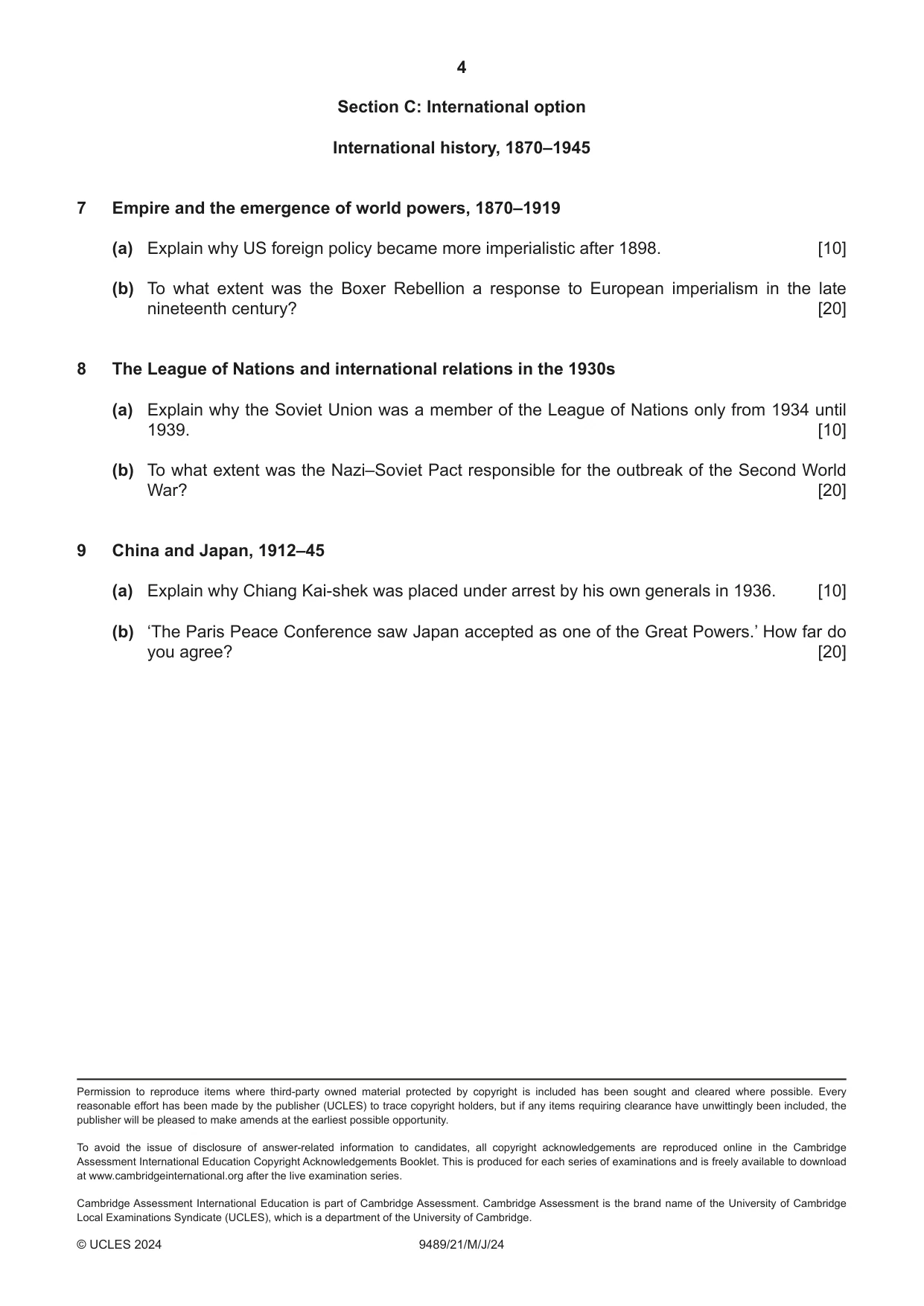
Q7 · Empire and the emergence of world powers, 1870–1919 (a) Explain why US foreign policy…
7 Empire and the emergence of world powers, 1870–1919 (a) Explain why US foreign policy became more imperialistic after 1898. [10] (b) To what extent was the Boxer Rebellion a response to European imperialism in the late nineteenth century? [20]
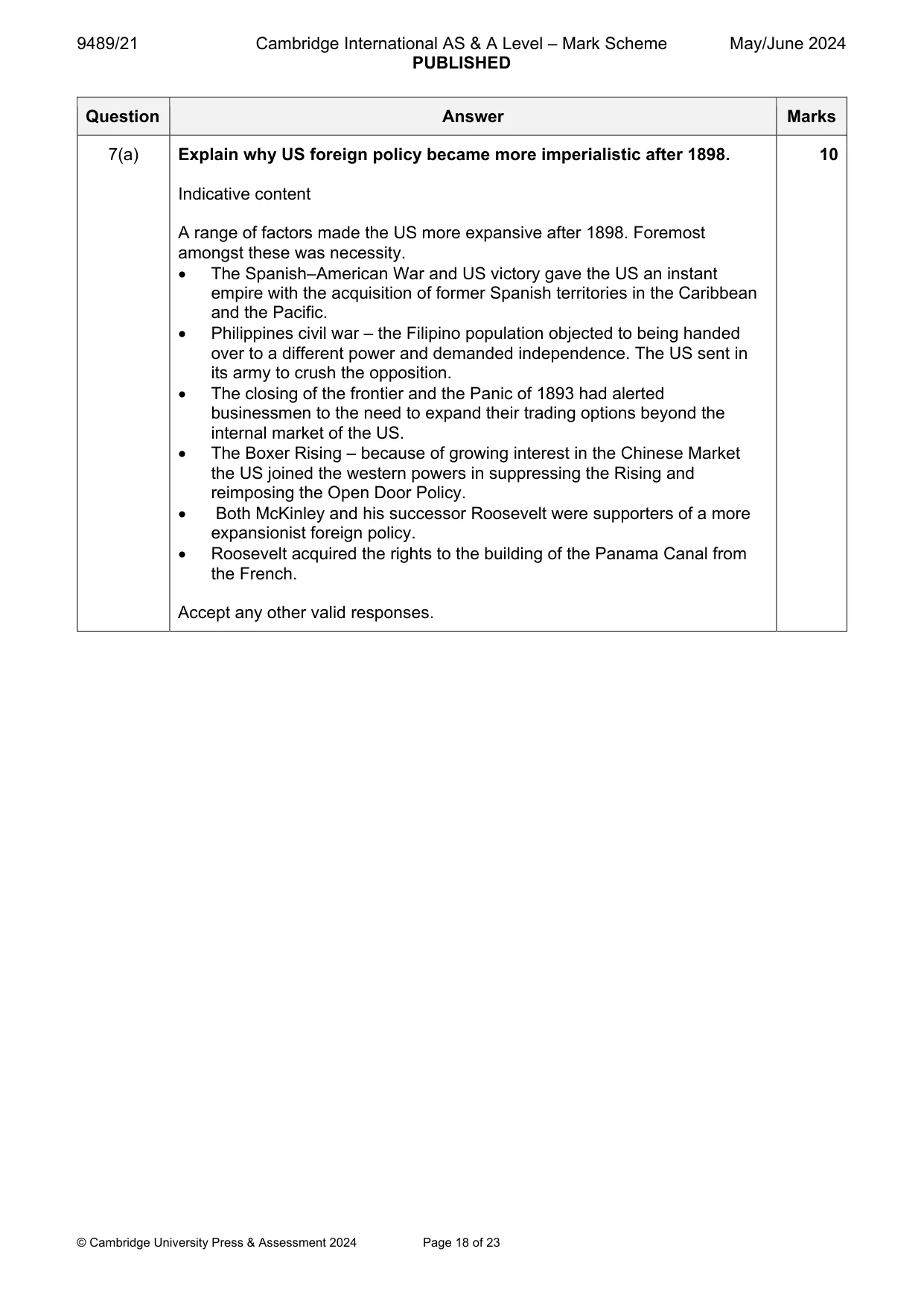
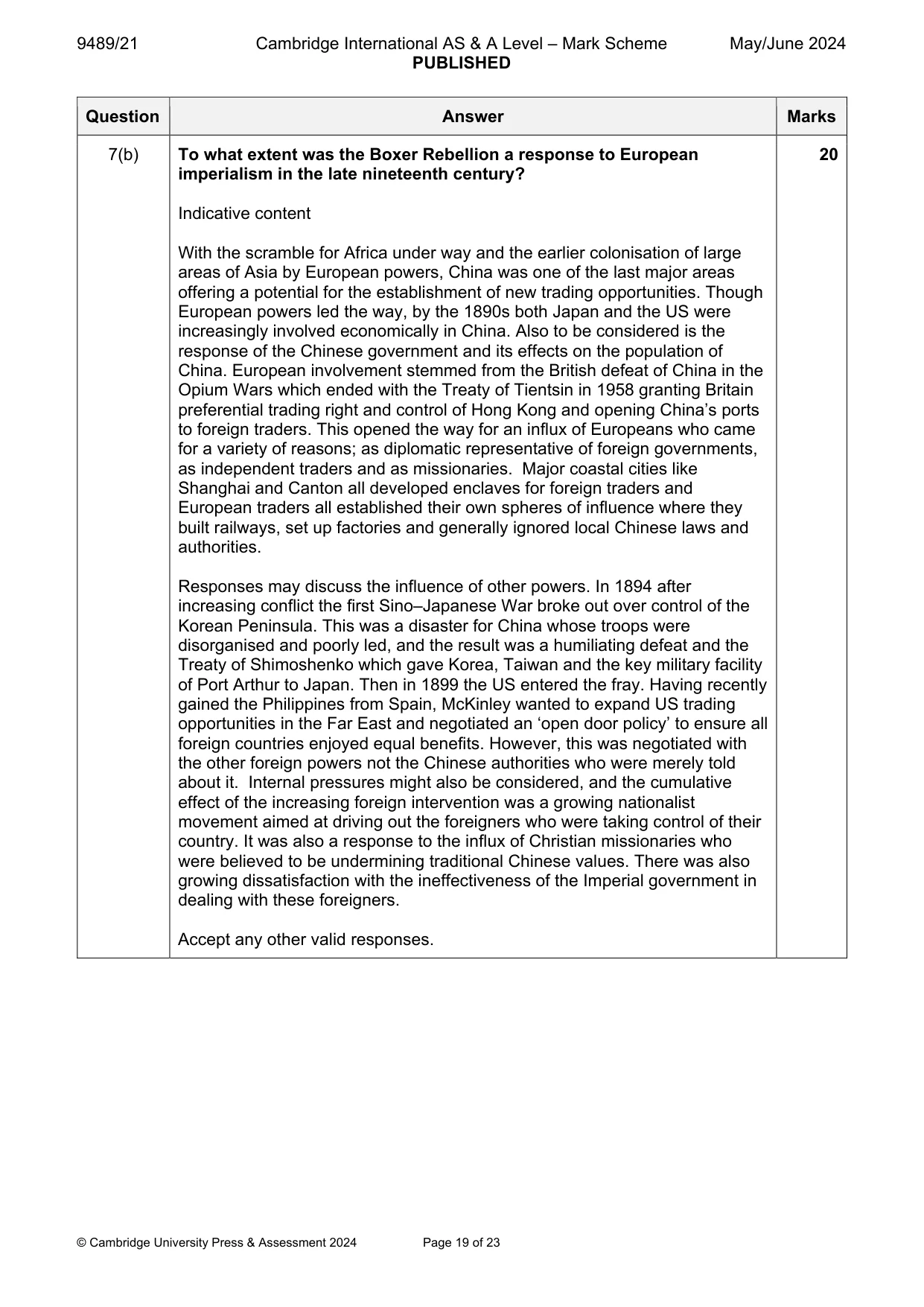
Mark scheme: 7(a) Explain why US foreign policy became more imperialistic after 1898. 10 Indicative content A range of factors made the US more expansive after 1898. Foremost amongst these was necessity. The Spanish–American War and US victory gave the US an instant empire with the acquisition of former Spanish territories in the Caribbean and the Pacific. Philippines civil war – the Filipino population objected to being handed over to a different power and demanded independence. The US sent in its army to crush the opposition. The closing of the frontier and the Panic of 1893 had alerted businessmen to the need to expand their trading options beyond the internal market of the US. The Boxer Rising – because of growing interest in the Chinese Market the US joined the western powers in suppressing the Rising and reimposing the Open Door Policy. Both McKinley and his successor Roosevelt were supporters of a more expansionist foreign policy. Roosevelt acquired the rights to the building of the Panama Canal from the French. Accept any other valid responses. 7(b) To what extent was the Boxer Rebellion a response to European 20 imperialism in the late nineteenth century? Indicative content With the scramble for Africa under way and the earlier colonisation of large areas of Asia by European powers, China was one of the last major areas offering a potential for the establishment of new trading opportunities. Though European powers led the way, by the 1890s both Japan and the US were increasingly involved economically in China. Also to be considered is the response of the Chinese government and its effects on the population of China. European involvement stemmed from the British defeat of China in the Opium Wars which ended with the Treaty of Tientsin in 1958 granting Britain preferential trading right and control of Hong Kong and opening China’s ports to foreign traders. This opened the way for an influx of Europeans who came for a variety of reasons; as diplomatic representative of foreign governments, as independent traders and as missionaries. Major coastal cities like Shanghai and Canton all developed enclaves for foreign traders and European traders all established their own spheres of influence where they built railways, set up factories and generally ignored local Chinese laws and authorities. Responses may discuss the influence of other powers. In 1894 after increasing conflict the first Sino–Japanese War broke out over control of the Korean Peninsula. This was a disaster for China whose troops were disorganised and poorly led, and the result was a humiliating defeat and the Treaty of Shimoshenko which gave Korea, Taiwan and the key military facility of Port Arthur to Japan. Then in 1899 the US entered the fray. Having recently gained the Philippines from Spain, McKinley wanted to expand US trading opportunities in the Far East and negotiated an ‘open door policy’ to ensure all foreign countries enjoyed equal benefits. However, this was negotiated with the other foreign powers not the Chinese authorities who were merely told about it. Internal pressures might also be considered, and the cumulative effect of the increasing foreign intervention was a growing nationalist movement aimed at driving out the foreigners who were taking control of their country. It was also a response to the influx of Christian missionaries who were believed to be undermining traditional Chinese values. There was also growing dissatisfaction with the ineffectiveness of the Imperial government in dealing with these foreigners. Accept any other valid responses.
More questions on Why was imperialism a significant force in Africa from 1870?
Q8 · The League of Nations and international relations in the 1930s (a) Explain why the Soviet…
8 The League of Nations and international relations in the 1930s (a) Explain why the Soviet Union was a member of the League of Nations only from 1934 until 1939. [10] (b) To what extent was the Nazi–Soviet Pact responsible for the outbreak of the Second World War? [20]
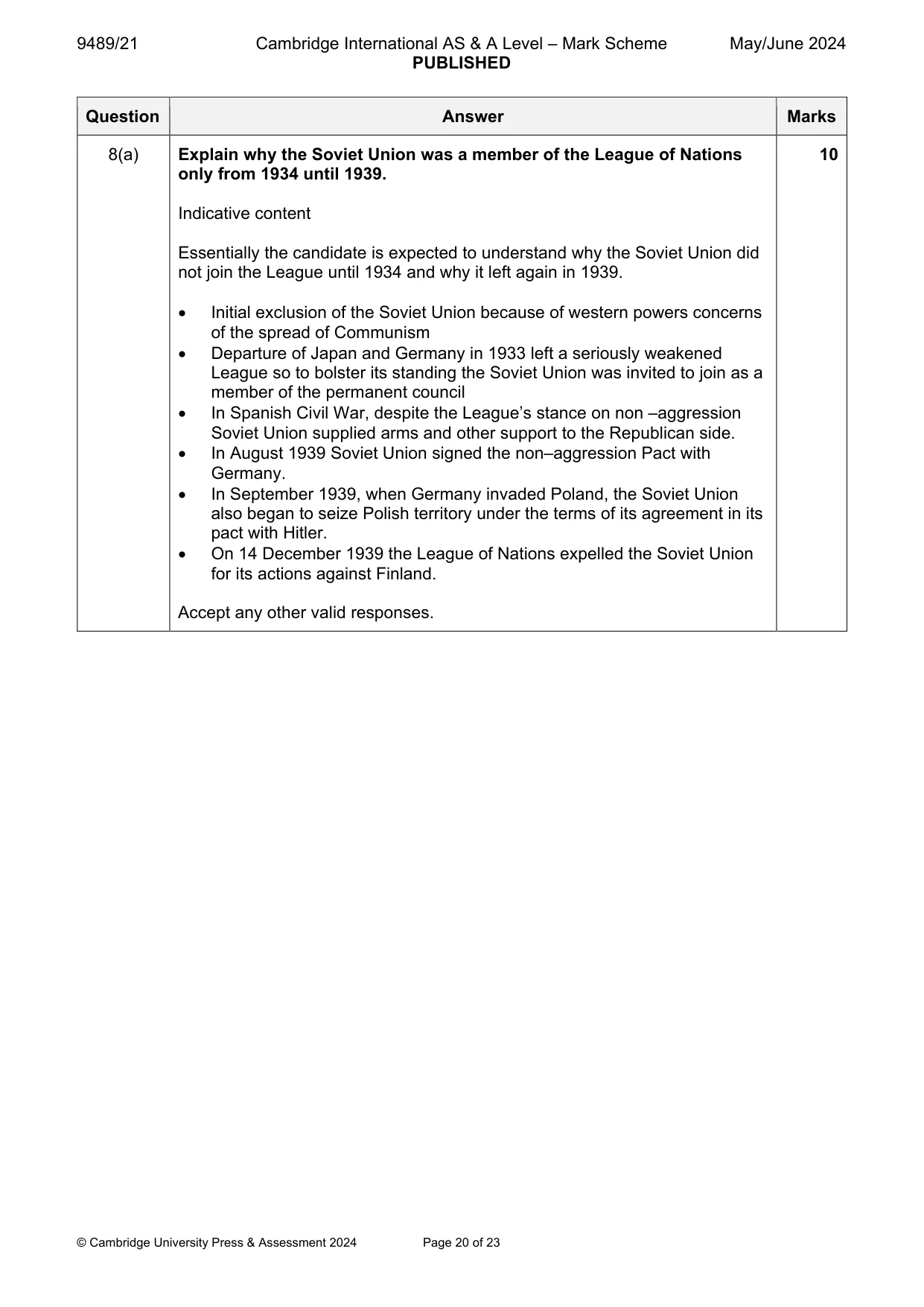
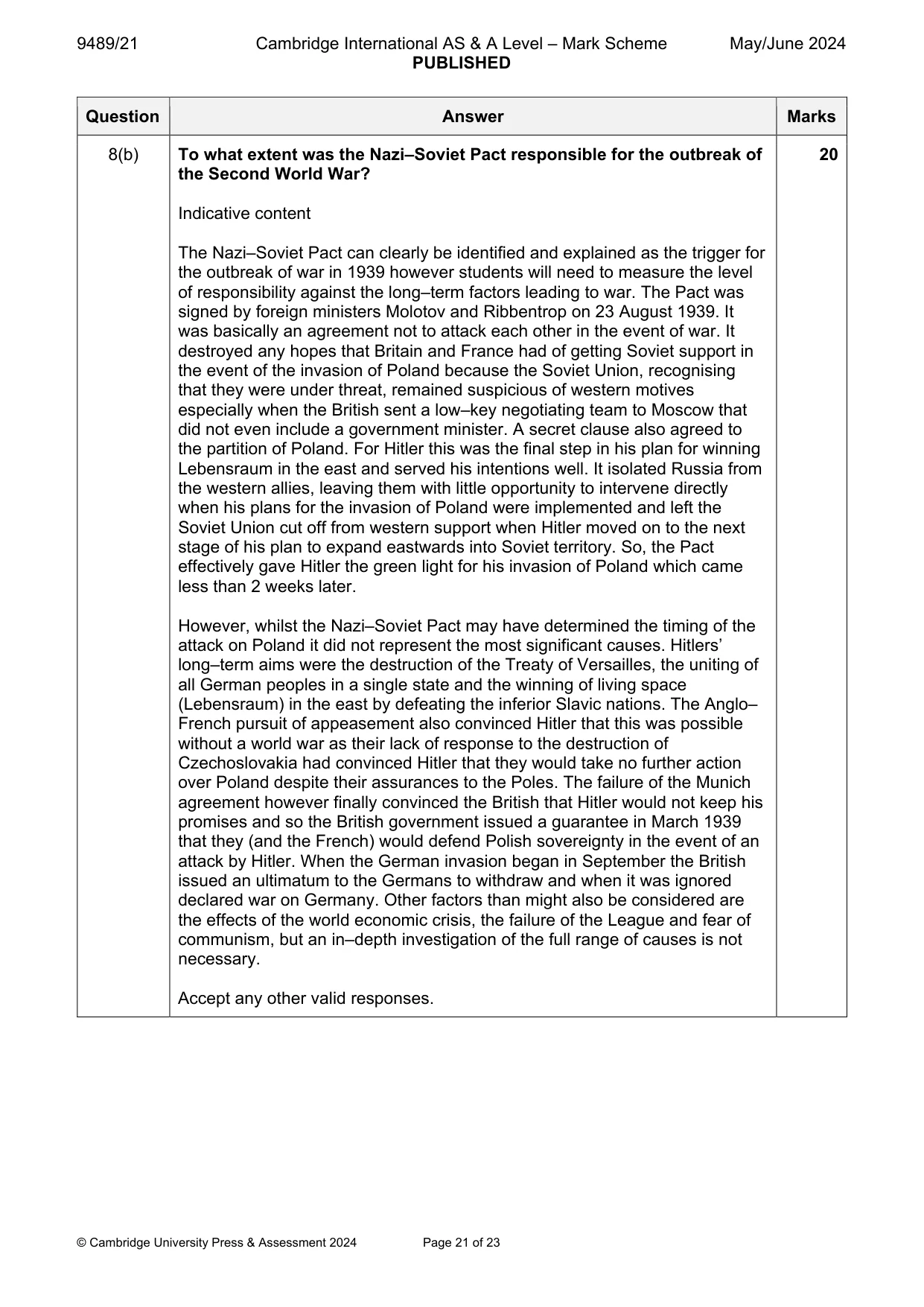
Mark scheme: 8(a) Explain why the Soviet Union was a member of the League of Nations 10 only from 1934 until 1939. Indicative content Essentially the candidate is expected to understand why the Soviet Union did not join the League until 1934 and why it left again in 1939. Initial exclusion of the Soviet Union because of western powers concerns of the spread of Communism Departure of Japan and Germany in 1933 left a seriously weakened League so to bolster its standing the Soviet Union was invited to join as a member of the permanent council In Spanish Civil War, despite the League’s stance on non –aggression Soviet Union supplied arms and other support to the Republican side. In August 1939 Soviet Union signed the non–aggression Pact with Germany. In September 1939, when Germany invaded Poland, the Soviet Union also began to seize Polish territory under the terms of its agreement in its pact with Hitler. On 14 December 1939 the League of Nations expelled the Soviet Union for its actions against Finland. Accept any other valid responses. 8(b) To what extent was the Nazi–Soviet Pact responsible for the outbreak of 20 the Second World War? Indicative content The Nazi–Soviet Pact can clearly be identified and explained as the trigger for the outbreak of war in 1939 however students will need to measure the level of responsibility against the long–term factors leading to war. The Pact was signed by foreign ministers Molotov and Ribbentrop on 23 August 1939. It was basically an agreement not to attack each other in the event of war. It destroyed any hopes that Britain and France had of getting Soviet support in the event of the invasion of Poland because the Soviet Union, recognising that they were under threat, remained suspicious of western motives especially when the British sent a low–key negotiating team to Moscow that did not even include a government minister. A secret clause also agreed to the partition of Poland. For Hitler this was the final step in his plan for winning Lebensraum in the east and served his intentions well. It isolated Russia from the western allies, leaving them with little opportunity to intervene directly when his plans for the invasion of Poland were implemented and left the Soviet Union cut off from western support when Hitler moved on to the next stage of his plan to expand eastwards into Soviet territory. So, the Pact effectively gave Hitler the green light for his invasion of Poland which came less than 2 weeks later. However, whilst the Nazi–Soviet Pact may have determined the timing of the attack on Poland it did not represent the most significant causes. Hitlers’ long–term aims were the destruction of the Treaty of Versailles, the uniting of all German peoples in a single state and the winning of living space (Lebensraum) in the east by defeating the inferior Slavic nations. The Anglo– French pursuit of appeasement also convinced Hitler that this was possible without a world war as their lack of response to the destruction of Czechoslovakia had convinced Hitler that they would take no further action over Poland despite their assurances to the Poles. The failure of the Munich agreement however finally convinced the British that Hitler would not keep his promises and so the British government issued a guarantee in March 1939 that they (and the French) would defend Polish sovereignty in the event of an attack by Hitler. When the German invasion began in September the British issued an ultimatum to the Germans to withdraw and when it was ignored declared war on Germany. Other factors than might also be considered are the effects of the world economic crisis, the failure of the League and fear of communism, but an in–depth investigation of the full range of causes is not necessary. Accept any other valid responses.
Q9 · China and Japan, 1912–45 (a) Explain why Chiang Kai-shek was placed under arrest by his…
9 China and Japan, 1912–45 (a) Explain why Chiang Kai-shek was placed under arrest by his own generals in 1936. [10] (b) ‘The Paris Peace Conference saw Japan accepted as one of the Great Powers.’ How far do you agree? [20]
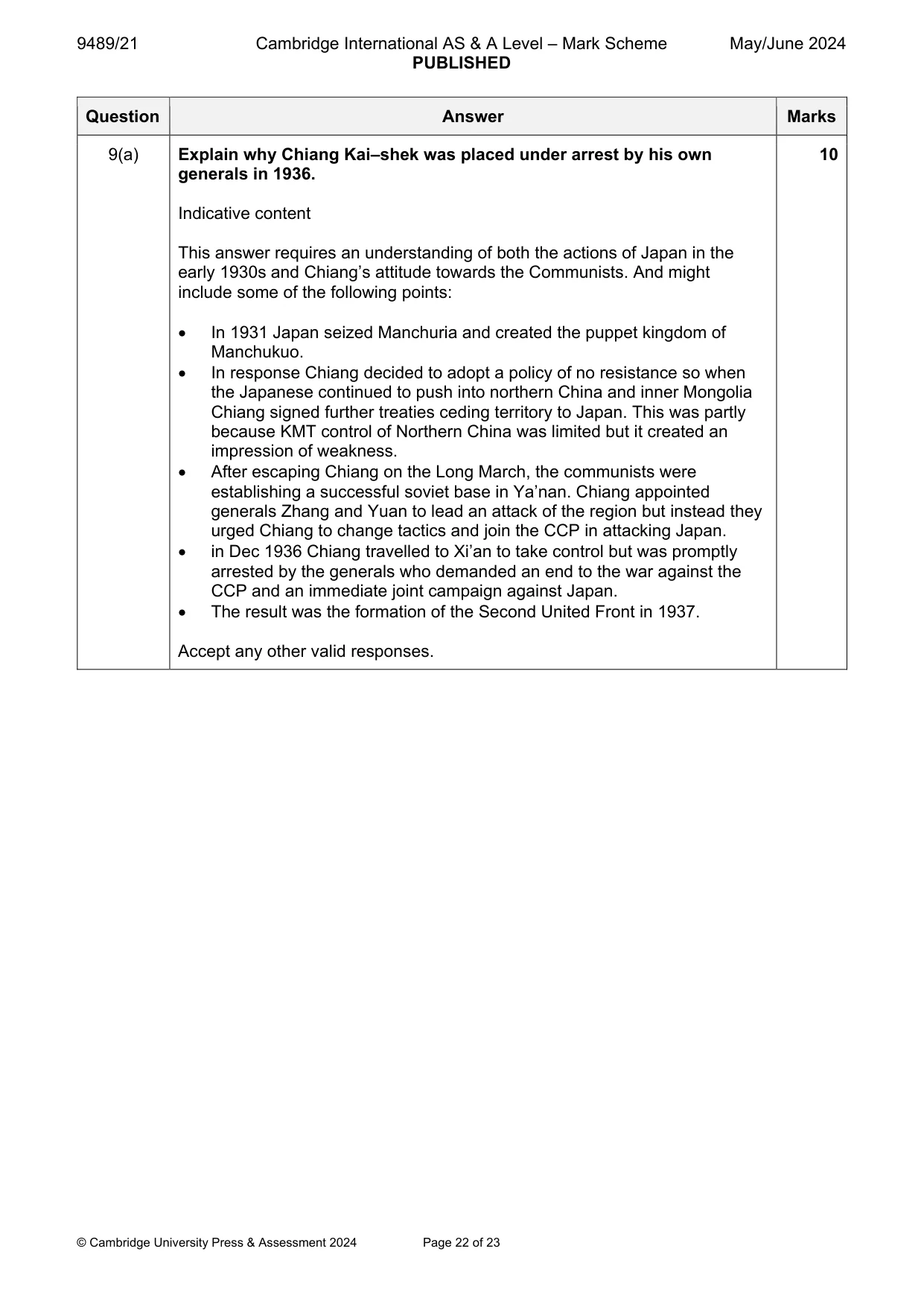
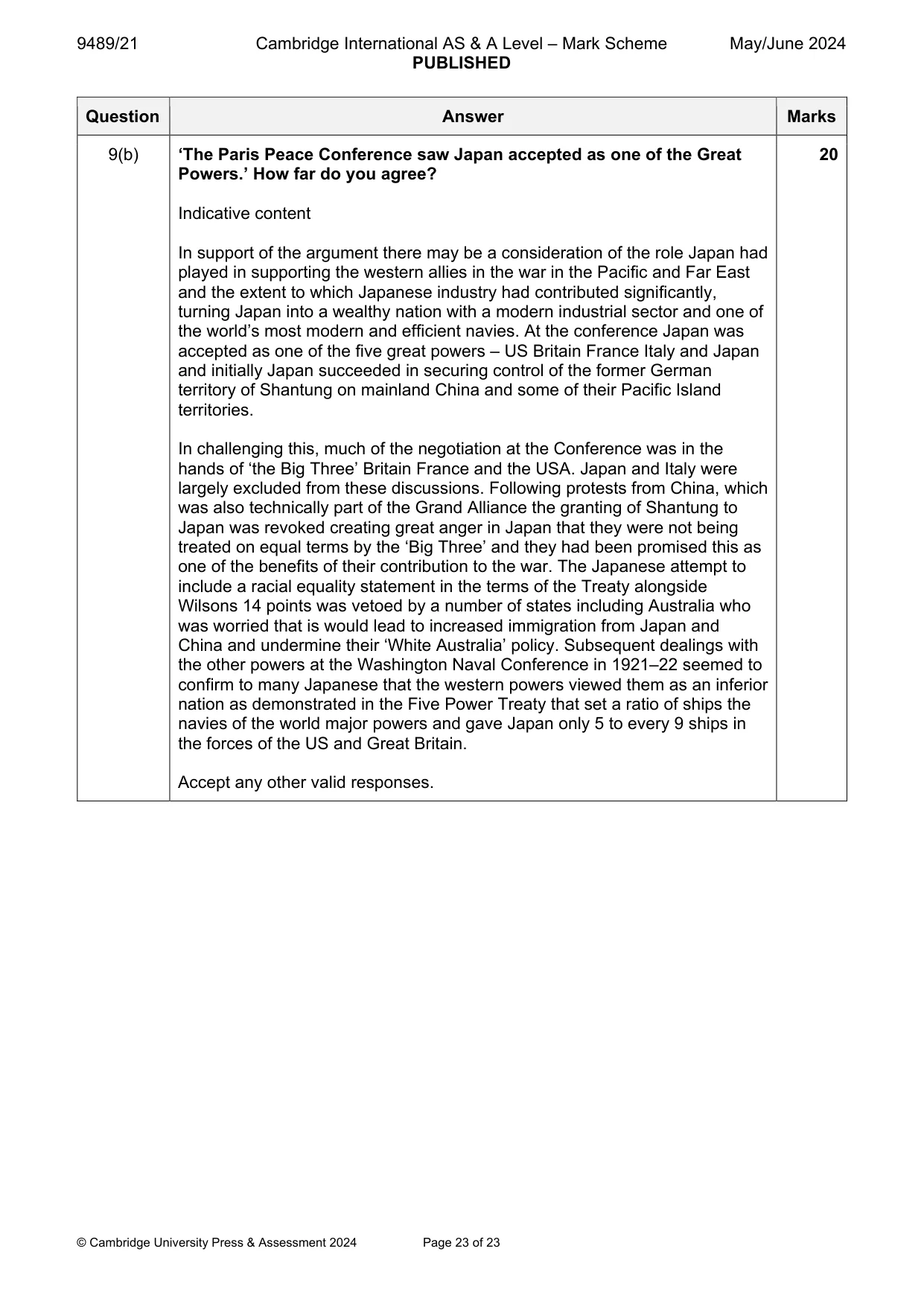
Mark scheme: 9(a) Explain why Chiang Kai–shek was placed under arrest by his own 10 generals in 1936. Indicative content This answer requires an understanding of both the actions of Japan in the early 1930s and Chiang’s attitude towards the Communists. And might include some of the following points: In 1931 Japan seized Manchuria and created the puppet kingdom of Manchukuo. In response Chiang decided to adopt a policy of no resistance so when the Japanese continued to push into northern China and inner Mongolia Chiang signed further treaties ceding territory to Japan. This was partly because KMT control of Northern China was limited but it created an impression of weakness. After escaping Chiang on the Long March, the communists were establishing a successful soviet base in Ya’nan. Chiang appointed generals Zhang and Yuan to lead an attack of the region but instead they urged Chiang to change tactics and join the CCP in attacking Japan. in Dec 1936 Chiang travelled to Xi’an to take control but was promptly arrested by the generals who demanded an end to the war against the CCP and an immediate joint campaign against Japan. The result was the formation of the Second United Front in 1937. Accept any other valid responses. 9(b) ‘The Paris Peace Conference saw Japan accepted as one of the Great 20 Powers.’ How far do you agree? Indicative content In support of the argument there may be a consideration of the role Japan had played in supporting the western allies in the war in the Pacific and Far East and the extent to which Japanese industry had contributed significantly, turning Japan into a wealthy nation with a modern industrial sector and one of the world’s most modern and efficient navies. At the conference Japan was accepted as one of the five great powers – US Britain France Italy and Japan and initially Japan succeeded in securing control of the former German territory of Shantung on mainland China and some of their Pacific Island territories. In challenging this, much of the negotiation at the Conference was in the hands of ‘the Big Three’ Britain France and the USA. Japan and Italy were largely excluded from these discussions. Following protests from China, which was also technically part of the Grand Alliance the granting of Shantung to Japan was revoked creating great anger in Japan that they were not being treated on equal terms by the ‘Big Three’ and they had been promised this as one of the benefits of their contribution to the war. The Japanese attempt to include a racial equality statement in the terms of the Treaty alongside Wilsons 14 points was vetoed by a number of states including Australia who was worried that is would lead to increased immigration from Japan and China and undermine their ‘White Australia’ policy. Subsequent dealings with the other powers at the Washington Naval Conference in 1921–22 seemed to confirm to many Japanese that the western powers viewed them as an inferior nation as demonstrated in the Five Power Treaty that set a ratio of ships the navies of the world major powers and gave Japan only 5 to every 9 ships in the forces of the US and Great Britain. Accept any other valid responses.
More questions on Why did Japan emerge as a world power and what was the impact on international
What was in this paper
The subtopics covered by these 9 questions, and how many questions each got. Open one in a new tab to see every Cambridge question on it.
1What were the causes and immediate consequences of the 1789 Revolution?1What were the consequences of the rapid economic growth after 1870?1Why did Japan emerge as a world power and what was the impact on international1Why did the Civil War last four years?1Why did war break out in 1939?1Why was Bismarck appointed as Minister-President and what were his aims in the period up1Why was imperialism a significant force in Africa from 1870?1Why was there increasing tension between the North and the South before 1860?1What you needed in this session
Cambridge’s own grade thresholds for 2024 May/June, Paper 2 · Variant 1. A higher threshold means an easier paper — the bar moves with how the cohort did.