Cambridge A Level Accounting 9706 — 2012 Oct/Nov Paper 3 · Variant 1
9706/31/O/N/12 · 30 questions · 30 marks · ≈34 min
The question paper and its mark scheme, free to read here and free to download. This is Cambridge’s own paper, exactly as it was sat.
Question paper12 pages
Mark scheme2 pages
Answers below. Sit the paper first if you are practising.
Questions as text
Q1 · X and Y are in partnership and revalue their assets as follows
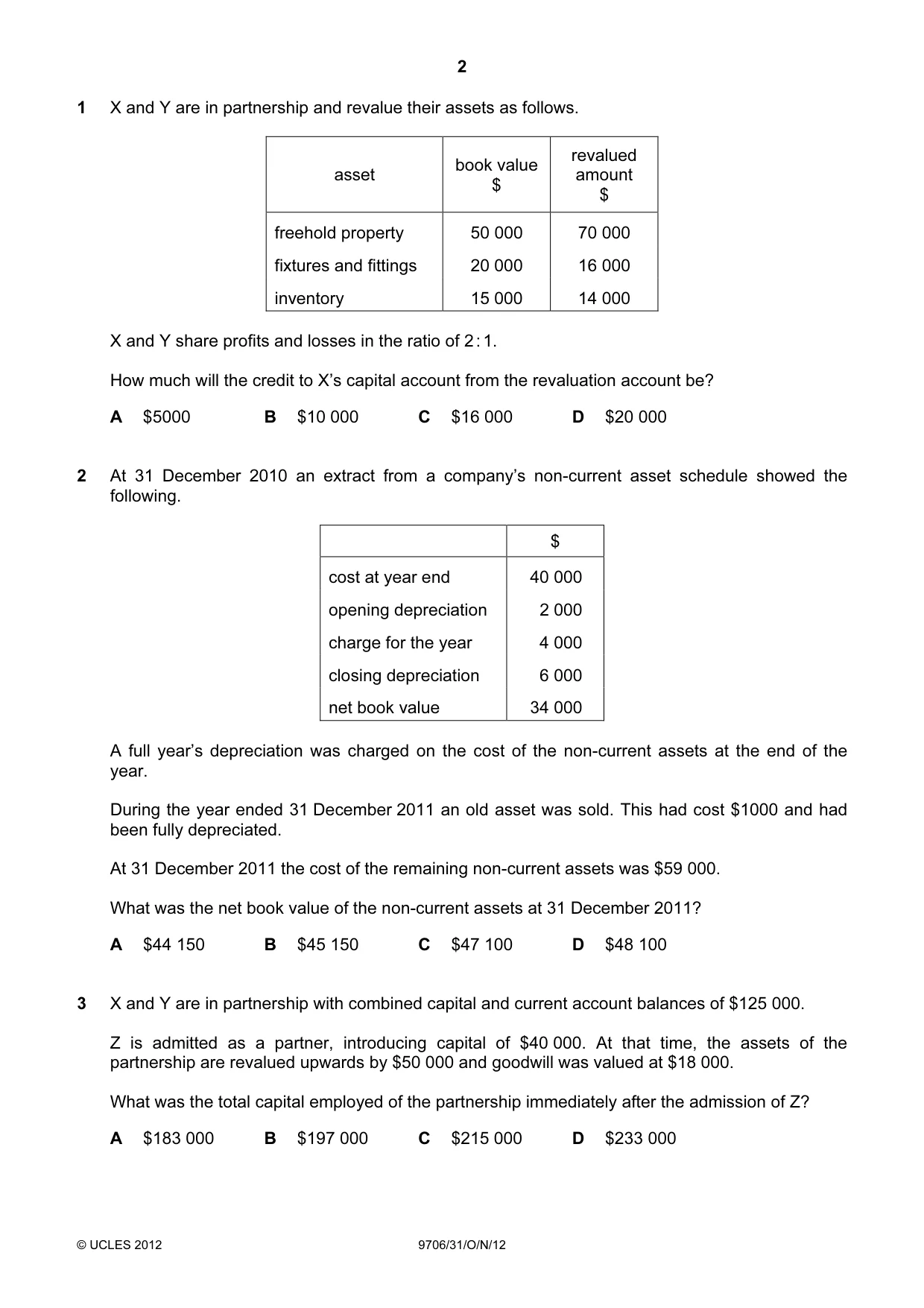
1 X and Y are in partnership and revalue their assets as follows. revalued book value asset amount $ $ freehold property 50 000 70 000 fixtures and fittings 20 000 16 000 inventory 15 000 14 000 X and Y share profits and losses in the ratio of 2 : 1. How much will the credit to X’s capital account from the revaluation account be? A $5000 B $10 000 C $16 000 D $20 000
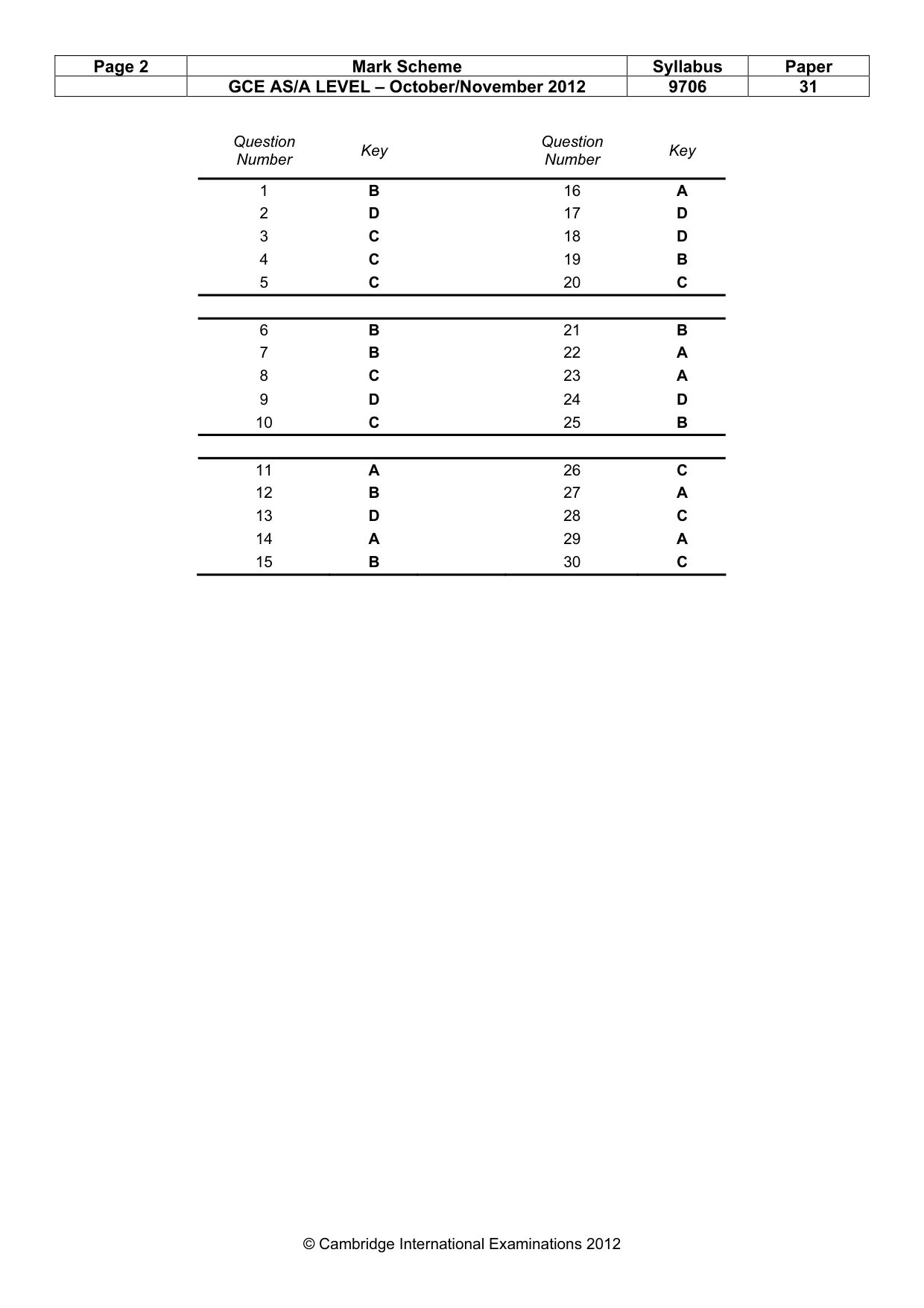
Mark scheme: B
Q2 · At 31 December 2010 an extract from a company’s non-current asset schedule showed the…
2 At 31 December 2010 an extract from a company’s non-current asset schedule showed the following. $ cost at year end 40 000 opening depreciation 2 000 charge for the year 4 000 closing depreciation 6 000 net book value 34 000 A full year’s depreciation was charged on the cost of the non-current assets at the end of the year. During the year ended 31 December 2011 an old asset was sold. This had cost $1000 and had been fully depreciated. At 31 December 2011 the cost of the remaining non-current assets was $59 000. What was the net book value of the non-current assets at 31 December 2011? A $44 150 B $45 150 C $47 100 D $48 100
Mark scheme: D
Q3 · X and Y are in partnership with combined capital and current account balances of $125 000
3 X and Y are in partnership with combined capital and current account balances of $125 000. Z is admitted as a partner, introducing capital of $40 000. At that time, the assets of the partnership are revalued upwards by $50 000 and goodwill was valued at $18 000. What was the total capital employed of the partnership immediately after the admission of Z? A $183 000 B $197 000 C $215 000 D $233 000
Mark scheme: C
Q4 · An extract from a company’s statement of financial position shows the following
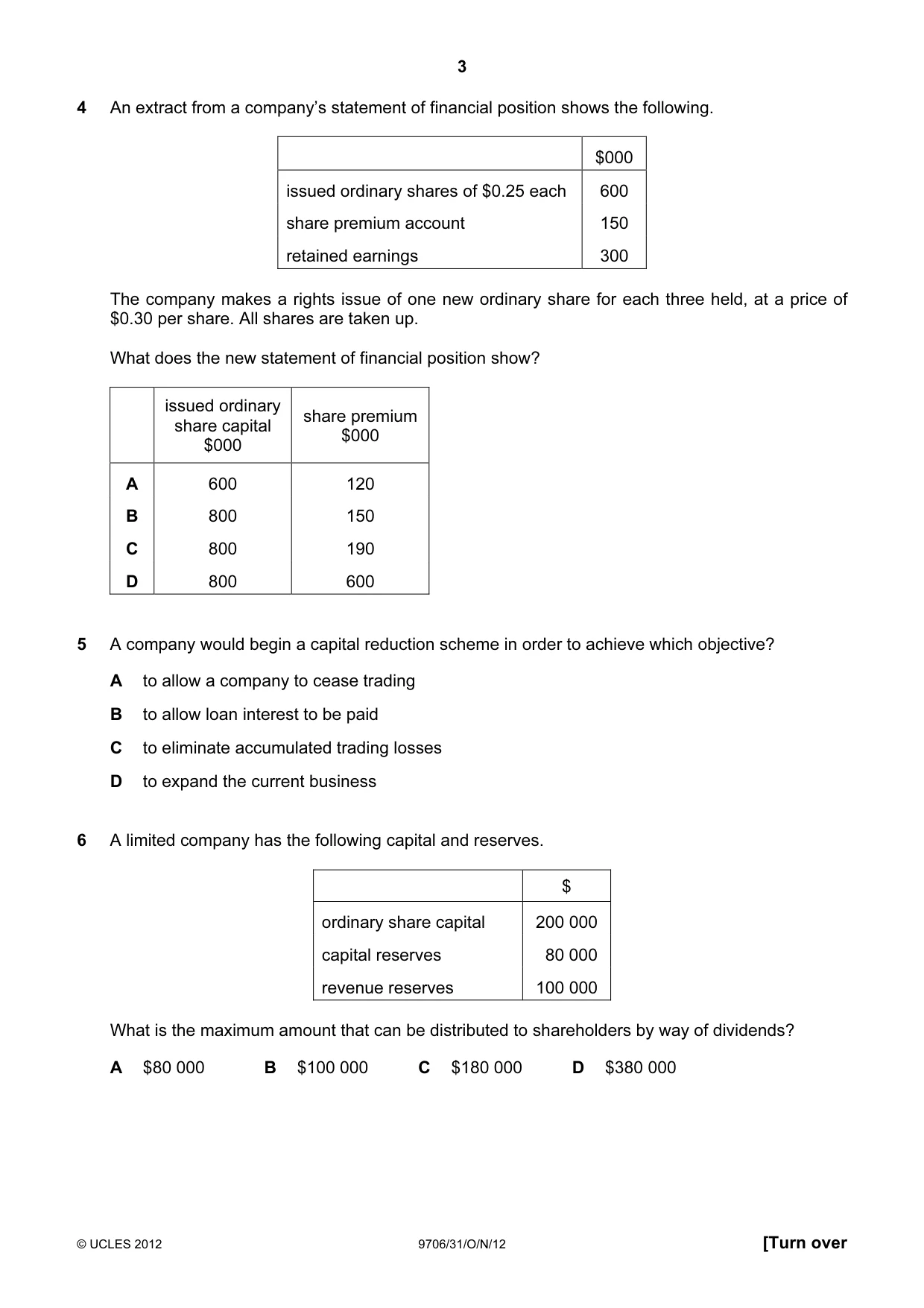
4 An extract from a company’s statement of financial position shows the following. $000 issued ordinary shares of $0.25 each 600 share premium account 150 retained earnings 300 The company makes a rights issue of one new ordinary share for each three held, at a price of $0.30 per share. All shares are taken up. What does the new statement of financial position show? issued ordinary share premium share capital $000 $000 A 600 120 B 800 150 C 800 190 D 800 600
Mark scheme: C
Q5 · A company would begin a capital reduction scheme in order to achieve which objective?
5 A company would begin a capital reduction scheme in order to achieve which objective? A to allow a company to cease trading B to allow loan interest to be paid C to eliminate accumulated trading losses D to expand the current business
Mark scheme: C
Q6 · A limited company has the following capital and reserves
6 A limited company has the following capital and reserves. $ ordinary share capital 200 000 capital reserves 80 000 revenue reserves 100 000 What is the maximum amount that can be distributed to shareholders by way of dividends? A $80 000 B $100 000 C $180 000 D $380 000
Mark scheme: B
Q7 · A company’s statement of financial position shows the following
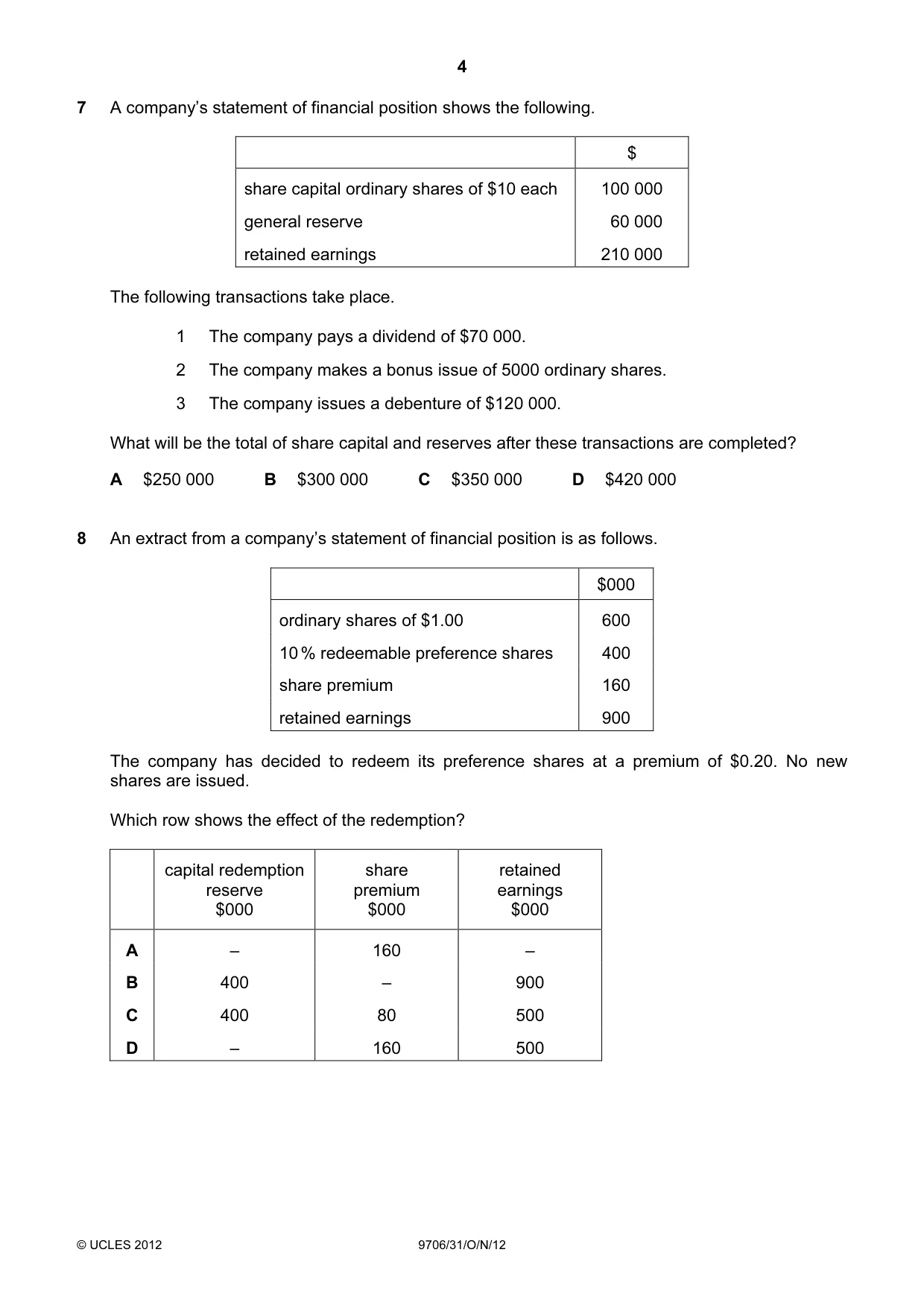
7 A company’s statement of financial position shows the following. $ share capital ordinary shares of $10 each 100 000 general reserve 60 000 retained earnings 210 000 The following transactions take place. 1 The company pays a dividend of $70 000. 2 The company makes a bonus issue of 5000 ordinary shares. 3 The company issues a debenture of $120 000. What will be the total of share capital and reserves after these transactions are completed? A $250 000 B $300 000 C $350 000 D $420 000
Mark scheme: B
Q8 · An extract from a company’s statement of financial position is as follows
8 An extract from a company’s statement of financial position is as follows. $000 ordinary shares of $1.00 600 10 % redeemable preference shares 400 share premium 160 retained earnings 900 The company has decided to redeem its preference shares at a premium of $0.20. No new shares are issued. Which row shows the effect of the redemption? capital redemption share retained reserve premium earnings $000 $000 $000 A – 160 – B 400 – 900 C 400 80 500 D – 160 500
Mark scheme: C
Q9 · A company agrees to buy assets from another company for $200 000
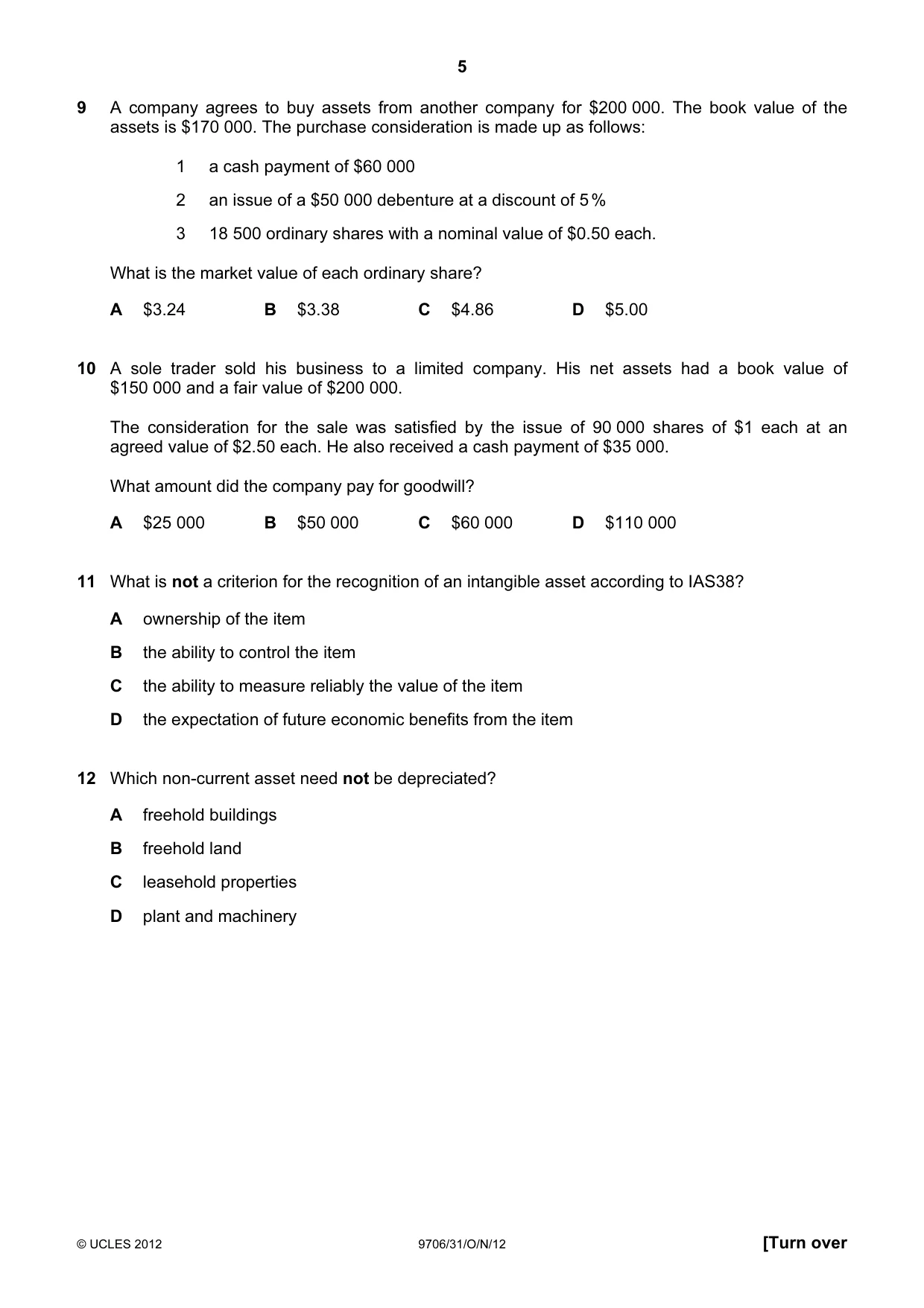
9 A company agrees to buy assets from another company for $200 000. The book value of the assets is $170 000. The purchase consideration is made up as follows: 1 a cash payment of $60 000 2 an issue of a $50 000 debenture at a discount of 5 % 3 18 500 ordinary shares with a nominal value of $0.50 each. What is the market value of each ordinary share? A $3.24 B $3.38 C $4.86 D $5.00
Mark scheme: D
Q10 · A sole trader sold his business to a limited company
10 A sole trader sold his business to a limited company. His net assets had a book value of $150 000 and a fair value of $200 000. The consideration for the sale was satisfied by the issue of 90 000 shares of $1 each at an agreed value of $2.50 each. He also received a cash payment of $35 000. What amount did the company pay for goodwill? A $25 000 B $50 000 C $60 000 D $110 000
Mark scheme: C
Q11 · What is not a criterion for the recognition of an intangible asset according to IAS38?
11 What is not a criterion for the recognition of an intangible asset according to IAS38? A ownership of the item B the ability to control the item C the ability to measure reliably the value of the item D the expectation of future economic benefits from the item
Mark scheme: A
Q12 · Which non-current asset need not be depreciated?
12 Which non-current asset need not be depreciated? A freehold buildings B freehold land C leasehold properties D plant and machinery
Mark scheme: B
Q13 · A company reported a profit from operations of $15 000 for the year, after charging the…
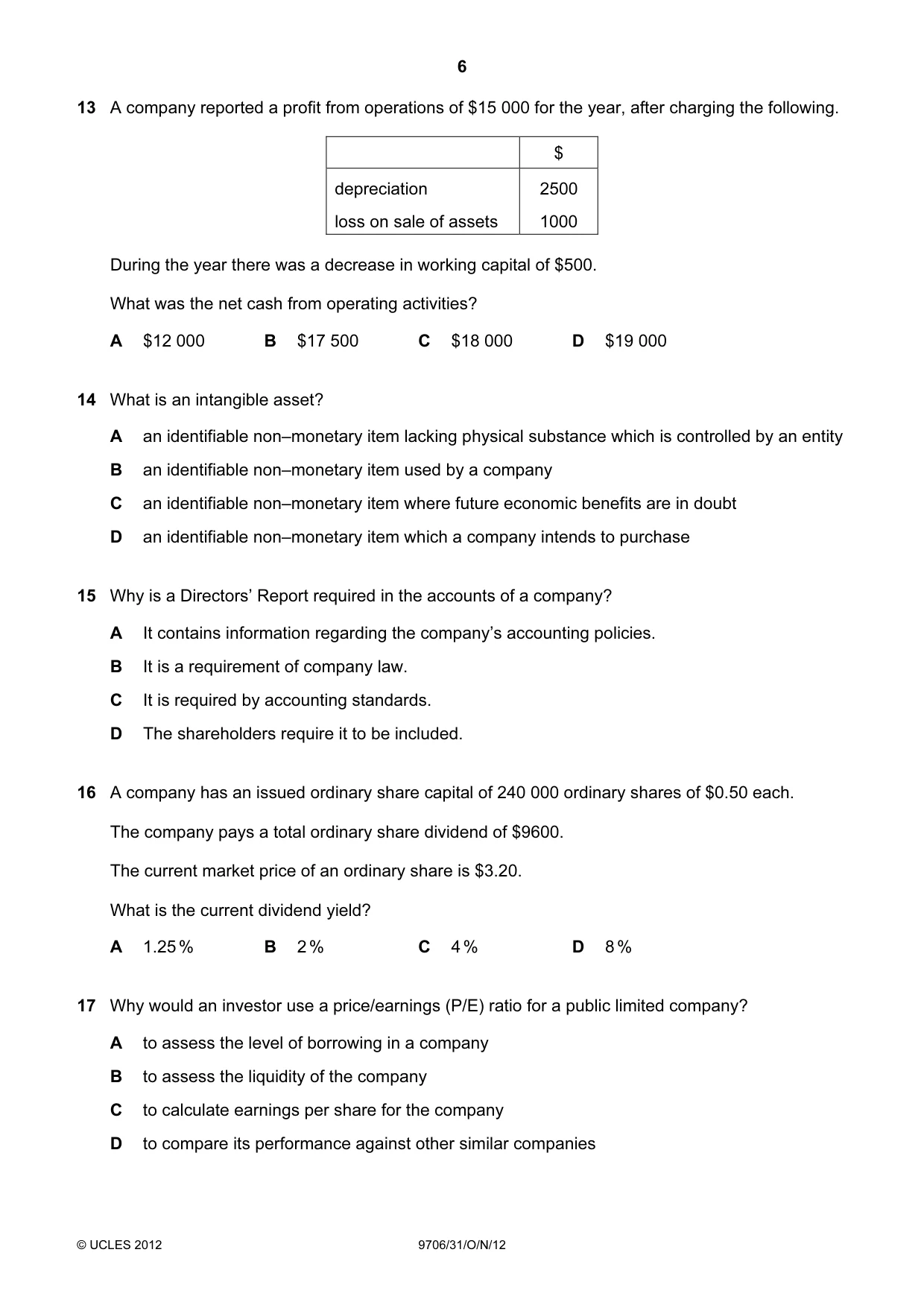
13 A company reported a profit from operations of $15 000 for the year, after charging the following. $ depreciation 2500 loss on sale of assets 1000 During the year there was a decrease in working capital of $500. What was the net cash from operating activities? A $12 000 B $17 500 C $18 000 D $19 000
Mark scheme: D
More questions on Analysis and communication of accounting information
Q14 · What is an intangible asset?
14 What is an intangible asset? A an identifiable non–monetary item lacking physical substance which is controlled by an entity B an identifiable non–monetary item used by a company C an identifiable non–monetary item where future economic benefits are in doubt D an identifiable non–monetary item which a company intends to purchase
Mark scheme: A
Q15 · Why is a Directors’ Report required in the accounts of a company?
15 Why is a Directors’ Report required in the accounts of a company? A It contains information regarding the company’s accounting policies. B It is a requirement of company law. C It is required by accounting standards. D The shareholders require it to be included.
Mark scheme: B
Q16 · A company has an issued ordinary share capital of 240 000 ordinary shares of $0.50 each
16 A company has an issued ordinary share capital of 240 000 ordinary shares of $0.50 each. The company pays a total ordinary share dividend of $9600. The current market price of an ordinary share is $3.20. What is the current dividend yield? A 1.25 % B 2 % C 4 % D 8 %
Mark scheme: A
More questions on Analysis and communication of accounting information
Q17 · Why would an investor use a price/earnings (P/E) ratio for a public limited company?
17 Why would an investor use a price/earnings (P/E) ratio for a public limited company? A to assess the level of borrowing in a company B to assess the liquidity of the company C to calculate earnings per share for the company D to compare its performance against other similar companies
Mark scheme: D
More questions on Analysis and communication of accounting information
Q18 · Extracts from a company’s accounts show the following information
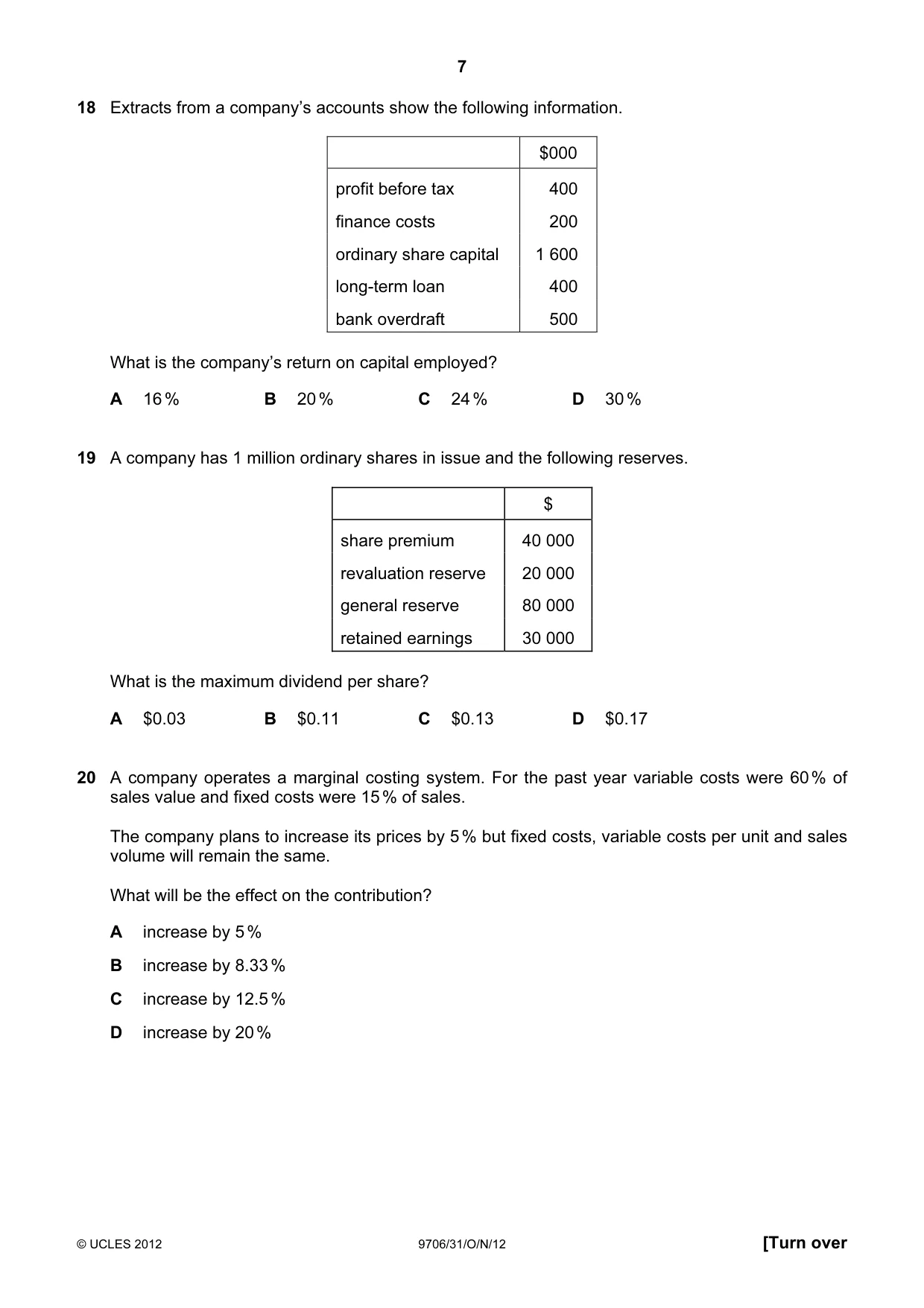
18 Extracts from a company’s accounts show the following information. $000 profit before tax 400 finance costs 200 ordinary share capital 1 600 long-term loan 400 bank overdraft 500 What is the company’s return on capital employed? A 16 % B 20 % C 24 % D 30 %
Mark scheme: D
More questions on Analysis and communication of accounting information
Q19 · A company has 1 million ordinary shares in issue and the following reserves
19 A company has 1 million ordinary shares in issue and the following reserves. $ share premium 40 000 revaluation reserve 20 000 general reserve 80 000 retained earnings 30 000 What is the maximum dividend per share? A $0.03 B $0.11 C $0.13 D $0.17
Mark scheme: B
Q20 · A company operates a marginal costing system
20 A company operates a marginal costing system. For the past year variable costs were 60 % of sales value and fixed costs were 15 % of sales. The company plans to increase its prices by 5 % but fixed costs, variable costs per unit and sales volume will remain the same. What will be the effect on the contribution? A increase by 5 % B increase by 8.33 % C increase by 12.5 % D increase by 20 %
Mark scheme: C
Q21 · The following information relates to the production level and costs for period 1
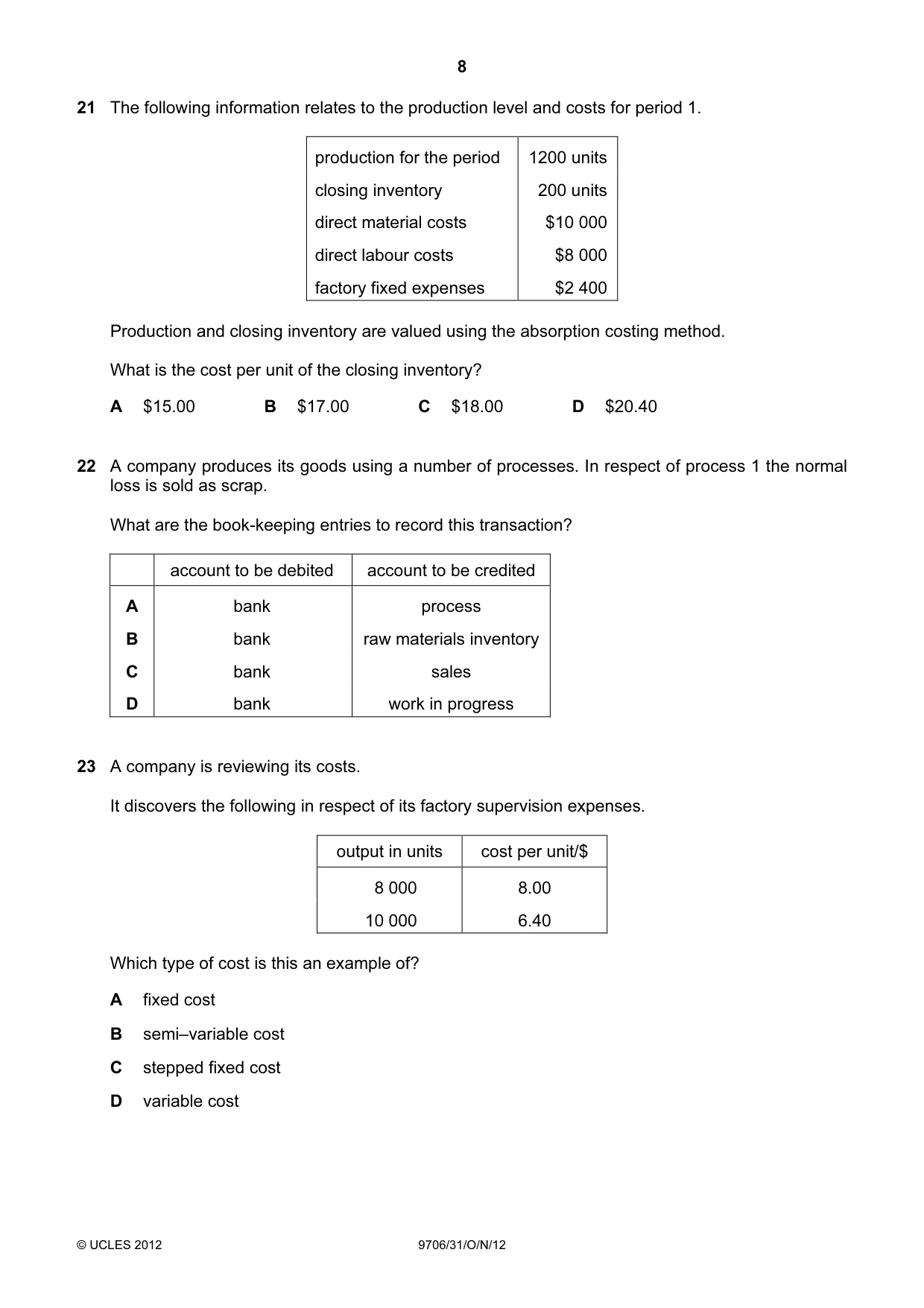
21 The following information relates to the production level and costs for period 1. production for the period 1200 units closing inventory 200 units direct material costs $10 000 direct labour costs $8 000 factory fixed expenses $2 400 Production and closing inventory are valued using the absorption costing method. What is the cost per unit of the closing inventory? A $15.00 B $17.00 C $18.00 D $20.40
Mark scheme: B
Q22 · A company produces its goods using a number of processes
22 A company produces its goods using a number of processes. In respect of process 1 the normal loss is sold as scrap. What are the book-keeping entries to record this transaction? account to be debited account to be credited A bank process B bank raw materials inventory C bank sales D bank work in progress
Mark scheme: A
Q23 · A company is reviewing its costs
23 A company is reviewing its costs. It discovers the following in respect of its factory supervision expenses. output in units cost per unit/$ 8 000 8.00 10 000 6.40 Which type of cost is this an example of? A fixed cost B semi–variable cost C stepped fixed cost D variable cost
Mark scheme: A
Q24 · A business sets the production cost budget shown
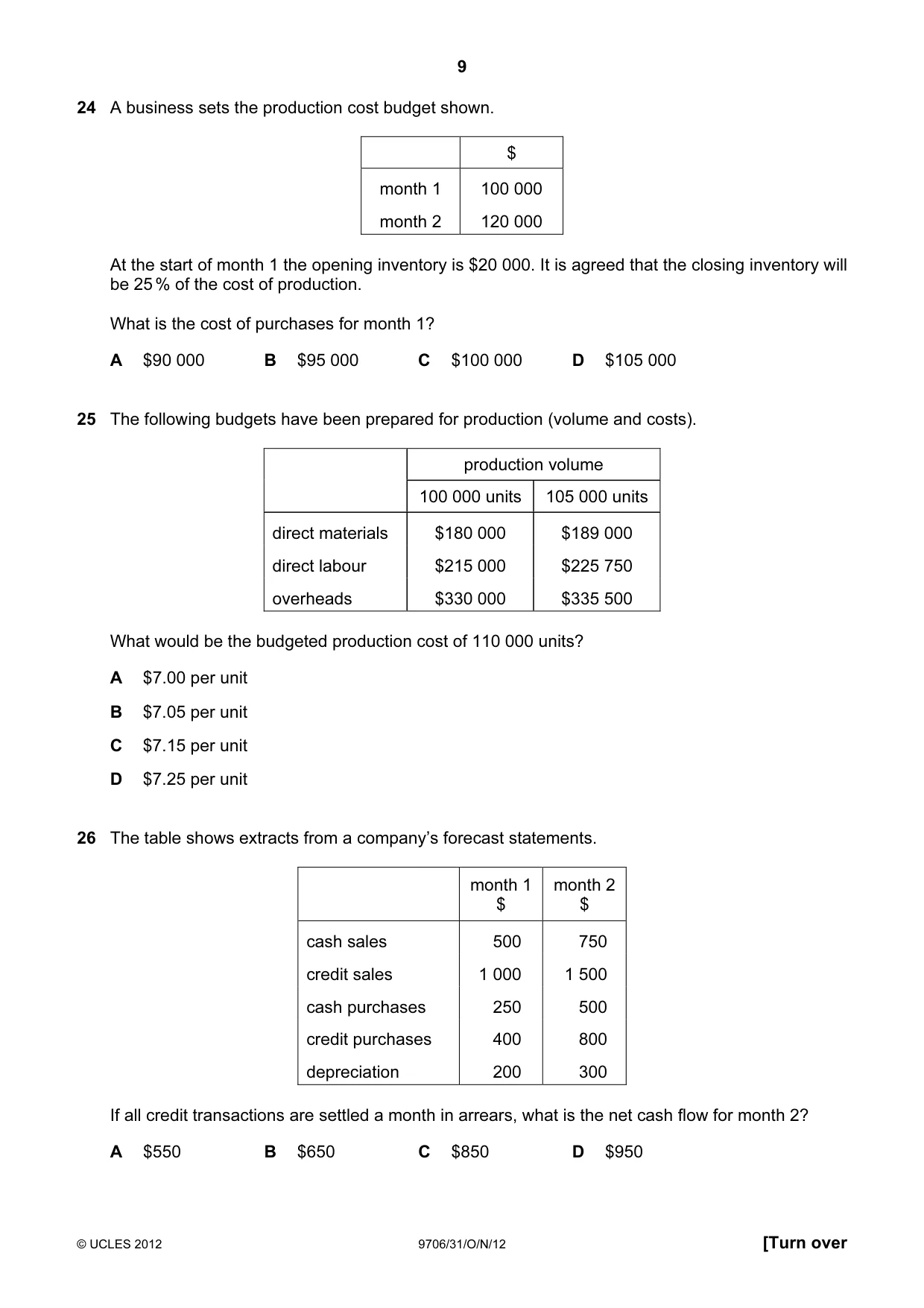
24 A business sets the production cost budget shown. $ month 1 100 000 month 2 120 000 At the start of month 1 the opening inventory is $20 000. It is agreed that the closing inventory will be 25 % of the cost of production. What is the cost of purchases for month 1? A $90 000 B $95 000 C $100 000 D $105 000
Mark scheme: D
Q25 · The following budgets have been prepared for production (volume and costs)
25 The following budgets have been prepared for production (volume and costs). production volume 100 000 units 105 000 units direct materials $180 000 $189 000 direct labour $215 000 $225 750 overheads $330 000 $335 500 What would be the budgeted production cost of 110 000 units? A $7.00 per unit B $7.05 per unit C $7.15 per unit D $7.25 per unit
Mark scheme: B
Q26 · The table shows extracts from a company’s forecast statements
26 The table shows extracts from a company’s forecast statements. month 1 month 2 $ $ cash sales 500 750 credit sales 1 000 1 500 cash purchases 250 500 credit purchases 400 800 depreciation 200 300 If all credit transactions are settled a month in arrears, what is the net cash flow for month 2? A $550 B $650 C $850 D $950
Mark scheme: C
Q27 · Budgeted and actual results are: budgeted actual materials (kgs per unit) 24 26 materials…
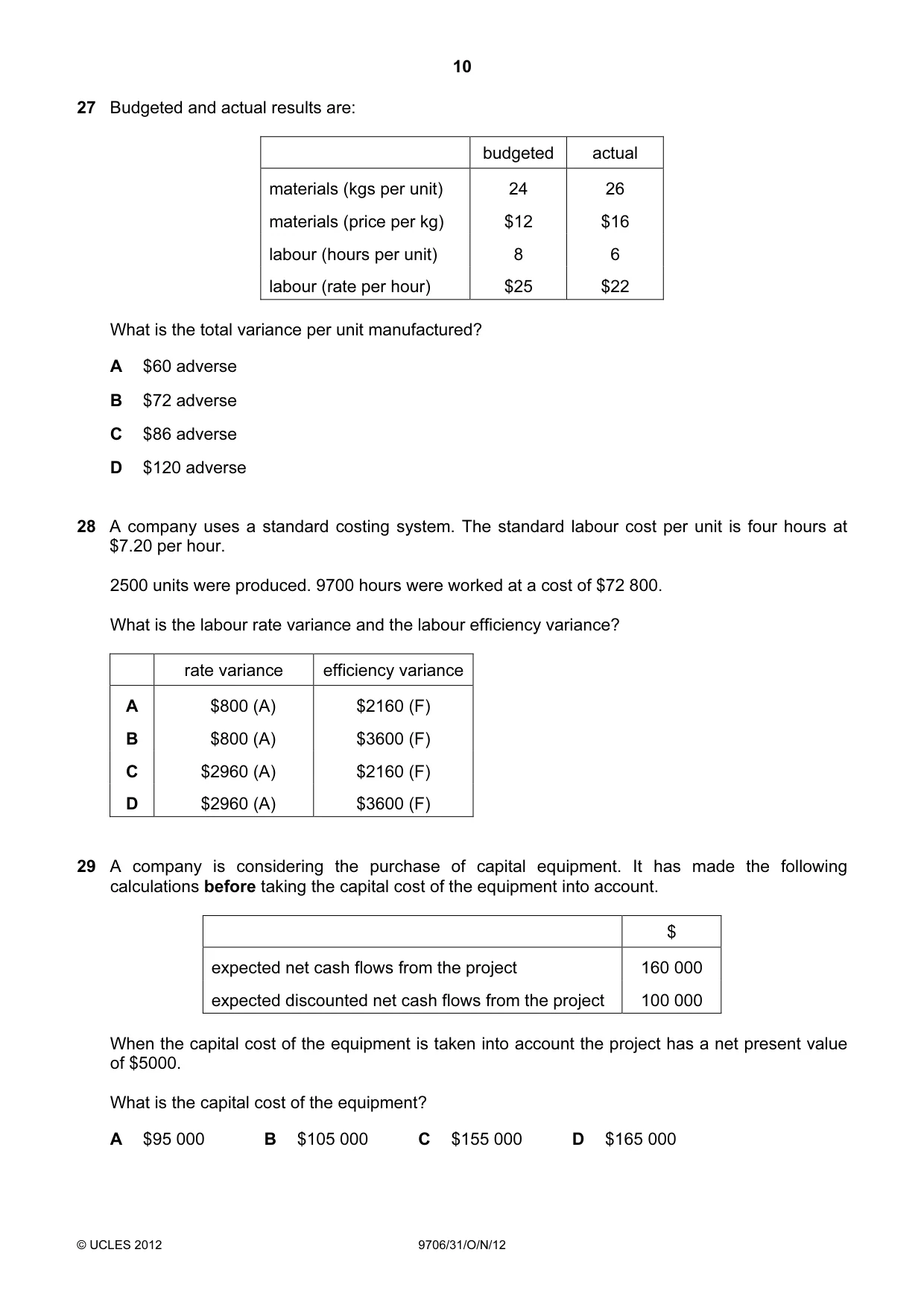
27 Budgeted and actual results are: budgeted actual materials (kgs per unit) 24 26 materials (price per kg) $12 $16 labour (hours per unit) 8 6 labour (rate per hour) $25 $22 What is the total variance per unit manufactured? A $60 adverse B $72 adverse C $86 adverse D $120 adverse
Mark scheme: A
Q28 · A company uses a standard costing system
28 A company uses a standard costing system. The standard labour cost per unit is four hours at $7.20 per hour. 2500 units were produced. 9700 hours were worked at a cost of $72 800. What is the labour rate variance and the labour efficiency variance? rate variance efficiency variance A $800 (A) $2160 (F) B $800 (A) $3600 (F) C $2960 (A) $2160 (F) D $2960 (A) $3600 (F)
Mark scheme: C
Q29 · A company is considering the purchase of capital equipment
29 A company is considering the purchase of capital equipment. It has made the following calculations before taking the capital cost of the equipment into account. $ expected net cash flows from the project 160 000 expected discounted net cash flows from the project 100 000 When the capital cost of the equipment is taken into account the project has a net present value of $5000. What is the capital cost of the equipment? A $95 000 B $105 000 C $155 000 D $165 000
Mark scheme: A
Q30 · Which investment appraisal method discounts cash flows at the company’s cost of capital?
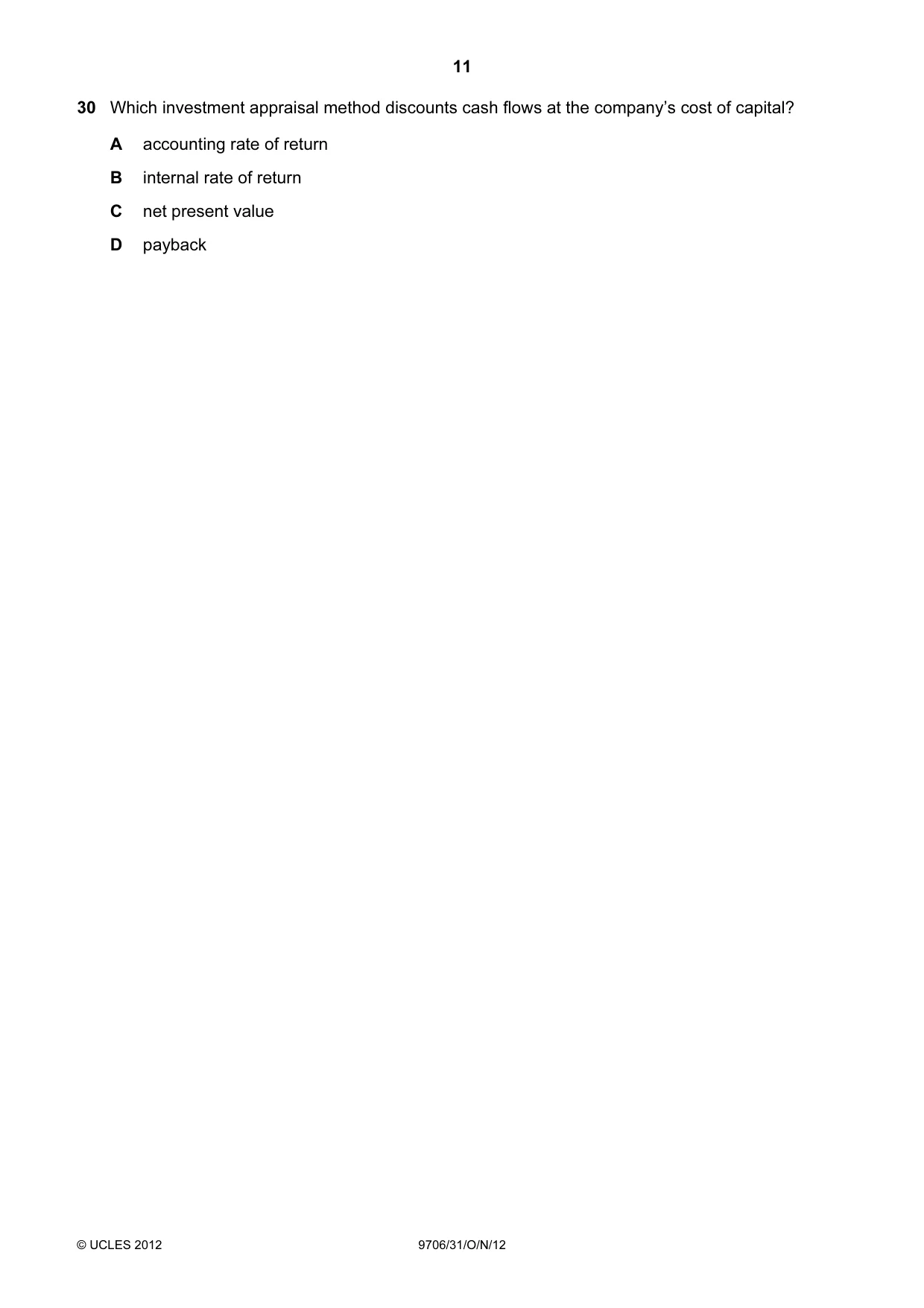
30 Which investment appraisal method discounts cash flows at the company’s cost of capital? A accounting rate of return B internal rate of return C net present value D payback
Mark scheme: C
What was in this paper
The subtopics covered by these 30 questions, and how many questions each got. Open one in a new tab to see every Cambridge question on it.
6Business acquisition and merger3Costs and cost behaviour3Regulatory and ethical considerations3Accounting for non-current assets2Analysis and communication of accounting information2Analysis and communication of accounting information2Budgeting and budgetary control2Investment appraisal2Standard costing2Traditional costing methods2Types of business entity1What you needed in this session
Cambridge’s own grade thresholds for 2012 Oct/Nov, Paper 3 · Variant 1. A higher threshold means an easier paper — the bar moves with how the cohort did.