Cambridge A Level Accounting 9706 — 2010 Oct/Nov Paper 3 · Variant 3
9706/33/O/N/10 · 30 questions · 30 marks · ≈34 min
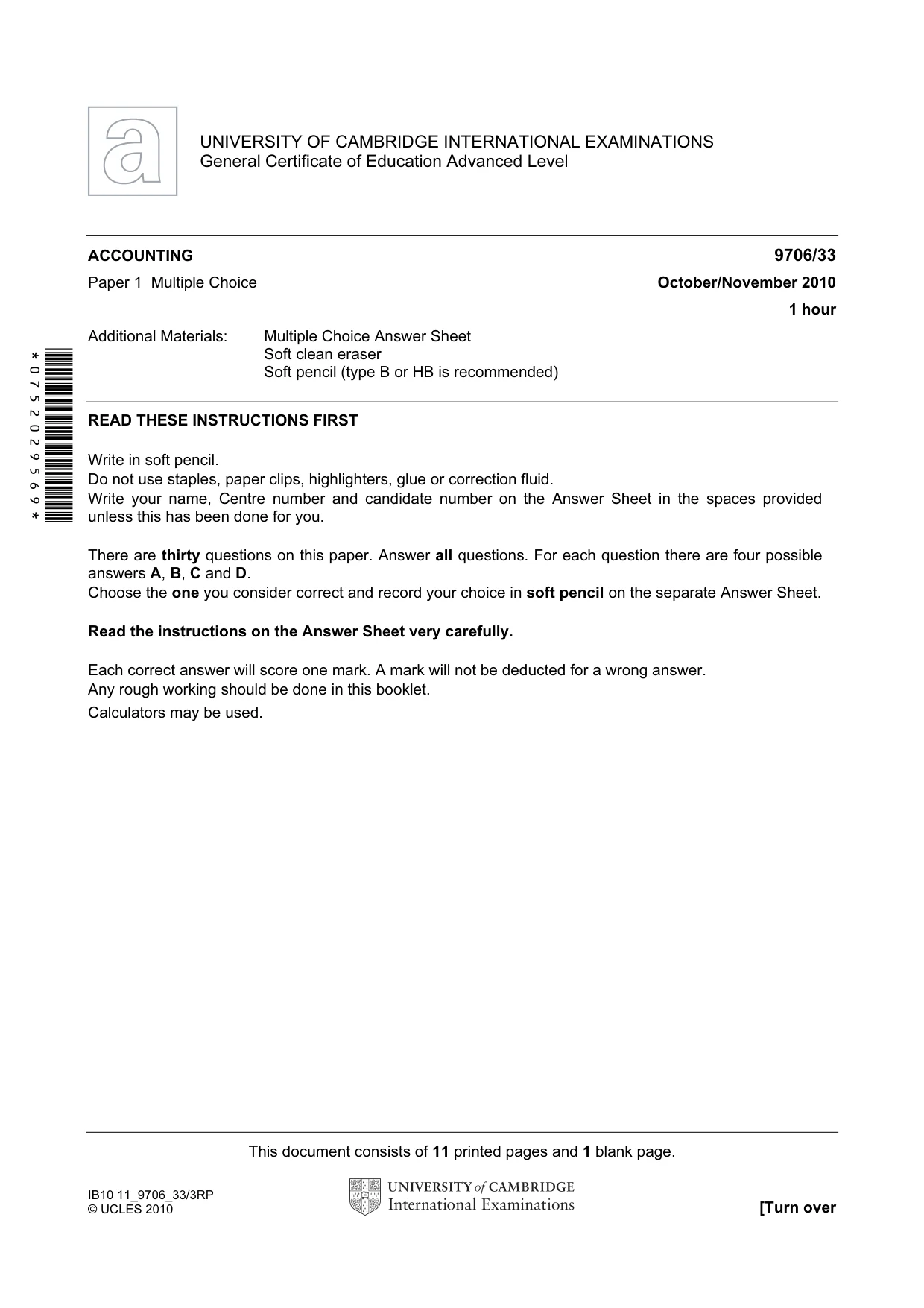
The question paper and its mark scheme, free to read here and free to download. This is Cambridge’s own paper, exactly as it was sat.
Question paper12 pages

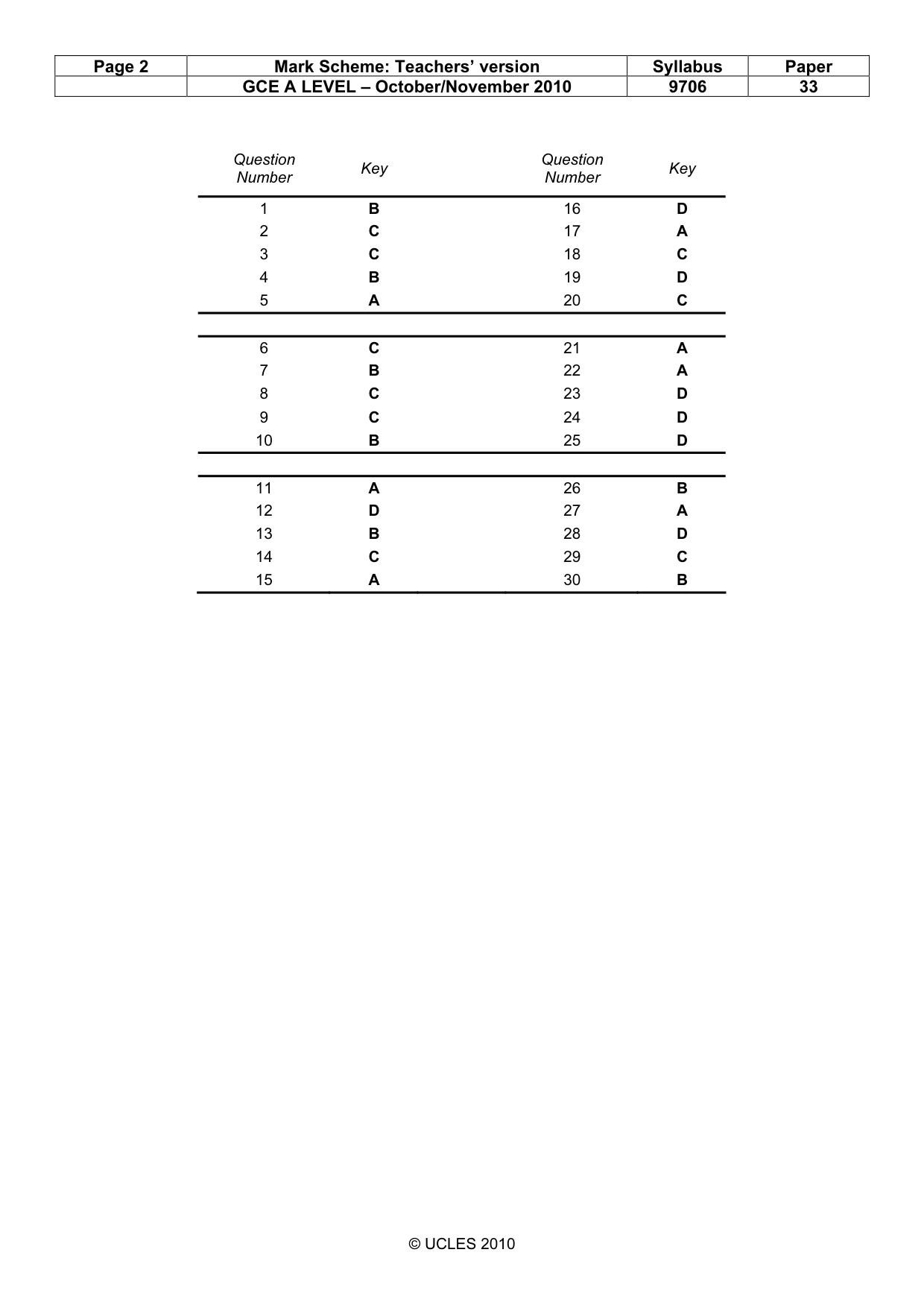
Mark scheme2 pages
Answers below. Sit the paper first if you are practising.
Questions as text
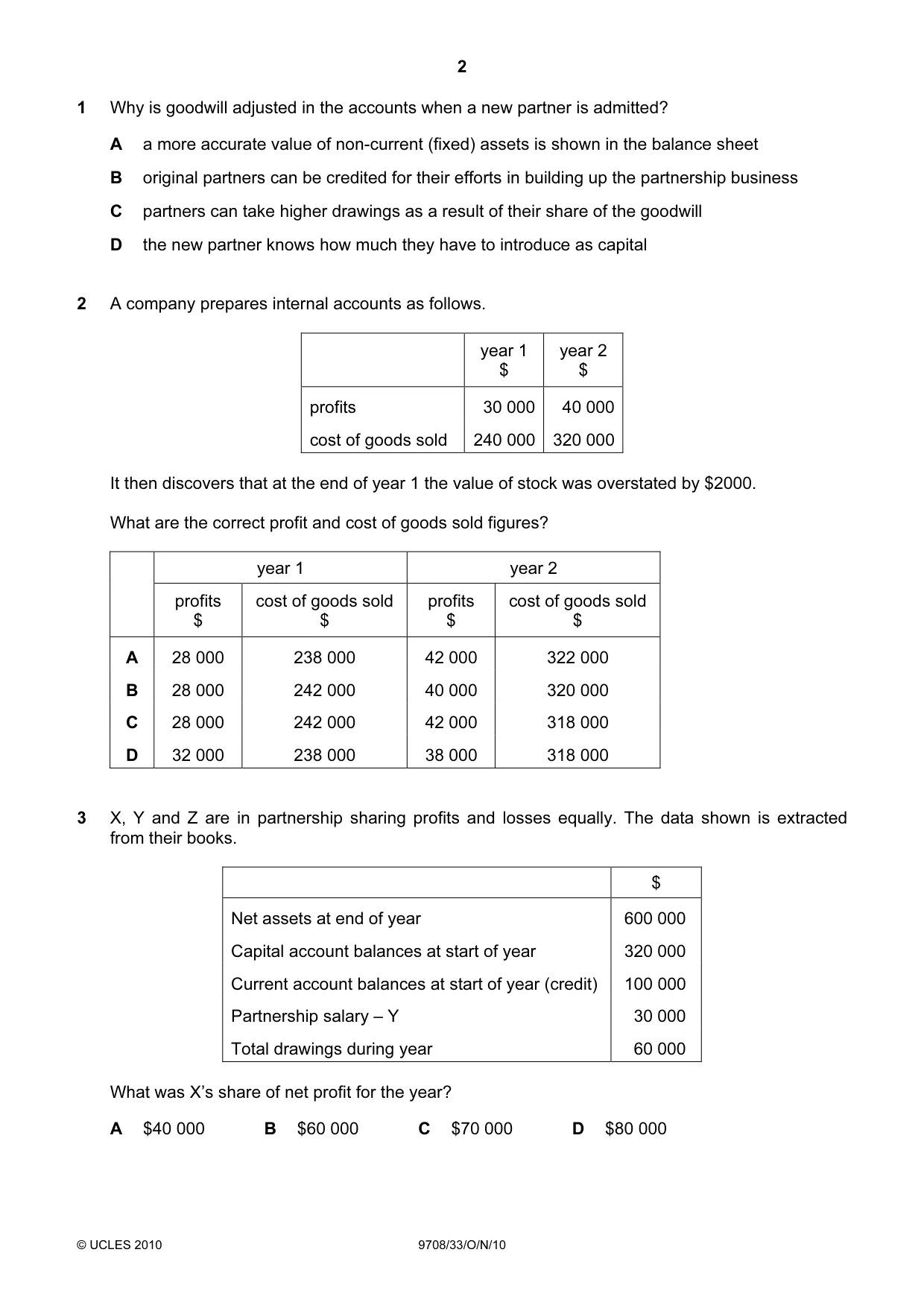
Q1 · Why is goodwill adjusted in the accounts when a new partner is admitted?
1 Why is goodwill adjusted in the accounts when a new partner is admitted? A a more accurate value of non-current (fixed) assets is shown in the balance sheet B original partners can be credited for their efforts in building up the partnership business C partners can take higher drawings as a result of their share of the goodwill D the new partner knows how much they have to introduce as capital
Mark scheme: B
Q2 · A company prepares internal accounts as follows
2 A company prepares internal accounts as follows. year 1 year 2 $ $ profits 30 000 40 000 cost of goods sold 240 000 320 000 It then discovers that at the end of year 1 the value of stock was overstated by $2000. What are the correct profit and cost of goods sold figures? year 1 year 2 profits cost of goods sold profits cost of goods sold $ $ $ $ A 28 000 238 000 42 000 322 000 B 28 000 242 000 40 000 320 000 C 28 000 242 000 42 000 318 000 D 32 000 238 000 38 000 318 000
Mark scheme: C
Q3 · X, Y and Z are in partnership sharing profits and losses equally
3 X, Y and Z are in partnership sharing profits and losses equally. The data shown is extracted from their books. $ Net assets at end of year 600 000 Capital account balances at start of year 320 000 Current account balances at start of year (credit) 100 000 Partnership salary – Y 30 000 Total drawings during year 60 000 What was X’s share of net profit for the year? A $40 000 B $60 000 C $70 000 D $80 000
Mark scheme: C
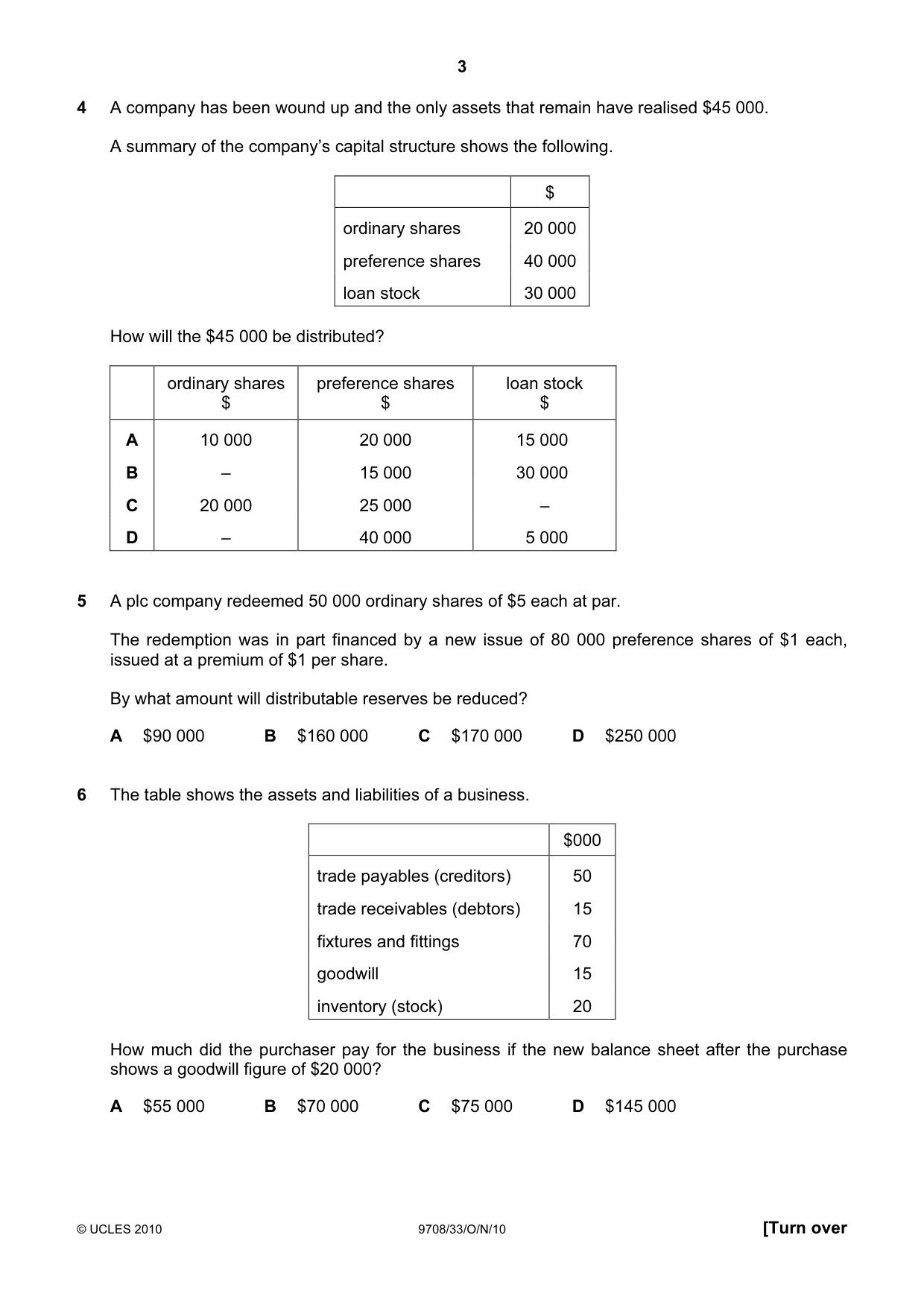
Q4 · A company has been wound up and the only assets that remain have realised $45 000
4 A company has been wound up and the only assets that remain have realised $45 000. A summary of the company’s capital structure shows the following. $ ordinary shares 20 000 preference shares 40 000 loan stock 30 000 How will the $45 000 be distributed? ordinary shares preference shares loan stock $ $ $ A 10 000 20 000 15 000 B – 15 000 30 000 C 20 000 25 000 – D – 40 000 5 000
Mark scheme: B
Q5 · A plc company redeemed 50 000 ordinary shares of $5 each at par
5 A plc company redeemed 50 000 ordinary shares of $5 each at par. The redemption was in part financed by a new issue of 80 000 preference shares of $1 each, issued at a premium of $1 per share. By what amount will distributable reserves be reduced? A $90 000 B $160 000 C $170 000 D $250 000
Mark scheme: A
Q6 · The table shows the assets and liabilities of a business
6 The table shows the assets and liabilities of a business. $000 trade payables (creditors) 50 trade receivables (debtors) 15 fixtures and fittings 70 goodwill 15 inventory (stock) 20 How much did the purchaser pay for the business if the new balance sheet after the purchase shows a goodwill figure of $20 000? A $55 000 B $70 000 C $75 000 D $145 000
Mark scheme: C
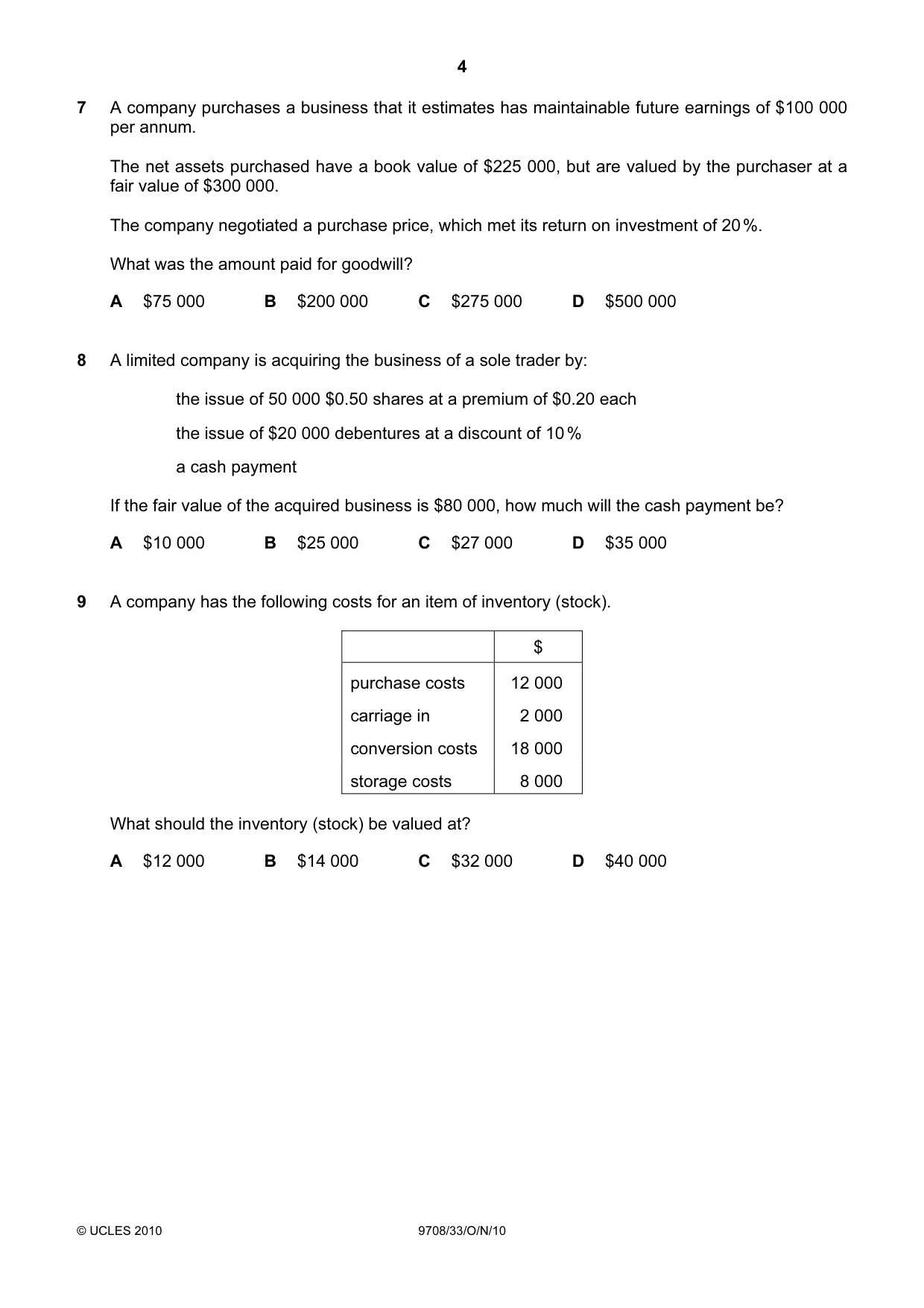
Q7 · A company purchases a business that it estimates has maintainable future earnings of $100…
7 A company purchases a business that it estimates has maintainable future earnings of $100 000 per annum. The net assets purchased have a book value of $225 000, but are valued by the purchaser at a fair value of $300 000. The company negotiated a purchase price, which met its return on investment of 20 %. What was the amount paid for goodwill? A $75 000 B $200 000 C $275 000 D $500 000
Mark scheme: B
Q8 · A limited company is acquiring the business of a sole trader by: the issue of 50 000…
8 A limited company is acquiring the business of a sole trader by: the issue of 50 000 $0.50 shares at a premium of $0.20 each the issue of $20 000 debentures at a discount of 10 % a cash payment If the fair value of the acquired business is $80 000, how much will the cash payment be? A $10 000 B $25 000 C $27 000 D $35 000
Mark scheme: C
Q9 · A company has the following costs for an item of inventory (stock)
9 A company has the following costs for an item of inventory (stock). $ purchase costs 12 000 carriage in 2 000 conversion costs 18 000 storage costs 8 000 What should the inventory (stock) be valued at? A $12 000 B $14 000 C $32 000 D $40 000
Mark scheme: C
Q10 · A company has the following account balances at the end of its financial year
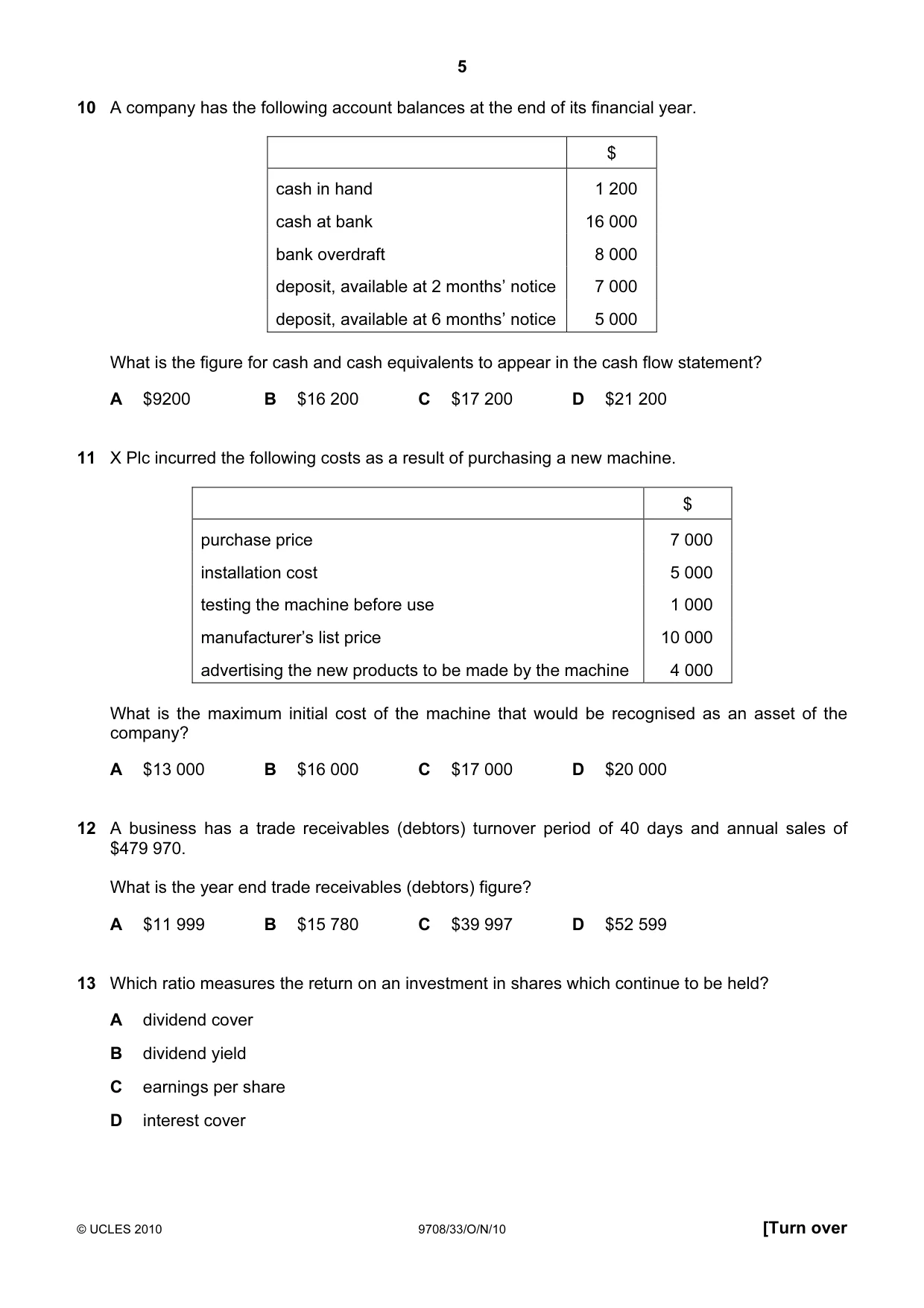
10 A company has the following account balances at the end of its financial year. $ cash in hand 1 200 cash at bank 16 000 bank overdraft 8 000 deposit, available at 2 months’ notice 7 000 deposit, available at 6 months’ notice 5 000 What is the figure for cash and cash equivalents to appear in the cash flow statement? A $9200 B $16 200 C $17 200 D $21 200
Mark scheme: B
Q11 · X Plc incurred the following costs as a result of purchasing a new machine
11 X Plc incurred the following costs as a result of purchasing a new machine. $ purchase price 7 000 installation cost 5 000 testing the machine before use 1 000 manufacturer’s list price 10 000 advertising the new products to be made by the machine 4 000 What is the maximum initial cost of the machine that would be recognised as an asset of the company? A $13 000 B $16 000 C $17 000 D $20 000
Mark scheme: A
Q12 · A business has a trade receivables (debtors) turnover period of 40 days and annual sales…
12 A business has a trade receivables (debtors) turnover period of 40 days and annual sales of $479 970. What is the year end trade receivables (debtors) figure? A $11 999 B $15 780 C $39 997 D $52 599
Mark scheme: D
More questions on Analysis and communication of accounting information
Q13 · Which ratio measures the return on an investment in shares which continue to be held?
13 Which ratio measures the return on an investment in shares which continue to be held? A dividend cover B dividend yield C earnings per share D interest cover
Mark scheme: B
More questions on Analysis and communication of accounting information
Q14 · A company’s authorised share capital is 1 million ordinary shares of $1 each
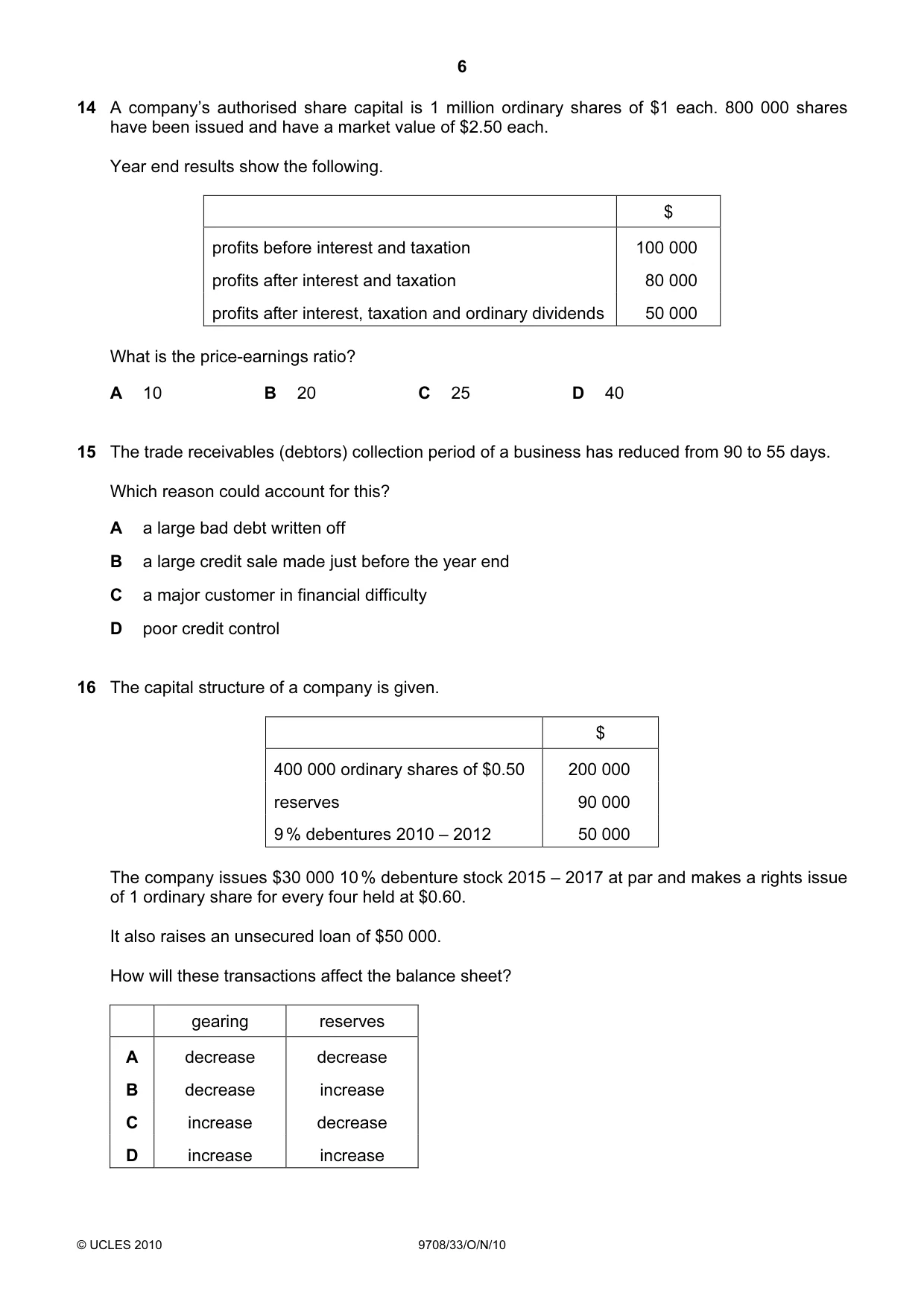
14 A company’s authorised share capital is 1 million ordinary shares of $1 each. 800 000 shares have been issued and have a market value of $2.50 each. Year end results show the following. $ profits before interest and taxation 100 000 profits after interest and taxation 80 000 profits after interest, taxation and ordinary dividends 50 000 What is the price-earnings ratio? A 10 B 20 C 25 D 40
Mark scheme: C
More questions on Analysis and communication of accounting information
Q15 · The trade receivables (debtors) collection period of a business has reduced from 90 to 55…
15 The trade receivables (debtors) collection period of a business has reduced from 90 to 55 days. Which reason could account for this? A a large bad debt written off B a large credit sale made just before the year end C a major customer in financial difficulty D poor credit control
Mark scheme: A
More questions on Analysis and communication of accounting information
Q16 · The capital structure of a company is given
16 The capital structure of a company is given. $ 400 000 ordinary shares of $0.50 200 000 reserves 90 000 9 % debentures 2010 – 2012 50 000 The company issues $30 000 10 % debenture stock 2015 – 2017 at par and makes a rights issue of 1 ordinary share for every four held at $0.60. It also raises an unsecured loan of $50 000. How will these transactions affect the balance sheet? gearing reserves A decrease decrease B decrease increase C increase decrease D increase increase
Mark scheme: D
More questions on Analysis and communication of accounting information
Q17 · The equity section of a company’s balance sheet is as follows
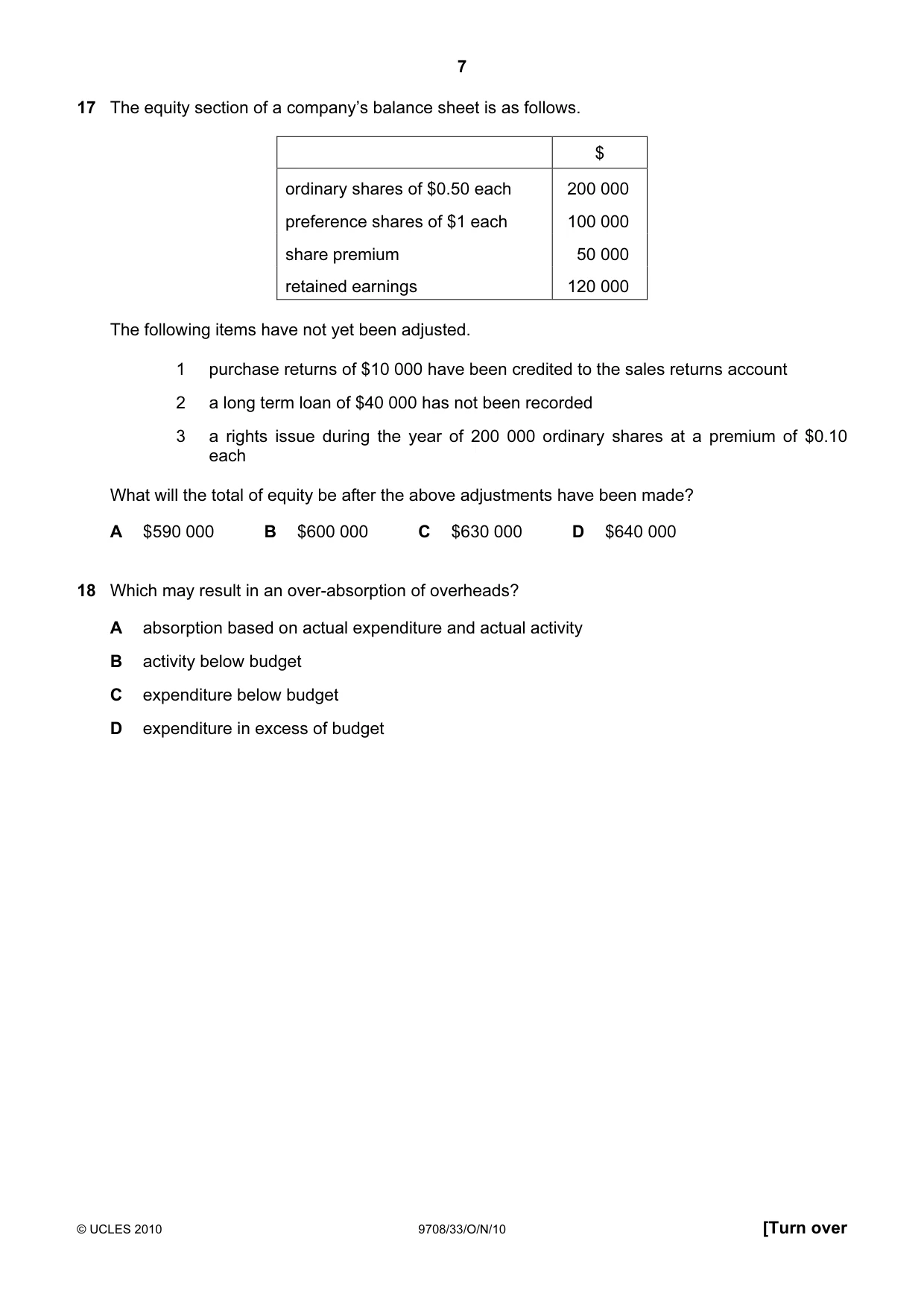
17 The equity section of a company’s balance sheet is as follows. $ ordinary shares of $0.50 each 200 000 preference shares of $1 each 100 000 share premium 50 000 retained earnings 120 000 The following items have not yet been adjusted. 1 purchase returns of $10 000 have been credited to the sales returns account 2 a long term loan of $40 000 has not been recorded 3 a rights issue during the year of 200 000 ordinary shares at a premium of $0.10 each What will the total of equity be after the above adjustments have been made? A $590 000 B $600 000 C $630 000 D $640 000
Mark scheme: A
Q18 · Which may result in an over-absorption of overheads?
18 Which may result in an over-absorption of overheads? A absorption based on actual expenditure and actual activity B activity below budget C expenditure below budget D expenditure in excess of budget
Mark scheme: C
Q19 · The table shows the annual results of a company’s three departments
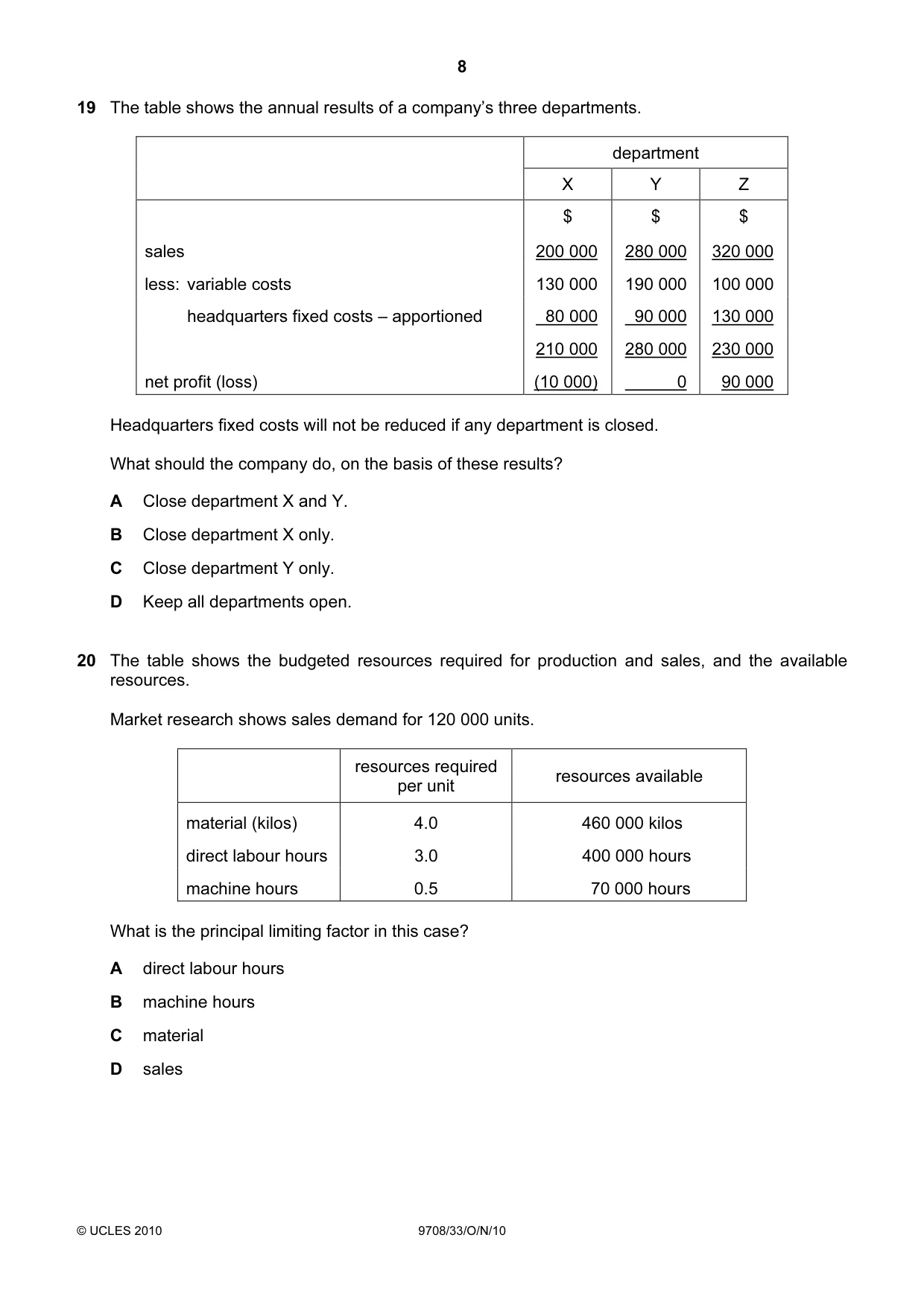
19 The table shows the annual results of a company’s three departments. department X Y Z $ $ $ sales 200 000 280 000 320 000 less: variable costs 130 000 190 000 100 000 headquarters fixed costs – apportioned 80 000 90 000 130 000 210 000 280 000 230 000 net profit (loss) (10 000) 0 90 000 Headquarters fixed costs will not be reduced if any department is closed. What should the company do, on the basis of these results? A Close department X and Y. B Close department X only. C Close department Y only. D Keep all departments open.
Mark scheme: D
Q20 · The table shows the budgeted resources required for production and sales, and the…
20 The table shows the budgeted resources required for production and sales, and the available resources. Market research shows sales demand for 120 000 units. resources required resources available per unit material (kilos) 4.0 460 000 kilos direct labour hours 3.0 400 000 hours machine hours 0.5 70 000 hours What is the principal limiting factor in this case? A direct labour hours B machine hours C material D sales
Mark scheme: C
Q21 · The table shows the costs involved in the production of 1000 units
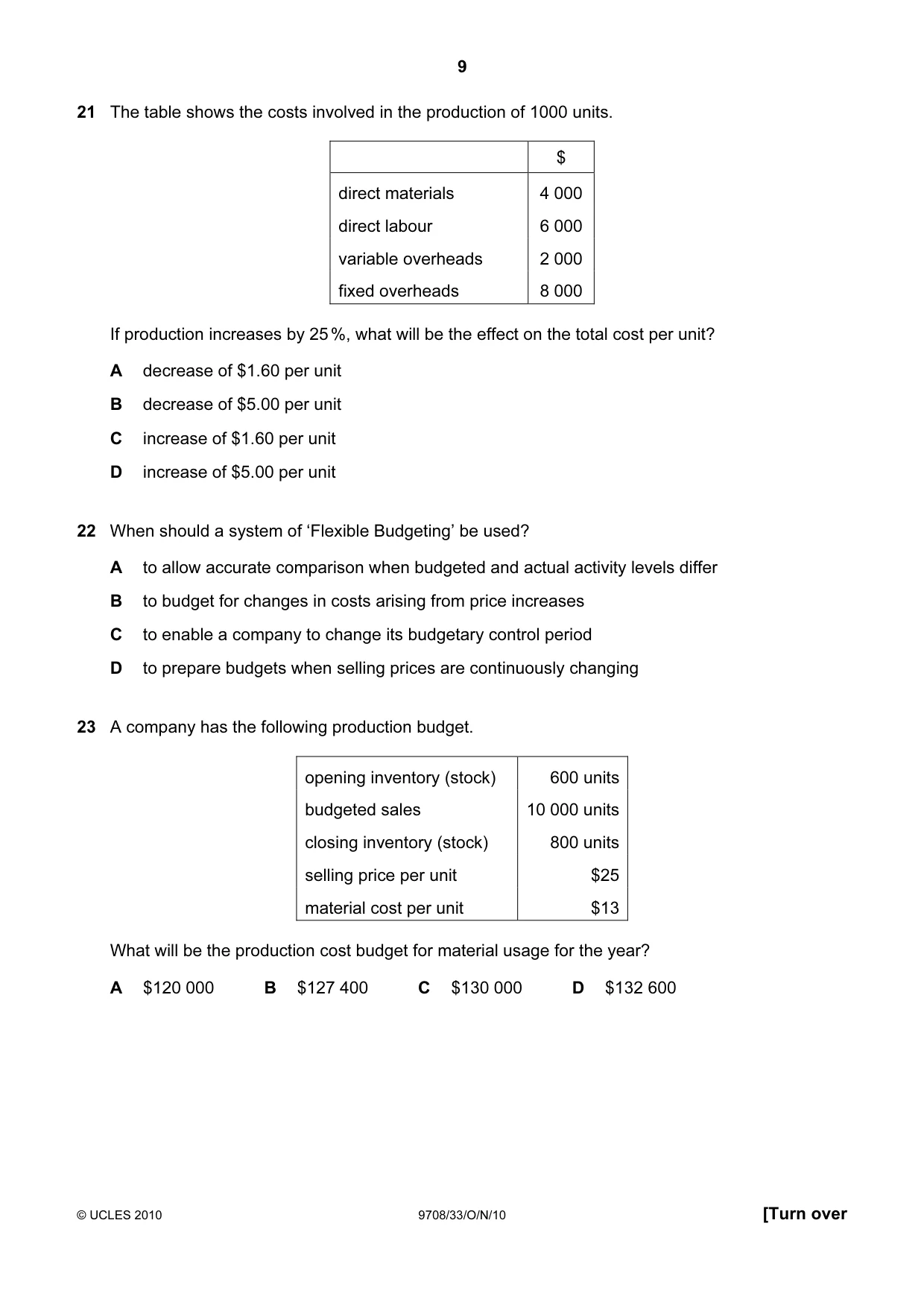
21 The table shows the costs involved in the production of 1000 units. $ direct materials 4 000 direct labour 6 000 variable overheads 2 000 fixed overheads 8 000 If production increases by 25 %, what will be the effect on the total cost per unit? A decrease of $1.60 per unit B decrease of $5.00 per unit C increase of $1.60 per unit D increase of $5.00 per unit
Mark scheme: A
Q22 · When should a system of ‘Flexible Budgeting’ be used?
22 When should a system of ‘Flexible Budgeting’ be used? A to allow accurate comparison when budgeted and actual activity levels differ B to budget for changes in costs arising from price increases C to enable a company to change its budgetary control period D to prepare budgets when selling prices are continuously changing
Mark scheme: A
Q23 · A company has the following production budget
23 A company has the following production budget. opening inventory (stock) 600 units budgeted sales 10 000 units closing inventory (stock) 800 units selling price per unit $25 material cost per unit $13 What will be the production cost budget for material usage for the year? A $120 000 B $127 400 C $130 000 D $132 600
Mark scheme: D
Q24 · A standard costing system uses routine exception reporting of variances
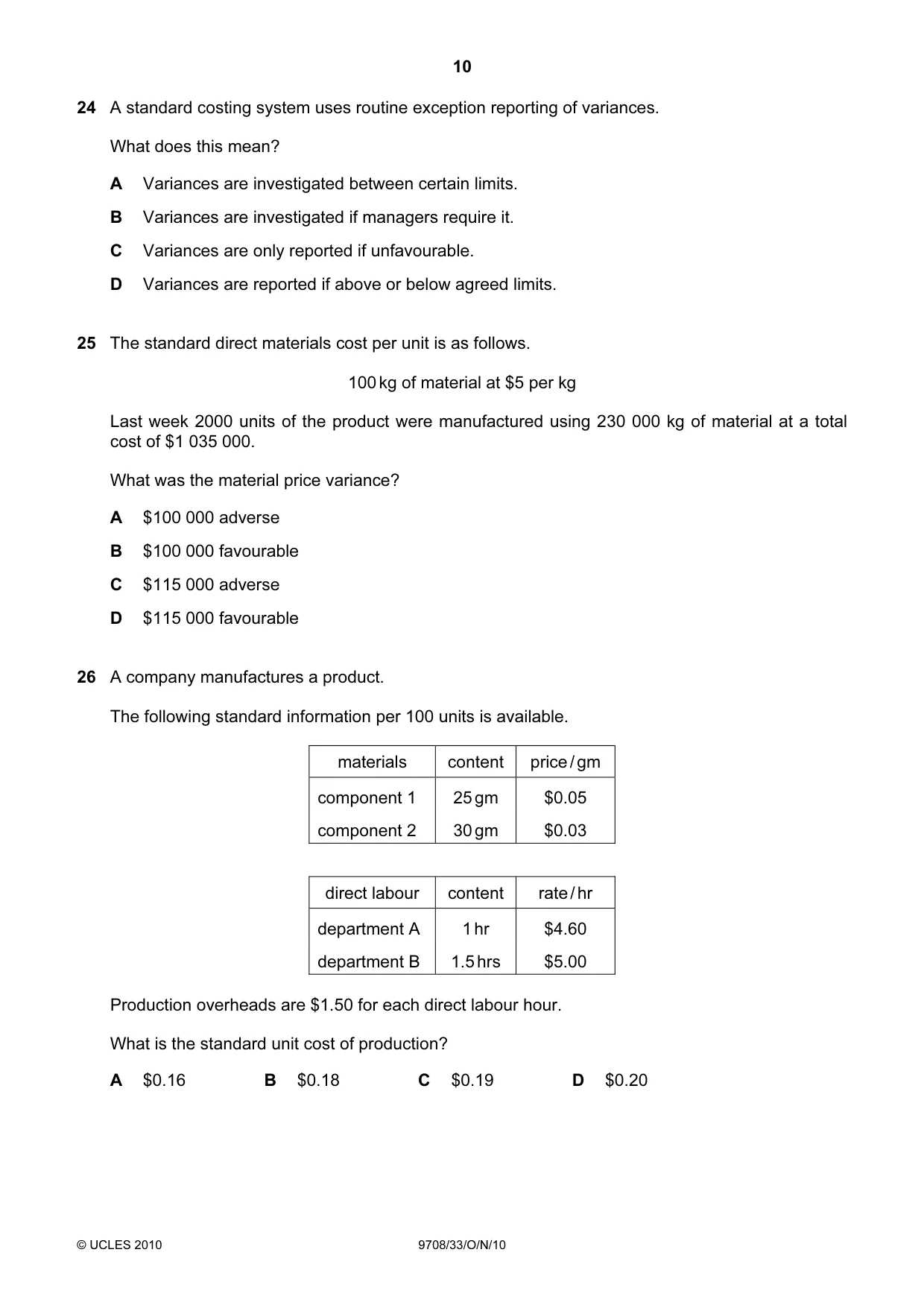
24 A standard costing system uses routine exception reporting of variances. What does this mean? A Variances are investigated between certain limits. B Variances are investigated if managers require it. C Variances are only reported if unfavourable. D Variances are reported if above or below agreed limits.
Mark scheme: D
Q25 · The standard direct materials cost per unit is as follows
25 The standard direct materials cost per unit is as follows. 100 kg of material at $5 per kg Last week 2000 units of the product were manufactured using 230 000 kg of material at a total cost of $1 035 000. What was the material price variance? A $100 000 adverse B $100 000 favourable C $115 000 adverse D $115 000 favourable
Mark scheme: D
Q26 · A company manufactures a product
26 A company manufactures a product. The following standard information per 100 units is available. materials content price / gm component 1 25 gm $0.05 component 2 30 gm $0.03 direct labour content rate / hr department A 1 hr $4.60 department B 1.5 hrs $5.00 Production overheads are $1.50 for each direct labour hour. What is the standard unit cost of production? A $0.16 B $0.18 C $0.19 D $0.20
Mark scheme: B
Q27 · The direct labour costs for a product are as follows
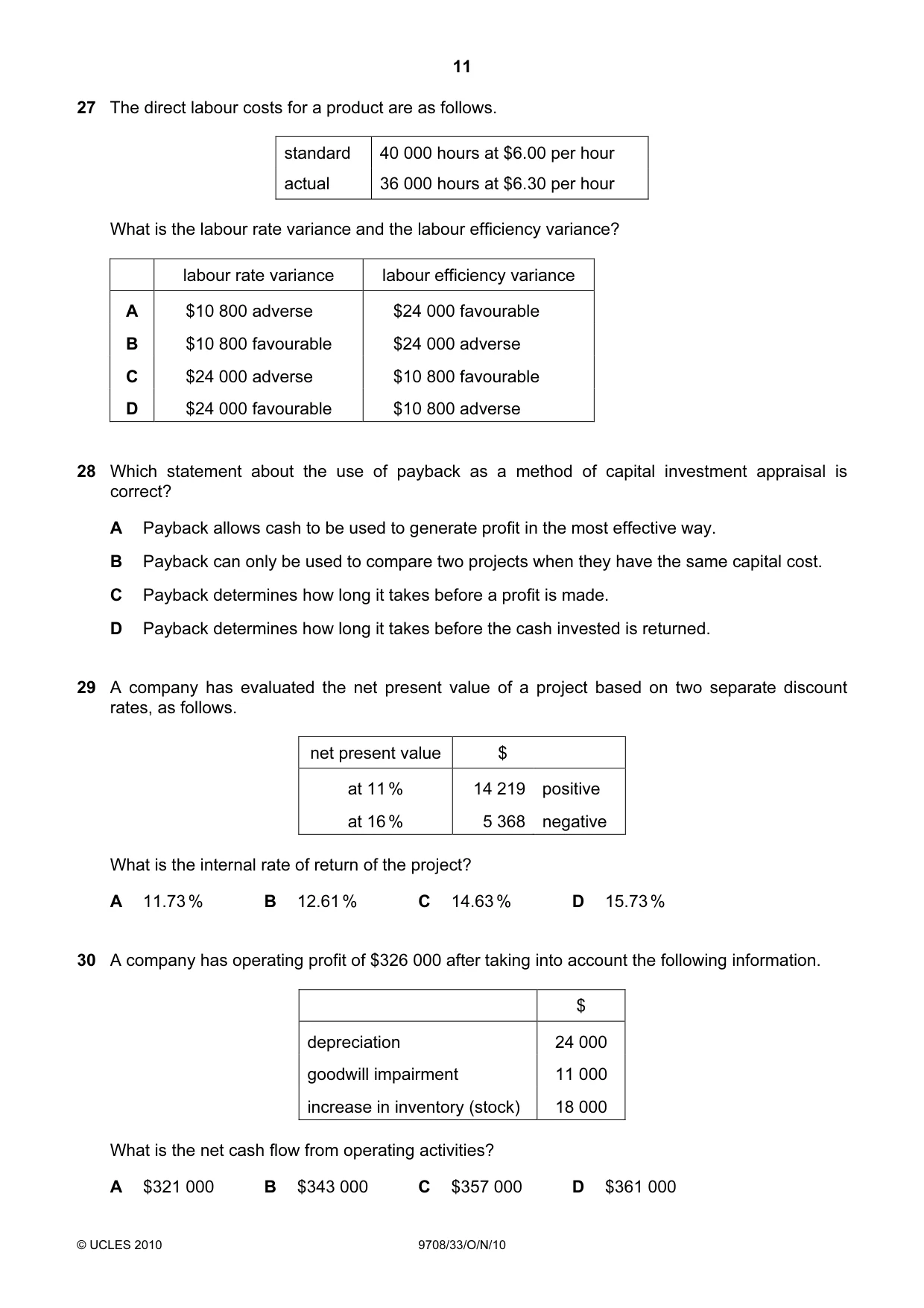
27 The direct labour costs for a product are as follows. standard 40 000 hours at $6.00 per hour actual 36 000 hours at $6.30 per hour What is the labour rate variance and the labour efficiency variance? labour rate variance labour efficiency variance A $10 800 adverse $24 000 favourable B $10 800 favourable $24 000 adverse C $24 000 adverse $10 800 favourable D $24 000 favourable $10 800 adverse
Mark scheme: A
Q28 · Which statement about the use of payback as a method of capital investment appraisal is…
28 Which statement about the use of payback as a method of capital investment appraisal is correct? A Payback allows cash to be used to generate profit in the most effective way. B Payback can only be used to compare two projects when they have the same capital cost. C Payback determines how long it takes before a profit is made. D Payback determines how long it takes before the cash invested is returned.
Mark scheme: D
Q29 · A company has evaluated the net present value of a project based on two separate discount…
29 A company has evaluated the net present value of a project based on two separate discount rates, as follows. net present value $ at 11 % 14 219 positive at 16 % 5 368 negative What is the internal rate of return of the project? A 11.73 % B 12.61 % C 14.63 % D 15.73 %
Mark scheme: C
Q30 · A company has operating profit of $326 000 after taking into account the following…
30 A company has operating profit of $326 000 after taking into account the following information. $ depreciation 24 000 goodwill impairment 11 000 increase in inventory (stock) 18 000 What is the net cash flow from operating activities? A $321 000 B $343 000 C $357 000 D $361 000
Mark scheme: B
What was in this paper
The subtopics covered by these 30 questions, and how many questions each got. Open one in a new tab to see every Cambridge question on it.
4Preparation of financial statements4Budgeting and budgetary control3Business acquisition and merger3Standard costing3Traditional costing methods3Investment appraisal2Preparation of financial statements2Types of business entity2Accounting for non-current assets1Analysis and communication of accounting information1Costs and cost behaviour1Reconciliation and verification1What you needed in this session
Cambridge’s own grade thresholds for 2010 Oct/Nov, Paper 3 · Variant 3. A higher threshold means an easier paper — the bar moves with how the cohort did.