Cambridge A Level Accounting 9706 — 2012 May/June Paper 3 · Variant 1
9706/31/M/J/12 · 30 questions · 30 marks · ≈34 min
The question paper and its mark scheme, free to read here and free to download. This is Cambridge’s own paper, exactly as it was sat.
Question paper12 pages

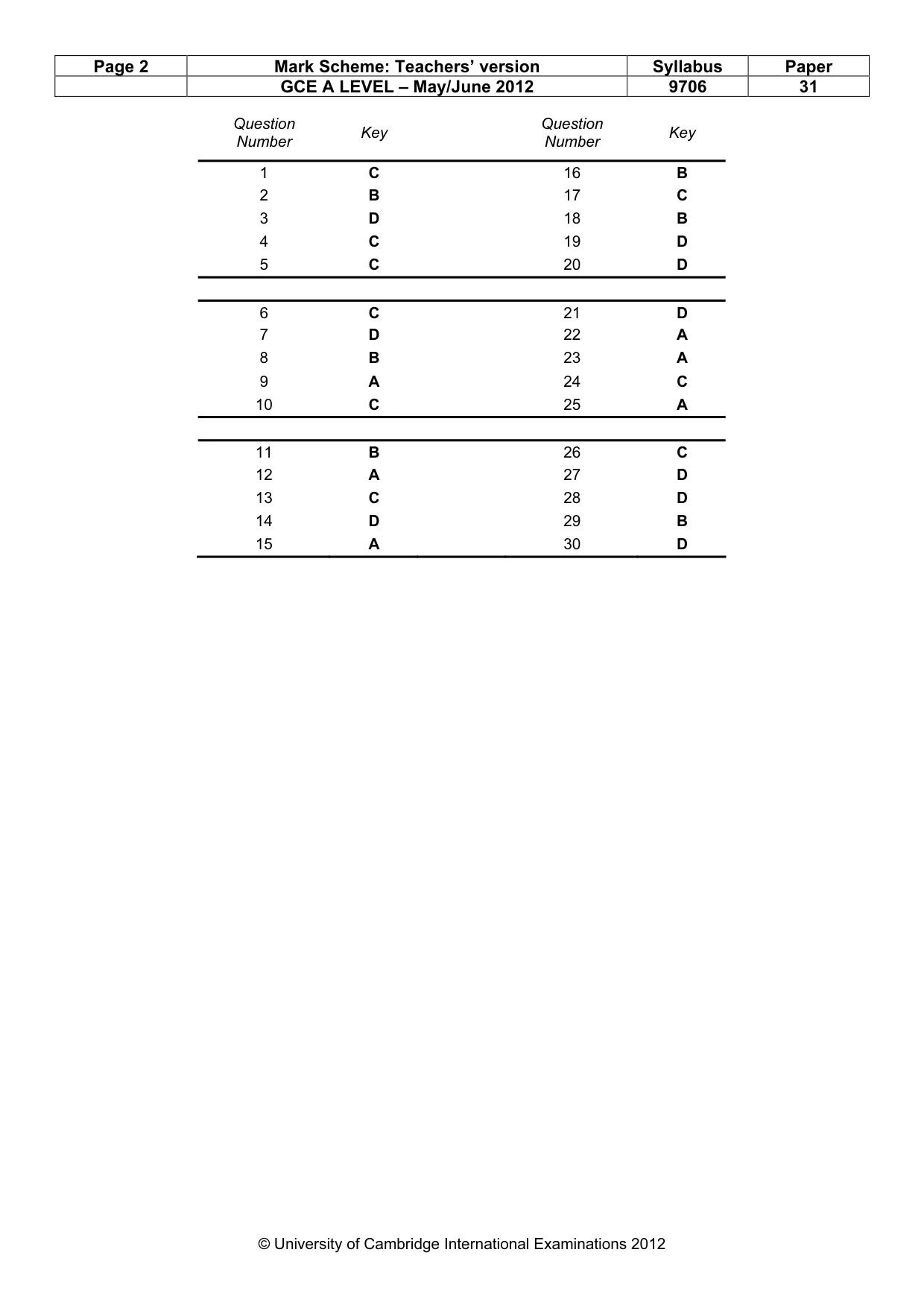
Mark scheme2 pages
Answers below. Sit the paper first if you are practising.
Questions as text
Q1 · X and Y are in partnership
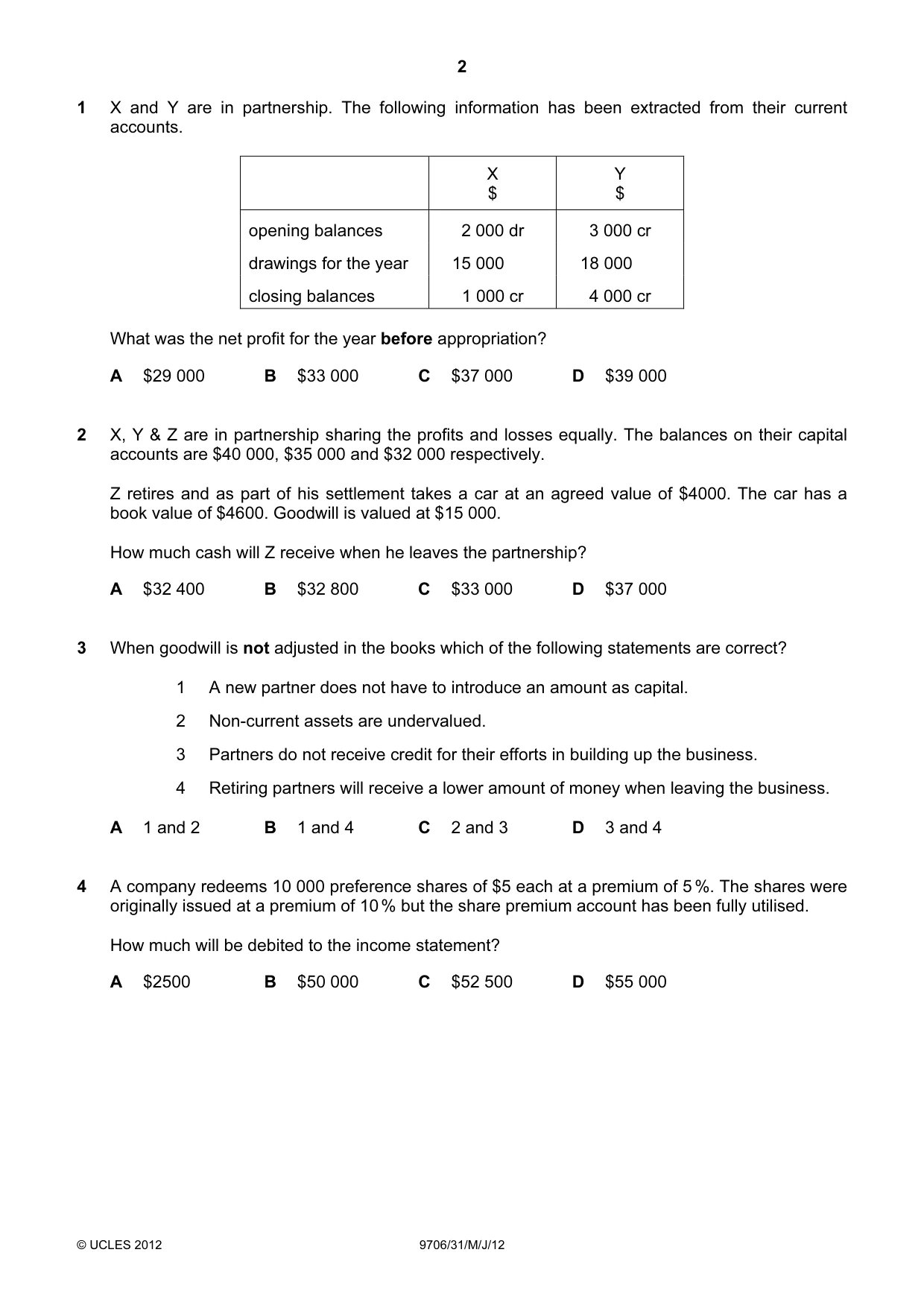
1 X and Y are in partnership. The following information has been extracted from their current accounts. X Y $ $ opening balances 2 000 dr 3 000 cr drawings for the year 15 000 18 000 closing balances 1 000 cr 4 000 cr What was the net profit for the year before appropriation? A $29 000 B $33 000 C $37 000 D $39 000
Mark scheme: C
Q2 · X, Y & Z are in partnership sharing the profits and losses equally
2 X, Y & Z are in partnership sharing the profits and losses equally. The balances on their capital accounts are $40 000, $35 000 and $32 000 respectively. Z retires and as part of his settlement takes a car at an agreed value of $4000. The car has a book value of $4600. Goodwill is valued at $15 000. How much cash will Z receive when he leaves the partnership? A $32 400 B $32 800 C $33 000 D $37 000
Mark scheme: B
Q3 · When goodwill is not adjusted in the books which of the following statements are correct?
3 When goodwill is not adjusted in the books which of the following statements are correct? 1 A new partner does not have to introduce an amount as capital. 2 Non-current assets are undervalued. 3 Partners do not receive credit for their efforts in building up the business. 4 Retiring partners will receive a lower amount of money when leaving the business. A 1 and 2 B 1 and 4 C 2 and 3 D 3 and 4
Mark scheme: D
Q4 · A company redeems 10 000 preference shares of $5 each at a premium of 5 %
4 A company redeems 10 000 preference shares of $5 each at a premium of 5 %. The shares were originally issued at a premium of 10 % but the share premium account has been fully utilised. How much will be debited to the income statement? A $2500 B $50 000 C $52 500 D $55 000
Mark scheme: C
Q5 · A company provides the following financial information at the end of the financial year
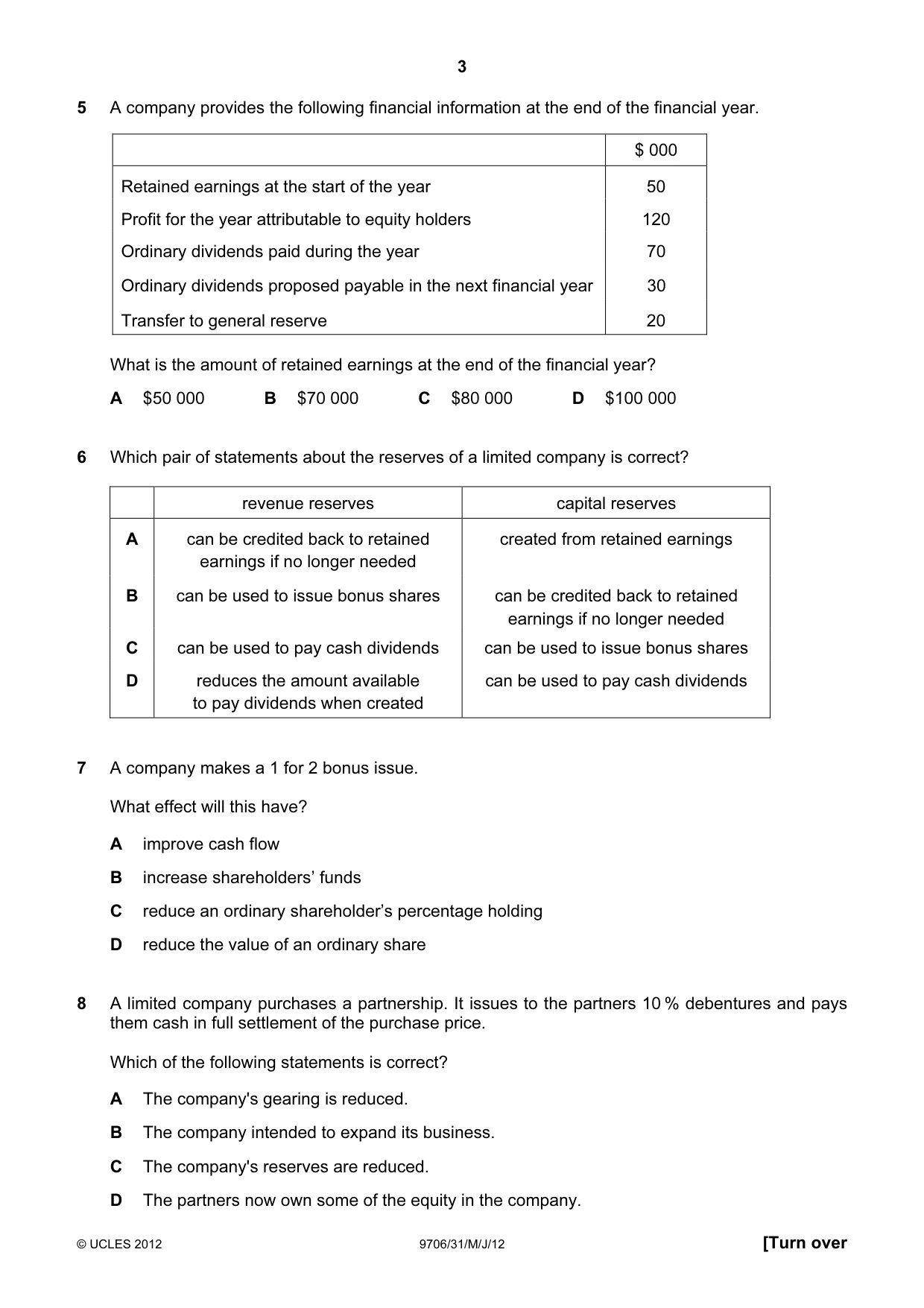
5 A company provides the following financial information at the end of the financial year. $ 000 Retained earnings at the start of the year 50 Profit for the year attributable to equity holders 120 Ordinary dividends paid during the year 70 Ordinary dividends proposed payable in the next financial year 30 Transfer to general reserve 20 What is the amount of retained earnings at the end of the financial year? A $50 000 B $70 000 C $80 000 D $100 000
Mark scheme: C
Q6 · Which pair of statements about the reserves of a limited company is correct?
6 Which pair of statements about the reserves of a limited company is correct? revenue reserves capital reserves A can be credited back to retained created from retained earnings earnings if no longer needed B can be used to issue bonus shares can be credited back to retained earnings if no longer needed C can be used to pay cash dividends can be used to issue bonus shares D reduces the amount available can be used to pay cash dividends to pay dividends when created
Mark scheme: C
Q7 · A company makes a 1 for 2 bonus issue
7 A company makes a 1 for 2 bonus issue. What effect will this have? A improve cash flow B increase shareholders’ funds C reduce an ordinary shareholder’s percentage holding D reduce the value of an ordinary share
Mark scheme: D
Q8 · A limited company purchases a partnership
8 A limited company purchases a partnership. It issues to the partners 10 % debentures and pays them cash in full settlement of the purchase price. Which of the following statements is correct? A The company's gearing is reduced. B The company intended to expand its business. C The company's reserves are reduced. D The partners now own some of the equity in the company.
Mark scheme: B
Q9 · A company buys a business by issuing shares in full payment
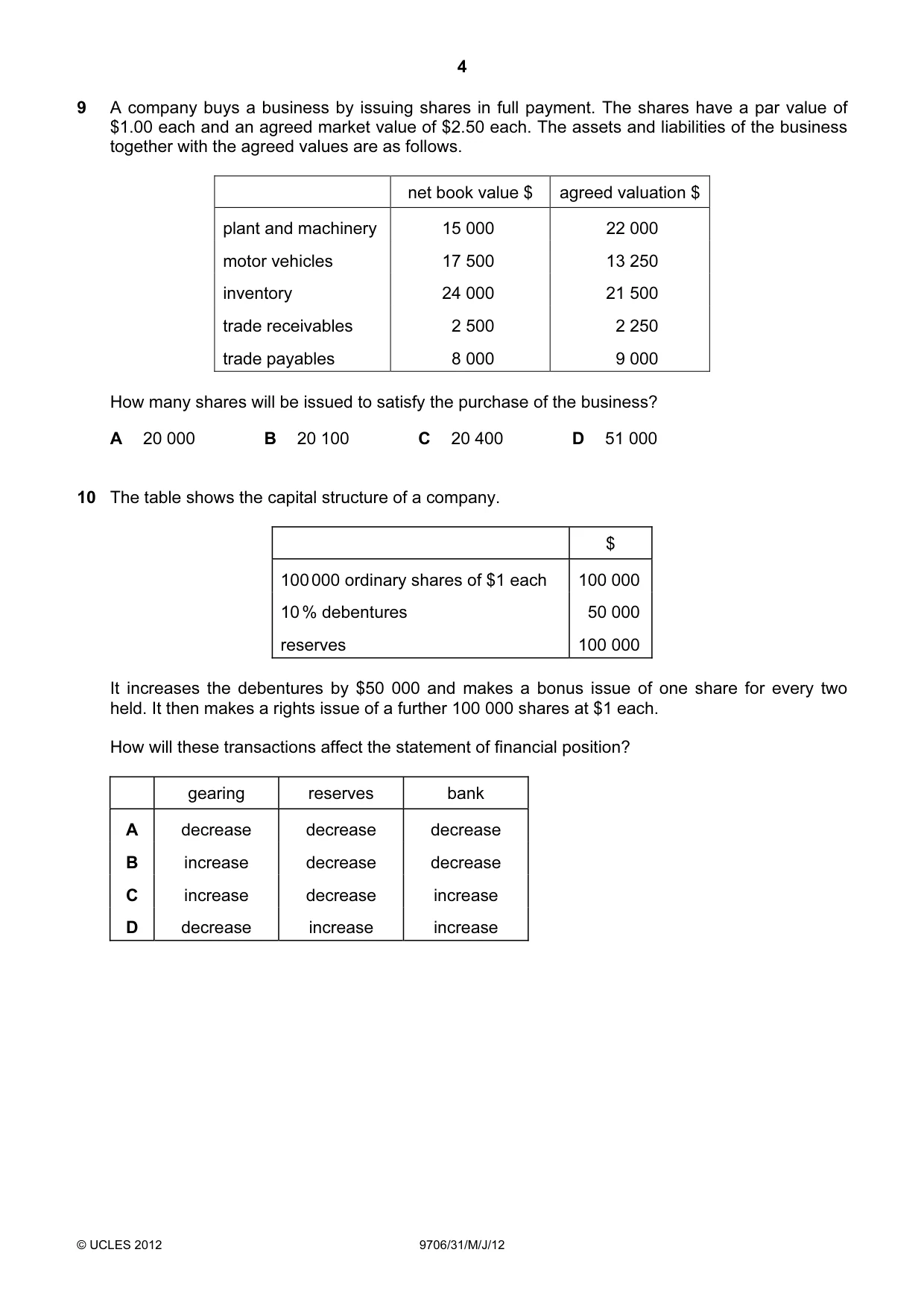
9 A company buys a business by issuing shares in full payment. The shares have a par value of $1.00 each and an agreed market value of $2.50 each. The assets and liabilities of the business together with the agreed values are as follows. net book value $ agreed valuation $ plant and machinery 15 000 22 000 motor vehicles 17 500 13 250 inventory 24 000 21 500 trade receivables 2 500 2 250 trade payables 8 000 9 000 How many shares will be issued to satisfy the purchase of the business? A 20 000 B 20 100 C 20 400 D 51 000
Mark scheme: A
Q10 · The table shows the capital structure of a company
10 The table shows the capital structure of a company. $ 100 000 ordinary shares of $1 each 100 000 10 % debentures 50 000 reserves 100 000 It increases the debentures by $50 000 and makes a bonus issue of one share for every two held. It then makes a rights issue of a further 100 000 shares at $1 each. How will these transactions affect the statement of financial position? gearing reserves bank A decrease decrease decrease B increase decrease decrease C increase decrease increase D decrease increase increase
Mark scheme: C
Q11 · The business of a sole trader is bought by a limited company
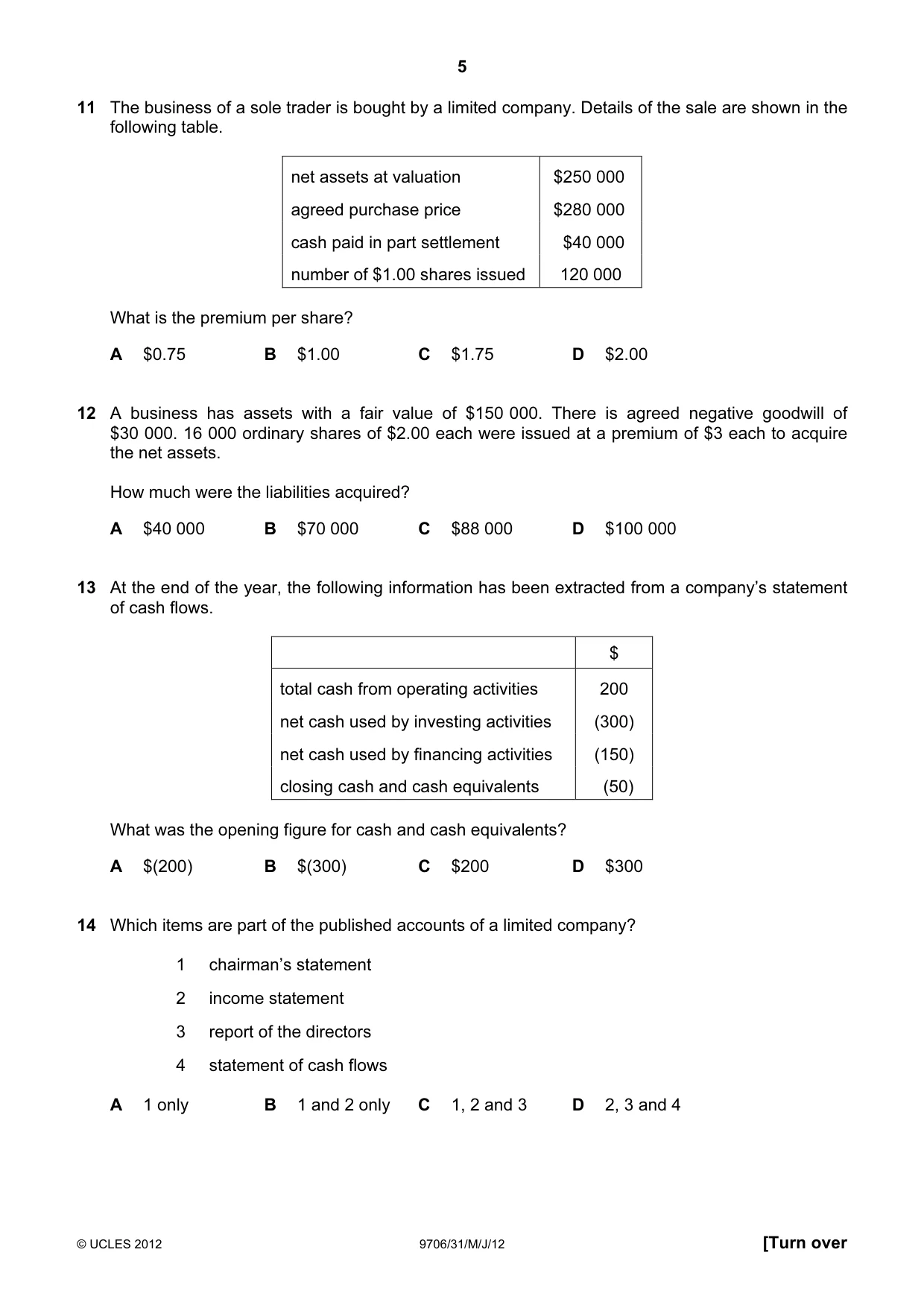
11 The business of a sole trader is bought by a limited company. Details of the sale are shown in the following table. net assets at valuation $250 000 agreed purchase price $280 000 cash paid in part settlement $40 000 number of $1.00 shares issued 120 000 What is the premium per share? A $0.75 B $1.00 C $1.75 D $2.00
Mark scheme: B
Q12 · A business has assets with a fair value of $150 000
12 A business has assets with a fair value of $150 000. There is agreed negative goodwill of $30 000. 16 000 ordinary shares of $2.00 each were issued at a premium of $3 each to acquire the net assets. How much were the liabilities acquired? A $40 000 B $70 000 C $88 000 D $100 000
Mark scheme: A
Q13 · At the end of the year, the following information has been extracted from a company’s…
13 At the end of the year, the following information has been extracted from a company’s statement of cash flows. $ total cash from operating activities 200 net cash used by investing activities (300) net cash used by financing activities (150) closing cash and cash equivalents (50) What was the opening figure for cash and cash equivalents? A $(200) B $(300) C $200 D $300
Mark scheme: C
Q14 · Which items are part of the published accounts of a limited company?
14 Which items are part of the published accounts of a limited company? 1 chairman’s statement 2 income statement 3 report of the directors 4 statement of cash flows A 1 only B 1 and 2 only C 1, 2 and 3 D 2, 3 and 4
Mark scheme: D
Q15 · To which asset is impairment normally applied each year?
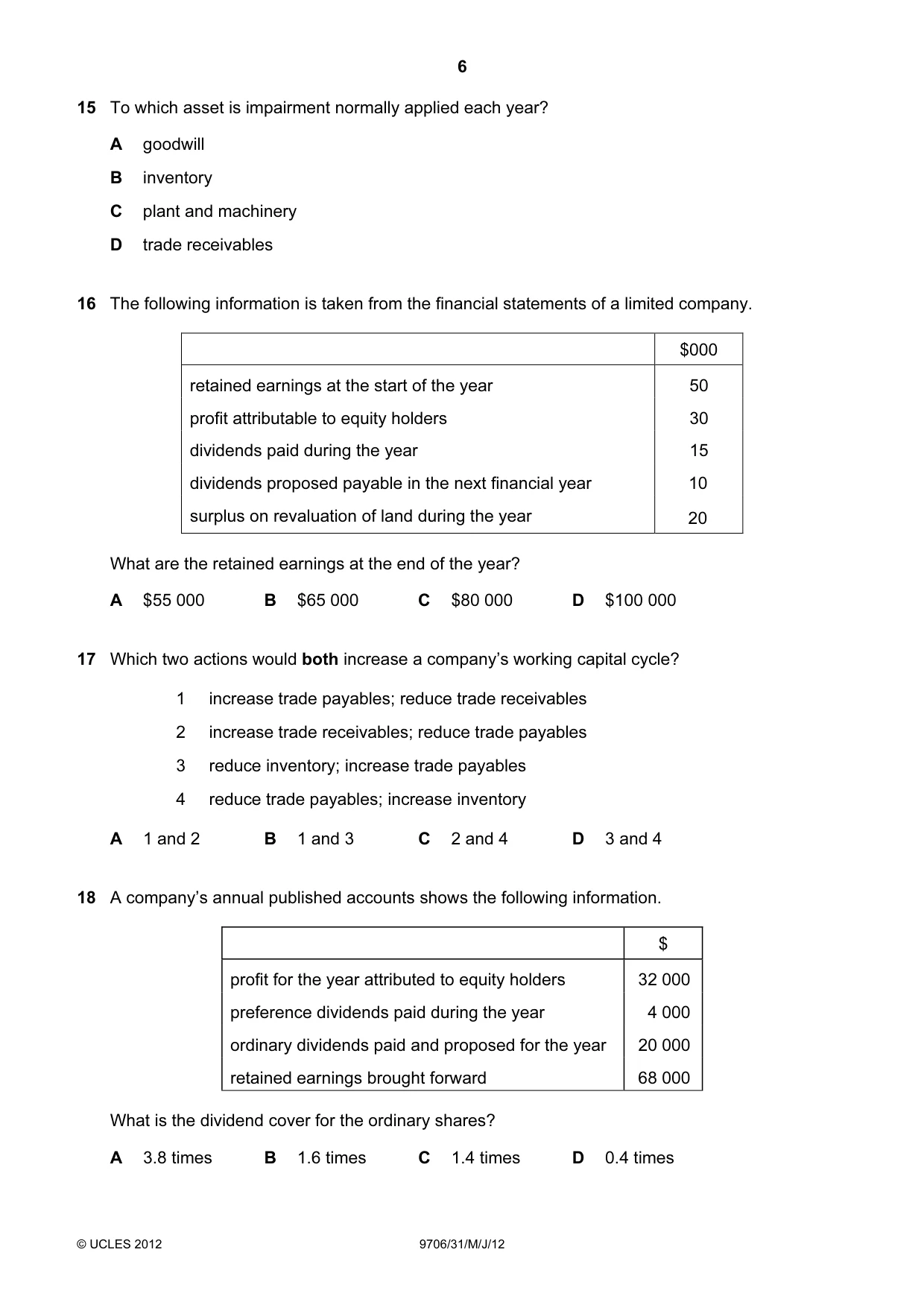
15 To which asset is impairment normally applied each year? A goodwill B inventory C plant and machinery D trade receivables
Mark scheme: A
Q16 · The following information is taken from the financial statements of a limited company
16 The following information is taken from the financial statements of a limited company. $000 retained earnings at the start of the year 50 profit attributable to equity holders 30 dividends paid during the year 15 dividends proposed payable in the next financial year 10 surplus on revaluation of land during the year 20 What are the retained earnings at the end of the year? A $55 000 B $65 000 C $80 000 D $100 000
Mark scheme: B
Q17 · Which two actions would both increase a company’s working capital cycle?
17 Which two actions would both increase a company’s working capital cycle? 1 increase trade payables; reduce trade receivables 2 increase trade receivables; reduce trade payables 3 reduce inventory; increase trade payables 4 reduce trade payables; increase inventory A 1 and 2 B 1 and 3 C 2 and 4 D 3 and 4
Mark scheme: C
More questions on Analysis and communication of accounting information
Q18 · A company’s annual published accounts shows the following information
18 A company’s annual published accounts shows the following information. $ profit for the year attributed to equity holders 32 000 preference dividends paid during the year 4 000 ordinary dividends paid and proposed for the year 20 000 retained earnings brought forward 68 000 What is the dividend cover for the ordinary shares? A 3.8 times B 1.6 times C 1.4 times D 0.4 times
Mark scheme: B
More questions on Analysis and communication of accounting information
Q19 · A company has provided the following information
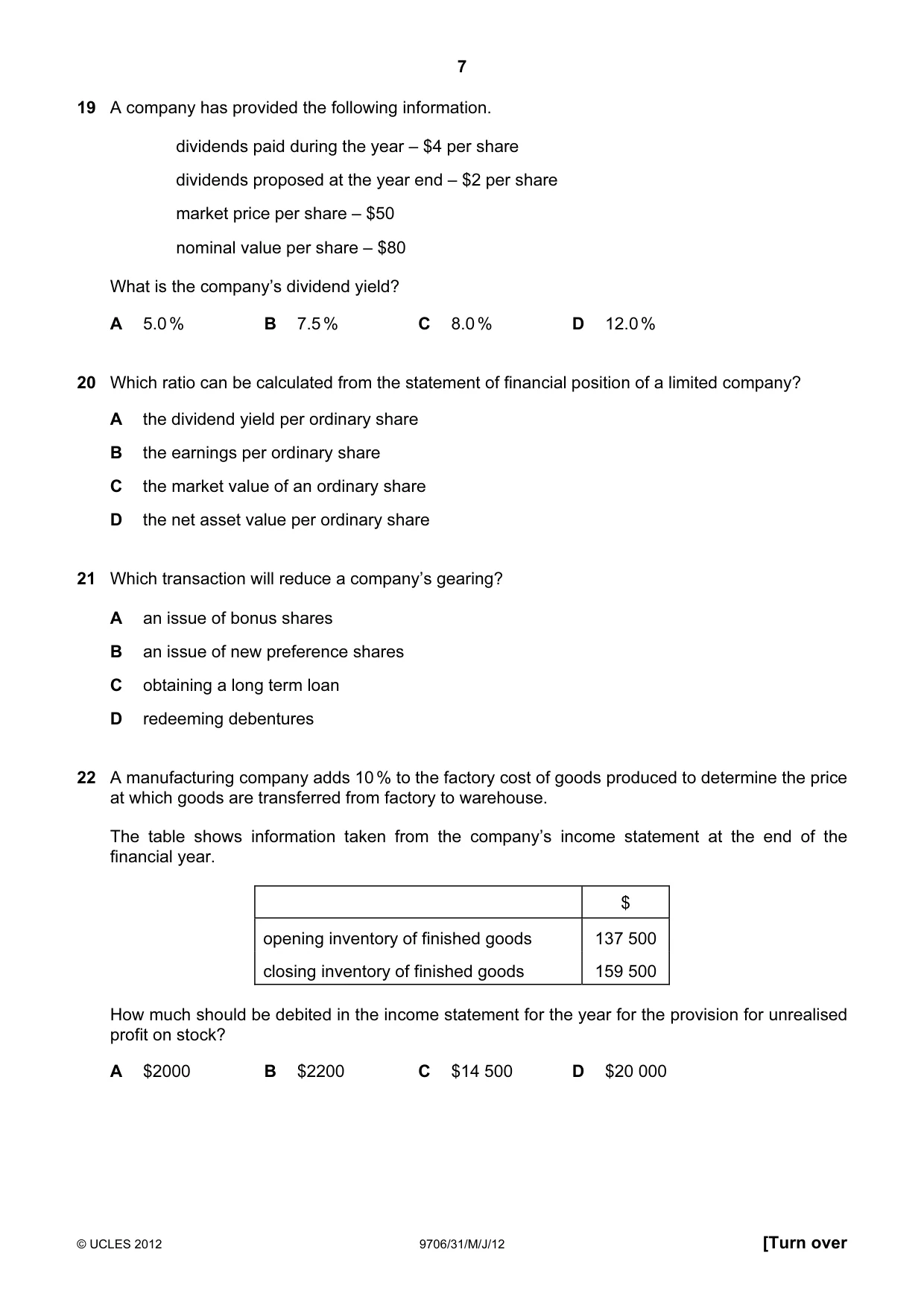
19 A company has provided the following information. dividends paid during the year – $4 per share dividends proposed at the year end – $2 per share market price per share – $50 nominal value per share – $80 What is the company’s dividend yield? A 5.0 % B 7.5 % C 8.0 % D 12.0 %
Mark scheme: D
More questions on Analysis and communication of accounting information
Q20 · Which ratio can be calculated from the statement of financial position of a limited…
20 Which ratio can be calculated from the statement of financial position of a limited company? A the dividend yield per ordinary share B the earnings per ordinary share C the market value of an ordinary share D the net asset value per ordinary share
Mark scheme: D
More questions on Analysis and communication of accounting information
Q21 · Which transaction will reduce a company’s gearing?
21 Which transaction will reduce a company’s gearing? A an issue of bonus shares B an issue of new preference shares C obtaining a long term loan D redeeming debentures
Mark scheme: D
More questions on Analysis and communication of accounting information
Q22 · A manufacturing company adds 10 % to the factory cost of goods produced to determine the…
22 A manufacturing company adds 10 % to the factory cost of goods produced to determine the price at which goods are transferred from factory to warehouse. The table shows information taken from the company’s income statement at the end of the financial year. $ opening inventory of finished goods 137 500 closing inventory of finished goods 159 500 How much should be debited in the income statement for the year for the provision for unrealised profit on stock? A $2000 B $2200 C $14 500 D $20 000
Mark scheme: A
Q23 · A company manufactures three products
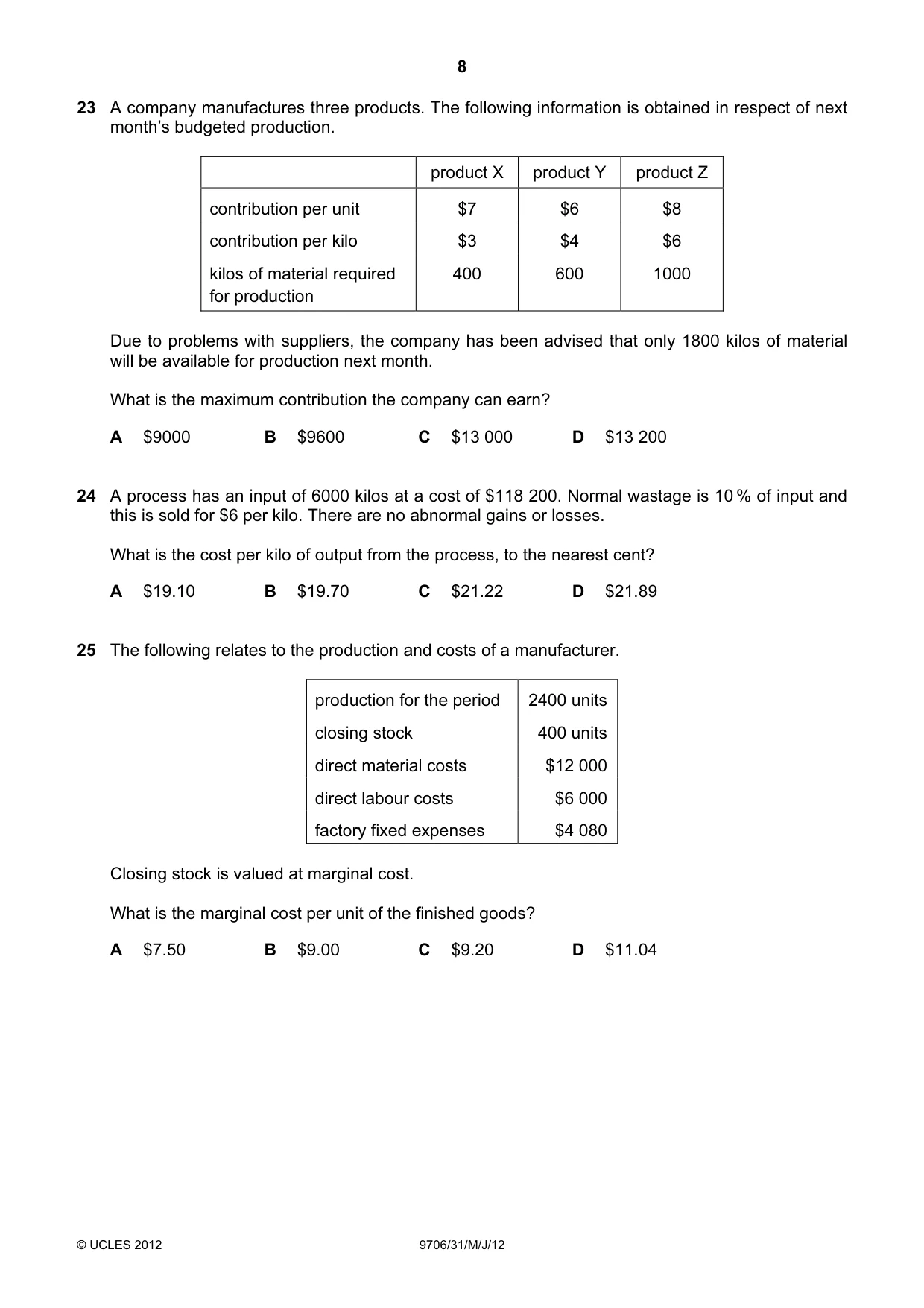
23 A company manufactures three products. The following information is obtained in respect of next month’s budgeted production. product X product Y product Z contribution per unit $7 $6 $8 contribution per kilo $3 $4 $6 kilos of material required 400 600 1000 for production Due to problems with suppliers, the company has been advised that only 1800 kilos of material will be available for production next month. What is the maximum contribution the company can earn? A $9000 B $9600 C $13 000 D $13 200
Mark scheme: A
Q24 · A process has an input of 6000 kilos at a cost of $118 200
24 A process has an input of 6000 kilos at a cost of $118 200. Normal wastage is 10 % of input and this is sold for $6 per kilo. There are no abnormal gains or losses. What is the cost per kilo of output from the process, to the nearest cent? A $19.10 B $19.70 C $21.22 D $21.89
Mark scheme: C
Q25 · The following relates to the production and costs of a manufacturer
25 The following relates to the production and costs of a manufacturer. production for the period 2400 units closing stock 400 units direct material costs $12 000 direct labour costs $6 000 factory fixed expenses $4 080 Closing stock is valued at marginal cost. What is the marginal cost per unit of the finished goods? A $7.50 B $9.00 C $9.20 D $11.04
Mark scheme: A
Q26 · The data shows the budget of a small manufacturing company
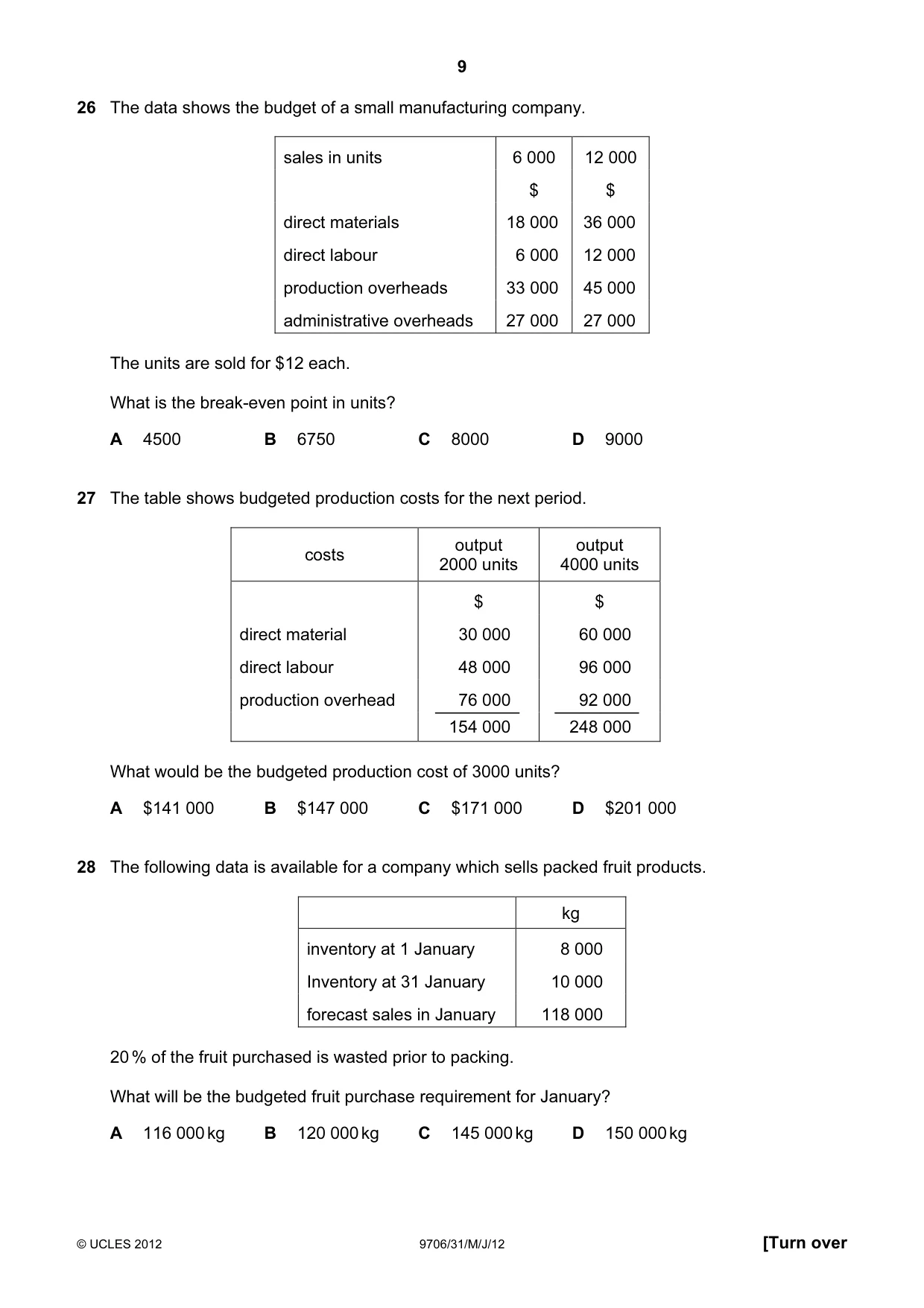
26 The data shows the budget of a small manufacturing company. sales in units 6 000 12 000 $ $ direct materials 18 000 36 000 direct labour 6 000 12 000 production overheads 33 000 45 000 administrative overheads 27 000 27 000 The units are sold for $12 each. What is the break-even point in units? A 4500 B 6750 C 8000 D 9000
Mark scheme: C
Q27 · The table shows budgeted production costs for the next period
27 The table shows budgeted production costs for the next period. output output costs 2000 units 4000 units $ $ direct material 30 000 60 000 direct labour 48 000 96 000 production overhead 76 000 92 000 154 000 248 000 What would be the budgeted production cost of 3000 units? A $141 000 B $147 000 C $171 000 D $201 000
Mark scheme: D
Q28 · The following data is available for a company which sells packed fruit products
28 The following data is available for a company which sells packed fruit products. kg inventory at 1 January 8 000 Inventory at 31 January 10 000 forecast sales in January 118 000 20 % of the fruit purchased is wasted prior to packing. What will be the budgeted fruit purchase requirement for January? A 116 000 kg B 120 000 kg C 145 000 kg D 150 000 kg
Mark scheme: D
Q29 · The following information is available in respect of a company’s sales for the last month
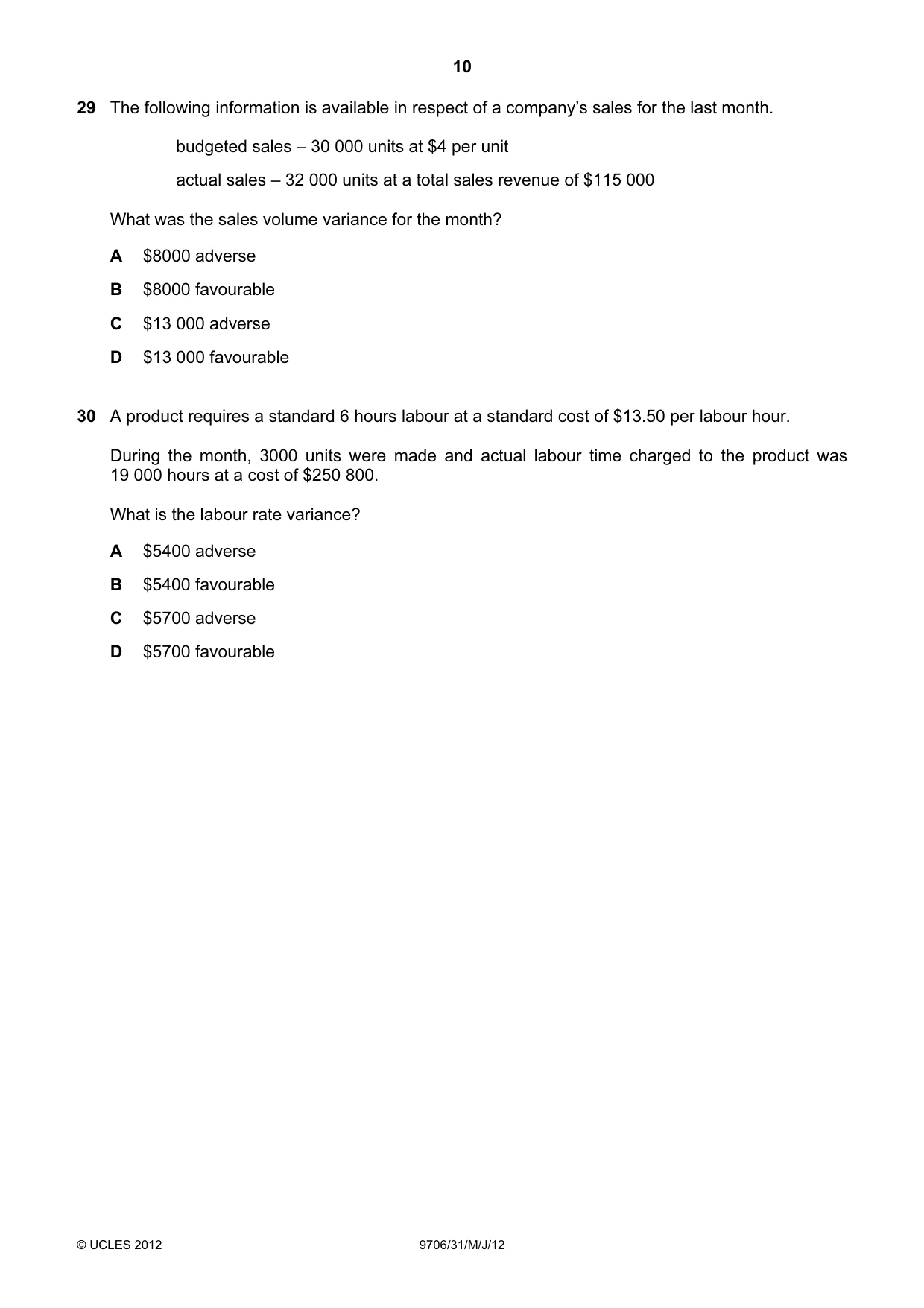
29 The following information is available in respect of a company’s sales for the last month. budgeted sales – 30 000 units at $4 per unit actual sales – 32 000 units at a total sales revenue of $115 000 What was the sales volume variance for the month? A $8000 adverse B $8000 favourable C $13 000 adverse D $13 000 favourable
Mark scheme: B
Q30 · A product requires a standard 6 hours labour at a standard cost of $13.50 per labour hour
30 A product requires a standard 6 hours labour at a standard cost of $13.50 per labour hour. During the month, 3000 units were made and actual labour time charged to the product was 19 000 hours at a cost of $250 800. What is the labour rate variance? A $5400 adverse B $5400 favourable C $5700 adverse D $5700 favourable
Mark scheme: D
What was in this paper
The subtopics covered by these 30 questions, and how many questions each got. Open one in a new tab to see every Cambridge question on it.
What you needed in this session
Cambridge’s own grade thresholds for 2012 May/June, Paper 3 · Variant 1. A higher threshold means an easier paper — the bar moves with how the cohort did.