Cambridge A Level Accounting 9706 — 2013 Oct/Nov Paper 3 · Variant 1
9706/31/O/N/13 · 30 questions · 30 marks · ≈34 min
The question paper and its mark scheme, free to read here and free to download. This is Cambridge’s own paper, exactly as it was sat.
Question paper12 pages
Mark scheme2 pages
Answers below. Sit the paper first if you are practising.
Questions as text
Q1 · The financial year of a manufacturer ends on 31 December
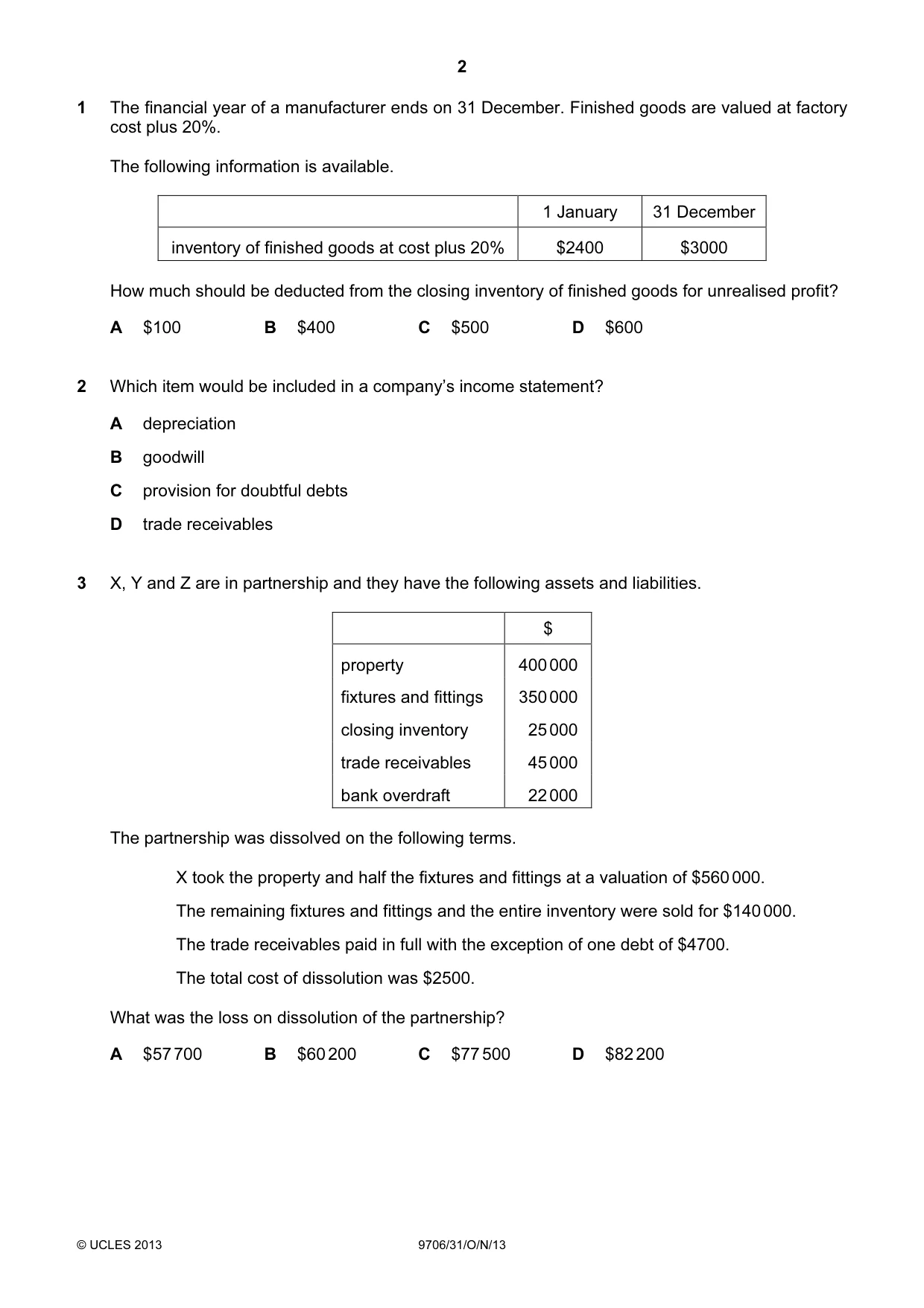
1 The financial year of a manufacturer ends on 31 December. Finished goods are valued at factory cost plus 20%. The following information is available. 1 January 31 December inventory of finished goods at cost plus 20% $2400 $3000 How much should be deducted from the closing inventory of finished goods for unrealised profit? A $100 B $400 C $500 D $600
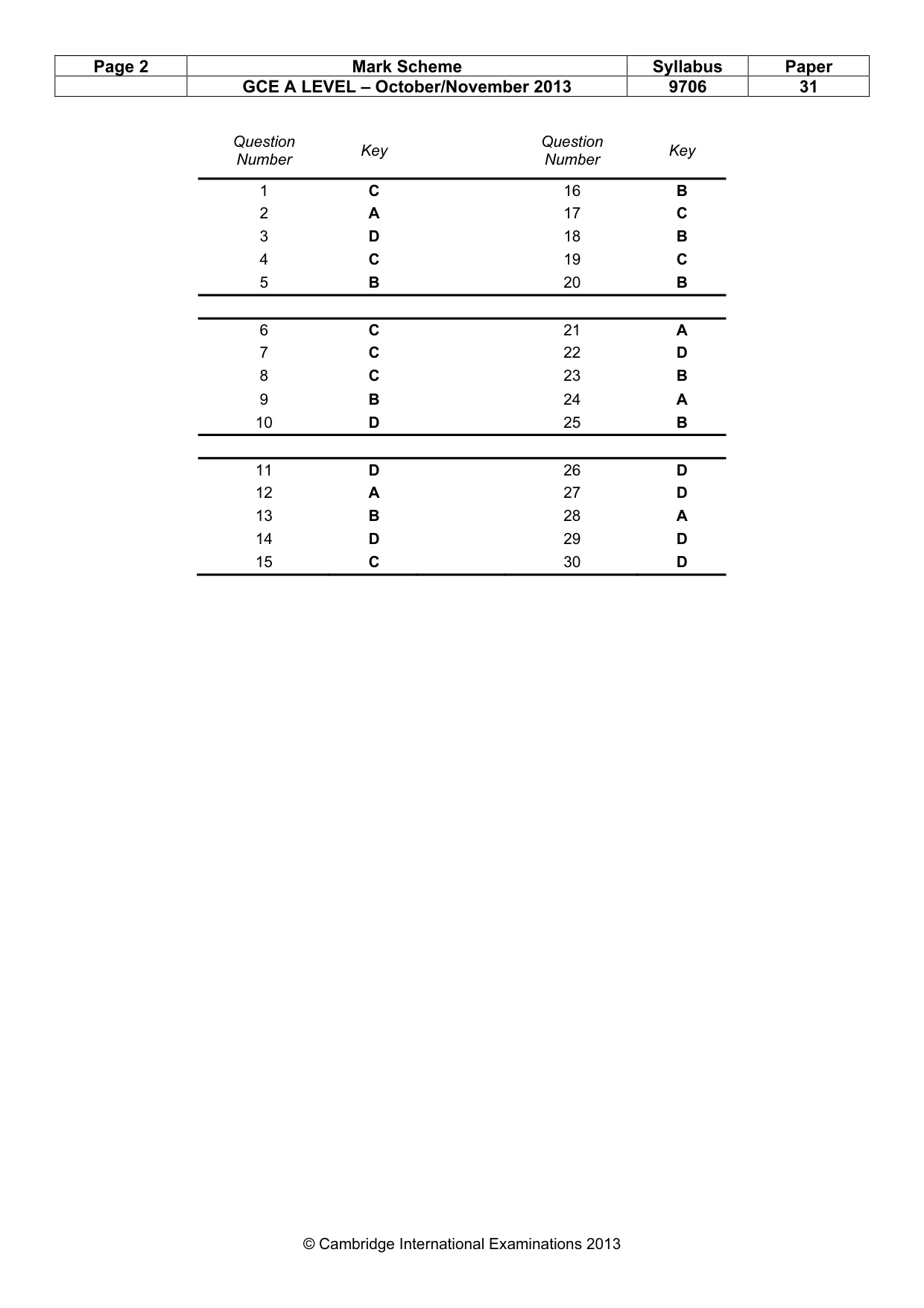
Mark scheme: C
Q2 · Which item would be included in a company’s income statement?
2 Which item would be included in a company’s income statement? A depreciation B goodwill C provision for doubtful debts D trade receivables
Mark scheme: A
Q3 · X, Y and Z are in partnership and they have the following assets and liabilities
3 X, Y and Z are in partnership and they have the following assets and liabilities. $ property 400 000 fixtures and fittings 350 000 closing inventory 25 000 trade receivables 45 000 bank overdraft 22 000 The partnership was dissolved on the following terms. X took the property and half the fixtures and fittings at a valuation of $560 000. The remaining fixtures and fittings and the entire inventory were sold for $140 000. The trade receivables paid in full with the exception of one debt of $4700. The total cost of dissolution was $2500. What was the loss on dissolution of the partnership? A $57 700 B $60 200 C $77 500 D $82 200
Mark scheme: D
Q4 · What type of capital must all limited companies have?
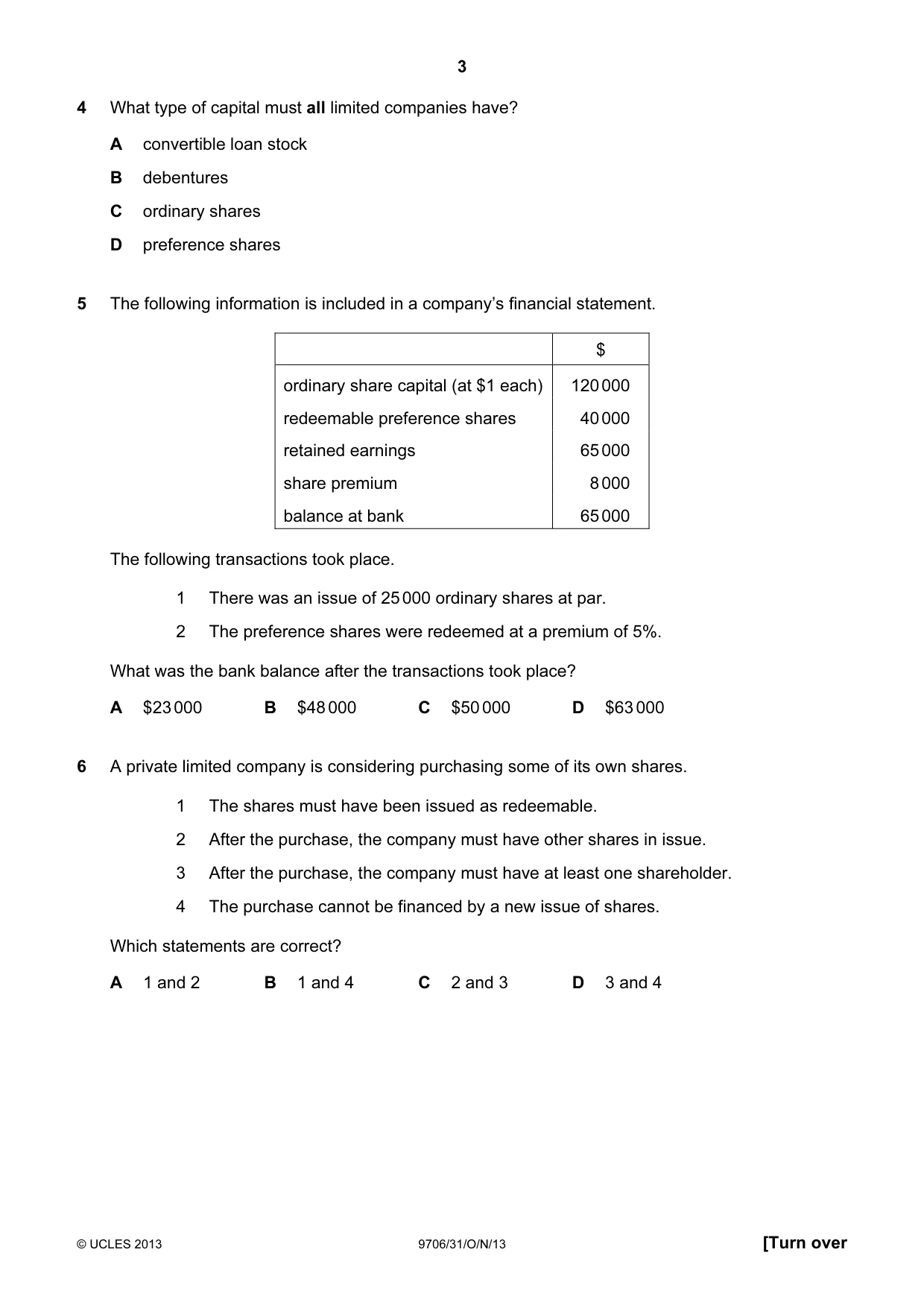
4 What type of capital must all limited companies have? A convertible loan stock B debentures C ordinary shares D preference shares
Mark scheme: C
Q5 · The following information is included in a company’s financial statement
5 The following information is included in a company’s financial statement. $ ordinary share capital (at $1 each) 120 000 redeemable preference shares 40 000 retained earnings 65 000 share premium 8 000 balance at bank 65 000 The following transactions took place. 1 There was an issue of 25 000 ordinary shares at par. 2 The preference shares were redeemed at a premium of 5%. What was the bank balance after the transactions took place? A $23 000 B $48 000 C $50 000 D $63 000
Mark scheme: B
Q6 · A private limited company is considering purchasing some of its own shares
6 A private limited company is considering purchasing some of its own shares. 1 The shares must have been issued as redeemable. 2 After the purchase, the company must have other shares in issue. 3 After the purchase, the company must have at least one shareholder. 4 The purchase cannot be financed by a new issue of shares. Which statements are correct? A 1 and 2 B 1 and 4 C 2 and 3 D 3 and 4
Mark scheme: C
Q7 · When a business is purchased, the price paid is sometimes less than the fair value of the…
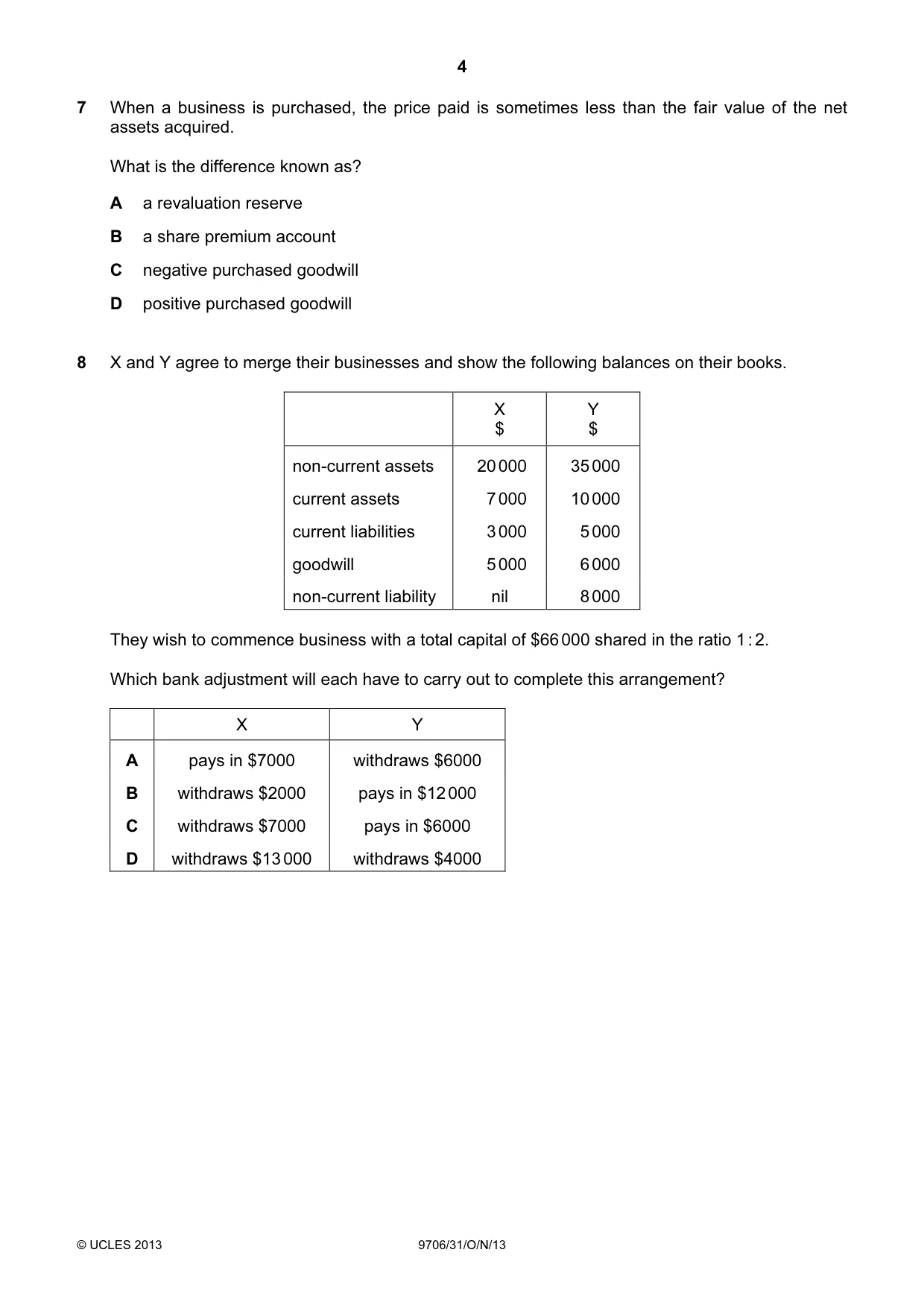
7 When a business is purchased, the price paid is sometimes less than the fair value of the net assets acquired. What is the difference known as? A a revaluation reserve B a share premium account C negative purchased goodwill D positive purchased goodwill
Mark scheme: C
Q8 · X and Y agree to merge their businesses and show the following balances on their books
8 X and Y agree to merge their businesses and show the following balances on their books. X Y $ $ non-current assets 20 000 35 000 current assets 7 000 10 000 current liabilities 3 000 5 000 goodwill 5 000 6 000 non-current liability nil 8 000 They wish to commence business with a total capital of $66 000 shared in the ratio 1 : 2. Which bank adjustment will each have to carry out to complete this arrangement? X Y A pays in $7000 withdraws $6000 B withdraws $2000 pays in $12 000 C withdraws $7000 pays in $6000 D withdraws $13 000 withdraws $4000
Mark scheme: C
Q9 · A company’s statement of financial position at 1 January included the following
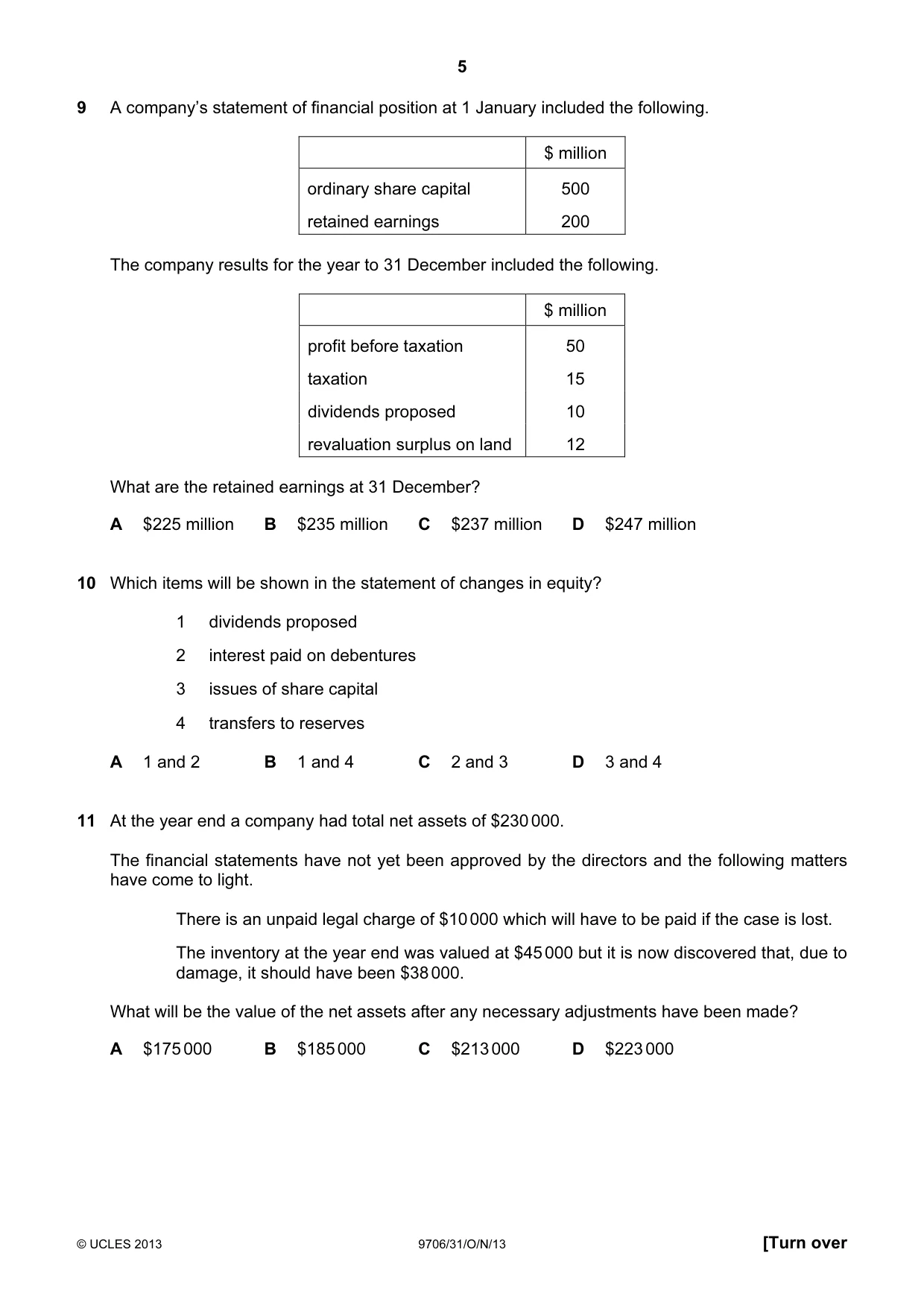
9 A company’s statement of financial position at 1 January included the following. $ million ordinary share capital 500 retained earnings 200 The company results for the year to 31 December included the following. $ million profit before taxation 50 taxation 15 dividends proposed 10 revaluation surplus on land 12 What are the retained earnings at 31 December? A $225 million B $235 million C $237 million D $247 million
Mark scheme: B
Q10 · Which items will be shown in the statement of changes in equity?
10 Which items will be shown in the statement of changes in equity? 1 dividends proposed 2 interest paid on debentures 3 issues of share capital 4 transfers to reserves A 1 and 2 B 1 and 4 C 2 and 3 D 3 and 4
Mark scheme: D
Q11 · At the year end a company had total net assets of $230 000
11 At the year end a company had total net assets of $230 000. The financial statements have not yet been approved by the directors and the following matters have come to light. There is an unpaid legal charge of $10 000 which will have to be paid if the case is lost. The inventory at the year end was valued at $45 000 but it is now discovered that, due to damage, it should have been $38 000. What will be the value of the net assets after any necessary adjustments have been made? A $175 000 B $185 000 C $213 000 D $223 000
Mark scheme: D
Q12 · What is the correct treatment of non-purchased goodwill?
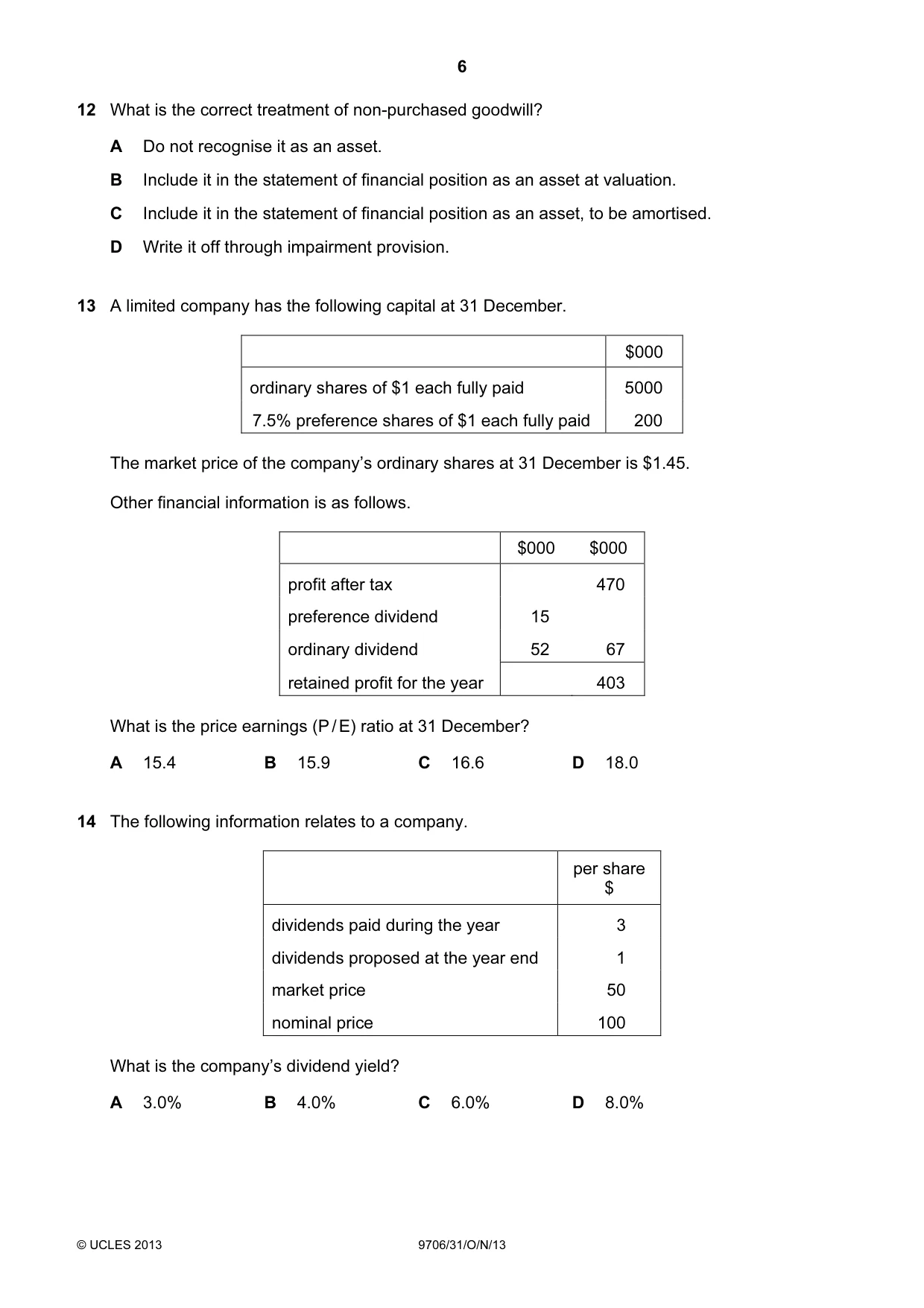
12 What is the correct treatment of non-purchased goodwill? A Do not recognise it as an asset. B Include it in the statement of financial position as an asset at valuation. C Include it in the statement of financial position as an asset, to be amortised. D Write it off through impairment provision.
Mark scheme: A
Q13 · A limited company has the following capital at 31 December
13 A limited company has the following capital at 31 December. $000 ordinary shares of $1 each fully paid 5000 7.5% preference shares of $1 each fully paid 200 The market price of the company’s ordinary shares at 31 December is $1.45. Other financial information is as follows. $000 $000 profit after tax 470 preference dividend 15 ordinary dividend 52 67 retained profit for the year 403 What is the price earnings (P / E) ratio at 31 December? A 15.4 B 15.9 C 16.6 D 18.0
Mark scheme: B
More questions on Analysis and communication of accounting information
Q14 · The following information relates to a company
14 The following information relates to a company. per share $ dividends paid during the year 3 dividends proposed at the year end 1 market price 50 nominal price 100 What is the company’s dividend yield? A 3.0% B 4.0% C 6.0% D 8.0%
Mark scheme: D
More questions on Analysis and communication of accounting information
Q15 · Which transaction will increase a company’s working capital?
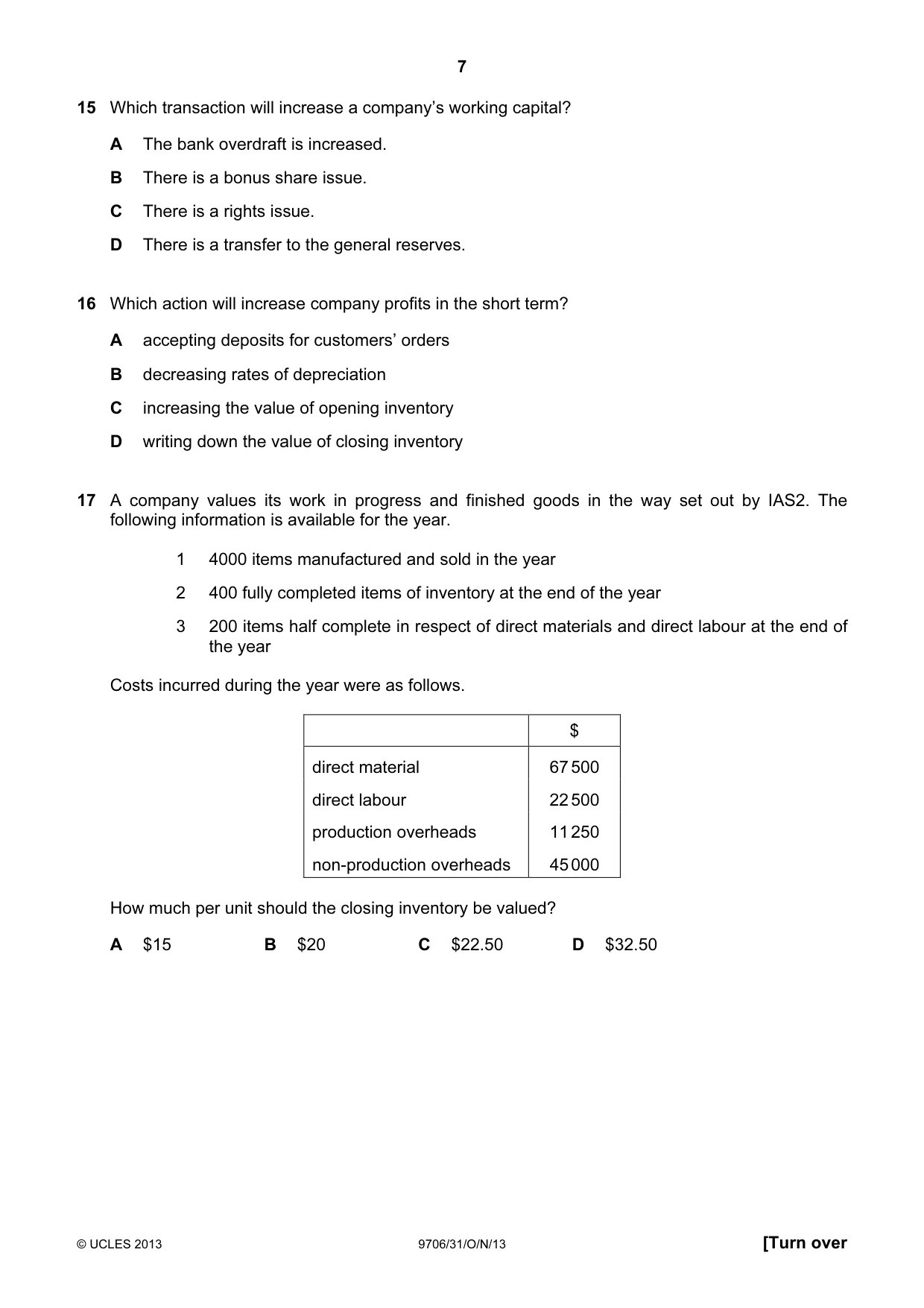
15 Which transaction will increase a company’s working capital? A The bank overdraft is increased. B There is a bonus share issue. C There is a rights issue. D There is a transfer to the general reserves.
Mark scheme: C
More questions on Analysis and communication of accounting information
Q16 · Which action will increase company profits in the short term?
16 Which action will increase company profits in the short term? A accepting deposits for customers’ orders B decreasing rates of depreciation C increasing the value of opening inventory D writing down the value of closing inventory
Mark scheme: B
More questions on Analysis and communication of accounting information
Q17 · A company values its work in progress and finished goods in the way set out by IAS2
17 A company values its work in progress and finished goods in the way set out by IAS2. The following information is available for the year. 1 4000 items manufactured and sold in the year 2 400 fully completed items of inventory at the end of the year 3 200 items half complete in respect of direct materials and direct labour at the end of the year Costs incurred during the year were as follows. $ direct material 67 500 direct labour 22 500 production overheads 11 250 non-production overheads 45 000 How much per unit should the closing inventory be valued? A $15 B $20 C $22.50 D $32.50
Mark scheme: C
Q18 · A company issues a debenture
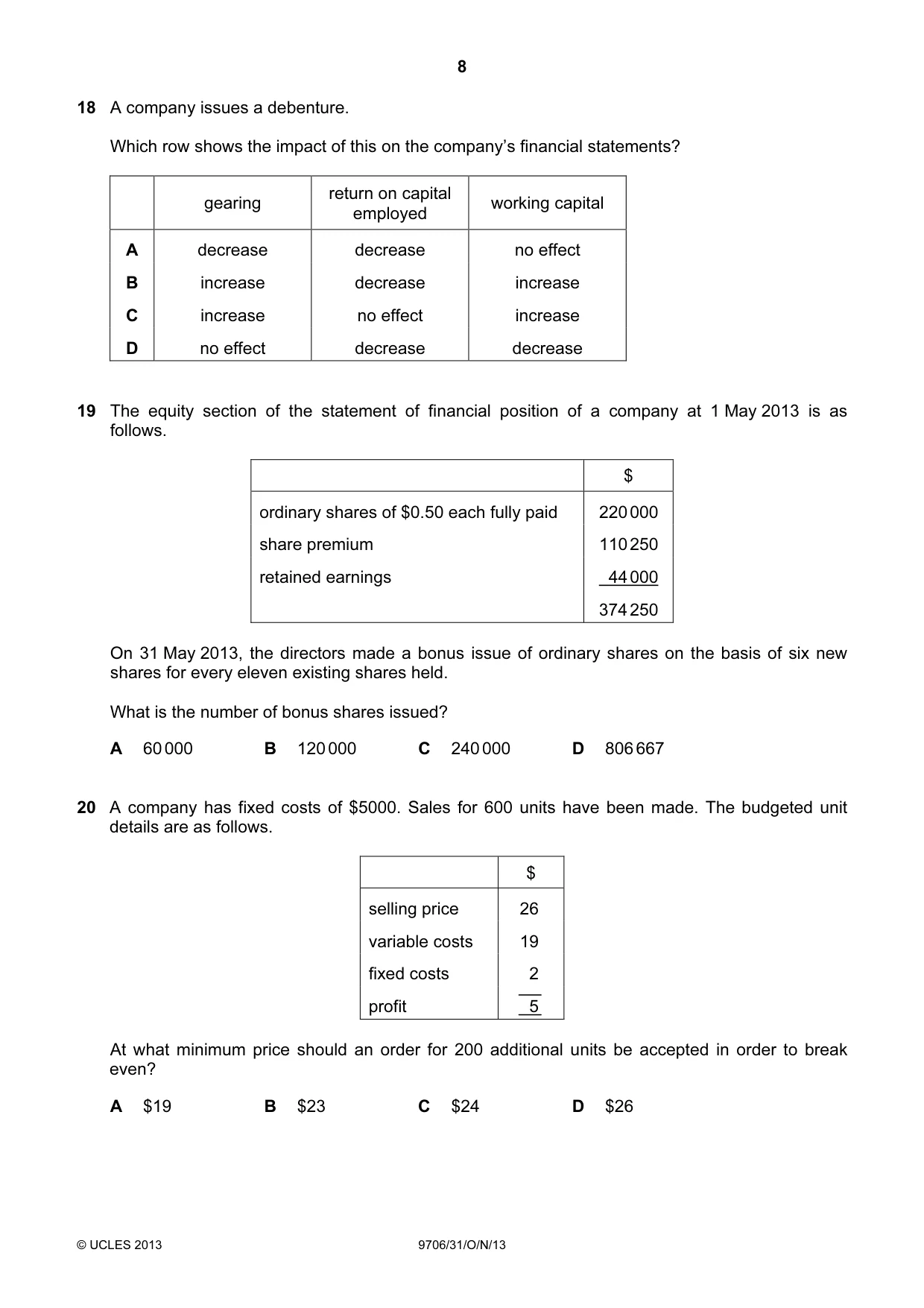
18 A company issues a debenture. Which row shows the impact of this on the company’s financial statements? return on capital gearing working capital employed A decrease decrease no effect B increase decrease increase C increase no effect increase D no effect decrease decrease
Mark scheme: B
More questions on Analysis and communication of accounting information
Q19 · The equity section of the statement of financial position of a company at 1 May 2013 is…
19 The equity section of the statement of financial position of a company at 1 May 2013 is as follows. $ ordinary shares of $0.50 each fully paid 220 000 share premium 110 250 retained earnings 44 000 374 250 On 31 May 2013, the directors made a bonus issue of ordinary shares on the basis of six new shares for every eleven existing shares held. What is the number of bonus shares issued? A 60 000 B 120 000 C 240 000 D 806 667
Mark scheme: C
Q20 · A company has fixed costs of $5000
20 A company has fixed costs of $5000. Sales for 600 units have been made. The budgeted unit details are as follows. $ selling price 26 variable costs 19 fixed costs 2 profit 5 At what minimum price should an order for 200 additional units be accepted in order to break even? A $19 B $23 C $24 D $26
Mark scheme: B
Q21 · A company is considering opening a new division of the business
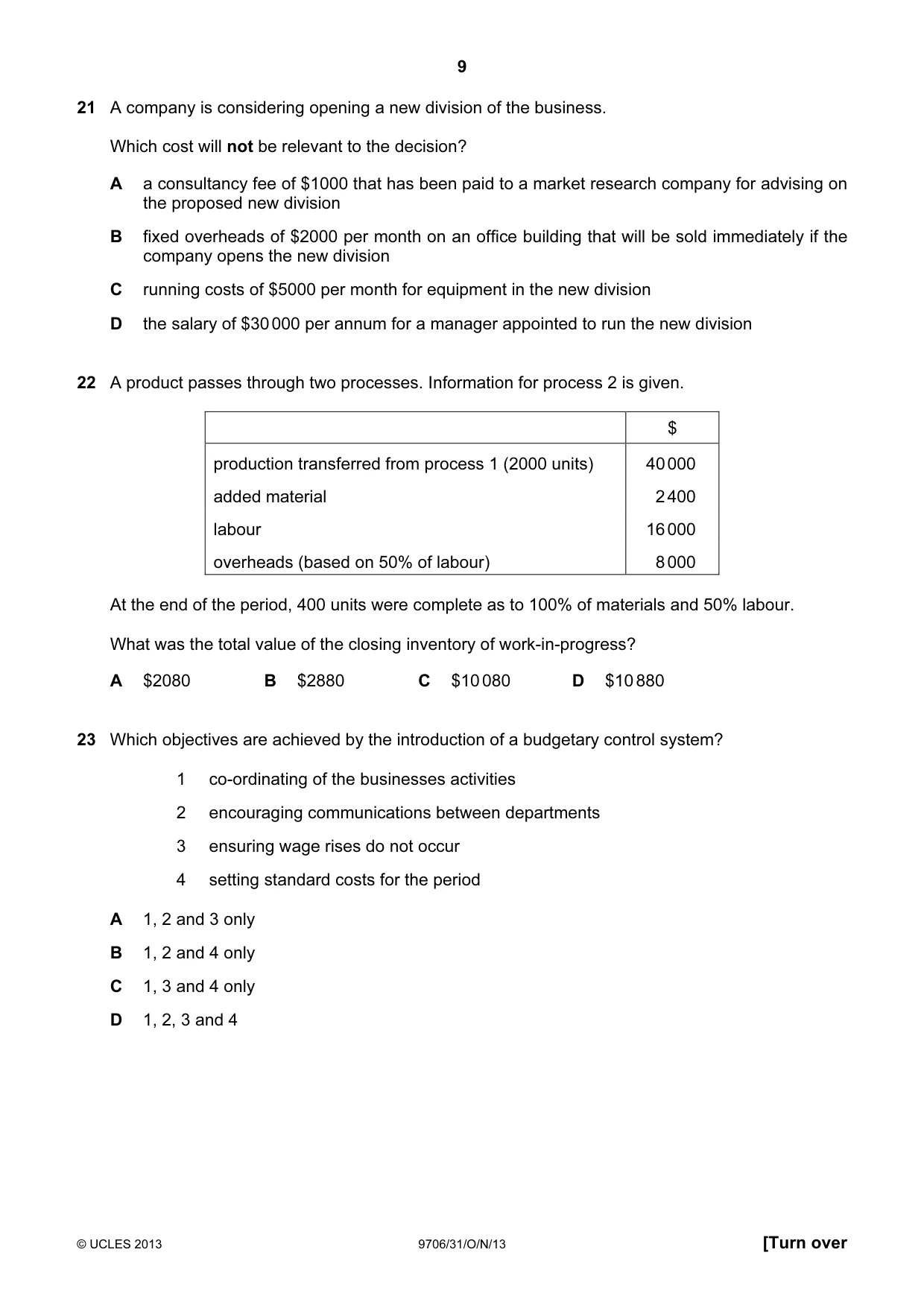
21 A company is considering opening a new division of the business. Which cost will not be relevant to the decision? A a consultancy fee of $1000 that has been paid to a market research company for advising on the proposed new division B fixed overheads of $2000 per month on an office building that will be sold immediately if the company opens the new division C running costs of $5000 per month for equipment in the new division D the salary of $30 000 per annum for a manager appointed to run the new division
Mark scheme: A
Q22 · A product passes through two processes
22 A product passes through two processes. Information for process 2 is given. $ production transferred from process 1 (2000 units) 40 000 added material 2 400 labour 16 000 overheads (based on 50% of labour) 8 000 At the end of the period, 400 units were complete as to 100% of materials and 50% labour. What was the total value of the closing inventory of work-in-progress? A $2080 B $2880 C $10 080 D $10 880
Mark scheme: D
Q23 · Which objectives are achieved by the introduction of a budgetary control system?
23 Which objectives are achieved by the introduction of a budgetary control system? 1 co-ordinating of the businesses activities 2 encouraging communications between departments 3 ensuring wage rises do not occur 4 setting standard costs for the period A 1, 2 and 3 only B 1, 2 and 4 only C 1, 3 and 4 only D 1, 2, 3 and 4
Mark scheme: B
Q24 · A unit of a product uses 3 kilos of raw material
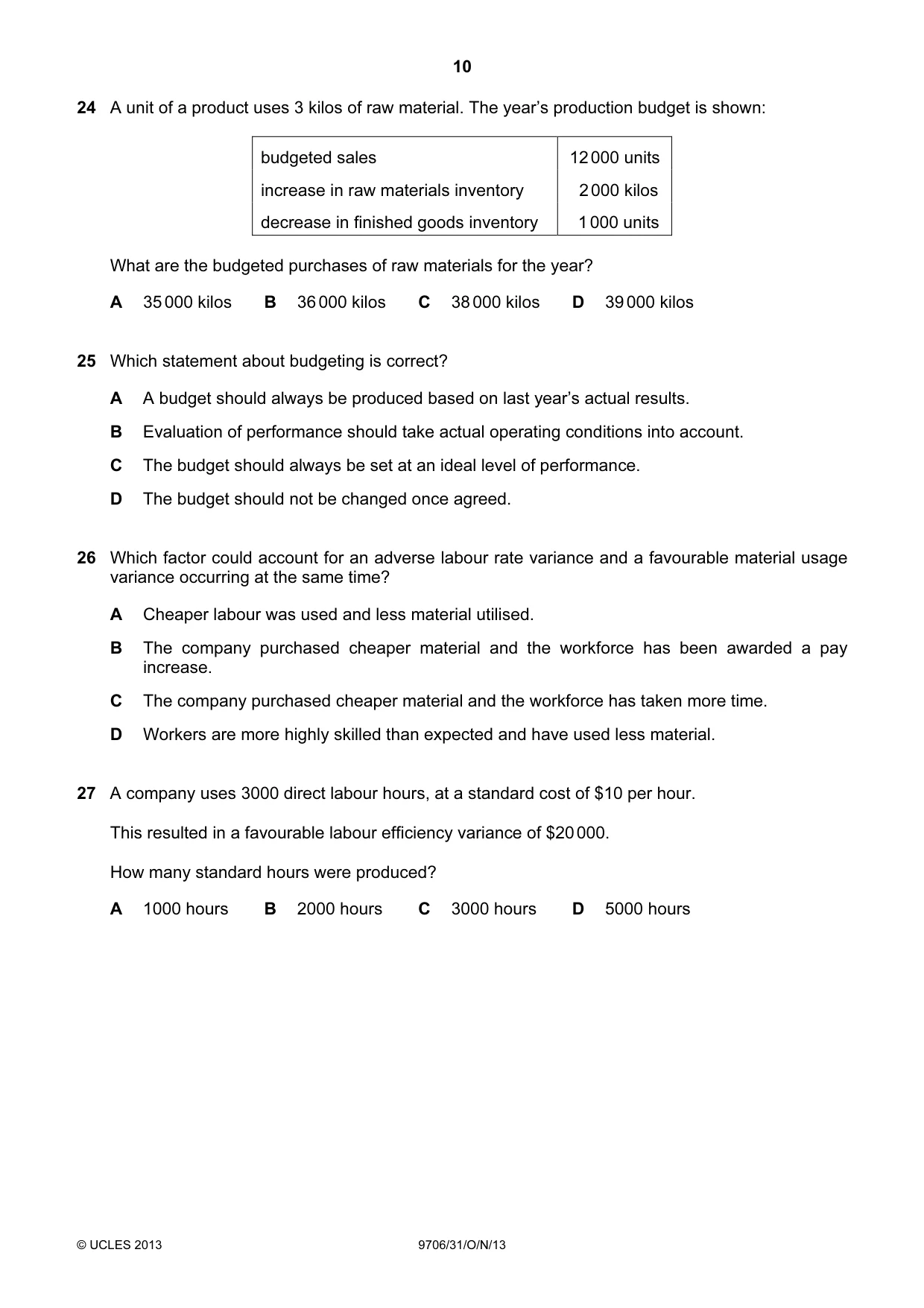
24 A unit of a product uses 3 kilos of raw material. The year’s production budget is shown: budgeted sales 12 000 units increase in raw materials inventory 2 000 kilos decrease in finished goods inventory 1 000 units What are the budgeted purchases of raw materials for the year? A 35 000 kilos B 36 000 kilos C 38 000 kilos D 39 000 kilos
Mark scheme: A
Q25 · Which statement about budgeting is correct?
25 Which statement about budgeting is correct? A A budget should always be produced based on last year’s actual results. B Evaluation of performance should take actual operating conditions into account. C The budget should always be set at an ideal level of performance. D The budget should not be changed once agreed.
Mark scheme: B
Q26 · Which factor could account for an adverse labour rate variance and a favourable material…
26 Which factor could account for an adverse labour rate variance and a favourable material usage variance occurring at the same time? A Cheaper labour was used and less material utilised. B The company purchased cheaper material and the workforce has been awarded a pay increase. C The company purchased cheaper material and the workforce has taken more time. D Workers are more highly skilled than expected and have used less material.
Mark scheme: D
Q27 · A company uses 3000 direct labour hours, at a standard cost of $10 per hour
27 A company uses 3000 direct labour hours, at a standard cost of $10 per hour. This resulted in a favourable labour efficiency variance of $20 000. How many standard hours were produced? A 1000 hours B 2000 hours C 3000 hours D 5000 hours
Mark scheme: D
Q28 · A company produces a single product and details of the production and budget are as…
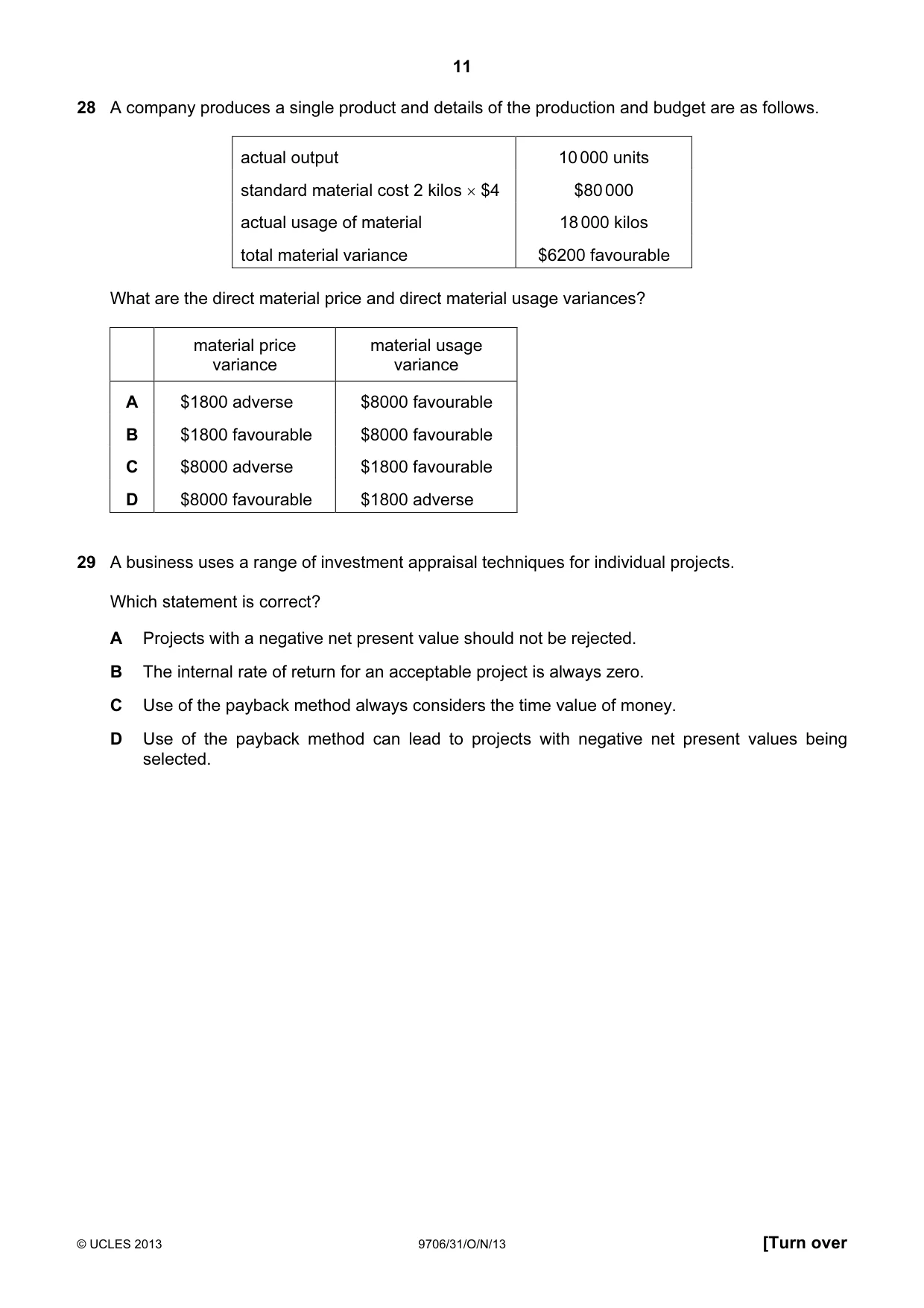
28 A company produces a single product and details of the production and budget are as follows. actual output 10 000 units standard material cost 2 kilos × $4 $80 000 actual usage of material 18 000 kilos total material variance $6200 favourable What are the direct material price and direct material usage variances? material price material usage variance variance A $1800 adverse $8000 favourable B $1800 favourable $8000 favourable C $8000 adverse $1800 favourable D $8000 favourable $1800 adverse
Mark scheme: A
Q29 · A business uses a range of investment appraisal techniques for individual projects
29 A business uses a range of investment appraisal techniques for individual projects. Which statement is correct? A Projects with a negative net present value should not be rejected. B The internal rate of return for an acceptable project is always zero. C Use of the payback method always considers the time value of money. D Use of the payback method can lead to projects with negative net present values being selected.
Mark scheme: D
Q30 · The following information relates to a capital investment, costing $900 000
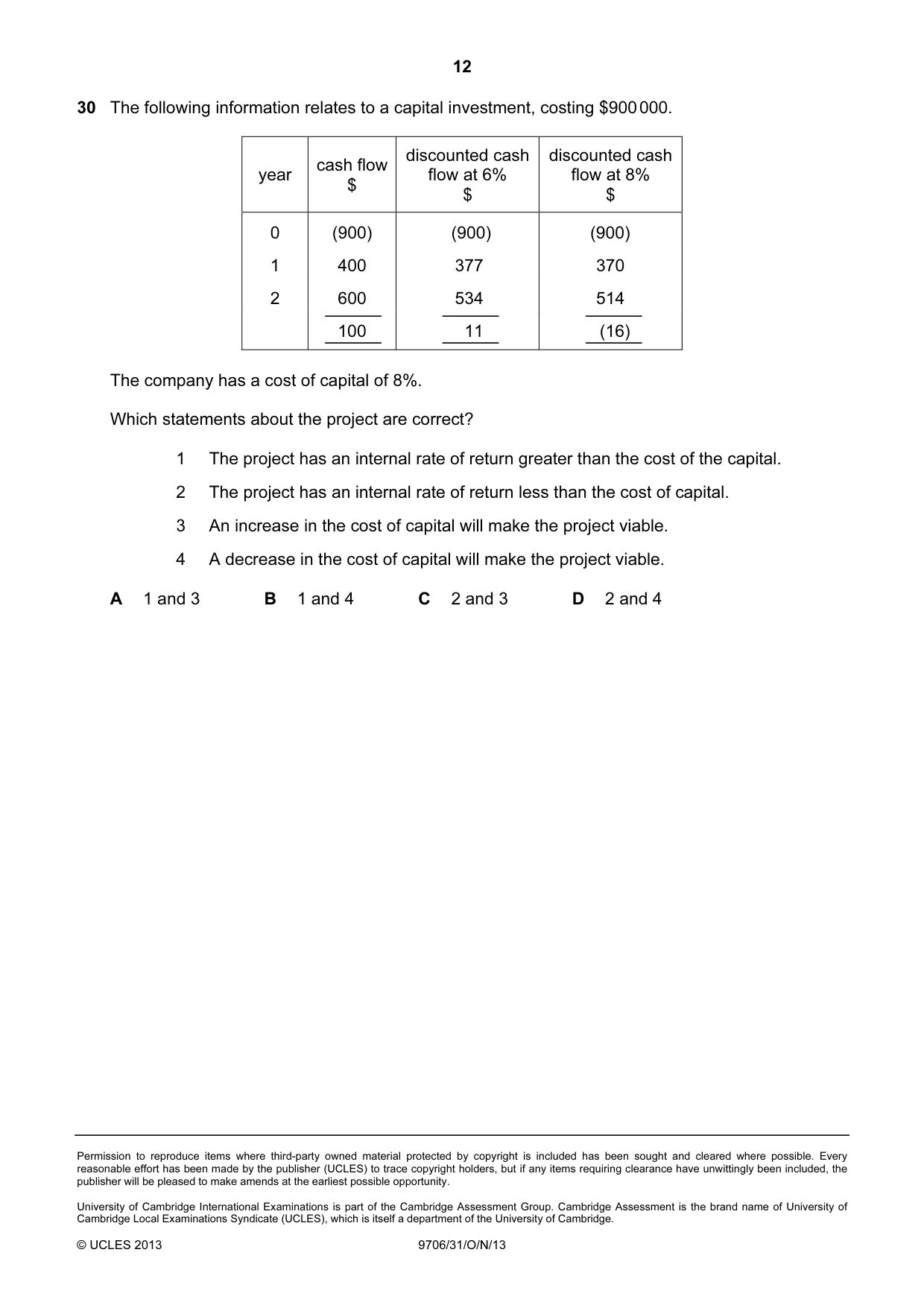
30 The following information relates to a capital investment, costing $900 000. discounted cash discounted cash cash flow year flow at 6% flow at 8% $ $ $ 0 (900) (900) (900) 1 400 377 370 2 600 534 514 100 11 (16) The company has a cost of capital of 8%. Which statements about the project are correct? 1 The project has an internal rate of return greater than the cost of the capital. 2 The project has an internal rate of return less than the cost of capital. 3 An increase in the cost of capital will make the project viable. 4 A decrease in the cost of capital will make the project viable. A 1 and 3 B 1 and 4 C 2 and 3 D 2 and 4
Mark scheme: D
What was in this paper
The subtopics covered by these 30 questions, and how many questions each got. Open one in a new tab to see every Cambridge question on it.
4Analysis and communication of accounting information3Budgeting and budgetary control3Costs and cost behaviour3Preparation of financial statements3Standard costing3Types of business entity3Analysis and communication of accounting information2Business acquisition and merger2Investment appraisal2Regulatory and ethical considerations1Traditional costing methods1What you needed in this session
Cambridge’s own grade thresholds for 2013 Oct/Nov, Paper 3 · Variant 1. A higher threshold means an easier paper — the bar moves with how the cohort did.