Cambridge A Level Accounting 9706 — 2013 May/June Paper 3 · Variant 3
9706/33/M/J/13 · 30 questions · 30 marks · ≈34 min
The question paper and its mark scheme, free to read here and free to download. This is Cambridge’s own paper, exactly as it was sat.
Question paper12 pages
Mark scheme2 pages
Answers below. Sit the paper first if you are practising.
Questions as text
Q1 · In calculating the net cash flow from operating activities, which item would be included…
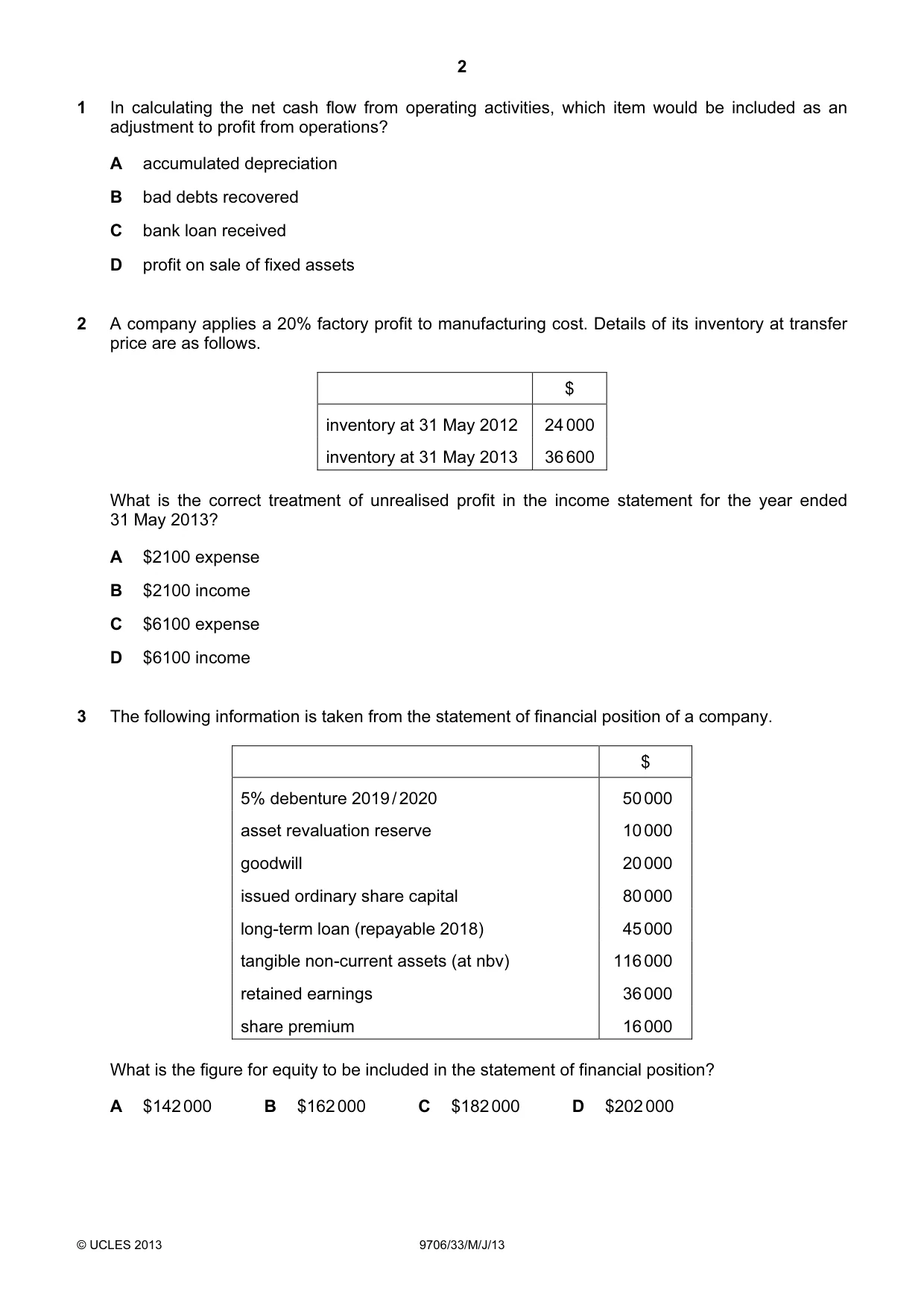
1 In calculating the net cash flow from operating activities, which item would be included as an adjustment to profit from operations? A accumulated depreciation B bad debts recovered C bank loan received D profit on sale of fixed assets
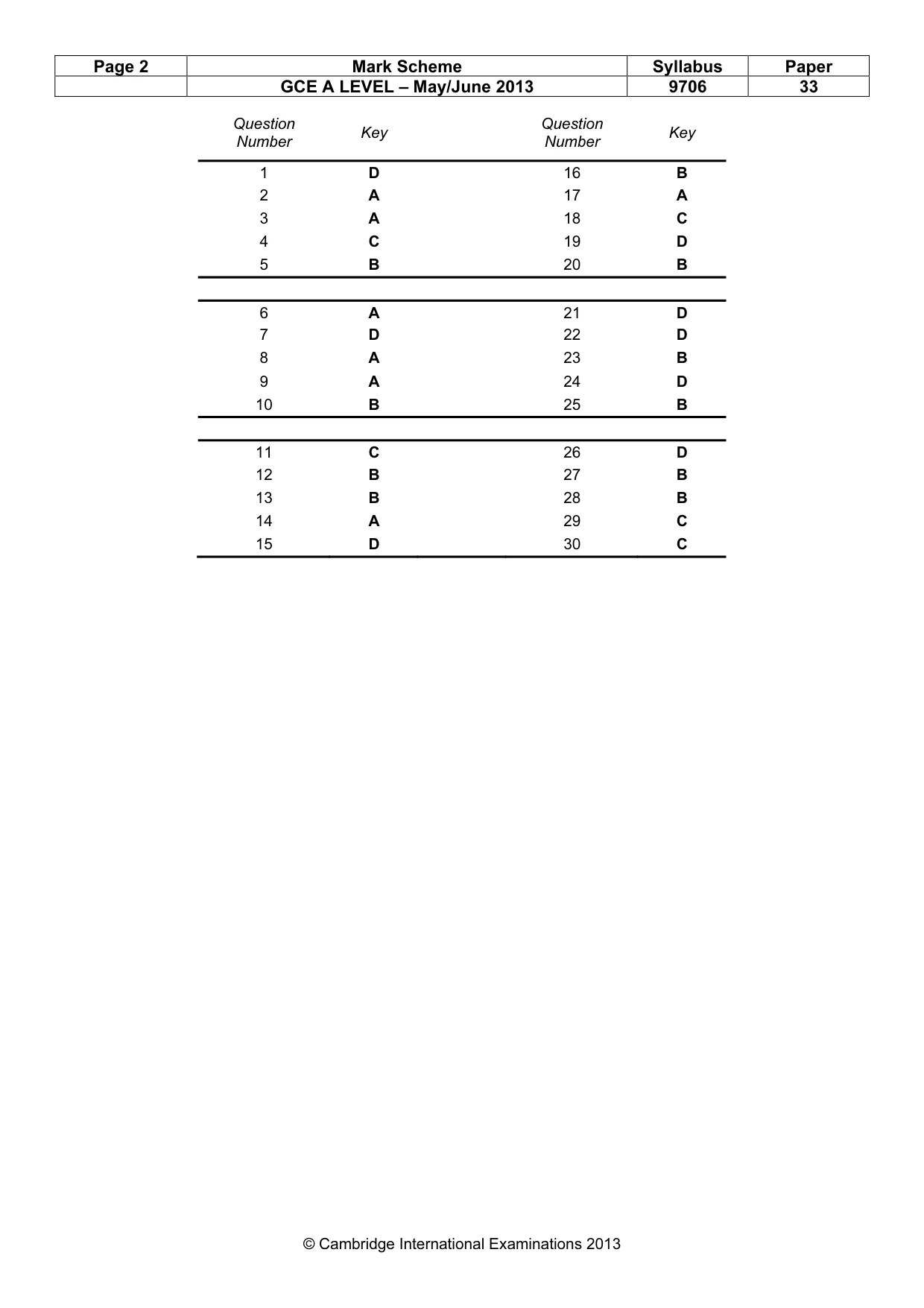
Mark scheme: D
More questions on Analysis and communication of accounting information
Q2 · A company applies a 20% factory profit to manufacturing cost
2 A company applies a 20% factory profit to manufacturing cost. Details of its inventory at transfer price are as follows. $ inventory at 31 May 2012 24 000 inventory at 31 May 2013 36 600 What is the correct treatment of unrealised profit in the income statement for the year ended 31 May 2013? A $2100 expense B $2100 income C $6100 expense D $6100 income
Mark scheme: A
Q3 · The following information is taken from the statement of financial position of a company
3 The following information is taken from the statement of financial position of a company. $ 5% debenture 2019 / 2020 50 000 asset revaluation reserve 10 000 goodwill 20 000 issued ordinary share capital 80 000 long-term loan (repayable 2018) 45 000 tangible non-current assets (at nbv) 116 000 retained earnings 36 000 share premium 16 000 What is the figure for equity to be included in the statement of financial position? A $142 000 B $162 000 C $182 000 D $202 000
Mark scheme: A
Q4 · What is the effect on a company’s statement of financial position of issuing bonus shares?
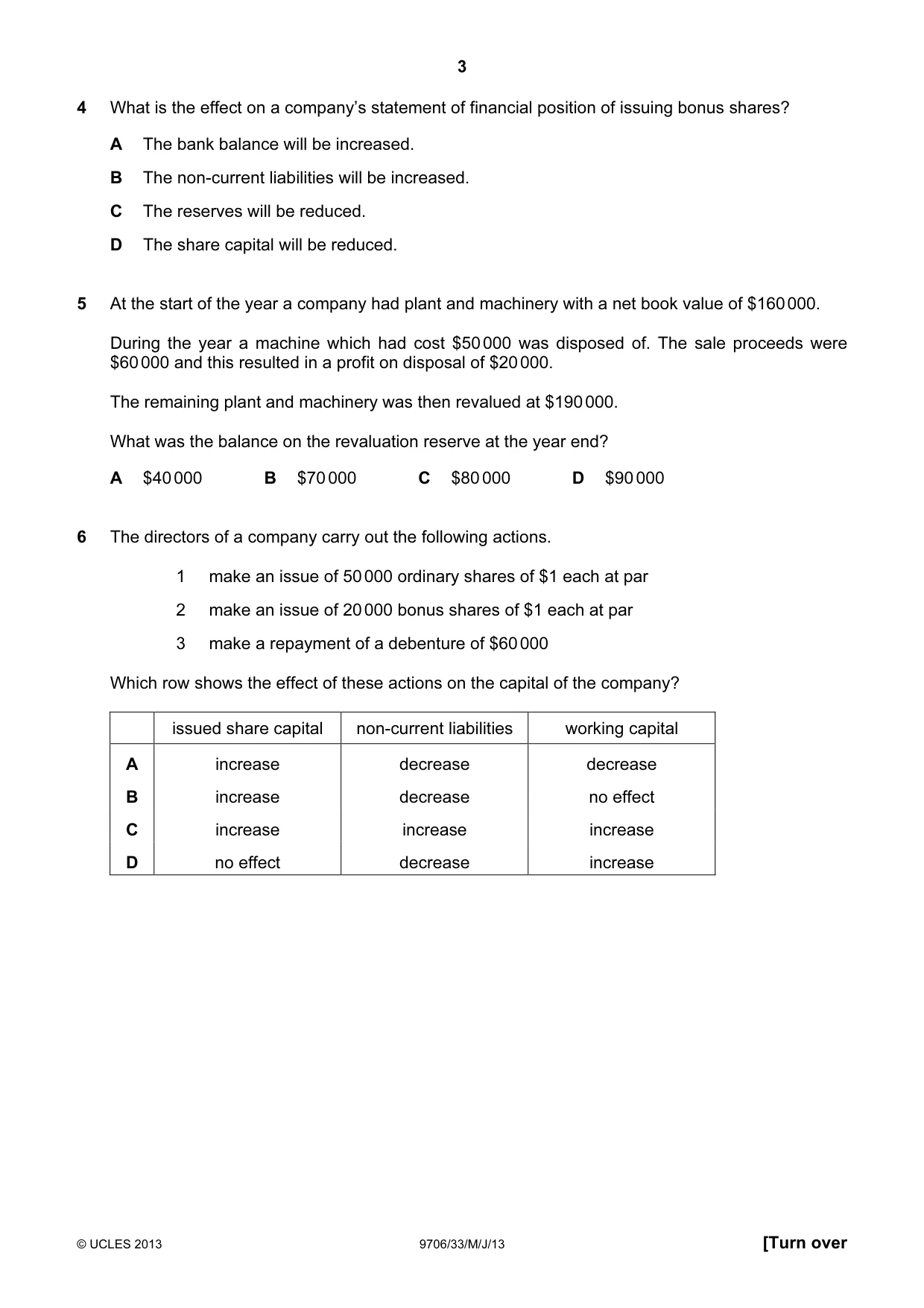
4 What is the effect on a company’s statement of financial position of issuing bonus shares? A The bank balance will be increased. B The non-current liabilities will be increased. C The reserves will be reduced. D The share capital will be reduced.
Mark scheme: C
Q5 · At the start of the year a company had plant and machinery with a net book value of $160…
5 At the start of the year a company had plant and machinery with a net book value of $160 000. During the year a machine which had cost $50 000 was disposed of. The sale proceeds were $60 000 and this resulted in a profit on disposal of $20 000. The remaining plant and machinery was then revalued at $190 000. What was the balance on the revaluation reserve at the year end? A $40 000 B $70 000 C $80 000 D $90 000
Mark scheme: B
Q6 · The directors of a company carry out the following actions
6 The directors of a company carry out the following actions. 1 make an issue of 50 000 ordinary shares of $1 each at par 2 make an issue of 20 000 bonus shares of $1 each at par 3 make a repayment of a debenture of $60 000 Which row shows the effect of these actions on the capital of the company? issued share capital non-current liabilities working capital A increase decrease decrease B increase decrease no effect C increase increase increase D no effect decrease increase
Mark scheme: A
Q7 · X and Y are in partnership sharing profits and losses equally
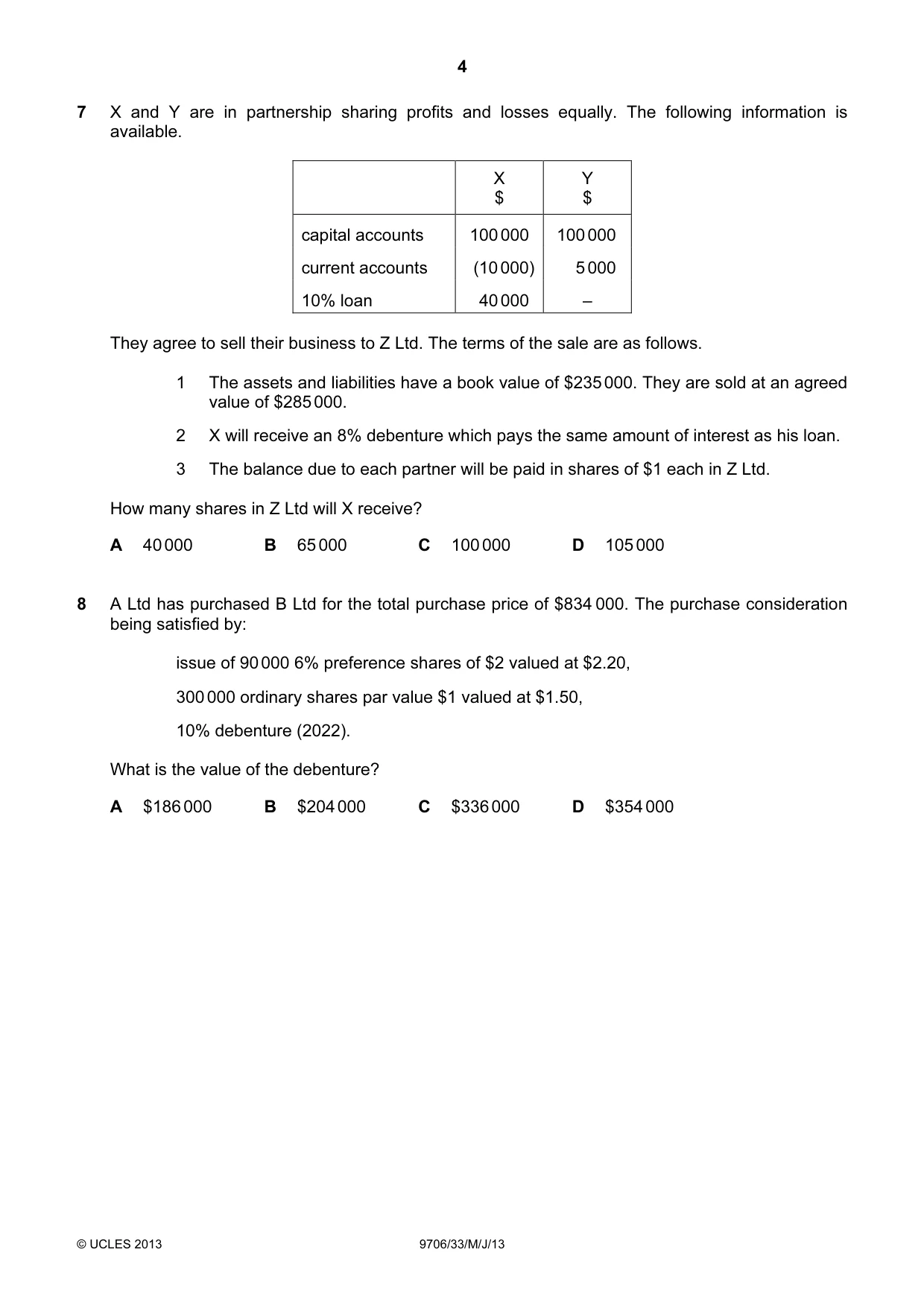
7 X and Y are in partnership sharing profits and losses equally. The following information is available. X Y $ $ capital accounts 100 000 100 000 current accounts (10 000) 5 000 10% loan 40 000 – They agree to sell their business to Z Ltd. The terms of the sale are as follows. 1 The assets and liabilities have a book value of $235 000. They are sold at an agreed value of $285 000. 2 X will receive an 8% debenture which pays the same amount of interest as his loan. 3 The balance due to each partner will be paid in shares of $1 each in Z Ltd. How many shares in Z Ltd will X receive? A 40 000 B 65 000 C 100 000 D 105 000
Mark scheme: D
Q8 · A Ltd has purchased B Ltd for the total purchase price of $834 000
8 A Ltd has purchased B Ltd for the total purchase price of $834 000. The purchase consideration being satisfied by: issue of 90 000 6% preference shares of $2 valued at $2.20, 300 000 ordinary shares par value $1 valued at $1.50, 10% debenture (2022). What is the value of the debenture? A $186 000 B $204 000 C $336 000 D $354 000
Mark scheme: A
Q9 · The summarised statement of financial position of a sole trader shows the following
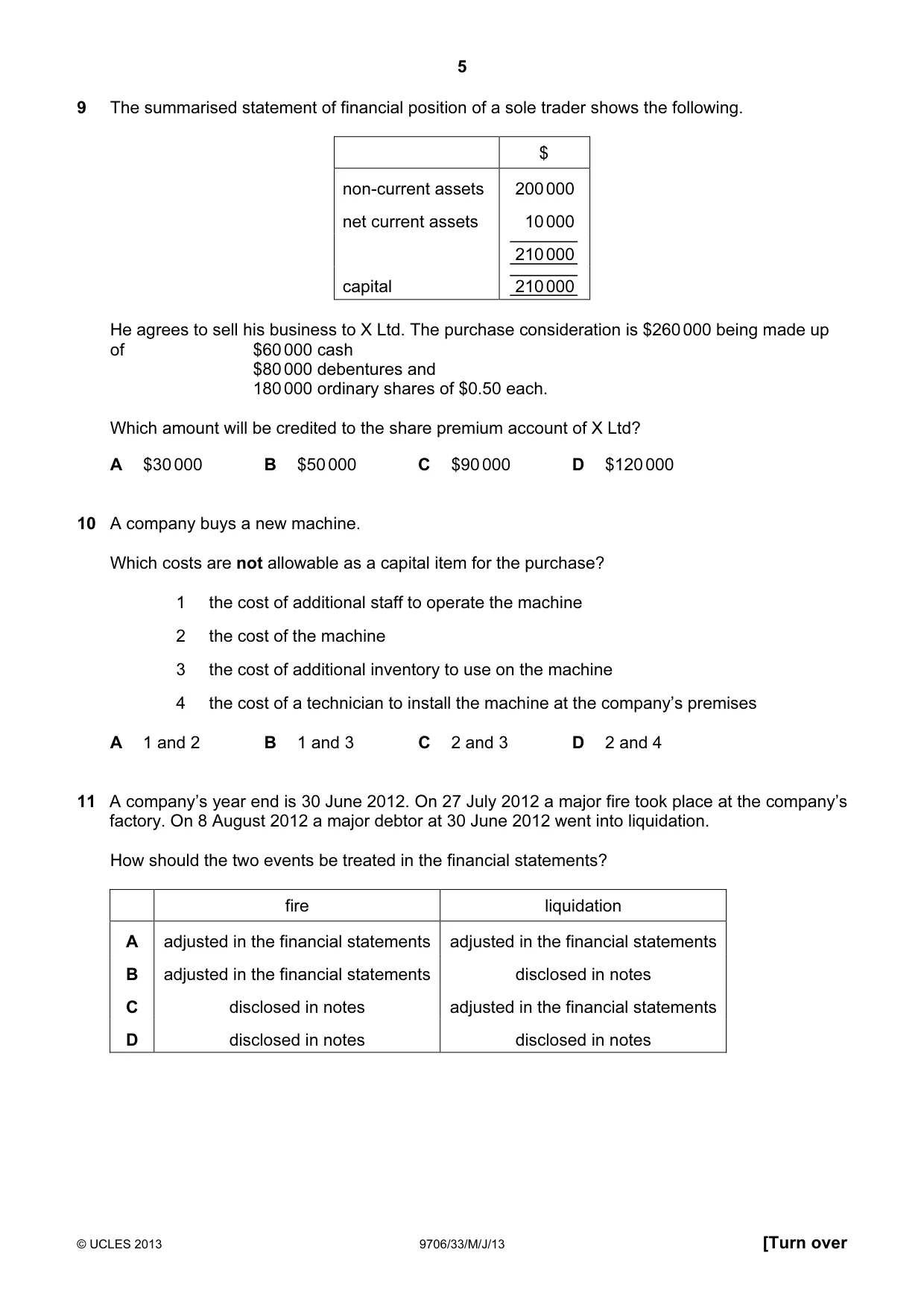
9 The summarised statement of financial position of a sole trader shows the following. $ non-current assets 200 000 net current assets 10 000 210 000 capital 210 000 He agrees to sell his business to X Ltd. The purchase consideration is $260 000 being made up of $60 000 cash $80 000 debentures and 180 000 ordinary shares of $0.50 each. Which amount will be credited to the share premium account of X Ltd? A $30 000 B $50 000 C $90 000 D $120 000
Mark scheme: A
Q10 · A company buys a new machine
10 A company buys a new machine. Which costs are not allowable as a capital item for the purchase? 1 the cost of additional staff to operate the machine 2 the cost of the machine 3 the cost of additional inventory to use on the machine 4 the cost of a technician to install the machine at the company’s premises A 1 and 2 B 1 and 3 C 2 and 3 D 2 and 4
Mark scheme: B
Q11 · A company’s year end is 30 June 2012
11 A company’s year end is 30 June 2012. On 27 July 2012 a major fire took place at the company’s factory. On 8 August 2012 a major debtor at 30 June 2012 went into liquidation. How should the two events be treated in the financial statements? fire liquidation A adjusted in the financial statements adjusted in the financial statements B adjusted in the financial statements disclosed in notes C disclosed in notes adjusted in the financial statements D disclosed in notes disclosed in notes
Mark scheme: C
Q12 · Which expense is not deducted before arriving at operating profit?
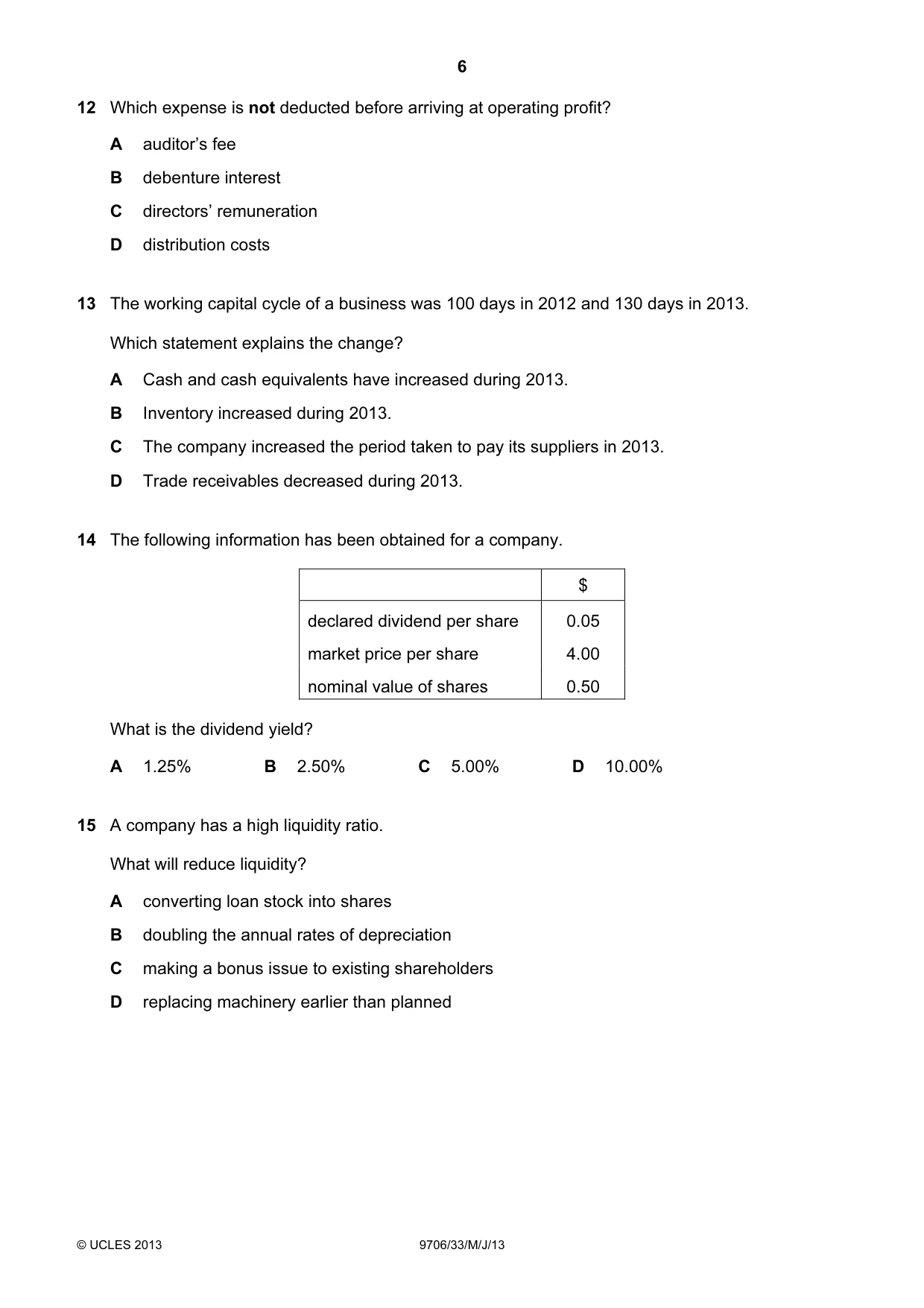
12 Which expense is not deducted before arriving at operating profit? A auditor’s fee B debenture interest C directors’ remuneration D distribution costs
Mark scheme: B
More questions on Analysis and communication of accounting information
Q13 · The working capital cycle of a business was 100 days in 2012 and 130 days in 2013
13 The working capital cycle of a business was 100 days in 2012 and 130 days in 2013. Which statement explains the change? A Cash and cash equivalents have increased during 2013. B Inventory increased during 2013. C The company increased the period taken to pay its suppliers in 2013. D Trade receivables decreased during 2013.
Mark scheme: B
More questions on Analysis and communication of accounting information
Q14 · The following information has been obtained for a company
14 The following information has been obtained for a company. $ declared dividend per share 0.05 market price per share 4.00 nominal value of shares 0.50 What is the dividend yield? A 1.25% B 2.50% C 5.00% D 10.00%
Mark scheme: A
More questions on Analysis and communication of accounting information
Q15 · A company has a high liquidity ratio
15 A company has a high liquidity ratio. What will reduce liquidity? A converting loan stock into shares B doubling the annual rates of depreciation C making a bonus issue to existing shareholders D replacing machinery earlier than planned
Mark scheme: D
More questions on Analysis and communication of accounting information
Q16 · The following information is available for a company for the year ended 31 December
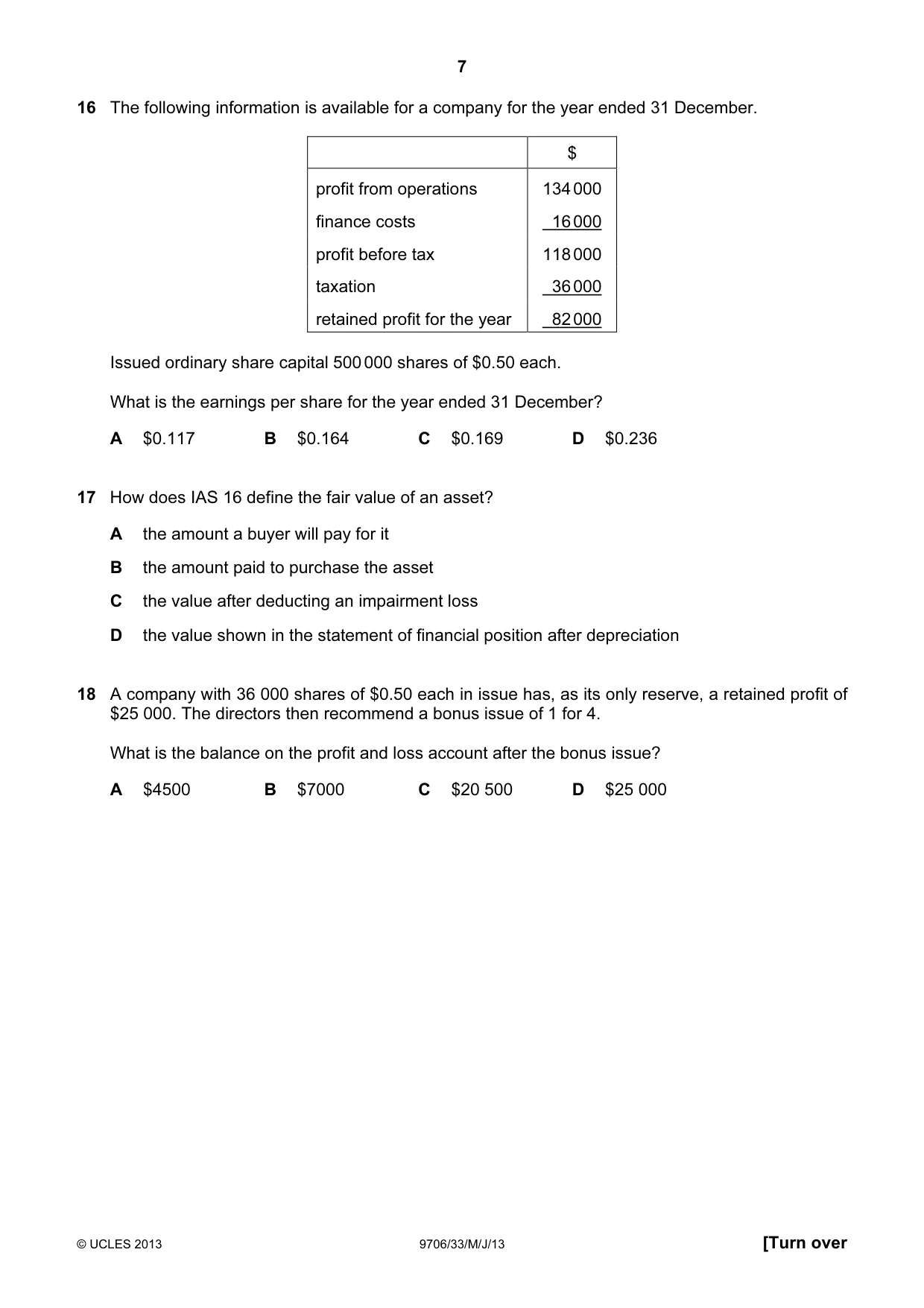
16 The following information is available for a company for the year ended 31 December. $ profit from operations 134 000 finance costs 16 000 profit before tax 118 000 taxation 36 000 retained profit for the year 82 000 Issued ordinary share capital 500 000 shares of $0.50 each. What is the earnings per share for the year ended 31 December? A $0.117 B $0.164 C $0.169 D $0.236
Mark scheme: B
More questions on Analysis and communication of accounting information
Q17 · How does IAS 16 define the fair value of an asset?
17 How does IAS 16 define the fair value of an asset? A the amount a buyer will pay for it B the amount paid to purchase the asset C the value after deducting an impairment loss D the value shown in the statement of financial position after depreciation
Mark scheme: A
Q18 · A company with 36 000 shares of $0.50 each in issue has, as its only reserve, a retained…
18 A company with 36 000 shares of $0.50 each in issue has, as its only reserve, a retained profit of $25 000. The directors then recommend a bonus issue of 1 for 4. What is the balance on the profit and loss account after the bonus issue? A $4500 B $7000 C $20 500 D $25 000
Mark scheme: C
Q19 · A company makes three products for which the following details are given
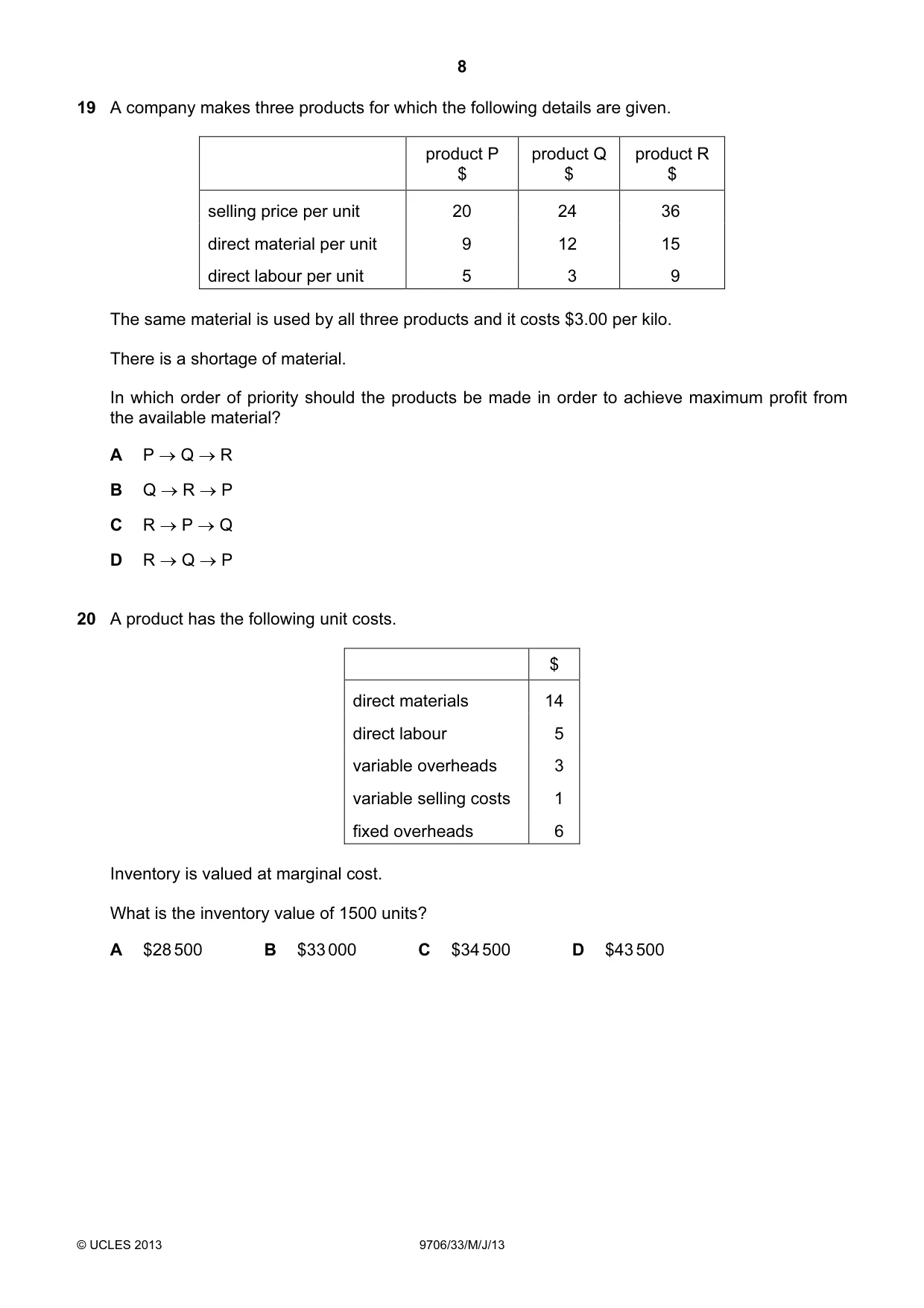
19 A company makes three products for which the following details are given. product P product Q product R $ $ $ selling price per unit 20 24 36 direct material per unit 9 12 15 direct labour per unit 5 3 9 The same material is used by all three products and it costs $3.00 per kilo. There is a shortage of material. In which order of priority should the products be made in order to achieve maximum profit from the available material? A P → Q → R B Q → R → P C R → P → Q D R → Q → P
Mark scheme: D
Q20 · A product has the following unit costs
20 A product has the following unit costs. $ direct materials 14 direct labour 5 variable overheads 3 variable selling costs 1 fixed overheads 6 Inventory is valued at marginal cost. What is the inventory value of 1500 units? A $28 500 B $33 000 C $34 500 D $43 500
Mark scheme: B
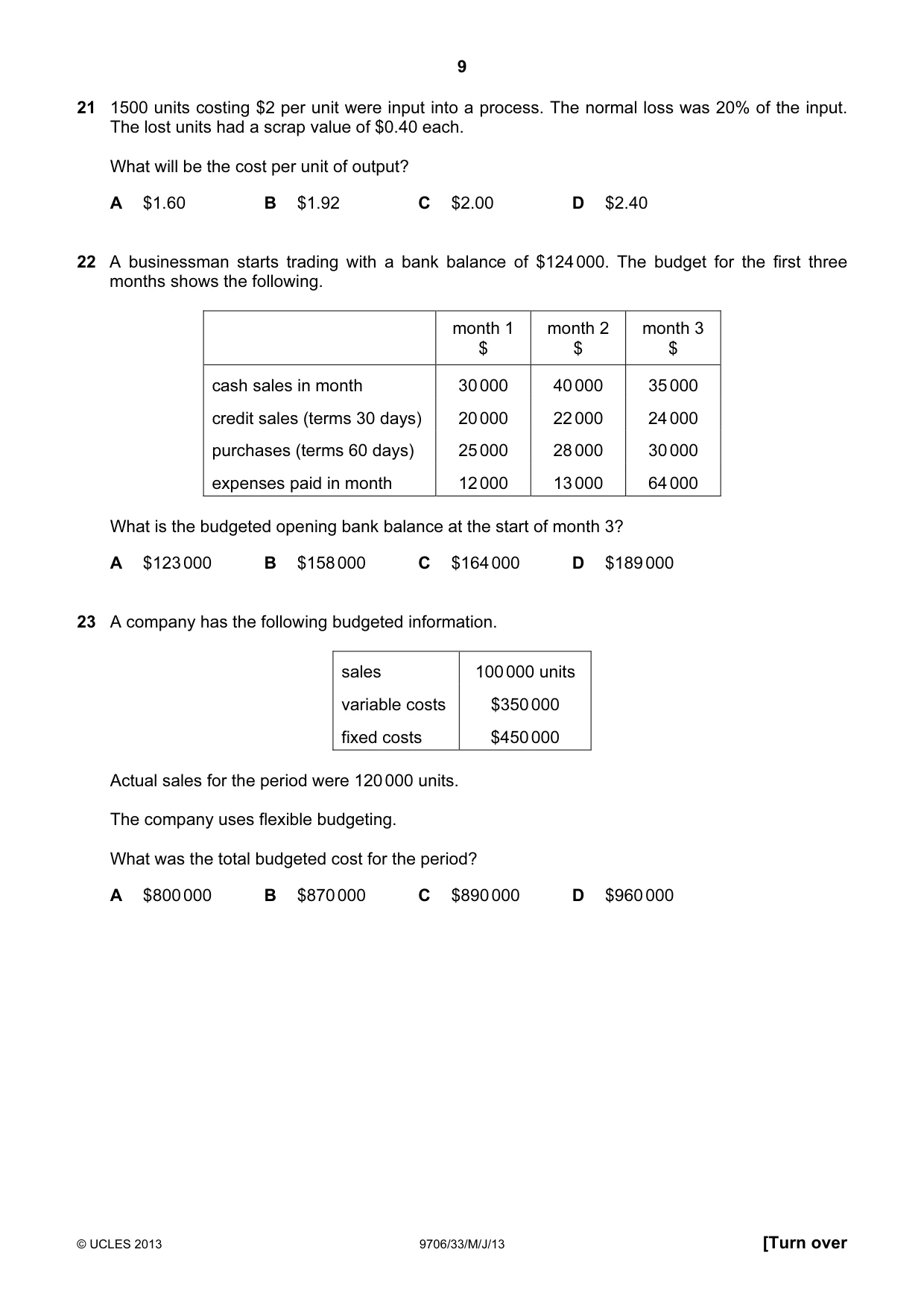
Q21 · 1500 units costing $2 per unit were input into a process
21 1500 units costing $2 per unit were input into a process. The normal loss was 20% of the input. The lost units had a scrap value of $0.40 each. What will be the cost per unit of output? A $1.60 B $1.92 C $2.00 D $2.40
Mark scheme: D
Q22 · A businessman starts trading with a bank balance of $124 000
22 A businessman starts trading with a bank balance of $124 000. The budget for the first three months shows the following. month 1 month 2 month 3 $ $ $ cash sales in month 30 000 40 000 35 000 credit sales (terms 30 days) 20 000 22 000 24 000 purchases (terms 60 days) 25 000 28 000 30 000 expenses paid in month 12 000 13 000 64 000 What is the budgeted opening bank balance at the start of month 3? A $123 000 B $158 000 C $164 000 D $189 000
Mark scheme: D
Q23 · A company has the following budgeted information
23 A company has the following budgeted information. sales 100 000 units variable costs $350 000 fixed costs $450 000 Actual sales for the period were 120 000 units. The company uses flexible budgeting. What was the total budgeted cost for the period? A $800 000 B $870 000 C $890 000 D $960 000
Mark scheme: B
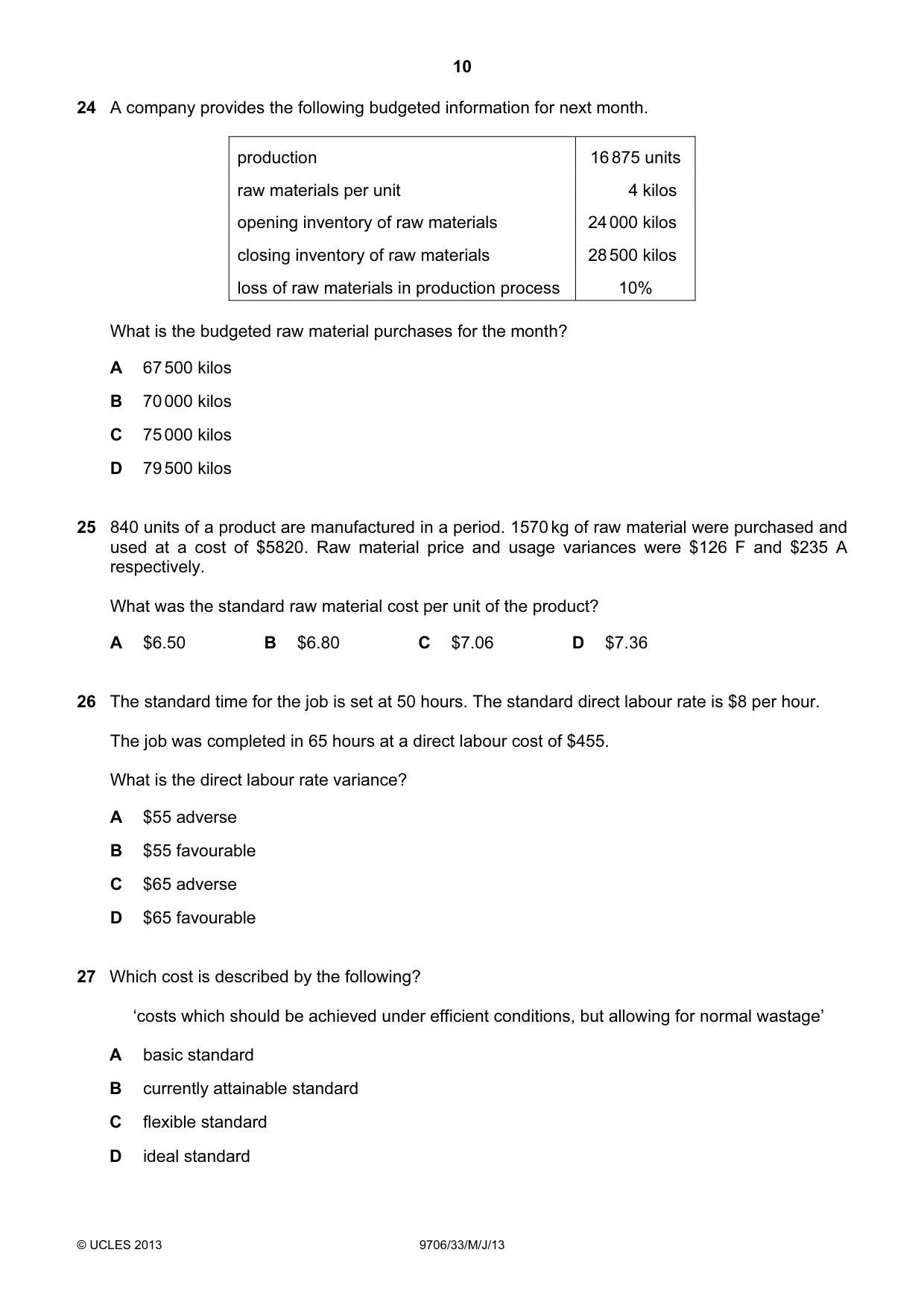
Q24 · A company provides the following budgeted information for next month
24 A company provides the following budgeted information for next month. production 16 875 units raw materials per unit 4 kilos opening inventory of raw materials 24 000 kilos closing inventory of raw materials 28 500 kilos loss of raw materials in production process 10% What is the budgeted raw material purchases for the month? A 67 500 kilos B 70 000 kilos C 75 000 kilos D 79 500 kilos
Mark scheme: D
Q25 · 840 units of a product are manufactured in a period
25 840 units of a product are manufactured in a period. 1570 kg of raw material were purchased and used at a cost of $5820. Raw material price and usage variances were $126 F and $235 A respectively. What was the standard raw material cost per unit of the product? A $6.50 B $6.80 C $7.06 D $7.36
Mark scheme: B
Q26 · The standard time for the job is set at 50 hours
26 The standard time for the job is set at 50 hours. The standard direct labour rate is $8 per hour. The job was completed in 65 hours at a direct labour cost of $455. What is the direct labour rate variance? A $55 adverse B $55 favourable C $65 adverse D $65 favourable
Mark scheme: D
Q27 · Which cost is described by the following?
27 Which cost is described by the following? ‘costs which should be achieved under efficient conditions, but allowing for normal wastage’ A basic standard B currently attainable standard C flexible standard D ideal standard
Mark scheme: B
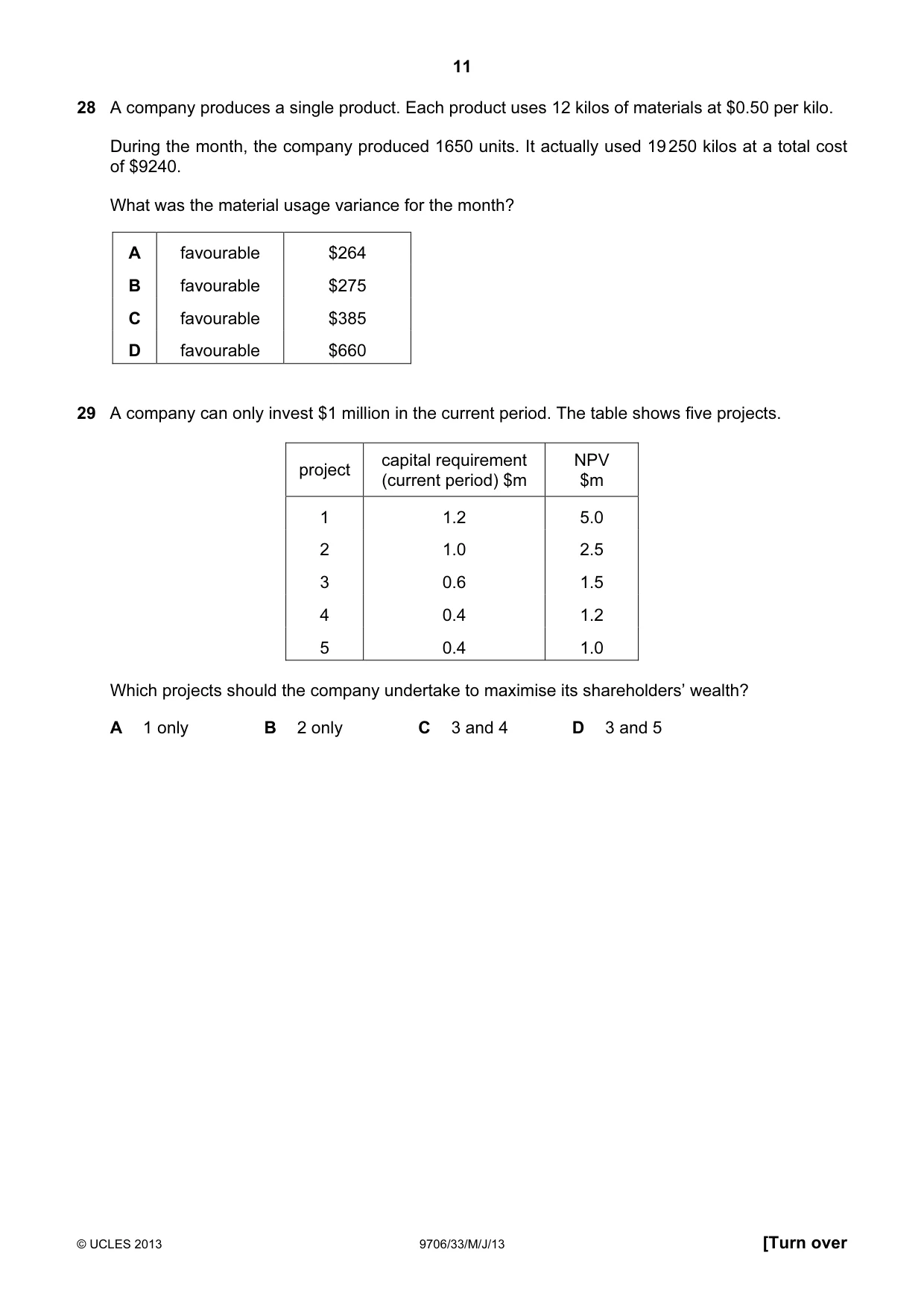
Q28 · A company produces a single product
28 A company produces a single product. Each product uses 12 kilos of materials at $0.50 per kilo. During the month, the company produced 1650 units. It actually used 19 250 kilos at a total cost of $9240. What was the material usage variance for the month? A favourable $264 B favourable $275 C favourable $385 D favourable $660
Mark scheme: B
Q29 · A company can only invest $1 million in the current period
29 A company can only invest $1 million in the current period. The table shows five projects. capital requirement NPV project (current period) $m $m 1 1.2 5.0 2 1.0 2.5 3 0.6 1.5 4 0.4 1.2 5 0.4 1.0 Which projects should the company undertake to maximise its shareholders’ wealth? A 1 only B 2 only C 3 and 4 D 3 and 5
Mark scheme: C
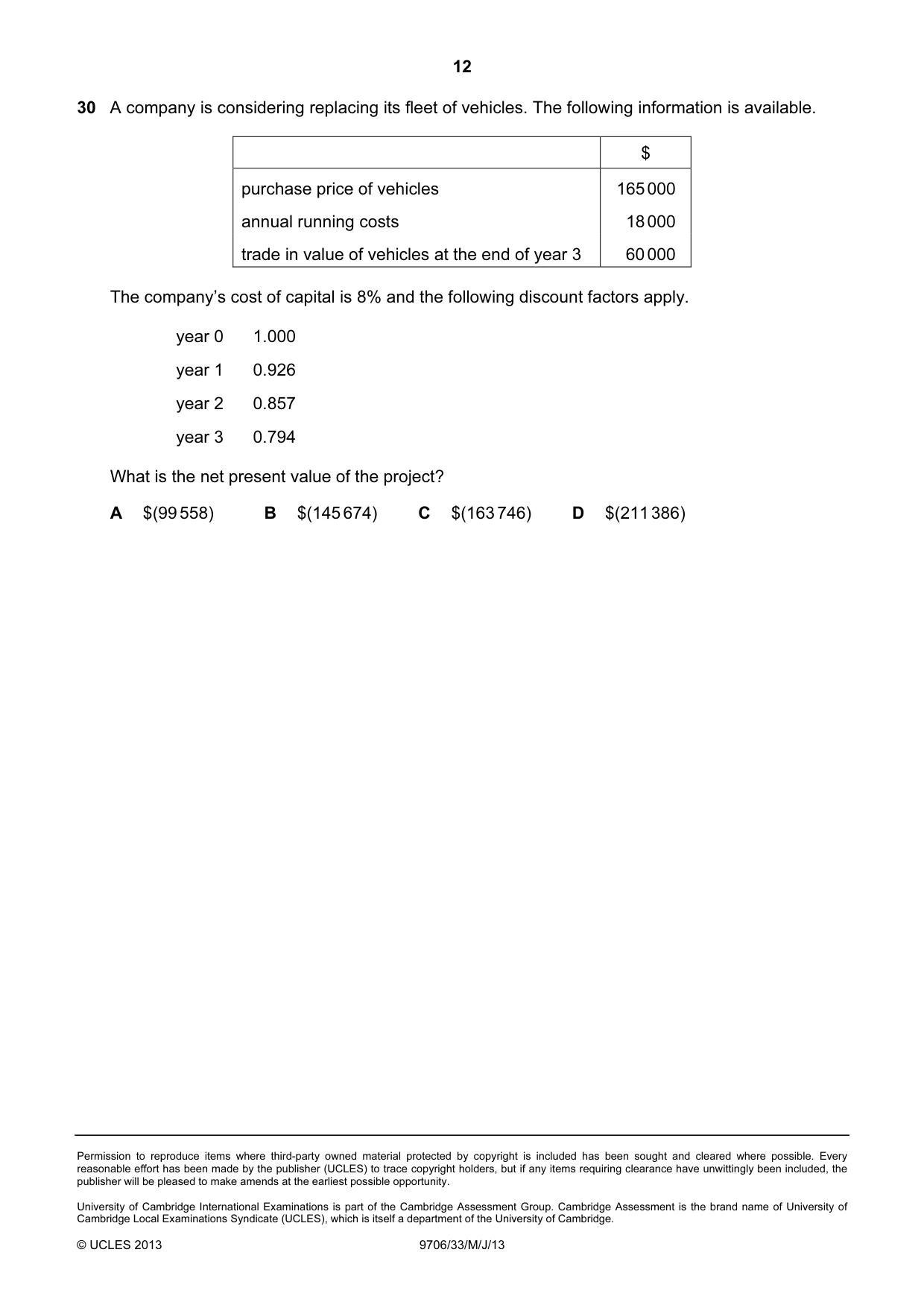
Q30 · A company is considering replacing its fleet of vehicles
30 A company is considering replacing its fleet of vehicles. The following information is available. $ purchase price of vehicles 165 000 annual running costs 18 000 trade in value of vehicles at the end of year 3 60 000 The company’s cost of capital is 8% and the following discount factors apply. year 0 1.000 year 1 0.926 year 2 0.857 year 3 0.794 What is the net present value of the project? A $(99 558) B $(145 674) C $(163 746) D $(211 386)
Mark scheme: C
What was in this paper
The subtopics covered by these 30 questions, and how many questions each got. Open one in a new tab to see every Cambridge question on it.
6Analysis and communication of accounting information5Standard costing4Budgeting and budgetary control3Business acquisition and merger3Regulatory and ethical considerations3Traditional costing methods3Investment appraisal2Analysis and communication of accounting information1What you needed in this session
Cambridge’s own grade thresholds for 2013 May/June, Paper 3 · Variant 3. A higher threshold means an easier paper — the bar moves with how the cohort did.