Cambridge A Level Accounting 9706 — 2013 Oct/Nov Paper 3 · Variant 2
9706/32/O/N/13 · 30 questions · 30 marks · ≈34 min
The question paper and its mark scheme, free to read here and free to download. This is Cambridge’s own paper, exactly as it was sat.
Question paper12 pages

Mark scheme2 pages
Answers below. Sit the paper first if you are practising.
Questions as text
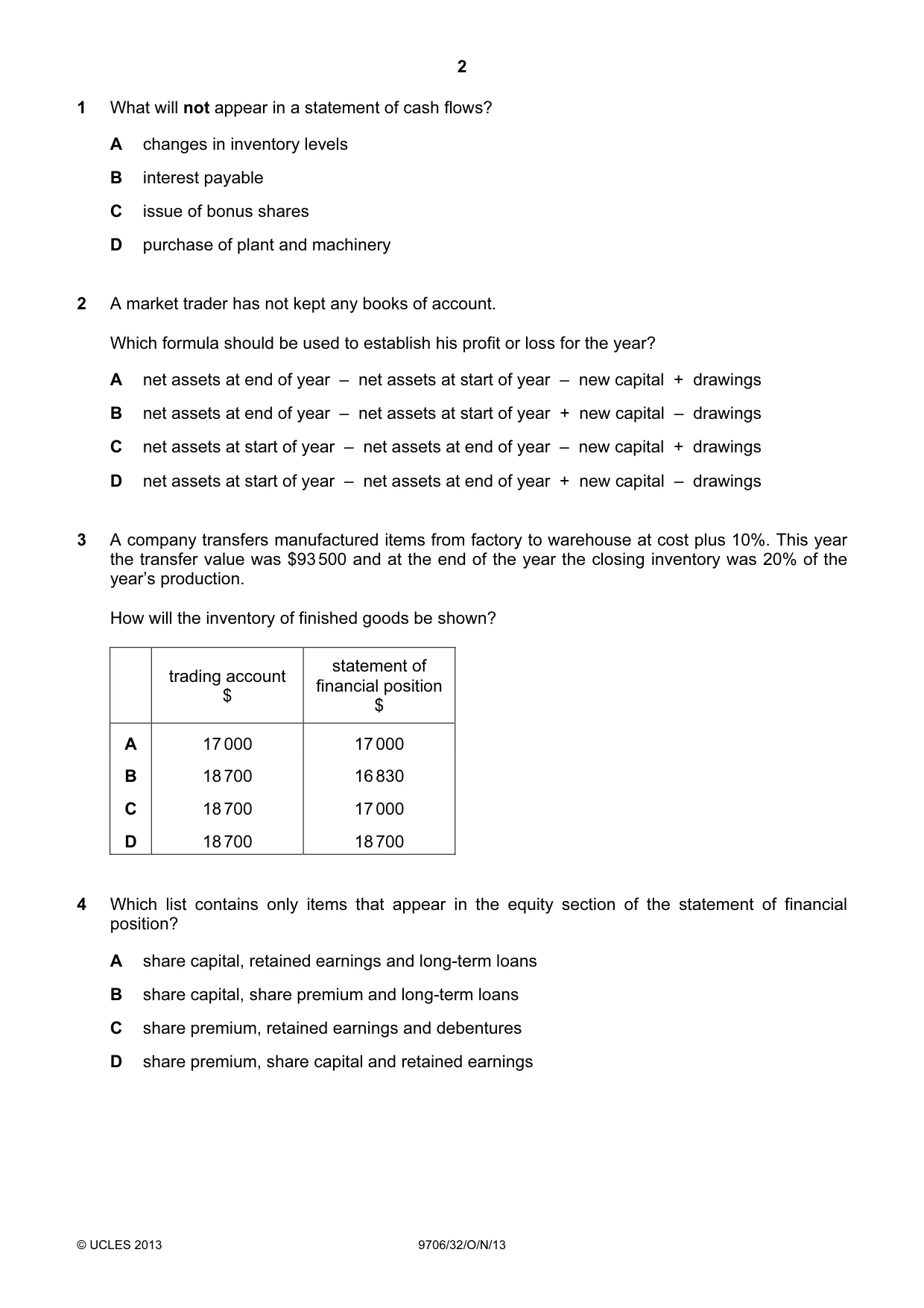
Q1 · What will not appear in a statement of cash flows?
1 What will not appear in a statement of cash flows? A changes in inventory levels B interest payable C issue of bonus shares D purchase of plant and machinery
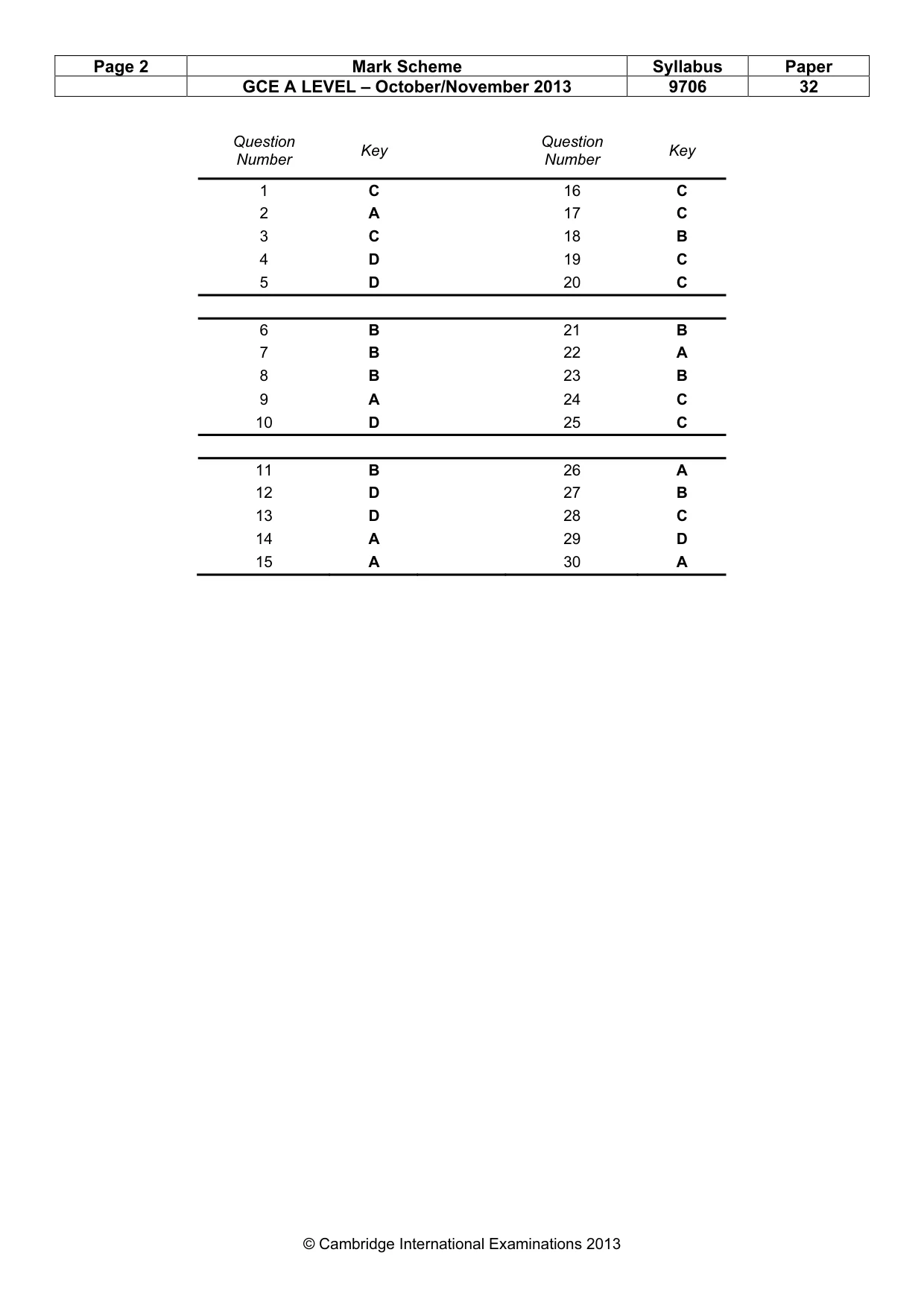
Mark scheme: C
More questions on Analysis and communication of accounting information
Q2 · A market trader has not kept any books of account
2 A market trader has not kept any books of account. Which formula should be used to establish his profit or loss for the year? A net assets at end of year – net assets at start of year – new capital + drawings B net assets at end of year – net assets at start of year + new capital – drawings C net assets at start of year – net assets at end of year – new capital + drawings D net assets at start of year – net assets at end of year + new capital – drawings
Mark scheme: A
Q3 · A company transfers manufactured items from factory to warehouse at cost plus 10%
3 A company transfers manufactured items from factory to warehouse at cost plus 10%. This year the transfer value was $93 500 and at the end of the year the closing inventory was 20% of the year’s production. How will the inventory of finished goods be shown? statement of trading account financial position $ $ A 17 000 17 000 B 18 700 16 830 C 18 700 17 000 D 18 700 18 700
Mark scheme: C
Q4 · Which list contains only items that appear in the equity section of the statement of…
4 Which list contains only items that appear in the equity section of the statement of financial position? A share capital, retained earnings and long-term loans B share capital, share premium and long-term loans C share premium, retained earnings and debentures D share premium, share capital and retained earnings
Mark scheme: D
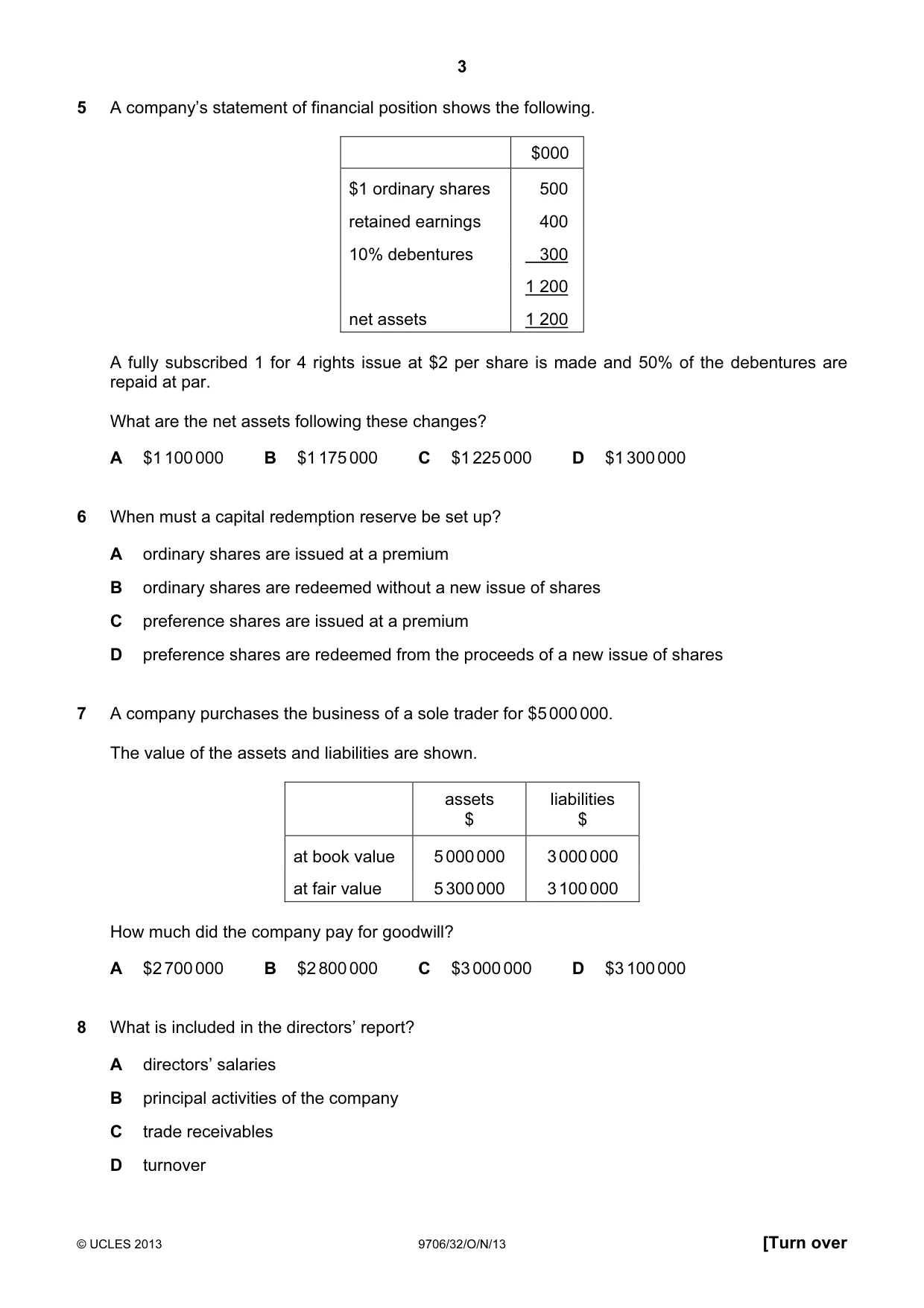
Q5 · A company’s statement of financial position shows the following
5 A company’s statement of financial position shows the following. $000 $1 ordinary shares 500 retained earnings 400 10% debentures 300 1 200 net assets 1 200 A fully subscribed 1 for 4 rights issue at $2 per share is made and 50% of the debentures are repaid at par. What are the net assets following these changes? A $1 100 000 B $1 175 000 C $1 225 000 D $1 300 000
Mark scheme: D
Q6 · When must a capital redemption reserve be set up?
6 When must a capital redemption reserve be set up? A ordinary shares are issued at a premium B ordinary shares are redeemed without a new issue of shares C preference shares are issued at a premium D preference shares are redeemed from the proceeds of a new issue of shares
Mark scheme: B
Q7 · A company purchases the business of a sole trader for $5 000 000
7 A company purchases the business of a sole trader for $5 000 000. The value of the assets and liabilities are shown. assets liabilities $ $ at book value 5 000 000 3 000 000 at fair value 5 300 000 3 100 000 How much did the company pay for goodwill? A $2 700 000 B $2 800 000 C $3 000 000 D $3 100 000
Mark scheme: B
Q8 · What is included in the directors’ report?
8 What is included in the directors’ report? A directors’ salaries B principal activities of the company C trade receivables D turnover
Mark scheme: B
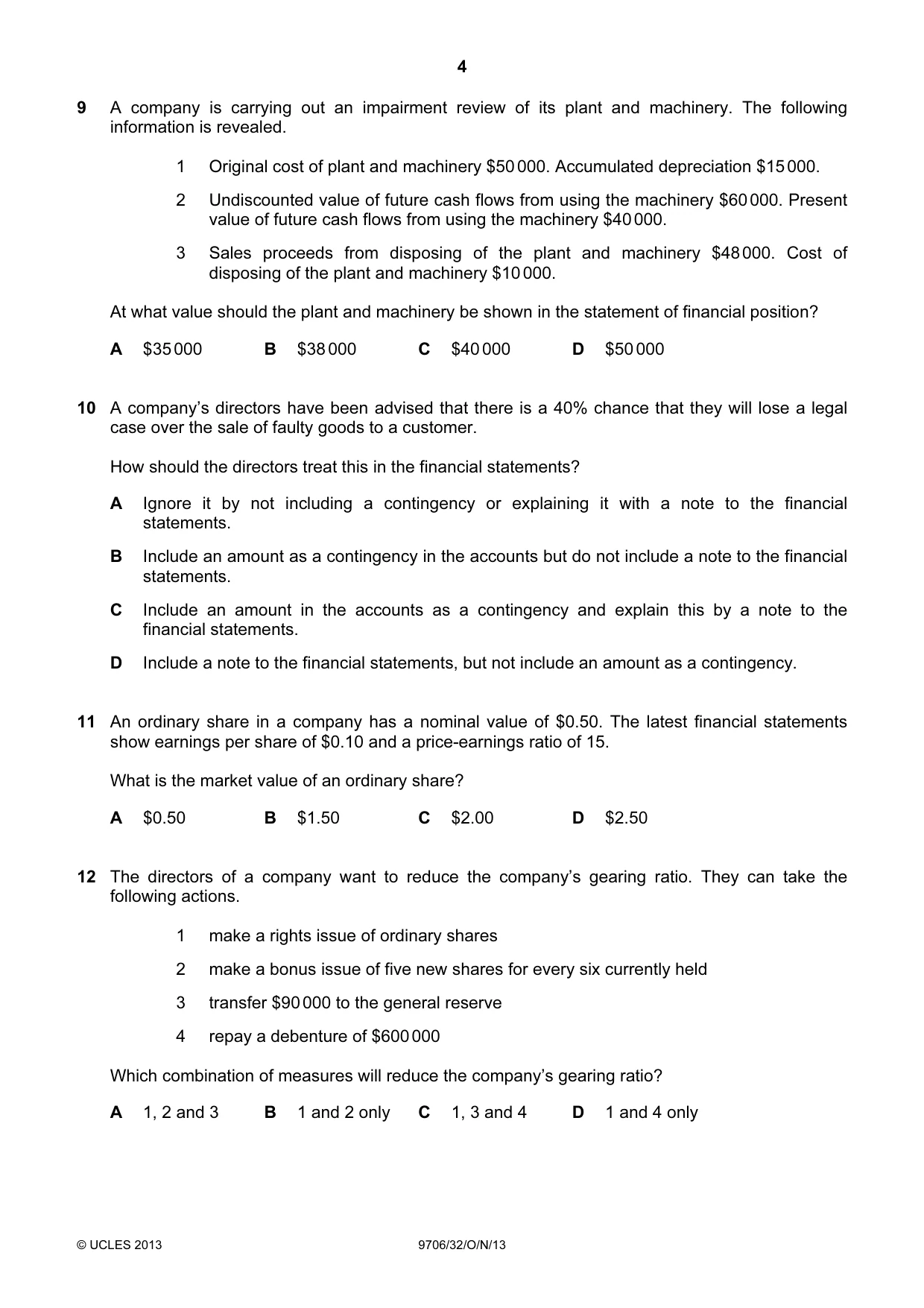
Q9 · A company is carrying out an impairment review of its plant and machinery
9 A company is carrying out an impairment review of its plant and machinery. The following information is revealed. 1 Original cost of plant and machinery $50 000. Accumulated depreciation $15 000. 2 Undiscounted value of future cash flows from using the machinery $60 000. Present value of future cash flows from using the machinery $40 000. 3 Sales proceeds from disposing of the plant and machinery $48 000. Cost of disposing of the plant and machinery $10 000. At what value should the plant and machinery be shown in the statement of financial position? A $35 000 B $38 000 C $40 000 D $50 000
Mark scheme: A
Q10 · A company’s directors have been advised that there is a 40% chance that they will lose a…
10 A company’s directors have been advised that there is a 40% chance that they will lose a legal case over the sale of faulty goods to a customer. How should the directors treat this in the financial statements? A Ignore it by not including a contingency or explaining it with a note to the financial statements. B Include an amount as a contingency in the accounts but do not include a note to the financial statements. C Include an amount in the accounts as a contingency and explain this by a note to the financial statements. D Include a note to the financial statements, but not include an amount as a contingency.
Mark scheme: D
Q11 · An ordinary share in a company has a nominal value of $0.50
11 An ordinary share in a company has a nominal value of $0.50. The latest financial statements show earnings per share of $0.10 and a price-earnings ratio of 15. What is the market value of an ordinary share? A $0.50 B $1.50 C $2.00 D $2.50
Mark scheme: B
More questions on Analysis and communication of accounting information
Q12 · The directors of a company want to reduce the company’s gearing ratio
12 The directors of a company want to reduce the company’s gearing ratio. They can take the following actions. 1 make a rights issue of ordinary shares 2 make a bonus issue of five new shares for every six currently held 3 transfer $90 000 to the general reserve 4 repay a debenture of $600 000 Which combination of measures will reduce the company’s gearing ratio? A 1, 2 and 3 B 1 and 2 only C 1, 3 and 4 D 1 and 4 only
Mark scheme: D
More questions on Analysis and communication of accounting information
Q13 · A business experienced the following events during the year
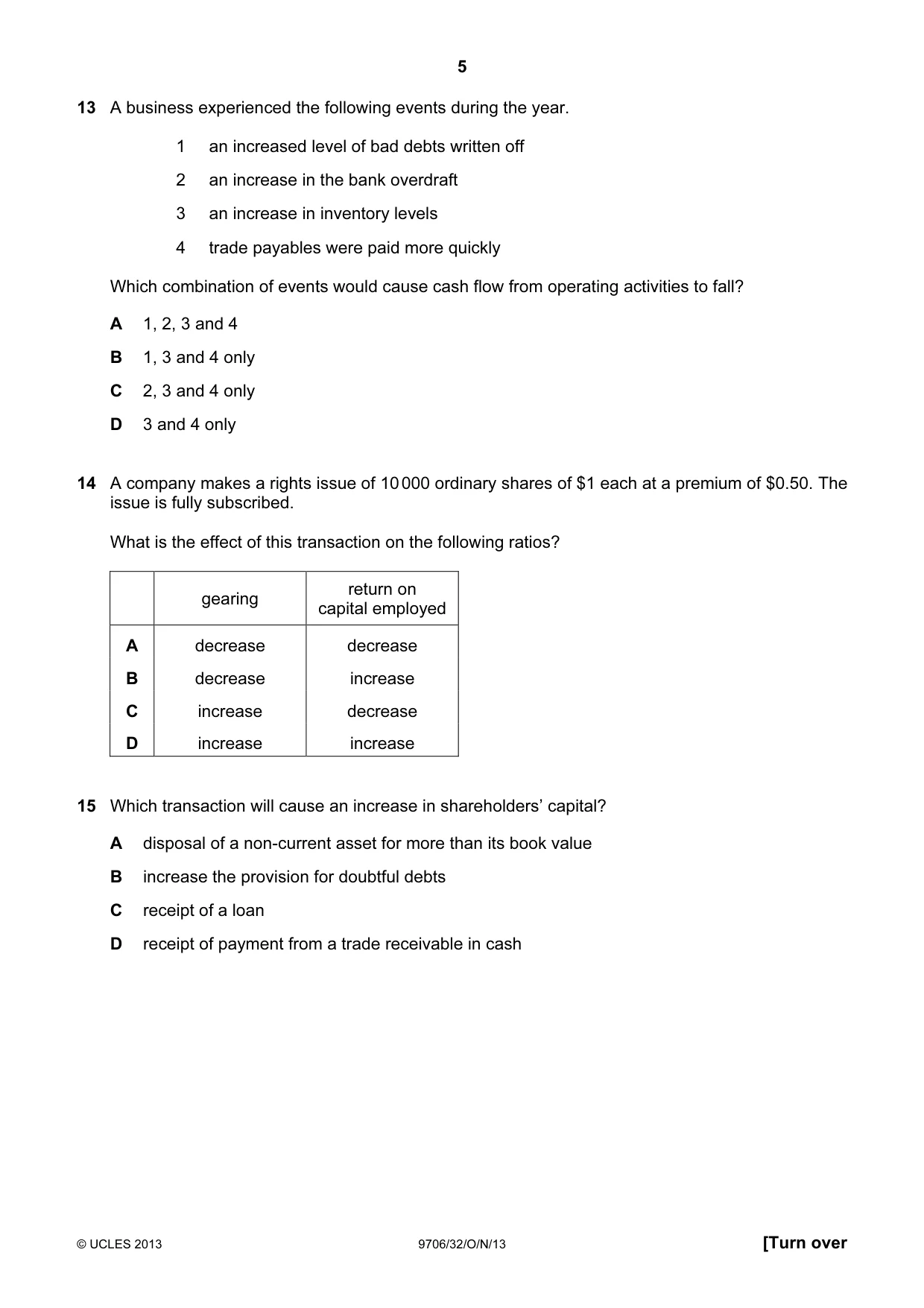
13 A business experienced the following events during the year. 1 an increased level of bad debts written off 2 an increase in the bank overdraft 3 an increase in inventory levels 4 trade payables were paid more quickly Which combination of events would cause cash flow from operating activities to fall? A 1, 2, 3 and 4 B 1, 3 and 4 only C 2, 3 and 4 only D 3 and 4 only
Mark scheme: D
More questions on Analysis and communication of accounting information
Q14 · A company makes a rights issue of 10 000 ordinary shares of $1 each at a premium of $0.50
14 A company makes a rights issue of 10 000 ordinary shares of $1 each at a premium of $0.50. The issue is fully subscribed. What is the effect of this transaction on the following ratios? return on gearing capital employed A decrease decrease B decrease increase C increase decrease D increase increase
Mark scheme: A
More questions on Analysis and communication of accounting information
Q15 · Which transaction will cause an increase in shareholders’ capital?
15 Which transaction will cause an increase in shareholders’ capital? A disposal of a non-current asset for more than its book value B increase the provision for doubtful debts C receipt of a loan D receipt of payment from a trade receivable in cash
Mark scheme: A
Q16 · The net assets of X Limited are shown below
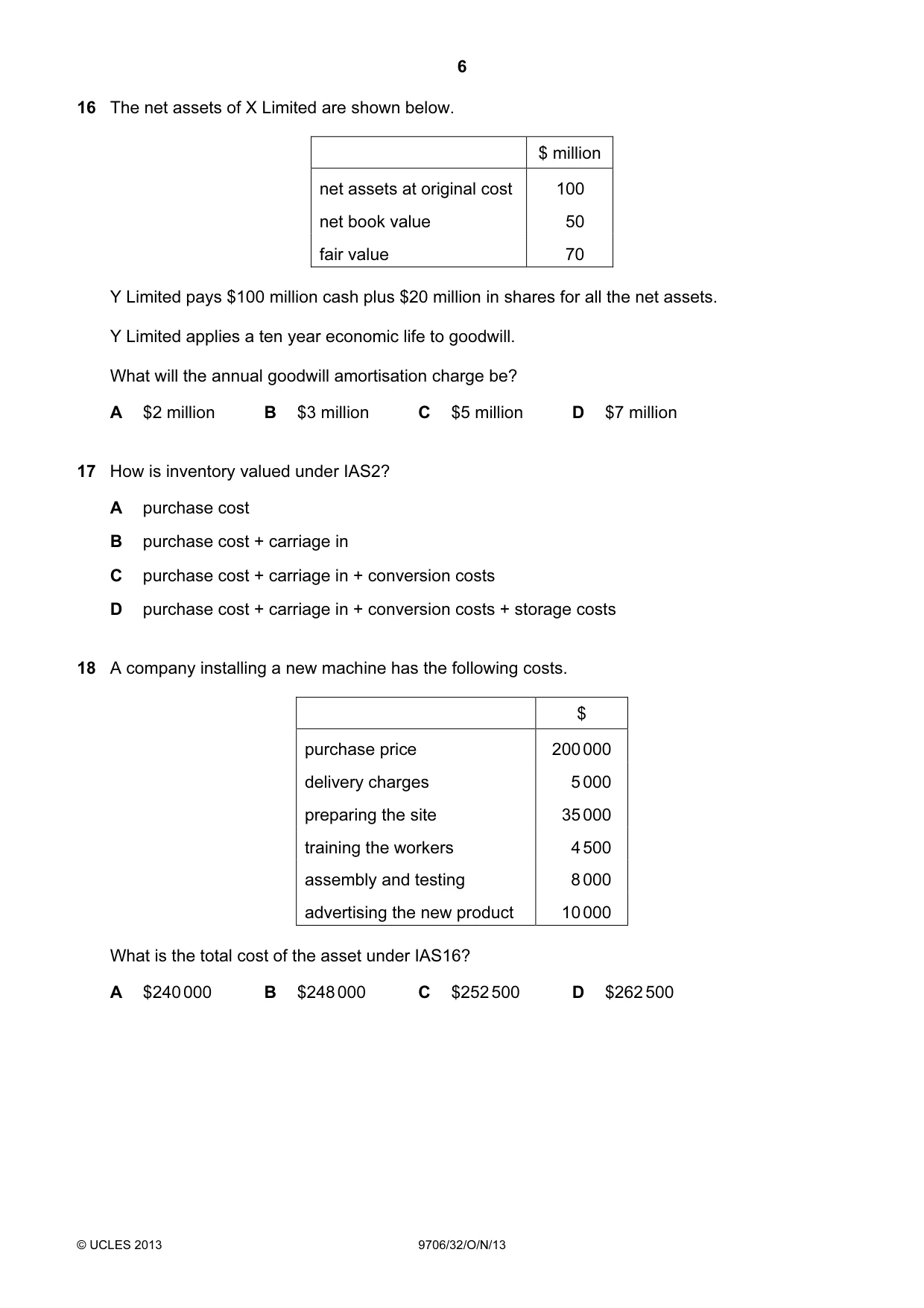
16 The net assets of X Limited are shown below. $ million net assets at original cost 100 net book value 50 fair value 70 Y Limited pays $100 million cash plus $20 million in shares for all the net assets. Y Limited applies a ten year economic life to goodwill. What will the annual goodwill amortisation charge be? A $2 million B $3 million C $5 million D $7 million
Mark scheme: C
Q17 · How is inventory valued under IAS2?
17 How is inventory valued under IAS2? A purchase cost B purchase cost + carriage in C purchase cost + carriage in + conversion costs D purchase cost + carriage in + conversion costs + storage costs
Mark scheme: C
Q18 · A company installing a new machine has the following costs
18 A company installing a new machine has the following costs. $ purchase price 200 000 delivery charges 5 000 preparing the site 35 000 training the workers 4 500 assembly and testing 8 000 advertising the new product 10 000 What is the total cost of the asset under IAS16? A $240 000 B $248 000 C $252 500 D $262 500
Mark scheme: B
Q19 · A company produces a product using a single process
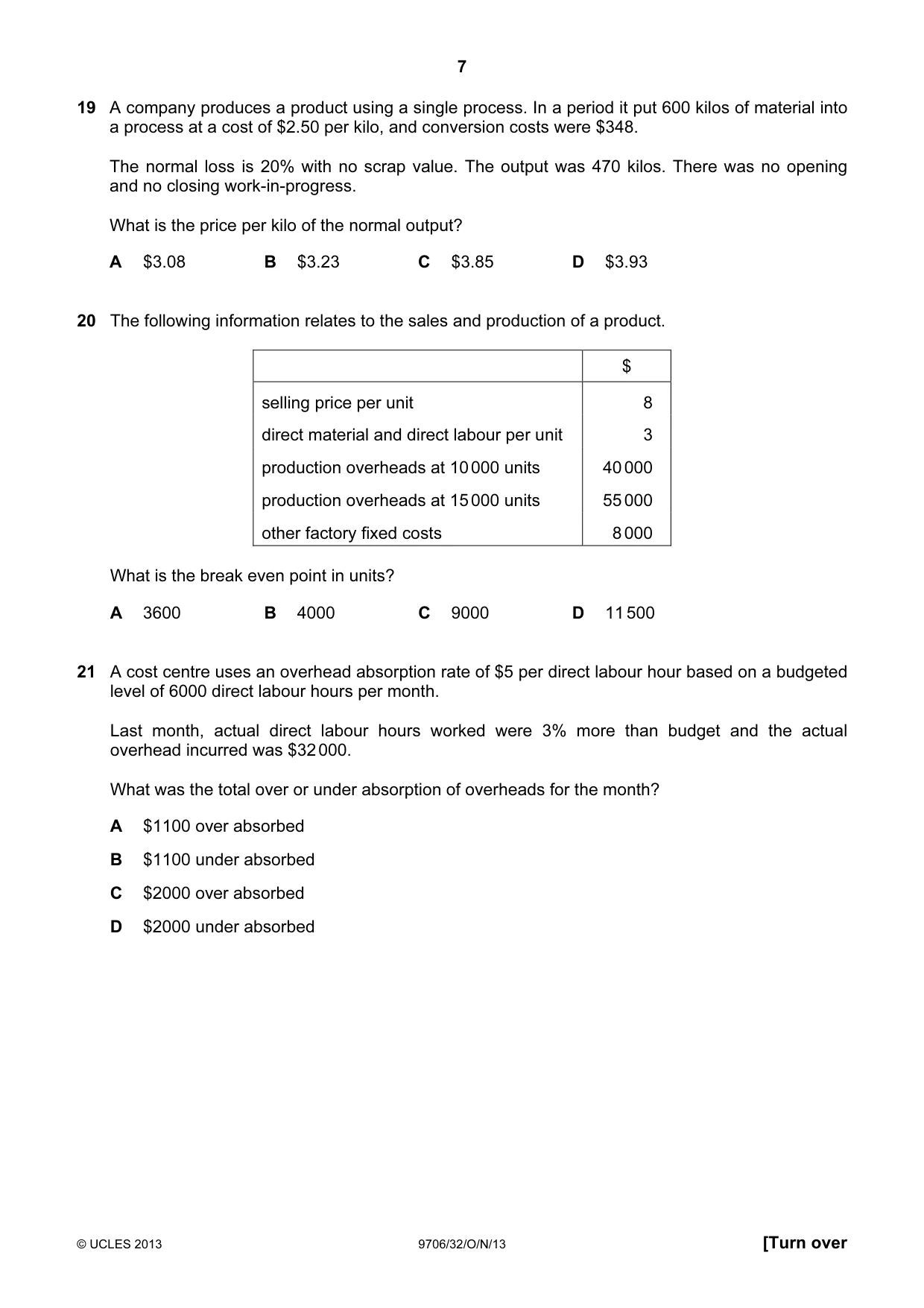
19 A company produces a product using a single process. In a period it put 600 kilos of material into a process at a cost of $2.50 per kilo, and conversion costs were $348. The normal loss is 20% with no scrap value. The output was 470 kilos. There was no opening and no closing work-in-progress. What is the price per kilo of the normal output? A $3.08 B $3.23 C $3.85 D $3.93
Mark scheme: C
Q20 · The following information relates to the sales and production of a product
20 The following information relates to the sales and production of a product. $ selling price per unit 8 direct material and direct labour per unit 3 production overheads at 10 000 units 40 000 production overheads at 15 000 units 55 000 other factory fixed costs 8 000 What is the break even point in units? A 3600 B 4000 C 9000 D 11 500
Mark scheme: C
Q21 · A cost centre uses an overhead absorption rate of $5 per direct labour hour based on a…
21 A cost centre uses an overhead absorption rate of $5 per direct labour hour based on a budgeted level of 6000 direct labour hours per month. Last month, actual direct labour hours worked were 3% more than budget and the actual overhead incurred was $32 000. What was the total over or under absorption of overheads for the month? A $1100 over absorbed B $1100 under absorbed C $2000 over absorbed D $2000 under absorbed
Mark scheme: B
Q22 · The following information is provided by a business
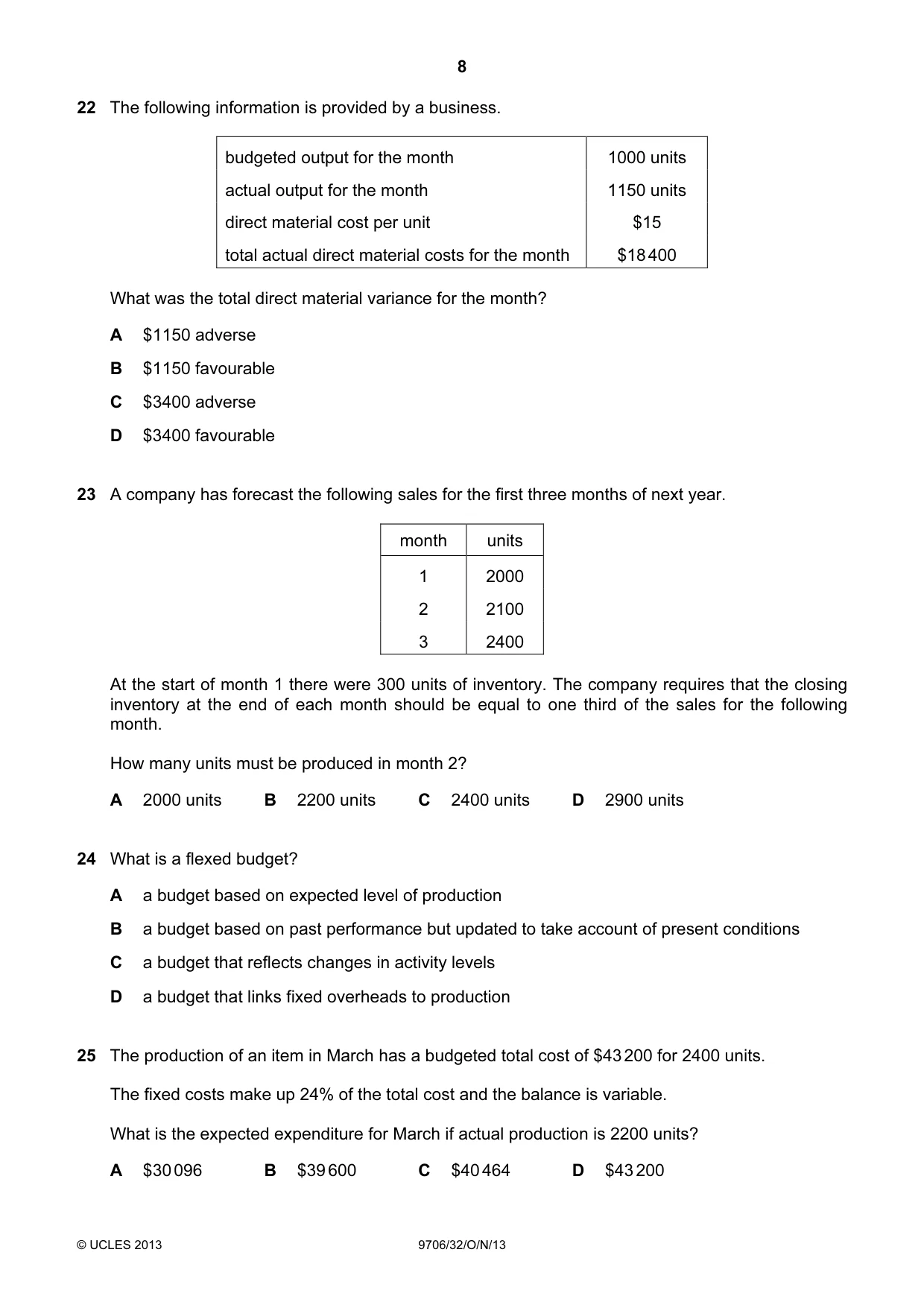
22 The following information is provided by a business. budgeted output for the month 1000 units actual output for the month 1150 units direct material cost per unit $15 total actual direct material costs for the month $18 400 What was the total direct material variance for the month? A $1150 adverse B $1150 favourable C $3400 adverse D $3400 favourable
Mark scheme: A
Q23 · A company has forecast the following sales for the first three months of next year
23 A company has forecast the following sales for the first three months of next year. month units 1 2000 2 2100 3 2400 At the start of month 1 there were 300 units of inventory. The company requires that the closing inventory at the end of each month should be equal to one third of the sales for the following month. How many units must be produced in month 2? A 2000 units B 2200 units C 2400 units D 2900 units
Mark scheme: B
Q24 · What is a flexed budget?
24 What is a flexed budget? A a budget based on expected level of production B a budget based on past performance but updated to take account of present conditions C a budget that reflects changes in activity levels D a budget that links fixed overheads to production
Mark scheme: C
Q25 · The production of an item in March has a budgeted total cost of $43 200 for 2400 units
25 The production of an item in March has a budgeted total cost of $43 200 for 2400 units. The fixed costs make up 24% of the total cost and the balance is variable. What is the expected expenditure for March if actual production is 2200 units? A $30 096 B $39 600 C $40 464 D $43 200
Mark scheme: C
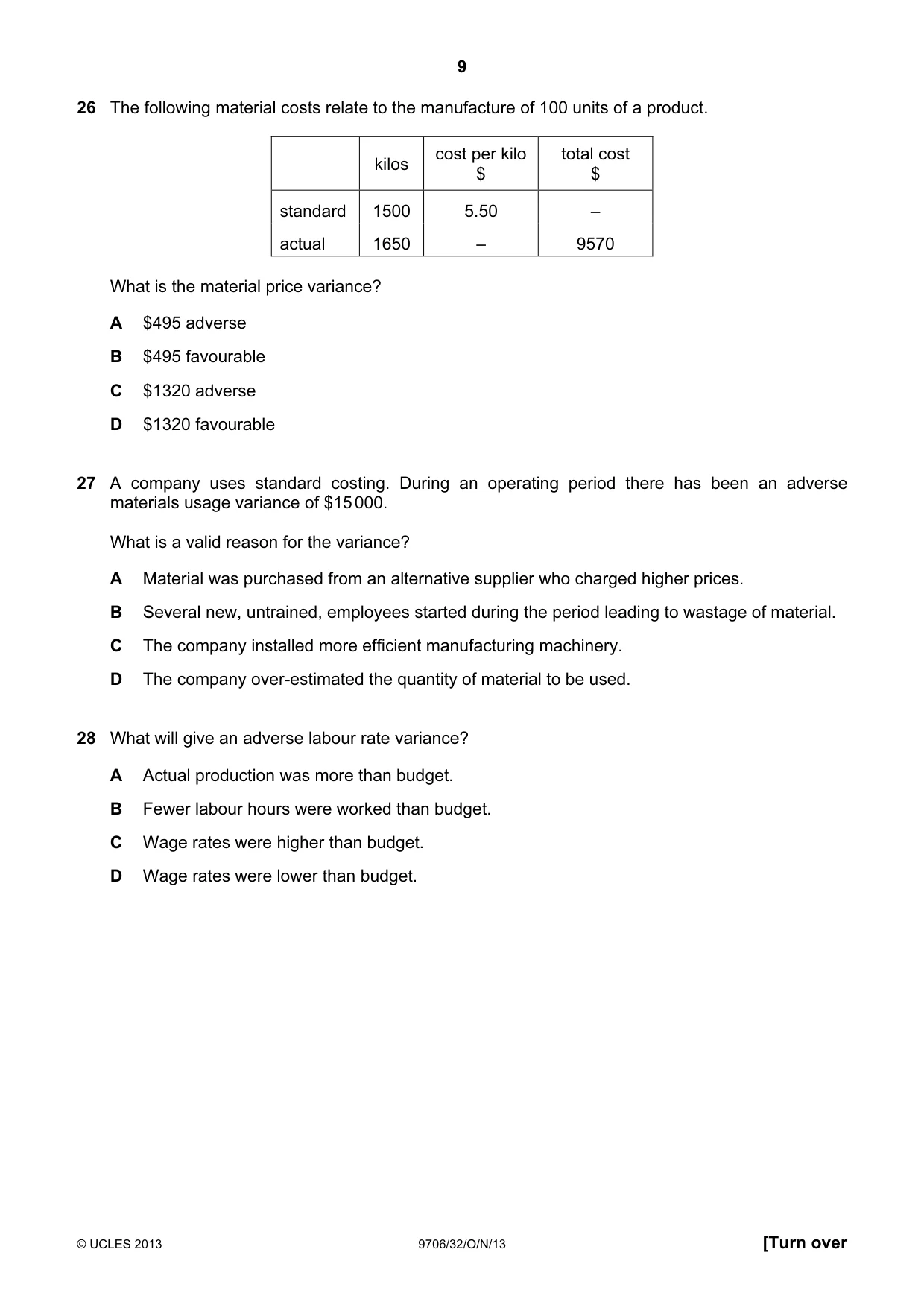
Q26 · The following material costs relate to the manufacture of 100 units of a product
26 The following material costs relate to the manufacture of 100 units of a product. cost per kilo total cost kilos $ $ standard 1500 5.50 – actual 1650 – 9570 What is the material price variance? A $495 adverse B $495 favourable C $1320 adverse D $1320 favourable
Mark scheme: A
Q27 · A company uses standard costing
27 A company uses standard costing. During an operating period there has been an adverse materials usage variance of $15 000. What is a valid reason for the variance? A Material was purchased from an alternative supplier who charged higher prices. B Several new, untrained, employees started during the period leading to wastage of material. C The company installed more efficient manufacturing machinery. D The company over-estimated the quantity of material to be used.
Mark scheme: B
Q28 · What will give an adverse labour rate variance?
28 What will give an adverse labour rate variance? A Actual production was more than budget. B Fewer labour hours were worked than budget. C Wage rates were higher than budget. D Wage rates were lower than budget.
Mark scheme: C
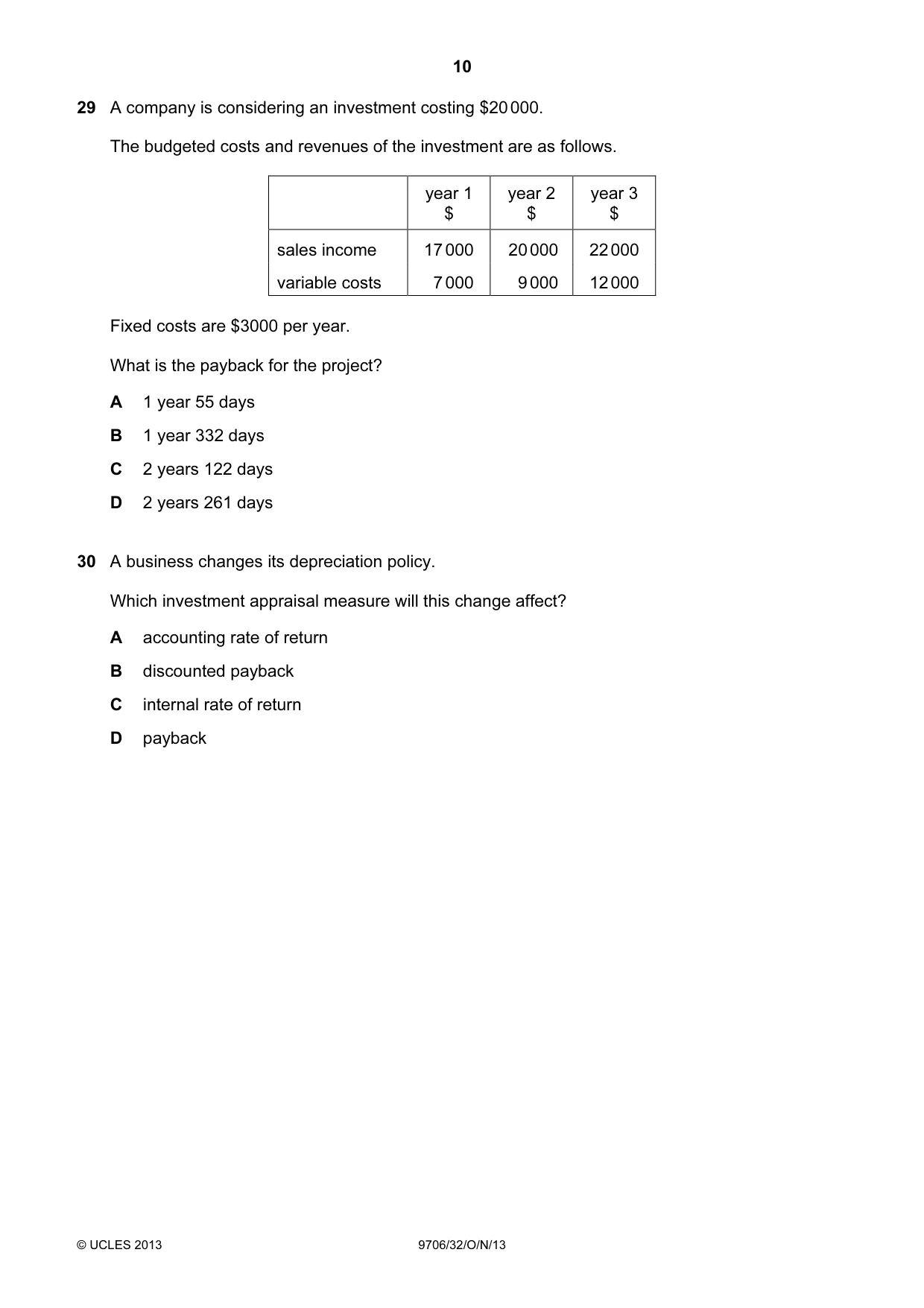
Q29 · A company is considering an investment costing $20 000
29 A company is considering an investment costing $20 000. The budgeted costs and revenues of the investment are as follows. year 1 year 2 year 3 $ $ $ sales income 17 000 20 000 22 000 variable costs 7 000 9 000 12 000 Fixed costs are $3000 per year. What is the payback for the project? A 1 year 55 days B 1 year 332 days C 2 years 122 days D 2 years 261 days
Mark scheme: D
Q30 · A business changes its depreciation policy
30 A business changes its depreciation policy. Which investment appraisal measure will this change affect? A accounting rate of return B discounted payback C internal rate of return D payback
Mark scheme: A
What was in this paper
The subtopics covered by these 30 questions, and how many questions each got. Open one in a new tab to see every Cambridge question on it.
5Preparation of financial statements5Standard costing4Budgeting and budgetary control3Business acquisition and merger2Investment appraisal2Preparation of financial statements2Regulatory and ethical considerations2Traditional costing methods2Accounting for non-current assets1Costs and cost behaviour1Reconciliation and verification1What you needed in this session
Cambridge’s own grade thresholds for 2013 Oct/Nov, Paper 3 · Variant 2. A higher threshold means an easier paper — the bar moves with how the cohort did.