Cambridge A Level Accounting 9706 — 2014 May/June Paper 3 · Variant 3
9706/33/M/J/14 · 30 questions · 30 marks · ≈34 min
The question paper and its mark scheme, free to read here and free to download. This is Cambridge’s own paper, exactly as it was sat.
Question paper12 pages
Mark scheme2 pages
Answers below. Sit the paper first if you are practising.
Questions as text
Q1 · The totals of the trial balance for a business were $536 300 debit and $519 800 credit
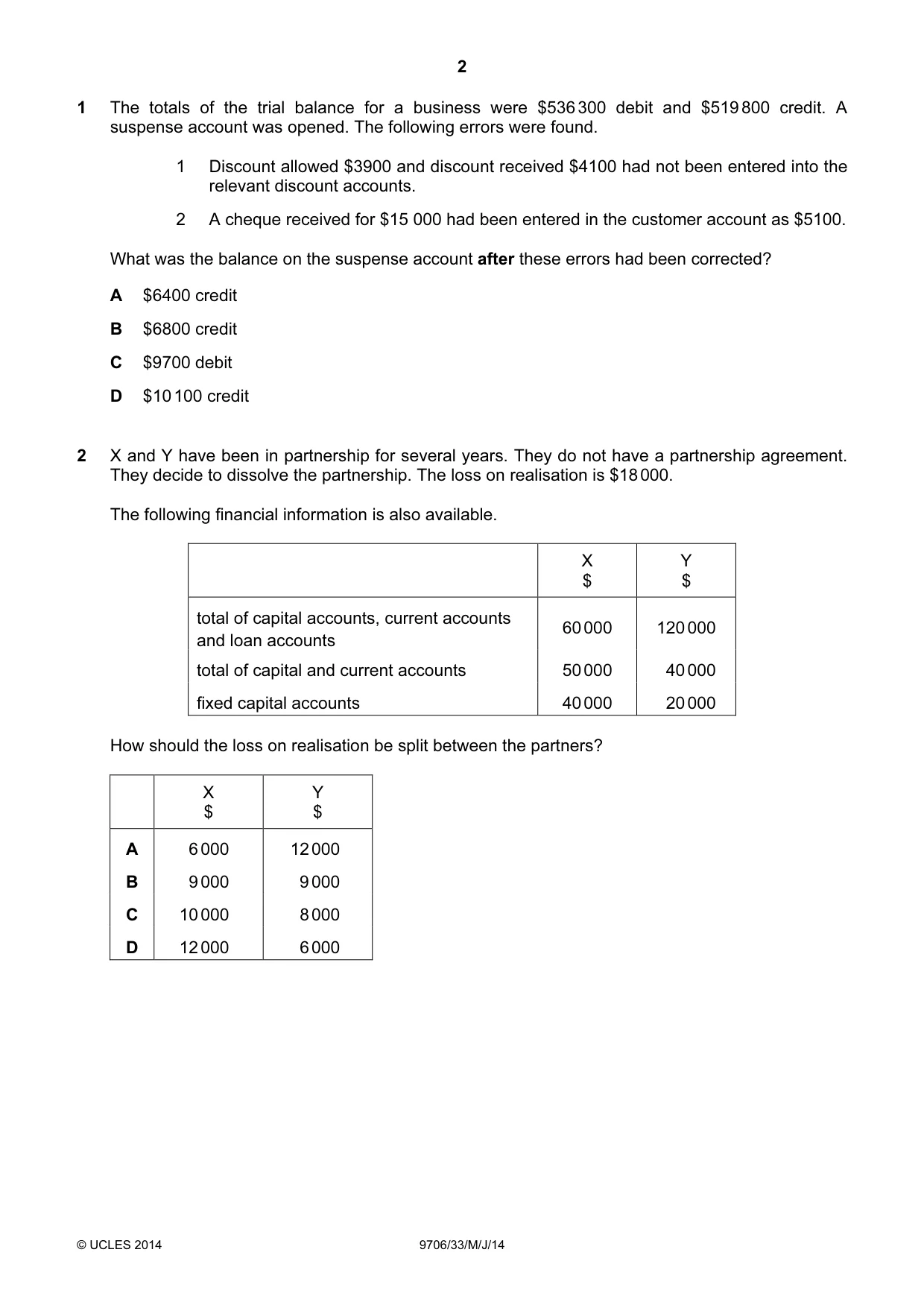
1 The totals of the trial balance for a business were $536 300 debit and $519 800 credit. A suspense account was opened. The following errors were found. 1 Discount allowed $3900 and discount received $4100 had not been entered into the relevant discount accounts. 2 A cheque received for $15 000 had been entered in the customer account as $5100. What was the balance on the suspense account after these errors had been corrected? A $6400 credit B $6800 credit C $9700 debit D $10 100 credit
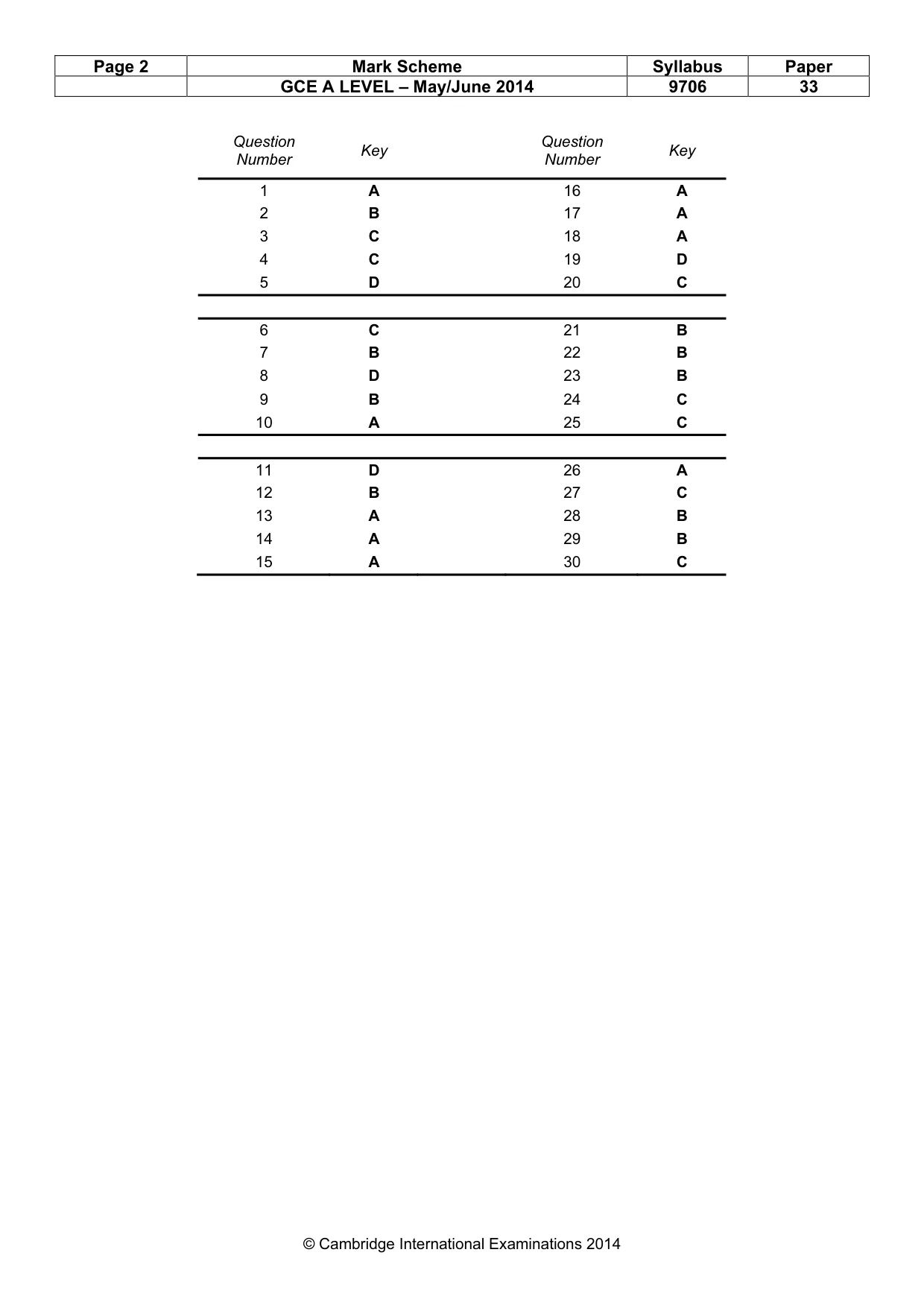
Mark scheme: A
Q2 · X and Y have been in partnership for several years
2 X and Y have been in partnership for several years. They do not have a partnership agreement. They decide to dissolve the partnership. The loss on realisation is $18 000. The following financial information is also available. X Y $ $ total of capital accounts, current accounts 60 000 120 000 and loan accounts total of capital and current accounts 50 000 40 000 fixed capital accounts 40 000 20 000 How should the loss on realisation be split between the partners? X Y $ $ A 6 000 12 000 B 9 000 9 000 C 10 000 8 000 D 12 000 6 000
Mark scheme: B
Q3 · A manufacturing company transfers its products from factory to warehouse at cost of…
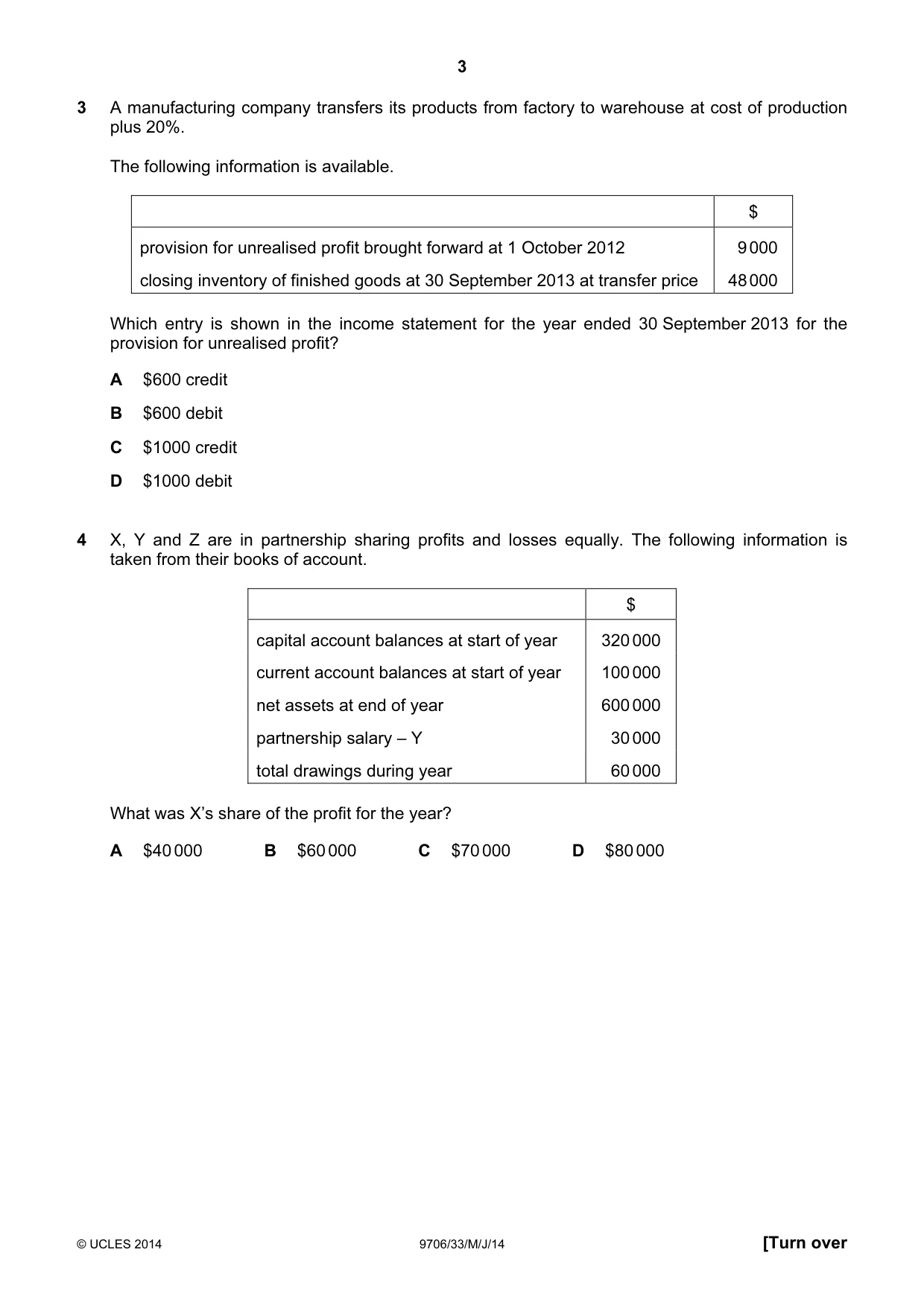
3 A manufacturing company transfers its products from factory to warehouse at cost of production plus 20%. The following information is available. $ provision for unrealised profit brought forward at 1 October 2012 9 000 closing inventory of finished goods at 30 September 2013 at transfer price 48 000 Which entry is shown in the income statement for the year ended 30 September 2013 for the provision for unrealised profit? A $600 credit B $600 debit C $1000 credit D $1000 debit
Mark scheme: C
Q4 · X, Y and Z are in partnership sharing profits and losses equally
4 X, Y and Z are in partnership sharing profits and losses equally. The following information is taken from their books of account. $ capital account balances at start of year 320 000 current account balances at start of year 100 000 net assets at end of year 600 000 partnership salary – Y 30 000 total drawings during year 60 000 What was X’s share of the profit for the year? A $40 000 B $60 000 C $70 000 D $80 000
Mark scheme: C
Q5 · X and Y are business partners sharing profits equally
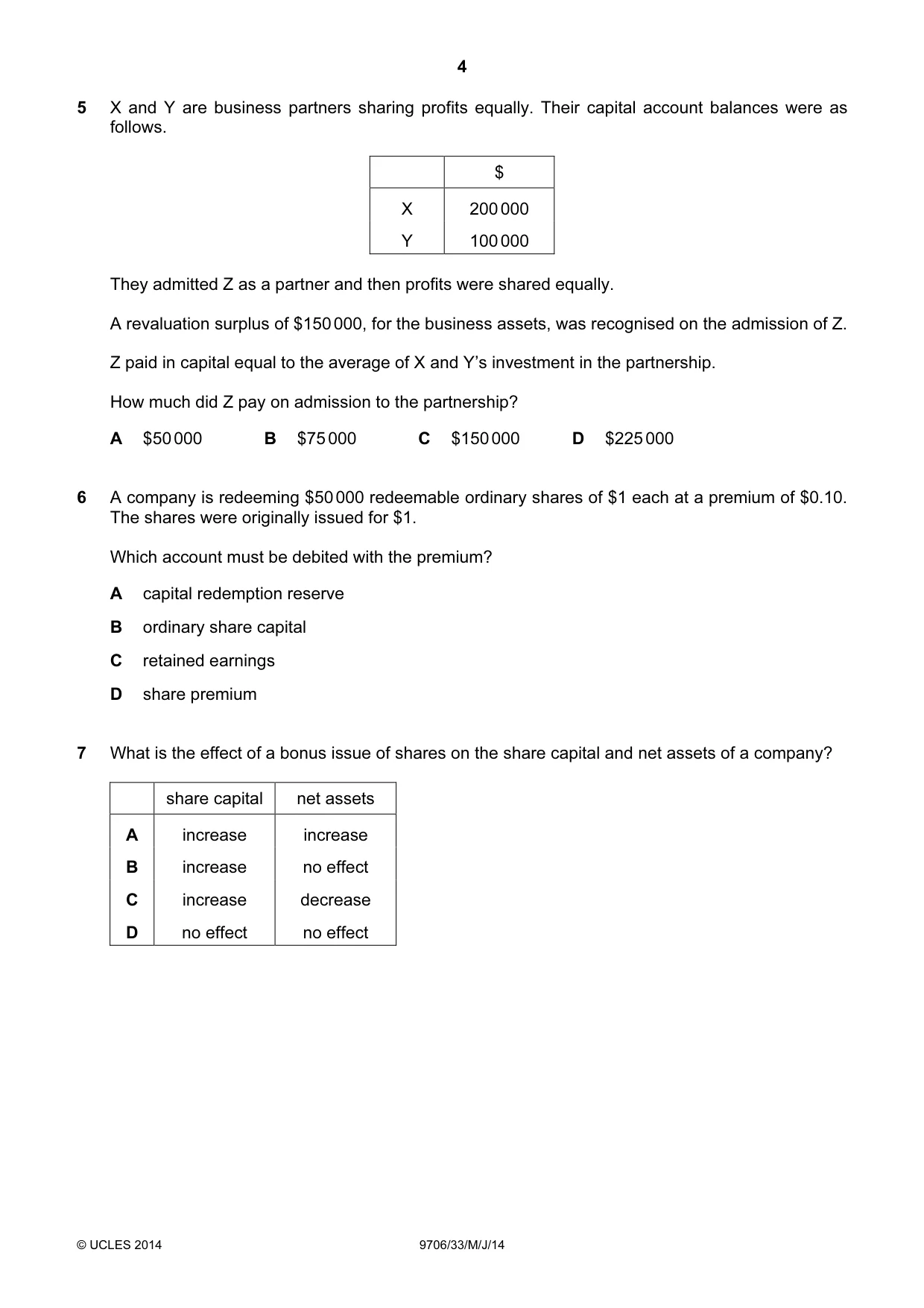
5 X and Y are business partners sharing profits equally. Their capital account balances were as follows. $ X 200 000 Y 100 000 They admitted Z as a partner and then profits were shared equally. A revaluation surplus of $150 000, for the business assets, was recognised on the admission of Z. Z paid in capital equal to the average of X and Y’s investment in the partnership. How much did Z pay on admission to the partnership? A $50 000 B $75 000 C $150 000 D $225 000
Mark scheme: D
Q6 · A company is redeeming $50 000 redeemable ordinary shares of $1 each at a premium of $0.10
6 A company is redeeming $50 000 redeemable ordinary shares of $1 each at a premium of $0.10. The shares were originally issued for $1. Which account must be debited with the premium? A capital redemption reserve B ordinary share capital C retained earnings D share premium
Mark scheme: C
Q7 · What is the effect of a bonus issue of shares on the share capital and net assets of a…
7 What is the effect of a bonus issue of shares on the share capital and net assets of a company? share capital net assets A increase increase B increase no effect C increase decrease D no effect no effect
Mark scheme: B
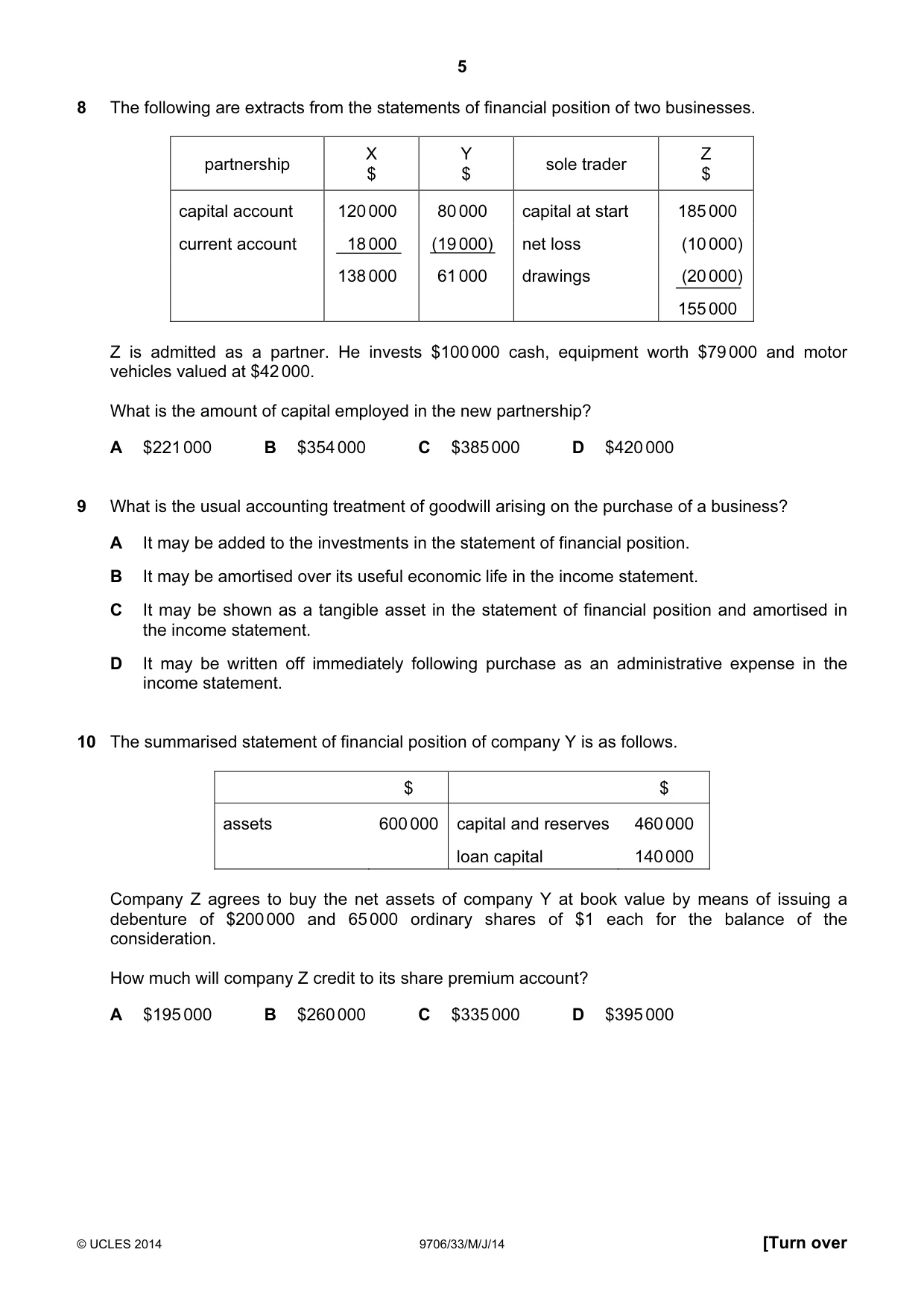
Q8 · The following are extracts from the statements of financial position of two businesses
8 The following are extracts from the statements of financial position of two businesses. X Y Z partnership sole trader $ $ $ capital account 120 000 80 000 capital at start 185 000 current account 18 000 (19 000) net loss (10 000) 138 000 61 000 drawings (20 000) 155 000 Z is admitted as a partner. He invests $100 000 cash, equipment worth $79 000 and motor vehicles valued at $42 000. What is the amount of capital employed in the new partnership? A $221 000 B $354 000 C $385 000 D $420 000
Mark scheme: D
Q9 · What is the usual accounting treatment of goodwill arising on the purchase of a business?
9 What is the usual accounting treatment of goodwill arising on the purchase of a business? A It may be added to the investments in the statement of financial position. B It may be amortised over its useful economic life in the income statement. C It may be shown as a tangible asset in the statement of financial position and amortised in the income statement. D It may be written off immediately following purchase as an administrative expense in the income statement.
Mark scheme: B
Q10 · The summarised statement of financial position of company Y is as follows
10 The summarised statement of financial position of company Y is as follows. $ $ assets 600 000 capital and reserves 460 000 loan capital 140 000 Company Z agrees to buy the net assets of company Y at book value by means of issuing a debenture of $200 000 and 65 000 ordinary shares of $1 each for the balance of the consideration. How much will company Z credit to its share premium account? A $195 000 B $260 000 C $335 000 D $395 000
Mark scheme: A
Q11 · A company’s convertible loan stock will be converted into ordinary shares on 1 January…
11 A company’s convertible loan stock will be converted into ordinary shares on 1 January 2020. Where would the company show this in the statement of financial position at 31 December 2013? A current liabilities B equity C non-current assets D non-current liabilities
Mark scheme: D
Q12 · Which item appears in the statement of changes in equity?
12 Which item appears in the statement of changes in equity? A issue of a debenture B profit on revaluation C proposed dividends D repayment of long term loan
Mark scheme: B
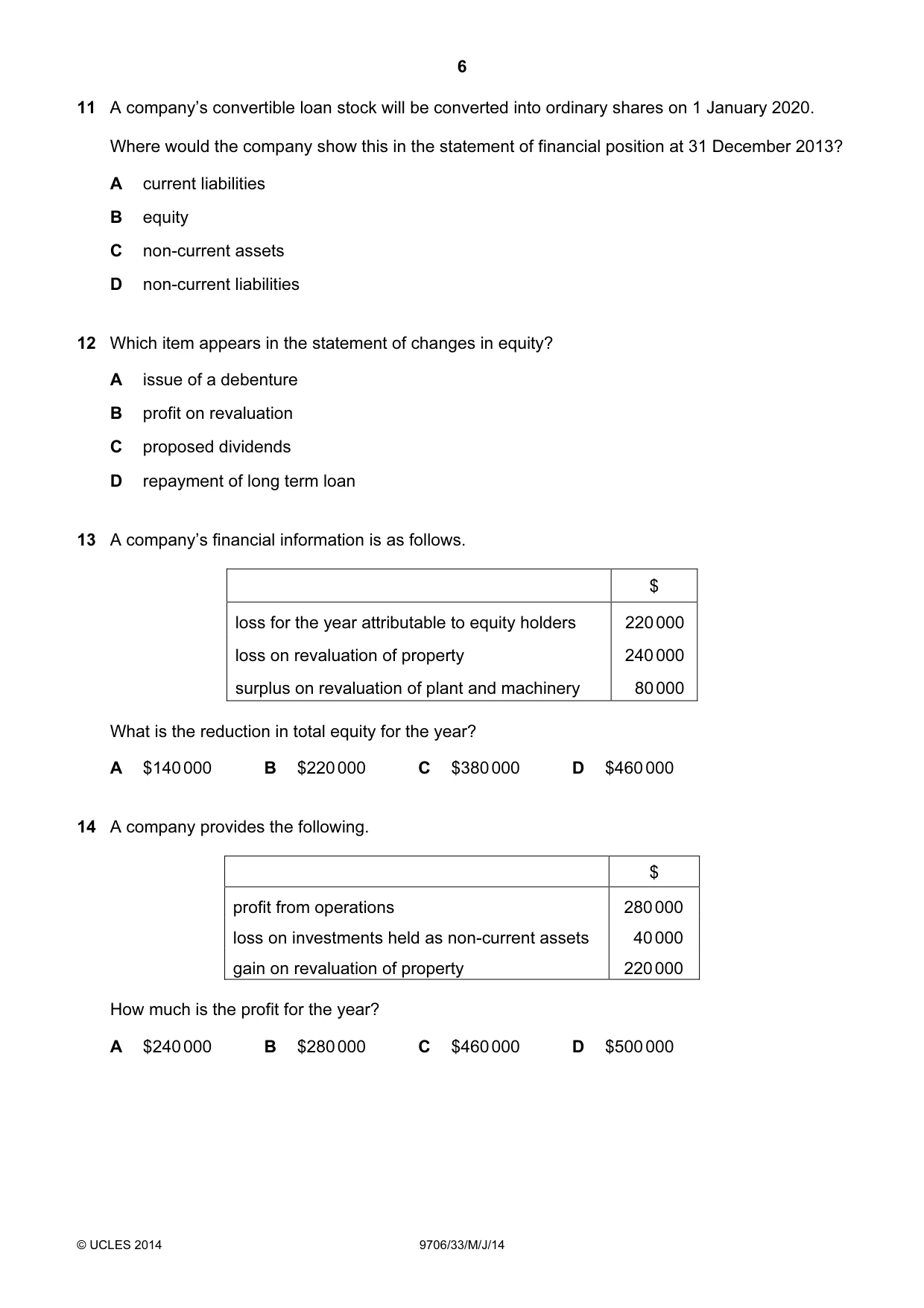
Q13 · A company’s financial information is as follows
13 A company’s financial information is as follows. $ loss for the year attributable to equity holders 220 000 loss on revaluation of property 240 000 surplus on revaluation of plant and machinery 80 000 What is the reduction in total equity for the year? A $140 000 B $220 000 C $380 000 D $460 000
Mark scheme: A
Q14 · A company provides the following
14 A company provides the following. $ profit from operations 280 000 loss on investments held as non-current assets 40 000 gain on revaluation of property 220 000 How much is the profit for the year? A $240 000 B $280 000 C $460 000 D $500 000
Mark scheme: A
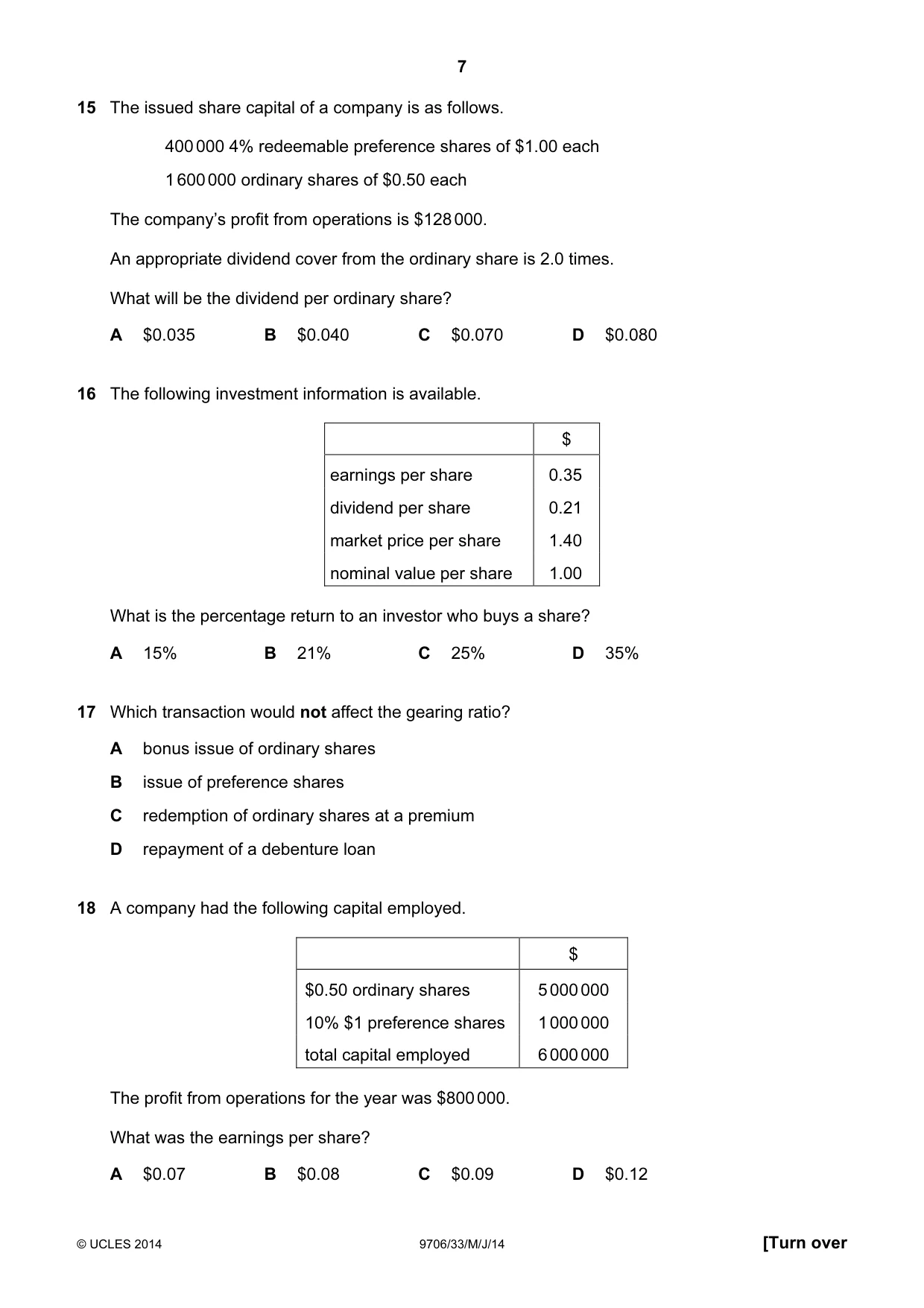
Q15 · The issued share capital of a company is as follows
15 The issued share capital of a company is as follows. 400 000 4% redeemable preference shares of $1.00 each 1 600 000 ordinary shares of $0.50 each The company’s profit from operations is $128 000. An appropriate dividend cover from the ordinary share is 2.0 times. What will be the dividend per ordinary share? A $0.035 B $0.040 C $0.070 D $0.080
Mark scheme: A
More questions on Analysis and communication of accounting information
Q16 · The following investment information is available
16 The following investment information is available. $ earnings per share 0.35 dividend per share 0.21 market price per share 1.40 nominal value per share 1.00 What is the percentage return to an investor who buys a share? A 15% B 21% C 25% D 35%
Mark scheme: A
More questions on Analysis and communication of accounting information
Q17 · Which transaction would not affect the gearing ratio?
17 Which transaction would not affect the gearing ratio? A bonus issue of ordinary shares B issue of preference shares C redemption of ordinary shares at a premium D repayment of a debenture loan
Mark scheme: A
More questions on Analysis and communication of accounting information
Q18 · A company had the following capital employed
18 A company had the following capital employed. $ $0.50 ordinary shares 5 000 000 10% $1 preference shares 1 000 000 total capital employed 6 000 000 The profit from operations for the year was $800 000. What was the earnings per share? A $0.07 B $0.08 C $0.09 D $0.12
Mark scheme: A
More questions on Analysis and communication of accounting information
Q19 · Which IAS deals with provisions, contingent assets and contingent liabilities?
19 Which IAS deals with provisions, contingent assets and contingent liabilities? A IAS1 B IAS10 C IAS36 D IAS37
Mark scheme: D
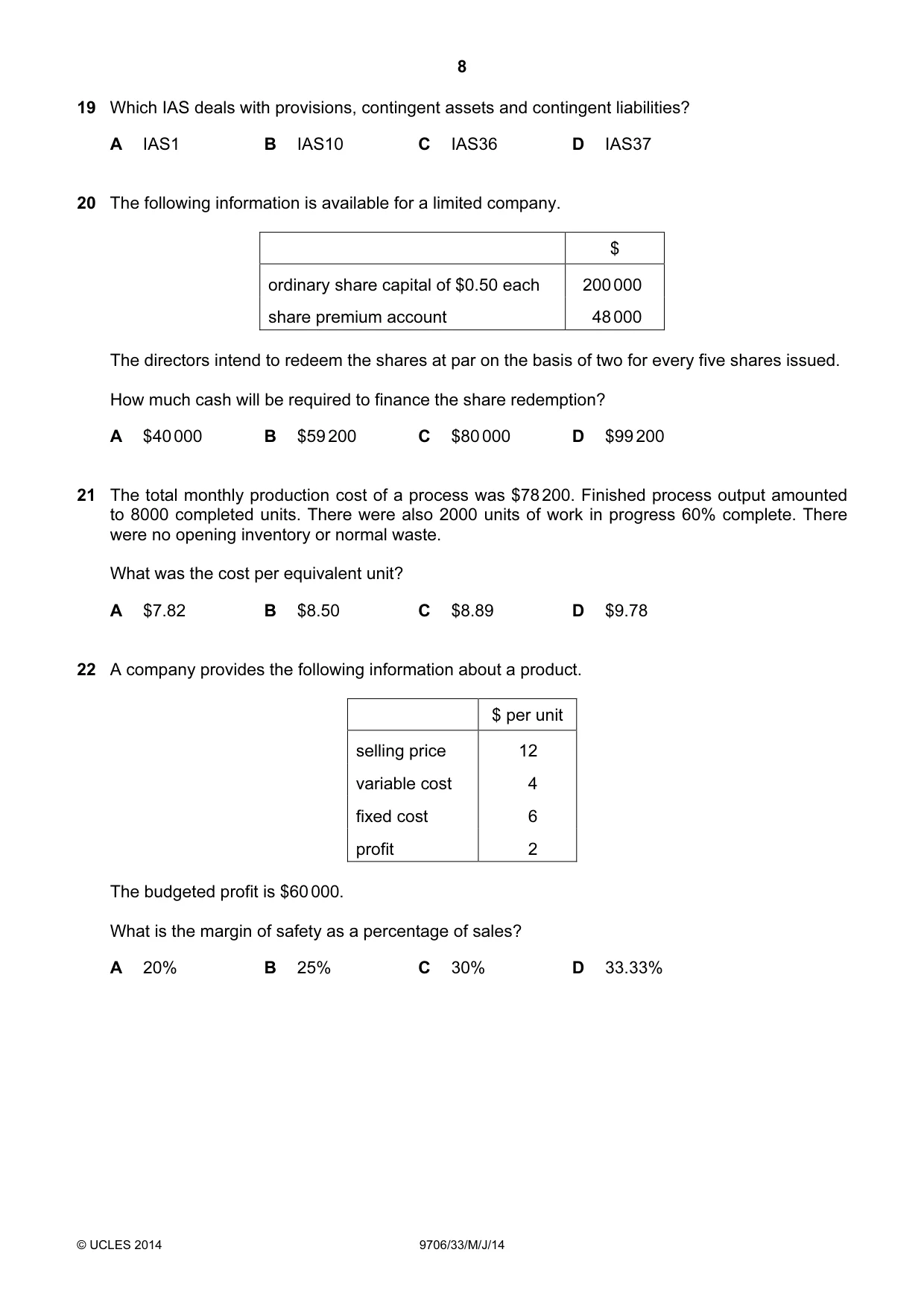
Q20 · The following information is available for a limited company
20 The following information is available for a limited company. $ ordinary share capital of $0.50 each 200 000 share premium account 48 000 The directors intend to redeem the shares at par on the basis of two for every five shares issued. How much cash will be required to finance the share redemption? A $40 000 B $59 200 C $80 000 D $99 200
Mark scheme: C
Q21 · The total monthly production cost of a process was $78 200
21 The total monthly production cost of a process was $78 200. Finished process output amounted to 8000 completed units. There were also 2000 units of work in progress 60% complete. There were no opening inventory or normal waste. What was the cost per equivalent unit? A $7.82 B $8.50 C $8.89 D $9.78
Mark scheme: B
Q22 · A company provides the following information about a product
22 A company provides the following information about a product. $ per unit selling price 12 variable cost 4 fixed cost 6 profit 2 The budgeted profit is $60 000. What is the margin of safety as a percentage of sales? A 20% B 25% C 30% D 33.33%
Mark scheme: B
Q23 · The following data relates to a manufacturing company for a month
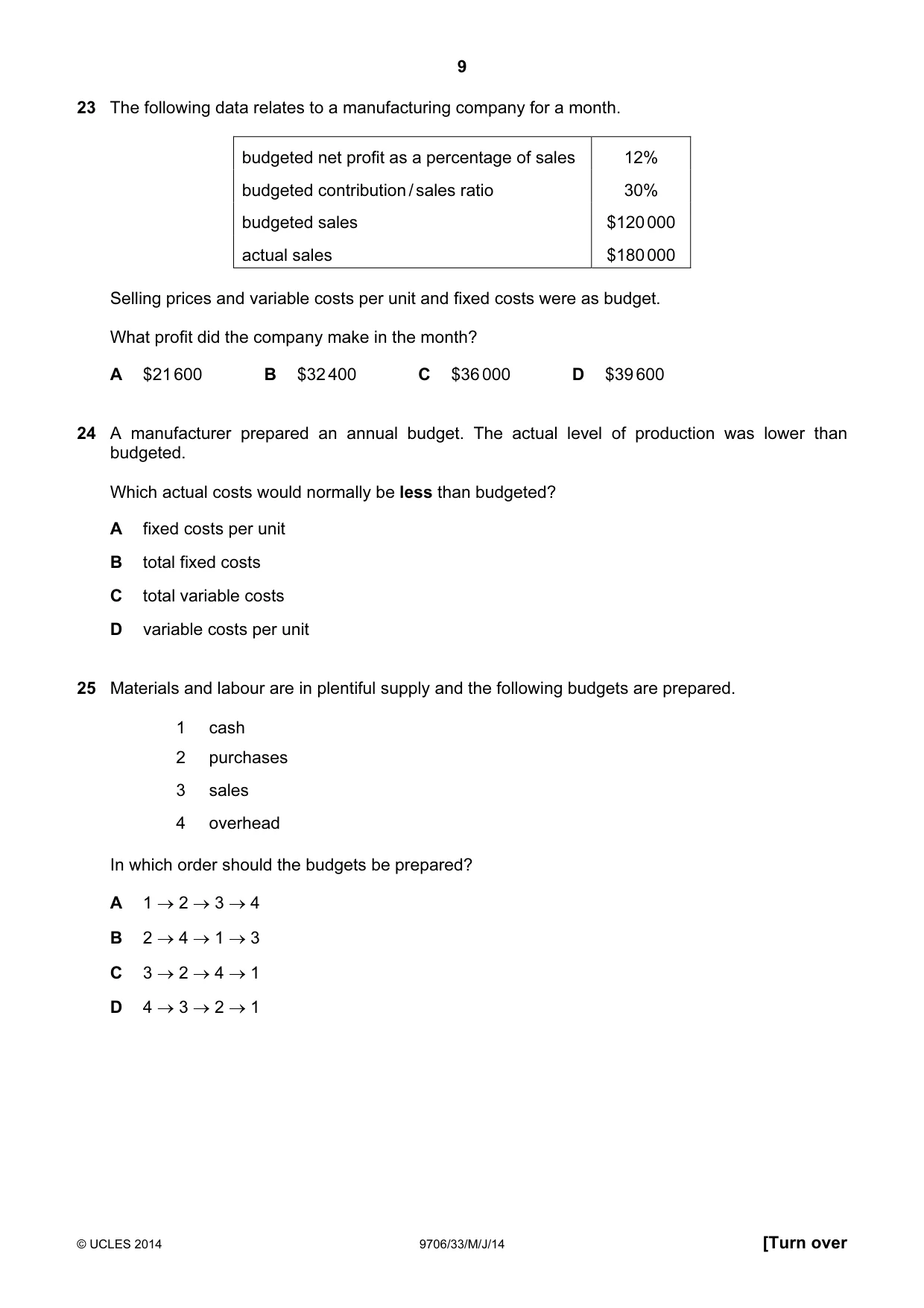
23 The following data relates to a manufacturing company for a month. budgeted net profit as a percentage of sales 12% budgeted contribution / sales ratio 30% budgeted sales $120 000 actual sales $180 000 Selling prices and variable costs per unit and fixed costs were as budget. What profit did the company make in the month? A $21 600 B $32 400 C $36 000 D $39 600
Mark scheme: B
Q24 · A manufacturer prepared an annual budget
24 A manufacturer prepared an annual budget. The actual level of production was lower than budgeted. Which actual costs would normally be less than budgeted? A fixed costs per unit B total fixed costs C total variable costs D variable costs per unit
Mark scheme: C
Q25 · Materials and labour are in plentiful supply and the following budgets are prepared
25 Materials and labour are in plentiful supply and the following budgets are prepared. 1 cash 2 purchases 3 sales 4 overhead In which order should the budgets be prepared? A 1 → 2 → 3 → 4 B 2 → 4 → 1 → 3 C 3 → 2 → 4 → 1 D 4 → 3 → 2 → 1
Mark scheme: C
Q26 · A business sets its budget for the next period as follows
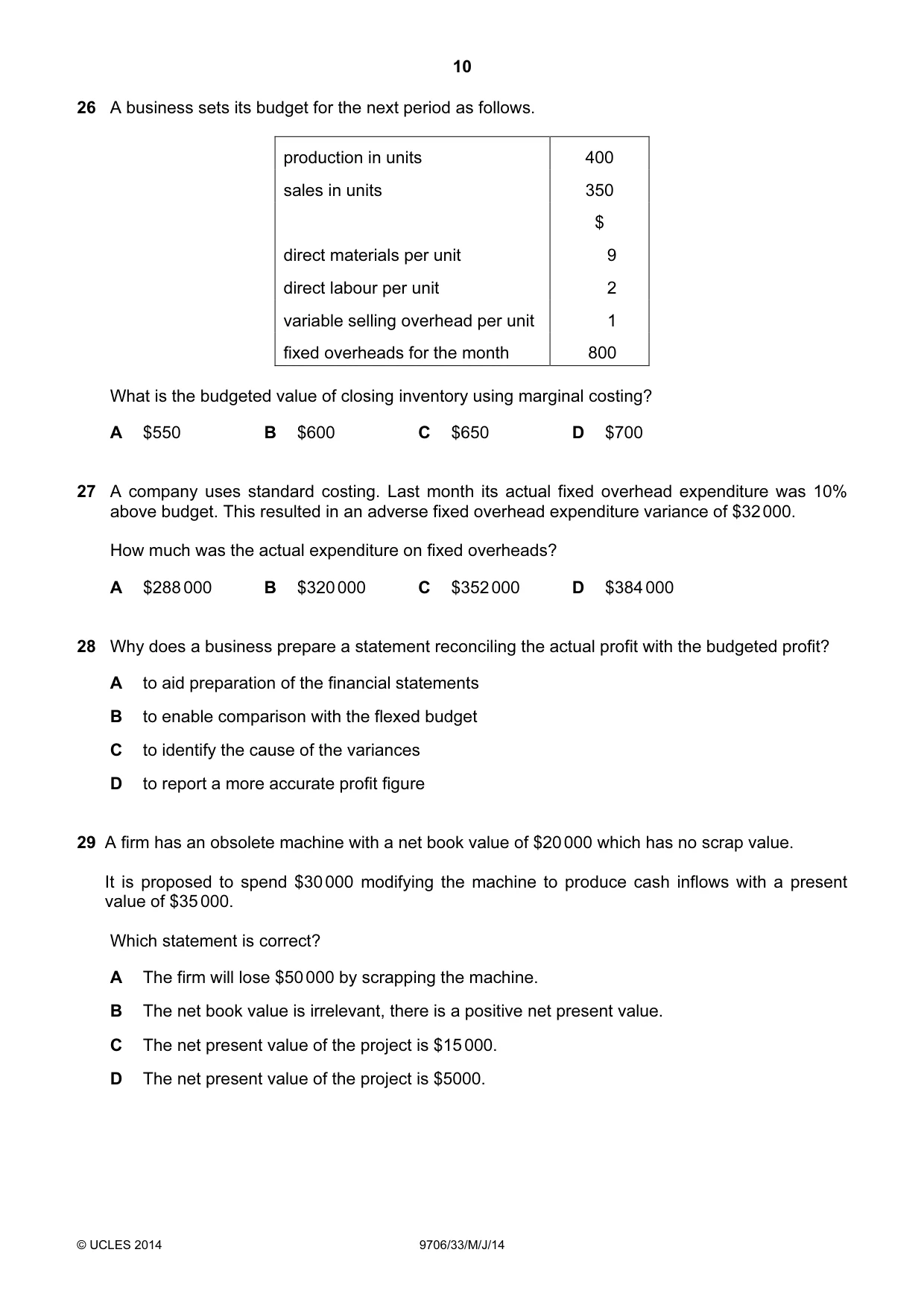
26 A business sets its budget for the next period as follows. production in units 400 sales in units 350 $ direct materials per unit 9 direct labour per unit 2 variable selling overhead per unit 1 fixed overheads for the month 800 What is the budgeted value of closing inventory using marginal costing? A $550 B $600 C $650 D $700
Mark scheme: A
Q27 · A company uses standard costing
27 A company uses standard costing. Last month its actual fixed overhead expenditure was 10% above budget. This resulted in an adverse fixed overhead expenditure variance of $32 000. How much was the actual expenditure on fixed overheads? A $288 000 B $320 000 C $352 000 D $384 000
Mark scheme: C
Q28 · Why does a business prepare a statement reconciling the actual profit with the budgeted…
28 Why does a business prepare a statement reconciling the actual profit with the budgeted profit? A to aid preparation of the financial statements B to enable comparison with the flexed budget C to identify the cause of the variances D to report a more accurate profit figure
Mark scheme: B
Q29 · A firm has an obsolete machine with a net book value of $20 000 which has no scrap value
29 A firm has an obsolete machine with a net book value of $20 000 which has no scrap value. It is proposed to spend $30 000 modifying the machine to produce cash inflows with a present value of $35 000. Which statement is correct? A The firm will lose $50 000 by scrapping the machine. B The net book value is irrelevant, there is a positive net present value. C The net present value of the project is $15 000. D The net present value of the project is $5000.
Mark scheme: B
Q30 · Which advantage arises when the average rate of return is used to evaluate a capital…
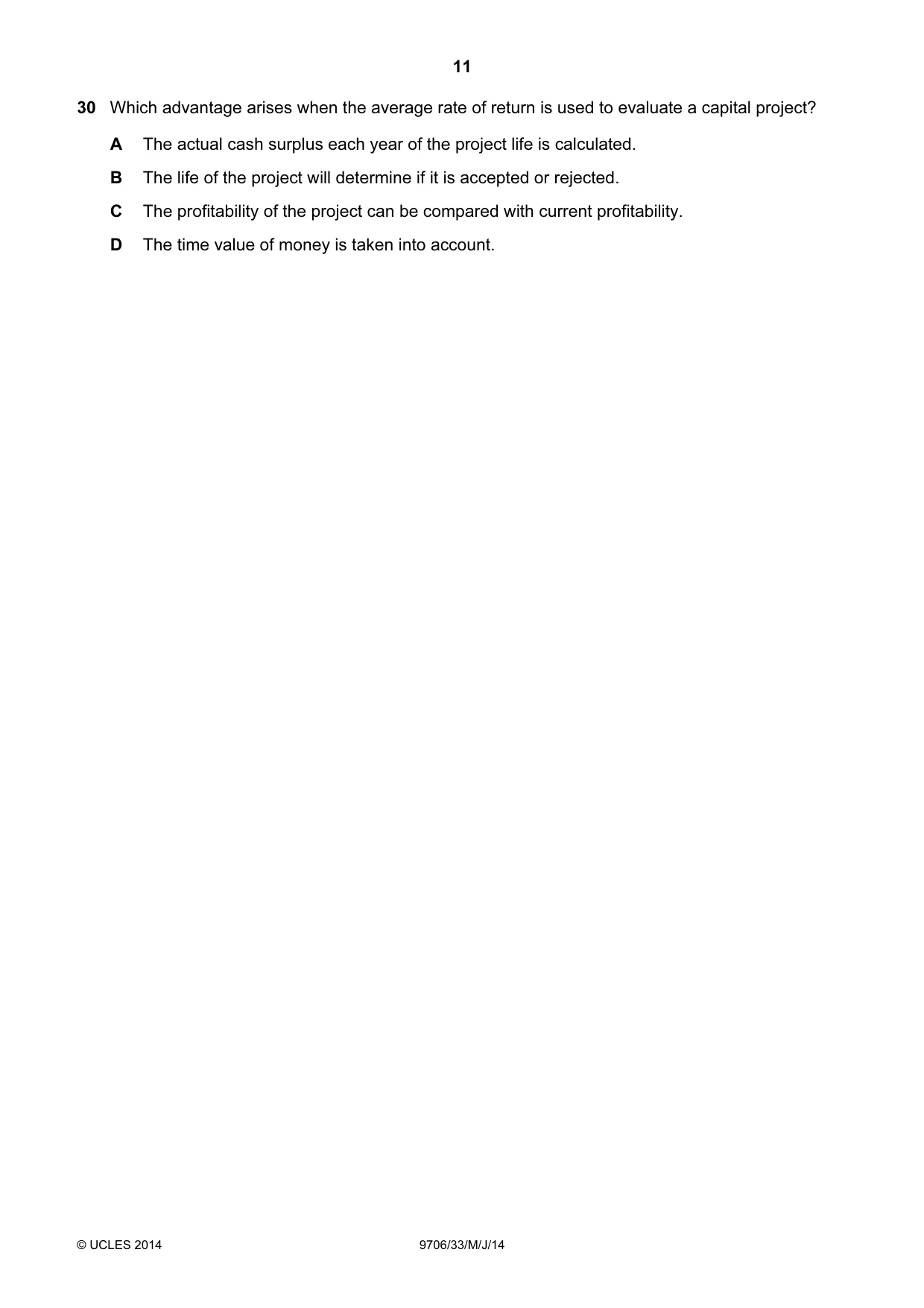
30 Which advantage arises when the average rate of return is used to evaluate a capital project? A The actual cash surplus each year of the project life is calculated. B The life of the project will determine if it is accepted or rejected. C The profitability of the project can be compared with current profitability. D The time value of money is taken into account.
Mark scheme: C
What was in this paper
The subtopics covered by these 30 questions, and how many questions each got. Open one in a new tab to see every Cambridge question on it.
6Analysis and communication of accounting information4Costs and cost behaviour4Business acquisition and merger3Types of business entity3Budgeting and budgetary control2Investment appraisal2Preparation of financial statements2Reconciliation and verification1Regulatory and ethical considerations1Standard costing1Traditional costing methods1What you needed in this session
Cambridge’s own grade thresholds for 2014 May/June, Paper 3 · Variant 3. A higher threshold means an easier paper — the bar moves with how the cohort did.