Cambridge A Level Accounting 9706 — 2013 May/June Paper 3 · Variant 1
9706/31/M/J/13 · 30 questions · 30 marks · ≈34 min
The question paper and its mark scheme, free to read here and free to download. This is Cambridge’s own paper, exactly as it was sat.
Question paper12 pages
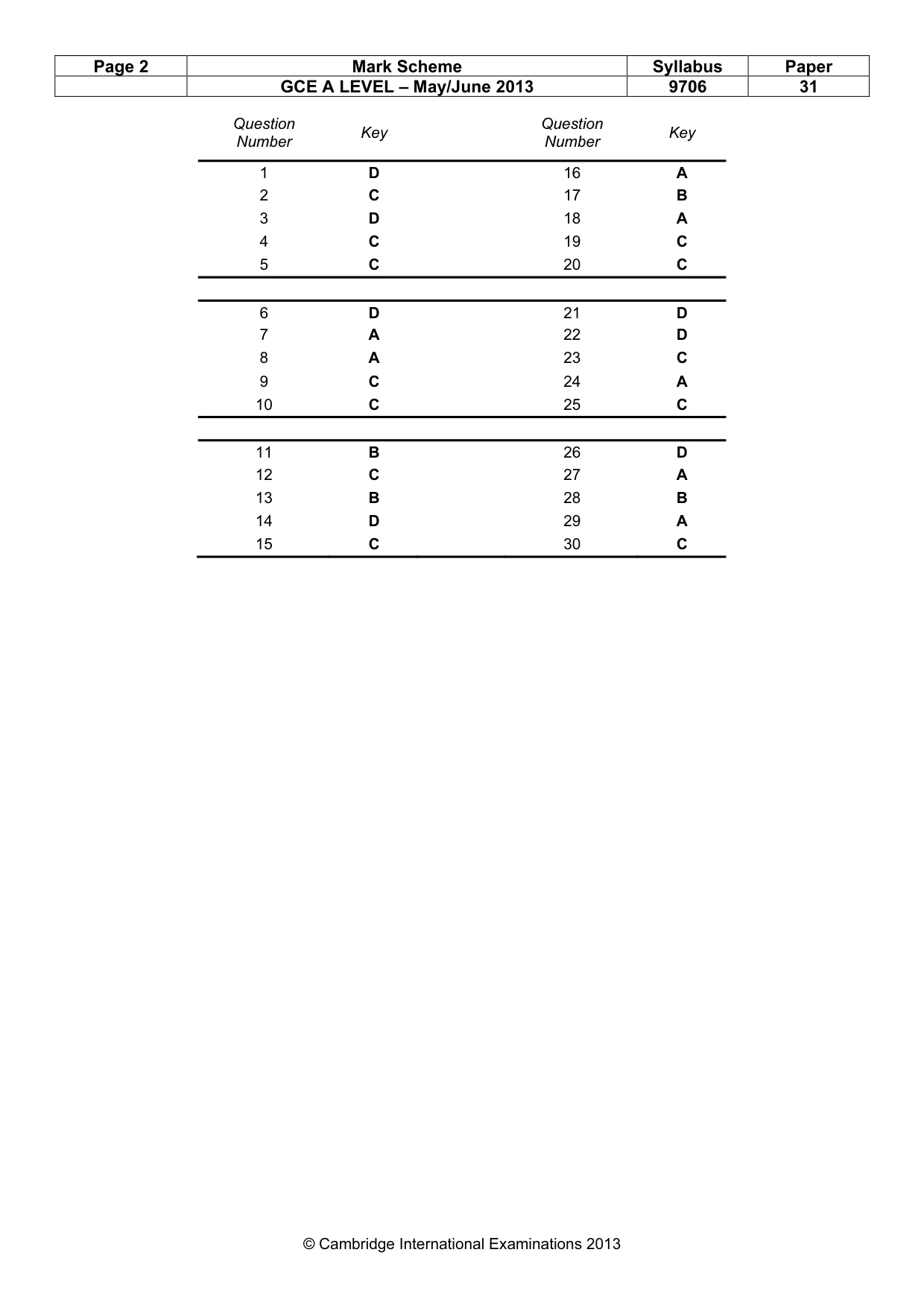
Mark scheme2 pages
Answers below. Sit the paper first if you are practising.
Questions as text
Q1 · When do revenue reserves arise?
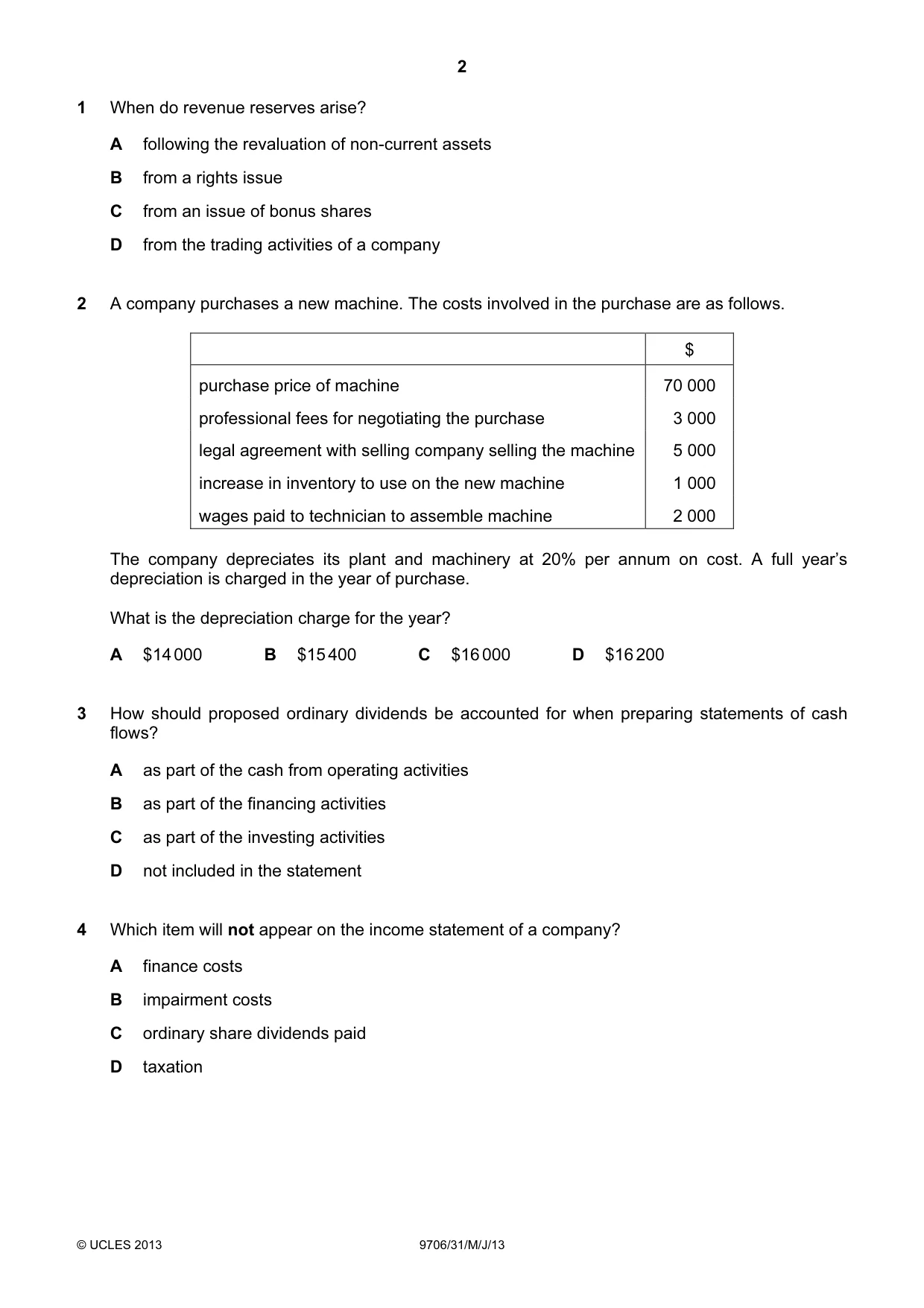
1 When do revenue reserves arise? A following the revaluation of non-current assets B from a rights issue C from an issue of bonus shares D from the trading activities of a company
Mark scheme: D
Q2 · A company purchases a new machine
2 A company purchases a new machine. The costs involved in the purchase are as follows. $ purchase price of machine 70 000 professional fees for negotiating the purchase 3 000 legal agreement with selling company selling the machine 5 000 increase in inventory to use on the new machine 1 000 wages paid to technician to assemble machine 2 000 The company depreciates its plant and machinery at 20% per annum on cost. A full year’s depreciation is charged in the year of purchase. What is the depreciation charge for the year? A $14 000 B $15 400 C $16 000 D $16 200
Mark scheme: C
Q3 · How should proposed ordinary dividends be accounted for when preparing statements of cash…
3 How should proposed ordinary dividends be accounted for when preparing statements of cash flows? A as part of the cash from operating activities B as part of the financing activities C as part of the investing activities D not included in the statement
Mark scheme: D
Q4 · Which item will not appear on the income statement of a company?
4 Which item will not appear on the income statement of a company? A finance costs B impairment costs C ordinary share dividends paid D taxation
Mark scheme: C
Q5 · Which item would be included as equity in a company’s statement of financial position?
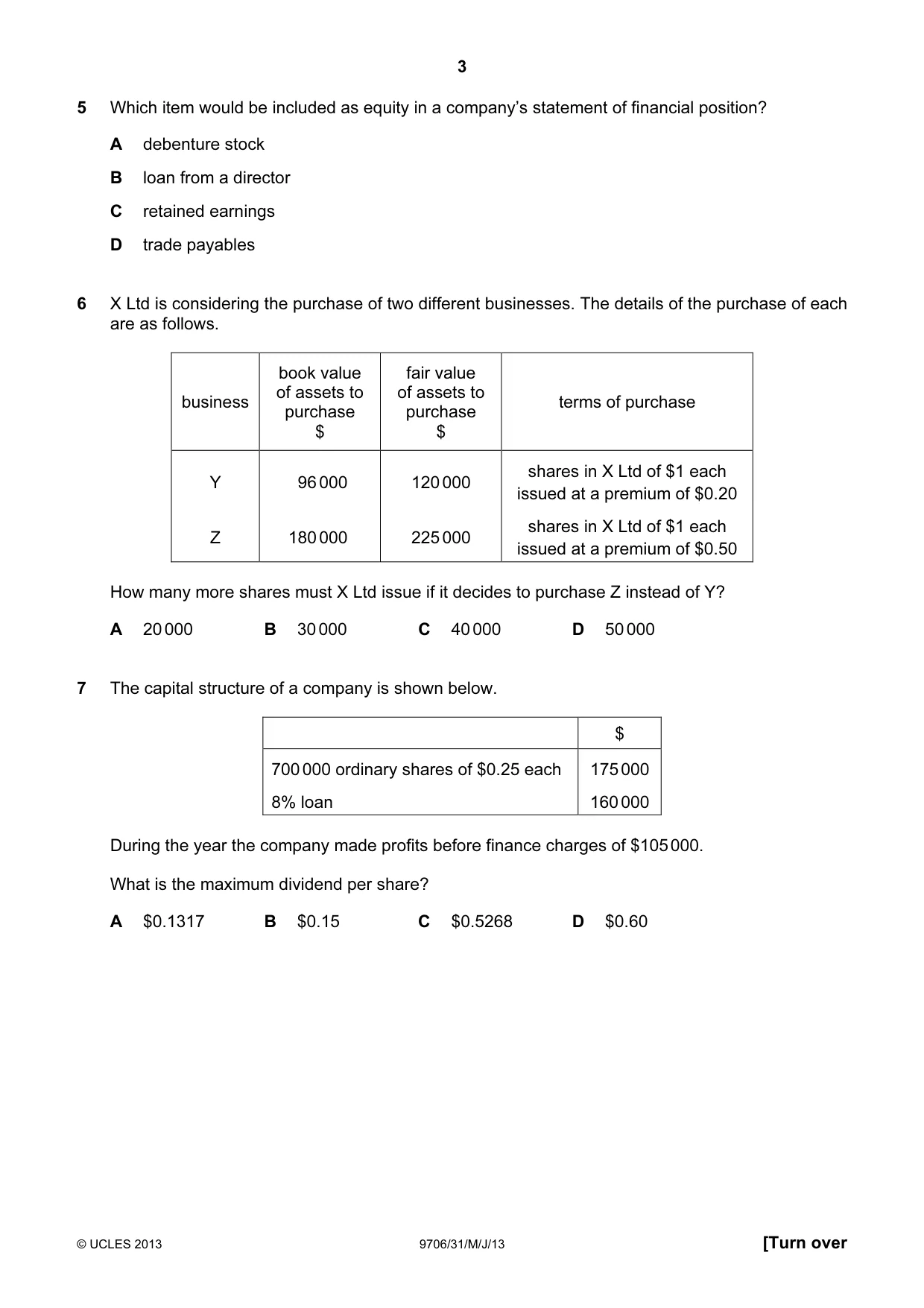
5 Which item would be included as equity in a company’s statement of financial position? A debenture stock B loan from a director C retained earnings D trade payables
Mark scheme: C
Q6 · X Ltd is considering the purchase of two different businesses
6 X Ltd is considering the purchase of two different businesses. The details of the purchase of each are as follows. book value fair value of assets to of assets to business terms of purchase purchase purchase $ $ shares in X Ltd of $1 each Y 96 000 120 000 issued at a premium of $0.20 shares in X Ltd of $1 each Z 180 000 225 000 issued at a premium of $0.50 How many more shares must X Ltd issue if it decides to purchase Z instead of Y? A 20 000 B 30 000 C 40 000 D 50 000
Mark scheme: D
Q7 · The capital structure of a company is shown below
7 The capital structure of a company is shown below. $ 700 000 ordinary shares of $0.25 each 175 000 8% loan 160 000 During the year the company made profits before finance charges of $105 000. What is the maximum dividend per share? A $0.1317 B $0.15 C $0.5268 D $0.60
Mark scheme: A
More questions on Analysis and communication of accounting information
Q8 · A Ltd acquires the assets and liabilities of B Ltd
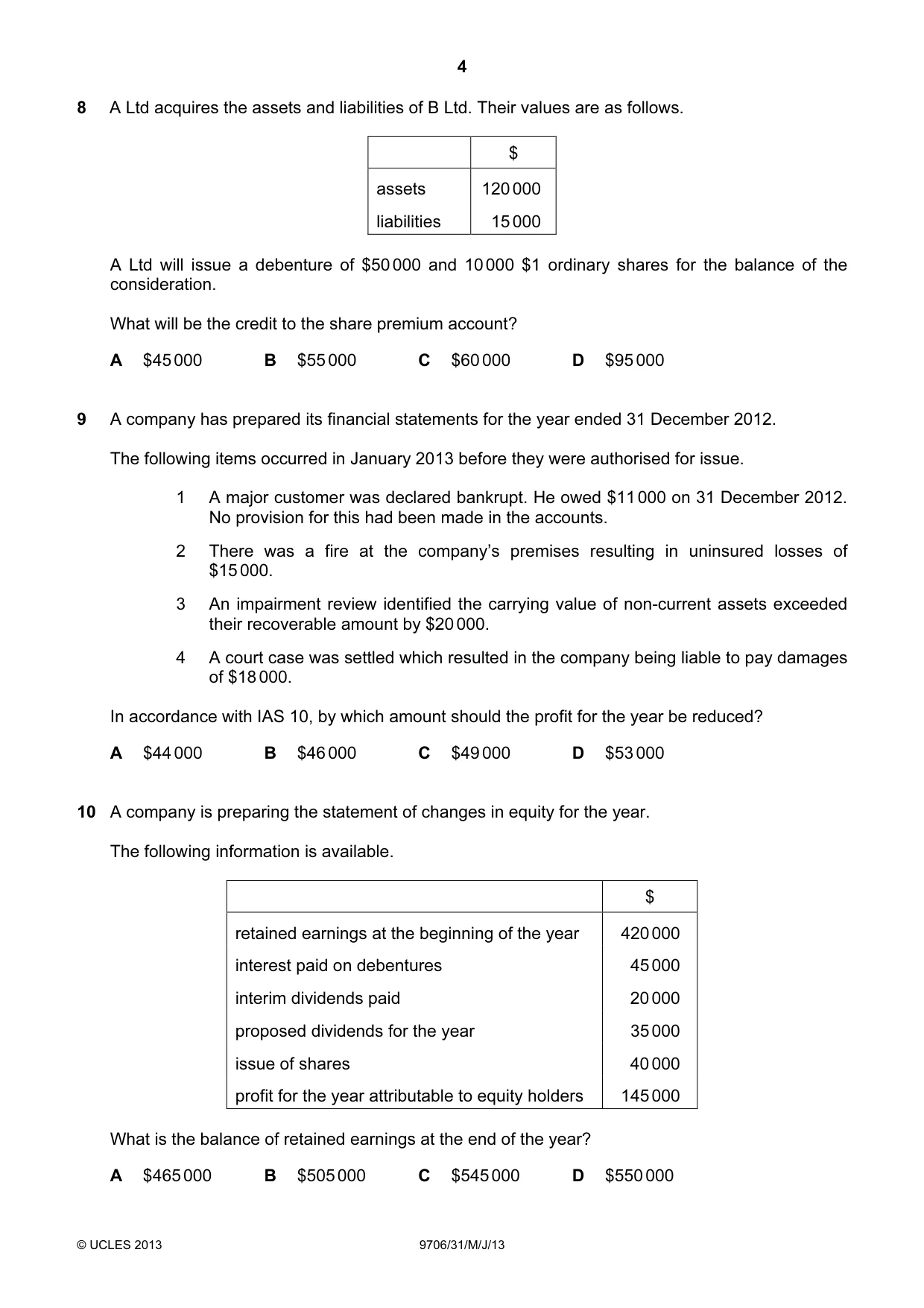
8 A Ltd acquires the assets and liabilities of B Ltd. Their values are as follows. $ assets 120 000 liabilities 15 000 A Ltd will issue a debenture of $50 000 and 10 000 $1 ordinary shares for the balance of the consideration. What will be the credit to the share premium account? A $45 000 B $55 000 C $60 000 D $95 000
Mark scheme: A
Q9 · A company has prepared its financial statements for the year ended 31 December 2012
9 A company has prepared its financial statements for the year ended 31 December 2012. The following items occurred in January 2013 before they were authorised for issue. 1 A major customer was declared bankrupt. He owed $11 000 on 31 December 2012. No provision for this had been made in the accounts. 2 There was a fire at the company’s premises resulting in uninsured losses of $15 000. 3 An impairment review identified the carrying value of non-current assets exceeded their recoverable amount by $20 000. 4 A court case was settled which resulted in the company being liable to pay damages of $18 000. In accordance with IAS 10, by which amount should the profit for the year be reduced? A $44 000 B $46 000 C $49 000 D $53 000
Mark scheme: C
Q10 · A company is preparing the statement of changes in equity for the year
10 A company is preparing the statement of changes in equity for the year. The following information is available. $ retained earnings at the beginning of the year 420 000 interest paid on debentures 45 000 interim dividends paid 20 000 proposed dividends for the year 35 000 issue of shares 40 000 profit for the year attributable to equity holders 145 000 What is the balance of retained earnings at the end of the year? A $465 000 B $505 000 C $545 000 D $550 000
Mark scheme: C
Q11 · Information from a company’s financial statements at 31 December 2012 is as follows
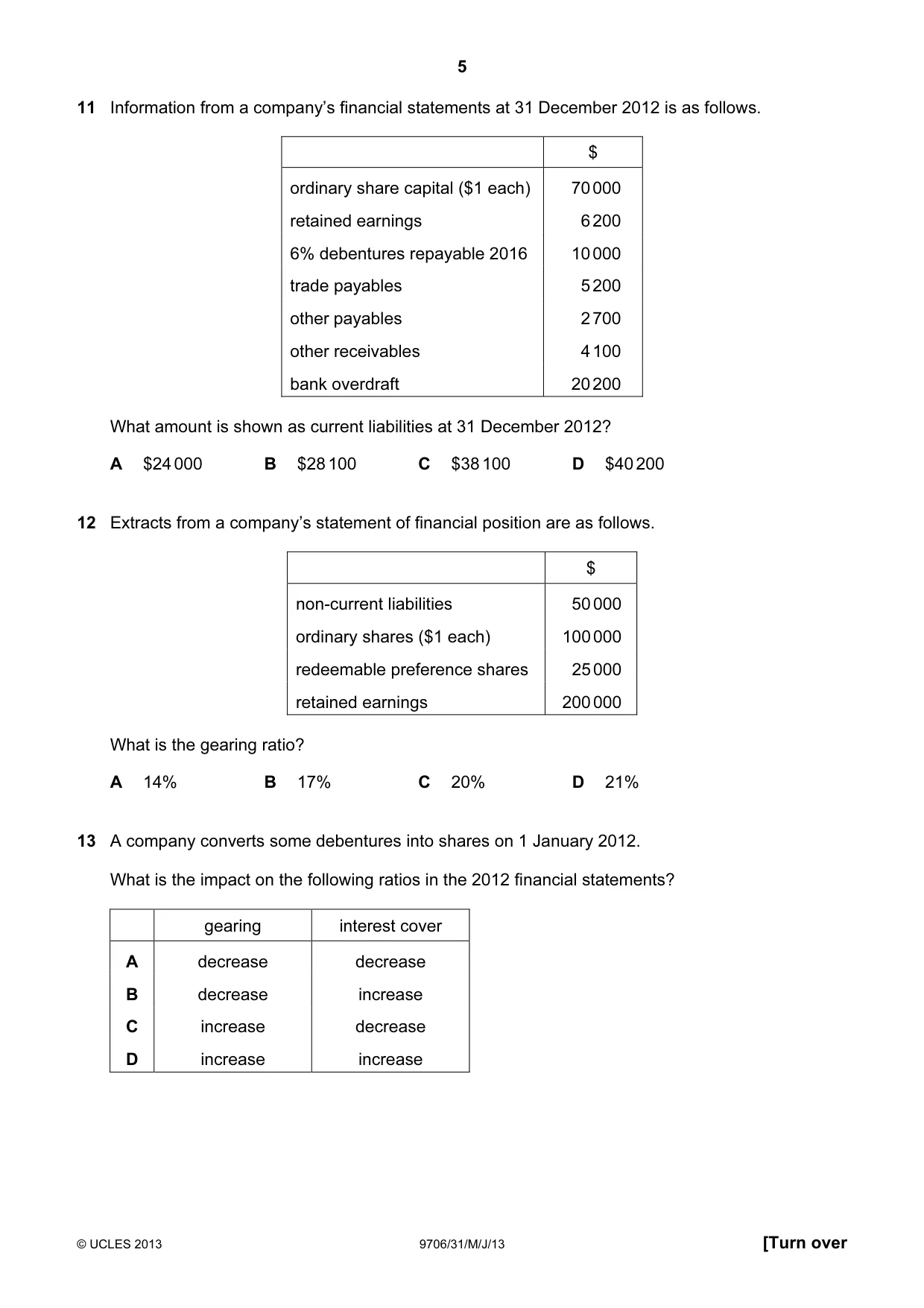
11 Information from a company’s financial statements at 31 December 2012 is as follows. $ ordinary share capital ($1 each) 70 000 retained earnings 6 200 6% debentures repayable 2016 10 000 trade payables 5 200 other payables 2 700 other receivables 4 100 bank overdraft 20 200 What amount is shown as current liabilities at 31 December 2012? A $24 000 B $28 100 C $38 100 D $40 200
Mark scheme: B
Q12 · Extracts from a company’s statement of financial position are as follows
12 Extracts from a company’s statement of financial position are as follows. $ non-current liabilities 50 000 ordinary shares ($1 each) 100 000 redeemable preference shares 25 000 retained earnings 200 000 What is the gearing ratio? A 14% B 17% C 20% D 21%
Mark scheme: C
More questions on Analysis and communication of accounting information
Q13 · A company converts some debentures into shares on 1 January 2012
13 A company converts some debentures into shares on 1 January 2012. What is the impact on the following ratios in the 2012 financial statements? gearing interest cover A decrease decrease B decrease increase C increase decrease D increase increase
Mark scheme: B
More questions on Analysis and communication of accounting information
Q14 · A company’s capital comprises 200 000 ordinary shares of $1 each
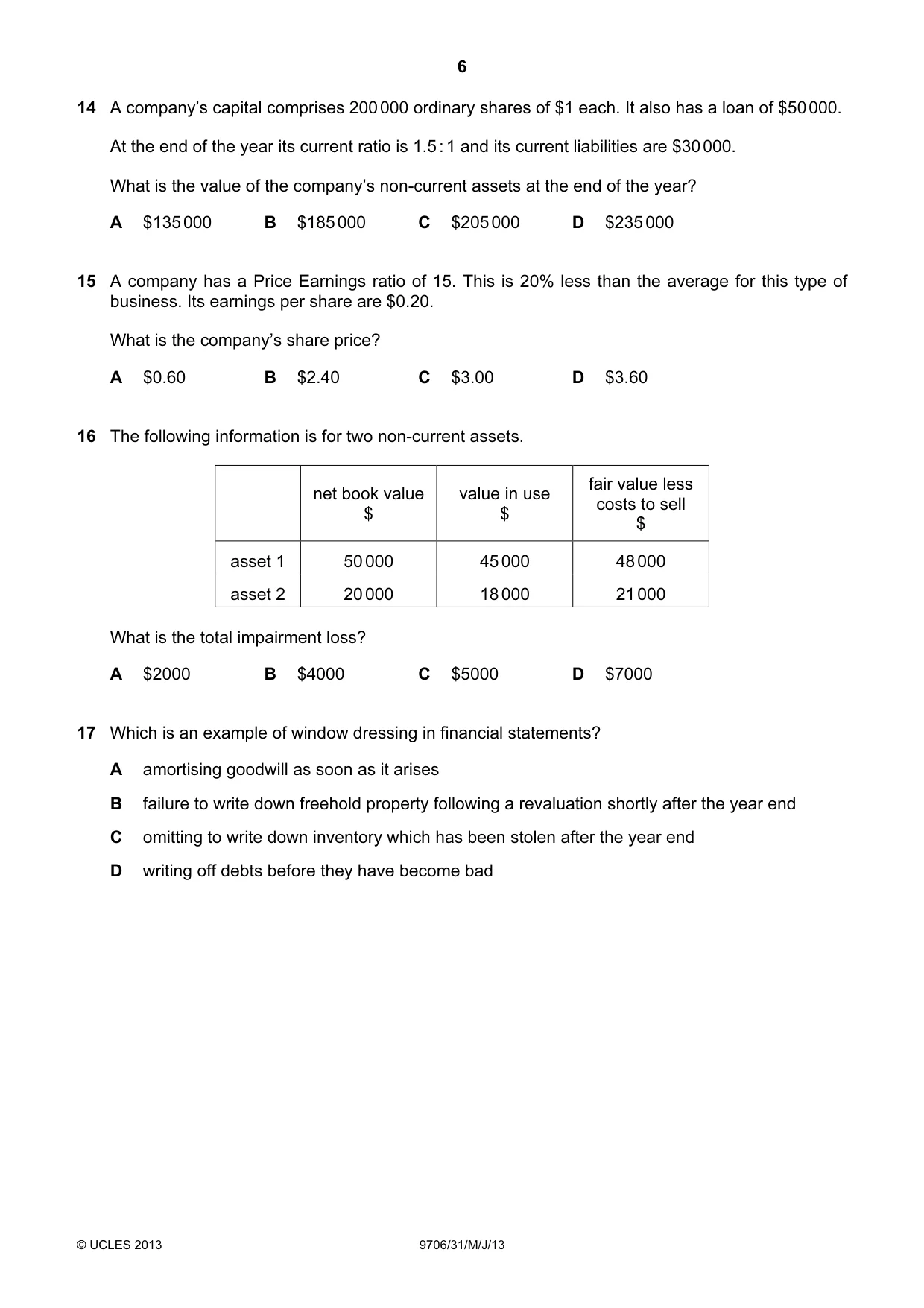
14 A company’s capital comprises 200 000 ordinary shares of $1 each. It also has a loan of $50 000. At the end of the year its current ratio is 1.5 : 1 and its current liabilities are $30 000. What is the value of the company’s non-current assets at the end of the year? A $135 000 B $185 000 C $205 000 D $235 000
Mark scheme: D
More questions on Analysis and communication of accounting information
Q15 · A company has a Price Earnings ratio of 15
15 A company has a Price Earnings ratio of 15. This is 20% less than the average for this type of business. Its earnings per share are $0.20. What is the company’s share price? A $0.60 B $2.40 C $3.00 D $3.60
Mark scheme: C
More questions on Analysis and communication of accounting information
Q16 · The following information is for two non-current assets
16 The following information is for two non-current assets. fair value less net book value value in use costs to sell $ $ $ asset 1 50 000 45 000 48 000 asset 2 20 000 18 000 21 000 What is the total impairment loss? A $2000 B $4000 C $5000 D $7000
Mark scheme: A
Q17 · Which is an example of window dressing in financial statements?
17 Which is an example of window dressing in financial statements? A amortising goodwill as soon as it arises B failure to write down freehold property following a revaluation shortly after the year end C omitting to write down inventory which has been stolen after the year end D writing off debts before they have become bad
Mark scheme: B
Q18 · The financial statements of a company shows the following
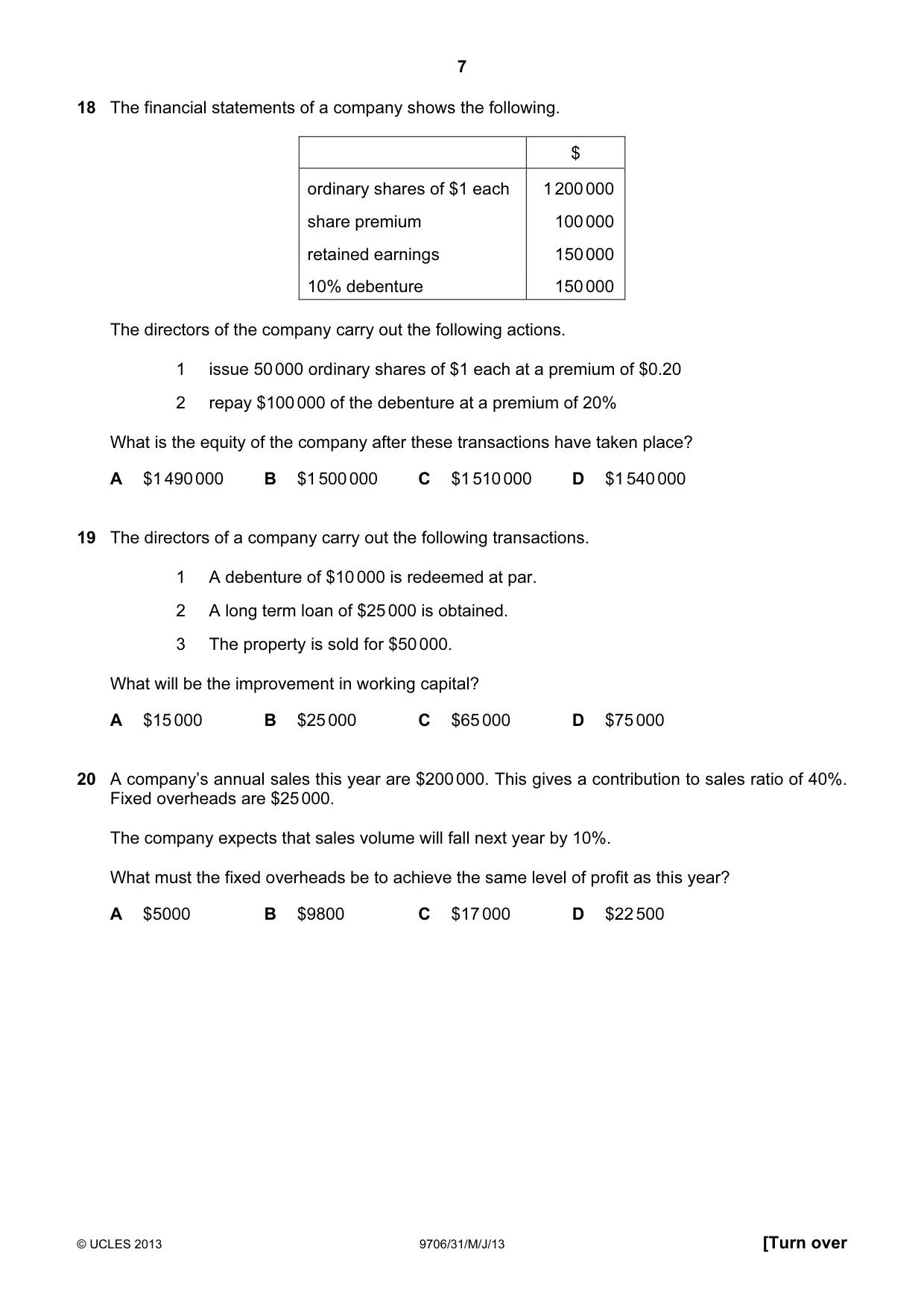
18 The financial statements of a company shows the following. $ ordinary shares of $1 each 1 200 000 share premium 100 000 retained earnings 150 000 10% debenture 150 000 The directors of the company carry out the following actions. 1 issue 50 000 ordinary shares of $1 each at a premium of $0.20 2 repay $100 000 of the debenture at a premium of 20% What is the equity of the company after these transactions have taken place? A $1 490 000 B $1 500 000 C $1 510 000 D $1 540 000
Mark scheme: A
Q19 · The directors of a company carry out the following transactions
19 The directors of a company carry out the following transactions. 1 A debenture of $10 000 is redeemed at par. 2 A long term loan of $25 000 is obtained. 3 The property is sold for $50 000. What will be the improvement in working capital? A $15 000 B $25 000 C $65 000 D $75 000
Mark scheme: C
Q20 · A company’s annual sales this year are $200 000
20 A company’s annual sales this year are $200 000. This gives a contribution to sales ratio of 40%. Fixed overheads are $25 000. The company expects that sales volume will fall next year by 10%. What must the fixed overheads be to achieve the same level of profit as this year? A $5000 B $9800 C $17 000 D $22 500
Mark scheme: C
Q21 · The manufacture of a product involves two processes
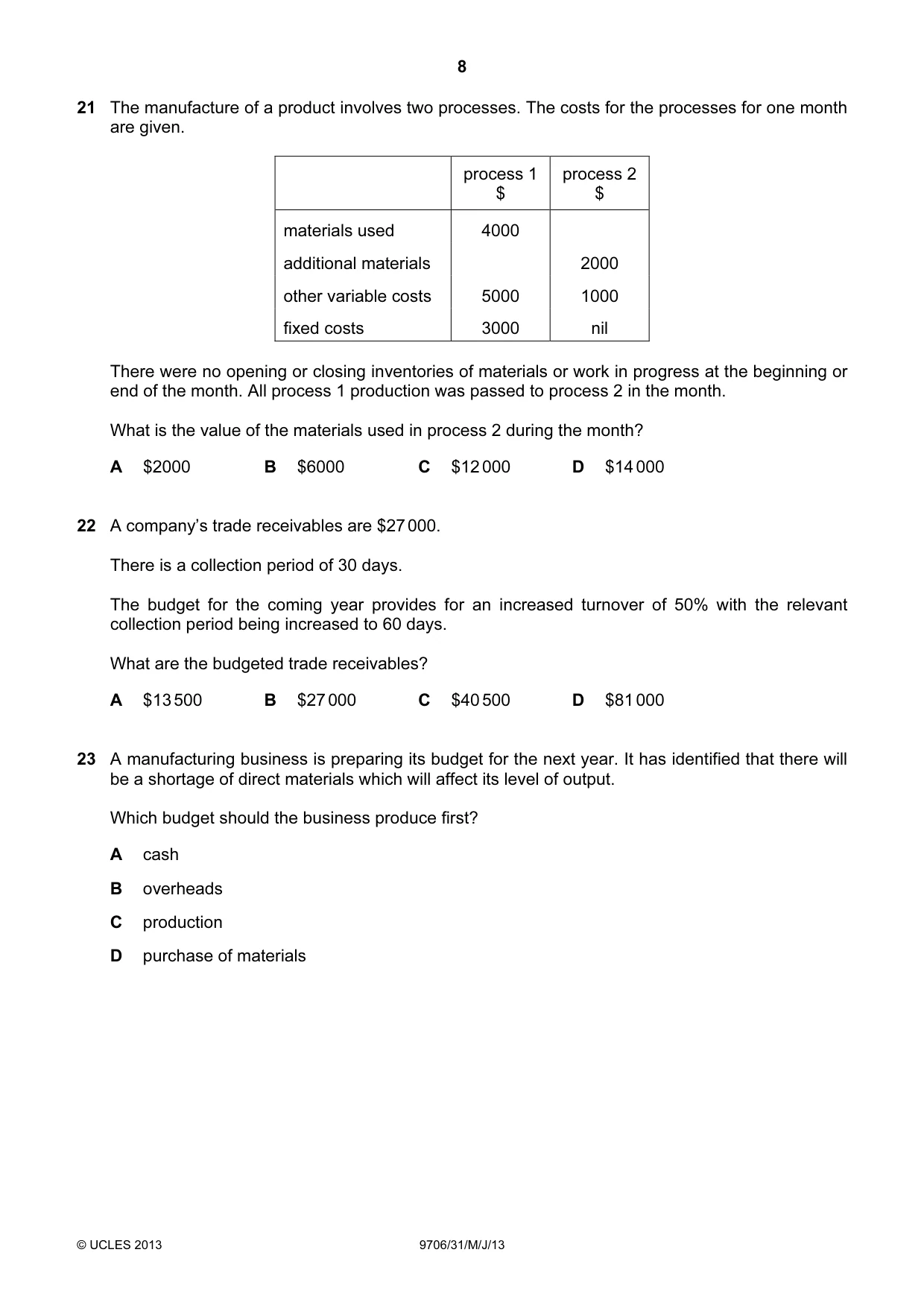
21 The manufacture of a product involves two processes. The costs for the processes for one month are given. process 1 process 2 $ $ materials used 4000 additional materials 2000 other variable costs 5000 1000 fixed costs 3000 nil There were no opening or closing inventories of materials or work in progress at the beginning or end of the month. All process 1 production was passed to process 2 in the month. What is the value of the materials used in process 2 during the month? A $2000 B $6000 C $12 000 D $14 000
Mark scheme: D
Q22 · A company’s trade receivables are $27 000
22 A company’s trade receivables are $27 000. There is a collection period of 30 days. The budget for the coming year provides for an increased turnover of 50% with the relevant collection period being increased to 60 days. What are the budgeted trade receivables? A $13 500 B $27 000 C $40 500 D $81 000
Mark scheme: D
Q23 · A manufacturing business is preparing its budget for the next year
23 A manufacturing business is preparing its budget for the next year. It has identified that there will be a shortage of direct materials which will affect its level of output. Which budget should the business produce first? A cash B overheads C production D purchase of materials
Mark scheme: C
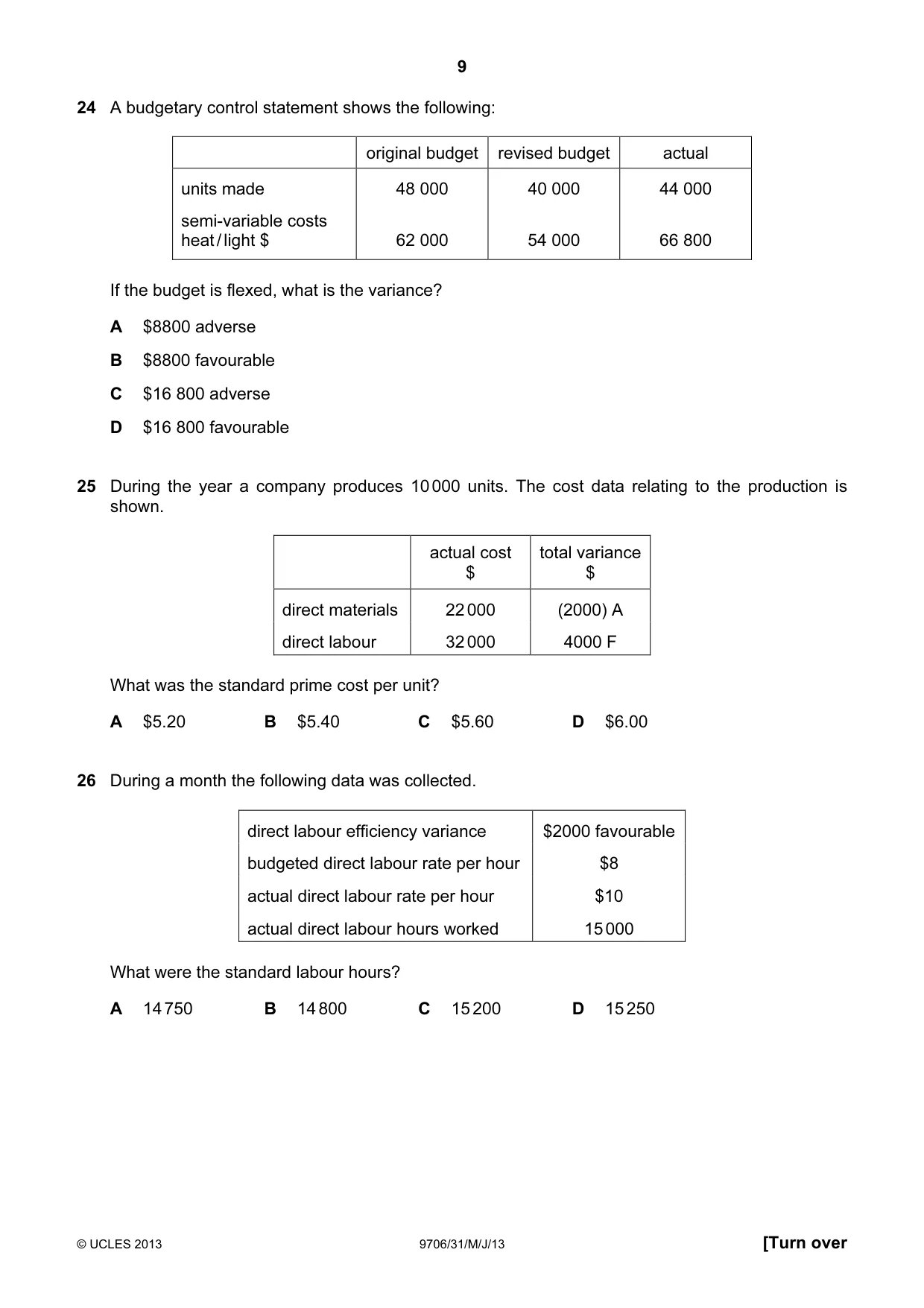
Q24 · A budgetary control statement shows the following: original budget revised budget actual…
24 A budgetary control statement shows the following: original budget revised budget actual units made 48 000 40 000 44 000 semi-variable costs heat / light $ 62 000 54 000 66 800 If the budget is flexed, what is the variance? A $8800 adverse B $8800 favourable C $16 800 adverse D $16 800 favourable
Mark scheme: A
Q25 · During the year a company produces 10 000 units
25 During the year a company produces 10 000 units. The cost data relating to the production is shown. actual cost total variance $ $ direct materials 22 000 (2000) A direct labour 32 000 4000 F What was the standard prime cost per unit? A $5.20 B $5.40 C $5.60 D $6.00
Mark scheme: C
Q26 · During a month the following data was collected
26 During a month the following data was collected. direct labour efficiency variance $2000 favourable budgeted direct labour rate per hour $8 actual direct labour rate per hour $10 actual direct labour hours worked 15 000 What were the standard labour hours? A 14 750 B 14 800 C 15 200 D 15 250
Mark scheme: D
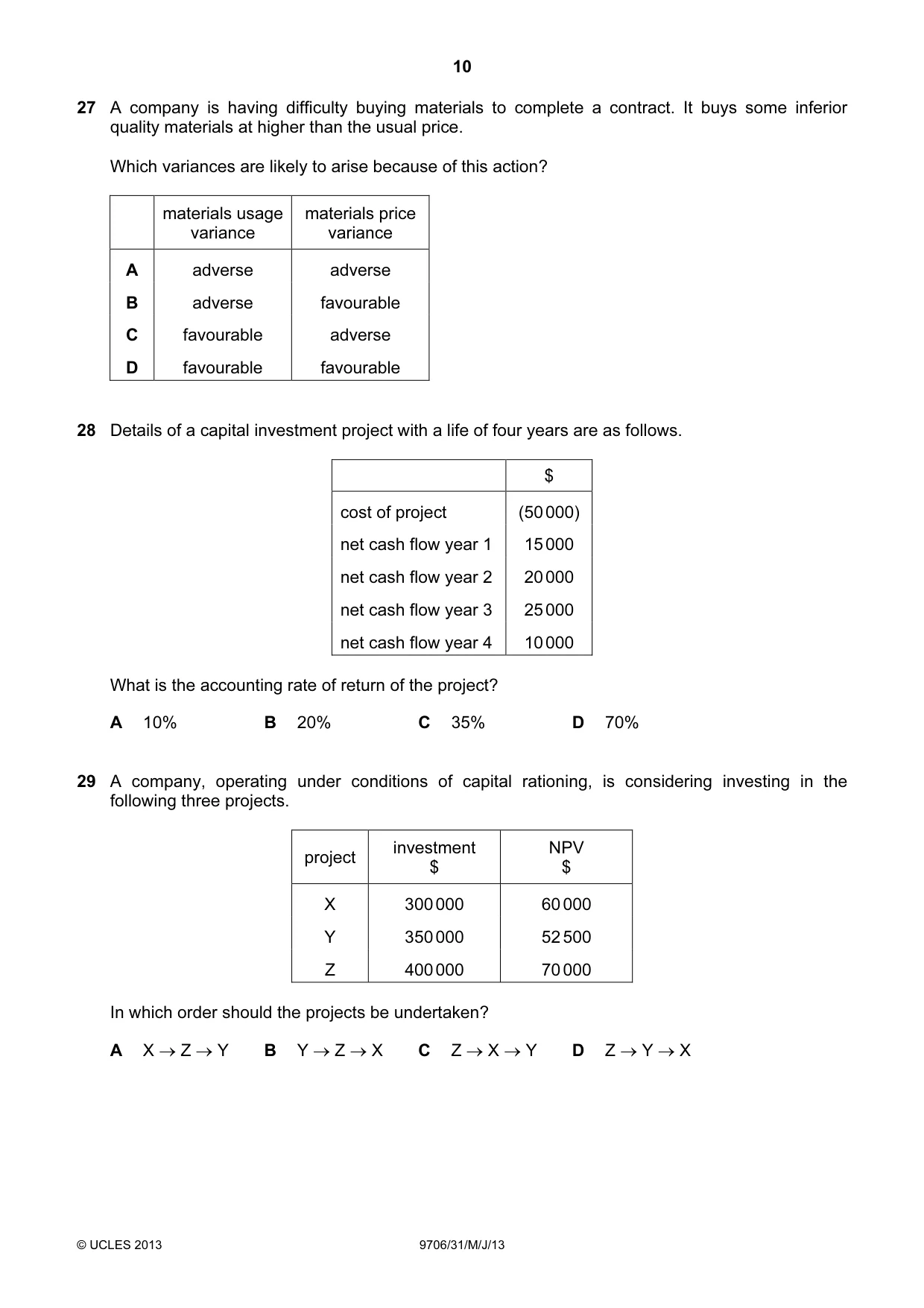
Q27 · A company is having difficulty buying materials to complete a contract
27 A company is having difficulty buying materials to complete a contract. It buys some inferior quality materials at higher than the usual price. Which variances are likely to arise because of this action? materials usage materials price variance variance A adverse adverse B adverse favourable C favourable adverse D favourable favourable
Mark scheme: A
Q28 · Details of a capital investment project with a life of four years are as follows
28 Details of a capital investment project with a life of four years are as follows. $ cost of project (50 000) net cash flow year 1 15 000 net cash flow year 2 20 000 net cash flow year 3 25 000 net cash flow year 4 10 000 What is the accounting rate of return of the project? A 10% B 20% C 35% D 70%
Mark scheme: B
Q29 · A company, operating under conditions of capital rationing, is considering investing in…
29 A company, operating under conditions of capital rationing, is considering investing in the following three projects. investment NPV project $ $ X 300 000 60 000 Y 350 000 52 500 Z 400 000 70 000 In which order should the projects be undertaken? A X → Z → Y B Y → Z → X C Z → X → Y D Z → Y → X
Mark scheme: A
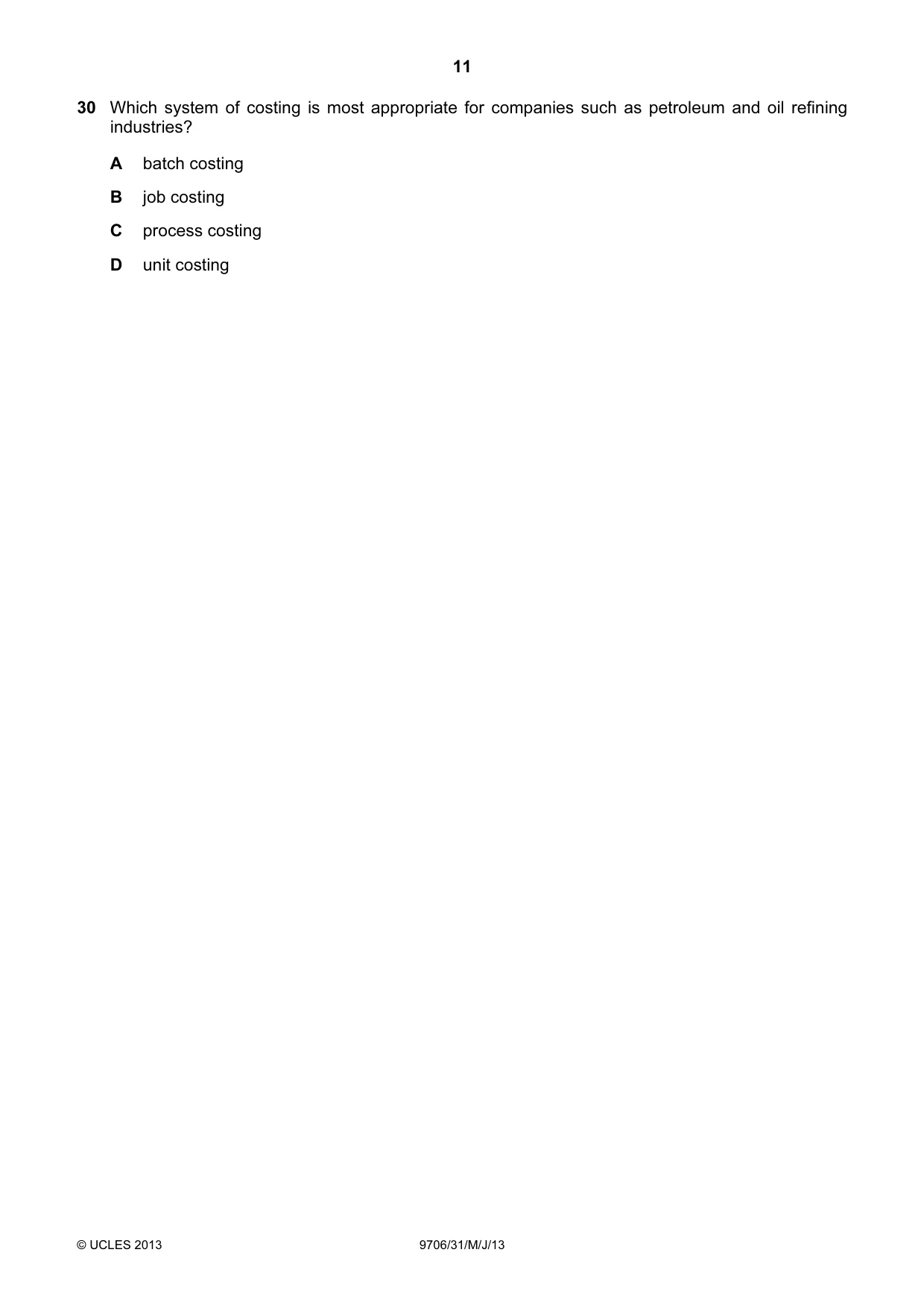
Q30 · Which system of costing is most appropriate for companies such as petroleum and oil…
30 Which system of costing is most appropriate for companies such as petroleum and oil refining industries? A batch costing B job costing C process costing D unit costing
Mark scheme: C
What was in this paper
The subtopics covered by these 30 questions, and how many questions each got. Open one in a new tab to see every Cambridge question on it.
8Analysis and communication of accounting information3Budgeting and budgetary control3Standard costing3Analysis and communication of accounting information2Business acquisition and merger2Investment appraisal2Traditional costing methods2Accounting for non-current assets1Costs and cost behaviour1Preparation of financial statements1Regulatory and ethical considerations1Types of business entity1What you needed in this session
Cambridge’s own grade thresholds for 2013 May/June, Paper 3 · Variant 1. A higher threshold means an easier paper — the bar moves with how the cohort did.