Cambridge A Level Accounting 9706 — 2010 May/June Paper 3 · Variant 3
9706/33/M/J/10 · 30 questions · 30 marks · ≈34 min
The question paper and its mark scheme, free to read here and free to download. This is Cambridge’s own paper, exactly as it was sat.
Question paper12 pages
Mark scheme2 pages
Answers below. Sit the paper first if you are practising.
Questions as text
Q1 · The following information has been extracted from the accounts of a company
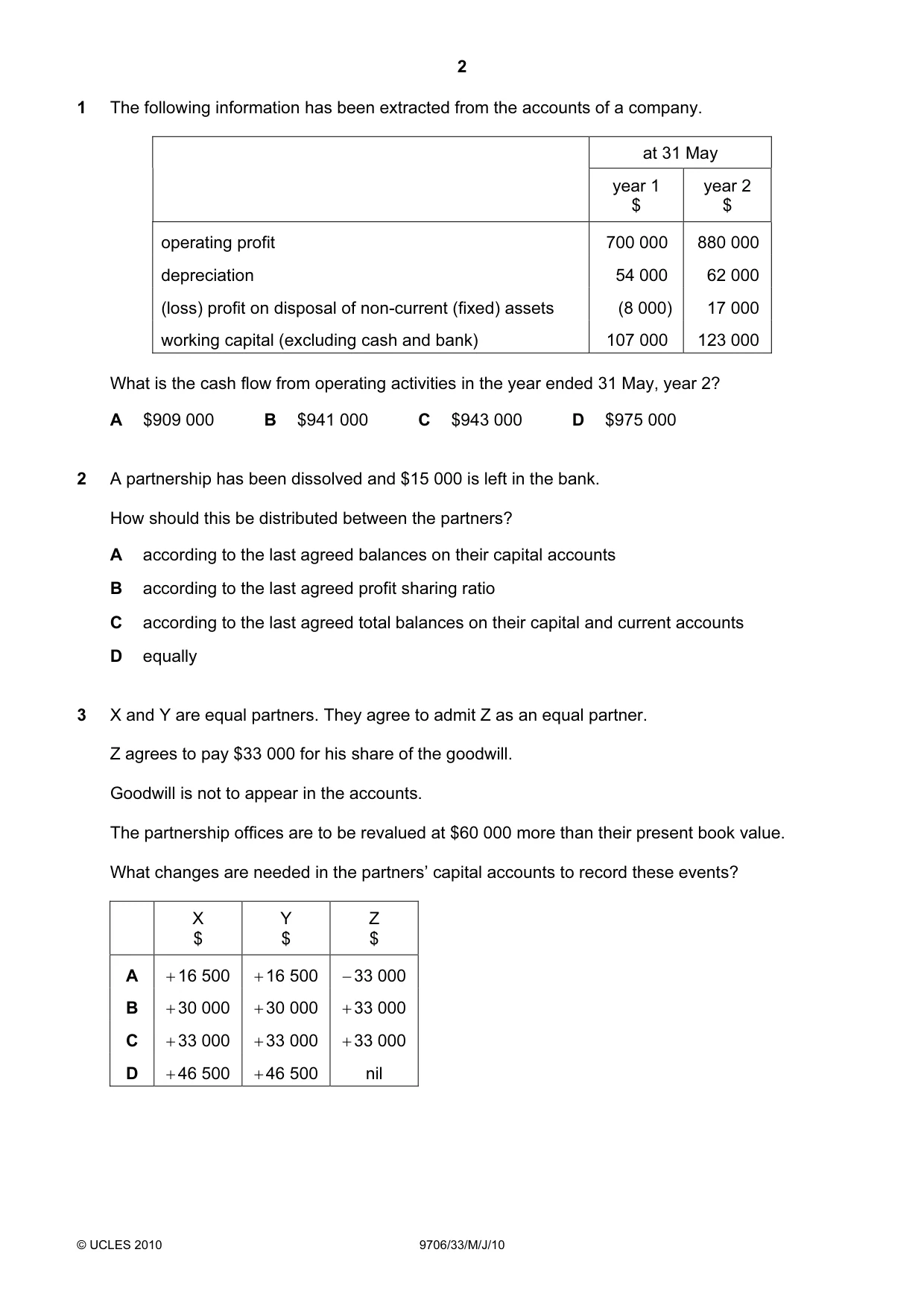
1 The following information has been extracted from the accounts of a company. at 31 May year 1 year 2 $ $ operating profit 700 000 880 000 depreciation 54 000 62 000 (loss) profit on disposal of non-current (fixed) assets (8 000) 17 000 working capital (excluding cash and bank) 107 000 123 000 What is the cash flow from operating activities in the year ended 31 May, year 2? A $909 000 B $941 000 C $943 000 D $975 000
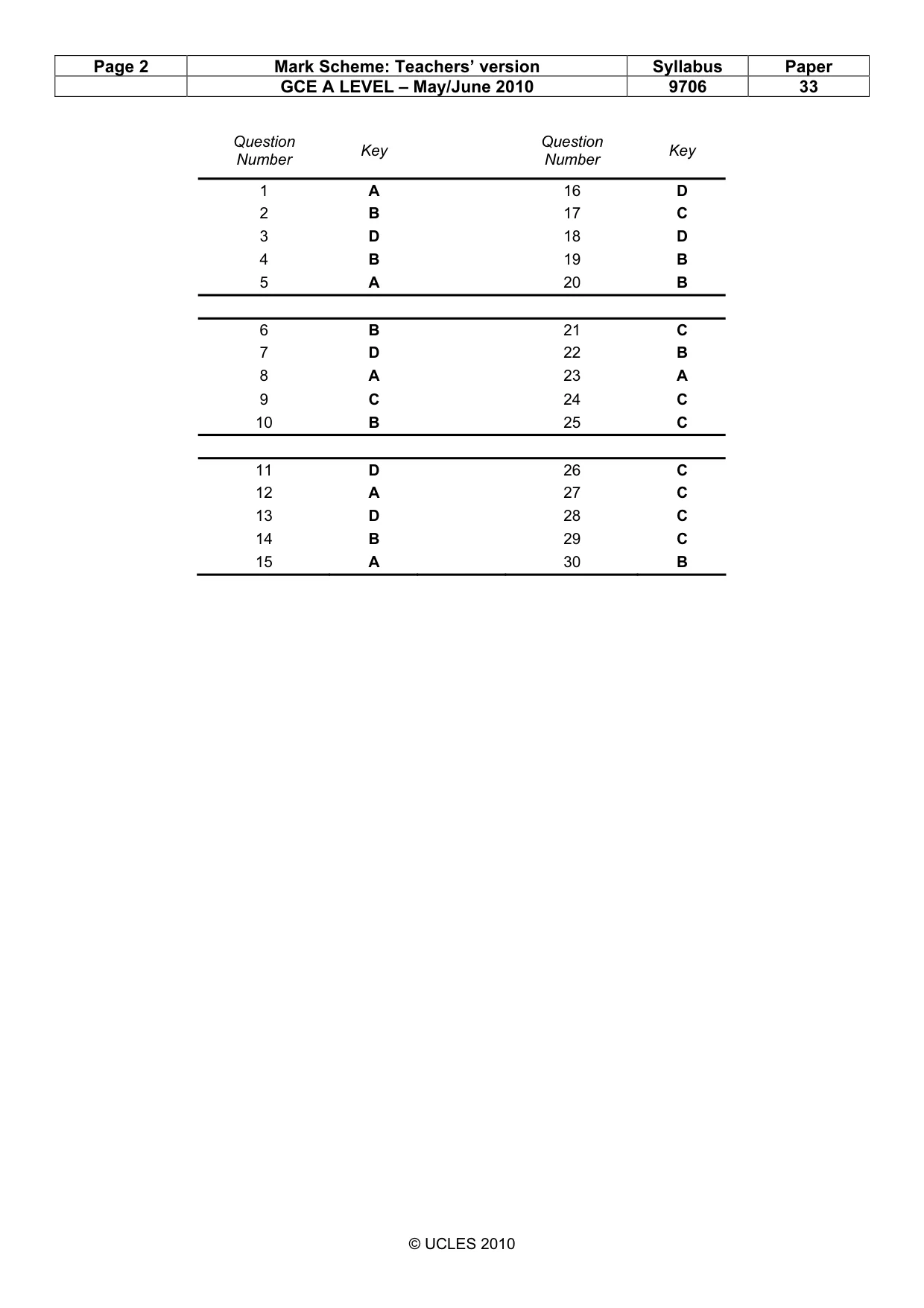
Mark scheme: A
Q2 · A partnership has been dissolved and $15 000 is left in the bank
2 A partnership has been dissolved and $15 000 is left in the bank. How should this be distributed between the partners? A according to the last agreed balances on their capital accounts B according to the last agreed profit sharing ratio C according to the last agreed total balances on their capital and current accounts D equally
Mark scheme: B
Q3 · X and Y are equal partners
3 X and Y are equal partners. They agree to admit Z as an equal partner. Z agrees to pay $33 000 for his share of the goodwill. Goodwill is not to appear in the accounts. The partnership offices are to be revalued at $60 000 more than their present book value. What changes are needed in the partners’ capital accounts to record these events? X Y Z $ $ $ A + 16 500 + 16 500 − 33 000 B + 30 000 + 30 000 + 33 000 C + 33 000 + 33 000 + 33 000 D + 46 500 + 46 500 nil
Mark scheme: D
Q4 · When is a capital redemption reserve created?
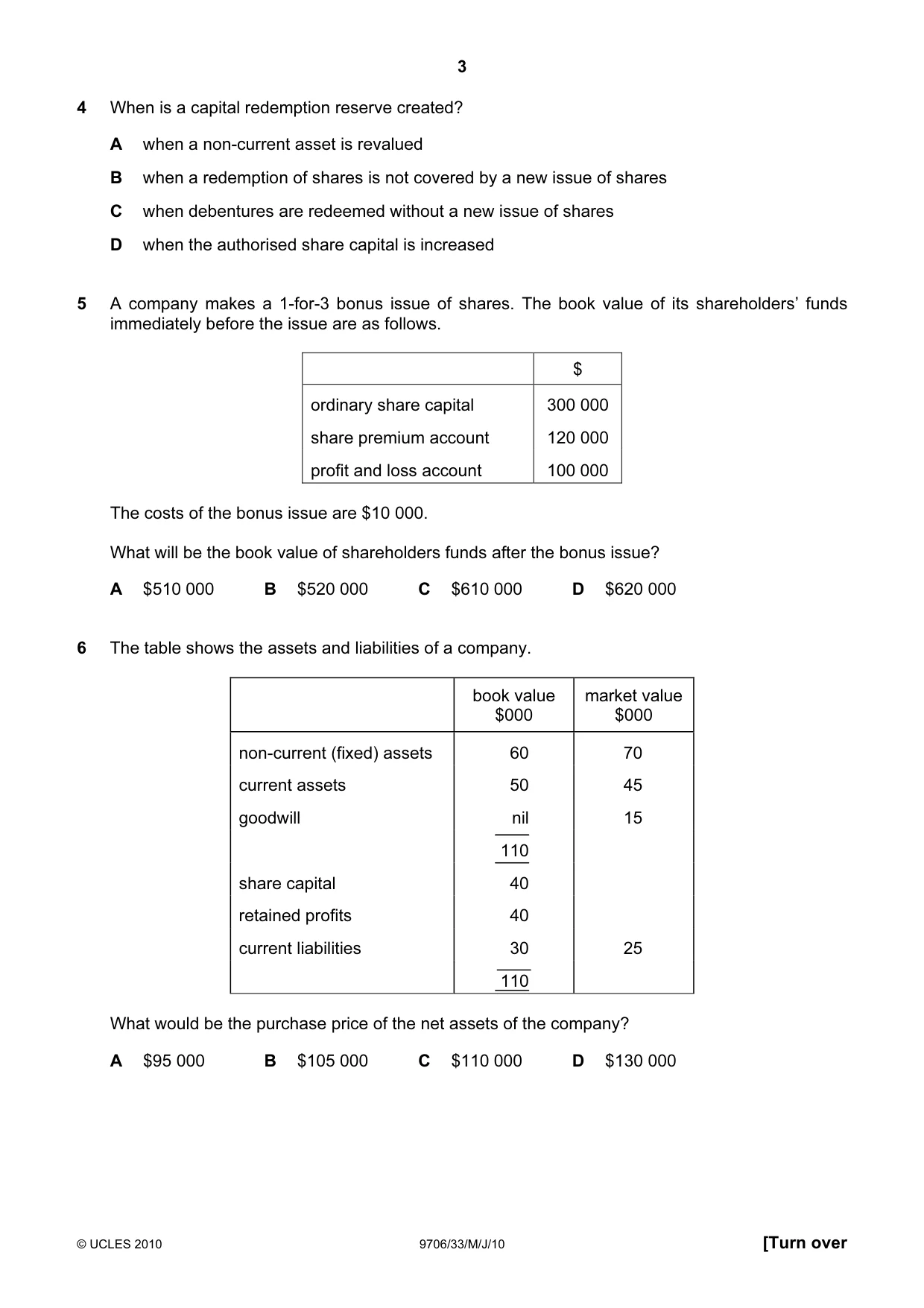
4 When is a capital redemption reserve created? A when a non-current asset is revalued B when a redemption of shares is not covered by a new issue of shares C when debentures are redeemed without a new issue of shares D when the authorised share capital is increased
Mark scheme: B
Q5 · A company makes a 1-for-3 bonus issue of shares
5 A company makes a 1-for-3 bonus issue of shares. The book value of its shareholders’ funds immediately before the issue are as follows. $ ordinary share capital 300 000 share premium account 120 000 profit and loss account 100 000 The costs of the bonus issue are $10 000. What will be the book value of shareholders funds after the bonus issue? A $510 000 B $520 000 C $610 000 D $620 000
Mark scheme: A
Q6 · The table shows the assets and liabilities of a company
6 The table shows the assets and liabilities of a company. book value market value $000 $000 non-current (fixed) assets 60 70 current assets 50 45 goodwill nil 15 110 share capital 40 retained profits 40 current liabilities 30 25 110 What would be the purchase price of the net assets of the company? A $95 000 B $105 000 C $110 000 D $130 000
Mark scheme: B
Q7 · A company had the following capital and reserves
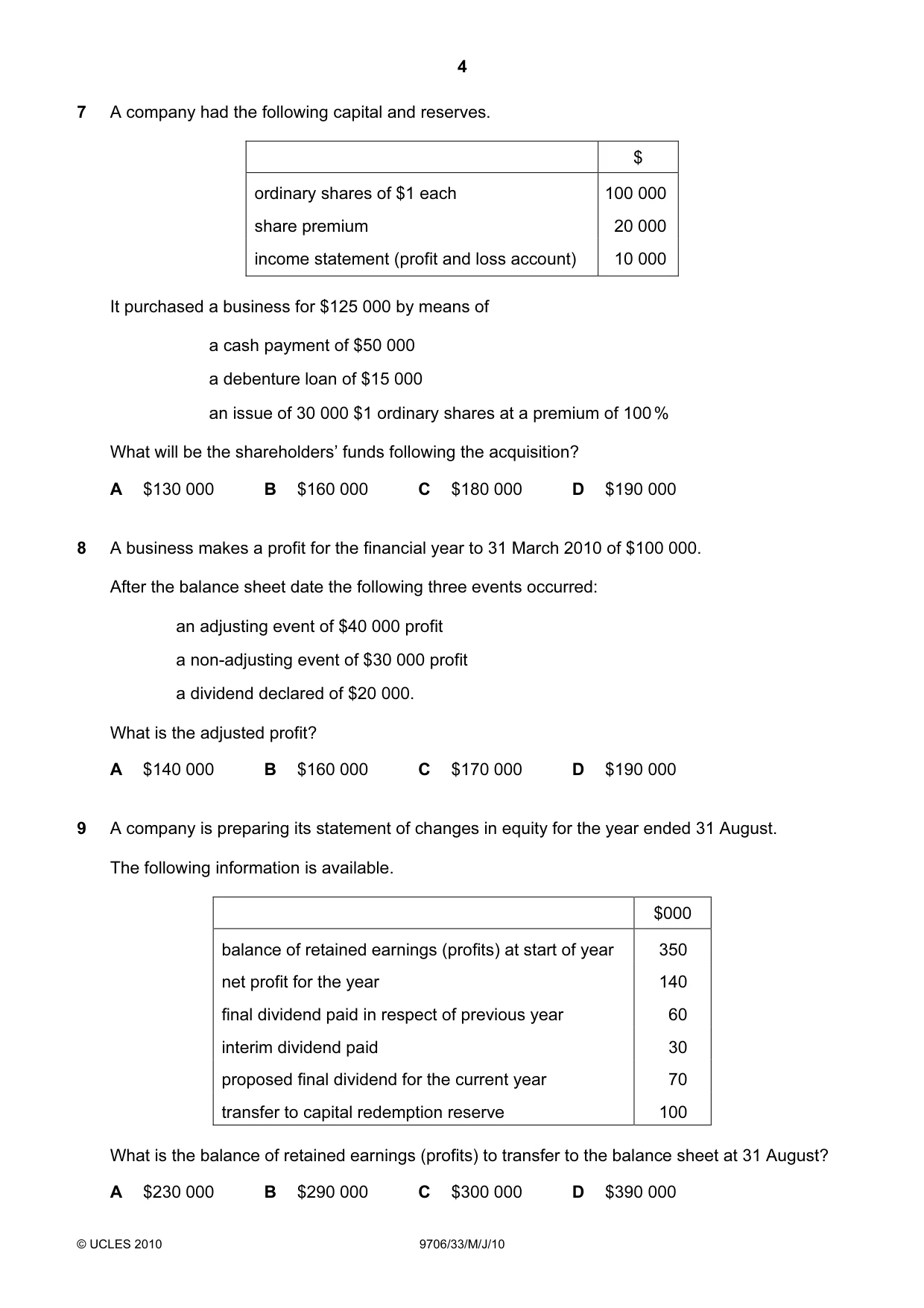
7 A company had the following capital and reserves. $ ordinary shares of $1 each 100 000 share premium 20 000 income statement (profit and loss account) 10 000 It purchased a business for $125 000 by means of a cash payment of $50 000 a debenture loan of $15 000 an issue of 30 000 $1 ordinary shares at a premium of 100 % What will be the shareholders’ funds following the acquisition? A $130 000 B $160 000 C $180 000 D $190 000
Mark scheme: D
Q8 · A business makes a profit for the financial year to 31 March 2010 of $100 000
8 A business makes a profit for the financial year to 31 March 2010 of $100 000. After the balance sheet date the following three events occurred: an adjusting event of $40 000 profit a non-adjusting event of $30 000 profit a dividend declared of $20 000. What is the adjusted profit? A $140 000 B $160 000 C $170 000 D $190 000
Mark scheme: A
Q9 · A company is preparing its statement of changes in equity for the year ended 31 August
9 A company is preparing its statement of changes in equity for the year ended 31 August. The following information is available. $000 balance of retained earnings (profits) at start of year 350 net profit for the year 140 final dividend paid in respect of previous year 60 interim dividend paid 30 proposed final dividend for the current year 70 transfer to capital redemption reserve 100 What is the balance of retained earnings (profits) to transfer to the balance sheet at 31 August? A $230 000 B $290 000 C $300 000 D $390 000
Mark scheme: C
Q10 · The financial statements of a company for the year to 30 June includes the following
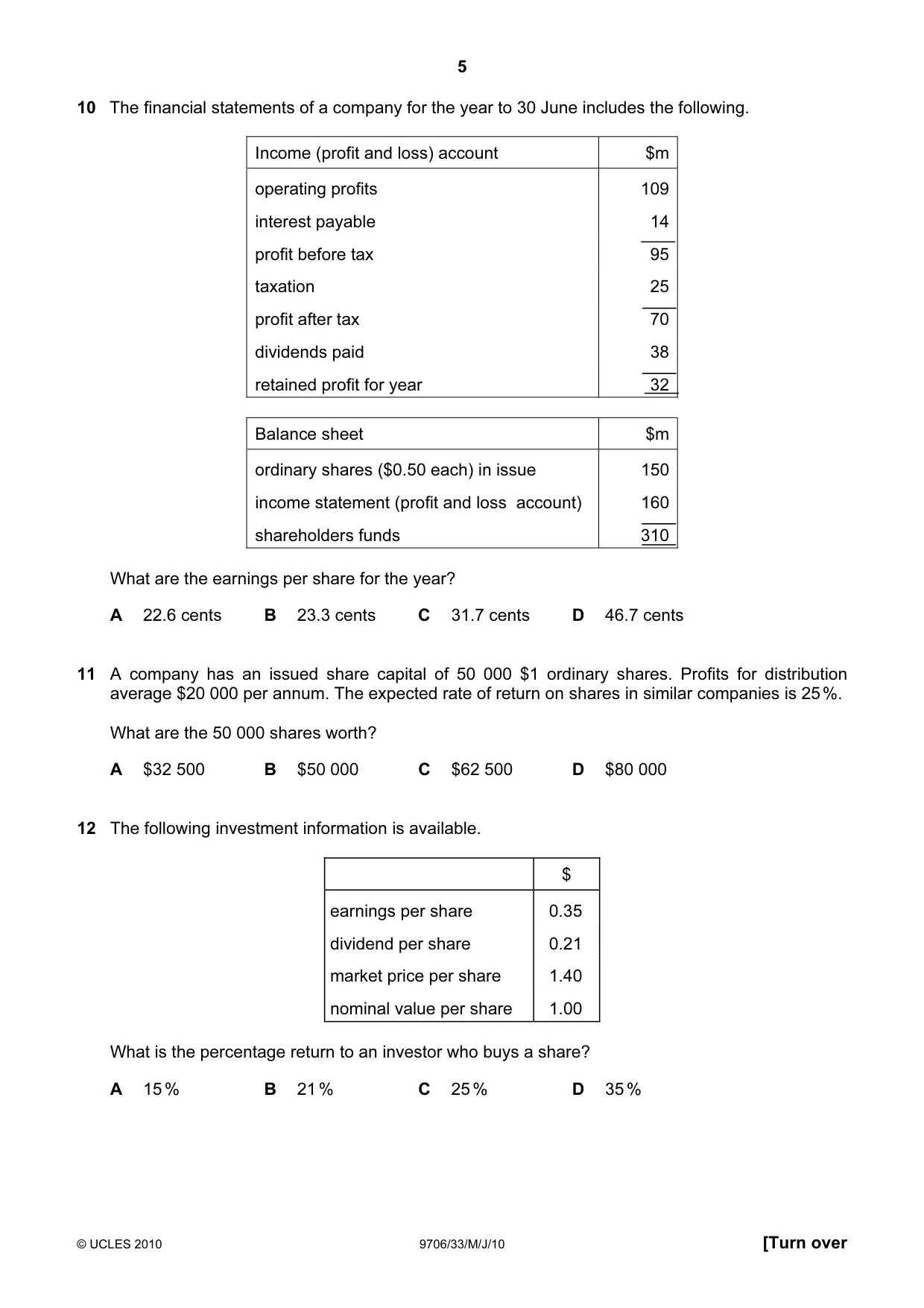
10 The financial statements of a company for the year to 30 June includes the following. Income (profit and loss) account $m operating profits 109 interest payable 14 profit before tax 95 taxation 25 profit after tax 70 dividends paid 38 retained profit for year 32 Balance sheet $m ordinary shares ($0.50 each) in issue 150 income statement (profit and loss account) 160 shareholders funds 310 What are the earnings per share for the year? A 22.6 cents B 23.3 cents C 31.7 cents D 46.7 cents
Mark scheme: B
More questions on Analysis and communication of accounting information
Q11 · A company has an issued share capital of 50 000 $1 ordinary shares
11 A company has an issued share capital of 50 000 $1 ordinary shares. Profits for distribution average $20 000 per annum. The expected rate of return on shares in similar companies is 25 %. What are the 50 000 shares worth? A $32 500 B $50 000 C $62 500 D $80 000
Mark scheme: D
More questions on Analysis and communication of accounting information
Q12 · The following investment information is available
12 The following investment information is available. $ earnings per share 0.35 dividend per share 0.21 market price per share 1.40 nominal value per share 1.00 What is the percentage return to an investor who buys a share? A 15 % B 21 % C 25 % D 35 %
Mark scheme: A
More questions on Analysis and communication of accounting information
Q13 · Which action will reduce the gearing of a company?
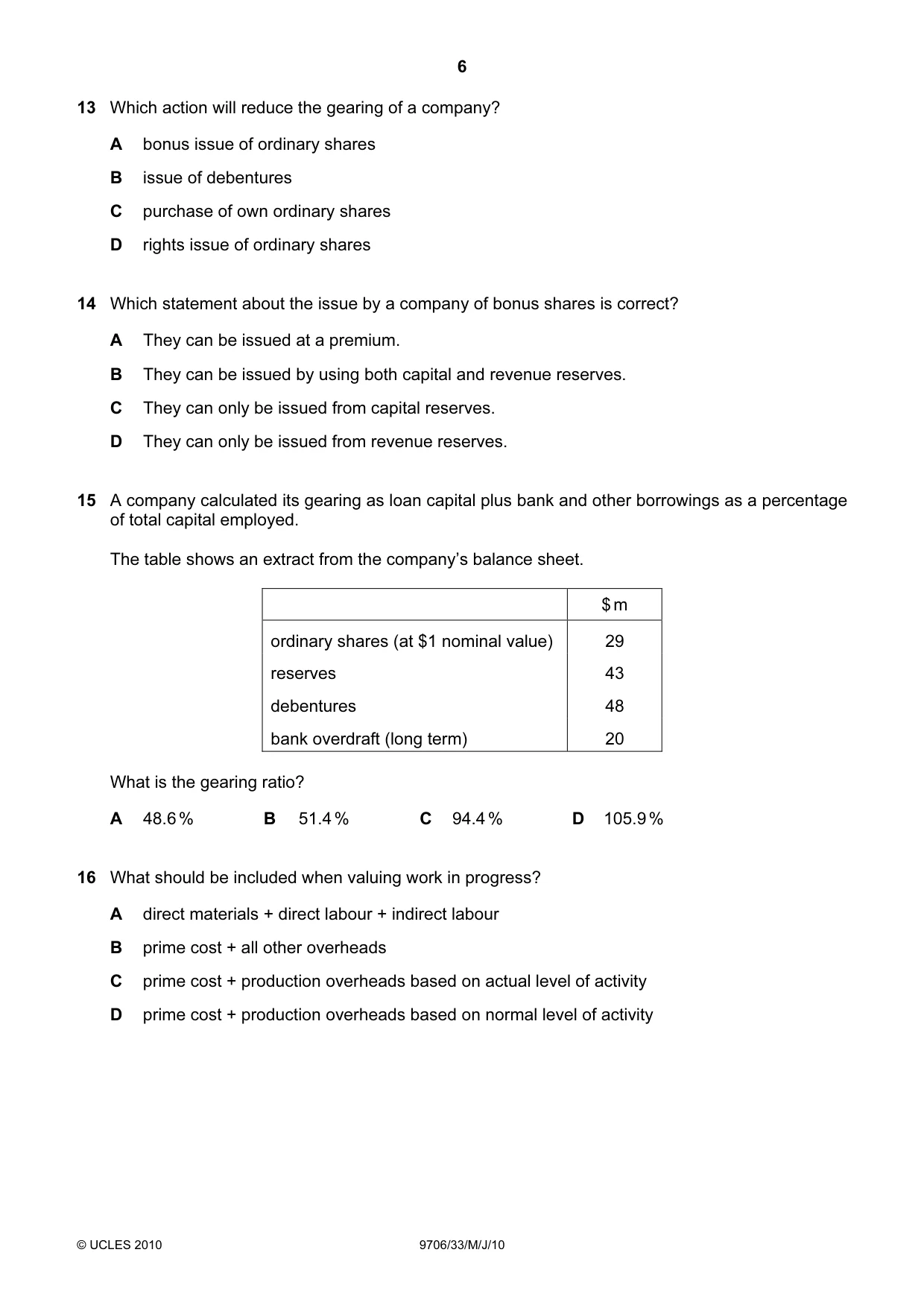
13 Which action will reduce the gearing of a company? A bonus issue of ordinary shares B issue of debentures C purchase of own ordinary shares D rights issue of ordinary shares
Mark scheme: D
More questions on Analysis and communication of accounting information
Q14 · Which statement about the issue by a company of bonus shares is correct?
14 Which statement about the issue by a company of bonus shares is correct? A They can be issued at a premium. B They can be issued by using both capital and revenue reserves. C They can only be issued from capital reserves. D They can only be issued from revenue reserves.
Mark scheme: B
Q15 · A company calculated its gearing as loan capital plus bank and other borrowings as a…
15 A company calculated its gearing as loan capital plus bank and other borrowings as a percentage of total capital employed. The table shows an extract from the company’s balance sheet. $ m ordinary shares (at $1 nominal value) 29 reserves 43 debentures 48 bank overdraft (long term) 20 What is the gearing ratio? A 48.6 % B 51.4 % C 94.4 % D 105.9 %
Mark scheme: A
More questions on Analysis and communication of accounting information
Q16 · What should be included when valuing work in progress?
16 What should be included when valuing work in progress? A direct materials + direct labour + indirect labour B prime cost + all other overheads C prime cost + production overheads based on actual level of activity D prime cost + production overheads based on normal level of activity
Mark scheme: D
Q17 · In marginal costing, how can the total contribution from a given activity be calculated?
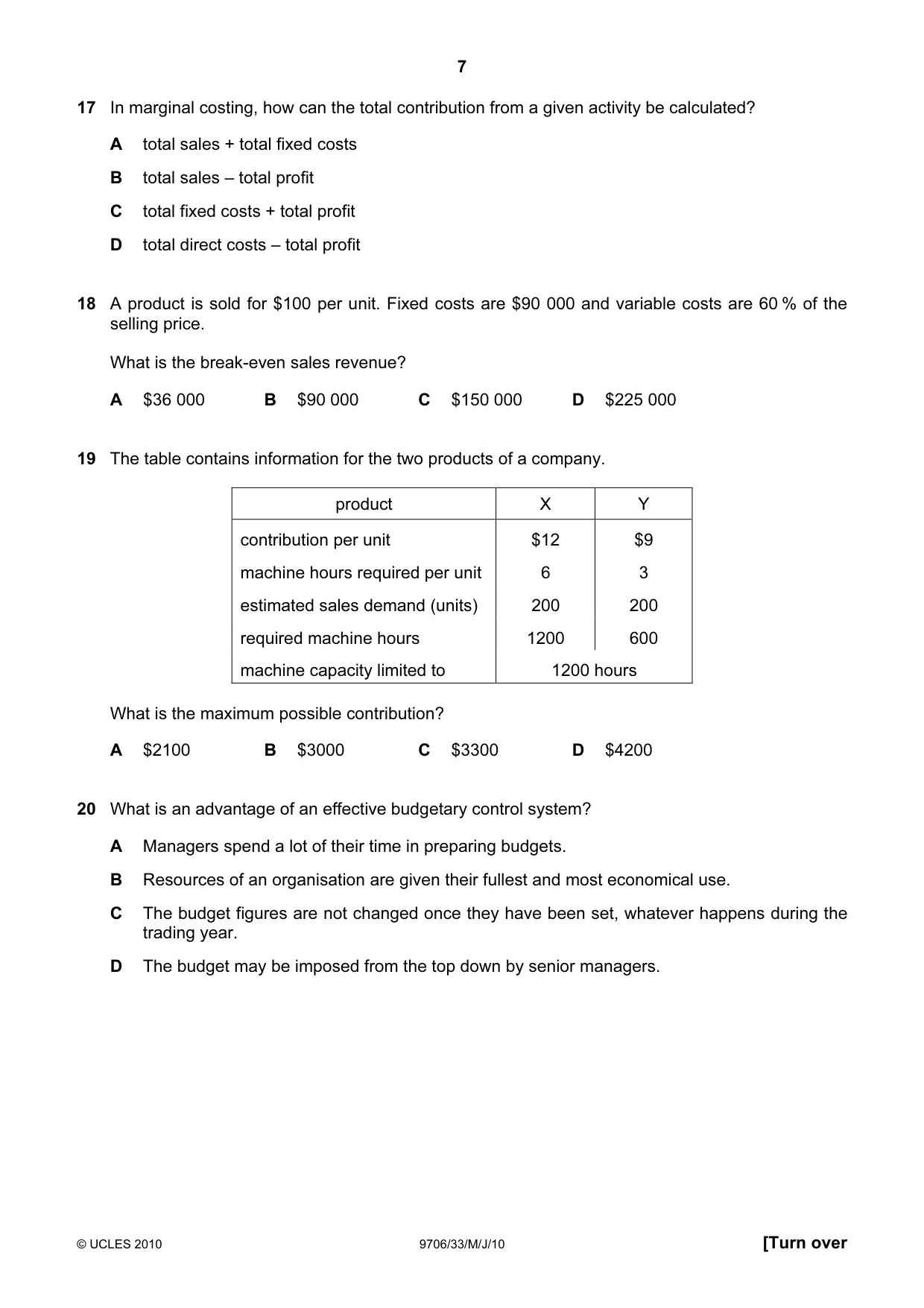
17 In marginal costing, how can the total contribution from a given activity be calculated? A total sales + total fixed costs B total sales – total profit C total fixed costs + total profit D total direct costs – total profit
Mark scheme: C
Q18 · A product is sold for $100 per unit
18 A product is sold for $100 per unit. Fixed costs are $90 000 and variable costs are 60 % of the selling price. What is the break-even sales revenue? A $36 000 B $90 000 C $150 000 D $225 000
Mark scheme: D
Q19 · The table contains information for the two products of a company
19 The table contains information for the two products of a company. product X Y contribution per unit $12 $9 machine hours required per unit 6 3 estimated sales demand (units) 200 200 required machine hours 1200 600 machine capacity limited to 1200 hours What is the maximum possible contribution? A $2100 B $3000 C $3300 D $4200
Mark scheme: B
Q20 · What is an advantage of an effective budgetary control system?
20 What is an advantage of an effective budgetary control system? A Managers spend a lot of their time in preparing budgets. B Resources of an organisation are given their fullest and most economical use. C The budget figures are not changed once they have been set, whatever happens during the trading year. D The budget may be imposed from the top down by senior managers.
Mark scheme: B
Q21 · In order to prepare the budget figures for next year a company uses last year’s actual…
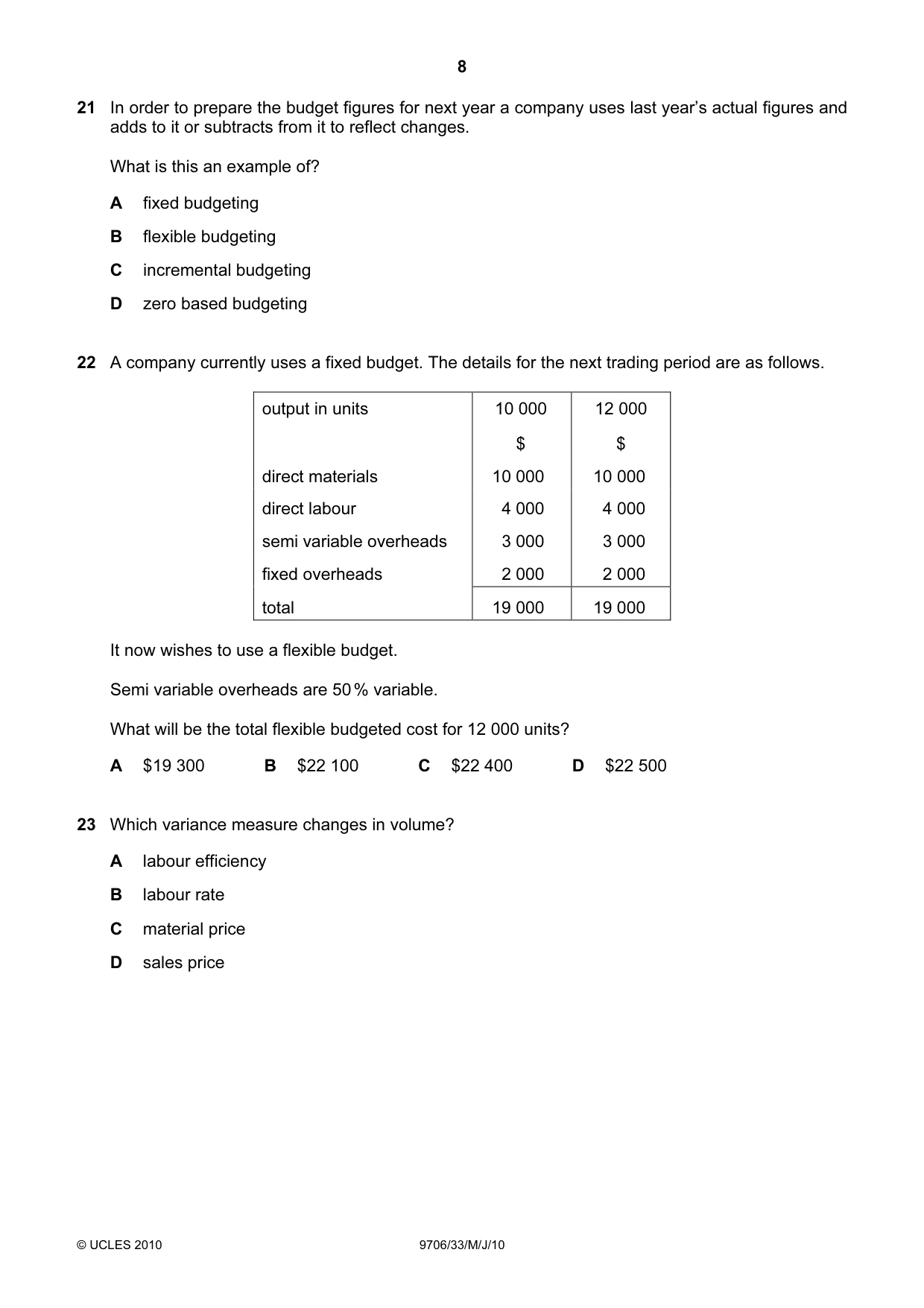
21 In order to prepare the budget figures for next year a company uses last year’s actual figures and adds to it or subtracts from it to reflect changes. What is this an example of? A fixed budgeting B flexible budgeting C incremental budgeting D zero based budgeting
Mark scheme: C
Q22 · A company currently uses a fixed budget
22 A company currently uses a fixed budget. The details for the next trading period are as follows. output in units 10 000 12 000 $ $ direct materials 10 000 10 000 direct labour 4 000 4 000 semi variable overheads 3 000 3 000 fixed overheads 2 000 2 000 total 19 000 19 000 It now wishes to use a flexible budget. Semi variable overheads are 50 % variable. What will be the total flexible budgeted cost for 12 000 units? A $19 300 B $22 100 C $22 400 D $22 500
Mark scheme: B
Q23 · Which variance measure changes in volume?
23 Which variance measure changes in volume? A labour efficiency B labour rate C material price D sales price
Mark scheme: A
Q24 · Budgeted figures for a product are as follows
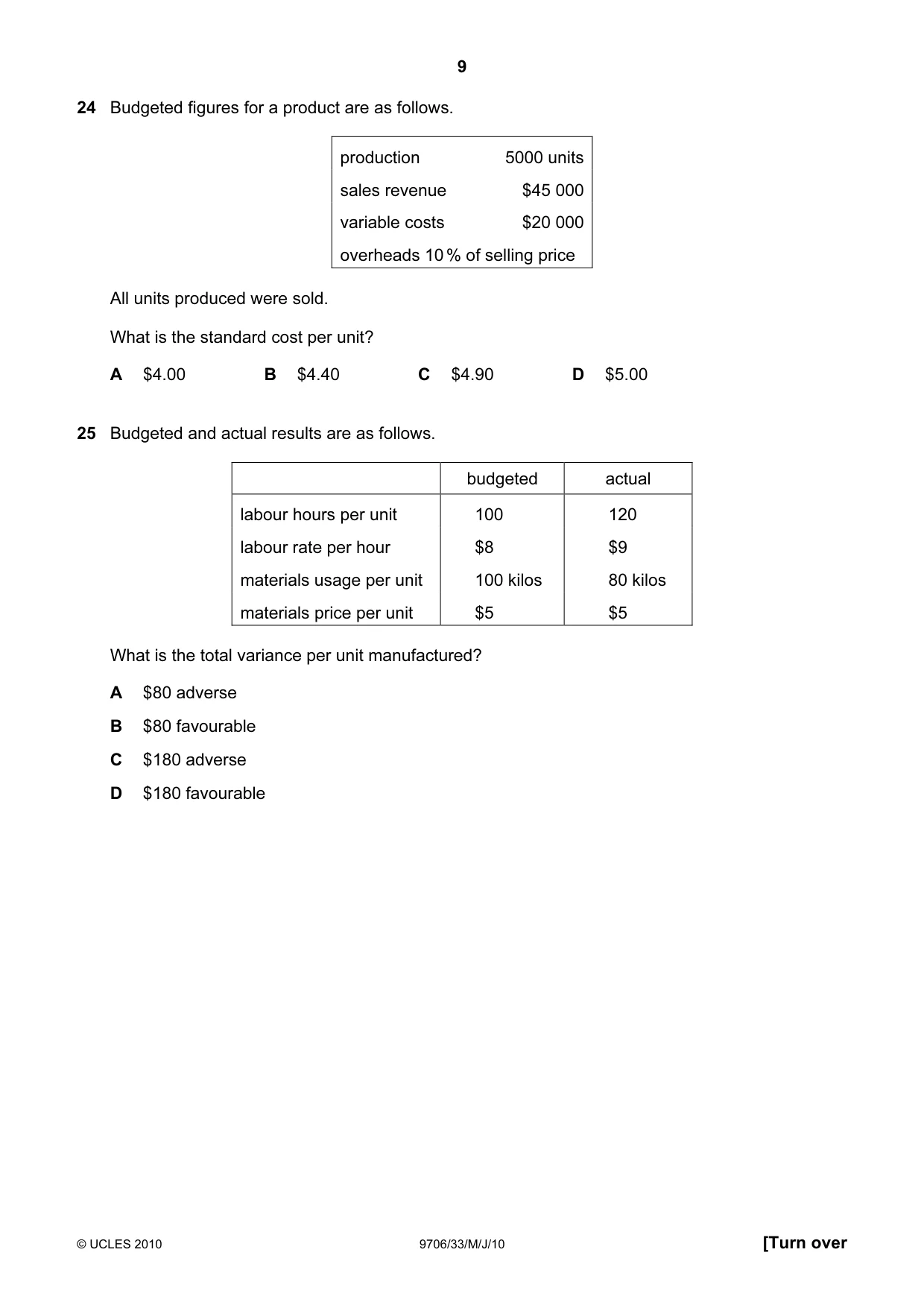
24 Budgeted figures for a product are as follows. production 5000 units sales revenue $45 000 variable costs $20 000 overheads 10 % of selling price All units produced were sold. What is the standard cost per unit? A $4.00 B $4.40 C $4.90 D $5.00
Mark scheme: C
Q25 · Budgeted and actual results are as follows
25 Budgeted and actual results are as follows. budgeted actual labour hours per unit 100 120 labour rate per hour $8 $9 materials usage per unit 100 kilos 80 kilos materials price per unit $5 $5 What is the total variance per unit manufactured? A $80 adverse B $80 favourable C $180 adverse D $180 favourable
Mark scheme: C
Q26 · A company makes a product with a standard material cost of $15, as follows
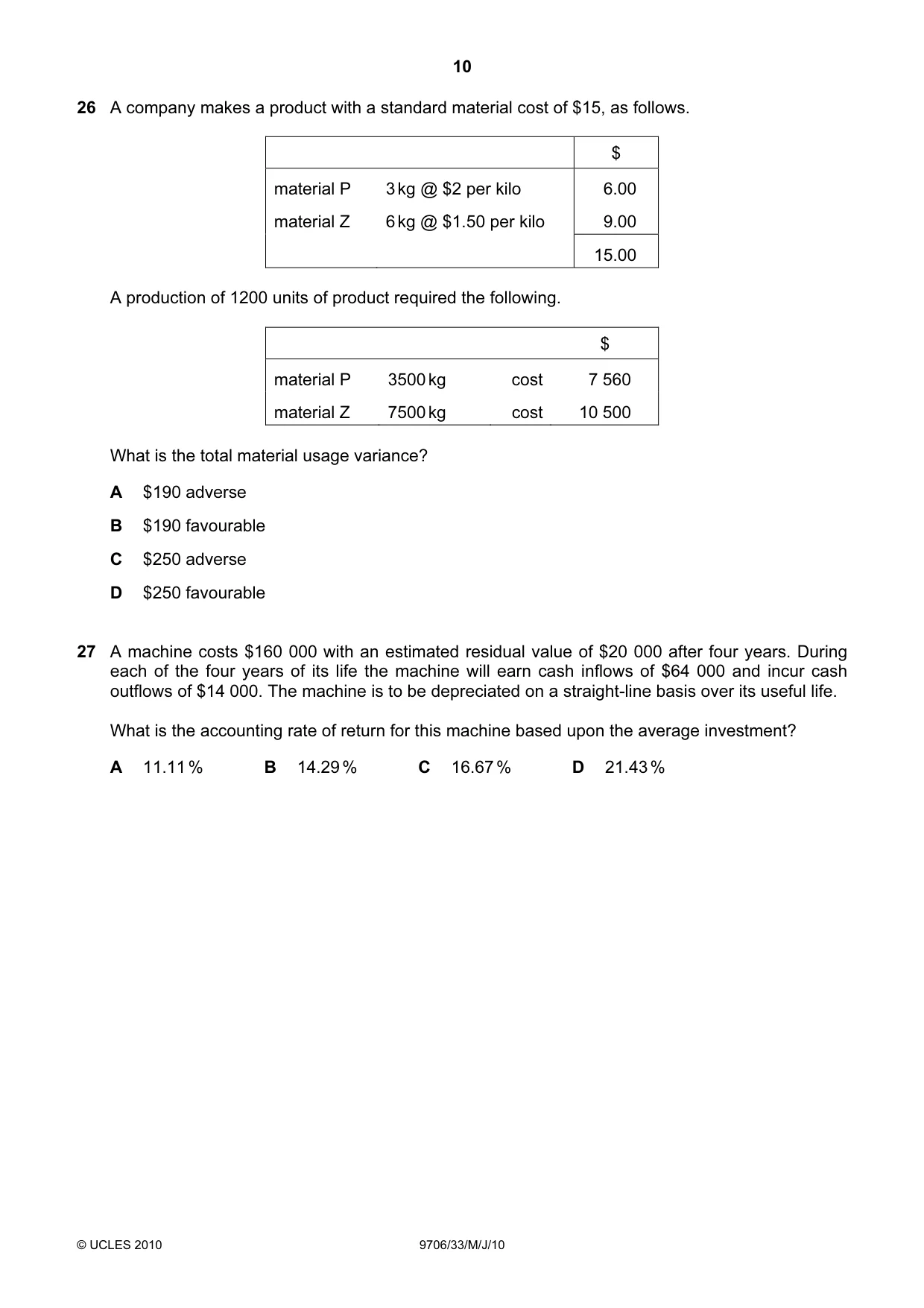
26 A company makes a product with a standard material cost of $15, as follows. $ material P 3 kg @ $2 per kilo 6.00 material Z 6 kg @ $1.50 per kilo 9.00 15.00 A production of 1200 units of product required the following. $ material P 3500 kg cost 7 560 material Z 7500 kg cost 10 500 What is the total material usage variance? A $190 adverse B $190 favourable C $250 adverse D $250 favourable
Mark scheme: C
Q27 · A machine costs $160 000 with an estimated residual value of $20 000 after four years
27 A machine costs $160 000 with an estimated residual value of $20 000 after four years. During each of the four years of its life the machine will earn cash inflows of $64 000 and incur cash outflows of $14 000. The machine is to be depreciated on a straight-line basis over its useful life. What is the accounting rate of return for this machine based upon the average investment? A 11.11 % B 14.29 % C 16.67 % D 21.43 %
Mark scheme: C
Q28 · A three year capital investment project costing $80 000 generates the following net cash…
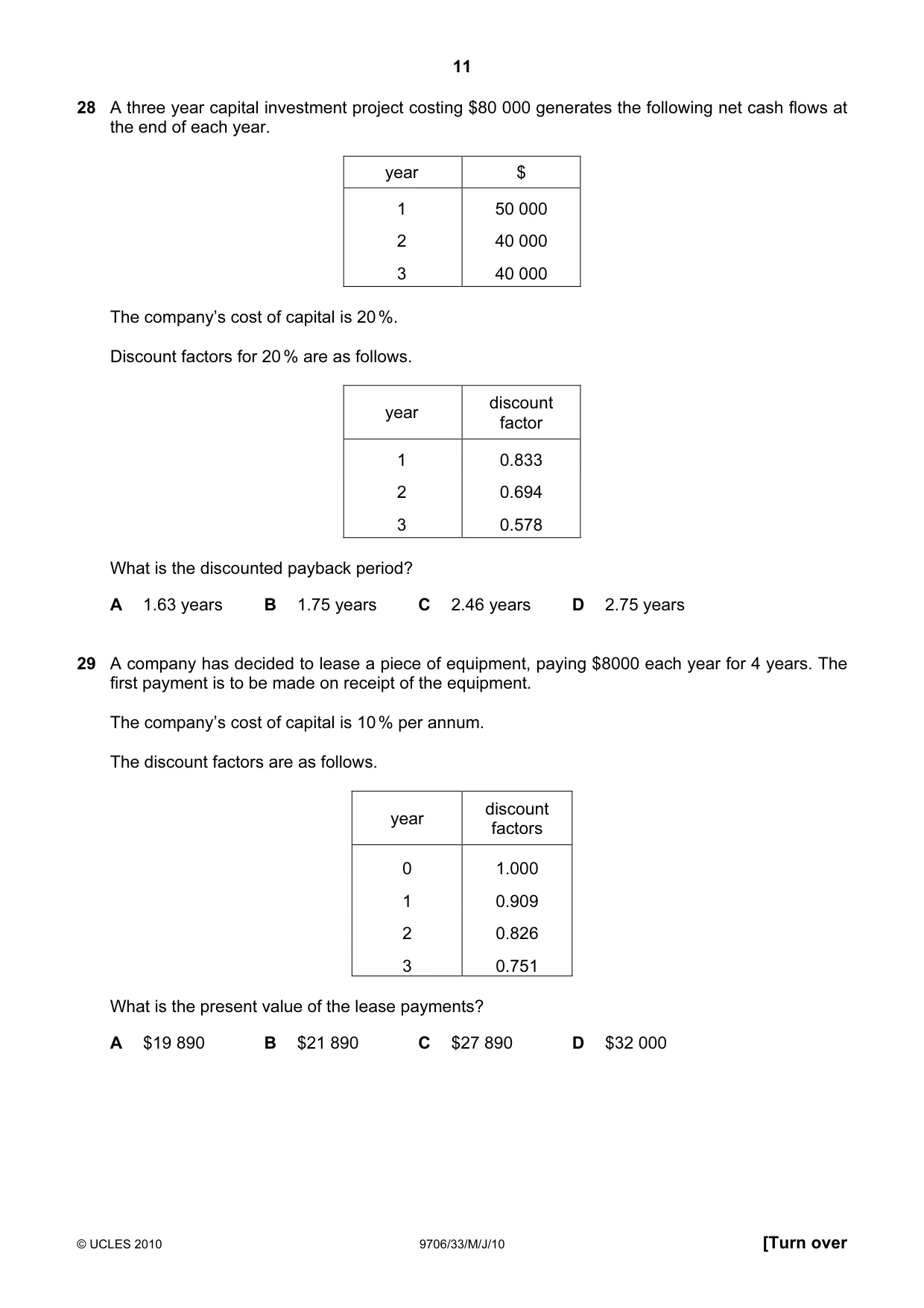
28 A three year capital investment project costing $80 000 generates the following net cash flows at the end of each year. year $ 1 50 000 2 40 000 3 40 000 The company’s cost of capital is 20 %. Discount factors for 20 % are as follows. discount year factor 1 0.833 2 0.694 3 0.578 What is the discounted payback period? A 1.63 years B 1.75 years C 2.46 years D 2.75 years
Mark scheme: C
Q29 · A company has decided to lease a piece of equipment, paying $8000 each year for 4 years
29 A company has decided to lease a piece of equipment, paying $8000 each year for 4 years. The first payment is to be made on receipt of the equipment. The company’s cost of capital is 10 % per annum. The discount factors are as follows. discount year factors 0 1.000 1 0.909 2 0.826 3 0.751 What is the present value of the lease payments? A $19 890 B $21 890 C $27 890 D $32 000
Mark scheme: C
Q30 · Which increases the net cash inflow from operating activities?
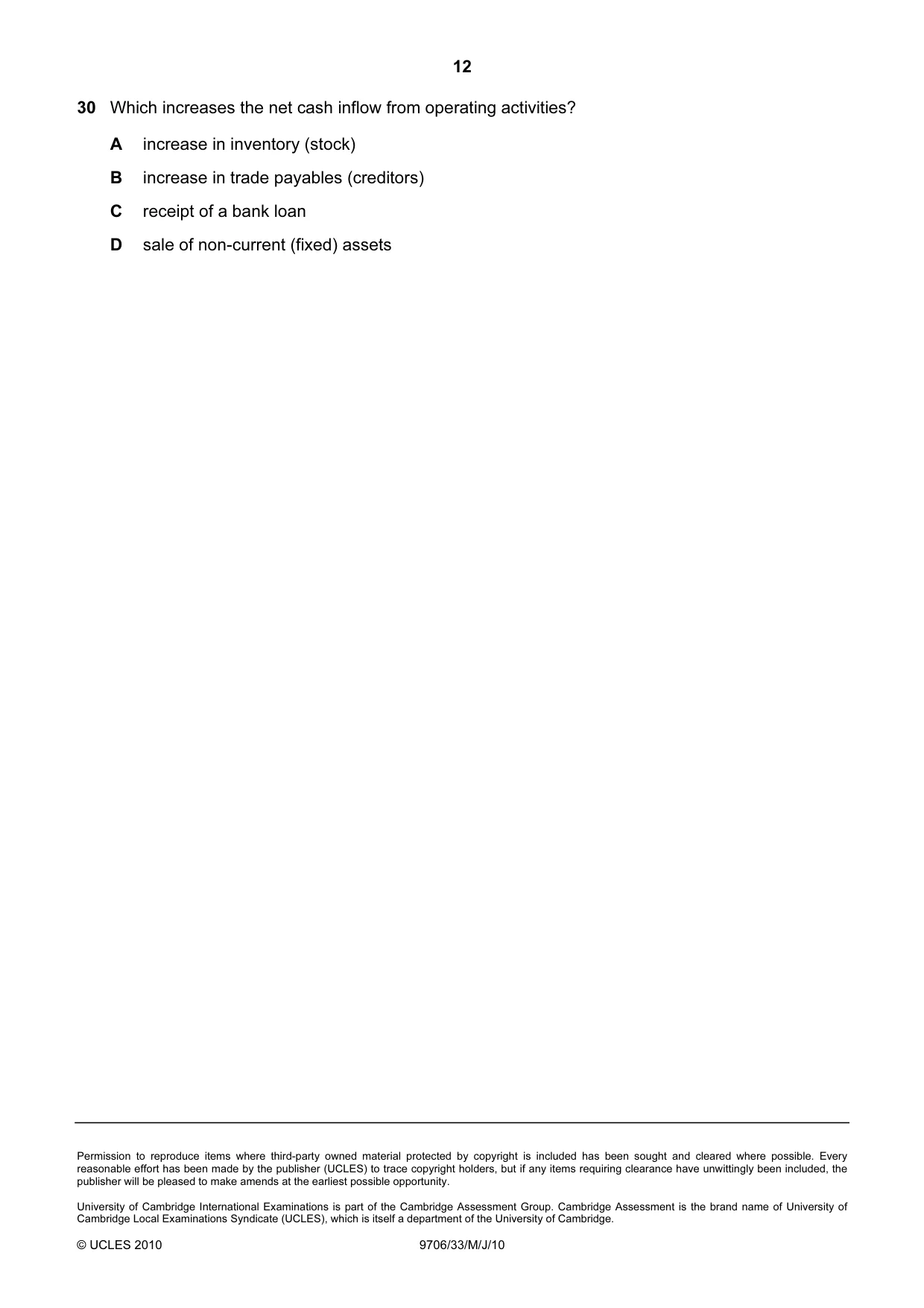
30 Which increases the net cash inflow from operating activities? A increase in inventory (stock) B increase in trade payables (creditors) C receipt of a bank loan D sale of non-current (fixed) assets
Mark scheme: B
What was in this paper
The subtopics covered by these 30 questions, and how many questions each got. Open one in a new tab to see every Cambridge question on it.
6Analysis and communication of accounting information4Standard costing4Budgeting and budgetary control3Investment appraisal3Traditional costing methods3Business acquisition and merger2Types of business entity2Analysis and communication of accounting information1Costs and cost behaviour1Regulatory and ethical considerations1What you needed in this session
Cambridge’s own grade thresholds for 2010 May/June, Paper 3 · Variant 3. A higher threshold means an easier paper — the bar moves with how the cohort did.