Cambridge A Level Accounting 9706 — 2015 Oct/Nov Paper 3 · Variant 2
9706/32/O/N/15 · 30 questions · 30 marks · ≈34 min
The question paper and its mark scheme, free to read here and free to download. This is Cambridge’s own paper, exactly as it was sat.
Question paper12 pages
Mark scheme2 pages
Answers below. Sit the paper first if you are practising.
Questions as text
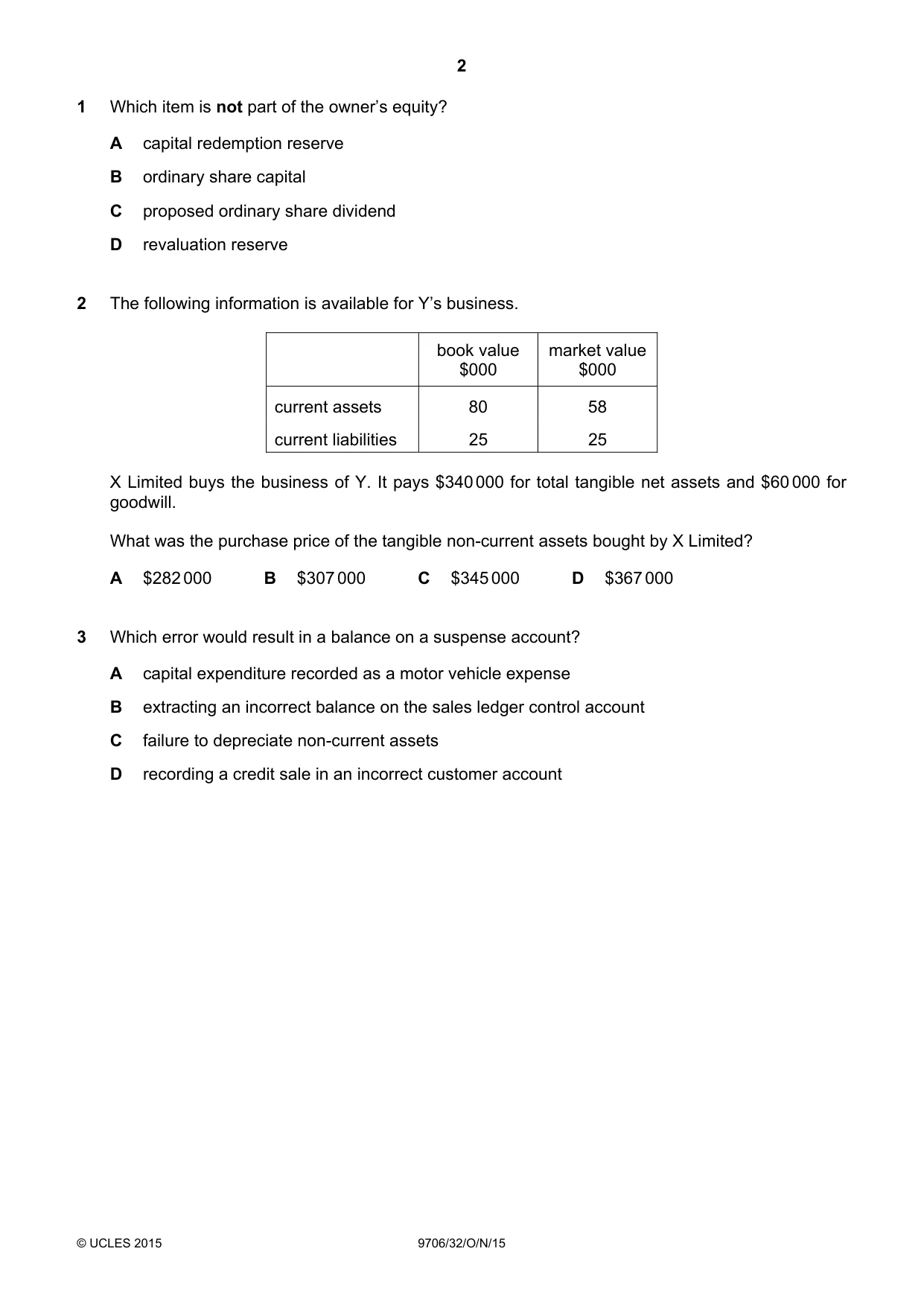
Q1 · Which item is not part of the owner’s equity?
1 Which item is not part of the owner’s equity? A capital redemption reserve B ordinary share capital C proposed ordinary share dividend D revaluation reserve
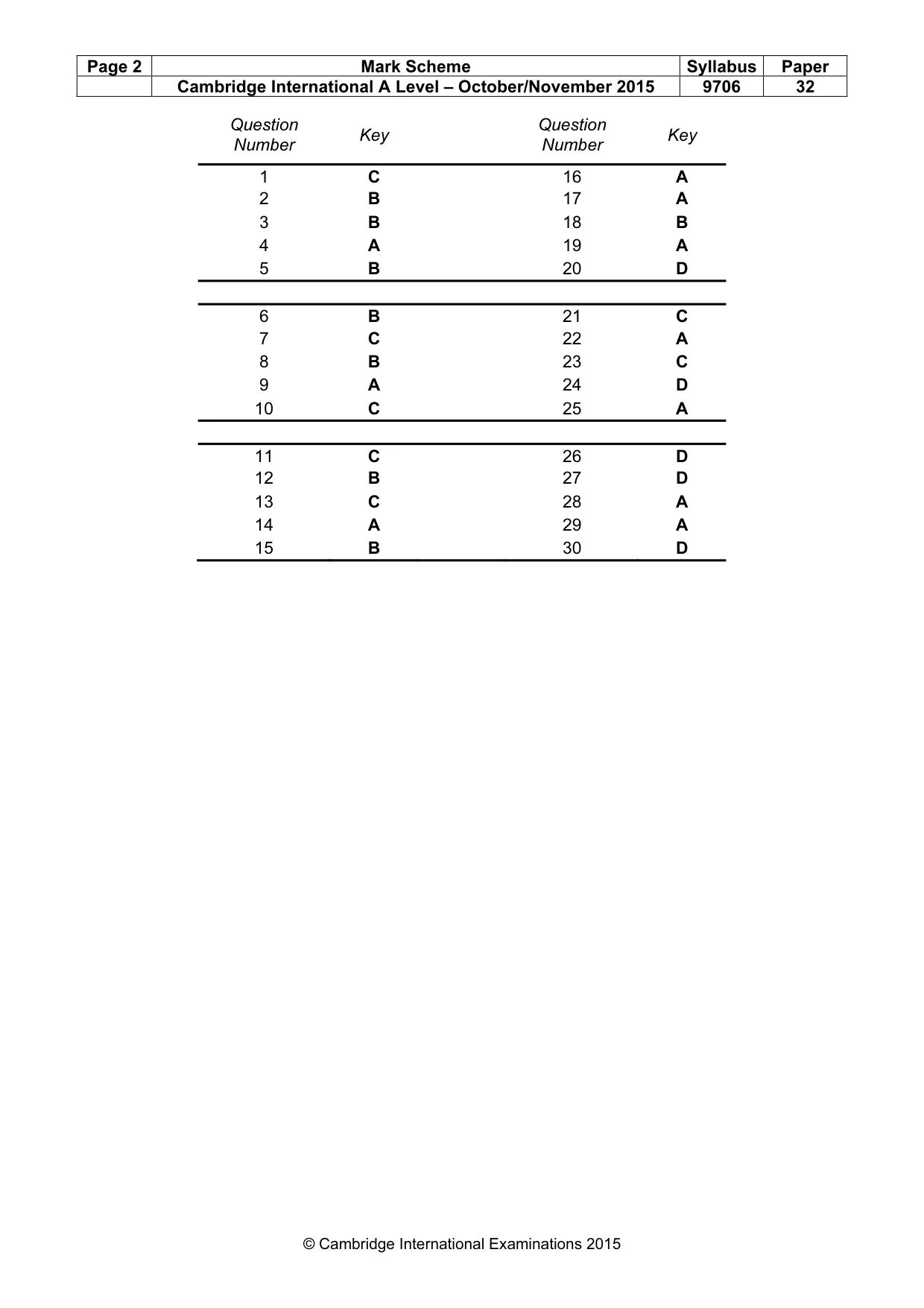
Mark scheme: C
Q2 · The following information is available for Y’s business
2 The following information is available for Y’s business. book value market value $000 $000 current assets 80 58 current liabilities 25 25 X Limited buys the business of Y. It pays $340 000 for total tangible net assets and $60 000 for goodwill. What was the purchase price of the tangible non-current assets bought by X Limited? A $282 000 B $307 000 C $345 000 D $367 000
Mark scheme: B
Q3 · Which error would result in a balance on a suspense account?
3 Which error would result in a balance on a suspense account? A capital expenditure recorded as a motor vehicle expense B extracting an incorrect balance on the sales ledger control account C failure to depreciate non-current assets D recording a credit sale in an incorrect customer account
Mark scheme: B
Q4 · X, Y and Z are in partnership with a profit sharing ratio of 2 : 2 : 1
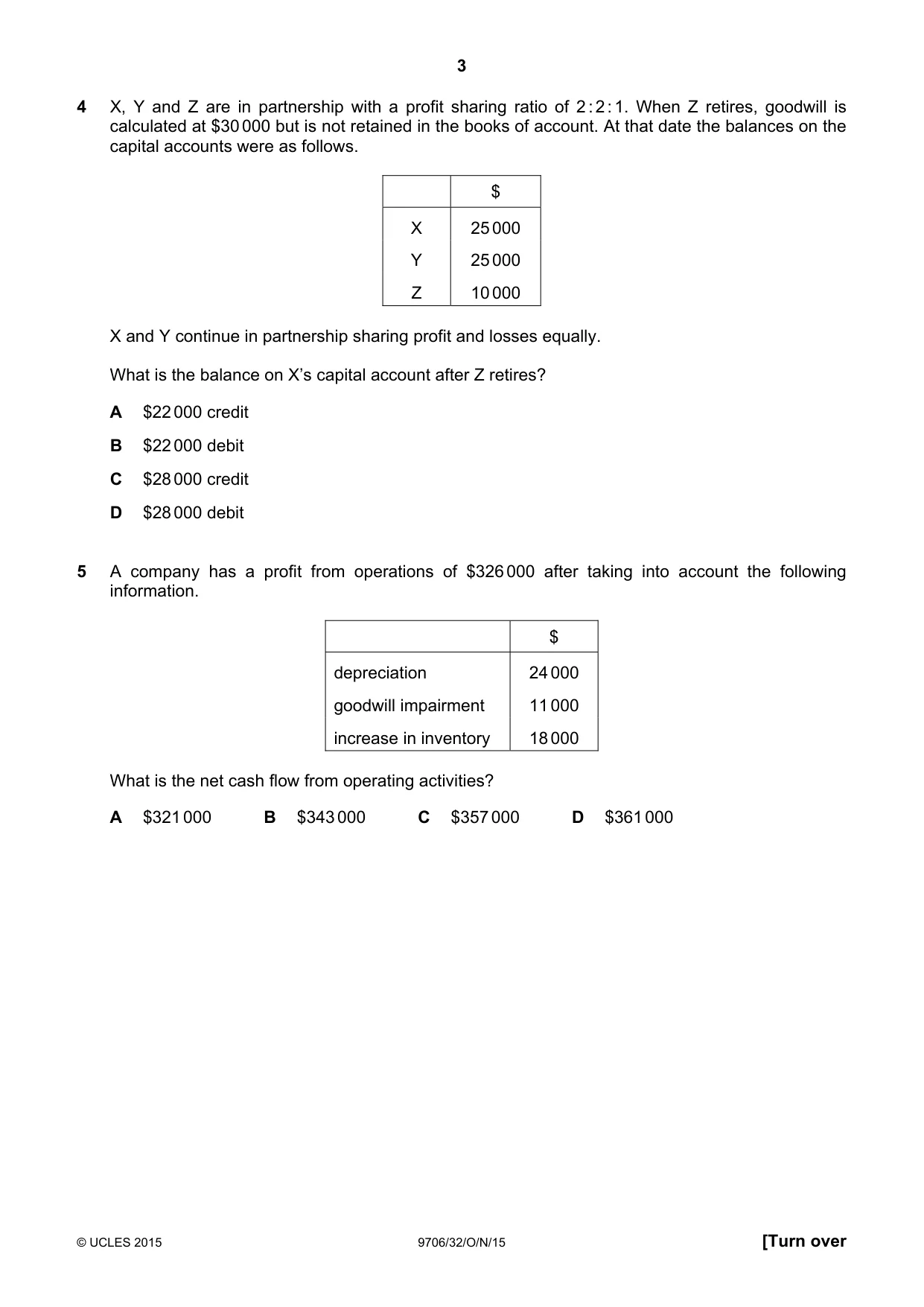
4 X, Y and Z are in partnership with a profit sharing ratio of 2 : 2 : 1. When Z retires, goodwill is calculated at $30 000 but is not retained in the books of account. At that date the balances on the capital accounts were as follows. $ X 25 000 Y 25 000 Z 10 000 X and Y continue in partnership sharing profit and losses equally. What is the balance on X’s capital account after Z retires? A $22 000 credit B $22 000 debit C $28 000 credit D $28 000 debit
Mark scheme: A
Q5 · A company has a profit from operations of $326 000 after taking into account the…
5 A company has a profit from operations of $326 000 after taking into account the following information. $ depreciation 24 000 goodwill impairment 11 000 increase in inventory 18 000 What is the net cash flow from operating activities? A $321 000 B $343 000 C $357 000 D $361 000
Mark scheme: B
More questions on Analysis and communication of accounting information
Q6 · A manufacturing business provides the following inventory valuations for finished goods
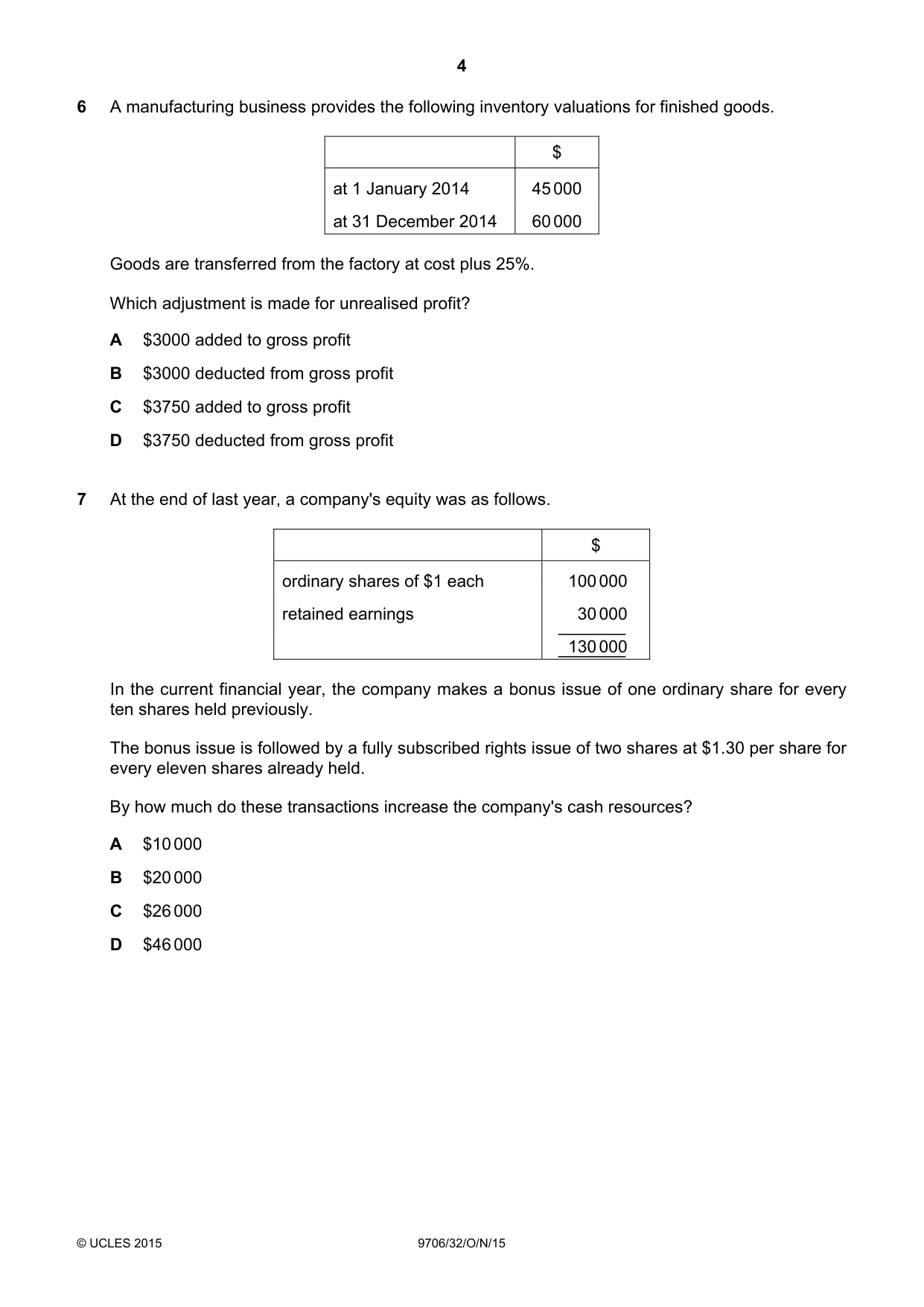
6 A manufacturing business provides the following inventory valuations for finished goods. $ at 1 January 2014 45 000 at 31 December 2014 60 000 Goods are transferred from the factory at cost plus 25%. Which adjustment is made for unrealised profit? A $3000 added to gross profit B $3000 deducted from gross profit C $3750 added to gross profit D $3750 deducted from gross profit
Mark scheme: B
Q7 · At the end of last year, a company's equity was as follows
7 At the end of last year, a company's equity was as follows. $ ordinary shares of $1 each 100 000 retained earnings 30 000 130 000 In the current financial year, the company makes a bonus issue of one ordinary share for every ten shares held previously. The bonus issue is followed by a fully subscribed rights issue of two shares at $1.30 per share for every eleven shares already held. By how much do these transactions increase the company's cash resources? A $10 000 B $20 000 C $26 000 D $46 000
Mark scheme: C
Q8 · The business of a sole trader is bought by a limited company
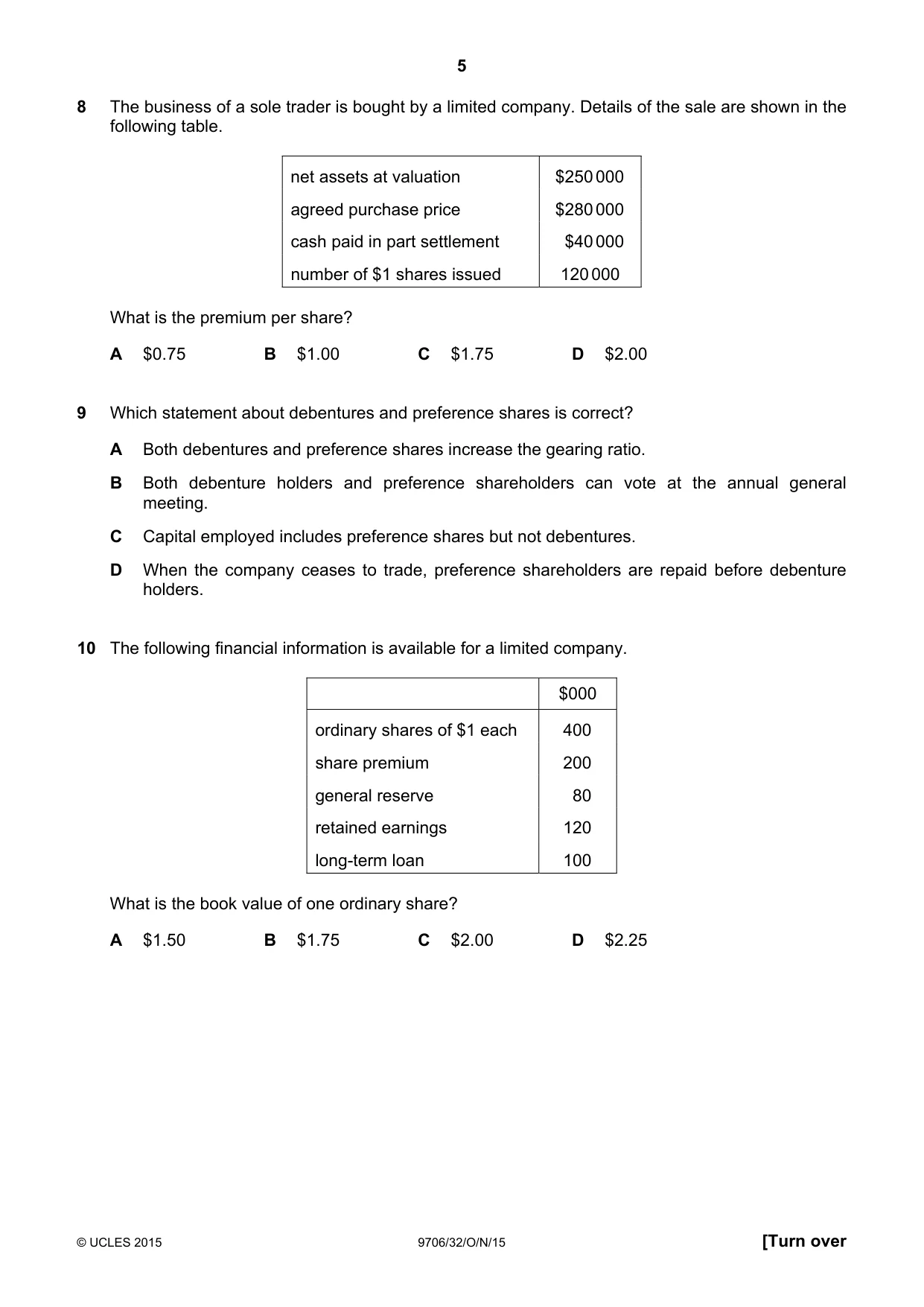
8 The business of a sole trader is bought by a limited company. Details of the sale are shown in the following table. net assets at valuation $250 000 agreed purchase price $280 000 cash paid in part settlement $40 000 number of $1 shares issued 120 000 What is the premium per share? A $0.75 B $1.00 C $1.75 D $2.00
Mark scheme: B
Q9 · Which statement about debentures and preference shares is correct?
9 Which statement about debentures and preference shares is correct? A Both debentures and preference shares increase the gearing ratio. B Both debenture holders and preference shareholders can vote at the annual general meeting. C Capital employed includes preference shares but not debentures. D When the company ceases to trade, preference shareholders are repaid before debenture holders.
Mark scheme: A
Q10 · The following financial information is available for a limited company
10 The following financial information is available for a limited company. $000 ordinary shares of $1 each 400 share premium 200 general reserve 80 retained earnings 120 long-term loan 100 What is the book value of one ordinary share? A $1.50 B $1.75 C $2.00 D $2.25
Mark scheme: C
More questions on Analysis and communication of accounting information
Q11 · The following information is available for a limited company
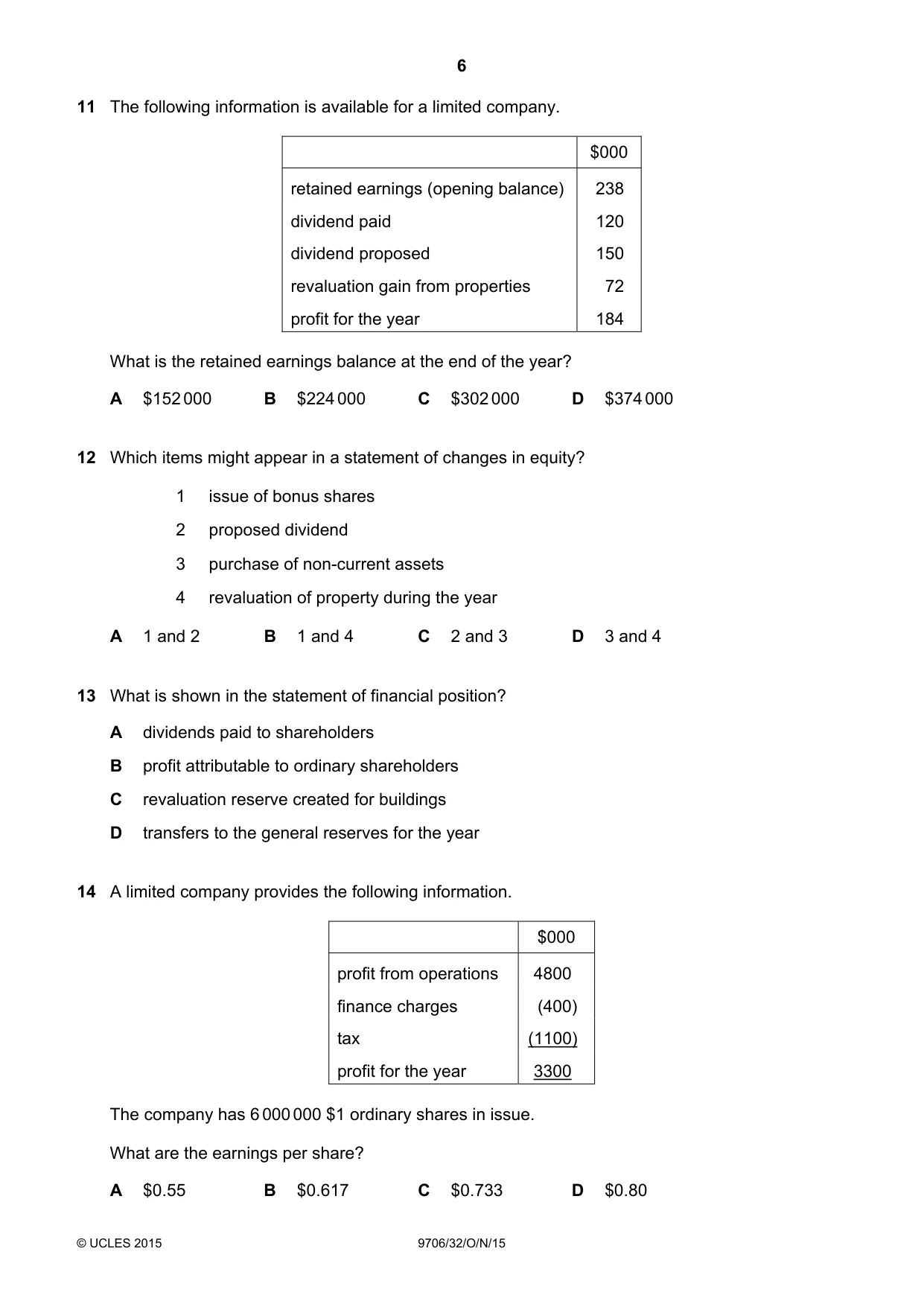
11 The following information is available for a limited company. $000 retained earnings (opening balance) 238 dividend paid 120 dividend proposed 150 revaluation gain from properties 72 profit for the year 184 What is the retained earnings balance at the end of the year? A $152 000 B $224 000 C $302 000 D $374 000
Mark scheme: C
Q12 · Which items might appear in a statement of changes in equity?
12 Which items might appear in a statement of changes in equity? 1 issue of bonus shares 2 proposed dividend 3 purchase of non-current assets 4 revaluation of property during the year A 1 and 2 B 1 and 4 C 2 and 3 D 3 and 4
Mark scheme: B
Q13 · What is shown in the statement of financial position?
13 What is shown in the statement of financial position? A dividends paid to shareholders B profit attributable to ordinary shareholders C revaluation reserve created for buildings D transfers to the general reserves for the year
Mark scheme: C
Q14 · A limited company provides the following information
14 A limited company provides the following information. $000 profit from operations 4800 finance charges (400) tax (1100) profit for the year 3300 The company has 6 000 000 $1 ordinary shares in issue. What are the earnings per share? A $0.55 B $0.617 C $0.733 D $0.80
Mark scheme: A
More questions on Analysis and communication of accounting information
Q15 · A company provided the following information
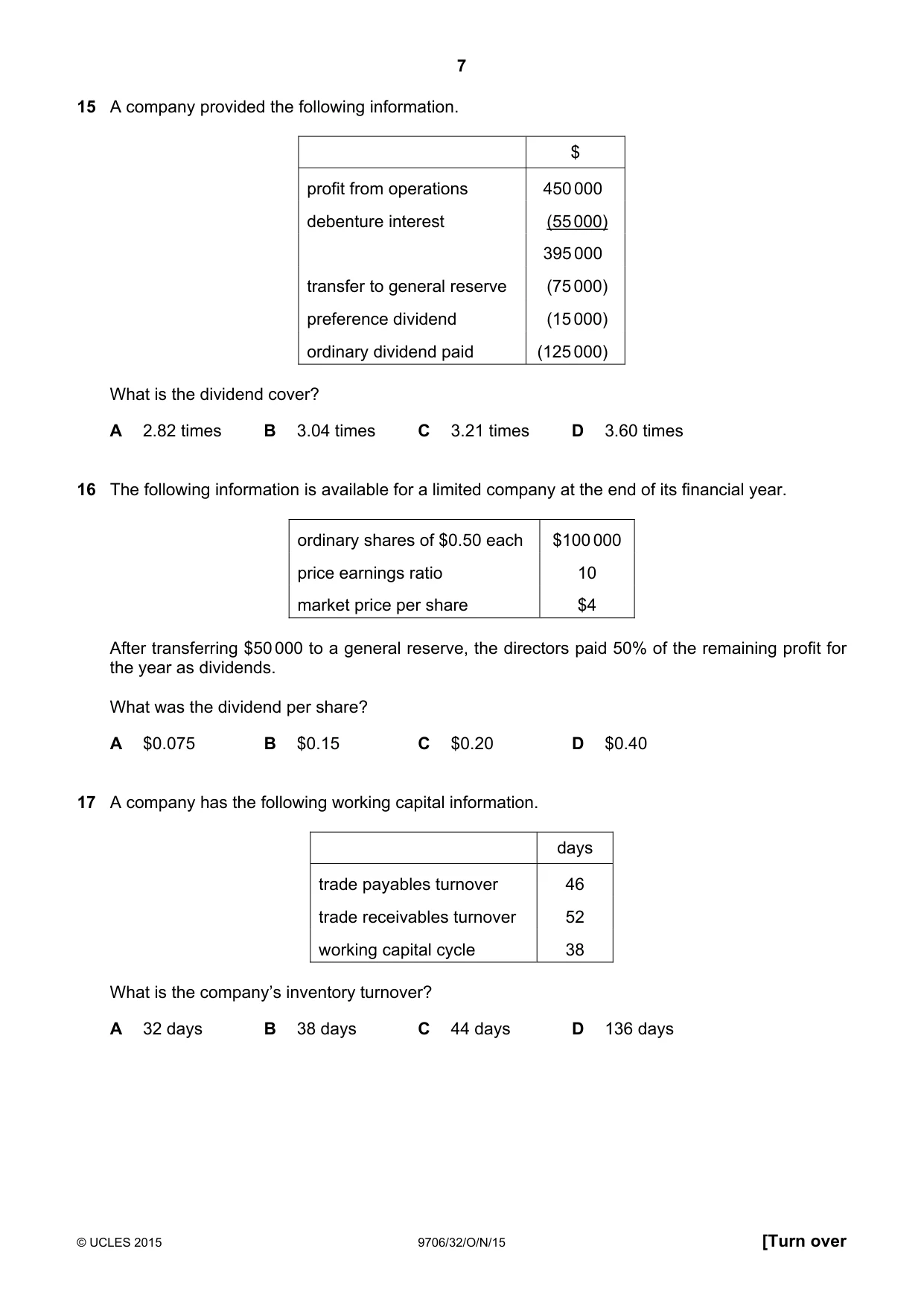
15 A company provided the following information. $ profit from operations 450 000 debenture interest (55 000) 395 000 transfer to general reserve (75 000) preference dividend (15 000) ordinary dividend paid (125 000) What is the dividend cover? A 2.82 times B 3.04 times C 3.21 times D 3.60 times
Mark scheme: B
More questions on Analysis and communication of accounting information
Q16 · The following information is available for a limited company at the end of its financial…
16 The following information is available for a limited company at the end of its financial year. ordinary shares of $0.50 each $100 000 price earnings ratio 10 market price per share $4 After transferring $50 000 to a general reserve, the directors paid 50% of the remaining profit for the year as dividends. What was the dividend per share? A $0.075 B $0.15 C $0.20 D $0.40
Mark scheme: A
More questions on Analysis and communication of accounting information
Q17 · A company has the following working capital information
17 A company has the following working capital information. days trade payables turnover 46 trade receivables turnover 52 working capital cycle 38 What is the company’s inventory turnover? A 32 days B 38 days C 44 days D 136 days
Mark scheme: A
More questions on Analysis and communication of accounting information
Q18 · How is a liability of uncertain timing or amount classified under IAS37?
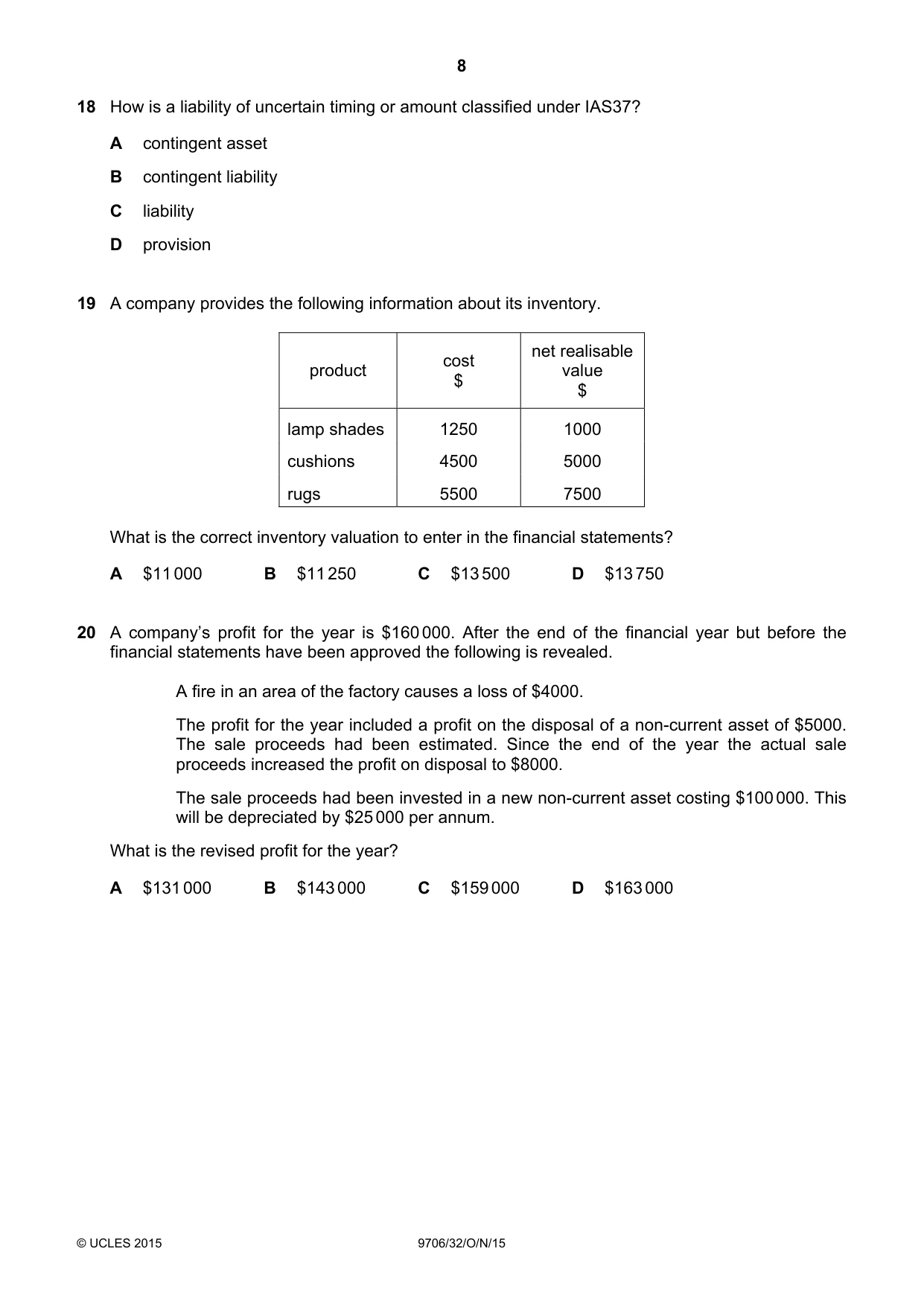
18 How is a liability of uncertain timing or amount classified under IAS37? A contingent asset B contingent liability C liability D provision
Mark scheme: B
Q19 · A company provides the following information about its inventory
19 A company provides the following information about its inventory. net realisable cost product value $ $ lamp shades 1250 1000 cushions 4500 5000 rugs 5500 7500 What is the correct inventory valuation to enter in the financial statements? A $11 000 B $11 250 C $13 500 D $13 750
Mark scheme: A
Q20 · A company’s profit for the year is $160 000
20 A company’s profit for the year is $160 000. After the end of the financial year but before the financial statements have been approved the following is revealed. A fire in an area of the factory causes a loss of $4000. The profit for the year included a profit on the disposal of a non-current asset of $5000. The sale proceeds had been estimated. Since the end of the year the actual sale proceeds increased the profit on disposal to $8000. The sale proceeds had been invested in a new non-current asset costing $100 000. This will be depreciated by $25 000 per annum. What is the revised profit for the year? A $131 000 B $143 000 C $159 000 D $163 000
Mark scheme: D
Q21 · A company is proposing to purchase a new machine which will have a payback of five years
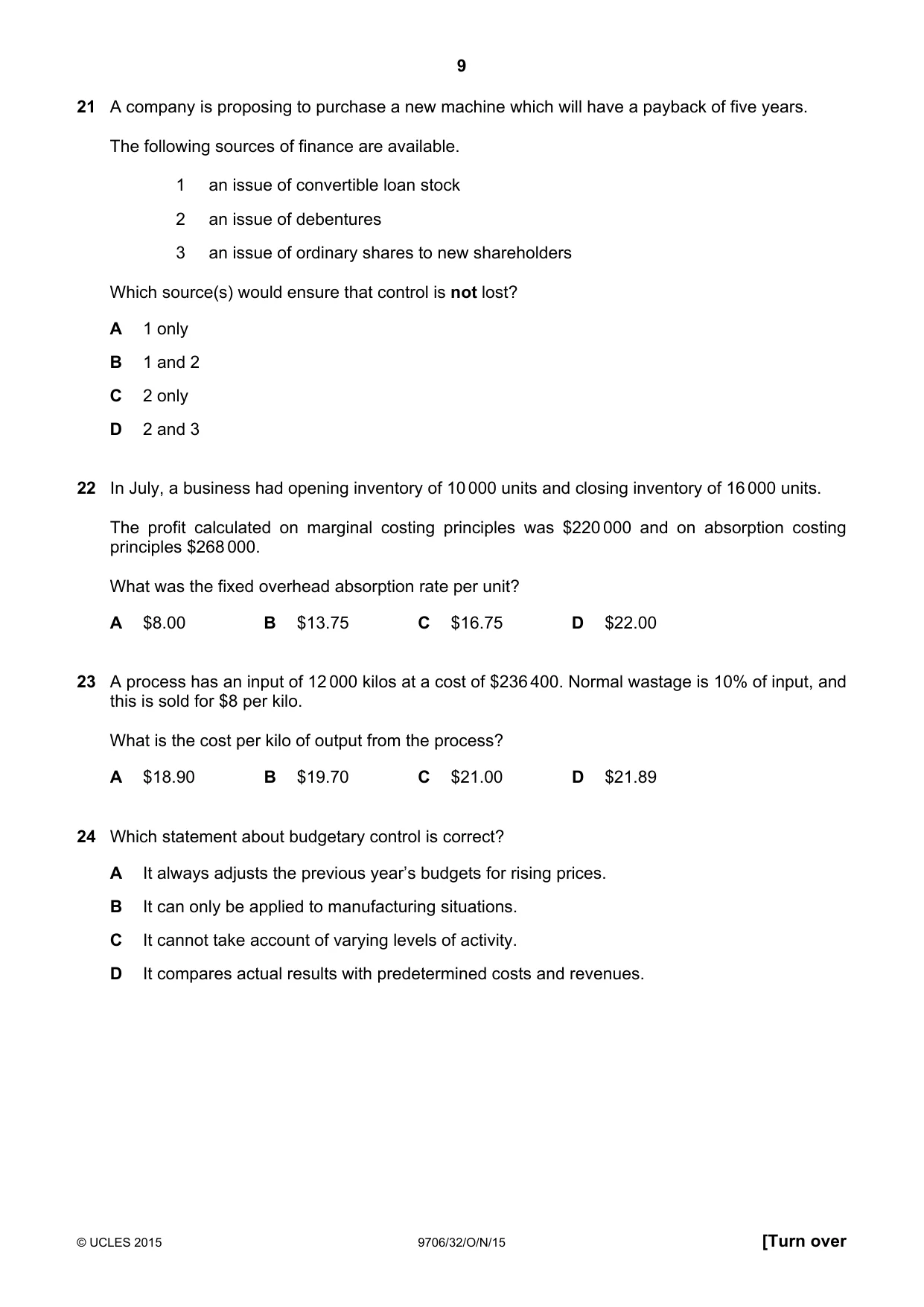
21 A company is proposing to purchase a new machine which will have a payback of five years. The following sources of finance are available. 1 an issue of convertible loan stock 2 an issue of debentures 3 an issue of ordinary shares to new shareholders Which source(s) would ensure that control is not lost? A 1 only B 1 and 2 C 2 only D 2 and 3
Mark scheme: C
Q22 · In July, a business had opening inventory of 10 000 units and closing inventory of 16 000…
22 In July, a business had opening inventory of 10 000 units and closing inventory of 16 000 units. The profit calculated on marginal costing principles was $220 000 and on absorption costing principles $268 000. What was the fixed overhead absorption rate per unit? A $8.00 B $13.75 C $16.75 D $22.00
Mark scheme: A
Q23 · A process has an input of 12 000 kilos at a cost of $236 400
23 A process has an input of 12 000 kilos at a cost of $236 400. Normal wastage is 10% of input, and this is sold for $8 per kilo. What is the cost per kilo of output from the process? A $18.90 B $19.70 C $21.00 D $21.89
Mark scheme: C
Q24 · Which statement about budgetary control is correct?
24 Which statement about budgetary control is correct? A It always adjusts the previous year’s budgets for rising prices. B It can only be applied to manufacturing situations. C It cannot take account of varying levels of activity. D It compares actual results with predetermined costs and revenues.
Mark scheme: D
Q25 · A business is preparing its cash budget and provides the following information
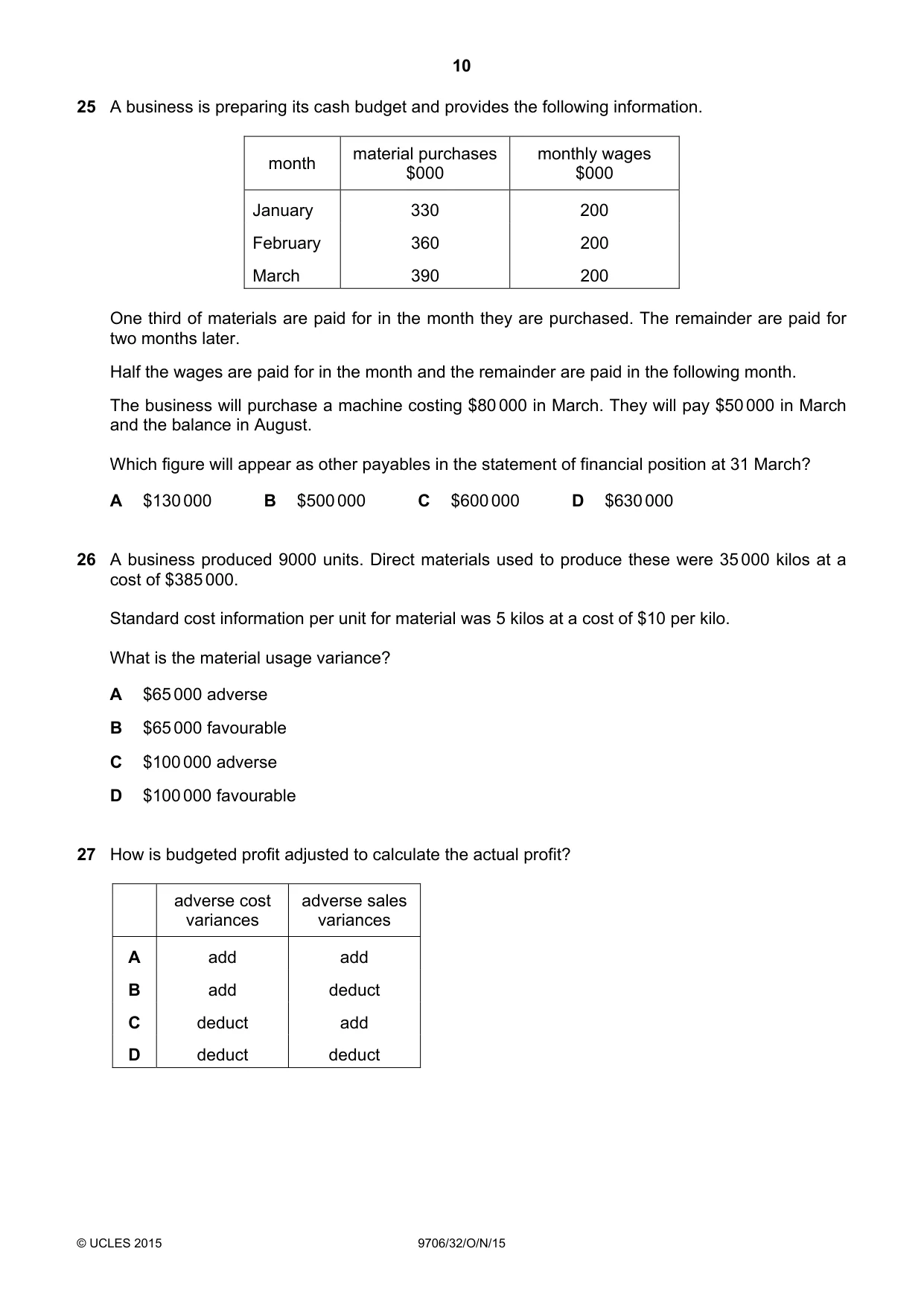
25 A business is preparing its cash budget and provides the following information. material purchases monthly wages month $000 $000 January 330 200 February 360 200 March 390 200 One third of materials are paid for in the month they are purchased. The remainder are paid for two months later. Half the wages are paid for in the month and the remainder are paid in the following month. The business will purchase a machine costing $80 000 in March. They will pay $50 000 in March and the balance in August. Which figure will appear as other payables in the statement of financial position at 31 March? A $130 000 B $500 000 C $600 000 D $630 000
Mark scheme: A
Q26 · A business produced 9000 units
26 A business produced 9000 units. Direct materials used to produce these were 35 000 kilos at a cost of $385 000. Standard cost information per unit for material was 5 kilos at a cost of $10 per kilo. What is the material usage variance? A $65 000 adverse B $65 000 favourable C $100 000 adverse D $100 000 favourable
Mark scheme: D
Q27 · How is budgeted profit adjusted to calculate the actual profit?
27 How is budgeted profit adjusted to calculate the actual profit? adverse cost adverse sales variances variances A add add B add deduct C deduct add D deduct deduct
Mark scheme: D
Q28 · A company produces a single product and details of the production and budget for a month…
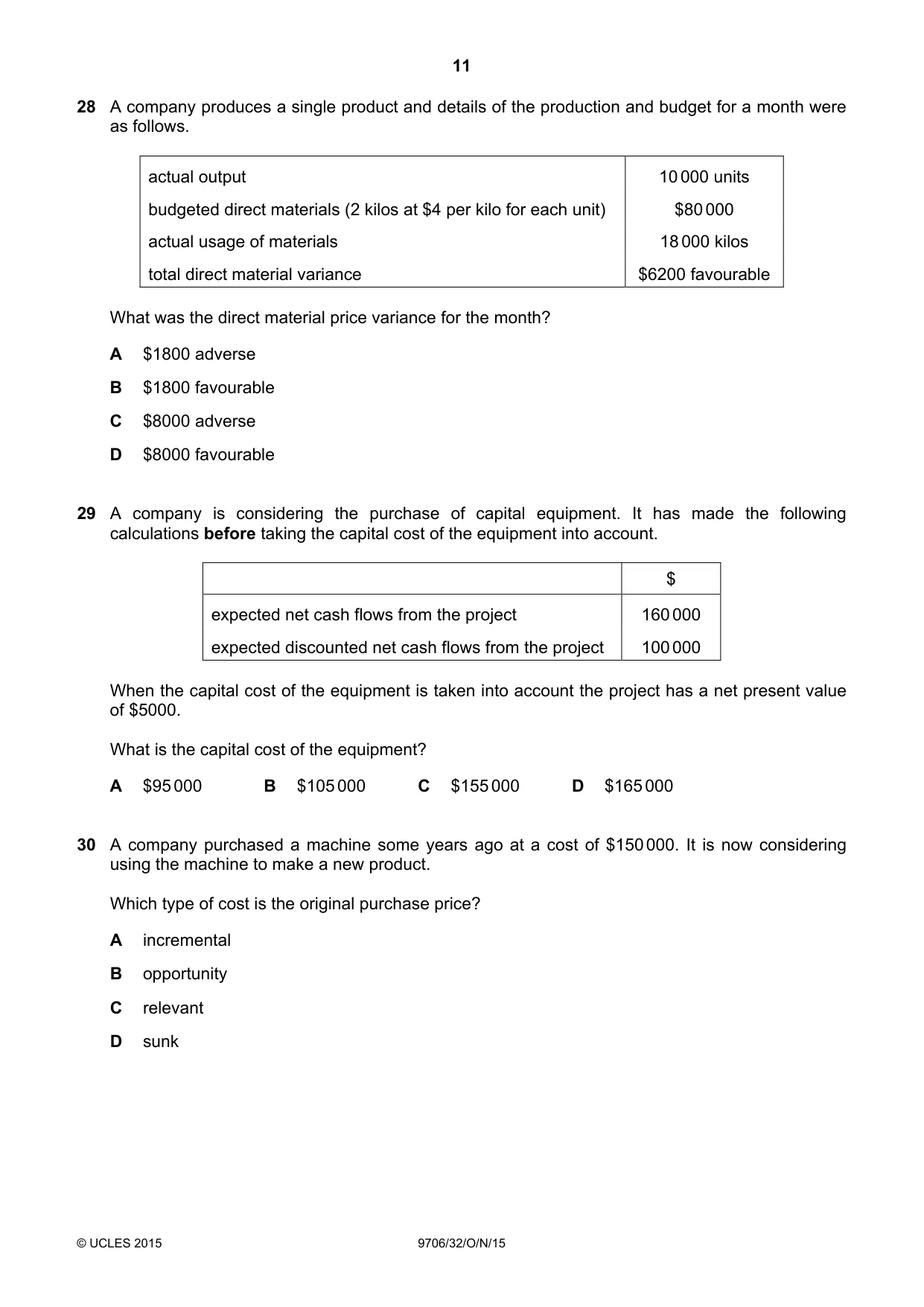
28 A company produces a single product and details of the production and budget for a month were as follows. actual output 10 000 units budgeted direct materials (2 kilos at $4 per kilo for each unit) $80 000 actual usage of materials 18 000 kilos total direct material variance $6200 favourable What was the direct material price variance for the month? A $1800 adverse B $1800 favourable C $8000 adverse D $8000 favourable
Mark scheme: A
Q29 · A company is considering the purchase of capital equipment
29 A company is considering the purchase of capital equipment. It has made the following calculations before taking the capital cost of the equipment into account. $ expected net cash flows from the project 160 000 expected discounted net cash flows from the project 100 000 When the capital cost of the equipment is taken into account the project has a net present value of $5000. What is the capital cost of the equipment? A $95 000 B $105 000 C $155 000 D $165 000
Mark scheme: A
Q30 · A company purchased a machine some years ago at a cost of $150 000
30 A company purchased a machine some years ago at a cost of $150 000. It is now considering using the machine to make a new product. Which type of cost is the original purchase price? A incremental B opportunity C relevant D sunk
Mark scheme: D
What was in this paper
The subtopics covered by these 30 questions, and how many questions each got. Open one in a new tab to see every Cambridge question on it.
7Analysis and communication of accounting information5Regulatory and ethical considerations3Standard costing3Traditional costing methods3Budgeting and budgetary control2Business acquisition and merger2Analysis and communication of accounting information1Costs and cost behaviour1Investment appraisal1Reconciliation and verification1Types of business entity1What you needed in this session
Cambridge’s own grade thresholds for 2015 Oct/Nov, Paper 3 · Variant 2. A higher threshold means an easier paper — the bar moves with how the cohort did.