Cambridge A Level Accounting 9706 — 2011 Oct/Nov Paper 3 · Variant 2
9706/32/O/N/11 · 30 questions · 30 marks · ≈34 min
The question paper and its mark scheme, free to read here and free to download. This is Cambridge’s own paper, exactly as it was sat.
Question paper12 pages
Mark scheme2 pages
Answers below. Sit the paper first if you are practising.
Questions as text
Q1 · A partnership achieved an average profit during the year of $15 000 per month
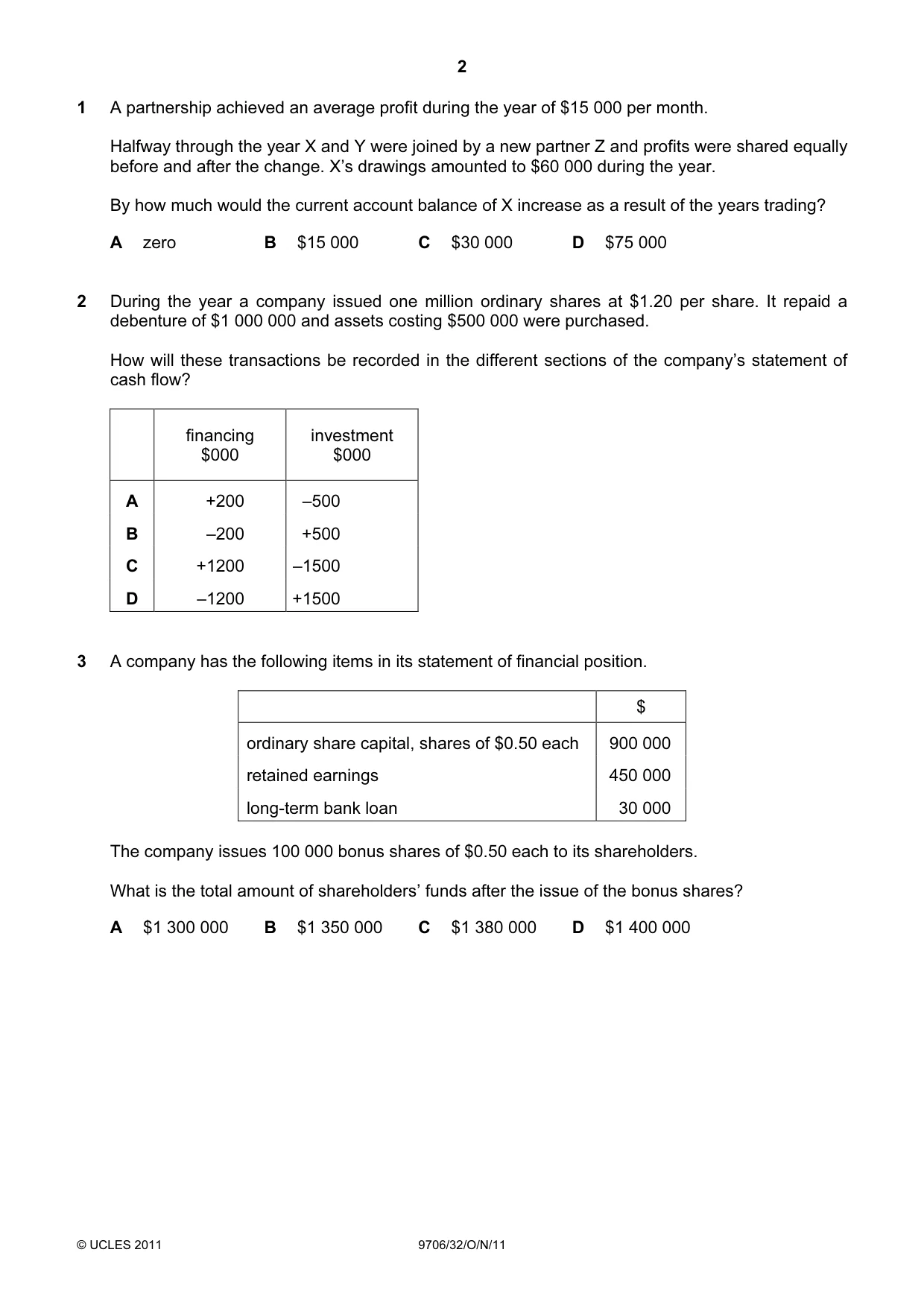
1 A partnership achieved an average profit during the year of $15 000 per month. Halfway through the year X and Y were joined by a new partner Z and profits were shared equally before and after the change. X’s drawings amounted to $60 000 during the year. By how much would the current account balance of X increase as a result of the years trading? A zero B $15 000 C $30 000 D $75 000
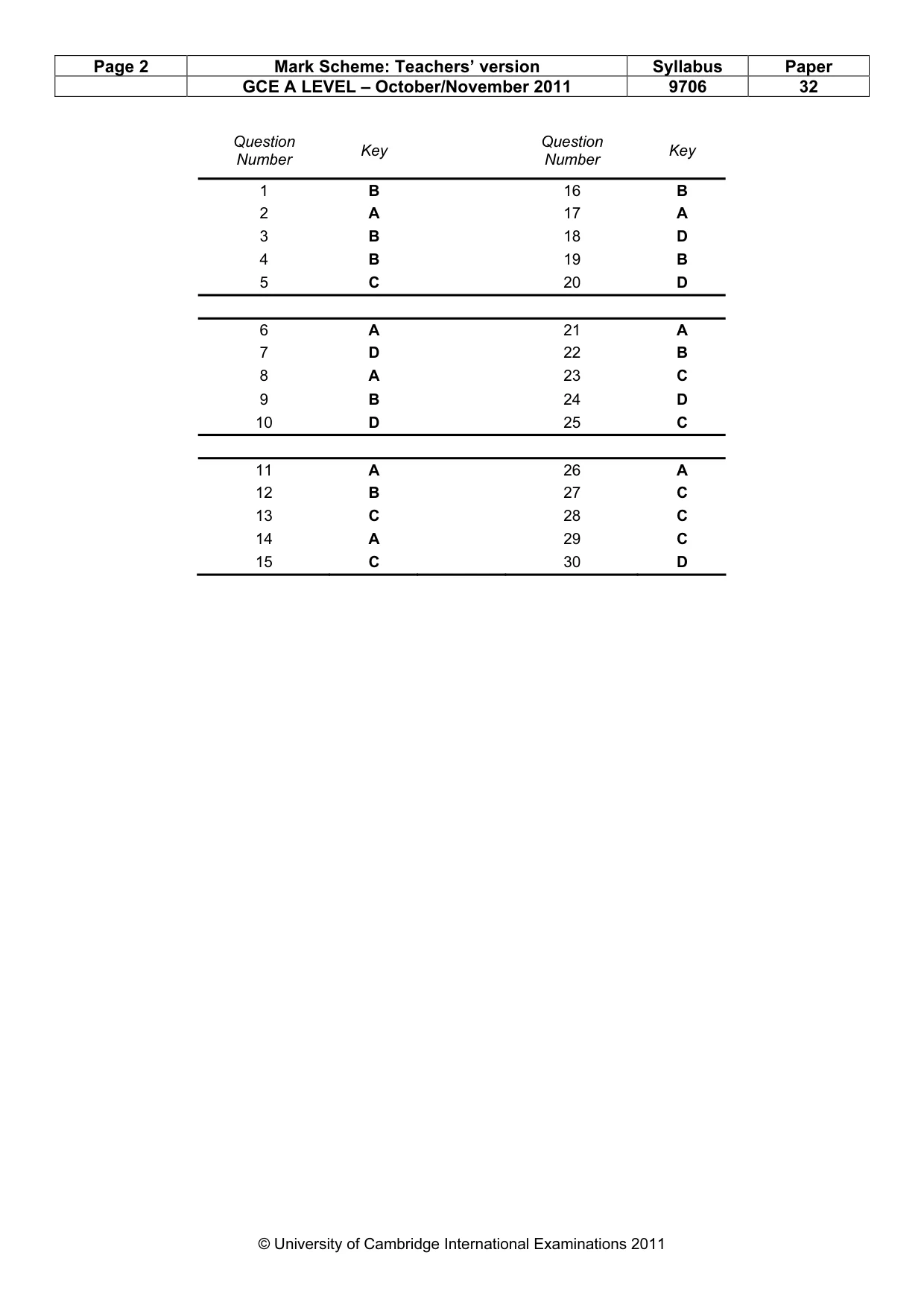
Mark scheme: B
Q2 · During the year a company issued one million ordinary shares at $1.20 per share
2 During the year a company issued one million ordinary shares at $1.20 per share. It repaid a debenture of $1 000 000 and assets costing $500 000 were purchased. How will these transactions be recorded in the different sections of the company’s statement of cash flow? financing investment $000 $000 A +200 –500 B –200 +500 C +1200 –1500 D –1200 +1500
Mark scheme: A
More questions on Analysis and communication of accounting information
Q3 · A company has the following items in its statement of financial position
3 A company has the following items in its statement of financial position. $ ordinary share capital, shares of $0.50 each 900 000 retained earnings 450 000 long-term bank loan 30 000 The company issues 100 000 bonus shares of $0.50 each to its shareholders. What is the total amount of shareholders’ funds after the issue of the bonus shares? A $1 300 000 B $1 350 000 C $1 380 000 D $1 400 000
Mark scheme: B
Q4 · The capital structure of a company is: $ $1 ordinary shares 40 000 convertible loan stock…
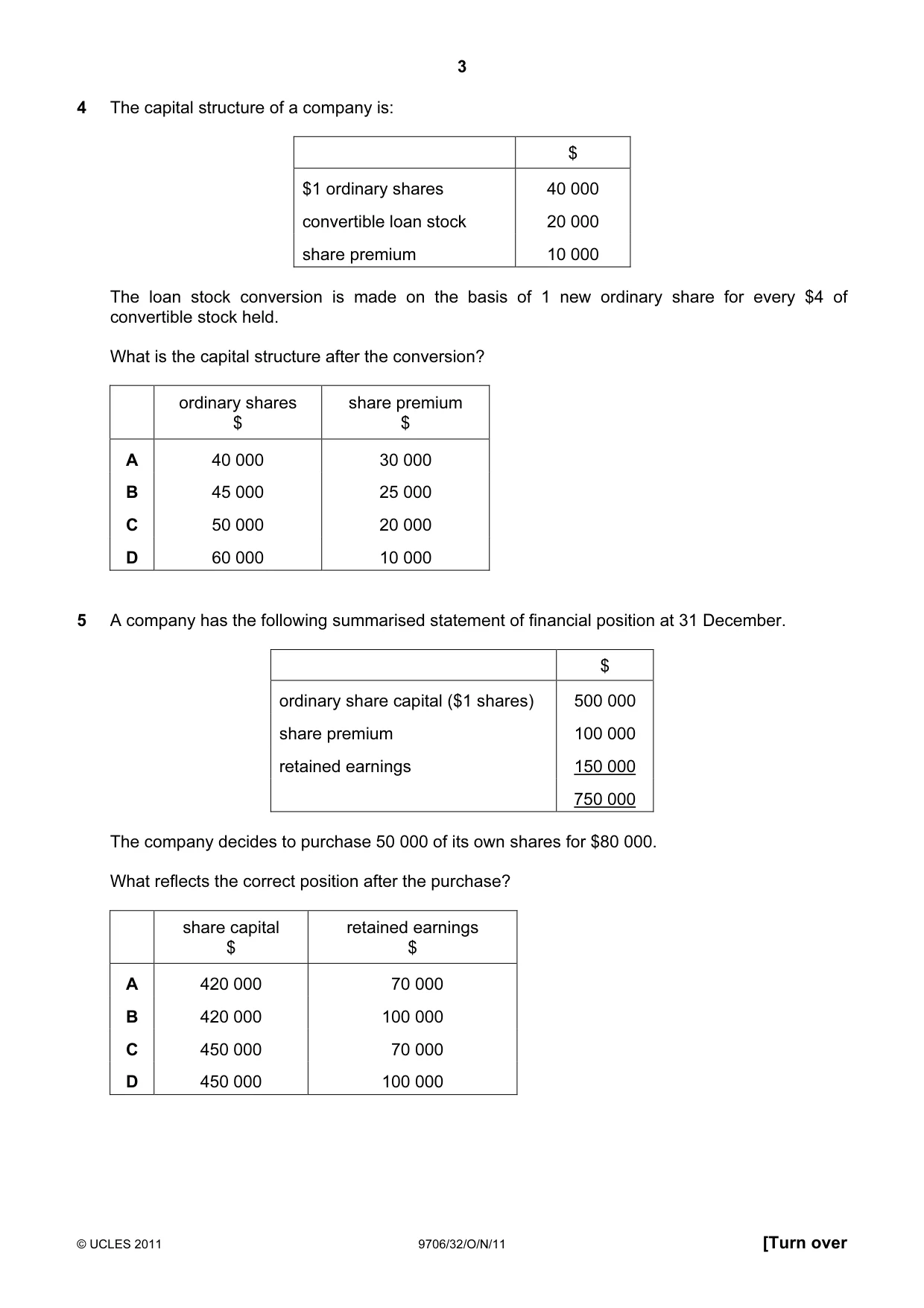
4 The capital structure of a company is: $ $1 ordinary shares 40 000 convertible loan stock 20 000 share premium 10 000 The loan stock conversion is made on the basis of 1 new ordinary share for every $4 of convertible stock held. What is the capital structure after the conversion? ordinary shares share premium $ $ A 40 000 30 000 B 45 000 25 000 C 50 000 20 000 D 60 000 10 000
Mark scheme: B
Q5 · A company has the following summarised statement of financial position at 31 December
5 A company has the following summarised statement of financial position at 31 December. $ ordinary share capital ($1 shares) 500 000 share premium 100 000 retained earnings 150 000 750 000 The company decides to purchase 50 000 of its own shares for $80 000. What reflects the correct position after the purchase? share capital retained earnings $ $ A 420 000 70 000 B 420 000 100 000 C 450 000 70 000 D 450 000 100 000
Mark scheme: C
Q6 · The summarised statement of financial position of company A is as follows
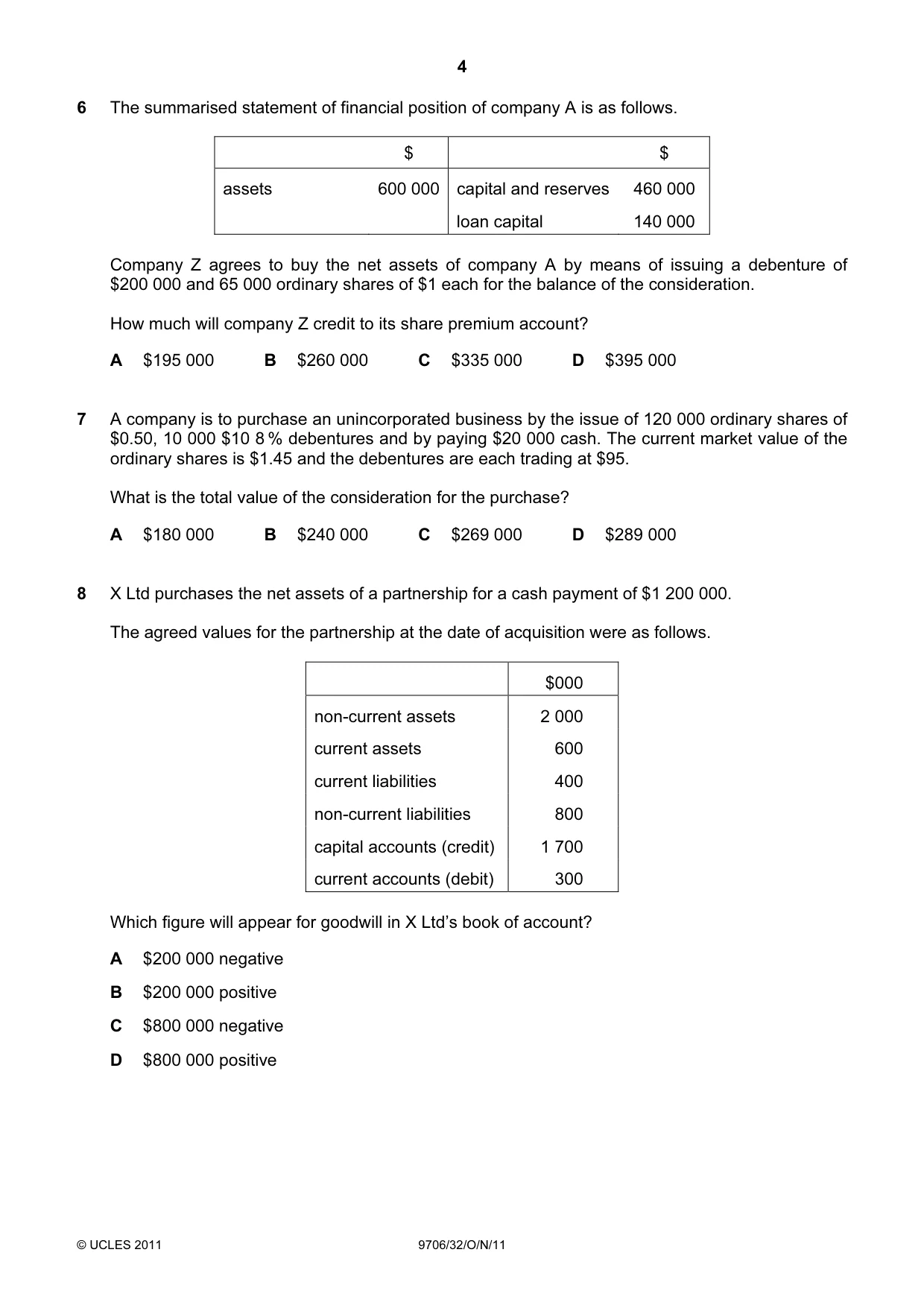
6 The summarised statement of financial position of company A is as follows. $ $ assets 600 000 capital and reserves 460 000 loan capital 140 000 Company Z agrees to buy the net assets of company A by means of issuing a debenture of $200 000 and 65 000 ordinary shares of $1 each for the balance of the consideration. How much will company Z credit to its share premium account? A $195 000 B $260 000 C $335 000 D $395 000
Mark scheme: A
Q7 · A company is to purchase an unincorporated business by the issue of 120 000 ordinary…
7 A company is to purchase an unincorporated business by the issue of 120 000 ordinary shares of $0.50, 10 000 $10 8 % debentures and by paying $20 000 cash. The current market value of the ordinary shares is $1.45 and the debentures are each trading at $95. What is the total value of the consideration for the purchase? A $180 000 B $240 000 C $269 000 D $289 000
Mark scheme: D
Q8 · X Ltd purchases the net assets of a partnership for a cash payment of $1 200 000
8 X Ltd purchases the net assets of a partnership for a cash payment of $1 200 000. The agreed values for the partnership at the date of acquisition were as follows. $000 non-current assets 2 000 current assets 600 current liabilities 400 non-current liabilities 800 capital accounts (credit) 1 700 current accounts (debit) 300 Which figure will appear for goodwill in X Ltd’s book of account? A $200 000 negative B $200 000 positive C $800 000 negative D $800 000 positive
Mark scheme: A
Q9 · Which statements are true in relation to International Accounting Standards?
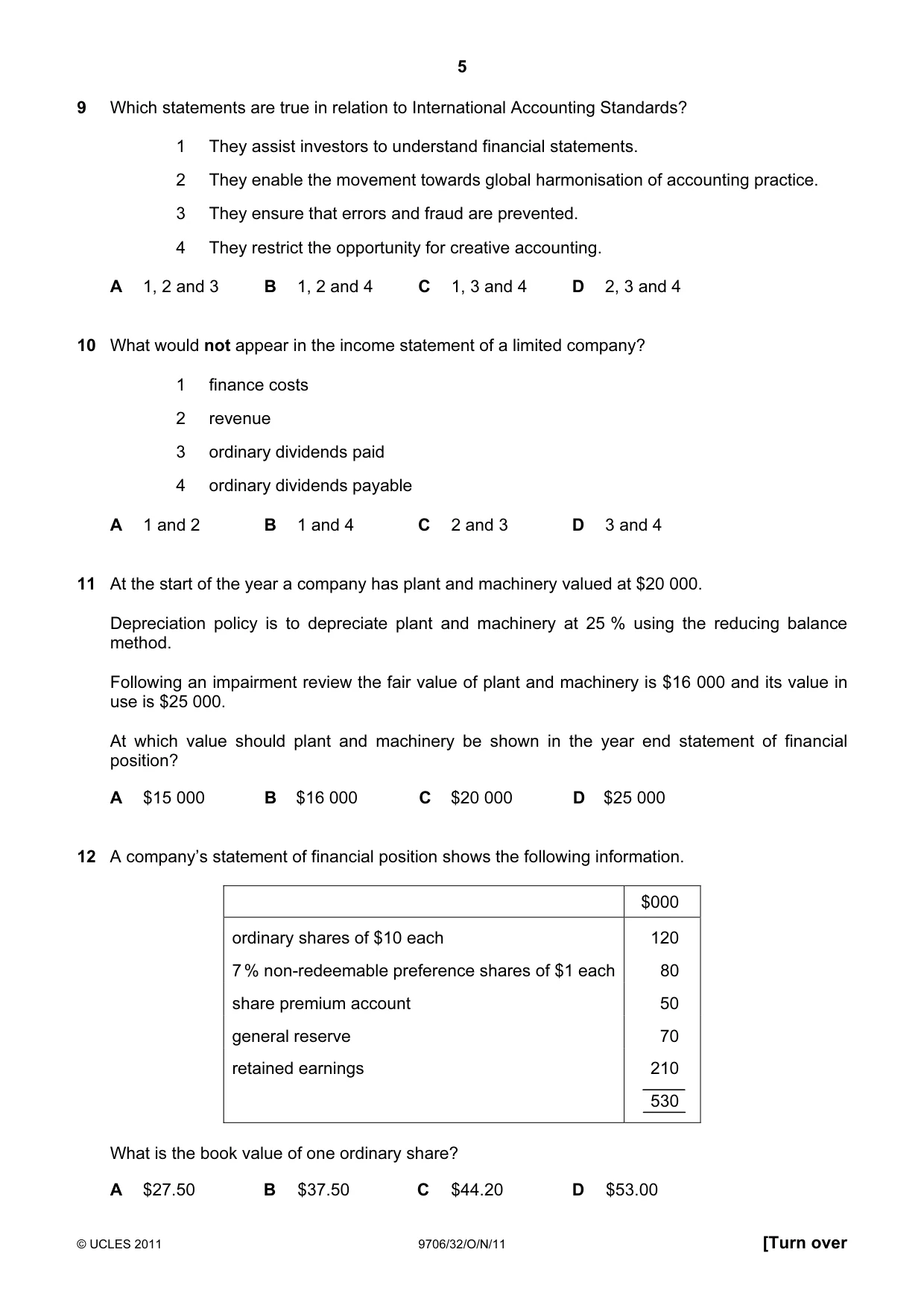
9 Which statements are true in relation to International Accounting Standards? 1 They assist investors to understand financial statements. 2 They enable the movement towards global harmonisation of accounting practice. 3 They ensure that errors and fraud are prevented. 4 They restrict the opportunity for creative accounting. A 1, 2 and 3 B 1, 2 and 4 C 1, 3 and 4 D 2, 3 and 4
Mark scheme: B
Q10 · What would not appear in the income statement of a limited company?
10 What would not appear in the income statement of a limited company? 1 finance costs 2 revenue 3 ordinary dividends paid 4 ordinary dividends payable A 1 and 2 B 1 and 4 C 2 and 3 D 3 and 4
Mark scheme: D
Q11 · At the start of the year a company has plant and machinery valued at $20 000
11 At the start of the year a company has plant and machinery valued at $20 000. Depreciation policy is to depreciate plant and machinery at 25 % using the reducing balance method. Following an impairment review the fair value of plant and machinery is $16 000 and its value in use is $25 000. At which value should plant and machinery be shown in the year end statement of financial position? A $15 000 B $16 000 C $20 000 D $25 000
Mark scheme: A
Q12 · A company’s statement of financial position shows the following information
12 A company’s statement of financial position shows the following information. $000 ordinary shares of $10 each 120 7 % non-redeemable preference shares of $1 each 80 share premium account 50 general reserve 70 retained earnings 210 530 What is the book value of one ordinary share? A $27.50 B $37.50 C $44.20 D $53.00
Mark scheme: B
More questions on Analysis and communication of accounting information
Q13 · A company makes annual profits of $50 million, before paying interest of $10 million and…
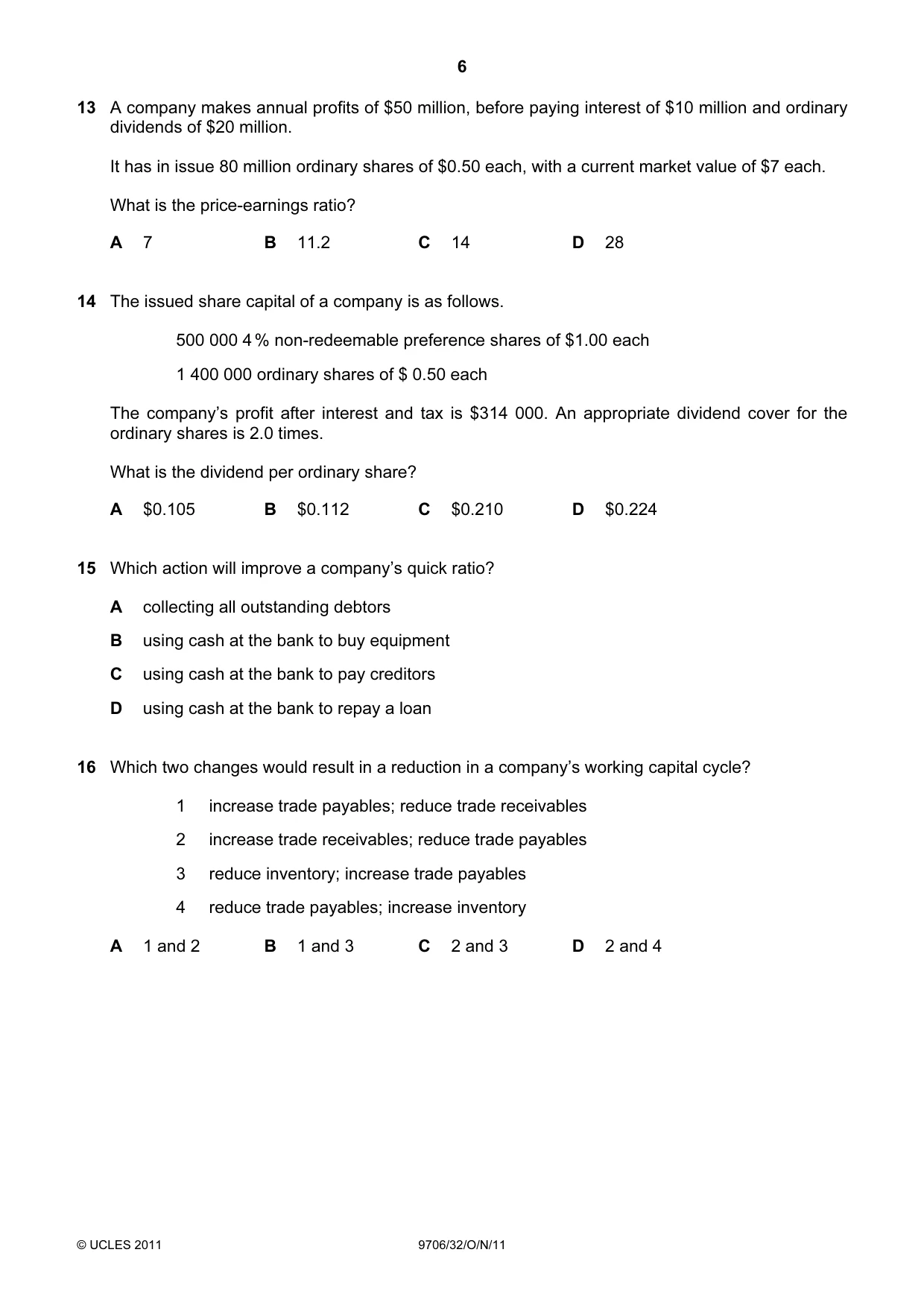
13 A company makes annual profits of $50 million, before paying interest of $10 million and ordinary dividends of $20 million. It has in issue 80 million ordinary shares of $0.50 each, with a current market value of $7 each. What is the price-earnings ratio? A 7 B 11.2 C 14 D 28
Mark scheme: C
More questions on Analysis and communication of accounting information
Q14 · The issued share capital of a company is as follows
14 The issued share capital of a company is as follows. 500 000 4 % non-redeemable preference shares of $1.00 each 1 400 000 ordinary shares of $ 0.50 each The company’s profit after interest and tax is $314 000. An appropriate dividend cover for the ordinary shares is 2.0 times. What is the dividend per ordinary share? A $0.105 B $0.112 C $0.210 D $0.224
Mark scheme: A
More questions on Analysis and communication of accounting information
Q15 · Which action will improve a company’s quick ratio?
15 Which action will improve a company’s quick ratio? A collecting all outstanding debtors B using cash at the bank to buy equipment C using cash at the bank to pay creditors D using cash at the bank to repay a loan
Mark scheme: C
More questions on Analysis and communication of accounting information
Q16 · Which two changes would result in a reduction in a company’s working capital cycle?
16 Which two changes would result in a reduction in a company’s working capital cycle? 1 increase trade payables; reduce trade receivables 2 increase trade receivables; reduce trade payables 3 reduce inventory; increase trade payables 4 reduce trade payables; increase inventory A 1 and 2 B 1 and 3 C 2 and 3 D 2 and 4
Mark scheme: B
More questions on Analysis and communication of accounting information
Q17 · A company revalues its buildings upwards
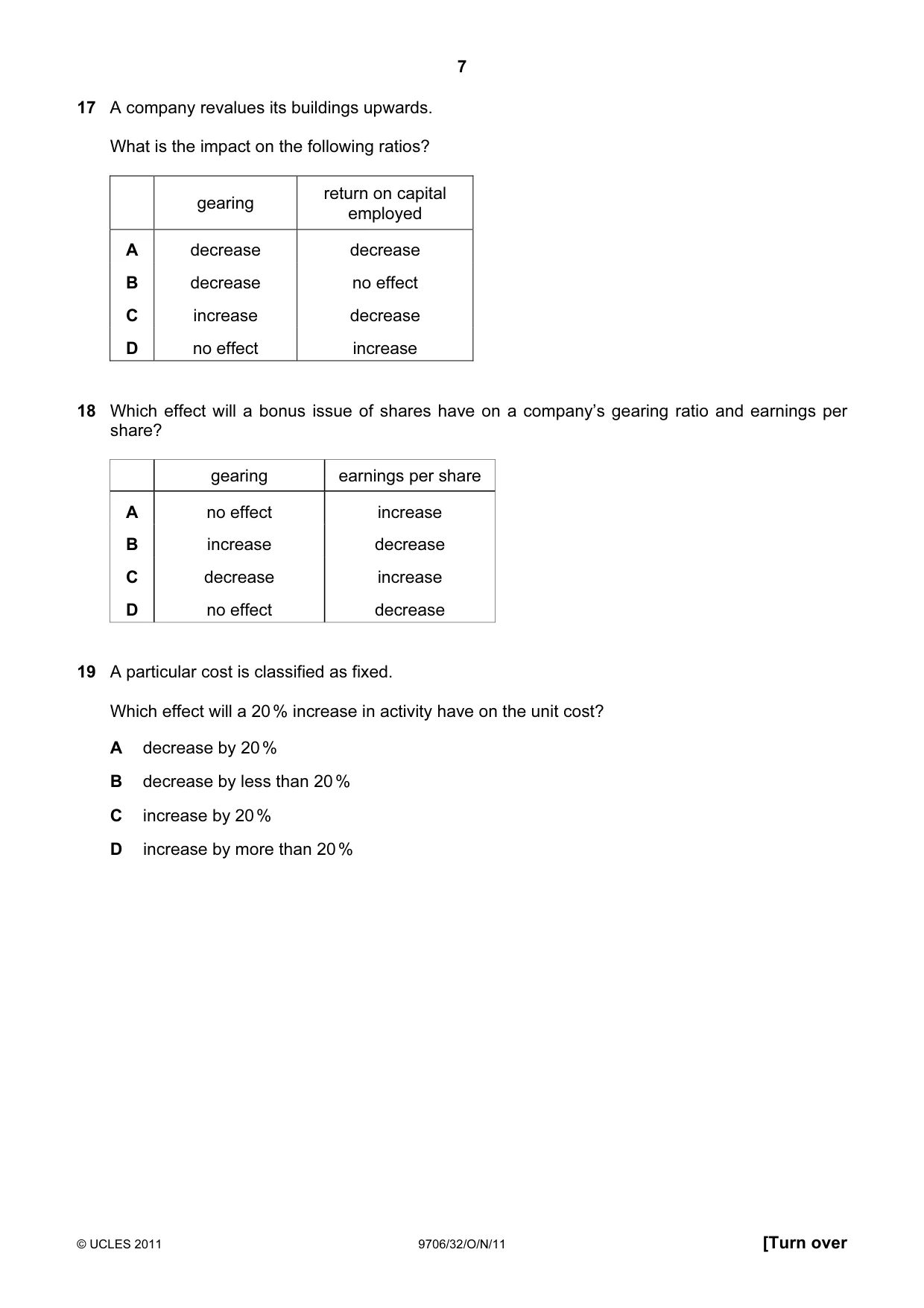
17 A company revalues its buildings upwards. What is the impact on the following ratios? return on capital gearing employed A decrease decrease B decrease no effect C increase decrease D no effect increase
Mark scheme: A
More questions on Analysis and communication of accounting information
Q18 · Which effect will a bonus issue of shares have on a company’s gearing ratio and earnings…
18 Which effect will a bonus issue of shares have on a company’s gearing ratio and earnings per share? gearing earnings per share A no effect increase B increase decrease C decrease increase D no effect decrease
Mark scheme: D
More questions on Analysis and communication of accounting information
Q19 · A particular cost is classified as fixed
19 A particular cost is classified as fixed. Which effect will a 20 % increase in activity have on the unit cost? A decrease by 20 % B decrease by less than 20 % C increase by 20 % D increase by more than 20 %
Mark scheme: B
Q20 · A company budgets to produce 110 000 units
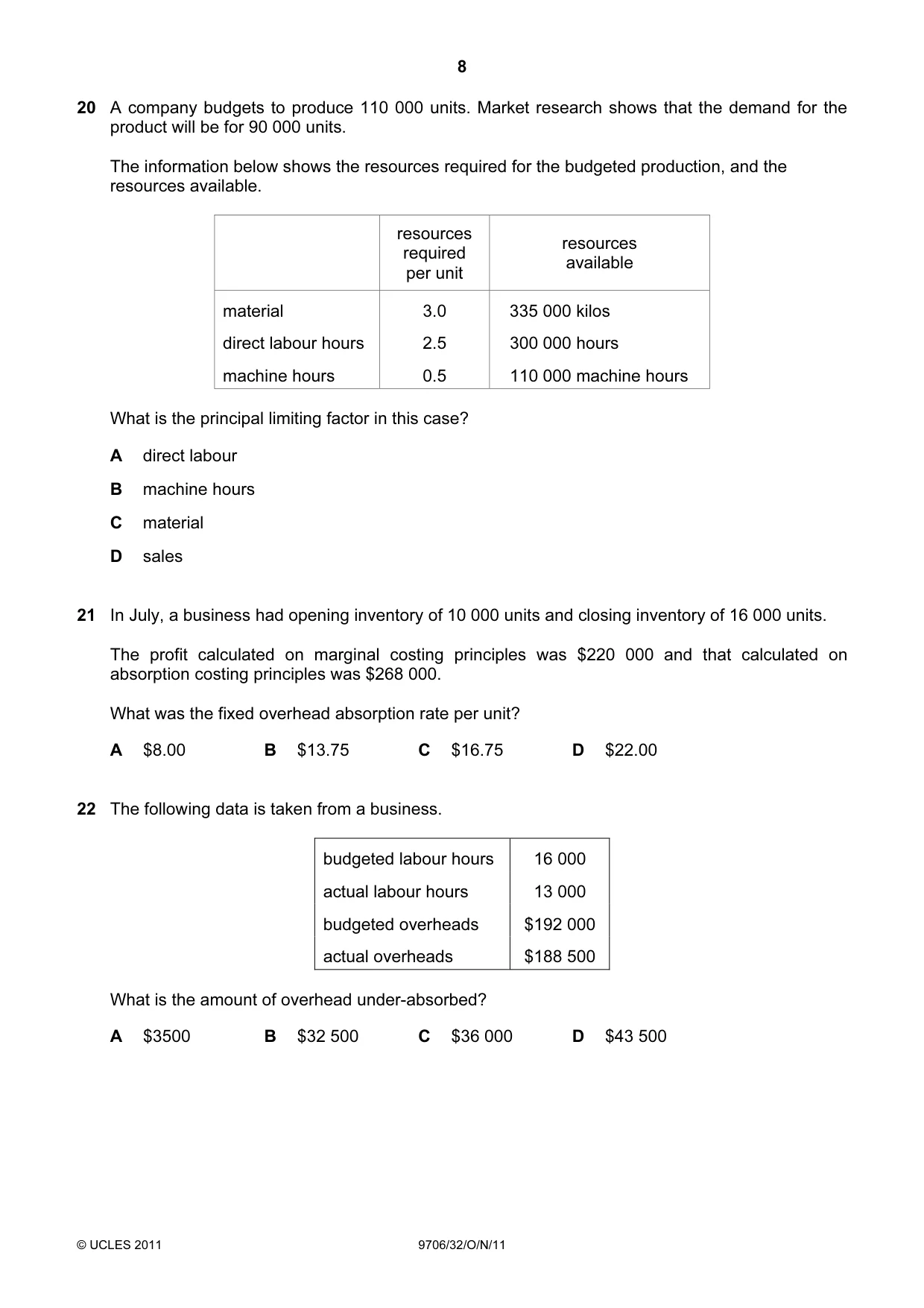
20 A company budgets to produce 110 000 units. Market research shows that the demand for the product will be for 90 000 units. The information below shows the resources required for the budgeted production, and the resources available. resources resources required available per unit material 3.0 335 000 kilos direct labour hours 2.5 300 000 hours machine hours 0.5 110 000 machine hours What is the principal limiting factor in this case? A direct labour B machine hours C material D sales
Mark scheme: D
Q21 · In July, a business had opening inventory of 10 000 units and closing inventory of 16 000…
21 In July, a business had opening inventory of 10 000 units and closing inventory of 16 000 units. The profit calculated on marginal costing principles was $220 000 and that calculated on absorption costing principles was $268 000. What was the fixed overhead absorption rate per unit? A $8.00 B $13.75 C $16.75 D $22.00
Mark scheme: A
Q22 · The following data is taken from a business
22 The following data is taken from a business. budgeted labour hours 16 000 actual labour hours 13 000 budgeted overheads $192 000 actual overheads $188 500 What is the amount of overhead under-absorbed? A $3500 B $32 500 C $36 000 D $43 500
Mark scheme: B
Q23 · A process has an input of 12 000 kg at a cost of $236 400
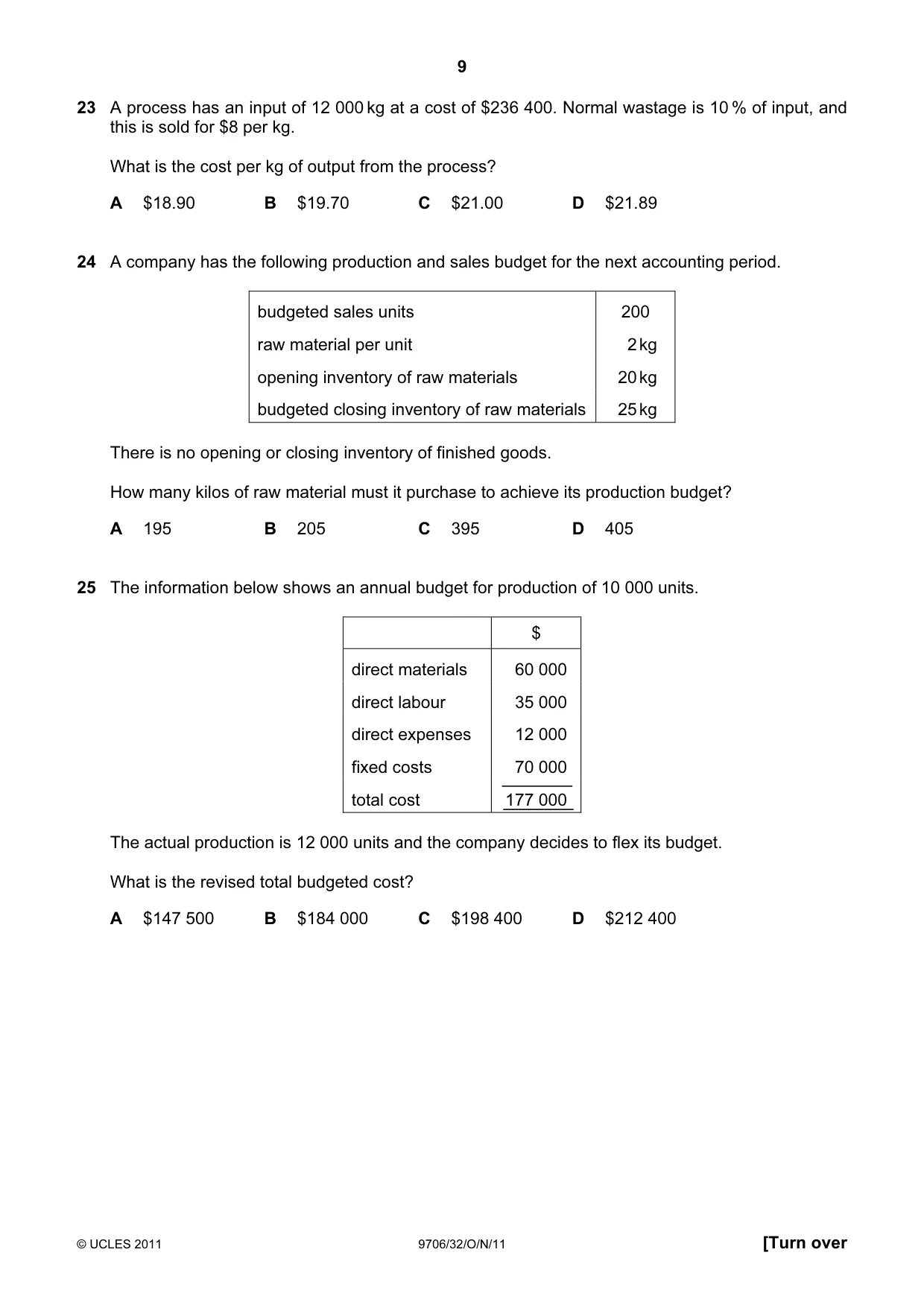
23 A process has an input of 12 000 kg at a cost of $236 400. Normal wastage is 10 % of input, and this is sold for $8 per kg. What is the cost per kg of output from the process? A $18.90 B $19.70 C $21.00 D $21.89
Mark scheme: C
Q24 · A company has the following production and sales budget for the next accounting period
24 A company has the following production and sales budget for the next accounting period. budgeted sales units 200 raw material per unit 2 kg opening inventory of raw materials 20 kg budgeted closing inventory of raw materials 25 kg There is no opening or closing inventory of finished goods. How many kilos of raw material must it purchase to achieve its production budget? A 195 B 205 C 395 D 405
Mark scheme: D
Q25 · The information below shows an annual budget for production of 10 000 units
25 The information below shows an annual budget for production of 10 000 units. $ direct materials 60 000 direct labour 35 000 direct expenses 12 000 fixed costs 70 000 total cost 177 000 The actual production is 12 000 units and the company decides to flex its budget. What is the revised total budgeted cost? A $147 500 B $184 000 C $198 400 D $212 400
Mark scheme: C
Q26 · Budgeted and actual sales of a product are shown below
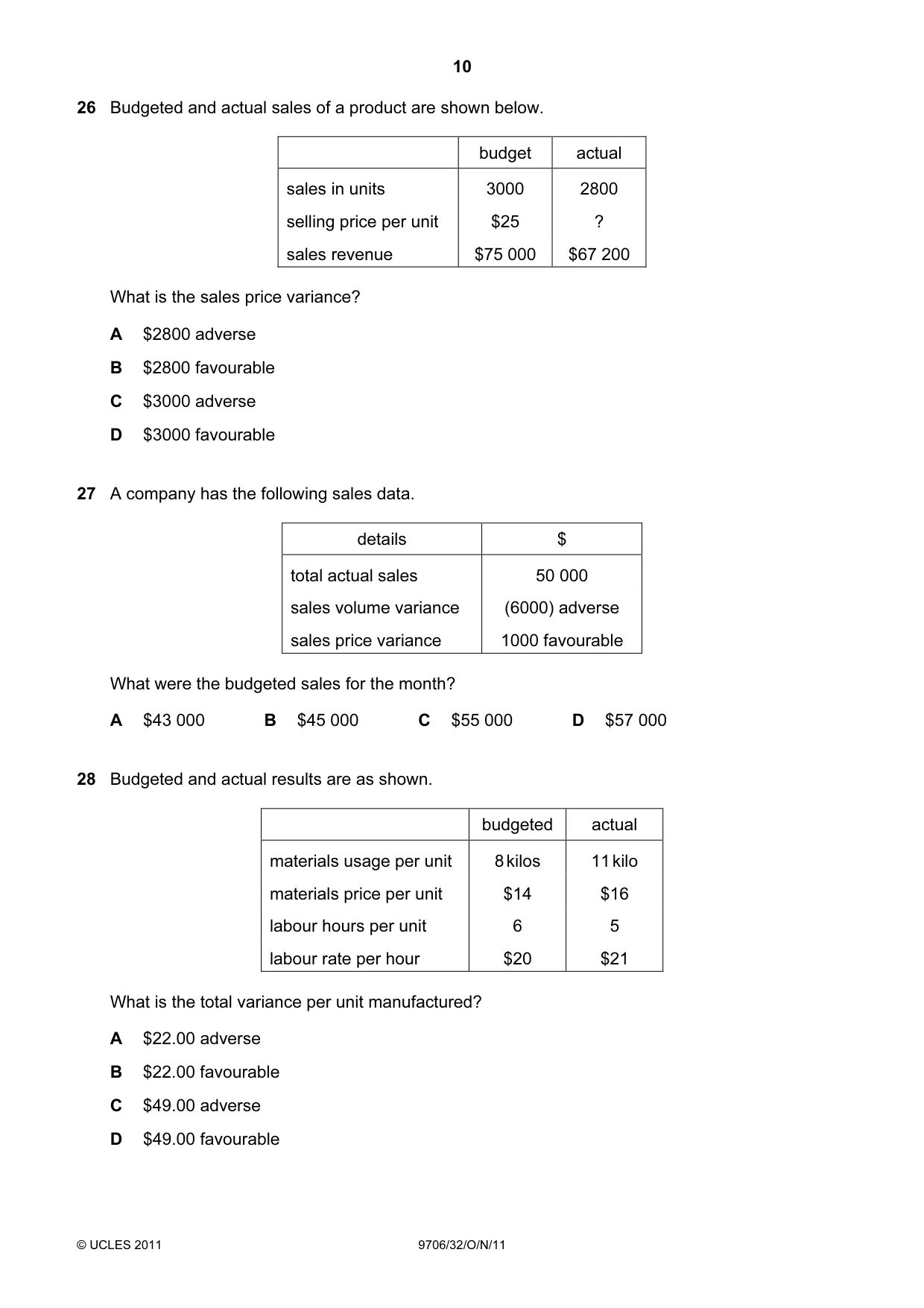
26 Budgeted and actual sales of a product are shown below. budget actual sales in units 3000 2800 selling price per unit $25 ? sales revenue $75 000 $67 200 What is the sales price variance? A $2800 adverse B $2800 favourable C $3000 adverse D $3000 favourable
Mark scheme: A
Q27 · A company has the following sales data
27 A company has the following sales data. details $ total actual sales 50 000 sales volume variance (6000) adverse sales price variance 1000 favourable What were the budgeted sales for the month? A $43 000 B $45 000 C $55 000 D $57 000
Mark scheme: C
Q28 · Budgeted and actual results are as shown
28 Budgeted and actual results are as shown. budgeted actual materials usage per unit 8 kilos 11 kilo materials price per unit $14 $16 labour hours per unit 6 5 labour rate per hour $20 $21 What is the total variance per unit manufactured? A $22.00 adverse B $22.00 favourable C $49.00 adverse D $49.00 favourable
Mark scheme: C
Q29 · A company is considering investing in a project costing $300 000
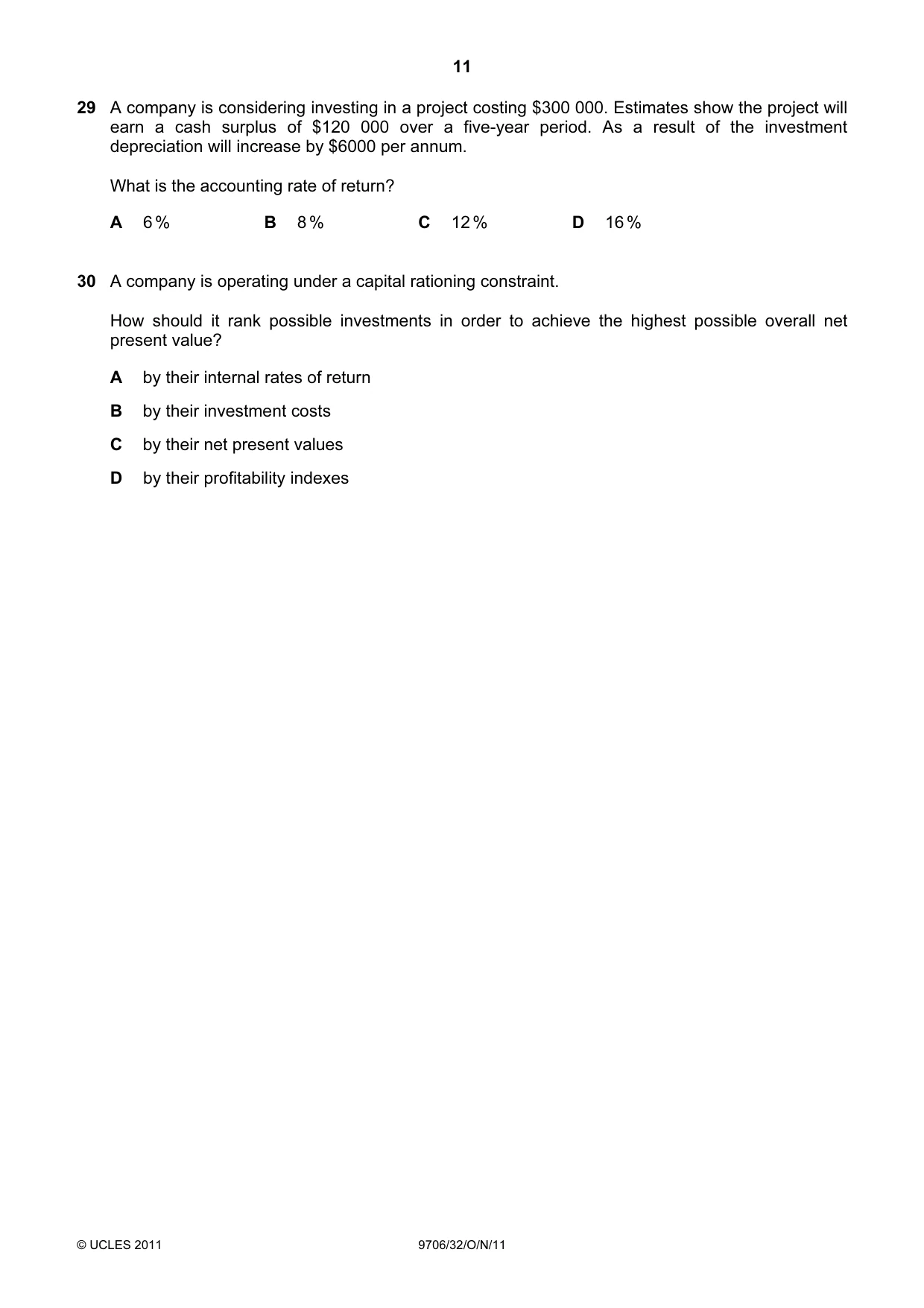
29 A company is considering investing in a project costing $300 000. Estimates show the project will earn a cash surplus of $120 000 over a five-year period. As a result of the investment depreciation will increase by $6000 per annum. What is the accounting rate of return? A 6 % B 8 % C 12 % D 16 %
Mark scheme: C
Q30 · A company is operating under a capital rationing constraint
30 A company is operating under a capital rationing constraint. How should it rank possible investments in order to achieve the highest possible overall net present value? A by their internal rates of return B by their investment costs C by their net present values D by their profitability indexes
Mark scheme: D
What was in this paper
The subtopics covered by these 30 questions, and how many questions each got. Open one in a new tab to see every Cambridge question on it.
5Traditional costing methods4Analysis and communication of accounting information3Business acquisition and merger3Preparation of financial statements3Standard costing3Budgeting and budgetary control2Investment appraisal2Accounting for non-current assets1Costs and cost behaviour1Preparation of financial statements1Regulatory and ethical considerations1Types of business entity1What you needed in this session
Cambridge’s own grade thresholds for 2011 Oct/Nov, Paper 3 · Variant 2. A higher threshold means an easier paper — the bar moves with how the cohort did.