Cambridge A Level Accounting 9706 — 2012 Oct/Nov Paper 3 · Variant 3
9706/33/O/N/12 · 30 questions · 30 marks · ≈34 min
The question paper and its mark scheme, free to read here and free to download. This is Cambridge’s own paper, exactly as it was sat.
Question paper12 pages
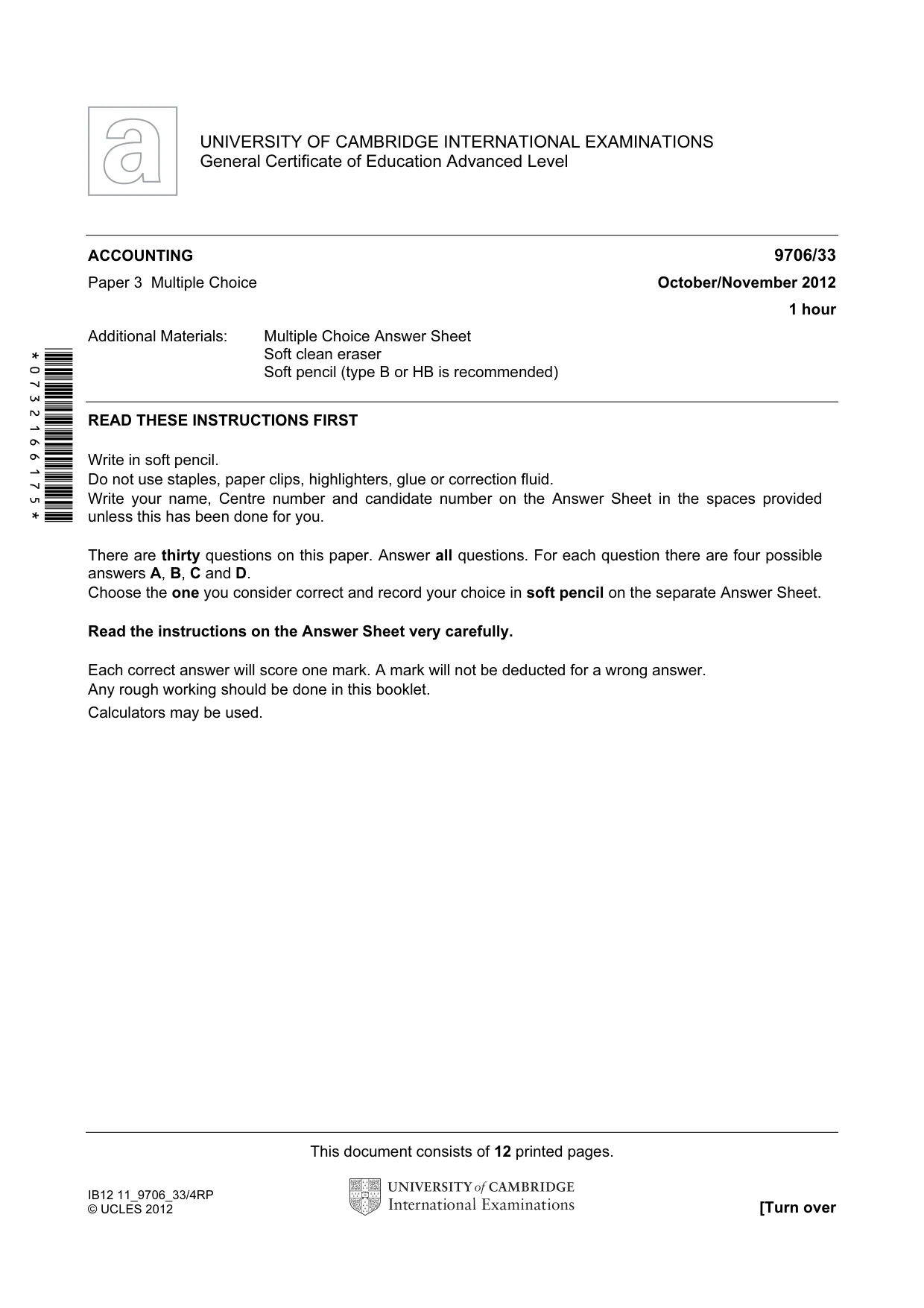
Mark scheme2 pages
Answers below. Sit the paper first if you are practising.
Questions as text
Q1 · X and Y are in partnership sharing profits and losses equally
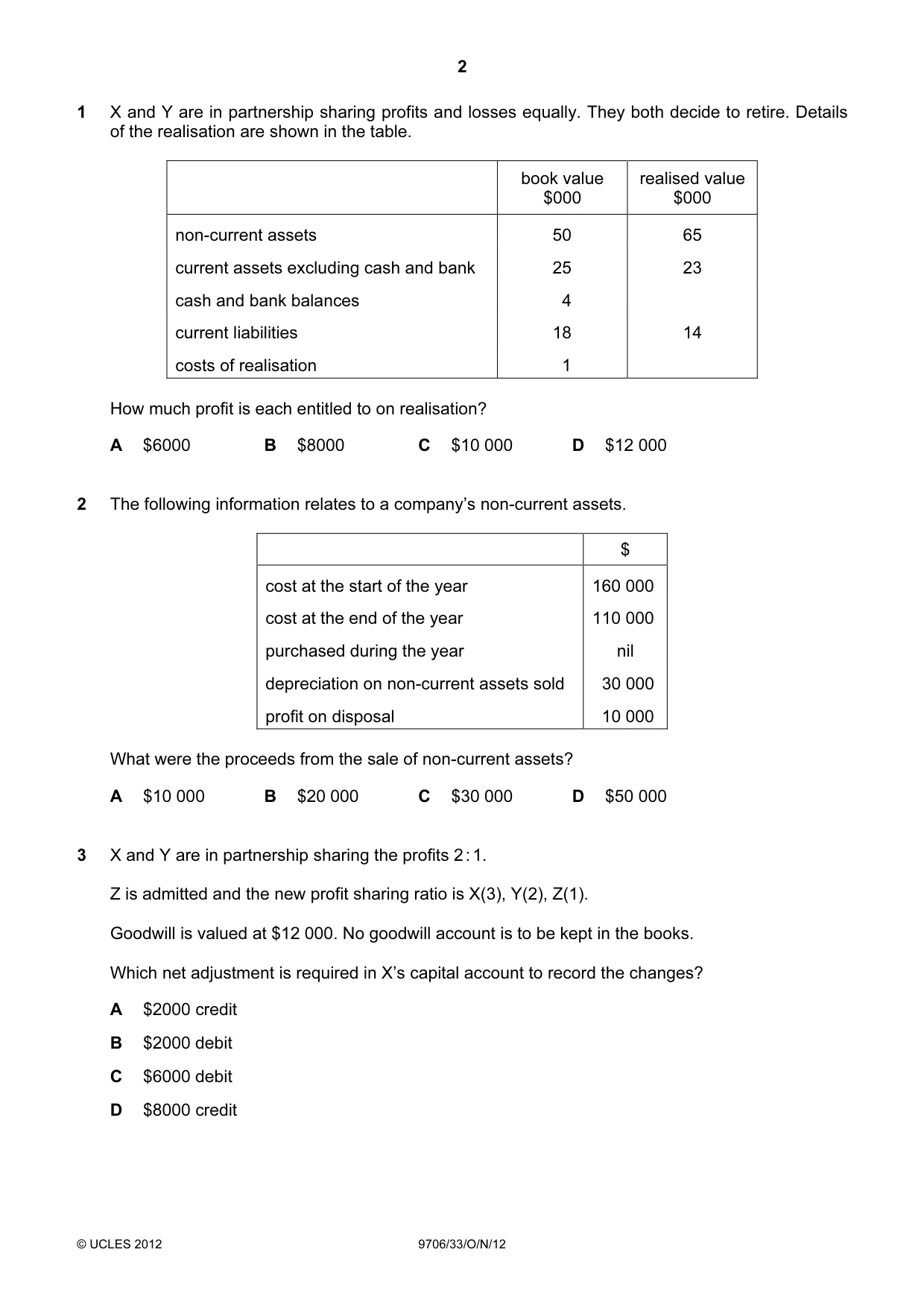
1 X and Y are in partnership sharing profits and losses equally. They both decide to retire. Details of the realisation are shown in the table. book value realised value $000 $000 non-current assets 50 65 current assets excluding cash and bank 25 23 cash and bank balances 4 current liabilities 18 14 costs of realisation 1 How much profit is each entitled to on realisation? A $6000 B $8000 C $10 000 D $12 000
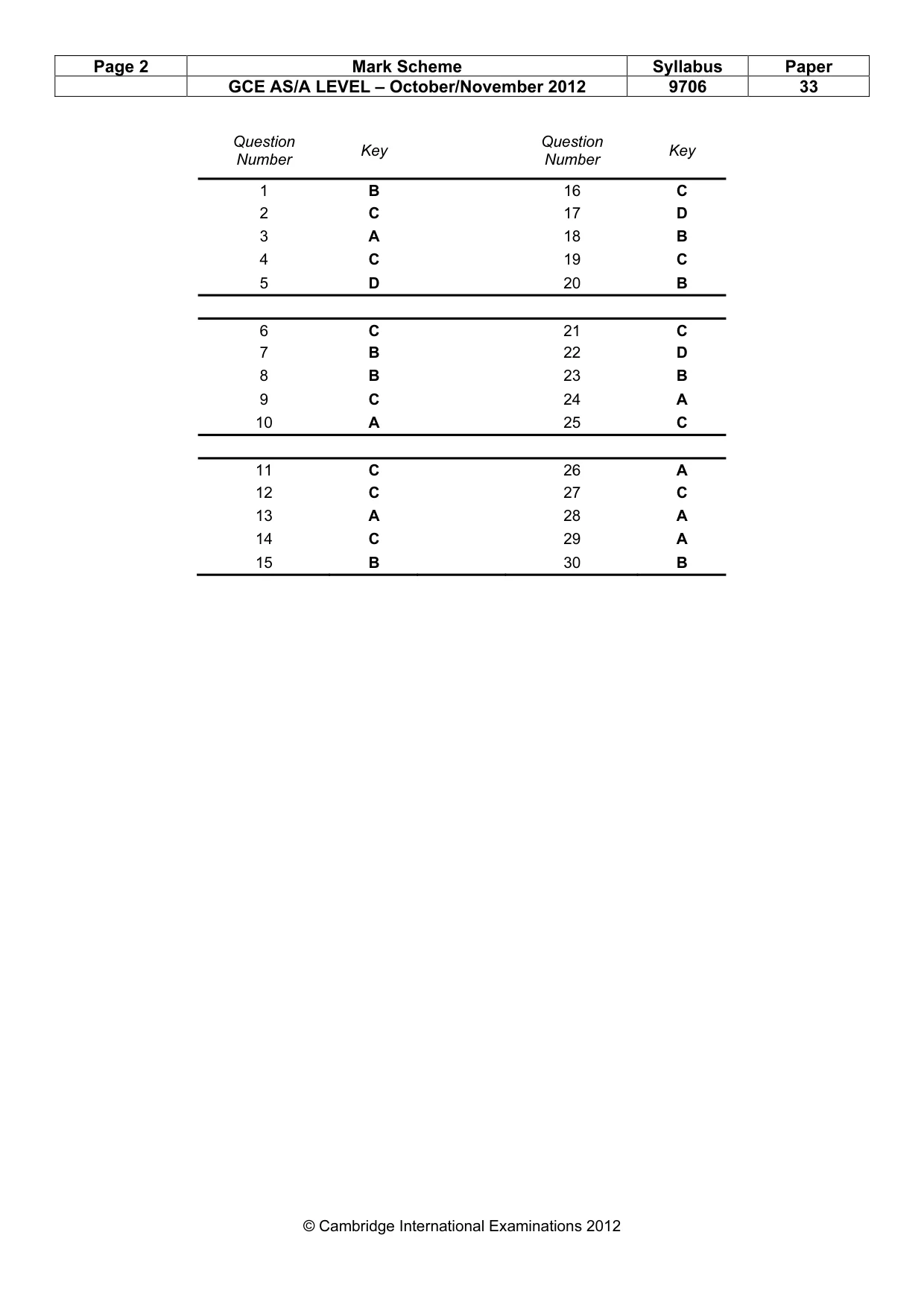
Mark scheme: B
Q2 · The following information relates to a company’s non-current assets
2 The following information relates to a company’s non-current assets. $ cost at the start of the year 160 000 cost at the end of the year 110 000 purchased during the year nil depreciation on non-current assets sold 30 000 profit on disposal 10 000 What were the proceeds from the sale of non-current assets? A $10 000 B $20 000 C $30 000 D $50 000
Mark scheme: C
Q3 · X and Y are in partnership sharing the profits 2 : 1
3 X and Y are in partnership sharing the profits 2 : 1. Z is admitted and the new profit sharing ratio is X(3), Y(2), Z(1). Goodwill is valued at $12 000. No goodwill account is to be kept in the books. Which net adjustment is required in X’s capital account to record the changes? A $2000 credit B $2000 debit C $6000 debit D $8000 credit
Mark scheme: A
Q4 · A company regularly pays a dividend
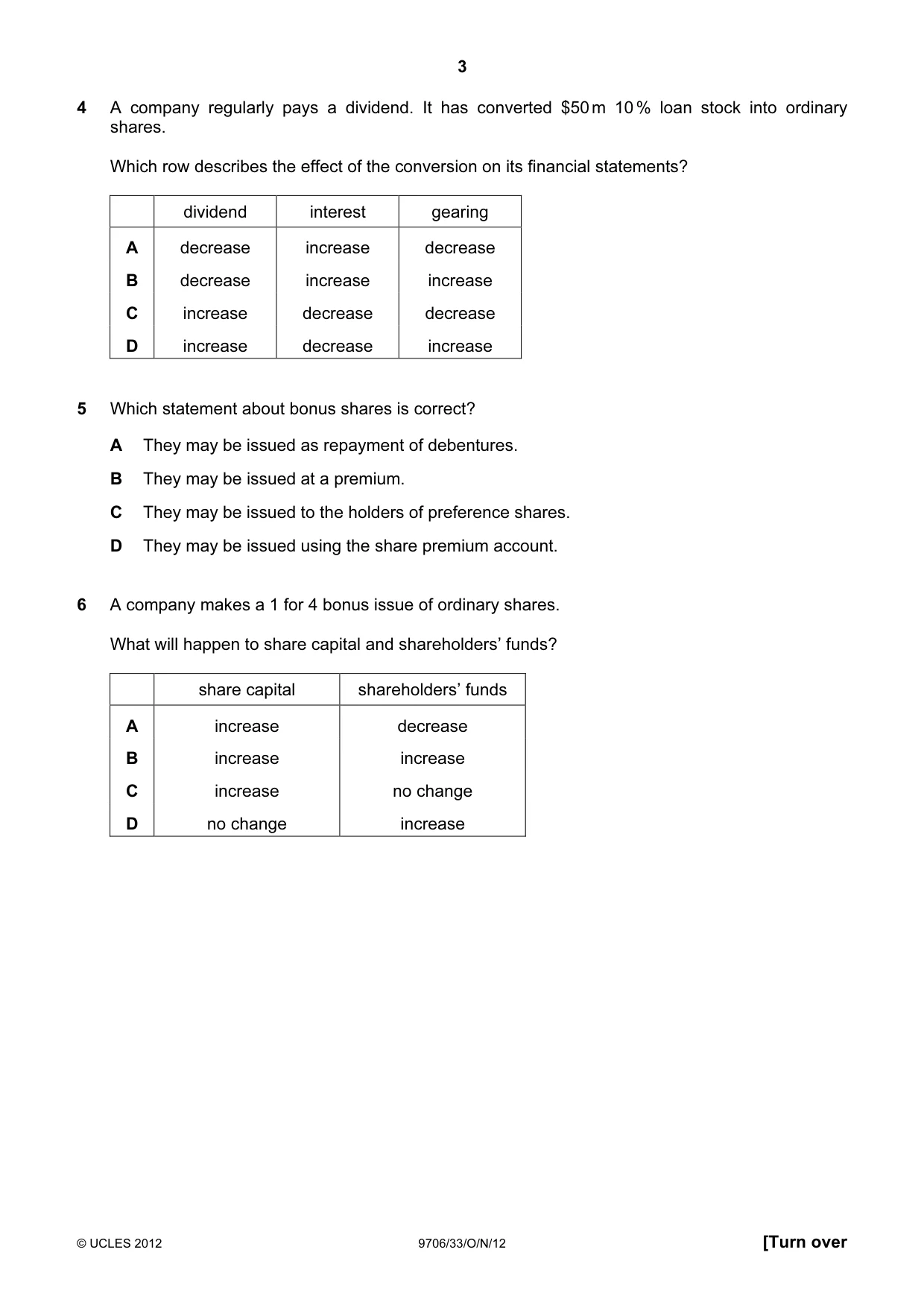
4 A company regularly pays a dividend. It has converted $50 m 10 % loan stock into ordinary shares. Which row describes the effect of the conversion on its financial statements? dividend interest gearing A decrease increase decrease B decrease increase increase C increase decrease decrease D increase decrease increase
Mark scheme: C
More questions on Analysis and communication of accounting information
Q5 · Which statement about bonus shares is correct?
5 Which statement about bonus shares is correct? A They may be issued as repayment of debentures. B They may be issued at a premium. C They may be issued to the holders of preference shares. D They may be issued using the share premium account.
Mark scheme: D
Q6 · A company makes a 1 for 4 bonus issue of ordinary shares
6 A company makes a 1 for 4 bonus issue of ordinary shares. What will happen to share capital and shareholders’ funds? share capital shareholders’ funds A increase decrease B increase increase C increase no change D no change increase
Mark scheme: C
Q7 · A company’s capital reduction scheme is as follows
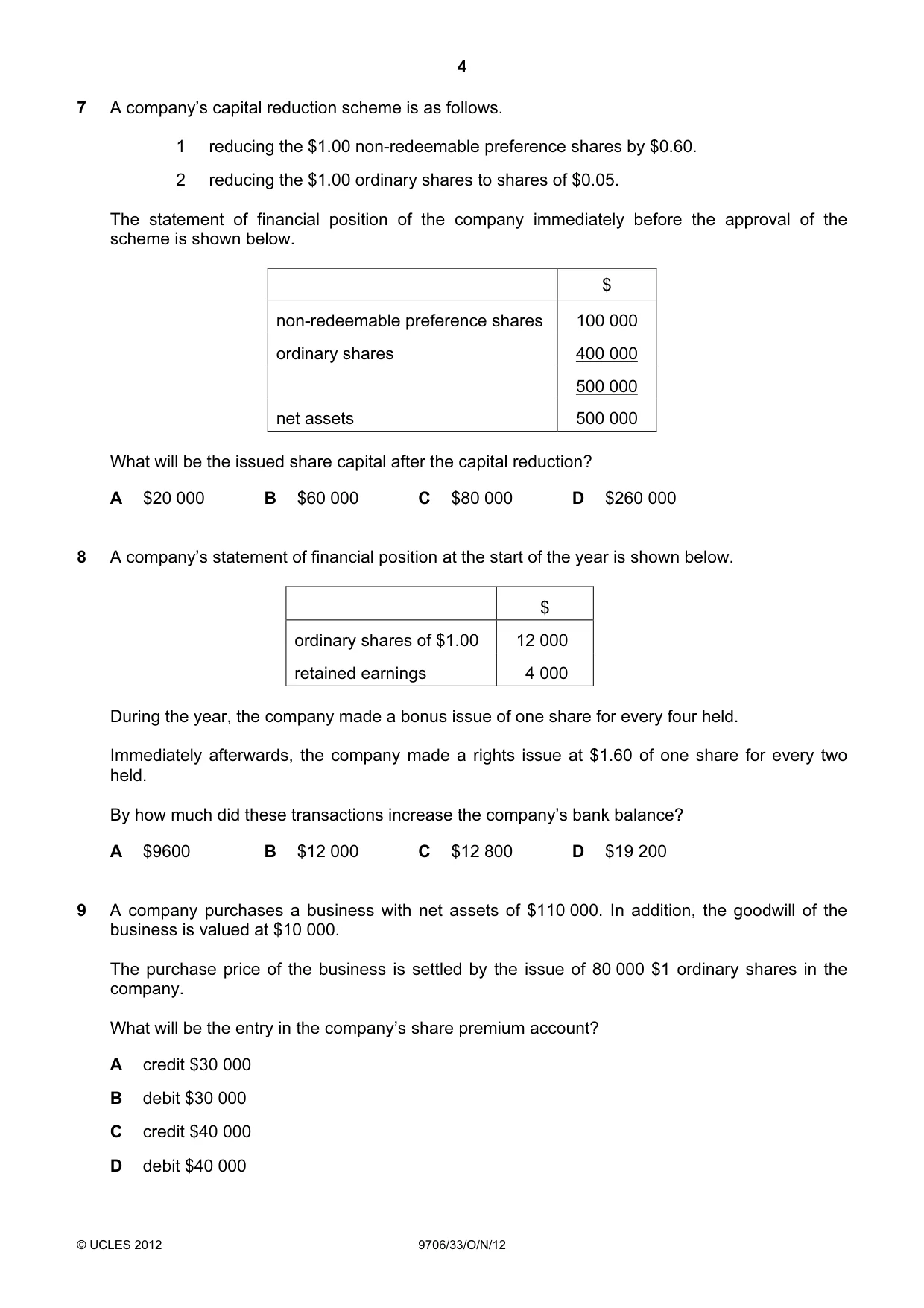
7 A company’s capital reduction scheme is as follows. 1 reducing the $1.00 non-redeemable preference shares by $0.60. 2 reducing the $1.00 ordinary shares to shares of $0.05. The statement of financial position of the company immediately before the approval of the scheme is shown below. $ non-redeemable preference shares 100 000 ordinary shares 400 000 500 000 net assets 500 000 What will be the issued share capital after the capital reduction? A $20 000 B $60 000 C $80 000 D $260 000
Mark scheme: B
Q8 · A company’s statement of financial position at the start of the year is shown below
8 A company’s statement of financial position at the start of the year is shown below. $ ordinary shares of $1.00 12 000 retained earnings 4 000 During the year, the company made a bonus issue of one share for every four held. Immediately afterwards, the company made a rights issue at $1.60 of one share for every two held. By how much did these transactions increase the company’s bank balance? A $9600 B $12 000 C $12 800 D $19 200
Mark scheme: B
Q9 · A company purchases a business with net assets of $110 000
9 A company purchases a business with net assets of $110 000. In addition, the goodwill of the business is valued at $10 000. The purchase price of the business is settled by the issue of 80 000 $1 ordinary shares in the company. What will be the entry in the company’s share premium account? A credit $30 000 B debit $30 000 C credit $40 000 D debit $40 000
Mark scheme: C
Q10 · A company purchases the business of a sole trader for $250 000
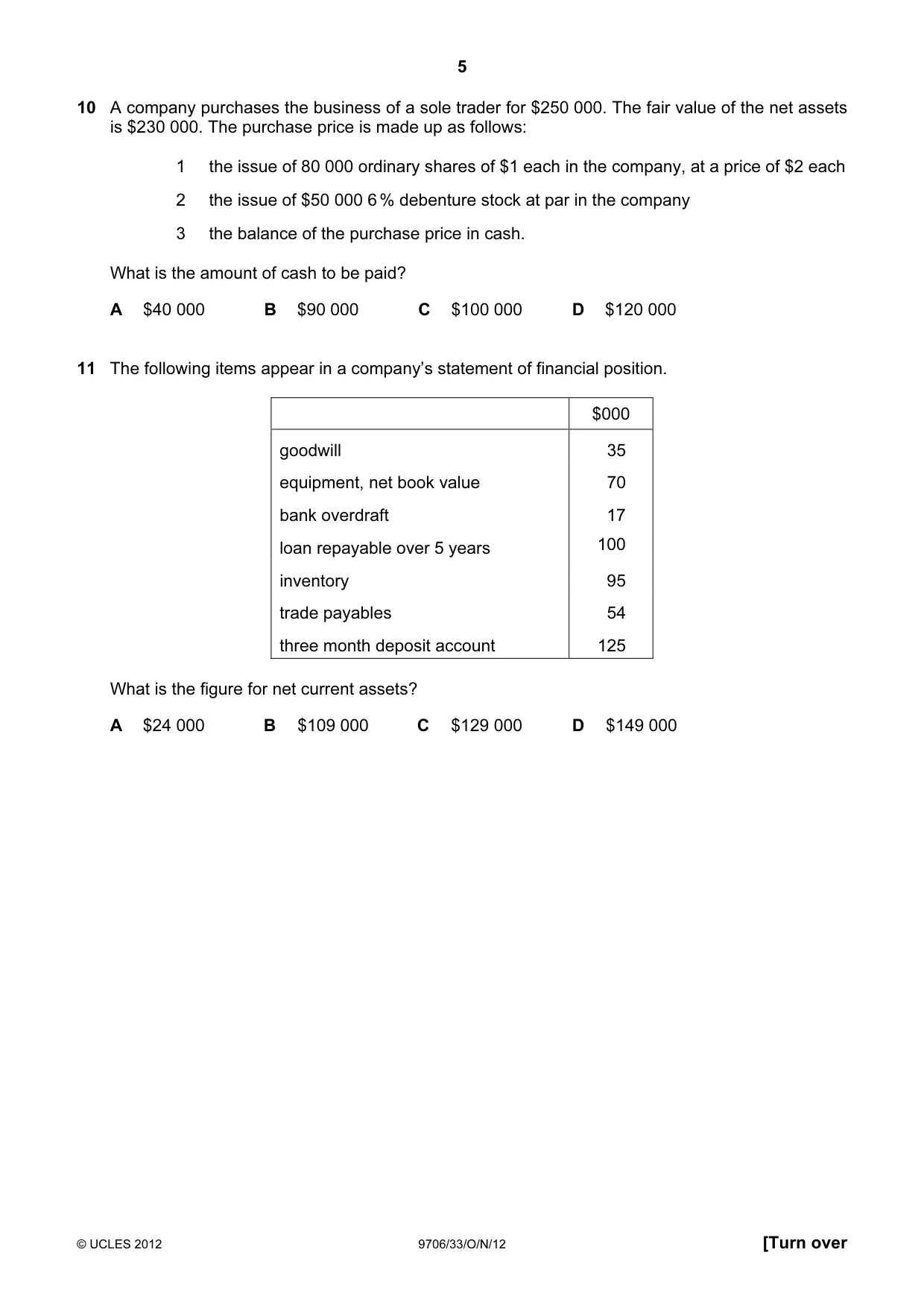
10 A company purchases the business of a sole trader for $250 000. The fair value of the net assets is $230 000. The purchase price is made up as follows: 1 the issue of 80 000 ordinary shares of $1 each in the company, at a price of $2 each 2 the issue of $50 000 6 % debenture stock at par in the company 3 the balance of the purchase price in cash. What is the amount of cash to be paid? A $40 000 B $90 000 C $100 000 D $120 000
Mark scheme: A
Q11 · The following items appear in a company’s statement of financial position
11 The following items appear in a company’s statement of financial position. $000 goodwill 35 equipment, net book value 70 bank overdraft 17 loan repayable over 5 years 100 inventory 95 trade payables 54 three month deposit account 125 What is the figure for net current assets? A $24 000 B $109 000 C $129 000 D $149 000
Mark scheme: C
Q12 · A company’s statement of financial position at 31 December 2010 included the following
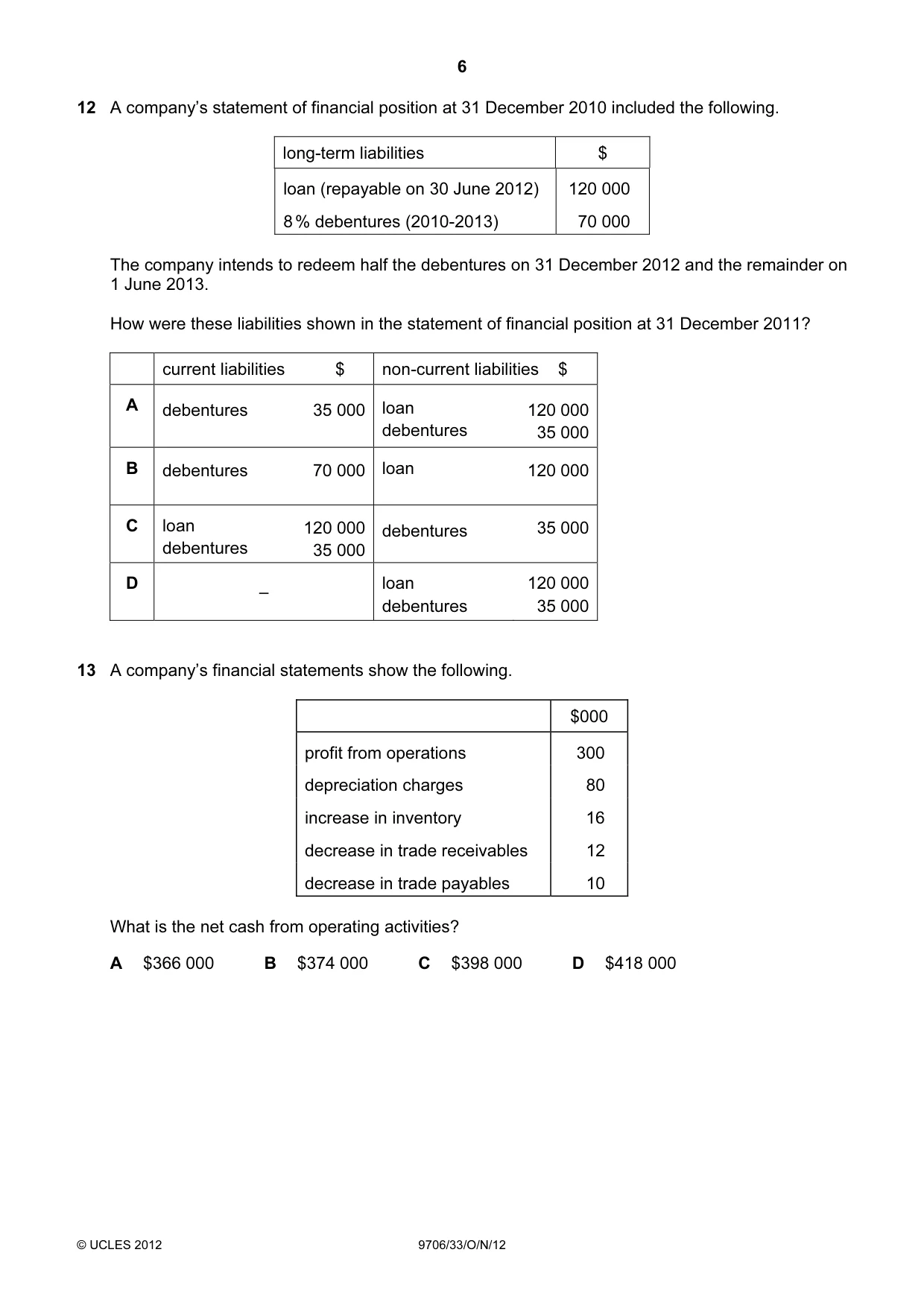
12 A company’s statement of financial position at 31 December 2010 included the following. long-term liabilities $ loan (repayable on 30 June 2012) 120 000 8 % debentures (2010-2013) 70 000 The company intends to redeem half the debentures on 31 December 2012 and the remainder on 1 June 2013. How were these liabilities shown in the statement of financial position at 31 December 2011? current liabilities $ non-current liabilities $ A debentures 35 000 loan 120 000 debentures 35 000 B debentures 70 000 loan 120 000 C loan 120 000 debentures 35 000 debentures 35 000 D loan 120 000 – debentures 35 000
Mark scheme: C
Q13 · A company’s financial statements show the following
13 A company’s financial statements show the following. $000 profit from operations 300 depreciation charges 80 increase in inventory 16 decrease in trade receivables 12 decrease in trade payables 10 What is the net cash from operating activities? A $366 000 B $374 000 C $398 000 D $418 000
Mark scheme: A
Q14 · At the start of the year, a company’s total equity was as follows
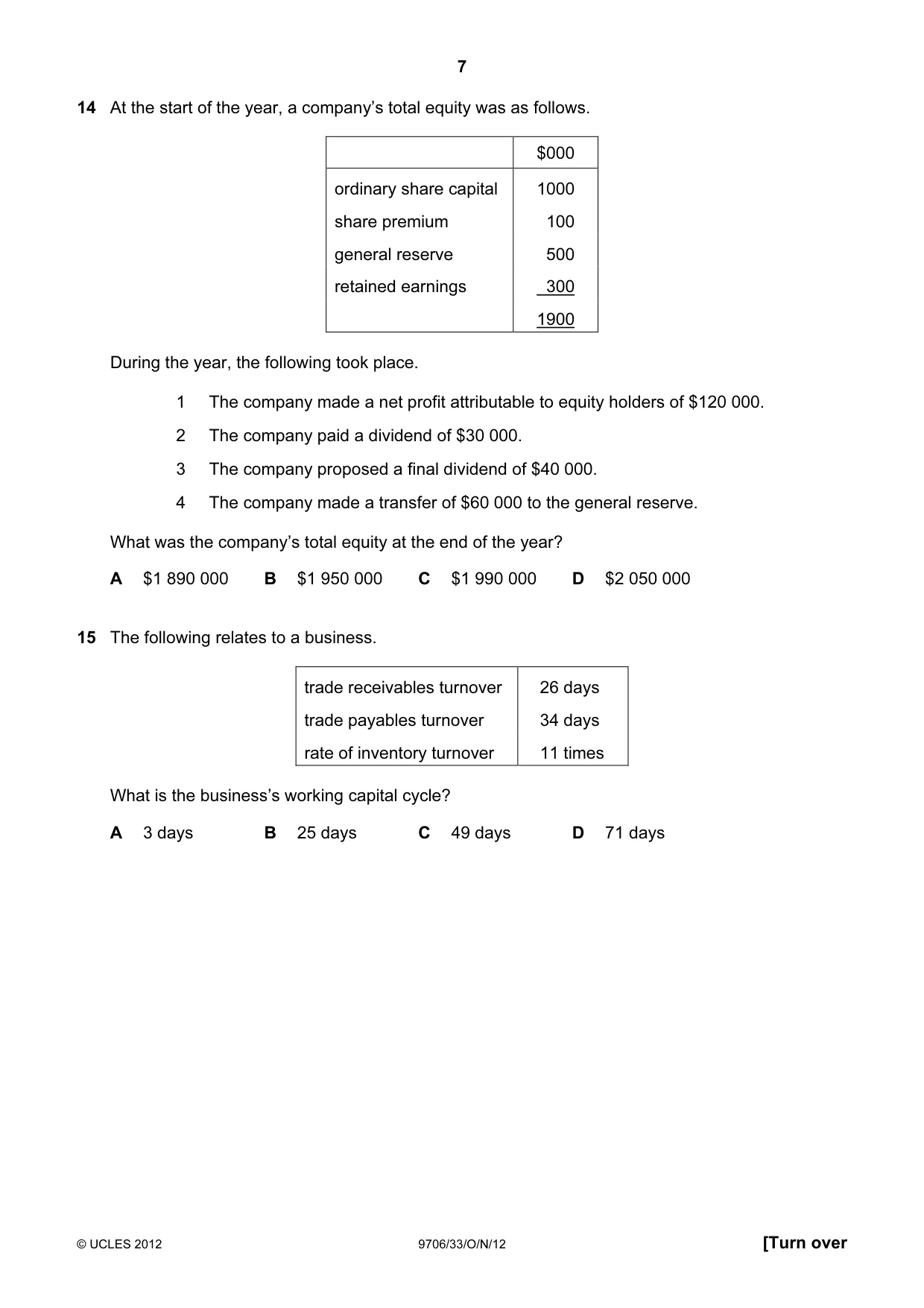
14 At the start of the year, a company’s total equity was as follows. $000 ordinary share capital 1000 share premium 100 general reserve 500 retained earnings 300 1900 During the year, the following took place. 1 The company made a net profit attributable to equity holders of $120 000. 2 The company paid a dividend of $30 000. 3 The company proposed a final dividend of $40 000. 4 The company made a transfer of $60 000 to the general reserve. What was the company’s total equity at the end of the year? A $1 890 000 B $1 950 000 C $1 990 000 D $2 050 000
Mark scheme: C
Q15 · The following relates to a business
15 The following relates to a business. trade receivables turnover 26 days trade payables turnover 34 days rate of inventory turnover 11 times What is the business’s working capital cycle? A 3 days B 25 days C 49 days D 71 days
Mark scheme: B
More questions on Analysis and communication of accounting information
Q16 · An extract from the final accounts of a company shows: $000 $000 profit from operations…
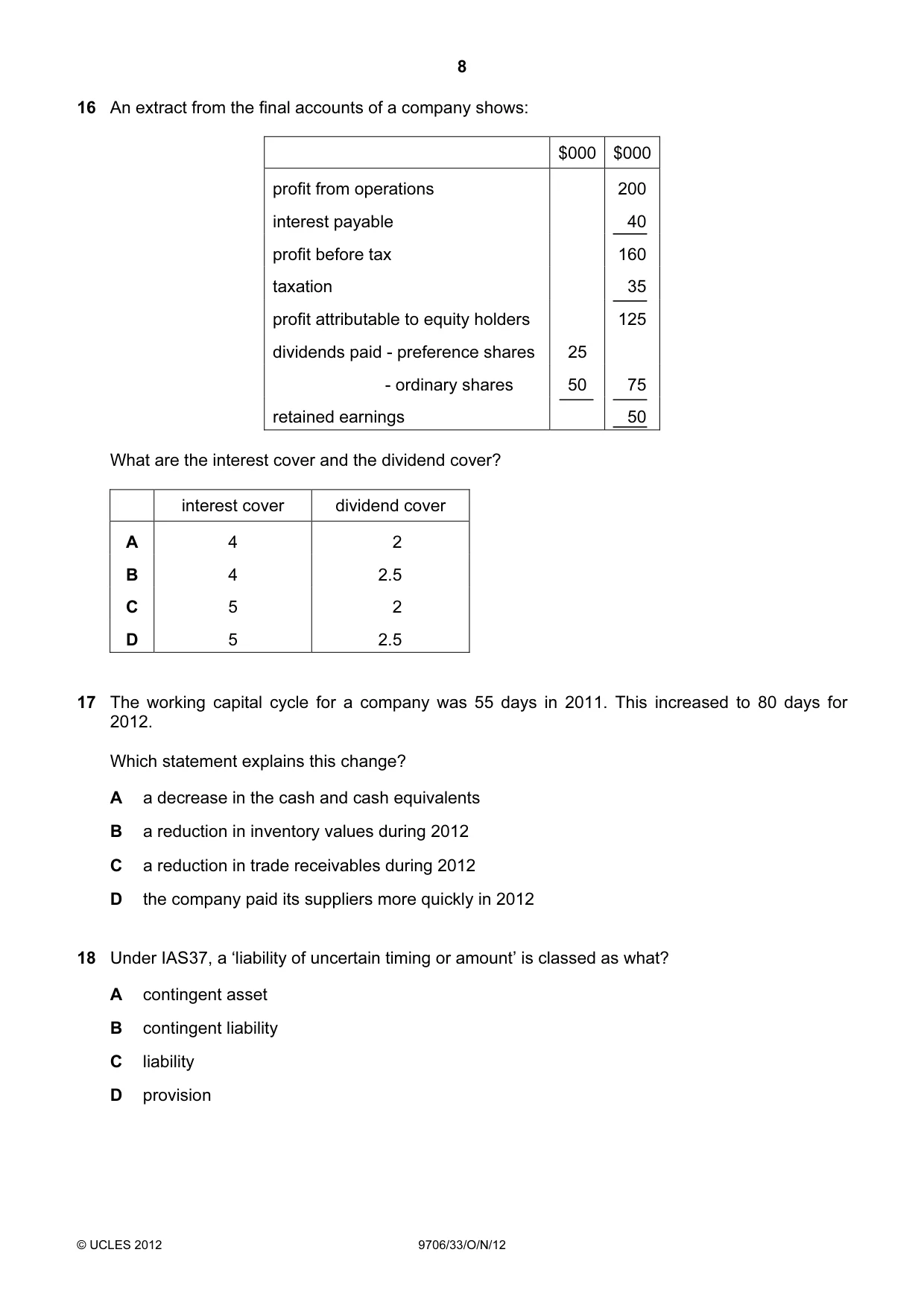
16 An extract from the final accounts of a company shows: $000 $000 profit from operations 200 interest payable 40 profit before tax 160 taxation 35 profit attributable to equity holders 125 dividends paid - preference shares 25 - ordinary shares 50 75 retained earnings 50 What are the interest cover and the dividend cover? interest cover dividend cover A 4 2 B 4 2.5 C 5 2 D 5 2.5
Mark scheme: C
More questions on Analysis and communication of accounting information
Q17 · The working capital cycle for a company was 55 days in 2011
17 The working capital cycle for a company was 55 days in 2011. This increased to 80 days for 2012. Which statement explains this change? A a decrease in the cash and cash equivalents B a reduction in inventory values during 2012 C a reduction in trade receivables during 2012 D the company paid its suppliers more quickly in 2012
Mark scheme: D
More questions on Analysis and communication of accounting information
Q18 · Under IAS37, a ‘liability of uncertain timing or amount’ is classed as what?
18 Under IAS37, a ‘liability of uncertain timing or amount’ is classed as what? A contingent asset B contingent liability C liability D provision
Mark scheme: B
Q19 · The following information relates to the production data for a process
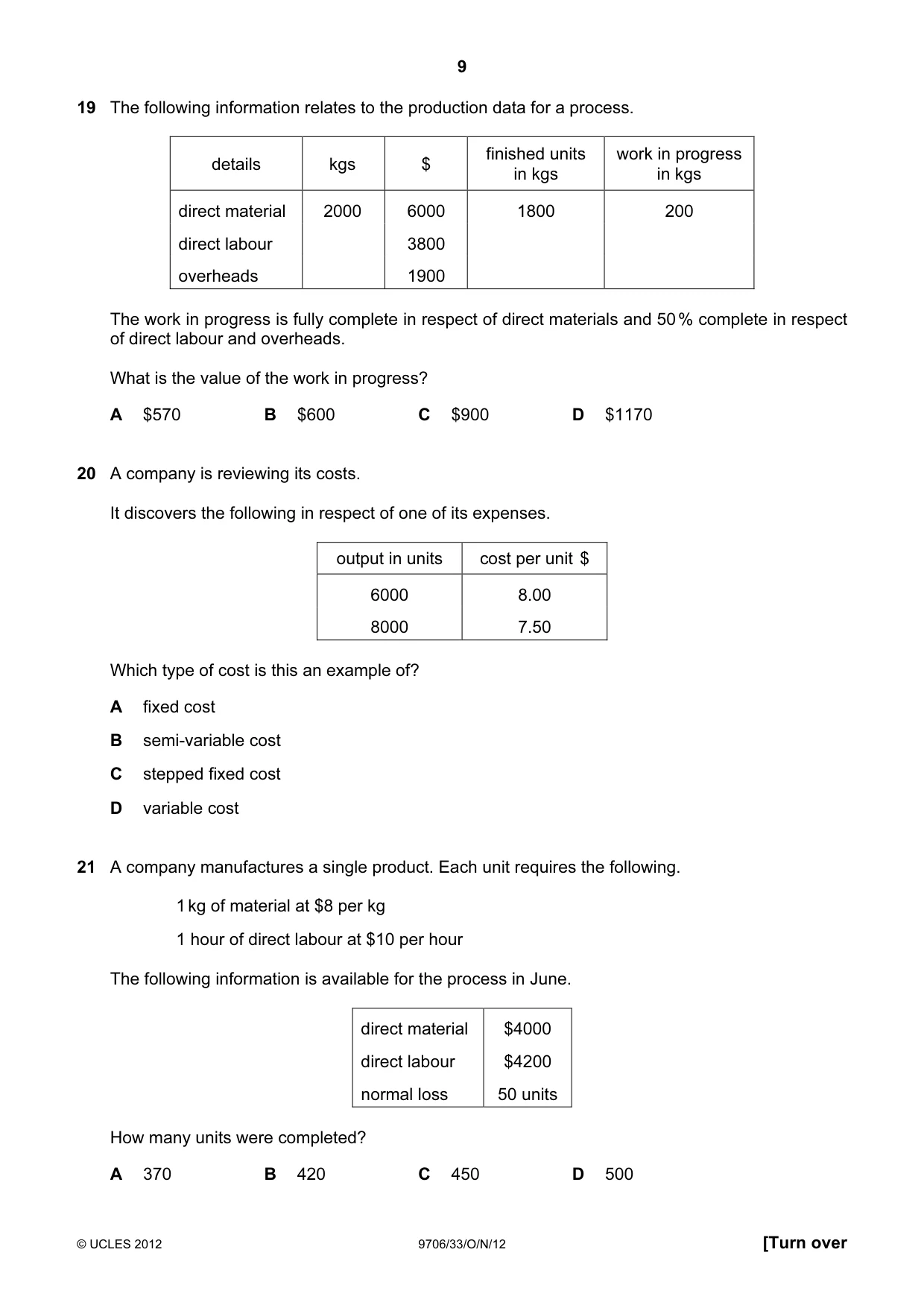
19 The following information relates to the production data for a process. finished units work in progress details kgs $ in kgs in kgs direct material 2000 6000 1800 200 direct labour 3800 overheads 1900 The work in progress is fully complete in respect of direct materials and 50 % complete in respect of direct labour and overheads. What is the value of the work in progress? A $570 B $600 C $900 D $1170
Mark scheme: C
Q20 · A company is reviewing its costs
20 A company is reviewing its costs. It discovers the following in respect of one of its expenses. output in units cost per unit $ 6000 8.00 8000 7.50 Which type of cost is this an example of? A fixed cost B semi-variable cost C stepped fixed cost D variable cost
Mark scheme: B
Q21 · A company manufactures a single product
21 A company manufactures a single product. Each unit requires the following. 1 kg of material at $8 per kg 1 hour of direct labour at $10 per hour The following information is available for the process in June. direct material $4000 direct labour $4200 normal loss 50 units How many units were completed? A 370 B 420 C 450 D 500
Mark scheme: C
Q22 · A company has creditors valued at $100 000 and they are currently paid in 30 days
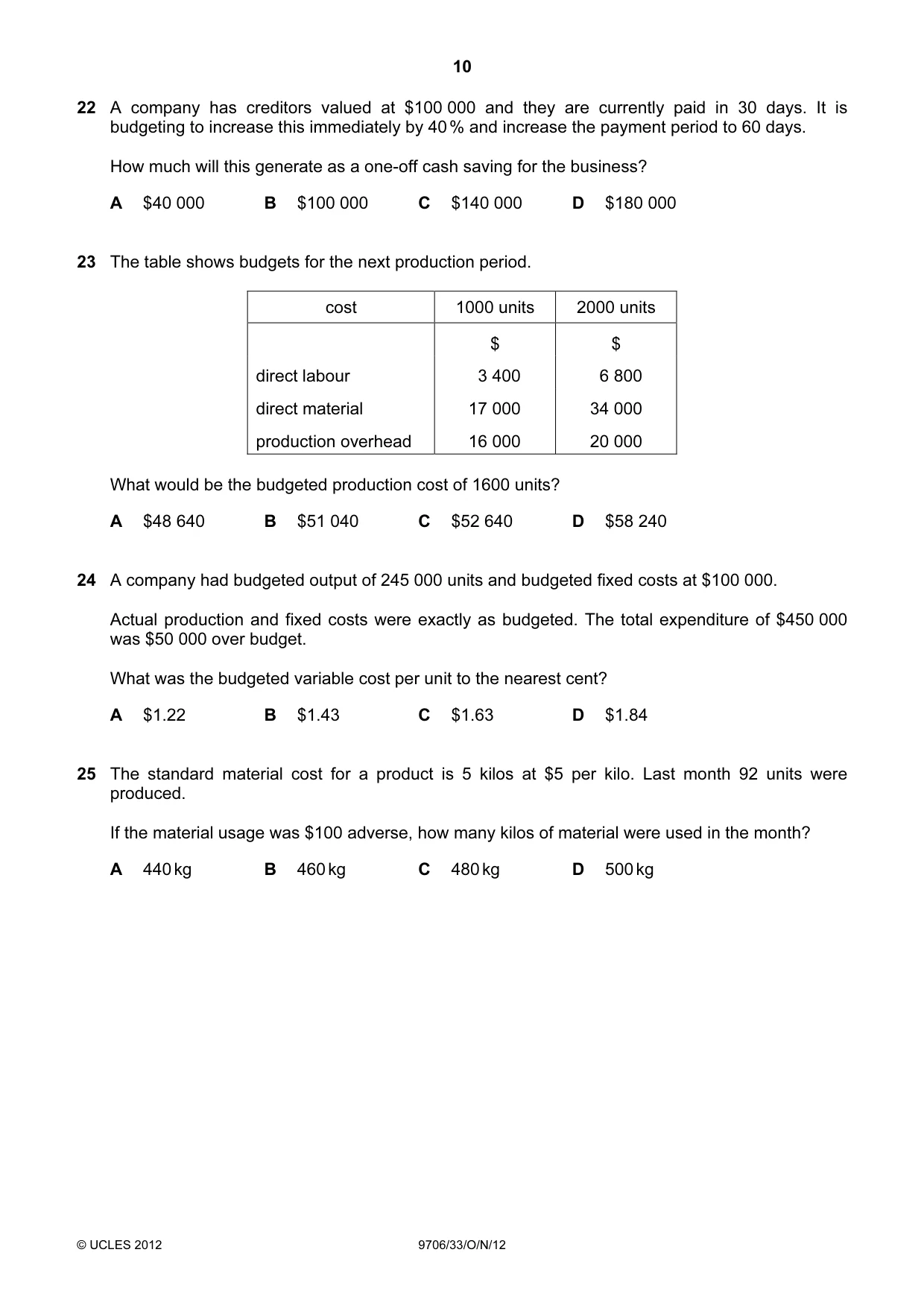
22 A company has creditors valued at $100 000 and they are currently paid in 30 days. It is budgeting to increase this immediately by 40 % and increase the payment period to 60 days. How much will this generate as a one-off cash saving for the business? A $40 000 B $100 000 C $140 000 D $180 000
Mark scheme: D
Q23 · The table shows budgets for the next production period
23 The table shows budgets for the next production period. cost 1000 units 2000 units $ $ direct labour 3 400 6 800 direct material 17 000 34 000 production overhead 16 000 20 000 What would be the budgeted production cost of 1600 units? A $48 640 B $51 040 C $52 640 D $58 240
Mark scheme: B
Q24 · A company had budgeted output of 245 000 units and budgeted fixed costs at $100 000
24 A company had budgeted output of 245 000 units and budgeted fixed costs at $100 000. Actual production and fixed costs were exactly as budgeted. The total expenditure of $450 000 was $50 000 over budget. What was the budgeted variable cost per unit to the nearest cent? A $1.22 B $1.43 C $1.63 D $1.84
Mark scheme: A
Q25 · The standard material cost for a product is 5 kilos at $5 per kilo
25 The standard material cost for a product is 5 kilos at $5 per kilo. Last month 92 units were produced. If the material usage was $100 adverse, how many kilos of material were used in the month? A 440 kg B 460 kg C 480 kg D 500 kg
Mark scheme: C
Q26 · A company uses standard costing and has the following budget and actual data available…
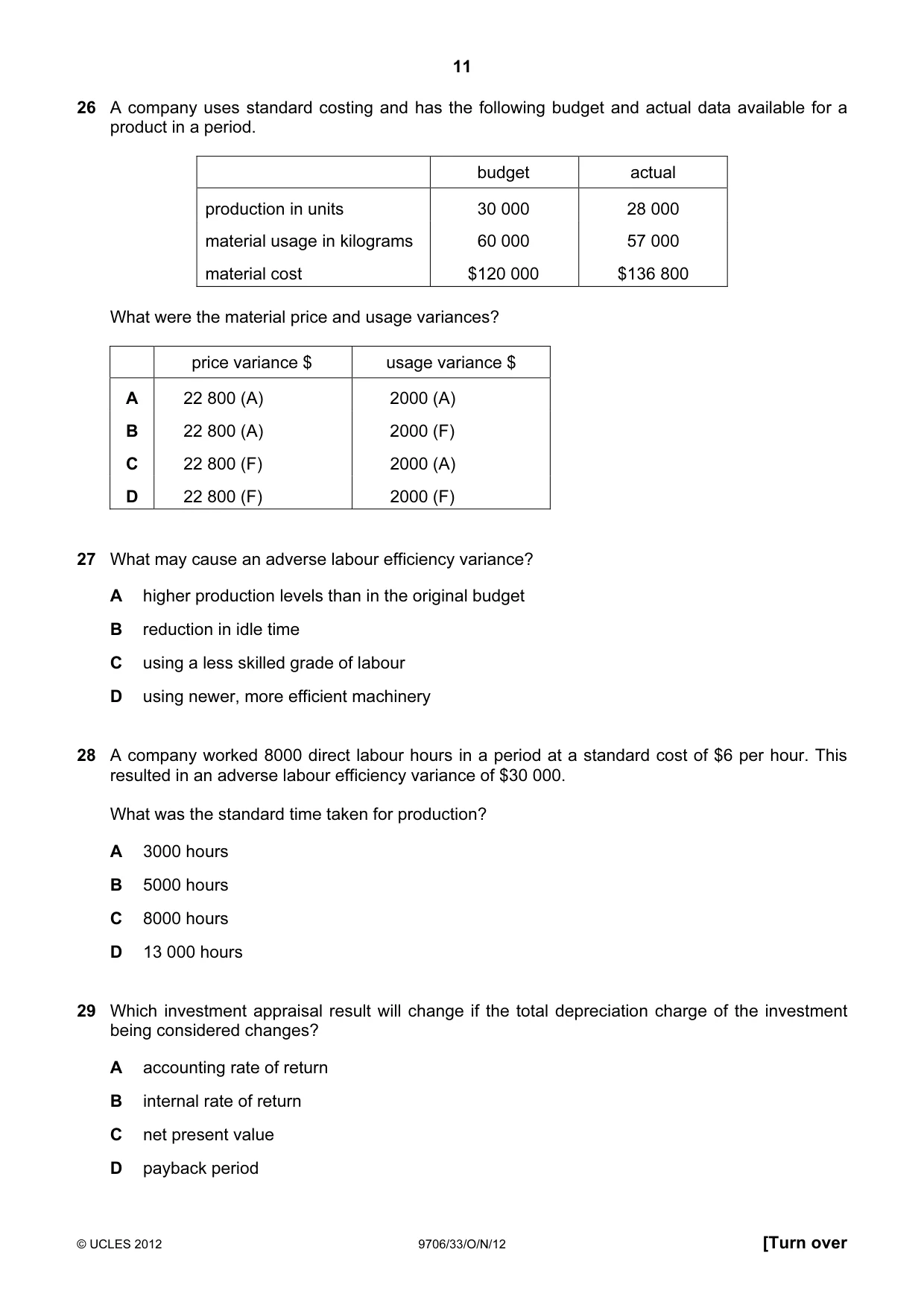
26 A company uses standard costing and has the following budget and actual data available for a product in a period. budget actual production in units 30 000 28 000 material usage in kilograms 60 000 57 000 material cost $120 000 $136 800 What were the material price and usage variances? price variance $ usage variance $ A 22 800 (A) 2000 (A) B 22 800 (A) 2000 (F) C 22 800 (F) 2000 (A) D 22 800 (F) 2000 (F)
Mark scheme: A
Q27 · What may cause an adverse labour efficiency variance?
27 What may cause an adverse labour efficiency variance? A higher production levels than in the original budget B reduction in idle time C using a less skilled grade of labour D using newer, more efficient machinery
Mark scheme: C
Q28 · A company worked 8000 direct labour hours in a period at a standard cost of $6 per hour
28 A company worked 8000 direct labour hours in a period at a standard cost of $6 per hour. This resulted in an adverse labour efficiency variance of $30 000. What was the standard time taken for production? A 3000 hours B 5000 hours C 8000 hours D 13 000 hours
Mark scheme: A
Q29 · Which investment appraisal result will change if the total depreciation charge of the…
29 Which investment appraisal result will change if the total depreciation charge of the investment being considered changes? A accounting rate of return B internal rate of return C net present value D payback period
Mark scheme: A
Q30 · A company invests in a project which costs $300 000
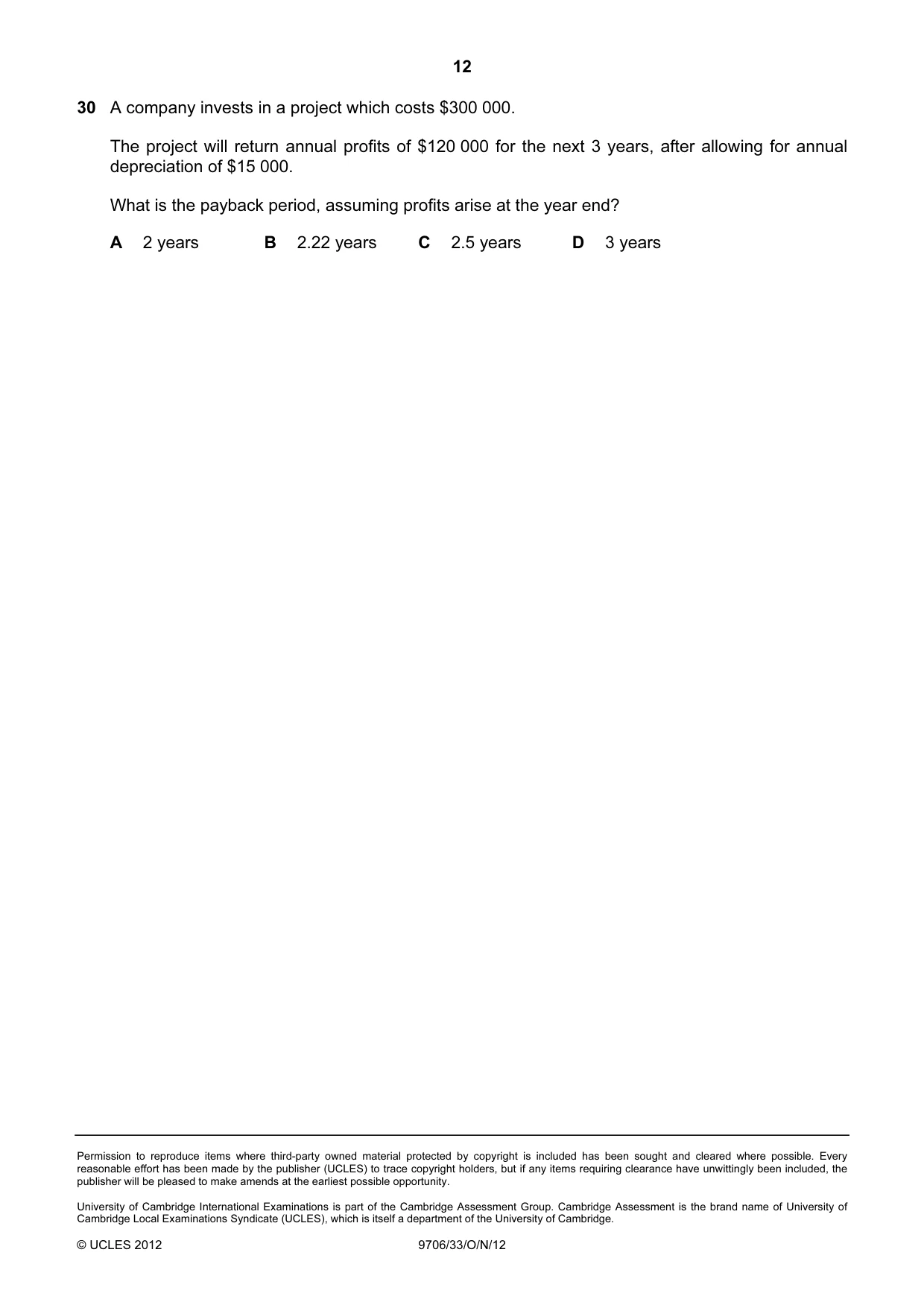
30 A company invests in a project which costs $300 000. The project will return annual profits of $120 000 for the next 3 years, after allowing for annual depreciation of $15 000. What is the payback period, assuming profits arise at the year end? A 2 years B 2.22 years C 2.5 years D 3 years
Mark scheme: B
What was in this paper
The subtopics covered by these 30 questions, and how many questions each got. Open one in a new tab to see every Cambridge question on it.
7Standard costing4Costs and cost behaviour3Analysis and communication of accounting information2Analysis and communication of accounting information2Business acquisition and merger2Investment appraisal2Traditional costing methods2Types of business entity2Accounting for non-current assets1Budgeting and budgetary control1Preparation of financial statements1Regulatory and ethical considerations1What you needed in this session
Cambridge’s own grade thresholds for 2012 Oct/Nov, Paper 3 · Variant 3. A higher threshold means an easier paper — the bar moves with how the cohort did.