Cambridge A Level Accounting 9706 — 2014 May/June Paper 3 · Variant 1
9706/31/M/J/14 · 30 questions · 30 marks · ≈34 min
The question paper and its mark scheme, free to read here and free to download. This is Cambridge’s own paper, exactly as it was sat.
Question paper12 pages
Mark scheme2 pages
Answers below. Sit the paper first if you are practising.
Questions as text
Q1 · During the year ended 31 December, a company bought a new motor vehicle
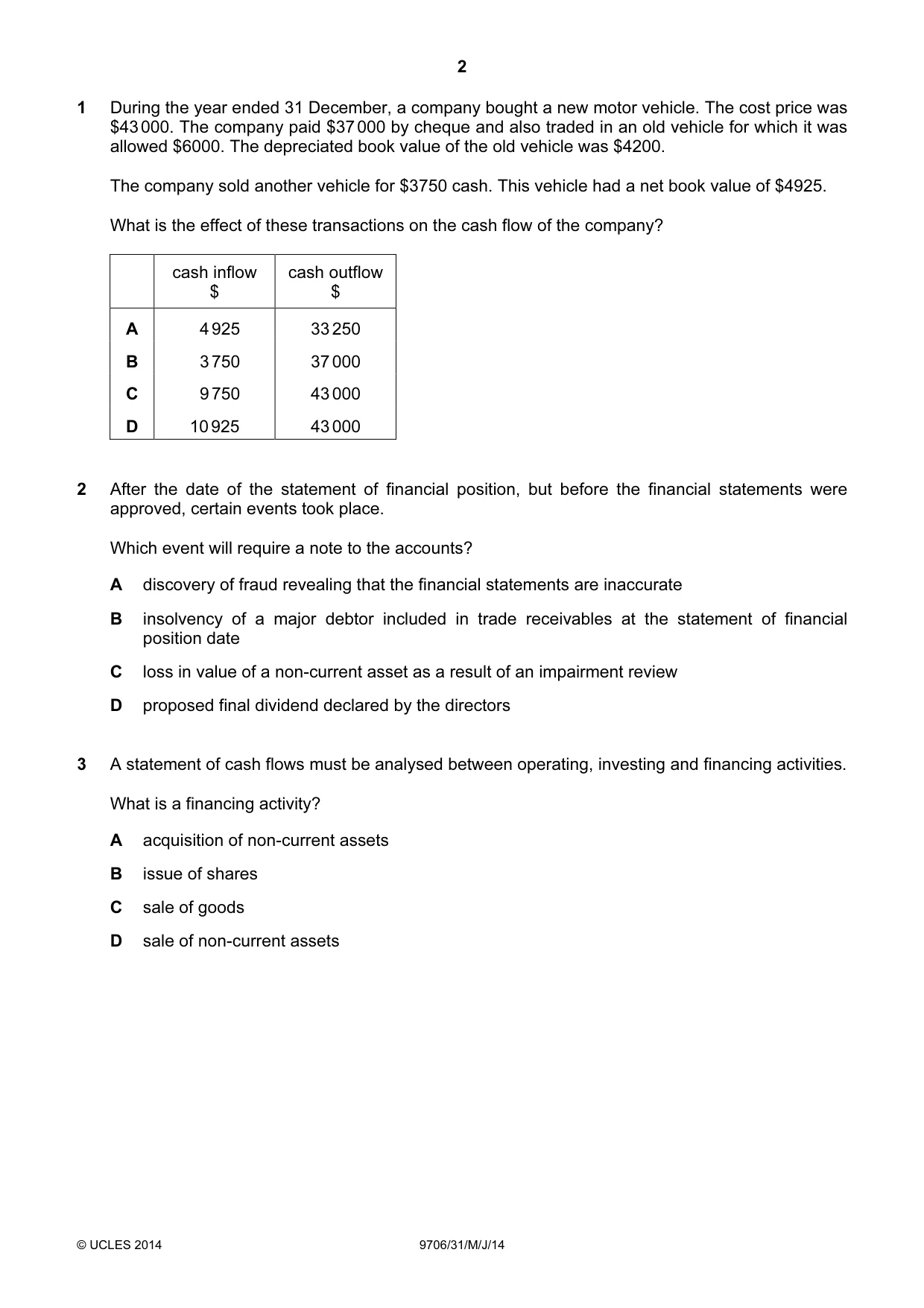
1 During the year ended 31 December, a company bought a new motor vehicle. The cost price was $43 000. The company paid $37 000 by cheque and also traded in an old vehicle for which it was allowed $6000. The depreciated book value of the old vehicle was $4200. The company sold another vehicle for $3750 cash. This vehicle had a net book value of $4925. What is the effect of these transactions on the cash flow of the company? cash inflow cash outflow $ $ A 4 925 33 250 B 3 750 37 000 C 9 750 43 000 D 10 925 43 000
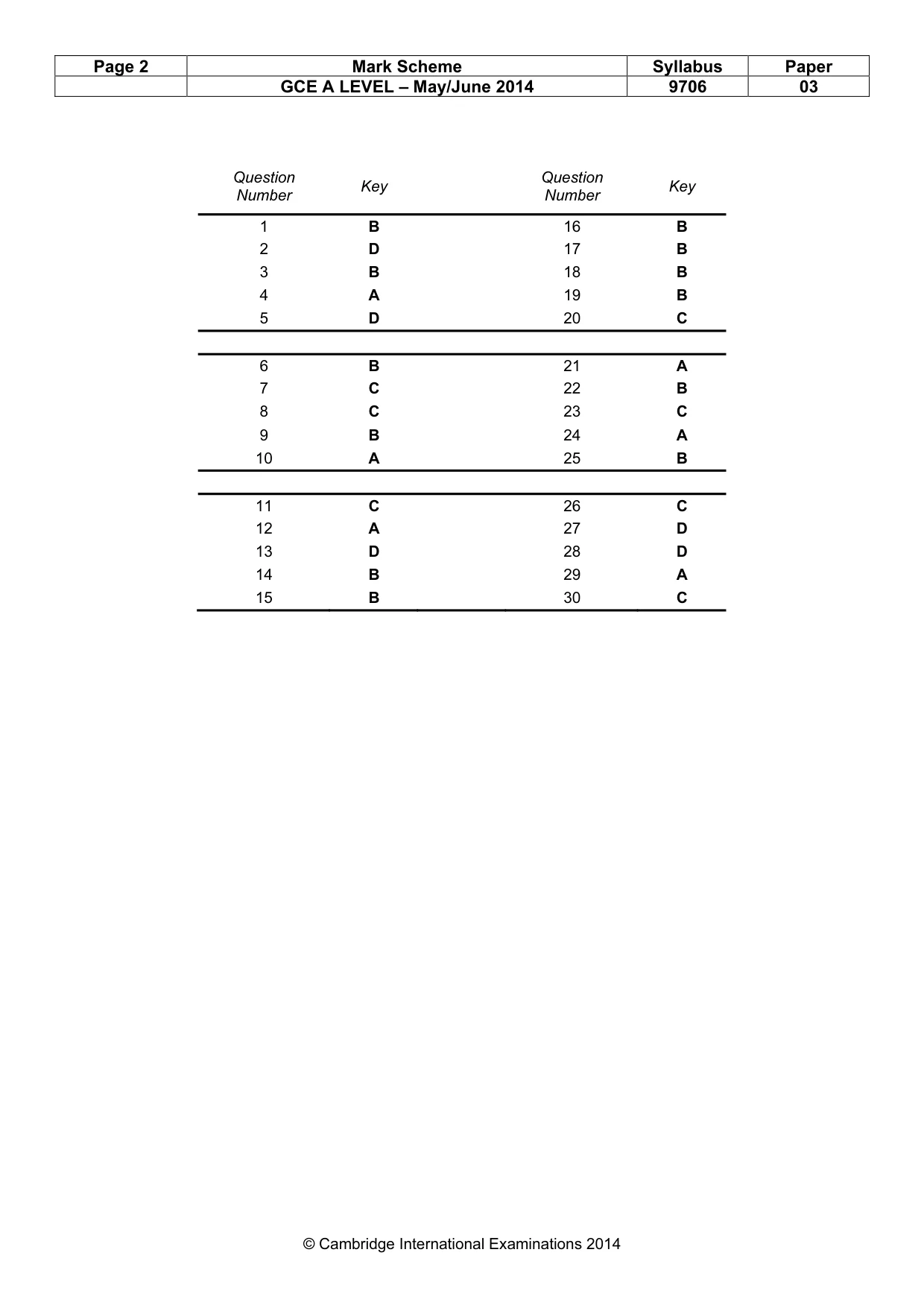
Mark scheme: B
Q2 · After the date of the statement of financial position, but before the financial…
2 After the date of the statement of financial position, but before the financial statements were approved, certain events took place. Which event will require a note to the accounts? A discovery of fraud revealing that the financial statements are inaccurate B insolvency of a major debtor included in trade receivables at the statement of financial position date C loss in value of a non-current asset as a result of an impairment review D proposed final dividend declared by the directors
Mark scheme: D
Q3 · A statement of cash flows must be analysed between operating, investing and financing…
3 A statement of cash flows must be analysed between operating, investing and financing activities. What is a financing activity? A acquisition of non-current assets B issue of shares C sale of goods D sale of non-current assets
Mark scheme: B
Q4 · In 2013 a manufacturing company added factory profit of 20% to its cost of production
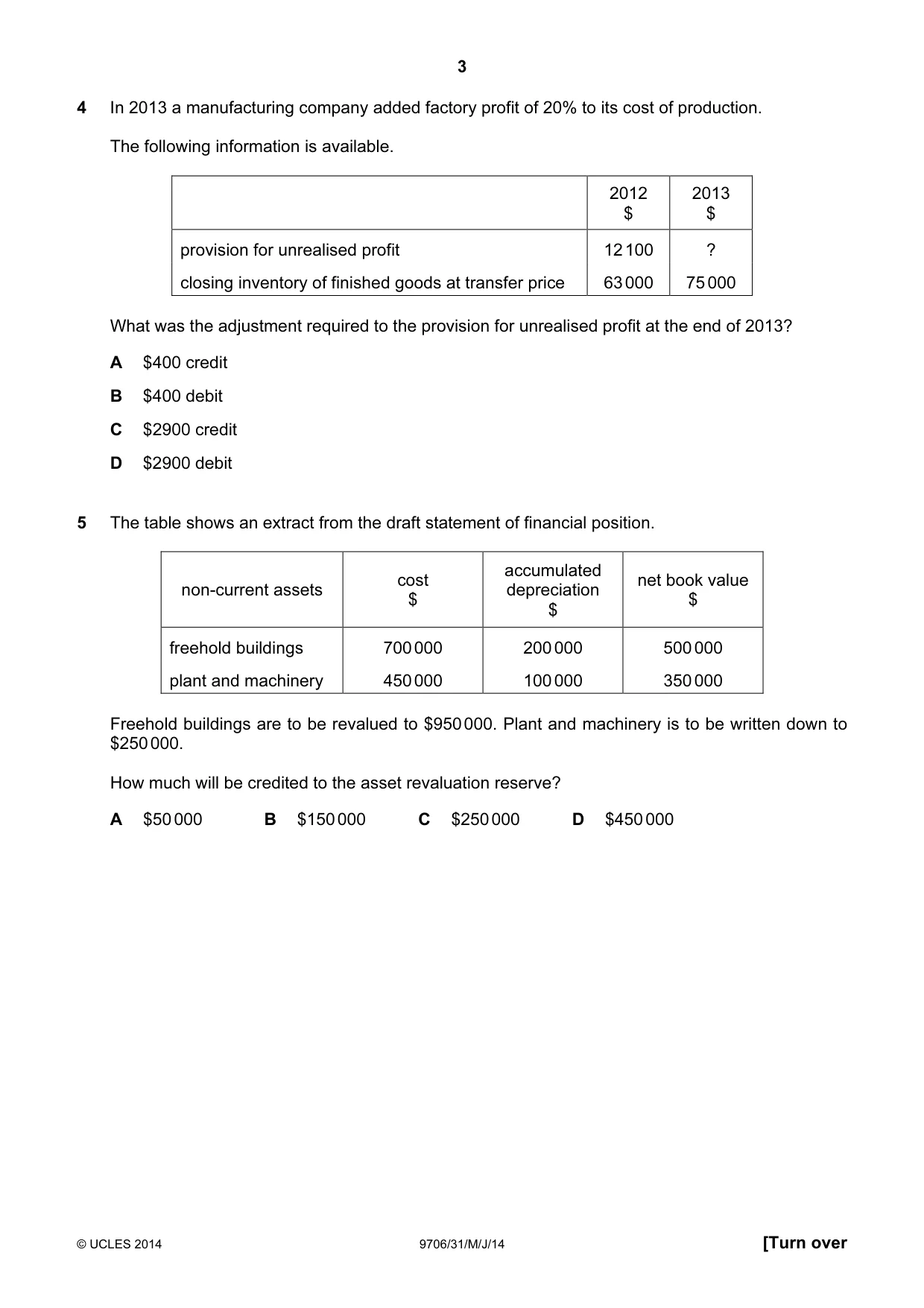
4 In 2013 a manufacturing company added factory profit of 20% to its cost of production. The following information is available. 2012 2013 $ $ provision for unrealised profit 12 100 ? closing inventory of finished goods at transfer price 63 000 75 000 What was the adjustment required to the provision for unrealised profit at the end of 2013? A $400 credit B $400 debit C $2900 credit D $2900 debit
Mark scheme: A
Q5 · The table shows an extract from the draft statement of financial position
5 The table shows an extract from the draft statement of financial position. accumulated cost net book value non-current assets depreciation $ $ $ freehold buildings 700 000 200 000 500 000 plant and machinery 450 000 100 000 350 000 Freehold buildings are to be revalued to $950 000. Plant and machinery is to be written down to $250 000. How much will be credited to the asset revaluation reserve? A $50 000 B $150 000 C $250 000 D $450 000
Mark scheme: D
Q6 · A company’s statement of financial position showed the following on 31 December 2012
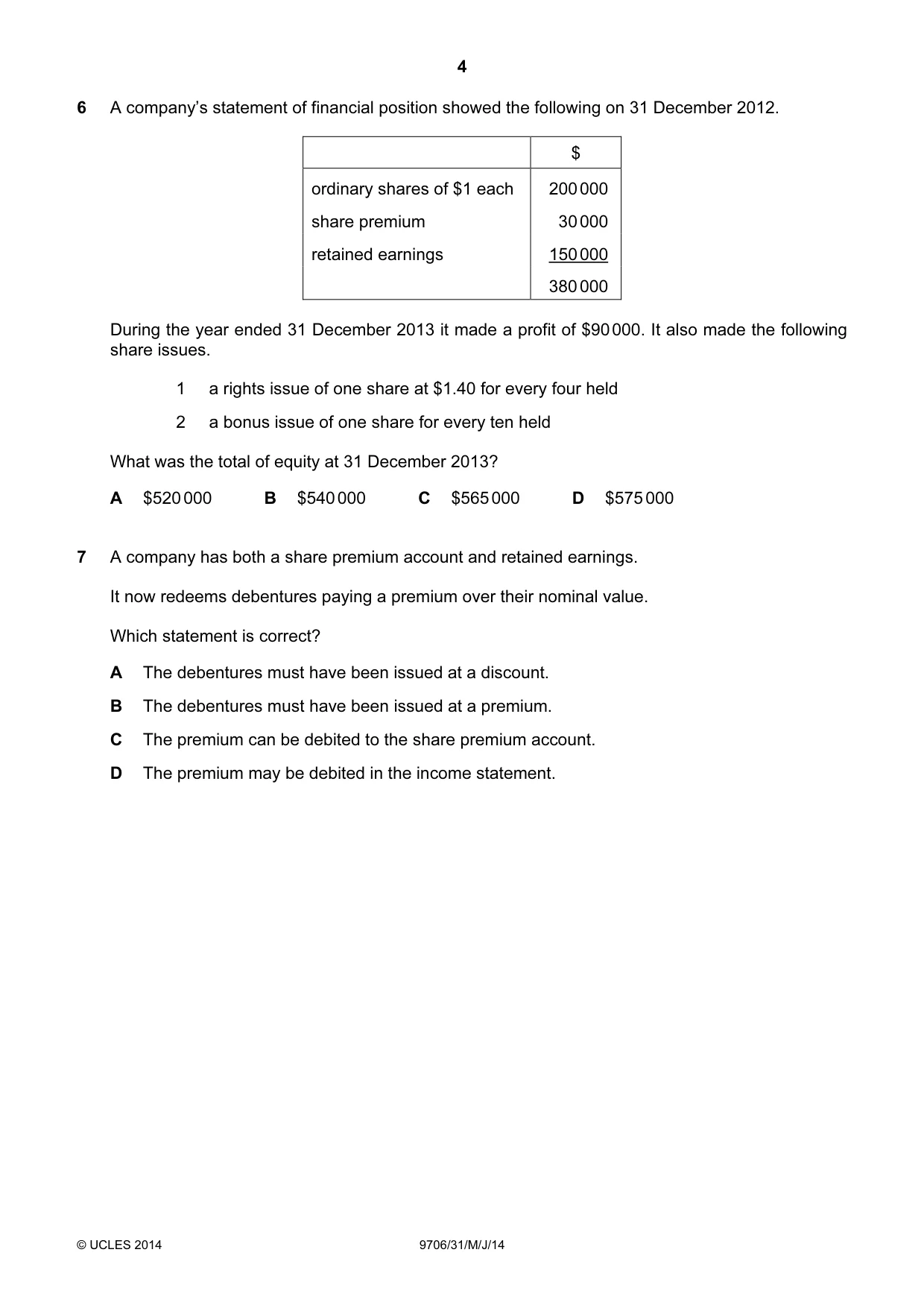
6 A company’s statement of financial position showed the following on 31 December 2012. $ ordinary shares of $1 each 200 000 share premium 30 000 retained earnings 150 000 380 000 During the year ended 31 December 2013 it made a profit of $90 000. It also made the following share issues. 1 a rights issue of one share at $1.40 for every four held 2 a bonus issue of one share for every ten held What was the total of equity at 31 December 2013? A $520 000 B $540 000 C $565 000 D $575 000
Mark scheme: B
Q7 · A company has both a share premium account and retained earnings
7 A company has both a share premium account and retained earnings. It now redeems debentures paying a premium over their nominal value. Which statement is correct? A The debentures must have been issued at a discount. B The debentures must have been issued at a premium. C The premium can be debited to the share premium account. D The premium may be debited in the income statement.
Mark scheme: C
Q8 · Alan, Brian and Colin are in partnership sharing profits and losses in the ratio 3 : 2 : 1
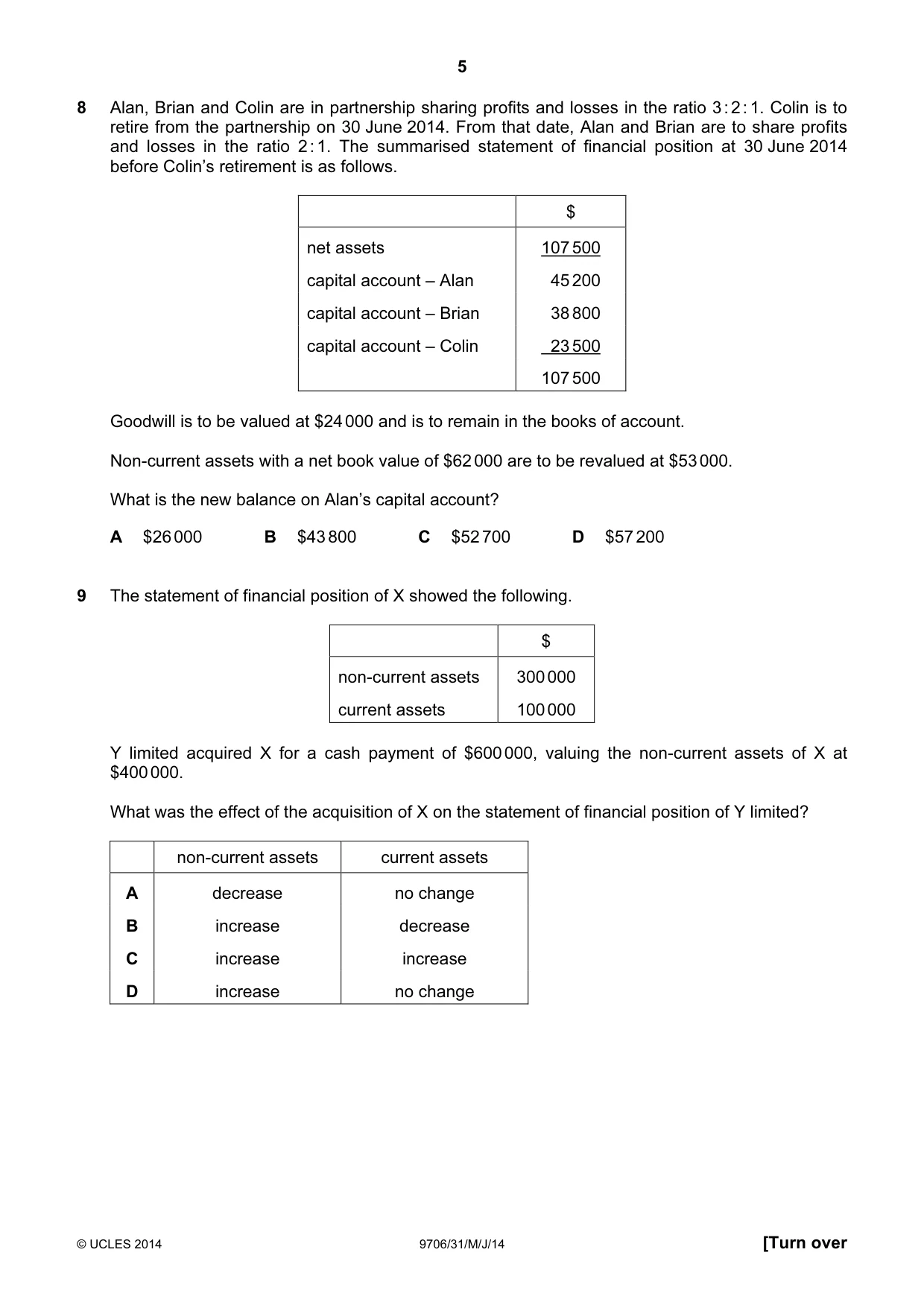
8 Alan, Brian and Colin are in partnership sharing profits and losses in the ratio 3 : 2 : 1. Colin is to retire from the partnership on 30 June 2014. From that date, Alan and Brian are to share profits and losses in the ratio 2 : 1. The summarised statement of financial position at 30 June 2014 before Colin’s retirement is as follows. $ net assets 107 500 capital account – Alan 45 200 capital account – Brian 38 800 capital account – Colin 23 500 107 500 Goodwill is to be valued at $24 000 and is to remain in the books of account. Non-current assets with a net book value of $62 000 are to be revalued at $53 000. What is the new balance on Alan’s capital account? A $26 000 B $43 800 C $52 700 D $57 200
Mark scheme: C
Q9 · The statement of financial position of X showed the following
9 The statement of financial position of X showed the following. $ non-current assets 300 000 current assets 100 000 Y limited acquired X for a cash payment of $600 000, valuing the non-current assets of X at $400 000. What was the effect of the acquisition of X on the statement of financial position of Y limited? non-current assets current assets A decrease no change B increase decrease C increase increase D increase no change
Mark scheme: B
Q10 · The business of a sole trader is acquired by a limited company
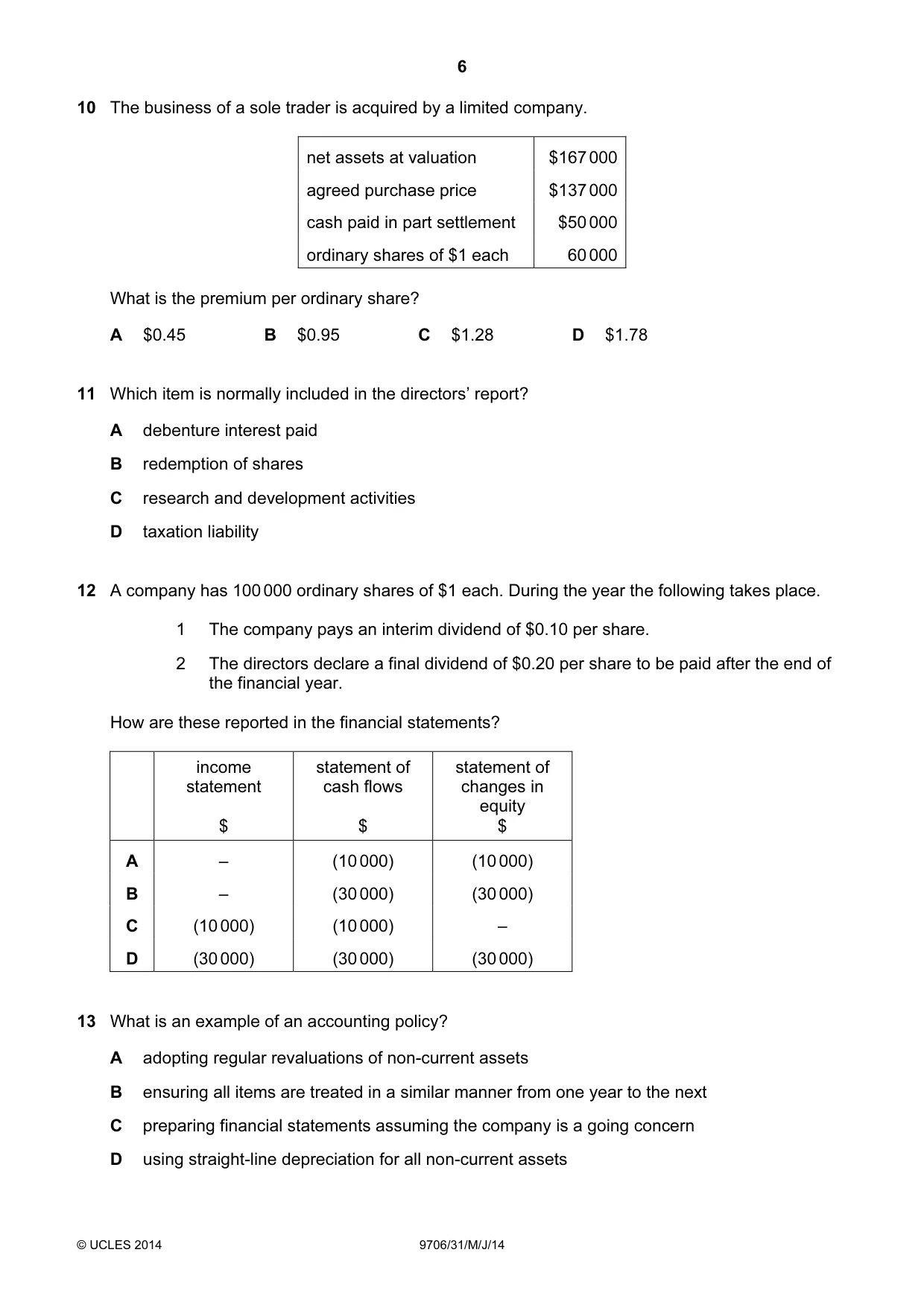
10 The business of a sole trader is acquired by a limited company. net assets at valuation $167 000 agreed purchase price $137 000 cash paid in part settlement $50 000 ordinary shares of $1 each 60 000 What is the premium per ordinary share? A $0.45 B $0.95 C $1.28 D $1.78
Mark scheme: A
Q11 · Which item is normally included in the directors’ report?
11 Which item is normally included in the directors’ report? A debenture interest paid B redemption of shares C research and development activities D taxation liability
Mark scheme: C
Q12 · A company has 100 000 ordinary shares of $1 each
12 A company has 100 000 ordinary shares of $1 each. During the year the following takes place. 1 The company pays an interim dividend of $0.10 per share. 2 The directors declare a final dividend of $0.20 per share to be paid after the end of the financial year. How are these reported in the financial statements? income statement of statement of statement cash flows changes in equity $ $ $ A – (10 000) (10 000) B – (30 000) (30 000) C (10 000) (10 000) – D (30 000) (30 000) (30 000)
Mark scheme: A
Q13 · What is an example of an accounting policy?
13 What is an example of an accounting policy? A adopting regular revaluations of non-current assets B ensuring all items are treated in a similar manner from one year to the next C preparing financial statements assuming the company is a going concern D using straight-line depreciation for all non-current assets
Mark scheme: D
Q14 · The following information is available for a company preparing its statement of changes…
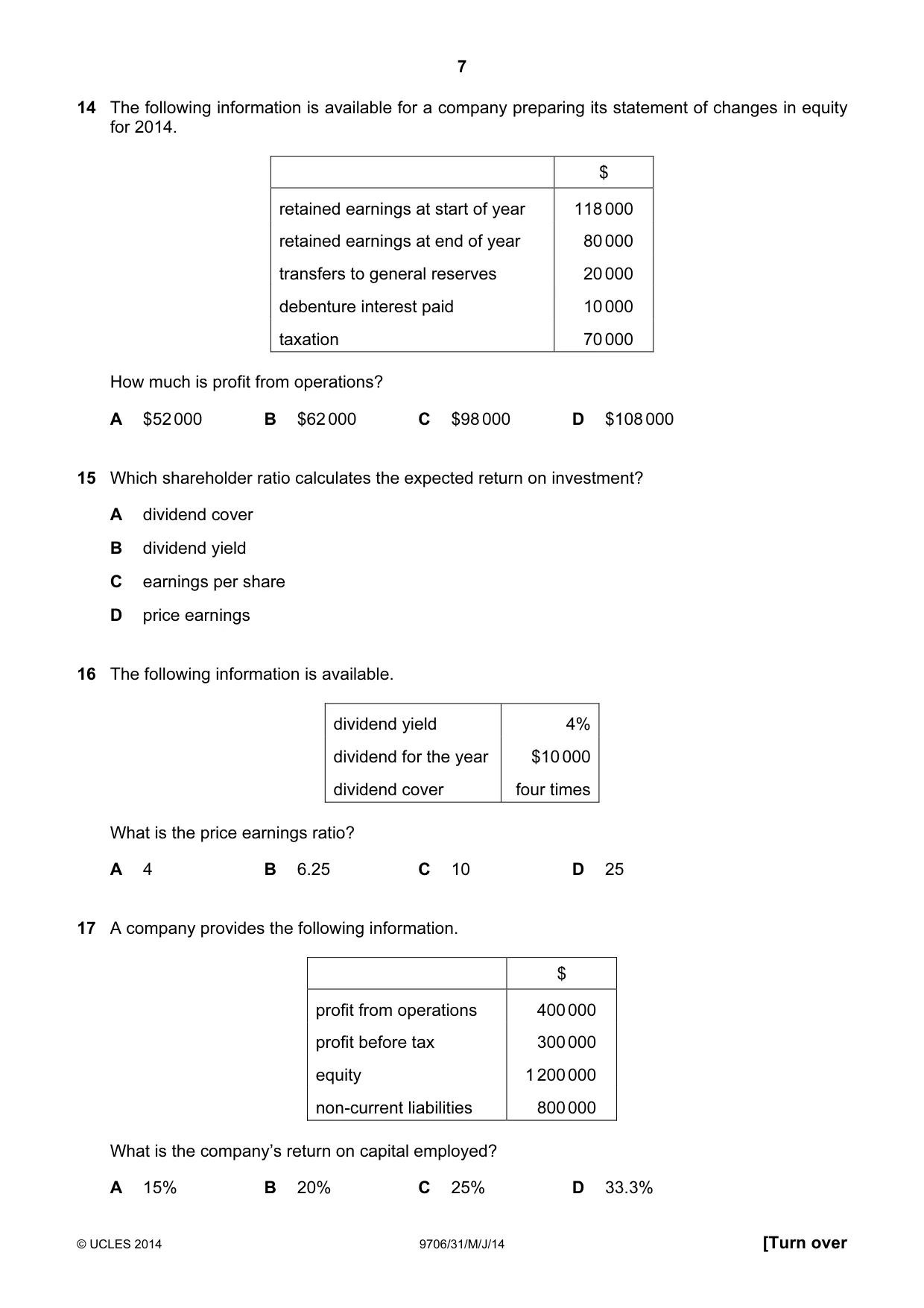
14 The following information is available for a company preparing its statement of changes in equity for 2014. $ retained earnings at start of year 118 000 retained earnings at end of year 80 000 transfers to general reserves 20 000 debenture interest paid 10 000 taxation 70 000 How much is profit from operations? A $52 000 B $62 000 C $98 000 D $108 000
Mark scheme: B
Q15 · Which shareholder ratio calculates the expected return on investment?
15 Which shareholder ratio calculates the expected return on investment? A dividend cover B dividend yield C earnings per share D price earnings
Mark scheme: B
More questions on Analysis and communication of accounting information
Q16 · The following information is available
16 The following information is available. dividend yield 4% dividend for the year $10 000 dividend cover four times What is the price earnings ratio? A 4 B 6.25 C 10 D 25
Mark scheme: B
More questions on Analysis and communication of accounting information
Q17 · A company provides the following information
17 A company provides the following information. $ profit from operations 400 000 profit before tax 300 000 equity 1 200 000 non-current liabilities 800 000 What is the company’s return on capital employed? A 15% B 20% C 25% D 33.3%
Mark scheme: B
More questions on Analysis and communication of accounting information
Q18 · The statement of financial position of a limited company showed the following
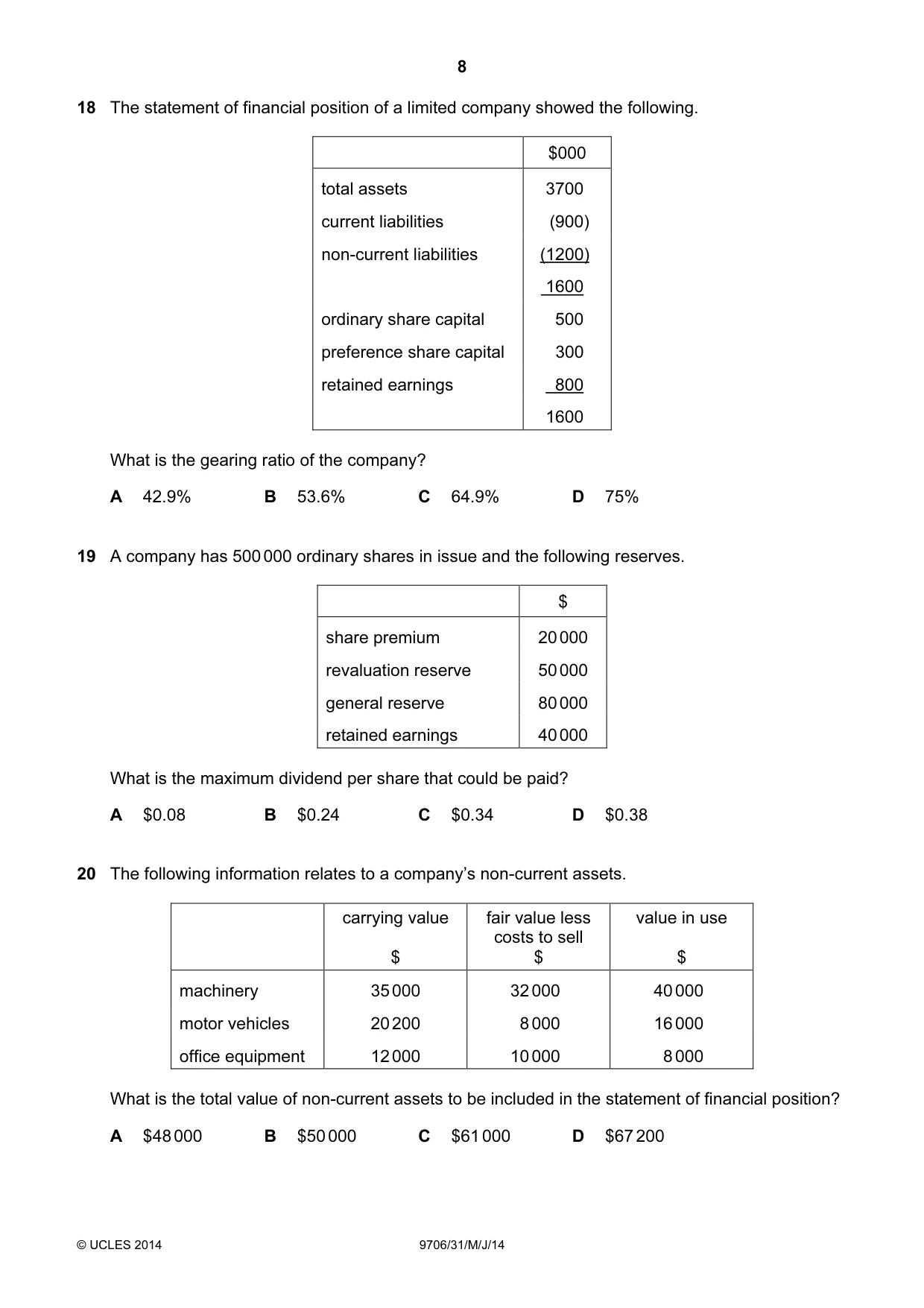
18 The statement of financial position of a limited company showed the following. $000 total assets 3700 current liabilities (900) non-current liabilities (1200) 1600 ordinary share capital 500 preference share capital 300 retained earnings 800 1600 What is the gearing ratio of the company? A 42.9% B 53.6% C 64.9% D 75%
Mark scheme: B
More questions on Analysis and communication of accounting information
Q19 · A company has 500 000 ordinary shares in issue and the following reserves
19 A company has 500 000 ordinary shares in issue and the following reserves. $ share premium 20 000 revaluation reserve 50 000 general reserve 80 000 retained earnings 40 000 What is the maximum dividend per share that could be paid? A $0.08 B $0.24 C $0.34 D $0.38
Mark scheme: B
Q20 · The following information relates to a company’s non-current assets
20 The following information relates to a company’s non-current assets. carrying value fair value less value in use costs to sell $ $ $ machinery 35 000 32 000 40 000 motor vehicles 20 200 8 000 16 000 office equipment 12 000 10 000 8 000 What is the total value of non-current assets to be included in the statement of financial position? A $48 000 B $50 000 C $61 000 D $67 200
Mark scheme: C
Q21 · How is the closing balance of unrealised factory profit shown in the statement of…
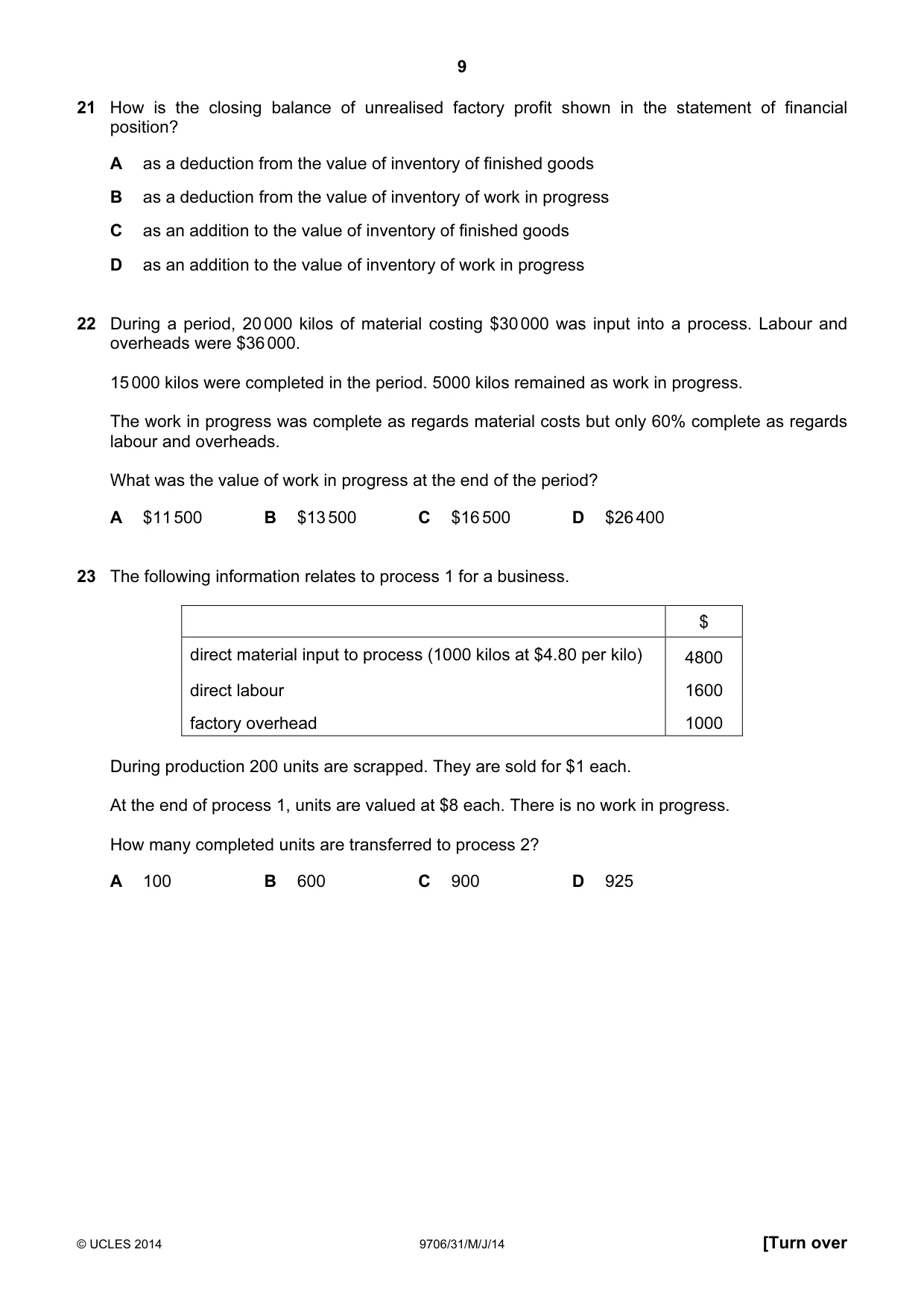
21 How is the closing balance of unrealised factory profit shown in the statement of financial position? A as a deduction from the value of inventory of finished goods B as a deduction from the value of inventory of work in progress C as an addition to the value of inventory of finished goods D as an addition to the value of inventory of work in progress
Mark scheme: A
Q22 · During a period, 20 000 kilos of material costing $30 000 was input into a process
22 During a period, 20 000 kilos of material costing $30 000 was input into a process. Labour and overheads were $36 000. 15 000 kilos were completed in the period. 5000 kilos remained as work in progress. The work in progress was complete as regards material costs but only 60% complete as regards labour and overheads. What was the value of work in progress at the end of the period? A $11 500 B $13 500 C $16 500 D $26 400
Mark scheme: B
Q23 · The following information relates to process 1 for a business
23 The following information relates to process 1 for a business. $ direct material input to process (1000 kilos at $4.80 per kilo) 4800 direct labour 1600 factory overhead 1000 During production 200 units are scrapped. They are sold for $1 each. At the end of process 1, units are valued at $8 each. There is no work in progress. How many completed units are transferred to process 2? A 100 B 600 C 900 D 925
Mark scheme: C
Q24 · A company provides the following information about its customers
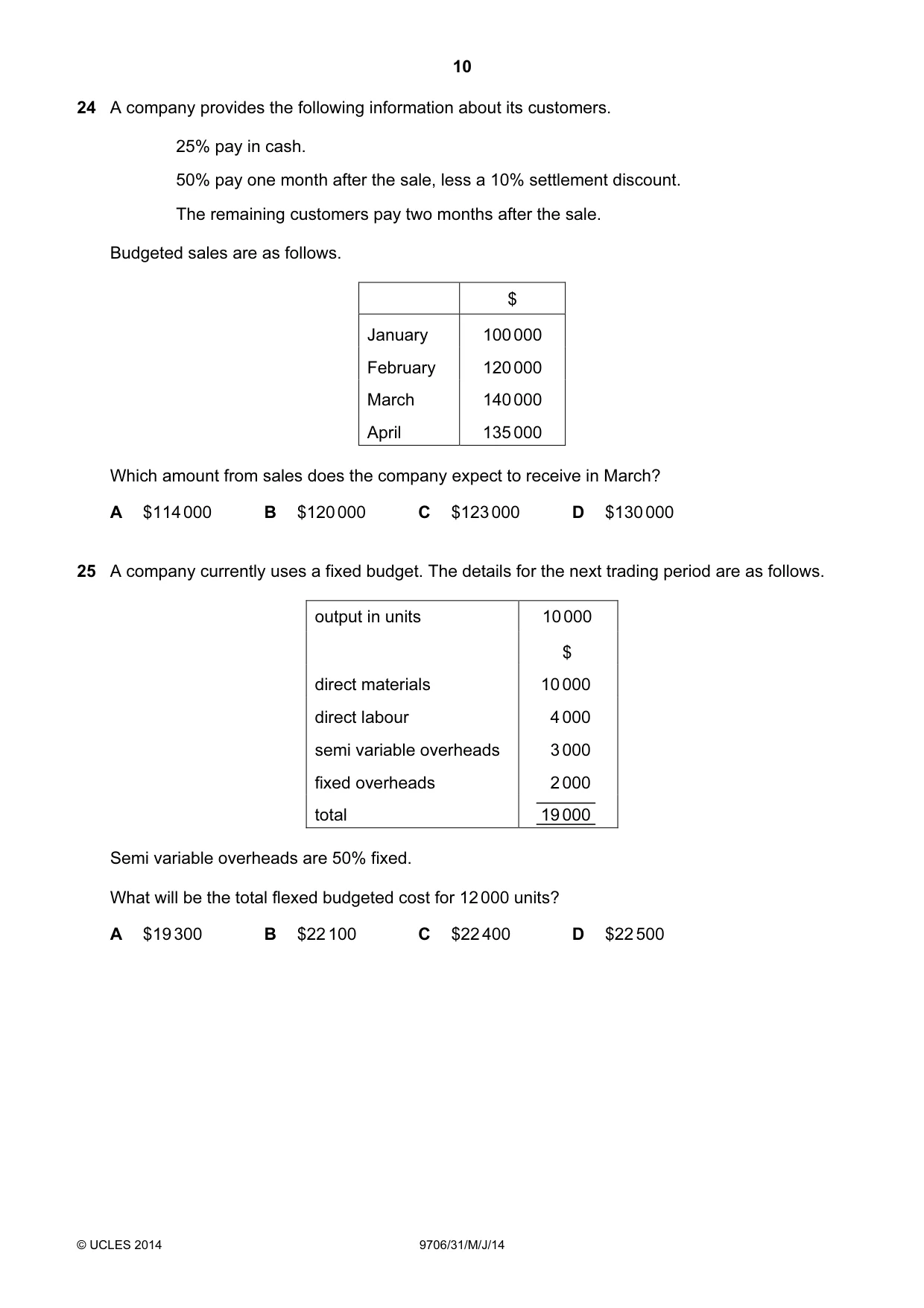
24 A company provides the following information about its customers. 25% pay in cash. 50% pay one month after the sale, less a 10% settlement discount. The remaining customers pay two months after the sale. Budgeted sales are as follows. $ January 100 000 February 120 000 March 140 000 April 135 000 Which amount from sales does the company expect to receive in March? A $114 000 B $120 000 C $123 000 D $130 000
Mark scheme: A
Q25 · A company currently uses a fixed budget
25 A company currently uses a fixed budget. The details for the next trading period are as follows. output in units 10 000 $ direct materials 10 000 direct labour 4 000 semi variable overheads 3 000 fixed overheads 2 000 total 19 000 Semi variable overheads are 50% fixed. What will be the total flexed budgeted cost for 12 000 units? A $19 300 B $22 100 C $22 400 D $22 500
Mark scheme: B
Q26 · A business uses two materials, X and Y, in production
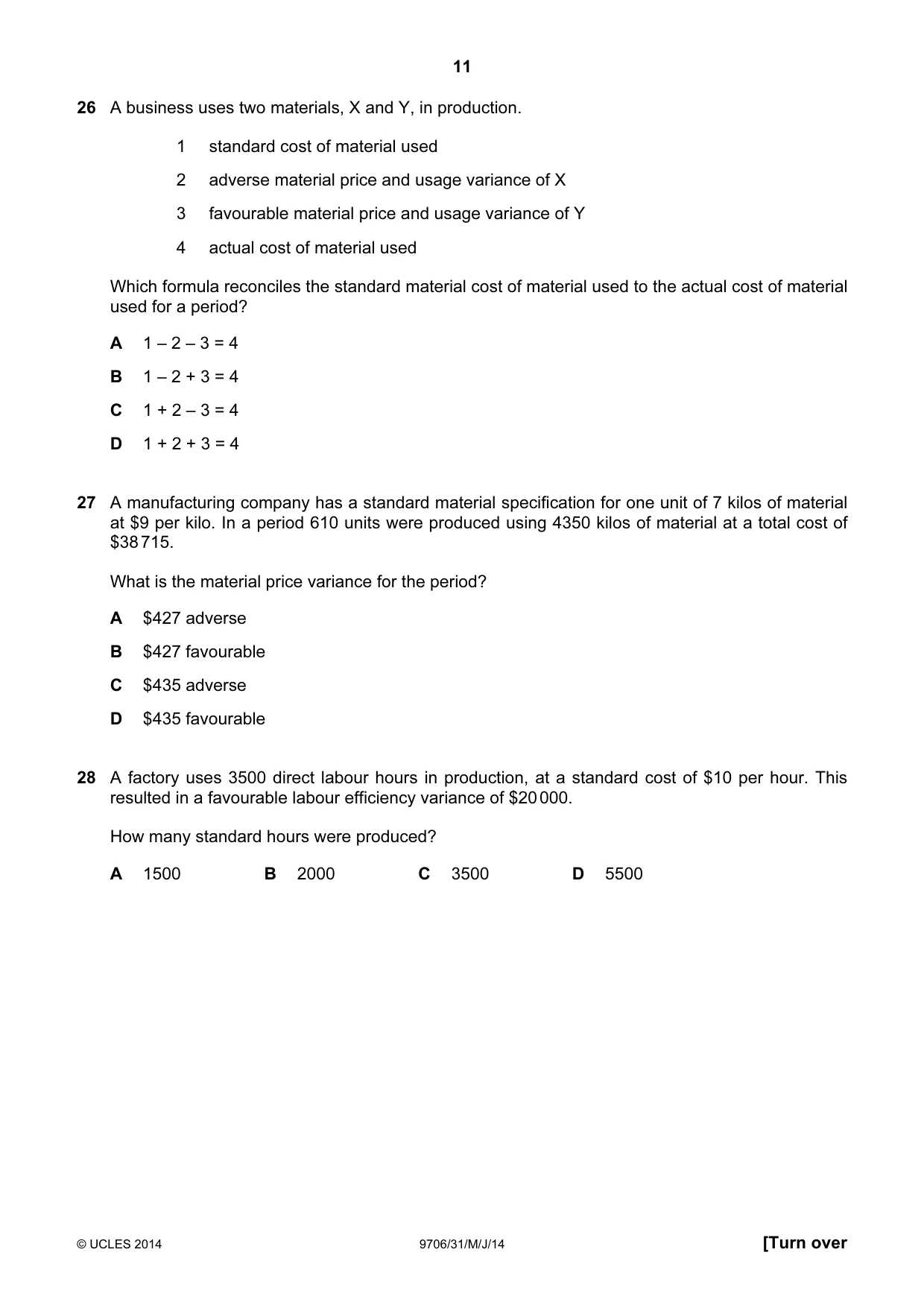
26 A business uses two materials, X and Y, in production. 1 standard cost of material used 2 adverse material price and usage variance of X 3 favourable material price and usage variance of Y 4 actual cost of material used Which formula reconciles the standard material cost of material used to the actual cost of material used for a period? A 1 – 2 – 3 = 4 B 1 – 2 + 3 = 4 C 1 + 2 – 3 = 4 D 1 + 2 + 3 = 4
Mark scheme: C
Q27 · A manufacturing company has a standard material specification for one unit of 7 kilos of…
27 A manufacturing company has a standard material specification for one unit of 7 kilos of material at $9 per kilo. In a period 610 units were produced using 4350 kilos of material at a total cost of $38 715. What is the material price variance for the period? A $427 adverse B $427 favourable C $435 adverse D $435 favourable
Mark scheme: D
Q28 · A factory uses 3500 direct labour hours in production, at a standard cost of $10 per hour
28 A factory uses 3500 direct labour hours in production, at a standard cost of $10 per hour. This resulted in a favourable labour efficiency variance of $20 000. How many standard hours were produced? A 1500 B 2000 C 3500 D 5500
Mark scheme: D
Q29 · The table shows the calculation of the net present value of a potential project
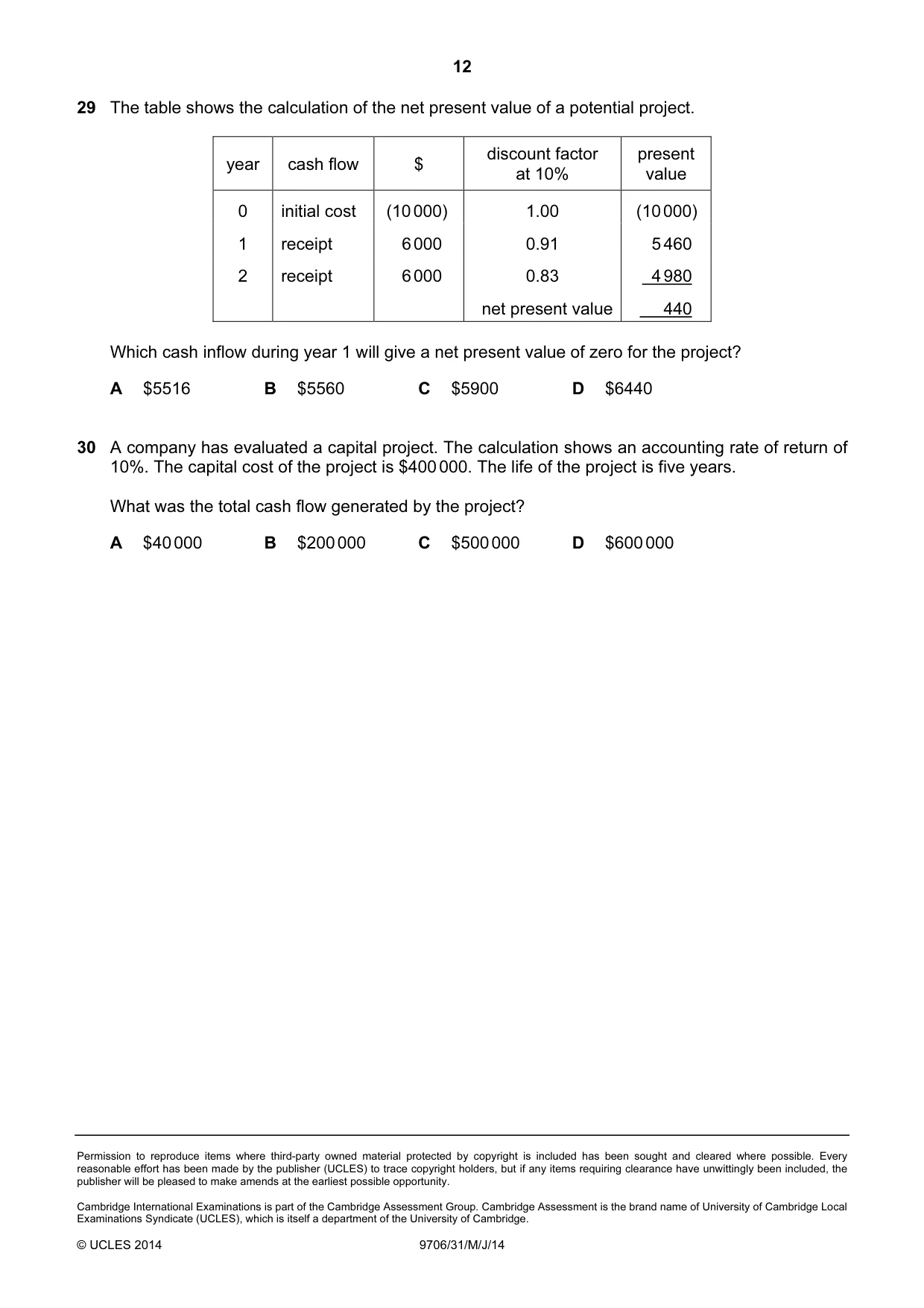
29 The table shows the calculation of the net present value of a potential project. discount factor present year cash flow $ at 10% value 0 initial cost (10 000) 1.00 (10 000) 1 receipt 6 000 0.91 5 460 2 receipt 6 000 0.83 4 980 net present value 440 Which cash inflow during year 1 will give a net present value of zero for the project? A $5516 B $5560 C $5900 D $6440
Mark scheme: A
Q30 · A company has evaluated a capital project
30 A company has evaluated a capital project. The calculation shows an accounting rate of return of 10%. The capital cost of the project is $400 000. The life of the project is five years. What was the total cash flow generated by the project? A $40 000 B $200 000 C $500 000 D $600 000
Mark scheme: C
What was in this paper
The subtopics covered by these 30 questions, and how many questions each got. Open one in a new tab to see every Cambridge question on it.
What you needed in this session
Cambridge’s own grade thresholds for 2014 May/June, Paper 3 · Variant 1. A higher threshold means an easier paper — the bar moves with how the cohort did.