Cambridge A Level Accounting 9706 — 2012 Oct/Nov Paper 3 · Variant 2
9706/32/O/N/12 · 30 questions · 30 marks · ≈34 min
The question paper and its mark scheme, free to read here and free to download. This is Cambridge’s own paper, exactly as it was sat.
Question paper12 pages
Mark scheme2 pages
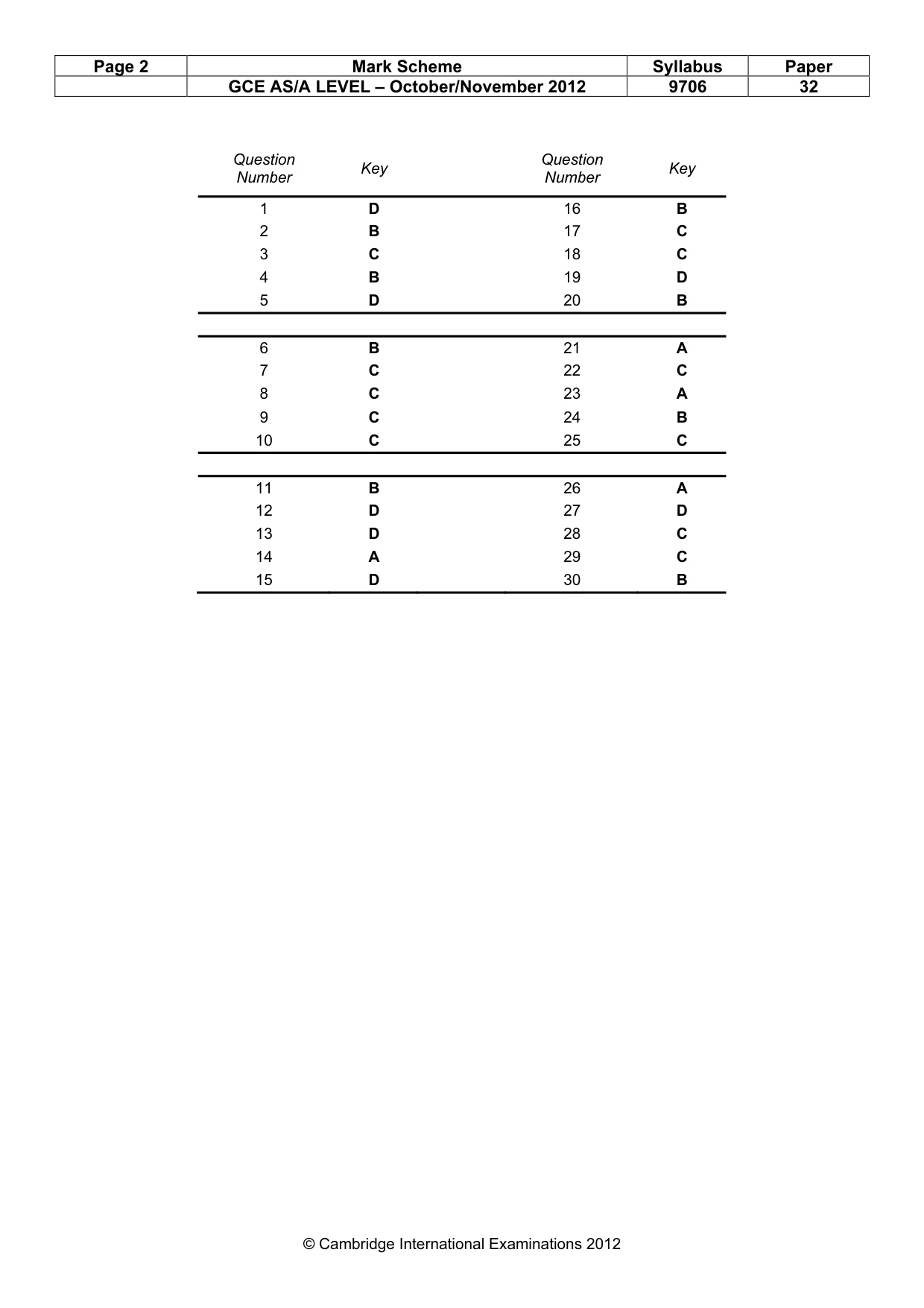
Answers below. Sit the paper first if you are practising.
Questions as text
Q1 · X, Y and Z are in partnership sharing the profits 3:2:1 respectively
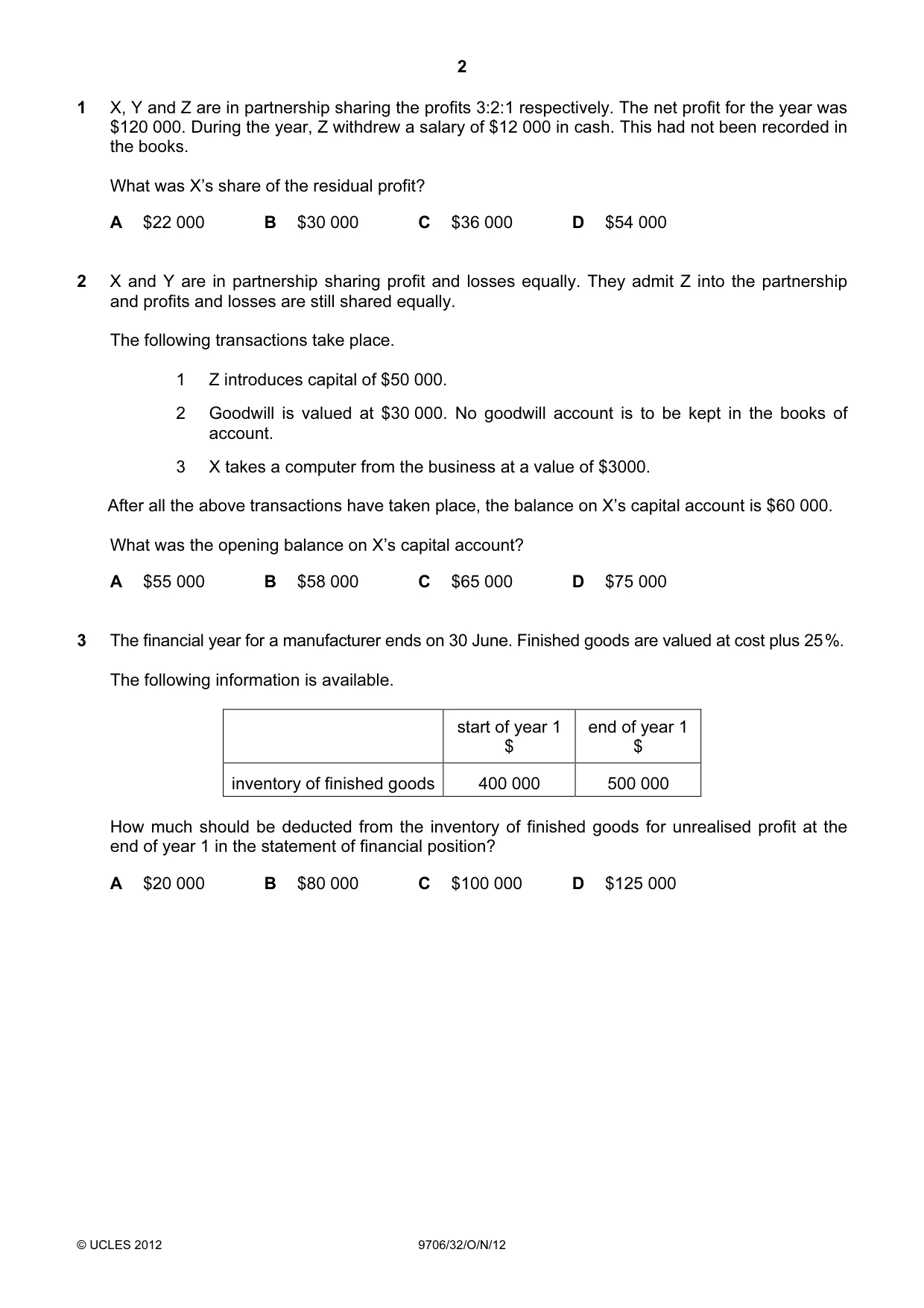
1 X, Y and Z are in partnership sharing the profits 3:2:1 respectively. The net profit for the year was $120 000. During the year, Z withdrew a salary of $12 000 in cash. This had not been recorded in the books. What was X’s share of the residual profit? A $22 000 B $30 000 C $36 000 D $54 000
Mark scheme: D
Q2 · X and Y are in partnership sharing profit and losses equally
2 X and Y are in partnership sharing profit and losses equally. They admit Z into the partnership and profits and losses are still shared equally. The following transactions take place. 1 Z introduces capital of $50 000. 2 Goodwill is valued at $30 000. No goodwill account is to be kept in the books of account. 3 X takes a computer from the business at a value of $3000. After all the above transactions have taken place, the balance on X’s capital account is $60 000. What was the opening balance on X’s capital account? A $55 000 B $58 000 C $65 000 D $75 000
Mark scheme: B
Q3 · The financial year for a manufacturer ends on 30 June
3 The financial year for a manufacturer ends on 30 June. Finished goods are valued at cost plus 25 %. The following information is available. start of year 1 end of year 1 $ $ inventory of finished goods 400 000 500 000 How much should be deducted from the inventory of finished goods for unrealised profit at the end of year 1 in the statement of financial position? A $20 000 B $80 000 C $100 000 D $125 000
Mark scheme: C
Q4 · The summary statement of financial position for a limited company is shown below
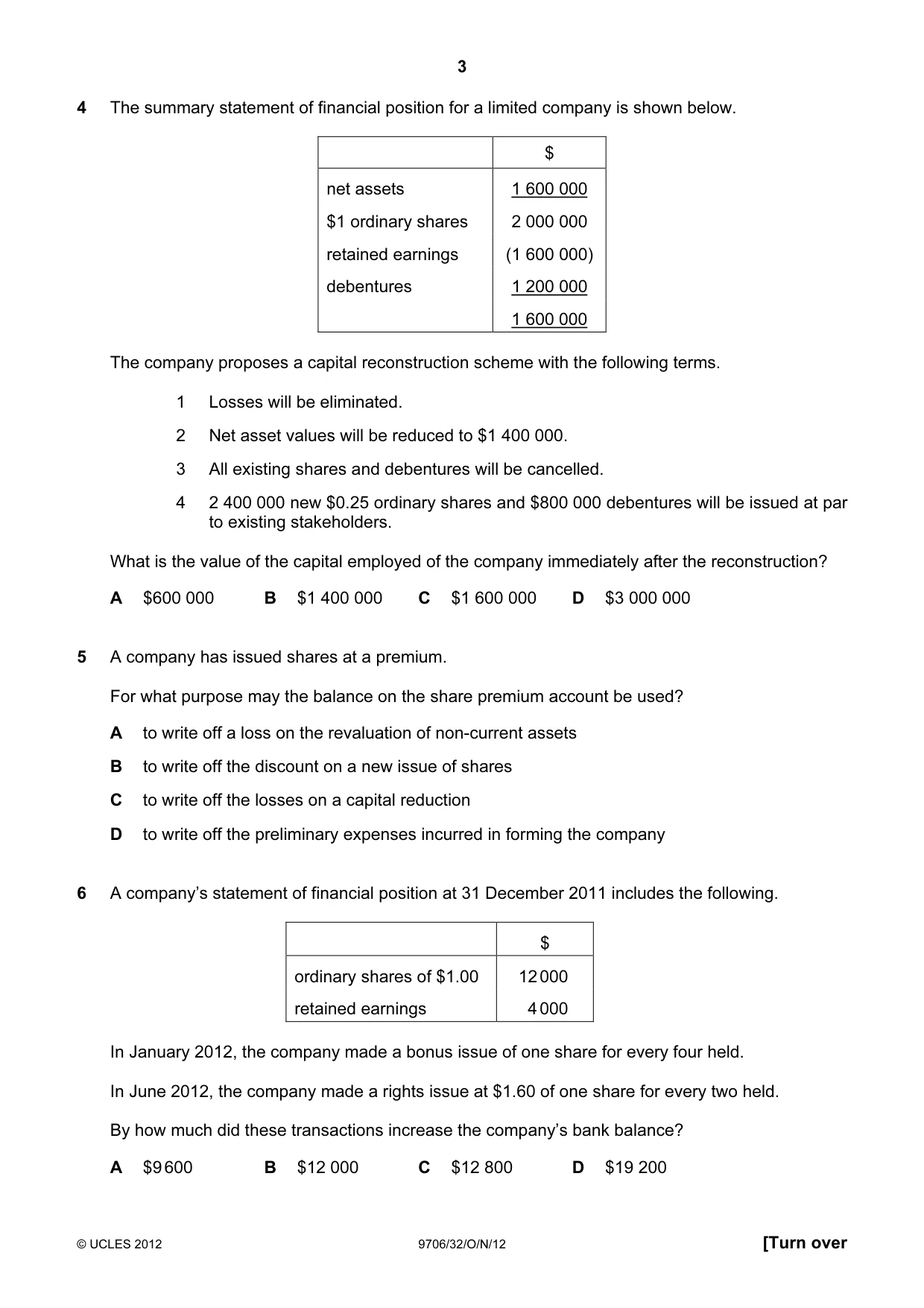
4 The summary statement of financial position for a limited company is shown below. $ net assets 1 600 000 $1 ordinary shares 2 000 000 retained earnings (1 600 000) debentures 1 200 000 1 600 000 The company proposes a capital reconstruction scheme with the following terms. 1 Losses will be eliminated. 2 Net asset values will be reduced to $1 400 000. 3 All existing shares and debentures will be cancelled. 4 2 400 000 new $0.25 ordinary shares and $800 000 debentures will be issued at par to existing stakeholders. What is the value of the capital employed of the company immediately after the reconstruction? A $600 000 B $1 400 000 C $1 600 000 D $3 000 000
Mark scheme: B
Q5 · A company has issued shares at a premium
5 A company has issued shares at a premium. For what purpose may the balance on the share premium account be used? A to write off a loss on the revaluation of non-current assets B to write off the discount on a new issue of shares C to write off the losses on a capital reduction D to write off the preliminary expenses incurred in forming the company
Mark scheme: D
Q6 · A company’s statement of financial position at 31 December 2011 includes the following
6 A company’s statement of financial position at 31 December 2011 includes the following. $ ordinary shares of $1.00 12 000 retained earnings 4 000 In January 2012, the company made a bonus issue of one share for every four held. In June 2012, the company made a rights issue at $1.60 of one share for every two held. By how much did these transactions increase the company’s bank balance? A $9 600 B $12 000 C $12 800 D $19 200
Mark scheme: B
Q7 · A business has the following capital structure
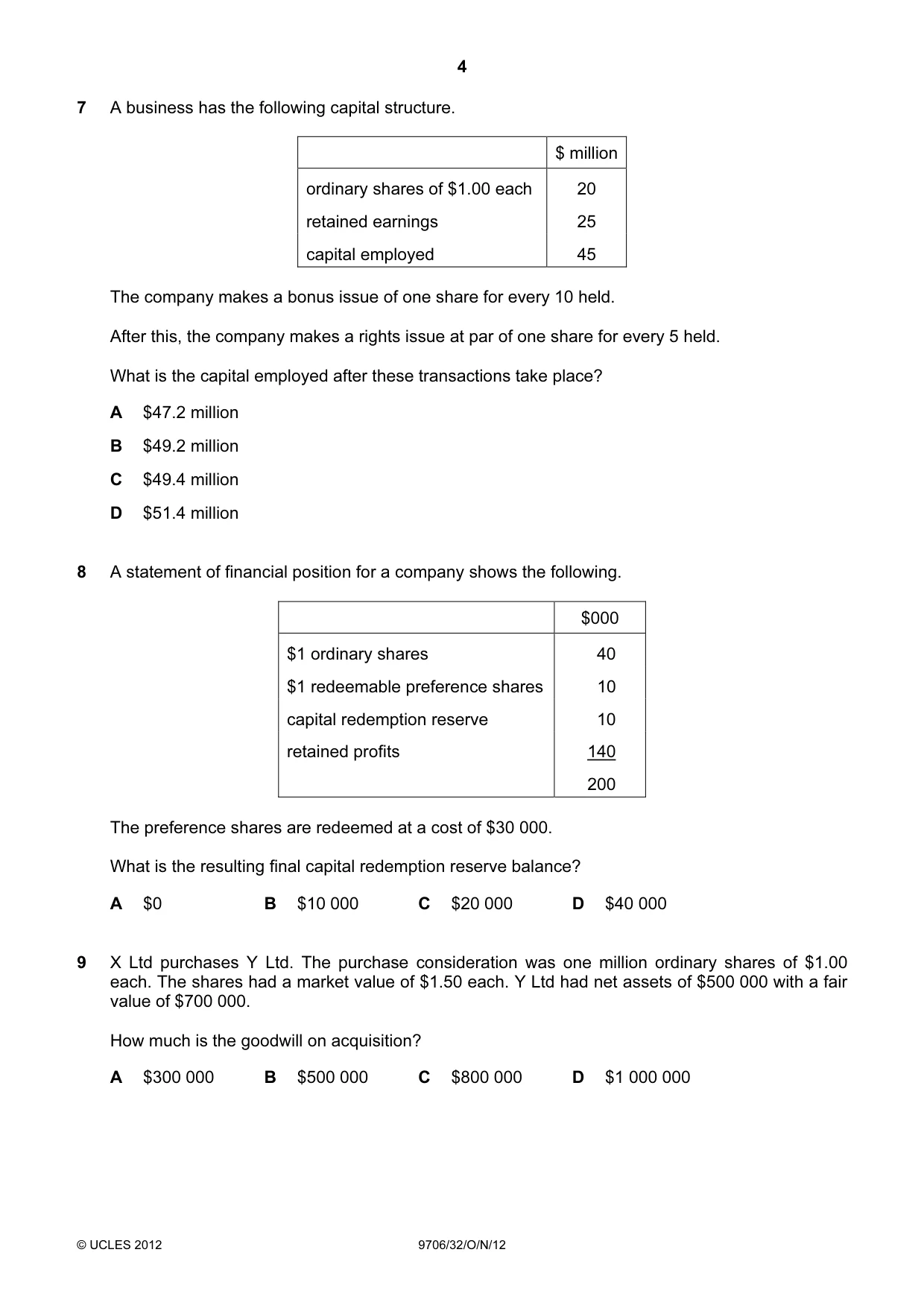
7 A business has the following capital structure. $ million ordinary shares of $1.00 each 20 retained earnings 25 capital employed 45 The company makes a bonus issue of one share for every 10 held. After this, the company makes a rights issue at par of one share for every 5 held. What is the capital employed after these transactions take place? A $47.2 million B $49.2 million C $49.4 million D $51.4 million
Mark scheme: C
Q8 · A statement of financial position for a company shows the following
8 A statement of financial position for a company shows the following. $000 $1 ordinary shares 40 $1 redeemable preference shares 10 capital redemption reserve 10 retained profits 140 200 The preference shares are redeemed at a cost of $30 000. What is the resulting final capital redemption reserve balance? A $0 B $10 000 C $20 000 D $40 000
Mark scheme: C
Q9 · X Ltd purchases Y Ltd
9 X Ltd purchases Y Ltd. The purchase consideration was one million ordinary shares of $1.00 each. The shares had a market value of $1.50 each. Y Ltd had net assets of $500 000 with a fair value of $700 000. How much is the goodwill on acquisition? A $300 000 B $500 000 C $800 000 D $1 000 000
Mark scheme: C
Q10 · A company’s statement of financial position is as follows
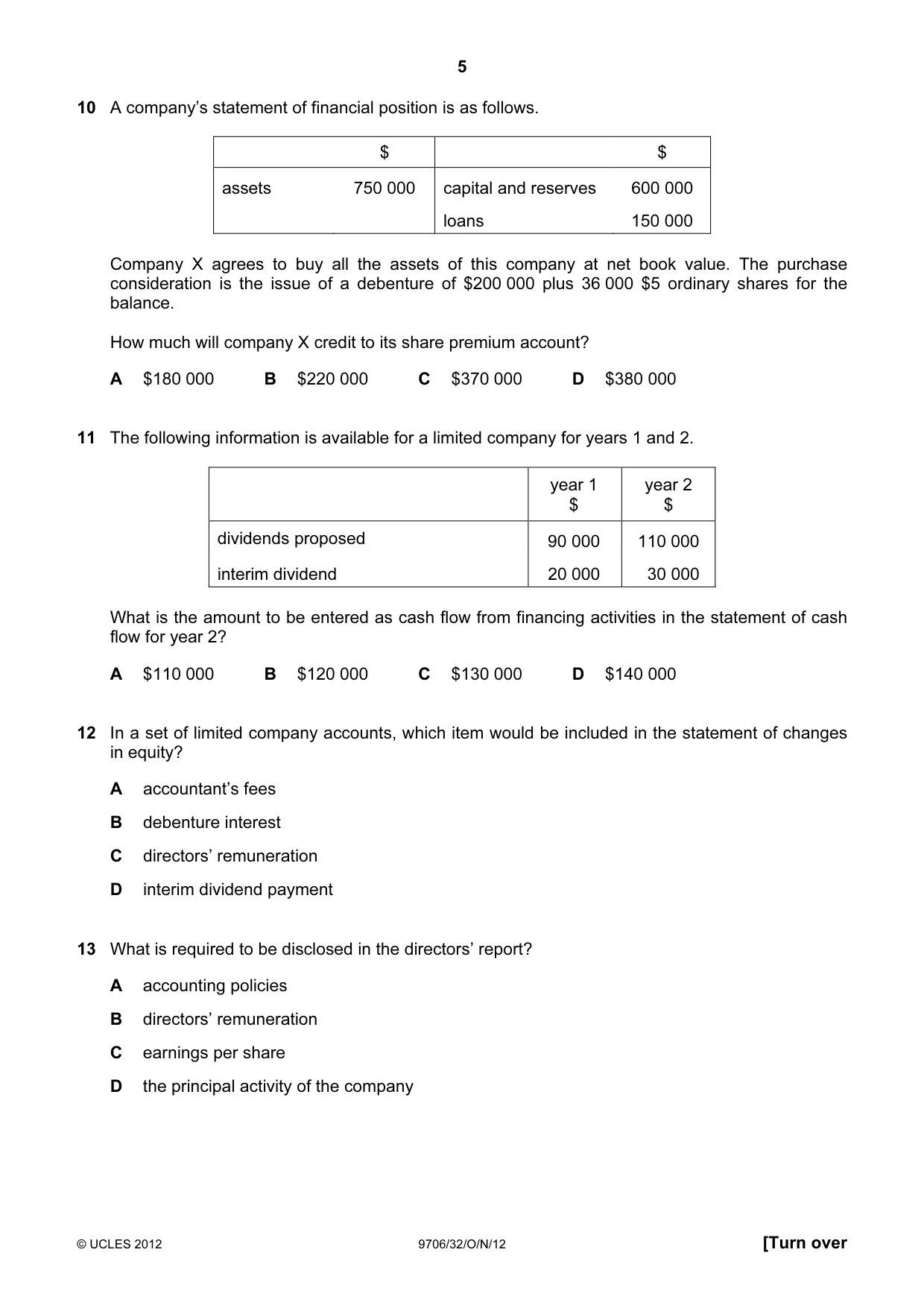
10 A company’s statement of financial position is as follows. $ $ assets 750 000 capital and reserves 600 000 loans 150 000 Company X agrees to buy all the assets of this company at net book value. The purchase consideration is the issue of a debenture of $200 000 plus 36 000 $5 ordinary shares for the balance. How much will company X credit to its share premium account? A $180 000 B $220 000 C $370 000 D $380 000
Mark scheme: C
Q11 · The following information is available for a limited company for years 1 and 2
11 The following information is available for a limited company for years 1 and 2. year 1 year 2 $ $ dividends proposed 90 000 110 000 interim dividend 20 000 30 000 What is the amount to be entered as cash flow from financing activities in the statement of cash flow for year 2? A $110 000 B $120 000 C $130 000 D $140 000
Mark scheme: B
Q12 · In a set of limited company accounts, which item would be included in the statement of…
12 In a set of limited company accounts, which item would be included in the statement of changes in equity? A accountant’s fees B debenture interest C directors’ remuneration D interim dividend payment
Mark scheme: D
Q13 · What is required to be disclosed in the directors’ report?
13 What is required to be disclosed in the directors’ report? A accounting policies B directors’ remuneration C earnings per share D the principal activity of the company
Mark scheme: D
Q14 · The following is an extract from the statement of financial position of a limited company…
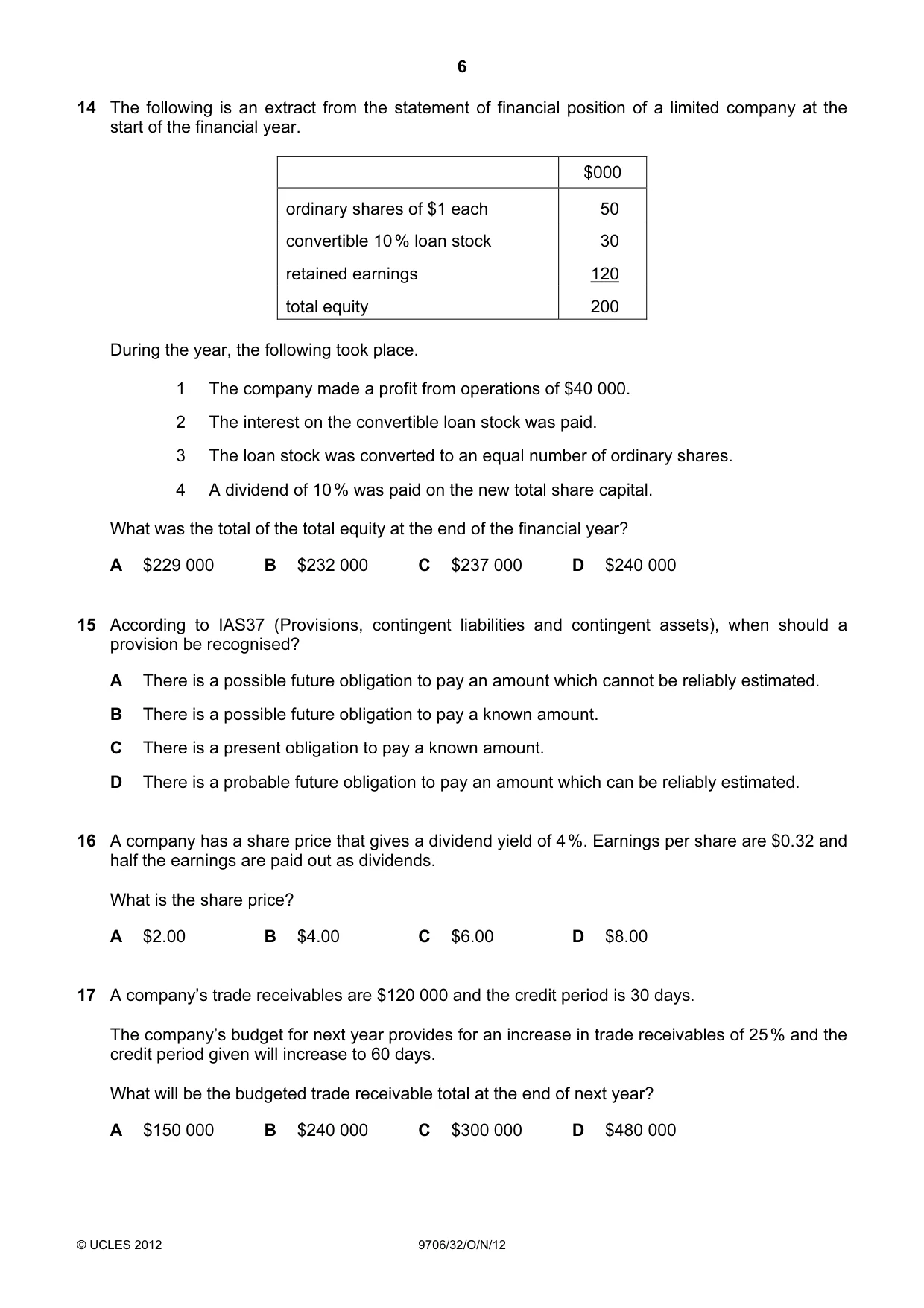
14 The following is an extract from the statement of financial position of a limited company at the start of the financial year. $000 ordinary shares of $1 each 50 convertible 10 % loan stock 30 retained earnings 120 total equity 200 During the year, the following took place. 1 The company made a profit from operations of $40 000. 2 The interest on the convertible loan stock was paid. 3 The loan stock was converted to an equal number of ordinary shares. 4 A dividend of 10 % was paid on the new total share capital. What was the total of the total equity at the end of the financial year? A $229 000 B $232 000 C $237 000 D $240 000
Mark scheme: A
Q15 · According to IAS37 (Provisions, contingent liabilities and contingent assets), when…
15 According to IAS37 (Provisions, contingent liabilities and contingent assets), when should a provision be recognised? A There is a possible future obligation to pay an amount which cannot be reliably estimated. B There is a possible future obligation to pay a known amount. C There is a present obligation to pay a known amount. D There is a probable future obligation to pay an amount which can be reliably estimated.
Mark scheme: D
Q16 · A company has a share price that gives a dividend yield of 4 %
16 A company has a share price that gives a dividend yield of 4 %. Earnings per share are $0.32 and half the earnings are paid out as dividends. What is the share price? A $2.00 B $4.00 C $6.00 D $8.00
Mark scheme: B
More questions on Analysis and communication of accounting information
Q17 · A company’s trade receivables are $120 000 and the credit period is 30 days
17 A company’s trade receivables are $120 000 and the credit period is 30 days. The company’s budget for next year provides for an increase in trade receivables of 25 % and the credit period given will increase to 60 days. What will be the budgeted trade receivable total at the end of next year? A $150 000 B $240 000 C $300 000 D $480 000
Mark scheme: C
More questions on Analysis and communication of accounting information
Q18 · A company has an issued share capital of 8 million shares at $0.50 par value
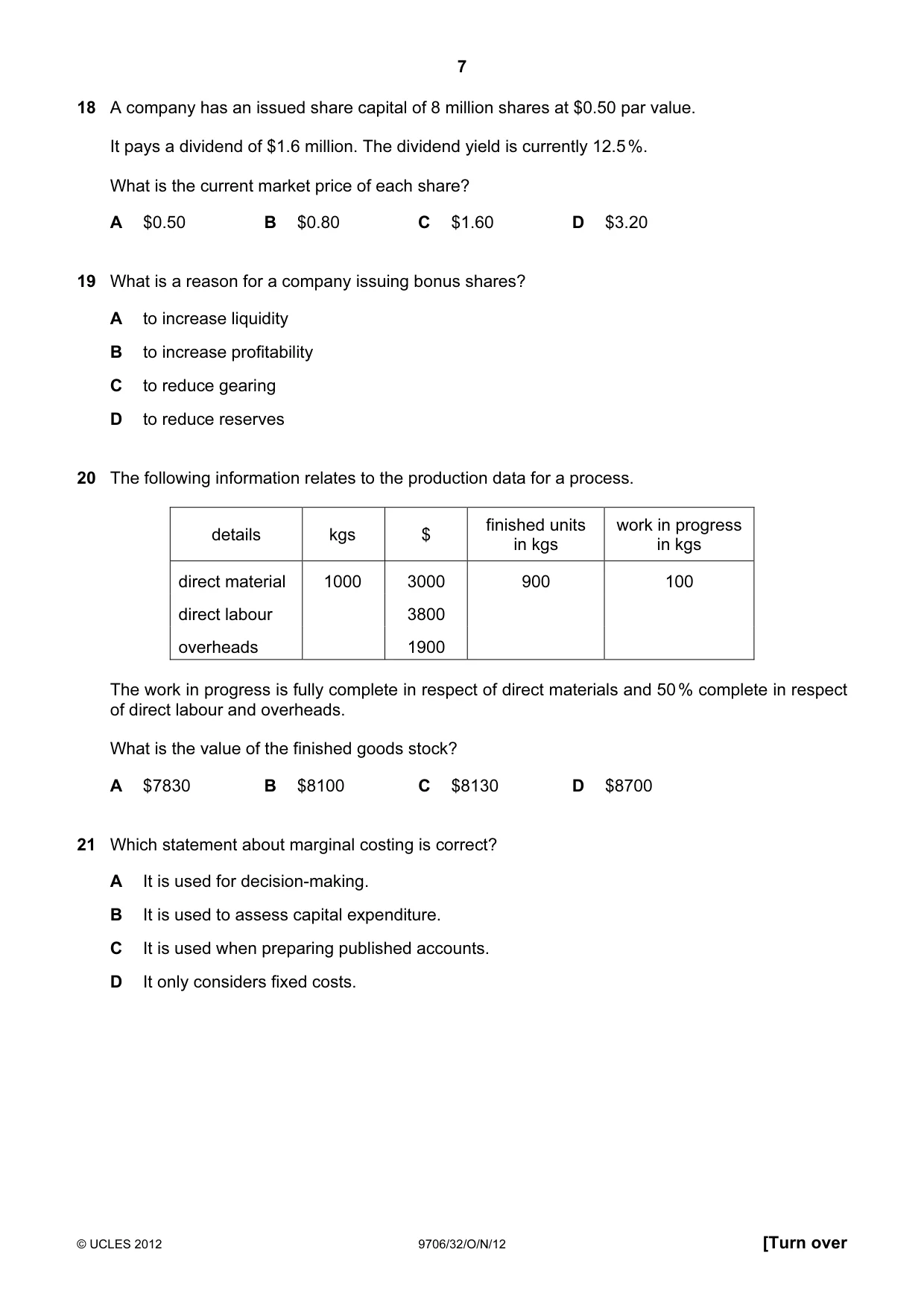
18 A company has an issued share capital of 8 million shares at $0.50 par value. It pays a dividend of $1.6 million. The dividend yield is currently 12.5 %. What is the current market price of each share? A $0.50 B $0.80 C $1.60 D $3.20
Mark scheme: C
More questions on Analysis and communication of accounting information
Q19 · What is a reason for a company issuing bonus shares?
19 What is a reason for a company issuing bonus shares? A to increase liquidity B to increase profitability C to reduce gearing D to reduce reserves
Mark scheme: D
Q20 · The following information relates to the production data for a process
20 The following information relates to the production data for a process. finished units work in progress details kgs $ in kgs in kgs direct material 1000 3000 900 100 direct labour 3800 overheads 1900 The work in progress is fully complete in respect of direct materials and 50 % complete in respect of direct labour and overheads. What is the value of the finished goods stock? A $7830 B $8100 C $8130 D $8700
Mark scheme: B
Q21 · Which statement about marginal costing is correct?
21 Which statement about marginal costing is correct? A It is used for decision-making. B It is used to assess capital expenditure. C It is used when preparing published accounts. D It only considers fixed costs.
Mark scheme: A
Q22 · Using marginal costing to value its inventory, a company made a loss of $31 000
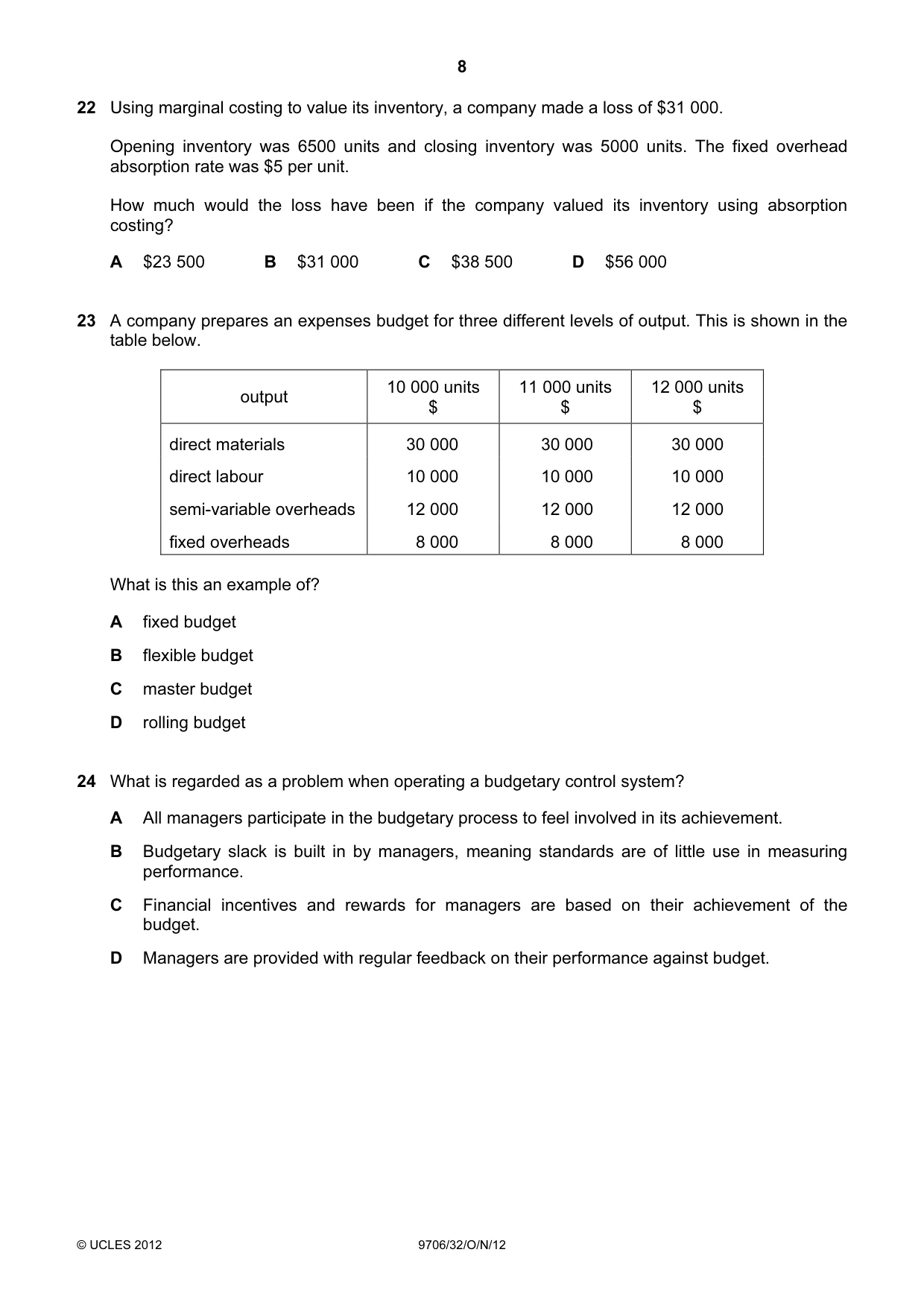
22 Using marginal costing to value its inventory, a company made a loss of $31 000. Opening inventory was 6500 units and closing inventory was 5000 units. The fixed overhead absorption rate was $5 per unit. How much would the loss have been if the company valued its inventory using absorption costing? A $23 500 B $31 000 C $38 500 D $56 000
Mark scheme: C
Q23 · A company prepares an expenses budget for three different levels of output
23 A company prepares an expenses budget for three different levels of output. This is shown in the table below. 10 000 units 11 000 units 12 000 units output $ $ $ direct materials 30 000 30 000 30 000 direct labour 10 000 10 000 10 000 semi-variable overheads 12 000 12 000 12 000 fixed overheads 8 000 8 000 8 000 What is this an example of? A fixed budget B flexible budget C master budget D rolling budget
Mark scheme: A
Q24 · What is regarded as a problem when operating a budgetary control system?
24 What is regarded as a problem when operating a budgetary control system? A All managers participate in the budgetary process to feel involved in its achievement. B Budgetary slack is built in by managers, meaning standards are of little use in measuring performance. C Financial incentives and rewards for managers are based on their achievement of the budget. D Managers are provided with regular feedback on their performance against budget.
Mark scheme: B
Q25 · The following budgeted information is supplied
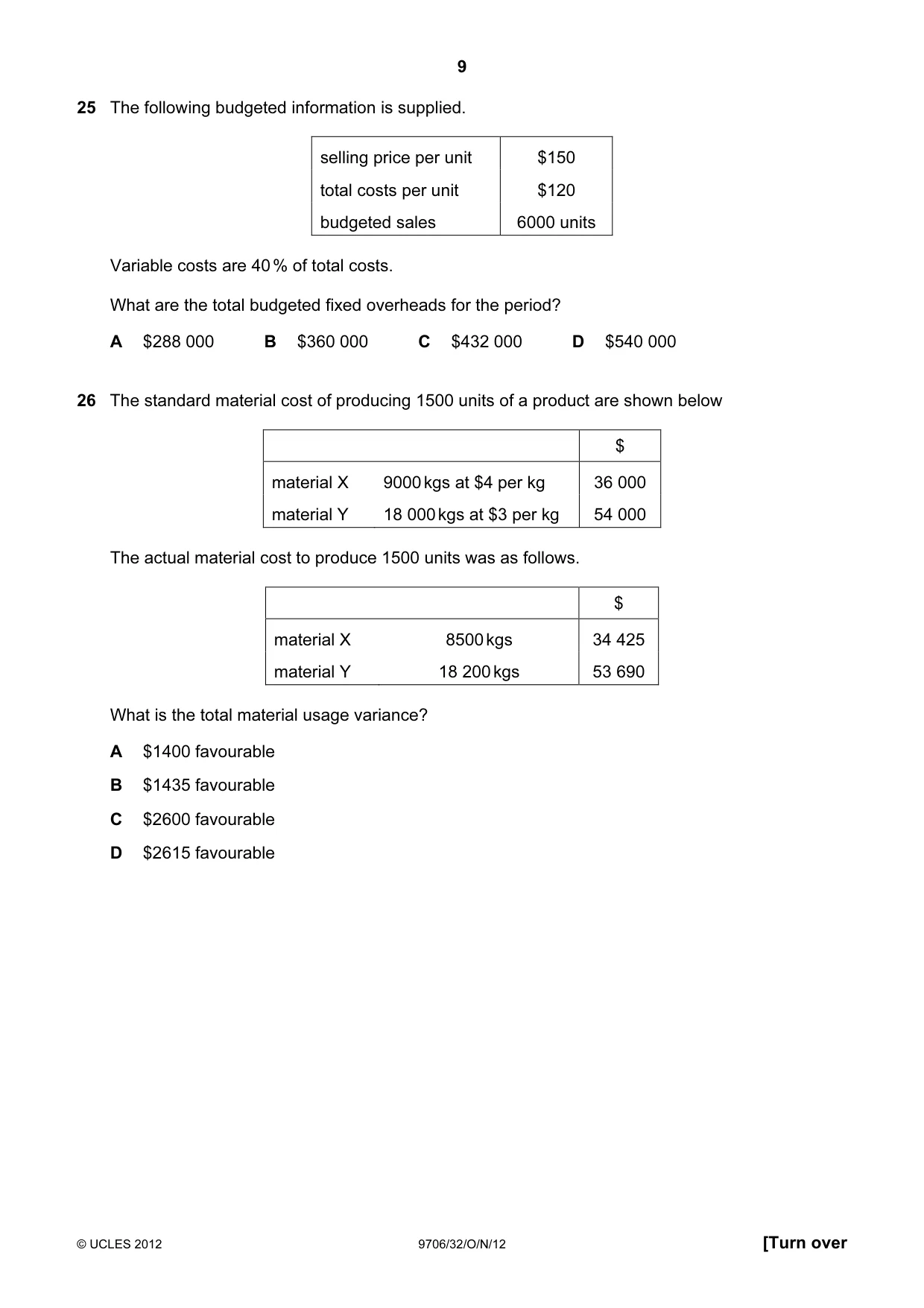
25 The following budgeted information is supplied. selling price per unit $150 total costs per unit $120 budgeted sales 6000 units Variable costs are 40 % of total costs. What are the total budgeted fixed overheads for the period? A $288 000 B $360 000 C $432 000 D $540 000
Mark scheme: C
Q26 · The standard material cost of producing 1500 units of a product are shown below $…
26 The standard material cost of producing 1500 units of a product are shown below $ material X 9000 kgs at $4 per kg 36 000 material Y 18 000 kgs at $3 per kg 54 000 The actual material cost to produce 1500 units was as follows. $ material X 8500 kgs 34 425 material Y 18 200 kgs 53 690 What is the total material usage variance? A $1400 favourable B $1435 favourable C $2600 favourable D $2615 favourable
Mark scheme: A
Q27 · A company sells its products at $2.10 per unit
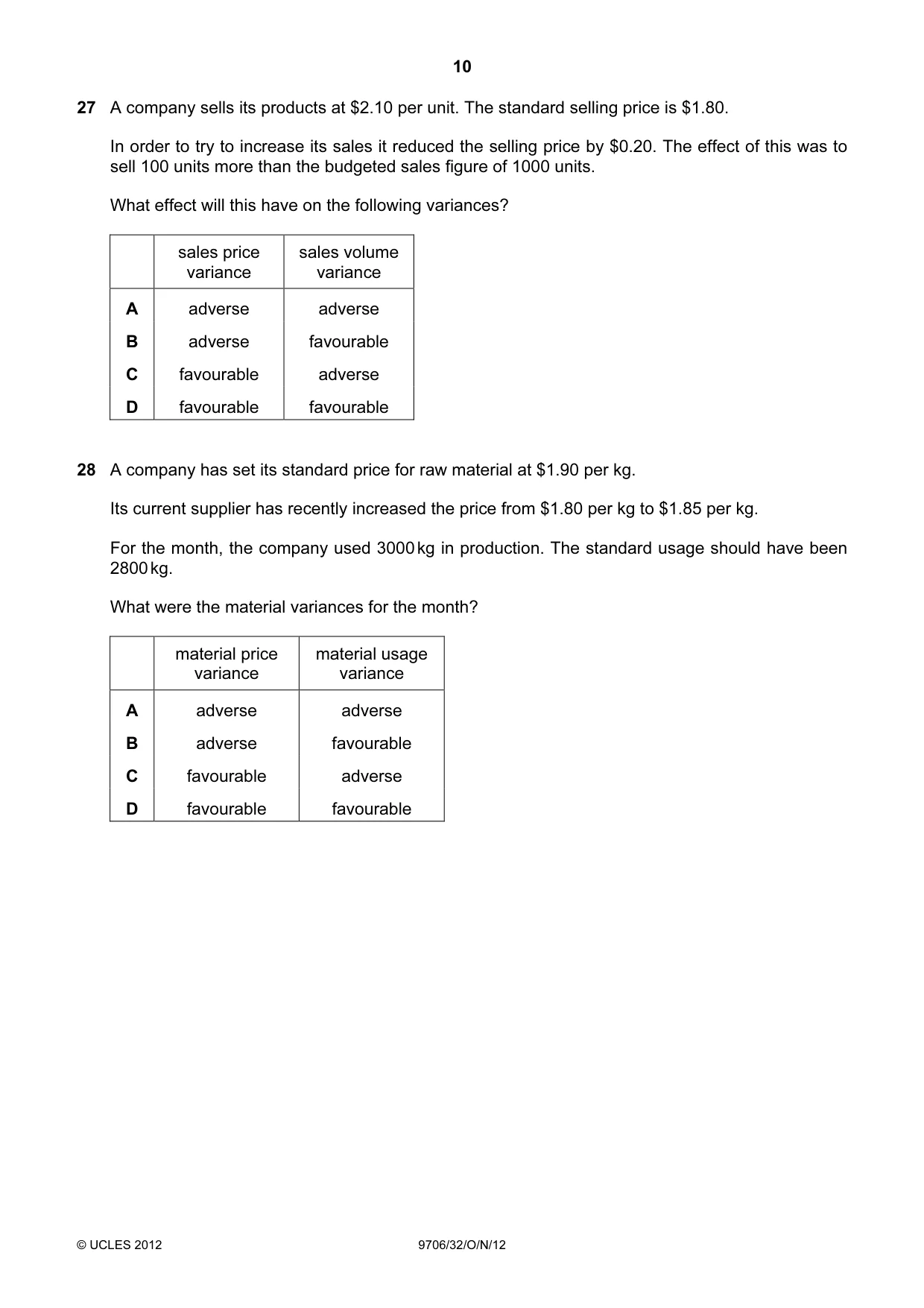
27 A company sells its products at $2.10 per unit. The standard selling price is $1.80. In order to try to increase its sales it reduced the selling price by $0.20. The effect of this was to sell 100 units more than the budgeted sales figure of 1000 units. What effect will this have on the following variances? sales price sales volume variance variance A adverse adverse B adverse favourable C favourable adverse D favourable favourable
Mark scheme: D
Q28 · A company has set its standard price for raw material at $1.90 per kg
28 A company has set its standard price for raw material at $1.90 per kg. Its current supplier has recently increased the price from $1.80 per kg to $1.85 per kg. For the month, the company used 3000 kg in production. The standard usage should have been 2800 kg. What were the material variances for the month? material price material usage variance variance A adverse adverse B adverse favourable C favourable adverse D favourable favourable
Mark scheme: C
Q29 · A company is negotiating a price for some capital equipment to modernise its production…
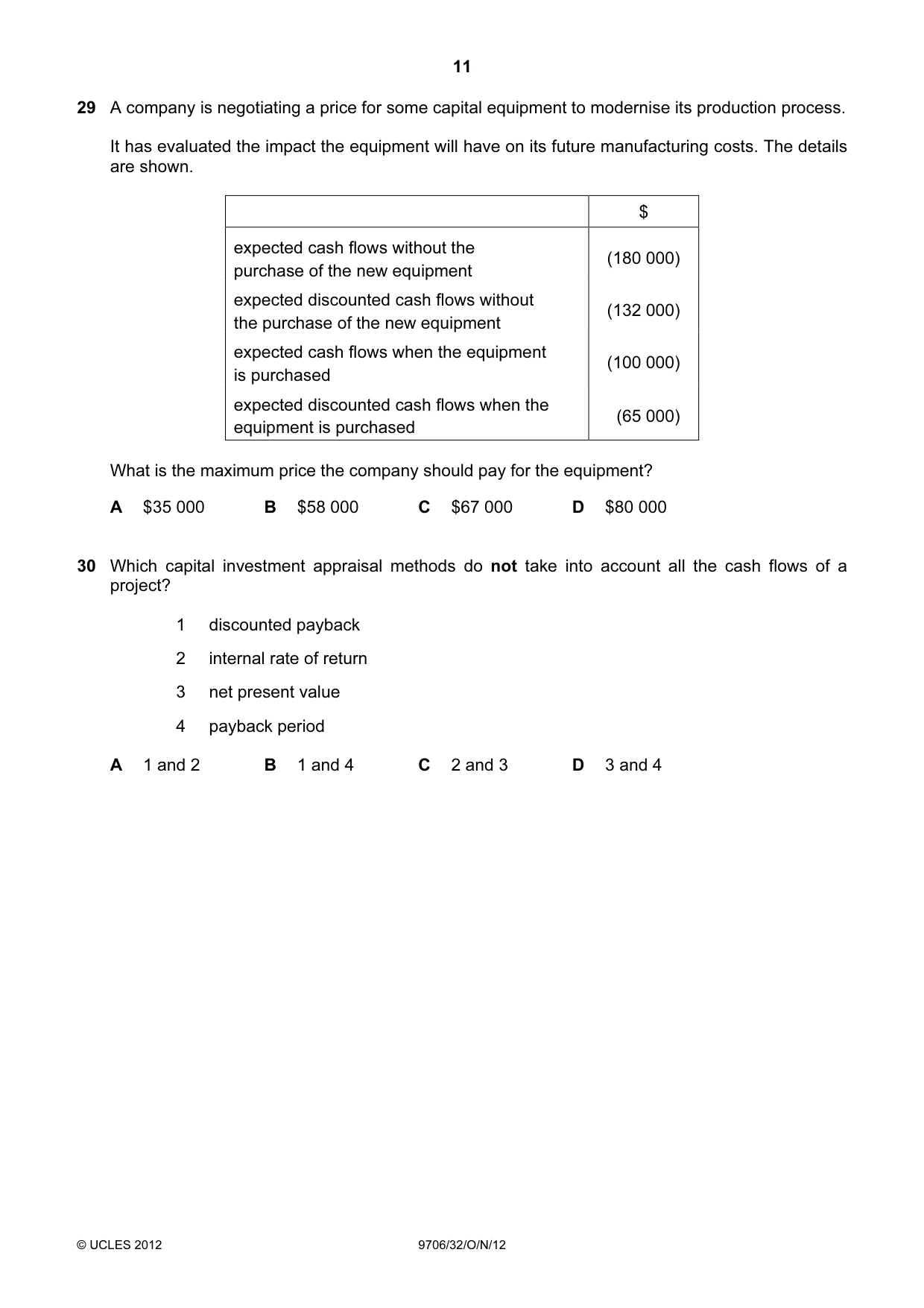
29 A company is negotiating a price for some capital equipment to modernise its production process. It has evaluated the impact the equipment will have on its future manufacturing costs. The details are shown. $ expected cash flows without the (180 000) purchase of the new equipment expected discounted cash flows without (132 000) the purchase of the new equipment expected cash flows when the equipment (100 000) is purchased expected discounted cash flows when the (65 000) equipment is purchased What is the maximum price the company should pay for the equipment? A $35 000 B $58 000 C $67 000 D $80 000
Mark scheme: C
Q30 · Which capital investment appraisal methods do not take into account all the cash flows of…
30 Which capital investment appraisal methods do not take into account all the cash flows of a project? 1 discounted payback 2 internal rate of return 3 net present value 4 payback period A 1 and 2 B 1 and 4 C 2 and 3 D 3 and 4
Mark scheme: B
What was in this paper
The subtopics covered by these 30 questions, and how many questions each got. Open one in a new tab to see every Cambridge question on it.
9Analysis and communication of accounting information3Standard costing3Budgeting and budgetary control2Business acquisition and merger2Costs and cost behaviour2Investment appraisal2Regulatory and ethical considerations2Traditional costing methods2Types of business entity2Preparation of financial statements1What you needed in this session
Cambridge’s own grade thresholds for 2012 Oct/Nov, Paper 3 · Variant 2. A higher threshold means an easier paper — the bar moves with how the cohort did.