Cambridge A Level Accounting 9706 — 2012 May/June Paper 3 · Variant 3
9706/33/M/J/12 · 30 questions · 30 marks · ≈34 min
The question paper and its mark scheme, free to read here and free to download. This is Cambridge’s own paper, exactly as it was sat.
Question paper12 pages
Mark scheme2 pages
Answers below. Sit the paper first if you are practising.
Questions as text
Q1 · X and Y are in partnership sharing profits in the ratio of 2:1
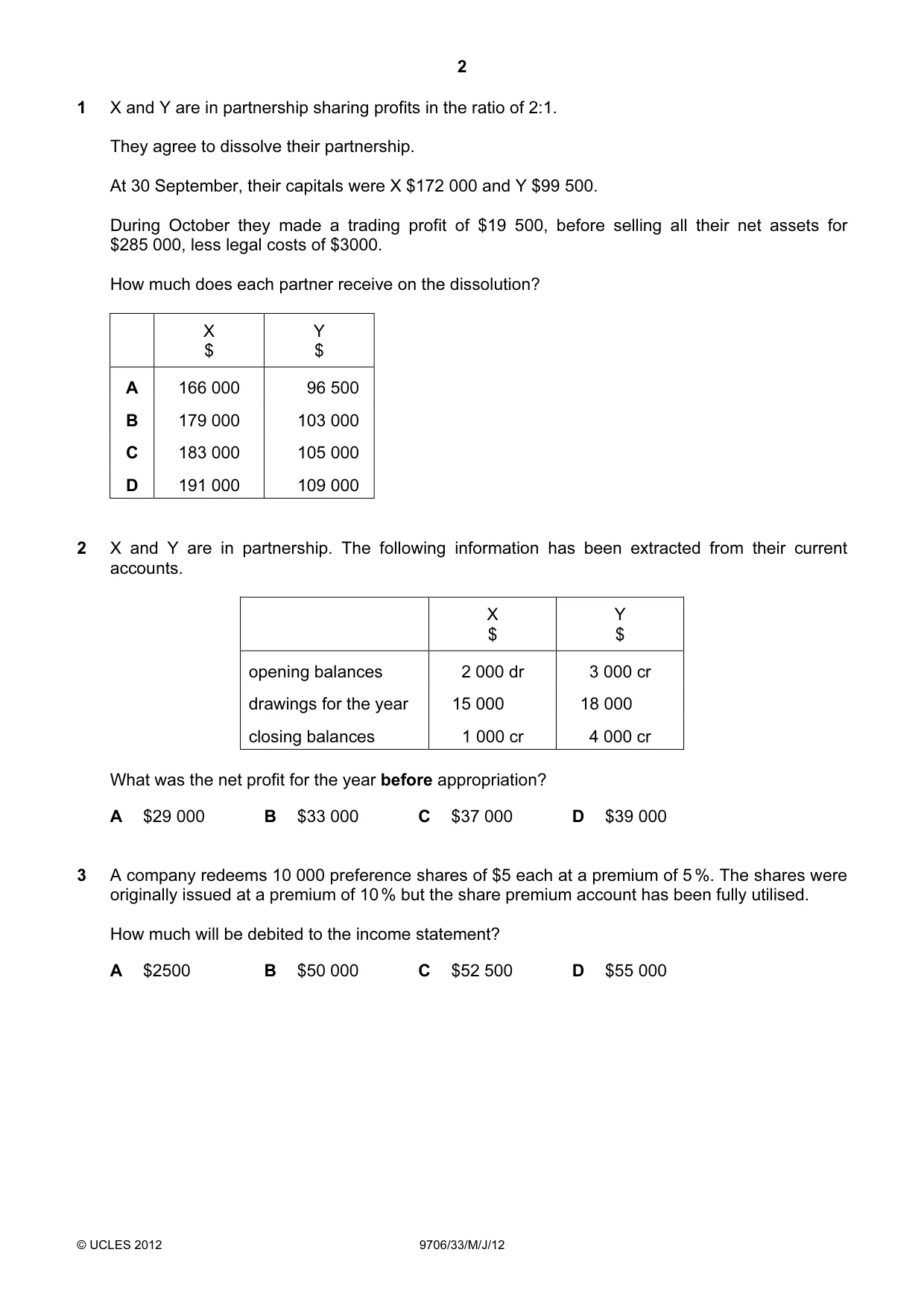
1 X and Y are in partnership sharing profits in the ratio of 2:1. They agree to dissolve their partnership. At 30 September, their capitals were X $172 000 and Y $99 500. During October they made a trading profit of $19 500, before selling all their net assets for $285 000, less legal costs of $3000. How much does each partner receive on the dissolution? X Y $ $ A 166 000 96 500 B 179 000 103 000 C 183 000 105 000 D 191 000 109 000
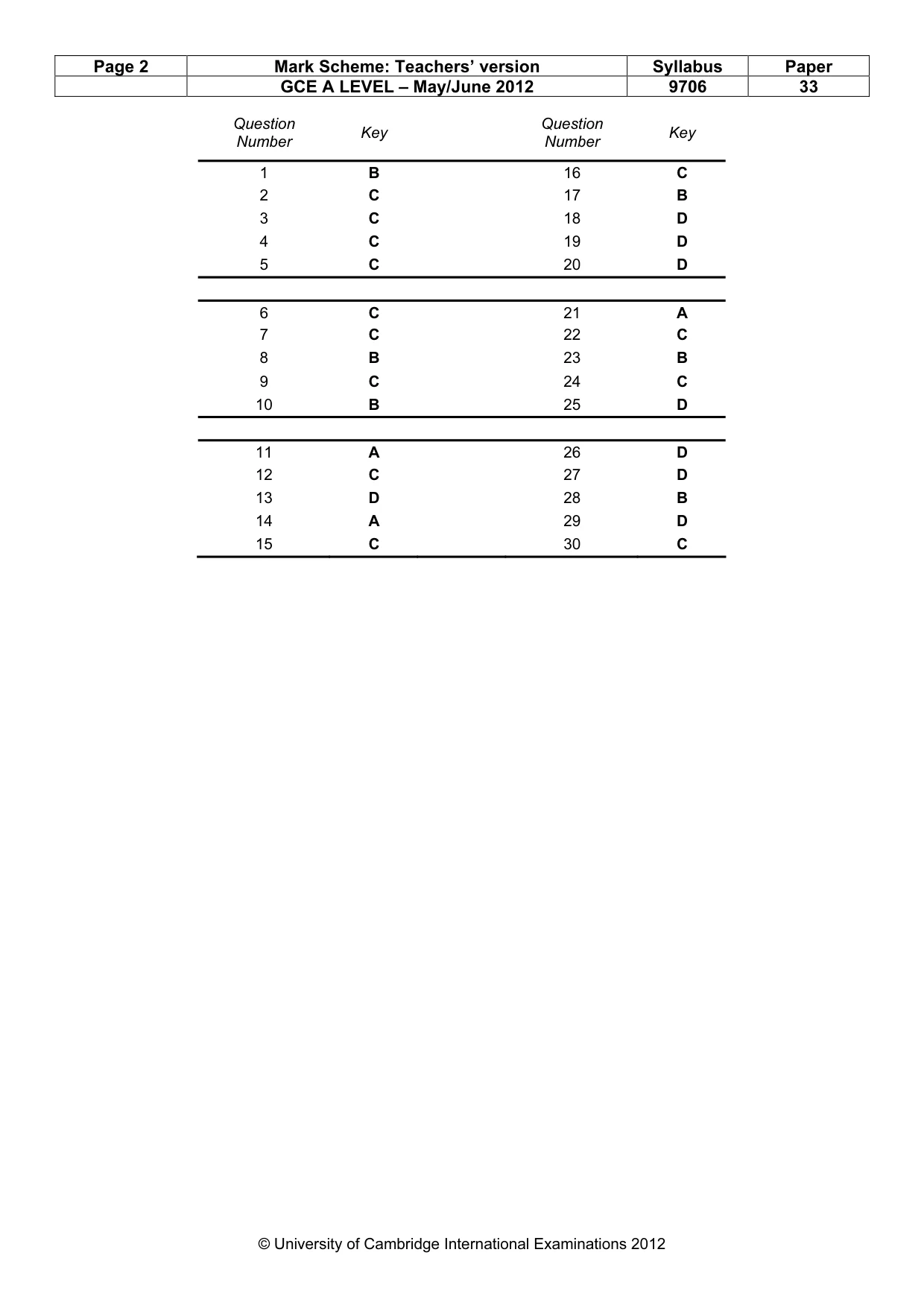
Mark scheme: B
Q2 · X and Y are in partnership
2 X and Y are in partnership. The following information has been extracted from their current accounts. X Y $ $ opening balances 2 000 dr 3 000 cr drawings for the year 15 000 18 000 closing balances 1 000 cr 4 000 cr What was the net profit for the year before appropriation? A $29 000 B $33 000 C $37 000 D $39 000
Mark scheme: C
Q3 · A company redeems 10 000 preference shares of $5 each at a premium of 5 %
3 A company redeems 10 000 preference shares of $5 each at a premium of 5 %. The shares were originally issued at a premium of 10 % but the share premium account has been fully utilised. How much will be debited to the income statement? A $2500 B $50 000 C $52 500 D $55 000
Mark scheme: C
Q4 · A company provides the following financial information at the end of the financial year
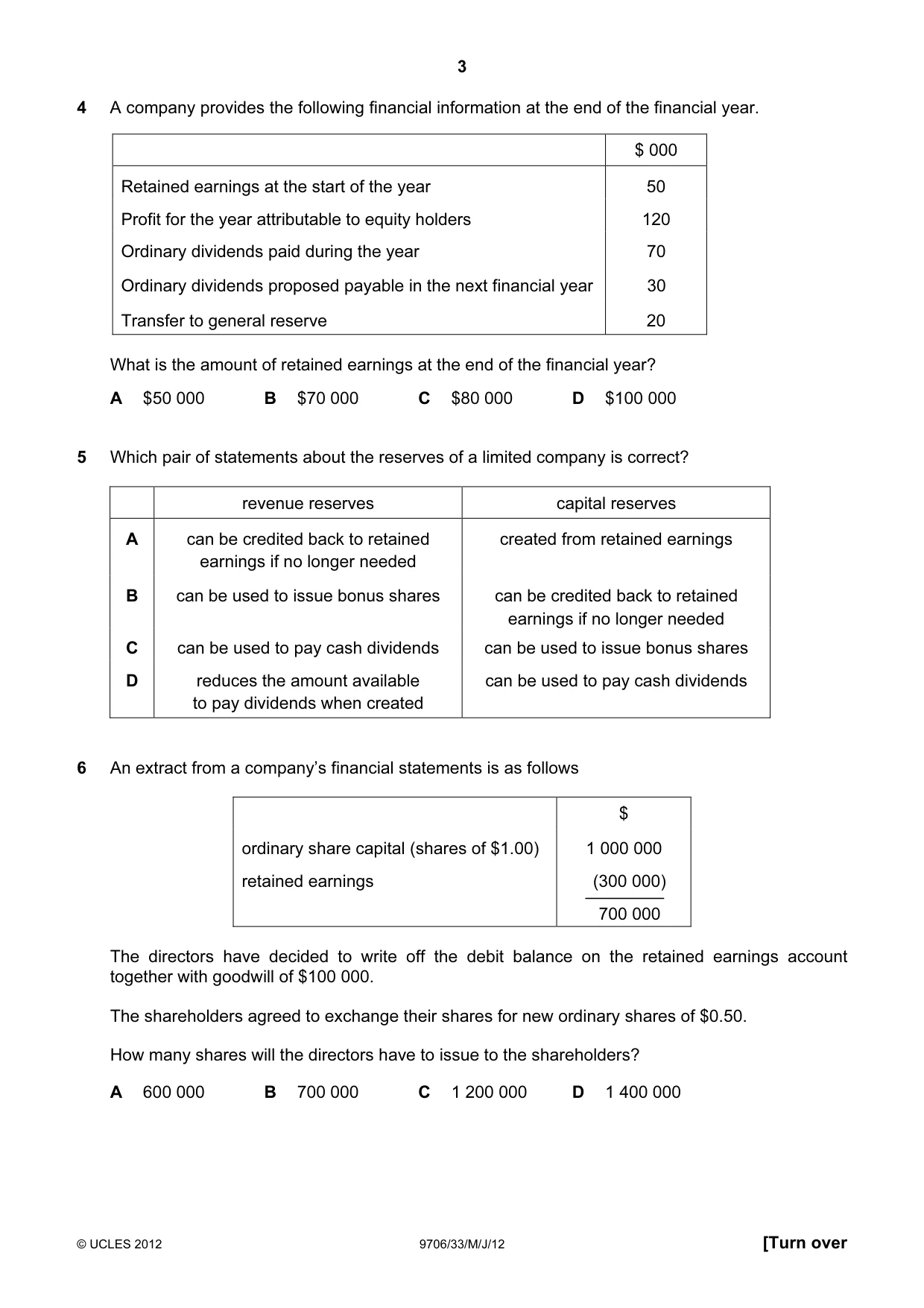
4 A company provides the following financial information at the end of the financial year. $ 000 Retained earnings at the start of the year 50 Profit for the year attributable to equity holders 120 Ordinary dividends paid during the year 70 Ordinary dividends proposed payable in the next financial year 30 Transfer to general reserve 20 What is the amount of retained earnings at the end of the financial year? A $50 000 B $70 000 C $80 000 D $100 000
Mark scheme: C
Q5 · Which pair of statements about the reserves of a limited company is correct?
5 Which pair of statements about the reserves of a limited company is correct? revenue reserves capital reserves A can be credited back to retained created from retained earnings earnings if no longer needed B can be used to issue bonus shares can be credited back to retained earnings if no longer needed C can be used to pay cash dividends can be used to issue bonus shares D reduces the amount available can be used to pay cash dividends to pay dividends when created
Mark scheme: C
Q6 · An extract from a company’s financial statements is as follows $ ordinary share capital…
6 An extract from a company’s financial statements is as follows $ ordinary share capital (shares of $1.00) 1 000 000 retained earnings (300 000) 700 000 The directors have decided to write off the debit balance on the retained earnings account together with goodwill of $100 000. The shareholders agreed to exchange their shares for new ordinary shares of $0.50. How many shares will the directors have to issue to the shareholders? A 600 000 B 700 000 C 1 200 000 D 1 400 000
Mark scheme: C
Q7 · A company has the following capital and reserves: $000 ordinary shares of $1 each, fully…
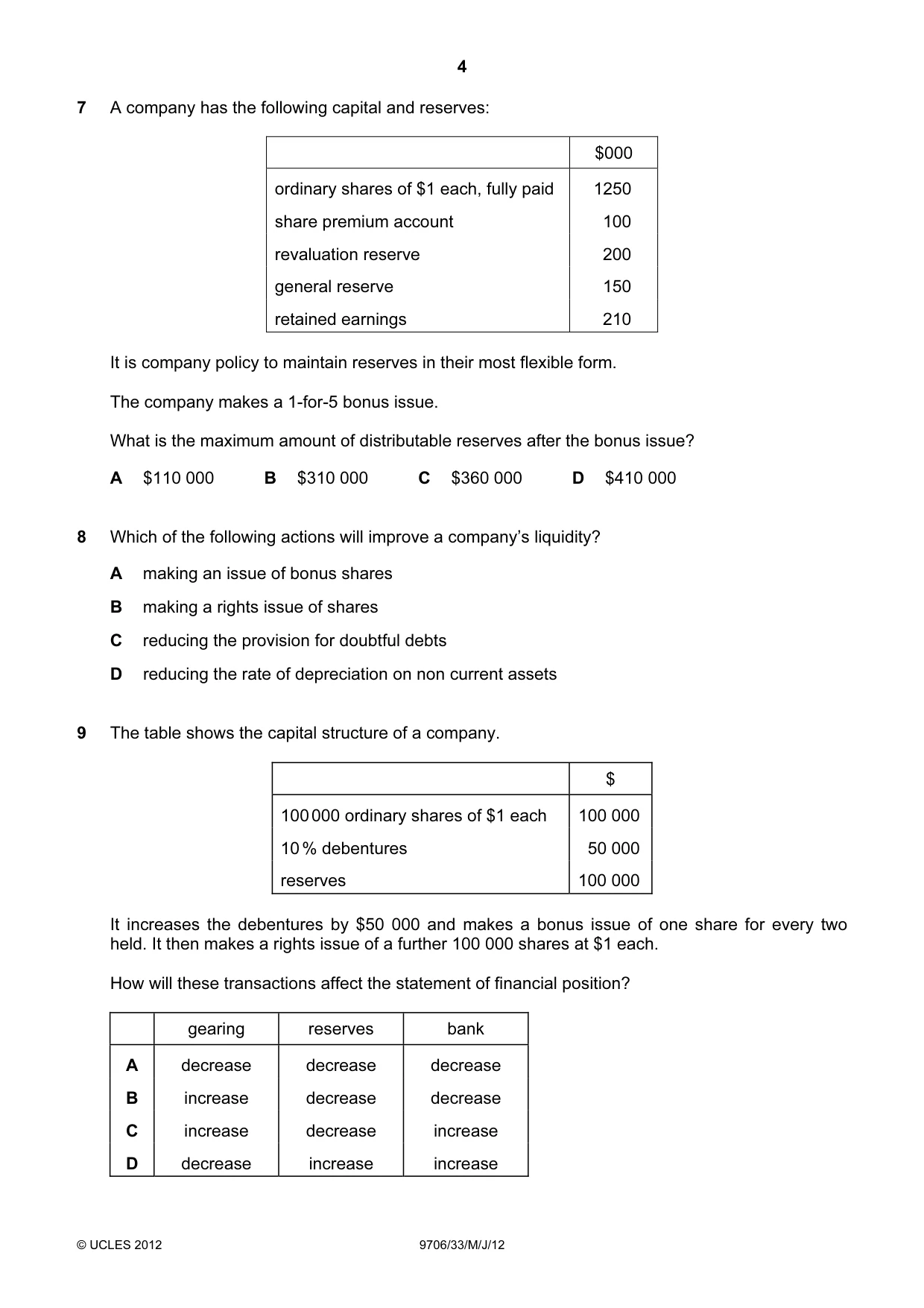
7 A company has the following capital and reserves: $000 ordinary shares of $1 each, fully paid 1250 share premium account 100 revaluation reserve 200 general reserve 150 retained earnings 210 It is company policy to maintain reserves in their most flexible form. The company makes a 1-for-5 bonus issue. What is the maximum amount of distributable reserves after the bonus issue? A $110 000 B $310 000 C $360 000 D $410 000
Mark scheme: C
Q8 · Which of the following actions will improve a company’s liquidity?
8 Which of the following actions will improve a company’s liquidity? A making an issue of bonus shares B making a rights issue of shares C reducing the provision for doubtful debts D reducing the rate of depreciation on non current assets
Mark scheme: B
More questions on Analysis and communication of accounting information
Q9 · The table shows the capital structure of a company
9 The table shows the capital structure of a company. $ 100 000 ordinary shares of $1 each 100 000 10 % debentures 50 000 reserves 100 000 It increases the debentures by $50 000 and makes a bonus issue of one share for every two held. It then makes a rights issue of a further 100 000 shares at $1 each. How will these transactions affect the statement of financial position? gearing reserves bank A decrease decrease decrease B increase decrease decrease C increase decrease increase D decrease increase increase
Mark scheme: C
Q10 · The business of a sole trader is bought by a limited company
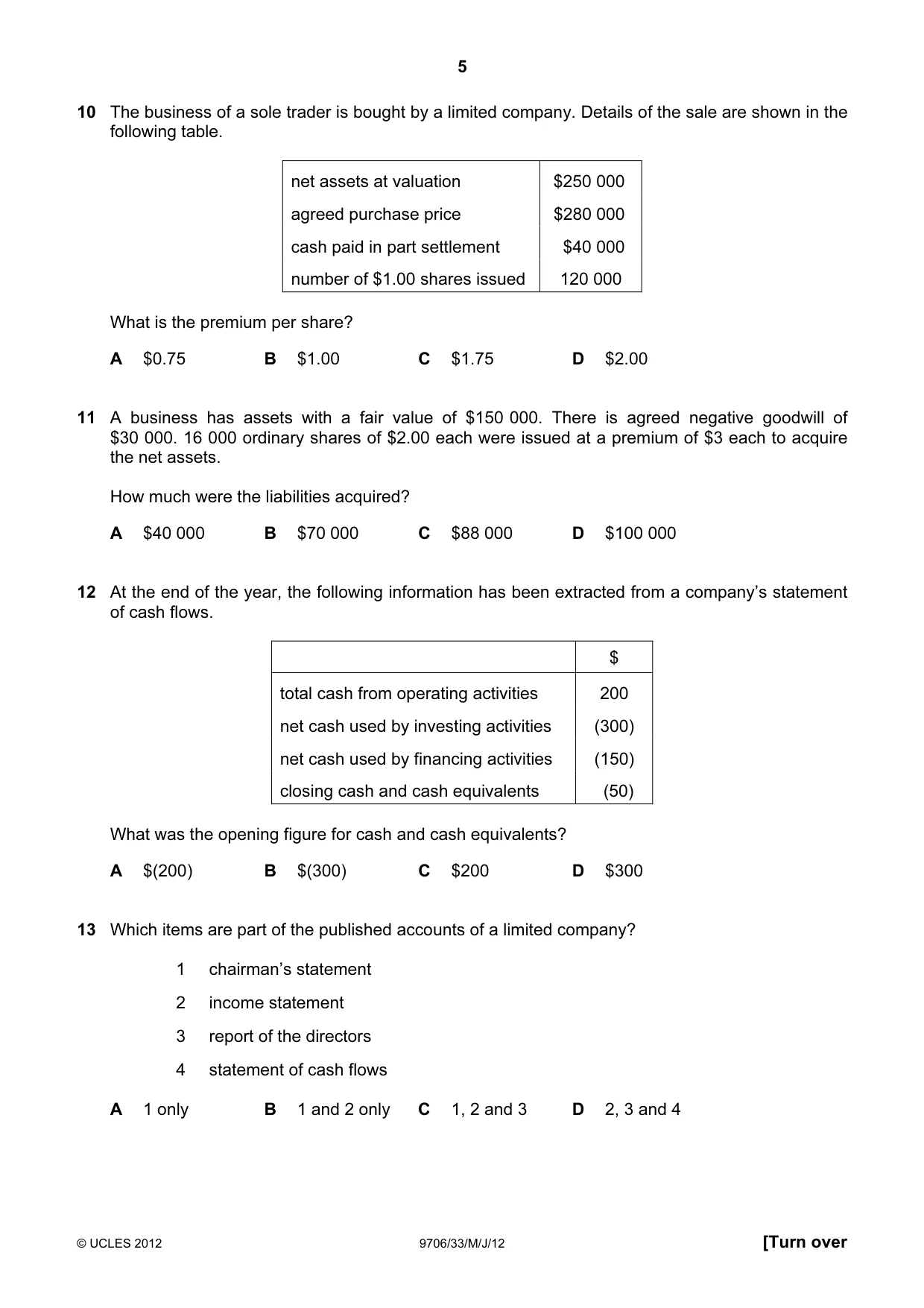
10 The business of a sole trader is bought by a limited company. Details of the sale are shown in the following table. net assets at valuation $250 000 agreed purchase price $280 000 cash paid in part settlement $40 000 number of $1.00 shares issued 120 000 What is the premium per share? A $0.75 B $1.00 C $1.75 D $2.00
Mark scheme: B
Q11 · A business has assets with a fair value of $150 000
11 A business has assets with a fair value of $150 000. There is agreed negative goodwill of $30 000. 16 000 ordinary shares of $2.00 each were issued at a premium of $3 each to acquire the net assets. How much were the liabilities acquired? A $40 000 B $70 000 C $88 000 D $100 000
Mark scheme: A
Q12 · At the end of the year, the following information has been extracted from a company’s…
12 At the end of the year, the following information has been extracted from a company’s statement of cash flows. $ total cash from operating activities 200 net cash used by investing activities (300) net cash used by financing activities (150) closing cash and cash equivalents (50) What was the opening figure for cash and cash equivalents? A $(200) B $(300) C $200 D $300
Mark scheme: C
Q13 · Which items are part of the published accounts of a limited company?
13 Which items are part of the published accounts of a limited company? 1 chairman’s statement 2 income statement 3 report of the directors 4 statement of cash flows A 1 only B 1 and 2 only C 1, 2 and 3 D 2, 3 and 4
Mark scheme: D
Q14 · To which asset is impairment normally applied each year?
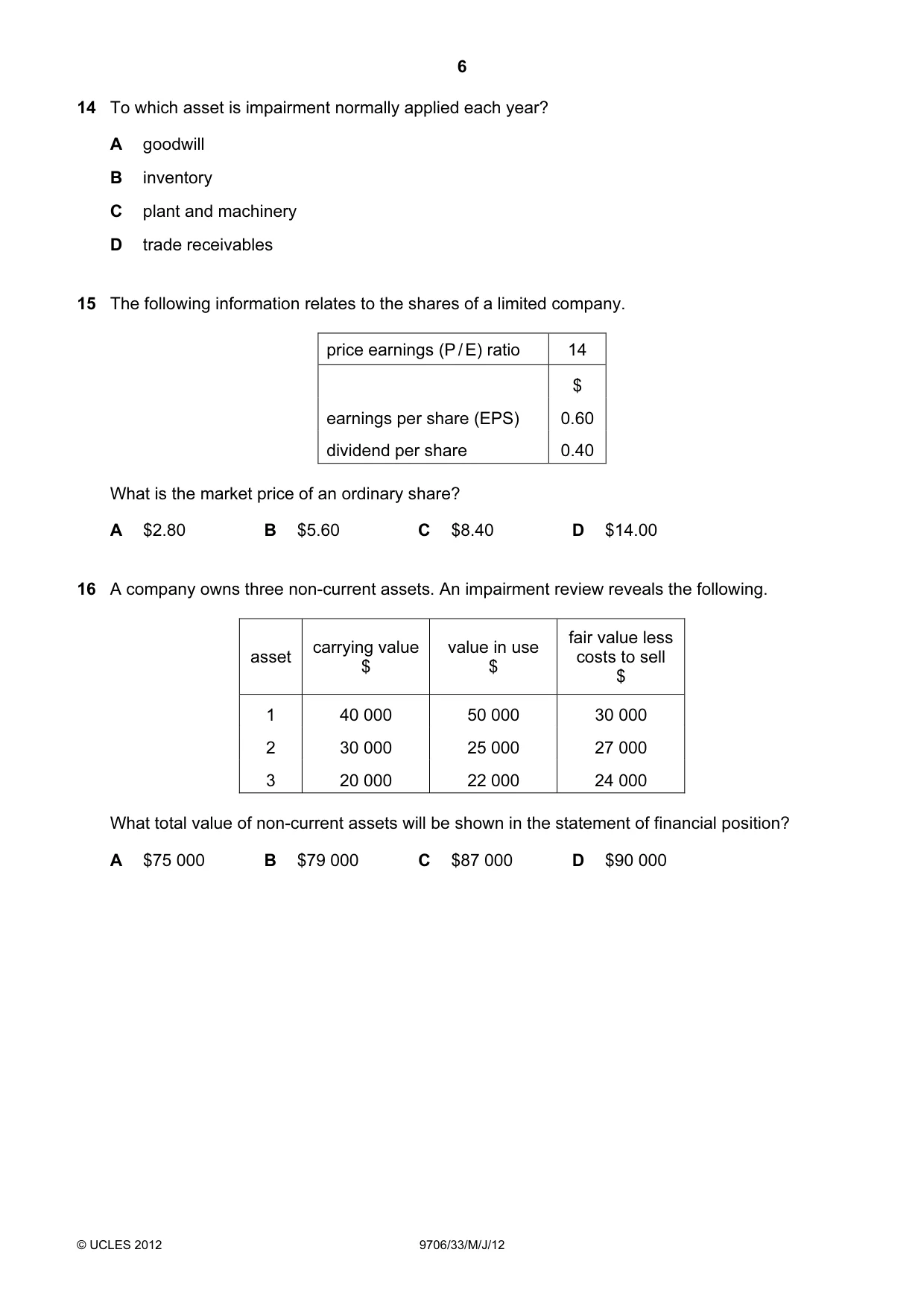
14 To which asset is impairment normally applied each year? A goodwill B inventory C plant and machinery D trade receivables
Mark scheme: A
Q15 · The following information relates to the shares of a limited company
15 The following information relates to the shares of a limited company. price earnings (P / E) ratio 14 $ earnings per share (EPS) 0.60 dividend per share 0.40 What is the market price of an ordinary share? A $2.80 B $5.60 C $8.40 D $14.00
Mark scheme: C
More questions on Analysis and communication of accounting information
Q16 · A company owns three non-current assets
16 A company owns three non-current assets. An impairment review reveals the following. fair value less carrying value value in use asset costs to sell $ $ $ 1 40 000 50 000 30 000 2 30 000 25 000 27 000 3 20 000 22 000 24 000 What total value of non-current assets will be shown in the statement of financial position? A $75 000 B $79 000 C $87 000 D $90 000
Mark scheme: C
Q17 · A company’s annual published accounts shows the following information
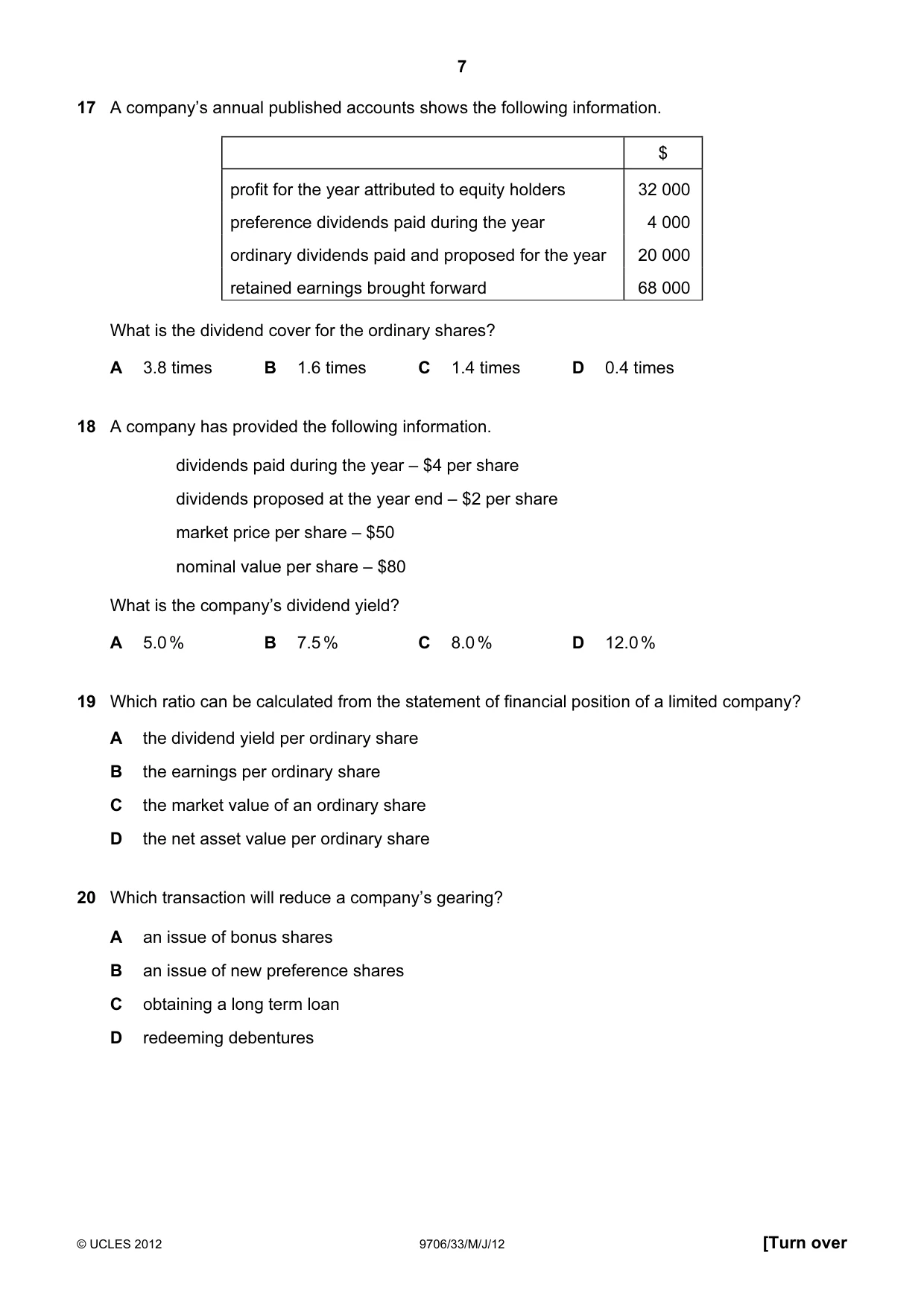
17 A company’s annual published accounts shows the following information. $ profit for the year attributed to equity holders 32 000 preference dividends paid during the year 4 000 ordinary dividends paid and proposed for the year 20 000 retained earnings brought forward 68 000 What is the dividend cover for the ordinary shares? A 3.8 times B 1.6 times C 1.4 times D 0.4 times
Mark scheme: B
More questions on Analysis and communication of accounting information
Q18 · A company has provided the following information
18 A company has provided the following information. dividends paid during the year – $4 per share dividends proposed at the year end – $2 per share market price per share – $50 nominal value per share – $80 What is the company’s dividend yield? A 5.0 % B 7.5 % C 8.0 % D 12.0 %
Mark scheme: D
More questions on Analysis and communication of accounting information
Q19 · Which ratio can be calculated from the statement of financial position of a limited…
19 Which ratio can be calculated from the statement of financial position of a limited company? A the dividend yield per ordinary share B the earnings per ordinary share C the market value of an ordinary share D the net asset value per ordinary share
Mark scheme: D
More questions on Analysis and communication of accounting information
Q20 · Which transaction will reduce a company’s gearing?
20 Which transaction will reduce a company’s gearing? A an issue of bonus shares B an issue of new preference shares C obtaining a long term loan D redeeming debentures
Mark scheme: D
More questions on Analysis and communication of accounting information
Q21 · A manufacturing company transfers goods from the manufacturing account to the finished…
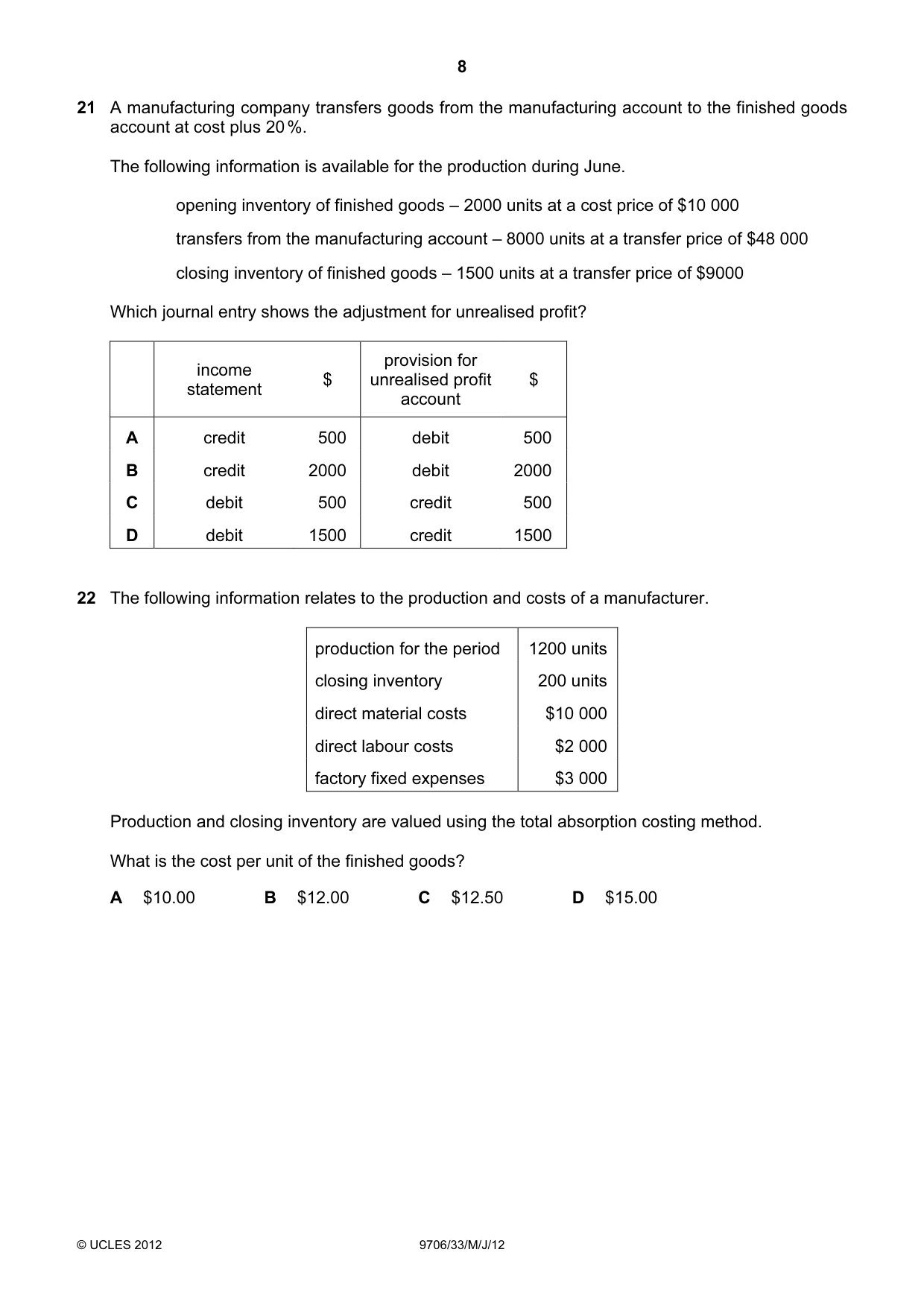
21 A manufacturing company transfers goods from the manufacturing account to the finished goods account at cost plus 20 %. The following information is available for the production during June. opening inventory of finished goods – 2000 units at a cost price of $10 000 transfers from the manufacturing account – 8000 units at a transfer price of $48 000 closing inventory of finished goods – 1500 units at a transfer price of $9000 Which journal entry shows the adjustment for unrealised profit? provision for income $ unrealised profit $ statement account A credit 500 debit 500 B credit 2000 debit 2000 C debit 500 credit 500 D debit 1500 credit 1500
Mark scheme: A
Q22 · The following information relates to the production and costs of a manufacturer
22 The following information relates to the production and costs of a manufacturer. production for the period 1200 units closing inventory 200 units direct material costs $10 000 direct labour costs $2 000 factory fixed expenses $3 000 Production and closing inventory are valued using the total absorption costing method. What is the cost per unit of the finished goods? A $10.00 B $12.00 C $12.50 D $15.00
Mark scheme: C
Q23 · The maximum amount of material available for the manufacture of products X and Y is 6400…
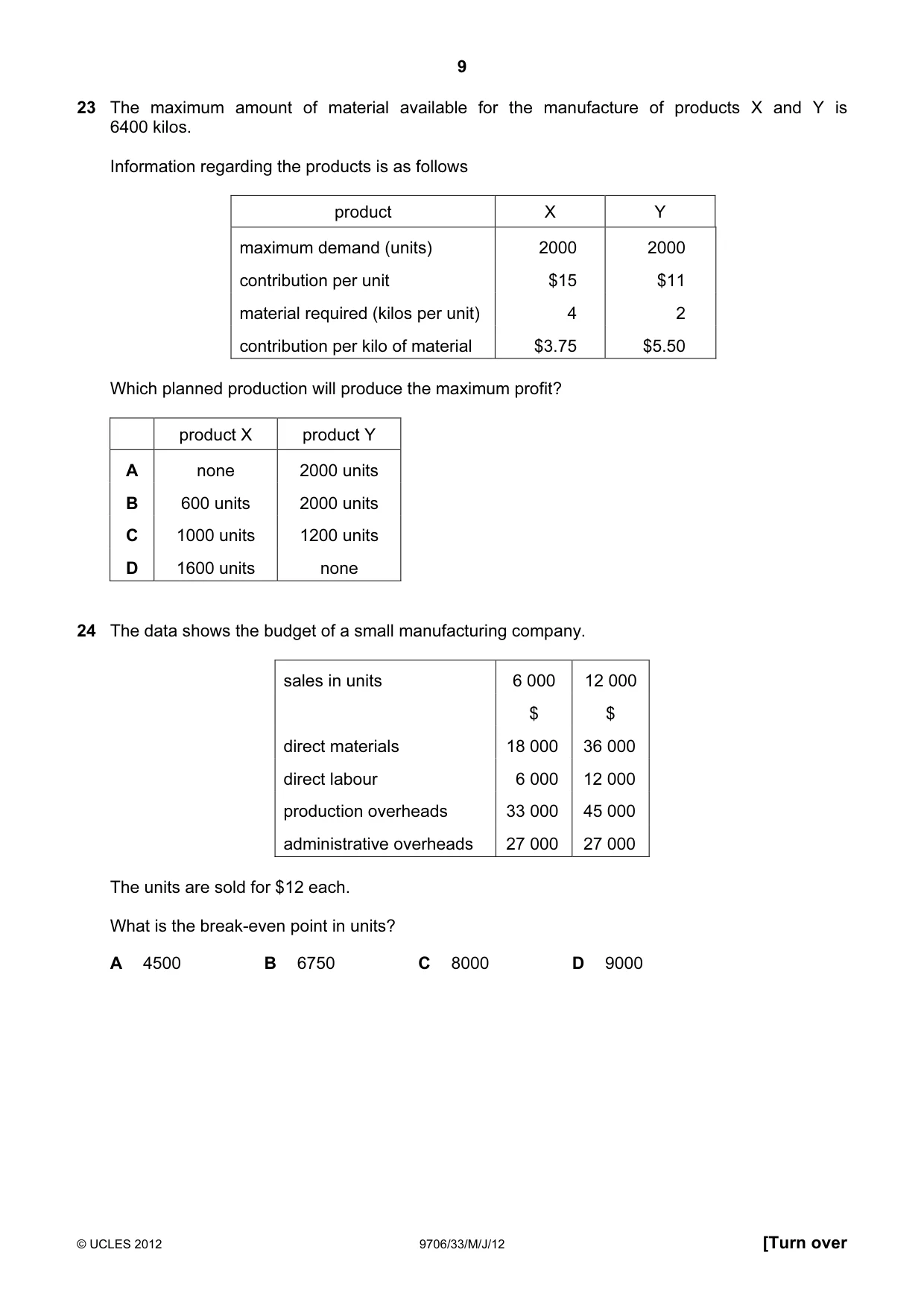
23 The maximum amount of material available for the manufacture of products X and Y is 6400 kilos. Information regarding the products is as follows product X Y maximum demand (units) 2000 2000 contribution per unit $15 $11 material required (kilos per unit) 4 2 contribution per kilo of material $3.75 $5.50 Which planned production will produce the maximum profit? product X product Y A none 2000 units B 600 units 2000 units C 1000 units 1200 units D 1600 units none
Mark scheme: B
Q24 · The data shows the budget of a small manufacturing company
24 The data shows the budget of a small manufacturing company. sales in units 6 000 12 000 $ $ direct materials 18 000 36 000 direct labour 6 000 12 000 production overheads 33 000 45 000 administrative overheads 27 000 27 000 The units are sold for $12 each. What is the break-even point in units? A 4500 B 6750 C 8000 D 9000
Mark scheme: C
Q25 · The table shows budgeted production costs for the next period
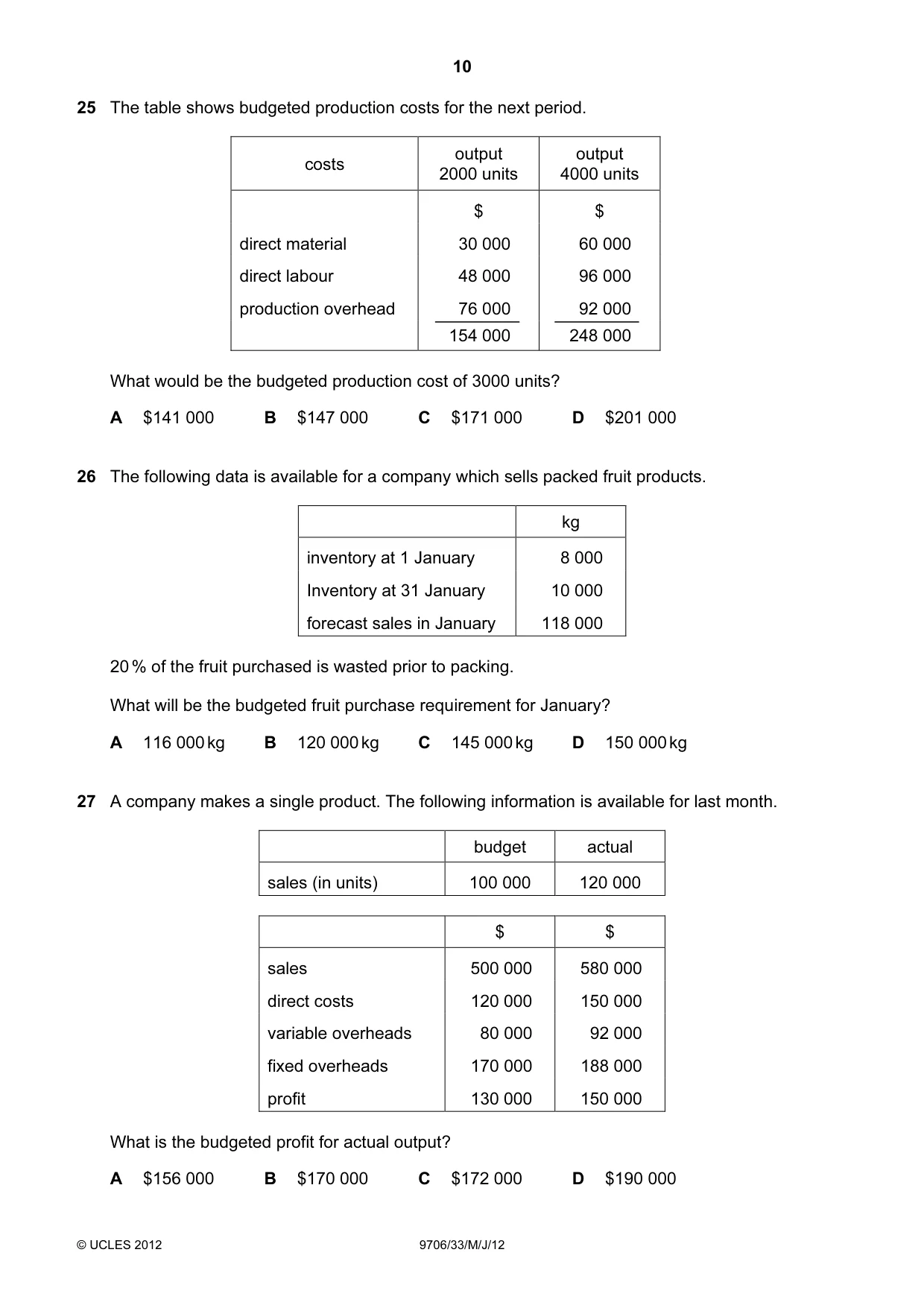
25 The table shows budgeted production costs for the next period. output output costs 2000 units 4000 units $ $ direct material 30 000 60 000 direct labour 48 000 96 000 production overhead 76 000 92 000 154 000 248 000 What would be the budgeted production cost of 3000 units? A $141 000 B $147 000 C $171 000 D $201 000
Mark scheme: D
Q26 · The following data is available for a company which sells packed fruit products
26 The following data is available for a company which sells packed fruit products. kg inventory at 1 January 8 000 Inventory at 31 January 10 000 forecast sales in January 118 000 20 % of the fruit purchased is wasted prior to packing. What will be the budgeted fruit purchase requirement for January? A 116 000 kg B 120 000 kg C 145 000 kg D 150 000 kg
Mark scheme: D
Q27 · A company makes a single product
27 A company makes a single product. The following information is available for last month. budget actual sales (in units) 100 000 120 000 $ $ sales 500 000 580 000 direct costs 120 000 150 000 variable overheads 80 000 92 000 fixed overheads 170 000 188 000 profit 130 000 150 000 What is the budgeted profit for actual output? A $156 000 B $170 000 C $172 000 D $190 000
Mark scheme: D
Q28 · The following information is available in respect of a company’s sales for the last month
28 The following information is available in respect of a company’s sales for the last month. budgeted sales – 30 000 units at $4 per unit actual sales – 32 000 units at a total sales revenue of $115 000 What was the sales volume variance for the month? A $8000 adverse B $8000 favourable C $13 000 adverse D $13 000 favourable
Mark scheme: B
Q29 · A product requires a standard 6 hours labour at a standard cost of $13.50 per labour hour
29 A product requires a standard 6 hours labour at a standard cost of $13.50 per labour hour. During the month, 3000 units were made and actual labour time charged to the product was 19 000 hours at a cost of $250 800. What is the labour rate variance? A $5400 adverse B $5400 favourable C $5700 adverse D $5700 favourable
Mark scheme: D
Q30 · The graph below relates to a project being considered by a company as a possible…
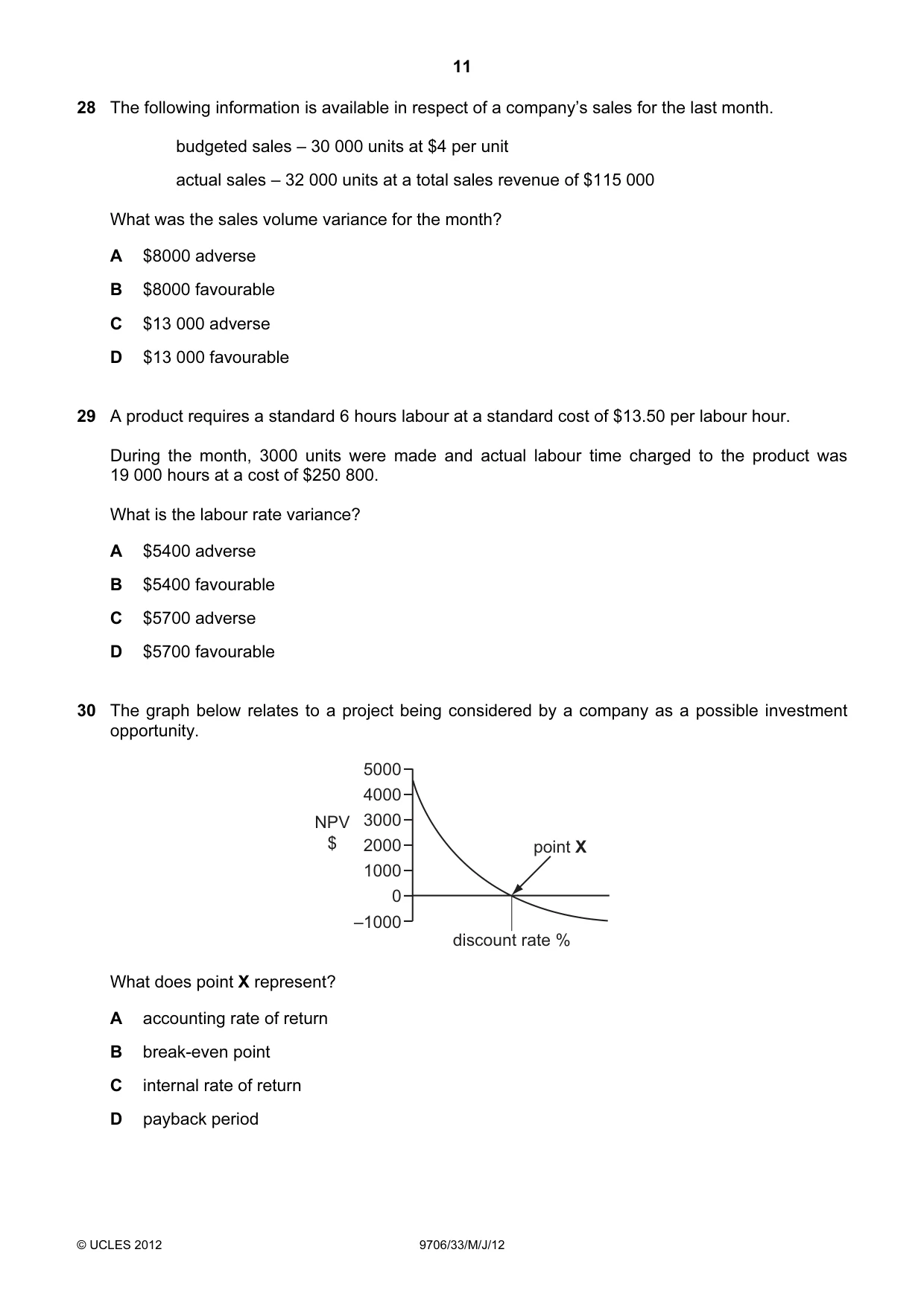
30 The graph below relates to a project being considered by a company as a possible investment opportunity. 5000 4000 NPV 3000 $ 2000 point X 1000 0 –1000 discount rate % What does point X represent? A accounting rate of return B break-even point C internal rate of return D payback period
Mark scheme: C
What was in this paper
The subtopics covered by these 30 questions, and how many questions each got. Open one in a new tab to see every Cambridge question on it.
9Analysis and communication of accounting information6Budgeting and budgetary control2Business acquisition and merger2Costs and cost behaviour2Standard costing2Traditional costing methods2Types of business entity2Investment appraisal1Preparation of financial statements1Regulatory and ethical considerations1What you needed in this session
Cambridge’s own grade thresholds for 2012 May/June, Paper 3 · Variant 3. A higher threshold means an easier paper — the bar moves with how the cohort did.