Cambridge A Level Accounting 9706 — 2013 May/June Paper 3 · Variant 2
9706/32/M/J/13 · 30 questions · 30 marks · ≈34 min
The question paper and its mark scheme, free to read here and free to download. This is Cambridge’s own paper, exactly as it was sat.
Question paper12 pages
Mark scheme2 pages
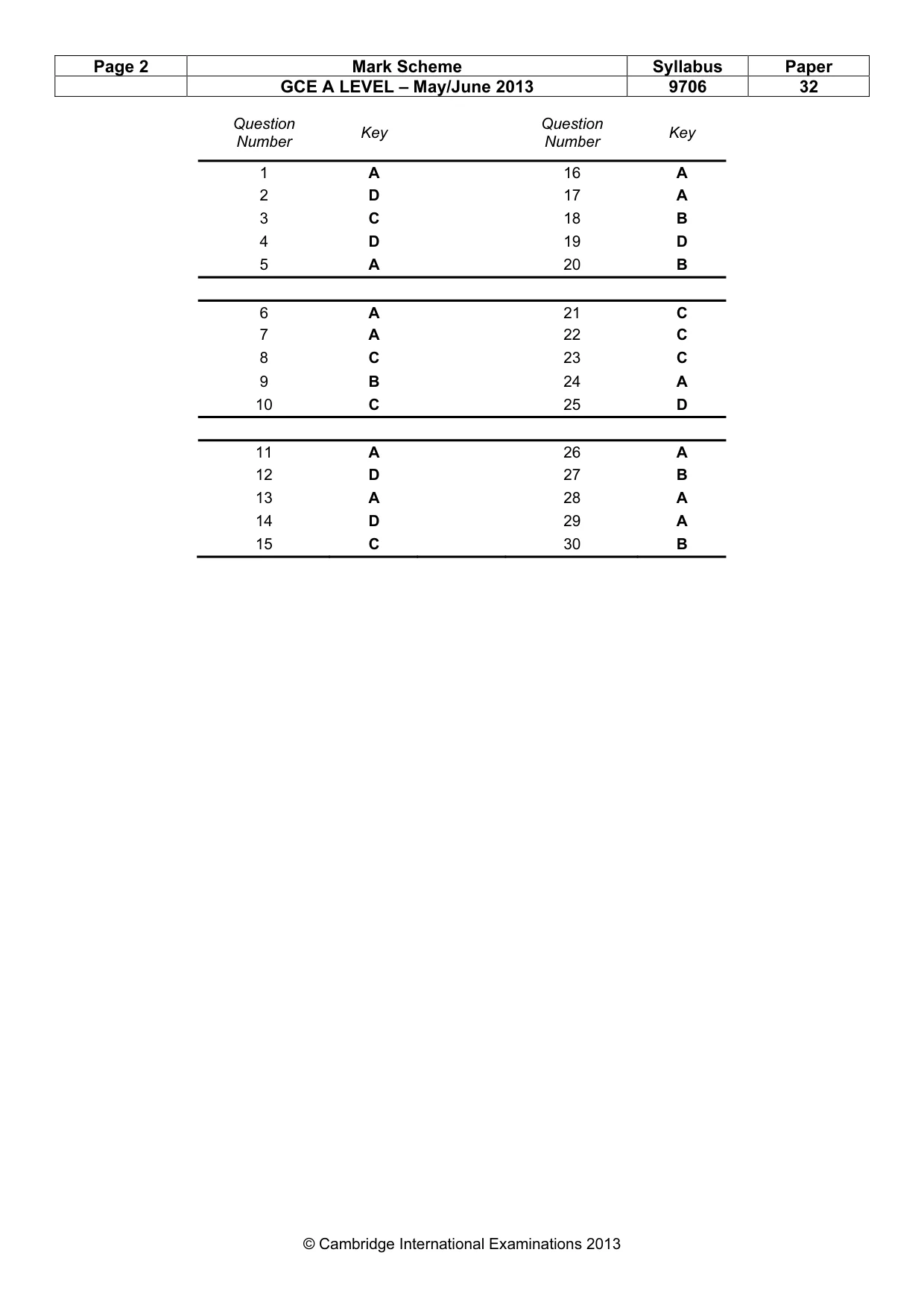
Answers below. Sit the paper first if you are practising.
Questions as text
Q1 · The following extracts are taken from the financial statements of a company
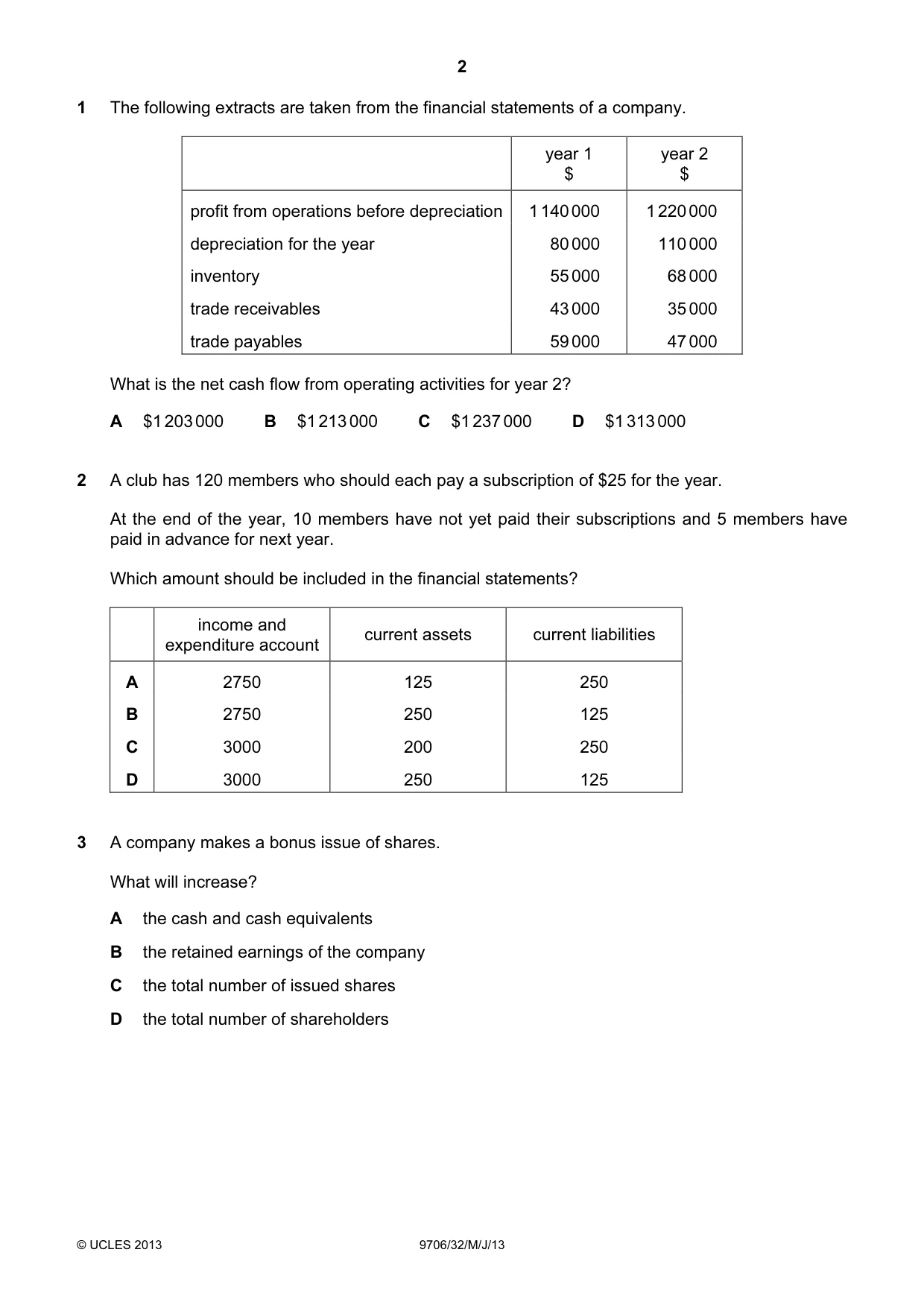
1 The following extracts are taken from the financial statements of a company. year 1 year 2 $ $ profit from operations before depreciation 1 140 000 1 220 000 depreciation for the year 80 000 110 000 inventory 55 000 68 000 trade receivables 43 000 35 000 trade payables 59 000 47 000 What is the net cash flow from operating activities for year 2? A $1 203 000 B $1 213 000 C $1 237 000 D $1 313 000
Mark scheme: A
Q2 · A club has 120 members who should each pay a subscription of $25 for the year
2 A club has 120 members who should each pay a subscription of $25 for the year. At the end of the year, 10 members have not yet paid their subscriptions and 5 members have paid in advance for next year. Which amount should be included in the financial statements? income and current assets current liabilities expenditure account A 2750 125 250 B 2750 250 125 C 3000 200 250 D 3000 250 125
Mark scheme: D
Q3 · A company makes a bonus issue of shares
3 A company makes a bonus issue of shares. What will increase? A the cash and cash equivalents B the retained earnings of the company C the total number of issued shares D the total number of shareholders
Mark scheme: C
Q4 · The following items were extracted from a company’s statement of financial position
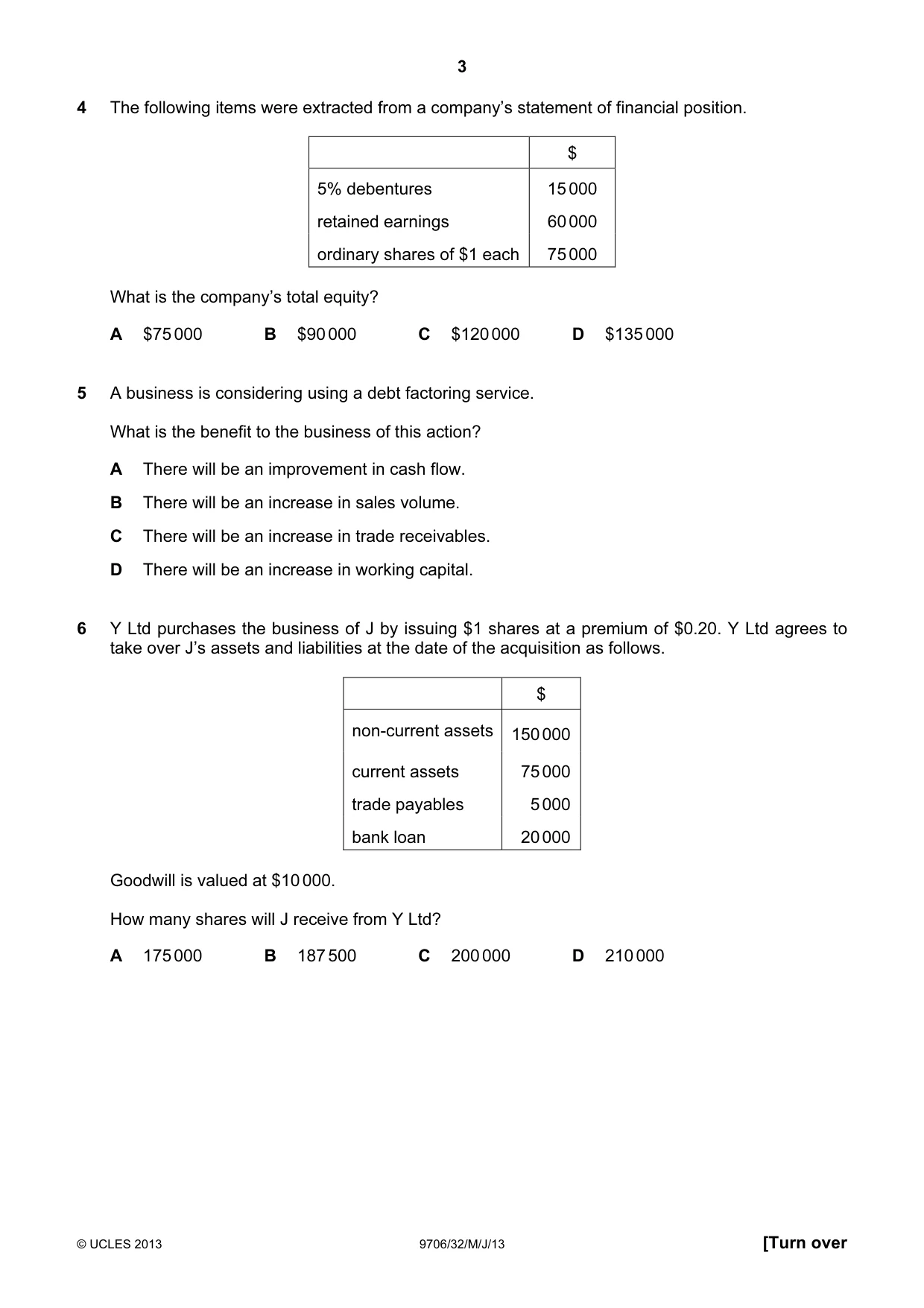
4 The following items were extracted from a company’s statement of financial position. $ 5% debentures 15 000 retained earnings 60 000 ordinary shares of $1 each 75 000 What is the company’s total equity? A $75 000 B $90 000 C $120 000 D $135 000
Mark scheme: D
Q5 · A business is considering using a debt factoring service
5 A business is considering using a debt factoring service. What is the benefit to the business of this action? A There will be an improvement in cash flow. B There will be an increase in sales volume. C There will be an increase in trade receivables. D There will be an increase in working capital.
Mark scheme: A
More questions on Analysis and communication of accounting information
Q6 · Y Ltd purchases the business of J by issuing $1 shares at a premium of $0.20
6 Y Ltd purchases the business of J by issuing $1 shares at a premium of $0.20. Y Ltd agrees to take over J’s assets and liabilities at the date of the acquisition as follows. $ non-current assets 150 000 current assets 75 000 trade payables 5 000 bank loan 20 000 Goodwill is valued at $10 000. How many shares will J receive from Y Ltd? A 175 000 B 187 500 C 200 000 D 210 000
Mark scheme: A
Q7 · A company purchases a business for less than the value of the net assets acquired
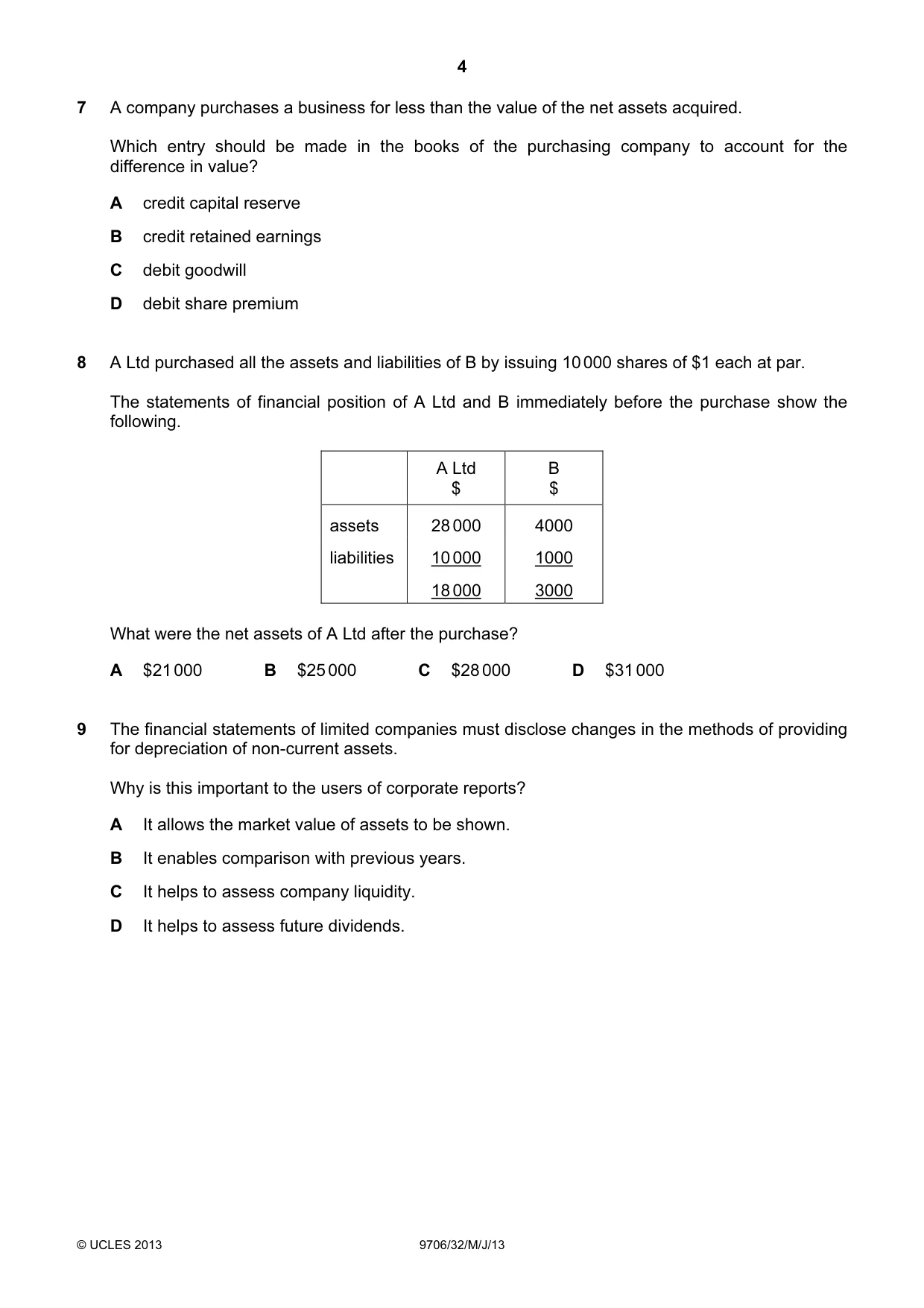
7 A company purchases a business for less than the value of the net assets acquired. Which entry should be made in the books of the purchasing company to account for the difference in value? A credit capital reserve B credit retained earnings C debit goodwill D debit share premium
Mark scheme: A
Q8 · A Ltd purchased all the assets and liabilities of B by issuing 10 000 shares of $1 each…
8 A Ltd purchased all the assets and liabilities of B by issuing 10 000 shares of $1 each at par. The statements of financial position of A Ltd and B immediately before the purchase show the following. A Ltd B $ $ assets 28 000 4000 liabilities 10 000 1000 18 000 3000 What were the net assets of A Ltd after the purchase? A $21 000 B $25 000 C $28 000 D $31 000
Mark scheme: C
Q9 · The financial statements of limited companies must disclose changes in the methods of…
9 The financial statements of limited companies must disclose changes in the methods of providing for depreciation of non-current assets. Why is this important to the users of corporate reports? A It allows the market value of assets to be shown. B It enables comparison with previous years. C It helps to assess company liquidity. D It helps to assess future dividends.
Mark scheme: B
Q10 · A company purchased a machine with a cost price of $40 000
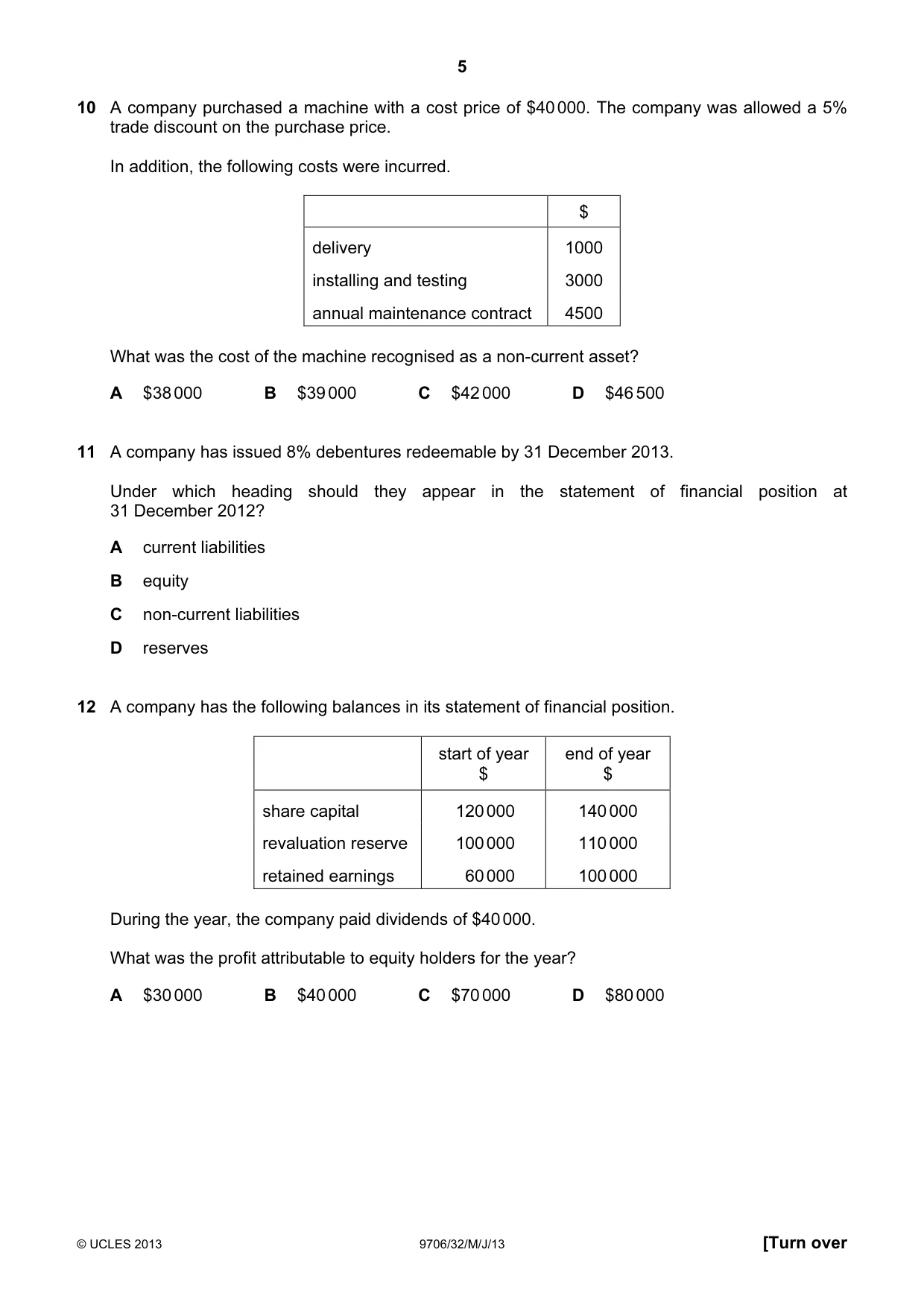
10 A company purchased a machine with a cost price of $40 000. The company was allowed a 5% trade discount on the purchase price. In addition, the following costs were incurred. $ delivery 1000 installing and testing 3000 annual maintenance contract 4500 What was the cost of the machine recognised as a non-current asset? A $38 000 B $39 000 C $42 000 D $46 500
Mark scheme: C
Q11 · A company has issued 8% debentures redeemable by 31 December 2013
11 A company has issued 8% debentures redeemable by 31 December 2013. Under which heading should they appear in the statement of financial position at 31 December 2012? A current liabilities B equity C non-current liabilities D reserves
Mark scheme: A
Q12 · A company has the following balances in its statement of financial position
12 A company has the following balances in its statement of financial position. start of year end of year $ $ share capital 120 000 140 000 revaluation reserve 100 000 110 000 retained earnings 60 000 100 000 During the year, the company paid dividends of $40 000. What was the profit attributable to equity holders for the year? A $30 000 B $40 000 C $70 000 D $80 000
Mark scheme: D
Q13 · Which row correctly shows the effect of a company increasing the value of its freehold…
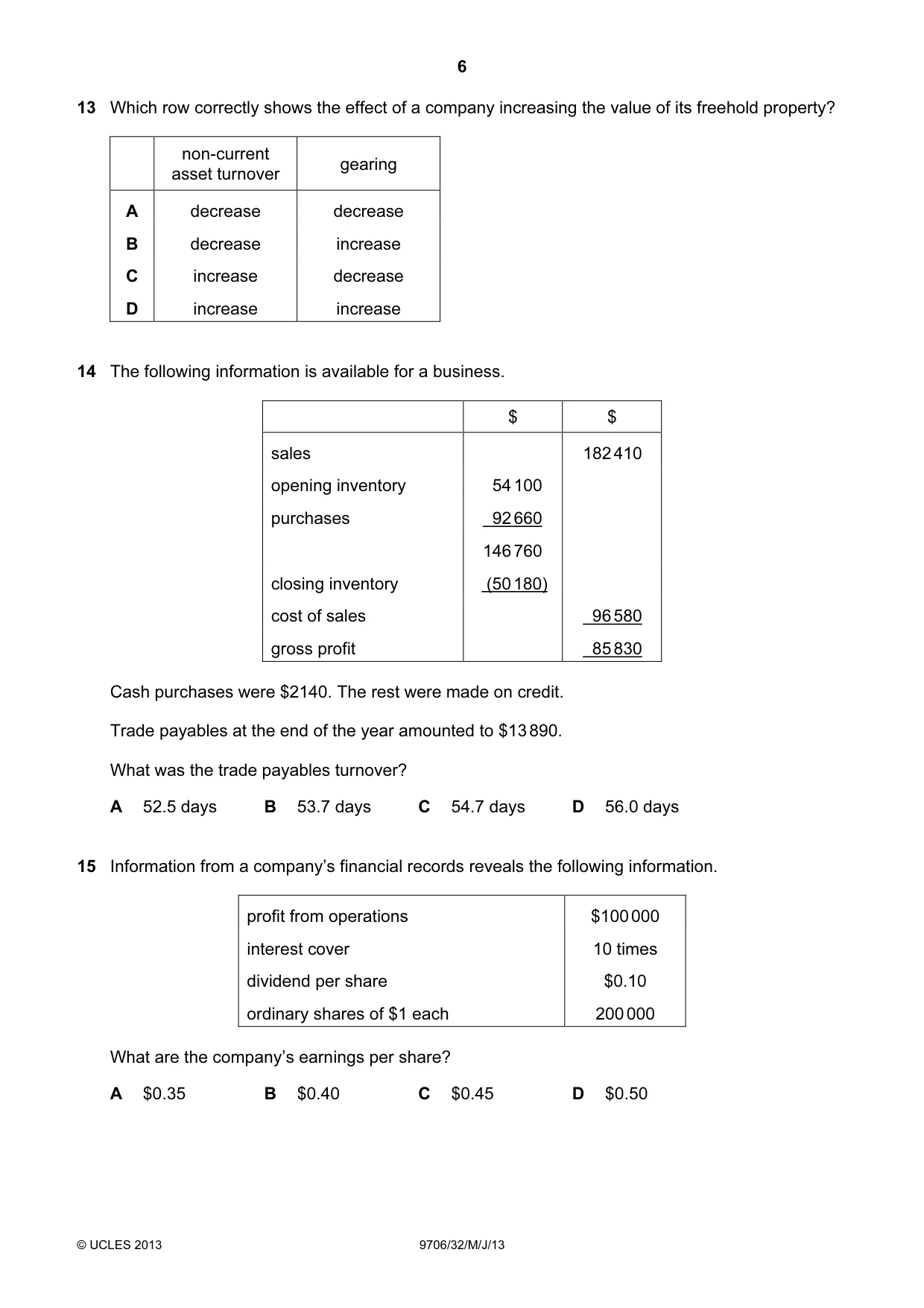
13 Which row correctly shows the effect of a company increasing the value of its freehold property? non-current gearing asset turnover A decrease decrease B decrease increase C increase decrease D increase increase
Mark scheme: A
More questions on Analysis and communication of accounting information
Q14 · The following information is available for a business
14 The following information is available for a business. $ $ sales 182 410 opening inventory 54 100 purchases 92 660 146 760 closing inventory (50 180) cost of sales 96 580 gross profit 85 830 Cash purchases were $2140. The rest were made on credit. Trade payables at the end of the year amounted to $13 890. What was the trade payables turnover? A 52.5 days B 53.7 days C 54.7 days D 56.0 days
Mark scheme: D
More questions on Analysis and communication of accounting information
Q15 · Information from a company’s financial records reveals the following information
15 Information from a company’s financial records reveals the following information. profit from operations $100 000 interest cover 10 times dividend per share $0.10 ordinary shares of $1 each 200 000 What are the company’s earnings per share? A $0.35 B $0.40 C $0.45 D $0.50
Mark scheme: C
More questions on Analysis and communication of accounting information
Q16 · What is a reason for a company issuing bonus shares to its existing shareholders?
16 What is a reason for a company issuing bonus shares to its existing shareholders? A to capitalise reserves B to increase profits available for dividend C to raise additional cash D to raise the market value of shares
Mark scheme: A
Q17 · A company makes a bonus issue of one ordinary share for every three held
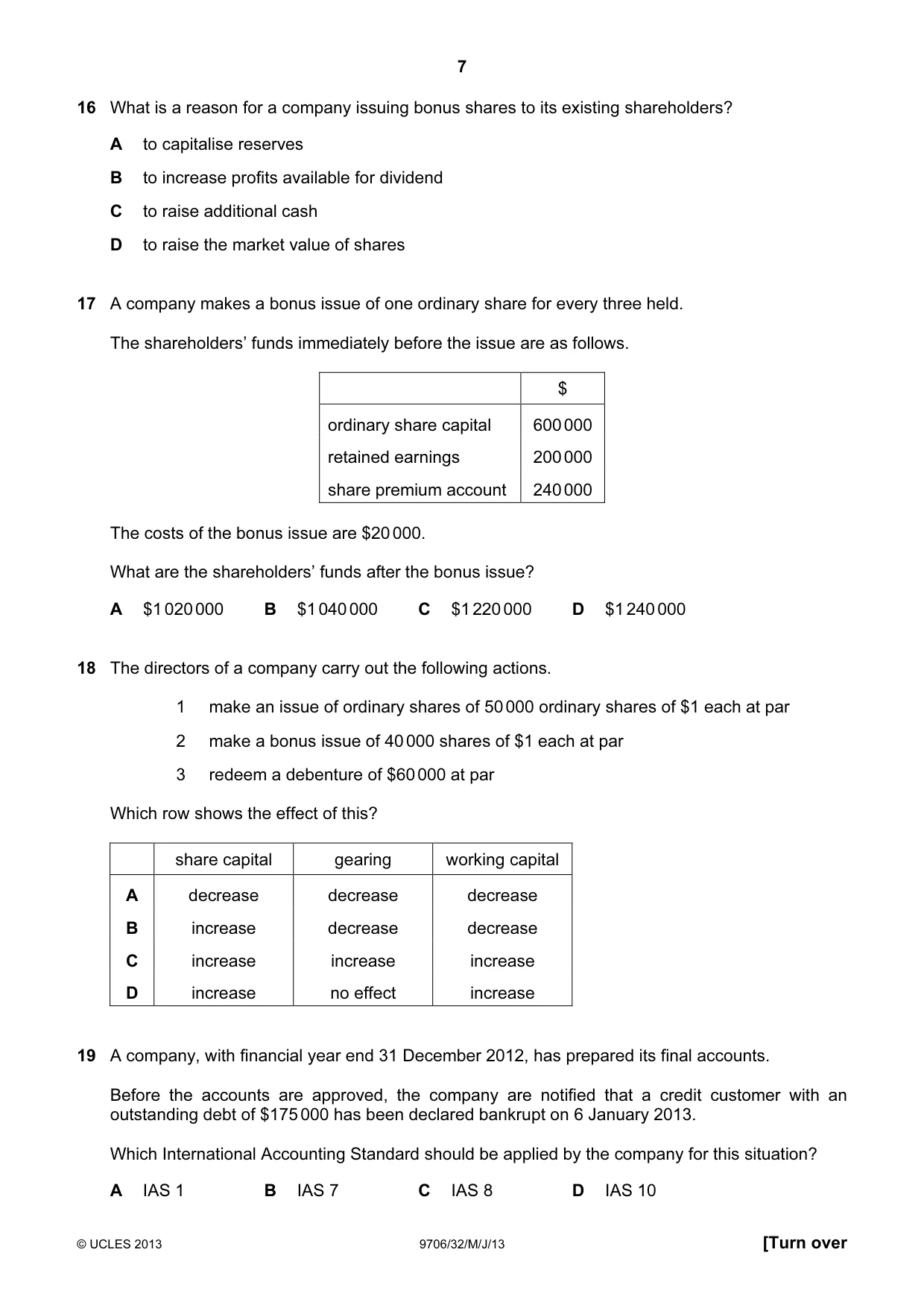
17 A company makes a bonus issue of one ordinary share for every three held. The shareholders’ funds immediately before the issue are as follows. $ ordinary share capital 600 000 retained earnings 200 000 share premium account 240 000 The costs of the bonus issue are $20 000. What are the shareholders’ funds after the bonus issue? A $1 020 000 B $1 040 000 C $1 220 000 D $1 240 000
Mark scheme: A
Q18 · The directors of a company carry out the following actions
18 The directors of a company carry out the following actions. 1 make an issue of ordinary shares of 50 000 ordinary shares of $1 each at par 2 make a bonus issue of 40 000 shares of $1 each at par 3 redeem a debenture of $60 000 at par Which row shows the effect of this? share capital gearing working capital A decrease decrease decrease B increase decrease decrease C increase increase increase D increase no effect increase
Mark scheme: B
More questions on Analysis and communication of accounting information
Q19 · A company, with financial year end 31 December 2012, has prepared its final accounts
19 A company, with financial year end 31 December 2012, has prepared its final accounts. Before the accounts are approved, the company are notified that a credit customer with an outstanding debt of $175 000 has been declared bankrupt on 6 January 2013. Which International Accounting Standard should be applied by the company for this situation? A IAS 1 B IAS 7 C IAS 8 D IAS 10
Mark scheme: D
Q20 · The data is given for four products
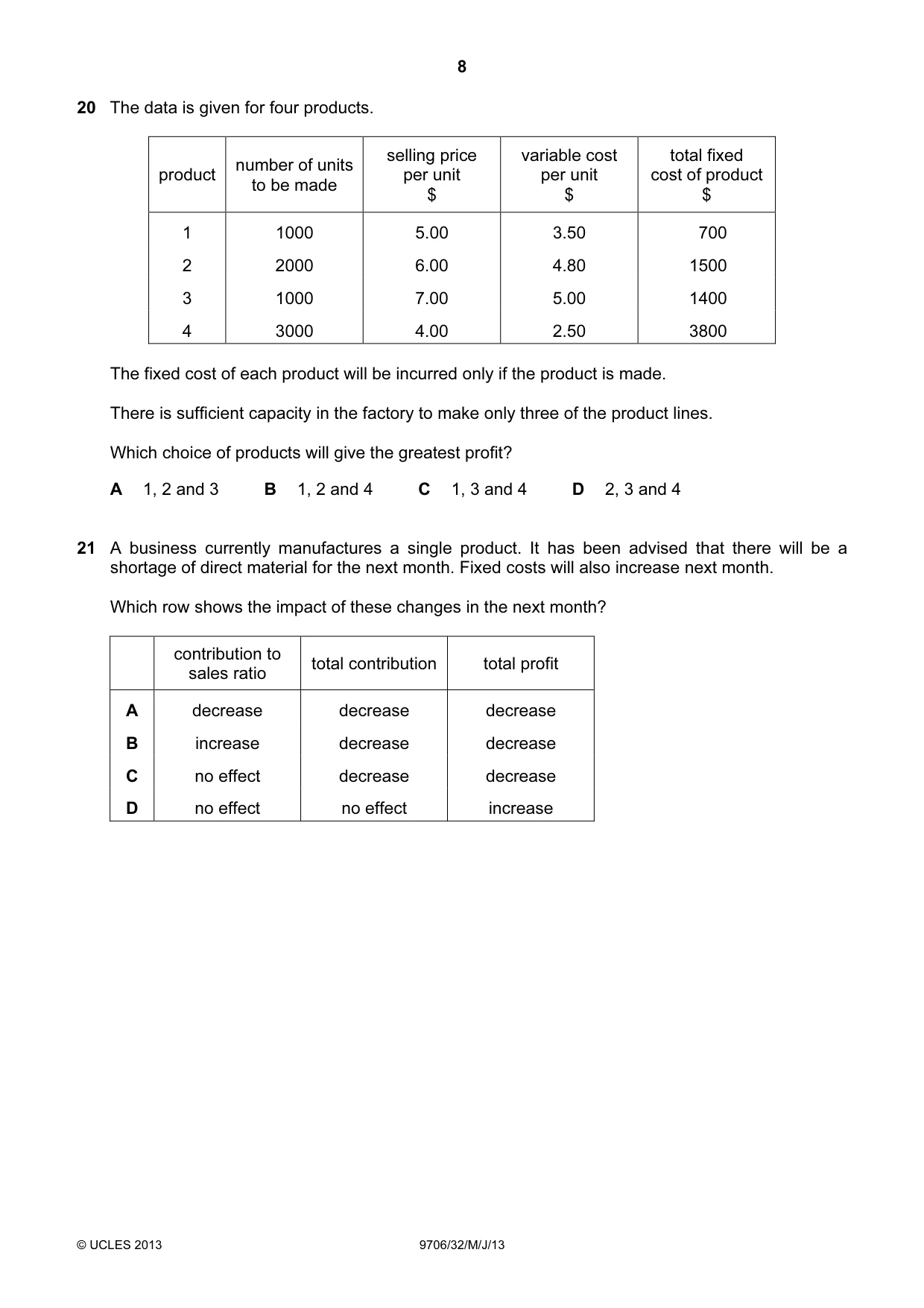
20 The data is given for four products. selling price variable cost total fixed number of units product per unit per unit cost of product to be made $ $ $ 1 1000 5.00 3.50 700 2 2000 6.00 4.80 1500 3 1000 7.00 5.00 1400 4 3000 4.00 2.50 3800 The fixed cost of each product will be incurred only if the product is made. There is sufficient capacity in the factory to make only three of the product lines. Which choice of products will give the greatest profit? A 1, 2 and 3 B 1, 2 and 4 C 1, 3 and 4 D 2, 3 and 4
Mark scheme: B
Q21 · A business currently manufactures a single product
21 A business currently manufactures a single product. It has been advised that there will be a shortage of direct material for the next month. Fixed costs will also increase next month. Which row shows the impact of these changes in the next month? contribution to total contribution total profit sales ratio A decrease decrease decrease B increase decrease decrease C no effect decrease decrease D no effect no effect increase
Mark scheme: C
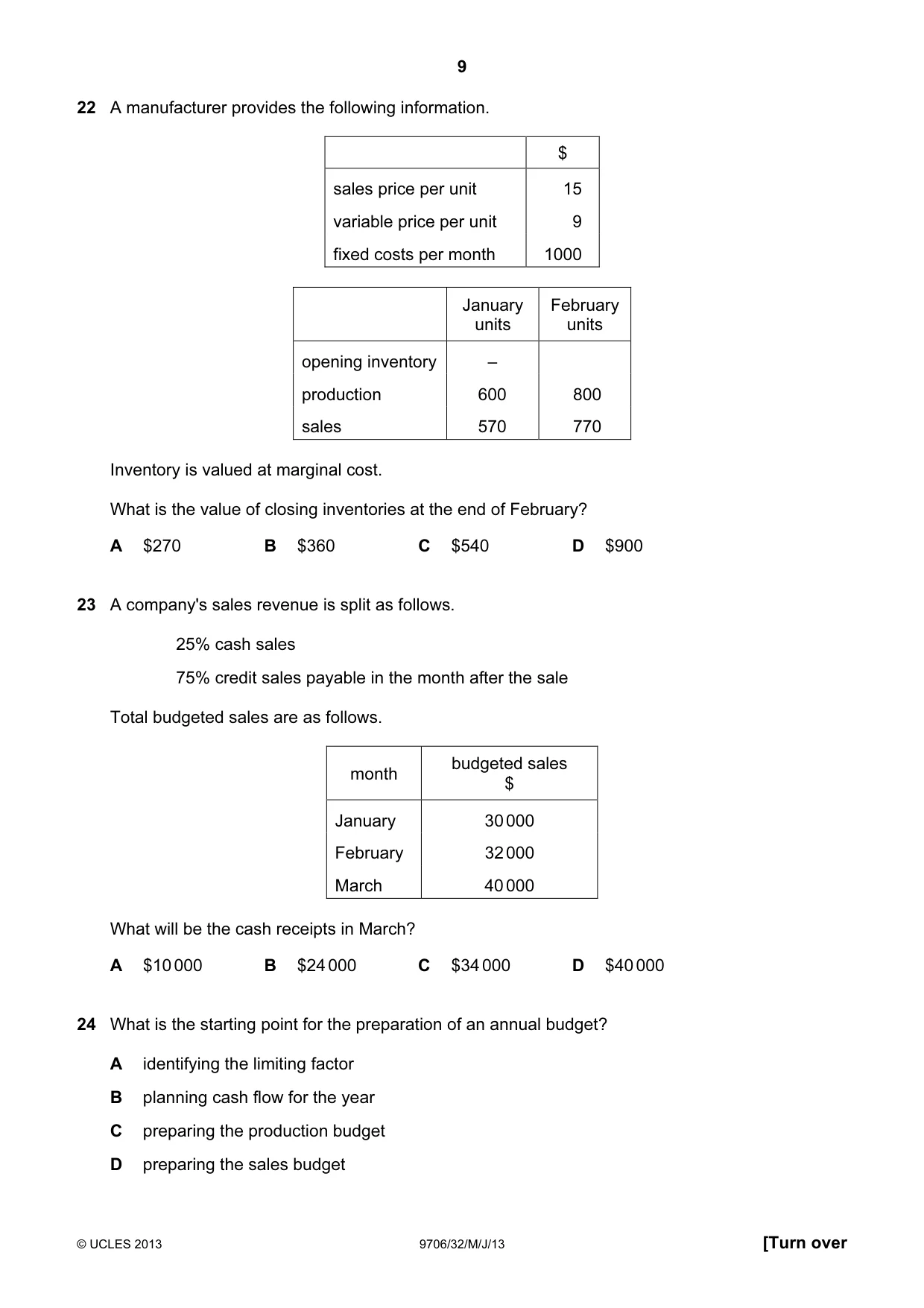
Q22 · A manufacturer provides the following information
22 A manufacturer provides the following information. $ sales price per unit 15 variable price per unit 9 fixed costs per month 1000 January February units units opening inventory – production 600 800 sales 570 770 Inventory is valued at marginal cost. What is the value of closing inventories at the end of February? A $270 B $360 C $540 D $900
Mark scheme: C
Q23 · A company's sales revenue is split as follows
23 A company's sales revenue is split as follows. 25% cash sales 75% credit sales payable in the month after the sale Total budgeted sales are as follows. budgeted sales month $ January 30 000 February 32 000 March 40 000 What will be the cash receipts in March? A $10 000 B $24 000 C $34 000 D $40 000
Mark scheme: C
Q24 · What is the starting point for the preparation of an annual budget?
24 What is the starting point for the preparation of an annual budget? A identifying the limiting factor B planning cash flow for the year C preparing the production budget D preparing the sales budget
Mark scheme: A
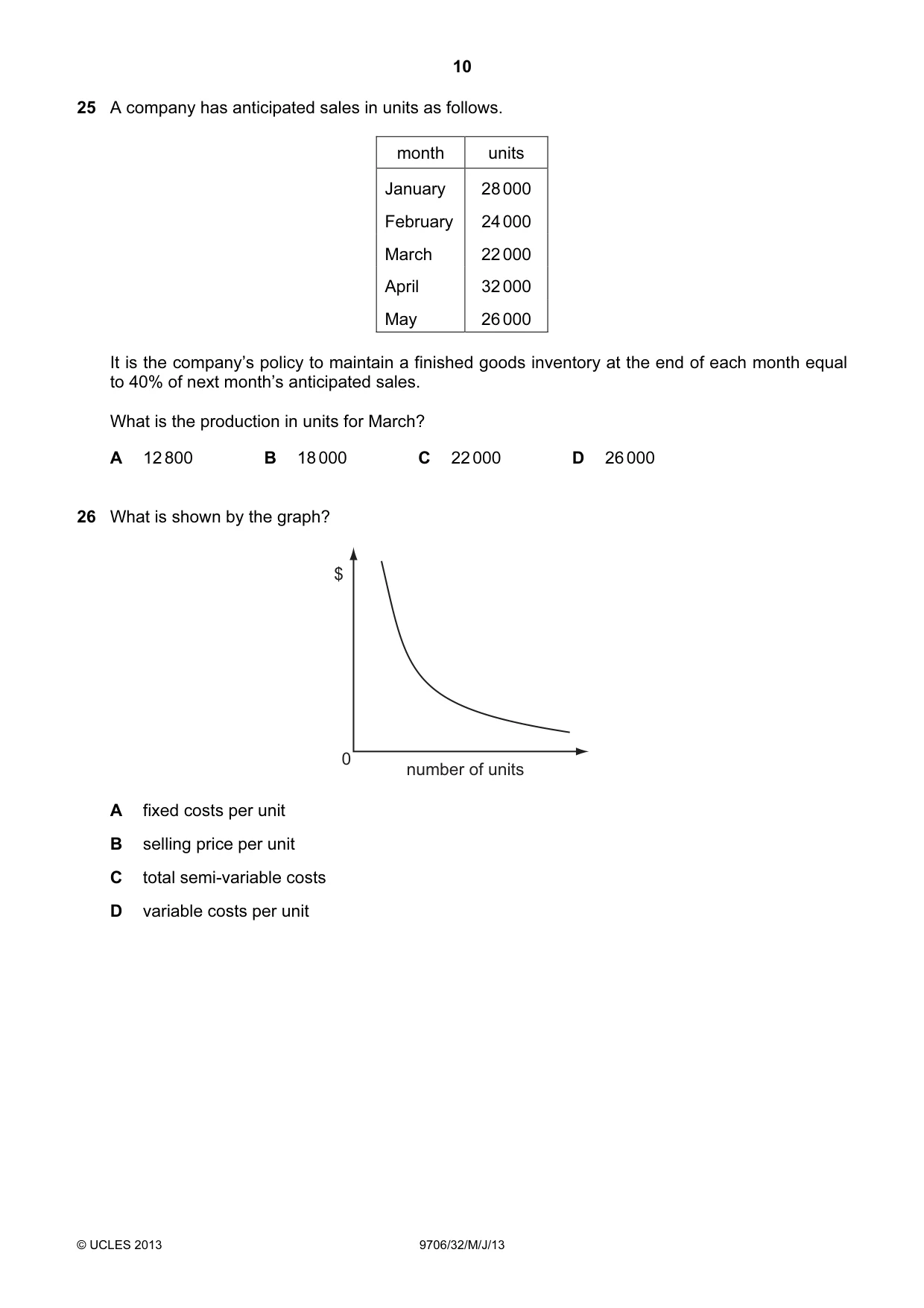
Q25 · A company has anticipated sales in units as follows
25 A company has anticipated sales in units as follows. month units January 28 000 February 24 000 March 22 000 April 32 000 May 26 000 It is the company’s policy to maintain a finished goods inventory at the end of each month equal to 40% of next month’s anticipated sales. What is the production in units for March? A 12 800 B 18 000 C 22 000 D 26 000
Mark scheme: D
Q26 · What is shown by the graph?
26 What is shown by the graph? $ 0 number of units A fixed costs per unit B selling price per unit C total semi-variable costs D variable costs per unit
Mark scheme: A
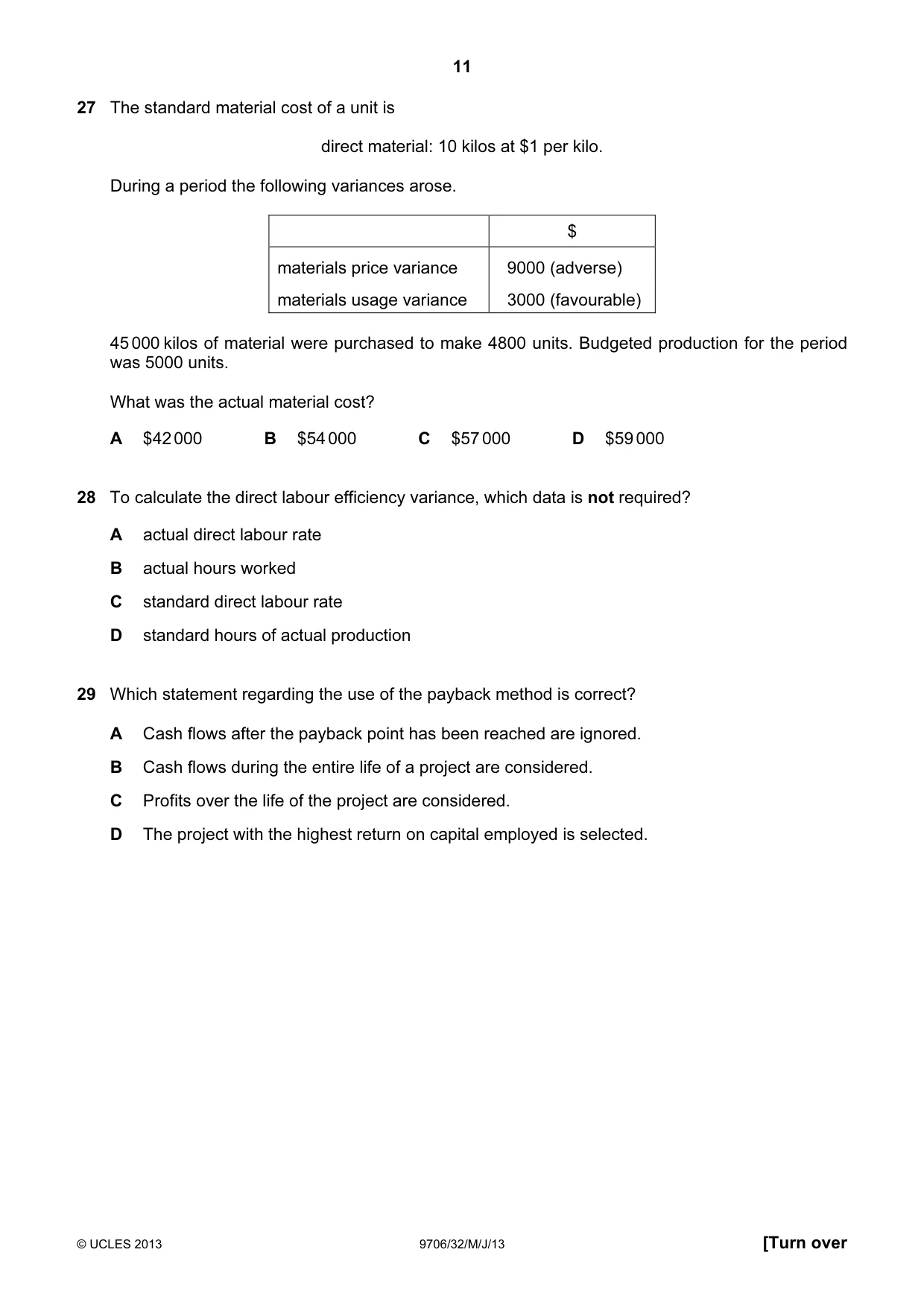
Q27 · The standard material cost of a unit is direct material: 10 kilos at $1 per kilo
27 The standard material cost of a unit is direct material: 10 kilos at $1 per kilo. During a period the following variances arose. $ materials price variance 9000 (adverse) materials usage variance 3000 (favourable) 45 000 kilos of material were purchased to make 4800 units. Budgeted production for the period was 5000 units. What was the actual material cost? A $42 000 B $54 000 C $57 000 D $59 000
Mark scheme: B
Q28 · To calculate the direct labour efficiency variance, which data is not required?
28 To calculate the direct labour efficiency variance, which data is not required? A actual direct labour rate B actual hours worked C standard direct labour rate D standard hours of actual production
Mark scheme: A
Q29 · Which statement regarding the use of the payback method is correct?
29 Which statement regarding the use of the payback method is correct? A Cash flows after the payback point has been reached are ignored. B Cash flows during the entire life of a project are considered. C Profits over the life of the project are considered. D The project with the highest return on capital employed is selected.
Mark scheme: A
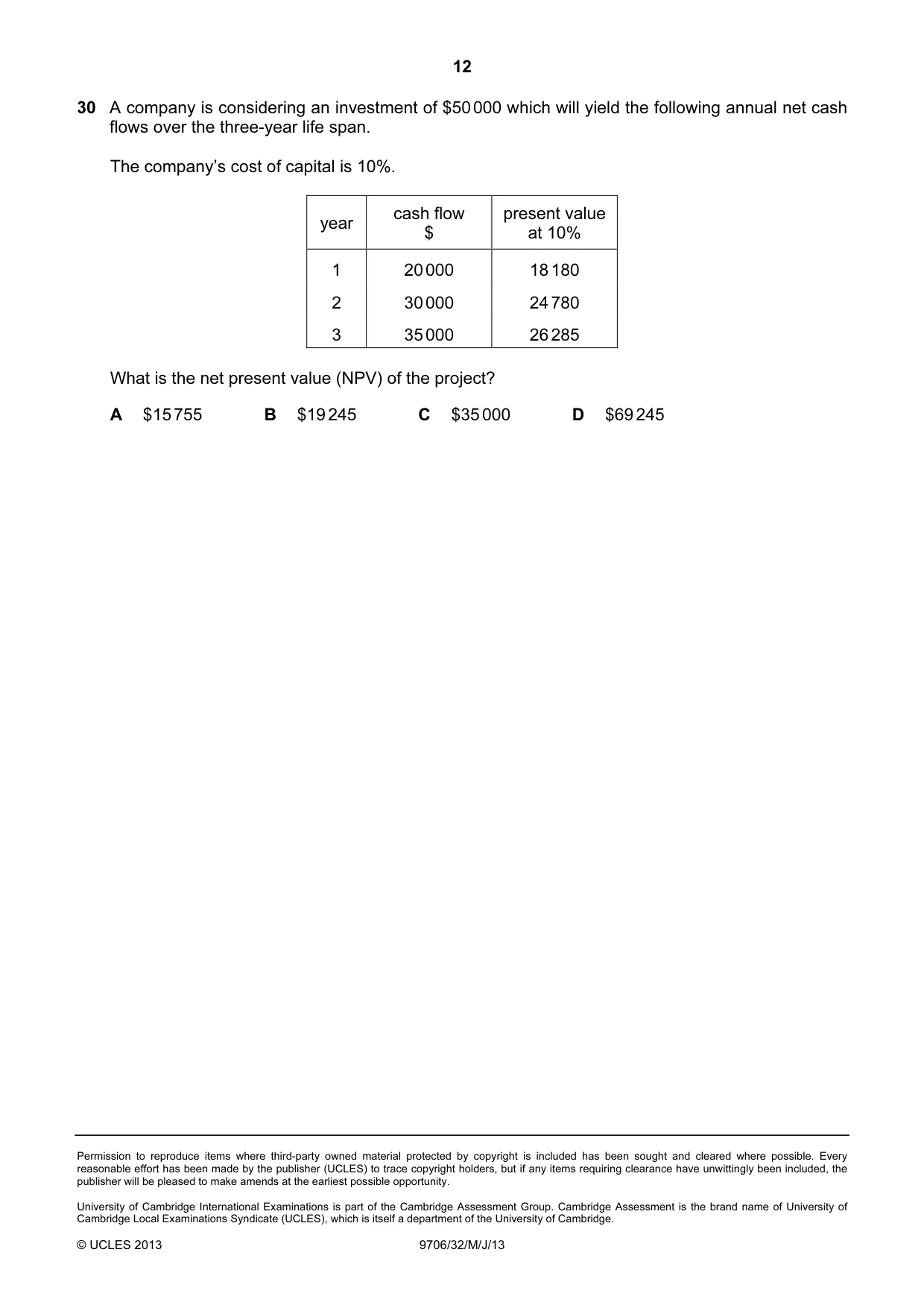
Q30 · A company is considering an investment of $50 000 which will yield the following annual…
30 A company is considering an investment of $50 000 which will yield the following annual net cash flows over the three-year life span. The company’s cost of capital is 10%. cash flow present value year $ at 10% 1 20 000 18 180 2 30 000 24 780 3 35 000 26 285 What is the net present value (NPV) of the project? A $15 755 B $19 245 C $35 000 D $69 245
Mark scheme: B
What was in this paper
The subtopics covered by these 30 questions, and how many questions each got. Open one in a new tab to see every Cambridge question on it.
5Analysis and communication of accounting information4Budgeting and budgetary control3Business acquisition and merger3Types of business entity3Costs and cost behaviour2Investment appraisal2Regulatory and ethical considerations2Standard costing2Traditional costing methods2Accounting for non-current assets1Analysis and communication of accounting information1What you needed in this session
Cambridge’s own grade thresholds for 2013 May/June, Paper 3 · Variant 2. A higher threshold means an easier paper — the bar moves with how the cohort did.