Cambridge A Level Accounting 9706 — 2015 Oct/Nov Paper 3 · Variant 1
9706/31/O/N/15 · 30 questions · 30 marks · ≈34 min
The question paper and its mark scheme, free to read here and free to download. This is Cambridge’s own paper, exactly as it was sat.
Question paper12 pages

Mark scheme2 pages
Answers below. Sit the paper first if you are practising.
Questions as text
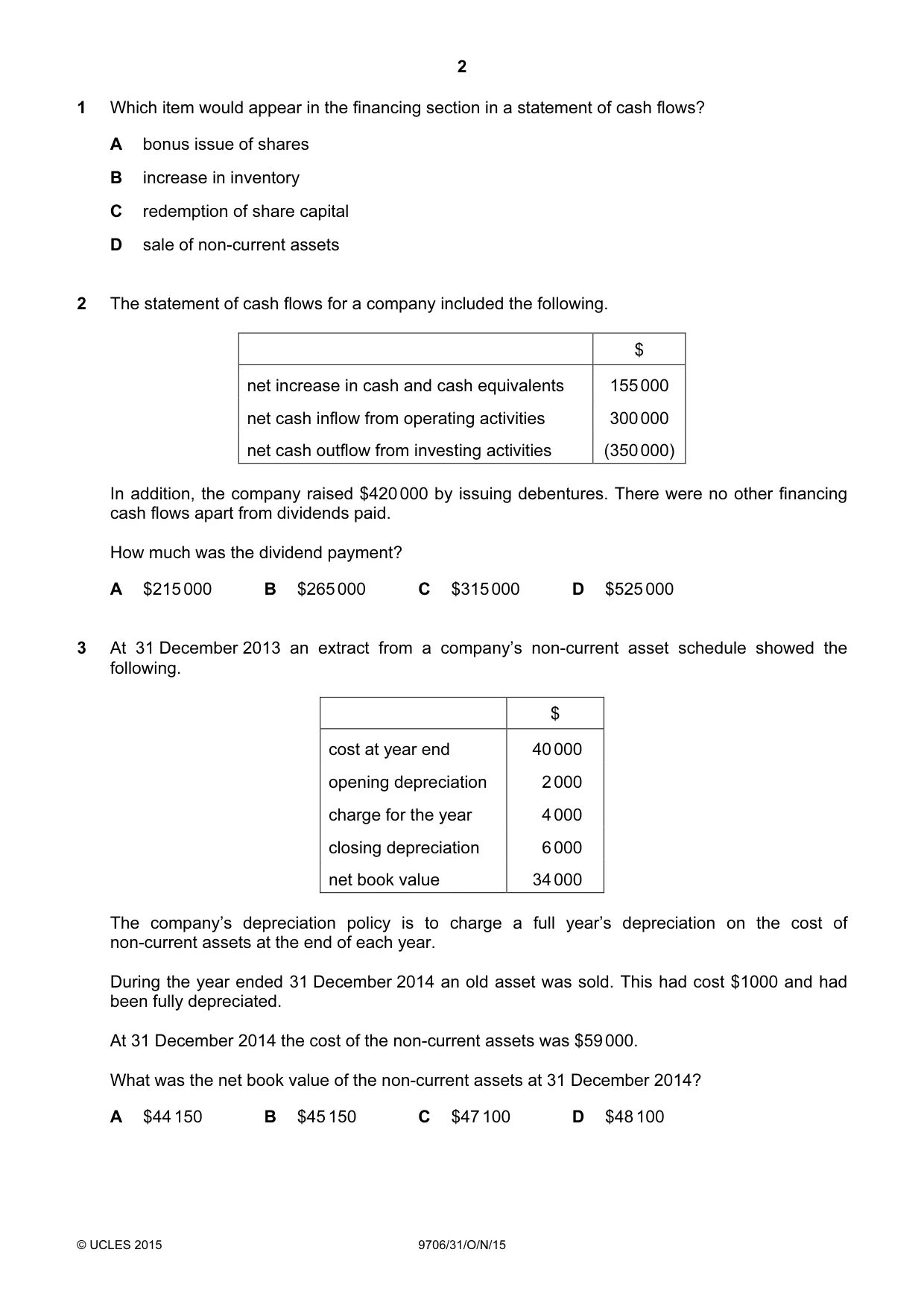
Q1 · Which item would appear in the financing section in a statement of cash flows?
1 Which item would appear in the financing section in a statement of cash flows? A bonus issue of shares B increase in inventory C redemption of share capital D sale of non-current assets
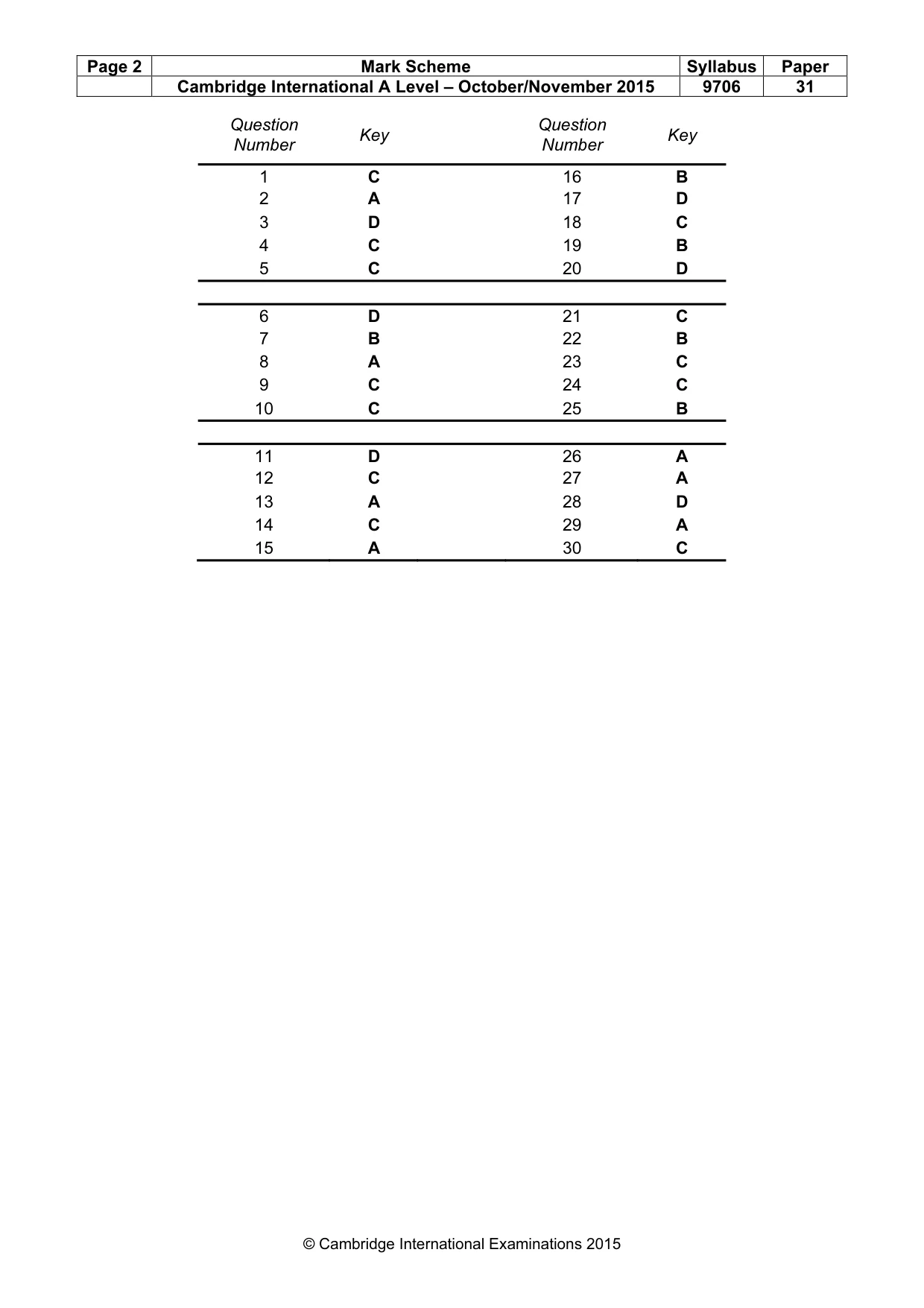
Mark scheme: C
Q2 · The statement of cash flows for a company included the following
2 The statement of cash flows for a company included the following. $ net increase in cash and cash equivalents 155 000 net cash inflow from operating activities 300 000 net cash outflow from investing activities (350 000) In addition, the company raised $420 000 by issuing debentures. There were no other financing cash flows apart from dividends paid. How much was the dividend payment? A $215 000 B $265 000 C $315 000 D $525 000
Mark scheme: A
Q3 · At 31 December 2013 an extract from a company’s non-current asset schedule showed the…
3 At 31 December 2013 an extract from a company’s non-current asset schedule showed the following. $ cost at year end 40 000 opening depreciation 2 000 charge for the year 4 000 closing depreciation 6 000 net book value 34 000 The company’s depreciation policy is to charge a full year’s depreciation on the cost of non-current assets at the end of each year. During the year ended 31 December 2014 an old asset was sold. This had cost $1000 and had been fully depreciated. At 31 December 2014 the cost of the non-current assets was $59 000. What was the net book value of the non-current assets at 31 December 2014? A $44 150 B $45 150 C $47 100 D $48 100
Mark scheme: D
Q4 · X and Y have been in partnership for some years sharing profits and losses equally
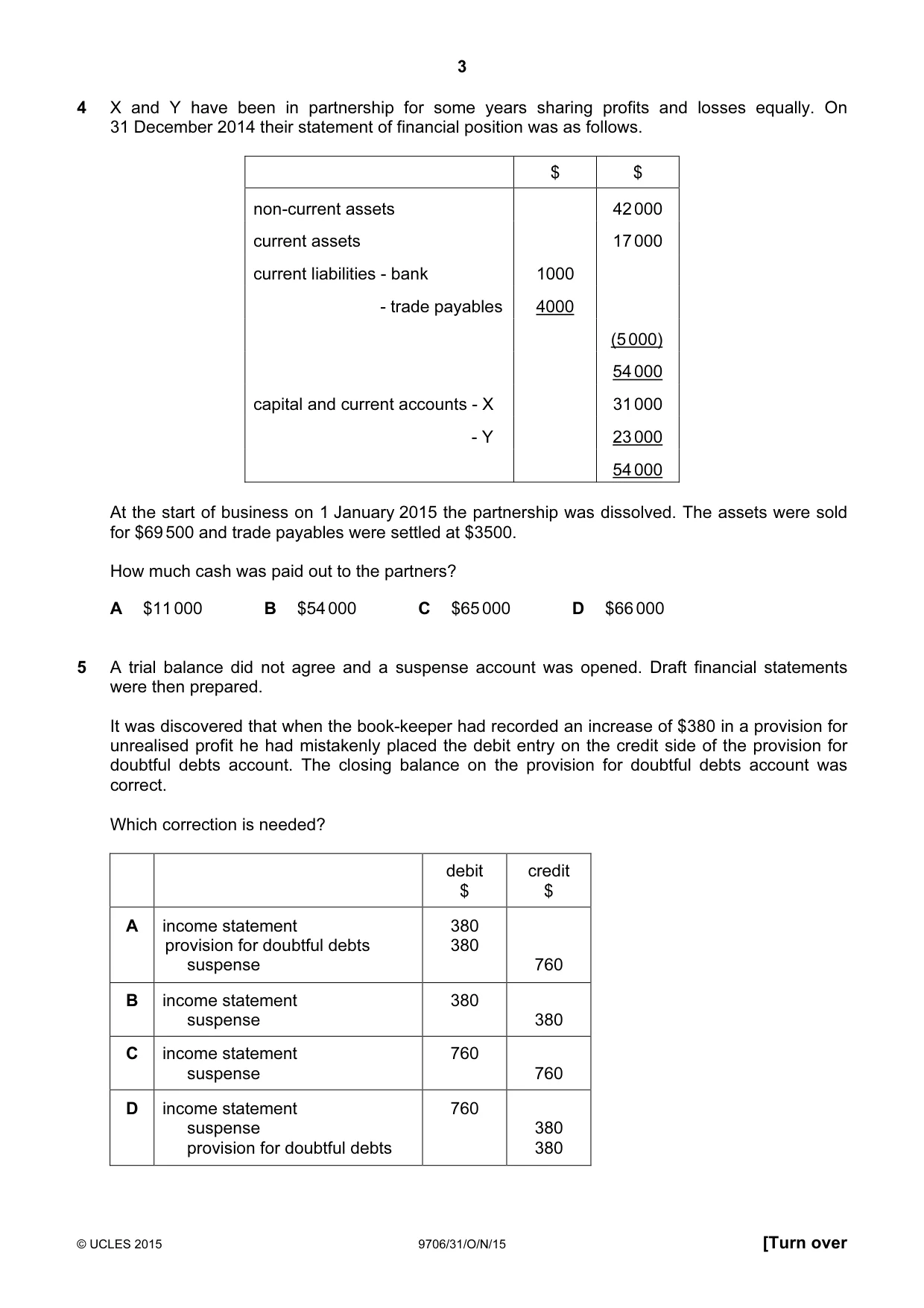
4 X and Y have been in partnership for some years sharing profits and losses equally. On 31 December 2014 their statement of financial position was as follows. $ $ non-current assets 42 000 current assets 17 000 current liabilities - bank 1000 - trade payables 4000 (5 000) 54 000 capital and current accounts - X 31 000 - Y 23 000 54 000 At the start of business on 1 January 2015 the partnership was dissolved. The assets were sold for $69 500 and trade payables were settled at $3500. How much cash was paid out to the partners? A $11 000 B $54 000 C $65 000 D $66 000
Mark scheme: C
Q5 · A trial balance did not agree and a suspense account was opened
5 A trial balance did not agree and a suspense account was opened. Draft financial statements were then prepared. It was discovered that when the book-keeper had recorded an increase of $380 in a provision for unrealised profit he had mistakenly placed the debit entry on the credit side of the provision for doubtful debts account. The closing balance on the provision for doubtful debts account was correct. Which correction is needed? debit credit $ $ A income statement 380 provision for doubtful debts 380 suspense 760 B income statement 380 suspense 380 C income statement 760 suspense 760 D income statement 760 suspense 380 provision for doubtful debts 380
Mark scheme: C
Q6 · When can a company issue redeemable shares?
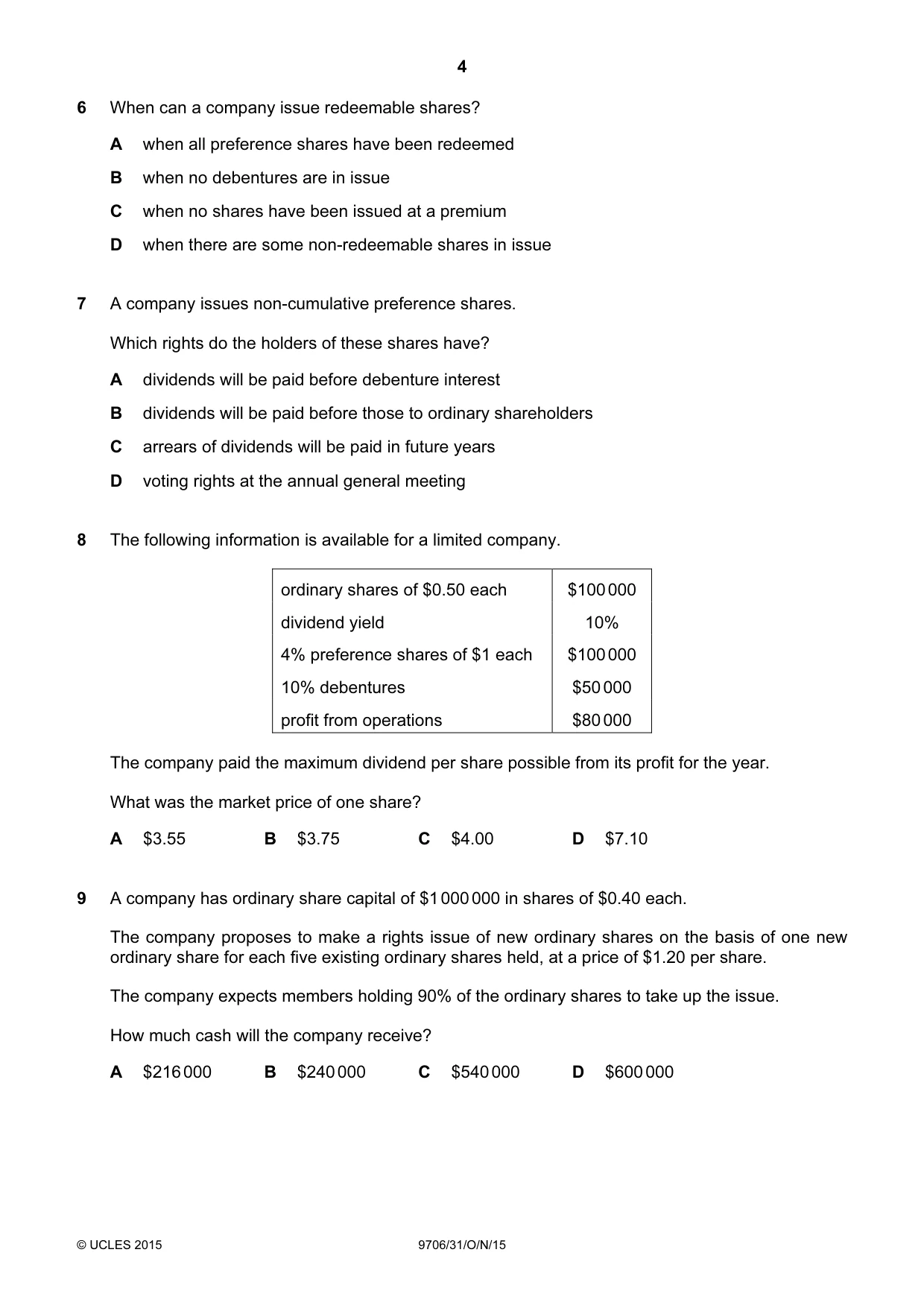
6 When can a company issue redeemable shares? A when all preference shares have been redeemed B when no debentures are in issue C when no shares have been issued at a premium D when there are some non-redeemable shares in issue
Mark scheme: D
Q7 · A company issues non-cumulative preference shares
7 A company issues non-cumulative preference shares. Which rights do the holders of these shares have? A dividends will be paid before debenture interest B dividends will be paid before those to ordinary shareholders C arrears of dividends will be paid in future years D voting rights at the annual general meeting
Mark scheme: B
Q8 · The following information is available for a limited company
8 The following information is available for a limited company. ordinary shares of $0.50 each $100 000 dividend yield 10% 4% preference shares of $1 each $100 000 10% debentures $50 000 profit from operations $80 000 The company paid the maximum dividend per share possible from its profit for the year. What was the market price of one share? A $3.55 B $3.75 C $4.00 D $7.10
Mark scheme: A
More questions on Analysis and communication of accounting information
Q9 · A company has ordinary share capital of $1 000 000 in shares of $0.40 each
9 A company has ordinary share capital of $1 000 000 in shares of $0.40 each. The company proposes to make a rights issue of new ordinary shares on the basis of one new ordinary share for each five existing ordinary shares held, at a price of $1.20 per share. The company expects members holding 90% of the ordinary shares to take up the issue. How much cash will the company receive? A $216 000 B $240 000 C $540 000 D $600 000
Mark scheme: C
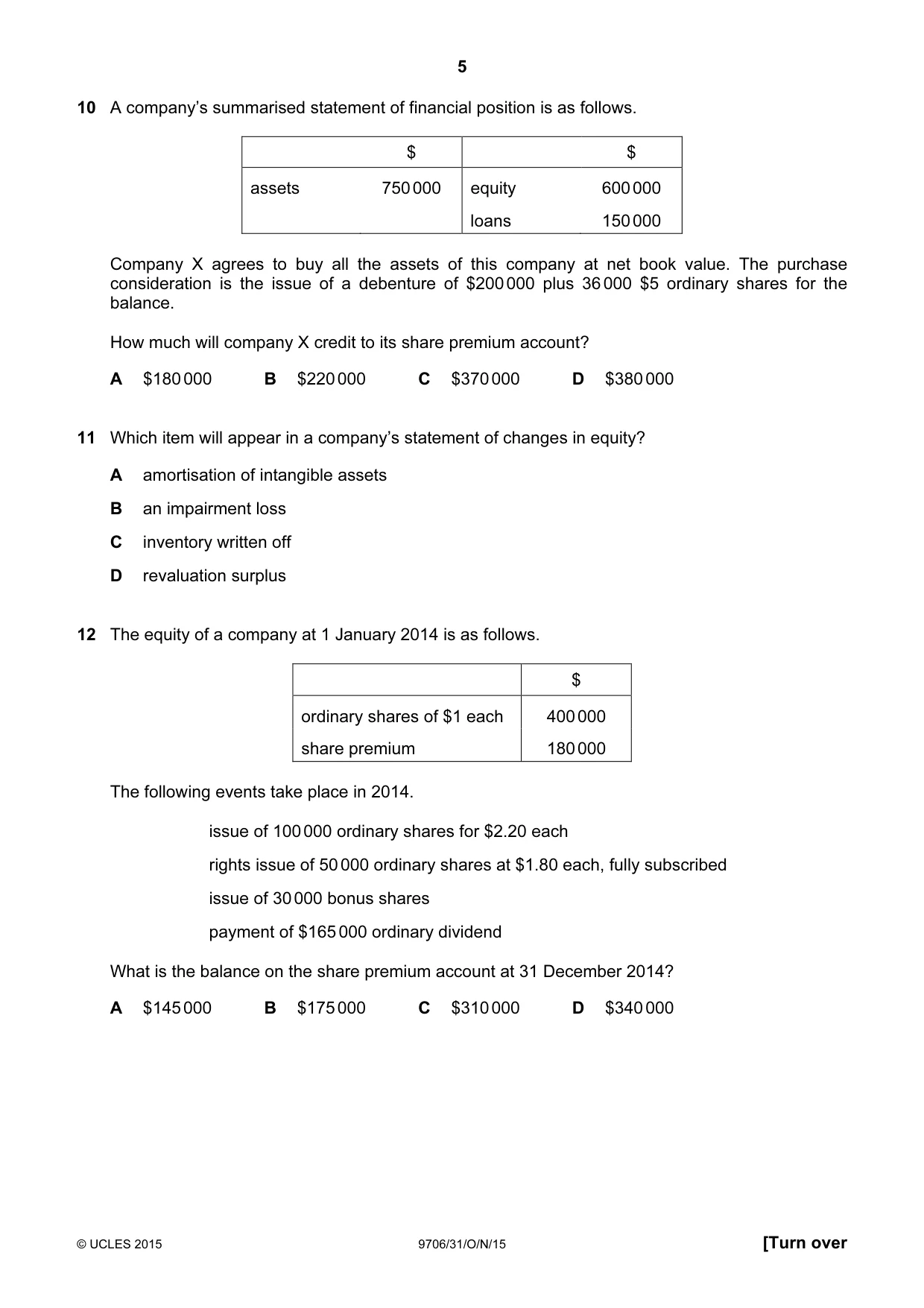
Q10 · A company’s summarised statement of financial position is as follows
10 A company’s summarised statement of financial position is as follows. $ $ assets 750 000 equity 600 000 loans 150 000 Company X agrees to buy all the assets of this company at net book value. The purchase consideration is the issue of a debenture of $200 000 plus 36 000 $5 ordinary shares for the balance. How much will company X credit to its share premium account? A $180 000 B $220 000 C $370 000 D $380 000
Mark scheme: C
Q11 · Which item will appear in a company’s statement of changes in equity?
11 Which item will appear in a company’s statement of changes in equity? A amortisation of intangible assets B an impairment loss C inventory written off D revaluation surplus
Mark scheme: D
Q12 · The equity of a company at 1 January 2014 is as follows
12 The equity of a company at 1 January 2014 is as follows. $ ordinary shares of $1 each 400 000 share premium 180 000 The following events take place in 2014. issue of 100 000 ordinary shares for $2.20 each rights issue of 50 000 ordinary shares at $1.80 each, fully subscribed issue of 30 000 bonus shares payment of $165 000 ordinary dividend What is the balance on the share premium account at 31 December 2014? A $145 000 B $175 000 C $310 000 D $340 000
Mark scheme: C
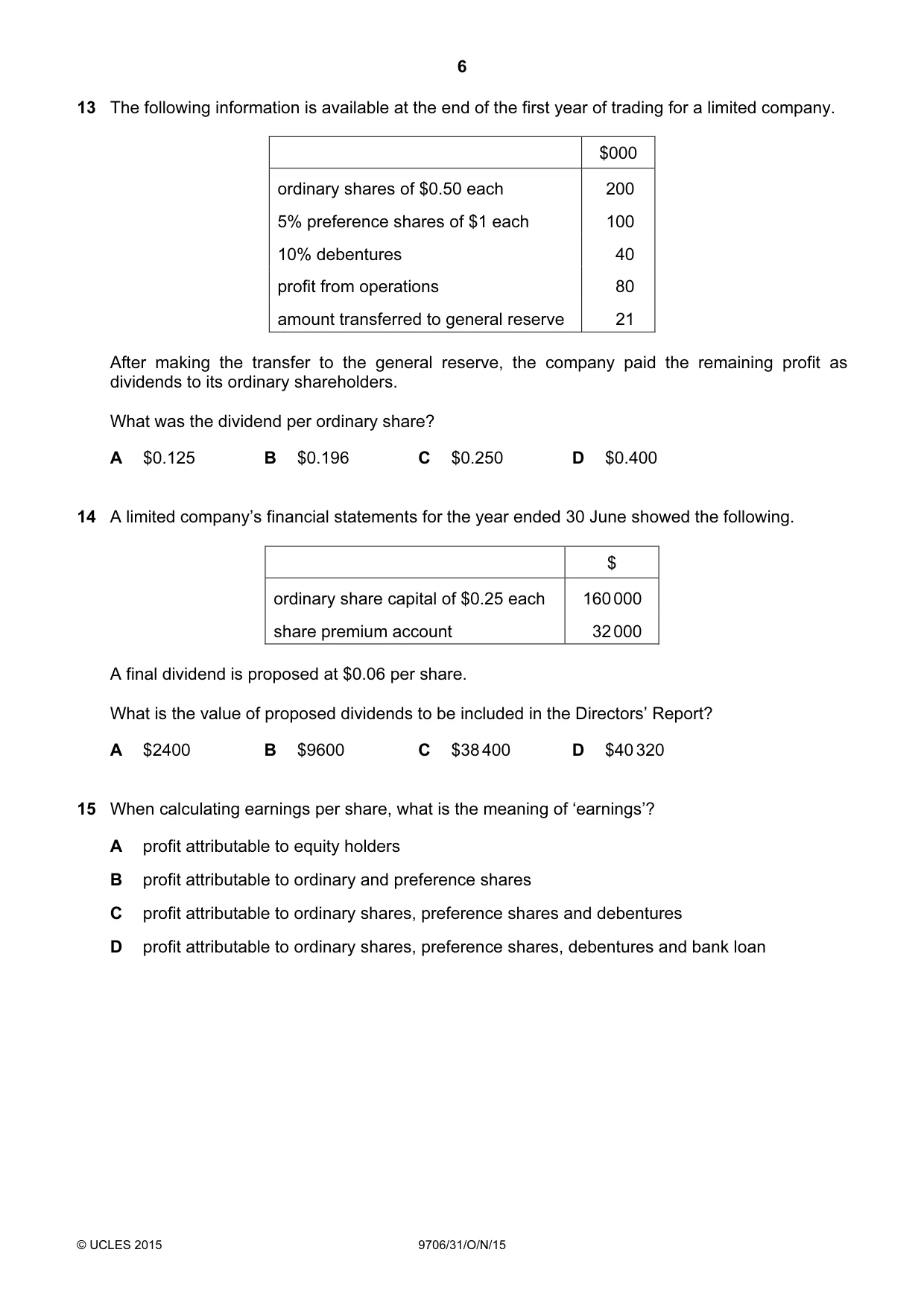
Q13 · The following information is available at the end of the first year of trading for a…
13 The following information is available at the end of the first year of trading for a limited company. $000 ordinary shares of $0.50 each 200 5% preference shares of $1 each 100 10% debentures 40 profit from operations 80 amount transferred to general reserve 21 After making the transfer to the general reserve, the company paid the remaining profit as dividends to its ordinary shareholders. What was the dividend per ordinary share? A $0.125 B $0.196 C $0.250 D $0.400
Mark scheme: A
Q14 · A limited company’s financial statements for the year ended 30 June showed the following
14 A limited company’s financial statements for the year ended 30 June showed the following. $ ordinary share capital of $0.25 each 160 000 share premium account 32 000 A final dividend is proposed at $0.06 per share. What is the value of proposed dividends to be included in the Directors’ Report? A $2400 B $9600 C $38 400 D $40 320
Mark scheme: C
Q15 · When calculating earnings per share, what is the meaning of ‘earnings’?
15 When calculating earnings per share, what is the meaning of ‘earnings’? A profit attributable to equity holders B profit attributable to ordinary and preference shares C profit attributable to ordinary shares, preference shares and debentures D profit attributable to ordinary shares, preference shares, debentures and bank loan
Mark scheme: A
More questions on Analysis and communication of accounting information
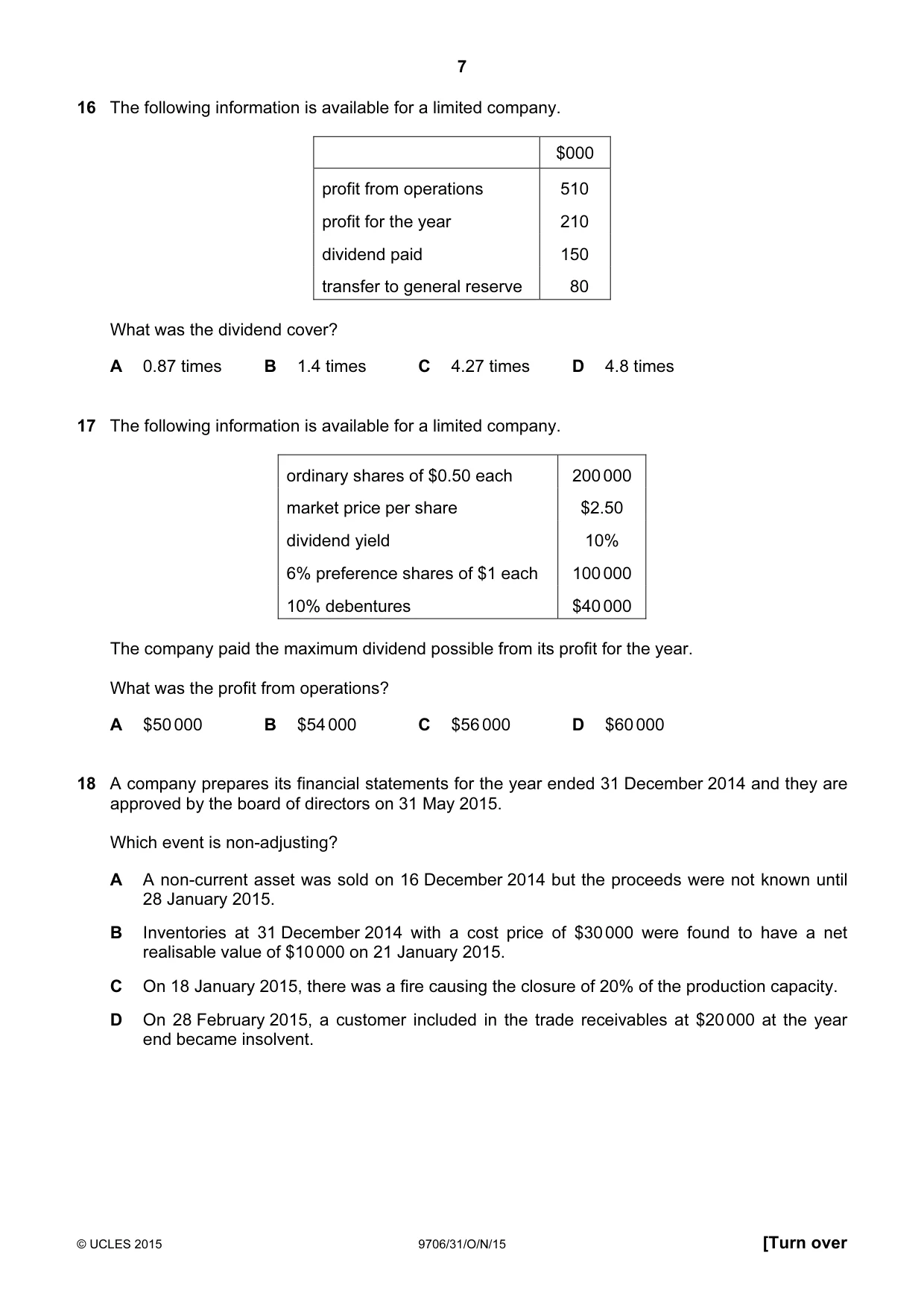
Q16 · The following information is available for a limited company
16 The following information is available for a limited company. $000 profit from operations 510 profit for the year 210 dividend paid 150 transfer to general reserve 80 What was the dividend cover? A 0.87 times B 1.4 times C 4.27 times D 4.8 times
Mark scheme: B
More questions on Analysis and communication of accounting information
Q17 · The following information is available for a limited company
17 The following information is available for a limited company. ordinary shares of $0.50 each 200 000 market price per share $2.50 dividend yield 10% 6% preference shares of $1 each 100 000 10% debentures $40 000 The company paid the maximum dividend possible from its profit for the year. What was the profit from operations? A $50 000 B $54 000 C $56 000 D $60 000
Mark scheme: D
More questions on Analysis and communication of accounting information
Q18 · A company prepares its financial statements for the year ended 31 December 2014 and they…
18 A company prepares its financial statements for the year ended 31 December 2014 and they are approved by the board of directors on 31 May 2015. Which event is non-adjusting? A A non-current asset was sold on 16 December 2014 but the proceeds were not known until 28 January 2015. B Inventories at 31 December 2014 with a cost price of $30 000 were found to have a net realisable value of $10 000 on 21 January 2015. C On 18 January 2015, there was a fire causing the closure of 20% of the production capacity. D On 28 February 2015, a customer included in the trade receivables at $20 000 at the year end became insolvent.
Mark scheme: C
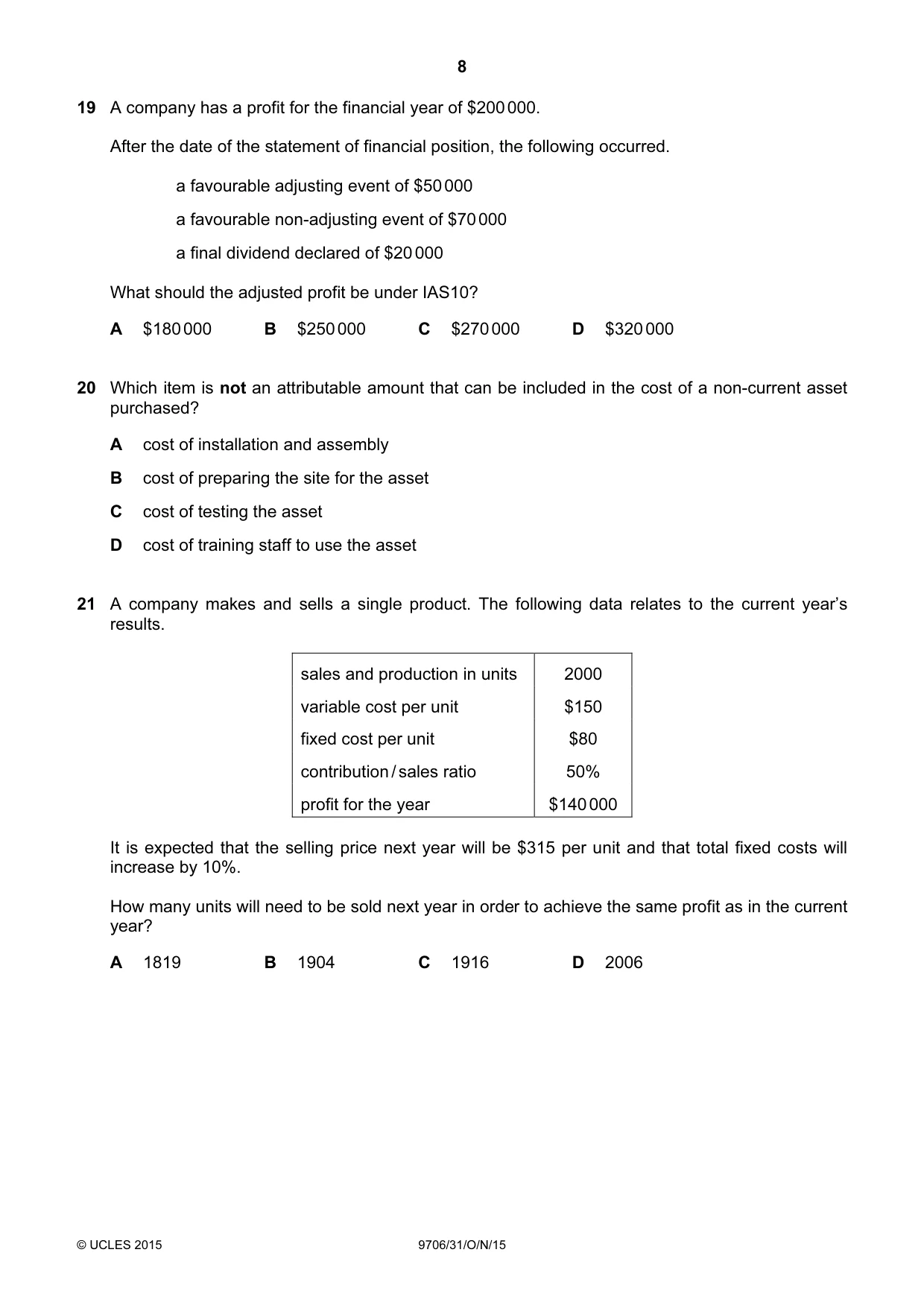
Q19 · A company has a profit for the financial year of $200 000
19 A company has a profit for the financial year of $200 000. After the date of the statement of financial position, the following occurred. a favourable adjusting event of $50 000 a favourable non-adjusting event of $70 000 a final dividend declared of $20 000 What should the adjusted profit be under IAS10? A $180 000 B $250 000 C $270 000 D $320 000
Mark scheme: B
Q20 · Which item is not an attributable amount that can be included in the cost of a…
20 Which item is not an attributable amount that can be included in the cost of a non-current asset purchased? A cost of installation and assembly B cost of preparing the site for the asset C cost of testing the asset D cost of training staff to use the asset
Mark scheme: D
Q21 · A company makes and sells a single product
21 A company makes and sells a single product. The following data relates to the current year’s results. sales and production in units 2000 variable cost per unit $150 fixed cost per unit $80 contribution / sales ratio 50% profit for the year $140 000 It is expected that the selling price next year will be $315 per unit and that total fixed costs will increase by 10%. How many units will need to be sold next year in order to achieve the same profit as in the current year? A 1819 B 1904 C 1916 D 2006
Mark scheme: C
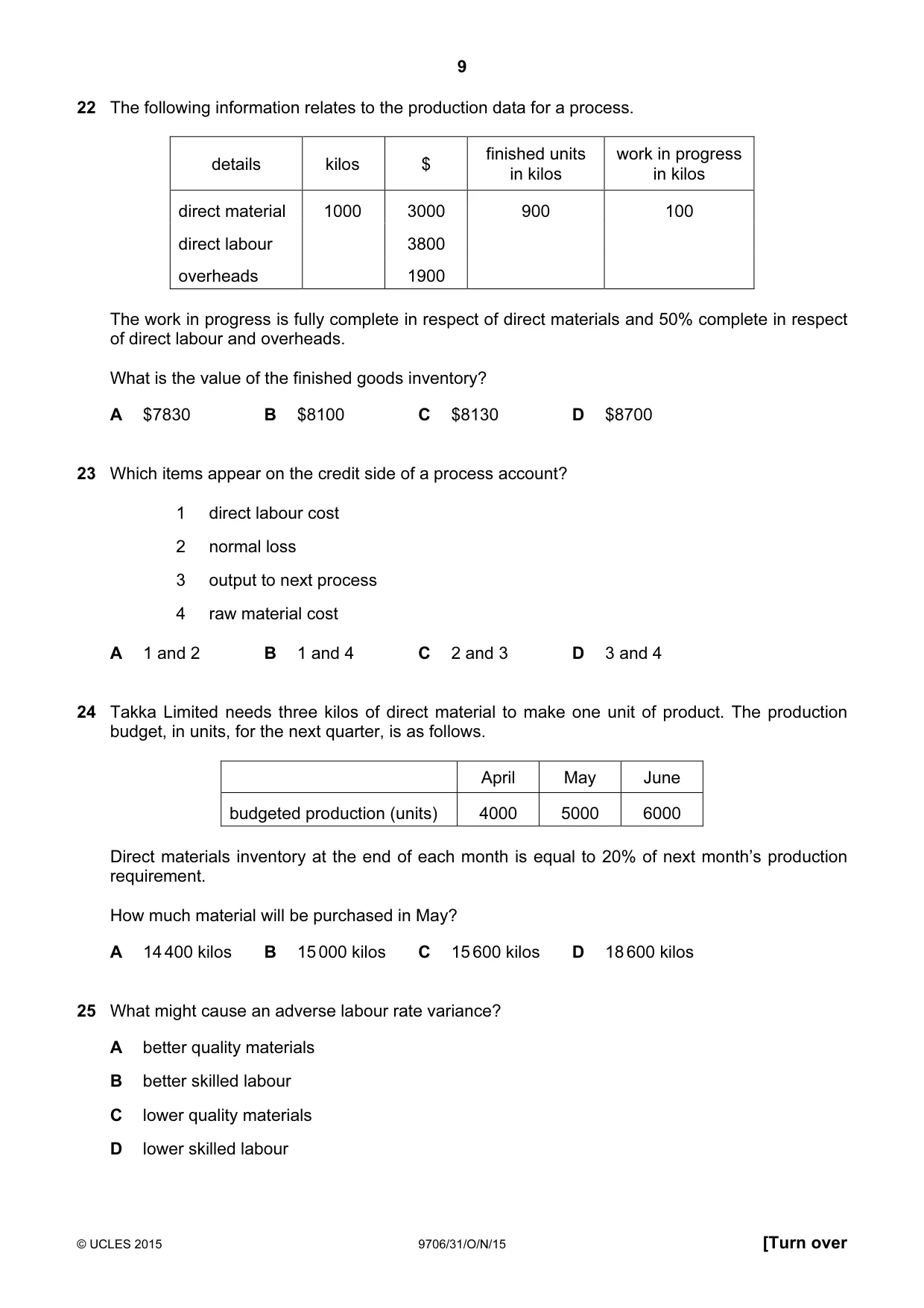
Q22 · The following information relates to the production data for a process
22 The following information relates to the production data for a process. finished units work in progress details kilos $ in kilos in kilos direct material 1000 3000 900 100 direct labour 3800 overheads 1900 The work in progress is fully complete in respect of direct materials and 50% complete in respect of direct labour and overheads. What is the value of the finished goods inventory? A $7830 B $8100 C $8130 D $8700
Mark scheme: B
Q23 · Which items appear on the credit side of a process account?
23 Which items appear on the credit side of a process account? 1 direct labour cost 2 normal loss 3 output to next process 4 raw material cost A 1 and 2 B 1 and 4 C 2 and 3 D 3 and 4
Mark scheme: C
Q24 · Takka Limited needs three kilos of direct material to make one unit of product
24 Takka Limited needs three kilos of direct material to make one unit of product. The production budget, in units, for the next quarter, is as follows. April May June budgeted production (units) 4000 5000 6000 Direct materials inventory at the end of each month is equal to 20% of next month’s production requirement. How much material will be purchased in May? A 14 400 kilos B 15 000 kilos C 15 600 kilos D 18 600 kilos
Mark scheme: C
Q25 · What might cause an adverse labour rate variance?
25 What might cause an adverse labour rate variance? A better quality materials B better skilled labour C lower quality materials D lower skilled labour
Mark scheme: B
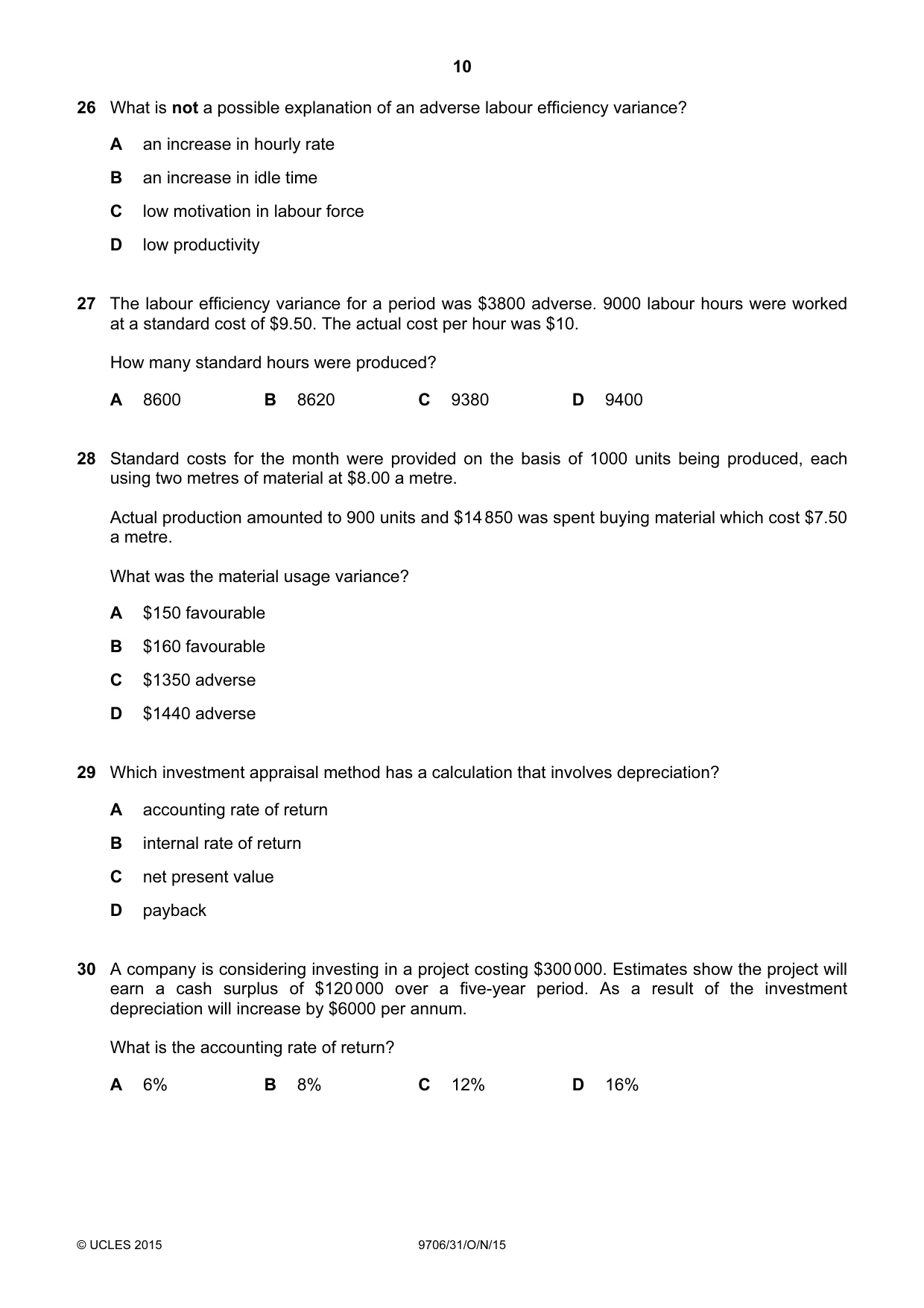
Q26 · What is not a possible explanation of an adverse labour efficiency variance?
26 What is not a possible explanation of an adverse labour efficiency variance? A an increase in hourly rate B an increase in idle time C low motivation in labour force D low productivity
Mark scheme: A
Q27 · The labour efficiency variance for a period was $3800 adverse
27 The labour efficiency variance for a period was $3800 adverse. 9000 labour hours were worked at a standard cost of $9.50. The actual cost per hour was $10. How many standard hours were produced? A 8600 B 8620 C 9380 D 9400
Mark scheme: A
Q28 · Standard costs for the month were provided on the basis of 1000 units being produced…
28 Standard costs for the month were provided on the basis of 1000 units being produced, each using two metres of material at $8.00 a metre. Actual production amounted to 900 units and $14 850 was spent buying material which cost $7.50 a metre. What was the material usage variance? A $150 favourable B $160 favourable C $1350 adverse D $1440 adverse
Mark scheme: D
Q29 · Which investment appraisal method has a calculation that involves depreciation?
29 Which investment appraisal method has a calculation that involves depreciation? A accounting rate of return B internal rate of return C net present value D payback
Mark scheme: A
Q30 · A company is considering investing in a project costing $300 000
30 A company is considering investing in a project costing $300 000. Estimates show the project will earn a cash surplus of $120 000 over a five-year period. As a result of the investment depreciation will increase by $6000 per annum. What is the accounting rate of return? A 6% B 8% C 12% D 16%
Mark scheme: C
What was in this paper
The subtopics covered by these 30 questions, and how many questions each got. Open one in a new tab to see every Cambridge question on it.
9Analysis and communication of accounting information4Standard costing4Accounting for non-current assets2Budgeting and budgetary control2Investment appraisal2Regulatory and ethical considerations2Traditional costing methods2Business acquisition and merger1Reconciliation and verification1Types of business entity1What you needed in this session
Cambridge’s own grade thresholds for 2015 Oct/Nov, Paper 3 · Variant 1. A higher threshold means an easier paper — the bar moves with how the cohort did.