Questions as text
Q1 · The gas from a leaking cylinder is tested by using damp litmus paper 0654/11 May/June 2007
21 The gas from a leaking cylinder is tested by using damp litmus paper. The damp litmus paper is bleached. What is the gas? A ammonia B chlorine C hydrogen D oxygen
1 marks
Answer: B
This question in 0654/11 May/June 2007
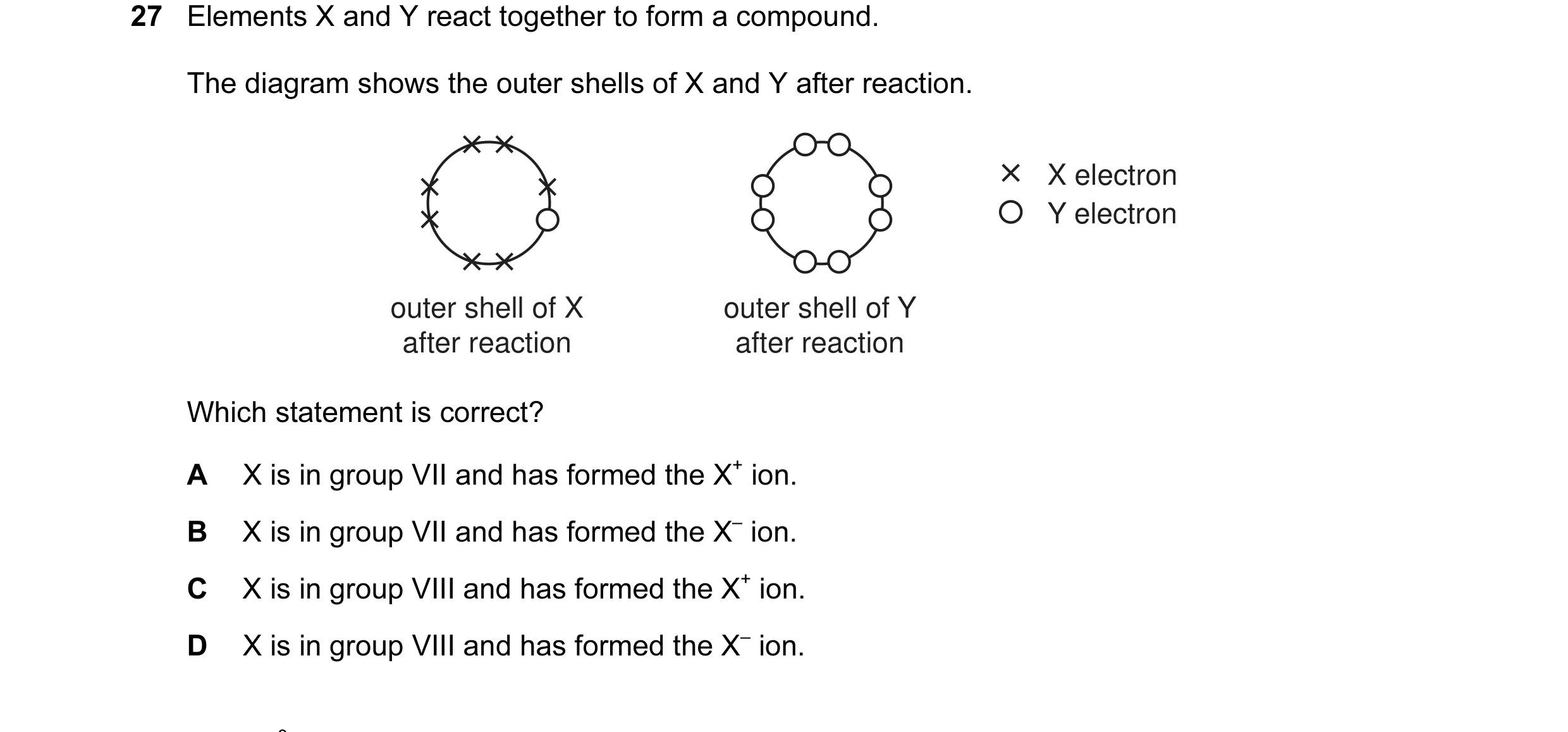
Q2 · Elements X and Y react together to form a compound 0654/11 Oct/Nov 2010
27 Elements X and Y react together to form a compound. The diagram shows the outer shells of X and Y after reaction. X electron Y electron outer shell of X outer shell of Y after reaction after reaction Which statement is correct? A X is in group VII and has formed the X+ ion. B X is in group VII and has formed the X– ion. C X is in group VIII and has formed the X+ ion. D X is in group VIII and has formed the X– ion.
1 marks
Answer: B
This question in 0654/11 Oct/Nov 2010
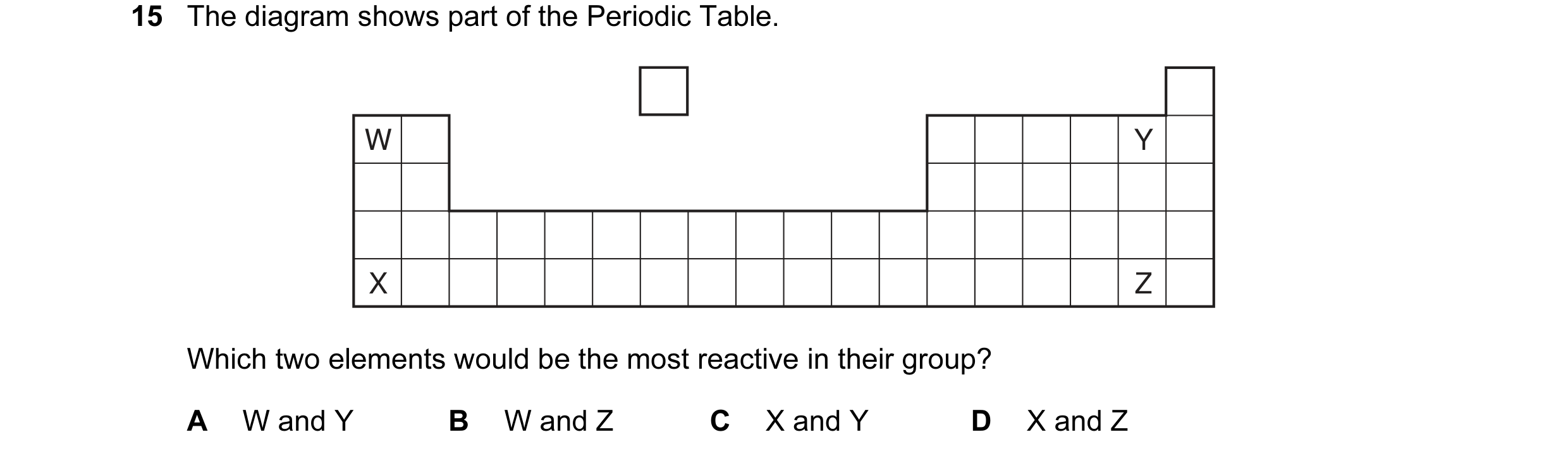
Q3 · The diagram shows part of the Periodic Table 0654/11 Oct/Nov 2011
15 The diagram shows part of the Periodic Table. W Y X Z Which two elements would be the most reactive in their group? A W and Y B W and Z C X and Y D X and Z
1 marks
Answer: C
This question in 0654/11 Oct/Nov 2011
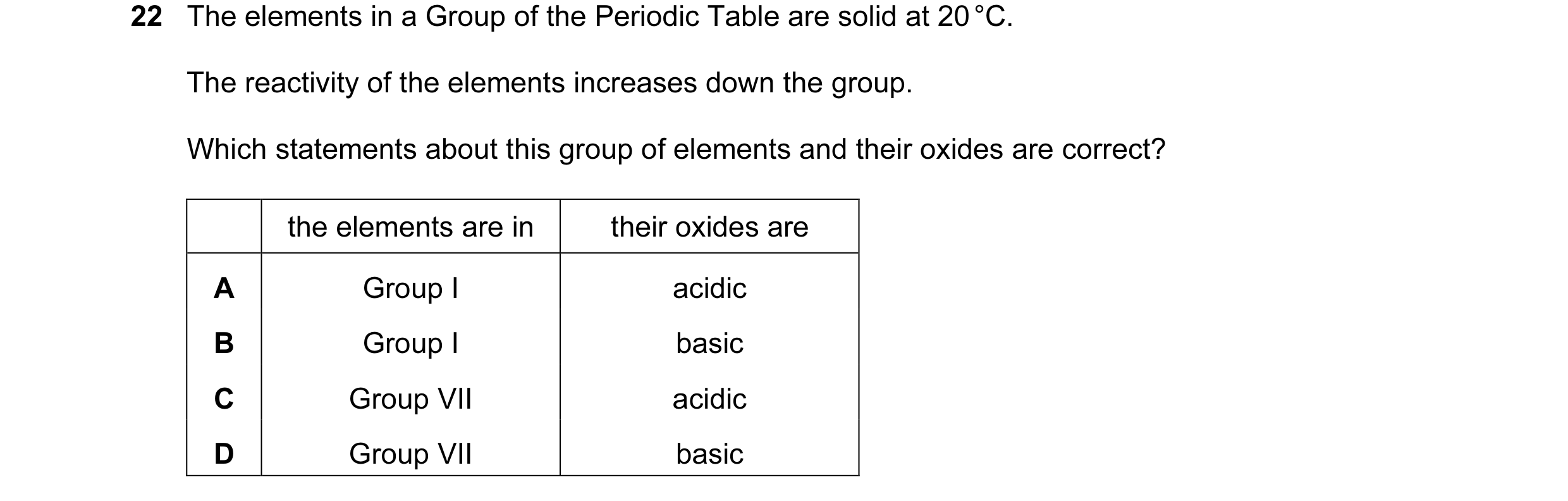
Q4 · The elements in a Group of the Periodic Table are solid at 20 °C 0654/12 Oct/Nov 2013
22 The elements in a Group of the Periodic Table are solid at 20 °C. The reactivity of the elements increases down the group. Which statements about this group of elements and their oxides are correct? the elements are in their oxides are A Group I acidic B Group I basic C Group VII acidic D Group VII basic
1 marks
Answer: B
This question in 0654/12 Oct/Nov 2013
Q5 · The diagram shows the energy change for the reactions between hydrogen and the halogens 0654/13 Oct/Nov 2013
16 The diagram shows the energy change for the reactions between hydrogen and the halogens. The size of the energy change is different for each halogen. H2 + X2 energy change energy 2HX reaction The reaction is H2 + X2 → 2HX The diagram shows that the reactions are ……1…… . The most reactive halogen is ……2…… and therefore the energy change for this element is ……3…… . Which words complete gaps 1, 2 and 3? 1 2 3 A endothermic fluorine least B endothermic iodine least C exothermic fluorine greatest D exothermic iodine greatest
1 marks
Answer: C
This question in 0654/13 Oct/Nov 2013
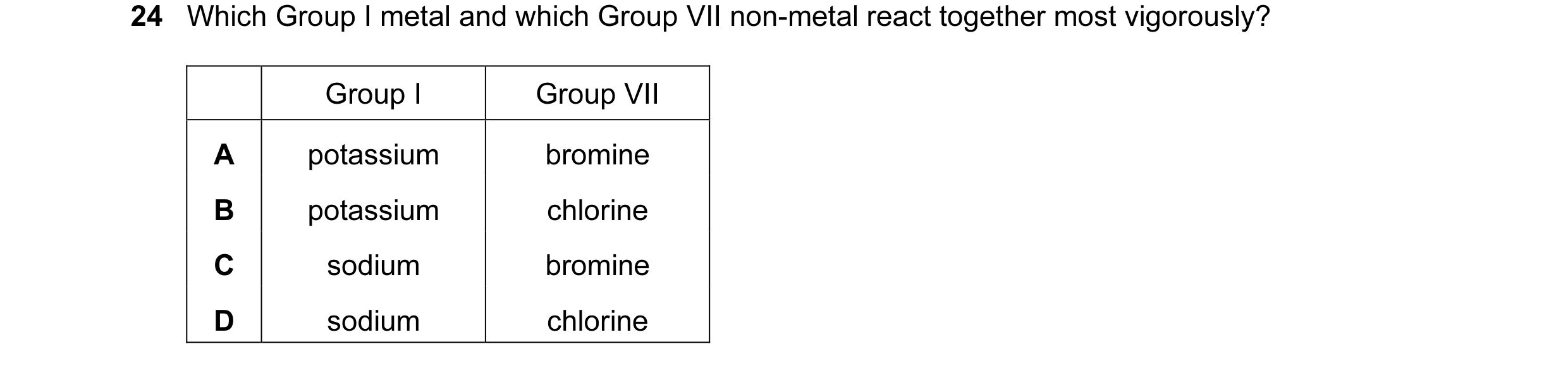
Q6 · Which Group I metal and which Group VII non-metal react together most vigorously? 0654/11 May/June 2014
24 Which Group I metal and which Group VII non-metal react together most vigorously? Group I Group VII A potassium bromine B potassium chlorine C sodium bromine D sodium chlorine
1 marks
Answer: B
This question in 0654/11 May/June 2014
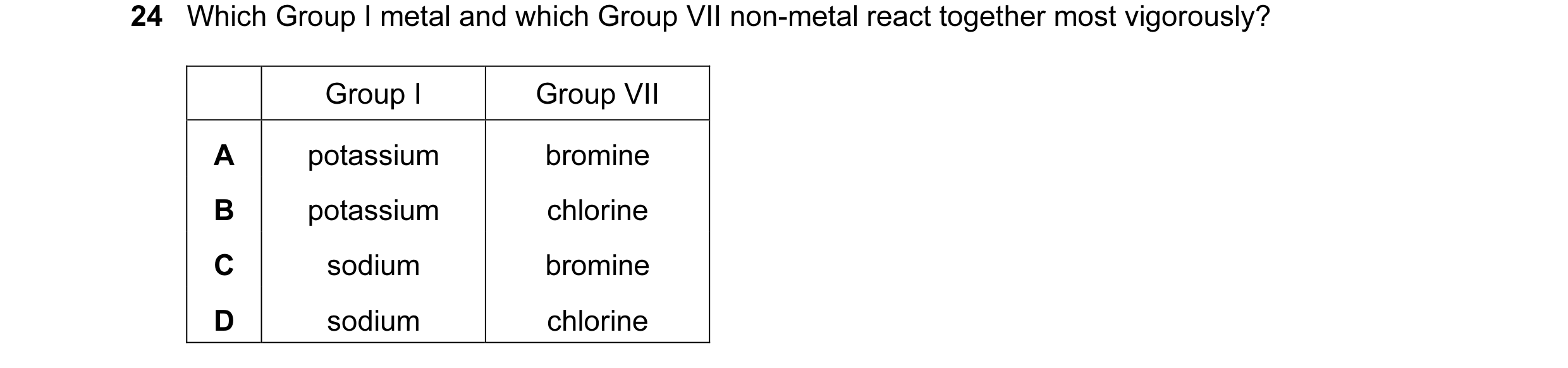
Q7 · Which Group I metal and which Group VII non-metal react together most vigorously? 0654/12 May/June 2014
24 Which Group I metal and which Group VII non-metal react together most vigorously? Group I Group VII A potassium bromine B potassium chlorine C sodium bromine D sodium chlorine
1 marks
Answer: B
This question in 0654/12 May/June 2014
Q8 · Which Group I metal and which Group VII non-metal react together most vigorously? 0654/13 May/June 2014
25 Which Group I metal and which Group VII non-metal react together most vigorously? Group I Group VII A potassium bromine B potassium chlorine C sodium bromine D sodium chlorine
1 marks
Answer: B
This question in 0654/13 May/June 2014
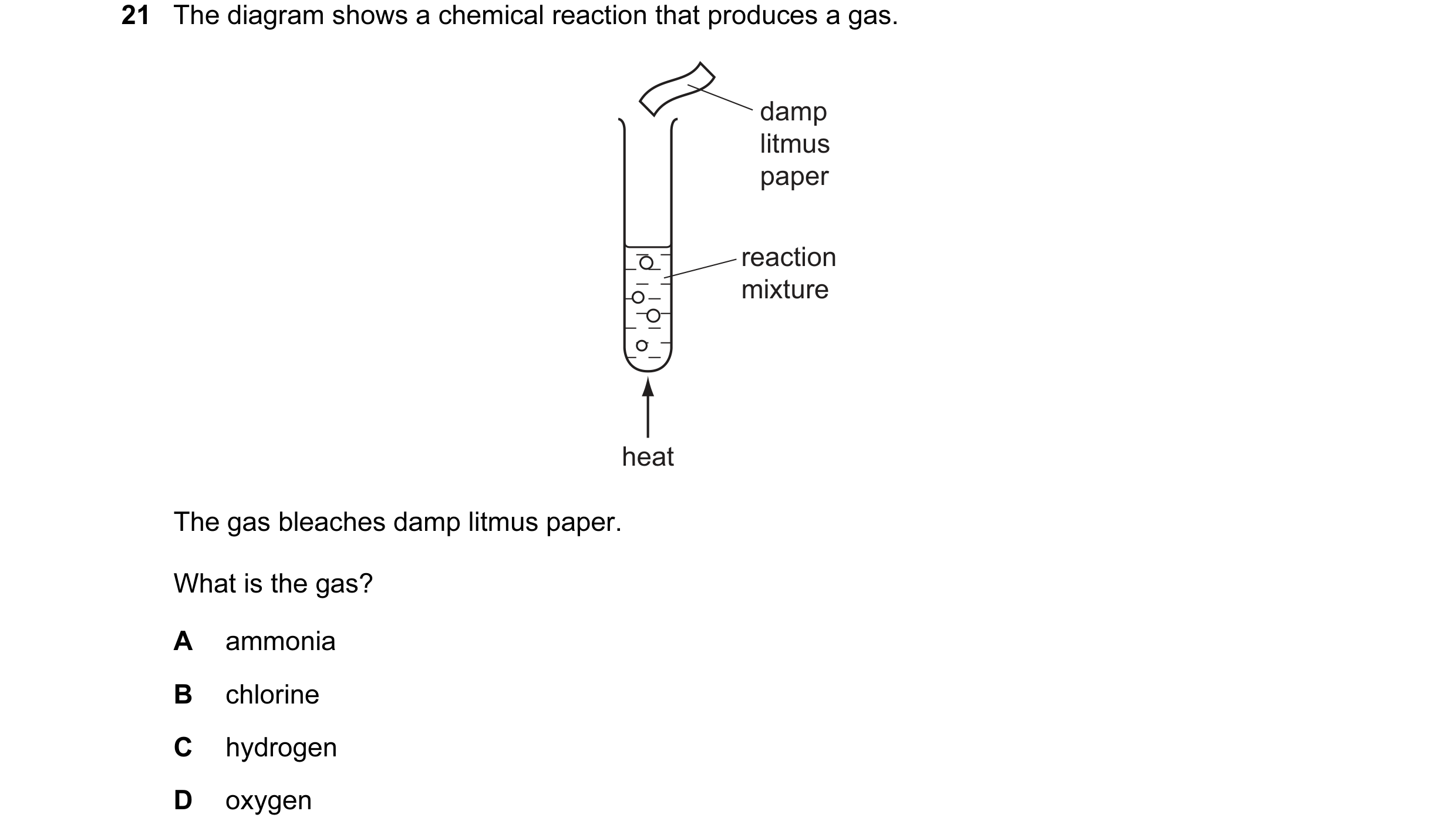
Q9 · The diagram shows a chemical reaction that produces a gas 0654/11 May/June 2015
21 The diagram shows a chemical reaction that produces a gas. damp litmus paper reaction mixture heat The gas bleaches damp litmus paper. What is the gas? A ammonia B chlorine C hydrogen D oxygen
1 marks
Answer: B
This question in 0654/11 May/June 2015
Q10 · Which statement about the elements in Group VII of the Periodic Table is correct? 0654/11 May/June 2015
22 Which statement about the elements in Group VII of the Periodic Table is correct? A Chlorine displaces bromine from potassium bromide. B The colour of the elements becomes darker up the group. C The melting point of the elements decreases down the group. D The reactivity of the elements increases down the group.
1 marks
Answer: A
This question in 0654/11 May/June 2015
Q11 · The diagram shows the electrolysis of a compound 0654/11 May/June 2016
17 The diagram shows the electrolysis of a compound. switch + – P Q electrolyte When the switch is closed, the solution around electrode P turns orange because a halogen is formed. The positive electrode P is called the ……1……, and the halogen is ……2…… . Which words complete gaps 1 and 2? 1 2 A anode bromine B anode chlorine C cathode bromine D cathode chlorine
1 marks
Answer: A
This question in 0654/11 May/June 2016
Q12 · A green halogen gas is bubbled through a potassium halide solution 0654/11 May/June 2016
22 A green halogen gas is bubbled through a potassium halide solution. The potassium halide solution turns brown–black. What is the halogen and what is the potassium halide solution? halogen potassium halide solution A bromine potassium chloride B bromine potassium iodide C chlorine potassium bromide D chlorine potassium iodide
1 marks
Answer: D
This question in 0654/11 May/June 2016
Q13 · The diagram shows the electrolysis of a compound 0654/13 May/June 2016
17 The diagram shows the electrolysis of a compound. switch + – P Q electrolyte When the switch is closed, the solution around electrode P turns orange because a halogen is formed. The positive electrode P is called the ……1……, and the halogen is ……2…… . Which words complete gaps 1 and 2? 1 2 A anode bromine B anode chlorine C cathode bromine D cathode chlorine
1 marks
Answer: A
This question in 0654/13 May/June 2016
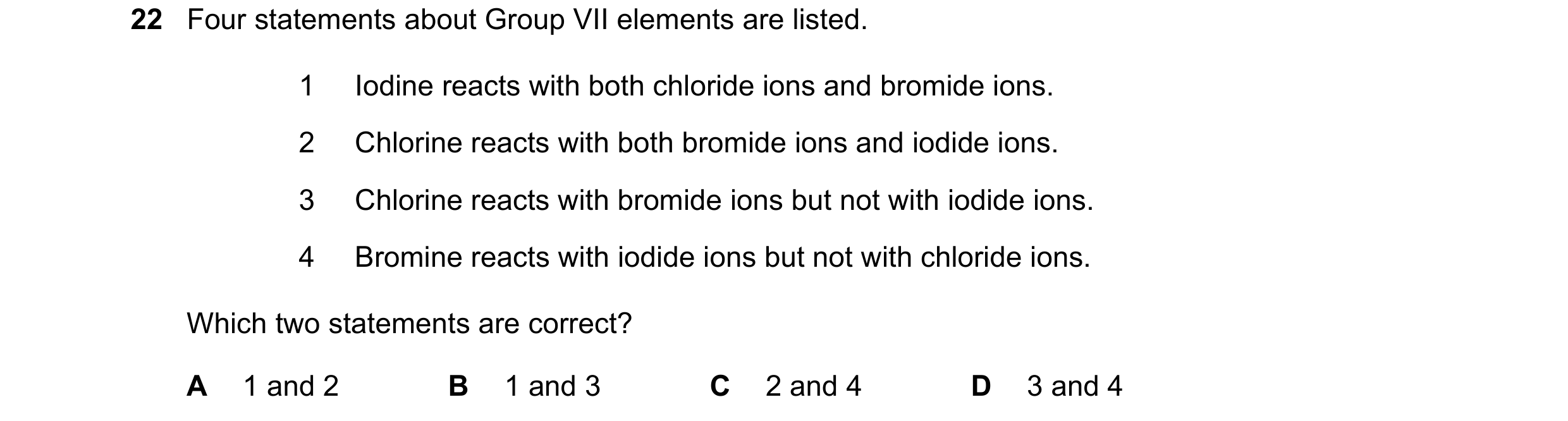
Q14 · Four statements about Group VII elements are listed 0654/13 May/June 2017
22 Four statements about Group VII elements are listed. 1 Iodine reacts with both chloride ions and bromide ions. 2 Chlorine reacts with both bromide ions and iodide ions. 3 Chlorine reacts with bromide ions but not with iodide ions. 4 Bromine reacts with iodide ions but not with chloride ions. Which two statements are correct? A 1 and 2 B 1 and 3 C 2 and 4 D 3 and 4
1 marks
Answer: C
This question in 0654/13 May/June 2017
Q15 · The melting points of three elements in Group I and of three elements in Group VII are… 0654/13 Oct/Nov 2017
24 The melting points of three elements in Group I and of three elements in Group VII are shown. element group melting point (°C) lithium I 179 sodium I 98 potassium I 64 chlorine VII –101 bromine VII –7 iodine VII 114 What is the trend in reactivity in each group as melting point increases? change in Group I change in Group VII reactivity reactivity A less reactive less reactive B less reactive more reactive C more reactive less reactive D more reactive more reactive
1 marks
Answer: A
This question in 0654/13 Oct/Nov 2017
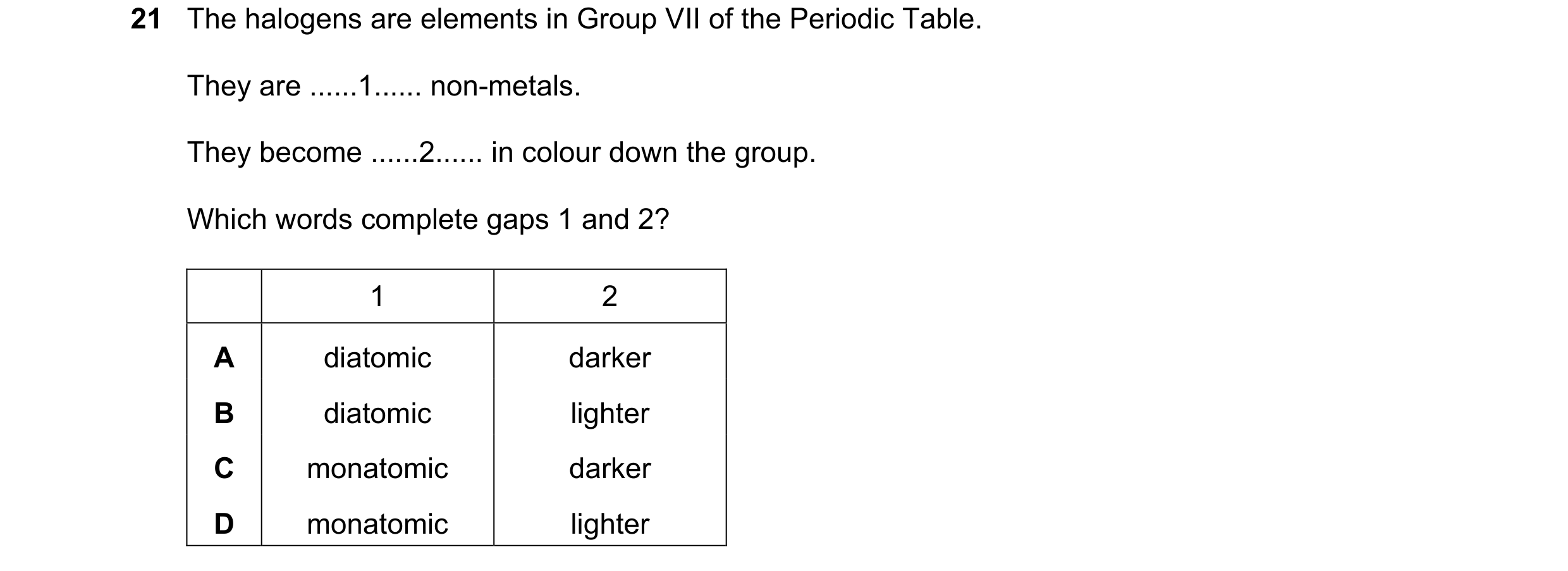
Q16 · The halogens are elements in Group VII of the Periodic Table 0654/13 Oct/Nov 2019
21 The halogens are elements in Group VII of the Periodic Table. They are … 1 … non-metals. They become … 2 … in colour down the group. Which words complete gaps 1 and 2? 1 2 A diatomic darker B diatomic lighter C monatomic darker D monatomic lighter
1 marks
Answer: A
This question in 0654/13 Oct/Nov 2019
Q17 · Which statement about the halogens is not correct? 0654/12 May/June 2020
22 Which statement about the halogens is not correct? A They are members of Group VII of the Periodic Table. B They are non-metals. C They become darker in colour down the group. D They exist as monoatomic gases.
1 marks
Answer: D
This question in 0654/12 May/June 2020
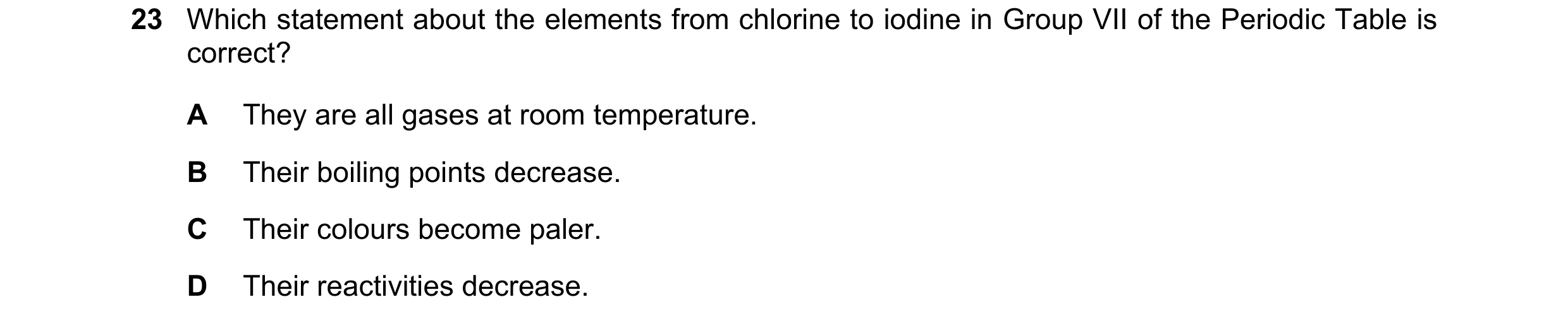
Q18 · Which statement about the elements from chlorine to iodine in Group VII of the Periodic… 0654/13 Oct/Nov 2020
23 Which statement about the elements from chlorine to iodine in Group VII of the Periodic Table is correct? A They are all gases at room temperature. B Their boiling points decrease. C Their colours become paler. D Their reactivities decrease.
1 marks
Answer: D
This question in 0654/13 Oct/Nov 2020
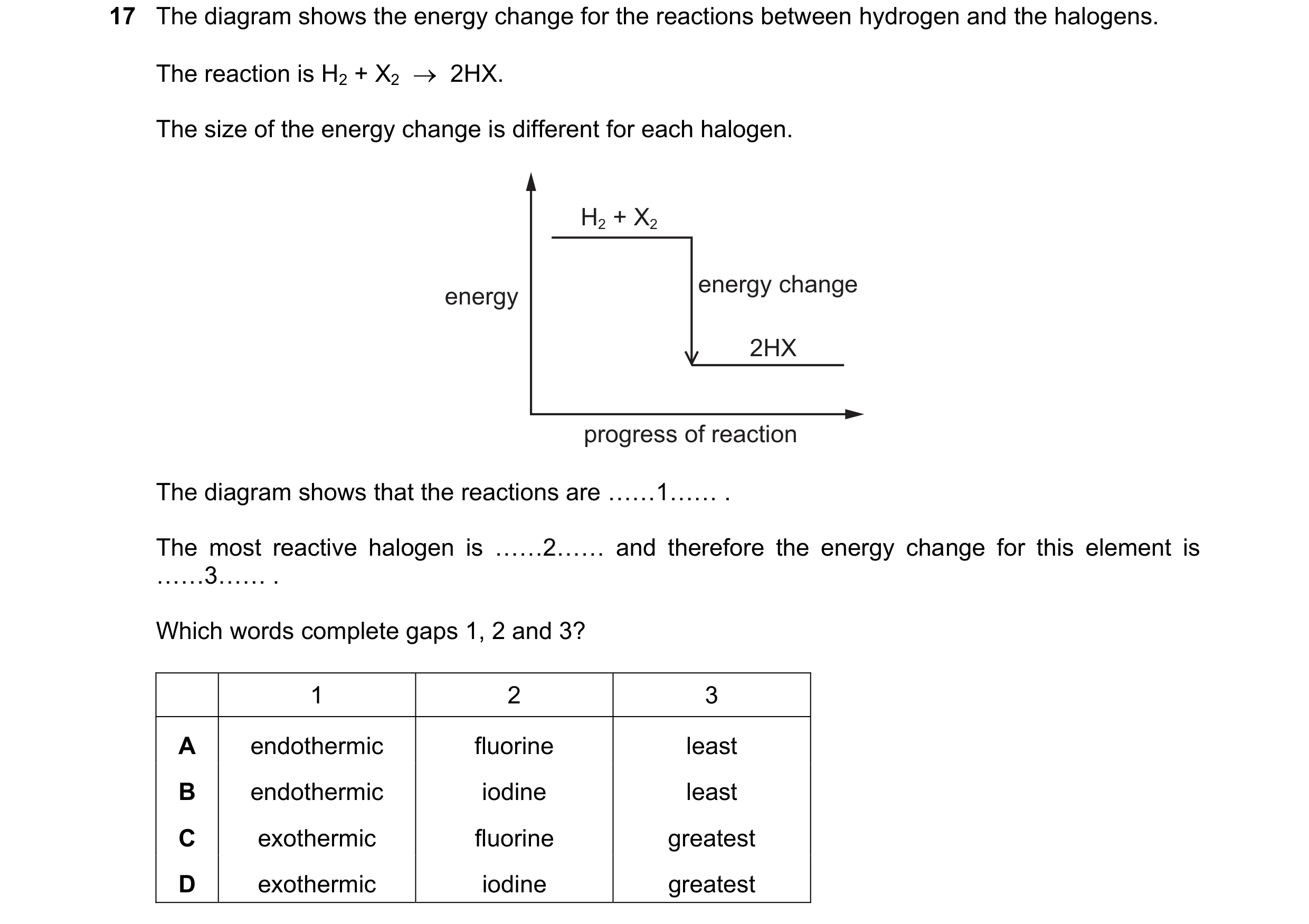
Q19 · The diagram shows the energy change for the reactions between hydrogen and the halogens 0654/12 Feb/March 2021
17 The diagram shows the energy change for the reactions between hydrogen and the halogens. The reaction is H2 + X2 2HX. The size of the energy change is different for each halogen. H2 + X2 energy change energy 2HX progress of reaction The diagram shows that the reactions are ……1…… . The most reactive halogen is ……2…… and therefore the energy change for this element is ……3…… . Which words complete gaps 1, 2 and 3? 1 2 3 A endothermic fluorine least B endothermic iodine least C exothermic fluorine greatest D exothermic iodine greatest
1 marks
Answer: C
This question in 0654/12 Feb/March 2021
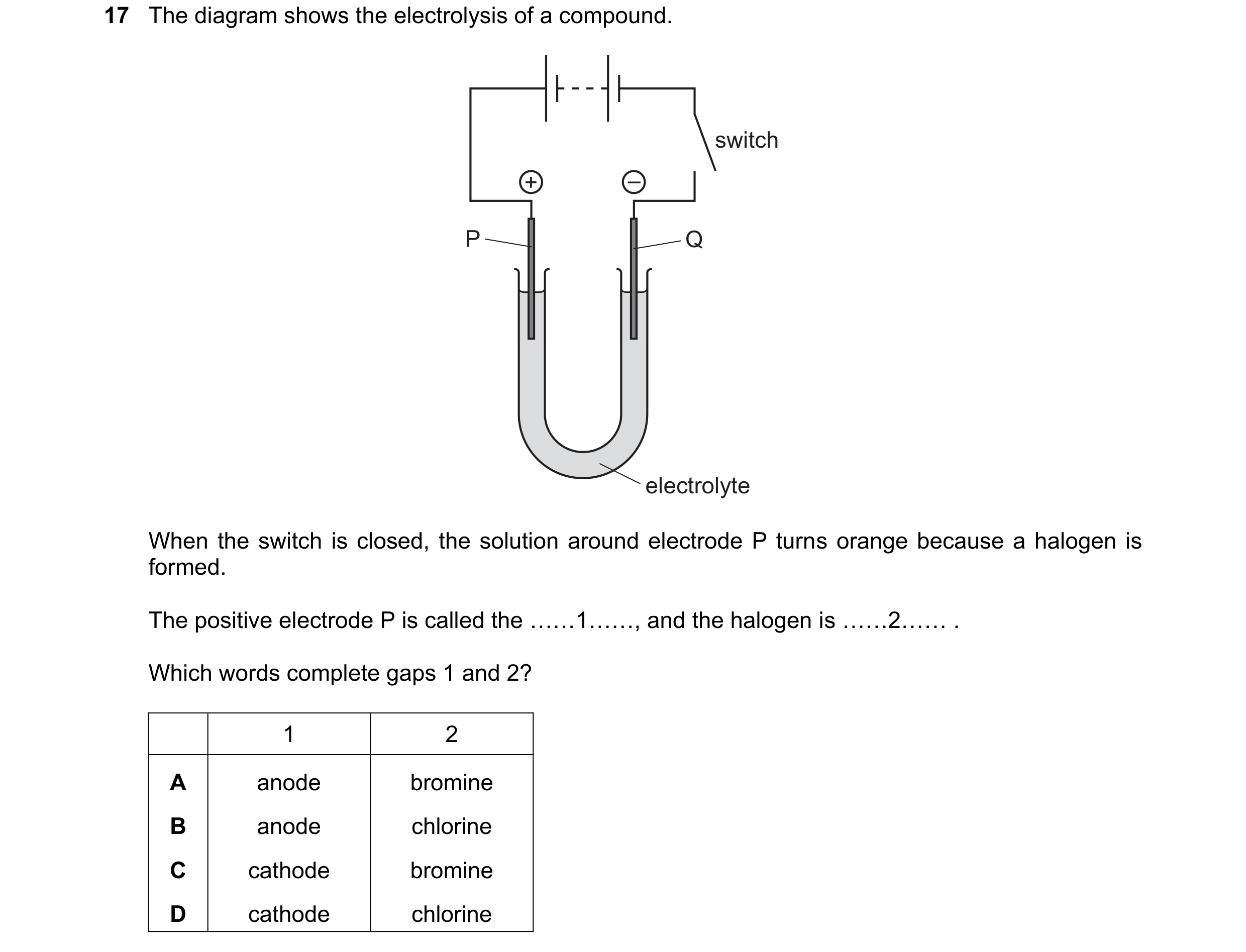
Q20 · The diagram shows the electrolysis of a compound 0654/11 Oct/Nov 2021
17 The diagram shows the electrolysis of a compound. switch + – P Q electrolyte When the switch is closed, the solution around electrode P turns orange because a halogen is formed. The positive electrode P is called the ……1……, and the halogen is ……2…… . Which words complete gaps 1 and 2? 1 2 A anode bromine B anode chlorine C cathode bromine D cathode chlorine
1 marks
Answer: A
This question in 0654/11 Oct/Nov 2021
Q21 · The diagram shows the electrolysis of a compound 0654/13 Oct/Nov 2021
17 The diagram shows the electrolysis of a compound. switch + – P Q electrolyte When the switch is closed, the solution around electrode P turns orange because a halogen is formed. The positive electrode P is called the ……1……, and the halogen is ……2…… . Which words complete gaps 1 and 2? 1 2 A anode bromine B anode chlorine C cathode bromine D cathode chlorine
1 marks
Answer: A
This question in 0654/13 Oct/Nov 2021
Q22 · A gas turns damp litmus paper white 0654/13 Oct/Nov 2021
20 A gas turns damp litmus paper white. What is the gas? A carbon dioxide B chlorine C hydrogen chloride D sulfur dioxide
1 marks
Answer: B
This question in 0654/13 Oct/Nov 2021
Q23 · Which statement about the elements in Group I and in Group VII of the Periodic Table is… 0654/13 Oct/Nov 2021
21 Which statement about the elements in Group I and in Group VII of the Periodic Table is correct? A Chlorine has a darker colour than iodine. B Each molecule of a halogen contains one atom. C Potassium reacts with cold water more vigorously than lithium. D The melting point of lithium is lower than the melting point of sodium.
1 marks
Answer: C
This question in 0654/13 Oct/Nov 2021
Q24 · Which statement about the halogens is not correct? 0654/11 Oct/Nov 2022
21 Which statement about the halogens is not correct? A Iodine has a darker colour than chlorine. B They all exist as diatomic molecules. C They are all gases at room temperature. D They are all non-metals.
1 marks
Answer: C
This question in 0654/11 Oct/Nov 2022
Q25 · Which statements about the elements in Group VII of the Periodic Table are correct? 0654/12 Oct/Nov 2022
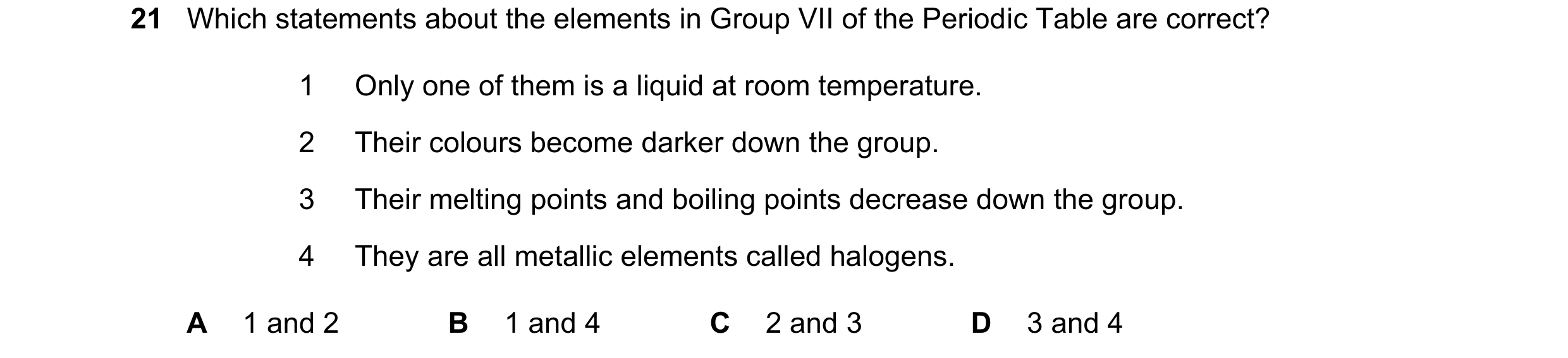
21 Which statements about the elements in Group VII of the Periodic Table are correct? 1 Only one of them is a liquid at room temperature. 2 Their colours become darker down the group. 3 Their melting points and boiling points decrease down the group. 4 They are all metallic elements called halogens. A 1 and 2 B 1 and 4 C 2 and 3 D 3 and 4
1 marks
Answer: A
This question in 0654/12 Oct/Nov 2022
Q26 · Which element is used in the manufacture of sulfuric acid? 0654/13 May/June 2023
24 Which element is used in the manufacture of sulfuric acid? A carbon B hydrogen C nitrogen D sulfur
1 marks
Answer: D
This question in 0654/13 May/June 2023
Q27 · Which statements about the halogens are correct? 0654/12 Oct/Nov 2023
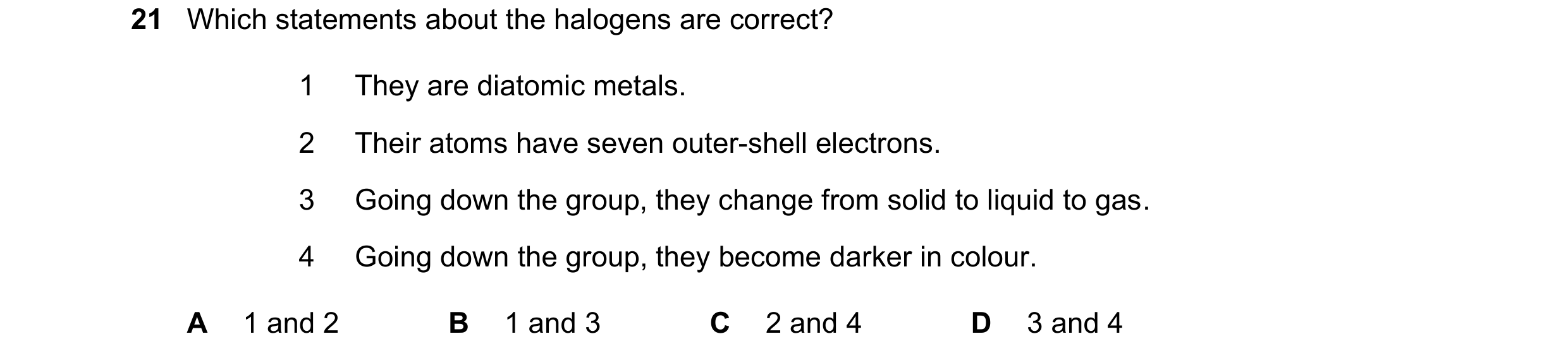
21 Which statements about the halogens are correct? 1 They are diatomic metals. 2 Their atoms have seven outer-shell electrons. 3 Going down the group, they change from solid to liquid to gas. 4 Going down the group, they become darker in colour. A 1 and 2 B 1 and 3 C 2 and 4 D 3 and 4
1 marks
Answer: C
This question in 0654/12 Oct/Nov 2023
Q28 · A piece of damp blue litmus paper is put in a test-tube of a gas 0654/13 Oct/Nov 2023
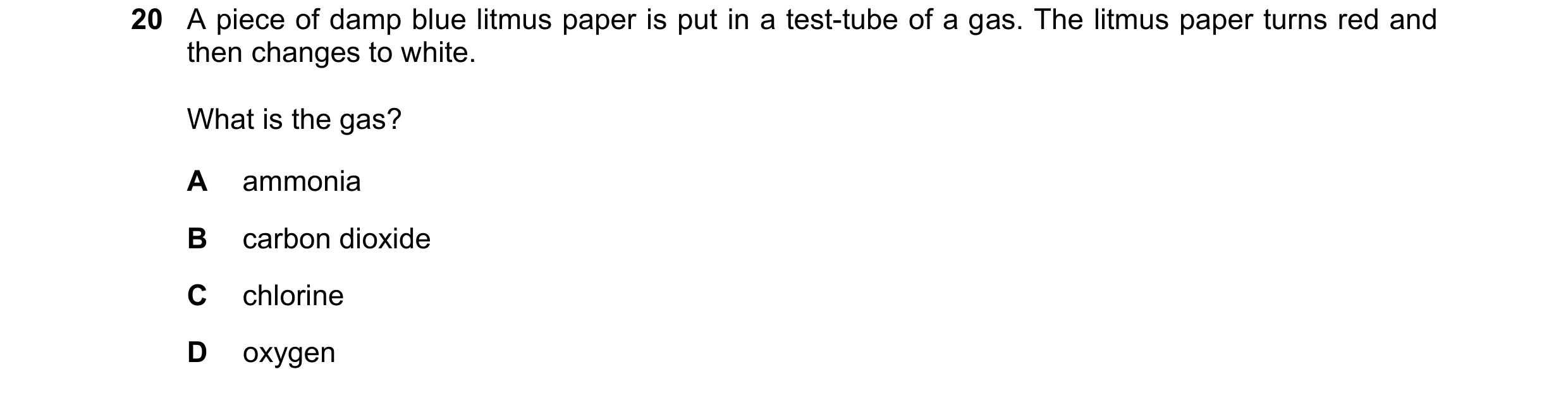
20 A piece of damp blue litmus paper is put in a test-tube of a gas. The litmus paper turns red and then changes to white. What is the gas? A ammonia B carbon dioxide C chlorine D oxygen
1 marks
Answer: C
This question in 0654/13 Oct/Nov 2023
Q29 · The halogens are elements in Group VII of the Periodic Table 0654/12 Feb/March 2024
22 The halogens are elements in Group VII of the Periodic Table. They are … 1 … non-metals. They become … 2 … in colour down the group. Which words complete gaps 1 and 2? 1 2 A diatomic darker B diatomic lighter C monatomic darker D monatomic lighter
1 marks
Answer: A
This question in 0654/12 Feb/March 2024
Q30 · Which statement about the halogens is correct? 0654/12 Oct/Nov 2024
22 Which statement about the halogens is correct? A They become lighter in colour down the group. B They are all gases at room temperature. C They are members of the same period of the Periodic Table. D They exist as diatomic molecules.
1 marks
Answer: D
This question in 0654/12 Oct/Nov 2024
Q31 · Which statement about the halogens is correct? 0654/13 Oct/Nov 2024
22 Which statement about the halogens is correct? A They become lighter in colour down the group. B They are all gases at room temperature. C They are members of the same period of the Periodic Table. D They exist as diatomic molecules.
1 marks
Answer: D
This question in 0654/13 Oct/Nov 2024
 1 / 11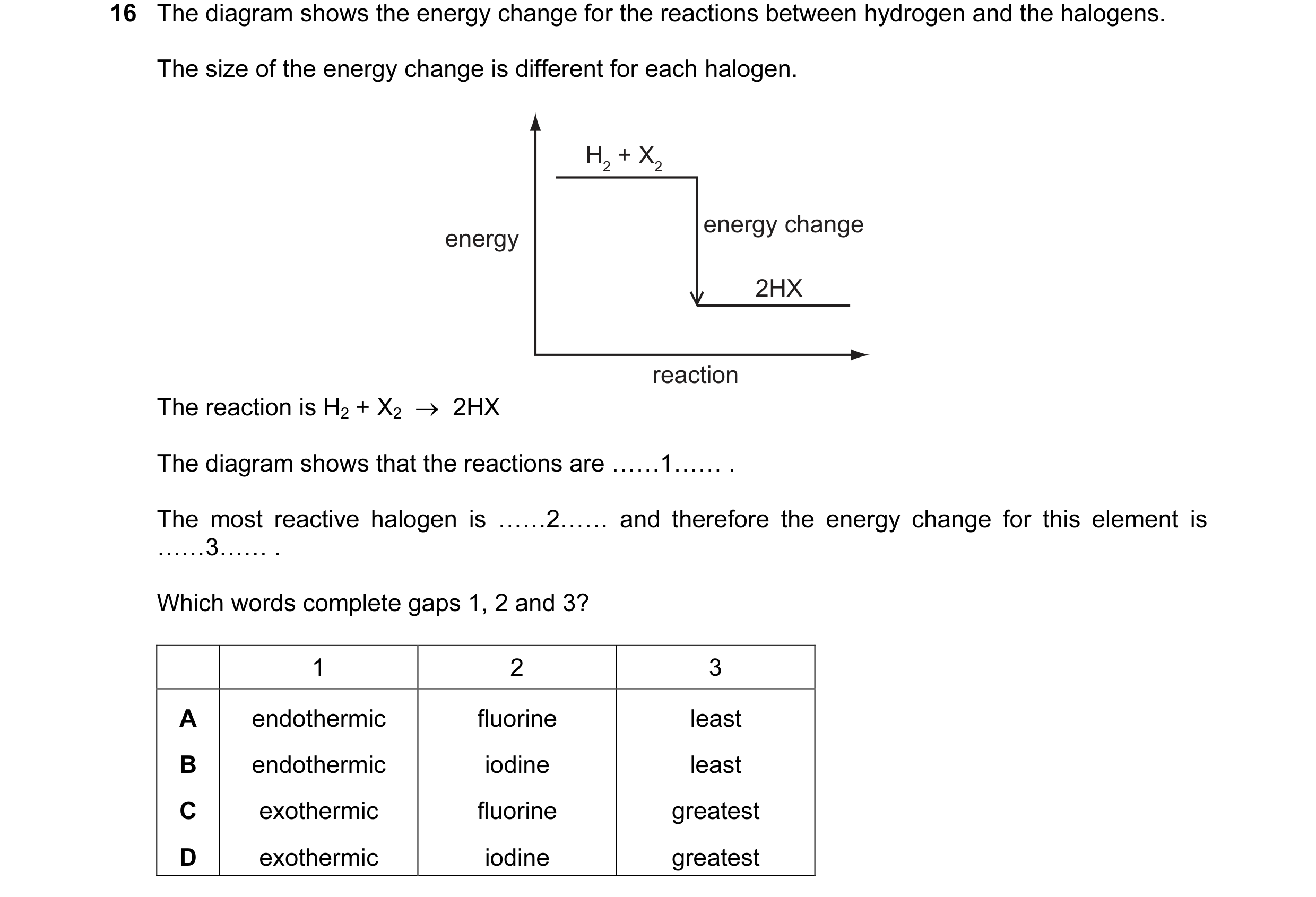
 2 / 11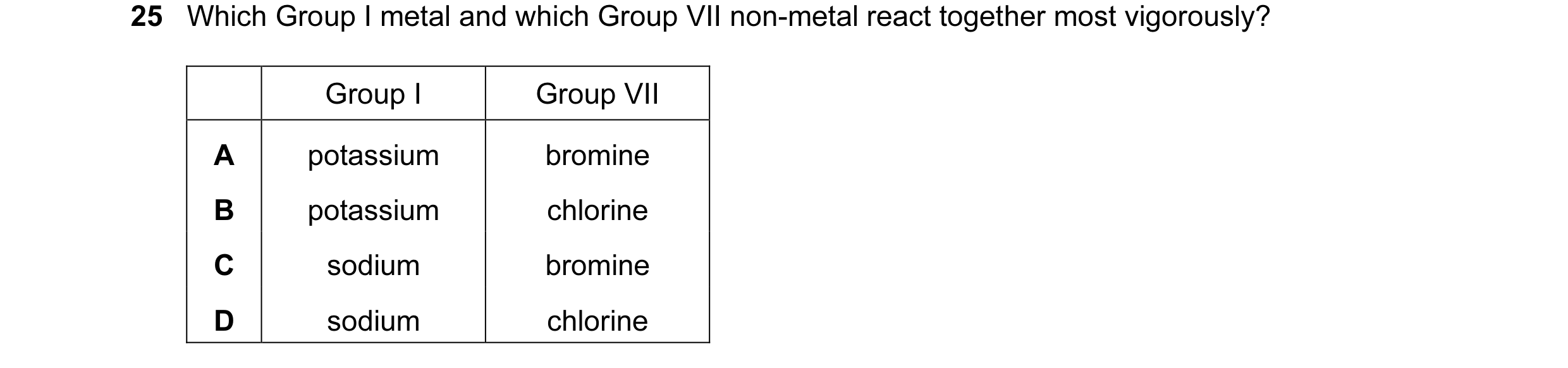
 3 / 11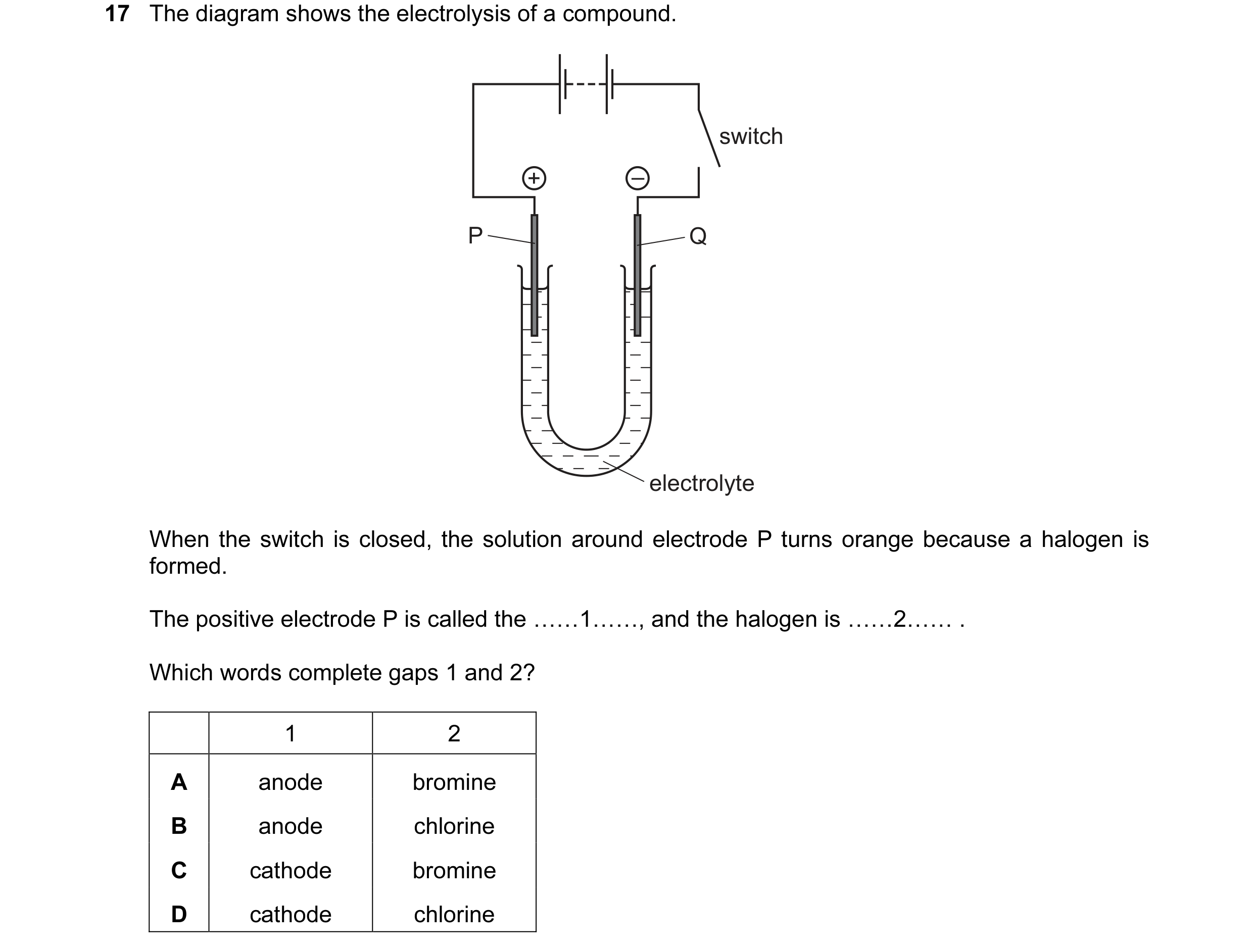
 4 / 11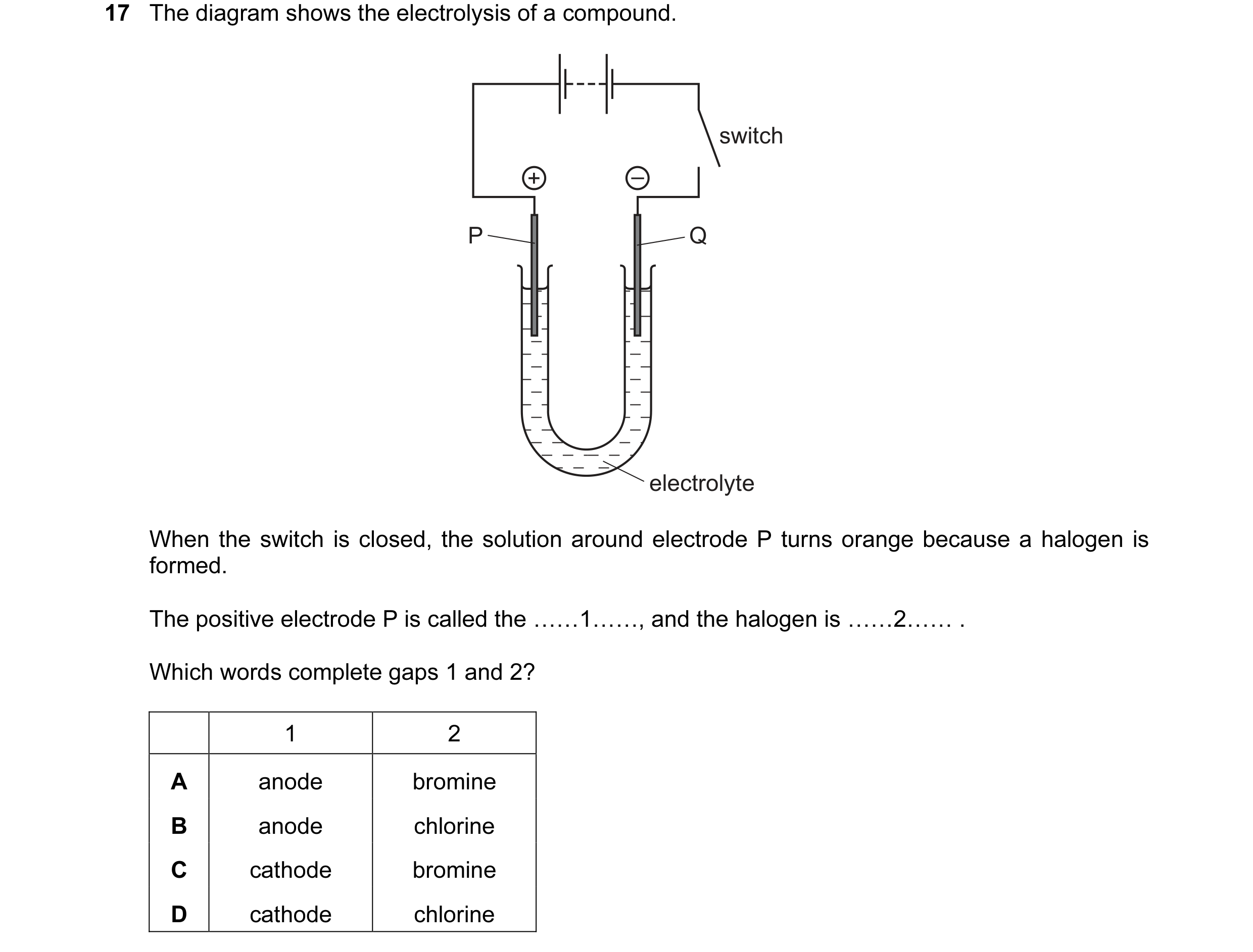
 5 / 11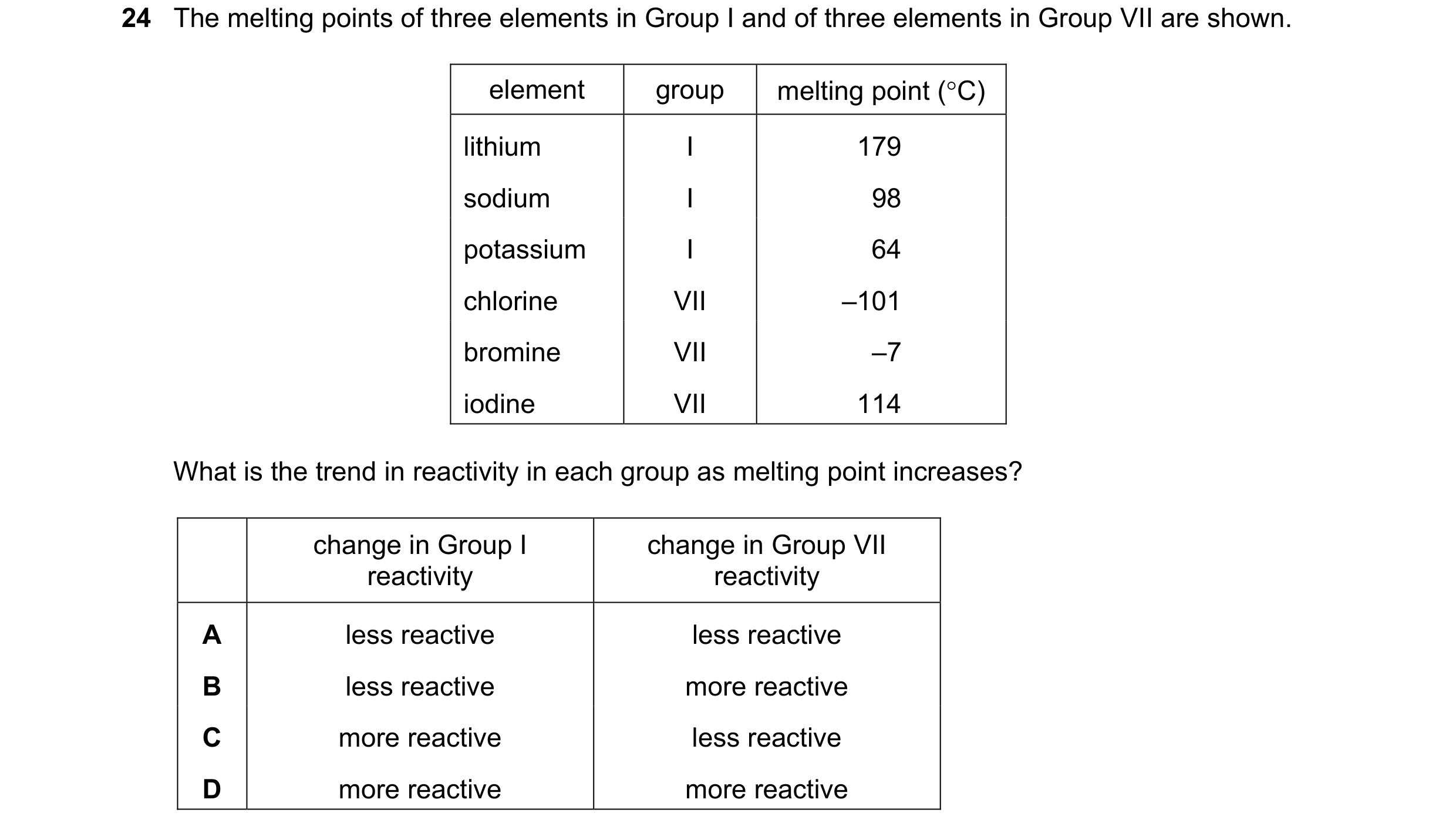

 6 / 11
 7 / 11
 8 / 11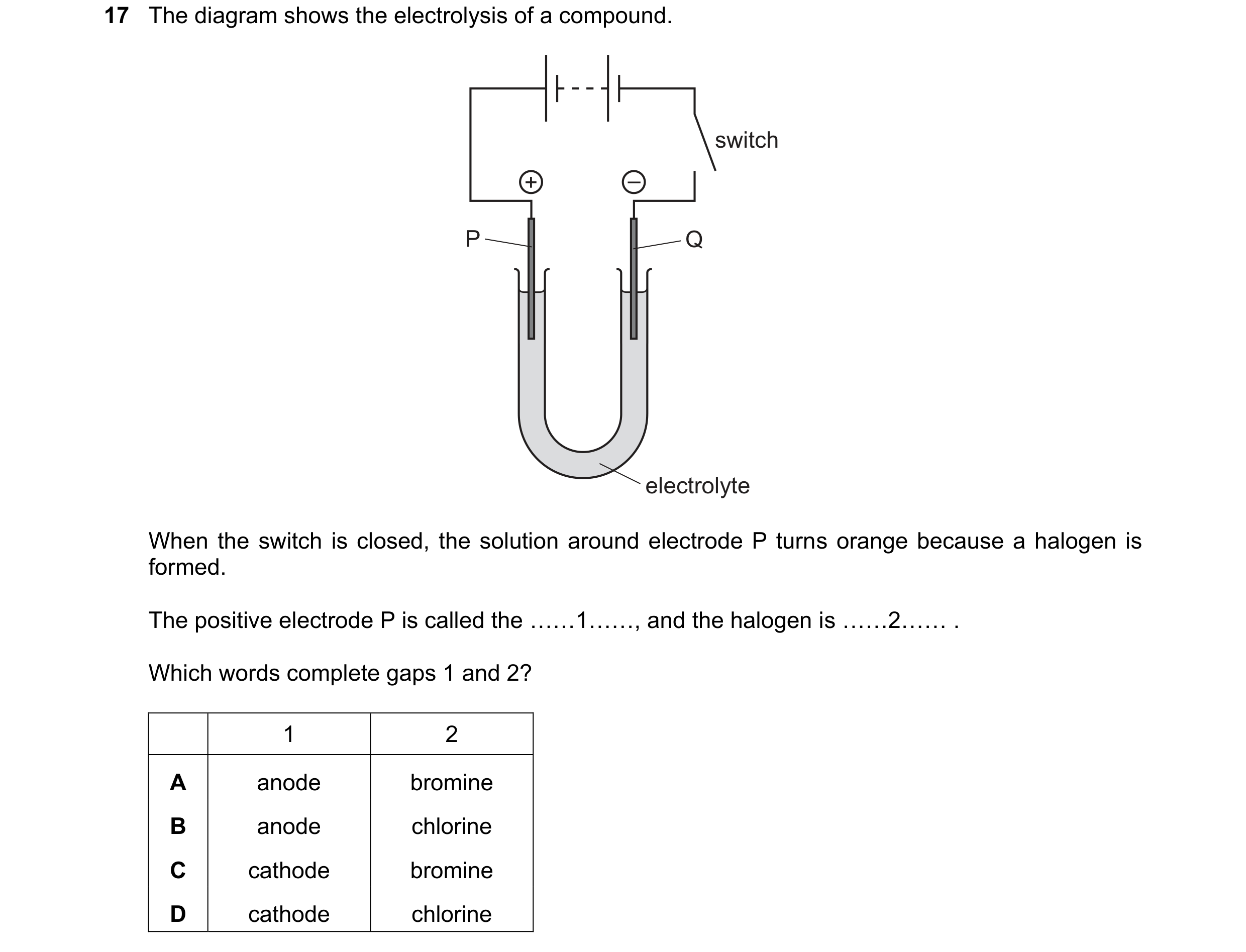
 9 / 11

 10 / 11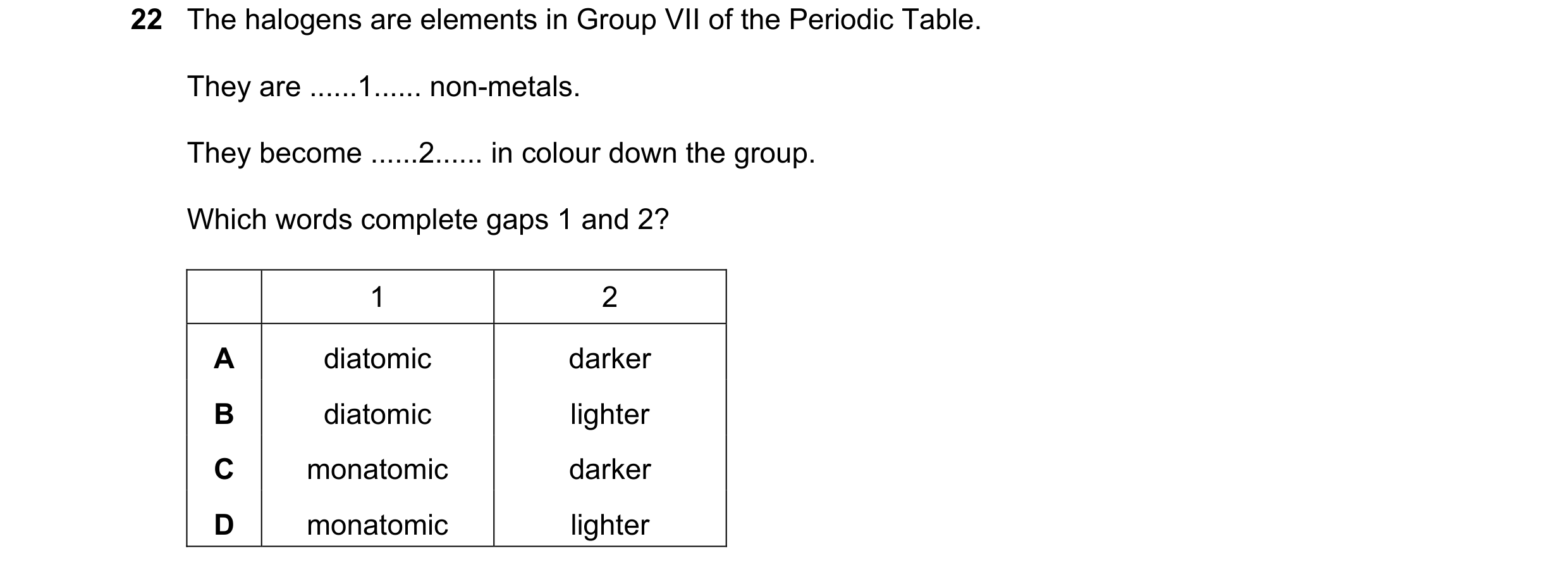

 11 / 11